Article

Robust Adaptive Sensorless Control for PMLSM Based on Improved Sliding Mode Observer and Extended State Observer


School of Intelligence Science and Technology, Beijing University of Civil Engineering and Architecture, Beijing 100044, China
*
Author to whom correspondence should be addressed.
Electronics 2026, 15(5), 984; https://doi.org/10.3390/electronics15050984
Submission received: 2 February 2026 / Revised: 23 February 2026 / Accepted: 26 February 2026 / Published: 27 February 2026

Abstract

Nowadays, sensorless control of permanent magnet synchronous linear motors (PMLSM) is widely utilized in industrial applications due to its inherent cost and spatial advantages. However, existing sensorless control methods for PMLMs face insufficient observation accuracy of states and disturbances and poor variable-speed trajectory tracking. To address these issues, this paper proposes a sensorless control method combining multi-observer coordinated perception and robust adaptive control. Firstly, a sliding mode observer based on an improved saturation switching function is designed, which suppresses current noise with a low-pass filter to achieve unbiased estimation of back electromotive force (EMF). Secondly, an extended state observer with back-EMF as input is constructed to synchronously observe disturbances such as the mover speed, position, and thrust ripple of linear machine. Then, a robust adaptive controller is designed to compensate for system uncertainty via an adaptive law, forming closed-loop control with SVPWM. Compared with the traditional methods, the proposed multi-observer coordinated perception scheme can significantly enhance the observation accuracy of the mover speed, position, and lumped disturbances, and the robust adaptive controller can effectively improve the variable-speed trajectory, tracking performance under system uncertainties. Finally, the simulation results have confirmed the effectiveness of the proposed method in accurately observing and tracking speed and position, providing a feasible solution for high-precision sensorless control of PMLSM.

1. Introduction

PMLSMs are extensively employed in industrial applications, owing to their advantageous characteristics, including rapid dynamic response, high positioning accuracy, and substantial thrust density [1,2]. The acquisition of the position and speed information is the key to the high-precision control of PMLSM [3,4]. Conventional approaches typically rely on mechanical sensors such as photoelectric encoders to directly collect signals, but these methods are often limited by environmental robustness, easily disturbed, and have relatively high purchase and maintenance costs. Consequently, sensorless control technology has emerged as a prominent research direction in linear motor control in recent years [5,6]. This approach offers the distinct advantage of reconstructing motor state information algorithmically, thereby eliminating the necessity for additional physical sensors. At present, sensorless control methods mainly include the high-frequency signal injection method [7,8,9], the extended Kalman filter (EKF) [10,11], the model reference adaptive system (MRAS) [12,13], and the sliding mode observer (SMO) [14,15]. Among these, the sliding mode observer has become an important research and application method due to its merits, including low sensitivity to motor model parameter accuracy, robust external disturbance rejection, a relatively straightforward algorithmic structure, and rapid dynamic response.
Traditional SMO suffers from inherent high harmonic components and high-frequency chattering induced by its sign function, which may even cause system instability [16]. To solve this problem, existing studies have introduced low-pass filters and continuous smooth switching functions (e.g., Sigmoid, saturation, hyperbolic tangent functions) to suppress harmonics and noise [17,18,19], yet conventional SMOs with fixed switching functions in Refs. [14,15] still face an inevitable trade-off between steady-state observation accuracy and chattering suppression. Besides switching function optimization, advanced signal processing technologies, such as adaptive filters and phase-locked loop (PLL), are adopted to improve observation quality [20,21], but the corresponding robust adaptive schemes lack targeted compensation for motor parameter time-variation, leading to poor adaptability to the temperature drift of stator resistance and inductance. In addition, the cascaded SMO-ESO structure has been proposed for disturbance observation and compensation [22,23] and verified in the sensorless control of rotating permanent magnet synchronous motors (PMSMs); however, there is still a lack of mature targeted SMO-ESO sensorless control schemes for permanent magnet synchronous linear motors (PMLSMs). Meanwhile, existing SMO-ESO designs mostly only focus on one-dimensional disturbance compensation, ignoring the coupling effect of system uncertainties, and fail to realize the deep integration of disturbance observation results and control law design.
PMLSM control systems face not only the difficulty in achieving accurate observation of system states but also prominent challenges in disturbance rejection and dynamic response performance. As a result, robust adaptive control strategies have become the preferred solution for motor speed control [24]. By incorporating disturbance rejection terms or designing robust control laws, such strategies reduce the system’s sensitivity to thrust force fluctuations, external disturbances, and parameter variations in PMLSMs, thereby enhancing operational stability under uncertain operating conditions [25,26,27,28]. Furthermore, the implementation of adaptive laws enables real-time monitoring of system states, facilitating rapid response and precise compensation for disturbances and deviations under complex operating conditions. While this type of method can effectively improve the system’s disturbance rejection capability and dynamic response speed, it is plagued by inadequate coordination between the control strategy and the state observer. This limitation readily leads to constrained anti-interference ability, dynamic response lag, and impaired fast synchronization between control outputs and observed states, ultimately degrading the overall dynamic performance of the system.
To address the aforementioned deficiencies in state observation accuracy, disturbance rejection, and dynamic performance of the sensorless PMLSM drive, this work adopts a robust adaptive control strategy based on a cascaded observer structure, which integrates a sliding-mode observer (SMO) and an extended state observer (ESO).
Major contributions and salient features of this work are as follows:
  • A sensorless control scheme combining multi-observer coordinated perception and robust adaptive control is proposed for permanent magnet synchronous linear motors (PMLSM), which addresses the issues of insufficient observation accuracy of states and disturbances, and poor variable-speed trajectory tracking in existing methods.
  • A sliding mode observer (SMO) based on an improved saturation switching function is designed, where a low-pass filter is introduced to suppress current noise, achieving unbiased estimation of back electromotive force (EMF) and significantly alleviating the chattering issue in conventional SMOs.
  • An extended state observer (ESO) with back-EMF as input is constructed to synchronously observe the mover speed, position, and lumped disturbances including thrust ripple, realizing multi-state and disturbance cooperative perception for PMLSM.
  • A robust adaptive controller is designed to compensate for system uncertainties via an adaptive law, which is integrated with SVPWM to form a closed-loop control system, thus significantly improving the variable-speed trajectory tracking performance and anti-interference ability of the PMLSM drive.
The rest of this article is organized as follows. Section 2 presents the mathematical model of PMLSM. The design of the SMO-ESO cascaded observer is introduced in Section 3. Section 4 elaborates on the robust adaptive control strategy. Simulation results and comparative analysis are provided in Section 5. Finally, Section 6 concludes this article.

2. Mathematical Model of PMLSM

The mathematical model of the PMLSM lays a theoretical foundation for the design of its control system. It is derived from the fundamental principles of electromagnetic induction and electromechanical energy conversion. This model explicitly characterizes the dynamic interrelationships among d–q axis voltages, currents, flux linkages, mover velocity, and electromagnetic thrust. Moreover, it incorporates key nonlinear factors inherent to the motor, including parameter variations and end effects, thereby establishing a theoretical basis for the development of high-performance PMLSM control algorithms.
The voltage equation in the dq frame can be expressed as
i ˙ d = 1 L d u d R s L d i d + π τ L d v ψ q i ˙ q = 1 L q u d R s L q i d + π τ L q v ψ d
where ud and uq denote the d-axis and q-axis components of the stator voltage, respectively; id and iq represent the d-axis and q-axis components of the stator current; Ld and Lq are the d-axis and q-axis components of the stator inductance; ψd and ψq correspond to the d-axis and q-axis components of the flux linkage; Rs is the stator resistance; τ stands for the pole pitch; and v indicates the linear velocity of the mover.
The flux linkage equations of the PMLSM are defined as follows:
ψ d = L d i d + ψ f ψ q = L q i q
where ψf is the flux linkage of the PMLSM.
The mechanical motion equations of the PMLSM are given by
M v ˙ = F e B v F l F d
F e = P 3 π 2 τ L d L q i d i q + ψ f i q
where M denotes the mover mass, Fe represents the electromagnetic thrust, Fl is the load force, and Fd is the detent force (cogging force); B represents the viscous friction coefficient, and P is the number of pole pairs.
When the dq-axis inductances are equal (Ld = Lq = Ls), the electromagnetic thrust can be simplified as follows:
F e = P 3 π 2 τ ψ f i q
In this case, the electromagnetic thrust varies linearly with the q-axis current and is independent of the d-axis component.

3. SMO-ESO Velocity and Position Observer

The SMO-ESO combined observer utilizes the advantages of the SMO and ESO to provide accurate observation of the system states and total disturbances, providing theoretical support for the sensorless control technology of PMLSM.

3.1. PMLSM Voltage Equations in the α-β Coordinate Frame

In the α-β stationary coordinate frame, the voltage equations of the PMLSM form the fundamental theoretical basis for the design of the SMO. Utilizing the nonlinear switching mechanism of the SMO, the back-EMF components can be extracted from the stator current dynamics, thus enabling sensorless state observation that is independent of physical sensors.
The voltage equations of the PMLSM in the α–β coordinate frame are given by
i ˙ α = 1 L s u α R s L s i α + 1 L s e α i ˙ β = 1 L s u β R s L s i β + 1 L s e β
where uα and uβ represent the α- and β-axis components of the stator voltage, respectively; iα and iβ denote the α- and β-axis components of the stator current; eα and eβ are the α and β-axis components of the back-EMF; and Ls is the stator inductance.
The mathematical expressions for the back-EMF components are given by
e α = sin π τ x π τ v ψ f e β = cos π τ x π τ v ψ f
where x is the position of the mover.

3.2. Design of the Sliding Mode Observer

The SMO design is based on the mathematical model of PMLSM; it utilizes the inherent robustness of sliding mode variable structure control along with an improved algorithm to facilitate precise and real-time observation of the mover state under sensorless conditions.
A conventional SMO is formulated as
i ^ ˙ α = 1 L s u α R s L s i ^ α + 1 L s e ^ α i ^ ˙ β = 1 L s u β R s L s i ^ β + 1 L s e ^ β
where i ^ α and i ^ β are the observed values of the stator currents iα and iβ, and e ^ α and e ^ β are the observed values of the back-EMF components eα and eβ.
The observed back-EMF is derived as
e ^ α = K tanh ( i ^ α i α ) e ^ β = K tanh ( i ^ β i β )
where tanh ( a x ) = e α x e α x e α x + e α x , K > max e α tanh ( i ^ α i α ) , e β tanh ( i ^ β i β ) ; the switching gain K can be adjusted according to the operating speed.
From Equations (6) and (8), the error dynamics can be expressed as
i ^ ˙ α i ˙ α = R s L s ( i ^ α i α ) + 1 L s ( e ^ α e α ) i ^ ˙ β i ˙ β = R s L s ( i ^ β i β ) + 1 L s ( e ^ β e β )
When the system reaches steady state, s = i ^ i = 0 , it leads to equality between the observed and actual back-EMF values:
e α = e ^ α = K tanh ( i ^ α i α ) e β = e ^ β = K tanh ( i ^ β i β )
To mitigate the adverse effects of high-frequency noise, stemming from sliding mode chattering, current sampling interference, and inverter nonlinearities, on the observed back-EMF, and to ensure the accurate subsequent calculation of the mover position and electrical angular velocity, a low-pass filter is employed to further process the observed back-EMF signals. This step effectively suppresses high-frequency noise and generates smoothed back-EMF estimation signals:
e ^ α = ω c s + ω c K tanh ( i ^ α i α ) e ^ α = ω c s + ω c K tanh ( i ^ α i α )
where ωc is the cutoff frequency of the low-pass filter.
The back-EMF estimation performance of the conventional SMO, the tanh-function-based SMO, and the proposed improved SMO are compared under variable-speed conditions.
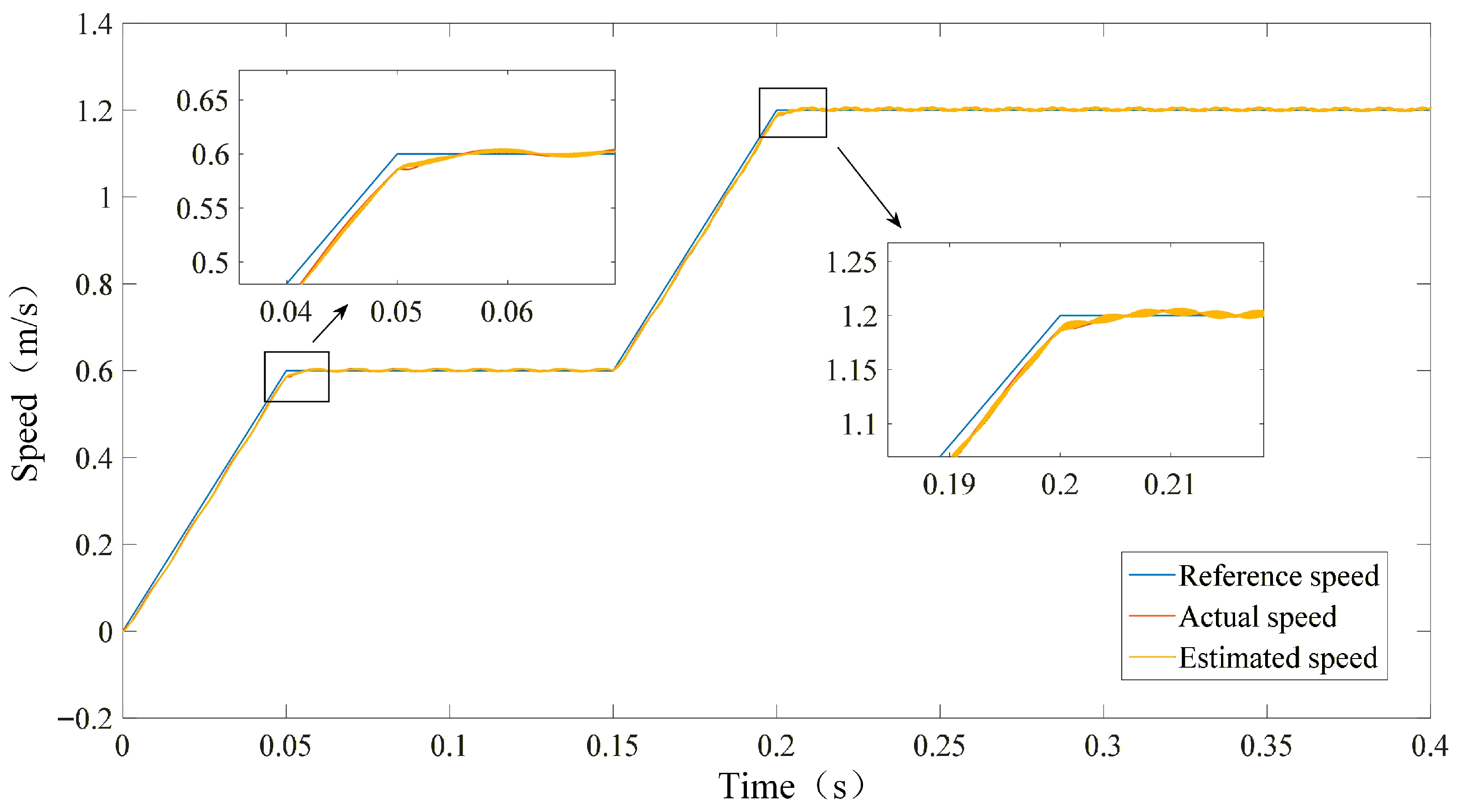
The back-EMF waveforms of the PMLSM under a two-step speed profile (accelerating to 0.6 m/s during 0–0.05 s, keeping constant until 0.15 s, then accelerating to 1.2 m/s during 0.15–0.2 s and remaining stable until 0.4 s) are illustrated in Figure 1. It can be clearly observed that the EKF in Figure 1a achieves superior estimation performance, yielding smooth, standard sinusoidal back-EMF with stable amplitude and a well-maintained 90° phase difference throughout the entire operating range. The conventional SMO in Figure 1b suffers from severe chattering and significant square-wave distortion, resulting in poor waveform quality and disrupted phase characteristics. Although the proposed SMO in Figure 1c achieves improved smoothness compared with the conventional SMO, noticeable waveform distortion still appears under the high speed of 1.2 m/s. Three schemes are compared, namely, the SMO with an improved saturation switching function, the SMO with a sign function, and the traditional SMO with a hyperbolic tangent function. The proposed saturation-function-based SMO exhibits the best performance, with fast convergence, smooth sinusoidal waveforms, accurate phase alignment, and stable amplitudes without obvious distortion or performance degradation, which fully demonstrates its higher estimation accuracy and better dynamic tracking performance than the other two SMO methods.
Compared with the traditional sign function and piecewise linear saturation function, the improved saturation function offers core advantages: it suppresses chattering more thoroughly, eliminates discontinuities at transition points, and enhances observation smoothness and steady-state accuracy, while retaining the strong robustness of sliding mode and balancing dynamic response with parameter robustness.

3.3. Parameter Uncertainties and Disturbances

The problems of parameter time-varying, external disturbance, and system coupling faced by PMLSMs under actual working conditions are mainly attributed to the temperature drift characteristics of resistance and inductance, load mutation, and thrust fluctuation of end effect. These uncertainties will directly reduce the dynamic and steady state performance of the system, which requires that the control strategy must have the ability of real-time estimation and dynamic compensation.
By separating the uncertainties and disturbances, the system can be described as
v ˙ = χ i q * + d + g
d = χ ( i q i q * ) η v γ ( F l + F d ) g = χ i q η v γ ( F l + F d )
where d represents the total disturbance, g denotes the uncertainty, and χ = 3 π P 2 τ M ψ f , η = P B M , γ = P M , ∆χ, ∆η, ∆γ gamma are uncertain parameters.

3.4. Design of the Extended State Observer (ESO)

In practice, Fe, Fl, and Fd are difficult to obtain in real time, thereby making it impossible to estimate the motor states via the motor motion equation. Accordingly, this study develops an ESO for the real-time estimation of the aforementioned disturbance and the synchronous observation of the mover position and velocity.
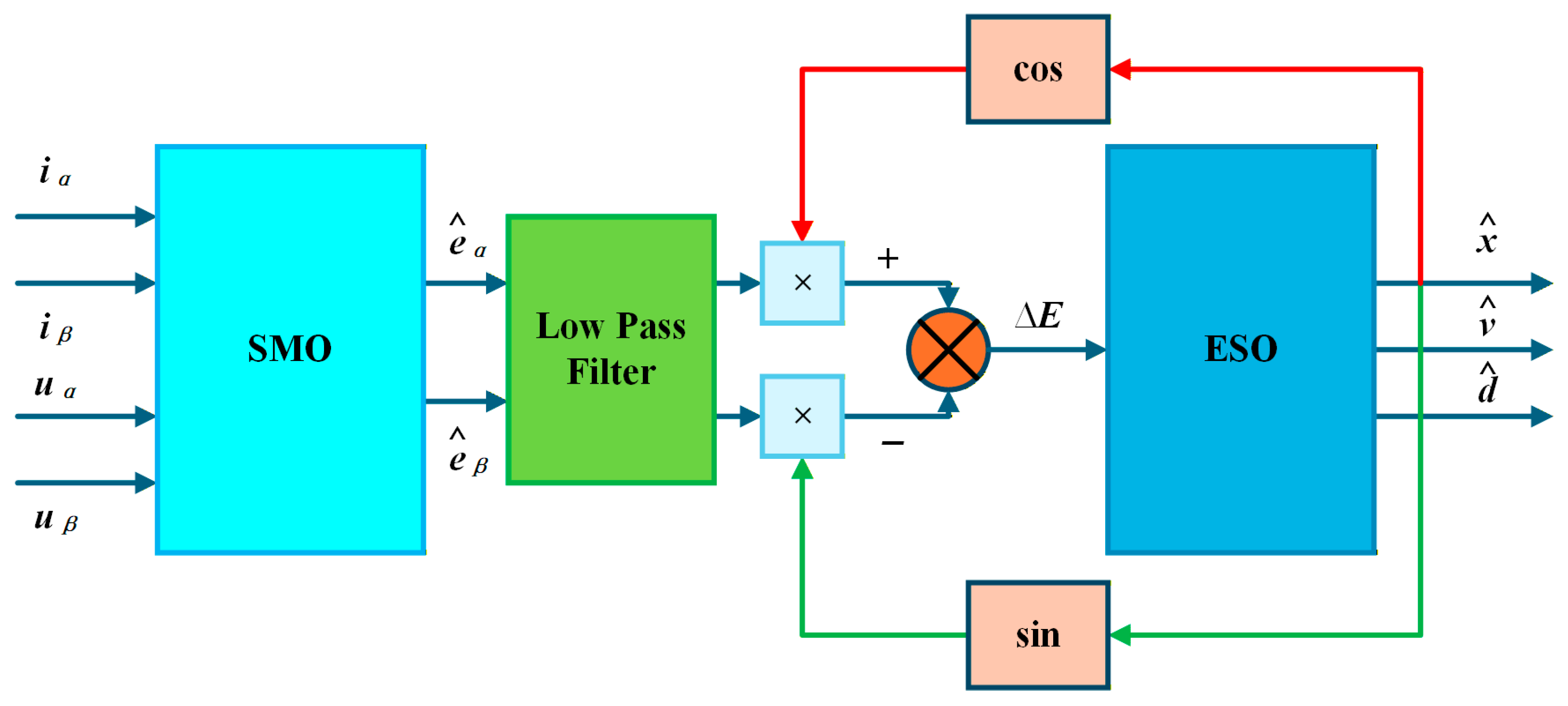
As illustrated in Figure 2, the α-β axis back-EMF signals are estimated using the SMO from the α-β axis stator currents and voltages of the PMLSM. The raw estimated signals are first processed by a low-pass filter, and the filtered back-EMF signals are then fed into the coordinate transformation module to generate the error signal E . Subsequently, this error signal is input into the ESO to realize real-time disturbance observation, as well as simultaneous estimation of the mover position and velocity of the PMLSM. To facilitate the engineering implementation of the proposed observer, a generic second-order extended state observer is designed in this study.
The ESO design may refer to [29], a general second-order ESO can be expressed as
x ˙ 1 ( t ) = x 2 ( t ) x ˙ 2 ( t ) = f ( x 1 , x 2 , t ) + b u ( t )
where b is a constant greater than zero, u(t) is the control input, and f(x1, x2, t) represents a bounded unknown nonlinear perturbation.
When the observer stabilizes, the position estimation error approaches zero, satisfying sin ( π τ x ^ π τ x ) π τ x ^ π τ x . To better process the back-EMF signal, an intermediate variable is defined as follows:
E = e ^ α cos π τ x ^ e ^ β sin π τ x ^ = k sin π τ x cos π τ x ^ k cos π τ x sin π τ x ^ = k sin ( π τ x ^ π τ x ) k 1 ( x ^ x )
Based on Equation (16), the position estimation error can be expressed as follows:
e 1 ( t ) = x x ^ = z 1 ( t ) x 1 ( t ) = E k 1
From Equations (13) and (15), by defining d = x 3 = f ( x 1 , x 2 , t ) , the ESO can be designed as
e 1 ( t ) = π τ x π τ x ^ = E k 1 x ^ ˙ = v ^ ( t ) β 1 e 1 ( t ) v ^ ˙ ( t ) = d ^ ( t ) + g ^ ( t ) + χ i q * ( t ) β 2 e 1 ( t ) d ^ ˙ ( t ) = β 3 e 1 ( t )
where β3 = 3ω, β2 = 3ω2, β3 = ω3, with ω being the observer bandwidth [30]. When k 1 = π k / τ , k is the gain parameter. The gain k significantly influences the amplitude and convergence characteristics of the observation error; conversely, a smaller k increases the error amplitude and slows convergence, making it unsuitable for high-precision or high-speed applications. Therefore, the selection of k should be tailored to practical conditions.

4. Robust Adaptive Speed Controller Design

The robust adaptive control strategy combines the technical advantages of adaptive control and robust control and has the features of high synergism with the observer, enabling a trade-off between the anti-disturbance ability and dynamic response performance of the system. Therefore, it provides a high-precision, robust closed-loop control solution for the sensorless control of PMSLMs.

4.1. Design of the Speed Controller

To balance dynamic response and anti-interference ability while reducing electromagnetic thrust fluctuations, the proposed controller comprehensively accounts for velocity error, total disturbances, and system uncertainties in its design.
The speed error is defined as
e v ( t ) = v * v ^
where v* represents the reference speed.
From Equation (13), the dynamic error of speed tracking can be expressed as
e ˙ v = v * χ i q * d ^ g ^
Considering the error characteristics of PMLSM sensorless control, the speed observation error and its integral are incorporated into the sliding surface. By appropriately constructing the sliding surface parameters, the system error can converge rapidly. The error sliding surface is designed as
s = e v ( t ) e v ( 0 ) + c 0 t e v ( t ) d t , c > 0
To estimate system uncertainties and satisfy stability requirements, the adaptive law is designed as
g ^ ˙ = λ s
By incorporating the pre-designed sliding surface, the estimated disturbances, and system uncertainties, this paper presents the design of the speed controller as follows:
i q * = 1 χ v ˙ * g ^ d ^ + c e v + ε s i g n ( s ) + k s
where k > 0, and ε is a positive constant. Conventional sliding mode control achieves deterministic robustness via a sign function and fixed sliding surface, but its high-frequency switching term easily causes chattering. In contrast, the proposed method adopts an adaptive law and robust terms to the online estimate and compensates system uncertainties without relying on a fixed sliding surface. With a continuous robust-adaptive structure and no high-frequency switching actions, it inherently suppresses chattering while maintaining strong robustness. Furthermore, its adaptive mechanism improves the adaptability to time-varying uncertainties and external disturbances, leading to smoother control performance and higher steady-state accuracy.

4.2. Stability Analysis of the Controller

To verify the stability and robustness of the proposed robust adaptive controller, an appropriate Lyapunov function based on Lyapunov stability theory is constructed.
The Lyapunov function is selected as
V = 1 2 s 2 + 1 2 λ g ^ 2
The uncertainty estimation error is defined as g ˜ = g g ^ , and the time derivative of the estimation error is g ˜ ˙ = g ^ ˙ . Accordingly, the derivative of V is given by
V ˙ = s s ˙ + 1 λ g ˜ g ˜ ˙ = s ( v * χ i q * d ^ g ^ + c e v + ε s i g n ( s ) + k s ) s ( ε s i g n ( s ) + k s ) g ˜ s + 1 λ g ˜ g ˜ ˙ = s ( ε s i g n ( s ) + k s )
When the parameters are selected to satisfy ε > v ˜ ˙ + d ˜ , v ˜ = v v ^ , and d ˜ = d d ^ , then V ˙ 0 is established. According to the Lyapunov stability theorem, the robust adaptive speed controller designed in this paper is asymptotically stable.

5. Results and Analysis

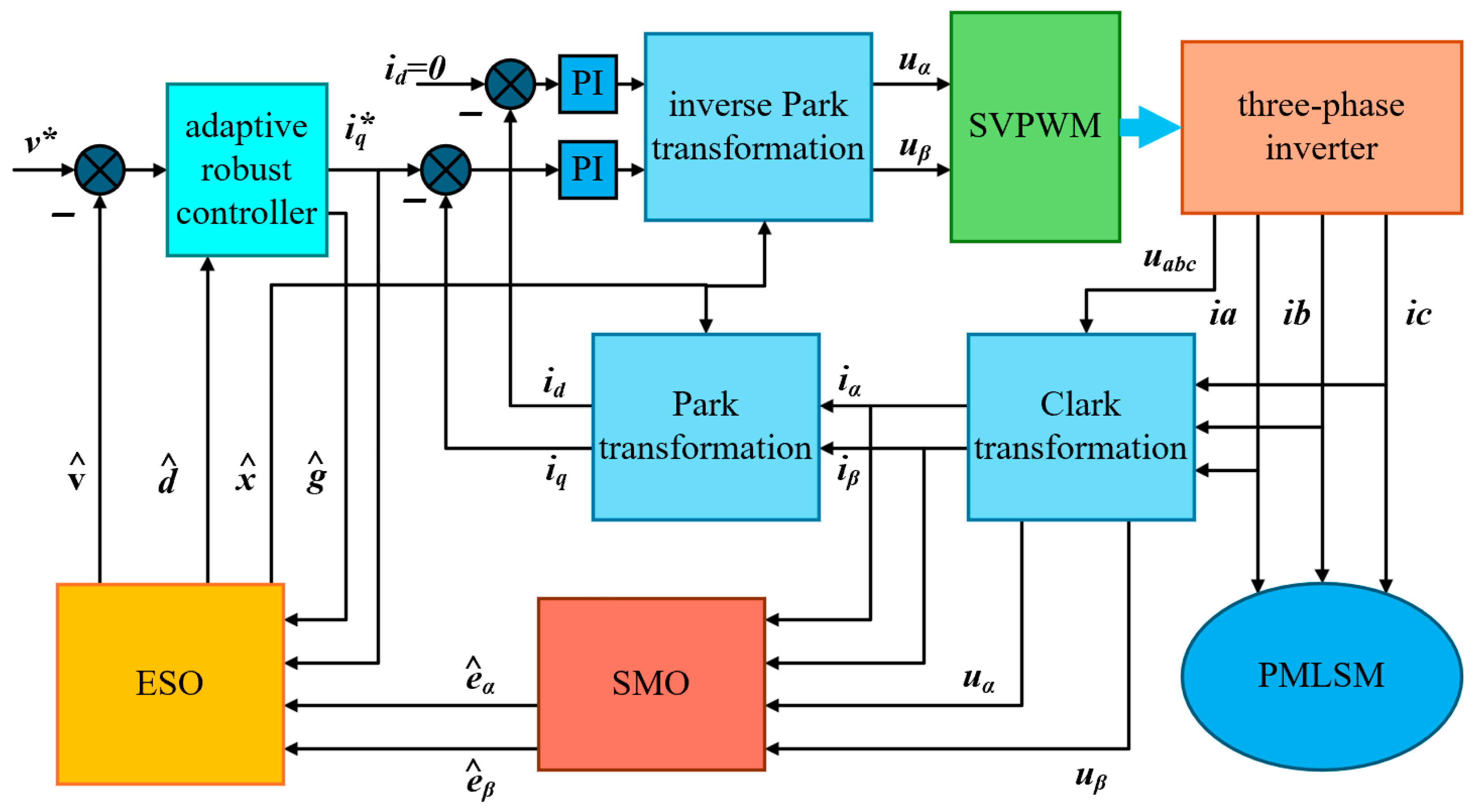
In this section, comprehensive simulation verifications are conducted to quantitatively evaluate the performance of the proposed control strategy from four critical indicators, namely observer estimation accuracy, dynamic response speed, steady-state control precision, and anti-interference ability, which demonstrates its comprehensive superiority. Figure 3 depicts the schematic diagram of the PMLSM control system.
Notably, the integrated configuration of the SMO-ESO and the proposed robust adaptive control algorithm constitutes the distinctive innovation of this control system, with the developed control algorithm implemented in the speed loop to govern the dynamic response and anti-interference ability. The parameters of the PMLSM utilized for the simulations are detailed in Table 1.

5.1. Analysis of Parameter Variation Effects on Control Accuracy

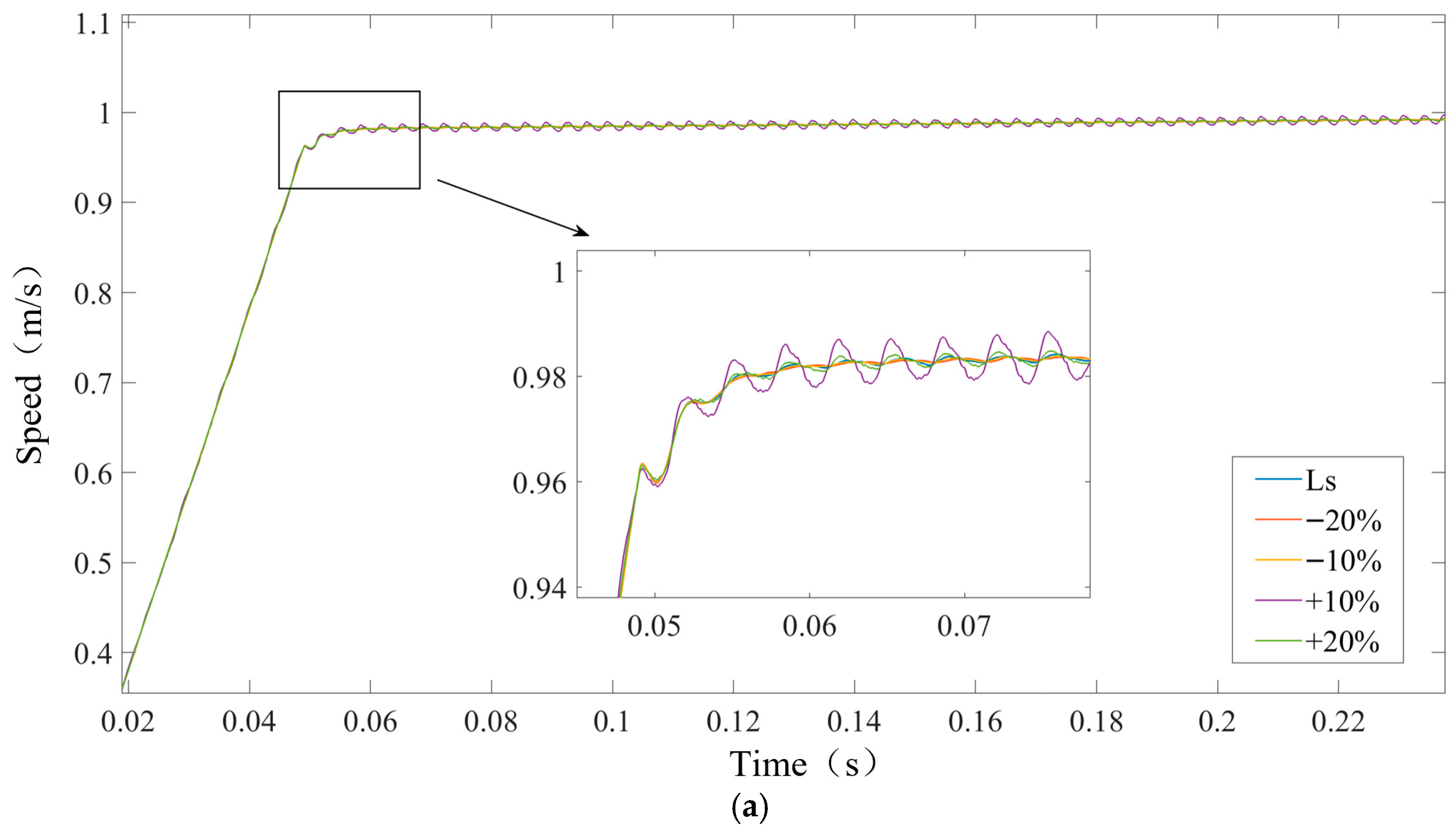
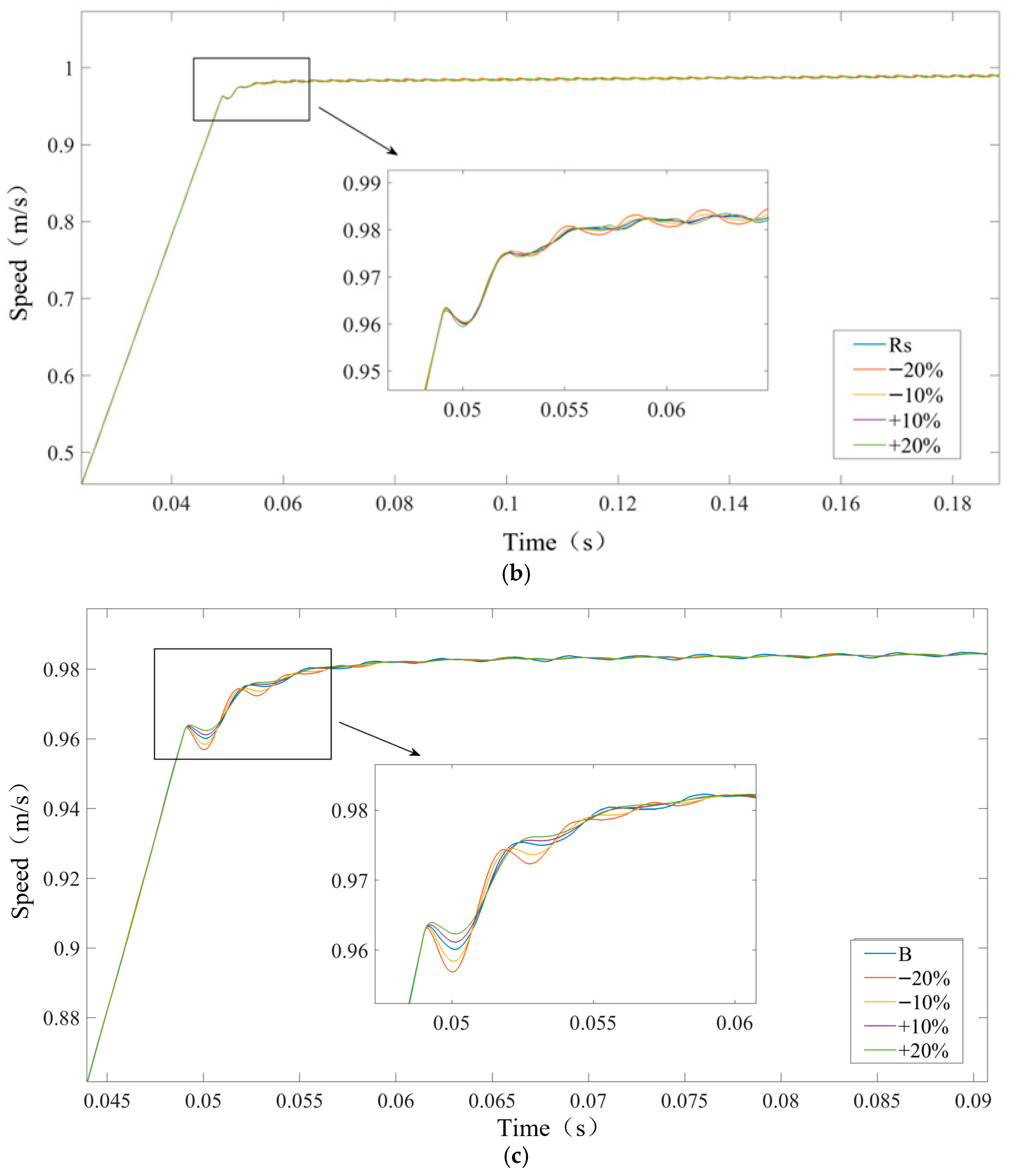
The analysis diagrams of the parameter variation effects are added to investigate the impacts of ±20% variations in Rs, Ls, and B on control accuracy under steady-state conditions at the speeds of 0.6 m/s and 1.2 m/s, with a variation step of 10%.
To evaluate the robustness of the proposed control strategy against parameter variations, we conducted tests under ±10% and ±20% perturbations of the viscous friction coefficient B, stator inductance Ls, and stator resistance Rs, respectively. The speed response curves under these conditions are shown in Figure 4a–c. As shown in Figure 4a, an increase in B reduces the overshoot during the speed response but slightly prolongs the rise time. Conversely, a decrease in B increases the overshoot but accelerates the response, while the steady-state speed remains stable within a narrow range, indicating the system’s good robustness to B variations. As shown in Figure 4b, an increase in Ls leads to more pronounced oscillations in the speed response, a larger overshoot, and a longer settling time, whereas a decrease in Ls results in a faster response with reduced oscillations, demonstrating that the system is more sensitive to increases in Ls. As shown in Figure 4c, an increase in Rs slightly prolongs the rise time and increases the overshoot, while a decrease in Rs accelerates the response and reduces the overshoot; the overall impact of Rs variations on the system’s steady-state performance is minimal, confirming the strategy’s robustness against resistance changes.
Table 2 is obtained through a series of simulation tests. Among all parameter perturbations as Table 2, an increase in Ls has the most significant impact on the system, leading to increased overshoot and prolonged settling time, which indicates that the system is more sensitive to inductance increments. In contrast, variations in Rs and B have a milder effect on the system, with the steady-state speed error remaining below 0.0023 m/s across all test cases, which fully demonstrates the excellent robustness of the proposed control strategy against parameter variations.

5.2. Comparison Between Sensed and Sensorless PI Control

In order to validate the high estimation accuracy of the designed observers, a comparative analysis between the sensed PI control and sensorless PI control strategies is conducted.
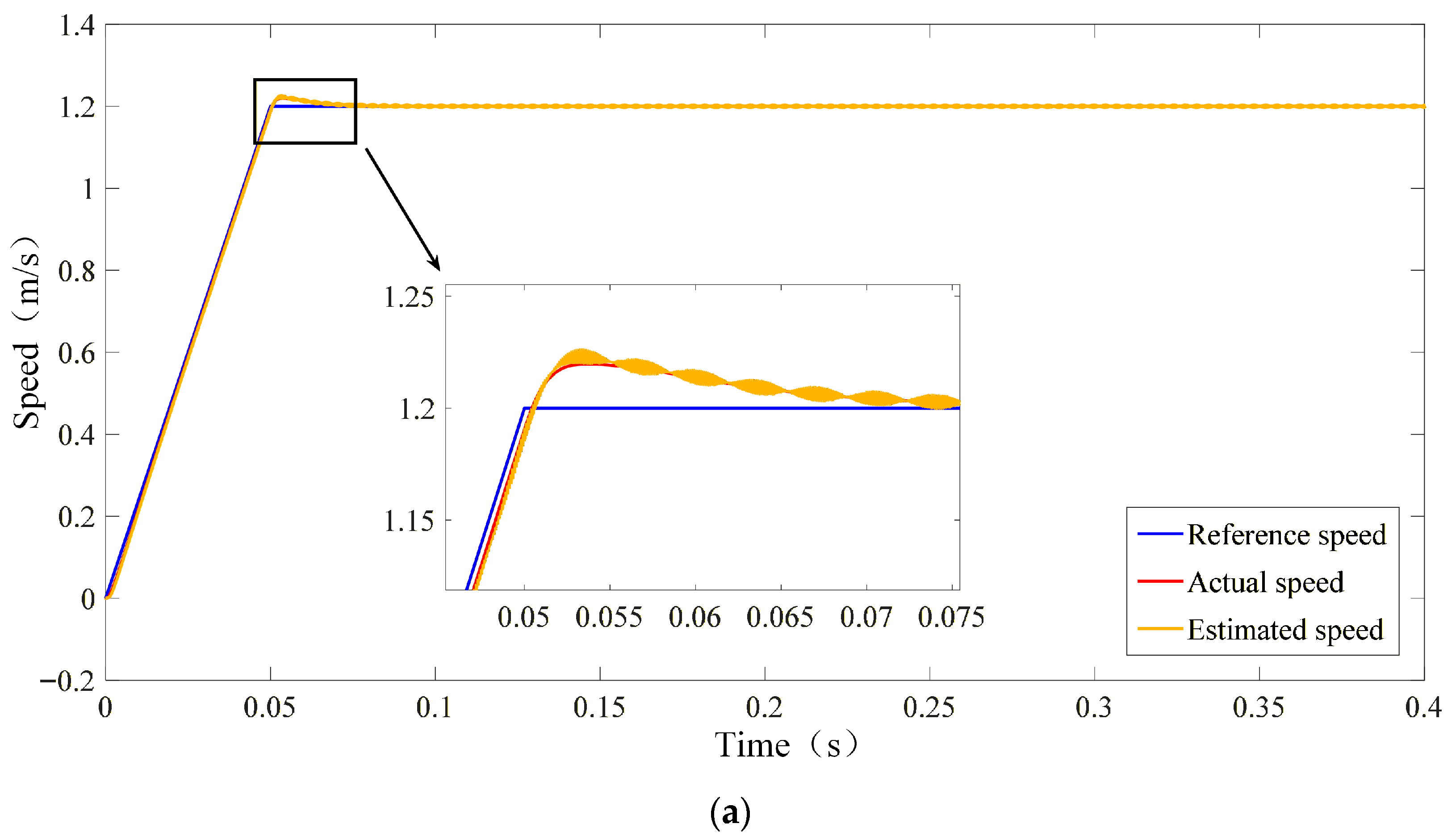
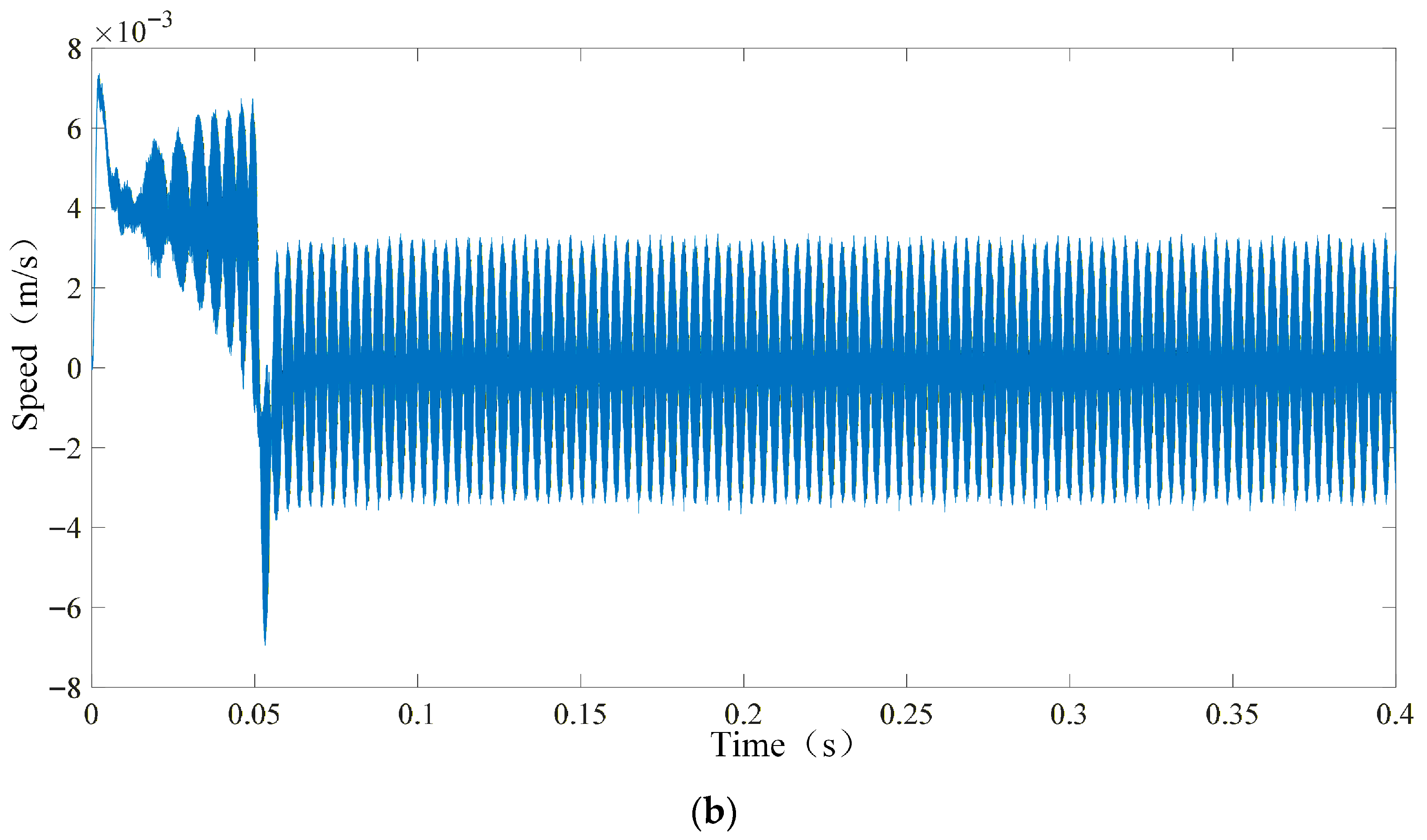
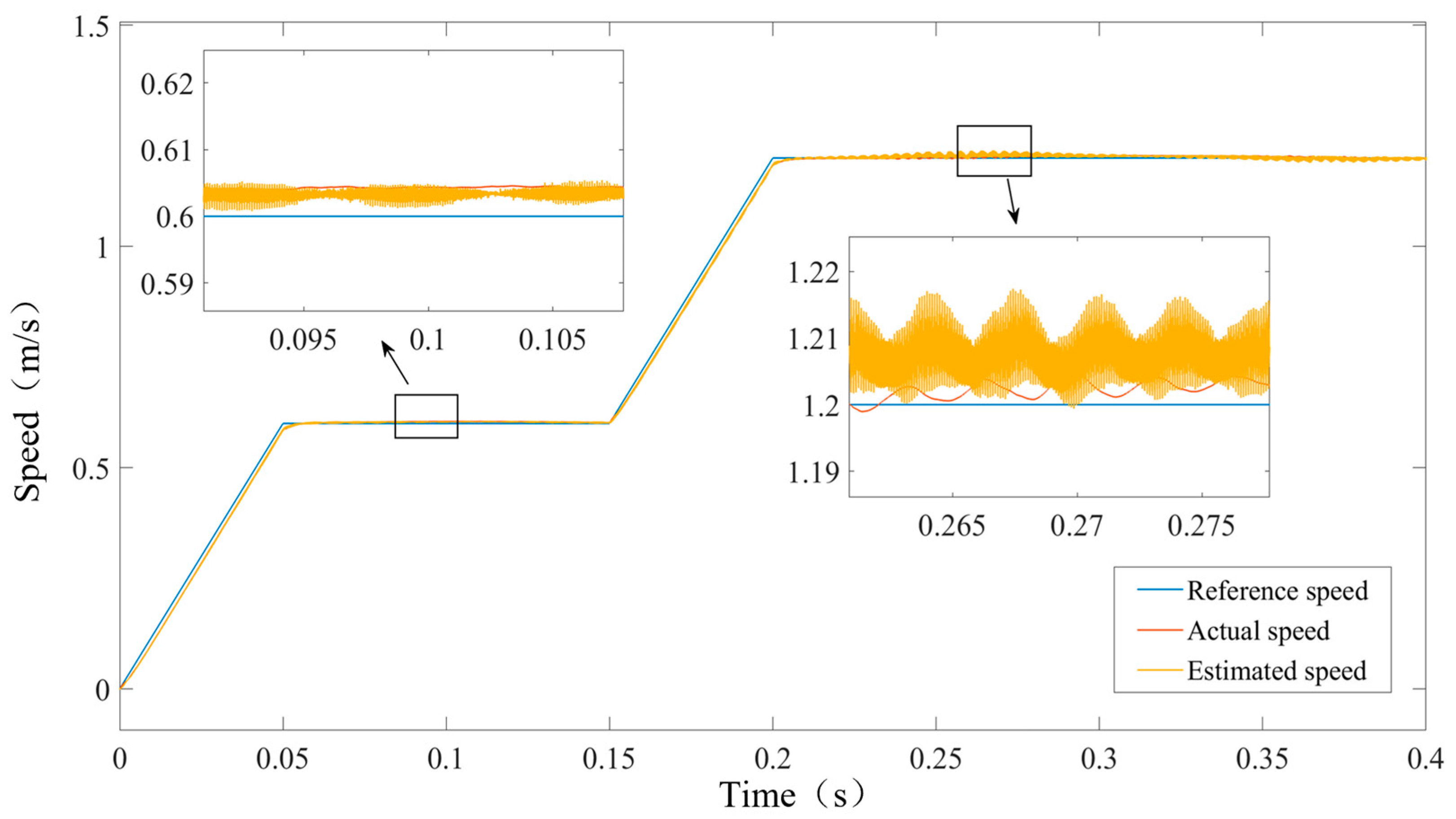
In Simulation 1, the reference speed was set to Speed Curve 1 as shown in Figure 5a, and a conventional PI controller [31] was employed under both sensored and sensorless conditions. As depicted in Figure 5a, during the dynamic response phase, the estimated speed from the sensorless PI control tightly tracks the actual speed, with a maximum dynamic deviation of merely 0.0041 m/s; in the steady state, the two curves nearly overlap, achieving a coincidence degree exceeding 99.9%. The speed estimation error curve in Figure 5b further reveals that the error remains in narrow range, with peak-to-peak fluctuations limited to below 0.0062 m/s; after the system reaches dynamic stability at 0.2 s, the error amplitude is further reduced to less than 0.0037 m/s, maintaining an average steady-state error of only 0.0019 m/s. These data demonstrate that the speed estimation signal generated by the sensorless PI control scheme is highly accurate and reliable for practical engineering applications.
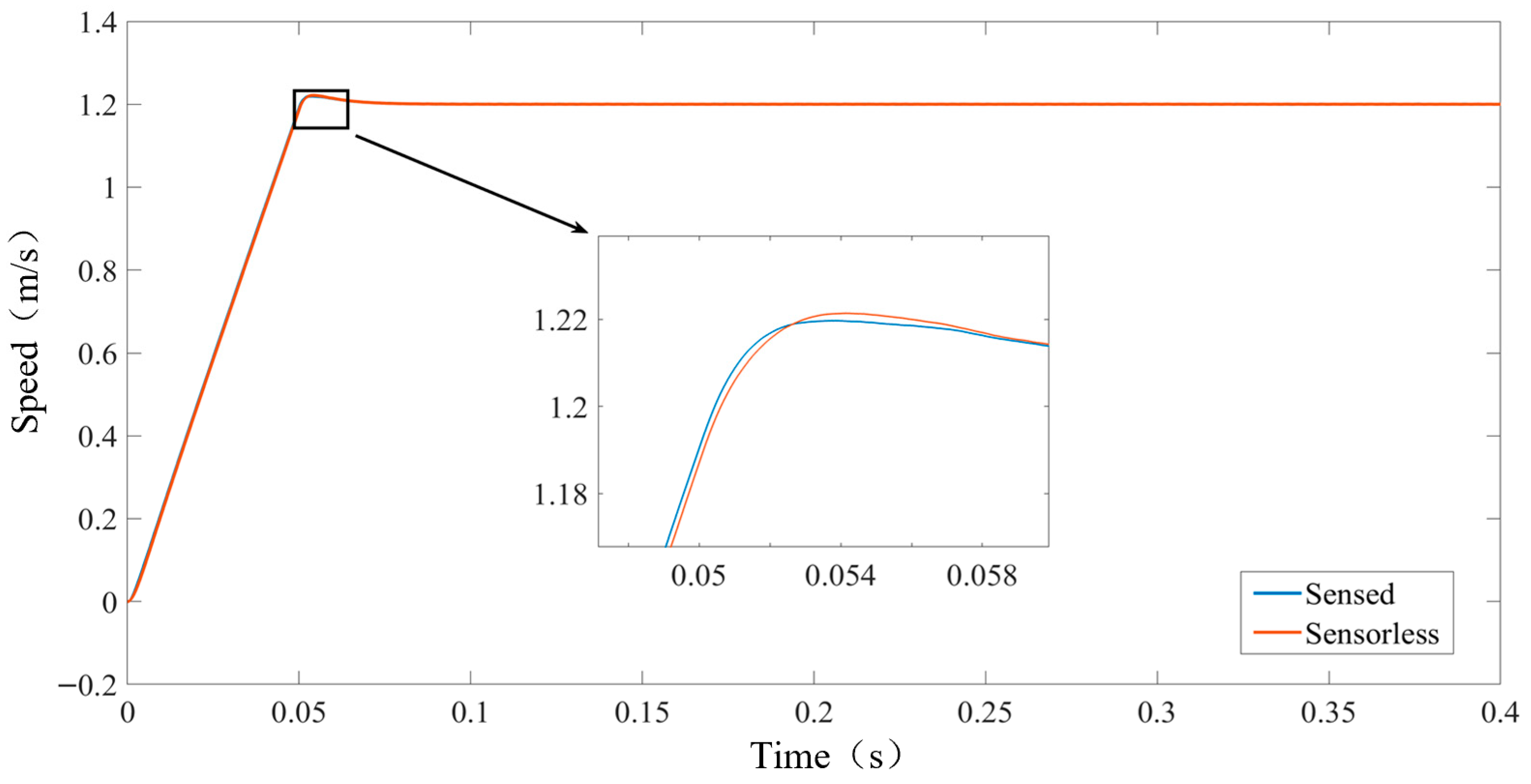
Figure 6 illustrates the speed comparison between the sensorless and sensored PI control. The speed curves of the sensorless PI control and sensored PI control are highly consistent; the steady-state speed deviation of the sensorless control is 0.0023 m/s, which is comparable to the 0.0018 m/s of the sensored control. These results confirm that the proposed sensorless PI control scheme exhibits high estimation accuracy, with its speed tracking performance on par with that of the sensored counterpart.

5.3. Sensorless Robust Adaptive Control

To verify the effective coordination between the control module and the observation module, the sensorless robust adaptive control system is operated under two typical operating conditions, namely time-varying speed and external disturbance.
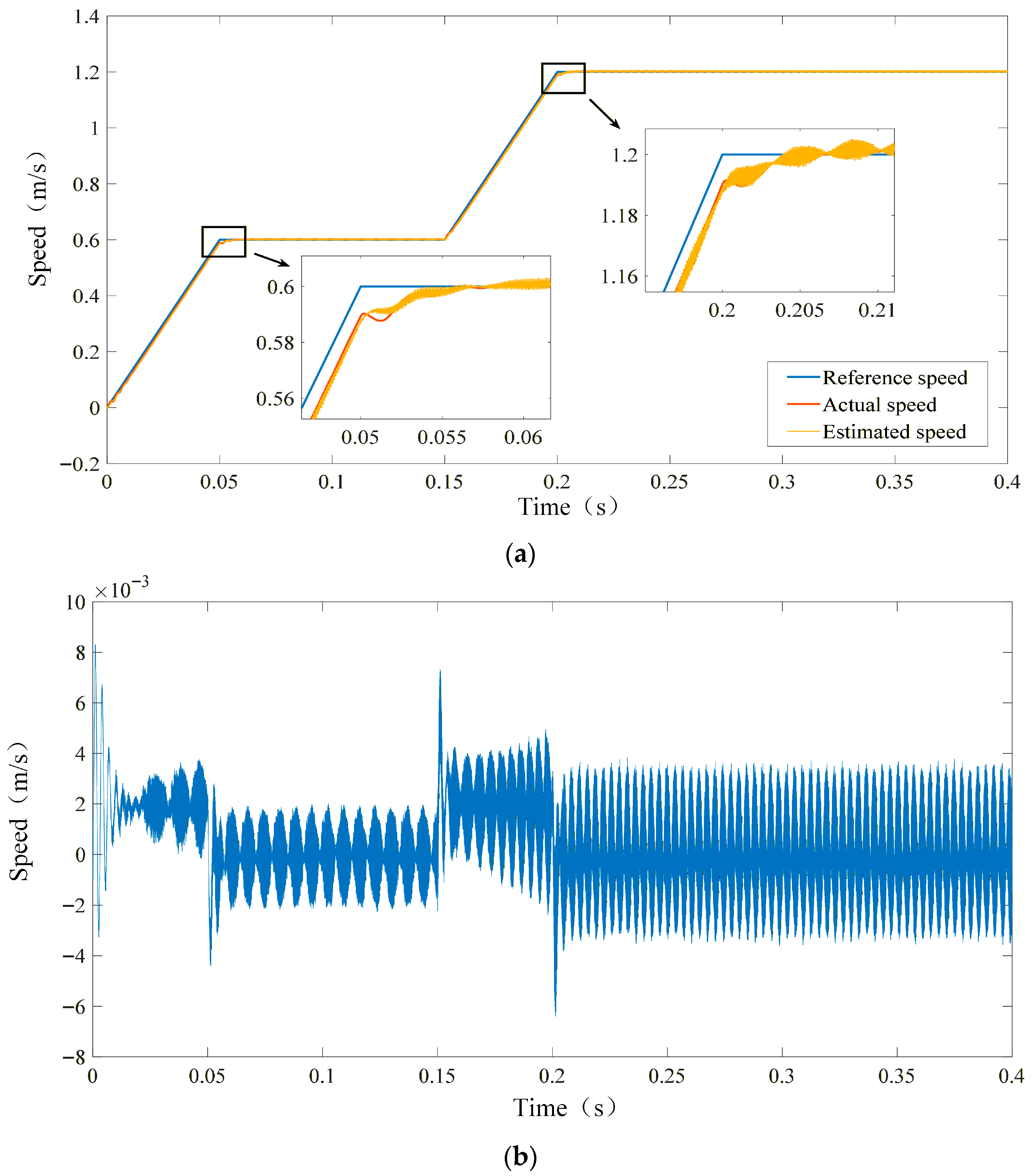
In Simulation 2, the sensorless robust adaptive control strategy was implemented, with the reference speed initially set to Speed Curve 2, as shown in Figure 7a.
As shown in Figure 7a, the control scheme exhibits exceptional speed tracking performance, during the 0–0.05 s and 0.15–0.2 s. The overshoot is nearly zero less than 0.1%, and the actual and estimated speeds rise smoothly without any oscillations. In the steady state, the estimated, actual, and reference speeds achieve an almost complete overlap, with a maximum steady-state deviation of 0.0021 m/s. As presented in Figure 7b, the speed tracking error throughout the simulation remains below 0.008 m/s, with an average error of 0.0034 m/s, a value practically negligible in engineering applications. These data confirm that the control scheme achieves a fast dynamic response while maintaining high tracking accuracy and operational smoothness.
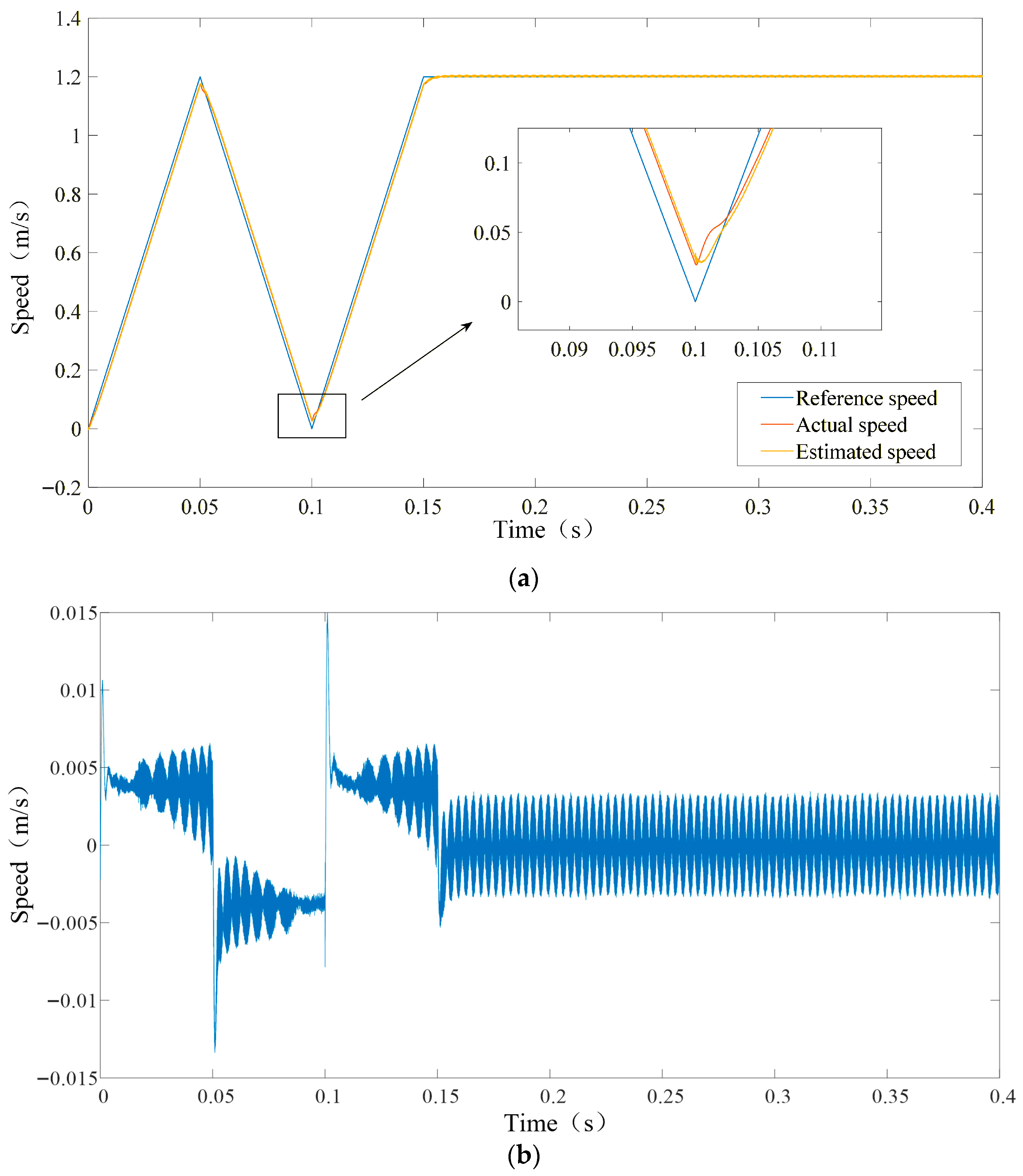
Figure 8 illustrates the speed tracking performance of the proposed control strategy during the speed zero-crossing process under a triangular speed profile. It can be observed that the actual speed and the estimated speed closely follow the reference speed throughout the entire operation, especially during the zero-crossing phase around 0.1 s magnified in the inset. Even at the speed reversal point, the deviation between the estimated speed and the actual speed remains extremely small, demonstrating the excellent zero-crossing tracking capability of the proposed method. Figure 8 presents the corresponding speed estimation error curve over the full simulation time domain. The estimation error is primarily concentrated within a narrow range, with transient peaks occurring only during the speed reversal and acceleration/deceleration stages. In the steady-state phase after 0.15 s, the error exhibits stable and small-amplitude oscillations, which fully verifies the high estimation accuracy and strong stability of the proposed observer.
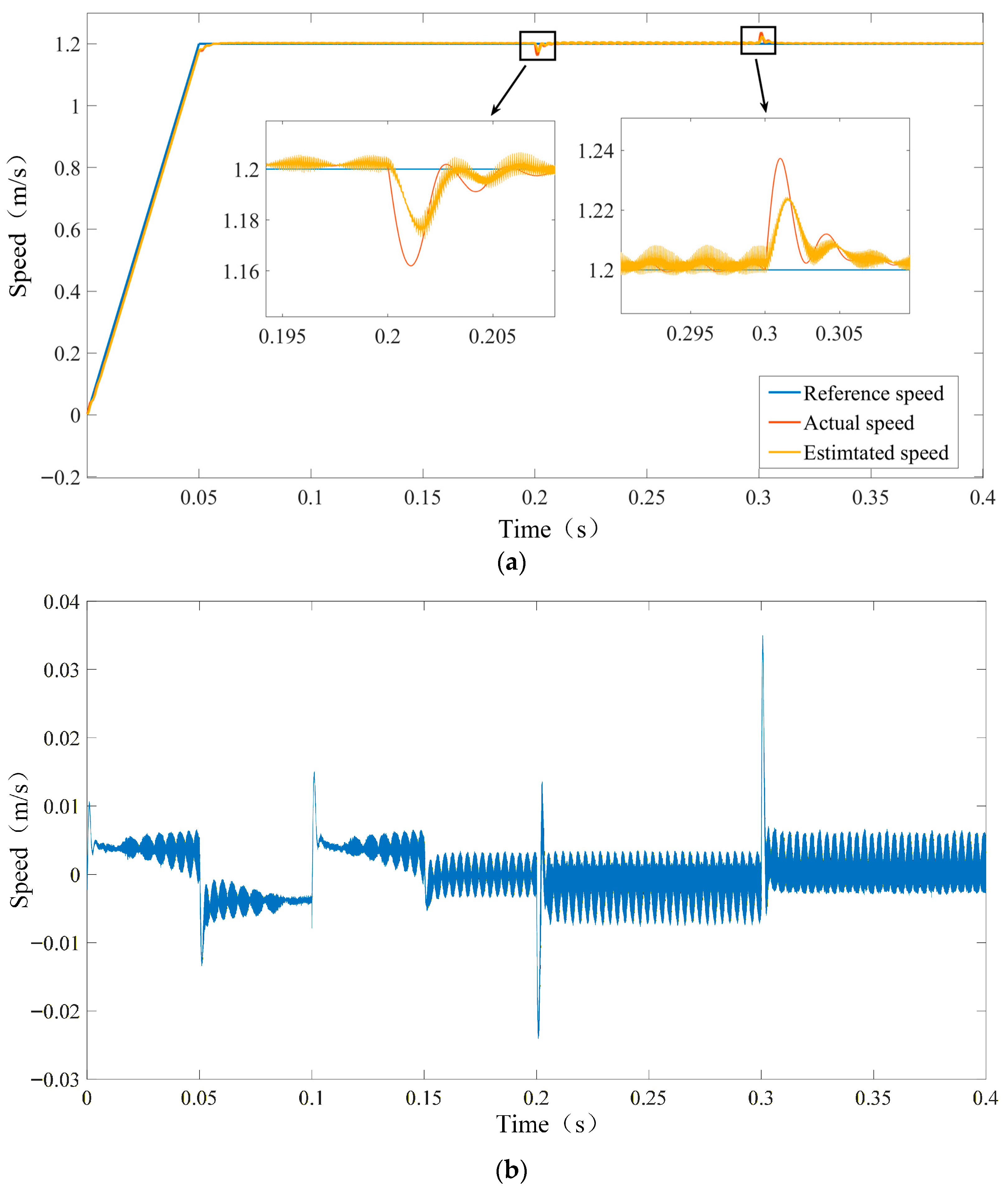
Figure 9a presents the speed tracking performance of the proposed control strategy under a 5 N load disturbance applied at 0.2 s and removed at 0.3 s during the zero-crossing speed process. It can be observed that the actual speed and estimated speed can still closely follow the reference speed even under sudden load variations, with a maximum transient speed deviation of only 0.03 m/s at the disturbance application moment and 0.025 m/s at the disturbance removal moment, as shown in the magnified insets. This demonstrates the strong anti-interference ability of the proposed method. Figure 9b shows the corresponding speed estimation error curve. The estimation error is maintained within a narrow range of ±0.03 m/s, with only transient peaks at the disturbance application and removal points and quickly returns to a stable small-amplitude oscillation below ±0.003 m/s in the steady state, which fully verifies the high accuracy and robustness of the proposed observer under load disturbances.
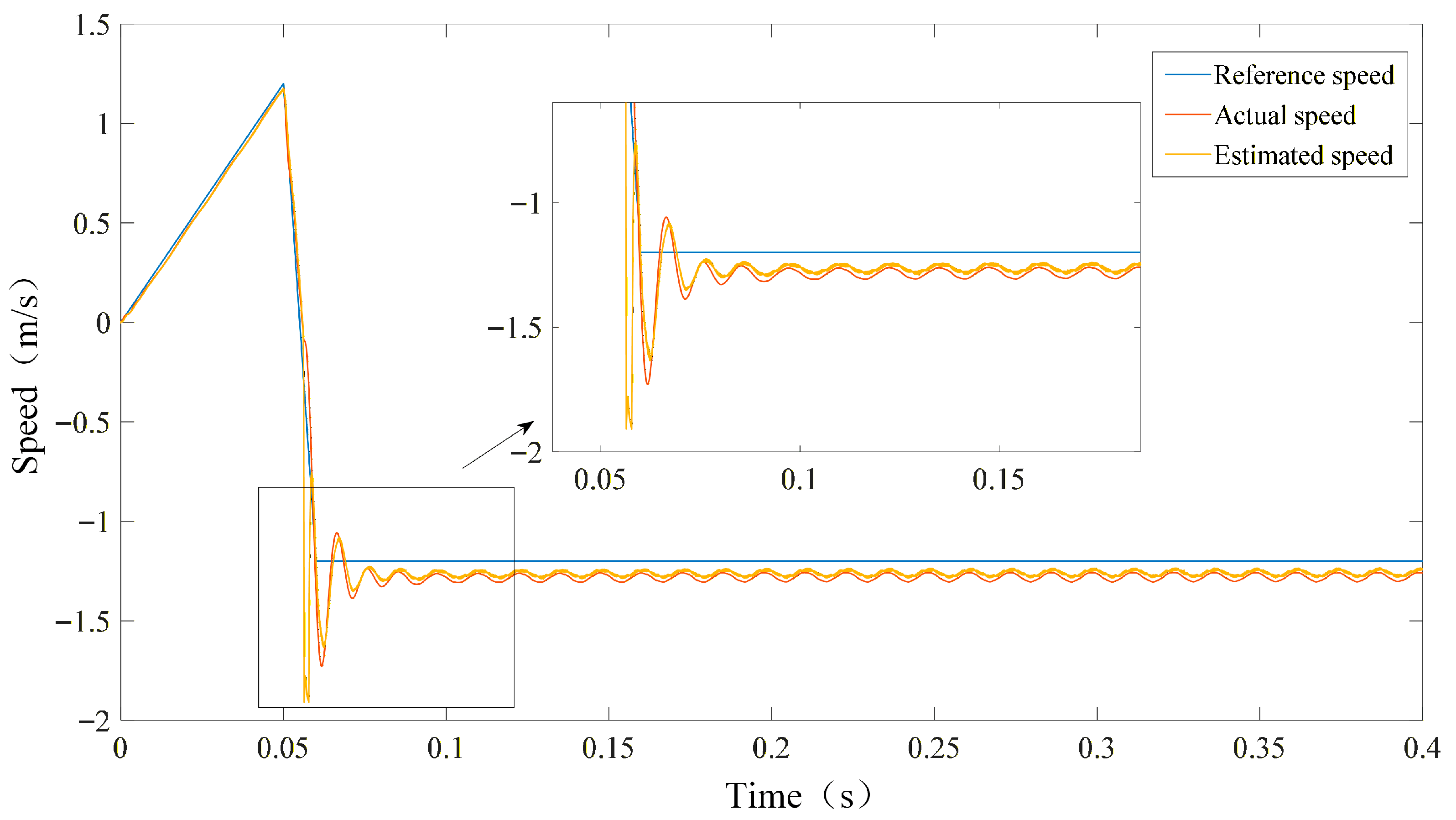
Figure 10 illustrates the speed tracking performance of the proposed sensorless control strategy under a speed switching profile, where the reference speed changes from 1.2 m/s to -1.2 m/s at 0.05 s. It can be observed that both the actual speed and the estimated speed can closely follow the reference speed during the entire speed switching process, with only a small transient deviation at the speed reversal point. The maximum transient speed deviation is less than 0.03 m/s, and the system quickly recovers to steady-state operation with a stable speed error below ±0.003 m/s, which fully demonstrates the excellent tracking accuracy and dynamic response capability of the proposed method under rapid speed switching conditions.
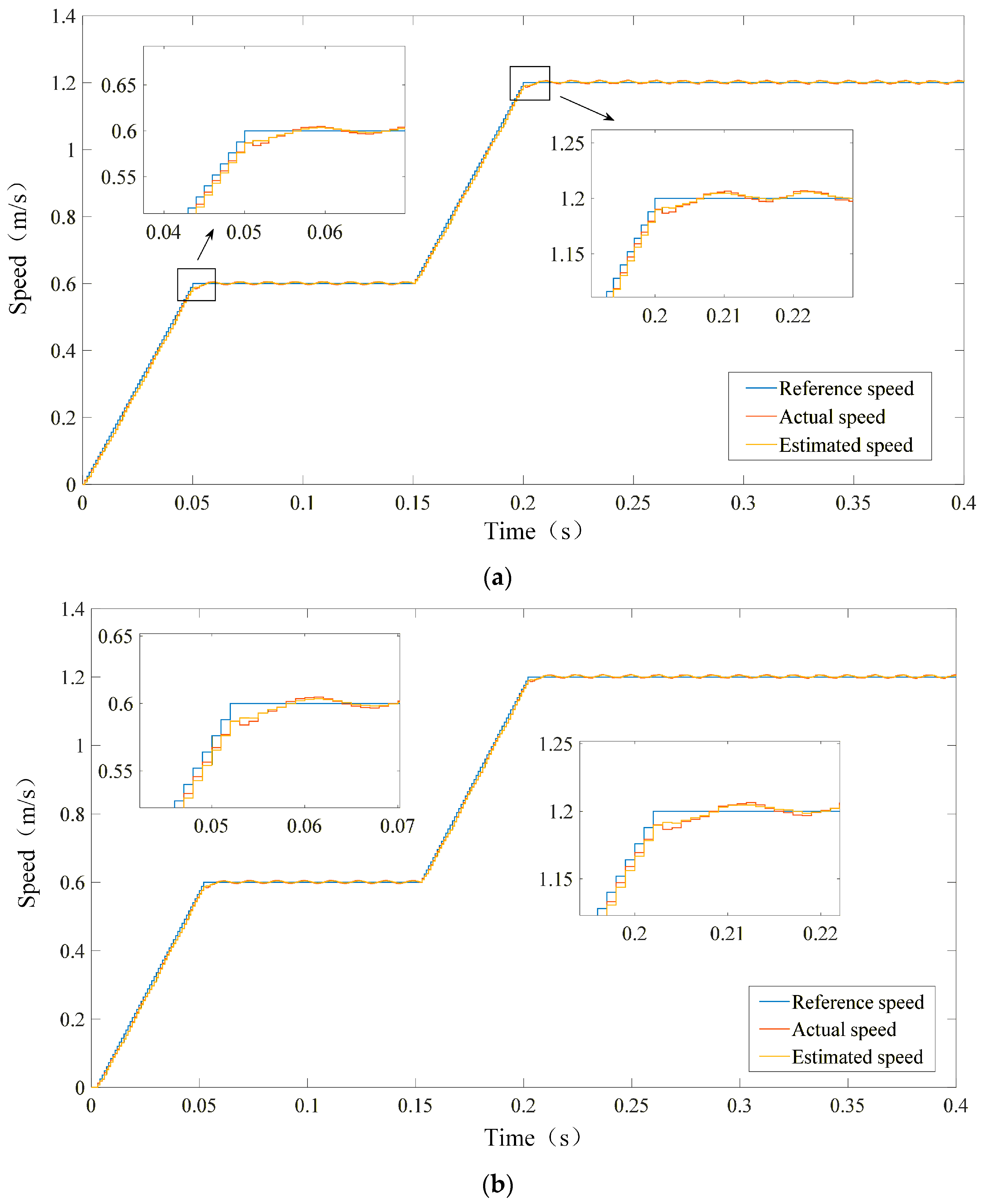
Figure 11 evaluates the speed tracking performance of the proposed control strategy under specific discrete and time-delay constraints. As shown in Figure 11a, under the discrete operation condition with a fixed sampling period of 0.001 s, the actual speed and estimated speed closely track the reference speed throughout the entire process. The maximum transient deviation is limited to 0.02 m/s during the acceleration phases, and the steady-state tracking error is strictly confined within ±0.003 m/s, which validates the excellent adaptability of the proposed method to high-frequency discrete sampling. As depicted in Figure 11b, when the system operates under the combined conditions of 0.001 s discrete sampling and 0.01 s time delay, the tracking performance exhibits slight degradation but remains satisfactory. A maximum transient deviation of 0.03 m/s occurs at the speed step transition points, 0.05 s and 0.2 s, yet the system rapidly regains stability, with the steady-state error maintained within ±0.004 m/s. These results fully demonstrate the strong robustness of the proposed control strategy against the combined effects of discrete sampling and time delay.
Figure 12 illustrates the speed tracking performance of the proposed sensorless control strategy under Gaussian white noise. It can be observed that the actual speed and estimated speed still closely follow the reference speed, with only minor fluctuations in the steady-state phase. The maximum speed deviation is maintained below 0.005 m/s, demonstrating the good noise suppression capability of the proposed method. Figure 13 presents the speed tracking performance under a periodic disturbance. The system exhibits stable tracking behavior, with the actual speed and estimated speed effectively suppressing the periodic fluctuations. The steady-state error remains within ±0.004 m/s, which verifies the strong robustness of the proposed control strategy against periodic disturbances.
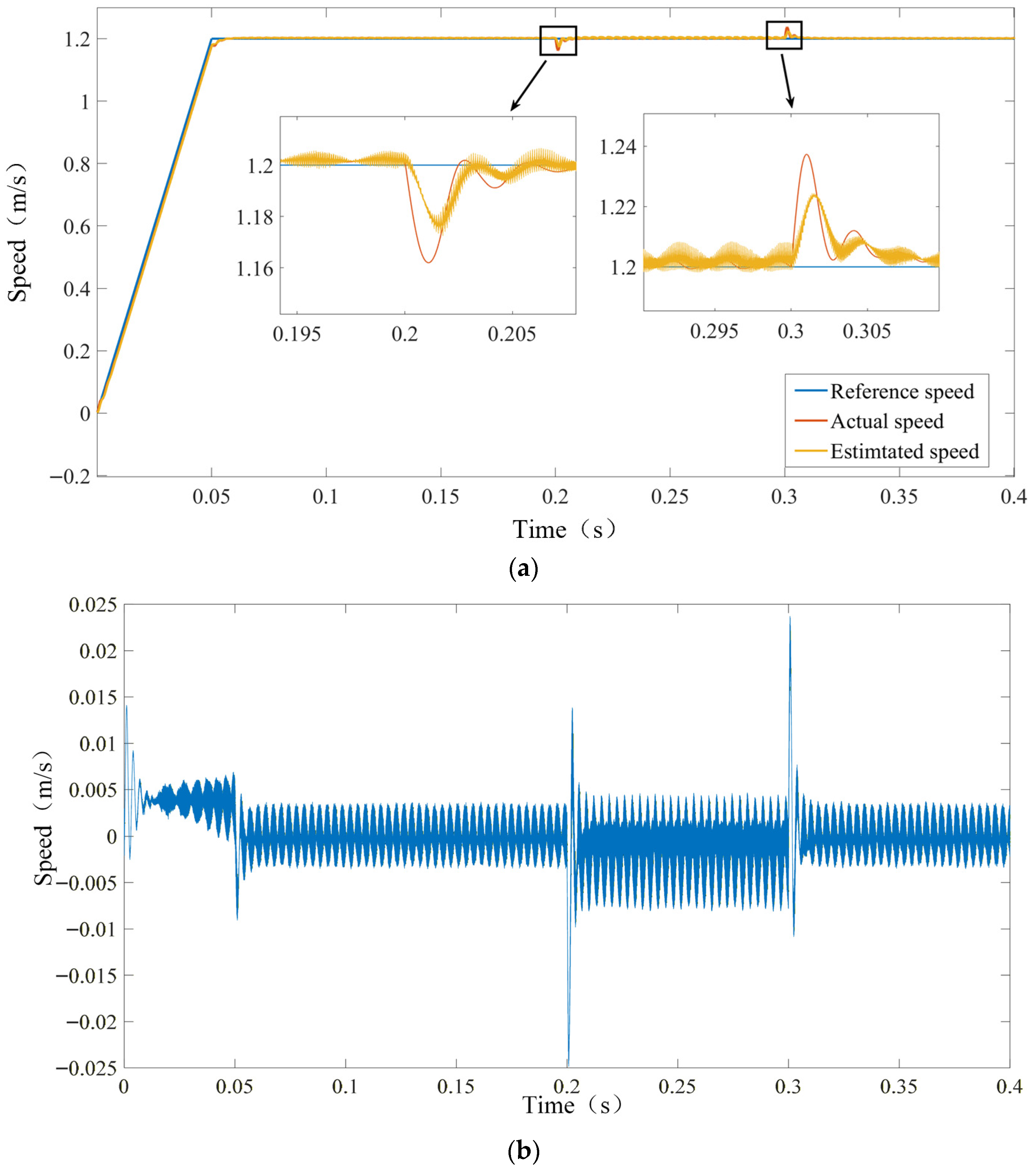
In a further test under Speed Curve 1, an external disturbance of 5 N was applied at 0.2 s and removed at 0.3 s. Figure 14a highlights the excellent anti-interference ability: upon disturbance application at 0.2 s, the actual speed exhibits a slight fluctuation with a maximum deviation of only 0.017 m/s from the reference speed, and it recovers to within 0.003 m/s of the reference value within approximately 0.0048 s. When the disturbance is removed at 0.3 s, the speed deviation is limited to 0.012 m/s, and full recovery is achieved in 0.0042 s. As shown in Figure 14b, under disturbed operating conditions, the maximum estimation deviation is less than 0.025 m/s, and the estimation deviation remains below 0.01 m/s for most of the remaining time. These results demonstrate that the system can effectively suppress speed fluctuations and achieve rapid recovery from external disturbances, thus exhibiting superior robustness and stability.
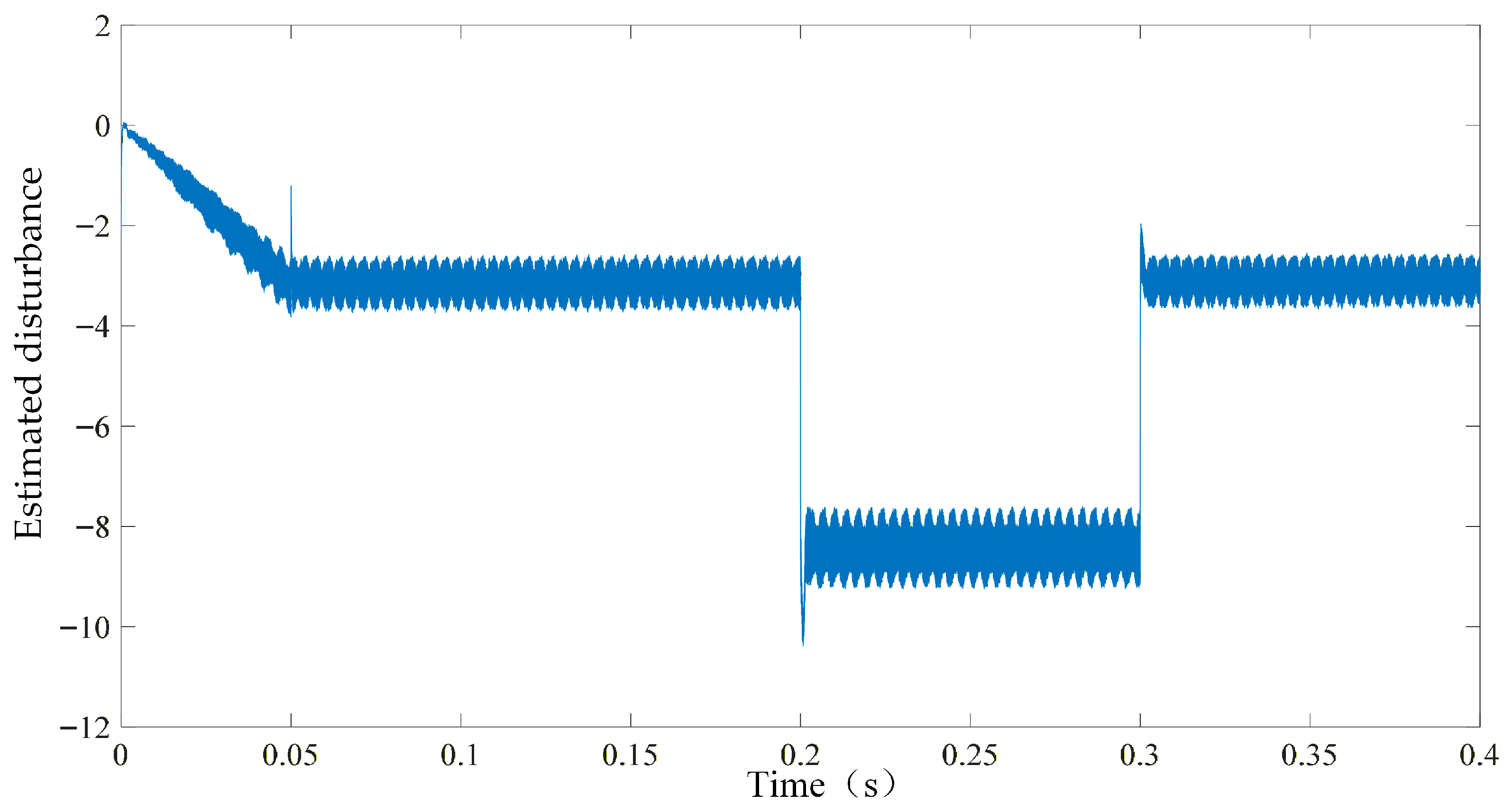
Figure 15 clearly illustrates that, at the instant the 5 N external disturbance is applied at 0.2 s, the estimated total disturbance rises sharply and stabilizes within a value range corresponding to the actual disturbance magnitude. When the disturbance is removed at 0.3 s, the estimated value quickly reverts to its initial stable range. This synchronous response and accurate tracking of the disturbance state confirm the high reliability and precision of the disturbance estimation algorithm. As demonstrated by the comprehensive results of Simulation 2, the SMO-ESO integrated observer exhibits high coordination with the robust adaptive controller, endowing the system with a rapid dynamic response and superior anti-interference ability.
To quantitatively validate the effectiveness of the proposed control strategy, the core performance evaluation indicators, including disturbance estimation error (DEE), coincidence degree (CD), recovery time (RT), disturbance suppression efficiency (DSE), speed estimation error (SEE), rise time (Tr), overshoot (OS), settling time (Ts), and steady-state speed error (SSE), are defined and summarized in Table 3.
Table 4 summarizes the dynamic response metrics of the proposed method under nine typical operating scenarios. Overall, the method exhibits excellent comprehensive performance: it achieves a fast dynamic response with a settling time of 0.01–0.015 s across all scenarios, maintains high steady-state accuracy with a steady-state error below 0.005 m/s, and has a maximum speed deviation no more than 0.03 m/s. It shows strong anti-interference ability against load, step, noise, and periodic disturbances, with a rapid recovery time of 0.0048–0.006 s when disturbed. Additionally, it demonstrates good adaptability to discrete sampling and time-delay constraints, as well as reliable tracking performance in zero-crossing and speed reversal operations, fully verifying its suitability for high-precision motion control applications.

5.4. Ablation Study via Simulation

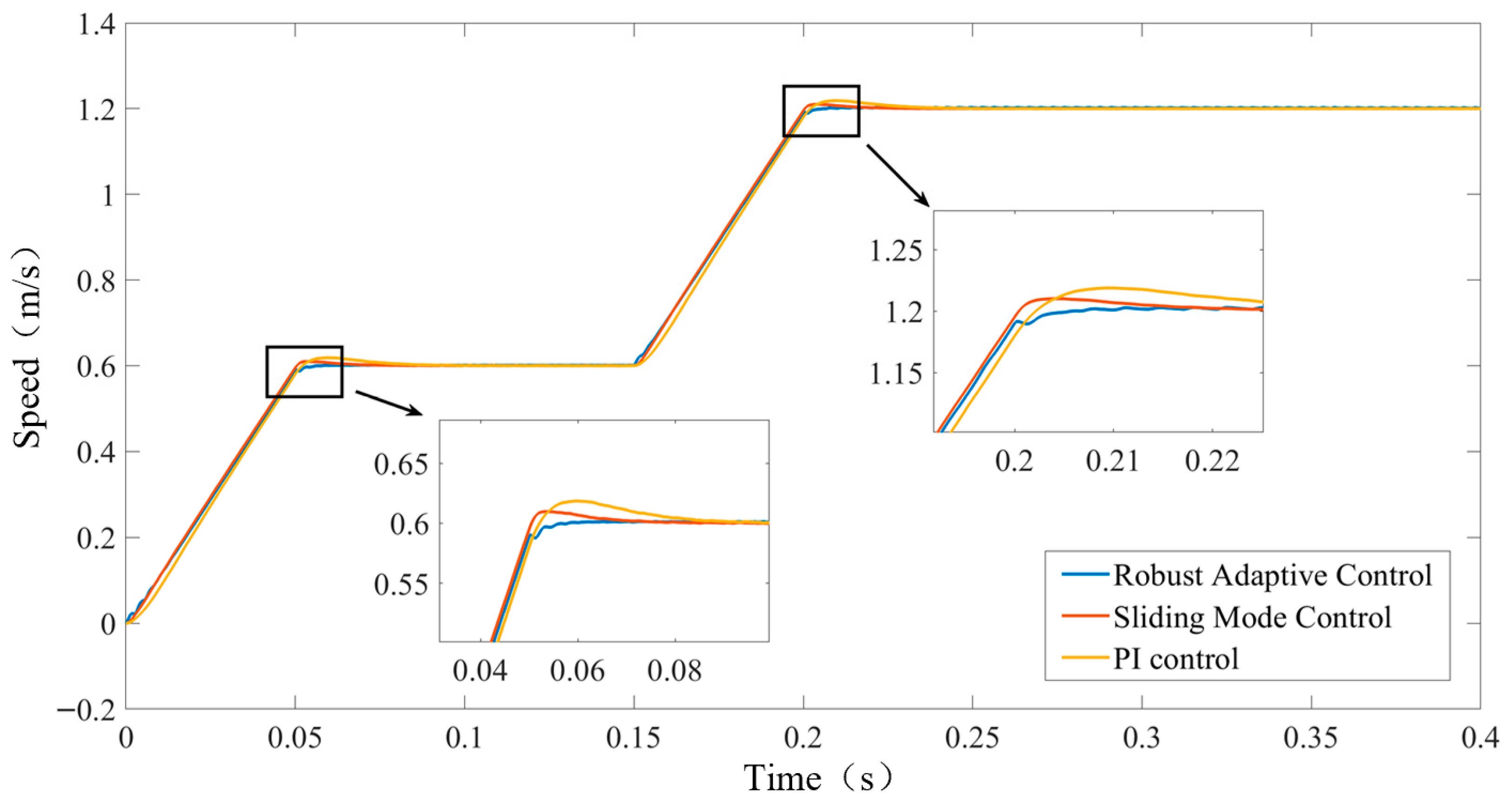
The performance of the proposed robust adaptive control strategy was compared with that of PI control and sliding mode control. As shown in Figure 16, during the transition from the acceleration phase to the steady state, the robust adaptive control yields a response curve that closely tracks the target value with minimal oscillations, an overshoot of less than 0.2%; in contrast, conventional PI control exhibits a noticeable overshoot of 3.7%, with steady-state oscillations of ±0.015 m/s; sliding mode control shows a slightly larger overshoot of 0.8% and peak-to-peak fluctuations of 0.019 m/s. Overall, the robust adaptive control strategy demonstrates a smoother dynamic response, smaller overshoot, higher tracking accuracy, and superior robustness for PMLSM sensorless operation.
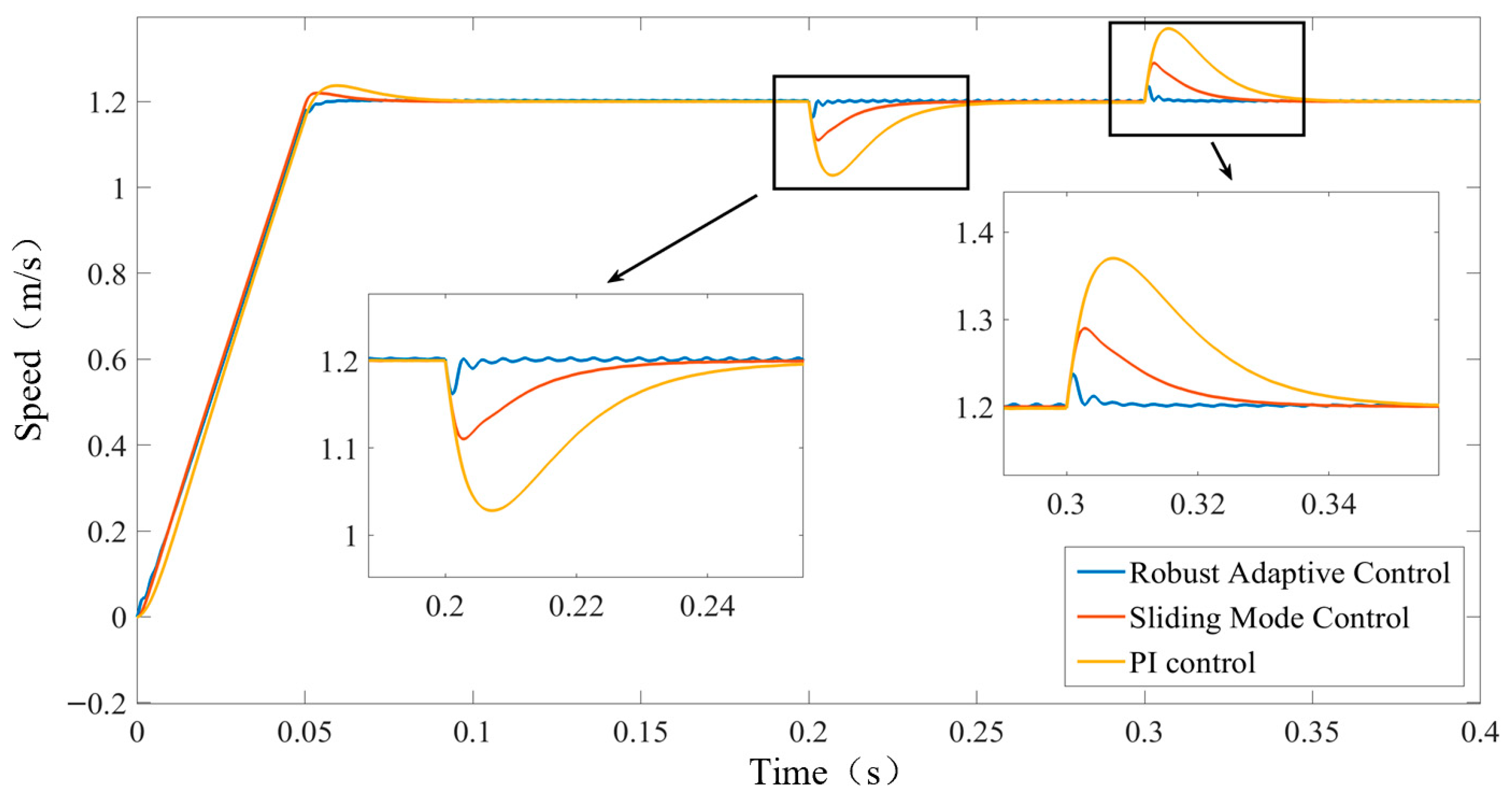
Figure 17 presents the speed responses under a 5 N external disturbance of 5 N was applied at 0.2 s and removed at 0.3 s. Upon disturbance application, PI control exhibits significant oscillations with a maximum speed dip of 0.089 m/s and a recovery time of 0.032 s. The sliding mode control shows a larger speed dip of 0.043 m/s and a recovery time of 0.018 s, and the robust adaptive control strategy demonstrates minimal speed fluctuation and the fastest recovery. After disturbance removal, the PI control sustains oscillations for 0.027 s with a maximum deviation of 0.063 m/s. The sliding mode control undergoes a relatively slower recovery with a deviation of 0.028 m/s, and the robust adaptive control strategy only exhibits slight oscillations and reverts to the target speed in 0.0042 s, with a disturbance suppression efficiency improved by over 75% compared to the PI control and over 55% compared to the sliding mode control. These data confirm that the robust adaptive control strategy outperforms both conventional PI control and traditional sliding mode control in terms of anti-interference ability.
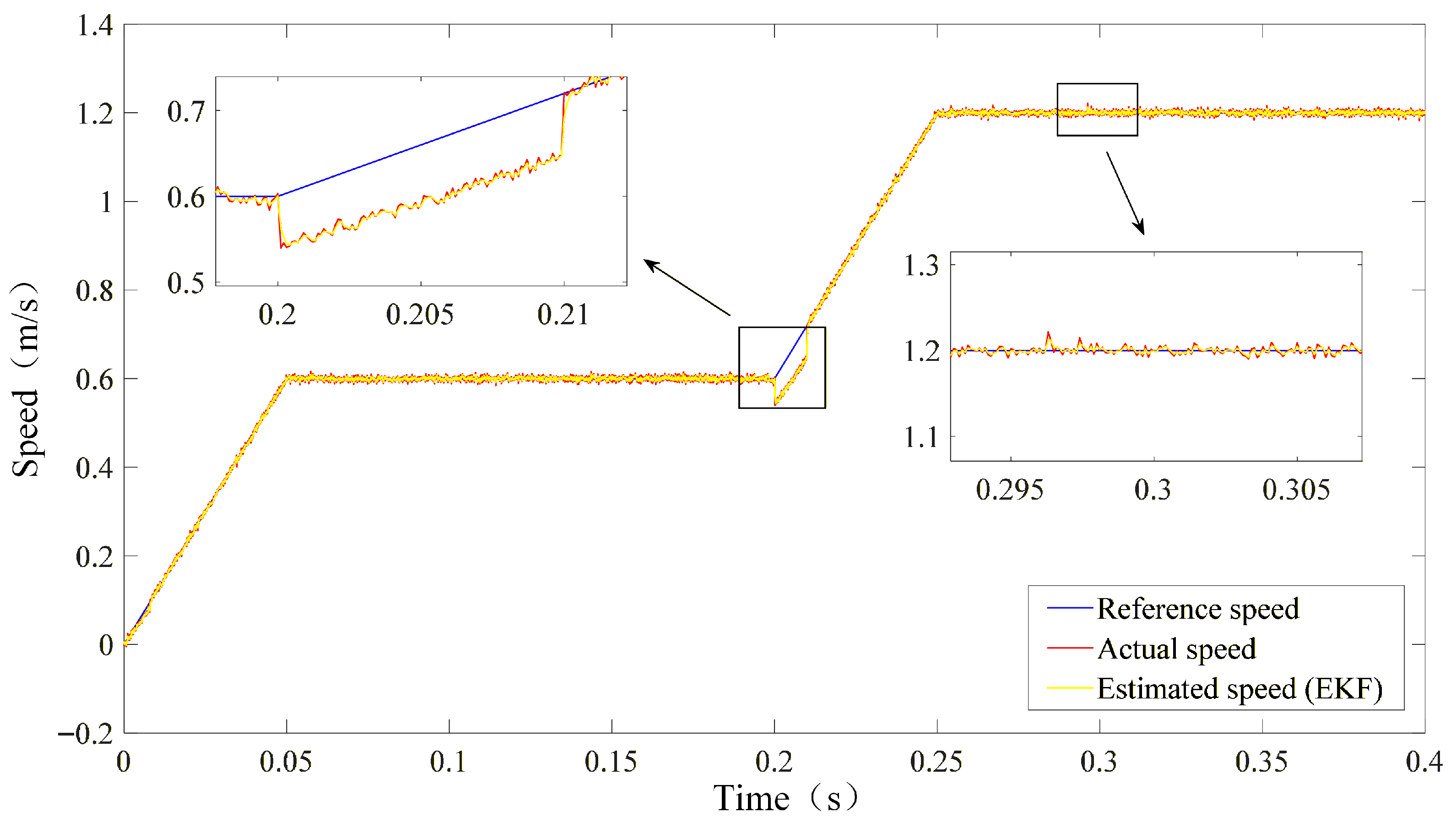
As shown in Figure 18, when the proposed SMO-ESO observer is replaced by an extended Kalman filter (EKF) for speed estimation, the overall speed tracking performance is inferior to that of the SMO-ESO. During the acceleration phase (0–0.05 s), the EKF-estimated speed exhibits noticeable lag and chattering, leading to a larger transient deviation from the reference speed. At the speed step change at 0.2 s, the EKF-based estimation shows a pronounced overshoot and a prolonged recovery time, with the maximum transient deviation reaching 0.08 m/s, which is significantly larger than that achieved by the SMO-ESO. In the steady-state phase (after 0.3 s), the EKF estimation still suffers from persistent small-amplitude oscillations, resulting in a steady-state error of approximately ±0.005 m/s, which is also inferior to the stable and precise tracking of the SMO-ESO. These results clearly demonstrate that the proposed SMO-ESO observer outperforms the EKF in both transient response and steady-state accuracy, especially under dynamic speed variations.

6. Conclusions

To address the challenges of parameter uncertainty, inadequate state observation accuracy, and limited anti-interference ability in PMLSM control systems, this paper proposes a sensorless robust adaptive control method based on SMO-ESO integration. Simulation results validate the correctness and effectiveness of the proposed method. The integrated observation SMO-ESO achieves high-precision estimation of position, speed, and total disturbances. The speed estimation error is below 0.008 m/s, and the disturbance estimation error is less than 1.4%. The proposed robust adaptive controller significantly improves the comprehensive performance: the dynamic response settling time is reduced to 0.01 s, the steady-state speed error is maintained below 0.0034 m/s, and the maximum speed deviation under 5 N external disturbance is only 0.025 m/s with a recovery time of 0.0048 s. Compared to a conventional PI control and traditional sliding mode control, the proposed method reduces overshoot by more than 94% and 78%, respectively, shortens recovery time under disturbance by over 85% and 63%, and enhances anti-interference ability by over 75% and 55%. These results confirm that the proposed sensorless robust adaptive control method effectively mitigates the effects of PMLSM parameter uncertainties and external disturbances, providing a solution for high-precision motion control applications.
However, the proposed method still has certain challenges. It exhibits degraded performance in ultra-low speed tracking scenarios, and noticeable observation fluctuations occur during speed direction switching. Experimental verification will be conducted in future work.

Author Contributions

Conceptualization, Y.S. (Yaning Shi), S.L., R.G. and X.Z.; Methodology, Y.S. (Yaning Shi); Software, Y.S. (Yaning Shi); Validation, Y.S. (Yaning Shi) and R.G.; Formal Analysis, Y.S. (Yaning Shi); Investigation, Y.S. (Yaning Shi) and R.G.; Resources, R.G., X.Z. and Y.S. (Yang Song); Data Curation, R.G.; Writing—Original Draft Preparation, Y.S. (Yaning Shi); Writing—Review and Editing, Y.S. (Yaning Shi), S.L. and R.G.; Visualization, Y.S. (Yaning Shi) and R.G.; Supervision, R.G. and X.Z.; Project Administration, R.G., X.Z. and Y.S. (Yang Song); Funding Acquisition, R.G., X.Z. and Y.S. (Yang Song). All authors have read and agreed to the published version of the manuscript.

Funding

This work was supported in part by National Natural Science Foundation of China under Grant 62371032, in part by R&D Program of Beijing Municipal Education Commission under Grant KM202310016005 and KM202410016009, and in part by BUCEA Young Scholar Research Capability Improvement Plan under Grant X21081.

Data Availability Statement

The original contributions presented in this study are included in the article material. Further inquiries can be directed to the corresponding author.

Acknowledgments

The authors would like to thank the Beijing Key Laboratory of Super Intelligent Technology for Urban Architecture, Beijing University of Civil Engineering and Architecture for providing administrative and technical support during the course of this research.

Conflicts of Interest

The authors declare no conflicts of interest.

References

  1. Qingding, G.; Limei, W.; Ruifu, L. Robust Fuzzy Variable Structure Control of PMLSM Servo System. In Proceedings of the 1997 IEEE International Conference on Intelligent Processing Systems (Cat. No.97TH8335), Beijing, China, 28–31 October 1997; Volume 1, pp. 675–679. [Google Scholar]
  2. Zhang, K.; Wang, L.; Fang, X. High-Order Fast Nonsingular Terminal Sliding Mode Control of Permanent Magnet Linear Motor Based on Double Disturbance Observer. IEEE Trans. Ind. Appl. 2022, 58, 3696–3705. [Google Scholar] [CrossRef]
  3. Wang, J.; Li, D. Application of Fuzzy PID Control in PMLSM Servo Drive System. In Proceedings of the 2015 IEEE International Conference on Mechatronics and Automation (ICMA), Beijing, China, 2–5 August 2015; pp. 6–10. [Google Scholar]
  4. Wang, M.; Li, L.; Pan, D.; Tang, Y.; Guo, Q. High-Bandwidth and Strong Robust Current Regulation for PMLSM Drives Considering Thrust Ripple. IEEE Trans. Power Electron. 2016, 31, 6646–6657. [Google Scholar] [CrossRef]
  5. Wang, A.; Zhao, M.; Hu, H.; Yao, T.; Tang, P.; Zhang, H. Sliding Mode Active Disturbance Rejection Composite Control for Sensorless Low-Speed Operation of PMLSM Using Low-Frequency Injection Method. In Proceedings of the 2025 IEEE 12th International Symposium on Sensorless Control for Electrical Drives (SLED), Harbin, China, 15–17 August 2025; pp. 1–6. [Google Scholar]
  6. Liu, F.; Du, J.; Zhang, B.; Song, C.; Wang, J.; Xu, S.; Xu, G.; Lin, J. Sensorless Control Strategy for PMLSM Based on an Improved SOGI-PLL Hybrid-Model Flux Observer. In Proceedings of the 2025 28th International Conference on Electrical Machines and Systems (ICEMS), Busan, Republic of Korea, 16–19 November 2025; pp. 2370–2374. [Google Scholar]
  7. Jang, J.-H.; Sul, S.-K.; Ha, J.-I.; Ide, K.; Sawamura, M. Sensorless Drive of Surface-Mounted Permanent-Magnet Motor by High-Frequency Signal Injection Based on Magnetic Saliency. IEEE Trans. Ind. Appl. 2003, 39, 1031–1039. [Google Scholar] [CrossRef]
  8. Woldegiorgis, A.T.; Ge, X.; Li, S.; Zuo, Y. An Improved Sensorless Control of IPMSM Based On Pulsating High-Frequency Signal Injection With Less Filtering for Rail Transit Applications. IEEE Trans. Veh. Technol. 2021, 70, 5605–5617. [Google Scholar] [CrossRef]
  9. Qiu, J.; Zhang, Z.; Li, H.; Wang, X.; Chen, G.; Zhou, S.; Wang, Y.; Li, Z. A Simple High-Frequency Signal Injection-Based Multi-Vector Predictive Encoderless Control Technique for Pmsm Drives. In Proceedings of the 2025 IEEE International Conference on Predictive Control of Electrical Drives and Power Electronics (PRECEDE), Nanjing, China, 5–8 June 2025; pp. 1–6. [Google Scholar]
  10. Welch, G.; Bishop, G. An Introduction to the Kalman Filter; TR 95-041; University of North Carolina at Chapel Hill: Chapel Hill, NC, USA, 2001; Available online: https://www.cs.unc.edu/~welch/kalman/ (accessed on 25 February 2026).
  11. Zhuang, Z.; Sun, Z.; Liu, Z. EKF-Based Online Angle-Error Estimation of PMLSM Using Disturbance Observer. In Proceedings of the 2020 IEEE 9th International Power Electronics and Motion Control Conference (IPEMC2020-ECCE Asia), Nanjing, China, 29 November–2 December 2020; pp. 3415–3419. [Google Scholar]
  12. Kim, Y.S.; Kim, S.K.; Kwon, Y.A. MRAS Based Sensorless Control of Permanent Magnet Synchronous Motor. In Proceedings of the SICE 2003 Annual Conference, Fukui, Japan, 4–6 August 2003; Volume 2, pp. 1632–1637. [Google Scholar]
  13. Kumar, S.; Singh, B. Improved MRAC Based Sensorless PMSM Drive With Enhanced Speed Control for LEV Application. IEEE Trans. Energy Convers. 2025, 40, 1153–1164. [Google Scholar] [CrossRef]
  14. Cheng, H.; Sun, S.; Zhou, X.; Shao, D.; Mi, S.; Hu, Y. Sensorless DPCC of PMLSM Using SOGI-PLL-Based High-Order SMO With Cogging Force Feedforward Compensation. IEEE Trans. Transp. Electrif. 2022, 8, 1094–1104. [Google Scholar] [CrossRef]
  15. Ye, S.; Yao, X. An Enhanced SMO-Based Permanent-Magnet Synchronous Machine Sensorless Drive Scheme With Current Measurement Error Compensation. IEEE J. Emerg. Sel. Top. Power Electron. 2021, 9, 4407–4419. [Google Scholar] [CrossRef]
  16. Zuo, Y.; Lai, C.; Iyer, K.L.V. A Review of Sliding Mode Observer Based Sensorless Control Methods for PMSM Drive. IEEE Trans. Power Electron. 2023, 38, 11352–11367. [Google Scholar] [CrossRef]
  17. Qiao, Z.; Shi, T.; Wang, Y.; Yan, Y.; Xia, C.; He, X. New Sliding-Mode Observer for Position Sensorless Control of Permanent-Magnet Synchronous Motor. IEEE Trans. Ind. Electron. 2013, 60, 710–719. [Google Scholar] [CrossRef]
  18. Zhang, X.; Li, Z. Sliding-Mode Observer-Based Mechanical Parameter Estimation for Permanent Magnet Synchronous Motor. IEEE Trans. Power Electron. 2016, 31, 5732–5745. [Google Scholar] [CrossRef]
  19. Xu, W.; Qu, S.; Zhao, L.; Zhang, H. An Improved Adaptive Sliding Mode Observer for Middle- and High-Speed Rotor Tracking. IEEE Trans. Power Electron. 2021, 36, 1043–1053. [Google Scholar] [CrossRef]
  20. Wang, Y.; Lan, Z.; Zhu, G. Adaptive Sliding Mode Observer Based on Phase Locked Loop in Sensorless Control of Permanent Magnet Linear Synchronous Motor. In Proceedings of the 2021 13th International Symposium on Linear Drives for Industry Applications (LDIA), Wuhan, China, 1–3 July 2021; pp. 1–6. [Google Scholar]
  21. Abhishek; Rama Krishna, M.S.; Jeevanand, S.; Saroha, S. Comparative Study of Q-PLL and DSOGI with SMO Based Sensorless Control of PMSM Drive. In Proceedings of the 2024 IEEE International Conference on Power Electronics, Drives and Energy Systems (PEDES), Mangalore, India, 18–21 December 2024; pp. 1–6. [Google Scholar]
  22. Sun, H.; Zhang, X.; Liu, X.; Su, H. Adaptive Robust Sensorless Control for PMSM Based on Improved Back EMF Observer and Extended State Observer. IEEE Trans. Ind. Electron. 2024, 71, 16635–16643. [Google Scholar] [CrossRef]
  23. Wang, H.; Zhang, Y.; Xiao, X.; Wang, X.; Han, S. SMO-ESO-Based Voltage Sensorless Model Predictive Control for PWM Rectifier. In Proceedings of the 2022 4th International Conference on Smart Power & Internet Energy Systems (SPIES), Beijing, China, 9–12 December 2022; pp. 1047–1052. [Google Scholar]
  24. Yao, B.; Xu, L. Adaptive Robust Motion Control of Linear Motors for Precision Manufacturing. Mechatronics 2002, 12, 595–616. [Google Scholar] [CrossRef]
  25. Yue, X.; Vilathgamuwa, D.M.; Tseng, K.-J. Observer-Based Robust Adaptive Control of PMSM with Initial Rotor Position Uncertainty. IEEE Trans. Ind. Appl. 2003, 39, 645–656. [Google Scholar] [CrossRef]
  26. Zhou, D.; Qian, Z.; Shen, J.; Fu, Z.; Song, G.; Xu, L. Robust Adaptive Sensorless Control Strategy for PMSM Based on Kalman Filtering. In Proceedings of the 2025 5th International Conference on Electronic Information Engineering and Computer Technology (EIECT), Jiangmen, China, 24–26 October 2025; pp. 548–552. [Google Scholar]
  27. Bai, C.; Yin, Z.; Zhang, Y.; Wang, B. An Adaptive Robust Predictive Current Control Scheme With Online Parameter Identification Based on MRAS for High-Performance PMLSM Drives. In Proceedings of the 2021 IEEE 16th Conference on Industrial Electronics and Applications (ICIEA), Chengdu, China, 1–4 August 2021; pp. 582–587. [Google Scholar]
  28. Wang, F.; Huang, Q.; Chen, K.; Zhen, S.; Chen, X. Adaptive Robust Position Control for Permanent Magnet Linear Synchronous Motor Based on Udwadia-Kalaba Theory. In Proceedings of the 2023 International Conference on Advanced Robotics and Mechatronics (ICARM), Sanya, China, 8–10 July 2023; pp. 445–450. [Google Scholar]
  29. Huang, Y.; Han, J. Analysis and Design for the Second Order Nonlinear Continuous Extended States Observer. Chin. Sci. Bull. 2000, 45, 1938–1944. [Google Scholar] [CrossRef]
  30. Gao, H.; Zhang, G.; Wang, W.; Liu, X. Research on an Improved Sliding Mode Sensorless Six-Phase PMSM Control Strategy Based on ESO. Electronics 2021, 10, 1292. [Google Scholar] [CrossRef]
  31. Das, J.C.; Ranjan, P.; Wrat, G.; Mishra, S.K. Position Control and Performance Analysis of Hydraulic System Using Two Pump-Controlling Strategies. Proc. Inst. Mech. Eng. Part I J. Syst. Control. Eng. 2018, 233, 1093. [Google Scholar]
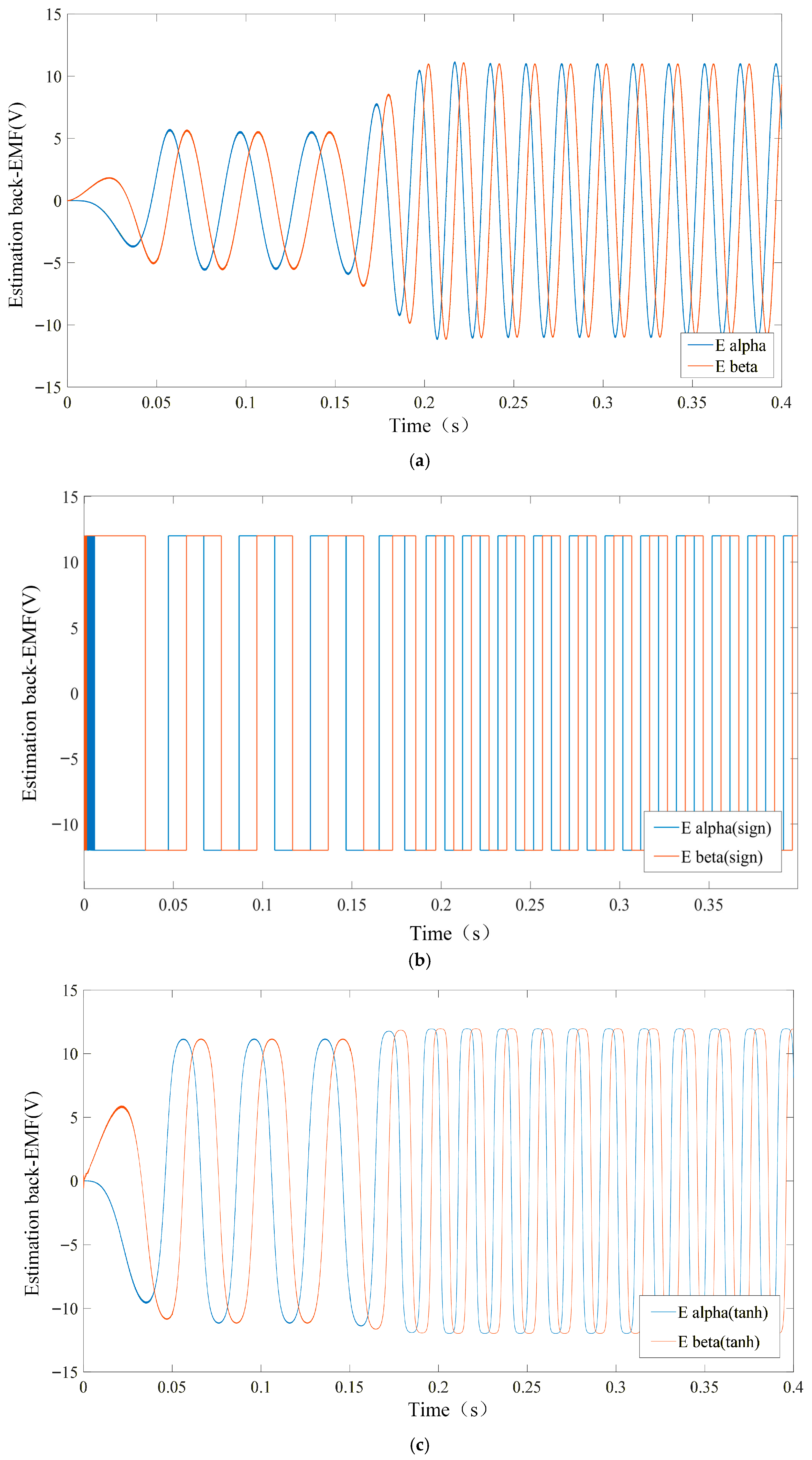
Figure 1. Back-EMF signals estimated by three different SMO. (a) Back-EMF observed by the proposed improved SMO; (b) back-EMF observed by the sign function-based SMO; (c) back-EMF observed by the tanh function-based SMO.
Electronics 15 00984 g001
Figure 2. SMO-ESO cascaded structure.
Electronics 15 00984 g002
Figure 3. Diagram of the PMLSM control system.
Electronics 15 00984 g003
Figure 4. Parameter variation effects on control accuracy. (a) Effect of Ls parameter perturbation on the dynamic response of the system; (b) effect of Rs parameter perturbation on the dynamic response of the system; (c) effect of B parameter perturbation on the dynamic response of the system.
Electronics 15 00984 g004aElectronics 15 00984 g004b
Figure 5. Sensorless PI control under the condition of time-varying speed reference command. (a) Comparison between the estimated speed and the actual speed; (b) speed estimation error under PI sensorless control.
Electronics 15 00984 g005aElectronics 15 00984 g005b
Figure 6. Speed comparison between PI sensorless and PI sensored control.
Electronics 15 00984 g006
Figure 7. Sensorless robust adaptive control under the operating conditions of time-varying speed reference command. (a) Comparison between the estimated speed and the actual speed; (b) speed estimation error under sensorless robust adaptive control.
Electronics 15 00984 g007
Figure 8. Sensorless robust adaptive control under the operating conditions of zero-crossing speed curve reference command. (a) Dynamic response of zero-crossing speed curve tracking; (b) observation error of the zero-crossing speed tracking curve.
Electronics 15 00984 g008
Figure 9. Sensorless robust adaptive control under the operating conditions of zero-crossing speed curve reference command under the conditions of external disturbances. (a) Speed tracking performance under load disturbance during the zero-crossing process; (b) corresponding speed estimation error.
Electronics 15 00984 g009
Figure 10. Speed tracking performance of the proposed method under a speed switching profile.
Electronics 15 00984 g010
Figure 11. Sensorless robust adaptive control under the conditions of discrete and time-delay operation. (a) Speed tracking performance under discrete operation at sampling period: 0.001 s; (b) speed tracking performance under discrete 0.001 s and time-delay 0.01 s operation conditions.
Electronics 15 00984 g011
Figure 12. Speed tracking performance under noise.
Electronics 15 00984 g012
Figure 13. Speed tracking performance under periodic disturbance.
Electronics 15 00984 g013
Figure 14. Sensorless robust adaptive control under the conditions of external disturbances. (a) Comparison between the estimated speed and the actual speed; (b) speed estimation error under sensorless robust adaptive control.
Electronics 15 00984 g014
Figure 15. Estimated disturbance under robust adaptive sensorless control.
Electronics 15 00984 g015
Figure 16. Speed tracking curves with different control methods under the operating conditions of time-varying speed reference command.
Electronics 15 00984 g016
Figure 17. Comparison of speed tracking curves of different control methods under external disturbance operating conditions.
Electronics 15 00984 g017
Figure 18. Speed tracking performance of the system when the proposed SMO-ESO observer is replaced by an extended Kalman filter (EKF).
Electronics 15 00984 g018
Table 1. Motor parameters.
SymbolDenotationValueUnit
Ldd-axis inductance0.00123H
Lqq-axis inductance0.00123H
Rsstator resistance6.5ohm
ψfpermanent magnet flux0.0385Wb
τpole pitch0.012m
Mmover mass1.51kg
Bviscous friction coefficient0.001N s/m
Pnumber of pole pairs1Pair
Table 2. Parameter variation effects on control accuracy.
ParameterPerturbationRise Time (s)Overshoot OS (%)Settling Time (s)
Nominal00.010<0.10.010
B−20%0.0092.20.009
B−10%0.00952.00.0095
B+10%0.0111.70.011
B+20%0.0121.50.012
Ls−20%0.0091.80.009
Ls−10%0.0102.30.010
Ls+10%0.0112.50.012
Ls+20%0.0122.70.013
Rs−20%0.0091.50.009
Rs−10%0.00951.70.0095
Rs+10%0.0112.00.011
Rs+20%0.0122.30.012
Table 3. Dynamic response performance indicators.
AbbreviationFull NameCore Definition & PurposeMathematical Definition
DEEDisturbance Estimation ErrorEvaluates ESO’s lumped disturbance tracking accuracy; normalized for cross-condition comparability D E E t = d t d t d t × 100 %
CDCoincidence DegreeQuantifies matching degree between estimated and actual speed; reflects observer’s global estimation consistency C D = 1 v t v t 2 v t 2 × 100 % , t 0 , T
RTRecovery TimeEvaluates system anti-interference ability; characterizes recovery speed after external disturbance
DSEDisturbance Suppression EfficiencyQuantifies anti-interference superiority of the proposed method over baseline controls D S E = 1 v p r o p o s e d v b a s e l i n e × 100 %
SEESpeed Estimation ErrorEvaluates SMO-ESO’s real-time speed estimation accuracy for PMLSM mover S E E t = v ^ t v t
TrRise TimeStandard indicator for system step response rapidity
OSOvershootEvaluates system stability and damping characteristics in step response O S = v max v * v * × 100 %
TsSettling TimeComprehensive indicator for system dynamic-to-steady-state transition speed
SSESteady-State Speed ErrorEvaluates system steady-state control accuracy S S E = 1 T s s T s s 1 T s s 2 v t v t d t
Table 4. Dynamic response performance indexes under various operating scenarios.
Operating
Scenario
Settling Time (s)Steady-State Error (m/s)Max Speed
Deviation (m/s)
Recovery Time (s)
Startup0.01<0.00340.02-
Zero-crossing speed tracking0.012<0.0030.030.005
Zero-crossing with load0.015<0.00340.0250.0048
Discrete0.011<0.0030.02-
Discrete + delay0.013<0.0040.030.006
Speed reversal0.014<0.0030.030.0055
Noise0.01<0.0050.005-
Periodic
disturbance
0.012<0.0040.020.005
Step disturbance0.015<0.00340.0250.0048
Disclaimer/Publisher’s Note: The statements, opinions and data contained in all publications are solely those of the individual author(s) and contributor(s) and not of MDPI and/or the editor(s). MDPI and/or the editor(s) disclaim responsibility for any injury to people or property resulting from any ideas, methods, instructions or products referred to in the content.