Data Augmentation via Auxiliary Classifier GAN for Enhanced Modeling of Gallium Nitride HEMT Devices


Abstract
1. Introduction
2. Initial Data Generation with TCAD
3. ACGAN-Based Data Augmentation
3.1. Data Preprocessing
3.2. ACGAN Architecture
- (1)
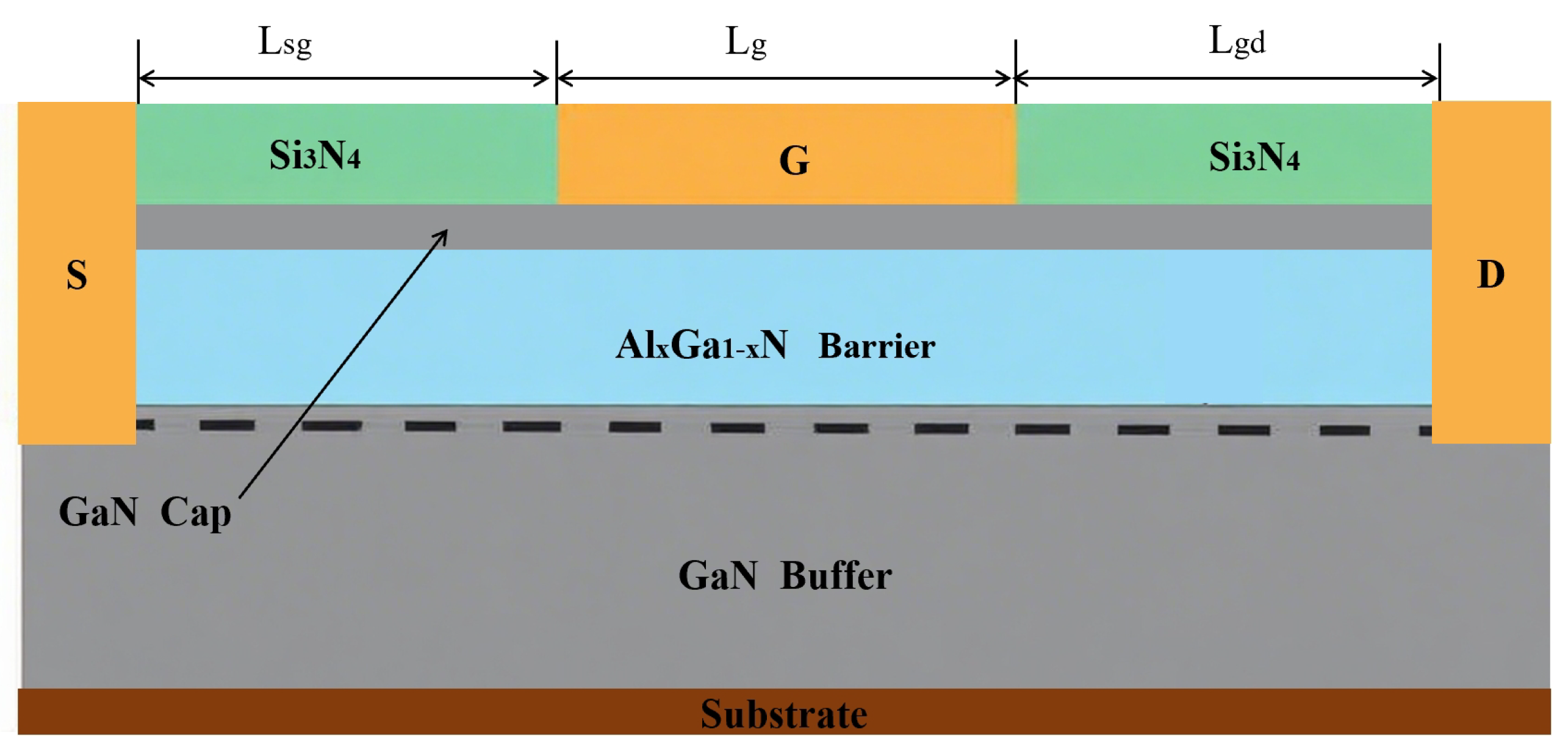
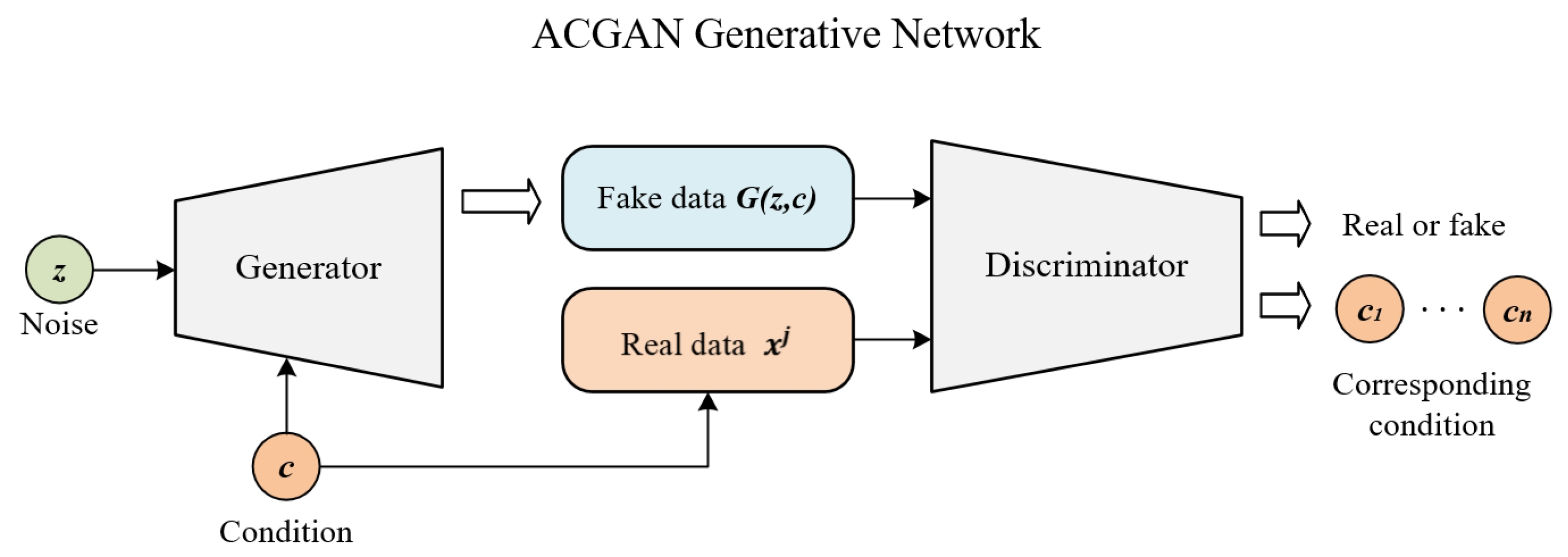
- Generator (G): The generator takes a random noise vector z and the conditioning vector c to produce synthetic fake data . In this specific implementation, the noise vector z is in Gaussian distribution with dimension 128 and the condition vector c is a three-dimensional device design parameter (%Al, t, D). The output fake data is an 11 × 21 matrix of under discrete and . Since the output has a low dimension, a fully connected multilayer perceptron(MLP) architecture with a ReLU activation functions is used. The fully connected layer has a 1024-512-256 structure as hidden layers.
- (2)
- Discriminator (D): The discriminator is designed to distinguish between real and fake data and to classify the data into the correct category. In this work, the discriminator takes the flattened 11 × 21 drain current (from TCAD or from the generator) and the condition c as input, which forms a 234-dimensional vector. The fully connected MLP hidden layers for feature extraction have a 1024-5120-256 structure. Each layer applies a non-linear activation function ReLU to capture complex patterns in the data. Batch normalization and dropout (rate of 0.2) are applied after each activation to improve generalization and reduce overfitting. The output is split into two independent heads:
- Authenticity Network with a sigmoid activation function to give a probability score to indicate whether the sample is real or fake. The network aims to evaluate the authenticity of input data and .
- Auxiliary Classifier network with regression head is applied to predict the conditioning information of the data , which is the device information for a given distribution.
3.3. Loss Functions
3.4. Training
| Algorithm 1: Training procedure for ACGAN–mixup framework. |
 |
3.5. Post-Generation Data Validation and Cleaning
4. Prediction Model Design
5. Results and Discussion
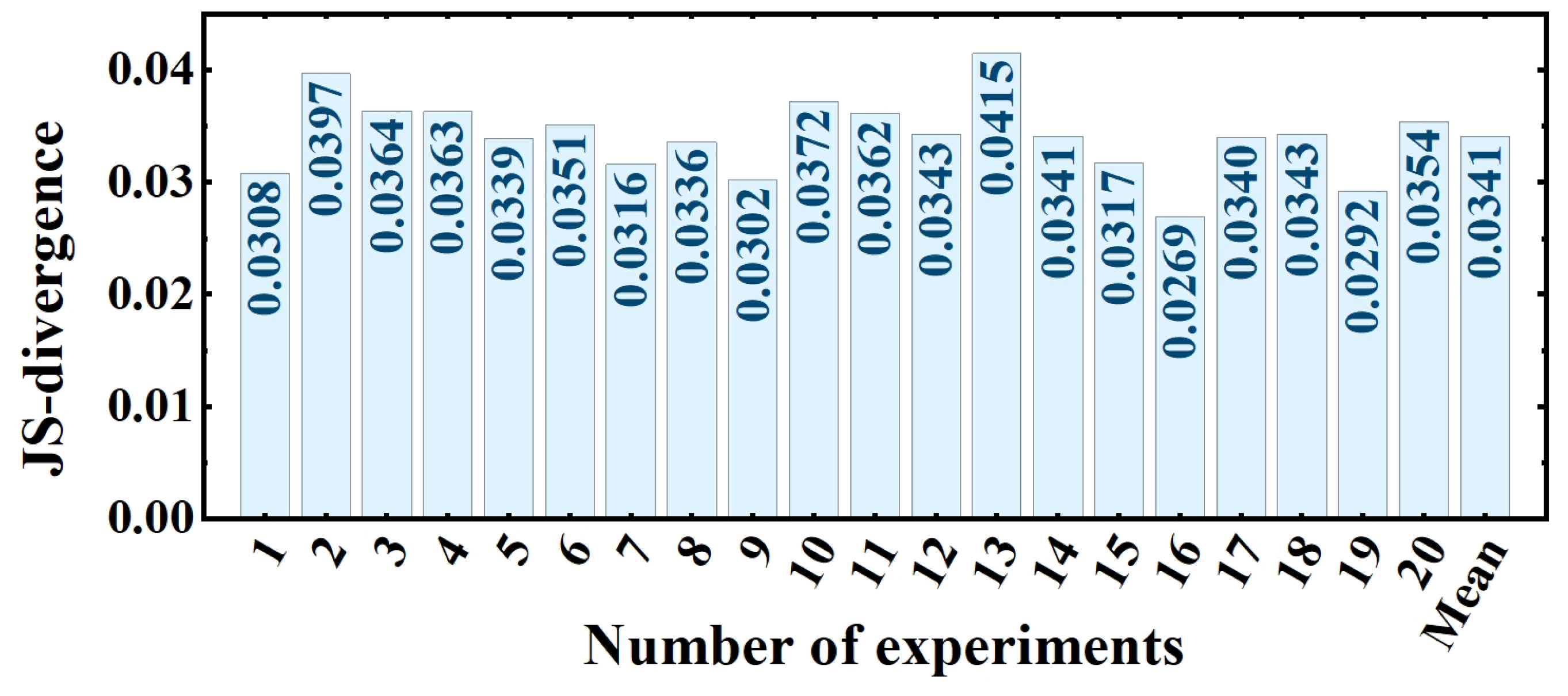
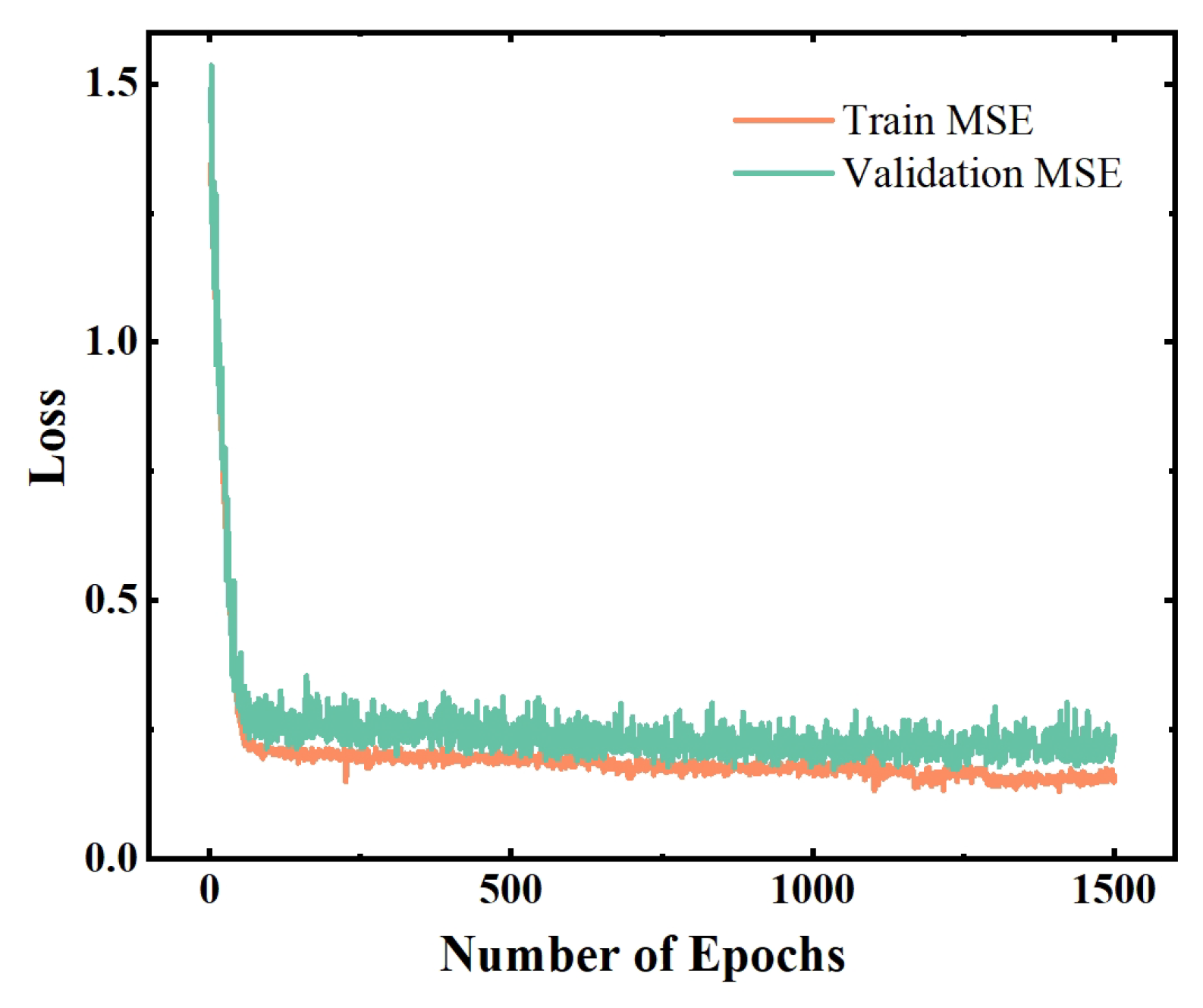
5.1. ACGAN Training Stability and Data Quality
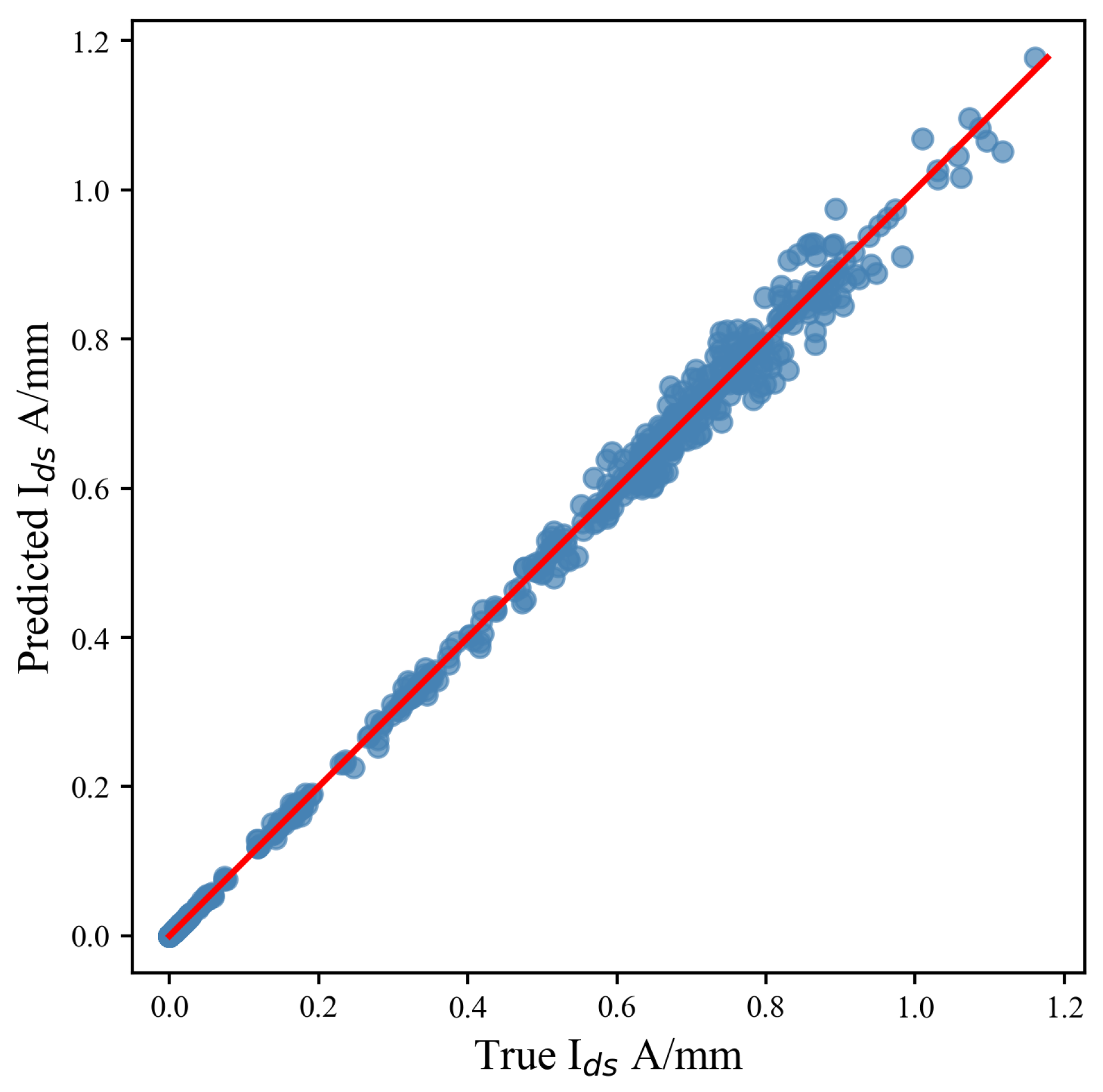
5.2. Impact of Data Augmentation on Predictive Performance
5.3. Implications and Advantages
6. Conclusions
Author Contributions
Funding
Data Availability Statement
Conflicts of Interest
References
- Sharma, R.C.; Nandal, R.; Tanwar, N.; Yadav, R.; Bhardwaj, J.; Verma, A. Gallium arsenide and gallium nitride semiconductors for power and optoelectronics devices applications. Proc. J. Phys. Conf. Ser. 2023, 2426, 012008. [Google Scholar] [CrossRef] [Scilit]
- Udabe, A.; Baraia-Etxaburu, I.; Diez, D.G. Gallium nitride power devices: A state of the art review. IEEE Access 2023, 11, 48628–48650. [Google Scholar] [CrossRef] [Scilit]
- Zhang, H.; Dong, Y.; Bi, C.; Ding, K.; Zhou, T.; Zhou, H.; Zhou, J.; Zhang, Y. High-Power-Handling GaN Terahertz High-Speed On-Chip Modulator Based on Fin-Line Double-Layer Near-Field Coupling. IEEE Electron Device Lett. 2025, 46, 1521–1524. [Google Scholar] [CrossRef] [Scilit]
- Jones, E.A.; Wang, F.F.; Costinett, D. Review of commercial GaN power devices and GaN-based converter design challenges. IEEE J. Emerg. Sel. Top. Power Electron. 2016, 4, 707–719. [Google Scholar] [CrossRef] [Scilit]
- Huang, X.; Liu, Z.; Li, Q.; Lee, F.C. Evaluation and application of 600 V GaN HEMT in cascode structure. IEEE Trans. Power Electron. 2013, 29, 2453–2461. [Google Scholar] [CrossRef] [Scilit]
- Schmidt, J.; Marques, M.R.; Botti, S.; Marques, M.A. Recent advances and applications of machine learning in solid-state materials science. NPJ Comput. Mater. 2019, 5, 83. [Google Scholar] [CrossRef] [Scilit]
- Baldi, P.; Bauer, K.; Eng, C.; Sadowski, P.; Whiteson, D. Jet substructure classification in high-energy physics with deep neural networks. Phys. Rev. 2016, 93, 094034. [Google Scholar] [CrossRef] [Scilit]
- Wang, X.; Alnabati, E.; Aderinwale, T.W.; Subramaniya, S.R.M.V.; Terashi, G.; Kihara, D. Detecting protein and DNA/RNA structures in cryo-EM maps of intermediate resolution using deep learning. Biophys. J. 2021, 120, 81a. [Google Scholar] [CrossRef] [Scilit]
- Mishra, S.; Chaturvedi, N. Multi-output deep learning model for simultaneous prediction of figure of merits (Ion, Gm, and Vth) of gallium nitride high electron mobility transistors. J. Appl. Phys. 2022, 131, 064901. [Google Scholar] [CrossRef] [Scilit]
- Jiang, Z.; Jiang, Y.; Chen, M.; Li, J.; Li, P.; Chen, B.; Zhao, S.; Wang, J.; Jiang, S.; Cai, M.; et al. Advanced design of a III-nitride light-emitting diode via machine learning. Laser Photonics Rev. 2023, 17, 2300113. [Google Scholar] [CrossRef] [Scilit]
- Wang, Z.; Li, L.; Leon, R.C.; Yang, J.; Shi, J.; van der Laan, T.; Usman, M. Improving semiconductor device modeling for electronic design automation by machine learning techniques. IEEE Trans. Electron Devices 2024, 71, 263–271. [Google Scholar] [CrossRef] [Scilit]
- Luo, H.; Yan, X.; Zhang, J.; Guo, Y. A neural network-based hybrid physical model for GaN HEMTs. IEEE Trans. Microw. Theory Tech. 2022, 70, 4816–4826. [Google Scholar] [CrossRef] [Scilit]
- Hirtz, T.; Huurman, S.; Tian, H.; Yang, Y.; Ren, T.L. Framework for TCAD augmented machine learning on multi-I–V characteristics using convolutional neural network and multiprocessing. J. Semicond. 2021, 42, 124101. [Google Scholar] [CrossRef] [Scilit]
- Mehta, K.; Wong, H.Y. Prediction of FinFET current-voltage and capacitance-voltage curves using machine learning with autoencoder. IEEE Electron Device Lett. 2020, 42, 136–139. [Google Scholar] [CrossRef] [Scilit]
- Dhillon, H.; Mehta, K.; Xiao, M.; Wang, B.; Zhang, Y.; Wong, H.Y. TCAD-augmented machine learning with and without domain expertise. IEEE Trans. Electron Devices 2021, 68, 5498–5503. [Google Scholar] [CrossRef] [Scilit]
- Lu, T.; Kanchi, V.; Mehta, K.; Oza, S.; Ho, T.; Wong, H.Y. Rapid mosfet contact resistance extraction from circuit using spice-augmented machine learning without feature extraction. IEEE Trans. Electron Devices 2021, 68, 6026–6032. [Google Scholar] [CrossRef] [Scilit]
- Chen, J.; Wu, Y.; Jia, C.; Zheng, H.; Huang, G. Customizable text generation via conditional text generative adversarial network. Neurocomputing 2020, 416, 125–135. [Google Scholar] [CrossRef] [Scilit]
- Gao, X.; Xiao, Z.; Deng, Z. High accuracy food image classification via vision transformer with data augmentation and feature augmentation. J. Food Eng. 2024, 365, 111833. [Google Scholar] [CrossRef] [Scilit]
- Duan, X.; Liu, J.; Zhang, E. Efficient image encryption and compression based on a VAE generative model. J. -Real-Time Image Process. 2019, 16, 765–773. [Google Scholar] [CrossRef] [Scilit]
- Hossain, M.Z.; Goyal, S. Advancements in Natural Language Processing: Leveraging Transformer Models for Multilingual Text Generation. Pac. J. Adv. Eng. Innov. 2024, 1, 4–12. [Google Scholar] [CrossRef] [Scilit]
- Park, T.; Kwak, J.; Ahn, H.; Lee, J.; Lim, J.; Yu, S.; Shin, C.; Moon, T. GAN-based framework for unified estimation of process-induced random variation in FinFET. IEEE Access 2022, 10, 130001–130023. [Google Scholar] [CrossRef] [Scilit]
- Guichard, E.; Silvaco, I. Silvaco TCAD, 2022. Available online: https://nanohub.org/resources/silvacotcad (accessed on 11 October 2024).
- Raja, P.V.; Nallatamby, J.C.; DasGupta, N.; DasGupta, A. Trapping effects on AlGaN/GaN HEMT characteristics. Solid-State Electron. 2021, 176, 107929. [Google Scholar] [CrossRef] [Scilit]
- Jin, X.; Zhu, H.; Li, S.; Wang, Z.; Liu, Z.; Tian, J.; Yu, C.; Qin, H.; Li, S.Z. A Survey on Mixup Augmentations and Beyond. arXiv 2025, arXiv:2409.05202. [Google Scholar] [CrossRef] [Scilit]
- Ma, Y.; Xu, X.; Li, Y. Lung RN+ NL: An Improved Adventitious Lung Sound Classification Using Non-local Block ResNet Neural Network with Mixup Data Augmentation. In Proceedings of the Interspeech 2020, Shanghai, China, 25–29 October 2020; pp. 2902–2906. [Google Scholar]
- Shen, X.; Chen, K.; Zhang, T. Asymptotic Statistical Analysis of f-divergence GAN. arXiv 2022, arXiv:2209.06853. [Google Scholar] [CrossRef] [Scilit]
- Shannon, M.; Poole, B.; Mariooryad, S.; Bagby, T.; Battenberg, E.; Kao, D.; Stanton, D.; Skerry-Ryan, R. Non-saturating GAN Training as Divergence Minimization. arXiv 2020, arXiv:2010.08029. [Google Scholar] [CrossRef] [Scilit]



| Parameters | From | To | Step Size |
|---|---|---|---|
| t (µm) | 0.015 | 0.025 | 0.005 |
| %Al | 15 | 33 | 6 |
| D (cm−3) | |||
| (V) | 5 | 10 | 0.5 |
| (V) | −5 | 2 | 0.35 |
| Data Augmentation Method | Mean Absolute Error of (A/mm) | |
|---|---|---|
| Off-State | Linear Region | |
| No augmentation (original TCAD only) | Model not converged | |
| Standard GAN | 0.021 | 0.095 |
| ACGAN (without mixup) | 0.015 | 0.088 |
| Proposed ACGAN–mixup | 0.002 | 0.052 |
Disclaimer/Publisher’s Note: The statements, opinions and data contained in all publications are solely those of the individual author(s) and contributor(s) and not of MDPI and/or the editor(s). MDPI and/or the editor(s) disclaim responsibility for any injury to people or property resulting from any ideas, methods, instructions or products referred to in the content. |
© 2026 by the authors. Licensee MDPI, Basel, Switzerland. This article is an open access article distributed under the terms and conditions of the Creative Commons Attribution (CC BY) license.
Share and Cite
Liu, Y.; Qian, Y.; Hu, Y.; Wu, Y. Data Augmentation via Auxiliary Classifier GAN for Enhanced Modeling of Gallium Nitride HEMT Devices. Electronics 2026, 15, 1067. https://doi.org/10.3390/electronics15051067
Liu Y, Qian Y, Hu Y, Wu Y. Data Augmentation via Auxiliary Classifier GAN for Enhanced Modeling of Gallium Nitride HEMT Devices. Electronics. 2026; 15(5):1067. https://doi.org/10.3390/electronics15051067
Chicago/Turabian StyleLiu, Yifei, Yihan Qian, Yefeng Hu, and Ye Wu. 2026. "Data Augmentation via Auxiliary Classifier GAN for Enhanced Modeling of Gallium Nitride HEMT Devices" Electronics 15, no. 5: 1067. https://doi.org/10.3390/electronics15051067
APA StyleLiu, Y., Qian, Y., Hu, Y., & Wu, Y. (2026). Data Augmentation via Auxiliary Classifier GAN for Enhanced Modeling of Gallium Nitride HEMT Devices. Electronics, 15(5), 1067. https://doi.org/10.3390/electronics15051067