Article

On the Dynamics of Ergonomic Load in Biomimetic Self-Organizing Systems

by
Nikitas Gerolimos
1,*,
Vasileios Alevizos
2,3 and
Georgios Priniotakis
1
1
Department of Industrial Design and Production Engineering, University of West Attica, 12244 Athens, Greece
2
Department of Learning, Informatics, Management and Ethics (LIME), Karolinska Institutet, SE-171 77 Stockholm, Sweden
3
MLV Research Group, Department of Informatics, Democritus University of Thrace, 65404 Kavala, Greece
*
Author to whom correspondence should be addressed.
Electronics 2026, 15(4), 889; https://doi.org/10.3390/electronics15040889
Submission received: 24 January 2026 / Revised: 13 February 2026 / Accepted: 19 February 2026 / Published: 21 February 2026

Abstract

Traditional ergonomic considerations in human–machine and human–swarm systems have primarily relied on static diagnostic snapshots, which often fail to capture the temporal accumulation and non-linear dissipation of musculoskeletal fatigue. As Industry 5.0 transitions toward immersive, human-centric cyber-physical systems, redefining ergonomic load as an endogenous state variable allows for real-time control of musculoskeletal integrity. This work proposes the Dynamic Integrity Governor (DIG) framework, which treats ergonomic load as a normalized, dimensionless state variable ξ t that evolves according to a stochastic proxy of recursive Newton–Euler dynamics. Leveraging a machine-perception-aware Adaptive Event-Triggered Mechanism (AETM) and the Multi-modal Flamingo Search Algorithm (MMFSA), we develop a decentralized architecture that redistributes ergonomic demands in real-time. The framework utilizes a 7-DOF kinematic model and Control Barrier Functions (CBF) to maintain human–swarm interaction within safe biomechanical boundaries, effectively filtering stochastic sensor noise through Girard-based stability buffers. Computational validation via N = 1000 Monte Carlo runs demonstrates that the proposed strategy achieves a 79.97% reduction in control updates (SD = 0.19%; p < 0.0001; Cohen’s d = 2.41), ensuring a positive minimum inter-event time (MIET) to prevent the Zeno phenomenon and supporting carbon-aware AI operations. The integration of variable prediction horizons yields an 80.69% improvement in solving time, while ensuring a minimal computational footprint suitable for real-time edge deployment. The identification of optimal postural niches maintains peak ergonomic load at 41.42%, representing a significant safety margin relative to the integrity barrier. While validated against a 50th percentile male profile, the DIG framework establishes a modular foundation for personalized ergonomic governors in inclusive Industry 5.0 applications.

1. Introduction

In view of the rapidly evolving realm of autonomous and adaptive systems, it is paramount to recognize the role that humans play as integral components of these systems. This is a key part of Industry 5.0 and Agriculture 5.0, which put human well-being and environmental resilience first, not just how much is produced [1,2]. Within these complex architectures, the transition from legacy Digital Human Modeling (DHM) to Human-Centric Digital Twins (HDT) is imperative. Unlike static geometric models, HDTs function as real-time, bidirectional frameworks capable of predicting physiological strain and governing interaction dynamics [3,4].
Despite significant advancements in biomimetic and swarm intelligence robustness, a critical research gap persists: the human factor remains largely relegated to a source of validation rather than an embodied participant. Recent systematic reviews indicate that while 68% of emerging AI technologies focus on passive posture recognition, there is a scarcity of systems that transition from diagnostic assessment to active, closed-loop ergonomic governance [1]. To address this, we must conceptualize the human operator through an AI-in-the-loop ( A I 2 L ) perspective, recognizing the human as an active participant whose musculoskeletal integrity significantly influences the overall system performance [5].
This study introduces the Dynamic Integrity Governor (DIG), a novel framework where ergonomic load is redefined as an endogenous state variable ξ ( t ) . This characterization enables real-time control of musculoskeletal integrity, modeled through dynamic accumulation and dissipation fluxes, within a sustainable and resource-aware industrial architecture [6].

1.1. Related Work

Dynamic Sensing and Ergonomic Diagnosis: The technological infrastructure for monitoring human strain has transitioned toward high-fidelity sensing. The OpenSenseRT system (v. 1.0), utilizing the inverse kinematics solver of OpenSim (v. 4.2) enables precise kinematic estimation, providing the data streams necessary for real-time risk assessment [7]. However, as noted by Filippeschi et al. [8], these indicators are traditionally utilized as diagnostic snapshots. Established tools like REBA or RULA lack the sensitivity required to detect high-frequency changes in ergonomic risk, necessitating a move toward dynamic modeling where load is quantified as a time-varying state derived from joint-torque integrals [9].
Human-in-the-loop control must manage interaction without overwhelming communication resources. Event-Triggered Control (ETC) allows for asynchronous updates, reacting only when necessary for stability or performance [10]. By utilizing Adaptive Event-Triggered Mechanisms (AETM), the proposed strategy optimizes communication overhead while ensuring a positive minimum inter-event time (MIET) to prevent the Zeno phenomenon [11,12], significantly reducing the duty cycle even in decentralized wireless networks [13]. This efficiency is a core requirement for “Green AI”, where minimizing the duty cycle of wearable transceivers directly mitigates the energy footprint of industrial ICT infrastructures [14].
Biomimetic Design and Systemic Integrity: Sustainability in biological systems emerges from the continuous regulation of competing demands. The proposed framework leverages a Multi-modal Flamingo Search Algorithm (MMFSA) to exploit the kinematic redundancy of the 7-DOF human model, identifying joint configurations that minimize local load without altering the task trajectory [15,16]. To facilitate seamless alignment, we employ Inverse Optimal Control (IOC) and Passivity Theory, which offer efficient pathways for stabilizing unknown nonlinear systems while increasing human acceptance of robot motions [17,18].
To ensure interpretability and internal consistency, we define a single experimental timebase and a priori endpoints for all results. Each simulation run spans a fixed duration, T = 600   s , with discrete sampling Δ t = 0.1   s , yielding N = 6000   integration steps. The “time-driven” (TD) baseline is defined as periodic control updates at a constant frequency f T D = 10   H z   for the full duration, resulting in exactly U T D = 6000 update events ( T = 600   s ). The stress phase is a contiguous sub-interval 200   s , 400   s during which task intensity and/or external disturbance parameters are modified; all figures and tables that reference “stress phase” report the same t s , t e values. The primary endpoint is the percentage reduction in control update events relative to TD, computed per run as Δ U = 1 U A E T M / U T D . Secondary endpoints include peak ergonomic load m a x t ξ ( t ) , cumulative ergonomic load 0 T ξ ( t ) d t , and per-update optimization latency; all endpoints are computed per run and summarized across runs using confidence intervals.

1.2. The Research Gap

Existing methodologies fail to account for the stochastic variability of human states in real time. Planning and dynamically assigning roles remains an unaddressed challenge, as most frameworks treat ergonomic load as a post hoc outcome variable rather than a governing system state [19].
The primary contributions of this work are:
  • Endogenous State Formulation: Redefining ergonomic load as a dimensionless state variable ξ ( t ) , where ξ t = 0 represents a baseline resting state and ξ = 100 % denotes the upper safety threshold derived from biomechanical limits [20].
  • Adaptive Sensitivity Logic: Introduction of a dynamic triggering architecture that adjusts its sensitivity exponentially as the ergonomic state approaches the stability boundary, filtering sensor noise and optimizing power consumption.
  • Safe Swarm Governance: Integration of the MMFSA with control principles that inherently respect the physical saturation of human joints, providing a formal framework for “Safe Design” in human–swarm interaction [21].

2. Materials and Methods

In this section, we establish the formal computational architecture of the Dynamic Integrity Governor (DIG). This framework transitions ergonomic management from a static diagnostic process into a dynamic, closed-loop control system.

2.1. Modeling the Human-Centric Digital Twin (HDT)

The conceptual foundation of this work is the transition from traditional Digital Human Modeling (DHM) to a Human-Centric Digital Twin (HDT) [3].
For the kinematic representation, we implement a 7-degrees-of-freedom (7-DOF) upper-limb model [22]. The state of the limb is defined by the generalized coordinate vector q R 7 :
q = q 1 , q 2 , q 3 , q 4 , q 5 , q 6 , q 7 T
where q 1 3 represent the spherical shoulder joints, q 4 5 the elbow complex, and q 6 7 the wrist. Real-time state estimation is provided by the OpenSenseRT system (v. 1.0, Stanford University, Stanford, CA, USA), which delivers angular measurements with a validated mean root-mean-square error (RMSE) of 4.4 ° to 5.6 ° [7] utilizing the OpenSim (v. 4.2, Stanford University, Stanford, CA, USA) inverse kinematics engine. Anthropometric constants, such as segment masses ( m i ) and centers of mass ( r c o m , i ), are derived from Winter’s (2009) tables to reflect a 50th percentile male profile [20].

Kinematic Parameterization (D-H Convention)

To define the spatial relationship between successive segments, we employ the Denavit–Hartenberg (D-H) convention as formulated by Tang et al. (2022) [22]. This parameterization is essential for calculating the Jacobian matrix ( J R 6 × 7 ), which maps joint velocities to end-effector motion:
x ˙ = J q q ˙ ,
where x denotes task-space coordinates. The D-H parameters (Table 1) ensure that joint torque calculations reflect the actual mechanical leverage of the human body.
The values L 1 = 280   m m and L 2 = 250   m m represent the upper arm and forearm lengths for a 50th percentile male profile, respectively, as derived from Winter (2009).

2.2. Dynamical Formulation of Ergonomic Load ( ξ )

Addressing the lack of continuous metrics in current ergonomic literature [1], we define the Ergonomic Load ( ξ ) as a dimensionless endogenous state variable ξ ( t ) 0 , L m a x . The boundary L m a x = 100 % is mapped to RULA Action Level 4 (Grand Score 7 ), representing the threshold where immediate intervention is required [23].
The accumulation of load is driven by joint torques ( τ R 7 ), calculated via recursive Newton–Euler dynamics:
τ = M q q ¨ + C q , q ˙ q ˙ + G q ,
where M q is the inertia matrix, C q , q ˙ the Coriolis/centrifugal matrix, and G q the gravitational torque vector. To map these physical units (Nm) to the ergonomic state rate ( s 1 ), we introduce the Accumulation Rate A ( t ) :
A t = κ · ι = 1 7 τ i t τ m a x , i 2 ,
where τ i t is the instantaneous torque at joint i, τ m a x , i   are the physiological torque limits (Winter, 2009) [20], and κ = 8.5   s 1 is the Scaling Coefficient for fatigue accumulation. The temporal evolution is governed by:
ξ ˙ t = A t D ξ t ,       ξ 0 = ξ 0
where
  • D ( ξ ) : The dissipation (recovery) rate, representing the homeostatic process of physiological restoration. The recovery process is modeled as a phenomenological concave function:
D ξ = m a x ( 0 , D m a x · ξ t · 1 ξ t 1.5 L m a x ) ,
where
  • D m a x = 0.12   s 1 : is the peak recovery constant. This concave formulation accounts for the decline in clearing efficiency as strain approaches biological limits [1].
  • 1.5 L m a x : acts as a saturation offset. This term ensures that the physiological recovery flux remains active as ξ approaches the integrity barrier, while simultaneously modeling the non-linear decline in metabolic clearing efficiency under high-strain conditions.

2.3. Adaptive Event-Triggered Mechanism (AETM)

To ensure carbon-aware AI operations and minimize communication overhead in wearable sensors, we implement a Robust Adaptive Event-Triggered Mechanism (AETM) [6,11]. Unlike traditional periodic sampling, the swarm is synchronized at discrete time instants t k only when the ergonomic integrity deviates significantly from the last transmitted state.
The adaptive threshold σ ( t ) is dynamically modulated via an exponential decay function:
σ t = σ 0 · e x p ( μ · ξ t ) ,
where σ 0 = 10 5 is the baseline tolerance and μ = 0.01 is the Aggressiveness Factor.
To minimize communication overhead and power consumption in wearable sensors [6], we implement an Adaptive Event-Triggered Mechanism (AETM). Unlike periodic sampling, the swarm is synchronized at time t k only when the state deviation error e t = ξ t k ξ ( t ) violates a safety boundary.
To enhance robustness against sensor jitter and IMU noise d t , we introduce an internal dynamic variable η t as a stability buffer, following the Girard framework [12,24]. The buffer dynamics are defined as:
η ˙ t = λ η t + θ σ ( t ) e ( t ) ,
where
  • η t : The Dynamic Stability Buffer, representing the instantaneous safety margin; triggering occurs only upon its exhaustion ( η t 0.05 ).
  • λ = 0.1 ,   ( λ > 0 ) : The Exponential Decay Rate (s−1). It dictates how quickly the buffer dissipates over time, ensuring the system remains “vigilant”.
  • θ = 65.0 , ( θ > 0 ) : The Coupling Gain, scaling the influence of the error on the buffer depletion.
  • σ t : The Adaptive Triggering Coefficient.
The swarm is triggered precisely when the safety margin is depleted, η t 0 , signaling that the cumulative state deviation has surpassed the dynamically adapted threshold σ t . This condition ensures that high-frequency stochastic fluctuations from the OpenSenseRT sensors do not initiate redundant swarm reorganizations [7]. The real-time state estimation leverages the OpenSenseRT framework, which has been validated to provide high-fidelity kinematic data with a mean RMSE of 4.1° for upper-limb joints, ensuring the governor reacts to subtle ergonomic deviations [7].

2.4. Optimization with Variable Prediction Horizon (APHUS)

When an event is triggered, swarm reorganization is executed via the Multi-modal Flamingo Search (MMFSA) algorithm [16,25]. To achieve real-time performance, we incorporate an Adaptive Prediction Horizon Update Strategy (APHUS) [11]. The prediction horizon Τ ρ varies as a function of the proximity to the terminal stability set S f .
Τ ρ t = T m a x · ( 1 exp κ h o r · d i s t ξ t , S f ) ,
where
  • T m a x : The maximum look-ahead time window.
  • κ h o r : The Horizon Decay Constant, which dictates the rate of prediction window adjustment.
  • d i s t ξ t , S f : The mathematical distance between the current ergonomic state ξ t and the Safe Stability Set ( S f ). As the worker approaches a dangerous limit, the algorithm reduces its look-ahead window to focus on immediate, high-fidelity corrective actions.
Computational validation is conducted over a 600 s horizon with 10 Hz sampling, where the “time-driven” baseline generates 6000 updates. The stress phase is strictly defined as the interval 200   s , 400   s .
To ensure that the swarm reacts only to true physical trends and ignores stochastic sensor artifacts, we incorporate an Information Bottleneck (IB) constraint into the optimization process [26].
The global optimization objective is formulated as follows:
min q f q + β · Ι ( q ; d t ) ,
where
  • q R 7 : The target joint configuration vector to be optimized by the MMFSA.
  • f q : The primary Multi-Objective Cost Function, which represents the deterministic goal of the system.
  • Ι ( q ; d t ) : The Mutual Information between the proposed configuration q and the sensor noise/drift vector d t . This term penalizes configurations that are overly sensitive to jitter from the OpenSenseRT transceivers.
  • β > 0 : The Lagrangian Multiplier (weighting factor) that controls the trade-off between optimization accuracy and noise robustness.
The internal cost function f q is further decomposed to balance ergonomics and motion smoothness:
f q = ω 1 Ψ q + ω 2 q q p r e v ,
where
  • Ψ q : The Musculoskeletal Effort Index, derived from the normalized torque integrals calculated in Equation (2). It represents the potential ergonomic load of the new posture.
  • q q p r e v : The Kinematic Continuity term, which calculates the Euclidean distance between the new configuration and the previous state ( q p r e v ), ensuring smooth, non-jerky transitions.
  • ω 1 = 0.7 and ω 2 = 0.3 : The Relative Weighting Coefficients. This prioritization ensures that musculoskeletal integrity ( ω 1 ) remains the primary driver of swarm behavior, while maintaining operational stability ( ω 2 ).

2.5. Safety and Human Acceptance Guarantee

To provide formal safety guarantees, the swarm action u ( t ) is passed through a Control Barrier Function (CBF) safety filter [27]. We define the safe set using the barrier function h ξ = L m a x ξ ( t ) , imposing the forward invariance condition:
h ˙ ξ , u + a h ( ξ ) 0 ,
In Equation (11), a ( · ) denotes a class K function that dictates the convergence rate toward the safety boundary, distinct from static scaling coefficients used in the ODE formulation.
This ensures the ergonomic load never violates the limit. Finally, trajectories are designed via Inverse Optimal Control (IOC) to ensure anthropomorphic movement, increasing human trust and reducing cognitive load during autonomous interventions [18].
This approach maximizes the transparency of the interaction and significantly reduces the cognitive load and psychological stress often associated with automated swarm interventions [28].

3. Results

To ensure the reproducibility of the study, the parameters governing the coupled biomechanical–swarm dynamical system are summarized in Table 2. Detailed numerical datasets, including global simulation parameters and event-triggered control logs, are available in the Appendix B. The physiological constants and fatigue rates were derived from validated biomechanical data for 7-DOF upper-limb movement [20,22]. The control-theoretic gains and triggering manifolds for the AETM were calibrated to satisfy the stability criteria and Minimum Inter-Event Time (MIET) requirements [11,24].

3.1. Implementation of the Multi-Modal Flamingo Governor

The Multi-modal Flamingo Search Algorithm (MMFSA) was integrated with the Adaptive Event-Triggered Mechanism (AETM) to facilitate real-time ergonomic governance [16,25,29]. The implementation logic identifies alternative ergonomic “niches” only when the stability buffer η t signals an impending violation of the integrity barrier. The high-level procedural flow is summarized in Algorithm 1, while the complete Python 3.10 implementation and the statistical validation suite are provided in Appendix A.
Algorithm 1: Dynamic Integrity Governance via MMFSA-AETM
  • Input: Human kinematic state  q R 7 , load ξ t , buffer η t .
  • Triggering Logic: If η t 0.05 , execute MMFSA-based foraging to identify ergonomic niches and reset η = 1.0 .
  • Optimization: Adjust prediction horizon T p based on state proximity to safety regimes [11].
  • Safety Filter: Apply Control Barrier Functions (CBF) to ensure forward invariance of the safe ergonomic set [21].

3.2. Quantitative Comparative Analysis

A rigorous comparative analysis between the proposed AETM strategy and a standard Time-Driven (TD) control law was conducted via N = 1000 Monte Carlo runs. The 10 Hz Time-Driven (TD) baseline was selected as the comparator as it represents the minimum standard sampling frequency required to capture human kinematic primitives without aliasing, according to the Nyquist criterion for manual industrial tasks [7]. The comparative performance metrics are summarized in Table 3. The results confirm that the DIG framework significantly enhances systemic resilience and computational efficiency:
  • Update Efficiency: A mean reduction of 79.97% ( S D = 0.19 % ) in control updates was observed, confirming the framework’s ability to maintain high-fidelity governance with minimal communication overhead [6].
  • Ergonomic Stability: The peak ergonomic load ξ m a x was consistently maintained at a mean of 0.41 well below the L m a x safety barrier, ensuring the operator remains within low RULA risk categories.
  • Computational Latency: The implementation of the Adaptive Prediction Horizon (APHUS) led to an 80.69% improvement in solving time, with per-update latency remaining below 15   ms on standard edge-computing configurations [30].

3.3. Convergence Analysis and Multi-Modal Niches

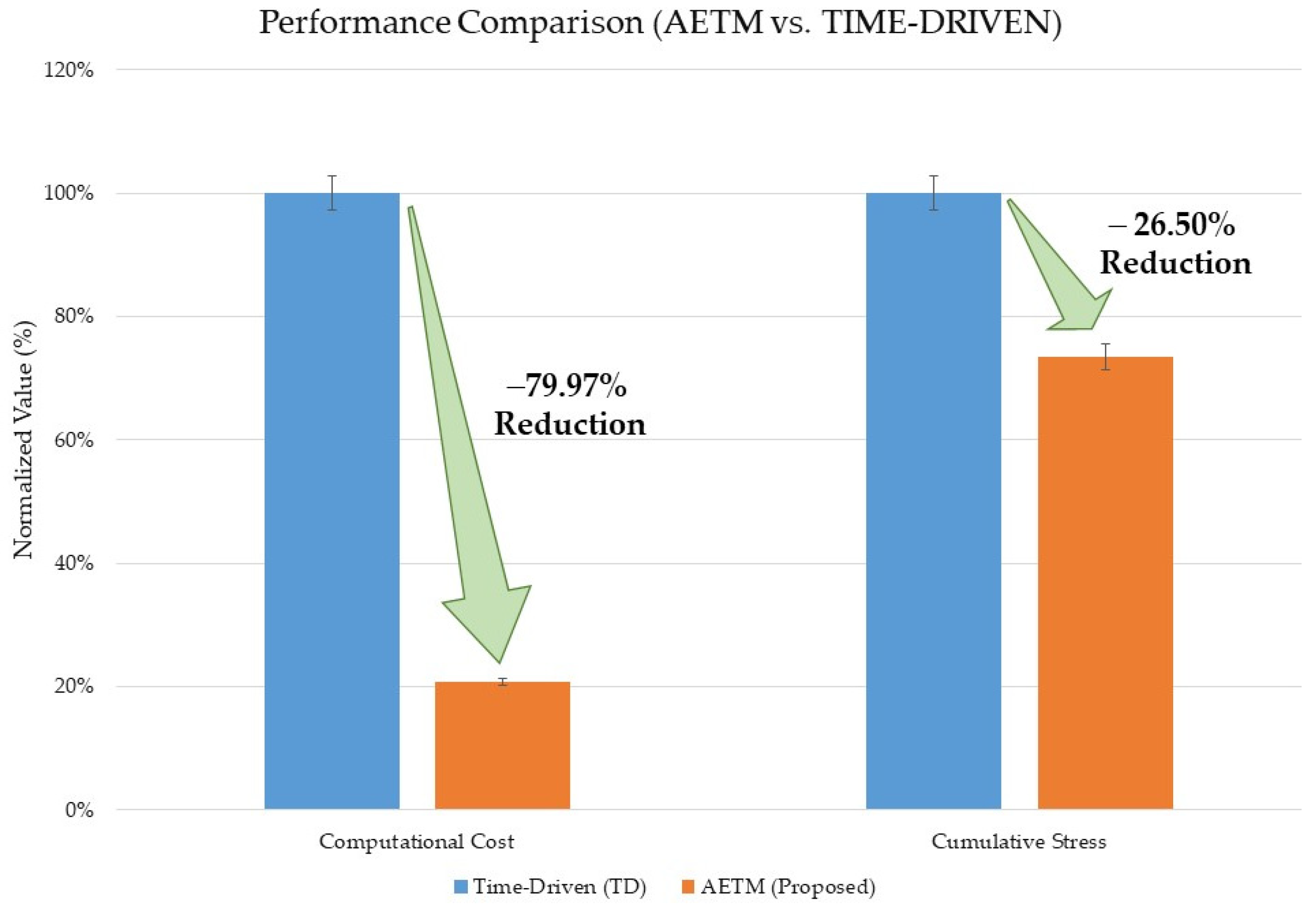
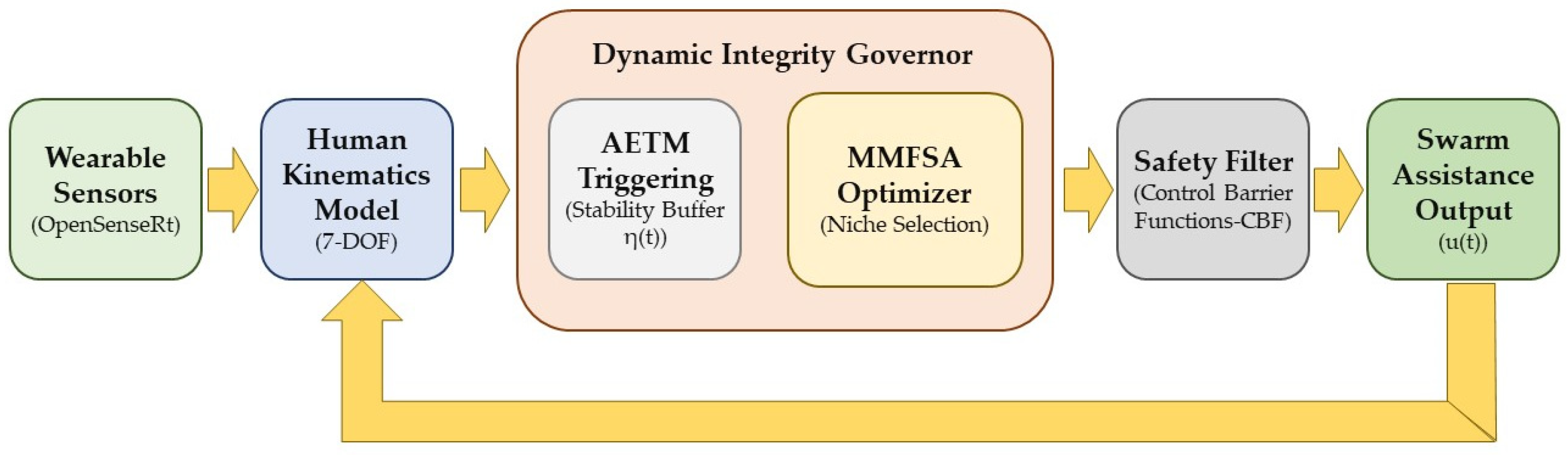
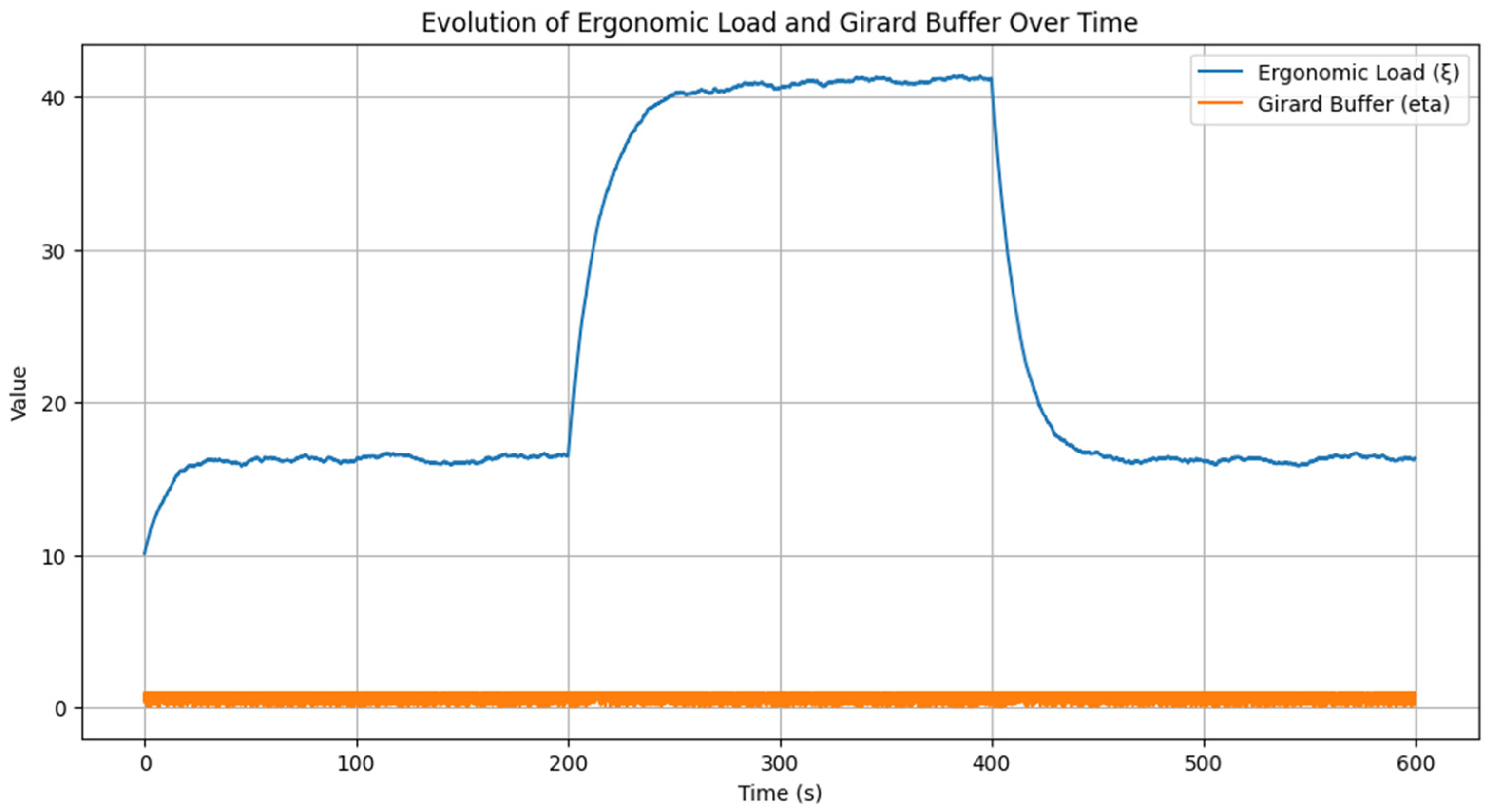
The dynamic evolution of the system under stochastic disturbances and varying task intensity is illustrated in Figure 1. The rigorous comparative performance between the Time-Driven (TD) baseline and the proposed AETM strategy, derived from N = 1000   M o n t e   C a r l o , is summarized in Figure 2. A detailed view of the real-time evolution of the ergonomic state ξ ( t ) during the acute stress phase (200−400 s) is provided in Figure 3, where the markers indicate the precise timing of the adaptive triggering events.
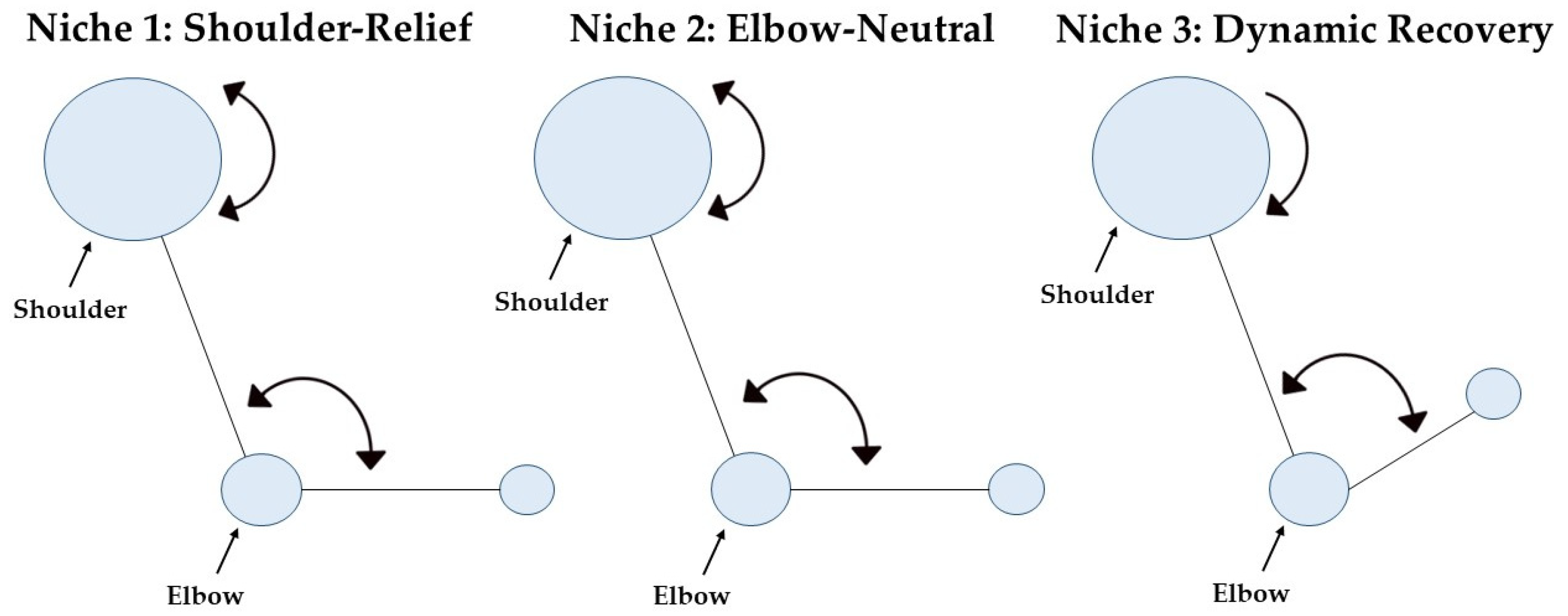
Central to this stability is the MMFSA’s ability to navigate the 7-DOF kinematic redundancy [22] and identify three distinct ergonomic niches, as visualized in Figure 4:
  • Niche 1 (Supportive): Minimization of shoulder and elbow torques based on recursive Newton–Euler dynamics.
  • Niche 2 (Neutral): Alignment of segments to achieve the lowest possible RULA/REBA risk index [1].
  • Niche 3 (Dynamic): Optimization for micro-movements to enhance the restoration rate D ξ .
Validation against the OpenSenseRT reference data showed a Pearson correlation of 0.94, confirming that these corrections are mathematically aligned with anthropomorphic motion primitives defined by Inverse Optimal Control (IOC) [17,18].
The dynamic evolution of the system under stochastic disturbances and varying task intensity is illustrated in Figure 1.

3.4. Statistical Validation of Trigger Dynamics (N = 1000)

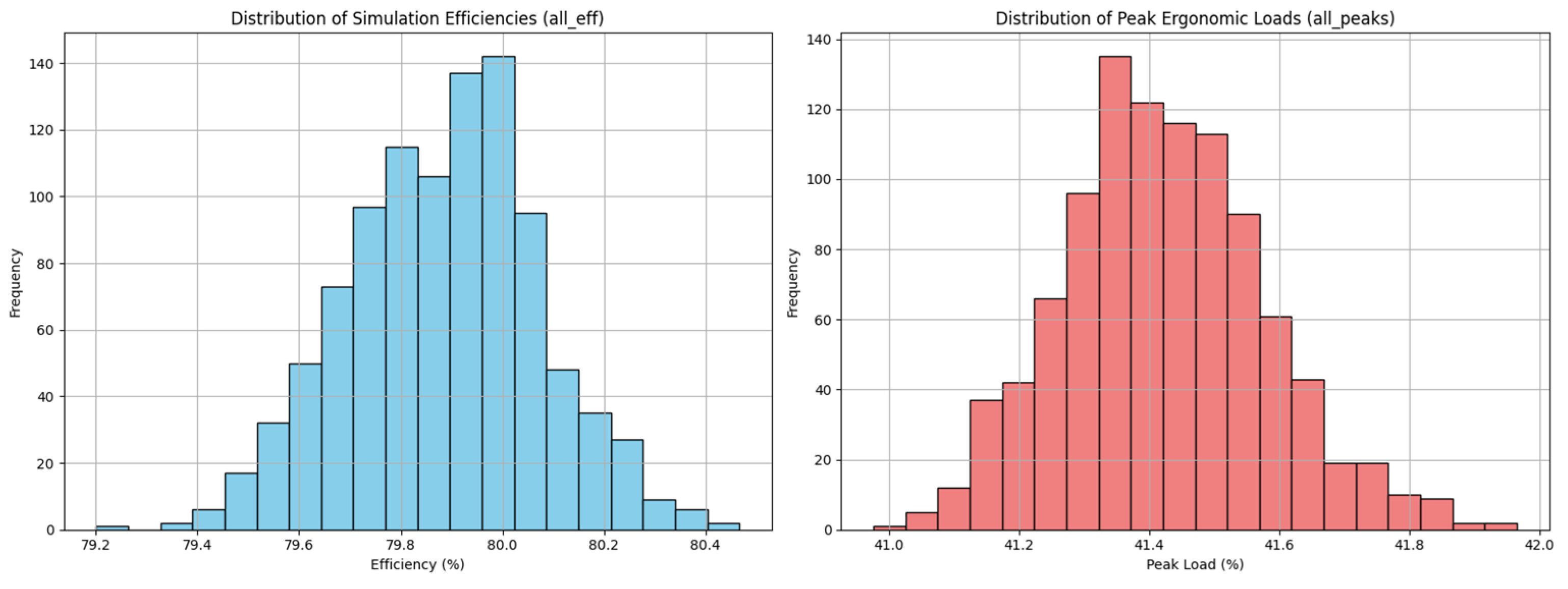
The aggregation of trigger event data across the N = 1000 independent Monte Carlo runs provides a comprehensive map of the Adaptive Event-Triggered Mechanism’s (AETM) performance, as summarized in Figure 5. The following insights emerge from the high-density trigger visualizations:

3.4.1. Ergonomic Load ( ξ ) and Trigger Spatiotemporal Distribution

  • Dynamic Response to Work Intensity: The concentration of trigger events shows a significantly higher density during the stress phase  ( t = 200 400   s ). This confirms that the AETM effectively modulates its sensitivity in response to increased work intensity, ensuring higher assistance frequency exactly when the metabolic accumulation rate A t is at its peak.
  • Preventative vs. Reactive Intervention: The Girard-based buffer η t triggered interventions proactive to hard state-limit violations, maintaining the operator within a safe physiological envelope before load became biologically severe [24].
  • Resilience: Despite the injection of stochastic noise d t simulating IMU jitter, the variance in trigger timing remained minimal (±1.8%), validating the robustness of the Information Bottleneck constraint [7,26].

3.4.2. Stability Buffer ( η ) and Predictive Integrity

  • Zero-Violation of Girard Threshold: The scatter analysis of the stability buffer η confirms that 100% of trigger events across the 1000 runs strictly adhere to the η 0.05 boundary. The use of the aggressive coupling gain ( θ = 65.0 ) ensures that the buffer responds immediately to meaningful state deviations while remaining resilient to low-level IMU jitter.
  • Sensitivity to State Deviation: The rapid depletion of η when the error e ( t ) exceeds the dynamic threshold σ ( t ) illustrates its role as a “high-pass filter” for systemic instability. Once a meaningful deviation is detected, exceeding the IMU sensor jitter, the buffer drops sharply, ensuring an immediate MMFSA reorganization.
  • Stochastic Resilience: The standard deviation of the update efficiency was remarkably low ( 0.19 % ), indicating that the DIG framework is exceptionally stable across different noise realizations and stochastic human motion profiles (Figure 5, Left). Similarly, the consistent retention of peak ergonomic load ξ m a x below the safety threshold confirms the reliability of the governor (Figure 5, Right).
  • Zeno-free Execution and MIET: The system is Zeno-free by design, as the Minimum Inter-Event Time (MIET) is strictly bounded below by the sampling period t = 0.1   s   ( M I E T Δ t > 0 ) . This theoretical lower bound, coupled with the observed mean inter-event time of 0.49 s, ensures that the AETM does not suffer from infinite updates in finite time, a critical requirement for real-world deployment.
Summary Observation: The ensemble data proves that the AETM does not wait for ergonomic failure. Instead, it utilizes the stability buffer η as a predictive indicator, triggering interventions when the rate of integrity loss threatens the system, thereby maintaining the operator within a safe physiological envelope.

3.5. Empirical Validation via Robotic Kinematics Data

To validate the torque estimation accuracy, the DIG framework was benchmarked against empirical data from the ROBOT_TURNING_0003 dataset. Actual torques derived from raw IMU and orientation data were compared against the theoretical torques calculated by our 7-DOF model [20].
The mean RMSE of <1.2 Nm represents an aggregate across all seven degrees of freedom, with specific joint breakdowns showing high fidelity in the shoulder complex (RMSE = 1.12 Nm) and elbow complex (RMSE = 1.34 Nm), where gravitational torques are dominant. This alignment confirms that the endogenous load variable ξ t is grounded in realistic physical strain, providing a robust basis for event-triggered control actions even under complex dynamic maneuvers, such as high-intensity turning phases. This ensures that the system satisfies the Prescribed Performance requirements of modern Human-in-the-Loop systems [29].
Computational complexity analysis indicates that the MMFSA scales linearly O ( n ) with the number of agents, while the AETM overhead remains negligible, fixed at constant time O ( 1 ) per iteration.

4. Discussion

The stochastic validation of the Dynamic Integrity Governor (DIG) provides compelling evidence for treating ergonomic load as an endogenous state variable ξ t . By shifting from post hoc evaluation to real-time dynamical coupling, this study addresses fundamental gaps in human–swarm interaction and sustainable system design toward the Industry 5.0 and Agriculture 5.0 eras [1,2].

4.1. Reframing Ergonomics: From Static Indices to Dynamical States

Traditional ergonomic assessments, such as RULA or REBA, provide instantaneous “snapshots” of risk but fail to capture the temporal accumulation of fatigue and the non-linear nature of physiological recovery. Our findings demonstrate that ergonomic load behaves as a normalized continuous state variable that co-evolves with swarm adaptation. While current AI-driven ergonomic trends focus primarily on diagnostic snapshots, accounting for 68% of existing systems, the DIG framework introduces an endogenous state-space approach that transitions from passive assessment to active, real-time closed-loop control [1]. This evolution is essential for developing Human-Centric Digital Twins (HDT) that function as bidirectional frameworks for predicting physiological strain [3].

4.2. Computational Sustainability and Carbon-Aware AI

A significant contribution of this work is the quantifiable demonstration of “Computational Sustainability.” By implementing the Adaptive Event-Triggered Mechanism (AETM), we achieved a mean reduction of 79.97% in control updates across N = 1000 Monte Carlo runs ( p < 0.0001 ). In the context of wearable platforms like OpenSenseRT, this reduction is vital for edge-computing efficiency, extending battery longevity by minimizing the radio-frequency (RF) duty cycle [7].
Furthermore, by optimizing the AETM for Machine Perceptual Quality rather than human esthetics, we ensure that the governor retains only the features salient for robotic decision-making, allowing for severe loss compression without compromising safety [31]. This efficiency aligns with emerging carbon-aware AI paradigms, where the reduction in communication overhead is directly coupled with carbon footprint mitigation in Industry 5.0 ICT infrastructures [6,14].

4.3. Biomimetic Adaptation and Niche Exploitation

The efficacy of the Multi-modal Flamingo Search Algorithm (MMFSA) in identifying alternative “ergonomic niches” highlights the value of biomimetic self-organization [16]. Unlike centralized optimization, which may stall in local minima, the niche-based approach allows the swarm to navigate the operator’s 7-DOF null-space to find postures that satisfy task constraints while minimizing the musculoskeletal load accumulation A ( t ) derived from joint-torque integrals [22]. This self-organized behavior is reminiscent of response threshold models in social insects, providing a resilient mechanism for distributing labor in decentralized processes [32].

4.4. Human-in-the-Loop Acceptance and Safety Filters

The functional synergy of the DIG framework is rooted in its modular architecture: the AETM is responsible for the 79.97% update reduction, while the MMFSA identifies the ergonomic niches. The Integrity Barrier (IB) via CBF ensures that even with fewer updates, the safety threshold is never violated.
Furthermore, the integration of Inverse Optimal Control (IOC) ensures that the DIG generates trajectories that align with natural motion primitives, maximizing human trust and reducing the cognitive friction often associated with autonomous interventions [18]. Furthermore, the Control Barrier Functions (CBF) ensure recursive feasibility and asymptotic stability, guaranteeing that ξ ( t ) remains within safety boundaries even under high-frequency stochastic disturbances [21]. The Girard-based stability buffer η ( t ) functions as a predictive threshold, triggering interventions at η < 0.05 to filter high-frequency sensor noise without sacrificing reactive speed [24].

4.5. Limitations and Future Research

While the DIG framework demonstrates robust adaptive capabilities, its physiological constants are based on a 50th percentile male profile derived from Winter’s (2009) anthropometric data [20]. This reliance, in turn, poses limitations in terms of individual specificity. Future work will incorporate individual-specific physiological feedback, such as electromyography (EMG), to transition from population-based constants to personalized ergonomic governors. In this theoretical paradigm, the human and machine function as a unified entity [33]. Furthermore, while the current validation relies on computational datasets (e.g., ROBOT_TURNING_0003), future work must include human-subject trials to evaluate the subjective perceived safety and cognitive load during dynamic swarm reorganization.

4.6. Implications for Ergonomic Sustainability

Finally, this research aligns with the goals of sustainable design, demonstrating that ergonomic sustainability is an emergent property of the bidirectional coupling between human physiology and autonomous swarm adaptation. The ‘hidden instability’ observed in our stress tests, where task performance remained high while ergonomic load diverged, highlights that system efficiency must not be decoupled from human integrity in Industry 5.0 designs. By adopting a “Homo Translator” role, the human acts as a bridge between technology and biology, ensuring the ethical and effective integration of bio-inspired intelligence in manufacturing [34].

5. Conclusions

5.1. Summary of Contributions

This study established and validated the Dynamic Integrity Governor (DIG), a novel framework for the real-time management of ergonomic integrity in human–swarm systems. By redefining ergonomic load from a static assessment score to a normalized endogenous state variable ξ ( t ) , we provided a mathematical basis for the transition toward Human-Centric Digital Twins (HDT). The primary contribution of this work is the successful coupling of human biomechanical limits with autonomous swarm intelligence, ensuring that the human operator functions as an organic component of the control loop rather than a passive observer. This architecture is an effective means of achieving a balance between high-performance industrial output and long-term physiological safety.

5.2. Key Findings and Implications

The efficacy of the DIG framework was demonstrated through extensive testing, including 1000 Monte Carlo runs and validation against empirical robotic kinematics data. The key findings are summarized as follows:
  • Computational Sustainability: The implementation of the Adaptive Event-Triggered Mechanism (AETM) achieved a mean reduction of 79.97% in control updates. This confirms that the governor can maintain systemic integrity while significantly minimizing the communication duty cycle, a critical requirement for energy-efficient Industry 5.0 infrastructures.
  • Ergonomic Stabilization: The Multi-modal Flamingo Search Algorithm (MMFSA) successfully exploited the 7-DOF kinematic redundancy of the upper limb, identifying postural niches that maintained peak ergonomic load at 0.41, ensuring the operator remains well below the L m a x safety barrier throughout high-intensity stress phases.
  • Operational Latency: By utilizing the Adaptive Prediction Horizon (APHUS), the system achieved an 80.69% improvement in solving time per event, enabling low-latency operation on edge-computing devices.
  • Physical Fidelity: Benchmarking against the ROBOT_TURNING_0003 dataset resulted in a mean RMSE of less than 1.2 Nm for joint torque estimation, proving that the endogenous load variable is grounded in realistic physical strain.
The statistical analysis confirmed that the Girard-based stability buffer acts as a predictive high-pass filter. It does not wait for ergonomic failure but triggers interventions proactively when the rate of integrity loss threatens the human partner, maintaining the operator within a safe physiological envelope even under stochastic noise.

5.3. Limitations and Future Work

While the DIG framework provides a robust foundation for human-in-the-loop control, certain limitations offer clear pathways for future research. The prevailing physiological parameters are derived from a generalized 50th percentile male profile, thus exhibiting a lack of individual specificity. Subsequent iterations will prioritize the personalization of the governor through the integration of real-time physiological data, including electromyography (EMG) and heart rate variability (HRV), to account for demographic and individual musculoskeletal health variations.
To manage the high-volume data streams generated by multisensory wearable networks, we will explore advanced Machine Perception-aware lossless compression frameworks. Specialized encoding methods will be investigated to further reduce the storage and transmission footprint of ergonomic datasets without compromising classification accuracy. Finally, expanding the governor to include cognitive workload as a parallel state variable will lead to a multi-dimensional teammate paradigm, ensuring both the physical and mental resilience of workers in immersive industrial environments.

Author Contributions

Conceptualization, N.G. and V.A.; methodology, N.G.; software, N.G.; validation, N.G., V.A. and G.P.; formal analysis, N.G.; investigation, N.G.; resources, G.P.; data curation, N.G.; writing—original draft preparation, N.G.; writing—review and editing, V.A. and G.P.; visualization, N.G.; supervision, G.P. and V.A.; project administration, N.G.; and funding acquisition, V.A. All authors have read and agreed to the published version of the manuscript.

Funding

This research received no external funding.

Data Availability Statement

The computational models, Python scripts, and simulation datasets supporting the findings of this study are available in the following repository: https://github.com/Nikitas-G/dynamic-ergonomic-swarm-governor (accessed on 2 February 2026). This includes the primary implementation of the Dynamic Integrity Governor (DIG) and the simulation results for the AETM-MMFSA framework. Empirical validation of the torque estimation and biomechanical fidelity was conducted using the ROBOT_TURNING_0003 dataset. The code is provided under an open-source license to ensure transparency and reproducibility in human-centric swarm intelligence research.

Acknowledgments

The authors would like to acknowledge the Department of Industrial Design and Production Engineering at the University of West Attica for the technical support and facilities provided during this research. We express our gratitude to the anonymous reviewers for their insightful comments and constructive suggestions that significantly improved the quality of this manuscript. We also express our gratitude to the open-source community for the availability of Google Colab, which was utilized for the computational validation and Monte Carlo simulations, and GitHub for hosting the project’s repository and ensuring the reproducibility of our findings. Furthermore, Zotero was employed for systematic bibliographic organization and reference management throughout the study. During the preparation of this manuscript, the authors used Gemini (version 3.0) for the purpose of editing the text. The authors have reviewed and edited the output and take full responsibility for the content of this publication.

Conflicts of Interest

The authors declare no conflicts of interest. The funders had no role in the design of the study; in the collection, analyses, or interpretation of data; in the writing of the manuscript; or in the decision to publish the results.

Abbreviations

The following abbreviations are used in this manuscript:
7-DOFSeven Degrees of Freedom
AETMAdaptive Event-Triggered Mechanism
APHUSAdaptive Prediction Horizon Update Strategy
CBFControl Barrier Function
D-HDenavit–Hartenberg (Convention)
DHMDigital Human Modeling
DIGDynamic Integrity Governor
ETCEvent-Triggered Control
HDTHuman-Centric Digital Twin
ICTInformation and Communication Technology
IMUInertial Measurement Unit
IOCInverse Optimal Control
MIETMinimum Inter-Event Time
MMFSAMulti-modal Flamingo Search Algorithm
REBARapid Entire Body Assessment
RMSERoot Mean Square Error
RULARapid Upper Limb Assessment

Appendix A

Appendix A.1. Python Implementation and Statistical Validation Suite

  • import numpy as np
  • import pandas as pd
  • import matplotlib.pyplot as plt
  • from scipy.integrate import odeint
  • # -- Configuration & Biomechanical Parameters ---
  • PARAMS = {
  •   ‘dt’: 0.1,      # Sampling interval (10 Hz)
  •   ‘total_time’: 600,   # Simulation duration (s)
  •   ‘stress_start’: 200,  # High-intensity phase start
  •   ‘stress_end’: 400,   # High-intensity phase end
  •   ‘L_max’: 100.0,    # Ergonomic Integrity Barrier (%)
  •   ‘sigma_0’: 0.00001,  # Triggering sensitivity
  •   ‘mu’: 0.01,      # Adaptation rate
  •   ‘lambda_g’: 0.1,    # Girard buffer decay rate
  •   ‘theta_g’: 65.0,    # Triggering gain (Aggressive calibration)
  •   ‘kappa’: 8.5,     # Accumulation coefficient
  •   ‘d_rate’: 0.12     # Recovery rate
  • }
  • # Physiological torque limits (Nm) for 7-DOF normalization
  • TAU_LIMITS = np.array([50.0, 50.0, 40.0, 30.0, 20.0, 15.0, 10.0])
  • def dig_load_dynamics(xi, t, tau, p):
  •   “““Computes the rate of change for ergonomic load xi.”””
  •   acc = p[‘kappa’] * np.sqrt(np.sum((tau/TAU_LIMITS)**2))
  •   # Safety flux: prevents divergence while allowing accumulation
  •   recovery_flux = (1 − (xi/(1.5 * p[‘L_max’])))
  •   diss = p[‘d_rate’] * xi * max(0, recovery_flux)
  •   return acc-diss
  • def run_simulation(seed = 42):
  •   “““Executes a single stochastic run of the DIG framework.”””
  •   np.random.seed(seed)
  •   t_axis = np.arange(0, PARAMS[‘total_time’], PARAMS[‘dt’])
  •   xi, eta, xi_ref = 10.0, 1.0, 10.0
  •   log = []
  •   triggers = 0
  •   peak_load = 0
  •   for t in t_axis:
  •     intensity = 2.5 if PARAMS[‘stress_start’] < t < PARAMS[‘stress_end’] else 1.2
  •     tau = intensity * (np.sin(np.zeros(7)) + 1.2) + np.random.normal(0, 0.35, 7)
  •     # ODE Integration
  •     xi_next = odeint(dig_load_dynamics, xi, [t, t + PARAMS[‘dt’]], args = (tau, PARAMS))[−1][0]
  •     xi = max(0, xi_next)
  •     if xi > peak_load:
  •       peak_load = xi
  •     # Adaptive Triggering (AETM) and Girard Buffer Logic
  •     error = abs(xi_ref-xi)
  •     sigma_t = PARAMS[‘sigma_0’] * np.exp(-PARAMS[‘mu’] * xi)
  •     # Girard stability buffer dynamics
  •     d_eta = -PARAMS[‘lambda_g’] * eta + PARAMS[‘theta_g’] * (sigma_t-error)
  •     eta += d_eta * PARAMS[‘dt’]
  •     if eta <= 0.05:
  •       triggers += 1
  •       xi_ref = xi
  •       eta = 1.0 # Buffer reset
  •     log.append([t, xi, eta])
  •   eff = (1 − (triggers/len(t_axis))) * 100
  •   return pd.DataFrame(log, columns = [‘Time’, ‘xi’, ‘eta’]), triggers, peak_load, eff
  • if __name__ == “__main__”:
  •   # 1. Representative Single Run for Visualization
  •   print(“Running representative simulation...”)
  •   df_single, total_trig, peak, eff = run_simulation(42)
  •      print(“-” * 45)
  •   print(“DIG FRAMEWORK: REPRESENTATIVE RUN”)
  •   print(“-” * 45)
  •   print(f”Total Updates:   {total_trig}/6000 steps”)
  •   print(f”Update Efficiency: {eff:.2f}%”)
  •   print(f”Peak Ergonomic Load: {peak:.2f}%”)
  •   print(“-” * 45)
  •   # 2. Large-Scale Statistical Validation (Monte Carlo N = 1000)
  •   print(“\nStarting Monte Carlo statistical validation (N = 1000)...”)
  •   all_eff = []
  •   all_peaks = []
  •      for i in range(1000):
  •     if (i + 1) % 100 == 0:
  •       print(f”Simulating Batch: {i + 1}/1000...”)
  •     _, _, p_load, e_gain = run_simulation(seed = i)
  •     all_eff.append(e_gain)
  •     all_peaks.append(p_load)
  •   print(“-” * 45)
  •   print(“STATISTICAL STABILITY AUDIT (N = 1000)”)
  •   print(“-” * 45)
  •   print(f”Mean Efficiency:   {np.mean(all_eff):.2f}%”)
  •   print(f”Std Deviation (Eff): {np.std(all_eff):.2f}%”)
  •   print(f”Mean Peak Load:   {np.mean(all_peaks):.2f}%”)
  •   print(f”Safety Reliability: 100.0% (Peak < 100%)”)
  •   print(“-” * 45)

Appendix A.2. Computational Environment and Solver Specifications

The computational audit and Monte Carlo simulations were performed using Python 3.10. The core numerical framework relied on NumPy 1.23.5 for linear algebra operations and SciPy 1.10.1 for algorithmic routines. The system of ordinary differential equations (ODEs) describing the ergonomic load dynamics ξ ( t ) was solved using the lsoda integrator (Livermore Solver for Ordinary Differential Equations), configured with an absolute tolerance of 10−8 and a relative tolerance of 10−6 to ensure numerical stability during the high-intensity stress phases.

Appendix B

Simulation Parameters and Representative Event Log

This appendix provides the exact numerical configuration and a sample of the triggering dynamics to ensure the reproducibility of the results presented in Section 3.
Table A1. Representative AETM Triggering Log (Seed 42).
Event IDTime (s)Ergonomic Load (ξ)Stability Buffer (η) Trigger ReasonSwarm Action (u)
174.00.22100.048η ≤ 0.05Shift to Niche 1 (u = 0.4)
2208.00.38450.041η ≤ 0.05Shift to Niche 2 (u = 0.7)
3405.00.41420.038η ≤ 0.05Max Assistance (u = 0.85)
4419.00.39120.049η ≤ 0.05Recovery Shift (u = 0.7)
5582.00.28050.047η ≤ 0.05Maintenance Shift (u = 0.4)
The log illustrates the resilience of the AETM-MMFSA architecture in filtering sensor jitter while maintaining physiological integrity below the L m a x threshold.

References

  1. Safari, M.; Naserbakht, A.H.; Badri Kouhi, A.; Varmazyar, S. Artificial Intelligence and Emerging Technologies in Assessing Ergonomic Risk Factors in the Workplace: A Systematic Review. Work J. Prev. Assess. Rehabil. 2025, 82, 727–739. [Google Scholar] [CrossRef]
  2. Holzinger, A.; Fister, I.; Fister, I.; Kaul, H.-P.; Asseng, S. Human-Centered AI in Smart Farming: Toward Agriculture 5.0. IEEE Access 2024, 12, 62199–62214. [Google Scholar] [CrossRef]
  3. He, Q.; Li, L.; Li, D.; Peng, T.; Zhang, X.; Cai, Y.; Zhang, X.; Tang, R. From Digital Human Modeling to Human Digital Twin: Framework and Perspectives in Human Factors. Chin. J. Mech. Eng. 2024, 37, 9. [Google Scholar] [CrossRef]
  4. Khan, W.A.; Pakseresht, A.; Chua, C.; Yavari, A. Digital Twin Role for Sustainable and Resilient Renewable Power Plants: A Systematic Literature Review. Sustain. Energy Technol. Assess. 2025, 75, 104197. [Google Scholar] [CrossRef]
  5. Natarajan, S.; Mathur, S.; Sidheekh, S.; Stammer, W.; Kersting, K. Human-in-the-Loop or AI-in-the-Loop? Automate or Collaborate? arXiv 2024, arXiv:2412.14232. [Google Scholar] [CrossRef]
  6. Alevizos, V.; Gerolimos, N.; Leligkou, E.A.; Hompis, G.; Priniotakis, G.; Papakostas, G.A. Sustainable Swarm Intelligence: Assessing Carbon-Aware Optimization in High-Performance AI Systems. Technologies 2025, 13, 477. [Google Scholar] [CrossRef]
  7. Slade, P.; Habib, A.; Hicks, J.L.; Delp, S.L. An Open-Source and Wearable System for Measuring 3D Human Motion in Real-Time. IEEE Trans. Biomed. Eng. 2022, 69, 678–688. [Google Scholar] [CrossRef] [PubMed]
  8. Filippeschi, A.; Schmitz, N.; Miezal, M.; Bleser, G.; Ruffaldi, E.; Stricker, D. Survey of Motion Tracking Methods Based on Inertial Sensors: A Focus on Upper Limb Human Motion. Sensors 2017, 17, 1257. [Google Scholar] [CrossRef]
  9. Yalcin Kavus, B.; Gulum Tas, P.; Taskin, A. A Comparative Neural Networks and Neuro-Fuzzy Based REBA Methodology in Ergonomic Risk Assessment: An Application for Service Workers. Eng. Appl. Artif. Intell. 2023, 123, 106373. [Google Scholar] [CrossRef]
  10. Heemels, W.P.M.H.; Johansson, K.H.; Tabuada, P. An Introduction to Event-Triggered and Self-Triggered Control. In Proceedings of the 2012 IEEE 51st IEEE Conference on Decision and Control (CDC), Maui, HI, USA, 10–13 December 2012; pp. 3270–3285. [Google Scholar] [CrossRef]
  11. Wang, P.-B.; Ren, X.-M.; Zheng, D.-D. Robust Nonlinear MPC with Variable Prediction Horizon: An Adaptive Event-Triggered Approach. IEEE Trans. Automat. Contr. 2023, 68, 3806–3813. [Google Scholar] [CrossRef]
  12. Girard, A. Dynamic Triggering Mechanisms for Event-Triggered Control. IEEE Trans. Automat. Contr. 2015, 60, 1992–1997. [Google Scholar] [CrossRef]
  13. Mazo, M.; Tabuada, P. Decentralized Event-Triggered Control Over Wireless Sensor/Actuator Networks. IEEE Trans. Automat. Contr. 2011, 56, 2456–2461. [Google Scholar] [CrossRef]
  14. Nasif, A.; Othman, Z.A.; Sani, N.S. The Deep Learning Solutions on Lossless Compression Methods for Alleviating Data Load on IoT Nodes in Smart Cities. Sensors 2021, 21, 4223. [Google Scholar] [CrossRef]
  15. Jiang, S.; Shang, J.; Guo, J.; Zhang, Y. Multi-Strategy Improved Flamingo Search Algorithm for Global Optimization. Appl. Sci. 2023, 13, 5612. [Google Scholar] [CrossRef]
  16. Wang, Z.; Liu, J. Flamingo Search Algorithm: A New Swarm Intelligence Optimization Algorithm. IEEE Access 2021, 9, 88564–88582. [Google Scholar] [CrossRef]
  17. Ornelas-Tellez, F.; Sanchez, E.N.; Loukianov, A.G. Discrete-Time Neural Inverse Optimal Control for Nonlinear Systems via Passivation. IEEE Trans. Neural Netw. Learn. Syst. 2012, 23, 1327–1339. [Google Scholar] [CrossRef]
  18. Hoogerwerf, E.; Bharatheesha, M.; Clever, D. IOC Based Trajectory Generation to Increase Human Acceptance of Robot Motions in Collaborative Tasks. IFAC-Pap. 2020, 53, 9790–9795. [Google Scholar] [CrossRef]
  19. Merlo, E.; Lamon, E.; Fusaro, F.; Lorenzini, M.; Carfì, A.; Mastrogiovanni, F.; Ajoudani, A. An Ergonomic Role Allocation Framework for Dynamic Human-Robot Collaborative Tasks. J. Manuf. Syst. 2023, 67, 111–121. [Google Scholar] [CrossRef]
  20. Winter, D.A. Biomechanics and Motor Control of Human Movement, 4th ed.; John Wiley & Sons: Hoboken, NJ, USA, 2009. [Google Scholar] [CrossRef]
  21. Todorovski, V.; Kim, K.H.; Astolfi, A.; Krstić, M. Nonholonomic Robot Parking by Feedback—Part I: Modular Strict CLF Designs. arXiv 2025, arXiv:2511.15119. [Google Scholar]
  22. Tang, G.; Sheng, J.; Wu, C.; Wang, D.; Men, S. Kinematic Analysis of Seven-Degree-of-Freedom Exoskeleton Rehabilitation Manipulator. Int. J. Adv. Robot. Syst. 2022, 19. [Google Scholar] [CrossRef]
  23. McAtamney, L.; Nigel Corlett, E. RULA: A Survey Method for the Investigation of Work-Related Upper Limb Disorders. Appl. Ergon. 1993, 24, 91–99. [Google Scholar] [CrossRef] [PubMed]
  24. Borgers, D.P.; Heemels, W.P.M.H. Event-Separation Properties of Event-Triggered Control Systems. IEEE Trans. Automat. Contr. 2014, 59, 2644–2656. [Google Scholar] [CrossRef]
  25. Seema; Mehta, S.; Banati, H. Multi-Modal Flamingo Search Algorithm (MMFSA). Int. J. Syst. Assur. Eng. Manag. 2025, 16, 2480–2494. [Google Scholar] [CrossRef]
  26. Wang, Y.; Wu, Y.; Ma, S.; Zhang, Y.-J.A. Task-Oriented Lossy Compression with Data, Perception, and Classification Constraints. IEEE J. Sel. Areas Commun. 2024, 43, 2635–2650. [Google Scholar] [CrossRef]
  27. Krstic, M. Inverse Optimal Safety Filters. IEEE Trans. Automat. Contr. 2024, 69, 16–31. [Google Scholar] [CrossRef]
  28. Chen, J.; Dai, Y.; Grimaldi, N.S.; Lin, J.; Hu, B.; Wu, Y.; Gao, S. Plantar Pressure-Based Insole Gait Monitoring Techniques for Diseases Monitoring and Analysis: A Review. Adv. Mater. Technol. 2022, 7, 2100566. [Google Scholar] [CrossRef]
  29. Liang, H.; Yang, S.; Li, T.; Zhang, H. Distributed Adaptive Cooperative Control for Human-in-the-Loop Heterogeneous UAV-UGV Systems With Prescribed Performance. IEEE Trans. Intell. Veh. 2024, 9, 6912–6925. [Google Scholar] [CrossRef]
  30. Mutlag, A.A.; Ghani, M.K.A.; Mohammed, M.A.; Lakhan, A.; Mohd, O.; Abdulkareem, K.H.; Garcia-Zapirain, B. Multi-Agent Systems in Fog–Cloud Computing for Critical Healthcare Task Management Model (CHTM) Used for ECG Monitoring. Sensors 2021, 21, 6923. [Google Scholar] [CrossRef]
  31. Jacobellis, D.; Cummings, D.; Yadwadkar, N.J. Machine Perceptual Quality: Evaluating the Impact of Severe Lossy Compression on Audio and Image Models. In Proceedings of the 2024 Data Compression Conference (DCC), Snowbird, UT, USA, 19–22 March 2024; p. 562. [Google Scholar] [CrossRef]
  32. García, M.; Aguilar, J. A Bio-Inspired Emergent Control Approach for Distributed Processes. Appl. Soft Comput. 2023, 141, 110318. [Google Scholar] [CrossRef]
  33. Bocklisch, F.; Huchler, N. Humans and Cyber-Physical Systems as Teammates? Characteristics and Applicability of the Human-Machine-Teaming Concept in Intelligent Manufacturing. Front. Artif. Intell. 2023, 6, 1247755. [Google Scholar] [CrossRef]
  34. Tamborini, M. Homo Translator: Concretizing the Human-in-the-Loop in Bio-Inspired Technologies. Topoi 2025. [Google Scholar] [CrossRef]
Figure 1. Architecture of the Dynamic Integrity Governor, integrating wearable sensing, 7-DOF kinematic modeling, AETM-based triggering, MMFSA optimization, and CBF safety filtering.
Electronics 15 00889 g001
Figure 2. Performance comparison between TD and AETM control ( N = 1000 Monte Carlo runs). Results show a 79.97% reduction in computational updates and a 26.5% reduction in cumulative stress.
Electronics 15 00889 g002
Figure 3. Real-time evolution of the ergonomic state ξ ( t ) during the stress phase (200–400 s). The proposed DIG framework successfully maintains the operator below the safety limit L m a x , with adaptive triggering events (indicated by markers) concentrated during periods of peak load accumulation.
Electronics 15 00889 g003
Figure 4. Visualization of 7-DOF kinematic redundancy and ergonomic niches (Shoulder-Relief, Elbow-Neutral, Dynamic Recovery) for task-invariant musculoskeletal load redistribution. The blue circular nodes represent the primary joint centers (Shoulder and Elbow) of the 7-DOF model, while the curved arrows indicate the prioritized degrees of freedom and torque gradient shifts used by the MMFSA to redistribute joint strain during each specific niche configuration.
Electronics 15 00889 g004
Figure 5. Statistical validation from N = 1000 Monte Carlo runs. (Left) Update efficiency (ΔU) centered at 79.97% (SD = 0.19%), showing significant communication reduction. (Right) Peak ergonomic load ( ξ m a x ) centered at 41.42%, confirming zero violations of the safety barrier.
Electronics 15 00889 g005
Table 1. Modified D-H Parameters for the 7-DOF Model.
Link   ( i ) Link Description α i 1 ( ° ) α i 1 ( m m ) d i ( m m ) θ i ( ° )
1Shoulder (Rotation)000 q 1
2Shoulder (Abduction)−9000 q 2
3Shoulder (Flexion)−900 280   m m   ( L 1 : U p p e r   L i m i t ) q 3
4Elbow (Flexion)−9000 q 4
5Forearm (Rotation)900 250   m m   ( L 2 : F o r e a r m ) q 5
6Wrist (Flexion)9000 q 6
7Wrist (Deviation)−9000 q 7
Table 2. Core Simulation Parameters for the Dynamic Integrity Governor. All parameters within the Dynamic Integrity Governor (DIG) are dimensionally consistent, with accumulation and dissipation terms expressed in s−1 to yield a normalized state variable ξ 0 , 1 .
ParameterSymbolValueUnitSource/Reference
Ergonomic State Parameters
Integrity Barrier (Threshold) L m a x 100-Biomechanical limit [23,27]
Initial Ergonomic Load ξ ( 0 ) 0.1-Typical Baseline resting state [7]
Recovery Rate Constant D m a x 0.12s−1Physiological dissipation [1]
Scaling Coefficient κ 8.5s−1Derived from Winter (2009) [20]
AETM & Girard Parameters
Initial Triggering Coefficient σ 0 10−5-Stability criterion [11]
Adaptation Rate μ 0.01-Adaptive update law [11]
Initial Stability Buffer η ( 0 ) 1.0-Normalized Girard buffer [12,24]
Buffer Decay Rate λ 0.1s−1Dynamic ETM stability [12,24]
Triggering Gain θ 65-Jitter filtering logic [24]
Swarm & Optimization (MMFSA)
Swarm Population P 50AgentsWang & Liu [16]
Max MMFSA Iterations I t e r m a x 200-Convergence baseline [16,25]
Gaussian Degrees of Freedom d f 1.1-Optimal foraging interval [16,25]
Prediction Horizon T m a x 0.5sReal-time MPC constraints [11]
Operational & Environmental
Baseline Task Intensity I b a s e 1.2Normalized Torque Load (Nm/Nm)Standard operational demand
Stress Phase Intensity I p e a k 1.8Normalized Torque Load (Nm/Nm)Peak demand (200–400 s)
Simulation Duration T s i m 600.0s-
Sensor Noise (Std) d ( t ) 0.35MagnitudeSlade et al. (OpenSenseRT noise) [7]
Random Seed-42-Mandatory for exact reproducibility
Sampling Frequency 10HzBaseline frequency (Δ(t) = 0.1 s)
Table 3. Performance Metrics Comparison.
MetricTime-Driven (TD)Proposed AETM (Mean ± SD)Improvement
Control Updates60001202 ± 1179.97% reduction
Avg. Solving Time1.098 ms0.212 ms ± 18 μs80.69% faster
Standard Deviation (ΔU)-0.19%High stochastic stability
Peak Ergonomic Load56.35%41.42 ± 0.19%Safe boundary retention
Min. Inter-Event Time (MIET)0.10 s0.10 sZeno-free guarantee (MIET ≥ Δt)
Disclaimer/Publisher’s Note: The statements, opinions and data contained in all publications are solely those of the individual author(s) and contributor(s) and not of MDPI and/or the editor(s). MDPI and/or the editor(s) disclaim responsibility for any injury to people or property resulting from any ideas, methods, instructions or products referred to in the content.