Article

Loss Characterization of Soft Magnetic Core Materials from Room to Cryogenic Temperatures: A Comparative Study for Cryogenic Power Electronic Applications

Institute of Power Electronics, Friedrich-Alexander-Universität Erlangen-Nürnberg, 90429 Nuremberg, Germany
*
Author to whom correspondence should be addressed.
Electronics 2026, 15(4), 872; https://doi.org/10.3390/electronics15040872
Submission received: 21 January 2026 / Revised: 13 February 2026 / Accepted: 16 February 2026 / Published: 19 February 2026
(This article belongs to the Section Power Electronics)

Abstract

This paper presents a comprehensive experimental study addressing the lack of consistent low-temperature data on magnetic materials for high-efficiency cryogenic power electronics. A unified dataset is provided for the first time, covering temperatures from room temperature down to −194 °C, excitation frequencies between 25 kHz and 400 kHz, and technologically relevant flux densities. The investigated materials include MnZn- and NiZn-ferrites, nanocrystalline alloys (Vitroperm, Finemet), and various classes of alloyed powder cores. The characterization comprises magnetic hysteresis behavior, saturation flux density, temperature- and frequency-dependent core losses, permeability, and DC bias performance under cryogenic conditions. The results demonstrate that nanocrystalline materials and selected powder cores (MPP, Edge) exhibit superior cryogenic performance, while ferrites and low-cost powder cores suffer from significant loss increases or magnetic instability at low temperatures. These findings provide a solid basis for the selection and design of magnetic components in next-generation cryogenic power-electronic systems.

1. Introduction

The development of cryogenic power electronics is a promising approach to enhance system efficiency, particularly in superconducting propulsion systems for next-generation electric aircraft. Although the cryogenic behavior of semiconductor devices is relatively well understood [1,2], the performance of magnetic core materials under such conditions remains insufficiently characterized [3,4,5,6,7,8,9,10,11,12,13,14]—despite their critical role in inductors, transformers, and filters. As these passive components significantly affect the efficiency, power density, and thermal performance of power converters, their suitability at low temperatures represents a key design consideration.
Conventional soft-magnetic materials—such as ferrites, nanocrystalline materials, and powder cores—exhibit pronounced temperature dependence in their magnetic properties, influencing core losses, permeability, and saturation flux density. Since cooling to deep cryogenic temperatures (e.g., −196 °C using liquid nitrogen) is technically and energetically demanding, precise characterization of magnetic losses at the actual operating temperature is essential for accurate thermal management. The loss-induced heat load defines the required cooling capacity and consequently impacts the overall system mass and efficiency.
Published data on the low-temperature performance of commercially relevant magnetic core materials are sparse. For some material classes, available studies are limited to a single temperature point (typically −196 °C in liquid nitrogen) [5,8,9,10,11,14], while for others, quantitative core loss data are reported for only one excitation frequency or are entirely absent [7]. In certain cases, core materials have been investigated only within specific application contexts, where their suitability was evaluated indirectly rather than through a dedicated material characterization [12,13]. Such fragmented information is insufficient to support comprehensive design optimization. Preliminary studies indicate that certain magnetic properties can deviate significantly from their room-temperature values, highlighting the need for a systematic characterization of commercially relevant core materials across the full temperature range.
MnZn- and NiZn-ferrites exhibit a pronounced decrease in permeability and increase in core losses at cryogenic temperatures. For example, the relative permeability of N87 (MnZn) decreases by a factor of 7 at −180 °C [3], while PC40 (MnZn) and MN8CX (NiZn) show reductions of approximately 50–60% at −150 °C [6]. In parallel, MnZn-ferrites display a substantial increase in saturation flux density, exceeding +35% in liquid nitrogen [5]. However, this improvement is accompanied by a pronounced increase in core losses, which rise by up to a factor of five for MnZn- and NiZn- ferrites at −150 °C and 100 kHz [6] and by as much as a factor of ten at −180 °C over the frequency range from 20 kHz to 200 kHz [3].
Nanocrystalline and amorphous core materials exhibit exceptionally high permeability, which decreases moderately at cryogenic temperatures (typically by 20–30% at −196 °C) [3,5,8]. In parallel, the saturation flux density increases slightly (~10–15%) [3,4,5,9], while core losses rise moderately with decreasing temperature, e.g., by a factor of 1.5–2.5 for Vitroperm 500 F at −180 °C within a 20–200 kHz range [3], and by approximately 40% increase for Finemet at −196 °C and 10 Hz [8]. Another study examined the use of a nanocrystalline core in a synchronous buck converter, reporting a 10% increase in power dissipation at 50 kHz and 25% at 100 kHz [11]. As demonstrated in previous work [4], nanocrystalline cores with a controlled air gap can achieve very good DC bias performance despite their reduced effective permeability, making them suitable for both conventional and cryogenic power-electronics applications. In that study, gapped cores were successfully employed as the energy-storage inductors of a buck converter operating at −196 °C in liquid nitrogen.
To date, one study has addressed the cryogenic behavior of powder cores, focusing on MPP, Kool Mµ, and High Flux types [7]. In this study, temperature- and frequency-dependent variations in inductor resistance, quality factor, and inductance were characterized, thereby reflecting properties of the inductor configuration rather than the inherent attributes of the core material. A B-H characteristic was likewise obtained; however, the resulting curve exhibited insufficient resolution and clarity to permit quantitative evaluation. Kool Mµ exhibited the strongest permeability decrease (≈35% at −190 °C), whereas High Flux and MPP remained relatively stable [7]. Nevertheless, there is still a lack of quantitative data on frequency- and flux-density-dependent core losses at low temperatures—despite their importance for accurate inductor design. Moreover, many commercially available powder-core variants, including those with modified alloy compositions, remain uncharacterized under cryogenic conditions.
This work specifically addresses the lack of comprehensive data on specific core losses over a wide temperature range from room temperature to −194 °C and at medium excitation frequencies (25–400 kHz), as a function of magnetic flux density—information essential for reliable inductor design. Special emphasis is also placed on the temperature dependence of magnetic permeability and, in selected cases, its behavior under DC bias at 25 °C and −196 °C. The study covers MnZn- and NiZn-ferrites, nanocrystalline materials (e.g., Vitroperm, Finemet), and alloyed iron powder cores. The key parameters include hysteresis losses, magnetic permeability, and, where applicable, saturation and DC bias characteristics.
Section 2 details the characterization methods, including the measurement setup, procedures, and the investigated core materials. Section 3 presents the experimental results obtained from room temperature down to −194 °C, beginning with B-H characteristics and saturation flux density, followed by specific core losses including temperature-dependent Steinmetz parameters, permeability measurements, and DC bias behavior. A concluding evaluation summarizes the key findings of this subsection. Section 4 provides a brief summary, and the appendix offers additional supporting material related to the Steinmetz parameters.

2. Characterization Method and Materials

To assess the suitability of soft magnetic materials for operation at low and cryogenic temperatures, a representative selection of commercially available core materials is characterized from room temperature down to −194 °C. The investigated materials include ferrites, nanocrystalline cores, and alloyed iron powder cores. An overview of these materials is provided in Table 1. All cores were characterized in the as-received condition, i.e., exactly as supplied by the manufacturers, without any pre-treatment or additional conditioning.

Charaterization Method

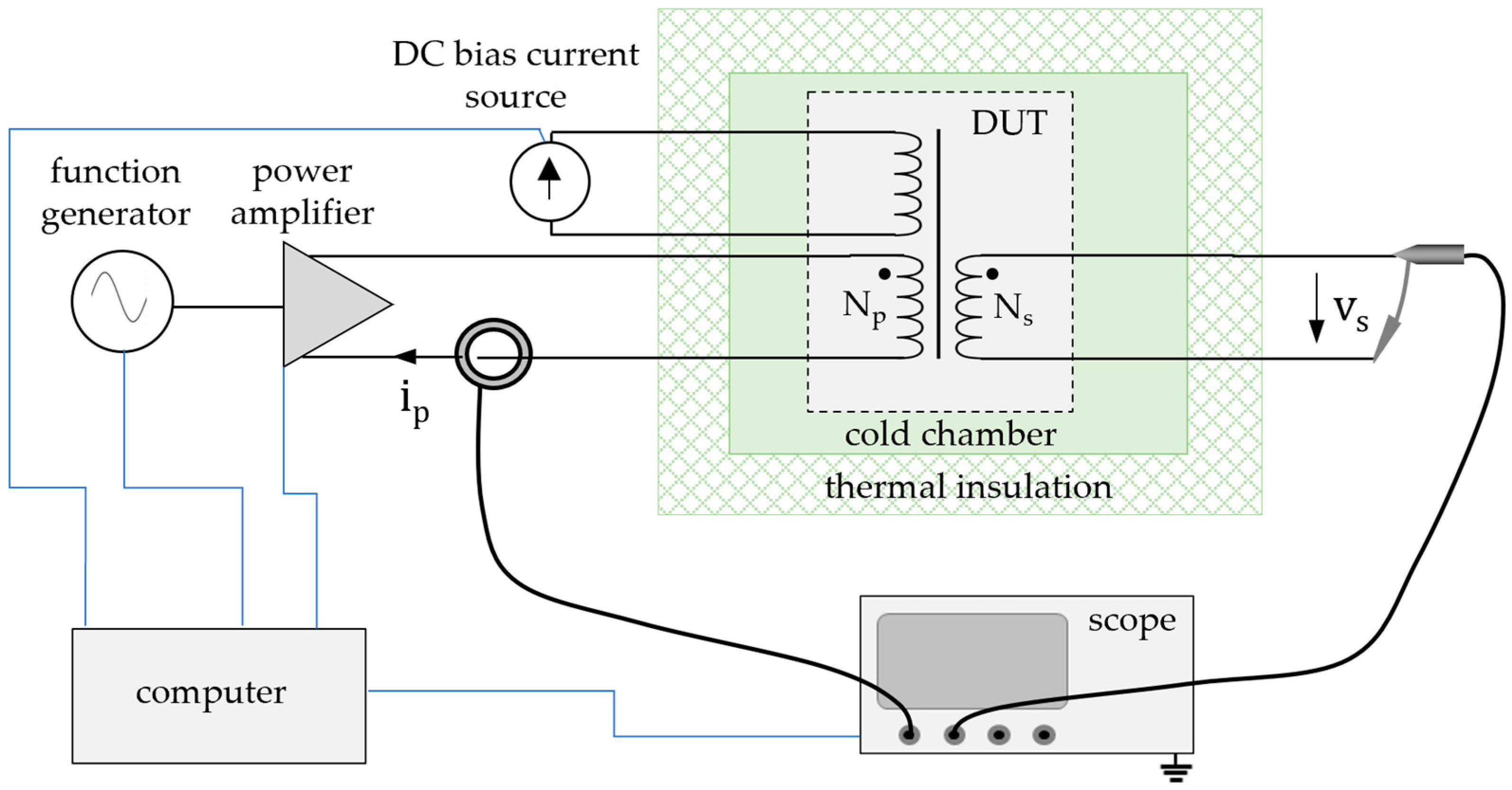
The characterization of different core materials was carried out using the measurement system model BST-Pro-FX (of Bs&T Frankfurt am Main GmbH, Frankfurt am Main, Germany [15]) in accordance with the international standard IEC 60404. The simplified schematic of the measurement setup for characterization of these inductive components at cryogenic temperatures is shown in Figure 1. Each material sample was tested using a small toroidal core with an outer diameter of 16–20 mm. The cores are wound with a primary winding of Np turns and a secondary winding of Ns turns to achieve tight magnetic coupling and to minimize leakage and eddy-current effects. The toroidal geometry provides a closed magnetic path yielding an almost homogeneous flux distribution inside the core. The devices under test (DUTs) are excited by a sinusoidal voltage source generated by a function generator and amplified using a HUBERT A1110-05-A (Dr. Hubert GmbH, Bochum, Germany) power amplifier. Its low output impedance (10 mΩ) helps to maintain a stable voltage waveform against the non-linear loading of the magnetic cores. The excitation frequency f s is varied between 25 kHz and 400 kHz. The primary current i p is measured through a current transformer placed in series with the primary winding, while the induced secondary voltage v s was recorded under open-circuit conditions. Both signals were simultaneously sampled by the oscilloscope MDO3012 with a bandwidth of 100 MHz.
The instantaneous magnetic field strength H ( t ) is obtained from the measured primary current i p t via
H t = N p i p t l e ,
where l e is the effective magnetic path length of the toroid core. The magnetic flux density B t is calculated by time integration of the secondary voltage v s t , yielding
B t = 1 N s A e 0 T v s t   d t  
with A e as the effective cross-sectional area. From the resulting B-H waveform, the closed hysteresis loop is reconstructed. The specific energy dissipated per magnetization cycle equals the area enclosed by the loop. Multiplying this quantity by the excitation frequency and normalizing to the effective core volume V e = A e l e , yields the volumetric specific core loss p v :
p v = f s 0 T H t d B t d t d t = N p f s N s V e 0 T v s t   i p t   d t .
For selected materials, a third winding is added to apply a DC bias current in order to investigate the resulting permeability degradation and the change in core loss under DC bias conditions. The DC bias current is supplied by a programmable current source and applied independently of the AC excitation. The materials chosen for this investigation were selected based on the measurements presented, which identify them as particularly suitable candidates for high-efficiency cryogenic operation.
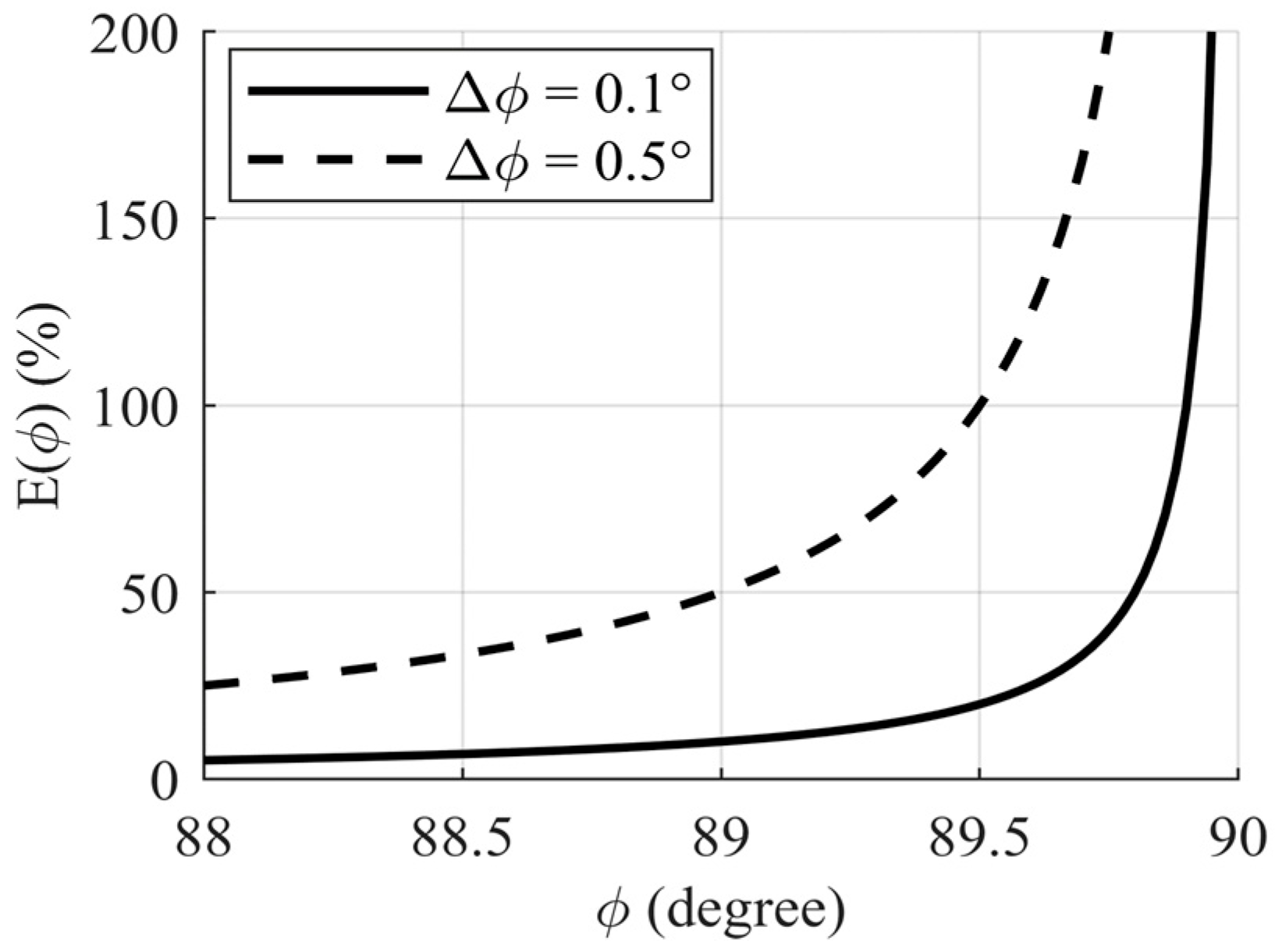
As demonstrated in [16], phase accuracy between voltage and current signals is critical when characterizing low-loss magnetic materials, which exhibit phase angles ϕ approaching 90°. Even small phase deviations can introduce significant loss errors. The relative error E resulting from a phase offset Δ ϕ is given:
E = cos ϕ + Δ ϕ cos ϕ cos ϕ .
Figure 2 illustrates that a phase deviation of only Δϕ = 0.5° at ϕ = 89° leads to a relative error exceeding 50%. Consequently, precise compensation of propagation delays between the voltage v s and current i p measurement channels is essential. Such delays originate from mismatched electrical impedances and propagation times of the sensors, probes, and cabling. Therefore, precise compensation of this signal delay is essential to ensure reliable characterization of the materials.
The phase delay was calibrated using air-core coils as reference samples, following the method described in [16]. The use of air-core devices eliminates hysteresis losses and therefore results in a phase shift of approximately 90°, making them suitable for delay characterization. Their phase response is first measured under small-signal conditions using an impedance analyzer (Bode 100, OMICRON Lab, Klaus, Austria) and then compared with the phase obtained from the large-signal setup. The resulting deviation represents the effective propagation delay of the measurement system, which is determined as a function of frequency. These delay values are subsequently applied as frequency-dependent corrections to all measurements. For comparison with the manufacturer’s data, black dashed lines indicate the corresponding reference values in the figures.
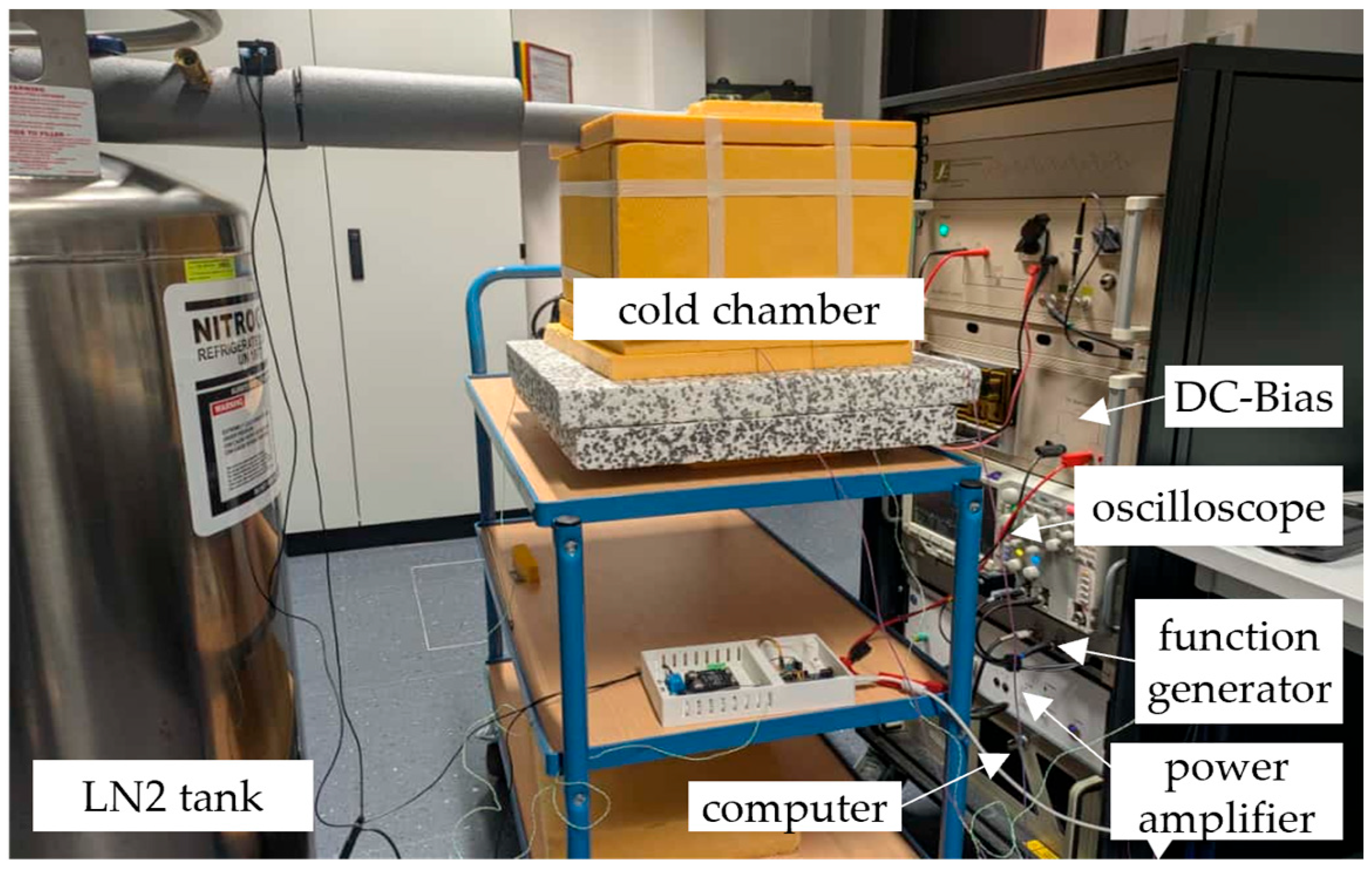
As illustrated in Figure 1, all measurement instruments operated at ambient temperature, while only the wound toroidal core—serving as the device under test (DUT)—was cooled to the desired temperature. This ensured that the thermal influence was confined to the magnetic material itself. The cryogenic test setup is illustrated in Figure 3. The cooling chamber—operated with liquid nitrogen—enables precise temperature control, allowing well-defined DUT temperatures from room temperature down to −194 °C. Temperature monitoring was carried out using thermocouples placed near the core surface. To ensure thermal equilibrium, a 5 min soak time was applied after each target temperature was reached. Due to the long duration of cryogenic testing, full loss maps were acquired once (i.e., no averaging over repeated full sweeps). However, representative operating points were periodically re-measured and showed good reproducibility. The residual measurement uncertainty is estimated to be within ±10–20%, including the combined tolerances of the measurement chain (power amplifier, oscilloscope, and current/voltage probes) and temperature stability, after phase-shift compensation.
To prevent self-heating effects of the core during measurement, a sufficient dwell time is introduced between individual operating points, each defined by a specific excitation frequency and peak flux density. For each core material and temperature level, a predefined measurement protocol is executed, covering a specified set of excitation frequencies (ranging from 25 kHz to 400 kHz) and defined magnetic flux densities. The following magnetic properties were characterized as a function of temperature from 25 °C down to −194 °C:
  • B-H loop and saturation flux density—measured for all materials except alloyed iron powder cores (Section 3.1)
  • Specific core losses pv (mW/cm3) under sinusoidal excitation—recorded for all materials across the entire temperature range (Section 3.2), with the corresponding temperature-dependent Steinmetz parameters also provided in this section.
  • Effective permeability—determined for all materials and shown for discrete temperature levels (Section 3.3)
In addition, the temperature-dependent DC bias behavior was investigated by measuring the permeability and specific core losses under DC bias at 25 °C and −196 °C for those core materials identified as suitable candidates for cryogenic applications based on the preceding measurements (Section 3.4).

3. Measurement Results and Discussion

3.1. B-H-Loop and Saturation Flux Density

When analyzing temperature-dependent B-H curves for applications in power electronics, the most relevant parameters are the saturation flux density, permeability, coercive field strength, and hysteresis losses, as these directly affect inductance, core losses, energy storage capability, and the risk of magnetic saturation. Due to the limited output power of the amplifier and the inherently low permeability of powder cores, the saturation flux analysis was confined to ferrite and nanocrystalline materials. For powder-based cores, due to the gap distributed through the material, the gradual transition into saturation prevents a meaningful representation of the hysteresis loop up to full saturation.
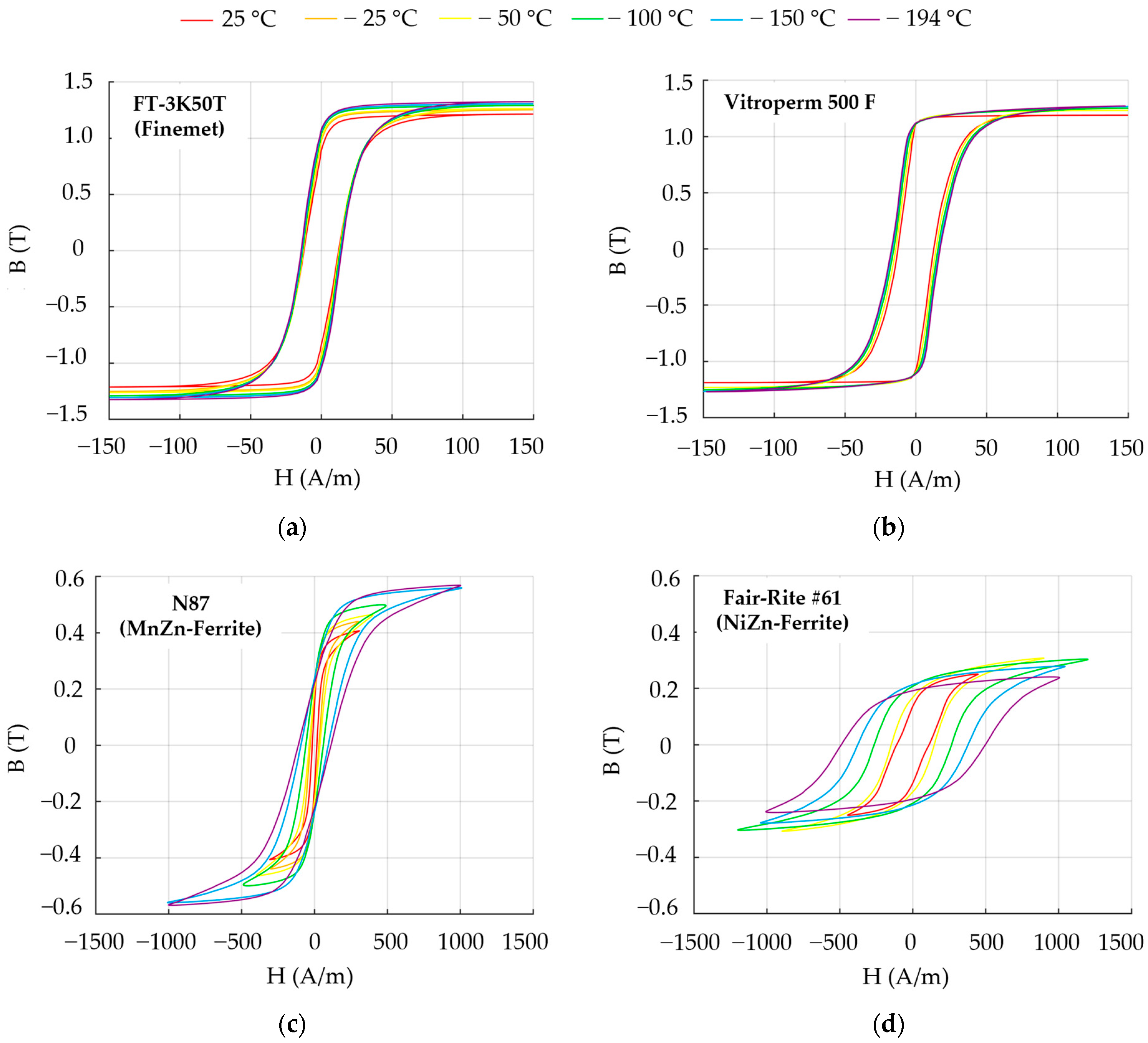
Figure 4 shows the B-H loops at different temperatures for nanocrystalline and ferrite core materials. The color scale ranges from red (25 °C) to dark purple (−196 °C). The increase in saturation flux density with decreasing temperature observed in Finemet, Vitroperm, and MnZn-ferrites arises from the enhancement of the saturation magnetization due to spin-wave excitation at low temperatures, as described by Bloch’s law [17,18,19]. This reduction in thermal fluctuations allows for greater alignment of the magnetic moments. While Finemet and Vitroperm exhibit only a modest increase in saturation flux density at cryogenic temperatures—approximately 10% and 7% at −194 °C, respectively—MnZn-ferrite shows a markedly stronger increase of approximately 40%. In contrast, NiZn-ferrite displays a non-monotonic behavior: The saturation flux density initially increases down to approximately −50 °C, but then decreases again at temperatures below −100 °C. The physics underlying this non-monotonic behavior is likely governed by complex, material-specific cryogenic effects and requires dedicated investigation beyond the scope of the present study.
As shown in Figure 4a,b, the nanocrystalline materials exhibit relatively low coercive fields and only a weak dependence on temperature. Their ultrafine grains are strongly exchange-coupled, which averages out local magnetic anisotropies and effectively suppresses magnetoelastic effects due to their extremely low magnetostriction [20]. As a result, the coercivity of nanocrystalline materials varies only slightly with temperature, and their core losses exhibit a comparatively low temperature dependence over the investigated range.
In contrast, both ferrite materials show a much stronger temperature dependence of coercive field, as illustrated in Figure 4c,d. With decreasing temperature, the coercive field increases significantly. This leads to a pronounced broadening of the hysteresis loop and greater energy dissipation per cycle. Consequently, the core losses of ferrites rise markedly at low temperatures. These observations, based on the visual evaluation of the B-H characteristics of both core types, provide an initial qualitative understanding of their magnetic behavior at low temperatures. While nanocrystalline materials maintain thermal stable and efficient magnetic properties, ferrites exhibit pronounced deterioration in performance with decreasing temperature.
The following subsections present a detailed quantitative analysis of all investigated core materials and their dependence on frequency, flux density, and temperature.

3.2. Specific Core Loss and Steinmetz Parameters Under Sinusoidal Excitation

During periodic magnetization, soft magnetic materials exhibit energy losses that primarily depend on temperature T , the magnetic flux density amplitude B ^ , and the excitation frequency f . In this study, all measurements are restricted to sinusoidal excitation. Minimizing these losses is a key requirement for achieving high efficiency in inductive components, particularly under cryogenic conditions.
A comprehensive investigation of specific core losses was performed over a temperature range from room temperature down to −194 °C for representative soft magnetic materials, including ferrites, nanocrystalline alloys, and powder cores. Core losses originate from a combination of magnetic and electrically induced dissipation mechanisms and are governed by the excitation conditions—frequency, flux density, and waveform—as well as by temperature and intrinsic material properties. While hysteresis and eddy-current losses typically dominate, their temperature dependence varies significantly among different material classes, resulting in strongly material-specific loss behavior.
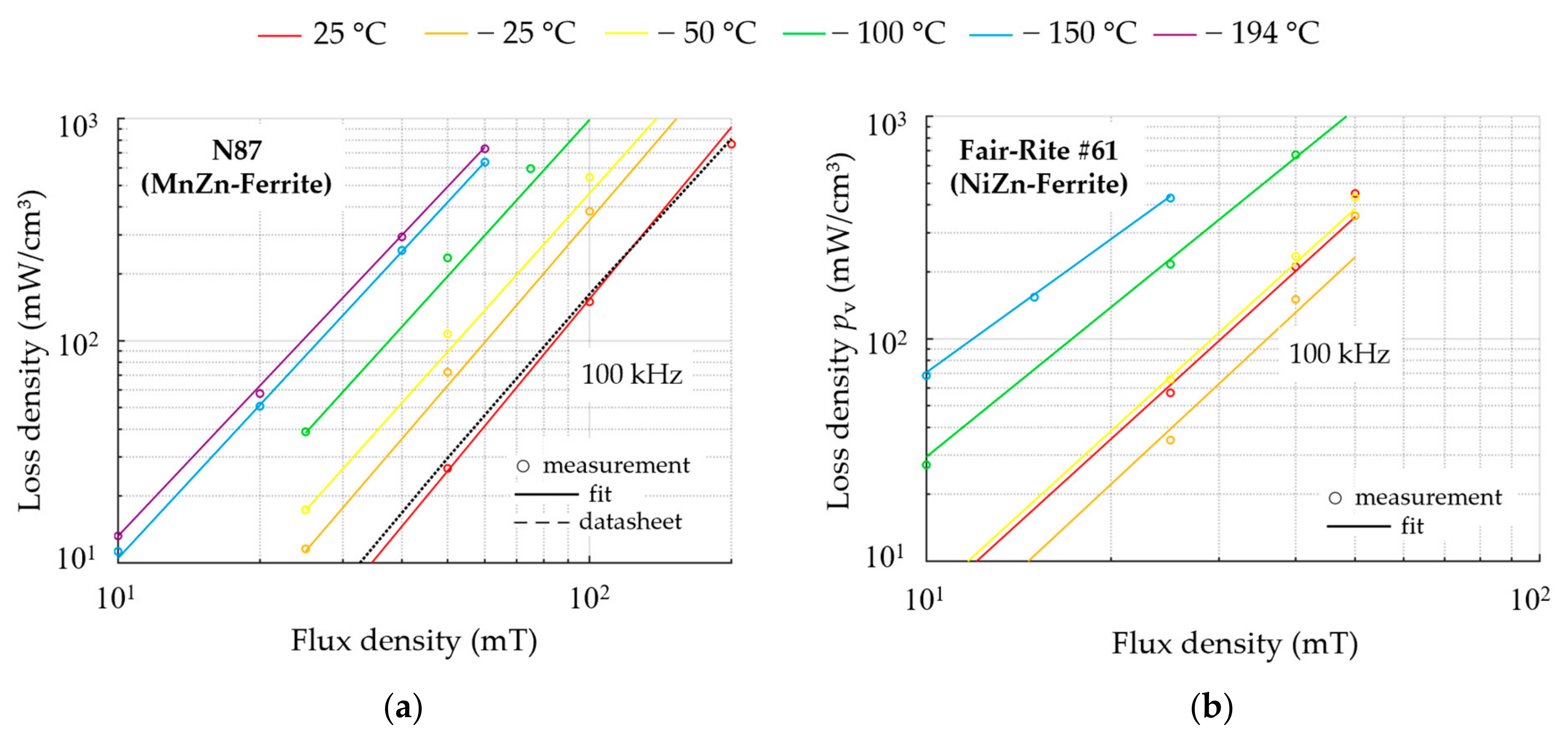
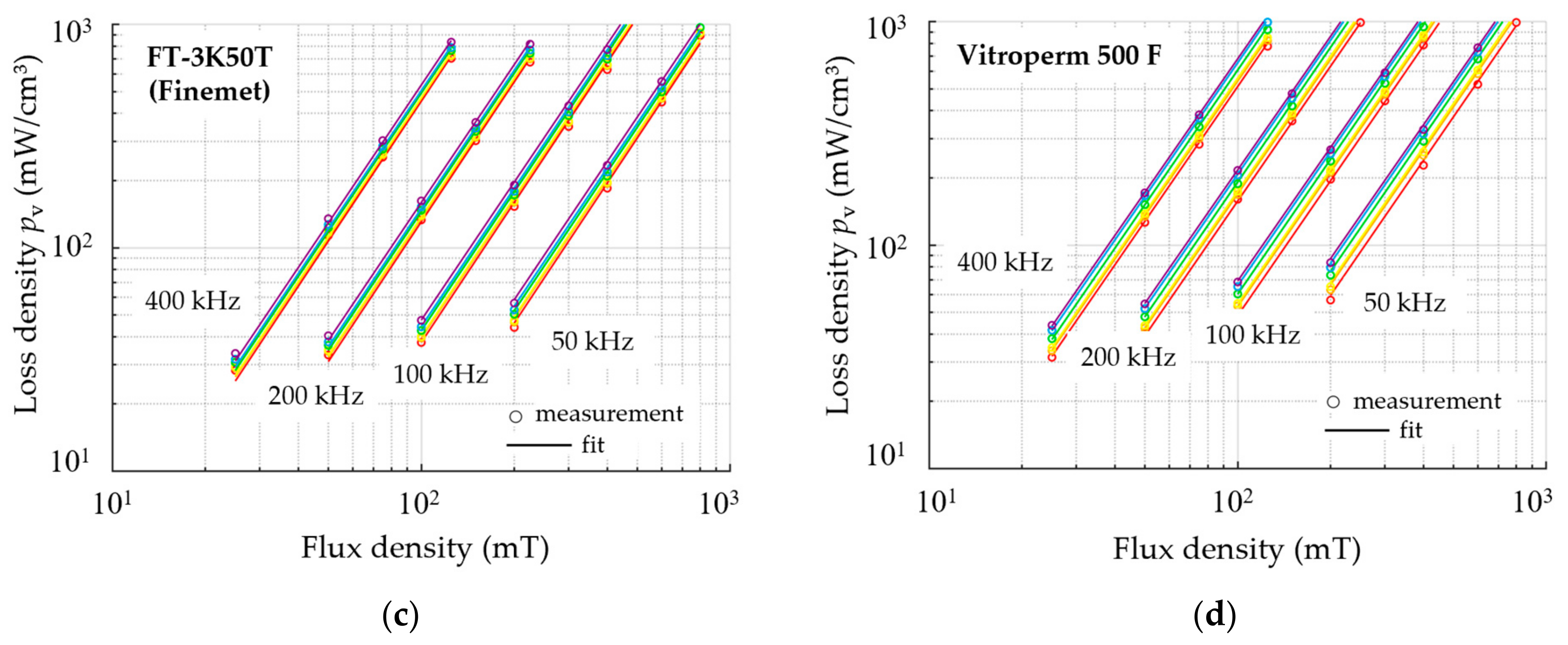
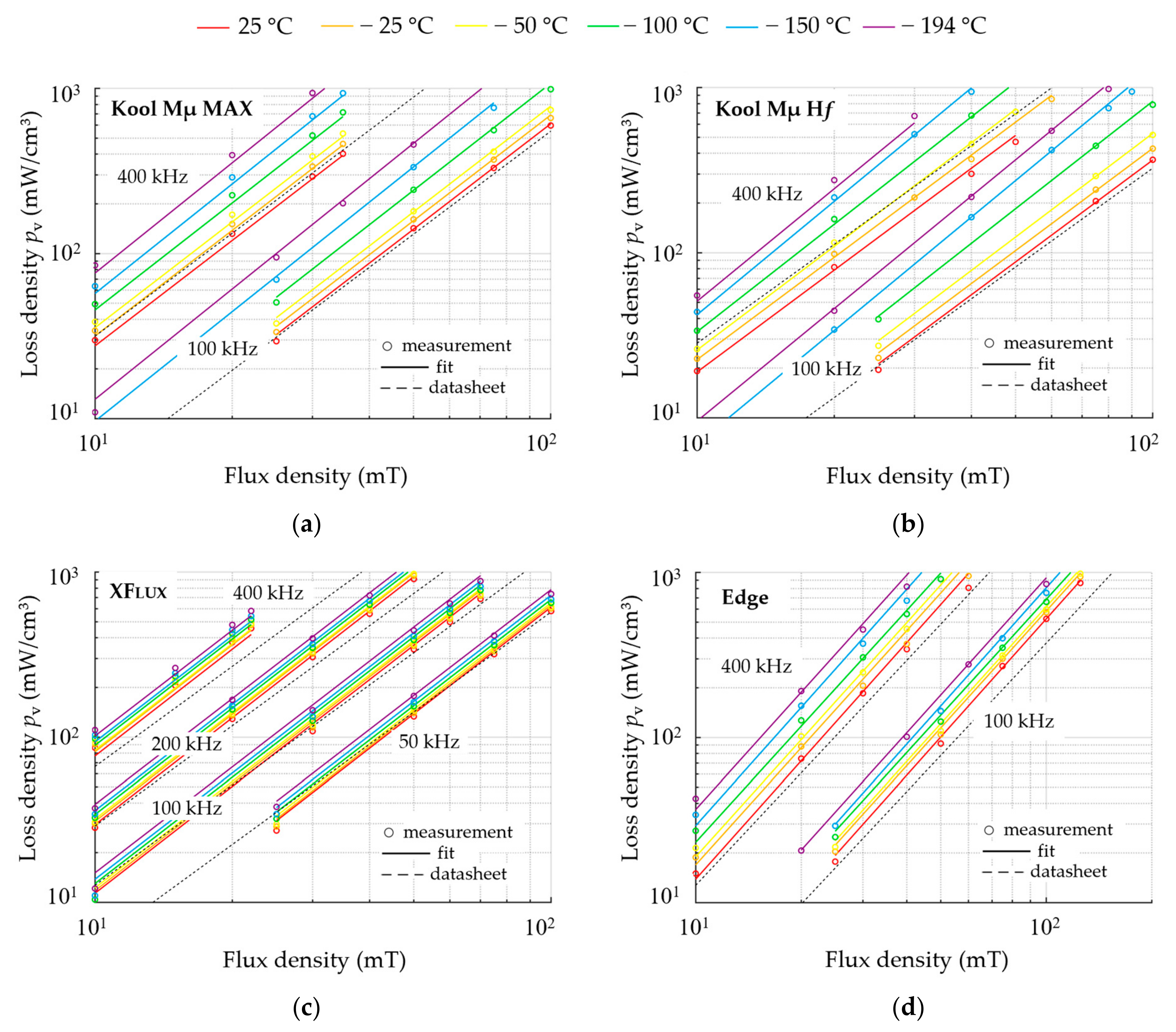
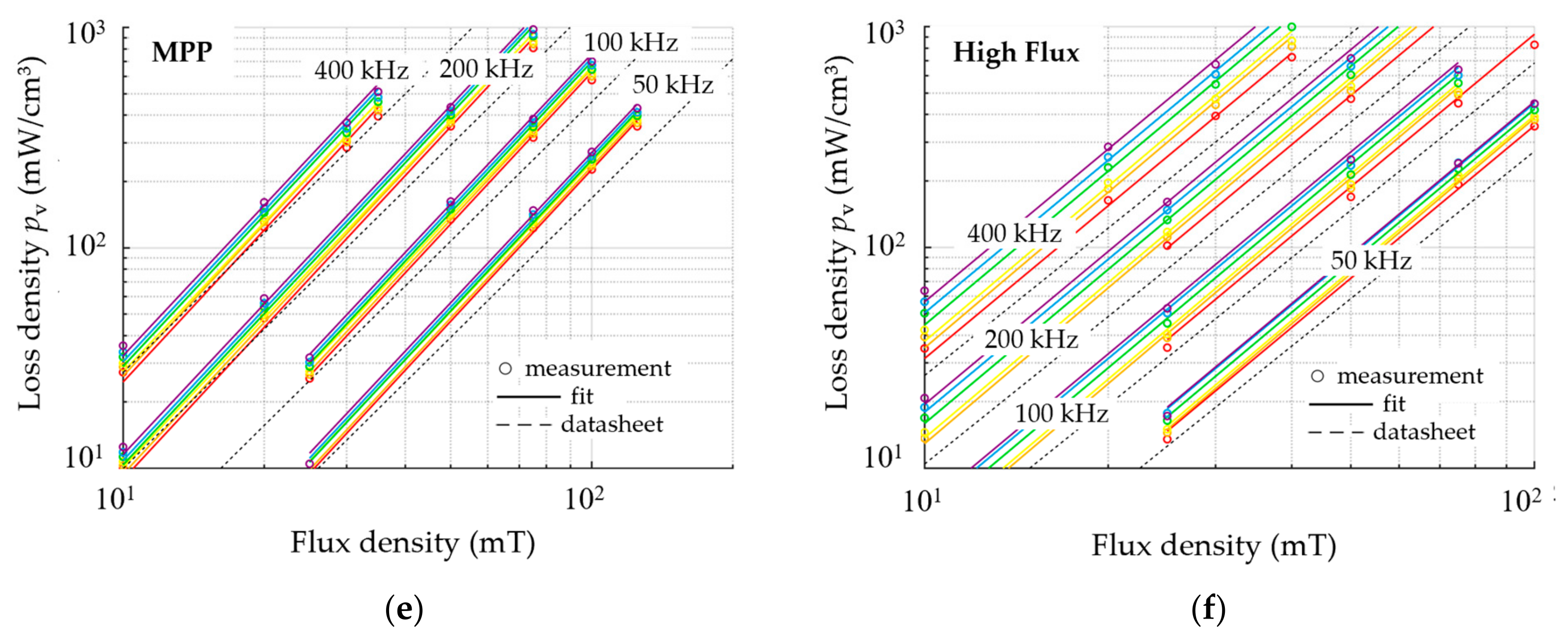
Figure 5 and Figure 6 present the measured specific core losses p v (in mW/cm3) as a function of magnetic flux density for excitation frequencies between 50 kHz and 400 kHz, shown as sets of curves in double-logarithmic plots. Measured data points are indicated by circular markers, while manufacturer-provided room-temperature loss data are included as dashed black lines for reference where available. In the double-logarithmic representation, the slope of each curve directly reflects the power-law dependence of the losses on the magnetic flux density at a given excitation frequency.
To quantitatively describe the temperature-dependent loss behavior, the measured loss density p v was modeled using a local, temperature-dependent extension of the Steinmetz equation,
p v = p r e f T · f f r e f α T · B ^ B r e f β T .
Here, the excitation frequency f and the peak flux density B ^ are normalized to the reference values f r e f = 100 kHz and B r e f = 50 mT. This normalization yields a scalable formulation that allows the loss behavior of different materials to be described consistently over a wide range of operating conditions through temperature-dependent Steinmetz parameters. The temperature dependence of the loss behavior is captured by the Steinmetz prefactor p r e f ( T ) , representing the reference loss power density at the operating point f r e f and B r e f , as well as by the frequency and flux-density exponents α ( T ) and β ( T ) , respectively. All three parameters were treated as temperature-dependent quantities and were extracted by locally fitting the measured loss data at each temperature using a least-squares method. As illustrated in Figure 5 and Figure 6, the fitted curves closely match the experimental data over the investigated excitation conditions.
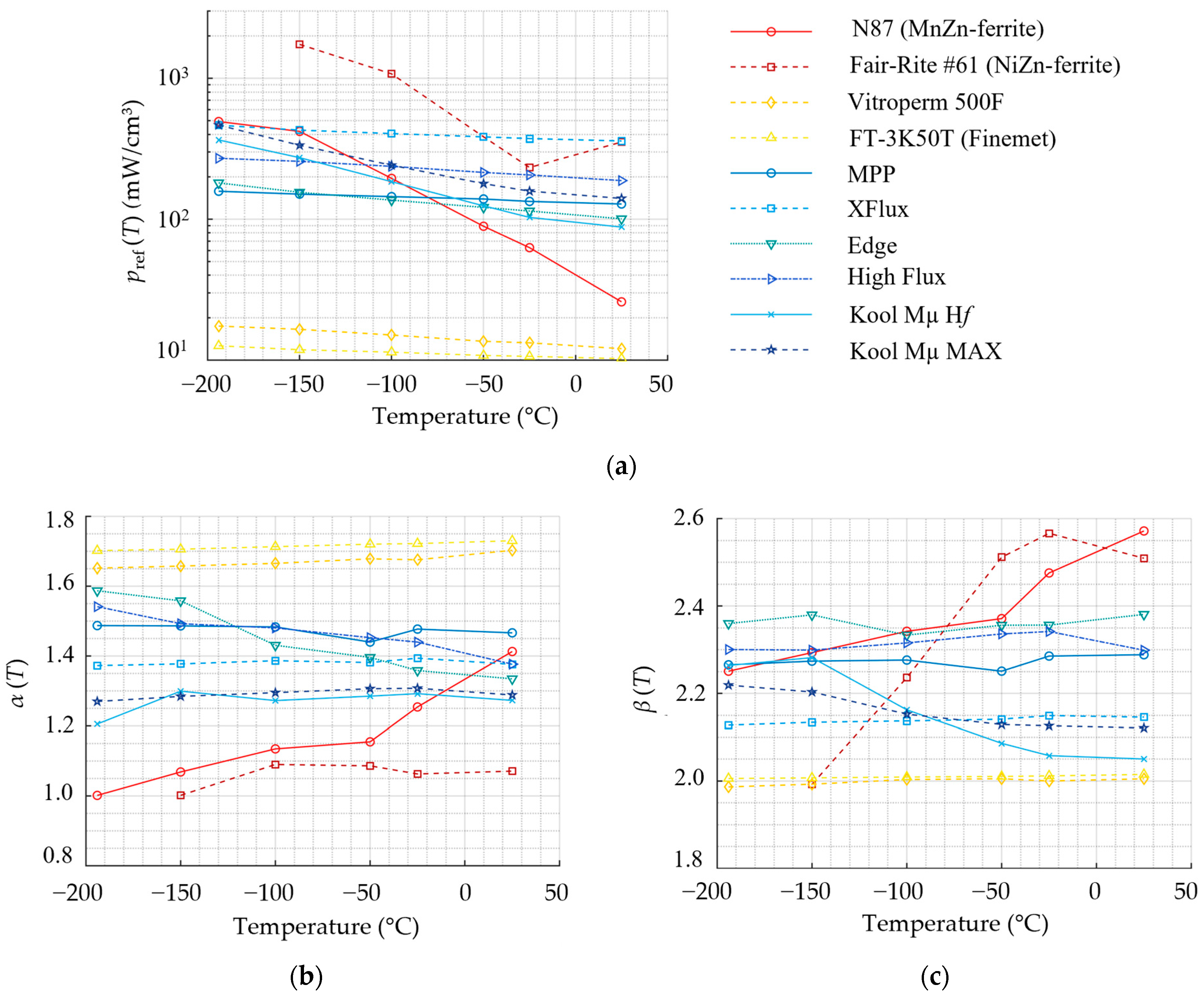
The temperature dependence of the extracted Steinmetz parameters is summarized in Figure 7; the numerical values of the reference loss coefficient p r e f ( T ) are provided in Table A1 in the Appendix A. Figure 7a shows that the Steinmetz prefactor p r e f ( T ) , exhibits the strongest temperature dependence among all fitted parameters and increases with decreasing temperature in a strongly material-specific manner. Ferrite materials show a pronounced increase toward cryogenic temperatures. MnZn-ferrite exhibits the strongest temperature sensitivity, with p r e f ( T ) increasing by nearly one order of magnitude between 25 °C and −194 °C. NiZn-ferrite follows the same general trend, albeit less pronounced, with a substantial increase below −50 °C, and reaching a factor of approximately four at −150 °C.
In contrast, nanocrystalline materials exhibit very low absolute values of p r e f ( T ) and only weak temperature dependence. Over the entire investigated temperature range, p r e f ( T ) varies by less than 25% for Finemet and 50% for Vitroperm 500 F, remaining within approximately 10–17 mW/cm3. This behavior indicates a high thermal stability of the dominant loss mechanisms.
Powder core materials show intermediate behavior with pronounced material-specific differences. MPP and XFlux exhibit comparatively moderate increases of p r e f ( T ) toward cryogenic temperatures (approximately 20–30%), whereas Edge and High Flux show stronger temperature sensitivity with increases of roughly 40–80%. The strongest temperature dependence among the powder cores is observed for Kool Mµ Hf and Kool Mµ MAX, for which p r e f ( T ) increases by factors of approximately 3–4 at cryogenic temperatures. The results highlight the importance of explicitly accounting for the temperature dependence of p r e f ( T ) in loss modeling.
The frequency exponent α ( T ) , shown in Figure 7b, exhibits weaker but still material-dependent temperature variations. For MnZn-ferrite, α ( T ) decreases significantly from approximately 1.41 at 25 °C to nearly 1.0 at −194 °C, whereas NiZn-ferrite remains nearly temperature invariant, decreasing only slightly from approximately 1.1 to 1.0. Nanocrystalline materials exhibit high and remarkably stable α values (approximately 1.65–1.75). Among powder cores, the temperature dependence of α ( T ) is strongly material-specific. XFlux ( α ≈ 1.38) and MPP ( α ≈ 1.48) show nearly temperature-independent frequency exponents, whereas Kool Mµ Hf and Kool Mµ MAX exhibit relatively low absolute α values (approximately 1.2–1.3) with only weak temperature dependence. In contrast, Edge and High Flux show a strong increase of α ( T ) from ≈1.35 at 25 °C close to 1.6 at −194 °C. For MnZn-ferrite as well as Edge and High Flux powder cores, assuming a temperature-invariant frequency exponent α can lead to substantial deviations in frequency-dependent loss prediction, demonstrating that the temperature dependence of α ( T ) must be explicitly considered for reliable modeling. For MnZn ferrite, neglecting the temperature dependence of α —which decreases strongly from 1.41 at 25 °C to about 1.0 at −194 °C (Δ α ≈ 0.4)—results in relative loss deviations of approximately 30–80% at moderate frequencies up to 100 kHz and can exceed 100% at higher frequencies. Similarly, for the Edge and High Flux operating cases, the increase of α ( T ) toward cryogenic temperatures (Δ α ≈ 0.15–0.25) leads—when its temperature dependence is neglected—to relative loss deviations of 10–40%, depending on the operating frequency. Deviations at the lower end of this range (about 10–20% for Δ α < 0.15) are comparable to typical measurement uncertainties and may therefore be of limited practical relevance.
The flux density exponent β ( T ) , shown in Figure 7c, characterizes the non-linear scaling of losses with magnetic flux density. For MnZn-ferrite, β ( T ) decreases from approximately 2.57 at 25 °C to about 2.25 at −194 °C, while NiZn-ferrite shows no monotonic increase toward cryogenic temperatures; instead, β remains near 2.5 down to −50 °C and then decreases to approximately 2.0 at lower temperatures. Nanocrystalline materials exhibit the highest thermal stability, maintaining β ( T ) values close to 2.0 across the entire investigated temperature range. For the powder cores, β ( T ) varies only moderately but remains clearly material-specific. Edge and High Flux exhibit the highest β values ( β ≈ 2.33–2.38 and ≈2.30–2.34), XFlux the lowest and most temperature-stable behavior ( β ≈ 2.14), and MPP an intermediate level ( β ≈ 2.28). Kool Mµ Hf and Kool Mµ MAX show a weak but systematic increase of β ( T ) toward cryogenic temperatures ( β ≈ 2.05 to ≈2.26 and ≈2.12 to ≈2.22, respectively). Similar to α ( T ) , assuming a constant β can introduce noticeable modeling errors. Variations of Δ β ≈ 0.1 generally cause loss deviations within the measurement uncertainty, while larger changes of Δ β ≈ 0.2 can result in deviations of up to 50% and must therefore be considered in loss modeling.
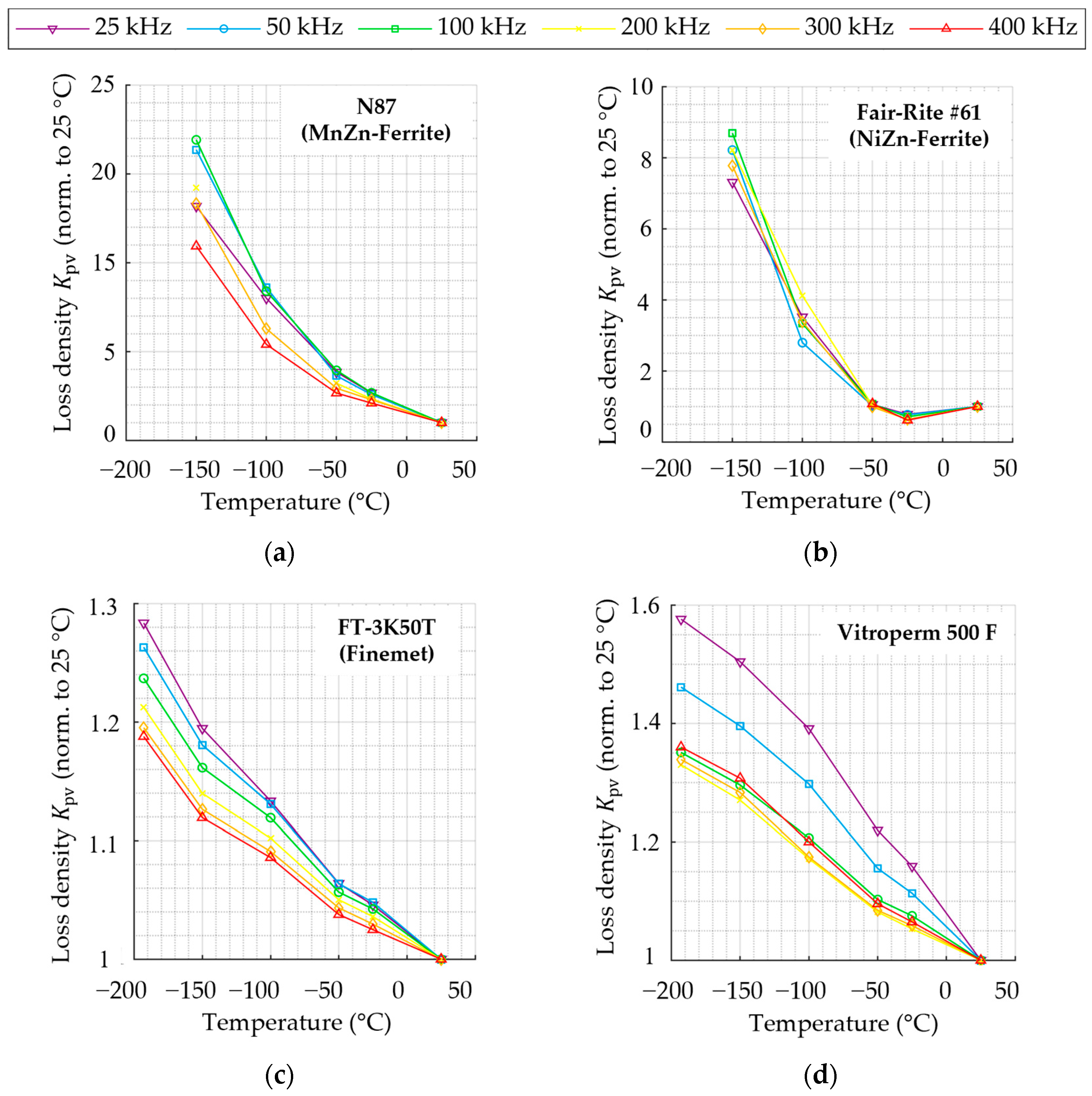
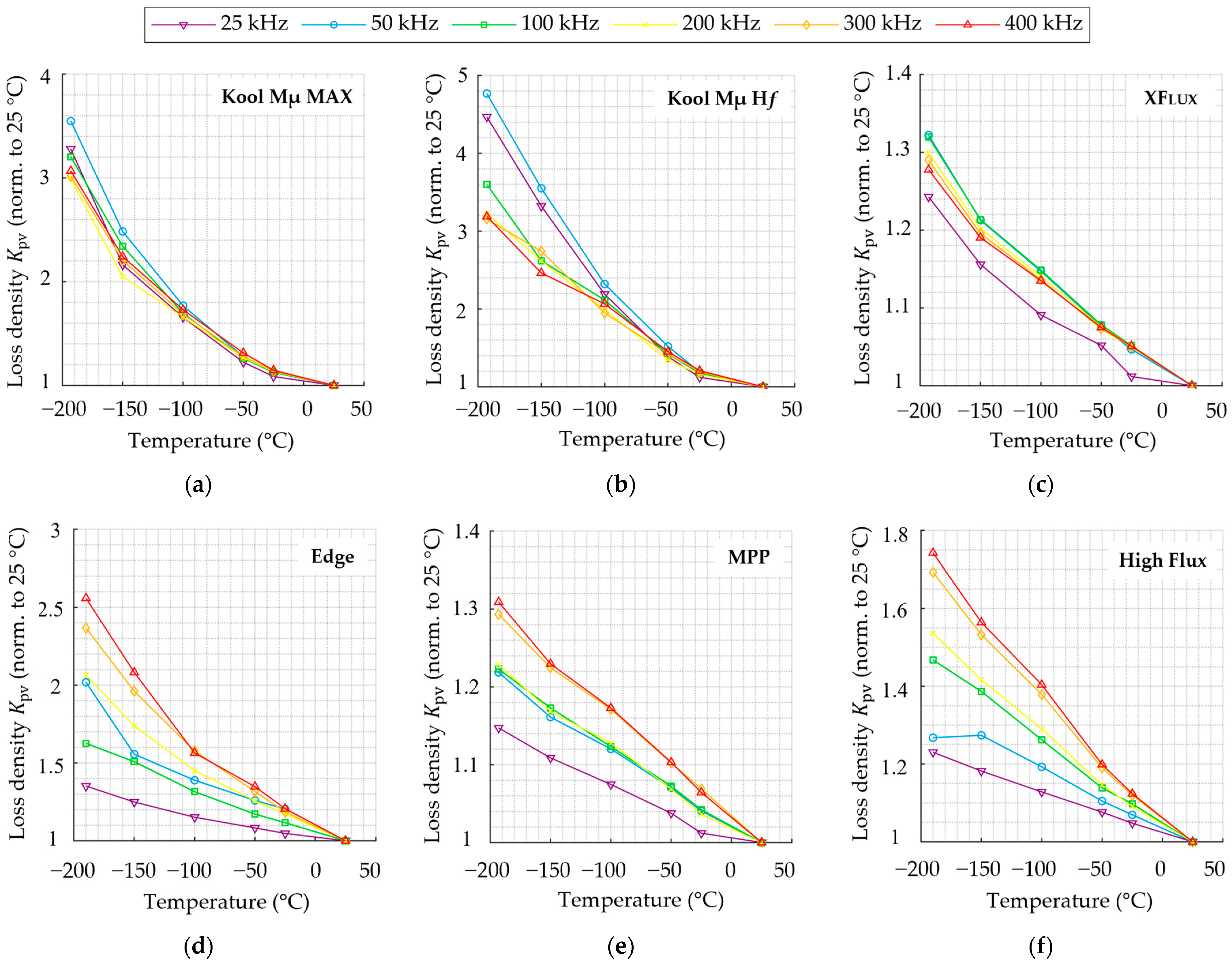
To enable a direct comparison of the thermal stability of materials with substantially different absolute loss magnitudes, the measured core losses were first normalized to their corresponding room-temperature values, i.e., p v ( f , T , B ) / p v ( f , 25   ° C , B ) . The resulting normalized values exhibit only a weak dependence on the magnetic flux density, typically within ±5%. For each excitation frequency and temperature, these normalized losses were therefore averaged over the investigated flux density range to obtain a flux-density-independent representation of the temperature dependence. This procedure yields a normalized loss factor K p v = p v ( f , T ) / p v ( f , 25   ° C ) , which is presented in Figure 8 and Figure 9.
This normalized representation directly reflects the combined effect of the temperature-dependent Steinmetz parameters discussed above and allows relative loss changes at reduced temperatures to be derived from room-temperature loss values commonly provided in manufacturer datasheets. Across all investigated materials, cooling to −194 °C leads to an increase in total core losses; however, the magnitude and frequency dependence of this increase differ substantially between material classes.
Ferrite materials exhibit the strongest temperature-induced loss increase. At 100 kHz, total losses rise by approximately a factor of 16–22 for MnZn-ferrite and 7–9 for NiZn-ferrite compared to room temperature. This behavior is consistent with the strong increase in the Steinmetz prefactor p r e f ( T ) and the pronounced reduction in the frequency exponent α ( T ) , as well as with the substantial rise in coercivity observed in the B-H loops (see Figure 4). In addition, as shown in Table 2, the permeability decreases nonlinearly at cryogenic temperatures, further confirming the severe magnetic degradation of ferrites at low temperatures.
In contrast, nanocrystalline alloys such as Finemet and Vitroperm exhibit only modest increases in normalized core losses when cooled to −194 °C. The loss curves at different excitation frequencies remain tightly clustered, indicating weak temperature sensitivity. This behavior directly reflects the high thermal stability of the fitted Steinmetz parameters, in particular the nearly temperature-invariant values of α ( T ) and β ( T ) , as well as the only moderate increase in coercivity (from 12.2 to 14.3 A/m for Finemet and from 12.6 to 17.1 A/m for Vitroperm between 25 °C and −194 °C). Quantitatively, total losses increase by only 20–30% for Finemet and 40–60% for Vitroperm, with the smallest relative increases occurring at higher excitation frequencies.
Powder-core materials show intermediate behavior with pronounced material-specific differences. XFlux and MPP exhibit only moderate increases in normalized losses (approximately 25–30%), consistent with their relatively stable Steinmetz parameters. Edge and High Flux display a stronger frequency dependence, with loss increases becoming more pronounced at higher frequencies. In contrast, Kool Mµ Hf and Kool Mµ MAX exhibit the strongest temperature sensitivity among the powder cores, with normalized losses increasing by factors of approximately 3–5 at cryogenic temperatures. These trends are in good agreement with the temperature dependence of the Steinmetz prefactor p r e f ( T ) and, to a lesser extent, the frequency exponent α(T).

3.3. Permeability Under Sinusoidal Excitation (No DC Bias)

While Section 3.2 focused on the temperature-dependent loss mechanisms and their empirical description using Steinmetz parameters, the present section addresses the thermal stability of the magnetic permeability under purely sinusoidal excitation without DC bias. The permeability determines the inductive behavior of magnetic components and therefore represents a key functional parameter, complementary to the loss characteristics. Table 2 summarizes the normalized permeability factors Kµ = µ(T)/µ(25 °C) of the investigated materials, measured at 100 kHz and referenced to their room-temperature values. A clear distinction between the different material classes is observed.
Ferrite materials exhibit the strongest temperature dependence. The normalized permeability of MnZn-ferrite (N87) decreases from 0.44 at −50 °C to only 0.06 at −194 °C, while the NiZn ferrite (Fair-Rite #61) shows a slight initial increase (up to 1.05), followed by a strong reduction to 0.21 over the same temperature range. This pronounced degradation confirms the strong sensitivity of ferrites to cryogenic operation and is consistent with the loss behavior discussed in Section 3.2.
Nanocrystalline materials show significantly higher magnetic stability. Finemet maintains nearly constant permeability, decreasing only slightly from 1.03 at −50 °C to 0.95 at −194 °C. Vitroperm exhibits a steady, moderate reduction to approximately 0.80 at −194 °C. Despite this decrease, both materials retain high permeability across the entire temperature range, indicating robust magnetic performance under sinusoidal excitation.
Powder-core materials exhibit the highest thermal stability. XFlux, MPP, and Edge show virtually unchanged permeability at −194 °C, with normalized values remaining between 0.97 and 1.00. Kool Mµ Hf and Kool Mµ MAX show a moderately stronger reduction of approximately 7–10% but remain within acceptable limits.
From a practical perspective, permeability variations are most relevant for powder-core inductors, where the inductance scales directly with the effective permeability. In contrast, for ferrite and nanocrystalline materials used in gapped inductors or transformer cores, moderate changes in intrinsic permeability are typically of limited significance, as the effective inductance is dominated by the air gap or core geometry rather than by the material permeability itself.

3.4. Permeability and Core Losses Under DC Bias Condition

In practical power-electronic applications, magnetic components are frequently subjected to combined AC excitation and DC magnetization. Therefore, the following investigations focus on the behavior of permeability and core losses under DC bias at cryogenic temperatures. Based on the results of Section 3.2 and Section 3.3, the analysis is restricted to materials that exhibit sufficiently low losses and stable permeability under sinusoidal excitation, namely the powder-core materials High Flux, Edge, and MPP, as well as the nanocrystalline alloys Finemet and Vitroperm.
The DC bias behavior of these materials is fundamentally governed by their microstructure. Powder cores consist of insulated metal particles separated by air gaps, forming a distributed-gap structure that reduces the effective permeability but significantly delays magnetic saturation. Nanocrystalline ribbon cores, in contrast, exhibit very high initial permeability and contain no intrinsic air gap unless intentionally introduced, resulting in strong flux concentration and early onset of magnetic saturation under DC excitation.
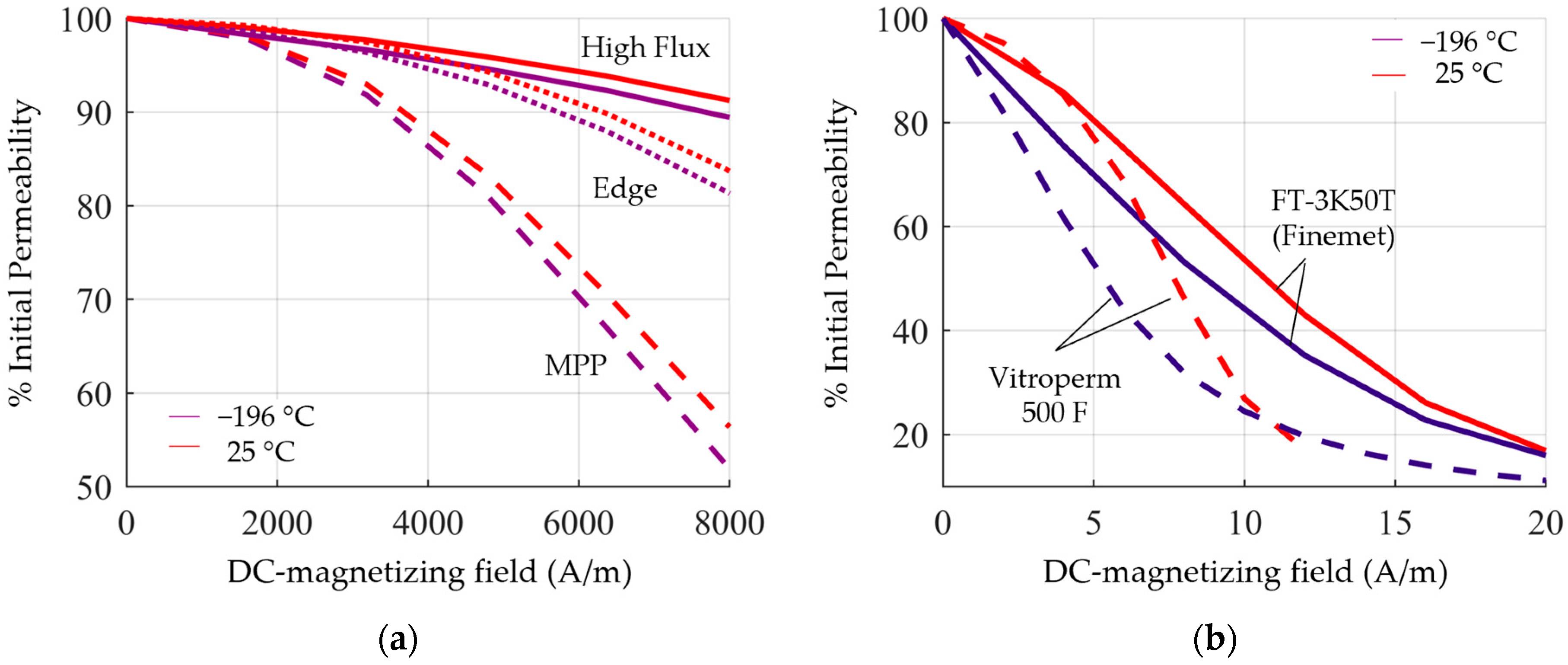
Figure 10a illustrates the normalized permeability as a function of DC magnetizing field at 100 kHz. For the powder-core materials, only minor changes in permeability are observed between room temperature and −196 °C. High Flux exhibits the highest DC bias robustness, retaining approximately 90% of its permeability even at DC fields exceeding 8 kA/m. MPP maintains about 80% of its permeability up to approximately 5 kA/m and decreases more strongly at higher bias levels, while Edge shows intermediate behavior, retaining roughly 80% up to 8 kA/m.
Nanocrystalline toroidal cores show a markedly different response. As shown in Figure 10b, the permeability decreases rapidly even at relatively low DC magnetizing fields of approximately 20 A/m, both at room temperature and at −196 °C. This behavior is consistent with datasheet specifications and reflects the absence of a distributed air gap.
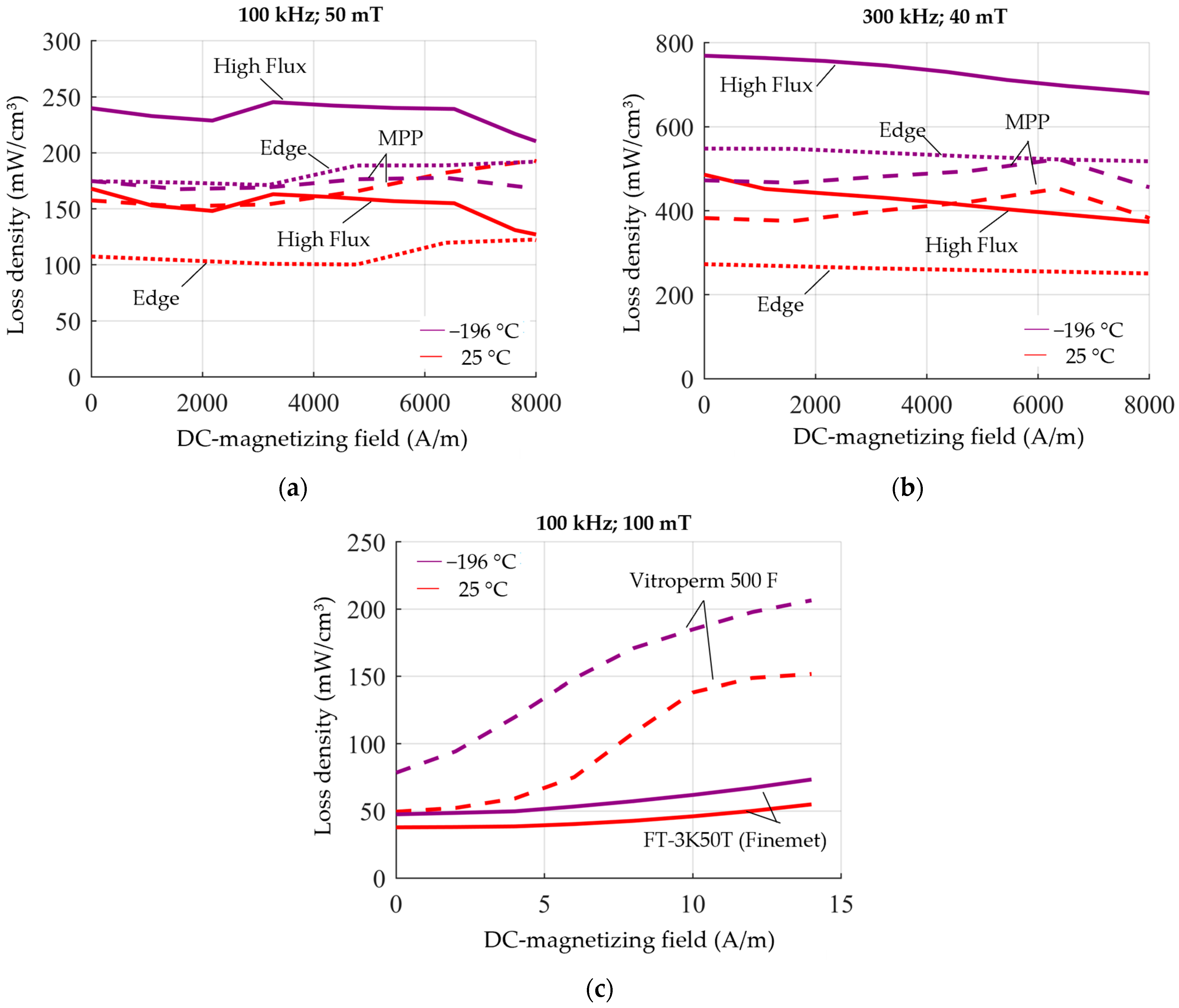
Beyond permeability, the effect of DC bias on core losses is of primary relevance. Figure 11 presents the measured core losses as a function of DC magnetizing field. For the powder-core materials, the losses at −196 °C remain nearly constant within approximately ±10% over the entire investigated DC bias range up to 8 kA/m, indicating that DC bias does not introduce additional loss mechanisms under cryogenic conditions. Among the powder cores, High Flux exhibits the highest absolute losses, while Edge and MPP show significantly lower loss levels.
Nanocrystalline materials, in contrast, exhibit a pronounced increase in core losses under DC bias at cryogenic temperatures. At a DC magnetizing field of 10 A/m and −196 °C, the losses of Finemet increase by approximately 40% relative to the zero-bias condition, while Vitroperm shows an increase exceeding 200%. This strong sensitivity further limits the applicability of ungapped nanocrystalline materials in DC-biased cryogenic applications.

3.5. Evaluation

The selection of magnetic core materials for high-efficiency cryogenic power-electronic applications requires a comprehensive evaluation that simultaneously considers the absolute magnitude of core losses, their temperature dependence, and the robustness of magnetic properties under DC bias. In particular, for aerospace and cryogenic applications, additional constraints such as volumetric efficiency, mass, and saturation capability must be accounted for. Materials with intrinsically high baseline losses remain unsuitable for high-efficiency operation, even if their relative temperature-induced variations are moderate. Conversely, materials with very low loss power densities at the reference operating point can remain viable despite a stronger relative temperature dependence, provided that their absolute loss levels remain sufficiently low.
Ferrite materials exhibit the most unfavorable behavior under cryogenic conditions. As demonstrated in Section 3.2 and Section 3.3, MnZn- and NiZn-ferrites exhibit at least an order-of-magnitude increase in core losses when cooled to −194 °C, along with a severe permeability reduction and a marked rise in coercivity. These coupled effects significantly degrade efficiency and magnetic performance and are fully consistent with prior literature. Consequently, ferrites are unsuitable for high-efficiency cryogenic power-electronic applications, regardless of whether the application is AC- or DC-dominated.
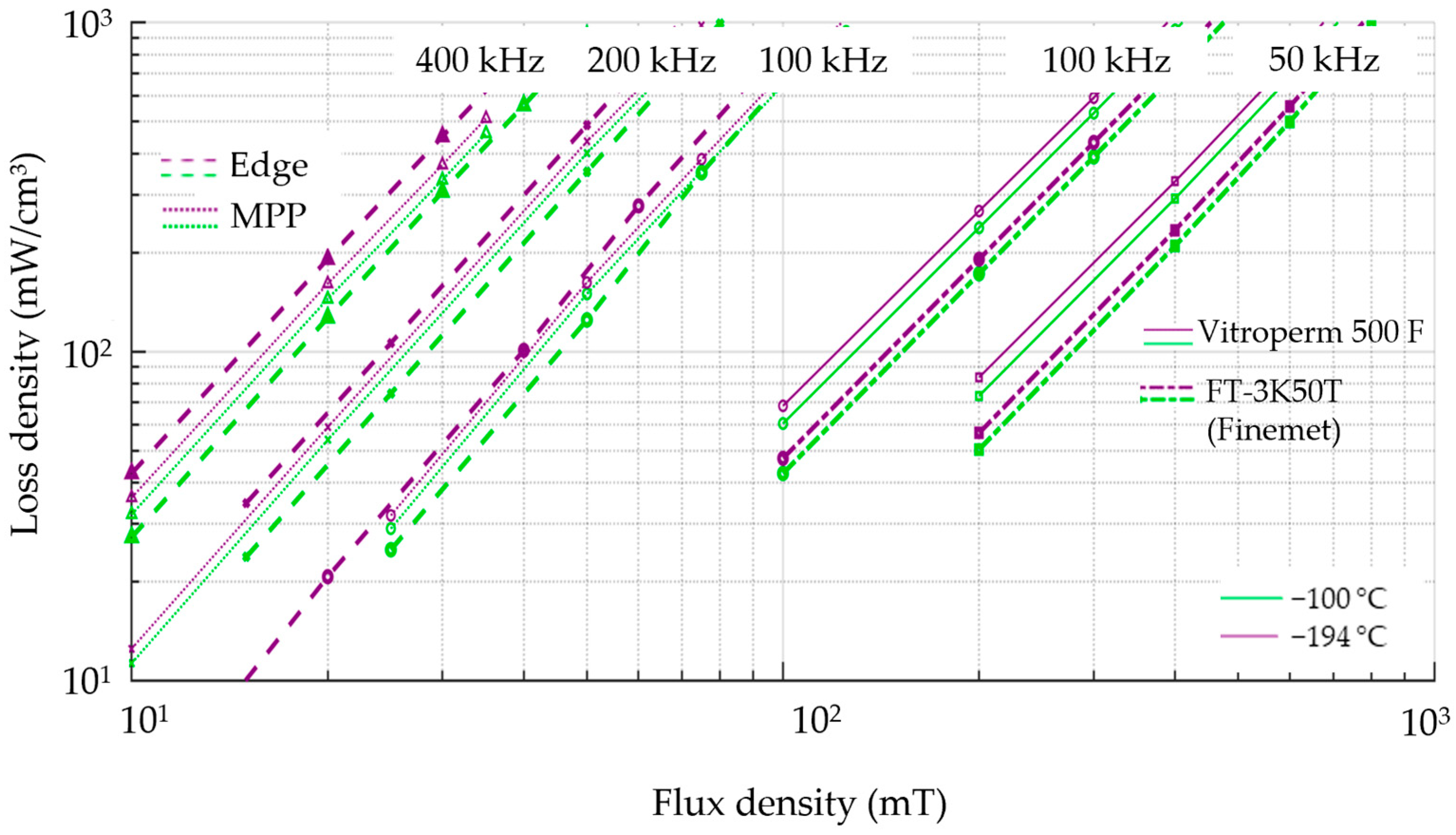
Nanocrystalline alloys, represented by Finemet and Vitroperm, exhibit fundamentally different behavior. Under purely AC excitation, both materials combine low absolute losses with excellent thermal stability, as confirmed by the temperature-dependent Steinmetz parameters and the normalized loss analysis. As illustrated in Figure 12, their loss curves remain closely clustered over wide ranges of flux density and excitation frequency when cooled to −194 °C. Finemet shows particularly stable behavior at higher frequencies, while Vitroperm exhibits a somewhat stronger temperature dependence at lower frequencies. These trends correlate well with the only moderate increase in coercivity and the near-constant Steinmetz exponents. However, as shown in Section 3.4, nanocrystalline materials exhibit a pronounced sensitivity to DC bias: even relatively small DC magnetizing fields cause a rapid reduction in permeability and a significant increase in losses, an effect that becomes more pronounced at cryogenic temperatures. Consequently, nanocrystalline alloys are well suited for AC-dominated applications such as transformers, but—in ungapped configurations—are inherently unsuitable for DC-biased inductors at both room and cryogenic temperatures.
Powder-core materials offer the most flexible design space for cryogenic inductors, as their distributed air-gap structure provides intrinsic DC bias robustness and enables the effective permeability to be engineered during material design. This allows a targeted trade-off between inductance, saturation capability, and core volume. From an inductor-design perspective, the key objectives are minimizing current ripple, avoiding magnetic saturation, and reducing total core losses. While higher inductance reduces current ripple and associated AC loss components, it inevitably increases the magnetic flux density within the core, thereby pushing the design closer to saturation. Consequently, the saturation flux density becomes a critical limiting parameter, particularly in compact and mass-constrained designs. Importantly, the total core loss is not governed by the specific loss density alone, but by the product of loss density and core volume. While higher inductance generally increases flux density and drives the core closer to saturation, materials with a higher saturation flux density shift this constraint to higher operating flux levels. As a result, they enable smaller core volumes and reduced mass, even if their specific loss density is moderately higher. Thus, in compact inductor designs, saturation flux density—not specific loss density alone—often determines the achievable system-level efficiency. At 25 °C, manufacturer-reported saturation flux densities for the investigated powder cores are approximately B s a t ≈ 0.8 T (MPP), B s a t ≈ 1.5 T (High Flux), and B s a t ≈ 1.5−1.6 T (Edge), whereas manufacturer-reported B s a t values at −196 °C are not available. In addition, full-saturation extraction at cryogenic temperature was not feasible in the present setup due to amplifier output-power limits and the gradual saturation transition of distributed-gap powder materials. Therefore, the size/weight discussion is based on room-temperature saturation headroom, while cryogenic comparison is based on measured core losses within the accessible operating range.
Within this material class, pronounced material-specific trade-offs are observed. Kool Mµ Hf and Kool Mµ MAX offer good DC bias stability and low material cost under ambient conditions; however, their strong temperature sensitivity leads to loss increases of up to factors of 3–5 at −194 °C. This pronounced degradation significantly limits their suitability for high-efficiency cryogenic applications despite their favorable room-temperature characteristics.
XFlux exhibits only moderate temperature sensitivity, with loss increases of approximately 25–30% across the investigated frequency range. Nevertheless, its intrinsically high loss power densities at the reference operating point—significantly exceeding those of all other investigated powder-core materials—result in high absolute loss densities, making it impractical for loss-critical and mass-limited aerospace applications.
High Flux provides high saturation capability and comparatively moderate temperature dependence; however, its substantially higher loss power densities at the reference operating point compared to Edge lead to significantly higher absolute losses at cryogenic temperatures, particularly at elevated frequencies, which limits its overall efficiency.
In contrast, MPP and Edge emerge as the most balanced powder-core solutions. Both materials combine comparatively low baseline losses with moderate temperature dependence and robust DC bias behavior. Their loss curves remain well separated from those of higher-loss powder cores over wide ranges of flux density and frequency, and, as shown in Figure 12, their absolute losses converge to similar levels below −100 °C. At 25 °C, however, Edge provides substantially higher saturation headroom ( B s a t ≈ 1.5−1.6 T) than MPP (≈0.8 T), which supports smaller core cross-sections and lower mass in compact designs. This advantage is particularly relevant for aerospace and cryogenic applications, where volumetric and gravimetric efficiency are critical. Although MPP is associated with higher material cost, cryogenic power-electronic systems are typically dominated by efficiency and mass considerations rather than by core material costs. Consequently, materials with slightly higher specific loss densities may still offer superior overall performance when their higher saturation capability enables significantly reduced core volume and total loss.


4. Conclusions

Overall, this work provides the first comprehensive and continuous data set across magnetic material classes relevant to low-temperature power electronics. Ferrite materials exhibit the most pronounced performance degradation at cryogenic temperatures and are therefore generally not suitable for efficient cryogenic operation in power-magnetic components (e.g., inductors and transformers). Our findings of an order-of-magnitude loss increase and severe permeability reduction confirm the trends for MnZn- and NiZn-ferrites reported in [3,5,6] while providing a more detailed frequency-dependent characterization up to 400 kHz.
Nanocrystalline alloys combine low absolute losses with high thermal stability under purely AC excitation. Our findings confirm the moderate temperature-induced loss increase and permeability reduction reported in [3,4,5,8,9,11], while extending these observations through a continuous characterization across the entire temperature and a wider frequency range. These results validate that nanocrystalline materials maintain their superior AC performance even at cryogenic temperatures. However, our investigations into DC bias reveal that the material’s sensitivity to DC magnetizing fields is a critical limiting factor for ungapped configurations, which becomes significantly more pronounced as temperatures decrease toward −194 °C. This underscores that while nanocrystalline cores are excellent for AC applications like transformers, their inherent DC-bias instability at low temperatures makes them unsuitable for ungapped DC-inductors.
Powder-core materials provide the greatest design flexibility for cryogenic inductor applications due to their intrinsic DC-bias robustness. While previous literature [7] focused on the cryogenic behavior of inductor configurations (e.g., resistance and quality factor) for MPP and High Flux, this work provides the first comprehensive, quantitative data set for frequency- and flux-density-dependent core losses. Our results confirm the relative stability of MPP and High Flux reported in [7], but further identify Edge as the most balanced solution for mass-critical applications. Furthermore, this study reveals that materials like Kool Mµ Hf and Kool Mµ MAX exhibit a severe loss increase (factors of 3–5) at −194 °C, a finding that extends the limited observations in [7] regarding the temperature sensitivity of the Kool Mµ alloy family. Furthermore, the high saturation flux density of High Flux and Edge (≈1.5–1.6 T) compared to MPP (≈0.8 T) allows for a pronounced reduction in core cross-section for a given magnetic flux. Although specific loss densities converge at cryogenic temperatures, this higher saturation headroom enables significantly reduced core volumes and total mass, representing a decisive advantage for aerospace power electronics where gravimetric efficiency is of great importance.

Author Contributions

Conceptualization, S.B.; methodology, S.B.; formal analysis, S.B.; investigation, S.B.; writing—original draft preparation, S.B.; writing—review and editing, S.B. and M.M.; visualization, S.B. All authors have read and agreed to the published version of the manuscript.

Funding

This research and the APC were funded by the ECS4DRES project (grant number 101139790).

Data Availability Statement

Data is contained within the article.

Conflicts of Interest

The authors declare no conflicts of interest.

Appendix A

Table A1. Temperature dependence of the loss density pref (T) at the reference operating point fref = 100 kHz and Bref = 50 mT for all investigated core materials.
Steinmetz   Prefactor   p r e f T (in mW/cm3)
Temperature °CN87
(MnZn-Ferrite)
Fair-Rite #61
(NiZn-Ferrite)
FT-3K50T (Finemet)Vitroperm 500 FKool Mµ HfKool Mµ MAXXFluxEdgeHigh FluxMPP
252635310.212.188140359101188128
−256323310.613.3103158374114206134
−508938510.813.6124179384121215139
−100195107611.415.1185242405137237145
−150420174211.816.5273335429155258151
−194494 12.617.4365466465181271158

References

  1. Gui, H.; Chen, R.; Niu, J.; Zhang, Z.; Tolbert, L.M.; Wang, F.F.; Blalock, B.J.; Costinett, D.; Choi, B.B. Review of Power Electronics Components at Cryogenic Temperatures. IEEE Trans. Power Electron. 2020, 35, 5144–5156. [Google Scholar] [CrossRef]
  2. Liao, Y.; Elwakeel, A.; Xiao, Y.; Alzola, R.P.; Zhang, M.; Yuan, W.; Feliciano, A.J.C.; Graber, L. Review of semiconductor devices and other power electronics components at cryogenic temperature. iEnergy 2024, 3, 95–107. [Google Scholar] [CrossRef]
  3. Chen, R.; Dong, Z.; Zhang, Z.; Gui, H.; Niu, J.; Ren, R.; Wang, F.; Tolbert, L.M.; Blalock, B.J.; Costinett, D.J.; et al. Core Characterization and Inductor Design Investigation at Low Temperature. In Proceedings of the 2018 IEEE Energy Conversion Congress and Exposition (ECCE), Portland, OR, USA, 23–27 September 2018; pp. 4218–4225. [Google Scholar]
  4. Wadsworth, A.; Pearce, M.G.; Thrimawithana, D.J.; Zhao, L. Dense and Efficient Cryogenic Power Converter Using Stress Annealed and Stacked Nanocrystalline Cores. IEEE Trans. Power Electron. 2025, 40, 3357–3369. [Google Scholar] [CrossRef]
  5. Yin, S.; Mehrabankhomartash, M.; Cruz, A.J.; Graber, L.; Saeedifard, M.; Evans, S.; Kapaun, F.; Revel, I.; Steiner, G.; Ybanez, L.; et al. Characterization of Inductor Magnetic Cores for Cryogenic Applications. In 2021 IEEE Energy Conversion Congress and Exposition (ECCE); IEEE: New York, NY, USA, 2021; pp. 5327–5333. [Google Scholar]
  6. Niedra, J.M. Comparative Wide Temperature Core Loss Characteristics of Two Candidate Ferrites for the NASA/TRW 1500 W PEBB Converter; NASA Glenn Research Center: Cleveland, OH, USA, 1999.
  7. Gerber, S.S. Performance of high-frequency high-flux magnetic cores at cryogenic temperatures. In 2002 37th Intersociety Energy Conversion Engineering Conference; IEEE: Washington, WA, USA, 2001; pp. 249–254. [Google Scholar]
  8. Pei, X.; Smith, A.C.; Vandenbossche, L.; Rens, J. Magnetic Characterization of Soft Magnetic Cores at Cryogenic Temperatures. IEEE Trans. Appl. Supercond. 2019, 29, 7800306. [Google Scholar] [CrossRef]
  9. Wadsworth, A.; Thrimawithana, D.J.; Zhao, L.; Neuburger, M.; Oliver, R.A.; Wallis, D.J. GaN-based cryogenic temperature power electronics for superconducting motors in cryo-electric aircraft. Supercond. Sci. Technol. 2023, 36, 94002. [Google Scholar] [CrossRef]
  10. Chen, M.; Yu, Y.J.; Xiao, L.Y.; Wang, Q.L.; Chung, W.; Kim, K.; Baang, S. The magnetic properties of the ferromagnetic materials used for HTS transformers at 77 K. IEEE Trans. Appl. Supercond. 2003, 13, 2313–2316. [Google Scholar] [CrossRef]
  11. Wadsworth, A.; Pearce, M.G.; Thrimawithana, D.J. A Cryogenic 3-kW GaN E-HEMT Synchronous Buck Converter. IEEE Trans. Ind. Electron. 2024, 71, 7075–7084. [Google Scholar] [CrossRef]
  12. Azofeifa, O.; Barth, C.B. Inductor loss estimation of a single phase 3-level gallium nitride inverter under cryogenic conditions. In 2018 IEEE Power and Energy Conference at Illinois (PECI): Champaign, IL, USA, 22–23 February 2018; IEEE: Champaign, IL, USA, 2018; pp. 1–7. [Google Scholar]
  13. Chen, Z.; Wei, Y.; He, Y.; Sun, P. Efficiency and Loss Analysis of a GaN HEMT based Synchronous Buck Converter at 123 K–298 K. In 2024 IEEE 15th International Symposium on Power Electronics for Distributed Generation Systems (PEDG); IEEE: New York, NY, USA, 2024. [Google Scholar]
  14. McKeown, S.; Wadsworth, A.; Pearce, M.G.; Thrimawithana, D.J.; Zhao, L.; Li, Z. Characterisation of Nanocrystalline and Iron Powder Mix Cores at 77K. In 2023 IEEE Energy Conversion Congress and Exposition (ECCE); IEEE: New York, NY, USA, 2023; pp. 1903–1908. [Google Scholar]
  15. Bs&T Frankfurt am Main GmbH. Available online: https://b-stone.de/ (accessed on 8 December 2025).
  16. Stolzke, T.; Ehrlich, S.; Joffe, C.; März, M. Comprehensive accuracy examination of electrical power loss measurements of inductive components for frequencies up to 1 MHz. J. Magn. Magn. Mater. 2020, 497, 166022. [Google Scholar] [CrossRef]
  17. Huebener, R. Leiter, Halbleiter, Supraleiter: Eine kompakte Einführung in Geschichte, Entwicklung und Theorie der Festkörperphysik, 4th ed.; Springer Spektrum: Berlin, Germany, 2025. [Google Scholar]
  18. Guo, H.-Q. Low-temperature magnetization and spin-wave excitation in nanocrystalline ferromagnets. J. Phys. Condens. Matter 1993, 5, L437–L442. [Google Scholar] [CrossRef]
  19. Maaz, K.; Mumtaz, A.; Hasanain, S.K.; Bertino, M.F. Temperature dependent coercivity and magnetization of nickel ferrite nanoparticles. J. Magn. Magn. Mater. 2010, 322, 2199–2202. [Google Scholar] [CrossRef]
  20. Herzer, G. Grain size dependence of coercivity and permeability in nanocrystalline ferromagnets. IEEE Trans. Magn. 1990, 26, 1397–1402. [Google Scholar] [CrossRef]
Figure 1. Simplified schematic of the measurement setup for the characterization of inductive components at cryogenic temperatures. Except for the components for and located inside the cryogenic chamber, all instruments are part of a commercial measurement system with fully automated data evaluation according to IEC 60404, provided by Bs&T Frankfurt am Main GmbH.
Electronics 15 00872 g001
Figure 2. Relative error of core loss measurement depending on phase shift ϕ and phase angle deviation Δϕ according to (4).
Electronics 15 00872 g002
Figure 3. Cryo test setup.
Electronics 15 00872 g003
Figure 4. Temperature-dependent hysteresis curves of (a) Finemet FT-3K50T, (b) Vitroperm 500 F, (c) N87 (MnZn-Ferrite) and (d) Fair-Rite #61 (NiZn-Ferrite).
Electronics 15 00872 g004
Figure 5. Temperature-dependent specific core losses of (a) N87 (MnZn-ferrite), (b) Fair-Rite #61 (NiZn-ferrite) and the nanocrystalline materials (c) Finemet FT-3K50T and (d) Vitroperm 500 F; Measurement data are shown as circles, while the corresponding Steinmetz-fit curves are plotted as solid lines. Where available, the datasheet values for the specific core losses at room temperature (25 °C) are included as black dashed reference lines.
Electronics 15 00872 g005aElectronics 15 00872 g005b
Figure 6. Temperature-dependent specific core losses of the powder-core materials (a) Kool Mµ MAX, (b) Kool Mµ Hf, (c) XFLUX, (d) Edge, (e) MPP and (f) High Flux (all µ = 60). Measurement data are shown as circles, while the corresponding Steinmetz-fit curves are plotted as solid lines. The datasheet values for the specific core losses at room temperature (25 °C) are included as black dashed reference lines.
Electronics 15 00872 g006aElectronics 15 00872 g006b
Figure 7. Temperature dependence of the fitted Steinmetz parameters for the investigated core materials: (a) reference loss coefficient p r e f ( T ) , (b) frequency exponent α ( T ) , and (c) flux density exponent β ( T ) . The Steinmetz parameters were extracted by fitting all measured data points over the full material-specific range (see Figure 5 and Figure 6).
Electronics 15 00872 g007
Figure 8. Temperature-dependent specific core losses for various excitation frequencies, normalized to 25 °C, of (a) N87 (MnZn-Ferrite), (b) Fair-Rite #61 (NiZn-Ferrite) and the nanocrystalline materials (c) Finemet FT-3K50T and (d) Vitroperm 500 F.
Electronics 15 00872 g008
Figure 9. Temperature-dependent specific core losses for various excitation frequencies, normalized to 25 °C, of the powder-core materials (a) Kool Mµ MAX, (b) Kool Mµ Hf, (c) XFLUX, (d) Edge, (e) MPP and (f) High Flux (all µ = 60).
Electronics 15 00872 g009
Figure 10. Comparison of permeability characteristics under DC bias fields for (a) powder-core materials (High Flux, Edge and MPP, all µ = 60) and (b) nanocrystalline materials (Finemet FT-3K50T and Vitroperm 500 F).
Electronics 15 00872 g010
Figure 11. Comparison of core loss density under DC bias fields: (a,b) powder-core materials (High Flux, Edge and MPP, all µ = 60) and (c) nanocrystalline materials (Finemet FT-3K50T and Vitroperm 500 F).
Electronics 15 00872 g011
Figure 12. Temperature-dependent specific core losses for various excitation frequencies of powder-core materials (Edge and MPP, all µ = 60) and nanocrystalline materials (Vitroperm 500 F and FT-3K50T Finemet).
Electronics 15 00872 g012
Table 1. Investigated magnetic core materials.
Core MaterialManufacturer Nr.
(Manufacturer)
Material Class
(Alloy Composition in wt.%)
Permeability (µ)Outer/Inner
Diameter
Np/Ns
N87B64290L0743X087
(EPCOS/TDK, Munich, Germany)
MnZn-Ferrite 15.8 mm/8.9 mm8/8
#61 5961004901
(Fair-Rite, Wallkill, New York, NY, USA)
NiZn-Ferrite 16.0 mm/9.6 mm9/9
FinemetFT-3K50T F1613YS
(Proterial, Tokyo, Japan)
Nanocystalline alloy 17.8 mm/10.7 mm3/3
Vitroperm 500 FT60004L2016W620
(Vacuumschmelze, Hanau, Germany)
Nanocystalline alloy 16.0 mm/12.5 mm3/3
Kool Mµ MAX79848 (Magnetics, Pittsburgh, PA, USA)Powder (85% Fe, 9% Si, 6% Al)6020.3 mm/12.7 mm14/7
Kool Mµ Hf76848 (Magnetics, Pittsburgh, PA, USA)Powder (85% Fe, 9% Si, 6% Al)60 20.3 mm/12.7 mm18/6
XFlux78848 (Magnetics, Pittsburgh, PA, USA)Powder (93.5% Fe, 6.5% Si)60 20.3 mm/12.7 mm14/7
Edge59848 (Magnetics, Pittsburgh, PA, USA)Powder (NiFe; wt.% unknown)60 20.3 mm/12.7 mm18/6
High Flux58848 (Magnetics, Pittsburgh, PA, USA)Powder (50% Fe, 50% Ni)60 20.3 mm/12.7 mm18/6
MPP55848 (Magnetics, Pittsburgh, PA, USA)Powder (79% Ni, 17% Fe, 4% Mo)6020.3 mm/12.7 mm15/5
Table 2. Temperature-dependent normalized permeability factor Kµ = µ(T)/µ(25 °C) at the specified measurement frequency (the permeability range of ferrites specified at room temperature refers to the magnetic flux density range used during measurement).
Core MaterialMeasurement Frequency (kHz)µr
(25 °C)
Kµ
(−50 °C)
Kµ
(−100 °C)
Kµ
(−194 °C)
N87 (MnZn-Ferrite)
(EPCOS/TDK, Munich, Germany)
1002800–46000.440.260.06
Fair-Rite #61 (NiZn-Ferrite)
(Fair-Rite, Wallkill, New York, NY, USA)
100200–2401.050.590.21
Finemet FT-3K50T
(Proterial, Tokyo, Japan)
10040,0001.031.010.95
Vitroperm 500 F
(Vacuumschmelze, Hanau, Germany)
10036,0000.930.880.8
Kool Mµ MAX
(Magnetics, Pittsburgh, PA, USA)
100610.990.970.9
Kool Mµ Hf
(Magnetics, Pittsburgh, PA, USA)
1005810.970.93
XFLUX
(Magnetics, Pittsburgh, PA, USA)
10061–641.000.990.98
Edge
(Magnetics, Pittsburgh, PA, USA)
100600.990.990.97
MPP
(Magnetics, Pittsburgh, PA, USA)
100631.001.001.00
High Flux
(Magnetics, Pittsburgh, PA, USA)
100580.990.980.97
Disclaimer/Publisher’s Note: The statements, opinions and data contained in all publications are solely those of the individual author(s) and contributor(s) and not of MDPI and/or the editor(s). MDPI and/or the editor(s) disclaim responsibility for any injury to people or property resulting from any ideas, methods, instructions or products referred to in the content.