1. Introduction
Digitalization is increasingly shaping modern energy and industrial systems, with a growing emphasis on data-driven monitoring, adaptability, and efficiency. While system-level concepts such as demand-side management or energy-aware control are often discussed at the grid or infrastructure level, their practical realization is facilitated by reliable operational data at the device level [
1]. In this context, the International Energy Agency (IEA) highlights the potential of digital technologies to improve efficiency and operational flexibility while emphasizing reliability and cybersecurity requirements in data-driven architectures [
1]. These observations call for a closer examination of digitalization at the level of power electronics systems. DC/DC converters play a central role in supplying, conditioning, and distributing energy in modern electronic systems and increasingly expose operational data via digital configuration and telemetry interfaces, enabling data-driven analysis directly at the source [
2].
Power electronics is increasingly evolving beyond the optimization of efficiency and power density toward improved configurability, monitoring capabilities, and tighter integration into system-level power management architectures. This development is driven by ongoing digitalization trends in energy and industrial systems [
1] and is reflected in recent review studies that emphasize the growing role of digitally assisted converter systems with enhanced observability and software-based parameterization [
3]. Accordingly, DC/DC converters are increasingly implemented using digitally controlled or mixed-signal architectures, enabling converter parameters to be modified, monitored, and coordinated in software rather than fixed hardware components [
2]. This programmable configurability forms the basis for adaptive operating modes, telemetry-based supervision, and data-driven diagnostic functions across a wide range of applications [
4,
5]. In addition, prior research has demonstrated that condition monitoring and diagnostic tasks can be realized using intrinsic electrical signals already available within configurable power electronic systems. By exploiting current- and voltage-based features derived from existing measurements, operational deviations and degradation effects can be detected without introducing additional external sensors or modifying the physical system architecture [
6]. These developments motivate the investigation of telemetry-based monitoring concepts that exploit converter-internal measurement data as a readily available information source for embedded condition monitoring and diagnostics.
A central aspect of this development is the use of real-time operational data for condition-based monitoring and early anomaly detection in power-electronic systems. Continuously acquired operational data can be leveraged to build data-driven representations of converter behavior and to detect deviations caused by component aging or parameter drift [
5]. Data-driven condition monitoring and prognostics of power-electronic systems have increasingly employed deep learning techniques, particularly convolutional and recurrent Neural Network architectures. In selected studies, including CNN–LSTM-based approaches, high predictive accuracy has been demonstrated for remaining useful life estimation and fault-related pattern recognition under controlled experimental conditions [
7,
8]. However, several review studies highlight that end-to-end deep learning models generally demand substantial computational resources and large amounts of labeled data, while also exhibiting non-deterministic execution behavior. These factors considerably restrict their practical deployment in resource-constrained embedded systems [
9,
10,
11]. As a result, lightweight model structures and feature-based representations remain a key design principle for embedded condition monitoring, particularly in safety-critical and real-time-constrained environments.
In parallel, the data-driven evaluation of operational and telemetry signals has been shown to improve fault detection and diagnostic capabilities in power-electronic systems. Machine learning approaches have been applied to identify abnormal operating patterns and fault-related transients in converters and connected components under controlled experimental conditions [
12,
13]. By exploiting characteristic changes in measured electrical signals, such methods enable early detection of deviations from nominal behavior and can support diagnostic functions at the system level. These developments motivate the use of converter-internal telemetry as an additional information source for condition monitoring and anomaly detection [
14]. It is important to distinguish the proposed telemetry-based monitoring approach from related concepts such as non-intrusive load monitoring (NILM) and power side-channel analysis. While NILM aims to identify multiple unknown loads from aggregated power measurements at higher system levels [
15], and side-channel analysis (SCA) typically exploits high-frequency leakage phenomena for security-related inference [
16], the present work focuses on device-level monitoring using converter-internal telemetry signals. These signals are digitally available within the power supply unit and represent well-defined electrical quantities such as current and voltage and also temperature, sampled at comparatively low rates. As a result, the proposed approach does not rely on blind load disaggregation or high-frequency signal acquisition but instead leverages structured, converter-provided operational data for condition monitoring of a known connected system. Beyond classical SCA, power supply monitoring has also been investigated in the context of security-related applications, where characteristic variations in supply current are analyzed to enhance device-level protection mechanisms [
15]. Beyond condition and fault monitoring, power supply telemetry has also been investigated as a potential information source for security-related monitoring and anomaly detection in embedded systems [
17].
The growing availability of communication and configuration interfaces has expanded the functional role of modern DC/DC converters beyond fixed-point power conversion. Digital communication enables parameterization, monitoring, and coordination within higher-level power management architectures. At the device level, this development is reflected in a shift from rigid analog control structures toward mixed-signal and software-configurable architectures. Standardized interfaces such as PMBus provide a widely adopted mechanism to access operational parameters and telemetry data and thus form a practical foundation for adaptive control strategies and data-driven diagnostic functions in digitally configurable power supplies [
18]. While earlier generations of DC/DC converters predominantly relied on fixed analog control structures, microcontrollers and mixed-signal controllers have become increasingly common. Advances in semiconductor integration and decreasing costs enable sophisticated digital and hybrid control functions, including adaptive efficiency optimization, online parameter adjustment, and automated commissioning procedures [
2,
19]. In parallel, wide-bandgap (WBG) semiconductors such as gallium nitride (GaN) further accelerate digitally assisted converter architectures. Higher switching speeds and improved loss characteristics support increased power density and dynamic performance while imposing stricter requirements on control robustness, timing determinism, and system integration [
19,
20].
The ongoing industrial transformation within the frameworks of digital transformation increasingly requires intelligent data processing close to the point of data generation to enable timely and autonomous decision-making [
9,
21]. While cloud-based architectures offer scalable computing resources, their applicability in industrial monitoring is often limited by communication latency, bandwidth requirements, availability constraints, and security requirements. [
10,
11,
22]. Consequently, edge-based processing has gained significant attention for time-critical and resource-efficient applications. A key enabler is Tiny Machine Learning (TinyML), which allows trained models to be executed on resource-constrained microcontrollers [
9,
10]. Such devices typically provide limited memory and computing resources and thus necessitate lightweight models and efficient feature representations [
9,
11]. By performing inference locally, latency can be reduced while improving robustness and data privacy [
10,
11]. Recent studies further emphasize the growing relevance of TinyML for industrial monitoring applications, highlighting trends toward increasingly autonomous and distributed intelligence at the device level [
23]. In the context of power electronics, these developments motivate the use of converter-internal telemetry as a readily available data source for data-driven condition monitoring and anomaly detection [
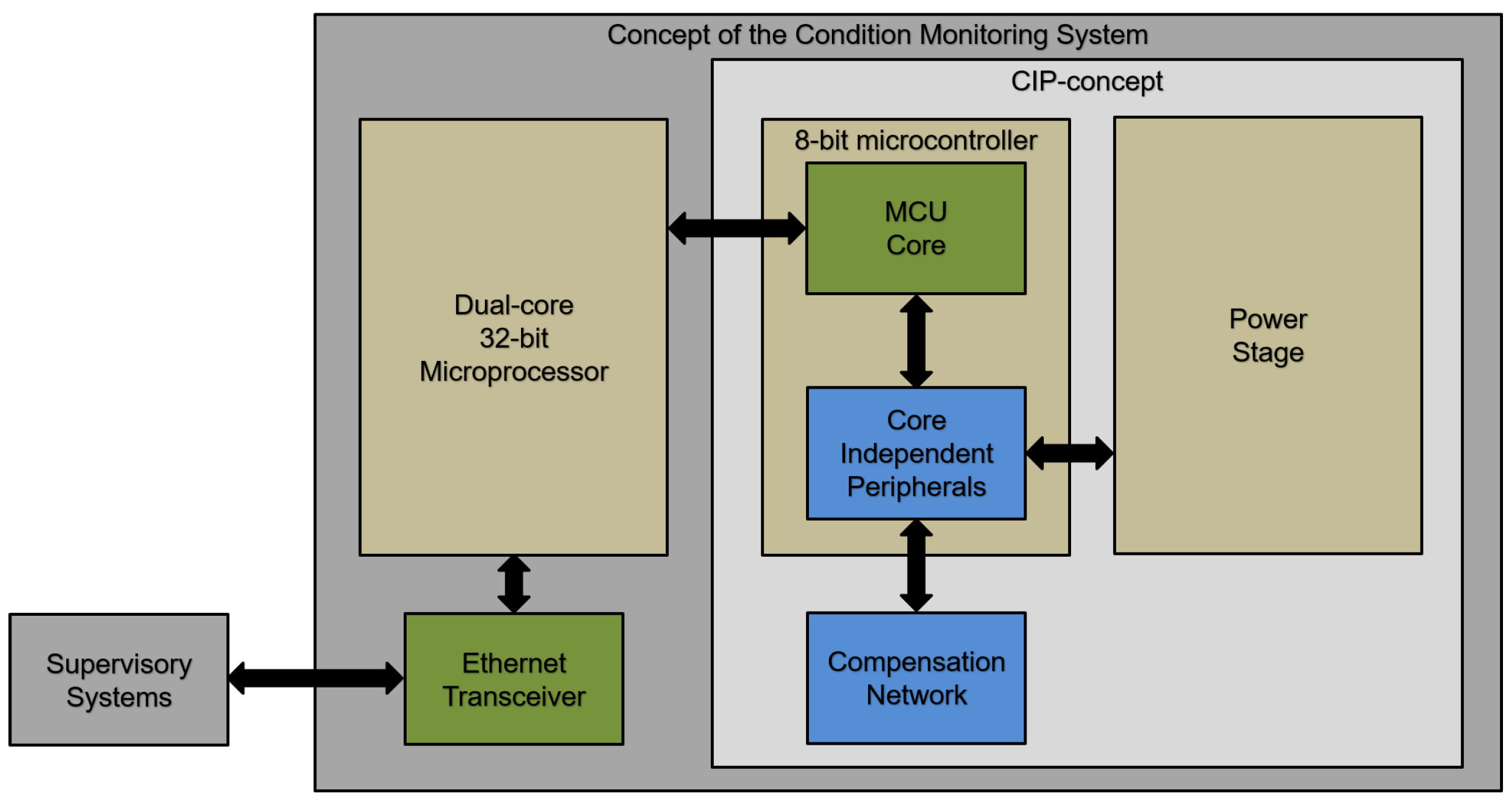
8]. To avoid interference with safety-critical control and protection and to reduce validation effort, telemetry processing and inference can be executed on a dedicated monitoring unit that is architecturally separated from the power supply control logic [
24,
25]. Building upon these concepts, this work demonstrates telemetry-based, resource-efficient condition monitoring using digitally configurable DC/DC converters and embedded intelligence.
Despite the increasing availability of converter-internal telemetry (e.g., via PMBus), its systematic use for embedded condition monitoring has so far been insufficiently addressed. Existing approaches often assume additional sensing or host-level compute resources or do not explicitly consider the separation between safety-critical power control and data-driven inference. As a result, it remains largely unclear how telemetry sampling rate, feature design, and model class jointly influence classification performance and deployability on microcontroller-class devices. This work addresses this gap by proposing a telemetry-only, feature-based monitoring pipeline designed for deterministic execution and predictable memory use, and by quantifying the accuracy–memory trade-off across representative model classes under controlled operating conditions.
The main contributions of this work are as follows:
- 1.
We present a telemetry-based analysis pipeline primarily relying on converter-side power telemetry signals for operational data-driven condition monitoring of a connected load, designed for execution on microcontroller-class hardware.
- 2.
We evaluate three representative model classes (Random Forest, Support Vector Machine, and a Neural Network) and analyze the trade-off between classification accuracy and embedded memory footprint.
- 3.
We demonstrate an architectural separation between power supply control and data-driven monitoring, supporting safe deployment and independent model updates in embedded systems [
24,
25].
In contrast to prior telemetry-based monitoring studies that primarily target host-side analysis or assume additional sensing and computing resources, this work introduces a telemetry-only pipeline explicitly optimized for microcontroller deployment. The novelty lies in systematically quantifying the trade-off among sampling rate, feature count, and model class under fixed embedded constraints and in embedding the approach in a safety-oriented architecture that isolates inference from power supply control, enabling safe deployment and independent model updates.
3. Methods
Based on the described hardware configuration, telemetry-based condition monitoring is evaluated using a feature-based embedded machine learning approach. This section describes the methodological framework used to analyze operational data from digitally configurable DC/DC converters and to perform embedded condition monitoring. The focus is placed on signal acquisition, preprocessing, feature extraction, and the application of machine learning models under embedded system constraints. The objective of the applied methodology is to acquire reproducible operational telemetry data from a digitally configurable DC/DC converter supplying a dynamic industrial-like load under controlled laboratory conditions. The resulting datasets are used to evaluate the influence of the telemetry sampling rate and feature selection on the classification performance and memory requirements of the models.
3.1. Data Acquisition
In the data acquisition process of this work, a clear distinction must be made between dataset generation and the inference phase used during operation. During data collection for the creation of the training dataset, external start and stop signals from the Fischertechnik model factory are employed solely to simplify the acquisition process and to ensure a precise and reproducible data basis, particularly with regard to reference labeling. These signals are not required during inference and are not used as input features for the machine learning models. In an operational monitoring scenario, cycle segmentation is performed exclusively based on converter-side current telemetry by detecting transitions between idle and active load states. This approach enables fully telemetry-based monitoring in systems where no explicit process-level synchronization signals are available. The operational data are acquired directly via the telemetry interface of the digitally configurable DC/DC converters described in
Section 2. The primary signal used for analysis is the output current together with its timestamp, as it reflects the dynamic interaction between the power supply and the connected load. The digitally configurable DC/DC converter supplies power to the monitored system while continuously transmitting telemetry data via a digital communication interface. Within each segmented cycle, internal operating phases are identified directly from the current signal and are not obtained from the demonstrator’s control system. Raw telemetry data were acquired at a sampling rate of 800 Hz, and lower sampling rates of 400 Hz, 200 Hz, and 100 Hz were generated synthetically by uniform downsampling of the original dataset to ensure identical operating conditions across all configurations.
3.2. Dataset Generation Protocol
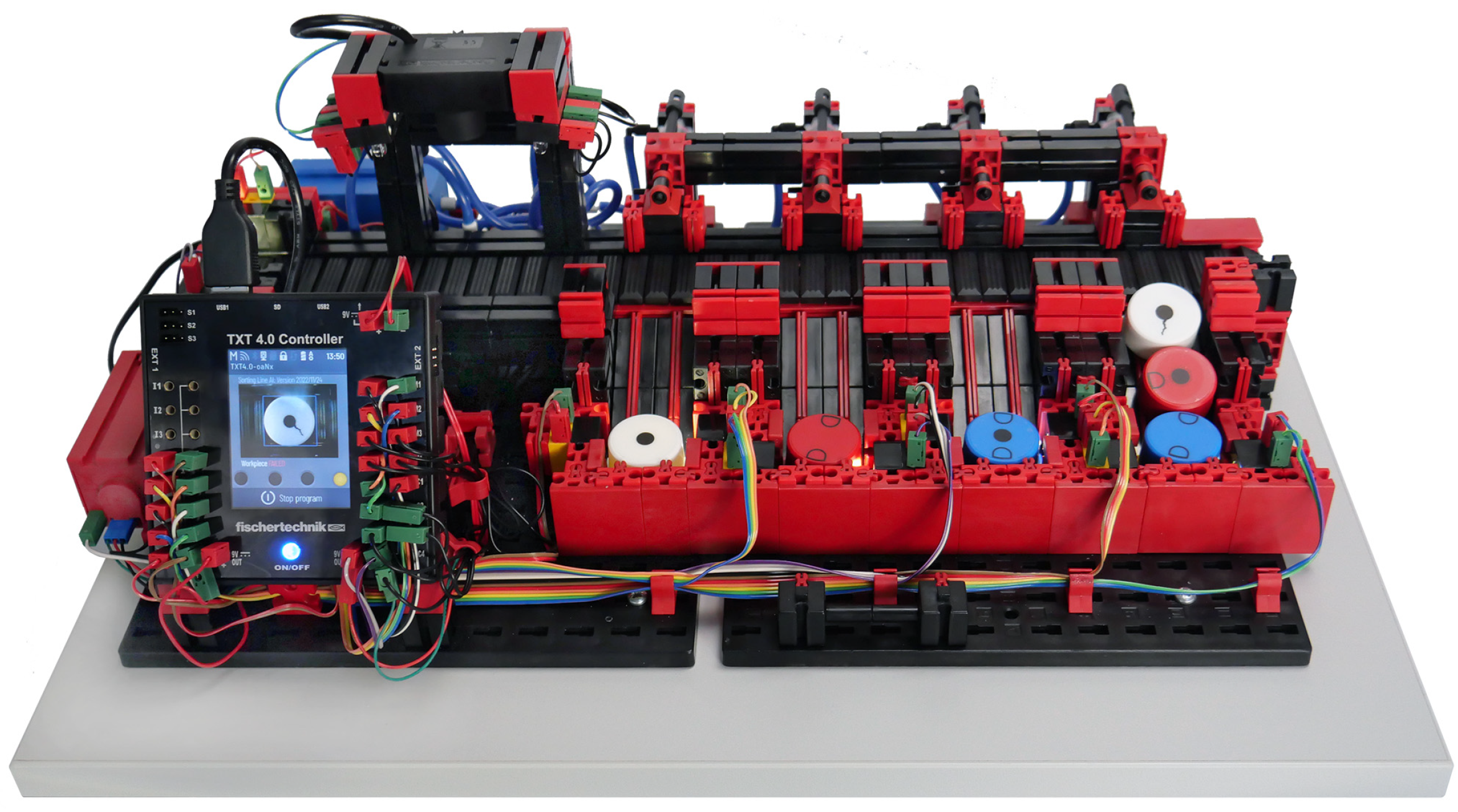
For dataset generation, a structured and repeatable measurement protocol was applied to ensure consistent operating conditions across all recorded samples. Prior to data acquisition, the demonstrator system was operated for approximately five minutes to reach thermal and operational steady-state conditions. Following the warm-up phase, consecutive process cycles of the Fischertechnik model factory were recorded under identical electrical and mechanical configurations. Each complete process cycle corresponds to one experimental run and produces a characteristic current consumption pattern at the output of the supplying DC/DC converter. Telemetry data were continuously acquired during normal system operation until the predefined number of cycles per class was reached. The classification outcome of the demonstrator determines the resulting storage position and thereby defines the associated system state label. No manual intervention or modification of system parameters was performed during the acquisition process. This protocol ensures that all datasets were generated under controlled and comparable conditions, while preserving the natural variability of the dynamic load behavior inherent to the demonstrator system.
3.3. Signal Preprocessing
The recorded electrical signals contain high-frequency noise components. To suppress these components while preserving the load-dependent dynamics, a second-order Butterworth low-pass filter with a cutoff frequency of 10 Hz is applied to the raw signal. This filtering step improves the robustness of subsequent feature extraction against measurement noise in digitally acquired telemetry signals. The analysis intentionally focuses on event- or timing-related characteristics that remain observable under bandwidth-limited telemetry. Although the applied low-pass filter limits the spectral content of the current signal to low-frequency components, the telemetry sampling rate remains a relevant design parameter for the proposed feature-based analysis. The extracted features are predominantly time-domain and event-based, including runtime estimation, peak timing, and transition localization, rather than frequency-domain characteristics. A higher sampling rate improves the temporal discretization of the filtered signal and enables more precise localization of transient events and phase boundaries in the discrete-time representation. Consequently, the benefit of increased telemetry sampling rate in this study arises primarily from improved temporal resolution rather than from the availability of higher-frequency signal components. This distinction is particularly relevant for embedded systems, where timing-related features can provide significant discriminative information under constrained signal bandwidth.
3.4. Segmentation of Process Cycles
The Fischertechnik model factory operates in discrete process cycles whose duration depends on mechanical movements, sensor feedback, and an internal AI-based image classification. Consequently, the recorded current signals do not represent stationary time series but consist of segments with variable length, each corresponding to a single process execution. For dataset generation, each process cycle is segmented using the factory’s start and stop signals to ensure reproducible temporal boundaries. These signals are provided by the demonstrator’s control system and are used exclusively for offline labeling and evaluation. The resulting time-series segments form the basis for feature extraction and subsequent classification. While external start and stop signals are applied to delimit complete process cycles, the identification of internal process phases, such as the classification interval, is performed solely based on characteristic patterns in the current signal. Although external synchronization signals are used in this study to guarantee reproducible segmentation during dataset generation, equivalent cycle boundaries can also be derived directly from the current signal by detecting transitions between idle and active operating states. This enables fully telemetry-based operation in scenarios where explicit process-level synchronization is not available.
3.5. Feature-Based Time-Series Representation
To enable efficient embedded inference, a feature-based analysis approach is adopted instead of directly processing raw time-series data. Feature extraction reduces data dimensionality, improves robustness, and significantly lowers computational and memory requirements compared to end-to-end waveform-based models. General-purpose automated feature extraction frameworks for time-series analysis, such as tsfresh, have been widely applied in data-driven monitoring tasks [
41]. However, their computational complexity and large feature sets typically exceed the constraints of microcontroller-class systems, motivating the use of domain-informed and lightweight feature designs in this work. The following features are used in this study:
Runtime represents the temporal duration of a complete processing cycle. It is calculated as the product of the total number of acquired data samples and the sampling interval.
Total Electric Charge refers to the cumulative electrical charge transferred during a single operation cycle. It is obtained by numerical integration of the measured output current over time.
Maximum Peak Time indicates the exact temporal position within the recorded time series at which the current signal reaches its global maximum value.
Peak Count represents the total number of current peaks observed within the signal and reflects the frequency of characteristic load transitions during the operational process.
Classification Time describes the temporal duration of the internal image-based classification process of the Fischertechnik model factory; this is determined from the characteristic current curve.
A detailed statistical summary of the observed characteristics is presented in
Table 3. It should be noted that the Classification Time feature represents a system-specific characteristic of the demonstrator setup. While this feature is derived exclusively from converter-side current telemetry, its interpretation relies on prior knowledge of the operational sequence of the Fischertechnik model factory. The inclusion of this feature does not require access to external process signals or controller-level information, but it is not intended as a universally transferable indicator. Rather, it serves to evaluate the achievable classification performance when domain-specific knowledge is available. More generic features, such as runtime, electric charge, and peak-related metrics, remain applicable across different load scenarios.
3.6. Feature Scaling, Normalization and Feature Relevance Analysis
For machine learning models that are sensitive to feature scaling, namely SVMs and Neural Networks, Min–Max normalization is applied to map each feature to the interval
. Tree-based models such as Random Forests are invariant to monotonic feature scaling and are therefore trained using unnormalized feature values [
42]. To assess the contribution of individual features to classification performance, feature relevance is evaluated using the Gini impurity criterion of a Random Forest classifier, with the results reported in
Table 4 [
42]. This analysis provides insight into which features contribute most strongly to class separability and supports informed feature selection for embedded deployment.
Feature relevance analysis is shown exemplarily for 100 Hz, similar trends were observed at higher sampling rates.
3.7. Machine Learning Models
Three machine learning model classes are evaluated in this work: a Random Forest, a SVM, and a fully connected Neural Network. All models are trained offline on a host system and subsequently deployed using platform-specific representations. The Random Forest and SVM models are trained using the scikit-learn machine learning framework (version 1.5.0), which provides standardized and well-established reference implementations of classical learning algorithms [
43]. For embedded deployment, both models are converted into static C representations using microMLgen (version 1.1.28), a Python (version 3.12.2) library that creates finished C header files with a predict function for scikit-learn models. The Neural Network is trained using TensorFlow (version 2.17.0) and converted to the TensorFlow Lite model format (version tflite Micro 1.3.1). TensorFlow Lite is a smaller version of TensorFlow developed for deploying TensorFlow models to embedded platforms. An even more lightweight version is TensorFlow Lite Micro, which is a TensorFlow Lite implementation specifically for microcontroller architectures.
3.7.1. Random Forest Classifier
The Random Forest classifier consists of an ensemble of decision trees trained on randomly sampled subsets of the data and feature space [
42]. The final prediction is obtained via majority voting across all trees. In this work, the model is constrained to 10 trees with a maximum depth of 10 and a maximum of 10 leaf nodes per tree to limit memory consumption and ensure feasibility on embedded hardware.
3.7.2. Support Vector Machine Classifier
A SVM with a Radial Basis Function (RBF) kernel is employed to model non-linear decision boundaries [
44]. An SVM grid search was conducted separately for each telemetry sampling rate for the minimum and maximum feature-set sizes (two and five features) to identify the best-performing hyperparameters for each rate. The resulting optimal parameters are reported in
Table 5.
For the comparison across sampling rates and feature-set sizes, a single fixed SVM configuration (, ) was intentionally used instead of optimizing hyperparameters for each configuration individually. The value of C was selected based on the grid search results of the two-feature configurations, as this choice also keeps the memory requirements broadly comparable to those of the other two models. This approach enhances the comparability of the results and supports an application-oriented evaluation. By avoiding configuration-specific tuning, the analysis does not introduce an additional degree of freedom, enabling a clearer interpretation of the observed performance trends. For embedded deployment, the trained SVM model is converted into optimized C code using microMLgen, enabling efficient inference without dynamic memory allocation.
3.7.3. Neural Network Classifier
The Neural Network is implemented as a fully connected multilayer perceptron using the TensorFlow framework [
45]. The architecture comprises two hidden layers with 32 and 64 neurons, respectively, using ReLU activation functions, followed by a Softmax output layer. After training, the model is converted to TFLite Micro format and optimized for inference on microcontroller-class hardware following established TinyML deployment practices. The neural network architecture was chosen to satisfy the constraints of TinyML deployment and to ensure comparability with the other models in terms of memory footprint and inference cost, rather than performing an extensive hyperparameter search for each evaluated configuration.
3.8. Embedded Deployment Considerations
The input data consists of the converter’s time domain output current signal, from which a deterministic feature extraction step is applied prior to classification. The machine learning models operate exclusively on the resulting feature vectors and do not process raw time-series data directly. To investigate the influence of input dimensionality on memory consumption and classification performance, four feature configurations are evaluated with
. The complete feature set comprises the Runtime, Total Electric Charge, Maximum Peak Time, Peak Count, and Classification Time of the factory. This order also corresponds to the structure of the feature set. All models perform a four-class classification task, corresponding to four distinct system states of the Fischertechnik model factory. Feature extraction is identical for all models to ensure a fair comparison. All preprocessing, feature extraction, and inference steps are designed to operate within the computational and memory constraints of an ESP32-class microcontroller. Model conversion and optimization are performed using TensorFlow Lite and microMLgen [
37,
46,
47]. To ensure system safety and maintainability of the demonstrator, all machine learning inference is executed on a dedicated monitoring microcontroller, fully separated from the safety-critical power supply control logic [
24,
25].
3.9. Evaluation Protocol and Memory Analysis Methodology
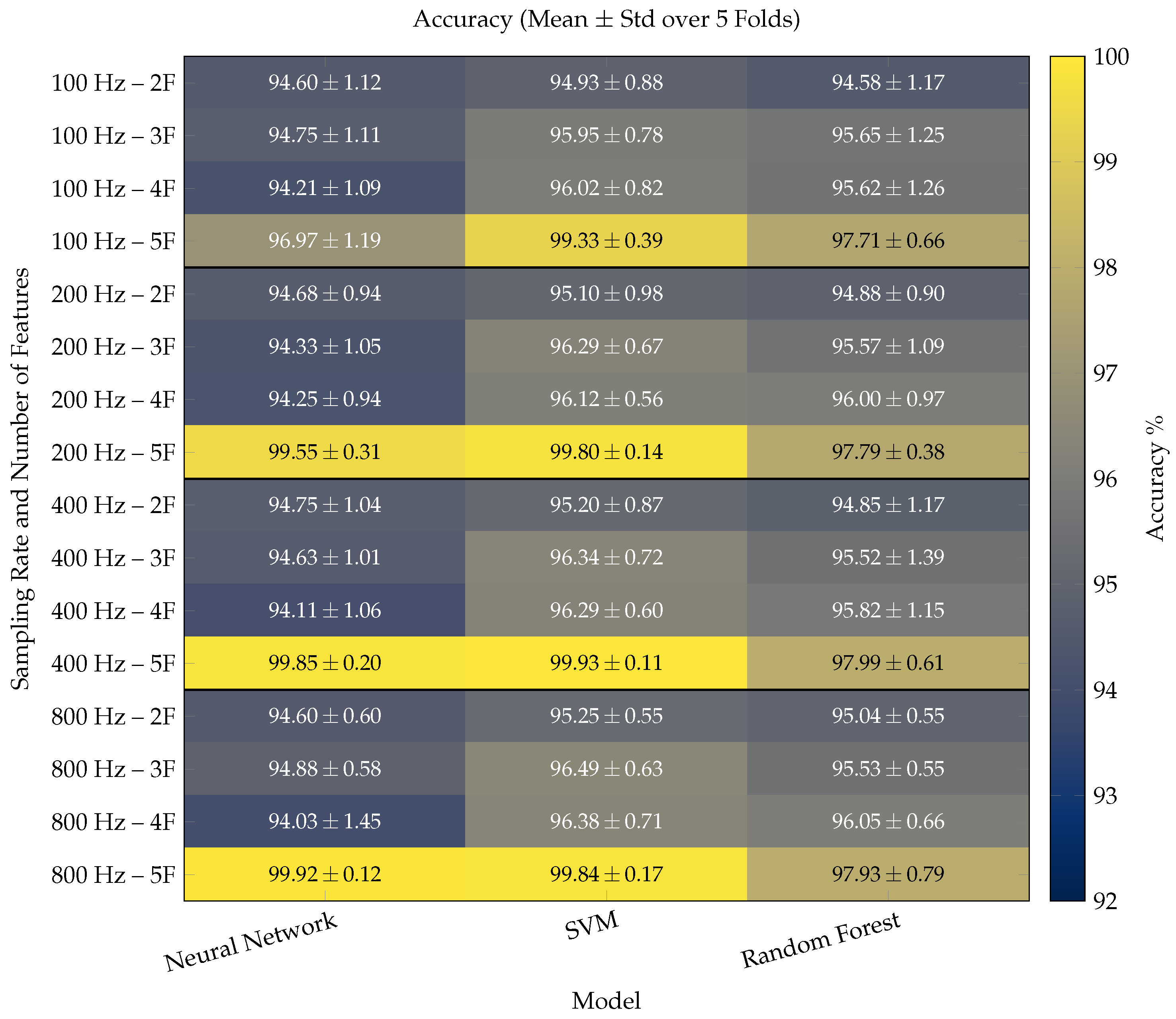
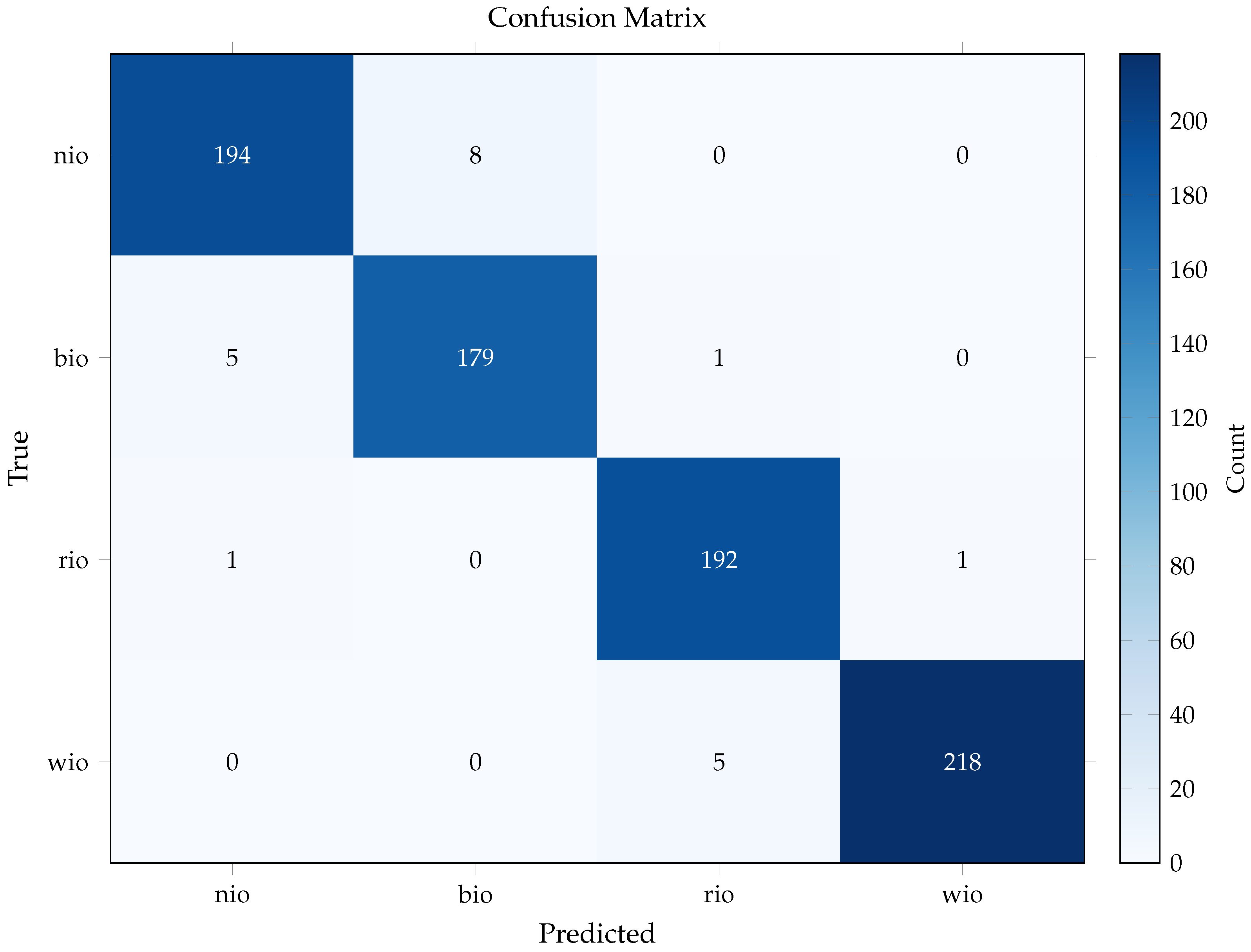
Model evaluation is performed using five-fold cross-validation across all four classes. For each fold, the dataset is partitioned into training and validation subsets while preserving class balance. Model hyperparameters are selected based on validation performance within the cross-validation procedure. Reported classification results correspond to the mean and standard deviation of classification accuracy across all five folds. In addition to classification performance, confusion matrices are evaluated to analyze class-wise misclassification behavior.
This paper deliberately focuses on classification performance and static deployability constraints (flash footprint). Measuring feature-extraction time, inference latency, peak RAM/stack usage, and energy consumption on target hardware is essential for a full real-time assessment but requires dedicated embedded benchmarking and power-measurement instrumentation and is therefore treated as out of scope for this publication. These aspects will be addressed in future work focusing specifically on device timing and energy measurements.
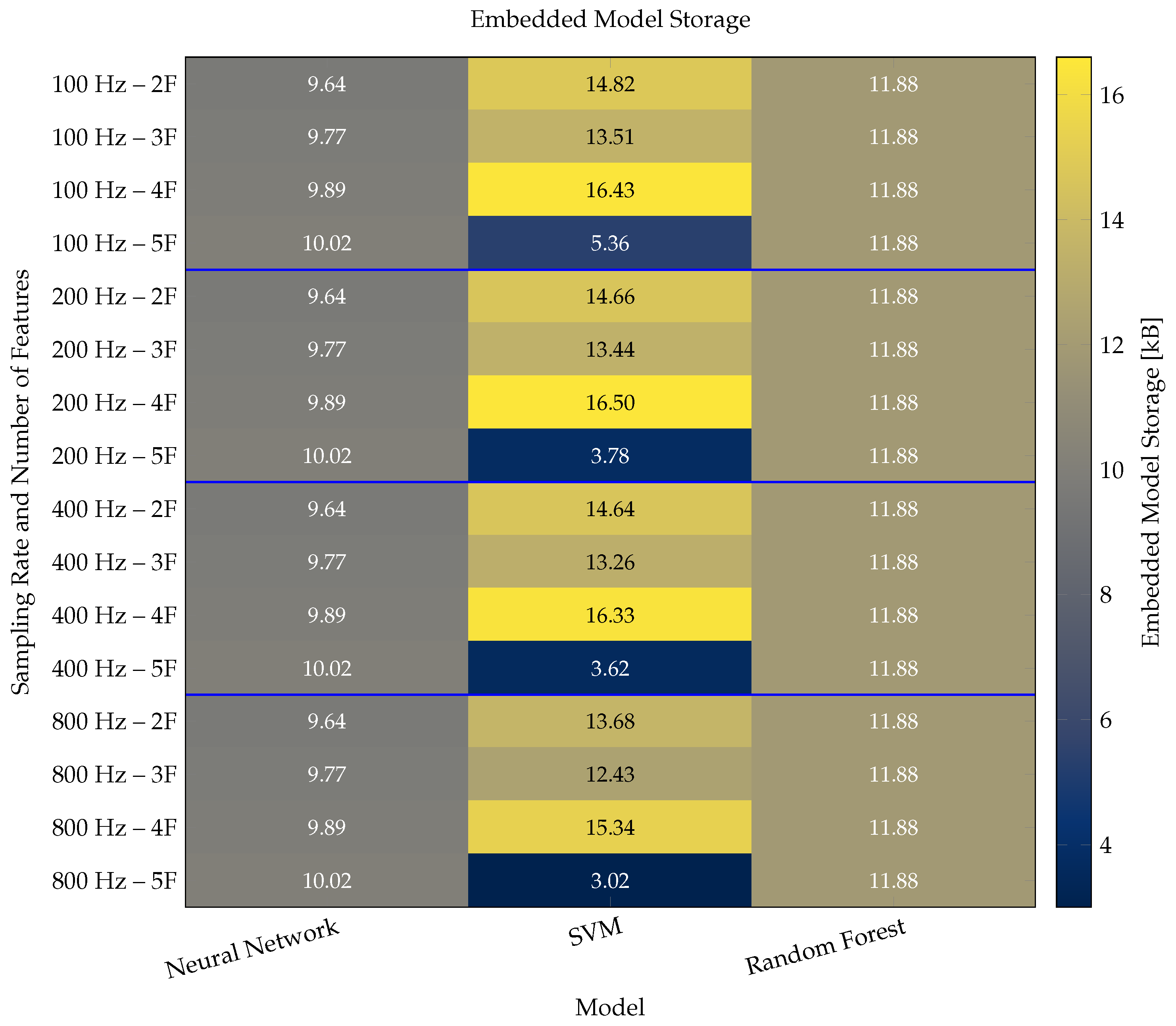
The memory analysis focuses exclusively on the static storage requirements of model parameters required for inference. Memory usage related to training, runtime activations, intermediate buffers, stack usage, and framework overhead is explicitly excluded. The focus on static model parameters reflects a design-relevant metric for embedded deployment, as flash memory consumption directly limits model complexity on microcontroller-class hardware. Runtime memory requirements strongly depend on the selected inference framework, compiler configuration, and platform-specific buffering strategies and are therefore not considered comparable across systems. Two complementary memory perspectives are considered:
- 1.
Host-based model storage refers to the persistence of trained models as serialized Python objects or parameter arrays on a development system, typically using pickle for evaluation [
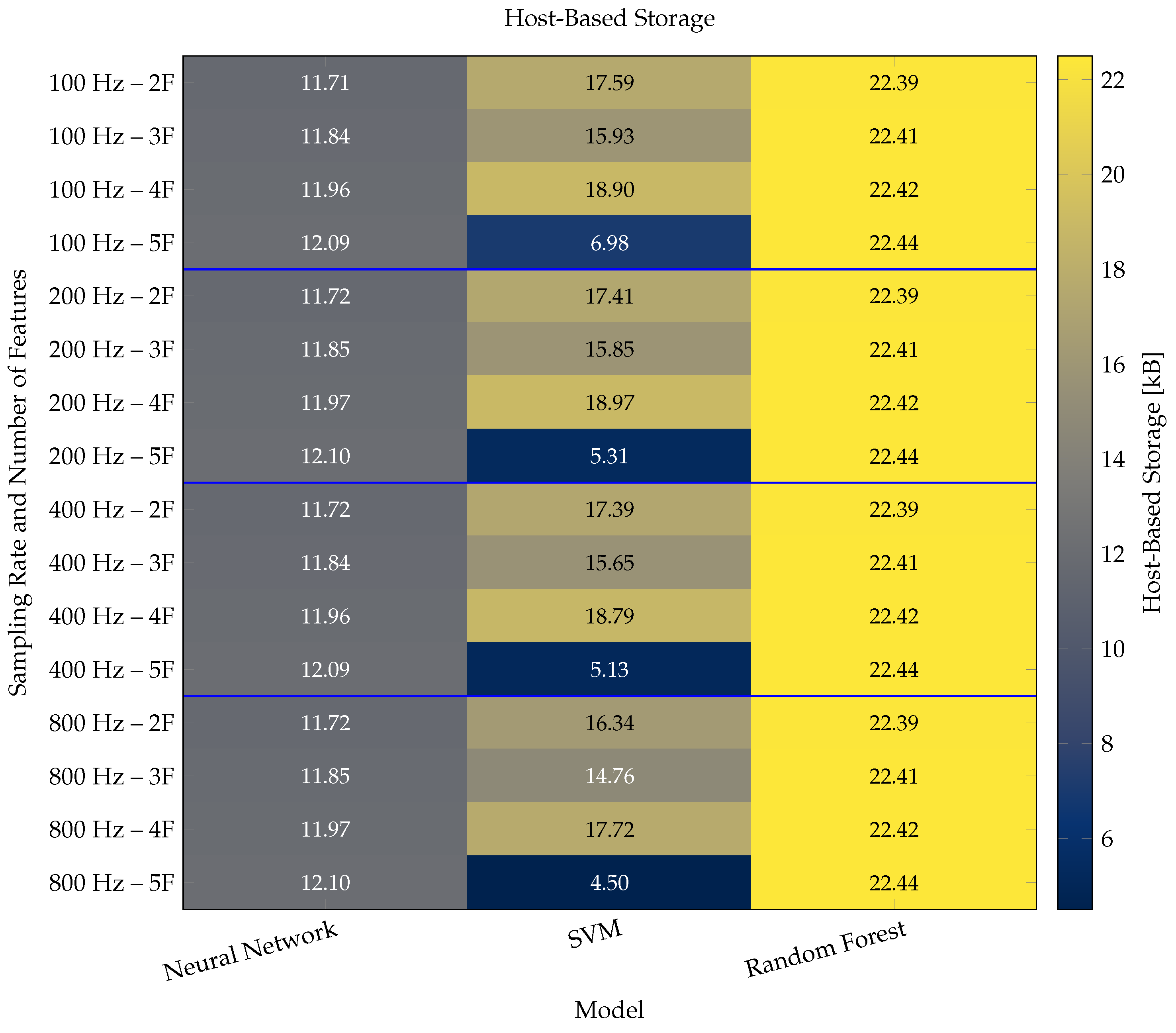
48]. The resulting file encapsulates model parameters, hyper-parameters and object-related metadata. However, this approach introduces significant storage overhead due to object structure and type information and requires the corresponding runtime environment and library versions for successful deserialization, thereby limiting portability and reproducibility.
- 2.
Embedded model storage for deployment on microcontrollers involves converting trained models into a static, platform-adapted representation during an offline compilation step. Only the numerical model parameters, such as feature indices, decision thresholds, or weights, are retained, while all dynamic structures and runtime dependencies are removed. The resulting parameter arrays are stored compactly in non-volatile memory (flash) and accessed directly during inference, eliminating deserialization and runtime overhead and enabling deterministic execution under strict memory constraints.
5. Discussion and Conclusions
This section discusses the experimental results presented in
Section 4 and places them within the context of telemetry-based condition monitoring using digitally configurable DC/DC converters. The discussion focuses on the influence of telemetry sampling rate, feature selection, model characteristics, and architectural design choices, followed by limitations and future research directions.
5.1. Interpretation of Classification Performance
The results demonstrate that operational telemetry acquired directly from digitally configurable DC/DC converters contains sufficient information to distinguish discrete system states of a connected load. Similar observations have been reported in prior work on telemetry-based monitoring and power-side signal analysis, where characteristic load-dependent patterns are reflected in electrical quantities [
8,
15,
16]. The observed performance confirms that characteristic timing information and transient load behavior are preserved in current measurements, even when no additional external sensors are employed.
Based on the exemplar confusion matrix, the observed predominance of confusions between neighboring states (e.g., wio to rio and bio to nio) is compatible with the physical proximity of these system regimes. This local error pattern suggests that class-conditional feature distributions overlap primarily near transition boundaries, indicating that residual errors are more likely attributable to thresholding and transition-region effects than to systematic confusion of non-adjacent states.
5.2. Impact of Telemetry Sampling Rate
The telemetry sampling rate affects both the classification accuracy and, in the case of the SVM, the model memory footprint. The smallest SVM storage size is observed at a sampling rate of 800 Hz when using five features. In particular, the Neural Network model exhibits a pronounced improvement in classification accuracy when increasing the sampling rate from 100 Hz to 200 Hz with five selected features. Similar trends are observed for the other two models, where the most significant performance gains occur within this sampling rate range. Further increases in sampling rate, especially from 400 Hz to 800 Hz, result in only minor additional improvements.
5.3. Role of Feature-Based Representation
The feature-based representation employed in this work enables efficient inference under embedded constraints while retaining discriminative information. Feature extraction has been widely recognized as a key design principle in TinyML systems, where computational and memory resources prohibit direct processing of high-dimensional raw signals [
9,
10,
11]. The experimental results demonstrate that domain-informed temporal and electrical features provide sufficient discriminative information for reliable classification under the investigated conditions, which is consistent with established approaches in time-series feature engineering and embedded machine learning [
23,
41]. Although end-to-end deep learning approaches based on raw time-series data, such as CNN or CNN–LSTM architectures, have demonstrated strong performance in condition monitoring and prognostics, their direct application was not the primary objective of this work but remains an important direction for future work and will be evaluated under identical segmentation and cross-validation splits to enable a fair comparison.
Such models typically require significantly higher computational resources, memory capacity, and training data volume, which limits their applicability in resource-constrained microcontroller environments. The focus of this study lies on resource-efficient embedded inference using converter-side telemetry that is readily available in digitally configurable power supplies. Feature-based representations enable deterministic computational complexity, predictable memory requirements, and transparent interpretability, which are critical design aspects for safety-related and industrial embedded systems. Consequently, the proposed approach prioritizes lightweight feature extraction combined with classical machine learning models to evaluate the achievable trade-off between classification performance and embedded deployability. The investigation of end-to-end time-series learning approaches remains an important direction for future work, particularly for platforms with increased computational capabilities.
When looking at classification accuracy, it becomes apparent across all three models that increasing the number of features used has a significantly greater impact on accuracy than a higher sampling rate.
5.4. Comparison of Machine Learning Models
The observed differences between model classes reflect well-known characteristics of the respective algorithms. SVMs are known for strong generalization performance in low-dimensional feature spaces, particularly when decision boundaries are non-linear [
44]. Neural Networks provide increased representational flexibility but typically require higher model complexity and memory resources to achieve comparable performance [
9,
11]. Under the applied structural constraints, the Random Forest classifier shows limited representational flexibility compared to the SVM and Neural Network models [
42].
5.5. Architectural Implications for Embedded Monitoring
The architectural separation between power supply control and data-driven monitoring represents an important design principle for safety-critical embedded systems. Prior work has emphasized that isolating machine-learning inference from real-time control loops significantly reduces validation complexity and operational risk [
24,
25]. All features used in this work are computed exclusively from converter-side current telemetry. However, their definition and interpretation are informed by prior knowledge of the system’s operational structure, which enables meaningful segmentation and feature extraction without requiring additional sensors. Edge-based analytics executed on dedicated monitoring hardware further align with established embedded intelligence and TinyML concepts, enabling low-latency inference while maintaining system robustness and maintainability [
9,
10,
22].
5.6. Limitations and External Validity
All reported results were obtained on a single laboratory demonstrator (Fischertechnik model factory) supplied by a single converter type under fixed electrical parameterization. Consequently, the study does not yet demonstrate transfer to other load categories, other converter topologies, or industrial environmental conditions. This limits the degree to which absolute accuracy values can be generalized. The primary contribution of this work is the controlled analysis of sampling-rate, feature, and model-class trade-offs under identical conditions. Generalization across systems requires additional datasets and validation campaigns. All experiments were conducted under controlled laboratory conditions with identical converter firmware, electrical parameterization, and demonstrator configuration. While the employed system represents a scaled laboratory setup, it captures essential characteristics of industrial automation processes, including dynamic load behavior and discrete operational phases. The presented results are obtained under controlled laboratory conditions with a limited number of predefined system states. While this enables systematic investigation of telemetry sampling rate and feature selection, transfer to industrial environments may require retraining and validation under increased variability, including temperature drift, aging effects, and multi-load interactions. In addition, the behavior under communication-related non-idealities and under systematic sensor drift was not explicitly quantified in this study. Future work will therefore include dedicated robustness tests under controlled temperature variation, induced offset/gain drift, and emulated communication disturbances to assess their impact on feature stability and classification performance. While absolute classification accuracy values are therefore system-specific, the observed trends regarding telemetry sampling rate, feature dimensionality, and model selection are expected to generalize to other telemetry-based monitoring scenarios. While flash footprint is a necessary feasibility constraint for microcontroller deployment, a complete real-time qualification additionally requires measurements of feature extraction time, inference latency, peak RAM/stack usage, and energy per inference on the target hardware. Providing such benchmarks is beyond the scope of this manuscript and will be addressed in future work.
Furthermore, this study does not include an end-to-end deep learning baseline (e.g., a 1D-CNN or CNN–LSTM) trained directly on raw telemetry time series. End-to-end architectures are commonly evaluated in related condition-monitoring settings; however, this work focuses on feature-based representations to enable deployment on microcontroller-class hardware with predictable inference latency and constrained resources. As a result, the empirical comparison is limited to feature-based approaches. Future work will evaluate compact 1D-CNN and CNN–LSTM baselines under the same experimental protocol.
5.7. Conclusions and Outlook
Using only converter-side telemetry, classification accuracies of over 99% were achieved, particularly with SVM, which was already possible at a data rate of 100 Hz. In this case, SVM also requires significantly less memory than Random Forest and Neural Network. The investigations clearly show that process-specific features have a significantly greater influence on classification accuracy than higher data rates. Thus, by selecting suitable features, it is possible to implement very resource-efficient and telemetry-based monitoring of connected loads using digitally configurable power supplies. The findings support current trends toward distributed edge intelligence and TinyML-based monitoring architectures, which aim to exploit existing data sources close to the physical process while minimizing system overhead [
9,
10,
11,
21,
22]. Further research will quantify feature-extraction runtime, inference latency, and energy consumption for both feature calculation and model inference across multiple microcontroller and system-on-a-chip platforms. The approach will be validated using additional loads and converter types under more diverse environmental conditions. In addition, a future comparison with neuromorphic hardware is conceivable to assess potential benefits in terms of latency and energy efficiency.




 ,
,