Article

A Data-Driven Method for Identifying Similarity in Transmission Sections Considering Energy Storage Regulation Capabilities


1
State Grid Hebei Electric Power Research Institute, Shijiazhuang 050023, China
2
School of Electrical Engineering, Chongqing University, Chongqing 400065, China
*
Author to whom correspondence should be addressed.
Electronics 2026, 15(4), 851; https://doi.org/10.3390/electronics15040851
Submission received: 21 January 2026 / Revised: 12 February 2026 / Accepted: 16 February 2026 / Published: 17 February 2026
(This article belongs to the Special Issue Security Defense Technologies for the New-Type Power System)

Abstract

To address the challenges of real-time control in power systems with high renewable penetration, identifying historical transmission sections similar to future scenarios enables efficient reuse of mature control strategies. However, existing data-driven identification methods exhibit two primary limitations: they typically rely on static Total Transfer Capacity (TTC), ignoring the rapid regulation capability of Energy Storage Systems (ESS) in alleviating congestion; and they employ fixed weights for similarity measurement, failing to distinguish the varying importance of different features (e.g., critical line flows vs. ordinary voltages). To overcome these issues, this paper proposes a similarity identification method for transmission sections considering ESS regulation capabilities and adaptive feature weights. First, a hierarchical decision model is utilized to screen basic grid features. An optimization model incorporating ESS charge/discharge constraints and emergency power support potential is established to calculate the Dynamic TTC, constructing a multi-scale feature set that reflects the real-time safety margin of the grid. Second, a Dispersion-Weighted Fuzzy C-Means (DW-FCM) clustering algorithm is proposed. By introducing a dispersion-weighting mechanism, the algorithm utilizes data distribution characteristics to automatically learn and assign higher weights to key features with high distinguishability during the iteration process, overcoming the subjectivity of manual weighting. Furthermore, fuzzy validity indices (XB, PC, FS) are introduced to adaptively determine the optimal number of clusters. Finally, case studies on the IEEE 39-bus system verify that the proposed method significantly improves identification accuracy compared to traditional methods and provides more reliable references for dispatching decisions.

1. Introduction

The power system is undergoing a rapid transformation towards a “new type of power system” characterized by a high proportion of renewable energy and power electronic devices. Consequently, the randomness and complexity of power grid operation modes have increased significantly. As the key corridors ensuring the safe power exchange of regional grids, the stability control of transmission sections faces tremendous challenges [1]. Traditional formulation of section control measures often relies on offline calculations and expert experience, making it difficult to adapt to the current grid’s requirements for real-time performance and refinement. Mining massive historical operation data of the power system to quickly match historical sections similar to future scenarios through similarity identification technology, and reusing their mature control strategies, has become an important means to enhance dispatch decision-making efficiency [1,2,3].
Existing research mainly achieves power grid security and stability control by regulating nodal injection power specifically through power sensitivity [4,5]. While such methods have clear physical meanings and strong interpretability, they often require certain assumptions to simplify the model, and the high computational complexity makes them difficult to apply directly to large-scale actual power grids. The development of data-driven technology brings new directions for the formulation of transmission section control measures [6,7] by utilizing neural networks and reinforcement learning methods respectively to analyze historical data and assist in decision-making. Mining the mapping relationship between key features of transmission sections and control measures through data-driven methods can effectively avoid complex mechanistic models [8,9,10], greatly improving computational efficiency. The operation of the power system produces massive data; besides basic information such as power flow, load, and unit output, it also contains information related to control and maintenance. Therefore, identifying historical sections similar to future transmission sections through data-driven methods and providing guidance based on historical control strategies can achieve the rapid formulation of future control measures. Some studies have developed decision-making frameworks to enhance power system regulation capabilities by integrating multiple flexibility resources such as demand response, energy storage systems, electric vehicle aggregators, and dynamic line rating [11]. Simultaneously, for distributed multi-energy systems, flexibility characterization and measurement methods considering time-coupling constraints—such as the concept of integrated flexible zones—offer novel approaches for precisely quantifying system flexibility [12]. These advancements underscore the importance of incorporating multidimensional flexibility resources into the core of decision-making.
Currently, data-driven similarity identification methods are relatively mature in fields such as load clustering, unit output clustering, and typical operation mode division [13,14,15]. However, research on transmission section similarity identification remains in its nascent stage. Some scholars have explored using clustering methods to realize section similarity identification. For instance, recent studies have utilized K-means clustering to mine demand modes for optimizing transmission section limits [16], while others have proposed analytical methods to identify critical transmission sections based on power flow transfer analysis [17]. While clustering methods possess strong advantages in this domain, current research typically uses only basic operating features to represent section samples and relies on single metric indicators for similarity. To improve the effectiveness of clustering in this context, it is necessary to consider section operating features and similarity metrics from more comprehensive perspectives.
Clustering, as an unsupervised machine learning method, can efficiently calculate the similarity between samples [18,19]. However, applying it to transmission section similarity identification faces two primary challenges:
1. The similarity measurement method of features: Existing clustering methods (such as K-means and traditional Fuzzy C-Means) typically use Euclidean distance to calculate sample distance, defaulting to equal weights for all feature dimensions (e.g., voltage, power flow, TTC) or relying on fixed weights set by experience. However, in actual operation, the ability of different features to distinguish section states varies significantly. For example, the heavy load flow of a key line has a far greater impact on system stability than the voltage fluctuation of an ordinary node. This creates a risk where key features are submerged by redundant information, thereby reducing the accuracy and credibility of similarity identification. Recent advancements in fuzzy clustering have begun to address this by incorporating variable-weighted distances to enhance sensitivity to critical features [20,21], but such adaptive mechanisms have rarely been applied to transmission section identification.
2. The selection of the number of clusters: Currently, the optimal number of clusters is often set artificially based on demand, which is prone to human error. To ensure objectivity, traversing different cluster numbers and calculating evaluation indicators are more effective and interpretable approaches [22]. Establishing an objective method to select the optimal number of clusters is crucial for solving the problems faced in section similarity identification.
Similarity identification based on clustering is essentially the calculation of feature sample similarity. To represent the section operation status more comprehensively, in addition to load distribution and unit output, the TTC—an important monitoring indicator for dispatchers—is a key feature focused on in this paper. While traditional TTC calculation methods are accurate but computationally expensive, optimization-based models offer a balance. Crucially, with the rapid growth of ESS on the grid side, their millisecond-level power throughput and short-term overload support capabilities have become vital resources for alleviating congestion, acting as “virtual transmission” capacity [23,24]. Moreover, they employ fixed weights for similarity measurement, failing to distinguish the differing importance of various features (such as critical path power flows versus ordinary node voltages). Specifically, conventional risk assessment and TTC calculations often rely on deterministic or simplified uncertainty models, failing to adequately account for the fundamental impact of hybrid uncertainties—including renewable energy output fluctuations—on system safety margins [25]. To overcome these limitations, this paper proposes a transmission section similarity identification method that incorporates ESS regulation capabilities and adaptive feature weighting.
Addressing the aforementioned shortcomings, this paper proposes a similarity identification method for transmission sections considering energy storage regulation capability and adaptive feature weights.
First, addressing the limitation of traditional clustering algorithms that treat all features equally, this paper proposes a DW-FCM algorithm. By introducing feature-weighting logic, the algorithm automatically effectively identifies key features that significantly impact the section safety margin, thereby extracting representative scenarios with higher physical distinctiveness from massive operational data.
Second, distinct from traditional TTC calculations that rely solely on generator dispatch, this paper constructs a Dynamic TTC optimization model that explicitly incorporates the active regulation capabilities of ESS. This model quantifies the potential of ESS to alleviate transmission congestion through rapid power adjustment, providing a more realistic assessment of the grid’s transfer capability under constraints.
Third, this study proposes a hierarchical framework that couples DW-FCM-based scenario reduction with optimization-based TTC calculation. This integration bridges the gap between statistical data analysis and physical boundary assessment, enabling efficient online evaluation of key transmission sections by focusing computational resources on the most representative and critical system states.
Finally, the validity of the proposed method is verified using the IEEE 39-bus system.

2. Construction of Key Transmission Section Features Considering Energy Storage Regulation Capabilities

The raw measurement data of the new power system usually contains substantial noise and coupled information. To effectively extract the key indicators governing the safety margin of transmission sections, this paper constructs a DW-FCM composite feature space. First, a screening strategy based on physical validity and topological invariance is employed to extract basic state features. Second, by incorporating the charge/discharge constraints of ESS, a calculation model for Dynamic TTC is established. These components collectively form a multi-scale feature vector that reflects both the steady-state operation and the dynamic regulation potential of the grid.

2.1. Construction of Feature Space Based on Physical Validity and Correlation

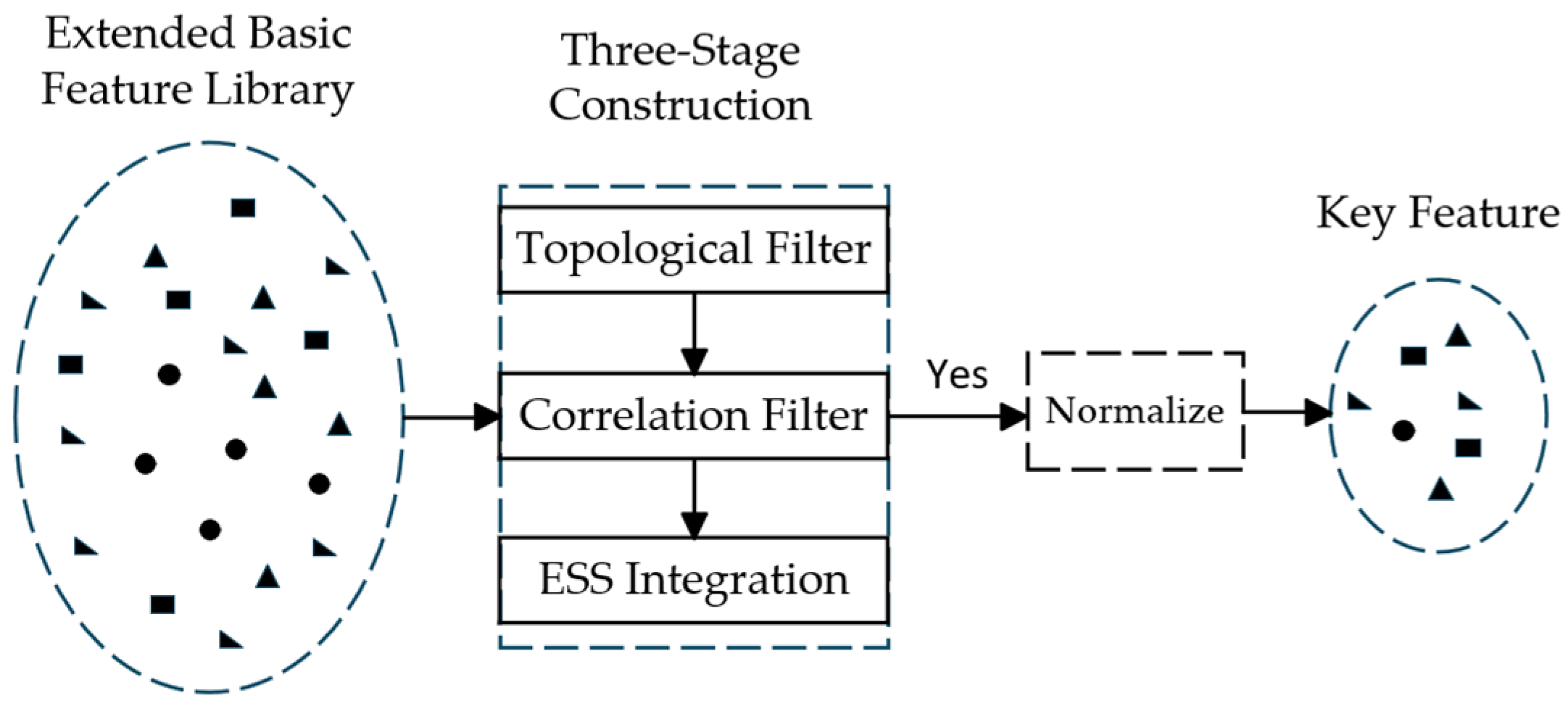
To ensure the convergence speed and classification accuracy of the proposed DW-FCM algorithm, it is necessary to extract a compact and highly correlated feature subset from the high-dimensional raw data. Based on the raw data pool presented in Table 1, this paper adopts a multi-stage feature extraction strategy focusing on physical validity, topological invariance, and control relevance.
  • Raw data includes descriptive attributes (e.g., Network Node Information π ) and variable-dimensional data (e.g., Node Connectivity Relationship Ω ). Descriptive attributes lack numerical physical meaning and make no contribution to distance calculations in clustering; thus, they are directly excluded. Furthermore, considering that the topology of the power grid may change (e.g., N-1 maintenance), features like connectivity matrices—which vary in dimension with grid structure—cannot be directly used as inputs for standard clustering algorithms. To maintain dimensional consistency across different topological scenarios, this paper extracts topology-invariant indices (such as the active power flow of critical monitoring lines) to represent grid structure changes rather than using the raw connectivity matrix.
  • The transmission capability of power systems is governed not only by thermal constraints but also by voltage stability constraints. To comprehensively characterize the section safety margin, this paper adopts AC power flow (AC-OPF) analysis to construct the feature space. Voltage magnitude distributions reflect the system’s voltage stability margin, while reactive power flows indicate the local reactive power support status, which is critical for analyzing transmission limits in high-renewable systems.
  • Unlike traditional methods that only consider generator outputs, this paper explicitly incorporates the ESS status into the feature space. The State of Charge S o C and the location of ESS nodes N E S S determine the system’s potential for emergency power support during faults. These features are critical for distinguishing operation modes that have similar load distributions but vastly different safety margins due to varying ESS regulation capabilities.
Through the above extraction process, the basic feature set F b a s e for clustering is constructed as shown in Figure 1, specifically including Nodal Voltage Angle θ , Voltage V, Active Power of Key Lines P l i n e , Reactive Power of Key Lines Q l i n e , Active Power Output of Key Generators P G , Reactive Power Output of Key Generators Q G and Energy Storage State of Charge S o C . This forms a physical feature vector with fixed dimensions and high information density, providing a reliable data foundation for the subsequent Dynamic TTC calculation and dispersion-weighted clustering. The basic feature set F b a s e is represented as follows:
F b a s e = θ ,   V ,   P l i n e ,   Q l i n e ,   P G ,   Q G ,   S o C ,   T T C

2.2. Calculation of Dynamic TTC Considering ESS Regulation Capabilities

Transmission section TTC represents the maximum active power transferable across a section, strictly constrained by thermal limits, voltage stability, and transient stability margins. The Transmission Capacity (TTC) of a transmission section represents the maximum active power that can be transmitted through that section under strict thermal stability, voltage stability, and transient stability constraints. Unlike traditional TTC models that rely on simplified DC power flow and consider only generator active power dispatch, this approach recognizes that operational decisions themselves impact system reliability and available transmission capacity (i.e., decision-dependent uncertainty) [26]. This paper proposes a rigorous Dynamic TTC calculation method based on AC-OPF. The proposed model explicitly introduces both the active and reactive power regulation capabilities of the ESS as decision variables, alongside physical ramp rate constraints. By optimizing the P-Q operating point of the ESS, the model fully utilizes its fast response potential to alleviate voltage violations and thermal congestion, thereby providing a more accurate and realistic assessment of the grid’s safety margin. The specific AC-OPF model is constructed as follows:
Objective Function: Maximize the transmission power of section K:
max   T T C = max   i , j S k P i j
where S k is the set of lines included in the section K and P i j is the active power flow of line ( i , j ) .
Power Balance Constraint Considering ESS:
P G , i + P E S S , i P L , i = V i j i V j ( G i j cos θ i j + B i j sin θ i j ) Q G , i + Q E S S , i Q L , i = V i j i V j ( G i j sin θ i j B i j cos θ i j )
where P E S S and Q E S S are the ESS injection power vectors (positive for discharge, negative for charge); P G and P L are generator and load active power vectors, respectively; and Q G and Q L are generator and load reactive power vectors, respectively. θ i j is the voltage phase angle difference between bus i and bus j.
Security Constraints:
V i min V i V i max
P i j 2 + Q i j 2 S i j max
( P i j l ) 2 + ( Q i j l ) 2 S i j max ,   l Ω fault
Equation (4) constrains the nodal voltage magnitude within safe limits. Equation (5) represents the line thermal stability constraint based on apparent power limits, where P i j and Q i j are the active and reactive power flows of line (i, j). S i j max is the maximum thermal capacity of the line. Equation (6) represents the constraint under N-1 contingency l.
Energy Storage System Operation Constraints:
P E S S , i 2 + Q E S S , i 2 V i I i max
E i min E t , i E i max
R i d o w n Δ t P E S S , i , t P E S S , i , t 1 R i u p Δ t
Equation (7) defines the P-Q capability curve of the ESS inverter, where I i max is the rated current capacity of the ESS inverter at bus i. P E S S , i and Q E S S , i represent the active power and reactive power output of the ESS inverter at bus i, respectively. This formulation strictly reflects the physical reality that the available power capacity of an inverter decreases linearly with voltage dips. Equation (8) represents the energy capacity constraints, where E i min and E i max are the maximum and minimum energy capacity of the ESS at bus i, respectively. Equation (9) enforces the ramp rate limits, where R i u p and R i d o w n are the maximum ramp-up and ramp-down rates, ensuring the dynamic response is physically feasible.
Transient Power Angle Stability:
δ i τ δ j τ 180 ° < 0 ,   i , j G , τ τ 0 , τ end
where G is the set of synchronous generators.
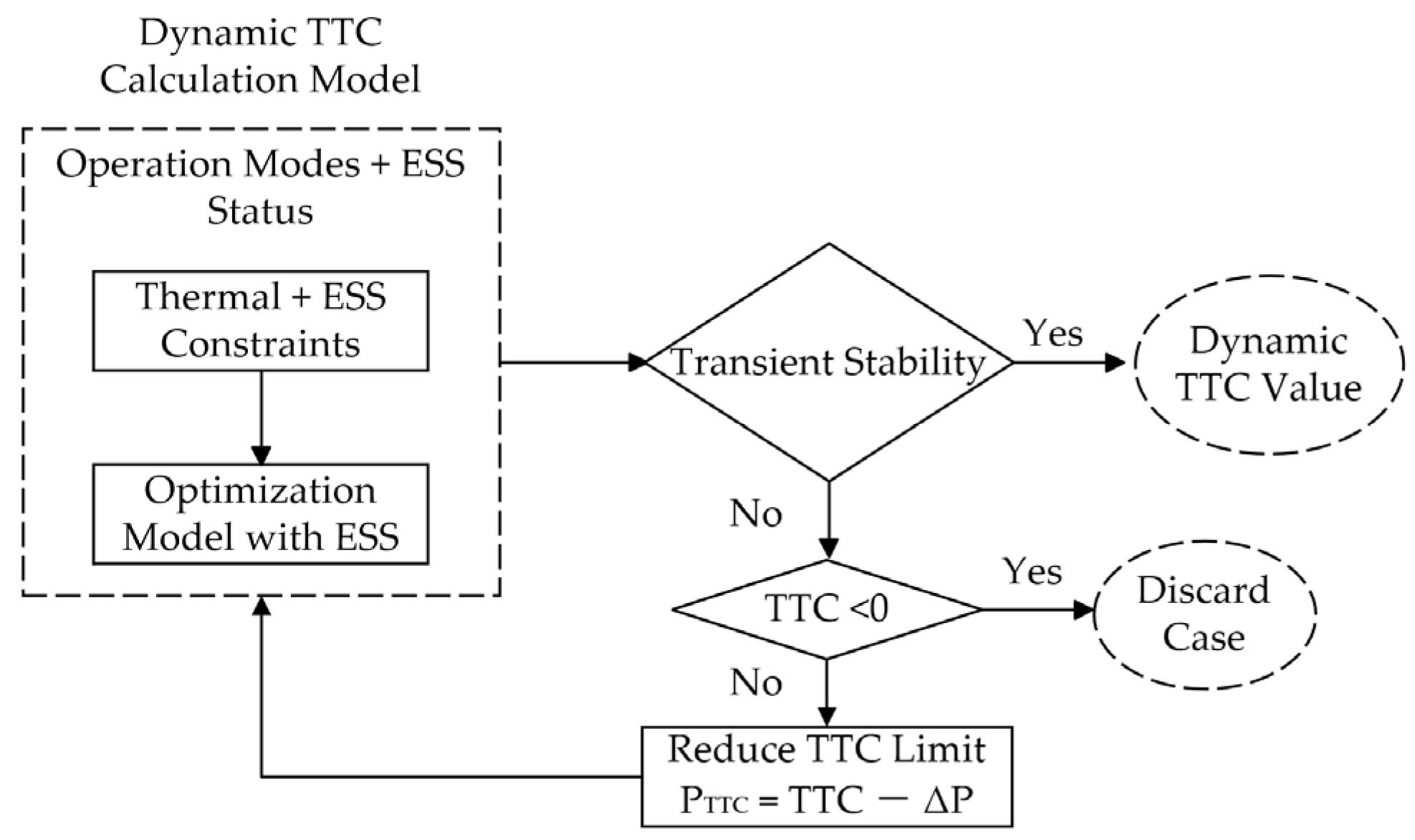
Due to the high computational complexity and non-convexity of transient power angle stability constraints, directly embedding them into the optimization model is computationally prohibitive for generating massive datasets. Therefore, this paper adopts an iterative correction strategy to ensure both computational efficiency and result reliability. The solution process is shown in Figure 2, with specific steps as follows:
  • First, Equations (2)–(9), which consider steady-state constraints, are solved to obtain the initial theoretical maximum TTC.
  • Then, the transient power angle stability is verified. If satisfied, the calculated TTC value is output.
  • If not satisfied, a correction loop is triggered: the TTC limit P T T C is iteratively reduced by a predefined step size Δ P , and the reduced capacity value P T T C is imposed as a new upper bound constraint ( T T C < P T T C ) in the model. The verification is repeated until the system satisfies the transient stability criterion. Note that, in rare cases where the system remains unstable even when the section transmission power is reduced to zero, the sample is identified as infeasible and is discarded.
By solving the above optimization problem, the Dynamic T T C d y n under the current operation mode considering ESS support potential is obtained. This is added to the feature set, and all features are normalized using Equation (11) to eliminate dimensional influence:
x = x min x max x min x , x F

3. Improved Fuzzy C-Means Clustering Algorithm Based on Dispersion-Weighted Feature Weighting

The essence of a clustering algorithm is to partition samples into categories based on similarity through an iterative optimization process, where the core objective is to maximize the similarity of samples within the same category. The traditional Fuzzy C-Means (FCM) algorithm employs Euclidean distance to measure sample similarity, defaulting to the assumption that all features contribute equally to the clustering result. However, in transmission section identification, certain key features (such as power flow on heavily loaded lines, Dynamic TTC, and Energy Storage Status) have a much higher capability to distinguish operation modes than ordinary nodal voltages. To objectively quantify feature importance, this paper introduces a dispersion-weighting mechanism and proposes a Dispersion-Weighted Fuzzy C-Means (DW-FCM) algorithm. This algorithm automatically learns feature weights and adaptively selects the optimal number of clusters based on validity indices.

3.1. Fuzzy C-Means Clustering with Feature Weights

Let the normalized sample set be X = x 1 , x 2 , , x m , where each sample contains D dimensions of features. A feature weight vector ω = ω 1 , ω 2 , , ω D is introduced into the objective function of Fuzzy C-Means to construct the following optimization problem:
min J , J U , V , ω = i = 1 c j = 1 m μ i j α k = 1 D ω k β x j k v i k 2
where V = v 1 , v 2 , , v c T represents the cluster centers, with v i = v i 1 , v i 2 , , v i k , v i k + 1 , where v i k is the value of the i -th cluster center on the k-th feature dimension; α is the fuzziness exponent; and β is the weight fuzziness factor ( β > 1 ), used to regulate the smoothness of the weight distribution and prevent weights from being overly concentrated on a single feature. U = μ i j is the membership matrix, where element μ i j represents the membership degree of the j -th sample to the i -th cluster, satisfying the following constraint:
i = 1 c μ i j = 1 ,   j
The feature weights must satisfy the normalization constraint:
k = 1 D ω k = 1 ,   ω k 0
By solving the above constrained optimization problem using the Lagrange multiplier method, the iterative update formulas for each parameter are obtained:
  • Update of Membership Degree μ i j : The distance between a sample and a center is redefined as a weighted Euclidean distance.
    μ i j = r = 1 c d ω 2 x j , v i d ω 2 x j , v r 1 m 1 1
    where d ω 2 denotes the weighted squared distance:
    d ω 2 x j , v i = k = 1 D ω k β x j k v i k 2
  • Update of Cluster Centers v i :
    v i k = j = 1 m μ i j α x j k j = 1 m μ i j α
  • Update of Feature Weights ω k (Core of Adaptive Mechanism): By minimizing the partial derivative of the objective function with respect to ω k , the adaptive update formula for weights is obtained:
ω k = 1 l = 1 D ζ k ζ l 1 β 1
where ξ k = i = 1 c j = 1 m μ i j α x j k v i k 2 represents the intra-cluster dispersion of the k-th feature under the current partition.
The complete training process of the DW-FCM model is as follows:
  • Initialize cluster centers V ( 0 ) and feature weights ω ( 0 ) .
  • Update the membership matrix U using Equation (15).
  • Update the cluster centers V using Equation (17).
  • Update the feature weights ω based on intra-cluster dispersion using Equation (18).
  • Check for convergence; if not converged, return to Step 2.
When the convergence condition is met or the maximum number of iterations is reached, the clustering terminates. Samples are then classified based on the membership values in the final U .
Equation (18) indicates that, if the intra-cluster dispersion ξ k of a feature is smaller (meaning samples within the same class are tightly clustered on this feature), the algorithm will automatically assign a larger weight ω k to this feature. Conversely, if a feature is disordered across all classes, its weight will be automatically suppressed. This mechanism allows the algorithm to “focus” on key features that best distinguish different operation modes. Furthermore, by introducing fuzzy set theory, Fuzzy C-Means establishes fuzzy correspondence based on sample similarity, significantly improving the algorithm’s ability to handle complex data, and its iterative process is guaranteed to converge.

3.2. Selection of Initial Cluster Centers

Since Fuzzy C-Means clustering is sensitive to initial values, improper initialization of cluster centers can easily lead the algorithm into local optima. Therefore, it is necessary to correct the initial values for the iteration. The principle for selecting initial cluster centers is that the distance between centers should be sufficiently large to represent different modes but not so dispersed that they deviate significantly from the dense regions of the sample set.
To this end, the initial iteration process of Fuzzy C-Means is improved using a Max–Min Distance strategy:
  • Calculate the distance between any two samples to form a distance matrix.
  • Identify the two samples with the smallest distance in the high-density region (or select based on density peaks) and set their midpoint as the initial value of the first cluster center, denoted as v 1 ( 0 ) .
  • Calculate the sum of distances from every unselected sample to all selected centers. Find the sample with the maximum distance sum and then find the sample closest to it. Select these two samples and set their midpoint as the initial value of the second cluster center, denoted as v 2 ( 0 ) .
  • Repeat the above steps until all initial cluster centers V ( 0 ) are obtained.

3.3. Adaptive Selection of Optimal Number of Clusters

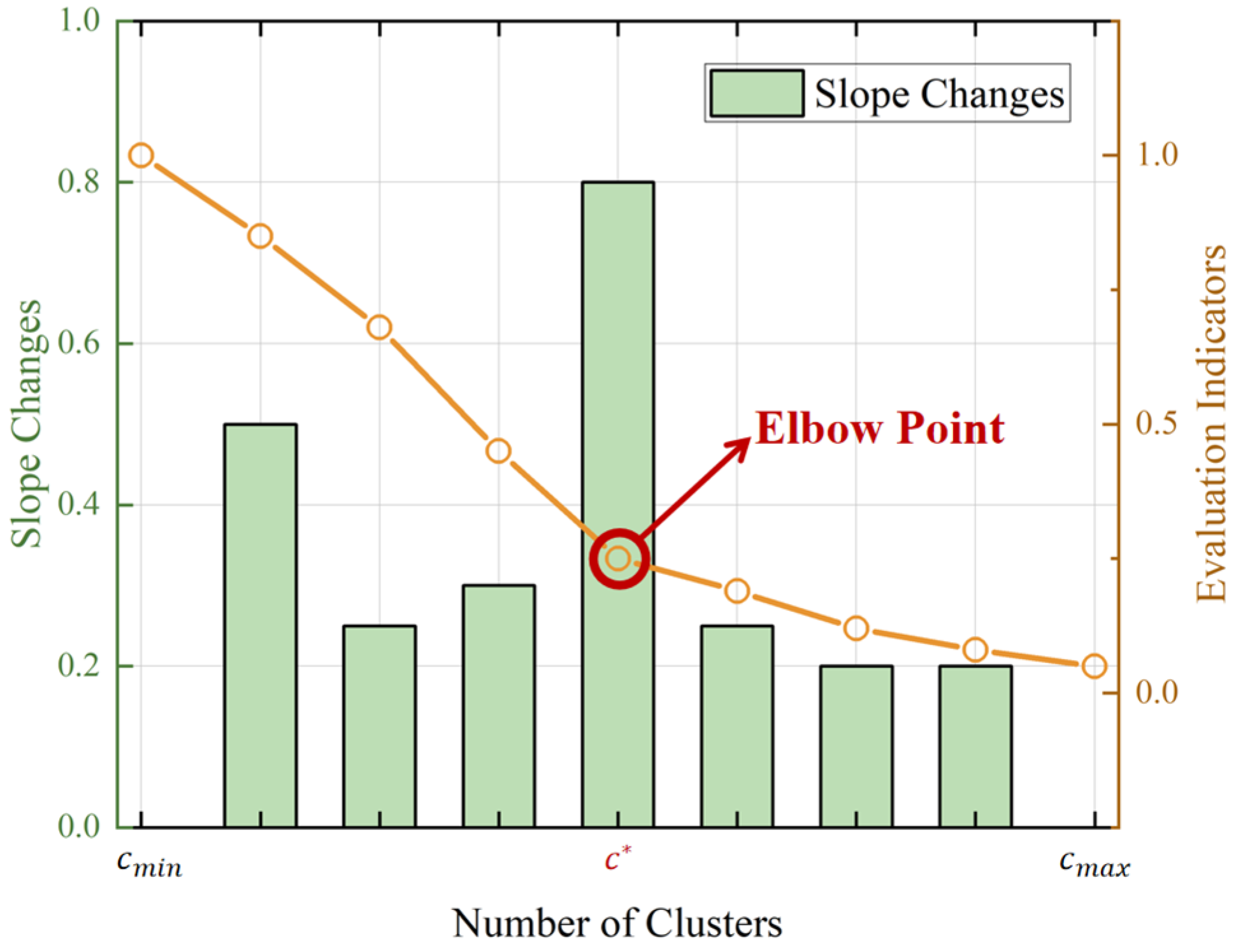
In the iterative process of Fuzzy C-Means, the number of clusters c needs to be specified manually, which is prone to human error. To improve the objectivity of the algorithm, this paper uses the sum of intra-cluster distances d i n after clustering as an indicator to reflect the compactness of the clustering result and employs the “Elbow Method” [22] to determine the optimal number of clusters.
For different numbers of clusters c , the sum of intra-cluster distances is calculated as follows:
d i n c = i = 1 c x C k d e u c x , v i
where C k is the set of samples contained in the k-th cluster. From Equation (19), it can be seen that a smaller d i n indicates more concentrated samples within classes and better clustering effects. When c = 1 , the concentration is lowest, and d i n reaches its maximum. As c increases, d i n generally shows a downward trend. When the number of clusters equals the number of samples, d i n becomes 0.
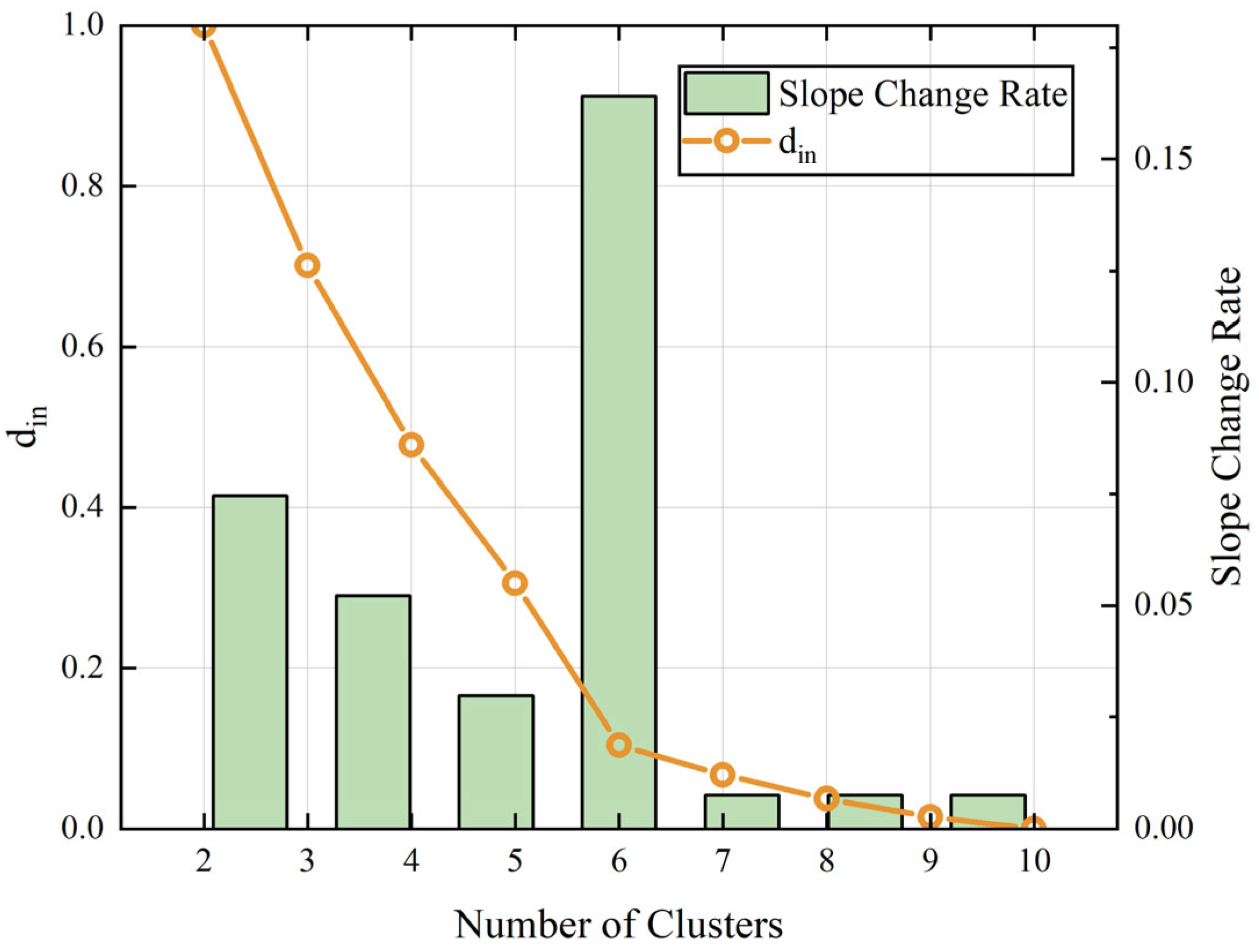
Using the “Elbow Method”, a range for the number of clusters L (e.g., [ c min , c max ] ) is first set. Then, the sum of intra-cluster distances is calculated for each clustering run to obtain the curve of d i n versus c , as shown in Figure 3. The x-axis represents the number of clusters, with its range determined based on the estimated c (optimal number of clusters). The left and right y-axes represent slope changes and evaluation metrics, respectively. When c is less than a certain value c , d i n decreases rapidly because increasing c significantly improves the compactness of each category. However, after c reaches c , further increases result in a diminishing rate of improvement in compactness, causing the decrease in d i n to slow down. The relationship graph resembles an “elbow,” and the “elbow point”—the value corresponding to the maximum change in slope—is the optimal number of clusters c .

4. Transmission Section Similarity Identification Method

4.1. Clustering Evaluation Indices

Affected by algorithm selection and random errors, the validity of clustering results varies. When the true labels of samples are unknown, the validity of clustering results is generally assessed through internal evaluation indices by calculating the compactness of similar samples and the separation of dissimilar samples. Given that the DW-FCM algorithm adopted in this paper belongs to the category of fuzzy clustering, its output includes membership information of samples to each category. Traditional hard clustering evaluation indices (such as Silhouette Coefficient and CH index) only utilize geometric partition boundaries and ignore the fuzzy characteristics of samples at the boundaries, making it difficult to objectively reflect the clustering quality of DW-FCM. Therefore, this paper selects three indices specifically dedicated to fuzzy clustering—the Xie–Beni Index (XB), Partition Coefficient (PC), and Fukuyama–Sugeno Index (FS)—to comprehensively evaluate the compactness, separation, and clarity of the fuzzy partition and uses them as the basis for determining the optimal number of clusters c .

4.1.1. Xie–Beni Index (XB)

The Xie–Beni index is one of the most classic indicators for measuring the validity of fuzzy clustering. It is defined as the ratio of intra-class compactness to inter-class separation. Its expression is as follows:
V X B = i = 1 c j = 1 m μ i j α d ω 2 x j , v i m × min i k d ω 2 v i , v k
where the numerator represents the intra-class compactness, calculated using the weighted distance d ω 2 and membership degree μ i j ; the denominator represents the inter-class separation, defined as the minimum weighted distance between any two cluster centers. A smaller V X B value indicates that the samples within the class are more compact and the distinction between classes is more obvious, representing a better clustering effect.

4.1.2. Partition Coefficient Index (PC)

The Partition Coefficient index is calculated directly based on the membership matrix U and is used to measure the “clarity” of the algorithm’s partition of samples. Its expression is as follows:
V P C = 1 m i = 1 c j = 1 m μ i j 2
where V P C 1 / c , 1 . A larger V P C value (closer to 1) indicates that the membership matrix is closer to a hard partition (i.e., μ i j tends to 0 or 1), implying lower fuzziness in the clustering result and higher classification confidence.

4.1.3. Fukuyama–Sugeno Index (FS)

The FS index modifies the calculation of compactness and separation by introducing a global center, making it more robust in handling overlapping clusters. Its expression is as follows:
V F S = i = 1 c j = 1 m μ i j α d ω 2 x j , v i d ω 2 v i , v ¯
where v ¯ is the global weighted mean center of all samples. The first term d ω 2 x j , v i measures the distance from the sample to its cluster center (compactness), and the second term d ω 2 x j , v i measures the distance from the cluster center to the global center (separation). A smaller V F S value (which can be negative) indicates that the cluster centers are more separated and the samples are closer to their respective centers, representing a superior clustering structure.

4.2. Similarity Identification of Transmission Sections Considering Energy Storage and Feature Weights

Based on the multi-scale key feature set containing energy storage and Dynamic TTC constructed in Section 1 and the DW-FCM clustering algorithm proposed in Section 2, this section constructs the overall framework for transmission section similarity identification. The framework aims to quickly identify historical sections highly similar to future operation modes through a combination of offline training and online matching, thereby providing a reference for dispatch decisions in power grids containing energy storage.
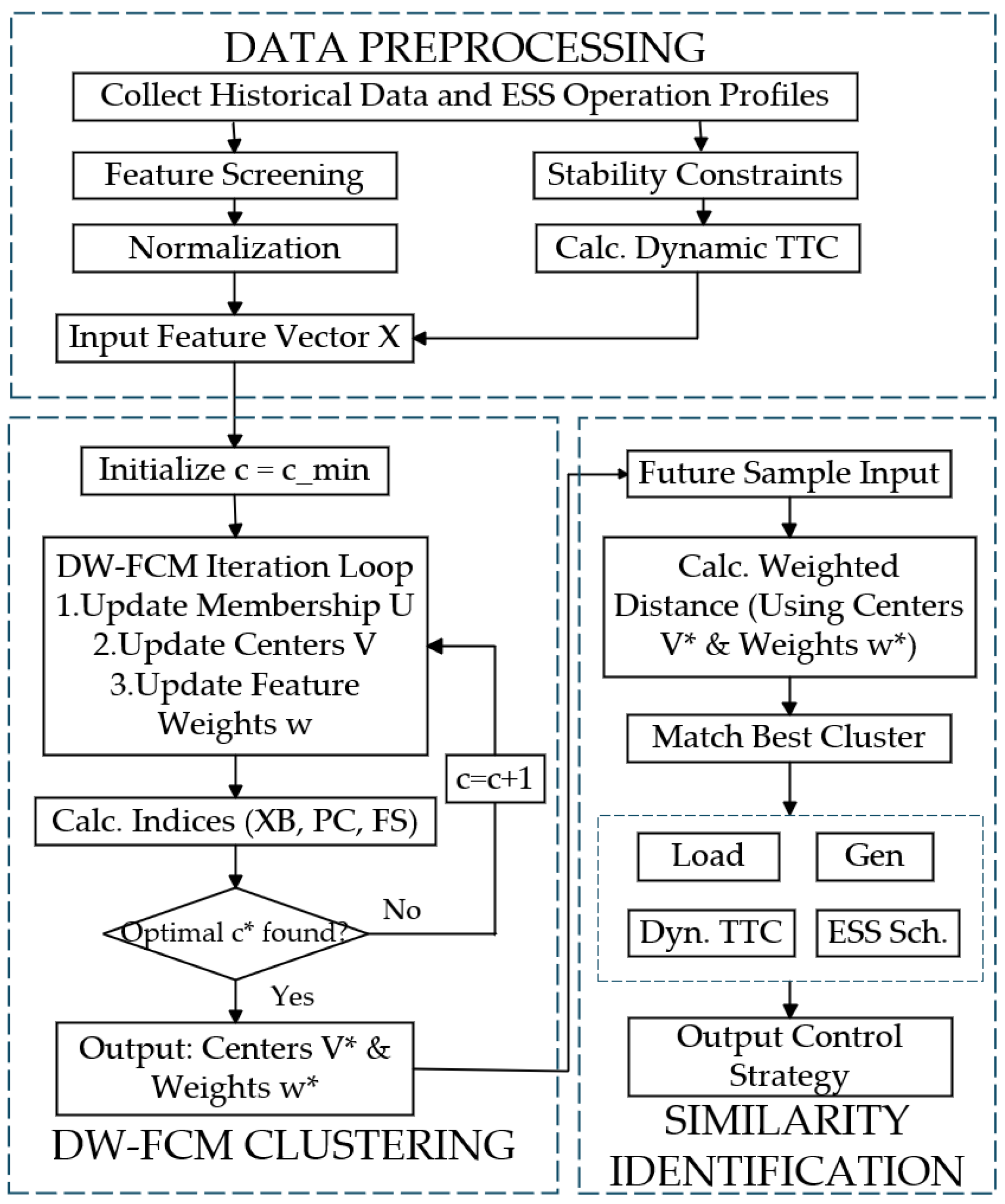
The identification model proposed in this paper is divided into two stages: “Offline Feature Library Construction and Clustering” and “Online Similarity Matching”. The calculation flow is shown in Figure 4, and the specific steps are as follows:
Step 1: Basic Data Acquisition and Preprocessing—Acquire data related to generator output, load, key line power flow, and energy storage SoC for transmission sections based on historical and future sample data. Use the hierarchical decision model from Section 2.1 to eliminate invalid features and perform normalization.
Step 2: Dynamic TTC Feature Calculation—For each historical sample, solve the transmission section TTC calculation model defined in Section 2.2., which accounts for thermal stability and transient power angle stability constraints. Obtain the Dynamic Total Transfer Capacity ( T T C d y n ) under this operation mode and concatenate it with the basic features to form the complete feature vector x .
Step 3: DW-FCM Model Training (Offline)—Set the search range for the number of clusters [ c min , c max ] . For each c value, execute the iterative calculation described in Section 3.1. Calculate the XB, PC, and FS indices for each c value and determine the optimal number of clusters c based on the “Elbow Method” or comprehensive optimality principles. Save the final cluster centers V and feature weights ω .
D i = k = 1 D ω k * β x f u t , k v i , k * 2
Step 4: Similarity Identification and Application (Online)—When the system obtains a new future operating point x f u t , utilize the saved weights ω to calculate the weighted distance between x f u t and each historical cluster center v i * according to Equation (23). Determine the category to which x f u t belongs. Within the category of historical samples, further retrieve the Top-K closest historical sections. Extract the control measures (such as section limit settings and energy storage reserve margins) from these historical sections, and after safety verification, output them as dispatching references.

5. Case Study Analysis

To verify the effectiveness of the proposed method, simulation tests were conducted based on the IEEE 39-bus system. All simulations and numerical experiments were performed on a computer equipped with an Intel Core i9-13980HX CPU @ 2.20 GHz, 16 GB RAM. The proposed DW-FCM clustering algorithm and Dynamic TTC calculation models were implemented in the MATLAB R2024b environment. Specifically, the Dynamic TTC optimization problems incorporating AC power flow constraints were modeled and solved using the Gurobi 13.0 solver.

5.1. Sample Generation

First, the standard IEEE 39-bus system is modified to adapt to the characteristics of the new power system. On the basis of the original grid structure, Energy Storage Systems (ESS) with a rated power of 100 MW and a capacity of 400 MWh are connected to buses 3, 16, and 23, respectively. Referring to [27], the transmission lines of the 39-bus system are divided to obtain four transmission sections for subsequent testing. The composition of each transmission section and the bus numbers at the ends of the included transmission lines are shown in Table 2.
Next, with typical parameters as the base case, the system load is set to fluctuate randomly within ±10%, while the initial State of Charge ( S o C ) of the energy storage systems is randomly generated within the interval [0.1, 0.9]. The active power outputs of all dispatchable generators are adjusted proportionally based on their remaining regulation capacities. For each generated operation mode, the Dynamic TTC of each section is calculated based on the optimization model proposed in Section 2.2, which considers energy storage regulation capabilities. This calculation model explicitly introduces the power of energy storage as decision variables, accurately reflecting the emergency support capability of ESS under N-1 contingencies.
During the calculations, contingencies are set to consider only N-1 faults in the system, and faults are applied only to the transmission lines within the sections. Contingencies are stochastically generated based on their occurrence probabilities. The fault settings are configured with reference to the protocols in [28]. Specifically, the fault type is set as a three-phase metallic short circuit, followed by line tripping. To comprehensively cover potential contingency scenarios, fault locations are traversing 2%, 20%, 50%, 80%, and 98% of each transmission line’s total length. The fault durations are set to 0.05 s, 0.15 s, 0.25 s, and 0.35 s, respectively, to simulate different protection response speeds.
The random seed is fixed throughout the generation process to ensure that the sequence of load fluctuations, S o C states, and contingency selections is deterministic and fully reproducible. Unless otherwise specified, all numerical results and curves presented in Section 5 represent the average values calculated over the 50 independent experimental trials.
Ultimately, a total of 3000 samples containing basic operating features, energy storage states, and Dynamic TTC are generated. Among them, 2500 samples are randomly selected to construct the historical sample library, and the remaining 500 samples serve as future transmission section samples to be identified.
In the process of generating these 3000 valid samples, the statistical performance of the proposed iterative correction strategy was recorded to ensure data reliability. Approximately 84.5% of the samples directly satisfied transient stability constraints following the initial optimization. The remaining 15.5% required the corrective reduction of TTC, with an average of 1.8 iterations per sample to reach a stable point. This correction process introduced an additional computational time overhead of roughly 12%, which is acceptable for offline database construction. It is worth noting that less than 0.5% of scenarios exhibiting inherent system instability were identified as infeasible and were excluded from the final dataset.

5.2. Selection of Optimal Number of Clusters

First, the optimal number of clusters needs to be determined. Following reference [29], the maximum number of clusters L is set to 10. Additionally, since the “Elbow Method” selects the “elbow point” based on the curve shape and is insensitive to the absolute values, the intra-cluster distance sum din is normalized to better illustrate the relationship between din and the number of clusters. The results are shown in Figure 5.
As the number of clusters increases, din shows a decreasing trend, with the most dramatic change in curve slope occurring at c = 6, i.e., the “elbow point” position. Thus, the optimal number of clusters is preliminarily determined as c = 6.
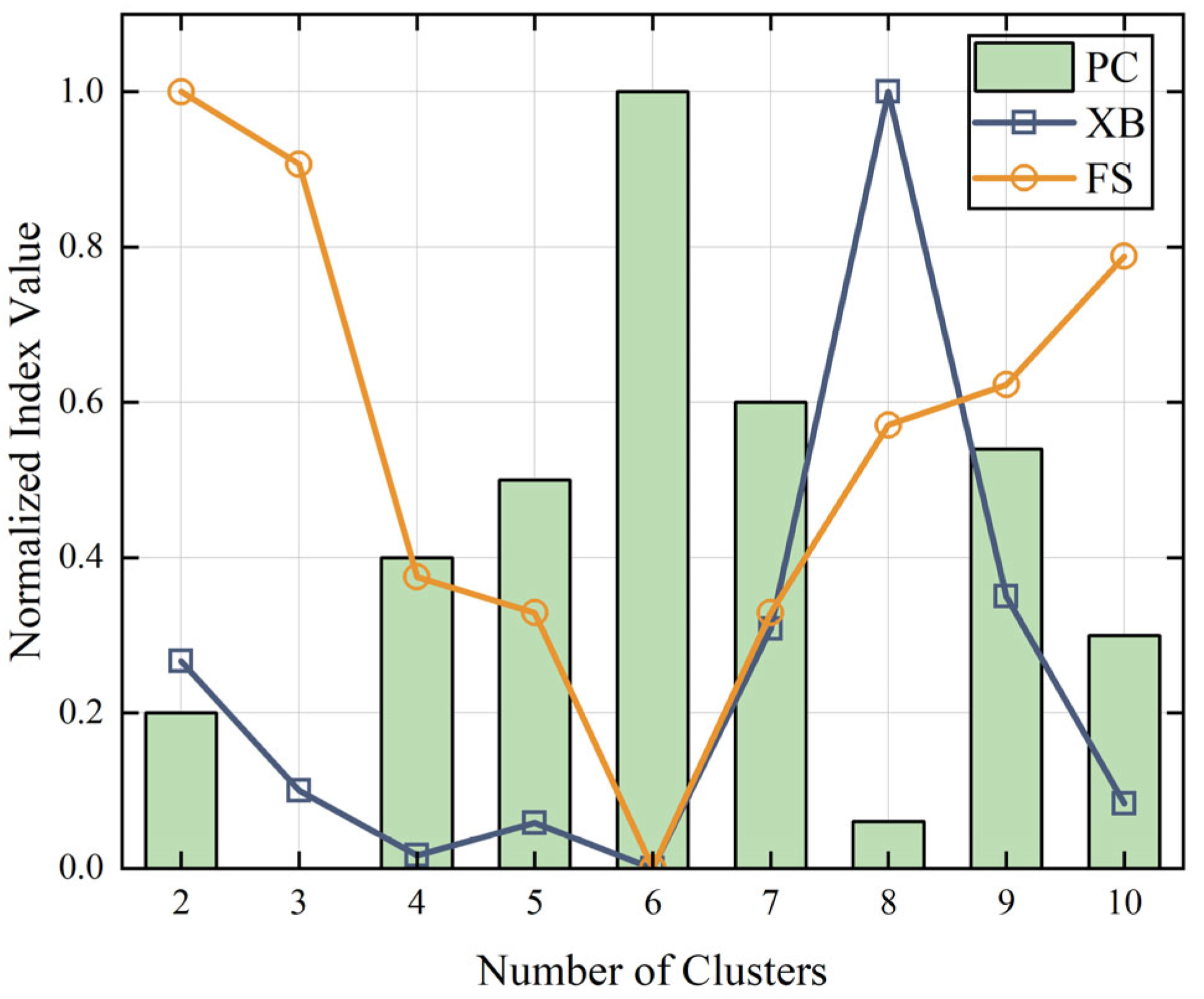
To further verify the rationality of this selection, the fuzzy clustering validity indices defined in Section 3.1 are calculated: Xie–Beni index (XB), Partition Coefficient (PC), and Fukuyama–Sugeno index (FS), followed by normalization. The results are shown in Figure 6.
As shown in Figure 6, when c = 6, the PC value reaches a local maximum, while both the XB and FS indices are in local minimum regions. Specifically, at c = 6, the Partition Coefficient (PC) reaches a local maximum, indicating the lowest fuzziness in the clustering results and the highest classification confidence. Simultaneously, the XB and FS indices are in local minimum regions, signifying an optimal balance between intra-class compactness and inter-class separation. The comprehensive evaluation from multiple indices aligns with the “Elbow Method,” confirming the rationality of selecting 6 as the optimal number of clusters.

5.3. Validation of Effectiveness in Transmission Section Similarity Identification Results

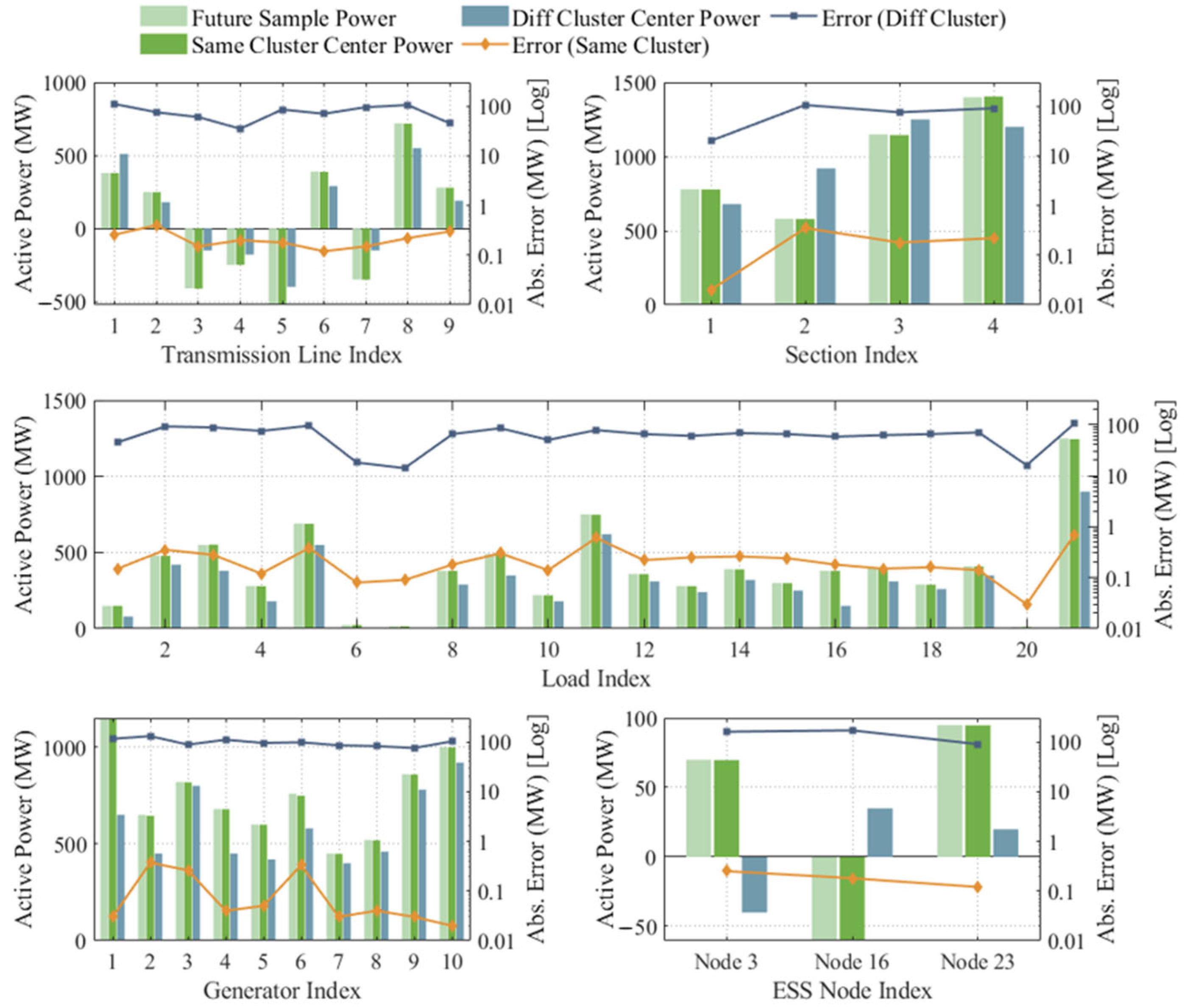
The future samples are mixed with historical samples, and clustering is performed based on the optimal number of clusters c = 6 and the weighting fuzziness factor β = 2, fuzziness exponent α = 2, using the proposed method. One future sample is randomly selected, and its differences from the center of the same class and the centers of other classes are compared in terms of key features such as generator output, load distribution, section transmission power flow, energy storage output, and Dynamic TTC. The results are shown in Figure 7.
Figure 7 illustrates the power comparison of a future sample with the identified same-class center and non-same-class centers in key features. The results show that, using the proposed method, the Dynamic TTC and key line flows of the future sample highly coincide with the same-class center while differing significantly from other class centers. The results demonstrate that, when applying the methodology proposed in this paper, the Dynamic TTC and critical line flows of future samples exhibit high consistency with those of similar centers while showing significant divergence from other types of centers. This is attributable to the dispersion weight mechanism, which assigns higher weights to Dynamic TTC and heavily loaded lines, enabling the clustering results to better reflect the inherent safety margin characteristics of the cross-section.
To demonstrate the superiority of the proposed method, five different schemes are set for comparative analysis. Scheme 5 is the identification method proposed in this paper, based on DW-FCM and Dynamic TTC. The specific settings are shown in Table 3.
Scheme 1 employs the conventional K-means clustering algorithm, using only basic operating features (such as line flows and generator outputs) for hard partitioning, without including Dynamic TTC information. Scheme 2 adopts Density-Based Spatial Clustering of Applications with Noise (DBSCAN). Instead of using centroids, it groups samples based on local density connectivity. This baseline is introduced to evaluate performance in handling noise and non-convex cluster shapes typical in power system data. Scheme 3 utilizes Spectral Clustering, a modern graph-theoretic approach. It constructs a similarity graph and performs dimensionality reduction on the Laplacian matrix to identify clusters, serving as a strong baseline for detecting complex manifold structures. Scheme 4 employs the DW-FCM algorithm proposed in this paper, but it relies solely on basic operational measurements as input features and does not consider the Dynamic TTC index. Scheme 5 incorporates Dynamic TTC considering energy storage regulation capabilities as a key feature on the basis of Scheme 4, the complete method proposed in this paper, aimed at addressing potential local optima due to random initialization and achieving the best identification performance.
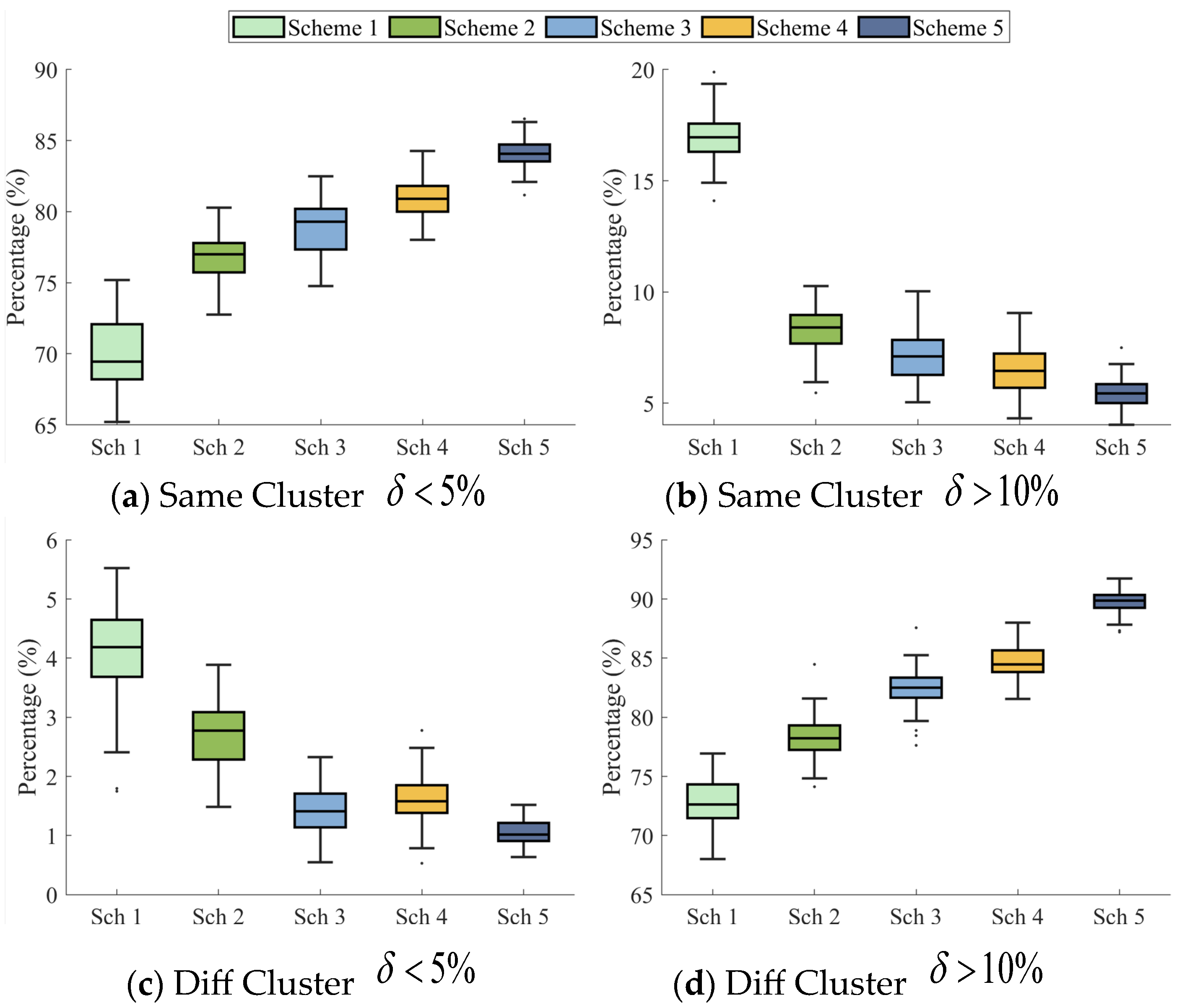
Further statistics on the identification errors for the 500 future samples are compiled. To validate the statistical significance of the proposed method’s superiority, Figure 8 presents the box plot of identification accuracy distribution across 50 independent runs.
As observed in the box plots, Scheme 5 consistently achieves the best median values across all four metrics. The interquartile range of Scheme 5 is significantly narrower than that of Scheme 1 and Scheme 2. This indicates that the proposed dispersion-weighted mechanism effectively constrains the algorithm’s randomness, preventing it from falling into local optima and ensuring consistent identification results across different runs. More importantly, the boxes of Scheme 5 exhibit a distinct separation from those of the baseline schemes. Even compared to the second-best Scheme 4, the median of Scheme 5 consistently surpasses the upper quartiles of the baselines. This distribution pattern statistically corroborates that the performance improvement is robust and significant rather than a result of random chance.
The mean values of the performance metrics across the 50 runs are adopted to represent the method’s general capability. Table 4 details the comprehensive error statistics based on these mean values, covering deviations in load, generator output, section power, and TTC values.
As shown in Table 4, first, the baseline methods (Schemes 1–3) show clear limitations. Scheme 2 often treats transition states as noise, resulting in lower accuracy. While Scheme 3 achieves a decent accuracy of 79.2%, it takes twice as long as the proposed method.
Second, Scheme 4 outperforms Scheme 3, with higher accuracy and significantly faster speed. This proves that the proposed adaptive weighting mechanism is highly efficient. It automatically focuses on key features while ignoring noise, achieving better results without the heavy computational burden of graph-based methods.
Finally, the proposed Scheme 5, combining initial value correction, Dynamic TTC, and the dispersion-weighting mechanism, achieves optimal performance. It realizes high-precision matching in 84.4% of the test samples and minimizes the risk of erroneous matching (i.e., smaller errors with non-same-class centers).
Note that the total identification time of the proposed Scheme 5 is 36.75 s, which is higher than that of the traditional K-means (Scheme 1) or DBSCAN (Scheme 2). However, this duration is well within the acceptable range for online applications. In modern power grid operation, the typical look-ahead dispatch or rolling optimization window is usually 5 to 15 min. The proposed method consumes only a fraction of this decision cycle, leaving ample time for subsequent control execution. Considering the significant improvement in identification accuracy as shown in Figure 6 and the critical guarantee of dynamic safety, this slight increase in computational cost is a justifiable and cost-effective trade-off.

5.4. Complexity and Scalability Analysis

To validate the practical applicability of the proposed method to large-scale power grids, the computational scalability is analyzed from three perspectives.
The framework strictly separates the computationally intensive model training (offline) from similarity matching (online). Although the offline training time correlates with the dataset size, the online matching complexity is strictly O ( K D ) , where K is the number of clusters and D is the feature dimension. This ensures millisecond-level responsiveness for real-time dispatch, independent of the grid’s physical scale.
As detailed in Section 2.1, the multi-stage feature extraction strategy extracts critical state variables rather than using the full network topology. Consequently, the input dimension for the DW-FCM algorithm depends on the number of key monitoring points rather than the total bus count, effectively preventing the “curse of dimensionality” in large-scale systems. In addition, the most time-consuming component—Dynamic TTC calculation—is inherently parallelizable. Since the assessment of different transmission sections is mathematically decoupled, parallel computing architectures can be leveraged.
In conclusion, the synergy of these strategies ensures that the computational burden remains tractable and does not grow linearly with the system scale. This confirms the practical feasibility of deploying the proposed framework for online decision support in actual large-scale provincial or regional power grids.

5.5. Adaptability Analysis of the Proposed Method to Load and Topology Changes

To test the adaptability of the proposed method under load variations, the load level of the IEEE 39-bus system is set to vary within 70–130% of the standard load, with proportional increases in the output limits of all generators to balance load growth and ensure power flow convergence. Other settings remain identical to the aforementioned 39-bus system.
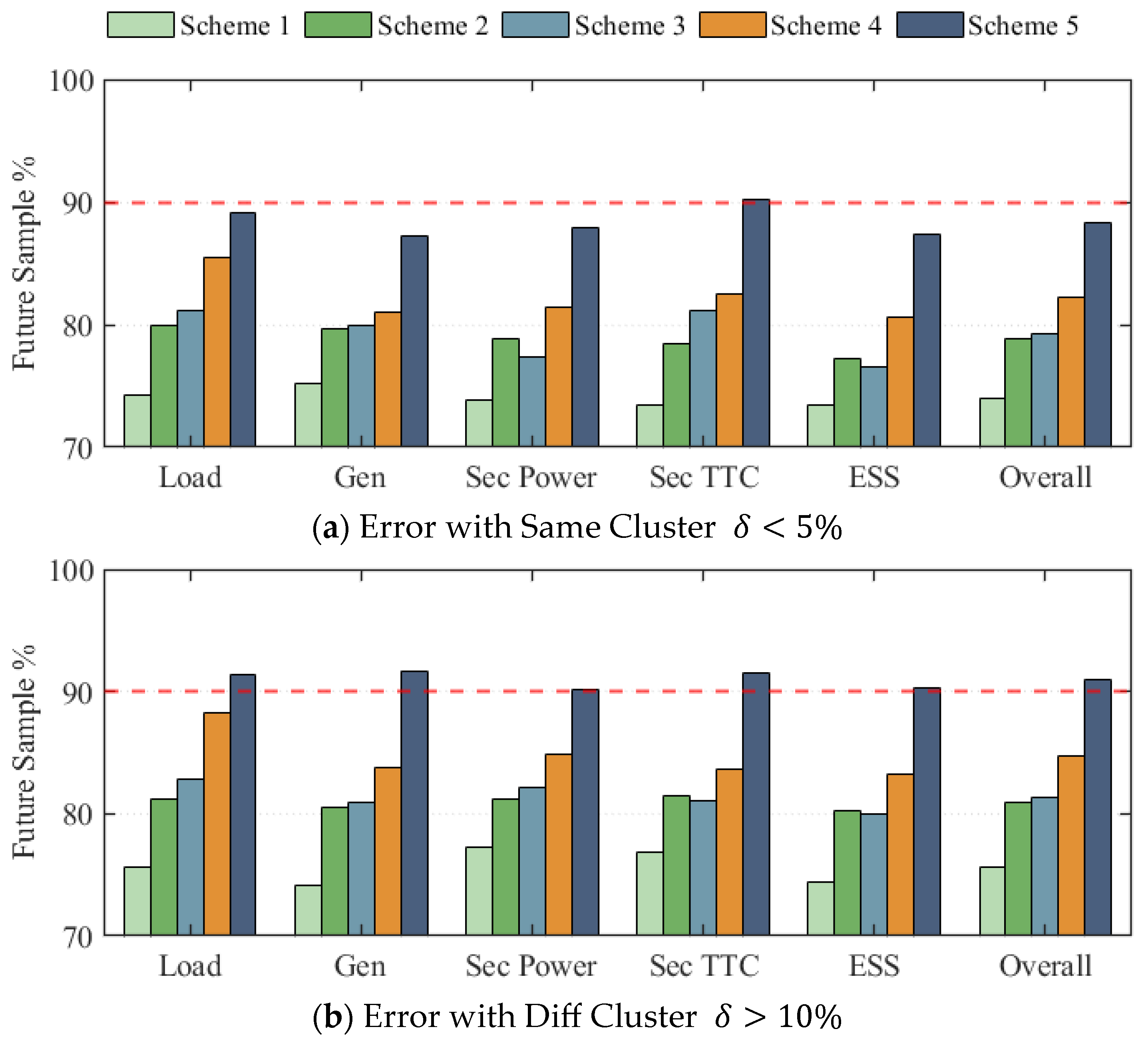
Figure 9a shows the concentration degree between future samples and same-class samples, while Figure 9b shows the difference degree between future samples and non-same-class samples. The results indicate that, under large load fluctuation scenarios, the proposed method achieves the highest number of effective identifications in terms of similarity with same-class samples and distinguishability from non-same-class samples, approaching 95%, significantly outperforming Schemes 1 and 2. This proves the robustness of the algorithm to load level changes.
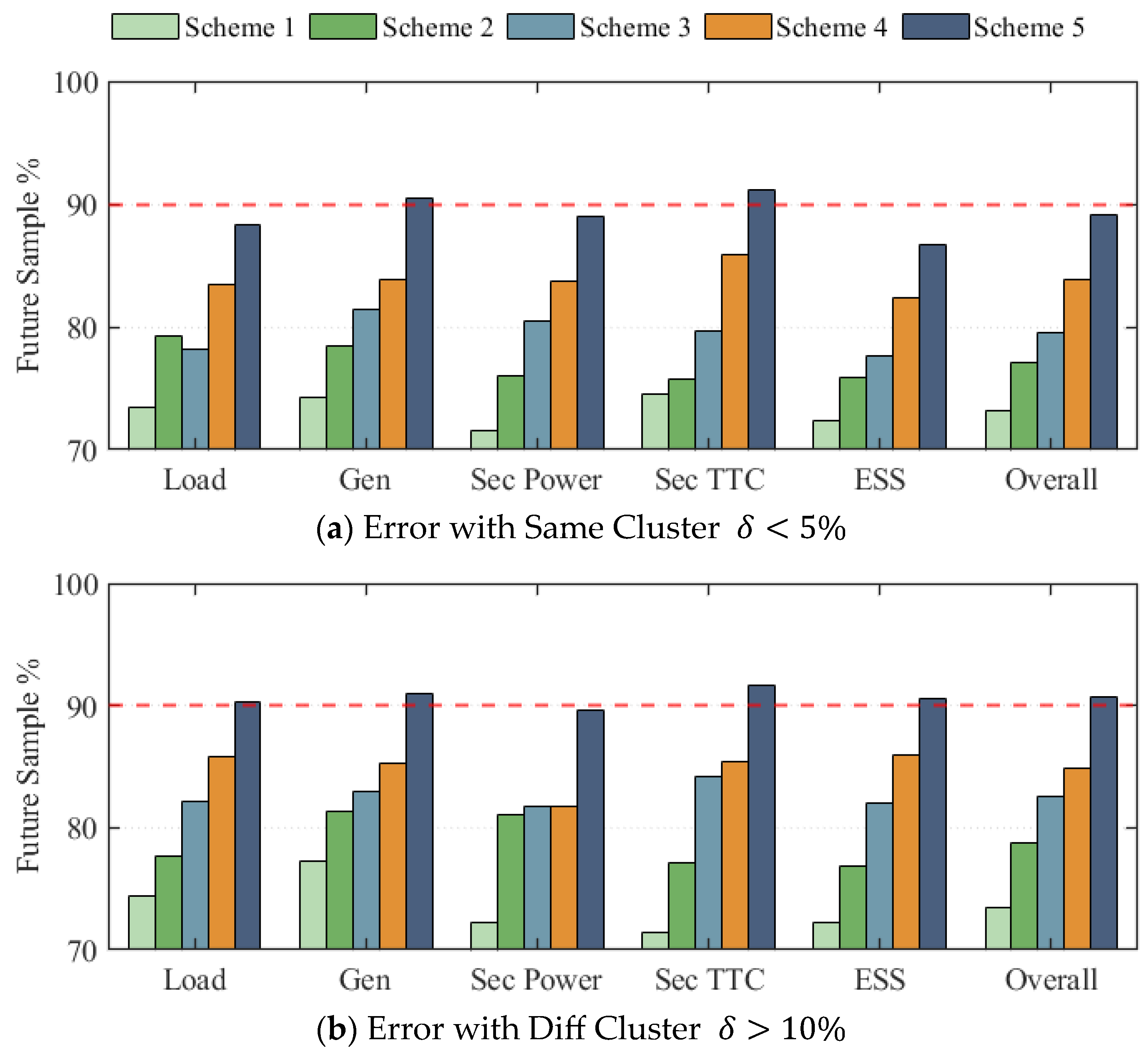
To verify the applicability of the proposed method when system topology changes, reference [30] is followed: planned maintenance is considered as new scenario 1, and addition of new nodes is considered as new scenario 2. System load fluctuates within ±10%, with other settings identical to the aforementioned 39-bus system. In new scenario 2, transmission line 2–3 is removed from Section 4. For each scenario, 500 sample sets are generated, with 400 as historical samples and 100 as future samples. The error statistics for new scenario 1 are shown in Figure 10.
It can be seen that the proposed method achieves the highest number of effectively identified samples, approximately 88%. For new scenario 2, the error statistics are shown in Figure 11, with results similar to new scenario 1. Scheme 5 still maintains the highest matching degree for same-class samples and distinguishability for non-same-class samples. This is because the Dynamic TTC calculation inherently embeds topology information, and DW-FCM sensitively captures changes in key feature weights caused by topology alterations—for instance, when a line is disconnected, the flow weights of its parallel lines are automatically increased by the algorithm, enabling accurate identification across topology scenarios.

6. Conclusions

This paper proposes a transmission section similarity identification method based on Dynamic Total Transfer Capacity (TTC) considering Energy Storage System (ESS) regulation capabilities and DW-FCM clustering. Case studies on the IEEE 39-bus system demonstrate that constructing a multi-scale feature set with Dynamic TTC significantly enhances the characterization of system safety margins, improving the effective identification rate of similar samples compared to traditional static methods. Furthermore, the proposed DW-FCM algorithm effectively overcomes the subjectivity of manual weighting by automatically quantifying feature importance; combined with an adaptive cluster selection strategy, it increases the distinguishability of dissimilar samples. The method exhibits strong robustness under significant load fluctuations and topology changes, providing a reliable and efficient decision-making reference for real-time grid dispatching.
Despite the contributions presented, this study has certain limitations regarding the modeling scope. Currently, the ESS modeling and stability assessment focus primarily on electromechanical timescales under deterministic N-1 contingencies. Sub-synchronous control interactions and the probabilistic impact of extreme environmental events are not fully captured. Consequently, future research will extend the framework to include electromagnetic transient (EMT) analysis and resilience-oriented TTC assessment, explicitly considering extreme weather events and multi-energy coupling characteristics.

Author Contributions

Conceptualization, L.W. and Y.S.; methodology, L.W. and W.Z.; software, J.G. and Y.W.; validation, J.G., Y.W. and W.Z.; investigation, L.W. and W.Z.; resources, J.L.; data curation, Y.W.; writing—original draft preparation, J.L.; writing—review and editing, L.W. and W.Z.; visualization, J.G.; supervision, Y.S.; project administration, Y.S.; funding acquisition, L.W. All authors have read and agreed to the published version of the manuscript.

Funding

This research was supported by Hebei Natural Science Foundation (E2023521001) and the Science and Technology Project of State Grid Hebei Electric Power Company Ltd. (kj2025-032).

Data Availability Statement

The raw data supporting the conclusions of this article will be made available by the authors on request.

Conflicts of Interest

Author Leibao Wang, Wei Zhao and Jifeng Liang are employed by the company State Grid Hebei Electric Power Research Institute. The remaining authors declare that the research was conducted in the absence of any commercial or financial relationships that could be construed as a potential conflict of interest.

Abbreviations

The following abbreviations are used in this manuscript:
FCMFuzzy C-Means
DW-FCMDispersion-Weighted Fuzzy C-Means
ESSEnergy Storage Systems
TTCTotal Transfer Capacity
AC-OPFAlternating Current Optimal Power Flow
SoCState of Charge
XBXie–Beni
PCPartition Coefficient
FSFukuyama–Sugeno
DBSCANDensity-Based Spatial Clustering of Applications with Noise

Nomenclature

The following symbols are used in this manuscript:
c Number of the cluster centers
c Optimal number of clusters
c min Minimum number of clusters
c max Maximum number of clusters
C k Set of samples contained in the k-th cluster
d i n Sum of intra-cluster distances
d ω 2 Weighted squared distance
D Dimensions of features
E i min Minimum energy capacity of the ESS at bus i
E i max Maximum energy capacity of the ESS at bus i
F b a s e Basic feature set
mNumber of features
P i j Active power flow of line ( i , j )
PGActive power output of key generators
P l i n e Active power of key lines
P E S S , i ESS injection active power at bus i
P L Load active power
Q GReactive power output of key generators
Q l i n e Reactive power of key lines
Q E S S , i ESS injection reactive power at bus i
Q L Load reactive power
R i u p Maximum ESS ramp-up rates at bus i
R i d o w n Maximum ESS ramp-down rates at bus i
S k Set of lines included in the section K
SoCEnergy storage state of charge
VVoltage
V X B Xie–Beni index
V P C Partition Coefficient index
V F S Fukuyama–Sugeno index
V Final cluster centers
ν i The i -th cluster center
v ¯ Global weighted mean center of all samples
x Normalized feature
x Original feature
x f u t Future operating point
α Fuzziness exponent
β Weight fuzziness factor
δ i ( τ ) Rotor power angles of generator i at time τ
μ i j Membership degree of the j -th sample to the i -th cluster
ω Feature weight
ω Final feature weights
ξ k Intra-cluster dispersion of the k-th feature
θ i j Voltage phase angle difference between bus i and bus j

References

  1. Song, J.; Bao, Y.; Zhang, J.; Xu, T.; Ren, X.; Wang, W. Characterization and Computation of Transient Stability Boundaries for New Power Systems: A Review and Outlook. Autom. Electr. Power Syst. 2025, 1–22. Available online: https://link.cnki.net/urlid/32.1180.TP.20250813.1719.006 (accessed on 13 February 2026).
  2. Gu, X.; Liu, T.; Li, S.; Wang, T.; Yang, X. Temporal and spatial similarity mining of power grid running section for future state prediction. Trans. China Electrotech. Soc. 2022, 37, 6145–6156. [Google Scholar] [CrossRef]
  3. Yin, W.; Wang, J.; Wang, Z.; Liu, Y.; Sun, Y.; Yang, L.; Xu, F. Digital Effects of Future State Dispatch in Power Grids Under Typical Extreme Weather Conditions. Power Syst. Clean Energy 2025, 41, 1–13. [Google Scholar] [CrossRef]
  4. Wen, T. A Rapid Method for Calculating Power System Section Sensitivity. Electr. Eng. 2021, 6, 120–122. [Google Scholar] [CrossRef]
  5. Zhang, X.; Yan, H. Research on Transmission Channel Section Control Strategies Based on Sensitivity Analysis. Mech. Electr. Inf. 2021, 26, 20–21. [Google Scholar] [CrossRef]
  6. Huang, Y.; Li, L.; Wang, L.; Zhu, J. Neural Network-Based Power Grid Operation Trend Estimation Algorithm and Its Application. Smart Power 2019, 47, 113–120. [Google Scholar] [CrossRef]
  7. Jiang, T.; Qie, Z.; Li, W.; Li, Z.; Wu, X. Multi-Period Online Preventive Control Strategy for Grids with High Proportion of Renewable Energy Based on Reinforcement Learning. Autom. Electr. Power Syst. 2025, 49, 159–169. Available online: https://link.cnki.net/urlid/32.1180.TP.20250625.1342.004 (accessed on 13 February 2026).
  8. Diao, H.; Xiao, T.; Huang, S.; Chen, Y.; Shen, C. Data-Driven Key Section Screening for Power Systems. Power Syst. Technol. 2023, 47, 4035–4046. [Google Scholar] [CrossRef]
  9. Ren, K.; Xu, T.; Guo, J.; Tu, M.; Lu, J.; Liu, J.; Ding, T. Data-Driven Method for Estimating Section Limits in New Power Systems. Smart Power 2022, 50, 9–16. [Google Scholar] [CrossRef]
  10. De Caro, F.; Giannuzzi, G.M.; Pisani, C.; Iuliano, S.; Vaccaro, A. The Role of Data-Driven Methods in Power System Security Assessment from Aggregated Grid Data. Front. Smart Grids 2024, 3, 1385367. [Google Scholar] [CrossRef]
  11. Erdinç, F.G.; Çiçek, A.; Erdinç, O.; Yumurtacı, R.; Oskouei, M.Z.; Mohammadi-Ivatloo, B. Decision-Making Framework for Power System with RES Including Responsive Demand, ESSs, EV Aggregator and Dynamic Line Rating as Multiple Flexibility Resources. Electr. Power Syst. Res. 2022, 204, 107702. [Google Scholar] [CrossRef]
  12. Tie, Y.; Hu, B.; Shao, C.; Huang, W.; Qi, F.; Xie, K. Integrated Flexibility Characterization and Measurement of Distributed Multi-Energy Systems Considering Temporal Coupling Constraints. Energy 2023, 283, 128684. [Google Scholar] [CrossRef]
  13. Chan, K.Y.; Yiu, K.F.C.; Kim, D.; Abu-Siada, A. Fuzzy Clustering-Based Deep Learning for Short-Term Load Forecasting in Power Grid Systems Using Time-Varying and Time-Invariant Features. Sensors 2024, 24, 1391. [Google Scholar] [CrossRef] [PubMed]
  14. Rahul, G. Survey of Data-Driven Methods for Power Systems. Preprints 2024. [Google Scholar] [CrossRef]
  15. Sohrabi, B. Data-Driven Approaches for Enhancing Power Grid Reliability. Master’s Thesis, University of Denver, Denver, CO, USA, 2024. [Google Scholar]
  16. Ma, X.; Ke, X.; Ren, C.; Wang, J. Data-Driven Optimization of Transmission Section Limits and Their Adaptability for New Power Systems With High Penetration of Renewable Energy. Front. Energy Res. 2022, 10, 948595. [Google Scholar] [CrossRef]
  17. Wang, G.; Yang, X.; Li, H.; Lu, H.; Song, X.; Rong, J.; Liu, C.; Zhuang, P. Identification Method for Critical Transmission Sections in Power Systems Based on Grid Partitioning and Power Flow Transfer Analysis. Electronics 2025, 14, 4675. [Google Scholar] [CrossRef]
  18. Wang, J.; Ding, M.; Sun, L.; Wang, L. Key Transmission Section Search Method Based on an Improved Clustering Algorithm. Electr. Power 2022, 55, 86–94. [Google Scholar] [CrossRef]
  19. Xu, D.; Tian, Y. A Comprehensive Survey of Clustering Algorithms. Ann. Data Sci. 2015, 2, 165–193. [Google Scholar] [CrossRef]
  20. Ghashti, J.S.; Thompson, J.R.J. FuzzySpec: Fuzzy Spectral Clustering with Variable-Weighted Adjacency Matrices, Version 1.0.0; CRAN: Vienna, Austria, 2025. [Google Scholar] [CrossRef]
  21. Tzortzis, G.F.; Likas, A.C. The Global Kernel k-Means Algorithm for Clustering in Feature Space. IEEE Trans. Neural Netw. 2009, 20, 1181–1194. [Google Scholar] [CrossRef]
  22. Liu, F.; Deng, Y. Determine the Number of Unknown Targets in Open World Based on Elbow Method. IEEE Trans. Fuzzy Syst. 2021, 29, 986–995. [Google Scholar] [CrossRef]
  23. Nguyen, T.A.; Byrne, R.H. Evaluation of Energy Storage Providing Virtual Transmission Capacity. In Proceedings of the 2021 IEEE Power & Energy Society General Meeting (PESGM), 26 July 2021; IEEE: Washington, DC, USA, 2021; pp. 1–5. [Google Scholar]
  24. Zhang, Q.; Kumar, P.R.; Xie, L. The Transmission Value of Energy Storage and Fundamental Limitations. arXiv 2024, arXiv:2407.09428. [Google Scholar] [CrossRef]
  25. Zhao, S.; Shao, C.; Ding, J.; Hu, B.; Xie, K.; Yu, X.; Zhu, Z. Unreliability Tracing of Power Systems for Identifying the Most Critical Risk Factors Considering Mixed Uncertainties in Wind Power Output. Prot. Control Mod. Power Syst. 2024, 9, 96–111. [Google Scholar] [CrossRef]
  26. Hu, B.; Pan, C.; Shao, C.; Xie, K.; Niu, T.; Li, C.; Peng, L. Decision-Dependent Uncertainty Modeling in Power System Operational Reliability Evaluations. IEEE Trans. Power Syst. 2021, 36, 5708–5721. [Google Scholar] [CrossRef]
  27. Liu, J.; Yan, J.; Shi, D.; Wu, Q.; Yang, X. An Automatic Method for Generating Power System Operation Mode Rules Based on the Lawson Algorithm. Proc. CSEE 2023, 43, 8171–8182. [Google Scholar] [CrossRef]
  28. Shi, Z.; Yao, W.; Huang, Y.; Tang, Y.; Wen, J. Intelligent Identification of Dominant Instability Modes in Power Systems Based on SE-CNN and Simulation Data. Proc. CSEE 2022, 42, 7719–7731. [Google Scholar] [CrossRef]
  29. Li, Y.; Liu, Y.; Liu, J.; Cheng, M.; Ma, T.; Wei, W.; Yin, L.; Ning, S. Adaptive Robust Clustering Algorithm for Daily Load Data Based on Morphological Distance. Proc. CSEE 2019, 39, 3409–3420. [Google Scholar] [CrossRef]
  30. Chen, H.; Guan, L. Adaptive Transient Stability Assessment of Power System Topology Based on Active Migration Learning. Proc. CSEE 2023, 43, 7409–7423. [Google Scholar] [CrossRef]
Figure 1. Framework of transmission section feature space construction. The different geometric shapes represent various types of data features.
Electronics 15 00851 g001
Figure 2. TTC calculation model solving process.
Electronics 15 00851 g002
Figure 3. Schematic diagram of determining the optimal number of clusters based on the elbow method.
Electronics 15 00851 g003
Figure 4. Calculation flow chart of transmission section identification model. * The asterisk (*) indicates the optimal or final converged values of the parameters.
Electronics 15 00851 g004
Figure 5. Selection of optimal number of clusters based on the “Elbow Method”.
Electronics 15 00851 g005
Figure 6. Relationship between number of clusters and evaluation indices.
Electronics 15 00851 g006
Figure 7. Comparison of key features between a future sample and the centers of same-class and non-same-class samples.
Electronics 15 00851 g007
Figure 8. Statistical distribution across 50 independent runs for different schemes.
Electronics 15 00851 g008
Figure 9. Identification result statistics for future transmission section samples under load variations.
Electronics 15 00851 g009
Figure 10. Identification result for future samples under new scenario 1.
Electronics 15 00851 g010
Figure 11. Identification result for future transmission section samples under new scenario 2.
Electronics 15 00851 g011
Table 1. Basic feature quantities library.
Feature NameSymbolFeature NameSymbol
Generator Active Power Output P G Transmission Line Active Power P l i n e
Generator Reactive Power Output Q G Transmission Line Reactive Power Q l i n e
Nodal Active Load P L AC Transmission Power P A C
Nodal Reactive Load Q L Generator On/Off Status η
Nodal Voltage
Magnitude
V Network Node Information π
Nodal Voltage Angle θ Node Connectivity Relationship Ω
Energy Storage of Charge S o C Energy Storage Node N E S S
Table 2. Transmission sections in IEEE 39-bus system.
NumberSectionInjection NodeOutflow Node
110–11/10–131011, 13
216–19/16–2119, 2116
321–22/23–2422, 2321, 24
41–2/2–3/26–272, 261, 3, 27
Table 3. Settings of different clustering algorithm schemes.
AlgorithmK-Means ClusteringDBSCANSpectral ClusteringDW-FCM
(Without TTC)
Proposed Method
Scheme No.12345
Table 4. Comparison of sample error statistics results for different schemes.
Scheme No.Relative to Center of Same ClusterRelative to Center of
Different Clusters
Total Time of Single Identification (s)
δ < 5%10% < δδ < 5%10% < δ
170.116.84.272.72.65
273.414.13.6575.815.42
379.27.82.1581.568.74
480.76.51.5585.131.98
584.45.21.0190.336.75
Disclaimer/Publisher’s Note: The statements, opinions and data contained in all publications are solely those of the individual author(s) and contributor(s) and not of MDPI and/or the editor(s). MDPI and/or the editor(s) disclaim responsibility for any injury to people or property resulting from any ideas, methods, instructions or products referred to in the content.