Article

A Generalized Approach for Frequency Selective Absorber with Controllable Center Frequency and Passband Bandwidth


1
Department of Communication Engineering, University of Science and Technology, Beijing 100083, China
2
Hebei Provincial Communications Planning, Design and Research Institute Co., Ltd., Shijiazhuang 050299, China
*
Author to whom correspondence should be addressed.
Electronics 2026, 15(4), 817; https://doi.org/10.3390/electronics15040817
Submission received: 7 January 2026 / Revised: 4 February 2026 / Accepted: 11 February 2026 / Published: 13 February 2026

Abstract

In this paper, we propose the generalized approach for a dual absorption frequency selective absorber (FSA) with controllable center frequency and passband bandwidth. The designed dual absorption FSA consists of a lossy layer and a frequency selective surface (FSS) layer. Furthermore, the lossy layer is composed of a square ring loaded with four resistors, four circular patches, and four interconnected patches, while the lossless layer is composed of four circular grooves. As for the operating mechanism, the center frequency of the transmission characteristics is mainly determined by the radius of the circular patch (‘a’), while the bandwidth of the transmission characteristics is mainly influenced by the angle of interconnected patch (‘θ’). Then, the generalized approach for dual absorption FSA with controllable center frequency and passband bandwidth was proposed, which could provide effective guidance for the design of dual absorption FSA. To verify the presented concept and design method, the dual absorption FSA was fabricated and measured. Experimental measurements demonstrate a −3 dB transmission fractional bandwidth of approximately 10.74%. Moreover, the proposed structure achieves an absorption rate of over 80% across the 2.95–7.00 GHz band and more than 72% absorption over the 7.80–10.20 GHz band.

1. Introduction

Artificial electromagnetic metamaterials have emerged as a powerful component for tailoring the reflection, transmission, and absorption characteristics of electromagnetic (EM) waves, enabling a broad range of applications in wireless communications, electromagnetic compatibility, and electronic countermeasures. In particular, EM absorbers play a critical role in reducing radar cross section (RCS) by dissipating incident electromagnetic energy, thereby providing an effective means for radar stealth and interference mitigation [1,2,3,4]. In parallel, frequency selective surfaces (FSSs), which exhibit passband and stopband responses in different frequency bands, have been widely employed in radome systems and electromagnetic filtering applications [5,6,7,8].
To simultaneously realize broadband absorption and in-band transmission, frequency selective absorbers (FSAs) have been proposed by integrating absorbing layers with bandpass frequency selective surface (FSS) structures. Over the past decades, extensive efforts have been devoted to the development of FSAs to achieve low radar cross section (RCS) while maintaining reliable signal transmission. In early studies, a resistive layer was placed on a low-frequency bandpass FSS, resulting in transmission bands located below the absorption bands [8,9]. Subsequently, alternative configurations were reported in which the resistive layer was integrated with a high-frequency bandpass FSS, leading to passbands located above the absorption bands [10,11,12,13]. From a structural perspective, various resonant elements have been explored, including square resistive films [9], parallel LC resonators for high-selectivity transmission [10], sinusoidal microstrip lines for bandwidth enhancement [12], and square-loop resonators combined with resistive sheets for harmonic suppression [13]. Despite these advances, most of the reported FSAs in [8,9,10,11,12,13] are limited to a single absorption band, which restricts their effectiveness in suppressing out-of-band scattering on both sides of the transmission window.
To further enhance stealth performance, considerable efforts have been devoted to the development of FSAs featuring dual absorption bands and a single transmission passband [14,15,16,17]. In [14], dual-band absorption was realized using metal square-ring units and square-aperture hybrid elements loaded with lumped resistors. In [15], lumped-resistor-loaded metallic dipoles combined with a square-slot FSS were employed to achieve a similar dual-band absorption response. However, the transmission bandwidths of these designs remain relatively narrow. To expand the transmission window, T-shaped metal strips and square-ring resonators loaded with lumped resistors were proposed in [16], while split-ring resonators integrated with short dipoles were adopted in [17]. For example, in [16], a −1 dB transmission band from 7.81 to 11.78 GHz was obtained, accompanied by absorption bands spanning 3.67–6.80 GHz and 13.74–15.31 GHz, whereas in [17], absorption levels approaching 90% were achieved over 3.95–13.28 GHz and 17.74–22.7 GHz, along with a −3 dB transmission band from 14.2 to 15.8 GHz. Despite demonstrating the feasibility of dual-band absorption with in-band transmission, these studies generally exhibit strong coupling between the transmission center frequency and bandwidth, making independent tuning challenging and thereby limiting practical design flexibility.
Functionally reconfigurable FSAs have attracted growing interest. Mode switching between rasorber and broadband absorption has been achieved using liquid-actuated water-based reflective layers [18], electrically controlled PIN diodes [19] and varactors [20]. By implementing a dual-PIN-diode matrix, a single surface can be dynamically reconfigured among multiple electromagnetic states, including transmission, absorption, reflection, and rasorber modes [21]. Furthermore, hybrid designs employing phase-change materials such as vanadium dioxide (VO2) and graphene have enabled dynamic switching between multiband absorption and reflection states [22]. Despite these advances, such approaches typically rely on active components or complex material systems, resulting in increased circuit complexity and stringent biasing requirements.
For many practical applications, comprehensive adaptability requires not only reconfigurability but also independent and flexible control over both the transmission center frequency and bandwidth. In most reported FSAs, however, these two key parameters are intrinsically coupled, making it difficult to tailor the transmission window to meet diverse system requirements. Ref. [20] demonstrates a tunable center frequency that can be continuously varied from 8 GHz to 12 GHz. Furthermore, a dual absorption FSA with controllable transmission frequency and bandwidth was demonstrated by combining parallel resonators, an interdigitated capacitor, and a metal meander line in [23]. This design enabled transmission bandwidths of 21.24%, 25.7%, and 31.3% at a fixed center frequency, and allowed tuning of the center frequency to 6.8, 8.3, and 9.9 GHz while maintaining a fixed bandwidth. Nevertheless, the structure reported in [23] is relatively complex, while the systematic, generalized design methodology, along with clear physical insights into independent parameter control, has not been explicitly provided. Consequently, a generalized and physically intuitive design framework that allows independent and decoupled control of both the transmission center frequency and bandwidth remains highly desirable.
To address these challenges, a generalized design methodology for dual absorption FSAs with independently tunable transmission frequency and bandwidth is proposed. The underlying operating mechanisms were systematically analyzed, offering clear physical insights into how key parameters govern the transmission and absorption responses. Following this analysis, a versatile design framework was established, enabling flexible and fully decoupled control of the FSA performance. A prototype was fabricated and experimentally validated, confirming both the effectiveness and practical applicability of the proposed approach. These results demonstrate the feasibility of independently tunable dual absorption FSAs, which have the potential for multifunctional, reconfigurable, broadband electromagnetic applications.

2. Design and Analysis

2.1. The Structure of Designed Dual Absorption Band FSA

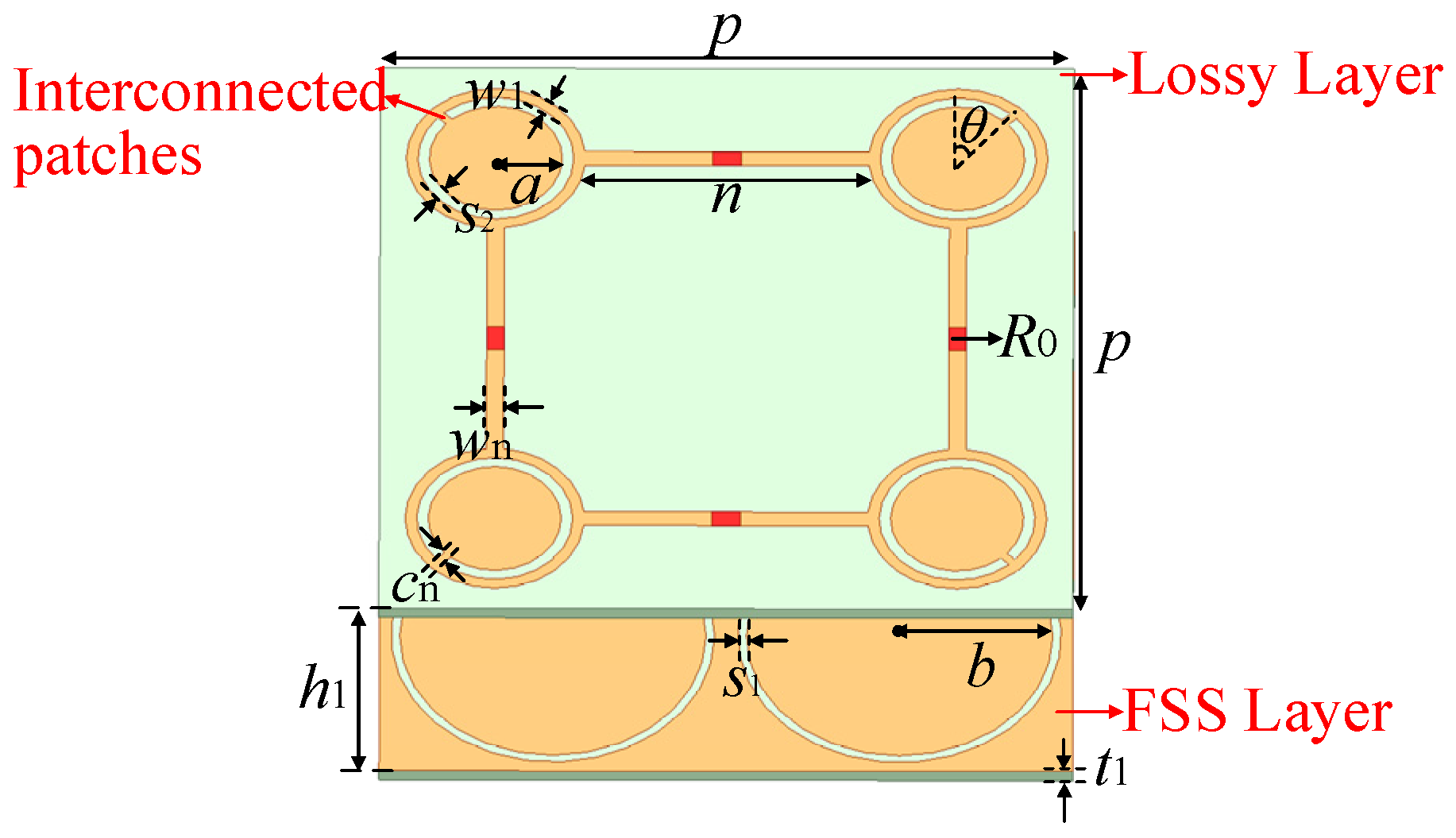
The schematic of the designed dual absorption FSA is shown in Figure 1 and its detailed parameters are listed in Table 1. As observed from Figure 1, the presented dual absorption FSA consists of a lossy layer and an FSS layer. The lossy layer consists of a square ring integrated with four resistors, four circular patches, four circular ring resonators, and four interconnected patches, while the FSS layer is constructed by four circular grooves. In this design, the circular patches are chosen for their rotational symmetry, which facilitates stable and easily tunable capacitive coupling. The interconnected patches introduce a notch band into the absorption spectrum and simultaneously provide a tunable inductive coupling mechanism; by varying their angle, the bandwidth of this notch (i.e., the transmission passband) can be directly controlled. Consequently, the designed lossy layer achieves broad absorption, while the FSS layer exhibits transmission characteristics within certain frequency bands.

2.2. Operating Mechanisms of the Proposed Designed Dual-Band Absorption FSA

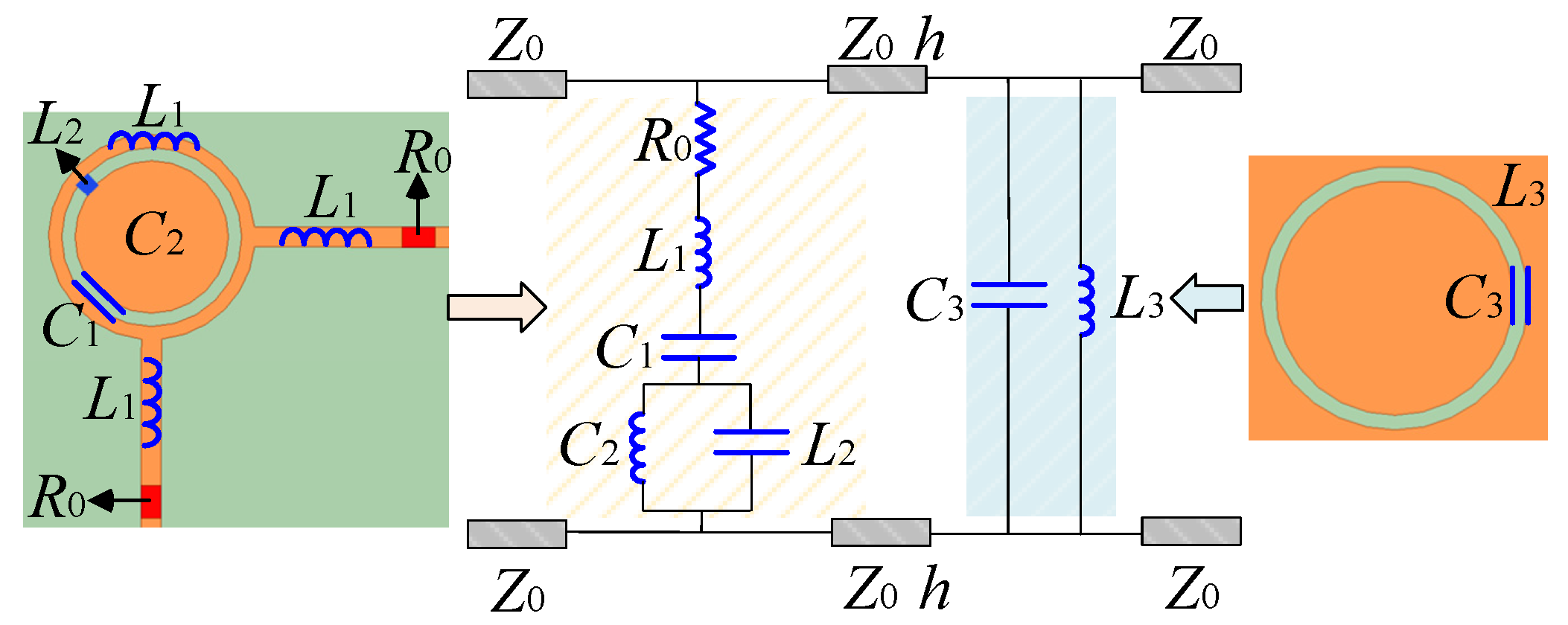
The equivalent lumped circuit of the proposed dual absorption FSA is shown in Figure 2. The circular patch mainly contributes to the capacitances ( C 1 and C 2 ), where C 1 is associated with the coupling between the circular patch and the surrounding circular ring resonators, and C 2 represents the self-capacitance of the circular patch. The circular groove in the FSS layer is modeled by the combined inductance–capacitance elements ( L 3 and C 3 ), corresponding to the resonant behavior of the ring-shaped structure in the FSS layer. The square ring integrated with lumped resistors is represented by the inductance L 1 and resistance R 0 , while the interconnected patches are modeled by the inductance L 2 , accounting for the inductive coupling between adjacent metallic elements.
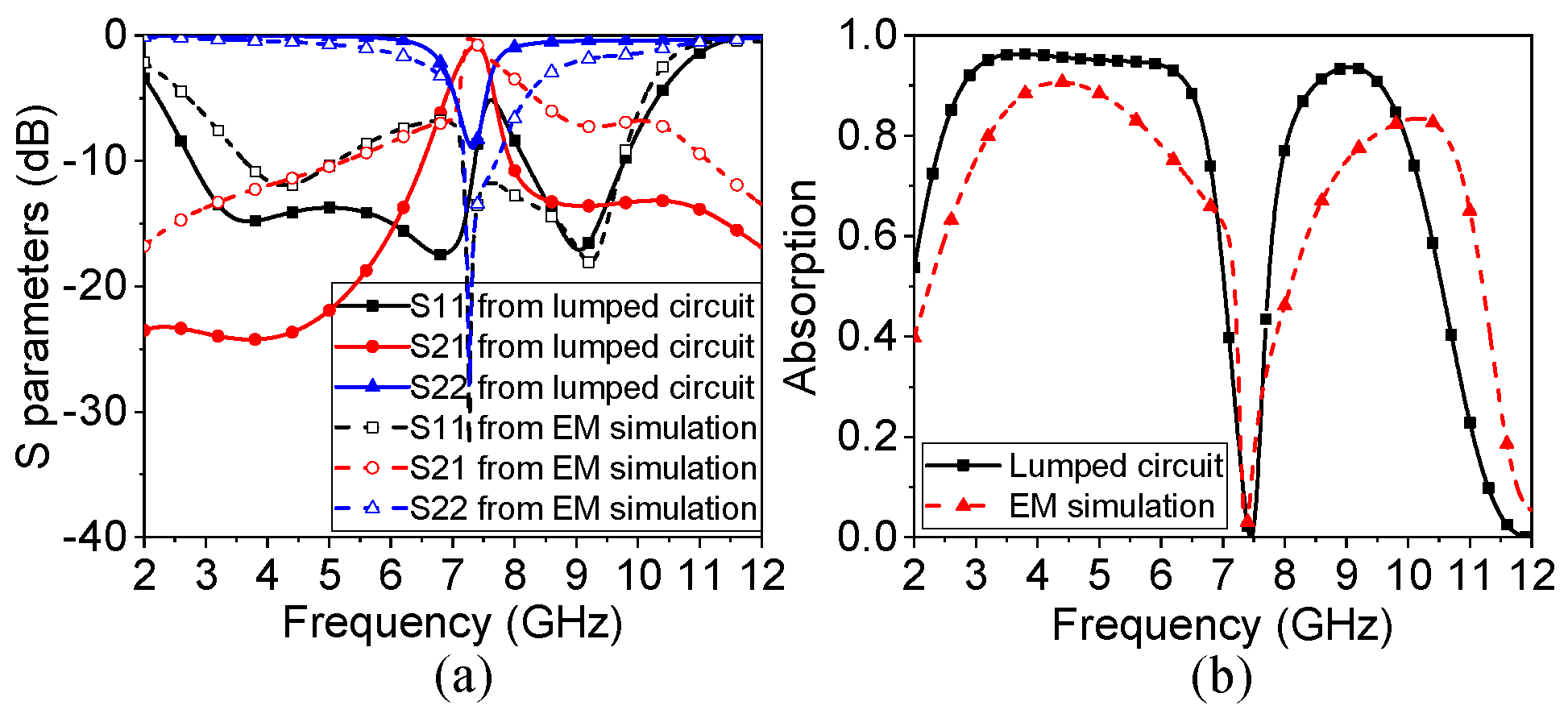
As shown in Figure 3, the S-parameters obtained from the equivalent lumped circuit are in good agreement with those from full-wave electromagnetic (EM) simulations, thereby confirming the validity and physical consistency of the proposed equivalent circuit model.
Based on Figure 2, the ABCD matrix of the equivalent lumped circuit could be derived as Equation (1). Then, the expressions of S 11 and S 21 could be derived as Equation (2) based on the transmission theory.
A B C D = 1 0 1 / Z A 1 cos k h j Z 0 sin k h j sin k h Z 0 cos k h 1 0 1 / Z B 1 = cos k h + j Z 0 Z B sin k h j Z 0 sin k h 1 Z A + 1 Z B cos k h + j 1 Z 0 + Z 0 Z A Z B sin k h cos k h + j Z 0 Z A sin k h
where Z A = R 0 + j ω L 1 + 1 j ω C 1 + j ω L 2 / / 1 j ω C 2 , Z B = j ω L 3 / / 1 j ω C 3 .
S 11 = j Z 0 ( Z A Z B Z 0 ) Z 0 P 1 tan θ ( 2 Q + Z 0 P ) 1 tan θ + j Z 0 ( P + Z 0 ) + 2 Q
S 21 = 2 Q 1 sin θ ( 2 Q + Z 0 P ) 1 tan θ + j Z 0 ( P + Z 0 ) + 2 Q
where P = Z A + Z B ,   Q = Z A Z B ,   θ = k h .
The absorption performance is related to the reflection and transmission coefficients which could be expressed in Equation (3).
A ( f ) = 1 S 11 2 S 21 2
A. Transmission State in the FSA
For perfect absorption, both reflection and transmission should be simultaneously suppressed, i.e., S 11 = 0 , S 21 = 0 . Within the absorption band, the FSS layer operates in a non-resonant state, and the grounded metallic plane blocks wave transmission. Under this condition, the lumped equivalent impedance of the FSS layer ( Z B ) approaches zero, which leads to S 21 = 0 based on Equation (2b).
Thus, to realize perfect absorption, the reflection coefficient must also satisfy S 11 = 0 . By substituting S 11 = 0 into (2a), the matching condition between lumped equivalent impedance of the lossy layer ( Z A ) and free-space impedance ( Z 0 ) can be obtained. After simplification, the equivalent absorber impedance Z A can be expressed as Equation (4).
Z A = j Z 0 sin θ j sin θ cos θ
Furthermore, by substituting the expression of Z A into (4), the equivalent resistance R 0 can be derived as Equation (5). When R 0 satisfies (5), the FSA could realize good absorption characteristics. Accordingly, the absorption performance of the FSA can be effectively adjusted by tuning the value of R 0 .
R 0 = j Z 0 sin θ j sin θ cos θ j ω L 1 1 j ω C 1 j ω L 2 / / 1 j ω C 2
B. Absorption State in the FSA
In contrast, the transmission response is mainly determined by the resonant behavior of the FSS layer. At the transmission frequency band, the FSS layer operates at resonance, where its lumped equivalent impedance becomes very large, i.e., Z B .
By substituting Z B into (2b), the transmission coefficient can be simplified as Equation (6).
S 21 = 2 Z 0 Z A + 2
From (6), it can be observed that the transmission performance is strongly dependent on the relative magnitude between the free-space impedance ( Z 0 ) and the effective impedance of the lossy layer ( Z A ). Specifically, a larger ( Z A ) leads to a higher transmission coefficient ( S 21 ), indicating that the transmission band can be flexibly tuned by adjusting the equivalent circuit parameters of the FSS layer.
Therefore, the absorber exhibits two distinct operating mechanisms:
(i)
In the absorption band, perfect absorption is achieved by simultaneously enforcing S 11 = 0 and S 21 = 0 , which corresponds to impedance matching and transmission suppression, as described by (3) and (4).
(ii)
In the transmission band, the FSS layer operates in a resonant state with Z B , and the transmission coefficient is governed by (6), indicating that the transmission response can be tuned independently by modifying the lumped resistances ( R 0 ).

2.3. Sensitivity Analysis and Regulation Mechanism of Critical Parameters

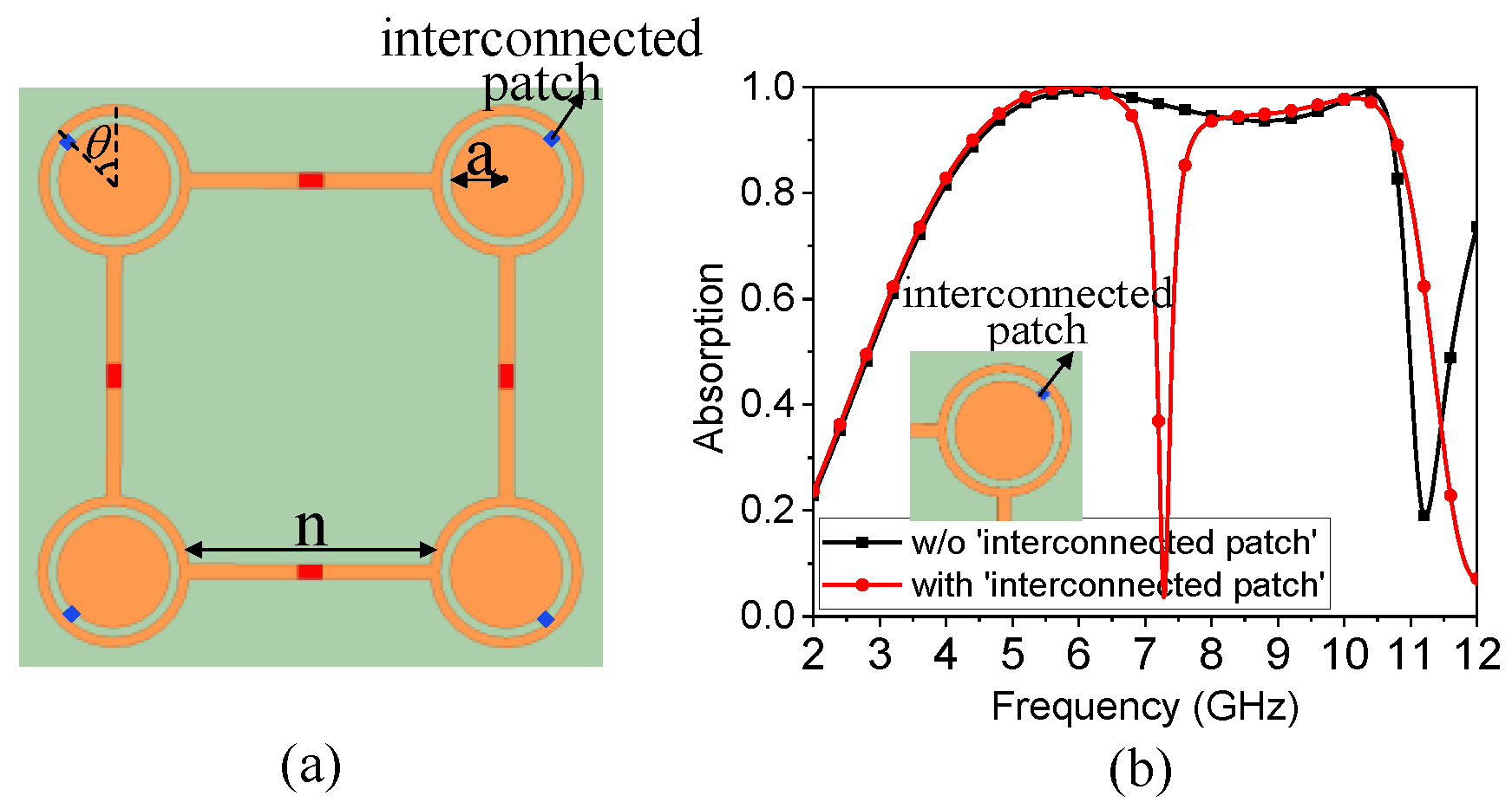
Figure 4 presents the frequency responses of the designed lossy layer with and without interconnected patches. As shown in Figure 4, the introduction of interconnected patches between the circular patch and the square-ring resonator generates a notch band within the absorption band.
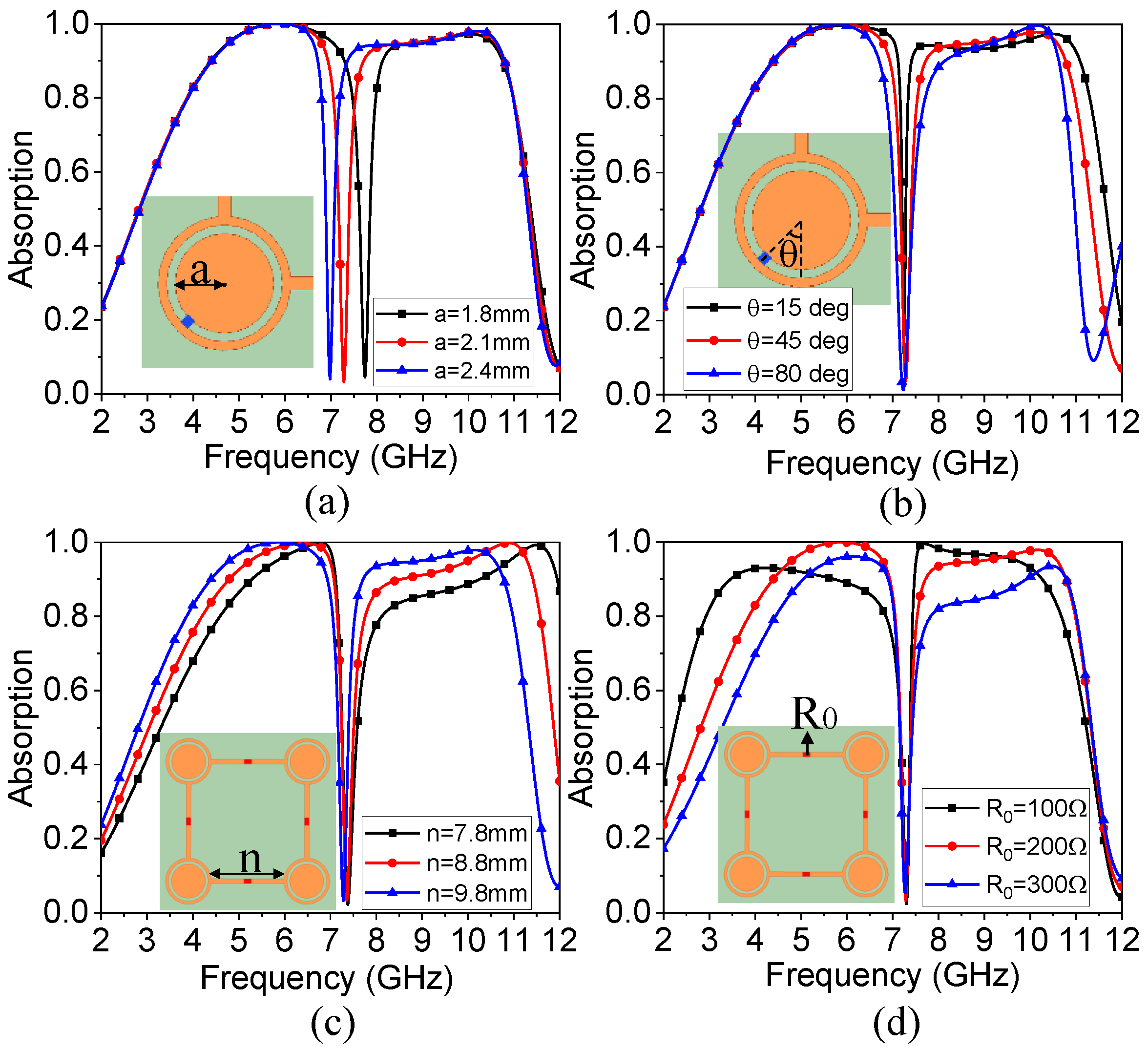
To further analyze the operating mechanism of the lossy layer, Figure 5 depicts the absorption characteristics under different values of the key parameters ‘a’, ‘θ’, ‘n’, and ‘R0’. As shown in Figure 5a,b, the center frequency and bandwidth of the notch band can be independently controlled by tuning the parameters ‘a’ and ‘θ’, respectively. Increasing the radius of the circular patch (‘a’) enhances the effective capacitance introduced by the patch, thereby shifting the notch center frequency toward lower frequencies. In contrast, increasing the angular span of the interconnected patches (‘θ’) effectively modifies the inductance of the coupling path, while a larger ‘θ’ strengthens the inductive coupling and leads to a wider notch bandwidth. As observed in Figure 5c, varying the length of the square ring (‘n’) is equivalent to adjusting the associated inductance. With increasing ‘n’, the effective inductance increases, thereby shifting both the lower- and upper-band absorption responses toward lower frequencies. Furthermore, as shown in Figure 5d, tuning the resistance parameter ‘ R 0 ’ significantly affects the absorption performance in both the lower and upper frequency bands, which is in good agreement with the theoretical analysis based on (5). These results confirm that the proposed lossy layer design enables flexible and independent control of the notch characteristics and broadband absorption behavior through well-defined physical mechanisms.
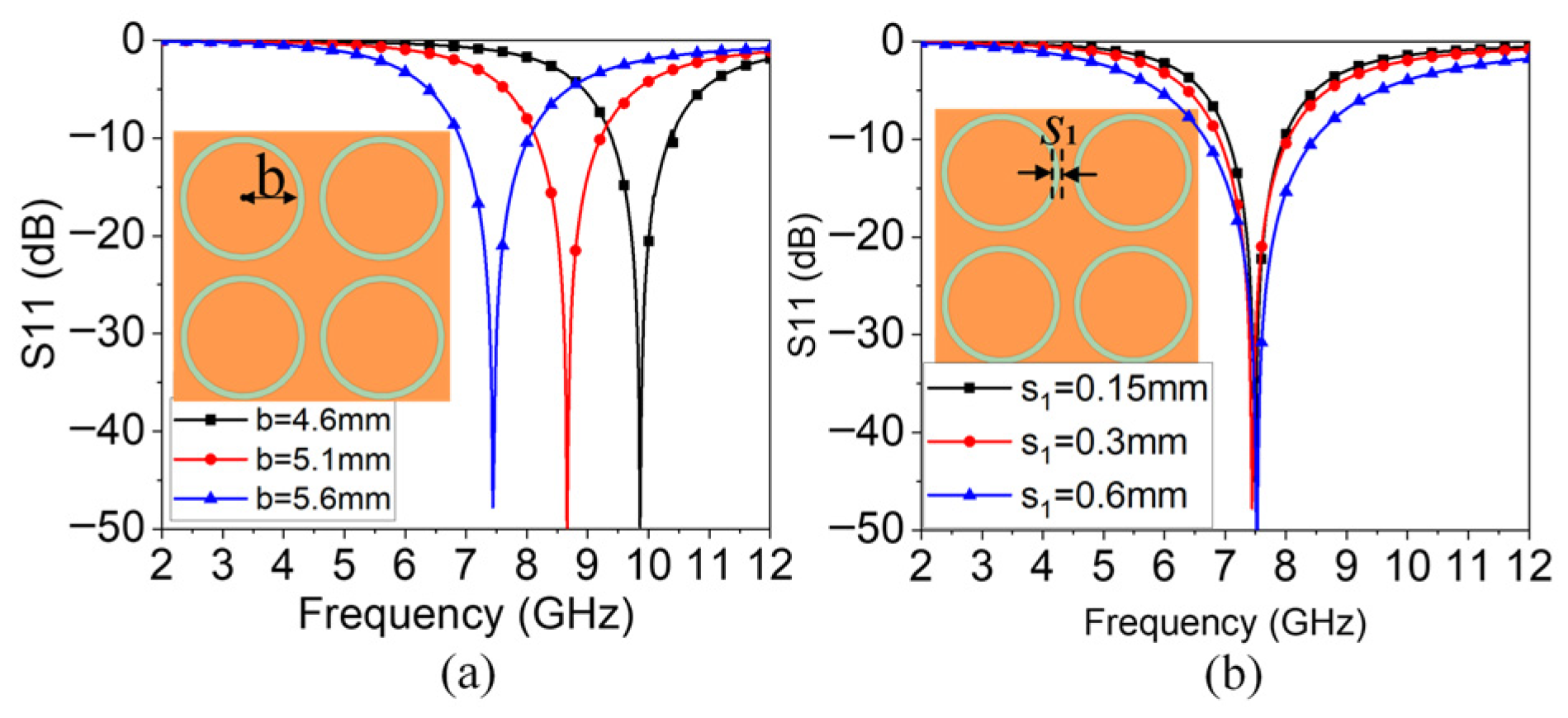
The frequency responses of the presented FSS layer with different values of ‘b’ and ‘ s 1 ’ are plotted in Figure 6. Accordingly, the resonance frequency shifts to a higher frequency with a smaller value of ‘b’, while the bandwidth is effectively broadened with a larger value of ‘ s 1 ’. Thus, the resonance frequency and the bandwidth of the FSS layer can be controlled independently by tuning ‘b’ and ‘ s 1 ’, respectively.
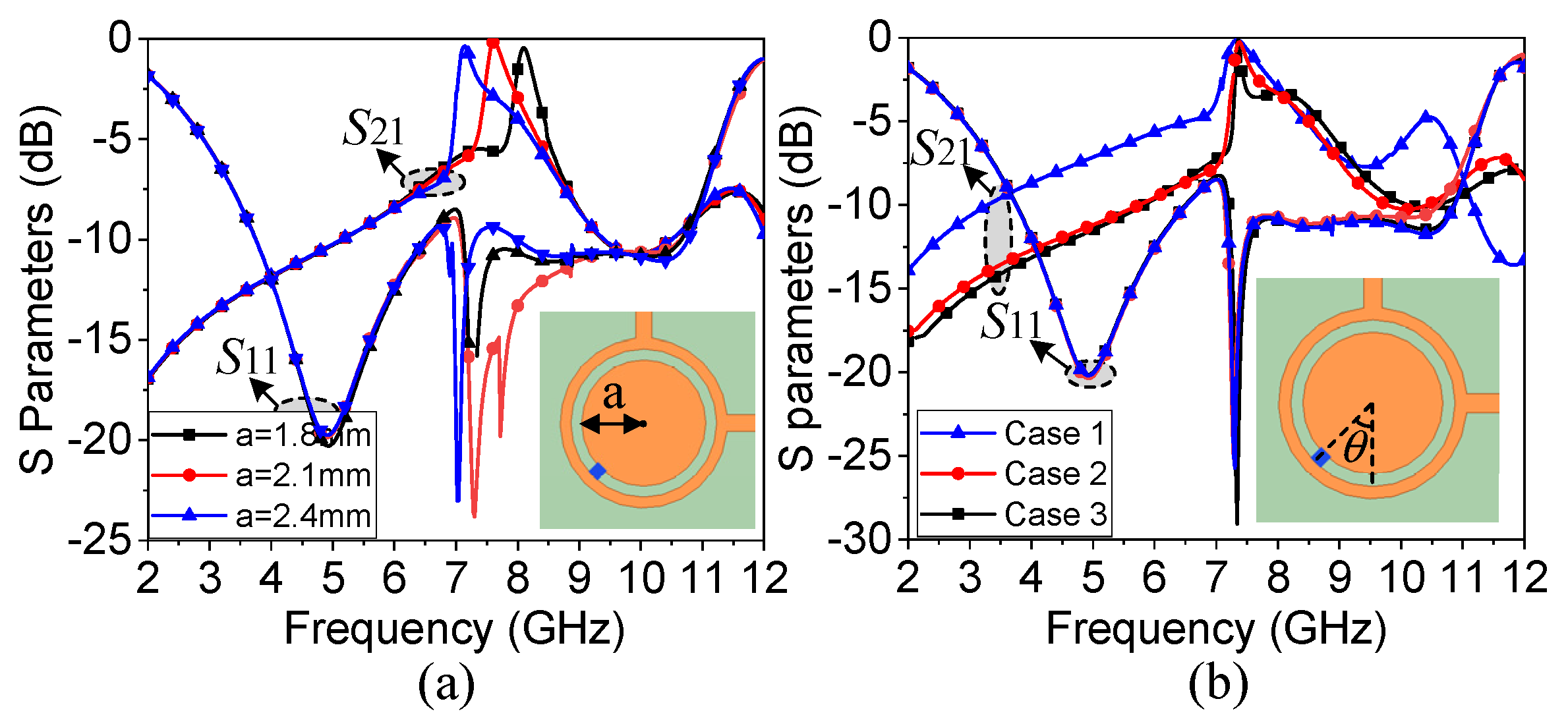
The absorption and transmission characteristics of the designed dual absorption FSA with various key parameters are shown in Figure 7. As illustrated in Figure 7a, by adjusting the value of ‘a’, the transmission center frequency with fixed passband bandwidth shifts to 7.14 GHz, 7.62 GHz and 8.10 GHz. This behavior is attributed to strong electromagnetic coupling between the circular patch in the lossy layer (governed by ‘a’) and the FSS layer. The circular patch primarily introduces a capacitive effect: larger ‘a’ increases the effective capacitance, lowering the resonant frequency, whereas smaller ‘a’ reduces the capacitance, raising the resonant frequency. In contrast, the transmission bandwidth is predominantly tuned by varying the parameter ‘θ’, producing fractional bandwidths of 2.6%, 9.7%, and 12.4%, as summarized in Figure 7b and Table 2, indicating that ‘θ’ serves as the dominant factor for passband bandwidth control. Minor adjustments of secondary parameters (e.g., ‘s1’, ‘b’, and ‘n’) can further refine the overall performance within the bandwidth range defined by ‘θ’. Moreover, interconnected patches are introduced to generate a controllable notch in the absorption spectrum. By tuning ‘θ’, these patches provide a variable inductive coupling path, directly regulating the notch width corresponding to the transmission passband. Specifically, a larger ‘θ’ strengthens the inductive coupling, resulting in a wider passband bandwidth.

3. Design Procedure of the Dual Absorption FSA

Based on the above comprehensive analysis, the design procedure of the proposed dual absorption FSA is summarized below:
(1) 
Determine the required parameters: Determine the required absorptivity, absorption bands ( f a 1 , f a 2 ), transmission coefficients ( S 21 ) and passband ( f t 1 , f t 2 ). These parameters will serve as the fundamental criteria for evaluating the performance of the designed dual absorption FSA.
(2) 
Construct and optimize the lossy layer: Construct the lossy layer based on Figure 2. Optimize the absorption characteristics both in the lower and upper bands by tuning the resistors ( R 0 ). Adjust the transmission center frequency by tuning the radius of the circular patch (‘a’), and optimize the transmission bandwidth by changing the angle of the ‘connected patch’ (‘θ’).
(3) 
Construct and optimize the FSS layer: Construct the FSS layer by using the circular ring resonator. Adjust the center frequency of transmission characteristic by tuning the parameter ‘b’, and tune the bandwidth of transmission characteristic by changing the parameter ‘ s 1 ’.
(4) 
Construct the dual absorption FSA: Construct the dual absorption FSA by placing the optimized lossy layer on the FSS layer. Adjust the transmission center frequency of the designed FSA by varying ‘a’ and ‘b’, which allows more flexible control of the center frequency. The transmission bandwidth can be mainly influenced by adjusting ‘θ’ and ‘ s 1 ’, thus optimizing the overall transmission bandwidth.
(5) 
Iterate and optimize: Return to step (2) until the designed dual absorption FSA meets the requirements specified in step (1), ensuring the final design fulfills all the desired performance criteria.

4. Simulation and Measurement

4.1. Prototype Fabrication and Experimental Setup

To validate the proposed concept, a prototype of the dual-band absorption frequency selective reflector (FSA) was fabricated on a Taconic TLX-8 substrate with a thickness of 10 mils and a dielectric constant of 2.55, providing stable dielectric properties in the microwave frequency range. The copper layer, with a thickness of approximately 0.035 mm, is significantly greater than the skin depth across the operating band, effectively minimizing ohmic losses. To assess the angular stability of the dual-band absorption FSA, both simulated and measured S-parameters and absorption characteristics were analyzed under varying angles of incidence.
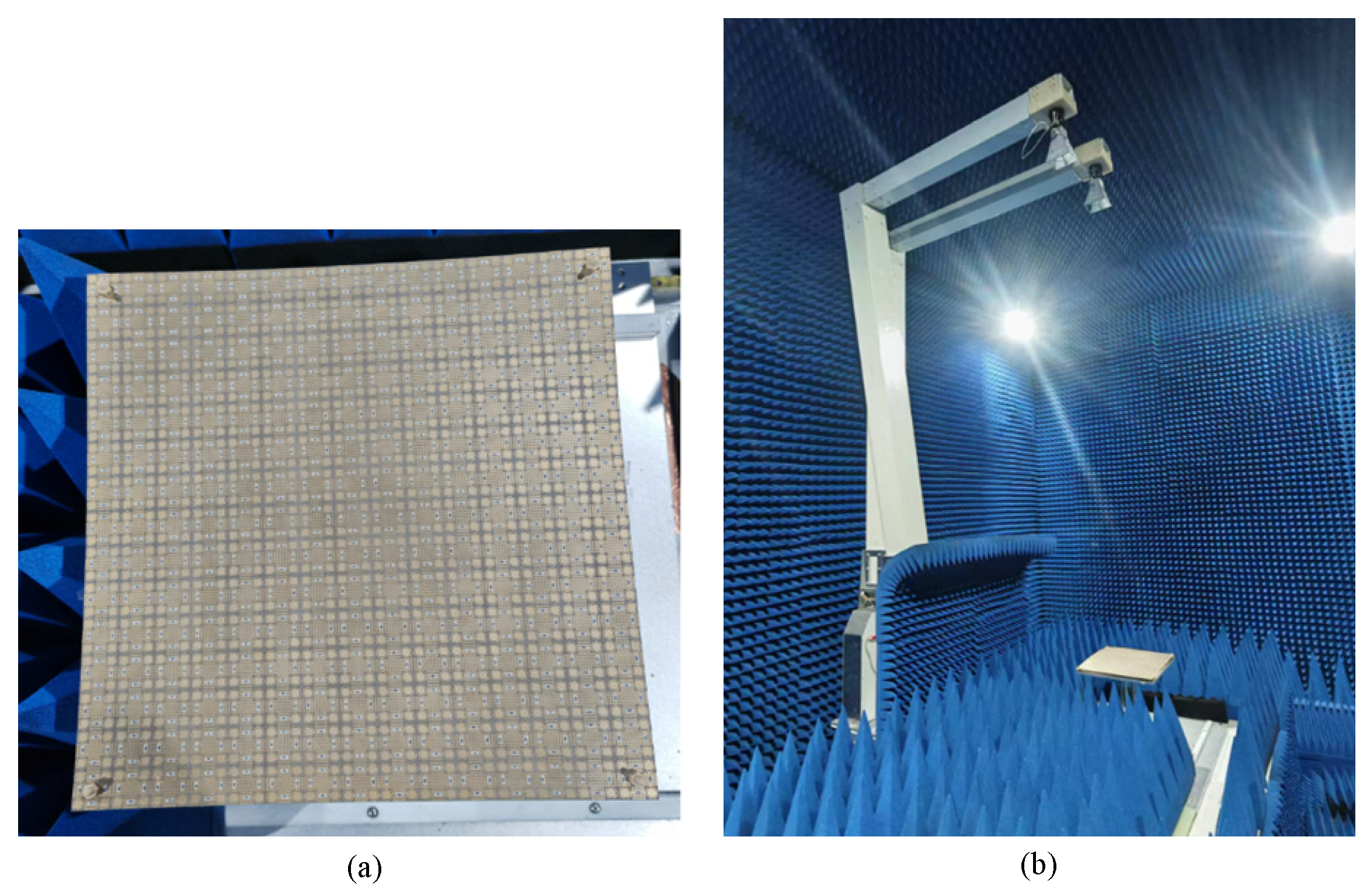
Electromagnetic characterization was measured in a microwave anechoic chamber with dimensions of 5.8   m × 3.5   m × 4.0   m   ( l e n g t h × w i d t h × h e i g h t ) , supporting an operating frequency range of 1–40 GHz. An arch-based measurement setup was employed to evaluate the reflectivity and transmissivity of the fabricated structure. A pair of dual-polarized Vivaldi antennas (1–40 GHz) was used as the transmitting and receiving antennas. An arch-based measurement configuration was employed, and photographs of the fabricated dual-band FSA and the corresponding measurement configuration are provided in Figure 8.

4.2. The Simulated and Measured Results

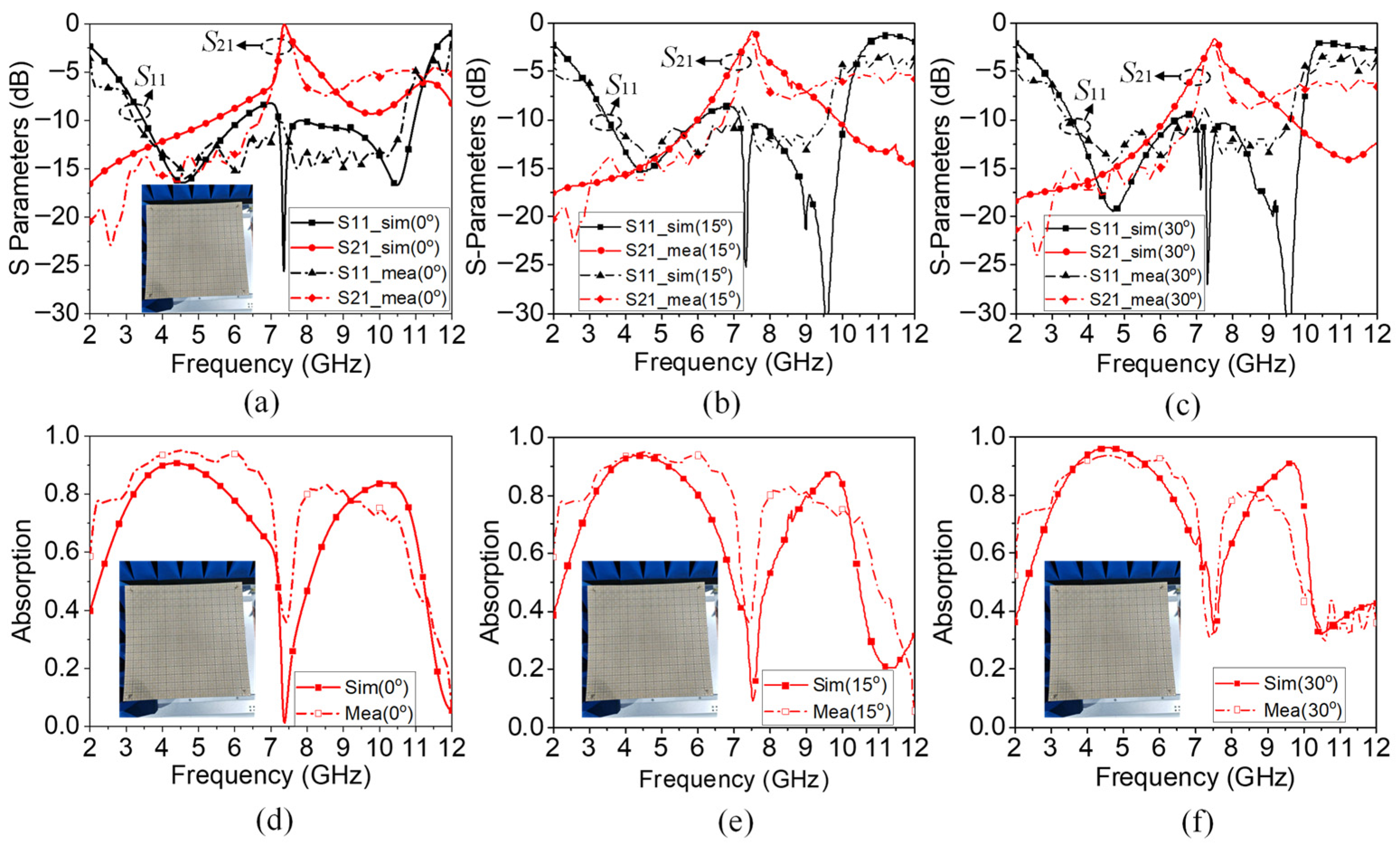
The measured transmission characteristics under different incidence angles are presented in Figure 9a,c,e. Under normal incidence (0°), the transmission coefficient exceeds −3 dB over 7.05–7.85 GHz. At 15° incidence, the −3 dB transmission bandwidth slightly narrows to 7.15–7.75 GHz, and at 30° incidence, it further decreases to 7.15–7.70 GHz, indicating that the transmission band is largely preserved up to 30° with only minor degradation.
The measured absorption characteristics are shown in Figure 9b,d,f. Under normal incidence, absorption exceeds 80% over 2.95–7.00 GHz and remains above 72% over 7.80–10.20 GHz. At 15° incidence, the lower band maintains absorption above 80% over 3.00–7.00 GHz, and the upper band stays above 72% over 7.75–10.15 GHz. When the incidence angle increases to 30°, the lower band preserves absorption above 80% over 3.05–6.95 GHz, while the upper band maintains absorption above 72% over 7.75–9.50 GHz. Only minor bandwidth reductions are observed, and both the dual-band absorption response and band separation remain well preserved.
The discrepancies observed between the simulated and measured results in Figure 8 can be attributed to several practical factors, including fabrication tolerances, uncertainties in substrate dielectric properties, lumped resistor tolerances and soldering parasitics, as well as non-idealities in the free-space measurement setup. In addition, finite sample size and edge diffraction effects, which are not considered in the infinite periodic simulations, may also contribute to small deviations in resonance frequency and absorption level. Overall, the agreement remains good, confirming the robustness of the proposed design and the validity of the simulation model.
The performance comparisons between the designed dual absorption FSA and other similar works are exhibited in Table 3. Accordingly, the proposed FSA adopts a simple two-dimensional planar configuration, which facilitates fabrication and system integration compared with reported 2.5-D and 3-D implementations. Moreover, this work establishes a generalized and systematic design framework with clearly defined procedures. Independent control of the center frequency and bandwidth is realized through two geometrically intuitive parameters, namely the radius of the circular patch (‘a’) and the angle of the interconnected patch (‘θ’). In contrast to approaches relying on complex tuning elements, such as interdigitated capacitors and meandered metal lines, the proposed method provides a more intuitive and generalized strategy for dual-band absorption FSA design.

5. Conclusions

In this paper, a dual absorption FSA with controllable transmission frequency and bandwidth is proposed based on the novel lossy layer and FSS layer. The lossy layer consists of a square-ring resonator loaded with resistors, four circular patches, four circular rings and four interconnected patches, while the notch band is introduced into the absorption by employing the ‘interconnected patch’. Furthermore, the center frequency and passband bandwidth of the notch band can be controlled independently by adjusting the radius and angle of the ‘interconnected patch’. Then, the generalized approach for the dual absorption FSA has been summarized. To validate the proposed structure and generalized approach, a prototype has been fabricated and measured. The measurements show good agreement with simulations, confirming a −3 dB transmission bandwidth of 10.74%, and absorption bandwidths of 81.41% and 26.67% in the lower and upper bands, respectively.
The generalized design methodology for dual-band FSA has been proposed in this work. Owing to its independent and flexible tuning capability, the proposed design is well suited for reconfigurable and multiband absorbing structures. In particular, the proposed structure can be applied to radomes for low-observable platforms to simultaneously achieve in-band signal transmission and out-of-band radar wave absorption. It is also suitable for electromagnetic shielding in communication systems, where frequency selective transparency and out-of-band interference suppression are required.

Author Contributions

Conceptualization, H.T. and Y.Z.; methodology, G.D.; software, H.T.; validation, C.Z., Y.C. and G.D.; formal analysis, H.T.; investigation, Y.Z.; resources, Y.Z.; data curation, C.Z.; writing—original draft preparation, H.T.; writing—review and editing, G.D.; visualization, C.Z.; supervision, Y.C.; project administration, H.T.; funding acquisition, H.T. and G.D. All authors have read and agreed to the published version of the manuscript.

Funding

This work was supported in part by the National Natural Science Foundation of China under Grant 62501045, in part by Beijing Natural Science Foundation under Grant 4252007 and Jingxiong Cloud Control (Beijing) 2024 10th Batch Special Procurement Project for Digital Transportation Construction under Grant 20250013.

Data Availability Statement

The original contributions presented in this study are included in the article. Further inquiries can be directed to the corresponding author.

Conflicts of Interest

Authors Yue Zhang; Cong Zhang; Yao Chen are employed by Hebei Provincial Communications Planning, Design and Research Institute Co., Ltd. The remaining authors declare that the research was conducted in the absence of any commercial or financial relationships that could be construed as potential conflicts of interest.

References

  1. Lin, B.; Huang, W.; Guo, J.; Wang, Z.; Si, K.; Ye, H. An absorptive coding metasurface for ultra-wideband radar cross-section reduction. Sci. Rep. 2024, 14, 12397. [Google Scholar] [CrossRef] [PubMed]
  2. Celenk, E.; Lynch, C.; Tentzeris, M.M. An Ultrawideband All-Textile Metamaterial Absorber for Ku-, K-, and Ka-Band Applications. IEEE Antennas Wirel. Propag. Lett. 2024, 23, 1789–1793. [Google Scholar] [CrossRef]
  3. Liu, S.; Deng, L.; Qu, M. Polarization-Independent Tunable Ultra-Wideband Meta-Absorber in Terahertz Regime. Electronics 2019, 8, 831. [Google Scholar] [CrossRef]
  4. Fan, Y.; Li, D.; Ma, H.; Xing, J.; Gu, Y.; Ang, L.K.; Li, E.-P. Ultrawideband Dual-Polarized Frequency-Selective Absorber with Tunable Reflective Notch. IEEE Trans. Antennas Propag. 2023, 71, 2855–2860. [Google Scholar] [CrossRef]
  5. Qu, M.; Feng, Y.; Su, J.; Shah, S.M.A. Design of a Single-Layer Frequency Selective Surface for 5G Shielding. IEEE Microw. Wirel. Compon. Lett. 2021, 31, 249–252. [Google Scholar] [CrossRef]
  6. Li, Y.; Ma, Y.; Ren, P.; Xu, B.; Xu, R.; Xiang, Z. Design of Angle-Selective Surface with Narrow-Angle Filtering for Variable Frequency. IEEE Antennas Wirel. Propag. Lett. 2025, 24, 1487–1491. [Google Scholar] [CrossRef]
  7. Xiao, T.; Liao, Q.; Tang, G.; Huang, L. A Novel Frequency-Selective Polarization Converter and Application in RCS Reduction. Electronics 2025, 14, 1280. [Google Scholar] [CrossRef]
  8. Zhao, P.C.; Zong, Z.Y.; Wu, W.; Li, B.; Fang, D.G. Miniaturized-Element Bandpass FSS by Loading Capacitive Structures. IEEE Trans. Antennas Propag. 2019, 67, 3539–3544. [Google Scholar] [CrossRef]
  9. Gan, C.; Xu, Y.; Wang, J.; Zhang, Q.; Wang, C.; Liu, Y. A Miniaturized Frequency Selective Rasorber with Wideband Transmission Properties. In Proceedings of the 2023 IEEE 11th Asia-Pacific Conference on Antennas and Propagation (APCAP), Guangzhou, China, 22–24 November 2023. [Google Scholar]
  10. Jiang, B.; Hu, H.; Tian, J.; Lin, Z.; Tang, P. Design of High-Selective FSA with a Single Layered FSS. In Proceedings of the 2020 IEEE International Symposium on Antennas and Propagation and North American Radio Science Meeting, Montreal, QC, Canada, 5–10 July 2020. [Google Scholar]
  11. Nigam, A.K.; Sharma, A.; Bhattacharya, S.; Ghosh, S.; Srivastava, K.V. Rasorber with Wide Absorption Band Before Transmission Band (A-T Type FSA). In Proceedings of the 2022 IEEE Microwaves, Antennas, and Propagation Conference (MAPCON), Bangalore, India, 12–16 December 2022; pp. 357–362. [Google Scholar]
  12. Song, H.; Zhang, Y.; Zhang, S.; Li, J.; Ai, X.; Zhang, H.; Liu, J. An Ultra-Wideband Frequency Selective Rasorber with Low Infrared Emissivity. Materials 2024, 17, 3414. [Google Scholar] [CrossRef] [PubMed]
  13. Yu, S.; Kou, N.; Ding, Z.; Zhang, Z. Harmonic-Suppressed Frequency Selective Rasorber Using Resistive-Film Sheet and Square-Loops Resonator. IEEE Antennas Wirel. Propag. Lett. 2020, 19, 292–296. [Google Scholar] [CrossRef]
  14. Xia, J.; Wei, J.; Liu, Y.; Zhang, Y.; Guo, S.; Li, C.; Bie, S.; Jiang, J. Design of a Wideband Absorption Frequency Selective Rasorber Based on Double Lossy Layers. IEEE Trans. Antennas Propag. 2020, 68, 5718–5723. [Google Scholar] [CrossRef]
  15. Guo, M.; Sang, D.; Yuan, F.; Guo, T.; Zheng, Y.; Chen, Q.; Fu, Y. Broadband Absorptive Frequency-Selective Rasorber Based on Multilayer Resistive Sheets Using Multilayer Resonator. IEEE Trans. Antennas Propag. 2022, 70, 2009–2022. [Google Scholar] [CrossRef]
  16. Yang, Z.; Jiang, W.; Huang, Q.; Hong, T. A 2.5-D Miniaturized Frequency-Selective Rasorber with a Wide High-Transmission Passband. IEEE Antennas Wirel. Propag. Lett. 2021, 20, 1140–1144. [Google Scholar] [CrossRef]
  17. Xue, Y.; Zhai, H. A Compact Ultrawideband Frequency Selective Rasorber with Hybrid 2-D and 3-D Structure. IEEE Antennas Wirel. Propag. Lett. 2022, 21, 1872–1876. [Google Scholar] [CrossRef]
  18. Kong, X.; Wang, X.; Jin, X.; Lin, W.; Kong, L.; Jiang, S.; Xing, L. Liquid Based Wideband and Switchable 3-D Frequency-Selective Rasorber. IEEE Trans. Electromagn. Compat. 2023, 65, 88–95. [Google Scholar] [CrossRef]
  19. Shi, S.; Chai, Z.; Zhang, S.; Shi, Y.; Zhang, Y. A Switchable Frequency Selective Rasorber with a Broad Transmission Window at the X-Band. Electronics 2023, 12, 3941. [Google Scholar] [CrossRef]
  20. Shi, S.; Chai, Z.; Zhang, S.; Shi, Y.; Zhang, Y. A Tunable Frequency Selective Rasorber with Broad Passband and Low Transmission Loss at X-Band. Materials 2023, 16, 5787. [Google Scholar] [CrossRef] [PubMed]
  21. Sainadh, P.; Ghosh, S. A wideband reconfigurable frequency selective surface switching among transmission, absorption, reflection, and rasorber operations. In Proceedings of the 2024 4th URSI Atlantic Radio Science Meeting (AT-RASC), Meloneras, Spain, 19–24 May 2024; pp. 1–4. [Google Scholar]
  22. Xiao, B.; Wang, X.; Jiang, W.; Gao, M.; Zuo, X.; Xiao, L. A tunable graphene-VO2 metasurface for multiband absorption-reflection switching in 6 G communication. Int. J. Electron. 2026. Epub ahead of printing. [Google Scholar] [CrossRef]
  23. Yu, Q.; Liu, S.; Monorchio, A.; Kong, X.; Brizi, D.; Zhang, X.; Wang, L. Miniaturized Wide-Angle Rasorber With a Wide Interabsorption High Transparent Bandpass Based on Multiple 2.5-D Resonators. IEEE Antennas Wirel. Propag. Lett. 2022, 21, 416–420. [Google Scholar] [CrossRef]
Figure 1. The schematic of the designed dual absorption FSA ( R 0 = 200 Ω, θ = 45 ° ).
Electronics 15 00817 g001
Figure 2. The equivalent lumped circuit of the designed dual adsorption FSA.
Electronics 15 00817 g002
Figure 3. The S-parameters of the equivalent lumped circuit and the EM simulation. (a) The S-parameters of the equivalent lumped circuit and the EM simulation; (b) The absorption of the equivalent lumped circuit and the EM simulation.
Electronics 15 00817 g003
Figure 4. (a) The structure of designed lossy layer, (b) The absorption of designed lossy layer with and without (w/o) ‘interconnected patch’.
Electronics 15 00817 g004
Figure 5. (a) The absorptions of designed lossy layer (a) with different values of ‘a’, (b) with different values of ‘θ’, (c) with different values of ‘n’, and (d) with different values of ‘ R 0 ’.
Electronics 15 00817 g005
Figure 6. The frequency responses of presented FSS layer (a) with different values of ‘b’, (b) with different values of ‘ s 1 ’.
Electronics 15 00817 g006
Figure 7. (a) The transmission coefficients of designed dual absorption FSA with various values of ‘a’, (b) under different cases.
Electronics 15 00817 g007
Figure 8. The photographs of the fabricated dual-band FSA and the corresponding measurement environment. (a) The photographs of the fabricated dual-band FSA; (b) The photographs of the microwave anechoic chamber.
Electronics 15 00817 g008
Figure 9. Simulated and measured transmission and absorption characteristics of the proposed dual-band absorption FSA under different incidence angles. (a) The simulated and measured S-Parameters of the proposed dual-band absorption FSA at 0° Incidence; (b) The simulated and measured S-Parameters of the proposed dual-band absorption FSA at 15° Incidence; (c) The simulated and measured S-Parameters of the proposed dual-band absorption FSA at 30° Incidence; (d) The simulated and measured absorption characteristics of the proposed dual-band absorption FSA at 0° Incidence; (e) The simulated and measured absorption characteristics of the proposed dual-band absorption FSA at 15° Incidence; (f) The simulated and measured absorption characteristics of the proposed dual-band absorption FSA at 30° Incidence.
Electronics 15 00817 g009
Table 1. The detailed parameters of the designed dual absorption FSA (mm).
ParametersValueParametersValue
p24 s 1 0.3
n9.8 s 2 0.4
a2.3 t 1 0.25
b5.5 h 1 8.5
w 1 0.4 c n 5.5
w n 0.6
Table 2. The detailed parameters of designed FSA under different cases.
θ s 1 npa b
Case 1 80 ° 0.8 mm10.8 mm28 mm2.5 mm6.6 mm
Case 2 45 ° 0.3 mm9.8 mm24 mm2.3 mm5.5 mm
Case 3 15 ° 0.2 mm9.8 mm24 mm2.3 mm5.3 mm
Table 3. Performance comparisons between the designed dual absorption FSA with other similar works.
RefS.Passband
(−3 dB)
Lower
Absorption
Upper
Absorption
CCFCBGA
[14]2-D/96.00%104.00%NNN
[16]2.5-D56.20%59.79%10.81%NNN
[17]3-D12.89%100.00%18.50%NNN
[20]2-D/46.5%55.8%YNY
[23]2.5-D30.40%63.51%31.84%YYN
This work2-D10.74%81.41%26.67%YYY
S. represents structure, CCF represents the controllable center frequency, CB represents the controllable bandwidth, GA represents the generalized approach.
Disclaimer/Publisher’s Note: The statements, opinions and data contained in all publications are solely those of the individual author(s) and contributor(s) and not of MDPI and/or the editor(s). MDPI and/or the editor(s) disclaim responsibility for any injury to people or property resulting from any ideas, methods, instructions or products referred to in the content.