Research on a High-Frequency High-Voltage Plasma Power Supply Based on SPWM Modulation



Abstract
1. Introduction
2. High-Frequency High-Voltage Plasma Power Supply Design
2.1. System Architecture
- (1)
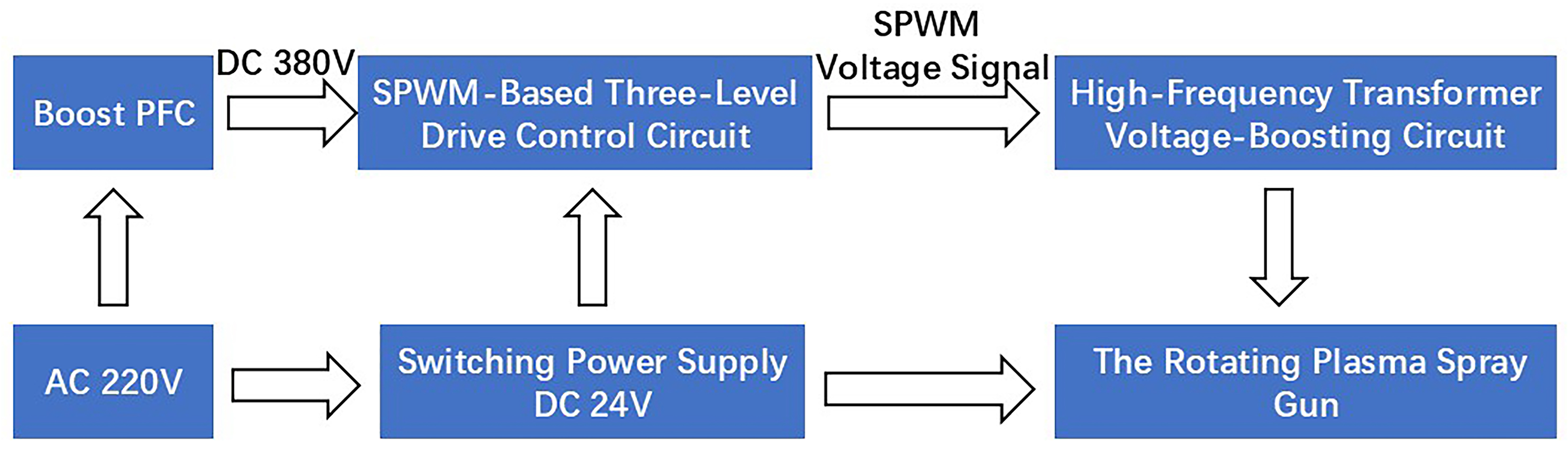
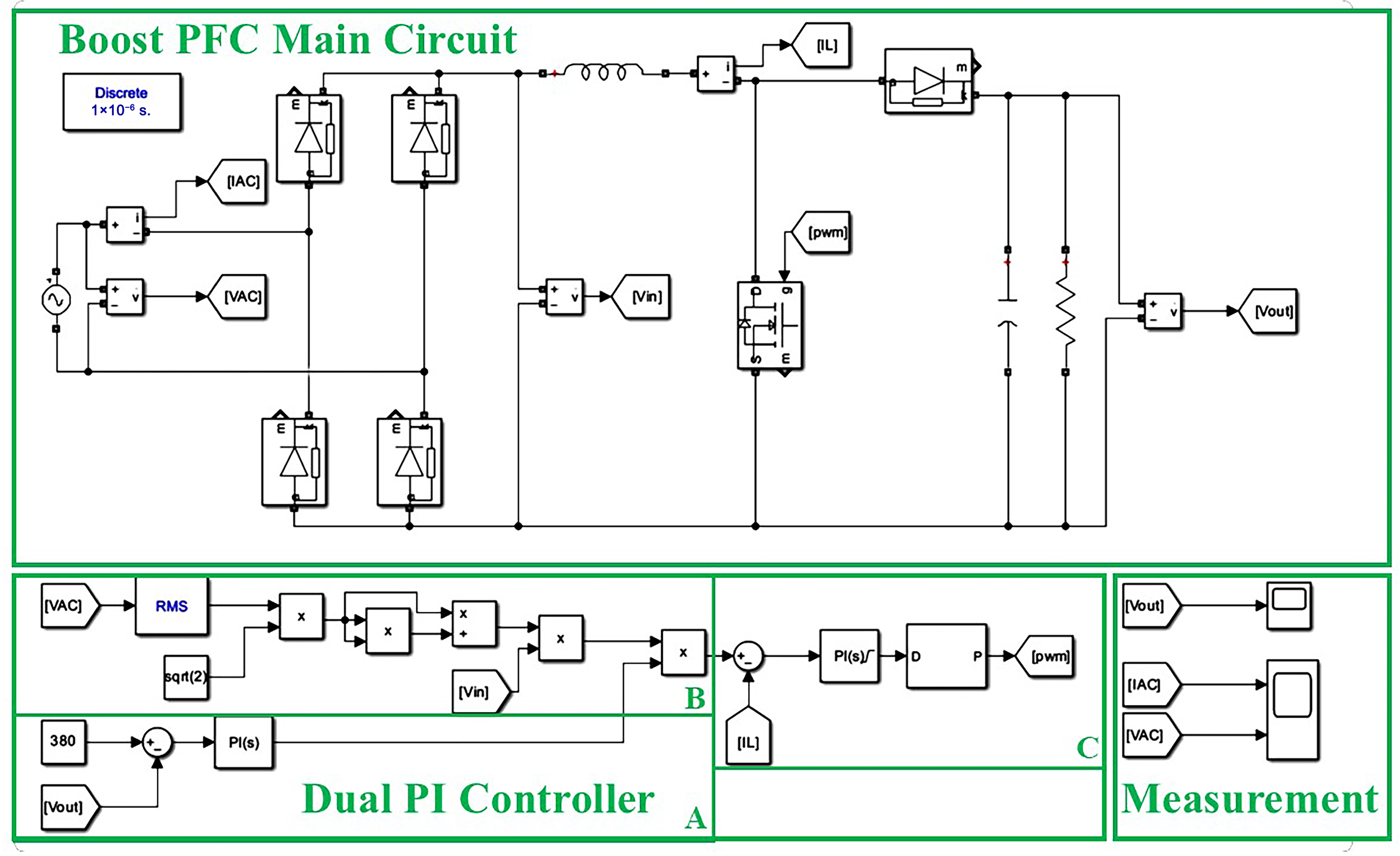
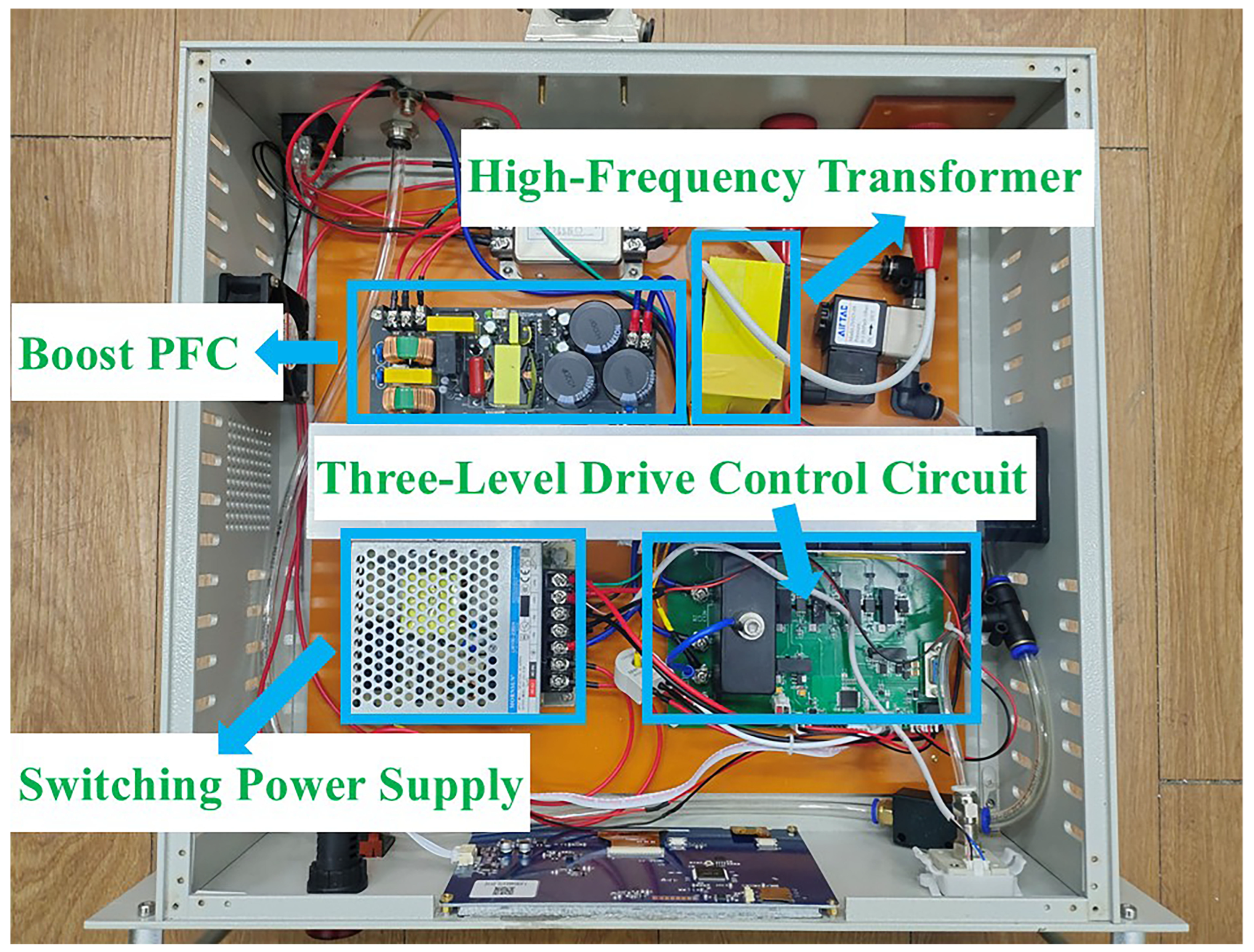
- Boost PFC circuit: This stage rectifies the 220 V AC mains voltage, boosts it, and delivers a stable 380 V DC output. This DC voltage serves as the input for the subsequent Type I three-level inverter circuit.
- (2)
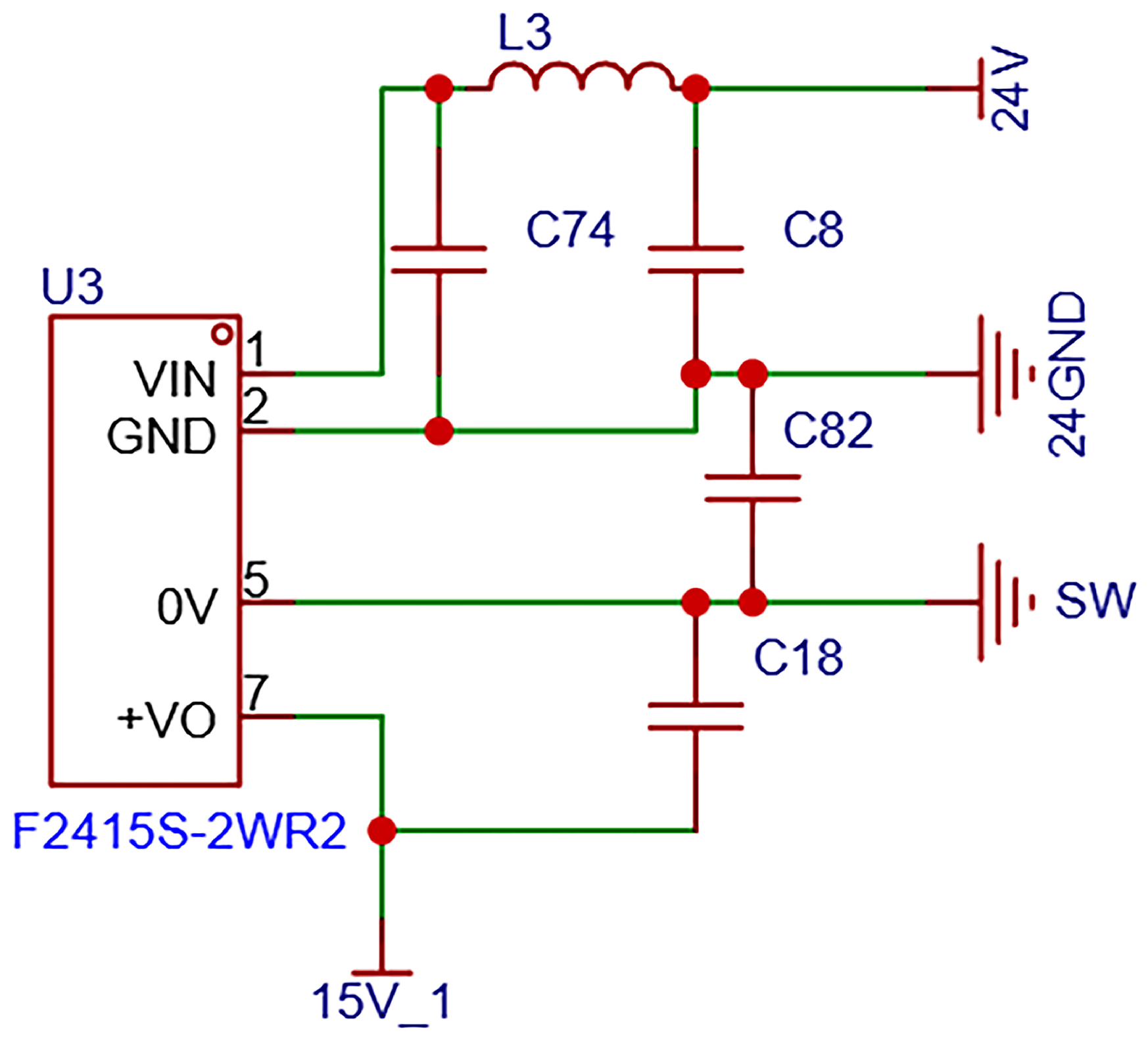
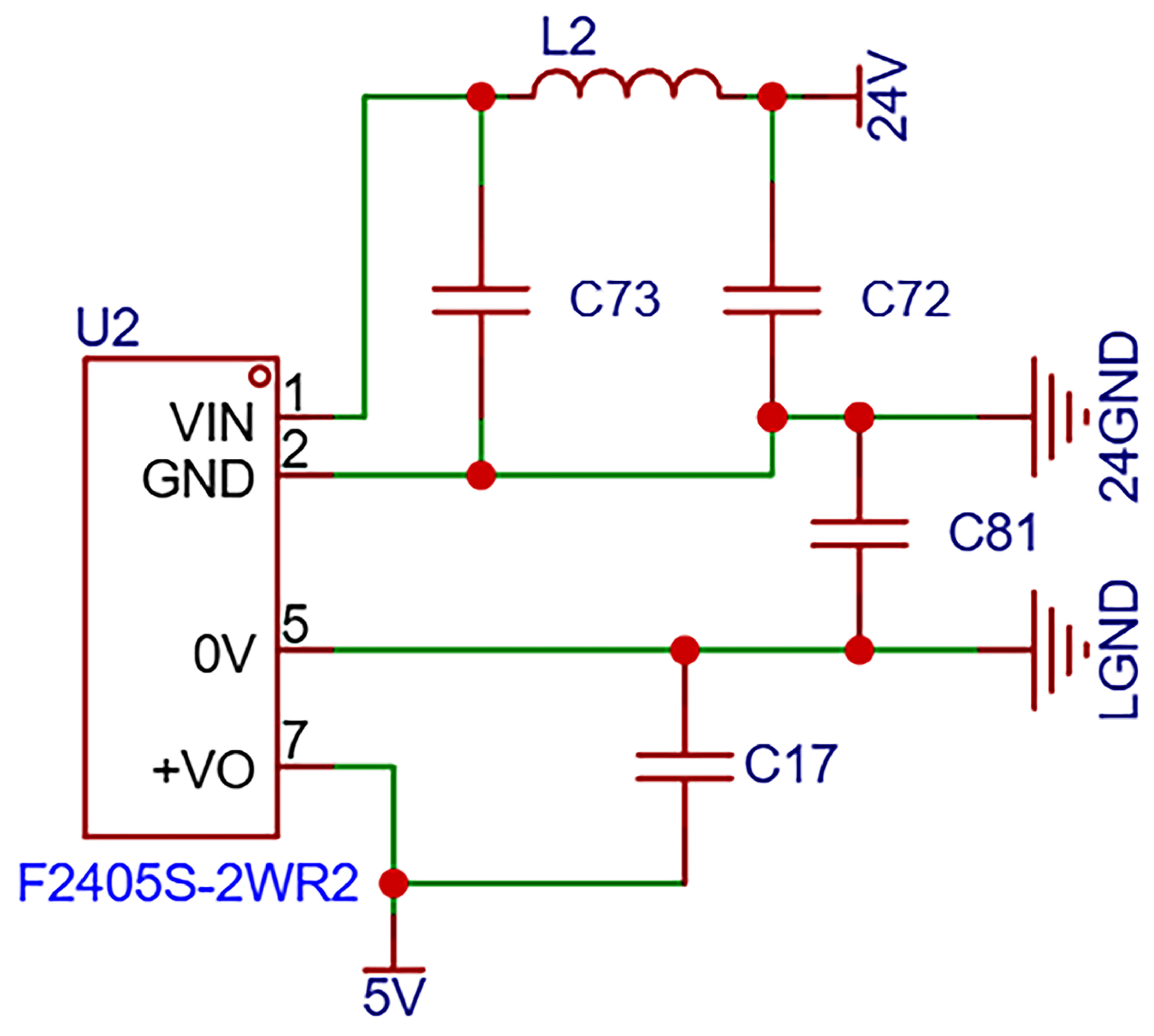
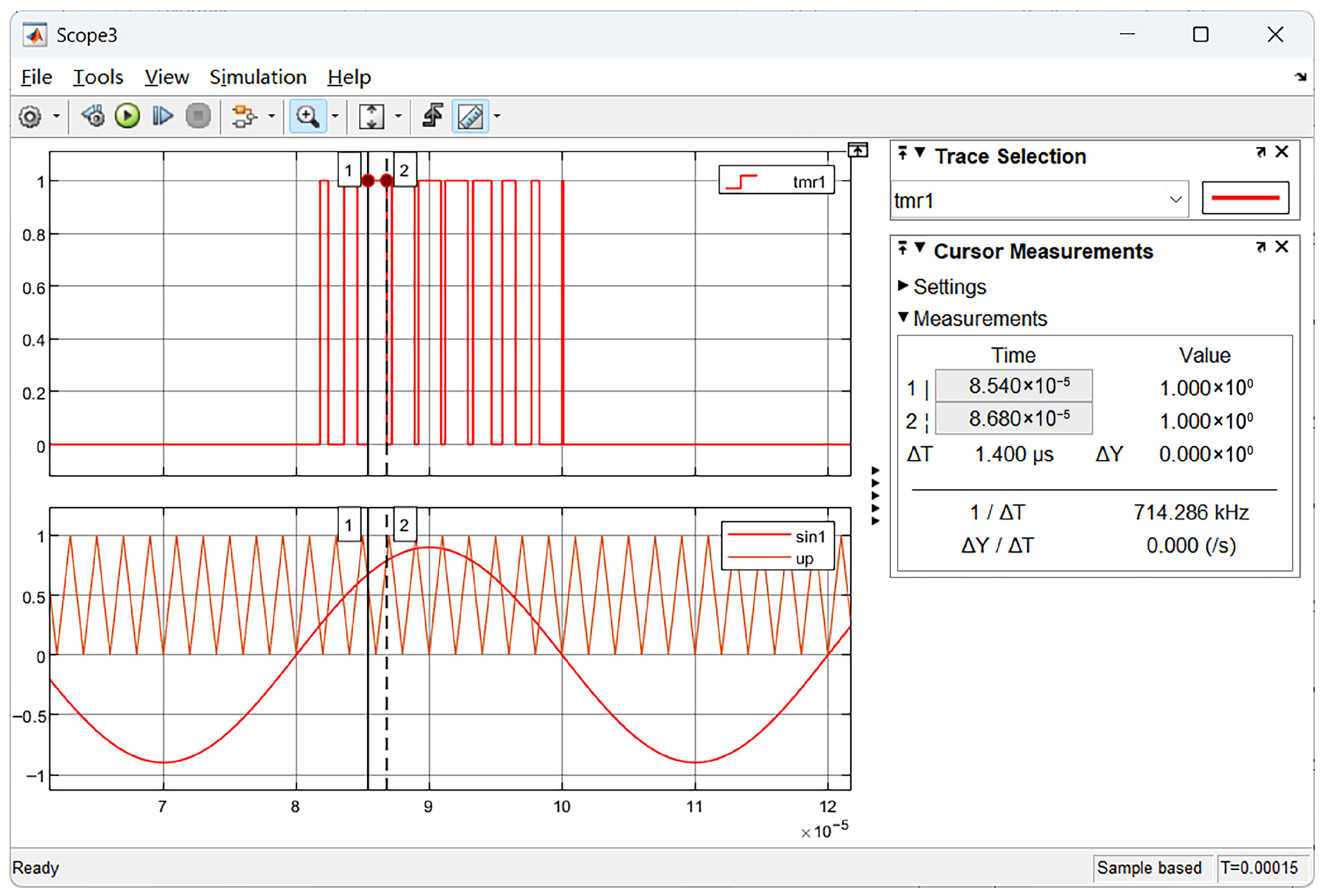
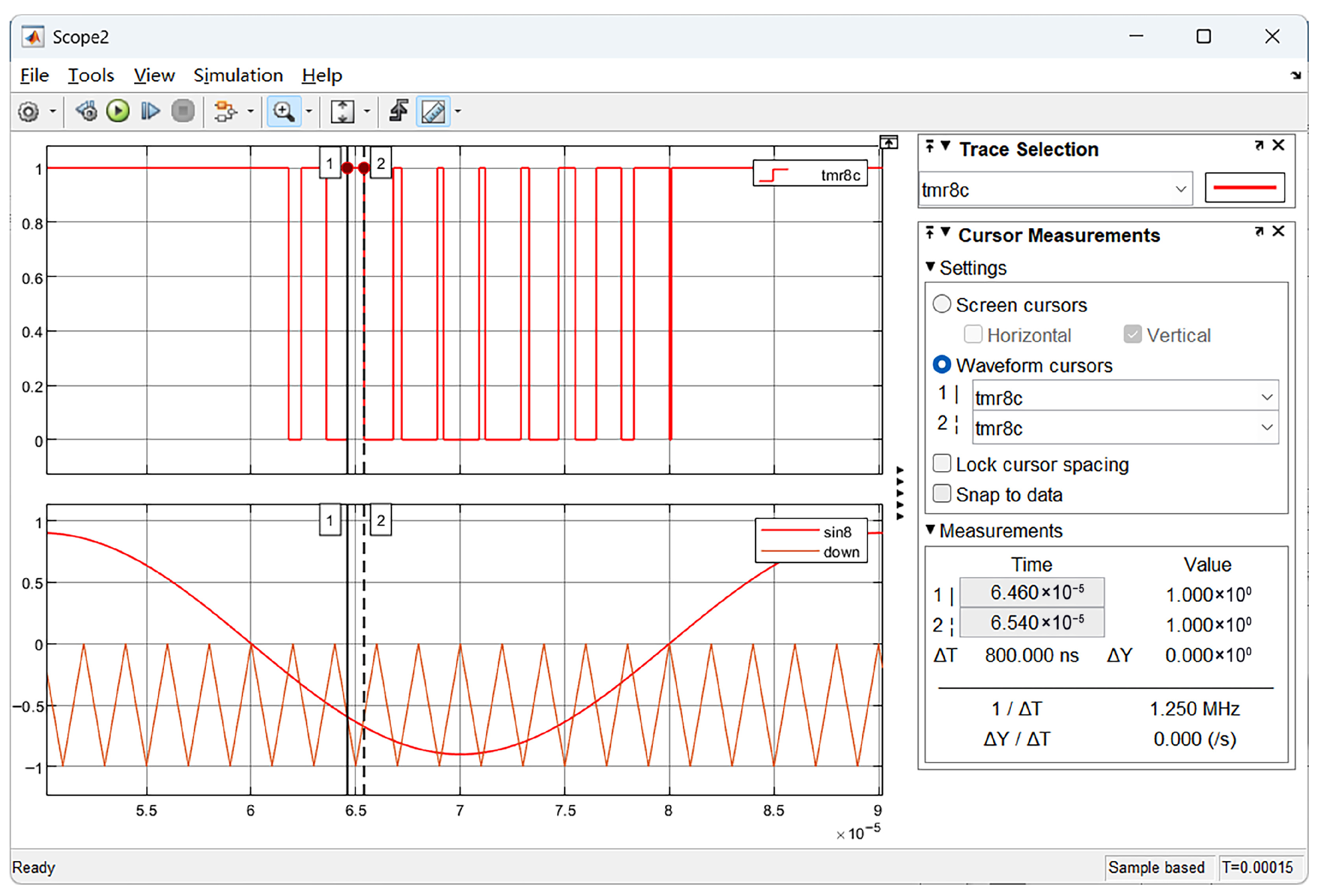
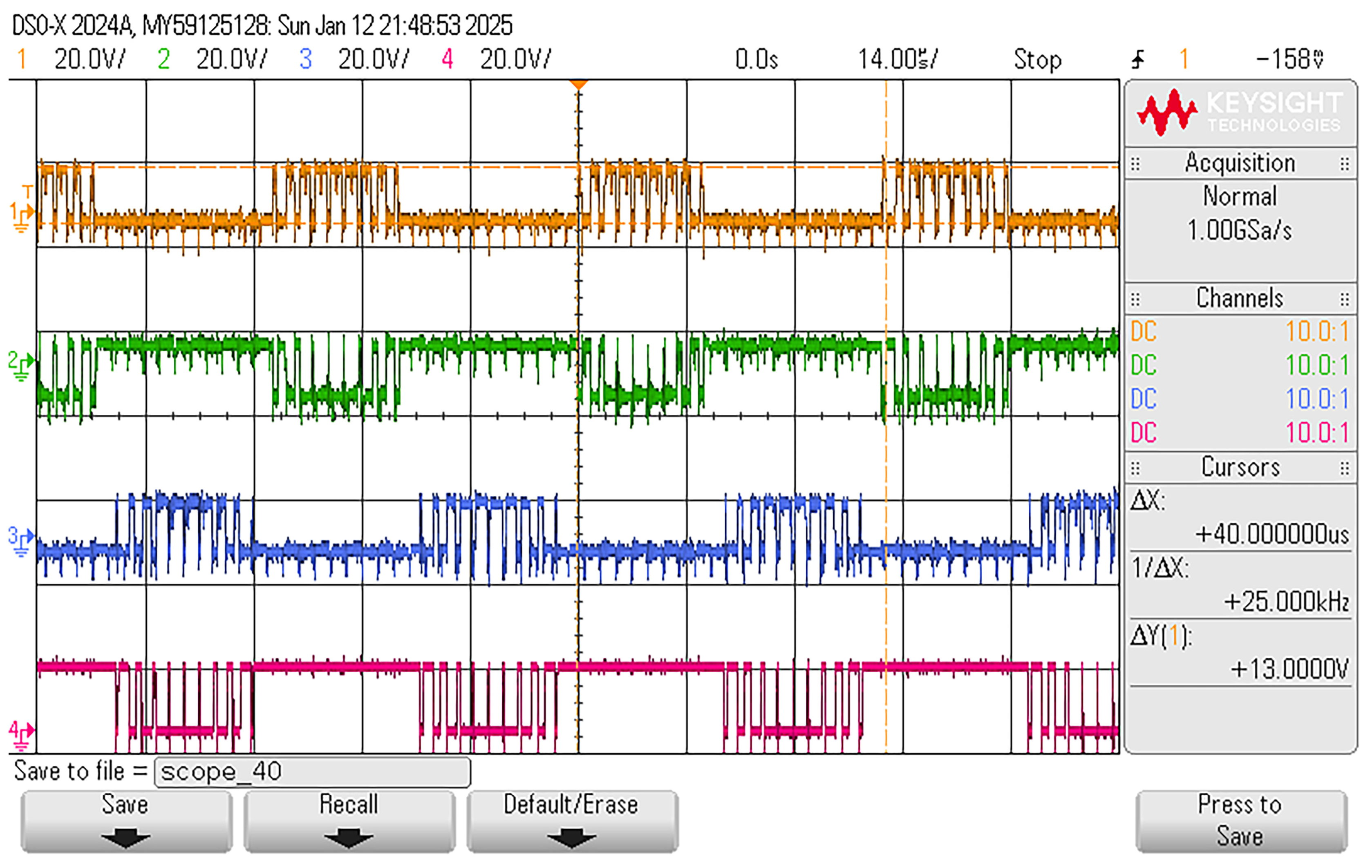
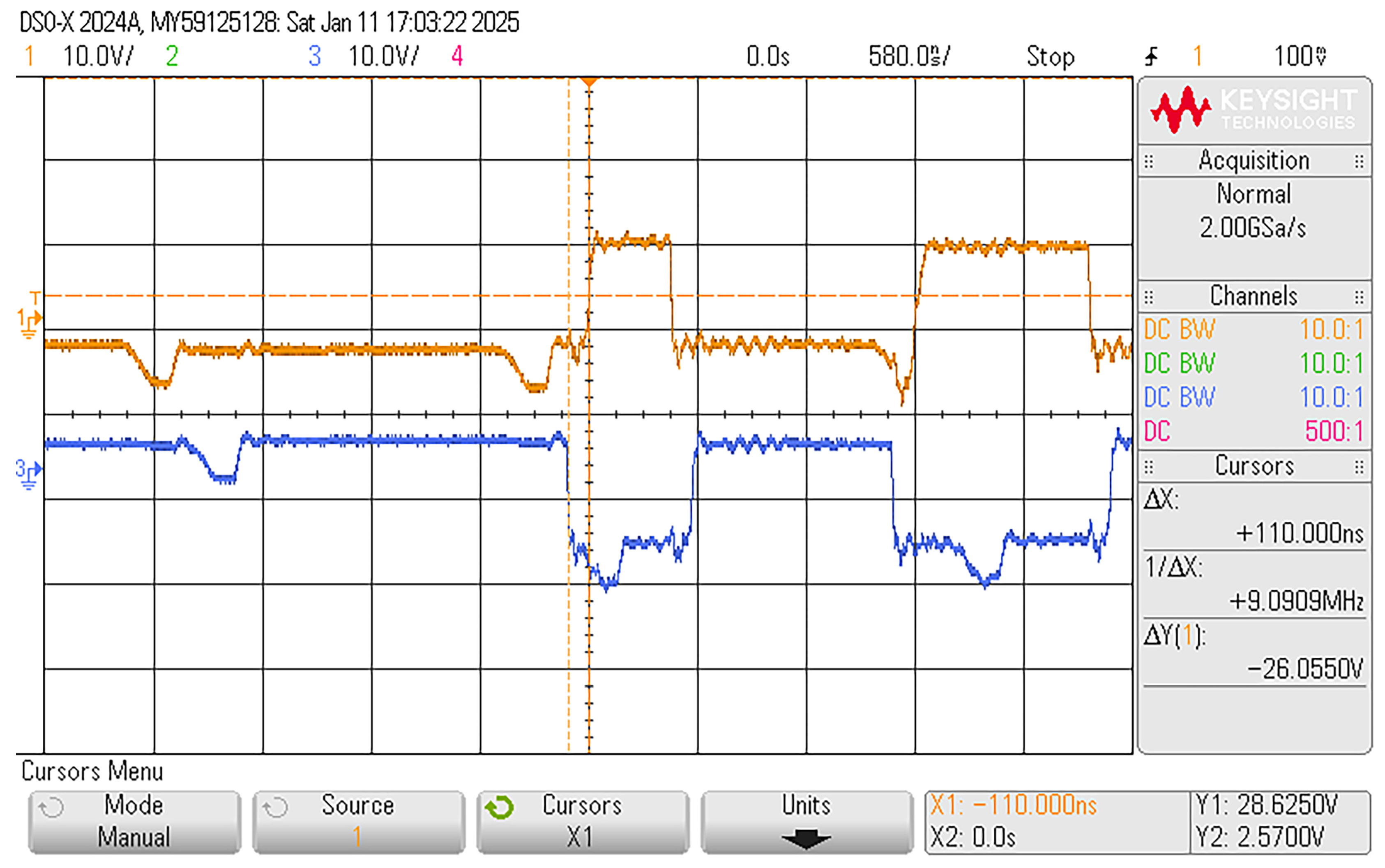
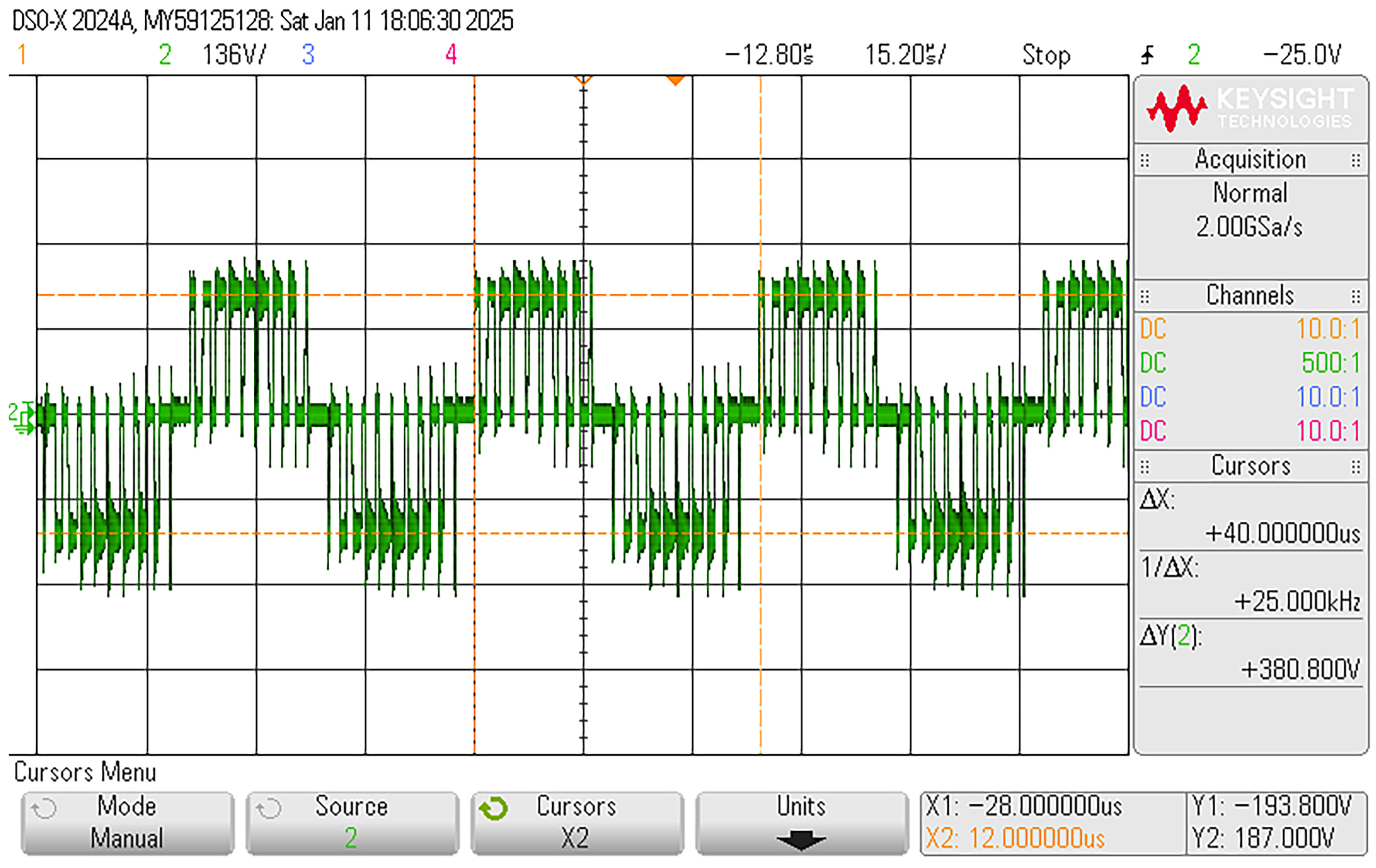
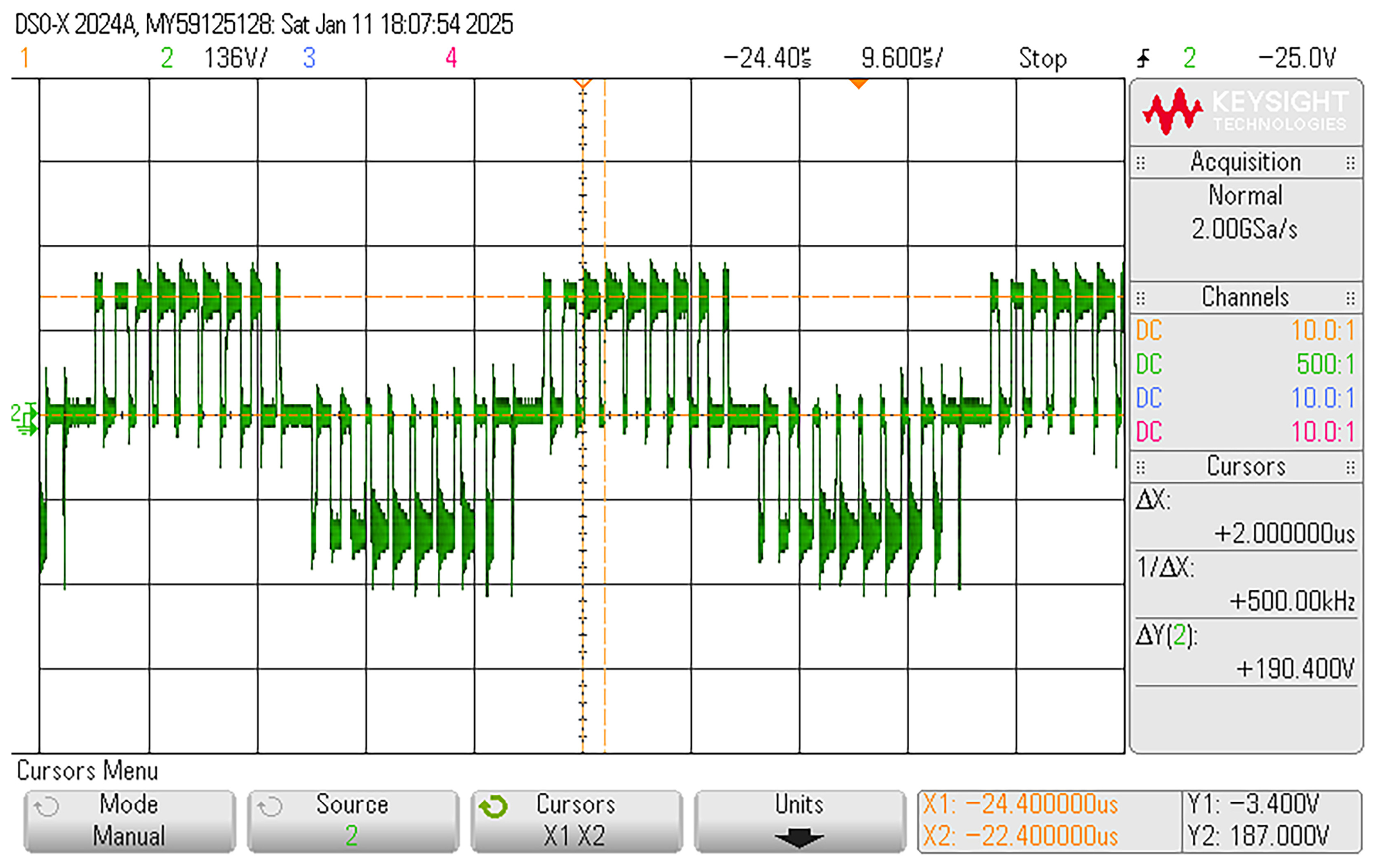
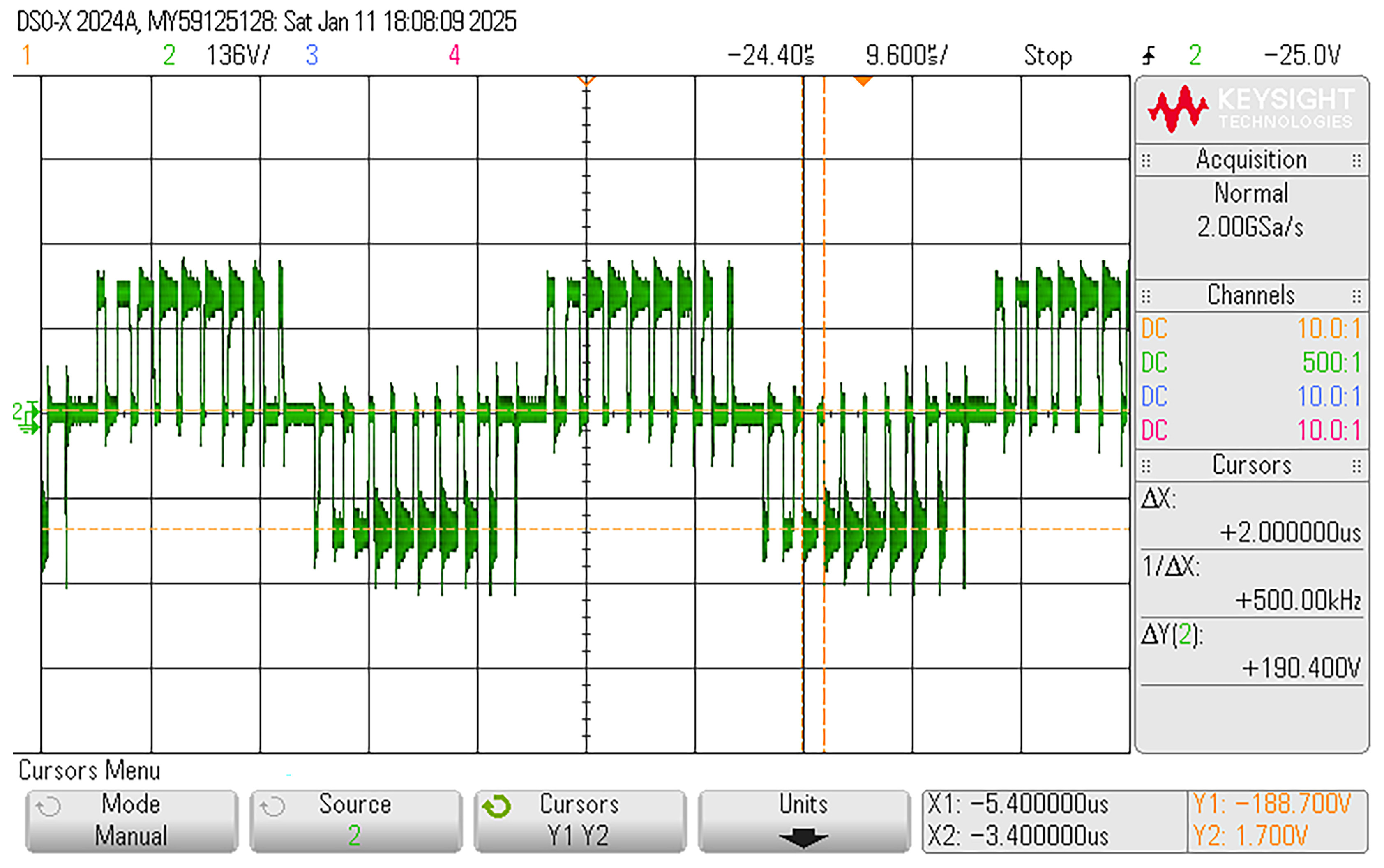
- SPWM-Based Three-Level Drive Control Circuit: This design employs an ARM Cortex-M4F 32-bit microcontroller (AT32F403ARCT7) as the core of the MCU control system. The control module MCU generates 25 kHz SPWM drive signals to switch the power semiconductor devices on and off. This action converts the 380 V DC input into an AC SPWM voltage signal.
- (3)
- High-Frequency Transformer Voltage-Boosting Circuit: This circuit steps up the SPWM signal to 10 kV, delivering the high-voltage output to the rotating plasma spray gun.
2.2. Boost PFC Circuit Versus Diode Rectifier
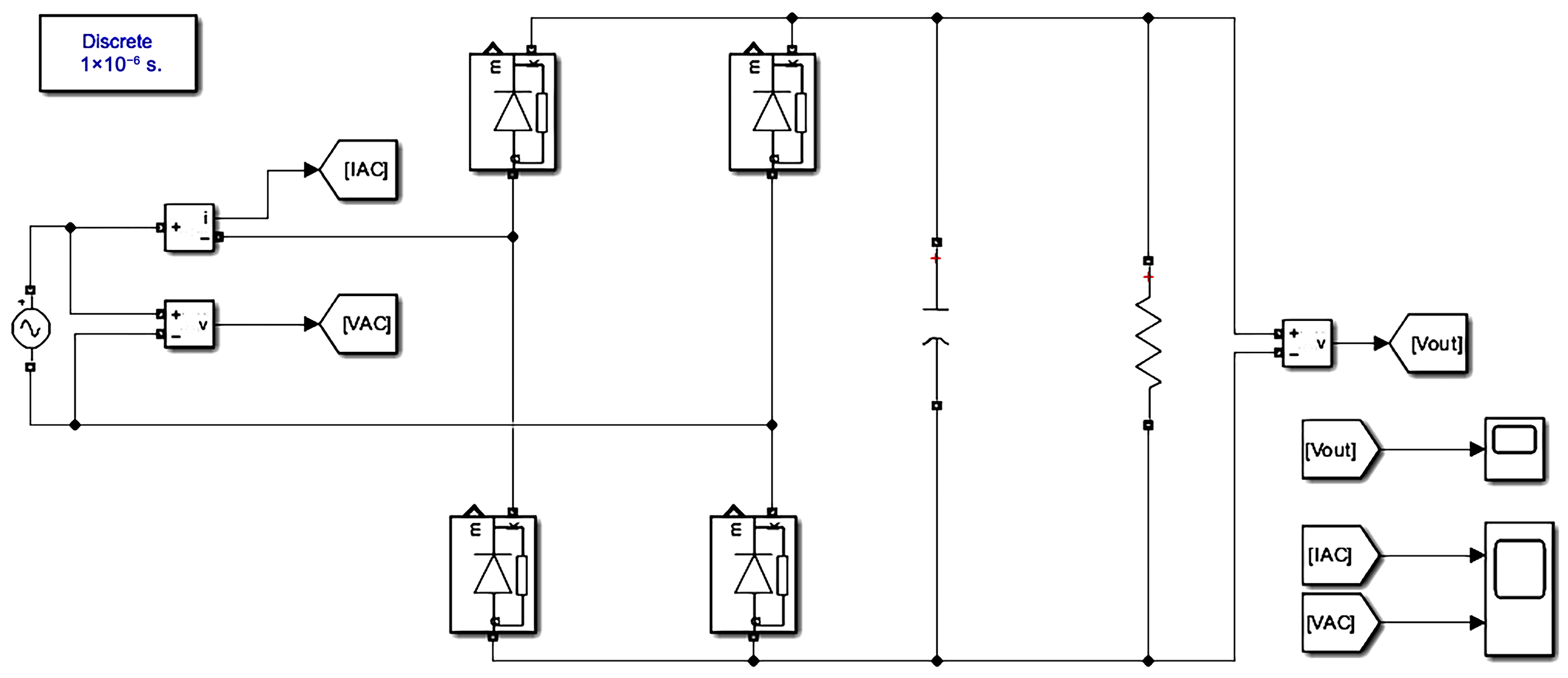
2.2.1. Conventional Topology
2.2.2. Boost Power Factor Correction Circuit
- (1)
- Input Stage: The output voltage () is compared with the reference voltage (380 V) to generate an error signal.
- (2)
- Processing Stage: The error signal is regulated through a PI controller, where the PI output increases when < and decreases otherwise.
- (3)
- Output Stage: The PI output serves as the reference current amplitude input for the inner current loop [30].
- (1)
- Peak Detection: The input AC voltage (VAC) is processed by a peak detection module to extract , followed by computation of the reciprocal .
- (2)
- Reference Current Generation: Multiplication of by the Boost circuit’s input voltage () and subsequently by the PI output from Section A yields the reference current the inner current loop. This forces the current waveform to track the input voltage, enabling power factor correction [31].
- (1)
- Input Stage: The reference current is compared with the actual inductor current to generate an error signal.
- (2)
- Processing Stage: The error signal is conditioned through a PI controller and amplitude limiter before being fed to the PWM generator.
- (3)
- Output Stage: The resulting PWM signal modulates the duty cycle of the MOSFET switch in the Boost circuit, thereby regulating the inductor current and stabilizing the output voltage .
2.2.3. Comparative Analysis of PF, THD, and FFT Between Boost PFC and Conventional Rectifiers
2.2.4. Input Voltage Fluctuation Test
- (a)
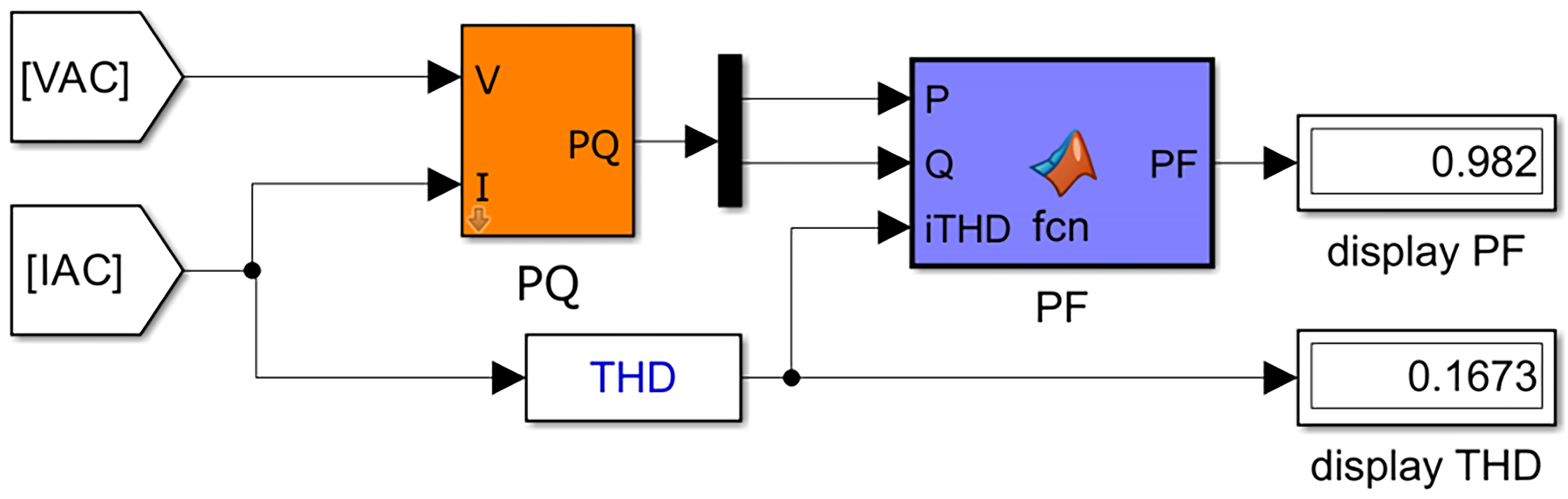
- As shown in Figure 10, at 10% above rated voltage, the Boost PFC Circuit rectifier maintains a power factor of 0.98 and total harmonic distortion (THD) of 16.73% with stable output voltage.
- (b)
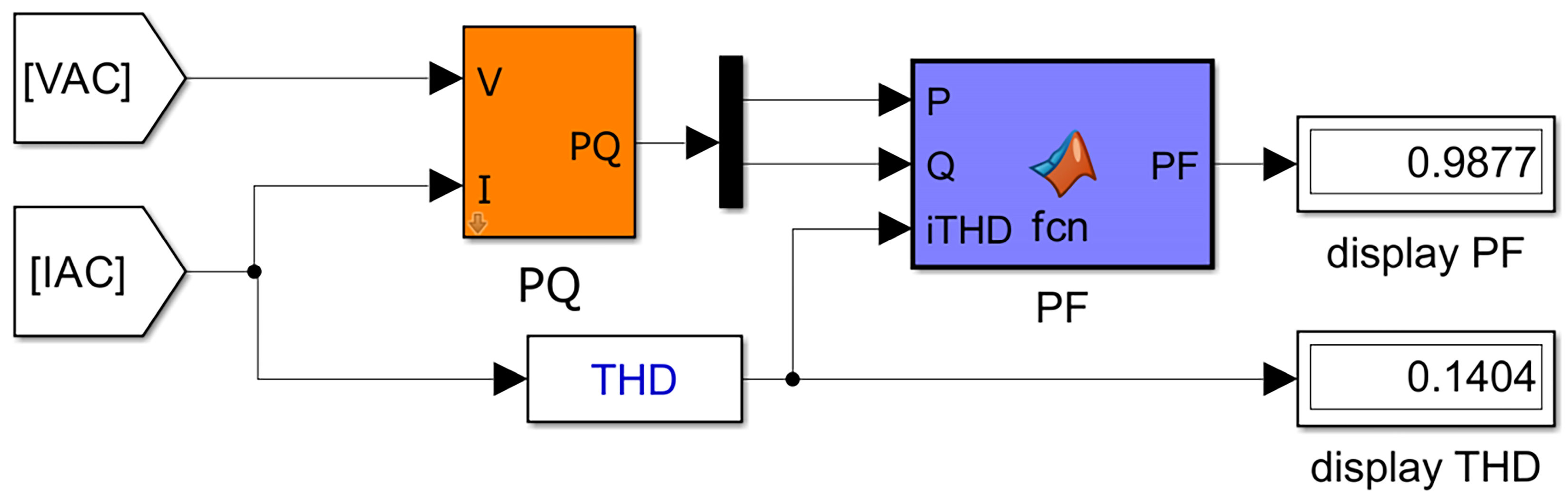
- As shown in Figure 11, at 10% below rated voltage, it sustains a power factor of 0.99 and THD of 14.04% while preserving output voltage stability.
2.3. Integrated SPWM Driver-Control Implementation
2.4. High-Frequency Transformer Design Considerations
2.4.1. Turns Calculation
2.4.2. Conductor Sizing
2.4.3. Selection of Magnetic Cores and Ferrite Materials
2.5. Rotating Plasma Spray Gun
3. Single-Phase Three-Level SPWM Modulation
3.1. Operational Principles and Advantages
3.2. Simulink Implementation
3.3. FFT Analysis and Harmonic Suppression
4. System Performance Optimization and Prototype Implementation
4.1. DC Bus Neutral-Point Stability and Capacitor Long-Term Reliability
4.2. Thermal Analysis of Power Devices and Cooling Performance Evaluation
4.3. System Performance Integration and Analysis
4.3.1. Energy Performance Estimation
4.3.2. Electromagnetic Compatibility Optimization
4.3.3. Electrical Stability for Plasma Uniformity
4.4. Plasma Power Supply Prototype Design
5. Results and Analysis
5.1. Characteristics of Three-Level SPWM Gate Signals
5.2. Output Voltage Analysis of Three-Level Converter
5.3. Performance Assessment of Plasma Power Supply
6. Conclusions
Author Contributions
Funding
Data Availability Statement
Conflicts of Interest
References
- Su, Y.P.; Ni, C.L.; Chen, C.Y.; Chen, Y.T.; Tsai, J.C.; Chen, K.H. Boundary conduction mode controlled power factor corrector with line voltage recovery and total harmonic distortion improvement techniques. IEEE Trans. Ind. Electron. 2013, 61, 3220–3231. [Google Scholar] [CrossRef]
- Kondrath, N.; Kazimierczuk, M.K. Inductor winding loss owing to skin and proximity effects including harmonics in non-isolated pulse-width modulated dc–dc converters operating in continuous conduction mode. IET Power Electron. 2010, 3, 989–1000. [Google Scholar] [CrossRef]
- Chen, M.; Sun, J. Feedforward current control of boost single-phase PFC converters. IEEE Trans. Power Electron. 2006, 21, 338–345. [Google Scholar] [CrossRef]
- Huang, J.; Liu, Q.; Wang, X.; Li, K. A carrier-based modulation scheme to reduce the third harmonic component of common-mode voltage in a three-phase inverter under high DC voltage utilization. IEEE Trans. Ind. Electron. 2017, 65, 1931–1940. [Google Scholar] [CrossRef]
- Kapoor, P.V.; Renge, M.M. Comparative analysis of modular multilevel converter with different modulation technique for control of induction motor drive. Microsyst. Technol. 2018, 24, 3349–3356. [Google Scholar] [CrossRef]
- Salgado-Herrera, N.M.; Medina-Ríos, J.A.; Tapia-Sánchez, R.; Anaya-Lara, O.; Rodríguez-Rodríguez, J.R. DSPWM multilevel technique of 27-levels based on FPGA for the cascaded DC/AC power converter operation. Int. Trans. Electr. Energy Syst. 2018, 28, e2479. [Google Scholar] [CrossRef]
- Li, Y.; Yu, H.; Jiang, C.; Jin, Y. Analysis of Control Strategy of Arc Plasma Power Supply Inverter Module. Electronics 2023, 12, 4400. [Google Scholar] [CrossRef]
- Dasgupta, S.; Sahoo, S.K.; Panda, S.K.; Amaratunga, G.A. Single-phase inverter-control techniques for interfacing renewable energy sources with microgrid—Part II: Series-connected inverter topology to mitigate voltage-related problems along with active power flow control. IEEE Trans. Power Electron. 2010, 26, 732–746. [Google Scholar] [CrossRef]
- Farakhor, A.; Reza Ahrabi, R.; Ardi, H.; Najafi Ravadanegh, S. Symmetric and asymmetric transformer based cascaded multilevel inverter with minimum number of components. IET Power Electron. 2015, 8, 1052–1060. [Google Scholar] [CrossRef]
- Karimi-Ghartemani, M.; Khajehoddin, S.A.; Karshenas, H.R.; Bakhshai, A. Apparent Power, Power Factor, and Current Factor in Single-phase Circuits with Non-negligible Line Impedances. Electr. Power Compon. Syst. 2011, 39, 423–445. [Google Scholar] [CrossRef]
- Yin, H.; Zhao, C.; Li, M.; Ma, C.; Chow, M.Y. A game theory approach to energy management of an engine–generator/battery/ultracapacitor hybrid energy system. IEEE Trans. Ind. Electron. 2016, 63, 4266–4277. [Google Scholar] [CrossRef]
- Kalair, A.; Abas, N.; Kalair, A.R.; Saleem, Z.; Khan, N. Review of harmonic analysis, modeling and mitigation techniques. Renew. Sustain. Energy Rev. 2017, 78, 1152–1187. [Google Scholar] [CrossRef]
- Li, W.; Ruan, X.; Pan, D.; Wang, X. Full-feedforward schemes of grid voltages for a three-phase LCL-type grid-connected inverter. IEEE Trans. Ind. Electron. 2012, 60, 2237–2250. [Google Scholar] [CrossRef]
- Zhang, T.; Antunes, H.; Aggarwal, S. Defending connected vehicles against malware: Challenges and a solution framework. IEEE Internet Things J. 2014, 1, 10–21. [Google Scholar] [CrossRef]
- Abdollahzadeh Jamalabadi, M.Y. Electrochemical and exergetic modeling of a combined heat and power system using tubular solid oxide fuel cell and mini gas turbine. J. Fuel Cell Sci. Technol. 2013, 10, 051007. [Google Scholar] [CrossRef]
- Hashemi-Dezaki, H.; Mohammadalizadeh-Shabestary, M.; Askarian-Abyaneh, H.; Rezaei-Jegarluei, M. New Approach to Optimize the Apfs Placement Based on Instantaneous Reactive Power Theory by Genetic Algorithm. J. Electr. Eng. 2014, 65, 12–20. [Google Scholar] [CrossRef]
- Rodriguez, J.C.C.; Lopez, J.V.; Olay, C.C.; Fernández, S.M.; García, R.V.; García, S.M. Dual-tap chopping stabilizer with subcyclic AC soft switching. IEEE Trans. Ind. Electron. 2009, 57, 3060–3074. [Google Scholar] [CrossRef]
- Berger, A.; Agostinelli, M.; Vesti, S.; Oliver, J.A.; Cobos, J.A.; Huemer, M. A wireless charging system applying phase-shift and amplitude control to maximize efficiency and extractable power. IEEE Trans. Power Electron. 2015, 30, 6338–6348. [Google Scholar] [CrossRef]
- Dimitrijević, M.; Milojković, J.; Bojanić, S.; Nieto–Taladriz, O.; Litovski, V. ICT and power: New challenges and solutions. Int. J. Reason.-Based Intell. Syst. 2013, 5, 32–41. [Google Scholar] [CrossRef]
- Genç, N.; İskender, İ. Teaching of power quality phenomenon based on modeling and simulation of boost type PFC converters. Comput. Appl. Eng. Educ. 2012, 20, 149–160. [Google Scholar] [CrossRef]
- Zhao, M.M.; Shi, Q.; Cai, Y.; Zhao, M.J.; Li, Y. Distributed penalty dual decomposition algorithm for optimal power flow in radial networks. IEEE Trans. Power Syst. 2019, 35, 2176–2189. [Google Scholar] [CrossRef]
- Stevanović, D.; Petković, P. A single-point method for identification sources of harmonic pollution applicable to standard power meters. Electr. Eng. 2015, 97, 165–174. [Google Scholar] [CrossRef]
- Corral, A.V.; Lopez, C.D.; Magdaleno, R.J.D.J.; Martínez-Fuentes, O.; Barron-Zambrano, J.H. Total harmonic distortion and unbalance factor estimator by three-phase quadrature signal generator based on multiresonant linear oscillator. Electr. Power Syst. Res. 2026, 255, 112730. [Google Scholar] [CrossRef]
- Jiang, W.; Liu, S.; Jiang, H.; Wang, J. Harmonic mitigation and power factor optimization of single-stage Swiss rectifier via recursive forgetting filter algorithm. J. Power Electron. 2026, 1–12. [Google Scholar] [CrossRef]
- Chen, H.C. Single-loop current sensorless control for single-phase boost-type SMR. IEEE Trans. Power Electron. 2009, 24, 163–171. [Google Scholar] [CrossRef]
- Thiruvenkadam, M.; Thangavel, S.; Paramasivam, S. Simulation and Practical Analysis on Power Factor Correction Techniques for Welding Applications. Appl. Mech. Mater. 2015, 785, 198–204. [Google Scholar] [CrossRef]
- Nayanasiri, D.R.; Foo, G.H.B.; Vilathgamuwa, D.M.; Maskell, D.L. A switching control strategy for single-and dual-inductor current-fed push–pull converters. IEEE Trans. Power Electron. 2014, 30, 3761–3771. [Google Scholar] [CrossRef]
- Xu, R.; Zhang, Y.; Lu, S.; Chen, G.; Yu, D.; Wang, L. Pulse train-controlled CCM boost converter with suppression of low-frequency oscillation. IET Power Electron. 2017, 10, 957–967. [Google Scholar] [CrossRef]
- Mishra, S.; Mishra, Y. Decoupled controller for single-phase grid connected rooftop PV systems to improve voltage profile in residential distribution systems. IET Renew. Power Gener. 2017, 11, 370–377. [Google Scholar] [CrossRef]
- Durgadevi, S.; Umamaheswari, M.G. Analysis and design of single phase power factor correction with DC–DC SEPIC Converter for fast dynamic response using genetic algorithm optimised PI controller. IET Circuits Devices Syst. 2018, 12, 164–174. [Google Scholar] [CrossRef]
- Orabi, M.; Ninomiya, T. Nonlinear dynamics of power-factor-correction converter. IEEE Trans. Ind. Electron. 2004, 50, 1116–1125. [Google Scholar] [CrossRef]
- De Gusseme, K.; Van de Sype, D.M.; Van den Bossche, A.P.M.; Melkebeek, J.A. Digitally controlled boost power-factor-correction converters operating in both continuous and discontinuous conduction mode. IEEE Trans. Ind. Electron. 2005, 52, 88–97. [Google Scholar] [CrossRef]
- Wang, Z.; Wei, Y. Study on single-stage AC/DC conversion device based on single-cycle control. Recent Adv. Electr. Electron. Eng. (Former. Recent Pat. Electr. Electron. Eng.) 2016, 9, 73–79. [Google Scholar] [CrossRef]
- Şen, Z. Modified wind power formulation and its comparison with Betz limits. Int. J. Energy Res. 2013, 37, 959–963. [Google Scholar] [CrossRef]
- Chaturvedi, L.; Yadav, D.K.; Pancholi, G. Comparison of SPWM, THIPWM and PDPWM technique based voltage source inverters for application in renewable energy. J. Green Eng. 2017, 7, 83–98. [Google Scholar] [CrossRef]
- Hren, A.; Mihalič, F. An improved SPWM-based control with over-modulation strategy of the third harmonic elimination for a single-phase inverter. Energies 2018, 11, 881. [Google Scholar] [CrossRef]
- Hu, C.G.; Liu, S.S.; Yuan, Y.; Chen, H.Z. Selective Harmonic Elimination PWM Method Applied to Three-Level Photovoltaic NPC Inverter. Adv. Mater. Res. 2013, 614, 1530–1533. [Google Scholar] [CrossRef]






| Parameters | Specifications |
|---|---|
| Output power | 1.7 kW |
| Peak Output Voltage | 10 kV |
| Switching frequency | 25 kHz |
| Parameters | Specifications |
|---|---|
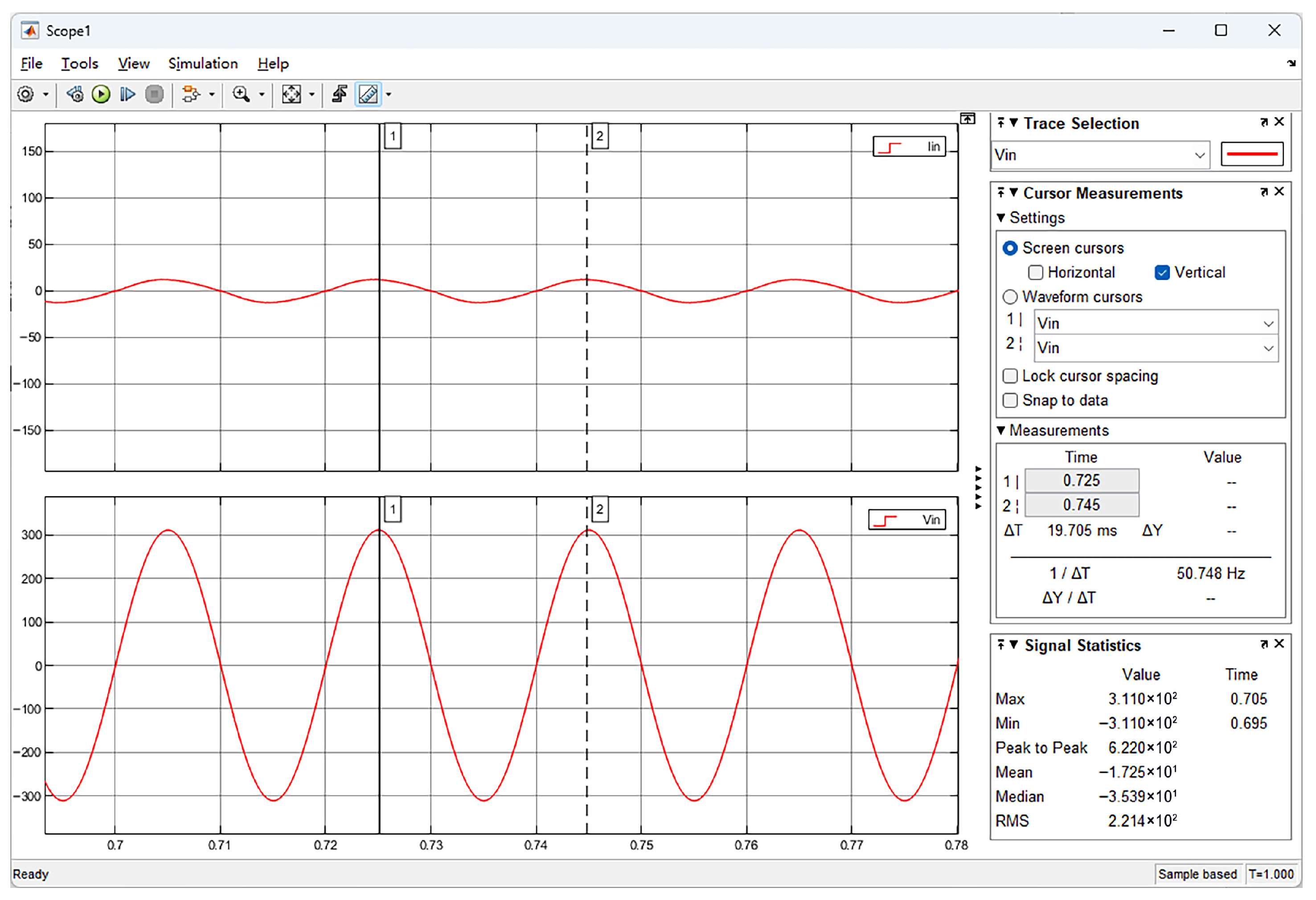
| Input signal | AC 220 V |
| Simulation type | Discrete |
| Sampling time | 1 × 10⁻⁶ s |
| Termination time | 1 s |
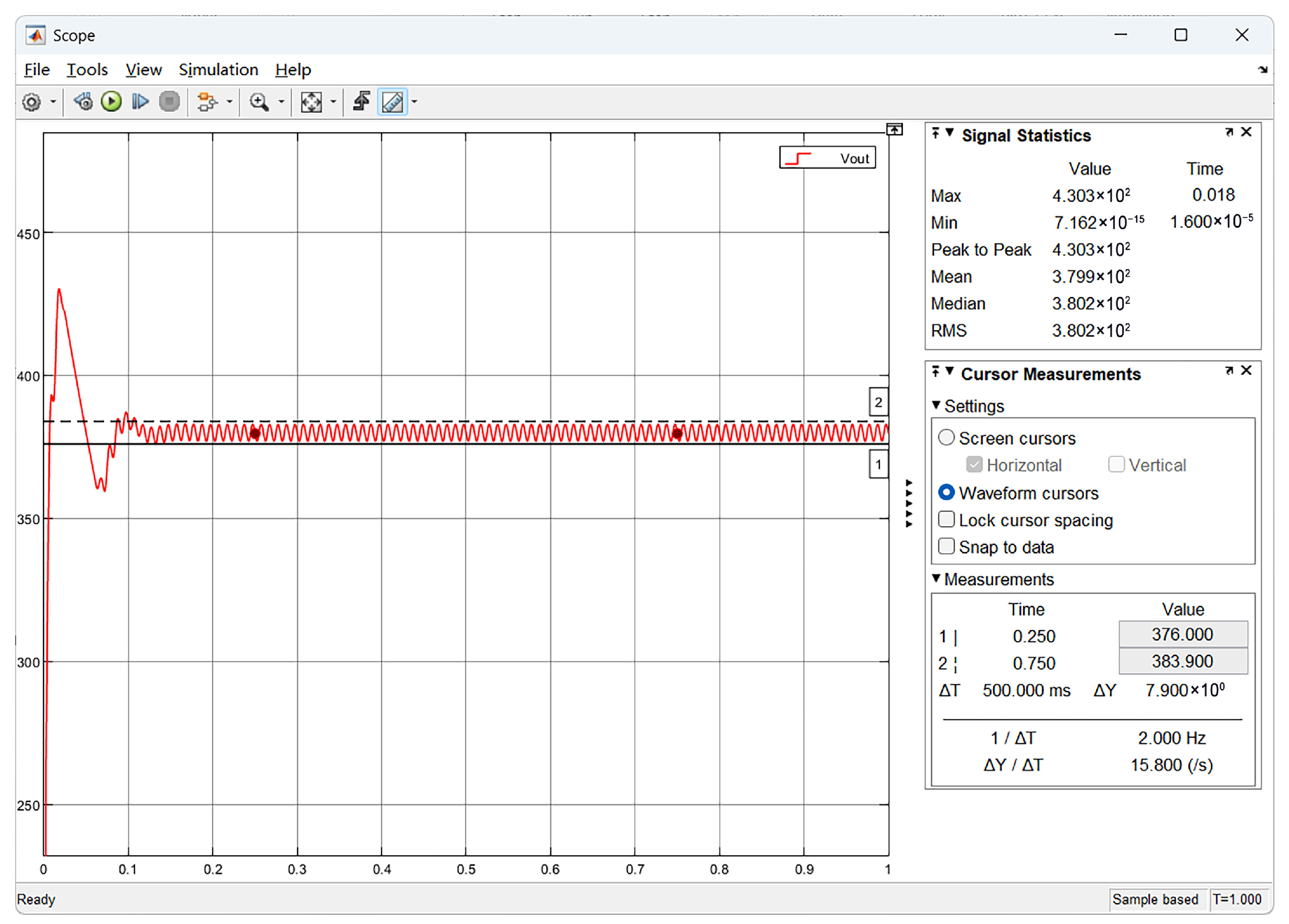
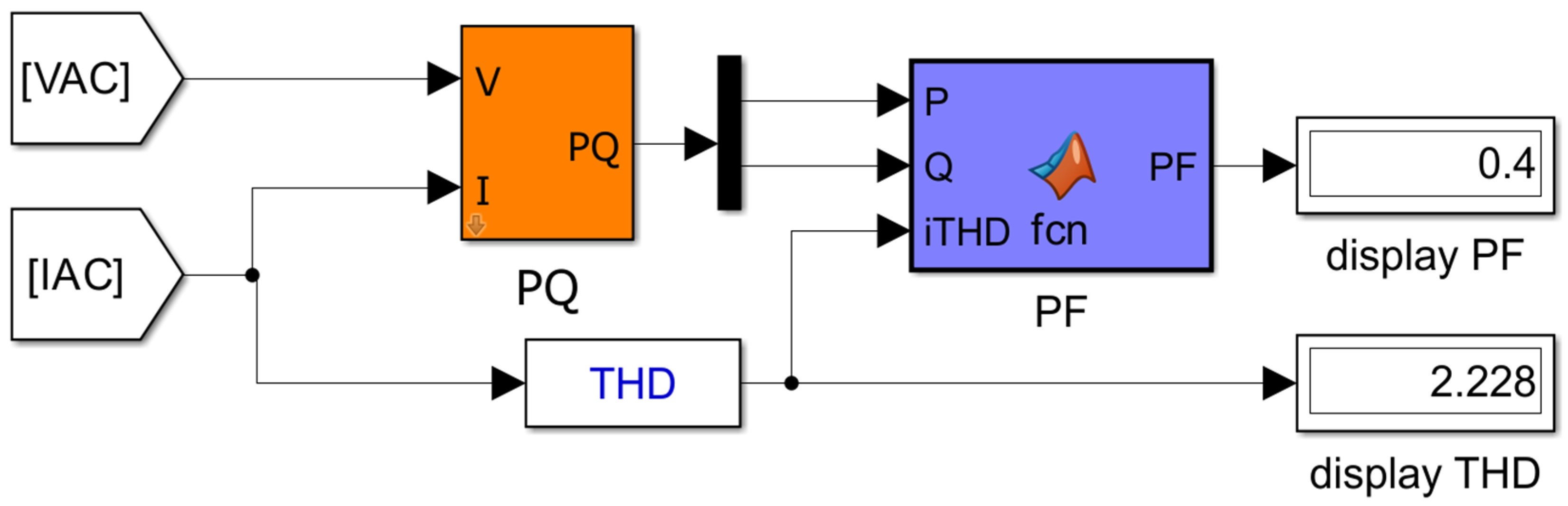
| Parameters | Diode Rectifier | Boost PFC Rectifier |
|---|---|---|
| PF | 0.40 | 0.99 |
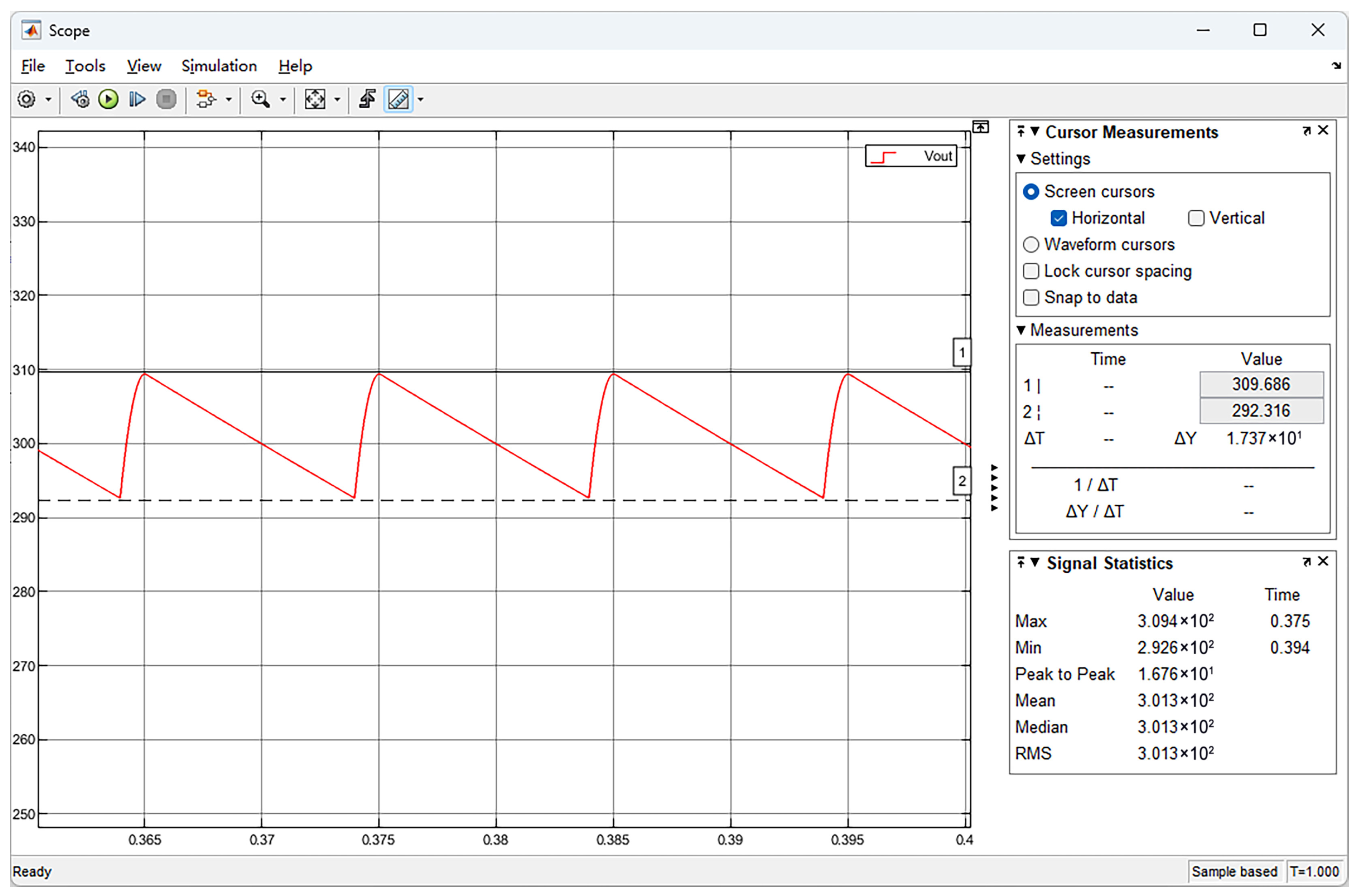
| Output Voltage Ripple | 16.76 V | 7.99 V |
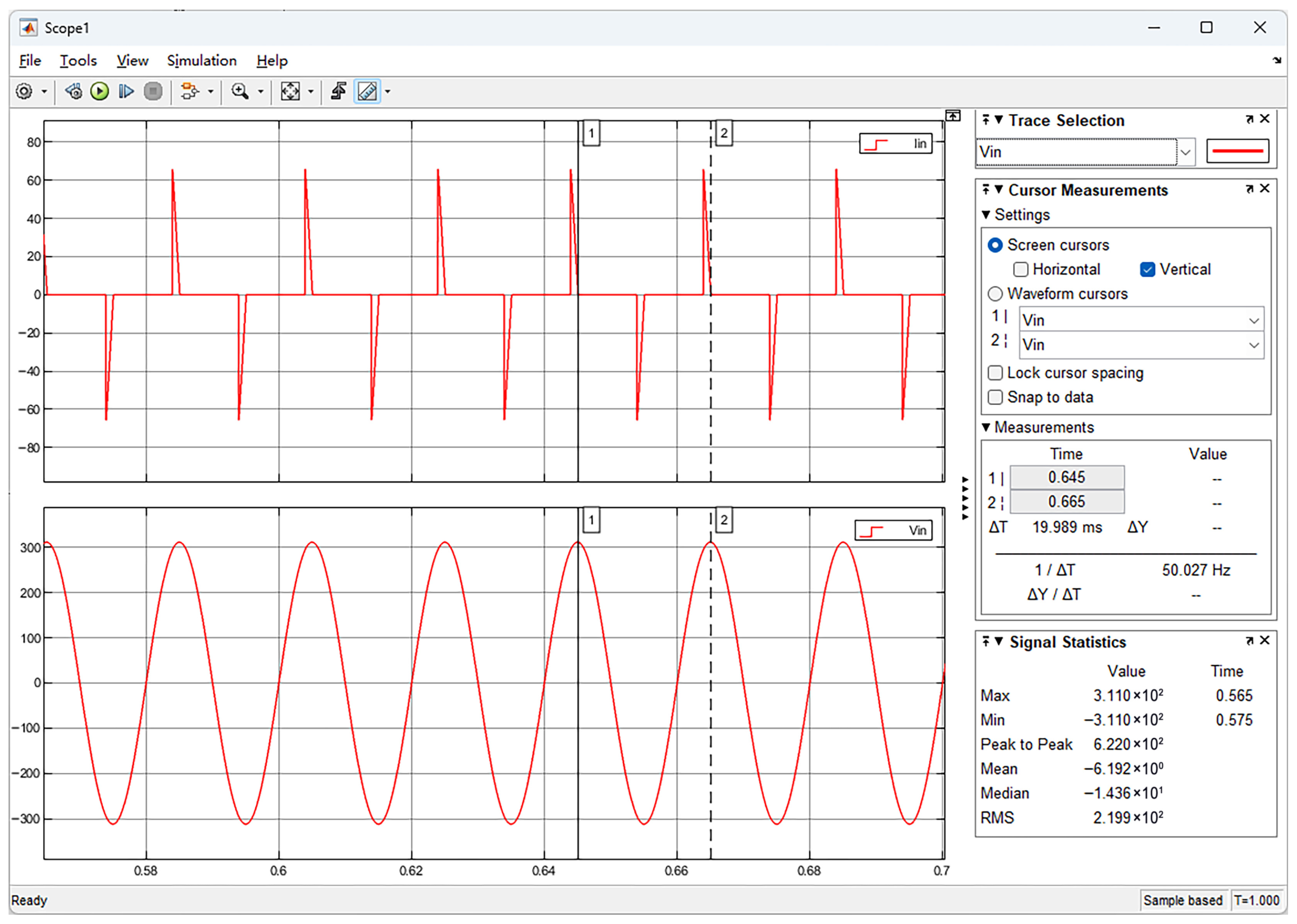
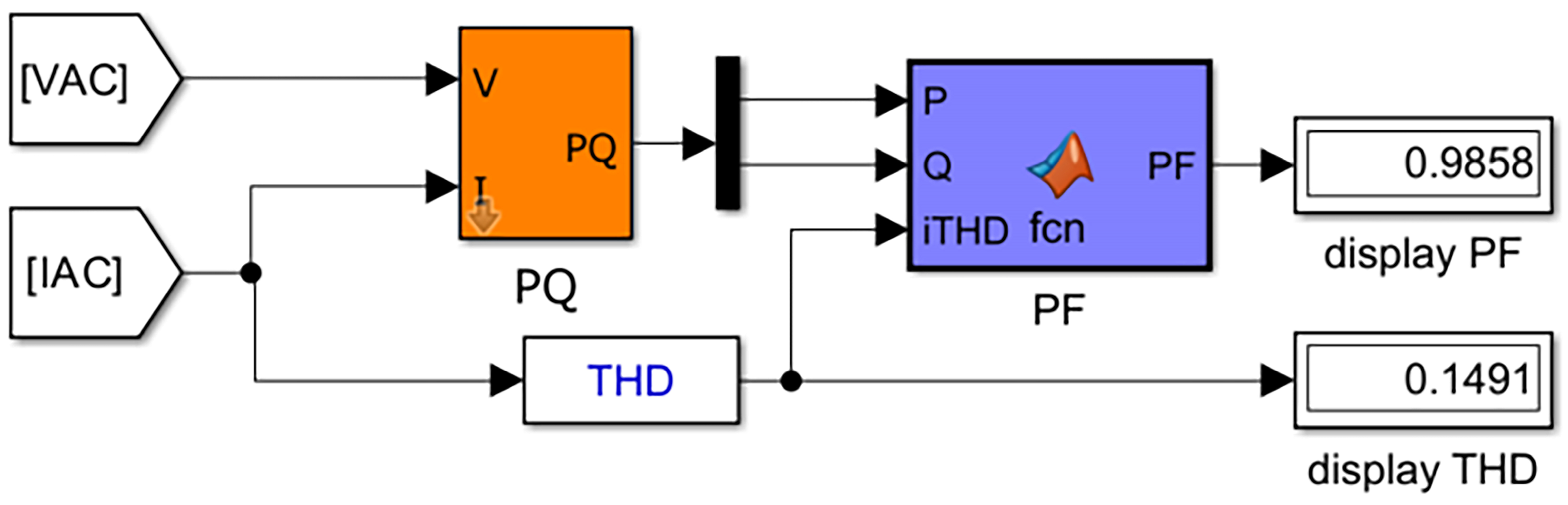
| THD of Input Current | 222.80% | 14.91% |
| Parameters | Definition |
|---|---|
| Primary Winding Input Voltage Peak-to-Peak Value | |
| Required Secondary Winding High Voltage (Peak Value) | |
| Air Breakdown Field Strength (Peak Value) |
| Parameters | Specifications |
|---|---|
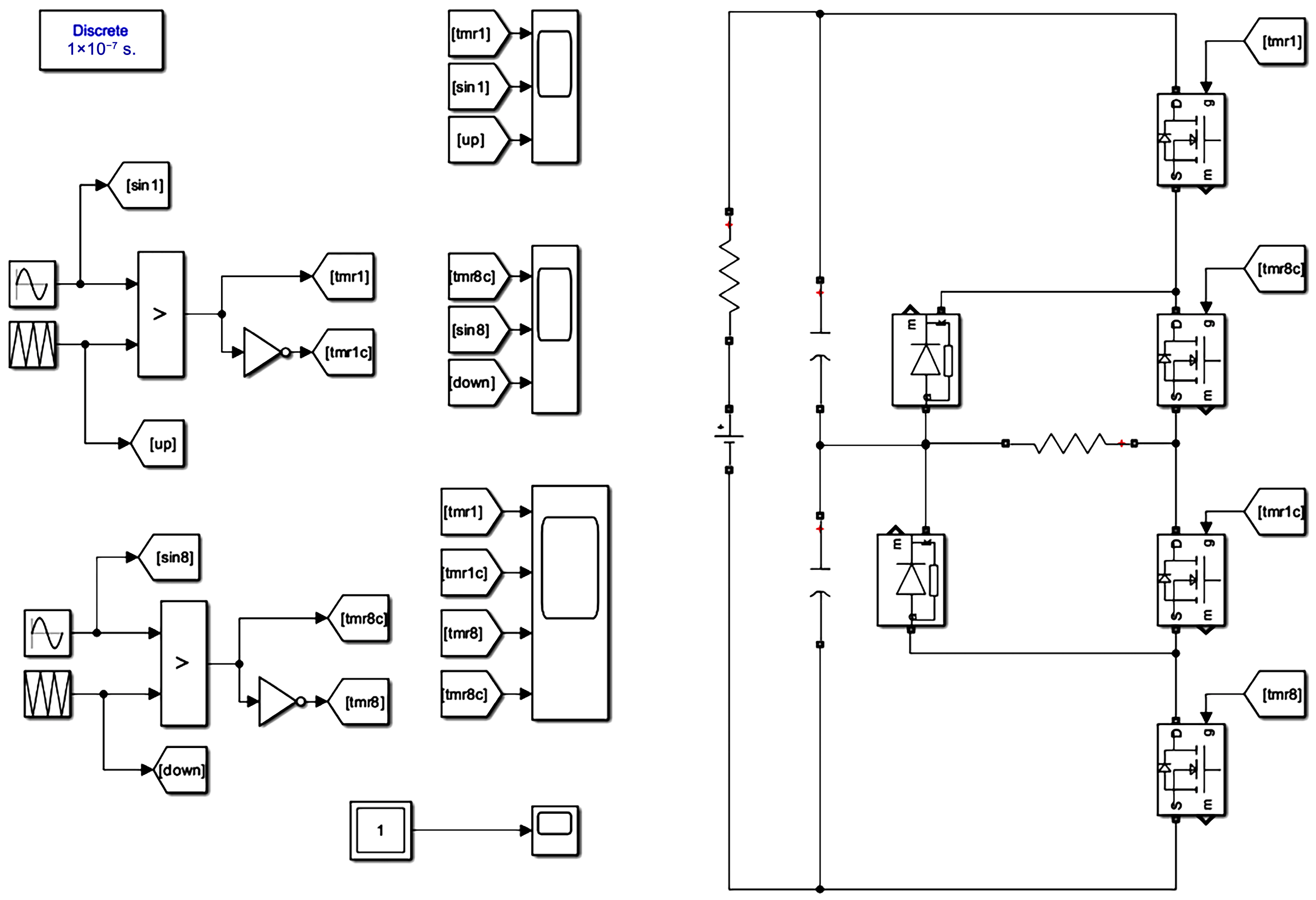
| Input signal | DC 380 V |
| Simulation type | Discrete |
| Sampling time | 1 × 10⁻⁷ s |
| Termination time | 1 s |
| Switching States | tmr1 | tmr8c | tmr1c | tmr8 | Vout |
|---|---|---|---|---|---|
| P | 1 | 1 | 0 | 0 | |
| 0 | 0 | 1 | 1 | 0 | 0 |
| N | 0 | 0 | 1 | 1 |
| Parameters | Measured Value |
|---|---|
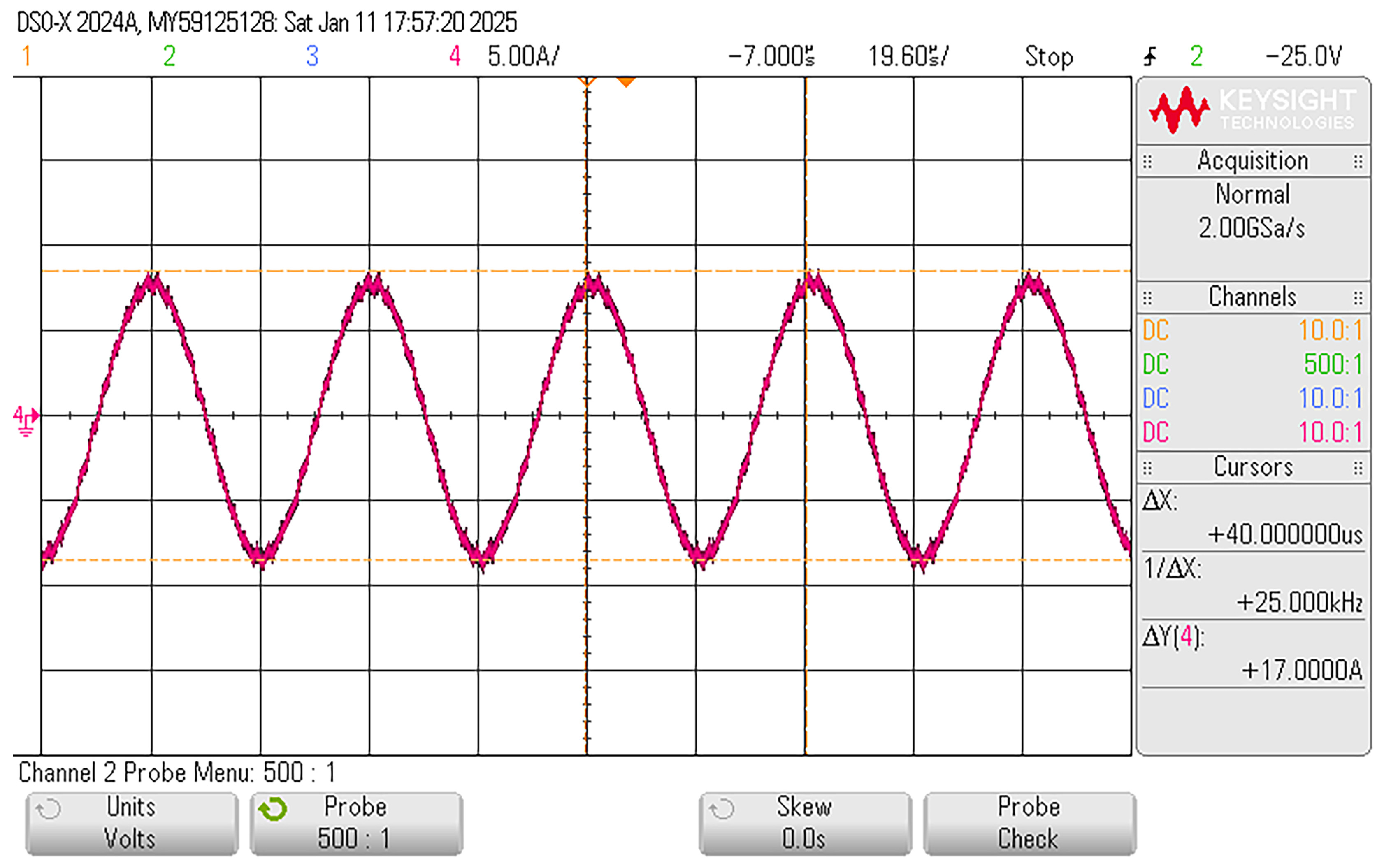
| Bus current | 17.0 A |
| Bus voltage Primary-Side RMS Current | 380.8 V 12.0 A |
| Secondary-Side Peak Voltage | 10.79 kV |
| Secondary-Side Peak Current | 0.6 A |
| Transformer Apparent Power | 2.05 kVA |
| System Output Power | 1.75 kW |
| Switching Frequency | 25.0 kHz |
Disclaimer/Publisher’s Note: The statements, opinions and data contained in all publications are solely those of the individual author(s) and contributor(s) and not of MDPI and/or the editor(s). MDPI and/or the editor(s) disclaim responsibility for any injury to people or property resulting from any ideas, methods, instructions or products referred to in the content. |
© 2026 by the authors. Licensee MDPI, Basel, Switzerland. This article is an open access article distributed under the terms and conditions of the Creative Commons Attribution (CC BY) license.
Share and Cite
Qin, W.; Cai, K.; Guo, X.; Yan, Z.; Yun, M.; Xiao, J. Research on a High-Frequency High-Voltage Plasma Power Supply Based on SPWM Modulation. Electronics 2026, 15, 814. https://doi.org/10.3390/electronics15040814
Qin W, Cai K, Guo X, Yan Z, Yun M, Xiao J. Research on a High-Frequency High-Voltage Plasma Power Supply Based on SPWM Modulation. Electronics. 2026; 15(4):814. https://doi.org/10.3390/electronics15040814
Chicago/Turabian StyleQin, Weimin, Kaida Cai, Xiao Guo, Zixiong Yan, Minghui Yun, and Jing Xiao. 2026. "Research on a High-Frequency High-Voltage Plasma Power Supply Based on SPWM Modulation" Electronics 15, no. 4: 814. https://doi.org/10.3390/electronics15040814
APA StyleQin, W., Cai, K., Guo, X., Yan, Z., Yun, M., & Xiao, J. (2026). Research on a High-Frequency High-Voltage Plasma Power Supply Based on SPWM Modulation. Electronics, 15(4), 814. https://doi.org/10.3390/electronics15040814