Article

Design of Anti-Disturbance Sparse Arrays for Marine Buoys Using an Improved Sparrow Search Algorithm

School of Electrical Engineering, Naval University of Engineering, Wuhan 430033, China
*
Authors to whom correspondence should be addressed.
Electronics 2026, 15(4), 788; https://doi.org/10.3390/electronics15040788
Submission received: 24 December 2025 / Revised: 21 January 2026 / Accepted: 6 February 2026 / Published: 12 February 2026

Abstract

To address the performance degradation of antenna beams in marine-towed buoy arrays caused by roll and pitch motions under dynamic sea conditions, this paper proposes a multi-objective sparse array optimization method based on an improved chaotic sparrow search algorithm (CSSA). First, an electromagnetic disturbance model of the array under sea states 1~7 is quantitatively established by coupling wave spectrum theory and buoy dynamics, formulating comprehensive optimization models for both linear and planar arrays under disturbance. Subsequently, within the NSGA-II framework, with main lobe width and peak sidelobe level (PSLL) as dual optimization objectives, a modified sparrow search algorithm integrating density-weighted initialization and Tent chaotic mapping is introduced for efficient solution exploration. Simulation results demonstrate that the proposed method achieves a PSLL below −19.95 dB under sea states 1~3 and effectively suppresses sidelobe elevation and beam distortion even under sea states 4~7 with strong disturbances. This approach significantly enhances the radiation robustness and link stability of sparse arrays in complex marine environments.

1. Introduction

In actual complex marine dynamic environments, the buoy arrays are subject to disturbances from ocean currents and waves, which can easily cause its physical configuration to deviate from the preset ideal linear topology, leading to distortion in the spatial phase distribution [1,2,3]. For satellite communication buoys operating in the microwave frequency band, their dynamic attitude changes at the seawater–air interface significantly affect the stability of the relay link and communication quality [4,5]. Therefore, studying the spatial attitude of the array under different sea state excitations and its impact on radiation characteristics is of great importance for improving the reliability of the entire monitoring system.
The radiation performance of the array is primarily determined by two factors: the spatial distribution of array elements and the excitation phase. Coordinated optimization of these two aspects can effectively enhance the system’s robustness under dynamic disturbances. Thinned array technology, by optimizing the non-uniform spatial layout of array elements, achieves excellent sidelobe suppression while maintaining aperture efficiency, and has become an important means in recent years to improve the performance adaptability of arrays in complex electromagnetic environments [5,6]. As the core of thinned array synthesis, the convergence speed and robustness of the optimization algorithm directly determine the upper limit of the final array’s performance. Current research trends indicate that combining physically informed density-weighted initialization strategies with intelligent optimization algorithms can significantly shorten the iteration cycle of the optimization process and improve solution quality [7,8]. For example, the method proposed in [9] based on probabilistic learning iterative Fourier techniques, through fitness function initialization and probability density tapering, achieves efficient low-sidelobe synthesis for large-scale planar arrays [10]; employs a framework combining an improved genetic algorithm and Gaussian process regression, effectively suppressing peak sidelobe levels with low computational complexity [11]; and realizes the optimization of rectangular planar sparse arrays under multiple constraints by integrating a weighting function with an improved gray wolf optimization algorithm.
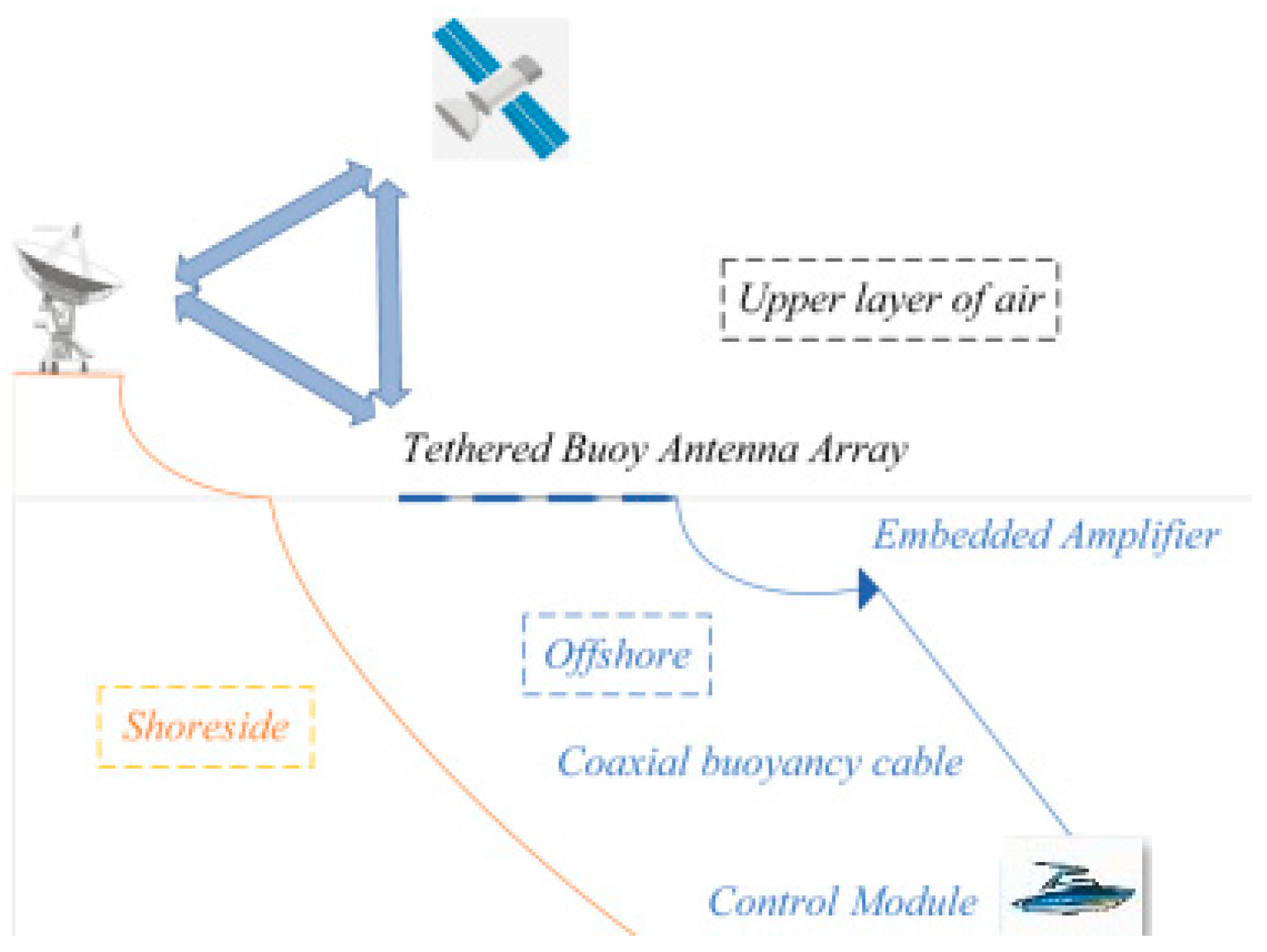
However, the above methods mainly focus on optimizing arrays under static or ideal configurations. Their optimization performance and model adaptability remain insufficient for addressing the dynamic topological deformation of ocean-towed buoy arrays caused by coupled roll and pitch motions under complex sea conditions, as it is shown in Figure 1, schematic diagram of marine satellite positioning information buoy array.As shown in Figure 1, the thick blue arrow indicates the direction of signal transmission.The thin blue line represents the connecting cable between the surface antenna array and the embedded amplifier of the underwater vehicle. To address the degradation of array beam performance induced by sea state disturbances, this paper proposes a multi-objective optimization design method for thinned arrays based on an improved chaotic sparrow search algorithm. By introducing ocean wave spectrum models and buoy hydrodynamic transfer functions, the roll and pitch disturbance characteristics of the array under sea states 1~7 are quantitatively analyzed. Based on this, comprehensive electromagnetic models for disturbed linear and planar arrays are established, aiming to achieve robust optimization of array radiation performance in dynamic marine environments.

2. Wave Grade Analysis

For a single-towline deployment mechanism, the buoy antenna array often exhibits an irregular spatial configuration under complex sea conditions. Against the backdrop of third-generation wave models, each unit within the array experiences roll and pitch motions of varying amplitudes under wave excitation. As the sea state level increases, the roll angle and pitch amplitude correspondingly rise, leading to a degradation in beamforming performance, a significant elevation in sidelobe levels, and a consequent deterioration of the array’s overall radiation characteristics [12,13]. This paper conducts a classified study based on sea state levels: for sea states 1~3, the primary focus is on investigating the roll effect of the array; for sea states 4~7, the coupled influence of both pitch amplitude and roll angle is analyzed. The specific analysis for the roll motion of the cylindrical buoy antenna is as follows:
As the antenna system operates in a dynamically floating state within the actual working environment, static analysis methods based on a fixed vertical coordinate system have limited applicability. In random sea states, the antenna tilt angle is not a fixed value but rather a time-varying stochastic process modulated by the wave spectrum [14,15,16,17,18].
To address this, the bivariate irregular wave model, widely adopted in ocean engineering, is introduced. This model describes the actual sea surface as a superposition of multiple simple harmonic waves with different frequencies, phases, and directions. The wave surface elevation function can be expressed as:
Y t = i = 0 Y i cos ω t + ε
where Y i is the amplitude of the i -th component wave; and ω is the random initial phase uniformly distributed within (0, 2π). Each sub-wave Y ( t ) can be regarded as a regular wave with a deterministic frequency, whose energy follows linear wave theory:
E i = 1 2 ρ 1 g Y i 2
where ρ 1 is the seawater density. Within the frequency domain ω ω + d ω , the definition of the wave energy spectral density function is:
S ω = 1 d ω ω ω + d ω Y i 2 2
The wave spectrum model recommended by the Oceanic Administration is adopted:
S ω = 0.74 ω 5 exp 96.25 ω 4 u 2
where u is the wind speed. Additionally, the system transfer function R ω is determined by the buoy’s hydrodynamic characteristics:
R ω = a 2 1 γ 2 + 4 μ 2 γ 2
where γ = ω 0 / ω is the frequency ratio, and a is a correction coefficient related to the buoy’s draft depth and dimensions. The roll angle spectrum can be expressed as the product of the wave spectrum and the transfer function:
S θ ω = S ω R ω
Finally, the variance of the roll inclination angle is obtained as:
m = 0 S θ ω d ω
For sea states 1 to 7, the corresponding wave-induced roll angles for a single array element are ±1°, ±2°, ±4°, ±7.02°, ±10.02°, ±13.01°, and ±16.01°, respectively.
The pitch metacentric height of the array is simulated under certain constraint conditions. When the sea state reaches levels 4 to 7, the metacentric height intensifies, and the entire array can be approximated as a planar array. At this point, the optimization model of the algorithm differs significantly from the mathematical model applicable to a linear array.

3. Multi-Objective Optimization Framework

In the overall optimization design, the core objective is the co-optimization of the main lobe width and sidelobe level, which exhibit a typical trade-off relationship. To this end, this paper constructs a bi-objective fitness vector F itness f 1 , f 2 , where f 1 and f 2 correspond to the normalized evaluation functions for main lobe width and sidelobe level, respectively. Their specific definitions are as follows:
f 1 = 1 S S = 1 S B W S f 2 = max P S L L S
In Equation (8), S represents the sea state level. This paper primarily focuses on optimizing the half-power beamwidth of the array for sea states 1 to 3, while for sea states 4 to 7, only performance analysis is conducted without incorporating them into the optimization process.
As this problem belongs to multi-objective optimization, there typically exists no single global optimal solution, but rather a set of Pareto-optimal solutions. A solution p is termed Pareto-optimal if and only if no other solution y satisfies:
f k p f k p , k 1 , 2 and   k :   f k p < f k p
The set of all Pareto-optimal solutions is referred to as the Pareto front. Each solution within this set is not dominated by any other feasible solution; hence, it is also termed the non-dominated solution set. In the non-dominated sorting process of multi-objective optimization algorithms, these solutions are classified as the first frontier level. This work employs the NSGA-II framework to address this multi-objective problem, whose core mechanisms include non-dominated sorting and crowding distance computation. First, the population is partitioned into several frontier levels through non-dominated sorting. A solution i is said to dominate another solution j (denoted as i j ) if i is no worse than j in all objectives and strictly better in at least one objective.
f 1 i f 1 j f 2 i f 2 j f 1 i < f 1 j f 2 i < f 2 j
Individuals not dominated by any other solutions belong to the first front, i.e., the Pareto front.
Secondly, to maintain the distribution diversity of the solution set, the crowding distance for each solution within its front is calculated:
C D i = k = 1 2 f k i + 1 f k i 1 f k max f k min
This distance reflects the density of neighboring solutions in the objective space and is used for selective retention among solutions within the same front rank, thereby ensuring a balance between convergence and diversity in the optimization results.

4. Main Body of the Chaotic Sparrow Algorithm

In this study, an improved multi-objective Sparrow Search Algorithm (SSA) is employed to optimize the array layout. This algorithm simulates the foraging behavior and division-of-labor mechanism observed in sparrow flocks, categorizing the population individuals into three distinct roles: Explorers (constituting approximately 20% of the population), responsible for conducting global exploration within the solution space to identify promising candidate regions; Followers (approximately 70%), tasked with performing local, fine-grained search in the vicinity of high-quality areas indicated by the explorers to enhance convergence precision; and Vigilants (approximately 10%), charged with monitoring the population state. When risks such as convergence to local optima are detected, the random movement of vigilants introduces perturbations to the population, aiding in maintaining population diversity and facilitating escape from local optima.
During the iterative process, the position update strategies for these three types of individuals are defined as follows:
1. Explorer Position Update: This strategy governs the global exploration process. The position update formula is given by:
x i t + 1 = x i t exp i α T + N 0 , σ 2                     R 2 < S T x i t + Q L L e v y C D i                                     R 2 S T    
where T is the maximum number of iterations, α and R 2 are random numbers within 0 , 1 , S T 0.5 , 1 is the safety threshold, Q is an all-ones vector, L e v y is a random step size, and denotes element-wise multiplication.
2. Follower Position Update: This strategy executes local exploitation. A hierarchical approach is adopted: for individuals ranked in the lower half of the current population, a triple-source learning fusion strategy is utilized:
x i t + 1 = β 1 x b e s t t + β 2 x P a r e t o t + β 3 x d i v e r s i t y t + Δ X exp l o r e                         i f         i > N / 2 O p p o s i t e X b e s t t + X b e s t t X i t i                                                                                   o t h e r w i s e
In the above equation, x b e s t t , x P a r e t o t , and x d i v e r s i t y t represent the global best solution, a randomly selected non-dominated solution from the current Pareto front, and the individual with the largest crowding distance C D i at the t -th iteration, respectively. Δ X exp l o r e       is a reserved stochastic exploration term. β 1 , β 2 , and β 3 are adaptive weighting coefficients for the three learning sources, summing approximately to 1. They are defined as functions of the iteration count:
β 1 = 0.5 0.5 0.3 t / T β 2 = 0.3 + 0.2 sin π t / T β 3 = 0.2 + 0.5 0.1 t / T
For individuals ranked in the top half, the reverse learning factor O p p o s i t e is used to explore their potential. The reverse learning factor is defined as the value of Z o p p o s i t e = 1 Z for a given position vector Z.
3. Vigilant Position Update: This strategy is responsible for introducing controlled stochastic perturbations. The update rule is differentiated based on an individual’s fitness relative to the population median:
x i t + 1 = x b e s t t + δ C a u c h y 0 , 1 x i t x b e s t t   Γ                                                                         i f   f i > f m e d i a n x i t + K x i t x w o r s t t f i f w o r s t   + ε                                                                                                                         o t h e r w i s e
In this formula, δ and C a u c h y respectively represent the base step length coefficient of the Cauchy variation and the random variable following the standard Cauchy distribution; Γ   represents the stagnation detection amplification factor, defined as:
Γ = 1 + 0.5 exp ( s t a g n a t i o n c o u n t / 10 )
s t a g n a t i o n c o u n t is the continuous algebraic solution that has not been updated globally. Additionally, to improve the convergence efficiency of the algorithm in array topology optimization, an improved chaotic mapping is introduced and combined with array prior knowledge to generate the initial population. First, a chaotic sequence with good ergodicity is generated using the improved Tent mapping:
x k + 1 = 2 x k                                           0 x k < 0.5 2 1 x k                     0.5 x k < 1
Secondly, in the algorithm implementation for complex sea conditions, to avoid the influence of fixed points and small periodic points, an improved Tent mapping form is adopted. For the first particle, the random initial value is:
x 1 = 0.1 + 0.8 r a n d 0 , 1
The entire system is scaled to the aperture x k d = x k , 1 L , x k , 2 L x k , d L , and in the initial stage of iteration, the unit is initialized with density weighting, adjusting k -th element positions to be denser in the central area. For the particle, there is:
u k = s o r t r a n d 1 , d × L w k = exp 8 u k L 0.5 2 x k d = u k 0.7 + 0.6 w k
In the above formula, u k represents the sorted random position vector. Further, the physical coordinates u k / L are mapped to the interval through. The Gaussian weight w k of the particle is symmetric around 0.5, reflecting the prior knowledge that “the central area has a higher probability”. Finally, the weighted adjusted final position vector is obtained, which is the k -th element layout of the individual.
The pseudocode of the entire algorithm is described in Algorithm 1 below.
Algorithm 1: Multi-Objective Intelligent Sparrow Search Algorithm (MO-ISSA)
Input:
Population size M maximum generations T
Initial parameters: L or L × H , roll angles, N
Search space constraints: d min
Output:
Pareto front: Non-dominated solutions (8)
Pareto solutions: Array layouts
Phase compensations: Optimized phase compensation vectors
PSLL iteration data: Convergence history
Initialization
While t T  do
1: Evaluate fitness via:
 - Intelligent phase compensation for each disturbance scenario
 - Multi-objective: minimize {mean(MW), max(PSLL)} across all scenarios (9) (10)
2: Perform non-dominated sorting with crowding distance computation (11)
3: Update Pareto archive with current non-dominated solutions
4: Update population positions using improved sparrow dynamics:
 - Discoverers: adaptive exploration based on Pareto ranking (12)
 - Followers: hybrid strategy combining Lévy flights and social learning (13)
 - Scouts: risk-aware local refinement near optimal regions (15)
5: Enforce physical constraints on updated positions
Termination & Solution Selection:
6: Select optimal compromise solution via ideal point method
7: Return Pareto front and associated optimal configurations
end if
Select the best individuals in the population and retain them for the next generation
end for
return Outputs

5. Model Construction

5.1. Linear Array Setup

For different sea state levels, corresponding array analysis models are established in this study. For sea states 1~3, a thinned linear array is adopted for full-wave simulation analysis. Under the assumption of uniform excitation I n = 1 , the general formula for the array factor of a linear array is:
A F θ = n = 1 N I n exp j k x n cos θ + α n
where the wavenumber k = 2 π / λ , λ is the operating wavelength, θ is the observation angle, and x n is the position of the n-th element.
Considering that the single-towline deployment mechanism causes the array to approximate a linear configuration in practice, the array pattern model requires modification when roll motion induced by ocean waves is introduced. Under the influence of roll angle θ r , the modified array factor can be expressed as:
A F θ , θ r = n = 1 N I n exp j 2 π x n sin θ sin θ r + j ϕ n θ r
where the phase compensation function is integrated into the argument ϕ n θ r = 2 π x n sin θ r + Δ ϕ n . The complete mathematical model for the array can thus be represented as:
d min = d c = 0.5 λ d i i = 1 N d i = L min P S L L d 1 , d 2 , , d n & min B W
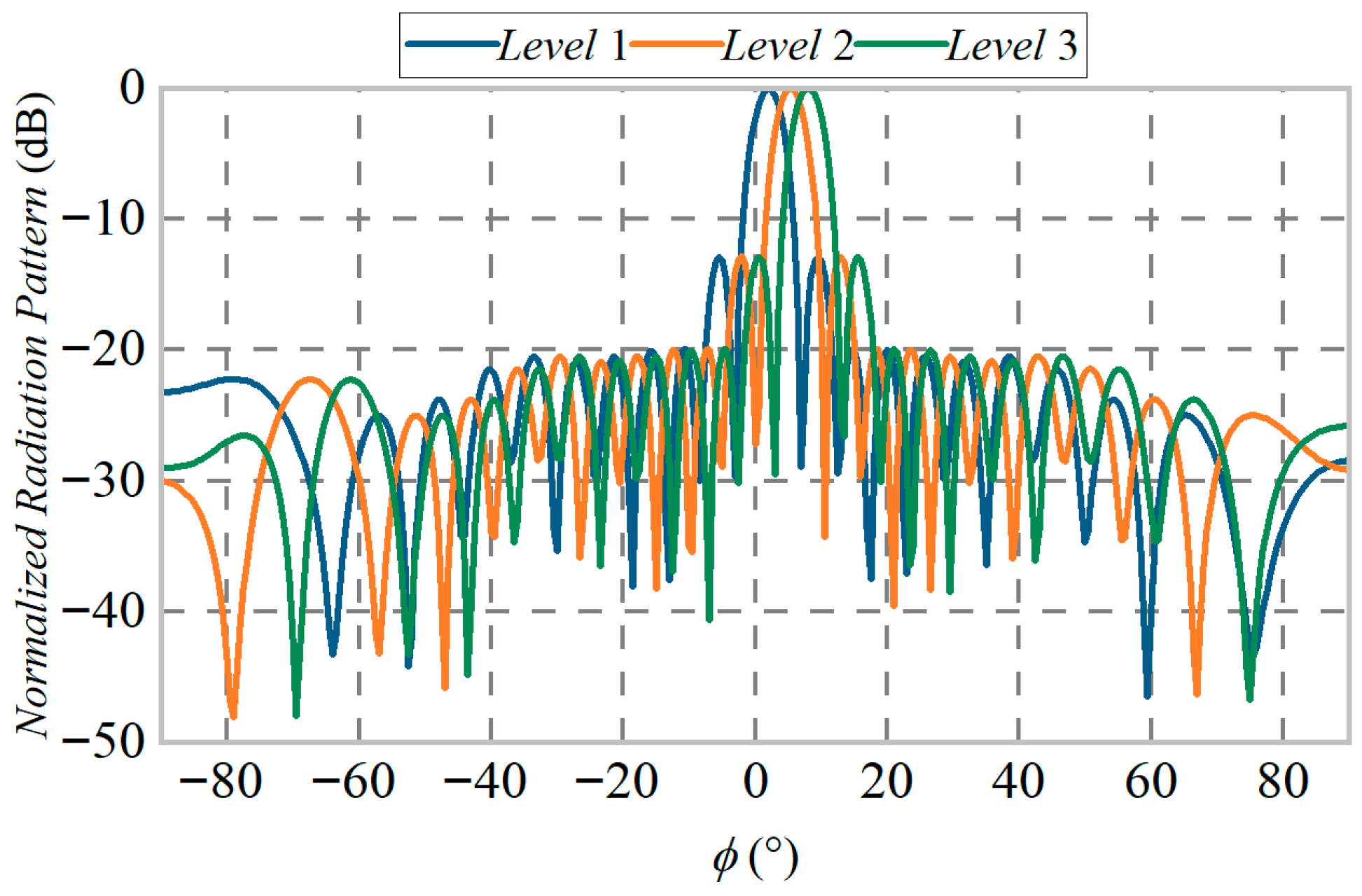
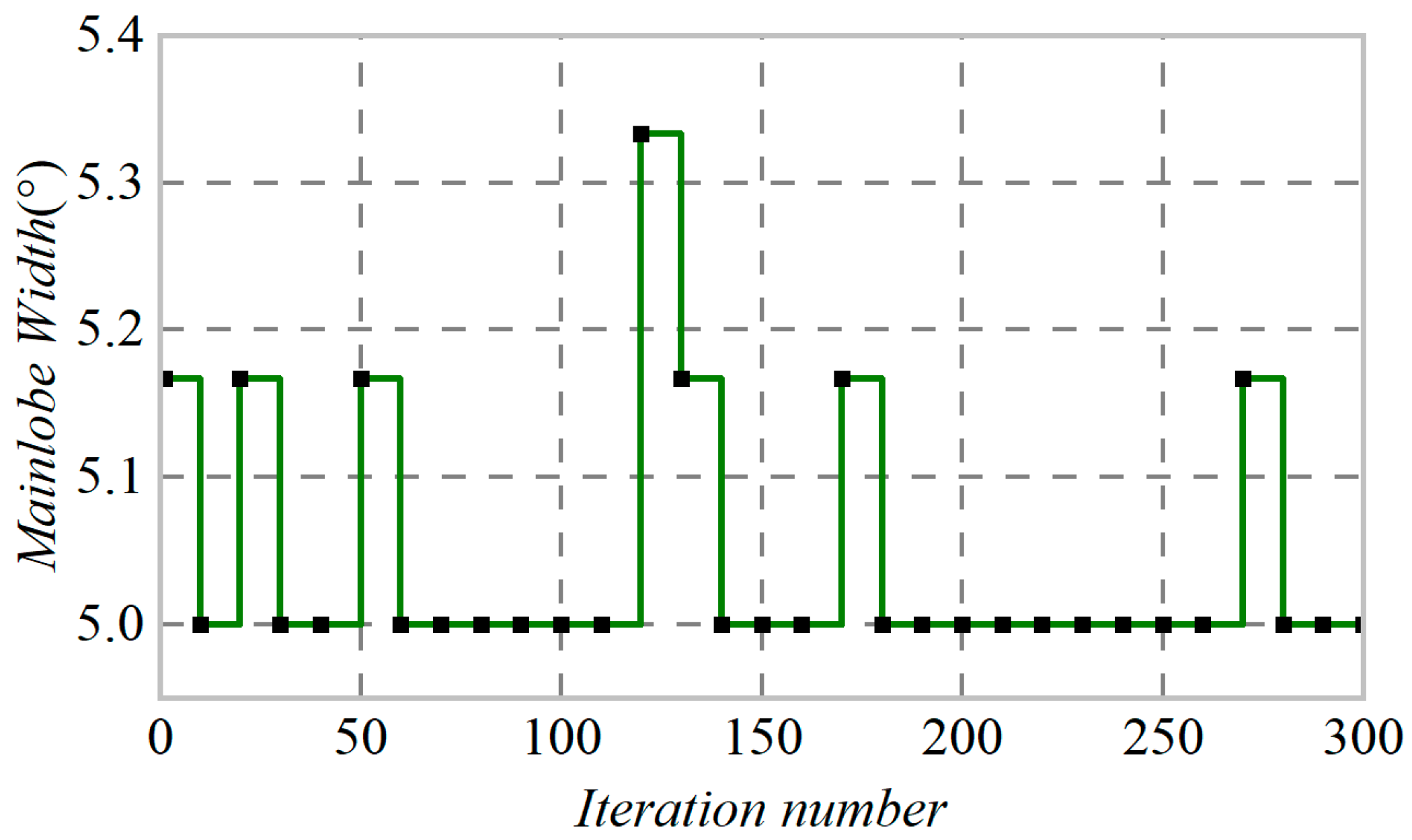
Based on the above model, optimization analysis of the array performance under sea states 1~3 is conducted. The optimal PSLL results, obtained from 100 independent Monte Carlo simulation runs, are shown in Figure 2. Interation numbers of main lobe width for sea states 1~3 are shown in Figure 3.
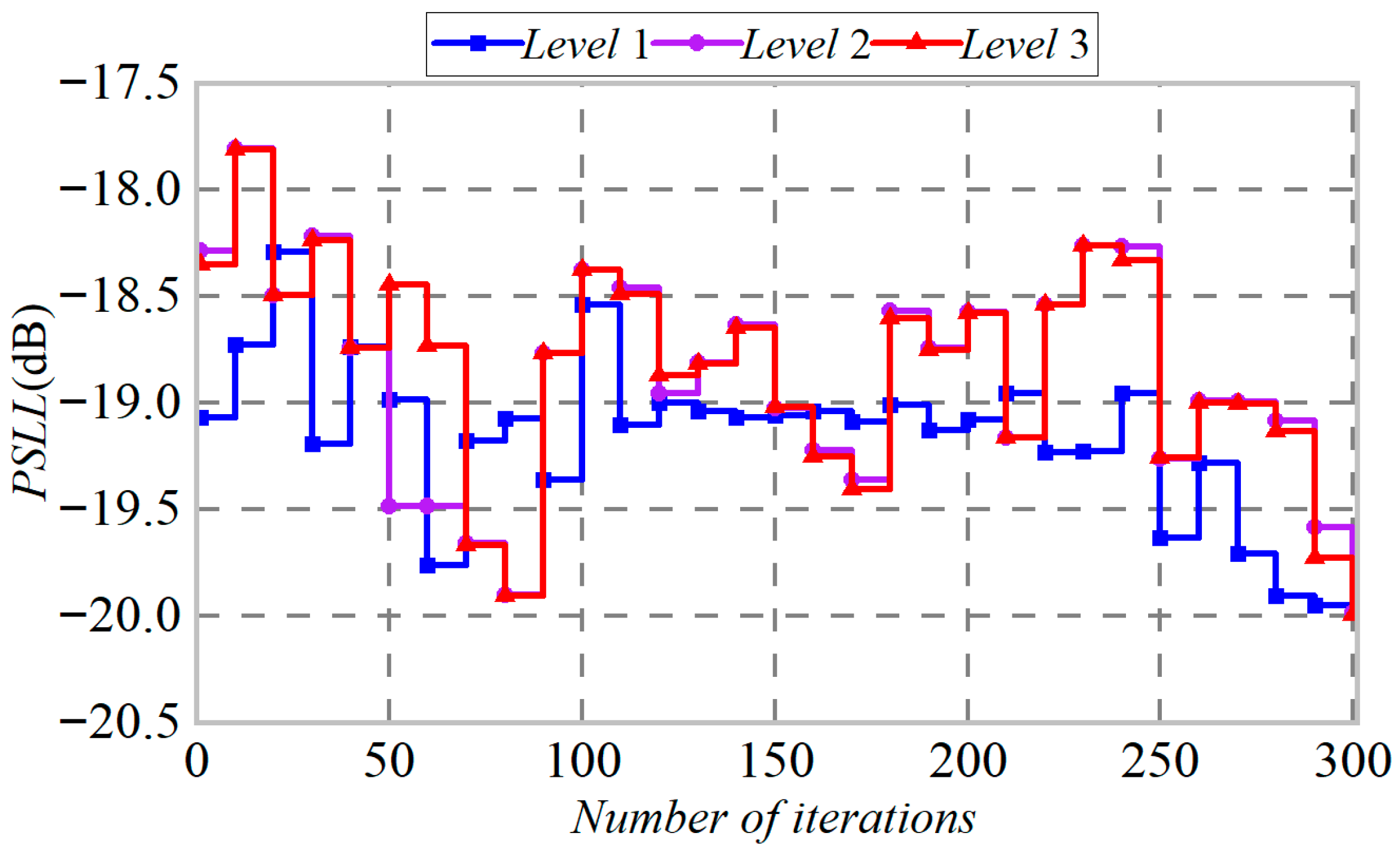
As shown in Figure 4, during the initial phase of optimization, owing to the density-weighted initial population generation strategy, the PSLL of the array is rapidly suppressed to a relatively low level within a small number of iterations. Upon entering the mid-phase of iterations, due to the trade-off and cooperative optimization between the dual-objective fitness functions of main lobe width and sidelobe level, the PSLL curve exhibits reasonable fluctuations to some extent. This reflects the algorithm’s effective exploration within the multi-objective solution space. Towards the later stage of iterations, the optimization process gradually converges, with PSLL further decreasing steadily, ultimately yielding an approximate global optimum that satisfies the prescribed constraints.
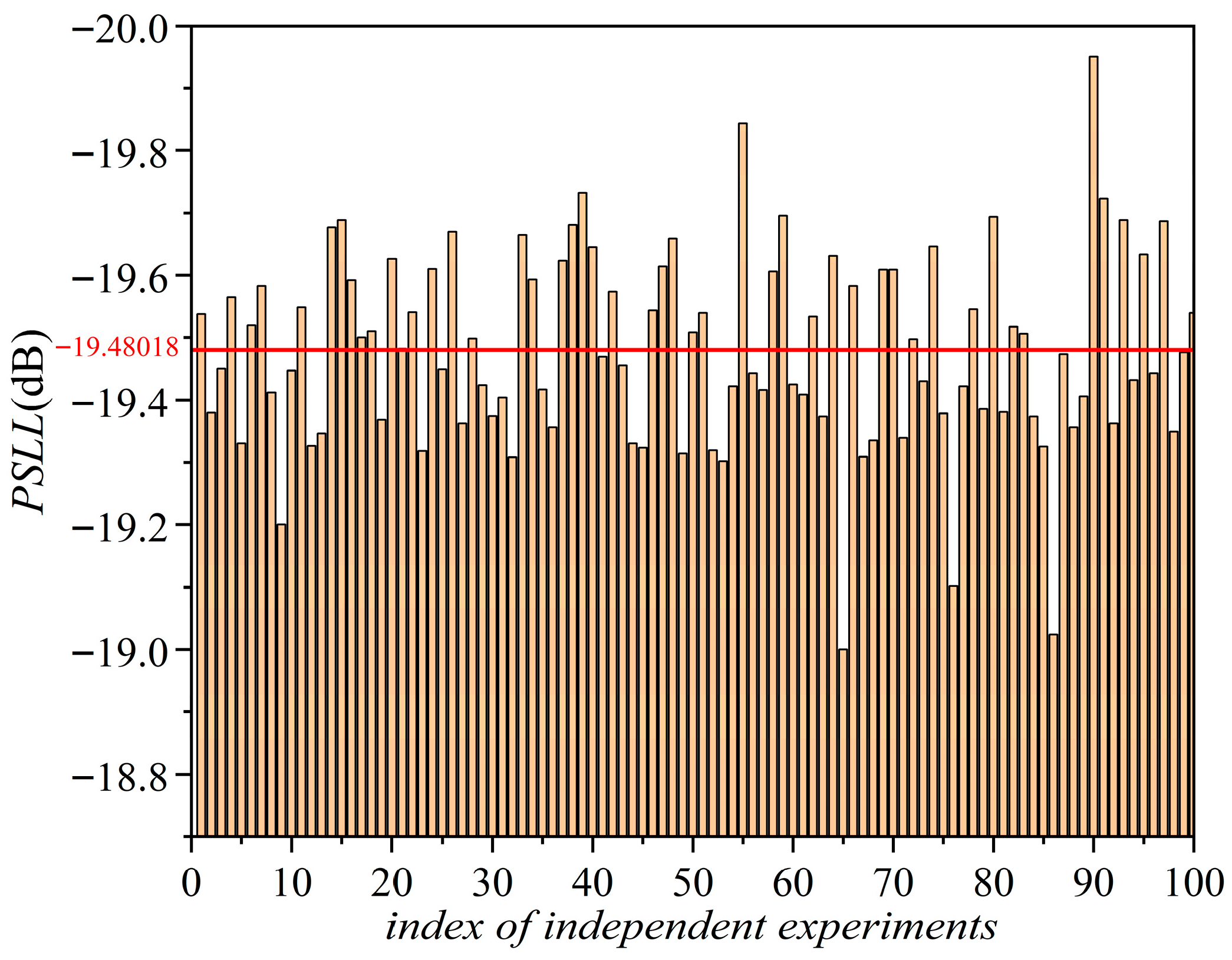
To further evaluate the stability of the optimization algorithm, Figure 5 presents the statistical distribution of the worst PSLL obtained from 100 independent repeated experiments under sea states 1~3. The experimental results indicate that the optimal PSLL can reach −19.5 dB, with an average PSLL of −19.48 dB. Furthermore, the variation across multiple runs is minimal. This demonstrates that the proposed method maintains stable and excellent sidelobe suppression performance under different random initial conditions, exhibiting good robustness.
The inter-element spacings for the entire array are listed in Table 1. The overall distribution of unit spacings ranges within 0.5~0.8 λ, with the majority concentrated around 0.5~0.6 λ. Table 2 provides a performance comparison between the method proposed in this paper and two other mainstream thinned array optimization algorithms under identical conditions. Within the dynamic sea state model incorporating roll disturbance, the PSLL of the array obtained by our method remains significantly lower than that of the compared algorithms, demonstrating superior sidelobe suppression capability and stronger environmental adaptability.

5.2. Planar Array Model

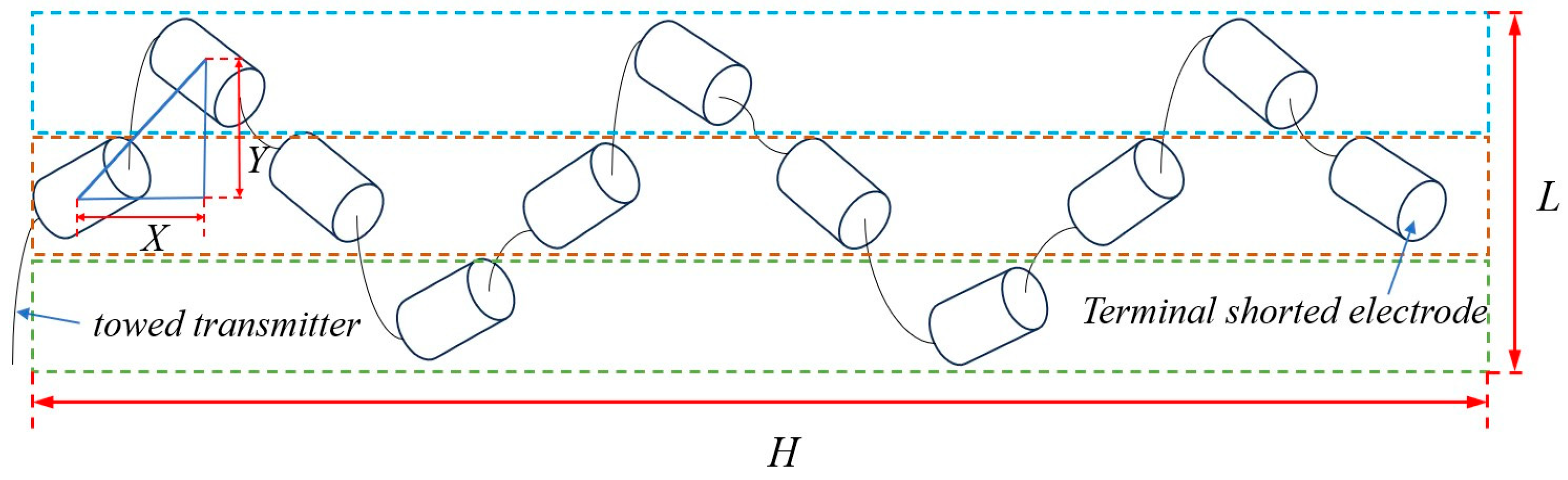
For higher sea states (levels 4~7), the array is subjected to the coupled effects of both pitch and roll motions, causing its spatial configuration to evolve from a linear approximation into a planar distribution. Under these conditions, the vertical heave of the array elements can be approximately described by a wave surface elevation function of sinusoidal form. The overall geometric model of the array is illustrated in Figure 6. The color lines indicate the hierarchical layering of the height of the waves.
To construct the thinned planar array model for these sea states, the total physical aperture length is defined as L × H . To mitigate mutual coupling effects, the minimum inter-element spacing is constrained as d min X 2 + Y 2 , where λ is the operating wavelength. Assuming the main beam is steered to θ 0 , φ 0 , and under uniform excitation, the radiation pattern function of the static planar array can be expressed as:
F θ , φ = m = 1 M n = 1 N e j k x m n sin θ sin φ + y m n sin θ sin φ
where x m n , y m n are the two-dimensional coordinates of the n-th element. When dynamic sea state-induced roll angle θ r and pitch-induced heave are incorporated, the pattern function must be modified to:
F θ , φ = m = 1 M n = 1 N e j k x m n sin θ cos φ + y m n sin θ sin φ cos γ + cos θ sin γ
To maintain the overall array aperture, two reference elements N1 and N2 are fixed at positions 0 , L / 2 and H , L / 2 , respectively, serving as the starting and ending units of the towed array. Using the wave path function as the axis reference, the position vector model for the entire array is given by:
d min = 0.5 λ X 2 + Y 2 = d x min = 0.3 λ x i ,     y min = 0.4 λ y j N 1 , N 2
A first-quadrant coordinate system is adopted, where x m n , y m n represents the coordinates of the m , n element on a non-uniform grid. Here, x m n and y m n denote the horizontal and vertical distances of the m , n element from the origin, respectively.
To validate the effectiveness of the density-weighted sparrow search algorithm in optimizing thinned arrays under high sea states, a coupled roll-pitch disturbance is applied to an initial linear array with a total of N = 28 elements. A corresponding planar array (with total aperture 12 λ × 5 λ ) is constructed based on the wave path function. After 100 independent Monte Carlo simulations, the optimal peak sidelobe level (PSLL) results are shown in Figure 7, demonstrating that the proposed method can significantly suppress sidelobe degradation caused by high sea states.
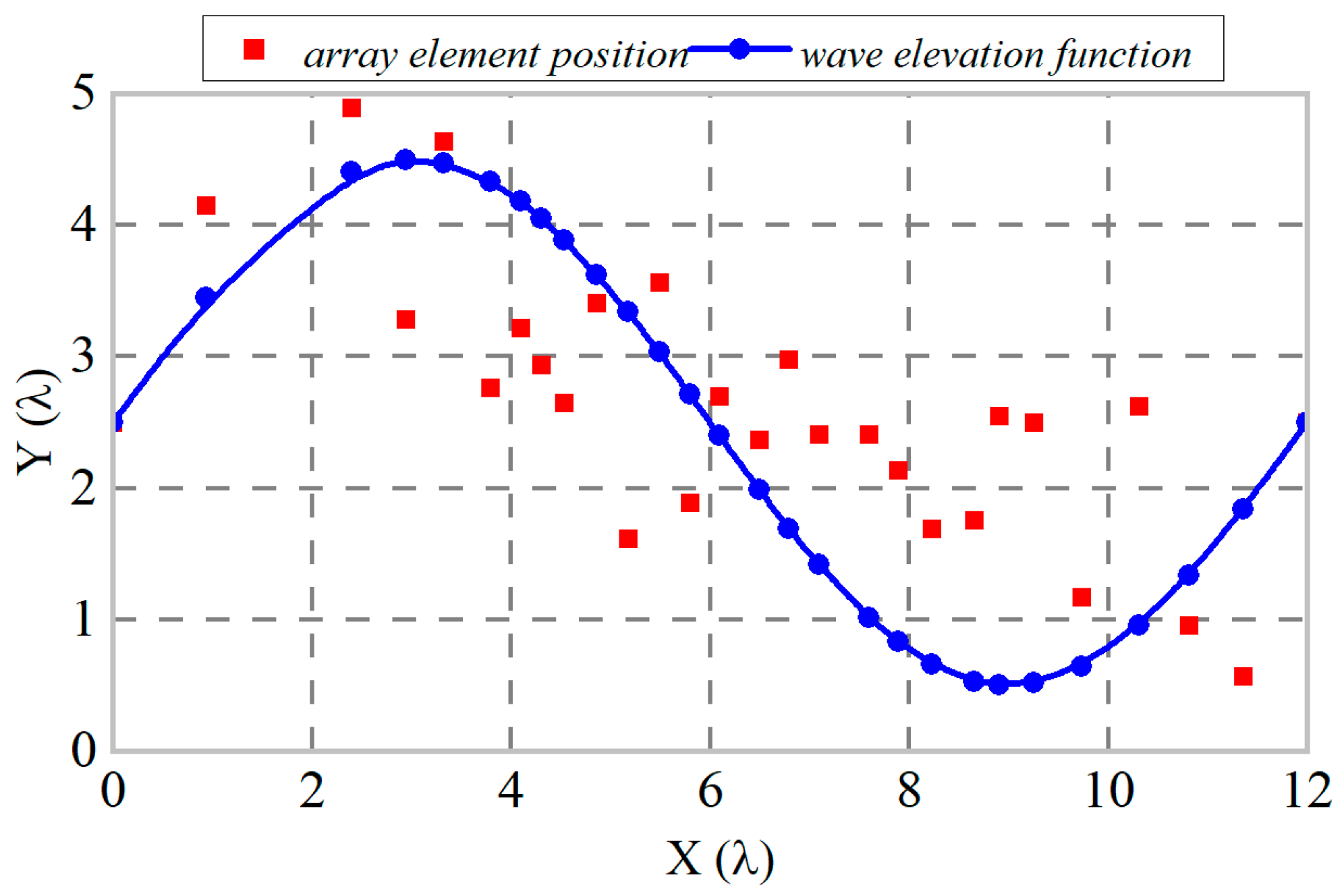
The optimized two-dimensional distribution of array elements is shown in Figure 8. All element coordinates on the X-axis are non-overlapping, and their positions are distributed within the vicinity of the wave path function curve. This distribution more realistically simulates the actual motion posture of a towed line array under dynamic sea surfaces, further verifying the engineering rationality of the model and optimization strategy.
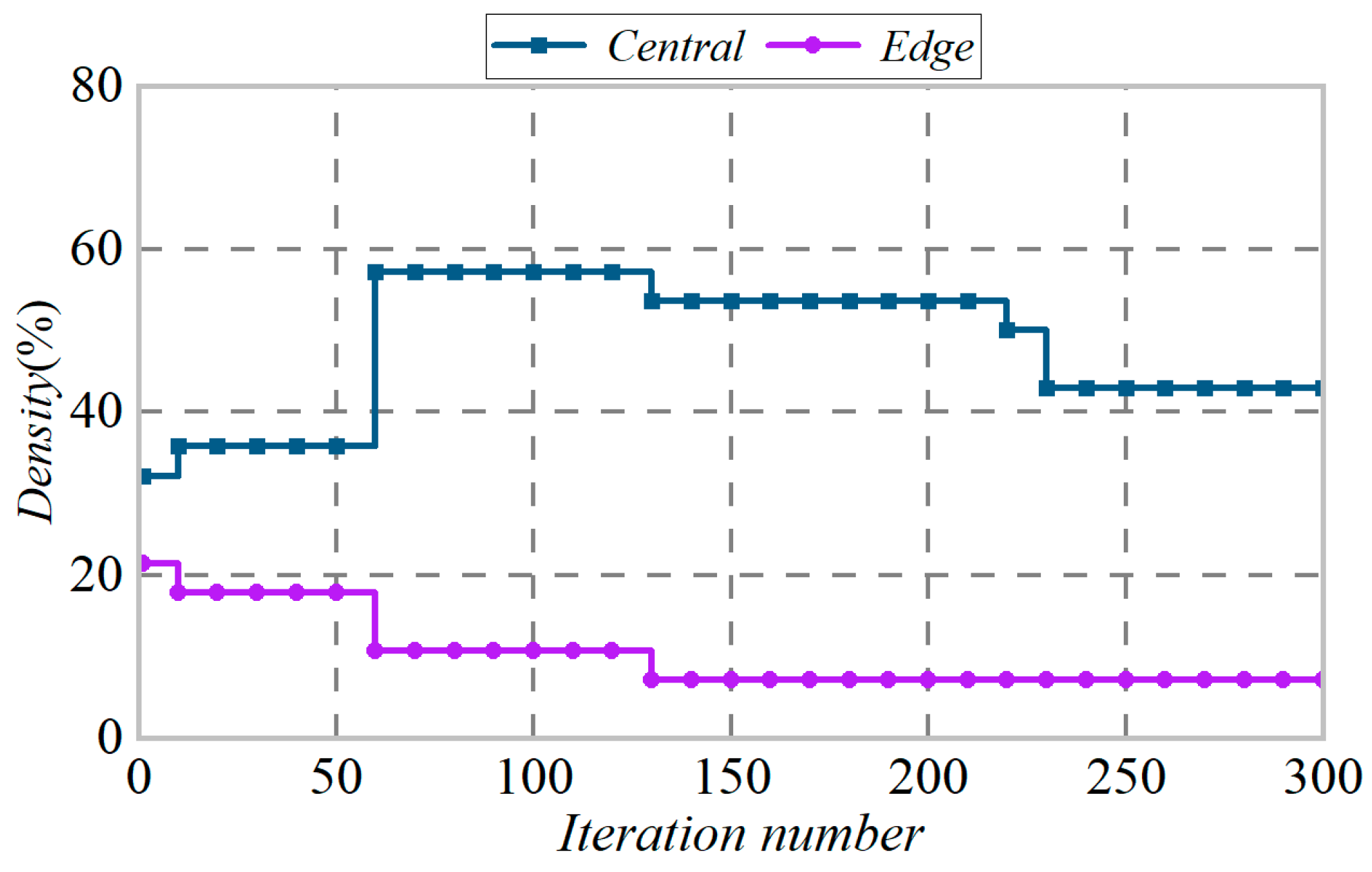
During the optimization process for sea states 4~7, the spatial distribution of array elements undergoes significant dynamic adjustment. As shown in Figure 9, in the early iteration stages, elements exhibit high-density clustering near the array center. As iterations proceed, to balance beam performance and aperture utilization, the algorithm gradually guides some elements to spread toward the edge regions. After approximately 150 iterations, the density distribution between the center and edges stabilizes, eventually forming a reasonable layout that is dense at the center and gradually sparse toward the edges. This effectively suppresses sidelobe elevation under high sea states and enhances the pattern robustness of the array.
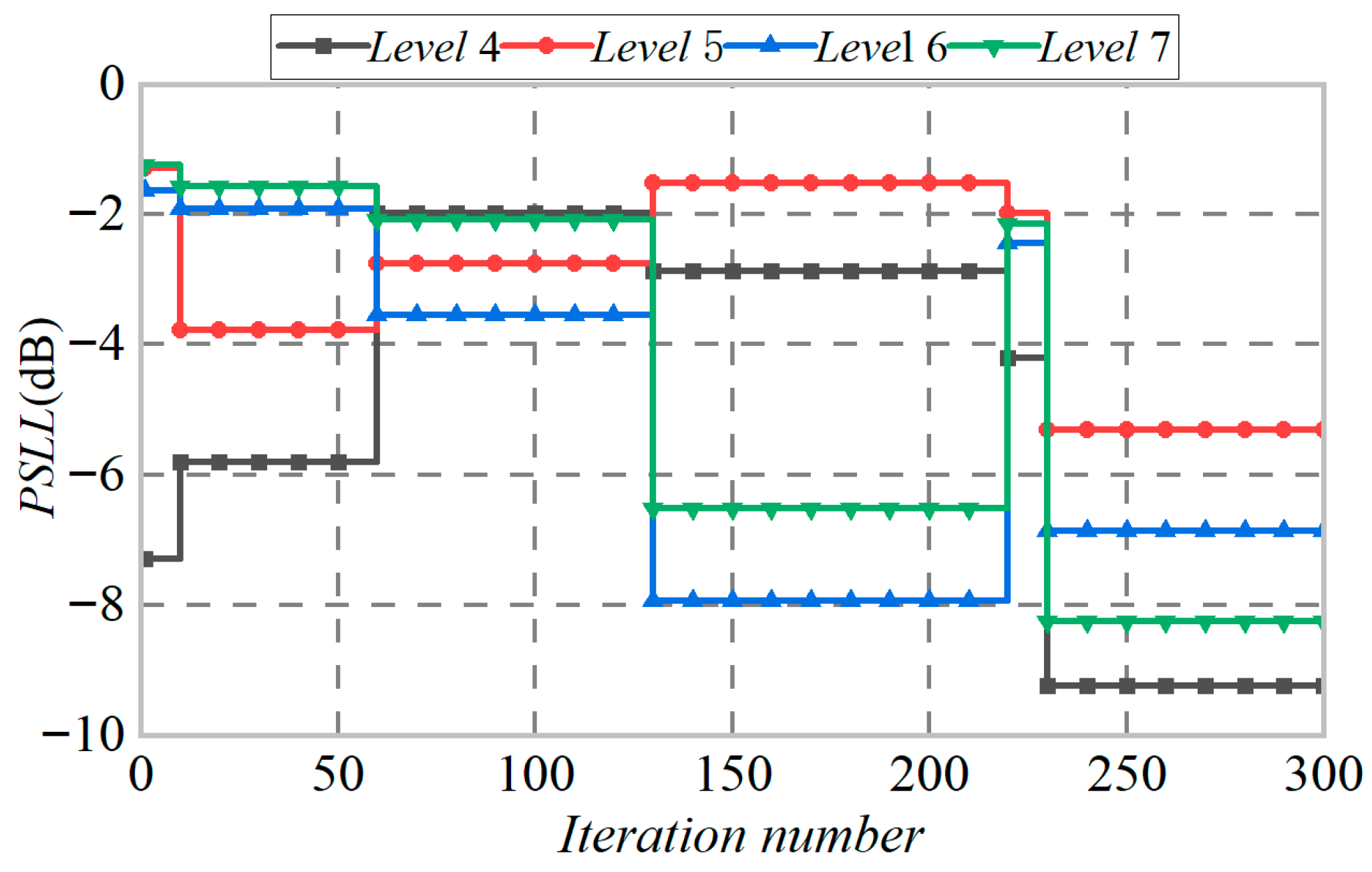
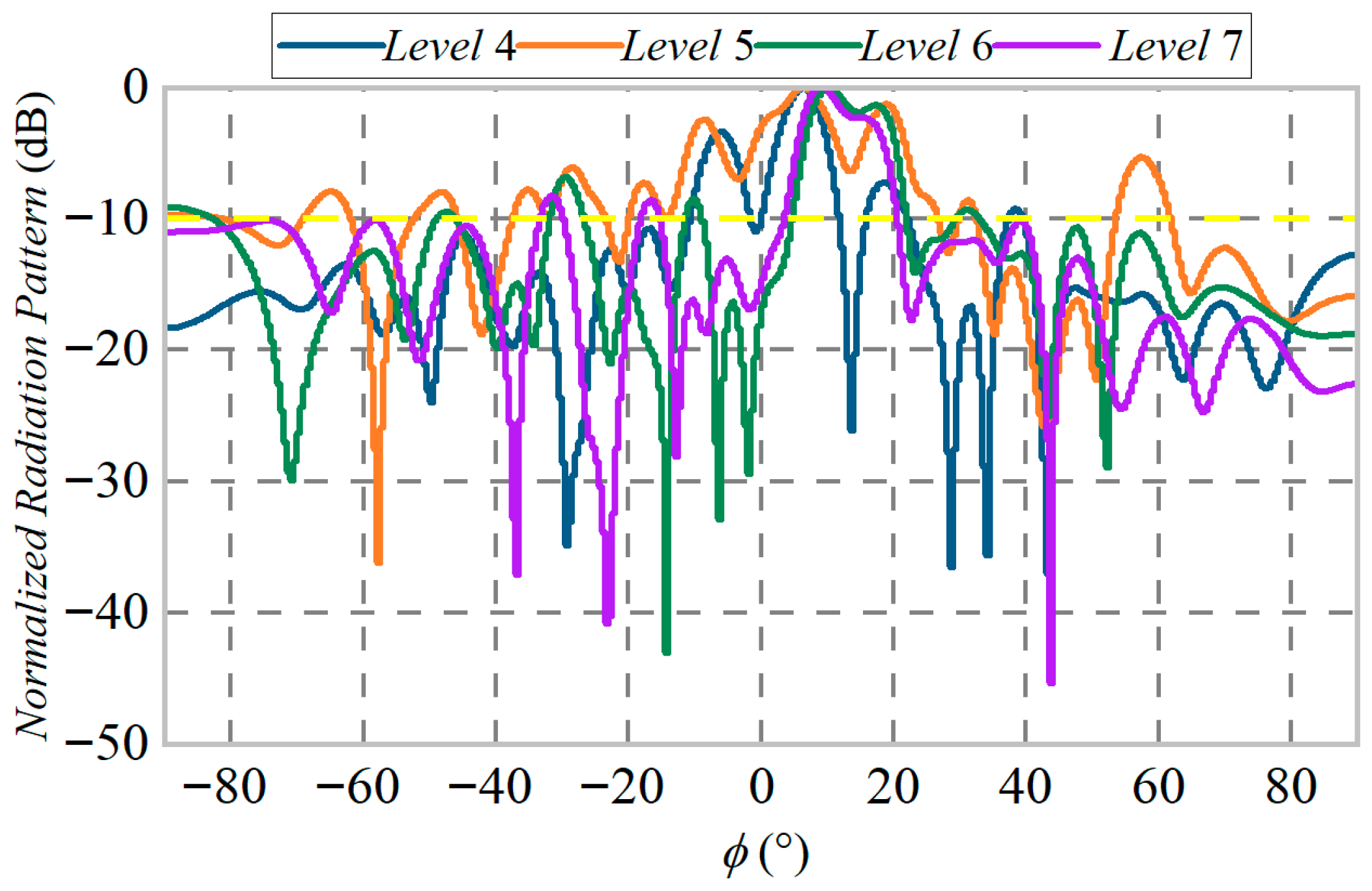
Under sea states 4~7, after 300 iterations of optimization, the array performance shows significant improvement. As observed in the radiation patterns in Figure 10, high sea states (especially levels 6 and 7) induce severe beam distortion and sidelobe elevation. After optimization, the PSLL for each sea state level is effectively suppressed (the curves for sea states 4 and 7 in Figure 9 are reduced below −8 dB). This indicates that the algorithm successfully reconstructs the element layout under complex disturbances, corrects pattern degradation caused by coupled pitch and roll motions, and achieves robust sidelobe control.

6. Conclusions

Aiming at the deterioration of beam performance in ocean-towed buoy arrays under complex sea conditions, this paper proposes a multi-objective optimization design method for thinned arrays based on an improved chaotic sparrow search algorithm. By introducing wave spectrum models and dynamic transfer functions, the roll and pitch disturbance characteristics of the array under sea states 1~7 are quantitatively analyzed. On this basis, comprehensive electromagnetic models for both disturbed linear arrays and planar arrays are established accordingly. A dual-objective optimization framework focusing on main lobe width and sidelobe level is constructed, and the NSGA-II mechanism is employed for Pareto-optimal solution search. Simulation results demonstrate that the proposed algorithm can effectively guide the distribution of array elements. Under sea states 1~3, the peak sidelobe level (PSLL) is optimized to below –19.95 dB, while under strong disturbances in sea states 4~7, significant suppression of sidelobe elevation and beam distortion is also achieved. These findings validate the effectiveness and engineering applicability of the proposed method in enhancing array radiation performance and system link robustness in dynamic marine environments.

Author Contributions

Conceptualization, H.L. and L.H.; methodology, L.H., H.L. and H.Y.; validation, Z.Z.; Y.Y., writing—original draft preparation, L.H., H.L. and Z.Z.; data curation, H.Y., H.L., and Z.Z.; writing—review and editing, H.Y.,Y.Y. All authors have read and agreed to the published version of the manuscript.

Funding

This work was supported by the Hubei Provincial Natural Science Foundation of China, 2024AFB966.

Data Availability Statement

The original contributions presented in this study are included in the article. Further inquiries can be directed to the corresponding author and the first author.

Acknowledgments

We thank the editor and the anonymous reviewers for their constructive comments, which helped to improve our work.

Conflicts of Interest

The authors declare no conflicts of interest.

Abbreviations

The following abbreviations are used in this manuscript:
CSSAChaotic sparrow search algorithm
PSLLPeak sidelobe level
LFPSOLevi’s flying particle swarm optimization
PSOParticle swarm optimization algorithm

References

  1. De Angelis, F.; Petrangeli, A.; Palmerini, G.B. Applications of Galileo HAS to Maritime Buoys. In Proceedings of the 2025 IEEE 12th International Workshop on Metrology for AeroSpace (MetroAeroSpace), Naples, Italy, 18–20 June 2025; IEEE: Piscataway, NJ, USA, 2025; pp. 1–6. [Google Scholar]
  2. Wang, H.; Wu, W.; Hou, X.; Cui, L.; Blaabjerg, F. A New Active Motion Control Strategy for Built-in Wave Energy Converter of Ocean Data Buoys. IEEE Trans. Ind. Electron. 2024, 72, 3213–3222. [Google Scholar] [CrossRef]
  3. Majumder, A.; Losito, M.; Paramasivam, S.; Kumar, A.; Gatto, G. Buoys for marine weather data monitoring and LoRaWAN communication. Ocean Eng. 2024, 313, 119521. [Google Scholar] [CrossRef]
  4. Shaumeyer, J.N.; Borden, J.M. An advanced buoy with high-volume, two-way LEO satellite communications. In Proceedings of the OCEANS 2000 MTS/IEEE Conference and Exhibition Conference Proceedings (Cat No 00CH37158), Providence, RI, USA, 11–14 September 2000; IEEE: Piscataway, NJ, USA, 2000; Volume 2, pp. 1103–1108. [Google Scholar]
  5. Premus, V.E.; Abbot, P.A.; Kmelnitsky, V.; Gedney, C.J.; Abbot, T.A. A wave glider-based, towed hydrophone array system for autonomous, real-time, passive acoustic marine mammal monitoring. J. Acoust. Soc. Am. 2022, 152, 1814–1828. [Google Scholar] [CrossRef] [PubMed]
  6. Lv, C.; Fang, S.; Hua, B.; Zhang, T.; Wang, M.; Wang, L.; Zhu, Q. Buoy Loss Model for Satellite-to-sea Communication Cooperating 6D Motion. In Proceedings of the 2024 Photonics & Electromagnetics Research Symposium (PIERS), Chengdu, China, 21–25 April 2024; IEEE: Piscataway, NJ, USA, 2024; pp. 1–5. [Google Scholar]
  7. Tian, X.; Wang, B.; Tao, K.; Li, K. An improved synthesis of sparse planar arrays using density-weighted method and chaos sparrow search algorithm. IEEE Trans. Antennas Propag. 2023, 71, 4339–4349. [Google Scholar] [CrossRef]
  8. Ma, R.; Ma, Y.; Lin, Z.; Ma, Y.; Yang, W.; Niyato, D. Covert Communication Assisted by Movable Time-Modulated Arrays. IEEE Commun. Lett. 2026, 30, 382–386. [Google Scholar] [CrossRef]
  9. Yuan, P. Synthesis of Shaped, Reconfigurable, and Envelope Beam for Linear Array Using a Hybrid Whale Optimization Algorithm. Prog. Electromagn. Res. B 2024, 107, 155240. [Google Scholar] [CrossRef]
  10. Ye, Z.; Cai, Q.-M.; Cao, X.; Gu, L.; Zhu, Y.; Zhu, Y.; Fan, J. A Novel Probability Density Taper Approach for Planar Array Thinning. In Proceedings of the 2022 Asia-Pacific International Symposium on Electromagnetic Compatibility (APEMC), Beijing, China, 1–4 September 2022; IEEE: Piscataway, NJ, USA, 2022; pp. 536–538. [Google Scholar]
  11. Yang, H.; Chen, P.; Zhou, H.; Tan, J. An efficient position optimization method based on improved genetic algorithm and machine learning for sparse array. AEU-Int. J. Electron. Commun. 2024, 179, 155312. [Google Scholar] [CrossRef]
  12. Tao, K.; Wang, B.; Tian, X.; Tang, Q.; Xie, G. Synthesis of sparse rectangular planar arrays with weight function and improved grey wolf optimization algorithm. IET Microw. Antennas Propag. 2024, 18, 748–762. [Google Scholar] [CrossRef]
  13. Pond, S. Some effects of buoy motion on measurements of wind speed and stress. J. Geophys. Res. 1968, 73, 507–512. [Google Scholar] [CrossRef]
  14. Tran, P.T.; Tran, T.-N.; Nguyen, B.C.; Hoang, T.M.; Dung, L.T.; Kim, T. Enhancing Secrecy Performance of Full-Duplex Relaying Systems Using IRS and RSMA. IEEE Trans. Mob. Comput. 2025, 25, 878–891. [Google Scholar] [CrossRef]
  15. Tayfun, M.; Alkhalidi, M. Distribution of sea-surface elevations in intermediate and shallow water depths. Coast. Eng. 2020, 157, 103651. [Google Scholar] [CrossRef]
  16. Nadimi-Shahraki, M.H.; Zamani, H.; Varzaneh, Z.A.; Mirjalili, S. A systematic review of the whale optimization algorithm: Theoretical foundation, improvements, and hybridizations. Arch. Comput. Methods Eng. 2023, 30, 4113–4159. [Google Scholar] [CrossRef] [PubMed]
  17. Liu, J.L.; Wang, X.M. Synthesis of sparse arrays with spacing constraints using an improved particle swarm optimization algorithm. J. Microw. 2010, 26, 7–10. [Google Scholar]
  18. Meng, X.M.; Cai, C.C. Synthesis of sparse array antennas based on Lévy flight particle swarm optimization. J. Terahertz Sci. Electron. Inf. Technol. 2021, 19, 90–95. [Google Scholar]
  19. Nieto-Reyes, A. On the non-Gaussianity of sea surface elevations. J. Mar. Sci. Eng. 2022, 10, 1303. [Google Scholar] [CrossRef]
  20. Zapevalov, A.S. Selection of the Distribution of Sea Surface Elevations for Modeling the Reflected Pulse of the Radio Altimeter. In Physical and Mathematical Modeling of Earth and Environment Processes: Proceedings of 7th International Conference, Moscow, Russia, 2021; Springer: Berlin/Heidelberg, Germany, 2022; pp. 21–31. [Google Scholar]
Figure 1. Information interaction diagram of the towed satellite buoy array.
Electronics 15 00788 g001
Figure 2. Array radiation pattern under roll for sea states 1~3.
Electronics 15 00788 g002
Figure 3. Iteration of main lobe width for sea states 1~3.
Electronics 15 00788 g003
Figure 4. Iteration of sidelobe level for sea states 1~3.
Electronics 15 00788 g004
Figure 5. Sidelobe level results from 100 tests.
Electronics 15 00788 g005
Figure 6. Overall buoy model for sea states 4~7.
Electronics 15 00788 g006
Figure 7. Sidelobe level iteration for sea states 4~7.
Electronics 15 00788 g007
Figure 8. Element positions.
Electronics 15 00788 g008
Figure 9. Element density iteration diagram.
Electronics 15 00788 g009
Figure 10. Array radiation pattern under roll for sea states 4~7.
Electronics 15 00788 g010
Table 1. Spacing of each unit in sparse array.
ElementSpacing (λ)ElementSpacing (λ)ElementSpacing (λ)ElementSpacing (λ)
1~20.6585~60.5889~100.58813~140.588
2~30.7506~70.58810~110.58814~150.588
3~40.5887~80.58811~120.58815~160.588
4~50.5888~90.69712~130.58816~170.588
Table 2. Comparison chart of several sparse array optimization algorithms.
TypeArray ElementsArray TypeIterationsArray ApertureSpacing RequirementPSLL (dB)
PSO [19]17Symmetry5009.774 d 0.5   λ −19.61
LFPSO [20]100−19.87
CSSAAsymmetry300−19.95
Disclaimer/Publisher’s Note: The statements, opinions and data contained in all publications are solely those of the individual author(s) and contributor(s) and not of MDPI and/or the editor(s). MDPI and/or the editor(s) disclaim responsibility for any injury to people or property resulting from any ideas, methods, instructions or products referred to in the content.