Multi-Camera Simultaneous Localization and Mapping for Unmanned Systems: A Survey

Abstract
1. Introduction

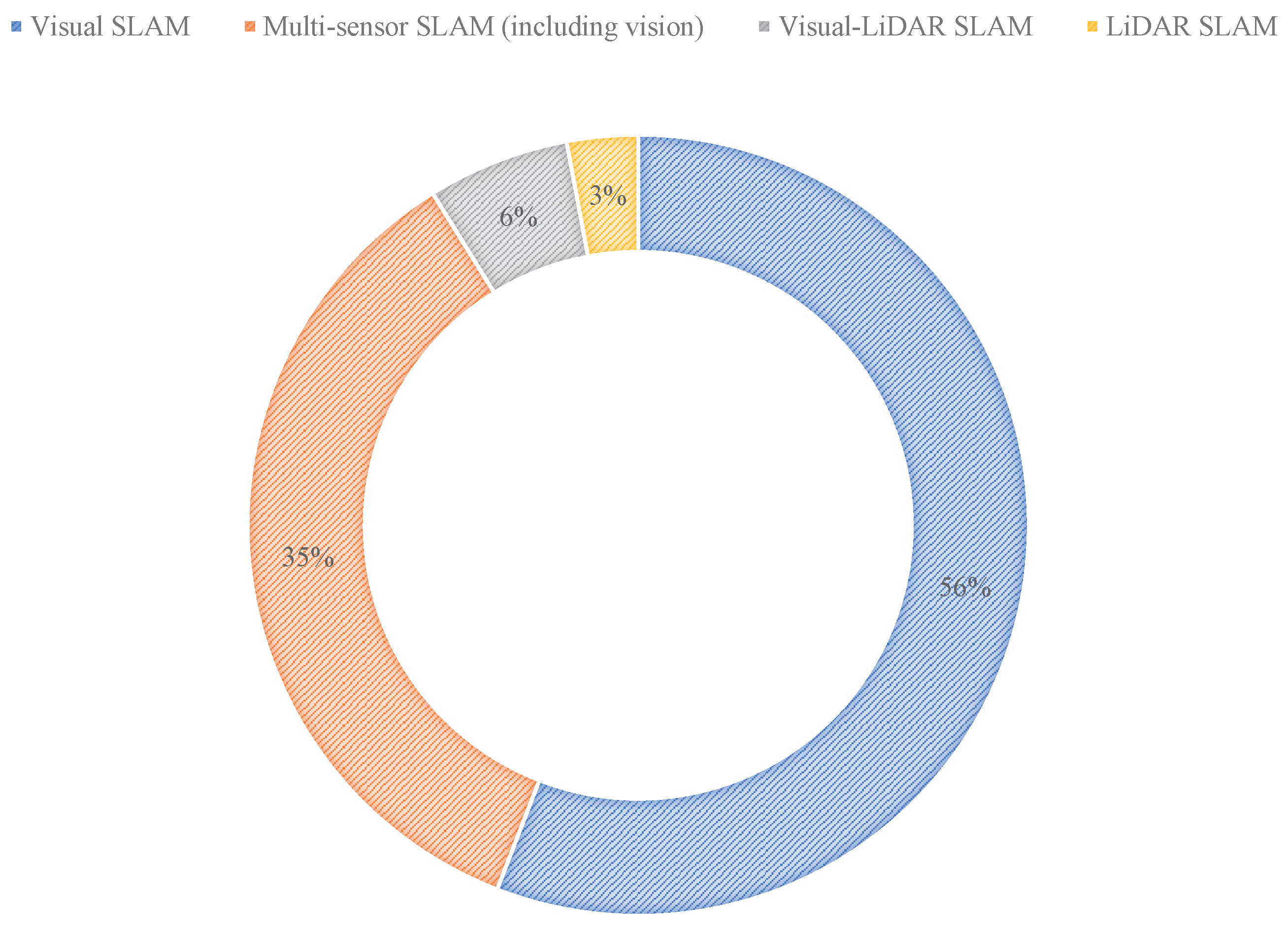
| Reference | Title | Type | Year |
|---|---|---|---|
| Kostavelis et al. [22] | Semantic Mapping for Mobile Robotics Tasks: A Survey | Visual SLAM | 2015 |
| Yousif et al. [23] | An Overview to Visual Odometry and Visual SLAM: Applications to Mobile Robotics | 2015 | |
| Lowry et al. [24] | Visual Place Recognition: A Survey | 2016 | |
| Taketomi et al. [25] | Visual SLAM Algorithms: A Survey from 2010 to 2016 | 2017 | |
| Saputra et al. [26] | Visual SLAM and Structure from Motion in Dynamic Environments: A Survey | 2018 | |
| Jamiruddin et al. [27] | RGB-Depth SLAM Review | 2018 | |
| Chen et al. [28] | A Review of V-SLAM | 2018 | |
| Duan et al. [29] | Deep Learning for Visual SLAM in Transportation Robotics: A Review. | 2019 | |
| Garg et al. [30] | Semantics for Robotic Mapping, Perception and Interaction: A Survey | 2020 | |
| Chen et al. [31] | A Survey on Deep Learning for Localization and Mapping: Towards the Age of Spatial Machine Intelligence | 2020 | |
| Zeng et al. [32] | View Planning in Robot Active Vision: A Survey of Systems, Algorithms, and Applications | 2020 | |
| Xia et al. [33] | A Survey of Image Semantics-Based Visual Simultaneous Localization and Mapping: Application-Oriented Solutions to Autonomous Navigation of Mobile Robots | 2020 | |
| Servières et al. [34] | Visual and Visual–Inertial SLAM: State of the Art, Classification, and Experimental Benchmarking | 2021 | |
| Tsintotas et al. [35] | The Revisiting Problem in Simultaneous Localization and Mapping: A Survey on Visual Loop Closure Detection | 2022 | |
| Chen [36] | Semantic Visual Simultaneous Localization and Mapping: A Survey | 2022 | |
| Agostinho et al. [37] | A Practical Survey on Visual Odometry for Autonomous Driving in Challenging Scenarios and Conditions | 2022 | |
| Fabio et al. [38] | How NeRFs and 3D Gaussian Splatting are Reshaping SLAM: a Survey | 2024 | |
| Zhuang et al. [39] | Visual SLAM for Unmanned Aerial Vehicles: Localization and Perception | 2024 | |
| Wang et al. [40] | A Survey of Visual SLAM in Dynamic Environment: The Evolution From Geometric to Semantic Approaches | 2024 | |
| Chong et al. [41] | Sensor Technologies and Simultaneous Localization and Mapping (SLAM) | Multi-sensor SLAM (including vision) | 2015 |
| Cadena et al. [42] | Past, Present, and Future of Simultaneous Localization and Mapping: Toward the Robust-Perception Age | 2016 | |
| Saeedi et al. [43] | Multiple-Robot Simultaneous Localization and Mapping: A Review | 2016 | |
| Zaffar et al. [44] | Sensors, Slam and Long-Term Autonomy: A Review | 2018 | |
| Sualeh et al. [45] | Simultaneous Localization and Mapping in the Epoch of Semantics: A Survey | 2019 | |
| Huang et al. [46] | A Survey of Simultaneous Localization and Mapping with An Envision in 6G Wireless Networks | 2019 | |
| Zhao et al. [47] | Review of SLAM Techniques for Autonomous Underwater Vehicles | 2019 | |
| Rosen et al. [48] | Advances in Inference and Representation for Simultaneous Localization and Mapping | 2021 | |
| Liu et al. [49] | Simultaneous Localization and Mapping Related Datasets: A Comprehensive Survey | 2021 | |
| Hriday et al. [50] | From SLAM to Situational Awareness: Challenges and Survey | 2023 | |
| Reza et al. [51] | Hardware Implementation of SLAM Algorithms: A Survey on Implementation Approaches and Platforms | 2023 | |
| Tezerjani et al. [52] | A Survey on Reinforcement Learning Applications in SLAM | 2024 | |
| Debeunne et al. [53] | A Review of Visual-LiDAR Fusion Based Simultaneous Localization and Mapping | Visual-LiDAR SLAM | 2020 |
| Kolhatkar et al. [54] | Review of SLAM Algorithms for Indoor Mobile Robot with LiDAR and RGB-D Camera Technology | 2020 | |
| Yang et al. [55] | A Survey of SLAM Research Based on LiDAR Sensors | LiDAR SLAM | 2019 |
- A thorough review of the existing research in MCSLAM is undertaken, followed by a systematic categorization of these advancements to provide a structured overview of the field.
- In order to support researchers in selecting datasets aligned with the characteristics of their algorithms, a detailed analysis and comparison of current MCSLAM-related datasets is presented.
- The strengths and limitations of representative MCSLAM approaches are examined in depth, and the key challenges as well as future development trends of MCSLAM are thoroughly analyzed.
2. Multi-Camera Systems
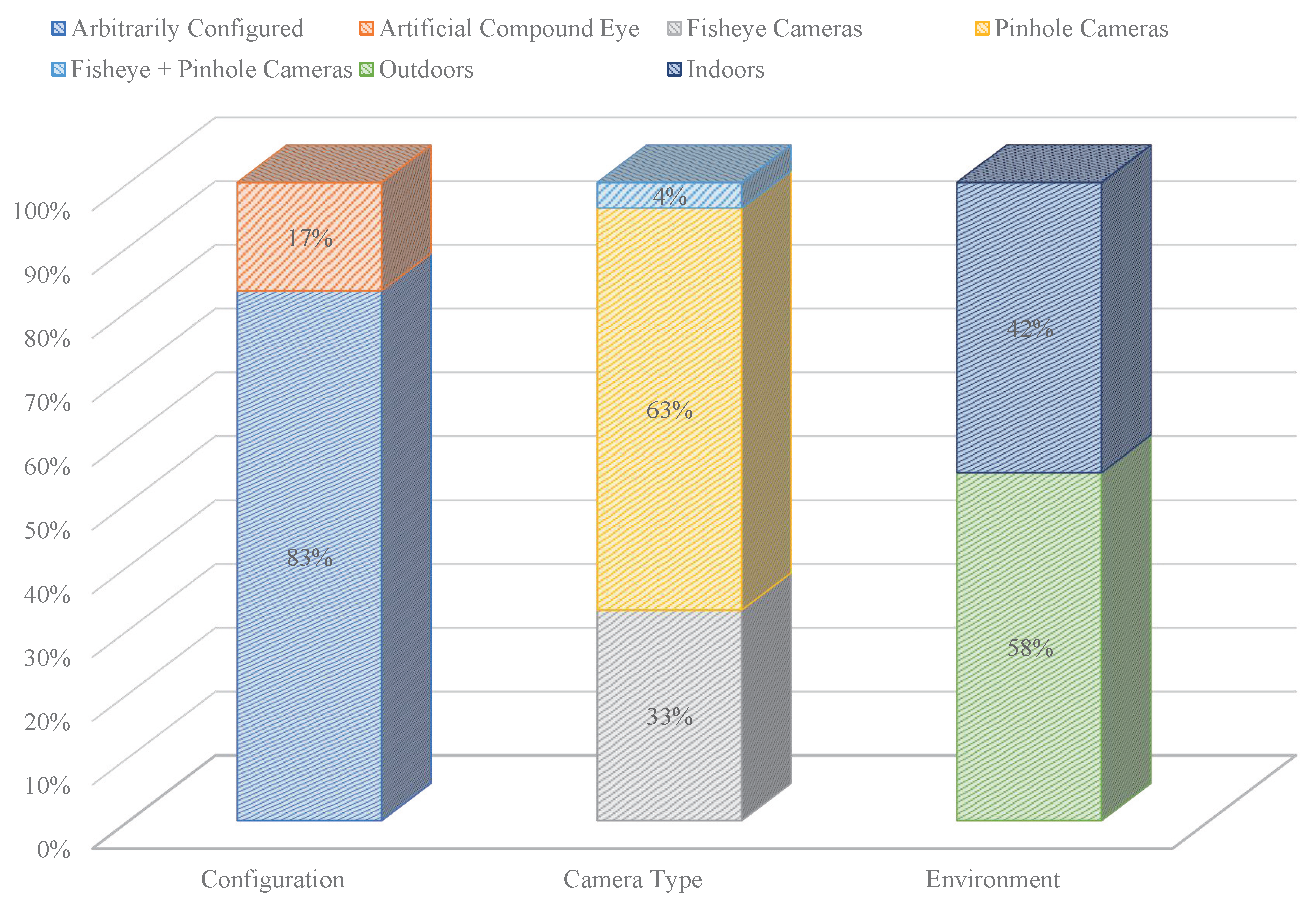
- MCSs are predominantly employed in outdoor settings.
- Research on ACESs is limited, with arbitrarily configured MCSs being more prevalent. This is mainly due to the high structural design and production demands of ACESs. Arbitrarily configured MCSs are preferred as they do not hinder the exploration of fundamental theories and technologies of MCSs. However, research on such systems may provide limited guidance for the standardization and commercialization of MCSs.
- Most MCSs consist of fewer than five cameras. Due to the substantial data volume in MCSs, increasing the number of cameras could lead to higher computational expense. Consequently, exploring MCSs with more than five cameras is a direction warranting further research.
- MCSs, particularly those of arbitrarily configured types, often neglect considerations of camera system synchronization or asynchrony.
3. Research on MCSLAM
3.1. Intrinsic and Extrinsic Calibration
3.1.1. Calibration of MCSs with Strictly Non-Overlapping FOV
3.1.2. Calibration with No Strict Regulations on Overlapping FOV
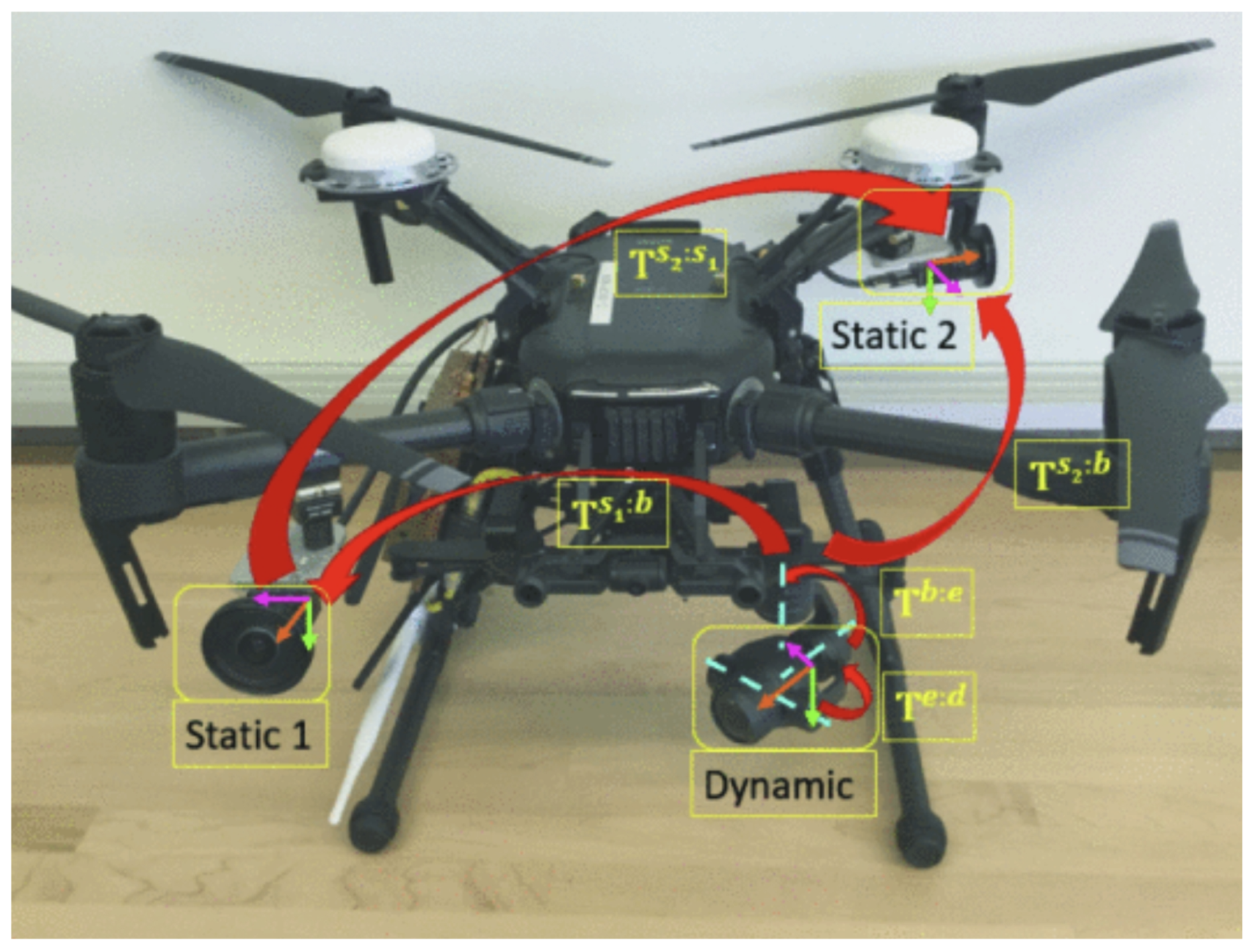
3.1.3. Dynamic Calibration for MCSs
- Calibration difficulty grows with increasing degrees of freedom (DOFs);
- Calibrating two or more cameras with overlapping FOVs but distinct individual FOV specifications necessitates multiple intricate calibration procedures;
- Calibration procedure is achieved in a restricted range of motion.

3.2. Initialization
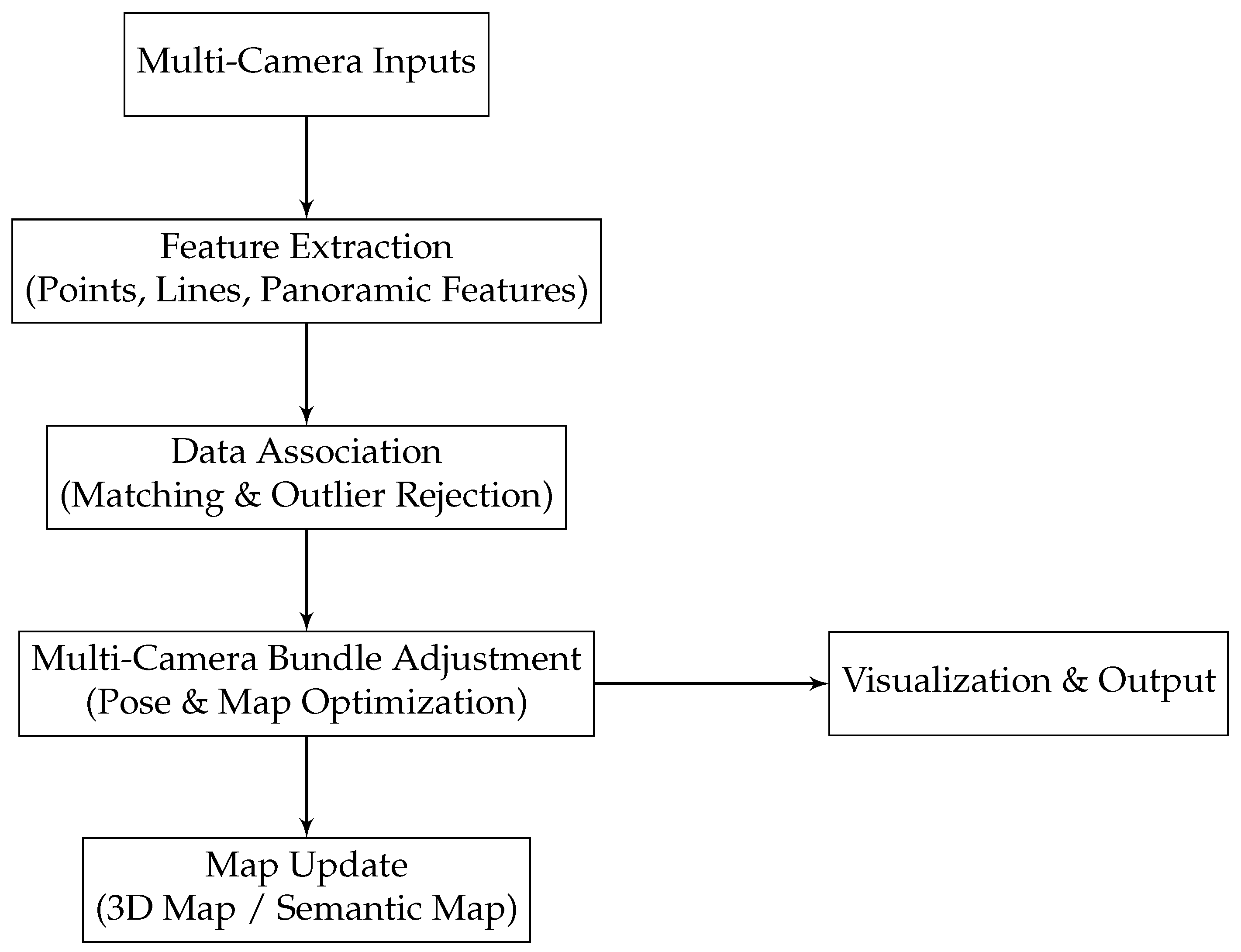
3.3. Feature Extraction
3.4. Depth and Pose Estimation
3.4.1. Depth Estimation
3.4.2. Pose Estimation
3.5. Mapping
4. MCSLAM Based on Deep Learning
5. Special MCSLAM
5.1. MCSLAM Based on Multi-Sensor Fusion
5.2. Others
6. Datasets
7. The Development Trend of MCSLAM
- MCSLAM based on deep learning: It faces severe challenges in small-sample and dynamic environments. Deep neural networks have shown impressive results in various applications, and they have become an important development trend in the SLAM field. They can serve as reliable feature extractors and have solved many cognitive and learning tasks that rely on human design feature cannot achieve. The advantages of deep learning in object detection, semantic segmentation, dense matching, and other fields have become prominent and significantly superior to traditional methods. However, deep learning methods heavily rely on large datasets and their performance is limited by the size of the dataset. At the same time, the performance of deep learning in dynamic environments remains problematic. Enhancing the adaptability of deep learning in scenarios with small datasets, large-scale environments, and dynamic conditions is of great significance.
- MCSLAM based on point–line-plane feature matching: Solely relying on point features may not be sufficient for various environments. The combination of point–line-plane features can achieve more robust feature matching, reduce system drift errors, and improve the system’s understanding of the environment.
- Balancing information retrieval and computation cost: Sparse map computation has lower costs but provides less information. Dense maps, while recording complete scene information, require real-time computing performance. MCSs generate a massive amount of information, and improving the performance of information retrieval will have a significant impact on the entire system.
- Asynchronous MCSLAM: Current MCSLAM studies are based on synchronous cameras. However, in practical applications, the natural asynchrony of cameras can affect system performance, leading to accuracy impacts.
- MCSLAM in dynamic environments (challenging scenarios): SLAM’s development has been following the development of the demand for autonomous driving technology. With the gradual improvement in and popularization of autonomous driving technology, the demands and requirements for unmanned systems in dynamic environments have gradually increased. Most traditional SLAM mostly solves problems in static environments. Addressing accurate self-positioning and collision avoidance in dynamic environments are hot topics in current MCSLAM research.
- Establish and expand dense maps: Dense maps can provide richer environmental information for unmanned systems. The breakthrough in dense map construction for the fusion of multiple sensors, drone cluster systems, and ground air joint navigation is of great significance.
8. Conclusions
Author Contributions
Funding
Data Availability Statement
Conflicts of Interest
References
- Hussain, K.; Oh, I.Y. Joint radar, communication, and integration of beamforming technology. Electronics 2024, 13, 1531. [Google Scholar] [CrossRef]
- Yu, J.; Yu, T.H.; Zhang, Q.Y.; Nguyen, T.T. NI-LIO: A Hybrid Approach Combining ICP and NDT for Improving Simultaneous Localization and Mapping Performance. Electronics 2025, 14, 178. [Google Scholar] [CrossRef]
- He, Y.; Li, B.; Ruan, J.; Yu, A.; Hou, B. ZUST Campus: A Lightweight and Practical LiDAR SLAM Dataset for Autonomous Driving Scenarios. Electronics 2024, 13, 1341. [Google Scholar] [CrossRef]
- Zou, Y.; Meng, P.; Xiong, J.; Wan, X. SS-LIO: Robust Tightly Coupled Solid-State LiDAR–Inertial Odometry for Indoor Degraded Environments. Electronics 2025, 14, 2951. [Google Scholar] [CrossRef]
- Shan, D.; Su, J.; Wang, X.; Liu, Y.; Zhou, T.; Wu, Z. VID-SLAM: Robust pose estimation with RGBD-inertial input for indoor robotic localization. Electronics 2024, 13, 318. [Google Scholar] [CrossRef]
- Zhou, K.; Yu, Z.; Zhou, X.; Tan, P.; Yin, Y.; Luo, H. ADEmono-SLAM: Absolute Depth Estimation for Monocular Visual Simultaneous Localization and Mapping in Complex Environments. Electronics 2025, 14, 4126. [Google Scholar] [CrossRef]
- Rostum, H.; Vásárhelyi, J. Enhancing Machine Learning Techniques in VSLAM for Robust Autonomous Unmanned Aerial Vehicle Navigation. Electronics 2025, 14, 1440. [Google Scholar] [CrossRef]
- Yuan, C.; Wang, D.; Li, Z.; Xu, Y.; Zhang, Z. DJPETE-SLAM: Object-Level SLAM System Based on Distributed Joint Pose Estimation and Texture Editing. Electronics 2025, 14, 1181. [Google Scholar] [CrossRef]
- Zhou, L.; Wang, M.; Zhang, X.; Qin, P.; He, B. Adaptive slam methodology based on simulated annealing particle swarm optimization for auv navigation. Electronics 2023, 12, 2372. [Google Scholar] [CrossRef]
- Wang, C.; Cheng, C.; Yang, D.; Pan, G.; Zhang, F. Underwater auv navigation dataset in natural scenarios. Electronics 2023, 12, 3788. [Google Scholar] [CrossRef]
- Zhu, Z.; Wu, F.; Sun, W.; Wu, Q.; Liang, F.; Zhang, W. Depth Estimation Based on MMwave Radar and Camera Fusion with Attention Mechanisms and Multi-Scale Features for Autonomous Driving Vehicles. Electronics 2025, 14, 300. [Google Scholar] [CrossRef]
- Meng, Y.; Pan, X.; Wu, M.; Guo, Y.; Liu, Y.; Jiang, J.; Chen, C. VIFPE: Multimodal Fusion of Visible and Infrared Images for Pose Estimation in Large-Scale Urban Environments. Electronics 2025, 14, 3621. [Google Scholar] [CrossRef]
- Han, D.; Choi, Y. Monocular depth estimation from a single infrared image. Electronics 2022, 11, 1729. [Google Scholar] [CrossRef]
- Xu, W.; Zhang, P.; Yuan, G.; Xu, S.; Li, L.; Zhang, J.; Li, L.; Li, T.; Wang, Z. DCNN–Transformer Hybrid Network for Robust Feature Extraction in FMCW LiDAR Ranging. Photonics 2025, 12, 995. [Google Scholar] [CrossRef]
- Zuo, Z.; Wu, Z.; Wei, J.; Wu, P.; Huang, S.; Cheng, Z. A Checkerboard Corner Detection Method for Infrared Thermal Camera Calibration Based on Physics-Informed Neural Network. Photonics 2025, 12, 847. [Google Scholar] [CrossRef]
- You, B.; Chen, H.; Li, J.; Li, C.; Chen, H. Fast point cloud registration algorithm based on 3DNPFH descriptor. Photonics 2022, 9, 414. [Google Scholar] [CrossRef]
- Chen, Z.S.; Chrisantonius; Raswa, F.H.; Chen, S.K.; Huang, C.I.; Li, K.C.; Chen, S.L.; Li, Y.H.; Wang, J.C. A Hybrid Deep Learning and Feature Descriptor Approach for Partial Fingerprint Recognition. Electronics 2025, 14, 1807. [Google Scholar] [CrossRef]
- Zhang, X.; Zhang, Z.; Wang, Q.; Yang, Y. Using a two-stage method to reject false loop closures and improve the accuracy of collaborative SLAM systems. Electronics 2021, 10, 2638. [Google Scholar] [CrossRef]
- Chghaf, M.; Rodríguez Flórez, S.; El Ouardi, A. Extended Study of a Multi-Modal Loop Closure Detection Framework for SLAM Applications. Electronics 2025, 14, 421. [Google Scholar] [CrossRef]
- Park, J.; Lee, B.; Lee, S.; Song, S. Stereo-GS: Online 3D Gaussian Splatting Mapping Using Stereo Depth Estimation. Electronics 2025, 14, 4436. [Google Scholar] [CrossRef]
- Chen, J.; Jiao, Y.; Jin, F.; Qin, X.; Ning, Y.; Yang, M.; Zhan, Y. Plant Sam Gaussian Reconstruction (PSGR): A High-Precision and Accelerated Strategy for Plant 3D Reconstruction. Electronics 2025, 14, 2291. [Google Scholar] [CrossRef]
- Kostavelis, I.; Gasteratos, A. Semantic mapping for mobile robotics tasks: A survey. Robot. Auton. Syst. 2015, 66, 86–103. [Google Scholar] [CrossRef]
- Yousif, K.; Bab-Hadiashar, A.; Hoseinnezhad, R. An overview to visual odometry and visual SLAM: Applications to mobile robotics. Intell. Ind. Syst. 2015, 1, 289–311. [Google Scholar] [CrossRef]
- Lowry, S.; Sünderhauf, N.; Newman, P.; Leonard, J.J.; Cox, D.; Corke, P.; Milford, M.J. Visual place recognition: A survey. IEEE Trans. Robot. 2015, 32, 1–19. [Google Scholar] [CrossRef]
- Taketomi, T.; Uchiyama, H.; Ikeda, S. Visual SLAM algorithms: A survey from 2010 to 2016. IPSJ Trans. Comput. Vis. Appl. 2017, 9, 16. [Google Scholar] [CrossRef]
- Saputra, M.R.U.; Markham, A.; Trigoni, N. Visual SLAM and structure from motion in dynamic environments: A survey. ACM Comput. Surv. 2018, 51, 1–36. [Google Scholar] [CrossRef]
- Jamiruddin, R.; Sari, A.O.; Shabbir, J.; Anwer, T. RGB-depth SLAM review. arXiv 2018, arXiv:1805.07696. [Google Scholar] [CrossRef]
- Chen, Y.; Zhou, Y.; Lv, Q.; Deveerasetty, K.K. A review of v-slam. In Proceedings of the 2018 IEEE International Conference on Information and Automation (ICIA), Wuyishan, China, 11–13 August 2018; IEEE: Piscataway, NJ, USA, 2018; pp. 603–608. [Google Scholar]
- Duan, C.; Junginger, S.; Huang, J.; Jin, K.; Thurow, K. Deep learning for visual SLAM in transportation robotics: A review. Transp. Saf. Environ. 2019, 1, 177–184. [Google Scholar] [CrossRef]
- Garg, S.; Sünderhauf, N.; Dayoub, F.; Morrison, D.; Cosgun, A.; Carneiro, G.; Wu, Q.; Chin, T.J.; Reid, I.; Gould, S.; et al. Semantics for robotic mapping, perception and interaction: A survey. Found. Trends Robot. 2020, 8, 1–224. [Google Scholar] [CrossRef]
- Chen, C.; Wang, B.; Lu, C.X.; Trigoni, N.; Markham, A. A survey on deep learning for localization and mapping: Towards the age of spatial machine intelligence. arXiv 2020, arXiv:2006.12567. [Google Scholar] [CrossRef]
- Zeng, R.; Wen, Y.; Zhao, W.; Liu, Y.J. View planning in robot active vision: A survey of systems, algorithms, and applications. Comput. Vis. Media 2020, 6, 225–245. [Google Scholar] [CrossRef]
- Xia, L.; Cui, J.; Shen, R.; Xu, X.; Gao, Y.; Li, X. A survey of image semantics-based visual simultaneous localization and mapping: Application-oriented solutions to autonomous navigation of mobile robots. Int. J. Adv. Robot. Syst. 2020, 17, 1729881420919185. [Google Scholar] [CrossRef]
- Servières, M.; Renaudin, V.; Dupuis, A.; Antigny, N. Visual and visual-inertial slam: State of the art, classification, and experimental benchmarking. J. Sens. 2021, 2021, 2054828. [Google Scholar] [CrossRef]
- Tsintotas, K.A.; Bampis, L.; Gasteratos, A. The revisiting problem in simultaneous localization and mapping: A survey on visual loop closure detection. IEEE Trans. Intell. Transp. Syst. 2022, 23, 19929–19953. [Google Scholar] [CrossRef]
- Chen, K.; Zhang, J.; Liu, J.; Tong, Q.; Liu, R.; Chen, S. Semantic Visual Simultaneous Localization and Mapping: A Survey. arXiv 2022, arXiv:2209.06428. [Google Scholar] [CrossRef]
- Agostinho, L.R.; Ricardo, N.M.; Pereira, M.I.; Hiolle, A.; Pinto, A.M. A practical survey on visual odometry for autonomous driving in challenging scenarios and conditions. IEEE Access 2022, 10, 72182–72205. [Google Scholar] [CrossRef]
- Tosi, F.; Zhang, Y.; Gong, Z.; Sandström, E.; Mattoccia, S.; Oswald, M.R.; Poggi, M. How NeRFs and 3D Gaussian Splatting Are Reshaping SLAM: A Survey. arXiv 2024, arXiv:2402.13255. [Google Scholar] [CrossRef]
- Zhuang, L.; Zhong, X.; Xu, L.; Tian, C.; Yu, W. Visual SLAM for Unmanned Aerial Vehicles: Localization and Perception. Sensors 2024, 24, 2980. [Google Scholar] [CrossRef]
- Wang, Y.; Tian, Y.; Chen, J.; Xu, K.; Ding, X. A Survey of Visual SLAM in Dynamic Environment: The Evolution From Geometric to Semantic Approaches. IEEE Trans. Instrum. Meas. 2024, 73, 1–21. [Google Scholar] [CrossRef]
- Chong, T.; Tang, X.; Leng, C.; Yogeswaran, M.; Ng, O.; Chong, Y. Sensor technologies and simultaneous localization and mapping (SLAM). Procedia Comput. Sci. 2015, 76, 174–179. [Google Scholar] [CrossRef]
- Cadena, C.; Carlone, L.; Carrillo, H.; Latif, Y.; Scaramuzza, D.; Neira, J.; Reid, I.; Leonard, J.J. Past, present, and future of simultaneous localization and mapping: Toward the robust-perception age. IEEE Trans. Robot. 2016, 32, 1309–1332. [Google Scholar] [CrossRef]
- Saeedi, S.; Trentini, M.; Seto, M.; Li, H. Multiple-robot simultaneous localization and mapping: A review. J. Field Robot. 2016, 33, 3–46. [Google Scholar] [CrossRef]
- Zaffar, M.; Ehsan, S.; Stolkin, R.; Maier, K.M. Sensors, slam and long-term autonomy: A review. In Proceedings of the 2018 NASA/ESA Conference on Adaptive Hardware and Systems (AHS), Edinburgh, UK, 6–9 August 2018; IEEE: Piscataway, NJ, USA, 2018; pp. 285–290. [Google Scholar]
- Sualeh, M.; Kim, G.W. Simultaneous localization and mapping in the epoch of semantics: A survey. Int. J. Control Autom. Syst. 2019, 17, 729–742. [Google Scholar] [CrossRef]
- Huang, B.; Zhao, J.; Liu, J. A survey of simultaneous localization and mapping with an envision in 6G wireless networks. arXiv 2019, arXiv:1909.05214. [Google Scholar]
- Zhao, W.; He, T.; Sani, A.Y.M.; Yao, T. Review of slam techniques for autonomous underwater vehicles. In Proceedings of the 2019 International Conference on Robotics, Intelligent Control and Artificial Intelligence, Shanghai, China, 20–22 September 2019; ACM: New York, NY, USA, 2019; pp. 384–389. [Google Scholar]
- Rosen, D.M.; Doherty, K.J.; Terán Espinoza, A.; Leonard, J.J. Advances in inference and representation for simultaneous localization and mapping. Annu. Rev. Control Robot. Auton. Syst. 2021, 4, 215–242. [Google Scholar] [CrossRef]
- Liu, Y.; Fu, Y.; Chen, F.; Goossens, B.; Tao, W.; Zhao, H. Simultaneous localization and mapping related datasets: A comprehensive survey. arXiv 2021, arXiv:2102.04036. [Google Scholar] [CrossRef]
- Bavle, H.; Sanchez-Lopez, J.L.; Cimarelli, C.; Tourani, A.; Voos, H. From slam to situational awareness: Challenges and survey. Sensors 2023, 23, 4849. [Google Scholar] [CrossRef]
- Eyvazpour, R.; Shoaran, M.; Karimian, G. Hardware implementation of SLAM algorithms: A survey on implementation approaches and platforms. Artif. Intell. Rev. 2023, 56, 6187–6239. [Google Scholar] [CrossRef]
- Tezerjani, M.D.; Khoshnazar, M.; Tangestanizadeh, M.; Kiani, A.; Yang, Q. A Survey on Reinforcement Learning Applications in SLAM. arXiv 2024, arXiv:2408.14518. [Google Scholar] [CrossRef]
- Debeunne, C.; Vivet, D. A review of visual-LiDAR fusion based simultaneous localization and mapping. Sensors 2020, 20, 2068. [Google Scholar] [CrossRef]
- Kolhatkar, C.; Wagle, K. Review of SLAM algorithms for indoor mobile robot with LIDAR and RGB-D camera technology. In Innovations in Electrical and Electronic Engineering; Springer: Singapore, 2021; pp. 397–409. [Google Scholar]
- Yang, J.; Li, Y.; Cao, L.; Jiang, Y.; Sun, L.; Xie, Q. A survey of SLAM research based on LiDAR sensors. Int. J. Sens. 2019, 1, 1003. [Google Scholar]
- Zhang, Z.; Rebecq, H.; Forster, C.; Scaramuzza, D. Benefit of large field-of-view cameras for visual odometry. In Proceedings of the 2016 IEEE International Conference on Robotics and Automation (ICRA), Stockholm, Sweden, 16–21 May 2016; IEEE: Piscataway, NJ, USA, 2016; pp. 801–808. [Google Scholar]
- Zou, D.; Tan, P. Coslam: Collaborative visual slam in dynamic environments. IEEE Trans. Pattern Anal. Mach. Intell. 2012, 35, 354–366. [Google Scholar] [CrossRef] [PubMed]
- Li, A.; Zou, D.; Yu, W. Robust initialization of multi-camera slam with limited view overlaps and inaccurate extrinsic calibration. In Proceedings of the 2021 IEEE/RSJ International Conference on Intelligent Robots and Systems (IROS), Prague, Czech Republic, 27 September–1 October 2021; IEEE: Piscataway, NJ, USA, 2021; pp. 3361–3367. [Google Scholar]
- Wang, Y.; Ng, Y.; Sa, I.; Parra, A.; Rodriguez-Opazo, C.; Lin, T.; Li, H. MAVIS: Multi-Camera Augmented Visual-Inertial SLAM using SE2(3) Based Exact IMU Pre-integration. In Proceedings of the 2024 IEEE International Conference on Robotics and Automation (ICRA), Yokohama, Japan, 13–17 May 2024; IEEE: Piscataway, NJ, USA, 2024; pp. 1694–1700. [Google Scholar] [CrossRef]
- Wang, L.; Xu, Y.; Shen, S. VINS-Multi: A Robust Asynchronous Multi-camera-IMU State Estimator. arXiv 2024, arXiv:2405.14539. [Google Scholar] [CrossRef]
- Song, H.; Liu, C.; Dai, H. BundledSLAM: An Accurate Visual SLAM System Using Multiple Cameras. In Proceedings of the 2024 IEEE 7th Advanced Information Technology, Electronic and Automation Control Conference (IAEAC), Chongqing, China, 15–17 March 2024; Volume 7, pp. 106–111. [Google Scholar] [CrossRef]
- Yang, Y.; Pan, M.; Tang, D.; Wang, T.; Yue, Y.; Liu, T.; Fu, M. MCOV-SLAM: A Multicamera Omnidirectional Visual SLAM System. IEEE/ASME Trans. Mechatron. 2024, 29, 3556–3567. [Google Scholar]
- Sewtz, M.; Fanger, Y.; Luo, X.; Bodenmüller, T.; Triebel, R. IndoorMCD: A Benchmark for Low-Cost Multi-Camera SLAM in Indoor Environments. IEEE Robot. Autom. Lett. 2023, 8, 1707–1714. [Google Scholar] [CrossRef]
- Morra, L.; Biondo, A.; Poerio, N.; Lamberti, F. MIXO: Mixture of Experts-based Visual Odometry for Multicamera Autonomous Systems. IEEE Trans. Consum. Electron. 2023, 69, 261–270. [Google Scholar] [CrossRef]
- Evangelista, D.; Olivastri, E.; Allegro, D.; Menegatti, E.; Pretto, A. A Graph-based Optimization Framework for Hand-Eye Calibration for Multi-Camera Setups. arXiv 2023, arXiv:2303.04747. [Google Scholar]
- Kaveti, P.; Vaidyanathan, S.N.; Chelvan, A.T.; Singh, H. Design and Evaluation of a Generic Visual SLAM Framework for Multi Camera Systems. IEEE Robot. Autom. Lett. 2023, 8, 7368–7375. [Google Scholar] [CrossRef]
- Zhang, Z.; Zou, K. MMO-SLAM: A Versatile and Accurate Multi Monocular SLAM System. J. Intell. Robot. Syst. 2022, 105, 58. [Google Scholar] [CrossRef]
- Karpyshev, P.; Kruzhkov, E.; Yudin, E.; Savinykh, A.; Potapov, A.; Kurenkov, M.; Kolomeytsev, A.; Kalinov, I.; Tsetserukou, D. Mucaslam: Cnn-based frame quality assessment for mobile robot with omnidirectional visual slam. In Proceedings of the 2022 IEEE 18th International Conference on Automation Science and Engineering (CASE), Mexico City, Mexico, 20–24 August 2022; IEEE: Piscataway, NJ, USA, 2022; pp. 368–373. [Google Scholar]
- Yin, J.; Li, A.; Li, T.; Yu, W.; Zou, D. M2dgr: A multi-sensor and multi-scenario slam dataset for ground robots. IEEE Robot. Autom. Lett. 2021, 7, 2266–2273. [Google Scholar]
- Javed, Z.; Kim, G.W. PanoVILD: A challenging panoramic vision, inertial and LiDAR dataset for simultaneous localization and mapping. J. Supercomput. 2022, 78, 8247–8267. [Google Scholar] [CrossRef]
- Ochoa, E.; Gracias, N.; Istenič, K.; Bosch, J.; Cieślak, P.; García, R. Collision detection and avoidance for underwater vehicles using omnidirectional vision. Sensors 2022, 22, 5354. [Google Scholar] [CrossRef]
- Gao, L.; Liang, Y.; Yang, J.; Wu, S.; Wang, C.; Chen, J.; Kneip, L. Vector: A versatile event-centric benchmark for multi-sensor slam. IEEE Robot. Autom. Lett. 2022, 7, 8217–8224. [Google Scholar] [CrossRef]
- Yu, J.; Xiang, Z.; Su, J. Hierarchical multi-level information fusion for robust and consistent visual SLAM. IEEE Trans. Veh. Technol. 2021, 71, 250–259. [Google Scholar] [CrossRef]
- Zhang, L.; Wisth, D.; Camurri, M.; Fallon, M. Balancing the budget: Feature selection and tracking for multi-camera visual-inertial odometry. IEEE Robot. Autom. Lett. 2021, 7, 1182–1189. [Google Scholar] [CrossRef]
- Wang, F.; Zhang, C.; Zhang, G.; Liu, Y.; Xia, Y.; Yang, X. PLMCVIO: Point-Line based Multi-Camera Visual Inertial Odometry. In Proceedings of the 2021 IEEE 11th Annual International Conference on CYBER Technology in Automation, Control, and Intelligent Systems (CYBER), Jiaxing, China, 27–31 July 2021; IEEE: Piscataway, NJ, USA, 2021; pp. 867–872. [Google Scholar]
- Eckenhoff, K.; Geneva, P.; Huang, G. MIMC-VINS: A versatile and resilient multi-IMU multi-camera visual-inertial navigation system. IEEE Trans. Robot. 2021, 37, 1360–1380. [Google Scholar] [CrossRef]
- Diamanti, E.; Løvås, H.S.; Larsen, M.K.; Ødegård, Ø. A multi-camera system for the integrated documentation of Underwater Cultural Heritage of high structural complexity; The case study of M/S Helma wreck. IFAC-PapersOnLine 2021, 54, 422–429. [Google Scholar] [CrossRef]
- He, D.; Chuang, H.M.; Chen, J.; Li, J.; Namiki, A. Real-time visual feedback control of multi-camera UAV. J. Robot. Mechatron. 2021, 33, 263–273. [Google Scholar] [CrossRef]
- Ali, I.; Durmush, A.; Suominen, O.; Yli-Hietanen, J.; Peltonen, S.; Collin, J.; Gotchev, A. FinnForest dataset: A forest landscape for visual SLAM. Robot. Auton. Syst. 2020, 132, 103610. [Google Scholar] [CrossRef]
- Rofallski, R.; Tholen, C.; Helmholz, P.; Parnum, I.; Luhmann, T. Measuring artificial reefs using a multi-camera system for unmanned underwater vehicles. Int. Arch. Photogramm. Remote Sens. Spat. Inf. Sci. 2020, 43, 999–1008. [Google Scholar] [CrossRef]
- Toft, C.; Maddern, W.; Torii, A.; Hammarstrand, L.; Stenborg, E.; Safari, D.; Okutomi, M.; Pollefeys, M.; Sivic, J.; Pajdla, T.; et al. Long-term visual localization revisited. IEEE Trans. Pattern Anal. Mach. Intell. 2020, 44, 2074–2088. [Google Scholar] [CrossRef]
- Seok, H.; Lim, J. ROVINS: Robust omnidirectional visual inertial navigation system. IEEE Robot. Autom. Lett. 2020, 5, 6225–6232. [Google Scholar] [CrossRef]
- Yang, Y.; Tang, D.; Wang, D.; Song, W.; Wang, J.; Fu, M. Multi-camera visual SLAM for off-road navigation. Robot. Auton. Syst. 2020, 128, 103505. [Google Scholar] [CrossRef]
- Li, J.; Deng, G.; Zhang, W.; Zhang, C.; Wang, F.; Liu, Y. Realization of CUDA-based real-time multi-camera visual SLAM in embedded systems. J. Real Time Image Process. 2020, 17, 713–727. [Google Scholar] [CrossRef]
- Eckenhoff, K.; Geneva, P.; Bloecker, J.; Huang, G. Multi-camera visual-inertial navigation with online intrinsic and extrinsic calibration. In Proceedings of the 2019 International Conference on Robotics and Automation (ICRA), Montreal, QC, Canada, 20–24 May 2019; IEEE: Piscataway, NJ, USA, 2019; pp. 3158–3164. [Google Scholar]
- Meng, X.; Gao, W.; Hu, Z. Dense RGB-D SLAM with multiple cameras. Sensors 2018, 18, 2118. [Google Scholar] [CrossRef]
- Rufli, M.; Scaramuzza, D.; Siegwart, R. Automatic detection of checkerboards on blurred and distorted images. In Proceedings of the 2008 IEEE/RSJ International Conference on Intelligent Robots and Systems, Nice, France, 22–26 September 2008; IEEE: Piscataway, NJ, USA, 2008; pp. 3121–3126. [Google Scholar]
- Li, B.; Heng, L.; Koser, K.; Pollefeys, M. A multiple-camera system calibration toolbox using a feature descriptor-based calibration pattern. In Proceedings of the 2013 IEEE/RSJ International Conference on Intelligent Robots and Systems, Tokyo, Japan, 3–7 November 2013; IEEE: Piscataway, NJ, USA, 2013; pp. 1301–1307. [Google Scholar]
- Kumar, R.K.; Ilie, A.; Frahm, J.M.; Pollefeys, M. Simple calibration of non-overlapping cameras with a mirror. In Proceedings of the 2008 IEEE Conference on Computer Vision and Pattern Recognition, Anchorage, AK, USA, 23–28 June 2008; IEEE: Piscataway, NJ, USA, 2008; pp. 1–7. [Google Scholar]
- Pollok, T.; Monari, E. A visual SLAM-based approach for calibration of distributed camera networks. In Proceedings of the 2016 13th IEEE International Conference on Advanced Video and Signal Based Surveillance (AVSS), Colorado Springs, CO, USA, 23–26 August 2016; IEEE: Piscataway, NJ, USA, 2016; pp. 429–437. [Google Scholar]
- Zhang, L.; Zhang, J.; Zhang, W.; Zhang, C.; Liu, Y. An Online Automatic Calibration Method Based on Feature Descriptor for Non-Overlapping Multi-Camera Systems. In Proceedings of the 2018 IEEE International Conference on Robotics and Biomimetics (ROBIO), Kuala Lumpur, Malaysia, 12–15 December 2018; IEEE: Piscataway, NJ, USA, 2018; pp. 138–143. [Google Scholar]
- Ouyang, Z.; Hu, L.; Lu, Y.; Wang, Z.; Peng, X.; Kneip, L. Online calibration of exterior orientations of a vehicle-mounted surround-view camera system. In Proceedings of the 2020 IEEE International Conference on Robotics and Automation (ICRA), Paris, France, 31 May–31 August 2020; IEEE: Piscataway, NJ, USA, 2020; pp. 4990–4996. [Google Scholar]
- Rehder, J.; Nikolic, J.; Schneider, T.; Hinzmann, T.; Siegwart, R. Extending kalibr: Calibrating the extrinsics of multiple IMUs and of individual axes. In Proceedings of the 2016 IEEE International Conference on Robotics and Automation (ICRA), Stockholm, Sweden, 16–21 May 2016; IEEE: Piscataway, NJ, USA, 2016; pp. 4304–4311. [Google Scholar]
- Xu, J.; Li, R.; Zhao, L.; Yu, W.; Liu, Z.; Zhang, B.; Li, Y. CamMap: Extrinsic Calibration of Non-Overlapping Cameras Based on SLAM Map Alignment. IEEE Robot. Autom. Lett. 2022, 7, 11879–11885. [Google Scholar] [CrossRef]
- Dexheimer, E.; Peluse, P.; Chen, J.; Pritts, J.; Kaess, M. Information-theoretic online multi-camera extrinsic calibration. IEEE Robot. Autom. Lett. 2022, 7, 4757–4764. [Google Scholar] [CrossRef]
- Su, P.C.; Shen, J.; Xu, W.; Cheung, S.C.S.; Luo, Y. A fast and robust extrinsic calibration for RGB-D camera networks. Sensors 2018, 18, 235. [Google Scholar] [CrossRef]
- Newcombe, R.A.; Izadi, S.; Hilliges, O.; Molyneaux, D.; Kim, D.; Davison, A.J.; Kohi, P.; Shotton, J.; Hodges, S.; Fitzgibbon, A. Kinectfusion: Real-time dense surface mapping and tracking. In Proceedings of the 2011 10th IEEE International Symposium on Mixed and Augmented Reality, Basel, Switzerland, 26–29 October 2011; IEEE: Piscataway, NJ, USA, 2011; pp. 127–136. [Google Scholar]
- Tao, L.; Xia, R.; Zhao, J.; Zhang, T.; Chen, Y.; Fu, S. A convenient and high-accuracy multicamera calibration method based on imperfect spherical objects. IEEE Trans. Instrum. Meas. 2021, 70, 1–15. [Google Scholar] [CrossRef]
- Das, A.; Waslander, S.L. Calibration of a dynamic camera cluster for multi-camera visual SLAM. In Proceedings of the 2016 IEEE/RSJ International Conference on Intelligent Robots and Systems (IROS), Daejeon, Republic of Korea, 9–14 October 2016; IEEE: Piscataway, NJ, USA, 2016; pp. 4637–4642. [Google Scholar]
- Rebello, J.; Das, A.; Waslander, S. Autonomous active calibration of a dynamic camera cluster using next-best-view. In Proceedings of the 2017 IEEE/RSJ International Conference on Intelligent Robots and Systems (IROS), Vancouver, BC, Canada, 24–28 September 2017; IEEE: Piscataway, NJ, USA, 2017; pp. 1484–1489. [Google Scholar]
- Rebello, J.; Fung, A.; Waslander, S.L. AC/DCC: Accurate Calibration of Dynamic Camera Clusters for Visual SLAM. In Proceedings of the 2020 IEEE International Conference on Robotics and Automation (ICRA), Paris, France, 31 May–31 August 2020; IEEE: Piscataway, NJ, USA, 2020; pp. 6035–6041. [Google Scholar]
- Hartenberg, R. Kinematic Synthesis of Linkages; McGraw-Hill, 1964; Volume 2, pp. 198–202. [Google Scholar]
- Choi, C.L.; Rebello, J.; Koppel, L.; Ganti, P.; Das, A.; Waslander, S.L. Encoderless gimbal calibration of dynamic multi-camera clusters. In Proceedings of the 2018 IEEE International Conference on Robotics and Automation (ICRA), Brisbane, QLD, Australia, 21–25 May 2018; IEEE: Piscataway, NJ, USA, 2018; pp. 2126–2133. [Google Scholar]
- Heng, L.; Li, B.; Pollefeys, M. Camodocal: Automatic intrinsic and extrinsic calibration of a rig with multiple generic cameras and odometry. In Proceedings of the 2013 IEEE/RSJ International Conference on Intelligent Robots and Systems, Tokyo, Japan, 3–7 November 2013; IEEE: Piscataway, NJ, USA, 2013; pp. 1793–1800. [Google Scholar]
- Wang, Y.; Jiang, W.; Huang, K.; Schwertfeger, S.; Kneip, L. Accurate calibration of multi-perspective cameras from a generalization of the hand-eye constraint. In Proceedings of the 2022 International Conference on Robotics and Automation (ICRA), Philadelphia, PA, USA, 23–27 May 2022; IEEE: Piscataway, NJ, USA, 2022; pp. 1244–1250. [Google Scholar]
- Tsai, R.Y.; Lenz, R.K. Real time versatile robotics hand/eye calibration using 3D machine vision. In Proceedings of the 1988 IEEE International Conference on Robotics and Automation, Philadelphia, PA, USA, 24–29 April 1988; IEEE: Piscataway, NJ, USA, 1988; pp. 554–561. [Google Scholar]
- Ou, J.; Huang, P.; Zhou, J.; Zhao, Y.; Lin, L. Automatic Extrinsic Calibration of 3D LIDAR and Multi-Cameras Based on Graph Optimization. Sensors 2022, 22, 2221. [Google Scholar] [CrossRef]
- Kim, E.S.; Park, S.Y. Extrinsic calibration between camera and LiDAR sensors by matching multiple 3D planes. Sensors 2019, 20, 52. [Google Scholar] [CrossRef]
- Pusztai, Z.; Eichhardt, I.; Hajder, L. Accurate calibration of multi-lidar-multi-camera systems. Sensors 2018, 18, 2139. [Google Scholar] [CrossRef] [PubMed]
- Hassanein, M.; Moussa, A.; El-Sheimy, N. A new automatic system calibration of multi-cameras and lidar sensors. Int. Arch. Photogramm. Remote Sens. Spat. Inf. Sci. 2016, 41, 589–594. [Google Scholar] [CrossRef]
- Hartzer, J.; Saripalli, S. Online Multi Camera-IMU Calibration. In Proceedings of the 2022 IEEE International Symposium on Safety, Security, and Rescue Robotics (SSRR), Sevilla, Spain, 8–10 November 2022; IEEE: Piscataway, NJ, USA, 2022; pp. 360–365. [Google Scholar]
- Brink, K.; Soloviev, A. Filter-based calibration for an IMU and multi-camera system. In Proceedings of the 2012 IEEE/ION Position, Location and Navigation Symposium, Myrtle Beach, SC, USA, 23–26 April 2012; IEEE: Piscataway, NJ, USA, 2012; pp. 730–739. [Google Scholar]
- Yang, Z.; Liu, T.; Shen, S. Self-calibrating multi-camera visual-inertial fusion for autonomous MAVs. In Proceedings of the 2016 IEEE/RSJ International Conference on Intelligent Robots and Systems (IROS), Daejeon, Republic of Korea, 9–14 October 2016; IEEE: Piscataway, NJ, USA, 2016; pp. 4984–4991. [Google Scholar]
- Davison, A.J.; Murray, D.W. Mobile robot localisation using active vision. In Proceedings of the Computer Vision—ECCV’98: 5th European Conference on Computer Vision, Freiburg, Germany, 2–6 June 1998; Springer: Berlin/Heidelberg, Germany, 1998; Volume II, pp. 809–825. [Google Scholar]
- Miraldo, P.; Dias, T.; Ramalingam, S. A minimal closed-form solution for multi-perspective pose estimation using points and lines. In Proceedings of the European Conference on Computer Vision (ECCV), Munich, Germany, 8–14 September 2018; pp. 474–490. [Google Scholar]
- Uehara, K.; Saito, H.; Hara, K. Line-based SLAM considering prior distribution of distance and angle of line features in an urban environment. In Proceedings of the Computer Vision, Imaging and Computer Graphics–Theory and Applications: 12th International Joint Conference, VISIGRAPP 2017, Porto, Portugal, 27 February–1 March 2017; Revised Selected Papers 12. Springer: Berlin/Heidelberg, Germany, 2019; pp. 105–127. [Google Scholar]
- Jiao, Y.; Wang, Y.; Ding, X.; Fu, B.; Huang, S.; Xiong, R. 2-Entity random sample consensus for robust visual localization: Framework, methods, and verifications. IEEE Trans. Ind. Electron. 2020, 68, 4519–4528. [Google Scholar] [CrossRef]
- Geppert, M.; Liu, P.; Cui, Z.; Pollefeys, M.; Sattler, T. Efficient 2D-3D matching for multi-camera visual localization. In Proceedings of the 2019 International Conference on Robotics and Automation (ICRA), Montreal, QC, Canada, 20–24 May 2019; IEEE: Piscataway, NJ, USA, 2019; pp. 5972–5978. [Google Scholar]
- Zhang, Y.; Huang, F. Panoramic visual slam technology for spherical images. Sensors 2021, 21, 705. [Google Scholar] [CrossRef]
- Rublee, E.; Rabaud, V.; Konolige, K.; Bradski, G. ORB: An efficient alternative to SIFT or SURF. In Proceedings of the 2011 International Conference on Computer Vision, Barcelona, Spain, 6–13 November 2011; IEEE: Piscataway, NJ, USA, 2011; pp. 2564–2571. [Google Scholar] [CrossRef]
- Lowe, D.G. Distinctive Image Features from Scale-Invariant Keypoints. Int. J. Comput. Vis. 2004, 60, 91–110. [Google Scholar] [CrossRef]
- Kang, Y.; Song, Y.; Ge, W.; Ling, T. Robust Multi-camera SLAM with Manhattan Constraint toward Automated Valet Parking. In Proceedings of the 2021 IEEE/RSJ International Conference on Intelligent Robots and Systems (IROS), Prague, Czech Republic, 27 September–1 October 2021; IEEE: Piscataway, NJ, USA, 2021; pp. 7615–7622. [Google Scholar]
- Won, C.; Seok, H.; Cui, Z.; Pollefeys, M.; Lim, J. OmniSLAM: Omnidirectional localization and dense mapping for wide-baseline multi-camera systems. In Proceedings of the 2020 IEEE International Conference on Robotics and Automation (ICRA), Paris, France, 31 May–31 August 2020; IEEE: Piscataway, NJ, USA, 2020; pp. 559–566. [Google Scholar]
- Yang, F.; Liming, Z.; Yi, Z.; Hengyang, K. Multi-camera System Depth Estimation. In Proceedings of the 2022 IEEE 6th Information Technology and Mechatronics Engineering Conference (ITOEC), Chongqing, China, 4–6 March 2022; IEEE: Piscataway, NJ, USA, 2022; Volume 6, pp. 1202–1207. [Google Scholar]
- Ghosh, S.; Gallego, G. Multi-Event-Camera Depth Estimation and Outlier Rejection by Refocused Events Fusion. Adv. Intell. Syst. 2022, 4, 2200221. [Google Scholar] [CrossRef]
- Rebecq, H.; Horstschäfer, T.; Gallego, G.; Scaramuzza, D. Evo: A geometric approach to event-based 6-dof parallel tracking and mapping in real time. IEEE Robot. Autom. Lett. 2016, 2, 593–600. [Google Scholar] [CrossRef]
- Rebecq, H.; Gallego, G.; Mueggler, E.; Scaramuzza, D. EMVS: Event-based multi-view stereo—3D reconstruction with an event camera in real-time. Int. J. Comput. Vis. 2018, 126, 1394–1414. [Google Scholar] [CrossRef]
- Wei, Y.; Zhao, L.; Zheng, W.; Zhu, Z.; Rao, Y.; Huang, G.; Lu, J.; Zhou, J. SurroundDepth: Entangling Surrounding Views for Self-Supervised Multi-Camera Depth Estimation. In Proceedings of the 6th Conference on Robot Learning (CoRL 2022), Auckland, New Zealand, 14–18 December 2022; PMLR: Cambridge, MA, USA, 2022. [Google Scholar] [CrossRef]
- Kangni, F.; Laganiere, R. Orientation and pose recovery from spherical panoramas. In Proceedings of the 2007 IEEE 11th International Conference on Computer Vision, Rio de Janeiro, Brazil, 14–21 October 2007; IEEE: Piscataway, NJ, USA, 2007; pp. 1–8. [Google Scholar]
- Rituerto, A.; Puig, L.; Guerrero, J.J. Visual SLAM with an omnidirectional camera. In Proceedings of the 2010 20th International Conference on Pattern Recognition, Istanbul, Turkey, 23–26 August 2010; IEEE: Piscataway, NJ, USA, 2010; pp. 348–351. [Google Scholar]
- Valiente, D.; Jadidi, M.G.; Miró, J.V.; Gil, A.; Reinoso, O. Information-based view initialization in visual SLAM with a single omnidirectional camera. Robot. Auton. Syst. 2015, 72, 93–104. [Google Scholar] [CrossRef]
- Valiente, D.; Gil, A.; Payá, L.; Sebastián, J.M.; Reinoso, Ó. Robust visual localization with dynamic uncertainty management in omnidirectional SLAM. Appl. Sci. 2017, 7, 1294. [Google Scholar] [CrossRef]
- Valiente, D.; Gil, A.; Reinoso, Ó.; Juliá, M.; Holloway, M. Improved omnidirectional odometry for a view-based mapping approach. Sensors 2017, 17, 325. [Google Scholar] [CrossRef] [PubMed]
- Gamallo, C.; Mucientes, M.; Regueiro, C.V. Omnidirectional visual SLAM under severe occlusions. Robot. Auton. Syst. 2015, 65, 76–87. [Google Scholar] [CrossRef]
- Caruso, D.; Engel, J.; Cremers, D. Large-scale direct SLAM for omnidirectional cameras. In Proceedings of the 2015 IEEE/RSJ International Conference on Intelligent Robots and Systems (IROS), Hamburg, Germany, 28 September–2 October 2015; IEEE: Piscataway, NJ, USA, 2015; pp. 141–148. [Google Scholar]
- Liu, P.; Heng, L.; Sattler, T.; Geiger, A.; Pollefeys, M. Direct visual odometry for a fisheye-stereo camera. In Proceedings of the 2017 IEEE/RSJ International Conference on Intelligent Robots and Systems (IROS), Vancouver, BC, Canada, 24–28 September 2017; IEEE: Piscataway, NJ, USA, 2017; pp. 1746–1752. [Google Scholar]
- Matsuki, H.; Von Stumberg, L.; Usenko, V.; Stückler, J.; Cremers, D. Omnidirectional DSO: Direct sparse odometry with fisheye cameras. IEEE Robot. Autom. Lett. 2018, 3, 3693–3700. [Google Scholar] [CrossRef]
- Engel, J.; Koltun, V.; Cremers, D. Direct Sparse Odometry. IEEE Trans. Pattern Anal. Mach. Intell. 2018, 40, 611–625. [Google Scholar] [CrossRef]
- Forster, C.; Zhang, Z.; Gassner, M.; Werlberger, M.; Scaramuzza, D. SVO: Semidirect visual odometry for monocular and multicamera systems. IEEE Trans. Robot. 2016, 33, 249–265. [Google Scholar] [CrossRef]
- Heng, L.; Choi, B. Semi-direct visual odometry for a fisheye-stereo camera. In Proceedings of the 2016 IEEE/RSJ International Conference on Intelligent Robots and Systems (IROS), Daejeon, Republic of Korea, 9–14 October 2016; IEEE: Piscataway, NJ, USA, 2016; pp. 4077–4084. [Google Scholar]
- Sumikura, S.; Shibuya, M.; Sakurada, K. OpenVSLAM: A versatile visual SLAM framework. In Proceedings of the 27th ACM International Conference on Multimedia, Nice, France, 21–25 October 2019; ACM: New York, NY, USA, 2019; pp. 2292–2295. [Google Scholar]
- Pless, R. Using many cameras as one. In Proceedings of the 2003 IEEE Computer Society Conference on Computer Vision and Pattern Recognition, Madison, WI, USA, 18–20 June 2003; IEEE: Piscataway, NJ, USA, 2003; Volume 2, p. II-587. [Google Scholar]
- Lee, G.H.; Li, B.; Pollefeys, M.; Fraundorfer, F. Minimal solutions for the multi-camera pose estimation problem. Int. J. Robot. Res. 2015, 34, 837–848. [Google Scholar] [CrossRef]
- Chen, C.S.; Chang, W.Y. Pose estimation for generalized imaging device via solving non-perspective n point problem. In Proceedings of the 2002 IEEE International Conference on Robotics and Automation (Cat. No. 02CH37292), Washington, DC, USA, 11–15 May 2002; IEEE: Piscataway, NJ, USA, 2002; Volume 3, pp. 2931–2937. [Google Scholar]
- Nistér, D.; Stewénius, H. A minimal solution to the generalised 3-point pose problem. J. Math. Imaging Vis. 2007, 27, 67–79. [Google Scholar] [CrossRef]
- Kneip, L.; Scaramuzza, D.; Siegwart, R. A novel parametrization of the perspective-three-point problem for a direct computation of absolute camera position and orientation. In Proceedings of the CVPR 2011, Colorado Springs, CO, USA, 20–25 June 2011; IEEE: Piscataway, NJ, USA, 2011; pp. 2969–2976. [Google Scholar]
- Hesch, J.A.; Roumeliotis, S.I. A direct least-squares (DLS) method for PnP. In Proceedings of the 2011 International Conference on Computer Vision, Barcelona, Spain, 6–13 November 2011; IEEE: Piscataway, NJ, USA, 2011; pp. 383–390. [Google Scholar]
- Kukelova, Z.; Bujnak, M.; Pajdla, T. Automatic generator of minimal problem solvers. In Proceedings of the Computer Vision–ECCV 2008: 10th European Conference on Computer Vision, Marseille, France, 12–18 October 2008; Part III 10. Springer: Berlin/Heidelberg, Germany, 2008; pp. 302–315. [Google Scholar]
- Larsson, V.; Oskarsson, M.; Astrom, K.; Wallis, A.; Kukelova, Z.; Pajdla, T. Beyond grobner bases: Basis selection for minimal solvers. In Proceedings of the IEEE Conference on Computer Vision and Pattern Recognition, Salt Lake City, UT, USA, 18–22 June 2018; pp. 3945–3954. [Google Scholar]
- Fragoso, V.; DeGol, J.; Hua, G. gdls*: Generalized pose-and-scale estimation given scale and gravity priors. In Proceedings of the IEEE/CVF Conference on Computer Vision and Pattern Recognition, Seattle, WA, USA, 14–19 June 2020; pp. 2210–2219. [Google Scholar]
- Ross, J.; Mendez, O.; Saha, A.; Johnson, M.; Bowden, R. BEV-SLAM: Building a Globally-Consistent World Map Using Monocular Vision. In Proceedings of the 2022 IEEE/RSJ International Conference on Intelligent Robots and Systems (IROS), Kyoto, Japan, 23–27 October 2022; IEEE: Piscataway, NJ, USA, 2022; pp. 3830–3836. [Google Scholar]
- Ben Hazem, Z.; Guler, N.; Altaif, A.H. Model-free trajectory tracking control of a 5-DOF mitsubishi robotic arm using deep deterministic policy gradient algorithm. Discov. Robot. 2025, 1, 4. [Google Scholar] [CrossRef]
- Labbé, Y.; Carpentier, J.; Aubry, M.; Sivic, J. Cosypose: Consistent multi-view multi-object 6d pose estimation. In Proceedings of the Computer Vision–ECCV 2020: 16th European Conference, Glasgow, UK, 23–28 August 2020; Part XVII 16. Springer: Berlin/Heidelberg, Germany, 2020; pp. 574–591. [Google Scholar]
- Kaskman, R.; Shugurov, I.; Zakharov, S.; Ilic, S. 6 dof pose estimation of textureless objects from multiple rgb frames. In Proceedings of the Computer Vision–ECCV 2020 Workshops, Glasgow, UK, 23–28 August 2020; Part II 16. Springer: Berlin/Heidelberg, Germany, 2020; pp. 612–630. [Google Scholar]
- Li, C.; Bai, J.; Hager, G.D. A unified framework for multi-view multi-class object pose estimation. In Proceedings of the European Conference on Computer Vision (ECCV), Munich, Germany, 8–14 September 2018; pp. 254–269. [Google Scholar]
- Sock, J.; Hamidreza Kasaei, S.; Seabra Lopes, L.; Kim, T.K. Multi-view 6D object pose estimation and camera motion planning using RGBD images. In Proceedings of the IEEE International Conference on Computer Vision Workshops, Venice, Italy, 22–29 October 2017; pp. 2228–2235. [Google Scholar]
- Erkent, Ö.; Shukla, D.; Piater, J. Integration of probabilistic pose estimates from multiple views. In Proceedings of the Computer Vision–ECCV 2016: 14th European Conference, Amsterdam, The Netherlands, 11–14 October 2016; Part VII 14. Springer: Berlin/Heidelberg, Germany, 2016; pp. 154–170. [Google Scholar]
- Sarlin, P.E.; DeTone, D.; Malisiewicz, T.; Rabinovich, A. Superglue: Learning feature matching with graph neural networks. In Proceedings of the IEEE/CVF Conference on Computer Vision and Pattern Recognition, Seattle, WA, USA, 14–19 June 2020; pp. 4938–4947. [Google Scholar]
- Yang, S.; Scherer, S. Cubeslam: Monocular 3-d object slam. IEEE Trans. Robot. 2019, 35, 925–938. [Google Scholar] [CrossRef]
- Li, F.; Shugurov, I.; Busam, B.; Yang, S.; Ilic, S. Ws-ope: Weakly supervised 6-d object pose regression using relative multi-camera pose constraints. IEEE Robot. Autom. Lett. 2022, 7, 3703–3710. [Google Scholar] [CrossRef]
- Kaygusuz, N.; Mendez, O.; Bowden, R. Multi-camera sensor fusion for visual odometry using deep uncertainty estimation. In Proceedings of the 2021 IEEE International Intelligent Transportation Systems Conference (ITSC), Indianapolis, IN, USA, 19–22 September 2021; IEEE: Piscataway, NJ, USA, 2021; pp. 2944–2949. [Google Scholar]
- Oskiper, T.; Zhu, Z.; Samarasekera, S.; Kumar, R. Visual odometry system using multiple stereo cameras and inertial measurement unit. In Proceedings of the 2007 IEEE Conference on Computer Vision and Pattern Recognition, Minneapolis, MN, USA, 17–22 June 2007; IEEE: Piscataway, NJ, USA, 2007; pp. 1–8. [Google Scholar]
- Hee Lee, G.; Pollefeys, M.; Fraundorfer, F. Relative pose estimation for a multi-camera system with known vertical direction. In Proceedings of the IEEE Conference on Computer Vision and Pattern Recognition, Columbus, OH, USA, 23–28 June 2014; pp. 540–547. [Google Scholar]
- Jaekel, J.; Kaess, M. Robust multi-stereo visual-inertial odometry. In Proceedings of the IEEE/RSJ International Conference on Intelligent Robots and Systems (IROS). Workshop on Visual-Inertial Navigation: Challenges and Applications, Macau, China, 8 November 2019. [Google Scholar]
- Ye, W.; Zheng, R.; Zhang, F.; Ouyang, Z.; Liu, Y. Robust and efficient vehicles motion estimation with low-cost multi-camera and odometer-gyroscope. In Proceedings of the 2019 IEEE/RSJ International Conference on Intelligent Robots and Systems (IROS), Macau, China, 3–8 November 2019; IEEE: Piscataway, NJ, USA, 2019; pp. 4490–4496. [Google Scholar]
- Tschopp, F.; Riner, M.; Fehr, M.; Bernreiter, L.; Furrer, F.; Novkovic, T.; Pfrunder, A.; Cadena, C.; Siegwart, R.; Nieto, J. Versavis—An open versatile multi-camera visual-inertial sensor suite. Sensors 2020, 20, 1439. [Google Scholar] [CrossRef]
- Miiller, M.; Steidle, F.; Schuster, M.J.; Lutz, P.; Maier, M.; Stoneman, S.; Tomic, T.; Stürzl, W. Robust visual-inertial state estimation with multiple odometries and efficient mapping on an MAV with ultra-wide FOV stereo vision. In Proceedings of the 2018 IEEE/RSJ International Conference on Intelligent Robots and Systems (IROS), Madrid, Spain, 1–5 October 2018; IEEE: Piscataway, NJ, USA, 2018; pp. 3701–3708. [Google Scholar]
- Mur-Artal, R.; Tardós, J.D. ORB-SLAM2: An Open-Source SLAM System for Monocular, Stereo and RGB-D Cameras. IEEE Trans. Robot. 2017, 33, 1255–1262. [Google Scholar] [CrossRef]
- Shen, B.; Chen, Y.; Han, F.; Dai, S.; Xiong, R.; Wang, Y. Emv-lio: An efficient multiple vision aided lidar-inertial odometry. arXiv 2023, arXiv:2302.00216. [Google Scholar]
- Kaess, M.; Dellaert, F. Probabilistic structure matching for visual SLAM with a multi-camera rig. Comput. Vis. Image Underst. 2010, 114, 286–296. [Google Scholar] [CrossRef]
- Harmat, A.; Sharf, I.; Trentini, M. Parallel tracking and mapping with multiple cameras on an unmanned aerial vehicle. In Proceedings of the Intelligent Robotics and Applications: 5th International Conference, ICIRA 2012, Montreal, QC, Canada, 3–5 October 2012; Part I 5. Springer: Berlin/Heidelberg, Germany, 2012; pp. 421–432. [Google Scholar]
- Harmat, A.; Trentini, M.; Sharf, I. Multi-camera tracking and mapping for unmanned aerial vehicles in unstructured environments. J. Intell. Robot. Syst. 2015, 78, 291–317. [Google Scholar] [CrossRef]
- Kuo, J.; Muglikar, M.; Zhang, Z.; Scaramuzza, D. Redesigning SLAM for arbitrary multi-camera systems. In Proceedings of the 2020 IEEE International Conference on Robotics and Automation (ICRA), Paris, France, 31 May–31 August 2020; IEEE: Piscataway, NJ, USA, 2020; pp. 2116–2122. [Google Scholar]
- Urban, S.; Hinz, S. Multicol-slam-a modular real-time multi-camera slam system. arXiv 2016, arXiv:1610.07336. [Google Scholar]
- Mur-Artal, R.; Montiel, J.M.M.; Tardós, J.D. ORB-SLAM: A Versatile and Accurate Monocular SLAM System. IEEE Trans. Robot. 2015, 31, 1147–1163. [Google Scholar] [CrossRef]
- Yang, A.J.; Cui, C.; Bârsan, I.A.; Urtasun, R.; Wang, S. Asynchronous multi-view SLAM. In Proceedings of the 2021 IEEE International Conference on Robotics and Automation (ICRA), Xi’an, China, 30 May–5 June 2021; IEEE: Piscataway, NJ, USA, 2021; pp. 5669–5676. [Google Scholar]
- Olfati-Saber, R. Distributed Kalman filtering for sensor networks. In Proceedings of the 2007 46th IEEE Conference on Decision and Control, New Orleans, LA, USA, 12–14 December 2007; IEEE: Piscataway, NJ, USA, 2007; pp. 5492–5498. [Google Scholar]
- Talebi, S.P.; Werner, S. Distributed Kalman filtering and control through embedded average consensus information fusion. IEEE Trans. Autom. Control 2019, 64, 4396–4403. [Google Scholar] [CrossRef]
- Talebi, S.P.; Mandic, D.P. On the dynamics of multiagent nonlinear filtering and learning. In Proceedings of the 2024 IEEE 34th International Workshop on Machine Learning for Signal Processing (MLSP), London, UK, 22–25 September 2024; IEEE: Piscataway, NJ, USA, 2024; pp. 1–6. [Google Scholar]
- Mahmoud, M.S.; Khalid, H.M. Distributed Kalman filtering: A bibliographic review. IET Control Theory Appl. 2013, 7, 483–501. [Google Scholar] [CrossRef]
- Smith, M.; Baldwin, I.; Churchill, W.; Paul, R.; Newman, P. The new college vision and laser data set. Int. J. Robot. Res. 2009, 28, 595–599. [Google Scholar] [CrossRef]
- Ceriani, S.; Fontana, G.; Giusti, A.; Marzorati, D.; Matteucci, M.; Migliore, D.; Rizzi, D.; Sorrenti, D.G.; Taddei, P. Rawseeds ground truth collection systems for indoor self-localization and mapping. Auton. Robot. 2009, 27, 353–371. [Google Scholar] [CrossRef]
- Geiger, A.; Lenz, P.; Urtasun, R. Are we ready for autonomous driving? the kitti vision benchmark suite. In Proceedings of the 2012 IEEE Conference on Computer Vision and Pattern Recognition, Providence, RI, USA, 16–21 June 2012; IEEE: Piscataway, NJ, USA, 2012; pp. 3354–3361. [Google Scholar]
- Korrapati, H.; Courbon, J.; Alizon, S.; Marmoiton, F. The Institut Pascal data sets. Proc. J. Francoph. Jeunes Cherch. Vis. Ordinat. 2013. [Google Scholar]
- Fallon, M.; Johannsson, H.; Kaess, M.; Leonard, J.J. The mit stata center dataset. Int. J. Robot. Res. 2013, 32, 1695–1699. [Google Scholar] [CrossRef]
- Koschorrek, P.; Piccini, T.; Oberg, P.; Felsberg, M.; Nielsen, L.; Mester, R. A multi-sensor traffic scene dataset with omnidirectional video. In Proceedings of the IEEE Conference on Computer Vision and Pattern Recognition Workshops, Portland, OR, USA, 23–28 June 2013; pp. 727–734. [Google Scholar]
- Carlevaris-Bianco, N.; Ushani, A.K.; Eustice, R.M. University of Michigan North Campus long-term vision and lidar dataset. Int. J. Robot. Res. 2016, 35, 1023–1035. [Google Scholar] [CrossRef]
- Wang, S.; Bai, M.; Mattyus, G.; Chu, H.; Luo, W.; Yang, B.; Liang, J.; Cheverie, J.; Fidler, S.; Urtasun, R. Torontocity: Seeing the world with a million eyes. arXiv 2016, arXiv:1612.00423. [Google Scholar] [CrossRef]
- Urban, S.; Jutzi, B. LaFiDa—A laserscanner multi-fisheye camera dataset. J. Imaging 2017, 3, 5. [Google Scholar] [CrossRef]
- Pfrommer, B.; Sanket, N.; Daniilidis, K.; Cleveland, J. Penncosyvio: A challenging visual inertial odometry benchmark. In Proceedings of the 2017 IEEE International Conference on Robotics and Automation (ICRA), Singapore, 29 May–3 June 2017; IEEE: Piscataway, NJ, USA, 2017; pp. 3847–3854. [Google Scholar]
- Maddern, W.; Pascoe, G.; Linegar, C.; Newman, P. 1 year, 1000 km: The oxford robotcar dataset. Int. J. Robot. Res. 2017, 36, 3–15. [Google Scholar] [CrossRef]
- Huang, X.; Cheng, X.; Geng, Q.; Cao, B.; Zhou, D.; Wang, P.; Lin, Y.; Yang, R. The apolloscape dataset for autonomous driving. In Proceedings of the IEEE Conference on Computer Vision and Pattern Recognition Workshops, Salt Lake City, UT, USA, 18–22 June 2018; pp. 954–960. [Google Scholar]
- Zhu, A.Z.; Thakur, D.; Özaslan, T.; Pfrommer, B.; Kumar, V.; Daniilidis, K. The multivehicle stereo event camera dataset: An event camera dataset for 3D perception. IEEE Robot. Autom. Lett. 2018, 3, 2032–2039. [Google Scholar] [CrossRef]
- Delmerico, J.; Cieslewski, T.; Rebecq, H.; Faessler, M.; Scaramuzza, D. Are we ready for autonomous drone racing? the UZH-FPV drone racing dataset. In Proceedings of the 2019 International Conference on Robotics and Automation (ICRA), Montreal, QC, Canada, 20–24 May 2019; IEEE: Piscataway, NJ, USA, 2019; pp. 6713–6719. [Google Scholar]
- Yogamani, S.; Hughes, C.; Horgan, J.; Sistu, G.; Varley, P.; O’Dea, D.; Uricár, M.; Milz, S.; Simon, M.; Amende, K.; et al. Woodscape: A multi-task, multi-camera fisheye dataset for autonomous driving. In Proceedings of the IEEE/CVF International Conference on Computer Vision, Seoul, Republic of Korea, 27–28 October 2019; pp. 9308–9318. [Google Scholar]
- Chang, M.F.; Lambert, J.; Sangkloy, P.; Singh, J.; Bak, S.; Hartnett, A.; Wang, D.; Carr, P.; Lucey, S.; Ramanan, D.; et al. Argoverse: 3d tracking and forecasting with rich maps. In Proceedings of the IEEE/CVF Conference on Computer Vision and Pattern Recognition, Long Beach, CA, USA, 15–20 June 2019; pp. 8748–8757. [Google Scholar]
- Shi, X.; Li, D.; Zhao, P.; Tian, Q.; Tian, Y.; Long, Q.; Zhu, C.; Song, J.; Qiao, F.; Song, L.; et al. Are we ready for service robots? the openloris-scene datasets for lifelong slam. In Proceedings of the 2020 IEEE International Conference on Robotics and Automation (ICRA), Paris, France, 31 May–31 August 2020; IEEE: Piscataway, NJ, USA, 2020; pp. 3139–3145. [Google Scholar]
- Wen, W.; Zhou, Y.; Zhang, G.; Fahandezh-Saadi, S.; Bai, X.; Zhan, W.; Tomizuka, M.; Hsu, L.T. UrbanLoco: A full sensor suite dataset for mapping and localization in urban scenes. In Proceedings of the 2020 IEEE International Conference on Robotics and Automation (ICRA), Paris, France, 31 May–31 August 2020; IEEE: Piscataway, NJ, USA, 2020; pp. 2310–2316. [Google Scholar]
- Ligocki, A.; Jelinek, A.; Zalud, L. Brno urban dataset-the new data for self-driving agents and mapping tasks. In Proceedings of the 2020 IEEE International Conference on Robotics and Automation (ICRA), Paris, France, 31 May–31 August 2020; IEEE: Piscataway, NJ, USA, 2020; pp. 3284–3290. [Google Scholar]
- Zuñiga-Noël, D.; Jaenal, A.; Gomez-Ojeda, R.; Gonzalez-Jimenez, J. The UMA-VI dataset: Visual–inertial odometry in low-textured and dynamic illumination environments. Int. J. Robot. Res. 2020, 39, 1052–1060. [Google Scholar] [CrossRef]
- Caesar, H.; Bankiti, V.; Lang, A.H.; Vora, S.; Liong, V.E.; Xu, Q.; Krishnan, A.; Pan, Y.; Baldan, G.; Beijbom, O. nuscenes: A multimodal dataset for autonomous driving. In Proceedings of the IEEE/CVF Conference on Computer Vision and Pattern Recognition, Seattle, WA, USA, 14–19 June 2020; pp. 11621–11631. [Google Scholar]
- Benseddik, H.E.; Morbidi, F.; Caron, G. PanoraMIS: An ultra-wide field of view image dataset for vision-based robot-motion estimation. Int. J. Robot. Res. 2020, 39, 1037–1051. [Google Scholar] [CrossRef]
- Pitropov, M.; Garcia, D.E.; Rebello, J.; Smart, M.; Wang, C.; Czarnecki, K.; Waslander, S. Canadian adverse driving conditions dataset. Int. J. Robot. Res. 2021, 40, 681–690. [Google Scholar] [CrossRef]
- Sun, P.; Kretzschmar, H.; Dotiwalla, X.; Chouard, A.; Patnaik, V.; Tsui, P.; Guo, J.; Zhou, Y.; Chai, Y.; Caine, B.; et al. Scalability in perception for autonomous driving: Waymo open dataset. In Proceedings of the IEEE/CVF Conference on Computer Vision and Pattern Recognition, Seattle, WA, USA, 14–19 June 2020; pp. 2446–2454. [Google Scholar]
- Geyer, J.; Kassahun, Y.; Mahmudi, M.; Ricou, X.; Durgesh, R.; Chung, A.S.; Hauswald, L.; Pham, V.H.; Mühlegg, M.; Dorn, S.; et al. A2d2: Audi autonomous driving dataset. arXiv 2020, arXiv:2004.06320. [Google Scholar] [CrossRef]
- Yan, Z.; Sun, L.; Krajník, T.; Ruichek, Y. EU long-term dataset with multiple sensors for autonomous driving. In Proceedings of the 2020 IEEE/RSJ International Conference on Intelligent Robots and Systems (IROS), Las Vegas, NV, USA, 24 October–24 January 2021; IEEE: Piscataway, NJ, USA, 2020; pp. 10697–10704. [Google Scholar]
- Zhang, L.; Camurri, M.; Wisth, D.; Fallon, M. Multi-camera lidar inertial extension to the newer college dataset. arXiv 2021, arXiv:2112.08854. [Google Scholar]
- Gehrig, M.; Aarents, W.; Gehrig, D.; Scaramuzza, D. Dsec: A stereo event camera dataset for driving scenarios. IEEE Robot. Autom. Lett. 2021, 6, 4947–4954. [Google Scholar] [CrossRef]
- Klenk, S.; Chui, J.; Demmel, N.; Cremers, D. Tum-vie: The tum stereo visual-inertial event dataset. In Proceedings of the 2021 IEEE/RSJ International Conference on Intelligent Robots and Systems (IROS), Prague, Czech Republic, 27 September–1 October 2021; IEEE: Piscataway, NJ, USA, 2021; pp. 8601–8608. [Google Scholar]
- Pandey, G.; McBride, J.R.; Eustice, R.M. Ford campus vision and lidar data set. Int. J. Robot. Res. 2011, 30, 1543–1552. [Google Scholar] [CrossRef]
- Helmberger, M.; Morin, K.; Berner, B.; Kumar, N.; Cioffi, G.; Scaramuzza, D. The hilti slam challenge dataset. IEEE Robot. Autom. Lett. 2022, 7, 7518–7525. [Google Scholar] [CrossRef]
- Wang, Z.; Liu, Y.; Duan, Y.; Li, X.; Zhang, X.; Ji, J.; Dong, E.; Zhang, Y. USTC FLICAR: A sensors fusion dataset of LiDAR-inertial-camera for heavy-duty autonomous aerial work robots. Int. J. Robot. Res. 2023, 42, 1015–1047. [Google Scholar] [CrossRef]
- Hess, W.; Kohler, D.; Rapp, H.; Andor, D. Real-time loop closure in 2D LIDAR SLAM. In Proceedings of the 2016 IEEE International Conference on Robotics and Automation (ICRA), Stockholm, Sweden, 16–21 May 2016; IEEE: Piscataway, NJ, USA, 2016; pp. 1271–1278. [Google Scholar]
- Zhang, J.; Singh, S. LOAM: Lidar odometry and mapping in real-time. In Proceedings of the Robotics: Science and Systems, Berkeley, CA, USA, 12–16 July 2014; Volume 2, pp. 1–9. [Google Scholar]
- Zujevs, A.; Pudzs, M.; Osadcuks, V.; Ardavs, A.; Galauskis, M.; Grundspenkis, J. An event-based vision dataset for visual navigation tasks in agricultural environments. In Proceedings of the 2021 IEEE International Conference on Robotics and Automation (ICRA), Xi’an, China, 30 May–5 June 2021; IEEE: Piscataway, NJ, USA, 2021; pp. 13769–13775. [Google Scholar]


| Vehicle Platform | MCS Type | Camera Quantity | Parameters | Env. | Year |
|---|---|---|---|---|---|
| Fixed bracket [59] | P&A | 5 × cameras | 720 × 540@30Hz | I&O | 2024 |
| Drone [60] | P&A | 3 × RGB-D cameras 1 × stereo camera | 1024 × 768@30Hz 1920 × 1080@30Hz | I | 2024 |
| Fixed bracket [61] | P&A | 2 × cameras | 752 × 480@20Hz | I&O | 2024 |
| Car [62] | F&A | 6 × fisheye cameras | 752 × 480@15Hz | O | 2024 |
| Handheld ground robot [63] | P&A | 3 × RGB-D cameras | 640 × 480@15Hz | I | 2023 |
| Car [64] | P&A | 6 × cameras in car | 1600 × 1200@12Hz | O | 2023 |
| Fixed bracket [65] | P&A | 3 × Kinect v2 | 1920 × 1080@130Hz | I | 2023 |
| Fixed bracket [66] | P&A | 7 × cameras | 128 × 2048@10Hz | O | 2023 |
| Car [67] | F&A | 4 × cameras in car | 1920 × 1208@20Hz | O | 2022 |
| HermesBot [68] | P&A | 1 × RGB-D camera 1 × binocular fisheye camera 1 × rolling-shutter camera | 640 × 480@20Hz | I | 2022 |
| Ground robot [69] | P&A | 1 × camera 1 × infrared camera 1 × event camera | 1280 × 1024@15Hz 640 × 512@25Hz 640 × 480@15Hz | I | 2022 |
| Car [70] | F&C | 6 × Ladybug3 | 1600 × 1200@5Hz | O | 2022 |
| Small Submarine [71] | F&C | 4 × GoPro Hero 4 Black | 3840 × 2160@30Hz | O | 2022 |
| Head-mounted [72] | P&A | 2 × Prophesee Gen3 CD with Kowa LM5JCM 2 × FLIR Grasshopper3 with Kowa LM6JCM 1 × Kinect 1 × Ouster OS0-128 | 640 × 480@N/A 1224 × 1024@30Hz 640 × 576@30Hz 128 × 2048@10Hz | O | 2022 |
| Car [73] | F&A | 4 × cameras in car | 1920 × 1208@25Hz | I&O | 2021 |
| Handheld [74] | F&A | 4 × grayscale fisheye cameras | 720 × 540@30Hz | O | 2021 |
| Fixed bracket [75] | P&A | 6 × mvBlueFOX-MLC 200 w | 752 × 480@20Hz | I&O | 2021 |
| Simulation [76] | P&A | 3 × binocular cameras installed on a semicircle | 640 × 480@30Hz | I&O | 2021 |
| Underwater robot [77] | P&F&A | 1 × Gopro 3 × Fish Eyes Gopro 2 × binocular cameras 1 × UHI camera | 2704 × 1520@60Hz 2704 × 2028@30Hz 1920 × 1080@30Hz 648 × 486@20Hz | O | 2021 |
| Drone [78] | P&A | 1 × fast camera (XIMEA MQ 003 CG-CM) 1 × slow camera (Sony IU 233 N2-Z) | 640 × 400@120Hz 648 × 488@500Hz | I | 2021 |
| Car [79] | P&A | 4 × Basler acA 1920 - 50 gc GigE | 1920 × 1200@50Hz | O | 2020 |
| Underwater robot [80] | P&A | 3 × Basler Ace acA 1920 - 48 gc | 1920 × 1200@50Hz | O | 2020 |
| Truck [81] | F&A | 4 × cameras | 1600 × 1532@20Hz | O | 2020 |
| Assembled small robot [82] | F&A | 4 × fisheye cameras | 1600 × 1532@10Hz | I | 2020 |
| Car [83] | P&C | 5 × cameras | 752 × 480@20Hz | O | 2020 |
| Fixed bracket [84] | P&A | 3 × mvBlueFox-MLC 200 wG | 752 × 480@93Hz | I | 2020 |
| Drone [85] | P&A | 3 × Pointgrey Blackfly | 1280 × 960@20Hz | I | 2019 |
| Fixed bracket [86] | P&A | 3 × Kinect | 320 × 240@30Hz (Depth) 640 × 480@30Hz (RGB) | I | 2018 |
| Dataset | Env. | Platform | Cameras | Other Sensers | Scene Mode | Ground Truth | Dur. | Years |
|---|---|---|---|---|---|---|---|---|
| New college [181] | I | Wheel robot | 1 Panoramic RGB 5 × 384 × 512@3Hz 1 Stereo 2 × 512 × 384@20Hz | 2 LiDARs LMS 291-S14@75Hz 1 GPS@5Hz 1 IMU | S&D | LiDAR | L | 2009 |
| Rawseeds [182] | I&O | Ground robot | 1 Trinocular gray 3 × 640 × 480@15Hz 1 RGB 640 × 480@30Hz 1 Fisheye RGB 640 × 640@15Hz | 1 IMU 1 accel/gyro@128Hz 1 GPS RTK@5Hz 4 LiDARs 2 Hokuyo@10Hz 2 SICK@75Hz 1 Sonar belt (Indoor) | S&D | GPS LiDAR | Sh | 2009 |
| KITTI [183] | O | Car | 1 Stereo 2 × 1392 × 512@10Hz 1 Stereo RGB 21,392 × 512@10Hz | 1 LIDAR Velodyne HDL-64E 3D@10Hz 1 IMU 1 RTK | S&D | GNSS INS | L | 2012 |
| IPDS [184] | O | Electric cart | 1 Classical camera 3 Synchronized cameras 2 Large FOV cameras@7.5Hz 1 Webcam | 1 GPS@10Hz 1 IMU acc./gyro@50Hz | S&D | GPS | L | 2013 |
| MIT stata dataset [185] | I | Wheel robot | 1 Stereo RGB 1 Infrared RGB-D | 2 LiDARs Hokuyo UTM-30LX 1 IMU Microstrain 3DM-GX2 | S | LiDAR | L | 2013 |
| AMUSE [186] | O | Vehicle | 1 Omnidirectional RGB 6 × 1616 × 616@30Hz | 1 IMU XSens MTi AHRS3 1 GPS uBlox AEK-4P 1 VF@250Hz | S&D | GPS INS | L | 2013 |
| NCLT [187] | I&O | Segway | 6 RGB 1600 × 1200@5Hz | 1 IMU 3DM-GX3-45 3-axis acc./gyro@100Hz 3 LiDARs 1 HDL-32E@10Hz 1 UTM-30LX 1 URG-04LX 1 FOG KVH DSP-3000 2 GPS 1 Garmin 18x@5Hz 1 RTK@1HZ | D | GPS IMU LiDAR | L | 2016 |
| TorontoCity [188] | O | Vehicle | 1 GoProHero 4 RGB camera 1 PointGray Bumblebee 3 Stereo Camera | 1 LIDAR Velodyne HDL-64E | S&D | High-precision maps | L | 2016 |
| LaFiDa [189] | I&O | Helmet | 3 Fisheye cameras 754 × 480@70Hz | 3 LiDARs Hokuyo UTM-30LX-EW | S&D | IMU LiDAR | Sh | 2017 |
| PennCOSYVIO [190] | I&O | Handheld | 4 Gopro hero 4 1 RGB (rolling shutter) 1920 × 1080@30Hz 1 Stereo gray-scale 2 × 752 × 480@20Hz 1 Fisheye gray-scale 640 × 480@30Hz | 3 IMUs 1 ADIS16488 3-axis acc./gyro@200Hz 2 Tango 3-axis acc.@128Hz 3-axis gyro@100Hz | D | INS | Sh | 2017 |
| Oxford Robot car [191] | Outdoor | Vehicle | 1 Trinocular stereo 3 × 1280 × 960@16Hz 3 Fisheye gray 1024 × 1024@11.1Hz | 3 LiDARs 2 SICKLMS-151 2D@50Hz 1 SICKLD-MRS 3D@12.5Hz 1 IMU 1 GPS | D | LiDAR | L | 2017 |
| ApolloScape [192] | O | Car | 6 video cameras 3384 × 2710 | 2 LiDARs VUX-1HA 1 GNSS 1 IMU | S&D | GNSS LiDAR | L | 2018 |
| MVSEC [193] | I&O | Handheld Hexacopter Car Motorcycle | 1 Event stereo 2 × 346 × 260 1 Stereo 2 × 752 × 480 | 1 LiDAR Velodyne Puck LITE@20Hz 1 GPS UBLOX NEO-M8N 2 IMUs 1MPU 6150 1 ADIS16488@200Hz | S&D | GNSS LiDAR IMU | L | 2018 |
| Dataset | Env. | Platform | Cameras | Other Sensers | Scene Mode | Ground Truth | Dur. | Years |
|---|---|---|---|---|---|---|---|---|
| UZH-FPV [194] | I&O | MAV | 1 Stereo gray-scale 2 × 640 × 480@30Hz, 1 Event camera 346 × 260@50Hz | 1 Laser 1 Leica Nova MS60 TotalStation@20HZ 2 IMUs 3-axis acc./gyro/ magn.@500Hz 3-axis acc./gyro@1000Hz | S | Laser | Sh | 2019 |
| WoodScape [195] | O | Car | 4 Fisheye 1MPx RGB with 190 horizontal FOV | 1 LiDAR Velodyne HDL-64E@20Hz 1 GNSS/IMU NovAtel Propak6 & SPAN-IGM-A1 1 GNSS Positioning with SPS | S&D | LiDAR | Sh | 2019 |
| Argoverse [196] | O | Vehicle | 7 Ring cameras 1920 × 1200@30Hz 2 Stereo cameras 4 × 2056 × 2464@5Hz | 2 LiDARs VLP-32 1 GPS | S&D | GPS | L | 2019 |
| OpenLORIS [197] | I | Ground robot | 1 RGB-D(rolling shutter) 848 × 480@30Hz 1 Stereo fisheye RGB 2 × 848 × 480@30Hz | 2 IMUs 2 BMI055 3-axis acc.@250Hz 3-axis gyro@400Hz 1 LiDAR UTM-30LX 30m | S&D | Laser Tracker Pose @40Hz | Sh | 2020 |
| UrbanLoco [198] | U | Car | 6 Cameras (California) 2048 × 1536@10Hz | 1 LiDAR RS-LIDAR-32@10Hz (California) 1 IMU Xsens Mti@10100Hz 1 GNSS Ublox M8T GPS@1Hz | S&D | GNSS | L | 2020 |
| Brno Urban [199] | U | Car | 4 RGB cemara 1920 × 1200@10Hz | 1 Thermal camera 640 × 512@30Hz 2 LiDARs Velodyne HDL-32e@10Hz 1 GNSS Trimble BX982@20Hz 1 IMU Xsens MTi-G-710 | S&D | GNSS | L | 2020 |
| UMA-VI [200] | I&O | Handheld | 1 Stereo RGB camera 2 × 1024 × 768@12.5Hz 1 Stereo camera 2 × 752 × 480@25Hz | 1 IMU XSens MTi-28A53G35 3D@250Hz | D | Pseudo- ground truth poses | L | 2020 |
| FinnForest dataset [79] | O | Car | 4 RGB 1920 × 1200 | 1 IMU Fiber optic gyro@200Hz 1 GPS OEM7 GNSS@20Hz | S&D | GPS | L | 2020 |
| nuScenes [201] | O | Car | 6 Cameras 1600 × 900@12Hz | 1 LiDAR 32 beams@20Hz 1 GPS 20 mm RTK 1 IMU 5 RADARs@13Hz | S&D | GPS | Sh | 2020 |
| PanoraMIS [202] | I&O | Wheel Aerial industrial | 1 Catadioptric VStone objective hyperbolic mirror 1 Twin-Fisheye 2 × 1280 × 720@30Hz | 2 IMUs 2 GPS | S&D | GPS IMU | L | 2020 |
| CADCD [203] | O | Vehicle | 8 Cameras 1280 × 1024@10Hz | 1 LiDAR Velodyne VLP-32C@10Hz 1 GNSS Triple-Frequency 3 IMUs 1 STIM300 MEMS@100Hz 2 Xsens@200Hz | S&D | GNSS | L | 2020 |
| Waymo Open [204] | O | Vehicle | 5 Cameras 3 × 1920 × 1280 2 × 1920 × 1040 | 5 LiDARs | S&D | LiDAR | L | 2020 |
| A2D2 [205] | O | Vehicle | 6 Cameras 5 Sekonix SF3324-100 1928 × 1208@30Hz 1 Sekonix SF3325-100 1928 × 1208@30Hz | 5 LiDARs Velodyne VLP-16@10Hz Bus gateway | S&D | LiDAR | L | 2020 |
| EU [206] | O | Vehicle | 2 Stereo cameras 1 Bumblebee XB3 1 Bumblebee2 2 Fisheye cameras Pixelink PL-B742F | 4 LiDARs 2 Velodyne HDL-32E 1 ibeo LUX 4L 1 SICK LMS100-10000 1 GPS RTK Magellan ProFlex500 1 IMU Xsens MTi-28A53G25 1 RADAR Continental ARS 308 | S&D | GPS LiDAR | L | 2020 |
| Dataset | Env. | Platform | Cameras | Other Sensers | Scene Mode | Ground Truth | Dur. | Years |
|---|---|---|---|---|---|---|---|---|
| The Newer College Dataset [207] | I&O | Handheld | 1 Stereo fisheye grayscale 2 × 720 × 540@30Hz 2 Grayscale fisheye 720 × 540@30Hz | 1 LiDAR Ouster, OS0-128@10Hz 2 IMUs 1 ICM-20948@100Hz 1 Bosch BMI085@200Hz | D | LiDAR | Sh | 2021 |
| M2DGR [69] | I&O | Ground robot | 6 Fisheye RGB 1280 × 1024@15Hz 1 Infrared camera 640 × 512@25Hz 1 Event camera 640 × 480@15Hz 1 RGB-D (rolling shutter) 640 × 480@15Hz | 2 IMUs 1 Handsfree A9 3-axis acc./gyro/ magn.@150Hz 1 BMI055 3-axis acc./gyro@200Hz 1 LiDAR Velodyne VLP-32C@10Hz 1 GNSS Ublox M8T@100Hz | D | GNSS LiDAR | L | 2021 |
| AMV-Bench [176] | O | Vehicle | 5 Wide-angle RGB 1920 × 1200@10Hz 1 Stereo RGB | 1 LiDAR 1 IMU 1 GPS | S&D | GNSS LiDAR | L | 2021 |
| DSEC [208] | O | Car | 1 Event stereo 2 × 640 × 480 1 Stereo RGB 2 × 1440 × 1080@20Hz | 1 LiDAR Velodyne VLP-16@10Hz 1 GNSS RTK@10Hz | S&D | GNSS LiDAR | Sh | 2021 |
| TUM-VIE [209] | I&O | Handheld, Head- mounted | 1 Event stereo 2 × 1280 × 720 1 Stereo 2 × 1024 × 1024@20Hz | 1 IMU 3-axis acc./gyro@200Hz | S&D | IMU | Sh | 2021 |
| Ford campus [210] | O | Vehicle | 6 Cameras Pointgrey 2009 1600 × 1200 | 2 LiDARs 1 Velodyne 2007@15Hz 1 RIEGL 2010 1 GPS Applanix 2010 1 IMU Xsens 2010 | S&D | GNSS LiDAR IMU | L | 2011 |
| The Hilti SLAM Challenge Dataset [211] | I&O | Handheld | 5 Cameras | 1 Ouster OS0-64 1 Livox MID70 3 IMUs 1 Bosch IMU@200Hz 1 ADIS16445@800Hz 1 Ivensense@100Hz | D | IMU | Sh | 2022 |
| PanoVILD [70] | O | Vehicle | 6 Cameras 2-Meg-apixel Ladybug3 1600 × 1200@5Hz | 1 LiDAR Ouster os1-64 1 GPS RTK NovAtel@100Hz 1 IMU 3-axis acc./gyro@100Hz | S&D | GPS | L | 2022 |
| Vector [72] | I | Handheld, Helmet, Wheeled tripod | 1 Event stereo camera 2 × 640 × 480 1 Stereo camera 2 × 1224 × 1024@30Hz 1 RGB-D Depth 640 × 576@30Hz 1 RGB-D Color 128 × 2048@10Hz | 1 LiDAR FARO 128-channel 1 IMU XSens MTi-30 AHRS 3-axis acc./gyro/ magn.@200Hz | S&D | LiDAR IMU | Sh | 2022 |
| IndoorMCD [63] | I | Handheld, Ground robot | 3 RGB-D (rolling shutter) 640 × 480@15Hz | 3 IMUs 3 BMI055 3-axis acc.@250Hz 3-axis gyro@400Hz | S&D | IMU | Sh | 2023 |
| MultiCamSLAM [66] | I&O | Ground robot | 7 Cameras FLIR BlackFly S 1.3 MP color 720 × 540 | 1 IMU Vectornav@200Hz 1 GPS | S&D | GPS | Sh | 2023 |
| USTC FLICAR [212] | O | Bucket Truck | 2 Cameras 1 × 1440 × 1080@20Hz 1 × 3072 × 2048@20Hz 2 Stereo cameras 3 × 1280 × 960 2 × 1024 × 768 | 1 IMU 9 axis Xsens MTi-G-710@400Hz 4 LiDARs 1 3D Velodyne HDL-32E 1 3D Velodyne VLP-32C 1 3D LiVOX Avia 1 3D Ouster OS0-12 | S&D | 3D Laser Tracker | Sh | 2023 |
Disclaimer/Publisher’s Note: The statements, opinions and data contained in all publications are solely those of the individual author(s) and contributor(s) and not of MDPI and/or the editor(s). MDPI and/or the editor(s) disclaim responsibility for any injury to people or property resulting from any ideas, methods, instructions or products referred to in the content. |
© 2026 by the authors. Licensee MDPI, Basel, Switzerland. This article is an open access article distributed under the terms and conditions of the Creative Commons Attribution (CC BY) license.
Share and Cite
Wang, G.; Wang, L.; He, J.; Jiang, Y.; Qi, Q.; Zhou, Y. Multi-Camera Simultaneous Localization and Mapping for Unmanned Systems: A Survey. Electronics 2026, 15, 602. https://doi.org/10.3390/electronics15030602
Wang G, Wang L, He J, Jiang Y, Qi Q, Zhou Y. Multi-Camera Simultaneous Localization and Mapping for Unmanned Systems: A Survey. Electronics. 2026; 15(3):602. https://doi.org/10.3390/electronics15030602
Chicago/Turabian StyleWang, Guoyan, Likun Wang, Jun He, Yanwen Jiang, Qiming Qi, and Yueshang Zhou. 2026. "Multi-Camera Simultaneous Localization and Mapping for Unmanned Systems: A Survey" Electronics 15, no. 3: 602. https://doi.org/10.3390/electronics15030602
APA StyleWang, G., Wang, L., He, J., Jiang, Y., Qi, Q., & Zhou, Y. (2026). Multi-Camera Simultaneous Localization and Mapping for Unmanned Systems: A Survey. Electronics, 15(3), 602. https://doi.org/10.3390/electronics15030602