Article

Optimal Collaborative Configuration Strategy of IaaS Resources Under Multiple Pricing Models for Maximizing SaaS Providers’ Expected Revenue


1
School of Information Engineering, Suqian University, Suqian 223800, China
2
Shenzhen Research Institute, Beijing University of Posts and Telecommunications, Shenzhen 518172, China
3
School of Management Science and Engineering, Dongbei University of Finance and Economics, Dalian 116025, China
*
Author to whom correspondence should be addressed.
Electronics 2026, 15(3), 568; https://doi.org/10.3390/electronics15030568
Submission received: 14 December 2025 / Revised: 25 January 2026 / Accepted: 26 January 2026 / Published: 28 January 2026

Abstract

Current cloud resource configuration schemes at the Infrastructure-as-a-Service (IaaS) and Platform-as-a-Service (PaaS) levels often result in frequent Quality of Service (QoS) violations, low resource utilization, and inadequate revenue assurance for Software-as-a-Service (SaaS) providers. To overcome these limitations, this paper proposes a novel two-stage, optimal collaborative configuration strategy for IaaS resources, designed explicitly to maximize SaaS providers’ expected revenue under three prevalent IaaS pricing models. In the first stage, each SaaS provider determines its initial optimal resource demand using historical user data. In the second stage, resources are dynamically reallocated collaboratively among SaaS providers experiencing resource surpluses and deficits. This strategy achieves a dual objective: maximizing the SaaS provider’s expected revenue while enabling the IaaS provider to enhance utilization through more precise resource allocation—all while ensuring zero QoS violations at the IaaS provider level and a drastically reduced probability of SaaS-to-user QoS violations. We instantiate this framework by deriving optimal collaborative configuration strategies for three prevalent IaaS pricing models: Fixed-price (OCCS_FI), Segmented-price (OCCS_SI), and Dynamic-price (OCCS_DI). Theoretical analysis and comprehensive experimental evaluations confirm the efficacy of our proposed strategies. Under conditions of stochastic user demand, our strategies ensure no QoS violations are triggered at the IaaS provider level, while seeking to maximize the expected revenue for SaaS providers and maintain high resource utilization. This is achieved by determining an optimal initial resource purchase that accounts for demand uncertainty, followed by a collaborative reallocation mechanism that mitigates shortages. Combined, these measures reduce the probability and impact of SaaS-to-user QoS violations to a negligible level.

1. Introduction

Big data and cloud computing systems, which deliver computing, storage, and application services over the Internet, have seen widespread adoption in recent years. Many companies have turned to cloud application services to reduce the costs associated with building and maintaining their own computing infrastructure [1]. The rapid growth in the number of Software-as-a-Service (SaaS) products and users has led most SaaS providers to operate on Platform-as-a-Service (PaaS) platforms, such as Amazon Web Services (AWS), Oracle Cloud Platform (OCP), Google Cloud Platform (GCP), Microsoft Azure, IBM Cloud Services, and Salesforce. Furthermore, SaaS providers typically lease multi-tenant public clouds and other Infrastructure-as-a-Service (IaaS) resources from providers such as Amazon EC2, Microsoft Azure IaaS, Alibaba Cloud, and IBM Cloud.
Consequently, the sharing of IaaS infrastructure among multiple SaaS providers on multi-tenant public clouds inevitably triggers resource competition. IaaS providers, seeking high resource utilization, often host multiple SaaS services whose stochastic user demands collectively lead to highly variable aggregate load. During peak periods, this load can exceed the effective capacity provisioned for the shared pool, resulting in IaaS providers failing to deliver the promised resource level, thereby violating their Service Level Agreement (SLA) or Quality of Service (QoS) commitments to the SaaS providers. For the SaaS providers, this infrastructure-level uncertainty compounds their own demand uncertainty, further increasing the risk of end-user QoS violations and revenue loss. Although some SaaS providers with ample IaaS resources manage to meet user QoS requirements, they often fail to optimize cloud resource utilization effectively. Therefore, configuring IaaS resources to enhance system-wide resource utilization while adhering to QoS constraints imposed by SaaS applications has emerged as a critical challenge [2].
To address these issues, IaaS resource allocation is typically conducted during both the application deployment and operational phases, aiming to minimize QoS violations and improve cloud resource utilization. Heuristic and graph-matching algorithms are commonly employed to identify cloud resources that satisfy QoS constraints. To cope with uncertainties in user access patterns and cloud resource load, machine learning algorithms are used to predict SaaS demand for cloud resources and the actual cloud resource load, followed by a search for suitable matching resources. However, accurately predicting uncertain cloud resource demands and loads remains challenging, often resulting in imprecise cloud resource matching. In practice, over-provisioning cloud resources diminishes utilization and increases costs for SaaS providers, while under-provisioning frequently breaches QoS constraints and adversely affects SaaS provider revenue.
While prior research has introduced two-stage and collaborative resource-allocation frameworks to manage demand uncertainty in cloud environments [3,4], these approaches are primarily designed from the perspectives of IaaS providers or general resource efficiency. For example, some studies have focused on cost minimization for IaaS clients [5] (where the client’s objective is predominantly to reduce infrastructure expenditure), while others have employed two-stage stochastic programming for resource reservation [6]. However, the specific problem of optimizing IaaS resource configuration to explicitly maximize SaaS providers’ expected revenue—a fundamentally different objective centered on maximizing income from end-user service fees rather than merely minimizing underlying infrastructure costs—while simultaneously considering the prevalent fixed, segmented, and dynamic IaaS pricing models—remains underexplored. Existing strategies often lack the economic granularity required to navigate the distinct cost–benefit trade-offs presented by these diverse pricing schemes within a unified collaborative framework. This gap limits their effectiveness in ensuring both the economic viability of SaaS providers and the physical resource efficiency of IaaS providers.
Motivated by this research gap, this study proposes an optimal collaborative allocation strategy for IaaS resources, specifically tailored to maximize SaaS providers’ expected revenue. Our work distinguishes itself by integrating the economic objective of SaaS expected revenue maximization with the operational realities of multi-pricing IaaS markets. The core of our method is a two-stage strategy designed for this composite optimization scenario. In the first stage, each SaaS provider determines its initial optimal resource demand using an adaptation of the newsvendor model customized for fixed, segmented, and dynamic pricing scenarios. In the second stage, resources are dynamically reallocated among SaaS providers based on their real-time surplus and deficit, guided by a collaboration algorithm that prioritizes units with higher expected revenue contributions. This design ensures that the allocation is not only efficient but also economically optimal for SaaS providers.
The primary contributions of this study are summarized as follows: (1) A Novel Economic Perspective for SaaS Providers: We introduce a revenue-centric model for cloud resource configuration. In this model, SaaS providers proactively determine the optimal quantity of IaaS resources to lease based on user volume and pricing models, ensuring expected revenue maximization with negligible SaaS-to-user QoS violations. This approach concurrently assists IaaS providers in making accurate and efficient resource allocations, thereby enhancing overall resource utilization. (2) Pricing-Integrated Collaborative Configuration Algorithm: First, we propose a novel Collaboration Configuration Algorithm for IaaS Resources (CCA_IR) that facilitates efficient resource redistribution between SaaS providers with resource surpluses and shortages. Its core innovation lies in using the SaaS provider’s unit resource revenue ( k i ) as the decisive economic priority indicator during collaboration. Unlike generic load-balancing or fairness-driven sharing mechanisms, CCA_IR explicitly redirects surplus resources to deficit providers in descending order of their k i , ensuring each reallocated unit maximizes the coalition’s collective revenue. This economic-driven logic is fundamentally integrated with the diverse cost structures arising from fixed, segmented, and dynamic IaaS pricing models. Second, drawing on the principles of the newsvendor model, we present three optimal resource-allocation methods tailored to different pricing models, aiming to maximize the expected revenue for SaaS providers. Finally, we design three concrete optimal collaborative configuration strategies for IaaS resources under different pricing scenarios considering random user demand: an Optimal Collaboration Strategy for Fixed Price (OCCS_FI) when cloud resource prices are constant; an Optimal Collaboration Strategy for Segmented Price (OCCS_SI) when prices are tiered; and an Optimal Collaboration Strategy for Dynamic Price (OCCS_DI) when prices fluctuate within a range. (3) Comprehensive Theoretical and Experimental Validation: We provide a theoretical analysis of the optimality conditions of our models and conduct extensive experiments. The results demonstrate that our strategies effectively ensure high resource utilization for IaaS providers with negligible QoS violations, while significantly boosting the expected revenue for SaaS providers under stochastic user requests, outperforming existing baseline methods (including non-collaborative newsvendor-based policies, QoS-centric service selection algorithms, and resource-efficiency-focused elastic managers, cost optimization, resource demand forecasting).
Adaptation of the Newsvendor Model to Multi-Pricing IaaS Context. The core of our Stage 1 strategy is the adaptation of the classic newsvendor model to the cloud resource procurement problem under different IaaS pricing schemes. In the standard newsvendor model, the optimal order quantity is determined by the critical fractile k / k + h , where k is the unit profit (cost of underage, i.e., lost profit from unmet demand) and h is the unit loss (cost of overage, i.e., loss from unsold inventory). Our customization lies in precisely defining these parameters ( k and h ) for each IaaS pricing model based on the SaaS provider’s economic model: (1) Fixed-Price Model. The unit cost w is constant. Thus, k = v m × w s o / m and h = w k r , leading directly to the standard critical fractile (Equations (5) and (6)). (2) Segmented-Price Model. The unit cost c i depends on the purchased quantity tier i . Therefore, k and h become tier-specific: k ¯ i = v m × c i s o and h ¯ i = c i k r . The optimization evaluates the critical fractile k ¯ i / k ¯ i + h ¯ i within each tier and selects the globally optimal quantity across tiers (Equations (8) and (9)). (3) Dynamic-Price Model. The unit cost w is a random variable. Here, k w and h w are stochastic. The key adaptation is recognizing that their sum k w + h w is a constant independent of w . This allows us to derive an optimality condition (Equation (13)) based on the expected unit profit E k w against this constant total exposure, effectively integrating price uncertainty into the newsvendor decision rule. This structured adaptation ensures the newsvendor framework correctly captures the distinct economic trade-offs (over-provisioning vs. under-provisioning costs) inherent in each prevalent IaaS pricing model.
Clarification on Objectives and QoS Guarantees. In our framework, the IaaS provider fulfills its QoS commitment by provisioning the contracted resources to the SaaS provider, resulting in no QoS violations at the infrastructure delivery level. The risk of QoS violations toward end-users stems from the inherent randomness of demand. Our core contribution is a strategy that manages this risk to a minimal, practically negligible extent while maximizing the SaaS provider’s expected revenue. This is accomplished through a triad of measures: (i) a revenue-optimal initial purchase quantity that inherently builds in a buffer against average demand; (ii) inter-provider collaboration that dynamically redistributes resources to cover localized deficits; and (iii) the operational possibility of deploying low-cost backup capacity for extreme demand realizations. Thus, our model navigates the classic cost-overage versus risk-of-shortage trade-off, optimizing expected financial return while effectively safeguarding user-perceived service quality.
The remainder of this paper is organized as follows. Section 2 summarizes related work. Section 3 introduces the notation and assumptions. Section 4 elaborates on the proposed optimal collaborative configuration strategy. Section 5 evaluates the effectiveness of the algorithm through experimentation. Section 6 presents the conclusions and directions for future research.

2. Related Work

This section reviews existing research on cloud resource configuration from the perspectives of IaaS, PaaS, and SaaS providers, highlighting the limitations that motivate our work.

2.1. Cloud Resource Configuration from the IaaS Provider Perspective

From the perspective of IaaS providers, the cloud resource configuration problem under QoS constraints involves deploying applications on Virtual Machines (VMs) and placing them on physical nodes for execution. The challenge is to search for suitable physical nodes in the IaaS resource pool that satisfy all QoS constraints while maximizing resource utilization. Three primary technical approaches address this problem: (1) modeling the resource search as a multi-objective optimization problem and solving it with heuristic algorithms; (2) constructing a topology map of physical nodes and application deployment, thereby mapping the resource search to a graph matching problem; and (3) utilizing machine learning algorithms to predict application resource consumption, resource load, and performance indicators prior to resource allocation.
Heuristic algorithms. The efficiency of the VM placement strategy significantly affects the quality of service, energy consumption, and operational costs in Cloud Data Centers (CDCs). A Greedy Randomized VM Placement (GRVMP) algorithm was proposed for large-scale CDCs with heterogeneous and multi-dimensional resources [7]. Other studies have explored resource-configuration schemes based on convex optimization algorithms [8], bionic algorithms [9,10], and other heuristic methods. These approaches primarily aim to achieve accuracy and speed in resource searches to meet application QoS requirements. However, owing to the high uncertainty in QoS requirements and resource load, and despite the development of numerous algorithms to improve QoS, a method for accurate modeling and evaluation that can effectively adapt to resource configurations in a dynamically changing environment is still lacking.
Graph matching algorithms. After a thorough analysis of application deployment, the topology of cloud resource nodes can be regarded as a complex heterogeneous network graph. The application deployment requirements proposed by different tenants can be represented as a heterogeneous network graph with multidimensional performance demand attributes. Therefore, large-scale resource configuration can be mapped to a sub-graph query matching problem of cloud resource nodes, which is addressed based on the partial order relationship heterogeneous graph method [11]. For scientific power calculations, which require faster computation speed and better scalability to support power flow calculation, reactive power optimization, and static/transient stability analysis for unit scheduling, a novel cloud data center task mapping algorithm of the Stoer-Wagner binary tree (SWBT) was proposed to support accelerated executions of these calculations [12].
Machine learning methods. Machine learning approaches have been employed to leverage monitoring data on job runtime and the shared characteristics of cloud resources for allocation purposes. Heuristic rules for job classification and optimization of cloud resource allocation have been established, and the Bayesian optimization algorithm has been applied to devise an effective resource-allocation strategy [13]. Various methods have been proposed to optimize cloud computing resources based on actual demand and reduce the cost of cloud services. However, most existing approaches focus primarily on optimizing a single factor (such as computing power), which may not yield satisfactory results in real-world multi-factorial, dynamic, and irregular cloud workloads. To address this limitation, a novel approach combines anomaly detection, machine-learning techniques, and particle swarm optimization to achieve a cost-optimal configuration of cloud resources [14]. User tasks in the cloud service center can be predicted based on a two-dimensional time series, classified, and aggregated. Subsequently, task resources are pushed to the edge server to enhance the average hit rate of user tasks and reduce server resource occupation overhead. Within the edge server, Pareto improvement for both user service quality and system service effectiveness can be achieved using a stochastic greedy approximation algorithm. This algorithm aims to identify the tangent or intersection point of two objective curves to optimize task scheduling [15] and address resource allocation challenges in edge-cloud collaborative computing. Other studies have explored resource allocation algorithms based on deep reinforcement learning [16,17], Markov prediction [18], intuitionistic fuzzy time series prediction [19], clustering [20], and supervised learning [21]. However, these methods face difficulties in ensuring accurate prediction of user demand and resource load due to various complex factors. Consequently, deviations between predicted results and actual outcomes often occur, leading to unavoidable QoS violations without continuous training and adjustment of algorithms, which in turn results in high system overhead.
Additionally, resource allocation methods based on control theory [22] and game theory [23,24] have been proposed. Owing to the strong uncertainty in the number of cloud service users, a single static resource configuration cannot guarantee the fulfillment of their requirements. Hence, it is imperative to dynamically adjust the resource configuration during cloud service operation. Adaptive resource adjustments can partially accommodate real-time changes in the cloud environment [24], as evidenced in references [25,26,27]. However, this approach encounters challenges when dealing with highly dynamic cloud environments and random fluctuations in resource demands, resulting in significant additional system overhead. Utilizing resource reservation to ensure QoS has proven to be an effective method. Nevertheless, existing strategies often lack a systematic description and classification of the QoS requirement parameters for reservation requests. Moreover, if even one QoS requirement within an entire reservation request cannot be satisfied, the entire request is typically rejected. Consequently, non-functional QoS parameters also determine the success of reservation requests, leading to an increased rejection rate due to minor errors. In response to these problems, Ref. [28] proposed a cross-data center resource joint reservation architecture that utilizes virtual resource containers to virtualize similar resources and adapt to dynamic changes in network resources. The calculation method for the QoS deviation distance was improved, and resource reservation negotiation adopts an algorithm based on this QoS deviation distance to reduce the erroneous rejection rate of reservation requests.

2.2. Cloud Resource Configuration from the PaaS Provider Perspective

The perspective of PaaS providers is also critical when considering cloud-resource configurations under QoS constraints. The primary objective of cloud resource allocation is to effectively enhance resource utilization while satisfying user QoS requirements. Currently, resource-allocation mechanisms primarily focus on the IaaS layer, often neglecting the application characteristics of the PaaS layer. Applications deployed on the PaaS platform exhibit significant variations in resource usage, and user traffic shows diverse temporal patterns. Different types of applications can be deployed in a balanced and efficient manner by predicting changes in application request rates and resource costs. Applications with high request volumes can be divided into multiple units with relatively fixed resource-processing costs [29]. Deploying applications with small- and medium-sized requests may result in some unused resources, whereas larger applications tend to monopolize resources, leading to wastage. The accuracy of describing changes in resource costs and application request rates directly impacts the effectiveness of resource allocation methods; however, ensuring this accuracy remains challenging in current approaches.

2.3. Cloud Resource Configuration from the SaaS Provider Perspective

Effective configuration of cloud resources under QoS constraints is a critical concern for Software-as-a-Service (SaaS) providers. Although substantial research exists on QoS-aware service selection and composition [30,31], the specific problem of cloud resource allocation from the SaaS provider’s perspective is often overlooked. This is a significant omission, as various uncertain factors lead to volatility in the QoS of the underlying services, resulting in frequent QoS violations and insufficient consideration of SaaS provider benefits. Although we previously proposed an optimal allocation strategy for cloud resources with uncertain supply and demand for SaaS providers [32], it did not solve the core problem of maximizing SaaS expected revenue under multiple IaaS pricing models. Some studies have also attempted to determine the reserved capacity of IaaS instances by accurately predicting cloud resource demand. For instance, the HPFDNN [33] employs neural networks, whereas L-PAW [34] utilizes deep learning to forecast potential future reserved instance requirements.
To handle demand uncertainty in cloud computing, a two-stage decision framework—decoupling long-term resource reservation from short-term on-demand provisioning—has been widely adopted. Similarly, collaborative or federated resource sharing among multiple tenants or providers has been explored to improve system-wide efficiency. Several studies exemplify this paradigm: a foundational two-stage strategy divides resource planning into a reservation phase, optimized via geometric programming, and a dynamic provisioning phase, which uses stochastic optimization to handle random user demand [3]. For unpredictable user requests, a two-layer strategy integrating online container scheduling with the auto-scaling of a reserved VM pool was proposed to optimize the cost-effectiveness of cloud brokers without requiring prior knowledge [4]. To dynamically adjust reservations, the concept of “average effective cost” was introduced to quantify spot price volatility, leading to algorithms (DARS and RRS-SP) for determining optimal reservation levels under known and unknown demand conditions [5]. In addition to high-performance computing (HPC) challenges, a cloud service framework was built on instance reservation, employing heuristic and online algorithms for demand forecasting and a cross-data-center resource sharing mechanism to enhance utilization and reduce costs [6].
However, a critical analysis reveals that these existing two-stage and collaborative schemes exhibit significant limitations from the perspective of SaaS revenue maximization. (1) Divergent Primary Objectives: The majority of these studies [3,4] are optimized for objectives such as cost minimization, QoS optimization, and load balancing. They do not explicitly model and maximize the revenue of SaaS providers as a direct and primary goal, which involves a distinct set of economic trade-offs. (2) Lack of Comprehensive Pricing Model Integration: While some studies consider dynamic pricing [5], they often do so in isolation. There is a lack of a unified framework that systematically derives and compares optimal configuration strategies across the spectrum of fixed, segmented, and dynamic IaaS pricing models, all of which are prevalent in the current cloud market. (3) Limited Scope of Collaboration: Collaborative mechanisms such as [6] often focus on fairness or efficiency from the infrastructure provider’s viewpoint. Collaboration in our context should be uniquely designed to facilitate revenue-driven resource redistribution directly among multiple SaaS providers, based on their real-time demand imbalances and unit profit margins.
Therefore, while the two-stage collaborative framework itself is well-established, its application to the specific problem of SaaS revenue maximization under multi-pricing IaaS models remains an open challenge. Our work fills this critical gap by introducing a novel two-stage collaborative strategy intrinsically tailored to this economic context.

2.4. Summary and Comments

Existing studies on cloud resource allocation exhibit several key limitations that motivate our work: (1) Disjoint Objectives: IaaS/PaaS-centric methods prioritize resource efficiency but neglect SaaS revenue goals, while SaaS-focused studies often isolate service selection from dynamic resource allocation. (2) Limited Adaptability: Many algorithms rely on static assumptions or predictions, struggling to effectively handle the full randomness of user access and price fluctuations. (3) Narrow Pricing Scope: Fixed price models are commonly assumed, with segmented and dynamic pricing receiving less attention in holistic allocation strategies. (4) Incomplete Collaborative Model: As detailed in Section 2.3, existing two-stage and collaborative schemes are not designed for the specific economic objective of SaaS revenue maximization across multiple pricing models.
We posit that solving the problem of precise resource allocation must simultaneously address the randomness of demand and the economic incentives of service providers. Because IaaS and PaaS ultimately exist to serve applications, the expected revenue of SaaS providers must be fully considered to ensure the sustainable development of the cloud ecosystem. We propose a two-stage collaborative strategy that bridges these gaps: Stage 1 (Predictive Allocation) computes initial resource quotas using a pricing-model-aware newsvendor model to minimize mismatch risks. Stage 2 (Collaborative Reallocation) dynamically redistributes surplus resources among SaaS providers based on real-time demand and unit revenue, balancing supply-demand gaps to ensure QoS and maximize collective expected revenue.

3. Assumptions and Notations

3.1. Problem Description

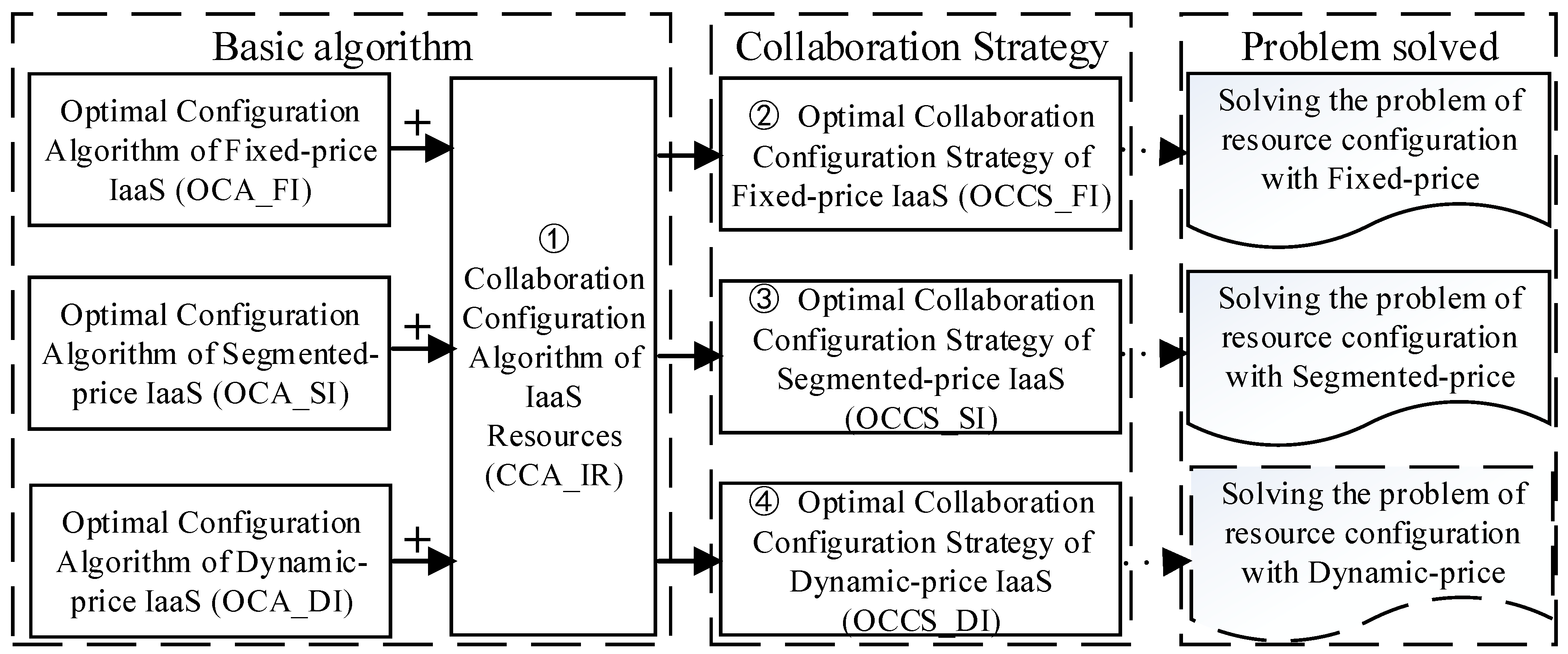
Within the cloud computing ecosystem, a SaaS provider utilizes infrastructure leased from an IaaS provider to deliver software services to end-users. The IaaS provider focuses solely on operating and maintaining the physical infrastructure, thereby reducing associated costs for the SaaS provider. At the beginning of a service period, the SaaS provider leases a certain quantity of IaaS resources at a specified rate to meet users’ Quality of Service (QoS) requirements and subsequently assumes responsibility for SaaS operation and maintenance. Our research addresses the following challenges: (1) The number of SaaS user visits is influenced by a combination of subjective factors (user needs, preferences, loyalty, service reputation, QoS expectations) and objective factors (service quality, natural environment, network conditions, and computing environment). Consequently, accurately predicting the actual number of user visits is highly uncertain. (2) IaaS pricing models are categorized into three prevalent types: fixed, segmented, and dynamic. (3) User demand for SaaS is stochastic and often does not perfectly align with the pre-leased amount of IaaS resources. To address these challenges while maximizing the SaaS provider’s expected revenue with negligible QoS constraint violation rate, we propose an optimal collaborative allocation strategy. Our model explicitly accounts for the trade-off between resource costs and the opportunity cost of unmet demand, seeking the procurement quantity that optimizes the expected financial outcome. The process flow is illustrated in Figure 1.

3.2. Notation

Table 1 lists the key symbols and variables used throughout this paper, grouped according to their relevance to the three pricing strategies.

3.3. Assumption

The study is based on the following assumptions: (1) Collaborating SaaS providers form a cooperative consortium with no inherent priority over one another and operate under a binding agreement to share the common goal of maximizing overall collective revenue. (2) Cloud resources are sufficient and can be provisioned at any time according to the configuration amount. (3) The number of SaaS users is relatively large, and minor fluctuations do not significantly affect the calculation results. (4) The cloud resources required for each user instance are quantifiable and equal in amount. (5) The SaaS provider is risk-neutral. (6) The SaaS service is considered delay-tolerant to a degree (e.g., batch processing, data analytics, email services). Users who cannot be served immediately due to resource insufficiency are queued and serviced later within the same accounting period without abandoning the service, thus preventing immediate revenue loss for the SaaS provider.
Rationale and Discussion of Assumptions. (1) Assumption (1) establishes a fully cooperative framework, which is a common and effective simplification for initial model development in resource sharing literature [35]. It is realistic in scenarios where SaaS providers are part of the same organization, operate under a revenue-sharing agreement, or participate in a trusted consortium where long-term collective benefits outweigh short-term individual gains. We acknowledge that in a purely competitive market, self-interested behavior could emerge. Our model provides the optimal benchmark for collective welfare. Analyzing strategic, non-cooperative behavior (e.g., using game theory) is a valuable direction for extending this work, as noted in the Future Work section (Section 6). The implications of relaxing this assumption towards self-interested behavior are significant. Providers might misreport demand or revenue to gain advantage, requiring a mechanism design or game-theoretic approach to ensure truthfulness and stability (e.g., a Vickrey-Clarke-Groves or a bargaining mechanism). While such an analysis is beyond the scope of this paper, which focuses on establishing the optimal collaborative performance benchmark, we explicitly identify it as a critical avenue for future work to enhance the model’s applicability to less structured, competitive environments. (2) Assumption (2) posits that the IaaS provider operates at a scale where resources are effectively unlimited and can be provisioned elastically. This is a standard and realistic abstraction aligned with the core value proposition of major public clouds (e.g., AWS, Azure), which offer the illusion of infinite capacity on-demand. It allows our model to focus on the economic optimization of resource quantity, decoupled from physical infrastructure constraints, which is a common approach in cloud resource management studies. (3) Assumption (3) regarding a large number of users is fundamental for applying the newsvendor model and continuous probability approximations. In practice, popular SaaS services typically serve a substantial user base. The law of large numbers ensures that the stochastic demand exhibits stable statistical properties, making our expected revenue maximization both methodologically sound and practically relevant for mainstream SaaS providers. (4) Assumption (4) that each user instance consumes a fixed, quantifiable amount of IaaS resource is a standard unit of account in cloud provisioning. For instance, a “small” VM instance or a defined amount of storage/bandwidth per user is a common pricing and capacity planning metric. While some applications may have variable per-user resource needs, our model applies to the predominant case where an average or standardized resource footprint per active user can be established for capacity planning purposes. (5) Assumption (5) of risk-neutrality is a conventional and well-justified baseline for operational decision models in IT and service management. It implies the SaaS provider aims to maximize expected revenue without assigning a specific premium or discount to uncertainty. This is typical for established businesses managing recurring operational costs and revenues. (6) Assumption (6) is critical for the structure of the revenue function in Equations (1) and (2), which does not include penalty costs for lost demand. This assumption is realistic for a broad class of non-interactive or batch-oriented cloud services where latency can be absorbed (e.g., report generation, scientific computations). For strictly real-time services (e.g., video streaming, online transactions), this assumption may not hold, as user abandonment leads to opportunity cost. If relaxed, the model would need to incorporate a penalty or lost-sales cost term ( c _ l o s t ) into the newsvendor formulation. The core two-stage collaborative strategy would remain valid, but the optimal configuration formula (e.g., Equation (5)) would change, with the critical ratio becoming k / k + h + c _ l o s t . This adjustment would make the configuration more conservative. Our experimental focus on delay-tolerant services (e.g., digital book retrieval in Section 5.2) validates the model under its intended scope.

4. Optimal Collaborative Configuration Strategy of IaaS Resources

Based on the problem description, assumptions, and notation defined above, this section proposes a two-stage strategy to solve the optimal resource allocation problem for cloud resources under fixed, segmented, and dynamic pricing models. First, we design an optimal collaborative resource configuration algorithm for secondary resource allocation. Subsequently, we develop optimal resource allocation algorithms tailored to three different pricing modes, which then utilize this collaborative algorithm. The overall objective is to maximize the SaaS provider’s expected revenue while ensuring zero IaaS-to-SaaS QoS violations and minimizing the risk of SaaS-to-user QoS violations. The strategy inherently addresses the cost-risk trade-off, and the collaborative stage further minimizes the residual risk of SaaS-to-user QoS violations.

4.1. Collaboration Configuration Algorithm for IaaS Resources (CCA_IR)

Problem Restatement for Collaboration: To further enhance the overall revenue of the SaaS provider coalition, we propose a collaborative resource reallocation mechanism. Consider a set of n SaaS providers S = s 1 , s 2 , , s t . After Stage 1, each provider s i has an initial optimal allocation Q i * and observes its true random resource demand D i . The discrepancy D i - Q i * represents a deficit (if positive) or a surplus (if negative). The unit resource revenue k i for provider s i (as defined in Table 1) indicates the profit generated per unit of IaaS resource successfully utilized to meet its demand.
Optimization Objective of Algorithm 1 (CCA_IR): The goal of the collaborative stage is to reallocate surplus resources from providers with excess capacity to those with a deficit, in order to maximize the total expected revenue of the coalition. Formally, if Q ˘ i denotes the final amount of resources available to serve s i ’s demand after collaboration, the total revenue is R t o t a l = i = 1 t k i m i n D i , Q ˘ i . Under the assumption that unmet demand results in lost revenue proportional to k i , a near-optimal strategy to maximize R t o t a l is to prioritize allocating resources to deficit providers with the highest k i . This ensures that each unit of reallocated resource yields the greatest possible marginal contribution to the coalition’s total income.
Algorithm Logic (Textual Explanation): The CCA_IR algorithm operationalizes this principle through a greedy approach. It first identifies all deficit providers ( D i > Q i * ) and sorts them in descending order of their unit resource revenue k i . This sorted list establishes a priority queue for receiving resources. Then, iterating through this prioritized list, the algorithm allocates available surplus resources from any provider with Q i * > D j to satisfy the highest-priority deficits first. This process continues until all surplus is distributed or all deficits are met. By systematically favoring high- k i deficits, the algorithm heuristically maximizes the collective revenue gain from collaboration.
The unit resource revenue k i for a SaaS provider s i is the net profit contributed by one unit of IaaS resource when it is utilized to serve a user. It is derived from the SaaS business model: k i = v i m i × w i s o i / m i , where v i is the revenue per user, s o i represents other costs per user (e.g., licensing, support), m i is the amount of IaaS resource required to serve one user, and w i is the price paid per unit of the IaaS resource under the applicable pricing model. This metric k i serves as the key economic priority indicator during collaborative reallocation in CCA_IR.
Algorithm 1. Collaboration Configuration Algorithm for IaaS Resources (CCA_IR)
Input: Set of n SaaS providers S = s 1 , s 2 , , s t ; For each provider s i : true resource demand D i , initial optimal allocation Q i * , unit resource revenue contribution k i .
Output: Final collaborative allocation set Q ˘ = Q ˘ 1 , Q ˘ 2 , , Q ˘ t .
1: Initialize an empty list L of size t.
2: for each provider s i in S do:
3:      Calculate surplus/deficit status: status_i = ( D i > Q i * ) ? ‘deficit’: ‘surplus’.
4:      Calculate available surplus: surplus_i = max(0, Q i * D i ).
5:      Calculate unmet deficit: deficit_i = max(0, D i Q i * ).
6:         Store entry_i = {id: i, initial_allocation: Q i * , demand: D i , status: status_i, surplus: surplus_i, deficit: deficit_i, revenue_per_unit: ri, final_allocation: Q i * } in L.
7: end for
8: // Step 1: Group and prioritize deficit providers
9: Create list L_deficit containing all entries from L where status == ‘deficit’.
10: Sort L_deficit in descending order of revenue_per_unit ( k i ). // Greedy prioritization
11: Create list L_surplus containing all entries from L where status == ‘surplus’.
12: // Step 2: Greedy reallocation
13: for each entry E_deficit in sorted list L_deficit do:
14:         remaining_deficit = E_deficit.deficit
15:         for each entry E_surplus in L_surplus (in any order) do:
16:                if E_surplus.surplus > 0 then
17:                      transfer_amount = min(remaining_deficit, E_surplus.surplus)
18:                      E_deficit.final_allocation += transfer_amount
19:                      E_surplus.final_allocation -= transfer_amount
20:                      E_surplus.surplus -= transfer_amount
21:                      remaining_deficit -= transfer_amount
22:                      if remaining_deficit == 0 then break inner loop
23:                end if
24:          end for
25: end for
26: // Compile final results, Record the number of resources added by the SaaS provider in the collaborative con figuration.
27: for each entry in L do:
28:           if entry.final_allocation > 0 then
29:       Q ˘ e n t r y . i = entry.final_allocation
30:           end if
31: end for
32: return Q ˘
Complexity and Overhead Analysis of CCA_IR. The computational overhead of CCA_IR is modest. Let t be the total number of collaborating SaaS providers and m be the number experiencing a deficit (m t ). The dominant operations are (1) sorting the m deficit providers by unit revenue, with O m l o g m complexity, and (2) the greedy allocation via nested loops, with a worst-case complexity of O m     t . In typical cloud scenarios where not all providers are simultaneously in deficit and surplus amounts are finite, the effective complexity scales approximately linearly with t . The space complexity is O t for storing the provider list. Communication overhead involves each provider transmitting its demand D i , initial allocation Q i * , and unit revenue k i to a central broker or across a peer-to-peer network—a minimal data exchange occurring once per allocation cycle. Therefore, CCA_IR is designed to be scalable and efficient for collaborative groups of practical size.
Theoretical Analysis: Convergence and Optimality Guarantees. (1) The CCA_IR algorithm is designed as a deterministic, single-pass greedy procedure that operates on a finite set of providers and their resource imbalances. Under the model assumptions (Section 3.3), particularly the cooperative consortium assumption (1) and the finite resource surplus/deficit values, the algorithm is guaranteed to converge in a finite number of steps. Specifically, each iteration of the outer loop (over sorted deficit providers) reduces the total system deficit or surplus until no transferable surplus remains or all deficits are satisfied. Since the number of providers t and the surplus/deficit amounts are finite, the algorithm terminates after at most O m     t transfer operations, where m is the number of deficit providers. (2) Regarding optimality, CCA_IR implements a greedy strategy that allocates surplus resources to deficit providers in descending order of their unit revenue contribution k i . This approach maximizes the total revenue gain from each unit of reallocated resource, given that revenue is linear in the amount of resources used. Under the assumption that unmet demand results in lost revenue proportional to k i , and given that the collaboration does not change the total amount of resources in the system (only redistributes existing surplus), the greedy allocation by k i is revenue-optimal for the coalition in this transfer stage. Formally, for any fixed set of initial allocations Q i * and realized demands D i , the final allocation vector Q ˘ produced by CCA_IR maximizes the total coalition revenue R t o t a l = i = 1 t k i     m i n D i , Q ˘ i , subject to the conservation constraints: i = 1 t Q ˘ i = i = 1 t Q i * and 0 Q ˘ i Q i * + t o t a l   s u r p l u s . This holds because reallocating a unit of resource to a provider with a higher k i always yields a marginal revenue increase at least as large as allocating it to a provider with a lower k i , and the greedy order ensures such allocations are performed first until surpluses are exhausted. (3) Thus, within the scope of the collaborative reallocation stage, the outcomes of CCA_IR provides a provably optimal redistribution that maximizes the coalition’s total expected revenue under the linear revenue model. Combined with the optimality of the Stage 1 newsvendor-based configuration (proven in Section 4.2, Section 4.3 and Section 4.4), the two-stage strategy ensures that the overall framework moves toward a system-optimal equilibrium in terms of SaaS provider revenue, while respecting QoS constraints.

4.2. Optimal Collaboration Configuration Strategy for Fixed-Price IaaS (OCCS_FI)

Under a fixed-price model, the unit price of IaaS is constant at w . Each SaaS user instance requires m units of IaaS resource. The number of SaaS users per unit time, n , is a discrete random variable, and each user generates revenue v per unit time. The IaaS resource demand is r = n × m , also a discrete random variable with probability mass function f r , where i = 0 f r = 1 . The unit profit is k = v m × w s o / m , and the unit loss for idle resources is h = w k r . To incentivize the efficient recovery of unused reserved resources, IaaS providers may offer a buy-back price k r for surplus resources [32].
Mathematical Derivation of the Optimal Policy: To maximize SaaS provider expected revenue, we employ the classical newsvendor model. The revenue for a given resource allocation Q and realized demand r is:
If Q r (supply exceeds demand), the SaaS provider’s revenue equals sales revenue minus the cost of idle resources:
r = 0 Q k r h Q r f r .
If Q < r (demand exceeds supply), the revenue is:
r = Q + 1 k Q   f r
The expected revenue function C Q is therefore:
C Q = r = 0 Q k r h Q r f r + r = Q + 1 k Q f r
To find the optimal Q * that maximizes C Q , we treating r as a continuous variable with probability density function p r for analytical derivation. The continuous analogue of (3) is:
C Q = 0 Q k r h Q r p r d r + Q + 1 k Q p r d r
Taking the first derivative with respect to Q and setting it to zero yields the first-order optimality condition:
d C Q d Q = 0 Q h p r d r + Q + 1 k p r d r = h f Q + k 1 f Q = 0
where f Q = 0 Q p r d r is the cumulative distribution function of demand. Solving for f Q * gives the critical fractile:
0 Q * p r d r = f Q * = k / k + h .
For the discrete case, this condition translates to:
r = 0 Q * 1 f r < k / k + h r = 0 Q * f r
The provider is profitable only if v > m w + s o . Algorithms 2 and 3 describe the OCCS_FI strategy in detail.
Algorithm 2. Optimal Configuration Algorithm for Fixed-price IaaS (OCA_FI)
Input: Fixed IaaS unit price w ; Resource needed per user m ; Other cost per user s o ; Random user visits n with probability table T ; SaaS service price v ; Unit recovery price k r .
Output: Optimal resource configuration amount Q * ; Unit resource profit k .
1: // Calculate derived demand parameters
2: Calculate demand variable r = n m // r is a discrete random variable
3: Build probability distribution table T r for r from n and T
4: Calculate unit profit and unit loss: k = v m × w s o / m , h = w k r
5: // Find optimal Q * using newsvendor condition (Equation (6))
6: Find the smallest Q such that: Cumulative_Probability( r Q ) ≥ k / k + h
7: Q * = Q
8: return Q * , k
Algorithm 3. Optimal Collaboration Configuration Strategy for Fixed-price IaaS (OCCS_FI)
Input: Set of t SaaS providers S = s 1 , s 2 , , s t ; For each s i : true demand D i , IaaS price w i , resource per user m i , other cost s o i , user visit distribution T i , service price v i , unit recovery price k r .
Output: Final collaborative allocation set Q ˘ = Q ˘ 1 , Q ˘ 2 , , Q ˘ t .
1: Initialize empty lists: Q_init = [], K = []
2: // Stage 1: Each provider computes its initial optimal allocation locally
3: for each provider s i in S do:
4:    ( Q i * , k i ) = OCA_FI( w , m , s o , T , v , k r )  // Call Algorithm 2.
5:    Append Q i * to Q_init
6:    Append k i to K
7: end for
8: // Stage 2: Collaborative reallocation using CCA_IR
9: Q ˘ = CCA_IR( S , D = D 1 , D 2 , , D t , Q_init, R)  // Call Algorithm 1
10: return Q ˘

4.3. Optimal Collaboration Configuration Strategy for Segmented-Price IaaS (OCCS_SI))

Under segmented pricing, the unit price G Q decreases as the configured amount Q increases. The price tiers are defined by cutoff points Q ¯ i and corresponding prices c i :
G Q =     c 1 ,       0 Q < Q ¯ 1 c 2 ,     Q ¯ 1 Q < Q ¯ 2 c d 1 ,     Q ¯ d 2 Q < Q ¯ d 1 c d ,     Q ¯ d 1 Q
Under segmented pricing, the unit cost c i of IaaS resources is a function of the purchased quantity Q . Consequently, the profit per unit sold k ¯ i and the loss per unit unused h ¯ i are also tier-dependent. For a given purchase quantity falling within tier i (where Q ¯ i 1 Q < Q ¯ i ), these parameters are defined as: k ¯ i = v m c i s o / m and h ¯ i = c i k r , where c i is the unit price in tier i , and k r is the buy-back price.
Mathematical Derivation of the Optimal Policy: This formulation adapts the newsvendor model by evaluating the cost–benefit trade-off at the marginal price applicable for the decision quantity Q . For a quantity Q planned within a given tier i , the expected revenue function is piecewise-defined and analogous to the fixed-price case but with parameters k ¯ i and h ¯ i . Maximizing this function within the interior of tier i leads to the first-order optimality condition specific to that tier:
r = 0 Q ¯ i * 1 f r < k ¯ i / k ¯ i + h ¯ i = v m c i s o v m k r s o r = 0 Q ¯ i * f r
The calculated Q ¯ i * must be adjusted to lie within its valid price tier:
Q ¯ i * = Q ¯ i * ,       Q ¯ i 1 Q ¯ i * < Q ¯ i Q ¯ i 1 ,             Q ¯ i * < Q ¯ i 1 Q ¯ i 1 ,             Q ¯ i * Q ¯ i
The final optimal Q * is selected from the candidate solutions across all tiers Q ¯ 1 * , Q ¯ 2 * , , Q ¯ d * as the one that yields the highest expected revenue C Q * , calculated using Equations (3) and (4). Algorithms 4 and 5 describe the OCCS_SI strategy.
Algorithm 4. Optimal Configuration Algorithm of Segmented-price IaaS (OCA_SI)
Input: Resource needed per user m ; Other cost per user s o ; User visits n with table T ; SaaS price v ; Unit recovery price k r ; Segmented price info: price tiers Q ¯ i , c i | i = 1 d where Q ¯ i is quantity cutoff and c i is unit price for tier i .
Output: Optimal resource configuration amount Q * ; Corresponding unit resource profit k .
1: Calculate demand variable r = n m
2: Build probability distribution table T r for r from T
3: Initialize best_revenue = -∞, best_Q = 0, best_k = 0
4: // Evaluate each price tier
5: for each price tier i from 1 to d do:
6:     c = c i // Unit price for this tier
7:    Calculate tier-specific unit profit and unit loss: k ¯ i = v m c i s o / m , h ¯ i = c i k r
8:    // Find candidate optimal Q for this tier using Equations (8) and (9)
9:    Find Q such that: Cumul_Prob( r Q ) ≥ k ¯ i / k ¯ i + h ¯ i
10:     Clamp Q to tier’s valid range: Q ¯ i 1 < Q Q ¯ i 1 (with Q ¯ 0 = 0 )
11:     // Calculate expected revenue for this candidate Q (using Equations (3) and (4))
12:     revenue_i = calculate_expected_revenue( Q , T r , k ¯ i , h ¯ i )
13:     // Keep the best across all tiers
14:     if revenue_i > best_revenue then:
15:       best_revenue = revenue_i
16:       best_Q = Q
17:       best_k = k ¯ i
18:     end if
19: end for
20: Q * = best_Q
21: k = best_k
22: return Q * , k
Algorithm 5. Optimal Collaboration Configuration Strategy of Segmented-price IaaS (OCCS_SI)
Input: Set of t SaaS providers S = s 1 , s 2 , , s t ; For each s i : true demand D i , resource per user m i , other cost s o i , user visit distribution T i , service price v i , unit recovery price k r ; segmented price scheme G Q .
Output: Final collaborative allocation set Q ˘ = Q ˘ 1 , Q ˘ 2 , , Q ˘ t .
1: Initialize empty lists: Q_init = [], K = []
2: // Stage 1: Individual optimal configuration under segmented pricing
3: for each provider s i in S do:
4:     ( Q i * , k i ) = OCA_SI( m , s o , T , v , k r , G Q )  // Call Algorithm 4
5:     Append Q i * to Q_init
6:     Append k i to K
7: end for
8: // Stage 2: Collaborative reallocation
9: Q ˘ = CCA_IR( S , D = D 1 , D 2 , , D t , Q_init, R)  // Call Algorithm 1
10: return Q ˘
The standard newsvendor critical fractile k / k + h is derived from marginal analysis where the unit cost is constant. Under segmented pricing, the unit cost c i is constant within a given tier i . Therefore, for a quantity Q planned within tier i , the relevant economic parameters for the marginal unit are k ¯ i and h ¯ i . The first-order condition for maximizing the expected revenue function C Q (which is piecewise-defined due to c i ) within the interior of tier i leads to the following optimality condition for a candidate Q ¯ i * , as shown in Equation (8). This condition is analogous to the classic newsvendor solution but is applied locally with the cost parameters of the specific tier i . The global optimum Q * is found by evaluating the expected revenue at the feasible candidate solution from each tier (subject to boundary clamping via Equation (9)) and choosing the one with the highest revenue.

4.4. Optimal Collaboration Configuration Strategy for Dynamic-Price IaaS (OCCS_DI)

Under dynamic pricing, the IaaS resource price w fluctuates within the interval w l , w h as a random variable with probability distribution f w w and density p w w . The number of users n is treated as a continuous random variable, making resource demand r = n × m continuous with density p r . This makes both the profit and loss parameters stochastic. The profit per unit sold becomes k = v m × w s o / m , and the loss per unit unused is h = w k r . The expected revenue function in Equation (10) therefore integrates over the joint uncertainty of both demand r and price w , extending the classic newsvendor model to a bi-variable stochastic optimization problem.
Mathematical Derivation of the Optimal Policy: The expected revenue function, considering the randomness of both r and w (assumed independent), is:
C Q = w l w h 0 Q k r h Q r p r d r + Q k Q p r d r p w w d w
This extends the classic newsvendor model to a bi-variable stochastic optimization. Let S Q , w denote the inner integral conditional on price w . The first-order optimality condition is:
C Q Q = w l w h S Q , w Q p w w d w = 0
From the fixed-price derivation, S Q , w / Q = h w f Q + k w 1 f Q . Substituting and simplifying leads to:
f Q * = E k w / E k w + E h w
where E · is expectation over w . A key observation is that k w + h w = v m × w s o / m is a constant, independent of w . This simplifies the denominator, allowing us to derive the tractable optimality condition:
0 Q * p r d r = v s o m w l w h w p w w d w / v s o m k r
Algorithms 6 and 7 describe the OCCS_DI strategy based on this condition.
Algorithm 6. Optimal Configuration Algorithm of Dynamic-price IaaS (OCA_DI)
Input: Resource needed per user m ; Other cost per user s o ; User visits n with table T ; SaaS price v ; Unit recovery price k r ; Price distribution info: price range w l , w h with probability table (or PDF) T w .
Output: Optimal resource configuration amount Q * ; Expected unit resource profit k .
1: Calculate demand variable r = n m
2: Build probability distribution table T r for r from T
3: // Calculate expected price from distribution
4: w   = calculate_expected_value ( T w )  // E[ w ] over w l , w h
5: // Calculate expected unit profit and unit loss using expected price
6: k = v m w s o / m , h = w k r
7: // Find optimal Q using condition derived for dynamic pricing (Equation (13) in manuscript)
8: Find Q * such that: Cumul_Prob( r Q ) ≥ k / k + h
9: return Q * , k
Algorithm 7. Optimal Collaboration Configuration Strategy of Dynamic-price IaaS (OCCS_DI)
Input: Set of t SaaS providers S = s 1 , s 2 , , s t ; For each s i : true demand D i , resource per user m i , other cost s o i , user visit distribution T i , service price v i , unit recovery price k r , dynamic price distribution T w .
Output: Final collaborative allocation set Q ˘ = Q ˘ 1 , Q ˘ 2 , , Q ˘ t .
1: Initialize empty lists: Q_init = [], K = []
2: // Stage 1: Individual optimal configuration under dynamic pricing
3: for each provider s i in S do:
4:     ( Q i * , k i ) = OCA_DI( m , s o , T , v , k r , T w )  // Call Algorithm 6
5:     Append Q i * to Q_init
6:     Append k i to K   // Note: k i here is an expected value
7: end for
8: // Stage 2: Collaborative reallocation (CCA_IR works with expected profits)
9: Q ˘ = CCA_IR( S , D = D 1 , D 2 , , D t , Q_init, R) // Call Algorithm 1
10: return Q ˘
The dynamic pricing model introduces a stochastic cost, transforming the problem into maximizing expected revenue under uncertainty in both demand ( r ) and input price ( w ). The profit for a sold unit, k = v m × w s o / m , and the loss for an unsold unit, h = w k r , are now linear functions of the random variable w . The expected revenue, C Q , requires integrating over the joint distribution of r and w (assumed independent), as shown in Equation (10). Applying the first-order condition for optimality leads to Equation (11). A key observation is that the sum k + h = v s o k r × m / m is a constant, removing the stochasticity from the denominator of the critical fractile when the expectation is taken. This allows us to derive the tractable optimality condition in Equation (13). This elegantly adapts the newsvendor model by using the expected marginal profit against the constant total cost exposure per unit.

5. Experiments and Analysis

5.1. Performance Analysis of the Algorithm

OCCS_FI Complexity. Time Complexity: The main time cost of OCA_FI lies in constructing the probability distribution table T r for r , which has a time complexity of O n , where n is the domain size of n . OCCS_FI calls OCA_FI t times and then executes CCA_IR, leading to a total time complexity of O n × t + t 2 . Given that the number of SaaS providers t is typically stable and small relative to n , the complexity is effectively linear, O n . Space Complexity: The main temporary space is for T r , which is O n . Thus, space complexity is O n + t = O n .
OCCS_SI Complexity. Time Complexity: OCA_SI also builds T r ( O n ) and performs calculations for d price-tiers. The time complexity remains O n as d is small and constant. Thus, the complexity of OCCS_SI is O t × n + t 2 = O n . Space Complexity: O n .
OCCS_DI Complexity. Similarly to OCA_FI, OCA_DI builds T r and processes the price distribution T w , with complexities of O n and O w respectively. The overall complexity of OCCS_DI is O t × n + w + t 2 = O n + w . Space Complexity: O n + w .

5.2. Numerical Example

The service instances used in our simulations are digital book retrieval services for college students, with parameter values reflecting actual operational characteristics.
(1) OCA_FI algorithm analysis. Parameters: Daily user visits follow n ~ N 520 , 45 2 . Resources required per user m = 10   k b . Rental price w = ¥ 0.1 / k b . Cost of idle resource h = ¥ 0.05 / k b (implying a recovery price h = ¥ 0.05 / k b ). Other service costs per user s o = ¥ 0.1 . Sales price v varies. Table 2 shows the optimal configuration amount Q * and maximum expected revenue C Q * for different values of v . When v = ¥ 3 ,   4 ,   5 , the optimal Q * values were 5565, 5672, and 5743, respectively.
When the sales price is v = ¥ 3 , we analyze how expected revenue changes with different means and standard deviations of user demand (Table 3). The optimal configuration amounts are 5406/5407, 5606/5607, 5365/5366, and 5565/5566 for the distributions N 5000 , 500 2 , N 5200 , 500 2 , N 5000 , 450 2 , N 5200 , 450 2 , respectively, with k / k + h = 0.7917 .
(2) OCA_SI algorithm analysis. Parameters: v = ¥ 3 , n ~ N 500 , 50 2 , m = 10   k b , k r = ¥ 0.05 , s o = ¥ 0.1 . The segmented price function is defined as:
G Q = 0.25 ,     0 Q < 2001 0.2 ,     2001 Q < 4001 0.15 ,     4001 Q < 6001 0.1 ,     6001 Q <
Table 4 and Table 5 show the expected revenue for different configuration amounts and sales prices. The optimal configuration was found to be Q * = 6001 for both v = ¥ 3 and v = ¥ 4 .
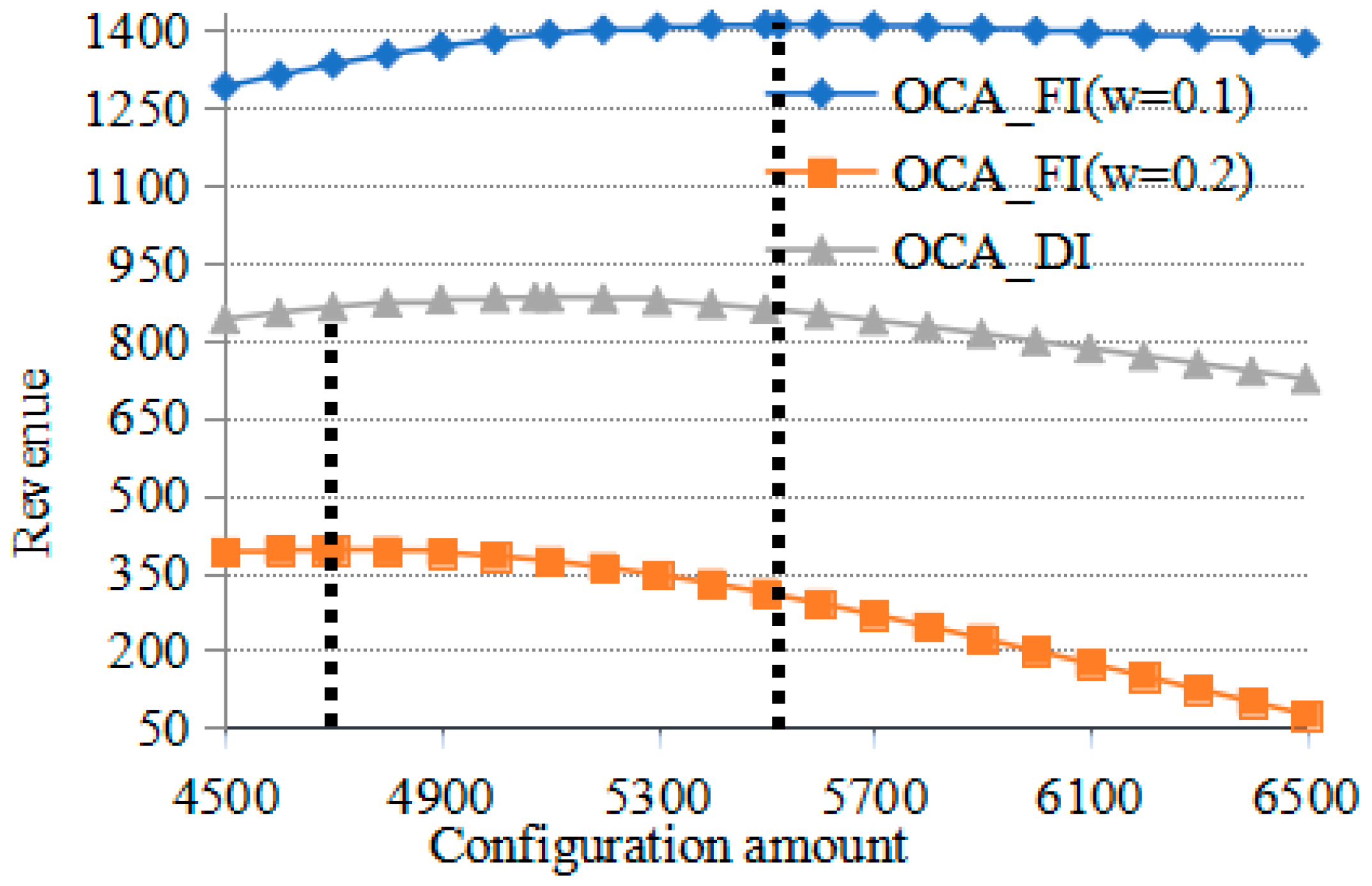
(3) OCA_DI algorithm analysis. Parameters: v = ¥ 4 , n ~ N 500 , 50 2 , m = 10   k b , w ~ N 0.2 , 0.01 2 bounded within 0.1 ,   0.3 , k r = ¥ 0.05 , s o = ¥ 0.1 . Figure 2 compares the expected revenue achieved by OCA_DI with that of OCA_FI under fixed prices w = ¥ 0.1 and w = ¥ 0.3 . OCA_DI achieves an optimal configuration of 5074 with an expected revenue of 882.9184, outperforming OCA_FI at both fixed-price points.

5.3. Expected Revenue Analysis of Collaboration Configuration Policy

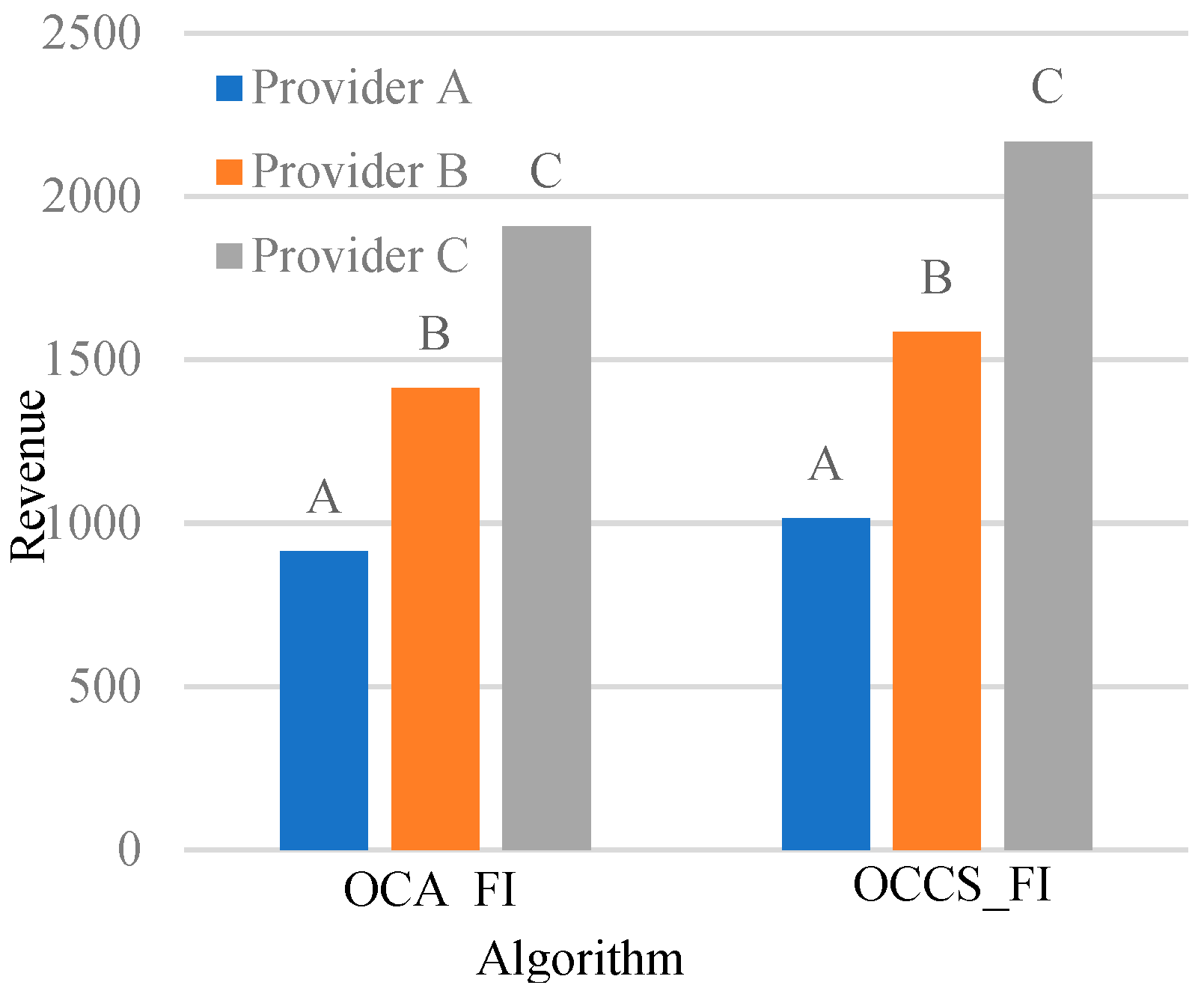
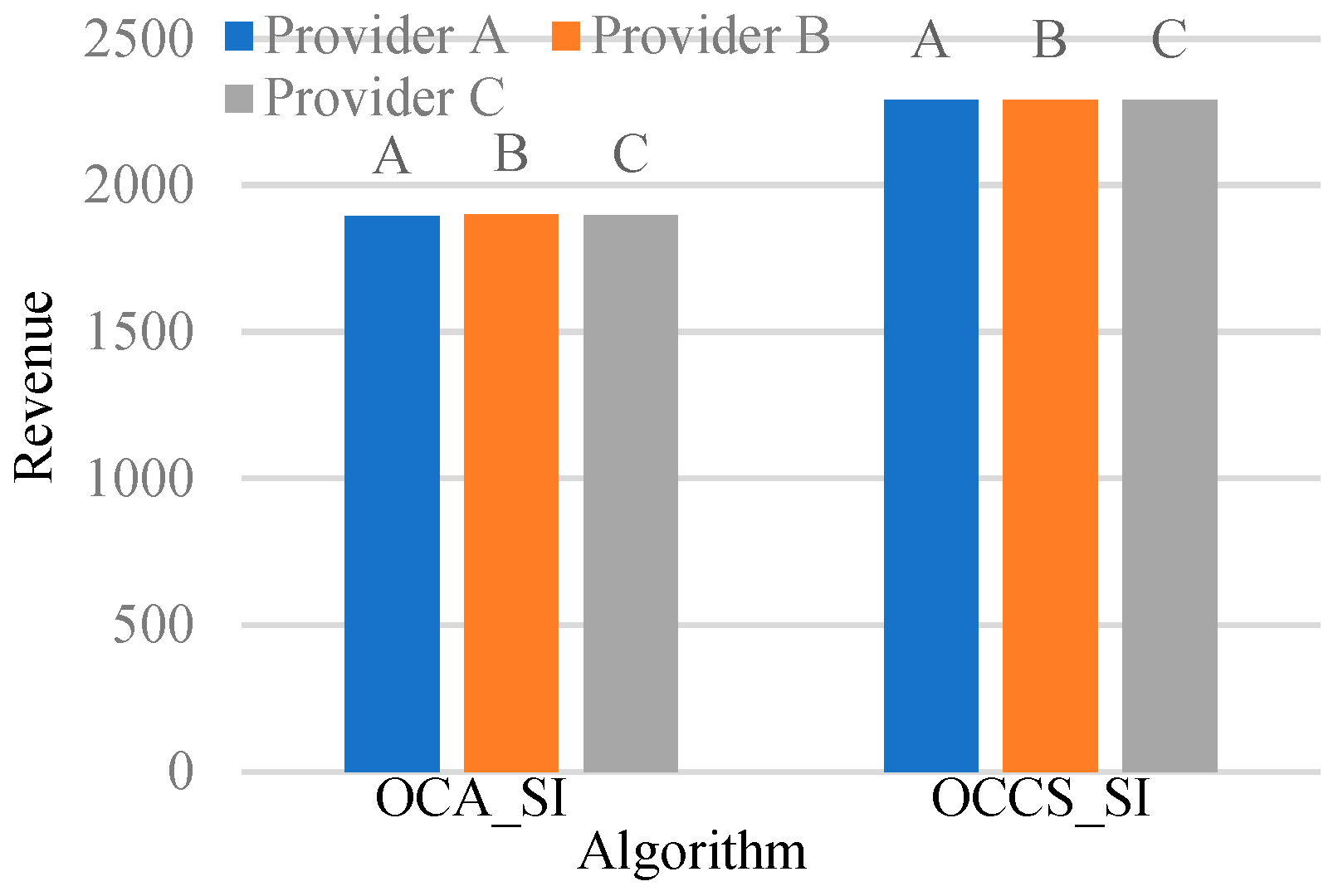
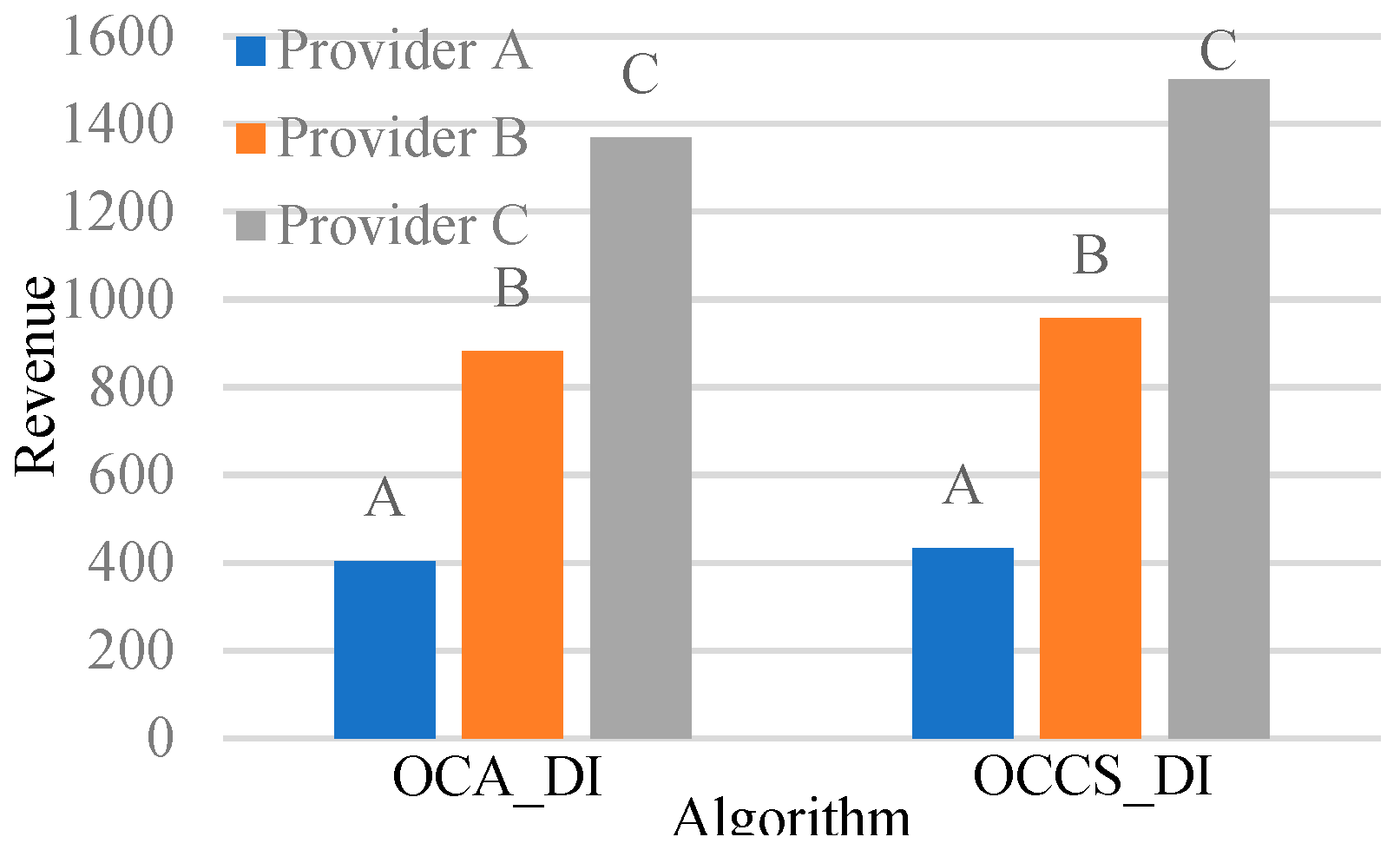
The experiments compared the expected revenue generated by standalone configuration algorithms (OCA_FI, OCA_SI, OCA_DI) against their collaborative counterparts (OCCS_FI, OCCS_SI, OCCS_DI). Three SaaS providers (A, B, and C) with service prices of ¥3, ¥4, and ¥5 per user per day participated. Their user numbers n ~ N 500 , 50 2 , with m = 10   k b , w = ¥ 0.1 / k b , h = ¥ 0.05 / k b , k r = ¥ 0.05 / k b , s 0 = ¥ 0.1 . Using 10,000 samples from N 500 , 50 2 , the average expected revenue for each algorithm was calculated. Figure 3, Figure 4 and Figure 5 present the results, which consistently show that collaborative resource allocation increases expected revenue for all providers.

5.4. Compared with SS_MaCM and AFERM

We compare the proposed algorithm with existing methods in terms of expected revenue, QoS violation rate, and resource utilization. Since OCA_SI and OCA_DI are derived from OCA_FI, and no existing resource allocation algorithms are specifically designed for segmented and dynamic pricing, we focus the comparison on OCA_FI against existing methods. Demonstrating that OCA_FI outperforms existing algorithms in expected revenue, QoS violation rate, and resource utilization would effectively validate that our methods successfully maximize SaaS provider expected revenue in stochastic user environments.
To validate the efficacy of our proposed revenue-centric approach, we compare our core algorithm (OCA_FI) against two representative baseline methods: SS_MaCM [31] (a cloud-model-based SaaS selection algorithm) and AFERM [29] (an application-feature-based elastic resource manager). We clarify that these baselines were not originally designed with SaaS provider revenue maximization as their primary objective. SS_MaCM focuses on stable QoS-aware service selection, while AFERM optimizes elastic resource management from a PaaS provider’s perspective to balance load and resource usage. Therefore, a direct comparison solely on revenue would be incongruent with their design goals. The purpose of this comparison is twofold: (1) To demonstrate that a strategy explicitly designed for SaaS revenue optimization (OCA_FI) naturally leads to superior financial outcomes for SaaS providers compared to strategies optimized for other operational metrics. (2) To evaluate our method’s performance on shared critical system-level metrics where the baselines were explicitly designed to perform well: QoS violation rate and resource utilization. This multi-faceted comparison provides a holistic assessment, showing our method’s superiority in its core objective (revenue) while also matching or surpassing baselines in their own domains (QoS and utilization).
To ensure a fair and meaningful comparison that respects the design intents of all methods, we evaluate performance across three axes: (1) SaaS Provider Revenue: The central economic metric our strategy aims to maximize, allowing us to assess its success against its own primary objective. (2) QoS Violation Rate: A core performance metric for SS_MaCM. Demonstrating a low SaaS-to-user QoS violation rate shows our revenue-focused strategy does not compromise service quality. (3) Resource Utilization: A key efficiency metric for AFERM and IaaS providers. High utilization indicates our strategy also promotes infrastructure efficiency. By outperforming or matching baselines across all three metrics, OCA_FI demonstrates a more holistic and beneficial configuration strategy from a combined SaaS and system perspective.
Experimental Setup and Baseline Configuration. To guarantee a fair comparison, all three algorithms were subjected to an identical experimental environment defined by the parameters in Table 6. This includes the same stochastic user demand distribution N 5000 ,   500 , IaaS unit price, SaaS service price, resource requirement per user, and cost structure. The revenue calculation for our OCA_FI is intrinsic to its model (Equation (3)). For the baselines, which do not output a revenue value directly, we calculated their implied revenue as follows: (1) SS_MaCM Configuration & Revenue. SS_MaCM selects services based on QoS stability but does not prescribe a dynamic resource quantity. For a resource provisioning comparison, we interpret its approach as a static, worst-case provisioning strategy to guarantee QoS. Therefore, its configured resource amount QSS is set to meet the maximum possible demand in the sample set: Q S S = m a x r s a m p l e . This aligns with its philosophy of avoiding QoS violations. Its revenue is then calculated by substituting Q S S into the universal revenue function (Equation (3)), under the same demand distribution and cost parameters as all other methods. (2) AFERM Configuration & Revenue. AFERM dynamically allocates resources based on application features and aims to keep resource overhead below 80%. To model this in our IaaS-centric context, we interpreted its configuration Q A F as the resource capacity needed to handle a threshold number of concurrent users while respecting the 80% overhead limit. This threshold U m a x was derived from its logic, representing the maximum users a unit can support without exceeding the overhead limit. Its revenue is similarly computed by plugging Q A F into Equation (3). This adaptation process ensures that all algorithms are evaluated on the same economic grounds (the SaaS revenue model defined by Equation (3)) and under identical market and demand conditions, making the revenue comparison valid and insightful.
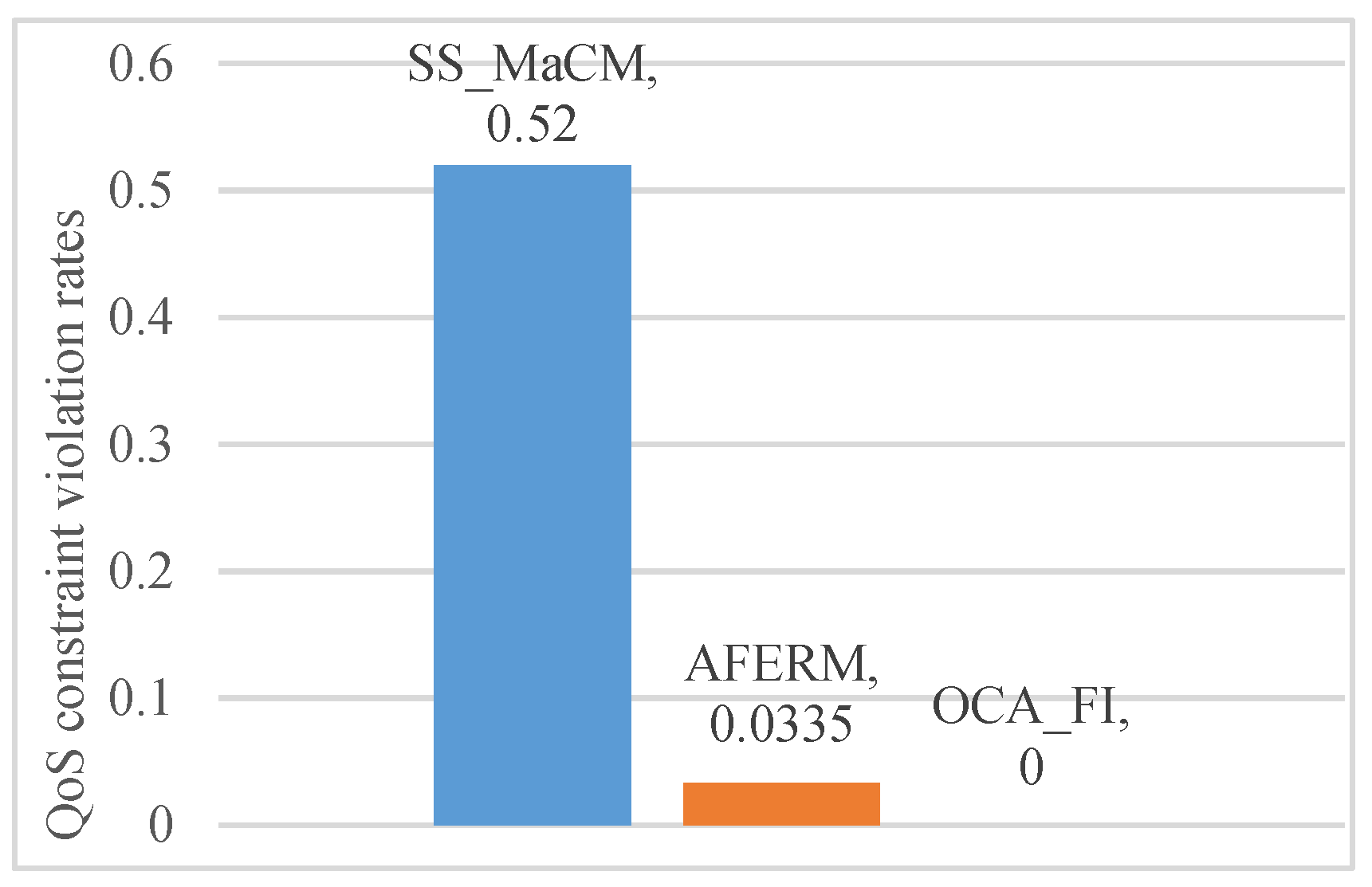
The SS_MaCM framework leverages cloud model theory to analyze QoS in SaaS and proposes a multi-attribute decision-making method for selecting services with optimal QoS. Despite its ability to identify services with good and stable QoS, violations can still occur. QoS cloud model accuracy refers to the precision of QoS descriptions based on cloud models. In our experiment, we used the highest recorded accuracy value (0.48 from Ref. [31]) as a benchmark, implying a QoS violation rate of 0.52. It should be noted that SS_MaCM does not consider the impact of user numbers on application resource configuration; instead, it configures resources based on the maximum possible number of users. Specifically, if we denote the sample set for user numbers as s i * i = 1 , 2 , , t , then the resource utilization rate is i = 1 t s i * / t × max i s i * .
The AFERM method considers variability in the number of users accessing the application. It focuses on services with stable request rates, deploying them on virtual machines while ensuring resource overhead does not exceed 80% (Ref. [29]), regardless of remaining virtual resources. We determined the maximum number of user visits a virtual machine can support as u ¯ , which represents the average of the maximum values obtained from a random sample set over 10,000 iterations: u ¯ = i = 1 10,000 u i / 10,000 , where u i denotes the highest value within the i -th individual random sample. The QoS violation rate is calculated as n / m , where n is the number of samples exceeding u ¯ and m is the total number of samples.
Figure 6 presents a comparison of SaaS-to-user QoS violation rates, where SS_MaCM exhibits a rate of 0.48, AFERM 0.035, and OCA_FI is approximately 0. OCA_FI demonstrates a significantly lower SaaS-to-user QoS violation rate. In this experiment, the number of users followed a normal distribution N 5000 ,   500 (with other parameters as per Table 6). The experiment was repeated to generate a sample set of 10,000 runs, and the average results were taken.
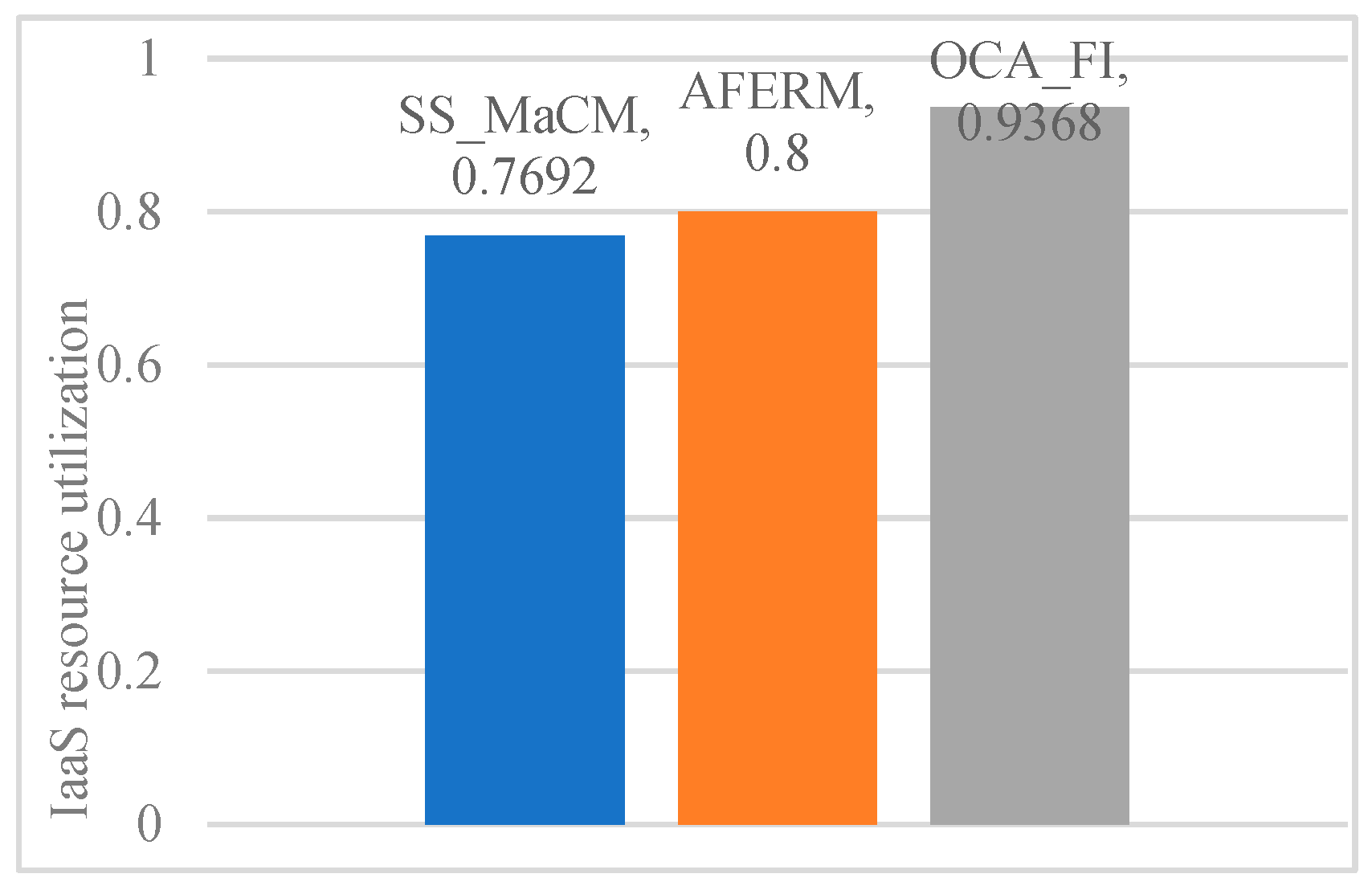
Figure 7 compares resource utilization, with SS_MaCM at 0.7692, AFERM at 0.8, and OCA_FI at 0.9368. OCA_FI achieves the highest resource utilization rate. The experimental setup for this comparison is the same as described above.
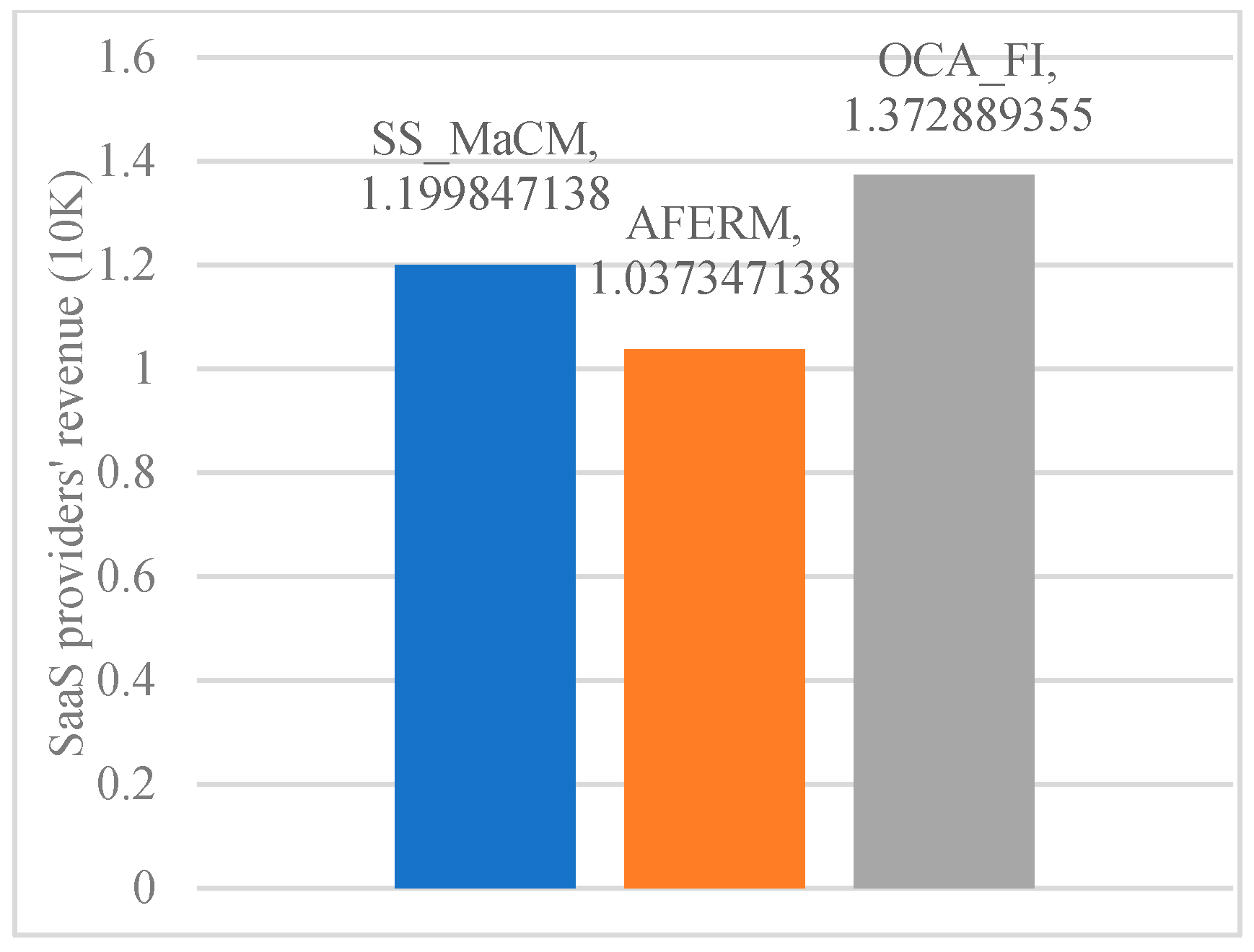
Expected revenue comparison experiments for SS_MaCM and AFERM typically do not account for the impact of fluctuating user numbers on SaaS providers, which is a critical factor. Therefore, to ensure a fair comparison, user numbers must be set appropriately for both algorithms. SS_MaCM assumes the maximum number of users without considering their effect on resource allocation and SaaS QoS (i.e., n 1 = 5000 + 500 × 3 = 6500 , Q 1 = 6500 × 10 = 65,000 , consistent with its utilization rate calculation). AFERM, which considers user numbers, aims to satisfy all concurrent requests with an 80% resource overhead limit. Thus, we assume its user numbers are also at the maximum (i.e., n 2 = 5000 + 500 × 3 = 6500 , Q 2 = 6500 × 10 / 0.8 = 81,250 ). The other parameters are listed in Table 6. Let the optimal resource amount obtained by OCA_FI be Q 3 . Substituting Q 1 , Q 2 , and Q 3 into Equation (3) yields the expected revenues for the three algorithms. Figure 8 shows the expected revenue comparison, where SS_MaCM achieves ¥11,998, AFERM ¥10,373, and OCA_FI ¥13,728. OCA_FI provides the highest expected revenue for SaaS providers.
Comparison with existing algorithms. Existing solutions primarily target the IaaS and PaaS levels to address challenges posed by random user visits and IaaS load. These involve predicting user visits and IaaS load, monitoring visits, adapting IaaS load, and reserving resources to minimize QoS violations. However, guaranteeing prediction accuracy is difficult, while monitoring and adaptive adjustment often fail to respond within QoS timeframes. Although resource reservation can reduce QoS violations, it also decreases overall cloud system utilization and increases costs for SaaS providers. In contrast, this study proposes three strategies that determine the optimal IaaS configuration under stochastic user demand, thereby maximizing SaaS provider benefits. Furthermore, these strategies ensure zero QoS violations at both IaaS and PaaS levels while fully utilizing cloud system resources without inflating SaaS provider costs.

5.5. Compared with Two-Stage Algorithm

An existing online learning SaaS platform provides course resources to users by purchasing IaaS instances, with a calculated IaaS selling price set at $0.2. Based on real operational data from this service, we designed a series of simulation experiments to demonstrate the effectiveness of our proposed algorithm.
Considering the characteristics of SaaS services, we selected small-type Amazon EC2 instances (specifically, t2.micro instances) as our experimental objects. We defined three price types for these instances: reserved, on-demand, and spot, and performed quantitative processing on their prices. The instance data are shown in Table 7. To align this real-world pricing data with our theoretical framework, we map the three EC2 purchase options to our three IaaS pricing models as follows: Reserved Instances are mapped to the Fixed-Price model (OCCS_FI), as they involve a one-time payment for a constant hourly rate over a term. On-Demand Instances are mapped to the Segmented-Price model (OCCS_SI). Although they have a single listed price, in a broader operational context, sustained usage or commitment can lead to effective price tiers (e.g., through Savings Plans), justifying this mapping for studying price-quantity trade-offs. Spot Instances are mapped to the Dynamic-Price model (OCCS_DI), as their price fluctuates dynamically based on supply and demand within a stated price range. For the comparative experiment in this subsection, the benchmark algorithms and our OCCS_FI strategy primarily operate within the Fixed-Price/Reserved Instance context. The prices listed for ‘Reserved’ instances in Table 7, varying by region, serve as the fixed price v in our model.
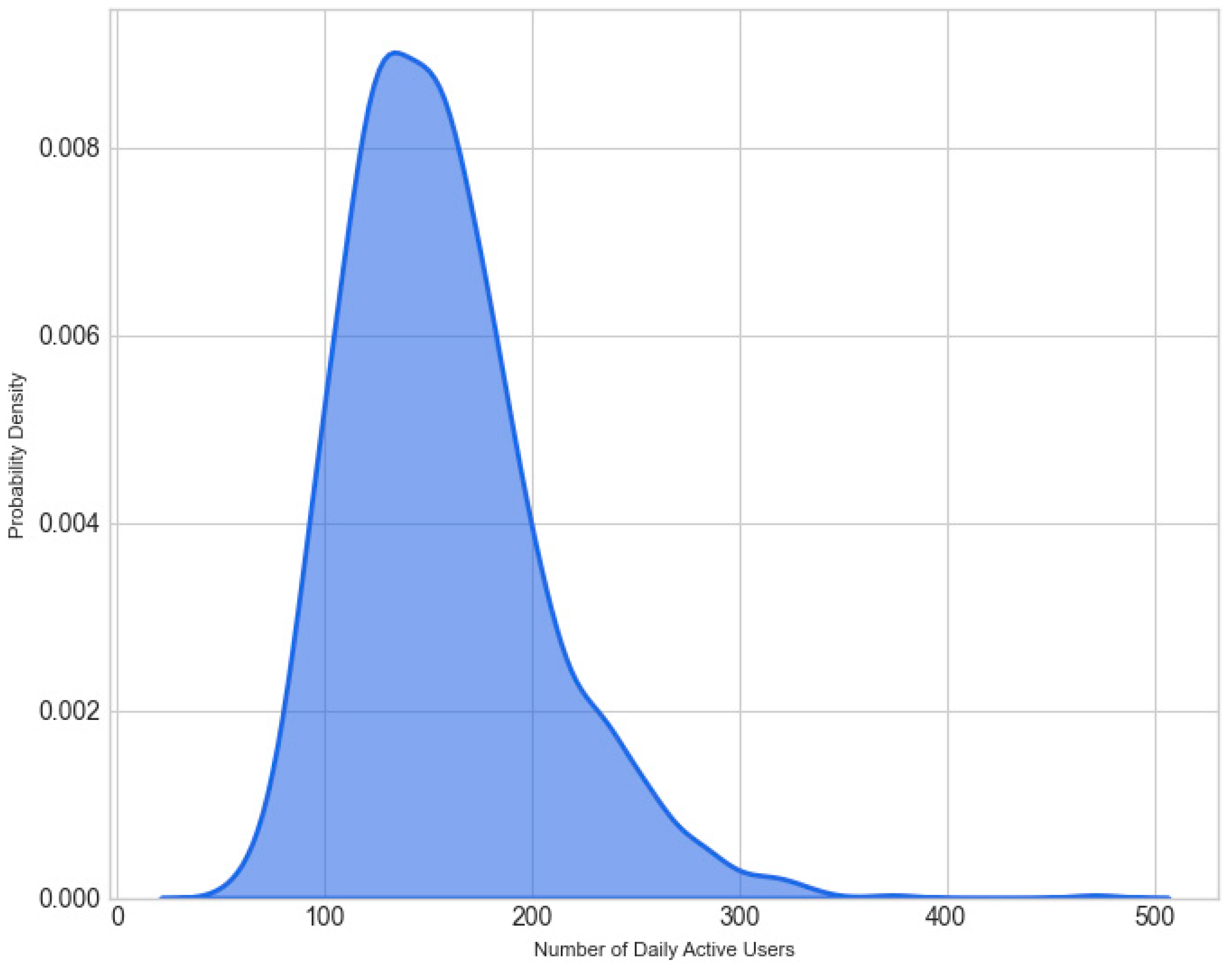
We collected data on the number of daily active users ( n ) for an online learning service platform from 1 January 2022, to 30 December 2024 (1095 days). Figure 9 depicts the probability density function of n over this period, indicating a log-normal distribution with parameters (μ = 6.2744, σ = 0.6710). We define the IaaS resource demand per user in quantifiable terms. For our simulation, serving one daily active user is modeled to require an average of 1 vCPU core-hours of compute resources from an EC2 instance. This unit allows for a direct translation of the stochastic user demand into the stochastic IaaS resource demand ( r = n ) used in our algorithms.
Benchmarking algorithms: DCRA [3], BOCP [4], RRS [5], and OHGR [6] construct cost functions, deduce key conclusions through mathematical proofs, and design cost-optimization algorithms. HPFDNN [33] and L-PAW [34] utilize neural networks and deep learning to forecast future cloud resource demand.
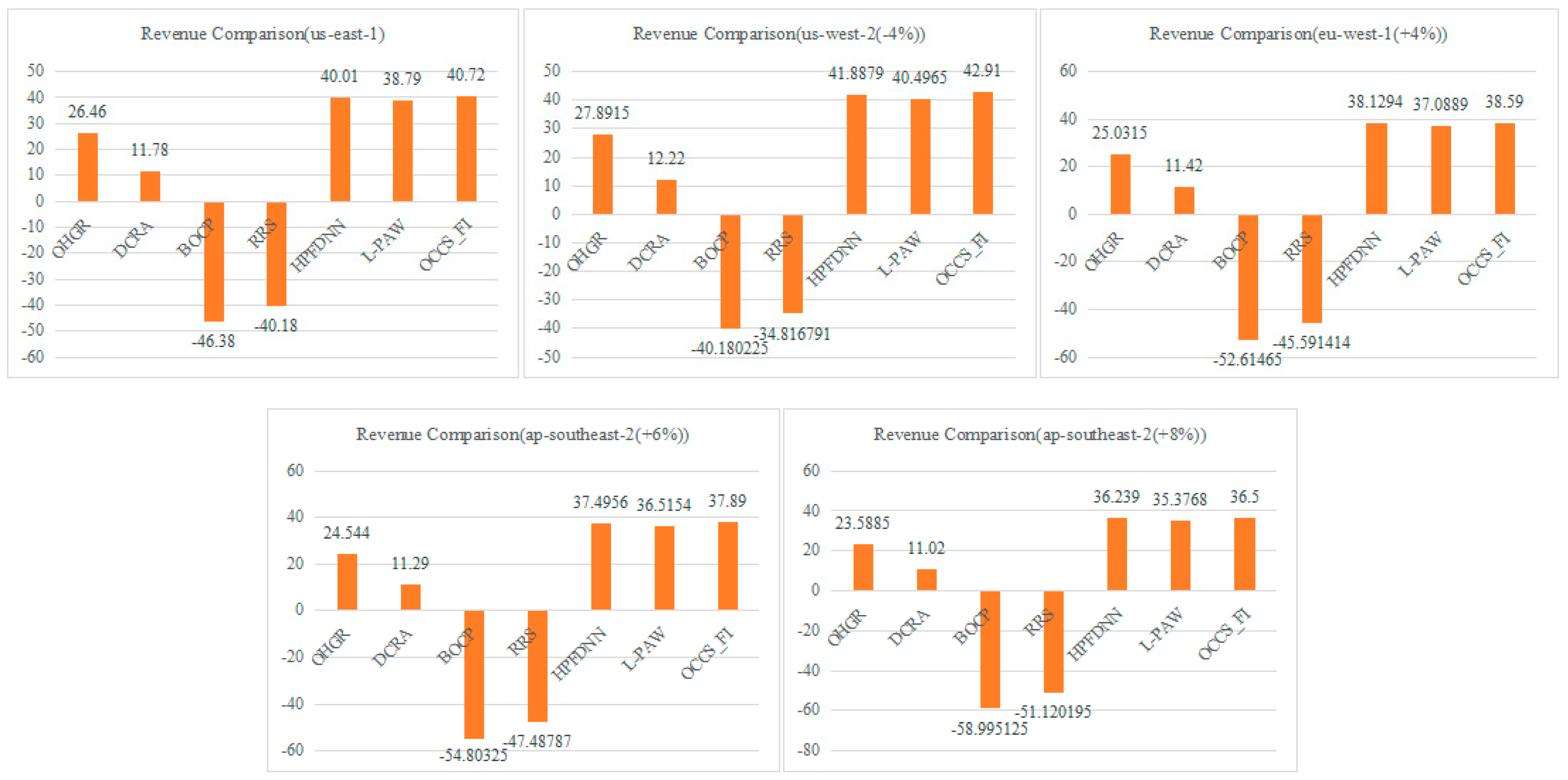
Figure 10 depicts the expected gains of these benchmark algorithms alongside OCCS_FI’s expected gains for five different IaaS instances. Without instance selection, OCCS_FI’s expected gain outperforms the other benchmarks. For the five IaaS instances, OCCS_FI calculates: us-east-1 with a resource configuration of 650 and an expected return of $40.72; us-west-2 with 670 and $42.91; eu-west-1 with 631 and $38.59; ap-southeast-2 with 625 and $37.89; ap-northeast-1 with 612 and $36.5. Finally, OCCS_FI selects the us-west-2 instance with an optimal reservation of 670, yielding a maximum expected return of $42.91, which represents a further improvement over the benchmark algorithms.

6. Conclusions and Future Work

This study addresses the persistent issues of QoS violations and low resource utilization in cloud resource configurations, exacerbated by the randomness of SaaS user visits and fluctuating cloud resource performance. We propose a novel collaborative IaaS resource configuration strategy from the unique perspective of SaaS provider revenue optimization. This strategy is instantiated through three distinct algorithms tailored for fixed, segmented, and dynamic IaaS pricing models (OCCS_FI, OCCS_SI, and OCCS_DI). Theoretical analysis and experimental validation confirm that our approach offers the following key advantages: (1) It enables expected revenue-maximizing IaaS resource configuration under three prevalent pricing models. (2) It effectively mitigates the uncertainty in resource provisioning caused by stochastic user demand, along with negligible QoS violation rates at this layer. (3) It empowers SaaS providers to manage their resource provisioning effectively, minimizing the risk of QoS violations towards their end-users to a negligible level while pursuing revenue maximization.
While the proposed collaborative strategies demonstrate significant efficacy under the stated assumptions, several promising avenues exist for extending this work to broader and more complex cloud ecosystems. Extending the Collaboration Model to Non-Cooperative Environments. The current model operates under a fully cooperative consortium assumption (Assumption 1), which serves as a foundational benchmark for collective welfare maximization. A critical and valuable extension is to relax this assumption to consider strategic, self-interested SaaS providers. In such a setting, providers may have incentives to misreport their private information (e.g., demand forecasts or revenue structures) to manipulate the collaborative mechanism for individual gain. Future research should investigate the integration of game-theoretic frameworks and mechanism design principles into the two-stage collaborative strategy. This could involve designing truth-revealing incentive mechanisms (e.g., based on Vickrey-Clarke-Groves auctions or Nash bargaining solutions) that align individual rational behavior with the system-wide goal of efficient resource redistribution, even in the absence of altruism. Analyzing the existence and properties of equilibrium states, as well as the price of anarchy relative to our cooperative benchmark, would provide profound insights into the practical deployability of such collaborative systems in competitive markets.
Additionally, our future work will explore multi-stage and multi-resource IaaS configuration strategies, investigate the quantitative integration of heterogeneous cloud resources, and develop a holistic resource configuration framework that benefits providers across all layers (IaaS, PaaS, and SaaS).

Author Contributions

L.Z. planned research and design, collected data, conducted experiments, and analyzed data. J.B. wrote the paper. All authors have read and agreed to the published version of the manuscript.

Funding

This work was supported by the National Social Science Fund of China (No. 19BTQ028).

Institutional Review Board Statement

This paper does not require an Ethical approval.

Informed Consent Statement

This paper does not involve human participants and/or animals.

Data Availability Statement

The authors confirm that the data supporting the findings of this study are available within the article.

Acknowledgments

The authors are grateful to the Senior Editor and three anonymous referees for their constructive comments and suggestions, which have helped us significantly improve the quality and exposition of this paper.

Conflicts of Interest

The authors declare no conflicts of interest.

Abbreviations

The following abbreviations are used in this manuscript:
IaaSinfrastructure as a service
PaaSplatform as a service
QoSquality of service
SaaSsoftware as a service
OCCS_FIoptimal collaboration configuration strategy for fixed-price IaaS
OCCS_SIoptimal collaboration configuration strategy for segmented-price IaaS
OCCS_DIoptimal collaboration configuration strategy of dynamic-price IaaS
AWSAmazon Web Services
OCPOracle Cloud Platform
GCPGoogle Cloud Platform
EC2Elastic Compute Cloud
VMsvirtual machines
CDCCloud Data Center
GRVMPgreedy randomized VM placement
SWBTStoer-Wagner binary tree
OCA_FIOptimal Configuration Algorithm of Fixed-price IaaS
OCA_SIOptimal Configuration Algorithm of Segmented-price IaaS
OCA_DIOptimal Configuration Algorithm of Dynamic-price IaaS
CCA_IRCollaboration Configuration Algorithm of IaaS Resources
SS_MaCMcloud model-based SaaS selection algorithm
AFERMthe application feature-based elastic resource manager
DCRADynamic Cloud Resource Allocation
BOCPBroker Online Container Provisioning
RRSRealistic Reservation and Scheduling
OHGRHeuristic-Greedy Reservation
HPFDNNHierarchical Pythagorean Fuzzy Deep Neural Network
L-PAWLearning based Prediction Algorithm for cloud Workloads

References

  1. Zhou, A.; Wang, S.; Zheng, Z.; Hsu, C.-H.; Lyu, M.R.; Yang, F. On Cloud Service Reliability Enhancement with Optimal Resource Usage. IEEE Trans. Cloud Comput. 2016, 4, 452–466. [Google Scholar] [CrossRef]
  2. Zhu, Q.; Agrawal, G. Resource Provisioning with Budget Constraints for Adaptive Applications in Cloud Environments. IEEE Trans. Serv. Comput. 2012, 5, 497–511. [Google Scholar] [CrossRef]
  3. Mireslami, S.; Rakai, L.; Wang, M.; Far, B.H. Dynamic cloud resource allocation considering demand uncertainty. IEEE Trans. Cloud Comput. 2021, 9, 981–994. [Google Scholar] [CrossRef]
  4. Li, X.; Pan, L.; Liu, S. An online service provisioning strategy for container-based cloud brokers. J. Netw. Comput. Appl. 2023, 214, 103618. [Google Scholar] [CrossRef]
  5. Mandal, S.; Maji, G.; Khatua, S.; Das, R.K. Cost minimizing reservation and scheduling algorithms for public clouds. IEEE Trans. Cloud Comput. 2023, 11, 1365–1380. [Google Scholar] [CrossRef]
  6. Liu, K.; Peng, J.; Yu, B.; Liu, W.; Huang, Z.; Pan, J. An instance reservation framework for cost effective services in geo-distributed data centers. IEEE Trans. Serv. Comput. 2021, 14, 356–370. [Google Scholar] [CrossRef]
  7. Azizi, S.; Shojafar, M.; Abawajy, J.; Buyya, R. GRVMP: A Greedy Randomized Algorithm for Virtual Machine Placement in Cloud Data Centers. IEEE Syst. J. 2021, 15, 2571–2582. [Google Scholar] [CrossRef]
  8. Duong-Ba, T.; Tran, T.; Nguyen, T.; Bose, B. A Dynamic Virtual Machine Placement and Migration Scheme for Data Centers. IEEE Trans. Serv. Comput. 2021, 14, 329–341. [Google Scholar] [CrossRef]
  9. Addya, S.K.; Satpathy, A.; Ghosh, B.C.; Chakraborty, S.; Ghosh, S.K.; Das, S.K. CoMCLOUD: Virtual Machine Coalition for Multi-Tier Applications Over Multi-Cloud Environments. IEEE Trans. Cloud Comput. 2023, 11, 956–970. [Google Scholar] [CrossRef]
  10. Belgacem, A.; Beghdad-Bey, K.; Nacer, H. Dynamic Resource Allocation Method Based on Symbiotic Organism Search Algorithm in Cloud Computing. IEEE Trans. Cloud Comput. 2022, 10, 1714–1725. [Google Scholar] [CrossRef]
  11. Guo, W.; Zhang, K.Q.; Cui, L.Z. A Cloud Resources Placement Method Supporting SaaS Applications with Multi-Dimensional and Heterogeneous Requirements. Chin. J. Comput. 2018, 041, 1225–1237. [Google Scholar]
  12. Yang, T.; Han, X.; Li, H.; Li, W.; Zomaya, A.Y. Parallel Scientific Power Calculations in Cloud Data Center Based on Decomposition-Coordination Directed Acyclic Graph. IEEE Trans. Cloud Comput. 2023, 11, 2491–2502. [Google Scholar] [CrossRef]
  13. Wu, Y.W.; Wu, H.; Ren, J.; Zhang, W.B. Heuristic Based Resource Provisioning Approach for Big Data Analytics in Cloud Environment. J. Softw. 2020, 31, 1860–1874. [Google Scholar]
  14. Osypanka, P.; Nawrocki, P. Resource Usage Cost Optimization in Cloud Computing Using Machine Learning. IEEE Trans. Cloud Comput. 2022, 10, 2079–2089. [Google Scholar] [CrossRef]
  15. Su, M.F.; Wang, G.J.; Li, R.F. Resource Deployment with Prediction and Task Scheduling Optimization in Edge Cloud Collaborative Computing. J. Comput. Res. Dev. 2021, 58, 2558–2570. [Google Scholar]
  16. Kardani-Moghaddam, S.; Buyya, R.; Ramamohanarao, K. ADRL: A Hybrid Anomaly-Aware Deep Reinforcement Learning-Based Resource Scaling in Clouds. IEEE Trans. Parallel Distrib. Syst. 2021, 32, 514–526. [Google Scholar] [CrossRef]
  17. Chen, X.; Yang, L.; Chen, Z.; Min, G.; Zheng, X.; Rong, C. Resource Allocation With Workload-Time Windows for Cloud-Based Software Services: A Deep Reinforcement Learning Approach. IEEE Trans. Cloud Comput. 2023, 11, 1871–1885. [Google Scholar] [CrossRef]
  18. Runsewe, O.; Samaan, N. Cloud Resource Scaling for Time-Bounded and Unbounded Big Data Streaming Applications. IEEE Trans. Cloud Comput. 2021, 9, 504–517. [Google Scholar] [CrossRef]
  19. Ren, S.H.; Zheng, K.Q.; Guan, D.D. The Method of Network Dynamic Load Balancing Based on Intuitionistic Fuzzy Time Series. Fire Control Command. Control 2019, 39, 1298–1307. [Google Scholar]
  20. Denninnart, C.; Salehi, M.A. Harnessing the Potential of Function-Reuse in Multimedia Cloud Systems. IEEE Trans. Parallel Distrib. Syst. 2022, 33, 617–629. [Google Scholar] [CrossRef]
  21. Chen, M.; Huang, S.; Fu, X.; Liu, X.; He, J. Statistical Model Checking-Based Evaluation and Optimization for Cloud Workflow Resource Allocation. IEEE Trans. Cloud Comput. 2020, 8, 443–458. [Google Scholar] [CrossRef]
  22. Yu, L.; Xie, Y.; Chen, B. Towards Runtime Dynamic Provision of Virtual Resources Using Feedforward and Feedback Control. J. Comput. Res. Dev. 2015, 52, 889–897. [Google Scholar]
  23. Gao, G.; Xiao, M.; Wu, J.; Huang, H.; Wang, S.; Chen, G. Auction-Based VM Allocation for Deadline-Sensitive Tasks in Distributed Edge Cloud. IEEE Trans. Serv. Comput. 2021, 14, 1702–1716. [Google Scholar] [CrossRef]
  24. Wang, Y.; Zhou, J.-T.; Song, X. A Utility Game Driven QoS Optimization for Cloud Services. IEEE Trans. Serv. Comput. 2022, 15, 2591–2603. [Google Scholar] [CrossRef]
  25. Nallur, V.; Bahsoon, R. A decentralized self-adaptation mechanism for service-based applications in the cloud. IEEE Trans. Softw. Eng. 2013, 39, 591–612. [Google Scholar] [CrossRef]
  26. Haratian, P.; Safi-Esfahani, F.; Salimian, L.; Nabiollahi, A. An Adaptive and Fuzzy Resource Management Approach in Cloud Computing. IEEE Trans. Cloud Comput. 2019, 7, 907–920. [Google Scholar] [CrossRef]
  27. Alsarhan, A.; Itradat, A.; Al-Dubai, A.Y.; Zomaya, A.Y.; Min, G. Adaptive Resource Allocation and Provisioning in Multi-Service Cloud Environments. IEEE Trans. Parallel Distrib. Syst. 2018, 29, 31–42. [Google Scholar] [CrossRef]
  28. Wu, Z.A.; Luo, J.Z.; Song, A.B. Data Centers spanning Dynamic Resource Co-Reservation. Chin. J. Comput. 2014, 37, 2395–2407. [Google Scholar]
  29. Wei, H.; Zhou, S.R.; Zhang, R. Application feature based elastic resource management mechanism on PaaS. Chin. J. Comput. 2016, 39, 223–236. [Google Scholar]
  30. Qi, L.; Dou, W.; Hu, C.; Zhou, Y.; Yu, J. A Context-Aware Service Evaluation Approach over Big Data for Cloud Applications. IEEE Trans. Cloud Comput. 2020, 8, 338–348. [Google Scholar] [CrossRef]
  31. Ma, H.; Zhu, H.; Li, K.; Tang, W. Collaborative Optimization of Service Composition for Data-Intensive Applications in a Hybrid Cloud. IEEE Trans. Parallel Distrib. Syst. 2019, 30, 1022–1035. [Google Scholar] [CrossRef]
  32. Zhang, L.; Bai, J.; Xu, J. Optimal Allocation Strategy of Cloud Resources With Uncertain Supply and Demand for SaaS Providers. IEEE Access 2023, 11, 80997–81010. [Google Scholar] [CrossRef]
  33. Chen, D.; Zhang, X.; Wang, L.L.; Han, Z. Prediction of cloud resources demand based on hierarchical pythagorean fuzzy deep neural network. IEEE Trans. Serv. Comput. 2021, 14, 1890–1901. [Google Scholar] [CrossRef]
  34. Chen, Z.; Hu, J.; Min, G.; Zomaya, A.Y.; El-Ghazawi, T. Towards Accurate Prediction for High-Dimensional and Highly-Variable Cloud Workloads with Deep Learning. IEEE Trans. Parallel Distrib. Syst. 2020, 31, 923–934. [Google Scholar] [CrossRef]
  35. Darzanos, G.; Koutsopoulos, I.; Stamoulis, G.D. Cloud Federations: Economics, Games and Benefits. IEEE/ACM Trans. Netw. 2019, 27, 2111–2124. [Google Scholar] [CrossRef]
Figure 1. The framework for maximizing SaaS provider expected revenue.
Electronics 15 00568 g001
Figure 2. Expected revenue comparison of OCA_FI vs. OCA_DI. The black dashed line represents the expected benefits obtained by the OCA_FI algorithm with costs of 0.1 and 0.2 relative to OCA_DI.
Electronics 15 00568 g002
Figure 3. Expected revenue comparison of OCA_FI vs. OCCS_FI.
Electronics 15 00568 g003
Figure 4. Expected revenue comparison of OCA_SI vs. OCCS_SI.
Electronics 15 00568 g004
Figure 5. Expected revenue comparison of (OCA_DI vs. OCCS_DI).
Electronics 15 00568 g005
Figure 6. Comparison of QoS constraint violations.
Electronics 15 00568 g006
Figure 7. Comparison of resource utilization.
Electronics 15 00568 g007
Figure 8. Comparison of expected revenue.
Electronics 15 00568 g008
Figure 9. Distribution of active daily users.
Electronics 15 00568 g009
Figure 10. Comparison of Expected Revenue Between Two-Stage Algorithms and OCA_FI.
Electronics 15 00568 g010
Table 1. Relevant Symbols and Definitions.
SymbolsDescription
General Model Variables
m Amount of IaaS resources required to serve each user (constant).
n Number of users per unit time (a discrete random variable).
v Sales price of the SaaS service (revenue from serving one user).
s o Other service costs incurred per SaaS user served.
k r Unit recovery price of remaining cloud resources
Q Resource allocation amount for SaaS service (a decision variable).
r Cloud resource demand ( r = n × m ), a discrete random variable.
f r Probability mass function of cloud resource demand r .
p r Probability density function of r (continuous case).
T Probability distribution table for n .
T r Probability distribution table for r .
Variables related to fixed-price IaaS configuration strategy
w Selling price per unit of a specific IaaS resource.
k Profit per unit of cloud resource sold ( k = v m × w s o / m ).
h Loss per unit of unused cloud resource ( h = w k r ).
C Q Expected revenue function of resource configuration amount Q .
Q * Optimal resource configuration amount.
Variables related to segmented-price IaaS configuration strategy
G Q Segmented Price Function.
c i The unit price at the i -th tier.
Q ¯ i Cut-off points for resource quantity at the i -th tier price.
k ¯ i Profit per unit of cloud resource sold at the i -th tier price.
h ¯ i Loss per unit of unused cloud resource at the i -th tier price.
Q ¯ i * Optimal resource configuration amount at the i -th tier price.
Variables related to dynamic-price IaaS configuration strategy
w l Lower bound of the selling price for a specific IaaS resource.
w h Upper bound of the selling price for a specific IaaS resource.
f w w Probability distribution function of w .
p w w Probability density function of w .
Table 2. The change in expected revenue with different sales price (OCA_FI).
v   =   ¥ 3
k / ( k   +   h )   =   0.729
v   =   ¥ 4
k / ( k   +   h )   =   0.853
v   =   ¥ 5
k / ( k   + h   )   =   0.887
Q * C Q * Q * C Q * Q * C Q *
5550 957.001456601472.78315730 1989.8758
5560 957.017656691472.79515739 1989.8910
5563 957.019556701472.79565740 1989.8917
5564 957.019856711472.79595741 1989.8923
5565957.019956721472.79605742 1989.8926
5566957.019956731472.795957431989.8928
5567 957.019756741472.79575744 1989.8927
5568 957.019556751472.79525745 1989.8925
5570 957.018456761472.79475746 1989.8921
5580 957.004056801472.79065750 1989.8886
Bold numbers indicate the optimal configuration quantity and expected revenue.
Table 3. The change in expected revenue with different demand distribution (OCA_FI).
N 5000 , 500 2 N 5200 , 500 2 N 5000 , 450 2 N 5200 , 450 2
Q * C Q * Q * C Q * Q * C Q * Q * C Q *
5400 915.57515600 953.57515360919.01765560957.0176
5403 915.57715603 953.57715362919.01905562957.0190
5404 915.57745604 953.57745363919.01955563957.0195
5405 915.57765605 953.57765364919.01985564957.0198
5406915.57775606953.57775365919.01995565957.0199
5407915.57775607953.57775366919.01995566957.0199
5408 915.57755608 953.57755367919.01985567957.0198
5409 915.57715609 953.57715368919.01955568957.0195
5410 915.57675610 953.57675369919.01905569957.0190
5420 915.56455620 953.56455380919.00405580957.0040
Bold numbers indicate the optimal configuration quantity and expected revenue.
Table 4. The change in configuration amount and expected revenue at the sales price is ¥3 (OCA_SI).
G Q   =   0.25
k / k   +   h   =   0.17
G Q   =   0.2
k / k   +   h   =   0.375
G Q   =   0.15
k / k   +   h   =   0.5833
G Q   =   0.1
k / k   +   h   =   0.7917
Q * C Q * Q * C Q * Q * C Q * Q * C Q *
200822001985000652.12696001898.9811
4001624002165080653.11556200889.6735
6002426002345103653.17476400879.9087
800322800251.99995104653.17516600869.9778
1000403000269.99915105653.17526800859.9953
1200483200287.99535106653.17517000849.9991
1400563400305.97785107653.17497200839.9999
1600643600323.90875108653.17457400830
1800723800341.67355120653.15487600820
2000804000358.98115200652.34747800810
Bold numbers indicate the optimal configuration quantity and expected revenue.
Table 5. The change in configuration amount and expected revenue at the sales price is ¥4 (OCA_SI).
G Q   =   0.25
k / k   +   h   =   0.4118
G Q   =   0.2
k / k   +   h   =   0.5588
G Q   =   0.15
k / k   +   h   =   0.7059
G Q   =   0.1 k / k   +   h   =   0.8529
Q * C Q * Q * C Q * Q * C Q * Q * C Q *
2002822004184001958.556660011398.5566
40056240045642001004.04962001389.5375
60084260049448001112.82564001379.8706
800112280053252691141.424966001369.9685
100013403000569.998852701141.425168001359.9933
12001683200607.993452711141.42570001349.9988
14001963400645.968552721141.424572001339.9998
16002243600683.870652731141.424574001329.9999
18002523800721.537556001130.46376001320
20002804000758.556660001098.55778001310
Bold numbers indicate the optimal configuration quantity and expected revenue.
Table 6. Parameter settings for comparison with SS-MaCM and AFERM.
m v w s o k r n
10¥4¥0.1¥0.0¥0.05 N 5000 ,   500
Table 7. Parameter settings for comparison with Two-Stage Algorithm.
Instance Parameters v Reserved (w) s o k r On-DemandSpotRegion
1 vCPU, 1 GiB memory$0.2$0.0936$0.0$0.02810.18720.0080us-east-1
$0.0900$0.02700.18000.0070us-west-2 (−4%)
$0.0972$0.02920.19440.0090eu-west-1 (+4%)
$0.0984$0.02950.19680.0095ap-southeast-2 (+6%)
$0.1008$0.03020.20160.0100ap-northeast-1 (+8%)
Disclaimer/Publisher’s Note: The statements, opinions and data contained in all publications are solely those of the individual author(s) and contributor(s) and not of MDPI and/or the editor(s). MDPI and/or the editor(s) disclaim responsibility for any injury to people or property resulting from any ideas, methods, instructions or products referred to in the content.