Dual-Axis Transformer-GNN Framework for Touchless Finger Location Sensing by Using Wi-Fi Channel State Information

Abstract
1. Introduction
- 1.
- Single-link verification: We validate the proposed system using a practical single-link Wi-Fi setup with commercial hardware.
- 2.
- Multi-domain combination strategy: We construct mini-batches by combining segments from multiple domains within each gesture class, explicitly forcing the model to observe diverse domain manifestations during training.
- 3.
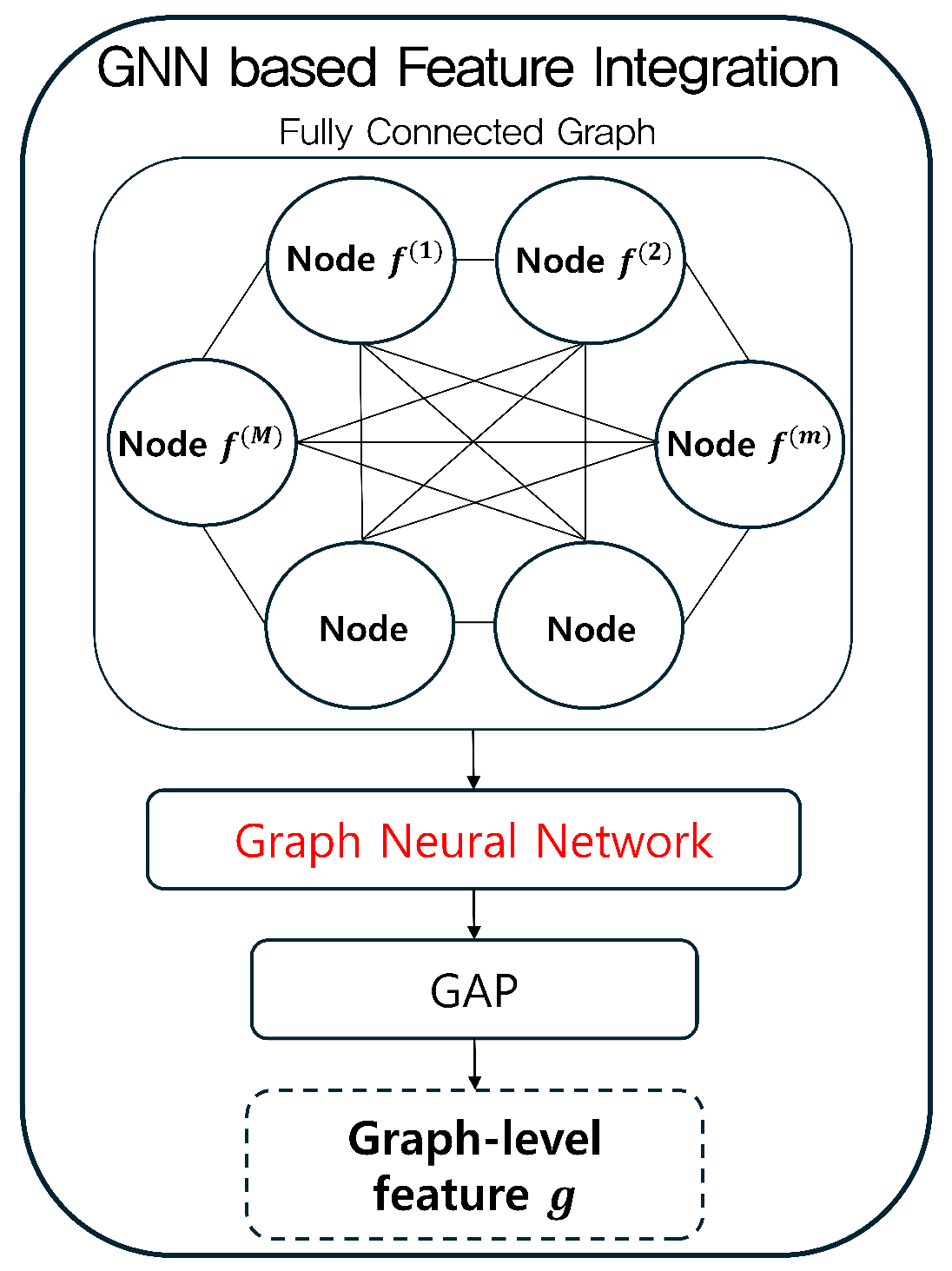
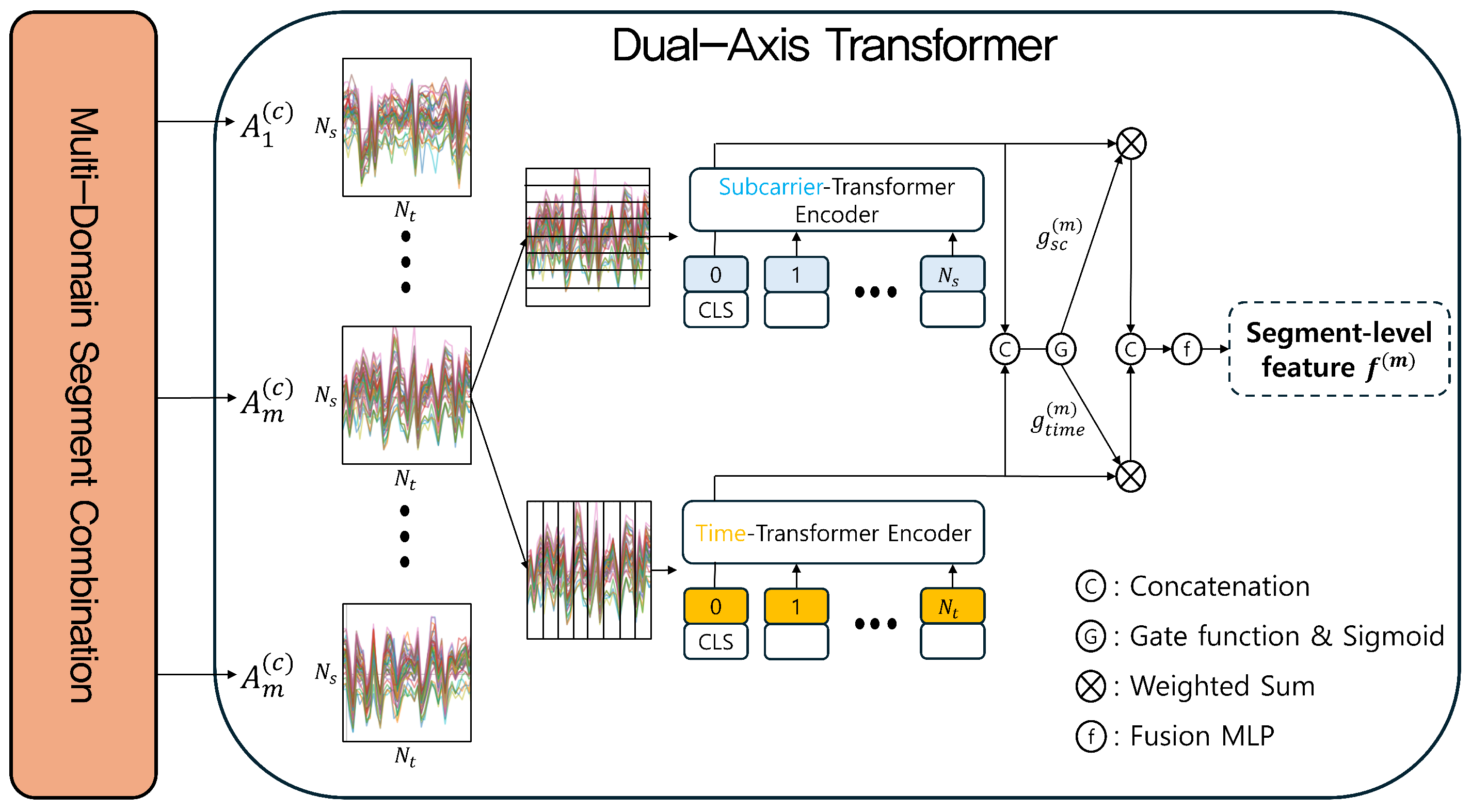
- Transformer–GNN hybrid learning: We design a Dual-Axis Transformer and a GNN-based integration module to learn domain-invariant representations.
2. Related Works
2.1. In-Domain Measurement Setting
2.2. Cross-Domain Measurement Setting
3. Methods
3.1. System Overview
3.2. CSI Data Preprocessing
3.3. Dual-Axis Transformer for Feature Extraction
3.4. Graph-Based Feature Integration
3.5. Classifier
4. Experimental Evaluation
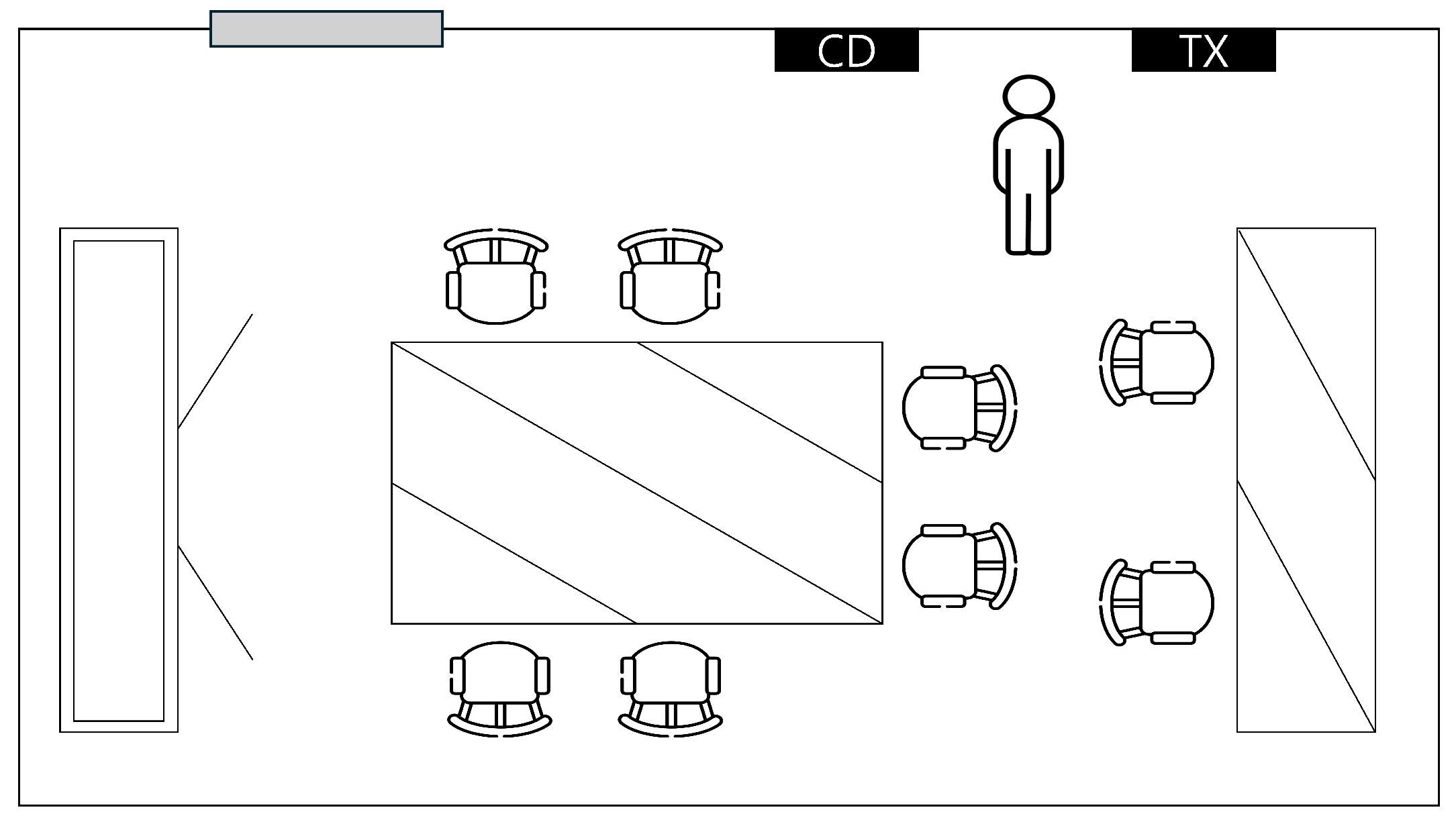
4.1. Data Collection and Implementation Details
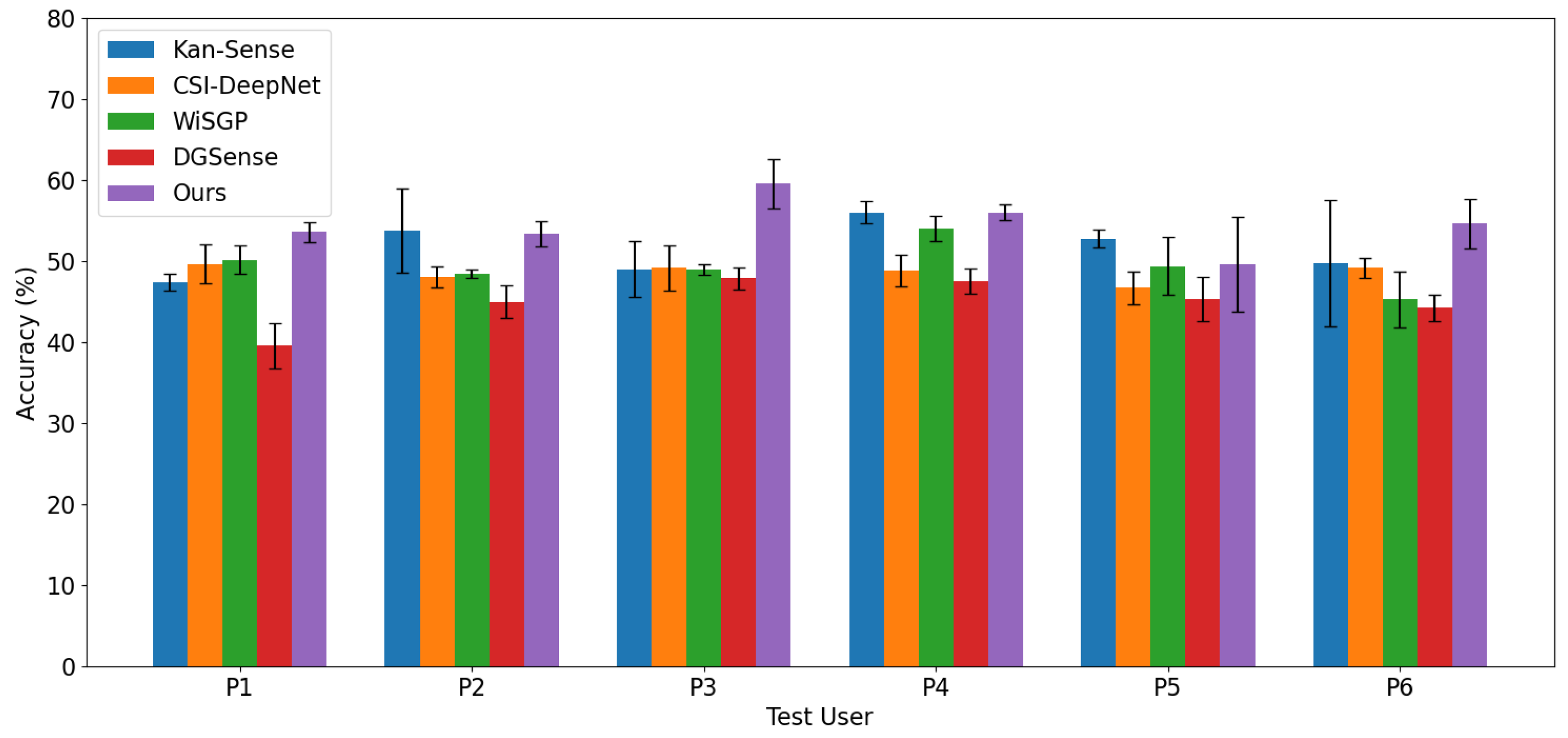
4.2. Performance Evaluation
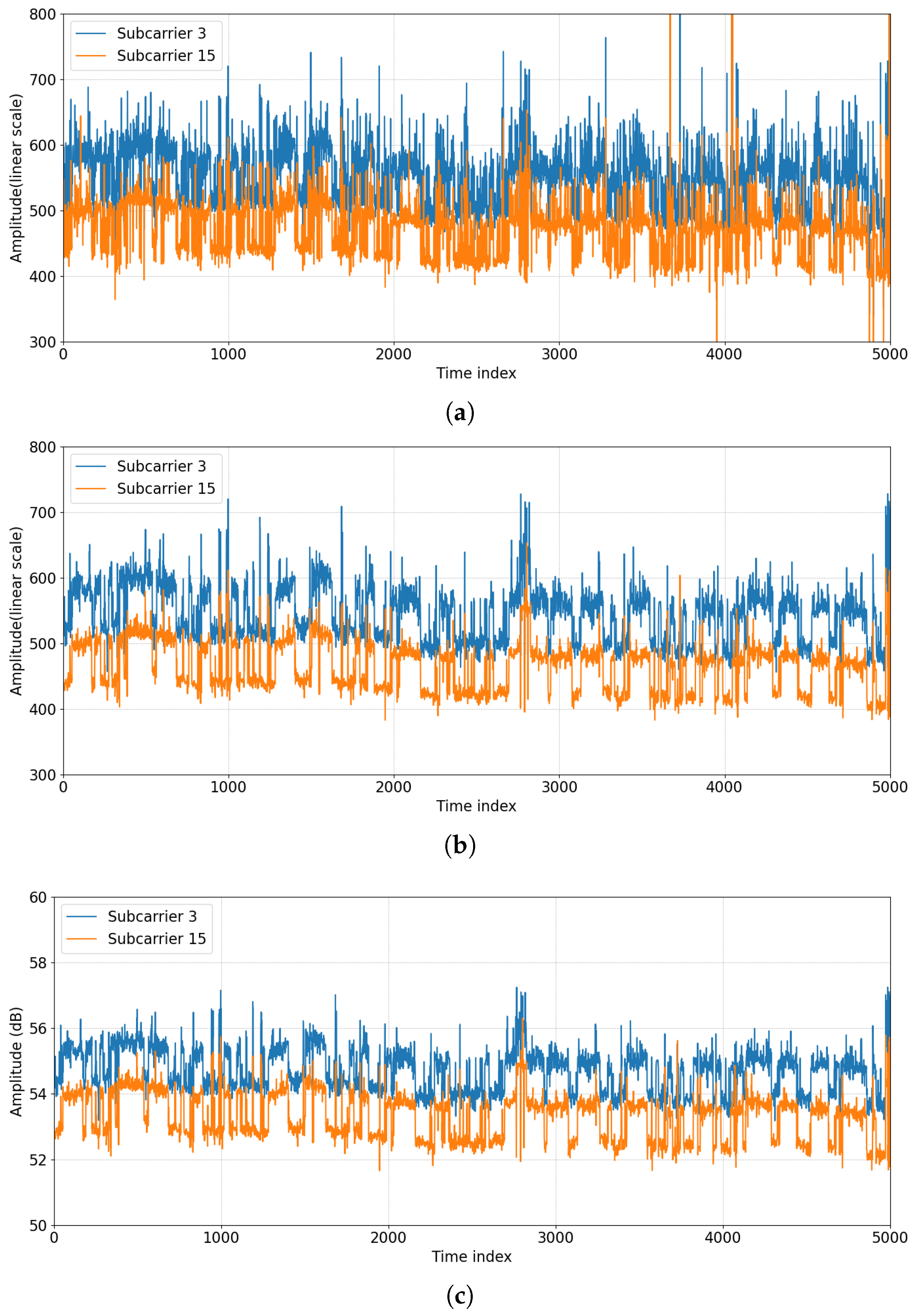
4.3. Visualization of the Preprocessing
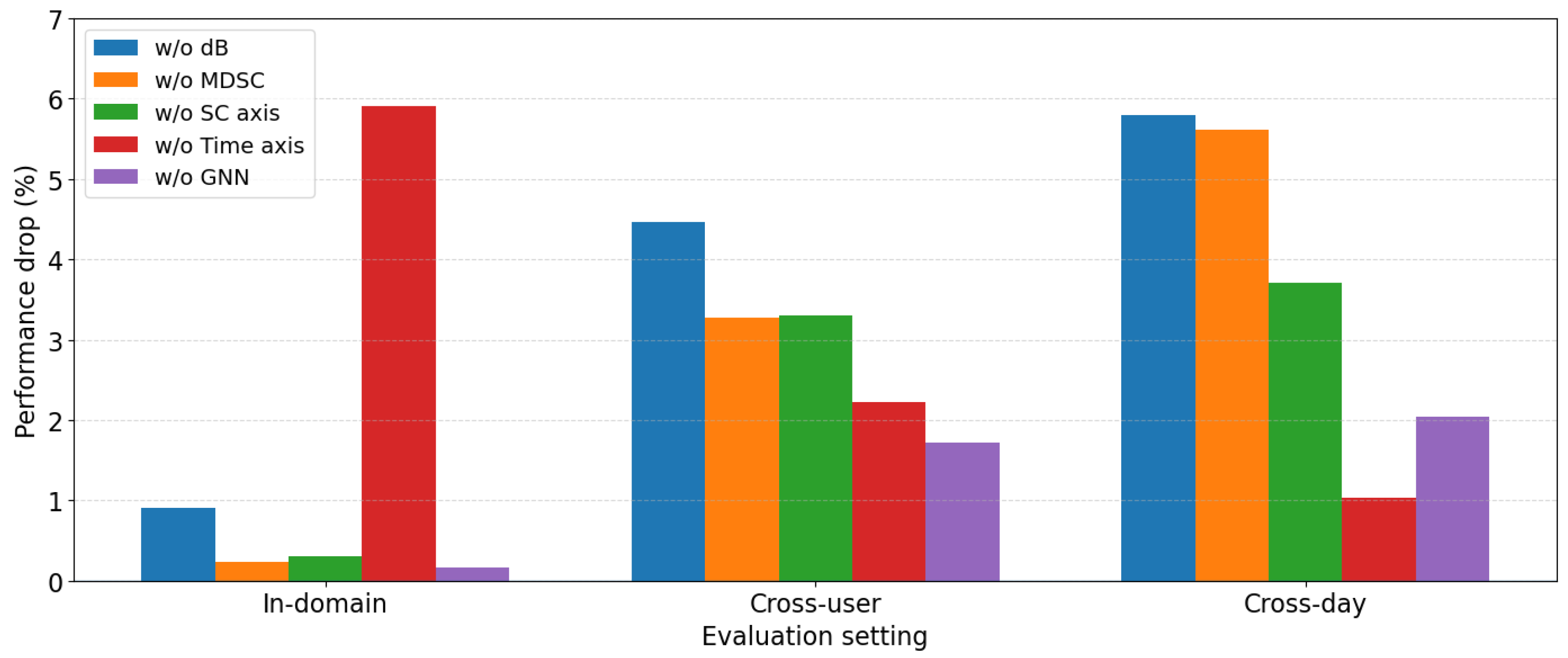
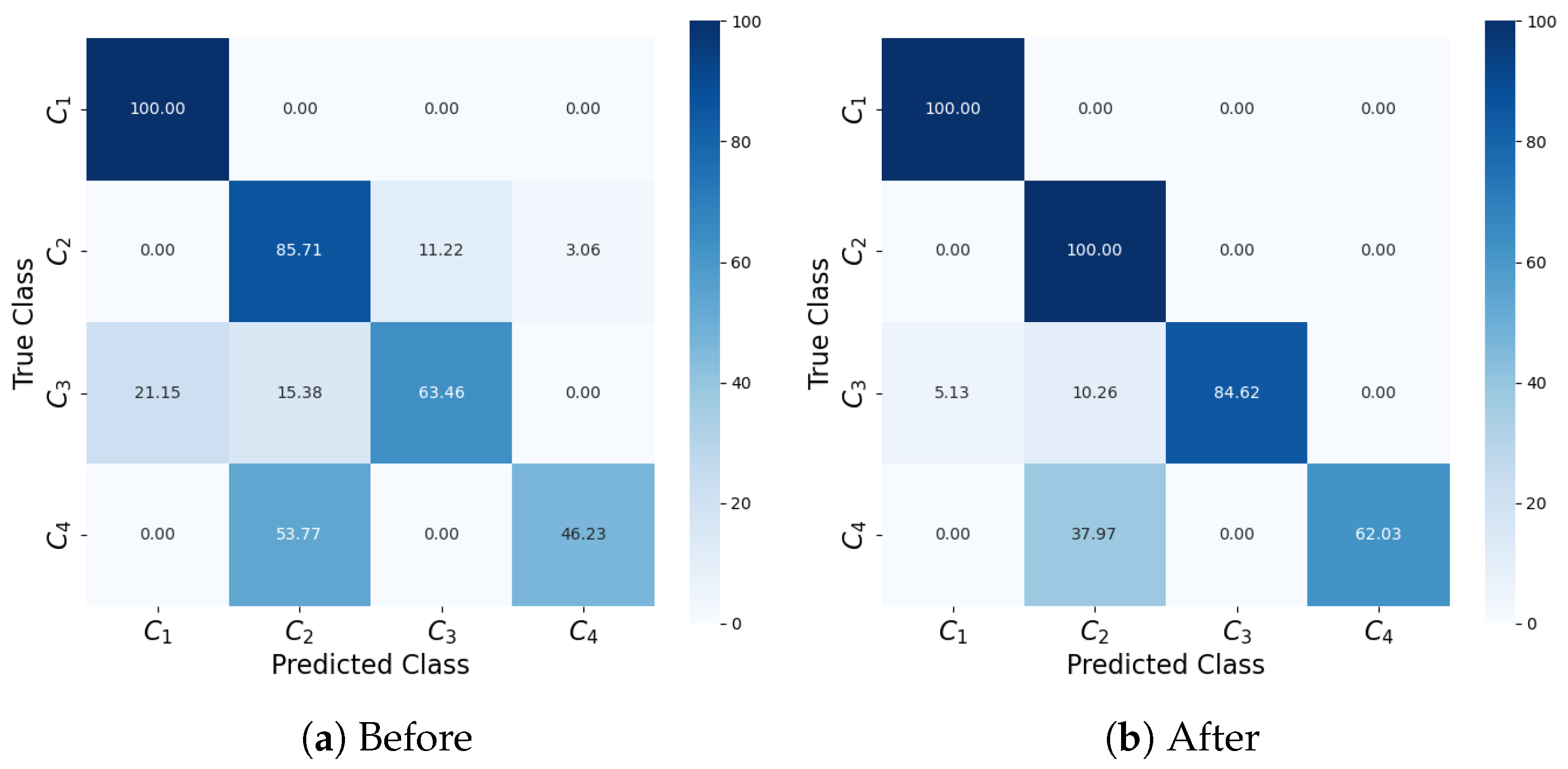
4.4. Ablation Study
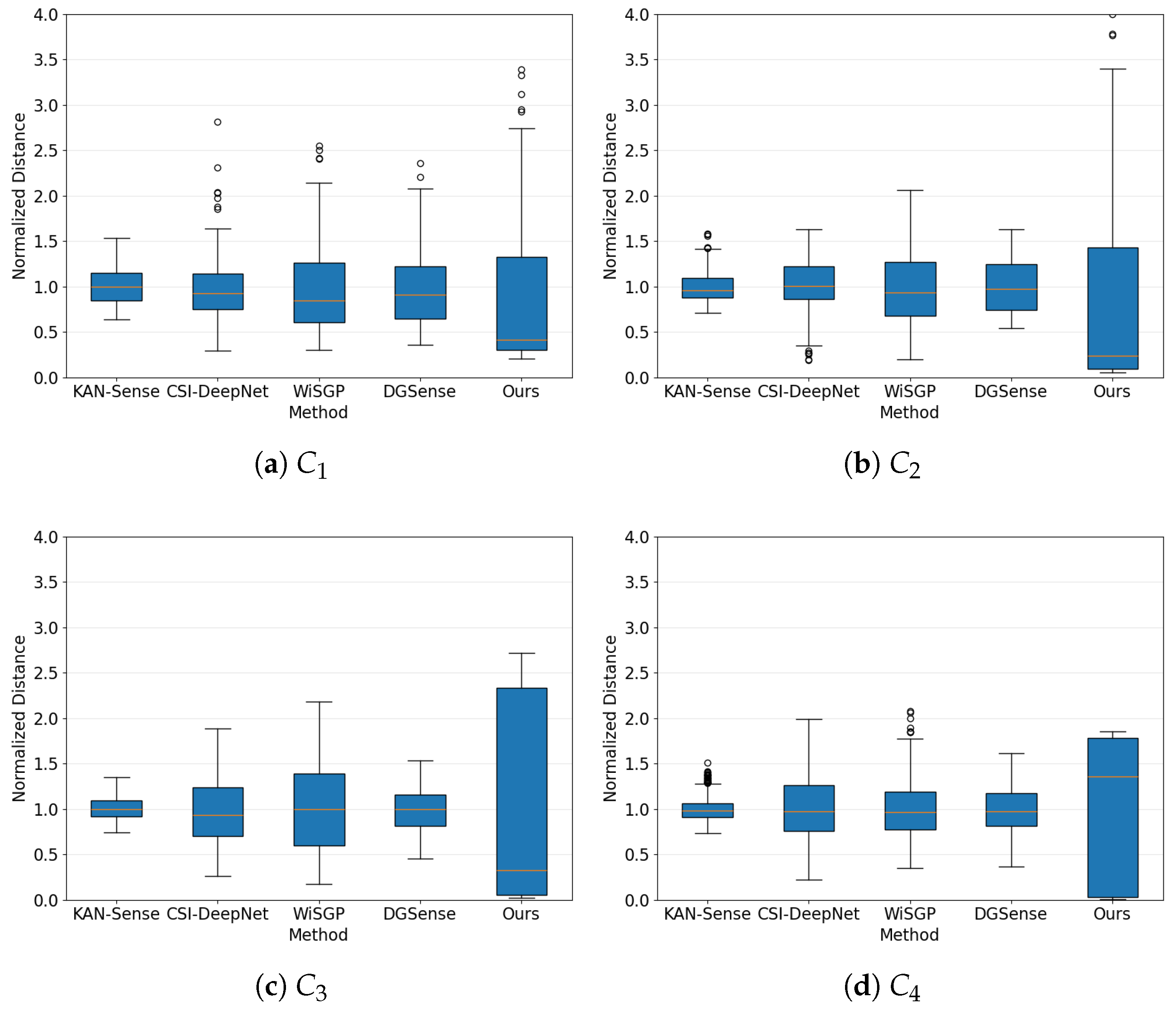
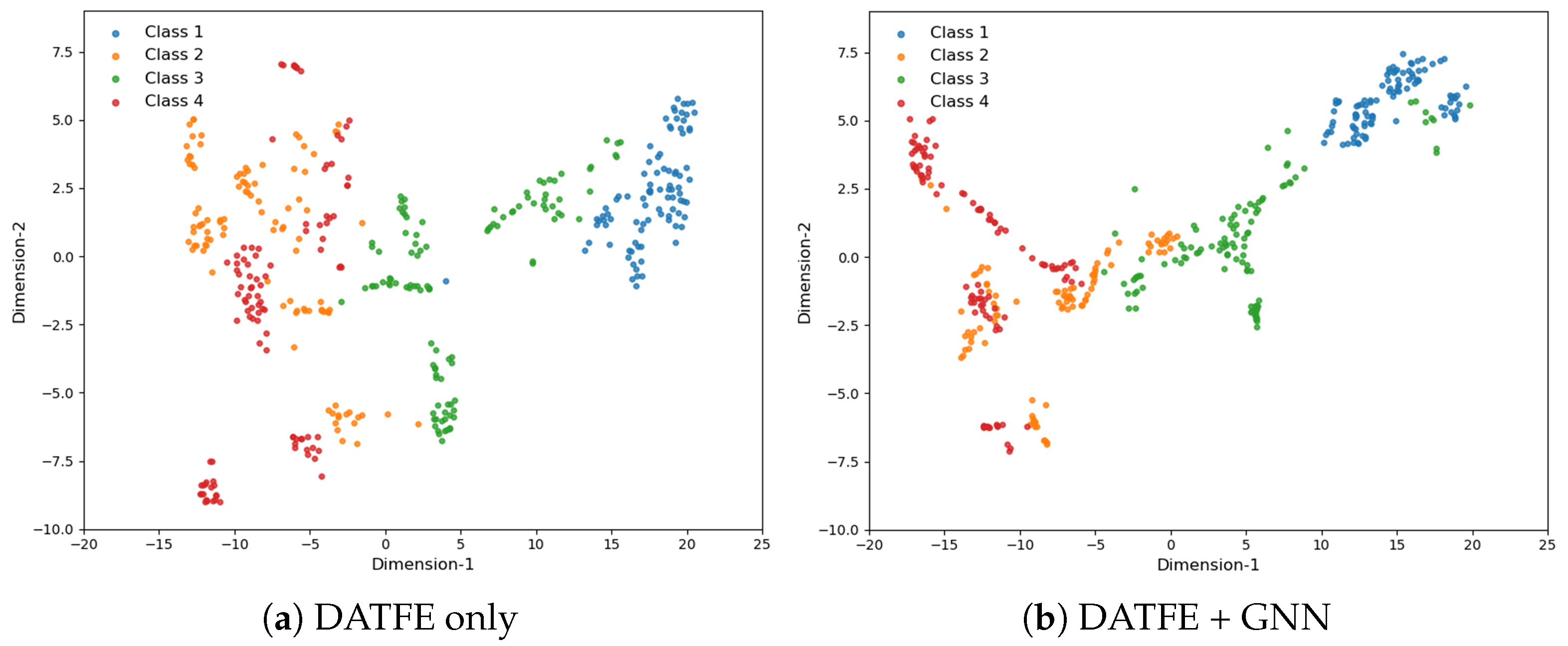
4.5. Feature Alignment Analysis
5. Conclusions and Future Works
Author Contributions
Funding
Data Availability Statement
Acknowledgments
Conflicts of Interest
References
- Ren, Z.; Meng, J.; Yuan, J. Depth camera based hand gesture recognition and its applications in human–computer interaction. In Proceedings of the 8th International Conference on Information, Communications & Signal Processing (ICICS), Singapore, 13–16 December 2011; pp. 1–5. [Google Scholar]
- Chamorro, S.; Collier, J.; Grondin, F. Neural network based lidar gesture recognition for realtime robot teleoperation. In Proceedings of the IEEE International Symposium on Safety, Security, and Rescue Robotics (SSRR), New York City, NY, USA, 25–27 October 2021; pp. 98–103. [Google Scholar]
- Zhu, C.; Sheng, W. Wearable sensor-based hand gesture and daily activity recognition for robot-assisted living. IEEE Trans. Syst. Man Cybern. A 2011, 41, 569–573. [Google Scholar] [CrossRef] [Scilit]
- Liu, K.R.; Wang, B. Wireless AI: Wireless Sensing, Positioning, IoT, and Communications; Cambridge University Press: Cambridge, UK, 2019. [Google Scholar]
- Zhu, G.; Hu, Y.; Gao, W.; Wang, W.H.; Wang, B.; Liu, K.J. CSI-Bench: A large-scale in-the-wild dataset for multi-task WiFi sensing. arXiv 2025, arXiv:2505.21866. [Google Scholar]
- Zhang, Y.; Zheng, Y.; Qian, K.; Zhang, G.; Liu, Y.; Wu, C.; Yang, Z. Widar3.0: Zero-effort cross-domain gesture recognition with Wi-Fi. IEEE Trans. Pattern Anal. Mach. Intell. 2021, 44, 8671–8688. [Google Scholar] [CrossRef] [Scilit] [PubMed]
- Wang, D.; Yang, J.; Cui, W.; Xie, L.; Sun, S. AirFi: Empowering WiFi-based passive human gesture recognition to unseen environment via domain generalization. IEEE Trans. Mob. Comput. 2022, 23, 1156–1168. [Google Scholar] [CrossRef] [Scilit]
- Xie, J.; Li, Z.; Feng, C.; Lin, J.; Meng, X. Wi-AM: Enabling cross-domain gesture recognition with commodity Wi-Fi. Sensors 2024, 24, 1354. [Google Scholar] [CrossRef] [Scilit] [PubMed]
- Bahadori, N.; Ashdown, J.; Restuccia, F. ReWiS: Reliable Wi-Fi sensing through few-shot multi-antenna multi-receiver CSI learning. In Proceedings of the IEEE International Symposium on World of Wireless, Mobile and Multimedia Networks (WoWMoM), Belfast, UK, 14–17 June 2022; pp. 50–59. [Google Scholar]
- Schumann, R.; Li, F.; Grzegorzek, M. WiFi Sensing with Single-Antenna Devices for Ambient Assisted Living. In Proceedings of the 8th International Workshop on Sensor-Based Activity Recognition and Artificial Intelligence (iWOAR), Lübeck, Germany, 21–22 September 2023; pp. 1–8. [Google Scholar]
- Son, J.; Park, J. Channel State Information (CSI) Amplitude Coloring Scheme for Enhancing Accuracy of an Indoor Occupancy Detection System Using Wi-Fi Sensing. Appl. Sci. 2024, 14, 7850. [Google Scholar] [CrossRef] [Scilit]
- Cai, Z.; Li, Z.; Chen, Z.; Zhuo, H.; Zheng, L.; Wu, X.; Liu, Y. Device-Free Wireless Sensing for Gesture Recognition Based on Complementary CSI Amplitude and Phase. Sensors 2024, 24, 3414. [Google Scholar] [CrossRef] [Scilit]
- Ahmed, F.T.; Ahmad, H.; Phang, S.K.; Vaithilingam, C.A.; Harkat, H.; Narasingamurthi, K. Higher order feature extraction and selection for robust human gesture recognition using CSI of COTS Wi-Fi devices. Sensors 2019, 19, 2959. [Google Scholar] [CrossRef] [Scilit]
- Kalal, J.; Khan, R.; Yashaswini, P.; Naik, A.; Mallibhat, K. Wi-Fi CSI based human activity recognition. In Proceedings of the International Conference on Intelligent Technologies (CONIT), Hubbali, India, 20–22 June 2025; pp. 1–8. [Google Scholar]
- Tong, G.; Li, Y.; Zhang, H.; Xiong, N. A fine-grained channel state information-based deep learning system for dynamic gesture recognition. Inf. Sci. 2023, 636, 118912. [Google Scholar] [CrossRef] [Scilit]
- Kabir, M.H.; Hasan, M.A.; Shin, W. CSI-DeepNet: A lightweight deep convolutional neural network based hand gesture recognition system using Wi-Fi CSI signal. IEEE Access 2022, 10, 114787–114801. [Google Scholar] [CrossRef] [Scilit]
- Yang, J.; Chen, X.; Zou, H.; Wang, D.; Xu, Q.; Xie, L. EfficientFi: Toward large-scale lightweight WiFi sensing via CSI compression. IEEE Internet Things J. 2022, 9, 13086–13095. [Google Scholar] [CrossRef] [Scilit]
- Bastwesy, M.R.; Kai, K.; Choi, H.; Ishida, S.; Arakawa, Y. Wi-Nod: Head nodding recognition by Wi-Fi CSI toward communicative support for quadriplegics. In Proceedings of the IEEE Wireless Communications and Networking Conference (WCNC), Glasgow, UK, 26–29 March 2023; pp. 1–6. [Google Scholar]
- Koo, M.; Park, J. KAN-Sense: Keypad input recognition via CSI feature clustering and KAN-based classifier. Electronics 2025, 14, 2965. [Google Scholar] [CrossRef] [Scilit]
- Zhao, Y.; Gong, W.; Liwang, M.; Li, L.; Jiao, Z.; Zhang, B.; Li, C. A Graph Neural Network-Based Dual Attention Fusion Network for CSI-Based Activity Recognition. IEEE Trans. Cogn. Commun. Netw. 2025, 12, 2265–2280. [Google Scholar] [CrossRef] [Scilit]
- Xiao, R.; Liu, J.; Han, J.; Ren, K. OneFi: One-shot recognition for unseen gesture via COTS WiFi. In Proceedings of the ACM Conference on Embedded Networked Sensor Systems (SenSys), Coimbra, Portugal, 15–17 November 2021; pp. 206–219. [Google Scholar]
- Feng, C.; Wang, N.; Jiang, Y.; Zheng, X.; Li, K.; Wang, Z.; Chen, X. Wi-Learner: Towards one-shot learning for cross-domain Wi-Fi based gesture recognition. Proc. ACM Interact. Mob. Wearable Ubiquitous Technol. 2022, 6, 1–27. [Google Scholar] [CrossRef] [Scilit]
- Yang, M.; Zhu, H.; Zhu, R.; Wu, F.; Yin, L.; Yang, Y. WiTransformer: A novel robust gesture recognition sensing model with WiFi. Sensors 2023, 23, 2612. [Google Scholar] [CrossRef] [Scilit] [PubMed]
- Gu, Y.; Yan, H.; Zhang, X.; Wang, Y.; Huang, J.; Ji, Y.; Ren, F. Attention-based gesture recognition using commodity WiFi devices. IEEE Sens. J. 2023, 23, 9685–9696. [Google Scholar] [CrossRef] [Scilit]
- Kang, H.; Zhang, Q.; Huang, Q. Context-aware wireless-based cross-domain gesture recognition. IEEE Internet Things J. 2021, 8, 13503–13515. [Google Scholar] [CrossRef] [Scilit]
- Zhou, R.; Cheng, Y.; Li, S.; Zhang, H.; Liu, C. DGSense: A domain generalization framework for wireless sensing. arXiv 2025, arXiv:2502.08155. [Google Scholar]
- Liu, S.; Chen, Z.; Wu, M.; Wang, H.; Xing, B.; Chen, L. Generalizing wireless cross-multiple-factor gesture recognition to unseen domains. IEEE Trans. Mob. Comput. 2023, 23, 5083–5096. [Google Scholar] [CrossRef] [Scilit]
- Chen, Y.; Huang, X. WiGNN: WiFi-Based Cross-Domain Gesture Recognition Inspired by Dynamic Topology Structure. IEEE Wirel. Commun. 2024, 31, 249–256. [Google Scholar] [CrossRef] [Scilit]
- Zhuo, Y.; Zhu, H.; Xue, H.; Chang, S. Perceiving Accurate CSI Phases with Commodity WiFi Devices. In Proceedings of the IEEE INFOCOM Conference on Computer Communications, Atlanta, GA, USA, 1–4 May 2017; pp. 1–9. [Google Scholar]
- Pearson, R.K.; Neuvo, Y.; Astola, J.; Gabbouj, M. Generalized Hampel filters. EURASIP J. Adv. Signal Process. 2016, 2016, 87. [Google Scholar] [CrossRef] [Scilit]
- Wen, Y.; Zhang, K.; Li, Z.; Qiao, Y. A discriminative feature learning approach for deep face recognition. In Proceedings of the European Conference on Computer Vision (ECCV), Amsterdam, The Netherlands, 11–14 October 2016; pp. 499–515. [Google Scholar]
- Schulz, M.; Wegemer, D.; Hollick, M. Nexmon: The C-Based Firmware Patching Framework. Available online: https://nexmon.org (accessed on 4 December 2025).




| Domain | Ref. | Feature | Preprocessing | Methodology | # Links |
|---|---|---|---|---|---|
| In-domain | [14] | Amplitude | PCA | LSTM | 1 |
| [15] | Amplitude Phase Diff | Butterworth Filter, Phase Unwrapping | CNN + GRU + Attention | 3 | |
| [16] | Amplitude | Butterworth Filter, Gaussian Smoothing | Depthwise Separable Convolution, Feature Attention, Residual Block | 1 | |
| [17] | Amplitude | - | Variational Autoencoder | 9 | |
| [18] | Amplitude | Weighted MA, STFT | CNN-based Inception Block | 8 | |
| [19] | Amplitude | Hampel Filter | CNN + KAN-based Feature Regularization | 1 | |
| [20] | Amplitude | Sliding Window | Dual-stream Attention + GNN | 6 | |
| Cross-domain | [21] | Phase | PCA, DFS | Transformer + Few-shot Learning | 12 |
| [22] | Amplitude Phase | Spectrogram | Autoencoder + Few-shot Learning | 3 | |
| [23] | Amplitude Phase | PCA, BVP | Transformer-based Multi-branch Attention | 3 | |
| [24] | Amplitude Phase | CSI Ratio | ResNet-18-based Self-Attention Relation Attention | 18 | |
| [25] | Phase | PCA, DFS | CNN + GRU Domain Network, Adversarial Attention Fine-tuning | 6 | |
| [7] | Amplitude | - | Autoencoder, Feature Augmentation, Adversarial Regularization | 3 | |
| [26] | Amplitude, Phase, Spectrogram | Median Filter, Phase Unwrapping, DFS | VAE-based Data Augmentation, Episodic Training | 9 | |
| [27] | Amplitude | Butterworth Filter, Phase Unwrapping | 1D-CNN + Residual Block Subdomain-guided Perturbation | 1, 3 | |
| [28] | Amplitude | DFS, Cyclic Shift Augmentation | CNN + GNN | 6 | |
| Ours | Amplitude | Hampel Filter, Decibel Conversion, Segment Combination | Transformer + GNN | 1 |
| Notation | Description |
|---|---|
| H | Raw complex CSI matrix. |
| T | Number of CSI time samples collected in a single measurement. |
| Number of raw subcarriers. | |
| Number of data subcarriers retained. | |
| Amplitude matrix of all the raw subcarriers. | |
| A | Amplitude matrix of data subcarriers only. |
| s | Subcarrier index. |
| Amplitude value of subcarrier s at time index t. | |
| w | Window length used for Hampel filter. |
| Temporal length of each segment. | |
| R | Number of non-overlapping segments obtained from a single measurement. |
| Multi-domain input segment set for gesture class c. | |
| D | Set of available domains. |
| M | Number of segments sampled to construct . |
| P1 | P2 | P3 | P4 | P5 | P6 | |
|---|---|---|---|---|---|---|
| Gender | Male | Male | Male | Male | Male | Female |
| Height (cm) | 180–190 | 170–180 | 170–180 | 170–180 | 160–170 | 150–160 |
| Statistic | Value |
|---|---|
| Sampling interval | 10 ms |
| Number of participants | 6 |
| Recording days per participant | 10 |
| CSI frames per gesture class (per day) | 6 k |
| CSI frames per participant (per day) | 24 k |
| Total CSI frames | 1.44 M |
| Component | Hyperparameter | Value |
|---|---|---|
| Preprocessing | w | 5 |
| 3 | ||
| 52 | ||
| DATFE | 128 | |
| # Attention heads | 4 | |
| # Encoder blocks | 3 | |
| GNN Integration | M | 6 |
| # GNN layers | 1 | |
| Loss | 0.01 | |
| Training | Optimizer | Adam |
| Learning rate (main optimization) | ||
| Learning rate (center optimization) | ||
| Batch size | 256 | |
| Max epochs | 300 | |
| Early stopping patience | 20 |
| Metric | Fold 1 | Fold 2 | Fold 3 | Fold 4 | Fold 5 | Average |
|---|---|---|---|---|---|---|
| Acc (%) | 99.01 | 99.63 | 99.14 | 99.38 | 99.38 | 99.31 |
| Precision (%) | 99 | 99.64 | 99.14 | 99.39 | 99.39 | 99.31 |
| F1-score (%) | 98.99 | 99.64 | 99.14 | 99.38 | 99.38 | 99.31 |
| Model | Kan-Sense | CSI-DeepNet | WiSGP | DGSense | Ours |
|---|---|---|---|---|---|
| Acc (%) | 98.41 | 93.62 | 91.91 | 96.52 | 99.31 |
| KAN | CSI-DeepNet | WiSGP | DGSense | Ours | |
|---|---|---|---|---|---|
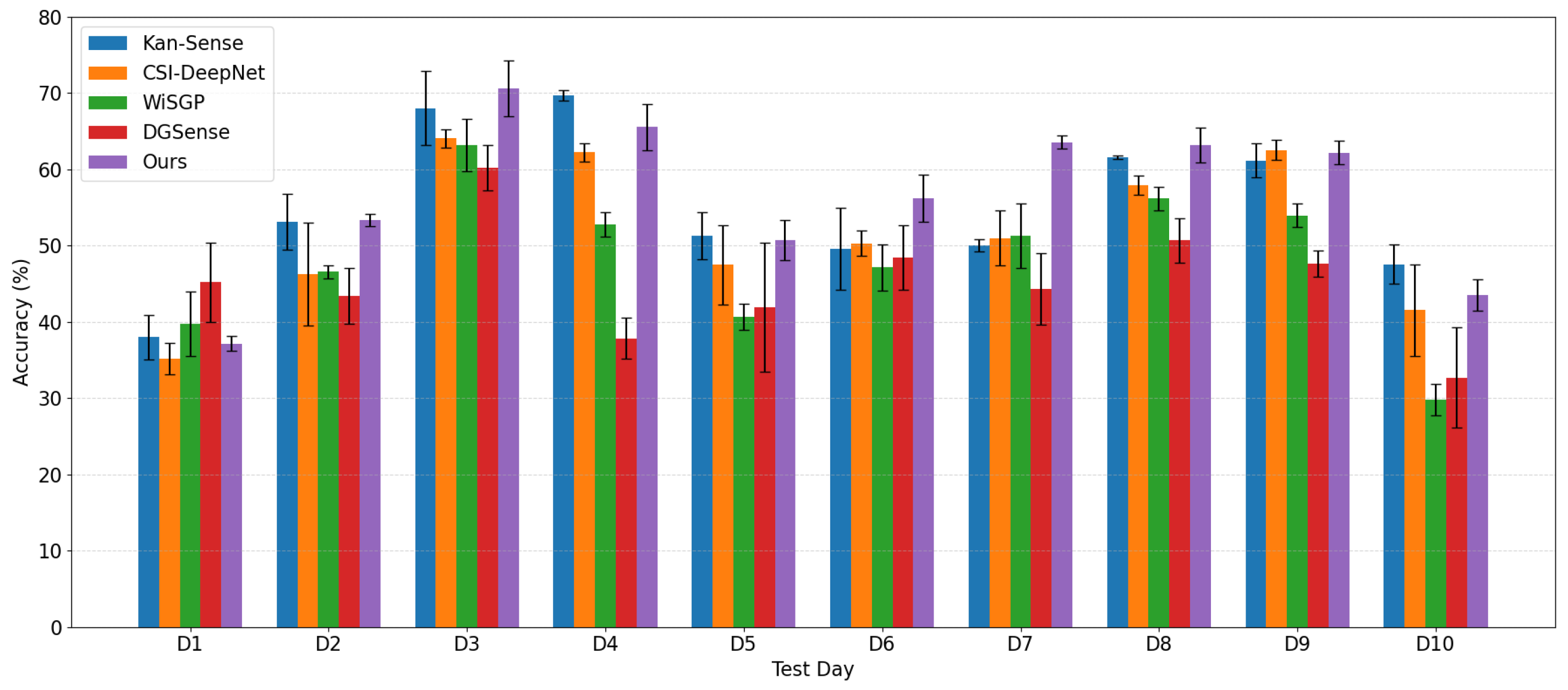
| All | 63.05 | 65.32 | 66.67 | 59.10 | 73.35 |
| Filtered | 68.29 | 78.41 | 81.26 | 70.35 | 86.27 |
Disclaimer/Publisher’s Note: The statements, opinions and data contained in all publications are solely those of the individual author(s) and contributor(s) and not of MDPI and/or the editor(s). MDPI and/or the editor(s) disclaim responsibility for any injury to people or property resulting from any ideas, methods, instructions or products referred to in the content. |
© 2026 by the authors. Licensee MDPI, Basel, Switzerland. This article is an open access article distributed under the terms and conditions of the Creative Commons Attribution (CC BY) license.
Share and Cite
Koo, M.; Park, J. Dual-Axis Transformer-GNN Framework for Touchless Finger Location Sensing by Using Wi-Fi Channel State Information. Electronics 2026, 15, 565. https://doi.org/10.3390/electronics15030565
Koo M, Park J. Dual-Axis Transformer-GNN Framework for Touchless Finger Location Sensing by Using Wi-Fi Channel State Information. Electronics. 2026; 15(3):565. https://doi.org/10.3390/electronics15030565
Chicago/Turabian StyleKoo, Minseok, and Jaesung Park. 2026. "Dual-Axis Transformer-GNN Framework for Touchless Finger Location Sensing by Using Wi-Fi Channel State Information" Electronics 15, no. 3: 565. https://doi.org/10.3390/electronics15030565
APA StyleKoo, M., & Park, J. (2026). Dual-Axis Transformer-GNN Framework for Touchless Finger Location Sensing by Using Wi-Fi Channel State Information. Electronics, 15(3), 565. https://doi.org/10.3390/electronics15030565