2.1. Calculation Model of Zero-Sequence Sheath Current for Double-Circuit Cables
High-voltage cables rated at 110 kV and above typically employ a single-core structure [
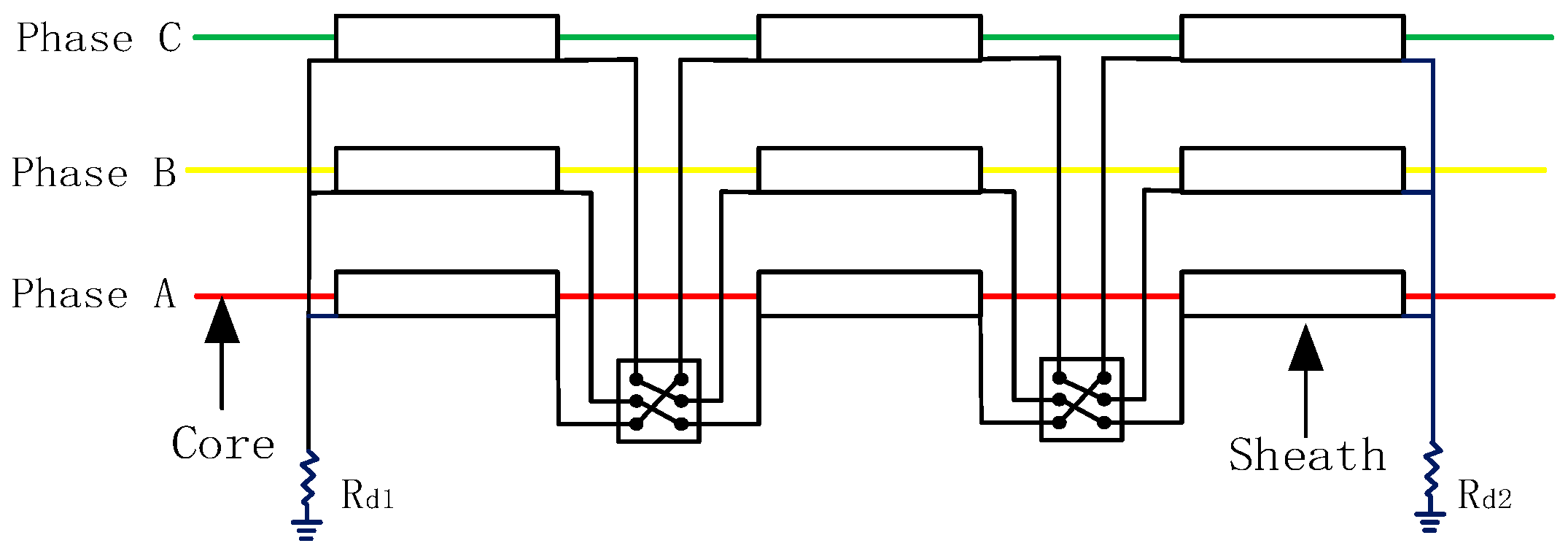
19]. The load current flowing through the cable core generates an alternating magnetic field around it, inducing an electromotive force in the metal sheath under the influence of this alternating magnetic field. To mitigate safety risks from excessive induced voltages, long cable lines require segmented, cross-interconnected grounding of the metal sheath [
20]. This configuration forms a loop between the metal sheath and the earth, generating the grounding current. Additionally, the capacitive current flows when the metal sheath is grounded, though its magnitude is negligible and can be disregarded in calculations [
16,
17,
18,
19,
20,
21,
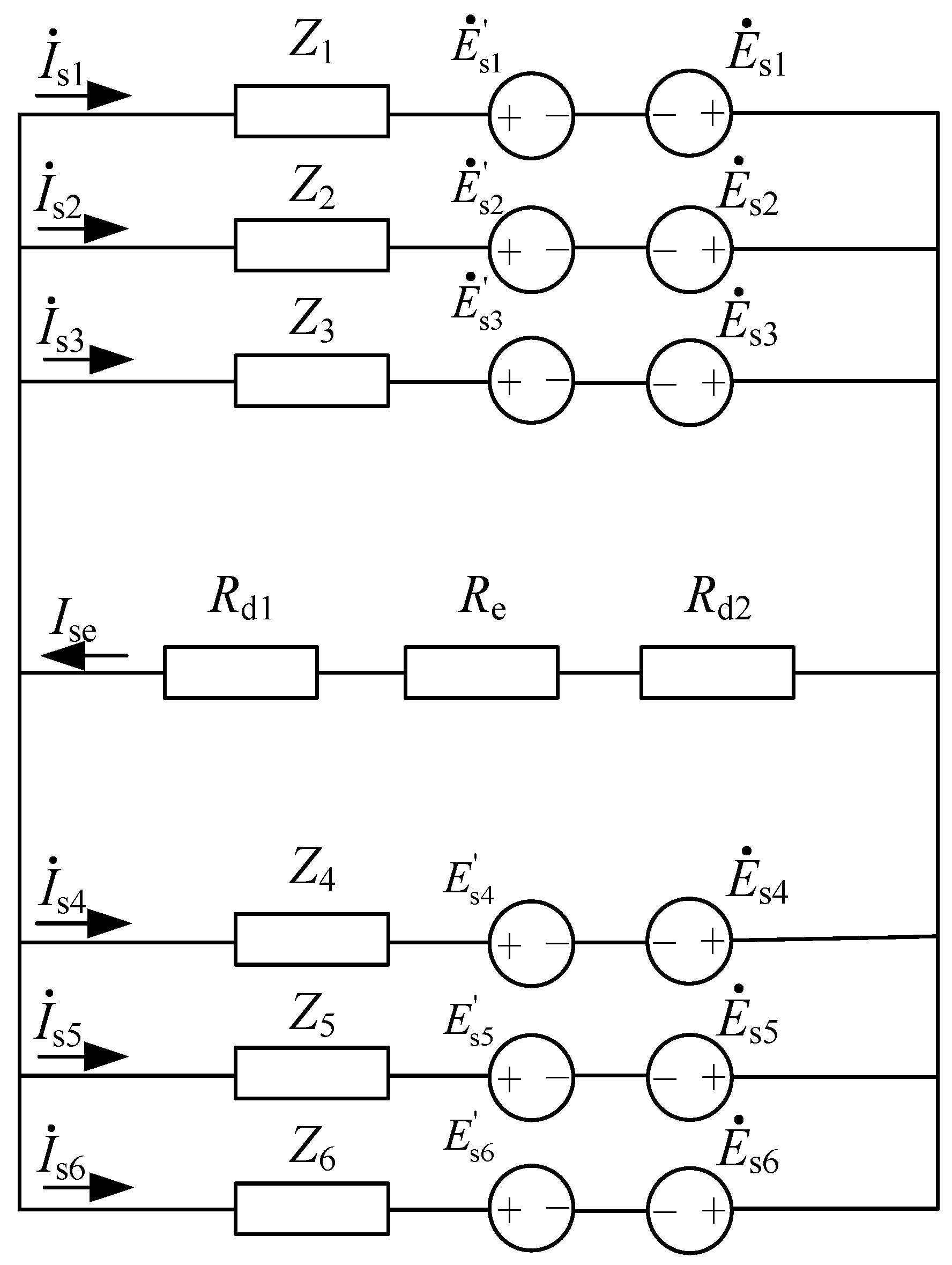
22]. This paper focuses on the induced grounding current in cable metal sheaths. Schematic diagrams of the cross-interconnected grounding method and equivalent circuit for the cable metal sheath are shown in
Figure 1 and
Figure 2.
In
Figure 2,
Rd1 and
Rd2 represent the grounding resistances at both ends of the cross-interconnection, R
e denotes the earth resistance,
Zi is the self-impedance of each phase’s metallic sheath,
Isi is the induced circulating current in the metallic sheath,
represents the induced voltage generated on each cable’s metallic sheath by the sheath circulation current,
Esi is the induced voltage generated by the core conductor current on each cable’s metallic sheath, and the subscript i indicates the identification number of the six cables in the double-circuit system. Let the segment lengths of the cable cross-interconnection be
L1,
L2, and
L3. Based on the equivalent circuit, the following equations can be derived:
In Equation (1), the remaining terms,
,
,
, and
Z, can be similarly derived:
Equations (2)–(10):
is the induced voltage generated per unit length on the i-th cable metal sheath by the current flowing through the conductor;
is the induced voltage on the metal sheath of the i-th cable per unit length in the j-th cross-interconnection section, due to the sheath current;
is the load current of the i-th cable;
is the earth loop current;
Xii is the self-inductance per unit length of the metal sheath;
Xij is the mutual inductance per unit length between two cables;
f is the frequency;
De is the equivalent earth loop depth;
is the geometric mean radius of the cable sheath; and
dij is the center-to-center distance between the two cables [
23,
24,
25]. For coaxial cables, the mutual inductance between the conductor and sheath equals the sheath’s self-inductance.
Equation (1) can be transformed into the relationship between the two-circuit cable sheath currents and the core currents, as follows:
When cables are laid within a tunnel, the installation location of the cross-interconnection box is less constrained by spatial positioning. This allows for equal lengths across all three sections of the cross-interconnection, with each section designated as length
L. At this point, the induced voltage generated by the load current on each cable sheath can be calculated as follows:
In Equations (12) and (13):
From Equations (12) and (13), it can be seen that when the magnitude of the core current load or the phase sequence changes, the induced voltage generated by the core current on the metal sheath of the double-circuit cables will vary. However, the induced voltage on the sheaths of each circuit’s three phases remains equal. At this point, the sheath current expression for each cable can be transformed into the following equation:
When the cable cross-interconnection segments are of equal length, matrix A can be transformed into the following form:
Analyzing the characteristics of matrix A in Equation (16), it can be found that the result of summing the elements of each row of rows 1~3 and rows 4~6 of matrix A are equal, and the sum of elements in each of the columns 1~3 and the columns 4~6 is equal, and since matrix A is a symmetric array, the result of summing the elements of each row of the rows 1~3 and rows 4~6 of matrix A
−1 is still equal, respectively. Therefore, the result of Equation (15) has the same elements in the first three rows and the same elements in the last three rows, which are as follows:
From Equation (17), it can be seen that the three-phase sheath currents of each circuit of cables are, respectively, the same, characterized by a zero-sequence current, and the total current of the grounding line of each cable is the sum of the three-phase sheath currents.
Equation (17) indicates that, under the equal-length condition of the three cross-interconnection sections (L1 = L2 = L3), the magnitudes of the three-phase sheath currents in each circuit tend to be identical, which implies that the zero-sequence component is dominant. Therefore, even if the magnitude of the single-phase sheath current is not large, the total grounding conductor current may still increase significantly, due to the summation effect.
The formation of the zero-sequence sheath current is closely related to the coupling parameters of the multi-conductor system. The key contributing factors can be summarized as follows: (1) the layout and cable spacings determine the mutual impedance and mutual inductance terms, thereby changing the superposition of induced sheath voltages among phases and affecting the zero-sequence component; (2) double-circuit coupling causes the induced sheath voltage to include contributions from both the local circuit and the adjacent circuit, so a pronounced zero-sequence component may still occur even when a single circuit is geometrically symmetric; (3) the cross-interconnection segment lengths (L1, L2, L3) govern the sectional accumulation of line parameters and the integral effect of induced sheath voltages, where the equal-length condition (L1 = L2 = L3) strengthens the matrix symmetry and drives the three-phase sheath currents in each circuit to become nearly identical, i.e., zero-sequence dominance; and (4) the grounding parameters affect the damping of the zero-sequence return path and thus the magnitudes of I0 and the total grounding conductor current, Ig. Together, these factors determine the variation in the zero-sequence sheath current under different layouts, load conditions, and phase sequences, and provide the physical basis for the subsequent probability assessment and phase-sequence optimization.
After determining the parameters of each quantity in Equation (1), the calculation program can be written to calculate the change in the cable metal sheath current and grounding current under different working conditions.
2.2. Analysis of Zero-Sequence Currents in the Sheath of Parallel-Laid High-Voltage Cables
For a given circuit, let the sheath currents of phases A, B, and C be
IsA,
IsB, and
IsC, respectively. The zero-sequence sheath current can then be expressed as
Accordingly, the total grounding conductor current (corresponding to the Phase-T current measured by the monitoring platform in this paper) is the sum of the three-phase sheath currents,
In particular, the operational criterion commonly adopted in practice, |Ig| < 100 A, can be equivalently converted to |I0| < 33.3 A. This criterion is used in the subsequent probability assessment and phase-sequence optimization to judge whether the sheath current exceeds the limit.
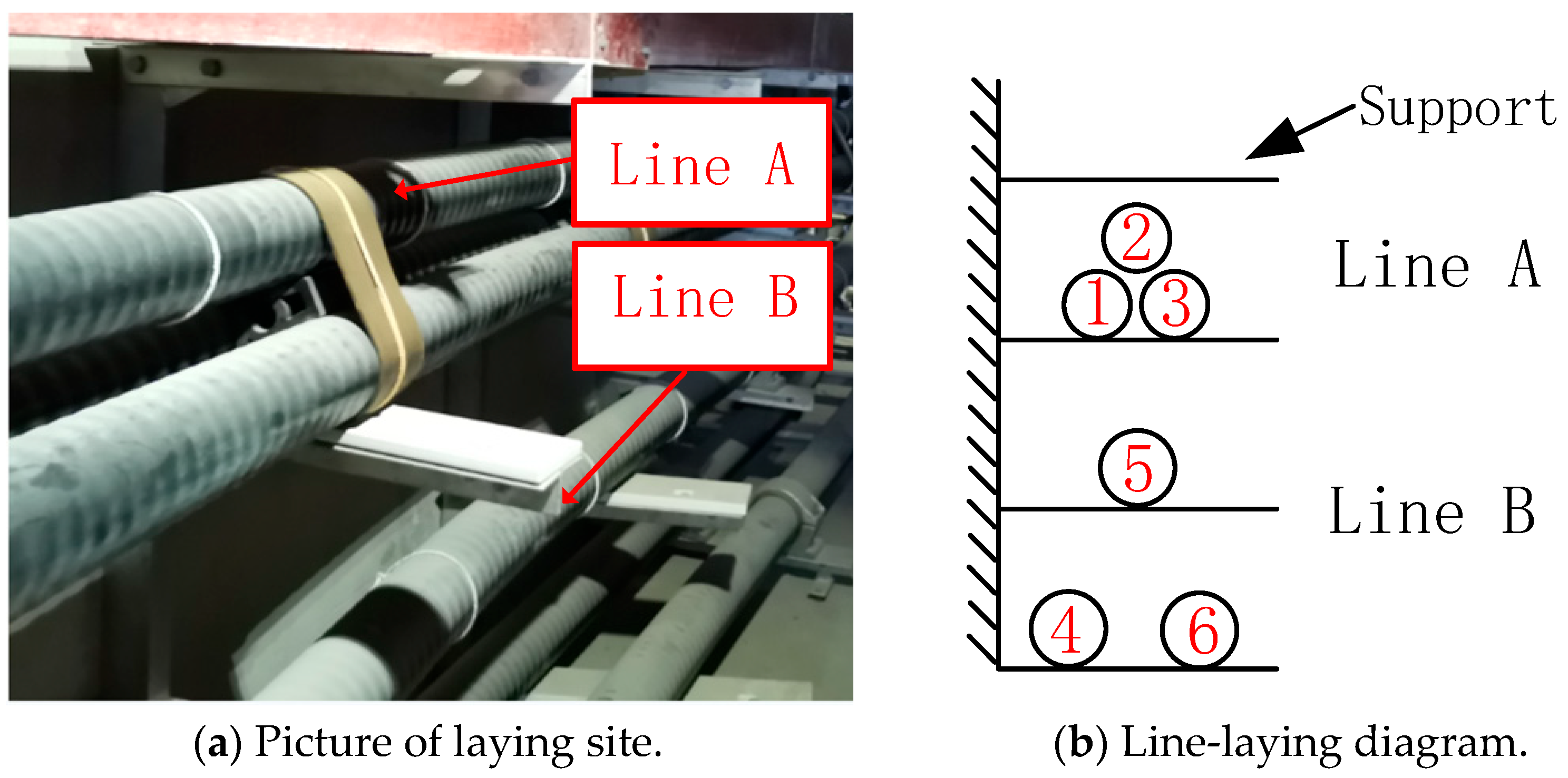
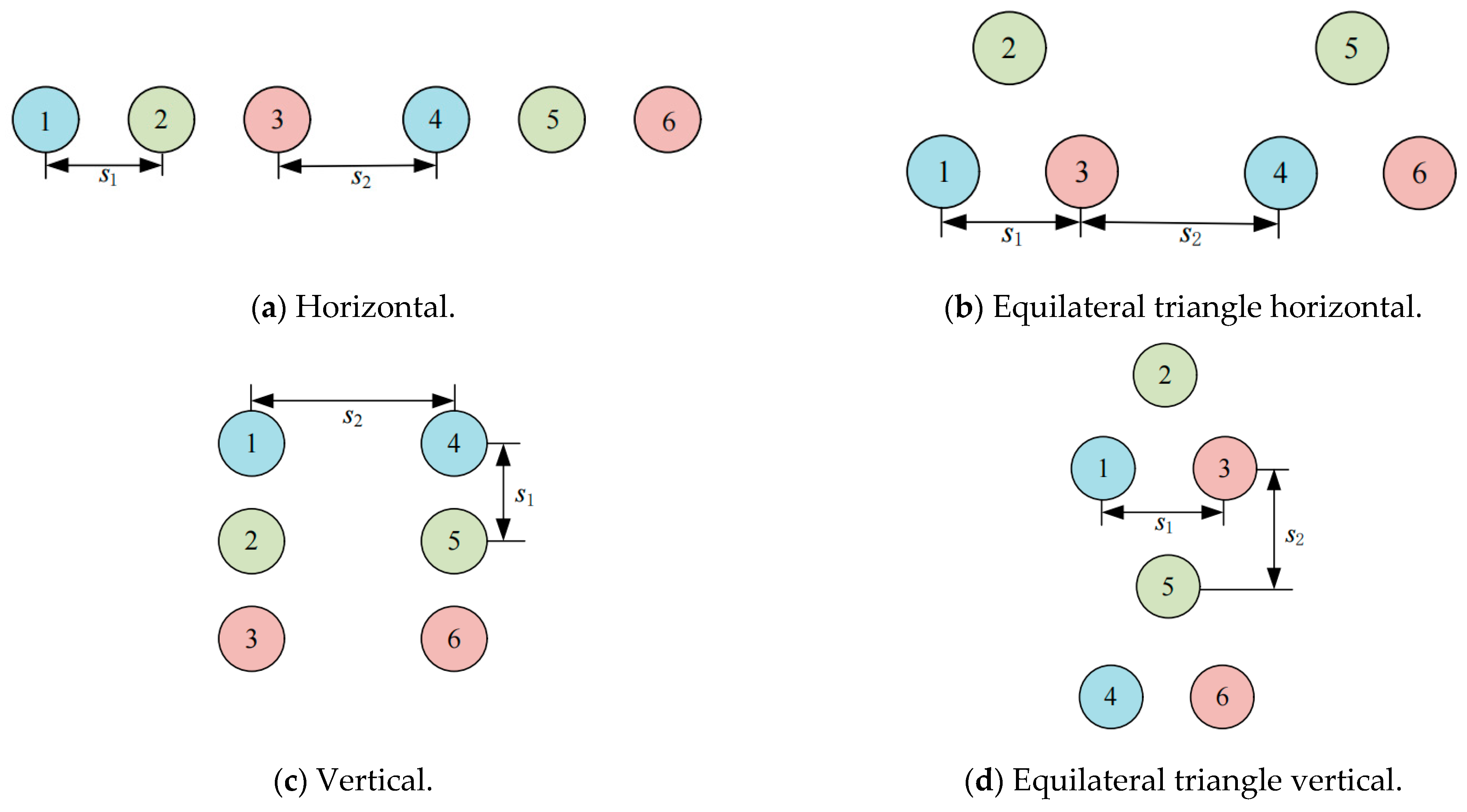
The two cables of 220 kV, Line A and Line B, are laid in parallel in the tunnel, and their arrangement is shown in
Figure 3. According to the grounding current monitoring platform data, the three-phase sheath current values for each circuit of the Line A and Line B are essentially consistent; the total cable sheath grounding current is about equal to the sum of the three-phase sheath current; and the maximum grounding current reaches 208 A, exceeding the relevant electric power regulations [
20,
21] on the cable grounding current, which cannot be more than 100 A and belongs to the abnormal state. A field inspection of the cable section revealed that the cross-interconnection box wiring was correct, all cable segments were of equal length, and the outer sheath showed no visible damage. Power was shut off for maintenance on Line A. As shown in
Table 1, on-site testing revealed that the total ground current on Line A remained as high as 170 A during the power-off state. By applying the aforementioned model to analyze the actual engineering project in this area, the validity of the model is verified.
In this study, for all investigated layouts, the cable geometric parameters, the cross-interconnection segment lengths L1–L3, and the grounding conditions are kept consistent with the engineering case. To ensure reproducibility, the sheath currents and the associated evaluation indices are obtained from Equations (1)–(17), following a unified procedure: first, the layout geometry, cross-interconnection segment lengths, and grounding-related parameters are specified; second, the self- and mutual impedances of the metallic sheaths (including the distance-dependent mutual-inductance terms) are calculated, based on the cable spacings, and used to assemble the impedance matrices; third, Equation (1) is solved to obtain the sheath currents of all cables; fourth, the zero-sequence sheath current, I0, and the total grounding conductor current, Ig, are computed from the three-phase sheath currents; finally, the compliance criterion |I0| < 33.3 A, which is equivalent to |Ig| < 100 A is applied to statistically evaluate the results under different operating conditions and phase sequences, which then serves as the basis for the subsequent probability assessment and phase-sequence optimization.
Figure 3b shows the numbering of the six cables in two circuits, labeled 1–6. Line A is arranged in a triangular pattern at the top, with 200 mm phase spacing. Line B is arranged in an isosceles triangle pattern at the bottom, with a center-to-center distance of 350 mm between cables 4 and 6. The four cable supports are evenly spaced at 500 mm intervals. The phase sequence for cables 1–6 is ABC/ABC. The cross-interconnected segment length of the cable line is 520 m, with a grounding resistance of 0.2 Ω and a soil resistivity of 300 Ω·m. Cable model for Line A: ZR-YJLW02-127/220 kV−1 × 1600 mm
2. Cable model for Line B: ZR-YJLW02-127/220 kV−1 × 2500 mm
2. Parameters for both cable circuits are shown in
Table 2.
Based on the above parameters, the cable sheath currents for Line A and Line B were calculated, assuming balanced three-phase currents. The load for Line A was set as
I1 and for Line B as
I2. The calculation results are shown in
Table 3 and
Table 4.
As shown in
Table 2 and
Table 3, the theoretical calculated values are consistent with the measured values, verifying the accuracy of the theoretical calculation model. Calculations indicate that under the conditions of uniform cross-interconnection segment length, zero-sequence currents are generated in the metallic sheath, resulting in a relatively large total three-phase grounding current. Even when one circuit is powered off, a significant zero-sequence sheath current is still induced in the cable line of that circuit.
2.3. Optimal Phase Sequence Selection Method
The “Power Cable Line Testing Regulations” [
21] stipulate that “the absolute value of grounding current in single-core cable lines shall be less than 100 A.” Since the grounding conductor current is the sum of the three-phase sheath currents, the total three-phase grounding conductor current can only be guaranteed to be less than 100 A when the zero-sequence sheath current is below 33.3 A. Excessive cable sheath currents can cause cable heating, and, in severe cases, may burn the grounding wire or even cause fires. When optimizing the phase sequence, the primary consideration should be ensuring cable sheath currents remain within limits.
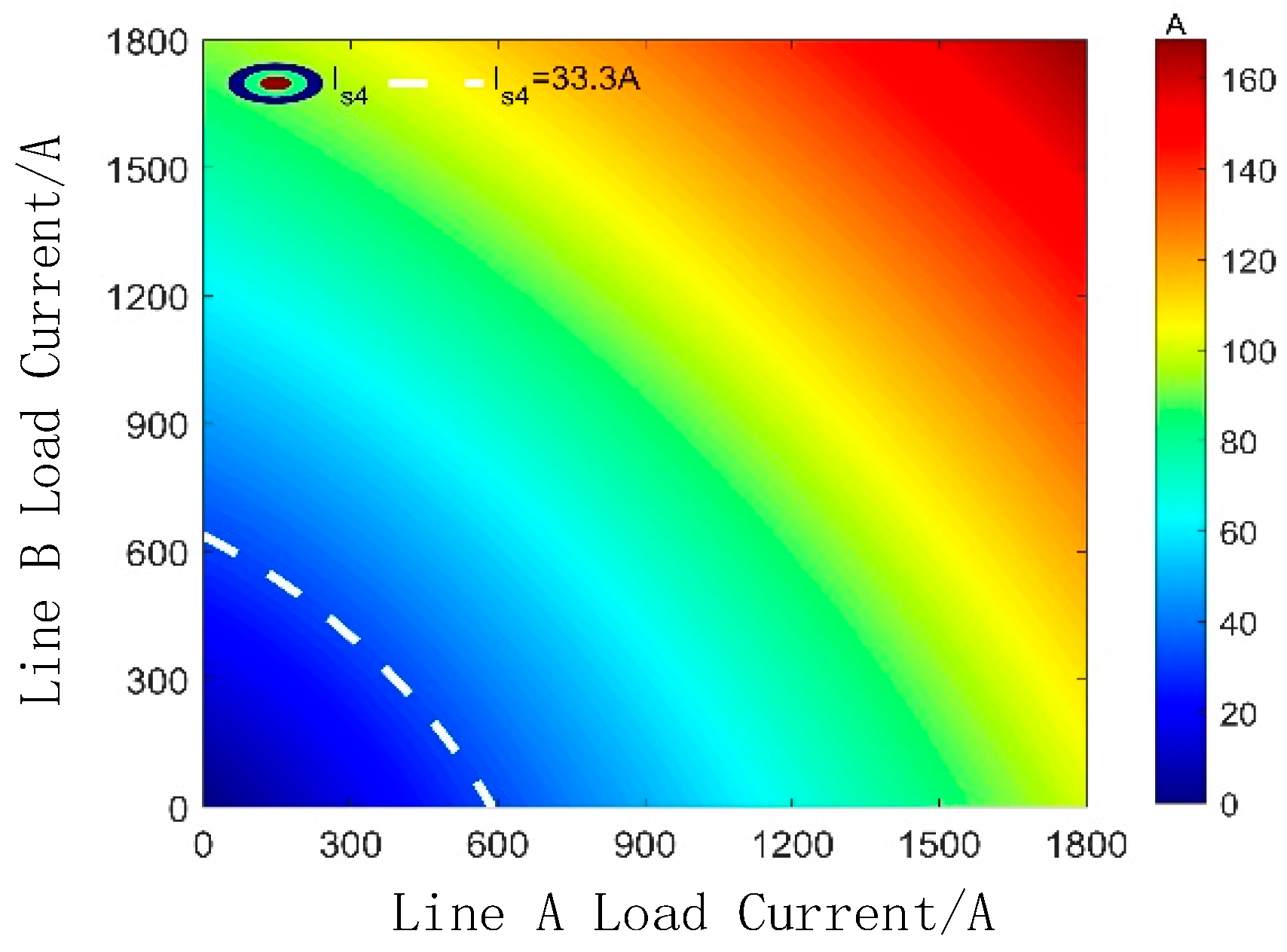
Figure 4 is generated from model-based batch computations, rather than directly from field-monitoring data. Specifically, the analytical sheath-current model for double-circuit cables with cross-interconnection and grounding conditions (Equations (1)–(17)) is implemented in MATLAB R2025a (Windows version). The geometric parameters, cross-interconnection segment lengths L1–L3, and grounding conditions are kept identical to the engineering case described in
Section 2.2. A grid sweep is then performed over the load –current pair (I
1, I
2) within the allowable ampacity ranges of the two circuits. For each operating point, the equation set is solved to obtain the sheath-current magnitudes of both circuits. The computed results are mapped onto the I
1–I
2 plane to form the heatmap shown in
Figure 4. The boundary indicated by the white dashed line corresponds to the sheath-current compliance criterion, i.e., |I
0| < 33.3 A, which is equivalent to |I
g| < 100 A; this line separates the “within-limit” region from the “exceeding-limit” region.
Figure 4 illustrates how sheath currents vary under different load combinations for two horizontally laid cable circuits. The white dashed line represents the load current combinations corresponding to a sheath current of 33.3 A. The area bounded by the white line and the coordinate axes containing the origin corresponds to the condition where the sheath current is below 33.3 A.
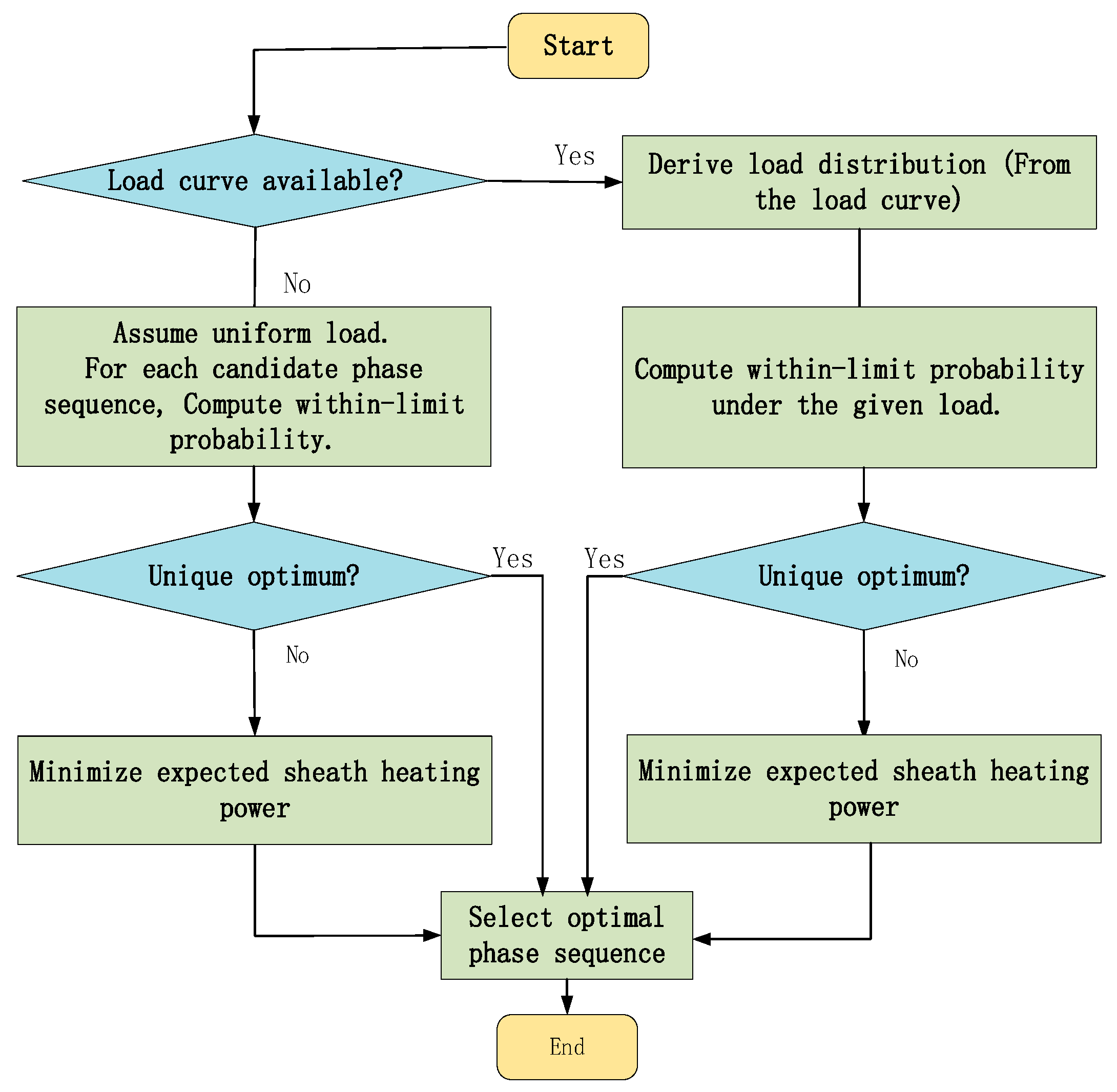
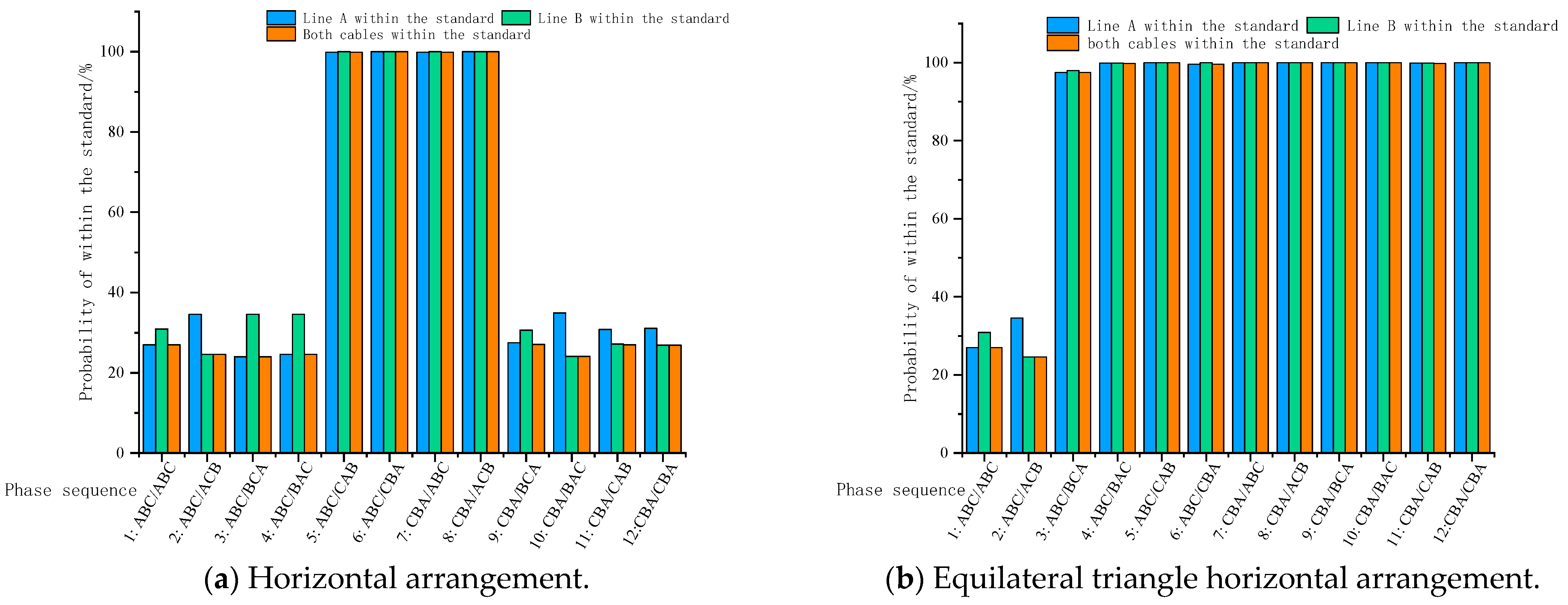
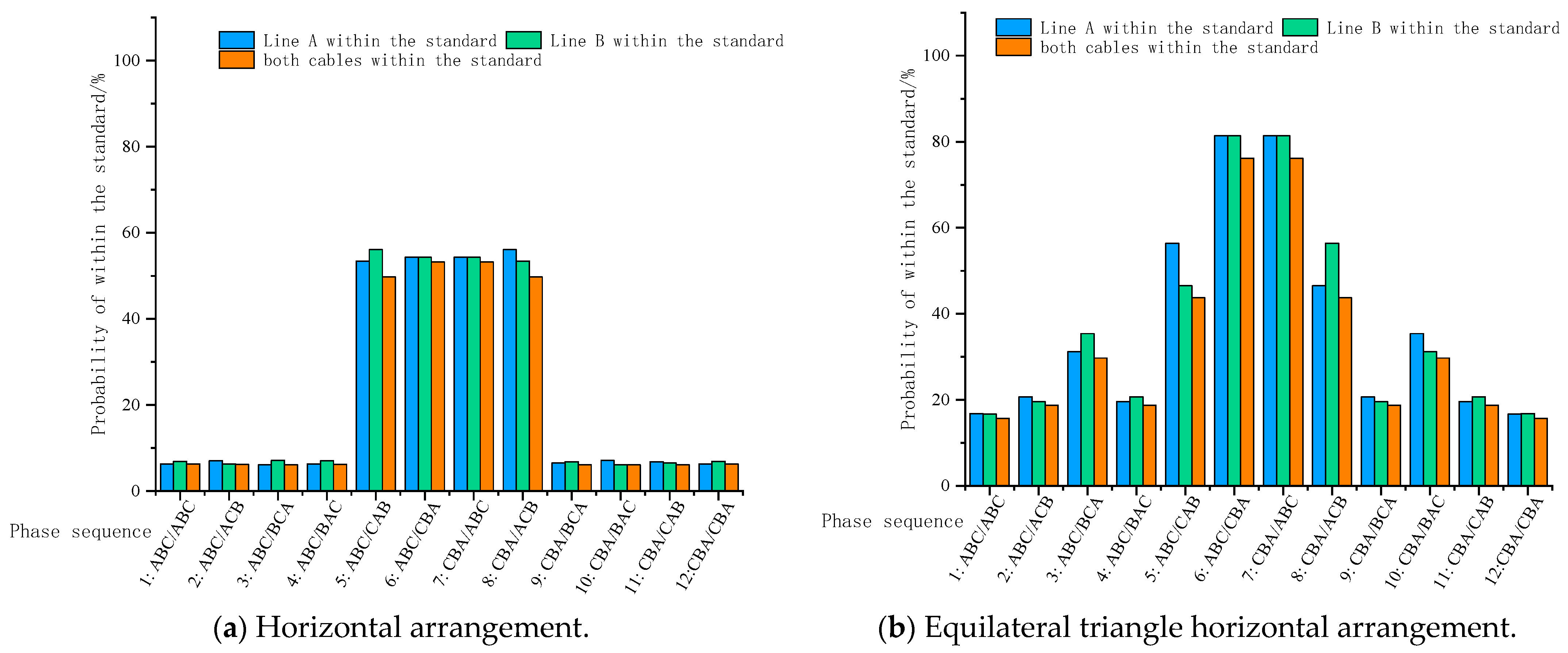
We calculate the probability that the sheath current is less than 33.3 A at this time, and select the phase sequence with the highest probability that the sheath current of both lines will not exceed the standard as the optimal phase sequence. When constructing new cable lines, there is no actual load curve; the load current of two cables at any given time is uncertain. Assuming that the load currents of the two circuits are uniformly distributed within the maximum current-carrying capacity range, the probability of load currents occurring at any point within the current-carrying capacity range is equal. At this point, the area formed by the load current when the sheath current is less than 33.3 A is divided by the total area within the load-carrying capacity range; you can find out the probability that the sheath current does not exceed the standard under this phase’s sequence conditions.
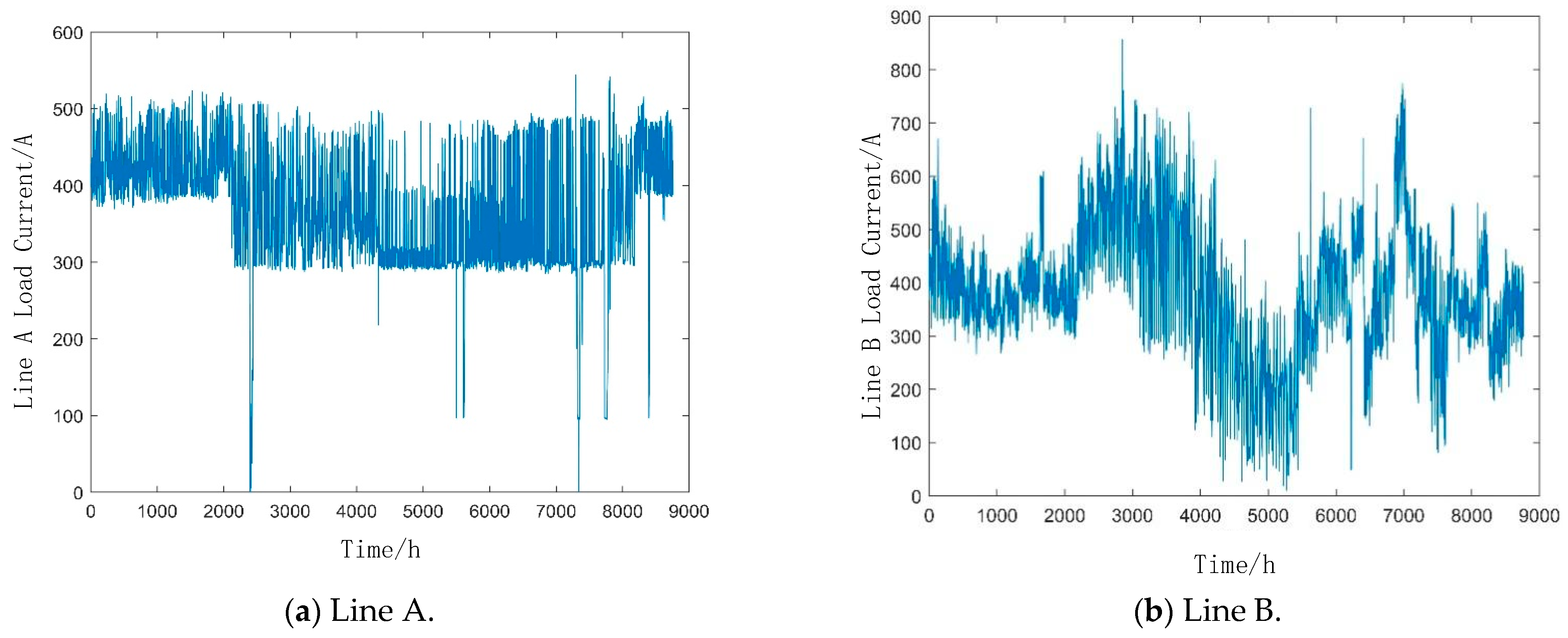
For the actual cable line, we already have a prediction of the load on the line. At this time, the load current combination can be taken every hour in a year: a total of 8760 groups of data. For double-circuit cable lines with different arrangements, we calculate whether the sheath current exceeds the standard for 8760 sets of data in different phase sequences. Afterwards, we divide the number of data with an excessive sheath current by 8760, and find out the phase sequence that maximizes the probability that the sheath current will not exceed the standard when considering the distribution of the load current according to the actual load curve.
Under certain conditions, there may be a number of phase sequences that can make sure that the sheath current does not exceed the standard, and the purpose of making sure that the grounding current does not exceed the standard is to reduce the heating of the cable sheath and improve the line current-carrying capacity. Therefore, the smaller the cable sheath current value the better; at this point, the heating power expectations of the cable sheath under each phase sequence can be further calculated.
To further distinguish candidate phase sequences when the within-limit probability is identical, the Joule loss associated with sheath currents is introduced as a secondary evaluation index. This index is used for relative comparison among phase-sequence options, rather than for predicting the cable temperature rise. The calculation equation for the expected value of heating power is as follows:
In Equation (20), the integration region D is defined by the maximum current-carrying capacity of the two-circuit cable; Is,mn is the size of the sheath current when the load current I1 = m, I2 = n; R is the AC resistance of the sheath of the cable in each phase; and Pmn is the probability of the occurrence of the load current, I1 = m, I2 = n. When the load current is distributed according to a uniform distribution, each combination of load currents has the same probability of occurrence. When the load current is distributed according to the actual load curve, it can be assumed that the hourly load current obtained according to the load curve is unchanged in one hour, and the total number of hours in which each load combination appears is divided by 8760, whereby the probability of each load combination appearing in one year is calculated, and the probability of the load combination not appearing is zero.
In summary, the optimal phase sequence selection method that accounts for load current variations can be derived, as shown in
Figure 5.