Article

Performance-Driven End-to-End Optimization for UAV-Assisted Satellite Downlink with Hybrid NOMA/OMA Transmission


Satellite Communications and Broadcasting and Television Department, China Electronics Technology Group Corporation, Network Communications Research Institute, Shijiazhuang 050011, China
*
Author to whom correspondence should be addressed.
Electronics 2026, 15(2), 471; https://doi.org/10.3390/electronics15020471 (registering DOI)
Submission received: 1 January 2026 / Revised: 19 January 2026 / Accepted: 21 January 2026 / Published: 22 January 2026

Abstract

Unmanned aerial vehicle (UAV)-assisted satellite downlink transmission is a promising solution for improving coverage and throughput under challenging propagation conditions. However, the achievable performance gains are fundamentally constrained by the coupling between access transmission and the satellite–UAV backhaul, especially when decode-and-forward (DF) relaying and hybrid multiple access are employed. In this paper, we investigate the problem of end-to-end downlink sum-rate maximization in a UAV-assisted satellite network with hybrid non-orthogonal multiple access (NOMA)/orthogonal multiple access (OMA) transmission. We propose a performance-driven end-to-end optimization framework, in which UAV placement is optimized as an outer-layer control variable through an iterative procedure. For each candidate UAV position, a greedy transmission mode selection mechanism and a KKT-based satellite-to-UAV backhaul bandwidth allocation scheme are jointly executed in the inner layer to evaluate the resulting end-to-end downlink performance, whose feedback is then used to update the UAV position until convergence. Simulation results show that the proposed framework consistently outperforms benchmark schemes without requiring additional spectrum or transmit power. Under low satellite elevation angles, the proposed design improves system sum rate and spectral efficiency by approximately 25–35% compared with satellite-only NOMA transmission. In addition, the average user rate is increased by up to 37% under moderate network sizes, while maintaining stable relative gains as the number of users increases, confirming the effectiveness and scalability of the proposed approach.

1. Introduction

The rapid expansion of large-scale Internet-of-Things (IoT) applications, including environmental monitoring, intelligent transportation, and emergency sensing, has exposed fundamental limitations of conventional terrestrial communication infrastructures in providing reliable wide-area connectivity [1,2]. To overcome these limitations, space–air–ground integrated networks (SAGINs) have emerged as a promising architecture that combines terrestrial, aerial, and satellite communication segments to enable wide-area and resilient IoT connectivity, particularly for downlink service provisioning [3,4]. Within such an architecture, UAVs can be strategically deployed to enhance link quality and provide flexible downlink communication paths by acting as aerial relays for IoT devices suffering from blockage or unfavorable propagation conditions, while low-Earth-orbit (LEO) satellites enable wide-area backhaul connectivity beyond the reach of terrestrial networks [5,6].
Motivated by the complementary capabilities of aerial platforms and satellite systems, hybrid satellite–terrestrial network architectures incorporating UAVs have been increasingly investigated in recent studies. Liu et al. investigated a LEO-satellite-assisted space–air–ground Internet of Remote Things (IoRT) network [7], where UAV flight path optimization was jointly considered to enhance data collection and transmission efficiency, demonstrating notable improvements in overall system throughput and UAV energy consumption performance in remote-area scenarios. Zhang et al. studied resource allocation and computational offloading in a UAV-assisted LEO satellite edge computing network for emergency scenarios [8], showing that satellite-enabled computing services can effectively compensate for damaged terrestrial infrastructure and improve system energy–delay performance. In these architectures, UAVs are introduced as intermediate aerial nodes to assist satellite downlink transmission, particularly in scenarios considered where direct satellite–ground links suffer from severe blockage, low elevation angles, or heterogeneous channel conditions.
Beyond architectural integration [9,10], improving spectral efficiency remains a central concern in downlink transmission of UAV-assisted satellite–terrestrial networks, where limited satellite bandwidth must be shared among an increasing number of ground users. Non-orthogonal multiple access (NOMA) has therefore attracted significant attention as an advanced multiple-access technique, as it enables simultaneous service to multiple users over the same time–frequency resources through power-domain multiplexing [11]. Li et al. analyzed the coverage performance and spectral efficiency of NOMA-enabled LEO multi-satellite downlink networks under different user ordering and power allocation schemes [12], revealing that NOMA provides significant spectral efficiency gains over OMA only below certain SINR thresholds. Although UAVs were not considered, these results provide important insights into the applicability of NOMA in satellite downlink systems.
The performance advantage of NOMA is inherently scenario-dependent and relies on favorable channel disparities and decoding feasibility [13]. In practical satellite downlink systems, especially when UAV-assisted relaying is involved, orthogonal multiple access (OMA) may remain preferable in certain cases due to its more predictable rate performance under heterogeneous link conditions [14]. This observation has motivated recent interest in hybrid access strategies, where no single multiple-access scheme is uniformly optimal across heterogeneous link conditions. Darsena et al. studied inter-plane inter-satellite communications in massive LEO constellations and proposed a hybrid NOMA–OMA multiple-access scheme [15]. Although their focus was not on satellite downlink transmission, the results indicate that hybrid multiple access is beneficial under heterogeneous link conditions.
Nevertheless, even with such hybrid access strategies, the achievable downlink sum rate in UAV-assisted satellite networks remains fundamentally constrained by the coupling between access transmission and the satellite–UAV backhaul, especially when decode-and-forward relaying is employed [16]. Liu et al. studied UAV-assisted wireless backhaul networks for rural and disaster scenarios  [17], analyzed the connectivity of two-hop satellite–UAV–ground communication links, highlighting that the satellite-to-UAV backhaul constitutes a shared and bandwidth-limited resource in UAV-assisted backhaul systems. This structural “min-capacity” effect can become particularly restrictive because the satellite-to-UAV backhaul is typically a shared and bandwidth-limited resource [18]; it must simultaneously support all relay-assisted flows and is further exposed to unfavorable satellite geometry that degrades decodability.
Even when the UAV significantly enhances the air-to-ground access link, these access-side gains do not necessarily translate into higher system-wide downlink throughput. This is particularly true when the satellite-to-UAV backhaul remains the dominant bottleneck. Under this condition, indiscriminate UAV involvement or resource allocation driven solely by access-side performance can be ineffective, underscoring the necessity of system-level coordination beyond isolated relay decoding enhancements.
In light of these observations, this paper focuses on the problem of downlink sum-rate maximization in a UAV-assisted satellite network with hybrid NOMA/OMA transmission. The main contributions are summarized as follows:
  • We propose a hybrid NOMA/OMA downlink transmission model is proposed for UAV-assisted satellite networks, which explicitly accounts for the coupling among access-side user pairing, the satellite-to-UAV backhaul bottleneck, and the UAV deployment position.
  • We develop a greedy transmission mode selection mechanism to determine, for each satellite-served user pair, whether UAV-assisted NOMA, UAV-assisted OMA, or direct satellite transmission should be activated. The decision is made by comparing the achievable end-to-end downlink rates under different transmission modes, thereby avoiding UAV forwarding when the backhaul bottleneck dominates.
  • We derive a KKT-based backhaul bandwidth allocation scheme is derived to optimally distribute the limited backhaul resources among the activated UAV-assisted user pairs. The proposed allocation strategy aims to eliminate the decode-and-forward bottleneck by allocating just sufficient backhaul bandwidth to match the access-link transmission capability.
  • We design a performance-driven UAV placement optimization framework is developed, where the UAV position is updated via an outer-loop L-BFGS-B algorithm. In each iteration, greedy transmission mode selection and KKT-based backhaul resource allocation are jointly executed based on the current UAV position, enabling coordinated end-to-end optimization and significant downlink sum-rate gains under backhaul-constrained satellite scenarios.
The remainder of this paper is organized as follows. Section 2 introduces the system model and problem formulation. Section 3 presents the proposed three-step optimization algorithms, including transmission mode selection, backhaul resource allocation, and UAV placement optimization. Simulation results and performance evaluations are provided in Section 4. Section 5 discusses key insights and practical implications of the proposed design. Finally, Section 6 concludes the paper.

2. System Model and Problem Formulation

2.1. Hybrid Downlink Transmission Framework

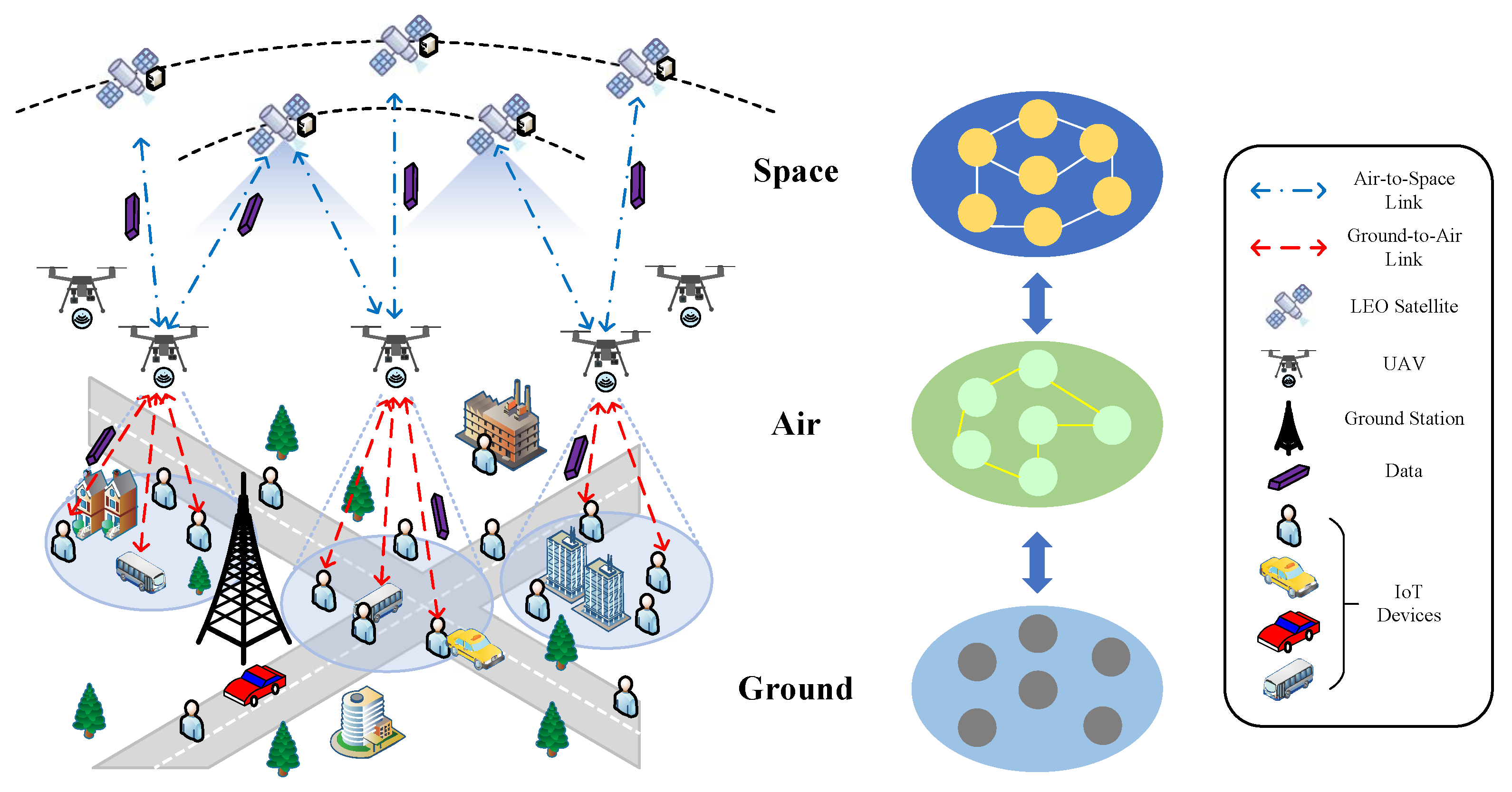
This subsection introduces the proposed UAV-assisted hybrid downlink transmission framework in the SAGIN. As shown in Figure 1, we consider a downlink SAGIN composed of a set of UAVs denoted by U = { 1 , 2 , , U } , a set of LEO satellites denoted by S = { 1 , 2 , , S } , and a set of ground IoT devices denoted by K = { 1 , 2 , , 2 K } , where the users are grouped into K satellite-side NOMA pairs.
In the downlink transmission architecture, IoT devices can be served either through direct satellite transmission or via UAV-assisted relaying. Specifically, when UAV assistance is activated, the UAV operates as a decode-and-forward relay by first receiving and decoding the satellite downlink signals over the satellite-to-air (S2A) link, and then forwarding the decoded information to ground devices over the air-to-ground (A2G) link.
To efficiently utilize the limited satellite downlink resources under heterogeneous channel conditions, power-domain multiple access is adopted in the downlink transmission model. Specifically, the satellite employs NOMA to simultaneously serve multiple users over the same time–frequency resource block.
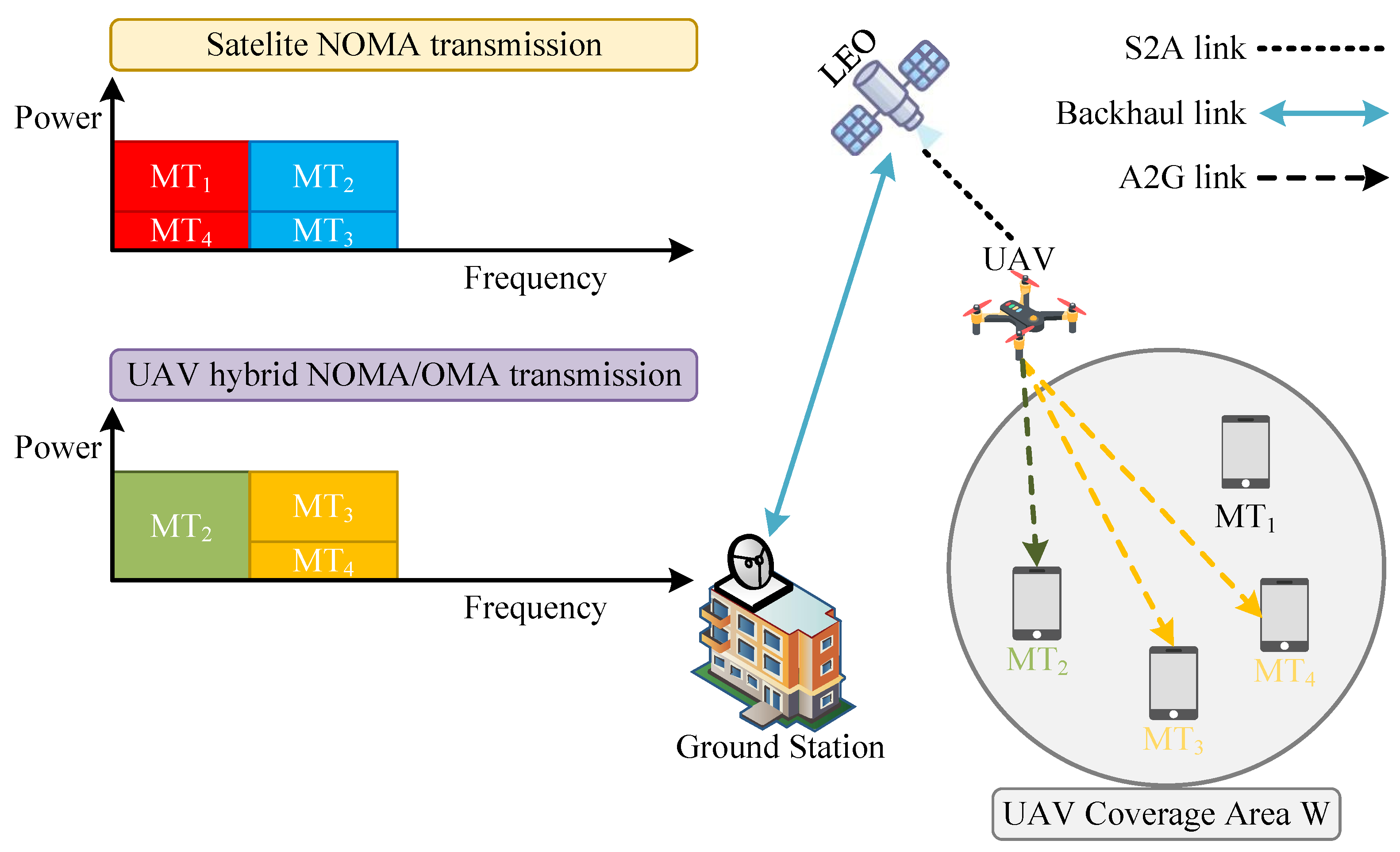
As illustrated in Figure 2, the UAV does not merely act as a transparent relay in the considered framework. After decoding the satellite downlink signals via the S2A link using decode-and-forward (DF) relaying, the UAV is allowed to selectively reorganize a subset of users and adjust the downlink transmission modes over the A2G links. Specifically, depending on the access-link conditions, the UAV may adopt power-domain NOMA to simultaneously serve a user pair, serve only a single user using OMA, or remain silent when relay assistance is not beneficial. This flexible transmission structure enables the UAV to enhance downlink performance without indiscriminately forwarding all satellite signals.
Within this framework, the satellite performs NOMA user pairing based on the satellite–user channel conditions and transmits power-domain superimposed downlink signals to each paired user group. Since the UAV is located within the satellite coverage area, it can also receive and decode the same superimposed signals via the S2A link. However, successful decoding at the UAV does not necessarily guarantee end-to-end performance gains, since UAV-assisted transmission follows a decode-and-forward relaying mechanism [16]. In this context, whether the UAV can effectively enhance the downlink performance depends on the quality of the A2G links between the UAV and the ground users.
Together, the coexistence of direct satellite transmission and UAV-assisted relaying, along with the flexibility of employing different multiple-access schemes at the UAV, constitutes a hybrid downlink transmission framework. Under this hybrid downlink transmission framework, the UAV evaluates whether auxiliary relaying should be activated and selects the appropriate transmission mode, NOMA or OMA, based on the A2G channel conditions. UAV-assisted transmission is enabled only when the achievable downlink rate via the UAV exceeds that of the direct satellite link.
Specifically, if the user pair can achieve higher downlink rates under the UAV-side NOMA pairing policy, the UAV adopts NOMA transmission to serve this pair. Otherwise, if only a single user benefits from UAV relaying, the UAV selectively serves this user using OMA transmission, while the remaining users continue to be served directly by the satellite.
The above hybrid downlink transmission framework establishes the transmission modes and decision logic, which rely on appropriate channel quality indicators to evaluate user pairing and relay activation, as detailed in the next subsection.

2.2. Channel Quality Indicators for Downlink Pairing and Mode Selection

For notational convenience, we index the 2 K ground users by { 1 , , 2 K } , which are paired into K NOMA user pairs at the satellite. Under the hybrid downlink transmission framework, link quality plays a central role in user pairing and transmission mode selection. Specifically, the satellite performs downlink NOMA user pairing based on the channel quality of the S2G links, whereas the UAV determines whether to participate in DF relaying and selects the corresponding transmission mode mainly according to the A2G channel conditions. To this end, the S2G and A2G links are characterized by a channel quality indicator Γ , which is defined for each user and serves as the basis for subsequent pairing and decision processes.
We first characterize the S2G link quality, which serves as the basis for satellite-side NOMA user ordering and pairing. Specifically, the S2G channel between the satellite and ground IoT device k ( 1 k 2 K ) is modeled using a land mobile satellite (LMS) channel, and is characterized by a complex channel coefficient h k s that captures small-scale fading effects [19]. Accordingly, the normalized satellite downlink channel quality indicator (CQI) is defined as
Γ k s = G t s G r s L k FS N s | h k s | 2 ,
where G t s and G r s denote the satellite transmit and user receive antenna gains, respectively, L k FS represents the free-space path loss of the satellite-to-ground link for user k, N s is the noise power at the ground user receiver, and | h k s | 2 denotes the instantaneous power gain of the LMS channel. The indicator Γ k s represents an instantaneous, normalized measure of the S2G channel quality and is mainly used for user ordering and pairing decisions, rather than for direct rate optimization.
Based on the defined S2G CQI, the satellite determines the NOMA user ordering and pairing for downlink transmission. Specifically, the IoT devices are first sorted in ascending order according to their S2G CQI values as
Γ 1 s Γ 2 s Γ 2 K s .
Following the optimal NOMA user pairing strategy in [20], the satellite pairs the k-th weakest user with the ( 2 K k + 1 ) -th strongest user. As a result, each NOMA pair consists of a weak and a strong S2G user, denoted by IoT i s and IoT j s , respectively, satisfying Γ j s Γ i s .
We adopt the standard power-domain NOMA model, where superposition coding is applied at the transmitter and successive interference cancellation (SIC) is performed at the receivers. Since SIC design and decoding errors are not the focus of this work, ideal SIC is assumed. Accordingly, the achievable downlink rates and power allocation coefficients follow the conventional NOMA expressions commonly used in the literature.
For UAV-assisted transmission, the A2G channel between the UAV and ground user k ( 1 k K ) is characterized by a complex channel coefficient h k d . Unlike the S2G link, the A2G channel quality explicitly depends on the UAV deployment, and is jointly determined by the UAV altitude h, the horizontal distance r k , and the associated path loss. Accordingly, the normalized A2G CQI is defined as
Γ k d = G t d G r d L k A 2 G ( h , r k ) N d | h k d | 2 .
Here, G t d and G r d denote the UAV transmit and user receive antenna gains, respectively, L k A 2 G ( h , r k ) represents the A2G path loss as a function of the UAV altitude h and the horizontal distance r k , and N d is the receiver noise power associated with the A2G link.
The defined A2G CQI is used by the UAV to evaluate the access-side transmission capability toward each ground user. Specifically, a higher A2G CQI indicates more favorable A2G access conditions, under which UAV-assisted transmission is more likely to provide rate gains compared to direct satellite transmission. This access-side quality information serves as a key input for the UAV-side transmission mode selection, determining whether NOMA, OMA, or no relaying should be activated for a given user pair.
While the above CQIs provide the basis for satellite-side user pairing and UAV-side relay/mode decisions, the achievable end-to-end downlink performance is further constrained by the decode-and-forward relaying mechanism and the satellite-to-air backhaul. These constraints and the resulting bottlenecks are discussed in the next subsection.

2.3. Downlink Transmission Constraints and Bottlenecks

Although the hybrid downlink transmission relies on heterogeneous S2G, A2G, and S2A links, their roles in system design are fundamentally different. Specifically, the S2G and A2G links govern access-side pairing and mode selection, whereas the S2A link introduces a structural bottleneck that bounds the end-to-end performance of DF-assisted downlink transmission [16].
To model the fundamental bottleneck introduced by DF relaying, the S2A backhaul link is characterized by the following normalized channel parameter:
Λ s d = G t s G r s d L s d FS N s d ,
which captures the large-scale propagation and noise characteristics of the S2A link. Here, G t s and G r s d denote the satellite transmit and UAV receive antenna gains, respectively, L s d FS represents the large-scale free-space path loss of the S2A link, and N s d denotes the receiver noise power at the UAV. Unlike the access-side channel quality indicators, Λ s d is not used for user pairing or transmission mode selection, but serves as a structural parameter that determines the maximum decodable rate at the UAV and hence the backhaul-induced upper bound on the end-to-end downlink performance.
For a given S2A bandwidth B s d , the maximum decodable rate at the UAV over the S2A backhaul can be expressed in a generic form as
R s d = B s d log 2 1 + P s Λ s d ,
where P s denotes the satellite transmit power. This expression is introduced to illustrate the role of Λ s d in bounding the achievable decoding rate at the UAV, rather than to model the exact physical-layer transmission or to serve as a direct optimization objective.
Under DF relaying, the achievable end-to-end downlink rate of UAV-assisted transmission is fundamentally upper-bounded by the decoding capability of the S2A backhaul link, irrespective of the quality of the A2G access links. This min-capacity effect makes the S2A link the dominant bottleneck governing the effectiveness of relay-assisted downlink transmission.
The above analysis reveals that the performance of UAV-assisted downlink transmission is fundamentally constrained by the S2A backhaul bottleneck induced by decode-and-forward relaying. As a result, indiscriminately activating UAV assistance or optimizing access-side transmission alone may fail to translate into end-to-end performance gains when the backhaul remains limiting. This observation highlights the necessity of a system-level optimization framework that explicitly accounts for the access–backhaul coupling in UAV-assisted satellite downlink transmission.

3. Algorithm Design and Implementation

3.1. Greedy Transmission Mode Selection

In the hybrid downlink framework, each ground user is always served by the satellite baseline transmission, while UAV-assisted forwarding is selectively activated as an auxiliary enhancement mechanism. Although a user may lie within the coverage of both the satellite and the UAV, the downlink data stream is ultimately delivered through only one effective transmission path [17], determined by the adopted transmission mode.
The transmission mode for each user is determined at the UAV prior to downlink forwarding, by comparing the achievable end-to-end rates under different transmission options. The UAV participates in downlink transmission only when its involvement can provide a tangible rate improvement over the baseline satellite NOMA transmission; otherwise, the satellite-only mode is retained to avoid unnecessary relay operation.
The achievable downlink rate of user k is given by
R k = B K log 2 1 + SINR k ,
where SINR k depends on the adopted transmission mode and the corresponding channel conditions.
We first characterize the achievable downlink rates under satellite NOMA transmission. Based on the CQI Γ k s defined in the previous subsection, the corresponding SINRs of satellite NOMA users can be obtained. For each satellite NOMA pair ( i , j ) with Γ i s Γ j s , let β j s ( 0 , 1 ) denote the power allocation factor assigned to the strong user. Under the standard power-domain NOMA model, the resulting SINRs of the weak and strong users are given by
SINR i s = ( 1 β j s ) P s Γ i s β j s P s Γ i s + 1 ,
SINR j s = β j s P s Γ j s ,
where the strong user applies SIC to remove the weak user’s signal prior to decoding its own message. Substituting the above SINRs into the unified rate expression in (6), the achievable downlink rate of user k under satellite transmission is denoted by R k s .
Similarly, for UAV transmission, the achievable access link rate of user k, denoted by R k d , follows the same rate expression in (6), with the UAV bandwidth B d and the corresponding SINR k d determined by the A2G channel conditions.
For an UAV-formed NOMA pair ( u , v ) with Γ u d Γ v d , let β v d ( 0 , 1 ) denote the power allocation factor assigned to the strong user. Under the standard power-domain NOMA model, the resulting SINRs are given by
SINR u d = ( 1 β v d ) P d Γ u d β v d P d Γ u d + 1 ,
SINR v d = β v d P d Γ v d ,
where the strong user applies SIC prior to decoding its own message.
When UAV-OMA is adopted to serve a single user k, the corresponding SINR reduces to
SINR k o = P d Γ k d ,
and the achievable UAV-OMA rate is given by
R k o = B d K log 2 1 + P d Γ k d .
Unlike satellite transmission, UAV forwarding is additionally constrained by the S2A backhaul link. As a result, the effective downlink rates provided by the UAV under NOMA and OMA modes are given by
R k d n = min R k d , R k s d , R k d o = min R k o , R k s d ,
where R k s d denotes the maximum decodable rate at the UAV over the S2A link.
After obtaining the achievable downlink rates under all feasible transmission modes, the objective of transmission mode selection is to determine whether UAV assistance should be activated for each user pair, and if so, which transmission mode should be adopted, relative to the baseline satellite transmission.
Specifically, the satellite-only transmission is treated as the baseline, and UAV-assisted transmission is enabled only when it can provide a non-decreasing downlink rate for all involved users and a strict rate improvement for at least one user. Under this design principle, the transmission mode selection is performed on a per-pair basis by comparing the achievable rates of each user under different forwarding options with their corresponding satellite rates.
For each UAV-formed user pair ( u , v ) , the UAV determines whether and how to assist the downlink transmission by comparing the achievable rates under different forwarding options with the baseline satellite transmission. Let
M = { SAT , UAV - NOMA , UAV - OMA - u , UAV - OMA - v }
denote the set of feasible modes, and let
R u ( m ) , R v ( m ) , m M ,
represent the achievable downlink rates of users u and v under mode m. The selected mode m u , v * follows a baseline-relative rule: UAV assistance is activated only when it can provide a strict rate improvement for at least one user without degrading the other user’s rate compared with the satellite-only baseline.
Accordingly, the following four cases are considered:
  • Case 1: UAV-assisted NOMA transmission: If R u d n > R u s and R v d n > R v s , the UAV serves the user pair using NOMA. In this case, both users are forwarded by the UAV and achieve rates R u d n and R v d n , respectively.
  • Case 2: UAV-assisted OMA transmission for user u: If R u d o > R u s while R v s is retained for user v, the UAV utilizes OMA and transmits only to user u during the time slot allocated to this pair. User u achieves a rate of R u d o , whereas user v is served directly by the satellite with rate R v s .
  • Case 3: UAV-assisted OMA transmission for user v: If R v d o > R v s while R u d n R u s , the UAV serves only user v using OMA, and user u is served by the satellite.
  • Case 4: Satellite-only transmission: Otherwise, UAV forwarding is not profitable for this user pair. Hence, the UAV remains silent and both users are served directly by the satellite in order to avoid unnecessary resource consumption.
It is worth emphasizing that the transmission mode selection is inherently performed at the level of UAV-formed user pairs. This is because a single UAV transmission action, whether employing NOMA, OMA, or remaining silent, is physically defined only with respect to the specific pair of users that the UAV simultaneously serves within a given transmission interval. As a result, the feasibility, decoding order, and achievable rates of an UAV transmission cannot be meaningfully evaluated outside the context of the corresponding UAV-formed pair.
The proposed greedy selector operates independently on each UAV-formed user pair, resulting in a linear computational complexity with respect to the number of pairs. An exhaustive search over all possible mode combinations, by comparison, would incur exponential complexity and quickly become infeasible even for a moderate number of user pairs. The greedy strategy thus offers an attractive balance between performance and computational efficiency and is well suited for practical implementations.
For analytical tractability, ideal SIC and instantaneous CSI are assumed throughout this work, which is a common practice in system-level performance evaluation of NOMA-based networks.
The greedy transmission mode selection is motivated by the structural characteristics of decode-and-forward relaying in UAV-assisted satellite downlink transmission. Due to the inherent min-rate bottleneck, UAV assistance can improve the end-to-end downlink rate only when both the access link and the satellite-to-UAV backhaul jointly support a higher rate than direct satellite transmission.
As a result, transmission modes that do not satisfy this joint condition are naturally excluded, significantly reducing the benefit of exhaustive combinatorial search. The proposed greedy mechanism directly compares the achievable end-to-end rates under different transmission modes and selects the most favorable one for each user pair, which aligns well with the globally favorable decision pattern observed in practice, while maintaining low computational complexity.

3.2. S2A Backhaul Bandwidth Provisioning

Resource allocation is driven by the rate requirements of users selected for UAV-assisted DF relaying. Under DF operation, the UAV must first decode each user’s data stream from the satellite NOMA superposition on the S2A backhaul before forwarding it over the A2G link [21]. As a result, the achievable UAV-forwarded rate of any user is fundamentally limited by its S2A decodable rate, which in turn constrains the maximum realizable A2G throughput, regardless of the access-link quality.
Because the S2A backhaul carries the satellite-generated NOMA superimposed waveform defined over satellite-formed user pairs, the decoding feasibility and hence the DF-induced rate constraint must be evaluated at the satellite-pair level. Consequently, S2A bandwidth allocation is performed on a satellite-formed pair basis, independent of any UAV-side re-pairing adopted for access transmission.
The allocation strategy therefore aims to provision just sufficient backhaul bandwidth to match the A2G transmission capability of UAV-assisted users, avoiding both redundant allocation beyond the DF decoding limit and insufficient allocation that would bottleneck the end-to-end rate.
For any user utilizing UAV-assisted relaying, the achievable end-to-end downlink rate is constrained by
R u E 2 E = min R u A 2 G , R u S 2 A ,
where R u A 2 G denotes the achievable access-link rate, and R u S 2 A denotes the achievable decoding rate of user u at the UAV over the S2A backhaul link. This min-rate characterization implies that S2A bandwidth allocation should be sufficient to prevent the backhaul from becoming the performance-limiting stage. The role of S2A resource allocation is therefore to ensure that the decode-and-forward operation can support the rate requirements of UAV forwarding, rather than to maximize the S2A transmission rate itself. Under a given satellite bandwidth budget, once this condition is satisfied, the end-to-end performance of UAV-assisted users is governed by the maximum achievable rates determined in the transmission mode selection stage.
When the S2A backhaul conveys satellite-side NOMA superimposed signals, the achievable decoding rate of each user at the UAV is a function of the allocated S2A bandwidth. Specifically, for the k-th satellite-side user pair, the S2A decoding rates of the strong and weak users can be expressed as
R k , j S 2 A = b k log 2 1 + β k , j γ s h s 2 a ,
R k , i S 2 A = b k log 2 1 + β k , i γ s h s 2 a 1 + β k , j γ s h s 2 a ,
where b k denotes the S2A bandwidth allocated to the k-th satellite-side user pair, and β k , j and β k , i are the satellite-side power allocation coefficients for the strong and weak users, respectively. The remaining parameters characterize the large-scale S2A channel and remain fixed during the resource allocation process [22].
To prevent the S2A backhaul from limiting the end-to-end transmission, the following decoding constraint is imposed for each user in the k-th satellite-side pair
R k , u S 2 A ( b k ) R k , u A 2 G , u { i , j } .
The S2A decoding rate R k , u S 2 A ( b k ) in (18) is a monotonically increasing function of the allocated S2A bandwidth b k . The minimum bandwidth required to satisfy the DF decoding constraint for user u is obtained by inverting the above inequality
b k , u min = R k , u A 2 G log 2 1 + γ k , u eff .
Satellite-side NOMA transmission requires that both users in the k-th pair be successfully decoded at the UAV. The minimum S2A bandwidth required for the k-th satellite-side pair is therefore determined by the most stringent decoding requirement
b k min = max b k , i min , b k , j min .
If the aggregate minimum S2A bandwidth requirement satisfies the satellite bandwidth constraint,
k = 1 K b k min B s ,
the decoding constraints of all satellite-side user pairs can be met by directly allocating b k = b k min , and no further optimization is required.
Otherwise, when the aggregate minimum bandwidth demand exceeds the available satellite bandwidth,
k = 1 K b k min > B s ,
the backhaul resource allocation reduces to a convex feasibility problem under a total bandwidth constraint. In this case, the Karush–Kuhn–Tucker (KKT) conditions characterize the optimal allocation structure, which results in a proportional scaling of the minimum bandwidth requirements. Specifically, the S2A bandwidth allocation is given by
b k = b k min · B s k = 1 K b k min , k .
The resulting proportional scaling maintains the relative bandwidth requirements across satellite-side user pairs.
When the satellite bandwidth is insufficient to accommodate all A2G demands, the resulting end-to-end rates may fall below the ideal values implied by the greedy mode selection. This behavior reflects the deliberate separation between transmission structure selection and feasibility enforcement, where mode selection identifies the potential performance upper bound, and backhaul bandwidth allocation ensures feasibility under practical satellite constraints.

3.3. Performance-Driven UAV Position Optimisation

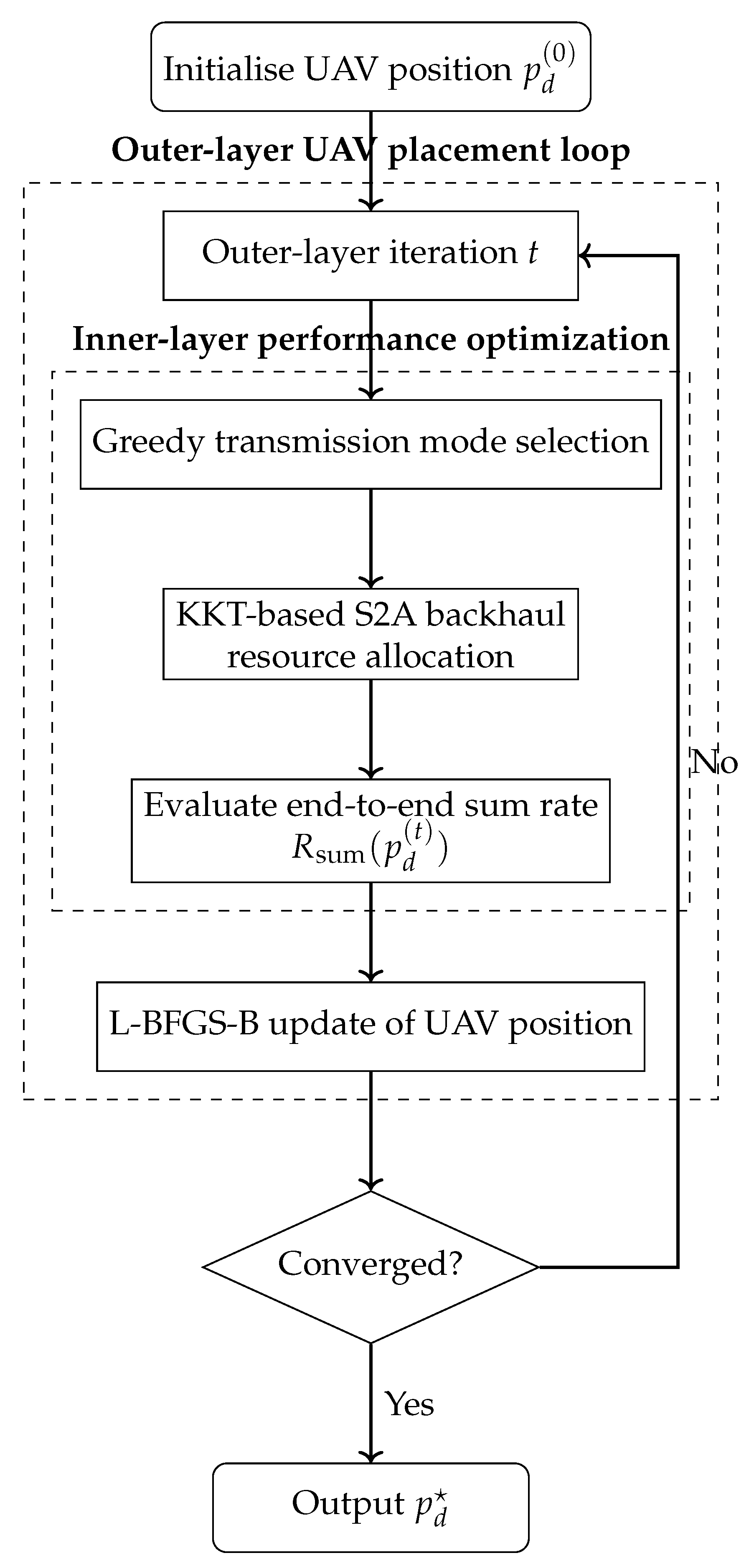
In the proposed framework, UAV placement is treated as a bound-constrained continuous optimization task, where the UAV position acts as an outer-layer control variable with the objective of maximising the aggregate end-to-end downlink rate of all users in the system. For any given UAV position, the resulting system performance is evaluated through an inner-layer execution of greedy transmission mode selection and KKT-based S2A backhaul resource allocation. The corresponding performance feedback then drives the iterative update of the UAV position in the outer loop until convergence, thereby enabling a fully coordinated, end-to-end performance-driven placement framework.
Due to the simultaneous impact of the UAV position on both the A2G access links and the S2A backhaul, its influence on the end-to-end downlink performance is highly coupled and non-linear, which cannot be adequately captured by conventional geometry-driven placement strategies. As a result, the UAV placement problem naturally lends itself to a performance-driven continuous optimization formulation.
Formally, the three-dimensional UAV position is defined as
p d = ( x d , y d , h d ) ,
where ( x d , y d ) denote the horizontal coordinates and h d represents the flight altitude. The system-level optimization objective is to maximise the aggregate downlink rate of all users, expressed as
max p d u U R u ( p d ) ,
subject to the following feasibility constraints
R cov x d R cov ,
R cov y d R cov ,
h min h d h max ,
where R cov denotes the horizontal coverage radius of the UAV, and [ h min , h max ] specifies the allowable altitude range.
The objective function in (26) does not admit a closed-form expression, as the achievable user rates depend on a cascade of coupled access- and backhaul-related decisions, including transmission mode selection and backhaul bandwidth allocation. Consequently, the resulting UAV placement problem is characterised by a non-analytic and implicitly defined objective function that must be evaluated through numerical procedures.
Owing to the continuous nature of the UAV position variables and the presence of non-smooth operations such as transmission mode switching and decode-and-forward rate constraints, the resulting optimization problem is inherently non-convex. Accordingly, the limited-memory Broyden–Fletcher–Goldfarb–Shanno algorithm with box constraints (L-BFGS-B) is adopted, as it is well suited for bound-constrained optimisation and supports numerical gradient approximations in the absence of explicit gradient expressions. The overall outer–inner iterative optimization procedure is summarised in Algorithm 1, p d * denotes the optimal value of p d .
Algorithm 1 Performance-Driven UAV Placement via Outer–Inner Iterative Optimisation
Require: 
User set U , feasible UAV region P d , system parameters
Ensure: 
Optimised UAV position p d *
  1:
Initialise UAV position p d ( 0 ) P d (e.g., geometric centroid)
  2:
Set iteration index t 0
  3:
repeat
Inner-layer performance optimization (given p d ( t ) ):
  4:
   Determine transmission modes via greedy mode selection (Section III-A)
  5:
   Allocate S2A backhaul resources by solving the KKT conditions (Section III-B)
  6:
   Evaluate aggregate end-to-end downlink rate R sum ( p d ( t ) )
Outer-layer position update:
  7:
   Update UAV position p d ( t + 1 ) using the L-BFGS-B algorithm
  8:
   Enforce box constraints p d ( t + 1 ) P d
  9:
    t t + 1
10:
until convergence of the outer-layer optimization
11:
return  p d * p d ( t )
The overall outer–inner optimization flow is further illustrated in Figure 3. The UAV placement optimization problem is inherently non-convex due to the coupled access–backhaul structure, discrete transmission mode switching, and decode-and-forward constraints. Therefore, the adopted L-BFGS-B algorithm is employed as a practical numerical optimization tool rather than a means to guarantee global optimality.
In the conducted simulations, the proposed outer–inner iterative procedure exhibits stable convergence behavior and typically reaches a stationary solution within a moderate number of iterations. Moreover, initializing the UAV position from different feasible starting points, such as the geometric centroid of user locations or random initial positions within the coverage region, results in very similar optimized UAV placements and end-to-end performance. This empirical observation indicates that the proposed framework shows limited sensitivity to initialization in practice.
The optimization procedure is initialised at the geometric centroid of the user distribution in the horizontal plane, with the UAV altitude set to a nominal value within the feasible range. During the iterative optimization process, the small-scale fading realisations of the A2G channels are held fixed so that the objective function remains deterministic, thereby ensuring numerical stability and reproducibility. At each iteration, the UAV position is updated according to the search direction generated by the L-BFGS-B algorithm, while the box constraints on the horizontal position and altitude are inherently enforced by the optimiser.
By directly optimising the communication performance rather than geometric proximity, the proposed UAV placement strategy captures the coupled impact of position, transmission mode selection, and backhaul resource allocation. As the outer-layer component of the proposed framework, this joint optimization mechanism enables the UAV to balance A2G access quality and S2A backhaul capacity in a coordinated manner, thereby completing the end-to-end algorithmic design and improving the overall system throughput.
Together, the proposed greedy transmission mode selection, KKT-based backhaul resource allocation, and performance-driven UAV placement form a low-complexity yet effective end-to-end optimization framework for UAV-assisted satellite downlink transmission.

4. Results

The proposed framework was implemented in Python 3.11 and evaluated through numerical simulations. The simulation setup consists of a set of scanned control parameters and a set of fixed system parameters, as summarized in Table 1 and Table 2, respectively.
We consider a single-beam downlink satellite coverage scenario, where N ground users are uniformly distributed within a circular service area of radius R. A single LEO satellite provides downlink transmission either directly to the users or via an UAV operating as a decode-and-forward relay. The UAV altitude is constrained within the range h d [ 100 , 500 ] m.
In the simulations, the satellite elevation angle E, the UAV bandwidth B d , and the SNR are treated as key control variables and varied to investigate their impact on system performance, while all remaining parameters are kept fixed unless explicitly stated.
Unless otherwise stated, the S2G and S2A links are assumed to be dominated by line-of-sight propagation, and only large-scale path loss determined by the satellite geometry and elevation angle E is considered. For the A2G links, a distance-dependent path loss model with exponent α = 2.5 and Rayleigh fading are adopted to capture small-scale channel variations.
To ensure statistical reliability, all numerical results are obtained by averaging over a sufficiently large number of independent Monte Carlo realizations with randomly generated user locations and channel fading samples. A fixed random seed is adopted throughout the simulations to guarantee reproducibility. The receiver noise power is computed based on a noise power spectral density of N 0 = 174 dBm/Hz.
System performance is evaluated in terms of the system sum rate, spectral efficiency, and average user rate. The system sum rate represents the aggregate downlink throughput of all users, while the spectral efficiency is obtained by normalizing the sum rate by the total satellite bandwidth.

4.1. Overall Performance Comparison of UAV-Assisted Downlink Schemes

This subsection evaluates the overall performance of the proposed framework by comparing it with several representative baseline schemes under identical system settings. All schemes are evaluated using the same satellite bandwidth, transmit power, user distribution, and channel models, so that any observed performance difference can be solely attributed to the adopted transmission, resource allocation, and UAV deployment strategies.
Specifically, the following baseline schemes are considered
  • SAT-NOMA: a conventional satellite-only downlink scheme, where all users are directly served by the satellite using power-domain NOMA, without UAV assistance. This scheme serves as a benchmark for assessing the benefit of introducing UAV-assisted relaying.
  • Heuristic + Uniform: a low-complexity benchmark that applies heuristic transmission mode selection, uniform S2A bandwidth allocation, and a fixed UAV placement based on geometric considerations. This scheme represents a practical design that does not explicitly optimize access–backhaul coupling.
  • Heuristic + Uniform + k-means: a complete baseline framework that further incorporates UAV placement via k-means clustering, while retaining heuristic mode selection and uniform resource allocation. This scheme is used as the primary baseline for evaluating the effectiveness of the proposed joint optimization framework.
The proposed framework differs from the baseline by jointly optimizing transmission mode selection, bandwidth allocation, and UAV placement in a unified manner. Importantly, no additional spectrum or transmit power is introduced; the performance gain is solely achieved through more efficient utilization of existing resources.
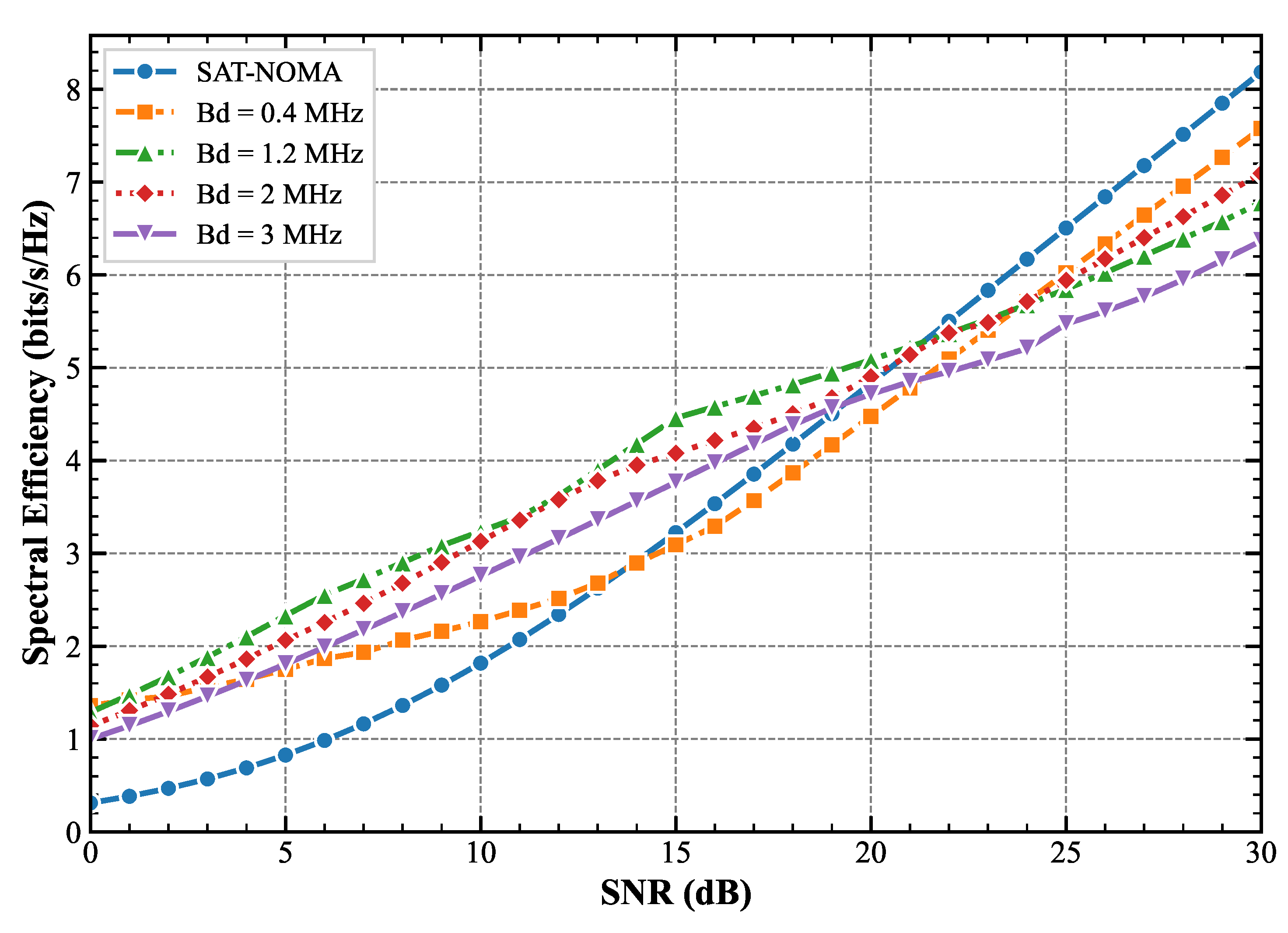
To first examine how UAV bandwidth provisioning affects the achievable performance of the proposed framework, Figure 4 investigates the spectral-efficiency behavior under different UAV bandwidth configurations.
Figure 4 illustrates the average spectral efficiency as a function of SNR under a low satellite elevation angle of E = 10 for different UAV bandwidth configurations. The satellite-only SAT-NOMA scheme, which relies solely on direct satellite transmission without UAV assistance, achieves the lowest spectral efficiency across the entire SNR range due to the severe propagation loss at low elevation angles and the absence of relay-assisted enhancement.
By contrast, the proposed framework significantly improves spectral efficiency by enabling UAV-assisted relaying. When the UAV bandwidth is limited ( B d = 0.4 MHz), the performance gain over SAT-NOMA remains modest, with an improvement typically below 10 % across most of the SNR range, indicating that the access-side gain cannot be fully translated into end-to-end performance under a tight bandwidth constraint. As the UAV bandwidth increases to B d = 1.2 MHz, a clear improvement in performance is observed, yielding approximately 20– 30 % higher spectral efficiency than SAT-NOMA in the medium-to-high SNR regime. This demonstrates that a moderate UAV bandwidth is sufficient to effectively support relay-assisted downlink transmission.
Further increasing the UAV bandwidth to B d = 2.0 MHz and 3.0 MHz continues to enhance the spectral efficiency, but with diminishing marginal gains. In particular, the additional improvement from B d = 2.0 MHz to 3.0 MHz is typically within 5– 10 % , suggesting that the end-to-end performance becomes increasingly constrained by the decode-and-forward backhaul rather than the UAV access link. Overall, Figure 4 confirms that the spectral efficiency gain under low-elevation satellite scenarios is highly sensitive to UAV bandwidth provisioning at low-to-moderate values, but gradually saturates once the backhaul constraint dominates.
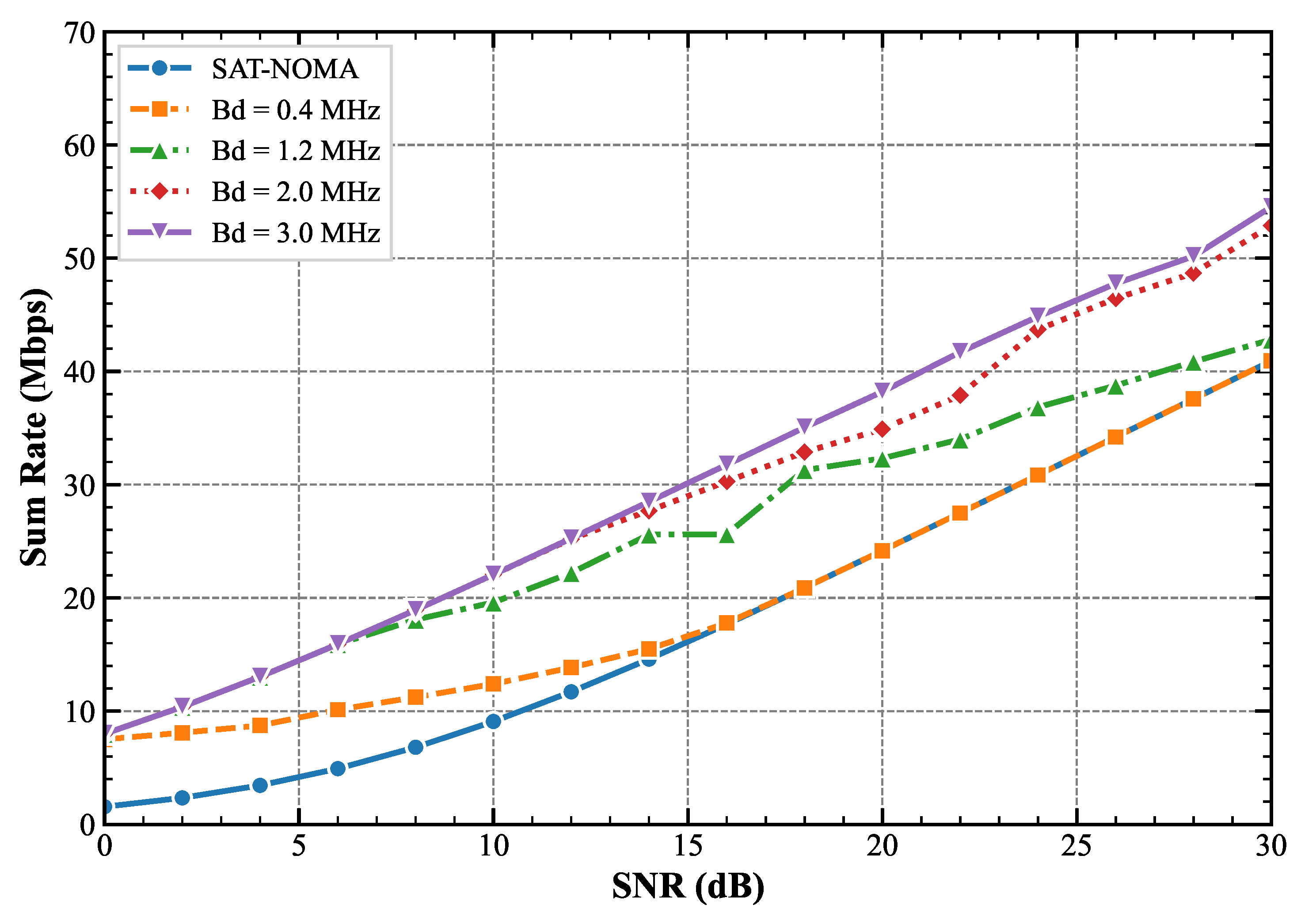
Figure 5 depicts the system sum rate as a function of SNR under a low satellite elevation angle of E = 10 for different UAV bandwidth configurations. Consistent with the spectral efficiency trends observed in Figure 4, the proposed framework achieves a consistently higher sum rate than the satellite-only SAT-NOMA scheme across the entire SNR range.
When the UAV bandwidth is small ( B d = 0.4 MHz), the sum-rate improvement over SAT-NOMA remains limited, typically within 10 % , indicating that the restricted UAV access capacity limits the effectiveness of relay-assisted downlink transmission. As the UAV bandwidth increases to B d = 1.2 MHz, a pronounced throughput gain emerges, with the system sum rate improving by approximately 25– 35 % in the medium SNR region. This confirms that a moderate amount of UAV bandwidth is sufficient to substantially enhance the end-to-end throughput.
Further increasing the UAV bandwidth to B d = 2.0 MHz and 3.0 MHz leads to additional throughput improvements, particularly at high SNR. However, the relative gain gradually diminishes, with the improvement from B d = 2.0 MHz to 3.0 MHz typically below 10 % . This behavior indicates that the satellite-to-UAV backhaul increasingly dominates the end-to-end performance, limiting the benefit of further UAV bandwidth expansion.
Overall, Figure 5 demonstrates that the proposed framework can effectively translate spectral-efficiency gains into tangible throughput improvements, while also revealing a practical UAV bandwidth range that balances performance enhancement and deployment cost.
Beyond bandwidth provisioning, the effectiveness of UAV-assisted relaying also depends on the satellite propagation geometry. To evaluate this effect, Figure 6 examines the impact of satellite elevation angle on the achievable spectral efficiency.
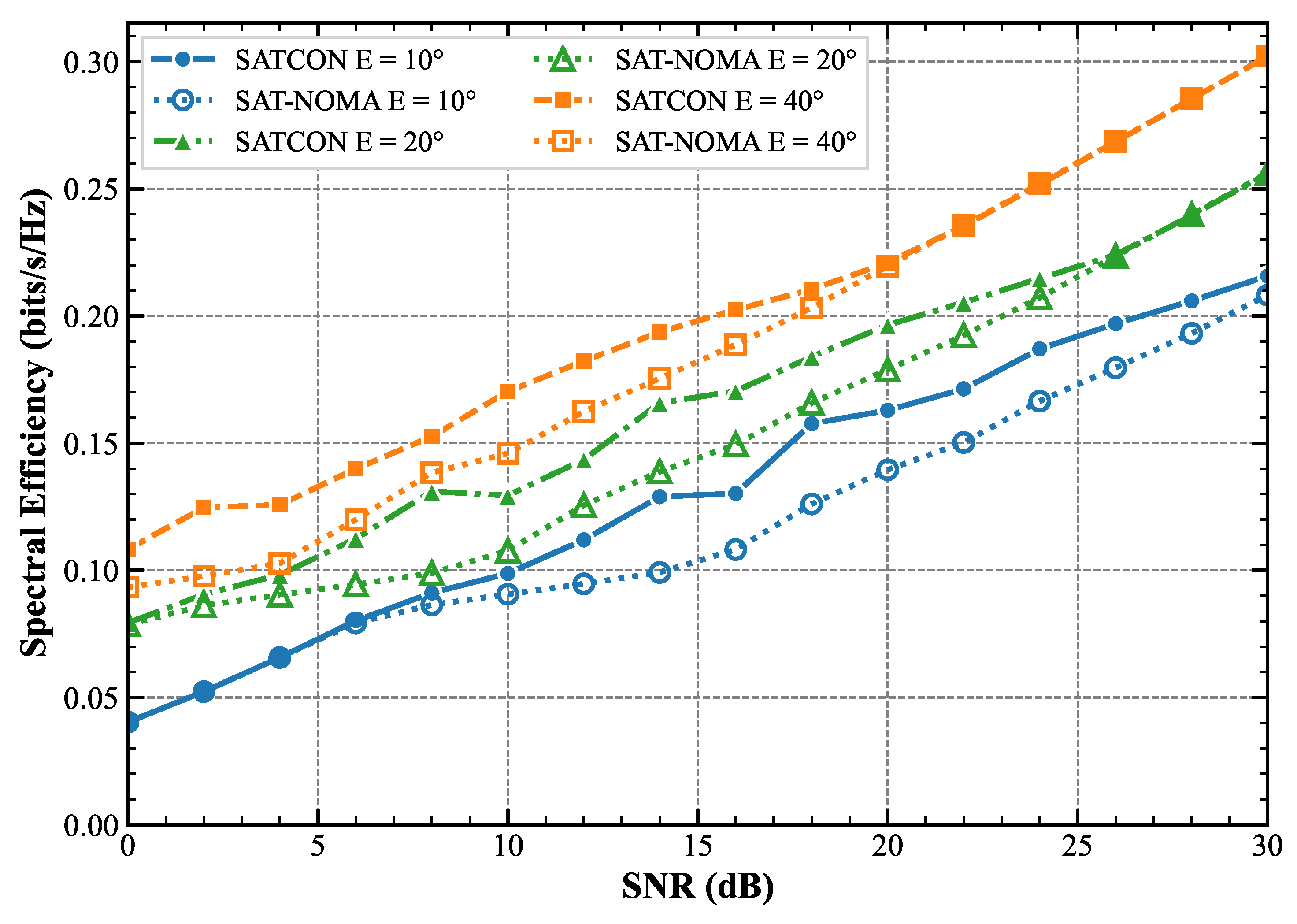
Figure 6 shows the average spectral efficiency as a function of SNR for different satellite elevation angles, with the UAV bandwidth fixed at B d = 1.2 MHz. The satellite-only SAT-NOMA baseline and the proposed framework are compared under identical system settings.
It can be observed that the spectral efficiency of both schemes improves as the elevation angle increases from 10 to 40 , due to the reduced propagation distance and path loss of the satellite links. However, the relative performance gain provided by the proposed framework strongly depends on the elevation angle. At a low elevation angle of E = 10 , the proposed framework achieves a clear and consistent advantage over SAT-NOMA across the entire SNR range, with a typical spectral-efficiency improvement of approximately 25–35%. This indicates that UAV-assisted relaying is particularly effective in mitigating the severe propagation loss experienced at low-elevation satellite passes.
When the elevation angle increases to E = 20 , the performance gap between the two schemes becomes smaller but remains noticeable, especially in the medium-to-high SNR regime. In this case, the relative improvement is generally reduced to around 10– 20 % , reflecting the fact that the direct satellite link quality has already been partially improved.
In contrast, for a high elevation angle of E = 40 , the two schemes exhibit nearly identical spectral efficiency, with the performance difference typically within a few percent. This suggests that, under favorable propagation conditions, the direct satellite link already provides near-optimal performance, leaving limited room for further enhancement via UAV-assisted relaying.
These results demonstrate that the primary benefit of the proposed framework arises under challenging propagation conditions, such as low-elevation satellite scenarios, whereas its advantage naturally diminishes as the channel quality improves. This behavior confirms that the proposed framework adapts its performance gain to the actual severity of the wireless environment, rather than providing uniform improvement irrespective of channel conditions.
Overall, the results in Figure 4, Figure 5 and Figure 6 consistently demonstrate that the proposed framework achieves its performance gain through efficient access–backhaul coordination rather than additional resource consumption. Its advantage is most pronounced under bandwidth-limited and low-elevation satellite conditions, while naturally diminishing as the propagation environment becomes more favorable, highlighting a performance-driven and scenario-adaptive design philosophy.

4.2. Ablation Study and Scalability Analysis

This subsection investigates the internal performance mechanism and scalability of the proposed framework through an ablation study, three-dimensional deployment visualization, and scalability analysis.
To quantify the contribution of each optimization component, we conduct an ablation study by selectively enabling different modules while keeping all other system parameters unchanged. The baseline scheme corresponds to heuristic transmission mode selection with uniform bandwidth allocation and k-means-based UAV placement.
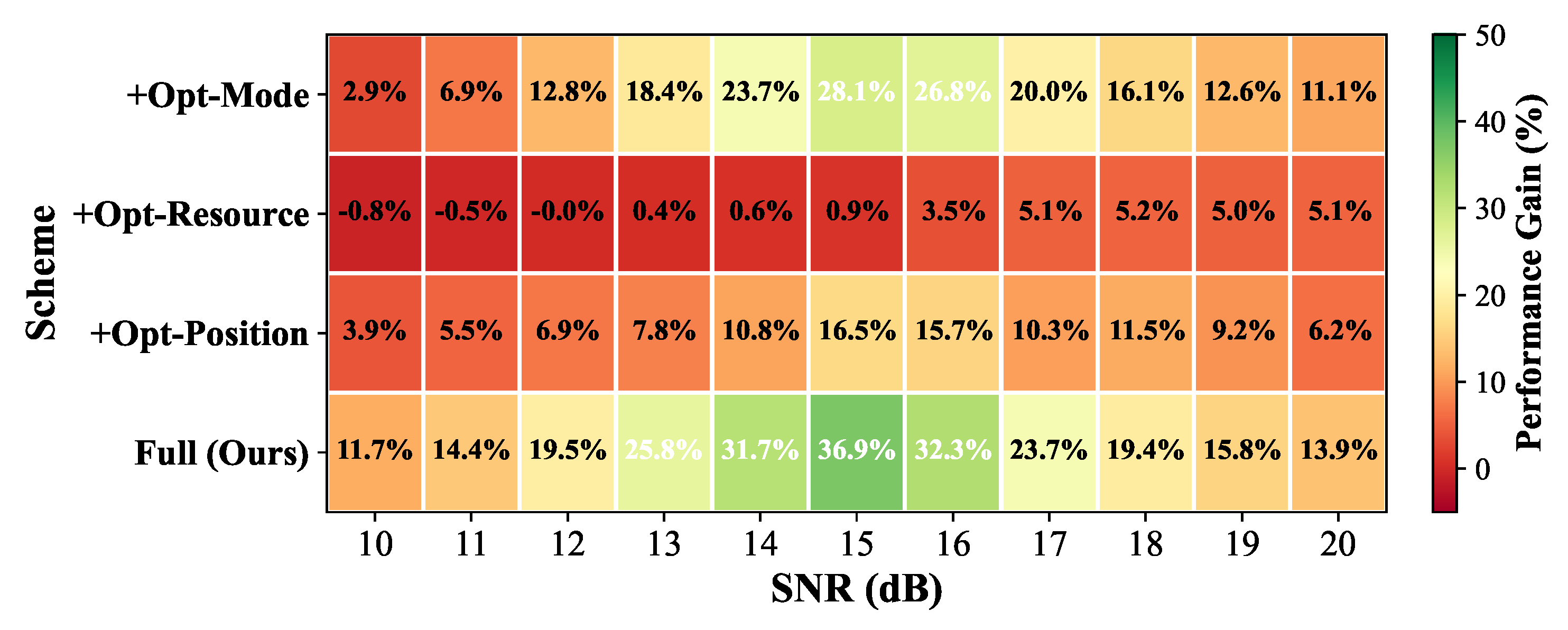
Figure 7 further presents the relative performance gain of different configurations with respect to the baseline under varying SNR conditions. It can be observed that optimizing transmission mode selection alone provides limited performance improvement, especially in the low-SNR regime, where the gain typically remains below 10 % . Similarly, resource allocation optimization yields only marginal gains when applied in isolation, with the performance improvement generally within a few percent across the entire SNR range.
In contrast, UAV position optimization contributes a noticeably larger performance gain, highlighting the critical role of spatial deployment in improving system throughput. For instance, position optimization alone achieves gains on the order of 10– 15 % in the medium-SNR region, significantly outperforming the other individual components. When all three components are jointly optimized, the proposed framework achieves the highest performance gain among the considered configurations, with the improvement exceeding 30 % around SNR = 15 dB.
These results demonstrate that no single optimization module is sufficient to fully exploit the system potential. Instead, the performance advantage of the proposed framework stems from the joint optimization of transmission mode selection, resource allocation, and UAV placement, with position optimization emerging as the most influential individual component.
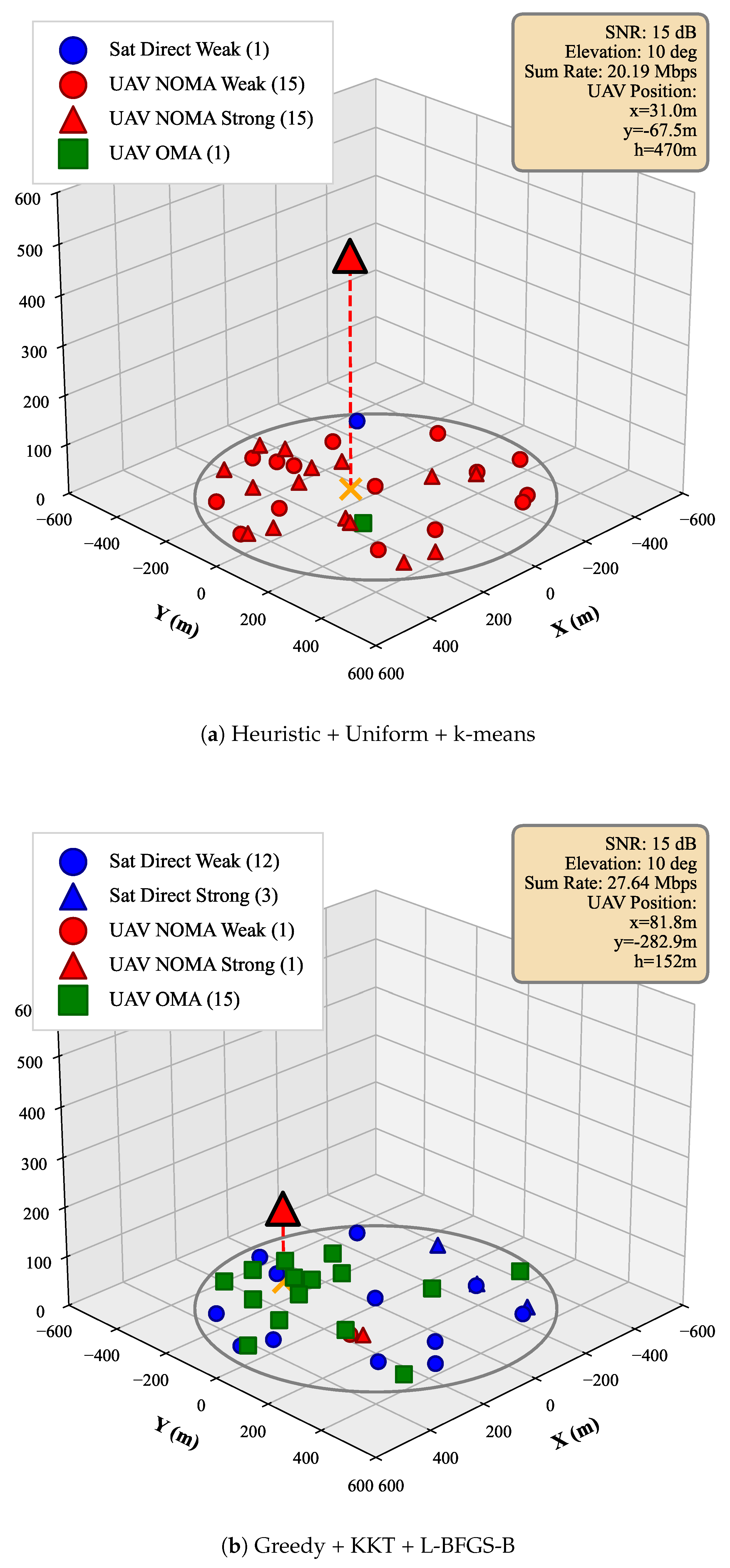
To further illustrate the impact of UAV placement optimization, Figure 8 visualizes the three-dimensional user distribution and the resulting UAV positions obtained by the baseline scheme and the proposed framework under identical system settings.
As shown in Figure 8a, the baseline method places the UAV close to the geometric center of the user distribution and at a relatively high altitude, without explicitly accounting for heterogeneous channel conditions or the coupling between satellite-to-UAV and UAV-to-ground links. This geometry-driven placement leads to an imbalanced link configuration, where the potential access-side gains cannot be efficiently translated into end-to-end throughput.
In contrast, Figure 8b shows that the proposed framework positions the UAV at a noticeably different horizontal location and a lower altitude, reflecting a more balanced trade-off between satellite backhaul quality and ground access efficiency. This optimized placement is not a marginal adjustment, but a structural relocation that significantly alters the spatial relationship between the UAV, the satellite, and the served users.
As a result of this deployment change, the optimized configuration achieves a substantially higher system sum rate under the same operating conditions, consistent with the 25– 35 % throughput gains observed in the preceding quantitative results at SNR = 15 dB. The visualization therefore confirms that the performance improvement of the proposed framework is not solely due to numerical resource tuning, but also stems from a meaningful and adaptive restructuring of UAV deployment that better matches the underlying wireless environment.
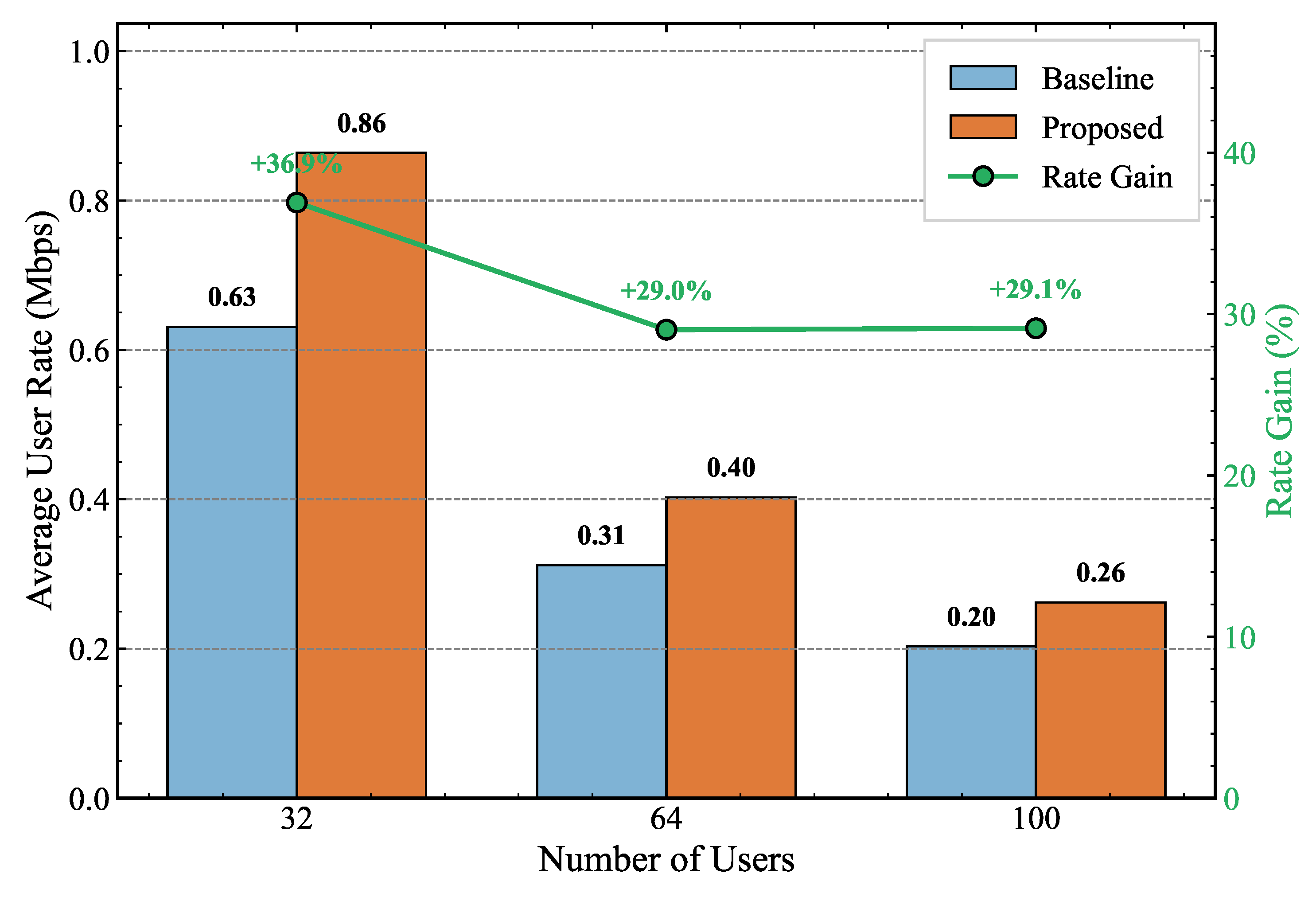
To assess whether the performance advantage of the proposed framework can be preserved as the network scales, Figure 9 compares the average user rate achieved by the proposed framework and the baseline scheme under different numbers of users, while keeping the total bandwidth fixed.
As expected, the average user rate decreases for both schemes as the number of users increases from N = 32 to N = 100 , due to intensified resource sharing. Nevertheless, the proposed framework consistently outperforms the baseline across all network sizes. Specifically, at N = 32 , the proposed framework improves the average user rate from approximately 0.63 Mbps to 0.86 Mbps, corresponding to a gain of about 37 % . When the number of users increases to N = 64 and N = 100 , the relative performance gain remains stable at around 29 % , despite the reduced absolute per-user rate.
This observation indicates that the performance advantage of the proposed framework does not diminish as the network scales. Instead of relying on favorable user density, the joint optimization of UAV placement, transmission mode selection, and resource allocation enables the framework to adapt to increased contention and preserve a nearly constant relative gain.
Overall, Figure 9 demonstrates that the proposed framework exhibits good scalability properties, maintaining consistent relative performance improvements over the baseline even in moderately dense user scenarios.
Together, these results confirm that the performance gain of the proposed framework arises from both effective joint optimization and robust adaptability to spatial deployment and network scale.
Although 2K = 32 is used as the nominal network size in most simulations, the scalability of the proposed framework is evaluated by increasing the number of users to 2K = 64 and 2K = 100. As shown in the scalability analysis, the proposed approach maintains stable relative performance gains as the network becomes denser.
From a computational perspective, the greedy transmission mode selection operates independently on each user pair, resulting in linear complexity with respect to the number of pairs. The KKT-based backhaul bandwidth allocation admits a low-complexity closed-form solution, and the outer-layer UAV placement optimization converges within a moderate number of iterations. These properties make the proposed framework suitable for moderately dense and large-scale IoT scenarios.

5. Discussion

From a practical deployment perspective, the results indicate that the proposed framework can achieve considerable performance gains without requiring additional spectrum or transmit power, relying instead on more efficient utilization of existing resources. The low-complexity structure of the proposed decision process and the stable behavior observed in the scalability analysis further suggest that the proposed framework is suitable for large-scale networks with dynamic user distributions.
The results presented in Section 4 demonstrate that the performance gains of the proposed framework are closely tied to the underlying propagation conditions and system bottlenecks. In particular, under challenging satellite propagation scenarios with low elevation angles ( E = 10 ), the proposed framework achieves substantial improvements over the satellite-only baseline, with spectral-efficiency and sum-rate gains on the order of 20–35% in the medium-to-high SNR regime. As the elevation angle increases to 20 , the relative gain decreases to approximately 10–20%, and becomes marginal at high elevation angles ( E = 40 ), where direct satellite transmission already provides near-optimal performance.
An important insight revealed by the numerical results is that the benefit of UAV assistance is inherently bounded by the S2A backhaul capacity. While increasing the UAV access bandwidth from 0.4 MHz to 1.2 MHz leads to pronounced performance improvements, yielding throughput gains of approximately 25–35%, further bandwidth expansion exhibits diminishing returns. In particular, increasing the UAV bandwidth beyond 2.0 MHz results in additional gains typically below 10%, indicating that the end-to-end performance becomes increasingly constrained by the decode-and-forward backhaul. This behavior quantitatively confirms the structural bottleneck imposed by DF relaying and validates the design philosophy of the proposed framework, which focuses on alleviating backhaul constraints through judicious resource allocation rather than indiscriminately increasing access bandwidth.
As in many existing studies on NOMA-enabled satellite and UAV-assisted networks, this work adopts ideal assumptions such as perfect SIC and instantaneous CQI for the S2G, S2A, and A2G links. These assumptions are made to highlight the system-level performance limits and to focus on the end-to-end optimization problem under the decode-and-forward backhaul bottleneck, rather than on physical-layer implementation details.
While recent learning-based or global optimization approaches have been explored for UAV and satellite network optimization, this work focuses on a model-driven and low-complexity framework with explicit interpretability. The adopted benchmark schemes operate under the same system assumptions and information availability as the proposed method, enabling fair and transparent performance comparison. Incorporating learning-based or hybrid model–data-driven optimization is an interesting direction for future work.
This design choice is further supported by the ablation analysis presented in Section 4. Furthermore, the ablation study highlights that the performance advantage of the proposed framework does not stem from any single optimization component in isolation. Instead, it arises from the coordinated interaction among transmission mode selection, backhaul resource allocation, and UAV placement, which are jointly refined through an iterative, performance-driven optimization process. Among these components, UAV placement plays a particularly critical role, as it governs the large-scale geometry of both access and backhaul links and thus fundamentally shapes the end-to-end performance landscape. These findings suggest that heuristic or geometry-driven designs may be insufficient for satellite–aerial integrated networks, where access and backhaul links are tightly coupled and must be optimized in an holistic manner.
This work considers a single-UAV-assisted satellite downlink scenario, which serves as a fundamental building block for investigating the coupling among access transmission, decode-and-forward backhaul constraints, and UAV placement. Focusing on a single UAV allows the proposed framework to clearly capture the end-to-end performance bottleneck without additional complexity arising from inter-UAV coordination or interference.
Extending the proposed framework to multi-UAV deployments is an important direction for future research. Such extensions would require joint optimization of UAV cooperation, interference management, and resource coordination, which are beyond the scope of the present study.
This work focuses on maximizing the end-to-end downlink throughput and does not explicitly account for UAV energy consumption, flight endurance, or other operational constraints. The objective is to highlight the impact of access–backhaul coupling and performance-driven UAV placement under decode-and-forward relaying.
In practical UAV-assisted satellite systems, energy efficiency and operational constraints play a critical role and can be incorporated into the proposed framework by introducing additional constraints or by formulating a multi-objective optimization problem. Investigating such extensions is an interesting direction for future research.
Nevertheless, several limitations of the present study should be acknowledged. Small-scale fading effects on satellite links are neglected under dominant line-of-sight assumptions, which may not fully capture complex satellite propagation conditions in highly obstructed or dense urban environments. The optimization framework relies on instantaneous channel knowledge, which may be imperfect in practice. Notably, the role of the UAV in mitigating access-side blockage is still captured through the A2G links, while the above simplification primarily affects the modeling fidelity of satellite-side propagation.
Future research directions include extending the proposed framework to cooperative multi-UAV scenarios, incorporating more realistic satellite channel models, and integrating learning-based techniques for predicting satellite visibility, traffic demand, and channel dynamics. Such extensions would further enhance the adaptability of the proposed framework and facilitate its alignment with emerging intelligent control paradigms beyond 5G and 6G non-terrestrial networks.

6. Conclusions

This paper investigated the intelligent integration of a UAV into a satellite downlink system and proposed a performance-driven framework for satellite–aerial–terrestrial cooperative communications. By jointly designing transmission mode selection, S2A backhaul resource allocation, and UAV placement, the proposed framework enables efficient exploitation of aerial assistance while explicitly accounting for the decode-and-forward bottleneck inherent in relay-assisted satellite transmissions.
Unlike conventional heuristic or geometry-driven approaches, the proposed framework adopts an end-to-end, performance-oriented design philosophy that coordinates access and backhaul decisions in a unified manner. UAV assistance is activated only when tangible rate improvements can be achieved, and backhaul resources are provisioned in a bottleneck-aware fashion to avoid unnecessary over-allocation. Simulation results show that, under low-elevation satellite scenarios, the proposed framework can improve spectral efficiency and system throughput by approximately 20–35% compared with satellite-only transmission, without requiring additional spectrum or transmit power. Moreover, the scalability analysis indicates that the relative performance gain remains stable as the network size increases, achieving an average user-rate improvement of about 37% at N = 32 users and approximately 29% even when the number of users grows to N = 100 .
The results further indicate that the observed performance gains stem from the coordinated optimization of structural decisions and continuous resource control, rather than from any individual optimization component in isolation. These findings highlight the importance of holistic access–backhaul coordination in future satellite–aerial integrated networks. Overall, the proposed framework offers a scalable and computationally efficient solution that is well aligned with the requirements of emerging non-terrestrial networks and beyond-5G/6G systems, where dynamic propagation conditions and heterogeneous link characteristics must be jointly addressed.
While this work focuses on a single-UAV-assisted satellite downlink scenario, the proposed framework serves as a fundamental building block that can be extended to multi-UAV deployments. Incorporating UAV energy consumption and operational constraints into the optimization framework is an important direction for future research.

Author Contributions

Conceptualization, T.L. and C.S.; methodology, T.L. and C.S.; software, T.L.; validation, T.L., Y.Z. and W.S.; formal analysis, T.L., Y.Z. and W.S.; data curation, T.L.; writing—original draft, T.L.; writing—review and editing, T.L. and W.S.; visualization, T.L.; supervision, C.S. and Y.Z.; project administration, Y.Z. All authors have read and agreed to the published version of the manuscript.

Funding

This research received no external funding.

Data Availability Statement

Data are contained within the article.

Conflicts of Interest

All authors were employed by the company China Electronics Technology Group Corporation Network Communications Research Institute. The remaining authors declare that the research was conducted in the absence of any commercial or financial relationships that could be construed as a potential conflict of interest.

Abbreviations

The following abbreviations are used in this manuscript:
A2GAir-to-Ground
CQIChannel Quality Indicator
DFDecode-and-Forward
IoT Internet of Things
KKTKarush–Kuhn–Tucker
LEOLow-Earth Orbit
LMSLand Mobile Satellite
NOMANon-Orthogonal Multiple Access
OMAOrthogonal Multiple Access
S2ASatellite-to-Air
S2GSatellite-to-Ground
SAGINSpace–Air–Ground Integrated Network
SICSuccessive Interference Cancellation
SINRSignal-to-Interference-plus-Noise Ratio
UAVUnmanned Aerial Vehicle

References

  1. Adeoye, S. Internet of Things (IoT): A Vision, Architectural Elements and Future Directions. Cognizance J. Multidiscip. Stud. 2025, 5, 316–338. [Google Scholar] [CrossRef]
  2. Lin, J.; Yu, W.; Zhang, N.; Yang, X.; Zhang, H.; Zhao, W. A survey on internet of things: Architecture, enabling technologies, security and privacy, and applications. IEEE Internet Things J. 2017, 4, 1125–1142. [Google Scholar] [CrossRef]
  3. Cheng, N.; He, J.; Yin, Z.; Zhou, C.; Wu, H.; Lyu, F.; Zhou, H.; Shen, X. 6G service-oriented space-air-ground integrated network: A survey. Chin. J. Aeronaut. 2022, 35, 1–18. [Google Scholar] [CrossRef]
  4. Chen, K.; Zhang, L.; Zhong, J. Space-air-ground integrated network (SAGIN) in disaster management: A survey. In IEEE Transactions on Network and Service Management; IEEE: Piscataway, NJ, USA, 2025. [Google Scholar]
  5. Kodheli, O.; Lagunas, E.; Maturo, N.; Sharma, S.K.; Shankar, B.; Montoya, J.F.M.; Duncan, J.C.M.; Spano, D.; Chatzinotas, S.; Kisseleff, S.; et al. Satellite communications in the new space era: A survey and future challenges. IEEE Commun. Surv. Tutor. 2020, 23, 70–109. [Google Scholar] [CrossRef]
  6. Guidotti, A.; Vanelli-Coralli, A.; Conti, M.; Andrenacci, S.; Chatzinotas, S.; Maturo, N.; Evans, B.; Awoseyila, A.; Ugolini, A.; Foggi, T. Architectures and key technical challenges for 5G systems incorporating satellites. IEEE Trans. Veh. Technol. 2019, 68, 2624–2639. [Google Scholar] [CrossRef]
  7. Liu, X.; Lv, L.; Yang, Q. LEO-satellite-assisted UAV path optimization for space–air–ground Internet of Remote Things networks. Space Sci. Technol. 2025, 5, 0280. [Google Scholar] [CrossRef]
  8. Zhang, H.; Xi, S.; Jiang, H.; Shen, Q.; Shang, B.; Wang, J. Resource allocation and offloading strategy for UAV-assisted LEO satellite edge computing. Drones 2023, 7, 383. [Google Scholar] [CrossRef]
  9. Jia, Z.; Sheng, M.; Li, J.; Niyato, D.; Han, Z. LEO-satellite-assisted UAV: Joint trajectory and data collection for Internet of Remote Things in 6G aerial access networks. IEEE Internet Things J. 2020, 8, 9814–9826. [Google Scholar] [CrossRef]
  10. Al-Hourani, A.; Kandeepan, S.; Lardner, S. Optimal LAP altitude for maximum coverage. IEEE Wireless Commun. Lett. 2014, 3, 569–572. [Google Scholar] [CrossRef]
  11. Dai, L.; Wang, B.; Ding, Z.; Wang, Z.; Chen, S.; Hanzo, L. A survey of non-orthogonal multiple access for 5G. IEEE Commun. Surv. Tutor. 2018, 20, 2294–2323. [Google Scholar] [CrossRef]
  12. Li, X.; Shang, B.; Wu, Q.; Ren, C. Coverage and Spectral Efficiency of NOMA-Enabled LEO Satellite Networks with Ordering Schemes. arXiv 2025, arXiv:2501.05946. [Google Scholar] [CrossRef]
  13. Ding, Z.; Lei, X.; Karagiannidis, G.K.; Schober, R.; Yuan, J.; Bhargava, V.K. A survey on non-orthogonal multiple access for 5G networks: Research challenges and future trends. IEEE J. Sel. Areas Commun. 2017, 35, 2181–2195. [Google Scholar] [CrossRef]
  14. Liu, Y.; Qin, Z.; Elkashlan, M.; Ding, Z.; Nallanathan, A.; Hanzo, L. Non-orthogonal multiple access for 5G and beyond. arXiv 2018, arXiv:1808.00277. [Google Scholar] [CrossRef]
  15. Darsena, D.; Gelli, G.; Iudice, I.; Verde, F. A Hybrid NOMA-OMA Scheme for Inter-Plane Intersatellite Communications in Massive LEO Constellations. In IEEE Transactions on Vehicular Technology; IEEE: Piscataway, NJ, USA, 2024. [Google Scholar]
  16. Laneman, J.N.; Tse, D.N.C.; Wornell, G.W. Cooperative Diversity in Wireless Networks: Efficient Protocols and Outage Behavior. IEEE Trans. Inf. Theory 2004, 50, 3062–3080. [Google Scholar] [CrossRef]
  17. Liu, Y.; Wang, Q.; Dai, H.-N.; Fu, Y.; Zhang, N.; Lee, C.C. UAV-assisted wireless backhaul networks: Connectivity analysis of uplink transmissions. IEEE Trans. Veh. Technol. 2023, 72, 12195–12207. [Google Scholar] [CrossRef]
  18. Mozaffari, M.; Saad, W.; Bennis, M.; Nam, Y.-H.; Debbah, M. A tutorial on UAVs for wireless networks: Applications, challenges, and open problems. IEEE Commun. Surv. Tutor. 2019, 21, 2334–2360. [Google Scholar] [CrossRef]
  19. Loo, C. A Statistical Model for a Land Mobile Satellite Link. IEEE Trans. Veh. Technol. 1985, 34, 122–127. [Google Scholar] [CrossRef]
  20. Zhu, Y.; Guntuku, S.C.; Lin, W.; Ghinea, G.; Redi, J.A. Measuring Individual Video QoE: A Survey, and Proposal for Future Directions Using Social Media. ACM Trans. Multimedia Comput. Commun. Appl. 2018, 14, 1–24. [Google Scholar] [CrossRef]
  21. Gu, X.; Zhang, G. A Survey on UAV-Assisted Wireless Communications: Recent Advances and Future Trends. Comput. Commun. 2023, 208, 44–78. [Google Scholar] [CrossRef]
  22. Yao, C.; Yang, C. Role of Large-Scale Channel Information on Predictive Resource Allocation. In 2016 IEEE Wireless Communications and Networking Conference, Doha, Qatar, 3–6 April 2016; IEEE: Piscataway, NJ, USA, 2016; pp. 1–6. [Google Scholar]
Figure 1. Illustration of the downlink communication architecture in SAGIN, where IoT devices are served either directly by a LEO satellite or via a UAV acting as a decode-and-forward relay through S2A and A2G links.
Electronics 15 00471 g001
Figure 2. System model of the hybrid satellite–UAV downlink transmission. The satellite performs NOMA user pairing and broadcasts superimposed downlink signals. After decoding the satellite NOMA signals via the S2A link using DF relaying, the UAV selectively re-groups a subset of users and adaptively applies NOMA or OMA transmission over the A2G links according to the adopted transmission mode selection strategy.
Electronics 15 00471 g002
Figure 3. Outer–inner iterative framework for performance-driven UAV placement. The inner layer evaluates the end-to-end downlink performance under a given UAV position, while the outer layer updates the UAV position using L-BFGS-B until convergence.
Electronics 15 00471 g003
Figure 4. Average spectral efficiency versus SNR under different UAV bandwidth configurations for the proposed framework at a low satellite elevation angle ( E = 10 ).
Electronics 15 00471 g004
Figure 5. System sum rate versus SNR under different UAV bandwidth configurations for the proposed framework at a low satellite elevation angle ( E = 10 ).
Electronics 15 00471 g005
Figure 6. Average spectral efficiency versus SNR under different satellite elevation angles for the proposed framework with a fixed UAV bandwidth of B d = 1.2 MHz.
Electronics 15 00471 g006
Figure 7. Ablation study illustrating the relative performance contribution of different optimization components under varying SNR conditions.
Electronics 15 00471 g007
Figure 8. Comparison of three-dimensional user distribution and UAV placement under identical system settings ( E = 10 , SNR = 15 dB): (a) baseline scheme with heuristic design and k-means-based placement, and (b) proposed framework with joint optimization. The yellow cross marks indicate the projected locations of the UAV.
Electronics 15 00471 g008
Figure 9. Scalability of the proposed framework and the baseline scheme in terms of average user rate under different numbers of users ( E = 10 , SNR = 15 dB, B d = 1.2 MHz).
Electronics 15 00471 g009
Table 1. Scanned Simulation Parameters.
ParameterSymbolValues
Satellite elevation angleE 10 , 20 , 40
UAV bandwidth B d 0.4, 1.2, 2.0, 3.0 MHz
Signal-to-noise ratioSNR0–30 dB
Table 2. Fixed Simulation Parameters.
ParameterSymbolValue
Number of usersN32
Coverage radiusR500 m
Satellite altitude H s 600 km
Satellite bandwidth B s 10 MHz
Satellite transmit power P s 30 dBm
UAV transmit power P d 23 dBm
Satellite antenna gain G s t 40 dBi
UAV antenna gain G d t 5 dBi
User antenna gain G u r 0 dBi
UAV altitude range h d [ 100 , 500 ] m
Carrier frequency (S2G) f s 2 GHz
Carrier frequency (A2G) f d 2.4 GHz
Noise power density N 0 174 dBm/Hz
Path loss exponent (A2G) α 2.5
Disclaimer/Publisher’s Note: The statements, opinions and data contained in all publications are solely those of the individual author(s) and contributor(s) and not of MDPI and/or the editor(s). MDPI and/or the editor(s) disclaim responsibility for any injury to people or property resulting from any ideas, methods, instructions or products referred to in the content.