Article

Enhanced Command Filter-Based Adaptive Asymptotic Backstepping Tracking Control and Its Application


School of Automation, Qingdao University, Qingdao 266071, China
*
Author to whom correspondence should be addressed.
Electronics 2026, 15(2), 470; https://doi.org/10.3390/electronics15020470 (registering DOI)
Submission received: 24 December 2025 / Revised: 16 January 2026 / Accepted: 17 January 2026 / Published: 22 January 2026
(This article belongs to the Section Systems & Control Engineering)

Abstract

We propose an adaptive backstepping-based asymptotic control scheme for a class of nonlinear systems with uncertain dynamics. By employing the enhanced command filter, the virtual stabilizing functions are reconstructed to solve the zero-error regulation problem. Then, a novel adaptive control strategy is introduced to improve the system performance in the presence of uncertain functions. Compared with existing command-filtered backstepping controllers, the standard error compensation mechanism is not required in our controller. System performance analysis shows that the asymptotic convergence of the tracking error is guaranteed under our control method. Finally, the effectiveness of the proposed asymptotic control strategy is validated by using simulation results.

1. Introduction

Recently, the command-filtered backstepping (CFB) scheme has attracted considerable attention because of its potential advantage in saving calculation resources [1,2,3,4,5,6,7,8,9,10,11]. Compared with traditional backstepping-based controllers, the most significant improvement in the CFB controller is that it employs command filters to handle virtual stabilizing signals [12,13,14]. Thus, knowledge of the derivative of the virtual stabilizing signal is not required in the CFB controller, which reduces the calculation amount effectively. However, it should be noted that the reduction in the computing load is obtained at the expense of the control performance. The error compensation subsystem is given to eliminate the effect of filter errors in [15]. Then, the stability of the system is proven based on Tikhonov’s theorem. In [16], the new error compensation mechanism is employed for an adaptive command filter backstepping-based controller. The system performance is analyzed during the initialization phase of the closed-loop system. In [17], a finite-time compensate subsystem is introduced to increase the system convergence speed. For more related topics about command-filtered backstepping schemes, readers can refer to [18,19,20,21,22,23,24,25,26,27,28,29,30].
It is well known that zero-error regulation can be easily achieved by using the standard backstepping scheme for the single-input–single-output nonlinear system in the strict-feedback form if the system model is well-built. However, the asymptotic output regulation is not always guaranteed for uncertain nonlinear systems by employing the previously mentioned CFB controllers. For example, the controller proposed in [15] just guarantees the asymptotic convergence of the compensation error v i . The tracking error e i only converges to the neighborhood of the zero. In [16], a novel adaptive law combined with a dead zone is proposed to avoid the design of the error-compensating subsystem. However, this scheme also cannot guarantee the asymptotic convergence of the tracking errors. Even though the filter error can be decreased by carefully adjusting filter parameters, it is still a challenging task to eliminate the influence of filter errors and to construct the asymptotic command-filtered backstepping controller.
At present, some pioneering works have been conducted on asymptotic command-filtered adaptive backstepping control. In [31], a novel asymptotic adaptive backstepping-based controller is proposed by reconstructing the compensation subsystem and adaptive laws. In [32], the asymptotic convergence of the tracking errors is also guaranteed by using smooth filter error compensation signals. The basic idea of these control strategies is to develop a new compensation subsystem to eliminate the effect of filter errors, thereby achieving the asymptotic convergence of the closed-loop system. However, the fragility and complexity of the command-filtered controller increase rapidly due to the re-design of error compensation subsystems. The strong coupling between the command filter, adaptive updating laws, virtual stability signals and error compensation functions brings a huge challenge to algorithm implementation and control parameter tuning. Hence, the simplification of the existing asymptotic adaptive command filter controller is the main objective of this paper.
For nonlinear systems, one of the key challenges in developing asymptotic backstepping control strategies is the difficulty of accurately modeling nonlinear dynamics. Currently, adaptive strategies based on RBFNN or fuzzy logic systems are well-established approaches for addressing unknown nonlinear problems. In reference [33], a new method based on a neural network framework is proposed to achieve real-time compensation of high-order nonlinear systems through hyperbolic tangent function, providing an efficient solution for nonlinear correction of such systems. Reference [34] proposes a leakage compensation hydraulic circuit scheme based on a proportional flow control valve (PFCV), which combines with the fuzzy PID control strategy to achieve energy saving and accuracy improvement through circuit structure optimization and intelligent control without increasing system complexity. Reference [35] proposes a distributed state observation method for complex dynamic multi-agent systems, which can ensure the robustness of observer performance in scenarios with input delays. The research work in reference [36] focuses on the design of intelligent controllers for nonlinear systems under sensor fault conditions, providing targeted solutions for fault-tolerant control of such systems. It is important to note that these methods do not achieve complete compensation for nonlinear dynamics. As a result, the approximation error from the intelligent module accumulates within the closed-loop system, preventing asymptotic tracking control. Although additional compensation mechanisms can be implemented to address these approximation errors, this would significantly increase the controller’s complexity and make parameter tuning more challenging. Therefore, researching the design of adaptive asymptotic control strategies for high-order nonlinear systems with uncertain dynamics in environments with limited computing resources continues to be a significant challenge.
Thus, we develop an asymptotic backstepping-based control strategy for uncertain nonlinear systems. Meanwhile, the simplified problem of the standard command-filtered backstepping control method is also considered in order to benefit the real-time implementation of the control algorithm. A new filter is designed to handle the virtual control signal, which guarantees that the filter error is always located in a given region. Then, the adaptive virtual control signals are constructed to eliminate the influence of filter errors and the uncertain dynamics in the nonlinear system. It is shown that asymptotic output regulation is achieved under the proposed backstepping-based control strategy. The main contributions of our article are listed below.
  • We develop a novel command-filtered backstepping-based asymptotic control strategy for uncertain nonlinear systems. Compared with existing works in [15,37,38,39,40,41], it is proven that the asymptotic convergence of the tracking error η i is guaranteed under our control strategy.
  • In contrast to the results in [31,32,42,43], the complex error compensation mechanism is unnecessary in our method, which reduces the complexity of the closed-loop controller.
  • Unlike the traditional command filter used in [16,18,19,44,45], the enhanced command filter is introduced, which guarantees that the filter error is always in a given region. Motivated by the bounded property of the filter error, a smooth virtual stabilizing function is proposed to stabilize the subsystem and solve the problem of the filter error.
The rest of this article is organized as follows: The problem formulation is introduced in Section 2. The new asymptotic command-filtered backstepping controller is proposed in Section 3. In Section 4, a simulation result from a one-link manipulator system is given to illustrate the effectiveness of our strategy.

2. Preliminaries

In this article, our main objective is to construct a backstepping-based asymptotic tracking controller for the following nonlinear system:
x ˙ 1 = g 1 ( x 1 ) x 2 + f 1 ( x 1 ) + Δ f 1 ( x 1 , x 2 )
x ˙ i = g i ( x ¯ i ) x i + 1 + f i ( x ¯ i ) + Δ f i ( x ¯ i , x i + 1 )
x ˙ n = g n ( x n ) u + f n ( x ¯ n ) + Δ f n ( x ¯ n )
where i = 2 , , n 1 , x ¯ i = x 1 , , x i T R i , x = x 1 , , x n T R n denotes the system state, x 1 R is the system output and u R is the input signal. For i = 1 , 2 , , n , the smooth nonlinear functions f i : = f i ( · ) , Δ f i : = Δ f i ( · ) and g i : = g i ( · ) are locally Lipschitz in x ¯ i .
Assumption 1.
The given reference x d and its time derivative x ˙ d are known, smooth and bounded.
Assumption 2.
There exists an open set Ω 1 R n that contains x ( 0 ) , x d and the origin. For i = 1 , , n and j = 1 , , n i , the j-th time derivative functions f i j , ( Δ f i ) j and g i j are bounded on the closed level set Ω ¯ 1 . For the control gain functions g i , we also assume that the following inequality ρ < g i < η holds with unknown positive constants ρ and η.
Proposition 1 ([46,47]).
For any z R and ε R + , we have 0 z z 2 z 2 + ε 2 < ε .
Remark 1.
Compared with [16,31,48], the asymptotic adaptive control problem in this paper is more challenging due to the non-affine uncertain term Δ f i .
Lemma 1.
We assume that the smooth signal α and its time derivative α ˙ are bounded and continuous. We consider the following filter:
α ^ ˙ = ξ ( α ^ α ) ( α ^ α ) 2 w 2 2 α ^ α 2
where ξ and w are positive filter parameters. If the initial value of the filter state α ^ satisfies α ^ ( 0 ) α ( 0 ) < w , we determine that the filter error α ^ α is bounded and α ^ α < w [16,49].
Proof. 
The filter error is defined as e = α ^ α . And a barrier Lyapunov function is given by
V = 1 2 log w 2 w 2 e 2
where l o g ( ) denotes the natural logarithm of ∗. For any e < w , we have
V ˙ = w 2 e 2 w 2 w 2 ( w 2 e 2 ) 2 e ( ξ e e 2 w 2 2 e 2 α ˙ ) = ξ e 2 w 2 e 2 e 2 2 w 2 e 2 2 e w 2 e 2 α ˙ .
Noting that α ˙ is bounded, we can obtain α ˙ d with an unknown positive constant d. Thus, using Young’s inequality, we have
e w 2 e 2 α ˙ 1 2 e 2 ( w 2 e 2 ) 2 + 1 2 d 2
According to [50], the following inequality holds
log w 2 w 2 e 2 e 2 w 2 e 2 .
It follows from (6), (7) and (8) that
V ˙ ξ e 2 w 2 e 2 + 1 2 d 1 2 ξ log w 2 w 2 e 2 + 1 2 d 1 2 2 ξ V + 1 2 d 2 .
According to the results in [1,12,48], Equation (9) illustrates that the filter error is bounded. Furthermore, we have α ^ α < w . □
Remark 2.
Differently from the traditional command filters used in [16,19,51], a new filter is introduced in (4). Lemma 1 shows that the boundedness of the filter error is guaranteed if the signal α satisfies α ^ ( 0 ) α ( 0 ) < w . Furthermore, the filter error is always in the given region Ω e = x x < w . Thus, the filter (4) can be regarded as an enhanced command filter. By virtue of this property, a novel asymptotic control strategy is proposed for the system (1)–(3) based on the command-filtered backstepping technique.
Remark 3.
As noted in Lemma 1, the initial value of the filter state should be carefully selected in order to guarantee α ^ ( 0 ) α ( 0 ) < w . For the system (1)–(3), this condition is easily satisfied when the value of   α ^ ( 0 ) is set to α ( 0 ) .

3. Adaptive Command-Filtered Backstepping Control

In this section, a novel asymptotic backstepping-based control method is given for the uncertain system in (1)–(3) by using a new filter. Inspired by the control algorithm proposed in [16], we introduce the definitions below.
Definition 1.
For i = 1 , , n 1 , the enhanced command filter is
α ^ ˙ i = ξ i ( α ^ i α i ) ( α ^ i α i ) 2 w i 2 2 α ^ i α i 2
where α ^ i is the filter state, α i is the virtual stabilizing function, e i = α ^ i α i is the filter error and w i and ξ i are positive filter parameters.
Definition 2.
For i = 1 , , n , the tracking error is
η i = x i α ^ i 1
where α ^ 0 = x d .
Definition 3.
The virtual stabilizing function α 1 is
α 1 = 1 g 1 ( k 1 η 1 f 1 + α ^ ˙ 0 θ ^ 1 η 1 η 1 2 + ε 2 ) η 1 d 1 2 η 1 2 d 1 2 + ε 2
where k 1 is a positive constant, d 1 is a control parameter, ε ( t ) is a smooth positive function that satisfies t 0 t ε ( s ) d s ε ¯ < + and ε ˙ ( t ) is bounded. θ ^ 1 is introduced to estimate θ 1 , and the value of θ 1 will be given later. Meanwhile, d 1 satisfies d 1 w 1 .
Definition 4.
For i = 2 , , n 1 , the virtual stabilizing function α i is
α i = 1 g i ( k i η i f i + α ^ ˙ i 1 g i 1 η i 1 θ ^ i η i η i 2 + ε 2 ) η i d i 2 η i 2 d i 2 + ε 2
where k i and d i are positive control parameters and θ ^ i is the estimation value of θ i . The value of d i should be selected to satisfy the inequality d i w i .
Definition 5.
The actual control function u is given by
u = 1 g n ( k n η n f n + α ^ ˙ n 1 g n 1 η n 1 θ ^ n η n η n 2 + ε 2 )
where k n is a positive control parameter and θ ^ n is employed to estimate θ n .
Definition 6.
The adaptive law is
θ ^ ˙ i = η i 2 r i η i 2 + ε 2
where r i is a positive constant and i = 1 , , n .
Remark 4.
In [15], a mature command-filtered control strategy is proposed for the nonlinear systems in the presence of pre-defined dynamic functions f i and g i . However, the uncertainty problem caused by the model mismatch and the disturbance is inevitable in practice. In particular, it is still a challenging task to build a precise dynamic model for a highly integrated mechatronic system or a high-order chemical system with a complex mass and heat transfer process. Thus, adaptive controllers have been proposed in the open literature to improve the control performance [16,38,52]. In this paper, we are going to demonstrate how to combine the command-filtered backstepping strategy with the existing adaptive control technique to solve the asymptotic control issue for uncertain nonlinear systems.
Remark 5.
Filter error compensation subsystems are incorporated into the command-filtered backstepping method to improve the system performance in [40,53,54]. However, this method increases the coupling among virtual stabilizing functions, command filters and adaptive laws. In this paper, the smooth term η i d i 2 η i 2 d i 2 + ε 2 is designed to compensate for the filter errors, which decreases the complexity of the controller.

4. Performance Analysis

Now, the performance of the closed-loop nonlinear system is given in the following Lemma.
Lemma 2.
Consider the nonlinear system (1)–(3) with the tracking control signals (13), (14), (17) and the enhanced command filter (10). For i = 1 , , n , the signals α i and α ^ i satisfy α ^ i ( 0 ) α i ( 0 ) < w i . Then we have (1). All the signals in the closed-loop system are bounded. (2). η 1 will converge to the origin asymptotically.
Proof. 
By analyzing the controlled system and the controller structure, along with Assumptions 1 and 2, we can conclude that there exists at least one time interval 0 ,   T 1 and that the open set Ω 2 R 2 n satisfies the following relationship: ( x ( t ) , θ ^ 1 ( t ) , , θ ^ n ( t ) ) Ω 2 for t 0 ,   T 1 . And then, for the Lyapunov function V 1 = 1 2 η 1 2 , we have
V ˙ 1 = η 1 ( g 1 x 2 + f 1 + Δ f 1 α ^ ˙ 0 ) = η 1 ( g 1 η 2 + g 1 α 1 + f 1 α ^ ˙ 0 ) + η 1 g 1 ( α ^ 1 α 1 ) + η 1 Δ f 1 .
Note that α 1 and α ˙ 1 are derived as
α 1 = 1 g 1 ( k 1 η 1 f 1 + α ^ ˙ 0 ) Ξ 1
α ˙ 1 = 1 g 1 2 ( k 1 η ˙ 1 f ˙ 1 + α ^ ¨ 0 ) g 1 g ˙ 1 ( k 1 η 1 f 1 + α ^ ˙ 0 ) Ξ ˙ 1
where Ξ 1 , Ξ ˙ 1 and η ˙ 1 are given by
Ξ 1 = θ ^ 1 η 1 g 1 η 1 2 + ε 2 + η 1 d 1 2 η 1 2 d 1 2 + ε 2
Ξ ˙ 1 = 1 g 1 2 ( η 1 2 + ε 2 ) ( θ ^ ˙ 1 η 1 + θ ^ 1 η ˙ 1 ) ( g 1 η 1 2 + ε 2 ) θ ^ 1 η 1 ( g ˙ 1 η 1 2 + ε 2 + g 1 η 1 η ˙ 1 + g 1 ε ε ˙ η 1 2 + ε 2 ) + 1 η 1 2 d 1 2 + ε 2 η ˙ 1 d 1 2 η 1 2 d 1 2 + ε 2 η 1 d 1 2 ( η 1 η ˙ 1 d 1 2 + ε ε ˙ ) η 1 2 d 1 2 + ε 2
η ˙ 1 = f 1 + g 1 x 2 x ˙ d + Δ f 1
On the interval t 0 ,   T 1 , the boundedness of α 1 and α ˙ 1 can be easily proven. By Lemma 1, the following inequality holds
α ^ 1 α 1 < w 1 .
Based on Proposition 1, we have
η 1 g 1 ( α ^ 1 α 1 ) g 1 η 1 ( α ^ 1 α 1 ) g 1 η 1 2 d 1 2 η 1 2 d 1 2 + ε 2 + g 1 ε
The definition of θ 1 is θ 1 = sup t [ 0 , T 1 ) | | Δ f 1 | | . Thus, the following inequality holds:
η 1 Δ f 1 η 1 θ 1 θ 1 η 1 2 η 1 2 + ε 2 + θ 1 ε
Substituting (17), (23) and (24) into (16), one obtains
V ˙ 1 η 1 ( g 1 η 2 + g 1 α 1 + f 1 α ^ ˙ 0 ) + g 1 η 1 2 d 1 2 η 1 2 d 1 2 + ε 2 + g 1 ε + θ 1 η 1 2 η 1 2 + ε 2 + θ 1 ε η 1 ( g 1 η 2 k 1 η 1 f 1 + α ^ ˙ 0 θ ^ 1 η 1 η 1 2 + ε 2 g 1 η 1 d 1 2 η 1 2 d 1 2 + ε 2 + f 1 α ^ ˙ 0 ) + g 1 η 1 2 d 1 2 η 1 2 d 1 2 + ε 2 + g 1 ε + θ 1 η 1 2 η 1 2 + ε 2 + θ 1 ε k 1 η 1 2 + g 1 η 1 η 2 θ ˜ 1 η 1 2 η 1 2 + ε 2 + g 1 ε + θ 1 ε
where θ ˜ 1 = θ ^ 1 θ 1 . Similarly, for i-th subsystem, we consider the Lyapunov function:
V i = 1 2 j = 1 i η j 2 .
Thus, the time derivative of V i is derived as
V ˙ i j = 1 i 1 k j η j 2 j = 1 i 1 θ ˜ j η j 2 η j 2 + ε 2 + j = 1 i 1 g j ε + j = 1 i 1 θ j ε + g i 1 η i 1 η i + η i ( g i η i + 1 + g i α i + f i + Δ f i α ^ ˙ i 1 ) + g i η i ( α ^ i α i )
On the interval t 0 ,   T 1 , the boundedness of α i and α ˙ i is also guaranteed. By virtue of Proposition 1, one has
η i g i ( α ^ i α i ) g i η i 2 d i 2 η i 2 d i 2 + ε 2 + g i ε
η i Δ f i θ i η i 2 η i 2 + ε 2 + θ i ε
where θ i = sup t [ 0 , T 1 ) | | Δ f i | | . By using the virtual stabilizing function α i , we have
V ˙ i j = 1 i 1 k j η j 2 j = 1 i 1 θ ˜ j η j 2 η j 2 + ε 2 + j = 1 i 1 g j ε + j = 1 i 1 θ j ε + g i 1 η i 1 η i + η i ( g i η i + 1 + g i α i + f i + Δ f i α ^ ˙ i 1 ) + g i η i 2 d i 2 η i 2 d i 2 + ε 2 + g i ε + θ i η i 2 η i 2 + ε 2 + θ i ε j = 1 i k j η j 2 j = 1 i θ ˜ j η j 2 η j 2 + ε 2 + j = 1 i g j ε + j = 1 i θ j ε + g i η i η i + 1
Similarly, for the Lyapunov function V n = 1 2 j = 1 n η j 2 , we have
V ˙ n j = 1 n 1 k j η j 2 j = 1 n 1 θ ˜ j η j 2 η j 2 + ε 2 + j = 1 n 1 g j ε + j = 1 n 1 θ j ε + g n 1 η n 1 η n + η n ( g n u + f n + Δ f n α ^ ˙ n 1 ) j = 1 n k j η j 2 j = 1 n θ ˜ j η j 2 η j 2 + ε 2 + j = 1 n 1 g j ε + j = 1 n θ j ε
where θ n = sup t [ 0 , T 1 ) | | Δ f n | | . Considering the adaptive law, the Lyapunov function is designed as
V n + 1 = V n + 1 2 j = 1 n r j θ ˜ j 2
where θ ˜ j = θ ^ j θ j . Thus, the derivative of V n + 1 is given by
V ˙ n + 1 j = 1 n k j η j 2 j = 1 n θ ˜ j η j 2 η j 2 + ε 2 + j = 1 n 1 g j ε + j = 1 n θ j ε + j = 1 n r j θ ˜ j θ ^ ˙ j j = 1 n k j η j 2 j = 1 n θ ˜ j η j 2 η j 2 + ε 2 + j = 1 n g j ε + j = 1 n θ j ε + j = 1 n θ ˜ j η j 2 η j 2 + ε 2 j = 1 n k j η j 2 + j = 1 n 1 g j ε + j = 1 n θ j ε .
And then (33) is rewritten as
V ˙ n j = 1 n k j η j 2 + j = 1 n l ¯ j ε
where l ¯ m = g ¯ m + θ m with m = 1 , , n 1 , l ¯ n = θ n and g ¯ j is the upper bound of g j .
Integrating (34) over the time interval 0 ,   T 1 , we have
V n ( t ) + 0 t j = 1 n k j η j 2 ( τ ) d τ V n ( 0 ) + 0 t j = 1 n l ¯ j ε ( τ ) d τ .
We define l ¯ m = max { l ¯ 1 , l ¯ 2 , , l ¯ n } . For i = 1 , , n , (35) illustrates that
1 2 η i 2 V n ( 0 ) + l ¯ m 0 t j = 1 n ε ( τ ) d τ .
Note that ε ( t ) is a positive function and satisfies 0 t ε ( τ ) d τ ε ¯ < + with a positive constant ε ¯ for any t 0 . Hence, the value of η i is bounded for any t 0 ,   T 1 . Furthermore, (36) also illustrates T 1 = + .
From (35), we have
0 t k 1 η 1 2 ( τ ) d τ V n ( 0 ) + 0 t j = 1 n l ¯ j ε ( τ ) d τ .
0 t k i η i 2 ( τ ) d τ V n ( 0 ) + 0 t j = 1 n l ¯ j ε ( τ ) d τ .
Furthermore, from (21), it can be seen that η ˙ 1 is bounded, and similarly, we can also conclude that η ˙ i is bounded. Based on the definitions of the virtual control laws and adaptive laws, it can be concluded that the virtual stabilizing functions α i , their time derivatives α ˙ i and the adaptive parameter estimates θ ^ i are all bounded. Based on the Barbalat Lemma [16], we have lim t η i = 0 ( i = 1 , 2 , 3 , , n ) . Therefore, asymptotic convergence of tracking error has been achieved. □

5. Results and Discussion

5.1. Simulation Validation

In this case, a simulation result from a one-link manipulator system [55] is given. Firstly, the dynamic model is given by
τ = D q ¨ + B q ˙ + N sin q
V = M τ ˙ + H τ + K m q ˙
where q and τ are the motor position and the armature current, respectively; V is the input signal. System parameters N, H, M, K m , D and B are set to N = 2.28 , H = 5 , M = 0.025 , K m = 0.9 , D = 0.064 and B = 0.018 . In order to simulate the uncertain dynamics in the manipulator system, the 10 % value deviation exists for the above system. For brevity, we design x 1 = q , x 2 = q ˙ and x 3 = τ . Control signals α 1 , α 2 and u are developed based on our method in Section 4. During the simulation process, the controller parameters are set to k 1 = k 2 = k 3 = 1 , d 1 = d 2 = w 1 = w 2 = 0.1 , ξ 1 = ξ 2 = 1 , r 1 = r 2 = r 3 = 0.1 and ε ( t ) = o t 2 + λ with o = 1 , λ = 1 . And the initial values of the closed-loop system are q ( 0 ) = q ˙ ( 0 ) = τ ( 0 ) = 0 . The reference signal is x d = s i n ( t ) .
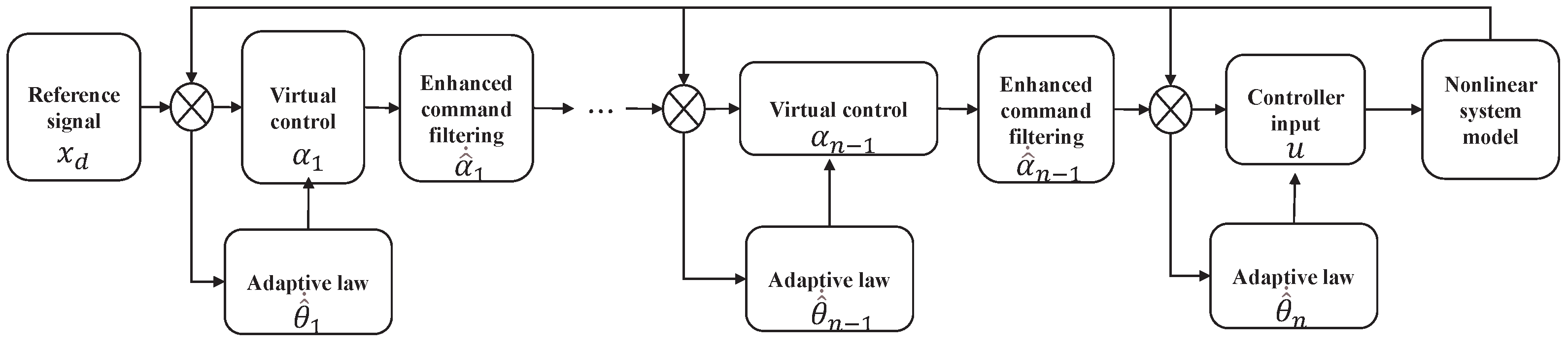
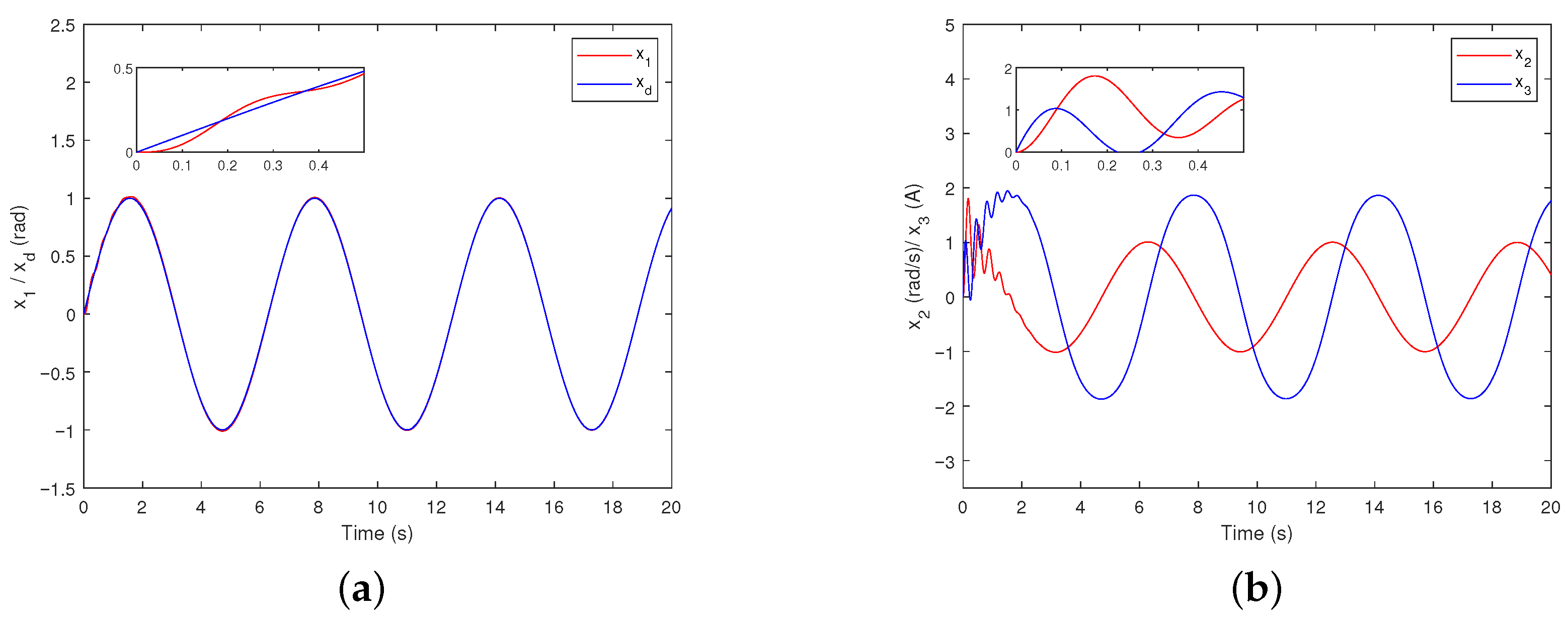
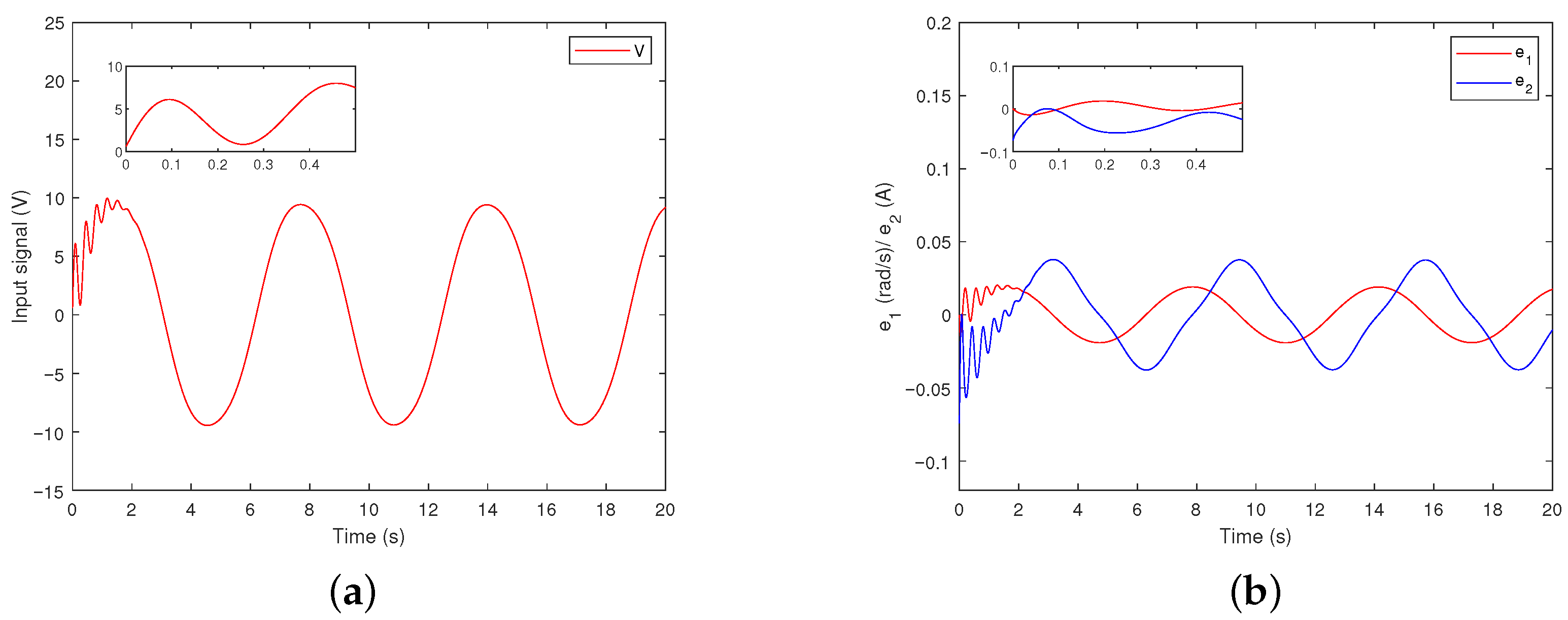
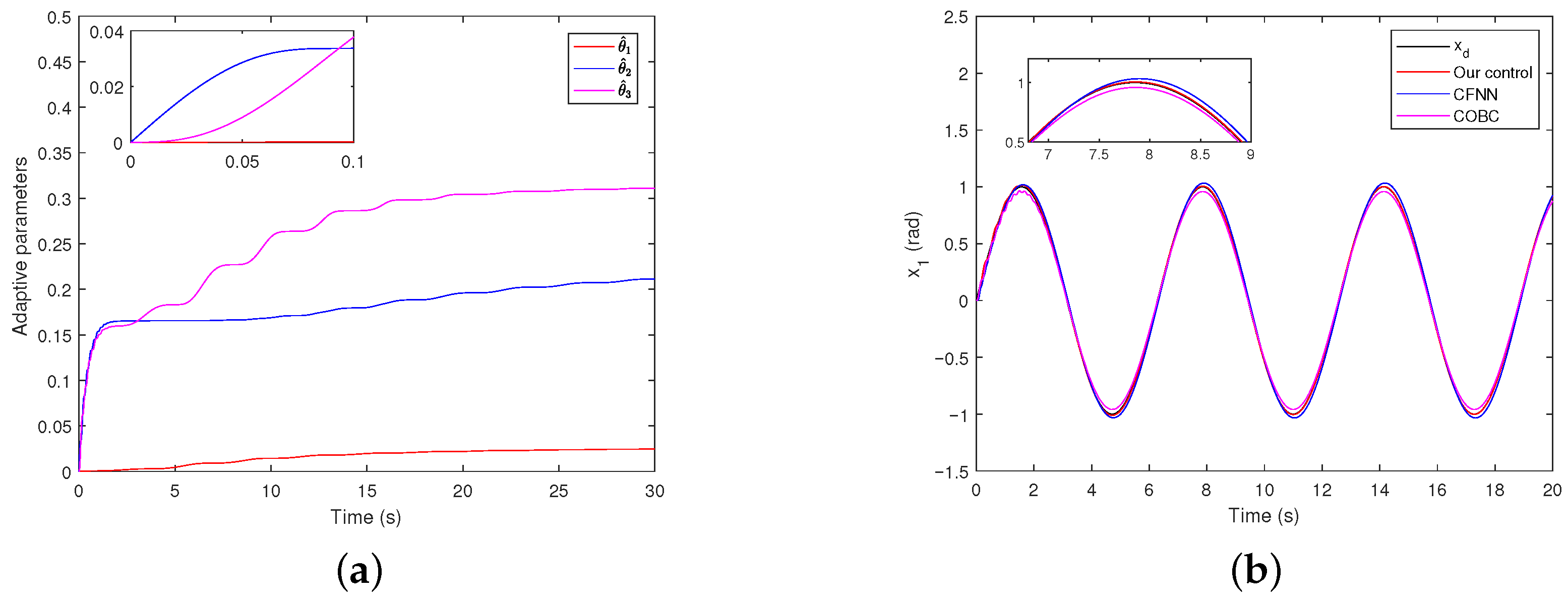
The control block diagram is shown in Figure 1. The system performance under our control strategy is shown in Figure 2. Figure 2a provides the response curve of motor position and Figure 2b shows the curves of q ˙ and τ . The behavior of the input signal is shown in Figure 3a. And the filter errors are shown in Figure 3b. From Figure 3b, it can be seen that the values of α ^ 1 α 1 and α ^ 2 α 2 are all less than 0.1, which confirms that the filter errors converge to the given region. The boundedness of the adaptive parameters is also validated from the curves in Figure 4a. Thus, a good tracking control performance can be guaranteed by using the enhanced command filter and adaptive laws.
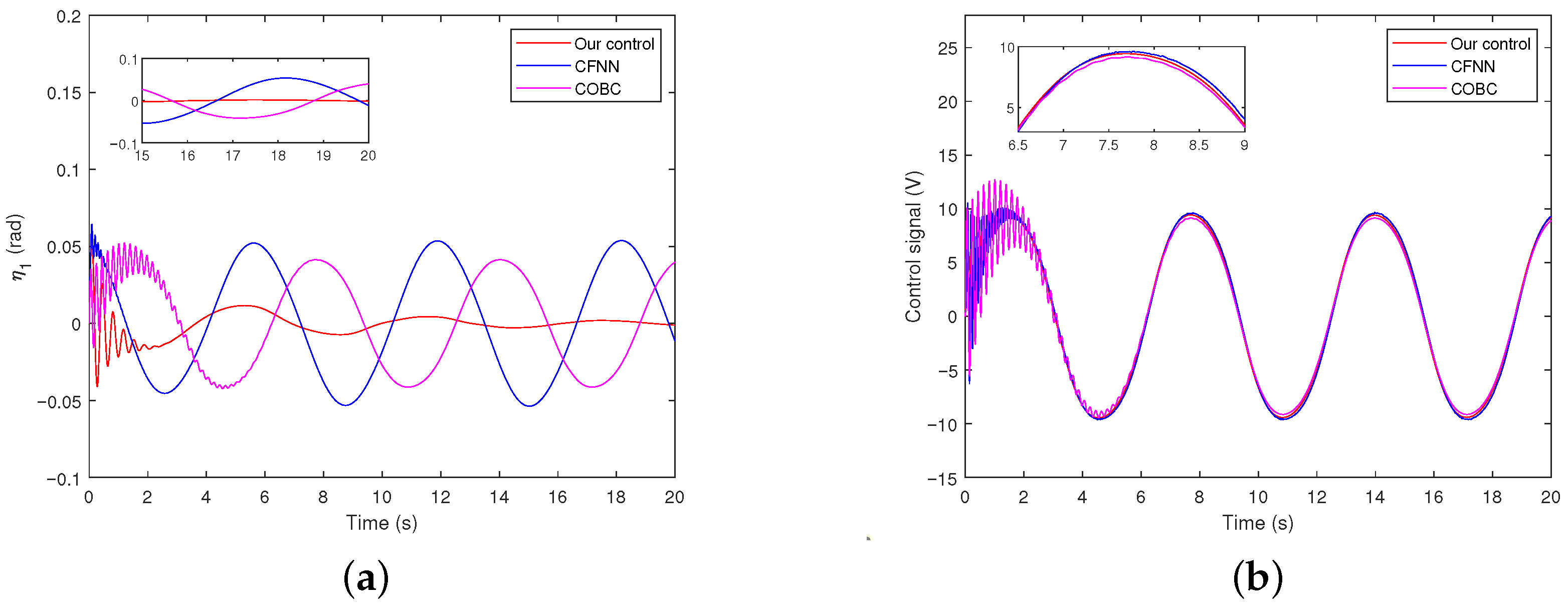
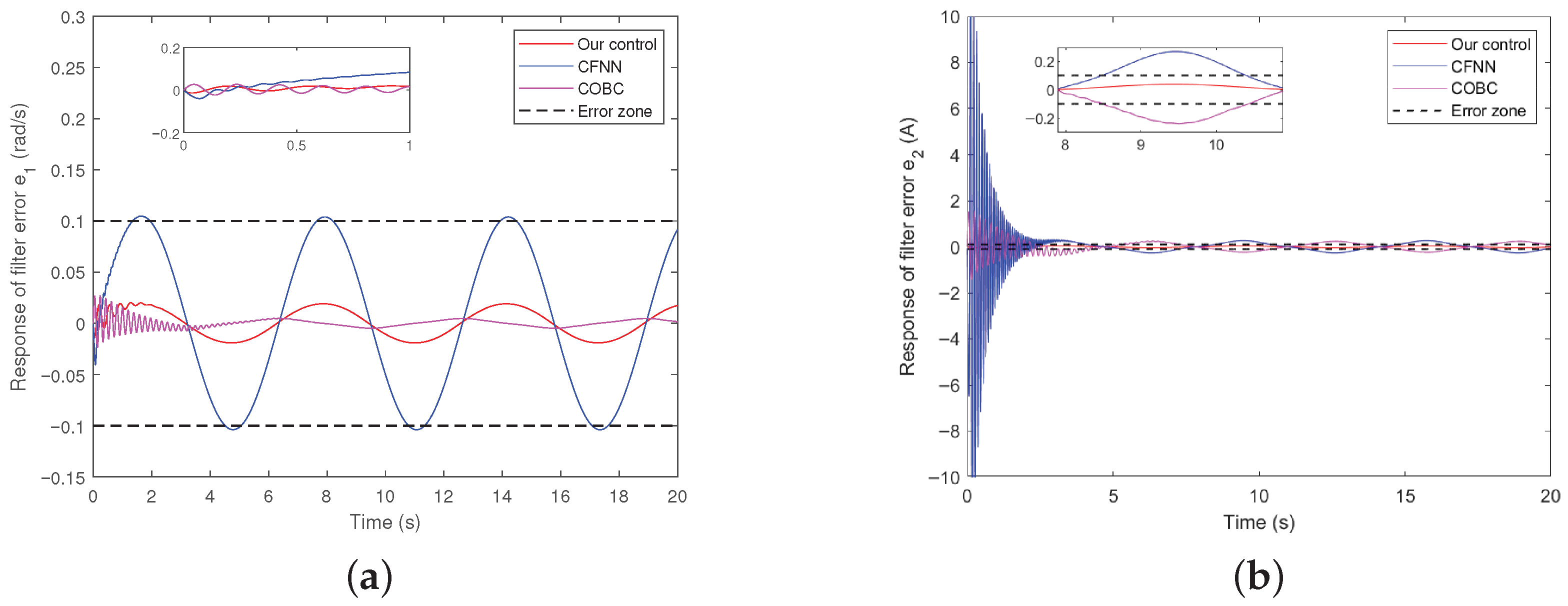
The simulation result from existing controllers, such as convex optimization backstepping control (COBC) [19] and command filtering neural network control (CFNN) [39], is also given in this section to show the advantage of our method. The behavior of x 1 and the curve of the tracking error under different controllers are shown in Figure 4b and Figure 5a, respectively. From Figure 5a, it can be seen that the tracking error decreases rapidly under our controller, but the error curve fluctuates periodically for CFNN and COBC. The main reason is that the asymptotic convergence of the tracking errors cannot always be guaranteed for CFNN and COBC under model uncertainty. The control functions of different control strategies are given in Figure 5b. The performance of filters is shown in Figure 6a,b. Compared with linear high-order command filters, our proposed filter ensures that the filter error is always within the given region. The performance comparison under different control strategies is shown in Table 1. By comparing key parameters of the control system, such as control error η 1 , convergence time (CT) and maximum overshoot (MO), it is evident that the performance of the control strategy proposed in this paper is superior to that of the comparison method.
It is challenging to determine the controller parameters using the Lyapunov stability criteria due to the complex uncertainties and unknown dynamics within the system. As a result, we employ a trial-and-error approach to obtain the appropriate controller parameters. This involves adjusting the values of the control parameters based on the observations from the simulation results to achieve the desired outcomes. For the control gain k i , increasing k i can further accelerate the attenuation speed of η i , but it may lead to an increase in the amplitude of the control input signal, which poses a risk of overshoot. ξ i is positively correlated with the convergence speed of the filter. Increasing ξ i can accelerate the tracking speed of α ^ i to the virtual control signal α i , can reduce filtering delay and may cause oscillation if it is too large. r i determines the learning speed of the adaptive law. The smaller r i , the faster θ ^ ˙ i approaches. If r i is too small, it may also cause oscillations. To clarify this issue, we examine how control parameters affect system performance using the control variable method. In this case, we modify the value of a single control parameter while keeping all other parameters constant. The results of these simulations, conducted with various control parameters, are presented in Table 2. It is challenging to determine the controller parameters using the Lyapunov stability criteria due to the complex uncertainties and unknown dynamics within the system. As a result, we employ a trial-and-error approach to obtain the appropriate controller parameters. This involves adjusting the values of the control parameters based on the observations from the simulation results to achieve the desired outcomes. For the control gain k i , increasing k i can further accelerate the attenuation speed of η i , but it may lead to an increase in the amplitude of the control input signal, which poses a risk of overshoot. ξ i is positively correlated with the convergence speed of the filter. Increasing ξ i can accelerate the tracking speed of α ^ i to the virtual control signal α i , can reduce filtering delay and may cause oscillation if it is too large. r i determines the learning speed of the adaptive law. The smaller r i , the faster θ ^ ˙ i approaches. If r i is too small, it may also cause oscillations. To clarify this issue, we examine how control parameters affect system performance using the control variable method. In this case, we modify the value of a single control parameter while keeping all other parameters constant. The results of these simulations, conducted with various control parameters, are presented in Table 2. It is worth noting that Table 2 presents the system control performance under different ε ( t ) . It can be seen that increasing o will lead to an increase in the initial value of ε ( t ) , thereby increasing the tracking error. Increasing λ will lower the initial value of ε ( t ) , effectively reducing tracking errors.
Remark 6.
The verification results demonstrate that the method proposed in this paper effectively compensates for uncertain dynamics within the system. In comparison to adaptive backstepping control that relies on intelligent control strategies, the proposed method achieves asymptotic convergence of control errors [56,57,58]. The response curve illustrated in Figure 5 shows that the filter introduced in this paper has a stronger ability to manage filtering errors than traditional linear filters. Additionally, since this article does not require a separate subsystem for compensating filtering errors, the control strategy presented here offers lower complexity compared to the methods discussed in the existing literature [25,55].

5.2. Experimental Validation

In this case, the validation results from the PMSM speed control platform are given. By using the Park and Clarke transformations, the dynamic model of the PMSM is derived as
d x 1 d t = 3 2 n p J m L d L q x 3 + ϕ x 2 B J m x 1 + Δ d
d x 2 d t = R s L q x 2 n p L d L q x 1 x 3 n p ϕ L q x 1 + 1 L q u q
d x 3 d t = n p L q L d x 1 x 2 R s L d x 3 + 1 L d u d
where x 1 is the motor speed, x 2 is the current i q and x 3 is the current i d . For more detailed information about motor parameters, refer to [59]. In the system (41)–(43), we use the function Δ d to denote the unknown dynamics caused by the variation in motor parameters. It should be noted that the uncertainty problem also exists in subsystems (42) and (43). However, in order to simplify the structure of our controller, only the uncertainty problem in the speed loop is considered in this section. In the experiment, the experimental model has a maximum deviation of 10% to simulate uncertainty, and it is assumed that Δ d is continuous and bounded.
It should be noted that the control strategy proposed in Section 3 only considers the SISO nonlinear systems. Based on FOC technology, the PMSM model can be decoupled into a q-axis subsystem and d-axis subsystem. Thus, our control method is employed to control the q-axis subsystem, while the traditional PI controller is used for the d-axis subsystem.
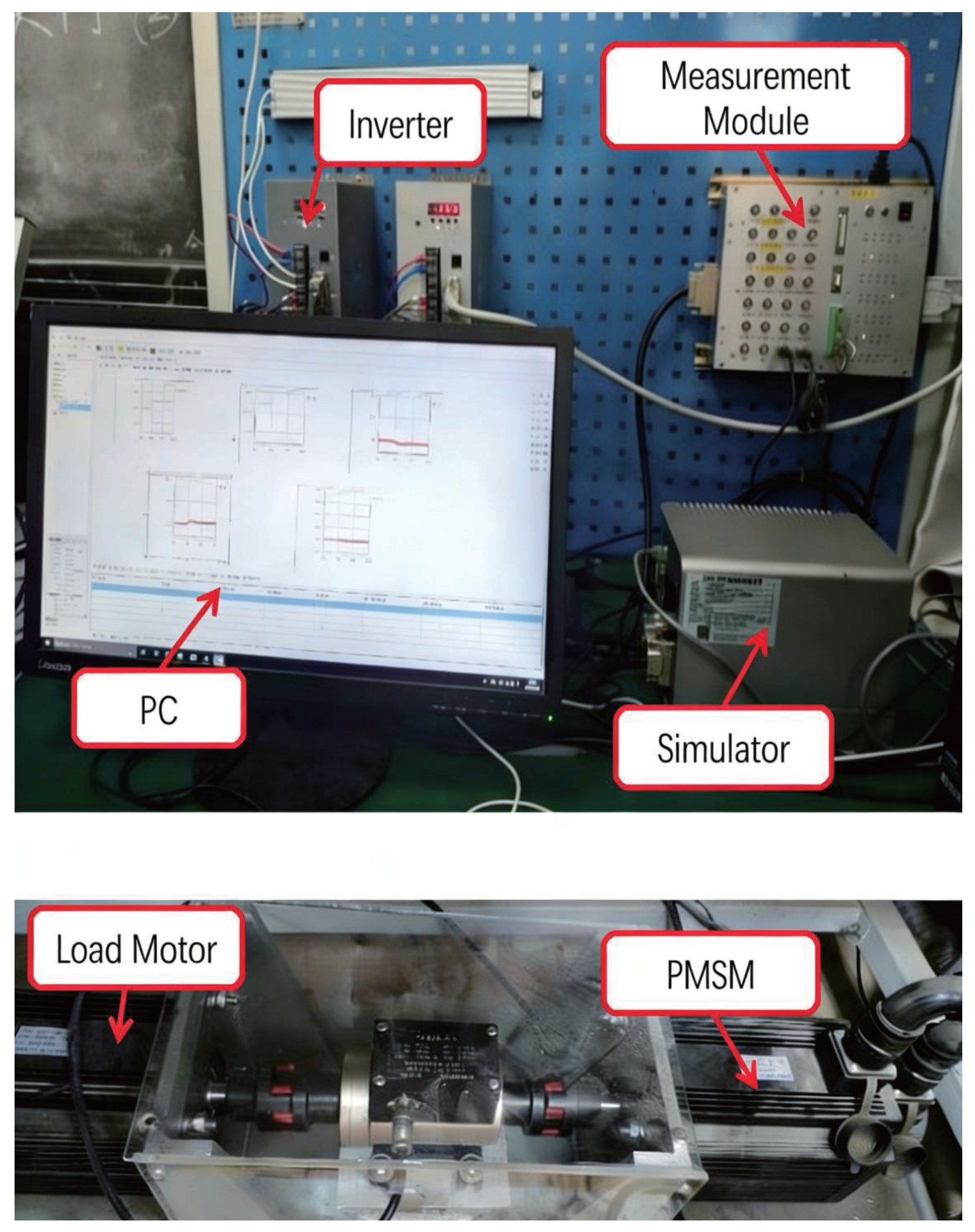
Our method is coded in a hardware-in-loop simulation platform, which is shown in Figure 7. Our control parameters are set to k 1 = k 2 = 10 , w 1 = d 1 = 1 and r = 1 . The sampling frequency is 1 kHz. It should be noted that our controller is implemented in a digital control system. Thus, the adaptive law is modified by incorporating a dead zone in order to turn off the adaptation when the tracking error η 1 < 0.2 .
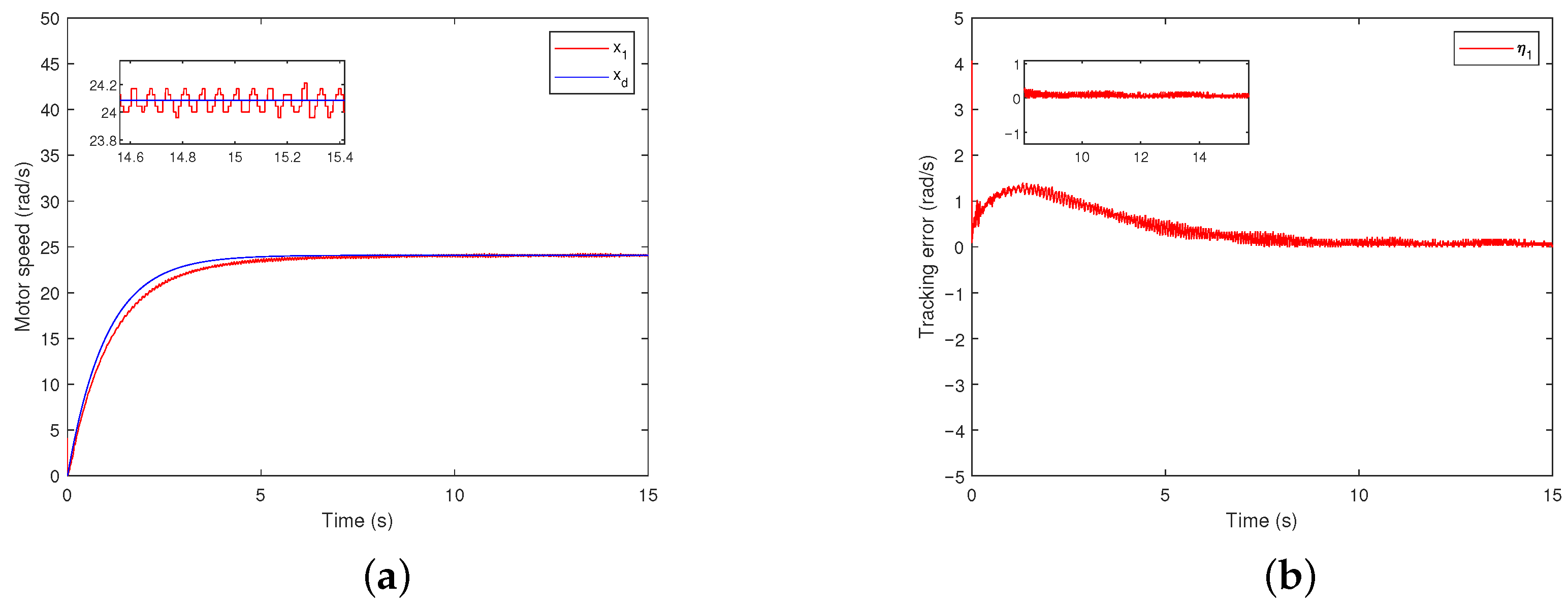
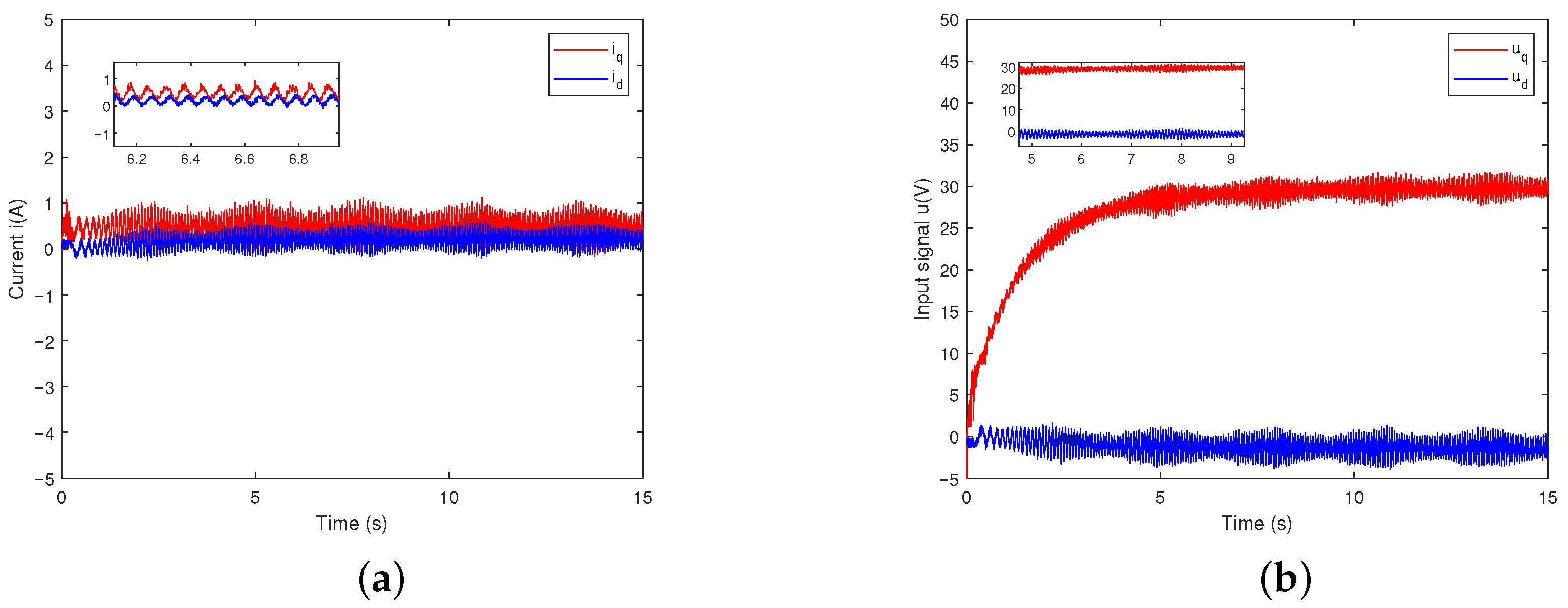
The experimental results are given in Figure 8 and Figure 9. The control performance is shown in Figure 8a. It can be found that the tracking error in the initial time is relatively large due to the influence of the unknown motor load disturbance. The tracking error is shown in Figure 8b. With the on-line adjustment of the adaptive parameters, the tracking error decreases rapidly. The response curves of the motor currents are shown in Figure 9a. Based on the FOC method, the i d * = 0 strategy is used in our controller. Thus, the value of i d fluctuates around 0. The system input signals u d and u q are shown in Figure 9b. It can be seen that our controller can effectively overcome the effect of system uncertainties.

6. Conclusions

In this paper, we develop a novel asymptotic adaptive backstepping control strategy for the nonlinear uncertain system by virtue of the enhanced command filter. Using our new filter and the adaptive control technique, we show that the tracking error of the closed-loop system is asymptotic convergence in the presence of unknown dynamics. Compared with existing command-filtered backstepping controllers, the structure of our controller is simpler and the zero-tracking regulation is obtained. Finally, simulation results are given to validate our controller. In the future, we will use reinforcement learning strategies to further optimize control system parameters for improved performance and explore robot control problems in unknown environments [60,61,62,63].

Author Contributions

Methodology, D.W. and J.L.; Validation, D.W.; Formal analysis, D.W. and J.L.; Resources, J.L.; Writing—original draft, D.W.; Writing—review and editing, J.L.; Visualization, D.W. and J.L.; Project administration, D.W. and J.L.; Funding acquisition, J.L. All authors have read and agreed to the published version of the manuscript.

Funding

This work was supported in part by the National Natural Science Foundation of China under Grant 62303255, in part by the Key R&D Program of Shandong Province, China under Grant 2025CXPT088 and Grant ZR2024ZD06, and in part by the Systems Science Plus Joint Research Program of Qingdao University XT2024202.

Institutional Review Board Statement

No applicable.

Informed Consent Statement

No applicable.

Data Availability Statement

Data are contained within the article.

Conflicts of Interest

The authors declare no conflicts of interest. The funders had no role in the design of the study; in the collection, analyses or interpretation of data; in the writing of the manuscript or in the decision to publish the results.

References

  1. Qiu, J.; Sun, K.; Rudas, I.J.; Gao, H. Command filter-based adaptive NN control for MIMO nonlinear systems with full-state constraints and actuator hysteresis. IEEE Trans. Cybern. 2020, 50, 2905–2915. [Google Scholar] [CrossRef]
  2. Ma, J.; Wang, J.; Xu, S. Command Filtered Adaptive Asymptotic Tracking Control of Nonlinear Systems with Unknown Control Directions via Logic-Based Switching. IEEE Trans. Autom. Sci. Eng. 2025, 22, 2309–2317. [Google Scholar] [CrossRef]
  3. Liu, D.; Liu, J.; Chen, X.; Yu, J. Deep Neural Network-Based Adaptive Control for Unmanned Surface Vehicles with Uncertain Dynamics. IEEE Trans. Ind. Electron. 2025, 1–9. [Google Scholar] [CrossRef]
  4. Cui, G.; Xu, H.; Yu, J.; Lam, H.K. Event-Triggered Distributed Fixed-Time Adaptive Attitude Control with Prescribed Performance for Multiple QUAVs. IEEE Trans. Autom. Sci. Eng. 2024, 21, 4471–4481. [Google Scholar] [CrossRef]
  5. Liu, J.; Wang, Q.G.; Yu, J. Convex Optimization-Based Adaptive Fuzzy Control for Uncertain Nonlinear Systems with Input Saturation Using Command Filtered Backstepping. IEEE Trans. Fuzzy Syst. 2023, 31, 2086–2091. [Google Scholar] [CrossRef]
  6. Zhang, W.; Zhao, L. Command Filtered Backstepping Based Finite-Time Adaptive Fuzzy Event-Triggered Control for Unmanned Aerial Vehicle with Full-State Constraints. IEEE Trans. Veh. Technol. 2025, 74, 10162–10174. [Google Scholar] [CrossRef]
  7. Kong, X.; Xia, Y.; Sun, Z.; Zhai, D.H.; Deng, Y.; Zhang, S. Differential High Order Control Barrier Function-Based Safe Reinforcement Learning. IEEE Rob. Autom. Lett. 2025, 10, 7524–7531. [Google Scholar] [CrossRef]
  8. Ji, C.; Zhang, Z.; Cheng, G.; Kong, M.; Li, R. Decoupled robust backstepping tracking control for variable stiffness actuated robot with input saturation. ISA Trans. 2025, 156, 109–122. [Google Scholar] [CrossRef] [PubMed]
  9. Wu, G.; Huang, Z.; Long, Z.; Huang, F.; Wang, M.-h.; Zhang, X. Motor fault diagnosis method based on spiking convolutional neural network with multi-scale decomposition local features. ISA Trans. 2025, 164, 271–283. [Google Scholar] [CrossRef]
  10. Liu, J.; Dai, B.; Liu, S.; Liu, J.; Li, T. Adaptive Fuzzy Human-in-the-Loop Control for Unmanned Surface Vehicles in Environmental Monitoring Applications. J. Mar. Sci. Eng. 2025, 13, 2270. [Google Scholar] [CrossRef]
  11. Wei, C.; Liu, J.; Liu, D. Adaptive neural network temperature control for thermoelectric refrigeration systems using online self-learning mechanism. Int. J. Refrig. 2026, 183, 379–390. [Google Scholar] [CrossRef]
  12. Niu, B.; Liu, Y.; Zong, G.; Han, Z.; Fu, J. Command filter-based adaptive neural tracking controller design for uncertain switched nonlinear output-constrained systems. IEEE Trans. Cybern. 2017, 47, 3160–3171. [Google Scholar] [CrossRef] [PubMed]
  13. Li, Y.X.; Yang, G.H. Adaptive neural control of pure-feedback nonlinear systems with event-triggered communications. IEEE Trans. Neural Netw. Learn. Syst. 2018, 29, 6242–6251. [Google Scholar] [CrossRef]
  14. Xi, R.; Shen, Z.; Huang, H.; Zhang, H. Command Filtered Adaptive Tracking Consensus of Random Nonlinear Multi-Agent Systems. IEEE Trans. Autom. Sci. Eng. 2024, 22, 8361–8370. [Google Scholar] [CrossRef]
  15. Farrell, J.A.; Polycarpou, M.; Sharma, M.; Dong, W. Command Filtered Backstepping. IEEE Trans. Autom. Control 2009, 54, 1391–1395. [Google Scholar] [CrossRef]
  16. Dong, W.; Farrell, J.A.; Polycarpou, M.M.; Djapic, V.; Sharma, M. Command filtered adaptive backstepping. IEEE Trans. Control Syst. Technol. 2012, 20, 566–580. [Google Scholar] [CrossRef]
  17. Xia, J.; Li, B.; Su, S.; Sun, W.; Shen, H. Finite-time command filtered event-triggered adaptive fuzzy tracking control for stochastic nonlinear systems. IEEE Trans. Fuzzy Syst. 2021, 29, 1815–1825. [Google Scholar] [CrossRef]
  18. Homayoun, B.; Arefi, M.M.; Vafamand, N. Robust adaptive backstepping tracking control of stochastic nonlinear systems with unknown input saturation: A command filter approach. Int. J. Robust. Nonlin. 2020, 30, 3296–3313. [Google Scholar] [CrossRef]
  19. Zheng, X.; Yang, X. Command filter and universal approximator based backstepping control design for strict-feedback nonlinear systems with uncertainty. IEEE Trans. Autom. Control 2020, 65, 1310–1317. [Google Scholar] [CrossRef]
  20. Qiu, J.; Ma, M.; Wang, T. Event-Triggered Adaptive Fuzzy Fault-Tolerant Control for Stochastic Nonlinear Systems via Command Filtering. IEEE Trans. Syst. Man Cybern. Syst. 2022, 52, 1145–1155. [Google Scholar] [CrossRef]
  21. Sui, S.; Liu, Z.; Bi, W.; Tong, S.; Chen, C.L.P. Neural Network Filter Quantized Control for a Class of Nonlinear Systems with Input and State Quantization. IEEE Trans. Autom. Sci. Eng. 2024, 21, 5802–5811. [Google Scholar] [CrossRef]
  22. Dai, K.; Zhu, Z.; Shen, G.; Li, X.; Tang, Y.; Wang, W. Modeling and adaptive tension control of chain transmission system with variable stiffness and random load. IEEE Trans. Ind. Electron. 2022, 69, 8335–8345. [Google Scholar] [CrossRef]
  23. Long, J.; Yu, D.; Wen, G.; Li, L.; Wang, Z.; Chen, C.L.P. Game-Based Backstepping Design for Strict-Feedback Nonlinear Multi-Agent Systems Based on Reinforcement Learning. IEEE Trans. Neural Netw. Learn. Syst. 2024, 35, 817–830. [Google Scholar] [CrossRef]
  24. Liu, J.; Wang, Q.G.; Yu, J. Command-Filter-Approximator-Based Adaptive Control for Uncertain Nonlinear Systems and Its Application in PMSMs. IEEE Trans. Syst. Man Cybern. Syst. 2023, 53, 6828–6835. [Google Scholar] [CrossRef]
  25. van Zanten, S.; Zee, R.A.R.v.d.; Nauta, B. A Capacitive Stacking Mixer-First Receiver with Higher Order Capacitive Feedback. IEEE J. Solid-State Circuits 2025, 60, 3148–3163. [Google Scholar] [CrossRef]
  26. Barretta, C.; Macher, A.E.; Köntges, M.; Ascencio-Vásquez, J.; Topič, M.; Oreski, G. Effect of Encapsulant Degradation on Photovoltaic Modules Performances Installed in Different Climates. IEEE J. Photovoltaics 2025, 15, 290–296. [Google Scholar] [CrossRef]
  27. Liu, D.; Liu, J.; Yu, J.; Sun, C. Adaptive neural network-based obstacle avoidance control for USVs with uncertain dynamics. Ocean Eng. 2025, 332, 121390. [Google Scholar] [CrossRef]
  28. Hu, J.; Zhang, H. Immersion and invariance based command-filtered adaptive backstepping control of VTOL vehicles. Automatica 2013, 49, 2160–2167. [Google Scholar] [CrossRef]
  29. Ren, S.; Feng, Y.; Wang, H.; Zhu, X.; Sang, C.; Hu, Q. Command filtered backstepping control with nonlinear disturbance observer for multi-posture lower limb rehabilitation robot. J. Vib. Control 2025, 1–18. [Google Scholar] [CrossRef]
  30. Liu, B.; Liu, J.; Yu, J. Finite-time command-filtered autonomous docking control of underactuated unmanned surface vehicles with obstacle avoidance. ISA Trans. 2025, 164, 116–124. [Google Scholar] [CrossRef] [PubMed]
  31. Li, Y. Command filter adaptive asymptotic tracking of uncertain nonlinear systems with time-varying parameters and disturbances. IEEE Trans. Autom. Control 2022, 67, 2973–2980. [Google Scholar] [CrossRef]
  32. Wang, L.; Sun, W.; Su, S.F. Adaptive asymptotic tracking control for nonlinear systems with state constraints and input saturation. Appl. Math. Comput. 2022, 431, 127342. [Google Scholar] [CrossRef]
  33. Xu, K.; Wang, H.; Liu, P.X. Singularity-Free Adaptive Fixed-Time Tracking Control for MIMO Nonlinear Systems with Dynamic Uncertainties. IEEE Trans. Circuits Syst. II-Express Briefs 2024, 71, 1356–1360. [Google Scholar] [CrossRef]
  34. Wrat, G.; Bhola, M.; Ranjan, P.; Mishra, S.K.; Das, J. Energy saving and Fuzzy-PID position control of electro-hydraulic system by leakage compensation through proportional flow control valve. ISA Trans. 2020, 101, 269–280. [Google Scholar] [CrossRef]
  35. Li, Y.; Qu, F.; Tong, S. Observer-Based Fuzzy Adaptive Finite-Time Containment Control of Nonlinear Multiagent Systems with Input Delay. IEEE Trans. Cybern. 2021, 51, 126–137. [Google Scholar] [CrossRef] [PubMed]
  36. Sun, Y.; Gao, C.; Yang, Y.; Wu, L. High-gain fuzzy observer based quantized input control for uncertain nonlinear systems with sensor and actuator failures. ISA Trans. 2025, 167, 407–418. [Google Scholar] [CrossRef]
  37. Yu, J.; Zhao, L.; Yu, H.; Lin, C.; Dong, W. Fuzzy finite-time command filtered control of nonlinear systems with input saturation. IEEE Trans. Cybern. 2018, 48, 2378–2387. [Google Scholar] [CrossRef] [PubMed]
  38. Cui, G.; Yu, J.; Wang, Q.G. Finite-time adaptive fuzzy control for MIMO nonlinear systems with input saturation via improved command-filtered backstepping. IEEE Trans. Syst. Man Cybern. Syst. 2022, 52, 980–989. [Google Scholar] [CrossRef]
  39. Yu, J.; Shi, P.; Lin, C.; Yu, H. Adaptive neural command filtering control for nonlinear MIMO systems with saturation input and unknown control direction. IEEE Trans. Cybern. 2020, 50, 2536–2545. [Google Scholar] [CrossRef]
  40. Li, Y.; Li, Z.; Yu, X.; Zheng, X.; Yang, X.; Yang, Y. Attitude Tracking Control for Quadrotors Under Unknown Disturbances Based on Dual-Loop Nonlinear Command Filters. IEEE Trans. Circuits Syst. II Exp. Briefs 2024, 71, 2769–2773. [Google Scholar] [CrossRef]
  41. Liu, D.; Liu, J.; Sun, C.; Dai, B. Convex Optimization-Based Adaptive Neural Network Control for Unmanned Surface Vehicles Considering Moving Obstacles. J. Mar. Sci. Eng. 2025, 13, 587. [Google Scholar] [CrossRef]
  42. Li, Y.; Dong, S.; Li, K. Command Filter Adaptive Fuzzy Formation Asymptotic Tracking Control for Nonholonomic Multirobot Systems with Multiple Constraints. IEEE Trans. Syst. Man Cybern. Syst. 2024, 54, 1936–1947. [Google Scholar] [CrossRef]
  43. Yan, L.; Mo, L.; Liu, Z.; Kao, Y.; Zhu, Q. Adaptive fuzzy finite-time control of robotic manipulator: A command filter-based sliding mode approach. Int. J. Syst. 2025, 1–14. [Google Scholar] [CrossRef]
  44. Zheng, X.; Yu, X.; Yang, X.; Rodriguez-Andina, J.J. Practical finite-time command-filtered adaptive backstepping with its applications to quadrotor hovers. IEEE Trans. Cybern. 2024, 54, 3017–3029. [Google Scholar] [CrossRef] [PubMed]
  45. Xu, W.; Liu, J.; Yu, J.; Han, Y. Low complexity adaptive neural network three-dimensional tracking control for autonomous underwater vehicles considering uncertain dynamics. Eng. Appl. Artif. Intell. 2025, 142, 1098A60. [Google Scholar] [CrossRef]
  46. Jin, X. Adaptive fixed-time control for MIMO nonlinear systems with asymmetric output constraints using universal barrier functions. IEEE Trans. Autom. Control 2019, 64, 3046–3053. [Google Scholar] [CrossRef]
  47. Li, Y.; Zheng, X.; Li, K. Time-Domain Mapping-Based Adaptive Fuzzy Formation Control of Nonlinear Multi-Agent Systems with Input Saturation. IEEE Trans. Fuzzy Syst. 2024, 32, 1848–1861. [Google Scholar] [CrossRef]
  48. Yu, J.; Zhao, L.; Yu, H.; Lin, C. Barrier Lyapunov functions-based command filtered output feedback control for full-state constrained nonlinear systems. Automatica 2019, 105, 71–79. [Google Scholar] [CrossRef]
  49. Niu, S.; Wang, J.; Zhao, J.; Shen, W. Neural network-based finite-time command-filtered adaptive backstepping control of electro-hydraulic servo system with a three-stage valve. ISA Trans. 2024, 144, 419–435. [Google Scholar] [CrossRef]
  50. Ren, B.; Ge, S.S.; Tee, K.P.; Lee, T.H. Adaptive Neural Control for Output Feedback Nonlinear Systems Using a Barrier Lyapunov Function. IEEE Trans. Neural Netw. 2010, 21, 1339–1345. [Google Scholar] [CrossRef]
  51. Niu, B.; Yan, B.; Zhao, X.; Zhang, B.; Zhao, T.; Liu, X. Event-Triggered Adaptive Command Filtered Bipartite Finite-Time Tracking Control of Nonlinear Coopetition MASs with Time-Varying Disturbances. IEEE Trans. Autom. Sci. Eng. 2024, 21, 4482–4494. [Google Scholar] [CrossRef]
  52. Shi, X.N.; Zhou, Z.G.; Zhou, D.; Li, R. Event-Triggered Fixed-Time Adaptive Trajectory Tracking for a Class of Uncertain Nonlinear Systems with Input Saturation. IEEE Trans. Circuits Syst. II 2021, 68, 983–987. [Google Scholar] [CrossRef]
  53. Gao, H.; Wang, J.; Xia, Y.; Zhang, J.; Cui, B. Fixed-Time Neuroadaptive Backstepping Tracking Control for Uncertain Nonlinear Systems with Predictor Based Learning. IEEE Trans. Autom. Sci. Eng. 2025, 22, 3147–3159. [Google Scholar] [CrossRef]
  54. Li, H.; Li, Z.; Song, F.; Yu, X.; Yang, X.; Rodríguez-Andina, J.J. Finite-Time Fast Adaptive Backstepping Attitude Control for Aerial Manipulators Based on Variable Coupling Disturbance Compensation. IEEE Trans. Ind. Electron. 2024, 71, 14730–14739. [Google Scholar] [CrossRef]
  55. Xia, Y.; Liu, Y.; Sun, W. Prescribed-time adaptive event-triggered control for robot manipulators based on command filtering. ISA Trans. 2025, 163, 1–8. [Google Scholar] [CrossRef] [PubMed]
  56. Fang, L.; Shen, H.; Wang, H.; Song, T. A novel prescribed-time H∞ robust backstepping control algorithm of strict-feedback uncertain nonlinear systems based on fuzzy approximation. ISA Trans. 2025, 167, 394–406. [Google Scholar] [CrossRef] [PubMed]
  57. Xu, K.; Wang, H.; Liu, P.X. Adaptive Fixed-Time Control for High-Order Stochastic Nonlinear Time-Delay Systems: An Improved Lyapunov–Krasovskii Function. IEEE Trans. Cybern. 2024, 54, 776–786. [Google Scholar] [CrossRef]
  58. Tong, S.; Sun, K.; Sui, S. Observer-Based Adaptive Fuzzy Decentralized Optimal Control Design for Strict-Feedback Nonlinear Large-Scale Systems. IEEE Trans. Fuzzy Syst. 2018, 26, 569–584. [Google Scholar] [CrossRef]
  59. Han, Y.; Gong, C.; Ma, Z.; Liu, C.; Li, W.; Chen, G. Precise Cumulative Error Calibration With Delay Effects Rejected for Incremental Encoders Used in High-Speed PMSMs. IEEE Trans. Ind. Electron. 2022, 69, 9667–9672. [Google Scholar] [CrossRef]
  60. Wang, J.Q.; Song, L.; Shen, J.; Yong, B.; Han, X.; Jiang, Y.; Raoufi, M.; Zhou, Q. Physics-informed continuous-time reinforcement learning with data-driven approach for robotic arm manipulation. J. Ind. Inf. Integr. 2026, 49, 101008. [Google Scholar] [CrossRef]
  61. Bataduwaarachchi, S.D.; Najdovski, Z.; Trinh, H.; Lim, C.P.; Huynh, V.T. Deterministic delay-aware reinforcement learning. Robot. Auton. Syst. 2026, 197, 105271. [Google Scholar] [CrossRef]
  62. Hazem, Z.B.; Saidi, F.; Guler, N.; Altaif, A.H. A Hybrid Reinforcement Learning Framework Combining TD3 and PID Control for Robust Trajectory Tracking of a 5-DOF Robotic Arm. Automation 2025, 6, 56. [Google Scholar] [CrossRef]
  63. Xing, X.; Burdet, E.; Si, W.; Yang, C.; Li, Y. Impedance Learning for Human-Guided Robots in Contact with Unknown Environments. IEEE Trans. Robot. 2023, 39, 3705–3721. [Google Scholar] [CrossRef]
Figure 1. Control block diagram.
Electronics 15 00470 g001
Figure 2. (a) Curve of x 1 ; (b) curves of x 2 and x 3 .
Electronics 15 00470 g002
Figure 3. (a) Curve of V; (b) curves of filter errors.
Electronics 15 00470 g003
Figure 4. (a) Response curve of adaptive parameters; (b) system performance under different controllers.
Electronics 15 00470 g004
Figure 5. (a) Tracking errors under different controllers; (b) different control signals.
Electronics 15 00470 g005
Figure 6. (a) Response curves of e 1 under different controllers; (b) response curves of e 2 under different controllers.
Electronics 15 00470 g006
Figure 7. PMSM speed control platform.
Electronics 15 00470 g007
Figure 8. (a) Control performance; (b) tracking error.
Electronics 15 00470 g008
Figure 9. (a) Response curve of motor current; (b) system input signals.
Electronics 15 00470 g009
Table 1. System performance comparison under different control methods.
ParameterCFNNCOBCOUR CONTROL
MSE ( η 1 )0.03260.02780.0027
MSE ( e 1 )0.06510.00310.0124
MSE ( e 2 )0.38750.16130.0214
C T 0.22 s1.41 s0.11 s
M O 0.06430.05220.0543
Table 2. System performance under different control parameters.
Parameter η 1 e 1 e 2
k i k 1 = k 2 = k 3 = 1 0.0052 0.0124 0.0215
k 1 = k 2 = k 3 = 1.1 0.0051 0.0124 0.0216
k 1 = k 2 = k 3 = 1.2 0.0049 0.0124 0.0216
ξ i ξ 1 = ξ 2 = 1 0.0052 0.0124 0.0215
ξ 1 = ξ 2 = 5 0.005 0.0115 0.0203
ξ 1 = ξ 2 = 10 0.0048 0.0106 0.0188
r i r 1 = r 2 = r 3 = 1 0.0052 0.0124 0.0215
r 1 = r 2 = r 3 = 2 0.0058 0.0122 0.022
r 1 = r 2 = r 3 = 3 0.0061 0.0121 0.0221
o o = 1 0.0052 0.0124 0.0215
o = 2 0.0064 0.0157 0.034
o = 3 0.0071 0.0179 0.048
λ λ = 1 0.0052 0.0124 0.0215
λ = 2 0.005 0.0123 0.0214
λ = 3 0.0049 0.0123 0.0213
Disclaimer/Publisher’s Note: The statements, opinions and data contained in all publications are solely those of the individual author(s) and contributor(s) and not of MDPI and/or the editor(s). MDPI and/or the editor(s) disclaim responsibility for any injury to people or property resulting from any ideas, methods, instructions or products referred to in the content.