Article

Enhancing Adversarial Policy Learning via Value-Based Reward Shaping

1
Rocket Force Engineering University, Xi’an 710025, China
2
Northwestern Polytechnical University, Xi’an 710072, China
3
Southwestern University of Finance and Economics, Chengdu 611130, China
*
Author to whom correspondence should be addressed.
Electronics 2026, 15(2), 463; https://doi.org/10.3390/electronics15020463

Submission received: 21 December 2025 / Revised: 16 January 2026 / Accepted: 17 January 2026 / Published: 21 January 2026

Abstract

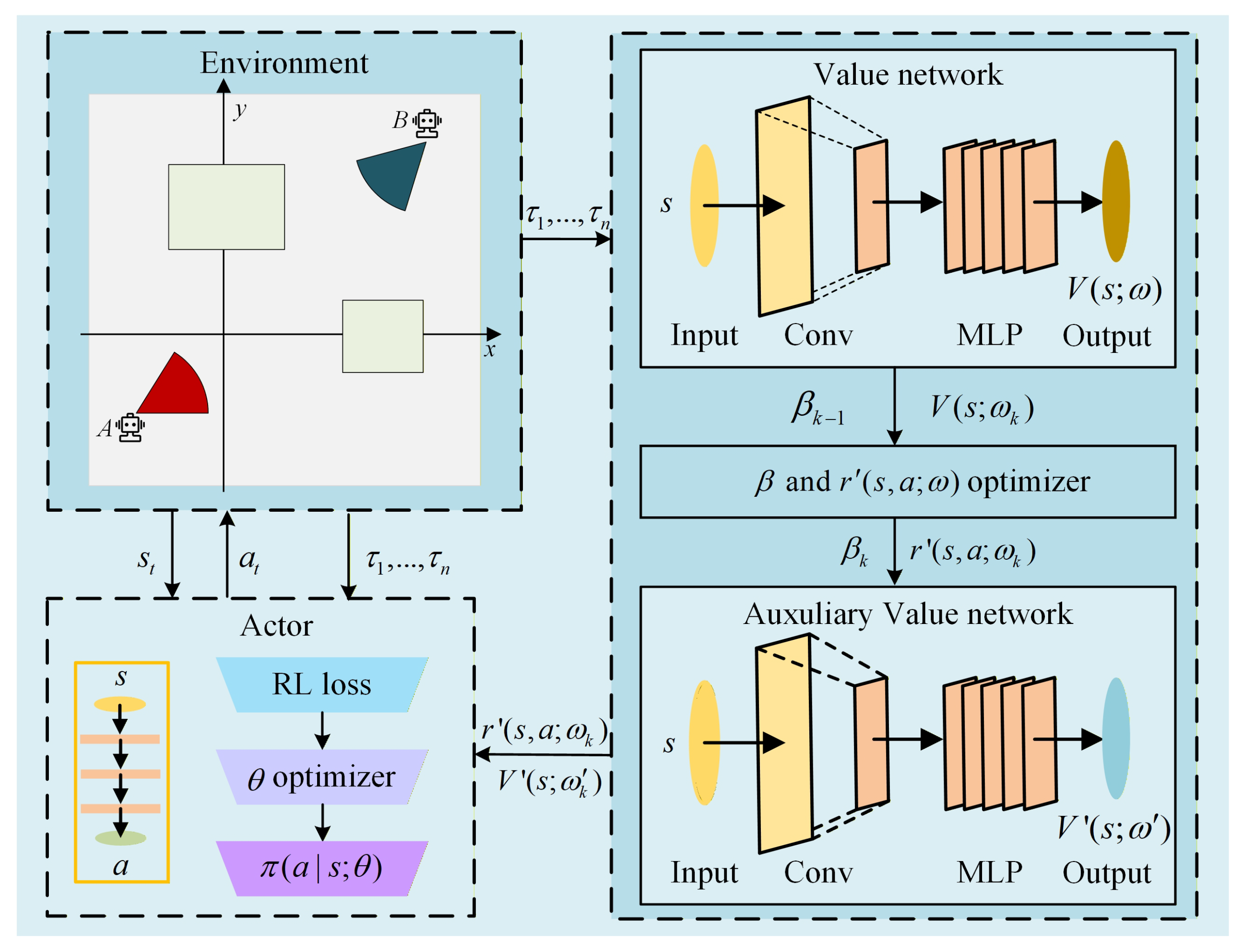
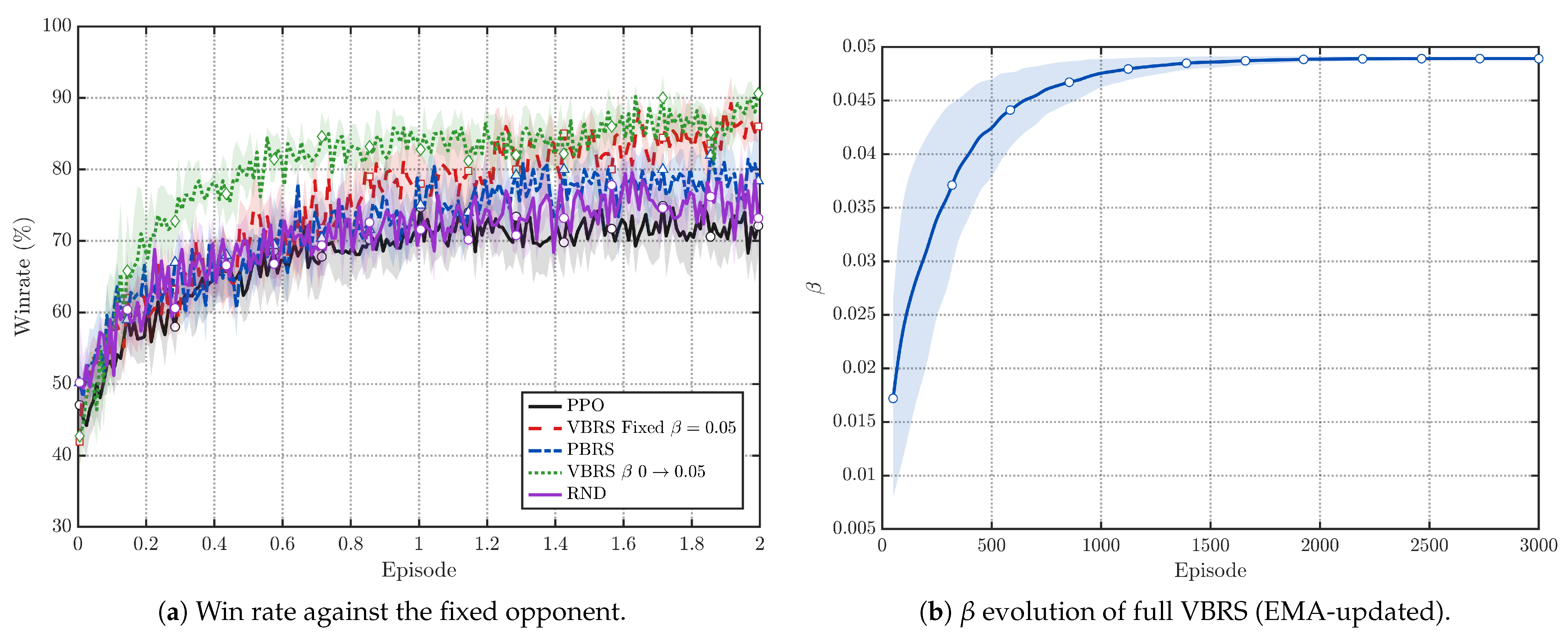
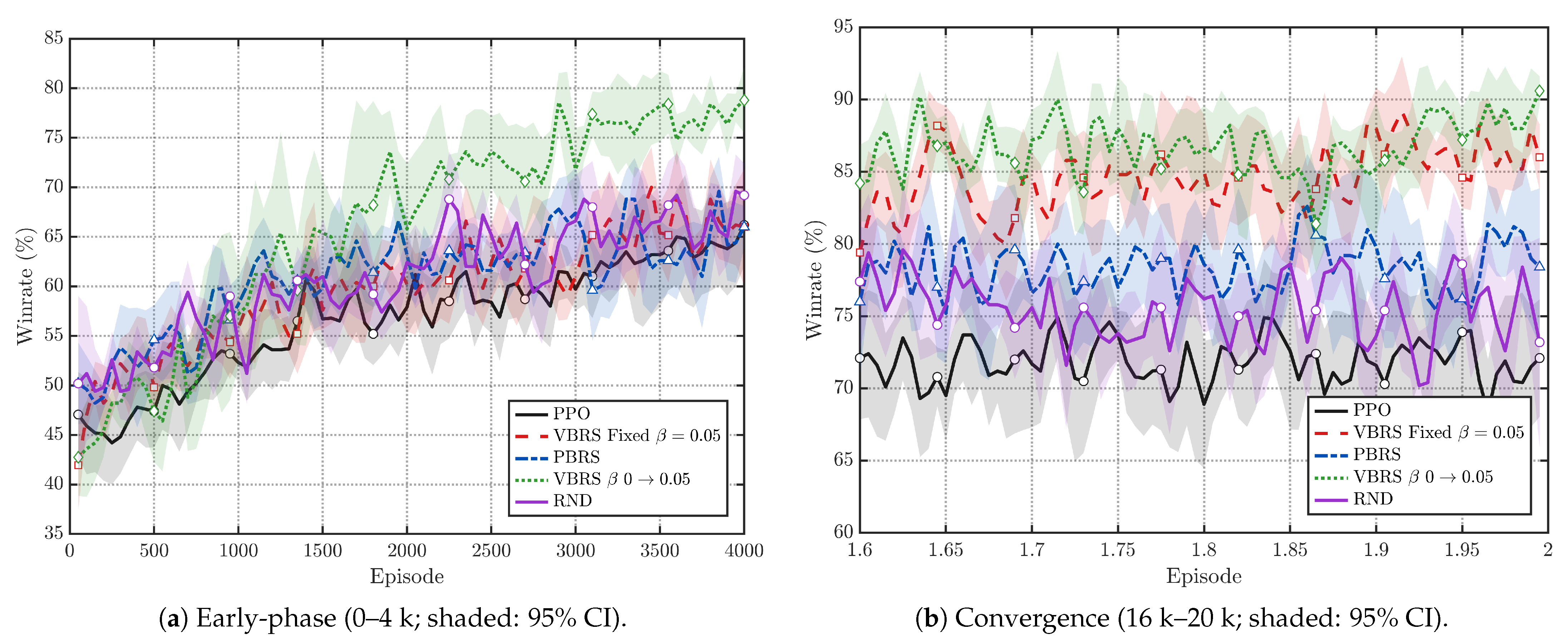
In adversarial reinforcement learning, designing dense reward functions is a traditional approach to address the sparsity of adversarial objectives. However, conventional reward design often relies on high-quality domain knowledge and may fail in practice, thereby inducing objective misalignment—a discrepancy between optimizing the designed reward and achieving the true adversarial utility. To reduce this discrepancy, a Value-Based Reward Shaping (VBRS) framework is proposed. VBRS integrates an intrinsic state-value estimate, which is a dynamic predictor of long-term utility, into the immediate reward function. As a result, exploration can be encouraged toward states predicted to be strategically advantageous, potentially avoiding some local optima in practice. Experiments demonstrate that VBRS outperforms a baseline that relies solely on the original reward function. The results confirm that the proposed method enhances adversarial performance and helps bridge the gap between designed reward guidance and the adversarial objective.
Keywords: reinforcement learning; adversarial reinforcement learning; reward shaping reinforcement learning; adversarial reinforcement learning; reward shaping