1. Introduction
Neural style transfer (NST) has gained significant attention due to its ability to synthesize visually compelling images by combining the structural content of one image with the artistic appearance of another [
1,
2,
3,
4,
5,
6,
7,
8,
9]. Early and widely adopted methods such as AdaIN [
7] and WCT [
10] support arbitrary style transfer by aligning feature statistics between content and style images. Despite their flexibility and efficiency, these approaches often struggle with fine-grained content preservation and are prone to distortion and style leakage, particularly in complex scenes or cross-domain stylization.
To address these challenges, several studies have explored alternative architectures and optimization strategies. Among them, reversible and flow-based models [
11] have emerged as a promising direction due to their inherent invertibility and information-preserving properties. ArtFlow [
8], for example, employs a reversible image transformation framework to mitigate content distortion by reconstructing stylized features through inverse mapping. ArtFlow effectively reduces structural distortion and leakage compared to conventional encoder–decoder or statistic-based methods. However, its use of fixed normalization parameters limits adaptability to diverse content–style pairs, particularly in scenarios with highly varied structures or artistic styles.
More broadly, the use of static normalization parameters is a common limitation across many style transfer frameworks. Fixed designs reduce the ability to adapt dynamically to varying style intensities, structural complexity, or domain shifts—motivating the need for a more flexible normalization mechanism that preserves reversibility.
Recent advances also explore new paradigms for improving generalization and efficiency. For instance, Wei [
1] employs a CycleGAN-based structure to stylize artworks more realistically, while Gim et al. [
2] introduce a training-free content-adaptive strategy using vector-quantized autoencoders. Tu et al. [
4] propose a split-and-transform approach to improve content preservation. However, most recent methods still rely on non-reversible designs or lack interpretability in stylization control.
While recent generative models such as diffusion and large vision–language frameworks demonstrate strong stylization abilities, they often operate as black-box systems, lacking interpretability and requiring substantial computational resources. In contrast, reversible architectures like ISTMAF offer explicit control, lower complexity, and precise content preservation. These characteristics make them better suited for specialized domains such as embedded vision systems, low-power edge computing, and style transfer tasks with explainability or reconstruction demands.
In this work, we propose ISTMAF (Image Style Transfer based on Meta ArtFlow), an enhanced reversible architecture that integrates meta-learning-based normalization. Specifically, we replace the fixed ActNorm in ArtFlow with Meta ActNorm, which dynamically generates scale and bias parameters conditioned on the input content and style images [
12]. This modification allows ISTMAF to adapt to varied content and style combinations more effectively than ArtFlow, particularly in challenging cross-domain stylization scenarios. Additionally, we introduce an algebraic–geometric parameter fusion mechanism in the reverse process to improve content–style balance, and adopt a hierarchical aligned style loss [
9] to reduce artifacts and enhance consistency across layers.
The main contributions of this work are summarized as follows:
Meta ActNorm module: We design a meta-network to generate input-specific normalization parameters, enhancing adaptability across diverse content–style pairs.
Algebraic–geometric parameter fusion: A novel strategy is proposed to fuse content and style parameters during the reverse process, effectively mitigating content leaking and improving reconstruction fidelity.
Hierarchical aligned style loss: We extend the hierarchical loss function [
9] to style transfer, reducing ghosting artifacts and improving the quality of stylization.
Comprehensive evaluation: Extensive experiments on COCO [
13], WikiArt [
14], and face datasets [
15,
16] show that ISTMAF achieves superior performance in both content preservation (SSIM [
17]) and style consistency (Gram difference [
5]) compared to state-of-the-art methods.
2. Related Work
Image style transfer has developed along several major directions, each focusing on balancing content preservation and stylization quality. In this section, we categorize related literature into four representative groups: arbitrary style transfer, GAN-based stylization, flow-based reversible frameworks, and adaptive normalization techniques. This structured overview helps highlight common limitations in current methods and motivates the design of our proposed model.
2.1. Arbitrary Style Transfer via Statistic Matching
Early methods such as AdaIN [
7] and WCT [
10] introduced efficient and flexible style transfer by aligning content and style feature statistics in the latent space. AdaIN performs per-channel normalization using style mean and variance, enabling arbitrary style transfer in real time. WCT and its variants (e.g., LinearWCT [
18], OptimalWCT [
19]) extend this by applying whitening and coloring transforms to better match second-order statistics. While successful in speed and generality, these approaches often suffer from content distortion, style leakage, and poor adaptation to cross-domain or high-resolution settings.
Recent works such as CLAST [
20] employ contrastive learning to enhance style–content separability in feature space, leading to improved stylization quality and representation robustness. However, these models still operate in feedforward architectures without reversible mappings or exact reconstruction capabilities.
2.2. GAN-Based Style Transfer
Generative adversarial networks (GANs) have been extensively applied to style transfer tasks, especially for improving visual realism and domain adaptation. CycleGAN [
6], StarGAN [
21], and MUNIT [
22] represent key approaches that achieve unpaired image-to-image translation with adversarial supervision and domain conditioning. While GANs produce vivid stylizations, they often lack explicit mechanisms for content preservation, and their training instability may lead to mode collapse or artifacts.
Recent extensions such as StarGAN v2 [
23] improve style controllability and diversity through reference-guided generation, while Wei [
1] demonstrates stylistic realism by fine-tuning CycleGAN structures for artistic content. More recently, UniStyleDiff [
24] introduces a unified framework for both image and video style transfer using diffusion models, demonstrating strong performance across modalities. However, these GAN- or diffusion-based methods often lack exact invertibility and do not explicitly address reconstruction fidelity, making them less interpretable or controllable compared to flow-based solutions like ours.
2.3. Flow-Based and Reversible Models
Flow-based models offer invertible mappings between image and feature space, enabling exact likelihood estimation and bidirectional transformation [
11]. Glow [
11] is a representative architecture in this domain, combining ActNorm, invertible 1 × 1 convolutions, and additive coupling layers. These models retain all input information and support image reconstruction and manipulation through latent interpolation. ArtFlow [
8] extends Glow for image style transfer, embedding stylization modules such as WCT or AdaIN within a reversible framework. This structure mitigates content leaking by enabling consistent forward and backward transformation. However, ArtFlow uses fixed normalization parameters across all inputs, limiting adaptability to diverse content–style pairs. As a result, the system struggles in scenarios with complex structures or varied domain distributions. To improve upon these limitations, CAP-VSTNet [
25] proposes content affinity-preserved reversible residual blocks for better structure preservation during stylization, though it does not incorporate dynamic normalization. Our ISTMAF builds on this line of work by embedding meta-learned, input-adaptive normalization within a reversible structure, enhancing both expressiveness and fidelity.
2.4. Adaptive Normalization and Meta-Learning
Adaptive normalization plays a central role in improving the flexibility of style transfer systems. Instance Normalization (IN) [
26] removes instance-specific contrast and has been found essential for stylization. AdaIN [
7] builds on this by matching content features to the style’s global statistics. However, both rely on hand-crafted or static designs, which lack adaptability to varying content–style characteristics.
To enhance input awareness, more recent approaches explore conditional normalization and meta-learning. Inspired by techniques such as Feature-wise Linear Modulation (FiLM) [
27] and Conditional Batch Normalization, several methods use auxiliary networks to dynamically predict affine parameters for normalization based on conditioning inputs.
Meta-learning has further advanced this capability by enabling fast generalization to unseen styles or content distributions. For instance, Meta-AdaIN generates normalization parameters from meta-learned priors. In this context, we propose Meta ActNorm, a meta-network that generates scale and bias parameters conditioned on both content and style images. By embedding Meta ActNorm into a reversible architecture, our method retains the advantages of invertibility while improving adaptation and stability during stylization.
Other recent efforts such as Tu et al. [
4] propose a split-and-transform scheme, where content structure and stylistic texture are disentangled and processed through separate branches before fusion. Similarly, Gim et al. [
2] propose a training-free, content-adaptive approach using VQ-based autoencoders.
Notably, StyleDiffusion [
28] explores controllable disentangled style transfer through diffusion models, showing promising results in stylization flexibility. However, like other diffusion-based approaches, it lacks reversible designs and does not guarantee exact reconstruction. Our proposed ISTMAF bridges this gap by combining meta-learning with invertible flow-based architectures, achieving robust, adaptive, and interpretable style transfer.
3. The Proposed Method
This paper improves the ArtFlow style transfer architecture by replacing the ActNorm transformation in the flow network with a meta network version, referred to as Meta ActNorm, which can generate input-specific parameters based on different images, significantly enhancing the adaptability of style transfer. In addition, unlike ArtFlow, which produces a single set of parameters for the input content and style images, the system proposed in this paper generates separate, independent parameter sets for each of the two input images. During the Backward process, the combined effect of these two parameter sets is utilized, which not only increases flexibility but also enhances the transformation performance. We refer to this improved architecture as ISTMAF (Image Style Transfer based on Meta ArtFlow). The following sections describe its structure and training details.
3.1. Overview of the Architecture
The proposed ISTMAF (Image Style Transfer based on Meta ArtFlow) extends ArtFlow [
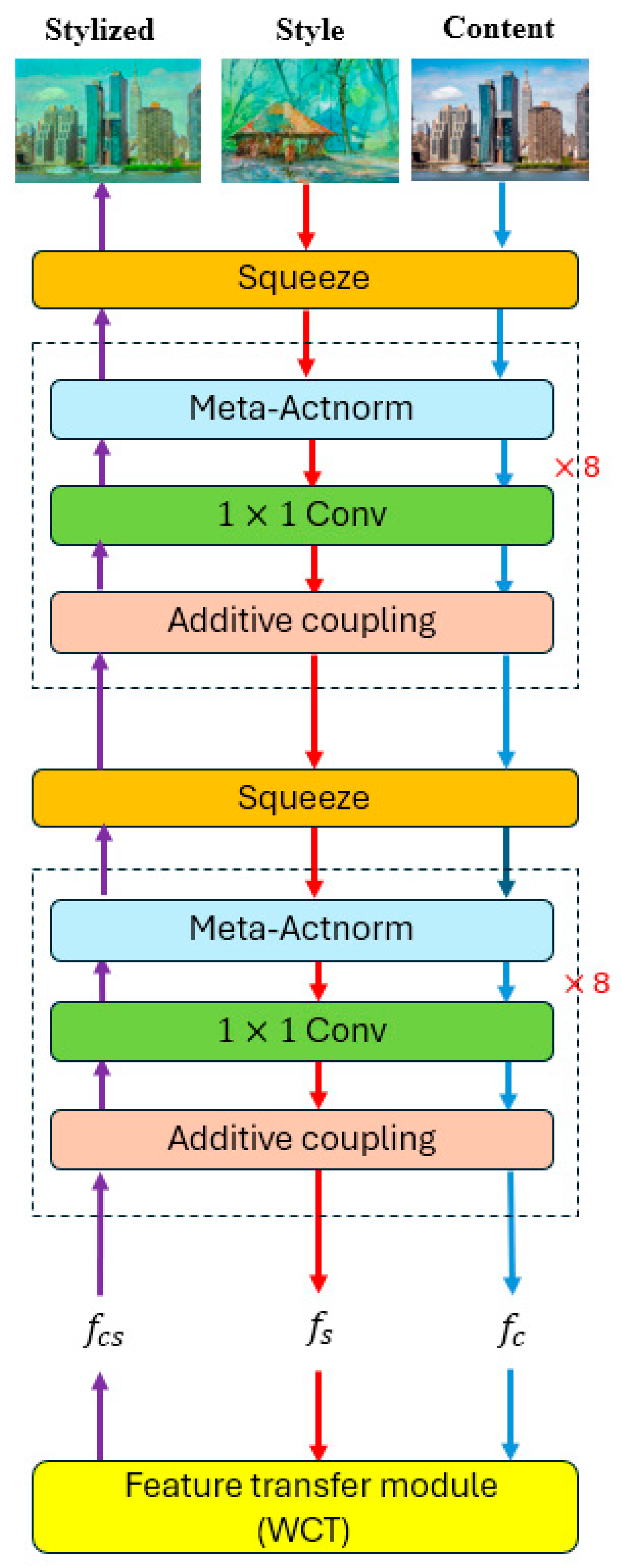
8] by incorporating an adaptive normalization mechanism and a parameter fusion strategy. As illustrated in
Figure 1, ISTMAF consists of two primary components: (1) Invertible Feature Extraction (IFE): Based on Glow [
11], it is composed of multiple blocks of reversible flows. Each flow includes Meta ActNorm, invertible convolution, and additive coupling. (2) Whitening and Coloring Transform (WCT): Aligns the statistics of content features with those of the style features [
10].
The processing pipeline operates as follows: (1) the content and style images are encoded into latent features by the forward IFE; (2) the WCT module transfers style information; (3) the stylized features are decoded back into images using the reverse IFE process. Unlike ArtFlow, ISTMAF dynamically adapts to each input through Meta ActNorm and integrates both content and style parameters during reconstruction. To help readers distinguish the flow directions,
Figure 1 uses different colored arrows: red and blue arrows indicate the forward process, while purple arrows represent the reverse process. This color-coded visualization highlights the bidirectional nature of ISTMAF’s architecture. The dotted-line boxes represent repeating flow blocks used in the encoder and decoder, and “×8” indicates that each block is repeated eight times.
3.2. Forward Process
The forward pass maps an input image to the latent feature space through three reversible operations.
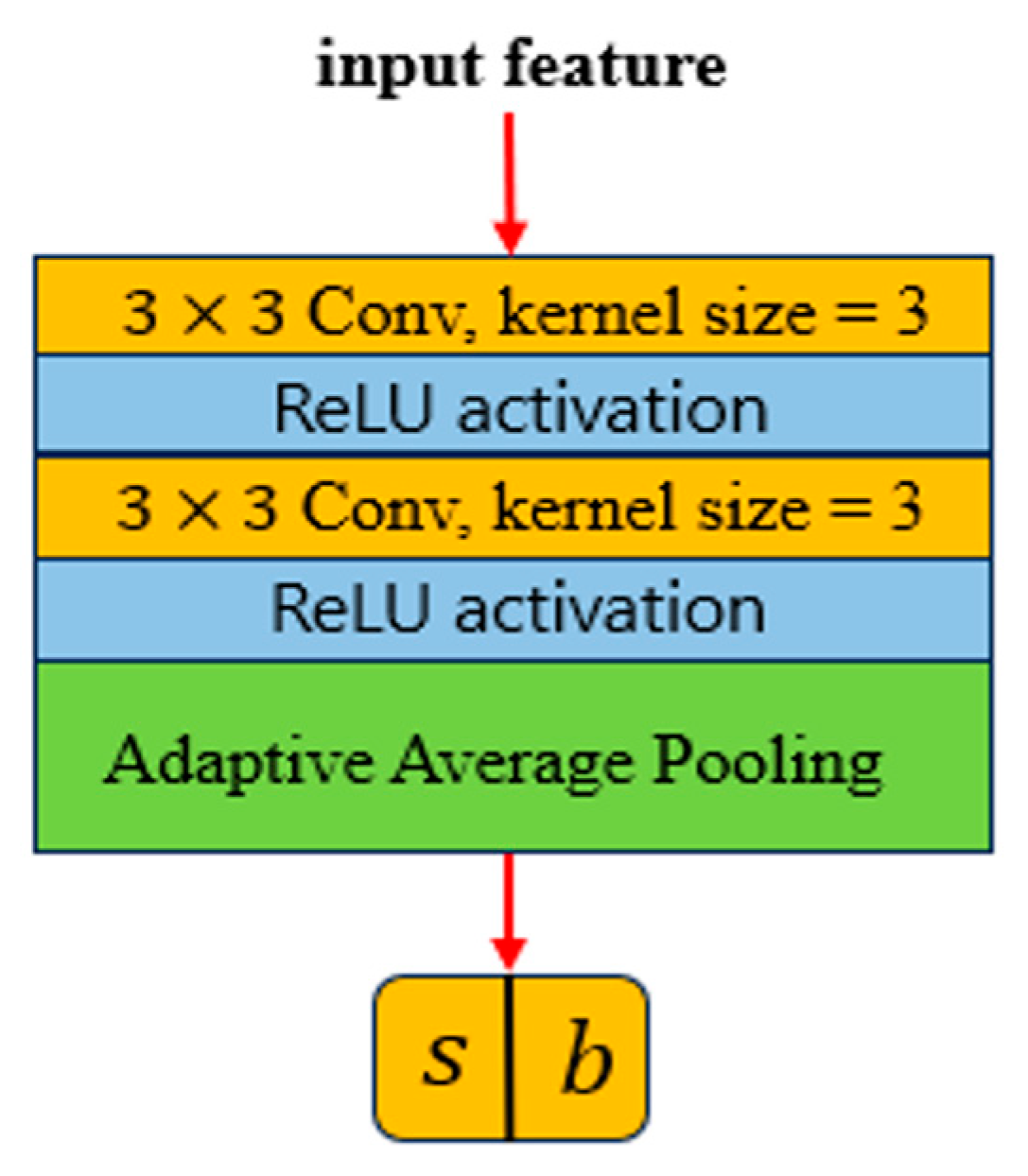
Meta ActNorm: Traditional ActNorm uses fixed trainable parameters. We replace it with Meta ActNorm, where scale and bias parameters are dynamically generated by a meta-network conditioned on the input feature maps. Given input feature
x, the transformation is shown in Equation (1), where
s and
b are produced by a meta-network composed of Conv–ReLU–Conv–ReLU–Conv–AdaptiveAvgPooling layers, as shown in
Figure 2. Independent parameter sets (s
c,
bc) and (
ss,
bs) are generated for content and style images, and stored for the reverse process.
Invertible Convolution: Channel-wise feature interaction is achieved by a 1 × 1 invertible convolution as shown in (3), where W is a learnable invertible weight matrix.
Additive Coupling: To ensure invertibility, each flow in the IFE module adopts an additive coupling transformation. Given an input feature map
, it is split along the channel dimension into two halves, (
), as shown in Equation (4). A lightweight sub-network
(⋅) (e.g., several 3 × 3 Conv–ReLU layers) takes
as input and produces a residual with the same shape. This residual is added to the other part
, as shown in Equation (5). The output is then obtained by concatenating the two parts along the channel dimension, as shown in Equation (6).
This design ensures exact reversibility: the forward step uses addition, and the inverse step simply subtracts the same transformation. The Jacobian of the additive coupling is triangular with determinant 1, meaning the log-determinant term is zero. To enable both partitions of the feature to be transformed across different layers, invertible 1 × 1 convolutions (or channel permutations) are inserted between coupling layers, ensuring sufficient information mixing and stronger representation power. The complete forward mapping is summarized in Algorithm 1.
| Algorithm 1 Projection (Forward Pass) |
| Input: |
| Output: feature y; parameters s, b |
| 1. #meta actnorm |
| 2. ; |
| 3. ; |
| 4. conv |
| 5. ; |
| 6. #additive coupling |
| 7. ; |
| 8. ; |
| 9. |
| 10. return y, s, b |
3.3. Reverse Process
The reverse process reconstructs the stylized features back into image space by applying the inverse operations of the three components used in the forward pass: Meta ActNorm, invertible 1 × 1 convolution, and additive coupling. These operations are applied in reverse order and are elaborated below.
Inverse Additive Coupling: We first split the stylized feature tensor
into two equal parts,
and
, as defined in Equation (7). The inverse transformation then subtracts the learned transformation
from
, and concatenates the result with
to reconstruct the feature map, as shown in Equation (8).
Inverse Invertible 1 × 1 Convolution: The second step reverses the invertible convolution. The transformed feature
is multiplied by the inverse of the learned weight matrix
, as shown in Equation (9).
Inverse Meta ActNorm: The final step applies the inverse of the Meta ActNorm transformation. Given the scaling (
) and bias (
) parameters used in the forward pass, the original pixel value
is recovered from the normalized feature
using Equation (10).
In our method, the forward process simultaneously processes both content and style images, each producing its own set of Meta ActNorm parameters: for the content image, and for the style image.
Unlike ArtFlow, which uses a single set of fixed parameters (
) for the inverse normalization step, we introduce a parameter fusion mechanism that dynamically combines the parameters from both the content and style images. This design aims to better balance content preservation and style alignment during reconstruction. To achieve this, we propose two parameter fusion strategies: (1) Algebraic Fusion (AF): Computes a weighted arithmetic mean of the content and style parameters using a fusion coefficient
, as defined in Equation (11). (2) Geometric Fusion (GF): Uses the geometric mean for the scale parameter, which is more appropriate given its multiplicative role, and applies the same operation to the bias for consistency, as shown in Equation (12). The complete reverse procedure is summarized in Algorithm 2.
| Algorithm 2 Reversion (Reverse Process) |
| Input: feature y; parameters and ; scalars and |
| Output: feature x |
| 1. #inverse additive coupling |
| 2. ; |
| 3. ; |
| 4. #invertible conv |
| 5. ; |
| 6. #inverse meta actnorm |
| 7. ; |
| 8. return x |
3.4. ISTMAF Operation Process
The overall ISTMAF workflow integrates the above steps: (1) Encoding: The content and style images are sequentially fed into the forward IFE, generating latent features and storing Meta ActNorm parameters. (2) Style Transfer: The content and style features are aligned via the WCT module [
10]. (3) Decoding: The stylized features are reconstructed through the reverse IFE process, using fused parameters (
,
). The complete pipeline is summarized in Algorithm 3.
| Algorithm 3 ISTMAF Workflow |
| Input: |
| , no. of blocks: B, no. of flows in each block: n |
| , |
| Output: |
| 1. ; ; |
| 2. for do |
| 3. if then |
| 4. |
| 5. |
| 6. |
| 7. |
| 8. ; #or ; |
| 9. |
| 10. end for |
| 11. ; |
| 12. ; |
| 13. ; |
| 14. for do |
| 15. ; |
| 16. if then |
| 17. |
| 18. end for |
| 19. ; |
| 20. return |
Following Hierarchy Flow [
9], we design a hierarchical loss function that combines content loss and aligned style loss. For content loss, the features are extracted through the activation function in the first layer of the four blocks in the VGG-19 network, represented by
, and subsequently calculated. The features of the stylized image
and content image
are separately subjected to normalization (
), after which their L2 distance is calculated, as shown in Equation (13).
In the design of the style loss, features are extracted using VGG-19, taking the values of ReLU activation function from the first layer of blocks 1 to 4, denoted as , where . We separately extract the features from the stylized image and style image for the four layers mentioned above, and compute the mean distance and standard deviation distance between the two images are then calculated.
For each channel, the mean distance and standard deviation distance are sorted using increasing sorting, and the smallest distances in the top 80% (
k = 0.8) are selected. The sum of these selected distances is then computed to obtain the so-called align style loss, as shown in (14), where
and
represent the sets of relative channels labels corresponding to the top 80% smallest mean and standard deviation distances, respectively. Total loss
is defined as the weighted sum of the content loss and aligned style loss, as shown in (15), where
and
are the respective weights.
4. Experimental Results
This section provides a comprehensive evaluation of the proposed ISTMAF framework. We first describe the experimental setup, followed by analyses of parameter fusion strategies, multiple transfer results, and additional visual examples. Finally, we compare ISTMAF with state-of-the-art style transfer methods using both qualitative and quantitative metrics.
The experiments are conducted on the MS-COCO 2014 dataset [
13] as the content domain (82,783 training and 40,775 test images) and WikiArt [
14] as the style domain (42,129 training and 10,628 test images). All images are resized to 512 × 512 and randomly cropped to 256 × 256. The model is trained for 60,000 iterations with a batch size of 2 using the Adam optimizer. The initial learning rate is 1.0 × 10
−4 and updated according to a decay schedule, as shown in (16), where
t is the iteration index and
λ is the decay factor. All experiments are performed on a server with an NVIDIA RTX 2080 GPU and 256 GB RAM. The implementation is based on PyTorch. 2.9.0.
4.1. Transfer Results
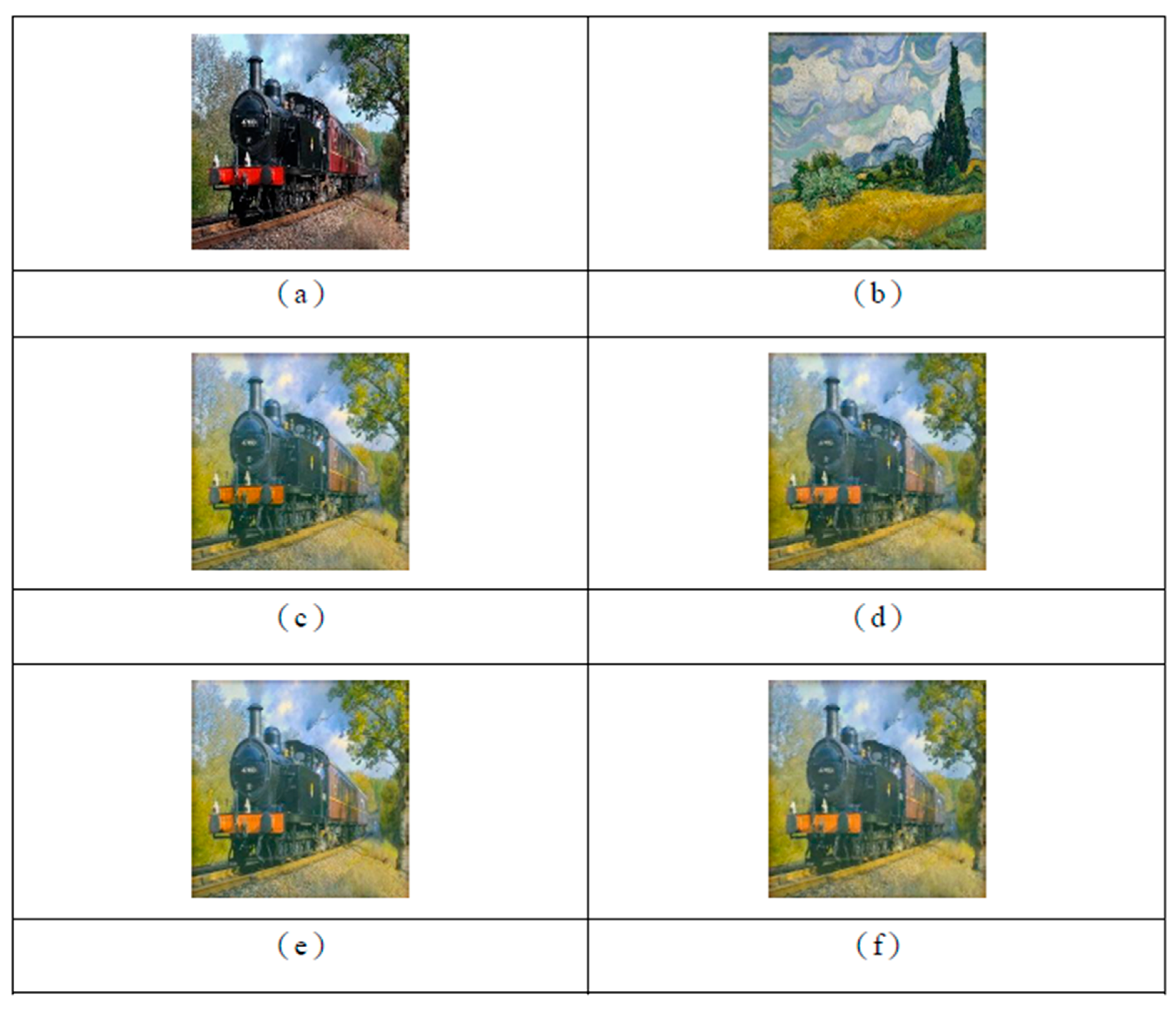
In the reverse process, ISTMAF fuses the content and style parameters generated by Meta ActNorm. We examine the impact of algebraic fusion (Equation (10)) and geometric fusion (Equation (11)) for scale, with arithmetic averaging for bias. In addition, we test the hierarchical aligned style loss [
9] with two configurations: retaining the smallest 80% of channel distances (
k = 0.8) or using all channels (
k = 1.0).
Figure 3 shows the qualitative results under different settings. Both fusion strategies produce visually satisfactory results, with algebraic fusion at
k = 0.8 offering the best trade-off between style fidelity and content preservation. Quantitative results (SSIM [
17] and Gram difference [
5]) confirm this observation, as reported in
Section 4.2.
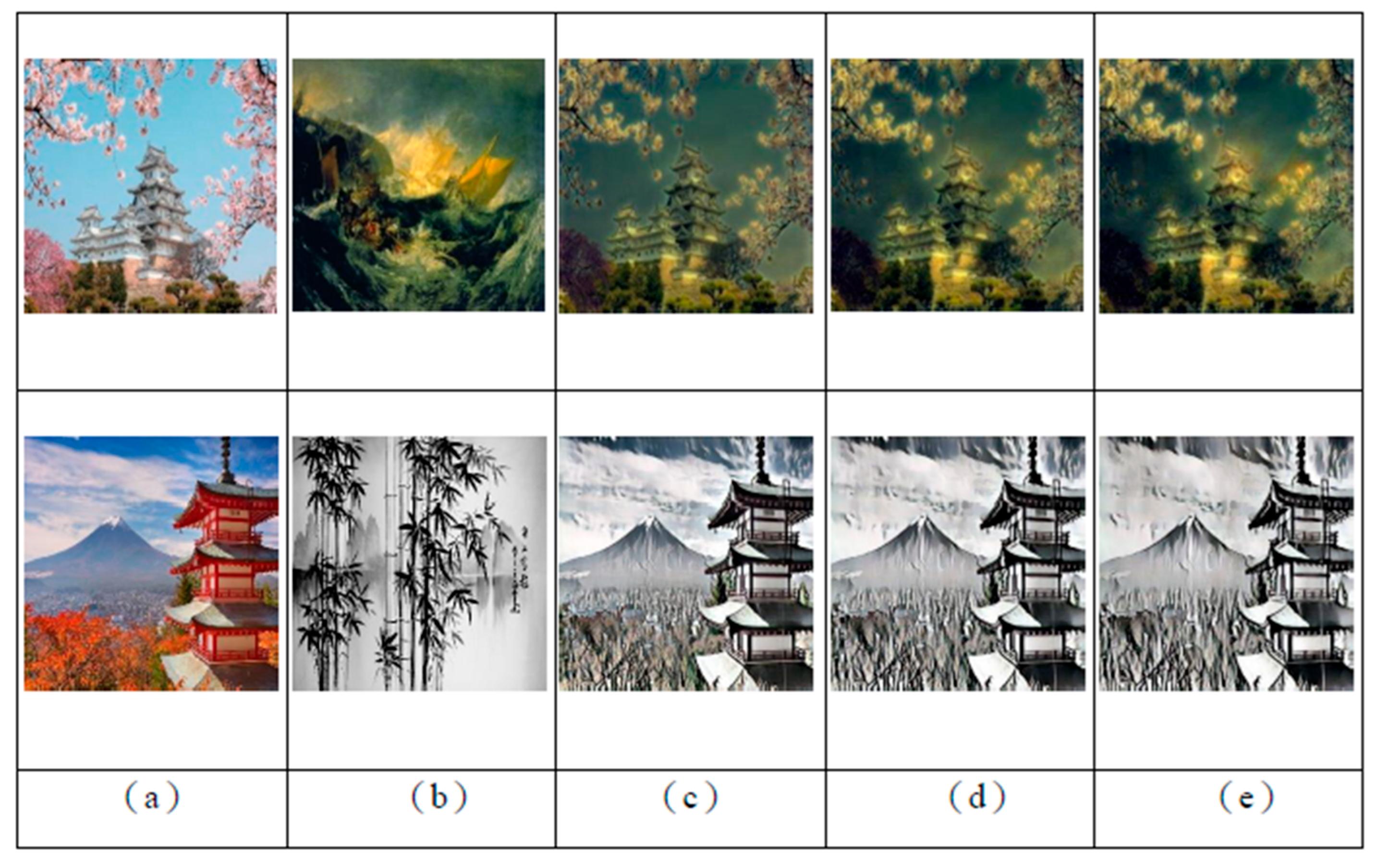
To evaluate robustness against repeated transformations, we apply ISTMAF sequentially from one to five rounds. As shown in
Figure 4, even after multiple transfers, the structural integrity of the content is largely preserved and content leaking remains minimal. This demonstrates the stability of the reversible framework combined with Meta ActNorm.
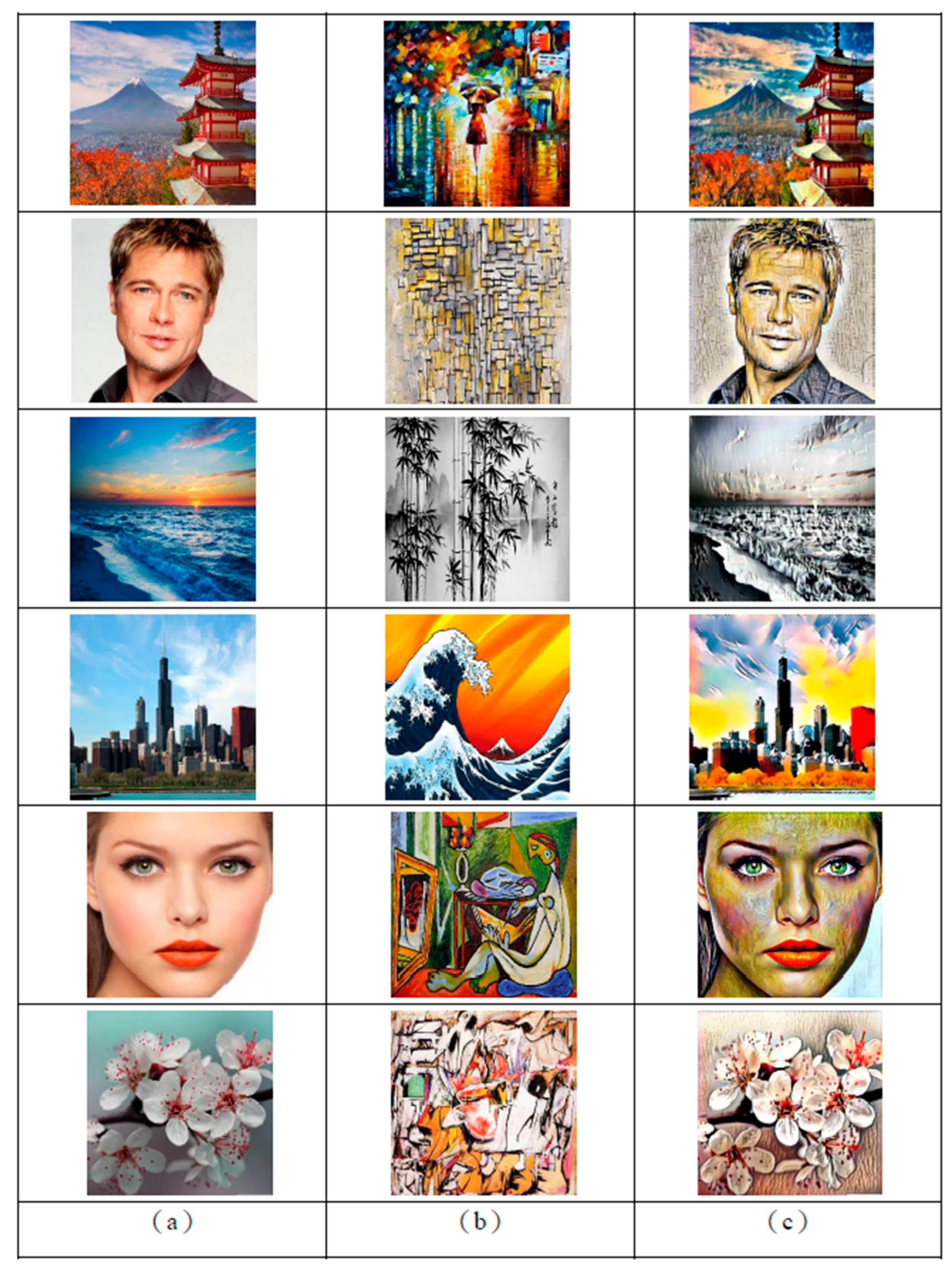
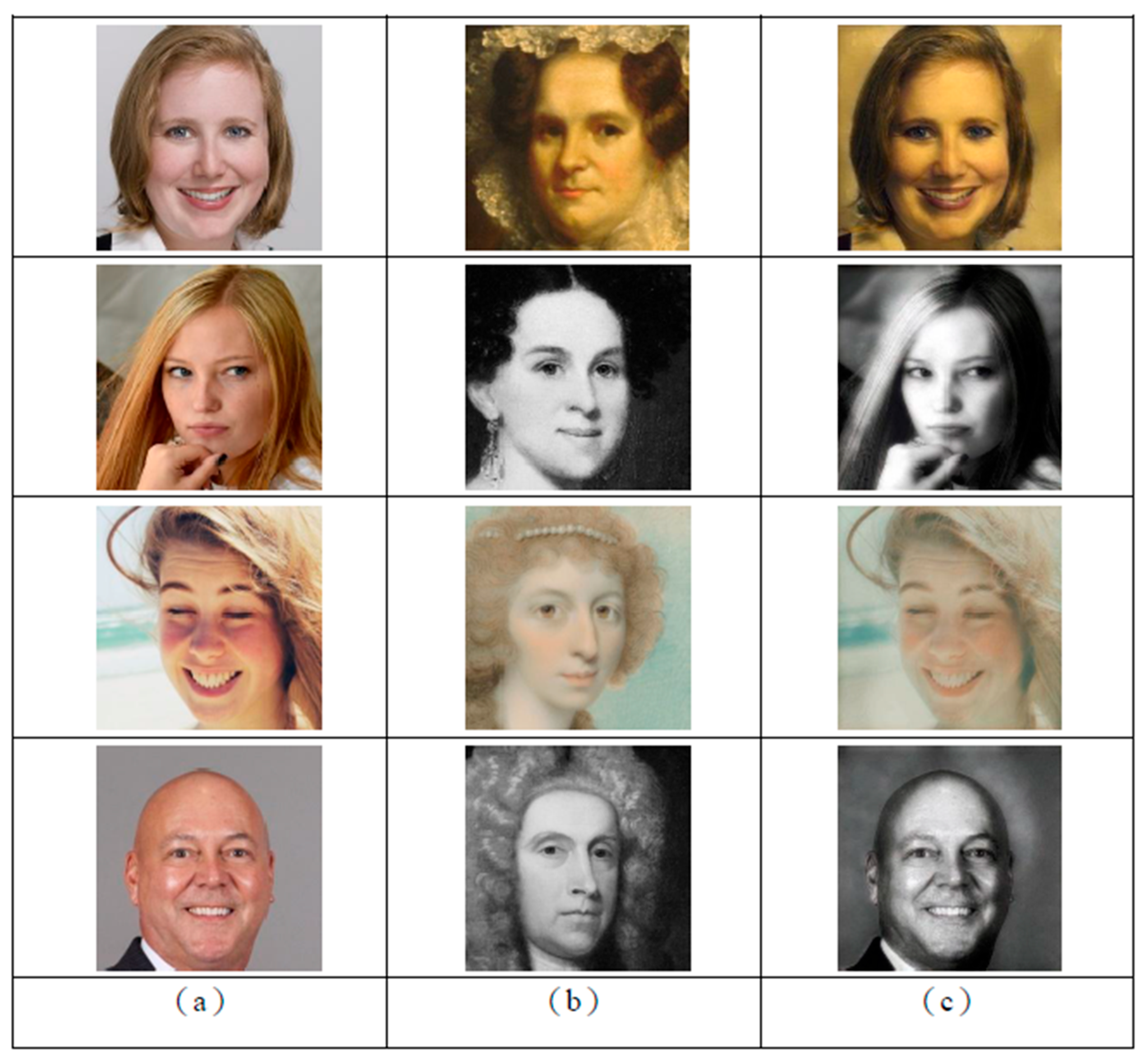
Figure 5 presents more stylization results across diverse content–style pairs, highlighting ISTMAF’s ability to capture rich style characteristics without compromising content structure. Furthermore, we extend the evaluation to face images using FFHQ [
15] as the content domain and MetFaces [
16] as the style domain, as shown in
Figure 6. Without retraining, the model successfully transfers artistic styles to faces, confirming its generalization ability across domains.
4.2. Ablation Study
Building upon the results of visual transfer quality, we further investigate the individual contributions of each component in ISTMAF. To this end, we conduct ablation studies by progressively removing key modules. The evaluated configurations are as follows:
Baseline: ArtFlow with fixed ActNorm, without Meta ActNorm or parameter fusion.
A1 (Meta ActNorm only): Replacing ActNorm with Meta ActNorm, without fusion strategy.
A2 (Fusion only): Using fixed ActNorm with the proposed parameter fusion (algebraic, ).
A3 (Full ISTMAF): Including both Meta ActNorm and fusion strategy (algebraic, ).
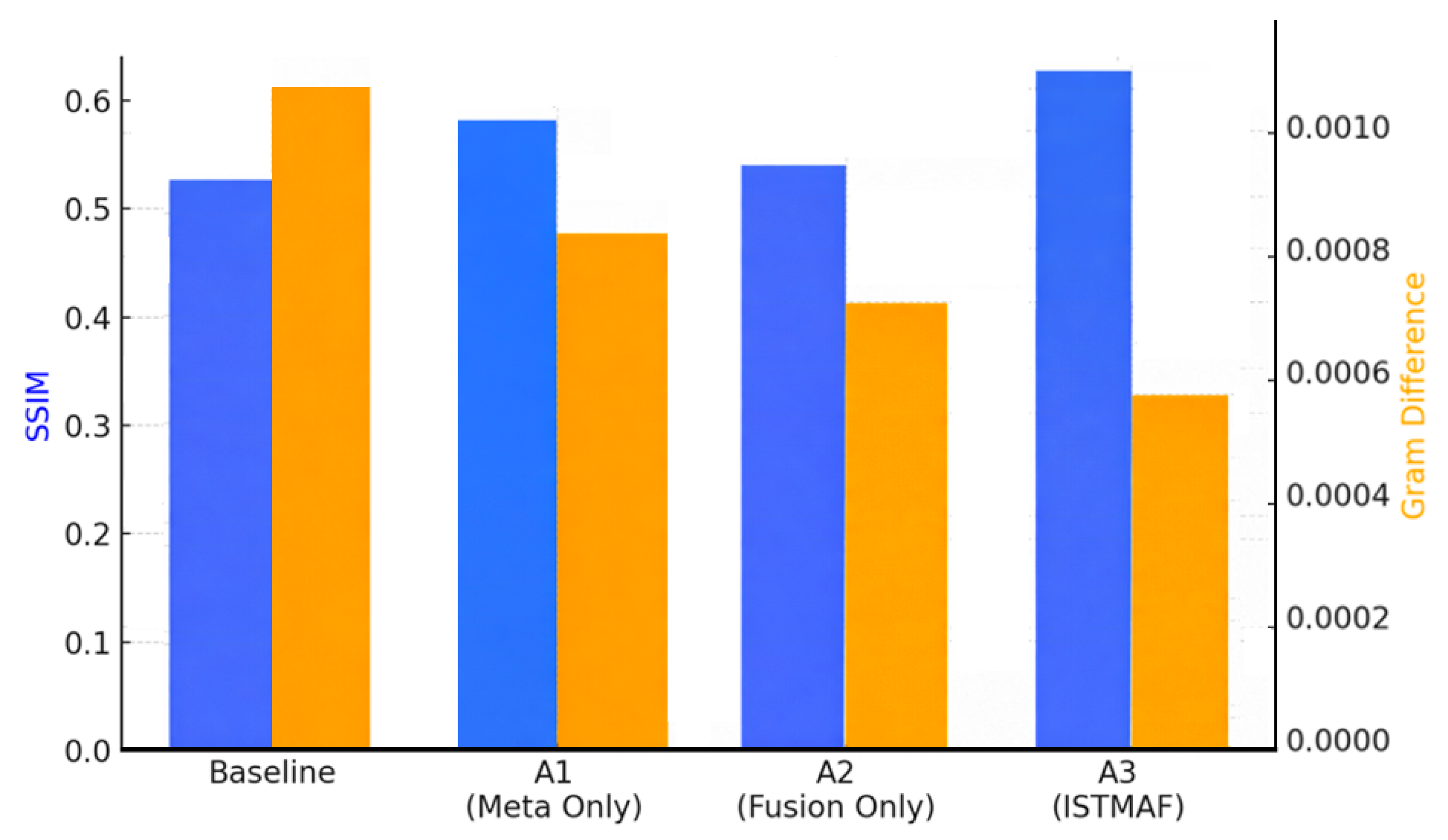
We measure Structural Similarity Index (SSIM) and Gram Difference (GD) to assess content preservation and style fidelity, respectively, as shown in
Table 1. These results indicate that Meta ActNorm improves content preservation significantly, while parameter fusion enhances style alignment. The combination of both yields the best performance, confirming the effectiveness of our design. These quantitative improvements are further illustrated in
Figure 7, where A3 consistently outperforms the baselines in both SSIM and Gram metrics, visually validating the benefits of combining Meta ActNorm and parameter fusion.
4.3. Comparison with Other Methods
After validating the internal components of ISTMAF, we now assess its performance against several state-of-the-art style transfer methods. These include StyleSwap [
29], AdaIN [
7], WCT [
10], LinearWCT [
18], OptimalWCT [
19], Avatar-Net [
30], Self-Contained [
31], and ArtFlow [
8].
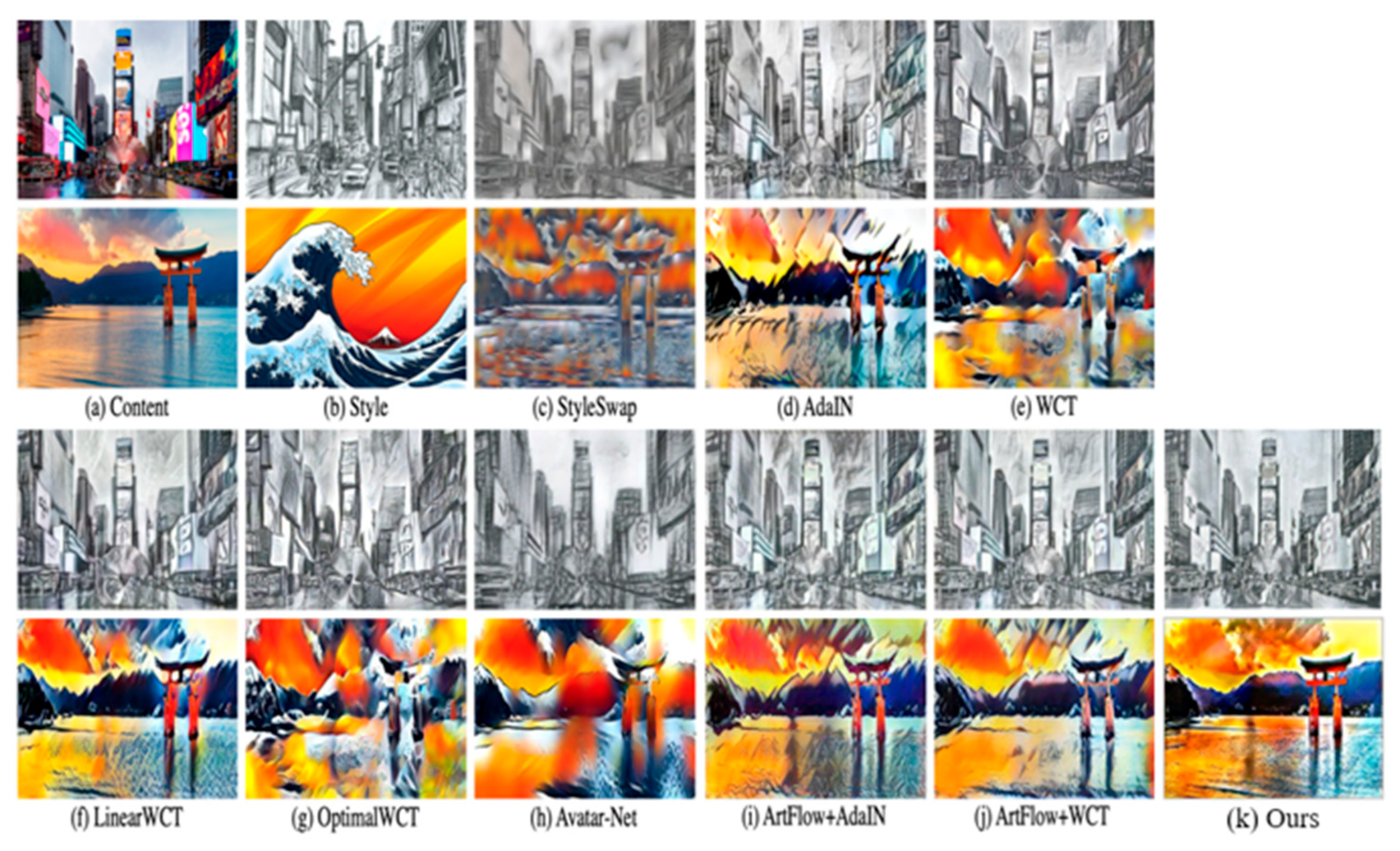
Figure 8 presents the qualitative results. ISTMAF generates stylizations that better preserve structural details and achieve more consistent style application, outperforming ArtFlow and other baselines.
Table 2 reports quantitative results using SSIM (higher is better, indicating stronger content preservation) and Gram difference (lower is better, indicating closer style alignment). ISTMAF achieves the highest SSIM score (0.61) and the second-lowest Gram difference (0.00057), striking the best balance between content fidelity and style consistency. Although OptimalWCT obtains a slightly lower Gram difference, it suffers from severe content leaking, confirming the superiority of ISTMAF. While no explicit weighted cost function was used, we jointly interpret both metrics to reflect the trade-off between content and style, as both are essential in style transfer.
In addition to visual and numerical performance, we also evaluated the runtime and complexity of ISTMAF. On 512 × 512 resolution images, our model takes 0.143 s per inference on an NVIDIA RTX 3090, compared to 0.126 s for ArtFlow. This modest increase stems from the added Meta ActNorm and parameter fusion mechanisms. The total parameter count increases marginally from 51.8 M (ArtFlow) to 53.1 M. Despite this, ISTMAF maintains real-time efficiency while offering significantly better control over stylization quality and consistency.
5. Conclusions and Discussion
In this work, we presented ISTMAF (Image Style Transfer based on Meta ArtFlow), an enhanced reversible style transfer framework that improves upon ArtFlow by introducing dynamic normalization and parameter fusion strategies. The key novelty lies in the Meta ActNorm module, which generates input-specific parameters conditioned on both content and style images. By incorporating these adaptive parameters into the reversible architecture, ISTMAF effectively enhances flexibility and reduces content leakage. Furthermore, the algebraic–geometric parameter fusion mechanism enables balanced integration of style and content information during the reverse process, while the hierarchical aligned style loss further suppresses ghosting and improves stylization quality.
Through extensive experiments on MS-COCO, WikiArt, FFHQ, and MetFaces, we demonstrated that ISTMAF consistently outperforms state-of-the-art baselines in terms of both content preservation and style fidelity. Quantitative evaluations using SSIM and Gram difference confirmed that our method achieves the best overall balance among compared approaches, while visual comparisons highlighted superior robustness to multi-step transfers and cross-domain stylization.
Unlike recent black-box generative models such as diffusion and Large Language Models (LLMs), ISTMAF offers explicit interpretability, reversible control, and parameter-efficient design, making it suitable for embedded systems and edge applications where real-time inference and transparency are critical. Its general-purpose stylization capability is not meant to compete with text-driven generation, but rather to complement it by supporting domains requiring structure preservation, reconstruction consistency, or user-controllable stylization.
Despite these promising results, there remain opportunities for improvement. First, the current design focuses on single-style transfer. Extending the framework to multi-style fusion within a single transformation process would broaden its applicability. Second, while our experiments show strong robustness in images, extending ISTMAF to video style transfer requires explicit temporal modeling to ensure consistency across frames. Finally, the framework could be generalized to 3D content and depth-aware applications, enabling stylized rendering in more complex visual domains. Overall, ISTMAF provides a flexible, scalable, and robust solution for content-preserving style transfer. Its integration of meta-learning into reversible flows offers new insights for future research in both image generation and adaptive normalization.