Article

Heat Transfer and Mechanical Performance Analysis and Optimization of Lattice Structure for Electric Vehicle Thermal Management

1
School of Mechanical Engineering, Beijing Institute of Technology, Beijing 100081, China
2
China North Vehicle Research Institute, Beijing 100072, China
3
Chinese Scholartree Ridge State Key Laboratory, Beijing 100072, China
4
Chongqing Innovation Center, Beijing Institute of Technology, Chongqing 401100, China
*
Author to whom correspondence should be addressed.
Electronics 2026, 15(2), 347; https://doi.org/10.3390/electronics15020347
Submission received: 26 November 2025 / Revised: 21 December 2025 / Accepted: 22 December 2025 / Published: 13 January 2026

Abstract

With the trend toward integrated development in electric vehicles, thermal management components are becoming more compact and highly integrated. This evolution, however, leads to complex spatial layouts of high- and low-temperature fluid circuits, causing localized heat accumulation and unintended heat transfer between channels, which compromises cooling efficiency. Concurrently, these compact components must possess sufficient mechanical strength to withstand operational loads such as vibration. Therefore, designing structures that simultaneously suppress heat transfer and ensure mechanical intensity presents a critical challenge. This study introduces Triply Periodic Minimal Surface (TPMS) and Body-Centered Cubic (BCC) lattice structures as multifunctional solutions to address the undesired heat transfer and mechanical support requirements. Their thermal and mechanical performances are analyzed, and a feedforward neural network model is developed based on CFD simulations to map key structural parameters to thermal and mechanical outputs. A dual-objective optimization approach is then applied to identify optimal structural parameters that balance thermal and mechanical requirements. Validation via CFD confirms that the neural network-based optimization effectively achieves a trade-off between heat transfer suppression and structural strength, providing a reliable design methodology for integrated thermal management systems.

1. Introduction

The thermal management system is crucial for ensuring the efficient and safe operation of electric vehicles. With advancements in new energy vehicle technology, vehicle thermal management systems are evolving from a decentralized architecture toward an integrated one [1,2]. The prevailing integrated design consolidates multiple fluid circuits and employs centralized control components to regulate the distribution and flow of heat transfer fluids [3,4,5,6]. The fluid manifold is a key component for this centralized multi-fluid control. Its internal structure typically incorporates multiple closely spaced channels for coolant and refrigerant. Temperature differences between the fluids in adjacent channels lead to complex heat exchange. This unintended heat transfer between high- and low-temperature circuits compromises the temperature control precision of the management system [7,8,9]. Therefore, effective thermal isolation structures between adjacent channels are necessary to mitigate this undesired heat transfer resulting from high integration. Furthermore, the mechanical integrity of the manifold must be thoroughly considered to withstand operational conditions such as vehicle vibration [1,3,6]. Consequently, optimizing the fluid manifold design presents a dual-objective challenge that requires simultaneously balancing thermal performance and mechanical strength.
Current research on the co-optimization of heat transfer and structural strength in multi-channel manifolds remains limited. Regarding thermal management, Wang et al. [10] developed an anisotropic heat transfer model based on porous media theory, revealing the temperature distribution characteristics in finger seal structures and enabling effective fluid temperature control. Zhang et al. [11] proposed a topology optimization approach for designing heat conduction paths to address the “volume-to-point” heat conduction problem in compact electronic devices. Xiao et al. [12] employed an anisotropic material interpolation method to establish a cross-scale topology optimization model for lattice heat dissipation structures, minimizing the average temperature, temperature difference, and maximum temperature. Their results demonstrated excellent thermal performance. However, these studies primarily focused on thermal performance and did not systematically account for mechanical strength.
Regarding the regulation of mechanical performance, structural strength in components requiring heat dissipation, such as traditional vehicle engines, is often enhanced by adding reinforcing ribs [13]. To enhance the adaptability of electric vehicles in complex operating environments, Yang et al. [14] employed the finite element method to quantitatively analyze how the distribution, size, shape, and position of reinforcing ribs influence the strength and stiffness of a vehicle’s shell. Similarly, Zhong [15] utilized the finite element method to optimize the structure of a traditional aluminum battery box, addressing issues of excessive stress and insufficient strength under extreme conditions, thereby improving its load-bearing capacity and crush resistance. The manifold structures in electrical vehicle thermal management systems must also meet these strength requirements to ensure overall vehicle safety. However, the studies mentioned above primarily focus on optimizing mechanical performance and have not yet integrated thermal characteristics into a co-optimization framework.
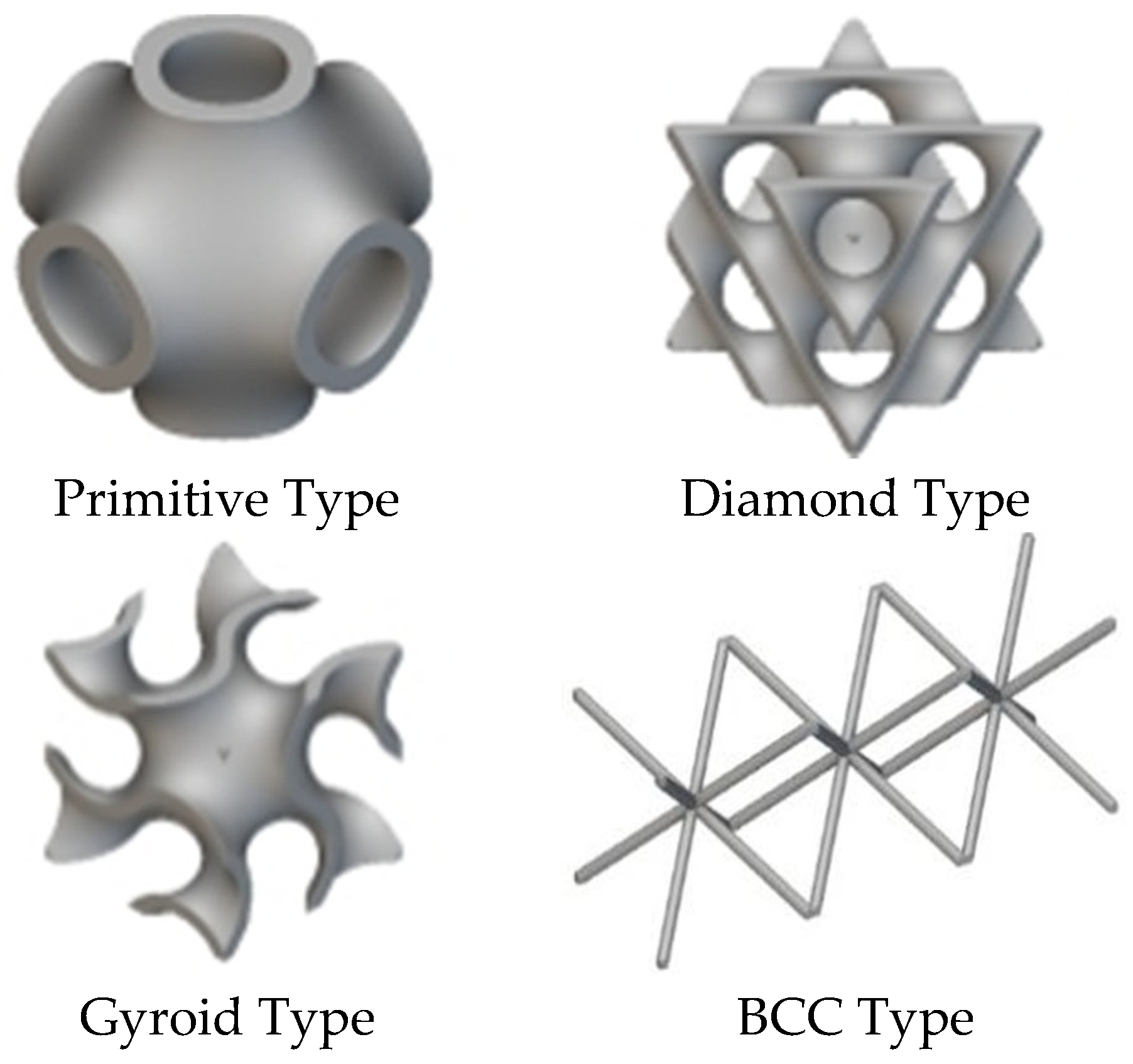
Recent advances in additive manufacturing have spurred growing interest in complex lattice structures due to their favorable mechanical and thermal properties [13,16,17], the common lattice structures are shown in Figure 1. Among them, Triply Periodic Minimal Surface (TPMS) and Body-Centered Cubic (BCC) lattice structures have shown significant potential for regulating heat transfer and mechanical performance [18,19]. Geometrically, TPMS structures are characterized by a mean curvature of zero, can be precisely defined by mathematical equations, and are periodic in three orthogonal directions [20,21,22]. Common types such as Gyroid, Diamond, and Primitive have been investigated for applications in compact heat exchangers and biomedical tissue engineering [18,19,23]. Tian et al. [24] systematically analyzed the influence of different TPMS structures and phase-change material filling methods on thermal energy storage performance and fluid flow characteristics, establishing application guidelines for various structures. Wei et al. [25] developed a topology optimization method for a three-fluid heat exchanger design using TPMS, achieving highly efficient heat transfer between two hot fluid streams and air.
For suppressing heat transfer between adjacent channels, the porous nature of TPMS structures can reduce the effective contact area with conductive walls, weakening solid–solid heat conduction and thus offering potential for lowering conductive heat flow [26,27]. The BCC lattice is a regular 3D truss structure consisting of struts connecting the corners of a cubic unit cell to its center [28]. This configuration provides efficient load-bearing paths in multiple directions, exhibiting quasi-isotropic mechanical behavior. Regarding the dual objectives of this work—heat transfer suppression and strength enhancement—the high porosity of the BCC lattice allows heat to travel along a non-linear strut network, thereby prolonging the heat transfer path, increasing thermal resistance, and significantly reducing overall thermal conductivity. Additionally, the air trapped within the pores acts as a thermal insulation barrier [29,30]. However, systematic studies on the coupled management of thermal and mechanical performance in TPMS and BCC structures are still lacking.
This study addresses the performance optimization of multi-channel fluid manifolds in vehicle thermal management systems by introducing TPMS and BCC lattice structures. The objective is to synergistically regulate thermal and mechanical performance, thereby suppressing undesired heat transfer between adjacent channels while ensuring structural integrity. Computational models of the lattice structures were established to comparatively analyze the performance of TPMS and BCC configurations in terms of heat transfer suppression and mechanical strength. Based on the analysis, the TPMS structure was selected for further optimization. A feedforward neural network model was constructed to map the relationships between its key structural parameters and the resulting thermal–mechanical performance. A dual-objective optimization was then conducted, leading to an optimal TPMS design that meets the target performance, which was subsequently validated. This work not only validates the feasibility of using TPMS and BCC structures for the co-optimization of thermal and mechanical properties but also outlines an effective methodology for dual-objective optimization, thereby providing a theoretical foundation for enhancing the performance of integrated thermal management systems.

2. Computational Details

2.1. Geometric Model and Boundary Conditions

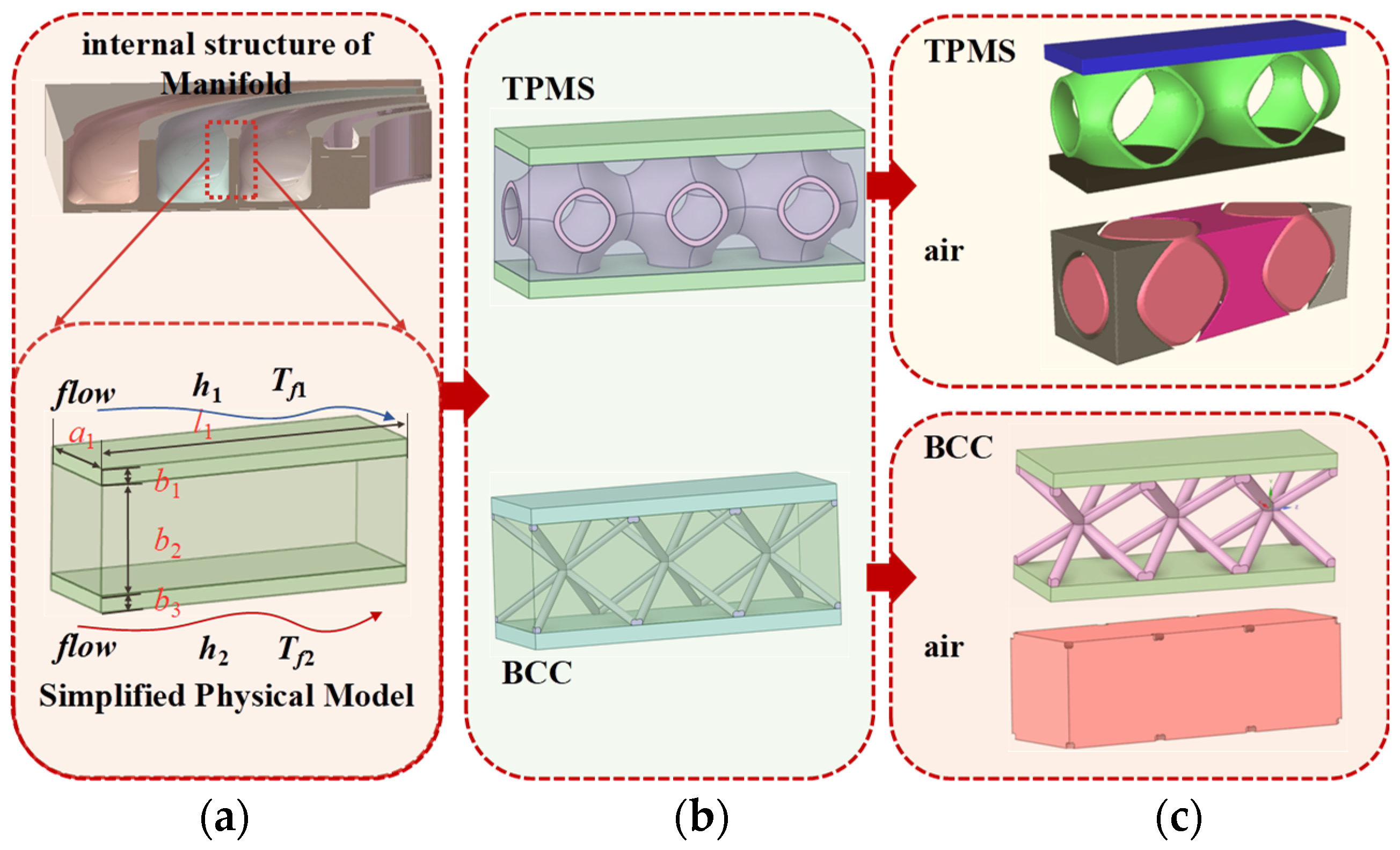
The physical model is shown in Figure 2a. In a typical liquid flow manifold, two adjacent channels share a common solid wall. Because the fluid temperatures in these channels differ, heat is exchanged through this wall. Without any thermal management strategy for the wall, this heat exchange is significant and can impair the performance of the thermal management system. For analysis, the solid wall where heat exchange occurs is modeled as a rectangular block with a length of l1, a total thickness of b (where b = b1 + b2 + b3), and a height of a1, the specific values are given in Table 1. The fluids on either side of the wall are represented using convective boundary conditions, meaning they are defined by their specific temperatures and heat transfer coefficients. To suppress this heat exchange, the interior of the wall is filled with either a BCC or TPMS lattice structure, resulting in the configuration shown in Figure 2b. These lattice structures allow for the synergistical control of both thermal and mechanical performance. As shown in Figure 2c, the solid domain, made of an aluminum alloy, consists of the TPMS/BCC lattice structure and the top and bottom plates; the remaining space is designated as the fluid domain, occupied by air.
The governing equation for generating Primitive-type TPMS structures is given in Equation (1):
cos ( 2 π x L ) + cos ( 2 π y L ) + cos ( 2 π z L ) = C
The periodic parameter (L) and the wall-thickness parameter (C) jointly govern the unit cell size and wall thickness; varying these values yields the corresponding Primitive architecture. The BCC structure, in turn, is generated under the control of Equation (2):
R n 1 , n 2 , n 3 , α = n 1 α 1 + n 2 α 2 + n 3 α 3 + τ α = α n 1 x + α n 1 y + α n 1 z
In Equation (2), α denotes the lattice constant, and n1, n2, and n3 are natural numbers.
Figure 3 presents the four types of structure analyzed in this study. For comparison, two reference cases were established: one filled entirely with air (pure air structure) and another with solid material (pure metal structure). In the heat-suppressing structures shown in Figure 3c,d, TPMS and BCC lattices serve as the fillers. The aluminum alloy skeleton of these lattices is designed to simultaneously suppress heat transfer and bear mechanical loads, while the interstitial spaces are filled with air.
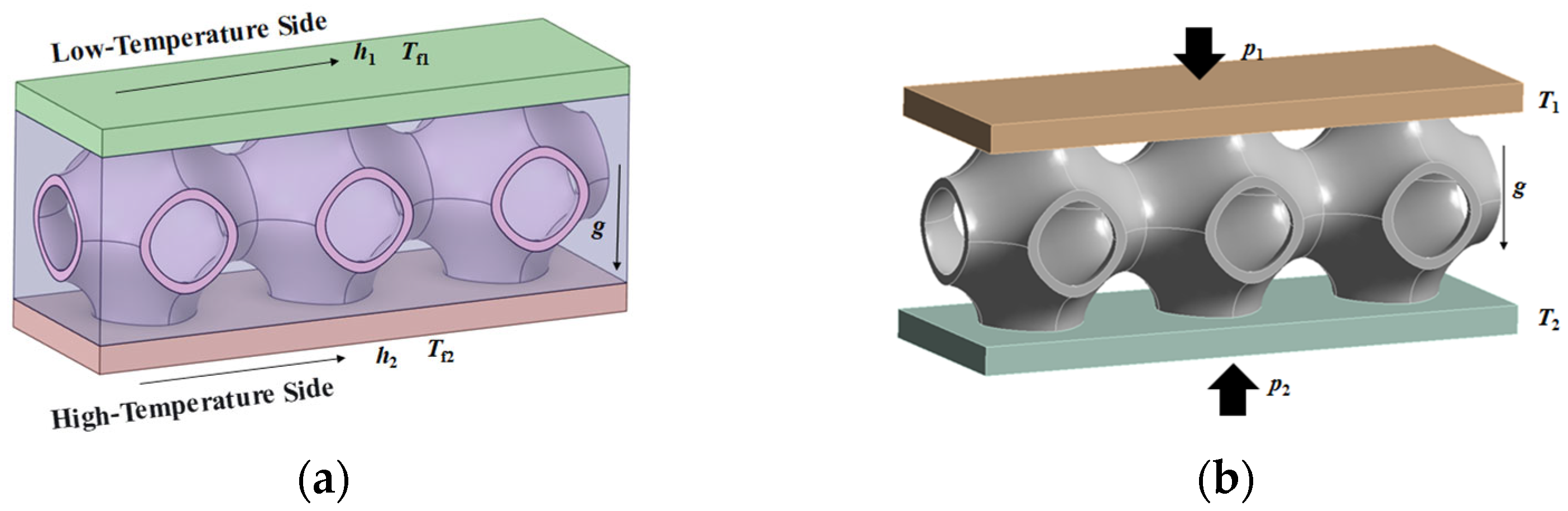
To evaluate the heat transfer and mechanical performance of the four structures in Figure 3, numerical models were developed based on the actual operating conditions of a multi-channel manifold. The boundary conditions for the heat transfer analysis are shown in Figure 4a. Given that the coolant temperature in electric vehicle thermal management systems generally ranges from 40 to 80 °C [3], the dominant heat transfer mode within the liquid manifold is the convection between high- and low-temperature coolant streams; consequently, convective boundaries were applied to the top and bottom surfaces, with the heat transfer coefficients (h1 = 8178 W/(m2·K), Tf1 = 84.4 °C for the bottom wall; h2 = 20,549 W/(m2·K), Tf2 = 74.1 °C for the top wall) derived from a temperature simulation of a compact thermal management unit using the Dittus–Boelter equation. The relevant data employed in the calculations are listed in the Table 2. The side walls were treated as adiabatic, as their heat transfer contribution is negligible.
Nu f = 0.023 Re f 0.8 Pr f 0.4 = h d λ
The loading conditions for the structural strength analysis are shown in Figure 4b. The model simulates fundamental loads, including thermal, pressure, and gravitational loads. A fixed support was applied to the bottom plate. Under these combined loads and boundary conditions, the structural strength was evaluated by analyzing the von Mises stress distribution and the strain energy distribution. To simplify the calculation, the pressures of the high- and low-temperature channel flows were equivalently treated as a uniform pressure load applied to the upper and lower surfaces of the geometric model, with a magnitude of 0.6 MPa—corresponding to the maximum static pressure exerted on the liquid manifold during operation. Additionally, the thermal effect of the fluid temperature difference was incorporated by setting the top and bottom surface temperatures to Tf2 and Tf1, respectively.

2.2. Governing Equations and Main Parameters

The heat transfer is governed by the conservation equations for mass, momentum, and energy throughout the computational domain:
Conservation of mass:
ρ t + ( ρ U ) = 0
Conservation of momentum:
ρ D U D t = ρ g P + τ = ρ g P + [ μ ( U + ( U ) T ) ]
Conservation of energy:
ρ C p D T D t = ρ ( U ) + Φ + k 2 T
where U is the velocity vector (m/s), P is the pressure (Pa), ρ is the density (kg/m3), Cp is the specific heat capacity at constant pressure (kJ/(kg·K)), g is the gravitational acceleration (m/s2), h is the heat transfer coefficient (W/(m2·K)), μ is the dynamic viscosity of air (Pa·s), and T is the temperature (K).
The Rayleigh number is defined as shown in Equation (7). In the computational model, the solid skeleton is filled with air, and a temperature difference (ΔT) = 10.3 °C exists between the top and bottom surfaces. The characteristic length (L) in the direction of the temperature gradient is 10 mm, and the air properties are evaluated at the arithmetic mean temperature of the two surfaces, giving Ra ≈ 439. Under these conditions, heat transfer in the air is dominated by conduction, with only weak convection.
Ra = g β Δ T L 1 3 ν α
where β is the thermal expansion coefficient and L1 is the characteristic length (m).
Consequently, the natural convection of air within the domain, arising from density variations, is modeled using the Boussinesq approximation:
( ρ ρ 0 ) ρ 0 β ( T T 0 ) g
ρ = ρ 0 ( 1 β Δ T )
ρ ρ 0
where ρ0 is the constant reference density and T0 is the operating temperature. The Boussinesq approximation is valid for this study because the calculated value of β(TT0) ≈ 0.01 is significantly less than 1, indicating minimal density variation. The air flow is considered laminar due to its low velocity. For the numerical solution, the pressure discretization was set to Body Force Weighted, and the velocity–pressure coupling was handled with the Coupled scheme. The energy and momentum equations were solved using the second-order upwind discretization scheme.
The structural statics analysis is based on the finite element method, which solves the following governing equations:
Equilibrium Equation:
· σ + F = θ
where σ is the Cauchy stress tensor, F is the body force vector per unit volume, and is the divergence operator.
Geometric Equation:
ε = 1 2 u + ( u ) T
where ε is the infinitesimal strain tensor and u is the displacement vector.
The constitutive equation accounting for ambient temperature effects is as follows:
σ = D : ( ε total ε thermal ) = D : ( ε total α ( T T ref ) I )
where εtotal is the total strain tensor, εthermal is the thermal strain, and Tref is the temperature (K).
The governing equations were discretized and solved using the Galerkin weighted residual method. This formulation states that, under external and body forces, the system’s total virtual work is zero for any admissible virtual displacement field that is compatible with the boundary conditions. Solving these equations yields key variables, including the global stiffness matrix, nodal displacements, and von Mises stress, thereby enabling a complete analysis of the structure’s stress–strain behavior.

2.3. Grid Independence and Computational Model Validation

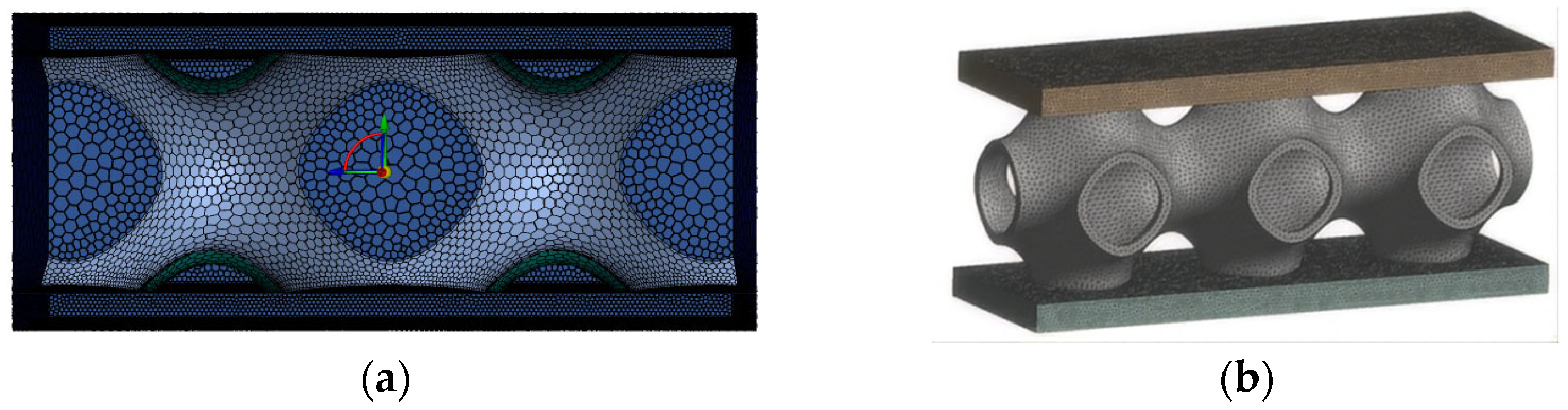
The models were discretized using an unstructured mesh, as shown in Figure 5. For the heat transfer analysis, a boundary layer was added to the fluid side of the fluid–solid interfaces to accurately capture the subtle effects of natural air convection. In the structural analysis, an unstructured mesh was also employed, with local refinement applied to the TPMS support structures.
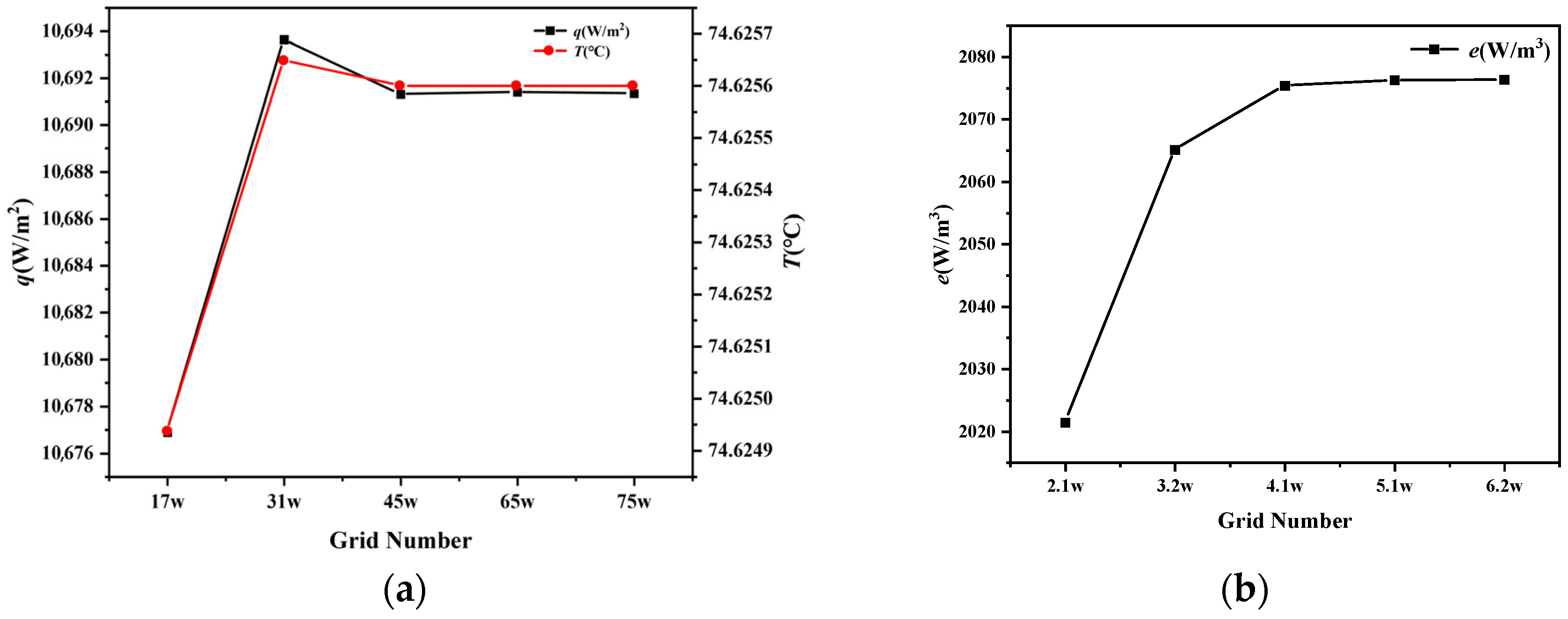
A grid-independence study was conducted to ensure that the results were not significantly influenced by mesh density. As illustrated in Figure 6a, the heat flux obtained by the cold wall gradually converges as the mesh density increases, indicating that the simulation results are essentially independent of further mesh refinement. The final heat transfer model contained approximately 654,619 elements. A mesh-independence study was likewise performed for the structural static analysis. As depicted in Figure 6b, the mean strain energy density ceases to vary once the mesh count exceeds a certain threshold. Balancing accuracy and computational cost, the structural simulation was ultimately conducted with 51,028 elements. All subsequent simulations for different structures used similar mesh parameters.
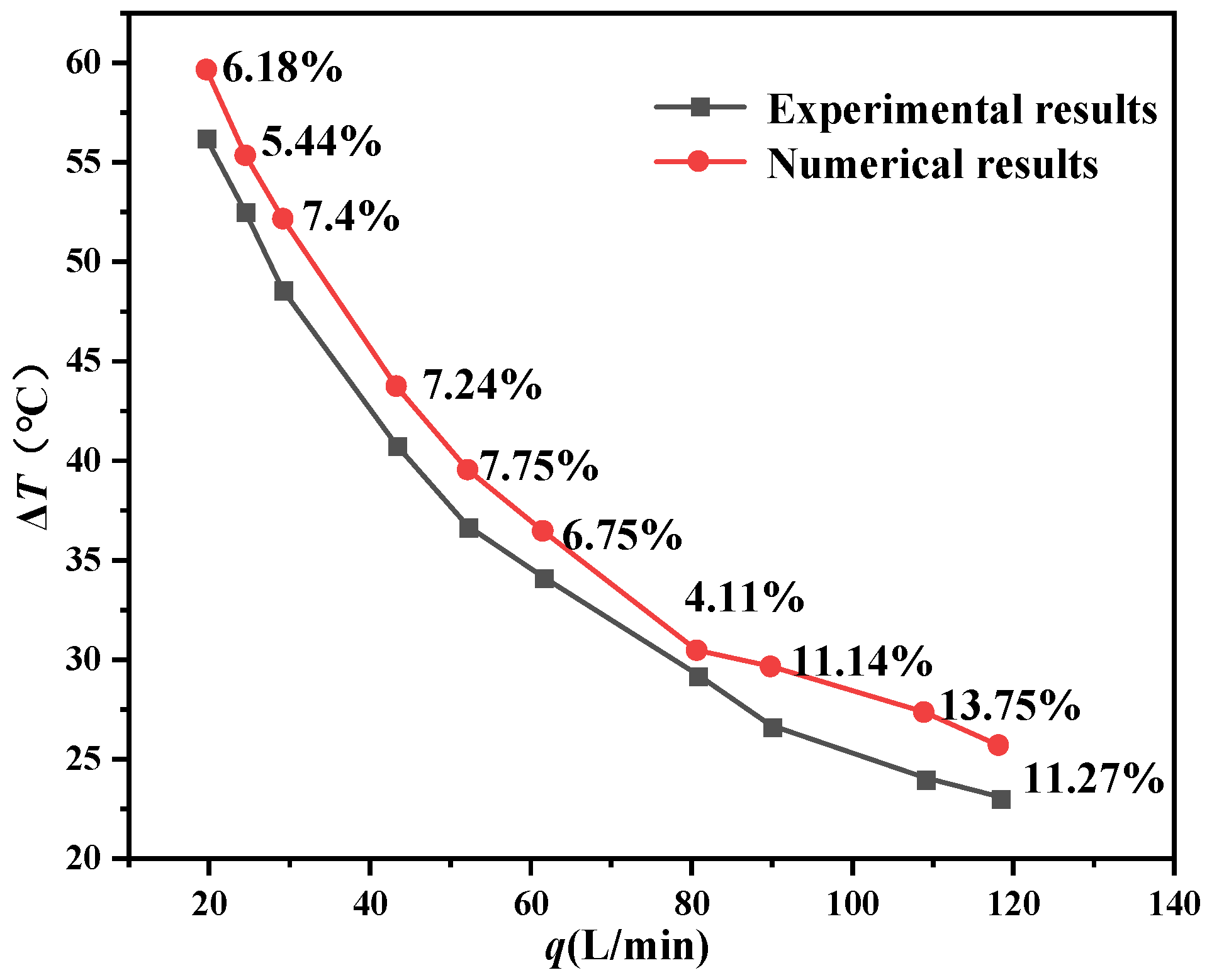
To corroborate the accuracy of the proposed computational models, we adopted the experimental dataset of Tang et al. [31] as the benchmark. In that work, the precise control of Gyroid architectures markedly enhanced TPMS heat transfer performance while reducing flow resistance, offering a valuable reference. Employing the present numerical framework, we reproduced their experimental conditions under the specified flow rate. As shown in Figure 7, the relative deviation between simulation and measurement remains below 14% and agrees well with the data reported in Ref. [31], confirming the satisfactory fidelity of the established models.

3. Results and Discussion

3.1. Heat Transfer and Mechanical Characteristics Analysis

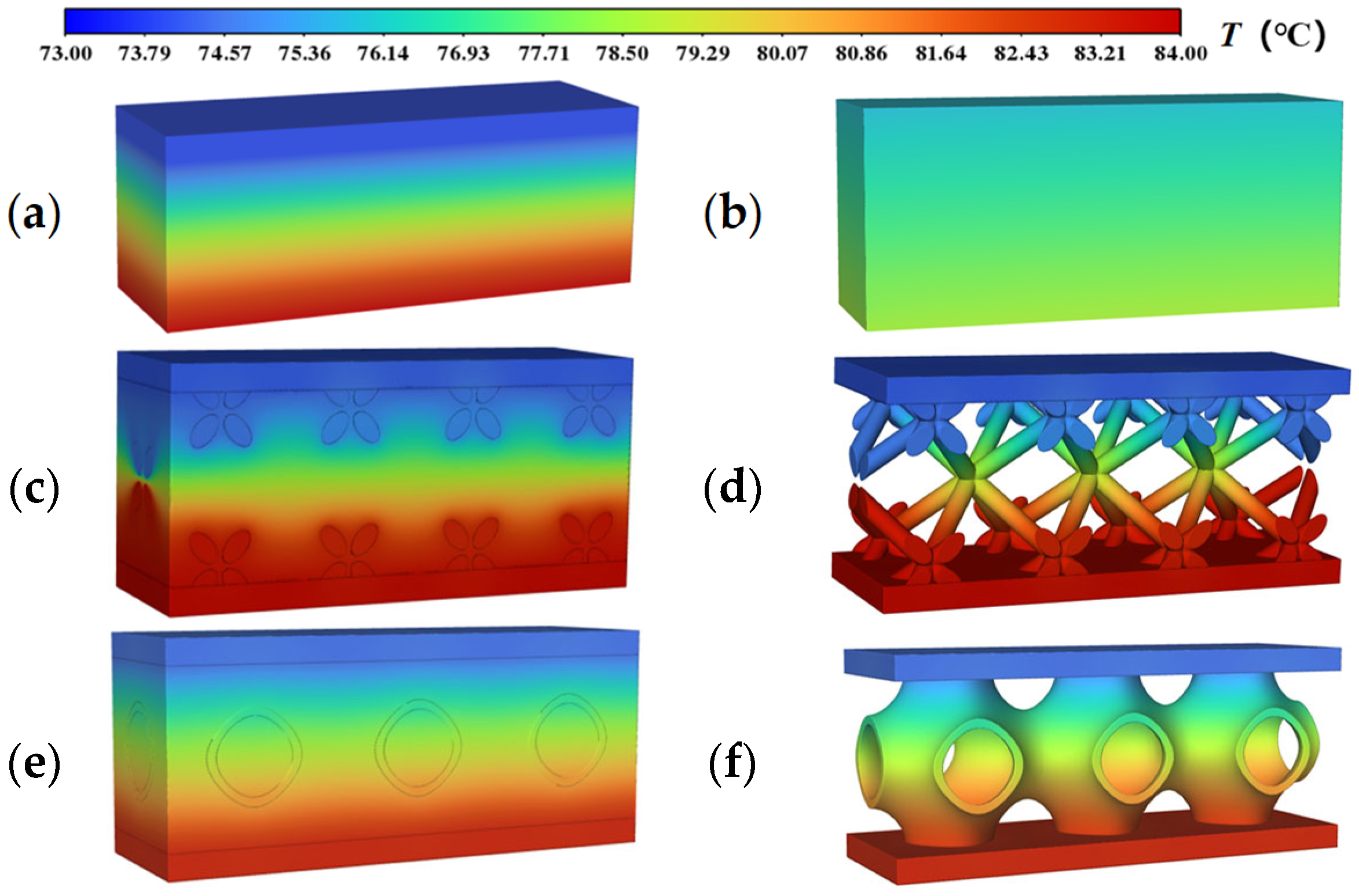
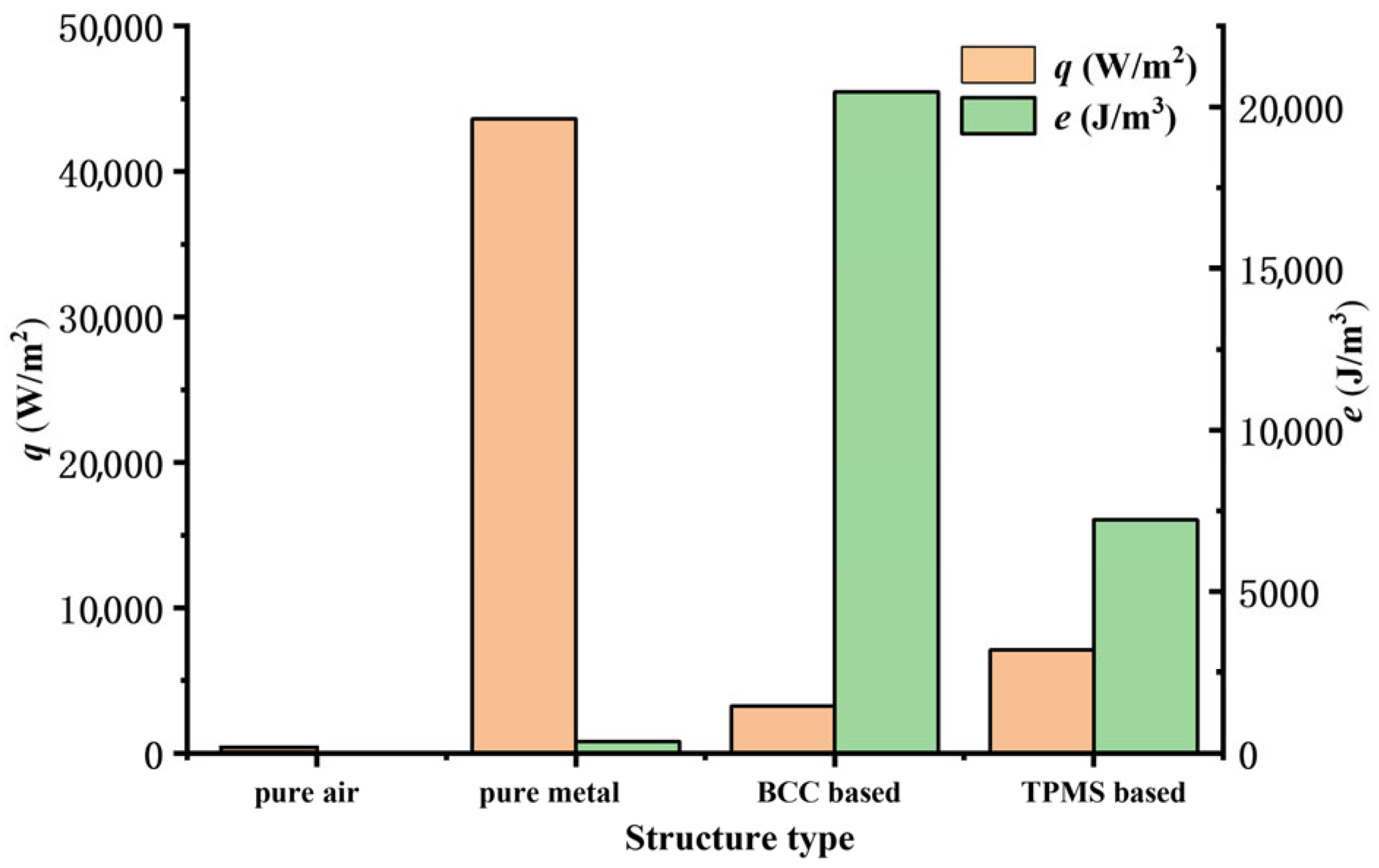
Based on the established model, the heat transfer performance and structural strength of four different configurations were analyzed. The resulting temperature contours are presented in Figure 8. In the structures filled with pure air (Figure 8a) and pure solid (Figure 8b) between the hot and cold walls, the uniform material distribution leads to a smooth and consistent temperature gradient. A comparison of the temperature contours reveals that the cold-side temperature of the pure metal structure is higher than that of the pure air structure. Furthermore, the heat flux absorbed by the cold side in the pure metal structure is significantly greater, reaching 43,615.62 W/m2. In contrast, the heat flux in the pure air model is only 30.2 W/m2. However, due to its thin walls and insufficient structural strength, the pure air configuration cannot withstand the impact loads expected in vehicular applications. Therefore, to meet the strength requirements under complex loading conditions, it is necessary to incorporate reinforced support structures within the manifold’s cooling channels.
For the BCC lattice structure (Figure 8c,d), a steep temperature gradient can be observed in the central region. Although heat can transfer from the bottom hot plate to the top plate through the BCC skeleton and the air, the process is significantly impeded by the high thermal resistance. This results in a low heat flux of 3226.37 W/m2 on the cold side, demonstrating the structure’s effective heat transfer suppression performance. In the TPMS structure (Figure 8e,f), the temperature gradient between the hot and cold walls is more uniformly distributed. The heat flux to the cold-side fluid is 7097.76 W/m2, which is less than one-third of the value for the solid model. This also demonstrates its effectiveness in suppressing heat transfer between the high- and low-temperature channels.
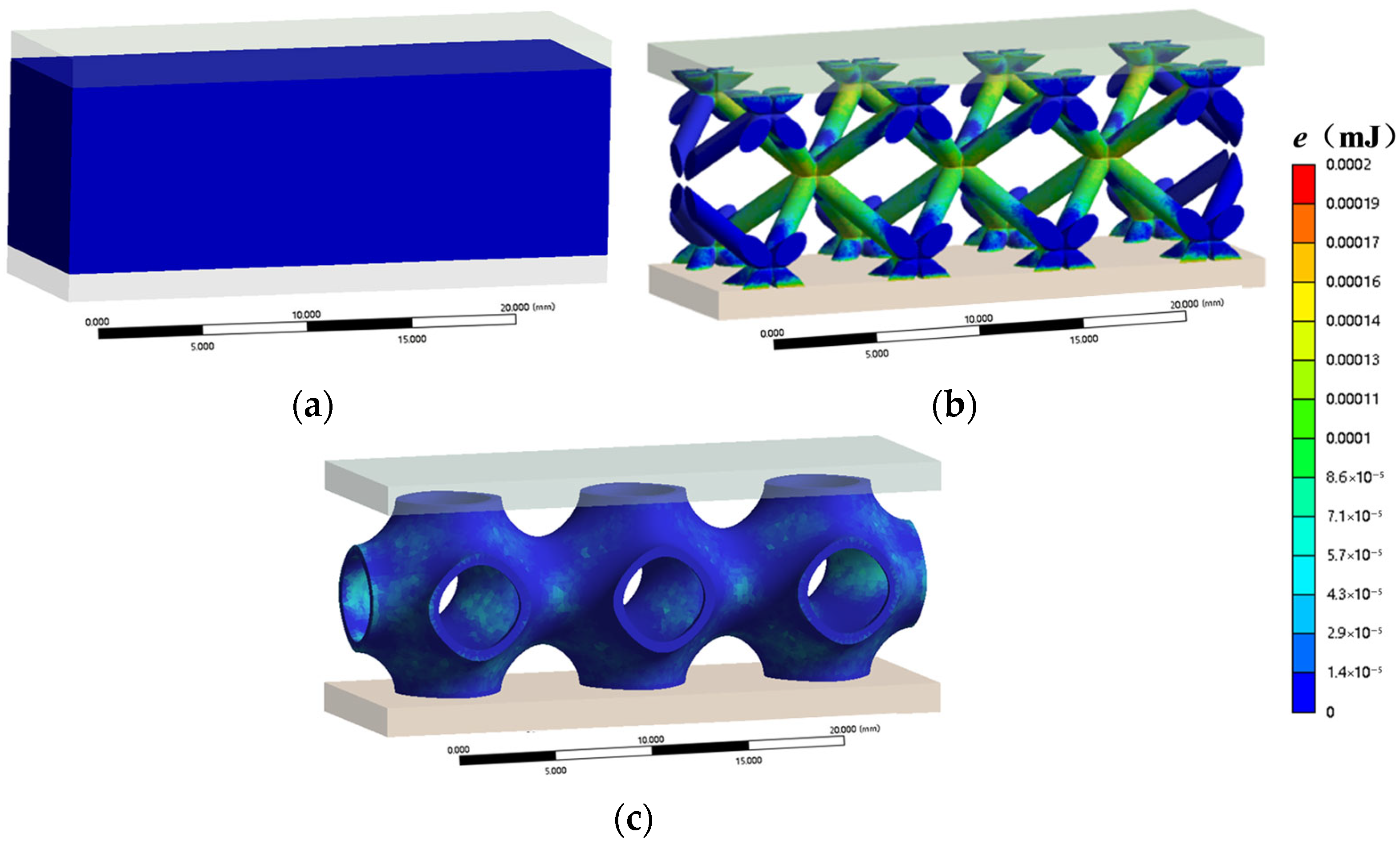
Figure 9 shows the strain energy distribution for three structures. A lower strain energy indicates less deformation per unit volume under a given load, signifying a higher load-bearing capacity. The pure air structure was excluded from this analysis due to its lack of solid support between the hot and cold plates. As shown, the TPMS structure exhibits a strain energy distribution similar to the solid metal, with deformation primarily concentrated in the central region away from the walls. Its average strain energy density is 7223.115 J/m3. Remarkably, even having only 10% of the volume of the pure metal structure, the TPMS structure demonstrates a comparable strain energy distribution, confirming its excellent mechanical support. Under similar external loads and effective volumes, the BCC structure exhibits a significantly higher strain energy than the TPMS. Its deformation is concentrated at the lattice nodes, resulting in an average strain energy density of 20,463.62 J/m3.
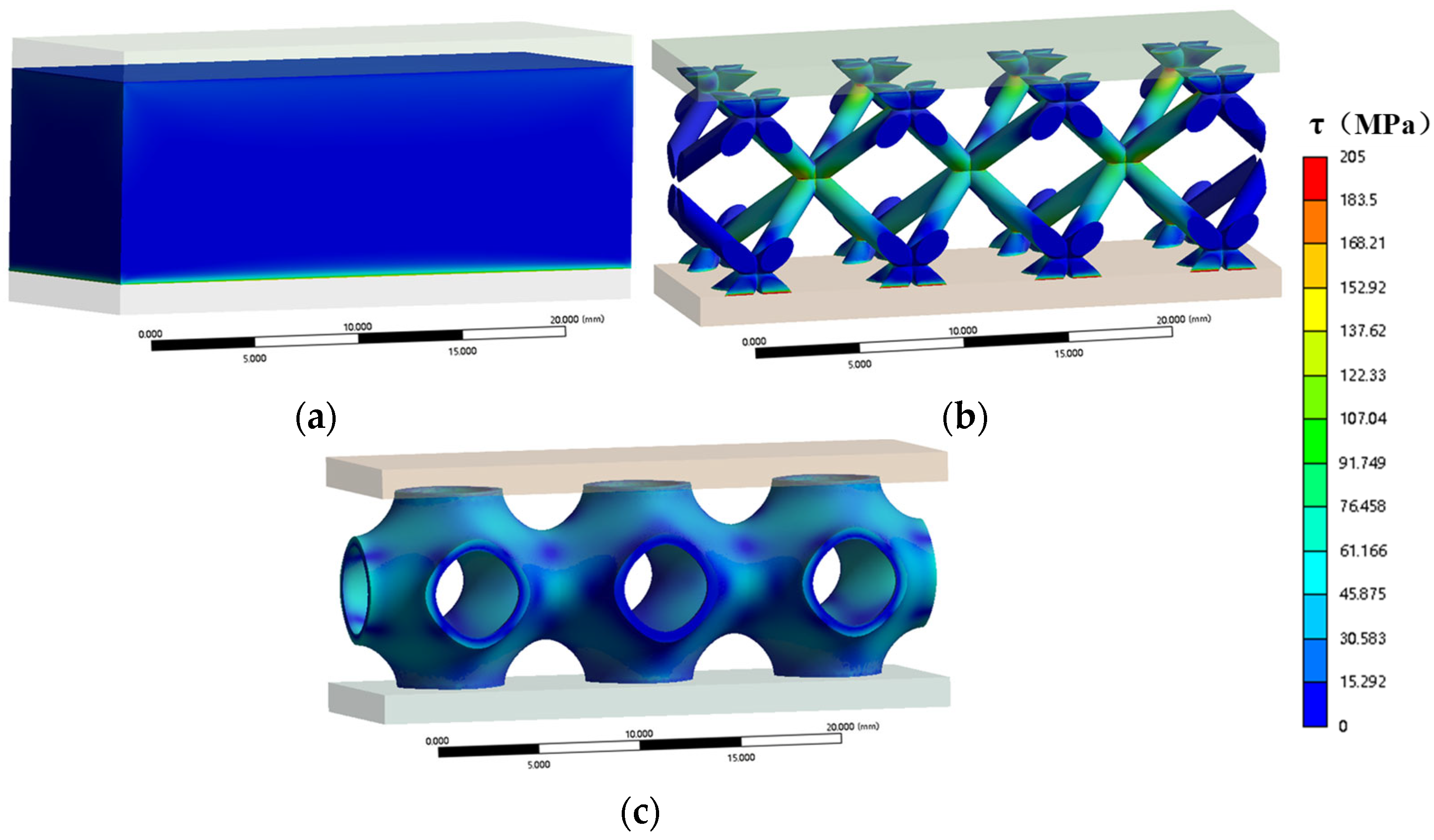
Figure 10 shows the von Mises stress (τ) distribution for each heat-suppressing structure. Under identical loading conditions, the solid metal structure exhibits a relatively uniform stress distribution, with most areas below 15 MPa, except for localized stress concentrations at sharp edges. The BCC structure shows an uneven stress pattern, with significant stress concentration at the lattice nodes, where local peaks exceed 178 MPa, while the strut regions remain at relatively low stress levels. In contrast, the TPMS structure demonstrates a more uniform stress distribution without pronounced stress concentrations. Its overall stress level remains below 75 MPa, effectively transmitting the load between the top and bottom plates and demonstrating superior load-bearing capacity compared to the BCC structure.
As shown in Figure 11, a comprehensive comparison of the heat transfer and mechanical properties reveals the following findings: the pure air structure demonstrates the best heat suppression performance, followed by the BCC structure, with the TPMS structure being slightly less effective thermally. However, under identical effective volume and external loading conditions, the TPMS structure exhibits lower deformation and a lower average strain energy density compared to the BCC-based structure. Overall, both TPMS and BCC structures provide substantial mechanical support while maintaining effective heat suppression compared to the two baseline models. Although the thermal insulation performance of the TPMS is slightly inferior to that of the BCC, its structural strength is significantly superior. Therefore, the TPMS-based heat suppression structure will be the focus of further analysis and optimization.

3.2. Bi-Objective Optimization Based on Machine Learning

The key design parameters for TPMS structures are cell size (l), wall thickness (δ), and the graded offset value. Since the TPMS structures in this study are surrounded by air on both sides, the graded offset parameter is not applicable and is therefore excluded from the discussion. The cell size and wall thickness collectively determine the structure’s heat transfer and mechanical performance.
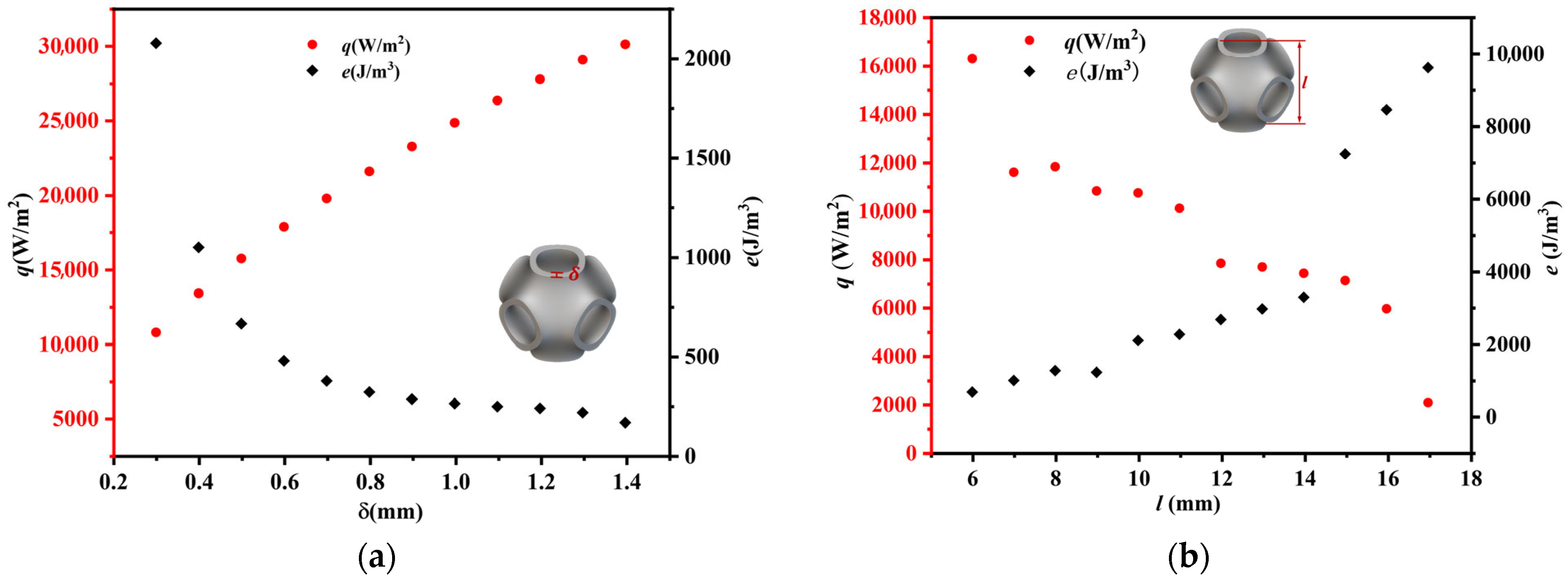
Figure 12 systematically illustrates how the geometric parameters—cell size and wall thickness—govern the thermal and structural properties of the TPMS lattices. From a thermal perspective, the increasing wall thickness leads to a progressive rise in heat flux across the structure, signaling reduced effectiveness in heat suppression. This phenomenon can be explained by two synergistic mechanisms: Firstly, the increased wall thickness expands the solid contact area at the interface between the TPMS skeleton and the top/bottom plates, strengthening thermal bridging. Secondly, thicker walls reduce the porosity and increase the volume fraction of the solid material, which inherently possesses higher thermal conductivity than the fluid within the pores. Consequently, the overall thermal resistance of the structure diminishes.
Structurally, the same increase in wall thickness results in a marked decrease in the average strain energy density under identical loads. This reduction is a direct indicator of elevated geometric stiffness. Thicker walls significantly bolster the bending and shear resistance of the slender struts or sheets that constitute the TPMS architecture, thereby enhancing the load-bearing capacity while constraining elastic deformation. The unit cell size further influences these properties by scaling the absolute dimensions of these structural members. These findings highlight the parameter-driven tunability of TPMS structures, where wall thickness serves as a key variable for mediating the trade-off between thermal insulation and mechanical integrity.
As the TPMS cell size increases, the heat flux (q) between the hot and cold wall gradually decreases. This is because a larger cell size reduces the number of cells that can be arranged between the two plates. Consequently, the volume fraction of the solid TPMS skeleton within the inter-plate space decreases, which enhances the thermal insulation and reduces the heat flux. Conversely, as the cell size increases, the average strain energy density (e) of the structure also rises. Under fixed load and constraint conditions, a larger cell size reduces the volume fraction of the solid TPMS skeleton available to support the load between the plates. This leads to stress concentration in local skeletal regions, increased deformation, and a corresponding reduction in load-bearing capacity.
The analysis demonstrates that the two key structural parameters of the TPMS significantly influence both its heat transfer and mechanical performance. However, achieving both low heat flux and high structural strength simultaneously presents a fundamental trade-off, necessitating optimized design. Obtaining these heat transfer and mechanical performance parameters through CFD simulations is typically time-consuming. Machine learning offers a promising solution, being well-suited for handling large datasets, accommodating dynamic data updates, and providing adjustable prediction accuracy. By combining a limited set of CFD data with machine learning, we can develop rapid prediction models for heat transfer and structural strength. Integrating these models with optimization algorithms enables efficient co-optimization of structural performance. Therefore, this study establishes a dual-objective optimization framework that integrates CFD simulations with a data-driven approach to simultaneously enhance thermal and mechanical performance.
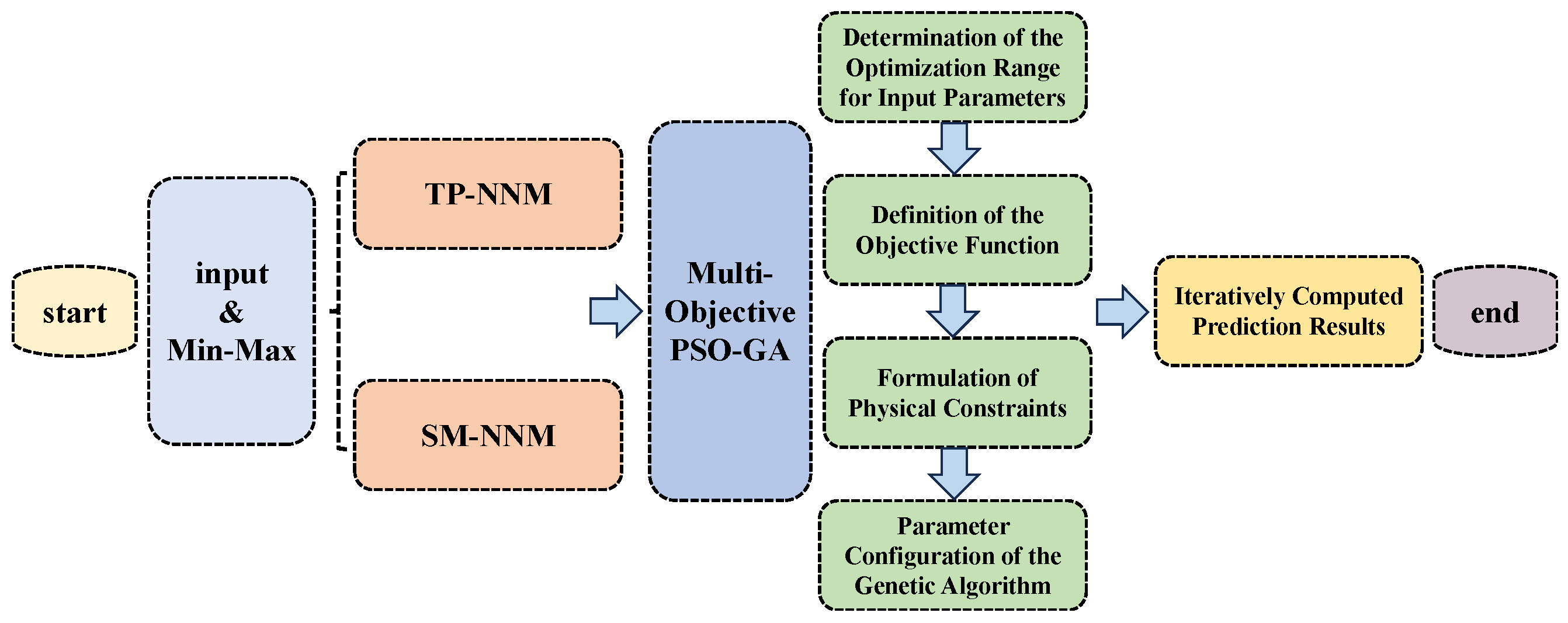
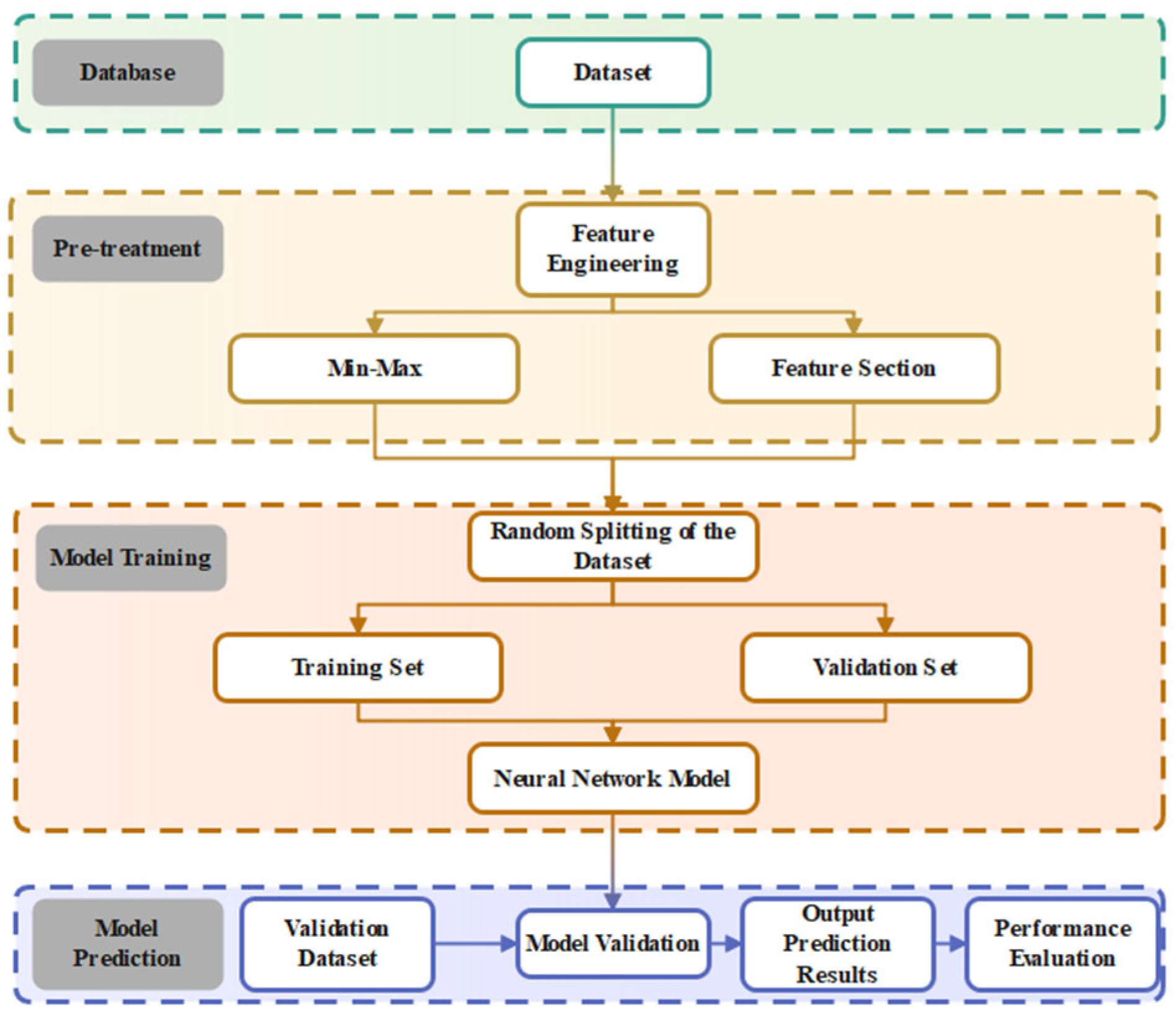
The workflow for developing the machine learning model is illustrated in Figure 13. The process begins with the construction of an initial database based on CFD simulations, containing structural parameters, heat flux values, and the average strain energy density. The data are subsequently preprocessed to remove outliers, resulting in a high-quality dataset. Feature engineering is then performed, including min–max normalization and feature selection. Finally, machine learning algorithms are trained on these processed data to establish high-accuracy predictive models for performance evaluation.
Among various machine learning approaches, the feedforward neural network (FNN) is widely utilized in engineering prediction and structural optimization owing to its high predictive accuracy and relatively low data requirements. In this study, FNNs are employed to model and optimize TPMS-based structures, following the workflow illustrated in Figure 13. Separate neural network models were developed for the two performance objectives, namely, heat flux and structural strength. To prevent over-parameterization, the complexity of the network was dynamically constrained based on the sample size—specifically, the total number of neurons in the hidden layers was limited to no more than one-quarter of the number of samples. Four candidate network architectures with varying complexities, ranging from single-hidden-layer to double-hidden-layer configurations, were designed and trained in parallel. Their performance was evaluated using the root mean square error (RMSE) as the metric, leading to the selection of the optimal network configuration.
To ensure the strong generalization capability of the model, the dataset was randomly divided into training, validation, and test sets in a 70:15:15 ratio. These subsets were designated for model training, hyperparameter tuning, and final predictive performance evaluation, respectively, aiming to achieve high predictive accuracy while preventing overfitting. A combination of strategies was employed to mitigate overfitting, including a streamlined network architecture, L2 regularization, early stopping, and five-fold cross-validation for neural network evaluation.

3.2.1. Feature Extraction and Training of Neural Network Models

As previously established, both the unit cell size, l (mm), and the wall thickness, δ (mm), significantly influence both the heat flux and deformation behavior. Therefore, these two parameters were selected as the key model inputs. For thermal performance, the heat flux, q (W/m2), serves as the output parameter, where a higher value indicates poorer heat transfer suppression. For structural integrity, the average strain energy density, e (J/m3), is the key output parameter, with a higher value corresponding to inferior mechanical performance.
When constructing the dataset, consideration was given to the number of input and output variables as well as the validation set size. With two key input parameters—unit cell size and wall thickness—the total database size was designed to exceed n × 8 (where n is the number of input variables). Accordingly, 23 Primitive-type structures with different shape parameters were designed. The heat flux was computed via CFD simulations, while the average strain energy density for each structure was obtained through structural mechanics simulations. This process resulted in the machine learning database presented in Table 3.
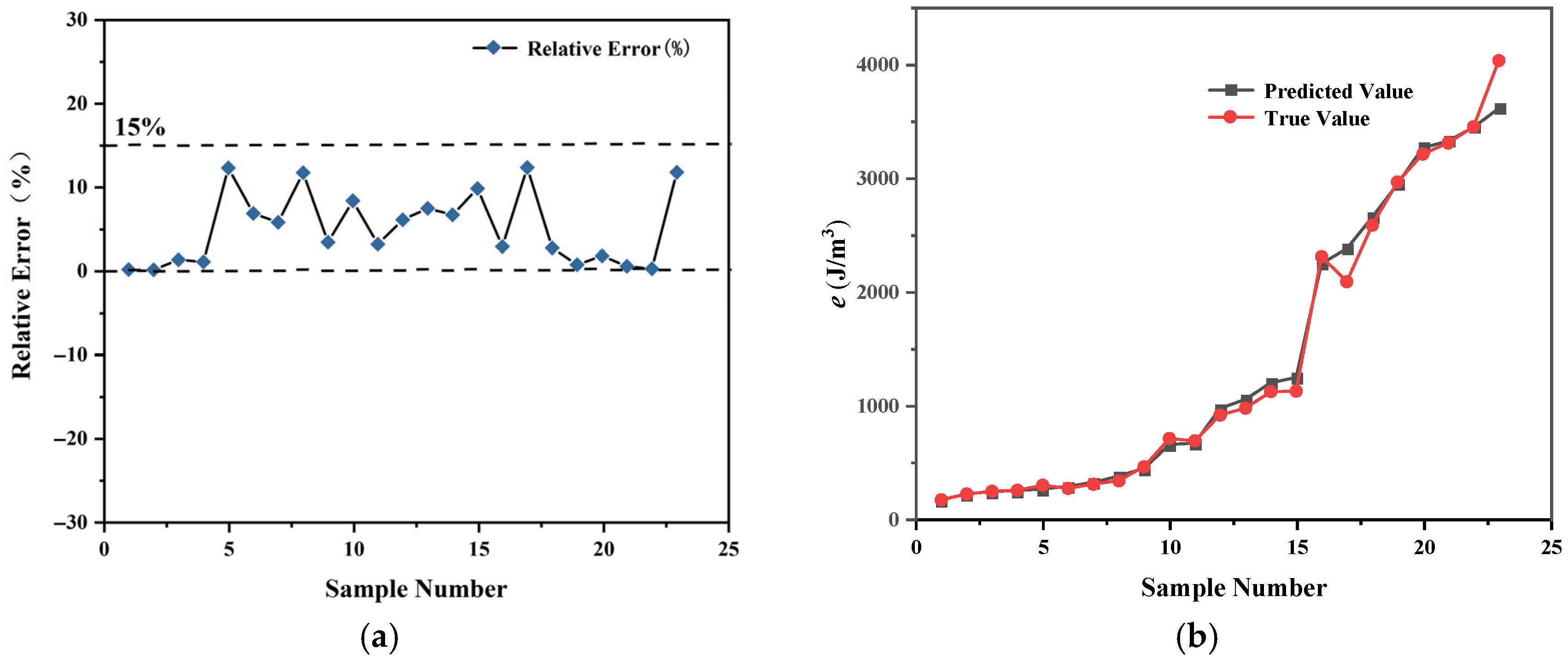
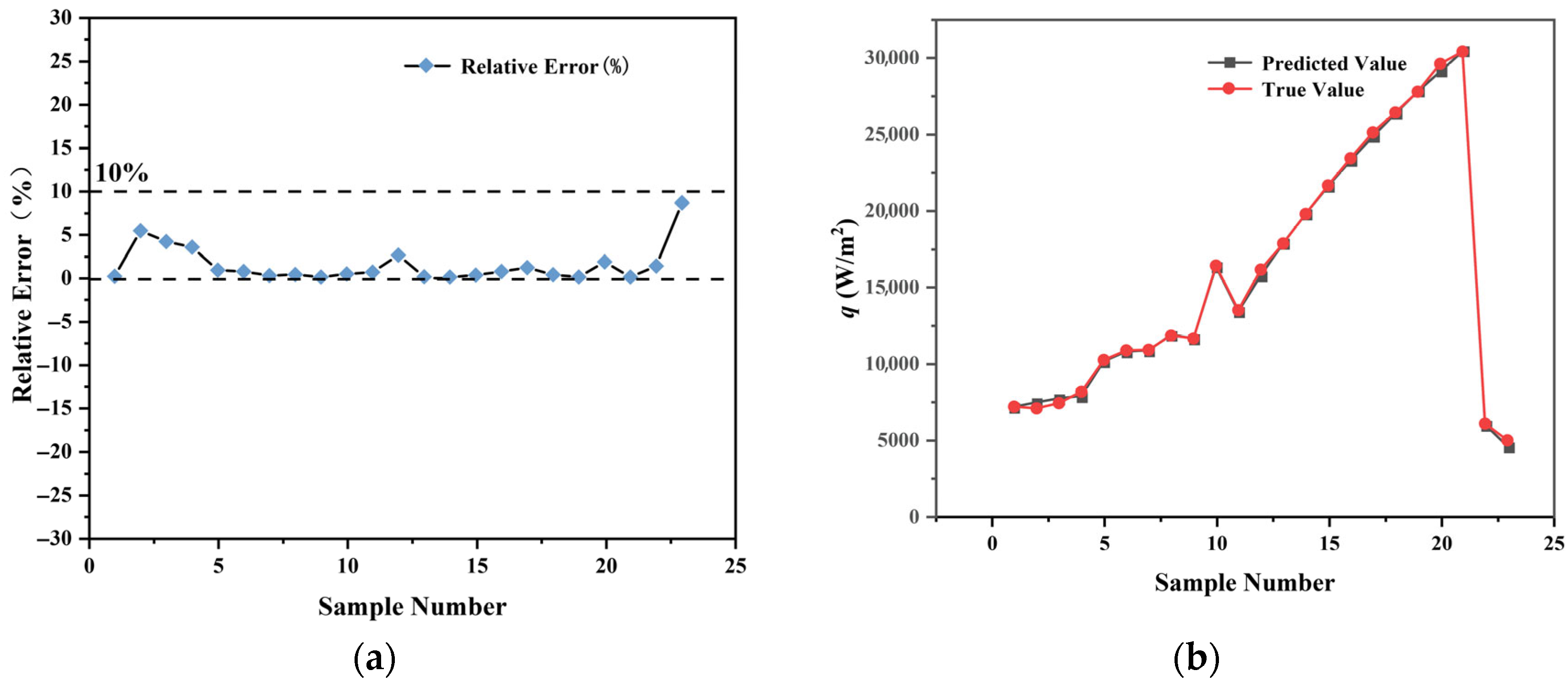
The database was imported into the model for training. Through dynamic adjustment of the neural network architecture, a double-hidden-layer neural network model for thermal performance (TP-NNM) was developed, comprising three neurons in the first hidden layer and four neurons in the second hidden layer. The resulting prediction error and correlation are illustrated in Figure 14. The predicted heat flux values from this model show strong agreement with the actual values. The relative error for most data points remains below 5%, with only a few outliers reaching 10–15%. The model achieves a root mean square error of 335.2 W/m2, demonstrating its high predictive accuracy.
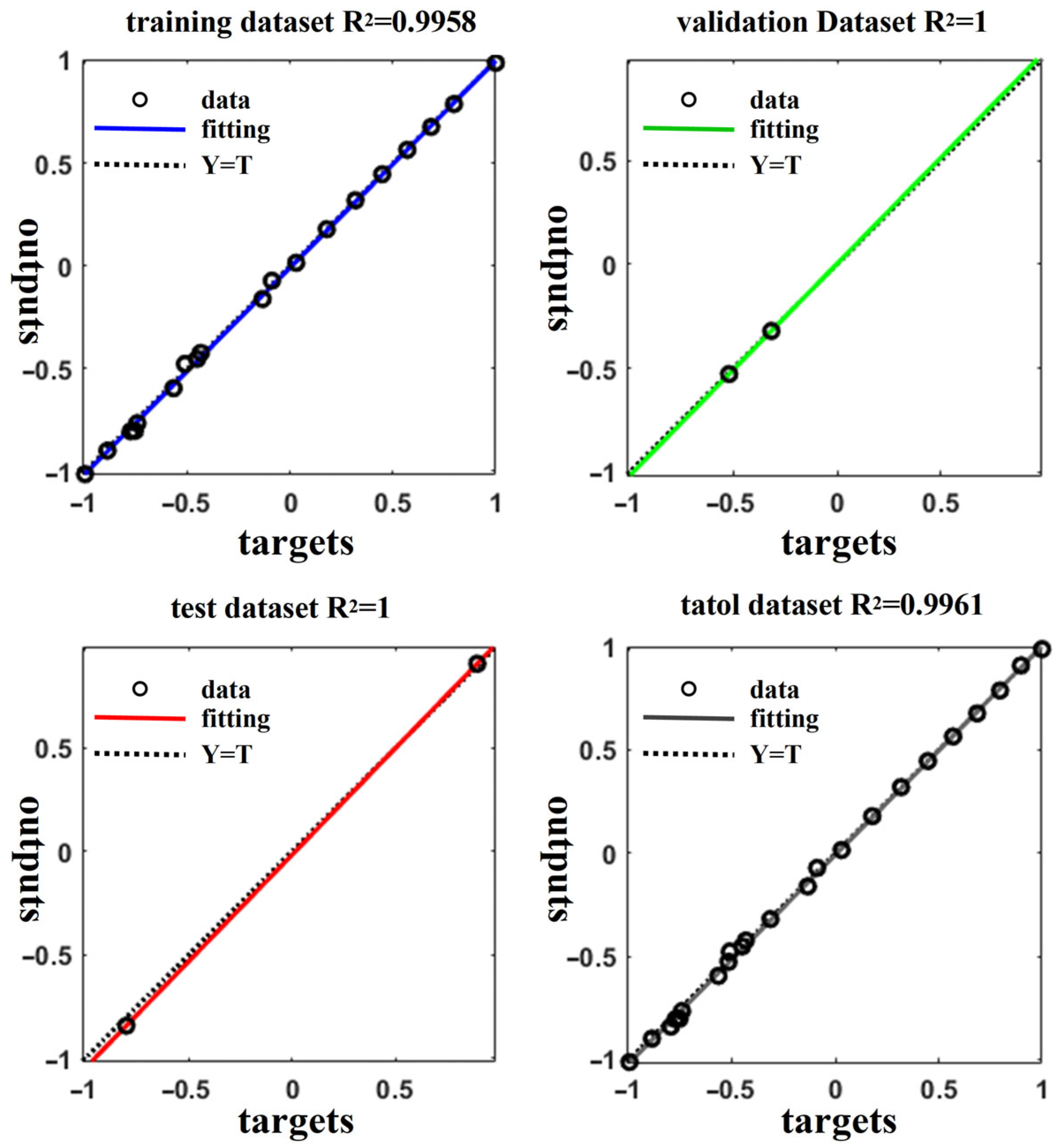
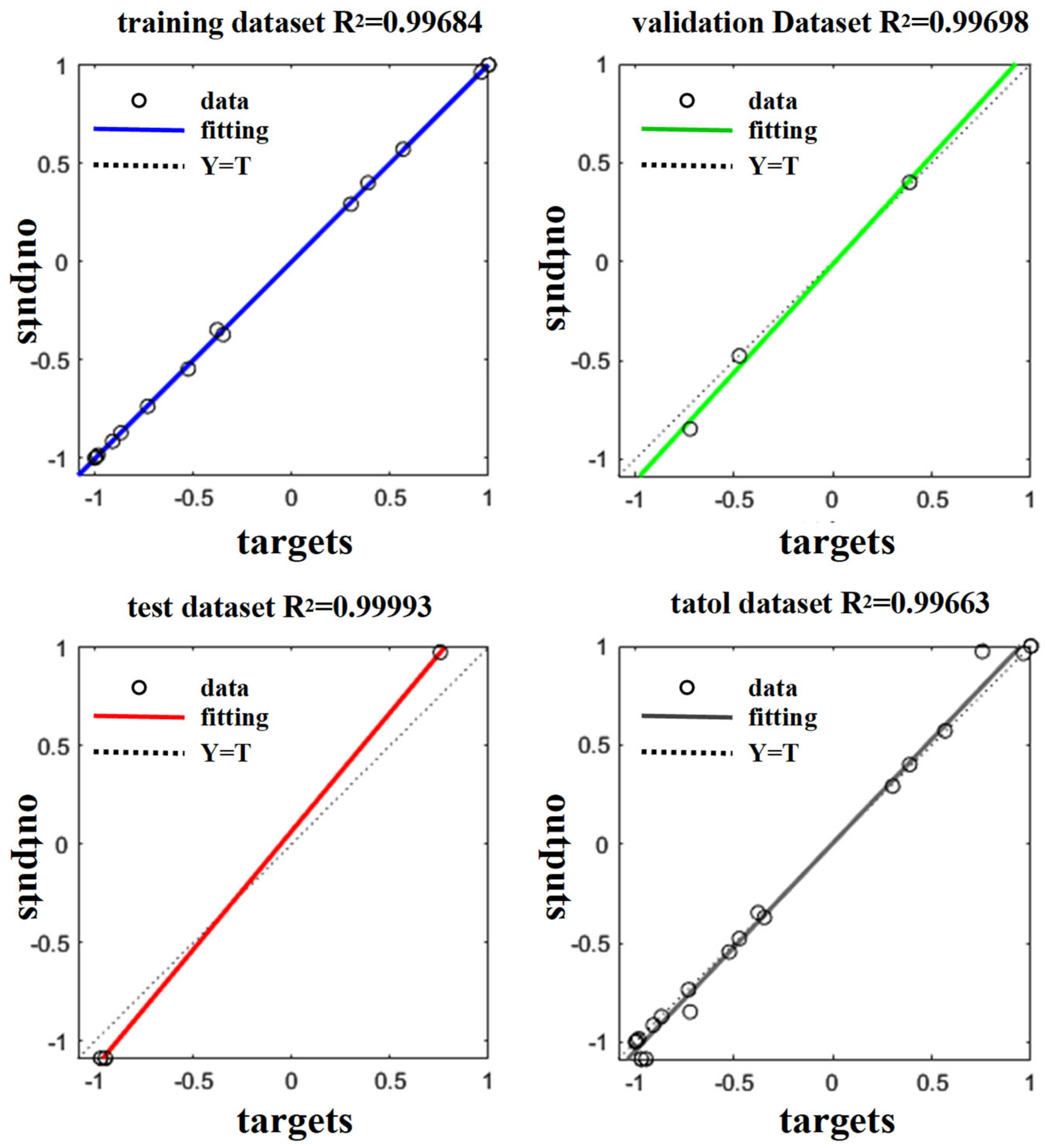
As shown in Figure 15, the predicted values from the neural network model for heat transfer show excellent agreement with the target values. The scatter points cluster closely around the Y = T line, indicating that the model has successfully captured the complex relationship between the inputs and outputs. The model achieved coefficient of determination (R2) values exceeding 0.99 across the training, validation, and test sets, demonstrating outstanding predictive accuracy and generalization capability. This high performance confirms the model’s reliability for predicting unseen data, making it suitable for the parameter optimization in the subsequent dual-objective analysis.
For the structural mechanics analysis, a predictive model was developed using unit cell size and wall thickness as inputs to estimate the average strain energy density. The dataset was partitioned, with 15% randomly selected for validation, another 15% for testing, and the remaining 70% for training. Given the significant variation in the mechanical output with respect to the input parameters, a neural network with two hidden layers was adopted, containing six neurons in the first layer and five in the second. Following iterative training adjustments, Figure 16 presents the relative prediction errors and a comparison of predicted and actual values. The predictions align closely with the targets, yielding a mean relative error of 116.90 J/m3, which indicates satisfactory overall predictive performance. Figure 17 further shows the regression metrics for this model, with the correlation coefficient (R2) values for the training, validation, and test sets all approaching 1, confirming the model’s high predictive accuracy.

3.2.2. Bi-Objective Optimization with Validation

The design of heat-suppressing structures must simultaneously meet requirements for both heat transfer insulation and mechanical strength, representing a typical multi-objective optimization problem. This study therefore employs a genetic algorithm to perform dual-objective optimization of TPMS-based heat-suppressing structures. Following the establishment of high-accuracy neural network models, a multi-particle swarm genetic algorithm is utilized to optimize the structural parameters, inversely solving for optimal configurations that meet the specified requirements.
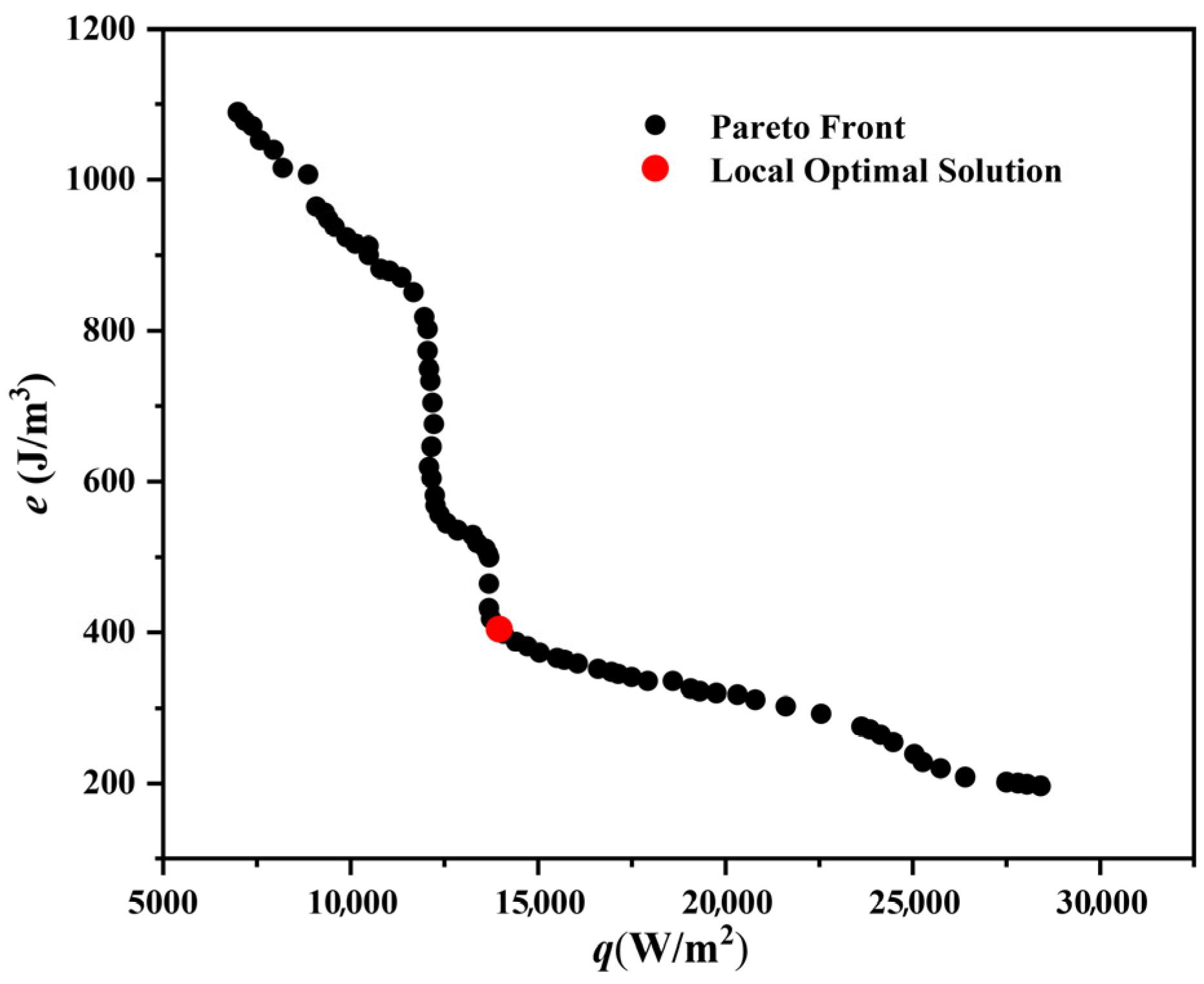
An inherent trade-off exists between structural strength and heat transfer suppression effectiveness, as enhancing mechanical performance typically requires an increased solid volume fraction that compromises thermal insulation. This constitutes a classic Pareto optimization problem. To address this, the predicted values of the two performance metrics were first normalized. Following the assignment of respective weights to structural strength and thermal performance, their weighted sum was minimized to identify Pareto-optimal solutions, thereby achieving multi-objective optimization. The optimization procedure, illustrated in Figure 18, employs separate neural network models for predicting heat transfer and mechanical performance independently. These models are simultaneously invoked during the genetic algorithm optimization, enabling the acquisition of well-optimized results with minimal error within a limited number of iterations.
A bi-objective optimization algorithm was employed to identify the optimal geometric parameters for the TPMS-based heat transfer suppression structures, assigning equal weight (1:1) to the thermal and mechanical objectives. The performance metrics were first min–max-normalized to the interval [−1, 1] to ensure neural network stability and convergence. The design variables were the unit cell size (6–17 mm) and wall thickness (0.3–1.4 mm). Within these bounds, an initial population of 100 random (cell size, wall thickness) pairs was generated. The corresponding heat flux density and deformation energy density for each pair were predicted using the pre-trained structural and thermal neural networks. The Levenberg–Marquardt algorithm was used for network training, incorporating early stopping (with a maximum of 50 consecutive failures), an L2 regularization coefficient of 0.01, and a logarithmic transformation applied to the deformation energy data to improve its distribution.
The genetic algorithm was configured with the following parameters: a population size of 100, a maximum of 50 generations, a Pareto-front retention ratio of 35%, a crossover probability of 0.8, a migration rate of 0.2, a function tolerance of 1 × 10⁻⁴, and a constraint tolerance of 1 × 10⁻³. Selection, crossover, and mutation operations were performed based on Pareto dominance. To select the final optimum from the generated Pareto frontier, the solutions were first filtered and ranked by crowding distance. A weighted scoring method was then applied to identify a balanced candidate that simultaneously accounted for performance, distribution uniformity, and physical feasibility. This process yielded a robust configuration centrally located in the objective space, ensuring a practical compromise between thermal and mechanical performance.
Figure 19 presents the Pareto front obtained using the genetic algorithm. This frontier exhibits a characteristic negative correlation, marked by an increase in heat flux with a corresponding decrease in the average strain energy density. This relationship highlights the inherent trade-off between the two optimization objectives—enhancing thermal insulation generally leads to higher structural deformation energy, while improving structural strength compromises heat transfer capability. A balanced compromise between these competing objectives is achieved by solutions in the central region of the Pareto front, one of which corresponds to a heat flux of 14,012 W/m2 and an average strain energy density of 401.12 J/m3. Based on the Pareto-optimal solution, the TPMS heat transfer suppression structure was optimized with a unit cell size of 7.19 mm and a wall thickness of 0.41 mm. The model’s generalization ability was assessed via extrapolation testing within the optimal solution region. Five extrapolation points were generated near the optimum, and their predictions were benchmarked against high-fidelity CFD simulations. All errors were contained within 15%, verifying the model’s reliability in handling unseen data.
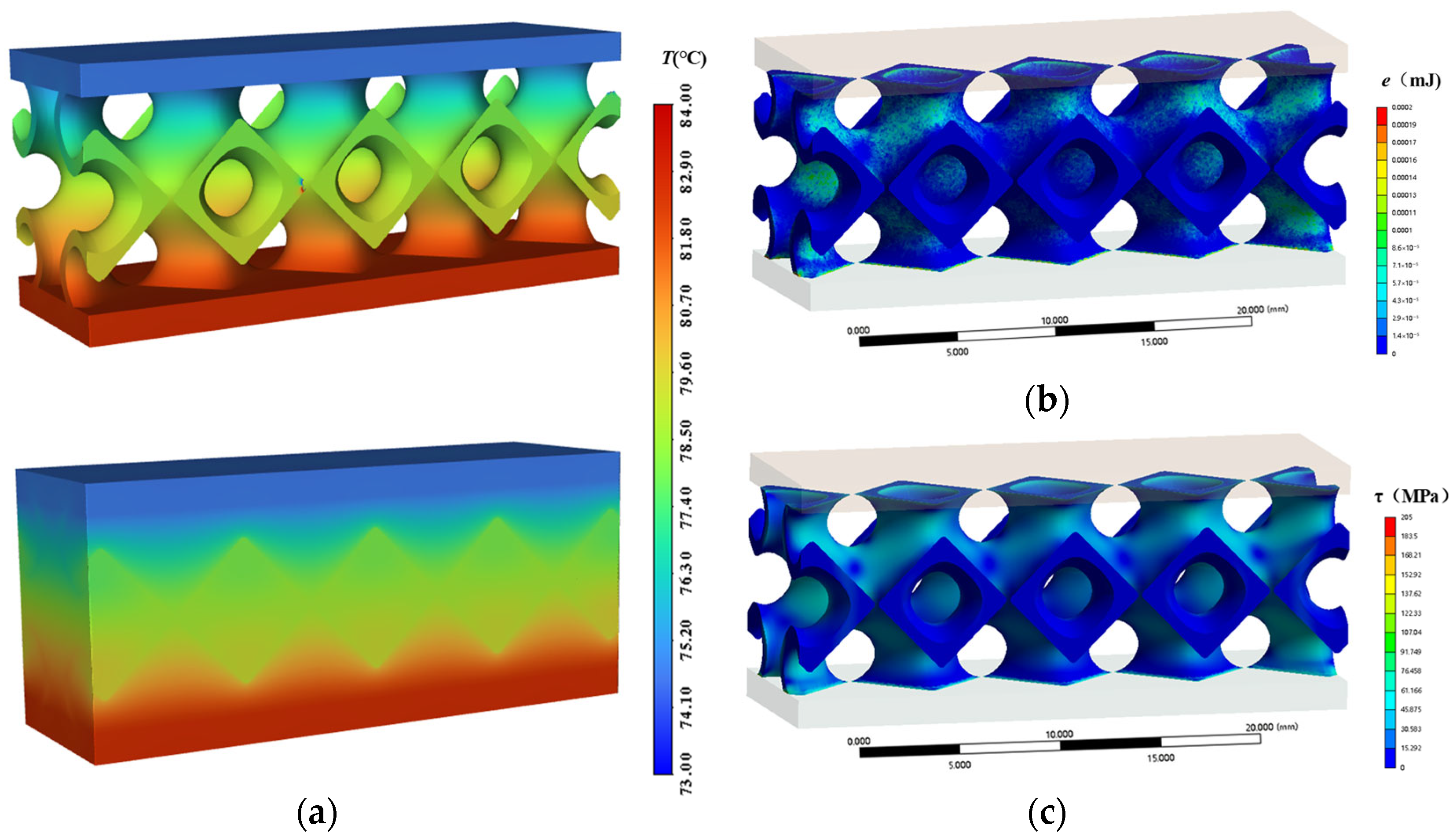
A corresponding geometric model was constructed and validated through simulation. Figure 20a shows the temperature contour of the optimized structure, where a distinct temperature gradient forms between the high- and low-temperature plates, indicating effective thermal insulation. The measured heat flux was 14,828 W/m2, which closely matches the neural network and genetic algorithm prediction of 14,012 W/m2, with an error of less than 10%, thereby validating the accuracy of the prediction.
Figure 20b,c present the strain energy contour and von Mises stress contour of the optimized structure, respectively. The results show that the von Mises stress remains below 75 MPa and that the deformation is within the acceptable limit, satisfying the mechanical design requirements. Furthermore, the average strain energy density is 427.69 J/m3, which deviates from the predicted value (401.12 J/m3) by only 6%—an acceptable margin of error. In summary, the adopted optimization approach effectively predicts both the heat transfer and mechanical performance of the TPMS structure, enabling a well-balanced co-design of structural strength and heat transfer performance.

4. Conclusions

This study demonstrates the feasibility of using TPMS and BCC lattice structures for the dual-objective optimization of heat transfer suppression and mechanical performance in compact thermal management components for electric vehicles. The main conclusions are as follows:
  • The heat transfer and mechanical performances of TPMS and BCC structures were analyzed. Through comparative analysis, TPMS structures were found to offer superior mechanical strength with relatively effective heat transfer suppression, while BCC structures exhibited better thermal insulation but lower structural integrity.
  • A neural network model was efficiently trained to predict thermal flux and average deformation energy density from key structural parameters, enabling a genetic algorithm to perform dual-objective optimization.
  • The Pareto-optimal solution achieved a balanced performance, validated by CFD simulations, with errors within acceptable limits. The proposed methodology provides a systematic and effective approach for designing high-performance, lightweight thermal management components that meet both thermal and structural demands, offering valuable insights for future applications in integrated vehicle thermal systems.
It should also be emphasized that the present work addresses only the influence of structural parameters on thermal performance and mechanical strength. In integrated thermal management systems, thermal performance is usually the primary concern and is significantly affected by thermal boundary conditions; hence, further investigation of these boundary effects is required to achieve a more comprehensive understanding.

Author Contributions

Conceptualization, X.Y., Z.L. and R.T.; methodology, X.S., X.Y. and P.S.; software, X.Y. and Z.L.; validation, X.Y., Z.L. and X.S.; formal analysis, R.T. and P.S.; investigation, X.Y. and Z.L.; resources, X.S.; data curation, Z.L.; writing—original draft preparation, X.Y.; writing—review and editing, X.S.; visualization, X.Y. and Z.L.; supervision, R.T. and M.W.; project administration, X.S., M.W. and L.S.; funding acquisition, M.W., X.S. and L.S. All authors have read and agreed to the published version of the manuscript.

Funding

This work is supported by the XX Development Pre-research Project (highly efficient XX thermal management technology).

Data Availability Statement

Data are unavailable due to privacy or ethical restrictions.

Acknowledgments

The authors would like to express their sincere gratitude to all those who contributed to this work: our colleagues for their insightful discussions, constructive feedback, and unwavering support throughout the research process.

Conflicts of Interest

The authors declare no conflicts of interest.

Abbreviations

The following abbreviations are used in this manuscript:
TPMSTriply Periodic Minimal Surface
BCCBody-Centered Cubic
CFDComputational Fluid Dynamics
TP-NNMThermal Performance Neural Network Model
SM-NNMStructural Mechanics Neural Network Model
FNNsFeedforward neural networks
ReReynolds number
PrPrandtl number
NuNusselt number
λThermal conductivity, (W/m·K)
βThermal expansion coefficient, (K−1)
μDynamic viscosity, (Pa·s)
αThermal diffusivity, (m2/s)
νKinematic viscosity, (m2/s)
TTemperature
h1Heat transfer coefficients, (W/m2·K)
lCell size, (mm)
δWall thickness, (mm)
qHeat flux, (W/m2)
eAverage strain energy density, (J/m3)
τVon Mises stress, (MPa)

References

  1. Previati, G.; Mastinu, G.; Gobbi, M. Thermal Management of Electrified Vehicles—A Review. Energies 2022, 15, 1326. [Google Scholar] [CrossRef]
  2. Lajunen, A.; Yang, Y.; Emadi, A. Review of Cabin Thermal Management for Electrified Passenger Vehicles. IEEE Trans. Veh. Technol. 2020, 69, 6025–6040. [Google Scholar] [CrossRef]
  3. Chen, W.; Han, X.; Pan, Y.; Yuan, Y.; Kong, X.; Liu, L.; Sun, Y.; Shen, W.; Xiong, R. Defects in lithium-ion batteries: From origins to safety risks. Green Energy Intell. Transp. 2025, 4, 100235. [Google Scholar] [CrossRef]
  4. Al-Haddad, L.A.; Ibraheem, L.; EL-Seesy, A.I.; Jaber, A.A.; Al-Haddad, S.A.; Khosrozadeh, R. Thermal heat flux distribution prediction in an electrical vehicle battery cell using finite element analysis and neural network. Green Energy Intell. Transp. 2024, 3, 100155. [Google Scholar] [CrossRef]
  5. Zhang, S. 1-Dimensional Modeling and Control Strategy Research for a Battery Electric Vehicle Thermal Management System (zh-CN). Master’s Thesis, Chang’an University, Xi’an, China, 2023. [Google Scholar] [CrossRef]
  6. Tang, C.; Tian, R.; Mao, J.; Li, D.; Peng, H. Current status and future trends of thermal management technology for new energy vehicles (zh-CN). Automob. Parts 2025, 8, 97–100. [Google Scholar] [CrossRef]
  7. Yang, Q.; Lu, W.; Zou, Z.; Xu, L. Design and Optimization of an Integrated Module for Electric Vehicle Thermal Management System. Cryog. Supercond. 2025, 53, 72–78. [Google Scholar] [CrossRef]
  8. Dan, D.; Zhao, Y.; Wei, M.; Wang, X. Review of Thermal Management Technology for Electric Vehicles. Energies 2023, 16, 4693. [Google Scholar] [CrossRef]
  9. Huang, Y. Finned Heat Sink Design Using Conjugate Fluid-Solid Heat Transfer (zh-CN). Master’s Thesis, Wuhan University, Wuhan, China, 2021. [Google Scholar] [CrossRef]
  10. Mou, J.; Xing, B.; Guo, M.; Qiao, H.; Wang, Q. Topology Optimization Analysis of an Aero-Engine Gearbox Housing Considering Thermal-Elastic-Fluid Coupling (zh-CN). J. Mech. Transm. 2022, 46, 127–134. [Google Scholar]
  11. Han, S. Optimal Design of Cooling Channels Based on Fluid-Solid Conjugate Heat Transfer (zh-CN). Master’s Thesis, Dalian University of Technology, Dalian, China, 2021. [Google Scholar]
  12. Xiao, M.; Li, Q.; Gao, L.; Sha, W.; Huang, M. Cross-Scale Topology Optimization of Lattice Heat Dissipation Structures Based on Anisotropic Material Interpolation (zh-CN). J. Mech. Eng. 2024, 60, 1–10. Available online: https://link.cnki.net/urlid/11.2187.TH.20240517.1707.049 (accessed on 25 November 2025).
  13. Brambati, G.; Guilizzoni, M.; Foletti, S. Convective Heat Transfer Correlations for Triply Periodic Minimal Surfaces Based Heat Exchangers. Appl. Therm. Eng. 2024, 242, 122492. [Google Scholar] [CrossRef]
  14. Yang, Z.; Bai, X.; Bao, X.; Liu, J.; Gao, K.; Zhang, Y.; Wang, Z. A Finite Element Analysis-Based Optimization Design Method for Reinforcement Ribs of Reducer Housing (zh-CN). Drive Syst. Tech. 2024, 38, 19–26. [Google Scholar]
  15. Zhong, Q. Structural Optimization of an All-Aluminum Battery Case for New Energy Vehicles (zh-CN). Automob. Test Rep. 2024, 5, 64–66. [Google Scholar]
  16. Guo, W.; Yang, Y.; Liu, C.; Bu, W.; Guo, F.; Li, J.; Wang, E.; Peng, Z.; Mai, H.; You, H.; et al. 3D Printed TPMS Structural PLA/GO Scaffold: Process Parameter Optimization, Porous Structure, Mechanical and Biological Properties. J. Mech. Behav. Biomed. Mater. 2023, 142, 105848. [Google Scholar] [CrossRef] [PubMed]
  17. Wang, J.; Chen, K.; Zeng, M.; Ma, T.; Wang, Q.; Cheng, Z. Investigation on Flow and Heat Transfer in Various Channels Based on Triply Periodic Minimal Surfaces (TPMS). Energy Conv. Manag. 2023, 283, 116955. [Google Scholar] [CrossRef]
  18. Naji, M.M.; Alagha, A.N.; Sheikh-Ahmad, J.Y.; Abu Al-Rub, R.K. Hybrid Plate-TPMS Lattice Metamaterials with Exceptional Stiffness and Strength. Virtual Phys. Prototyp. 2025, 20, e2536560. [Google Scholar] [CrossRef]
  19. Tsai, Y.-Y.; Chang, S.-W. Pullout Strength of Triply Periodic Minimal Surface-Structured Bone Implants. Int. J. Mech. Sci. 2023, 237, 107795. [Google Scholar] [CrossRef]
  20. Laskowska, D.; Szatkiewicz, T.; Balasz, B.; Mitura, K. Mechanical Properties and Energy Absorption Abilities of Diamond TPMS Cylindrical Structures Fabricated by Selective Laser Melting with 316 L Stainless Steel. Materials 2023, 16, 3196. [Google Scholar] [CrossRef]
  21. Liu, P.; Qi, W.; Luo, K.; Yin, C.; Li, J.; Lu, C.; Lu, L. Bending Performance and Failure Mechanisms of Composite Sandwich Structures with 3D Printed Hybrid Triply Periodic Minimal Surface Cores. J. Sandw. Struct. Mater. 2024, 26, 990–1011. [Google Scholar] [CrossRef]
  22. Zhang, J.; Xie, S.; He, G.; Li, T.; Sun, G.; Zhou, Z.; Cui, Y. Design of Hybrid Triply Periodic Minimal Surface Structures to Enhance Structural Dynamic Compression Behavior. Compos. Struct. 2025, 354, 118790. [Google Scholar] [CrossRef]
  23. Vellaisamy, M.; Pathinettampadian, G.; Kavya, H.; Surendhar, G.J.K.; Subramaniyan, M.K. Additively Manufactured Functionally Graded Triply Periodic Minimal Surfaces for Integrated Engineering Structural Applications. Strength Mater. 2025, 57, 866–879. [Google Scholar] [CrossRef]
  24. Tian, R.; Meng, S.; Zheng, S.; Sun, X.; Wei, M. Thermo-Hydraulic Performance Evaluation of Lattice Structures with Triply Periodic Minimal Surfaces for Latent Heat Storage Devices. J. Energy Storage 2024, 102, 114234. [Google Scholar] [CrossRef]
  25. Wei, X.; Qian, Y.; Li, Y.; Gong, Z.; Yao, M.; Qian, D.; Hu, B. Investigation on the Flow and Heat Transfer of a Novel Three-Fluid Heat Exchanger Based on TPMS. Energy 2025, 314, 134072. [Google Scholar] [CrossRef]
  26. Wei, Y.; Li, H.; Han, J.; Ma, Y.; Zhou, H.; Cheng, J.; Shi, J.; Miao, Z.; Yu, B.; Lin, F. Mechanical and Damping Performances of TPMS Lattice Metamaterials Fabricated by Laser Powder Bed Fusion. China Foundry 2024, 21, 327–333. [Google Scholar] [CrossRef]
  27. Wei, S.; Song, B.; Zhang, L.; Wang, X.; Fan, J.; Zhang, Z.; Shi, Y. Effect of Structural Configurations on Mechanical and Shape Recovery Properties of NiTi Triply Periodic Minimal Surface Porous Structures. Chin. J. Mech. Eng. 2024, 37, 125. [Google Scholar] [CrossRef]
  28. Samudin, I.M.; Radzuan, N.A.M.; Sulong, A.B.; Ma, Q.; Azman, A.H.; Zamri, W.F.H.W. Stress Strain Curve Analysis of Sheet Based TPMS Structures in Quasi Static Compression Test: A Review. J. Mater. Res. Technol.-JMRT 2025, 36, 5757–5796. [Google Scholar] [CrossRef]
  29. Yan, K.; Deng, H.; Xiao, Y.; Wang, J.; Luo, Y. Thermo-Hydraulic Performance Evaluation through Experiment and Simulation of Additive Manufactured Gyroid-Structured Heat Exchanger. Appl. Therm. Eng. 2024, 241, 122402. [Google Scholar] [CrossRef]
  30. Yeranee, K.; Xu, C.; Rao, Y.; Zhang, Y. Experimental and Numerical Study of Improving Flow and Heat Transfer in a Serpentine Cooling Channel with Topology-Optimized TPMS Porous Structures. Int. J. Heat Mass Transf. 2024, 231, 125873. [Google Scholar] [CrossRef]
  31. Tang, W.; Zou, C.; Zhou, H.; Zhang, L.; Zeng, Y.; Sun, L.; Zhao, Y.; Yan, M.; Fu, J.; Hu, J.; et al. A Novel Convective Heat Transfer Enhancement Method Based on Precise Control of Gyroid-Type TPMS Lattice Structure. Appl. Therm. Eng. 2023, 230, 120797. [Google Scholar] [CrossRef]
Figure 1. Common lattice structures.
Electronics 15 00347 g001
Figure 2. Simulation model: (a) physical model; (b) structural design; (c) computational domain.
Electronics 15 00347 g002
Figure 3. Types of heat-suppressing structure models.
Electronics 15 00347 g003
Figure 4. Boundary conditions: (a) thermal boundary conditions; (b) structural loads and constraints.
Electronics 15 00347 g004
Figure 5. Computational meshes: (a) mesh for thermal analysis; (b) mesh for structural analysis.
Electronics 15 00347 g005
Figure 6. Grid-independence validation: (a) mesh for thermal analysis; (b) mesh for structural analysis.
Electronics 15 00347 g006
Figure 7. Comparison of CFD simulation results with experimental data from Ref. [31].
Electronics 15 00347 g007
Figure 8. Temperature contours of various structures: (a) pure air structure; (b) pure metal structure; (c) BCC-based structure (with air); (d) BCC-based structure (skeleton); (e) TPMS-based structure (with air); (f) TPMS -based structure (skeleton).
Electronics 15 00347 g008
Figure 9. Strain energy contour: (a) pure metal structure; (b) BCC-based structure; (c) TPMS-based structure.
Electronics 15 00347 g009
Figure 10. Von mises stress distribution: (a) pure metal structure; (b) BCC-based structure; (c) TPMS-based structure.
Electronics 15 00347 g010
Figure 11. Comparison of heat transfer and mechanical performance of various structures.
Electronics 15 00347 g011
Figure 12. Influence of wall thickness and unit cell size on the thermal and structural properties of TPMS structures: (a) wall thickness (δ); (b) cell size (l).
Electronics 15 00347 g012
Figure 13. Machine learning flowchart.
Electronics 15 00347 g013
Figure 14. Training performance of the thermal performance neural network model (TP-NNM), prediction error and correlation: (a) relative error; (b) prediction vs. target.
Electronics 15 00347 g014
Figure 15. Regression performance of the TP-NNM.
Electronics 15 00347 g015
Figure 16. Training performance of the Structural Mechanics Neural Network Model (SM-NNM): (a) relative error; (b) prediction vs. target.
Electronics 15 00347 g016
Figure 17. Regression performance of the SM-NNM.
Electronics 15 00347 g017
Figure 18. Flowchart of the bi-objective optimization process.
Electronics 15 00347 g018
Figure 19. Pareto front with local optimum.
Electronics 15 00347 g019
Figure 20. Simulation results for the optimized structure: contour plots of thermal and structural performance: (a) temperature distribution; (b) strain energy distribution; (c) equivalent stress distribution.
Electronics 15 00347 g020
Table 1. Basic parameters of the simplified model.
Parametersa1l1b1b2b3
Values (mm)10301.5101.5
Table 2. Data relevant to the convective heat transfer boundary conditions.
VariablesRe1Pr1λ1 (W/m·K)λ2 (W/m·K)d (m)Re2Pr2
Values120,000~130,0002.10560.673080.673080.03360,000~370,0002.41
Table 3. Dataset from CFD simulations.
No.l (mm)δ (mm)q (W/m2)e (J/m3)
1150.37097.767223.115
2100.413,355.241046.476
360.316,287.91647.9479
4100.515,699.38660.8391
570.311,578.64966.6554
6100.310,723.42076.267
7140.37396.693265.531
8100.821,556.5315.7581
9120.37808.312651.944
10100.923,241.40279.8708
11110.310,090.102242.981
12101.024,822.40257.5911
13130.37654.722944.414
14101.126,331.30242.2911
1590.310,808.31192.548
16101.227,769.10233.266
1780.311,808.301240.79
18100.719,744.80372.349
19100.617,822.69473.1413
20160.35924.053446.22
21101.329,077.81212.0424
22170.35512.053612.35
23101.430,112.06160.8391
Disclaimer/Publisher’s Note: The statements, opinions and data contained in all publications are solely those of the individual author(s) and contributor(s) and not of MDPI and/or the editor(s). MDPI and/or the editor(s) disclaim responsibility for any injury to people or property resulting from any ideas, methods, instructions or products referred to in the content.