Article

Wide Range Dual Active Half-Bridge Resonant Converter with PWM Control and Load-Independent Voltage Gain Characteristics


1
School of Traffic & Transportation Engineering, Central South University, Changsha 410075, China
2
School of Information and Electrical Engineering, Hunan University of Science and Technology, Xiangtan 411201, China
*
Author to whom correspondence should be addressed.
Electronics 2026, 15(2), 346; https://doi.org/10.3390/electronics15020346
Submission received: 30 November 2025 / Revised: 31 December 2025 / Accepted: 5 January 2026 / Published: 13 January 2026
(This article belongs to the Special Issue Modelling, Design and Implementation of Power Electronic Converters)

Abstract

This paper proposes a fixed frequency pulse width modulation (PWM) for a dual active half-bridge resonant converter. The wide voltage range can be achieved without adding any additional components, and the voltage gain characteristic is independent of the load. Meanwhile, all switches can achieve full range zero voltage switching (ZVS). The driving logic is unified between the primary and secondary sides, allowing for the implementation of both boost and buck modes. Hence, the control logic is simple. In addition, the multiple-order harmonic analysis of the resonant tank is proposed without complex time-domain calculations. Hence, the expression of voltage gain, current characteristics, and soft switching conditions can be conveniently analyzed. Finally, a 500 W experimental prototype was built. The experimental results prove the effectiveness and superiority of the proposed solution.

1. Introduction

With the rapid development of renewable energy generation and energy storage systems, DC/DC converters have been widely used [1,2,3]. A typical structure of the renewable generation system [4] is shown in Figure 1. In traditional structures, the galvanic isolation between renewable energy and the grid is achieved by the bulky line frequency transformers. When facing the demand for lightweight isolated DC/DC converters with high-frequency, transformers have more advantages [5]. High switching frequency can also effectively reduce the volume and weight of filters. In order to reduce switching losses, soft switching converters are studied. Among numerous isolated DC/DC converters, the LLC resonant converter has potential due to its advantages of wide range zero voltage switching (ZVS) and high conversion efficiency [6,7]. However, due to the intermittency and volatility of renewable energy, its voltage can vary widely. Therefore, isolated DC/DC converters also need to be widely regulated. Pulse frequency modulation (PFM) is commonly used in traditional resonant converters. When the switching frequency is close to the resonant frequency, the converter has a higher conversion efficiency. However, when the voltage regulation range is wide, the switching frequency needs to be far away from the resonant frequency. In this case, a higher circulating current is generated, and the wide frequency range brings challenges to magnetic components and driving circuits [8,9]. Therefore, achieving wide voltage gain within a narrow frequency range is necessary.
In terms of improving topology, additional auxiliary switches can be added, allowing for more control degrees of freedom to expand the voltage gain range. In [10,11], after parallel bidirectional switching of the primary or secondary bridge, the hybrid bridge can be obtained and more voltage levels can be generated. Similarly, a part of the secondary side diodes can also be replaced with MOSFETs, which can reduce additional switches [12]. In [13], a five-switch bridge resonant converter is proposed. The converter contains two resonant tanks and can generate four operating modes through different switching logics. Although the voltage gain range is significantly increased, the complexity of control and driving has increased. Adding auxiliary inductors or capacitors can construct high-order resonant tanks, and the gain curve will become steeper [14]. The most widely used resonant converters, such as CLLC [15] and L-LLC [16] converters, can achieve boost operation mode in reverse. However, the design of resonant tanks is relatively complex. The structure of multiple transformers has better voltage regulation capability, but the utilization rate of auxiliary transformers is usually reduced, and the overall power density is low [17]. The topology morphing method enables the converter to switch between full-bridge and half-bridge, which can directly double the gain range [18]. However, smooth switching between different modes is a challenge, which is more suitable for offline control. In order to balance the voltage regulation range and design difficulty, resonant converters can be cascaded with other non-isolated PWM converters for operation [19]. In this system, the resonant converter always operates at the resonant frequency, and the voltage gain is fixed, which can be regarded as a DC transformer. The non-isolated converter, such as the boost converter, is used to regulate the operating voltage. However, more switches and components are adopted, resulting in higher overall cost and volume.
On the other hand, the improved modulation strategy can also enhance voltage regulation capability without additional components. Improved modulation methods such as pulse width modulation (PWM) [20] and phase shift modulation (PSM) [21] are proposed, which can achieve voltage regulation at a fixed switching frequency. In order to further expand the voltage gain, the hybrid control strategy is proposed [22]. However, the design of the controller is more complex. In addition, in order to improve conversion efficiency, the secondary side diode can be replaced by MOSFET, and the control method of synchronous rectification is adopted [23]. Due to the inconsistent driving logic of the primary and secondary sides MOSFETs, the digital control synchronous rectification strategies usually require high computational complexity. Most synchronous rectification strategies rely on zero crossing detection circuits, which are sensitive to sampling noise. Meanwhile, the design difficulty of the driving circuit is also higher. In addition, the voltage gain of the resonant converter is dependent on the load [24]. At different powers, the voltage gain characteristics are not the same. Usually, under light load, higher voltage gain can be achieved, while under heavy load, voltage gain is reduced. Therefore, in high-power and high current situations, the voltage regulation capability of resonant converters is limited. In addition, for full-bridge or multi-level structures, many improved modulation strategies have been studied due to the large number of control degrees of freedom. The half-bridge resonant converter only has two MOSFETs on the primary or secondary side, which is more suitable for low to medium power applications. However, the modulation strategy is still mainly based on traditional PFM control.
The fixed frequency PWM control strategy of the dual active half-bridge resonant converter is proposed in this paper. Both the primary and secondary sides are active half-bridges. The proposed method has three main advantages:
(1)
The wide voltage gain can be achieved at the fixed switching frequency, without any additional components.
(2)
The voltage gain is independent of the load, and the driving logic of the primary and secondary side MOSFETs is unified.
(3)
Multiple-order harmonic analysis is adopted without complex time-domain calculations.

2. Proposed Converter and Operation

2.1. Proposed Converter Topology

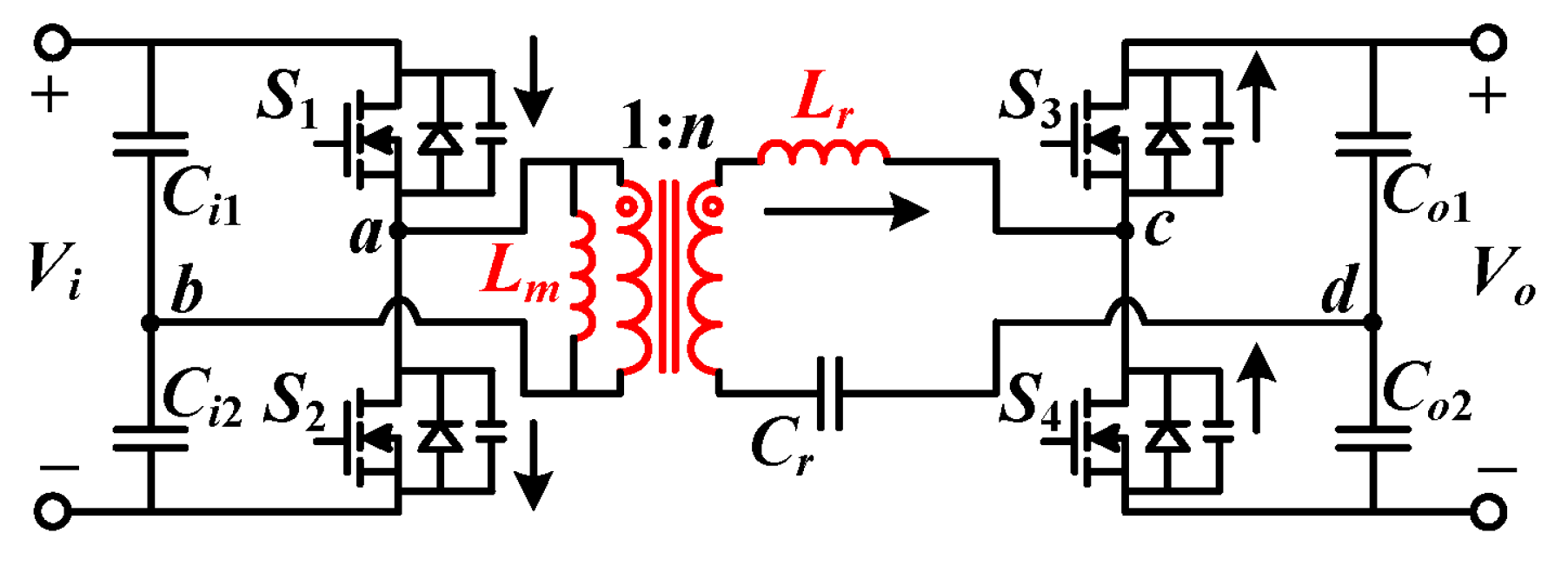
The dual active half-bridge resonant converter is shown in Figure 2, and the current direction is defined by the arrow. S1 and S2 form the primary side bridges, while S3 and S4 form the secondary side bridges. The two half-bridges are connected by a high-frequency transformer, a resonant tank. Among them, the high-frequency transformer comprises an excitation inductor, a leakage inductor, and an ideal transformer (1:n). The excitation inductor is always clamped by vab, which is not used for power transmission and ZVS operation. Therefore, in order to reduce losses, the excitation inductance will be designed to be large enough, which can be ignored in the analysis. The leakage inductor is used as the resonant inductor Lr, which is connected in series with the resonant capacitor Cr to form the resonant tank. Ci1 and Ci2 are input half-bridge capacitors, while Co1 and Co2 are output half-bridge capacitors. In addition, Ci1 is equal to Ci2, and Co1 is equal to Co2. The primary and secondary bridges are operated in phase. Half-bridge capacitors are connected in series with resonant capacitors. The half-bridge capacitor is large enough, and only the resonant capacitor is involved in resonance. Hence under the proposed modulation strategy, the switching frequency is equal to the resonant frequency, which can be expressed as
f s = f r = 1 2 π L r C r

2.2. Operation Strategy

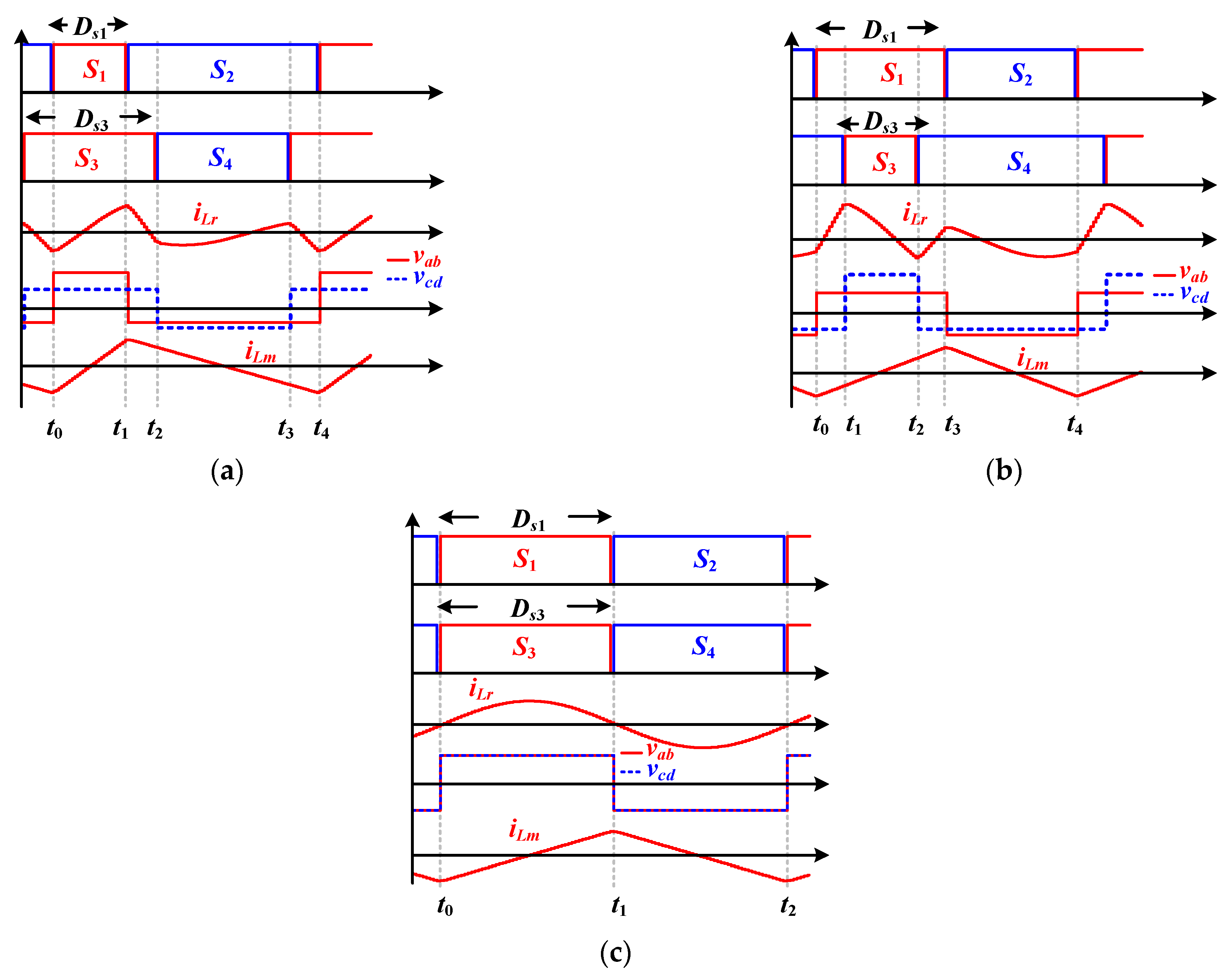
The operation principle of the proposed converter is similar for different duty cycles. Therefore, only the case DS1 < 0.5 is analyzed, as shown in Figure 3a.
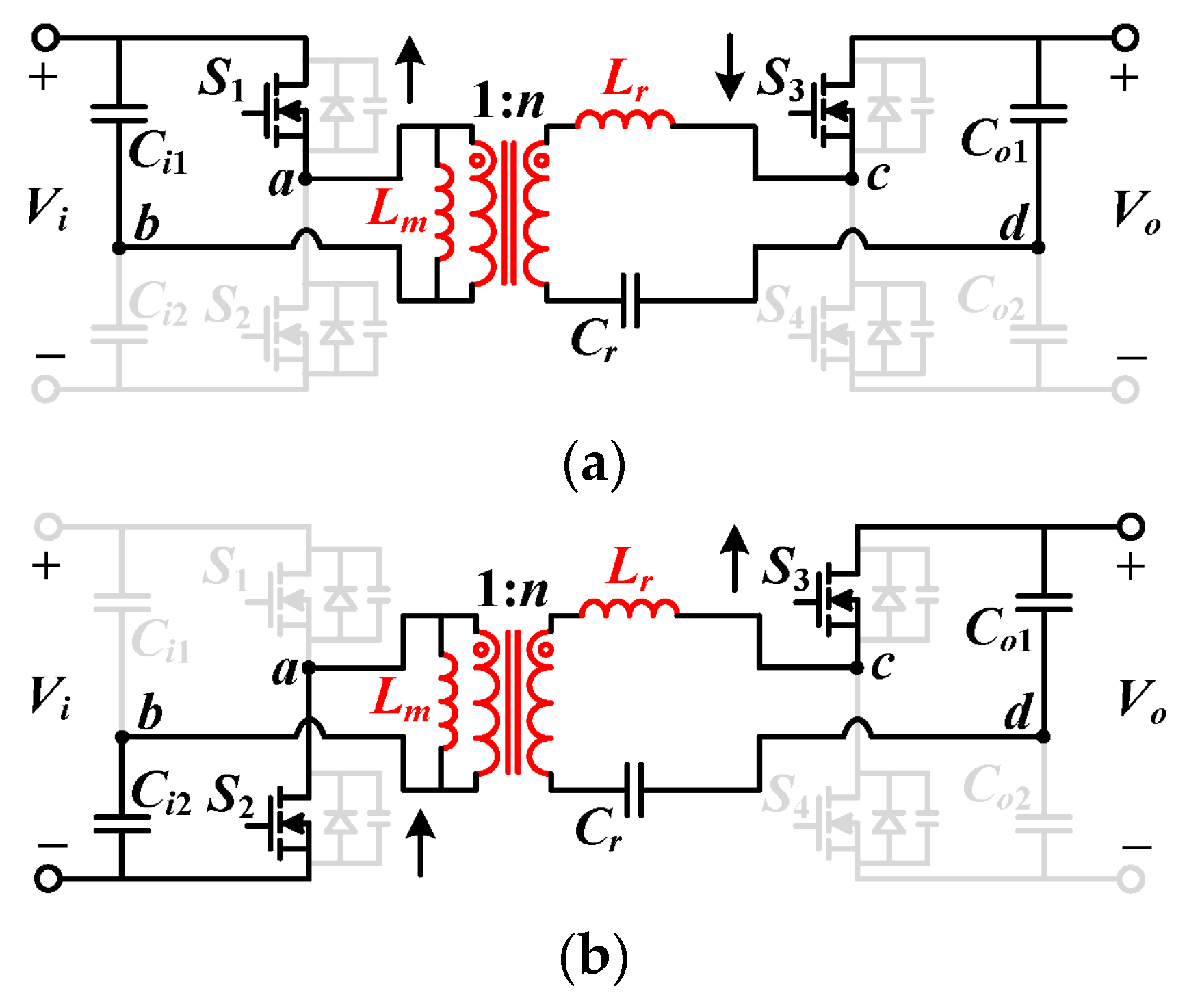
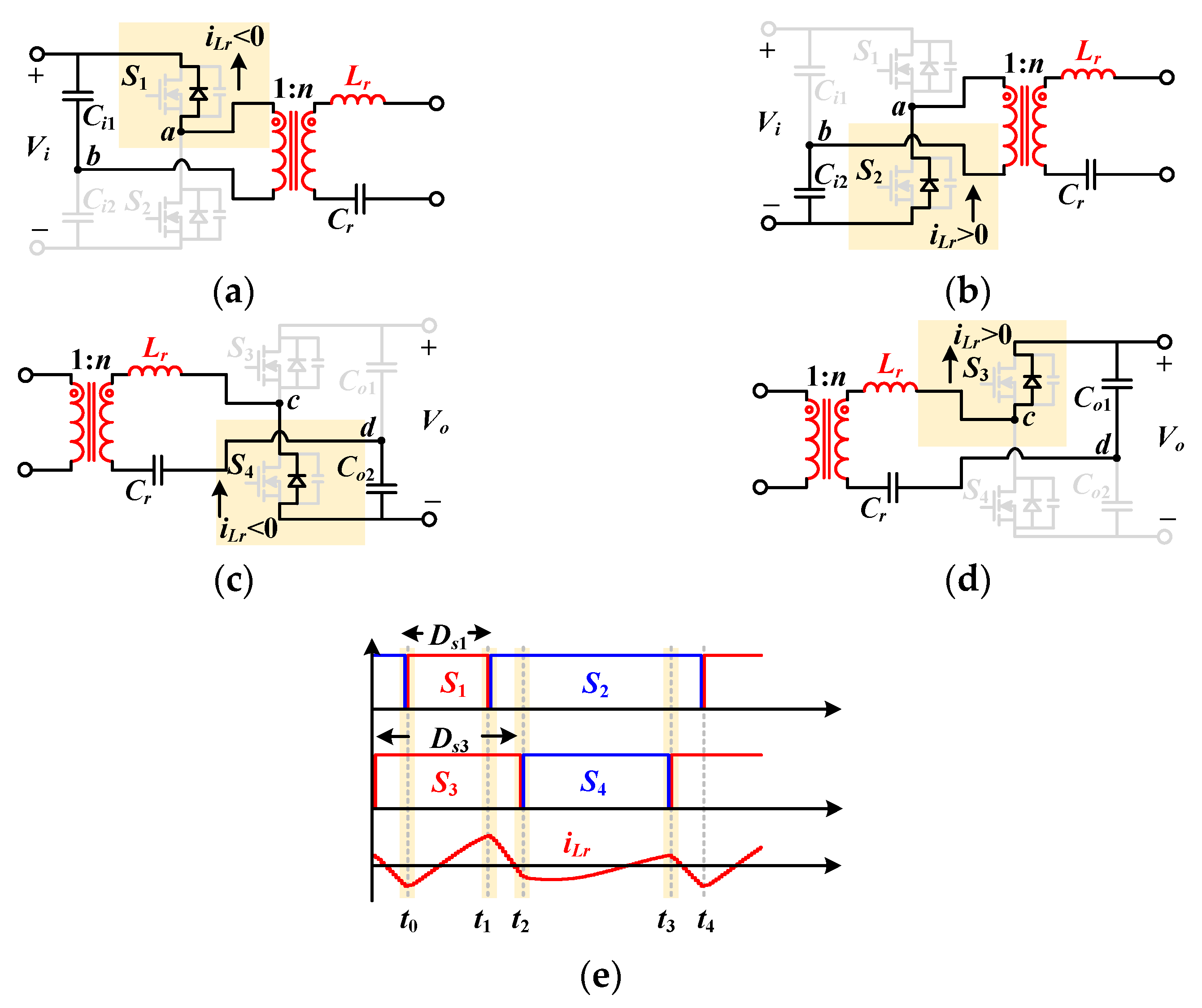
Stage 1 [t0, t1] [see Figure 4a]: Before time t0, due to the dead time, S1 and S2 are turned off, while S3 is turned on. At this time, the resonant current is less than zero. Therefore, on the primary side, the current flows through the body diode of S1. At time t0, S1 can achieve ZVS-on. In this range, the resonant current will gradually increase to greater than zero.
Stage 2 [t1, t2] [see Figure 4b]: Before t1, due to the dead time, S1 and S2 are both turned off, while S3 is turned on. Because the resonant current is greater than zero, on the primary side, the current flows through the body diode of S2. At time t1, S2 can also achieve ZVS-on. In this range, the resonant current will gradually decrease to less than zero.
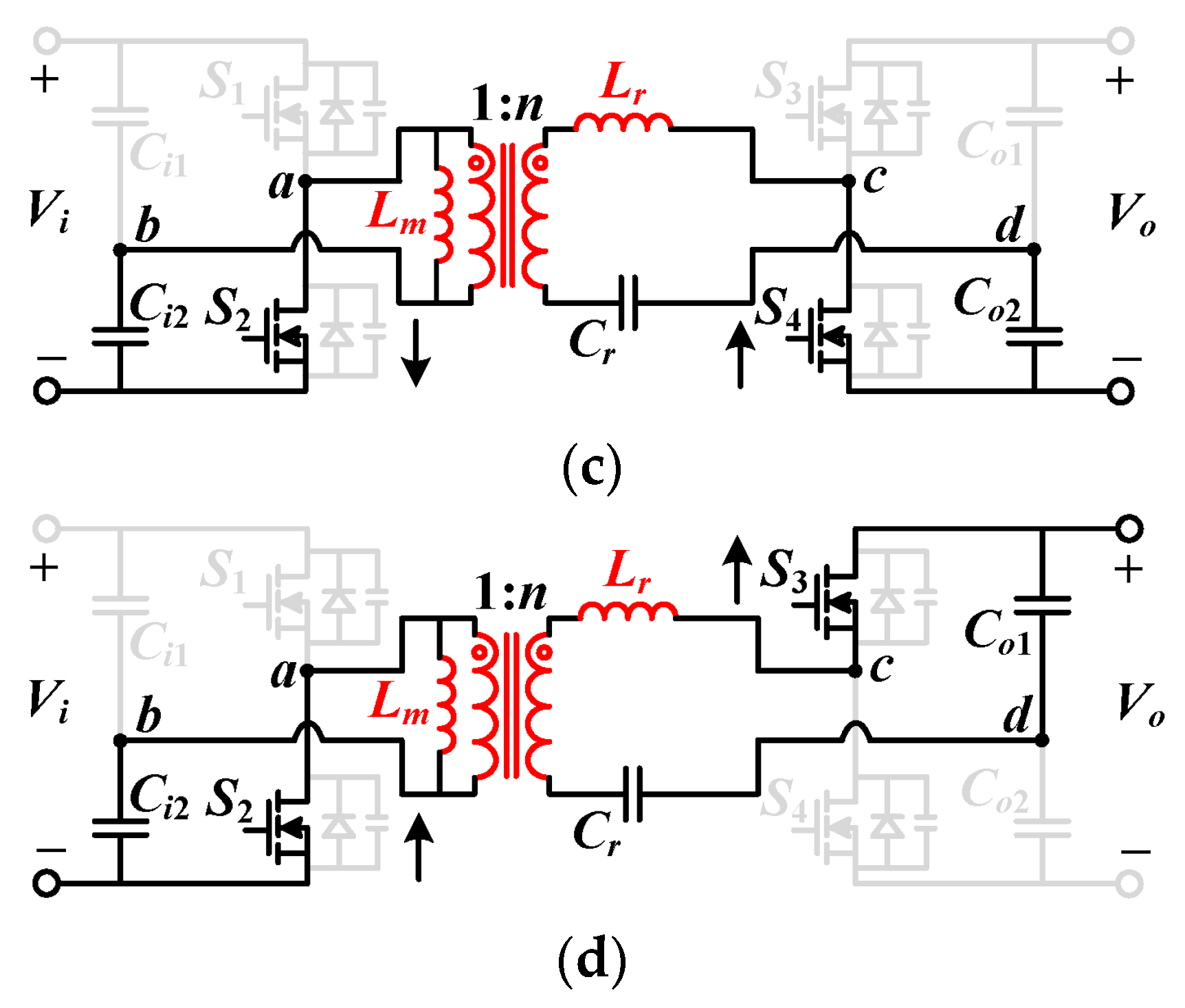
Stage 3 [t2, t3] [see Figure 4c]: Before t2, due to the dead time, S3 and S4 are both turned off, while S2 is turned on. At this time, the resonant current is less than zero and continues to flow through the body diode of S4. Hence, S4 can achieve ZVS-on. In this range, the resonant current will gradually increase to greater than zero.
Stage 4 [t3, t4] [see Figure 4d]: Before t3, due to the dead time, S3 and S4 are both turned off, while S2 is turned on. At this time, the resonant current is greater than zero and continues to flow through the body diode of S3. Hence, S3 can also achieve ZVS-on. In this range, the resonant current will gradually decrease to less than zero.
After time t4, the converter will operate to the next switching cycle. The working principle is similar to the previous text and will not be introduced.

3. Characteristic Analysis

3.1. Resonant Tank Terminal Voltage

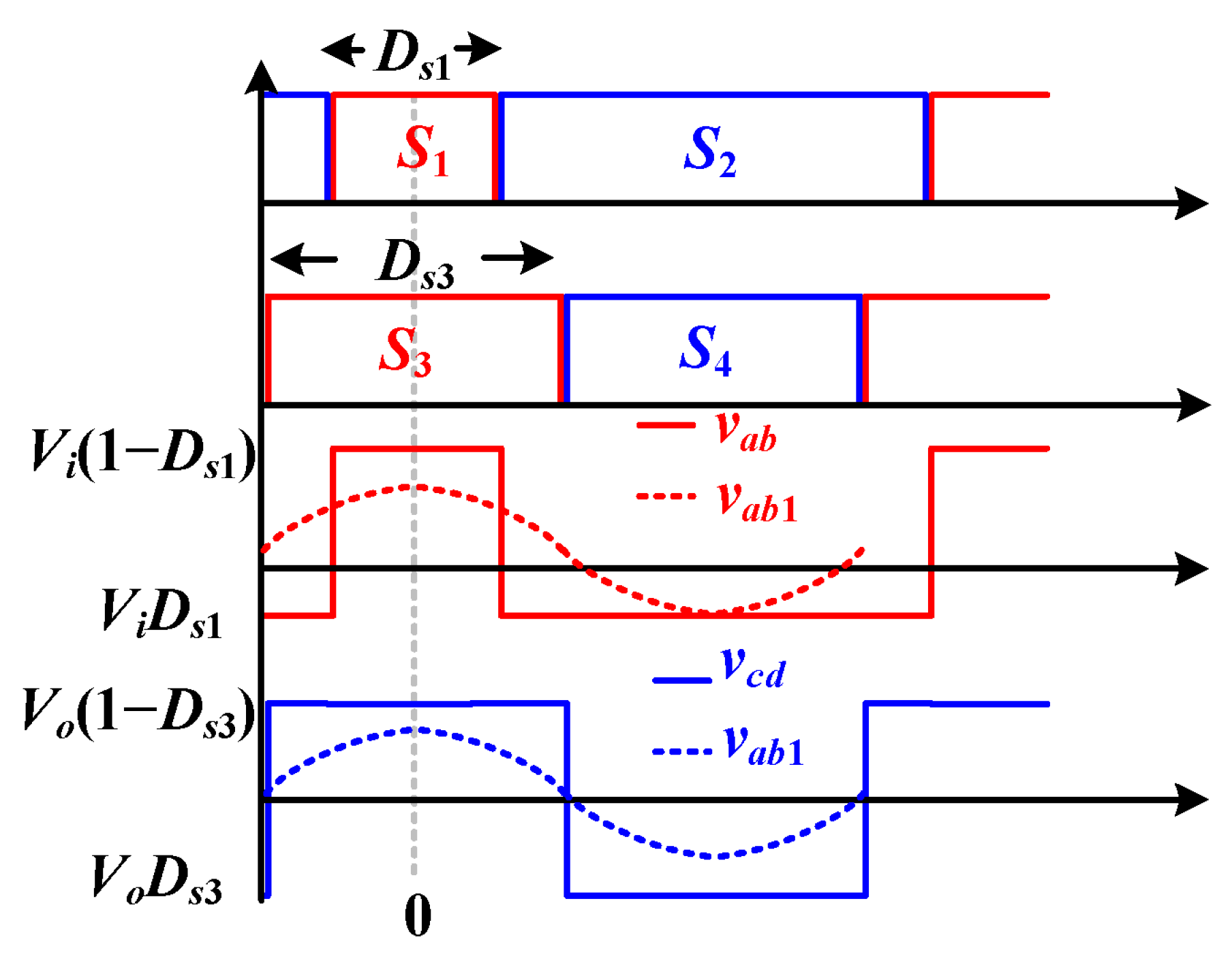
The waveform of the resonant tank terminal voltage is shown in Figure 5. On the primary side, the state equation of the excitation inductor can be expressed as
L m d i L m d t = v a b
In a steady state, the average period of the excitation current is equal to zero and remains constant. Therefore, the average value of vab is also equal to zero, which satisfies the principle of Volt-second balance. Then, vab can be derived as
v a b = v C i 1 = V i ( 1 D S 1 ) 0 ~ D s 1 T s v C i 2 = V i D S 1 D s 1 T s ~ T s
Similarly, since the periodic average of the resonant current is also fixed to zero, vcd also satisfies the Volt-second balance principle, which can be expressed as
v c d = v C o 1 = V o ( 1 D S 3 ) 0 ~ D s 3 T s v C o 2 = V o D S 3 D s 3 T s ~ T s

3.2. Voltage Gain

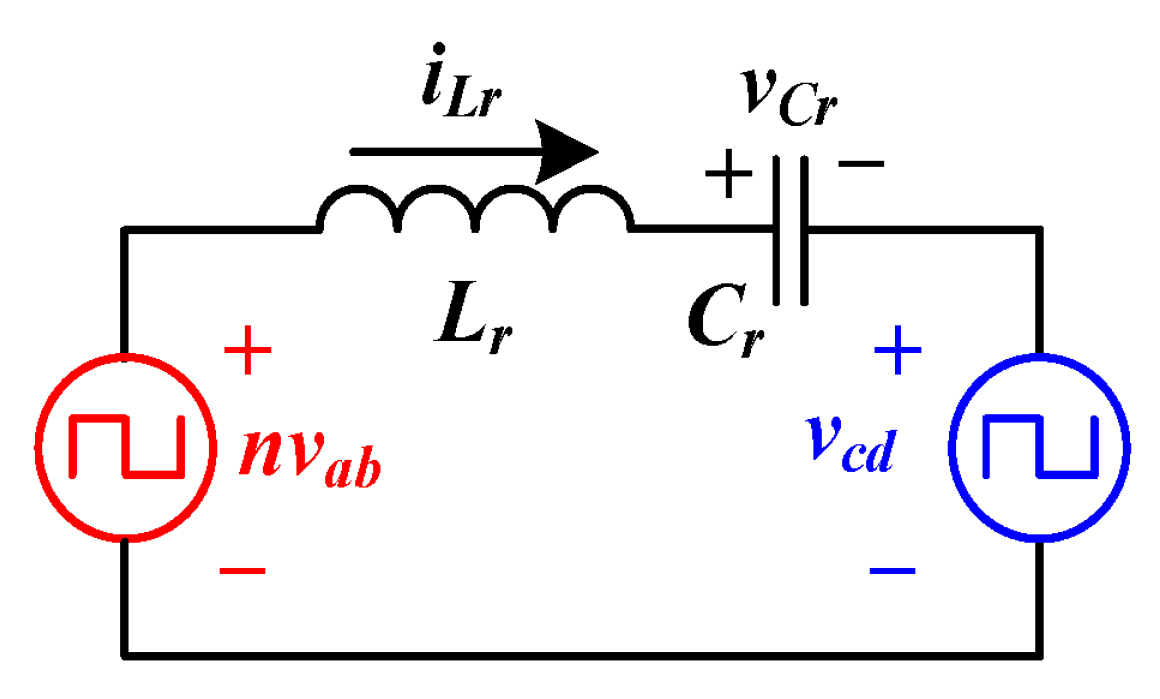
The equivalent circuit of the resonant tank is shown in Figure 6. According to Kirchhoff’s law, the circuit voltage equation of the resonant circuit can be expressed as
n v a b i L r j ω r L r i L r 1 j ω r C r = v c d
where ωr = 2πfr.
As shown in Figure 5, when the origin is defined at the center point of the square wave, both vab and vcd can be regarded as even functions. Therefore, vab and vcd can be expanded into cosine functions using Fourier decomposition, which can be expressed as
v a b ( t ) = k = 1 2 n V i k π sin ( k π D s 1 ) cos ( k ω r t ) v c d ( t ) = k = 1 2 V o k π sin ( k π D s 3 ) cos ( k ω r t )
Under the proposed control strategy, the switching frequency is equal to the resonant frequency. According to the superposition theorem, when the fundamental component acts, the series impedance of Lr and Cr is equal to zero. Therefore, the amplitude of the fundamental wave of the resonant tank terminal voltage is equal. The voltage gain relationship can be derived as
n V i sin ( π D s 1 ) = V o sin ( π D s 3 ) V o = n V i sin ( π D s 1 ) sin ( π D s 3 )
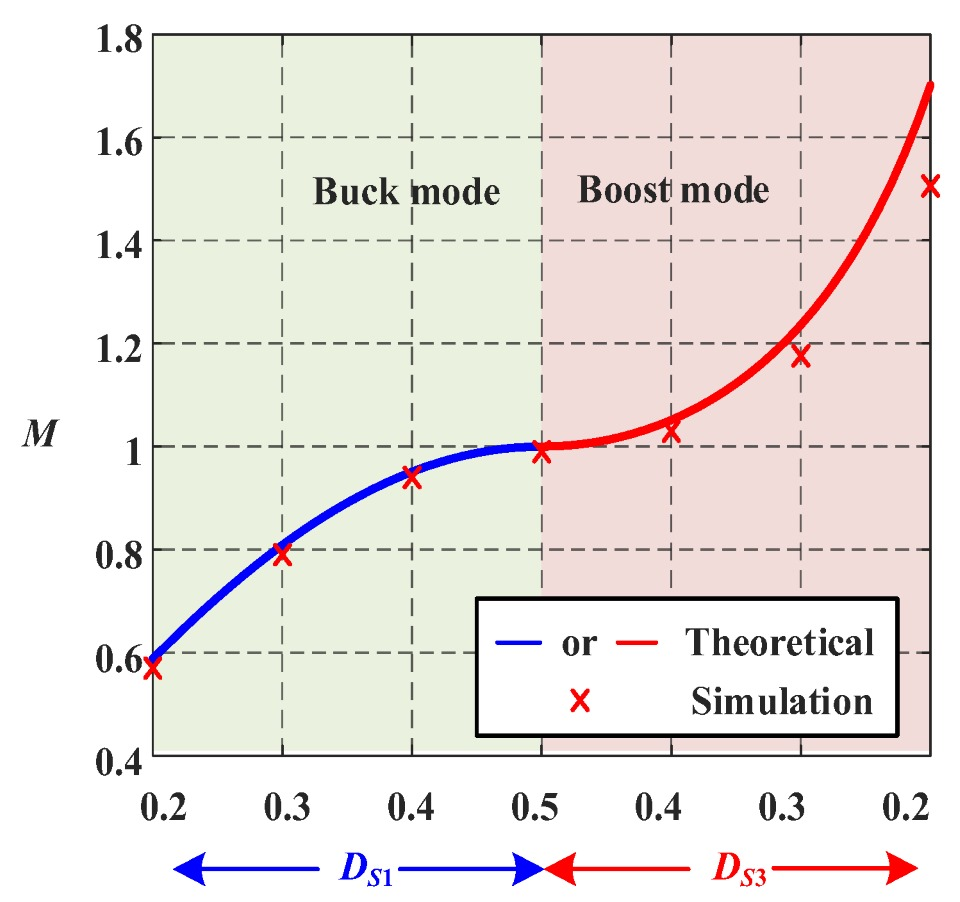
From (7), it can be seen that when DS1 deviates from 0.5, the output voltage will decrease. And when DS3 deviates from 0.5, the output voltage will increase. In addition, sine functions are non-monotonic functions. Therefore, in order to make the voltage gain expression a monotonic function, the ranges of DS1 and DS3 are both less than or equal to 0.5. The normalized voltage gain curve is shown in Figure 7. In addition, simulation results considering lower line impedance and 10% inductance error are also shown. In this case, the voltage gain will be slightly lower than the theoretical calculation value.

3.3. Resonant Current Harmonic Analysis

3.3.1. Fundamental Component

Within a switching cycle, the resonant current has multiple operating modes. It is difficult to directly solve the time-domain expression of the resonant current. Therefore, the superposition theorem is adopted. After solving the time-domain expressions of currents of different frequencies, the actual resonant current can be restored by superimposing them. The various frequency resonant equivalent impedance Xm can be expressed as
X k = j k ω r L r + 1 j k ω r C r X k = j k Z r Z r k
Because both vab and vcd are not odd harmonic functions, both odd and even harmonic components are contained. In addition, for high-order harmonics, k is not equal to 1 and the equivalent impedance is purely inductive. When the primary and secondary voltages are in phase, the excitation of high-order harmonics only generates reactive power. Therefore, only the fundamental component will transmit active power. The active power can be expressed as
0 T r 2 V o π sin ( π D S 3 ) cos ( ω r t ) I L r 1 cos ( ω r t ) d t T r = V o I o
where ILr1 is the amplitude of the fundamental component of the resonant current.
After calculating the amplitude of the fundamental component according to (9), the resonant current fundamental can be expressed as
i L r 1 ( t ) = I o π sin π D S 3 cos ( ω r t )
Because, under the excitation of the fundamental component, the series impedance is equal to zero. Therefore, the resonant current fundamental component and terminal voltages are in phase, and they are both cosine functions.

3.3.2. High-Order Harmonic

According to the voltage equation of the resonant tank, high-order harmonics can be expressed as
i L r k ( t ) = n v a b k v c d k X k i L r k ( t ) = 2 n V i k π sin ( k π D s 1 ) 2 V o k π sin ( k π D s 3 ) k 1 k Z r sin k ω r t
where k = 2, 3, 4…
It can be seen that under the action of high-order harmonics, the series resonant impedance is purely inductive. Therefore, high-order harmonics will lag behind the terminal voltages by 90 degrees, which is a sine function.
Substituting (7) into (11), high-order harmonics can be rewritten as
i L r k ( t ) = 2 V o k π sin ( k π D s 1 ) sin ( π D s 3 ) sin ( π D s 1 ) sin ( k π D s 3 ) k 1 k Z r sin k ω r t
It can be seen that when DS1 and DS3 are equal, all high-order harmonic components are equal to zero. The resonant current only contains the fundamental component; therefore, it will appear as a standard cosine wave.

3.3.3. Overlay of Different Frequency Components

According to (10) and (12), by superimposing the fundamental component and high-order harmonics, the resonant current can be expressed as
i L r ( t ) = I o π sin π D S 3 cos ( ω r t ) + k = 2 2 V o k π sin ( k π D s 1 ) sin ( π D s 3 ) sin ( π D s 1 ) sin ( k π D s 3 ) k 1 k Z r sin k ω r t
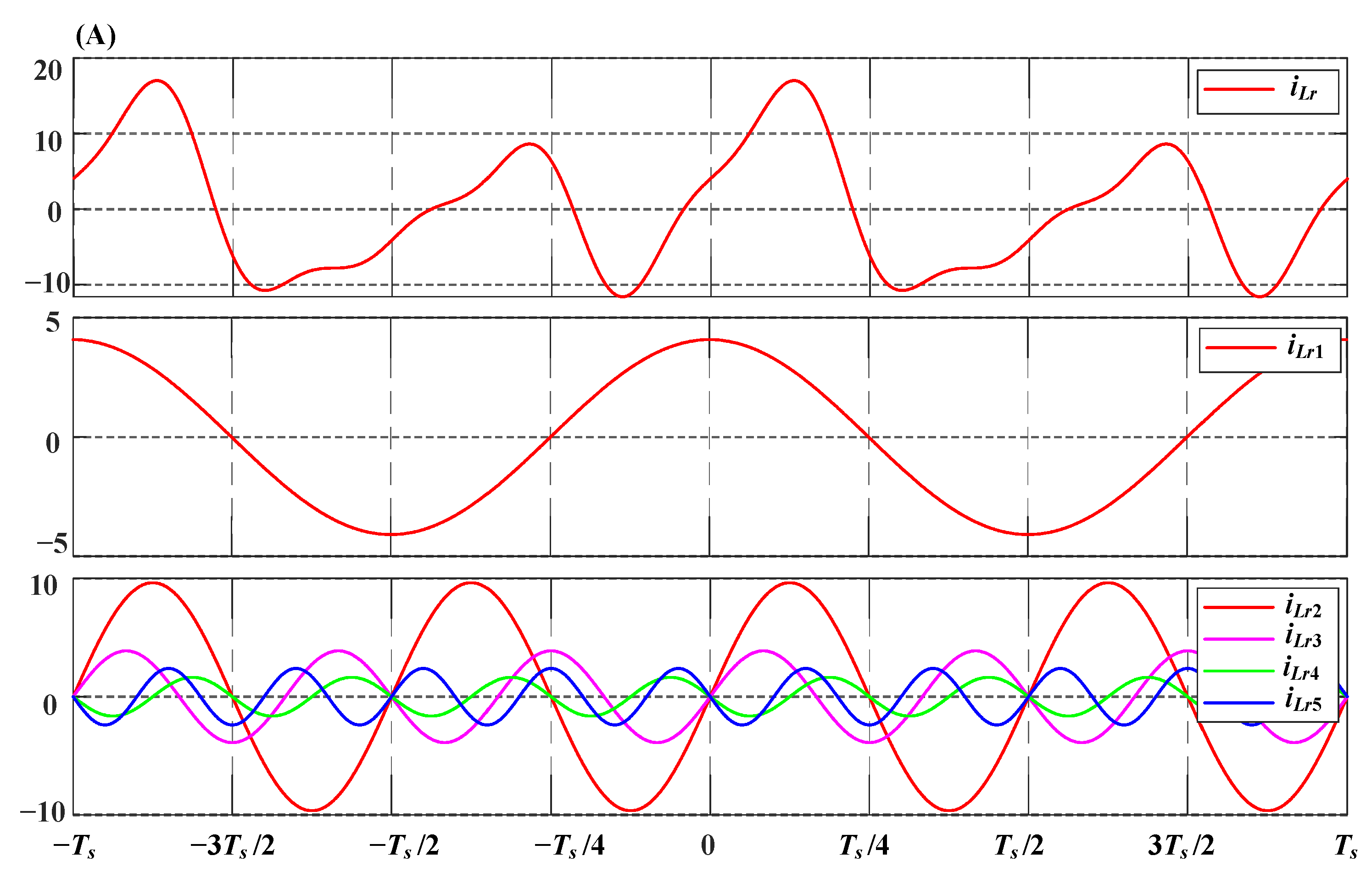
As the frequency increases, the amplitude of harmonics will also decrease. Hence, partial frequency harmonic components can be considered to approximate the time-domain solution of the resonant current. The resonant current waveforms containing frequency components of order 1~5 are shown in Figure 8. It can be seen that the waveforms obtained by considering only the harmonic components with a high proportion are basically consistent with the theoretical analysis.

3.4. ZVS Analysis

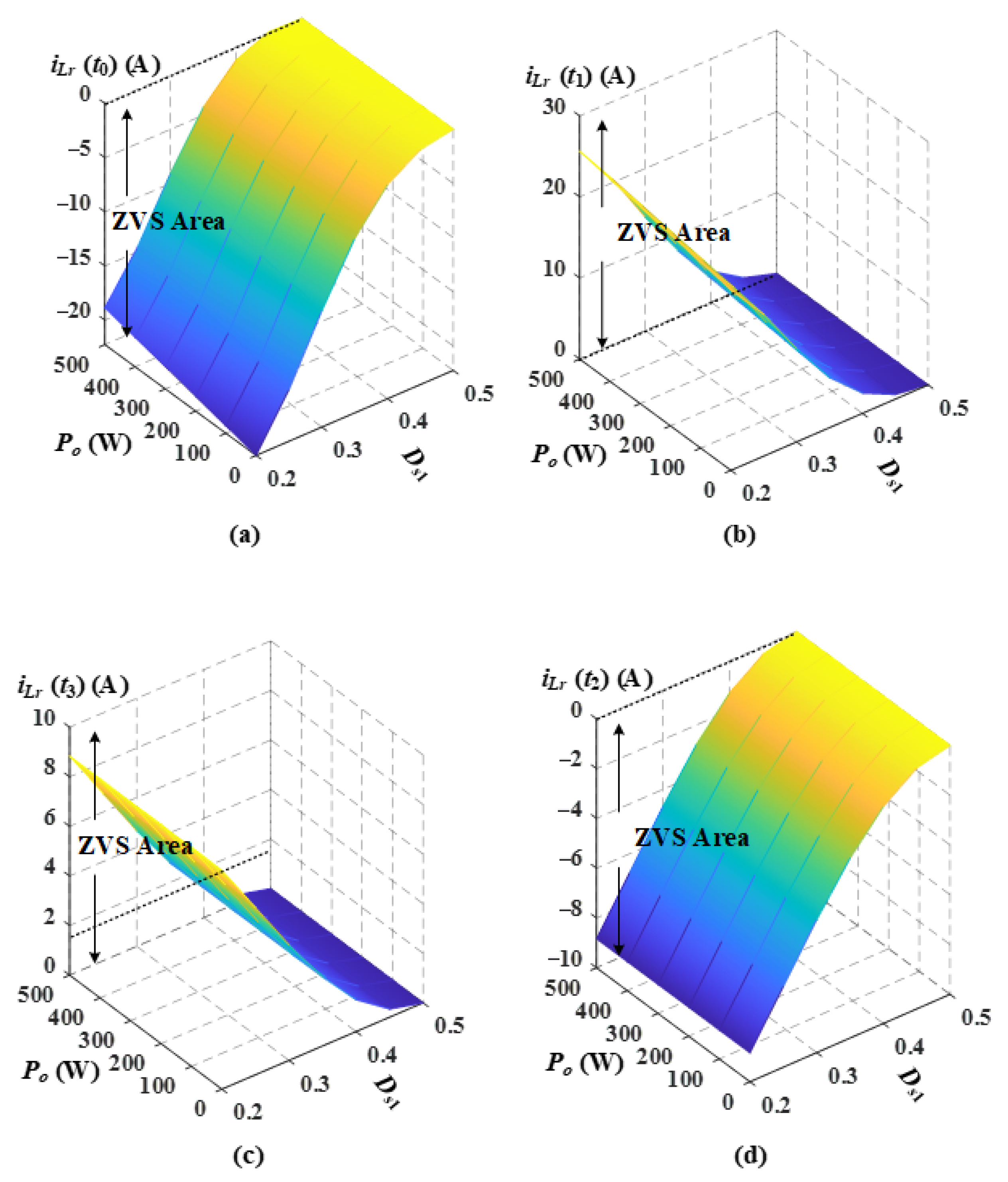
The soft switching circuit modes of four MOSFETs are shown in Figure 9a–d. Before MOSFET is turned on, current should flow through its body diode. In this paper, the excitation inductor can be ignored because it is sufficiently large. Only the resonant current is involved in the operation of ZVS. According to the current direction defined in Figure 9, the ZVS conditions of the four MOSFETs can be expressed as
i L r t 0 < 0 ( S 1 ) i L r t 1 > 0 ( S 2 ) i L r t 3 > 0 ( S 3 ) i L r t 4 < 0 ( S 4 )
According to the time-domain expression of the resonant current in (13), the range of ZVS can be shown in Figure 10. ZVS is achieved by harmonic components. As the power is increased, because the fundamental component content is higher, ZVS becomes more difficult to achieve. Similarly, when the duty cycle approaches 0.5 and the harmonic component content is lower, ZVS is also more difficult to achieve. According to (13), the lower characteristic impedance Zr can generate higher harmonics. However, a low Zr value can result in excessive reactive power and conduction losses. Therefore, Zr needs to be compromised in design.

3.5. Extended Applications

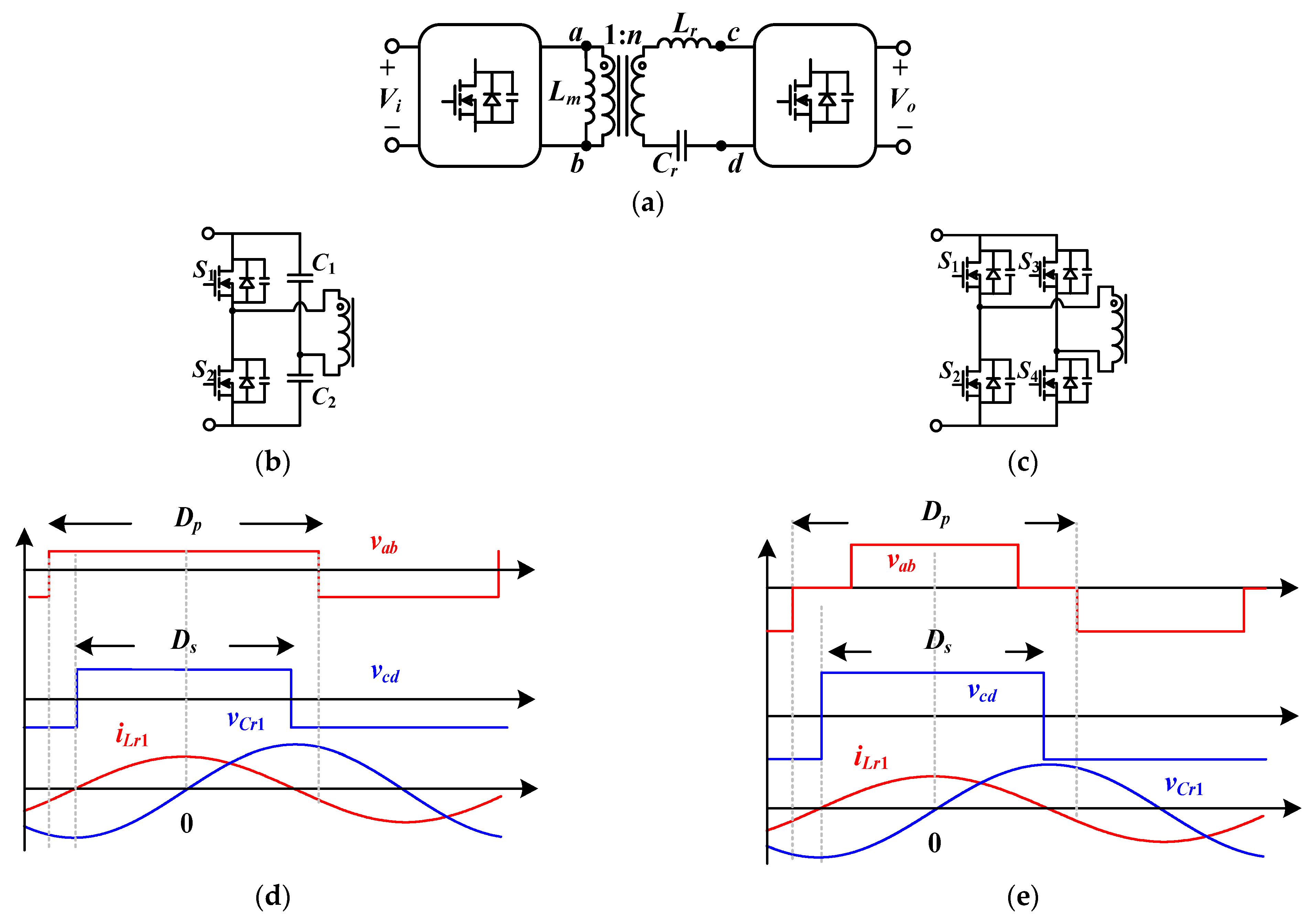
The proposed modulation strategy can be applied to other topology structures, such as full-bridge or multi-level structures. Taking the full-bridge structure as an example, the circuit structure and operation waveforms are shown in Figure 11. In the full-bridge structure, the terminal voltage of the resonant tank has three levels: vi, 0, and −vi. The fundamental components of the resonant current and voltage are also shown. vab and vcd can be regarded as even functions, whether full-bridge or half-bridge. Therefore, a unified expression can be used for them. After Fourier decomposition, the terminal voltage of the resonant tank vab (vcd) is decomposed into cosine functions, which are shown as
v a b ( t ) = k = 1 m n V i k π sin ( k π D p ) cos ( k ω r t ) v c d ( t ) = k = 1 m V o k π sin ( k π D s ) cos ( k ω r t )
where m = 2 in half-bridge, and m = 4 in full-bridge.
Under the excitation of the fundamental components, the series impedance of Lr and Cr is equal to zero. Therefore, the fundamental amplitudes of vab and vcd are equal. Therefore, the unified voltage gain expression for both full-bridge and half-bridge structures can be expressed as
V o V i = m p n sin ( π D p ) m s sin ( π D p )
mp and ms represent the gain coefficients of the primary and secondary sides, respectively. (2 in half-bridge, and 4 in full-bridge).

4. Experimental Verification

4.1. Design Considerations

4.1.1. Turns Ratio

The input voltage range is 270–480 V, while the output voltage is 400 V. In order to minimize the circulating current by making the duty cycle range as close to 0.5, the transformer turn ratio can be designed as 1:1.

4.1.2. Duty Cycle Range

From the voltage gain formula sin (πDS1)/sin (πDS3), it can be seen that when the duty cycle of the primary side is far from 0.5, it is in buck mode, and when the duty cycle of the secondary side is far from 0.5, it is in boost mode. Hence, in buck mode, DS3 is fixed at 0.5, while in boost mode, DS1 is fixed at 0.5. In addition, the effect of voltage adjustment is the same when the duty cycle is greater than 0.5 and less than 0.5. Therefore, the duty cycle can be designed to decrease from 0.5. The duty cycle range of each mode can be expressed as
D S 1 ( 0.28 , 0.5 ] , D S 3 = 0.5 Input :   400 V ~ 480 V D S 3 ( 0.25 , 0.5 ] , D S 1 = 0.5 Input :   270 V ~ 400 V

4.1.3. Resonant Tank

A lower characteristic impedance Zr contributes to the implementation of ZVS, but higher harmonic components and the circulating current will be increased. Therefore, suitable Zr values can be designed based on the expression of the resonant current (13), which can achieve a wide range of ZVS at higher values. In this paper, the resonant inductance and resonant capacitance are designed to be 7 μH and 90 nF, respectively.

4.2. Experimental Results

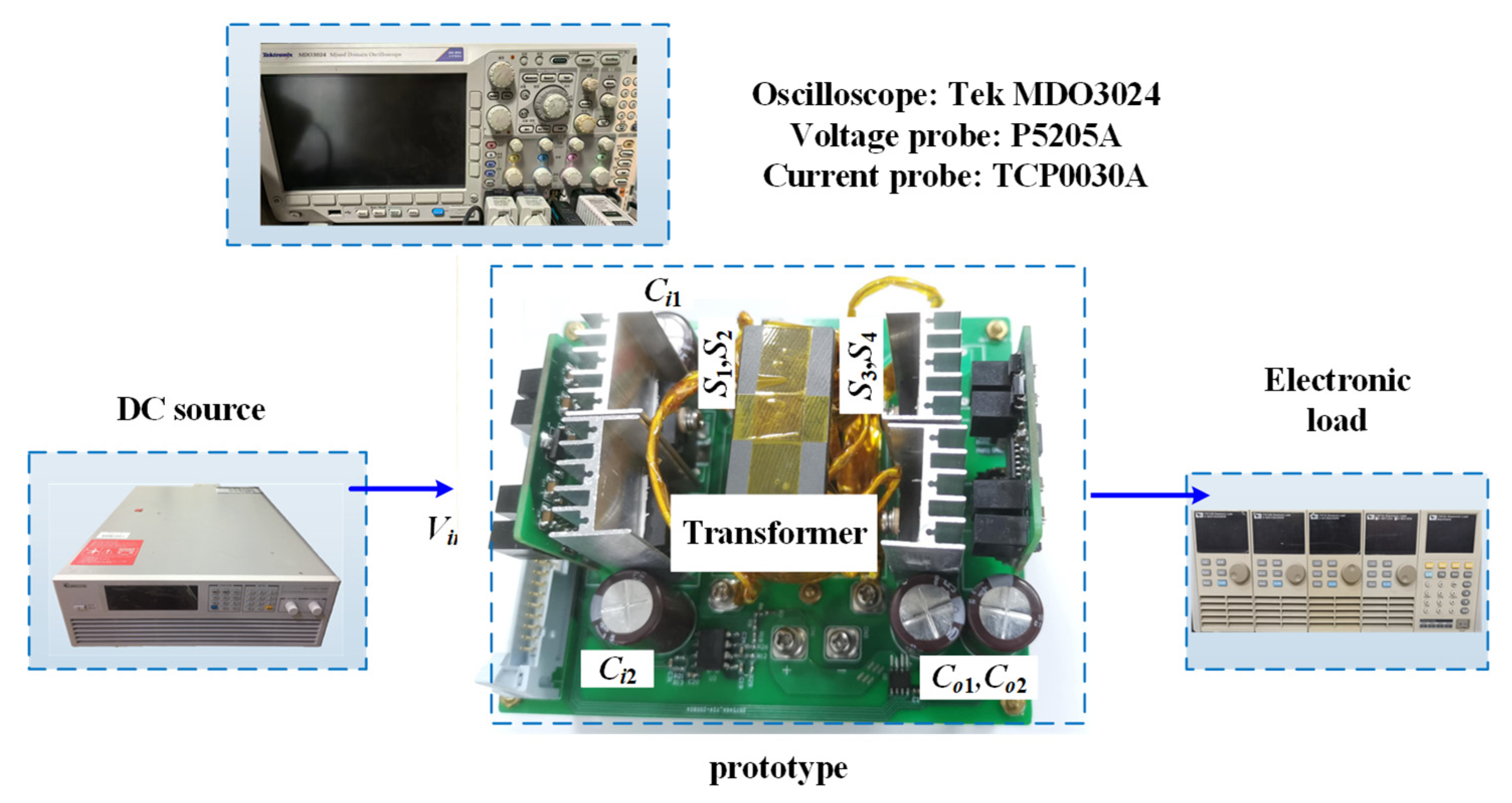
An experimental prototype of the proposed converter is built to validate the proposed solution. The main parameters are as follows: input voltage 270~480 V, output voltage 400 V, rated power 500 W, switching frequency 200 kHz, and resonant frequency 200 kHz. The detailed parameters are shown in Table 1. In addition, the experimental prototype and instruments are shown in Figure 12.
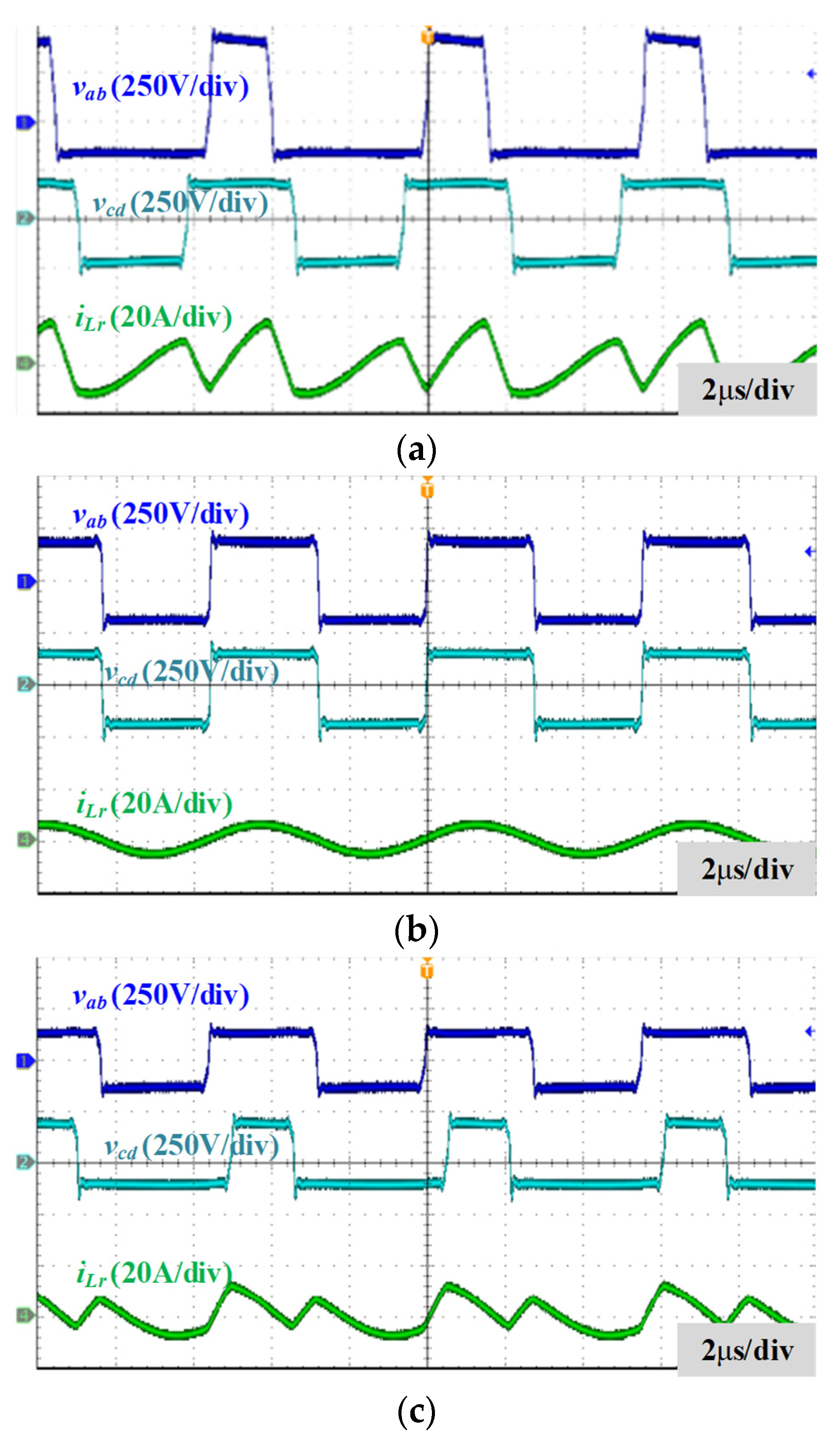
The steady state experimental waveforms are shown in Figure 13. The primary and secondary side terminal voltages of the resonant tank are in phase. When the input voltage changes, the duty cycle is also adjusted to control the output voltage. During the buck mode, the duty cycle of the primary side (DS1) is decreased, while the duty cycle of the secondary side is fixed at 0.5. On the contrary, the duty cycle of the primary side is fixed at 0.5, while the duty cycle of the secondary side is decreased. The amplitude of the primary and secondary side terminal voltages varies under different duty cycles. But vab and vcd always satisfy the Volt-second balance principle.
When the input voltage and output voltage are equal, the primary and secondary side duty cycles are both 0.5. The high-order harmonic components of the resonant current are equal to zero. Therefore, the resonant current appears as a standard sine wave.
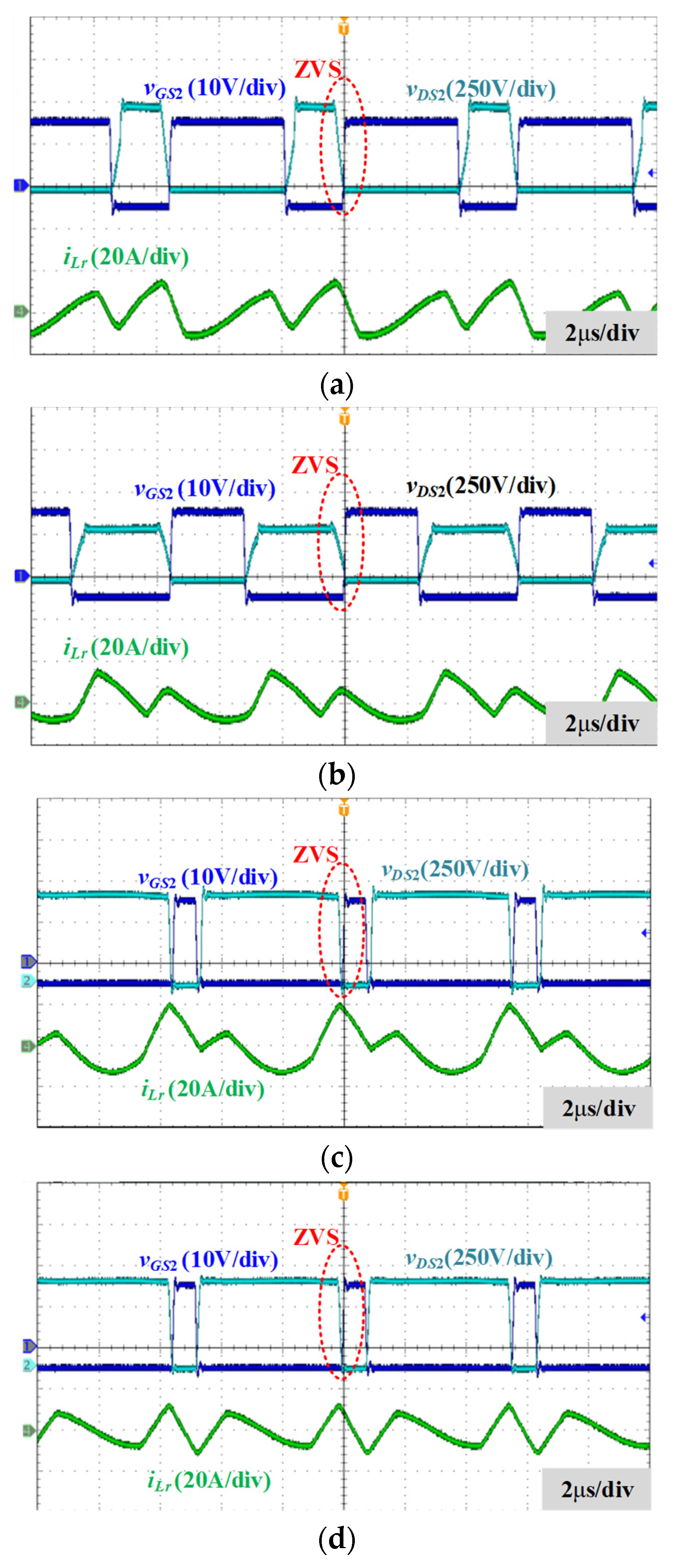
ZVS experimental waveforms under full load are shown in Figure 14. Due to the symmetry of the converter topology, modulation strategies, and ZVS characteristics, the primary side MOSFET S2 is taken as an example for analysis in this paper. For S2, the resonant current is greater than zero before it is turned on, which satisfies the ZVS condition. Therefore, it can be seen that vDS2 has already dropped to zero before vGS2 rises. Therefore, S2 can be turned on with ZVS. In addition, when the input voltage changes, S2 can achieve ZVS-on at different duty cycles. Under a wider input voltage range (input 200 V), ZVS can still be achieved, whether it is fully loaded or unloaded, as shown in Figure 14c,d.
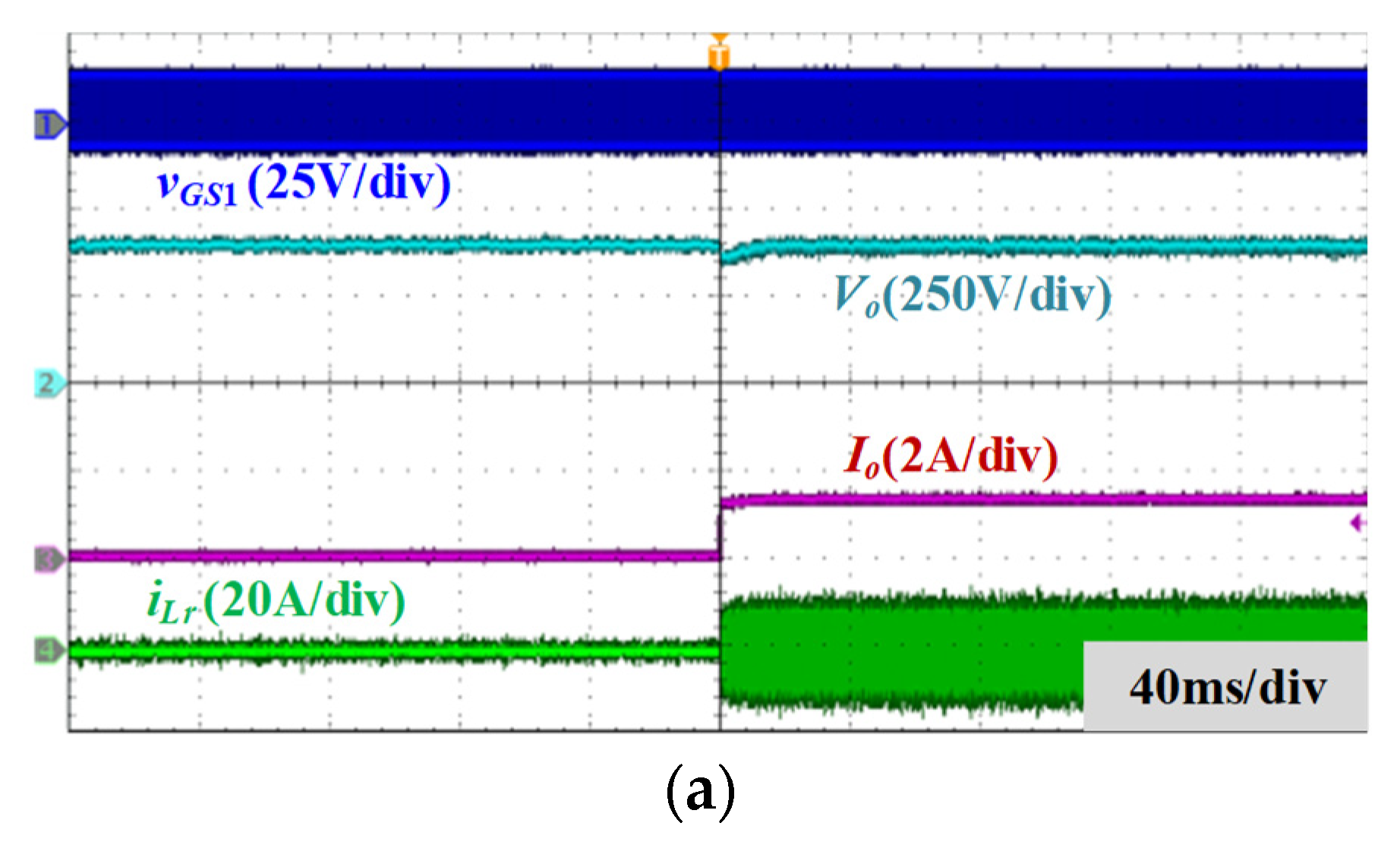
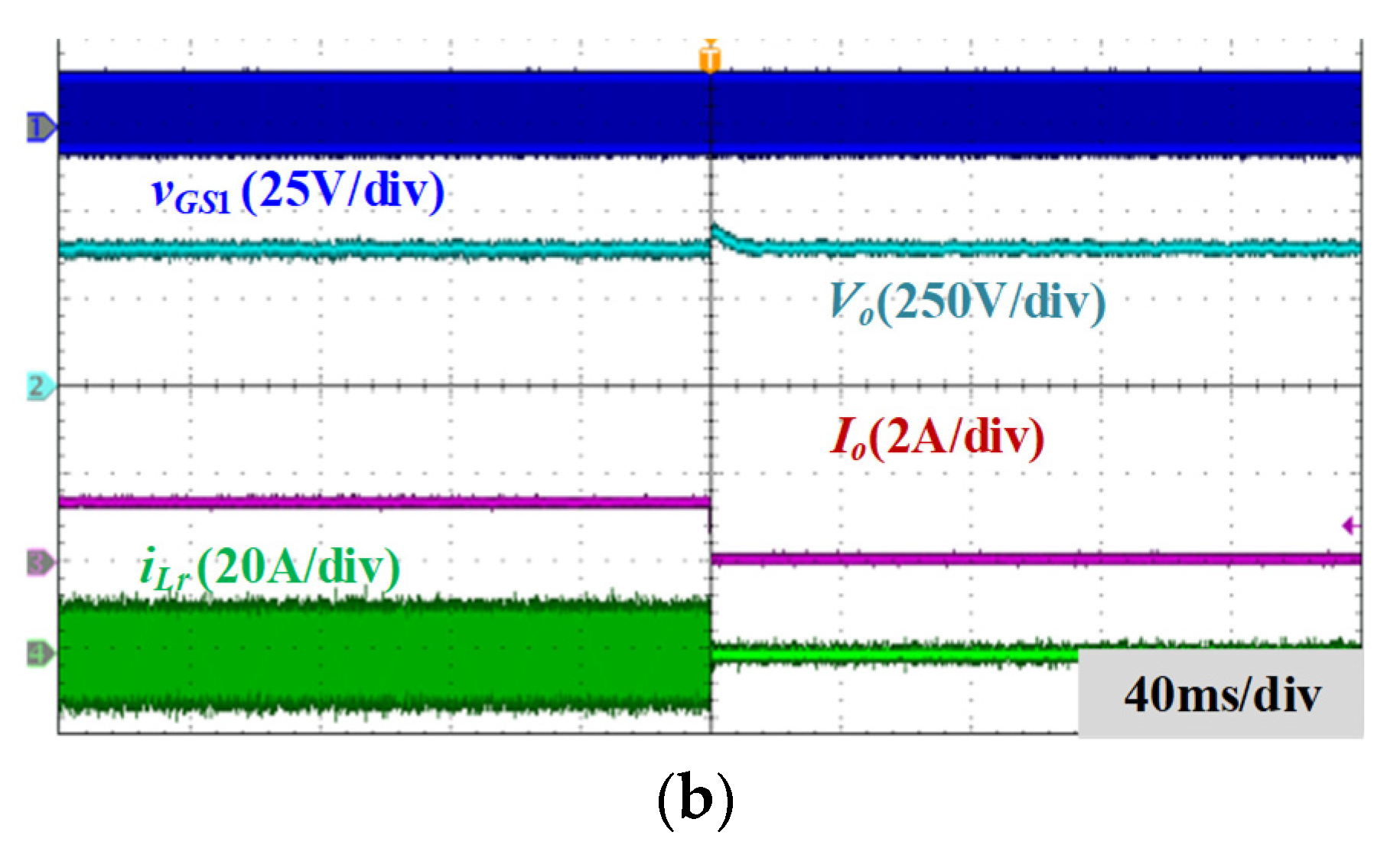
The dynamic waveforms are shown in Figure 15. The load switches between no load and full load. It can be seen that the resonant current can respond smoothly without significant overshoot. In addition, the output voltage is also clamped around 400 V. Therefore, the proposed solution has good dynamic performance. The overshoot and recovery time of the output voltage are approximately 50 V and 16 ms, respectively.
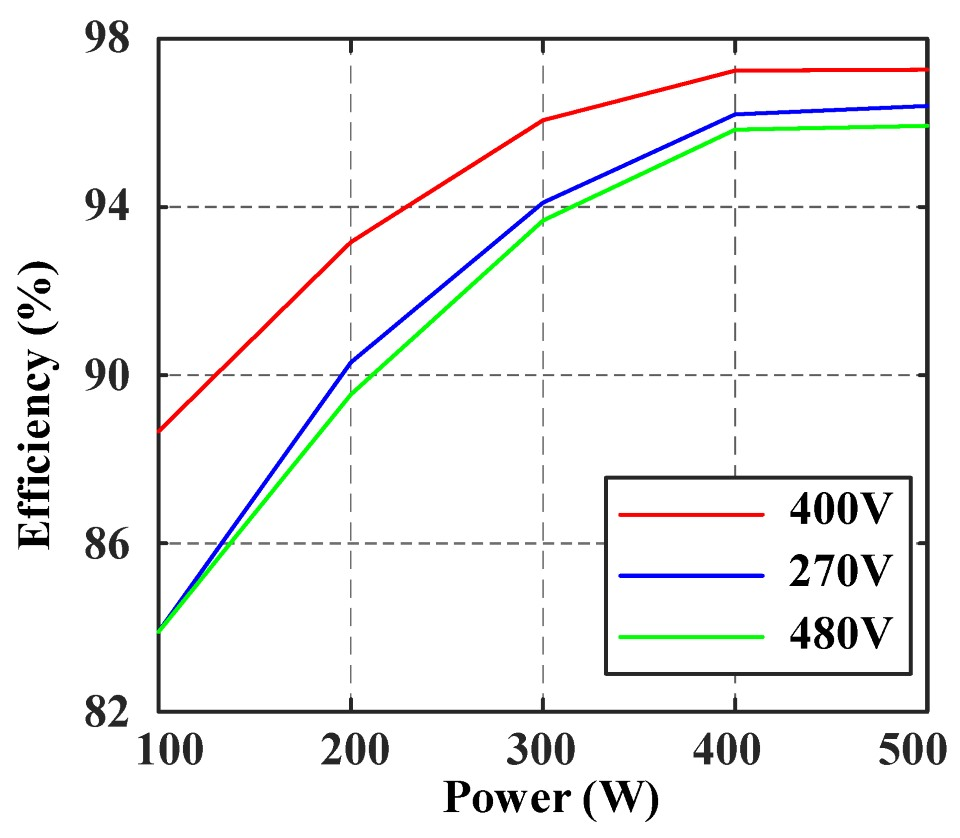
The measurement efficiency curves under different input voltages are shown in Figure 16. When the input voltage is equal to 400 V, the duty cycle is around 0.5. In this case, the high-order harmonic components in the resonant current are almost zero, and the reactive power is very low. Therefore, the conversion efficiency is the highest. When the input voltage changes, certain high-order harmonics will be generated, and the conversion efficiency will be reduced.

4.3. RMS Value of Resonant Current and THD Analysis

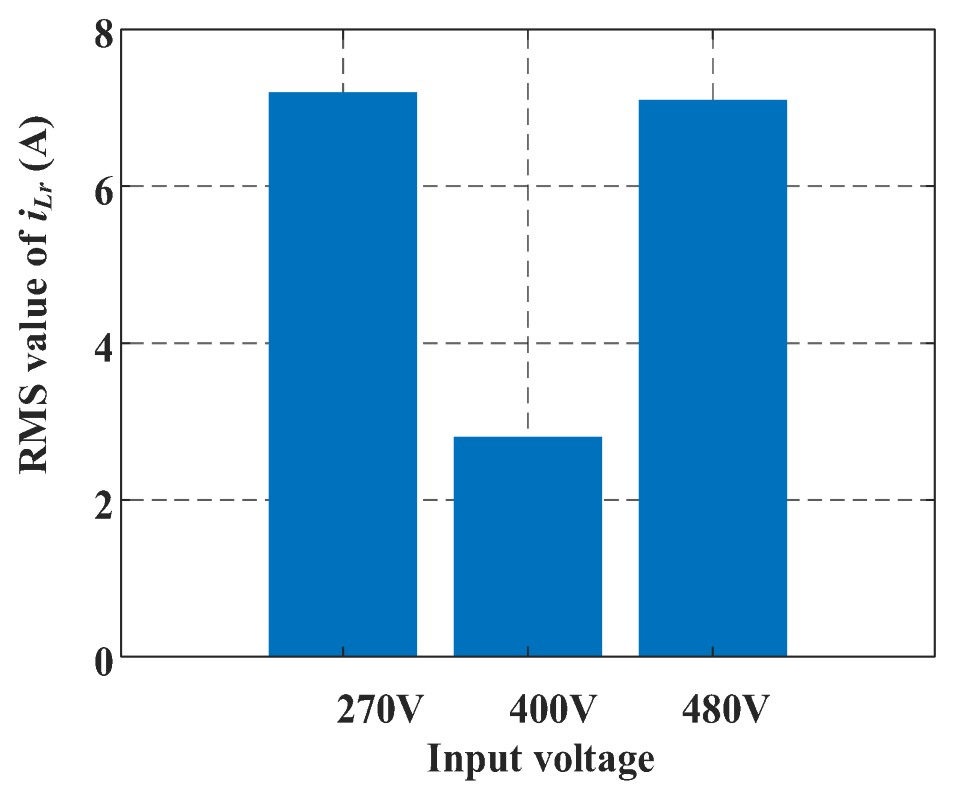
Under full load, the RMS values of resonant currents with different input voltages are shown in Figure 17. When the input voltage is 400 V, the primary and secondary sides of the duty cycle are both about 0.5. At this time, the high-order harmonic components of the resonant current are very low. Therefore, the overall effective current value is the lowest. When the input voltage is 270 V, the duty cycle DS3 is approximately 0.25. The amplitude of the fundamental wave is equal to Ioπ/(sinπDS3). In this case, the amplitude of the fundamental wave and the overall effective value are both higher.
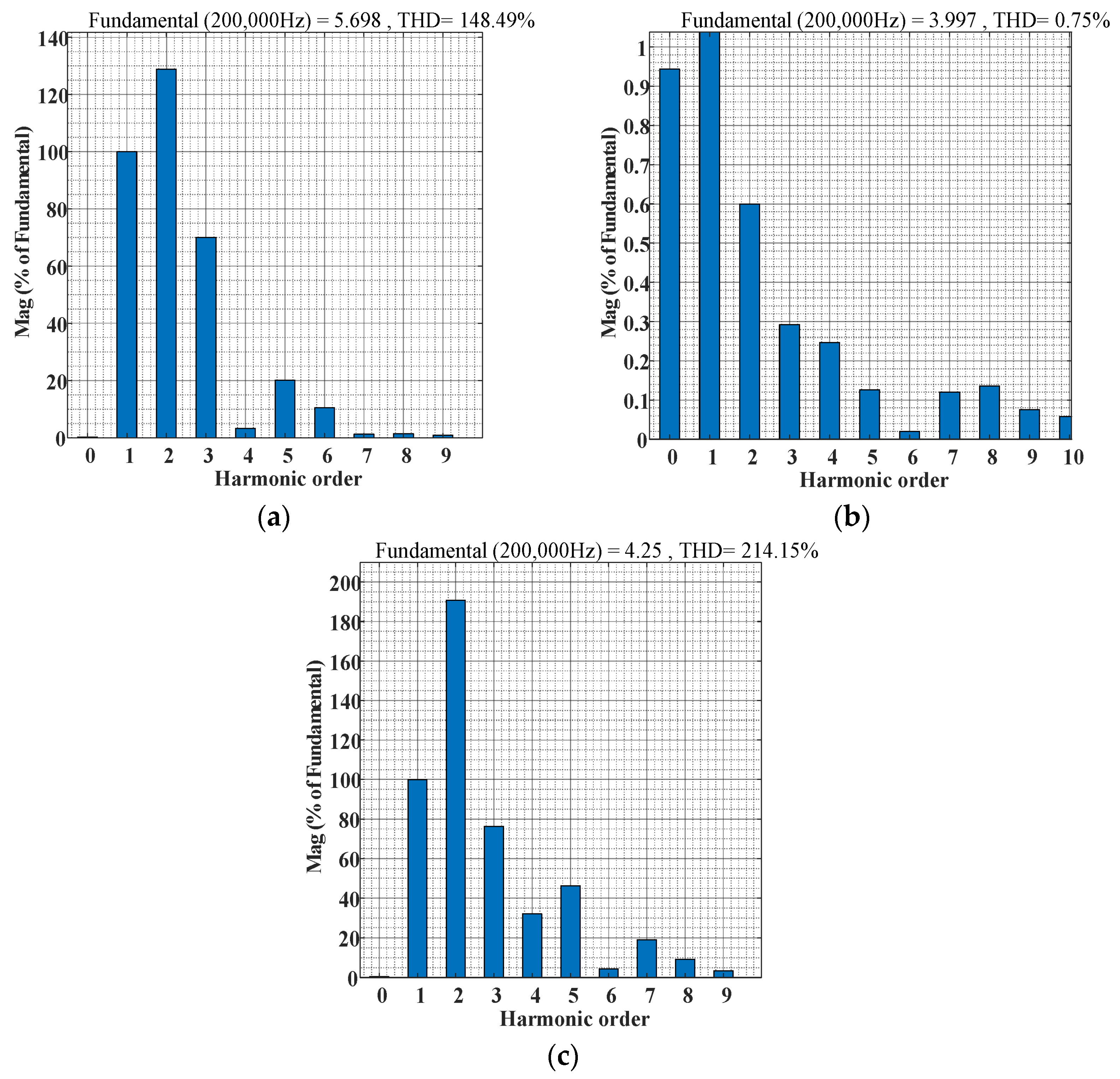
The different input voltage THD analysis is shown in Figure 18. When the input voltage is 400 V, the THD of the resonant current is the lowest. Due to the dead time, it still contains extremely low high-order harmonics. The overall resonant current tends to be a sine wave.

4.4. Loss Analysis

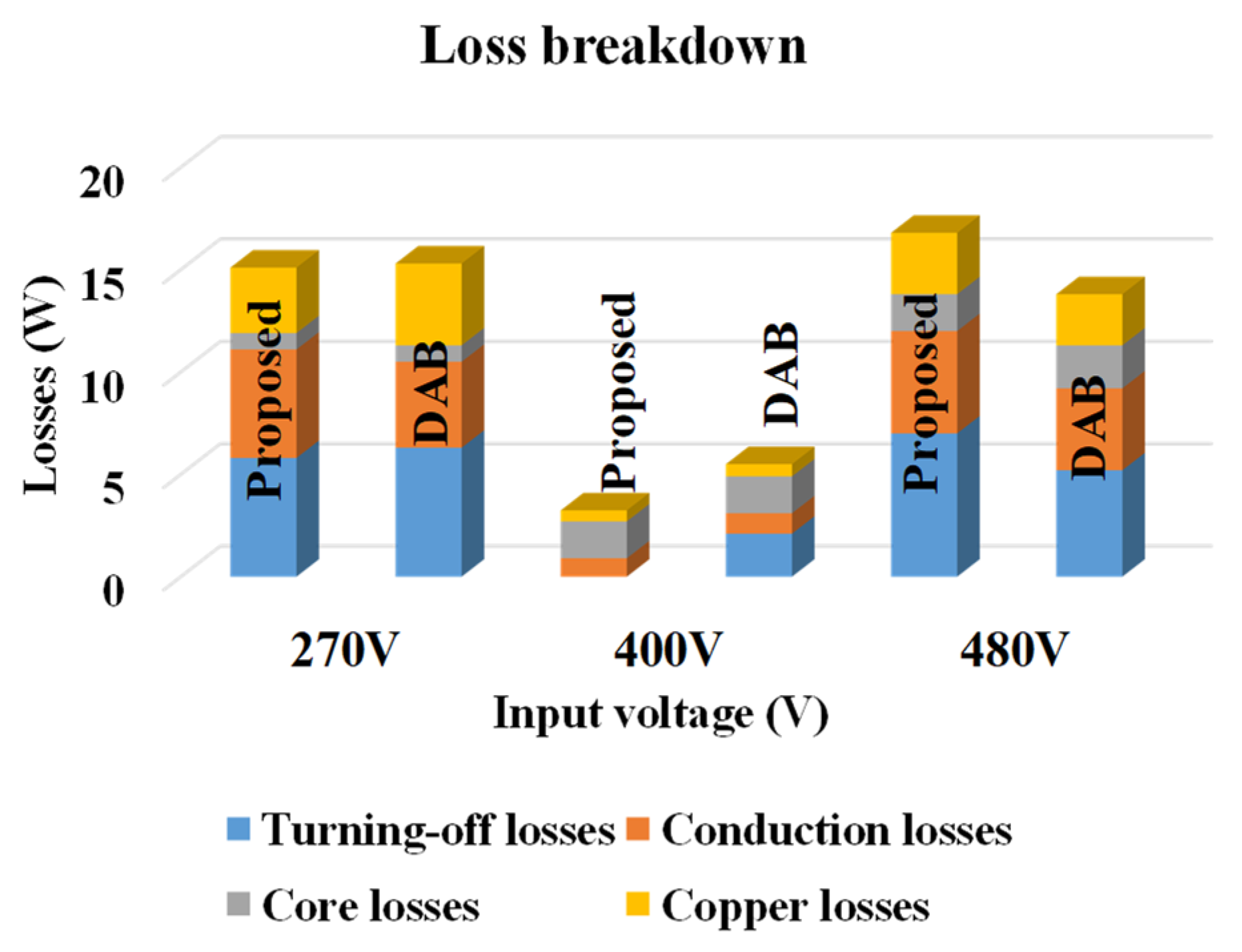
The theoretical loss analysis under full load is shown in Figure 19. All switches can achieve ZVS, hence turning on losses are ignored. When the input voltage is 400 V, the duty cycle of both the primary and secondary sides is close to 0.5. The resonant current is approximately a sine wave with very few high-order harmonics. Therefore, the RMS value of the resonant current and the conduction losses are the lowest. In addition, the turning on and turning off currents of MOSFETs are approximately zero. Therefore, the turning off losses are also very low, and the overall efficiency is the highest. When the input voltage changes, the duty cycle is not equal to 0.5. The resonant current will generate high-order harmonics, so the conduction loss will increase. In addition, the turning off current will also increase. Especially when the input voltage is 480 V, a higher bus voltage will result in higher turning off losses. In addition, the proposed solution was compared with DAB at the same voltage and power. It can be seen that the efficiency of the proposed converter is higher when the input voltage is 400 V (duty cycle is about 0.5).

4.5. Comparison

The comparison between the proposed solution, PFM LLC, and DAB is shown in Table 2. For PFM-controlled LLC resonant converters, primary MOSFETs can achieve ZVS, and secondary diodes can achieve ZCS. Due to the limitation of the switching frequency range, its voltage regulation range is narrow, and the voltage gain is dependent on the load. The DAB converter can achieve ZVS, but it is easy to lose ZVS characteristics under a light load. Although the voltage gain of the DAB converter is load-dependent, it has the advantage of directly controlling the transmission power. The proposed solution can achieve wide range voltage regulation at a fixed switching frequency. And the voltage gain is independent of the load, which is helpful for circuit design and control.

5. Conclusions

A fixed frequency PWM control for a half-bridge resonant converter is proposed in this paper. A wide voltage range and ZVS can be achieved without any additional components. In addition, the unified driving logic simplifies the design of voltage control. Compared with PFM LLC or DAB, the proposed converter can achieve load-independent voltage gain. This is helpful for circuit analysis and control. In addition, at the rated operating point (duty cycle of approximately 0.5), the efficiency of the proposed converter will be higher than that of the DAB converter. In order to avoid complex time-domain calculations, the multiple-order harmonics analysis method is proposed. The voltage and current expressions of resonant tanks can be easily calculated. In order to verify the effectiveness of the proposed solution, an experimental prototype was built. The experimental results are consistent with the theoretical analysis.

Author Contributions

Conceptualization, J.X., S.H., and L.Z.; methodology, J.X. and S.H.; writing—original draft preparation, J.X. and S.H.; writing—review and editing, J.X. and L.Z. All authors have read and agreed to the published version of the manuscript.

Funding

This work was supported in part by the National Natural Science Foundation of China under Grant 52407232, in part by the Key Research and Development Program of Hunan Province under Grant 2024JK2013.

Data Availability Statement

The original contributions presented in the study are included in the paper, further inquiries can be directed to the corresponding author.

Conflicts of Interest

The authors declare no conflicts of interest.

References

  1. Vogni, M.; Bellido, J.L.; Stella, F.; Stefanini, L.; Bianchini, C.; Esteve, V. Application and Development of a Double Asymmetric Voltage Modulation on a Resonant Dual Active Bridge. Electronics 2025, 14, 4625. [Google Scholar] [CrossRef]
  2. Mukherjee, S.; Ruiz, J.M.; Barbosa, P. A High Power Density Wide Range DC–DC Converter for Universal Electric Vehicle Charging. IEEE Trans. Power Electron. 2023, 38, 1998–2012. [Google Scholar] [CrossRef]
  3. Naresh Kumar, K.; Miśkiewicz, R.; Trochimiuk, P.; Rąbkowski, J.; Peftitsis, D. Comparative Analysis of SiC-Based Isolated Bidirectional DC/DC Converters for a Modularized Off-Board EV Charging System with a Bipolar DC Link. Electronics 2025, 14, 4522. [Google Scholar] [CrossRef]
  4. Leuenberger, D.; Biela, J. PV-module integrated AC inverters (AC modules) with subpanel MPP-tracking. IEEE Trans. Power Electron. 2017, 32, 6105–6118. [Google Scholar] [CrossRef]
  5. Lu, Y.; Wu, H.; Sun, K.; Xing, Y. A Family of Isolated Buck-Boost Converters Based on Semiactive Rectifiers for High-Output Voltage Applications. IEEE Trans. Power Electron. 2016, 31, 6327–6340. [Google Scholar] [CrossRef]
  6. Guan, Y.; Wang, Y.; Cecati, C.; Wang, W.; Xu, D. Analysis of Frequency Characteristics of the Half-Bridge CLCL Converter and Derivative Topologies. IEEE Trans. Ind. Electron. 2018, 65, 7741–7752. [Google Scholar] [CrossRef]
  7. Wei, Y.; Pereira, T.; Pan, Y.; Liserre, M.; Blaabjerg, F.; Mantooth, H.A. A general and automatic RMS current oriented optimal design tool for LLC resonant converters. IEEE J. Emerg. Sel. Top. Power Electron. 2022, 10, 7318–7332. [Google Scholar] [CrossRef]
  8. Hu, Z.; Qiu, Y.; Liu, Y.-F.; Sen, P.C. A control strategy and design method for interleaved LLC converters operating at variable switching frequency. IEEE Trans. Power Electron. 2014, 29, 4426–4437. [Google Scholar] [CrossRef]
  9. Musavi, F.; Craciun, M.; Gautam, D.S.; Eberle, W.; Dunford, W.G. An LLC resonant DC–DC converter for wide output voltage range battery charging applications. IEEE Trans. Power Electron. 2013, 28, 5437–5445. [Google Scholar] [CrossRef]
  10. Sun, X.; Li, X.; Shen, Y.; Wang, B.; Guo, X. Dual-Bridge LLC Resonant Converter with Fixed-Frequency PWM Control for Wide Input Applications. IEEE Trans. Power Electron. 2017, 32, 69–80. [Google Scholar] [CrossRef]
  11. Lim, J.-W.; Hassan, J.; Kim, M. Bidirectional Soft Switching Push–Pull Resonant Converter Over Wide Range of Battery Voltages. IEEE Trans. Power Electron. 2021, 36, 12251–12267. [Google Scholar] [CrossRef]
  12. Wu, F.; Wang, Z.; Luo, S. Buck-Boost Three-Level Semi-Dual-Bridge Resonant Isolated DC-DC Converter. IEEE J. Emerg. Sel. Top. Power Electron. 2021, 9, 5986–5995. [Google Scholar] [CrossRef]
  13. Li, C.; Wang, H.; Shane, M. A Five-Switch Bridge Based Reconfigurable LLC Converter for Deeply Depleted PEV Charging Applications. IEEE Trans. Power Electron. 2019, 34, 4031–4035. [Google Scholar] [CrossRef]
  14. Zhang, X.; Jing, J.; Guan, Y.; Dai, M.; Wang, Y.; Xu, D. High-efficiency high-order CL-LLC DC/DC converter with wide input voltage range. IEEE Trans. Power Electron. 2021, 36, 10383–10394. [Google Scholar] [CrossRef]
  15. Jung, J.-H.; Kim, H.-S.; Ryu, M.-H.; Baek, J.-W. Design methodology of bidirectional CLLC resonant converter for high-frequency isolation of DC distribution systems. IEEE Trans. Power Electron. 2013, 28, 1741–1755. [Google Scholar] [CrossRef]
  16. Xu, J.; Xu, G.; Sun, Y.; Su, M. A Family of Bidirectional Series Resonant Converter with Sine-Wave Modulation in Wide Voltage Range. IEEE Trans. Power Electron. 2023, 38, 5013–5023. [Google Scholar] [CrossRef]
  17. Hu, H.; Fang, X.; Shen, J.; Chen, F.; Shen, Z.J.; Batarseh, I. A modified high-efficiency LLC converter with two transformers for wide input voltage range applications. IEEE Trans. Power Electron. 2013, 28, 1946–1960. [Google Scholar] [CrossRef]
  18. Zong, S.; Fan, G.; Yang, X. Double Voltage Rectification Modulation for Bidirectional DC/DC Resonant Converters for Wide Voltage Range Operation. IEEE Trans. Power Electron. 2018, 34, 6510–6521. [Google Scholar] [CrossRef]
  19. Fu, M.; Fei, C.; Yang, Y.; Li, Q.; Lee, F.C. A GaN-Based DC–DC Module for Railway Applications: Design Consideration and High-Frequency Digital Control. IEEE Trans. Ind. Electron. 2020, 67, 1638–1647. [Google Scholar] [CrossRef]
  20. Wu, H.; Ding, S.; Sun, K.; Zhang, L.; Li, Y.; Xing, Y. Bidirectional Soft-Switching Series-Resonant Converter with Simple PWM Control and Load-Independent Voltage-Gain Characteristics for Energy Storage System in DC Microgrids. IEEE J. Emerg. Sel. Top. Power Electron. 2017, 5, 995–1007. [Google Scholar] [CrossRef]
  21. Wu, H.; Mu, T.; Gao, X.; Xing, Y. A secondary-side phase-shift-controlled LLC resonant converter with reduced conduction loss at normal operation for hold-up time compensation application. IEEE Trans. Power Electron. 2015, 30, 5352–5357. [Google Scholar] [CrossRef]
  22. Sun, X.; Shen, Y.; Li, W.; Wu, H. A PWM and PFM Hybrid Modulated Three-Port Converter for a Standalone PV/Battery Power System. IEEE J. Emerg. Sel. Top. Power Electron. 2015, 3, 984–1000. [Google Scholar] [CrossRef]
  23. Jiang, T.; Zhang, J.; Wu, X.; Sheng, K.; Wang, Y. A Bidirectional LLC Resonant Converter with Automatic Forward and Backward Mode Transition. IEEE Trans. Power Electron. 2015, 30, 757–770. [Google Scholar] [CrossRef]
  24. Xu, J.; Wang, H.; Liu, B. Unified Inductor Type Based Linear Resonant Hybrid Converter for Wide Voltage Range Applications. Energies 2025, 18, 2572. [Google Scholar] [CrossRef]
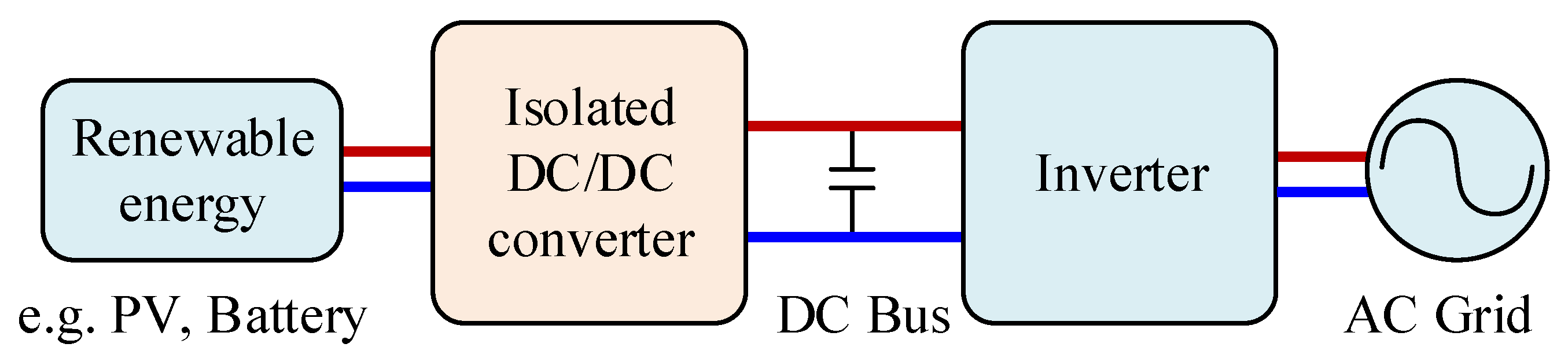
Figure 1. Typical structure of the renewable generation system.
Electronics 15 00346 g001
Figure 2. Dual active half-bridge converter.
Electronics 15 00346 g002
Figure 3. Operation waveforms. (a) DS1 < 0.5, DS3 = 0.5. (b) DS1 = 0.5, DS3 < 0.5. (c) DS1 = 0.5, DS3 = 0.5.
Electronics 15 00346 g003
Figure 4. (a) Stage 1 [t0, t1]. (b) Stage 2 [t1, t2]. (c) Stage 3 [t2, t3]. (d) Stage 4 [t3, t4].
Electronics 15 00346 g004aElectronics 15 00346 g004b
Figure 5. Resonant tank terminal voltage waveforms.
Electronics 15 00346 g005
Figure 6. Equivalent circuit of resonant tank.
Electronics 15 00346 g006
Figure 7. Normalized voltage gain curve.
Electronics 15 00346 g007
Figure 8. Harmonic waveforms of resonant current.
Electronics 15 00346 g008
Figure 9. ZVS operation modes and waveforms. (a) S1. (b) S2. (c) S3. (d) S4. (e) ZVS wave forms.
Electronics 15 00346 g009
Figure 10. ZVS range. (a) S1. (b) S2. (c) S3. (d) S4.
Electronics 15 00346 g010
Figure 11. Converter structure and working waveforms. (a) Structure diagram. (b) Half-bridge structure. (c) Full-bridge structure. (d) Half-bridge working waveforms. (e) Full-bridge working waveforms.
Electronics 15 00346 g011
Figure 12. Experimental prototype.
Electronics 15 00346 g012
Figure 13. Steady state waveforms. (a) Input voltage 480 V. (b) Input voltage 400 V. (c) Input voltage 270 V.
Electronics 15 00346 g013
Figure 14. ZVS waveforms. (a) S2, input voltage 480 V, full load. (b) S2, input voltage 270 V, full load. (c) S4, input voltage 200 V, full load. (d) S4, input voltage 200 V, no load.
Electronics 15 00346 g014
Figure 15. Dynamic waveforms. (a) No load to full load. (b) Full load to no load.
Electronics 15 00346 g015aElectronics 15 00346 g015b
Figure 16. Measurement efficiency curves.
Electronics 15 00346 g016
Figure 17. RMS value of resonant current under full load.
Electronics 15 00346 g017
Figure 18. THD analysis. (a) 270 V. (b) 400 V. (c) 480 V.
Electronics 15 00346 g018
Figure 19. Theoretical loss analysis.
Electronics 15 00346 g019
Table 1. Experimental prototype parameters.
ParameterValue
input voltage Vi270–480 V
output voltage Vo400 V
rated power P500 W
switching frequency fs200 kHz
resonant frequency fr200 kHz
resonant inductance Lr7 μH
excitation inductance970 μH
resonant capacitance Cr90 nF
MOSFETs (S1S4)UF3C065040K3S
half-bridge capacitance47 μF
transformer core typeEE4220
Table 2. Comparison.
CharacteristicPFM LLCDABProposed Solutions
ModulationPFMPSMPWM
Switching frequencyVariableFixedFixed
Soft switchingZVS, ZCSZVSZVS
Voltage regulation rangeNarrowWideWide
Load independent voltage gain××
Transmission networkLLCLLC
Disclaimer/Publisher’s Note: The statements, opinions and data contained in all publications are solely those of the individual author(s) and contributor(s) and not of MDPI and/or the editor(s). MDPI and/or the editor(s) disclaim responsibility for any injury to people or property resulting from any ideas, methods, instructions or products referred to in the content.