Article

Path Planning for Mobile Robots in Dynamic Environments: An Approach Combining Improved DBO and DWA Algorithms

1
College of Automation and Electronic Engineering, Qingdao University of Science and Technology, Qingdao 266061, China
2
College of Electrical Engineering and Automation, Shandong University of Science and Technology, Qingdao 266590, China
*
Author to whom correspondence should be addressed.
Electronics 2026, 15(2), 320; https://doi.org/10.3390/electronics15020320
Submission received: 18 December 2025 / Revised: 1 January 2026 / Accepted: 7 January 2026 / Published: 11 January 2026
(This article belongs to the Section Computer Science & Engineering)

Abstract

To address the common limitations of conventional dual-layer path planning methods, such as slow global convergence, delayed local obstacle avoidance response, and insufficient inter-layer integration, this paper proposes an enhanced collaborative planning framework combining the Improved Dung Beetle Optimizer (IDBO) and the Improved Dynamic Window Approach (IDWA). First, the proposed IDBO solves the problems of population aggregation and unbalanced exploration–exploitation of traditional algorithms by optimizing the initialization strategy and reconstructing the position update mechanism. Second, in the local path planning stage, the IDWA introduces an adaptive evaluation function embedded with obstacle motion prediction and a global path-tracking factor, which breaks through the limitations of traditional local algorithms, such as fixed weights and lack of environmental adaptability, while resolving the contradictions of poor inter-layer coupling and path redundancy in traditional dual-layer frameworks. The results of comparative simulation experiments show that the average path length is reduced by 6.5% and the running time is decreased by 9.1%. This framework effectively overcomes the problems of delayed local response and insufficient inter-layer integration in traditional dual-layer path planning.

1. Introduction

Path planning is a fundamental task in mobile robotics, aimed at finding an optimal collision-free path from the start point to the goal point [1,2,3]. This capability is crucial to ensure safe and efficient task execution in complex environments that contain both static and dynamic obstacles [4]. Existing path planning algorithms are primarily categorized into two classes: global planning methods, such as A* [5], Dijkstra [6], Particle Swarm Optimization (PSO) [7], Ant Colony Optimization(ACO) [8], and RRT* [9], which utilize complete environmental information to generate an optimal path offline. In contrast, local planning techniques, e.g., the Dynamic Window Approach (DWA) [10] and the Artificial Potential Field (APF) [11], focus on the real-time obstacle avoidance in dynamic environments. Among these algorithms, DWA has gained considerable attention and found extensive applications due to its effective integration of dynamic obstacle avoidance capabilities with the robot’s kinematic constraints [12,13].
Though DWA has been widely used in mobile robot path planning in recent studies, it still suffers from several drawbacks, such as inflexible weight coefficients and low computational efficiency [12]. To address these limitations, researchers have proposed various improved schemes. For example, Gong et al. [14] incorporated fuzzy control theory to dynamically adjust the weight coefficients of the evaluation function based on environmental complexity, enabling faster and smoother navigation. Chang et al. [15] employed Q-learning to optimize the evaluation function and dynamically adapt to DWA parameters, thereby improving global navigation capability. Liang et al. [16] proposed an integrated path planning approach combining an enhanced White Shark Optimizer (WSO) and the DWA, where the key improvements include chaotic mapping, adaptive weighting, and simplex method optimization, collectively enhancing convergence efficiency and navigation performance in dynamically obstructed environments. Nevertheless, the aforementioned enhancements still face challenges in highly time-sensitive scenarios. Additionally, existing approaches primarily focus on local path planning using DWA without adequately considering global information, which may compromise planning efficiency and safety. Therefore, further research is needed to better integrate global path planning with DWA’s local optimization capabilities.
To deal with the challenges of global path planning algorithms in adapting to dynamic environments and the lack of a global perspective in local path planning algorithms, a dual-layer path planning architecture that integrates both approaches has become a research hot spot in mobile robot studies [17]. Within this framework, the DWA is often selected as the core algorithm for the local planning layer due to its high compliance with kinematic constraints and reliable real-time obstacle avoidance. For example, Li et al. [18] constructed a hybrid planner by coupling an improved PSO with DWA, thereby achieving a dual-objective optimization on path length and smoothness. Zhou et al. [19] proposed a hybrid global planner based on Grey Wolf Optimizer (GWO) and Whale Optimization Algorithm (WOA), and DWA was employed for the path planning of followers in the formation control system, resolving the challenge of maintaining consistency with global path in dynamic obstacle avoidance. Zhao et al. [20] combined the topological search capability of Ant Colony Optimization (ACO) with the real-time response of DWA, where the coarse way points generated by ACO are used to guide DWA’s local decision-making for the long-term autonomy of robots in unknown environments. Lin et al. [21] developed a dual-layer path planning algorithm that integrates an optimized APF with an improved DWA, where the PSO algorithm is employed to optimize the APF parameters for global path planning, while a fuzzy control system enhances the DWA for local path planning. Yang et al. [22] proposed an enhanced hybrid algorithm that integrates ACO with DWA. This method improves global search capability through an optimized pheromone update mechanism and heuristic function in ACO, while enhancing dynamic obstacle avoidance via an improved DWA implementation. Liu et al. [23] proposed an algorithm integrating the DWA and an improved Sparrow Search Algorithm (SSA), which leverages Cauchy opposition-based learning for population initialization, the Sine-Cosine Algorithm (SCA) for the optimization of producer position updates, and Lévy flight strategy to enhance the ability of escaping local optima, realizing uperior performance in both global path planning and local obstacle avoidance.
In recent years, deep reinforcement learning (DRL) has emerged as a research hotspot in path planning for its potential in high-dimensional environmental perception and dynamic decision-making. For instance, Sun et al. [24] proposed an improved Prioritized Experience Replay (iPER)-based Soft Actor-Critic (SAC) algorithm to build a global path guidance-local dynamic decision-making framework. Local DRL training is guided by global path-generated waypoints to enhance path safety in dynamic environments, while this method requires massive training samples for stable convergence and its fixed global waypoints cause increased path redundancy due to the lack of real-time adjustment for local obstacle avoidance. Cheng et al. [25] put forward an automated learning and evaluation framework for robot autonomous goal seeking and collision avoidance based on PPO method, which enhances the real-environment adaptability via closed-loop training and evaluation in physical scenarios. However, this method suffers from large-scale sample iteration for convergence and lacks a dynamic global path guidance mechanism, resulting in redundant path detour in complex dynamic obstacle scenes.
Despite advances in dual-layer path planning frameworks, existing methods often struggle with delayed reaction to moving obstacles, excessive path redundancy, and insufficient consistency between global and local planners in dynamic environments. Motivated by the aforementioned discussions, we propose a hierarchical planning architecture combining an Improved Dung Beetle Optimizer (IDBO)-based global path planner and an Improved Dynamic Window Approach (IDWA)-based local path planner. The main contributions of this paper can be summarized as follows:
  • To address key limitations in prevailing dual-layer path planning architectures, such as slow global convergence speed, delayed local response, and weak inter-layer integration, this paper presents an enhanced collaborative framework. A novel path-similarity constraint is proposed to ensure the seamless integration of global planning with local obstacle avoidance.
  • This paper proposes an IDBO that includes an environment feature-based adaptive population initialization strategy and a reconstructed position updating operator. These enhancements improve both the convergence speed and path quality in complex environments.
  • An adaptive evaluation function is designed by integrating an obstacle motion prediction module and a global path-tracking factor, achieving fast responses to dynamic obstacles and precise global path tracking through real-time adjustments of the weight distribution in the velocity sampling space.
  • Several comparative experiments are conducted to validate the comprehensive advantages of the proposed method in terms of path length optimization, motion smoothness, and real-time performance. Experimental results demonstrate the effectiveness and advantages of the new method compared to the traditional counterparts.
Section 2 presents the grid map modeling method and the IDBO for global path planning. Section 3 analyzes the limitations of the classical DWA and proposes improvements, culminating in a dual-layer planning algorithm that incorporates global guidance. Section 4 evaluates the performance of the proposed algorithm through simulation experiments. Section 5 concludes the paper by summarizing the research findings.

2. Global Path Planning Using the Improved Dung Beetle Optimizer Algorithm

2.1. Workspace Modeling

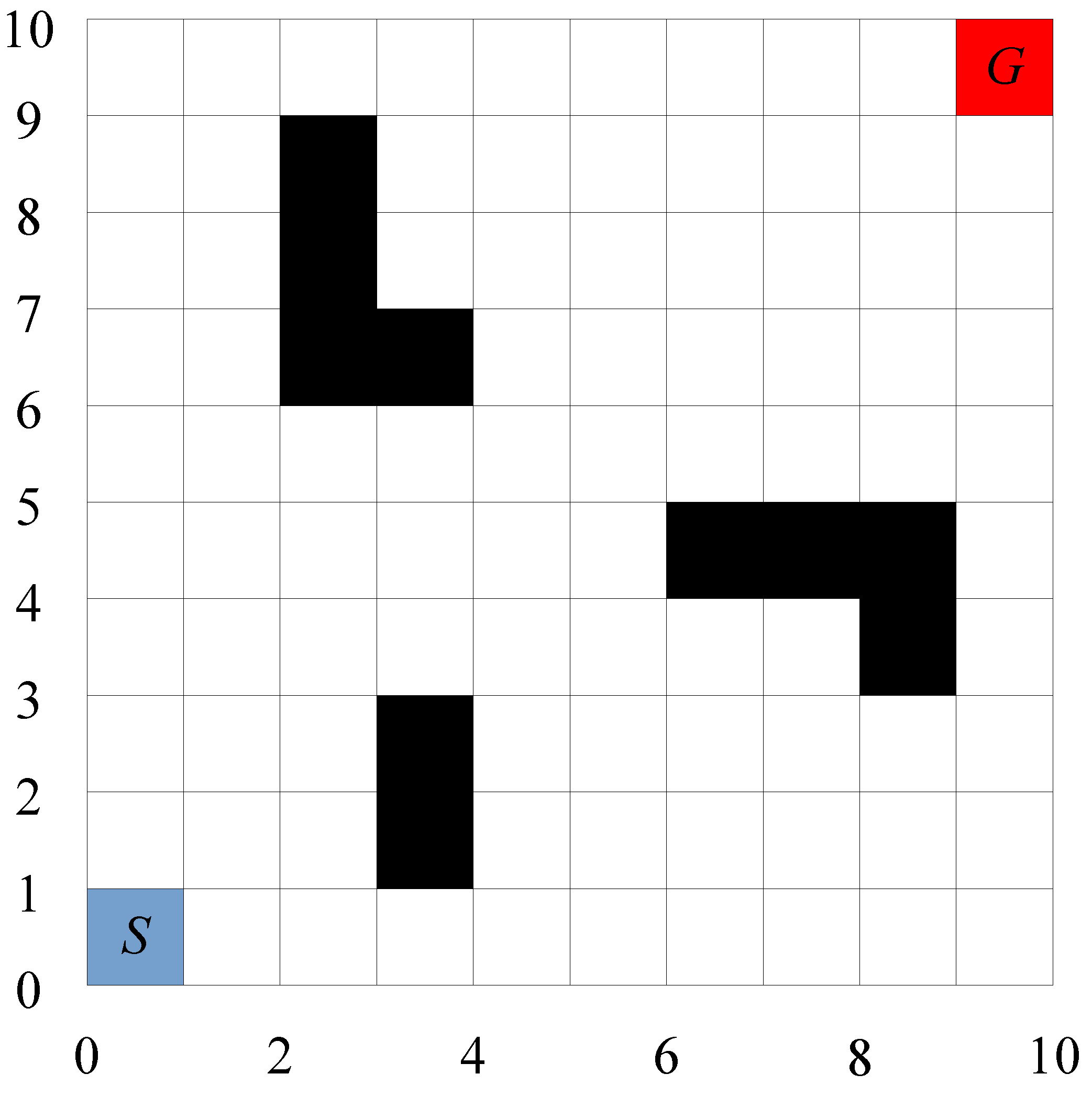
In simulation experiments, it is necessary to model the environment in which the mobile robot operates to establish a realistic foundation for validating path planning algorithms. During modeling, relevant constraints for path search are predefined, including the search scope, start and end positions, as well as information about obstacles encountered along the path. This study models the environment using a grid map [26]; the state of each grid cell is defined as follows:
G r i d ( i , j ) = 0 Free Space , 1 Occupied Space ,
where G r i d ( i , j ) denotes the state of the grid cell at coordinate ( i , j ) . A value of 0 indicates a free space (shown as a white block), while a value of 1 indicates an obstacle area (shown as a black block). The symbols S and G denote the start point and goal point of the path, respectively. An example of this grid-based representation is illustrated in Figure 1.

2.2. Classical Dung Beetle Optimizer

The DBO is a swarm intelligence algorithm inspired by the ball-rolling behavior of dung beetles [27]. It models a relationship between perceived light intensity and step size, meaning individuals move farther under stronger illumination [28]. The key position updating rule is defined as follows:
x i ( t + 1 ) = x i ( t ) + a · k q · x i ( t 1 ) + b · Δ x , Δ x = | x i ( t ) X w | ,
where t denotes the current iteration number, x i ( t ) represents the position of the i-th dung beetle, a { 1 , 1 } is the direction coefficient, k q ( 0 , 0.2 ) and b ( 0 , 1 ) are adjustment parameters, X w denotes the global worst position, and Δ x characterizes the variation intensity of the light source.
Upon detecting an obstacle in the path, the dung beetle activates a tangent function-based directional adaptation mechanism to adjust its heading. Correspondingly, the revised position updating rule is established as follows:
x i ( t + 1 ) = x i ( t ) + tan ( θ q ) | x i ( t ) x i ( t 1 ) | ,
where θ q ( 0 , π ) is defined as the deflection angle. It should be noted that the position remains fixed if θ q attains any of the key values 0, π 2 , or π .
The DBO algorithm simulates the natural ball-rolling behavior of dung beetles, including their foraging patterns, brood-ball placement strategies, and defensive mechanisms, via a systematic boundary selection mechanism. This mechanism is formally defined by the following mathematical expression:
L b * = max ( X * × ( 1 R ) , L b ) , U b * = min ( X * × ( 1 + R ) , U b ) ,
where X * represents the currently known best position; L b and U b specify the lower and upper bounds of the search space; L b * and U b * define the egg-laying zone; R = 1 t / T m a x , where T m a x denotes the preset maximum number of iterations.
In the iterative process of the algorithm, each female dung beetle represents a candidate solution, while every iteration cycle generates a new solution. Simultaneously, the oviposition area dynamically adapts and adjusts, and its position updating formula is defined as follows:
B i ( t + 1 ) = X * + b 1 × ( B i ( t ) L b * ) + b 2 × ( B i ( t ) U b * ) , B i = L b * , if B i < L b * , U b * , if B i > U b * ,
where B i ( t ) represents the position of the i-th brood ball, while b 1 and b 2 denote D-dimensional random vectors.
Based on the oviposition mechanism, the position update for newborn larvae is defined as follows:
x i ( t + 1 ) = x i ( t ) + C 1 × ( x i ( t ) L b b ) + C 2 × ( x i ( t ) U b b ) , L b b = max ( X b × ( 1 R ) , L b ) , U b b = min ( X b × ( 1 + R ) , U b ) ,
where X b represents the global best position, L b b and U b b denote the boundaries of the optimal search space, x i ( t ) indicates the current position of the young dung beetle, and C 1 , C 2 ( 0 , 1 ) are random coefficients.
To simulate the theft behavior observed in natural dung beetle populations, the algorithm incorporates a specific thief-individual model. The corresponding position-updating formula is designed as follows:
X i ( t + 1 ) = X b + S · g · | x i ( t ) X * | + | x i ( t ) X b | ,
where g N ( 0 , 1 ) denotes a random vector drawn from the standard normal distribution, and S is the adjustment factor. By iteratively optimizing the current optimal solution and its associated fitness value, the algorithm asymptotically approaches and delivers the globally optimized result.

2.3. Improved Dung Beetle Optimizer

2.3.1. Population Initialization Strategy

To address the limitation of non-uniform population distribution induced by random initialization in the traditional Dung Beetle Optimizer (DBO), an improved Tent chaotic map is adopted to enhance population diversity [29]. Owing to the inherent ergodicity and initial value sensitivity of chaotic systems, the improved Tent chaotic map enables the generated sequences to uniformly traverse the entire search interval [0, 1] and generate individuals with high diversity, thereby effectively reducing the risk of premature convergence caused by population aggregation in random initialization. Compared with the standard Tent chaotic map, the enhanced mathematical formulation is defined as follows:
z k + 1 = 2 ( z k + 0.1   ×   rand ( 0 , 1 ) ) , 0 z k < 0.5 , 2 2 ( z k + 0.1   ×   rand ( 0 , 1 ) ) , 0.5 z k 1 .
where z k + 1 denotes the chaotic sequence value generated by the ( k + 1 ) -th iteration; rand ( 0 , 1 ) represents a uniformly distributed random number within the interval [ 0 , 1 ] , which is the newly incorporated disturbance term in the improved map; the coefficient 0.1 serves as a disturbance intensity regulator, whose value is referenced from the literature [29], serving to control the influence degree of the random term on the iterative process.

2.3.2. Improved Position Updating Strategy

This paper proposes a Modified Sine Algorithm (MSA) that incorporates an adaptive inertia weight coefficient w t to modulate the position updating mechanism. At the initial stage, w t is assigned a larger value to enhance global exploration capability and accelerate convergence speed. As iterations proceed, w t adaptively decreases to enhance local exploitation capability and improve solution accuracy. The mathematical formulation of MSA is presented as follows:
x i ( t + 1 ) = w t x i ( t ) + r 1 × sin r 2 × [ r 3 p i ( t ) x i ( t ) ] ,
where w t denotes the inertia weight coefficient, p i ( t ) denotes the position of the i-th elite individual at iteration t, r 1 denotes the nonlinear attenuation coefficient, and r 2 [ 0 , 2 π ] and r 3 [ 2 , 2 ] denote the phase modulation and intrinsic perturbation coefficients, respectively. The nonlinear attenuation coefficient r 1 is dynamically regulated using a cosine-based mechanism, whose functional form is specified as follows:
r 1 = w max w min 2 cos π t T max + w max + w min 2 ,
where w max and w min denote the upper and lower bounds of the inertia weight, respectively. The inertia weight coefficient w t is further optimized to exhibit a nonlinear decay characteristic, which is formulated as follows:
w t = w min + ( w max w min ) × 1 1 + exp 11 t / T max 6 .
To address certain inherent limitations of the traditional DBO, including imprecise directional guidance, excessive stochasticity, and inflexible search paradigms, this paper integrates the MSA to optimize the positional updating mechanism for the ball-rolling beetles. The resulting enhanced formulation is defined as follows:
x i ( t + 1 ) = x i ( t ) + α × k × x i ( t 1 ) + b × Δ x , δ < S T , w x i ( t ) + r 1 × sin ( r 2 ) × [ r 3 X * x i ( t ) ] , δ S T ,
where δ = rand ( 0 , 1 ) and S T ( 0.5 , 1 ] . By dynamically adjusting the search strategy, the enhanced algorithm effectively balances global exploration and local exploitation capabilities. This improvement not only accelerates the algorithm’s convergence speed but also significantly strengthens its ability to escape local optima, leading to a noticeable enhancement in overall performance.

2.4. Evaluation Function

In the global path planning problem, the evaluation function is defined as the total length of the path from the start point to the end point, i.e., the sum of Euclidean distances between the centroids of consecutive grids along the path [30], as expressed as follows:
L d = i = 0 n 1 ( x i , n + 1 x i , n ) 2 + ( y i , n + 1 y i , n ) 2 ,
where ( x i , n , y i , n ) and ( x i , n + 1 , y i , n + 1 ) are the grid coordinates of the i-th individual at the n-th and ( n + 1 ) -th path nodes, respectively.

2.5. Redundant Node Removal

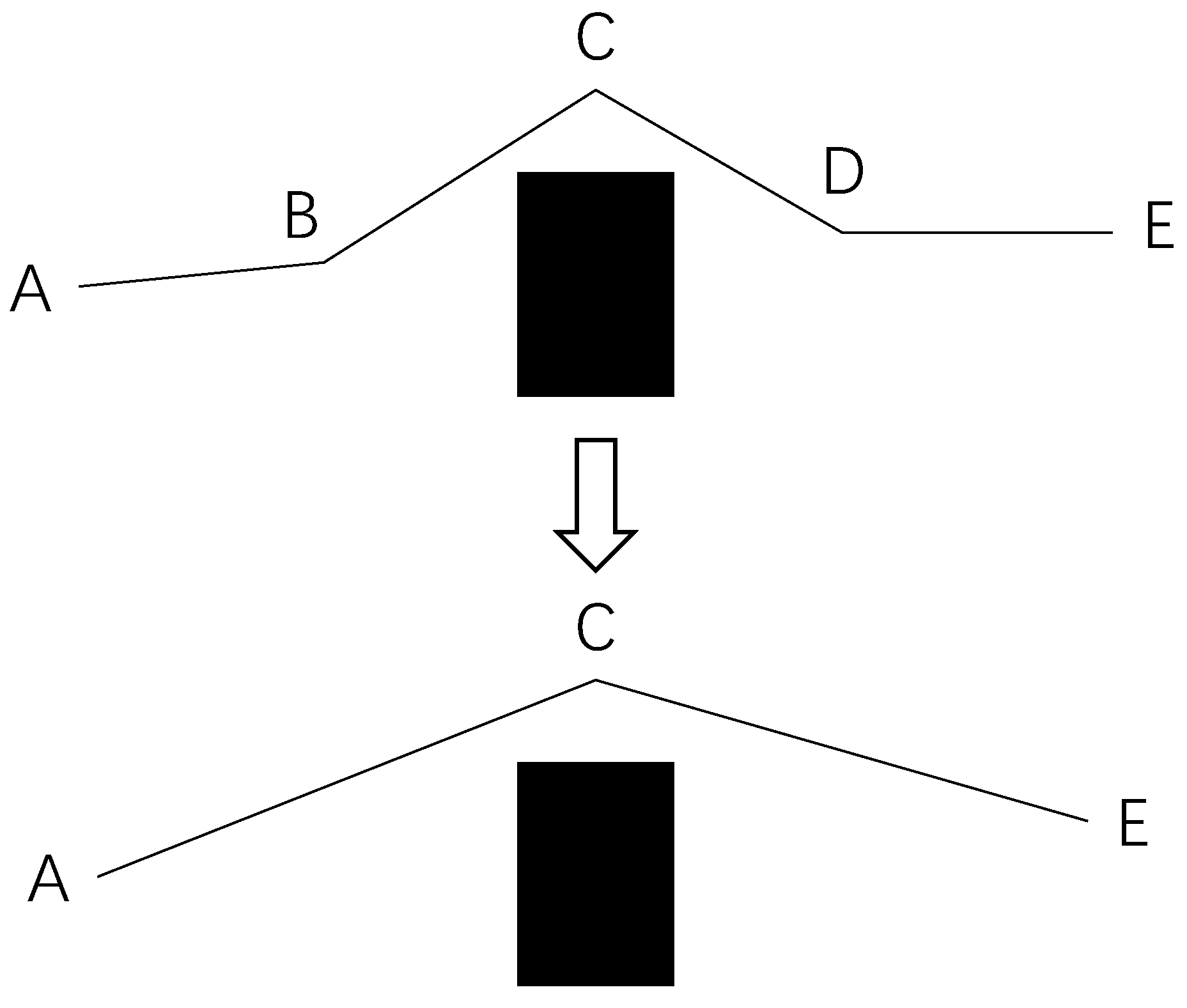
To reduce path redundancy encountered in global path planning [31], this paper proposes a novel path pruning method referred to the Redundant Node Elimination Strategy. The core workflow of this strategy is as follows: starting from the start point, it sequentially checks each node along the path. If a collision-free linear segment exists between two non-adjacent nodes, all intermediary nodes are discarded, and a direct connection is established. For example, a raw path A → B → C → D → E can thus be streamlined into A → C → E, as shown in Figure 2.
This approach effectively reduces both the total travel distance and the number of heading changes while strictly ensuring obstacle avoidance integrity. The final integrated framework, which couples the IDBO with this optimization scheme, constitutes our complete solution for mobile robot global path planning, as summarized in Algorithm 1.
Algorithm 1 Global Path Planning Algorithm
  • Require: Map, start position S, goal position G
  • Ensure: Optimal global path
1:
Initialize maximum iteration T max , individual number N, start S, goal G, and factors w max , w min , k q .
2:
for all agent i do
3:
   Initialize position X i for agent i; set step size Δ r , state threshold S T , and boundaries L B , U B .
4:
   Calculate fitness f i t ( X i ) for agent i; set personal best P b e s t i = X i .
5:
end for
6:
Set global best b e s t X = min { P b e s t i } .
7:
while t < T max do
8:
   for  i = 1 to N do
9:
     if i == ball-rolling dung beetle then
10:
        Generate random factor δ = rand ( 0 , 1 ) .
11:
        if  δ < 0.9  then
12:
          Update position using Equation (12).
13:
        else
14:
          Update position using Equation (3).
15:
        end if
16:
        {Steps 9-16: Position update for ball-rolling dung beetle}
17:
     end if
18:
     if  i = = brood ball  or  i = = small dung beetle  or  i = = thief beetle  then
19:
        Update position using Equations (5)–(7).
20:
     end if
21:
   end for
22:
   Record and store the current location of each agent.
23:
   for all agent i do
24:
   if  f ( X i ) < f ( P b e s t i )  then
25:
      P b e s t i = X i .
26:
   end if
27:
   if  f ( P b e s t i ) < f ( b e s t X )  then
28:
      b e s t X = P b e s t i .
29:
   end if
30:
   { Update personal and global optimal positions}
31:
   end for
32:
   Update the solution set X if a better solution is found.
33:
end while
34:
 
35:
return Optimal global path (derived from b e s t X ).

3. Improved Dynamic Window Approach

3.1. Kinematic Model

During the local path planning phase, the DWA algorithm adopts a receding horizon optimization strategy: within each sampling period, the algorithm first generates a dynamic window and evaluates all admissible velocity combinations. For each velocity pair ( v , ω ) , the algorithm predicts the robot’s motion trajectory over a time interval Δ t , which can be simplified as an arc or a straight line when Δ t is sufficiently small. Based on the assumption of uniform linear motion for prediction purposes, the robot’s kinematic model can be expressed as follows [32,33]:
x ( t c + Δ t ) = x ( t c ) + v ( t c ) × Δ t × cos θ ( t c ) , y ( t c + Δ t ) = y ( t c ) + v ( t c ) × Δ t × sin θ ( t c ) , θ ( t c + Δ t ) = θ ( t c ) + w ( t c ) × Δ t ,
where x ( t c ) , y ( t c ) , and θ ( t c ) represent the pose of the mobile robot at time t c (including position coordinates and the heading angle), v ( t c ) denotes the linear velocity, and w ( t c ) denotes the angular velocity.

3.2. Velocity Sampling

The DWA algorithm determines the robot’s currently feasible motion states by establishing a dynamic velocity window. Its core concept lies in screening feasible velocity combinations by constraining the ranges of linear and angular velocities. Specifically, the selection of the robot’s velocities is primarily restricted by the following physical constraints:

3.2.1. Power Performance Constraints

Considering hardware constraints such as motor torque limitations and battery power limitations, the achievable linear and angular velocities of the robot are confined within well-defined boundaries as follows:
V m = ( v , w ) v ( v min , v max ) , w ( w min , w max ) ,
where v max and v min represent the theoretically achievable maximum and minimum linear velocities of the mobile robot, whereas ω max and ω min stand for the realizable maximum and minimum angular velocities, respectively.

3.2.2. Dynamic Acceleration Constraints

Accounting for physical constraints such as motor torque saturation and system inertia, the robot’s acceleration within the sampling interval Δ t must comply with dynamic constraints. The admissible velocities are consequently confined to a dynamically feasible window, which is mathematically expressed as follows:
V d = ( v , w ) | v c v c v ˙ b Δ t , v c + v ˙ a Δ t , w w c w ˙ b Δ t , w c + w ˙ a Δ t ,
where ( v c , ω c ) indicates the current translational and rotational velocities of the mobile robot, while ( v ˙ a , ω ˙ a ) and ( v ˙ b , ω ˙ b ) denote the maximum achievable acceleration and deceleration, respectively.

3.2.3. Obstacle Safety Distance Constraints

To ensure the mobile robot safely reaches the target point, it is imperative to maintain a minimum safe distance from the nearest obstacle. This distance must comprehensively consider the robot’s motion inertia and braking performance, and the corresponding velocity constraints should satisfy the condition as follows:
V a = ( v , w ) v 2 d i s t ( v , w ) v ˙ b , w 2 d i s t ( v , w ) w ˙ b ,
where d i s t ( v , ω ) denotes the minimum predicted distance between the mobile robot’s motion trajectory and the nearest obstacle under the current velocity combination ( v , ω ) .
The admissible velocity domain of the mobile robot must satisfy the following three constraint categories simultaneously, and its velocity sampling range is therefore defined by:
V f = V m V d V a .

3.3. Evaluation Function

In the iterative optimization phase of the DWA, the evaluation function assesses predicted trajectories produced by feasible velocity pairs sampled within the dynamic window. The function balances multiple objectives, including path safety, target proximity, and motion smoothness. The evaluation function of DWA is defined as follows:
G ( v , w ) = σ ( s 1 · h e a d i n g ( v , w ) + s 2 · d i s t ( v , w ) + s 3 · v e l ( v , w ) ) ,
where h e a d i n g ( v , ω ) is the heading evaluation function, quantifying the orientation deviation between the robot’s current heading and the target direction; d i s t ( v , ω ) is the distance evaluation function, assessing the minimum safety clearance between the predicted trajectory and surrounding obstacles; and v e l ( v , ω ) is the velocity evaluation function, measuring the motion efficiency. The weighting coefficients s 1 , s 2 , and s 3 correspond to the three evaluation functions respectively, modulating the relative importance of these terms in the overall cost function. The specific mathematical formulations of these evaluation functions are detailed as follows:
h e a d i n g ( v , w ) = 180 ° θ c g , d i s t ( v , w ) = ( x ( t ) x o b s ) 2 + ( y ( t ) y o b s ) 2 , v e l ( v , w ) = | v c | ,
where θ c g characterizes the angular disparity between the robot’s terminal heading orientation within the Δ t prediction horizon and the intended target direction; meanwhile, ( x obs , y obs ) specifies the positional coordinates of the obstacle within the global reference frame.

3.4. Risk Factor

The traditional DWA faces three main challenges in dynamic environments. First, its predetermined weighting configuration lacks the adaptability to accommodate velocity variations in dynamic obstacles, as the method models them exclusively as stationary entities while ignoring their kinematic states. Second, despite incorporating global path guidance, the resulting local trajectories exhibit limited adherence to the reference path, thereby leading to significant path redundancy. Third, in densely cluttered environments, the planner frequently converges to locally optimal solutions.
To mitigate these drawbacks, this paper proposes a dynamic risk evaluation framework. By incorporating a relative velocity-based collision risk assessment and integrating a path deviation penalty term, our enhanced method exhibits superior environmental adaptability and generates improved trajectory quality in dynamic scenarios.

3.4.1. Repulsive Potential Field Risk Factor

Drawing upon the theoretical foundation of artificial potential fields, this study proposes an enhanced repulsive potential field model aimed at improving obstacle avoidance safety [34]. Once the mobile robot enters the effective region of an obstacle, the proposed framework constructs an adaptive repulsive field whose intensity varies continuously with both the relative velocity and the inter-distance. Taking into consideration the dynamic behavior of moving obstacles, the proposed repulsion function is explicitly defined as follows [35]:
U r e p = 1 2 k r e p 1 p ( q ) 1 ρ 0 2 , p ( q ) ρ 0 , 0 , p ( q ) > ρ 0 ,
where p ( q ) quantifies the Euclidean distance between the mobile robot and its nearest obstacle, k rep serves as the repulsive gain coefficient regulating obstacle avoidance responsiveness, and ρ 0 defines the maximum interaction range beyond which the obstacle no longer exerts repulsive forces.
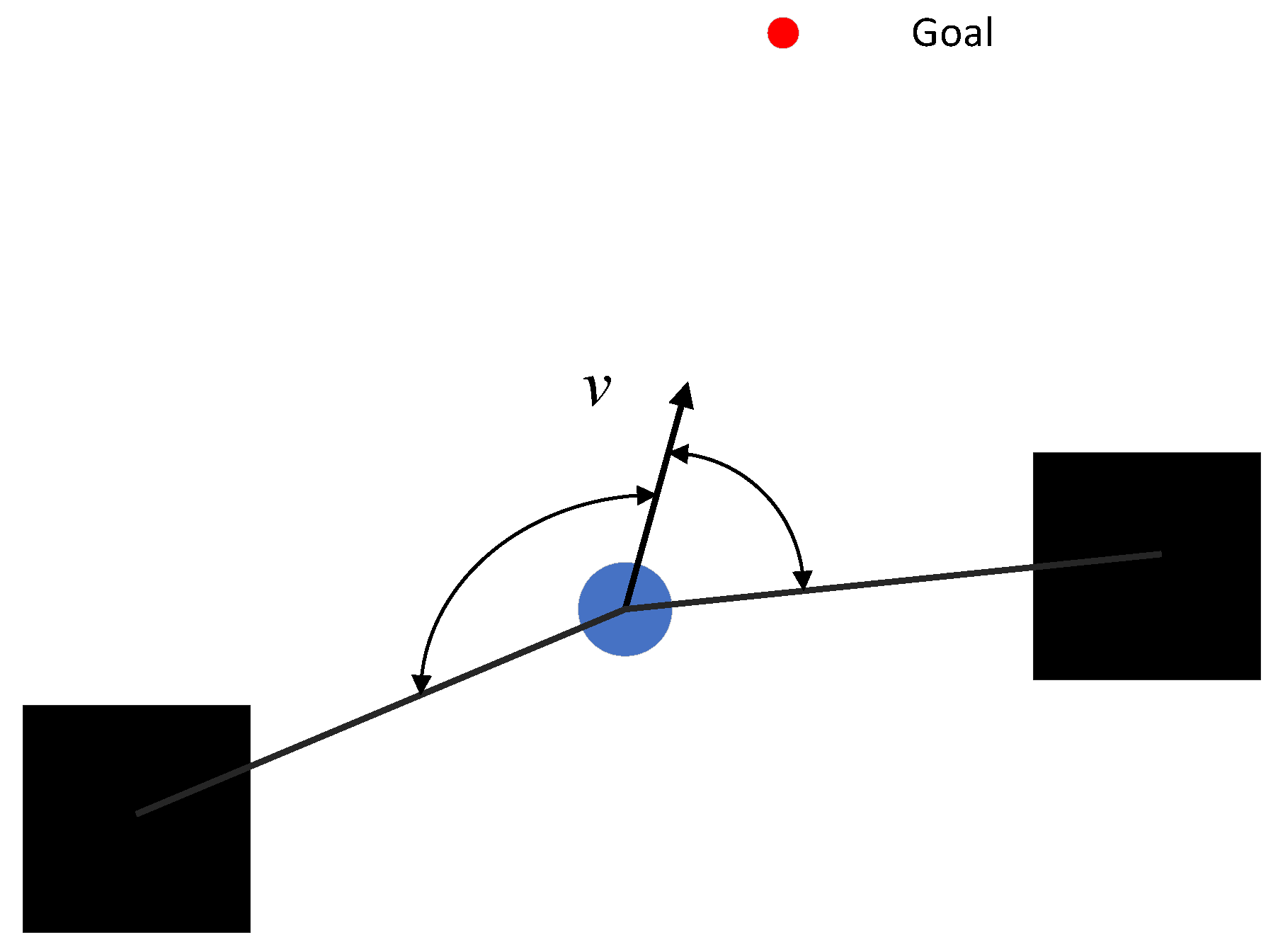
Within the APF framework, the computation of repulsive forces acting on the robot needs to adapt effectively to dynamic environments. Three principal mechanisms are designed and implemented to achieve this objective [36]. Initially, a distance-activated repulsion mechanism is employed, where repulsive forces are calculated solely when the robot enters the effective range of the obstacle’s potential field ( ρ ( q ) ρ 0 ); outside this range, repulsion remains null to guarantee computational tractability. Subsequently, an orientation-aware adjustment mechanism is incorporated, which modulates the repulsion intensity through a directional weighting factor that is enhanced when the robot approaches an obstacle and diminished when it recedes. Ultimately, a motion-state coupling mechanism integrates the relative velocity dependency, rendering the repulsive field strength proportional to the cosine of the relative bearing angle between the robot and the obstacle.
As depicted in Figure 3, when the robot moves away from a left-side obstacle at velocity v, the system autonomously scales down the obstacle’s repulsive contribution, thereby enabling more rational obstacle avoidance. The presented enhancement successfully alleviates the local minima limitation intrinsic to conventional potential field techniques, while simultaneously promoting both safety assurance and trajectory smoothness in path planning.
Based on the aforementioned dynamic regulation mechanisms, this paper proposes an enhanced repulsive potential field model, with its mathematical formulation and risk coefficient computation given as follows:
c r e p = U r e p ( q , α ) = 1 2 f ( α ) k r e p 1 p ( q ) 1 ρ 0 2 , p ( q ) ρ 0 , 0 , p ( q ) > ρ 0 ,
where α denotes the angle between the mobile robot’s heading direction and the line connecting the robot to the obstacle, constrained to the interval [ 0 , π ] . The expression for f ( α ) is defined as follows:
f ( α ) = π α π + 1 α tanh 2 α π 2 .

3.4.2. Velocity Risk Factor

The relative velocity between the mobile robot and dynamic obstacles is also one of the factors affecting the robot’s safe obstacle avoidance. Ignoring the impact of this factor may lead to collisions or parallel movement with obstacles, thereby resulting in an excessively long planned path. This paper establishes a risk assessment model based on relative kinematics.
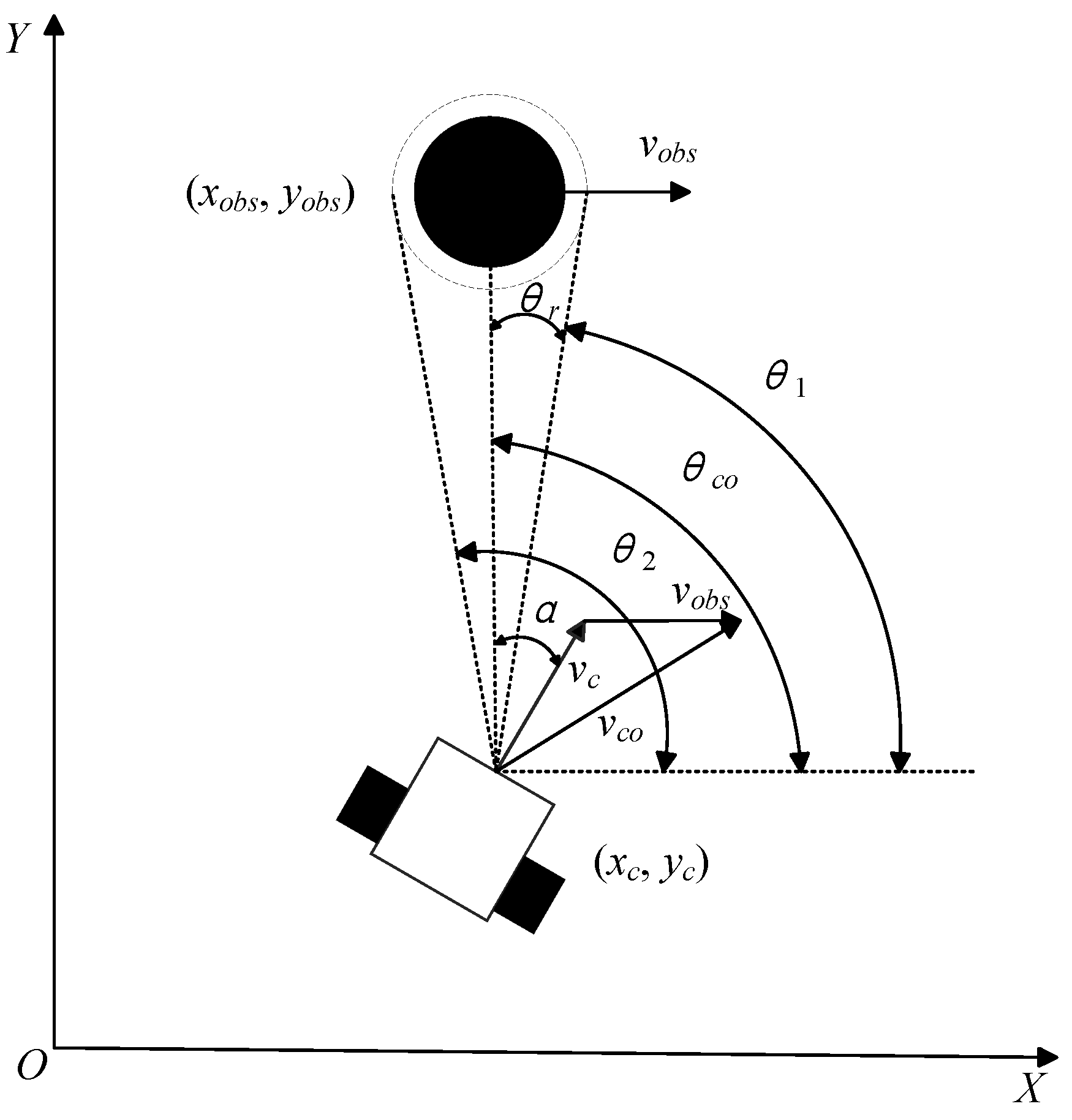
As shown in Figure 4, the key parameter θ co is defined as the azimuth angle of the line connecting the robot and the dynamic obstacle relative to the x-axis of the global coordinate system, and its expression is given as follows:
θ c o = tan 1 | y c y o b s | | x c x o b s | .
The parameter θ v c o represents the orientation of the relative velocity vector between the robot and the dynamic obstacle, with its explicit mathematical definition provided as follows:
θ v c o = tan 1 ( v c sin θ v c + v o b s sin θ v o v c cos θ v c + v o b s cos θ v o ) ,
where θ v c and θ v o represent the velocity direction angles of the mobile robot and the obstacle, respectively.
The angle θ r is defined as the vertex angle formed by two diverging rays originating from the robot’s coordinate: the first ray targeting the geometric center of the dynamic obstacle, and the second oriented toward the outermost contour of its extended safety boundary. This quantity is mathematically described as follows:
θ r = sin 1 ( r p D c o ) ,
where r p denotes the expansion radius of the dynamic obstacle, and D c o defines the Euclidean distance between the robot and the obstacle. The angles θ 1 and θ 2 are calculated based on θ c o and θ r , with their explicit expressions given as follows:
θ 1 = θ c o θ r , θ 2 = θ c o + θ r .
As illustrated in Figure 3 and Equation (27), when the direction of the relative velocity v co satisfies θ 1 θ vco θ 2 , that is, within the range defined by the tangents to the robot and the inflated obstacle region, maintaining the robot’s current motion direction will result in a collision risk. To quantify this risk, a dedicated velocity risk coefficient is specifically established, whose expression is given as follows:
c v = 1 1 + e f v , θ v c o [ θ 1 , θ 2 ] , 0 , θ v c o [ θ 1 , θ 2 ] ,
where f v serves as the speed gain coefficient, dynamically adjusted according to the relative speed between the robot and the dynamic obstacle: higher relative speeds lead to a corresponding increase in the velocity risk coefficient. Its specific mathematical form is provided as follows:
f v = 2 ( v c o f c o D c o ) .
where f c o serves as the distance gain coefficient.

3.4.3. Obstacle Risk Factor

The total obstacle risk coefficient is derived by integrating the repulsive potential field risk factor and the velocity risk factor, and its expression is given as follows:
r c = c r e p × c v .
The traditional DWA has limited environmental adaptability in dynamic scenarios due to the fixed weights in its objective function, which may eventually lead to collisions. To alleviate this drawback, an obstacle risk coefficient is incorporated to dynamically redefine the corresponding weighting factors. Accordingly, the weight associated with the heading evaluation subfunction is defined as follows:
s h = s 1 × e r c , r c 0 , s 1 , r c = 0 ,
when the robot–obstacle separation distance drops below a critical threshold, priority is given to safe obstacle avoidance by reducing the weight of the heading-angle evaluation function. However, in such cases, the gain coefficient associated with the repulsive potential field increases, which in turn elevates the heading-angle weight. Additionally, when the robot’s relative motion is directed toward the obstacle and the relative speed rises, the velocity risk coefficient c v also increases, again raising the heading weight r c . Ultimately, these adjustments result in a lower score for the heading component s h , thereby reinforcing the priority of obstacle avoidance.
The specific expression for the obstacle evaluation function weight is defined as follows:
s d = s 2 × e r c , r c 0 , s 2 , r c = 0 ,
when the robot–obstacle separation distance decreases below a critical threshold, collision avoidance receives the highest priority. During such operations, the repulsive potential field gain coefficient c exp , which characterizes the impact of proximity on collision risk is increased, leading to a corresponding rise in the heading weight r c . This creates a cascade effect that ultimately elevates the weighting factor s d for the obstacle-aware heading evaluation function, directing the system to prioritize trajectory modifications for navigating around nearby obstacles. Additionally, when the robot’s relative motion is directed toward the obstacle and the relative speed rises, the velocity risk coefficient c v increases proportionally. This similarly induces an increase in r c , thereby amplifying s d . Under these conditions, the system exhibits enhanced sensitivity to collision threats from dynamic velocity variations, facilitating timely path corrections to avoid rapidly approaching obstacles.
The specific formulation for the velocity evaluation function weight is defined as follows:
s v = s 3 × e r c , r c 0 , s 3 , r c = 0 ,
when the robot–obstacle separation distance decreases below a critical threshold, velocity reduction becomes essential to prioritize collision avoidance. Under these conditions, the repulsive potential field gain coefficient c exp increases substantially, triggering a corresponding rise in the heading weight r c ; this sequential adjustment consequently diminishes the velocity evaluation function weight s v , indicating the system’s preference for speed reduction as the primary means of obstacle evasion. Additionally, when the robot’s relative motion is directed toward the obstacle and the relative speed rises, the velocity risk coefficient c v escalates proportionally with the relative speed. This effect similarly promotes an increase in r c , thereby reducing s v , and in such critical situations, the system immediately engages speed attenuation to avoid rapidly approaching obstacles.

3.5. Improved Evaluation Function

When integrating global and local path planning algorithms, obstacle interference often cause significant deviations between local trajectories and the global path. This deviation generates unnecessary redundant paths, thereby increasing the robot’s total travel distance. To address this issue, we enhance the objective function by introducing a novel term g l _ d ( v , w ) , which measures the distance between the predicted trajectory endpoint generated by the DWA algorithm and the turning points along the globally optimal path. The mathematical formulation is given as follows:
g l _ d ( v , w ) = ( x l x g ) 2 + ( y l y g ) 2 ,
where ( x l , y l ) denotes the terminal position coordinate of the DWA-predicted trajectory, and ( x g , y g ) represents the coordinate of the next subgoal point along the globally optimal path.
To address two major limitations of the traditional DWA in dynamic obstacle environments, specifically, its inability to anticipate obstacle velocity changes for timely avoidance and its tendency to deviate significantly from the global path during obstacle evasion, this section presents an improved method through redefining weight coefficients and incorporating new evaluation metrics. The refined objective function accounts for both avoidance timeliness and global path adherence. Its detailed mathematical formulation is expressed as follows:
G = σ ( s h × h e a d i n g ( v , w ) + s d × d i s t ( v , w ) + s v × v e l ( v , w ) + s g × g l _ d ( v , w ) ) ,
where s g is the weight coefficient of g l _ d ( v , w ) ; σ stands for the normalization factor.

3.6. Dynamic Path Planning Algorithm

In summary, this paper integrates the advantages of both global and local path planning to propose an improved dual-layer path planning algorithm. The algorithmic framework comprises two sequential steps: first, an IDBO is used for the global path planning task, generating an optimal global route for the mobile robot; subsequently, an IDWA performs real-time local obstacle avoidance under the guidance of the global path, thus ensuring safe and rational motion trajectory generation in dynamic environments. The complete dual-layer path planning approach is summarized in Algorithm 2.
Algorithm 2 Dynamic Path Planning Algorithm
  • Require: Map, start position S, goal position G, nodes of the global path.
  • Ensure: Optimal dynamic path.
1:
( V f v , V f ω ) CalculateV f ( pose , model ) .
2:
for all  v V f v  do
3:
   for all  ω V f ω  do
4:
       d i s t CalculateDist ( pose , model , obstacle ) .
5:
       d CalculateBreakingDist ( pose , obstacle ) .
6:
      {Calculate braking distance at current pose (consistent with figure)}
7:
      if  d i s t > d   then
8:
          h e a d i n g CalculateHeading ( pose , goal , obstacle ) .
9:
          g l _ d CalculateGlobalDist ( pose , globalpath ) .
10:
          vel v .
11:
         (norm_heading, norm_dist, norm_vel, norm_gl_d) ←
12:
            Normalize(heading, dist, vel, gl_d).
13:
         Eval ← G(norm_heading, norm_dist, norm_vel, norm_gl_d).
14:
         if  Eval > optimalEval  then
15:
            ( v best , ω best ) ( v , ω ) .
16:
            optimalEval Eval .
17:
 
18:
           return  ( v best , ω best ) .
19:
         end if
20:
      end if
21:
   end for
22:
end for
23:
pose ( x , y , θ ) GeneratePath ( pose , model ) .
24:
 
25:
return Optimal dynamic path.

4. Simulation Experiments

4.1. Simulation Experiments in Static Environments

To deal with the limitations of the traditional DBO, this study proposes several enhancements designed to improve optimization performance and better accommodate global path planning requirements. However, the efficacy of these improvements has not yet been validated in practical applications. To assess the actual performance of the improved DBO algorithm in path planning tasks, comparative experiments are conducted on a 20 × 20 grid map. These experiments compare the planned paths generated by our IDBO against those produced by other optimization algorithms, thereby validating its superiority in path planning applications. The specific parameter settings for the IDBO algorithm are as follows: maximum iterations T m a x = 100, maximum population size N = 50, w m a x = 0.9, w m i n = 0.35, S T = 0.8, and k q = 0.3.
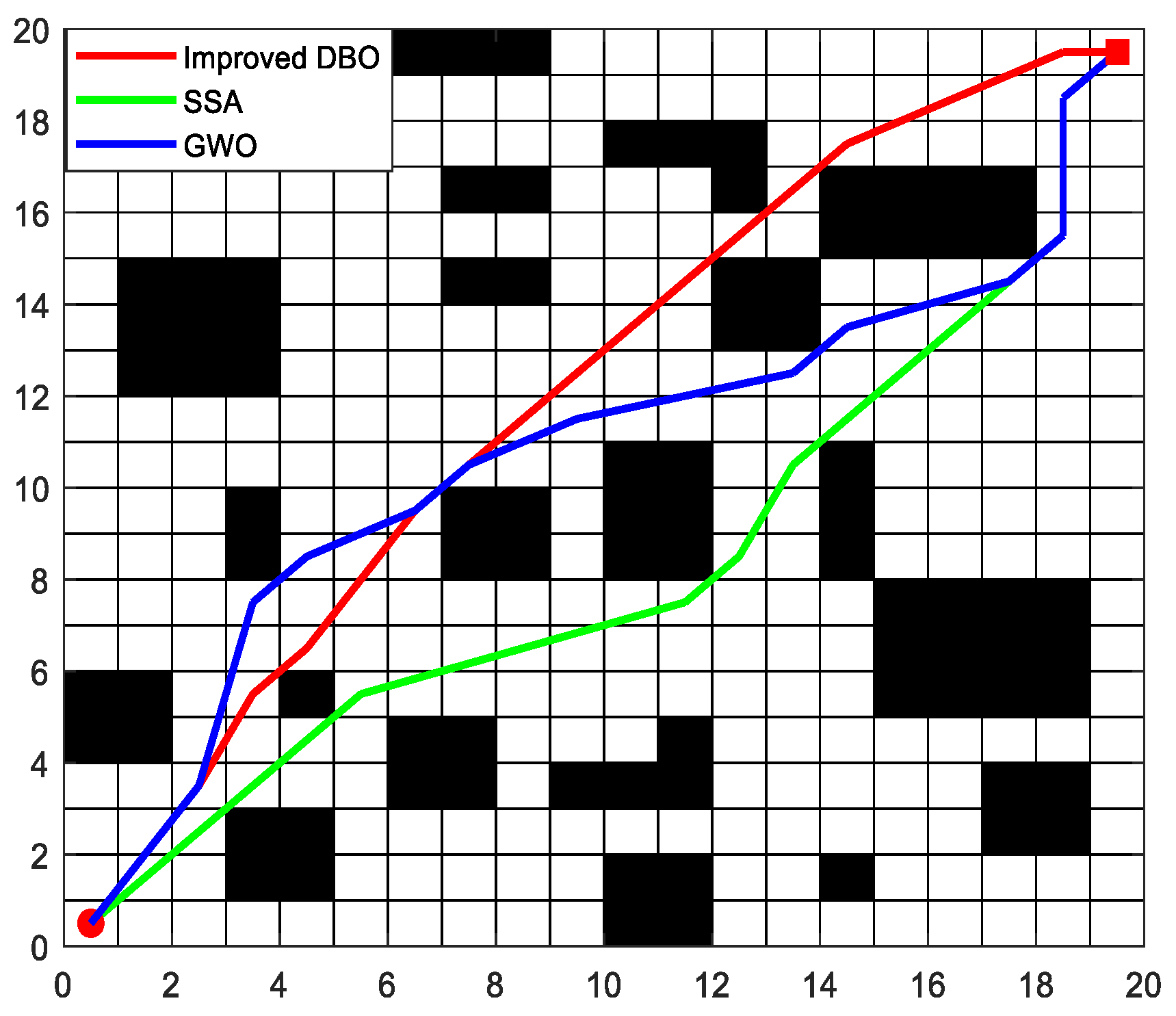
Figure 5 presents a comparative analysis of path planning results among the improved DBO, SSA, and GWO within a 20 × 20 grid environment.
As evidenced by the comprehensive analysis of Figure 5 and Table 1, although all three algorithms demonstrate competent obstacle-avoidance capabilities and can generate feasible paths in cluttered environments with dense obstacles, the improved DBO algorithm shows better performance in terms of path quality. The proposed method produces notably smoother trajectories with reduced overall length, thereby validating its effectiveness and overall advantages in addressing global path planning challenges.

4.2. Simulation Experiments in Dynamic Environments

To validate the superiority of the proposed dual-layer path planning algorithm, this subsection conducts simulation experiments based on MATLAB 2023b to compare the performance of the traditional and improved versions within two distinct map configurations: one featuring a single dynamic obstacle and another populated with multiple dynamic obstacles. The DWA algorithm is configured with the following parameter specifications: linear velocity bounds [ v min , v max ] = [0, 1.5] m/s; angular velocity bounds [ w min , w max ] = [−0.35, 0.35] rad/s; linear acceleration constraint v a = 0.2 m/s2, deceleration constraint v b = 0 m/s2; angular acceleration constraint w a = 0.9 rad/s2, deceleration constraint w b = −0.9 rad/s2; prediction period T = 3 s; evaluation function weights s 1 = 0.2, s 2 = 0.1, s 3 = 0.2; and additional parameters s g = 0.3, f c o = 0.15, k r e p = 2.

4.2.1. Single-Dynamic Obstacle Case

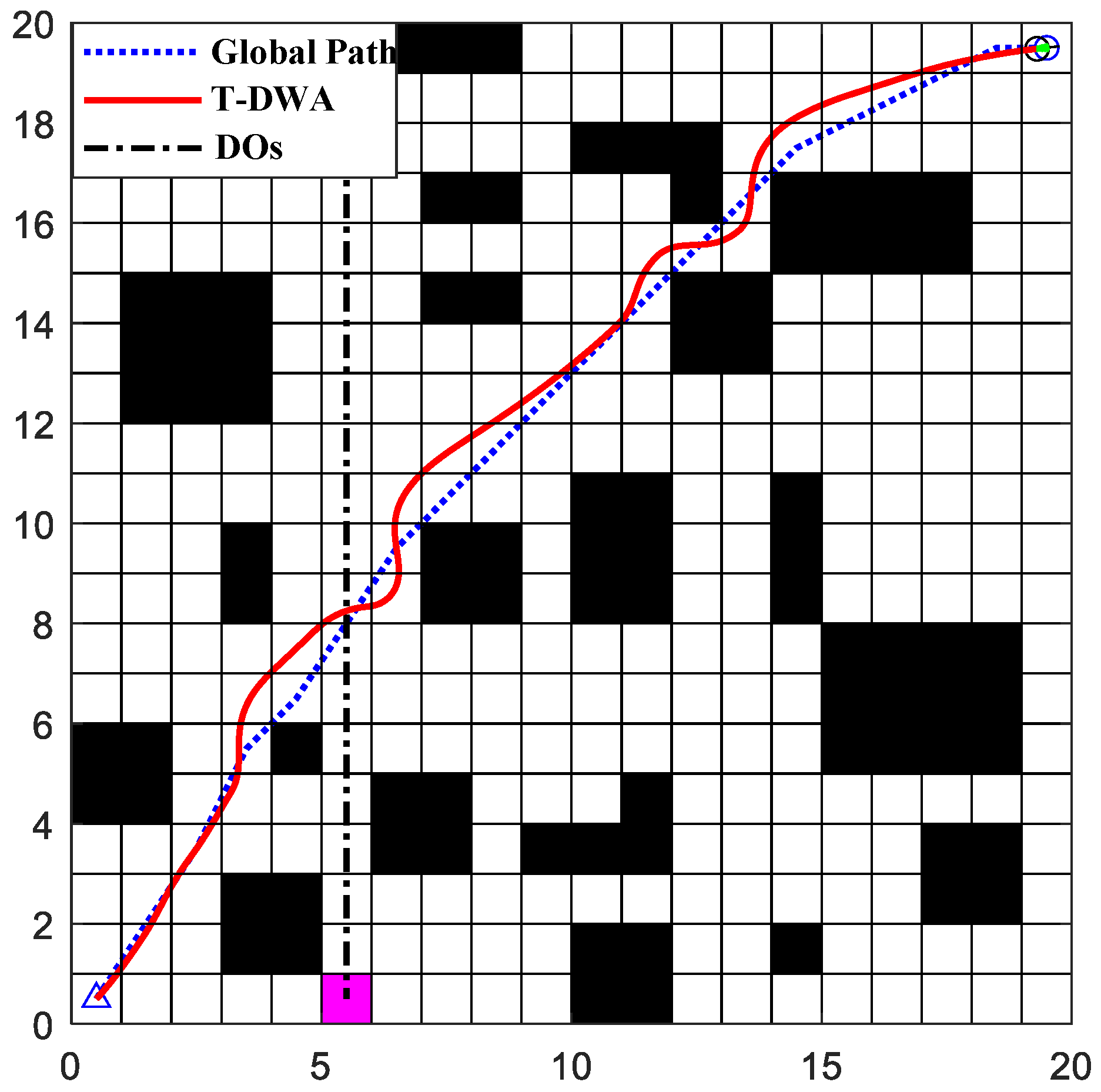
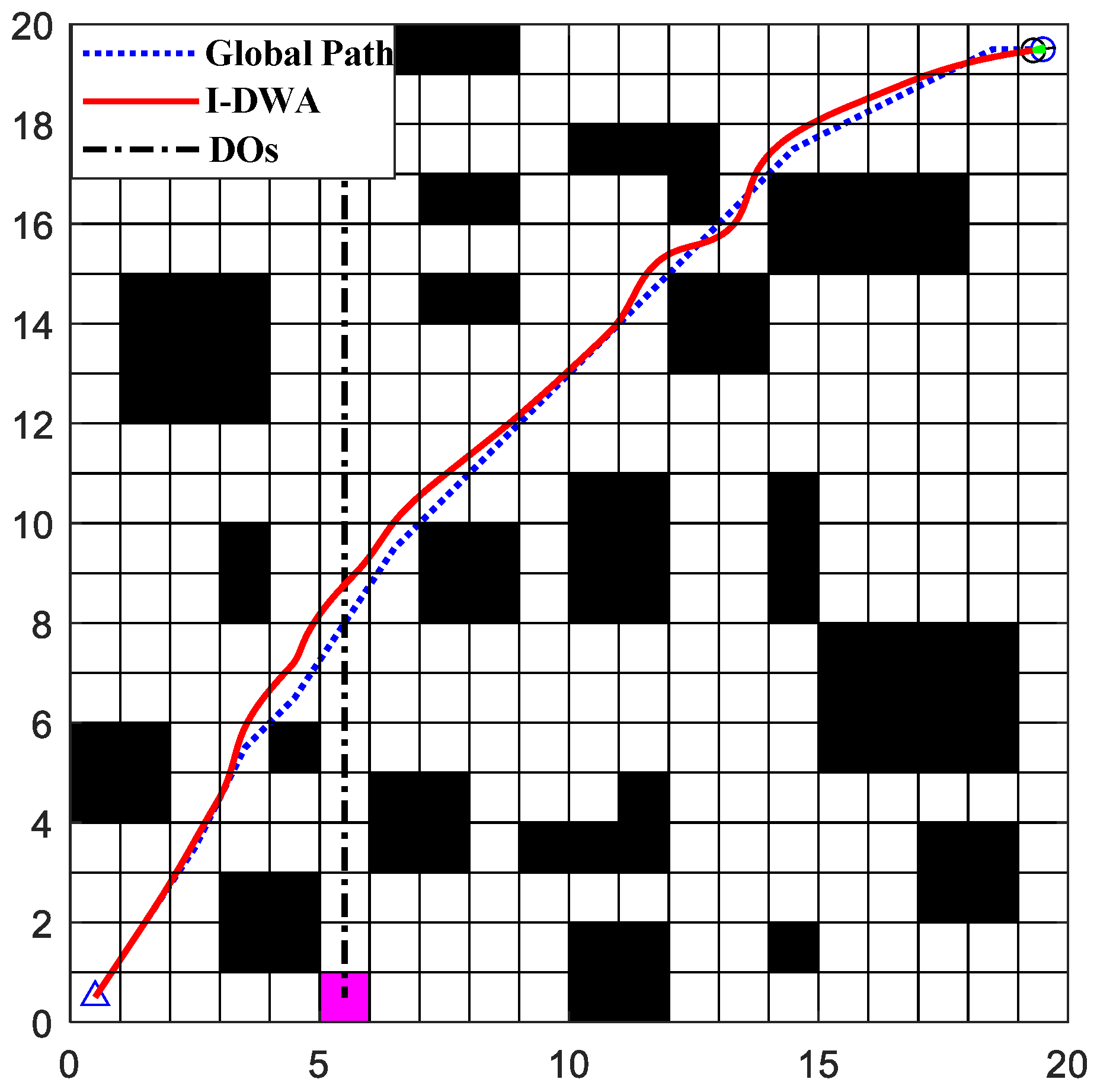
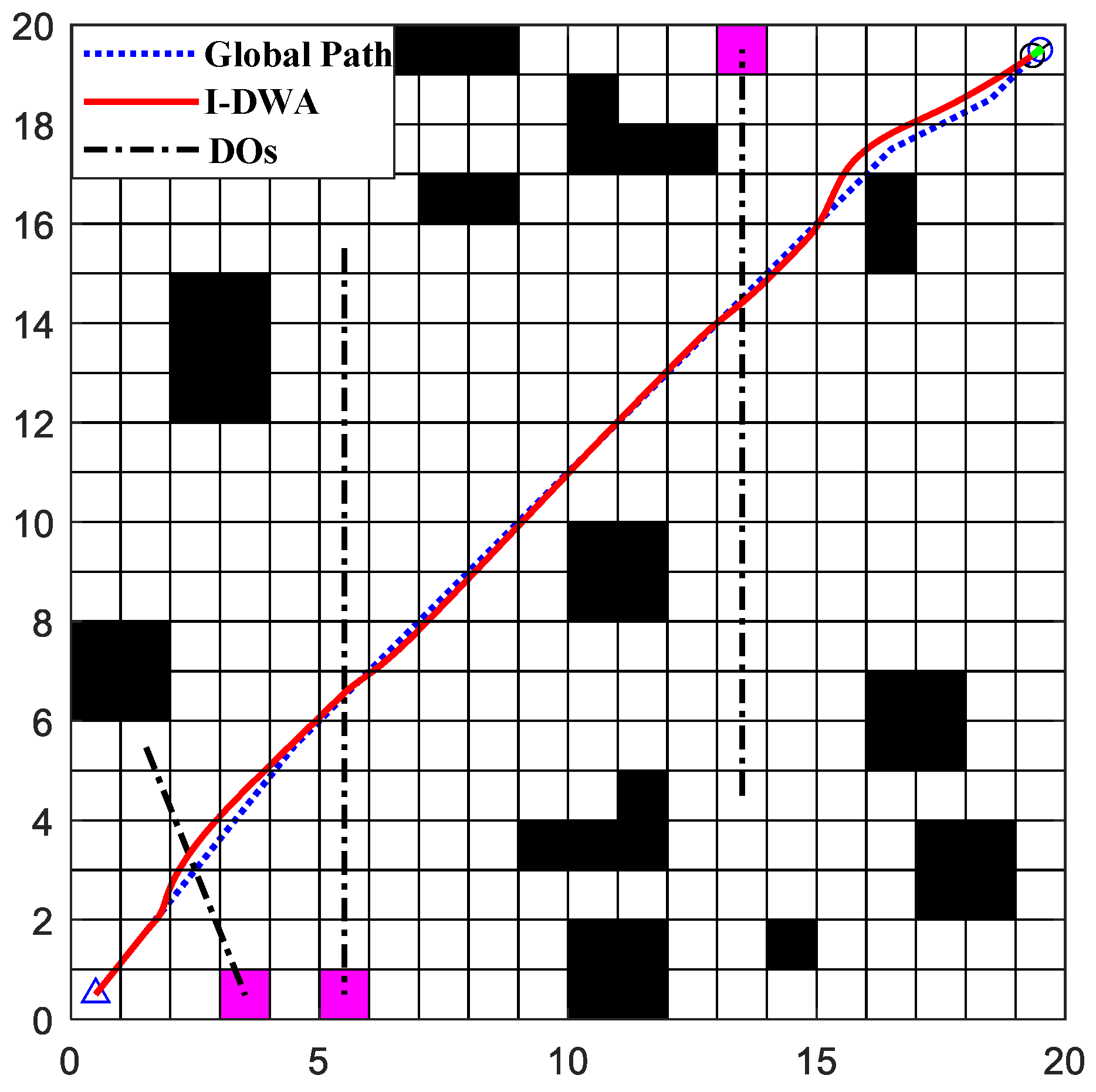
To evaluate the performance of the enhanced dual-layer path planning algorithm, comparative tests are conducted on a 20 × 20 grid map, with results illustrated in Figure 6 and Figure 7. In this configuration, white grids represent obstacle-free traversable areas, black grids indicate static obstacles, and purple grids denote dynamic obstacles that follow a constant-velocity linear motion model.
The conventional dual-layer approach requires robots to execute sharp steering maneuvers when avoiding dynamic obstacles, primarily due to either rapid obstacle movement or delayed obstacle detection. In contrast, our improved algorithm incorporates real-time perception of dynamic obstacle velocities and positions, enabling dynamic adjustment of evaluation function weights. This effectively mitigates the abrupt steering issues observed in traditional methods, yielding considerably smoother trajectories.
Another fundamental limitation of conventional techniques lies in their poor consistency between local trajectories and the global path. Significant deviations from the optimal global route during local obstacle avoidance inevitably lead to elongated paths and compromised planning efficiency. To tackle this challenge, we refine the local planner DWA by augmenting its evaluation function with a global path adherence term. This addition substantially improves the alignment between locally executed paths and the predetermined global route. The simulation results fully validate the superiority of the improved algorithm: it not only effectively mitigates path deviation but also significantly enhances planning safety by preventing collision-prone sharp turns and ensures reliability by preserving global path consistency.
According to the experimental data presented in Table 2, the proposed dual-layer path planning algorithm achieves a 2.12 m reduction in path length and a 16 s decrease in travel time from start to finish compared to the traditional dual-layer approach. These quantitative outcomes clearly confirm the advantages of our enhanced approach: the shortened path length directly contributes to improved robotic motion efficiency, thereby validating the effectiveness of the introduced modifications to the dual-layer path planning framework.

4.2.2. Multiple-Dynamic Obstacle Case

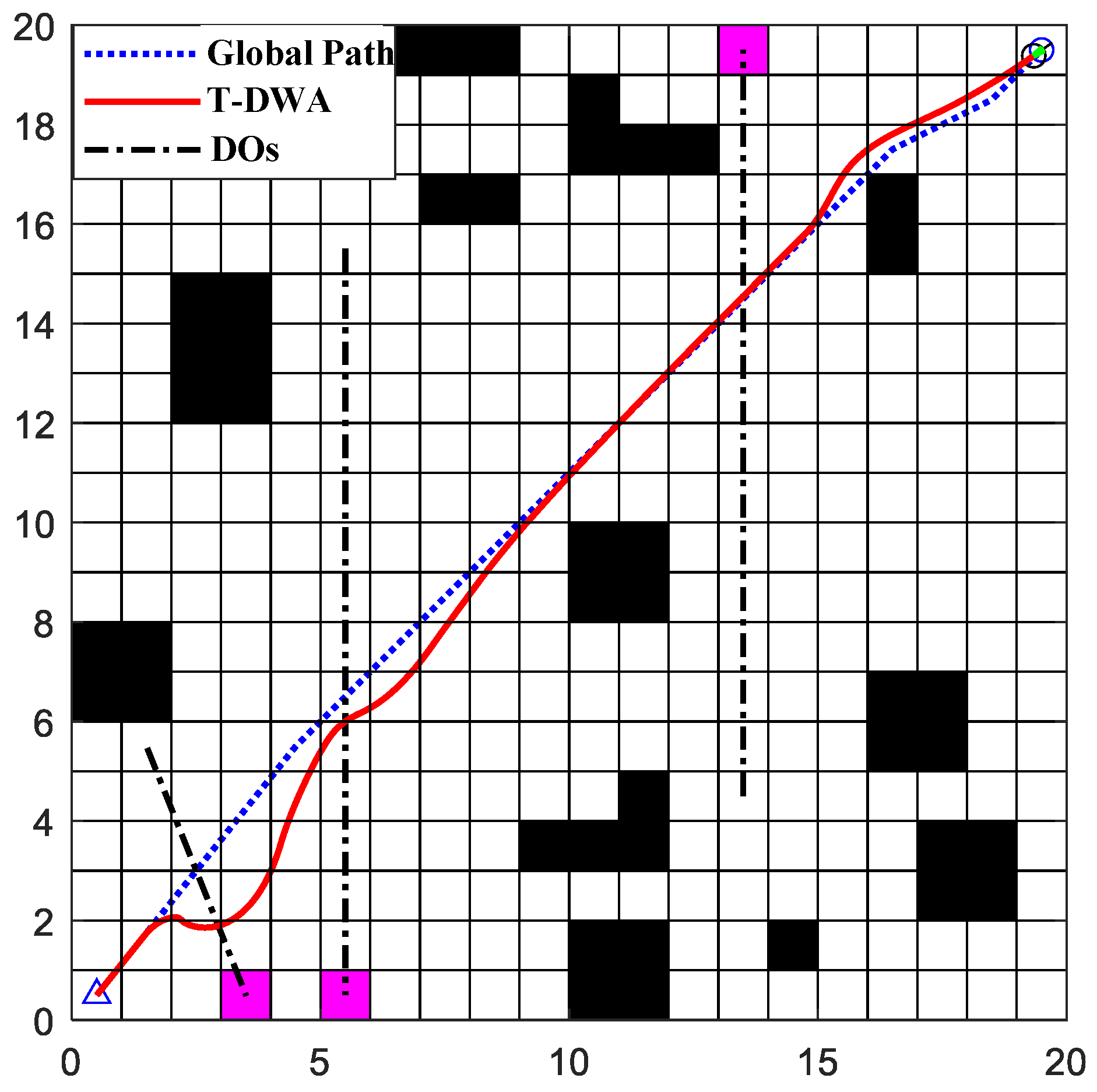
Within the 20 × 20 grid-based environment, this study moderately reduces the distribution density of static obstacles while introducing multiple dynamic obstacles to thoroughly evaluate the obstacle-avoidance capability of the improved algorithm in complex dynamic scenarios. Comparative results are presented in Figure 8 and Figure 9. The traditional dual-layer path planning algorithm exhibits limited responsiveness when reacting to forward obstacles, constrained by its inadequate perception of dynamic obstacle movements. Due to untimely acquisition of velocity and positional changes, the robot must undertake extensive path detours to accomplish obstacle avoidance. Moreover, prolonged processing time during the initial two avoidance maneuvers leaves insufficient response margin when encountering the third obstacle. In contrast, the proposed dual-layer path planning framework leverages early prediction of obstacle kinematics to achieve efficient collision avoidance with moving obstructions. Even during the third avoidance instance, there is no conspicuous path oscillation or substantial deviation from the globally guided trajectory, demonstrating considerably enhanced stability and safer planning proficiency.
According to the experimental data presented in Table 3, the proposed dual-layer path planning algorithm achieves a 1.65 m reduction in path length and a 27 s decrease in travel time from start to finish compared to the traditional dual-layer approach.

5. Conclusions

To cope with the path planning challenges for mobile robots in dynamic environments, this paper establishes a dual-layer cooperative planning architecture. The upper layer employs an improved DBO, which improves initialization strategies and position updating mechanisms to improve both the quality of global paths and convergence efficiency. Building upon the guidance provided by the global path, the lower layer incorporates an improved DWA. By dynamically adjusting evaluation function weights and introducing a supplementary evaluation component that considers global path consistency, this integrated framework facilitates efficient dynamic obstacle avoidance and smooth trajectory generation. In improving the DBO, we focus on refining population initialization methods and individual position update rules. Experimental verification confirms that these modifications not only shorten the path length effectively but also accelerate the convergence process, leading to significant computational savings. The optimizations applied to the DWA include two main aspects: first, the establishment of an adaptive weight allocation mechanism for the evaluation functions, allowing the algorithm to dynamically adjust decision preferences based on the motion states of dynamic obstacles; second, the introduction of an auxiliary evaluation term that integrates global path information to enhance coherence between local trajectories and global guidance. For performance validation, simulation tests are conducted in grid map environments containing various dynamic obstacles. Results demonstrate that the proposed dual-layer planning algorithm consistently generates safe, smooth, and nearly globally optimal feasible paths across varying complexity levels, confirming both effectiveness and robustness in dynamic operational settings.
It should be noted that the simulation verification of this study still has certain limitations: the adopted regular grid map, simplified obstacle motion patterns, and idealized robot kinematic model differ from the complex conditions in real environments, such as irregular obstacle distribution, sudden direction changes/acceleration of dynamic obstacles, sensor noise, and hardware constraints. Moreover, the simulation scenarios only cover static environments and scenarios with single/multiple dynamic obstacles, and do not involve more complex scenarios such as interweaving high-density dynamic obstacles and terrain undulations, which will be studied in our future work.
This research investigates robot path planning within idealized planar environments. Real-world applications, however, often involve rugged or uneven terrain [37,38,39]. Such terrain can introduce various problems due to uncertainties, including kinematic instability, positioning drift, and significant deviations from preplanned trajectories [40,41,42]. Therefore, future work will focus on extending the algorithm’s applicability to more intricate topographical conditions and conducting thorough adaptability validations. Successfully addressing these challenges would significantly enhance the practical value of our findings.

Author Contributions

Conceptualization, Y.Z. and B.S.; methodology, Z.W. and B.S.; software, Y.Z.; validation, Y.Z., Z.W. and B.S.; investigation, Y.Z., Z.W. and B.S.; writing—original draft preparation, Y.Z. and B.S.; writing—review and editing, Y.Z. and B.S.; visualization, Z.W.; supervision, B.S.; project administration, B.S.; funding acquisition, B.S. All authors have read and agreed to the published version of the manuscript.

Funding

This work was supported in part by the Natural Science Foundation of Shandong Province of China under Grant ZR2023MF067.

Data Availability Statement

The raw data supporting the conclusions of this article will be made available by the authors upon request.

Conflicts of Interest

The remaining authors declare that the research was conducted in the absence of any commercial or financial relationships that could be construed as a potential conflict of interest.

Abbreviations

The following abbreviations are used in this manuscript:
Symbols and ParametersDefinition
K r e p Tunable parameter of repulsive potential field
ρ 0 Maximum influence range of obstacle
θ c o Azimuth angle of the line connecting the robot and the dynamic obstacle relative to the X-axis of the global coordinate system
θ v c Velocity direction of the mobile robot
θ v o Velocity direction of the obstacle
r p Collision radius of the dynamic obstacle
D c o Distance between the robot and the obstacle
f v Velocity gain coefficient
c v Velocity risk coefficient
c r e f Repulsive potential field risk coefficient

References

  1. Duan, P.; Yu, Z.; Gao, K.; Meng, L.; Han, Y.; Ye, F. Solving the multi-objective path planning problem for mobile robot using an improved NSGA-II algorithm. Swarm Evol. Comput. 2024, 87, 101576. [Google Scholar] [CrossRef]
  2. Fu, B.; Chen, Y.; Quan, Y.; Zhou, X.; Li, C. Bidirectional artificial potential field-based ant colony optimization for robot path planning. Robot. Auton. Syst. 2025, 183, 104834. [Google Scholar] [CrossRef]
  3. Hu, G.; Huang, F.; Shu, B.; Wei, G. MAHACO: Multi-algorithm hybrid ant colony optimizer for 3D path planning of a group of UAVs. Inf. Sci. 2025, 694, 121714. [Google Scholar] [CrossRef]
  4. Ren, Z.; Cai, A.; Xu, F. Automated guided vehicle (AGV) path optimization method based on improved rapidly-exploring random trees. PeerJ Computer Science 2025, 11, e2915. [Google Scholar] [CrossRef]
  5. Tang, G.; Tang, C.; Claramunt, C.; Hu, X.; Zhou, P. Geometric A-star algorithm: An improved A-star algorithm for AGV path planning in a port environment. IEEE Access 2021, 9, 59196–59210. [Google Scholar] [CrossRef]
  6. Bing, H.; Lai, L. Improvement and application of Dijkstra algorithms. Acad. J. Comput. Inf. Sci. 2022, 5, 97–102. [Google Scholar] [CrossRef]
  7. Song, B.; Wang, Z.; Zou, L. An improved PSO algorithm for smooth path planning of mobile robots using continuous high-degree Bezier curve. Appl. Soft Comput. 2021, 100, 106960. [Google Scholar] [CrossRef]
  8. Song, B.; Tang, S.; Li, Y. A new path planning strategy integrating improved ACO and DWA algorithms for mobile robots in dynamic environments. Math. Biosci. Eng. 2024, 21, 2189–2211. [Google Scholar] [CrossRef]
  9. Qureshi, A.H.; Ayaz, Y. Intelligent bidirectional rapidly-exploring random trees for optimal motion planning in complex cluttered environments. Robot. Auton. Syst. 2015, 68, 1–11. [Google Scholar] [CrossRef]
  10. Ballesteros, J.; Urdiales, C.; Velasco, A.B.M.; Ramos-Jiménez, G. A biomimetical dynamic window approach to navigation for collaborative control. IEEE Trans. Hum.-Mach. Syst. 2017, 47, 1123–1133. [Google Scholar] [CrossRef]
  11. Wang, P.; Gao, S.; Li, L.; Sun, B.; Cheng, S. Obstacle avoidance path planning design for autonomous driving vehicles based on an improved artificial potential field algorithm. Energies 2019, 12, 2342. [Google Scholar] [CrossRef]
  12. He, Q.; Wang, Z.; Li, K.; Zhang, Y.; Li, M. Research on autonomous navigation of mobile robots based on IA-DWA algorithm. Sci. Rep. 2025, 15, 2099. [Google Scholar] [CrossRef]
  13. Ambuj; Machavaram, R. Intelligent path planning for autonomous ground vehicles in dynamic environments utilizing adaptive Neuro-Fuzzy control. Eng. Appl. Artif. Intell. 2025, 144, 110119. [Google Scholar] [CrossRef]
  14. Gong, X.; Gao, Y.; Wang, F.; Zhu, D.; Wang, F.; Liu, Y. A local path planning algorithm for robots based on improved DWA. Electronics 2024, 13, 2965. [Google Scholar] [CrossRef]
  15. Chang, L.; Shan, L.; Jiang, C.; Dai, Y. Reinforcement based mobile robot path planning with improved dynamic window approach in unknown environment. Auton. Robot. 2021, 45, 51–76. [Google Scholar] [CrossRef]
  16. Liang, J.; Liu, L. Optimal path planning method for unmanned surface vehicles based on improved shark-inspired algorithm. J. Mar. Sci. Eng. 2023, 11, 1386. [Google Scholar] [CrossRef]
  17. Zhang, H.; Li, M. Rapid path planning algorithm for mobile robot in dynamic environment. Adv. Mech. Eng. 2017, 9, 1687814017747400. [Google Scholar] [CrossRef]
  18. Li, J.; Wan, L.; Huang, Z.; Cheng, Y.; Tang, H. Hybrid path planning strategy based on improved particle swarm optimization algorithm combined with DWA for unmanned surface vehicles. J. Mar. Sci. Eng. 2024, 12, 1268. [Google Scholar] [CrossRef]
  19. Zhou, M.; Wang, Z.; Wang, J.; Dong, Z. A hybrid path planning and formation control strategy of multi-robots in a dynamic environment. J. Adv. Comput. Intell. Intell. Inform. 2022, 26, 342–354. [Google Scholar] [CrossRef]
  20. Zhao, T.; Qin, P.; Dian, S.; Guo, B. Fractional order sliding mode control for an omni-directional mobile robot based on self-organizing interval type-2 fuzzy neural network. Inf. Sci. 2024, 654, 119819. [Google Scholar] [CrossRef]
  21. Lin, Z.; Yue, M.; Chen, G.; Sun, J. Path planning of mobile robot with PSO-based APF and fuzzy-based DWA subject to moving obstacles. Trans. Inst. Meas. Control 2022, 44, 121–132. [Google Scholar] [CrossRef]
  22. Yang, L.; Fu, L.; Li, P.; Mao, J.; Guo, N. An effective dynamic path planning approach for mobile robots based on ant colony fusion dynamic windows. Machines 2022, 10, 50. [Google Scholar] [CrossRef]
  23. Liu, L.; Liang, J.; Guo, K.; He, C.; Chen, J. Dynamic path planning of mobile robot based on improved sparrow search algorithm. Biomimetics 2023, 8, 182. [Google Scholar] [CrossRef]
  24. Sun, D.; Wen, J.; Wang, J.; Yang, X.; Hu, Y. A path planning method based on deep reinforcement learning with improved prioritized experience replay for human-robot collaboration. Lect. Notes Comput. Sci. 2024, 14685, 196–206. [Google Scholar] [CrossRef]
  25. Cheng, W.C.; Ni, Z.; Zhong, X.; Wei, M. Autonomous robot goal seeking and collision avoidance in the physical world: An automated learning and evaluation framework based on the ppo method. Appl. Sci. 2024, 14, 11020. [Google Scholar] [CrossRef]
  26. Li, Y.; Ruichek, Y. Occupancy grid mapping in urban environments from a moving on-board stereo-vision system. Sensors 2014, 14, 10454–10478. [Google Scholar] [CrossRef]
  27. Tang, W.; Qin, H.; Kang, S. Dung beetle optimizer based on mean fitness distance balance and multi-strategy fusion for solving practical engineering problems. Sci. Rep. 2025, 15, 26389. [Google Scholar] [CrossRef]
  28. Xue, J.; Shen, B. Dung beetle optimizer: A new meta-heuristic algorithm for global optimization. J. Supercomput. 2023, 79, 7305–7336. [Google Scholar] [CrossRef]
  29. Qian, S.; Wang, Z.; Chao, H.; Xu, Y.; Wei, Y.; Gu, G.; Chen, K. Application of adaptive chaotic dung beetle optimization algorithm to near-infrared spectral model transfer. Spectrochim. Acta Part A Mol. Biomol. Spectrosc. 2024, 321, 124718. [Google Scholar] [CrossRef]
  30. Behjati, M.; Nordin, R.; Zulkifley, M.A.; Mahalin, N.F. 3D global path planning optimization for cellular-connected UAVs under link reliability constraint. Sensors 2022, 22, 8957. [Google Scholar] [CrossRef]
  31. Yin, X.; Dong, W.; Wang, X.; Yu, Y.; Yao, D. Route planning of mobile robot based on improved RRT* and TEB algorithm. Sci. Rep. 2024, 14, 8942. [Google Scholar] [CrossRef]
  32. Yao, M.; Deng, H.; Feng, X.; Li, P.; Li, Y.; Liu, H. Improved dynamic windows approach based on energy consumption management and fuzzy logic control for local path planning of mobile robots. Comput. Ind. Eng. 2024, 187, 109767. [Google Scholar] [CrossRef]
  33. Chang, X.; Wang, J.; Li, K.; Zhang, X.; Tang, Q. Research on multi-UAV autonomous obstacle avoidance algorithm integrating improved dynamic window approach and ORCA. Sci. Rep. 2025, 15, 14646. [Google Scholar] [CrossRef]
  34. Li, X.; Li, G.; Bian, Z. Research on autonomous vehicle path planning algorithm based on improved RRT* algorithm and artificial potential field method. Sensors 2024, 24, 3899. [Google Scholar] [CrossRef]
  35. Wu, Z.; Dai, J.; Jiang, B.; Karimi, H.R. Robot path planning based on artificial potential field with deterministic annealing. ISA Trans. 2023, 138, 74–87. [Google Scholar] [CrossRef]
  36. Zhang, Y.; Liu, K.; Gao, F.; Zhao, F. Research on path planning and path tracking control of autonomous vehicles based on improved APF and SMC. Sensors 2023, 23, 7918. [Google Scholar] [CrossRef]
  37. Ji, Y.; Liu, Y.; Xie, G.; Ma, B.; Xie, Z.; Cao, B. NNPP: A learning-based heuristic model for accelerating optimal path planning on uneven terrain. Robot. Auton. Syst. 2025, 193, 105084. [Google Scholar] [CrossRef]
  38. Jia, H.; Abdel-salam, M.; Hu, G. ACIVY: An Enhanced IVY Optimization Algorithm with Adaptive Cross Strategies for Complex Engineering Design and UAV Navigation. Biomimetics 2025, 10, 471. [Google Scholar] [CrossRef]
  39. Liu, Z.; Yang, H.; Wang, Q.; Shi, Y.; Zhao, J. An improved A* algorithm for generating four-track trajectory planning to adapt to longitudinal rugged terrain. Sci. Rep. 2025, 15, 6727. [Google Scholar] [CrossRef] [PubMed]
  40. Zhai, Y.; Zhang, S. A novel LiDAR–IMU–odometer coupling framework for two-wheeled inverted pendulum (TWIP) robot localization and mapping with nonholonomic constraint factors. Sensors 2022, 22, 4778. [Google Scholar] [CrossRef] [PubMed]
  41. Azpúrua, H.; Saboia, M.; Freitas, G.; Clark, L.; Agha-mohammadi, A.; Pessin, G.; Campos, M.; Macharet, D. A survey on the autonomous exploration of confined subterranean spaces: Perspectives from real-world and industrial robotic deployments. Robot. Auton. Syst. 2023, 160, 104304. [Google Scholar] [CrossRef]
  42. Luo, Y.; Dai, W.; Ti, Y. Improved sine algorithm for global optimization. Expert Syst. Appl. 2023, 213, 118831. [Google Scholar] [CrossRef]
Figure 1. Grid map.
Figure 1. Grid map.
Electronics 15 00320 g001
Figure 2. Redundant node elimination.
Electronics 15 00320 g002
Figure 3. The relative position of the obstacle to the robot.
Electronics 15 00320 g003
Figure 4. The velocity relationship of the robot and the obstacle.
Electronics 15 00320 g004
Figure 5. Results of different algorithms in static environments.
Electronics 15 00320 g005
Figure 6. Results of the traditional dual-layer path planning algorithm with a single dynamic obstacle.
Electronics 15 00320 g006
Figure 7. Results of the improved dual-layer path planning algorithm with a single dynamic obstacle.
Electronics 15 00320 g007
Figure 8. Results of the traditional dual-layer planning algorithm with multiple dynamic obstacles.
Electronics 15 00320 g008
Figure 9. Results of the improved dual-layer path planning algorithm with multiple dynamic obstacles.
Electronics 15 00320 g009
Table 1. Comparison of path planning algorithms.
AlgorithmLength (m)Turn Count
Improved DBO27.644
SSA28.527
GWO29.6511
Table 2. Comparison in single dynamic obstacle case.
AlgorithmLength (m)Time (s)
Traditional algorithm30.25232
Improved algorithm28.13216
Table 3. Comparison in multi-dynamic obstacle case.
AlgorithmLength (m)Time (s)
Traditional algorithm29.51236
Improved algorithm27.86209
Disclaimer/Publisher’s Note: The statements, opinions and data contained in all publications are solely those of the individual author(s) and contributor(s) and not of MDPI and/or the editor(s). MDPI and/or the editor(s) disclaim responsibility for any injury to people or property resulting from any ideas, methods, instructions or products referred to in the content.