Figure 1.
Compact overall architecture flowchart of UCA-Net.
Figure 1.
Compact overall architecture flowchart of UCA-Net.
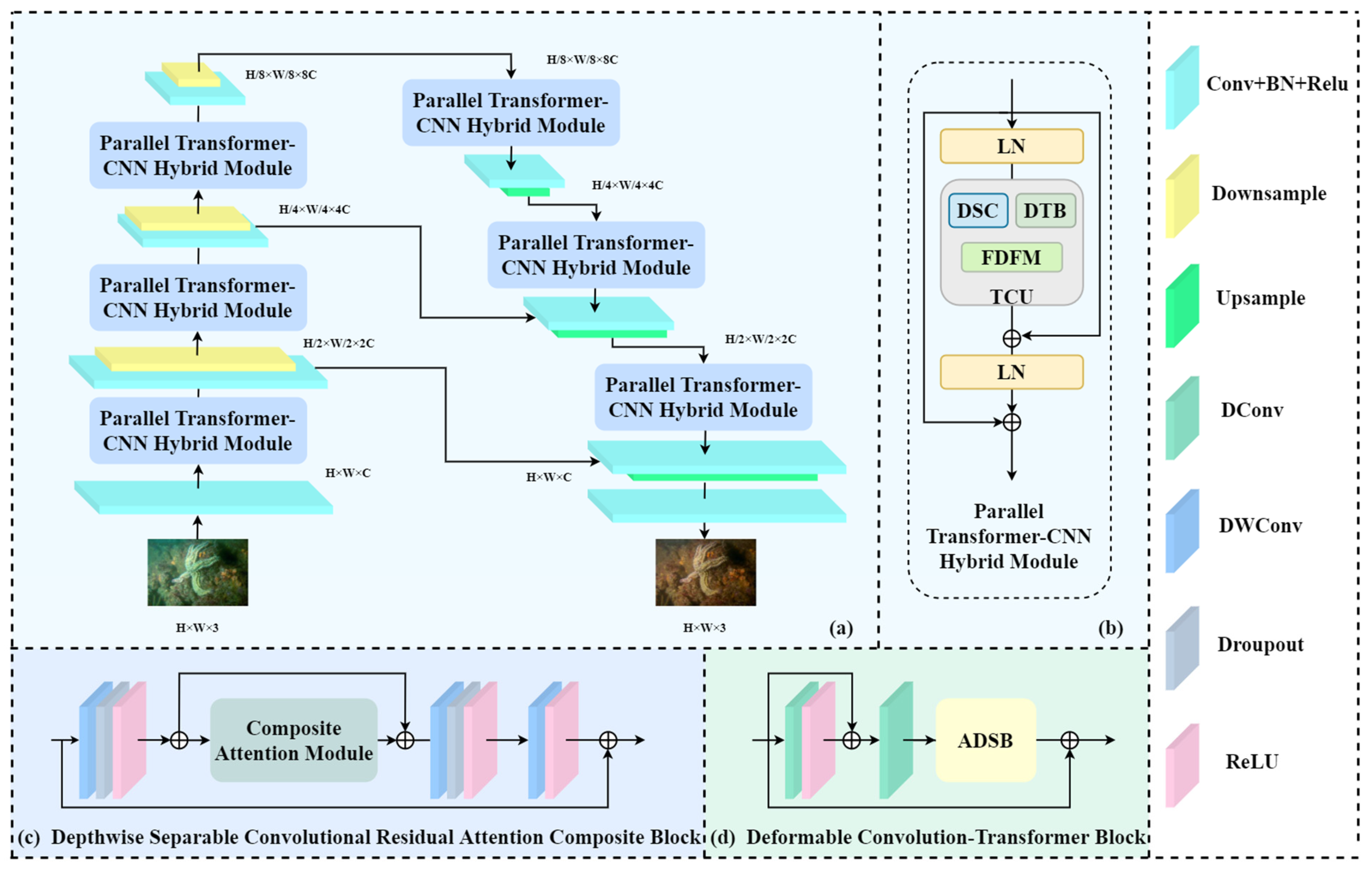
Figure 2.
Architecture of UCA-Net. (a) Overall structure, (b) PTCHM, (c) DSCRC, (d) DCTB.
Figure 2.
Architecture of UCA-Net. (a) Overall structure, (b) PTCHM, (c) DSCRC, (d) DCTB.
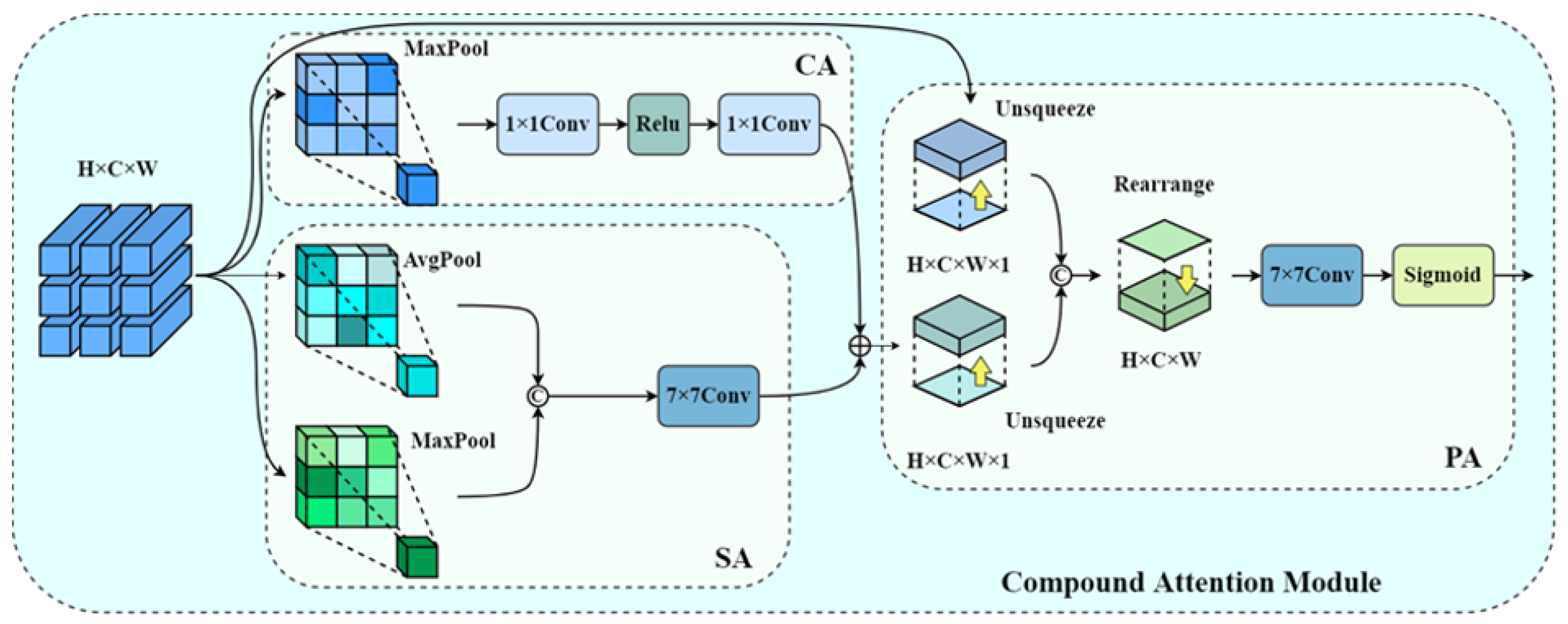
Figure 3.
Schematic diagram of the Composite Attention Module (CAM).
Figure 3.
Schematic diagram of the Composite Attention Module (CAM).
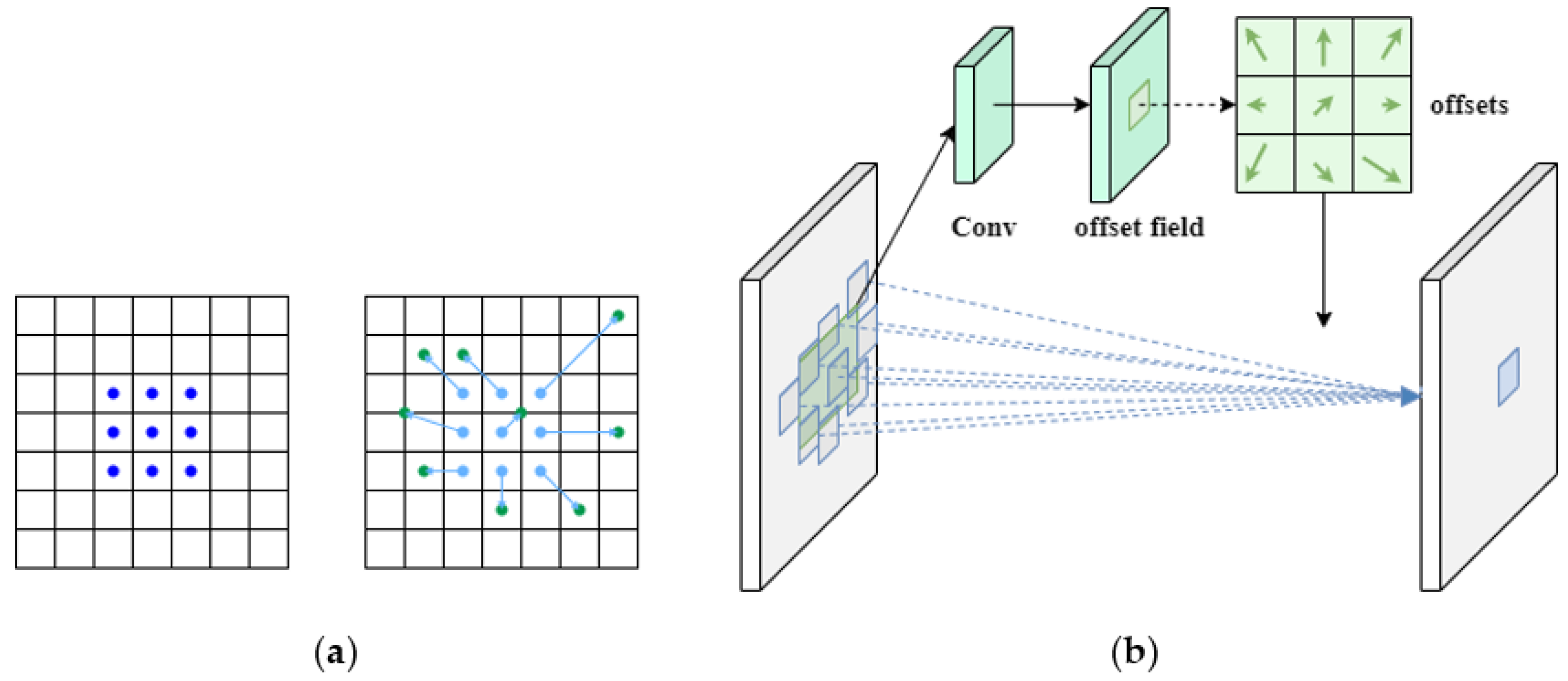
Figure 4.
(a) Schematic diagram of the deformable convolution principle. (b) Structure diagram of deformable convolution.
Figure 4.
(a) Schematic diagram of the deformable convolution principle. (b) Structure diagram of deformable convolution.
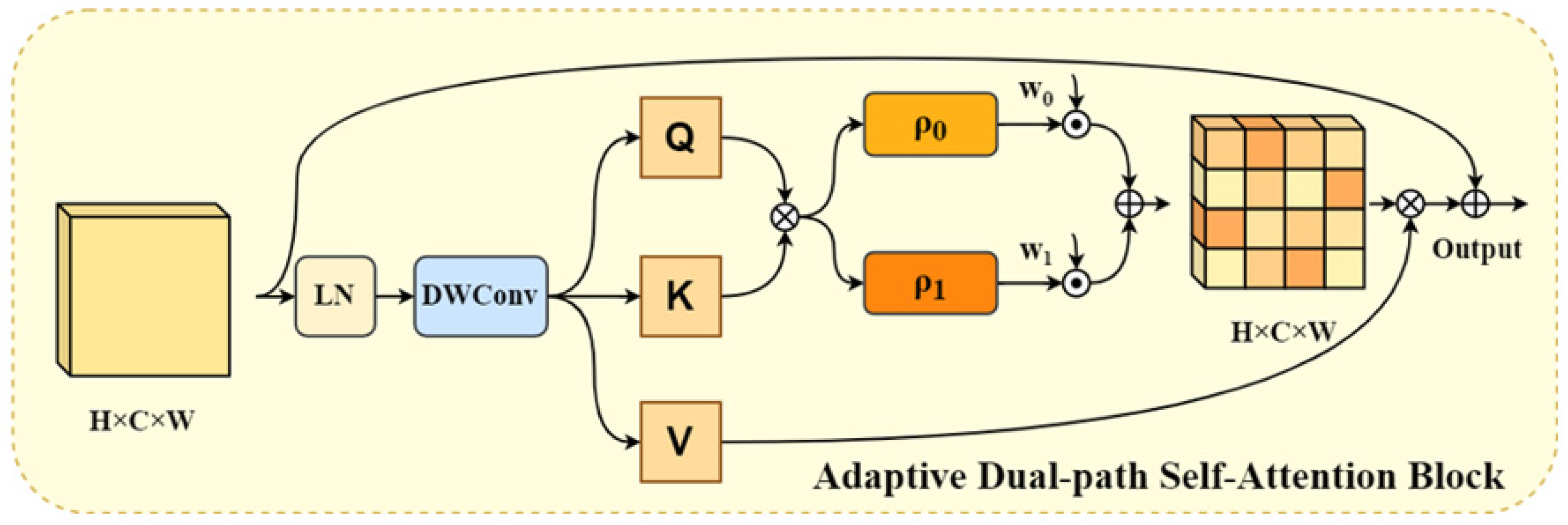
Figure 5.
Schematic diagram of the C (ADSB).
Figure 5.
Schematic diagram of the C (ADSB).
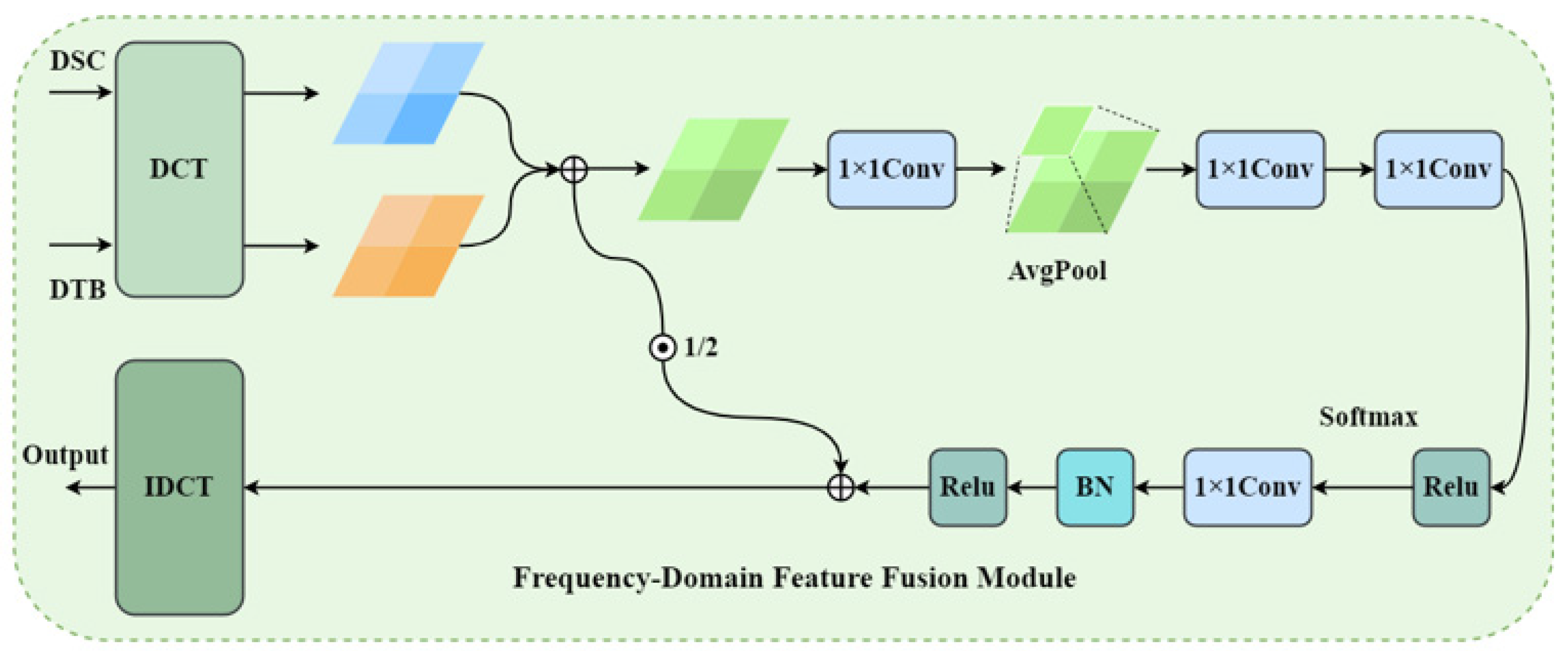
Figure 6.
Schematic diagram of the Frequency–Domain Feature Fusion Module (FDFM).
Figure 6.
Schematic diagram of the Frequency–Domain Feature Fusion Module (FDFM).
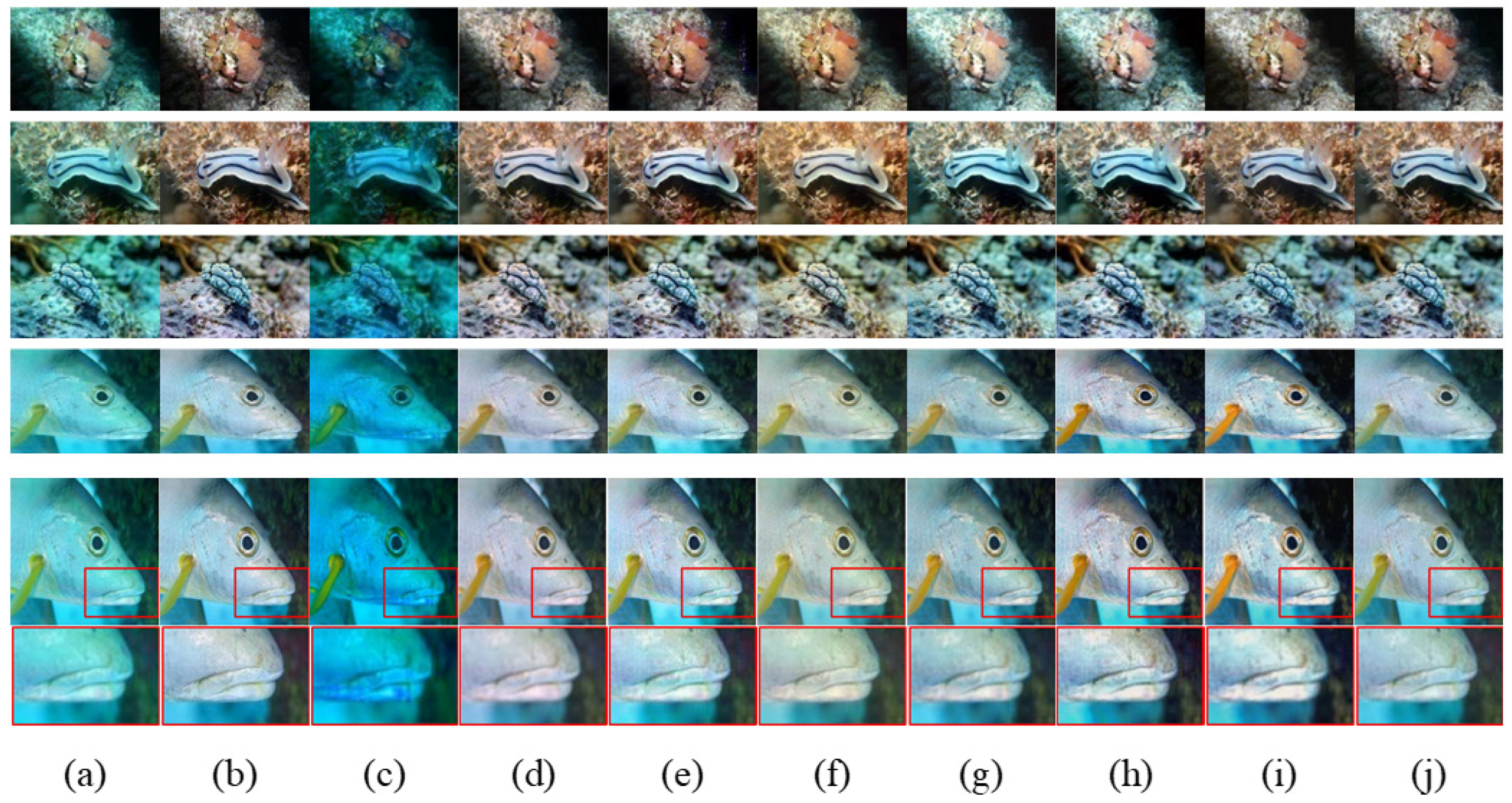
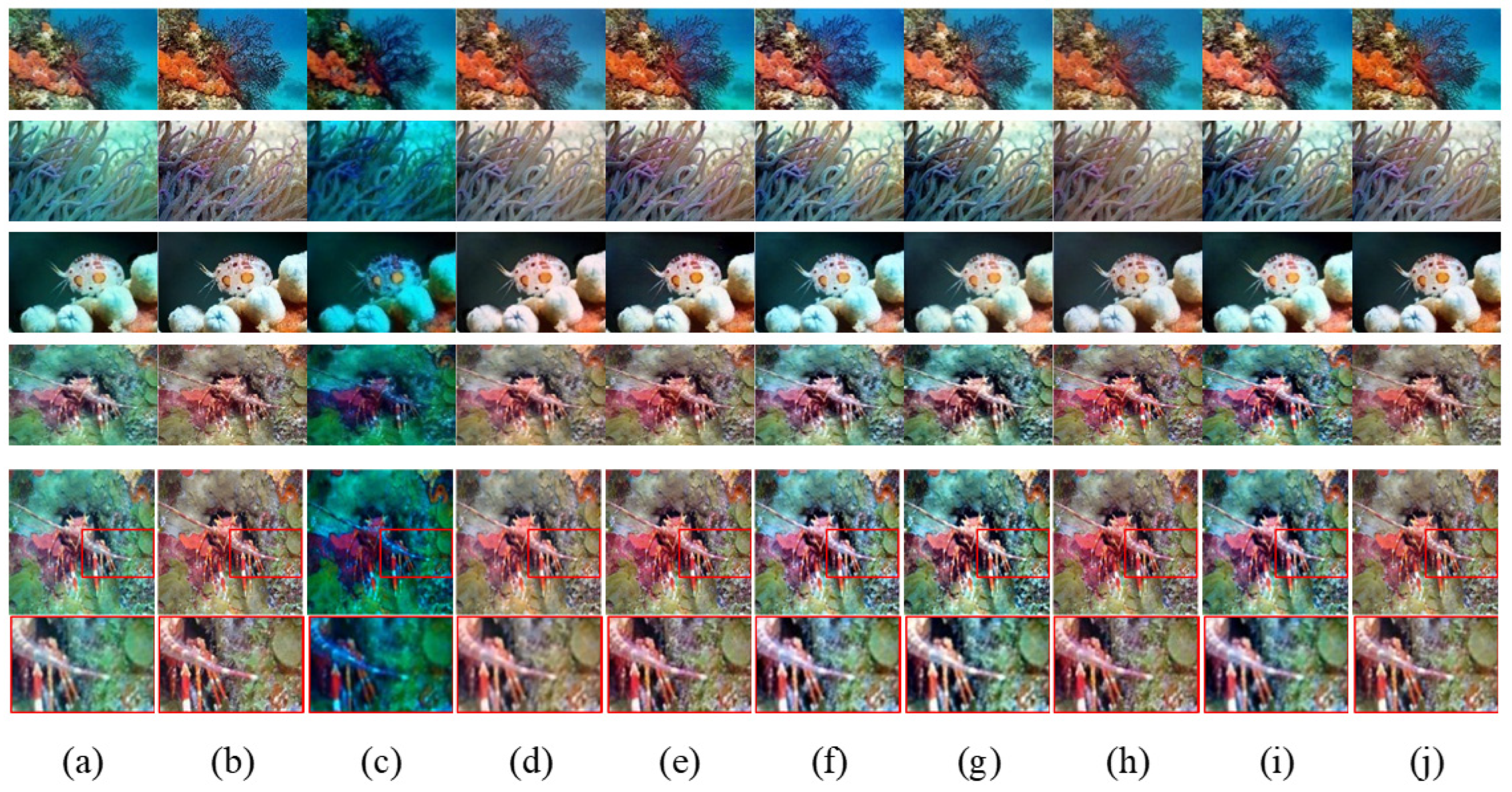
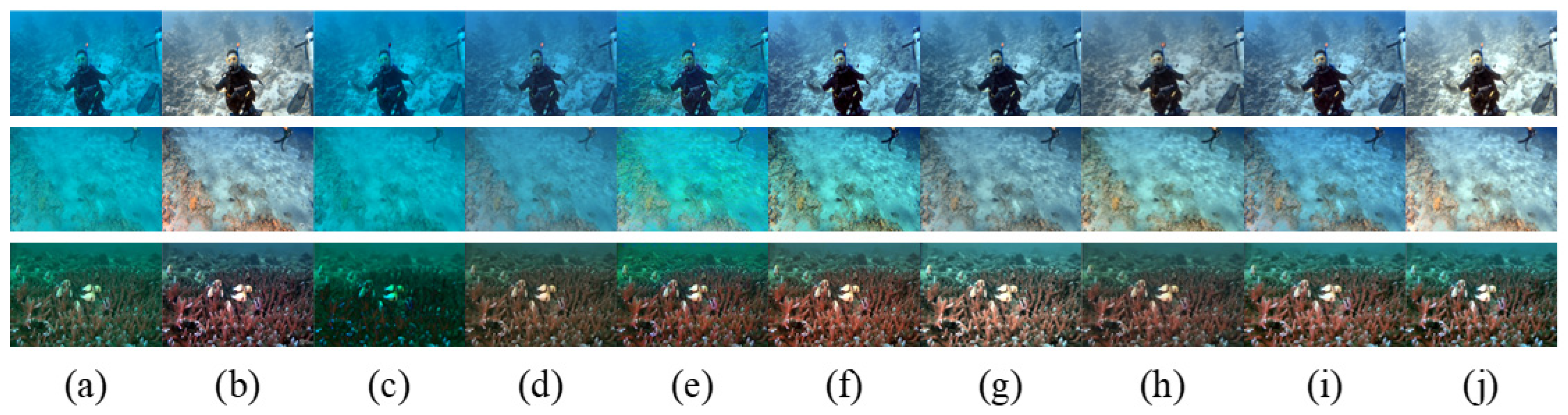
Figure 7.
Visual comparison results of different methods on the EUVP-T100 test set. (a) Input images. (b) Reference images, (c) DCP, (d) UWNet, (e) FUnIEGAN, (f) DeepWaveNet, (g) LitenhencedNet, (h) DCSS-Net, (i) HisMamba. (j) Ours.
Figure 7.
Visual comparison results of different methods on the EUVP-T100 test set. (a) Input images. (b) Reference images, (c) DCP, (d) UWNet, (e) FUnIEGAN, (f) DeepWaveNet, (g) LitenhencedNet, (h) DCSS-Net, (i) HisMamba. (j) Ours.
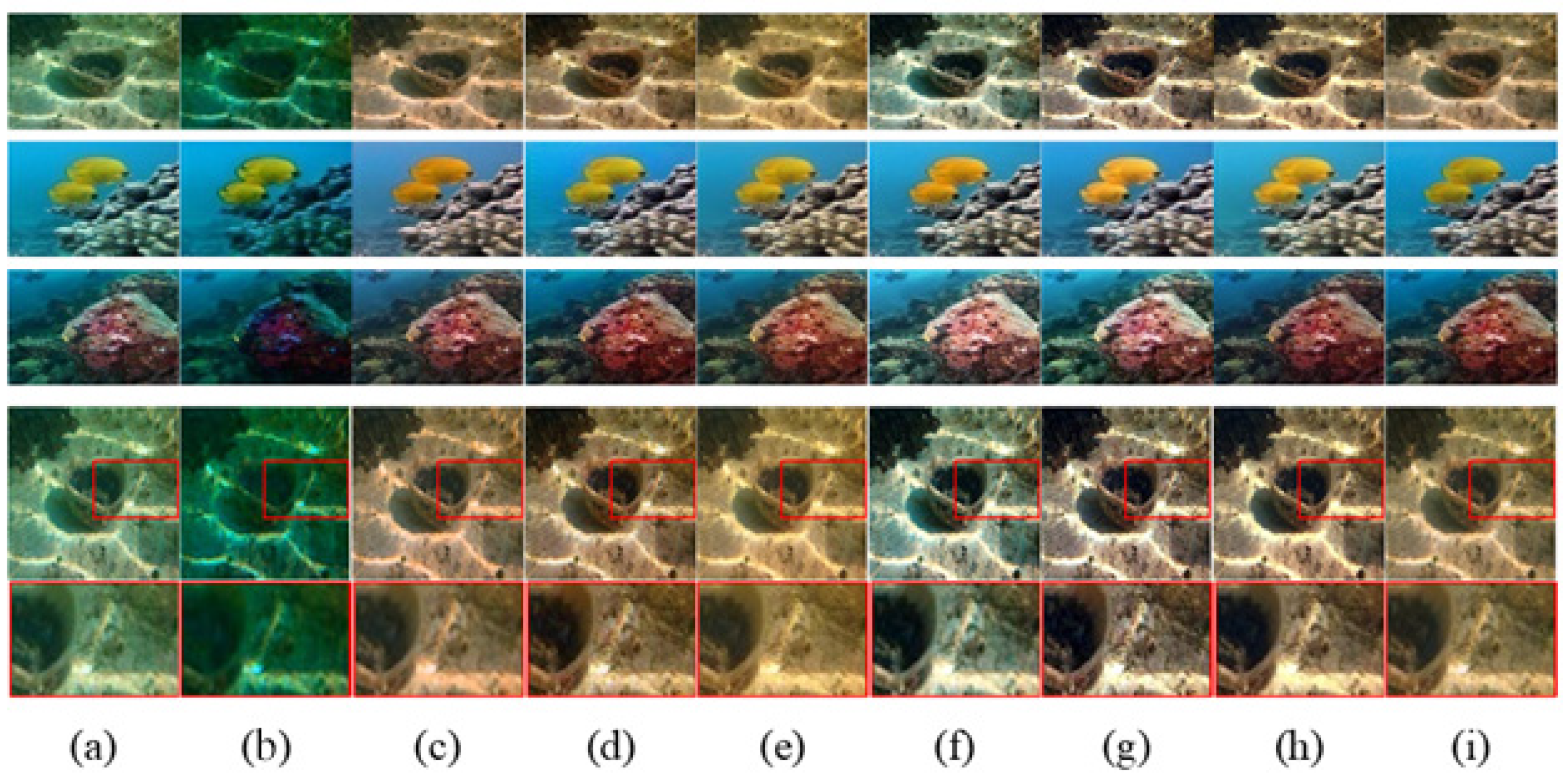
Figure 8.
Visual comparison results of different methods on the EUVP-R60 test set. (a) Input images, (b) DCP, (c) UWNet, (d) FUnIEGAN, (e) DeepWaveNet, (f) LitenhencedNet, (g) DCSS-Net, (h) HisMamba. (i) Ours.
Figure 8.
Visual comparison results of different methods on the EUVP-R60 test set. (a) Input images, (b) DCP, (c) UWNet, (d) FUnIEGAN, (e) DeepWaveNet, (f) LitenhencedNet, (g) DCSS-Net, (h) HisMamba. (i) Ours.
Figure 9.
Visual comparison results of different methods on the UIEB-T90 test set. (a) Input images. (b) Reference images, (c) DCP, (d) UWNet, (e) FUnIEGAN, (f) DeepWaveNet, (g) LitenhencedNet, (h) DCSS-Net, (i) HisMamba. (j) Ours.
Figure 9.
Visual comparison results of different methods on the UIEB-T90 test set. (a) Input images. (b) Reference images, (c) DCP, (d) UWNet, (e) FUnIEGAN, (f) DeepWaveNet, (g) LitenhencedNet, (h) DCSS-Net, (i) HisMamba. (j) Ours.
Figure 10.
Visual comparison results of different methods on the UIEB-R60 test set. (a) Input images, (b) DCP, (c) UWNet, (d) FUnIEGAN, (e) DeepWaveNet, (f) LitenhencedNet, (g) DCSS-Net, (h) HisMamba. (i) Ours.
Figure 10.
Visual comparison results of different methods on the UIEB-R60 test set. (a) Input images, (b) DCP, (c) UWNet, (d) FUnIEGAN, (e) DeepWaveNet, (f) LitenhencedNet, (g) DCSS-Net, (h) HisMamba. (i) Ours.
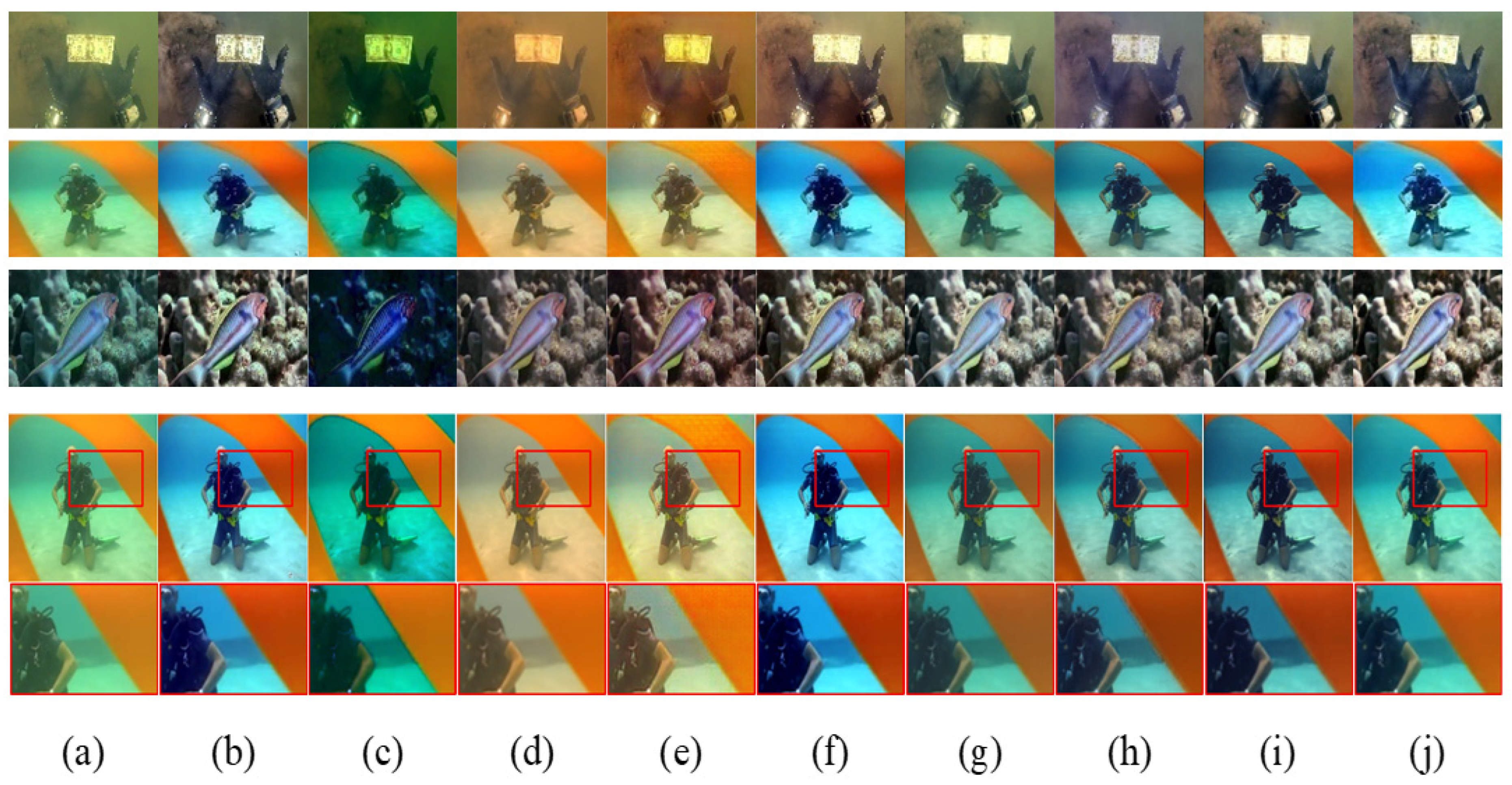
Figure 11.
Visual comparison results of different methods on the UFO-T120 test set. (a) Input images. (b) Reference images, (c) DCP, (d) UWNet, (e) FUnIEGAN, (f) DeepWaveNet, (g) LitenhencedNet, (h) DCSS-Net, (i) HisMamba. (j) Ours.
Figure 11.
Visual comparison results of different methods on the UFO-T120 test set. (a) Input images. (b) Reference images, (c) DCP, (d) UWNet, (e) FUnIEGAN, (f) DeepWaveNet, (g) LitenhencedNet, (h) DCSS-Net, (i) HisMamba. (j) Ours.
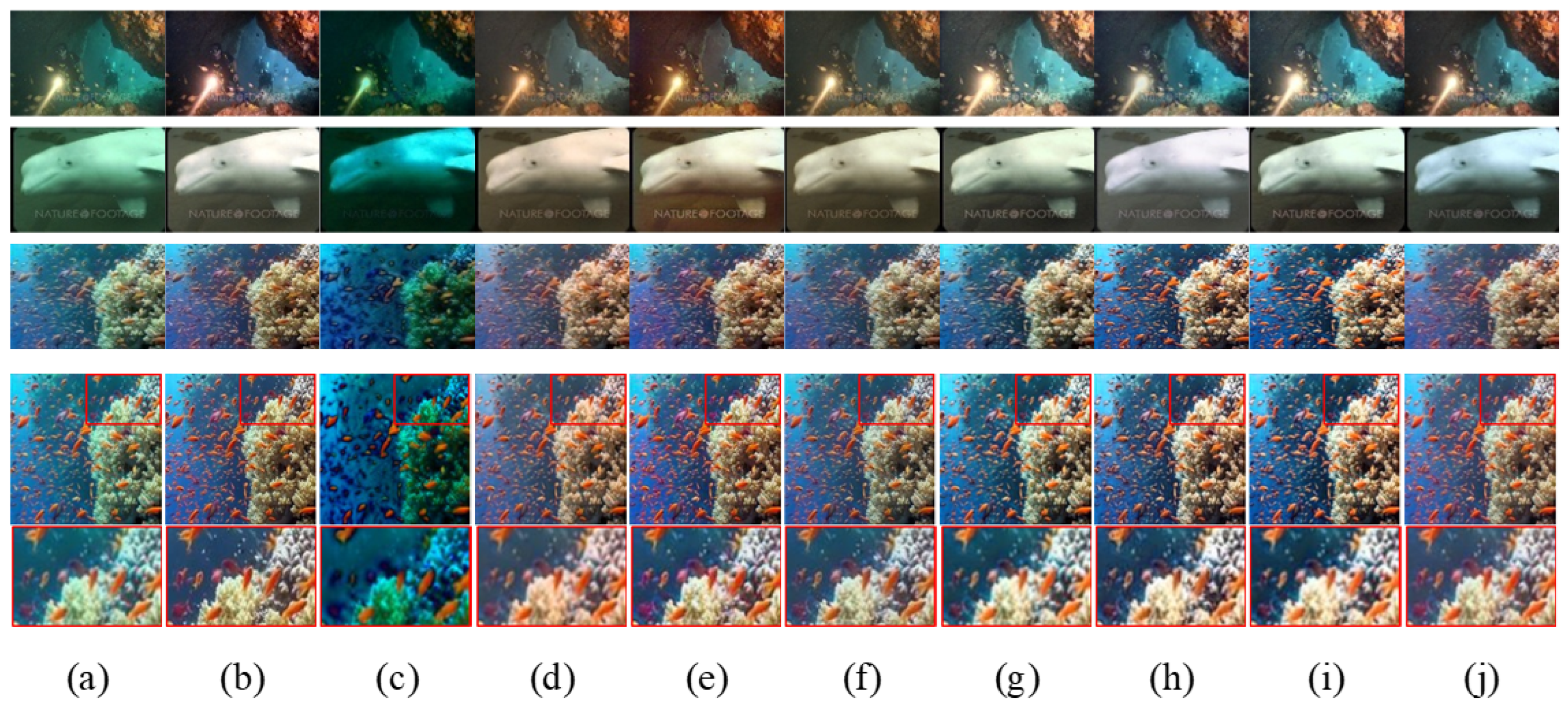
Figure 12.
Visual comparison results of different methods on the LSUI-T100 test set. (a) Input images. (b) Reference images, (c) DCP, (d) UWNet, (e) FUnIEGAN, (f) DeepWaveNet, (g) LitenhencedNet, (h) DCSS-Net, (i) HisMamba. (j) Ours.
Figure 12.
Visual comparison results of different methods on the LSUI-T100 test set. (a) Input images. (b) Reference images, (c) DCP, (d) UWNet, (e) FUnIEGAN, (f) DeepWaveNet, (g) LitenhencedNet, (h) DCSS-Net, (i) HisMamba. (j) Ours.
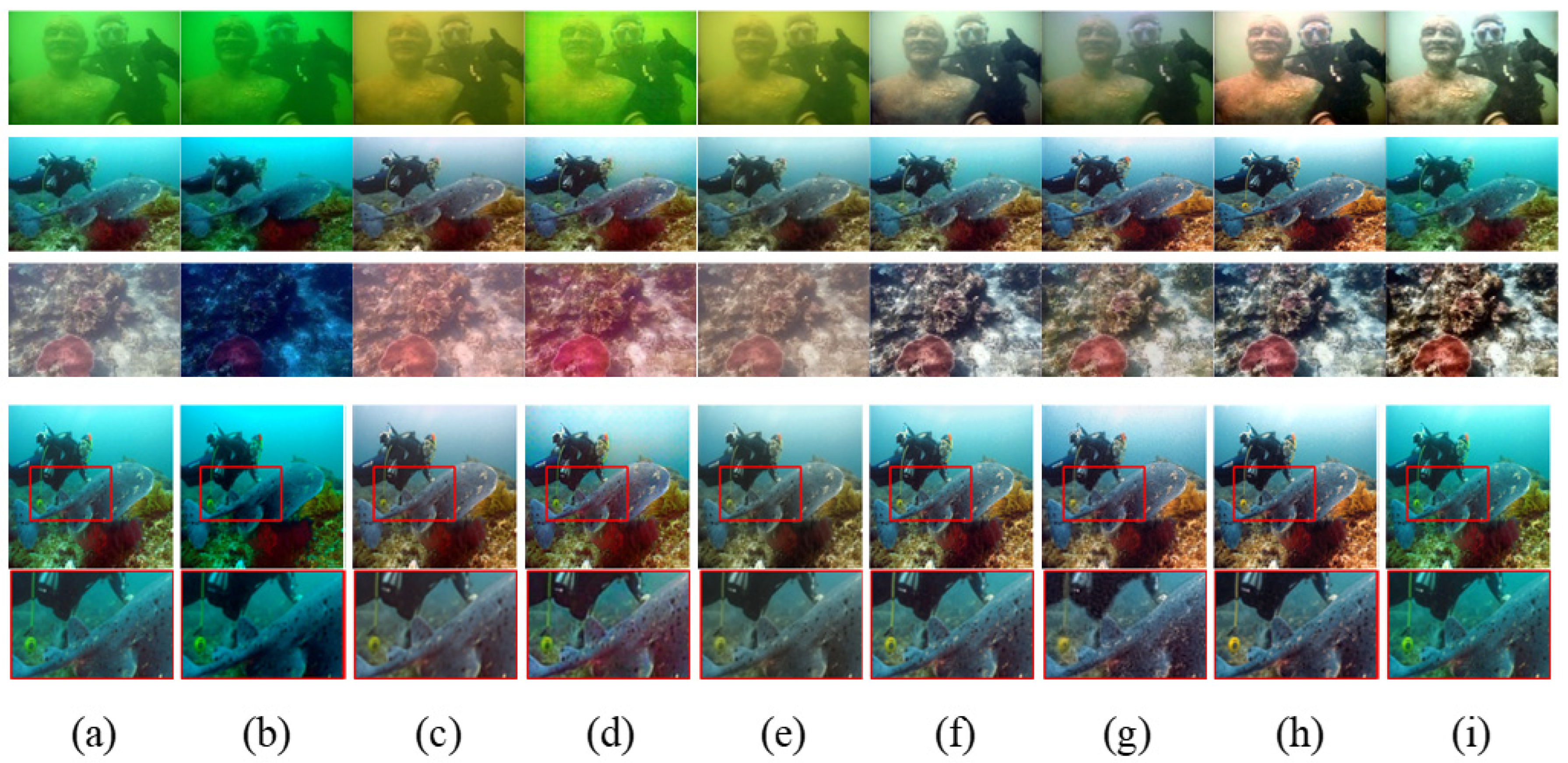
Figure 13.
Visual comparison results of different methods on the U45 test set. (a) Input images, (b) DCP, (c) UWNet, (d) FUnIEGAN, (e) DeepWaveNet, (f) LitenhencedNet, (g) DCSS-Net, (h) HisMamba. (i) Ours.
Figure 13.
Visual comparison results of different methods on the U45 test set. (a) Input images, (b) DCP, (c) UWNet, (d) FUnIEGAN, (e) DeepWaveNet, (f) LitenhencedNet, (g) DCSS-Net, (h) HisMamba. (i) Ours.
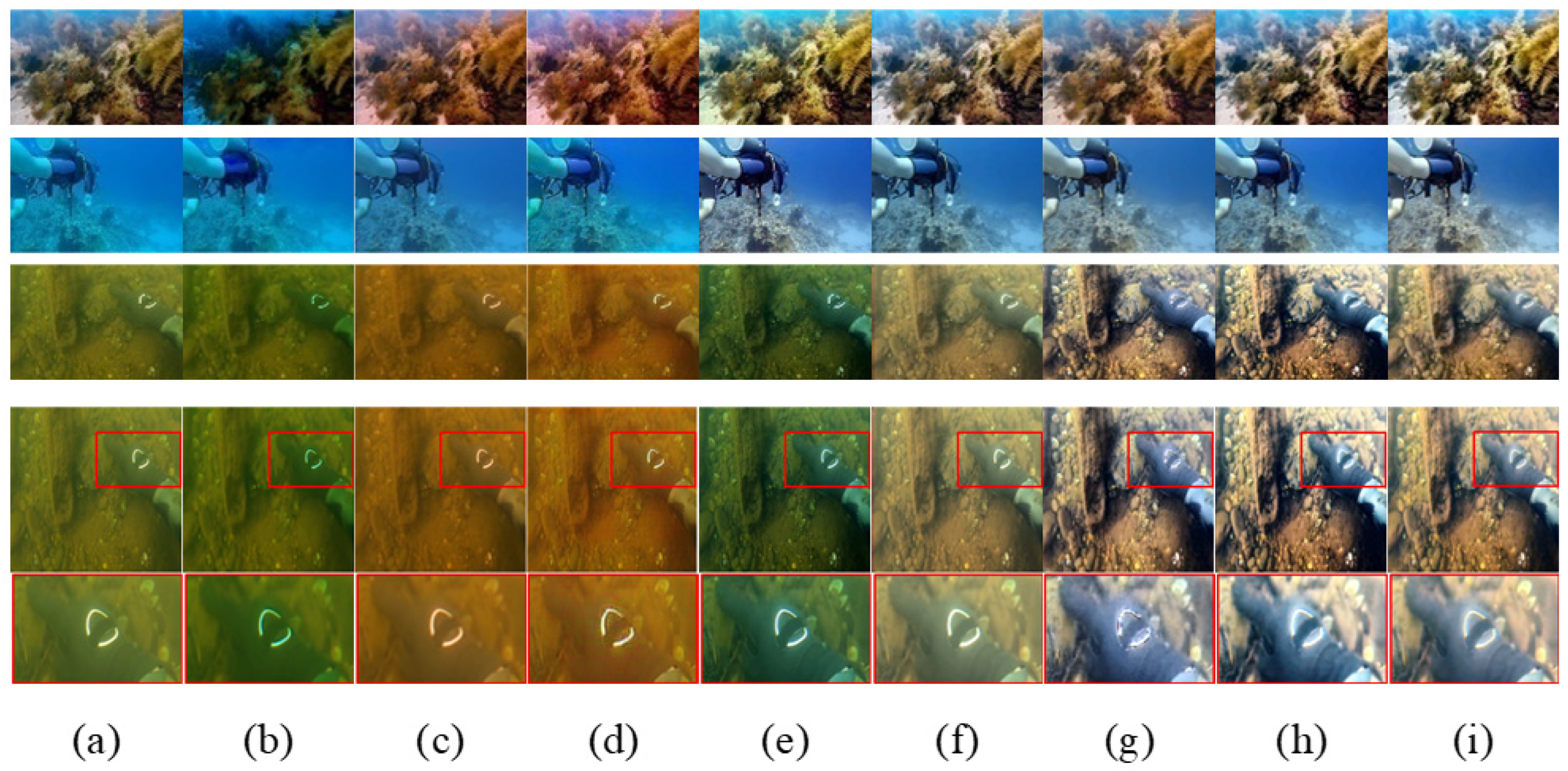
Figure 14.
Visual comparison results of different methods on different blue and green partial pictures of the UIEB test set. (a) Input images. (b)reference images, (c) DCP, (d) UWNet, (e) FUnIEGAN, (f) DeepWaveNet, (g) LitenhencedNet, (h) DCSS-Net, (i) HisMamba. (j) Ours.
Figure 14.
Visual comparison results of different methods on different blue and green partial pictures of the UIEB test set. (a) Input images. (b)reference images, (c) DCP, (d) UWNet, (e) FUnIEGAN, (f) DeepWaveNet, (g) LitenhencedNet, (h) DCSS-Net, (i) HisMamba. (j) Ours.
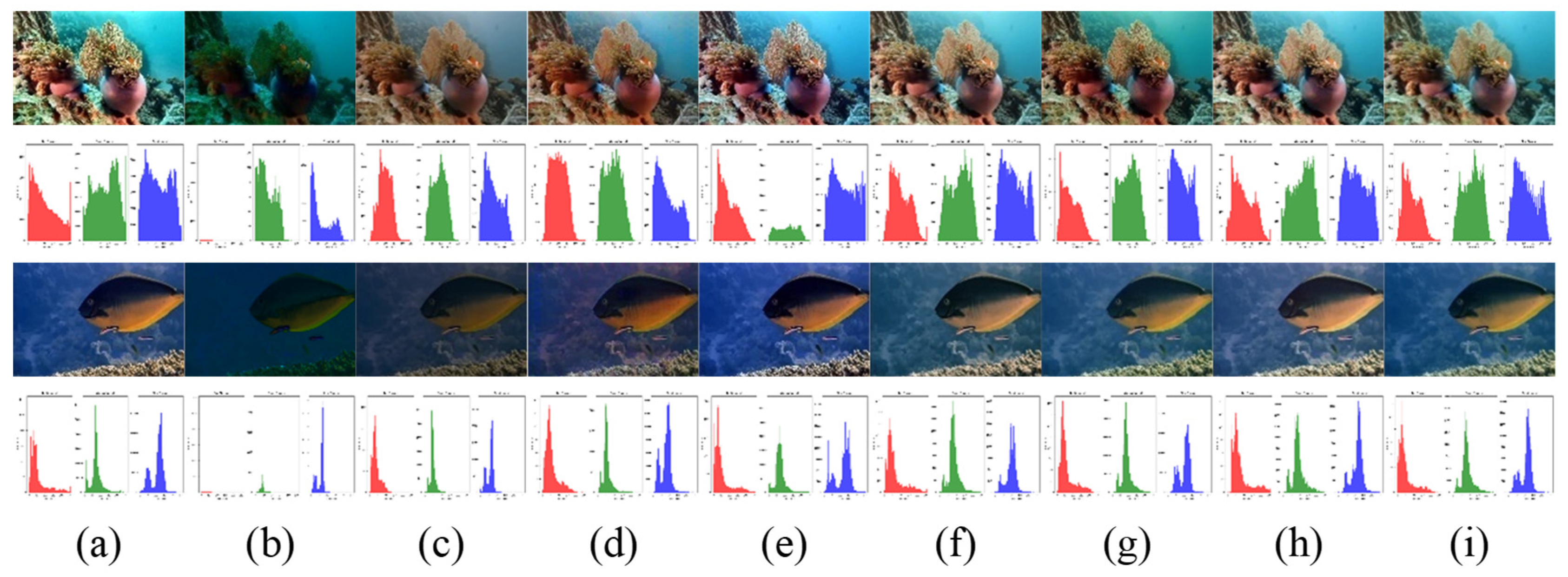
Figure 15.
Visual comparison of the color histograms of the enhanced images using different comparison methods. Here, the red, green and blue curves correspond to the histograms of the respective colors. (a) input images, (b) DCP, (c) UWNet, (d) FUnIEGAN, (e) DeepWaveNet, (f) LitenhencedNet, (g) DCSS-Net, (h) HisMamba, (i) ours.
Figure 15.
Visual comparison of the color histograms of the enhanced images using different comparison methods. Here, the red, green and blue curves correspond to the histograms of the respective colors. (a) input images, (b) DCP, (c) UWNet, (d) FUnIEGAN, (e) DeepWaveNet, (f) LitenhencedNet, (g) DCSS-Net, (h) HisMamba, (i) ours.
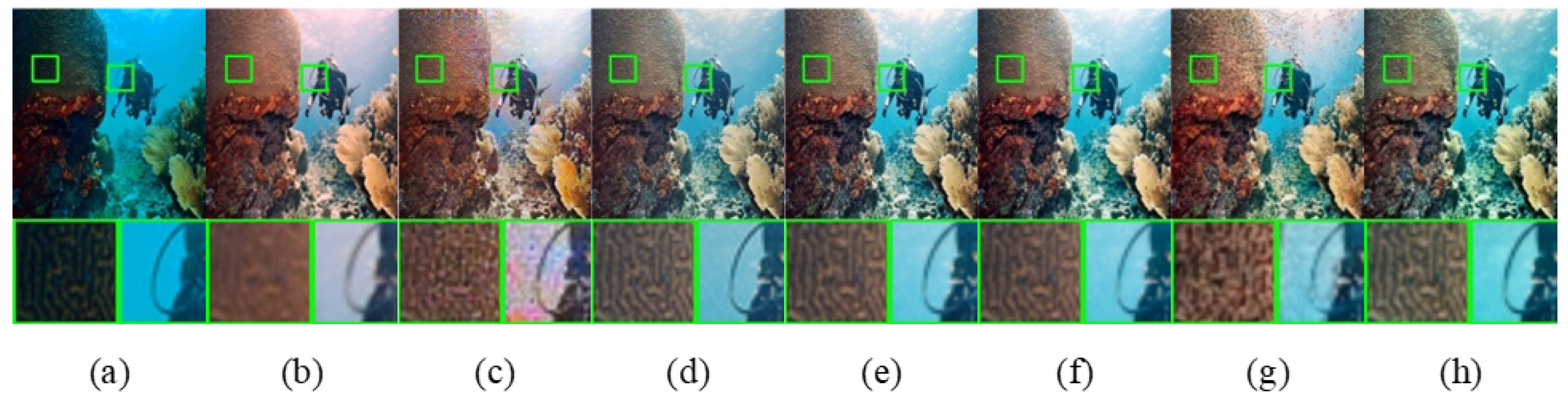
Figure 16.
The detailed magnification and visual comparison of the enhanced image using different comparison methods. (a) DCP, (b) UWNet, (c) FUnIEGAN, (d) DeepWaveNet, (e) LitenhencedNet, (f) DCSS-Net, (g) HisMamba, (h) ours.
Figure 16.
The detailed magnification and visual comparison of the enhanced image using different comparison methods. (a) DCP, (b) UWNet, (c) FUnIEGAN, (d) DeepWaveNet, (e) LitenhencedNet, (f) DCSS-Net, (g) HisMamba, (h) ours.
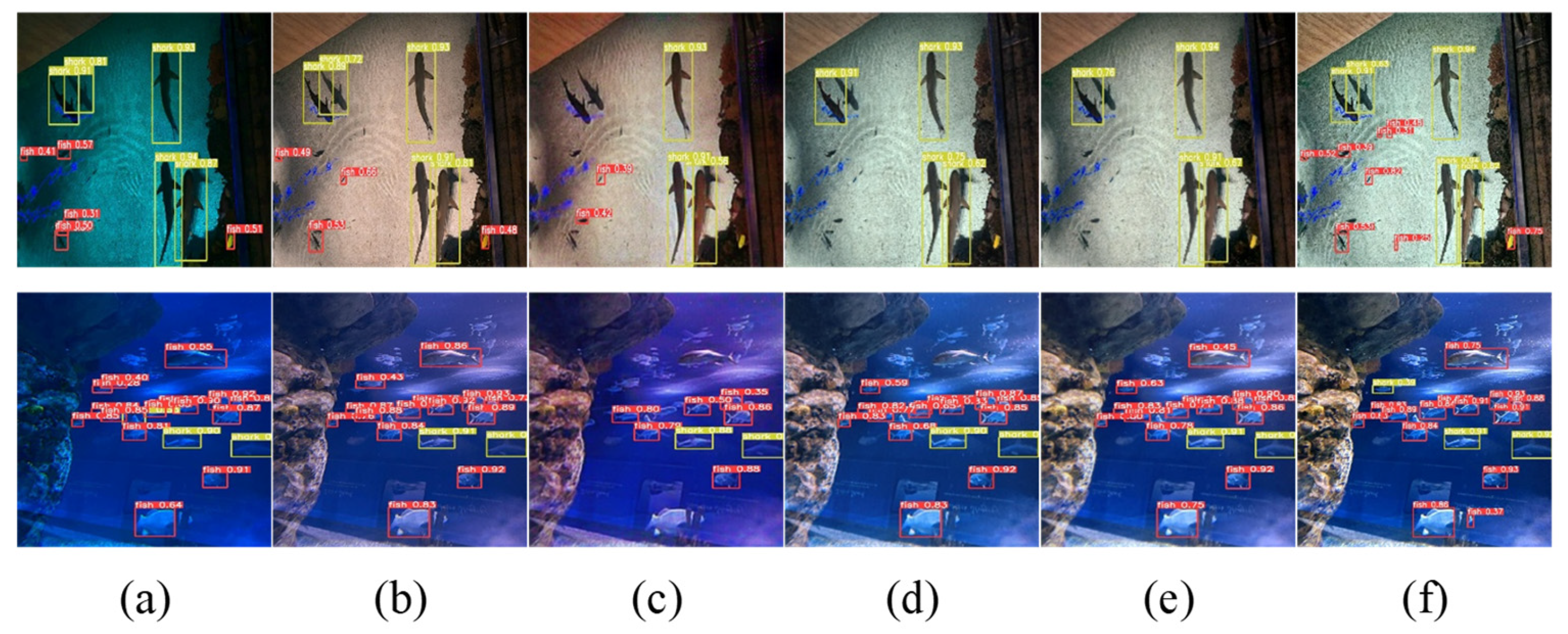
Figure 17.
Detection of underwater targets through different methods of YOLOv5, (a) DCP, (b) UWNet, (c) FUnIEGAN, (d) LitenhencedNet, (e) DeepWaveNet, (f) ours.
Figure 17.
Detection of underwater targets through different methods of YOLOv5, (a) DCP, (b) UWNet, (c) FUnIEGAN, (d) LitenhencedNet, (e) DeepWaveNet, (f) ours.
Figure 18.
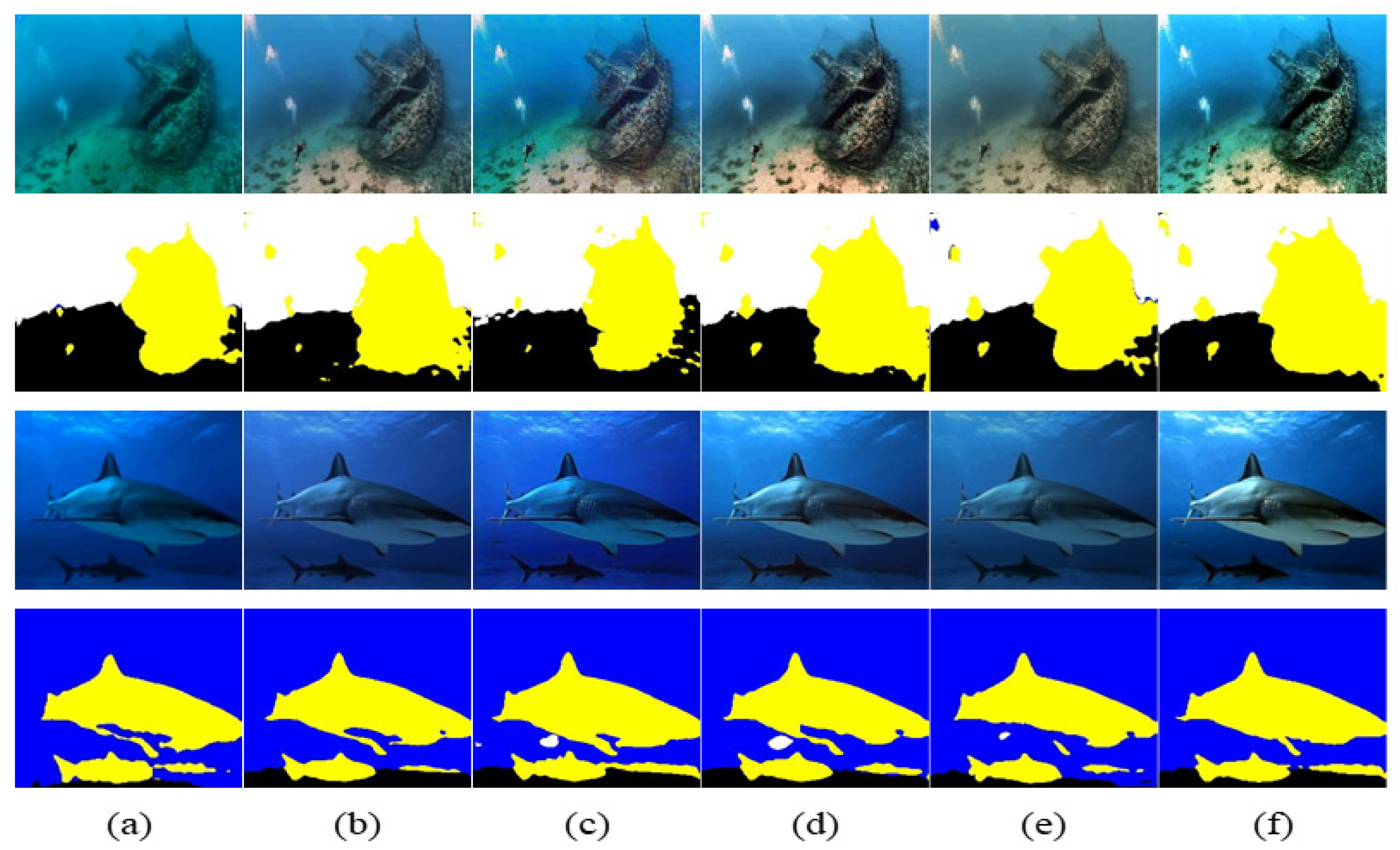
The segmentation tasks of the images enhanced by different methods were compared using Deeplabv3. (a) DCP, (b) UWNet, (c) FUnIEGAN, (d) LitenhencedNet, (e) DeepWaveNet, (f) ours.
Figure 18.
The segmentation tasks of the images enhanced by different methods were compared using Deeplabv3. (a) DCP, (b) UWNet, (c) FUnIEGAN, (d) LitenhencedNet, (e) DeepWaveNet, (f) ours.
Table 1.
Quantitative comparisons of all reference indicators were conducted on the four test sets of EUVP-T100, UIEB-T90, UFO-T100, and LSUI-T100. The red and blue numbers, respectively, represent the best and sub-best results.
Table 1.
Quantitative comparisons of all reference indicators were conducted on the four test sets of EUVP-T100, UIEB-T90, UFO-T100, and LSUI-T100. The red and blue numbers, respectively, represent the best and sub-best results.
| Dataset | Metric | DCP | UWNet | FUnIEGAN | DeepWaveNet | LitenhencedNet | DCSS-Net | HisMamba | Ours |
|---|
| EUVP-T100 | PSNR | 13.85 | 25.82 | 25.96 | 25.42 | 20.69 | 27.03 | 26.91 | 27.41 |
| SSIM | 0.48 | 0.74 | 0.78 | 0.81 | 0.74 | 0.81 | 0.82 | 0.86 |
| UIEB-T90 | PSNR | 14.69 | 18.03 | 19.59 | 22.89 | 23.03 | 23.83 | 24.51 | 24.75 |
| SSIM | 0.67 | 0.71 | 0.72 | 0.82 | 0.87 | 0.86 | 0.91 | 0.89 |
| UFO-T120 | PSNR | 14.82 | 25.21 | 25.83 | 20.79 | 20.24 | 25.66 | 25.73 | 26.86 |
| SSIM | 0.58 | 0.75 | 0.77 | 0.74 | 0.73 | 0.80 | 0.82 | 0.85 |
| LSUI-T100 | PSNR | 15.60 | 24.76 | 25.89 | 26.75 | 21.69 | 26.47 | 26.39 | 27.26 |
| SSIM | 0.64 | 0.82 | 0.84 | 0.88 | 0.83 | 0.83 | 0.82 | 0.87 |
Table 2.
All reference indicators were quantitatively compared on three sets of test devices, namely EUVP-R50, UIEB-R60, and U45. The red and blue numbers, respectively, represent the best and sub-best results, while the green one is the third result.
Table 2.
All reference indicators were quantitatively compared on three sets of test devices, namely EUVP-R50, UIEB-R60, and U45. The red and blue numbers, respectively, represent the best and sub-best results, while the green one is the third result.
| Dataset | Metric | DCP | UWNet | FUnIEGAN | DeepWaveNet | LitenhencedNet | DCSS-Net | HisMamba | Ours |
|---|
| EUVP-R50 | UIQM | 1.54 | 3.03 | 2.92 | 3.12 | 3.03 | 3.01 | 3.07 | 2.98 |
| UCIQE | 0.571 | 0.585 | 0.594 | 0.592 | 0.619 | 0.620 | 0.612 | 0.606 |
| CCF | 0.088 | 0.989 | 0.839 | 0.997 | 0.824 | 0.823 | 0.983 | 0.895 |
| UIEB-R60 | UIQM | 1.40 | 2.63 | 3.02 | 2.78 | 2.98 | 3.02 | 3.09 | 3.12 |
| UCIQE | 0.573 | 0.568 | 0.589 | 0.608 | 0.603 | 0.613 | 0.601 | 0.615 |
| CCF | 0.206 | 1.087 | 1.081 | 0.856 | 0.859 | 0.877 | 0.913 | 0.929 |
| U45 | UIQM | 1.56 | 2.79 | 3.05 | 2.89 | 3.31 | 3.18 | 3.29 | 3.19 |
| UCIQE | 0.539 | 0.528 | 0.559 | 0.533 | 0.583 | 0.622 | 0.632 | 0.604 |
| CCF | 0.066 | 1.015 | 0.892 | 0.951 | 0.823 | 0.879 | 0.989 | 0.880 |
Table 3.
The quantitative results of the network structure ablation study based on the average PSNR and SSIM values of the UIEB dataset.
Table 3.
The quantitative results of the network structure ablation study based on the average PSNR and SSIM values of the UIEB dataset.
| Setting | Detail | UIEB-T90 |
|---|
| PSNR/SSIM |
|---|
| Full model | - | 24.75/0.89 |
| No. 1 | w/o DCRAC | 23.62/0.78 |
| No. 2 | w/o DCTB | 23.57/0.82 |
| No. 3 | w/o ADSB | 23.63/0.90 |
| No. 4 | w/o CAM | 24.53/0.81 |
| No. 5 | w/o DC | 24.60/0.85 |
| No. 6 | w/o FDFM | 24.32/0.86 |
Table 4.
The quantitative results of the loss function ablation study based on the average PSNR and SSIM values of the UIEB dataset.
Table 4.
The quantitative results of the loss function ablation study based on the average PSNR and SSIM values of the UIEB dataset.
| Loss | UIEB-T90 |
|---|
| PSNR/SSIM |
|---|
| L1 Loss | 22.63/0.81 |
| SSIM Loss | 22.82/0.80 |
| Perceptual Loss | 23.15/0.83 |
| L1 + SSIM | 23.48/0.86 |
| L1 + Perceptual | 24.61/0.79 |
| SSIM + Perceptual | 24.55/0.83 |
| L1 + SSIM + Perceptual | 24.42/0.84 |
| 0.5L1 + 0.3SSIM + Perceptual | 24.51/0.87 |
| 0.3L1 + 0.1SSIM + Perceptual | 24.58/0.89 |
| 0.2L1 + 0.2SSIM + Perceptual | 24.75/0.89 |
Table 5.
Quantitative comparison of the detection task. The best results are indicated in red. The second-best results are indicated in blue.
Table 5.
Quantitative comparison of the detection task. The best results are indicated in red. The second-best results are indicated in blue.
| Method | Precision(%) | mAP@50–95(%) |
|---|
| DCP | 79.3 | 44.2 |
| UWNet | 82.9 | 43.5 |
| FUnIEGAN | 76.7 | 41.6 |
| LitenhencedNet t | 83.5 | 44.3 |
| DeepWaveNet | 85.4 | 45.1 |
| UCA-Net | 88.3 | 45.5 |
Table 6.
Comparison of the complexity of different methods.
Table 6.
Comparison of the complexity of different methods.
| Method | #Params(M) | #MACS(G) |
|---|
| UWNet | 0.22 | 21.71 |
| FUnIEGAN | 7.02 | 10.76 |
| LitenhencedNet | 0.69 | 0.013 |
| LA-Net | 5.15 | 356.03 |
| DeepWaveNet | 0.27 | 18.18 |
| U-shape Transformer | 31.59 | 310.21 |
| UCA-Net | 1.44 | 19.26 |