Two-Stage Combining and Beamforming Scheme for Multi-Pair Users FDD Massive MIMO Relay Systems


Abstract
1. Introduction
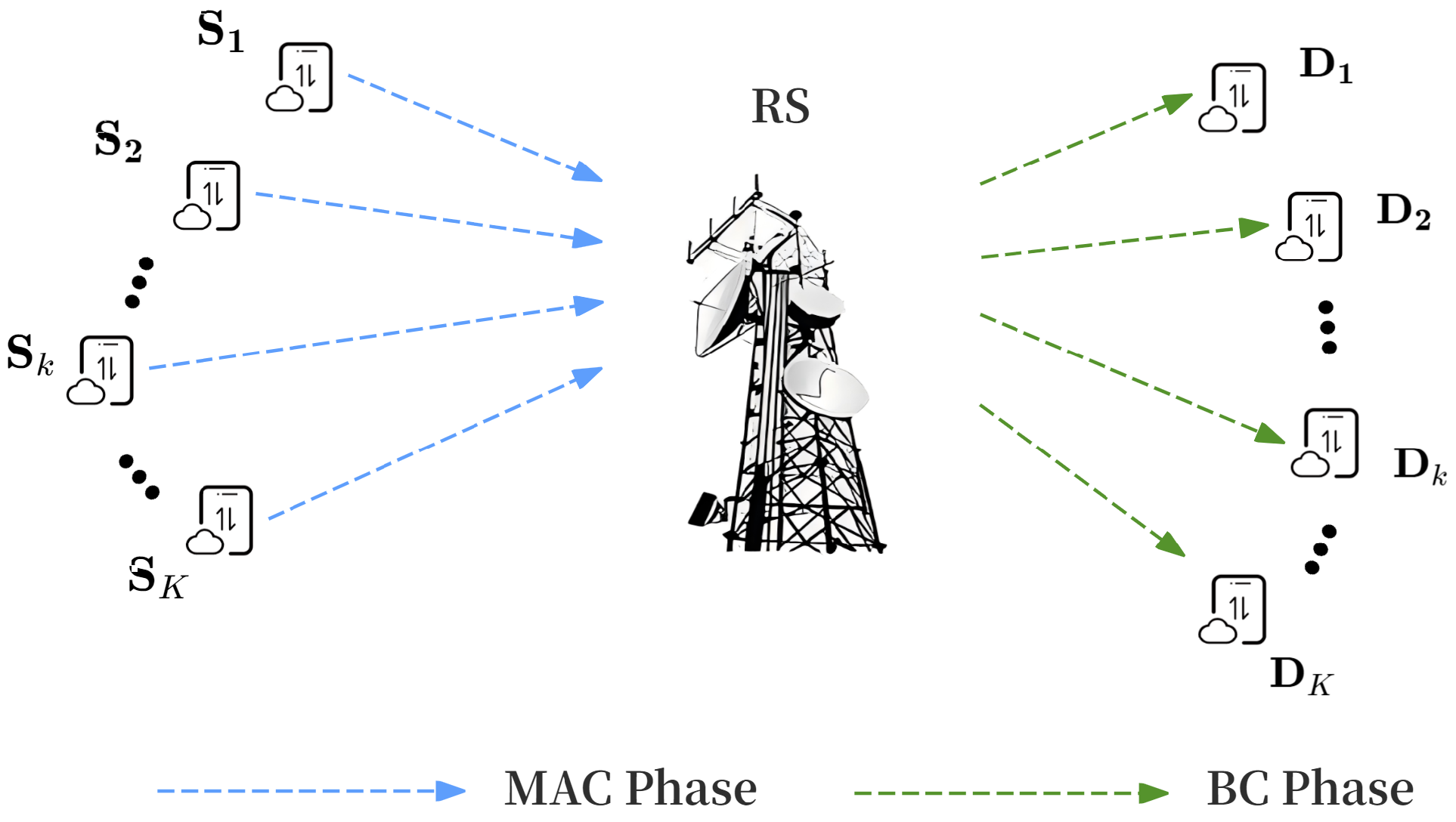
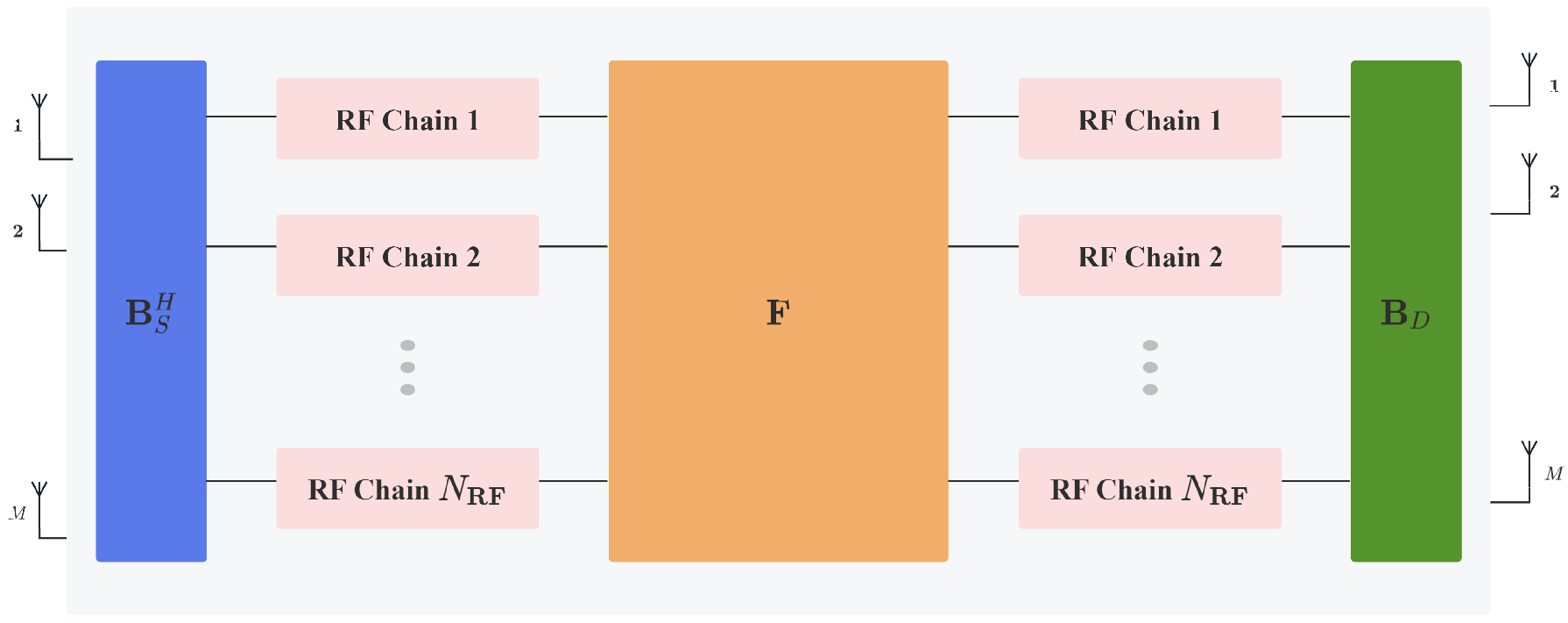
- A novel TSCB scheme is introduced in a multi-pair-user FDD massive MIMO system to reduce the pilot overhead, thereby improving ESE. In the first stage, by using the S-CSI at the RS, we optimize the pre-combining matrix and pre-beamforming matrix jointly. In the second stage, due to the reduction in the dimensions of the IE-CSI after pre-combining and pre-beamforming, the IE-CSI can be estimated with lower pilot overhead. Subsequently, the ZF strategy is employed in the design of the digital precoding matrix to reduce multi-user interference, resulting in a higher ESE.
- The design of the pre-combining and pre-beamforming matrices is cast as a multivariate optimization task that involves 0-1 integer constraints. Considering the one-ring channel model and leveraging its intrinsic sparsity, the two matrices are designed by choosing beams from a discrete Fourier transform (DFT) codebook to reduce the implementation complexity with only the S-CSI known at the RS, thereby minimizing design and implementation complexity. The maximization of the system’s receiving energy, therefore, constitutes the objective function. Accounting for the practical limitations of RF chains and pilot overhead, we finally formulate the design problem into a form of multivariate optimization subject to 0-1 integer constraints.
- By an alternating optimization (AO) algorithm, the design of the pre-beamforming and pre-combining matrices is addressed, which targets improvements in the ESE. The design problem is broken down into three distinct sub-problems to be tackled by the AO algorithm. The first and second ones focus on obtaining the pre-beamforming and pre-combining matrices, which are recast as 0–1 integer programming problems. These problems are then solved by the proposed iterative beamforming selection (I-BS) and iterative combining selection (I-CS) algorithms. The third sub-problem involves an intermediate parameter matrix, which is a convex sub-problem, and a convex optimization is utilized to obtain the intermediate parameter matrix.
2. Preliminary
2.1. System Model and Channel Model
2.2. The Equivalent Channel Matrix and Matrix Sparsity
3. Two-Stage Combining and Beamforming Scheme
3.1. The Design of Pre-Combining and Pre-Beamforming Matrices
3.2. Problem Formulation with Limited RF Chains and Pilots
| Algorithm 1: I-BS scheme |
 |
| Algorithm 2: I-CS scheme |
 |
| Algorithm 3: The AO Algorithm |
 |
3.3. Digital Pre-Coding Matrix Design in the Second Stage
4. Numerical Results
5. Conclusions
Author Contributions
Funding
Informed Consent Statement
Data Availability Statement
Conflicts of Interest
Abbreviations
| AWGN | Additive White Gaussian Noise |
| AO | Alternating Optimization |
| BC | Broadcast Channel |
| I-BS | Iterative Beamforming Selection |
| I-CS | Iterative Combining Selection |
| DFT | Discrete Fourier Transform |
| ESE | Effective Spectral Efficiency |
| FDD | Frequency Division Duplexing |
| I-CSI | Instantaneous Channel State Information |
| IE-CSI | Equivalent Instantaneous Channel State Information |
| i.i.d. | independently and identically distributed |
| JSDM | Joint Spatial Division and Multiplexing |
| MAC | Multiple Access Channel |
| MIMO | Multiple-Input Multiple-Output |
| NOP | Number of Orthogonal Pilots |
| RF | Radio Frequency |
| RS | Relay Station |
| S-CSI | Statistical Channel State Information |
| SE | Spectral Efficiency |
| SU | Source User |
| TDD | Time Division Duplex |
| TSB | Two-stage Beamforming |
| TSCBUS | Two-stage Combining and Beamforming with User-pair Scheduling |
| ULA | Uniform Linear Arrays |
References
- Li, J.; Li, T.; Ren, J.; Chao, H. Enjoy the benefit of network coding: Combat pollution attacks in 5G multihop networks. Wirel. Commun. Mob. Comput. 2018, 1, 3473910. [Google Scholar] [CrossRef]
- Agiwal, M.; Roy, A.; Saxena, N. Next generation 5G wireless networks: A comprehensive survey. IEEE Commun. Surv. Tutor. 2016, 18, 1617–1655. [Google Scholar] [CrossRef]
- Liu, X. Low-complexity unsupervised learning-based hybrid precoding for massive MIMO systems. IET Commun. 2023, 17, 1773–1779. [Google Scholar] [CrossRef]
- Chowdhury, M.; Shahjalal, M.; Ahmed, S.; Jang, Y. 6G wireless communication systems: Applications, requirements, technologies, challenges, and research directions. IEEE Open J. Commun. Soc. 2020, 1, 957–975. [Google Scholar] [CrossRef]
- Jiang, X.; Li, P.; Li, B.; Zou, Y.; Wang, R. Secrecy performance of transmit antenna selection for underlay MIMO cognitive radio relay networks with energy harvesting. IET Commun. 2022, 16, 227–245. [Google Scholar] [CrossRef]
- Fazeli, S.; Akhlaghi, S. Null-space beamforming strategy for secrecy rate balancing of two-way MIMO relay networks. IET Commun. 2023, 17, 2080–2096. [Google Scholar] [CrossRef]
- Khodeir, M.; Al-Mistarthi, M.; Ibrahem, L. Performance evaluation of cognitive relay networks for end-user mobile over mixed realistic channels. IET Commun. 2023, 17, 228–245. [Google Scholar] [CrossRef]
- Du, J.; Ye, S.; Chen, Y.; Guan, Y. Joint channel estimation techniques for multi-user massive MIMO relay networks. In Proceedings of the 2020 IEEE 20th International Conference on Communication Technology (ICCT), Nanning, China, 28–31 October 2020; pp. 29–33. [Google Scholar]
- Peng, Z.; Wang, S.; Pan, C.; Chen, X.; Cheng, J.; Hanzo, L. Multi-pair two-way massive MIMO DF relaying over Rician fading channels under imperfect CSI. IEEE Wirel. Commun. Lett. 2021, 11, 225–229. [Google Scholar] [CrossRef]
- Zhang, Y.; Zhang, H.; Zhou, X.; Yuan, D.; Cao, Y. Relay assisted Max-SINR transceiver optimization design for MIMO interference channels. IEEE Trans. Veh. Technol. 2022, 72, 2066–2081. [Google Scholar] [CrossRef]
- Alahmadi, A.; Liang, Y.; Tian, R.; Ren, J.; Li, T. Blocking probability analysis for relay-assisted OFDMA networks using stochastic geometry. In Proceedings of the 2019 International Conference on Computing, Networking and Communications (ICNC), Honolulu, HI, USA, 18–21 February 2019; pp. 509–514. [Google Scholar]
- Suraweera, H.A.; Ngo, H.Q.; Duong, T.Q.; Yuen, C.; Larsson, E.G. Multi-pair amplify-and-forward relaying with very large antenna arrays. In Proceedings of the 2013 IEEE International Conference on Communications (ICC), Budapest, Hungary, 9–13 June 2013; pp. 4635–4640. [Google Scholar]
- Chen, Y.; Liu, C.; Wang, H.; Zhu, W.P. Performance analysis for multi-pair massive MIMO AF relay networks with ZF processing. In Proceedings of the GLOBECOM 2017-2017 IEEE Global Communications Conference, Singapore, 4–8 December 2017; pp. 1–6. [Google Scholar]
- Rahimi, R.; Shahbazpanahi, S. A two-way network beamforming approach based on total power minimization with symmetric relay beamforming matrices. IEEE Access 2017, 5, 12458–12474. [Google Scholar] [CrossRef]
- Chen, X.; Peng, Z.; Pan, C.; Ren, H.; Wang, L.C. Performance analysis and power allocation of multi-pair two-way massive MIMO full-duplex DF relaying systems under Rician fading channels. IEEE Trans. Veh. Technol. 2022, 72, 1955–1971. [Google Scholar] [CrossRef]
- Rezaei, A.; Falahati, A.; Zargari, S. Energy efficient multi-Way massive MIMO AF relaying with imperfect CSI and optimal power allocation. Wirel. Pers. Commun. 2023, 132, 1681–1702. [Google Scholar] [CrossRef]
- Xu, M.; Mao, M.; Feng, Y.; Li, T.; Shi, R.; He, Y. Beamforming design for max-min SINR in RIS-based hybrid relaying. IET Commun. 2023, 17, 1220–1227. [Google Scholar] [CrossRef]
- Rong, Y.; Khandaker, M.R.; Xiang, Y. Channel estimation of dual-hop MIMO relay system via parallel factor analysis. IEEE Trans. Wirel. Commun. 2012, 11, 2224–2233. [Google Scholar] [CrossRef]
- Chen, H.; Lam, W.H. Training-based two-step channel estimation in two-Way MIMO relay systems. IEEE Trans. Veh. Technol. 2017, 67, 2193–2205. [Google Scholar] [CrossRef]
- Ngo, H.Q.; Suraweera, H.A.; Matthaiou, M.; Larsson, E.G. Multipair full-duplex relaying with massive arrays and linear processing. IEEE J. Sel. Areas Commun. 2014, 32, 1721–1737. [Google Scholar] [CrossRef]
- Xu, W.; Liu, J.; Jin, S.; Dong, X. Spectral and energy efficiency of multi-pair massive MIMO relay network with hybrid processing. IEEE Trans. Commun. 2017, 65, 3794–3809. [Google Scholar] [CrossRef]
- Chauhan, A.S.; Sharma, E.; Budhiraja, R. Hybrid block diagonalization for massive MIMO two-way half-duplex AF hybrid relay. In Proceedings of the 2018 International Conference on Signal Processing and Communications (SPCOM), Bangalore, India, 16–19 July 2018; pp. 367–371. [Google Scholar]
- Fozooni, M.; Ngo, H.Q.; Matthaiou, M.; Jin, S.; Alexandropoulos, G.C. Hybrid processing design for multipair massive MIMO relaying with channel spatial correlation. IEEE Trans. Commun. 2018, 67, 107–123. [Google Scholar] [CrossRef]
- Spectral and energy efficiency for large-scale multiple-input-multiple-output two-Way hybrid relaying with multi-pair users under imperfect channel state information. IEEE Access 2021, 9, 142837–142856. [CrossRef]
- Qian, J.; Masouros, C. Multipair relaying with space-constrained large-scale MIMO arrays: Spectral and energy efficiency analysis with incomplete CSI. IEEE Open J. Commun. Soc. 2021, 2, 2357–2371. [Google Scholar] [CrossRef]
- Long, H.; Xiang, W.; Zhang, L.; Huang, L. MMSE-based secure precoding in two-way relaying systems. IET Commun. 2020, 14, 3813–3819. [Google Scholar] [CrossRef]
- Jiang, Z.; Molisch, A.F.; Caire, G.; Niu, Z. Achievable rates of FDD massive MIMO systems with spatial channel correlation. IEEE Trans. Wirel. Commun. 2015, 14, 2868–2882. [Google Scholar] [CrossRef]
- Li, S.; Xing, C.; Fei, Z.; Kuang, J. Robust two-way amplify-and-forward MIMO relay beamforming with non-reciprocal and reciprocal CSI. In Proceedings of the 7th International Conference on Communications and Networking in China, Kunming, China, 8–10 August 2012; pp. 343–347. [Google Scholar]
- Dutta, B.; Budhiraja, R.; Koilpillai, R.D.; Hanzo, L. Analysis of quantized MRC-MRT precoder for FDD massive MIMO two-Way AF relaying. IEEE Trans. Commun. 2018, 67, 988–1003. [Google Scholar] [CrossRef]
- Rezvani, S.M.; Keshavarz, H. Two-way MIMO relay beamforming scheme for sum-rate maximization approach based on second-order statistics. In Proceedings of the 2016 24th Iranian Conference on Electrical Engineering (ICEE), Shiraz, Iran, 10–12 May 2016; pp. 29–33. [Google Scholar]
- Zhang, R.; Leung, S.H.; Luo, Z.; Wang, H. Precoding design for correlated MIMO-AF relay networks with statistical channel state information. IEEE Trans. Signal Process. 2018, 66, 5902–5916. [Google Scholar] [CrossRef]
- Dilli, R. Hybrid beamforming in 5G nr networks using multi user massive MIMO at FR2 frequency bands. Wirel. Pers. Commun. 2022, 127, 3677–3709. [Google Scholar] [CrossRef]
- Adhikary, A.; Nam, J.; Ahn, J.Y.; Caire, G. Joint spatial division and multiplexing—The large-scale array regime. IEEE Trans. Inf. Theory 2013, 59, 6441–6463. [Google Scholar] [CrossRef]
- Song, Y.C.; Liu, C.; Liu, Y.L.; Cheng, N.; Huang, Y.M.; Shen, X.M. Joint spatial division and multiplexing in massive MIMO: A neighbor-based approach. IEEE Trans. Wirel. Commun. 2020, 19, 7392–7406. [Google Scholar] [CrossRef]
- Song, Y.C.; Liu, C.; Zhang, W.Y.; Liu, Y.L.; Zhou, H.B.; Shen, X.M. Two-stage beamforming in massive MIMO: A combinatorial multi-armed bandit-based approach. IEEE Trans. Veh. Technol. 2023, 72, 6794–6799. [Google Scholar] [CrossRef]



| Scheme | Assumption | Relay | Limited RF Chains | Limited NOP | Based on DFT |
|---|---|---|---|---|---|
| Digital [15] | I-CSI | Yes | Yes | No | No |
| Digital [31] | S-CSI | Yes | No | No | No |
| JSDM [33] | S-CSI | No | No | No | No |
| N-JSDM [34] | S-CSI | No | No | No | Yes |
| TSCB-proposed | S-CSI | Yes | Yes | Yes | Yes |
| Scheme | Computational Complexity |
|---|---|
| I-CSI, Full-ditigal [15] | |
| S-CSI, Full-ditigal [31] | |
| S-CSI, JSDM [33] | |
| S-CSI, TSCB |
| Description | Symbol | Value/Range |
|---|---|---|
| Number of RS Antennas | M | 64 |
| Number of UPs | K | 8∼25 |
| Angle Spread | , | |
| Number of RF Chains | 16∼32 | |
| Minimum NOP Constraint | N | 6∼20 |
| Covers low-, medium-, and high-SNR Scenarios | SNR | −15∼15 dB |
| Correlation between a UP and a Codeword | ||
| Number of Coherent Time Transmission Symbols | T | 100 |
| Scheme | SNR | ||||||
|---|---|---|---|---|---|---|---|
| 5 | 0 | 5 | 10 | 15 | 20 | ||
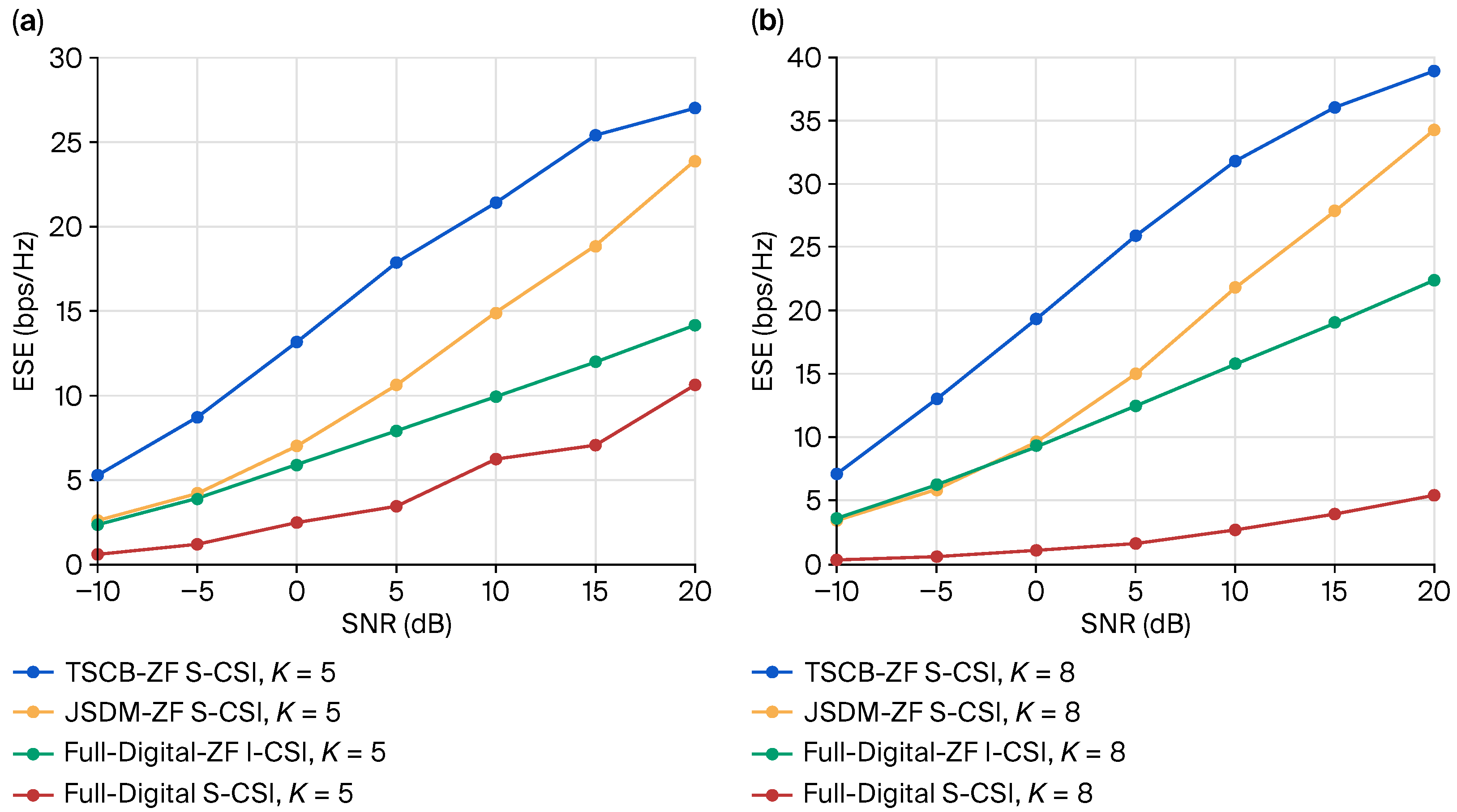
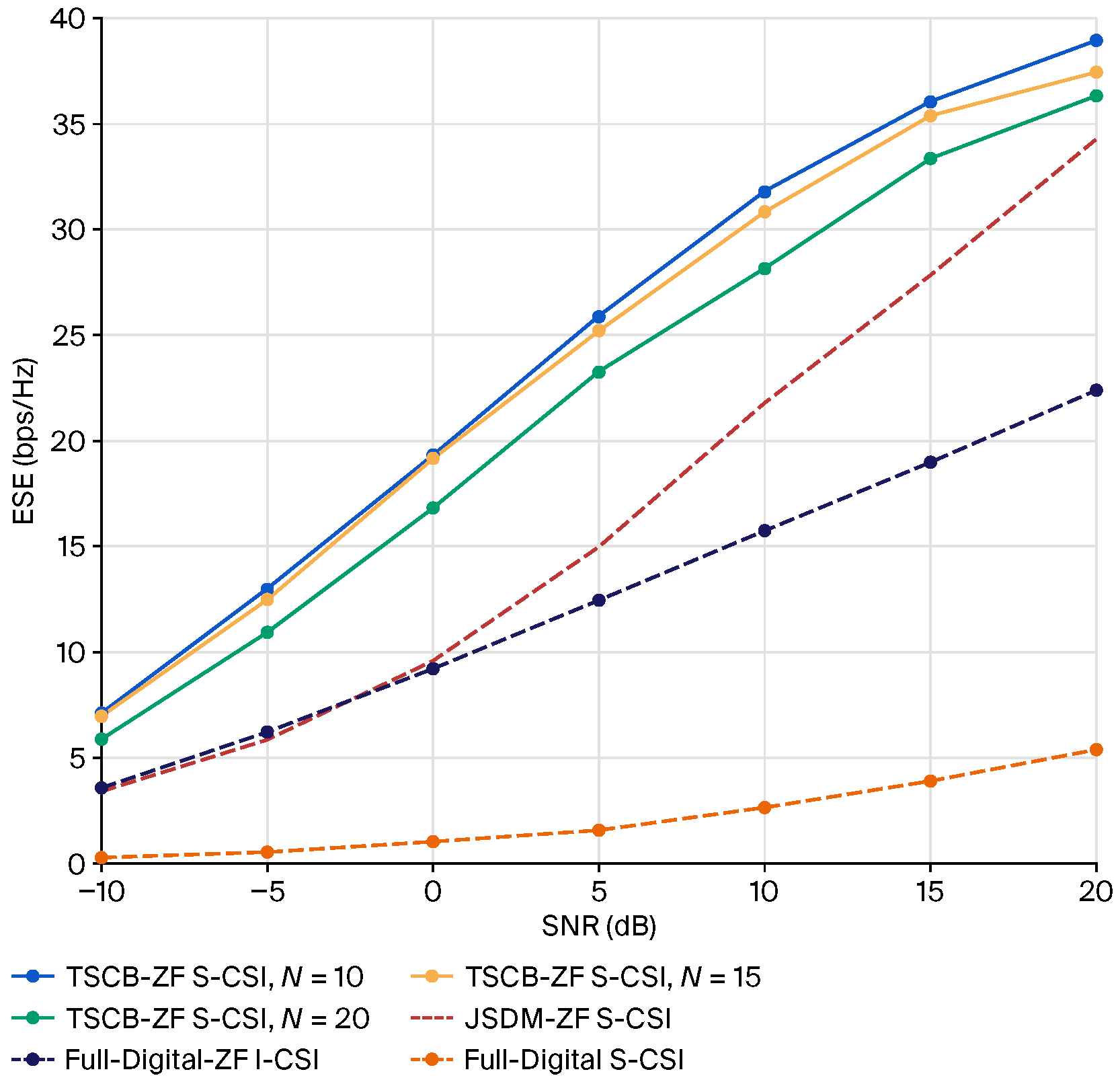
| S-CSI, TSCB | 7.121 | 13.031 | 19.324 | 25.911 | 31.810 | 36.052 | 38.937 |
| S-CSI, JSDM | 3.418 | 5.863 | 9.595 | 14.986 | 21.794 | 27.837 | 34.272 |
| I-CSI, Digital | 3.852 | 6.228 | 9.220 | 12.459 | 15.750 | 18.986 | 22.393 |
| S-CSI, Digital | 3.852 | 6.228 | 9.220 | 12.459 | 15.750 | 18.986 | 22.393 |
| Scheme | TSCB () | JSDMT () | TSCB () | JSDMT () |
| NOP | 11 | 9 | 12 | 15 |
Disclaimer/Publisher’s Note: The statements, opinions and data contained in all publications are solely those of the individual author(s) and contributor(s) and not of MDPI and/or the editor(s). MDPI and/or the editor(s) disclaim responsibility for any injury to people or property resulting from any ideas, methods, instructions or products referred to in the content. |
© 2026 by the authors. Licensee MDPI, Basel, Switzerland. This article is an open access article distributed under the terms and conditions of the Creative Commons Attribution (CC BY) license.
Share and Cite
Ge, D.; Song, Y.; Gao, T.; Liang, H. Two-Stage Combining and Beamforming Scheme for Multi-Pair Users FDD Massive MIMO Relay Systems. Electronics 2026, 15, 310. https://doi.org/10.3390/electronics15020310
Ge D, Song Y, Gao T, Liang H. Two-Stage Combining and Beamforming Scheme for Multi-Pair Users FDD Massive MIMO Relay Systems. Electronics. 2026; 15(2):310. https://doi.org/10.3390/electronics15020310
Chicago/Turabian StyleGe, Dan, Yunchao Song, Tianbao Gao, and Huibin Liang. 2026. "Two-Stage Combining and Beamforming Scheme for Multi-Pair Users FDD Massive MIMO Relay Systems" Electronics 15, no. 2: 310. https://doi.org/10.3390/electronics15020310
APA StyleGe, D., Song, Y., Gao, T., & Liang, H. (2026). Two-Stage Combining and Beamforming Scheme for Multi-Pair Users FDD Massive MIMO Relay Systems. Electronics, 15(2), 310. https://doi.org/10.3390/electronics15020310