Next Article in Journal
A 1.06 ppm/°C Compact CMOS Voltage Reference
Previous Article in Journal
Development and Validation of a GPS Error-Mitigation Algorithm for Mental Health Digital Phenotyping
Previous Article in Special Issue
On Deep Learning Hybrid Architectures for MIMO-OFDM Channel Estimation
error_outline You can access the new MDPI.com website here. Explore and share your feedback with us.
 
 
Article

Stacked Intelligent Metasurfaces: Key Technologies, Scenario Adaptation, and Future Directions

1
School of Electronic and Information Engineering, Beijing Jiaotong University, Beijing 100044, China
2
Institute of Communication and Signal, China Academy of Railway Sciences Group Co., Ltd., Beijing 100081, China
*
Author to whom correspondence should be addressed.
Electronics 2026, 15(2), 274; https://doi.org/10.3390/electronics15020274
Submission received: 13 December 2025 / Revised: 30 December 2025 / Accepted: 5 January 2026 / Published: 7 January 2026

Abstract

The advent of sixth-generation (6G) imposes stringent demands on wireless networks, while traditional 2D rigid reconfigurable intelligent surfaces (RISs) face bottlenecks in regulatory freedom and scenario adaptability. To address this, stacked intelligent metasurfaces (SIMs) have emerged. This paper presents a systematic review of SIM technology. It first elaborates on the SIM multi-layer stacked architecture and wave-domain signal-processing principles, which overcome the spatial constraints of conventional RISs. Then, it analyzes challenges, including beamforming and channel estimation for SIM, and explores its application prospects in key 6G scenarios such as integrated sensing and communication (ISAC), low earth orbit (LEO) satellite communication, semantic communication, and UAV communication, as well as future trends like integration with machine learning and nonlinear devices. Finally, it summarizes the open challenges in low-complexity design, modeling and optimization, and performance evaluation, aiming to provide insights to promote the large-scale adoption of SIM in next-generation wireless communications.

1. Introduction

The advent of the sixth-generation (6G) communication era has placed unprecedented performance demands on wireless networks, including high capacity, low energy consumption, wide-area adaptation, and reliable operation in complex scenarios such as high-speed mobility and extreme environments. As a revolutionary technology for regulating the electromagnetic environment [1], reconfigurable intelligent surfaces (RISs) are widely recognized as a promising solution to meet the aforementioned 6G requirements, due to their advantage of flexibly manipulating the amplitude, phase, and polarization of electromagnetic waves without additional signal processing overhead.
However, conventional 2D rigid RIS suffers from inherent limitations: the single-layer planar structure restricts its regulatory dimensions, resulting in insufficient degrees of freedom in electromagnetic wave manipulation [2]; meanwhile, the rigid substrate leads to poor adaptability to dynamic and irregular application scenarios (e.g., the curved surfaces of mobile carriers and complex terrain in remote areas). These bottlenecks severely hinder the exploitation of RIS potential in 6G high-performance communication systems, spurring an urgent demand for innovative enhanced RIS technologies.
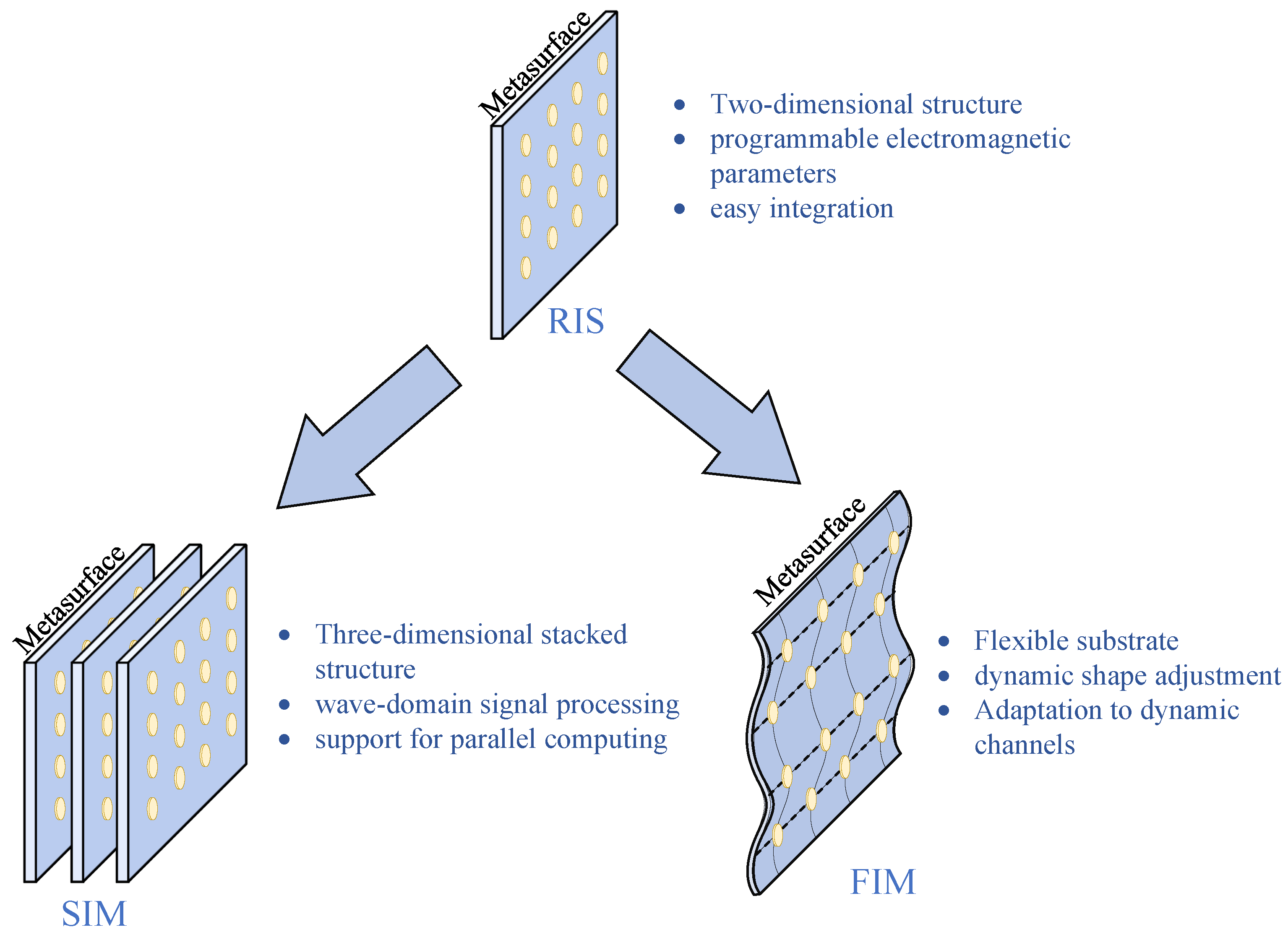
To address this demand, two representative advanced RIS paradigms have emerged and developed rapidly: stacked intelligent metasurface (SIM) and flexible intelligent metasurface (FIM). Among them, SIM uses a stacked architecture with multiple layers of programmable metasurfaces, overcoming the spatial limitations of traditional two-dimensional RISs. It can effectively reduce radio frequency (RF) energy consumption and processing latency [3], making it suitable for tasks such as radar sensing, multiple-input multiple-output (MIMO) precoding, and combination operations. Figure 1 illustrates the evolution of intelligent metasurface architecture.
This paper focuses on the systematic review and analysis of SIM technology. First, the architecture and principles of SIM are detailed. Second, an in-depth analysis is presented of the key challenges, application prospects, and future trends of SIM. Finally, common challenges in SIM technology, such as low-complexity design, model optimization, and performance evaluation, are summarized.

2. Stacked Intelligent Metasurface

Compared with the single-layer structure of traditional RIS, the multi-layer stacked architecture of SIM expands the regulatory dimensions of electromagnetic waves: traditional 2D RIS can only achieve spatial regulation in the planar direction, while SIM adds the degree of freedom in vertical regulation through layer-by-layer collaborative control, thereby significantly improving the flexibility of wave manipulation.

2.1. Architecture and Principles

Multiple layers of programmable metasurfaces stacked in a vertical manner form the SIM, with each layer separated by a dielectric substrate with specific electromagnetic properties. Dense arrays of reconfigurable meta-atoms are arranged on each metasurface layer, and a single meta-atom can independently adjust the amplitude, phase, or polarization state of the incident electromagnetic wave through external control signals (e.g., voltage and current). The number of layers and the scale of the meta-atom array can be configured to meet application requirements, balancing performance and engineering feasibility.
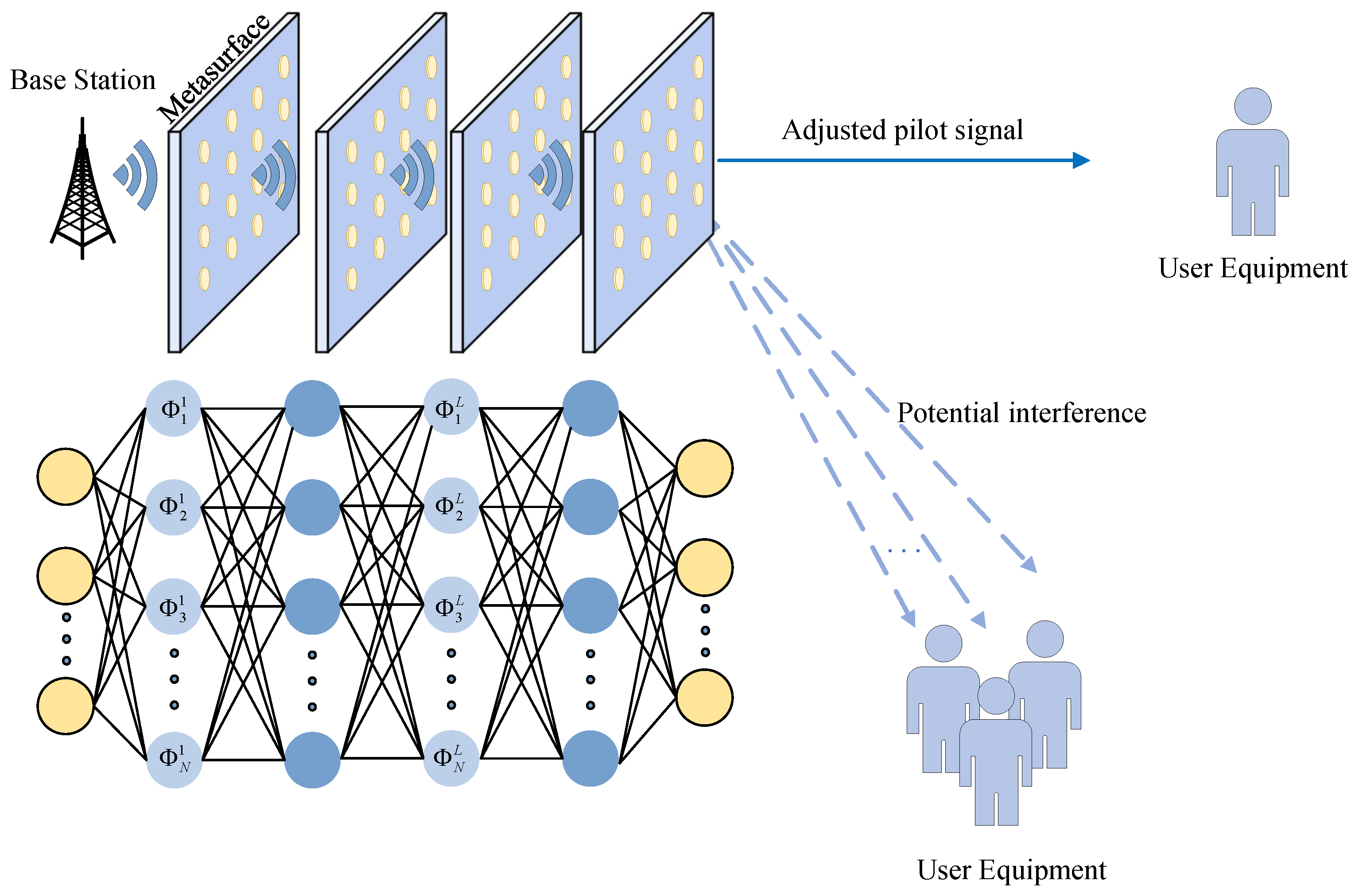
The stacked structure of SIM bears similarities to the structure and operation of the electromagnetic neural network (EMNN) [4] as shown in Figure 2. Each layer of the programmable metasurface can correspond to a “hidden layer” in the neural network, and each reconfigurable meta-atom acts as a “neuron” that performs localized electromagnetic signal processing. The propagation of vertically penetrating electromagnetic waves through multiple metasurface layers is analogous to signal transmission between neurons in a neural network, while the collaborative regulation of meta-atoms across layers enables the weighted processing of electromagnetic signals.
Based on the Rayleigh–Sommerfeld diffraction integral [5], we can establish the inter-layer transmission model of SIM. We can represent the transmission correlation from the n-th meta-atom of the ( l 1 ) -th metasurface layer to the n-th meta-atom of the l-th metasurface layer as follows:
w n , n , l l = A cos λ n , n l r n , n l 1 2 π r n , n l j 1 λ e j 2 π r n , n , l l / λ
where A stands for the area of each individual meta-atom, r n , n l denotes the corresponding propagation distance, and λ n , n l represents the included angle between the propagation direction and the normal direction of the ( l 1 ) -th metasurface layer. By iterating this propagation procedure all the way to the final metasurface layer, we can deduce the expression of the transfer function S of the SIM as follows:
S = φ L W L φ 2 W 2 φ 1 C N × N ,
Here, N stands for the quantity of meta-atoms distributed on each metasurface layer, W l C N × N denotes the propagation coefficient matrix between the ( l 1 ) -th and l-th metasurface layers, and φ l C N × N represents the transmission coefficient matrix corresponding to the l-th metasurface layer.
According to the Rayleigh–Sommerfeld diffraction integral model, the layer-by-layer transmission of electromagnetic waves inherently implements the multiplication of regulation matrices—that is, wave propagation itself is a matrix operation. There is no need for additional digital signal processors to perform complex matrix calculations, which significantly reduces the system’s energy consumption and processing latency.
In practical engineering applications, the ideal performance of the SIM architecture and signal processing mechanism is affected by non-ideal factors such as manufacturing errors, inter-layer alignment deviations, and inter-layer reflections. Therefore, targeted algorithms and processing technologies are required to optimize system performance. Currently, commonly used methods include the backpropagation algorithm [6] and inter-layer reflection reduction [7].
Due to manufacturing and assembly processes, the actual regulation coefficient of each meta-atom may deviate from the designed value, and inter-layer alignment errors can lead to a mismatch between the actual inter-layer transmission model and the theoretical model. These deviations will seriously affect the accuracy of electromagnetic wave manipulation. The backpropagation algorithm, widely used in neural networks for its efficient error correction, has been incorporated into the SIM calibration process. This method fully leverages the analogy between SIM and EMNN and achieves the high-precision correction of non-ideal factors via error backpropagation, ensuring system reliability in practical applications.
In the multi-layer stacked structure of SIM, electromagnetic waves reflect between adjacent layers due to parameter mismatches. Excessive interlayer reflection not only reduces system energy efficiency but also causes interference between reflected and incident waves, distorting the field distribution and affecting regulatory accuracy. Reducing inter-layer reflection can be achieved through processing technologies such as electromagnetic matching-layer design and meta-atom impedance optimization, which provide excellent inter-layer reflection suppression, thereby maximizing the transmission efficiency of electromagnetic waves between layers.
In the current transmission model, only the inter-layer unit correlation is considered, while the mutual coupling effect between adjacent meta-atoms within the same layer is not fully taken into account. Further investigation into the mutual coupling effect within the same layer should be conducted in future research.

2.2. Performance Comparison

Compared with 6G technologies such as MIMO systems and active RIS, SIMs demonstrate dual innovations in architecture and performance in wideband multi-user communication scenarios:
Traditional MIMO relies on digital baseband precoding technology for signal processing and interference suppression. It requires a large number of radio frequency (RF) chains and high-resolution digital-to-analog/analog-to-digital converters (DAC/ADC), resulting in high hardware complexity and power consumption. In wideband scenarios, independent precoding vectors must be designed for each subcarrier, leading to high computational overhead and significant latency when addressing frequency-selective fading and dynamic subcarrier scheduling. In contrast, through the three-dimensional stacked structure of multi-layer metasurfaces, SIM migrates signal processing from the digital domain to the electromagnetic wave domain. By virtue of precise phase manipulation, it directly achieves wave-domain beamforming and multi-user signal synthesis. Efficient communication can be achieved with only a small number of RF chains (the number matching the number of users), significantly reducing hardware complexity and power consumption. Research by Zheao Li et al. [8] indicates that SIM, relying on a dual-domain interference suppression mechanism combining wave-domain nulling and frequency-domain sparsity, greatly reduces inter-user interference (IUI). Its peak-to-average power ratio (PAPR) is 2–5 dB lower than that of traditional MIMO, and under the same spectral efficiency, it achieves a 2–3 dB advantage in the bit error rate (BER) of the worst-case link and a 40 percent to 80 percent improvement in energy efficiency. This provides a hardware-efficient, latency-controllable, and highly reliable solution for 6G wideband multi-user communications.
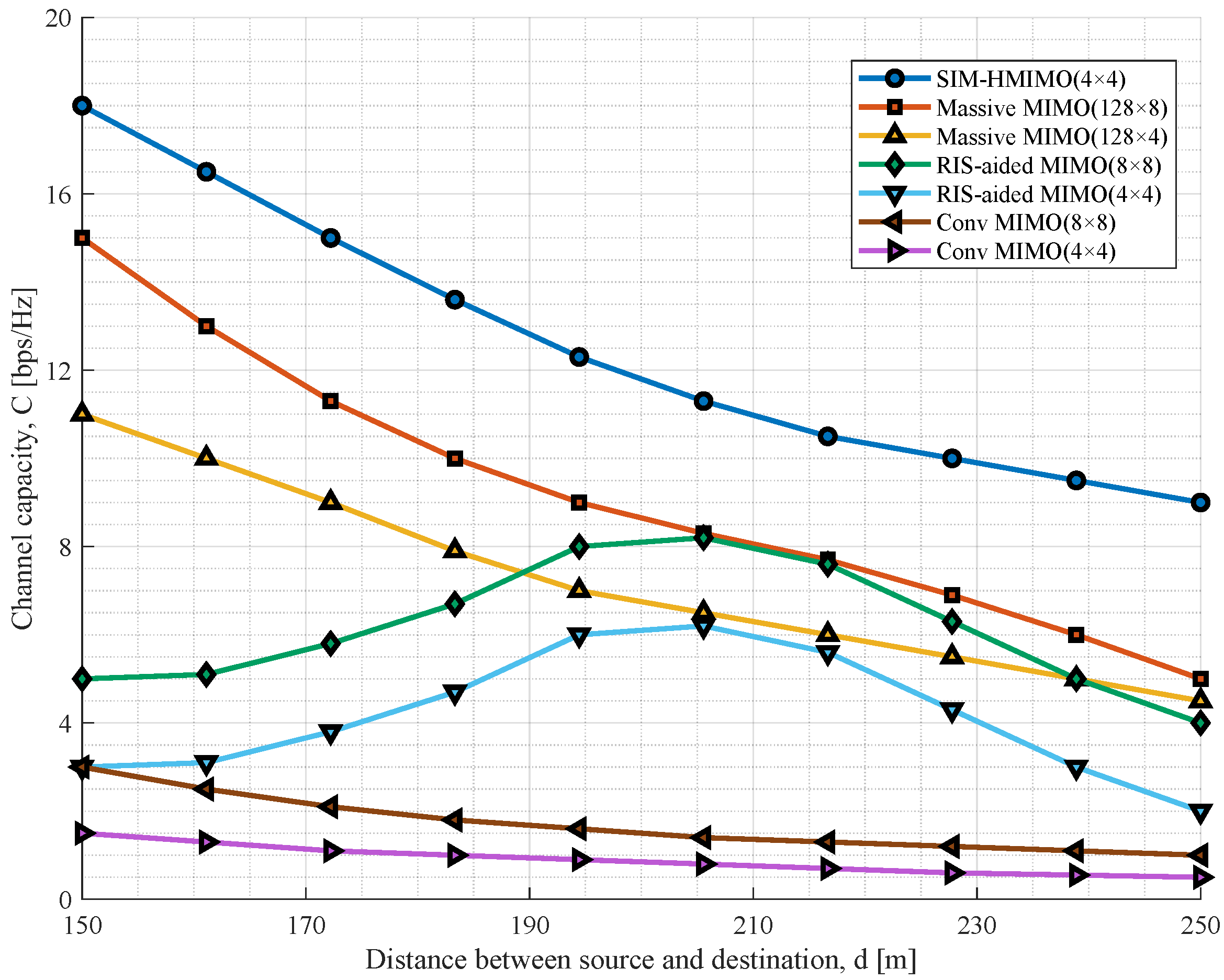
Holographic MIMO (HMIMO) developed on this basis can achieve precise manipulations such as near-field focusing and multi-beam generation by regulating the amplitude and phase of electromagnetic waves based on holographic principles [9]. Its spatial structure is mainly a two-dimensional near-continuous aperture, with antenna elements densely arranged at sub-wavelength intervals, holding broad application prospects in holographic communications, ultra-high-definition transmission, and other fields. However, the HMIMO signal processing is limited to electromagnetic wave holographic reconstruction and beam manipulation, lacking independent digital computing capabilities. In contrast, SIM achieves multidimensional signal processing through multi-layer cascading and can complete computing tasks in the wave domain, serving as a key support for reducing 6G hardware costs and improving link efficiency. In the future, the two can be deployed collaboratively to jointly meet the full-scenario requirements of 6G. The Figure 3 below compares the channel capacity advantages of the SIM-aided HMIMO system over traditional MIMO, RIS-aided MIMO, and other schemes.
Active RIS [11] can amplify reflected signals to offset double-path loss by integrating amplifiers. It still mainly features a two-dimensional planar structure, with control degrees of freedom limited to the phase and amplification factor of in-plane units. Meanwhile, Active RIS requires additional power supply modules and self-interference suppression circuits, resulting in high dependence on radio frequency (RF) chains. In contrast, SIM is characterized by a three-dimensional stacked structure, forming an “electromagnetic neural network” through the cascading of multi-layer programmable metasurfaces. It does not require complex amplification components and achieves signal processing solely relying on phase manipulation and inter-layer electromagnetic coupling. Each unit has lower power consumption, the number of RF chains can be reduced to match the number of users, and hardware complexity and power consumption are significantly decreased. Active RIS has cost advantages in small-scale, low-user-density scenarios such as indoor coverage supplementation and short-range signal enhancement. However, its low energy efficiency and single functionality make it difficult to support cross-domain tasks. SIM, on the other hand, with its high energy efficiency, strong interference suppression capability, and multi-function integration characteristics, is suitable for high-end 6G scenarios including wideband multi-user communication, near-field holographic transmission, and integrated sensing and communication (ISAC). It exhibits particularly prominent advantages under the requirements of massive user access and low-latency signal processing.
Traditional beam-scanning antenna technologies (such as phased arrays, leaky-wave antennas, and 2D RIS) mostly rely on planar or low-dimensional structures for beam manipulation, facing the bottleneck of single regulation dimension and insufficient degrees of freedom. The 1 × 4 conformal dielectric resonator antenna (DRA) phased array in [12] can achieve a wide-angle scan of ±28°, but it can only adjust the beam direction within a single plane and requires complex inter-element phase optimization to realize scanning. In contrast, the reconfigurable meta-atoms in each metasurface layer of SIM can independently adjust the amplitude, phase, and polarization of electromagnetic waves. Moreover, inter-layer collaborative control enables the weighted processing of electromagnetic waves, allowing SIM to simultaneously meet the beam requirements of multi-directional and multi-user scenarios—for example, generating independent narrow beams for users at different positions and avoiding the multi-user interference problem of traditional phased arrays.
Meanwhile, existing beam-scanning technologies generally face the dilemma of high complexity and high energy consumption. The technology in [13] achieves beam scanning through a periodic structure with 1-bit dielectric modulation, which requires precise adjustment for modulation period optimization and high-order harmonic suppression, and suffers from high beam update latency in dynamic scenarios. SIM fundamentally reduces complexity through a wave-domain signal processing mechanism. It can directly derive the transfer function through iteration, avoiding the complex matrix calculations required by traditional phased arrays.

2.3. Prototype Hardware

In recent years, with the gradual deepening of research, stacked intelligent metasurface (SIM) technology has gradually advanced from the theoretical research stage to the hardware design stage. In [14], SIM is utilized for the design of high-performance metalens antennas. Its meta-atoms adopt a symmetric three-layer stacked structure, with a planar size of 15 × 15 mm per unit. The substrate thickness is uniformly set to 1 mm, and the spacing between adjacent substrates is fixed at 5 mm. This spacing design ensures that the inter-layer electromagnetic coupling meets the requirements of amplitude-phase control accuracy. Meanwhile, the dielectric substrate is made of F4B material with a relative permittivity ϵ r = 2.2 , which exhibits low-loss characteristics. It can effectively reduce energy attenuation during electromagnetic wave transmission, making it suitable for high-frequency signal processing scenarios.
However, the current hardware design of SIM still faces significant challenges. The core obstacles focus on the high-precision manufacturing requirements for inter-layer alignment and the insertion loss control of the multi-layer structure, along with multidimensional constraints involving materials, processes, and system integration.
The core principle of SIM lies in realizing “wave-domain signal processing” through electromagnetic coupling among multi-layer metasurfaces. The inter-layer alignment accuracy directly determines the accuracy of electromagnetic propagation coefficients between meta-atoms (such as propagation distance r n , n l ). Any alignment deviation will lead to inter-layer signal crosstalk, transmission matrix distortion, and even failure to achieve expected functions such as beamforming and matrix operations. The size of SIM meta-atoms is typically 0.2 to 0.6 λ 0 (where λ 0 is the free-space wavelength), while the inter-layer alignment deviation must be controlled within λ 0 /50 to λ 0 /100 (i.e., micrometer to sub-micrometer scale). Existing manufacturing processes (such as 3D printing and precision lamination) struggle to stably meet this requirement, especially as cumulative deviations tend to exceed the threshold after multi-layer stacking.
Additionally, the multi-layer structure of SIM introduces cumulative insertion loss, mainly originating from meta-atom intrinsic loss, inter-layer dielectric absorption, and metal-dielectric interface reflection. Improper loss control will result in adverse effects such as signal power attenuation and signal-to-noise ratio (SNR) degradation. As the operating frequency of SIM extends to millimeter-wave and terahertz bands, the insertion loss problem will intensify exponentially.
Currently, SIM technology remains in the laboratory prototype stage. To achieve large-scale applications, further breakthroughs in precision manufacturing processes and low-loss active materials are required to exploit the advantages of SIM in wave-domain signal processing fully.

3. Challenges

SIMs, leveraging their multi-layered architecture and wave-domain signal-processing mechanism, overcome the dimensional limitations of traditional 2D RISs. However, in the practical deployment of complex 6G communication scenarios, realizing their functions still faces two key challenges: beamforming and channel estimation. These challenges stem from the inherent multi-layer coupling of SIMs, the complexity of electromagnetic propagation, and the dynamic requirements of practical applications, all of which directly affect system regulatory accuracy and communication performance. This section systematically analyzes the issues and technical bottlenecks.

3.1. Beamforming

Beamforming is a key function of SIMs that enables the precise directionality of electromagnetic waves and improves communication link quality. Its goal is to generate beams with target directionality, low sidelobes, and high gain by coordinating the regulation of meta-atoms across multiple layers. Nevertheless, the multi-layered structure and wave-domain transmission mechanism of SIMs introduce numerous technical difficulties to beamforming.
Unlike traditional 2D RISs, which require only optimizing the amplitude and phase parameters of in-plane meta-atoms, SIM beamforming requires joint optimization of regulatory coefficients for meta-atoms across L layers. Additionally, there is strong electromagnetic coupling between layers as described by the Rayleigh–Sommerfeld diffraction integral. This characteristic leads to a sharp increase in the dimensionality of beamforming optimization variables from N (the number of meta-atoms per layer) in traditional RISs to N × L , resulting in a high-dimensional, non-convex optimization problem. Conventional algorithms are prone to getting stuck in local optima, making it challenging to achieve globally optimal beamforming. To address this issue, Quran et al. [15] proposed a Riemannian conjugate gradient (RCG) algorithm for SIM-RSMA systems, which iteratively updates multi-layer phase shifts on the complex circle manifold, thereby improving global optimization accuracy. Perović et al. [16] considered dirty paper coding (DPC) as well as linear precoding (LP), and optimized the covariance matrices of users by means of successive convex approximation (SCA) and the Dinkelbach method to explore the energy efficiency (EE) performance of broadcast MIMO systems. Li et al. [17] proposed a layer-by-layer iterative optimization algorithm based on the non-uniform spherical wave model, reducing single-step complexity through an “fix-optimize” alternating strategy.
Meanwhile, high-speed mobile scenarios in 6G communications (such as high-speed railways and low-altitude aircraft) require SIMs to possess millisecond-level beam real-time tracking capabilities to adapt to the rapid position changes of terminals. However, SIM beamforming optimization involves complex matrix operations and iterative inter-layer transmission models, resulting in relatively high beam update latency. Therefore, meeting the real-time requirements of dynamic scenarios has also become a challenge for SIM beamforming. Li et al. [8] proposed a double-unfolded projected gradient descent network (UPGD-Net), transforming the traditional PGD algorithm into a learnable network, which increased the convergence speed of SIM phase optimization by 2.5 times in orthogonal frequency division multiplexing (OFDM) frame-level reconfiguration scenarios. In [18], downlink rate maximization was achieved through statistical channel state information (CSI). Rezvani et al. [19] implemented sum-rate optimization using the gradient ascent method and interior-point method under hardware constraints. Chen et al. [20] partitioned reconfigurable intelligent surfaces (RISs) into active and inactive groups via a greedy search grouping strategy. This approach enhances beam orthogonality by minimizing the orthogonal error of the array response matrix, significantly reducing the dimension of parameter optimization. Simultaneously, it simplifies the matrix operation process of analog beamforming, improving real-time response capability while ensuring beam adjustment accuracy.
Among these, the RCG algorithm balances accuracy and complexity, making it suitable for single-objective phase-shift optimization in IRS/SIM systems; the SCA algorithm offers high accuracy with moderate complexity, adapting to multi-variable collaborative optimization scenarios; the UPGD-Net delivers optimal real-time performance but relies on offline training, fitting well in wideband dynamic scheduling scenarios. We summarize the core differences between the algorithms as follows (Table 1):

3.2. Channel Estimation

Channel estimation is a prerequisite for SIMs to achieve key functions such as precise beamforming and efficient resource allocation. Its primary goal is to accurately capture the complete CSI of incident electromagnetic waves and their transmission between SIM layers, including key parameters like angle of incidence, channel gain, and inter-layer coupling coefficients.
The channel model of traditional 2D RISs can be simplified to a three-dimensional mapping relationship of “incident wave—single-layer metasurface—reflected/transmitted wave”. In contrast, the SIM channel requires constructing a multidimensional coupled model of “incident wave—multi-layer metasurface—inter-layer diffraction—output wave”. The dimension of its CSI expands from the traditional N × 1 to L × N × 1 . Additionally, it is necessary to incorporate parameters strongly related to meta-atom positions, layer count, and operating frequency, such as inter-layer coupling coefficients and diffraction propagation factors, which significantly increase the difficulty of analytical modeling. Meanwhile, in multi-user Holographic MIMO scenarios, the number of base-station antennas is far lower than that of meta-atoms in each layer of the SIM. The increase in user links further intensifies the coupling degree of channel parameters, making channel detection more challenging.
Yao et al. [21] acquired multiple replicas of uplink pilot signals transmitted via the SIM and proposed two subspace channel estimators. They optimized the SIM phase shifts to minimize the mean squared error (MSE) of the channel estimator, thereby improving channel estimation. Research on ultra-massive MIMO channels [22] has shown that the channel estimation accuracy can be improved by jointly exploiting the low-rank property and sparsity characteristics in the beam domain through an integrated framework that fuses sparse Bayesian learning with soft-threshold gradient descent.

4. Application and Development

4.1. Application Prospects

With its high-dimensional regulatory capability from a multi-layer stacked architecture, low-power consumption in wave-domain signal processing, and flexibility in complex electromagnetic environments, the SIM demonstrates broad potential in key 6G application scenarios. Table 2 summarizes the research progress on SIM applications.

4.1.1. ISAC

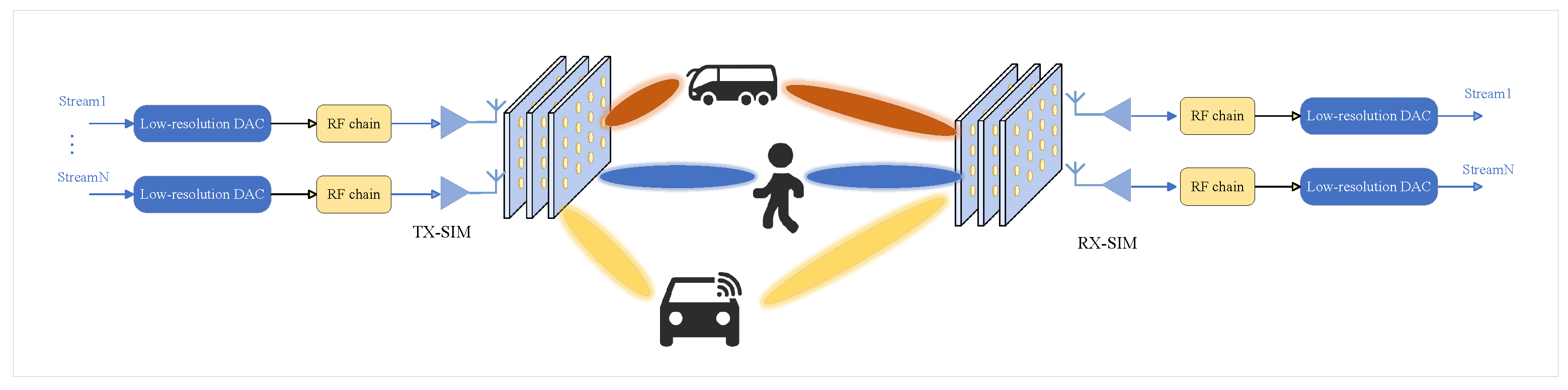
Leveraging the wave-domain regulation capability of its multi-layer stacked structure, the SIM breaks through the limitation of the optimization degrees of freedom of traditional single-layer RISs, providing a new “communication-sensing” collaborative optimization solution for ISAC systems. Figure 4 presents the specific application scenarios of SIM-aided ISAC.
Ranasinghe et al. [40] developed a metasurface-parametrized doubly dispersive (MPDD) channel model that integrates the interlayer diffraction coefficients of the SIM and the reflection characteristics of the RIS into the channel matrix. This model accurately captures the Doppler shift and delay spread effects in high-mobility scenarios (such as vehicles and low-altitude aircraft), offering a key channel modeling tool for SIM-assisted ISAC. Meanwhile, a receiver design incorporating joint low-rank and sparse characteristics was proposed [41], enabling the receiver to complete multi-task joint processing in the wave domain. This avoids the high complexity of traditional digital signal processing and provides a new path for the ISAC receiver design. Niu et al. [42] maximized the system spectral efficiency by introducing a penalty term to take into account the constraints on sensing power, designed a tailored gradient-ascent algorithm, and explored wave-domain ISAC precoding. Chen et al. [43] proposed a stochastic network calculus (SNC)-based probabilistic delay bound analysis framework, combined with a joint optimization algorithm of block coordinate descent (BCD) and semidefinite relaxation (SDR). By integrating SIM phase regulation with queue-delay modeling, this method provides a quantifiable delay-guarantee approach for ISAC low-latency scenarios. Ref. [44] proposed an energy efficiency (EE) maximization scheme based on a three-dimensional (3D) geometry-based channel model and the proximal policy optimization (PPO) algorithm, addressing the balance between energy efficiency and quality of service (QoS) caused by channel fading and complex resource allocation in practical urban environments.
Wave-domain processing technology significantly improves sensing resolution, reduces processing latency, and simplifies hardware complexity through direct electromagnetic waveform manipulation and multi-layer collaborative computing, outperforming traditional digital-domain methods by a considerable margin.
Traditional digital-domain methods rely on planar dimension control of base station antenna arrays and can only optimize beam directions through digital signal processing. Their sensing dimensions are limited, making it difficult to distinguish between multiple short-range targets or weakly scattering targets. In contrast, wave-domain processing technology, based on SIM, achieves three-dimensional collaborative control of electromagnetic waves via a multi-layer stacked architecture. Combined with the Rayleigh–Sommerfeld diffraction integral model, it enables the refined joint optimization of waveform amplitude, phase, and polarization, increasing the sensing degrees of freedom from N-dimension (for traditional 2D RIS) to L × N -dimension (where L denotes the number of layers and N denotes the number of meta-atoms per layer). Meanwhile, traditional digital-domain methods require complex signal reconstruction after ADC sampling, leading to target features being susceptible to quantization noise and sampling distortion, with weak target features easily submerged. In contrast, wave-domain processing technology leverages the electromagnetic coupling effect of multi-layer meta-atoms in SIM to directly enhance and separate target scattering signals in the wave domain, eliminating the need for digital sampling and quantization processes and preserving the integrity of original target features.
In terms of processing latency, traditional digital-domain methods involve multiple stages, including signal reception, ADC sampling, digital demodulation, feature extraction, and beam optimization, with each stage introducing processing delays. The total latency typically ranges from 10 to 100 ms. In contrast, the multi-layer transmission of SIM itself constitutes a signal processing process: as electromagnetic waves propagate between layers, meta-atom manipulation directly accomplishes beamforming, interference suppression, and target signal enhancement, without the need for additional matrix operations by digital signal processors. Additionally, wave-domain processing technology directly implements interference suppression and target signal screening in the wave domain, transmitting only the processed effective feature signals. This reduces data volume by 70 percent to 90 percent, avoiding the transmission delays associated with massive raw data.

4.1.2. Low Earth Orbit Satellite Communications

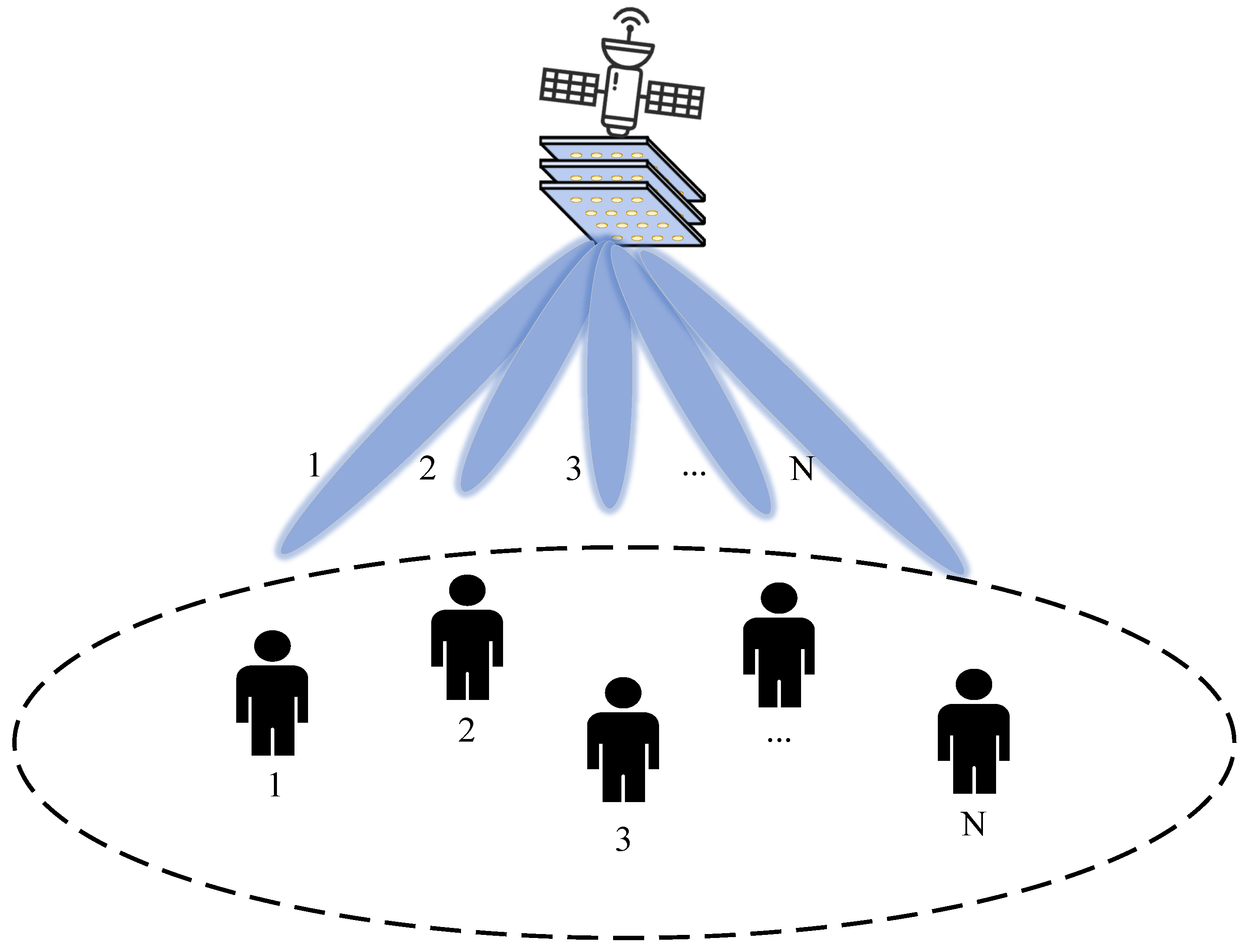
Low Earth orbit (LEO) satellite communication has emerged as one of the key technologies for seamless global connectivity in 6G, thanks to its wide coverage and low-latency characteristics. The SIM, leveraging its multi-layer wave-domain regulation architecture, enables low-complexity beamforming and interference suppression without requiring large-scale digital signal processing units. This provides a lightweight, energy-efficient optimization solution for LEO satellite communications. Figure 5 illustrates a schematic diagram of SIM-assisted LEO satellite communication.
Lin et al. [24] designed a LEO satellite communication system using SIM and proposed a user-grouping approach relying on channel correlation along with a corresponding antenna-selection algorithm. These technologies enable multi-user beamforming directly in the electromagnetic wave domain, significantly enhancing system performance. In [45], SIM is integrated with symbiotic radio (SR), and three optimization algorithms—BCD-SCA, multi-constraint proximal policy optimization (MCPPO), and model-assisted multi-agent constraint soft actor-critic (MA-CSAC)—are proposed to achieve dynamic balance between energy efficiency (EE) and spectral efficiency (SE).

4.1.3. Semantic Communication

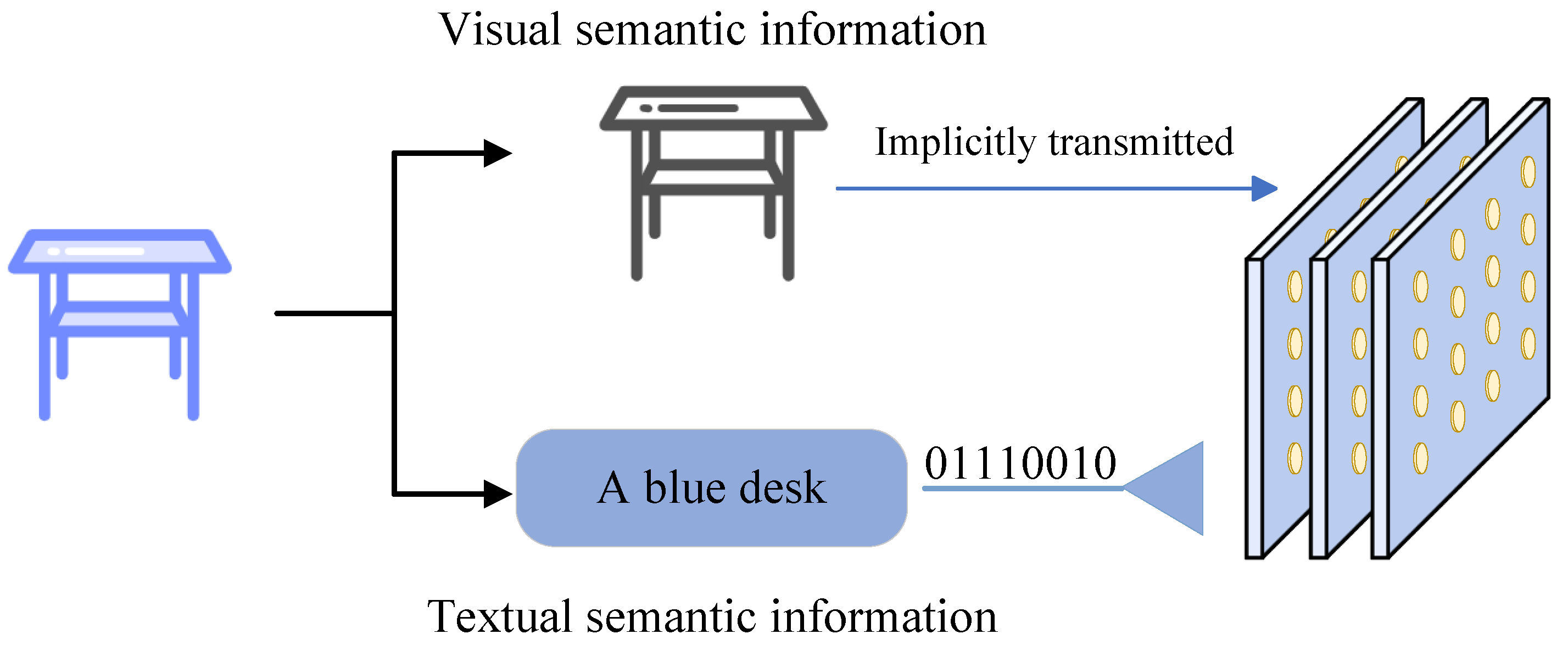
As a key paradigm for efficient transmission in 6G, semantic communication significantly reduces the bandwidth overhead by extracting semantic information rather than transmitting raw data. Leveraging its wave-domain computing capability, the SIM integrates semantic encoding into the propagation process of electromagnetic signals, reducing the complexity of semantic communication while improving transmission fidelity. Figure 6 illustrates the application scenario of SIM-assisted semantic communication.
Huang et al. [46] proposed that textual semantics are transmitted through traditional amplitude-phase modulation, while visual semantics are implicitly transmitted via specific radiation patterns generated by the SIM without additional bandwidth consumption. At the receiver, a conditional generative adversarial network (CGAN) can fuse these two types of semantics, thereby significantly improving reconstruction accuracy for complex scenes. In [47], a SIM semantic encoding architecture based on an EMNN was proposed. The SIM is structured as a “source encoding layer + semantic encoding layer” and requires only the receiver to detect antenna energy to complete image recognition. To address the core security risks of semantic communication (such as eavesdropping attacks, jamming attacks, etc.), in [48], we combine the forward noise-adding and reverse denoising mechanism of diffusion models with the wave-domain processing capability of SIM to construct a security-enhanced SIM-aided semantic communication architecture.

4.1.4. UAV Communications

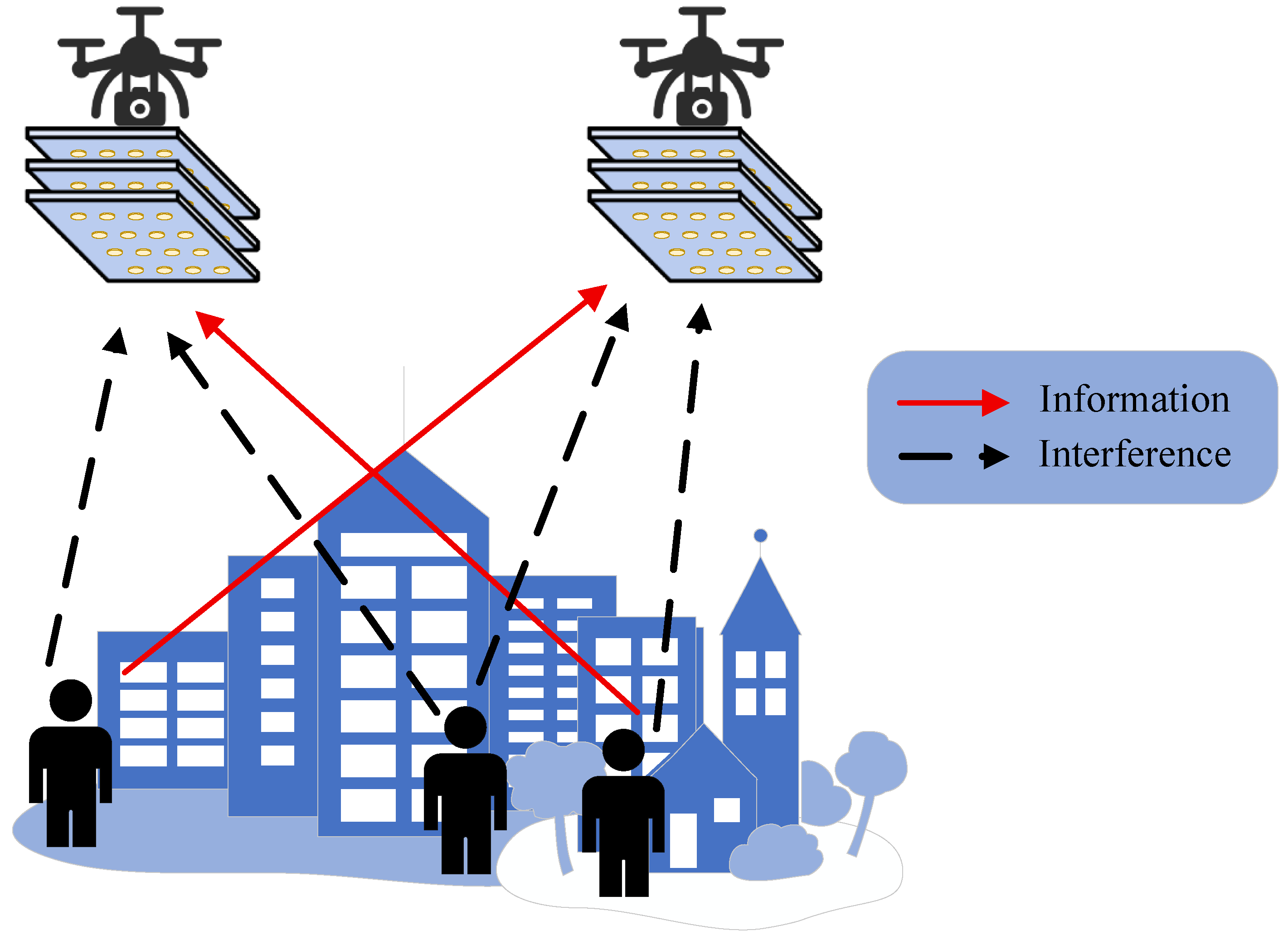
Unmanned Aerial Vehicles (UAVs), leveraging their high mobility and rapid deployment capabilities, have become key access nodes in low-altitude economy (LAE) networks. SIMs provide a lightweight, energy-efficient solution for UAV communications and are well-suited to typical application scenarios such as multi-user collaboration and dynamic coverage. Figure 7 illustrates the SIM-assisted UAV communications scenario.
Xiong et al. [49] proposed a dual-twin architecture comprising a digital twin-SIM (DT-SIM) and an electric vertical take-off and landing (eVTOL). This architecture optimizes beamforming parameters through the SIM DT, employs a fractional programming algorithm to optimize transmission power, and uses a gradient ascent algorithm to adjust the phase matrix. It addresses the pain points of insufficient computing resources and large trajectory deviations in traditional UAV communications. Sun et al. [50] proposed a generative artificial intelligence (GAI)-enhanced alternating optimization (AO) framework. This framework decomposes the user association, UAV positioning, and SIM phase optimization into convex optimization subproblems. Compared with traditional iterative algorithms, it reduces runtime by 10 percent and is well-suited to the dynamic deployment requirements of UAVs in low-altitude environments. Fan et al. [51] proposed a three-layer AO algorithm that integrates user association, UAV positioning, and phase-shift optimization. This algorithm suppresses multi-user interference and verifies a positive correlation among the number of SIM layers, the number of meta-atoms, and interference suppression performance. To address the issue of limited sensing performance for high-altitude UAVs caused by the downtilt of base station antennas, ref. [52] proposes a joint optimization scheme combining hybrid RIS and the MoE-PPO algorithm, which improves algorithm convergence and optimization efficiency.

4.2. Development Trends

4.2.1. Integration with Machine Learning

The deep integration of SIM and machine learning (ML) will address the limitations of traditional optimization algorithms, including limited generalization and insufficient real-time performance. By constructing a model of the transmitter-channel-receiver system in the form of an end-to-end deep neural network (DNN) [53], the phase shifts of SIM meta-atoms can be treated as trainable network parameters. This integration provides a lightweight implementation path for scenarios such as 6G edge intelligence. Meanwhile, SIM can be integrated with electronic neural networks to construct hybrid optoelectronic neural networks [54], thereby reducing the complexity of subsequent electronic networks and enabling low-power, high-frame-rate applications.

4.2.2. Integration of Nonlinear Devices

Traditional SIM relies on linear electromagnetic responses and is limited to passive regulation. However, integrating nonlinear devices will enable SIM to perform active signal processing, expanding its applications in scenarios such as energy-efficient transmission and complex signal modulation. The electromagnetic units of SIM enable the fine-grained dynamic adjustment of amplitude and phase parameters by integrating nonlinear control switches.

5. Future Directions

Despite SIM demonstrating theoretical advantages in high-dimensional electromagnetic wave manipulation through their multi-layer stacked architecture, their practical engineering and large-scale applications still face inherent limitations determined by core mechanisms, which require further exploration in the future. At the hardware implementation level, SIM imposes stringent requirements on the sub-wavelength alignment accuracy of meta-atoms between layers (with errors required to be < λ /10). A micrometer-scale offset can lead to a mismatch between the inter-layer transmission model and the theoretical design. At the algorithmic level, SIM beamforming confronts the challenge of high-dimensional non-convex optimization, which is prone to falling into local optima or relying on extensive training data and iterative computations. Meanwhile, in practical applications, the cascading effects of single-point failures must be considered. Each metasurface layer of SIM consists of a large number of meta-atoms connected in series or parallel. The failure of a single meta-atom can affect the manipulation accuracy of the entire system through inter-layer coupling. Additionally, the multi-layer structure of SIM makes local maintenance difficult, requiring overall replacement and resulting in high maintenance costs. To achieve large-scale applications in the future, further exploration of SIM is necessary. Examples include developing microfabrication processes with atomic-level precision, proposing breakthrough low-dimensional optimization algorithms, or identifying new dielectric materials that balance low loss and light weight.

5.1. Low-Complexity Design

The key challenge of low-complexity design is balancing the hardware implementation difficulty of SIM systems with the efficiency of algorithm optimization, which not only reduces deployment costs but also adapts to the real-time requirements of dynamic scenarios.
At the hardware level, the multi-layer structure of SIM faces increased control complexity due to the surge in the number of meta-atoms. By introducing meta-fibers into SIM to construct a two-layer architecture, hardware deployment can be significantly simplified [55]: meta-fibers focus electromagnetic energy and suppress interference from uncorrelated meta-atoms, enabling the two-layer SIM to possess the wave-domain signal processing capability of traditional seven-layer SIM with a reduction of 59 percent in the total count of meta-atoms.
At the algorithmic level, the complexity of existing optimization algorithms increases with the total number of antennas, carriers, and meta-atoms [56,57]. Deep learning can be considered to compress the optimization dimension, reducing algorithm latency while ensuring multi-user fairness and communication performance.
How to design a collaborative approach to hardware simplification and algorithm lightweighting is a key breakthrough direction for low-complexity design.

5.2. Optimization Modeling

The key challenge in modeling and optimization is developing an accurate, generalizable mathematical model that fully captures the physical properties of SIM and the dynamic changes in complex scenarios. The main research includes the following.
Traditional SIM modeling typically assumes unilateral propagation, ignoring inter-layer mutual coupling and feedback effects, which makes it difficult to reduce the channel-fitting NMSE. A T-parameter modeling scheme based on multiport network theory is proposed in [58], replacing nested iteration with matrix multiplication to reduce modeling complexity while accurately capturing inter-layer coupling and energy attenuation. According to the research in [59], artificial noise (AN) in wireless communications faces open challenges such as imperfect CSI, Eve’s countermeasures, and the lack of low-complexity algorithms. Exploring how to optimize the interference efficiency of AN through the inter-layer channel modeling of SIM can further enrich the application dimensions and practical value of SIM technology.
In [28], the SIM is modeled as a complex-valued neural network (CV-NN), which supports non-orthogonal wavefront design and adapts to multi-objective optimization.
Ref. [52] proposed a statistical multiport network model with mutual coupling (MC) and 1-bit quantization constraints, solving the modeling distortion problem caused by discrete phases and meta-atom mutual coupling in actual hardware.
Ref. [29] presented a general electromagnetic collaborative object (ECO) model based on Z-parameters, eliminating approximate assumptions such as “unilateral propagation” and “neglecting mutual coupling”.

5.3. Performance Evaluation

Existing evaluations primarily focus on traditional communication metrics, such as sum-rate and BER, while neglecting SIM-specific hardware indicators, including meta-atom control energy consumption and device lifespan. Meanwhile, current evaluations are primarily based on ideal line-of-sight (LoS) scenarios, with insufficient testing in complex scattering environments, such as dense urban areas and indoor multi-obstruction scenarios. Therefore, a comprehensive and practical evaluation system should be established that not only covers multidimensional performance indicators but also adapts to the evolving characteristics of SIM technology.

6. Conclusions

This paper reviews the progress of SIM technology and its application potential in 6G communications: firstly, it analyzes the multi-layer stacked architecture and wave-domain signal processing principle of SIM, elaborating on its advantage of breaking through the regulatory limitations of traditional 2D RIS; secondly, it discusses the application prospects of SIM in key scenarios such as ISAC and LEO satellite communications, as well as future development trends including integration with machine learning and nonlinear devices; finally, it analyzes the three key challenges faced by SIM, namely low-complexity design, modeling and optimization, and performance evaluation. It is hoped that the systematic collation in this paper will serve as a reference for related research and promote the large-scale adoption of SIM technology in next-generation wireless communications.

Author Contributions

Conceptualization, J.K.; Formal analysis, J.L.; Writing—original draft, J.L.; Writing—review & editing, J.L. and J.K. All authors have read and agreed to the published version of the manuscript.

Funding

This research received no external funding.

Data Availability Statement

No new data were created in this study.

Conflicts of Interest

Author Jiacheng Kong was employed by the company China Academy of Railway Sciences Group Co., Ltd. The remaining author declares that the research was conducted in the absence of any commercial or financial relationships that could be construed as a potential conflict of interest.

References

  1. Wu, Q.; Zhang, S.; Zheng, B.; You, C.; Zhang, R. Intelligent reflecting surface-aided wireless communications: A tutorial. IEEE Trans. Commun. 2021, 69, 3313–3351. [Google Scholar] [CrossRef]
  2. Shi, E.; Zhang, J.; Du, H.; Ai, B.; Yuen, C.; Niyato, D.; Letaief, K.B.; Shen, X. RIS-aided cell-free massive MIMO systems for 6G: Fundamentals, system design, and applications. Proc. IEEE 2024, 112, 331–364. [Google Scholar] [CrossRef]
  3. An, J.; Yuen, C.; Xu, C.; Li, H.; Ng, D.W.K.; Di Renzo, M.; Debbah, M.; Hanzo, L. Stacked intelligent metasurface-aided MIMO transceiver design. IEEE Wirel. Commun. 2024, 31, 123–131. [Google Scholar] [CrossRef]
  4. Zhang, Y.; Liu, Q.; Xia, Y.; Xia, G.; Wang, Q. SIM-Assisted End-to-End Co-Frequency Co-Time Full-Duplex System. arXiv 2025, arXiv:2510.27270. [Google Scholar]
  5. Lin, X.; Rivenson, Y.; Yardimci, N.; Veli, M.; Luo, Y.; Jarrahi, M.; Ozcan, A. All-optical machine learning using diffractive deep neural networks. Science 2018, 361, 1004–1008. [Google Scholar] [CrossRef]
  6. Liu, H.; An, J.; Jia, X.; Gan, L.; Karagiannidis, G.K.; Clerckx, B.; Bennis, M.; Debbah, M.; Cui, T.J. Stacked intelligent metasurfaces for wireless communications: Applications and challenges. IEEE Wirel. Commun. 2025, 32, 46–53. [Google Scholar] [CrossRef]
  7. An, J.; Yuen, C.; Guan, Y.L.; Di Renzo, M.; Debbah, M.; Poor, H.V.; Hanzo, L. Two-dimensional direction-of-arrival estimation using stacked intelligent metasurfaces. IEEE J. Sel. Areas Commun. 2024, 42, 2786–2802. [Google Scholar]
  8. Li, Z.; An, J.; Yuen, C. Stacked Intelligent Metasurface-Enhanced Wideband Multiuser MIMO OFDM-IM Communications. arXiv 2025, arXiv:2509.22327. [Google Scholar]
  9. Gong, T.; Gavriilidis, P.; Ji, R.; Huang, C.; Alexandropoulos, G.C.; Wei, L.; Zhang, Z.; Debbah, M.; Poor, H.V.; Yuen, C. Holographic MIMO communications: Theoretical foundations, enabling technologies, and future directions. IEEE Commun. Surv. Tutor. 2023, 26, 196–257. [Google Scholar] [CrossRef]
  10. An, J.; Xu, C.; Ng, D.W.K.; Alexandropoulos, G.C.; Huang, C.; Yuen, C.; Hanzo, L. Stacked intelligent metasurfaces for efficient holographic MIMO communications in 6G. IEEE J. Sel. Areas Commun. 2023, 41, 2380–2396. [Google Scholar] [CrossRef]
  11. Zhi, K.; Pan, C.; Ren, H.; Chai, K.K.; Elkashlan, M. Active RIS versus passive RIS: Which is superior with the same power budget? IEEE Commun. Lett. 2022, 26, 1150–1154. [Google Scholar] [CrossRef]
  12. Gupta, P.K.; Tiwari, G.; Kumar, T.; Mukherjee, B. A Novel Dielectric Resonator Antenna with Applications in Wide-Angle Beam-Scanning Phased Array. Microw. Opt. Technol. Lett. 2025, 67, e70305. [Google Scholar]
  13. Wang, S.; Wang, W.; Chung, K.L.; Zheng, Y. An Orthogonal Quad-Beam Scanning Antenna Using 1-Bit Dielectric Modulation in Plasmonic Metamaterial Transmission Line for Traffic Monitoring Applications. IEEE Trans. Veh. Technol. 2025. [Google Scholar] [CrossRef]
  14. Liu, P.; Chen, Z.N. Full-range amplitude–phase metacells for sidelobe suppression of metalens antenna using prior-knowledge-guided deep-learning-enabled synthesis. IEEE Trans. Antennas Propag. 2023, 71, 5036–5045. [Google Scholar]
  15. Quran, A.; Naser, S.; Tariq, M.; Alhussein, O.; Muhaidat, S. Max-Min Fairness in Stacked Intelligent Metasurface-Aided Rate Splitting Networks. arXiv 2025, arXiv:2505.08521. [Google Scholar]
  16. Perović, N.S.; Bahingayi, E.E.; Tran, L.N. Energy-efficient designs for SIM-based broadcast MIMO systems. IEEE Trans. Commun. 2025, 73, 15881–15894. [Google Scholar]
  17. Li, Q.; El-Hajjar, M.; Xu, C.; An, J.; Yuen, C.; Hanzo, L. Stacked intelligent metasurface-based transceiver design for near-field wideband systems. IEEE Trans. Commun. 2025; early access. [Google Scholar]
  18. Papazafeiropoulos, A.; Kourtessis, P.; Chatzinotas, S.; Kaklamani, D.I.; Venieris, I.S. Achievable rate optimization for large stacked intelligent metasurfaces based on statistical CSI. IEEE Wirel. Commun. Lett. 2024, 13, 2337–2341. [Google Scholar] [CrossRef]
  19. Rezvani, M.; Adve, R.; bin Sediq, A.; El-Keyi, A. Uplink wave-domain combiner for stacked intelligent metasurfaces accounting for hardware limitations. In Proceedings of the ICC 2025—IEEE International Conference on Communications, Montreal, QC, Canada, 8–12 June 2025; pp. 2424–2429. [Google Scholar]
  20. Chen, W.; Wen, C.-K.; Li, X.; Jin, S. Channel customization for joint Tx-RISs-Rx design in hybrid mmWave systems. IEEE Trans. Wirel. Commun. 2023, 22, 8304–8319. [Google Scholar]
  21. Yao, X.; An, J.; Gan, L.; Di Renzo, M.; Yuen, C. Channel estimation for stacked intelligent metasurface-assisted wireless networks. IEEE Wirel. Commun. Lett. 2024, 13, 1349–1353. [Google Scholar] [CrossRef]
  22. Ji, J.; Wang, C.-X.; Chen, S.; Huang, C.; Wu, X.; Björnson, E. Joint Low-Rank and Sparse Bayesian Channel Estimation for Ultra-Massive MIMO Communications. arXiv 2025, arXiv:2512.04470. [Google Scholar] [CrossRef]
  23. An, J.; Chaaban, A. Hybrid digital-wave domain channel estimator for stacked intelligent metasurface enabled multi-user MISO systems. In Proceedings of the 2024 IEEE Wireless Communications and Networking Conference (WCNC), Dubai, United Arab Emirates, 21–24 April 2024; pp. 1–6. [Google Scholar]
  24. Lin, S.; An, J.; Gan, L.; Debbah, M.; Yuen, C. Stacked intelligent metasurface enabled LEO satellite communications relying on statistical CSI. IEEE Wirel. Commun. Lett. 2024, 13, 1295–1299. [Google Scholar] [CrossRef]
  25. Papazafeiropoulos, A.; Kourtessis, P.; Kaklamani, D.I.; Venieris, I.S. Channel Estimation for Stacked Intelligent Metasurfaces in Rician Fading Channels. IEEE Wirel. Commun. Lett. 2025, 14, 1411–1415. [Google Scholar] [CrossRef]
  26. Li, Z.; An, J.; Yuen, C. Fundamental trade-off in wideband stacked intelligent metasurface assisted OFDMA systems. arXiv 2025, arXiv:2509.08294. [Google Scholar] [CrossRef]
  27. Darsena, D.; Iudice, I.; Galdi, V.; Verde, F. Randomized Space-Time Coded Stacked Intelligent Metasurfaces for Massive Multiuser Downlink Connectivity. arXiv 2025, arXiv:2510.23440. [Google Scholar] [CrossRef]
  28. Zayat, A.; Abbas, O.; Markley, L.; Chaaban, A. Deep Complex-Valued Neural-Network Modeling and Optimization of Stacked Intelligent Surfaces. In Proceedings of the 2025 IEEE International Mediterranean Conference on Communications and Networking (MeditCom), Nice, France, 7–10 July 2025; pp. 1–6. [Google Scholar]
  29. Abrardo, A.; Bartoli, G.; Toccafondi, A. A novel comprehensive multiport network model for stacked intelligent metasurfaces (SIM) characterization and optimization. IEEE Trans. Commun. 2025, 73, 11559–11573. [Google Scholar] [CrossRef]
  30. Wang, Z.; Liu, H.; Zhang, J.; Xiong, R.; Wan, K.; Qian, X.; Di Renzo, M.; Qiu, R.C. Multi-user ISAC through stacked intelligent metasurfaces: New algorithms and experiments. In Proceedings of the GLOBECOM 2024—2024 IEEE Global Communications Conference, Cape Town, South Africa, 8–12 December 2024; pp. 4442–4447. [Google Scholar]
  31. Li, S.; Zhang, F.; Mao, T.; Na, R.; Wang, Z.; Karagiannidis, G.K. Transmit beamforming design for ISAC with stacked intelligent metasurfaces. IEEE Trans. Veh. Technol. 2024, 74, 6767–6772. [Google Scholar] [CrossRef]
  32. Fadakar, A.; Molisch, A.F. Stacked Intelligent Metasurfaces for Multicarrier Cognitive Radio ISAC. arXiv 2025, arXiv:2511.13933. [Google Scholar] [CrossRef]
  33. Ranasinghe, K.R.R.; Sandoval, I.A.M.; de Abreu, G.T.F.; Alexandropoulos, G.S. Parametrized Stacked Intelligent Metasurfaces for Bistatic Integrated Sensing and Communications. arXiv 2025, arXiv:2504.20661. [Google Scholar] [CrossRef]
  34. An, J.; Di Renzo, M.; Debbah, M.; Poor, H.V.; Yuen, C. Stacked intelligent metasurfaces for multiuser downlink beamforming in the wave domain. IEEE Trans. Wirel. Commun. 2025, 24, 5525–5538. [Google Scholar] [CrossRef]
  35. Yang, X.; Zhang, J.; Shi, E.; Liu, Z.; Liu, J.; Zheng, K.; Ai, B. Joint SIM configuration and power allocation for stacked intelligent metasurface-assisted MU-MISO systems with TD3. In Proceedings of the GLOBECOM 2024—2024 IEEE Global Communications Conference, Cape Town, South Africa, 8–12 December 2024; pp. 3255–3260. [Google Scholar]
  36. Jia, X.; An, J.; Liu, H.; Gan, L.; Di Renzo, M.; Debbah, M.; Yuen, C. Stacked intelligent metasurface enabled near-field multiuser beamfocusing in the wave domain. In Proceedings of the 2024 IEEE 99th Vehicular Technology Conference (VTC2024-Spring), Singapore, 24–27 June 2024; pp. 1–5. [Google Scholar]
  37. Hashida, H.; Di, B. Precoding-free Hierarchical Rate-Splitting Multiple Access via Stacked Intelligent Metasurface. arXiv 2025, arXiv:2510.24246. [Google Scholar]
  38. Shi, E.; Zhang, J.; Zhu, Y.; An, J.; Yuen, C.; Ai, B. Uplink performance of stacked intelligent metasurface-enhanced cell-free massive MIMO systems. IEEE Trans. Wirel. Commun. 2025, 24, 3731–3746. [Google Scholar] [CrossRef]
  39. Liu, M.; Li, X.; An, J.; Yuen, C. Onboard terrain classification via stacked intelligent metasurface-diffractive deep neural networks from SAR level-0 raw data. arXiv 2025, arXiv:2503.13488. [Google Scholar]
  40. Ranasinghe, K.R.R.; Rou, H.S.; Sandoval, I.A.M.; de Abreu, G.T.F.; Alexandropoulos, G.C. Metasurfaces-Integrated Doubly-Dispersive MIMO: Channel Modeling and Optimization. arXiv 2025, arXiv:2506.14985. [Google Scholar]
  41. Ranasinghe, K.R.R.; Sandoval, I.A.M.; Rou, H.S.; De Abreu, G.T.F.; Alexandropoulos, G.C. Doubly-Dispersive MIMO Channels with Stacked Intelligent Metasurfaces: Modeling, Parametrization, and Receiver Design. arXiv 2025, arXiv:2501.07724. [Google Scholar] [CrossRef]
  42. Niu, H.; An, J.; Papazafeiropoulos, A.; Gan, L.; Chatzinotas, S.; Debbah, M. Stacked intelligent metasurfaces for integrated sensing and communications. IEEE Wirel. Commun. Lett. 2024, 13, 2807–2811. [Google Scholar] [CrossRef]
  43. Chen, L.; Xiong, K.; Qin, Y.; Yu, H.; Leng, S.; Yuen, C. Stacked Intelligent Metasurfaces-Aided eVTOL Delay Sensitive Communications. arXiv 2025, arXiv:2507.06632. [Google Scholar]
  44. Ma, Z.; Zhang, R.; Ai, B.; Lian, Z.; Zeng, L.; Niyato, D.; Peng, Y. Deep reinforcement learning for energy efficiency maximization in RSMA-IRS-assisted ISAC system. IEEE Trans. Veh. Technol. 2025, 74, 18273–18278. [Google Scholar] [CrossRef]
  45. Saadat Yeganeh, R.; Behroozi, H.; Omidi, M.J.; Robat Mili, M.; Jorswieck, E.A.; Chatzinotas, S. Enhancing Energy and Spectral Efficiency in IoT-Cellular Networks via Active SIM-Equipped LEO Satellites. arXiv 2025, arXiv:2508.17149. [Google Scholar]
  46. Huang, G.; An, J.; Gan, L.; Niyato, D.; Debbah, M.; Cui, T.J. Stacked Intelligent Metasurfaces for Multi-Modal Semantic Communications. arXiv 2025, arXiv:2506.12368. [Google Scholar] [CrossRef]
  47. Huang, G.; An, J.; Yang, Z.; Gan, L.; Bennis, M.; Debbah, M. Stacked intelligent metasurfaces for task-oriented semantic communications. IEEE Wirel. Commun. Lett. 2024, 14, 310–314. [Google Scholar] [CrossRef]
  48. He, B.; Chen, Z.; Luo, J.; Liu, C.; Wang, S.; Wang, S.; Quek, T.Q.S. Towards Secure Semantic Transmission In the Era of GenAI: A Diffusion-based Framework. arXiv 2025, arXiv:2505.05724. [Google Scholar]
  49. Xiong, K.; Chen, Z.; Xie, J.; Qin, Y.; Leng, S.; Yuen, C. Digital Twin-based SIM Communication and Flight Control for Advanced Air Mobility. IEEE Trans. Netw. Sci. Eng. 2025, 13, 728–744. [Google Scholar] [CrossRef]
  50. Sun, G.; Fan, M.; Zhang, L.; Pan, H.; Li, J.; Zhang, C.; Li, Y.; Zhao, C.; Yuen, C. Generative AI-enhanced Low-Altitude UAV-Mounted Stacked Intelligent Metasurfaces. arXiv 2025, arXiv:2506.23488. [Google Scholar]
  51. Fan, M.; Sun, G.; Pan, H.; Wang, J.; An, J.; Du, H.; Yuen, C. Joint Association and Phase Shifts Design for UAV-mounted Stacked Intelligent Metasurfaces-assisted Communications. arXiv 2025, arXiv:2508.00616. [Google Scholar]
  52. Ma, Z.; Liang, Y.; Zhu, Q.; Zheng, J.; Lian, Z.; Zeng, L.; Fu, C.; Peng, Y.; Ai, B. Hybrid-RIS-Assisted Cellular ISAC Networks for UAV-Enabled Low-Altitude Economy via Deep Reinforcement Learning with Mixture-of-Experts. IEEE Trans. Cogn. Commun. Netw. 2025, 12, 3875–3888. [Google Scholar] [CrossRef]
  53. Stylianopoulos, K.; Alexandropoulos, G.C. Integrating Stacked Intelligent Metasurfaces and Power Control for Dynamic Edge Inference via Over-The-Air Neural Networks. arXiv 2025, arXiv:2509.18906. [Google Scholar] [CrossRef]
  54. Mengu, D.; Luo, Y.; Rivenson, Y.; Ozcan, A. Analysis of diffractive optical neural networks and their integration with electronic neural networks. IEEE J. Sel. Top. Quantum Electron. 2019, 26, 3700114. [Google Scholar] [CrossRef] [PubMed]
  55. Niu, H.; An, J.; Wu, T.; Chen, J.; Zhao, Y.; Guan, Y.L.; Di Renzo, M.; Debbah, M.; Karagiannidis, G.K.; Poor, H.V.; et al. Introducing meta-fiber into stacked intelligent metasurfaces for MIMO communications: A low-complexity design with only two layers. IEEE Trans. Wirel. Commun. 2025. [Google Scholar] [CrossRef]
  56. Shi, E.; Zhang, J.; An, J.; Zhang, G.; Liu, Z.; Yuen, C.; Ai, B. Joint AP-UE association and precoding for SIM-aided cell-free massive MIMO systems. IEEE Trans. Wirel. Commun. 2025, 24, 5352–5367. [Google Scholar]
  57. Li, Z.; An, J.; Yuen, C. Stacked intelligent metasurfaces for fully-analog wideband beamforming design. In Proceedings of the 2024 IEEE VTS Asia Pacific Wireless Communications Symposium (APWCS), Singapre, 21–23 August 2024; pp. 1–5. [Google Scholar]
  58. Yahya, H.; Nerini, M.; Clerckx, B.; Debbah, M. T-Parameters Based Modeling for Stacked Intelligent Metasurfaces: Tractable and Physically Consistent Model. IEEE Wirel. Commun. Lett. 2025, 14, 2149–2153. [Google Scholar] [CrossRef]
  59. Niu, H.; Xiao, Y.; Lei, X.; Chen, J.; Xiao, Z.; Li, M.; Yuen, C. A survey on artificial noise for physical layer security: Opportunities, technologies, guidelines, advances, and trends. IEEE Commun. Surv. Tutor. 2025, 28, 341–381. [Google Scholar] [CrossRef]
Figure 1. Evolution of intelligent metasurface architecture.
Electronics 15 00274 g001
Figure 2. SIM multi-layer propagation model.
Electronics 15 00274 g002
Figure 3. Channel capacity comparison of SIM-aided HMIMO [10].
Electronics 15 00274 g003
Figure 4. The specific application scenarios of SIM-aided ISAC.
Electronics 15 00274 g004
Figure 5. SIM-assisted LEO satellite communication.
Electronics 15 00274 g005
Figure 6. The application scenario of SIM-assisted semantic communication.
Electronics 15 00274 g006
Figure 7. The scenario of SIM-assisted UAV communications.
Electronics 15 00274 g007
Table 1. Core differences between the algorithms.
Comparison DimensionRCG AlgorithmSCA AlgorithmUPGD-Net Algorithm
Optimization AccuracyModerately excellent (approaching local optimality)HighHigh (close to global optimal solution)
Computational ComplexityLow/moderate: single iteration complexity is O ( L M 2 + K 2 M ) , with no training overheadModerate: single iteration complexity is O ( I U K N t 2 N r + L N 3 ) alternatively optimizes multiple variablesHigh for offline training: O ( N c T ( L M 2 + K 2 M ) ) ; low for online inference (fixed T operations)
Convergence TimeModerate: converges in 25–50 iterationsModerately slow: converges in 30–100 iterationsExtremely fast: no iteration in online inference, outputs in real time
Core AdvantagesBalances accuracy and complexity; no training required; strong stabilitySupports multi-variable collaborative optimization; high upper limit of accuracyLow latency adapts to dynamic scenarios; frame-level real-time response
Core LimitationsOnly optimizes the single variable of phase-shift vectorAlternating optimization leads to long single-iteration timeRelies on offline training; generalization is affected by sample coverage
Application ScenariosIRS-aided multi-user MIMO, static/slow-varying channels, single-variable phase-shift optimizationSIM-aided broadcast MIMO, slow-varying channels, energy efficiency/sum rate optimization, multi-variable collaborationSIM-enhanced wideband OFDM-IM, dynamic subcarrier scheduling, low-latency BER optimization
I U denotes the number of inner iterations, N t / N r denote the number of transmit/receive antennas, N c denotes the number of subcarriers, T denotes the number of unfolded iterations.
Table 2. The research progress of SIM applications.
ReferenceMain Research TaskObjective FunctionOptimization DirectionFeatures
[21]Channel EstimationMSESubspace Projection EstimationStatistical CSI
[23]Channel EstimationNMSEGradient DescentLow-Rank Channel Reduction Optimization
[24]BeamformingErgodic Sum RateAOStatistical CSI, User Grouping, Antenna Selection
[17]BeamformingSpectral EfficiencyLayer-by-Layer Iterative OptimizationIterative Water-Filling Power Allocation
[25]BeamformingNMSEProjected Gradient DescentCNN
[26]BeamformingChannel Fitting with NMSE EvaluationAOPCCP, MILP Subcarrier Allocation
[27]BeamformingTime-averaged Sum RateProjected Gradient DescentOpportunistic User Scheduling with Partial CSI
[28]BeamformingSER, Spectral EfficiencyGradient DescentCV-NN, SVD
[29]BeamformingMSEGradient DescentZ-parameter Modeling, Diagonal T-RIS Architecture
[30]BeamformingTarget Estimation CRBMAOSDR
[31]BeamformingTime-averaged Sum RateGradient Descent D 3
[32]ISACSU Localization BCRBGradient Descent, AODNN Backpropagation
[33]ISACWeakest Channel Path Gain, MSEGradient AscentPDA-Based Sparse Recovery
[8]Multi-user PrecodingBERGradient DescentIterative Water-Filling Power Allocation
[34]Multi-user PrecodingSum RateProjected Gradient Ascent, AOWater-Filling Algorithm
[35]Multi-user PrecodingSum RateTD3Continuous Action Spaces
[36]Multi-user PrecodingNMSE, Sum RateGradient DescentIterative Water-Filling Power Allocation
[37]Multi-user CombinationMinimum User RateAOSPSA, Local Greedy Refinement
[38]Multi-user CombinationSum Spectral EfficiencyLayer-wise Iterative OptimizationStatistical CSI, Greedy Iteration
[19]Multi-user CombinationSum RateGradient AscentIPM
[15]Power AllocationMinimum User RateAOSCA, RCG
[39]Terrain ClassificationClassification Accuracy, Recall RateData AugmentationOffline Phase Learning
Disclaimer/Publisher’s Note: The statements, opinions and data contained in all publications are solely those of the individual author(s) and contributor(s) and not of MDPI and/or the editor(s). MDPI and/or the editor(s) disclaim responsibility for any injury to people or property resulting from any ideas, methods, instructions or products referred to in the content.