Explainable Predictive Jurisprudence for Anticipating Legal Doctrine Evolution in Dynamic Judicial Systems


Abstract
1. Introduction
- -
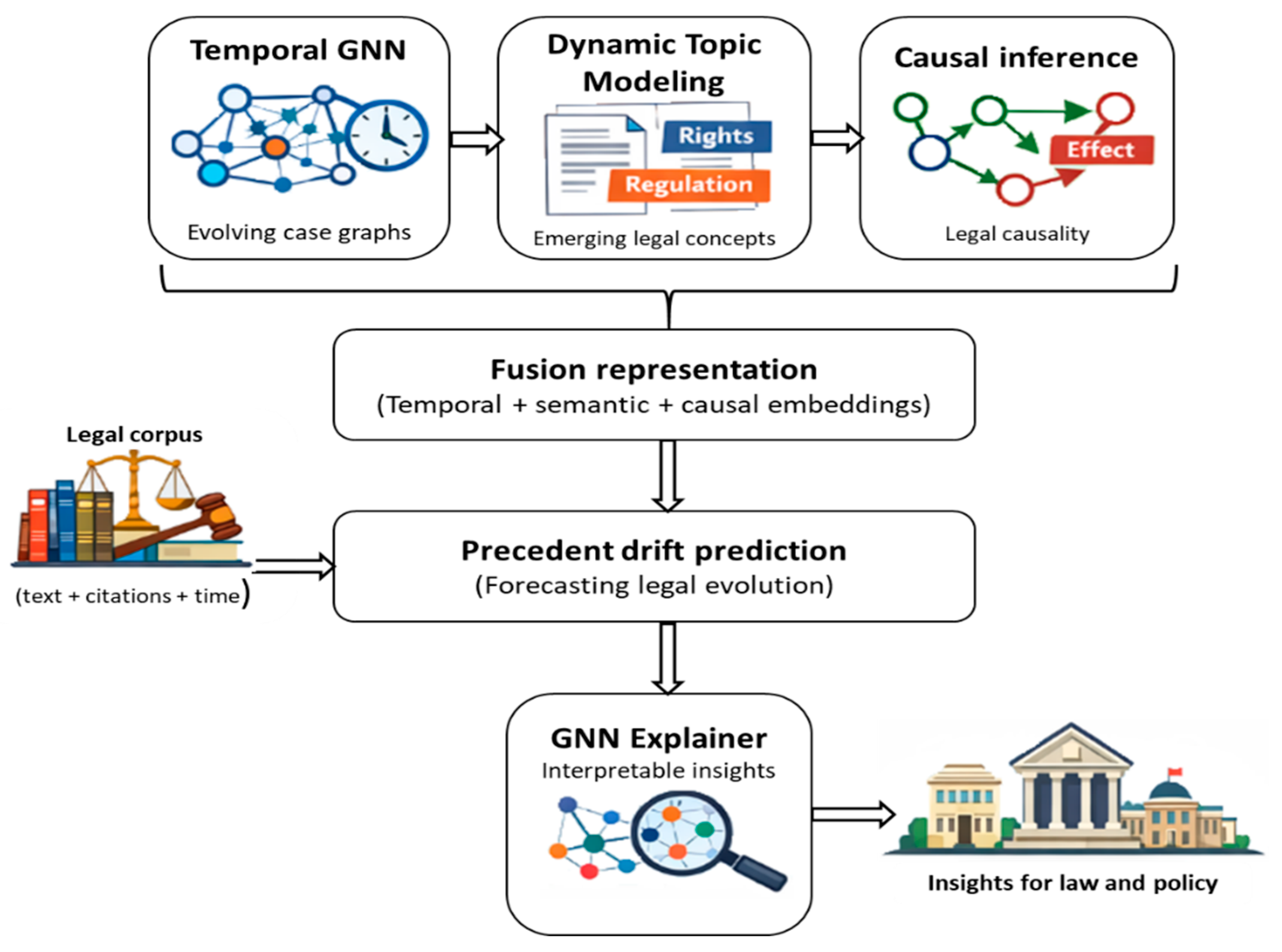
- A unified precedent drift predictive model combining causal, semantic, and structural legal changes.
- -
- Hybridizing this model with TGNN, DTM, and causal inference for forecasting.
- -
- Adding an explainable layer via GNNExplainer, for identifying and analyzing precedent drift.
- -
- Experimenting with the proposed model and comparing with standard algorithms on two datasets (Free Law Project and LePaRD).
- -
- How does one model and enumerate precedent drifts in evolving legal applications?
- -
- Is explainable AI able to enhance explainability in predictive legal models?
- -
- How does causal inference distinguish true precedent influences from correlations?
- -
- How does temporal graph learning, semantic and causal modeling optimize the prediction of legal cases?
2. Related Works
2.1. Summary of State of the Art
2.2. Critical Discussion and Research Gap
- -
- Fragmentation across modeling dimensions: Most works focus on one aspect only: TGNN-based models capturing structural evolution but ignoring semantics and causality, NLP models (such as BERT) capturing semantic understanding but ignoring graph structure, or causal models focusing on cause–effect relationships but lacking temporal graph context. Indeed, even advanced hybrid approaches (such as temporal heterogeneous GNNs) only partially integrate structure and semantics, leaving out explainability and causal reasoning.
- -
- The scarcity of predictive models adopted in law: Most current legal AI research, such as CaseGNN, focuses on retrieval, classification, and similarity but does not define or quantify precedent deviations, nor does it provide predictive tools for legal change.
- -
- Lack of intelligent platforms based on explainable causal law: Legal systems rely on principles of reasoning and traceable decisions. Current models (such as deep models and TGNNs) are black boxes that provide no explanation for the decisions made. Furthermore, these models do not rely on causal reasoning with graph learning. This gap is significant because legal AI needs to achieve the highest levels of transparency and accountability.
3. Methods and Material
3.1. Problem Formulation and Preliminaries
- (i)
- Structural drift Δtstruct = ‖At − At−1‖F or spectral distances;
- (ii)
- Semantic drift Δtsem = KL(βt‖βt−1) over topic parameters; and
- (iii)
- Causal drift Δtcausal = ∑(j,i)∣CEj→it − CEj→it−1∣.
- (A1)
- Causal acyclicity in the contemporaneous graph.
- (A2)
- Temporal Markovity of order 1.
- (A3)
- Smooth semantic evolution: ‖βt − βt−1‖ ≤ Lβ.
- (A4)
- Bounded degree/weights.
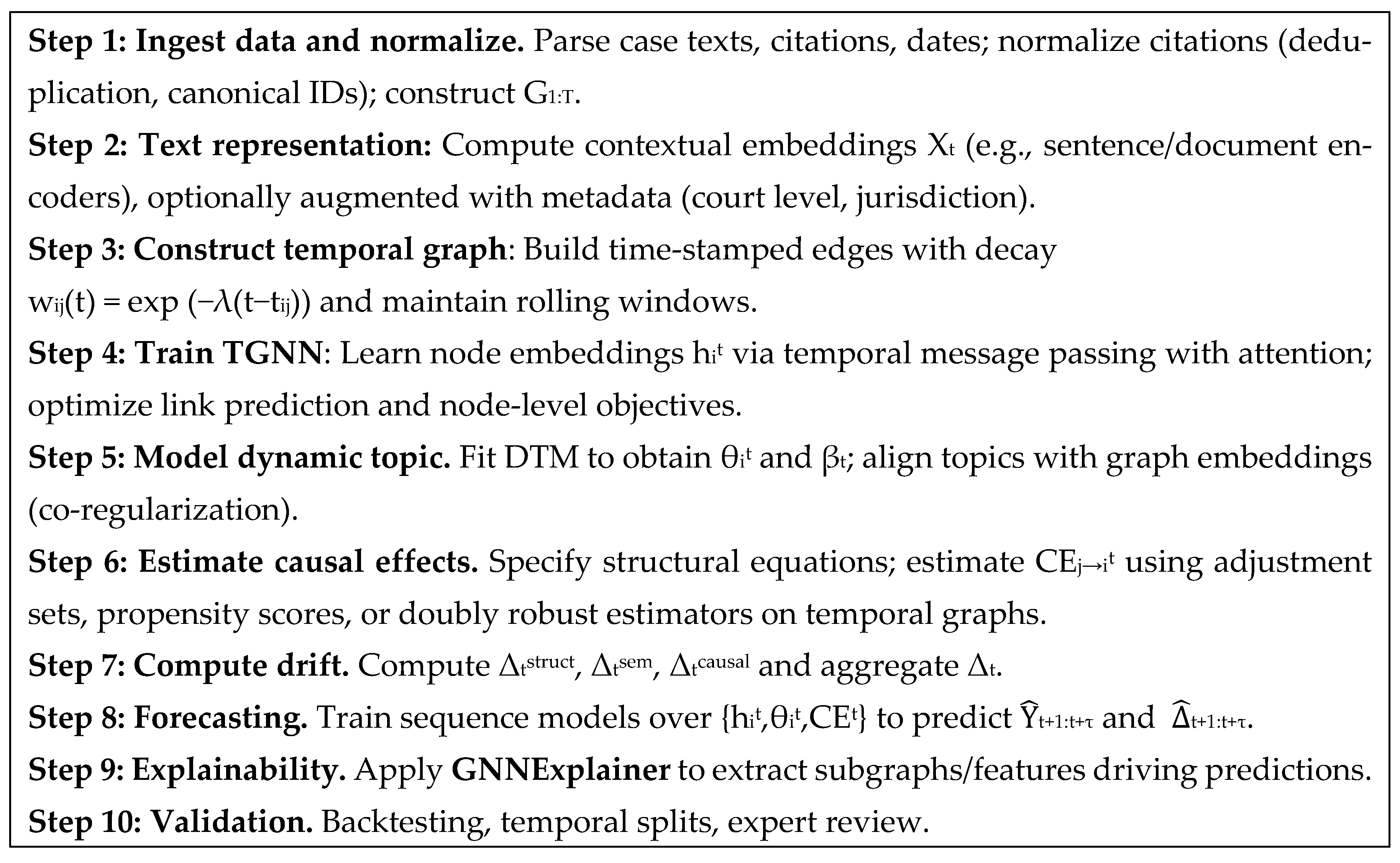
3.2. Algorithmic Pipeline
- -
- Complexity of TGNN: O(∑t∣Et∣d).
- -
- Complexity of DTM: O(TKV).
- -
- Complexity of causal inference: O(∣E∣log n) optimized via sampling.
3.3. Temporal Graph Neural Network (TGNN)
3.4. Dynamic Topic Modeling (DTM)
3.5. Causal Inference on Precedent Graphs
3.6. Joint Learning Objective
3.7. Theoretical Analysis
- Causal part: By Pearl’s backdoor criterion, for each (j, i, t),E[Yit ∣ do(Aji = a)] = ∑zE[Yit ∣ Aji = a, Zijt = z] P(Zijt = z),
- which is estimable from observational data given positivity and correct Zijt.
- Hence CEj→it is identifiable.
- Structural part: Distances Δtstruct are functions of At and At−1. Since At is observed, identifiability is trivial. When using learned embeddings, the injectivity of the TGNN encoder ensures a one-to-one mapping (modulo isomorphism), so distances computed in the embedding space correspond to those in the graph space.
- Semantic part: In DTM, the parameters βt are identifiable up to permutation under standard conditions (non-degeneracy and sufficient separation). The KL divergence is invariant to label permutation when consistently aligned; hence, Δtsem is identifiable.
- Aggregation: Since each component is identifiable (up to permissible equivalences), their weighted sum Δt is identifiable up to topic label permutation. □
3.8. Explainability via GNNExplainer
4. Results
4.1. Baseline Selection and Fair Experimental Protocol
4.2. Experimental Setup
4.3. Quantitative Performance
4.4. Drift Prediction Analysis
4.5. Temporal Drift and Temporal Topic Evolution Analysis
4.6. Backtesting Historical Legal Shifts
Qualitative Case Study: Evolution of Digital-Privacy Jurisprudence
4.7. Attention Heatmap Analysis
4.8. Evaluation of Explainability of Citation Subgraph
4.9. Evaluation of Statistical Significance
4.10. Evaluation of Robustness
4.11. Evaluation of Computational Efficiency
4.12. Evaluation of Cross-Jurisdiction Generalization
4.13. Evaluation of Human Experts
4.14. Component Contribution Analysis
5. Discussion
- -
- Time-based modeling tools are in general effective in tracking legal evolution. Indeed, due to their incapacity in managing the dynamic behavior of case law, static paradigms, such as latent discrimination analysis and generative neural networks, fail in obtaining an accurate variance ratio. Nonetheless, Temporal GNN successfully identifies evolving citation patterns, then generates better predictions.
- -
- The use of dynamic topic modeling in our platform allows for better identification of semantic shifts in legal doctrines. The tests confirm that citation networks are characterized by a timeline indicating that evolution in legal language generally occurs before structural evolution. The latter fact transforms the semantic deviation into an early indicator of legal evolution.
- -
- The accuracy of the obtained causal evaluation confirms that causal reasoning considerably enhances the predictions and their explainability. In legal contexts, this is relevant since the decisions must be justified based on legitimate case law.
- -
- The use of GNNExplainer allows a better capture of the most important precedent links guiding the prediction process. In our evaluations, this accuracy of interpretation is validated by human experts.
6. Conclusions
Supplementary Materials
Author Contributions
Funding
Institutional Review Board Statement
Informed Consent Statement
Data Availability Statement
Conflicts of Interest
References
- Corso, G.; Stark, H.; Jegelka, S.; Jaakkola, T.; Barzilay, R. Graph neural networks. Nat. Rev. Methods Primers 2024, 4, 17. [Google Scholar] [CrossRef] [Scilit]
- Krook, J.; Winter, P.; Downer, J.; Blockx, J. A systematic literature review of artificial intelligence (AI) transparency laws in the European Union (EU) and United Kingdom (UK): A socio-legal approach to AI transparency governance. AI Ethics 2025, 5, 4069–4090. [Google Scholar] [CrossRef] [Scilit]
- Ying, Z.; Bourgeois, D.; You, J.; Zitnik, M.; Leskovec, J. Gnnexplainer: Generating explanations for graph neural networks. Adv. Neural Inf. Process. Syst. 2019, 32, 9240–9251. [Google Scholar] [PubMed]
- Zhang, T.; Fang, J.; Chen, X.; Yang, Z. Enhanced Temporal Graph Neural Network for Predicting Future Citations on Academic Graphs: A Dual Clustering-Driven and Centrality-Guided Approach. Knowl.-Based Syst. 2025, 329, 114282. [Google Scholar] [CrossRef] [Scilit]
- Aldawsari, M. TempReasoner: Neural temporal graph networks for event timeline construction. Sci. Rep. 2026, 16, 4985. [Google Scholar] [CrossRef] [Scilit] [PubMed]
- Li, H.; Liang, H.; Hu, Y.; Liu, X. Technology convergence prediction based on temporal heterogeneous graph neural networks. Inf. Process. Manag. 2025, 62, 104034. [Google Scholar] [CrossRef] [Scilit]
- Li, Y.; Zhang, X.; Cui, Y.; Ma, S. Hyperbolic Graph Neural Network for Temporal Knowledge Graph Completion. In Proceedings of the 2024 Joint International Conference on Computational Linguistics, Language Resources and Evaluation (LREC-COLING 2024); ELRA and ICCL: Torino, Italy, 2024; pp. 8474–8486. [Google Scholar]
- Tang, Y.; Qiu, R.; Liu, Y.; Li, X.; Huang, Z. CaseGNN: Graph Neural Networks for Legal Case Retrieval with Text-Attributed Graphs. In Advances in Information Retrieval: 46th European Conference on Information Retrieval, ECIR 2024, Glasgow, UK, 24–28 March 2024; Proceedings, Part II; Springer: Cham, Switzerland, 2024; pp. 80–95. [Google Scholar] [CrossRef] [Scilit]
- Yuan, L.; Zhang, X.; Ke, Y.; Lu, Z.; Li, X.; Liu, C. Temporal Community Detection and Analysis with Network Embeddings. Mathematics 2025, 13, 698. [Google Scholar] [CrossRef] [Scilit]
- Ahmed, M.J.; Mozo, A.; Karamchandani, A. A survey on graph neural networks, machine learning and deep learning techniques for time series applications in industry. PeerJ Comput. Sci. 2025, 11, e3097. [Google Scholar] [CrossRef] [Scilit]
- Liang, G.; Tiwari, P.; Byttner, S.; Alonso-Fernandez, F. Dynamic Causal Explanation Based Diffusion-Variational Graph Neural Network for Spatiotemporal Forecasting. IEEE Trans. Neural Netw. Learn. Syst. 2025, 36, 9524–9537. [Google Scholar] [CrossRef] [Scilit] [PubMed]
- Srivastav, S.; Shruti, K.M.; Agarwal, D.; Soni, P.; Singh, R. Intelligent justice: AI-driven forensics and legal process for criminal justice reforms. Int. J. Law Crime Justice 2026, 84, 100832. [Google Scholar] [CrossRef] [Scilit]
- Wang, Y.; Alawad, M.A.; Alfilh, R.H.C.; Singh, N.S.S. Temporal influence maximization via continuous-time graph neural networks and deep reinforcement learning. Sci. Rep. 2026, 16, 8987. [Google Scholar] [CrossRef] [Scilit] [PubMed]
- Zhu, Y.; Liu, Q. Hybrid graph attention network-LSTM models for causal-aware supply chain forecasting. J. Intell. Manuf. 2026, 19. [Google Scholar] [CrossRef] [Scilit]
- Feng, G.; Qin, Y.; Huang, R.; Chen, Y. Criminal Action Graph: A semantic representation model of judgement documents for legal charge prediction. Inf. Process. Manag. 2023, 60, 103421. [Google Scholar] [CrossRef] [Scilit]
- Zhang, H.; Zhang, T.; Yang, Z.; Wang, W.; Ju, M.; Wen, D.; Cao, B. Temporal Katz Centrality Estimation with Temporal Graph Neural Networks. In Advanced Data Mining and Applications. ADMA 2025; Yoshikawa, M., Meng, X., Cao, Y., Xiao, C., Chen, W., Wang, Y., Eds.; Lecture Notes in Computer Science; Springer: Singapore, 2026; Volume 16200. [Google Scholar] [CrossRef] [Scilit]
- Wang, X.; Jiang, H.; Dong, Y.; Mu, M. Spatial-channel collaborative multi-scale graph interaction deep transfer learning for unsupervised rotating machinery fault diagnosis. Eng. Appl. Artif. Intell. 2026, 176, 114691. [Google Scholar] [CrossRef] [Scilit]
- He, H.; Sun, C.; Huang, Y.; Huang, G.; Hao, X. Spmixnet: Spatial-channel collaborative modeling for enhanced small-object segmentation in LiDAR point clouds. Vis. Comput. 2026, 42, 464. [Google Scholar] [CrossRef] [Scilit]
- Hassanat, A.B.; Alqaralleh, M.K.; Tarawneh, A.S.; Almohammadi, K.; Alamri, M.; Alzahrani, A.; Altarawneh, G.A.; Alhalaseh, R. A Novel Outlier-Robust Accuracy Measure for Machine Learning Regression Using a Non-Convex Distance Metric. Mathematics 2024, 12, 3623. [Google Scholar] [CrossRef] [Scilit]
- Liu, J.; Jiang, F.; Tashiro, S.; Chen, S.; Tanaka, M. A physics-informed and data-driven framework for robotic welding in manufacturing. Nat. Commun. 2025, 16, 4807. [Google Scholar] [CrossRef] [Scilit] [PubMed]
- Zhao, H.; Wang, B.; Fu, Y.; Zhou, M.; Li, N.; Gao, Z. Fixed-time adaptive smooth control with relaxed performance constraints for a canard rotor/wing UAV subject to aerodynamic interferences and actuator faults. Aerosp. Sci. Technol. 2026, 178, 112959. [Google Scholar] [CrossRef] [Scilit]
- Job, S.; Tao, X.; Cai, T.; Xie, H.; Li, L.; Li, Q.; Yong, J. Exploring Causal Learning Through Graph Neural Networks: An In-Depth Review. Wiley Interdiscip. Rev. Data Min. Knowl. Discov. 2025, 15, e70024. [Google Scholar] [CrossRef] [Scilit]
- Li, Y.; Zhu, J.; Luo, X. BERT-TSR: A BERT-based two-stage ranking model for legal case retrieval. Artif. Intell. Law 2026, 1–33. [Google Scholar] [CrossRef] [Scilit]
- Wang, Z.; Yu, J. ALTER: A lightweight topic-aware representation legal case retrieval system. Artif. Intell. Law 2026, 1–30. [Google Scholar] [CrossRef] [Scilit]
- Harde, T.; Jain, D.; Patelia, K.; Mathur, S. AI-driven legal argument strength analyzer & counter-argument generator. Artif. Intell. Law 2026, 1–42. [Google Scholar] [CrossRef] [Scilit]
- Tokala, Y.S.S.S. LexLabyrinth: Navigating Structured Planning, Faithful Grounding, Cross-Jurisdictional Transfer, and Temporal Adaptation in Legal Language Models. Ph.D. Thesis, Technische Universität München, München, Germany, 2026. [Google Scholar]
- Sun, C. Explainable Artificial Intelligence for Time Series Modelling and Causal Inference. Ph.D. Thesis, School of Aerospace, Transport and Manufacturing Cranfield University, Bedfordshire, UK, 2022. [Google Scholar]
- Pasquale, F. The Non-Delegable Duty to Think: Judicial Legitimacy and the Limits of Generative AI. Cornell Leg. Stud. 2026, 26. [Google Scholar] [CrossRef] [Scilit]
- Prasetya, C.E.; Sekti, B.A. AI-Powered Legal Research and Analysis. In AI Transformations in Global Legal Systems; IGI Global Scientific Publishing: Hershey, PA, USA, 2026; pp. 1–34. [Google Scholar]
- CourtListener Data. Available online: https://free.law (accessed on 20 August 2026).
- Mahari, R.; Stammbach, D.; Ash, E.; Pentland, A. LePaRD: A Large-Scale Dataset of Judicial Citations to Precedent. In Proceedings of the 62nd Annual Meeting of the Association for Computational Linguistics (Volume 1: Long Papers); Association for Computational Linguistics: Stroudsburg, PA, USA, 2024; pp. 9863–9877. [Google Scholar] [CrossRef] [Scilit]



| Paper | Problem | Methodology | Complexity | Dataset(s) | Results | Pros | Cons | Comments |
|---|---|---|---|---|---|---|---|---|
| (Zhang et al., 2025) [4] | Citation prediction | Heterogeneous TGNN + clustering | O(E·d) | Academic graphs | Improved accuracy vs. GNN | Captures global + local structure | No causal modeling | Strong temporal modeling but domain-limited |
| (Aldawsari et al., 2026) [5] | Event timeline construction | Temporal GNN + attention | O(E·d) | Multi-domain events | Accuracy of 94.3% | Builds high temporal reasoning. Models causal order of events. | No semantic topic modeling | Focuses on events, not legal reasoning |
| (Li et al., 2025) [6] | Technology evolution | Temporal heterogeneous GNN | O(E·d) | Patent datasets | SOTA prediction | Combines structure or semantics | No explainability or causality | Closest to our hybrid idea |
| (Li et al., 2024) [7] | Knowledge graph completion | Hyperbolic TGNN | O(E·d) | Temporal KG benchmarks | SOTA performance | Models complex relations | No legal domain, no causality | Strong representation learning |
| (Tang et al., 2024) [8] | Legal case retrieval | Graph + text (CaseGNN) | O(E·d) | COLIEE datasets | Outperforms baselines | Uses graph-based structure and text for legal reasoning | Static (no temporal modeling) | Legal domain but not predictive |
| (Yuan et al., 2025) [9] | Community detection | Temporal GNN + attention | O(E·d) | Temporal networks | Improved accuracy | Captures dynamics | Not domain-specific | Generic TGNN model |
| (Ahmed et al., 2025) [10] | GNN survey | Comprehensive review | N/A | Multiple | N/A | Broad coverage | No unified framework | Highlights open challenges |
| (Liang et al., 2025) [11] | Spatiotemporal forecasting with interpretability and causal understanding in dynamic graph environments. | Dynamic causal explanation-based diffusion variational GNN (DCE-DVGNN) | High computational complexity due to graph diffusion operations. Complexity grows with graph size, time steps, and latent-variable optimization. | Spatiotemporal traffic/sensor datasets (METR-LA and PEMS). | Improved forecasting accuracy over baseline ST-GNN methods while causal explanations demonstrated better robustness and explainability. | Combines prediction and explainability. Handles dynamic spatial-temporal dependencies. Introduces causal interpretability. | High training cost. Complex architecture. Explainability quality may depend on causal assumptions. Reduced scalability for very large dynamic graphs. | Highly relevant for research combining XAI and temporal GNNs. Strong contribution for interpretable forecasting systems and causal graph learning. |
| (Srivastav et al., 2026) [12] | Modernization of criminal justice processes using AI-driven forensic and legal analytics. | Combines machine learning, NLP, and legal analytics concepts. | Moderate complexity overall. Complexity depends on underlying AI modules used in legal analytics and forensic processing. | Legal records from criminal justice and forensic evidence repositories. | Improved case processing and forensic analysis accuracy in justice systems. | Discusses ethical and legal implications. Connects AI with justice reform. | Limited experimental validation. Bias and privacy concerns. Legal explainability challenges remain. | Useful as a high-level reference for AI in legal systems. More conceptual than technically deep compared with GNN/XAI papers. |
| (Wang et al., 2026) [13] | Influence maximization in evolving temporal networks. | Combines Continuous-Time Graph Neural Networks (CT-GNNs) with Deep Reinforcement Learning (DRL) | Very high complexity due to continuous-time dynamic graph processing, reinforcement learning optimization, and sequential decision-making. | Temporal social network dataset, and diffusion benchmark datasets. | Superior influence spread and adaptive decision-making compared to classical influence maximization methods. | Captures temporal evolution accurately Integrates RL with GNNs | Harder interpretability. Computationally expensive. Scalability concerns on massive graphs. | Relevant to evolving legal and social network analysis. |
| (Zhu et al., 2026) [14] | Supply-chain forecasting with causal-aware dependency modeling. | Hybrid Graph Attention Networks and LSTM architecture. | Moderate-to-high complexity because of hybrid deep architecture involving attention | Supply-chain datasets, logistics/industrial forecasting datasets. | Better forecasting accuracy and causal-awareness compared to traditional forecasting and standalone DL approaches. | Captures spatial and temporal dependencies. Attention improves interpretability. Practical industrial relevance. | Requires large training data. Model tuning complexity. Limited causal certainty despite “causal-aware” design. | Strong industrial application of hybrid GNN-LSTM. Useful reference for causal-aware temporal forecasting architectures. |
| (Feng et al., 2023) [15] | Legal charge prediction from judicial documents while preserving semantic relationships between criminal actions. | Suggested Criminal Action Graph (CAG) representing legal facts as semantic graphs combined with deep learning/NLP. | Moderate-to-high complexity due to graph construction and semantic extraction. | Chinese judicial judgment datasets and criminal case documents. | Better legal charge prediction accuracy compared with traditional text-based legal NLP methods. | Captures semantic legal relations. Better contextual understanding. Shows the relevance of temporal structure in law. | Limited transferability across legal systems. | Useful reference for AI in legal analytics and graph-based legal reasoning. |
| (Zhang et al., 2026) [16] | Estimation of temporal centrality in evolving dynamic networks. | Temporal Graph Neural Networks (TGNNs) to estimate Temporal Katz Centrality efficiently in dynamic graphs. | High complexity due to temporal graph processing and recursive centrality estimation. | Dynamic graph benchmarks and temporal network datasets. | Accurate approximation of temporal Katz centrality with better scalability than classical computation methods. | Handles temporal evolution. Suitable for large-scale dynamic networks. | Computationally intensive training. Limited interpretability. Performance sensitive to temporal graph quality. | Relevant for temporal network analysis and evolving graph intelligence systems. |
| Proposed Model | Predictive jurisprudence | TGNN + DTM + causal + XAI | O(E·d) | Free Law Project, LePaRD | SOTA across tasks | Unified, interpretable, causal | High complexity | First holistic framework |
| Parameter | Value |
|---|---|
| TGNN layers | 3 |
| Hidden dimension | 128 |
| Attention heads | 4 |
| Learning rate | 0.001 |
| Batch size | 64 |
| Epochs | 100 |
| Topic number (DTM) | 50 |
| Drift weights (α, β, γ) | (0.4, 0.3, 0.3) |
| Dropout | 0.3 |
| Model | Parameter | Value |
|---|---|---|
| GCN | Layers | 2 |
| Hidden dim | 128 | |
| LR | 0.01 | |
| Dropout | 0.5 | |
| GAT | Layers | 2 |
| Heads | 8 | |
| Hidden dim | 128 | |
| LR | 0.005 | |
| TGN | Memory dim | 128 |
| Time encoding | Sinusoidal | |
| LR | 0.001 | |
| DynamicTriad | Embedding dim | 128 |
| Window size | 5 | |
| LDA + SVM | Topics | 50 |
| SVM kernel | RBF | |
| C | 1.0 | |
| BERT | BERT Model | base (768 dim) |
| LR | 2 × 10⁻⁵ | |
| Epochs | 5 | |
| CausalForest | Trees | 500 |
| Max depth | 10 |
| Accuracy (%) | F1-Score | Precision | Recall | |||||
|---|---|---|---|---|---|---|---|---|
| Model | FLP | LePaRD | FLP | LePaRD | FLP | LePaRD | FLP | LePaRD |
| GCN | 78.2 ± 1.2 | 76.5 ± 1.4 | 0.76 ± 0.01 | 0.74 ± 0.02 | 0.75 ± 0.01 | 0.73 ± 0.02 | 0.76 ± 0.01 | 0.74 ± 0.02 |
| GAT | 80.5 ± 1.1 | 78.9 ± 1.3 | 0.79 ± 0.01 | 0.77 ± 0.01 | 0.78 ± 0.01 | 0.76 ± 0.02 | 0.79 ± 0.01 | 0.78 ± 0.01 |
| TGN | 84.7 ± 0.9 | 82.6 ± 1.0 | 0.83 ± 0.01 | 0.81 ± 0.01 | 0.82 ± 0.01 | 0.80 ± 0.01 | 0.83 ± 0.01 | 0.82 ± 0.01 |
| BERT | 82.3 ± 1.0 | 83.5 ± 0.8 | 0.81 ± 0.01 | 0.82 ± 0.01 | 0.80 ± 0.01 | 0.82 ± 0.01 | 0.81 ± 0.01 | 0.83 ± 0.01 |
| LDA + SVM | 75.1 ± 1.5 | 74.3 ± 1.6 | 0.73 ± 0.02 | 0.72 ± 0.02 | 0.72 ± 0.02 | 0.71 ± 0.02 | 0.73 ± 0.02 | 0.72 ± 0.02 |
| CaseGNN-adapted | 83.5 ± 0.9 | 81.3 ± 1.2 | 0.76 ± 0.03 | 0.78 ± 0.01 | 0.81 ± 0.01 | 0.77 ± 0.02 | 0.82 ± 0.01 | 0.80 ± 0.02 |
| Proposed | 89.6 ± 0.7 | 87.9 ± 0.8 | 0.88 ± 0.01 | 0.86 ± 0.01 | 0.88 ± 0.01 | 0.85 ± 0.01 | 0.88 ± 0.01 | 0.87 ± 0.01 |
| Model | Citation Prediction AUC | Drift Prediction AUC | Causal Influence AUC | Mean ROC-AUC |
|---|---|---|---|---|
| GCN | 0.81 | 0.77 | 0.73 | 0.77 |
| GAT | 0.84 | 0.80 | 0.76 | 0.80 |
| TGN | 0.88 | 0.85 | 0.81 | 0.85 |
| BERT | 0.86 | 0.79 | 0.75 | 0.80 |
| CaseGNN-adapted | 0.89 | 0.89 | 0.83 | 0.87 |
| Proposed | 0.93 | 0.91 | 0.89 | 0.91 |
| Model | FLP MSE | LePaRD MSE |
|---|---|---|
| TGN | 0.084 ± 0.004 | 0.089 ± 0.005 |
| DynamicTriad | 0.091 ± 0.006 | 0.095 ± 0.006 |
| LDA-based | 0.110 ± 0.007 | 0.115 ± 0.008 |
| Proposed | 0.052 ± 0.003 | 0.058 ± 0.004 |
| Model | FLP Error | LePaRD Error |
|---|---|---|
| CausalForest | 0.072 ± 0.005 | 0.075 ± 0.006 |
| TGN (no causal) | 0.095 ± 0.006 | 0.099 ± 0.007 |
| Proposed | 0.041 ± 0.003 | 0.045 ± 0.004 |
| Drift Component | FLP Contribution (%) | LePaRD Contribution (%) |
|---|---|---|
| Structural Drift | 41.5 | 39.8 |
| Semantic Drift | 31.2 | 34.5 |
| Causal Drift | 27.3 | 25.7 |
| Period | Structural Drift | Semantic Drift | Causal Drift | Overall Drift Score |
|---|---|---|---|---|
| 2000–2005 | 0.21 | 0.18 | 0.14 | 0.18 |
| 2005–2010 | 0.29 | 0.24 | 0.19 | 0.23 |
| 2010–2015 | 0.37 | 0.31 | 0.25 | 0.30 |
| 2015–2020 | 0.45 | 0.39 | 0.34 | 0.41 |
| 2020–2025 | 0.52 | 0.47 | 0.41 | 0.46 |
| Legal Topic | 2000–2005 | 2005–2010 | 2010–2015 | 2015–2020 | 2020–2025 |
|---|---|---|---|---|---|
| Digital Privacy | 0.05 | 0.09 | 0.18 | 0.31 | 0.44 |
| Cybercrime | 0.04 | 0.08 | 0.16 | 0.28 | 0.39 |
| Constitutional Rights | 0.26 | 0.28 | 0.31 | 0.34 | 0.36 |
| Corporate Liability | 0.18 | 0.21 | 0.25 | 0.27 | 0.29 |
| Environmental Law | 0.09 | 0.11 | 0.17 | 0.24 | 0.33 |
| Event Type | FLP Accuracy (%) (Mean ± SD) | FLP 95% CI | LePaRD Accuracy (%) (Mean ± SD) | LePaRD 95% CI |
|---|---|---|---|---|
| Major shifts | 91.2 ± 0.8 | [90.5, 91.9] | 89.5 ± 1.0 | [88.6, 90.4] |
| Moderate shifts | 87.5 ± 1.0 | [86.6, 88.4] | 85.9 ± 1.2 | [84.8, 87.0] |
| Minor changes | 82.8 ± 1.3 | [81.6, 84.0] | 81.4 ± 1.4 | [80.1, 82.7] |
| Forecast Horizon | FLP Accuracy (%) (Mean ± SD) | LePaRD Accuracy (%) (Mean ± SD) |
|---|---|---|
| 1 Year | 89.6 | 87.9 |
| 3 Years | 86.4 | 84.8 |
| 5 Years | 82.7 | 80.9 |
| 10 Years | 75.8 | 73.2 |
| No. | Historical Event | Year | Legal Topic | Doctrinal Development | Shift Category | Predicted Drift | Event Detected |
|---|---|---|---|---|---|---|---|
| 1 | United States v. Jones | 2012 | Digital privacy | GPS tracking recognized as a Fourth Amendment search | Major | 0.79 | Yes |
| 2 | Riley v. California | 2014 | Digital privacy | Warrant generally required for search of digital contents of a seized mobile phone | Major | 0.86 | Yes |
| 3 | Obergefell v. Hodges | 2015 | Constitutional rights | Recognition of constitutional right to same-sex marriage | Major | 0.91 | Yes |
| 4 | Carpenter v. United States | 2018 | Digital privacy | Fourth Amendment protection extended to historical cell-site location information | Major | 0.94 | Yes |
| 5 | Bostock v. Clayton County | 2020 | Constitutional rights | Title VII interpreted to prohibit discrimination based on sexual orientation or gender identity | Major | 0.88 | Yes |
| 6 | Digital-search warrant cases following Riley | 2015–2017 | Digital privacy | Incremental clarification of digital-search doctrine | Moderate | 0.71 | Yes |
| 7 | Post-Carpenter lower-court applications | 2019–2021 | Digital privacy | Extension/refinement of privacy principles to emerging digital records | Moderate | 0.69 | Yes |
| 8 | Incremental environmental-law precedent developments | 2018–2020 | Environmental law | Narrow doctrinal refinements | Minor | 0.48 | Yes |
| Legal Feature Category | Average Attention Weight |
|---|---|
| Supreme Court precedents | 0.34 |
| Constitutional references | 0.27 |
| Statutory interpretation | 0.18 |
| Procedural citations | 0.11 |
| Secondary legal doctrines | 0.10 |
| Metric | FLP ± SD | FLP 95% CI | LePaRD ± SD | LePaRD 95% CI |
|---|---|---|---|---|
| Subgraph Fidelity | 0.89 ± 0.02 | [0.87, 0.91] | 0.87 ± 0.01 | [0.85, 0.89] |
| Explanation Compactness | 0.81 ± 0.03 | [0.78, 0.84] | 0.79 ± 0.03 | [0.76, 0.82] |
| Citation Relevance | 0.92 ± 0.02 | [0.90, 0.94] | 0.90 ± 0.01 | [0.88, 0.92] |
| Legal Consistency Score | 0.88 ± 0.01 | [0.86, 0.90] | 0.86 ± 0.02 | [0.83, 0.89] |
| Human Expert Agreement | 0.85 ± 0.03 | [0.82, 0.88] | 0.83 ± 0.02 | [0.80, 0.86] |
| Comparison | t-Statistic | p-Value | Significant | Mean Difference | 95% CI | Effect Size |
|---|---|---|---|---|---|---|
| Proposed vs. GCN | 7.42 | <0.001 | Yes | 8.4% | [6.0%, 10.8%] | 1.45 |
| Proposed vs. GAT | 6.85 | <0.001 | Yes | 7.1% | [4.9%, 9.3%] | 1.32 |
| Proposed vs. TGN | 5.91 | <0.001 | Yes | 5.2% | [3.1%, 7.3%] | 1.18 |
| Proposed vs. BERT | 6.27 | <0.001 | Yes | 6.4% | [4.2%, 8.6%] | 1.27 |
| Noise Level | FLP Accuracy (%) | 95% CI | LePaRD Accuracy (%) | 95% CI |
|---|---|---|---|---|
| 0% | 89.6 | [89.0, 90.2] | 87.9 | [87.2, 88.6] |
| 5% | 88.2 | [87.5, 88.9] | 86.7 | [86.0, 87.4] |
| 10% | 86.9 | [86.2, 87.6] | 85.1 | [84.3, 85.9] |
| 20% | 83.8 | [83.0, 84.6] | 81.9 | [81.0, 82.8] |
| 30% | 79.6 | [79.3, 81.2] | 77.5 | [75.4, 78.3] |
| Robustness Condition | Level | Accuracy (%) | F1-Score (%) | ROC-AUC | Drift MSE | Causal Error |
|---|---|---|---|---|---|---|
| Clean data | 0% | 89.6 ± 0.7 | 89.5 ± 0.7 | 0.93 | 0.052 ± 0.003 | 0.041 ± 0.003 |
| Input noise | 5% | 88.2 ± 0.8 | 88.1 ± 0.8 | 0.92 | 0.056 ± 0.003 | 0.043 ± 0.003 |
| 10% | 86.9 ± 0.9 | 86.7 ± 0.9 | 0.90 | 0.061 ± 0.004 | 0.046 ± 0.004 | |
| 20% | 83.8 ± 1.1 | 83.5 ± 1.1 | 0.87 | 0.071 ± 0.005 | 0.052 ± 0.005 | |
| Missing citations | 10% | 88.1 ± 0.8 | 87.9 ± 0.8 | 0.91 | 0.059 ± 0.004 | 0.045 ± 0.004 |
| 20% | 85.9 ± 1.0 | 85.6 ± 1.0 | 0.89 | 0.068 ± 0.005 | 0.049 ± 0.004 | |
| 30% | 82.7 ± 1.2 | 82.3 ± 1.2 | 0.85 | 0.079 ± 0.006 | 0.056 ± 0.005 | |
| Sparse history | 75% | 88.0 ± 0.8 | 87.8 ± 0.8 | 0.91 | 0.058 ± 0.004 | 0.044 ± 0.003 |
| 50% | 85.4 ± 1.0 | 85.1 ± 1.0 | 0.88 | 0.067 ± 0.005 | 0.049 ± 0.004 | |
| 25% | 81.6 ± 1.3 | 81.2 ± 1.3 | 0.84 | 0.081 ± 0.006 | 0.057 ± 0.005 | |
| Temporal shift | +1 year | 88.7 ± 0.8 | 88.5 ± 0.8 | 0.92 | 0.057 ± 0.004 | 0.043 ± 0.003 |
| +3 years | 86.4 ± 1.0 | 86.1 ± 1.0 | 0.89 | 0.065 ± 0.005 | 0.048 ± 0.004 | |
| +5 years | 83.9 ± 1.2 | 83.6 ± 1.2 | 0.86 | 0.074 ± 0.006 | 0.054 ± 0.005 | |
| Jurisdiction shift | Cross-jurisdiction | 84.8 ± 1.1 | 84.5 ± 1.1 | 0.87 | 0.072 ± 0.005 | 0.055 ± 0.005 |
| Semantic shift | Emerging topics | 82.9 ± 1.2 | 82.5 ± 1.2 | 0.85 | 0.078 ± 0.006 | 0.058 ± 0.005 |
| Citation-structure shift | −20% edges | 84.6 ± 1.1 | 84.2 ± 1.1 | 0.87 | 0.073 ± 0.005 | 0.054 ± 0.005 |
| Model | Training Time (h) | GPU Memory (GB) | Inference Time (ms/Sample) |
|---|---|---|---|
| GCN | 4.1 | 6.2 | 11 |
| GAT | 6.5 | 8.1 | 17 |
| TGN | 11.3 | 12.4 | 25 |
| Proposed Framework | 15.8 | 14.9 | 31 |
| Jurisdiction | Accuracy (%) ± SD | 95% CI | Drift Prediction Error ± SD | 95% CI |
|---|---|---|---|---|
| Federal Courts | 89.6 ± 0.7 | [88.9, 90.3] | 0.052 ± 0.003 | [0.049, 0.055] |
| State Courts | 86.9 ± 0.9 | [86.0, 87.8] | 0.061 ± 0.004 | [0.057, 0.065] |
| International Legal Cases | 83.7 ± 1.1 | [82.6, 84.8] | 0.069 ± 0.005 | [0.064, 0.074] |
| Administrative Courts | 84.8 ± 1.0 | [83.8, 85.8] | 0.064 ± 0.004 | [0.060, 0.068] |
| Error Type | Percentage (%) |
|---|---|
| Ambiguous precedents | 31.4 |
| Sparse citation history | 24.6 |
| Semantic ambiguity | 21.8 |
| Temporal inconsistency | 14.2 |
| Annotation noise | 8.0 |
| Criterion | Judges Score ± SD | Legal Experts ± SD |
|---|---|---|
| Explanation clarity | 4.5 ± 0.5 | 4.7 ± 0.4 |
| Legal consistency | 4.4 ± 0.6 | 4.8 ± 0.3 |
| Trustworthiness | 4.3 ± 0.6 | 4.6 ± 0.5 |
| Practical usefulness | 4.6 ± 0.5 | 4.7 ± 0.4 |
| Model Configuration | Accuracy (%) | Precision (%) | Recall (%) | F1-Score (%) | ROC-AUC | Drift MSE | Causal Error |
|---|---|---|---|---|---|---|---|
| TGNN only | 84.9 ± 1.1 | 83.8 ± 1.2 | 85.7 ±1.1 | 84.7 ± 1.1 | 0.87 | 0.084 ± 0.006 | 0.061 ± 0.005 |
| TGNN + DTM | 86.9 ± 0.9 | 86.1 ± 1.0 | 87.6 ± 0.9 | 86.8 ± 0.9 | 0.89 | 0.069 ± 0.005 | 0.088 ± 0.006 |
| TGNN + Causal Inference | 87.8 ± 0.8 | 87.0 ± 0.9 | 88.5 ± 0.8 | 87.7 ± 0.8 | 0.90 | 0.063 ± 0.004 | 0.043 ± 0.003 |
| TGNN + DTM + Causal inference | 89.1 ± 0.7 | 88.5 ± 0.8 | 89.7 ± 0.7 | 89.0 ± 0.7 | 0.92 | 0.055 ± 0.003 | 0.042 ± 0.003 |
| Complete framework (TGNN + DTM + Causal inference + GNNExplainer) | 89.6 ± 0.7 | 88.9 ± 0.8 | 90.2 ± 0.7 | 89.5 ± 0.7 | 0.93 | 0.052 ± 0.003 | 0.041 ± 0.003 |
Disclaimer/Publisher’s Note: The statements, opinions and data contained in all publications are solely those of the individual author(s) and contributor(s) and not of MDPI and/or the editor(s). MDPI and/or the editor(s) disclaim responsibility for any injury to people or property resulting from any ideas, methods, instructions or products referred to in the content. |
© 2026 by the authors. Licensee MDPI, Basel, Switzerland. This article is an open access article distributed under the terms and conditions of the Creative Commons Attribution (CC BY) license.
Share and Cite
Mnasri, S.; Alghamdi, M. Explainable Predictive Jurisprudence for Anticipating Legal Doctrine Evolution in Dynamic Judicial Systems. Electronics 2026, 15, 4051. https://doi.org/10.3390/electronics15174051
Mnasri S, Alghamdi M. Explainable Predictive Jurisprudence for Anticipating Legal Doctrine Evolution in Dynamic Judicial Systems. Electronics. 2026; 15(17):4051. https://doi.org/10.3390/electronics15174051
Chicago/Turabian StyleMnasri, Sami, and Mansoor Alghamdi. 2026. "Explainable Predictive Jurisprudence for Anticipating Legal Doctrine Evolution in Dynamic Judicial Systems" Electronics 15, no. 17: 4051. https://doi.org/10.3390/electronics15174051
APA StyleMnasri, S., & Alghamdi, M. (2026). Explainable Predictive Jurisprudence for Anticipating Legal Doctrine Evolution in Dynamic Judicial Systems. Electronics, 15(17), 4051. https://doi.org/10.3390/electronics15174051