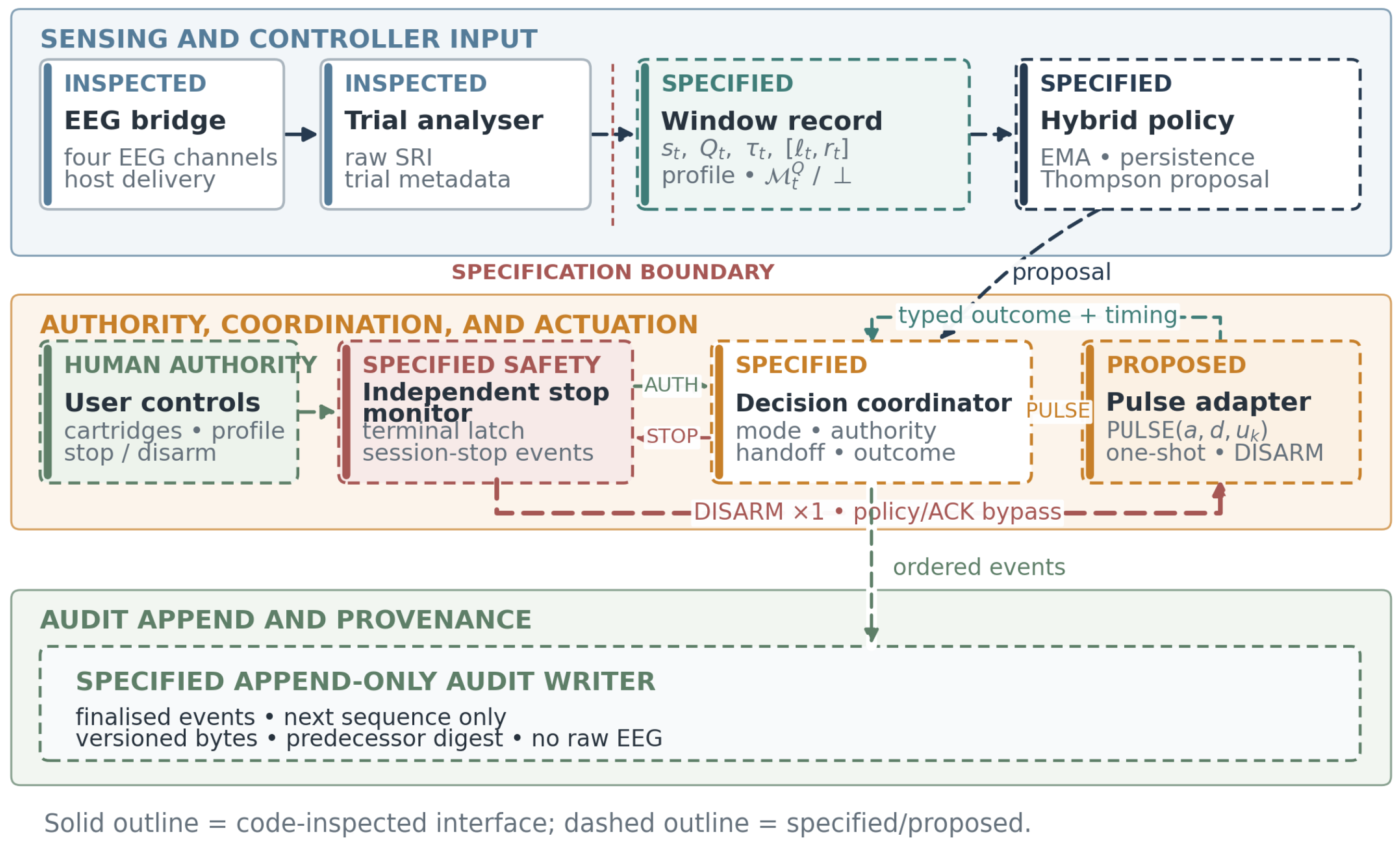
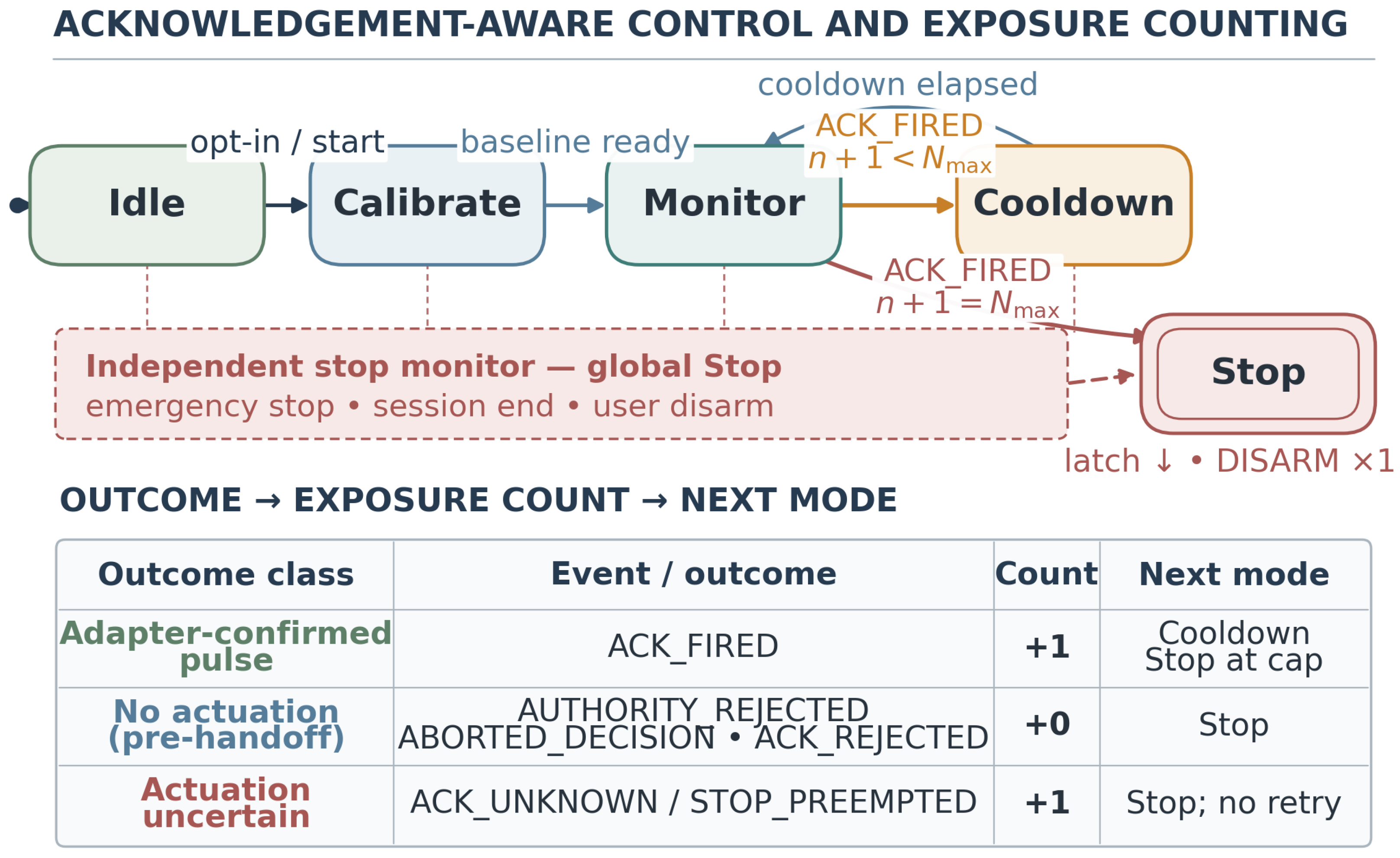
An Auditable Human-Centric Architecture for EEG-Triggered Fragrance Selection During Sleep Preparation


Abstract
1. Introduction
2. Related Work
2.1. Consumer EEG-Driven Biofeedback Loops
2.2. Olfactory Delivery Hardware and Digital Olfaction Paradigms
2.3. Spectral Estimation and Controller Inputs
2.4. Human–Automation and Runtime Assurance
3. Materials and Methods
3.1. Use Case and Human Authority
3.2. Hardware Stack and Data Plane
3.3. Control Variable and Signal Quality Requirements
Signal Quality Profiles
3.4. Cartridge Ranking and Cold-Start Calibration
4. Closed-Loop Controller
4.1. Finite-State Machine
| Algorithm 1 One post-calibration controller update. |
| Require: Validated record , post-calibration state , authorised set , parameters Ensure: Updated state, at most one pulse request, and ordered decision records if then return end if if a stop or disarm event is pending then enter Stop, lower the latch, issue one DISARM, and record the event return end if if or is non-finite then clear and ; record quality inhibition; return end if update by Equation (1) if then clear ; return to Monitor only after ; return end if append t to ; compute by Equation (2) if then record no trigger; return end if snapshot authorisation version and eligible set if the latch is low or then record inhibition; clear ; return end if select by Equation (4); form a fixed-duration request if the final locked recheck fails Equation (6) then record every failed condition; clear ; return end if persist the request and hand it to the adapter once record the typed adapter outcome; update count, mode, and cooldown anchor clear |
4.2. Reward Shaping Around an Acknowledged Pulse
4.3. Thompson Sampling Cartridge Ranking
4.4. Safety Admissibility
5. Safety and Auditability
5.1. Interlocks and Safety Predicate
5.2. Tamper-Evident, Hash-Chained Decision Log
6. Reference Replay and Validation Boundary
6.1. Executed Conformance Replay
6.2. Remaining Validation
6.3. Evidence Boundary
7. Discussion
7.1. Current Engineering Utility and Design Trade-Offs
7.2. Limitations and Threats to Validity
8. Conclusions
Supplementary Materials
Author Contributions
Funding
Data Availability Statement
Acknowledgments
Conflicts of Interest
Abbreviations
| EEG | Electroencephalography |
| EMA | Exponential Moving Average |
| SHA-256 | Secure Hash Algorithm 256-bit |
| SRI | Sleep Readiness Index |
References
- Edinger, J.D.; Arnedt, J.T.; Bertisch, S.M.; Carney, C.E.; Harrington, J.J.; Lichstein, K.L.; Sateia, M.J.; Troxel, W.M.; Zhou, E.S.; Kazmi, U.; et al. Behavioral and Psychological Treatments for Chronic Insomnia Disorder in Adults: An American Academy of Sleep Medicine Clinical Practice Guideline. J. Clin. Sleep Med. 2021, 17, 255–262. [Google Scholar] [CrossRef] [Scilit] [PubMed]
- Ghibaudo, V.; Turrel, M.; Granget, J.; Souilhol, M.; Garcia, S.; Plailly, J.; Buonviso, N. Pleasant Odors Specifically Promote a Soothing Autonomic Response and Brain–Body Coupling Through Respiratory Modulation. Sci. Rep. 2025, 15, 36417. [Google Scholar] [CrossRef] [Scilit] [PubMed]
- Gong, X.; Yang, Y.; Xu, T.; Yao, D.; Lin, S.; Chang, W. Assessing the Anxiolytic and Relaxation Effects of Cinnamomum camphora Essential Oil in University Students: A Comparative Study of EEG, Physiological Measures, and Psychological Responses. Front. Psychol. 2024, 15, 1423870. [Google Scholar] [CrossRef] [Scilit] [PubMed]
- Liu, J.; Liu, M.; Peng, L.; He, H.; Sun, R.; Chang, W. Effects of Inhaling Cunninghamia lanceolata Essential Oil on the Physiological and Psychological Relaxation of University Students. Front. Psychol. 2025, 16, 1638492. [Google Scholar] [CrossRef] [Scilit] [PubMed]
- Kupers, R.; Dousteyssier, O.; Delforge, J.; Gonnot, V.; Kantono, K.; Blerot, B.; Pêtre, A.; Dricot, L.; Heinecke, A. Long-Lasting Effects of Lavender Exposure on Brain Resting-State Networks in Healthy Women. Front. Neurosci. 2025, 19, 1555922. [Google Scholar] [CrossRef] [Scilit] [PubMed]
- Lu, C.-Y.; Su, W.-Z.; Chien, T.-H.; Liao, C.-W. A Deployable Engineering Framework for Olfactory-Induced Relaxation Assessment: Modular Architecture and Signal Processing Pipeline for Wearable EEG. Eng 2026, 7, 198. [Google Scholar] [CrossRef] [Scilit]
- Zanetti, R.; Aminifar, A.; Atienza, D. EEG Glasses for Real-Time Brain Electrical Activity Monitoring. Sci. Rep. 2025, 15, 43574. [Google Scholar] [CrossRef] [Scilit] [PubMed]
- Han, C.; Zhang, Z.; Lin, Y.; Huang, S.; Mao, J.; Xiang, W.; Wang, F.; Liang, Y.; Chen, W.; Zhao, X. Monitoring Sleep Quality Through Low α-Band Activity in the Prefrontal Cortex Using a Portable Electroencephalogram Device: Longitudinal Study. J. Med. Internet Res. 2025, 27, e67188. [Google Scholar] [CrossRef] [Scilit] [PubMed]
- Fu, Z.; So, K.P.; Wu, X.; Khotsaenlee, A.; Wong, S.W.H.; Tin, C.; Chan, R.H.M. A Feasibility Study of Using an In-Ear EEG System for a Quantitative Assessment of Stress and Mental Workload. Sensors 2026, 26, 442. [Google Scholar] [CrossRef] [Scilit] [PubMed]
- Arpaia, P.; De Luca, M.; Di Marino, L.; Duran, D.; Gargiulo, L.; Lanteri, P.; Moccaldi, N.; Nalin, M.; Picciafuoco, M.; Visani, E. A Systematic Review of Techniques for Artifact Detection and Artifact Category Identification in Electroencephalography from Wearable Devices. Sensors 2025, 25, 5770. [Google Scholar] [CrossRef] [Scilit] [PubMed]
- Ninenko, I.; Medvedeva, A.; Efimova, V.L.; Kleeva, D.F.; Morozova, M.; Lebedev, M.A. Olfactory Neurofeedback: Current State and Possibilities for Further Development. Front. Hum. Neurosci. 2024, 18, 1419552. [Google Scholar] [CrossRef] [Scilit] [PubMed]
- LaRocco, J.; Le, M.D.; Paeng, D.-G. A Systemic Review of Available Low-Cost EEG Headsets Used for Drowsiness Detection. Front. Neuroinform. 2020, 14, 553352. [Google Scholar] [CrossRef] [Scilit] [PubMed]
- Kleeva, D.; Ninenko, I.; Lebedev, M.A. Resting-State EEG Recorded with Gel-Based vs. Consumer Dry Electrodes: Spectral Characteristics and Across-Device Correlations. Front. Neurosci. 2024, 18, 1326139. [Google Scholar] [CrossRef] [Scilit] [PubMed]
- Ehrhardt, N.M.; Niehoff, C.; Oßwald, A.-C.; Antonenko, D.; Lucchese, G.; Fleischmann, R. Comparison of Dry and Wet Electroencephalography for the Assessment of Cognitive Evoked Potentials and Sensor-Level Connectivity. Front. Neurosci. 2024, 18, 1441799. [Google Scholar] [CrossRef] [Scilit] [PubMed]
- Begue Hayes, H.; Magne, C. Exploring the Utility of the Muse Headset for Capturing the N400: Dependability and Single-Trial Analysis. Sensors 2024, 24, 7961. [Google Scholar] [CrossRef] [Scilit] [PubMed]
- Zhang, Y.; Zhang, Z.; Du, F.; Song, J.; Huang, S.; Mao, J.; Xiang, W.; Wang, F.; Liang, Y.; Chen, W.; et al. Shared Oscillatory Mechanisms of Alpha-Band Activity in Prefrontal Regions in Eyes Open and Closed State Using a Portable EEG Acquisition Device. Sci. Rep. 2024, 14, 26719. [Google Scholar] [CrossRef] [Scilit] [PubMed]
- Al-Daraghmeh, M.Y.; Stone, R.T.; Mgaedeh, F.Z. Explore the Ideal Human Body Part for Medical Wearable Sensors. Smart Wearable Technol. 2026, 2, A4. [Google Scholar] [CrossRef] [Scilit]
- Nahmias, D.O.; Kontson, K.L. Quantifying Signal Quality from Unimodal and Multimodal Sources: Application to EEG with Ocular and Motion Artifacts. Front. Neurosci. 2021, 15, 566004. [Google Scholar] [CrossRef] [Scilit] [PubMed]
- Yang, S.-Y.; Lin, Y.-P. Movement Artifact Suppression in Wearable Low-Density and Dry EEG Recordings Using Active Electrodes and Artifact Subspace Reconstruction. IEEE Trans. Neural Syst. Rehabil. Eng. 2023, 31, 3844–3853. [Google Scholar] [CrossRef] [Scilit] [PubMed]
- Kline, J.E.; Huang, H.J.; Snyder, K.L.; Ferris, D.P. Isolating Gait-Related Movement Artifacts in Electroencephalography during Human Walking. J. Neural Eng. 2015, 12, 046022. [Google Scholar] [CrossRef] [Scilit] [PubMed]
- Morozova, M.; Gabrielyan, I.; Kleeva, D.; Efimova, V.; Lebedev, M. Scents Modulate Anxiety Levels, but Electroencephalographic and Electrocardiographic Assessments Could Diverge from Subjective Reports: A Pilot Study. Front. Behav. Neurosci. 2025, 19, 1534716. [Google Scholar] [CrossRef] [Scilit] [PubMed]
- Chernykh, M.; Zyma, I.; Vodianyk, B.; Subin, Y.; Seleznov, I.; Popov, A.; Kiyono, K. Comparative EEG Study of Neurodynamics upon Olfactory Stimulation in COVID-19 Patients. Front. Hum. Neurosci. 2025, 19, 1571477. [Google Scholar] [CrossRef] [Scilit] [PubMed]
- Klimesch, W. EEG Alpha and Theta Oscillations Reflect Cognitive and Memory Performance: A Review and Analysis. Brain Res. Rev. 1999, 29, 169–195. [Google Scholar] [CrossRef] [Scilit] [PubMed]
- Welch, P.D. The Use of Fast Fourier Transform for the Estimation of Power Spectra: A Method Based on Time Averaging over Short, Modified Periodograms. IEEE Trans. Audio Electroacoust. 1967, 15, 70–73. [Google Scholar] [CrossRef] [Scilit]
- Risqiwati, D.; Wibawa, A.D.; Pane, E.S.; Yuniarno, E.M.; Islamiyah, W.R.; Purnomo, M.H. Effective Relax Acquisition: A Novel Approach to Classify Relaxed State in Alpha Band EEG-Based Transformation. Brain Inform. 2024, 11, 12. [Google Scholar] [CrossRef] [Scilit] [PubMed]
- Zayed, A.; Belhadj, N.; Ben Khalifa, K.; Valderrama, C.; Bedoui, M.H. A Novel Hybrid Approach for Drowsiness Detection Using EEG Scalograms to Overcome Inter-Subject Variability. Sensors 2025, 25, 5530. [Google Scholar] [CrossRef] [Scilit] [PubMed]
- Mdluli, B.; Khumalo, P.; Maswanganyi, R.C. Signal Preprocessing, Decomposition and Feature Extraction Methods in EEG-Based BCIs. Appl. Sci. 2025, 15, 12075. [Google Scholar] [CrossRef] [Scilit]
- Ayuso-Moreno, R.; Rubio-Morales, A.; Durán-Rufaco, A.; García-Calvo, T.; González-Ponce, I. EEG-Based Assessment of Mental Fatigue in Students: A Systematic Review of Measurement Methods and Data Processing Protocols. Appl. Sci. 2026, 16, 234. [Google Scholar] [CrossRef] [Scilit]
- Huang, J.; Wu, Y.; Li, F.; Zhang, D.; Tan, S. Assessing Pulse Rate Variability from a Wrist-Worn PPG Device Against ECG-Derived Heart Rate Variability in Ambulatory Settings. Smart Wearable Technol. 2026, 2, A3. [Google Scholar] [CrossRef] [Scilit]
- Parasuraman, R.; Sheridan, T.B.; Wickens, C.D. A Model for Types and Levels of Human Interaction with Automation. IEEE Trans. Syst. Man. Cybern. Part A Syst. Hum. 2000, 30, 286–297. [Google Scholar] [CrossRef] [Scilit] [PubMed]
- Hobbs, K.L.; Mote, M.L.; Abate, M.C.L.; Coogan, S.D.; Feron, E.M. Runtime Assurance for Safety-Critical Systems: An Introduction to Safety Filtering Approaches for Complex Control Systems. IEEE Control Syst. 2023, 43, 28–65. [Google Scholar] [CrossRef] [Scilit]
- Russo, D.J.; Van Roy, B.; Kazerouni, A.; Osband, I.; Wen, Z. A Tutorial on Thompson Sampling. Found. Trends Mach. Learn. 2018, 11, 1–96. [Google Scholar] [CrossRef] [Scilit]
- Schneier, B.; Kelsey, J. Secure Audit Logs to Support Computer Forensics. ACM Trans. Inf. Syst. Secur. 1999, 2, 159–176. [Google Scholar] [CrossRef] [Scilit]
- Gopal, S.; Bhat, P.; Sivaram, S.; Prabhu, M.; Karthikeyan, V.J.; Roy, P.; Subramanian, M.; Subramanya, I. From Wires to Wearables (2): Temporal Fidelity Assessment of the Sydäntek Wearable ECG System Against a Legacy Cloud-Based Standard. Smart Wearable Technol. 2025. [Google Scholar] [CrossRef] [Scilit]


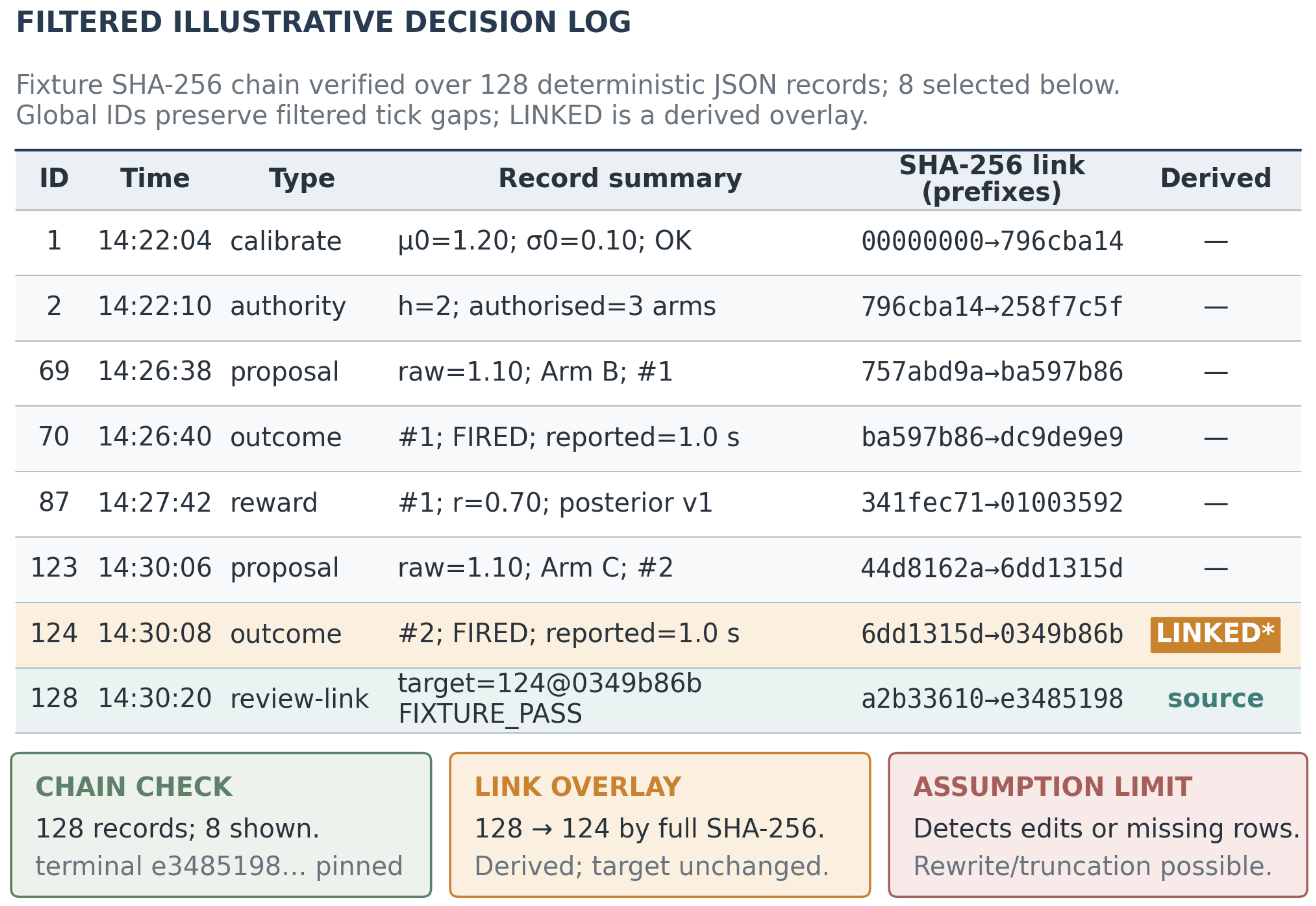
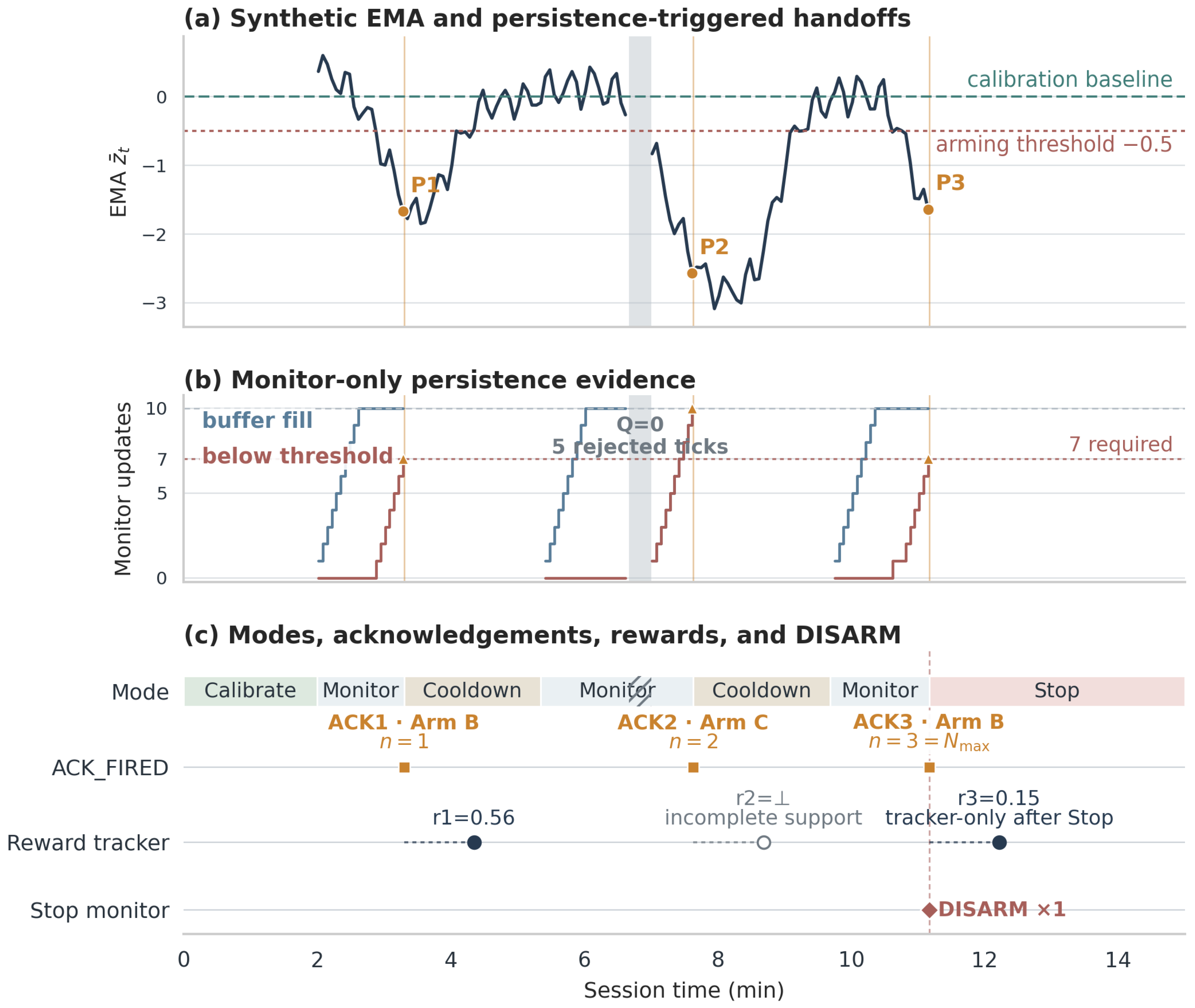

| Evidence Family | Candidate Evidence and Interpretive Limit | Implementation Status |
|---|---|---|
| EEG signal integrity | Completeness, finite values, duration, flatline/clipping, amplitude, and total power; gross gating only. | Trial validity present; strict window mapping and clipping proposed. |
| Channel comparison | Variance imbalance, agreement, and derivative; four channels provide limited spatial evidence. | Imbalance warning present; controller veto, agreement, and derivative proposed. |
| Spectral context | Low/high-frequency ratios and local main power; source remains ambiguous. | Proposed wider-band branch. |
| Inertial reference | Time–local motion association; neither necessary nor sufficient for EEG contamination. | Registered; not forwarded or fused. |
| Cardiac reference | Photoplethysmography association identifies candidate coupling, not cerebral origin. | Registered; not forwarded or fused. |
| Parameter | Reference Value [Range] | Role |
|---|---|---|
| EMA weight | 0.2 [0.1, 0.4] | About five accepted updates |
| SRI window | 5 s | Phase-1 analysis window [6] |
| Update hop | 2–4 s | Proposed overlapping cadence |
| Calibration span | 120 s; complete schedule | Finite, , one version |
| Arming threshold | 0.5 [0.3, 0.8] | Baseline standard deviation units |
| Persistence | (10, 7) | Fresh accepted updates |
| Reward slope | 1.2 [0.8, 1.8] | Soft-label sigmoid |
| Association window | 60 s | Support-contained pre/post sets |
| Lower baseline guard | Phase-1 numerical floor; temporal use unvalidated [6] | |
| Upper baseline guard | Set before deployment | No validated value reported |
| Cooldown | 120 s [90, 180] | Minimum pulse interval |
| Acknowledgement timeout | Set before deployment; >0 | No value or measurement reported |
| Configured duration | Fixed per session | |
| Duration cap | 1.5 s [1.0, 2.0] | Hard valve-on limit |
| Session cap | 3 pulses | Hard exposure-accounting limit |
| Cartridge options | 3 | Proposed slots |
| Prior | Beta(1, 1) | Uniform per option |
| Interlock | Hazard Addressed | Check |
|---|---|---|
| Authorised set | Actuation without approval | Revalidate the selected cartridge option at handoff; commit the proposal before one adapter attempt |
| Sensitivity deny list | Known sensitivity | Denied identifiers are excluded before sampling; unknown sensitivities remain possible |
| Session cap | Cumulative exposure | Count adapter-confirmed or uncertain actuation; enter Stop at the cap |
| Cooldown | Rapid retriggering | Block actuation until the monotonic interval has elapsed |
| Duration cap | Single over-release | Reject valve-on durations outside before dispatch |
| Hardware one-shot | Stuck host or lost link | Proposed adapter watchdog terminates every pulse by ; ACK_FIRED follows completion |
| Baseline guards | Invalid standardisation | Require complete finite calibration and ; otherwise remain Calibrate, latch low |
| Command acknowledgement | Duplicate or uncertain actuation | Use an idempotent identifier and retained handoff status; do not retry an unresolved pulse; count possible actuation once, then stop |
| Emergency stop | Distress or hardware fault | Pre-empt the acknowledgement wait, lower the latch, send one DISARM, and enter Stop |
| Quality gate | Incomplete or grossly suspect input | Reset EMA and persistence, then inhibit; optional profiles also reject missing or stale required inputs (Section 3.3) |
| Fixture | Observed Software Result | Interpretation |
|---|---|---|
| Synthetic strict-v1 records | 105/105 records accepted; 29-record baseline; two simulated ACK_FIRED outcomes; one completed cooldown; cap-two Stop; one DISARM; two reward updates; 114-event chain verified | Internal consistency of the retained record validator, controller, and audit trace only |
| Legacy OSC preflight | 0/105 records accepted; baseline not committed; latch low; no proposal, outcome, exposure, or reward | The inspected transport cannot operate the actuation-enabled controller |
| Focused unit tests | 7/7 pass, covering required metadata, free-Q rejection, quality reset, authorisation recheck, exact output, and hash tampering | Deterministic boundary checks; not device or physiological validation |
| Claim Level | Current Status |
|---|---|
| Reference validator and controller | Executed on retained synthetic records; exact output and seven focused tests supplied in Archive S1 |
| Cartridge–SRI association and ranking | Exercised with synthetic acknowledgements and SRI values only; no measured cartridge response, preference convergence, or real-world policy performance |
| Device strict-v1 exporter | Not implemented; the inspected legacy OSC path fails closed and cannot enter actuation-enabled Monitor |
| Natural artefact quality estimator | Requirements specified in Section 3.3; no labelled corpus, fitted model, or performance metrics |
| Physical adapter and fault tolerance | Cartridge-selective adapter, timing trace, watchdog test, and aggregate fault injection outputs unavailable |
| Human use and sleep outcomes | No participant, usability, chemical dose, polysomnography, or sleep outcome evidence |
Disclaimer/Publisher’s Note: The statements, opinions and data contained in all publications are solely those of the individual author(s) and contributor(s) and not of MDPI and/or the editor(s). MDPI and/or the editor(s) disclaim responsibility for any injury to people or property resulting from any ideas, methods, instructions or products referred to in the content. |
© 2026 by the authors. Licensee MDPI, Basel, Switzerland. This article is an open access article distributed under the terms and conditions of the Creative Commons Attribution (CC BY) license.
Share and Cite
Lyu, S.-J.; Lan, H.-S.; Kuo, C.-L.; Liao, C.-W. An Auditable Human-Centric Architecture for EEG-Triggered Fragrance Selection During Sleep Preparation. Electronics 2026, 15, 3625. https://doi.org/10.3390/electronics15163625
Lyu S-J, Lan H-S, Kuo C-L, Liao C-W. An Auditable Human-Centric Architecture for EEG-Triggered Fragrance Selection During Sleep Preparation. Electronics. 2026; 15(16):3625. https://doi.org/10.3390/electronics15163625
Chicago/Turabian StyleLyu, Sheng-Jhih, Hsuan-Sheng Lan, Chin-Liang Kuo, and Chin-Wen Liao. 2026. "An Auditable Human-Centric Architecture for EEG-Triggered Fragrance Selection During Sleep Preparation" Electronics 15, no. 16: 3625. https://doi.org/10.3390/electronics15163625
APA StyleLyu, S.-J., Lan, H.-S., Kuo, C.-L., & Liao, C.-W. (2026). An Auditable Human-Centric Architecture for EEG-Triggered Fragrance Selection During Sleep Preparation. Electronics, 15(16), 3625. https://doi.org/10.3390/electronics15163625