



Few-Shot Active Radar Jamming Recognition Using Adaptive Confidence Dual-Branch Fusion Network with Full-Information Time–Frequency Features


Abstract
1. Introduction
- (1)
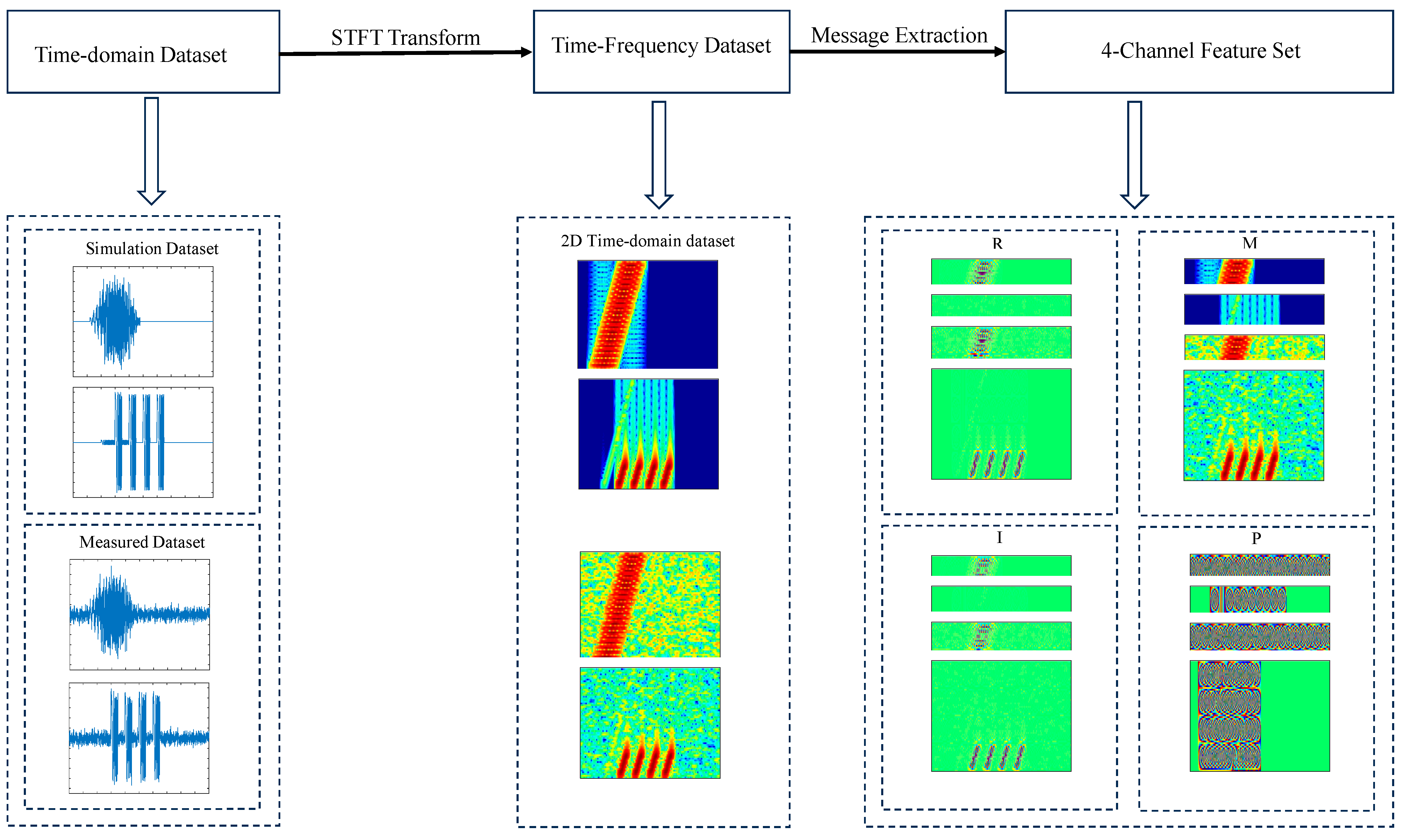
- A four-channel STFT-based time–frequency representation, including the real part, imaginary part, amplitude, and phase information of radar jamming signals, is constructed. Combined with a dual-branch ResNet18 framework, complementary feature learning is achieved to improve the discriminative capability of different jamming types under few-shot conditions.
- (2)
- An adaptive confidence fusion strategy with multi-task supervision is proposed to dynamically fuse the outputs of the two branches according to their prediction reliability. This strategy alleviates overfitting in few-shot scenarios and improves the robustness of the proposed model under varying JNR conditions.
- (3)
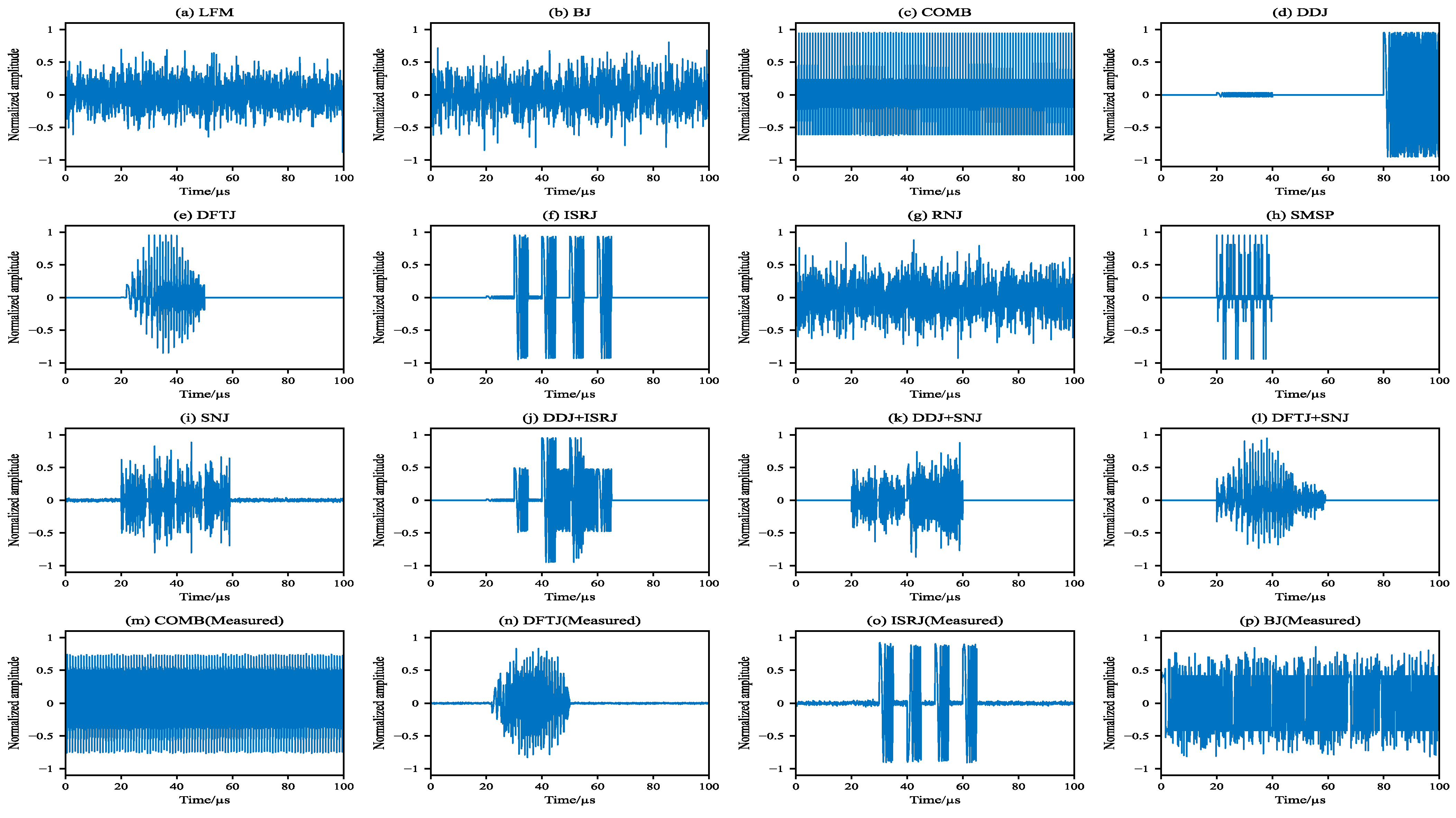
- A mixed dataset containing simulated and measured jamming signals is established for experimental validation. Extensive experiments under different few-shot settings demonstrate the effectiveness and practical potential of the proposed ACDF-Net for radar jamming recognition.
2. Data Generation Methods
2.1. Radar Echo Signal
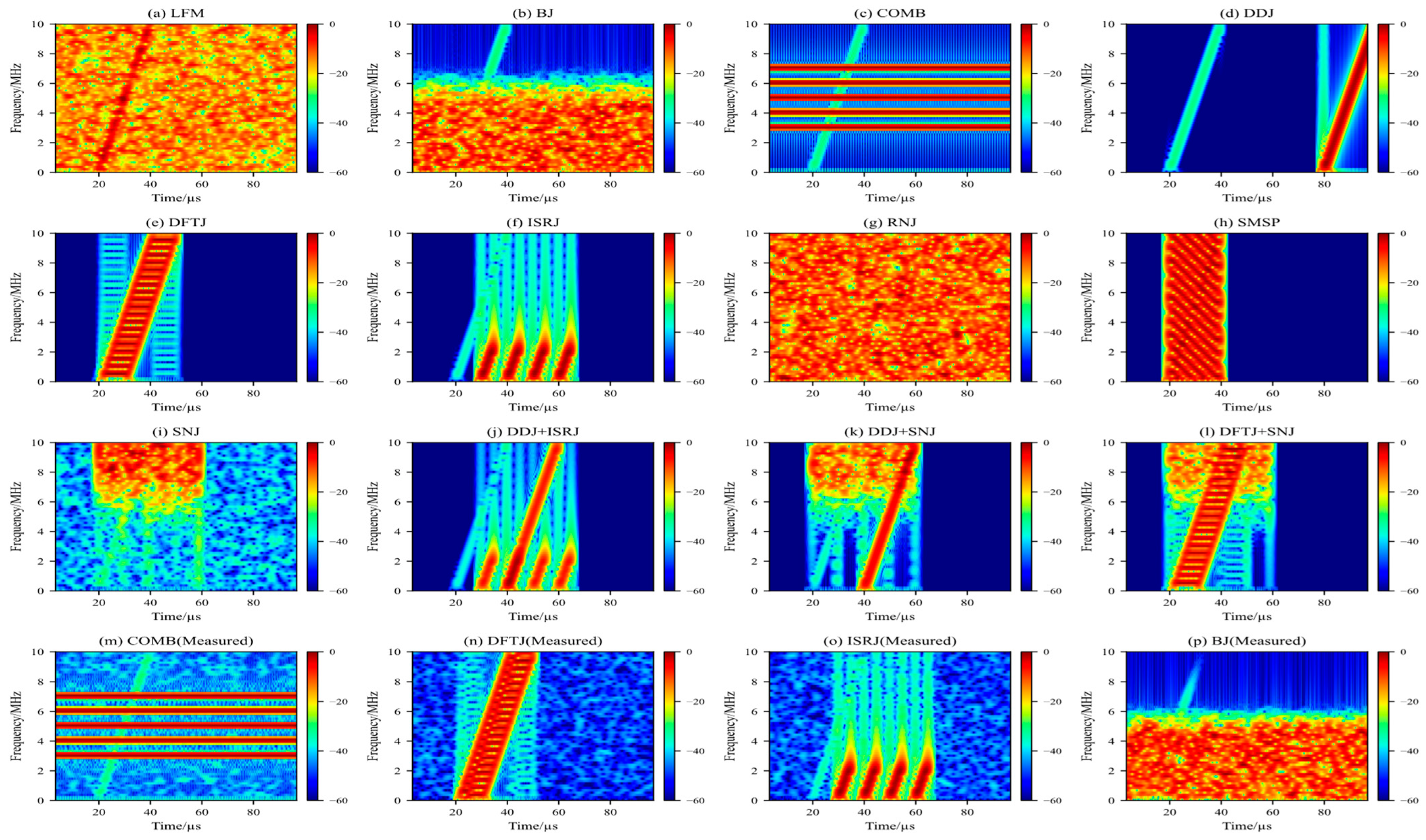
2.2. Jamming Signals
3. Proposed Method
3.1. Architecture of the Proposed ACDF-Net
- (1)
- A one-dimensional time-domain jamming signal is given, which is processed by using the STFT to get a time–frequency feature map of size .
- (2)
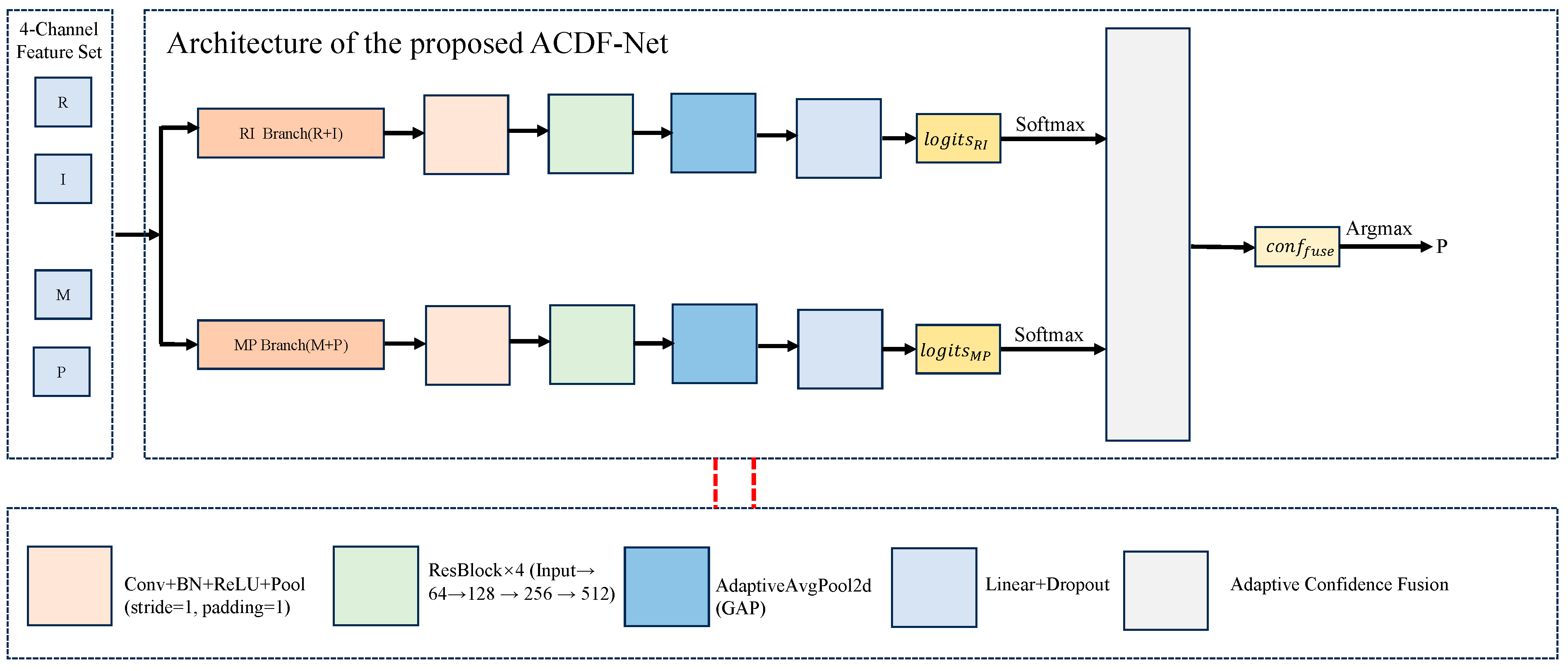
- The four-channel time–frequency feature tensor is split along the channel dimension into two independent branches. The first two channels (real and imaginary parts of the complex time–frequency matrix) are used as the real–imaginary modulation branch, and the last two channels (amplitude and phase) are used as the amplitude–phase energy branch.
- (3)
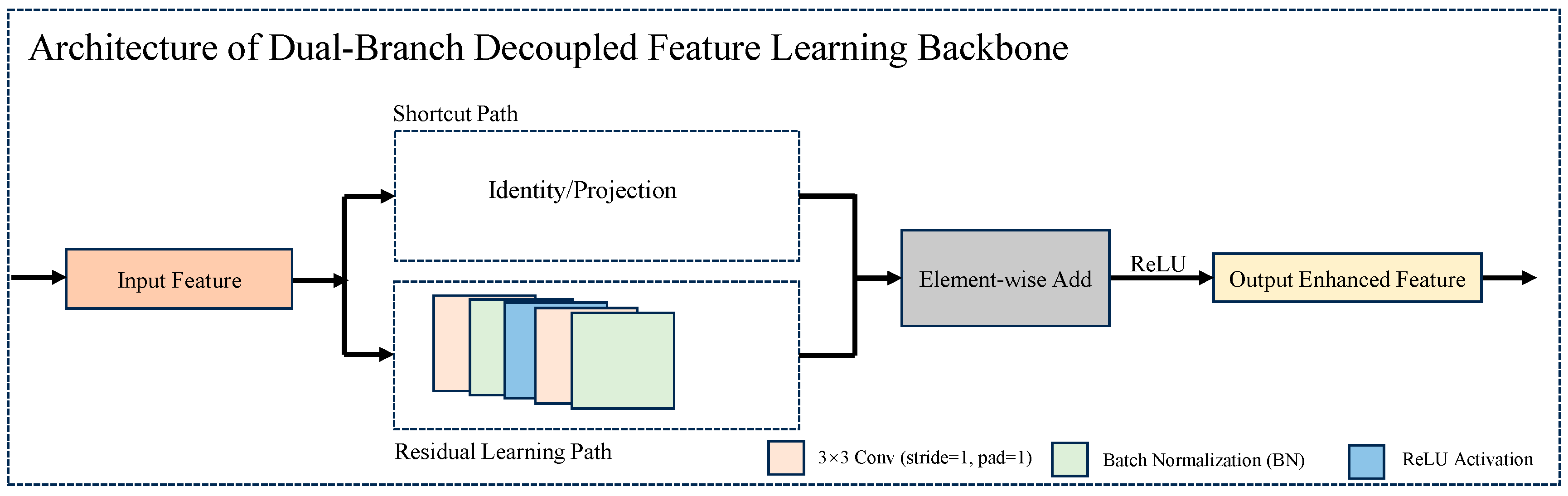
- Each branch independently extracts discriminative features through 8 residual blocks organized into 4 layers, following the standard ResNet18 architecture, and maps the features to 16-dimensional raw recognition logits through the Global Average Pooling (GAP) layer and Fully Connected (FC) layer.
- (4)
- The recognition confidence scores of the two branches are weighted and fused via a learnable parameter α to obtain the final fused confidence.
- (5)
- The total loss is calculated by the cross-entropy loss function, which takes the independent logits of each branch and the fused logits as inputs respectively. The sum of the three losses is used to optimize all trainable parameters of the network.
3.2. STFT-Based Feature Extraction
3.2.1. Amplitude Normalization
3.2.2. Time–Frequency Feature Construction
3.3. Dual-Branch Complementary Representation Feature Learning Backbone
3.4. Adaptive Confidence-Level Fusion Strategy
3.5. Model Training and Inference Process
| Algorithm 1 Training procedure of ACDF-Net |
| Require: |
| Radar jamming dataset with labels |
| Training ratio |
| Maximum epochs |
| Batch size |
| Early stopping patience Ensure: |
| Optimal network weights |
| Recognition results on test set |
| 1: Randomly initialize model parameters . |
| 2: Split into training, validation and test sets. |
| 3: Initialize AdamW optimizer. |
| 4: Set and . |
| 5: for epoch = 1 to do |
| 6: Set model to training mode. |
| 7: for each mini-batch do |
| 8: Forward propagation |
| 9: compute . |
| 10: Backpropagate gradients and update . |
| 11: end for |
| 12: Evaluate validation accuracy . |
| 13: if then |
| 14: Save current model. |
| 15: . |
| 16: . |
| 17: else |
| 18: . |
| 19: if then |
| 20: Break |
| 21: end if |
| 22: end if |
| 23: end for |
| 24: Load the optimal model weights. |
| 25: Perform inference on the test set. |
| 26: Output Jamming Recognition results. |
4. Experiment and Results
4.1. Datasets
4.2. Evaluation Metrics
4.3. Experimental Configuration
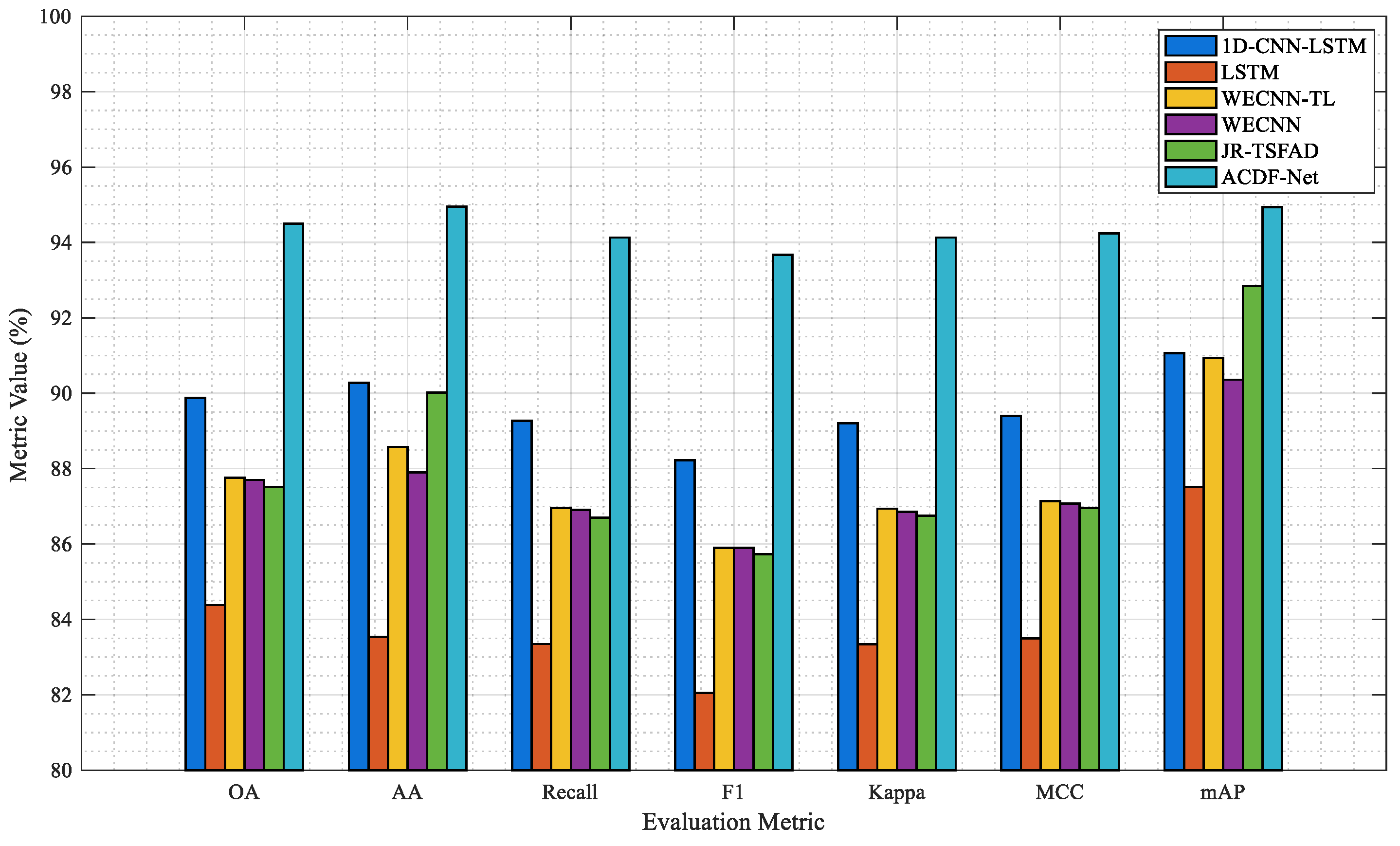
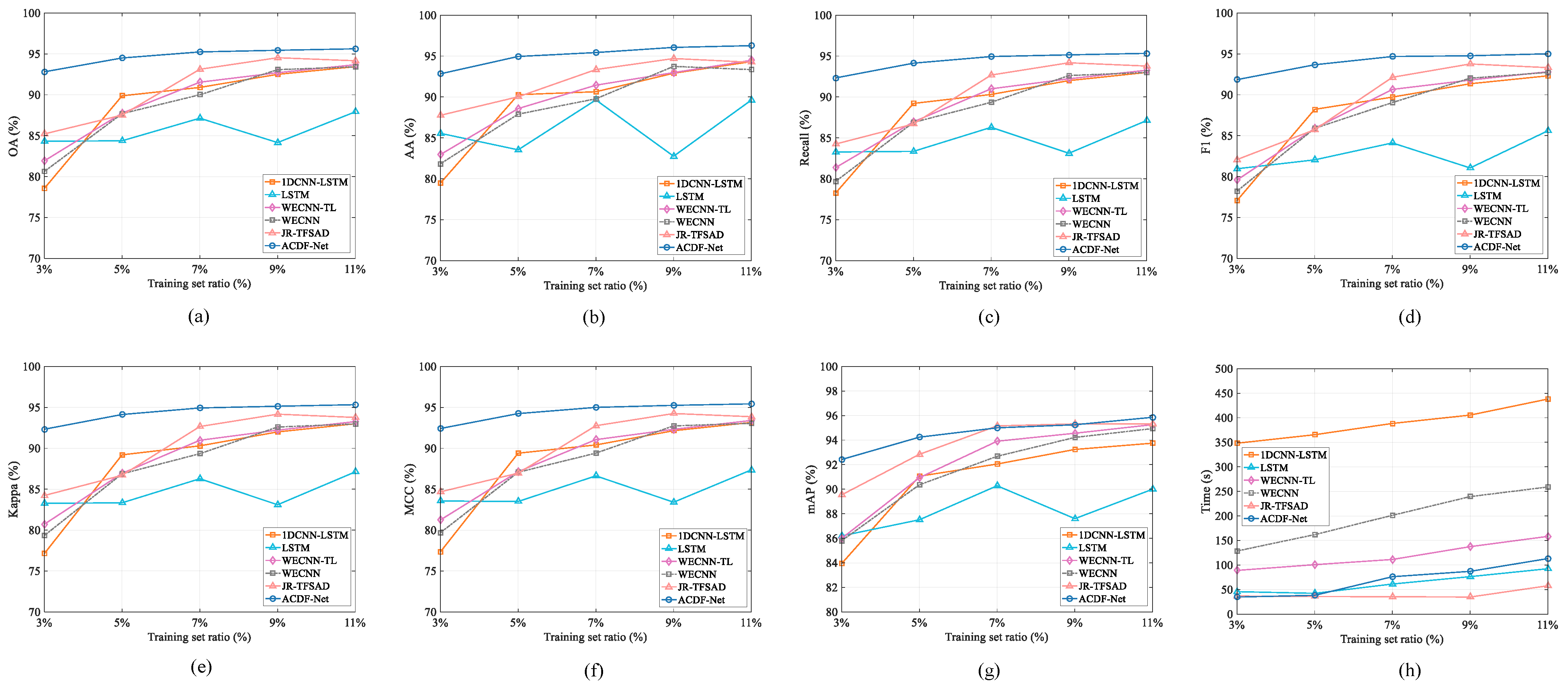
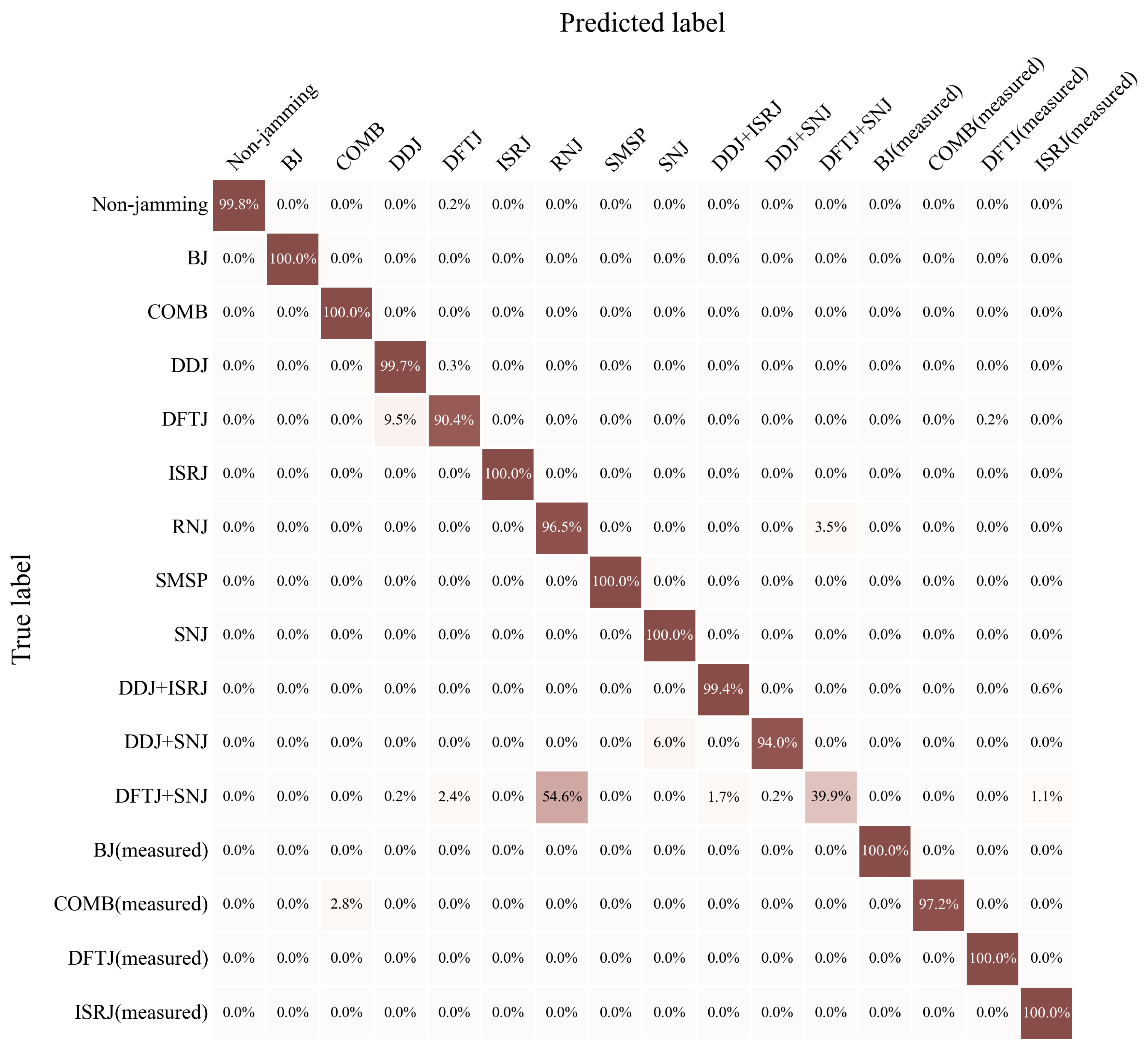
4.4. Experimental Results
5. Conclusions
Author Contributions
Funding
Data Availability Statement
Conflicts of Interest
References
- Chen, Y.; Wang, Y.; Qu, F.; Li, W. A graph-based track-before-detect algorithm for automotive radar target detection. IEEE Sens. J. 2021, 21, 6587–6599. [Google Scholar] [CrossRef]
- Du, L.; Li, L.; Wei, D.; Mao, J. Saliency-guided single shot multibox detector for target detection in SAR images. IEEE Trans. Geosci. Remote Sens. 2020, 58, 3366–3376. [Google Scholar] [CrossRef]
- Tan, M.; Wang, C.; Xue, B.; Xu, J. A novel deceptive jamming approach against frequency diverse array radar. IEEE Sens. J. 2021, 21, 8323–8332. [Google Scholar] [CrossRef]
- Du, C.; Zhao, Y.; Wang, L.; Tang, B.; Xiong, Y. Deceptive multiple false targets jamming recognition for linear frequency modulation radars. J. Eng. 2019, 21, 7690–7694. [Google Scholar] [CrossRef]
- Wang, W.; Wu, J.; Pei, J.; Sun, Z.; Yang, J.; Yi, Q. Antirange-deceptive jamming from multijammer for multistatic SAR. IEEE Trans. Geosci. Remote Sens. 2022, 60, 5212512. [Google Scholar] [CrossRef]
- Ali, M.A.; Ahmed, H.; Saadia, R.; Ahmed, W.; Tahir, F. Electronic deceptive jamming: False target generation in radars. In Proceedings of the International Conference on Recent Advances in Electrical Engineering and Computer Sciences (RAEECS), Islamabad, Pakistan, 18–20 October 2022; pp. 1–6. [Google Scholar]
- Iqbal, Y.; Jawad, M. An effective coherent noise jamming method for deception of wideband LFM radars. In Proceedings of the 17th International Bhurban Conference on Applied Sciences and Technology (IBCAST), Islamabad, Pakistan, 14–18 January 2020; pp. 622–626. [Google Scholar]
- Lou, M.; Yang, J.; Li, Z.; Ren, H.; An, H.; Wu, J. Joint optimal and adaptive 2-D spatial filtering technique for FDA-MIMO SAR deceptive jamming separation and suppression. IEEE Trans. Geosci. Remote Sens. 2022, 60, 5238414. [Google Scholar] [CrossRef]
- Orlando, D. A novel noise jamming detection algorithm for radar applications. IEEE Signal Process. Lett. 2017, 24, 206–210. [Google Scholar] [CrossRef]
- Zhang, S.; Zhou, Y.; Zhang, L.; Zhang, Q.; Du, L. Target detection for multi static radar in the presence of deceptive jamming. IEEE Sens. J. 2021, 21, 8130–8141. [Google Scholar] [CrossRef]
- Luo, Z.; Cao, Y.; Yeo, T.-S.; Wang, F. Few-shot radar jamming recognition network via complete information mining. IEEE Trans. Aerosp. Electron. Syst. 2024, 60, 3625–3638. [Google Scholar] [CrossRef]
- Zhou, H.; Dong, C.; Wu, R.; Xu, X.; Guo, Z. Feature fusion based on Bayesian decision theory for radar deceptive jamming recognition. IEEE Access 2021, 9, 16296–16304. [Google Scholar] [CrossRef]
- Sun, D.; Li, A.; Ding, H.; Wei, J. Detection of DRFM deceptive jamming based on diagonal integral bispectrum. Remote Sens. 2025, 17, 1957. [Google Scholar] [CrossRef]
- Wu, W.; Zou, J.; Chen, J.; Xu, S.; Chen, Z. False-target recognition against interrupted-sampling repeater jamming based on integration decomposition. IEEE Trans. Aerosp. Electron. Syst. 2021, 57, 2979–2991. [Google Scholar] [CrossRef]
- Xu, Z.; Shi, Q.; Shi, J.; Wang, H.; Wei, M.; Gao, R.; Shao, Y.; Tao, H. A Novel Method of Mitigating the Mutual Interference between Multiple LFMCW Radars for Automotive Applications. In IGARSS 2019—2019 IEEE International Geoscience and Remote Sensing Symposium; IEEE: Piscataway, NJ, USA, 2019. [Google Scholar] [CrossRef]
- Xu, Z.; Shi, Q. Interference Mitigation for Automotive Radar Using Orthogonal Noise Waveforms. IEEE Geosci. Remote Sens. Lett. 2018, 15, 137–141. [Google Scholar] [CrossRef]
- Xu, Z.; Wang, X.; Wang, Y. Nonlinear Frequency-Modulated Waveforms Modeling and Optimization for Radar Applications. Mathematics 2022, 10, 3939. [Google Scholar] [CrossRef]
- Greco, M.; Gini, F.; Farina, A. Radar detection and classification of jamming signals belonging to a cone class. IEEE Trans. Signal Process. 2008, 56, 1984–1993. [Google Scholar] [CrossRef]
- Xing, H.; Xing, Q.; Wang, K. Radar anti-jamming countermeasures intelligent decision-making: A partially observable Markov decision process approach. Aerospace 2023, 10, 236. [Google Scholar] [CrossRef]
- Bandiera, F.; Farina, A.; Orlando, D.; Ricci, G. Detection algorithms to discriminate between radar targets and ECM signals. IEEE Trans. Signal Process. 2010, 58, 5984–5993. [Google Scholar] [CrossRef]
- Zhao, S.; Zhou, Y.; Zhang, L.; Guo, Y.; Tang, S. Discrimination between radar targets and deceptive jamming in distributed multiple-radar architectures. IET Radar Sonar Navig. 2017, 11, 1124–1131. [Google Scholar] [CrossRef]
- Su, D.; Gao, M. Research on jamming recognition technology based on characteristic parameters. In Proceedings of the IEEE 5th International Conference on Signal and Image Processing, Beijing, China, 23–25 October 2020; pp. 303–307. [Google Scholar]
- Hao, Z.; Yu, W.; Chen, W. Recognition method of dense false targets jamming based on time-frequency atomic decomposition. J. Eng. 2019, 2019, 6354–6358. [Google Scholar] [CrossRef]
- Xu, Z.; Xue, S.; Wang, Y. Incoherent Interference Detection and Mitigation for Millimeter-Wave FMCW Radars. Remote Sens. 2022, 14, 4817. [Google Scholar] [CrossRef]
- Xu, Z. Bi-level l1 optimization-based interference reduction for millimeter wave radars. IEEE Trans. Intell. Transp. Syst. 2023, 24, 728–738. [Google Scholar] [CrossRef]
- Xu, Z.; Yuan, M. An Interference Mitigation Technique for Automotive Millimeter Wave Radars in the Tunable Q-Factor Wavelet Transform Domain. IEEE Trans. Microw. Theory Tech. 2021, 69, 5270–5283. [Google Scholar] [CrossRef]
- Wu, Z.; Zhang, Y. A hybrid 1D-2D CNN with decision-level fusion for radar active deceptive jamming recognition. In Proceedings of the 7th International Conference on Information Science, Electrical and Automation Engineering (ISEAE), Harbin, China, 18–20 April 2025; pp. 668–672. [Google Scholar] [CrossRef]
- Xu, H.; Quan, Y.; Zhou, X.; Chen, H.; Cui, T.J. A novel approach for radar passive jamming based on multiphase coding rapid modulation. IEEE Trans. Geosci. Remote Sens. 2023, 61, 5101614. [Google Scholar] [CrossRef]
- Liu, Q.; Zhang, W. Deep learning and recognition of radar jamming based on CNN. In Proceedings of the 12th International Symposium on Computational Intelligence and Design (ISCID), Hangzhou, China, 14–15 December 2019; pp. 208–212. [Google Scholar] [CrossRef]
- Cai, Y.; Shi, K.; Song, F.; Xu, Y.; Wang, X.; Luan, H. Jamming pattern recognition using spectrum waterfall: A deep learning method. In Proceedings of the IEEE 5th International Conference on Computer and Communications (ICCC), Chengdu, China, 6–9 December 2019; pp. 2113–2117. [Google Scholar] [CrossRef]
- Du, L.; Li, F.; He, X.; Li, Y. Radar deceptive jamming recognition based on multi-dimensional feature extraction. In Proceedings of the IEEE International Conference on Signal, Information and Data Processing (ICSIDP), Zhuhai, China, 22–24 November 2024; pp. 1–6. [Google Scholar] [CrossRef]
- Cheng, L.; Cao, S. TransRAD: Retentive Vision Transformer for Enhanced Radar Object Detection. IEEE Trans. Radar Syst. 2025, 3, 303–317. [Google Scholar] [CrossRef]
- Cheng, L.; Sengupta, A.; Cao, S. 3D Radar and Camera Co-Calibration: A Flexible and Accurate Method for Target-Based Ex-trinsic Calibration. In Proceedings of the 2023 IEEE Radar Conference (RadarConf23), San Antonio, TX, USA, 8–11 May 2023; pp. 1–6. [Google Scholar] [CrossRef]
- Lu, J.; Guo, Y.; Feng, W.; Hu, X.; Gong, J.; Zhang, Y. Intelligent Recognition and Parameter Estimation of Radar Active Jamming Based on Oriented Object Detection. Remote Sens. 2025, 17, 2646. [Google Scholar] [CrossRef]
- Kong, Y.; Wang, X.; Wu, C.; Yu, X.; Cui, G. Active deceptive jamming recognition in the presence of extended target. IEEE Geosci. Remote Sens. Lett. 2022, 19, 4024905. [Google Scholar] [CrossRef]
- Hou, L.; Zhang, S.; Wang, C.; Li, X.; Chen, S.; Zhu, L.; Zhu, Y. Jamming recognition of carrier-free UWB cognitive radar based on MANet. IEEE Trans. Instrum. Meas. 2023, 72, 8504413. [Google Scholar] [CrossRef]
- Chen, H.; Chen, H.; Lei, Z.; Zhang, L.; Li, B.; Zhang, J.; Wang, Y. Compound Jamming Recognition Based on a Dual-Channel Neural Network and Feature Fusion. Remote Sens. 2024, 16, 1325. [Google Scholar] [CrossRef]
- Chen, X.; Liu, Y.; Wang, C. Multi-Domain Fusion Network for Active Jamming Recognition in Cognitive Radar. Remote Sens. 2025, 17, 1723. [Google Scholar] [CrossRef]
- Li, L.; Huang, L.; Meng, T.; Xing, C.; Yang, T.; Li, W.; Lu, P. MFE-STN: A Versatile Front-End Module for SAR Deception Jamming False Target Recognition. Remote Sens. 2025, 17, 3848. [Google Scholar] [CrossRef]
- Qian, J.; Teng, X.; Qiu, Z. Recognition of radar deceptive jamming based on convolutional neural network. IET Conf. Proc. 2021, 2020, 913–918. [Google Scholar] [CrossRef]
- Cao, X. Few-shot and zero-shot radar active jamming recognition based on a vision-language model. IEEE Trans. Aerosp. Electron. Syst. 2025, 61, 14795–14808. [Google Scholar] [CrossRef]
- Luo, J.; Si, W.; Deng, Z. Few-shot learning for radar signal recognition based on tensor imprint and re-parameterization multi-channel multi-branch model. IEEE Signal Process. Lett. 2022, 29, 1327–1331. [Google Scholar] [CrossRef]
- Wu, Z.; Wang, T.; Cao, Y.; Zhang, M.; Guo, W.; Yang, L. Few-shot radar active jamming recognition under label prior information reuse. IEEE Geosci. Remote Sens. Lett. 2025, 22, 3501305. [Google Scholar] [CrossRef]
- Lin, Z.; Ji, K.; Kang, M.; Leng, X.; Zou, H. Deep convolutional highway unit network for SAR target classification with limited labeled training data. IEEE Geosci. Remote Sens. Lett. 2017, 14, 1091–1095. [Google Scholar] [CrossRef]
- Luo, Z.; Cao, Y.; Yeo, T.-S.; Wang, Y.; Wang, F. Few-shot radar jamming recognition network via time-frequency self-attention and global knowledge distillation. IEEE Trans. Geosci. Remote Sens. 2023, 61, 5105612. [Google Scholar] [CrossRef]
- Lv, Q.; Quan, Y.; Feng, W.; Sha, M.; Dong, S.; Xing, M. Radar deceptive jamming recognition based on weighted ensemble CNN with transfer learning. IEEE Trans. Geosci. Remote Sens. 2022, 60, 5107511. [Google Scholar] [CrossRef]
- Feng, X.; Zhang, X.; He, K.; Tan, P.; Tang, Y. A multiclass time-series signal recognition method based on a large active radar jamming database. IEEE Sens. J. 2025, 25, 20051–20066. [Google Scholar] [CrossRef]
- Matthews, B.W. Comparison of the predicted and observed secondary structure of T4 phage lysozyme. Biochim. Biophys. Acta 1975, 405, 442–451. [Google Scholar] [CrossRef] [PubMed]
- Chicco, D.; Jurman, G. The advantages of the Matthews correlation coefficient (MCC) over F1 score and accuracy in binary classification evaluation. BMC Genom. 2020, 21, 6. [Google Scholar] [CrossRef] [PubMed]
- Everingham, M.; Van Gool, L.; Williams, C.K.I.; Winn, J.; Zisserman, A. The PASCAL visual object classes (VOC) challenge. Int. J. Comput. Vis. 2010, 88, 303–338. [Google Scholar] [CrossRef]
- Peng, R.; Wu, X.; Wang, Z.L.H. Intelligent recognition and information extraction of radar complex jamming based on time-frequency features. J. Syst. Eng. Electron. 2024, 35, 1148–1166. [Google Scholar] [CrossRef]

| Layer | Conv. Kernel | Activation | MaxPool | Dropout | Output Size |
|---|---|---|---|---|---|
| Input | - | - | - | ||
| Conv.1 | BN ReLU | - | |||
| ResBlock1 | ReLU | - | - | ||
| ResBlock2 | ReLU | - | - | ||
| ResBlock3 | ReLU | - | - | ||
| ResBlock4 | ReLU | - | - | ||
| GAP | - | - | - | ||
| Dropout | - | - | - | 0.35 | |
| FC | - | - | - | ||
| Output (Softmax) | - | - | - |
| Signal | Parameters | Range of Values |
|---|---|---|
| LFM (non-jamming) | Time width Bandwidth Sampling frequency | 20 10 MHz 20 MHz |
| BJ | Base noise Bandwidth | Gaussian noise (0, 1) 5 MHz–10 MHz |
| COMB | Comb num Comb magnitude Comb frequency step | 3~5 0~1 1 MHz |
| DDJ | Delay in false target | 1~10 |
| DFTJ | Num of false targets Delay of false target | 3~6 1~10 |
| ISRJ | Num of forwarding times Slice cycle Duty cycle of sampling pulse | 4 12.5 0.4~0.6 |
| RNJ | Base noise Attenuation factor | Gaussian noise (0, 1) 2~3 |
| SMSP | Sampling factor | 3~5 |
| SNJ | Num of forwarding times Slice cycle Duty cycle of sampling pulse | 2~5 5~15 0.1~0.7 |
| DDJ + ISRJ DDJ + SNJ DFTJ + SNJ | Num of forwarding times Slice cycle Duty cycle of sampling pulse num of false targets Delay of false target | Determined by specific jamming |
| Hyperparameters | Values |
|---|---|
| Batch_size | 16 |
| Epochs | 60 |
| Optimizer | AdamW |
| Label_smoothing | 0.12 |
| Initial learning rate | 1 × 10⁻⁴ |
| Weight decay | 1 × 10⁻⁵ |
| Training: 3% | 1D-CNN-LSTM | LSTM | WECNN-TL | WECNN | JR-TFSAD | ACDF-Net |
|---|---|---|---|---|---|---|
| OA (%) | 78.56 ± 0.45 | 84.32 ± 0.87 | 81.93 ± 0.87 | 80.63 ± 0.86 | 85.22 ± 2.91 | 92.81 ± 0.62 |
| AA (%) | 79.47 ± 1.58 | 85.56 ± 1.82 | 82.96 ± 0.78 | 81.83 ± 1.26 | 87.76 ± 1.58 | 92.83 ± 1.23 |
| Recall (%) | 78.26 ± 1.85 | 83.28 ± 0.95 | 81.37 ± 0.03 | 79.69 ± 0.44 | 84.25 ± 3.11 | 92.33 ± 0.68 |
| F1 (%) | 77.06 ± 0.54 | 80.96 ± 0.86 | 79.58 ± 1.43 | 78.22 ± 0.49 | 82.08 ± 3.98 | 91.85 ± 0.73 |
| Kappa (%) | 77.13 ± 0.48 | 83.27 ± 0.93 | 80.72 ± 0.92 | 79.34 ± 0.92 | 84.23 ± 3.11 | 92.33 ± 0.67 |
| MCC (%) | 77.34 ± 0.54 | 83.56 ± 0.95 | 81.04 ± 0.7 | 79.68 ± 0.92 | 84.68 ± 2.93 | 92.42 ± 0.69 |
| mAP (%) | 83.94 ± 0.71 | 86.2 ± 0.60 | 85.99 ± 2.33 | 85.8 ± 2.28 | 89.54 ± 1.66 | 93.56 ± 0.66 |
| Time (s) | 348.1 | 45.74 | 89.10 | 128.49 | 36.8 | 34.78 |
| Training: 3% | Single-Branch ResNet (RI-Only) | Single-Branch ResNet (MP-Only) | Single-Branch ResNet (4-Channel Concat) | Dual-Branch ResNet + Fixed Fusion () | ACDF-Net |
|---|---|---|---|---|---|
| OA (%) | 83.62 ± 1.66 | 79.47 ± 1.20 | 85.71 ± 1.65 | 89.81 ± 2.82 | 92.81 ± 0.62 |
| AA (%) | 82.92 ± 1.43 | 78.68 ± 1.06 | 84.59 ± 1.52 | 88.78 ± 1.41 | 92.83 ± 1.23 |
| Recall (%) | 82.52 ± 1.43 | 79.21 ± 1.19 | 84.89 ± 1.75 | 89.13 ± 2.88 | 92.33 ± 0.68 |
| F1 (%) | 82.02 ± 1.70 | 77.78 ± 1.26 | 83.57 ± 2.11 | 87.85 ± 1.38 | 91.85 ± 0.73 |
| Kappa (%) | 82.53 ± 1.72 | 78.10 ± 1.18 | 84.76 ± 1.75 | 89.13 ± 2.15 | 92.33 ± 0.67 |
| MCC (%) | 82.68 ± 1.71 | 78.25 ± 1.23 | 84.93 ± 1.68 | 89.40 ± 1.83 | 92.42 ± 0.69 |
| mAP (%) | 84.52 ± 1.76 | 80.58 ± 1.17 | 86.41 ± 2.15 | 90.60 ± 1.98 | 93.56 ± 0.66 |
| Time (s) | 17.12 | 16.89 | 17.89 | 34.52 | 34.78 |
| Training: 5% | 1D-CNN-LSTM | LSTM | WECNN-TL | WECNN | JR-TFSAD | ACDF-Net |
|---|---|---|---|---|---|---|
| Non-jamming | 98.60 ± 0.65 | 97.86 ± 2.14 | 99.58 ± 0.59 | 100.00 ± 0.00 | 89.80 ± 4.45 | 100.00 ± 0.00 |
| BJ | 100.00 ± 0.00 | 100.00 ± 0.00 | 100.00 ± 0.00 | 100.00 ± 0.00 | 100.00 ± 0.00 | 100.00 ± 0.00 |
| COMB | 96.28 ± 3.92 | 54.79 ± 9.35 | 89.72 ± 10.27 | 91.20 ± 4.57 | 83.82 ± 7.50 | 96.19 ± 2.95 |
| DDJ | 71.88 ± 3.85 | 82.94 ± 3.22 | 74.85 ± 6.80 | 73.26 ± 5.95 | 98.22 ± 2.52 | 91.52 ± 5.92 |
| DFTJ | 83.22 ± 12.96 | 82.86 ± 3.30 | 67.94 ± 1.21 | 59.54 ± 0.50 | 62.87 ± 11.89 | 94.65 ± 2.86 |
| ISRJ | 99.68 ± 0.45 | 95.98 ± 3.88 | 99.68 ± 0.45 | 99.90 ± 0.15 | 100.00 ± 0.00 | 100.00 ± 0.00 |
| RNJ | 63.27 ± 0.71 | 63.32 ± 0.46 | 63.60 ± 0.29 | 63.60 ± 0.12 | 63.56 ± 0.80 | 63.36 ± 0.79 |
| SMSP | 100.00 ± 0.00 | 99.68 ± 0.45 | 99.90 ± 0.15 | 99.90 ± 0.15 | 99.38 ± 0.88 | 100.00 ± 0.00 |
| SNJ | 87.34 ± 1.03 | 79.78 ± 0.90 | 79.90 ± 0.14 | 80.74 ± 1.39 | 86.46 ± 1.45 | 95.62 ± 1.76 |
| DDJ + ISRJ | 96.98 ± 0.64 | 99.46 ± 0.22 | 96.62 ± 4.40 | 96.55 ± 4.51 | 95.54 ± 4.06 | 97.67 ± 3.11 |
| DDJ + SNJ | 97.46 ± 2.56 | 95.86 ± 5.28 | 96.86 ± 1.34 | 91.98 ± 5.71 | 100.00 ± 0.00 | 99.11 ± 1.46 |
| DFTJ + SNJ | 75.70 ± 19.74 | 63.45 ± 28.11 | 90.84 ± 8.44 | 76.97 ± 6.56 | 72.60 ± 38.76 | 87.14 ± 8.62 |
| BJ (measured) | 100.00 ± 0.00 | 100.00 ± 0.00 | 100.00 ± 0.00 | 99.90 ± 0.15 | 100.00 ± 0.00 | 100.00 ± 0.00 |
| COMB (measured) | 100.00 ± 0.00 | 53.30 ± 7.45 | 86.02 ± 4.25 | 100.00 ± 0.00 | 100.00 ± 0.00 | 100.00 ± 0.00 |
| DFTJ (measured) | 98.92 ± 1.10 | 96.06 ± 0.83 | 93.80 ± 2.23 | 95.18 ± 0.28 | 96.48 ± 4.99 | 99.75 ± 0.26 |
| ISRJ (measured) | 83.54 ± 1.09 | 85.70 ± 1.32 | 88.90 ± 4.46 | 89.68 ± 4.90 | 91.41 ± 0.16 | 99.26 ± 1.31 |
| Training: 5% | 1D-CNN-LSTM | LSTM | WECNN-TL | WECNN | JR-TFSAD | ACDF-Net |
|---|---|---|---|---|---|---|
| Non-jamming | 99.84 ± 0.23 | 99.84 ± 0.23 | 99.79 ± 0.00 | 99.79 ± 0.00 | 99.90 ± 0.15 | 99.87 ± 0.18 |
| BJ | 100.00 ± 0.00 | 100.00 ± 0.00 | 100.00 ± 0.00 | 100.00 ± 0.00 | 100.00 ± 0.00 | 100.00 ± 0.00 |
| COMB | 100.00 ± 0.00 | 51.42 ± 1.78 | 85.58 ± 3.42 | 100.00 ± 0.00 | 100.00 ± 0.00 | 100.00 ± 0.00 |
| DDJ | 87.54 ± 16.28 | 100.00 ± 0.00 | 68.42 ± 0.00 | 48.74 ± 5.81 | 72.00 ± 5.36 | 97.73 ± 2.21 |
| DFTJ | 67.51 ± 8.92 | 82.96 ± 4.46 | 79.26 ± 12.95 | 84.00 ± 6.55 | 99.37 ± 0.59 | 90.28 ± 7.72 |
| ISRJ | 99.84 ± 0.23 | 99.06 ± 1.34 | 99.68 ± 0.45 | 99.79 ± 0.30 | 100.00 ± 0.00 | 100.00 ± 0.00 |
| RNJ | 98.58 ± 2.01 | 86.12 ± 15.61 | 98.74 ± 1.49 | 94.74 ± 4.46 | 72.21 ± 39.30 | 94.01 ± 4.91 |
| SMSP | 94.64 ± 7.59 | 100.00 ± 0.00 | 99.90 ± 0.15 | 99.79 ± 0.30 | 99.37 ± 0.89 | 100.00 ± 0.00 |
| SNJ | 100.00 ± 0.00 | 96.53 ± 4.45 | 99.16 ± 0.89 | 94.52 ± 7.15 | 100.00 ± 0.00 | 99.68 ± 0.45 |
| DDJ + ISRJ | 85.65 ± 2.90 | 85.33 ± 6.02 | 84.21 ± 9.53 | 86.63 ± 7.30 | 90.84 ± 0.45 | 99.75 ± 0.56 |
| DDJ + SNJ | 84.38 ± 1.56 | 76.66 ± 1.34 | 74.74 ± 0.59 | 78.00 ± 2.53 | 69.06 ± 2.38 | 95.39 ± 1.93 |
| DFTJ + SNJ | 23.50 ± 1.56 | 16.72 ± 3.56 | 24.95 ± 8.19 | 27.05 ± 4.02 | 26.84 ± 32.00 | 39.24 ± 5.99 |
| BJ (measured) | 100.00 ± 0.00 | 100.00 ± 0.00 | 100.00 ± 0.00 | 100.00 ± 0.00 | 100.00 ± 0.00 | 100.00 ± 0.00 |
| COMB (measured) | 96.53 ± 3.56 | 56.47 ± 14.72 | 89.79 ± 10.56 | 90.22 ± 5.51 | 71.26 ± 23.37 | 95.96 ± 3.20 |
| DFTJ (measured) | 100.00 ± 0.00 | 100.00 ± 0.00 | 99.90 ± 0.15 | 99.90 ± 0.15 | 99.90 ± 0.15 | 100.00 ± 0.00 |
| ISRJ (measured) | 100.00 ± 0.00 | 99.06 ± 1.34 | 100.00 ± 0.00 | 100.00 ± 0.00 | 99.68 ± 0.45 | 100.00 ± 0.00 |
| Dual-Branch Complementary Representation | Adaptive Fusion Strategy | OA (%) | AA (%) | Recall (%) | F1(%) | Kappa (%) | MCC (%) | mAP (%) | Training Time (s) |
|---|---|---|---|---|---|---|---|---|---|
| ×(RI-only single branch) | × | 83.62 ± 1.66 | 82.92 ± 1.43 | 82.52 ± 1.43 | 82.02 ± 1.70 | 82.53 ± 1.72 | 82.68 ± 1.71 | 84.52 ± 1.76 | 17.12 |
| ×(MP-only single branch) | × | 79.47 ± 1.20 | 78.68 ± 1.06 | 79.21 ± 1.19 | 77.78 ± 1.26 | 78.10 ± 1.18 | 78.25 ± 1.23 | 80.58 ± 1.17 | 16.89 |
| ×(4-channel concat) | × | 85.71 ± 1.65 | 84.59 ± 1.52 | 84.89 ± 1.75 | 83.57 ± 2.11 | 84.76 ± 1.75 | 84.93 ± 1.68 | 86.41 ± 2.15 | 17.89 |
| × | √ | 83.88 ± 3.30 | 82.46 ± 3.88 | 82.80 ± 3.52 | 81.99 ± 3.95 | 82.32 ± 3.36 | 82.90 ± 3.48 | 85.73 ± 2.79 | 15.34 |
| √(fixed weight ) | × | 89.81 ± 2.82 | 88.78 ± 1.41 | 89.13 ± 2.88 | 87.85 ± 1.38 | 89.13 ± 2.15 | 89.40 ± 1.83 | 90.60 ± 1.98 | 34.52 |
| √ | √ | 92.81 ± 0.62 | 92.83 ± 1.23 | 92.33 ± 0.68 | 91.85 ± 0.73 | 92.33 ± 0.67 | 92.42 ± 0.69 | 93.56 ± 0.66 | 34.78 |
| Dual-Branch Complementary Representation | Adaptive Fusion Strategy | OA (%) | AA (%) | Recall (%) | F1 (%) | Kappa (%) | MCC (%) | mAP (%) | Training Time (s) |
|---|---|---|---|---|---|---|---|---|---|
| ×(RI-only single branch) | × | 89.15 ± 1.12 | 88.76 ± 1.05 | 88.42 ± 1.08 | 87.95 ± 1.13 | 88.42 ± 1.07 | 88.55 ± 1.06 | 89.98 ± 1.02 | 22.89 |
| ×(MP-only single branch) | × | 85.21 ± 1.28 | 84.72 ± 1.31 | 84.28 ± 1.25 | 83.82 ± 1.30 | 84.28 ± 1.24 | 84.43 ± 1.22 | 86.58 ± 1.20 | 23.05 |
| ×(4-channel concat) | × | 91.06 ± 1.53 | 90.64 ± 1.69 | 90.46 ± 1.63 | 90.03 ± 1.70 | 90.46 ± 1.63 | 90.53 ± 1.63 | 91.66 ± 1.55 | 23.46 |
| × | √ | 90.89 ± 1.60 | 90.62 ± 1.99 | 90.29 ± 1.71 | 89.94 ± 1.53 | 90.29 ± 1.71 | 90.35 ± 1.75 | 91.63 ± 1.39 | 22.67 |
| √(fixed weight ) | × | 94.42 ± 0.80 | 94.87 ± 0.88 | 94.05 ± 0.85 | 93.51 ± 1.10 | 94.05 ± 0.85 | 94.16 ± 0.82 | 94.48 ± 0.56 | 37.71 |
| √ | √ | 94.50 ± 0.56 | 94.95 ± 0.76 | 94.13 ± 0.73 | 93.67 ± 0.90 | 94.13 ± 0.73 | 94.24 ± 0.71 | 94.94 ± 0.61 | 38.28 |
Disclaimer/Publisher’s Note: The statements, opinions and data contained in all publications are solely those of the individual author(s) and contributor(s) and not of MDPI and/or the editor(s). MDPI and/or the editor(s) disclaim responsibility for any injury to people or property resulting from any ideas, methods, instructions or products referred to in the content. |
© 2026 by the authors. Licensee MDPI, Basel, Switzerland. This article is an open access article distributed under the terms and conditions of the Creative Commons Attribution (CC BY) license.
Share and Cite
Chen, B.; Liu, Q.; Li, M. Few-Shot Active Radar Jamming Recognition Using Adaptive Confidence Dual-Branch Fusion Network with Full-Information Time–Frequency Features. Electronics 2026, 15, 3576. https://doi.org/10.3390/electronics15163576
Chen B, Liu Q, Li M. Few-Shot Active Radar Jamming Recognition Using Adaptive Confidence Dual-Branch Fusion Network with Full-Information Time–Frequency Features. Electronics. 2026; 15(16):3576. https://doi.org/10.3390/electronics15163576
Chicago/Turabian StyleChen, Bao, Qinghua Liu, and Ming Li. 2026. "Few-Shot Active Radar Jamming Recognition Using Adaptive Confidence Dual-Branch Fusion Network with Full-Information Time–Frequency Features" Electronics 15, no. 16: 3576. https://doi.org/10.3390/electronics15163576
APA StyleChen, B., Liu, Q., & Li, M. (2026). Few-Shot Active Radar Jamming Recognition Using Adaptive Confidence Dual-Branch Fusion Network with Full-Information Time–Frequency Features. Electronics, 15(16), 3576. https://doi.org/10.3390/electronics15163576

