Smart Reputation-Based Counter-Collusion Contracts for Cloud Verification


Abstract
1. Introduction
1.1. Motivation
1.2. Work and Contributions
2. Related Work
3. Preliminaries
3.1. Smart Contracts
3.2. Repeated Game Scenario
3.2.1. Utility Equation for Repeated Games
3.2.2. Trust Mechanism
- When no collusion phase is initiated between and , the trust update function is:Here, and represent, respectively, the maximum and minimum utility that can get from the interaction.
- When there is a Colluder’s contract phase between and , the trust update function is:and represent the trust and distrust of in its interactions with , respectively. This update is performed in two directions, that is, and are both updated, because and both obtain a trust update from their encounter.
- We also define a quantity , which is called other CPs’ satisfaction with . When and other CPs successfully collude, the value of is 1, and the value of all other CPs trust is 1. When the reports the collusion attempts by other parties to the client, the value of is 0, and the value of all other CPs trust is 0. Otherwise, we set it to empty and do not change the trust degree b.
3.3. Notations
- c: The cost incurred by CP for executing computing tasks.
- e: The deposit that CP submits to the client to obtain the computing task.
- r: Payment to CP after the client accepts the result.
- : Represents the calculation result of TTP test, the calculation result submitted by two CPs ( and ) respectively.
- z: The cost of invoking the the TTP test to calculate the result of the task and resolve the problem.
- o: The LDR (The CP who initiates the collusion; the ringleader) incurs the costs to win over a FLR (The other CP; the follower) receive collusion.
- t: The deposit submitted by the CP signing the Colluder’s contract.
- : In this round, no collusion or a collusion agreement, but failure to comply with the collusion contract, results in a loss, the average utility for the next round. The next round utility is not affected at this point.
- : After the success of this round of collusion, the next round is average utility. The next round will definitely be invited to collusion.
- : This refers to the next round average discounted utility of betraying the Colluder’s contract when the client outsource tasks with equal probability of choosing.
- : This denotes the average discounted utility obtained by a CP in the next round after signing the Report contract in the current round.
- : Amazon [37] and other cloud outsourcing businesses report return on investment ratios.
- : The deposit should be greater than the sum of the cost of invoking the TTP and the cost of its computation task.
- : Otherwise, the client does not need to outsource the task to CPs and only needs to invoke the TTP.
- : The cost of initiating the collusion is less than half the cost of its honest calculation task.
- : This is necessary to ensure that the deposit for signing the Colluder’s contract is large enough to keep the collusion commitment credible and mandatory.
- : When successful collusion occurs in this round, the average utility in the next round is guaranteed to be greater than in any other scenario.
4. Our Construction
4.1. The Proposed Outsourcing Contract
4.1.1. Reputation Scheme
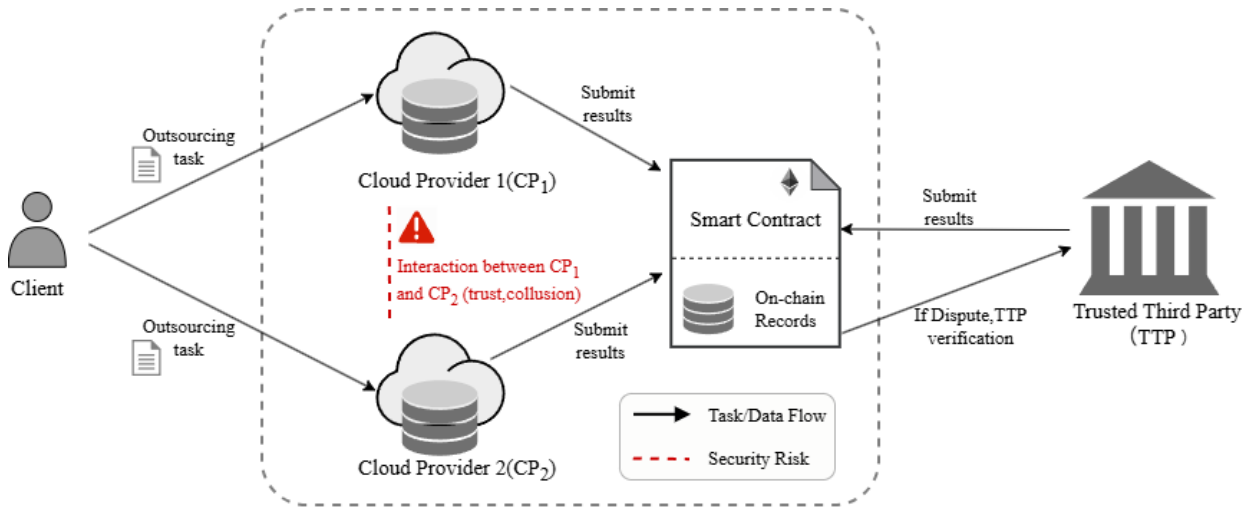
4.1.2. Outsourcing Contract Process
- (a)
- If both and fail to submit, the deposit e will be retained by CS.
- (b)
- and submit the same result, in a non-final outsourced task, CS will refund the deposit e and pay the payment r after acceptance. In the final outsourced task, CS invokes the TTP with a probability no less than .
- (c)
- Otherwise, CS invokes TTP to resolve the dispute.
- (a)
- Upon receiving the invocation, TTP calculates . TTP considers any absence of submission or any submission inconsistent with y as cheating, while submissions consistent with y are considered honest.
- (b)
- If one CP cheats and the other is honest, the deposit e of the honest party will be refunded and CS will pay the payment r. The amount z used to invoke TTP will be deducted from the deposit e of the cheating party, and the remaining deposit will serve as a reward for the honest party. No deposit e is refunded to the cheating party and no payment is paid by CS.
- (c)
- If and both cheat, their deposits will be obtained by CS and CS does not pay the payment, CS pays the cost z of invoking TTP.
| Algorithm 1: Outsourcing Contract |
 |
4.2. The Proposed Report Contract
Report Contract Process
- (a)
- CS assigns a reputation of to REP for that round, while LDR receives a reputation of for the same round.
- (b)
- Otherwise, the contract does not carry out additional operations.
5. Game and Analysis
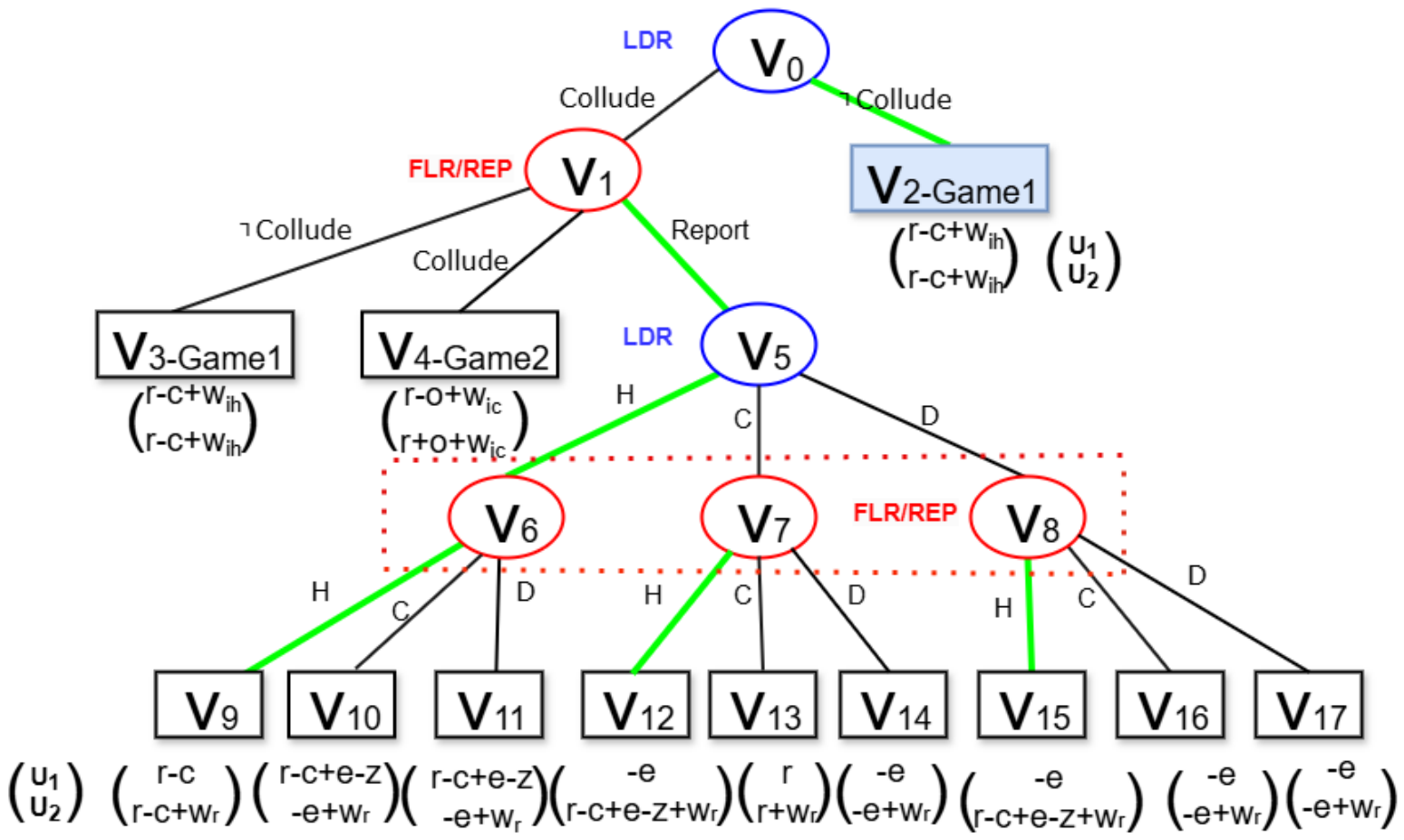
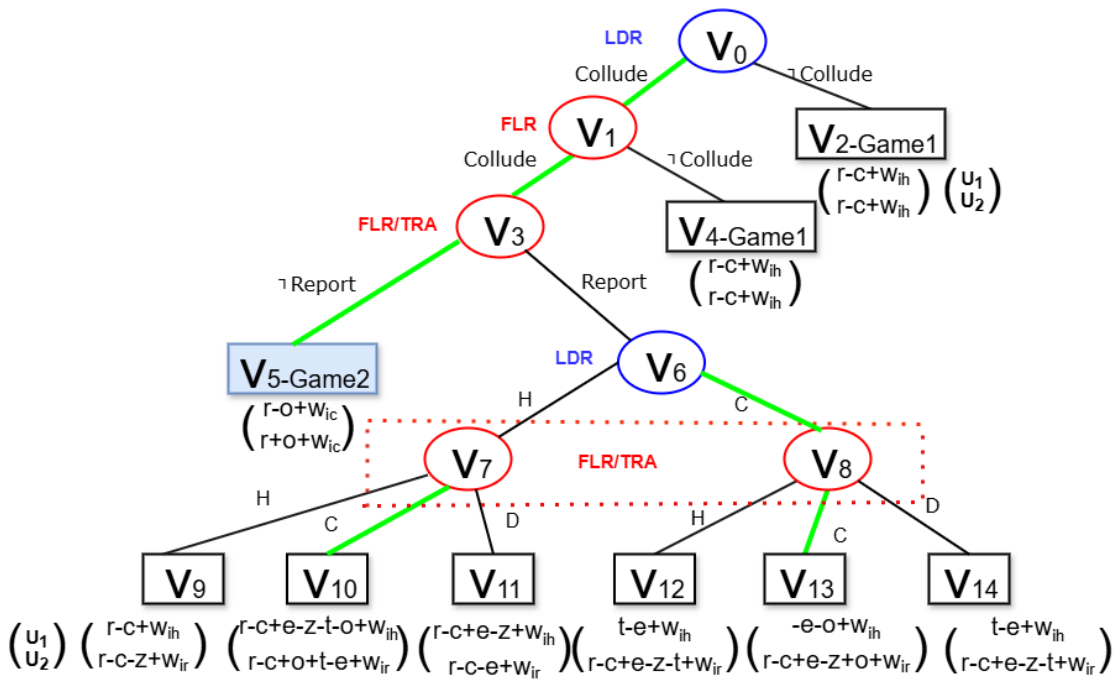
5.1. Analysis of Our Method
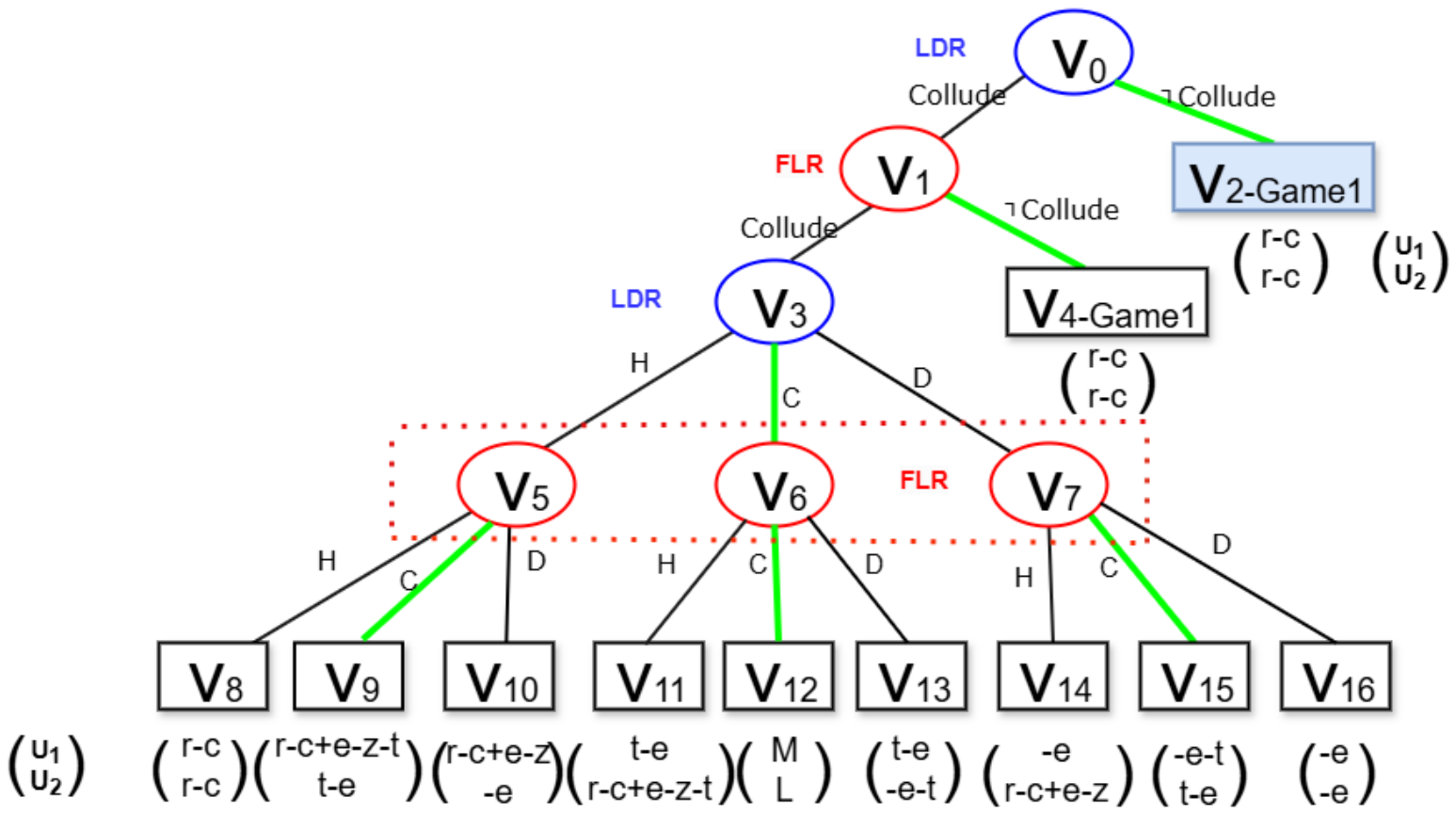
5.2. Analysis of Dong Method
5.3. Cost Analysis
5.4. Proof Theorem 1
6. Implementation and Results
6.1. Implementation
6.2. Experiments
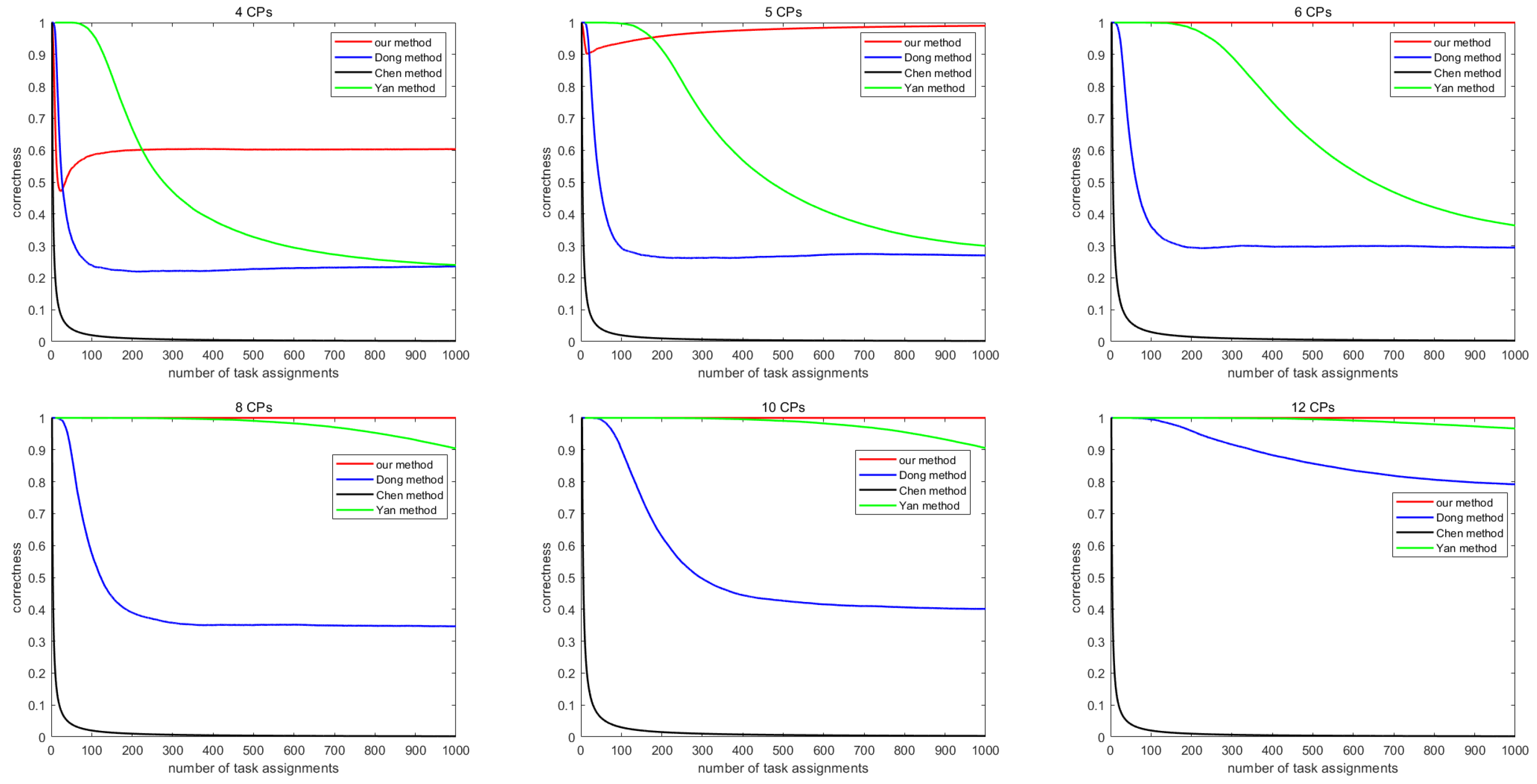
6.2.1. Standardized Task Scenario
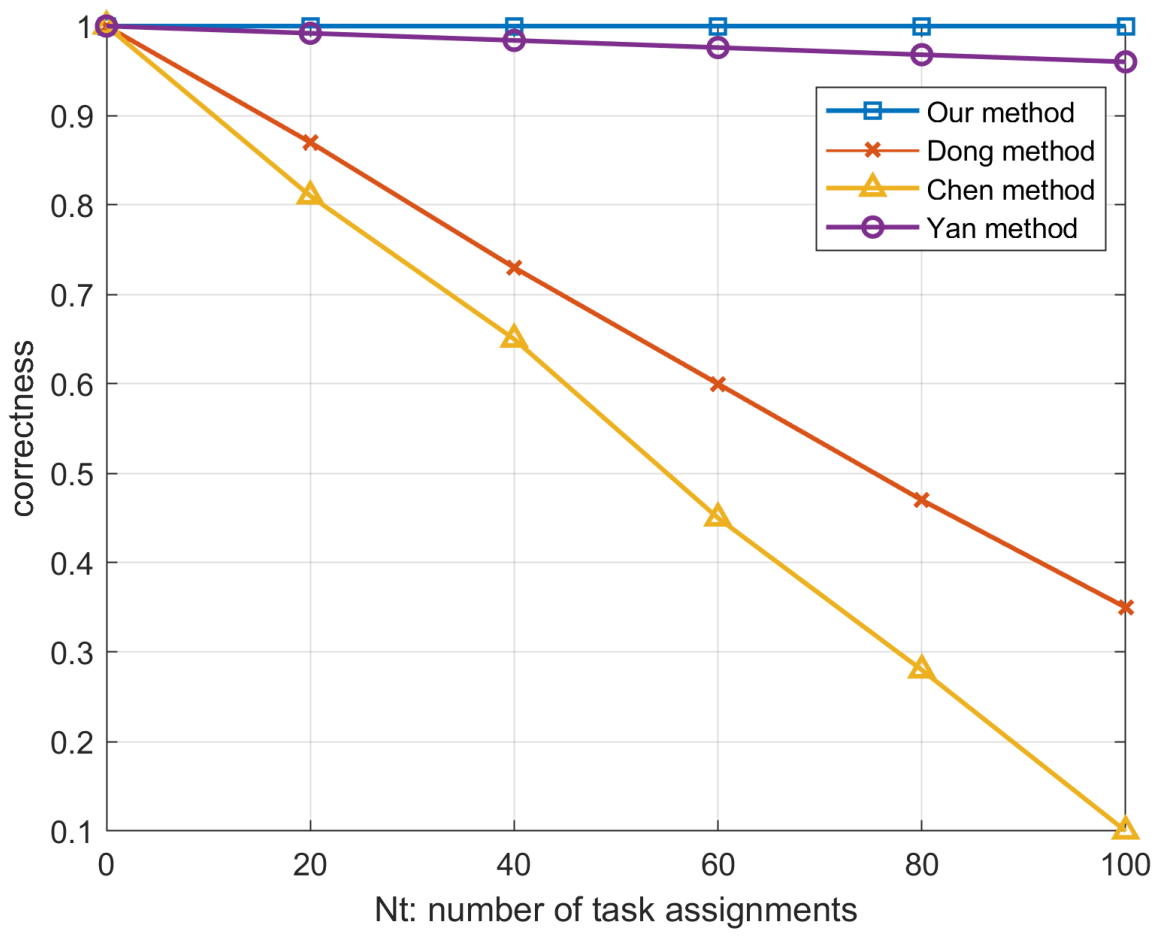
6.2.2. Diverse Task Scenario
7. Conclusions
Author Contributions
Funding
Data Availability Statement
Conflicts of Interest
References
- Zhang, Q.; Cheng, L.; Boutaba, R. Cloud computing: State-of-the-art and research challenges. J. Internet Serv. Appl. 2010, 1, 7–18. [Google Scholar] [CrossRef]
- Zhao, M.; Hu, C.; Song, X.; Zhao, C. Towards dependable and trustworthy outsourced computing: A comprehensive survey and tutorial. J. Netw. Comput. Appl. 2019, 131, 55–65. [Google Scholar] [CrossRef]
- Dong, C.; Wang, Y.; Aldweesh, A.; McCorry, P.; Van Moorsel, A. Betrayal, distrust, and rationality: Smart counter-collusion contracts for verifiable cloud computing. In Proceedings of the 2017 ACM SIGSAC Conference on Computer and Communications Security; ACM: New York, NY, USA, 2017; pp. 211–227. [Google Scholar]
- Costello, C.; Fournet, C.; Howell, J.; Kohlweiss, M.; Kreuter, B.; Naehrig, M.; Parno, B.; Zahur, S. Geppetto: Versatile verifiable computation. In Proceedings of the 2015 IEEE Symposium on Security and Privacy; IEEE: New York, NY, USA, 2015; pp. 253–270. [Google Scholar]
- Walfish, M.; Blumberg, A.J. Verifying computations without reexecuting them. Commun. ACM 2015, 58, 74–84. [Google Scholar] [CrossRef]
- Zhang, Y.; Yang, D.; Xue, G.; Yu, R. Counter-collusion smart contracts for watchtowers in payment channel networks. In Proceedings of the IEEE INFOCOM 2021—IEEE Conference on Computer Communications; IEEE: New York, NY, USA, 2021; pp. 1–10. [Google Scholar]
- Amazon. AWS Total Cost of Ownership (TCO) Calculator. 2023. Available online: https://aws.amazon.com/tco-calculator/ (accessed on 3 August 2026).
- Chen, Z.; Tian, Y.; Xiong, J.; Peng, C.; Ma, J. Towards reducing delegation overhead in replication-based verification: An incentive-compatible rational delegation computing scheme. Inf. Sci. 2021, 568, 286–316. [Google Scholar] [CrossRef]
- Liu, Y.; He, Z.; Liang, J.; Li, Z.; Deng, Q. Multidimensional Trust Evaluation and Task Match Based Workers Recruitment Scheme for MCS. IEEE Trans. Dependable Secur. Comput. 2026, 23, 5058–5074. [Google Scholar] [CrossRef]
- Liu, Y.; He, Z.; Liu, A.; Dai, X.; Deng, Q.; Li, Z. TDI: A Trust-Based Distributed Incentive Scheme to Promote Information Propagation. IEEE Trans. Mob. Comput. 2026, 25, 8566–8582. [Google Scholar] [CrossRef]
- Liu, P.; Zhang, W. A new game theoretic scheme for verifiable cloud computing. In Proceedings of the 2018 IEEE 37th International Performance Computing and Communications Conference (IPCCC); IEEE: New York, NY, USA, 2018; pp. 1–8. [Google Scholar]
- Li, T.; Tian, Y.; Xiong, J.; Bhuiyan, M.Z.A. FVP-EOC: Fair, verifiable, and privacy-preserving edge outsourcing computing in 5G-enabled IIoT. IEEE Trans. Ind. Inform. 2022, 19, 940–950. [Google Scholar] [CrossRef]
- Chen, Y.; Ma, J.; Wang, X.; Zhang, X.; Zhou, H. DE-RSTC: A rational secure two-party computation protocol based on direction entropy. Int. J. Intell. Syst. 2022, 37, 8947–8967. [Google Scholar] [CrossRef]
- Guo, J.; Du, Y.; Zhang, D.; Wu, R. PSEEMV: Provably secure and efficient emergency message verification scheme based on ECC and CRT for Space Information Network. J. Inf. Secur. Appl. 2023, 73, 103437. [Google Scholar] [CrossRef]
- Tanwar, N. An Efficient and Secure Blockchain Based Homomorphic Encryption for Intelligent Transport System; Springer: Berlin/Heidelberg, Germany, 2023; pp. 752–759. [Google Scholar]
- Kumar, P.; Sharma, S.K.; Kadam, K.U. Empirical Evaluation of ECC Batch Verification Algorithms of Digital Signature in Wireless Sensor Network. Electronics/Elektronika (1450-5843) 2022, 26, 53. [Google Scholar] [CrossRef]
- Devadas, L.; Goyal, R.; Kalai, Y.; Vaikuntanathan, V. Rate-1 non-interactive arguments for batch-NP and applications. In Proceedings of the 2022 IEEE 63rd Annual Symposium on Foundations of Computer Science (FOCS); IEEE: New York, NY, USA, 2022; pp. 1057–1068. [Google Scholar]
- Agarwal, A.; Alamati, N.; Khurana, D.; Raghuraman, S.; Rindal, P. On Black-Box Verifiable Outsourcing. In Proceedings of the Theory of Cryptography Conference; Springer: Berlin/Heidelberg, Germany, 2023; pp. 158–187. [Google Scholar]
- Mudigonda, A.S.; Williams, R.R. Time-Space Lower Bounds for Simulating Proof Systems with Quantum and Randomized Verifiers. arXiv 2020, arXiv:2012.00330. [Google Scholar]
- Chen, Y.; Xie, R.; Zhang, H.; Li, D.; Lin, W. Generation of high-order random key matrix for Hill Cipher encryption using the modular multiplicative inverse of triangular matrices. Wirel. Netw. 2023, 30, 5697–5707. [Google Scholar] [CrossRef]
- Yu, X.; Yan, Z.; Zhang, R. Verifiable outsourced computation over encrypted data. Inf. Sci. 2019, 479, 372–385. [Google Scholar] [CrossRef]
- Shen, J.; Liu, D.; Chen, X.; Li, J.; Kumar, N.; Vijayakumar, P. Secure Real-Time Traffic Data Aggregation with Batch Verification for Vehicular Cloud in VANETs. IEEE Trans. Veh. Technol. 2020, 479, 807–817. [Google Scholar] [CrossRef]
- Ben-Sasson, E.; Chiesa, A.; Goldberg, L.; Gur, T.; Riabzev, M.; Spooner, N. Linear-size constant-query IOPs for delegating computation. In Proceedings of the Theory of Cryptography Conference; Springer: Berlin/Heidelberg, Germany, 2019; pp. 494–521. [Google Scholar]
- Kalai, Y.T.; Paneth, O.; Yang, L. How to delegate computations publicly. In Proceedings of the 51st Annual ACM SIGACT Symposium on Theory of Computing; ACM: New York, NY, USA, 2019; pp. 1115–1124. [Google Scholar]
- Kalai, Y.T.; Paneth, O.; Yang, L. Delegation with updatable unambiguous proofs and PPAD-hardness. In Proceedings of the Annual International Cryptology Conference; Springer: Berlin/Heidelberg, Germany, 2020; pp. 652–673. [Google Scholar]
- Holmgren, J.; Rothblum, R. Delegating computations with (almost) minimal time and space overhead. In Proceedings of the 2018 IEEE 59th Annual Symposium on Foundations of Computer Science (FOCS); IEEE: New York, NY, USA, 2018; pp. 124–135. [Google Scholar]
- Li, L.; Zhang, T.; Sun, G.; Jin, D.; Li, N. A Fair, Verifiable and Privacy-Protecting Data Outsourcing Transaction Scheme Based on Smart Contracts. IEEE Access 2022, 10, 106873–106885. [Google Scholar] [CrossRef]
- Ma, J.; Chen, Y.; Wang, Z.; Liu, G.; Zhu, H. A rational delegating computation protocol based on reputation and smart contract. J. Cloud Comput. 2021, 10, 51. [Google Scholar] [CrossRef]
- Dong, L.; Mosteiro, M.A.; Singh, S. Verifiable Crowd Computing: Coping with Bounded Rationality. In Proceedings of the International Workshop on Frontiers in Algorithmics; Springer: Berlin/Heidelberg, Germany, 2022; pp. 59–78. [Google Scholar]
- Canetti, R.; Riva, B.; Rothblum, G.N. Practical delegation of computation using multiple servers. In Proceedings of the 18th ACM Conference on Computer and Communications Security, October 2011; ACM: New York, NY, USA, 2011. [Google Scholar] [CrossRef]
- Distler, T.; Cachin, C.; Kapitza, R. Resource-Efficient Byzantine Fault Tolerance. IEEE Trans. Comput. 2016, 65, 2807–2819. [Google Scholar] [CrossRef]
- Lai, R.; Zhao, G. Blockchain for achieving accountable outsourcing computations in edge computing. Comput. Commun. 2023, 200, 17–29. [Google Scholar] [CrossRef]
- Yan, H.; Jiang, N.; Li, K.; Wang, Y.; Yang, G. Collusion-free for cloud verification toward the view of game theory. ACM Trans. Internet Technol. (TOIT) 2021, 22, 1–21. [Google Scholar] [CrossRef]
- Foundation, E. Ethereum’s White Paper. 2016. Available online: https://ethereum.org/en/whitepaper/ (accessed on 3 August 2026).
- Tomassini, M.; Pestelacci, E.; Luthi, L. Mutual trust and cooperation in the evolutionary hawks–doves game. Biosystems 2010, 99, 50–59. [Google Scholar] [CrossRef] [PubMed]
- Taylor, C.; Nowak, M.A. Transforming the dilemma. Evolution 2007, 61, 2281–2292. [Google Scholar] [CrossRef] [PubMed]
- Lieh, O.E.; Jarzabek, S. An adaptability-driven model and tool for analysis of service profitability. In Proceedings of the Advanced Information Systems Engineering: 28th International Conference, CAiSE 2016 Proceedings 28, Ljubljana, Slovenia, 13–17 June 2016; Springer: Berlin/Heidelberg, Germany, 2016; pp. 393–408. [Google Scholar]
- Leyton-Brown, K.; Shoham, Y. Essentials of Game Theory: A Concise Multidisciplinary Introduction; Morgan & Claypool Publishers: San Rafael, CA, USA, 2022. [Google Scholar]
- Owen, G. Game Theory; Emerald: Leeds, UK, 2013. [Google Scholar]
- Kreps, D.M.; Wilson, R. Sequential equilibria. Econom. J. Econom. Soc. 1982, 50, 863–894. [Google Scholar] [CrossRef]



| Symbol | Description |
|---|---|
| ID of cloud provider () | |
| CS considers the number of times honestly computes tasks | |
| The number of tasks received by | |
| Signature of the client (CS) | |
| Signature of the cloud provider () | |
| The reputation of the cloud provider () |
| Contract | Operation | Cost (Gas) | Cost (USD) |
|---|---|---|---|
| Outsourcing | Init | 3,077,617 | 5.9295 |
| Create | 297,507 | 0.5732 | |
| Bid | 70,936 | 0.1367 | |
| Deliver | 58,423 | 0.1145 | |
| Pay | 95,288 | 0.1836 | |
| Dispute | 293,852 | 0.5662 | |
| Colluder | Init | 1,453,200 | 2.7998 |
| Create | 235,439 | 0.4536 | |
| Join | 21,064 | 0.0406 | |
| Enforce | 21,800 | 0.0420 | |
| Report | Init | 1,385,200 | 2.6688 |
| Create | 211,928 | 0.4083 | |
| Join | 21,320 | 0.0411 | |
| Promise | 21,204 | 0.0409 |
| Method | Mechanism | Main Strategy | Incentive/Punishment |
|---|---|---|---|
| Dong et al. [3] | Traitor’s contract | A CP reports collusion by submitting additional results and obtains the deposit of the colluding party as a reward. | Reward-based incentive for the reporter. |
| Chen et al. [8] | 1-n delegated computation | Tasks are divided into multiple computing blocks and assigned to overlapping CPs for repeated computation. | Relies on redundant computation to ensure correctness. |
| Yan et al. [33] | Outsourced computation with sentry tasks | Sentinel tasks are inserted into outsourced tasks to detect successful collusion. | Uses detection probability to discourage collusion. |
| Our method | Report contract and reputation certificate | A CP reports collusion by providing evidence and obtains reputation incentives. | Combines incentive mechanism and reputation penalty. |
| Method | Standardized Task Scenario | Diverse Task Scenario | ||||
|---|---|---|---|---|---|---|
| Our method | 0.93 | 0.98 | 0.99 | 0.92 | 0.98 | 0.99 |
| Dong method | 0.35 | 0.30 | 0.29 | 0.33 | 0.30 | 0.28 |
| Chen method | 0.07 | 0.03 | 0.01 | 0.05 | 0.02 | 0.01 |
| Yan method | 0.98 | 0.51 | 0.35 | 0.96 | 0.48 | 0.33 |
Disclaimer/Publisher’s Note: The statements, opinions and data contained in all publications are solely those of the individual author(s) and contributor(s) and not of MDPI and/or the editor(s). MDPI and/or the editor(s) disclaim responsibility for any injury to people or property resulting from any ideas, methods, instructions or products referred to in the content. |
© 2026 by the authors. Licensee MDPI, Basel, Switzerland. This article is an open access article distributed under the terms and conditions of the Creative Commons Attribution (CC BY) license.
Share and Cite
Wang, X.; Ren, Y.; Song, L. Smart Reputation-Based Counter-Collusion Contracts for Cloud Verification. Electronics 2026, 15, 3497. https://doi.org/10.3390/electronics15163497
Wang X, Ren Y, Song L. Smart Reputation-Based Counter-Collusion Contracts for Cloud Verification. Electronics. 2026; 15(16):3497. https://doi.org/10.3390/electronics15163497
Chicago/Turabian StyleWang, Xiaoli, Yajuan Ren, and Lipeng Song. 2026. "Smart Reputation-Based Counter-Collusion Contracts for Cloud Verification" Electronics 15, no. 16: 3497. https://doi.org/10.3390/electronics15163497
APA StyleWang, X., Ren, Y., & Song, L. (2026). Smart Reputation-Based Counter-Collusion Contracts for Cloud Verification. Electronics, 15(16), 3497. https://doi.org/10.3390/electronics15163497