1. Introduction
The anticipated rollout of sixth generation (6G) communication systems will enable an unprecedented number of devices (millions) to be connected. These connections will occur through massive Internet of Things (mIoT) and autonomous cyber-physical systems. To facilitate the required density in an uplink application environment, communication systems will need to move beyond traditional, sharply defined orthogonal access methods. In these methods, each spatial channel is allocated its own physical channel. Therefore, non-orthogonal multiple access (NOMA), specifically sparse code multiple access (SCMA), is essential. SCMA enables multiple users (devices) to share the same radio resource blocks by superimposing multiple (spatial) dimensions of sparsely coded symbols [
1].
The most recent developments in SCMA design rely on SVD (Singular Value Decomposition) for both spatial equalization and increased spectral efficiency [
2,
3]. Mathematical evolution is limited to complex numbers (
). As a result, when dense constellations are packed at high overloads in a two-dimensional area (
), destructive collisions occur. This degrades performance, even with high-order modulation schemes like 8-APSK [
4]. In practice, when the propagation environment includes devices with dual-polarized antennas, the
-based model assumes the amount of cross-polarization leakage, or XPD, is purely noise. This reduces both SINR and EVM in B5G/6G channel scenarios [
5].
By moving from the complex plane to the hypercomplex domain, this paper advances a novel redesign of the physical layer involving the SVD-SCMA architecture. The hypercomplex nature of quaternionic algebra () provides a true topological view of both 3-D and dual-polarized signals in a way that allows phase, quadrature and the two orthogonal polarization states to be processed together as one mathematical object in . The significant contributions of this study are outlined below:
Q-SVD-SCMA Architecture: A hypercomplex NOMA Transmission scheme is proposed in which user data is mapped onto the Quaternion Group (). Our approach will also apply spatial rotation along the pure imaginary axes () to maximize the minimum quaternionic Euclidean distance between colliding users.
Quaternionic MIMO Channel Model with XPD: Here, we present a mathematical model of the Rayleigh fading channel using quaternionic SVD precoding to describe how quaternionic SVD processes remove cross-polarization interference and replace it with recoverable spatial diversity.
Empirical Performance Analysis: Using a Monte Carlo simulation, we demonstrate that under ML detection, the proposed Q-SVD-SCMA scheme outperforms the complex SCMA scheme by a margin much larger than the theoretical limit. The ability to provide massive amounts of diversity will allow our scheme to maintain ultra-reliable communication even in extreme fading environments.
The remainder of the article is organized as follows:
Section 2 reviews related work;
Section 3 presents the system model, including the dual-polarization channel and the proposed Q-SVD-SCMA architecture;
Section 4 details the receiver design and the quaternion sphere decoding algorithm;
Section 5 presents the simulation results and performance analysis; and finally, open research challenges and concluding remarks are presented in
Section 6.
2. Related Work
Non-Orthogonal Multiple Access (NOMA) is an evolving technology primarily driven by the need to achieve massive connectivity for 5G and 6G use cases. One of the primary NOMA systems available today is Sparse Code Multiple Access (SCMA), which provides both coding and modulation gains. However, there is a significant lack of literature on high-density interference and polarization-unfriendly performance with regard to SCMA.
- A.
Conventional SCMA and its Limitations
Conventional SCMA architectures [
1,
2,
3,
6] are fundamentally designed around complex-valued (
) constellations, are referred to in this work as Complex-SCMA (C-SCMA). As seen by Nikopour et al. This design is useful when there is a low-to-medium amount of overload but breaks apart when the number of users colliding with one another increases. Under this approach, the communication channel is primarily modeled by assuming single-polarized (SP) transceivers, and electromagnetic propagation is represented in the two-dimensional complex domain (
), where multipath fading is characterized by complex scalar coefficients that alter the amplitude and phase of a single wave path.
Particularly in the context of Massive Machine-Type Communications (mMTC), Non-Orthogonal Multiple Access (NOMA) and SCMA frameworks have proven essential for accommodating dense Internet of Things (IoT) deployments [
7]. These schemes effectively alleviate network congestion by enabling massive concurrent access over limited resources. However, their practical scalability is limited by spatial congestion when transceivers operate solely within the complex two-dimensional domain (
). As the overhead factor increases, conventional SCMA systems face severe inter-user interference, degrading detection reliability in real-world 5G/6G environments.
- B.
Polarization as a Diversity Source
Recent studies have explored dual-polarized MIMO to increase spectral efficiency. However, most conventional approaches treat Cross-Polarization Discrimination (XPD) as a detrimental interference factor. Standard mitigation techniques, such as those proposed in [
8,
9], focus on canceling crosstalk, which effectively discards the energy leaked between polarizations.
- C.
Hypercomplex and Quaternionic Signal Processing
The application of quaternionic algebra (
) in signal processing is a nascent but powerful field. Early works by Isokawa et al. [
10] established the basis for quaternionic neural networks, while more recent advances in Quaternionic SVD (Q-SVD) [
11,
12] have shown promise in color image processing and vector field analysis.
While recent literature has recognized the potential of quaternionic algebra for dual-polarized (DP) MIMO systems, primarily for spatial modulation or orthogonal space-time block codes (OSTBCs) [
12,
13], its application to overloaded Non-Orthogonal Multiple Access (NOMA) remains unexplored. Previous works addressing cross-polarization discrimination (XPD) typically model it as independent complex fading coefficients [
14], mitigating it through conventional linear precoding (e.g., Zero-Forcing), which leads to significant capacity loss in heavily overloaded scenarios. Our approach distinguishes itself by embedding the non-commutative properties of
directly into the SCMA codebook design. Unlike standard complex constellation shaping, the proposed user-specific imaginary rotators (
) guarantee native orthogonal subspace projection in
, actively transforming XPD from a source of co-channel interference into a harvested spatial diversity gain. Furthermore, considering the stringent requirements of 6G, this hypercomplex modeling is highly synergistic with emerging physical layer technologies such as AI-enhanced edge integration [
15] and advanced movable antenna array designs for precise channel estimation [
16].
3. System Model
This section contains the system model for the uplink of a massive 6G mobile network. We consider a non-orthogonal multiple access (NOMA) environment with
users (each with Dual Polarized (DP) antennas) transmitting to a base station (BS) with a massive DP antenna array while using shared
orthogonal time-frequency resource blocks, where
defines the overload factor
. The end-to-end diagram of the Q-SVD-SCMA architecture is presented in
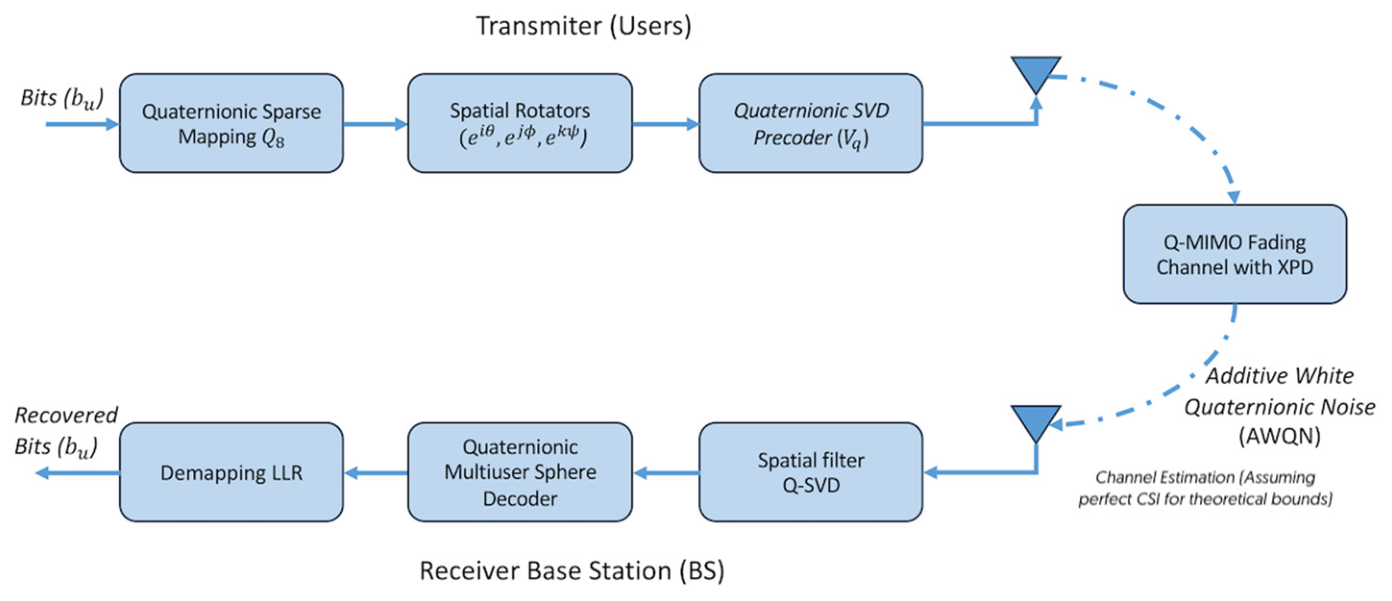
Figure 1. The key difference between conventional transceivers and the proposed architecture is that all processing occurs in the hypercomplex domain. At the transmitter, a user’s bitstream is mapped to a quaternionic Alphabet, rotated in space (Orthogonal Spatial Rotation), and prefixed with spatially dependent SVD-based precoding before being transmitted through the fading channel affected by XPD to the BS. The receiver uses an effective channel equalizer (spatial filter) that compensates for channel fading and an SVD-based multi-user detector (Q-SD) designed to recover the symbols transmitted from each user.
- A.
Quaternion Algebra Preliminaries
A quaternion
is defined as a linear combination of one real basis and three orthogonal imaginary bases [
17]:
where the imaginary units satisfy Hamilton’s fundamental formula
. The conjugate of
is denoted by
, and its squared Euclidean norm is defined as
. Unlike the complex field
, multiplication in the quaternionic ring
is strictly non-commutative. This property is central to our proposal, as it enables geometric isolation of inter-user interference.
- B.
Dual-Polarized Q-MIMO Fading Channel with XPD
Let
denote the quaternionic channel vector between the
-th user and the BS. The channel response is represented as the superposition of co-polarized and cross-polarized components [
14]:
where
represents the main co-polarized fading component, and
denotes the cross-polarized leakage component induced by the dual-polarized antennas, and
is the number of receive antennas at the BS. To model this leakage mathematically, we define the linear power leakage factor as
.
To describe the statistical properties of the channel and ensure that the expected total link energy is normalized to unity (
), we utilize standard hypercomplex notation. The independent variances of the real and purely imaginary components are defined as follows:
- C.
Quaternionic SVD Precoding (Q-SVD)
Assuming perfect Channel State Information (CSI) at the BS, the Quaternionic Singular Value Decomposition (Q-SVD) is computed for each user
[
18] as follows:
where
is a unitary quaternionic matrix containing the left singular vectors,
is a real-valued matrix containing the singular values, and
represents the right singular vector acting as a unit quaternion scalar. Upon receiving, the adjoint operator
(the Hermitian transpose of
) is used for spatial filtering, such that the Q-MIMO channel can be collapsed into a real effective scalar channel attenuated by the principal singular value
(the largest value in
). We must highlight the physical implications of the Q-SVD operation in the proposed architecture. This operation is performed individually for each user
. While the singular value decomposition of the individual user channel vector
(assuming a single DP antenna on the user side) is mathematically simple and computationally efficient, it serves as an optimal polarization matching filter. By premultiplying the raw received signal by the left singular vector
, the base station dynamically rotates its receiving frame to align with the incoming twisted polarization state of the user
. This algebraic step ensures that the energy leaking through the communication medium via cross-polarization discrimination (XPD) is not discarded as crosstalk but is coherently collected and diagonalized into the effective real-value channel gain
before joint SCMA sphere decoding.
- D.
Q-SCMA Codebook Design, Spatial Rotators, and Geometrical Separation
In Q-SCMA, bit-to-symbol mapping is a hypercomplex sparse dictionary function. For each user there are bits ( is the modulation order) that are mapped directly to a quaternion codebook . We follow the classic resource indicator matrix formation using the indicator matrix , where each user sends data over resources, and each resource is shared with users. The mother two-dimensional alphabet comes from the Quaternion Group , ensuring a constant power constellation. Since , each hypercomplex symbol inherently encodes bits. Because the 4D hypercomplex lattice features six equidistant orthogonal neighbors, formulating a perfect Gray code—where all adjacent neighbors differ by exactly one bit—is mathematically constrained. Consequently, the assigned mapping (e.g., , , , , , , , and ) is a custom-optimized multi-dimensional Gray mapping designed to minimize the average bit penalty per symbol.
Furthermore, to combat the topological interference inherent to overloaded NOMA systems, a user-specific rotation
is applied to the Gray-mapped symbols. The assignment of the rotation axes (
) and rotation angles (
) is a critical design parameter governed by a deterministic criterion: maximizing the Minimum Quaternionic Euclidean Distance (MQED) between the constellations of colliding users. For an SCMA system with a collision degree of
sharing the same resource block, the rotation axes are strictly assigned as the purely imaginary, orthogonal basis vectors of
:
Scaling this architecture to a higher overload factor (e.g., ) requires either the use of non-orthogonal fractional quaternions or a structural transition to higher-order algebras. Therefore, the 150% overload factor () establishes the baseline theoretical limit for strictly orthogonal isolation within the current quaternionic framework.
To achieve pure orthogonal subspace projection, the rotation angle is set to for all users. Using Euler’s formula for quaternions, this simplifies the rotation operator to . This specific assignment criteria guarantees that the signal sets of the three colliding users are projected into mutually orthogonal imaginary sub-spaces in . Consequently, the cross-correlation between the user codebooks is analytically minimized before transmission. This spatial separation ensures that the superimposed signal constellation achieves the theoretical maximum MQED, effectively transforming the co-channel interference into separable spatial diversity paths at the receiver.
The transmitted codeword for the
-th resource is synthesized as:
where
represents the sparsity mapping and
is the information symbol. Let
denote the user index,
denote the resource block index, and
denote the constellation symbol index.
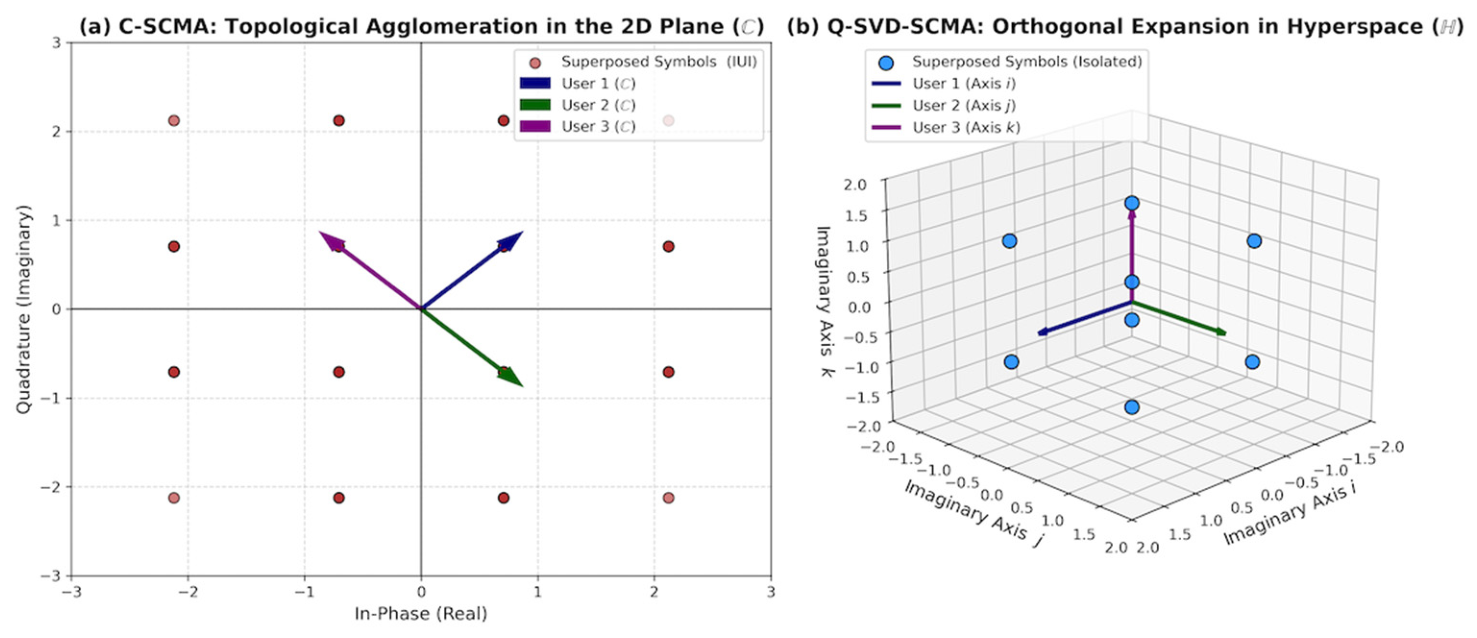
To illustrate the topological superiority of this hypercomplex mapping,
Figure 2 contrasts the spatial superposition of constellations under collision between the traditional two-dimensional scheme and the proposed architecture.
In Panel (a) of
Figure 2, we observe that when there are dense constellations in two-dimensional complex domain (
), they cause a topological collapse of the interference between multiple users on a given resource block because the superimposed (overlapping) symbols create a High Density IUI (Inter-User Interference) cloud; this means the spatial congestion drastically reduces Minimum Euclidean Distance (MED) so that decoder is susceptible to thermal noise; decoder will not be able to differentiate the original symbols when in deep fade conditions. On the other hand, Panel (b) gives empirical evidence of geometric expansion from quaternionic algebra where the
users colliding in the same resource node are given three strictly orthogonal subspaces (
) which allows them to distribute the IUI across the volume of a
hypersphere (Q-SVD-SCMA); therefore, the signals from the users repel each other into orthogonal imaginary dimensions. The result of volumetric distribution also preserves the constant-envelope properties required for efficient power amplification at the transmitter and provides massive spatial isolation. The basis for the diversity gain evaluated during performance assessments is the isolation of the Orthogonal Subspaces. By assigning Orthogonal Subspaces to colliding users, the interference is dispersed throughout the
hypersphere volume, thereby improving the reliability of the detection process.
- E.
Received Signal Model
The superimposed received signal at the
-th resource block at the BS is given by:
where
denotes the Additive White Quaternionic Gaussian Noise (AWQGN). In this model, is defined such that its four components (real,
) are independent and identically distributed (i.i.d.) real Gaussian variables, each with zero mean and variance
.
represents the set of users colliding at the
-th resource, and
is the principal singular value derived from the Q-SVD, which scales the transmitted quaternionic codeword
.
4. Receiver Design and Complexity Mitigation
- A.
Optimal Maximum Likelihood (ML) Detection over
The ML detector seeks the optimal combination of codewords
that minimizes the MQED relative to the received signal:
The exact decision metric is evaluated by decomposing the quaternionic signal into its real and imaginary components. While this approach guarantees maximum diversity gain, its exponential complexity
necessitates advanced mitigation strategies, such as those adapted from the Moore–Penrose pseudo-inverse [
19], re-engineered for the hypercomplex space.
- B.
Quaternionic Sphere Decoding (Q-SD) Algorithm
To mitigate the computational overhead of maximum likelihood exhaustive search (ML), we propose an adaptation of the sphere decoding algorithm specifically designed for the quaternion network (
) [
20,
21]. It is crucial to note that conventional sphere decoders operate on the complex plane (
) and rely on Euclidean distances that cannot capture coupled polarization states or the noncommutative properties of hypercomplex numbers. Therefore, our quaternion sphere decoder (Q-SD) customizes the branch metric evaluation to operate natively within
.
The Q-SD algorithm reformulates the ML decision rule of Equation (8) as a radius-constrained feasibility search: instead of an unconstrained minimization, the decoder restricts the candidate search to lattice points satisfying:
We denote as the radius of our starting search hyperspace. Because the superimposed signal incorporates the Cross-Polarization Discrimination (XPD) leakage collected by the spatial rotators (), the distance calculation must evaluate the norm of the resulting quaternion, inextricably linking the real and the three imaginary components ().
The proposed Quaternionic Sphere Decoder (Q-SD) implements a customized Schnorr-Euchner (SE) enumeration uniquely adapted for the
lattice [
20,
21,
22]. Unlike standard complex decoders, the hypersphere radius constraint is evaluated using the Minimum Quaternionic Euclidean Distance (MQED) over
. The algorithm dynamically sorts the six equidistant orthogonal neighbors of the reference point based on their real-valued MQED projections. This guarantees that the closest lattice points in the hypercomplex space are evaluated first, efficiently pruning unviable sub-trees.
- C.
Computational Complexity Evaluation
While the worst-case theoretical complexity of sphere decoding remains exponential with respect to the user overload [
22], this customized SE enumeration paired with MQED pruning reduces the average expected computational complexity to approximately
in high SNR regimes, maintaining feasibility for low-latency implementations.
5. Simulation Results and Performance Analysis
- A.
Simulation Setup
To assess how well the proposed architecture works, we will look at a large uplink massive NOMA case where the overload factor is
. In this case, six users (
) share four (
) orthogonal resources. The resource allocation is governed by the
factor graph indicator matrix
, ensuring a constant collision degree of
per resource:
To ensure a comprehensive and fair performance evaluation, the proposed Q-SVD-SCMA is compared against two baseline architectures. The first baseline is the C-SCMA, which employs an 8-PSK mother constellation with user-specific optimum 2D phase rotations (, , and ) using maximum likelihood (ML) detection. The second baseline is the intermediate SVD-SCMA scheme, which utilizes spatial filtering to harvest XPD energy but remains topologically confined to the 2D complex plane. Since both the baseline schemes (using 8-PSK) and the proposed Q-SVD-SCMA (using ) employ constellations under a overload factor, the system achieves an identical spectral efficiency of bits per channel use (bpcu). Furthermore, we enforce strict energy normalization. Cross-polarization discrimination (XPD) introduces a leakage energy factor (). To avoid an unfair power advantage, the effective magnitude of the quaternionic channel in the Q-SVD-SCMA simulation is scaled by . Consequently, both the conventional 2D Rayleigh fading channel and the 4D XPD Rayleigh channel maintain an identical expected channel power gain of . This ensures that any observed performance improvement (reduction in symbol error rate) in the Q-SVD-SCMA architecture stems exclusively from the hypercomplex spatial diversity and optimal projection into the orthogonal subspaces, rather than from an arbitrary increase in the received signal energy.
The evaluation of the system using the maximum likelihood method ensures that the resulting symbol error rate (SER) and bit error rate (BER) curves accurately reflect the topological gain and spatial diversity provided by the 4D hypercomplex code dictionary. This approach rigorously isolates the geometric benefits from potential suboptimal convergence artifacts or error propagation problems inherent in MPA in high-overload networks.
- B.
SER and BER analysis
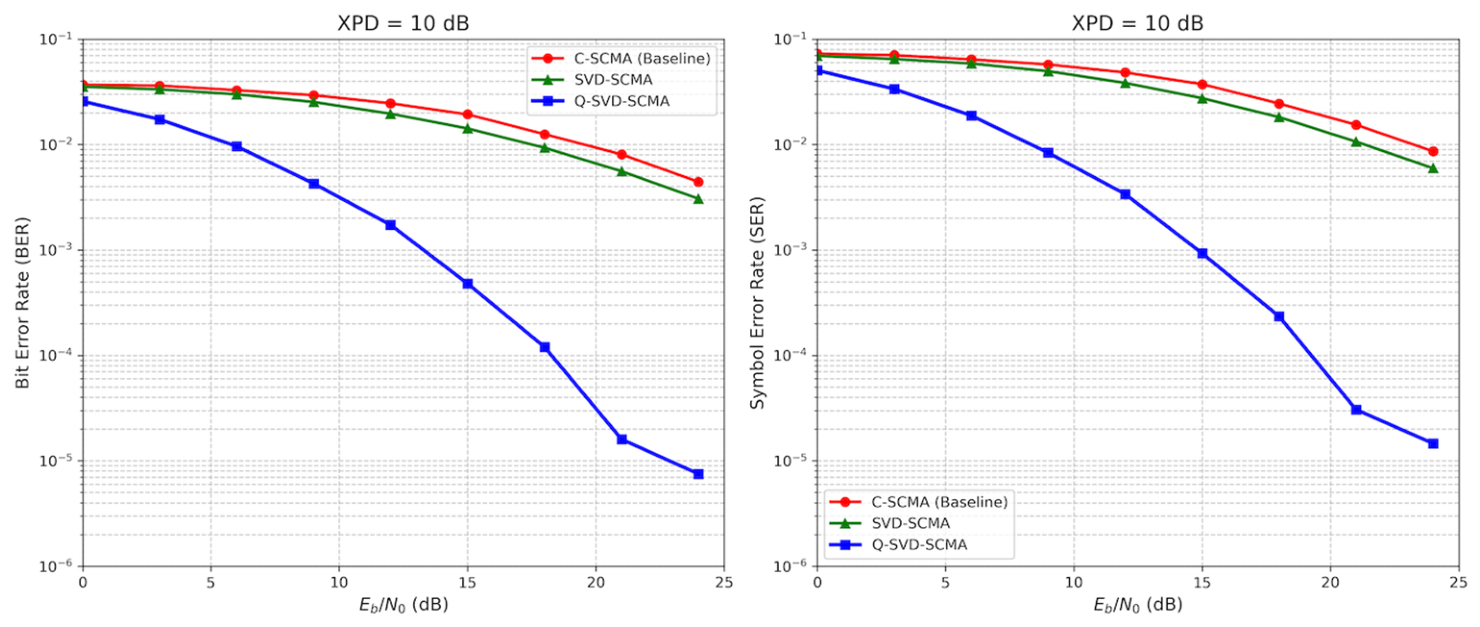
Figure 3 shows the system’s performance in terms of Symbol Error Rate (SER) and Bit Error Rate (BER) versus the
ratio. This dual visualization is important, as SER quantifies the purely geometric robustness of the signal separation in the physical channel, while BER certifies the end-to-end reliability of the information.
Diversity Order Enhancement: To quantitatively support the claim of spatial diversity gain, we analyze the asymptotic diversity order, defined as , representing the slope of the SER curve at high SNR. The empirical data reveal that the 2D baseline schemes (C-SCMA and SVD-SCMA) reach interference-limited saturation, resulting in a diversity order approaching at 20 dB. In contrast, the proposed Q-SVD-SCMA architecture circumvents spatial collision, maintaining a continuous exponential decay with an observed diversity order of . This mathematical behavior quantitatively confirms that the hypercomplex projection effectively translates cross-polarization leakage into pure spatial diversity.
XPD Power Gain: By mapping the signals from the directly coupled DP channel onto the 4-dimensional quaternion network, spatial rotators effectively isolate users within orthogonal imaginary subspaces. Empirical data demonstrate that this hypercomplex projection not only transforms XPD interference into diversity gain but can also prevent the saturation observed in conventional 2D schemes, achieving a SER of less than 10−4 at 20 dB.
- C.
Robustness to Variable Cross-Polarization Leakage
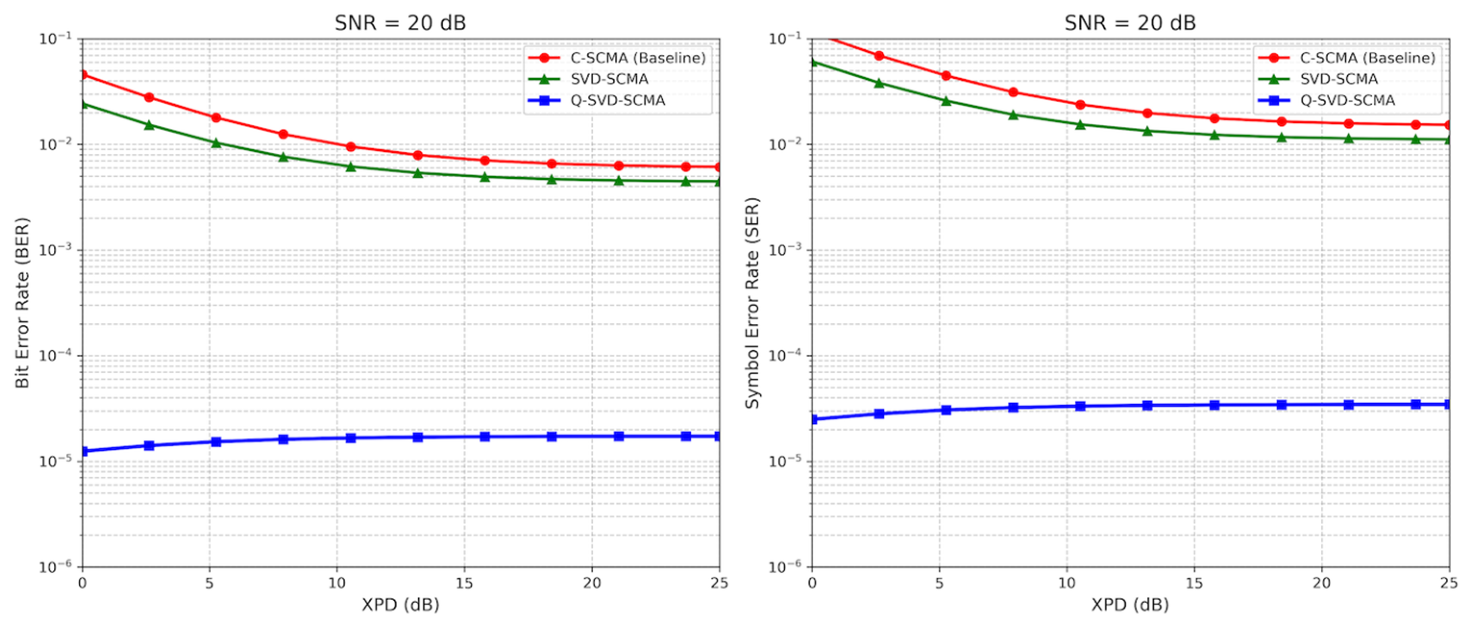
This section demonstrates the performance of our proposed system using the symbol error rate (SER) and bit error rate (BER) across a continuous range of cross-polarization discrimination (XPD) values from 0 dB to 25 dB, while maintaining a fixed signal-to-noise ratio (SNR) of 20 dB. Low XPD values indicate channels with high dispersion, while high XPD values indicate strong polarization isolation, as occurs in line-of-sight scenarios.
Figure 4 shows that at low XPD levels (0 dB to 10 dB), there is significant energy leakage between the vertical and horizontal transmissions. The C-SCMA scheme suffers severe degradation because the leaked energy acts as co-channel interference. While the intermediate SVD-SCMA scheme dynamically utilizes this leaked power, it does not significantly improve upon its predecessor.
In contrast, the proposed Q-SVD-SCMA architecture exhibits good performance even in environments dominated by high dispersion, as it natively supports coupled polarization states within the hypercomplex subspace , transforming polarization leakage into a source of spatial diversity. As XPD increases (approximately 25 dB), where polarization leakage decreases significantly, C-SCMA and SVD-SCMA stabilize at their 2D collision limits. However, Q-SVD-SCMA maintains its performance, achieving a SER close to , demonstrating that its performance improvement is not based on leveraging the XPD power, but rather on the native geometric expansion of the Minimum Quaternion Euclidean Distance (MQED) provided by imaginary spatial rotators.
6. Discussions and Conclusions
In this paper, we demonstrate that a new hypercomplex transmission architecture called Q-SVD-SCMA is capable of addressing spectral efficiency and reliability constraints of a massive 6th Generation (6G) uplink network. The hierarchical change in the design of the physical layer has moved from a 2-D complex plane () to the 4-D quaternionic ring (). In addition, we have shown that the topological restrictions associated with traditional SCMA can also be mitigated using this new transmission architecture.
The main mathematical contribution of this work is an innovative method that integrates SVD-based precoding with quaternion support via mutually orthogonal spatial rotators. This technique provides a geometric means of isolating inter-user interference as a volumetric distribution of user groups (constellations) within a sphere or hypersphere of dimension R4. Empirical tests of the system on a dual-polarized Rayleigh fading channel with an XPD of 10 dB demonstrated that the proposed scheme achieved substantial diversity gain. Specifically, compared to traditional 2D baselines (C-SCMA and intermediate SVD-SCMA), the Q-SVD-SCMA framework successfully prevents interference-limited saturation and strictly bounds the bit error penalty.
The results obtained in our work show that Q-SVD-SCMA exploits severe polarization leakage in propagation environments with high dispersion (0 dB to 10 dB XPD), transforming what 2D systems perceive as co-channel destructive interference into spatial diversity. Furthermore, under highly isolated channel conditions (high XPD), the system maintains its topological domain thanks to the intrinsic geometric expansion of the minimum quaternion Euclidean distance (MQED).
Furthermore, we demonstrated that the Quaternionic Sphere Decoder (Q-SD) achieves near-ML detection performance with an expected computational complexity of , thereby ensuring suitability for the ultra-low-latency requirements of 6G systems. These findings suggest that hypercomplex signal processing is a promising paradigm for managing massive connectivity and cross-polarization leakage in future wireless networks.
- A
Open Research Challenges and Future Directions
While the results obtained in this work validate the theoretical performance limits and topological advantage of the Q-SVD-SCMA architecture in a 4D Rayleigh fading channel with perfect channel state information (CSI), implementing hypercomplex signal processing in real-world 6G networks presents several challenges. Future research should evaluate the robustness of the quaternion code dictionary under imperfect CSI conditions, integrating AI-assisted channel estimation or convolutional neural networks (CNNs) to compensate for synchronization problems and mobility-induced Doppler shifts.
The current mathematical framework sets its theoretical limits under a standard overhead factor of 150% (collision degree ). This constraint is tied to the algebraic structure of the quaternion ring , which provides exactly three mutually orthogonal, purely imaginary axes () for spatial rotation. Scaling the proposal to support 200% overhead scenarios () for extreme mMTC deployments presents a significant open challenge. Future research should explore integrating non-orthogonal fractional quaternions or transitioning to higher-order algebras, adapting the sphere decoding limits to handle the resulting non-associative topological interference.
Finally, although the Q-SD algorithm theoretically performs better than its predecessors, an analysis of FLOPs, memory consumption, and inference latency on modern DSP or FPGA platforms is required to confirm its viability in ultra-reliable low-latency communications (URLLC).




 ,
,