1. Introduction
Indoor people-flow monitoring has become a core sensing function for smart buildings, safety management and human-centric Internet-of-Things (IoT) services [
1]. Beyond binary presence detection, practical deployments often need to estimate how many people are passing, whether their trajectories are separated, crossing or following and which registered identities are associated with the observed motion events.
Camera and millimeter-wave systems provide rich spatial information, but they typically require line-of-sight installation, non-trivial processing resources and explicit privacy governance. Passive ultra-high-frequency (UHF) RFID offers a complementary sensing route because commercial readers can acquire tag identifiers and wireless features without batteries, wearable electronics with active radios or image capture [
2]. RFID technology and application studies further show that low-cost tag infrastructure is suitable for pervasive indoor identification scenarios [
3]. In UHF deployments, EPC Gen2 provides the practical identification basis for reading identity tags and fixed array tags in a unified stream [
4]. Early RFID localization work also shows that identity-bearing tags can support indoor location sensing, although passage monitoring requires more than static tag localization [
5]. Recent surveys have further emphasized the transition from RFID identification to RFID sensing in IoT environments [
6].
However, RFID-based dynamic human sensing remains challenging in indoor passages. The feasibility of RFID-based human-activity detection has been demonstrated in early RF-sensing studies [
7]. Deep learning has further been introduced to RFID-based activity recognition [
8]. Wearable RFID radio-pattern modeling has shown that motion states can be inferred from RSSI variation [
9]. Recent UHF RFID behavior-recognition work also indicates that dynamic tag detection benefits from multi-feature temporal modeling [
10]. RSSI measurements remain sensitive to multipath and body-induced attenuation, a limitation also reflected in radio tomographic imaging research [
11]. Passive-tag localization and tracking studies similarly show that robust device-free sensing requires spatial diversity and data-driven modeling [
12]. A single RFID link or a small number of tags therefore produces unstable features when several people pass close to each other. In addition, identity recognition and behavior recognition are often processed as loosely coupled tasks, which can cause identity switching under crossing trajectories, missed tag reads or overlapping occlusion intervals.
To address these challenges without overstating the scope of the prototype, this study develops an identity-aware RFID tag-array framework for corridor-style dynamic indoor passage monitoring. The central idea is to use wearable passive identity tags for subject-level traceability while using a fixed passive tag array as a spatial sampling surface for RSSI disturbance observation. The framework couples timestamp-level identity/RSSI alignment, EBD-based valid-window screening, observation-inferred distance-mode partitioning and temporal modeling. The method is therefore positioned as an integrated RFID-only sensing pipeline rather than as a new RFID physical sensing mechanism or a fully validated smart-building deployment solution.
The main contributions are as follows:
A joint identity-tag and tag-array sensing architecture is developed. Wearable passive tags provide traceable EPC identities, while the wall-mounted passive array converts single-link RSSI observation into multi-channel spatial disturbance sensing.
An EBD mechanism is used to identify valid human-occlusion windows using differential RSSI energy and active-tag ratios. This step reduces background-window imbalance and provides interpretable temporal boundaries for dynamic passage events; it is treated as a rule-based screening module rather than as an independently supervised detector.
A distance-aware parallel LSTM fusion model is designed for joint target-count regression, behavior-state recognition and window-level identity association. Distance modes are estimated from RFID disturbance patterns and tag-array geometry during inference; marked walking lanes are used only for experimental control and label verification.
A Dynamic Tag-Array RSSI dataset and a subject-independent evaluation protocol are reported. The quantitative results are limited to a single-reader, single-antenna, one-room corridor-style prototype with up to three participants, and claims are confined to this controlled setting.
The remainder of this paper is organized as follows.
Section 2 reviews RFID-based sensing and identity-behavior association.
Section 3 presents the method.
Section 4 reports the experimental setup, dataset, preprocessing and results.
Section 5 discusses practical implications and limitations, and
Section 6 concludes this paper.
2. Related Work
Indoor human-dynamics sensing has moved from simple presence detection and aggregate counting toward integrated perception that supports identity verification, behavior recognition and traceable event reconstruction. In applications such as public safety, smart-space management and personnel mobility control, behavior features must be quantifiable, identities must be explicitly associated and dynamic processes must be temporally recoverable.
Existing indoor sensing technologies can be broadly grouped into behavior-oriented and identity-native approaches. Vision and millimeter-wave radar provide high-resolution motion and location features, but they do not naturally assign a unique identity to each individual and may introduce privacy or deployment burdens. RFID, by contrast, provides a native electronic identifier through each tag, enabling low-cost and contactless identity annotation. The remaining challenge is that RFID behavior sensing based on RSSI is sensitive to multipath interference, occlusion superposition and environmental change; therefore, RSSI alone is insufficient for robust dynamic behavior recognition unless spatial diversity and temporal modeling are carefully designed.
Representative recent studies in mobile computing, sensor networks and ubiquitous sensing have shown that commodity RF signals can support tracking, localization and activity recognition when signal features are carefully modeled. High-precision mobile RFID-tag tracking has been reported with commercial off-the-shelf RFID devices [
13]. RF signal interaction has also been used to construct air-based virtual touch interfaces [
14]. Vision-assisted RFID systems have been explored to improve fine-grained multi-object identification [
15]. Transformer-style temporal modeling has recently been applied to device-free human activity recognition [
16]. Multimodal convolutional RFID recognition further demonstrates that feature fusion can improve human-activity recognition robustness [
17]. These studies motivate the present work, but they also highlight a gap: existing systems often emphasize either high-precision RF tracking or heterogeneous modality fusion, whereas low-cost RFID-only sensing with simultaneous identity-behavior association in multi-person passage scenarios remains underdeveloped.
2.1. Advances in RFID-Based Behavior Sensing
RFID sensing exploits the obstruction, scattering and reflection effects of the human body on electromagnetic waves. These effects produce regular variations in RSSI, phase or channel-related features, which can then be used to infer activity patterns, spatial positions and target numbers.
RSSI-based sensing is the most deployable low-cost approach because it requires no phase synchronization and is supported by most commercial RFID readers. Prior work has improved RFID behavior recognition through multi-feature analysis, deep residual networks, Transformer-style temporal modeling and multimodal RSSI-phase fusion. These studies confirm the feasibility of commercial RFID sensing, but they also show that robustness depends strongly on channel diversity, scenario coverage and sample quality.
However, RSSI signals are highly sensitive to environmental multipath, non-uniform body occlusion and dynamic interference. Metallic objects, human-body absorption and tag orientation changes can produce short-term dropouts or non-monotonic fluctuations. In complex passage scenarios such as following, crossing and close-range overlap, single-tag or single-antenna RSSI schemes often experience feature aliasing, which motivates the use of spatial tag arrays and temporal models.
Phase- and CSI-based approaches provide higher signal resolution and have achieved strong performance in fine-grained tracking and gesture recognition. Nevertheless, they commonly require phase calibration, antenna-array geometry or more complex signal synchronization. They also do not automatically solve the identity-binding problem unless explicit ID observations are integrated into the sensing pipeline.
RFID identity recognition is widely used in static access-control and attendance scenarios, where each tag provides a unique EPC. Such applications usually make only a presence-or-absence decision and do not integrate continuous wireless-signal sensing with identity traceability. As a result, they cannot directly support continuous behavior sensing and real-time identity binding in dynamic multi-person passages.
2.2. Single-/Dual-Target Dynamic Detection and Tag-Array-Based Sensing
Dynamic detection of single, dual and multiple targets is a fundamental problem in RFID-based human sensing and a prerequisite for identity–behavior joint perception. Existing RFID-based multi-target detection methods can be mainly divided into two technical directions: signal separation and spatial array sensing.
In the signal separation direction, current studies mainly focus on anti-collision algorithms and blind source separation. RFID anti-collision protocols have been systematically surveyed for dense-tag reading [
18]. Antenna-array signal processing has also been used to separate overlapping RFID responses [
19]. However, such methods mainly focus on the correct reading of tag IDs. They do not use the spatial distribution characteristics of tag signals for dynamic behavior detection. Consequently, they cannot distinguish between the static presence of tags and dynamic human behavior, nor can they jointly estimate target number and behavior patterns.
In the spatial array sensing direction, RFID tag arrays have become an effective solution for improving dynamic detection capability. Passive RFID tag arrays have been used for device-free posture recognition in assisted-living scenarios [
20]. Wall-mounted UHF RFID tags have also supported device-free indoor localization [
21]. Passive-tag object tracking studies show that distributed tag responses can encode target-induced signal changes [
22]. Recent transparent RFID tag-wall work further extends array-based sensing to assisted-living monitoring [
23]. Transformer-based tag-free fall detection indicates that RF feature fusion is useful in safety-oriented monitoring [
24]. Passive RFID array localization and activity recognition from radio images further support the value of spatial RSSI sampling [
25]. A two-dimensional or wall-mounted tag array converts single-point RSSI acquisition into surface-level spatial sampling, making it possible to infer human movement, posture, location or activity from distributed attenuation patterns. Recent studies further show that AI-based tag walls can support contactless monitoring in assisted-living scenarios, but the explicit fusion of identity readings with array disturbance patterns remains underdeveloped.
Despite these advances, existing tag-array-based schemes still face three major limitations. First, they mainly focus on improving spatial resolution and do not integrate the unique ID-based identity capability of RFID tags. Second, fine-grained dynamic detection for single and dual targets remains insufficiently studied. Third, existing methods lack interpretable mechanisms for quantifying behavior duration and dynamic features. These limitations motivate an RFID-only framework that combines identity-tag observations with tag-array RSSI disturbance patterns under a clearly bounded passage-monitoring scenario.
2.3. Research Status of Identity-Behavior Joint Sensing
Current identity–behavior joint sensing systems mainly adopt heterogeneous fusion. Typical examples include vision-assisted RFID matching and RFID-radar fusion, where a high-resolution modality provides behavior information, and RFID provides identity verification. RFID-radar data fusion has been used for enhanced contactless human-activity recognition [
26]. Although these methods demonstrate the value of cross-feature fusion, they often increase deployment cost or require complex spatiotemporal calibration.
Although these methods can achieve joint sensing to some extent, they still suffer from inherent limitations, including the difficulty of spatiotemporal alignment between multimodal data, high system deployment complexity, high hardware cost and privacy risks associated with vision-based sensing. These drawbacks hinder their large-scale deployment in indoor environments.
By contrast, identity–behavior joint sensing based on a single RFID system is still at an early stage. Compared with systems that use phase tracking, vision-RFID fusion or dense RF imaging, the distinctive focus here is an RFID-only and identity-aware corridor-monitoring framework that can be implemented with commercial UHF hardware. The present study does not claim to outperform published systems under incompatible datasets, hardware layouts or task definitions. Instead, it provides an internally consistent evaluation of an integrated RFID-only pipeline on the same controlled dataset.
Existing studies have not yet overcome three theoretical and technical bottlenecks. First, identity sensing and behavior sensing remain deeply decoupled. Second, the inherent instability of RFID-based behavior recognition has not been systematically addressed under crossing and following events. Third, existing studies lack interpretable behavior quantification and small-sample generalization capability. Broader surveys of device-free human-activity recognition also indicate that cross-domain generalization and transferability remain persistent challenges [
27].
To address these limitations within a clearly bounded experimental scope, this paper proposes an RFID tag-array-based identity–behavior joint sensing method. The proposed method takes native EPC-based identity observation as its foundation and compensates for RSSI instability through multi-channel spatial sampling using a multi-row tag array. The objective is to evaluate whether such an integrated RFID-only pipeline can support counting, behavior recognition and window-level identity association in corridor-like passage scenarios.
3. Materials and Methods
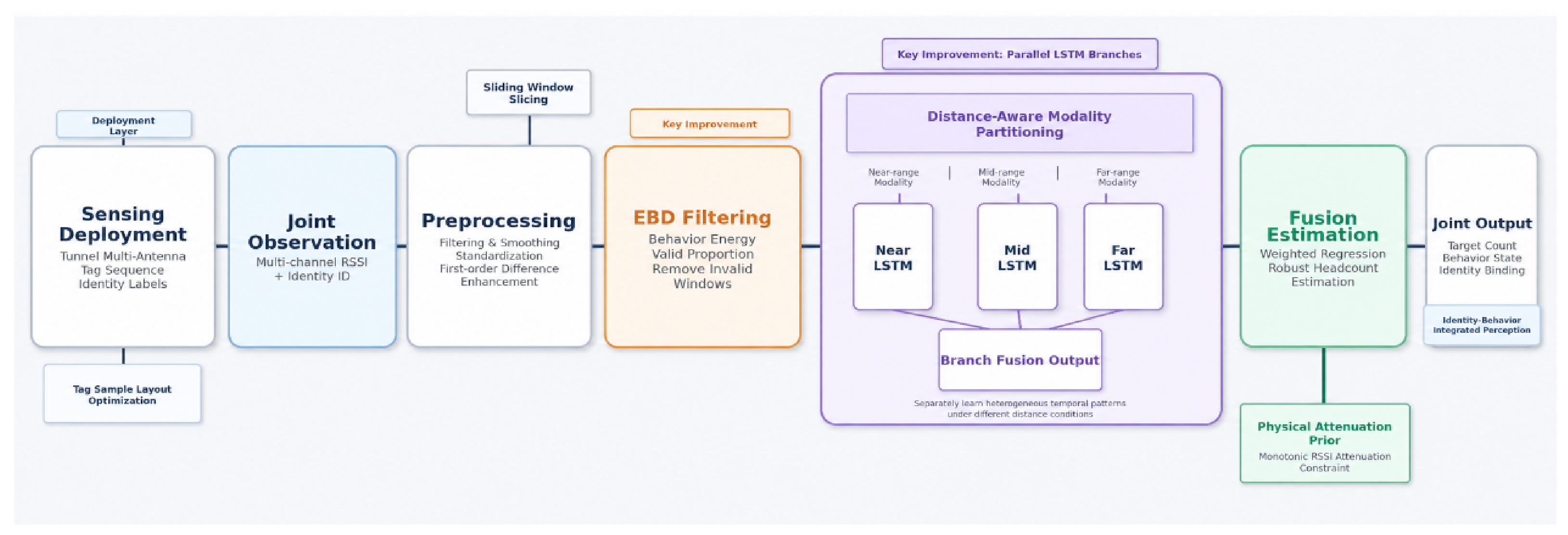
The proposed method follows a reproducible pipeline consisting of joint observation, RSSI calibration, valid-window screening, distance-mode partitioning, parallel temporal modeling and fused output.
Figure 1 summarizes the overall framework.
As shown in
Figure 1, the system includes identity tag reading, tag-array RSSI observation, RSSI preprocessing, EBD screening, observation-inferred distance-mode partitioning, parallel LSTM branches and final fusion. Identity readings and array sequences are aligned on the same reader-timestamp timeline. The model outputs target count, window-level identity association and behavior state. The attenuation equations are retained to explain the RSSI disturbance mechanism, but they are not used as an independently tuned loss constraint in the reported model.
3.1. Task Definition and Notation
Given the tag-array observation at time t, , and the identity-tag reading set , the system outputs the number of targets , the identity association , the behavior state and the effective behavior duration . denotes the target count in the current window, denotes the set of associated identity tags, and uses a unified behavior taxonomy: separated/parallel passage, close crossing, following passage and opposite-direction passage.
Let M be the number of tags, L be the sliding-window length, be the normalized RSSI sequence of the m-th tag and be its first-order difference. The subsequent modules are organized as joint observation, valid-window screening, distance-mode partitioning, parallel temporal modeling and fused output.
3.2. Identity Tag Reading and Behavior Association
Each participant wears one passive identity tag with a unique EPC identifier on the chest or waist. The reader synchronously collects identity-tag responses and fixed tag-array RSSI values. Identity-tag EPCs and array-tag EPCs are separated by a tag registry and mapped to a unified timeline using reader timestamps. Short identity dropouts are compensated only within adjacent valid windows, and no long-range identity interpolation is assumed.
At the window level, identity readings and RSSI sequences are aligned by nearest timestamps. The associated identity set is obtained by combining EPC reading frequency within the window, the estimated RSSI disturbance trajectory, EBD validity and adjacent-window temporal continuity. During short dropouts in crossing or following events, adjacent-window ID continuity and disturbance-center consistency are used for conservative compensation. If the identity evidence is insufficient, the window is not used to support a stronger identity claim.
This design treats identity association as a window-level fusion and constraint process, not as fully end-to-end co-learning with behavior recognition. Behavior recognition and count estimation are learned by the LSTM branches from RSSI-derived sequences, while identity association uses EPC observations and temporal consistency to bind the predicted event window to participant identities.
3.3. RSSI Attenuation Mechanism as Physical Motivation
To improve interpretability, the RSSI attenuation mechanism, which is motivated by the free-space transmission relationship, is used to motivate feature design and distance-mode interpretation [
28]. It is not reported as a separately optimized physical-prior loss, and therefore no ablation row is claimed for removing a physical constraint.
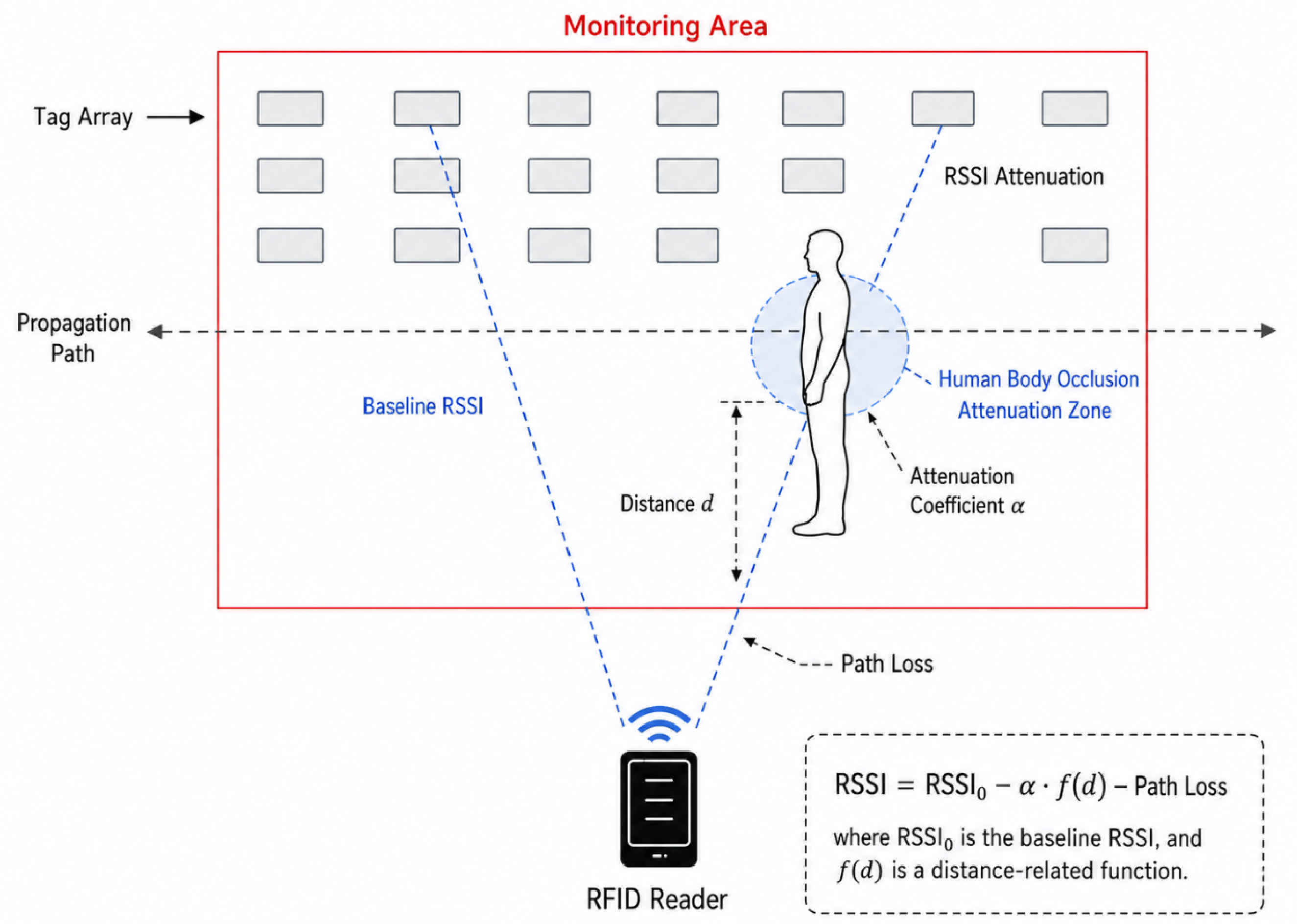
As shown in
Figure 2, the RFID reader, antenna and tag array form the basic propagation geometry. When a human body enters the antenna–tag path, additional blocking, scattering and absorption losses are introduced. Let the RSSI of the
m-th tag at time
t be
, and let
denote the unobstructed background value. The observation model is expressed as follows:
Here,
is the equivalent attenuation caused by human occlusion, and
denotes multipath disturbance, hardware jitter and reading noise. If
targets cross the RF path at time
t, the additional attenuation can be described by a cumulative distance-decay form:
Equations (
1) and (
2) indicate that, under comparable body properties and relative positions, accumulated RSSI disturbance generally increases when more targets occlude the propagation region. In this paper, this monotonic relationship explains why normalized RSSI and first-order RSSI differences are informative features. The neural model learns nonlinear temporal disturbances from data; the equations are not used to impose a hard monotonic constraint during optimization.
3.4. Dynamic Feature Modeling Based on RSSI
3.4.1. First-Order Difference of RSSI
In the non-invasive deployment, the system infers movement state and people count only from the tag RSSI changes received by the RFID reader. When a subject passes between the antenna and the tag array, body blocking, scattering and reflection cause synchronized or local disturbance in the multi-tag RSSI sequence.
Let the RSSI observation vector obtained from M tags at time t be . To remove tag-specific offsets and long-term environmental bias, each tag sequence is standardized as , where and are the mean and standard deviation of the m-th tag in the training or background calibration segment, and is a small constant for numerical stability. A first-order difference is then introduced to highlight rapid changes during entering, peak occlusion and leaving: .
The input feature at time t is the concatenation of normalized RSSI and differential RSSI: . The energy and activation length of the first-order difference sequence provide stable boundary information for EBD estimation and temporal regression.
3.4.2. Distance-Aware Mode Partition
Because RSSI attenuation depends on relative geometry, each current window is divided into near-, middle- and far-distance modes using RFID observations rather than manually entered walking-lane labels. For a window , the attenuation strength and dynamic variation of the m-th array tag are calculated as and . The disturbance weight of the m-th tag is then , where balances amplitude attenuation and dynamic change.
Given the fixed coordinate of each array tag and the antenna/reader coordinate , the disturbance-weighted spatial center is . The estimated distance is . The distance mode is defined as near if , middle if and far if . The thresholds and are calibrated from the antenna-array geometry and background calibration trials. Marked walking lanes are used only to control the data-collection scene and verify labels; they are not used as inference-time inputs.
3.5. Three-Modal Parallel LSTM Branches and Fusion Estimation
Let the window length be
L and the input sequence ending at time
t be
. According to the distance-mode partition, an independent LSTM branch is constructed for each mode [
29,
30]:
,
, where
denotes the parameters of the
k-th distance-mode branch, and
is the final hidden state. Each branch outputs a local count estimate through a lightweight regression head.
To obtain smooth output near mode boundaries, gated fusion is used to compute branch weights. The final count estimate is obtained by the weighted fusion of all modal branches. For behavior-state recognition, the hidden states of the three branches are concatenated and passed to a classification head corresponding to the unified behavior classes: separated/parallel passage, close crossing, following passage and opposite-direction passage. This distance-partitioned, multi-branch and gated-fusion architecture learns temporal features under different attenuation levels and improves robustness under multi-target and high-speed moving scenarios.
Training
Objective and Implementation Details
The model is trained as a multi-task sequence model. The count head uses mean-squared error loss, the behavior-state head uses cross-entropy loss, and the identity-association head uses binary cross-entropy over the participant/tag identity set. The combined objective is . The reported experiments used equal loss weights unless otherwise stated. The input dimension is for the 18-tag array because normalized RSSI and first-order RSSI difference are concatenated. Each LSTM branch uses two layers, a hidden size of 64 and dropout of 0.20. The optimizer is Adam with learning rate and weight decay . The batch size is 64, the maximum number of epochs is 100, and early stopping is applied when the validation loss does not improve for 15 consecutive epochs. Five independent runs are performed using fixed random seeds, and the neural-network results are reported as mean ± standard deviation. No p-values or statistical significance claims are reported unless paired per-window predictions are recomputed from the raw experiment logs.
3.6. Tag Array and Spatial Layout Optimization
Because the system relies primarily on RSSI, tag placement directly affects the observability of occlusion disturbance. Let the coordinate of the m-th tag be and the reader coordinate be . The unobstructed distance is . Under the free-space approximation, the unobstructed RSSI in dB form can be expressed using transmit power, antenna gains, carrier wavelength and background noise. When a person enters the array coverage area, the effective propagation distance changes and extra occlusion loss occurs.
Tag spacing
should balance spatial resolution and channel correlation. If tags are too dense, adjacent channels become highly correlated; if they are too sparse, local occlusion patterns may be missed. In the experiments,
cm is used to balance sensitivity and stability.
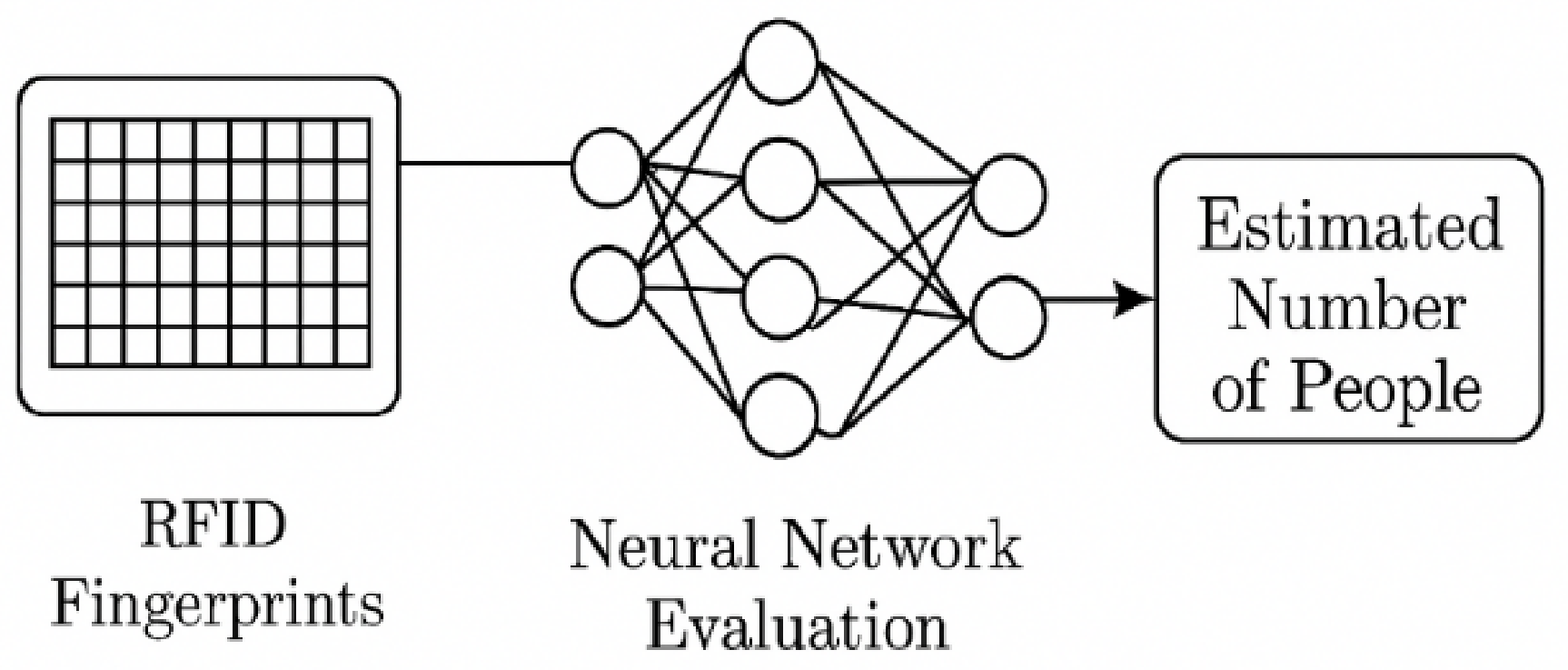
Figure 3 illustrates the layout and signal propagation model.
As shown in
Figure 3, the tag array acts as a spatial sampling plane and maps propagation disturbances caused by human passage into multi-tag RSSI fingerprints. The neural network then learns the nonlinear relationship between this disturbance matrix and target count, identity association and behavior state.
3.7. Extension to High-Density Tag Arrays
Although the prototype evaluated in this study uses an 18-tag wall-mounted array, the same observation principle could be extended to denser two-dimensional arrays, such as a 64-tag grid layout. Because such a high-density array was not experimentally evaluated in the present work, it is treated only as future work and is not listed as a validated component of the proposed method. A higher tag density may improve spatial resolution for close crossing, following and compact multi-person cases, but it can also increase adjacent-channel correlation, reader scheduling overhead and calibration complexity.
The present paper therefore reports all quantitative results using the measured 18-tag platform described in
Section 4.1 and
Table 1. The high-density-array discussion is included only to indicate a possible route for scaling the sensing surface; its actual benefit should be verified in future cross-room and multi-reader experiments before being claimed as a tested contribution.
4. Experiments and Results
4.1. Experimental Setup
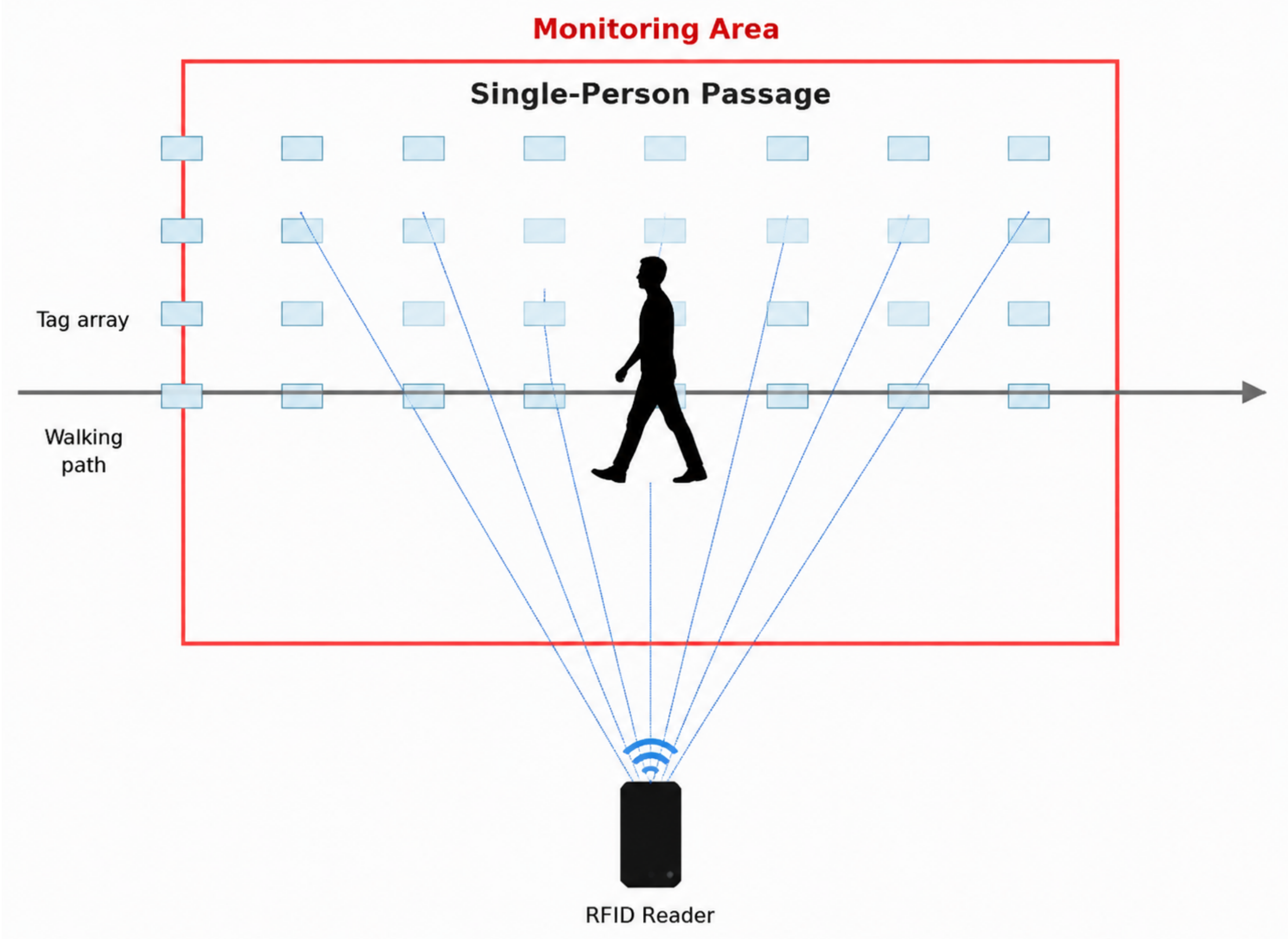
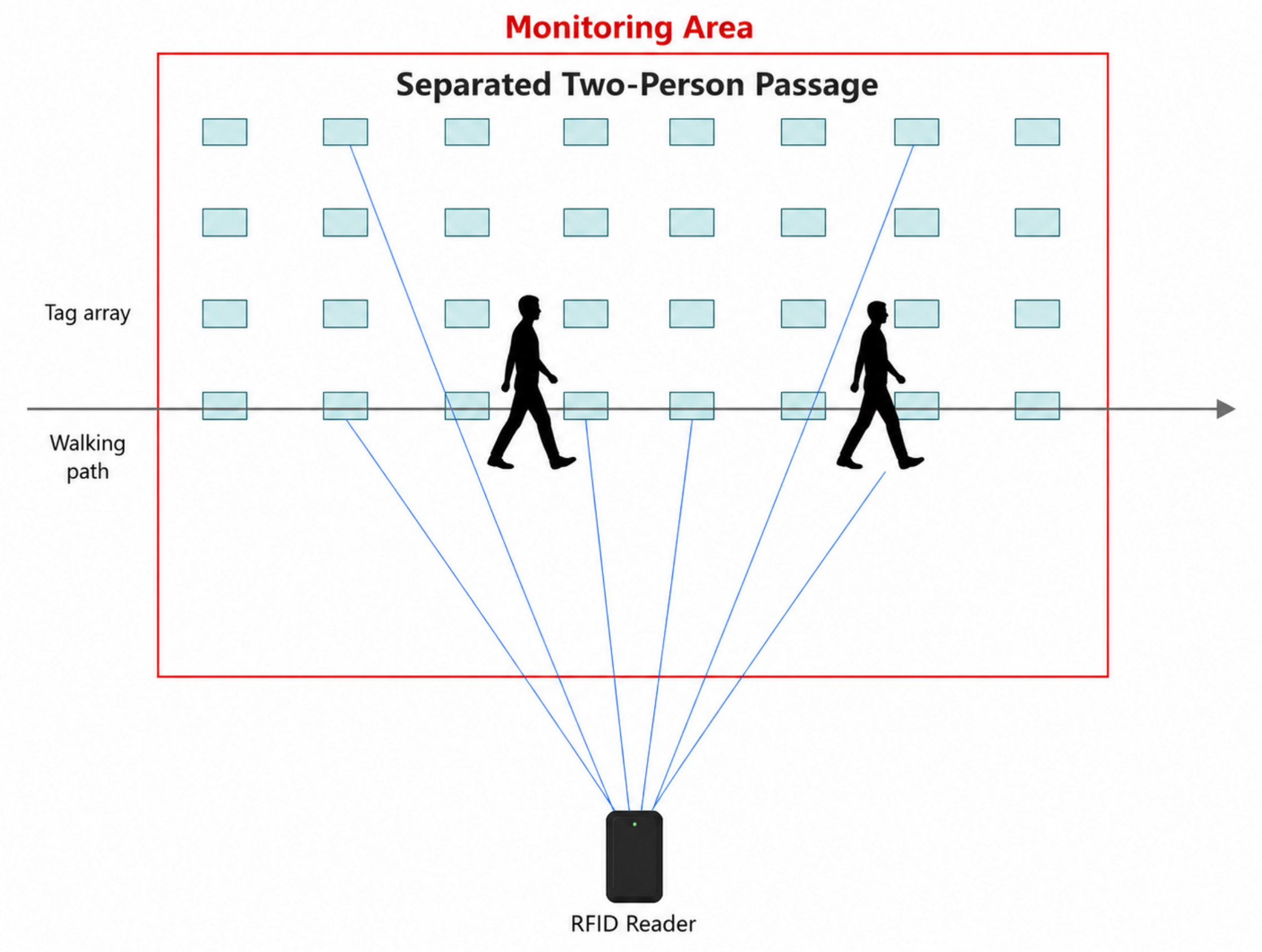
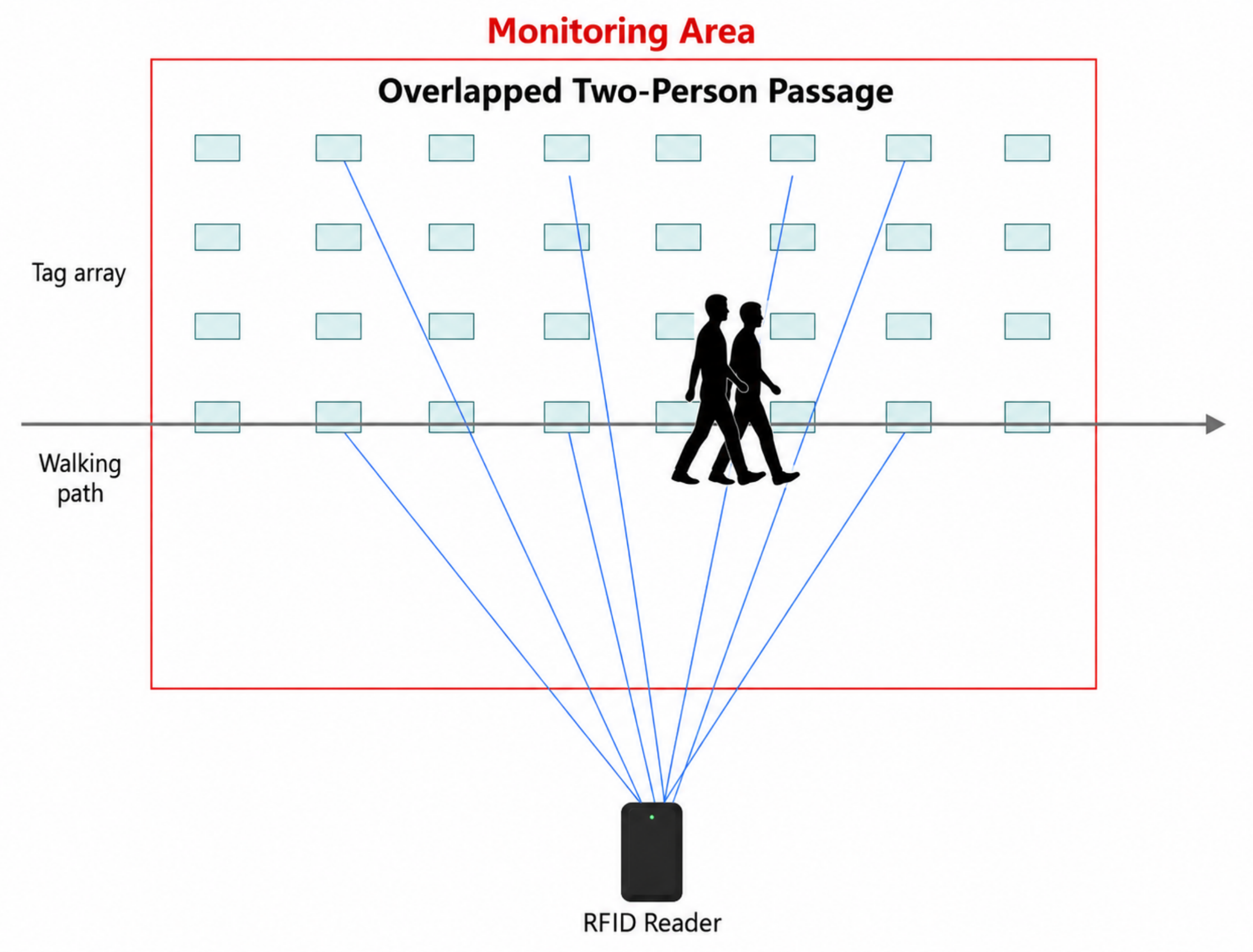
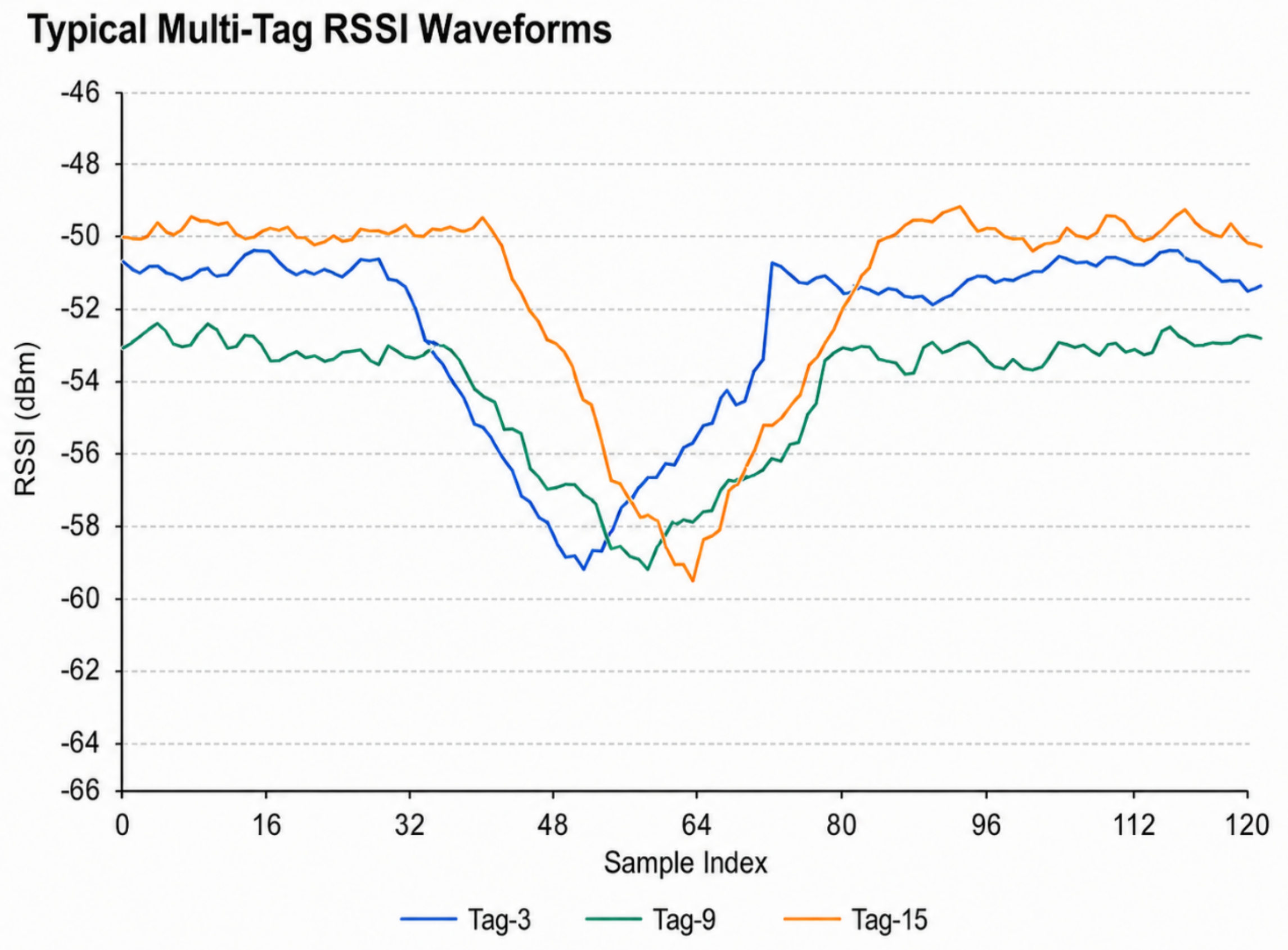
To validate the proposed identity–behavior joint sensing method, an indoor prototype platform was built using commercial UHF RFID hardware, as shown in
Figure 4,
Figure 5,
Figure 6 and
Figure 7. The setup represents a corridor-side deployment with a single reader, a single antenna, a wall-mounted tag array and participants walking through the antenna-array propagation region.
The RFID reader was placed on a low platform at one side of the room and connected to a wall-mounted directional antenna through an RF cable. The antenna center was fixed 1.35 m above the floor and pointed toward the opposite wall. Transmit power was held constant within each acquisition day and recalibrated before cross-day recording to reduce systematic drift.
On the wall facing the antenna, 18 passive UHF RFID tags were arranged as a multi-row array. The tag spacing was 25 cm in both horizontal and vertical directions, covering the main body-occlusion region from the upper leg to the chest. This spacing was selected after pilot measurements because smaller spacing increased channel correlation, whereas larger spacing missed local occlusion valleys.
Participants walked through a 0.9 m wide marked passage between the RFID antenna and the tag array. For each trial, walking mode, participant identities, start time, end time and ground-truth count labels were recorded manually and then aligned with RFID timestamps. The labels were checked twice after acquisition to reduce annotation errors. During data acquisition, the RFID reader continuously collected RSSI curves from all tags.
Figure 7 shows representative multi-tag attenuation waveforms: RSSI decreases when a person enters the signal path, while simultaneous multi-person passage produces superposed fluctuations and multiple valley structures.
4.2. Dataset Construction
Based on the experimental platform, a Dynamic Tag-Array RSSI dataset was constructed for people-count estimation, passage-pattern recognition and identity–behavior association. The final dataset contains 18 volunteers, 888 raw sequence segments and 11,148 valid windows after EBD filtering. Each raw segment lasts 12–20 s and records timestamp, EPC, RSSI, antenna port, tag coordinates and scenario labels.
To improve representativeness and include realistic sensing noise, data were collected under controlled but varied conditions: number of people (no-person baseline, one, two and three persons), walking speed (slow, normal and fast), passage pattern (separated/parallel, close crossing, following and opposite-direction passage) and participant variation (height 1.58–1.84 m and mixed body sizes). Each participant appears in only one of the training, validation or test splits.
For each trial, participants walked through the path between the RFID antenna and the tag array while the reader continuously sampled all visible tags. Identity tags and array tags were recorded in the same reader stream, allowing raw EPC records to be separated into identity observations and spatial-array observations during preprocessing.
Table 2 presents an example of the collected RFID tag-array RSSI dataset reformatted as a typeset table rather than an Excel screenshot.
The core contents of the dataset are summarized in
Table 3; the split protocol is summarized in
Table 4. No participant ID appears in more than one split, so the reported test results reflect cross-subject generalization rather than memorization of participant-specific RSSI patterns.
4.3. Preprocessing and Sequence Enhancement
Because RSSI sequences contain spike noise, baseline drift, missed reads and environmental sensitivity, the preprocessing pipeline included moving-average smoothing, local outlier correction, tag-wise normalization, first-order difference enhancement, sliding-window slicing and EBD filtering. The parameters used in the reported experiments are listed in
Table 1 and
Table 3.
4.3.1. Filtering and Outlier Correction
Raw RSSI sequences often contain short-term spike noise. A moving-average filter with length w was first applied: , where w is set to five samples in the main experiments. A rule was then used for outlier correction; abnormal readings were replaced by the local median within a short temporal neighborhood.
4.3.2. Dynamic Difference Enhancement
To highlight RSSI changes induced by human movement, a first-order difference was introduced as the dynamic enhancement feature: . The differential sequence strengthens the boundaries of entering, maximum occlusion and leaving, making it easier for the model to learn the temporal structure of the occlusion process. The final model input contains both the preprocessed RSSI sequence and its first-order difference.
4.3.3. Normalization
To reduce amplitude differences across tags and acquisition rounds, the filtered RSSI sequence was standardized as
. The difference sequence was then calculated from the normalized sequence. Normalization improves cross-tag, cross-round and cross-subject generalization.
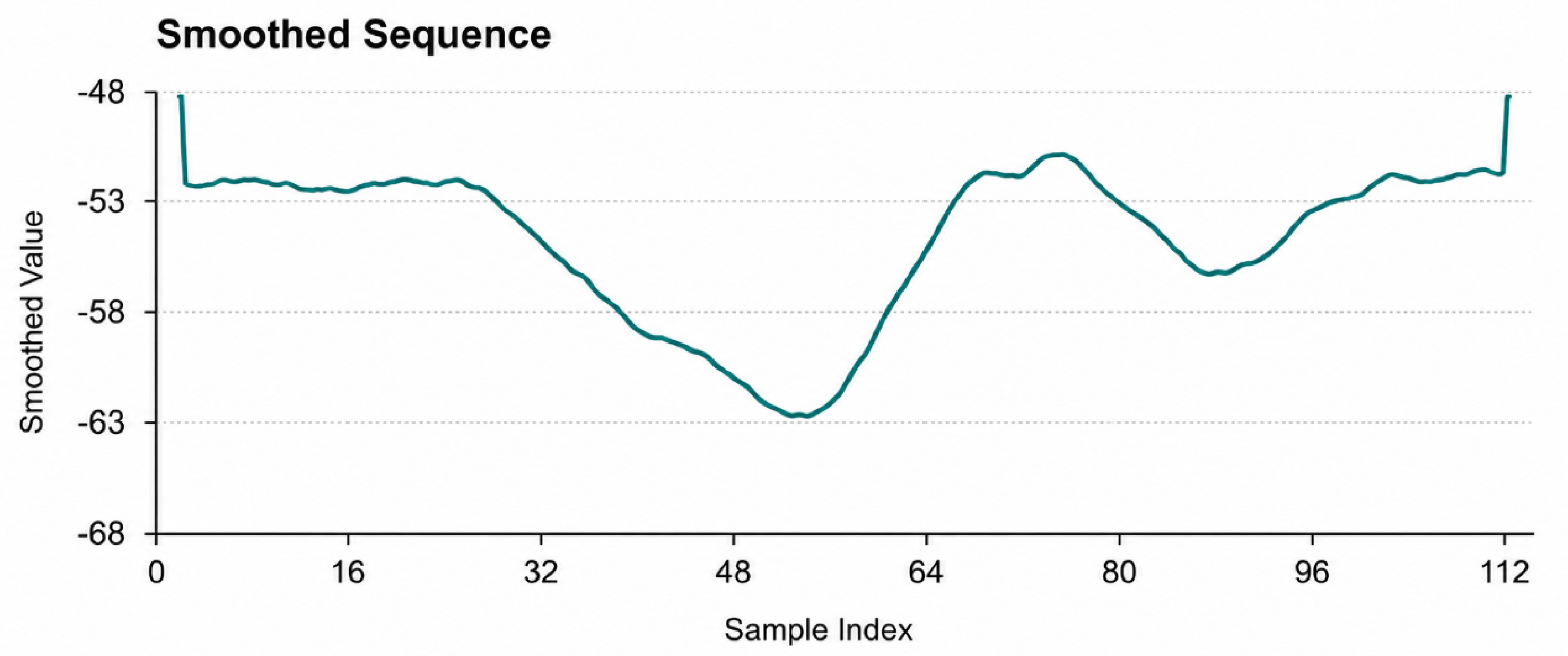
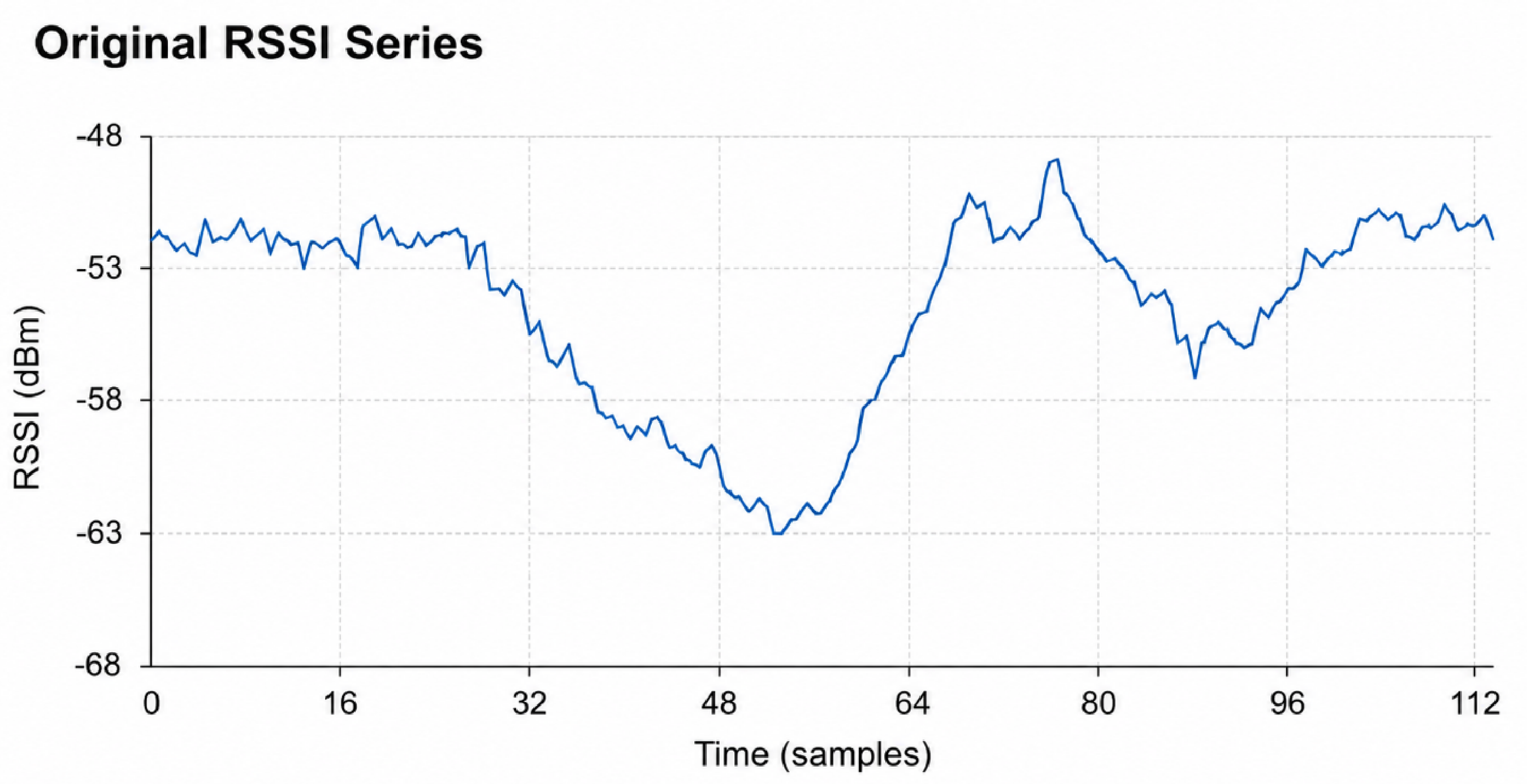
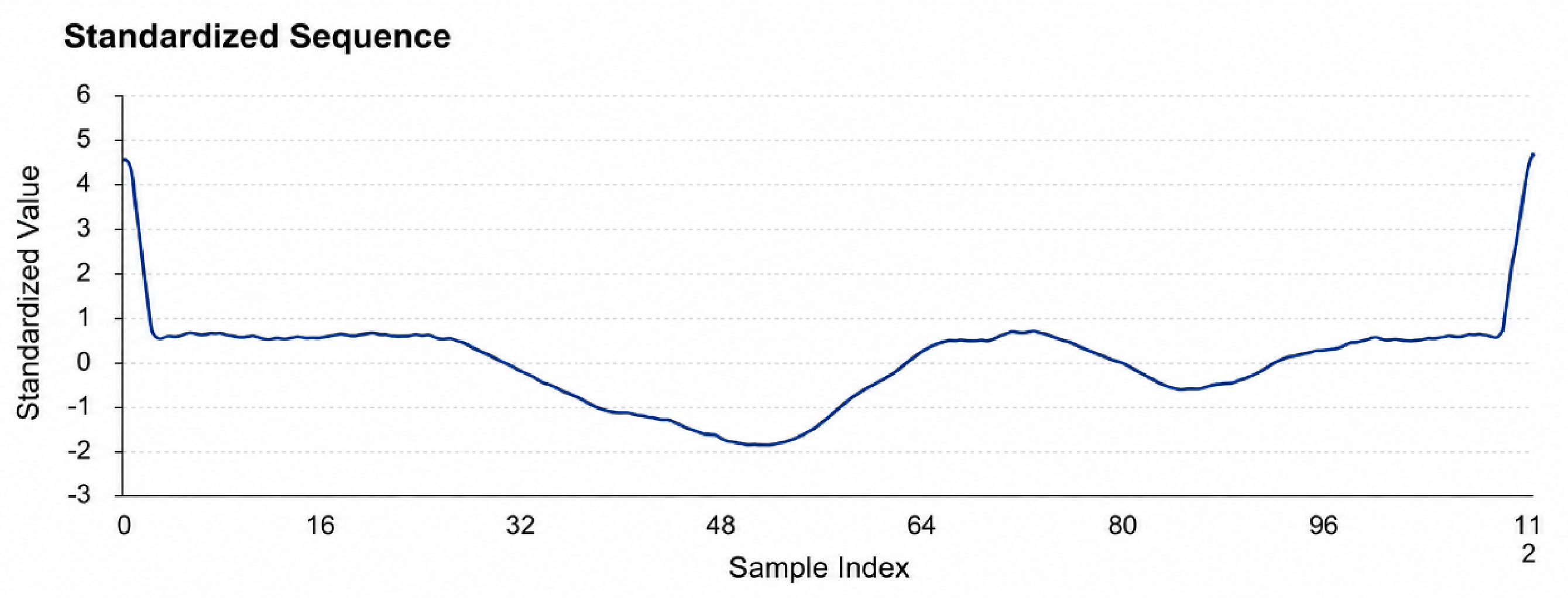
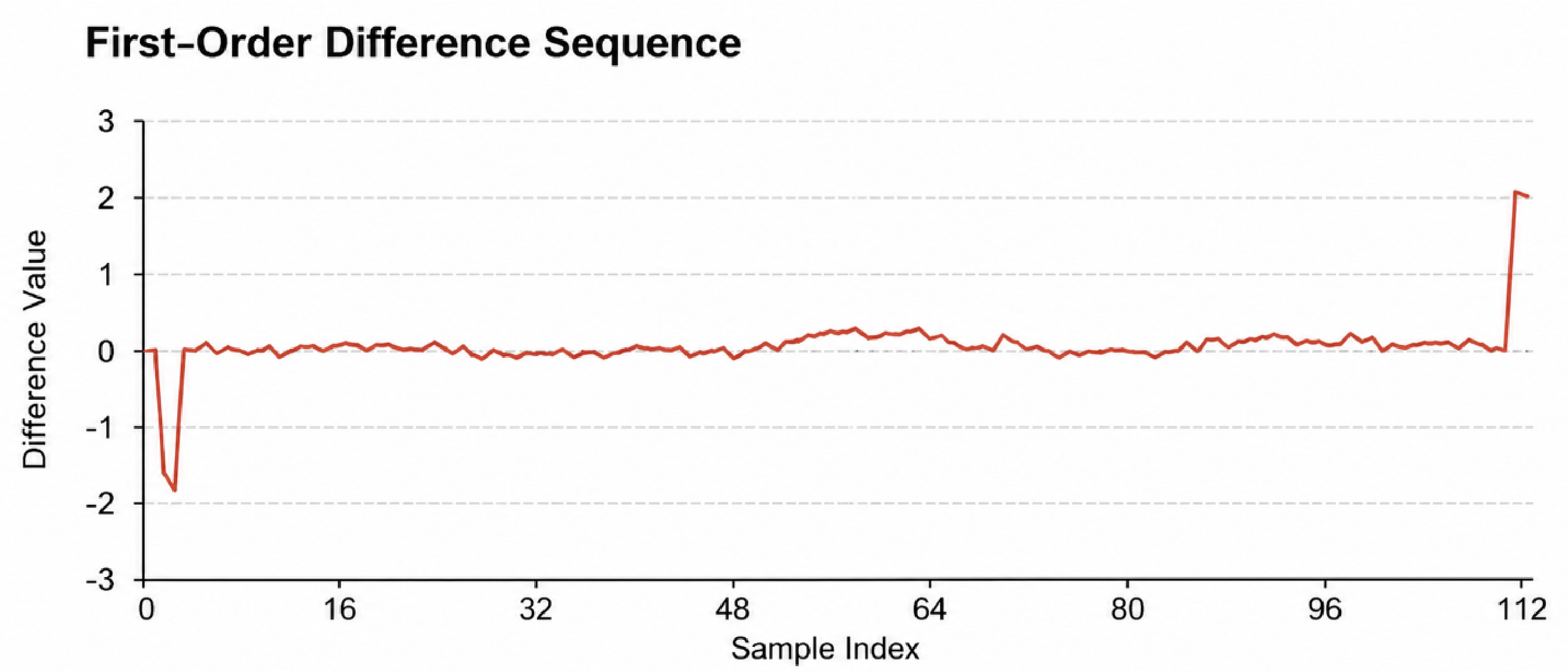
Figure 8,
Figure 9,
Figure 10 and
Figure 11 illustrate the changes in the RSSI sequence after smoothing, normalization and first-order differencing.
Figure 8,
Figure 9,
Figure 10 and
Figure 11 show that moving-average smoothing suppresses spike noise, normalization unifies the amplitude scale across tags and trials, and the first-order difference highlights the dynamic boundaries of entering, peak occlusion and leaving. This preprocessing provides stable input for sliding-window slicing, EBD screening and LSTM temporal modeling.
4.3.4. Temporal Windowing
To match the LSTM input structure and cover a complete body-occlusion process, the continuous RSSI sequence was sliced into fixed-length windows. The main model used and a step size of 32, corresponding to 50% overlap. This setting covers approximately 1.8 s of RSSI evolution at the average measured read rate and generally includes the enter-occlude-leave process. This setting increases the number of valid samples. To avoid excessive background segments, EBD screening was applied after window slicing.
4.3.5. Effective Behavior Duration
In multi-person dynamic passage scenarios, continuous RSSI sampling contains background fluctuations, static segments and short-term spikes. If all windows are sent to the temporal network, background noise can dilute the sample distribution and cause unstable people-count inference. Therefore, an EBD mechanism is introduced after sliding-window slicing to keep only windows containing valid human occlusion behavior.
Let be the n-th window with length L and M tags. The window-level behavior energy is defined from the mean squared first-order difference across tags and samples. A time-level activation function is then defined according to the differential activation threshold and active-tag-ratio threshold. The effective behavior duration and effective ratio are calculated from the activated samples. A window is regarded as valid only when both the energy and effective-ratio thresholds are satisfied. Otherwise, the window is removed during training; during inference, the output is set to zero or the state update is suppressed.
The EBD module is used as a deterministic screening rule in this revision. Because the current verified annotation record does not contain an independent frame-level EBD boundary mask suitable for standalone EBD precision, recall, F1 or boundary-IoU evaluation, no such numerical metrics are introduced. Accordingly, these metrics are not reported as numerical results in this revision; the reported evaluation remains limited to the verified EBD-valid event-window protocol.
4.4. Evaluation Metrics
The method was evaluated from three aspects: people-count estimation, behavior recognition and window-level identity association. For count regression, mean absolute error (MAE) and root mean square error (RMSE) were used. For behavior classes, accuracy, precision, recall and Macro-F1 were calculated. Identity–behavior association was evaluated by ID association accuracy, defined as the proportion of valid windows for which the predicted identity set exactly matches the ground-truth identity set:
where
denotes the evaluated EBD-valid windows. Event-level identity-switch rate is not reported because the verified labels are window-level associated identity sets rather than continuous identity trajectories with transition-level switch annotations. Accordingly, the manuscript does not claim an event-level switch-rate result. All neural-network results are reported as mean ± standard deviation over five training runs. No statistical significance claim is made without paired per-window hypothesis testing.
4.5. Comparative Experiments and Baselines
Five internally reproducible baselines were used to evaluate the contribution of the proposed pipeline on the same dataset: (1) a raw RSSI threshold-rule method; (2) a traditional machine-learning baseline using RSSI and differential statistics; (3) a data-driven LSTM using RSSI and differential features without EBD screening or distance-mode fusion; (4) a single-branch LSTM using the same input features but without distance-aware parallel branches and (5) the full proposed method. Because published RFID/tag-array systems differ in hardware layout, subject labels, identity-task definition and data-access conditions, this revision does not add an unsupported external numerical baseline. Cross-paper comparisons are discussed qualitatively rather than reported as direct performance rankings.
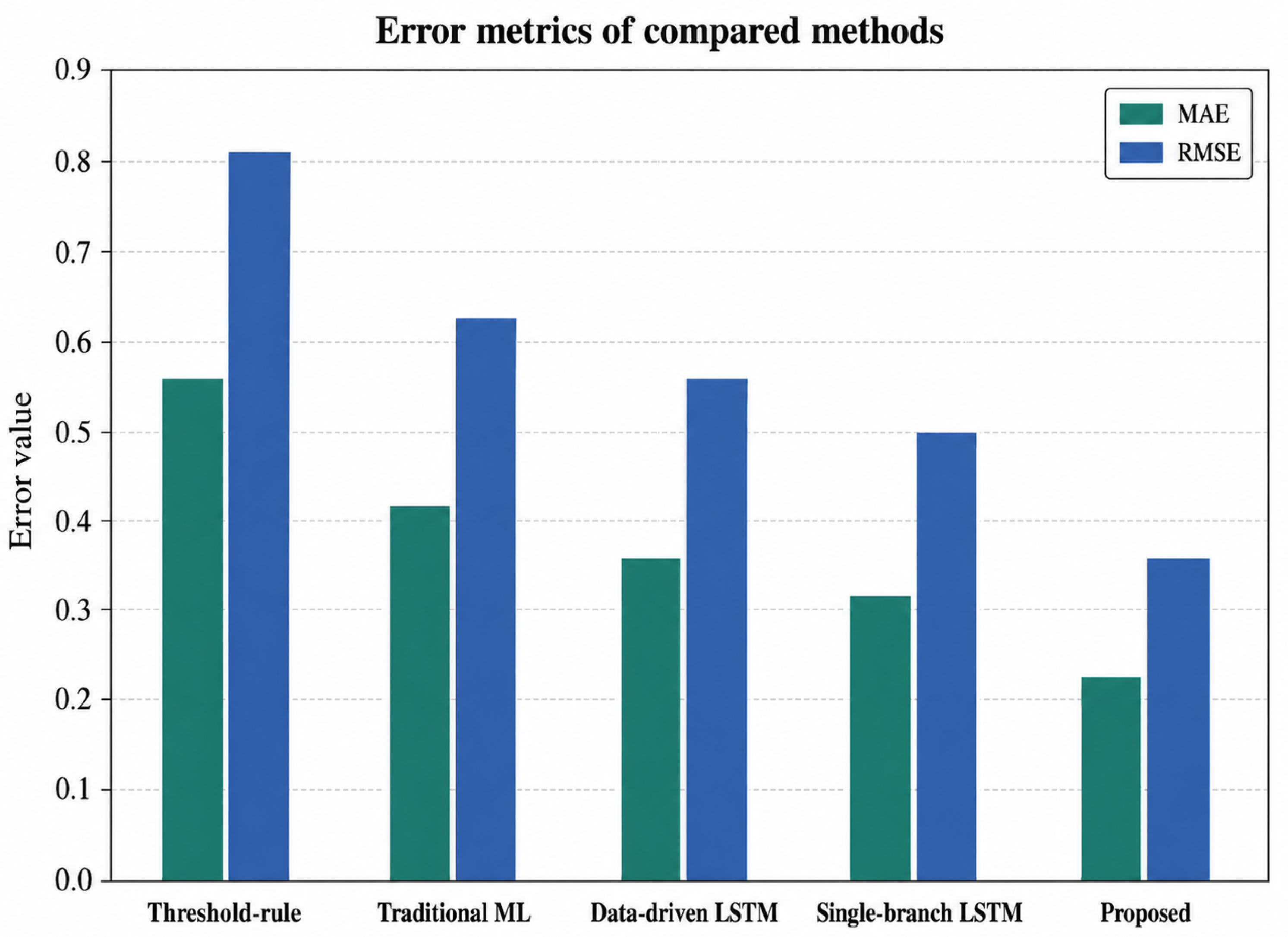
Figure 12 and
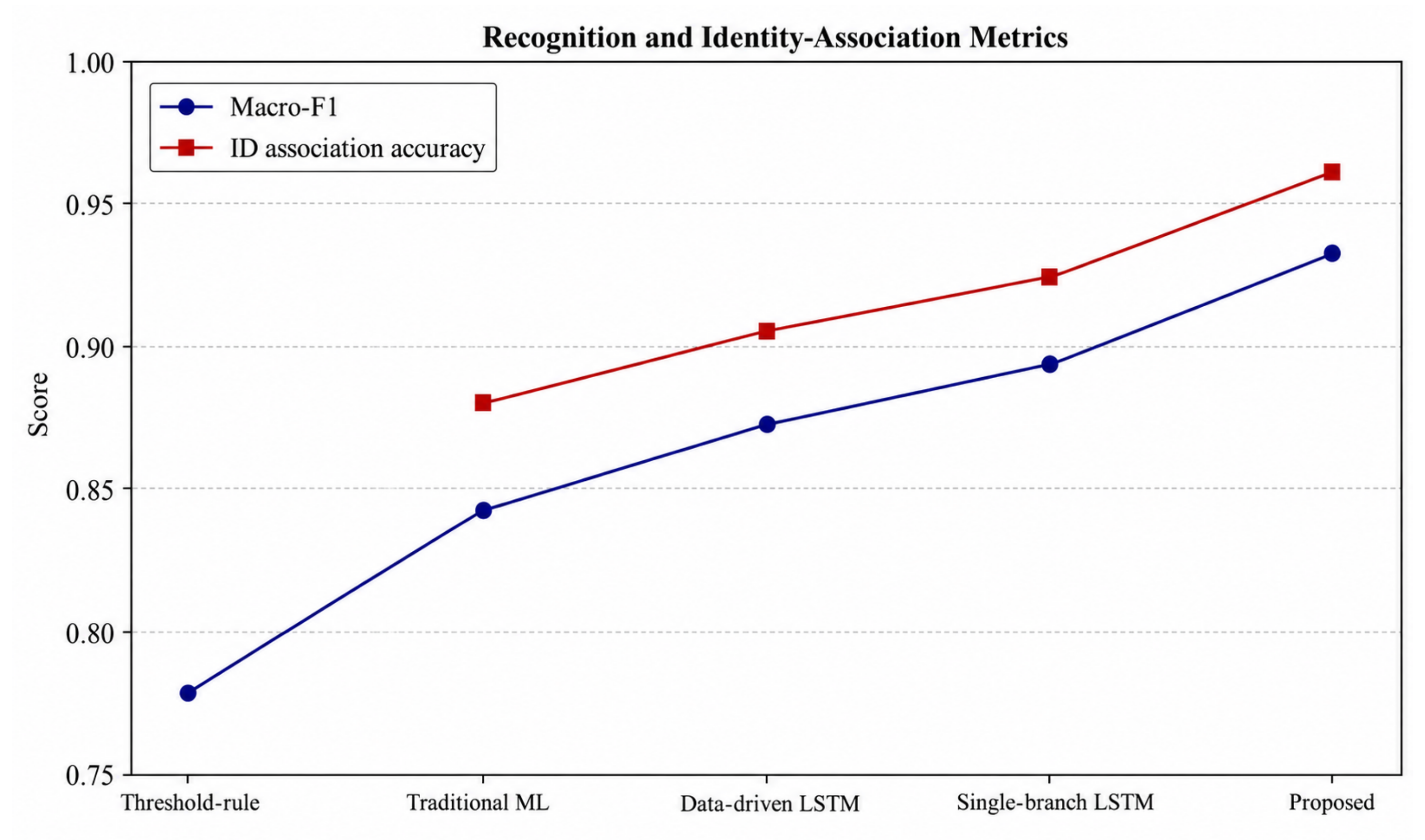
Figure 13 show that the proposed method obtains the lowest MAE and RMSE and the highest Macro-F1 and ID-association accuracy on the same internal dataset. Compared with the single-branch LSTM, the largest gain appears in close crossing and following cases, indicating that distance-mode partitioning and gated fusion reduce the ambiguity caused by overlapping RSSI valleys. Compared with threshold and traditional machine-learning baselines, the improvement mainly comes from temporal modeling and EBD screening, which prevent short background spikes from being interpreted as valid human passage.
Figure 12.
Corrected error metrics of compared methods. Method names are consistent with
Table 5.
Figure 12.
Corrected error metrics of compared methods. Method names are consistent with
Table 5.
Table 5.
Comparative results of people-count estimation, behavior recognition and identity association.
Table 5.
Comparative results of people-count estimation, behavior recognition and identity association.
| Method | Input Features | Identity Tag | EBD | MAE ↓ | RMSE ↓ | Macro-F1 ↑ | ID Acc. ↑ |
|---|
| Threshold-rule method | Raw RSSI energy | No | No | | | | – |
| Traditional ML (RF/SVM) | RSSI statistics + difference | Yes | No | | | | |
| Data-driven LSTM | RSSI + difference | Yes | No | | | | |
| Single-branch LSTM | RSSI + difference | Yes | No | | | | |
| Proposed method | RSSI + difference +
inferred distance mode | Yes | Yes | | | | |
4.6. Ablation Experiments and Parameter Sensitivity
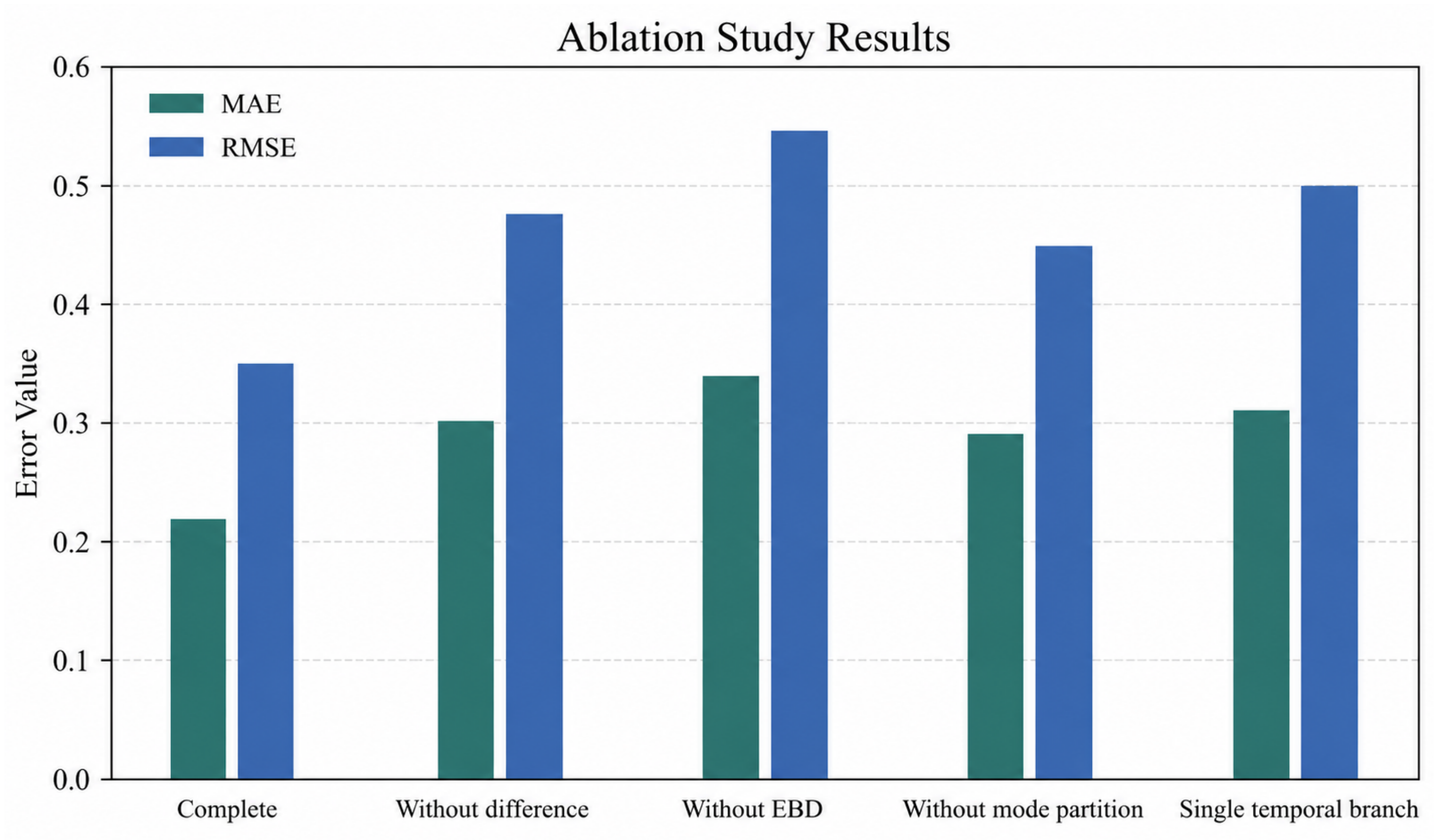
Ablation experiments were conducted to clarify the contribution of difference features, EBD screening, distance-mode partitioning and the parallel LSTM structure. The earlier physical-prior ablation is removed because the attenuation equations are used as physical motivation rather than as an explicit loss term or hard constraint.
Figure 14 visualizes the corrected ablation results,
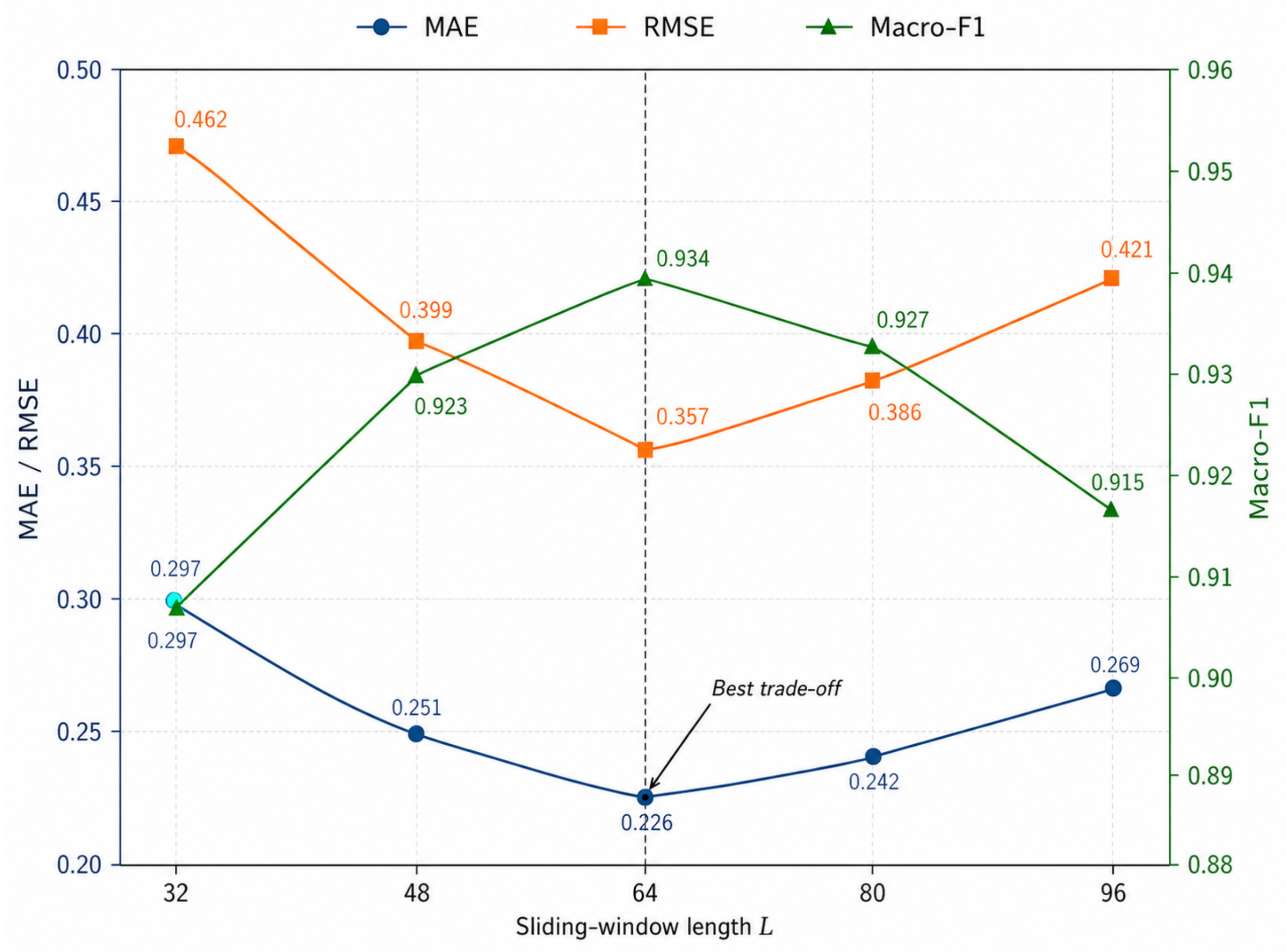
Figure 15 shows sensitivity to the sliding-window length
L, and
Table 6,
Table 7 and
Table 8 report the concrete numerical values used for the analysis.
The complete model achieves the lowest MAE and RMSE. Removing EBD causes the largest degradation because background and transition windows become mixed with true occlusion windows. Removing distance-mode partitioning also reduces performance, indicating that a single global branch cannot fully absorb the distance-dependent non-stationarity of RSSI attenuation.
As shown in
Figure 15 and
Table 7, the error decreases when the window length increases from 32 to 64 because a longer window better covers the enter-occlude-leave process. When the window length increases to 80 or 96, the error rises because more background samples are included and the effective behavior boundary becomes less distinct.
4.7. Robustness, Generalization and Stratified Performance
To evaluate robustness, the test set was further divided by movement pattern, speed and approximate distance mode.
Table 8 reports representative stratified results. The model performs best in single-person and separated two-person cases, while the highest errors occur in close two-person crossing, fast walking and compact three-person passage. These cases produce overlapping RSSI valleys and short identity-tag read gaps.
Qualitative inspection of time-aligned count curves and RSSI heat maps indicates that EBD screening suppresses background fluctuations before and after the passage event, while gated fusion helps avoid abrupt count changes near distance-mode boundaries. The remaining failure cases are mainly caused by three factors: missed identity-tag reads lasting longer than two windows, near-synchronous crossing in the center of the array and strong multipath caused by large metallic objects near the walking path.
5. Discussion
The experimental results indicate that the performance gain is produced by the combination of sensing architecture, signal screening and temporal modeling rather than by a single isolated component. Identity tags reduce ambiguity in subject association, the tag array increases spatial observability, EBD improves the quality of training and inference windows, and distance-aware branches reduce the non-stationarity caused by propagation distance. The method should therefore be interpreted as an integrated RFID-only passage-monitoring pipeline rather than as a new RFID physical sensing mechanism.
Compared with vision- or radar-assisted systems, the proposed solution is less intrusive and easier to deploy in privacy-sensitive indoor spaces. The prototype nevertheless has clear limitations. It uses a single reader and a single antenna, the main dataset was collected in one room, and the maximum tested target number was three. Therefore, the reported results should be interpreted as evidence for controlled corridor-style passage monitoring rather than as a complete solution for dense crowds or general smart-building deployment. Future experiments should include multiple rooms, longer cross-day evaluation, different furniture layouts, public or semi-public benchmarks and stress tests with more severe multipath.
Several additional analyses requested during review would require ground-truth records that are not contained in the current verified dataset. In particular, standalone EBD precision/recall/F1/boundary-IoU, event-level identity-switch rate, paired statistical significance tests and direct numerical comparison with external RFID/tag-array methods are not introduced without recomputation or compatible public protocols. This reporting choice avoids fabricating numerical evidence and confines the claims to the measured results available in the current dataset.
Complexity and Online Decision Rate
The preprocessing complexity for a window is , where L is the window length, and M is the number of array tags. The LSTM computation is proportional to for three distance-mode branches, where F is the input dimension, and H is the hidden size. In the reported configuration, , , and the average aligned read rate is Hz. With a step size of 32 samples, the online decision interval is approximately s, corresponding to about 1.09 window-level decisions per second. This is an algorithmic update-rate estimate rather than a measured latency benchmark.
6. Conclusions and Future Work
This paper presented an identity-aware RFID tag-array framework for corridor-style indoor dynamic passage monitoring. By combining wearable identity tags, a wall-mounted passive tag array, EBD-based valid-window screening, observation-inferred distance-mode partitioning and parallel LSTM temporal modeling, the method jointly estimates target count, behavior state and window-level identity association from low-cost UHF RFID observations.
The experimental evaluation used 888 raw sequence segments and 11,148 valid windows collected under subject-independent splits. The proposed method achieved a test MAE of 0.226, RMSE of 0.357, Macro-F1 of 0.934 and ID-association accuracy of 0.961. Compared with threshold rules, traditional machine learning and single-branch LSTM baselines on the same dataset, the method reduced count-estimation error and improved identity-behavior association, especially in crossing and following scenarios.
Future work will extend the platform to multi-reader collaboration, cross-room deployment, higher-density tag arrays, larger crowd sizes, event-level identity trajectory annotation and public release of de-identified benchmark data where ethics and privacy constraints permit.