1. Introduction
Wireless Sensor Networks (WSNs) are distributed networks consisting of a large number of sensor nodes. By integrating wireless communication technologies with advanced sensing techniques, WSNs can be deployed in diverse scenarios to accomplish specific tasks. In WSNs, sensor nodes form a self-organizing network through multi-hop wireless routing and periodically or event-driven transmit sensing data to the base station [
1]. These data enable users to analyze environmental conditions without the need for on-site observation. However, since sensor nodes are battery-powered, limited energy supply restricts the network lifetime and communication performance of WSNs. Nodes located near communication hotspots are subject to heavier traffic loads, leading to faster energy depletion and earlier failures. Consequently, reducing the computational and communication overhead of sensor nodes to prolong network lifetime has become a major research focus.
To address these challenges, a network architecture known as the Tiered Mobile Wireless Sensor Network (TMWSN) has been introduced in practice [
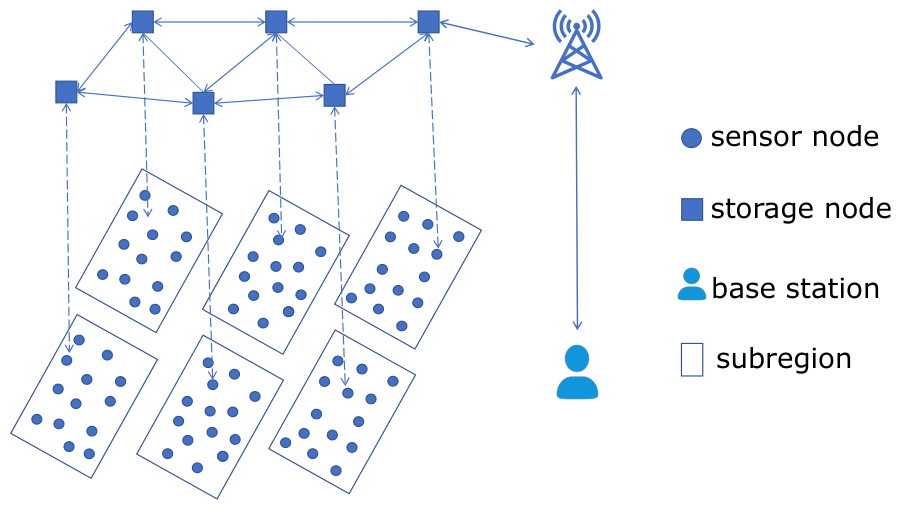
2]. As shown in
Figure 1, a monitored region is divided into multiple disjointed subregions, each containing numerous mobile sensor nodes and one storage node. Sensor nodes, constrained by energy and computational resources, are mainly responsible for sensing the environment and generating data, which are then transmitted to the corresponding storage node. In contrast, storage nodes are equipped with higher storage and processing capacities as well as greater energy resources, enabling them to perform more complex tasks. They are responsible for collecting and storing sensor data and for processing queries issued by users via the base station.
Compared with traditional WSNs, TMWSNs offer several advantages: (1) Mobile sensor nodes enable load balancing across the network. (2) Query processing is performed by storage nodes without requiring sensor node participation, thereby improving query efficiency. (3) Storage nodes, with richer resources, take over more tasks, reducing the workload of sensor nodes and extending the overall network lifetime. These advantages have facilitated the wide adoption of TMWSNs in military, healthcare, and environmental monitoring applications [
2,
3].
However, the tiered architecture of TMWSNs also introduces new security risks—specifically, a higher likelihood of being targeted by adversaries. Since storage nodes concentrate more resources, they become more high-value targets for adversaries. Once a storage node is compromised, an attacker can: (1) Illegally access the data stored on the compromised node, resulting in sensitive information leakage; (2) Tamper with or discard stored data, mislead users who rely on query results, and ultimately cause erroneous decision-making.
The above scenario highlights two main security objectives in TMWSN queries: privacy protection and integrity protection. Privacy protection ensures that attackers cannot obtain sensitive data in plaintext during the query process, while integrity protection requires that query results accurately include all data satisfying the query conditions without omission. Most existing studies on secure query processing in TMWSNs focus on attacks against storage nodes, assuming that data packets are always safely delivered to storage nodes. However, packet loss and malicious packet dropping by sensor nodes have been largely overlooked in these studies. Factors such as node mobility, electromagnetic interference, or device malfunctions may cause path failures, data corruption, or packet loss [
4]. Under such harsh communication conditions, TMWSNs are designed to tolerate a certain level of packet loss to maintain network robustness. Excessive tolerance of packet loss, however, may mask malicious behavior by compromised nodes, leading to persistent violations of query result integrity.
In this paper, we propose a loss-tolerant TMWSN model and establish a threat model tailored to this scenario. The key insight is that in loss-tolerant networks, a compromised storage node or sensor node can intentionally drop packets while disguising the malicious behavior as legitimate packet loss—since a certain degree of loss is inherently tolerated, such attacks can persistently compromise query result integrity without being easily detected.
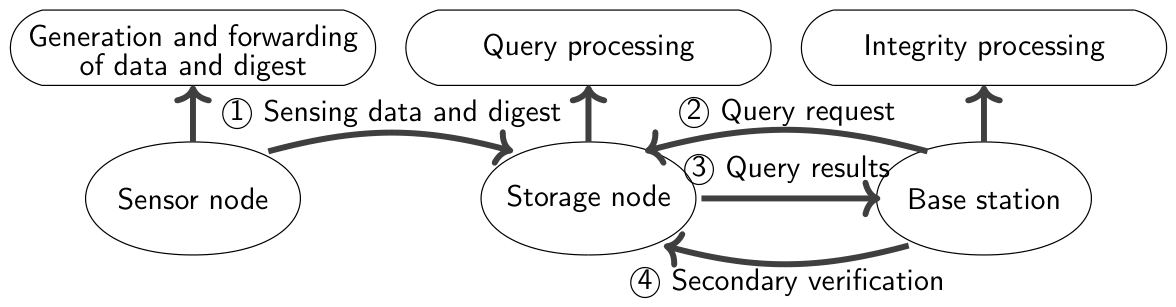
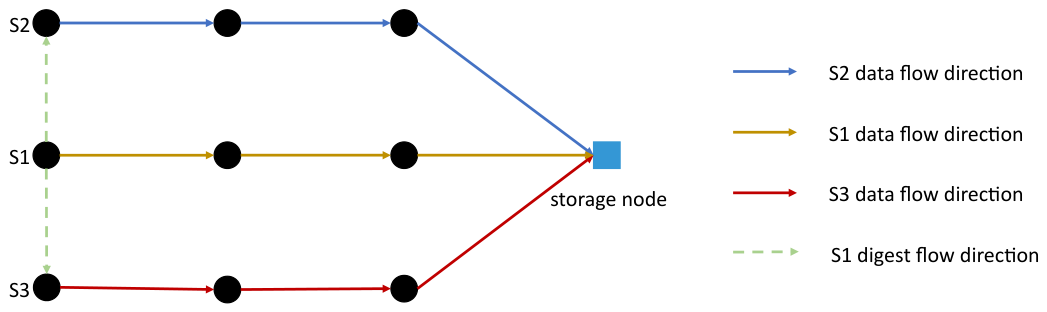
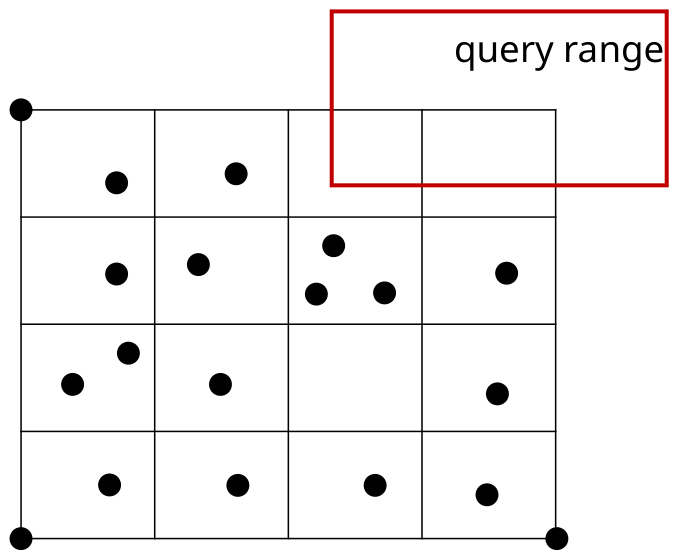
To address this issue, we propose a baseline integrity verification algorithm, the Neighbor Node-Forwarding Digest Algorithm (NNFDA), which leverages data digests to enable secondary verification of query results at the storage node level. In TMWSNs, each sensor node generates both sensed data and corresponding digests; it sends its sensed data to one neighbor node, while distributing its digest to other neighboring nodes. These sensed data and digests are eventually forwarded to their respective storage nodes via multi-hop transmission. When the base station issues a query, the storage node returns the corresponding query results along with relevant digests to the base station. The base station then uses the digests to determine whether any sensor data within the query range have been omitted. For any missing data detected, the base station initiates a secondary verification process with the corresponding storage node. The NNFDA is specifically designed for the proposed threat model and can be integrated with existing secure query schemes to enhance the overall security level. However, the NNFDA introduces considerable communication overhead. To mitigate such redundancy and reduce overhead, we further propose an improved version of the algorithm, NNFDA-BM (NNFDA with Bitmap), which optimizes digest generation and transmission to lower communication costs.
In summary, the main contributions of this paper are as follows:
We analyze how existing packet-dropping attacks manifest in loss-tolerant TMWSNs and establish a new threat model tailored for this scenario.
We propose a baseline integrity verification algorithm, the NNFDA, which ensures query result integrity in TMWSNs.
We present an improved algorithm, NNFDA-BM, that reduces communication costs through optimized digest generation and transmission.
We evaluate the NNFDA under various conditions in simulation, measuring integrity verification success rates as well as communication overhead of both algorithms. Results show that the NNFDA effectively detects compromised query results, while NNFDA-BM achieves lower communication costs than the NNFDA.
The remainder of this paper is organized as follows.
Section 2 reviews related work.
Section 3 first introduces the network model and threat model, then presents the baseline integrity verification algorithm the NNFDA, and finally details the improved algorithm NNFDA-BM.
Section 4 focuses on experimental evaluations, including the description of the experimental setup and the analysis of experimental results.
Section 5 presents the conclusions of this study.
2. Related Work
In wireless sensor networks (WSNs), deployed sensor nodes perceive the surrounding environment and generate sensing data according to predefined programs. A large volume of such sensing data is transmitted, processed, and stored by network nodes, which await query requests initiated by users. Given the limited resources of WSNs, the design of each key step—including data routing, data aggregation, and data querying—must take energy consumption into full consideration.
In WSNs, sensor nodes are usually organized into a network in a multi-hop manner. The goal of data routing is to adjust transmission paths to reduce the communication cost during data delivery. Many researchers have employed hierarchical structures and clustering algorithms to reduce the energy consumption of sensor nodes and thereby prolong network lifetime [
5,
6,
7]. However, these methods are not entirely suitable for mobile WSNs (MWSNs). While node mobility is beneficial for network load balancing, it also increases the risk of communication link disruptions. To address the challenges in MWSNs, the proposed method in [
8] integrates hierarchical structures with weighted clustering algorithms, aiming to mitigate the risk of link disruptions and reduce the overhead caused by complex routing, frequent cluster head re-selection, and frequent updates to dominant sets in MWSNs. Meanwhile, V.A. et al. designed an energy-efficient (EE) routing mechanism that leverages unmanned aerial vehicles (UAVs) to enhance the operational performance of MWSNs [
9]. For smart agriculture applications, the study in [
10] introduced a three-level K-means clustering and chain-based routing method to optimize information transmission efficiency. The work in [
11] uses intelligent monitoring and adaptive clustering to optimize data routing and extend network lifetime. These approaches demonstrate diverse strategies for balancing energy consumption and improving routing reliability in both static and mobile WSNs.
It is worth noting that the hierarchical organization of nodes is not a new concept in WSNs. Classic clustering protocols such as LEACH [
12] and TEEN [
13] partition the network into clusters to improve energy efficiency and extend network lifetime. TMWSN inherits this idea of hierarchical node organization; however, its primary motivation is fundamentally different: rather than optimizing routing or energy-efficient communication, TMWSN introduces the tiered structure to support secure query processing—by centralizing storage and query computation at resource-richer storage nodes, it establishes an architectural foundation for security mechanism design.
Data aggregation focuses on analyzing and processing sensing data to reduce subsequent transmission and storage costs. In [
14,
15], tree-based structures are employed to optimize the aggregation process, thereby reducing the energy consumption of sensor nodes. In MWSNs, the studies in [
16,
17] improve the efficiency of data aggregation and routing by planning optimal routes for mobile agents. Considering node failures, energy constraints, and mobile node mobility, the work in [
18] applies hybrid optimization algorithms to enhance network reliability. Such studies illustrate the importance of data aggregation in reducing communication costs and improving overall efficiency in both WSNs and MWSNs.
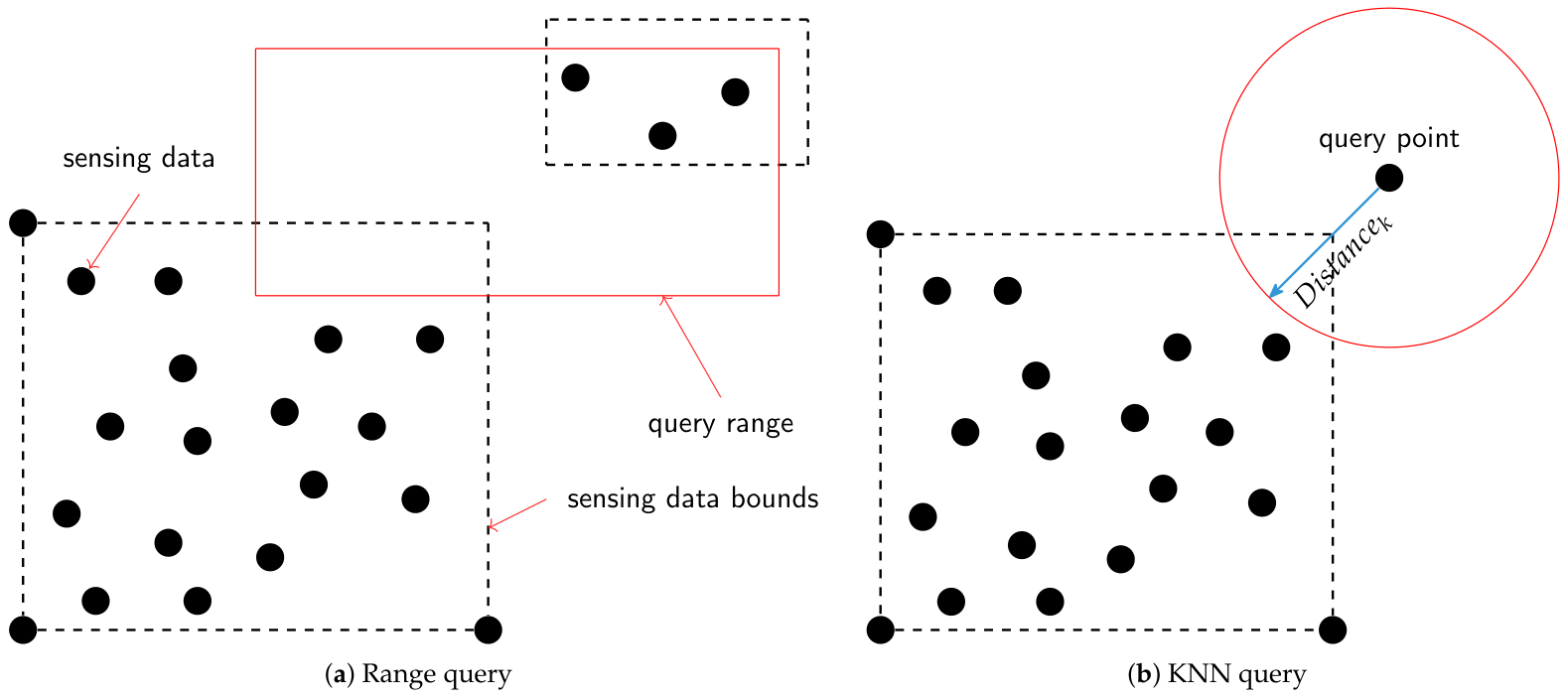
The objective of data querying is to return results that satisfy user requests. Data query schemes typically integrate the design of data routing, data aggregation, and data storage. From the perspective of data storage, most query models in WSNs are based on data-center storage. In this approach, a subset of nodes is selected as data centers, to which sensor nodes transmit their sensing data. This method not only enables users to access data efficiently but also reduces the volume of communication required during the query process. From the perspective of query types, existing approaches include aggregation queries, range queries, Top-k queries, and K-nearest neighbor (KNN) queries, among others. Selecting appropriate query schemes for different application scenarios to achieve efficient resource utilization and secure data management remains a critical research direction in WSNs.
Aggregation queries are among the most critical query types in WSNs. By leveraging operations such as MAX, MIN, COUNT, and AVERAGE, multiple sensing data items are consolidated into a single result—this not only meets user requirements but also reduces the overhead associated with transmitting redundant raw data. TAG [
19] is a representative tree-based aggregation scheme: intermediate nodes aggregate data from their child nodes and forward the aggregated results to their parent nodes, while the root node computes the final query result. In [
20], distinct routing structures are deployed in different network regions, integrating the efficiency of tree structures with the accuracy of multipath aggregation. The TiNA framework [
21] groups sensor nodes along the same transmission path and employs differential computation to reduce redundant data transmission, which ensures query accuracy while optimizing communication costs. Additionally, several other studies [
22,
23,
24] design heuristic routing-tree construction algorithms by incorporating information such as the residual energy of sensor nodes.
Through Top-k queries, users can obtain the
k data items with the highest scores, where the scoring criteria are user-defined. KNN queries can be regarded as a special case of Top-k queries, in which the reciprocal of the distance to the query point is used as the score. In [
25], an approximate Top-k query approach is proposed that leverages historical sensor data samples. After a user specifies a precision tolerance, nodes only need to return results within the required accuracy, thus reducing query costs. FILA [
26] exploits the fact that Top-k queries only require a small number of top-ranked results: it maintains a potential result range for sensor nodes, ensuring that only data within this range are transmitted to the base station, which reduces unnecessary transmissions. In [
27], a locally ordered tree structure is introduced to memorize network hotspots, thereby reducing the number of participating sensor nodes and conserving energy.
Most of the aforementioned WSN query schemes primarily focus on energy efficiency, with relatively little attention paid to security issues. In TMWSNs, the integration of mobile sensor nodes and a two-tier architecture gives rise to more complex security challenges. Below, we review the state-of-the-art techniques for secure range queries in such networks.
Range queries are another critical query type in WSNs, enabling event monitoring tasks such as detecting anomalous high-temperature regions or locating areas with suitable environmental conditions. During query execution, the transmitted data must be protected against capture or eavesdropping by malicious attackers. Privacy protection and integrity protection are two primary objectives of secure query processing.
Some secure query algorithms focus on privacy protection for range queries [
28,
29,
30]. For instance, the work in [
31] presents a general information and query protection protocol based on onion routing. In [
32], a secure and efficient cluster-based query processing scheme was introduced for WSNs. Lin et al. [
33] proposed a secure query protocol for large-scale, multi-layer IoT-based sensor networks, which provides protection against attacks from three aspects: network security, attack models, and privacy preservation.
Other studies consider both privacy and integrity simultaneously. The QuerySec protocol [
34], on the one hand, applies order-preserving encryption to encode sensing data and query requests, ensuring query confidentiality against untrusted storage nodes. On the other hand, it uses watermarking techniques to link data together and detect the deletion of result items. SafeQ [
35] adopts a prefix-membership verification scheme, which transforms the problem of verifying whether a number falls within a specific range into checking the equality of two numbers—thus supporting privacy-preserving verification. For integrity protection, SafeQ introduces a neighborhood-chain technique to verify the integrity of query results. Dai et al. [
36] proposed the dc and qp protocols, which integrate TAG routing, bucket partitioning, symmetric encryption, identity authentication, and check codes to achieve both privacy preservation and result integrity. Earlier studies mainly focused on attacks launched after storage nodes in TMWSNs were compromised, with an emphasis on addressing privacy and integrity breaches [
37]. Zhang [
38] further studied collusion attacks among nodes and proposed a family of collusion-resilient privacy-preserving range query protocols. These protocols employ Bloom-filter-based encoding to protect private data, while the integrity of results is verified through the order relationships among data items.
Existing secure query schemes in TMWSNs typically assume the successful delivery of data packets or focus on traditional attacker models. However, their security mechanisms do not directly address packet-loss detection. In loss-tolerant TMWSNs, adversaries may disguise malicious actions as normal packet losses. Such covert attacks—which exploit the inherent network characteristics of loss-tolerant TMWSNs and undermine query integrity—have not been thoroughly investigated. To the best of our knowledge, this paper is the first to propose a threat model tailored for loss-tolerant TMWSNs, as well as a novel integrity verification method designed to validate query results in such environments.
4. Experiments
4.1. Experimental Setup
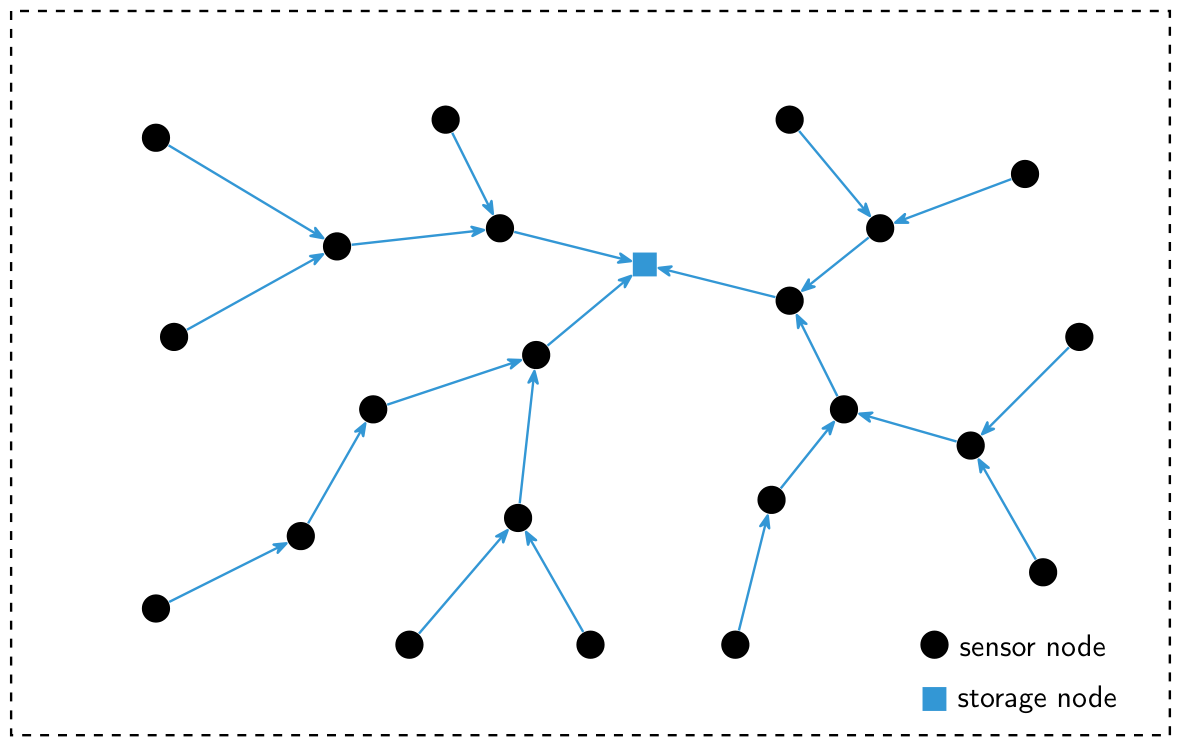
The experimental scenario is illustrated in
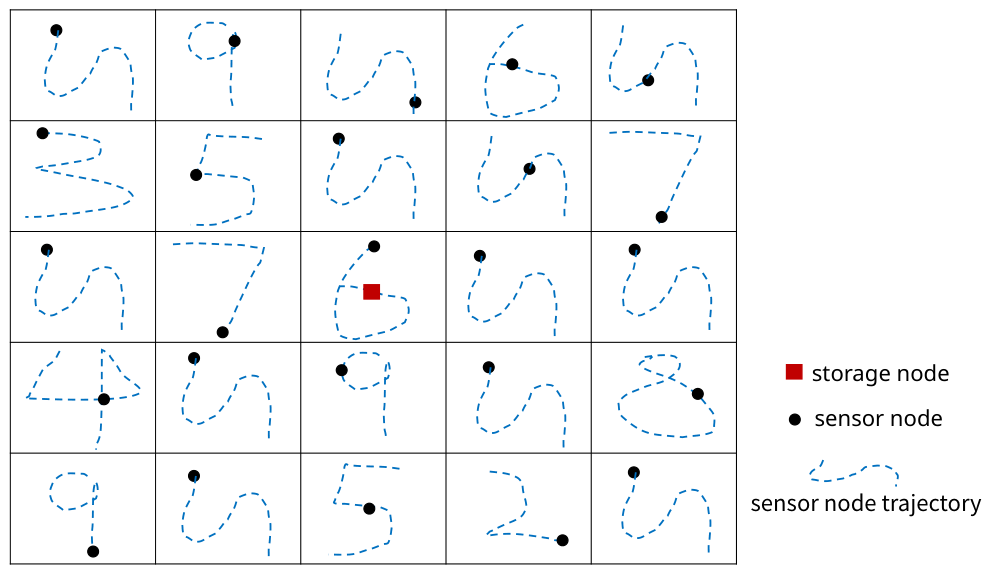
Figure 8. Specifically, a single sensing subregion is configured to contain 25 mobile sensor nodes and one fixed storage node. The storage node is deployed at the center of the subregion, while the mobile sensor nodes move freely within the subregion’s boundary—generating sensing data periodically during their movement. The generated data are transmitted to the storage node through multi-hop communication.
This study represents the first attempt to address secure query issues in loss-tolerant TMWSNs. Since no existing schemes have been designed for this specific scenario, comparative experiments with external approaches are not conducted. Instead, the performance evaluation focuses exclusively on the proposed the NNFDA and NNFDA-BM. The simulation primarily evaluates two metrics: the integrity verification success rate, denoted as P, and the communication overhead incurred during secondary verification, denoted as .
The simulation is built using Python 3.8 and operates at the protocol level without involving physical devices. It explicitly models the following four aspects:
Communication mode. Two communication patterns are modeled: (1) neighbor communication among sensor nodes, where each sensor node first forwards its verification digest to its neighboring nodes; (2) uplink communication from sensor nodes to the storage node, where each sensor node uploads its own sensing data together with the collected neighbor digests. Communication overhead is measured uniformly in terms of packet size (bytes).
Attack modeling. Attack behavior is triggered at the storage node with probability . For sensor nodes whose data satisfy the query conditions, their query results may be randomly discarded to simulate intermittent adversarial behavior. The attack model independently samples in each query round to capture the randomness and unpredictability of attacks, thereby avoiding detection bias from fixed attack patterns.
Processing capability. The simulation does not incorporate specific cryptographic libraries for homomorphic encryption or other operations; instead, it adopts a protocol-level abstract modeling approach. The generation and matching of verification digests (MBR and bitarray) are abstracted as lightweight protocol operations, with their computational overhead indirectly reflected through communication packet sizes. The evaluation focuses on the trade-off between detection effectiveness and communication overhead of the two-tier verification mechanism, rather than the runtime performance of underlying cryptographic implementations.
Physical layer. The network is deployed on a regular grid topology, with neighbor relationships determined by spatial proximity (8-neighbor connectivity). The simulation adopts an idealized single-hop reliable communication model and does not explicitly model signal propagation, path loss, or physical-layer channel attenuation. Under this model, physical-layer transmission uncertainty and attack behavior are uniformly abstracted at the protocol level as “data packet unavailable events” to support system-level security analysis.
The experiments focus on scenarios in which the storage node discards all query results originating from a given sensor node. For the original NNFDA scheme, the success rate of integrity verification is evaluated under three types of queries: range queries, KNN queries, and Top-k queries. The definitions of the success rates for these three query types are as follows:
Definition 5 (Success rate of integrity verification for range queries). The success rate is defined as the ratio of the number of sensor nodes that pass integrity verification to the total number of sensor nodes whose sensing data fall within the user-specified query range, with a maximum value of 1.
Definition 6 (Success rate of integrity verification for KNN queries). The success rate is defined as the ratio of the number of sensor nodes that pass integrity verification to the total number of sensor nodes whose sensing data fall within the range of from the query point, with a maximum value of 1.
Definition 7 (Success rate of integrity verification for Top-k queries). The success rate is defined as the ratio of the number of sensor nodes that pass integrity verification to the number of sensor nodes whose sensing data have values no less than , with a maximum value of 1.
It should be noted that the purpose of testing KNN queries in the experiments is not to use KNN for sensor node localization. Rather, the KNN experiments evaluate the verification coverage of the digest-data bundling mechanism: if node A’s data is lost, the KNN query measures how likely a neighboring node’s data (which carries A’s digest) is to be returned in the query results. The base station can then use A’s digest, bundled with the neighbor’s data, to initiate secondary verification for A. This experimental design allows us to assess the effectiveness of the bundling mechanism under different query semantics.
The simulations investigate how the following factors affect the success rate of integrity verification
P and the communication overhead of secondary verification
: the number of digests transmitted to neighboring nodes
, the probability of storage node attacks
, query conditions, and the cell division parameter
in NNFDA-BM. Other default parameters are provided in
Table 1. To obtain reliable results, the reported data are the average values calculated from 100 network instances.
4.2. Experimental Results Analysis
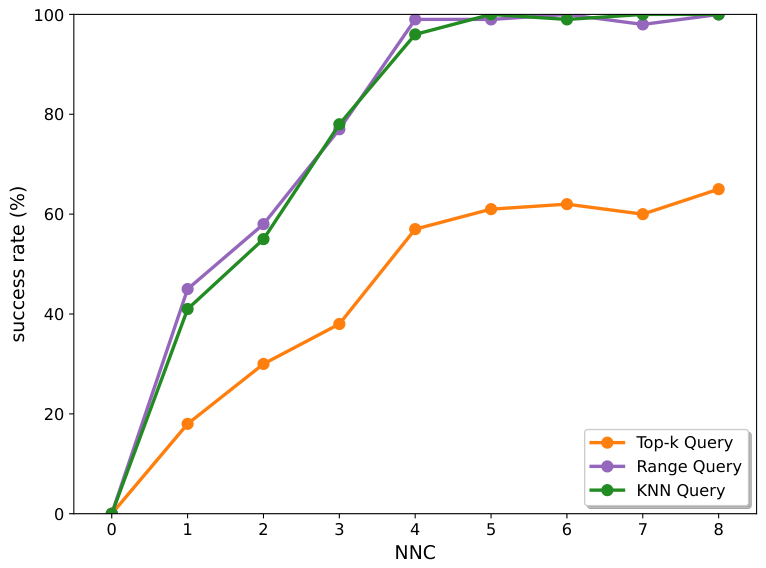
Figure 9 illustrates the impact of the number of digest forwards on the success rate of integrity verification. In this set of experiments,
is varied within the range of 0 to 8. During the digest forwarding phase, each sensor node transmits digest information to its
neighboring nodes; if the number of neighbors is less than
, the node sends the digest information to all available neighbors, disregarding the predefined
value.
As illustrated in
Figure 9, the success rates of integrity verification
P for all three query types generally increase as
increases. This trend arises because a larger
allows each sensor node to carry more verification information, thereby providing the base station with richer data to support successful integrity verification. Compared to Top-k queries, range queries and KNN queries achieve higher
P values. This discrepancy is attributed to the spatial characteristics of range and KNN queries: forwarding digests to neighboring nodes better preserves spatial correlation. In contrast, Top-k queries rely on randomly generated scores with weak spatial correlation, leading to a lower overall success rate. Notably, when
, the NNFDA scheme becomes non-functional because no digest is forwarded to neighbors, and the integrity verification success rate drops to 0 under the designed attack scenario. This result is consistent with the performance of existing relevant algorithms.
As depicted in
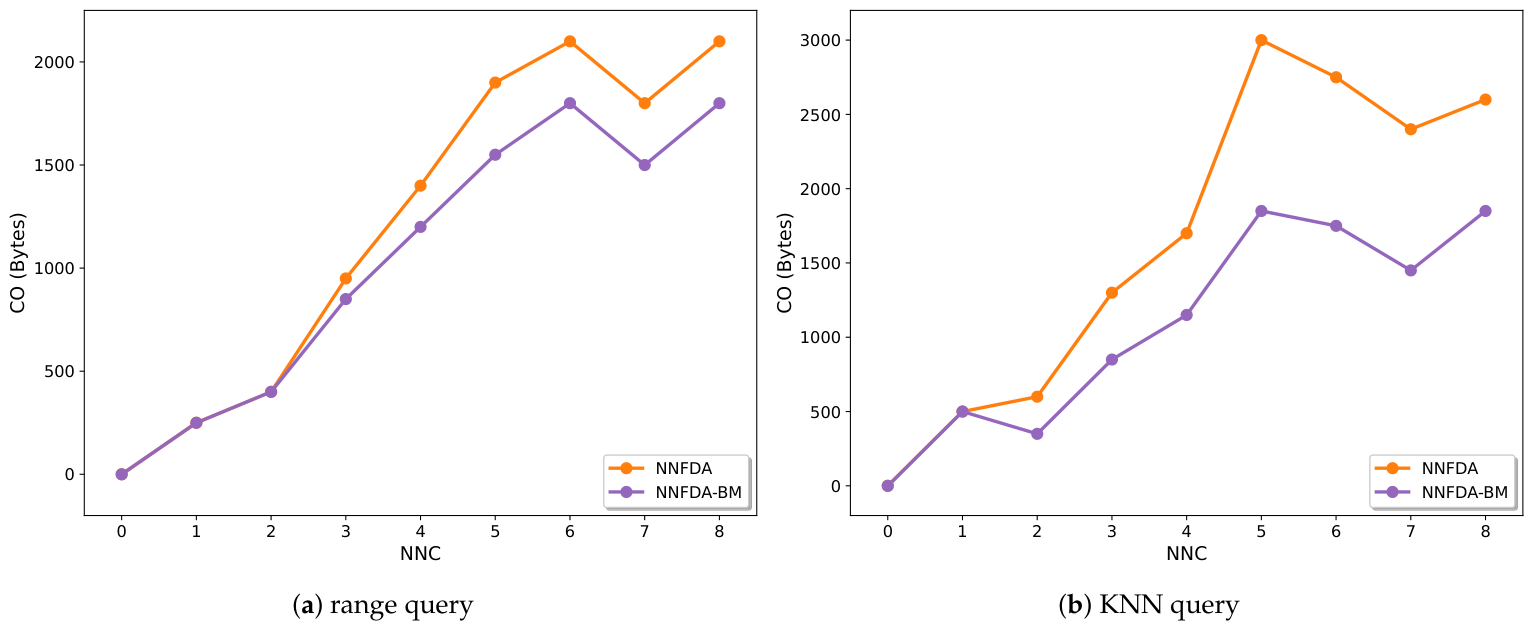
Figure 10, with an increase in
, the overall communication overhead rises, since a larger
results in more digests being returned in the query results. Compared to the original NNFDA scheme, the NNFDA-BM algorithm further reduces the communication overhead during secondary verification. The reduction effect becomes more pronounced as
increases.
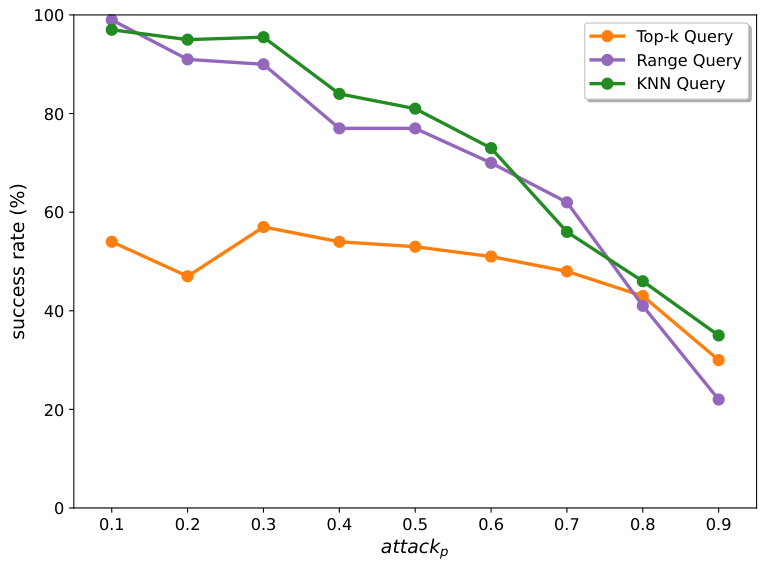
Figure 11 illustrates the impact of varying storage node attack probabilities on the integrity verification success rate
P in the NNFDA scheme. In this experiment, the attack probability
is varied from 0.1 to 0.9. When
(i.e., no attacks occur), no verification is required; when
(i.e., no query results are returned), the integrity verification success rate is inevitably 0.
The results indicate that as increases, the integrity verification success rate decreases. This trend occurs because a higher attack frequency leads to fewer query results being returned, which reduces the number of digests received by the base station and lowers the success rate. In particular, when the storage node discards all query results from sensor nodes, the base station receives no digests at all, which results in a success rate of 0. A vertical comparison of the three query types shows that the success rate for Top-k queries remains relatively stable with increasing . This stability is again attributed to the weak spatial correlation of the data involved in Top-k data.
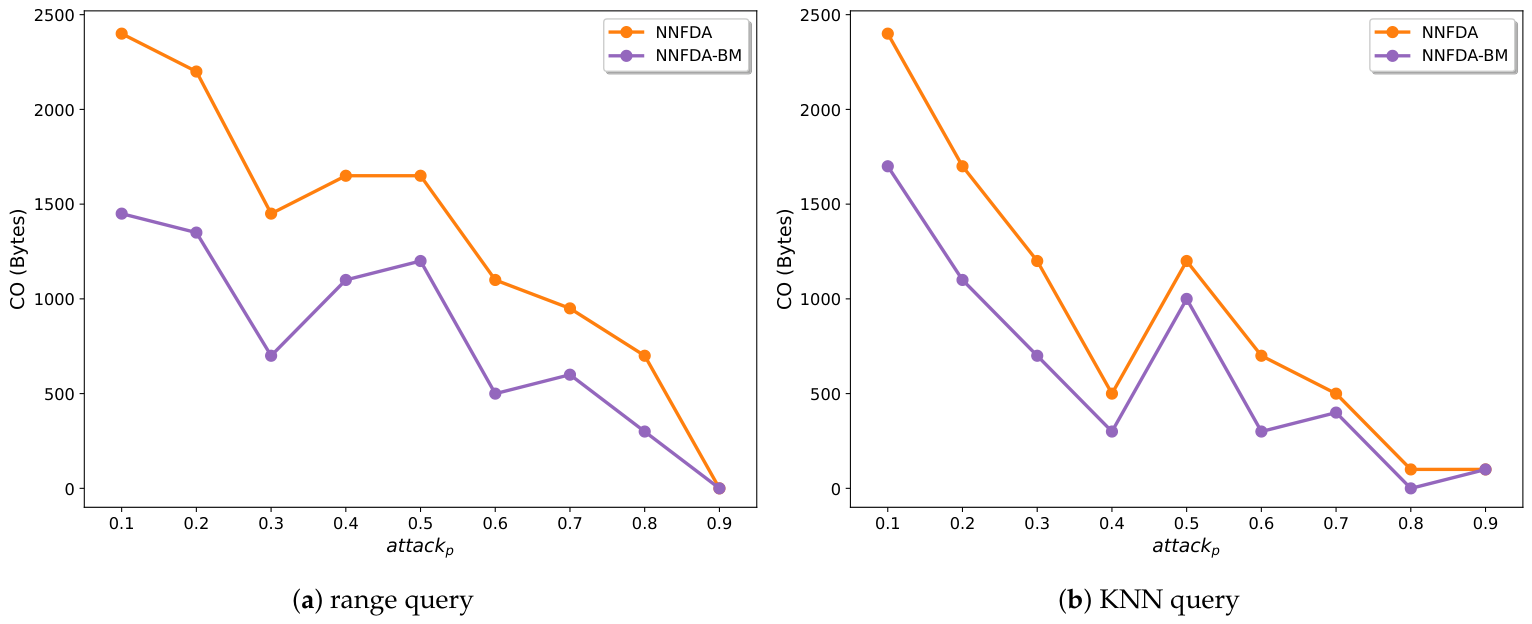
Figure 12 illustrates the impact of
on the communication overhead of secondary verification in the NNFDA scheme. As
increases, the communication overhead for both algorithms generally decreases. This trend occurs because a higher
results in fewer query results and digests being transmitted to the base station—this reduces the volume of data for secondary verification, thereby lowering the associated communication overhead. Nevertheless, the NNFDA-BM scheme maintains a significant advantage in reducing communication overhead compared with the original NNFDA scheme.
The set of experiments illustrated in
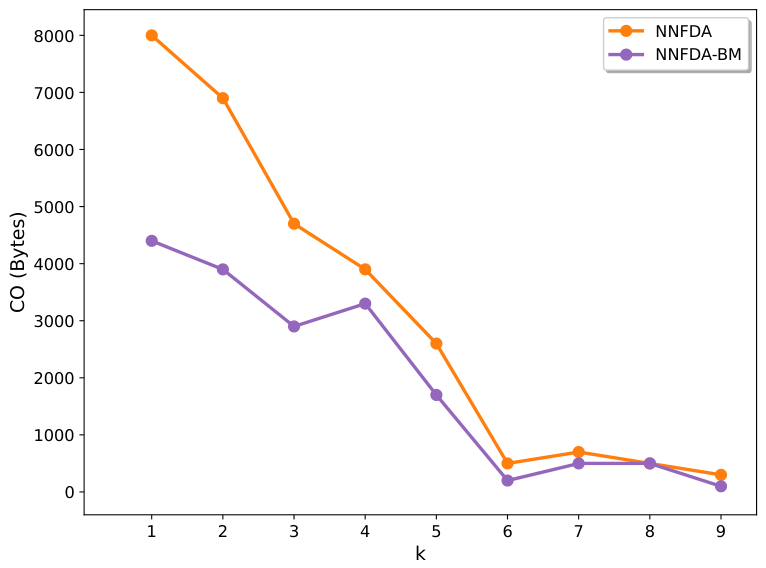
Figure 13 investigates the impact of query conditions on algorithm performance. Since the results of range queries are theoretically predictable, the analysis focuses on KNN queries and Top-k queries. By varying the value of
k from 1 to 9 in both query types, the experiments analyze how
k impacts the success rate and the communication overhead.
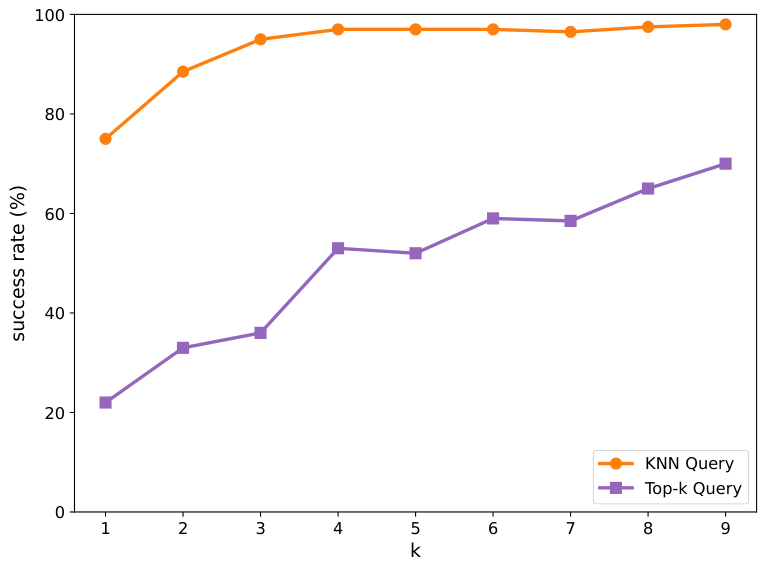
Figure 13 illustrates the impact of varying
k on the success rates for KNN queries and Top-k queries. For KNN queries, the success rate initially rises as
k increases; however, it stabilizes once
. This trend occurs because, under the network configuration and default target settings, KNN query results are concentrated among four sensor nodes. Once the digests from these four sensors are successfully returned, additional increases in
k no longer improve the success rate. For Top-k queries, increasing
k leads to more query results being returned, carrying more digest information, which increases the probability of detecting the sensor nodes targeted by attacks. Consequently, the integrity verification success rate improves as
k increases.
Figure 14 demonstrates that the NNFDA-BM scheme performs effectively in reducing the communication overhead of secondary verification. When
k is small, the reduction effect on the communication overhead is more significant. Once
k exceeds a certain threshold, the reduction stabilizes at a constant value. This trend is attributed to the concentration of Top-k query results among four sensor nodes. As
k increases, the base station essentially receives the duplicate digest information. This limits the potential for further reducing the communication overhead.
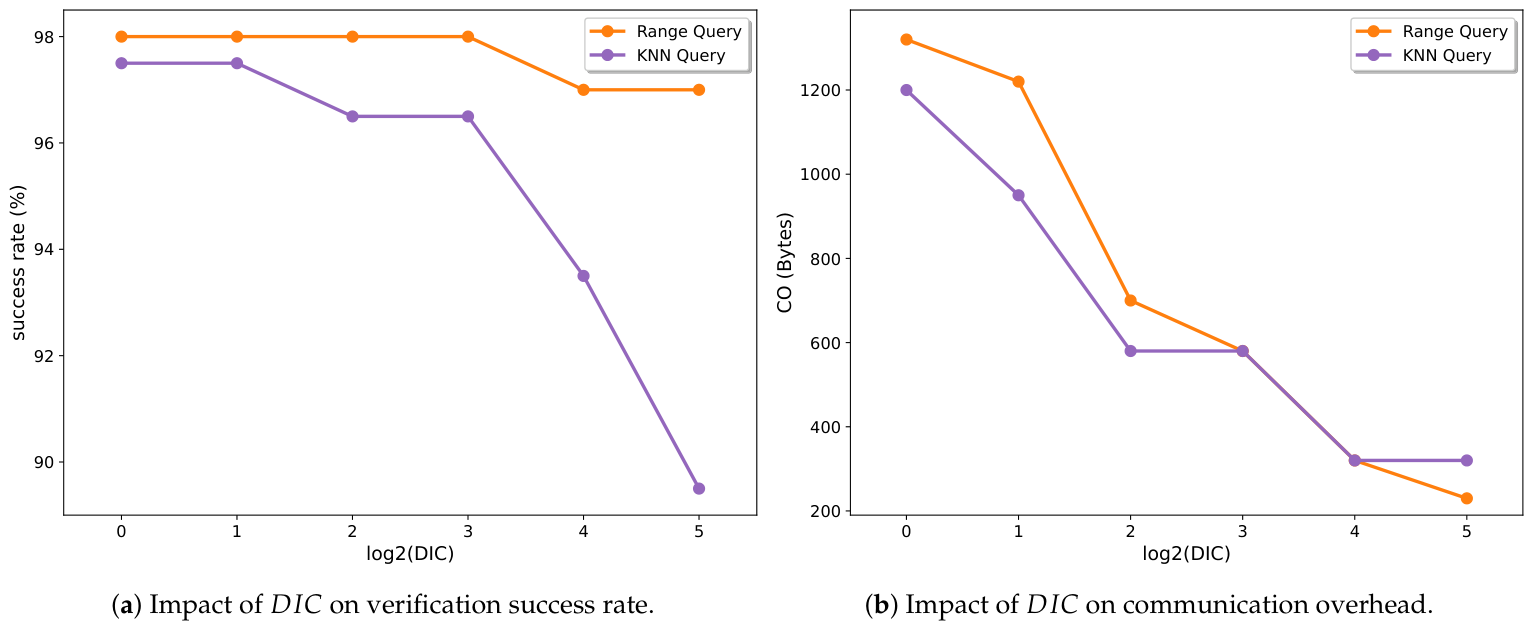
The set of experiments illustrated in
Figure 15 investigates the impact of
on the integrity verification success rate and the communication overhead for range queries and KNN queries. The actual values of
are set to 1, 2, 4, 8, 16, and 32; correspondingly, the horizontal axis of
Figure 15 uses the log2-transformed values of
for clearer visualization. As shown in
Figure 15a, the success rate of the NNFDA scheme tends to decrease as
increases. This downward trend stems from the fact that the definition of the integrity verification success rate is related to the size of verification set—specifically, the number of nodes requiring secondary verification, which is determined during the verification phase. As
increases, sensor nodes that do not meet the query conditions are gradually excluded, reducing the total number of nodes available for integrity checking and thus lowering the overall success rate. Meanwhile,
Figure 15b demonstrates that increasing
reduces the secondary verification communication overhead for both query types. This is attributed to the more accurate identification of sensor nodes involved in the verification phase; fewer irrelevant nodes are included, thereby reducing the volume of redundant communication.
Based on the above results, DIC values between 4 and 8 provide a favorable trade-off between communication overhead and verification performance. Specifically, increasing DIC from 1 to 4 significantly reduces communication cost, while further increases yield only marginal improvements. Meanwhile, the verification success rate remains above 95% for both range and KNN queries when , but begins to decline noticeably for larger values. Therefore, DIC = 4 or 8 is recommended for most deployments. When communication efficiency is the primary concern, DIC = 16 may also be considered at the cost of a moderate reduction in KNN verification performance.
5. Discussion
5.1. Limitations of the Current Work
Detection boundary of the integrity verification chain. The NNFDA mechanism relies on the assumption that a sensor node’s digest can reach the base station via at least one neighbor’s data packet. When all digests within an affected region fail to escape—for instance, due to regional interference that blocks all outgoing digest paths, correlated link failures that simultaneously affect both data and digest forwarding, or collusion among neighboring compromised nodes that intercepts all digest transmissions—the detection capability of the NNFDA ceases to function. Under such conditions, neither the original data nor any copy of the associated digests reaches the base station, and the verification chain is entirely broken.
Attacker simultaneously controlling range and point queries. The secondary verification mechanism in the NNFDA assumes that, while an attacker may manipulate the range query logic at the storage node, they do not simultaneously control the single-point query logic used during secondary verification. If an attacker can precisely manipulate both query types—for example, dropping a node’s qualifying results in the range query while also hiding the same data during the subsequent single-point verification—the two-tier verification mechanism would be circumvented.
Homomorphic encryption performance on sensor hardware. In NNFDA-BM, the additive homomorphic encryption (AHE) operations for digest aggregation have not been benchmarked on specific sensor hardware platforms (e.g., 8-bit or 16-bit MCUs). While we employ AHE rather than fully homomorphic encryption (FHE) and restrict encryption to digest-level metadata rather than full sensing data, the concrete latency and energy consumption of AHE on resource-constrained devices remain to be quantitatively evaluated. Compared with conventional symmetric encryption such as AES, AHE imposes a higher computational complexity, which represents a necessary security premium in scenarios requiring trustworthy aggregation, and may impose moderate requirements on node hardware configurations such as FPU support and memory capacity.
Qualitative nature of the security analysis. The security analysis presented in this paper is primarily qualitative. Formal security definitions and rigorous proofs that integrate the security properties of the NNFDA (digest integrity, omission detection, replay resistance) into a unified formal framework have not yet been developed. The construction of a formal security model tailored to loss-tolerant TMWSNs remains an important direction for future investigation.
Experimental scale and baseline comparisons. The current experiments employ a single subregion with 25 mobile sensor nodes and one storage node, which is sufficient for validating the basic feasibility and effectiveness of the NNFDA and NNFDA-BM under controlled conditions, but is considerably smaller than typical real-world TMWSN deployments. In large-scale networks, additional challenges may arise, including: inflation of bundled digests per data packet as the number of neighbors increases, which may raise communication load and verification latency; cumulative delay introduced by deep verification chain propagation across many hops; and cross-subregion management when sensors migrate, where the interruption and re-establishment of digest forwarding chains may affect detection coverage. Furthermore, baseline comparisons with redundant digest schemes, multi-path forwarding strategies, or adapted secure query protocols have not been conducted, as no existing schemes in the literature are designed for the same loss-tolerant TMWSN scenario with simultaneous consideration of packet loss tolerance and integrity verification.
Packet loss model diversity and evaluation metrics. The current experiments are primarily based on a uniform random packet loss model. In real TMWSNs, loss patterns may exhibit burstiness or spatial correlation due to environmental factors such as interference, congestion, or node mobility. The evaluation metrics focus mainly on detection rate and communication overhead, while total communication cost, energy consumption, and robustness under different loss models have not been comprehensively quantified.
Granularity of the success rate metric. The integrity verification success rate
P defined in
Section 4.1 is measured at the sensor-node level and reflects the proportion of qualifying sensor nodes whose integrity status is correctly identified during verification. To avoid overstating the practical protection effect, we note that this metric does not directly characterize item-level omission rates or false-positive rates. Since the proposed digest records only the minimum and maximum attribute values of each sensor node, the current design operates at the node granularity and does not explicitly evaluate these aspects. Therefore, the reported success rate should be interpreted as a node-level integrity verification metric rather than a complete assessment of result-set completeness.
5.2. Applicability Boundaries
The effectiveness of the NNFDA depends on several conditions that define its applicability boundaries:
Spatial correlation assumption. The digest forwarding verification mechanism relies on the premise that neighboring sensor nodes exhibit strong spatial correlation in their sensing data. This assumption may not hold in the following scenarios: (1) sparse deployment, where sensor nodes are too far apart for their readings to maintain sufficient similarity; (2) high mobility, where rapidly changing node positions may destabilize neighbor relationships and disrupt the digest-data bundling during transmission; (3) heterogeneous sensing tasks, where different nodes monitor different physical quantities (e.g., temperature, humidity, pressure), making cross-node data comparison meaningless; and (4) spatially discontinuous phenomena, where the monitored environmental variable itself exhibits sharp spatial gradients, causing neighboring nodes to report significantly different values. In summary, the proposed method is best suited for TMWSN scenarios characterized by dense node deployment, low-to-moderate mobility, homogeneous sensing tasks, and spatially continuous physical phenomena. Applicability beyond these boundary conditions requires further validation.
Routing independence assumption. The paper assumes that sensing data and digest information are transmitted via different routing paths to minimize the probability of simultaneous loss. In this context, “different paths” refers to local differentiated forwarding—data and digests are forwarded through different next-hop neighbors rather than requiring fully disjoint routes at the network-wide level. This local differentiation is feasible in moderately dense TMWSNs (where each node has 3–5 neighbors) with manageable overhead. However, the assumption may be compromised when regional interference blocks all escape paths, correlated link failures simultaneously affect both data and digest forwarding, or colluding neighboring nodes intercept digest transmissions. Mitigation strategies for practical deployment include: increasing the number of multi-path digest replicas (trading communication efficiency for reliability), explicitly prioritizing non-overlapping next-hop nodes for digest forwarding in the routing protocol, and introducing redundant digest caching at boundary nodes. The quantitative effectiveness of these strategies warrants further study.
Inability to distinguish malicious from natural packet loss. The NNFDA detects the occurrence of packet loss but cannot distinguish between malicious dropping and natural loss caused by adverse wireless channel conditions. This ambiguity has practical implications: in areas with poor channel quality (e.g., high interference, severe multi-path fading), naturally high loss rates may trigger frequent alerts, leading to elevated false positive rates. High false positive rates may in turn cause unnecessary field inspections by network administrators, wasting operational resources and potentially eroding trust in the alerting system. A potential mitigation approach for practical deployment is to combine NNFDA detection results with environmental channel quality indicators such as RSSI, Link Quality Indicator (LQI), and historical packet loss rates: when persistent alerts correlate with abnormal channel quality metrics in the same region, losses can be preliminarily attributed to environmental factors; when alerts occur in the absence of channel quality anomalies, malicious dropping becomes a more likely cause. The effectiveness of this multi-source discrimination strategy requires validation in real-world environments.
5.3. Future Work
Several directions are identified for extending this work:
Quantitative overhead evaluation on real hardware. Benchmarking the computational, memory, and energy overhead of digest generation, forwarding, and homomorphic aggregation on specific sensor hardware platforms (e.g., 8-bit/16-bit MCUs) with concrete cryptographic library implementations.
Large-scale multi-subregion deployment. Evaluating the scalability and robustness of the NNFDA and NNFDA-BM in larger networks with multiple subregions, hundreds to thousands of sensor nodes, and multiple storage nodes.
Formal security model and proofs. Developing a formal security model tailored to loss-tolerant TMWSNs and providing rigorous proofs that integrate the security properties of the proposed mechanisms into a unified framework.
Multi-path redundancy and routing strategies. Quantitatively evaluating the effectiveness of increasing digest replicas, priority-based next-hop selection, and boundary-node caching for improving verification chain reliability under adverse conditions.
Comprehensive evaluation under diverse packet loss models. Assessing scheme performance under bursty and spatially correlated loss models in addition to the uniform random model, with expanded metrics including total communication cost, energy consumption, and robustness.
Baseline comparisons with adapted secure query schemes. Implementing and comparing against adapted versions of existing secure query protocols (e.g., redundant digest schemes, multi-path forwarding) that are modified to operate in loss-tolerant TMWSN scenarios.
Integration with channel quality indicators. Empirically validating the effectiveness of combining NNFDA alerts with RSSI/LQI data for reducing false positive rates caused by natural packet loss.