Article

Lyapunov Stability Analysis of a Generated UAV Controller

School of Aeronautical, Automotive, Chemical, and Material Engineering, Loughborough University, Loughborough LE11 3TL, UK
*
Author to whom correspondence should be addressed.
Electronics 2026, 15(13), 2898; https://doi.org/10.3390/electronics15132898
Submission received: 29 May 2026 / Revised: 24 June 2026 / Accepted: 26 June 2026 / Published: 2 July 2026
(This article belongs to the Special Issue Integrated Information Systems for Smart Industrial Electronics)

Abstract

A Large Language Model-based search for controller synthesis can yield UAV controllers with strong trajectory-tracking performance. However, low tracking error does not necessarily demonstrate closed-loop stability. This study presents a Lyapunov stability assessment of an automatically generated UAV controller produced through a Large Language Model-based search process. The closed-loop system is numerically linearised about the hover equilibrium, yielding a local closed-loop state matrix A d .Eigenvalue analysis is then used to determine whether A d is Schur stable, corresponding to all eigenvalues lying inside the unit circle ρ ( A d ) < 1 . A quadratic Lyapunov function is constructed by solving the discrete-time Lyapunov equation A d T P A d P = Q . The positive definiteness of the resulting matrix provides a local Lyapunov certificate for the linearised closed-loop system. To connect this local certificate to dynamic flight behaviour, the Lyapunov function is evaluated along trajectory-tracking logs using the tracking-error state. The mean Lyapunov value, maximum Lyapunov value, discrete Lyapunov difference, and mean squared error are used to compare the generated controller with PID, LQR, and PID + DOB baselines. The results show that the generated controller satisfies local Lyapunov stability conditions near hover. Our findings demonstrate that established Lyapunov tools can be applied post hoc to a search-generated UAV controller, providing evidence of local stability.

1. Introduction

Large language model (LLM)-based search methods have recently enabled controller synthesis beyond fixed-structure gain tuning, allowing both controller architecture and numerical parameters to be explored [1,2]. This is particularly relevant for unmanned aerial vehicles (UAVs), where nonlinear dynamics, coupled translational and rotational motion, actuator limits, and sim-to-real discrepancies make controller design challenging [3,4,5,6]. However, strong trajectory-tracking performance alone does not guarantee closed-loop stability, so generated controllers require additional post hoc verification [7,8].
This paper assesses the local Lyapunov stability of a UAV controller generated using the Real Value Optimised Large Language Models as Evolutionary Algorithms (RVOLMEA) synthesis process [9]. The primary objective is not to propose a new Lyapunov-based synthesis method but rather to evaluate whether the resulting controller, generated with a mean squared error target, satisfies local Lyapunov stability conditions near hover. The closed-loop system is numerically linearised about the hover equilibrium, the resulting discrete-time state matrix is tested for Schur stability, and a quadratic Lyapunov function is constructed by solving the discrete-time Lyapunov equation.
The generated controller is also evaluated along trajectory-tracking logs to examine whether its tracking-error dynamics remain consistent with the local Lyapunov certificate during dynamic flight [7,8]. Mean and maximum Lyapunov values, discrete Lyapunov differences, and tracking error metrics are used to compare the generated controller with conventional baselines. The generated controller can be interpreted as a nonlinear state-feedback control law, since its output is computed from measured tracking error, attitude, velocity, angular velocity, and internal controller states. Related state-feedback controllers have been generated or tuned using pole placement, optimisation-based synthesis, neural-network control, and evolutionary gain tuning [7,10,11]; in contrast, LLM-based evolutionary methods generate executable controller code directly, enabling more flexible controller structures.
The main contribution of this paper is a post hoc Lyapunov assessment pipeline for automatically generated UAV controllers. This provides a practical verification layer for controller-generation frameworks by combining local stability evidence with empirical trajectory-tracking diagnostics. Section 2 describes the Lyapunov assessment methodology, Section 3 reports the local stability and trajectory-tracking results, and Section 4 concludes the paper.

2. Methodology

The controller is first embedded within the nonlinear UAV dynamics to form a closed-loop discrete-time system. The resulting closed-loop system is evaluated through a one-step error map around hover. After numerical linearisation, local stability is assessed using the spectral radius of the discrete-time closed-loop state matrix. A quadratic Lyapunov function is then constructed by solving the discrete-time Lyapunov equation. The resulting function is used both to certify local stability around hover and to evaluate stability-consistent behaviour during trajectory tracking.

2.1. Evaluating Hover Stability

The UAV and controller were evaluated as a closed-loop discrete-time system, with the certificate state defined as
z k = e p , k v k e R , k ω k ,
where e p , k is the position error; v k is the translational velocity; e R , k is the attitude rotation-vector error; and ω k is the body angular velocity. The hover equilibrium is therefore defined as z = 0 .
The controller is evaluated using a one-step closed-loop error map
z k + 1 = F ( z k ) .
The closed-loop map is numerically linearised around the hover equilibrium, producing the discrete-time state matrix
A d = F ( z ) z z = 0 .
The Jacobian is estimated using central finite differences by perturbing each state dimension around z = 0 and evaluating the resulting one-step closed-loop response.
The eigenvalues of A d are evaluated to determine whether the local discrete-time linearised system is asymptotically stable. For the linearised system
z k + 1 = A d z k ,
the behaviour of small perturbations around hover is governed by the eigenvalues of A d . Let
λ i ( A d )
denote the i-th eigenvalue of the discrete-time closed-loop state matrix A d . Each eigenvalue corresponds to a local dynamic mode of the linearised closed-loop system. In discrete time, a mode decays if the magnitude of its eigenvalue is less than one. Therefore, all eigenvalues must lie inside the unit circle in the complex plane for the local linearised system to be asymptotically stable.
This condition is expressed using the spectral radius,
ρ ( A d ) = max i | λ i ( A d ) | ,
where | λ i ( A d ) | is the magnitude of the i-th eigenvalue. The local discrete-time system is stable if
ρ ( A d ) < 1 .
Having evaluated the spectral radius condition, a quadratic Lyapunov function is constructed by solving the discrete-time Lyapunov equation
A d T P A d P = Q ,
where Q is a positive-definite design matrix and P is the unknown symmetric matrix to be solved for. In this work, Q is selected as the identity matrix,
Q = I n ,
where I n denotes the n × n identity matrix and n is the dimension of the certificate state z k . Therefore,
A d , P , Q , I n R n × n .
The matrix (P) is solved numerically using a fixed-point iteration of the discrete-time Lyapunov equation. Starting from P 0 = Q , the update
P j + 1 = A d T P j A d + Q
is applied until convergence, where convergence is defined by
| P j + 1 P j | < ϵ .
This iteration converges when the discrete-time closed-loop matrix A d is Schur stable, i.e.,
ρ ( A d ) < 1 .
After convergence, numerical symmetry is enforced using
P 1 2 ( P + P T ) .
The resulting matrix is then checked for positive definiteness before being used to construct the quadratic Lyapunov function V ( z k ) = z k T P z k .
The purpose of solving for P is to define the candidate quadratic Lyapunov function
V ( z k ) = z k T P z k .
If the computed matrix P is positive definite, then V ( z k ) is positive for all non-zero perturbations z k . The matrix P, therefore, determines the shape of the Lyapunov function used to measure local error energy around hover.
The Lyapunov equation is solved numerically for P. The positive definiteness of the resulting matrix is then verified by checking that all eigenvalues of P are strictly positive. Equivalently, positive definiteness can be verified by checking whether a Cholesky decomposition of P can be performed.
The candidate Lyapunov function is defined as
V ( z k ) = z k T P z k .
If P > 0 , then V ( z k ) > 0 for all non-zero z k .
The one-step Lyapunov difference for the linearised system is
Δ V k = V ( z k + 1 ) V ( z k ) .
Substituting z k + 1 = A d z k gives
Δ V k = z k T ( A d T P A d P ) z k .
Using the discrete-time Lyapunov equation, this becomes
Δ V k = z k T Q z k .
Since Q > 0 , this implies
Δ V k < 0 z k 0 .
Therefore, the controller satisfies the local discrete-time Lyapunov certificate around hover if ρ ( A d ) < 1 and P > 0 .
The local certificate is derived from the linearised system, so the nonlinear one-step map is also sampled directly around hover. For each sampled perturbation, the values
V ( z k ) = z k T P z k
and
V ( z k + 1 ) = F ( z k ) T P F ( z k )
are computed. A sampled violation is recorded when
V ( z k + 1 ) V ( z k ) .

2.2. Empirical Level Trajectory Evaluation

A secondary measurement of the control system is measured along a lemniscate trajectory, with the function for the trajectory defined as [4]
P r t = r a d sin θ ( t ) , r a d sin 2 θ ( t ) , z 0 + σ ( t ) A sin θ ( t )
The trajectory-level diagnostic evaluation is measured on both a disturbance-free simulation and a secondary trajectory under disturbance [5,12]. The disturbances added to the simulation for the secondary evaluation are in Table 1.
This experiment does not serve as a formal proof of stability. Instead, it is used to measure the performance of the control system across both hover stability and using a more standardised approach. Hover stability alone does not guarantee strong trajectory tracking performance.
For a desired reference state x d , k , the trajectory-level tracking error is defined as
e k = x k x d , k .
The Lyapunov value along the trajectory is computed as
V ( e k ) = e k T P e k ,
and the discrete Lyapunov difference is computed as
Δ V k = V ( e k + 1 ) V ( e k ) .
Overall, the proposed pipeline provides a structured assessment to determine whether the generated controller demonstrates both empirical effectiveness and local consistency with classical discrete-time Lyapunov stability. The resulting certificate provides evidence of local stability near hover, while the trajectory-level evaluation provides a diagnostic assessment of behaviour during tracking.

2.3. UAV Model

The UAV dynamics equations are based on established quadrotor modelling and trajectory-tracking formulations [5,6,13,14] and are omitted from here. The model for the UAV is provided in Table 2.

2.4. Generated Control Law

Throughout the control law presented below, θ i represents tunable parameters within the program. Throughout experiments, these are tuned via PSO for each specific task.
Let the position tracking error be defined as
e p = e x e y e z T = p ref p ,
where ( p ref ) is the commanded position and (p) is the measured vehicle position. The measured linear and angular velocities are denoted by ( v = [ v x , v y , v z ] T ) and ( ω = [ ω x , ω y , ω z ] T ), respectively.
The controller first applies exponential smoothing to the measured linear and angular velocities:
v ¯ k = β v ¯ k 1 + ( 1 β ) v k ,
ω ¯ k = β ω ¯ k 1 + ( 1 β ) ω k .
A velocity-dependent gain scaling term is then computed as
λ v = 1 + θ 0 | v ¯ | .
The derivative-like error terms are taken from the filtered velocity:
d x = v ¯ x , d y = v ¯ y , d z = v ¯ z .
The controller also uses state-dependent integral weighting terms:
w z = exp | e z | max ( θ 1 , ϵ ) ,
w x = exp | e x | max ( θ 2 , ϵ ) , w y = exp | e y | max ( θ 3 , ϵ ) ,
where ( ϵ > 0 ) is a small numerical constant.
The integral limits are defined as
L z = θ 4 | d z | + ϵ , L x = θ 5 | d x | + ϵ , L y = θ 6 | d y | + ϵ .
The integral states are updated according to
I z + = sat [ L z , L z ] I z + θ 7 e z Δ t , w z ,
I x + = sat [ L x , L x ] I x + θ 8 e x Δ t , w x ,
I y + = sat [ L y , L y ] I y + θ 9 e y Δ t , w y .
The outer-loop translational control terms are
u z = θ 10 λ v e z + θ 11 λ v d z + I z ,
u x = θ 12 λ v e x + θ 13 λ v d x + I x ,
u y = θ 14 λ v e y + θ 15 λ v d y + I y .
These terms define an intermediate target velocity
v cmd = u x u y u z T .
The commanded acceleration is then calculated as
a cmd = v cmd v ¯ + 0 0 g .
The commanded thrust direction is
b 3 , cmd = a cmd | a cmd | .
The desired pitch and roll angles are obtained from this thrust direction:
θ cmd = clip tan 1 a cmd , x a cmd , z , α max , α max ,
ϕ cmd = clip tan 1 a cmd , y a cmd , z , α max , α max ,
with
ψ cmd = 0 .
Let (R) be the measured attitude rotation matrix and ( R cmd ) be the rotation matrix corresponding to (( ϕ cmd , θ cmd , ψ cmd )). The attitude error is represented using the rotation-vector form:
e R = Log R T R cmd .
The desired angular velocity is then
ω cmd = 4 θ 20 e R .
The angular-rate error is
e ω = ω cmd ω ¯ .
The commanded body torque is
τ cmd = J θ 21 0 0 0 θ 22 0 0 0 θ 23 e ω + ω ¯ × J ω ¯ ,
where (J) is the vehicle inertia matrix.
The commanded collective thrust is
T cmd = max 0 , m a cmd , z .
The final control output is therefore the wrench
u = T cmd τ cmd , x τ cmd , y τ cmd , z .
This wrench is mapped to individual motor thrusts through the allocation matrix
f = B 1 u ,
where (B) is the quadrotor control allocation matrix.

3. Results

The results compare a Proportional-Integral-Derivative (PID) baseline, Linear Quadratic Regulator (LQR) controller, PID with disturbance observer (PID + DOB), and the generated controller based on Lyapunov stability criteria and mean squared error (MSE) during Lemniscate trajectory tracking. Local certification is assessed using the spectral radius ρ ( A d ) , the positive definiteness of P, the Lyapunov residual, and sampled nonlinear Lyapunov violations near hover. Trajectory performance is evaluated using position-reference errors, MSE, root mean squared error (RMSE), and Lyapunov diagnostics over the tracking sequence. In the tables, bold values indicate favourable results.

3.1. Local Hover Stability

Table 3 presents the local hover-stability results. All controllers satisfy the discrete-time Lyapunov certificate, as indicated by ρ ( A d ) < 1 and P > 0 . The results indicate that each tested controller has Lyapunov stability. The generated controller had the best conditioned Lyapunov matrix κ ( P ) = 138.41 , while LQR had the lowest count of violations at a larger sample radius. A better-conditioned Lyapunov matrix physically means the control law is less likely to amplify errors around the hover equilibrium, which can also be interpreted as improved disturbance rejection around hover. The likely cause of the LQR controller outperforming other controllers around hover is due to LQR controller specifically being modelled around the hover condition. Each controller passed the main stability certification criterion ρ ( A d ) < 1 .

3.2. Double-Lemniscate Trajectory Tracking

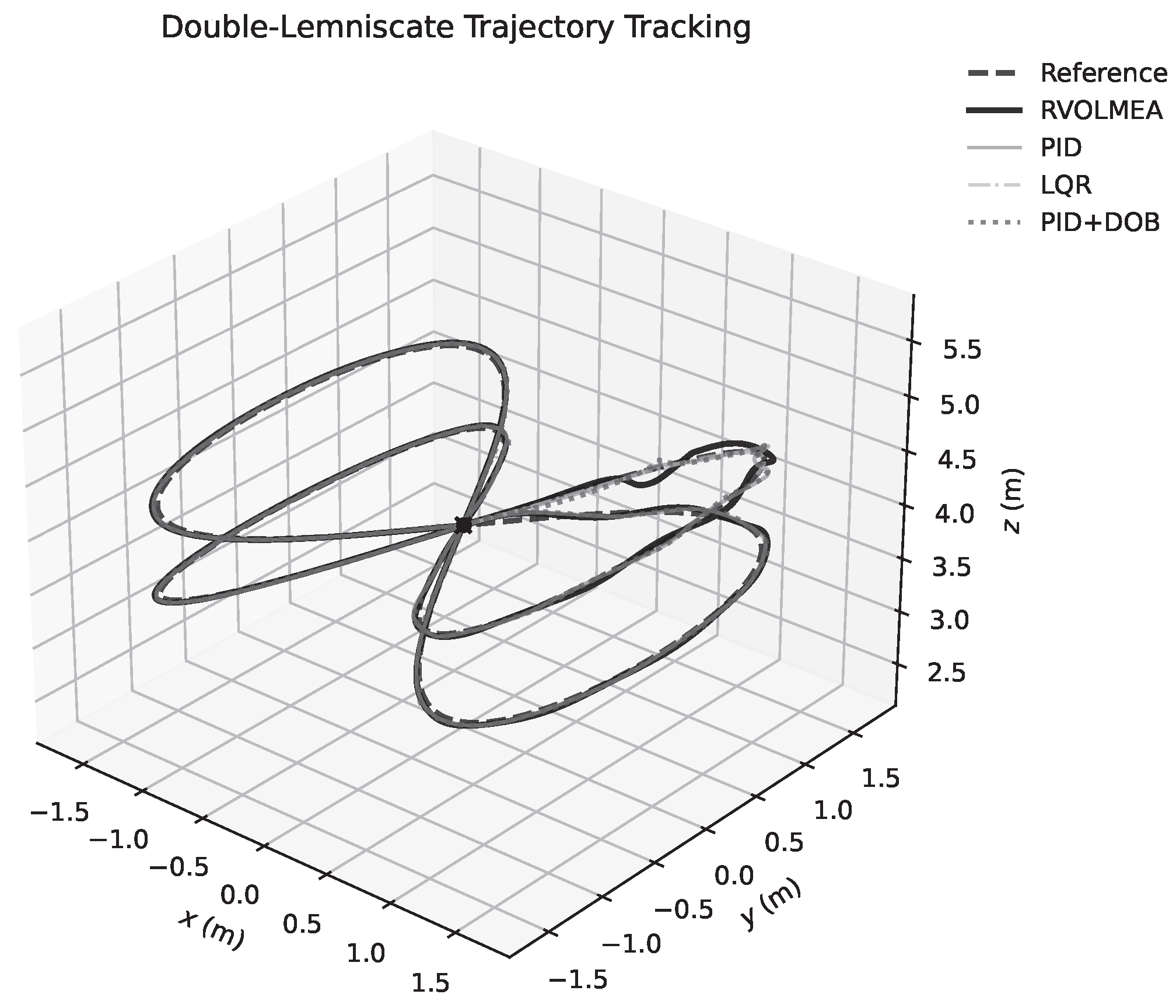
Figure 1 provides a view of the RVOLMEA trajectory-tracking result. The trajectory closely follows the double-lemniscate reference.
Table 4 presents the trajectory-tracking results over 10,000 timesteps, with Table 5 describing the same results under disturbance.
Under no disturbance, the generated control law had the lowest MSE and subsequent RMSE, with an MSE of 0.00189 m2 trajectory reference error. The worst performing control law on the trajectory tracking task was the LQR controller, with an MSE of 0.08751 m2.
The generated control law lost a large amount of performance after disturbances were added to the simulation. A substantial increase in MSE can be observed in the difference between the generated control law with and without disturbances. This is indicative of overfitting by the generative procedure-creating control laws that overfit to specific tasks.
For the trajectory under disturbance, the PID controller with a disturbance observer performed the best, with an MSE of 0.00276 m2. A seed-sensitivity analysis was performed for the disturbed trajectory evaluation using repeated stochastic rollouts (10,000 rollouts). Across the evaluated runs, all controllers exhibited very small standard deviations in MSE and RMSE. Since the variability was negligible relative to the mean tracking errors, the standard deviation values were omitted from the final results table for clarity.
Table 3. Local hover-stability results. Bold values indicate favourable results.
Controller ρ ( A d ) P > 0 κ ( P ) R L r = 10 2 r = 5 × 10 2
PID0.986667True483.73 9.32 × 10 11 3/25043/250
PID + DOB0.989667True12,438.29 9.17 × 10 11 32/25091/250
RVOLMEA0.985301True138.41 9.38 × 10 11 0/25022/250
LQR0.886883True165.24 5.44 × 10 11 0/2503/250
Table 4. Trajectory-tracking Lyapunov results (no disturbance). Bold values indicate favourable results.
ControllerMSERMSE V ¯ V max Δ V ¯ max Δ V ρ Δ V < 0
PID0.002650.05148428.8413852.51−0.211510.90040.4958
PID + DOB0.002700.051981511.7112,017.8−0.6482123.6270.5158
RVOLMEA0.001890.0434979.1625220.9460−0.007693.016680.5348
LQR0.087510.2958212.773424.66770.001863.020610.4983
Table 5. Trajectory-tracking performance under disturbances. Bold values indicate favourable results.
ControllerMSERMSEMean ErrorMax Error
PID0.002800.052900.042160.26715
PID + DOB0.002760.052490.043120.27877
RVOLMEA0.026520.162850.150590.40944
LQR0.106160.325820.310290.46887
All controllers met the local hover certificate requirements. The generated controller performed better in trajectory tracking without disturbance and maintained effectiveness at a slightly larger perturbation radius. The generated control law presented forms of overfitting, indicating a need for regularisation features within generative frameworks.

4. Conclusions

This paper presented a post hoc Lyapunov assessment of a UAV controller generated through the RVOLMEA synthesis process. All tested controllers satisfied the local hover certificate, with spectral radii below unity and positive-definite Lyapunov matrices. The LQR controller achieved the strongest local hover-stability result, consistent with its design around the hover operating point, while the generated controller also demonstrated valid local stability behaviour.
In nominal double-lemniscate tracking, the RVOLMEA controller achieved the lowest MSE and RMSE, outperforming the PID, PID + DOB, and LQR baselines. However, under thrust-mapping errors, inertia mismatch, and sensor noise, its performance degraded substantially, while the PID + DOB controller achieved the best disturbed tracking result. This indicates that the generated controller was highly effective in the nominal optimisation environment but less robust to modelling errors and disturbances.
Overall, the results show that generated UAV controllers can be assessed using classical Lyapunov tools after synthesis. The RVOLMEA controller provides strong nominal tracking performance with local stability evidence, but future work should incorporate disturbance-aware optimisation and robustness constraints to reduce task-specific overfitting.

Author Contributions

Conceptualization, C.C., M.M.-G., M.C.; methodology C.C., M.M.-G.; validation C.C., E.Z.; formal analysis C.C., M.M.-G.; investigation C.C.; resources M.C.; data curation C.C.; writing—original draft preparation C.C.; writing–review and editing C.C., M.M.-G., E.Z., M.C.; visualization C.C.; supervision M.M.-G., E.Z., M.C.; project administration M.M.-G., E.Z., M.C. All authors have read and agreed to the published version of the manuscript.

Funding

This research received no external funding.

Data Availability Statement

The original contributions presented in this study are included in the article. Further inquiries can be directed to the corresponding author.

Conflicts of Interest

The authors declare no conflicts of interest.

References

  1. Liu, S.; Chen, C.; Qu, X.; Tang, K.; Ong, Y.S. Large Language Models as Evolutionary Optimizers. In Proceedings of the 2024 IEEE Congress on Evolutionary Computation; IEEE: Piscataway, NJ, USA, 2024. [Google Scholar] [CrossRef]
  2. Hemberg, E.; Moskal, S.; O’Reilly, U.M. Evolving Code with a Large Language Model. Genet. Program. Evolvable Mach. 2024, 25, 21. [Google Scholar] [CrossRef]
  3. Lee, T.; Leok, M.; McClamroch, N.H. Nonlinear Robust Tracking Control of a Quadrotor UAV on SE(3). Asian J. Control 2013, 15, 391–408. [Google Scholar] [CrossRef]
  4. Mellinger, D.; Kumar, V. Minimum Snap Trajectory Generation and Control for Quadrotors. In Proceedings of the IEEE International Conference on Robotics and Automation; IEEE: Piscataway, NJ, USA, 2011; pp. 2520–2525. [Google Scholar] [CrossRef]
  5. Faessler, M.; Franchi, A.; Scaramuzza, D. Differential Flatness of Quadrotor Dynamics Subject to Rotor Drag for Accurate Tracking of High-Speed Trajectories. IEEE Robot. Autom. Lett. 2017, 3, 620–626. [Google Scholar] [CrossRef]
  6. Faessler, M.; Falanga, D.; Scaramuzza, D. Thrust Mixing, Saturation, and Body-Rate Control for Accurate Aggressive Quadrotor Flight. IEEE Robot. Autom. Lett. 2017, 2, 476–482. [Google Scholar] [CrossRef]
  7. Dai, H.; Landry, B.; Yang, L.; Pavone, M.; Tedrake, R. Lyapunov-Stable Neural-Network Control. In Proceedings of the Robotics: Science and Systems; RSS Foundation: Nagpur, India, 2021. [Google Scholar]
  8. Perkins, T.J.; Barto, A.G. Lyapunov Design for Safe Reinforcement Learning. J. Mach. Learn. Res. 2002, 3, 803–832. [Google Scholar]
  9. Carr, C.; Martínez-García, M.; Marshall, B.J.; Coombes, M.; Zhang, E. Automated UAV Controller Synthesis via LLM-Generated Control Logic and Particle Swarm Optimization. IEEE Trans. Ind. Inform. 2026, 1–11. [Google Scholar] [CrossRef]
  10. Rodríguez-Abreo, O.; Garcia-Guendulain, J.M.; Hernández-Alvarado, R.; Flores Rangel, A.; Fuentes-Silva, C. Genetic Algorithm-Based Tuning of Backstepping Controller for a Quadrotor-Type Unmanned Aerial Vehicle. Electronics 2020, 9, 1735. [Google Scholar] [CrossRef]
  11. Luo, C.; Du, Z.; Yu, L. Neural Network Control Design for an Unmanned Aerial Vehicle with a Suspended Payload. Electronics 2019, 8, 931. [Google Scholar] [CrossRef]
  12. Ha, S.W.; Park, B. Disturbance Observer-Based Control for Trajectory Tracking of a Quadrotor. Electronics 2020, 9, 1624. [Google Scholar] [CrossRef]
  13. Kaufmann, E.; Loquercio, A.; Ranftl, R.; Müller, M.; Koltun, V.; Scaramuzza, D. Deep Drone Acrobatics (Extended Abstract). In Proceedings of the Thirtieth International Joint Conference on Artificial Intelligence, IJCAI-21; Zhou, Z.H., Ed.; International Joint Conferences on Artificial Intelligence Organization: Somerset, NJ, USA, 2021; pp. 4780–4783. [Google Scholar] [CrossRef] [PubMed]
  14. Loquercio, A.; Kaufmann, E.; Ranftl, R.; Dosovitskiy, A.; Koltun, V.; Scaramuzza, D. Deep Drone Racing: From Simulation to Reality with Domain Randomization. IEEE Trans. Robot. 2020, 36, 1–14. [Google Scholar] [CrossRef]
Figure 1. Trajectory tracking: 3D double-lemniscate trajectory-tracking result for the generated controller. The dashed black curve denotes the reference, and the solid grey curve denotes the control system trajectory.
Electronics 15 02898 g001
Table 1. Disturbances applied during trajectory evaluation.
CategoryParameterValue
Thrust mappingMotor 1 scale0.97000
Thrust mappingMotor 2 scale0.95545
Thrust mappingMotor 3 scale0.98455
Thrust mappingMotor 4 scale0.96515
Inertia mismatch I x x scale1.05
Inertia mismatch I y y scale0.95
Inertia mismatch I z z scale1.03
Sensor noisePosition noise 0.002 m RMS
Sensor noiseEuler-angle noise 0.0005 rad RMS
Sensor noiseLinear-velocity noise 0.005 m / s RMS
Sensor noiseAngular-velocity noise 0.002 rad / s RMS
Table 2. Table of measurements of the UAV model.
NameMeasurementUnits
Arm length0.225cm
Mass1.600kg
Ixx 5.54 × 10 3 kg/m2
Iyy 4.87 × 10 3 kg/m2
Izz 9.71 × 10 5 kg/m2
Rotor Inertia 9.75 × 10 7 kg/m2
Max RPM10,100rpm
Time motor up0.0125s
Time motor down0.0125s
Motor constant 8.84 × 10 8 kg/m2
Drag co-efficient0.025kg/m2
Disclaimer/Publisher’s Note: The statements, opinions and data contained in all publications are solely those of the individual author(s) and contributor(s) and not of MDPI and/or the editor(s). MDPI and/or the editor(s) disclaim responsibility for any injury to people or property resulting from any ideas, methods, instructions or products referred to in the content.