Article

Research on Low-Frequency Fault Ride-Through Control for Offshore Wind Delivery System Based on M3C

1
Central South China Electric Power Design Institute Co., Ltd. of China Power Engineering Consulting Group, Wuhan 430060, China
2
School of Electrical Engineering, Xi’an Jiaotong University, Xi’an 710049, China
*
Author to whom correspondence should be addressed.
Electronics 2026, 15(13), 2871; https://doi.org/10.3390/electronics15132871
Submission received: 27 April 2026 / Revised: 17 June 2026 / Accepted: 18 June 2026 / Published: 1 July 2026
(This article belongs to the Special Issue Advanced Technologies for Future Electric Power Transmission Systems)

Abstract

This paper systematically analyses the fault characteristics and investigates fault ride-through (FRT) control strategies for a low-frequency (LF) transmission system in offshore wind power based on Modular Multilevel Matrix Converter (M3C). The study addresses transient issues of power imbalance, submodule capacitor overvoltage, and bridge-arm overcurrent arising from three-phase ground faults on both the industrial-frequency (IF) and LF sides. The underlying mechanisms of power surplus and submodule capacitor overvoltage, induced by decoupling control and current-limiting protection during IF-side faults, are examined in detail, along with the transient characteristics of bridge-arm currents under voltage sags on the LF side. Two innovative control strategies are proposed to enhance system resilience: (1) For IF-side faults, a controllable energy dissipation device on the LF side achieves precise dissipation of surplus power via real-time monitoring of the average submodule capacitor voltage. (2) For LF-side faults, the FRT strategy based on dynamic adjustment of the LF modulation voltage rapidly reduces the reference to 0.1 p.u. and restores it linearly at a predefined rate, thereby enabling fault information transmission and wind turbine derating. The effectiveness and feasibility of the proposed scheme are verified through simulations on a 1000 MW system model.

1. Introduction

With the global transition of the energy structure toward low-carbon development and the further advancement of China’s dual-carbon goals, offshore wind power, as a vital pillar of clean and renewable energy sources, has made large-scale development and transmission over medium to long distances a key focus of power system research [1]. However, the long distance and large capacity transmission of offshore wind power have become a critical bottleneck restricting its large-scale grid integration. Conventional HVAC transmission is constrained by the charging currents of submarine cables and the inductive reactance of transmission lines, making it challenging to meet the requirements for transmission distance and capacity [2]. Although HVDC transmission can effectively address the charging current problem, it requires the additional construction of offshore converter platforms, resulting in high investment costs. Moreover, the immaturity of high-voltage DC circuit breaker technology further limits its wider application in offshore wind power systems [3].
Low-frequency AC (LFAC) transmission technology significantly reduces inductive reactance and capacitive charging current by lowering the transmission frequency to 50/3 Hz or 20 Hz, thereby substantially increasing transmission capacity and distance, making it a highly competitive technical solution for the transmission of electricity from offshore wind farms located in medium and far sea areas [4]. This technology does not require offshore converter stations and can utilise existing submarine cables to achieve efficient transmission. It offers distinct technical and economic advantages, which have been preliminarily validated in demonstration projects in Hangzhou, Taizhou and Yuhuan [5,6,7]. In the LFAC system, the M3C [8,9], serving as the core AC/AC frequency conversion equipment, possesses outstanding advantages including low input and output current harmonics, the ability to achieve independent active and reactive power decoupling control, ease of expansion, and the elimination of the need for a DC bus. The M3C comprises nine full-bridge submodule arms, enabling flexible voltage, frequency and phase conversion between the IF side and the LF side [10]. However, its control complexity is relatively high, specifically concerning submodule capacitor voltage balancing, circulating current suppression and FRT capability, which directly impact the safe and stable operation of the system [11].
The grid connection of offshore wind power must meet strict requirements [12]. In the event of a grid fault, wind turbines and converters must remain connected to the grid and provide reactive power support to ensure system transient stability. In an offshore wind power delivery system based on M3C, a three-phase ground fault on the IF side can cause a sudden drop in M3C output power, resulting in excess power, which is likely to trigger overvoltage in submodule capacitors and system overcurrent [13,14]. A three-phase ground fault on the LF side directly affects the collection voltage of the offshore wind farm, hindering the power output of the wind turbines. Furthermore, the complex transient characteristics of current and voltage on the LF side of the M3C can easily lead to excessive bridge-arm currents or voltage imbalance in the submodules [15,16,17].
Existing research has conducted preliminary investigations into FRT strategies for LF offshore wind transmission system based on M3C. During three-phase ground faults on the IF side, load-shedding resistors on the LF side have been employed to dissipate surplus power from wind turbines, accompanied by reactive power injection on the IF side [18]. However, these schemes typically rely on threshold-based triggering without continuous feedback from submodule capacitor voltages, which may result in either insufficient power dissipation leading to submodule overvoltage or excessive dissipation causing unnecessary energy losses. Although dynamic regulation of the LF side AC voltage reference or joint voltage-power droop control has been proposed to mitigate IF-side faults by curtailing wind farm output [19,20], these schemes couple FRT actions directly to wind turbine dynamics. Consequently, they may cause mechanical stresses on turbines, slow response, or unnecessary deviation from maximum power point tracking (MPPT) even during transient faults.
For three-phase ground faults on the LF side, existing studies [21,22,23] have primarily addressed asymmetric fault conditions. These works propose dynamic LF-side voltage regulation to suppress healthy-phase overvoltage [21], negative-sequence current injection for inter-phase power balancing [22], and circulating current compensation within capacitor voltage balancing control to mitigate bridge-arm power imbalances [23]. While effective in mitigating voltage and current imbalances under unbalanced faults, these strategies do not adequately address the distinct transient characteristics associated with symmetric three-phase ground faults. In symmetric fault scenarios, all phases are simultaneously affected, resulting in unique pre-control capacitive discharge currents and post-control step responses containing non-fundamental frequency components. Such transients, arising from the interaction between capacitive discharge and proportional-integral regulation dynamics, significantly elevate the risk of bridge-arm overcurrent.
Similar challenges in achieving efficient and reliable operation have also been addressed in other advanced multilevel converter topologies. Comprehensive reviews of control strategies for three-level neutral-point-clamped dual-active-bridge converters have highlighted effective modulation schemes and voltage-balancing techniques to improve system performance under dynamic and transient conditions [24].
To address the aforementioned limitations in existing FRT methods for LF offshore wind transmission system based on M3C, this paper systematically investigates the transient characteristics of three-phase ground faults on both the IF and LF sides. Based on the analysis, two targeted control strategies are proposed. The main contributions of this work are summarised as follows:
(1) A comprehensive analysis of the transient behaviours for three-phase ground faults on both the IF and LF sides is presented. For faults on the IF side, the power surplus mechanism that leads to submodule capacitor overvoltage, arising from the interaction between decoupling control and current limiting, is revealed. For faults on the LF side, the voltage sag dynamics and transient bridge-arm current coupling are elucidated through complex-frequency domain modelling of the pre-fault and post-control stages. This analysis provides a unified theoretical foundation that was previously lacking in studies focused on isolated fault types or asymmetric conditions.
(2) For three-phase ground faults on the IF side, a controllable energy dissipation device installed on the LF side of the M3C is proposed. By continuously monitoring the average submodule capacitor voltage and comparing it with a predefined threshold, the device generates switching commands to precisely dissipate surplus power. This feedback-based approach enables accurate real-time energy balancing without requiring wind farm output curtailment, thereby maintaining submodule capacitor voltages within safe limits and allowing uninterrupted MPPT operation of the wind turbines.
(3) For three-phase ground faults on the LF side, the FRT strategy based on dynamic adjustment of the LF side modulation voltage is proposed. Upon fault detection, the voltage reference is rapidly reduced to limit power injection into the fault and transmit fault information to the wind farm. After a defined observation window, the reference is linearly ramped back to the rated value. Integrated fault classification logic distinguishes between transient and permanent faults, enabling coordinated active power recovery with the wind farm. Unlike existing methods primarily designed for asymmetric faults, this strategy specifically addresses symmetric fault conditions and achieves effective bridge-arm overcurrent suppression, stable submodule voltages, and compliance with low-voltage ride-through requirements.

2. Topology and Mathematical Model of LF Offshore Wind Transmission System Based on M3C

LF offshore wind transmission system based on M3C enables direct AC/AC flexible interconnection between offshore wind farms and onshore grids, serving as a key technical solution for the large-scale transmission of electricity from offshore wind farms in medium and far sea areas. First, this section introduces the overall topological structure of the system. Second, it establishes a mathematical model of the M3C and its steady-state control. Finally, it presents a wind farm model. These provide a solid theoretical foundation for the subsequent analysis of transient characteristics of three-phase ground faults on both the IF and LF sides, as well as the design of FRT control strategies.

2.1. Topology of LF Offshore Wind Transmission System Based on M3C

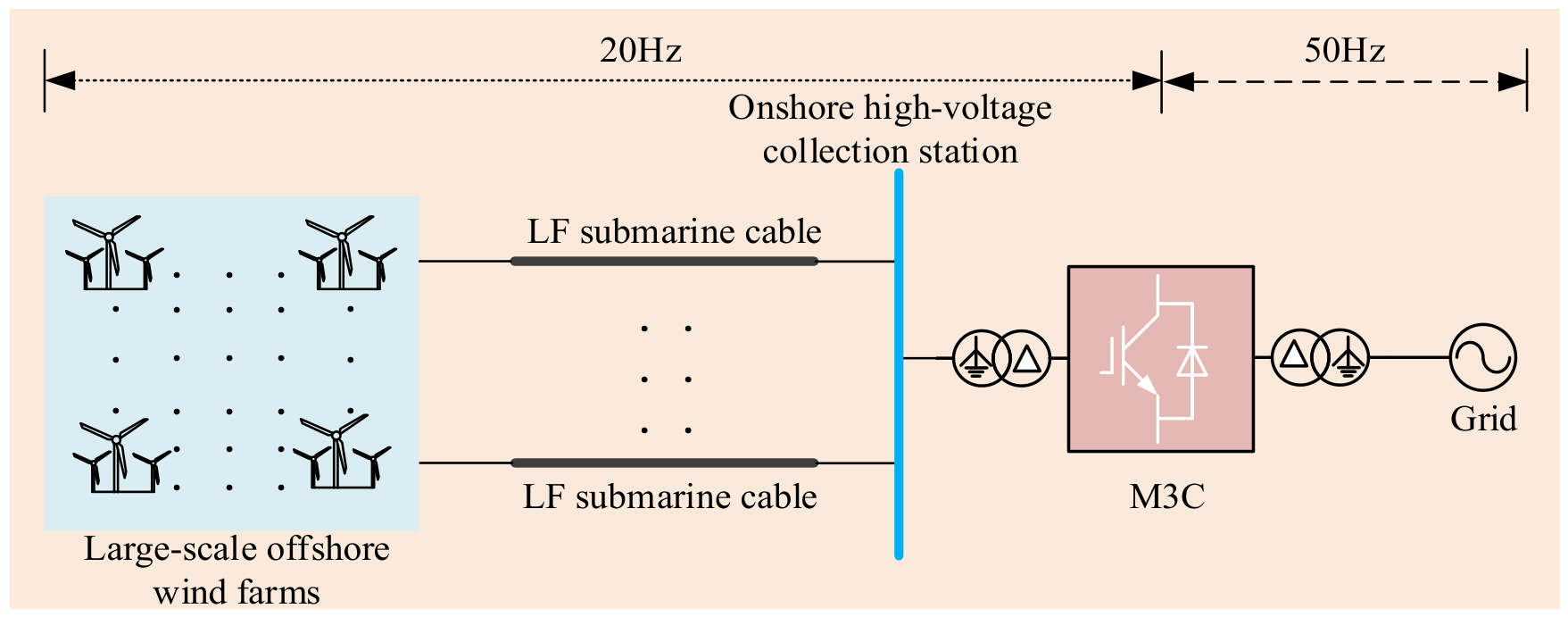
The topology of LF offshore wind transmission system based on M3C is shown in Figure 1. The output power from large-scale offshore wind farms utilising permanent magnet synchronous generators (PMSGs) is transmitted via LF submarine cables and onshore collection stations to the LF side of the M3C, where it is converted to IF before being fed into the 500 kV grid.

2.2. Topology of M3C

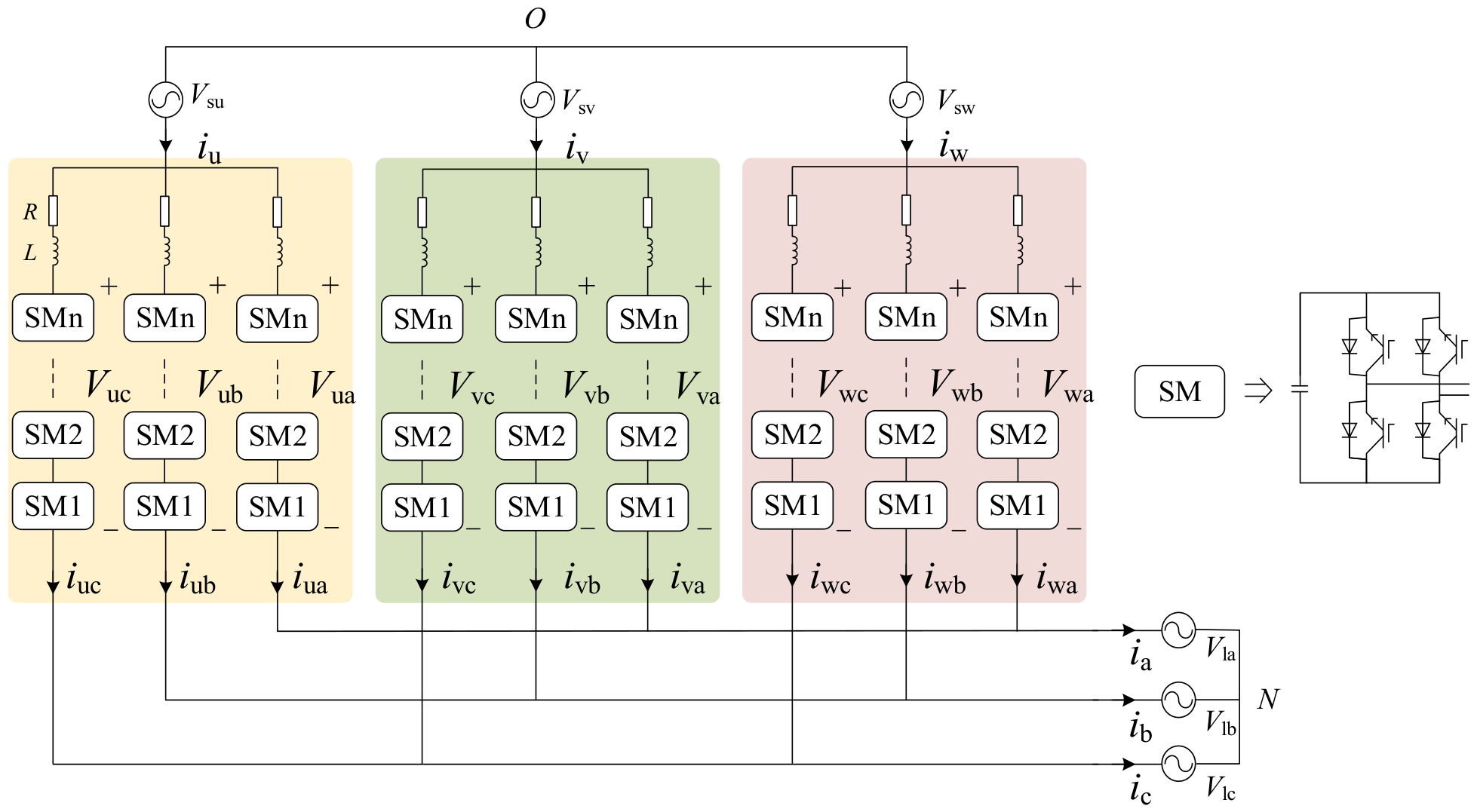
The main circuit topology of M3C is shown in Figure 2. In the figure: Vsx (x = u, v, w) and ix represent the three-phase voltage and current on the IF side, respectively, and O denotes the IF neutral point, Vly (y = a, b, c) and iy represent the three-phase voltage and current on the LF side, respectively, and N denotes the LF neutral point. The M3C comprises nine bridge arms, each of which is formed by the series connection of an equivalent inductance L, an equivalent resistance R, and N submodules [25,26].
Taking the three sub-converters connected to the LF side in Figure 2 as an example, the loop voltage equations for each sub-converter in the M3C can be derived from the relationship between the input and output voltages and the arm currents:
V s x = V lu + V u x + R i u x + L d i u x d t + V O N V s x = V lv + V v x + R i v x + L d i v x d t + V O N V s x = V lw + V w x + R i w x + L d i w x d t + V O N
where Vxy and ixy represent the arm voltage and arm current of M3C, respectively; VON is the LF neutral-point voltage, which is typically 0 during steady-state operation.
Rewriting Equation (1) in matrix form and applying the double dq transformation yields the following mathematical model in the dq coordinate system:
V d y V q y = V s d V s q R i d y i q y + L d d t i d y i q y + ω s L i q y i d y V 0 d V 0 q = 0 0 R i 0 d i 0 q L d d t i 0 d i 0 q ω l L i 0 q i 0 d 3 V l d V l q
where Vdy, Vqy, idy and iqy are the d-axis and q-axis components of the three-phase bridge-arm voltages and currents on the IF side, respectively; Vsd and Vsq are the d-axis and q-axis components of Vsy, respectively; V0d, V0q, i0d and i0q are the d-axis, q-axis and zero-sequence components of the voltage and current in each bridge arm, respectively; Vld and Vlq are the d-axis and q-axis components of Vly, respectively; ωs and ωl are the angular frequencies of the IF and LF, respectively.
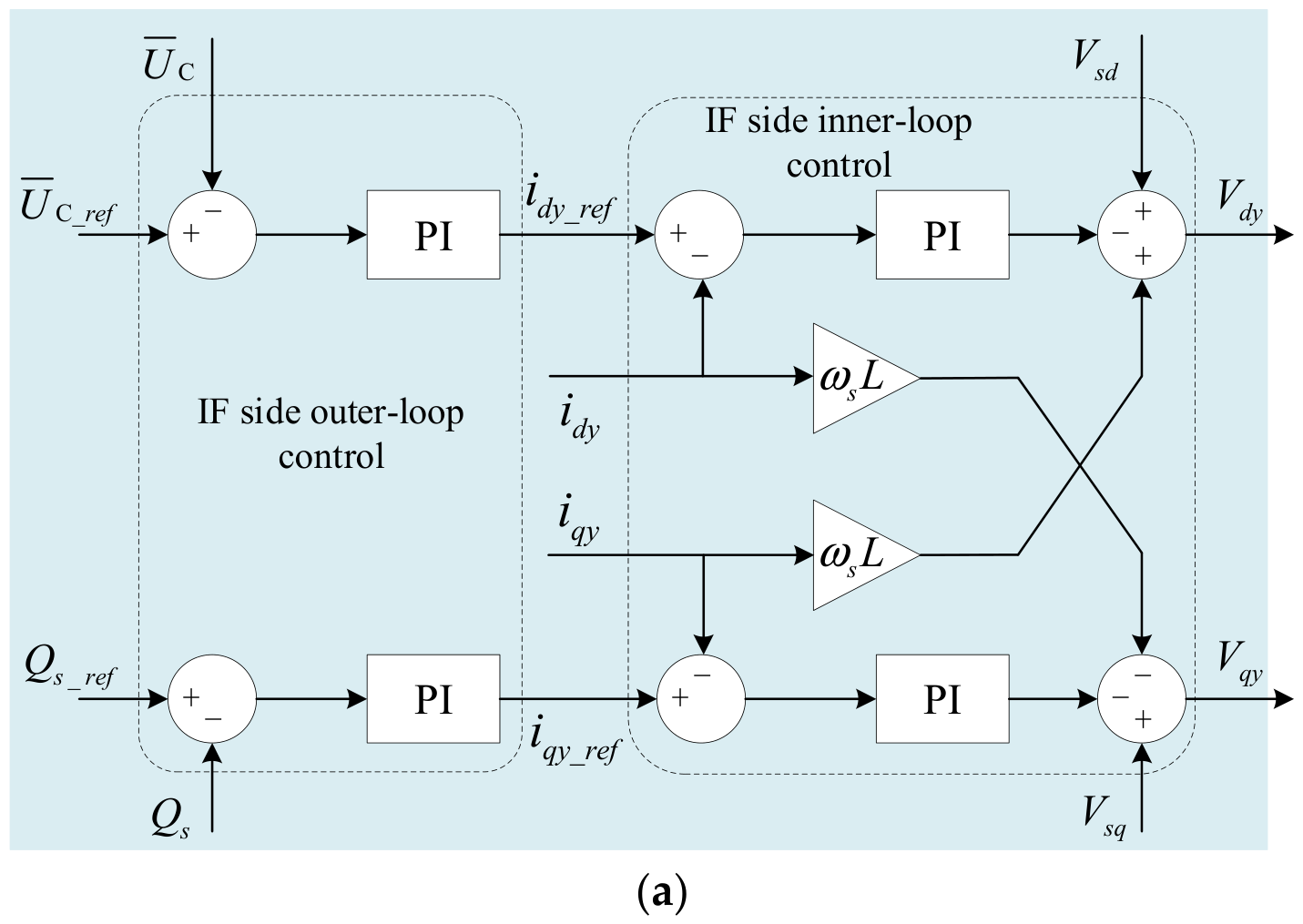
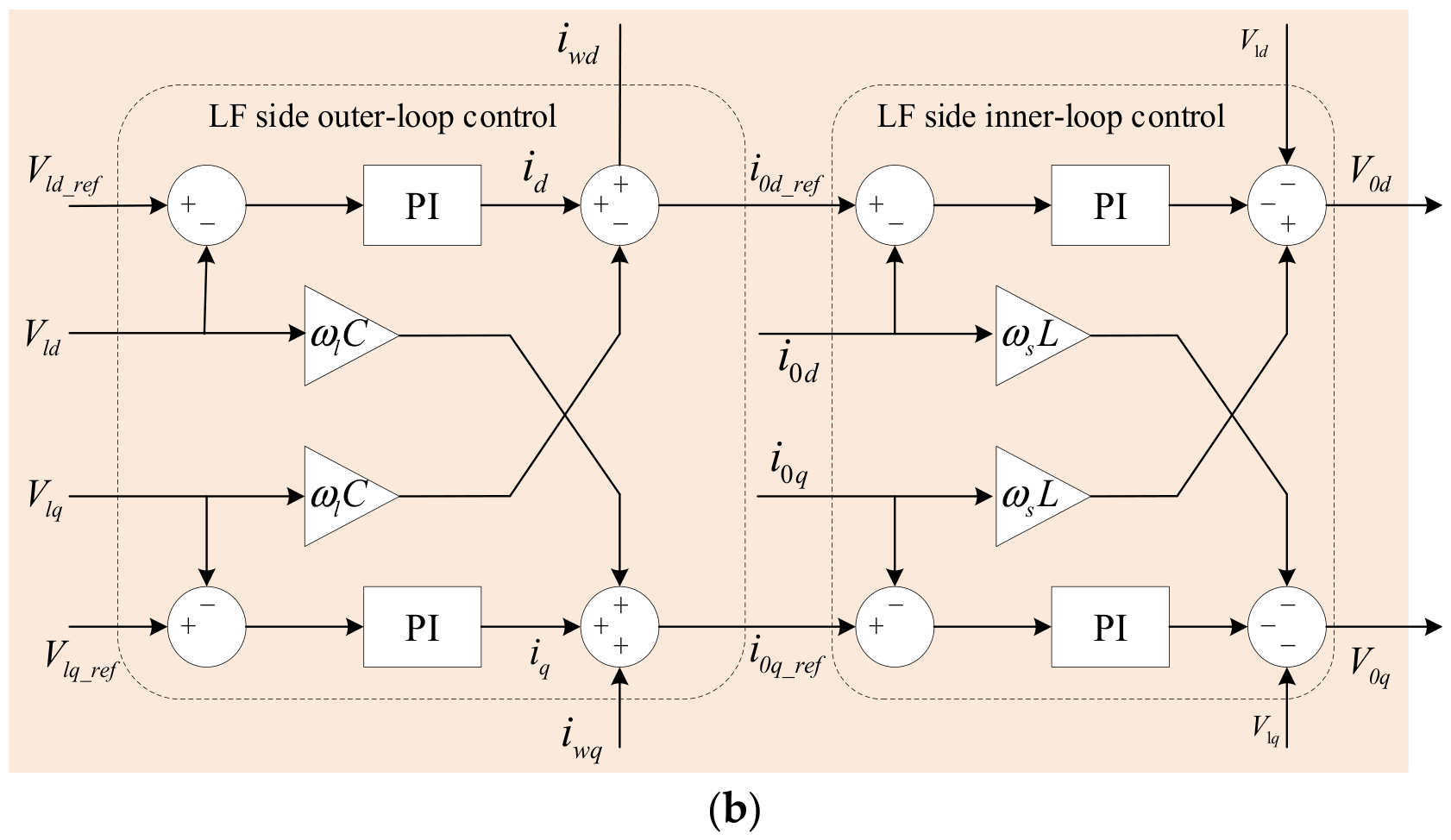
The overall control block diagram of M3C is shown in Figure 3. A dynamic inner-loop model for M3C’s IF-side and LF-side currents is established based on Equation (2). For the IF-side outer loop, average capacitor voltage control and AC voltage amplitude control of the stator module are selected. In the scenario of offshore wind transmission, constant voltage and frequency (Vf) control are adopted for the LF-side outer loop.

2.3. Wind Farm Model

This paper focuses on wind farms comprising PMSGs, which primarily consist of a rotor, a PMSG, a full-power back-to-back converter and their control systems. To effectively reduce the computational complexity of detailed modelling for each individual turbine in large-scale wind farms, this paper employs an equivalent aggregate modelling approach, using a single equivalent wind turbine to characterise the dynamic behaviour of the entire wind farm.
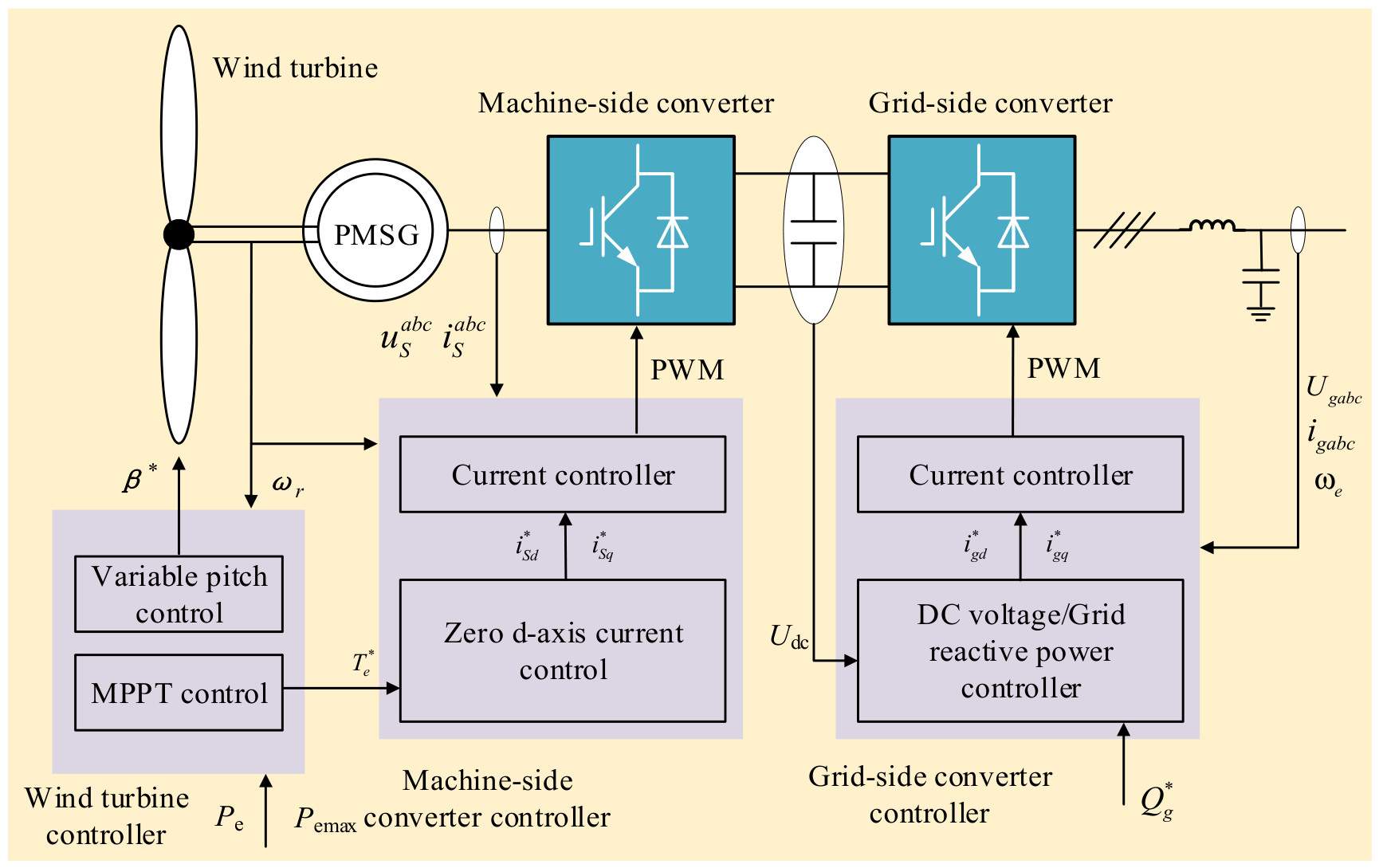
This paper establishes an equivalent model for a direct-drive wind turbine that accounts for variations in wind speed, whose main circuit topology and control strategy are shown in Figure 4. Under steady-state operating conditions, the generator side converter employs zero d-axis current control combined with the MPPT strategy, whilst the grid side converter utilises a control method combining DC voltage control with reactive power regulation to maintain the stability of the DC bus voltage and provide reactive power support [27].

3. Transient Characteristics and FRT Control of Three-Phase Faults on the IF Side

Building on the topology and mathematical model established in Section 2, this section first analyses the characteristics of three-phase ground faults on the IF side from the perspectives of M3C power surplus and the transient response characteristics of submodule capacitors and voltages. It then proposes the FRT control strategy based on a controllable energy dissipation device to ensure the safe and stable ride-through of M3C during severe IF faults.

3.1. Analysis of Three-Phase Ground Fault Characteristics on the IF Side

3.1.1. Power Surplus of M3C

As shown in Figure 1, during normal operation, if losses in the converter station are neglected, the power balance equations on either side of the M3C are as follows:
P w i n d = P g r i d
where Pwind is the input power on the LF side of M3C, and Pgrid is the power delivered to the grid on the IF side of M3C.
When a three-phase ground fault occurs on the IF side, Pwind remains constant because the M3C is completely decoupled from the IF side. As the IF voltage drops to kUN, the current on the IF side must theoretically increase to 1/k times its original value in order to maintain the same active power.
However, the M3C’s IF side is subject to current-limiting protection by the converter, with a maximum permissible current of Imax = 1.2 p.u., meaning that the actual current cannot increase indefinitely. When the voltage dip is shallow, the M3C can still achieve power balance by increasing the current. When the voltage dip is severe, the M3C’s IF side behaves as a constant current source, and the output power is limited. At this point, the power relationship across the M3C becomes:
P w i n d P g r i d = Δ P c
where ΔPc represents the power surplus, which is entirely absorbed by the capacitors in the M3C bridge-arm submodule, causing the capacitor voltage to rise.

3.1.2. Transient Response Characteristics of Submodule Capacitors

The M3C bridge-arm capacitor is the sole energy storage component, and its voltage directly reflects the power imbalance. The total energy stored in the submodule capacitors prior to the fault is:
W c 0 = 9 2 N C U c N 2
where Wc0 represents the total energy stored in the submodules prior to the fault; N is the number of submodules in the bridge arm; C is the capacitance value of a submodule; and UcN is the rated voltage of the submodule.
During the fault, all the energy generated by the excess power is fed into the capacitor:
W c t = W c 0 + t 0 t Δ P c d t
where Wc(t) represents the energy stored in the submodule capacitor; t0 represents the time of the fault.
Accounting for the relationship between the total capacitive energy of all bridge arms and the voltage, the transient response of the capacitive voltage during a deep dip is given by [12]:
U c t = U c N 2 + 2 t 0 t Δ P c d t 9 N C
The transient characteristics of three-phase ground faults on the IF side essentially arise from power imbalance resulting from the combined effects of decoupling control and current-limiting protection. Existing FRT strategies for flexible DC transmission cannot be directly applied. It is necessary to study measures tailored to the characteristics of the M3C topology, such as coordinated load shedding between the M3C and wind turbine converters, the engagement of energy dissipation devices, or dynamic voltage reduction on the LF side, in order to rapidly transfer or dissipate ΔPc.

3.2. FRT Control Based on a Controllable Energy Dissipation Device

As analysed in Section 3.1, a three-phase ground fault on the IF side causes a significant reduction in the active power transmission capacity of the M3C. Since the wind turbines on the LF side cannot detect the fault instantaneously, they continue to inject power in MPPT mode, leading to a substantial power surplus that is absorbed by the submodule capacitors. For shallow voltage sags, the existing current control of the M3C is generally sufficient to restore power balance [14]. However, under deep voltage sags, the power surplus becomes excessive and cannot be effectively mitigated by current limiting alone, resulting in a rapid rise in submodule capacitor voltage. In severe cases, this may trigger protection and disconnect the wind farm from the grid, thereby compromising the FRT capability of the system. To address this issue, this paper proposes the FRT control strategy based on a controllable energy dissipation device on the LF side. By rapidly dissipating the excess power through a controlled dissipation device, the strategy simultaneously satisfies the grid’s dynamic reactive power support requirements and maintains submodule voltage balance, enabling the M3C to ride through faults safely and stably without curtailing wind farm output.
To avoid modifying the M3C submodule structure whilst optimising space utilisation and economic costs on the onshore platform, this paper proposes installing the controllable energy dissipation device on the LF side of M3C to serve as a dedicated energy-dissipation path under IF fault conditions. This solution effectively prevents the wind farm from triggering low-voltage ride-through during transient faults, without altering the M3C’s normal operating topology.
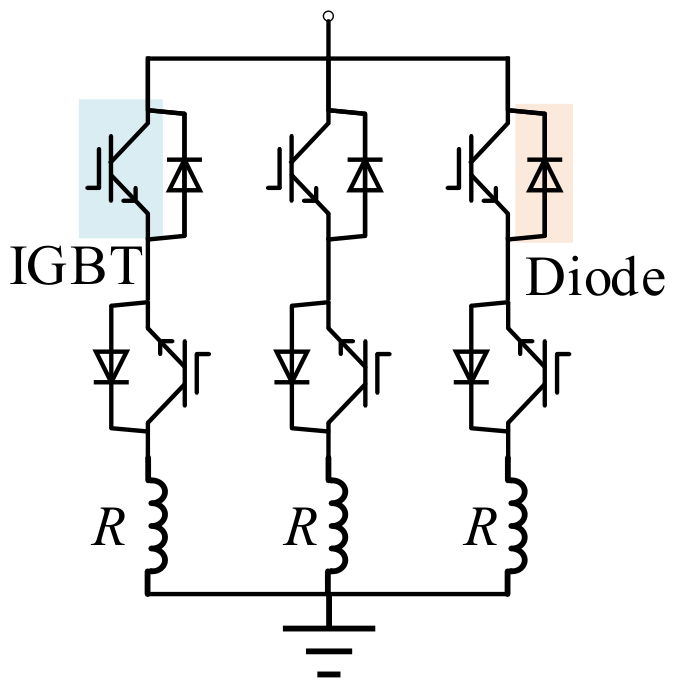
The structure of the controllable energy dissipation device is shown in Figure 5. Each phase of the three-phase bridge arms consists of two IGBTs connected in anti-parallel, two diode modules connected in anti-parallel, and a series of energy dissipation resistors. Parameter design and simulation are carried out using the 1000 MW/160 kV M3C converter valve for the offshore LF wind farm described in this paper as an example. Referring to the Hangzhou LF transmission project [18] and the Zhangbei HVDC project [28], the power calculation for the unloading resistors is based on the most severe operating conditions, namely the IF voltage sag to 0 p.u., with the rated power input on the LF side being:
R = U l N 2 P r a t e
where UlN represents the line voltage on the LF side, and Prate represents the system’s single-phase rated power. Taking into account the filtering inductor and regulation margin in practical engineering applications, the value of the controllable dissipation resistor used in this paper is set at 70 Ω.
This paper monitors fluctuations in the average capacitive voltage of the M3C submodule in real time and compares this with the threshold for the total submodule capacitive voltage to generate a controllable energy dissipation device switching signal f: when the switching signal f is 1, the IGBT turns on to achieve energy dissipation. When the switching signal f is 0, the IGBT turns off and the controllable energy dissipation device function remains inactive.

4. Transient Characteristics and FRT Control of Three-Phase Faults on the LF Side

In an LF offshore wind transmission system based on M3C, when the three-phase ground fault occurs on the LF valve side, the system’s transient response typically exhibits complex characteristics such as a sharp surge in current and a sudden drop in voltage. These phenomena not only amplify the risk of fault propagation but also directly test the endurance limits of critical components within M3C. This section first systematically analyses the current characteristics under the three-phase ground fault on the LF valve side, and subsequently proposes the FRT control strategy based on dynamically adjusting the modulation voltage on the LF side. This method prioritises preventing the M3C from being taken offline. During the fault, M3C and the wind farm are controlled independently for FRT, with the wind farm side utilising the DC chopper of the wind turbine converter for FRT.

4.1. Characteristics of Three-Phase Ground Fault Currents on the LF Valve Side

When the three-phase ground fault occurs on the LF side, the system’s dynamic response sequentially passes through the pre-fault stage of the M3C control response, the M3C control response stage, the M3C lockout and follow-current stage following protection operation, and the circuit breaker tripping stage [16]. This section focuses on analysing the pre-fault stage of the M3C control response and the M3C control response stage, laying the theoretical foundation for the proposal of the FRT control strategy based on modulating the voltage on the LF side.

4.1.1. The Pre-Fault Stage of the M3C Control Response

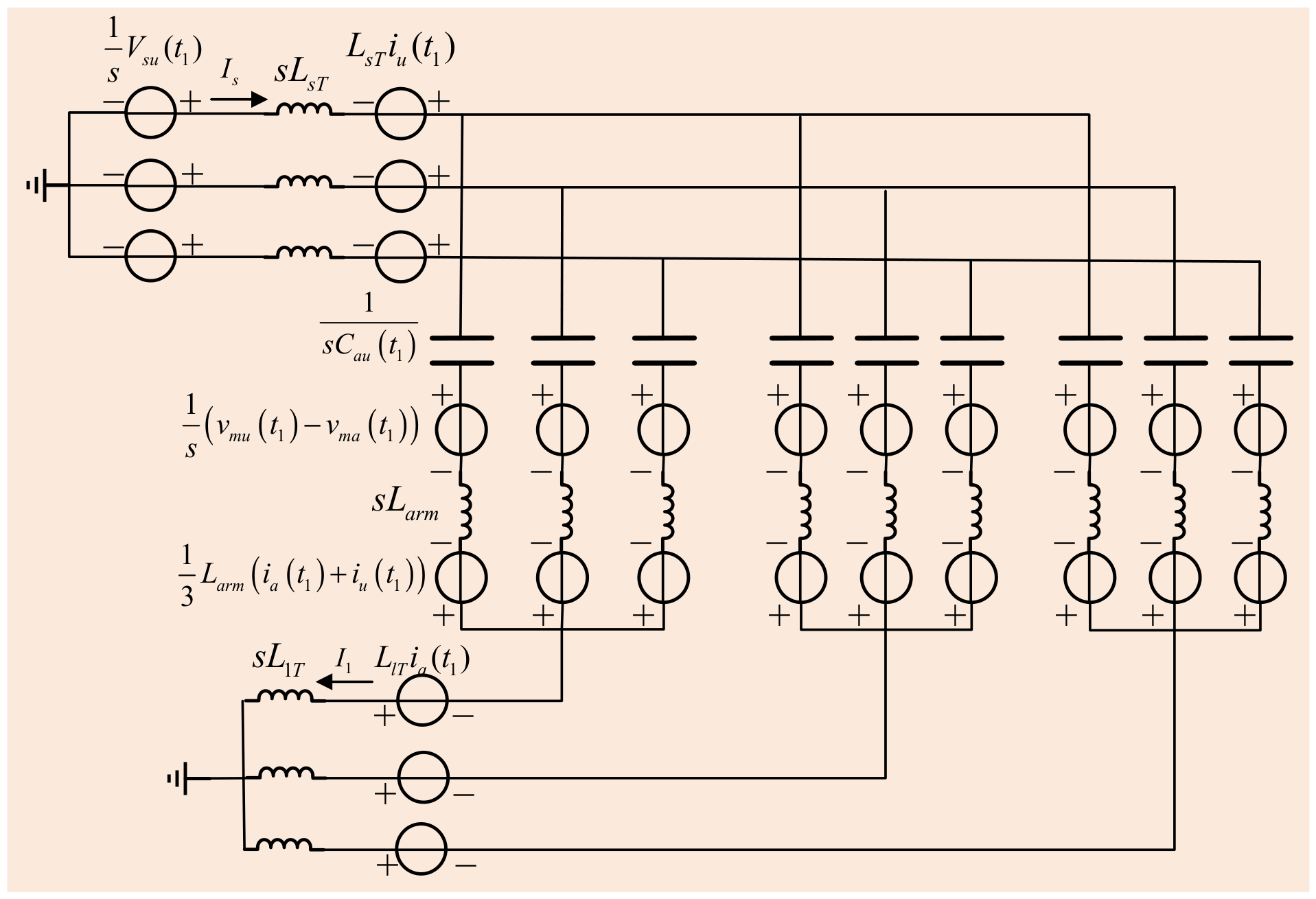
As shown in Figure 6, at the instant of the fault (t1), the IF-side voltage remains virtually unaffected. The equivalent capacitance of each arm of M3C is the capacitance connected at the moment of the fault, thereby establishing the equivalent circuit in the complex frequency domain.
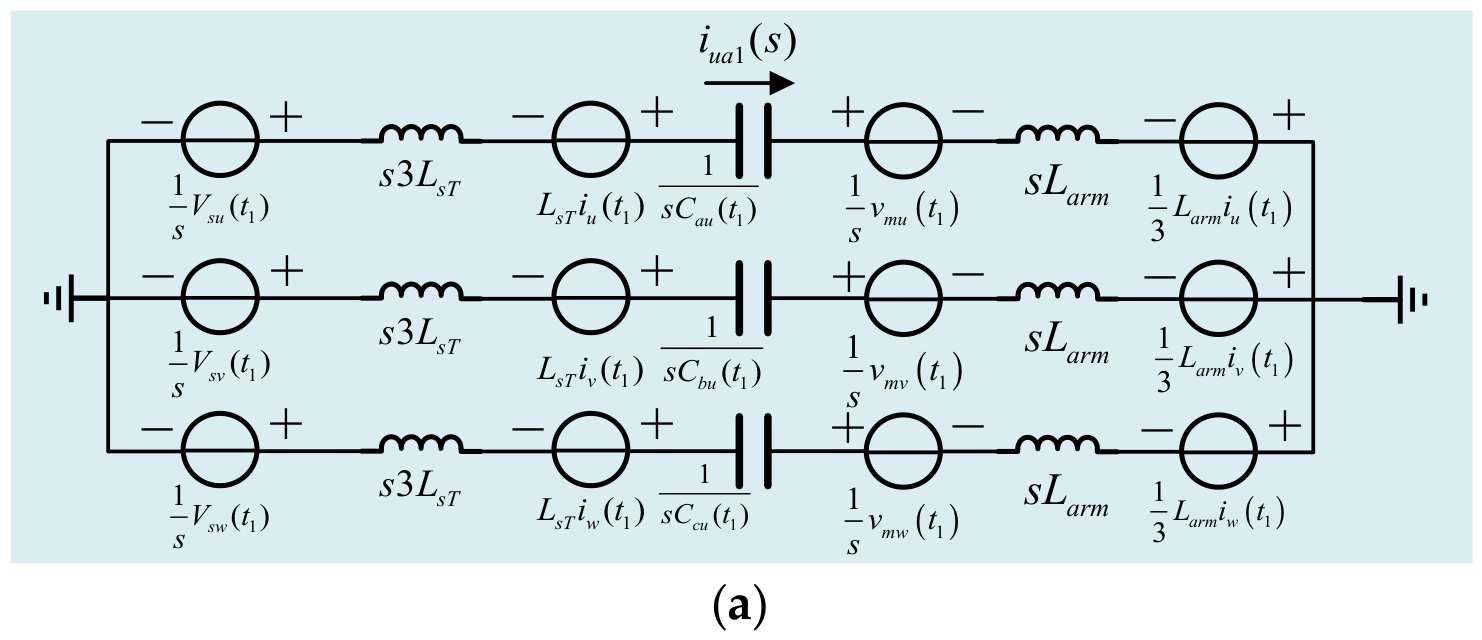
Taking the sub-converters a as an example, the fault circuit under the IF excitation source is shown in Figure 7a.
Taking the bridge-arm ua as an example, the circuit equations under the IF excitation source are as follows:
V s u ( t 1 ) s + L s T + 1 3 L a r m i u ( t 1 ) 3 s L s T + s L a r m + 1 s C a u ( t 1 ) i u a ( s ) v m u ( t 1 ) s = 0
After applying the inverse Laplace transform, the current iua1(t) in the lower arm under the IF excitation source is
i u a 1 t = 1 3 i u ( t 1 ) cos ( t C a u ( 3 L s T + L a r m ) ) + C a u 3 L s T + L a r m ( V s u ( t 1 ) v m u ( t 1 ) ) sin ( t C a u ( 3 L s T + L a r m ) )
As the M3C control had not yet responded at the moment of the fault and due to the LF decoupling characteristics of the system, this current was essentially the same as during normal operation.
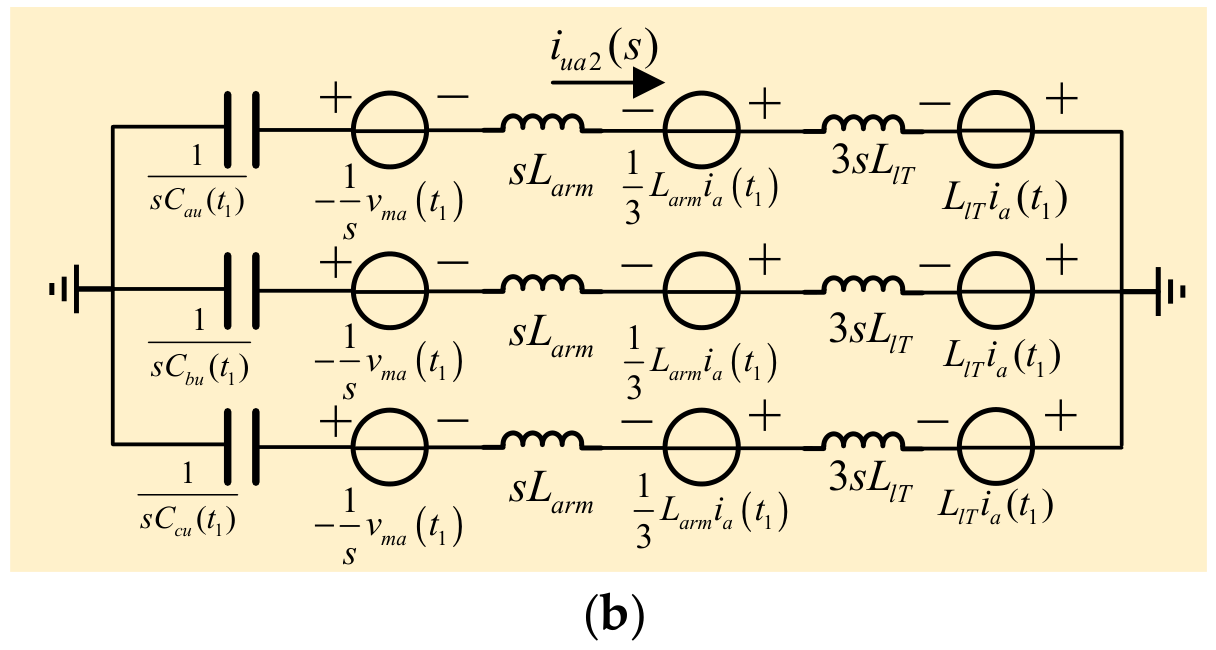
The fault circuit under the LF excitation source is shown in Figure 7b. Due to the three-phase ground on the LF side, the voltage is forced to zero. The circuit equation for arm ua is:
( s L a r m + 1 s C a u ( t 1 ) + 3 s L l T ) i u a 2 ( s ) v m a ( t 1 ) s ( L l T + 1 3 L a r m ) i a ( t 1 ) = 0
After applying the inverse Laplace transform, the current iua2(t) in the lower arm under the LF excitation source is:
i u a 2 t = 1 3 i a ( t 1 ) cos ( t C a u ( 3 L l T + L a r m ) ) + C a u 3 L l T + L a r m v m a ( t 1 ) sin ( t C a u ( 3 L l T + L a r m ) )
During normal operation, this current is:
i u a 2 n o r t = 1 3 i a ( t 1 ) cos ( t C a u ( 3 L l T + L a r m ) ) + C a u 3 L l T + L a r m ( v m a ( t 1 ) e l a ( t 1 ) ) sin ( t C a u ( 3 L l T + L a r m ) )
By comparing Equations (12) and (13), it can be seen that under the LF excitation source, there is a risk of overcurrent in the lower arm current at the instant of fault occurrence.

4.1.2. The M3C Control Response Stage

The rapid dynamic response of the M3C control strategy directly determines the system’s transient behaviour. The level of overcurrent during this stage depends primarily on the control algorithm employed. During the fault, the voltage outer loop is typically disconnected, and the dq-axis current response is primarily governed by the PI current inner loop. The step response equation for the second-order system on the LF side can be derived from the system’s dynamic equations:
d 2 i 0 d d t 2 + k p l 1 L d i 0 d d t + k i l 1 L i 0 d = k i l 1 L i 0 d r e f d 2 i 0 q d t 2 + k p l 2 L d i 0 q d t + k i l 2 L i 0 q = k i l 2 L i 0 q r e f
where kpl1 and kil1 represent the LF d-axis proportional gain and integral gain, respectively, kpl2 and kil2 represent the LF q-axis proportional gain and integral gain, respectively.
During normal operation, the M3C operates at a power factor of 0.95, with initial currents on the dq axes of i0d = 0.95 p.u. and i0q = 0.05 p.u. The solution yields the step response of the dq-axis currents.
The expression for the d-axis current is:
i 0 d = i 0 d r e f + i 0 d i 0 d r e f ω 0 2 + σ 2 ω 0 e σ t sin ( ω 0 t + ξ )
where σ = k p l 1 2 L , ω 0 = 4 k i l 1 L k p l 1 2 2 L , ξ = arctan ω 0 σ .
The expression for the q-axis current is:
i 0 q = i 0 q r e f + i 0 q i 0 q r e f ω 0 q 2 + σ q 2 ω 0 q e σ q t sin ( ω 0 q t + ξ q )
where σ q = k p l 2 2 L , ω 0 q = 4 k i l 2 L k p l 2 2 2 L , ξ q = arctan ω 0 q σ q .
Applying the inverse dq transformation to Equations (15) and (16), the transient current in the abc coordinate system is:
i y = i 0 d r e f + i 0 d i 0 d r e f ω 0 2 + σ 2 ω 0 e σ t sin ( ω 0 t + ξ ) cos ( ω t + θ ) i 0 q r e f + i 0 q i 0 q r e f ω 0 q 2 + σ q 2 ω 0 q e σ q t sin ( ω 0 q t + ξ q ) sin ( ω t + θ ) t t 0
where θ is the initial phase angle following the fault; ω is the angular frequency detected by the phase-locked loop; t0 is the time of the fault.
As can be seen from Equation (17), the fault-phase current exhibits characteristics combining a non-IF decaying sine wave with a non-IF sine wave. Compared with normal current, there is a significant risk of overcurrent, and the M3C control must be further optimised to suppress overcurrent.

4.2. The FRT Control Strategy Based on Dynamic Adjustment of the LF-Side Modulation Voltage

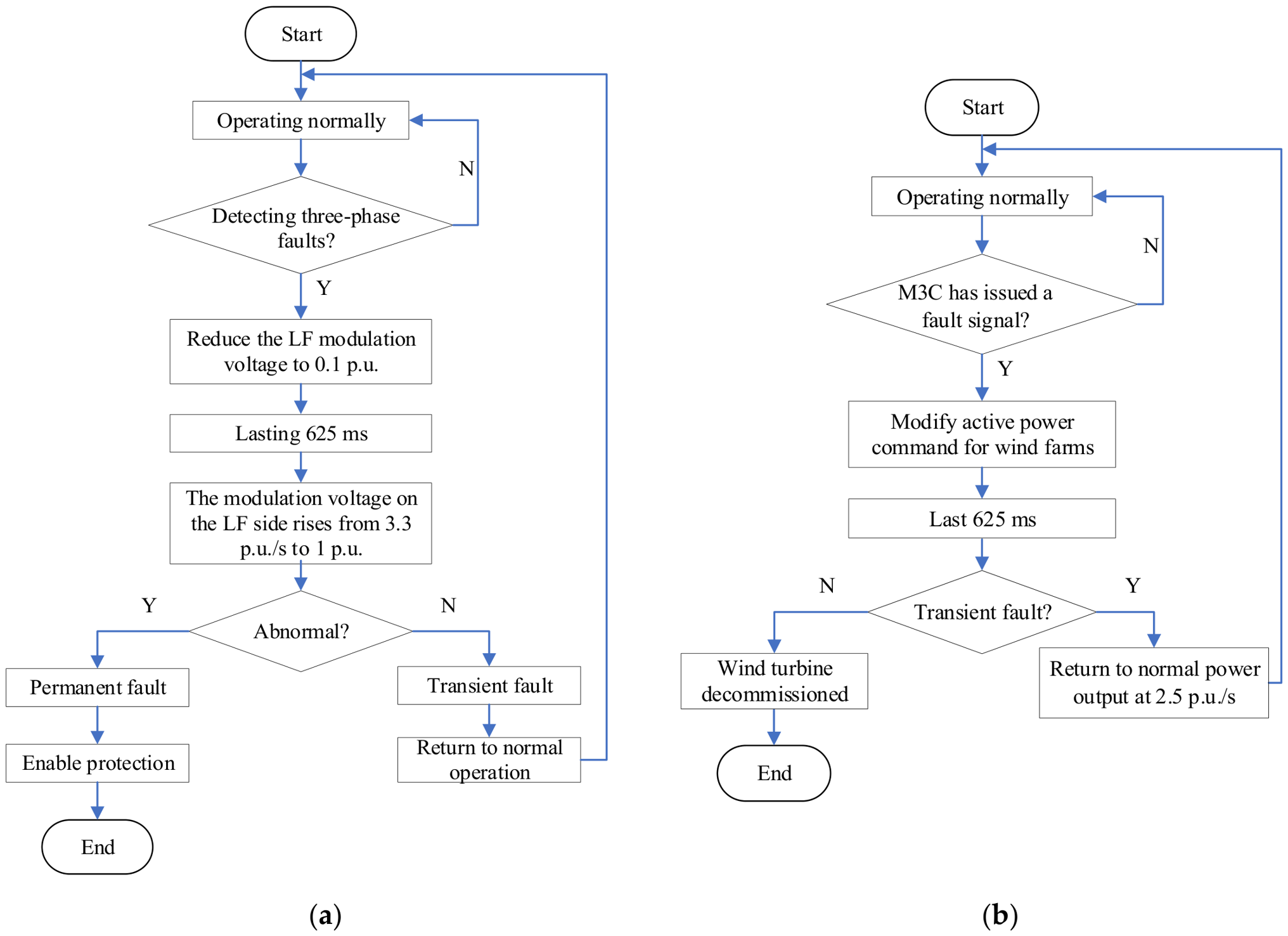
Based on the analysis of fault current characteristics in Section 4.1, this paper proposes the FRT control strategy based on the dynamic adjustment of the LF-side modulation voltage, as shown in Figure 8a. Upon rapid identification of the three-phase ground fault on the LF side, the FRT strategy is immediately activated: the LF-side voltage reference is rapidly set to 0.1 p.u.; after 625 ms, the voltage reference is linearly increased to the rated value at a rate of 3.3 p.u./s. Simultaneously, the fault detection logic is activated: if the voltage rises to the rated value and the system shows no abnormalities, the fault is deemed transient and normal operation is resumed; if an abnormality is detected during the ramp-up, the system switches back to the low-modulation voltage mode and the fault is deemed permanent; in the event of a permanent fault, the low-modulation voltage mode continues to operate until the protection system intervenes.
To mitigate the power mismatch between the M3C and the wind farm, this paper introduces active power control commands between the M3C and the wind farm, as shown in Figure 8b. Upon detection of the three-phase ground fault, the M3C sends a fault command to the wind farm to reduce its active power output; 625 ms later, the subsequent operation is determined based on the fault type: in the case of a transient fault, the power is increased to normal levels at a rate of 2.5 p.u./s; in the case of a permanent fault, the wind turbines are instructed to cease operation.
The parameters of the proposed FRT strategy are selected based on a combination of typical grid code requirements for FRT, the low-voltage ride-through capability of PMSGs, and the need for rapid yet stable and coordinated recovery between the M3C and the wind farm. The LF-side voltage reference is reduced to 0.1 p.u. because this level is sufficiently low to reliably activate the active power derating and ride-through mode of the wind turbines, while still providing a minimum voltage support at the fault point to prevent complete voltage collapse and limit excessive inrush currents. The 625 ms holding period is chosen to be consistent with common fault clearing times and the FRT duration requirements specified in grid codes.
After the holding period, the LF-side modulation voltage is restored linearly at a rate of 3.3 p.u./s, corresponding to a recovery from 0.1 p.u. to 1.0 p.u. within approximately 273 ms. This recovery rate is deliberately aligned with the voltage recovery slopes permitted under typical low-voltage ride-through standards for wind turbines. To maintain smooth coordination and avoid secondary transients or overcurrent during the recovery phase, the active power reference of the wind farm is ramped up at a slightly slower rate of 2.5 p.u./s.

5. Simulation and Verification

To verify the feasibility of the proposed LF offshore wind transmission system based on M3C, a simulation model as shown in Figure 1 was constructed in PSCAD/EMTDC. The main simulation parameters are given in Table 1 and Table 2.

5.1. Simulation Verification of FRT Control Based on a Controllable Energy Dissipation Device

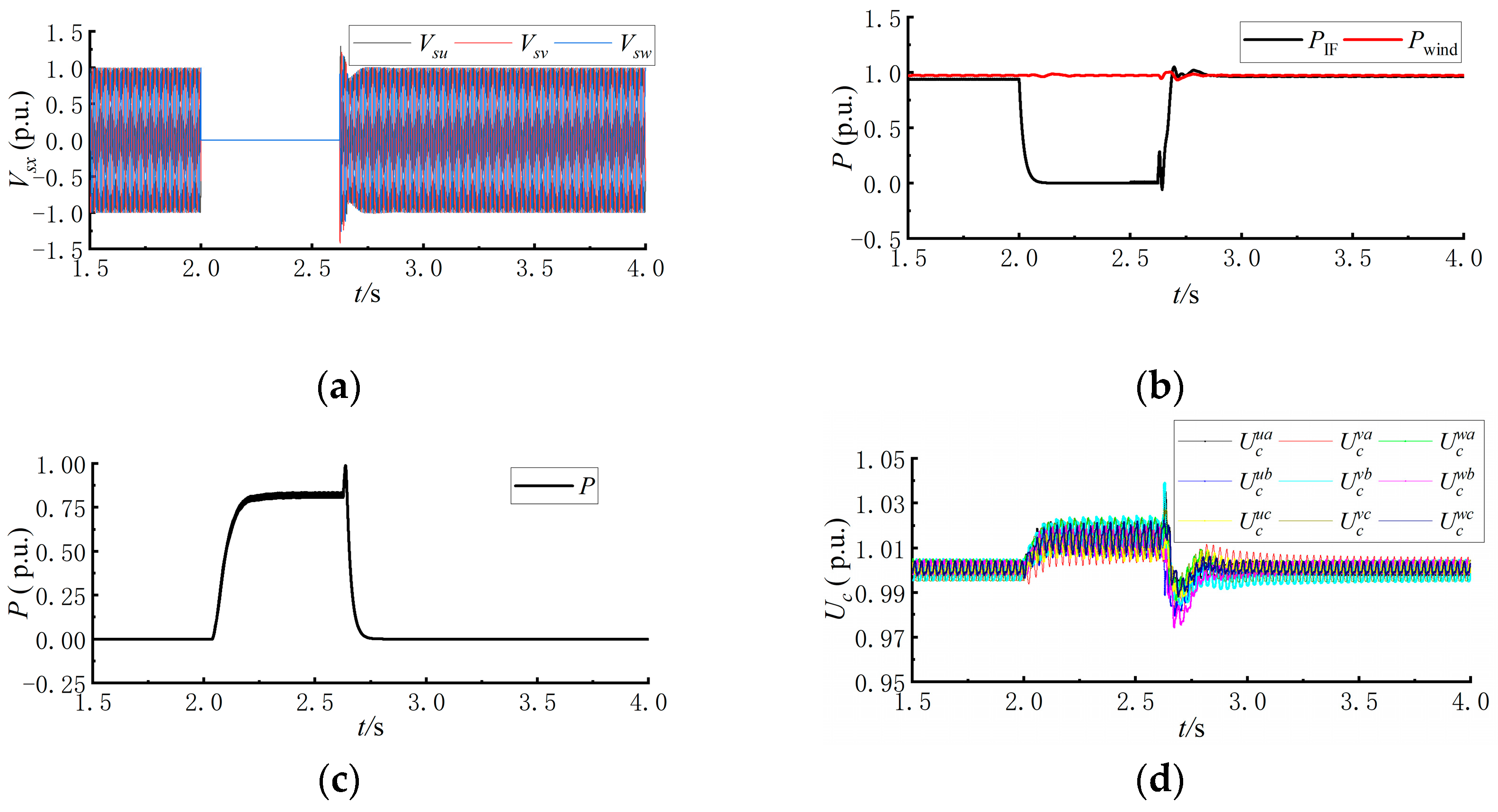
At 2 s, a three-phase ground fault was induced on the M3C’s IF side; the IF grid voltage dropped to 0 and remained in this state for 0.625 s. The fault was cleared after 2.625 s, and the IF grid returned to its rated voltage. The following simulation results were obtained.
In the simulation of FRT control based on a controllable energy dissipation device, the three-phase voltage on the M3C’s IF side drops directly to zero as shown in Figure 9a. During the fault, the IF-side active power is reduced to zero due to the immediate activation of the controllable energy dissipation device, as illustrated in Figure 9b,c. This action prevents power imbalance and protects the IGBTs from overcurrent. The maximum bridge-arm current remains below 1.15 p.u. throughout the fault period. The wind farm continues to deliver its original active power output, thereby avoiding unnecessary shutdown losses. As shown in Figure 9d, the average submodule capacitor voltage rises to a peak of 1.042 p.u. at approximately 120 ms after the fault and is subsequently regulated to within 1.02 p.u. The power imbalance lasts for about 85 ms before being fully compensated by the dissipation device. After the fault is cleared at 2.625 s, the IF-side active power recovers smoothly to the rated value within 180 ms. These results confirm that the proposed strategy effectively maintains submodule capacitor voltage stability and ensures reliable operation of the M3C during severe IF-side faults.

5.2. Simulation Verification of FRT Control Based on Dynamic Adjustment of the LF-Side Modulation Voltage

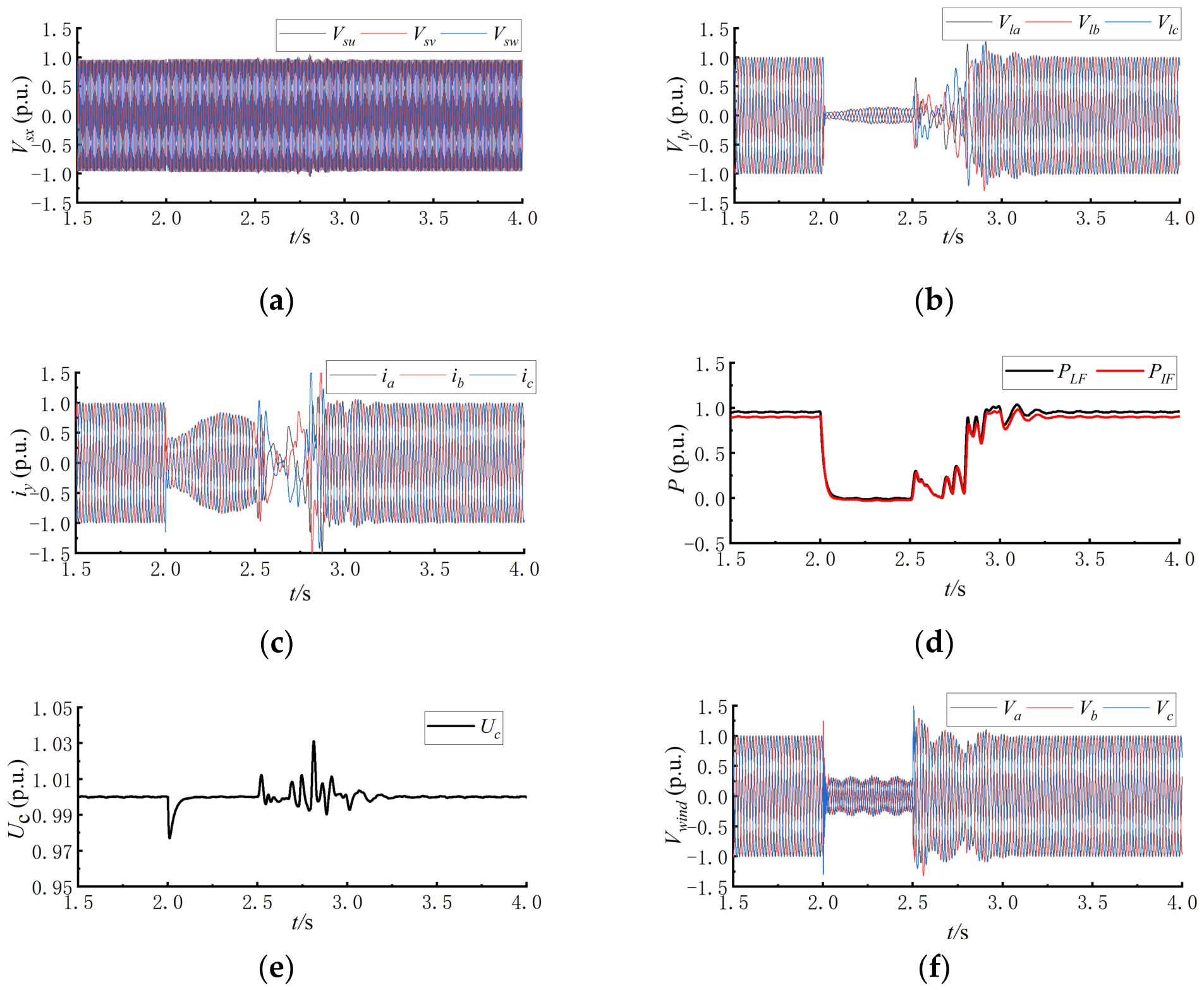
At 2 s, a three-phase ground fault was induced on the LF side of M3C, lasting 0.5 s; the fault was cleared after 2.5 s, yielding the following simulation results.
As shown in Figure 10a, the three-phase voltages on the IF side remain well balanced during the LF-side fault. Following the fault, the LF-side voltage is rapidly reduced to 0.1 p.u. by switching the modulation voltage reference, as presented in Figure 10b. The three-phase currents on the LF side reach a peak of 1.28 p.u. within the first 40 ms and subsequently remain below 1.15 p.u. after the control response takes effect, as shown in Figure 10c. The LF-side voltage is held at 0.1 p.u. for 625 ms and then recovers linearly to the rated value within 273 ms at a rate of 3.3 p.u./s. During this period, the active power on both sides remains at zero, as illustrated in Figure 10d. After the recovery process begins, the active power is restored to the rated value within 320 ms as the wind farm power command ramps up at 2.5 p.u./s. The submodule capacitor voltage fluctuates between 0.96 p.u. and 1.04 p.u., corresponding to a maximum deviation of 4% from the rated value, as shown in Figure 10e. Meanwhile, the wind farm output voltage stays above 0.22 p.u. due to the voltage support provided at the fault point, enabling the wind turbines to ride through the fault without disconnection, as depicted in Figure 10f. The entire system returns to steady-state operation approximately 380 ms after fault clearance. These quantitative results demonstrate that the proposed dynamic modulation voltage adjustment strategy effectively limits overcurrent and voltage deviation while achieving fast and coordinated recovery.

6. Conclusions

This paper takes the LF offshore wind transmission system based on M3C as its subject of study, systematically conducting an analysis of the transient characteristics of three-phase ground faults on both the IF and LF sides, as well as research into FRT control strategies. Firstly, a mathematical model of M3C in dq coordinates, an overall control framework, and an equivalent aggregate model of the wind farm were established, providing a theoretical foundation for subsequent fault mechanism analysis and control design. Secondly, the paper thoroughly reveals the risk mechanism whereby a power surplus in M3C during a three-phase ground fault on the IF side leads to overvoltage in submodule capacitors, as well as the dynamic characteristics of voltage sags and transient coupling of bridge-arm currents during a three-phase ground fault on the LF side, thereby addressing the shortcomings in existing research regarding the systematic analysis of symmetrical faults on both sides.
To address the aforementioned issues, this paper proposes two innovative FRT control strategies: (1) For three-phase ground faults on the IF side, a ride-through control method based on a controllable energy dissipation device on the LF side has been designed. By continuously monitoring the average capacitive voltage of the submodules, this method enables the precise dissipation of excess power, ensuring that the capacitive voltage of the submodules remains within safe thresholds and preventing false tripping of M3C protection; (2) For three-phase ground faults on the LF side, the FRT control strategy based on dynamically adjusting the modulation voltage on the LF side is proposed. By rapidly reducing the voltage reference to 0.1 p.u. and linearly restoring it at a set rate, this strategy enables rapid transmission of fault information and load shedding of wind turbines, effectively suppressing overcurrent in the bridge arms and maintaining system transient stability.
Verification results from a 1000 MW system model built on the PSCAD/EMTDC simulation platform indicate that, under conditions of a 0 p.u. voltage dip on the IF side and a three-phase ground fault on the LF side, voltage fluctuations across the submodule capacitors were all kept within ±5%. The wind farm output voltage met the low-voltage ride-through requirements, power balance on the LF side was rapidly restored, and the system did not experience any disconnection or protection tripping. The simulation results fully demonstrate the effectiveness, responsiveness and robustness of the proposed control strategy.

Author Contributions

Conceptualization, L.N. and Y.L.; methodology, X.L., G.Z. and W.L.; validation, X.L., C.L. and L.N.; formal analysis, Y.L.; investigation, Q.W. and J.Z.; writing—original draft preparation, J.W., G.Z., L.N. and Y.L.; writing—review and editing, Y.L., W.L. and X.L.; supervision, X.L.; project administration, X.L.; funding acquisition, X.L. All authors have read and agreed to the published version of the manuscript.

Funding

This research was funded by Research into Key Technologies for Low-Frequency Transmission Systems in Offshore Wind Farms of the Science and Technology Department of Hubei Province, grant number 2024BAB104.

Data Availability Statement

The original contributions presented in this study are included in the article.

Conflicts of Interest

Xiaorui Liu, Guoliang Zhou, Wenjin Li, Chao Liu and Jiangtian Wang are employed by the company Central South China Electric Power Design Institute Co., Ltd. The remaining authors declare that the research was conducted in the absence of any commercial or financial relationships that could be construed as a potential conflict of interest.

Abbreviations

The following abbreviations are used in this manuscript:
FRTFault ride-through
LFLow-frequency
M3CModular Multilevel Matrix Converter
IFIndustrial-frequency
HVACHigh-voltage alternating current
HVDCHigh-voltage direct current
LFACLow-frequency AC
ACAlternating current
DCDirect current
MPPTMaximum power point tracking
PMSGsPermanent magnet synchronous generators
VfVoltage and frequency
PWMPulse width modulation

References

  1. Peng, L.; He, G.; Abhyankar, N.; Yang, H.; Paliwal, U.; Lin, J. Aligning offshore wind deployment with local priorities to accelerate power system decarbonization. Commun. Earth Environ. 2026; in press. [CrossRef]
  2. Lyu, Y.; Luo, Y.; Jia, Z.; Fu, S.; Tang, Y.; Wang, Q.; Zeng, Y. Benefit evaluation of HVAC and HVDC for offshore wind power transmission system under the multidimensional index. Electr. Power Syst. Res. 2024, 237, 111018. [Google Scholar] [CrossRef]
  3. He, J.; Xue, L.; Li, B.; Li, Y.; Prieto-Araujo, E.; Gomis-Bellmunt, O. Oriol Gomis-Bellmunt, Protection and fault ride-through techniques of VSC-HVDC systems for offshore wind power transmission—Research status, challenges, and prospects. Renew. Sustain. Energy Rev. 2025, 210, 115138. [Google Scholar] [CrossRef]
  4. Ruddy, J.; Meere, R.; O’dOnnell, T. Low Frequency AC transmission for offshore wind power: A review. Renew. Sustain. Energy Rev. 2016, 56, 75–86. [Google Scholar] [CrossRef]
  5. Lu, C.; Wang, K.; Qiu, P.; Hua, W.; Pan, W. Resonance Stability Analysis of Hangzhou Flexible Low Frequency AC System. In Proceedings of the 2021 International Conference on Power System Technology (POWERCON), Haikou, China, 8–9 December 2021; pp. 1640–1644. [Google Scholar] [CrossRef]
  6. Wang, S.; Zhou, Z.; Yang, G.; Cao, H.; Lu, Y.; Song, Y. Sampling Value Current Accumulation Protection for Flexible Low-frequency Transmission Lines Based on Differences in Negative Sequence Control Characteristics. Proc. CSEE 2025, 45, 6625–6637. [Google Scholar] [CrossRef]
  7. Chen, P.; Li, H.; Chen, J.; Liu, Z.; Xu, Y. High-Frequency Oscillation Analysis and Suppression Strategy for M3C-Based Low-Frequency Transmission System of Offshore Wind Power. Trans. China Electrotech. Soc. 2026, 41, 1543–1557+1588. [Google Scholar] [CrossRef]
  8. Kawamura, W.; Hagiwara, M.; Akagi, H. Control and Experiment of a Modular Multilevel Cascade Converter Based on Triple-Star Bridge Cells. IEEE Trans. Ind. Appl. 2014, 50, 3536–3548. [Google Scholar] [CrossRef]
  9. Erickson, R.W.; Al-Naseem, O.A. A new family of matrix converters. In Proceedings of the 27th Annual Conference of the IEEE Industrial Electronics Society, Denver, CO, USA, 29 November–2 December 2001; IEEE: New York, NY, USA; Volume 2, pp. 1515–1520. [Google Scholar] [CrossRef]
  10. Zhang, Z.; Jin, Y.; Xu, Z. Modeling and Control of Modular Multilevel Matrix Converter for Low-Frequency AC Transmission. Energies 2023, 16, 3474. [Google Scholar] [CrossRef]
  11. Liu, S.; Wang, X.; Meng, Y.; Sun, P.; Luo, H.; Wang, B. A Decoupled Control Strategy of Modular Multilevel Matrix Converter for Fractional Frequency Transmission System. IEEE Trans. Power Deliv. 2017, 32, 2111–2121. [Google Scholar] [CrossRef]
  12. Kumar, D.; Shireen, W.; Ram, N. Grid Integration of Offshore Wind Energy: A Review on Fault Ride Through Techniques for MMC-HVDC Systems. Energies 2024, 17, 5308. [Google Scholar] [CrossRef]
  13. Zhao, Y.; Duan, J.; Yan, W.; Song, W. Coordinated Fault-Ride-Through Strategy of Modular Multilevel Matrix Converter in Low-Frequency AC Transmission System for Offshore Wind Power. In Proceedings of the 2023 3rd Power System and Green Energy Conference (PSGEC), Shanghai, China, 24–26 August 2023; pp. 138–143. [Google Scholar] [CrossRef]
  14. Yang, Y.; Ning, L.; Ye, Z.; Li, C.; Zhang, X. Research on Joint Low Voltage Ride Through Strategy of Wind Power Fractional Frequency Transmission System. In Proceedings of the 2023 5th International Conference on Power and Energy Technology (ICPET), Tianjin, China, 27–30 July 2023; pp. 371–377. [Google Scholar] [CrossRef]
  15. Zhou, M.; Liu, Y.; Kong, Z.; Chen, Y.; Chen, Y.; Huang, Y.; Wang, Q.; He, T. Control Strategy for Two-Phase Operation of Two-Terminal Fractional Frequency Transmission System. In Proceedings of the 2025 4th Asia Power and Electrical Technology Conference (APET), Xiamen, China, 26–28 December 2025; pp. 199–204. [Google Scholar] [CrossRef]
  16. Zhao, Z.; Han, B.; Zhao, G.; Xu, Y.; Lu, Z.; Xiang, N.; Wang, S. Short Circuit Fault Characteristics of Low Frequency AC Transmission System Based on Modular Multilevel Matrix Converter. In Proceedings of the 2023 International Conference on Power Energy Systems and Applications (ICoPESA), Nanjing, China, 24–26 February 2023; pp. 90–95. [Google Scholar] [CrossRef]
  17. Zhang, Y. Research on low frequency side short circuit fault of low frequency AC transmission (LFAC) system based on modular multilevel matrix converter (M3C). In Proceedings of the 18th International Conference on AC and DC Power Transmission (ACDC 2022), Online, 2–3 July 2022; pp. 468–475. [Google Scholar] [CrossRef]
  18. Dong, Y.; He, Y.; Du, L.; Tang, M.; Jin, G.; Zhao, J. Research of the Power Frequency Grid Fault Ride through Strategy of Modular Multilevel Matrix Converter for New Energy Transmission. Electr. Drive 2024, 54, 71–82. [Google Scholar] [CrossRef]
  19. Sun, Y.; Wang, T.; Fu, C.; Guo, F.; Ni, Q. Fault Ride-through Control Strategy of Modular Multilevel Matrix Converter for Fractional Frequency Transmission System. High. Volt. Eng. 2023, 49, 19–30. [Google Scholar] [CrossRef]
  20. Xiang, N.; Cheng, H.; Ye, S.; Shao, B.; Wang, S.; Lu, Y. Fault ride-through coordinated control strategy for offshore wind power via flexible low-frequency transmission system. Electr. Power Eng. Technol. 2025, 44, 57–68. [Google Scholar] [CrossRef]
  21. Gao, X.; Zhang, C.; Song, G.; Jiang, J.; Lv, Y. Control strategies of offshore wind power low frequency transmission system under asymmetric fault of low-frequency side. Electr. Power Autom. Equip. 2023, 43, 160–166. [Google Scholar] [CrossRef]
  22. Zheng, T.; Song, W.; Lü, W. Asymmetric fault ride-through control strategy for a low frequency AC transmission system based on a modular multilevel matrix converter. Power Syst. Prot. Control 2023, 51, 107–117. [Google Scholar] [CrossRef]
  23. Zheng, T.; Kang, H.; Song, W. Asymmetric fault ride-through control strategy for low-frequency transmission systems realizing the capacitor voltage balance of modular multilevel matrix converters. Power Syst. Prot. Control 2023, 51, 130–140. [Google Scholar] [CrossRef]
  24. Song, C.; Wang, N.; Sangwongwanich, A.; Blaabjerg, F.; Davari, P. Overview of Efficient and Reliable Control Strategies for Three-Level NPC-Based DAB Converters. IEEE Trans. Power Electron. 2026, 41, 2561–2591. [Google Scholar] [CrossRef]
  25. Yuan, B.; Ma, J.; Yu, S.; Wang, Y.; He, P.; Meng, Y. Joint Frequency Control Strategy for Fractional Frequency Offshore Wind Power System with Modular Multilevel Matrix Converter. In Proceedings of the 2025 IEEE 2nd International Conference on Energy and Electrical Engineering (EEE), Nanchang, China, 20–21 June 2025; pp. 1–6. [Google Scholar] [CrossRef]
  26. Liu, S.; Zhao, B.; Chen, Y.; Wang, G.; Wang, X. Optimal Arm Current Reallocation of Modular Multilevel Matrix Converter Dedicated for Power Grid Interconnection. IEEE Trans. Power Deliv. 2022, 37, 3477–3490. [Google Scholar] [CrossRef]
  27. Wang, Q.; Liu, Y.; Huang, Y.; Ding, W.; Pei, Z.; Fan, R.; He, T.; Zhang, J. A Novel Gigawatt-Scale System and Method for Low-Frequency Transmission and Grid Integration of Large-Scale Renewable Energy Sources. In Proceedings of the 2025 International Conference on Smart Grid and Energy (ICSGE), Guangzhou, China, 12–14 December 2025; pp. 74–79. [Google Scholar] [CrossRef]
  28. Guo, X.; Zhou, Y.; Mei, N.; Zhao, B. Construction and Characteristic Analysis of Zhangbei Flexible DC Grid. Power Syst. Technol. 2018, 42, 3698–3707. [Google Scholar] [CrossRef]
Figure 1. The topology of LF offshore wind transmission system based on M3C.
Electronics 15 02871 g001
Figure 2. The main circuit topology of M3C.
Electronics 15 02871 g002
Figure 3. The overall control block diagram of M3C: (a) block diagram of the IF side; (b) block diagram of the LF side.
Electronics 15 02871 g003aElectronics 15 02871 g003b
Figure 4. The topology of wind turbines and their control strategies.
Electronics 15 02871 g004
Figure 5. The structure of the controllable energy dissipation device.
Electronics 15 02871 g005
Figure 6. Complex frequency domain circuit the pre-fault stage of the M3C control response.
Electronics 15 02871 g006
Figure 7. Fault circuits under different excitation sources (sub-converter a): (a) fault circuits under the IF excitation source; (b) fault circuits under the LF excitation source.
Electronics 15 02871 g007aElectronics 15 02871 g007b
Figure 8. The FRT control strategy based on dynamic adjustment of the LF-side modulation voltage: (a) flowchart of M3C control; (b) flowchart of the offshore wind farm control.
Electronics 15 02871 g008
Figure 9. Simulation results for FRT control based on a controllable energy dissipation device: (a) three-phase voltage on the IF side; (b) active power on the IF side and at the wind farm; (c) active power consumption of the controllable energy dissipation device; (d) voltage of capacitors on the nine bridge arms of M3C.
Electronics 15 02871 g009
Figure 10. Simulation results for FRT control based on dynamic adjustment of the LF-side modulation voltage: (a) three-phase voltage on the IF side; (b) three-phase voltage on the LF side; (c) three-phase current on the LF side; (d) active power on the IF and LF side; (e) the average voltage of the capacitors on the nine bridge arms of M3C; (f) wind farm output voltage.
Electronics 15 02871 g010
Table 1. System parameters.
EquipmentParametersValue
converter transformer of IF sideconnection methodY0
transmission ratio500 kV/160 kV
rated capacity1060 MVA
short-circuit reactance percentage15%
converter transformer of LF sideconnection methodΔ/Y0
transmission ratio160 kV/330 kV
rated capacity1060 MVA
short-circuit reactance percentage15%
LF transmission linevoltage level330 kV
equivalent series resistance2.6037 Ω
equivalent series inductance45.529 mH
equivalent capacitance to ground18.92 uF
M3Crated capacity1000 MW
rated voltage330 kV
number of bridge-arm submodules110
capacitance of the submodule18 mF
rated voltage of the capacitor2.94 kV
bridge-arm inductance40 mH
PMSGrated capacity5 MW
maximum capacity5.2 MW
rated voltage1140 V
rated frequency20 Hz
Table 2. Controller parameters used in this paper.
ParametersIF SideLF SideUnit
current inner loop
proportional gain and integral gain (d-axis/q-axis)1.3, 0.0181.15, 0.02p.u.
voltage outer loop
proportional gain and integral gain (d-axis/q-axis) 0.21, 0.036p.u.
average submodule capacitor voltage control
proportional gain and integral gain (d-axis/q-axis)0.18, 0.023 p.u.
voltage balancing control
proportional gain and integral gain0.1, 0.0180.09, 0.02p.u.
circulating current suppression
proportional gain0.50.45p.u.
Disclaimer/Publisher’s Note: The statements, opinions and data contained in all publications are solely those of the individual author(s) and contributor(s) and not of MDPI and/or the editor(s). MDPI and/or the editor(s) disclaim responsibility for any injury to people or property resulting from any ideas, methods, instructions or products referred to in the content.