An Analytical Model of Inertial Gait Parameters for the Development of Robotic Exoskeletons for Lower-Limb Rehabilitation




Abstract
1. Introduction
2. Materials and Methods
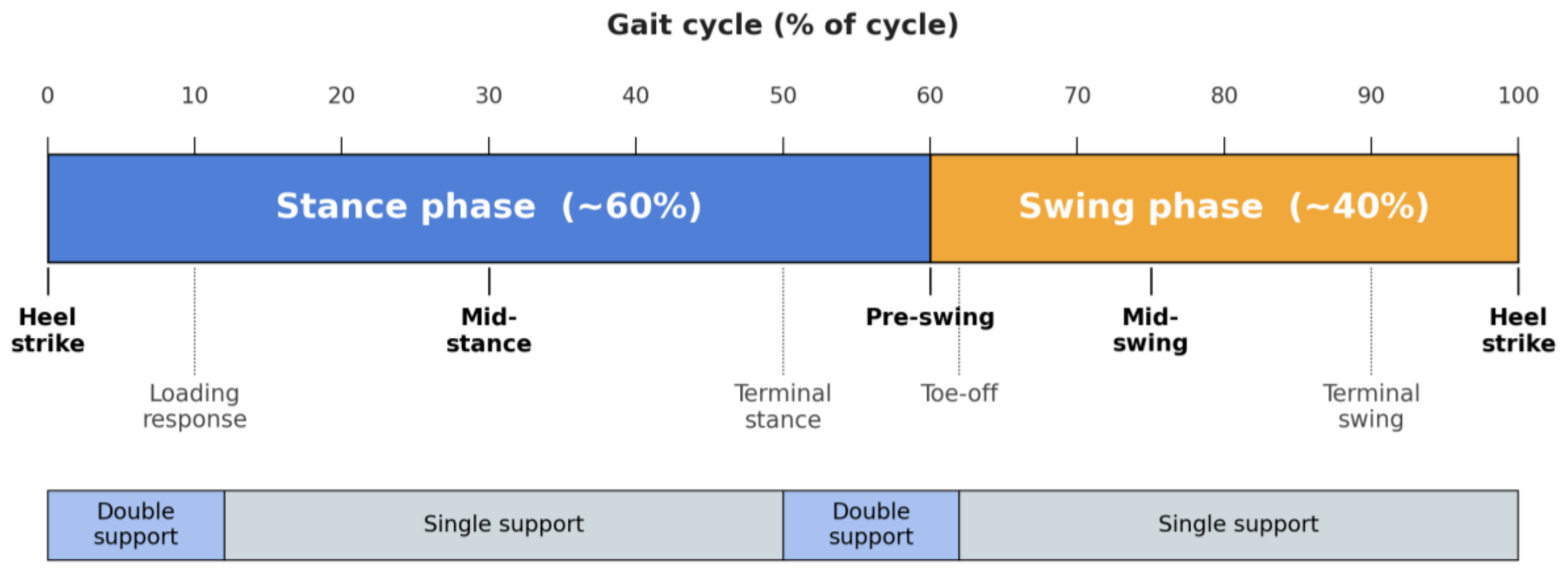
2.1. Human Gait and the Gait Cycle
2.2. Inertial-Sensor-Based Gait Recognition
2.3. Lower-Limb Exoskeleton Design Considerations
2.4. Experiment 1—Free Walking Without an Exoskeleton
2.4.1. Participants
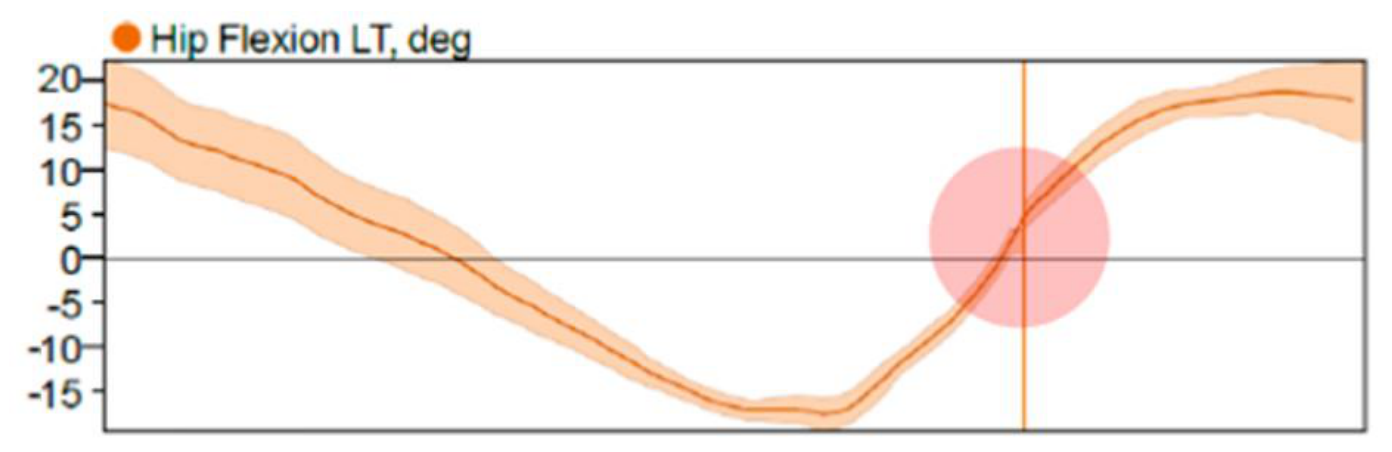
2.4.2. Instrumentation
2.4.3. Protocol
2.5. Experiment 2—Walking with and Without the Exowalk Exoskeleton
2.5.1. Participants
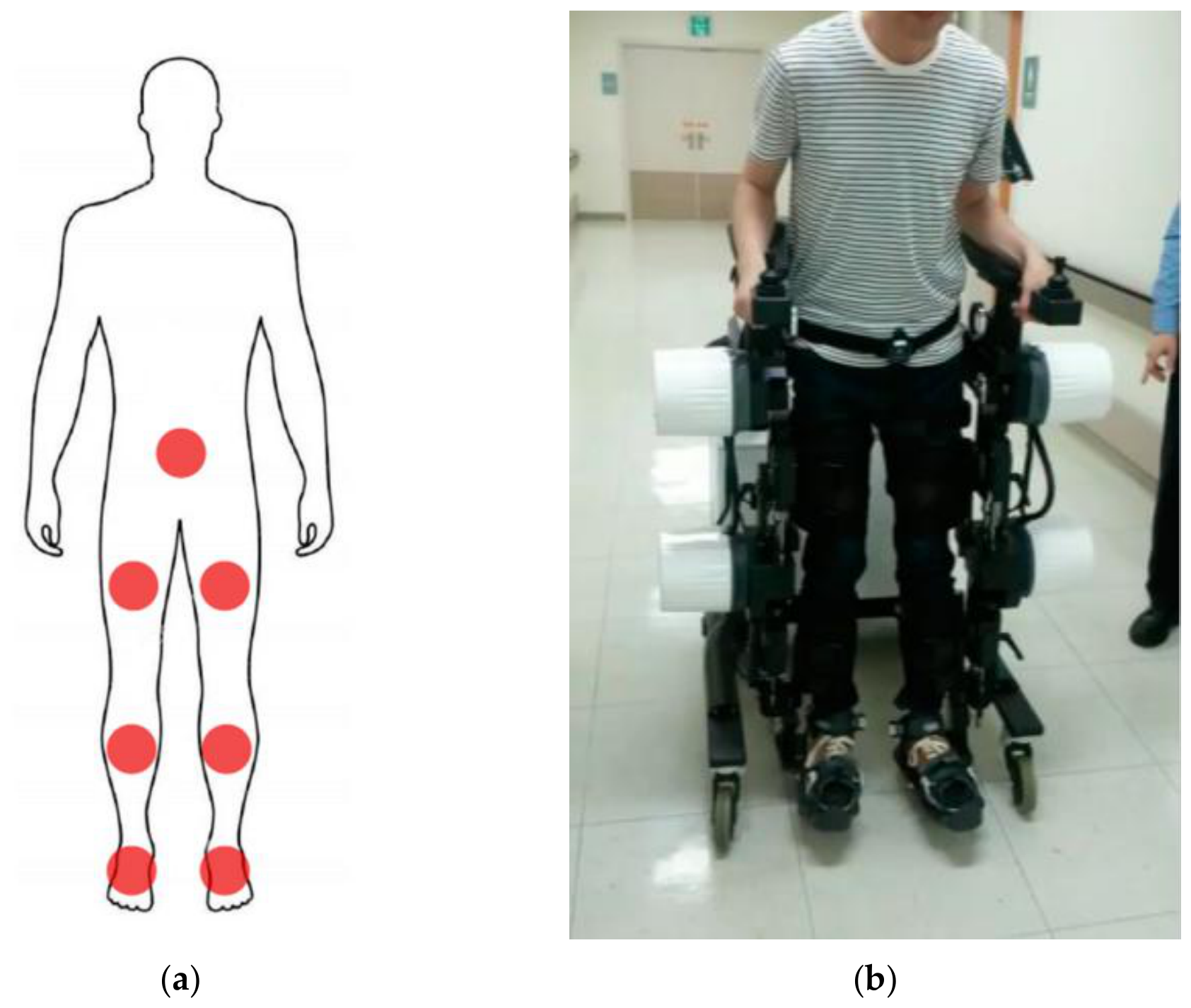
2.5.2. Instrumentation
2.5.3. Protocol
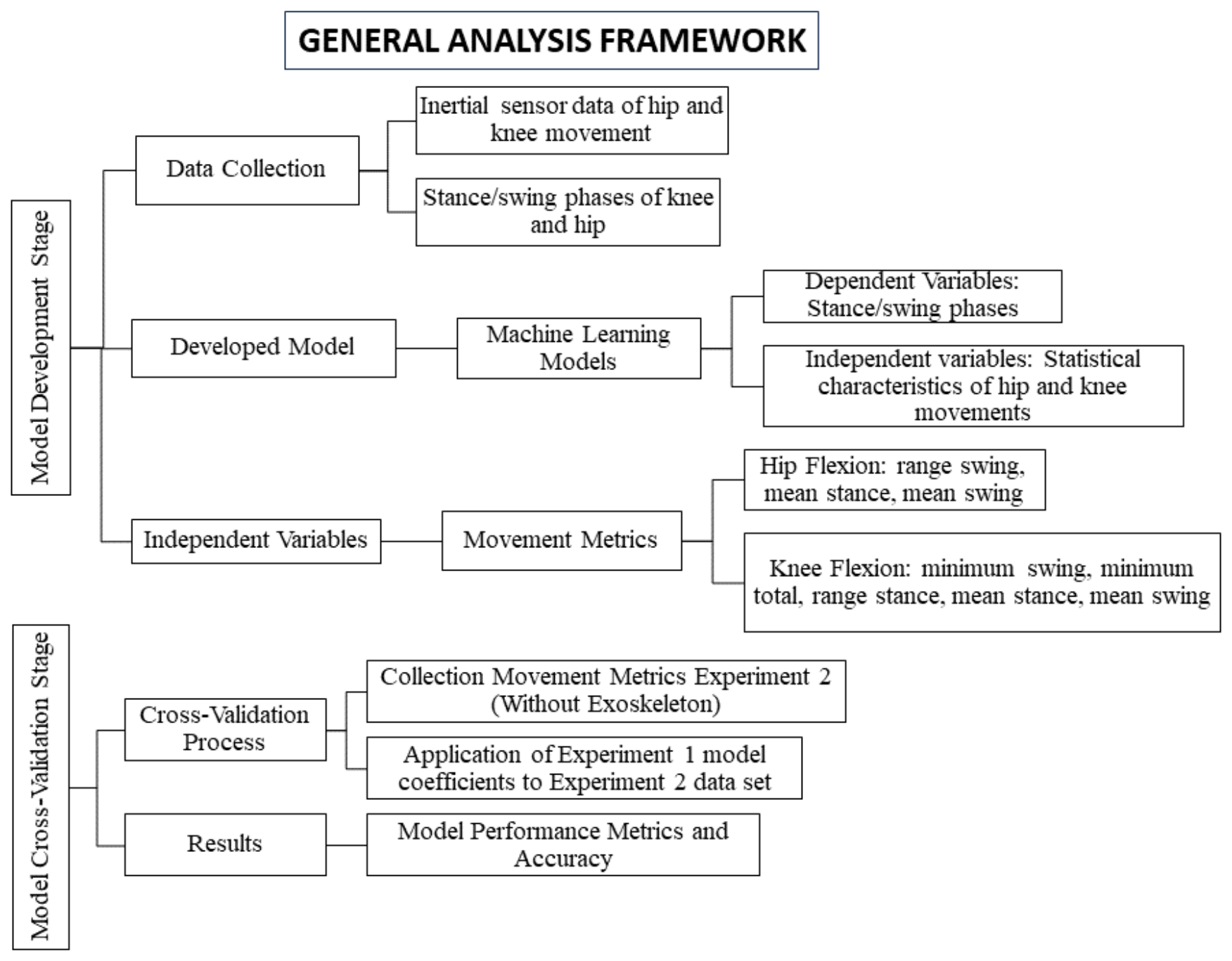
2.6. Feature Extraction
- range of hip flexion during the swing phase (range_swing_hip_flexion);
- mean hip flexion during the stance phase (mean_stance_hip_flexion);
- mean hip flexion during the swing phase (mean_swing_hip_flexion);
- minimum knee flexion during the swing phase (min_swing_knee_flexion);
- minimum knee flexion over the entire cycle (min_total_knee_flexion);
- range of knee flexion during the stance phase (range_stance_knee_flexion);
- mean knee flexion during the stance phase (mean_stance_knee_flexion);
- mean knee flexion during the swing phase (mean_swing_knee_flexion).
2.7. Logistic-Regression Model and Validation
3. Results
3.1. Model Development on the Experiment 1 Dataset
3.2. External Cross-Validation on the Experiment 2 Dataset
3.3. Comparison with Other Machine-Learning Approaches
4. Discussion
4.1. Interpretation of the Model
4.2. Generalisation to Exoskeleton-Assisted Walking
4.3. Implications for Exoskeleton Design
4.4. Comparison with Related Modelling Approaches
4.5. Limitations
4.6. Future Work
5. Conclusions
Author Contributions
Funding
Institutional Review Board Statement
Informed Consent Statement
Data Availability Statement
Conflicts of Interest
Abbreviations
| Abbreviation | Definition |
| CNN | Convolutional neural network |
| EEG | Electroencephalography |
| EMG | Electromyography |
| FN | False negative |
| FP | False positive |
| FSR | Force-sensitive resistor |
| HMM | Hidden Markov model |
| IMU | Inertial measurement unit |
| LDA | Linear discriminant analysis |
| LR | Logistic regression |
| ML | Machine learning |
| PPV | Positive predictive value |
| SVM | Support-vector machine |
| TN | True negative |
| TP | True positive |
References
- Young, A.J.; Ferris, D.P. State of the art and future directions for lower limb robotic exoskeletons. IEEE Trans. Neural Syst. Rehabil. Eng. 2017, 25, 171–182. [Google Scholar] [PubMed]
- Shi, D.; Zhang, W.; Zhang, W.; Ding, X. A review on lower limb rehabilitation exoskeleton robots. Chin. J. Mech. Eng. 2019, 32, 74. [Google Scholar] [CrossRef]
- Banala, S.K.; Kim, S.H.; Agrawal, S.K.; Scholz, J.P. Robot assisted gait training with active leg exoskeleton (ALEX). IEEE Trans. Neural Syst. Rehabil. Eng. 2009, 17, 2–8. [Google Scholar] [PubMed]
- Díaz, I.; Gil, J.J.; Sánchez, E. Lower-limb robotic rehabilitation: Literature review and challenges. J. Robot. 2011, 2011, 759764. [Google Scholar] [CrossRef]
- Siviy, C.; Baker, L.M.; Quinlivan, B.T.; Porciuncula, F.; Swaminathan, K.; Awad, L.N.; Walsh, C.J. Opportunities and challenges in the development of exoskeletons for locomotor assistance. Nat. Biomed. Eng. 2023, 7, 456–472. [Google Scholar] [PubMed]
- Herr, H. Exoskeletons and orthoses: Classification, design challenges and future directions. J. NeuroEng. Rehabil. 2009, 6, 21. [Google Scholar] [CrossRef] [PubMed]
- Montgomery, J.R.; Grabowski, A.M. The contributions of ankle, knee and hip joint work to individual leg work change during uphill and downhill walking over a range of speeds. R. Soc. Open Sci. 2018, 5, 180550. [Google Scholar] [CrossRef] [PubMed]
- Franks, P.W.; Bryan, G.M.; Martin, R.M.; Reyes, R.; Lakmazaheri, A.; Collins, S.H. Comparing optimized exoskeleton assistance of the hip, knee, and ankle in single and multi-joint configurations. Wearable Technol. 2021, 2, e16. [Google Scholar] [CrossRef] [PubMed]
- MacLean, M.K.; Ferris, D.P. Energetics of walking with a robotic knee exoskeleton. J. Appl. Biomech. 2019, 35, 320–326. [Google Scholar] [CrossRef] [PubMed]
- Ding, Y.; Galiana, I.; Asbeck, A.T.; De Rossi, S.M.M.; Bae, J.; Santos, T.R.T.; de Araujo, V.L.; Lee, S.; Holt, K.G.; Walsh, C. Biomechanical and physiological evaluation of multi-joint assistance with soft exosuits. IEEE Trans. Neural Syst. Rehabil. Eng. 2017, 25, 119–130. [Google Scholar] [CrossRef] [PubMed]
- Ma, J.; Sun, D.; Chen, X. Hip–knee coupling exoskeleton with offset theory for walking assistance. Front. Bioeng. Biotechnol. 2022, 9, 798496. [Google Scholar] [CrossRef] [PubMed]
- Villa-Parra, A.C.; Delisle-Rodriguez, D.; Botelho, T.; Villarejo Mayor, J.J.; Delis, A.L.; Carelli, R.; Neto, A.F.; Bastos, T.F. Control of a robotic knee exoskeleton for assistance and rehabilitation based on motion intention from sEMG. Res. Biomed. Eng. 2018, 34, 198–210. [Google Scholar] [CrossRef]
- Kyeong, S.; Shin, W.; Yang, M.; Heo, U.; Feng, J.; Kim, J. Recognition of walking environments and gait period by surface electromyography. Front. Inf. Technol. Electron. Eng. 2019, 20, 342–352. [Google Scholar] [CrossRef]
- Neťuková, S.; Bejtic, M.; Malá, C.; Horáková, L.; Kutílek, P.; Kauler, J.; Krupička, R. Lower limb exoskeleton sensors: State-of-the-art. Sensors 2022, 22, 9091. [Google Scholar] [CrossRef] [PubMed]
- Yan, L.; Zhen, T.; Kong, J.L.; Wang, L.M.; Zhou, X.L. Walking gait phase detection based on acceleration signals using voting-weighted integrated neural network. Complexity 2020, 2020, 4760297. [Google Scholar] [CrossRef]
- Liu, L.; Wang, H.; Li, H.; Liu, J.; Qiu, S.; Zhao, H.; Guo, X. Ambulatory human gait phase detection using wearable inertial sensors and hidden Markov model. Sensors 2021, 21, 1347. [Google Scholar] [CrossRef] [PubMed]
- Vu, H.T.T.; Gomez, F.; Cherelle, P.; Lefeber, D.; Nowé, A.; Vanderborght, B. ED-FNN: A new deep learning algorithm to detect percentage of the gait cycle for powered prostheses. Sensors 2018, 18, 2389. [Google Scholar] [CrossRef] [PubMed]
- Su, B.; Smith, C.; Gutierrez-Farewik, E.M. Gait phase recognition using deep convolutional neural network with inertial measurement units. Biosensors 2020, 10, 109. [Google Scholar] [CrossRef] [PubMed]
- Shin, D.; Lee, S.; Hwang, S. Locomotion mode recognition algorithm based on Gaussian mixture model using IMU sensors. Sensors 2021, 21, 2785. [Google Scholar] [CrossRef] [PubMed]
- Wu, X.; Liu, D.X.; Liu, M.; Chen, C.; Guo, H. Individualized gait pattern generation for sharing lower limb exoskeleton robot. IEEE Trans. Autom. Sci. Eng. 2018, 15, 1459–1470. [Google Scholar] [CrossRef]
- Wang, X.; Zhang, J.; Yan, W.Q. Gait recognition using multichannel convolution neural networks. Neural Comput. Appl. 2020, 32, 14275–14285. [Google Scholar]
- Cene, V.H.; Balbinot, A. Upper-limb movement classification through logistic regression sEMG signal processing. In Proceedings of the 2015 Latin America Congress on Computational Intelligence (LA-CCI), Curitiba, Brazil, 13–16 October 2015; pp. 1–5. [Google Scholar]
- Slade, P.; Kochenderfer, M.J.; Delp, S.L.; Collins, S.H. Personalizing exoskeleton assistance while walking in the real world. Nature 2022, 610, 277–282. [Google Scholar] [CrossRef]
- Perry, J.; Burnfield, J.M. Gait Analysis: Normal and Pathological Function, 2nd ed.; SLACK Incorporated: Thorofare, NJ, USA, 2010. [Google Scholar]
- Pirker, W.; Katzenschlager, R. Gait disorders in adults and the elderly: A clinical guide. Wien. Klin. Wochenschr. 2017, 129, 81–95. [Google Scholar] [PubMed]
- Aguirre-Ollinger, G.; Colgate, J.E.; Peshkin, M.A.; Goswami, A. Active-impedance control of a lower-limb assistive exoskeleton. In Proceedings of the 2007 IEEE 10th International Conference on Rehabilitation Robotics (ICORR), Noordwijk, The Netherlands, 13–15 June 2007; pp. 188–195. [Google Scholar]
- Jiang, J.G.; Ma, X.F.; Huo, B.; Zhang, Y.D.; Yu, X.Y. Recent advances on lower limb exoskeleton rehabilitation robot. Recent Pat. Eng. 2017, 11, 194–207. [Google Scholar] [CrossRef]
- Hussain, F.; Goecke, R.; Mohammadian, M. Exoskeleton robots for lower limb assistance: A review of materials, actuation, and manufacturing methods. Proc. Inst. Mech. Eng. Part H J. Eng. Med. 2021, 235, 1375–1385. [Google Scholar] [CrossRef]
- Li, N.; Yan, L.; Qian, H.; Wu, H.; Wu, J.; Men, S. Review on lower extremity exoskeleton robot. Open Autom. Control Syst. J. 2015, 7, 441–453. [Google Scholar]
- Allison, P.D. What’s the best R-squared for logistic regression? Statistical Horizons, 13 February 2013. Available online: https://statisticalhorizons.com/r2logistic (accessed on 19 April 2023).
- Hemmert, G.A.J.; Schons, L.M.; Wieseke, J.; Schimmelpfennig, H. Log-likelihood-based pseudo-R2 in logistic regression: Deriving sample-sensitive benchmarks. Sociol. Methods Res. 2018, 47, 507–531. [Google Scholar] [CrossRef]
- McFadden, D. Conditional logit analysis of qualitative choice behavior. In Frontiers in Econometrics; Zarembka, P., Ed.; Academic Press: New York, NY, USA, 1973; pp. 105–142. [Google Scholar]
- Peng, Z.; Cao, C.; Huang, J.; Pan, W. Human moving pattern recognition toward channel number reduction based on multipressure sensor network. Int. J. Distrib. Sens. Netw. 2013, 9, 510917. [Google Scholar] [CrossRef]
- Chen, B.; Zheng, E.; Wang, Q. A locomotion intent prediction system based on multi-sensor fusion. Sensors 2014, 14, 12349–12369. [Google Scholar] [CrossRef] [PubMed]
- Livolsi, C.; Conti, R.; Guanziroli, E.; Friðriksdóttir, Þ.; Alexandersson, Á.; Kristjánsson, K.; Esquenazi, A.; Lova, R.M.; Romo, D.; Giovacchini, F.; et al. An impairment-specific hip exoskeleton assistance for gait training in subjects with acquired brain injury: A feasibility study. Sci. Rep. 2022, 12, 19343. [Google Scholar] [CrossRef] [PubMed]
- Shi, D.; Zhang, W.; Zhang, W.; Ju, L.; Ding, X. Assist-as-needed attitude control in three-dimensional space for robotic rehabilitation. Mech. Mach. Theory 2020, 154, 104044. [Google Scholar] [CrossRef]
- Souit, C.; Coelho, D.S.; Szylit, M.; Camargo-Junior, F.; Cortez Junior, M.P.; Forner-Cordero, A. Design of a lower limb exoskeleton for experimental research on gait control. In Proceedings of the 2016 6th IEEE Int. Conf. on Biomedical Robotics and Biomechatronics (BioRob), Singapore, 26–29 June 2016; pp. 1098–1103. [Google Scholar]
- Ishmael, M.K.; Archangeli, D.; Lenzi, T. Powered hip exoskeleton improves walking economy in individuals with above-knee amputation. Nat. Med. 2021, 27, 1783–1788. [Google Scholar] [CrossRef] [PubMed]
- Jayaraman, C.; Embry, K.R.; Mummidisetty, C.K.; Moon, Y.; Giffhorn, M.; Prokup, S.; Lim, B.; Lee, J.; Lee, Y.; Lee, M.; et al. Modular hip exoskeleton improves walking function and reduces sedentary time in community-dwelling older adults. J. NeuroEng. Rehabil. 2022, 19, 144. [Google Scholar] [CrossRef] [PubMed]
- Burton, T.; Séguin, É.; Doumit, M. Study of hip exoskeleton technology for elderly stability during walking. In Proceedings of the 2022 World Automation Congress (WAC), San Antonio, TX, USA, 11–15 October 2022; pp. 596–601. [Google Scholar]
- Chang, C.; Li, Y.-R.; Chen, C.-T. Assistive mobility control of a robotic hip-knee exoskeleton for gait training. Sensors 2022, 22, 5045. [Google Scholar] [CrossRef] [PubMed]
- Agrawal, S.K.; Banala, S.K.; Fattah, A.; Sangwan, V.; Krishnamoorthy, V.; Scholz, J.P.; Hsu, W.-L. Assessment of motion of a swing leg and gait rehabilitation with a gravity balancing exoskeleton. IEEE Trans. Neural Syst. Rehabil. Eng. 2007, 15, 410–420. [Google Scholar] [CrossRef] [PubMed]
- Lee, H.J.; Lee, S.; Chang, W.H.; Seo, K.; Shim, Y.; Choi, B.O.; Ryu, G.-H.; Kim, Y.-H. A wearable hip assist robot can improve gait function and cardiopulmonary metabolic efficiency in elderly adults. IEEE Trans. Neural Syst. Rehabil. Eng. 2017, 25, 1549–1557. [Google Scholar] [CrossRef] [PubMed]
- Lenzi, T.; Carrozza, M.C.; Agrawal, S.K. Powered hip exoskeletons can reduce the user’s hip and ankle muscle activations during walking. IEEE Trans. Neural Syst. Rehabil. Eng. 2013, 21, 938–948. [Google Scholar] [PubMed]
- Kennard, M.; Kadone, H.; Shimizu, Y.; Suzuki, K. Passive exoskeleton with gait-based knee joint support for individuals with cerebral palsy. Sensors 2022, 22, 8935. [Google Scholar] [CrossRef] [PubMed]
- Wehbi, F.; Huo, W.; Amirat, Y.; El Rafei, M.; Khalil, M.; Mohammed, S. Active impedance control of a knee-joint orthosis during swing phase. In Proceedings of the 2017 International Conference on Rehabilitation Robotics (ICORR), London, UK, 17–20 July 2017; pp. 435–440. [Google Scholar]
- Mefoued, S. A robust adaptive neural control scheme to drive an actuated orthosis for assistance of knee movements. Neurocomputing 2014, 140, 27–40. [Google Scholar] [CrossRef]
- Wang, D.-H.; Guo, J.; Lee, K.-M.; Yang, C.-J.; Yu, H. An adaptive knee joint exoskeleton based on biological geometries. In Proceedings of the 2011 IEEE International Conference on Robotics and Automation (ICRA), Shanghai, China, 9–13 May 2011; pp. 1386–1391. [Google Scholar]
- Celebi, B.; Yalcin, M.; Patoglu, V. AssistOn-Knee: A self-aligning knee exoskeleton. In Proceedings of the 2013 IEEE/RSJ International Conference on Intelligent Robots and Systems (IROS), Tokyo, Japan, 3–7 November 2013; pp. 996–1002. [Google Scholar]
- Zhang, L.; Liu, Y.; Wang, R.; Smith, C.; Gutierrez-Farewik, E.M. Modeling and simulation of a human knee exoskeleton’s assistive strategies and interaction. Front. Neurorobot. 2021, 15, 620928. [Google Scholar] [PubMed]



| Algorithm | Sensor Type | Wearable | Processing | Task | Accuracy | Ref. |
|---|---|---|---|---|---|---|
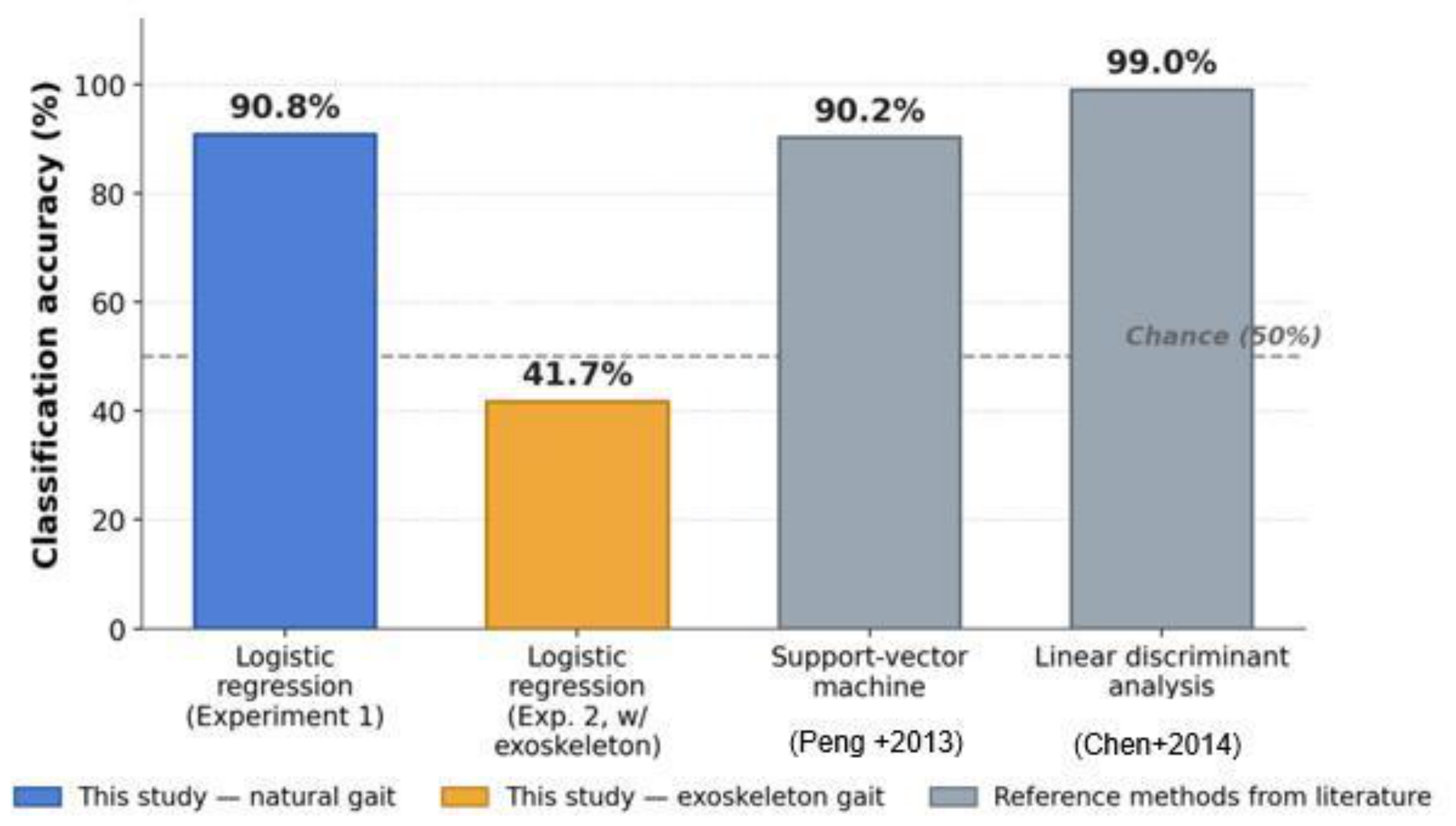
| Hidden Markov model | IMU | Yes | Post hoc | Phase recognition | 91.88% | [16] |
| Exponentially-delayed FCNN | IMU + FSR | Yes | Post hoc | Phase recognition | 97.9 ± 0.1% | [17] |
| Deep convolutional NN | IMU | Yes | Post hoc | Phase recognition | 97% | [18] |
| Gaussian mixture model | IMU | Yes | Post hoc | Behaviour recognition | 95.75–99.33% | [19] |
| Individualised gait-pattern generation | Motion-capture | Yes | Real-time | Behaviour recognition | >97% | [20] |
| Predicted Stance (0) | Predicted Swing (1) | Total | ||
|---|---|---|---|---|
| Observed | Stance (0) | 74 | 6 | 80 |
| Swing (1) | 5 | 35 | 40 | |
| Total | 79 | 41 | 120 |
| Metric | Value (%) |
|---|---|
| Sensitivity (Sn) | 87.50 |
| Specificity (Sp) | 92.50 |
| Positive predictive value (PPV) | 85.37 |
| Accuracy (A) | 90.83 |
| Participant | With Exoskeleton—P1 | With Exoskeleton—P2 | Without Exoskeleton—P1 | Without Exoskeleton—P2 |
|---|---|---|---|---|
| 1 | X | X | O | O |
| 2 | O | O | O | X |
| 3 | O | X | O | O |
| 4 | O | O | O | O |
| 5 | X | X | O | O |
| 6 | X | X | O | O |
| Phase accuracy (%) | 50.0 | 33.3 | 100.0 | 83.3 |
| Pooled accuracy (%) | 41.7 | 41.7 | 91.7 | 91.7 |
Disclaimer/Publisher’s Note: The statements, opinions and data contained in all publications are solely those of the individual author(s) and contributor(s) and not of MDPI and/or the editor(s). MDPI and/or the editor(s) disclaim responsibility for any injury to people or property resulting from any ideas, methods, instructions or products referred to in the content. |
© 2026 by the authors. Licensee MDPI, Basel, Switzerland. This article is an open access article distributed under the terms and conditions of the Creative Commons Attribution (CC BY) license.
Share and Cite
Kim, H.K.; Kim, J.; Park, J. An Analytical Model of Inertial Gait Parameters for the Development of Robotic Exoskeletons for Lower-Limb Rehabilitation. Electronics 2026, 15, 2851. https://doi.org/10.3390/electronics15132851
Kim HK, Kim J, Park J. An Analytical Model of Inertial Gait Parameters for the Development of Robotic Exoskeletons for Lower-Limb Rehabilitation. Electronics. 2026; 15(13):2851. https://doi.org/10.3390/electronics15132851
Chicago/Turabian StyleKim, Hyun K., Jungyoon Kim, and Jaehyun Park. 2026. "An Analytical Model of Inertial Gait Parameters for the Development of Robotic Exoskeletons for Lower-Limb Rehabilitation" Electronics 15, no. 13: 2851. https://doi.org/10.3390/electronics15132851
APA StyleKim, H. K., Kim, J., & Park, J. (2026). An Analytical Model of Inertial Gait Parameters for the Development of Robotic Exoskeletons for Lower-Limb Rehabilitation. Electronics, 15(13), 2851. https://doi.org/10.3390/electronics15132851