Article

Decentralized Optimal Dynamic Control of Interlinking Converters for Priority-Driven Inertia Sharing Among Microgrid Clusters


1
School of Electronic Information, Central South University, Changsha 410075, China
2
School of Automation, Central South University, Changsha 410083, China
*
Author to whom correspondence should be addressed.
Electronics 2026, 15(13), 2825; https://doi.org/10.3390/electronics15132825 (registering DOI)
Submission received: 22 May 2026 / Revised: 12 June 2026 / Accepted: 23 June 2026 / Published: 26 June 2026

Abstract

Interlinking converters (ILCs) are critical interfaces for coordinating power exchange in hybrid ac/dc microgrid clusters. Practically, different microgrids have varying inertia capacities and load priorities, it is urgent to design flexible power exchange control of interlinking converters for priority-driven dynamic sharing. To achieve optimal inertia inter-support among microgrids, a decentralized optimal dynamic control of ILCs is proposed for priority-driven inertia sharing among microgrid clusters. Firstly, an inertia interaction optimization model is established, incorporating subgrid priority weights and inertia-support capacity. Secondly, the established optimization model is implemented in a decentralized manner by deriving a local ILC control law from the optimality condition. Furthermore, a quantitative analytical framework based on a whole equivalent circuit model is constructed to reveal the impact of control parameters on key dynamic indicators. The proposed strategy features high scalability and less-communication requirements of decentralized control, enabling global optimization of transient performance and priority support for critical loads. Finally, the proposed method is validated through five representative cases in a Hardware-in-the-loop (HIL) platform.

1. Introduction

The microgrid constitutes a key architecture for improving flexibility, reliability, and renewable energy integration in renewable power systems [1]. By coordinating local resources, it enables critical infrastructure to sustain autonomous operation during grid failures. Depending on the common bus voltage characteristics, microgrids are generally classified into ac, dc, and hybrid ac/dc configurations [2,3]. Among these, the hybrid ac/dc microgrid combines the advantages of ac microgrids and dc microgrids. By allowing heterogeneous sources and loads to connect directly to their native buses, it reduces multi-stage conversion losses, establishing it as an efficient architecture for future power-electronics-dominated systems [4,5].
To improve operational flexibility, power supply reliability, economic efficiency, and renewable energy integration, the microgrid cluster architecture is widely adopted by interconnecting adjacent microgrids [6,7], as shown in Figure 1. Within the framework, microgrids are interconnected through ILCs to facilitate bidirectional power exchange across ac/dc boundaries [8]. By coordinating power distribution under uncertain disturbances, the ILC allows other cluster members to effectively support local power shortages. It mitigates the frequency and voltage deviations of various microgrids, thereby enhancing the overall disturbance tolerance and operational reliability [9]. Consequently, achieving stable and scalable ILC control under multi-microgrid interactions remains a key issue for the reliable operation of hybrid microgrid clusters.
Control strategies for ILCs are generally categorized into centralized communication-based and decentralized schemes [10,11]. Although communication-based strategies can achieve precise power dispatch, they increase communication burden and costs, reducing scalability [12,13,14]. To address the issues, decentralized ILC control strategies have been widely studied [15]. Among these, the widely adopted dual droop control maps normalized ac frequency and dc voltage deviations into the ILC’s active power reference to enable autonomous steady-state power sharing [16,17]. However, this method lacks an explicit inertial support capability and therefore cannot effectively suppress rapid rate of change in voltage/frequency during transient processes.
To enhance the security and stability of system operations, inertia plays an important role in the power system [18]. With the decline of physical inertia due to renewable integration, Virtual Synchronous Generator (VSG) control has emerged to emulate traditional synchronous generators [19,20]. Extending the concept to hybrid ac/dc microgrid clusters, the swing equation is incorporated into the ILC’s outer control loop [21,22,23]. It enables the converter to provide active inertial support during frequency or dc voltage transients, offering superior dynamic response compared to conventional dual droop methods. However, these VSG-based ILC control approaches typically derive power references from static deviations. Consequently, a systematic framework for dynamically sharing inertia resources among multiple heterogeneous subgrids remains a problem.
To clarify the physical meaning of inertia sharing in hybrid ac/dc microgrid clusters, the concept of inertial power is first specified. In this study, inertial power refers to the fast transient active power released or absorbed by inertia-providing resources in response to rapid variations in system states. In ac subgrids, inertial power is reflected by the rate of change in angular frequency and is traditionally supplied by the kinetic energy of synchronous machines or emulated by grid-forming converters through VSG control. In dc subgrids, since no mechanical frequency variable exists, the analogous inertial power is reflected by the rate of change in dc-bus voltage, which can be supported by dc-link capacitance, storage units, or converter-controlled virtual capacitance. Therefore, inertia sharing in hybrid ac/dc microgrid clusters can be understood as a fast transient active power redistribution process through ILCs. This mechanism differs from conventional steady-state power sharing because it focuses on the initial transient stage and is directly related to RoCoF/RoCoV suppression.
Based on this concept, several ILC-based dynamic power sharing methods have been developed to improve the transient frequency/voltage response of hybrid ac/dc systems [24,25,26,27,28]. These studies demonstrate that ILCs can participate in transient support by coordinating the dynamic responses of adjacent ac and dc subgrids. Unamuno et al. were the first to propose the concept of dual-inertia emulation (DIE) control within a unified per-unit modeling framework [24]. By integrating the rate of change in frequency (RoCoF) and rate of change in voltage (RoCoV) into the ILC active power reference, it autonomously reduces transient disturbances and suppresses rapid dynamic deviations in weak inertia subgrids. Building on this concept, subsequent research has further developed the dynamic power-sharing paradigm. In Ref. [25], a DIE control scheme utilizes decoupled ac and dc inertia-emulation loops to enable autonomous inertial power exchange via the ILC. In Ref. [26], a unified inertia index is introduced to coordinate inter-subgrid inertial support via the ILC, thereby enhancing system-level transient stability. In Ref. [27], an adaptive RoCoX-based droop control embeds normalized RoCoF and RoCoV metrics into the ILC power reference to mitigate rapid dynamic excursions. Furthermore, in Ref. [28], a bidirectional virtual inertia (BVI) strategy employs adaptive transfer coefficients to balance inter-subgrid inertia mismatches during transients. Collectively, these studies transform the ILC from a static power router into a dynamic coordinator of system-wide inertia interaction, enhancing the transient response without relying on external communication links or a centralized controller. As shown in Table 1, existing methods mainly focus on RoCoF/RoCoV suppression, inertia enhancement, or ac/dc transient balancing. Although some of them consider inertia-related coefficients or device capacities, load priority and inertia capacity are not mathematically formulated into an explicit allocation objective. Therefore, when transient support capacity is limited, the ILC may not allocate dynamic support through a mathematically optimal principle according to critical-load priority and available inertia capacity.
To achieve optimal inertia inter-support among microgrids with different load priority and inertia capacity, a decentralized optimal dynamic control of ILCs is proposed for priority-driven inertia sharing among microgrid clusters. Autonomous transient power exchange among ac/dc subgrids with different priority requirements and inertia capacity is realized without relying on external communication links or a centralized controller. An analytical framework is further established to quantify the inter-subgrid transient response characteristics in hybrid ac/dc microgrid clusters. HIL validation is conducted on a four-subgrid ring configured hybrid ac/dc microgrid cluster. The main contributions are summarized as follows.
  • A priority-driven inertia interaction optimization model is established. By integrating priority weights and inertia capacity, the model defines the optimal allocation of inertia support power, overcoming the limitations of conventional global equal sharing rules.
  • A decentralized inter-support control strategy is proposed based on the optimality condition. This strategy transforms the optimization target into a decentralized power interaction law. It enables ILCs to autonomously provide more inertial support toward high-priority and weak-inertia subgrids using only local measurements.
  • A quantitative analytical framework based on a whole equivalent circuit is developed. This framework quantifies the inter-subgrid transient response characteristics. Time-domain solutions are derived to reveal the link between control parameters and transient performance indicators, facilitating systematic parameter design.
The rest of this article is organized as follows. Section 2 outlines the cluster configuration and the basic control of ac/dc subgrids. Section 3 introduces the proposed decentralized inertia sharing strategy. Section 4 establishes the dynamic characterization framework. Section 5 presents the five cases of HIL validation results, followed by the conclusion in Section 6.

2. Hybrid Microgrid Clusters and Subgrid Control

2.1. Configuration of Hybrid Microgrid Clusters

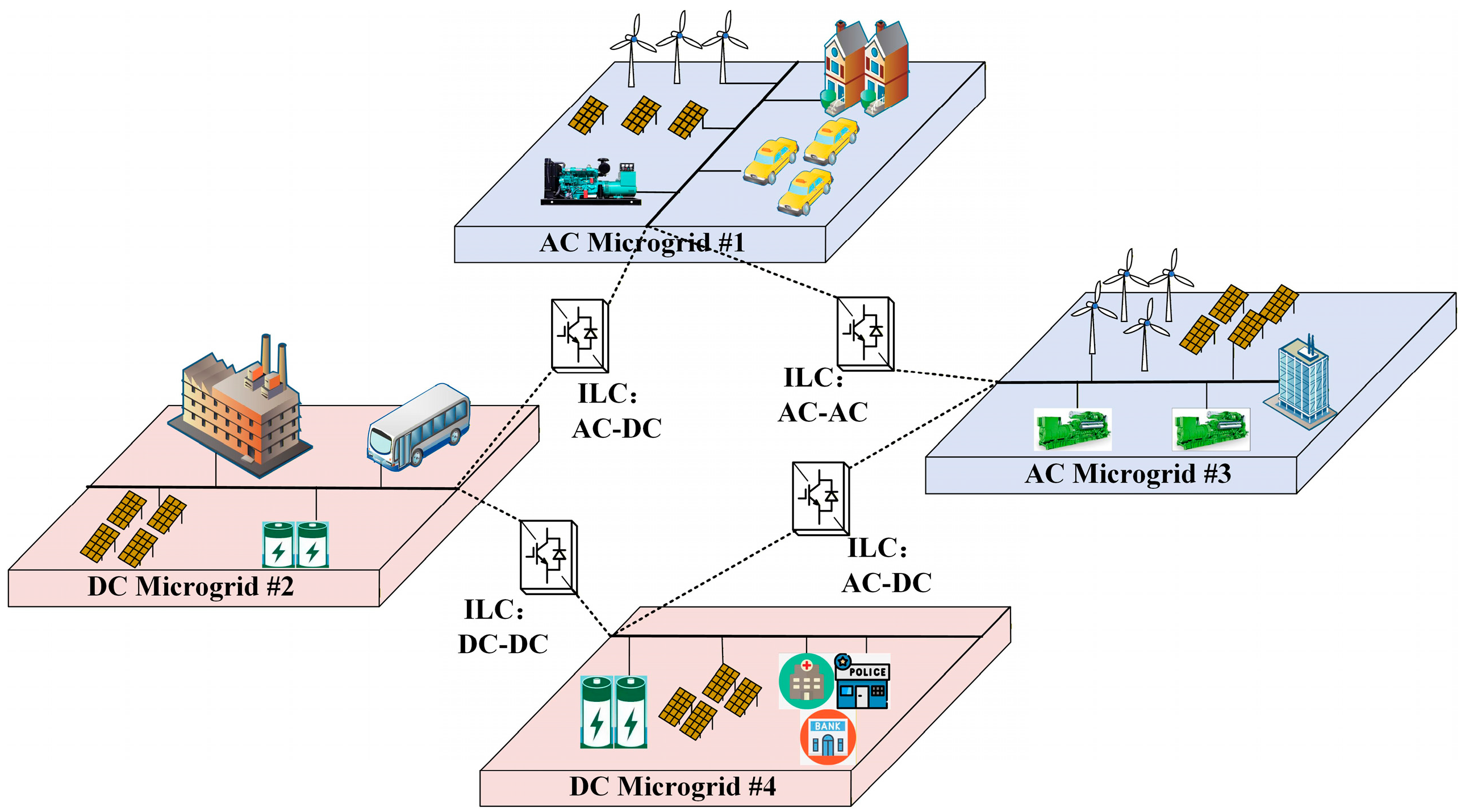
A hybrid ac/dc microgrid cluster integrates multiple self-governed ac or dc subgrids via bidirectional ILCs, as shown in Figure 2. The interconnection layer employs appropriate converter interfaces—dc/dc, ac/ac, or ac/dc—to facilitate power exchange between adjacent subgrids of differing voltage types. This study focuses on the control strategy of ac/dc ILC for hybrid ac/dc microgrid clusters. And a ring-connected topology is adopted as the baseline configuration to establish a clear and reproducible coordination framework in this study [29].
In practical deployments, hybrid microgrid clusters often serve heterogeneous areas with distinct power-quality requirements, demand flexibility, and risk tolerance. To characterize the heterogeneous areas for the design of priority-driven control, a three-level classification framework is introduced to quantify the priority of each subgrid:
  • Level 1 (Critical-Load Subgrids): Highly sensitive infrastructure (e.g., hospitals, data centers) demanding strict stability, assigned a “High” priority weight to ensure power supply reliability.
  • Level 2 (Fixed Non-Critical Subgrids): Standard infrastructure (e.g., industrial plants, commercial centers) operating with moderate tolerance for disturbances, assigned a “Medium” priority weight to balance local power quality with cluster support capability.
  • Level 3 (Flexible-Load Subgrids): Resilient loads (e.g., residential areas) capable of withstanding significant state deviation, assigned a “Low” priority weight to serve as the primary power buffer protecting critical peers.
A quantitative subgrid priority weight, wi, is defined to reflect the relative importance of the i-th subgrid within cluster coordination. A larger wi indicates that the corresponding subgrid should receive preferential protection against severe operational state deviations during disturbances. Conversely, lower priority subgrids are allowed to provide greater power support or tolerate larger operational state deviations under extreme conditions. The design of this weight provides a foundation for the subsequent establishment of the priority-driven transient optimization model.

2.2. Basic Control of ac and dc Subgrids

The secure operation of hybrid ac/dc microgrid clusters relies on the coordinated design of intra-subgrid control and inter-subgrid power interaction, so that each subgrid maintains adequate steady-state regulation and transient support capability. Before proposing the ILC coordination strategy, it is necessary to establish equivalent dynamic models for local control of inertial and non-inertial sources.
Within each subgrid, local distributed sources are generally categorized into non-inertia and inertia sources based on their dynamic characteristics. Non-inertia sources, such as photovoltaic arrays, typically operate in maximum power point tracking (MPPT) mode. Since their active power injection is maximized and non-dispatchable, these non-inertia units are equivalently modeled as negative loads. Inertia sources are typically distributed resources controlled by VSG to provide inertia support. The active power-frequency (for ac subgrids) and active power-voltage (for dc subgrids) dynamics of inertia sources can be described by the swing equation:
J ac ω d ( ω ω ) d t = P ac P ac D ac ( ω ω )
C dc V d ( V V ) d t = P dc P dc D dc ( V V )
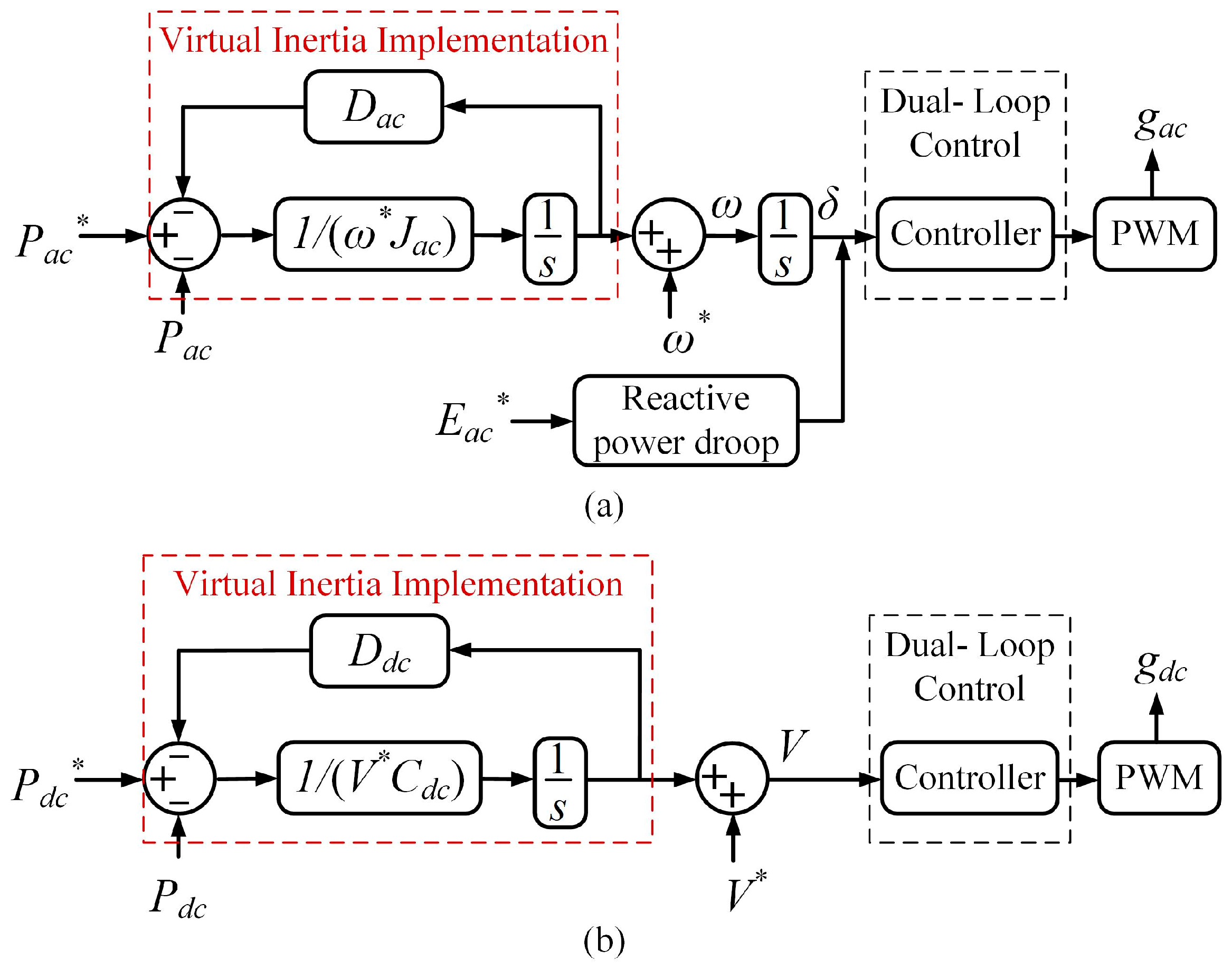
where ω and V denote the ac angular frequency and the dc bus voltage, respectively. ω* and V* are the nominal references. Pac and Pdc are the output active power of inertia sources inside the ac and dc subgrids. Pac* and Pdc* are the reference active power of ac and dc subgrids. Dac and Ddc are damping coefficients. Jac is the virtual rotational inertia on the ac side, and Cdc is the virtual capacitance inertia on the dc side. It should be noted that Cdc represents an equivalent virtual capacitance rather than only the physical dc-link capacitance. In practice, this virtual capacitance is realized by the control of dc-side energy storage converters or other controllable power electronic interfaces. By introducing dc-voltage derivative feedback into the power or current reference, the converter releases or absorbs additional transient power when the dc-bus voltage changes. As a result, the dc subgrid behaves as if it has a larger equivalent capacitance in the external power-balance dynamics. The actual energy support is provided by the dc-link capacitor, storage unit, or controllable dc source, while the magnitude of Cdc is determined by the converter control parameters and limited by the converter power/current ratings. The control block diagram of the ac subnet and dc subgrid is shown in Figure 3. Equations (1) and (2) describe the inertia-dominant dynamics of ac and dc subgrids, respectively. For the ac subgrid, Jac determines the capability of suppressing angular-frequency variation under sudden active power imbalance; thus, a larger Jac leads to a smaller RoCoF under the same disturbance. For the dc subgrid, Cdc plays a similar role in the dc-voltage dynamics, where a larger virtual capacitance reduces the RoCoV caused by power imbalance. Therefore, Jac and Cdc provide the physical basis for defining comparable inertia capabilities in heterogeneous ac and dc subgrids.
The design of Jac and Cdc is related to the inertial power stored in the subgrid, which can be formulated as:
J ac ω d ω / d t l i m i t = P inertia , ac C dc V d V / d t l i m i t = P inertia , dc
where (dω/dt)limit and (dV/dt)limit are the upper limit of RoCoF and RoCoV, which is determined by the standards and the grid code. P*inertia,ac and P*inertia,dc represent the inertia rated power of the ac and dc subgrids. Here, P*inertia denotes the equivalent inertia rated power under the prescribed RoCoF/RoCoV limit. It is used to quantify how much transient power imbalance can be compensated by the inertia-dominant dynamics of a subgrid during the initial disturbance stage. Unlike the steady-state rated power of a converter, P*inertia characterizes the short-term inertia capability and provides a unified power-dimensional index for both ac and dc subgrids.
According to the admissible deviation range, Dac and Ddc are designed as follows:
D ac = 4 P ac , max ω max ω min D dc = 4 P dc , max V max V min
where Pac,max and Pdc,max are the maximum active power capabilities of inertia sources in the ac and dc subgrids, and ωmax, ωmin, Vmax, Vmin are the permitted bounds of ac frequency and dc voltage.

2.3. Control Problem Description of ILCs

Since ac and dc subgrids have different primary operating indicators (frequency and voltage, respectively), a unified metric must be established to evaluate their transient deviations consistently. To enable unified control across ac and dc subgrids, the disparate RoCoF and RoCoV are normalized using per-unit scaling:
d ω d t pu = d ω / d t d ω / d t l i m i t d V d t pu = d V / d t d V / d t l i m i t  
Then, a unified dynamic deviation index (dγ/dt)pu is defined as
d γ d t pu = d ω d t pu   for   ac d V d t pu   for   dc
For clarity, the subscript “,i”, prefix “Δ”, and subscript “pu” indicate the i-th subgrid, changes and p.u. values in this study. A larger absolute value of (dγ/dt)pu,i implies a more severe dynamic deviation of subgrid-i, typically associated with a larger instantaneous shortage or weaker inertial support capability. Combined with the inertia-rated power P*inertia,i defined in (3) and Equations (1) and (2), it can be further inferred that under comparable power disturbances, subgrids with smaller P*inertia,i tend to exhibit larger absolute value of (dγ/dt)pu,i and, therefore, require stronger ILC support.
Based on the defined unified index, the goal of ILC coordination is to allocate the ILC exchange power PILC to suppress the transient deviations across the cluster. To achieve this goal, two critical challenges should be addressed: How to formulate an inertia interaction optimization model that incorporates subgrid priority to protect critical loads? How to realize the priority-driven inertia sharing in a decentralized manner without relying on external communication links or a centralized controller?

3. Proposed Priority-Driven Inertia Sharing Control Scheme of ILCs

3.1. Inertia Sharing Control Model of ILCs Considering the Priorities and Inertia Capacities

In hybrid ac/dc microgrid clusters, coordination among subgrids should not only address the steady-state power allocation issues but also the rapid transient dynamic issues following load or power source disturbances. During the initial transient stage, ILCs are expected to rapidly support transient power to suppress the RoCoF and RoCoV, thereby enabling dynamic inertia sharing across the cluster.
Immediately after a disturbance, the operational state deviations are initially too small for quasi-steady damping regulation to have a significant effect. Consequently, the instantaneous power mismatch is mainly compensated by the inertial response of local resources and the active support from ILCs. Since the transient power shortage is primarily reflected by the RoCoF in ac subgrid and the RoCoV in dc subgrid, the inertia-dominant relation can be formulated as:
J ac ω d ω d t = P inertia , ac C dc V d V d t = P inertia , dc
where Pinertia denotes the inertia power compensated by the inertia resources after the disturbance. Equation (7) implies that the transient shortage first manifests as a rate of change response, and the severity of this response is shaped by the effective inertial buffering capability.
To account for heterogeneous load criticality and power quality requirements across subgrids, a priority weight wi is assigned to each subgrid-i. During this transient process, the coordination objective is to minimize the priority-weighted dynamic deviations across the cluster, formulated as:
min J = i = 1 N w i d γ d t pu , i 2
where N is the total number of subgrids in the cluster. wi is the priority weight of subgrid-i.
The optimization is subject to
P i j Ω i P ILC , ij = P load , i P non-inertia , i ; P j + i Ω j P ILC , ij = P load , j P non-inertia , j ; i = 1 N P i = i = 1 N P load , i P non-inertia , i ; d γ d t pu , i = P inertia , i P inertia , i ;
where PILC, ij is the transient active power delivered from subgrid-i to subgrid-j by the ILC. Ωi is the set of subgrids physically interconnected with subgrid-i. Pi is the active power of inertia sources in subgrid-i. Pload,i is the local load power in subgrid-i. Pnon-inertia,i is the output power of MPPT-controlled non-inertia sources, which can be treated as a negative load. The first two formulas of Equations (9) formulate the local transient active power balance for individual subgrids, explicitly incorporating the ILC active power exchanges. The third sub equation of Equation (9) represents the global active power balance, where the total active power support equals the cluster-wide subgrid shortage. Finally, the fourth sub equation of (9) maps the inertial support active power to the unified dynamic deviation (dγ/dt)pu,i. Through the mapping, the decision variables PILC,ij can directly regulate dynamic deviations, forming the physical foundation of inertia sharing.
From the first two formulas of (9), the ILC power PILC,ij only redistributes transient active power among interconnected subgrids. When the local power-balance equations of all subgrids are summed together, the internal ILC exchange terms cancel out, and the cluster-level active power shortage Puncertainty is obtained as
P uncertainty = i = 1 N P load , i P non-inertia , i
According to the third sub equation of (9), this shortage must be supplied by the inertial power contributions of all subgrids. Furthermore, from the fourth sub equation of (9), the inertial power contribution of subgrid-i can be represented by P*inertia(dγ/dt)pu,i. Therefore, the cluster-level transient power-balance constraint can be written as
i = 1 N P inertia , i d γ d t pu , i = P uncertainty
Based on (11), the detailed local power-balance problem is converted into a cluster-level transient mismatch allocation problem. The optimization objective is to allocate the required inertial support among subgrids while minimizing their priority-weighted dynamic deviations. Thus, the following simplified quadratic program is obtained:
min J = i = 1 N w i d γ d t pu , i 2 s . t .   i = 1 N P inertia , i d γ d t pu , i = P uncertainty
In practical converter systems, the simplified allocation model in (12) is further subject to physical feasibility constraints. The main constraints include the ILC active power limit |PILC,ij| ≤ PILC,ijmax, the converter current limit iiiimax, the subgrid inertia capability |Pinertia,i| ≤ P*inertia,i, the power ramp rate limit |dPILC,ij/dt| ≤ Rmax, and the dc-link voltage bound Vdc,minVdcVdc,max.
For the nominal simplified quadratic program in (12), the allocation variable is the unified dynamic-deviation indicator (dγ/dt)pu,i. The objective function is a weighted quadratic function with positive priority weights, and the cluster-level transient power-balance constraint is affine with respect to (dγ/dt)pu,i. Therefore, the objective Hessian is positive definite, and the feasible set defined by the balance constraint is convex. The nominal problem in (12) is thus convex and admits a unique optimum. If the obtained nominal solution remains inside the physical feasible range described above, the optimality condition can be derived from the following Lagrangian formulation [30].
Construct the Lagrangian of (12) as
L = i = 1 N w i d γ d t pu , i 2 + λ P uncertainty i = 1 N P inertia , i d γ d t pu , i
where λ is the Lagrange multiplier. Therefore, the optimum solution is obtained by solving the following equation:
L d γ d t pu , i = 2 w i d γ d t pu , i λ P inertia , i = 0   for i = 1 , , N
From (14), the necessary optimality condition is obtained as
w 1 P inertia , 1 d γ d t pu , 1 = w 2 P inertia , 2 d γ d t pu , 2 = = w N P inertia , N d γ d t pu , N
Equation (15) provides a compact necessary condition characterizing the optimal solution of the priority-driven transient coordination problem. Although the exchange powers PILC,ij cannot be solved directly due to the load uncertainty, (15) reveals a clear coordination principle: the objective in (8) is minimized when the interlinked subgrids satisfy the equalization relationship. Therefore, (15) serves as the theoretical foundation for decentralized ILC control design, and the subsequent controller is constructed to autonomously drive the system toward this condition.
To drive the interconnected subgrids toward the optimality condition in a decentralized manner, each ILC simply adjusts its power flow based on the local mismatch between its two connected subgrids. Specifically, the ILC exchange active power reference is formulated as:
P ILC , ij = k d w i P inertia , i d γ d t pu , i w j P inertia , j d γ d t pu , j
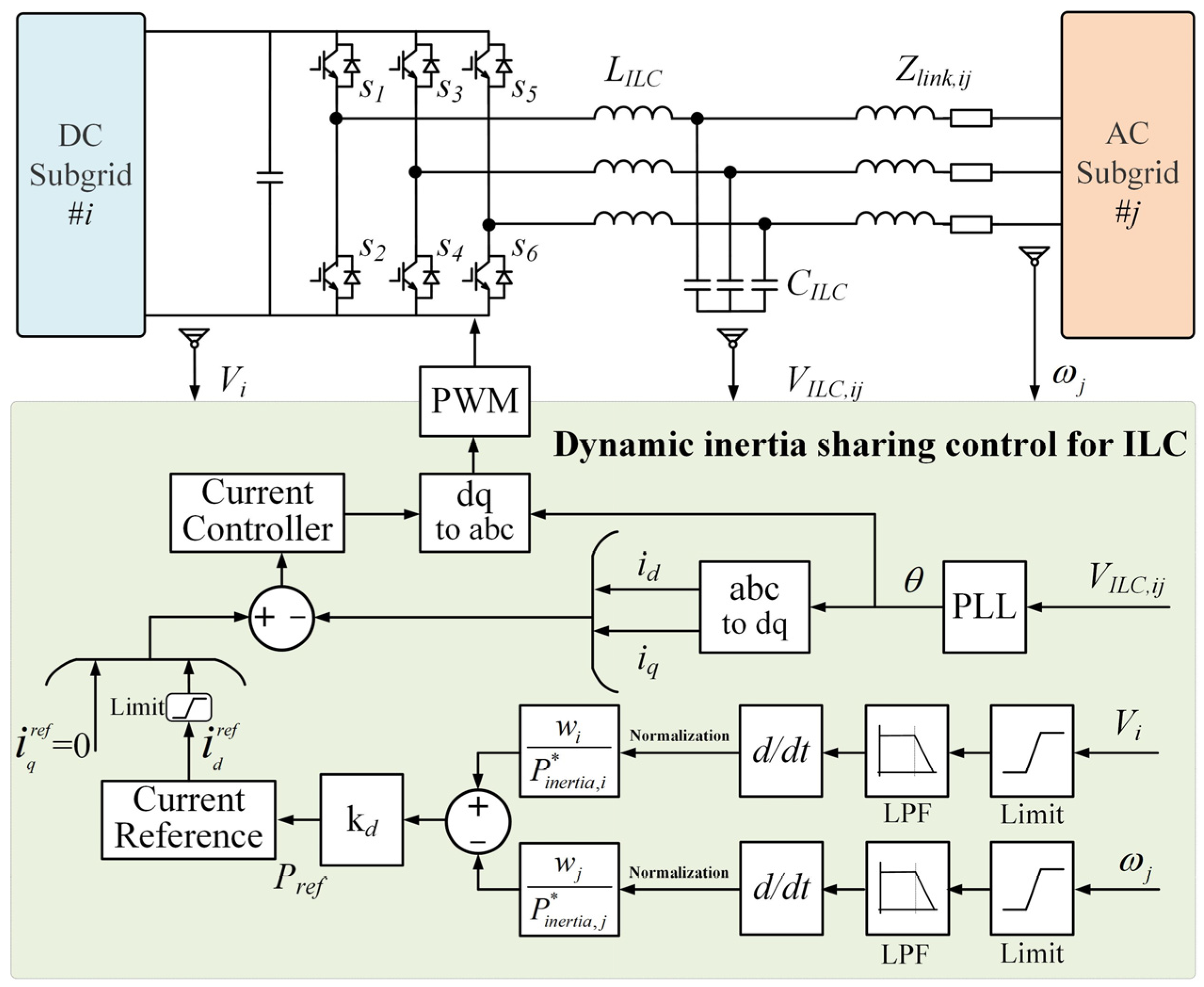
where kd is the dynamic control gain and P*ILC,ij is the transient exchange active power reference from subgrid-i to subgrid-j, and P*ILC,ij = −P*ILC,ji. Specifically, the sign of the difference term determines the power flow direction, and these local interactions drive the cluster to the equalization condition in (15). The control block diagram of the ILC is shown in Figure 4. The control law in (16) provides a nominal ILC power reference derived from the simplified allocation model. If this reference is within the physical feasibility constraints, it can be directly applied to the converter. Otherwise, it will be limited by protection modules such as active power, power ramp rate, etc. Therefore, when the required transient support exceeds the available ILC or subgrid capability, the controller only provides the maximum feasible support instead of enforcing an infeasible command. In this case, the priority-weighted optimality condition may not be exactly satisfied, and residual frequency/voltage deviations may remain.
It should be noted that the proposed controller does not require neighbor-state sharing through an external communication network. For each ILC connecting subgrid-i and subgrid-j, the unified dynamic deviation indices of the two connected subgrids are obtained from the local two-terminal measurements of the ILC. Specifically, for an ac terminal, the bus voltage is measured, and the angular frequency is estimated through a PLL; the RoCoF is then generated by a filtered differentiator. For a dc terminal, the dc-bus voltage is directly measured and the RoCoV is obtained through the same filtered differentiator. Therefore, the required dynamic deviation indices are locally calculated inside the ILC controller, with the low-pass cut-off parameter of the filtered differentiator given in Table 2.
From (15) and (16), the proposed inertia-sharing strategy contains two offline design parameters: the priority weight wi and the inertia capacity P*inertia,i. The priority weight wi reflects the transient protection requirement of subgrid-i, while P*inertia,i represents its designed inertia capacity. In practice, the weight is determined before online control according to engineering requirements. Let xi = (dγ/dt)pu,i denote the unified dynamic-deviation indicator. For an ac subgrid, the allowable bound xi,max is specified from the permitted RoCoF limit; for a dc subgrid, xi,max is specified from the permitted RoCoV limit. These limits can be obtained from grid-code requirements, power-quality criteria, load criticality, or engineering specifications. After xi,max is determined, the effective weighting ratio is selected according to wi/P*inertia,i ∝ 1/xi,max, or equivalently wi = κP*inertia,i/xi,max, where κ is a normalization factor used to set the normal-priority weight to 1. Therefore, wi is not obtained by online parameter tuning or by inversely solving the optimality condition. Instead, it is determined offline from the allowable RoCoF/RoCoV margin and the inertia capacity, and the optimality condition is then used to guide the priority- and capacity-driven transient support allocation by (16).
The control law in (16) provides a clear physical interpretation when applied to an ac/dc interlinking scenario. To illustrate this, consider a specific pair where subgrid-i operates as a dc subgrid and subgrid-j operates as an ac subgrid. For clarity, the positive direction of active power flow is defined from the dc side to the ac side. Under this convention, a positive power command implies that the ILC operates in inverter mode, whereas a negative command dictates rectifier mode.
By substituting the definitions of Pinertia,i and (dγ/dt)pu into (16), the exchange active power reference of the ILC can be expanded into an explicit function of the rates of change, as formulated in (17):
P ILC , dc ac = k d w dc d γ / d t pu , dc P inertia , dc w ac d γ / d t pu , ac P inertia , ac = k d w d c J ac ω d ω / d t l i m i t d V / d t l i m i t d V d t w ac C dc V d V / d t l i m i t d ω / d t l i m i t d ω d t
where k d denotes the revised dynamic control gain. Equation (17) reveals that the optimal transient power exchange consists of two cross-coupled inertial support components:
  • ac-to-dc Support (Term 1): This component is driven by the RoCoV, and its magnitude is proportional to the ac-side virtual inertia (Jac). Physically, during a dc voltage fluctuation, the ILC transfers transient power from the ac subgrid to support the dc subgrid. The priority weight wdc determines the intensity of the support. Essentially, this term enables the dc subgrid to utilize the virtual inertia of the ac side.
  • dc-to-ac Support (Term 2): Conversely, this component is driven by the RoCoF, and its magnitude is proportional to the dc-side virtual capacitance (Cdc). This indicates that during ac frequency fluctuations, the ILC utilizes the transient energy from the dc-side capacitors to support the ac subgrid. Here, the priority weight wac regulates the amount of dc capacity allocated to preserve transient frequency response characteristics.
Therefore, (17) proves that the essence of the proposed coordination is a bidirectional transient support mechanism, rather than a unidirectional static power transfer. Specifically, the ILC effectively enables the ac subgrid to act as an inertia source for the dc subgrid and simultaneously utilizes the dc subgrid as an inertia source for the ac subgrid. This mutual coupling mechanism enhances the transient response characteristics across different subgrids, which reflects the concept of inertia sharing. Furthermore, it theoretically justifies why the ILC controller should simultaneously incorporate both RoCoF and RoCoV information to achieve the global optimum defined in (8).

3.2. Small Signal Stability Analysis of ILCs Among Four Microgrid

To evaluate the dynamic interactions among multiple ILCs during transient processes and verify the stability of the closed-loop system, a small-signal state-space model of the microgrid clusters with a four-subgrid ring topology is established in this section.
First, linearizing (1), (2), (9), and (16) around the steady-state operating points yields the small-signal models for the AC subgrid frequency, DC subgrid voltage, interlinking converter power reference, and subgrid power allocation, which are detailed as Equations (A1)–(A4) in Appendix A.
Since the bandwidth of the current loop is much higher than in the power loop in the ILC, the current controller of the ILC is modeled as a low-pass filter (LPF) [27]. On these premises, the active power of the ILC can be derived as Equation (A5) in Appendix A.
Rewriting (A1)–(A5) in matrix form, the state-space equations for the power control stability of the ILC are presented as:
V ˜ ˙ 1 ω ˜ ˙ 2 ω ˜ ˙ 3 V ˜ ˙ 4 V ˜ ˙ s 1 ω ˜ ˙ s 2 ω ˜ ˙ s 3 V ˜ ˙ s 4 P ˜ ˙ ILC , 12 P ˜ ˙ ILC , 13 P ˜ ˙ ILC , 42 P ˜ ˙ ILC , 43 = A I L C V ˜ 1 ω ˜ 2 ω ˜ 3 V ˜ 4 V ˜ s 1 ω ˜ s 2 ω ˜ s 3 V ˜ s 4 P ˜ ILC , 12 P ˜ ILC , 13 P ˜ ILC , 42 P ˜ ILC , 43
where the closed-loop system state matrix AILC is given in the following simplified form:
A ILC = A x 0 B p ω α I ω α I 0 ω c k d H ω c k d H ω c I
The detailed analytical expressions for the constituent submatrices within the state matrix AILC are provided as Equation (A6) in Appendix A.
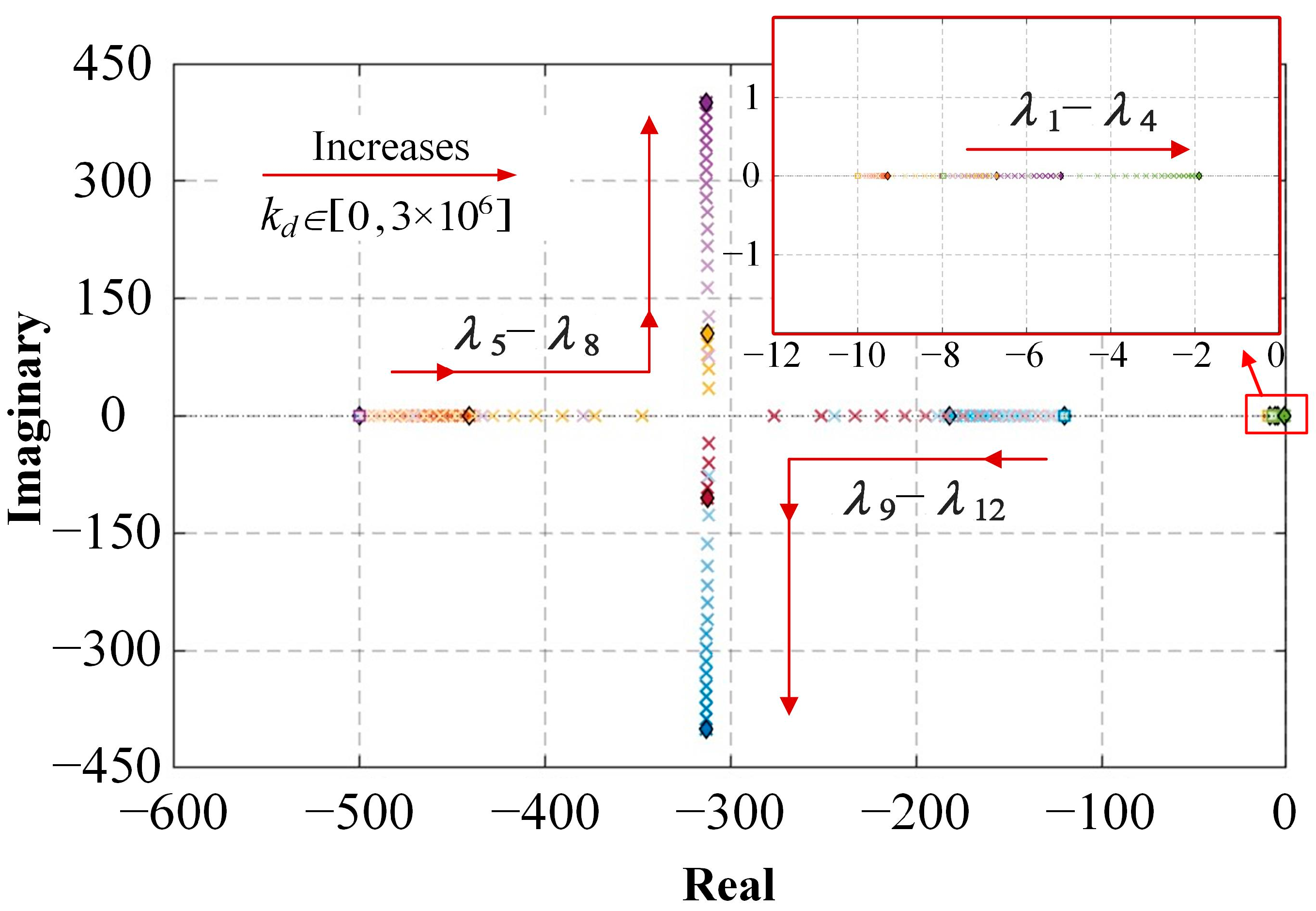
To verify the stability of the proposed strategy and guide the selection of key control parameters, Figure 5 shows the root locus with the dynamic control gain kd varies from 0 to 3 × 10⁶.
As indicated by the root locus analysis, with the increase in the dynamic control gain kd, the dominant poles of the system gradually move to the right and approach the imaginary axis. This leads to a decrease in the transient damping ratio, making the closed-loop system prone to instability. Therefore, it is of great importance to select an appropriate dynamic control gain kd to ensure stability and satisfactory dynamic responses of the system.

4. Analytical Modeling and Transient Performance Evaluation of Hybrid ac/dc Microgrid

To quantify the transient response characteristics of subgrids under disturbances, this section establishes a dynamic characterization framework. First, a whole equivalent circuit model is established by mapping the control laws into equivalent dynamic impedances [31]. Based on this model, the time-domain expressions for the dc-bus voltage and ac frequency are analytically derived. These expressions are then used to formulate key transient indicators. Ultimately, this framework reveals how dynamic control gain kd shapes the transient global performance, providing a theoretical basis for parameter design.

4.1. Establishment of Whole Equivalent Circuit Model

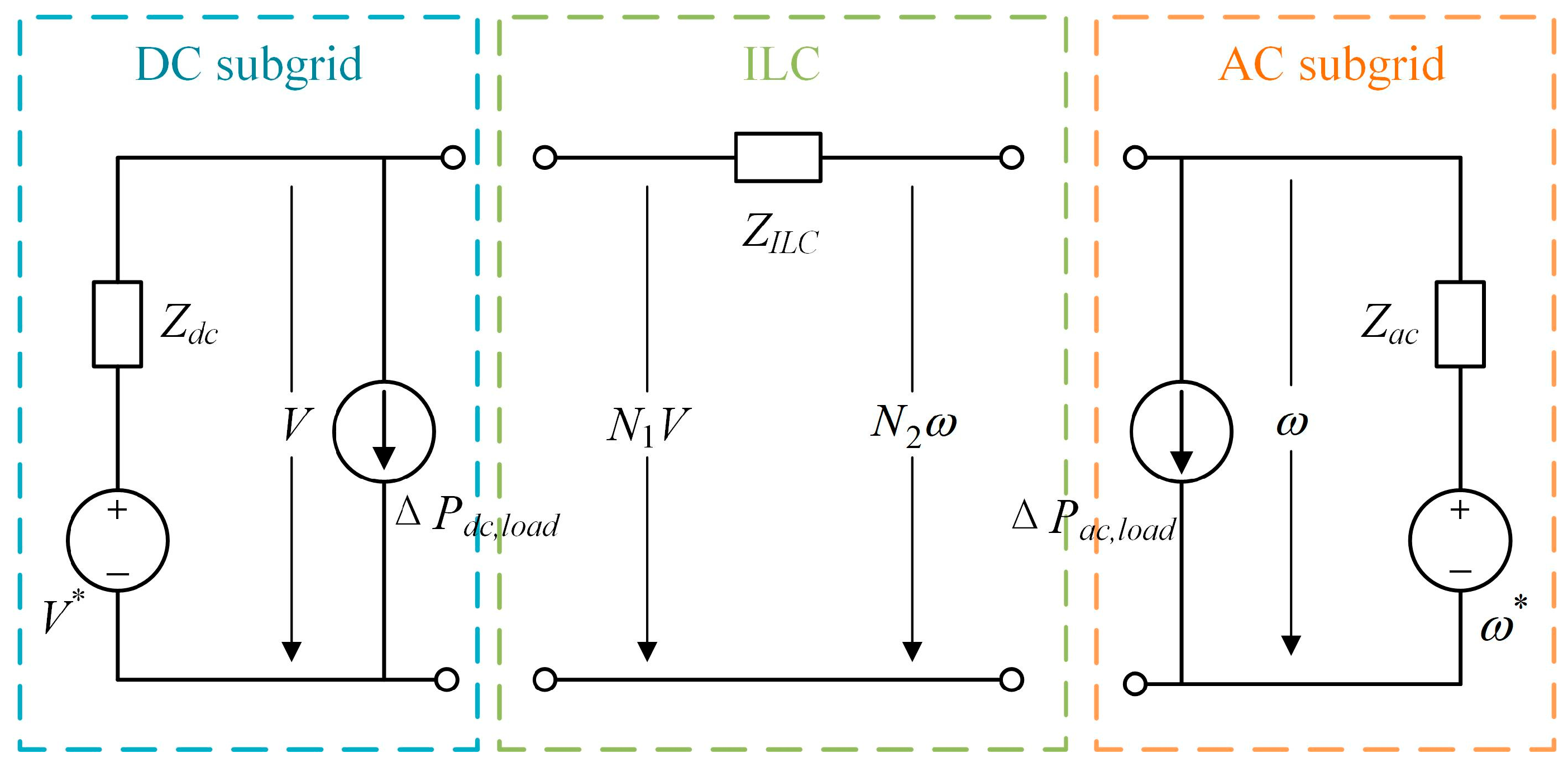
To establish a comprehensive dynamic characterization framework, this section first develops a whole equivalent circuit model to uniformly represent the power regulation dynamics, as shown in Figure 6.
Firstly, small-signal modeling of the subgrids is performed around the equilibrium points, and the transfer functions from the load changes to the bus voltage/frequency fluctuations can be expressed as:
ω ˜ s P ˜ ac ( s ) = 1 J ac ω s + D ac = Z ac ( s ) V ˜ ( s ) P ˜ dc ( s ) = 1 C dc V s + D dc = Z dc ( s )
where ‘’ denotes small perturbation around equilibrium points. By defining the regulated variables as W(s) = col(V(s), ω(s)), the references as M(s) = col(V*(s), ω*(s)), the equivalent dynamic impedances as Z(s) = diag(Zdc(s), Zac(s)), and the power disturbance vector as Ip(s) = col(ΔPdc(s), ΔPac(s)), the bus voltage/frequency can be derived as:
W s = M s Z s I p s
In the hybrid ac/dc microgrid, the ILC dynamically distributes the transient load disturbances between the two subgrids. Specifically, the net equivalent power deviations are determined by the superposition of the local load changes and the ILC transferred power, which can be expressed as:
P ˜ dc s = P ˜ dc , load s + P ˜ ILC s P ˜ ac s = P ˜ ac , load s P ˜ ILC s
where Pdc,load and Pac,load denote the local load powers of the dc and ac subgrids. According to (16), the dynamic power transferred by the ILC is governed by the priority-weighted difference between the dc-voltage and ac-frequency deviations. In the Laplace domain, this control behavior can be expressed as follows:
Z ILC s = N 1 V ˜ s N 2 ω ˜ s P ˜ ILC s = 1 k d s
where
N 1 = w dc P inertia , dc d V / d t l i m i t ,   N 2 = w ac P inertia , ac d ω / d t l i m i t
Assuming that W refers to the voltage source, Ip refers to the current source and Z inherently represents impedance, (21) resembles the format of Thevenin equivalent circuit in each subgrid. Furthermore, with the help of (23), the ports of each Thevenin equivalent circuit can be interconnected by ZILC. It should be noted that the diagonal impedance matrix in (21) is used to characterize the local inertia-dominant dynamics of the dc and ac subgrids before interconnection. This does not imply that the complete interconnected system is decoupled. The bidirectional inertial coupling introduced by (17) is represented by the equivalent ILC branch in (23), where the dc-voltage deviation and ac-frequency deviation jointly determine the transferred ILC power. Therefore, after the local subgrid ports are interconnected through ZILC, the overall equivalent circuit becomes a coupled system, even though the local subgrid impedance matrix is initially expressed in a diagonal form.

4.2. Establishment of Quantitative Models

Firstly, taking the dc bus voltage as an example for analysis. Substituting (22) and (23) into (21) and eliminating internal variables yields an explicit expression of the dc-bus voltage in the Laplace domain:
V ( s ) = Z ILC ( s ) + N 2 Z ac ( s ) V ( s ) + N 2 Z dc ( s ) ω ( s ) Z ILC ( s ) + N 1 Z dc ( s ) + N 2 Z ac ( s ) + Z dc ( s ) Z ILC ( s ) + N 2 Z ac ( s ) P dc , load ( s ) N 2 Z dc ( s ) Z ac ( s ) P ac , load ( s ) Z ILC ( s ) + N 1 Z dc ( s ) + N 2 Z ac ( s ) = N ( s ) D ( s )
To derive a time-domain response necessary for transient indicators evaluation, consider step load variations:
P dc , load ( t ) = P dc , load 0 + Δ P dc , load u ( t ) P ac , load ( t ) = P ac , load 0 + Δ P ac , load u ( t )
where Pdc,load0 and Pac,load0 denote the pre-disturbance net powers of the dc and ac subgrids, respectively. To determine the system poles, the denominator in (24) is reformulated into a characteristic second-order polynomial:
D ( s ) = A 2 s 2 + A 1 s + A 0
where
A 0 = b d , A 1 = a d + b c + k d N 1 d + N 2 b A 2 = a c + k d N 1 c + N 2 a a = C dc V ,   b = D dc ,   c = J ac ω ,   d = D ac
Accordingly, the poles are
p 1 , 2 = A 1 ± A 1 2 4 A 2 A 0 2 A 2
Thus, performing the inverse Laplace transformation of (24), the time domain expression of dc-bus voltage can be shown as:
V ( t ) = V ( ) + R 1 e p 1 t + R 2 e p 2 t
And the steady-state value is
V ( ) = V P dc , load 0 + Δ P dc , load D dc
where
R 1 = B 1 p 1 + B 0 p 1 A 2 ( p 1 p 2 ) R 2 = B 1 p 2 + B 0 p 2 A 2 ( p 2 p 1 ) B 1 = c Δ P dc , load + k d N 2 Δ P dc , load + Δ P ac , load B 0 = d Δ P dc , load
It is worth noting from (29)–(31) that the ac-side disturbance ΔPac,load contributes exclusively to the transient term via B1, leaving the steady-state value unaffected. Furthermore, (24)–(31) indicate that increasing the dynamic gain kd will shift the closed-loop poles P1, P2 and amplify the ac-to-dc disturbance injection during the transient stage.
Following a similar derivation procedure to that of the dc-bus voltage, the time-domain expression for the ac-bus angular frequency can be obtained as:
ω ( t ) = ω ( ) + R 1 ω e p 1 t + R 2 ω e p 2 t
And the steady-state value is
ω ( ) = ω P ac , load 0 + Δ P ac , load D ac
where
R 1 ω = B 1 ω p 1 + B 0 ω p 1 A 2 ( p 1 p 2 ) R 2 ω = B 1 ω p 2 + B 0 ω p 2 A 2 ( p 2 p 1 ) B 1 ω = a Δ P ac , load + k d N 1 Δ P ac , load + Δ P dc , load B 0 ω = b Δ P ac , load
Based on the explicit response (29) and (32), transient metrics can be derived analytically. The RoCoV and RoCoF are
RoCoV ( t ) = d V ( t ) d t = R 1 p 1 e p 1 t + R 2 p 2 e p 2 t RoCoF ( t ) = 1 2 π d ω ( t ) d t = 1 2 π R 1 ω p 1 e p 1 t + R 2 ω p 2 e p 2 t
The voltage nadir and frequency nadir are obtained by setting RoCoV(t) = 0 and RoCoF(t) = 0,
t nadir , dc = 1 p 1 p 2 ln R 2 p 2 R 1 p 1 t nadir , ac = 1 p 1 p 2 ln R 2 ω p 2 R 1 ω p 1
Accordingly,
V m = V ( t nadir , dc ) = V ( ) + R 1 e p 1 t nadir , dc + R 2 e p 2 t nadir , dc ω m = ω ( t nadir , ac ) = ω ( ) + R 1 ω e p 1 t nadir , ac + R 2 ω e p 2 t nadir , ac
Moreover, define the pre-disturbance steady value V (0) = V*Pdc,load0/Ddc, ω (0−) = ω*Pac,load0/Dac. Using a 5% settling band, the settling time ts is determined by
V ( t sdc ) V ( ) V ( ) V ( 0 ) = 0.05 ω ( t sac ) ω ( ) ω ( ) ω ( 0 ) = 0.05
where tsdc and tsac denote the settling times.
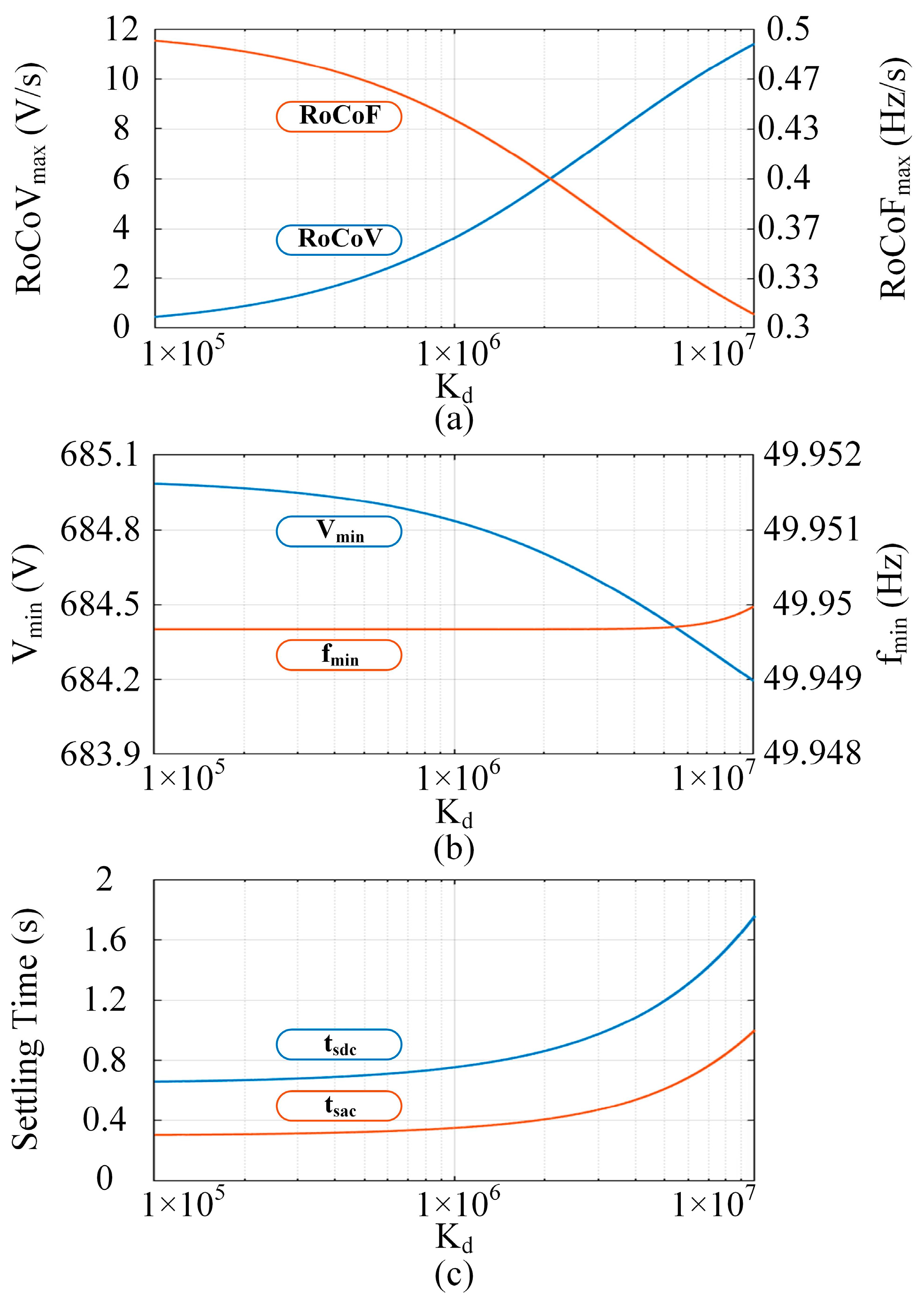
In summary, quantitative analytical models for transient indicators are established. As the core parameter of the proposed control law, kd influences the key dynamic indicators (RoCoVmax, RoCoFmax, nadirs, and settling times). Figure 7 plots these key dynamic indicators across varying dynamic control gains kd from 1 × 10⁵ to 1 × 10⁷. The simulation configuration adopts simplified two-subgrid tests, where a 2.5 kW step load increase is applied to the ac subgrid. These curves provide a theoretical guideline for parameter selection and controller design.

5. Hardware-in-the-Loop (HIL) Results

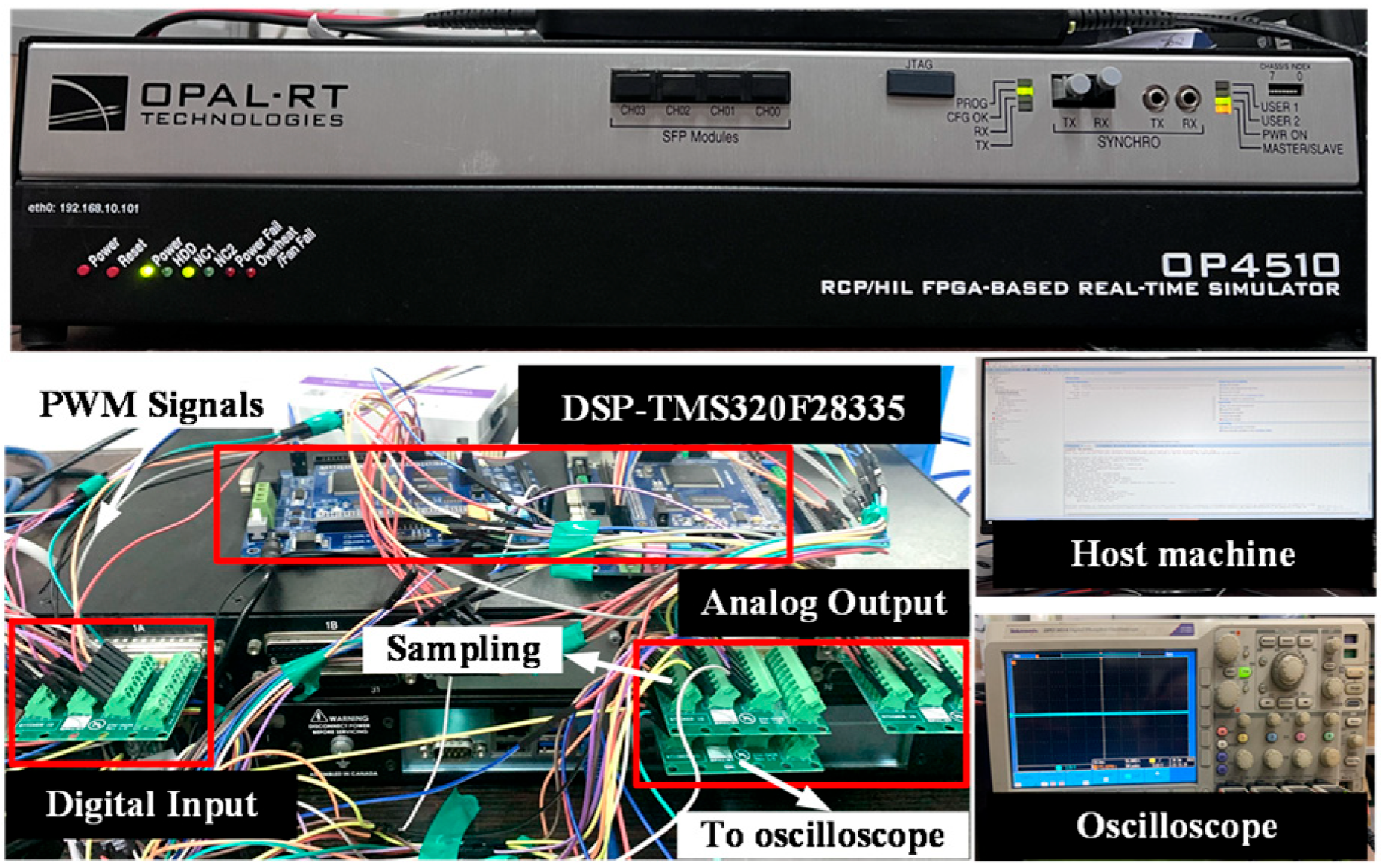
The proposed inertia sharing control strategy is verified by real-time HIL tests. The HIL platform is shown in Figure 8. The main circuit is emulated in the OPAL-RT4510 simulator (manufactured by OPAL-RT Technologies, Montreal, QC, Canada). The controller of the converter is implemented in the DSP control board. The detailed HIL implementation parameters are listed in Table 2. The experimental data are extracted from the oscilloscope.
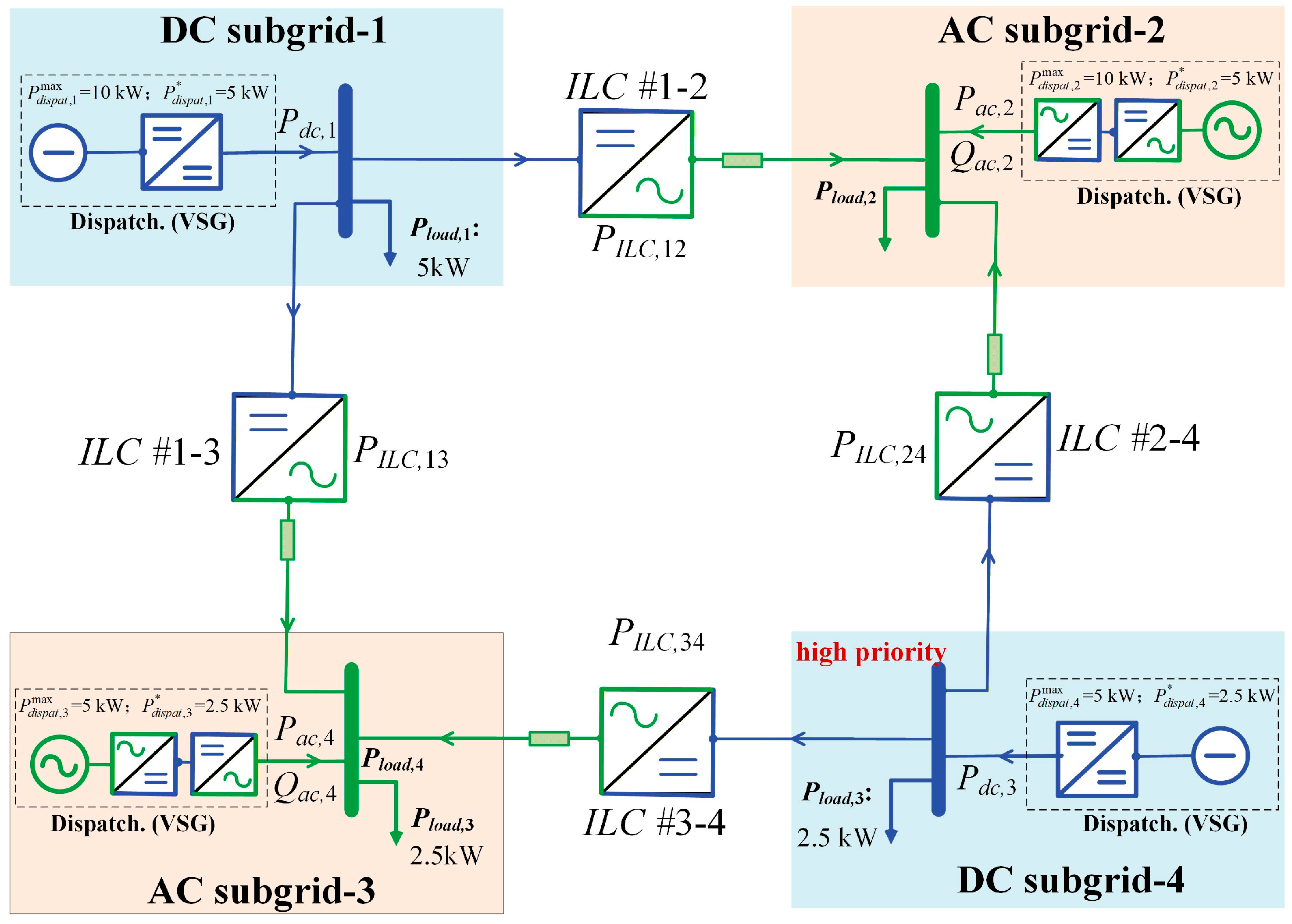
The studied system model of four hybrid ac/dc microgrids is described in Figure 9. The ring topology in Figure 9 is used as a representative fixed connected configuration for verification. Since the proposed ILC control law is edge-based and only uses the dynamic-deviation information of the two subgrids connected to each ILC, the same principle can be extended to other fixed connected topologies, such as meshed microgrid clusters. Subgrid-1 and Subgrid-4 are dc type. Subgrid-2 and Subgrid-3 are ac type. There are four H-bridge-based bidirectional ILCs to interlink the four subgrids, ILC#12, ILC#24, ILC#34 and ILC#13. The power flow direction reference of a positive active power is assumed from dc side to ac side. For example, PILC,12 implies the power exchange value of ILC#12 from Subgrid-1 to Subgrid-2. When the power value is more than zero, the ILC works in inverter mode, and when less than zero, the ILC works in rectifier mode.
The physical and control parameters in the HIL system are listed in Table 2. The priority weights wi of four subgrids are 1, 1, 1, and 3, respectively. The dc Subgrid-4 has a high priority of power supply and high requirement of RoCoV. In addition, the dispatchable power capacity of Subgrid-1/Subgrid-2 is twice as much as that of Subgrid-3/Subgrid-4. The nominal power capacities of four subgrids are 5, 5, 2.5, and 2.5 kW, respectively. According to the specified inertia capacity and allowable dynamic-deviation margins, the normalized priority weights used in the HIL study are selected as 1, 1, 1, and 3, respectively. This setting indicates that Subgrid-4 is assigned a stricter allowable RoCoV margin and thus a higher effective priority for transient support.
(1)
Case 1: verification of basic inertia sharing mechanism
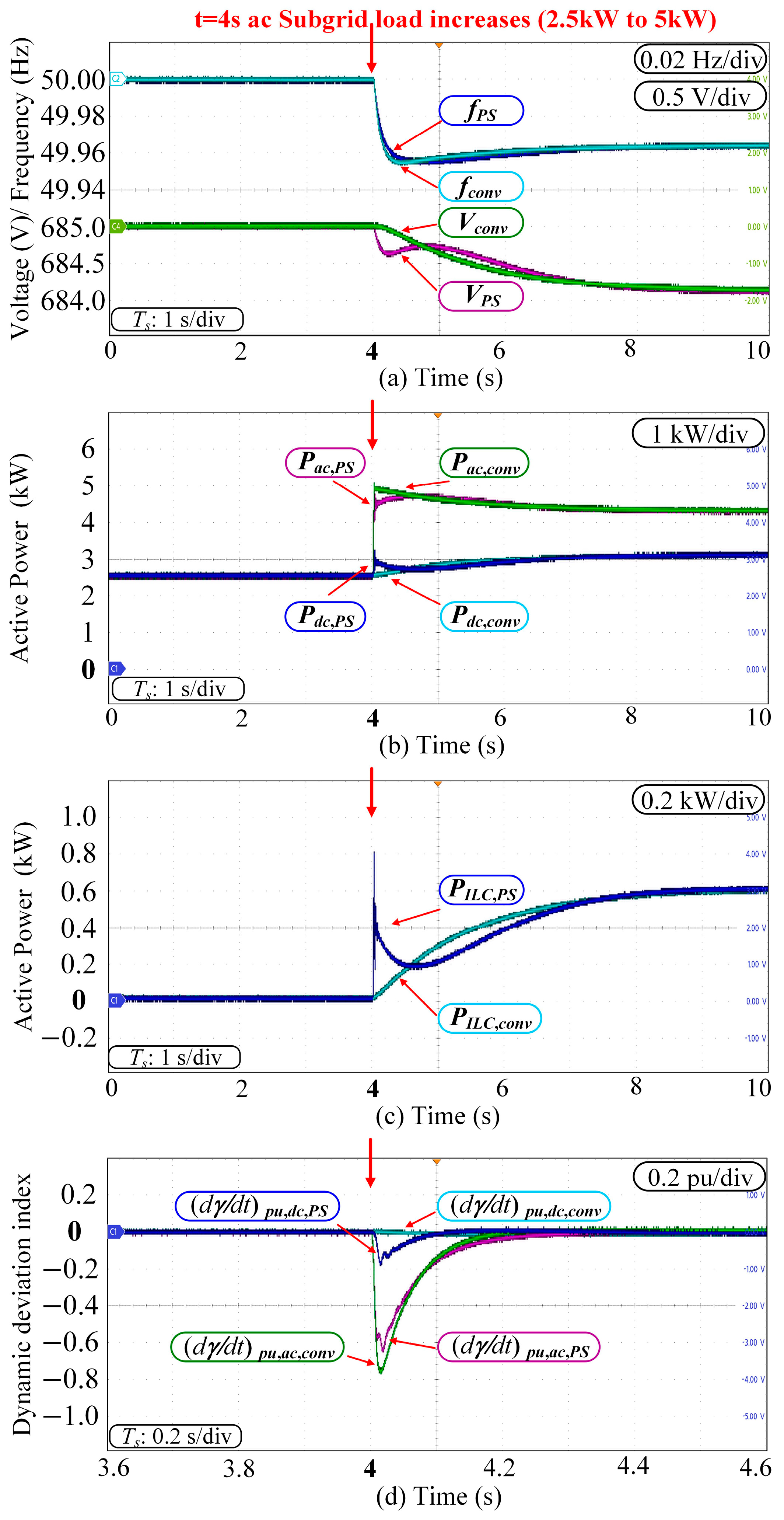
Case 1 aims to verify the effectiveness of the proposed inertia sharing strategy. In this case, only an ac Subgrid with wi =1 and a dc Subgrid with wi = 3 is interconnected via the ILC, forming a simplified two-subgrid test. With the system initially operating at the nominal load of 2.5 kW, a 2.5 kW step load increase is applied to the ac subgrid at t = 4 s, while the load of the dc subgrid remains at the nominal value. Figure 10 shows the experiment results under the proposed strategy (denoted by the subscript “PS”) versus the conventional dual droop strategy (denoted by the subscript “conv”) [15].
Specifically, from Figure 10a, the proposed strategy improves transient frequency response characteristics in the ac subgrid but worsens the voltage transient characteristics in the dc subgrid. Figure 10b shows that the proposed strategy actively drives the dc subgrid to rapidly increase its active power output during disturbances. From Figure 10c, the proposed strategy drives the ILC to rapidly transfer active power from the dc subgrid to the disturbed ac subgrid. As shown in Figure 10d and Table 3, the conventional dual-droop strategy results in a severe dynamic deviation in the ac subgrid, while the dc-side deviation remains small (dc: −6.56 × 10⁻⁴ and ac: −0.76). In contrast, the proposed strategy effectively reduces the dynamic deviation indices in the ac subgrid at the expense of the dc subgrid’s performance (dc: −0.14; ac: −0.64), reducing the overall optimization objective J from 0.577 to 0.466. These results indicate that the proposed strategy improves the priority-weighted global transient performance by redistributing the dynamic burden between the interconnected subgrids, rather than independently improving the local dynamic index of each subgrid.
(2)
Case 2: Validation of the Equivalent Dynamic Circuit Model
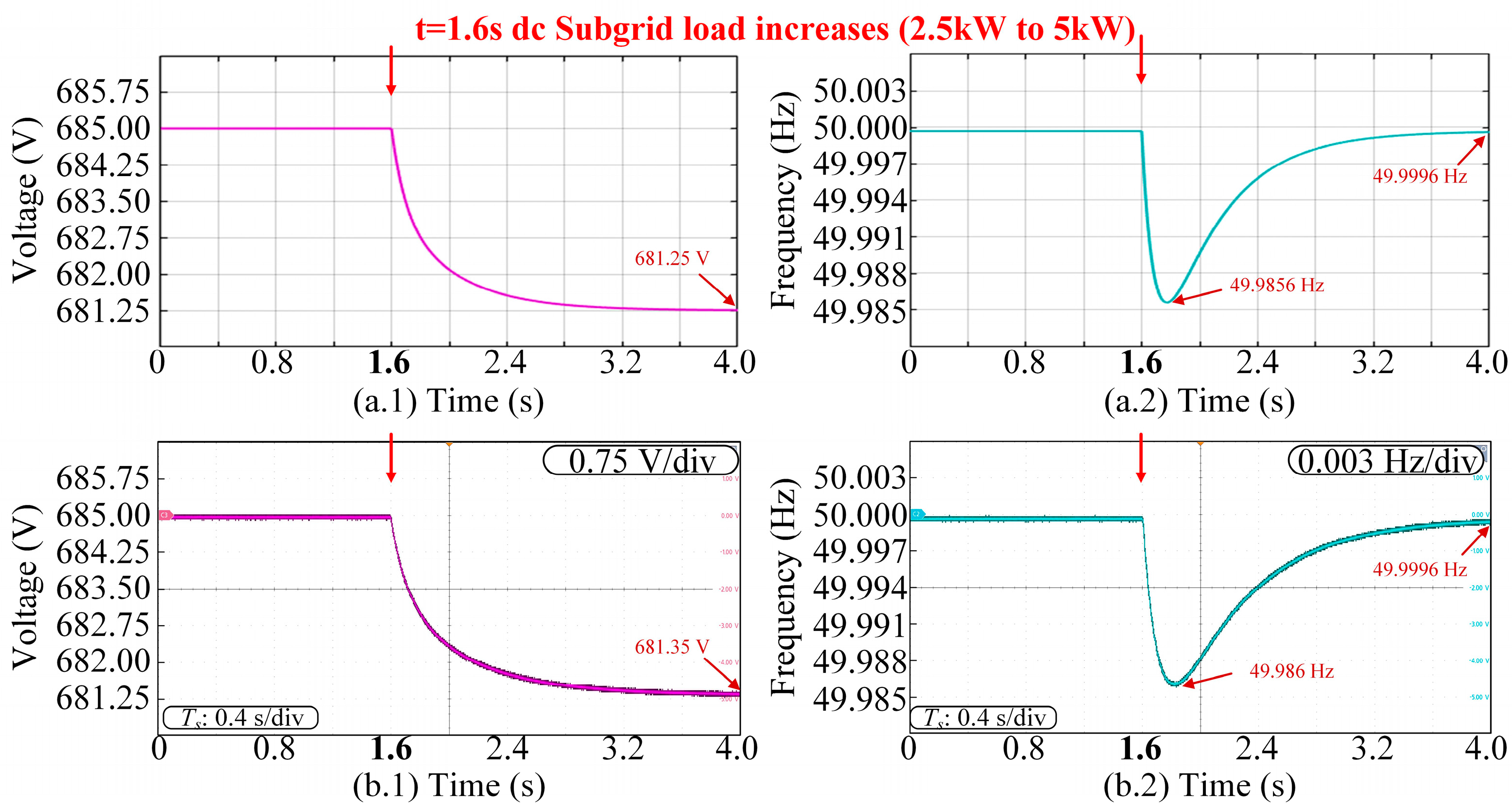
To verify the correctness and accuracy of the proposed equivalent dynamic circuit model, Case 2 is designed as follows: In this case, only an ac subgrid with wi = 1 and a dc subgrid with wi = 1 is interconnected via the ILC, forming a simplified two-subgrid test. With the system initially operating at rated power, a step load increase of 2.5 kW is applied to the dc subgrid at t = 1.6 s, while the load of the ac subgrid remains constant. Figure 11 shows the responses of the dc bus voltage V(t) and the ac bus frequency f(t). Figure 11(a.1,a.2) is obtained from the time-domain solutions derived in Section 4, and Figure 11(b.1,b.2) is obtained from the HIL experiment. The HIL test results in Figure 11(b.1,b.2) show consistency with the analytical results in Figure 11(a.1,a.2), corroborating the accuracy of the dynamic-circuit modeling framework established in Section 4. The close agreement between the theoretical predictions and HIL test data validates that the derived equivalent circuit correctly characterizes the inter-subgrid disturbance propagation and the coupling strength within the hybrid microgrid cluster.
(3)
Case 3: Verification of Priority-Driven Mechanism
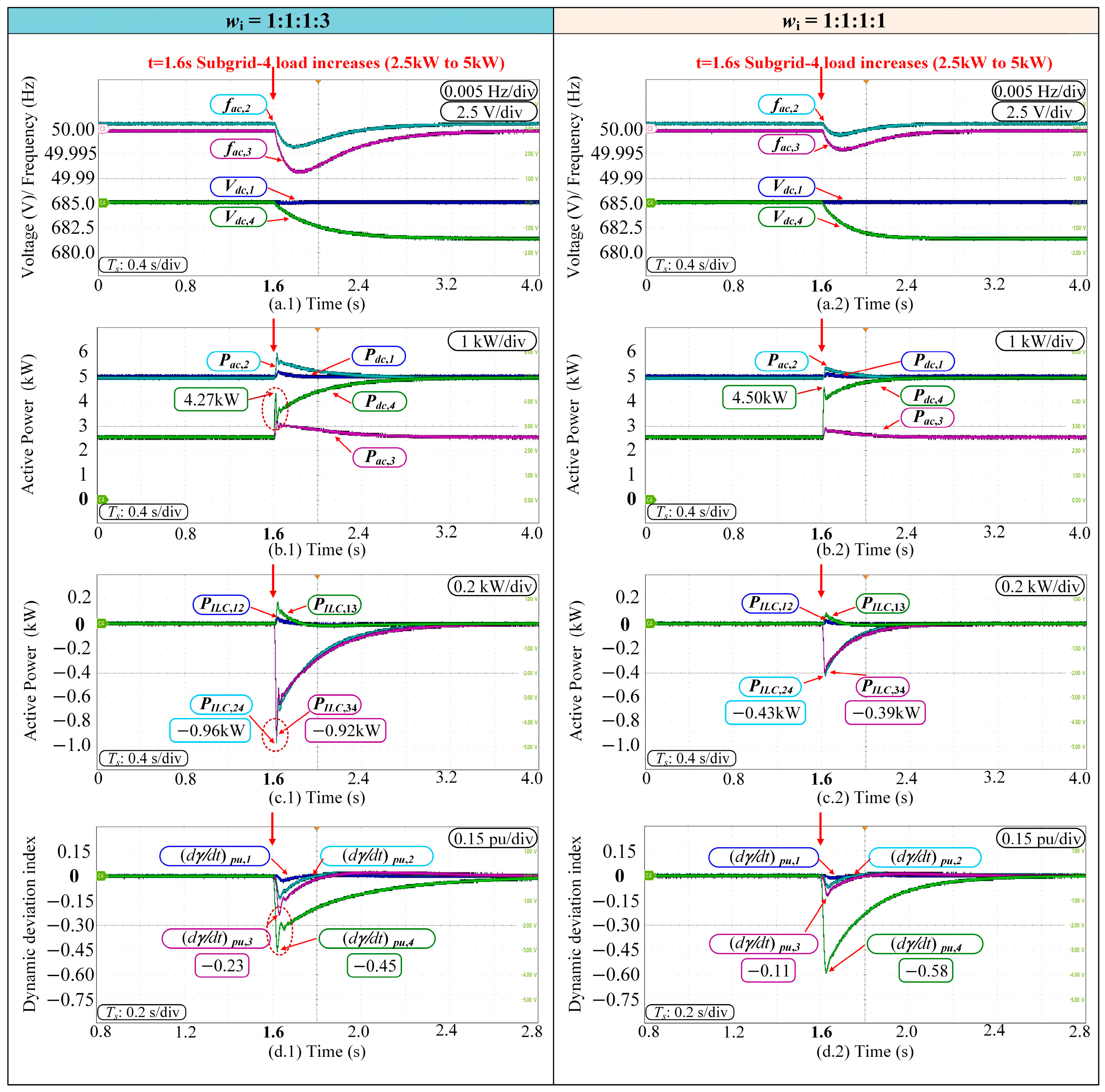
Case 3 verifies the effectiveness of the proposed strategy under different priority weights. System parameters are shown in Table 2, and the cluster initially operates at rated power. At t = 1.6 s, the load in dc Subgrid-4 undergoes a step increase from 2.5 kW to 5 kW, while the loads in other three subgrids remain unchanged. Figure 12 shows the comparative system dynamics between the proposed priority-driven strategy (priority weights wi of the four subgrids are 1, 1, 1, and 3, respectively) and the existing strategy without the priority-driven mechanism (all wi = 1).
From Figure 12(b.2,c.2), the existing strategy provides insufficient transient power from the ac subgrids due to the absence of priority distinction. Conversely, Figure 12(b.1,c.1) show that the proposed strategy drives Subgrid-2 and Subgrid-3 to generate higher active power and transfer more transient support through ILC#24 and ILC#34 toward the critical subgrid. From Figure 12(d.1,d.2) and Table 4, the priority-driven strategy reduces the dynamic deviation index of the disturbed dc Subgrid-4 from −0.58 (under the existing strategy) to −0.45. Simultaneously, the global optimization objective J decreased from 1.033 to 0.636 (In this case, the global objective J is calculated using the priority weights defined in Table 2). In summary, the results confirm that the proposed strategy achieves priority-driven inertia sharing, optimally utilizing cluster resources to support critical subgrids during severe disturbances.
(4)
Case 4: Adaptability to Heterogeneous Inertia Capacities
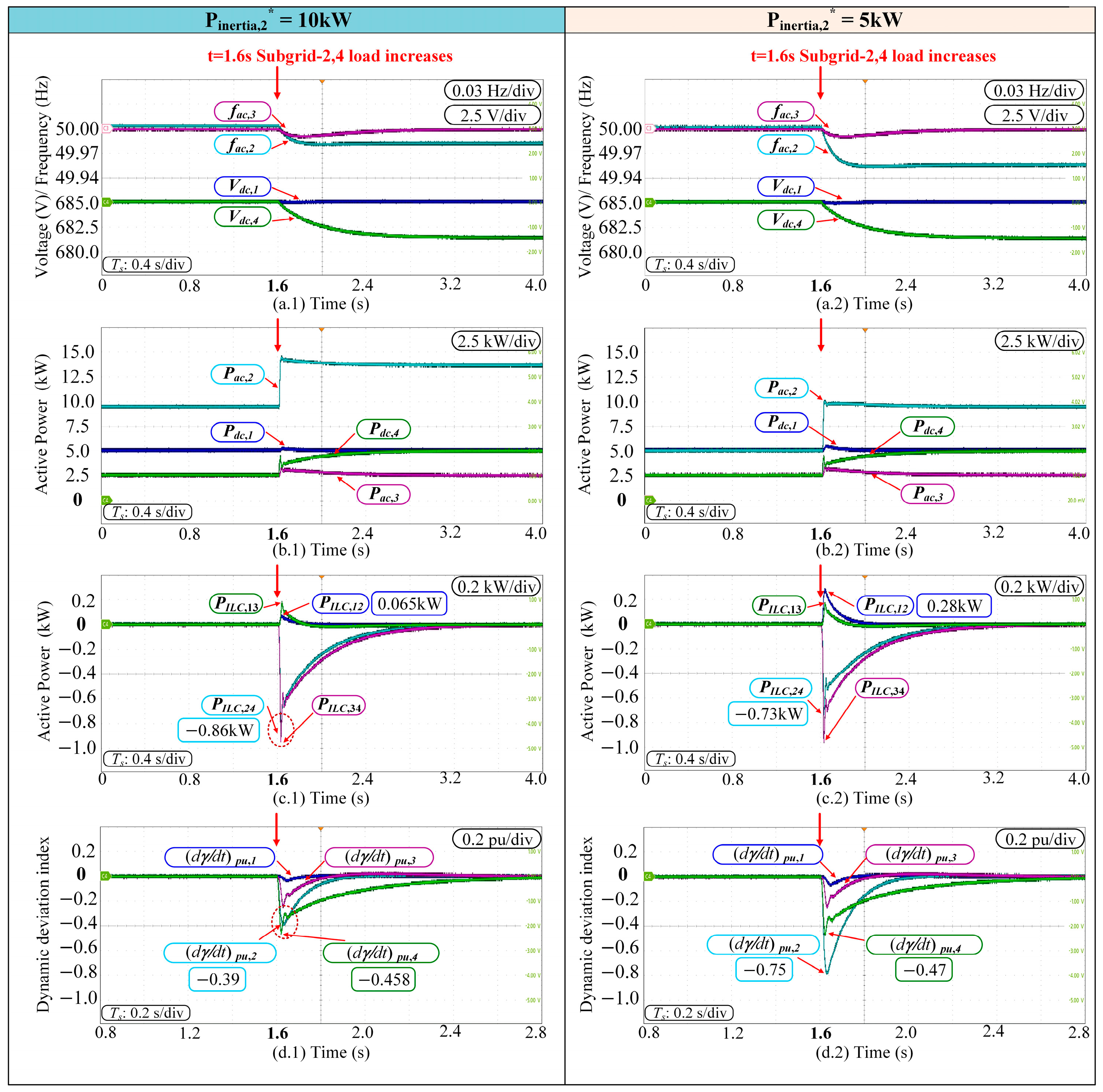
Case 4 analyses the impact of different inertia capacity on dynamic coordination performance. System parameters are shown in Table 2, and the cluster initially operates at rated power. The HIL scenario involves simultaneous load steps at t = 1.6 s: the load in ac Subgrid-2 increases 5 kW, and in dc Subgrid-4 increases from 2.5 kW to 5 kW. Two inertia-capacity settings of Subgrid-2 are compared, as shown in Figure 13. In the low-inertia setting, Subgrid-2 adopts the baseline parameters in Table 2, where P*inertia,2 = P* 2 = 5 kW and P2,max = 10 kW. In the high-inertia setting, the rated power, maximum power capability, and inertia power capacity of Subgrid-2 are all doubled, where P*inertia,2 = P* 2 = 10 kW and P2,max = 20 kW.
As shown in Figure 13(b.1,b.2), the increased inertia enables Subgrid-2 to generate more transient active power during the load disturbance (peaking at approximately 14.4 kW in Figure 13(b.1) compared to 9.9 kW in Figure 13(b.2)). Accordingly, Figure 13(c.1,c.2) demonstrates that ac Subgrid-2 imports less power from dc Subgrid-1 while actively providing more transient support power to dc Subgrid-4. As shown in Figure 13(d.1,d.2) and Table 5, the dynamic deviation index of ac Subgrid-2 is significantly reduced from −0.75 to −0.35, accompanied by simultaneous mitigations in the absolute deviations of all other subgrids, which collectively decreases the global optimization objective J from 1.25 to 0.775. Consequently, the results indicated that under the proposed mechanism, a localized inertia enhancement directly contributes to the global inertia support capability of the entire hybrid cluster.
(5)
Case 5: Dynamic Performance under ILC Failure (Topology Change)
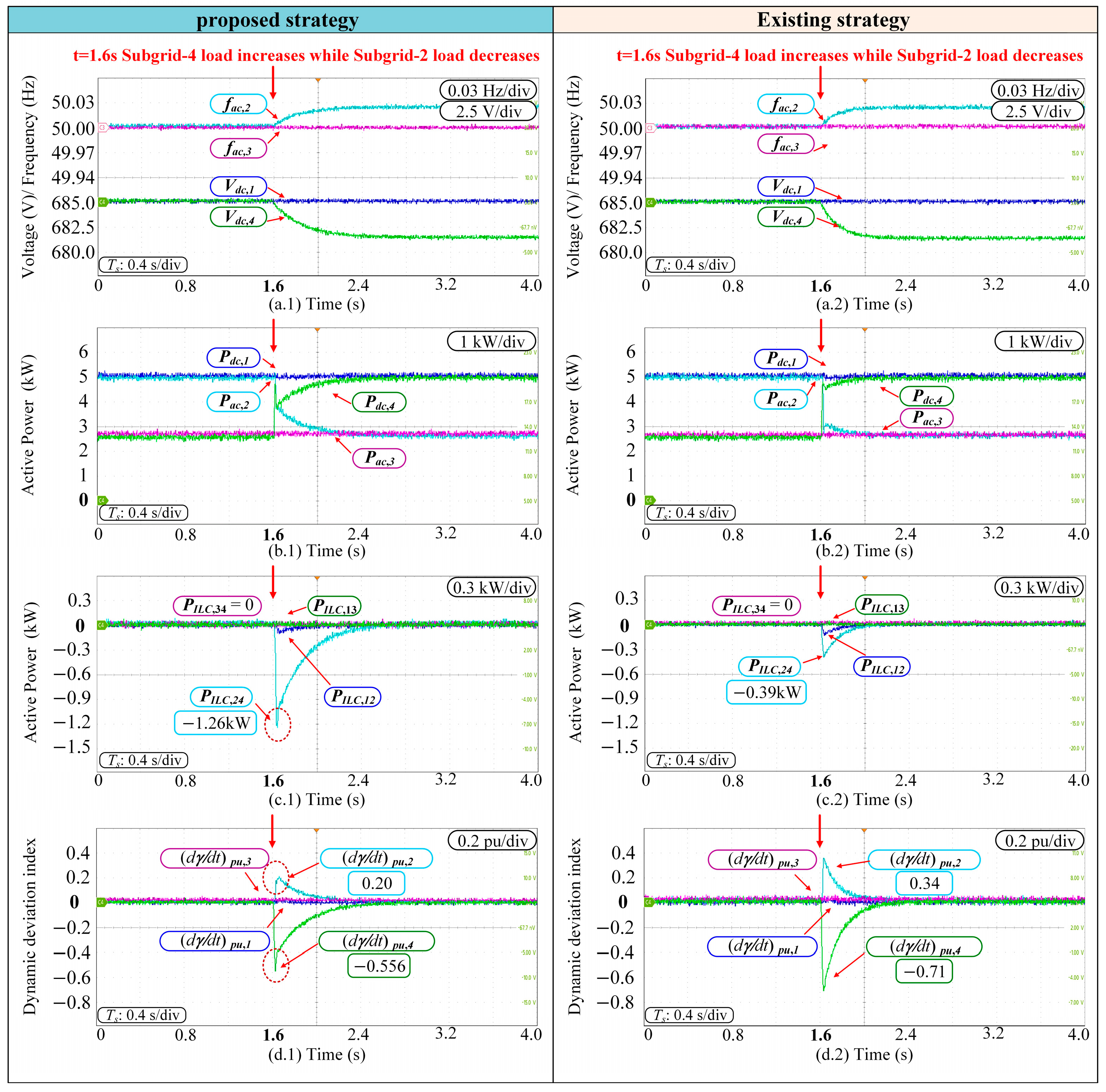
Case 5 analyses the impact of physical topological changes on dynamic coordination performance. In this scenario, ILC#34 is damaged, transforming the microgrid cluster topology from a ring to a radial structure. System parameters are shown in Table 2, and the cluster initially operates at rated power. The HIL scenario involves simultaneous load steps at t = 1.6 s: the load in ac Subgrid-2 decreases from 5 kW to 2.5 kW, while in dc Subgrid-4 it increases from 2.5 kW to 5 kW. Figure 14 shows the comparative system dynamics between the proposed strategy and the existing ILC-based dynamic power sharing method [27].
As shown in Figure 14(c.1,c.2) the proposed strategy enables the system to autonomously route more transient active power during the load disturbance (with PILC,24 reaching −1.26 kW in Figure 14(c.1) compared to −0.39 kW in Figure 14(c.2)). As shown in Figure 14(d.1,d.2) and Table 6, the dynamic deviation index of ac Subgrid-2 is reduced from 0.34 to 0.20, accompanied by simultaneous mitigations in the absolute deviation of dc Subgrid-4 (from −0.71 to −0.556), which decreases the global optimization objective J from 1.63 to 0.93 (in this case, the global objective J is calculated using the priority weights defined in Table 2). Consequently, the results indicate that our method exhibits better global dynamic performance of the system under physical topology changes and simultaneous load disturbances.

6. Conclusions

This study introduces a decentralized optimal dynamic control of ILCs for priority-driven inertia sharing among microgrid clusters to enhance the transient response of hybrid ac/dc microgrid clusters. By embedding subgrid priority weights and inertia capacity into an inertia interaction optimization model, a decentralized inter-support control strategy is derived based on the optimality condition. It enables ILCs to autonomously direct inertia support power toward high-priority and weak-inertia subgrids without relying on communication, effectively overcoming the limitations of conventional global inertia equal sharing schemes. Furthermore, a quantitative analytical framework based on a whole equivalent circuit model is established. Through the derivation of time-domain solutions, the impact of control parameters on the transient response characteristics is revealed, providing a theoretical basis for systematic parameter design.
The effectiveness of the proposed control strategy is validated through a four-subgrid Hardware-in-the-loop (HIL) experimental setup. By providing autonomous and prioritized inertia support without communication overhead, the proposed strategy presents a promising decentralized transient control framework for interconnected hybrid microgrids. However, certain limitations of the proposed method should be noted. The idealized modeling assumptions may not fully capture the complex dynamics of high-renewable integrations, and extreme cases involving profound converter saturation and large-scale cluster topologies require further comprehensive verification. In future work, the proposed transient control strategy could be integrated with advanced upper-layer decentralized optimization methods, such as bio-inspired dynamic leader election algorithms, decentralized stochastic recursive gradient methods, or multi-area optimal power flow frameworks, to form a comprehensive hierarchical control and management scheme.

7. Patents

There are no patents resulting from the work reported in this manuscript.

Author Contributions

Conceptualization, X.H. (Xiaochao Hou), X.H. (Xinyu He) and L.J.; methodology, X.H. (Xiaochao Hou), X.H. (Xinyu He) and J.T.; writing—original draft preparation, X.H. (Xiaochao Hou) and X.H. (Xinyu He); writing—review and editing, X.H. (Xiaochao Hou), X.H. (Xinyu He), H.M. and L.J. All authors have read and agreed to the published version of the manuscript.

Funding

This work was supported by the Smart Grid-National Science and Technology Major Project (2025ZD0804500), the National Natural Science Foundation of China under Grant 52307232, and the Hunan Provincial Natural Science Foundation of China under Grant 2024JJ4055.

Data Availability Statement

The original contributions presented in the study are included in the paper. Further inquiries can be directed to the corresponding author.

Conflicts of Interest

The authors declare no conflicts of interest.

Abbreviations

The following abbreviations are used in this manuscript:
ILCInterlinking Converter
HILHardware-in-the-loop
VSGVirtual Synchronous Generator
DIEDual-inertia Emulation
RoCoFRate of Change in Frequency
RoCoVRate of Change in Voltage
MPPTmaximum power point tracking

Appendix A

Equation (A1) presents the small-signal dynamic models of the ac subgrid frequencies and dc subgrid voltages, which are derived by linearizing Equations (1) and (2) around the steady-state operating points.
V ˜ ˙ 1 = 1 C d c 1 V P ˜ d c 1 D d c 1 C d c 1 V V ˜ 1 ω ˜ ˙ 2 = 1 J a c 2 ω P ˜ a c 2 D a c 2 J a c 2 ω ω ˜ 2 ω ˜ ˙ 3 = 1 J a c 3 ω P ˜ a c 3 D a c 3 J a c 3 ω ω ˜ 3 V ˜ ˙ 4 = 1 C d c 4 V P ˜ d c 4 D d c 4 C d c 4 V V ˜ 4
Equations (A2) and (A3) present the small-signal dynamic models of the reference active powers for the four interlinking converters (ILCs), which are derived by linearizing the decentralized optimal control law (15) around the steady-state operating points:
P ˜ I L C , 12 = k d w d c 1 P i n e r t i a , d c 1 d V 1 / d t l i m i t V ˜ ˙ s 1 w a c 2 P i n e r t i a , a c 2 d ω 2 / d t l i m i t ω ˜ ˙ s 2 P ˜ I L C , 13 = k d w d c 1 P i n e r t i a , d c 1 d V 1 / d t l i m i t V ˜ ˙ s 1 w a c 3 P i n e r t i a , a c 3 d ω 3 / d t l i m i t ω ˜ ˙ s 3 P ˜ I L C , 42 = k d w d c 4 P i n e r t i a , d c 4 d V 4 / d t l i m i t V ˜ ˙ s 4 w a c 2 P i n e r t i a , a c 2 d ω 2 / d t l i m i t ω ˜ ˙ s 2 P ˜ I L C , 43 = k d w d c 4 P i n e r t i a , d c 4 d V 4 / d t l i m i t V ˜ ˙ s 4 w a c 3 P i n e r t i a , a c 3 d ω 3 / d t l i m i t ω ˜ ˙ s 3
V ˜ s 1 = ω α s + ω α V ˜ 1 ω ˜ s 2 = ω α s + ω α ω ˜ 2 ω ˜ s 3 = ω α s + ω α ω ˜ 3 V ˜ s 4 = ω α s + ω α V ˜ 4
where Vsi and wsi denote the filtered measurement signals obtained by applying the low-pass filters shown in Figure 4 to the sampled Vi and wi signals, respectively; wα denotes the corresponding cut-off frequency used to represent the measurement-filtering dynamics during RoCoV/RoCoF extraction.
Equation (A4) presents the small-signal dynamic models of the power allocation within the four subgrids, which are derived by linearizing the power balance Equation (9) around the steady-state operating points:
P ˜ d c 1 P ˜ I L C , 12 P ˜ I L C , 13 = P ˜ d c , l o a d 1 = 0 P ˜ a c 2 + P ˜ I L C , 12 + P ˜ I L C , 42 = P ˜ a c , l o a d 2 = 0 P ˜ a c 3 + P ˜ I L C , 13 + P ˜ I L C , 43 = P ˜ a c , l o a d 3 = 0 P ˜ d c 4 P ˜ I L C , 42 P ˜ I L C , 43 = P ˜ d c , l o a d 4 = 0
Equation (A5) presents the small-signal dynamic models of the actual output active powers for the four interlinking converters (ILCs). By modeling the inner current loop as a low-pass filter, these equations characterize the dynamic tracking response of the actual output powers to the reference power commands:
P ˜ I L C , 12 = ω c s + ω c P ˜ I L C , 12 P ˜ I L C , 13 = ω c s + ω c P ˜ I L C , 13 P ˜ I L C , 42 = ω c s + ω c P ˜ I L C , 42 P ˜ I L C , 43 = ω c s + ω c P ˜ I L C , 43
where wc are the cut-off frequencies of the LPF for the equivalent current loop.
Equation (A6) provides complete analytical expressions for the constituent submatrices within the closed-loop system state matrix AILC.
A x = D d c 1 C d c 1 V 0 0 0 0 D a c 2 J a c 2 ω 0 0 0 0 D a c 3 J a c 3 ω 0 0 0 0 D d c 4 C d c 4 V B p = 1 C d c 1 V 1 C d c 1 V 0 0 1 J a c 2 ω 0 1 J a c 2 ω 0 0 1 J a c 3 ω 0 1 J a c 3 ω 0 0 1 C d c 4 V 1 C d c 4 V H = w d c 1 ω α P i n e r t i a , d c 1 d V 1 / d t l i m i t w a c 2 ω α P i n e r t i a , a c 2 d ω 2 / d t l i m i t 0 0 w d c 1 ω α P i n e r t i a , d c 1 d V 1 / d t l i m i t 0 w a c 3 ω α P i n e r t i a , a c 3 d ω 3 / d t l i m i t 0 0 w a c 2 ω α P i n e r t i a , a c 2 d ω 2 / d t l i m i t 0 w d c 4 ω α P i n e r t i a , d c 4 d V 4 / d t l i m i t 0 0 w a c 3 ω α P i n e r t i a , a c 3 d ω 3 / d t l i m i t w d c 4 ω α P i n e r t i a , d c 4 d V 4 / d t l i m i t I = 1 0 0 0 0 1 0 0 0 0 1 0 0 0 0 1

References

  1. Min, Y.; Lei, Z.; Chen, L.; Xu, F.; Zhao, B.; Lu, Z.; Hao, L. Frequency-fixed grid-forming control for less-dynamic and safer renewable power systems. iEnergy 2024, 4, 219–234. [Google Scholar] [CrossRef]
  2. Lashin, A.; Ghanem, A.; Kaddah, S.S.; Hu, W.; Deng, F.; Abulanwar, S. Adaptive Multimode Droop-Based Distributed Energy Management for Standalone Hybrid AC/DC Microgrid. Chin. J. Electr. Eng. 2025, 11, 146–166. [Google Scholar] [CrossRef]
  3. Nejabatkhah, F.; Li, Y.W. Overview of Power Management Strategies of Hybrid AC/DC Microgrid. IEEE Trans. Power Electron. 2015, 30, 7072–7089. [Google Scholar] [CrossRef]
  4. Wang, J.; Dong, C.; Jin, C.; Lin, P.; Wang, P. Distributed Uniform Control for Parallel Bidirectional Interlinking Converters for Resilient Operation of Hybrid AC/DC Microgrid. IEEE Trans. Sustain. Energy 2022, 13, 3–13. [Google Scholar] [CrossRef]
  5. Liu, X.; Wang, Y.; Liu, X.; Zhao, T.; Wang, P. More Efficient Energy Management for Hybrid AC/DC Microgrids with Hard Constrained Neural Network-Based Conversion Loss Surrogate Models. IEEE Trans. Smart Grid 2024, 15, 2534–2552. [Google Scholar] [CrossRef]
  6. Wu, P.; Huang, W.; Tai, N.; Liang, S. A Novel Design of Architecture and Control for Multiple Microgrids with Hybrid AC/DC Connection. Appl. Energy 2018, 210, 1002–1016. [Google Scholar] [CrossRef]
  7. Liu, Z.; Wang, L.; Ma, L. A Transactive Energy Framework for Coordinated Energy Management of Networked Microgrids With Distributionally Robust Optimization. IEEE Trans. Power Syst. 2020, 35, 395–404. [Google Scholar] [CrossRef]
  8. Wang, L.; Fu, X.; Wong, M.-C. Operation and Control of a Hybrid Coupled Interlinking Converter for Hybrid AC/Low Voltage DC Microgrids. IEEE Trans. Ind. Electron. 2021, 68, 7104–7114. [Google Scholar] [CrossRef]
  9. Li, X.; Guo, L.; Li, Y.; Guo, Z.; Hong, C.; Zhang, Y.; Wang, C. A Unified Control for the DC–AC Interlinking Converters in Hybrid AC/DC Microgrids. IEEE Trans. Smart Grid 2018, 9, 6540–6553. [Google Scholar] [CrossRef]
  10. Gupta, A.; Doolla, S.; Chatterjee, K. Hybrid AC–DC Microgrid: Systematic Evaluation of Control Strategies. IEEE Trans. Smart Grid 2018, 9, 3830–3843. [Google Scholar] [CrossRef]
  11. Han, Y.; Zhang, K.; Li, H.; Coelho, E.A.A.; Guerrero, J.M. MAS-Based Distributed Coordinated Control and Optimization in Microgrid and Microgrid Clusters: A Comprehensive Overview. IEEE Trans. Power Electron. 2018, 33, 6488–6508. [Google Scholar] [CrossRef]
  12. Zhang, K.; Su, M.; Liu, Z.; Han, H.; Zhang, X.; Wang, P. A Distributed Coordination Control for Islanded Hybrid AC/DC Microgrid. IEEE Syst. J. 2023, 17, 1819–1830. [Google Scholar] [CrossRef]
  13. Chang, J.-W.; Lee, G.-S.; Moon, S.-I.; Hwang, P.-I. A Novel Distributed Control Method for Interlinking Converters in an Islanded Hybrid AC/DC Microgrid. IEEE Trans. Smart Grid 2021, 12, 3765–3779. [Google Scholar] [CrossRef]
  14. Brandao, D.I.; Santos, R.P.D.; Silva, W.W.A.G.; Oliveira, T.R.; Donoso-Garcia, P.F. Model-Free Energy Management System for Hybrid Alternating Current/Direct Current Microgrids. IEEE Trans. Ind. Electron. 2021, 68, 3982–3991. [Google Scholar] [CrossRef]
  15. Hou, X.; Sun, K.; Teng, F. Priority-Driven Self-Optimizing Power Control Scheme for Interlinking Converters of Hybrid AC/DC Microgrid Clusters in Decentralized Manner. IEEE Trans. Power Electron. 2022, 37, 5970–5983. [Google Scholar]
  16. Loh, P.C.; Li, D.; Chai, Y.K.; Blaabjerg, F. Autonomous Control of Interlinking Converter with Energy Storage in Hybrid AC–DC Microgrid. IEEE Trans. Ind. Appl. 2013, 49, 1374–1382. [Google Scholar] [CrossRef]
  17. Loh, P.C.; Li, D.; Chai, Y.K.; Blaabjerg, F. Autonomous Operation of Hybrid Microgrid With AC and DC Subgrids. IEEE Trans. Power Electron. 2013, 28, 2214–2223. [Google Scholar] [CrossRef]
  18. Zhang, Z.; Fang, J.; Dong, C.; Jin, C.; Tang, Y. Enhanced Grid Frequency and DC-Link Voltage Regulation in Hybrid AC/DC Microgrids Through Bidirectional Virtual Inertia Support. IEEE Trans. Ind. Electron. 2023, 70, 6931–6940. [Google Scholar] [CrossRef]
  19. Zhong, Q.-C.; Weiss, G. Synchronverters: Inverters That Mimic Synchronous Generators. IEEE Trans. Ind. Electron. 2011, 58, 1259–1267. [Google Scholar] [CrossRef]
  20. Zhong, Q.-C.; Nguyen, P.-L.; Ma, Z.; Sheng, W. Self-Synchronized Synchronverters: Inverters Without a Dedicated Synchronization Unit. IEEE Trans. Power Electron. 2014, 29, 617–630. [Google Scholar] [CrossRef]
  21. He, L.; Li, Y.; Shuai, Z.; Guerrero, J.M.; Cao, Y.; Wen, M.; Wang, W.; Shi, J. A Flexible Power Control Strategy for Hybrid AC/DC Zones of Shipboard Power System with Distributed Energy Storages. IEEE Trans. Ind. Inform. 2018, 14, 5496–5508. [Google Scholar] [CrossRef]
  22. Melath, G.; Rangarajan, S.; Agarwal, V. A Novel Control Scheme for Enhancing the Transient Performance of an Islanded Hybrid AC–DC Microgrid. IEEE Trans. Power Electron. 2019, 34, 9644–9654. [Google Scholar] [CrossRef]
  23. Qi, G.; Chen, A.; Chen, J. Improved Control Strategy of Interlinking Converters With Synchronous Generator Characteristic in Islanded Hybrid AC/DC Microgrid. CPSS Trans. Power Electron. Appl. 2017, 2, 149–158. [Google Scholar] [CrossRef]
  24. Unamuno, E.; Paniagua, J.; Barrena, J.A. Unified Virtual Inertia for Ac and Dc Microgrids: And the Role of Interlinking Converters. IEEE Electrif. Mag. 2019, 7, 56–68. [Google Scholar] [CrossRef]
  25. Paniagua, J.; Unamuno, E.; Barrena, J.A. Dual Inertia-Emulation Control for Interlinking Converters in Grid-Tying Applications. IEEE Trans. Smart Grid 2021, 12, 3868–3876. [Google Scholar] [CrossRef]
  26. He, L.; Li, Y.; Guerrero, J.M.; Cao, Y. A Comprehensive Inertial Control Strategy for Hybrid AC/DC Microgrid with Distributed Generations. IEEE Trans. Smart Grid 2020, 11, 1737–1747. [Google Scholar] [CrossRef]
  27. Du, Y.; Chong, P.; Wang, X.; Yang, X.; Yang, S. Adaptive RoCoX Droop Control Strategy for AC/DC Hybrid Microgrid. Int. J. Electr. Power Energy Syst. 2024, 157, 109860. [Google Scholar] [CrossRef]
  28. Wang, J.; Huang, W.; Tai, N.; Yu, M.; Li, R.; Zhang, Y. A Bidirectional Virtual Inertia Control Strategy for the Interconnected Converter of Standalone AC/DC Hybrid Microgrids. IEEE Trans. Power Syst. 2024, 39, 745–754. [Google Scholar] [CrossRef]
  29. Saha, D.; Bazmohammadi, N.; Vasquez, J.C.; Guerrero, J.M. Multiple Microgrids: A Review of Architectures and Operation and Control Strategies. Energies 2023, 16, 600. [Google Scholar] [CrossRef]
  30. Yuan, W.; Wang, Y.; Liu, D.; Deng, F.; Chen, Z. Efficiency-Prioritized Droop Control Strategy of AC Microgrid. IEEE J. Emerg. Sel. Top. Power Electron. 2021, 9, 2936–2950. [Google Scholar] [CrossRef]
  31. Lin, P.; Meng, Q.; Zhu, M.; Ghias, A.M.Y.M.; Blaabjerg, F. Dynamic Circuit-Based Unified Power Regulation for Hybrid AC/DC/DS Microgrids: A Comprehensive Approach to Static and Transient Control. IEEE Trans. Ind. Electron. 2026, 73, 522–533. [Google Scholar] [CrossRef]
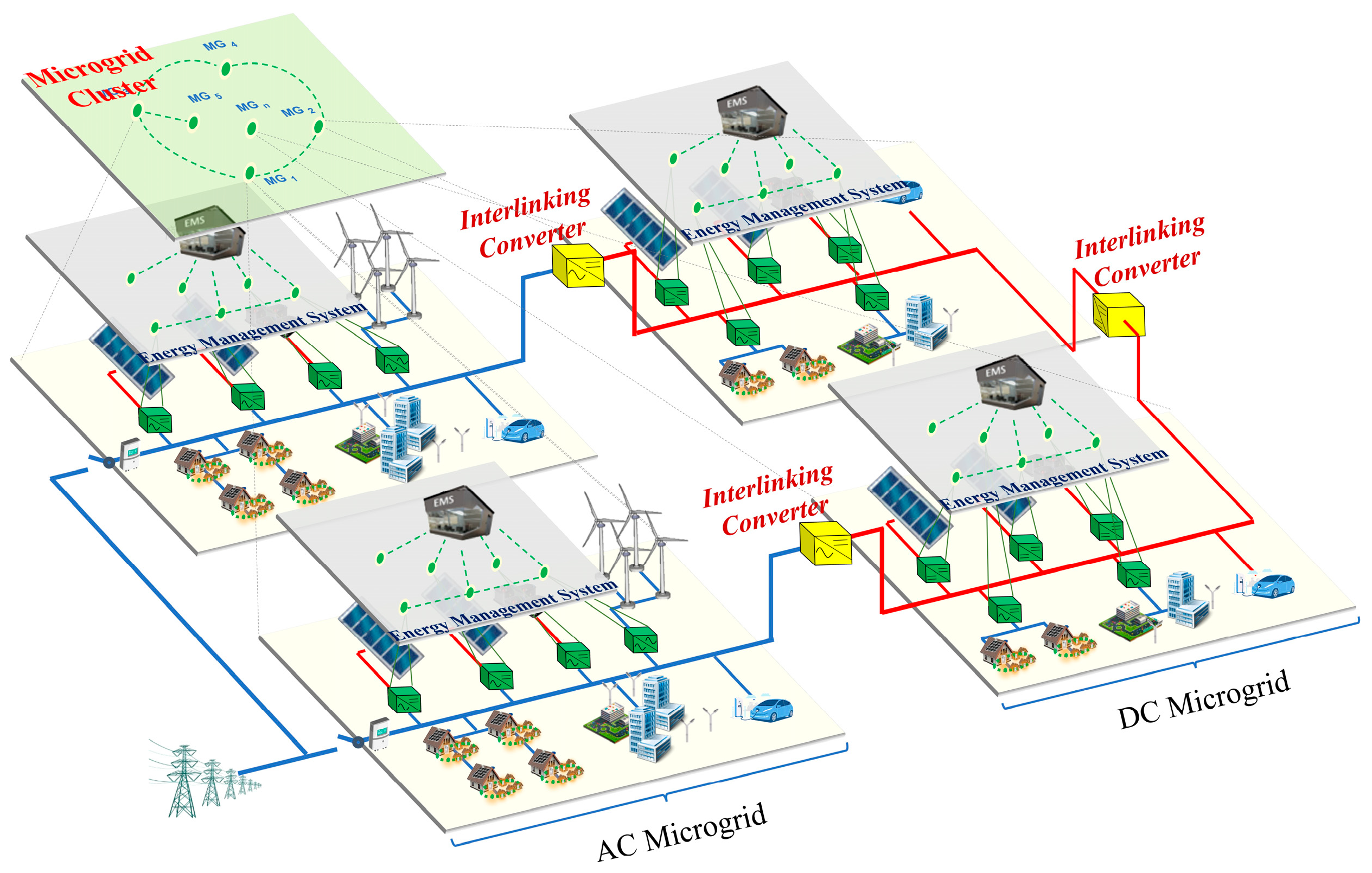
Figure 1. Schematic representation of networked microgrid clusters.
Electronics 15 02825 g001
Figure 2. Typical configuration of networked hybrid ac/dc microgrid clusters.
Electronics 15 02825 g002
Figure 3. Control block diagrams of ac and dc subgrids. (a) ac subgrid; (b) dc subgrid.
Electronics 15 02825 g003
Figure 4. Proposed inertia sharing control block diagram of ILC.
Electronics 15 02825 g004
Figure 5. Eigenvalues of state-space matrix AILC from kd = 0 to kd = 3 × 10⁶.
Electronics 15 02825 g005
Figure 6. Whole equivalent circuit model of the hybrid ac/dc microgrid.
Electronics 15 02825 g006
Figure 7. Key dynamic indicators for different dynamic control gains kd (from 1 × 10⁵ to 1 × 10⁷).
Electronics 15 02825 g007
Figure 8. Hardware-in-the-loop (HIL) platform.
Electronics 15 02825 g008
Figure 9. Studied system model of four hybrid ac/dc microgrids.
Electronics 15 02825 g009
Figure 10. HIL experimental results in case 1: (a) dc-bus voltage and ac frequency; (b) output active power of the subgrids; (c) exchanged active power of the ILCs; (d) unified dynamic deviation index of the subgrids.
Electronics 15 02825 g010
Figure 11. Response process of dc-bus voltage V(t)and ac frequency f(t) in a hybrid dc/ac microgrid under a 100% dc load step. (a.1,a.2) analytical trajectories from (29) and (32), (b.1,b.2) HIL results.
Electronics 15 02825 g011
Figure 12. HIL experimental results in Case 3: (a.1,a.2) Dynamic responses of dc-bus voltage and ac frequency; (b.1,b.2) Output active power of the four subgrids; (c.1,c.2) Exchanged active power of the four ILCs; (d.1,d.2) Unified dynamic deviation index of the four subgrids.
Electronics 15 02825 g012
Figure 13. HIL experimental results in case 4: (a.1,a.2) Dynamic responses of dc-bus voltage and ac frequency. (b.1,b.2) Output active power of the four subgrids. (c.1,c.2) Exchanged active power of the four ILCs. (d.1,d.2) Unified dynamic deviation index of the four subgrids.
Electronics 15 02825 g013
Figure 14. HIL experimental results in case 5: (a.1,a.2) Dynamic responses of dc-bus voltage and ac frequency. (b.1,b.2) Output active power of the four subgrids. (c.1,c.2) Exchanged active power of the four ILCs. (d.1,d.2) Unified dynamic deviation index of the four subgrids.
Electronics 15 02825 g014
Table 1. Comparison with related ILC-based inertia sharing methods.
MethodObjective
Function
ObjectiveMeasurementCommunicationPriorityInertia
Capacity
Constraints
DIE [25]/RoCoF/RoCoV
suppression
f/Vdc××Indirectly
considered
ILC power
limits
Unified
inertia
indices [26]
/System level
inertia enhancement
f/Vdc××Indirectly
considered
ILC and HES
power limits
Adaptive RoCoX
control [27]
min G = | RoCo V d c | max . pu d u d c / d t limit . pu 2 + | RoCo F | max . pu d ω a c / d t limit . pu 2 RoCoX
equalization
f/Vdc×××ILC power
limits
BVI [28]/AC/DC transient
performance balancing
f/Vdc××Indirectly
considered
ILC power
limits
This study min J = i = 1 N w i d γ d t pu , i 2 Priority-weighted
RoCoF/RoCoV
suppression
f/Vdc×Power/current/ramp
limit of ILC
Table 2. HIL test parameters.
DescriptionSymbolValue
Simulation step sizeTRT50 μs
DSP sampling timeTs100 μs
PWM frequencyfPWM10 kHz
Controller discretization/Discrete-time, Ts = 100 μs
Filtered differentiator cut-off frequencywα120 rad/s
ILC current-loop LPF cut-off frequencywc500 rad/s
Physical parameters of four subgrids
DC subgrid voltageVdc,max  V*dc/Vdc,min700/685/670 V
AC subgrid frequencyfmax/f*/fmin50.2/50/49.8 Hz
Priority weightw1/w2/w3/w41/1/1/3
Max. power cap.P1,maxP4,max10/10/5/5 kW
Nom. power cap.P*1P*45/5/2.5/2.5 kW
Inertia power cap.P*inertia,1P*inertia,45/5/2.5/2.5 kW
Nom. load active powerP*load,1P*load,45/5/2.5/2.5 kW
Upper limit of RoCoF(/dt)limitπ rad/s2
Upper limit of RoCoV(dV/dt)limit30 V/s
Max. converter currentiimax50 A
Physical parameters of ILCs
Max. power cap.PILC,ijmax5 kW
Max. power ramp rateRmax30 kW/s
Control parameters of ILCs
dynamic control gainkd2 × 106
Table 3. Unified dynamic deviation index corresponding to maximum global objective J during transient state (Case 1).
VariableScenariosDC-1AC-2
(dγ/dt)pu,i (p.u)Proposed strategy−0.14−0.64
Comparison strategy−6.56× 10⁻⁴−0.76
Table 4. Unified dynamic deviation index corresponding to maximum global objective J during transient state (Case 3).
VariableScenariosDC-1AC-2AC-3DC-4
(dγ/dt)pu,i (p.u)Proposed strategy−6.62 × 10⁻³−6.85 × 10⁻²−0.13−0.45
Comparison strategy−2.38 × 10⁻³−5.75 × 10⁻²−0.10−0.58
Table 5. Unified dynamic deviation index corresponding to maximum global objective J during transient state (Case 4).
VariableScenariosDC-1AC-2AC-3DC-4
(dγ/dt)pu,i (p.u)High-inertia setting−4.31 × 10⁻³−0.35−0.15−0.458
Low-inertia setting−6.19 × 10⁻³−0.75−0.19−0.469
Table 6. Unified dynamic deviation index corresponding to maximum global objective J during transient state (Case 5).
VariableScenariosDC-1AC-2AC-3DC-4
(dγ/dt)pu,i (p.u)Proposed strategy−1.92 × 10−46.31 × 10−26.54 × 10⁻⁶−0.556
Comparison strategy−2.77 × 10−30.347.34 × 10−5−0.71
Disclaimer/Publisher’s Note: The statements, opinions and data contained in all publications are solely those of the individual author(s) and contributor(s) and not of MDPI and/or the editor(s). MDPI and/or the editor(s) disclaim responsibility for any injury to people or property resulting from any ideas, methods, instructions or products referred to in the content.