Power System Fault Detection and Localization Using a Dual-Path Spatio-Temporal Multi-Task Graph Convolutional Network


Abstract
1. Introduction
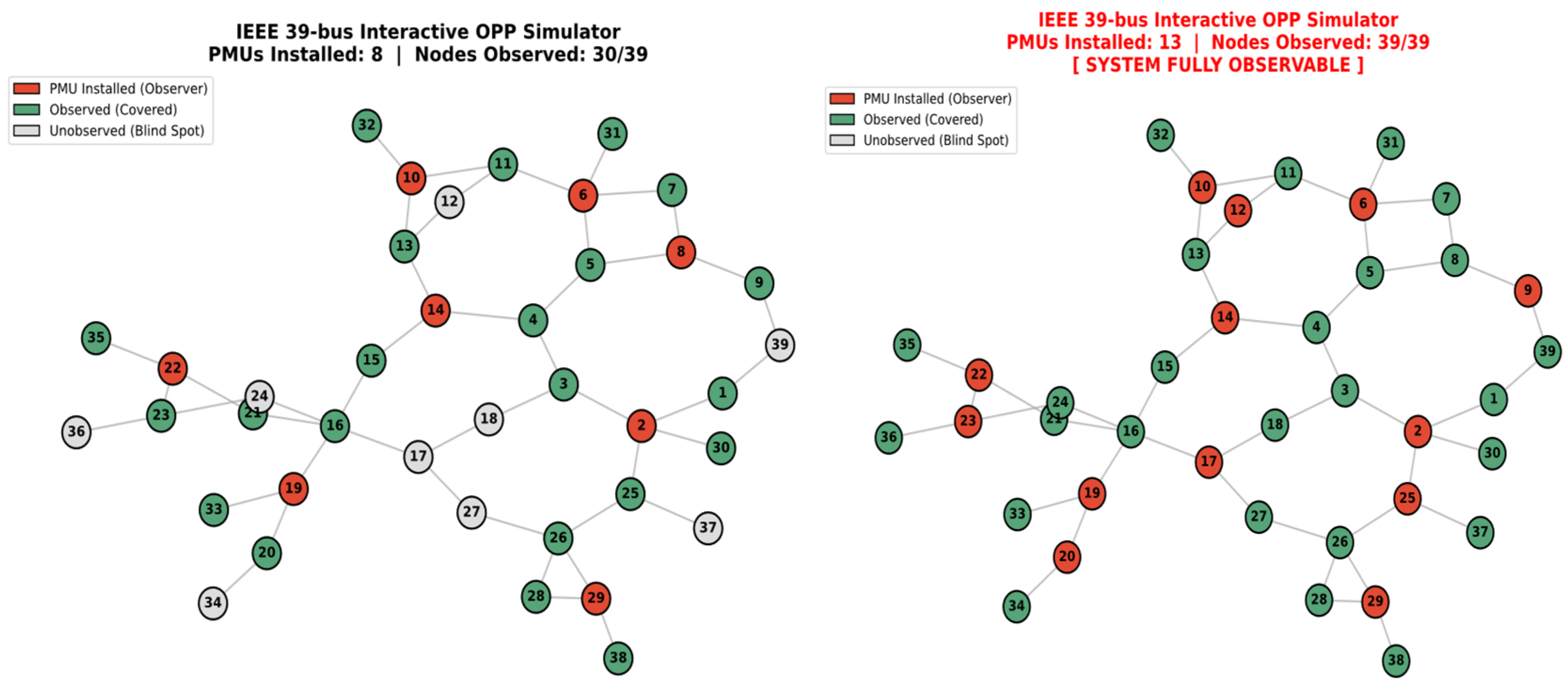
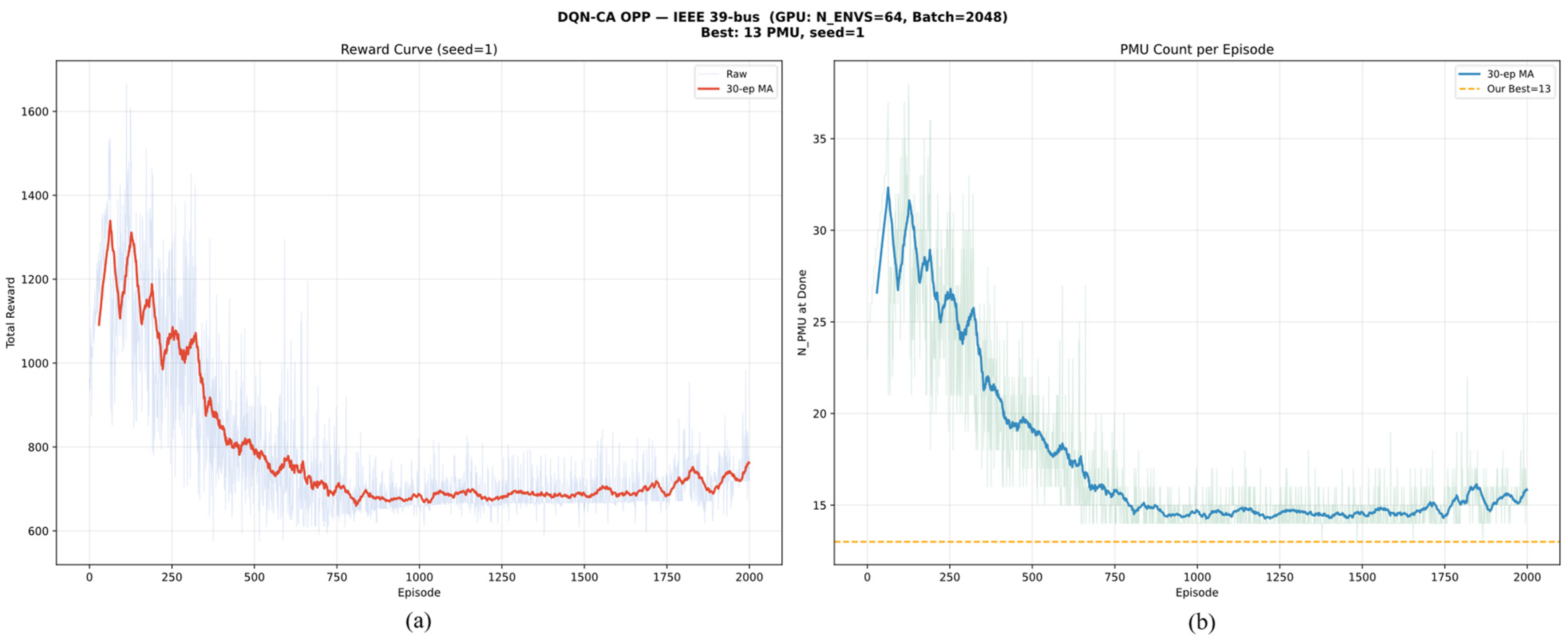
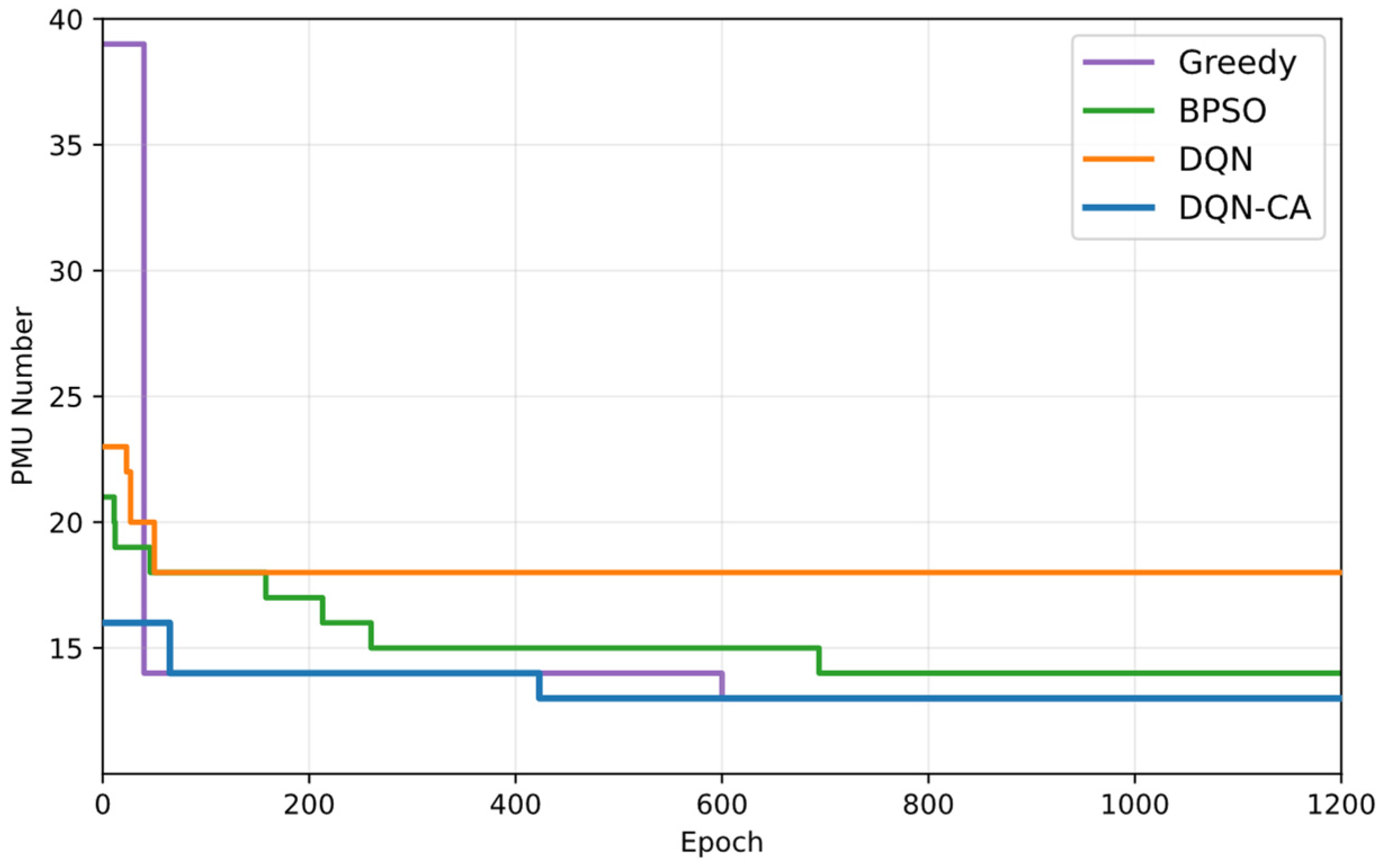
- A DQN-CA-based optimal PMU placement strategy is developed for sparse measurement configuration. By embedding the Checking-Action mechanism into the action-selection process, redundant and invalid PMU placement actions are suppressed, thereby improving the search efficiency of OPP under full observability constraints.
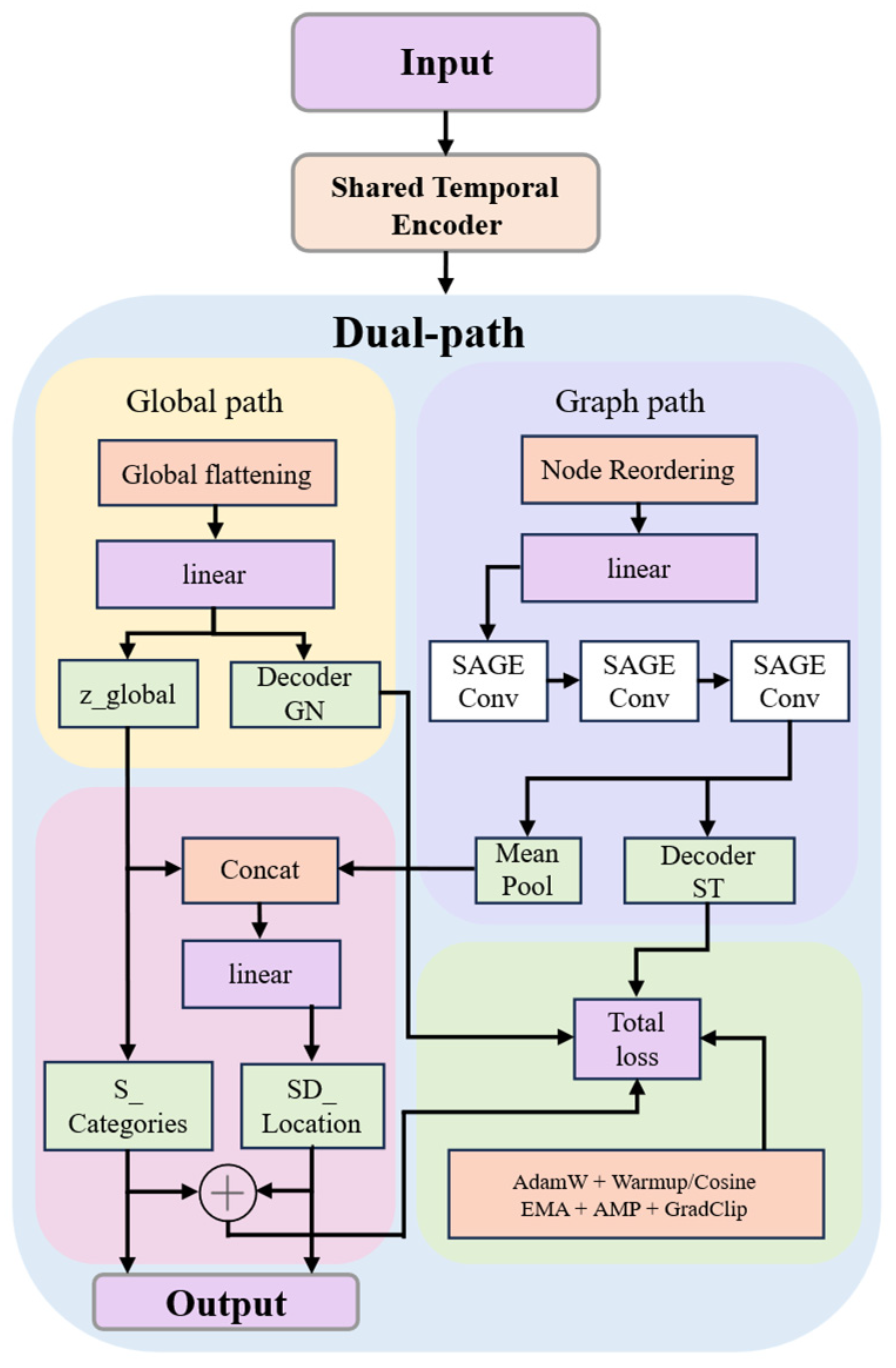
- A dual-path spatio-temporal multi-task graph convolutional network, termed ST-MTGCN, is proposed for joint fault type classification and fault topology localization under sparse PMU measurements. The model combines a global feature reduction path and a K-hop spatial graph convolution path to decouple fault-type-related features from topology-sensitive fault-location features.
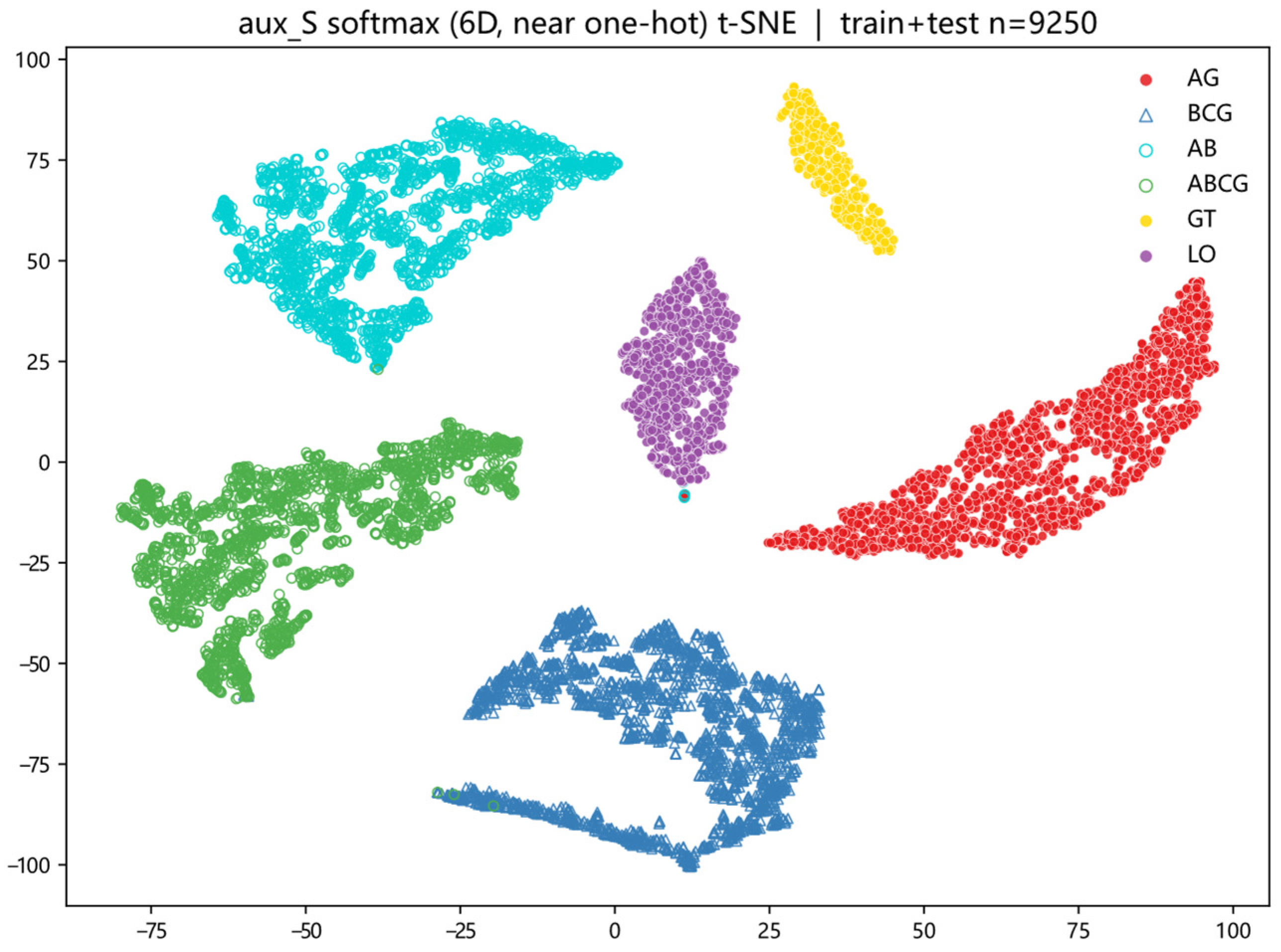
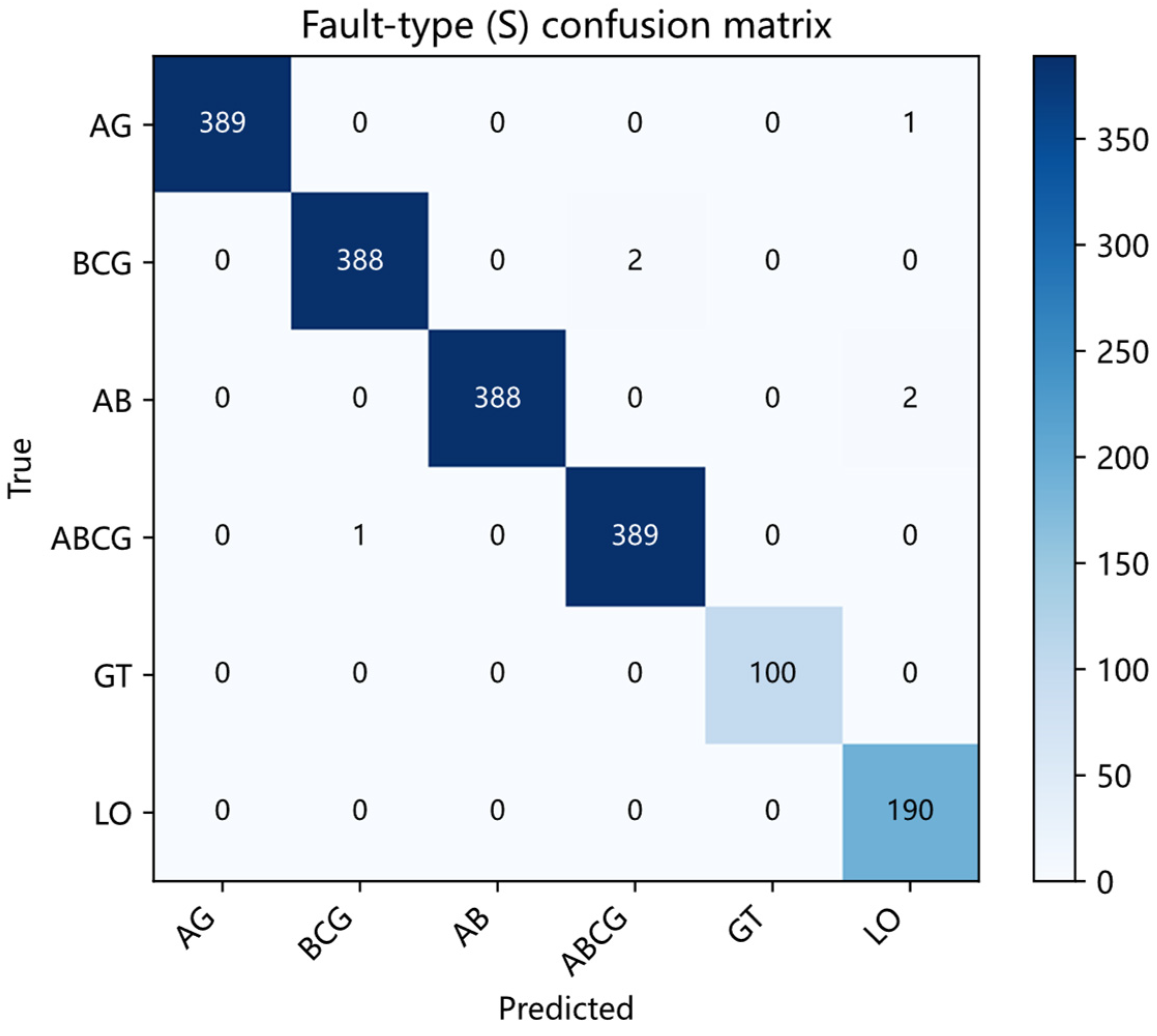
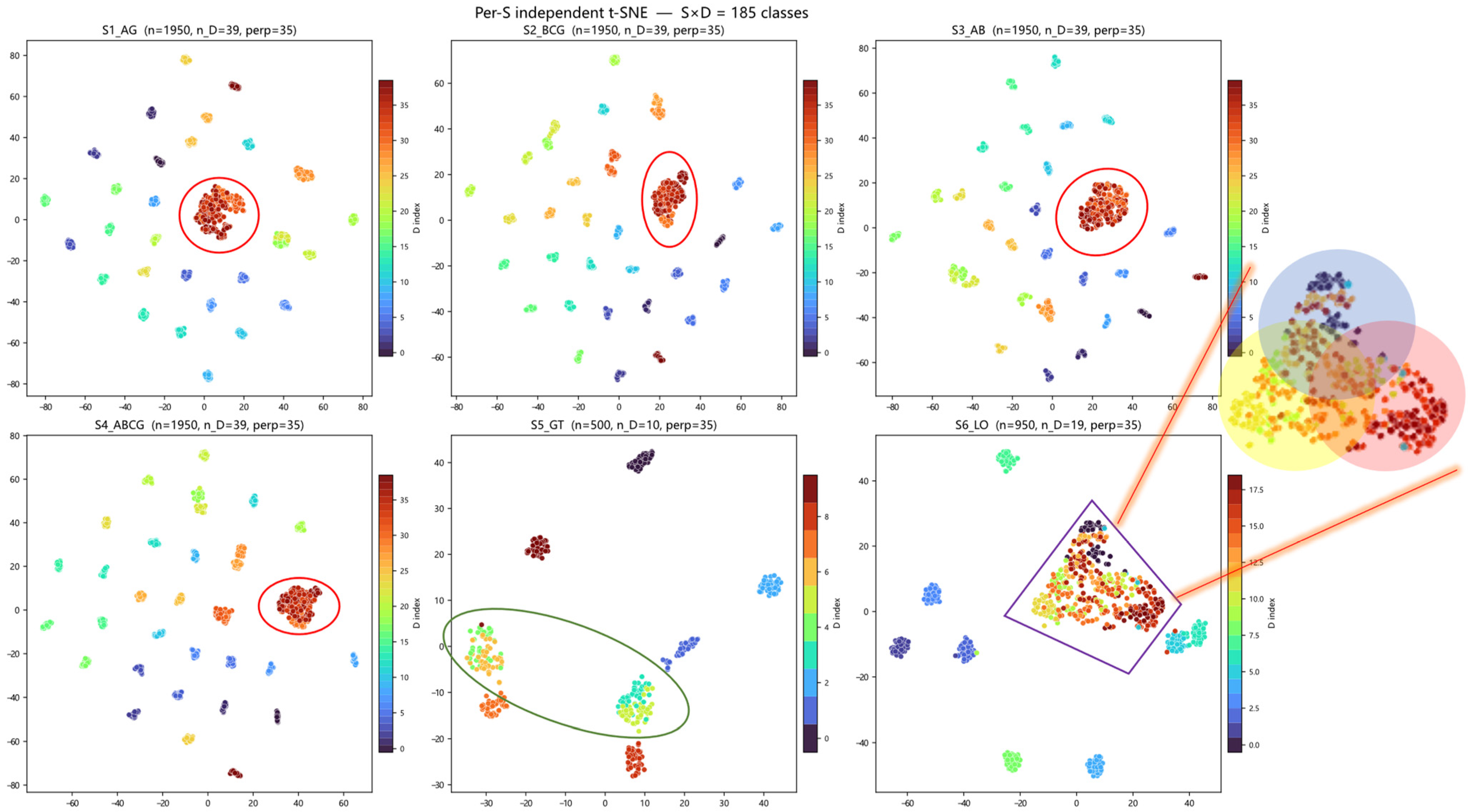
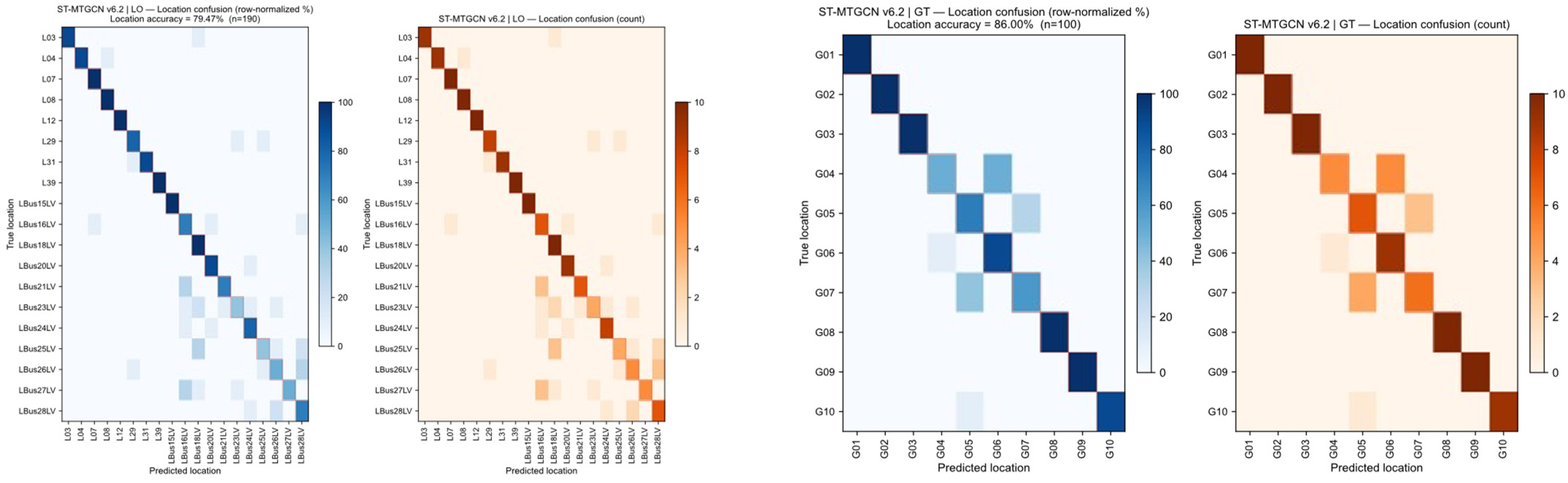
- We designed a joint optimization scheme based on physical structures. Through multi-task auxiliary supervision, we simultaneously utilized t-SNE visualization and confusion matrices to demonstrate a high degree of physical consistency between the model’s residual error and the topological isomorphism of the power system.
2. An OPP Framework Based on Deep Reinforcement Learning
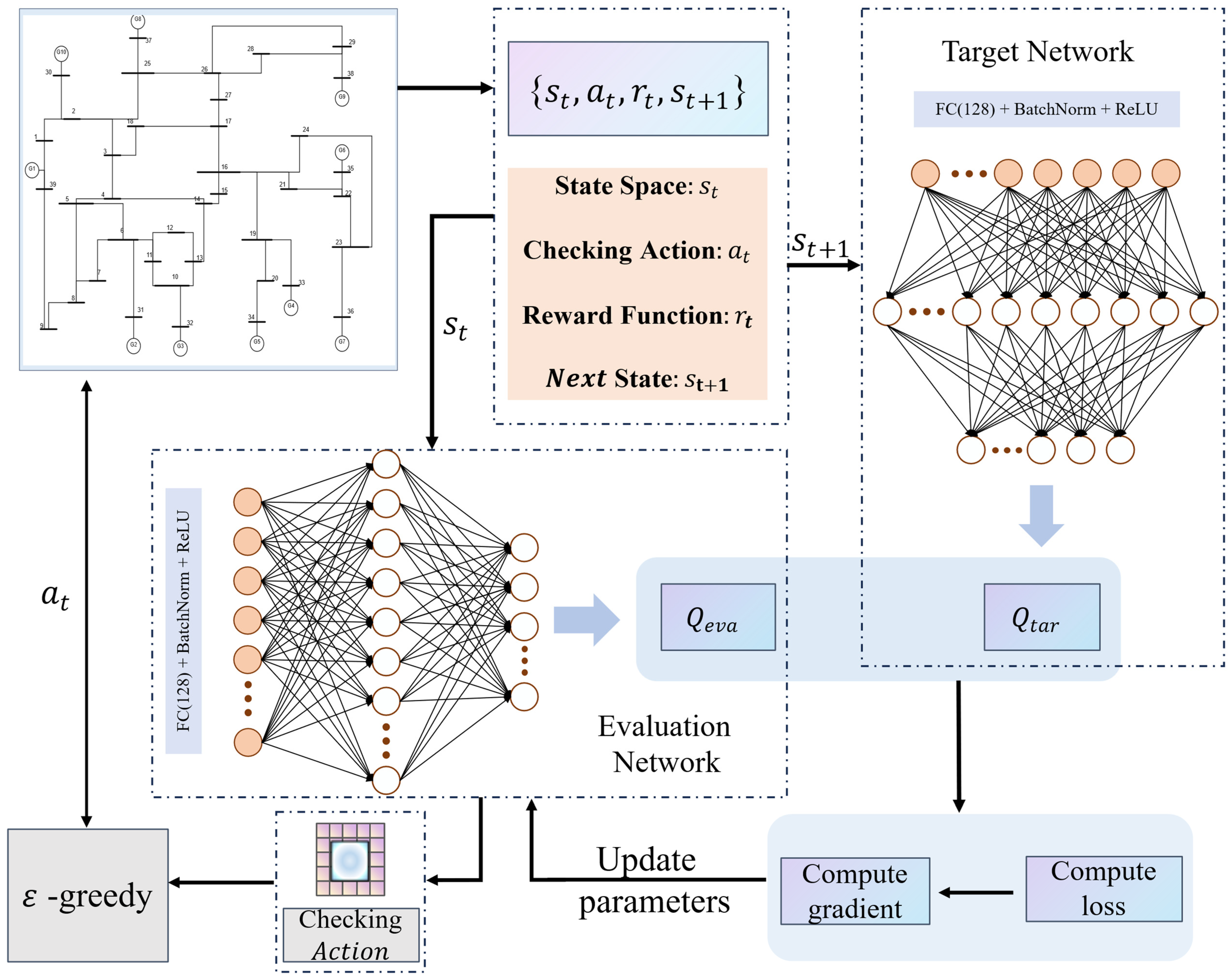
2.1. Overall Architecture
2.2. An Optimal Test Point Selection Model Based on DQN-CA
- State Space: S
- 2.
- Action Space and the Checking Action Mechanism: A
- 3.
- Reward Function: R
- 4.
- Transition Probability: P
| Algorithm 1: DQN-CA for Optimal PMU Placement |
| Input: IEEE-39 topology G, N_SEEDS, EP_PER_SEED for seed = 1 … N_SEEDS: init Q_eval, Q_tar (FC 39 → 128 → 128 → 39 + BN + ReLU), replay D, ε = 0.9 for ep = 1 … EP_PER_SEED: s ← 0; while n_obs(s) < 39: a ← ε-greedy(Q_eval(s) with Checking mask: Q[s = 1] ← −∞) s’ ← s ∪ {a}; r ← −n_pmu(s’) + 2·n_obs(s’) (+100 if done) D.push(s,a,r,s’,done) ▷ replay buffer a* = argmax Q_eval(s’); target = r + γ·Q_tar(s’,a*)·(1 − done) ▷ Double DQN update Q_eval on MSE(Q_eval(s,a), target); periodically Q_tar ← Q_eval if |s| < |B*|: B* ← buses(s) return B* Output: best PMU set B* (|B*| minimal, full observability) |
3. Architecture and Mechanisms of Dual-Path Spatio-Temporal Multitask Convolutional Graph Networks
3.1. A Dual-Path Spatio-Temporal Multi-Task Convolutional Graph Network Architecture
3.1.1. Global Dimension Reduction Path
3.1.2. Paths for Spatial Graph Aggregation
3.1.3. Multitasking and Auxiliary Supervision Head
3.1.4. Multi-Task Joint Loss Functions and Physical Reconstruction
| Algorithm 2: ST-MTGCN Training |
| Input: X ∈R^{B × 3 × 13 × 30}, A_norm ∈ R^{13×13}, y_SD ∈ {0.184} for epoch = 1 … 150: lr ← warmup(5) → cosine to 1 × 10⁻⁶ for (X, y_SD) in loader: feat = Encoder_GN(X) ▷ [B,32,13,30] z_glob = Linear(flatten feat); rec_G = Decoder_GN(z_glob) aux_S = aux_S_head(z_glob) ▷ [B,6] h = NodeProj(feat) → SAGE × 3(A_norm) → mean_N ▷ graph_feat [B,384] rec_N = STDecoder(h_nodes) logits_SD = SDHead([z_glob ‖ graph_feat]) ▷ [B,185] L = CE(logits_SD,y_SD) + 0.3·CE(aux_S,y_S) + 0.15·(MSE_G + MSE_N) AdamW step; gradClip = 1.0; EMA update (decay = 0.998) if val_SxD(EMA) > best: save θ* pr_SD = argmax logits_SD; pr_S = sd2type[pr_SD]; pr_D = sd2loc[pr_SD] Output: θ* maximizing val S × D accuracy |
3.2. Fault Data Generation Method
4. Experiments and Analysis of Results
4.1. Data Generation and Preprocessing
4.2. Results of Optimal PMU Configuration Based on the DQN-CA Algorithm
4.2.1. Training Dynamics and OPT13 Configuration of DQN-CA
4.2.2. OPP for IEEE 39 Bus Test System
4.3. Classification of Fault Types and Fault Localization
4.3.1. Comparative Analysis of Results
4.3.2. Fault Type Identification and Evaluation
- t-SNE Latent Space Clustering Analysis
- B.
- Analysis of the Confusion Matrix
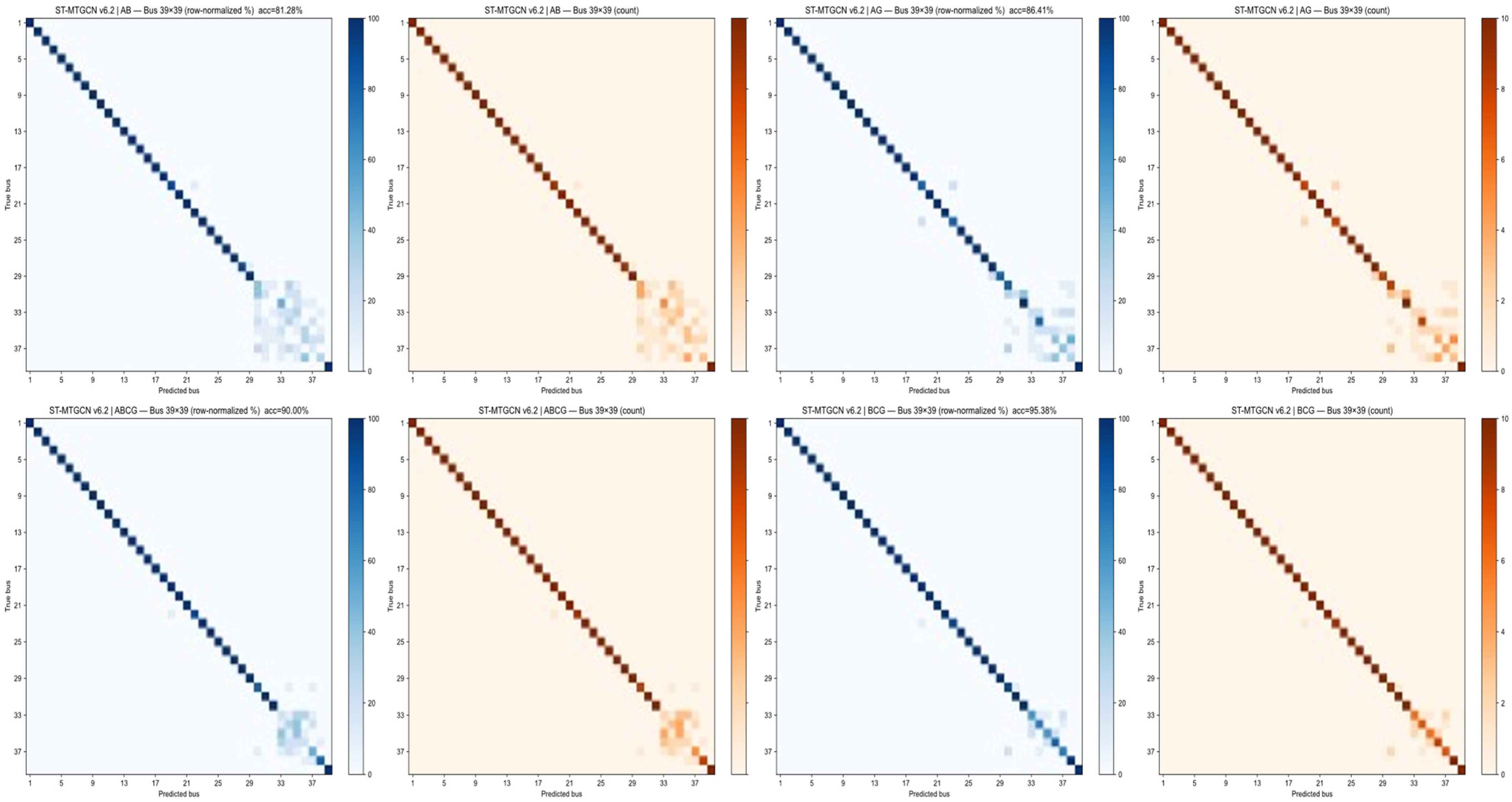
4.3.3. Assessment of Fault Localization Capabilities
4.4. Ablation Study
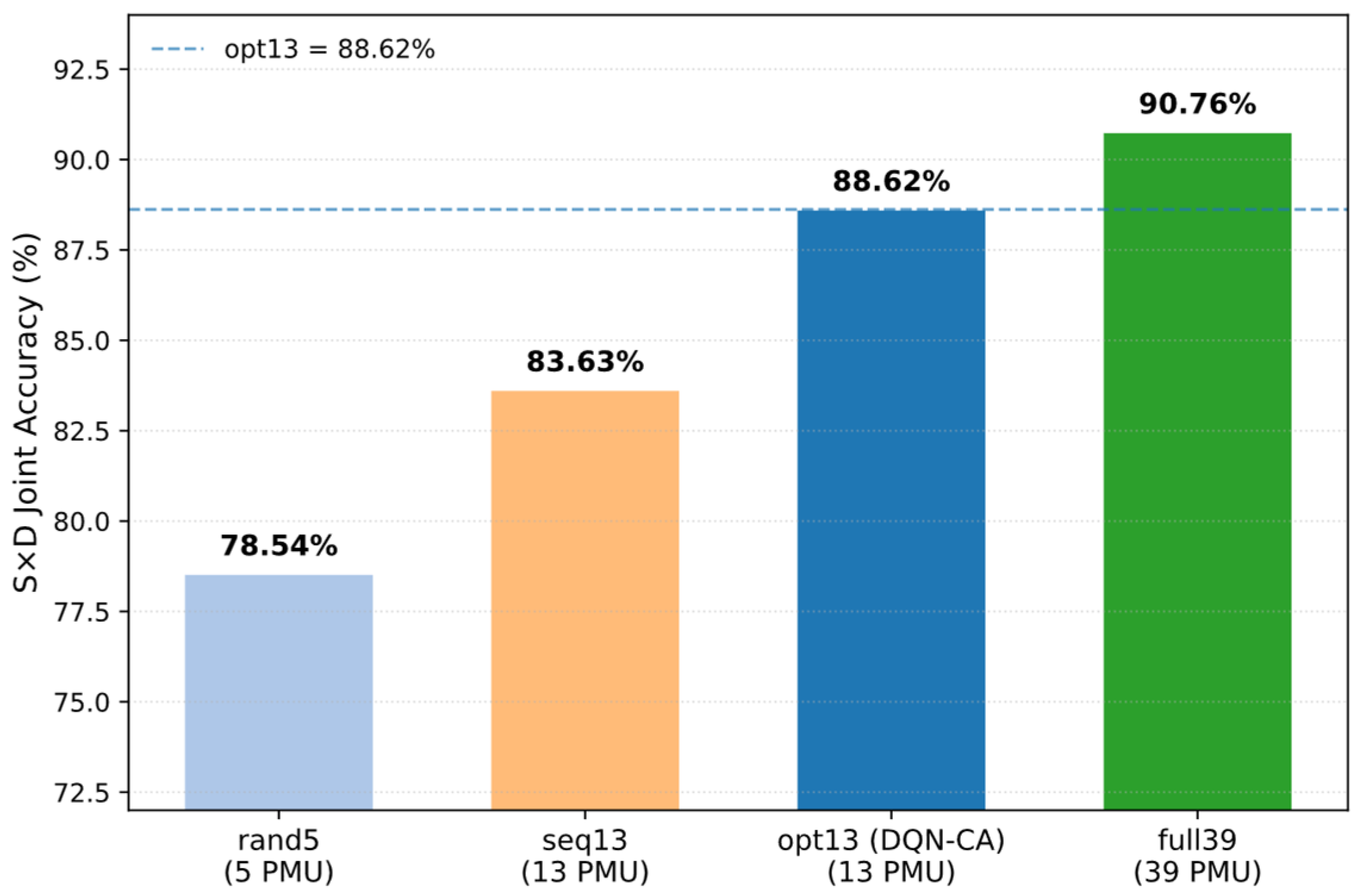
4.4.1. PMU Configuration Sensitivity Analysis
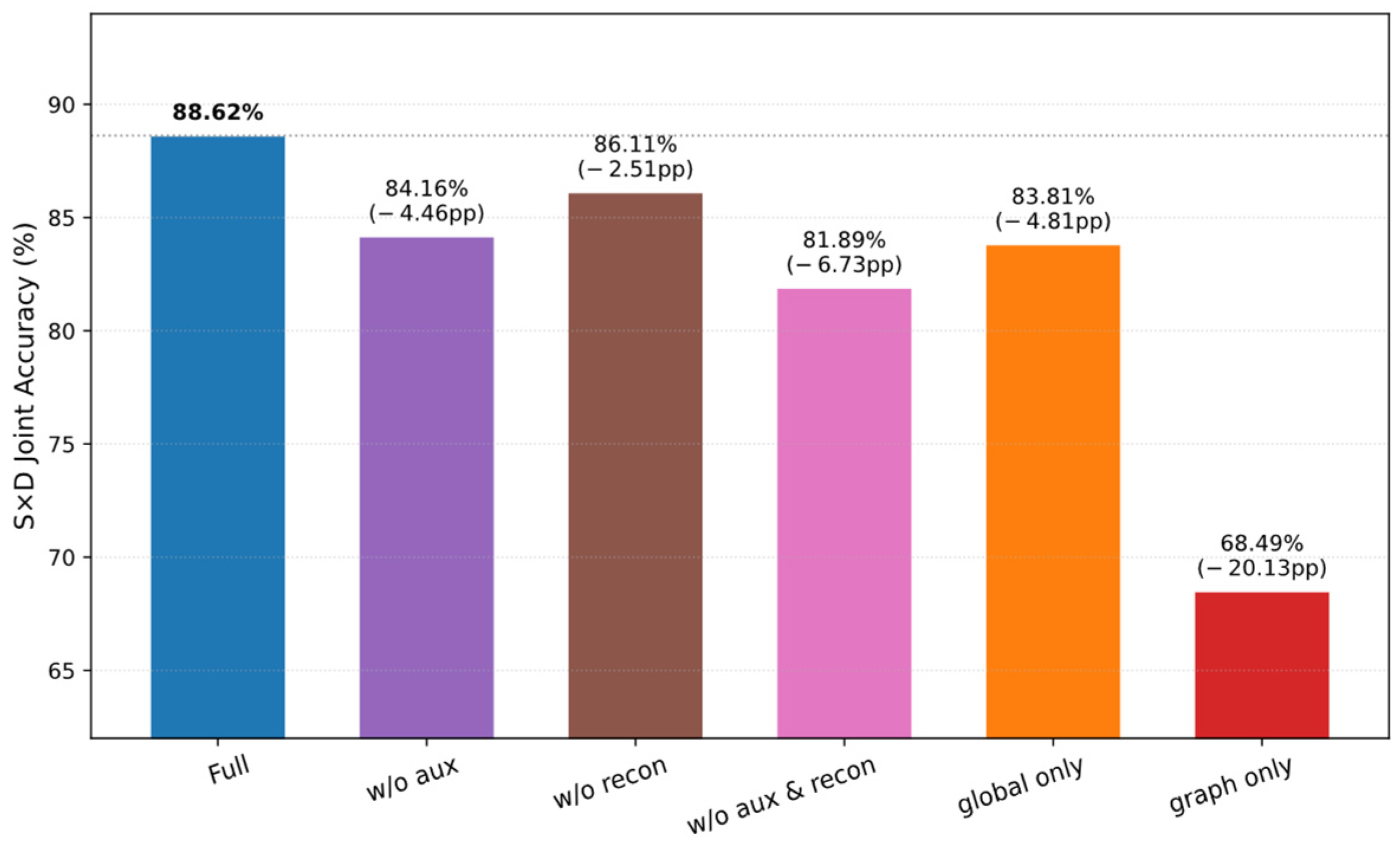
4.4.2. Ablation Study of the Proposed ST-MTGCN
5. Conclusions
Author Contributions
Funding
Data Availability Statement
Conflicts of Interest
References
- Deepa, B.; Hampannavar, S.; Mansani, S. Phasor Estimation Using Micro-Phasor Measurement Unit (μPMU) in Distribution Network for Situational Awareness. J. Electr. Syst. Inf. Technol. 2024, 11, 52. [Google Scholar]
- Pattanaik, V.; Malika, B.K.; Panda, S.; Rout, P.K.; Sahu, B.K.; Samanta, I.S.; Bajaj, M.; Blazek, V.; Prokop, L. A Critical Review on Phasor Measurement Units Installation Planning and Application in Smart Grid Environment. Results Eng. 2024, 24, 103559. [Google Scholar] [CrossRef]
- Fierro-Rincón, J.S.; Lozano-Moncada, C.A.; Gómez-Luna, E.; Grisales-Noreña, L.F.; Sanin-Villa, D. Applications of Distribution Phasor Measurement Units for the Integration of Distributed Energy Resources in Modern Distribution Networks. Appl. Syst. Innov. 2026, 9, 92. [Google Scholar] [CrossRef]
- Khodadadi-Arpanahi, M.; Torkzadeh, R.; Safavizadeh, A.; Ashrafzadeh, A.; Eghtedarnia, F. A Novel Comprehensive Optimal PMU Placement Considering Practical Issues in Design and Implementation of a Wide-Area Measurement System. Electr. Power Syst. Res. 2023, 214, 108940. [Google Scholar]
- Ahmed, M.M.; Amjad, M.; Qureshi, M.A.; Khan, M.O.; Haider, Z.M. Optimal PMU Placement to Enhance Observability in Transmission Networks Using ILP and Degree of Centrality. Energies 2024, 17, 2140. [Google Scholar] [CrossRef]
- Ge, J.; Xu, Y.; Wu, Z.; Mili, L.; Lu, S.; Hu, Q.; Gu, W. Data-Driven Optimal PMU Placement for Power System Nonlinear Dynamics Using Koopman Approach. IEEE Trans. Ind. Inform. 2024, 20, 11306–11317. [Google Scholar] [CrossRef]
- Zhou, X.; Wang, Y.; Shi, Y.; Jiang, Q.; Zhou, C.; Zheng, Z. Deep Reinforcement Learning-Based Optimal PMU Placement Considering the Degree of Power System Observability. IEEE Trans. Ind. Inform. 2024, 20, 8949–8960. [Google Scholar] [CrossRef]
- Lei, X.; Li, Z.; Jiang, H.; Yu, S.S.; Chen, Y.; Liu, B.; Shi, P. Deep-Learning Based Optimal PMU Placement and Fault Classification for Power System. Expert Syst. Appl. 2025, 292, 128586. [Google Scholar] [CrossRef]
- Hou, Y.; Liang, X.; Zhang, J.; Yang, Q.; Yang, A.; Wang, N. Exploring the Use of Invalid Action Masking in Reinforcement Learning: A Comparative Study of On-Policy and Off-Policy Algorithms in Real-Time Strategy Games. Appl. Sci. 2023, 13, 8283. [Google Scholar]
- Fathollahi, A.; Andresen, B. Deep Deterministic Policy Gradient for Adaptive Power System Stabilization and Voltage Regulation. e-Prime—Adv. Electr. Eng. Electron. Energy 2024, 9, 100675. [Google Scholar] [CrossRef]
- Lyu, Y.; Wang, H. Optimizing Evacuation for Disabled Pedestrians with Heterogeneous Speeds: A Floor Field Cellular Automaton and Reinforcement Learning Approach. Buildings 2025, 15, 4191. [Google Scholar] [CrossRef]
- Teng, J.; Sun, Y.; Song, N.; Gan, Y.; Li, Y.; Hou, X. A Power System Fault Assessment Methodology from a Power-Based Perspective. In Proceedings of the 2025 International Conference on New Power System Technology (PowerCon), 2025; IEEE: New York, NY, USA, 2025. [Google Scholar]
- Pérez-García, J.M.; Eguía, P.; Perea Olabarria, E.; Pujana, A.; Gyftakis, K.N.; Guerrero, J.M. Diagnosis and Protection of Ground Fault in Electrical Systems: A Comprehensive Analysis. IEEE Access 2025, 13, 189150–189176. [Google Scholar] [CrossRef]
- Yadav, G.K.; Kirar, M.K.; Gupta, S.C. Adaptive Protection Based Fault Detection, Classification, and Localization in Power System. In Proceedings of the 2025 IEEE 1st International Conference on Smart and Sustainable Developments in Electrical Engineering (SSDEE), 2025; IEEE: New York, NY, USA, 2025. [Google Scholar]
- Alhanaf, A.S.; Farsadi, M.; Balik, H.H. Fault Detection and Classification in Ring Power System with DG Penetration Using Hybrid CNN-LSTM. IEEE Access 2024, 12, 59953–59975. [Google Scholar] [CrossRef]
- Rizeakos, V.; Bachoumis, A.; Andriopoulos, N.; Birbas, M.; Birbas, A. Deep Learning-Based Application for Fault Localization Identification and Type Classification in Active Distribution Grids. Appl. Energy 2023, 338, 120932. [Google Scholar]
- Thomas, J.B.; Chaudhari, S.G.; Shihabudheen, K.V.; Verma, N.K. CNN-Based Transformer Model for Fault Detection in Power System Networks. IEEE Trans. Instrum. Meas. 2023, 72, 1–10. [Google Scholar] [CrossRef]
- Sahu, R.; Panigrahi, P.K.; Lal, D.K.; Pradhan, R.; Mahanty, C. A Deep Recurrent Learning Framework for Multi-Class Microgrid Fault Classification Using LSTM and Bi-LSTM Models. Eng 2026, 7, 143. [Google Scholar]
- Giri, T.; Thapa, B.B.; Paneru, B.; Paneru, B. An XAI-Driven CNN-Transformer Model for Transmission Line Fault Detection and Classification. Energy Rep. 2026, 15, 108929. [Google Scholar] [CrossRef]
- Xu, C.; Wang, Z.; Jin, Y.; Nong, W. An Adaptive Industrial Large Language Model for Mechanical Fault Diagnosis under Variable Operating Conditions. Adv. Eng. Inform. 2026, 74, 104821. [Google Scholar] [CrossRef]
- Ma, Y.; Zheng, S.; Yang, Z.; Pan, H.; Hong, J. A Knowledge-Graph Enhanced Large Language Model-Based Fault Diagnostic Reasoning and Maintenance Decision Support Pipeline towards Industry 5.0. Int. J. Prod. Res. 2025, 64, 5239–5260. [Google Scholar]
- Lai, Y.; Wu, Z.; Chen, M.; Liu, C.; Shao, H. FR-LLM: Multi-Task Large Language Model with Signal-to-Text Encoding and Adaptive Optimization for Joint Fault Diagnosis and RUL Prediction. Reliab. Eng. Syst. Saf. 2026, 269, 112091. [Google Scholar]
- Chanda, D.; Soltani, N.Y. A Heterogeneous Graph-Based Multi-Task Learning for Fault Event Diagnosis in Smart Grid. IEEE Trans. Power Syst. 2025, 40, 1427–1438. [Google Scholar]
- Karabulut, B.; Manna, C.; Develder, C. Generalization of Graph Neural Network Models for Distribution Grid Fault Detection. In Proceedings of the 2025 IEEE International Conference on Communications, Control, and Computing Technologies for Smart Grids (SmartGridComm), Toronto, ON, Canada, 2025; IEEE: New York, NY, USA, 2025; pp. 1–7. [Google Scholar]
- Nguyen, B.L.H.; Vu, T.; Nguyen, T.-T.; Panwar, M.; Hovsapian, R. 1-D Convolutional Graph Convolutional Networks for Fault Detection in Distributed Energy Systems. In Proceedings of the IEEE 1st Industrial Electronics Society Annual On-Line Conference (ONCON), 2023; IEEE: New York, NY, USA, 2023; pp. 1–6. [Google Scholar]
- Prasad, U.; Mohanty, S.R.; Singh, S.P.; Jagan, A. Robust Centralized Protection Scheme with AI-Based Fault Diagnosis Capabilities for Graph-Structured AC Microgrids. IEEE Trans. Smart Grid 2025, 16, 1975–1992. [Google Scholar] [CrossRef]
- Rimkus, M.; Kokoszka, P.; Duan, D.; Wang, X.; Wang, H. Graph Neural Networks for the Localization of Faults in a Partially Observed Regional Transmission System. Scand. J. Stat. 2025, 52, 572–594. [Google Scholar] [CrossRef]
- Ngo, Q.-H.; Nguyen, B.L.H.; Zhang, J.; Schoder, K.; Ginn, H.; Vu, T. Deep Graph Neural Network for Fault Detection and Identification in Distribution Systems. Electr. Power Syst. Res. 2025, 247, 111721. [Google Scholar] [CrossRef]
- Nguyen, B.L.H.; Vu, T.V.; Nguyen, T.-T.; Panwar, M.; Hovsapian, R. Spatial-Temporal Recurrent Graph Neural Networks for Fault Diagnostics in Power Distribution Systems. IEEE Access 2023, 11, 46039–46050. [Google Scholar] [CrossRef]
- Wang, S.; Xiang, X.; Zhang, J.; Liang, Z.; Li, S.; Zhong, P.; Zeng, J.; Wang, C. A Multi-Task Spatiotemporal Graph Neural Network for Transient Stability and State Prediction in Power Systems. Energies 2025, 18, 1531. [Google Scholar] [CrossRef]
- Huang, S.; Li, J.; Zeng, R.; Li, Z.; Xu, J. Dynamical Graph Neural Networks for Modern Power Grid Analysis. Electronics 2026, 15, 493. [Google Scholar] [CrossRef]
- Rusch, T.K.; Bronstein, M.M.; Mishra, S. A Survey on Oversmoothing in Graph Neural Networks. arXiv 2023, arXiv:2303.10993. [Google Scholar]
- Chen, Z.; Lin, Z.; Chen, S.; Polyanskiy, Y.; Rigollet, P. Avoiding Oversmoothing in Deep Graph Neural Networks: A Multiplicative Ergodic Analysis. arXiv 2025, arXiv:2501.00762. [Google Scholar]
- Attali, H.; Pernelle, N.; Buscaldi, D.; Malliaros, F.D. Graph Rewiring in GNNs to Mitigate Over-Squashing and Over-Smoothing. arXiv 2026, arXiv:2411.17429. [Google Scholar]
- Zhang, M.; Wu, Z.; Yan, J.; Lu, R.; Guan, X. Attack-Resilient Optimal PMU Placement via Reinforcement Learning Guided Tree Search in Smart Grids. IEEE Trans. Inf. Forensics Secur. 2022, 17, 1919–1929. [Google Scholar] [CrossRef]
- Zhong, D.; Yang, Y.; Zhao, Q. No Prior Mask: Eliminate Redundant Action for Deep Reinforcement Learning. In Proceedings of the Thirty-Eighth AAAI Conference on Artificial Intelligence, Vancouver, BC, Canada, 20–27 February 2024; AAAI Press: Washington, DC, USA, 2024; pp. 17078–17086. [Google Scholar]
- Huang, Z.; Liang, R.; Xiao, Y.; Fang, Z.; Li, X.; Ye, R. Simulation of Pedestrian Evacuation with Reinforcement Learning Based on a Dynamic Scanning Algorithm. Phys. A Stat. Mech. Appl. 2023, 625, 129011. [Google Scholar] [CrossRef]
- Wang, F.; Hu, Z. A Novel Fault Diagnosis and Accurate Localization Method for a Power System Based on GraphSAGE Algorithm. Electronics 2025, 14, 1219. [Google Scholar] [CrossRef]
- Li, T.; Wu, Z.; Liu, Y.; Jia, R. Voltage Sag Source Localization Based on Multi-Layer Perceptron and Transfer Learning. Front. Energy Res. 2023, 11, 1237239. [Google Scholar] [CrossRef]
- Daisy, M.; Dashti, R.; Shaker, H.R.; Javadi, S.; Aliabadi, M.H. Fault Localization in Power Grids Using Substation Voltage Magnitude Differences: A Comprehensive Technique for Transmission Lines, Distribution Networks, and AC/DC Microgrids. Measurement 2023, 220, 113403. [Google Scholar]
- Yao, R.; Bai, H.; Jiang, S.; Liu, T.; Lei, Y.; Zheng, Y. A Two-Stage Voltage Sag Source Localization Method in Microgrids. Energies 2026, 19, 258. [Google Scholar] [CrossRef]
- Tang, X.; Yao, H.; Sun, Y.; Wang, Y.; Tang, J.; Aggarwal, C.; Mitra, P.; Wang, S. Investigating and Mitigating Degree-Related Biases in Graph Convolutional Networks. In ACM International Conference on Information and Knowledge Management (CIKM); ACM: New York, NY, USA, 2020. [Google Scholar]
- Alenezi, M.; Anayi, F.; Packianather, M.; Shouran, M. Enhancing Transformer Protection: A Machine Learning Framework for Early Fault Detection. Sustainability 2024, 16, 10759. [Google Scholar] [CrossRef]
- Zhang, S. Review of the Development of Power System Out-of-Step Splitting Control and Some Thoughts on the Impact of Large-Scale Access of Renewable Energy. Energy AI 2024, 16, 100357. [Google Scholar]
- Li, Q.; Han, Z.; Wu, X.-M. Deeper Insights into Graph Convolutional Networks for Semi-Supervised Learning. In Proceedings of the Thirty-Second AAAI Conference on Artificial Intelligence, New Orleans, LA, USA, 2–7 February 2018; AAAI Press: Palo Alto, CA, USA, 2018; pp. 3538–3545. [Google Scholar]
- Bacho, A.; Kutyniok, G.; Maskey, S.; Paolino, R. A Fractional Graph Laplacian Approach to Oversmoothing. In Proceedings of the Thirty-Seventh Conference on Neural Information Processing Systems, New Orleans, LA, USA, 10–16 December 2023. [Google Scholar]
- Wang, Y.; Wang, L.; Zhong, W.; Wang, E.; He, B.; Lan, W. A Real-Time Fault Detection Strategy for Cables Based on Adaptive Feature Enhancement and Multi-Scale Temporal Modeling. Discov. Artif. Intell. 2025, 5, 394. [Google Scholar]
- Samarawickrama, K.; Kordi, B.; Chang, L. Generator Out-of-Step Protection Using the Trajectory of Relative Speed. In Proceedings of the International Conference on Power Systems Transients (IPST), Thessaloniki, Greece, 12–15 June 2023; IPST: Hayama, Japan, 2023; pp. 1–6. [Google Scholar]



| Parameter | Values |
|---|---|
| Input tensor | (B × 3 × 13 × 30) |
| PMU configuration | OPT13 |
| PMU-induced graph | 3-hop graph |
| Number of joint classes | 185 |
| Shared encoder | 6 ResBlock2D layers |
| Encoder channels | 128–128–64–64–32–32 |
| Global latent dimension | 52 |
| Graph path | 3 GraphSAGE layers |
| Graph hidden dimension | 384 |
| Fusion dimension | 436 |
| Main classifier | Linear(436–128–64–185) |
| Auxiliary classifier | Linear(52–32–6) |
| Optimizer | AdamW |
| Weight decay | 1 × 10⁻³ |
| Gradient clipping | 1 × 10⁻³ |
| Epochs | 150 |
| Label smoothing | 0.05 |
| Loss function | Joint cross-entropy + auxiliary cross-entropy + MSE |
| Parameter | EMT Electromagnetic Transient | Note |
|---|---|---|
| System frequency | 60 Hz | IEEE 39 standard |
| Simulation window | [−0.05, +0.2] s | t = 0 is fault injection |
| Fault-on time | 0.02 s | via EvtShc/EvtSwitch |
| Fault-off time | 0.08 s | duration 1.0 s/60 ms |
| Time step Δt | 1.0 × 10⁻⁴ s | 1/60 s/0.1 ms |
| Sampling rate fs | 10 kHz | 16.7 ms/0.1 ms interval |
| Samples per window T | 30 | last 30 steps |
| Effective length | ≈3 ms | T·Δt |
| Observation channels | Va/Vb/Vc | RMS derived from |
| Fault types S | AG/BCG/AB/ABCG/GT/LO | 6 classes |
| Fault Localizations D | 39 buses + 10 gens + 19 loads | S × D = 185 |
| Fault resistance R_f | U(4.5, 5.5) Ω | resampled per run |
| Fault reactance X_f | 0 | short-circuit faults |
| Load perturbation | N(1.0, 0.15), clip [0.5, 1.5] | Plini, Qlini |
| Samples per (S, D) | 40/10 | 50 per pair |
| Dataset total | 7400/1850 | 9250 in total |
| Parameter | Values |
|---|---|
| Test system | IEEE 39-bus system |
| Number of input neurons | 39 |
| Number of hidden neurons | 128 |
| Number of output neurons | 39 |
| Q-network structure | FC–BN–ReLU–FC–BN–ReLU–FC |
| Initialization method | Normal distribution |
| Target network update frequency | 50 episodes |
| Exploration probability | 0.9 → 0.05 |
| decay rate | 0.997 |
| Discount factor | 0.9 |
| Learning rate | 1 × 10⁻³ |
| Optimizer | Adam |
| Episodes per seed | 2000 |
| Number of random seeds | 50 |
| Gradient clipping | 10.0 |
| Loss function | MSE |
| Checking-Action mechanism | Masking installed buses |
| Terminal reward | +100 |
| Model | Fault Type | Localization | S × D (Joint) |
|---|---|---|---|
| SVM | 89.54% | 73.73% | 70.49% |
| CNN | 95.59% | 78.32% | 78.01% |
| GCN | 98.76% | 78.38% | 78.32% |
| GraphSAGE | 99.41% | 80.54% | 80.21% |
| LSTM | 99.68% | 82.00% | 81.35% |
| Transformer-GNN | 99.30% | 84.38% | 83.32% |
| ST-MTGCN | 99.68% | 89.94% | 88.62% |
Disclaimer/Publisher’s Note: The statements, opinions and data contained in all publications are solely those of the individual author(s) and contributor(s) and not of MDPI and/or the editor(s). MDPI and/or the editor(s) disclaim responsibility for any injury to people or property resulting from any ideas, methods, instructions or products referred to in the content. |
© 2026 by the authors. Licensee MDPI, Basel, Switzerland. This article is an open access article distributed under the terms and conditions of the Creative Commons Attribution (CC BY) license.
Share and Cite
Wu, Z.; Shi, F.; Li, H.; Ran, L. Power System Fault Detection and Localization Using a Dual-Path Spatio-Temporal Multi-Task Graph Convolutional Network. Electronics 2026, 15, 2767. https://doi.org/10.3390/electronics15132767
Wu Z, Shi F, Li H, Ran L. Power System Fault Detection and Localization Using a Dual-Path Spatio-Temporal Multi-Task Graph Convolutional Network. Electronics. 2026; 15(13):2767. https://doi.org/10.3390/electronics15132767
Chicago/Turabian StyleWu, Zhaoyang, Fanrong Shi, Hao Li, and Lili Ran. 2026. "Power System Fault Detection and Localization Using a Dual-Path Spatio-Temporal Multi-Task Graph Convolutional Network" Electronics 15, no. 13: 2767. https://doi.org/10.3390/electronics15132767
APA StyleWu, Z., Shi, F., Li, H., & Ran, L. (2026). Power System Fault Detection and Localization Using a Dual-Path Spatio-Temporal Multi-Task Graph Convolutional Network. Electronics, 15(13), 2767. https://doi.org/10.3390/electronics15132767