Article

Demand-Driven Configuration Method and Model for Equipment Performance Indices

1
Department of Mechanical Engineering, Sichuan University, Chengdu 610065, China
2
Electromechanical Equipment and Product Innovative Design Key Laboratory of Sichuan Province, Chengdu 610065, China
*
Author to whom correspondence should be addressed.
Electronics 2026, 15(12), 2634; https://doi.org/10.3390/electronics15122634 (registering DOI)
Submission received: 14 May 2026 / Revised: 10 June 2026 / Accepted: 11 June 2026 / Published: 15 June 2026

Abstract

The requirement for rapid and diversified performance index demonstrations for complex equipment systems conflicts with traditional fixed and singular demonstration templates. In this study, we propose a rapid demonstration model for complex equipment performance indices based on requirements to solve this limitation. We established a demonstration framework encompassing diverse requirements, schemes, and demonstration data, along with a demonstration process model based on dynamic requirements integrated through the framework. The requirement elements and index elements for demonstration are dynamically configured by characterizing the requirements and knowledge at the granularity and unit levels. Combined with a structured knowledge template, we constructed a dynamic demonstration template linking requirements and knowledge associations based on a form configuration, which constitutes a rapid configuration method for equipment performance index demonstration templates. Diverse index demonstrations for new equipment can be realized by instantiating the requirements-driven equipment performance index demonstration method. Finally, we developed a rapid demonstration tool for the error analysis of antenna arrays to verify the rationality and effectiveness of the proposed method.

1. Introduction

Index demonstration is an important part of the development process for new weapons and equipment [1,2]. The demonstration of weaponry and equipment indexes spans the entire life cycle of their research and development. It is a series of logical reasoning and analysis processes that starts from combat requirements and combat capabilities, and conducts scientific analyses and calculations of the main problems that must be solved in the development of weapons and equipment, thereby determining the goals and requirements of weapon equipment construction. Modern warfare faces a complex combat environment, which brings significant challenges to traditional weaponry design concepts and processing architectures [3,4]. At present, performance index demonstration methods and schemes under a single demonstration index system cannot meet the requirements for diverse demonstrations, due to the increasing complexity of new weapon equipment systems in terms of both function and structure. In addition, the knowledge required in the demonstration process cannot be quickly integrated and effectively transferred because of the unstructured nature of the knowledge required under different demonstration requirements. To address these two problems, researchers have conducted extensive research from the perspectives of demonstration methods and demonstration knowledge management.

1.1. Demonstration Method of Equipment Performance Index

Weaponry and equipment development departments pay significant attention to equipment system demonstrations [5]. The demonstration method for weapon and equipment performance indexes adopted by these departments determines the quality and efficiency of the demonstration. It has become a hotspot in the research of weapon equipment demonstration, and scholars worldwide have carried out extensive research work. Chao Wang [6] designed and developed an effectiveness index demonstration platform for combat simulation systems. Through the demonstration of design requirements, an index system can be automatically constructed to complete the analysis of test data, record and replay the evaluation process, and generate demonstration results. Zenghua Li [7] proposed using combat effectiveness demonstrations to describe combat mission products and equipment, providing a specific performance demonstration process referencing Department of Defense Architecture Framework (DoDAF) modeling ideas. Ren Wei [8] constructed a combat effectiveness demonstration index system for the space-ground integrated information system for aircraft carrier attack missions, proposing various effectiveness demonstration index models, and using the fuzzy analytic hierarchy process and entropy weight method to analyze the demonstration index weights to obtain the overall combat effectiveness value. Aiming at the evaluation of the overall contribution of the weapon and equipment system, Wenhao Bi [9] pointed out that the ability of weapon systems to achieve operational missions is vital to military success. Focusing on the problem of weapon system effectiveness assessment under interval uncertainty, the authors proposed a method that utilized the interval-valued evidential reasoning algorithm, the analytical hierarchy process, and the two-grade interval ranking method to properly deal with interval uncertainty in the assessment as well as provide reliable assessment results, thereby obtaining the final evaluation result of weapon system effectiveness. Lingyan Zhu [10] employed a combined approach of the Analytic Hierarchy Process (AHP) and the fuzzy comprehensive evaluation method, utilizing Yaahp(12.0) software for modeling and empirical analysis to obtain the final comprehensive evaluation results. Dou Yajie [11] measured the contribution rate by establishing a hierarchical multi-standard value model from three dimensions. According to the value model, feasible weaponry was developed under certain cost constraints, and the optimal weapon system weaponry was obtained through a classification optimization selection strategy. Yu Zhang [12] solved the problems of unclear operating procedures and inconvenient operations, and promoted the effective implementation of equipment operation test practices. Starting from the equipment user and task sequence, on this basis, the operation test problem is decomposed, and the indicators are established and combined through a variety of methods. This establishes a complete system, and defines the complete steps of the operation test index system. Weishi Peng [13] proposed a performance evaluation method for man-portable devices based on the cloud center of gravity evaluation method, constructed an evaluation index system, applied the cloud center of gravity judgment method and weighted deviation to determine evaluation results, and verified the feasibility and effectiveness of the method through case studies to obtain the final performance assessment results. Dağıstanlı [14] applied a methodology for Anti-Guided Tank Missile selection by integrating the Fuzzy Analytic Hierarchy Process (FAHP) with Lanchester equations, and utilized the Joint Conflict and Tactical Simulation (JCATS) tool for scenario analysis to verify the validity of the combat model, thereby determining the optimal weapon system selection under a capability-based planning framework.

1.2. Research on Demonstration Knowledge Management Method

Demonstration knowledge is the key to a rapid response in the demonstration process. Different demonstration requirements need to be equipped with appropriate demonstration knowledge resources. It provides auxiliary support means for the demonstration of weapons and equipment indexes through the classification, feature extraction, modeling, identification, and management of demonstration knowledge [15]. Yunke Sun [16] proposed an integrated framework for requirement analysis and capability evaluation of weapon system of systems, utilizing Quality Function Deployment (QFD) for requirement decomposition and the Fuzzy Analytical Network Process (FANP) to calculate priorities under uncertain conditions, and finally constructing a projection gray target model to obtain the capability evaluation results under conditions of poor data. Hui Qu [17] proposed a framework for constructing a weapon and equipment knowledge graph based on Protégé, describing key technologies for each stage to provide theoretical and methodological support for knowledge graph design and construction. Wang Lin [18] proposed a method based on process knowledge graph retrieval and machining scheme similarity matching to reduce human subjectivity, constructing a multi-level process knowledge graph and using an improved cosine similarity formula to obtain the optimal machining scheme. Han [19] proposed a hybrid approach combining a dynamic Bayesian network with a large language model to address challenges in multimodal context-aware interactions, implementing a tri-level DBN for real-time intent inference to achieve accurate and efficient user intention recognition. Pascal Hirmer [20] proposed a method for situation recognition and processing by executing situation templates and situation awareness workflows—the Situation Recognition and Handling based on Executing Situation Templates (SitOPT) method based on a three-tier architecture. Lenko Grigorov [21] proposed a template design method to solve the Discrete Event System (DES) problem. This method does not require the introduction of new control theory, but rather a reinterpretation of the existing modeling framework. Guoqian Jiang [22] developed a template generation and visualization system based on the open Resource Description Framework (RDF) storage backend, a web user interface based on SmartGWT, and a visualization tool based on “mind mapping”. Adriana Caione [23] proposed a method and technical solution that can model, manage, execute, and monitor business processes in complex fields. Andrea Marrella [24] proposed an automatic synthesis method based on a template-based process model, which can achieve goals in a dynamic and partially specified environment.
Although there have been numerous studies on the methods of weapon equipment performance index demonstration and knowledge management methods, these studies are mostly based on the rapid reuse of a fixed, singular demonstration template based on specific requirements. It is currently impossible to dynamically form a matching index demonstration template for different demonstration requirements and realize a variety of corresponding demonstration schemes. Therefore, this paper proposes a requirements-driven weapon equipment performance index demonstration model and a configuration method for dynamic demonstration templates. By quickly responding to the diverse demonstration requirements of weapon equipment systems, the dynamic demonstration template of weapon equipment performance indexes can be constructed. In order to realize the rapid assessment and data analysis of the required demonstration weapon equipment system performance indexes, it is necessary to dynamically configure the matching index demonstration template and instantiate the corresponding demonstration tool set through a rapid response to requirements. Compared with existing requirement-based performance demonstration approaches, the proposed framework establishes a dynamic requirement–knowledge association mechanism. Traditional methods largely rely on fixed, singular templates and lack the flexibility to adapt to changing evaluation parameters. In contrast, our approach enables the dynamic generation of demonstration templates driven entirely by specific evaluation requirements, thereby maximizing knowledge reuse and tool configurability. To clearly highlight the original contributions and distinctive features of the proposed method, a systematic comparison with representative existing approaches is summarized in Table 1.

2. Demonstration Model Based on Requirement-Driven Weapon Equipment Performance Indexes

The requirements-driven performance index demonstration model of a weapon equipment system is an overall system that includes three aspects: demonstration requirements, demonstration plans, and demonstration data. Among them, demonstration requirements are the performance standard requirements that the weapon equipment system needs to meet during operation; the demonstration plan is based on the demonstration requirements to gather the knowledge related to the demonstration, including the demonstration rules, the demonstration tools, and the demonstration data, so as to realize the overall design and deployment of the demonstration plan; and demonstration data involves the unified organization and management of demonstration rules, knowledge, and other information in different fields required by the demonstration process. Its purpose is to achieve the matching of requirements-driven design resources. This paper proposes a requirements-driven performance index demonstration model framework, as shown in Figure 1. The requirement layer is based on the background and operational capabilities of the weapon equipment system performance index system required to be demonstrated. The weapon performance index elements are divided into performance function indexes and general element indexes to form a weapon equipment system index demonstration requirement set. The scheme layer is a weapon equipment performance index demonstration scheme established for the demonstration requirement set. It performs effectiveness simulations on the established index demonstration program and evaluates the performance index results to obtain various influencing factors in the weapon equipment performance index and determine their degree of influence. The template layer is a structured organization model of index demonstration tools. Through the structural organization and expression of design requirements such as configuration, setting, calculation, and display, it realizes the matching of various demonstration knowledge of products, and strengthens the management, extraction, and reuse of knowledge. Finally, it completes the dynamic construction of demonstration templates; the data layer manages all kinds of knowledge resources that support the demonstration process, establishes the interface between business logic and data access, and realizes the aggregation of all kinds of demonstration data through the entity class of the object model as the carrier of data transmission. The specific demonstration process includes the analysis and establishment of demonstration requirements, the construction and evaluation of demonstration indexes, and the configuration and packaging of demonstration tools. Specifically, the interaction among the four layers follows a progressive workflow. The requirement layer decomposes user requirements into functional and performance indexes, which drive the scheme layer to generate and evaluate demonstration schemes. The selected scheme is then passed to the template layer, where the required calculation and display functions are dynamically configured through requirement and knowledge forms. Finally, the data layer provides the necessary knowledge resources and execution support for template instantiation and operation.

2.1. Analysis and Establishment of Demonstration Requirements

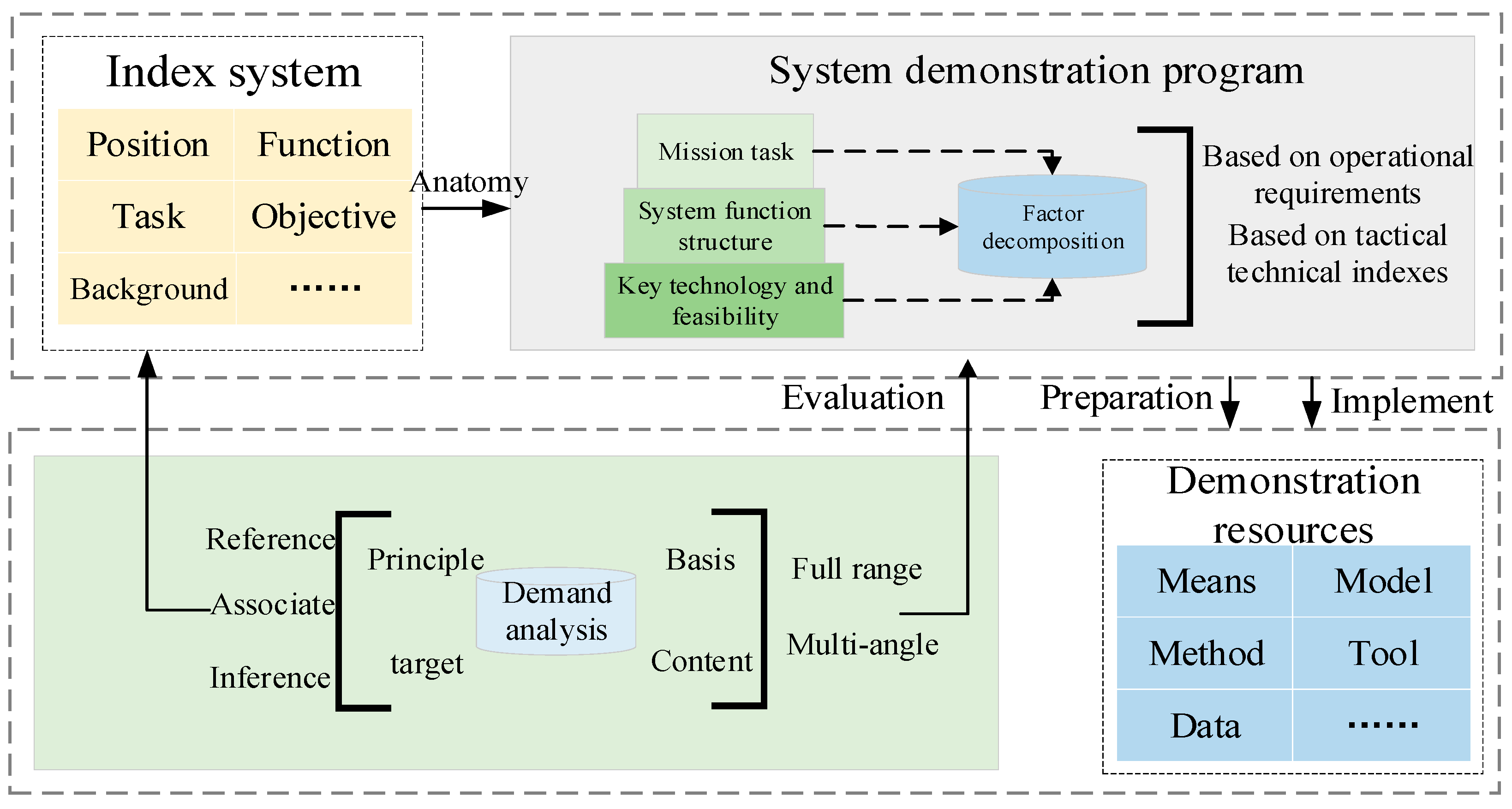
The demonstration of performance indexes for new weapons and equipment is multi-objective, and the factors involved are complex, diverse, and uncertain [25]. Therefore, it is necessary to configure the dynamic demonstration plan for the requirements of diversity demonstrations. In order to meet the requirements of information warfare and capability-based equipment construction, the demonstration of weapons and equipment types must not be limited to the basic combat tasks undertaken by the type of equipment, but must also be analyzed for the requirements of the system structure [26]. As shown in Figure 2, the purpose of the demonstration requirement analysis is to form multiple weapon equipment system demonstration plans based on the positioning, background, mission, goal, and function of the index system, and analyze its mission, operational requirements, system functional structure, tactical technical indexes, key technologies, and feasibility. Finally, it evaluates the differences between multiple alternatives, and determines the system positioning, status, role, and target tasks of the new weapon equipment system [23]. Based on the basis, principles, content, and objectives of the weapon and equipment demonstration system, a demonstration plan that supports multi-angle and all-round evaluation can be designed. It prepares for the follow-up demonstration work by arranging the implementation of the necessary models, data, tools, and other resources.

2.2. Construction and Evaluation of Demonstration Index

Based on various demonstration requirements, establishing a reasonable demonstration index system is the basis and foundation for achieving equipment performance index evaluation. Adopting and constructing a reasonable index evaluation method is very important for the comprehensive evaluation of equipment performance indexes.
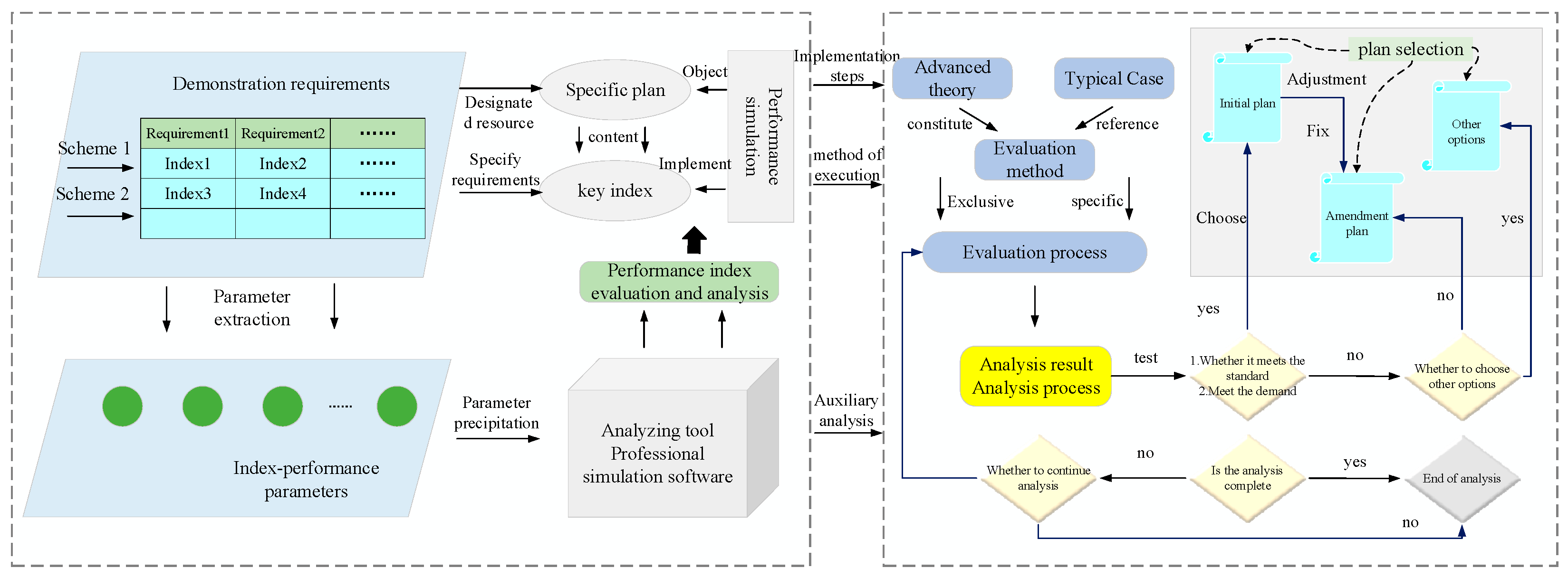
Targeting weapon equipment demonstration, the performance index evaluation analysis process constructed in this paper is mainly composed of the key performance index evaluation and the effectiveness simulation of the demonstration program. Through the mapping relationships in the weapon equipment combat requirement demonstration, such as those between the demonstration requirement and the demonstration plan, the demonstration plan and the demonstration index, as well as the demonstration index and the performance parameter, we establish the rule set for the index knowledge parameter extraction of the index demonstration tool and extract the key parameters of the performance indexes into the analysis tool. In the tool, professional simulation software can be used for index simulation analysis. The specific rules and logic can be developed to realize the analysis of some index requirements, as shown in Figure 3. The key performance indexes are decomposed and expanded to the design parameter level. According to the given target requirements and the use resources limited by the demonstration environment, it is judged whether the demonstration results of the scheme used meet the standards. The results of various indexes are sent back to the corresponding weapon equipment demonstration program set to complete the precipitation process. These parameters and results will be used in the next stage of weapon equipment index demonstration analysis. The evaluation and analysis process uses cyclical evaluation to make real-time adjustments to the deployment of combat plans. For different evaluation objects, according to the defined goals and specific requirements, we adopt the principle of specific analysis of specific problems, and construct an evaluation index system that meets different requirements and focuses on the premise of ensuring its versatility and scalability. The ultimate goal is to realize the dynamic optimization configuration of the demonstration plan and complete the transformation of the combat mode from platform-centric war countermeasures to system-centric operations.

2.3. Configuration and Packaging of the Demonstration Tool

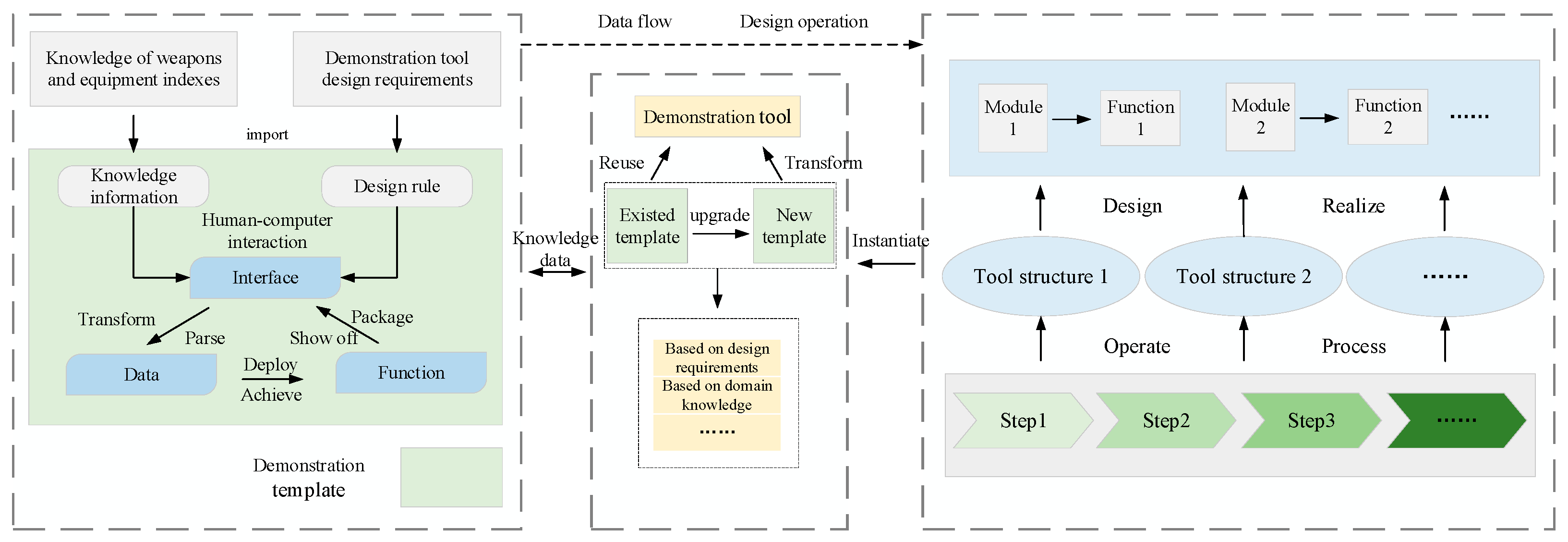
In order to achieve a rapid and accurate demonstration of key performance indexes of weapons and equipment, the knowledge of indexes in various related fields needs to have the ability to quickly converge for the demonstration requirements. This paper proposes a unitized demonstration requirement and knowledge management model, and proposes a dynamic index demonstration template configuration method. This method can realize the dynamic configuration of the demonstration template through the collection of knowledge meta-information. It can quickly derive the index demonstration tool set, as shown in Figure 4. By defining index demonstration templates, and importing relevant knowledge about weapons and equipment demonstration indexes and design demand information of demonstration tools, the demonstration tools for specific equipment R&D demonstration stages could be instantiated. The formation of demonstration tools is the realization process of dynamic demonstration templates. The index demonstration tool template is mainly composed of the interface, data, function, and other elements. The functional modules and control contents of the interface setting tool limit the display mode of each piece of information in the tool, such as windows, text boxes, buttons, etc. Data refers to the knowledge of weapons and equipment demonstration indexes and design rules, including a summary of information received by the interface. It combines index knowledge and design rules, and specifies the analytical rules that form the tool interface. Function is a collection of data descriptions and executable program elements. The interface and its module content are the display carriers of its functional attributes. In business instances, the existing demonstration templates that meet the demonstration requirements can be directly called according to actual requirements to realize the reuse of templates. The dynamic upgrade of the template can be realized in the interaction process of the change in design requirements and the update of domain knowledge, including the variant design organized by modules and the wizard design guided by the tool structure. In the rapid design process of the demonstration tool, the template is quickly configured according to the attribute settings of knowledge and requirements. Two types of knowledge data are extracted to form tool examples. The rapid prototyping of dynamic and customized tools could be realized through dynamic demonstration templates.

3. Performance Index Demonstration Template Configuration and Knowledge Management

In order to solve the contradiction between the diversity of demonstration requirements and the singular solidification of the demonstration template, this paper proposes a model that matches and manages diverse demonstration requirements with knowledge, which can support the dynamic expansion of demonstration knowledge in the process of weapon equipment demonstration based on diverse demonstration requirements. Based on the ontology model and configuration method, a requirements-driven dynamic demonstration configuration template and template configuration method are proposed. They complete the template configuration by inputting the requirement meta-information and index meta-information, and realize the instantiation of the dynamic demonstration template to complete the construction of the demonstration tool entity.

3.1. Unitized Demonstration Requirements and Knowledge Management

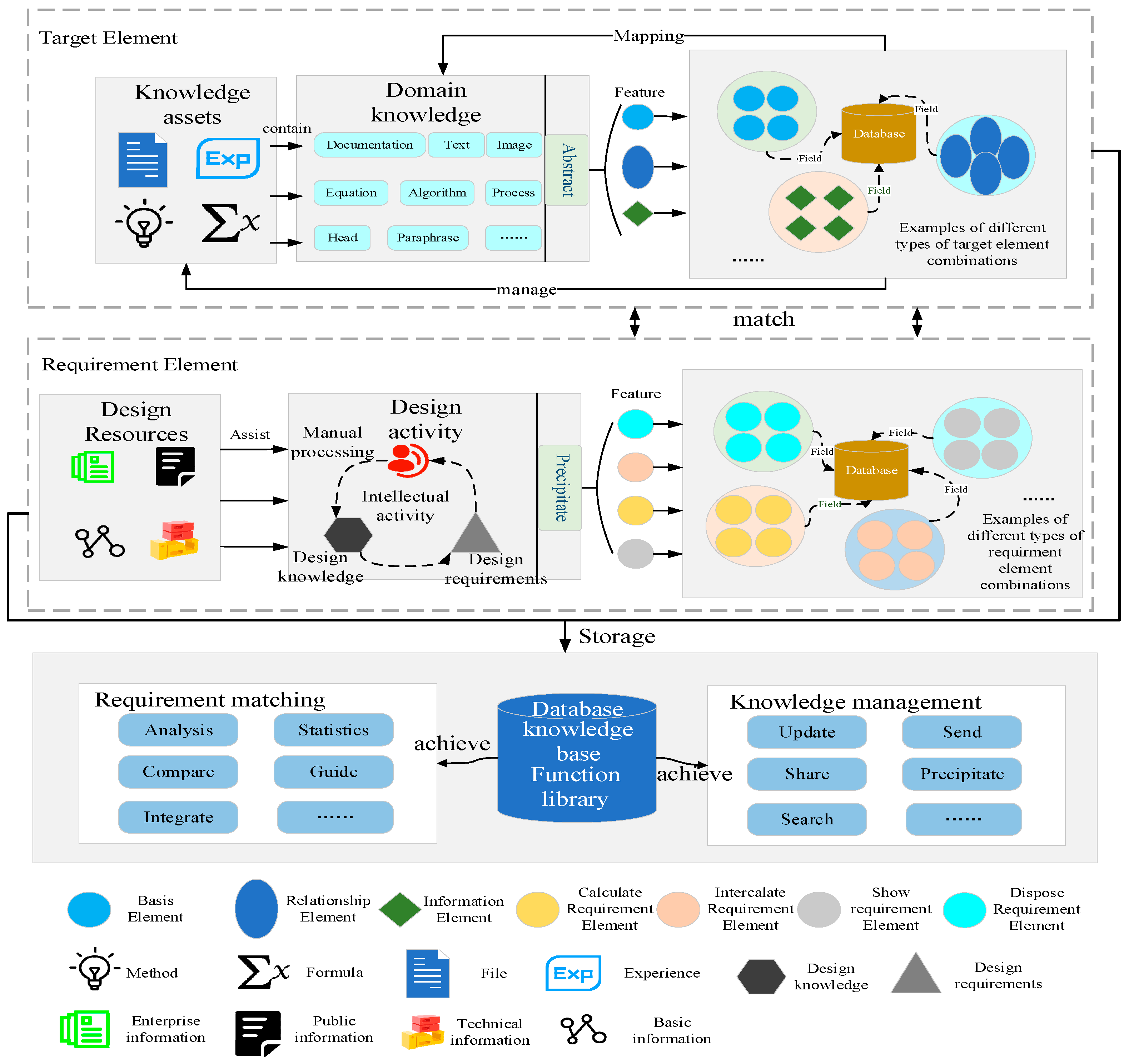
Effectively organizing and managing domain knowledge information and applying it to support product design and development is a key issue in knowledge modeling technology, which mainly includes the structured processing of information and the provision of information carriers for it [27,28]. To realize the dynamic aggregation and management of demonstration knowledge based on diverse demonstration requirements, firstly, it is necessary to unitize and structure the expression of demonstration knowledge in different fields. As a kind of knowledge unit that can completely express information with the smallest granularity, the knowledge element can more effectively reveal the relationship between demonstration knowledge in various fields, and it is an ideal form to realize the dynamic organization of knowledge [29]. In order to adapt to the changing, overlapping, and iterative process of knowledge in the process of weapon equipment key performance index demonstration, as well as the constantly changing demonstration requirements of the test environment, with the support of the Web Ontology Language (OWL) [30], this paper proposes a unitized demonstration requirement and knowledge management model, as shown in Figure 5.
The minimum performance index of weapons and equipment is defined as the Target Element (TE), which is divided into three types: Basis Element (BE), Relationship Element (RE), and Information Element (IE). The basic element expresses the smallest data unit in the weapon and equipment demonstration index—the parameter, which is used to describe the basic attributes of the index and supports users to define the knowledge attributes; the relationship element is the relationship between any two minimum basic elements in the performance indexes of weapon equipment, which is mainly characterized by the logical relationship, functional relationship, and causal relationship of the indexes; information elements express the public attributes of weapon equipment index knowledge information, including text, numbers, pictures, files, options, etc.
The requirement element (ReqE) is the smallest knowledge unit that describes the demonstration requirement. It includes the Dispose Requirement Element (DRE), the Intercalate Requirement Element (IRE), the Calculate Requirement Element (CRE), and the Show Requirement Element (SRE). The dispose requirement element refers to the configuration application requirements of each module of the demonstration template, such as tool architecture, module design, and control content; the intercalate requirement element refers to the processing process of the calculating requirement element, which can be expressed as Y = { T E ( B E 1 , B E 2 , , B E n ) , F ( T E ) } , where Y is the result of operation processing, and F is the additional operation rule. Intercalate requirements are additional setting attributes for demonstration parameters; the calculate requirement element is a summary of the index data corresponding to the index element in the knowledge base data; and the show requirement element refers to the visualization operation of the data results of the demonstration solution calculation, etc.
The combination of multiple requirement elements constitutes the structure of requirement information, which is used to represent the attribute information of a certain part of the demand, such as configuration information, setting information, etc. The combination of multiple index elements constitutes an index structure, which is used to represent the attribute information of a certain part of the index, such as parameter information. The combination of several index elements and requirement elements that represent a complete type of information is the ontology. The combination of several requirement structures that characterize a type of complete information and the index structure that characterizes the complete information structure is the demonstration template, and each is defined as Formulas (1) to (4).
T E = { B E , R E , I E }
Re q E = { C R E , I R E , S R E , D R E } , C R E = { B E , R E ( x x B E B E }
K O = { T E , R e q E T E }
D T = { R S , I S ( z z R S I S ) }
In the formulas, IS is the index structure, RS is the requirement structure, KO is the knowledge ontology, and DT is the demonstration template. The symbol ⇔ denotes the corresponding relationship, indicating the relationship between the former and the latter.
The entity of the demonstration tool based on the rapid matching of dynamic requirements is the ultimate goal of the configuration of the index demonstration template. Requirement matching and knowledge management make each demonstration requirement and demonstration knowledge form a feedback interactive process to complete the dynamic configuration of the index demonstration template.

3.2. Dynamic Index Demonstration Template

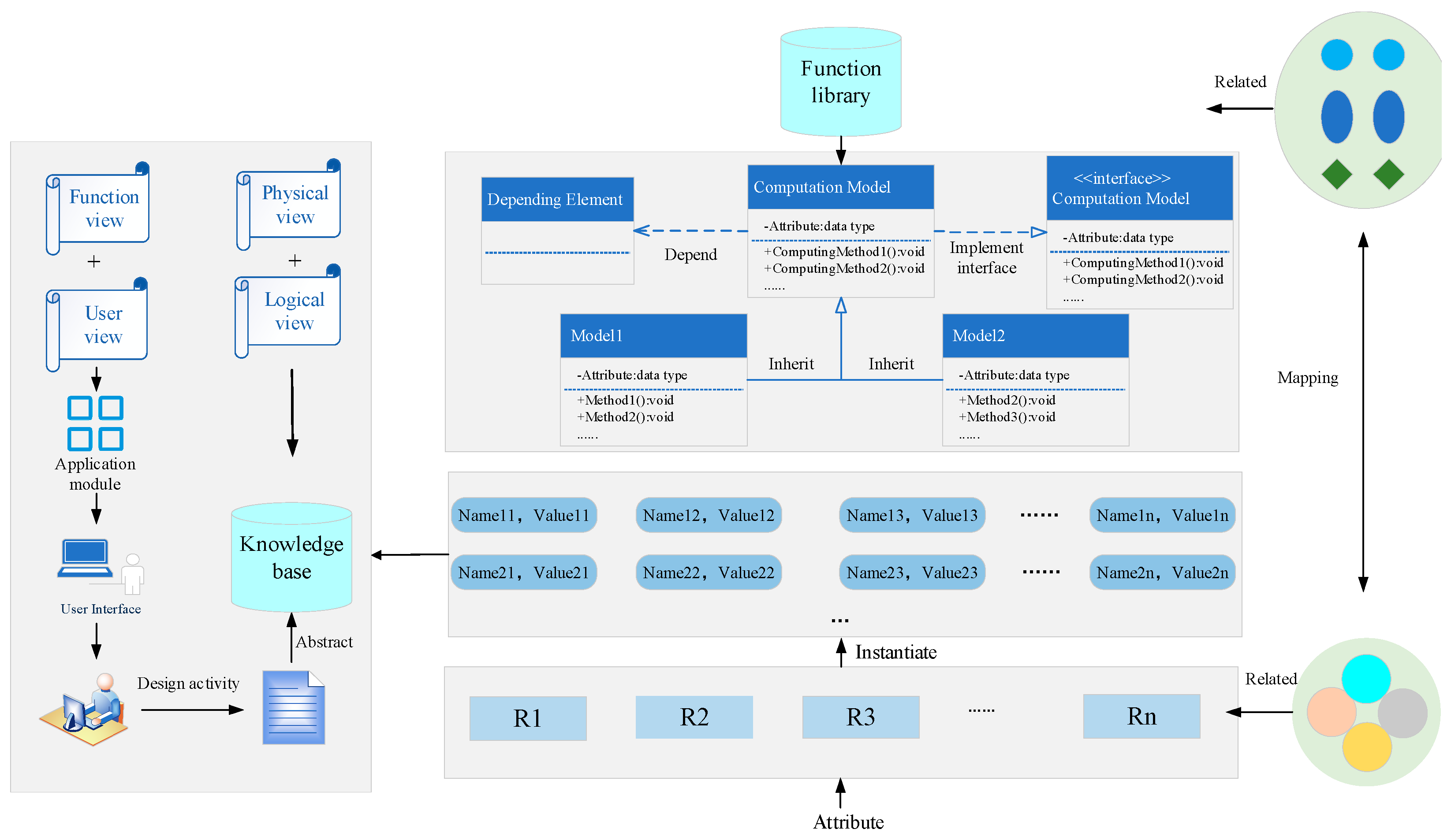
The demonstration template is an organizational structure that expresses requirements and knowledge, and determines how they are stored in the database and how they are displayed on the computer [31]. Since the index demonstration template needs to be dynamically adjusted and expanded according to the diverse demonstration requirements, this paper proposes a requirements-based Dynamic Index Demonstration Template (DIDT). DIDT provides a structured and standardized way of expression for demonstration requirements and demonstration knowledge. Each requirement element and index element involved in the template are connected through key fields of the database. The function library is the calculation tool set in the demonstration template. The link between the function library and the demonstration knowledge set can be established by the index element through the field and the open Application Programming Interface (API) interface or Uniform Resource Locator (URL) link, so as to realize the matching and invocating of the index knowledge and the calculation requirements. The demonstration tool entity can be instantiated by setting the requirement meta-information and index meta-information in the demonstration template. Figure 6 shows the relationship between the demonstration template, the function library, the indicator element, and the demand element. The four are connected through design activities. The demonstration template has different manifestations in this connection. They are realized through the implementation of the demonstration requirements and the deployment of the demonstration template configuration. Through the physical view, functional view, logical view, and user view, the first two correspond to the knowledge base, and the latter two correspond to the user operation interface, facilitating the human–computer interaction of the demonstration process. The designer can analyze the module requirements according to the configuration prompt information of the design interface, so as to invocate the knowledge base data. The knowledge base is connected with the function library through key fields, so that the business requirements and knowledge are mutually configured and integrated.

3.3. Configuration Method of Dynamic Index Demonstration Template

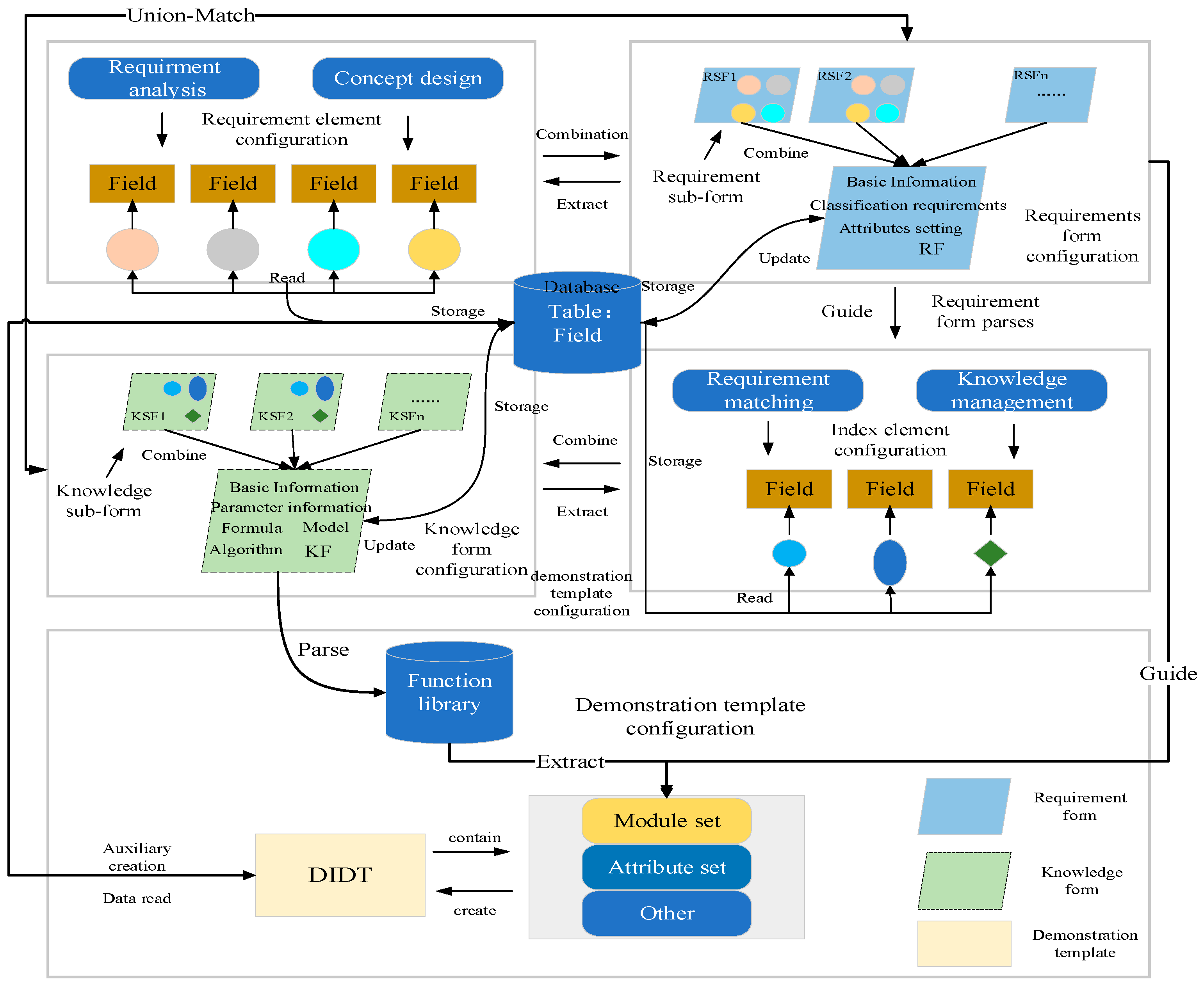
In order to effectively organize and manage the index knowledge in various fields to support the rapid configuration of suitable demonstration templates according to the demonstration requirements in the process of weapon and equipment demonstration, this paper uses the ontology model and configuration method [32,33] to propose a Dynamic Index Demonstration Template (DIDT) configuration method. This method refers to the concept of forms, and constructs the information structure of demonstration requirements and index knowledge by configuring the form. The forms are divided into two types: the Requirement Form (RF) and the Knowledge Form (KF). The lower-level tables of the two are called their corresponding sub-tables, which are the Requirement Sub-Form (RSF) and the Knowledge Sub-Form (KSF). The main table is formed by the association of several sub-tables. It actually contains information about the demonstration template. Requirement forms are used as a knowledge structure representing user design requirements, and knowledge forms are used as a knowledge structure representing relevant field knowledge. They are all stored in the corresponding database of the demonstration template and are related to each other.
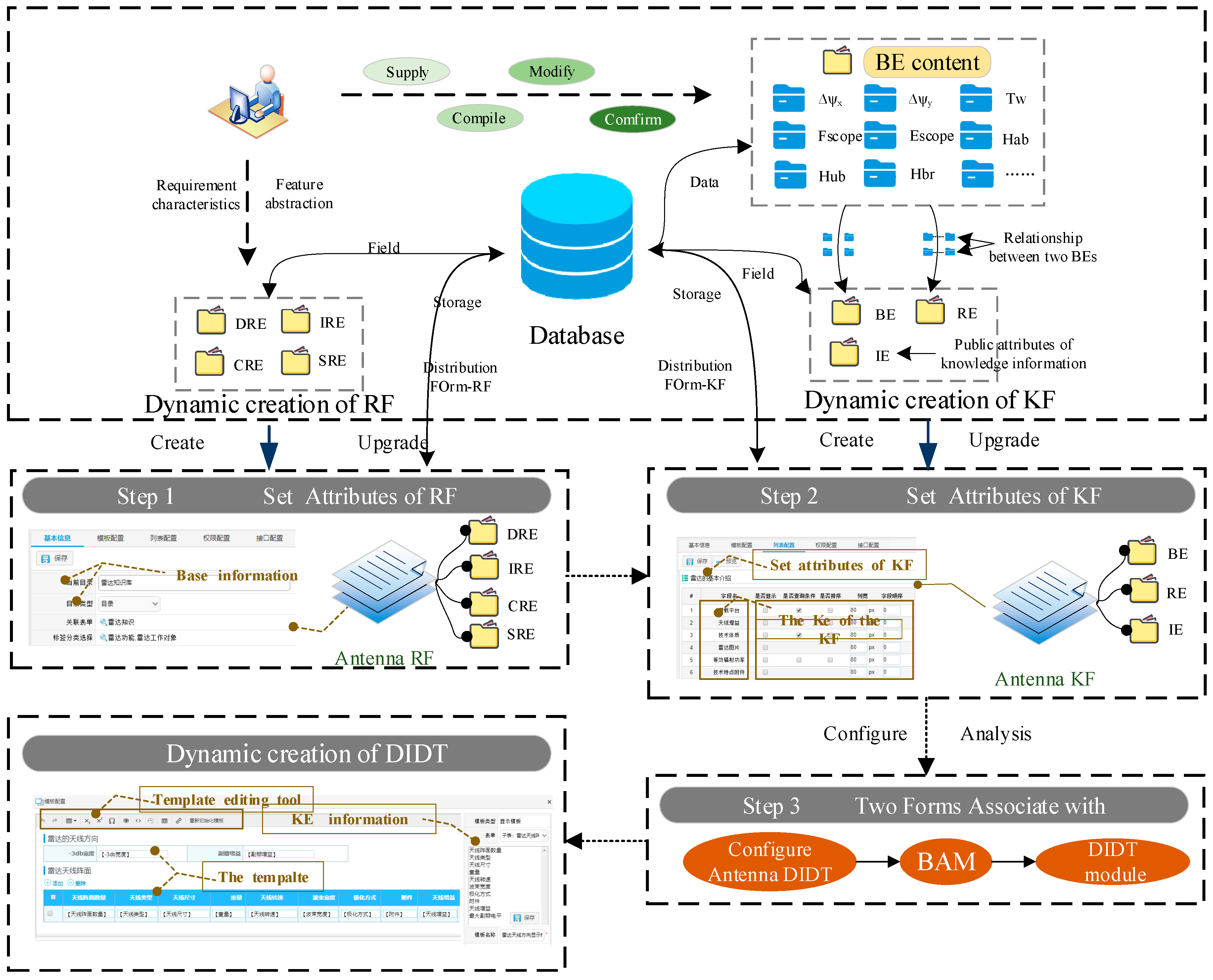
The configuration process of the dynamic index demonstration template includes requirement element configuration, requirement form configuration, index element configuration, knowledge form configuration, and demonstration template configuration, as shown in Figure 7. First, the designer creates a knowledge base of management domain knowledge, and configures the demonstration template through the knowledge base information configuration module. After selecting the requirement form, the designer can dynamically edit the template structure, content, and index element attributes. Secondly, they configure multiple requirement elements in the requirement form, and solidify them into three types of configurations—setting, calculation, and display—through system definitions for designers to choose when configuring the form. Multiple forms are supported to store multiple pieces of demand structure information. The form fields correspond to the requirement elements in the requirement structure, which can dynamically associate the configured requirement elements, and increase or decrease their quantity and content. The knowledge form is used to associate the requirement form related to the demonstration template, and the requirement form combination can be dynamically selected. Furthermore, all the above configuration content supports the automatic configuration and automatic analysis of the configuration content. The system repeats the above configuration process by parsing configuration files to modify database field information. Finally, the designer can dynamically edit the structure, content, and attributes of the demonstration template, realize operations such as creating, deleting, and adjusting the demonstration template, and complete the construction and upgrading of the demonstration template. The form and template configuration are defined as formulas (5) to (9). At the implementation level, the requirement forms and knowledge forms are stored as relational tables within the database schema. They are matched via unique primary keys corresponding to the specific ReqE and BE. When a demonstration requirement is updated, the system queries the relational database, dynamically retrieves the latest knowledge elements, and automatically updates the instantiated template views. This modular organization of requirement forms, knowledge forms, and dynamic template structures ensures high system scalability. New demonstration requirements can be seamlessly incorporated without modifying the overall framework architecture. Furthermore, this intelligent, data-supported configuration mechanism significantly enhances decision-making efficiency and operational adaptability, similar to how intelligent data-driven modeling supports early failure detection and performance improvement in complex manufacturing systems [34].
R S F = { E ( R S ) , E ! ( C R E ) }
R F = { E ( R S F 1 , R S F 2 R S F n ) , < > }
K S F = { E ! ( I S ) R F }
K F = { E ( K S F 1 , K S F 2 K S F 3 ) , < > }
D I D T = { ! f : P ( f ) f ( R F , K F ) }
In the formulas, RSF is the requirement sub-form, RF is the requirement form, KSF is the knowledge sub-form, and KF is the knowledge form. E represents that the former is the associated combination form of the latter. E! means must exist. The symbol ⇒ represents implication, meaning the former is a reflection of the latter information. The symbol <> means configuration information settings. P(f) represents the set of setting operations performed on the attributes of form f. DIDT is a dynamic index demonstration template.
According to the five configurable contents, the proposed dynamic demonstration template construction method can support the construction of demonstration templates of arbitrary information structure and content, and realize the dynamic construction of demonstration templates.

3.4. Instantiation of Dynamic Demonstration Template

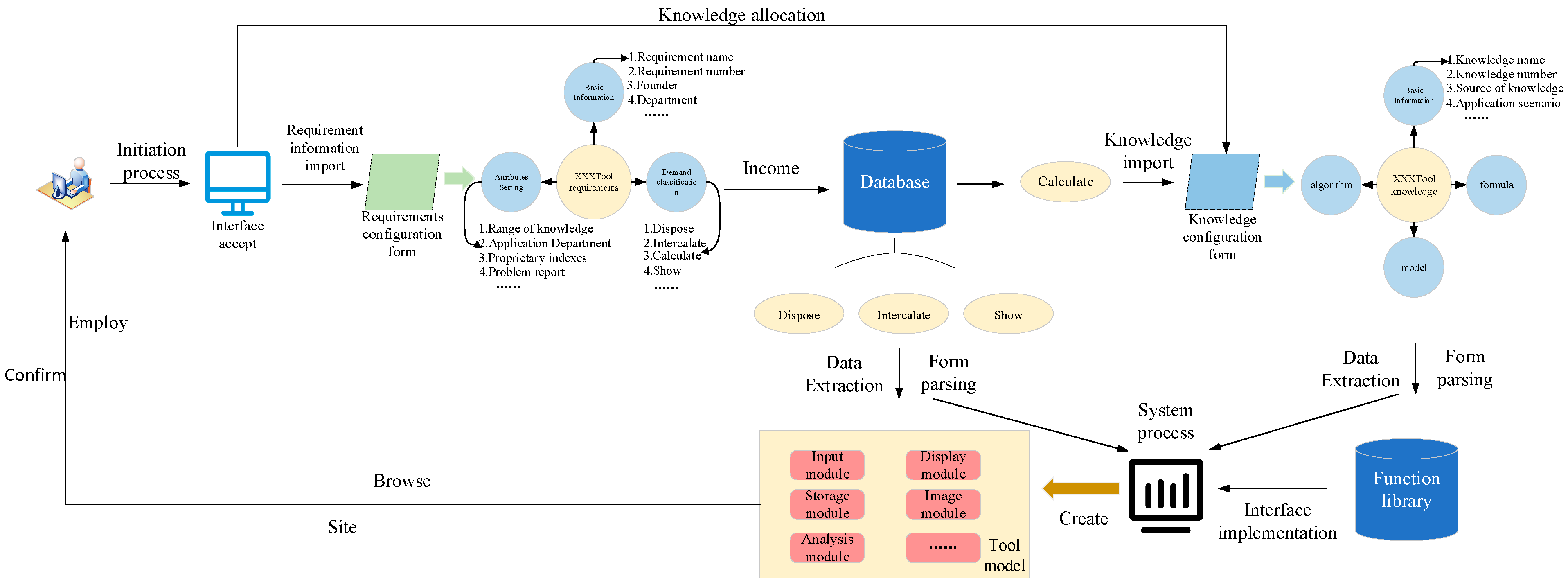
The instantiation of the template is the process of using the template to generate the demonstration tool entity. The designer completes the attribute setting and demonstration tool configuration by entering the information of the demonstration template, and generates the index demonstration tool entity. Figure 8 shows the specific process of the dynamic demonstration template instantiation.
The designer initiates the construction process of the demonstration tool, completes the configuration of the demonstration template, and configures the demonstration template to be stored in the knowledge base. In the instantiation interface, the designer invocates the corresponding demonstration template according to the corresponding relationship between the demonstration template and the knowledge base. The designer edits the content of the demonstration template, that is, generates the ontology content entry interface according to the configuration of the requirement element and index element in the demonstration template. The controls that make up the interface are in one-to-one correspondence with the requirement element and its related attributes in the template. The designer enters the index meta-information according to the demonstration and calculation requirements, realizes the call of its calculation model by constructing the connection between the index element and the function library, and completes the instantiation of the calculation model in the called function library. The designer completes the setting of the demonstration tool architecture, module design, and control content by customizing and editing the display interface of the demonstration template. The preliminary configuration of the index demonstration tool with customized features can be realized by rendering the tool template. The system invocates instance data from the knowledge base to implement tool expansion. The tool preview interface provides editing, setting, and modification functions. After the designer confirms that the setting is complete, the tool construction is completed and enters the department approval process. After the process is over, it is put into use.

4. Applications

Based on the proposed requirements-driven rapid demonstration method of weapon equipment performance indexes and demonstration template configuration methods, this paper was oriented to the diverse performance index demonstration requirements of the antenna array system of airborne radars, and built and developed corresponding performance indexes rapid demonstration modules and index demonstration platforms. Through the establishment of various demonstration knowledge bases supporting the demonstration requirements of the diversity index of the antenna array system, and the establishment of a relationship between the index demonstration requirements and the demonstration index elements, a configurable index demonstration template for the antenna array system was developed and corresponding functional modules were constructed. It realized the needs of different indicators for the antenna array system. The demonstration system can quickly demonstrate and predict the comprehensive performance of the antenna array system’s direction finding accuracy and error analysis.

4.1. Construction of Dynamic Demonstration Template for Antenna Array System Demonstration Requirements

To create the demonstration requirement of the antenna array system, the required meta-model included in it must first be configured to characterize the exclusive attributes of the design requirement, that is, the configuration of DRE, IRE, CRE, and SRE in the demonstration system, as shown in Table 2. DRE is created on requirements through system attribute definitions, and is abstracted into tool architecture, module design, control content, etc. During the configuration of the demand form, the information it contains is determined by the specifically defined demand element and stored in the database. Such attributes can be used for characterizing specific attributes of requirements and the association of knowledge. IRE sets the calculation process, operation rules, and the content of demonstration parameters, which are used in the selection range of specific domain knowledge, attribute structure, data source, etc. CRE refers to the need for demonstration tools to finally realize the management of the calculation content of various indexes of weapons and equipment, such as radar system sensitivity, exploration distance, interference Effective Radiated Power (ERP), etc. SRE is used to display the result set information of the index demonstration. By setting the attributes of the demand element and index element of the demonstration template, the display form of the demonstration parameter results can be determined, such as tables, graphics, dynamic graphics, or video 3D graphics, etc.
To create an index knowledge structure, the index meta-model included in it must be configured first to characterize index calculation requirements, that is, configure BE, RE, and IE in the system. This type of knowledge is mainly described by structured information. Table 3 below shows the radar antenna array system layout design index knowledge in detail, from which a knowledge form of radar knowledge, antenna knowledge, formula knowledge, etc., is constructed as the electronic warfare equipment system of this article for the management and rapid design of implementation objects.
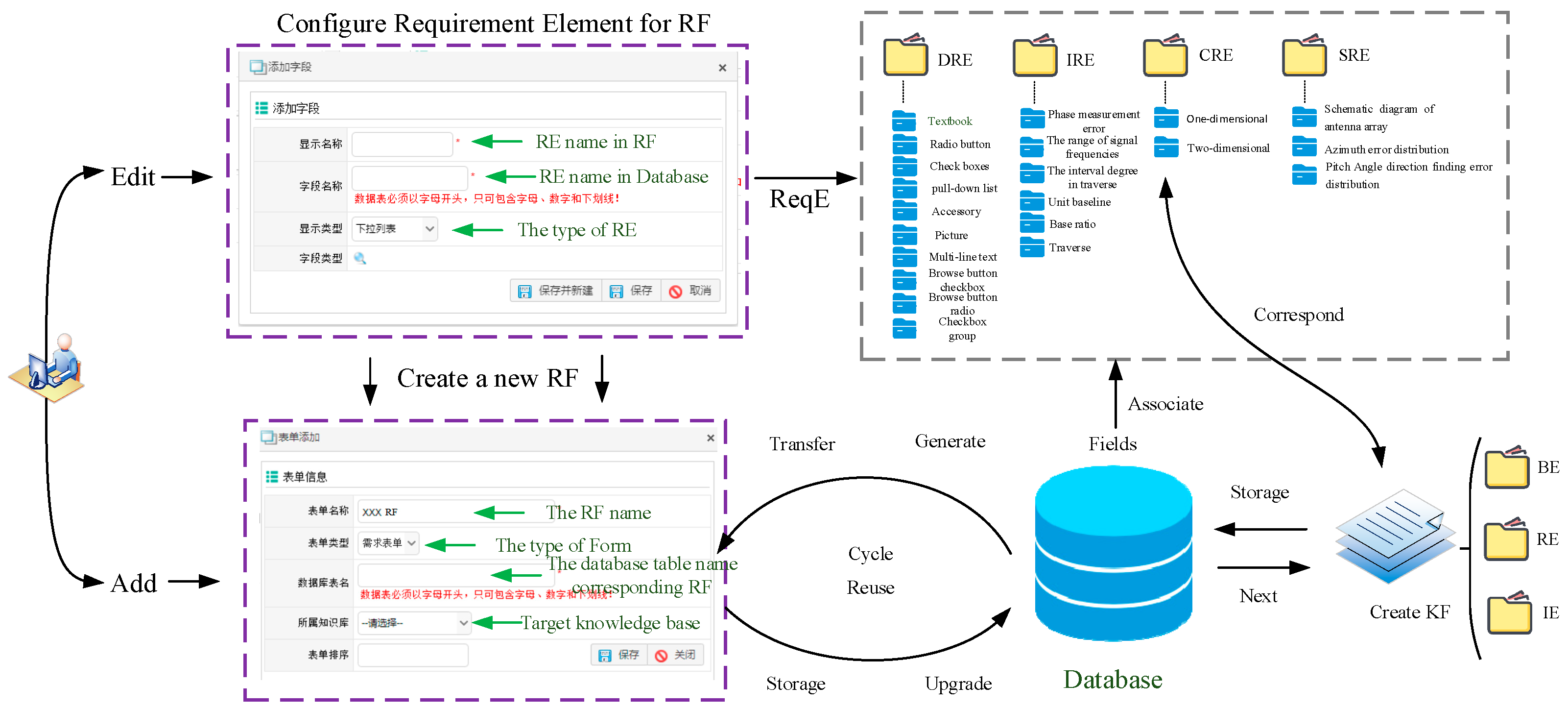
First, create the antenna knowledge requirement form in the form configuration module, fill in the requirement information, and initially improve the content of the requirement form. Figure 9 shows the association process between the demand form and the demand element. The combination of several demand elements is formed into a demand form, and the corresponding database table is created in the database. By adding, reducing, and modifying demand elements and their attributes, the design output of the database table supports the creation and modification from structure to content to support the editing of demonstration template structure, content, attributes, etc. After the requirement form is completed, the system compiles and processes the specific requirement content in the requirement form, and extracts the knowledge data used in the demonstration tool in the knowledge base. The system assists users to complete the selection and configuration of knowledge types in the knowledge form. After completion, the developer will edit, modify, confirm and perform other operations.
The construction of the two forms is carried out through the module for background management (BAM). Through the form creation module, several requirement elements can be combined to form requirement forms and create corresponding database tables in the database. By adding different requirement elements, any table structure can be designed to create functions, behaviors, structures, parameters, etc. Encapsulate BE, RE, and IE to form a knowledge form, create a corresponding database table in the onboard knowledge form database, and generate a corresponding function library file, which is to model and manage the parameters, algorithms, and formulas corresponding to the indexes. In the form configuration module, the requirement form can be constructed by the user manually or by the system receiving the configuration file. When creating a form, the form name, type, and database table belonging to the knowledge base and other information need to be set. This supports adding arbitrary combinations of requirement elements and index element sets in the form, and the construction of sub-tables; and the construction process is the same as the above form.
The construction of the dynamic demonstration template is the key to the rapid demonstration of the performance indexes of diverse weapon equipment systems. The dynamics of the demonstration template are reflected in the dynamic configuration of the requirement form and the knowledge form. Figure 10 shows the construction process of the dynamic demonstration template for antenna knowledge. Specifically, the workflow includes requirement-element configuration, index-element configuration, template initialization, and dynamic template generation, thereby establishing the linkage between user requirements and demonstration knowledge resources. Set the attributes of the demand element and the indicator element on the Step 1 and Step 2 list configuration page, and select the initialization to generate the demonstration template on the configuration page.
The designer uses the template tool to add, delete, arrange and perform other operations for each requirement element and index element. The same knowledge base can have multiple sets of templates, which are distinguished by version numbers or custom template names. Examples of the following antenna array demonstration tools are shown: one-dimensional linear array, two-dimensional L1 type, two-dimensional T type, and two-dimensional cross type.

4.2. Demonstration of Antenna Array Error Index

In the modern battlefield, the main task of radar countermeasures is to detect, locate and interfere with enemy radars [35]. Interferometer direction finding technology is a very good radar direction finding and positioning processing technology. It has the characteristics of high direction finding accuracy, high sensitivity, and observation frequency bandwidth, so it is widely used in electronic countermeasures, radar and other fields. However, the weakness of the phase interferometer is that the linear range of the angle measurement is small. When the angle exceeds its unambiguous viewing angle, it is easy to produce phase blur [36]. Therefore, when designing a multi-baseline phase interferometer antenna, technical issues such as antenna selection, antenna array design, direction finding error analysis, and unambiguous angle measurement need to be resolved. This article uses the one-dimensional and two-dimensional antenna array design system calculation models from the literature [35,36] to illustrate the rapid demonstration of its design indicators, taking the two-dimensional L1 antenna array design as an example. Although the detailed demonstration results below are presented using the L1 antenna-array case, the developed template mechanism has already been seamlessly applied to multiple antenna-array configurations, including one-dimensional linear arrays, two-dimensional L-type arrays, T-type arrays, and cross-type arrays. These configurations share the exact same framework while differing in their requirement structures, knowledge forms, and calculation models, thereby demonstrating the strong adaptability of the proposed method to heterogeneous demonstration scenarios. Table 4 shows the antenna array layout design index knowledge that needs to be described by structured information. The formula knowledge shown in this table is used as the RE management object corresponding to the CRE in the complex weapon equipment demonstration of this research.
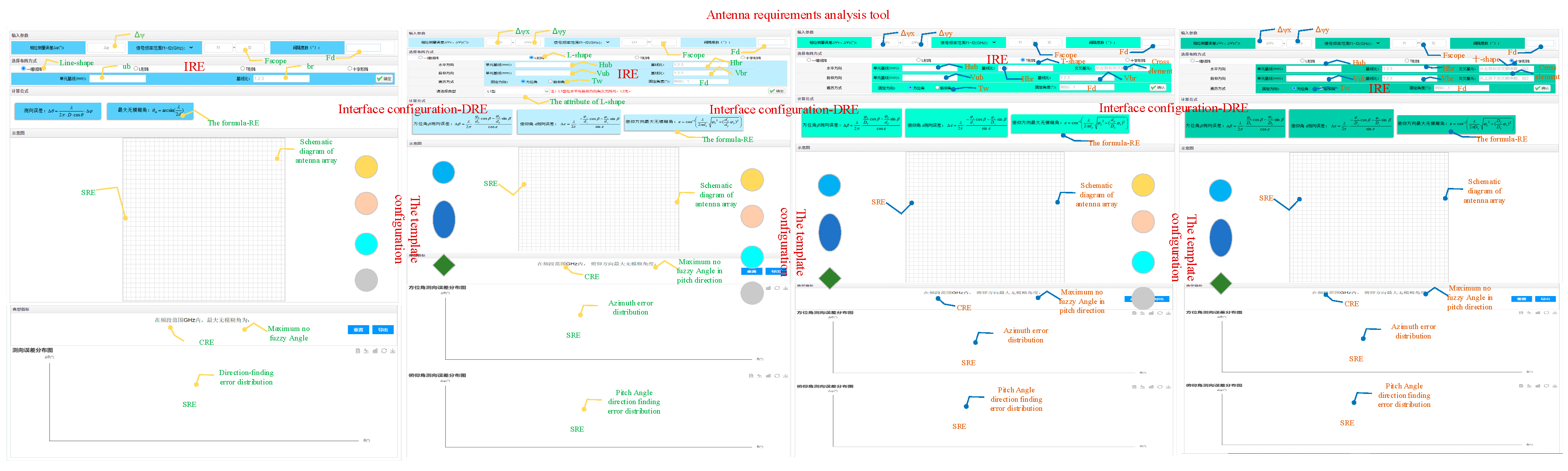
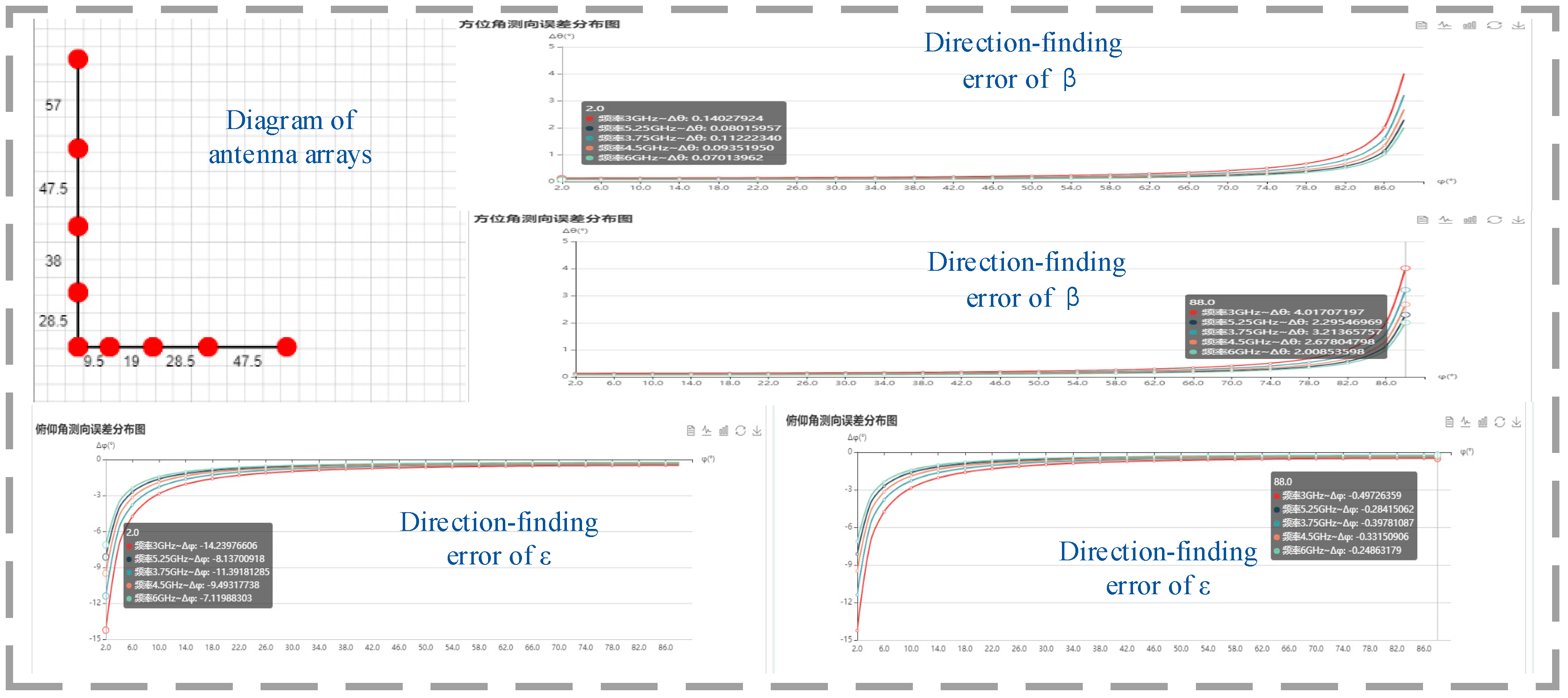
An example test is performed on the dynamically generated demonstration template, as described in Section 4.1; the antenna error index demonstration tool template is constructed in the system, as shown in Figure 11. Figure 11 presents the dynamically generated demonstration interface, which integrates requirement input, parameter configuration, and result analysis functions for antenna-array performance evaluation. According to the calculation requirements, a set of corresponding knowledge data is transmitted as shown in Table 5, where L1-shape determines the RE content (formula rules) of the tool calling L-type. Fscope is the signal frequency range. The system is set to divide five frequency bands in the range of 3~6 GHz for traversal. Escope is a range parameter, which limits the systematic error range of the interferometer. The value of Tw is H and the value of Fd is 20°, both of which determine the fixed azimuth angle β of 20° for global traversal in the pitch direction. The design values of Hbr and Vbr are 1:2:3:5 and 3:4:5:6. The tool performs demonstration and analysis according to formula rules and index meta-attributes to obtain the result set. Table 6 and Figure 12 are a set of examples. As shown in Figure 12, the system automatically generates the corresponding demonstration results based on the configured requirements and associated knowledge resources, thereby supporting performance evaluation and scheme analysis. In Table 6, Ap denotes the pitch-angle estimation error, TE denotes the template entity, F denotes the operating frequency (GHz), max φ and min φ denote the maximum and minimum azimuth estimation errors, respectively, max θ and min θ denote the maximum and minimum pitch-angle estimation errors, respectively, Vab and Hab denote the vertical and horizontal baseline lengths, respectively, and max η denotes the maximum unambiguous angle.
According to the above data calculation, the demonstration conclusion can be drawn. Throughout this study, φ denotes the azimuth angle, θ denotes the pitch angle, β denotes the antenna orientation angle, ε denotes the fixed pitch angle, and η denotes the maximum unambiguous angle. For example, when β = 20° and the horizontal traversal mode is selected, the requirement analysis results indicate that the azimuth direction-finding error remains within ±1°, demonstrating that the configured antenna parameters satisfy the predefined performance requirements. When the fixed Tw value is H and the fixed angle is 20°, it can be calculated according to the knowledge metadata that the maximum unambiguous angle is [0, 90°], the range of the pitch angle of 90°. In the range of the pitch angle of [0, 82°], the direction finding error of the azimuth angle meets the requirements, that is, the direction finding error is between ±1°.
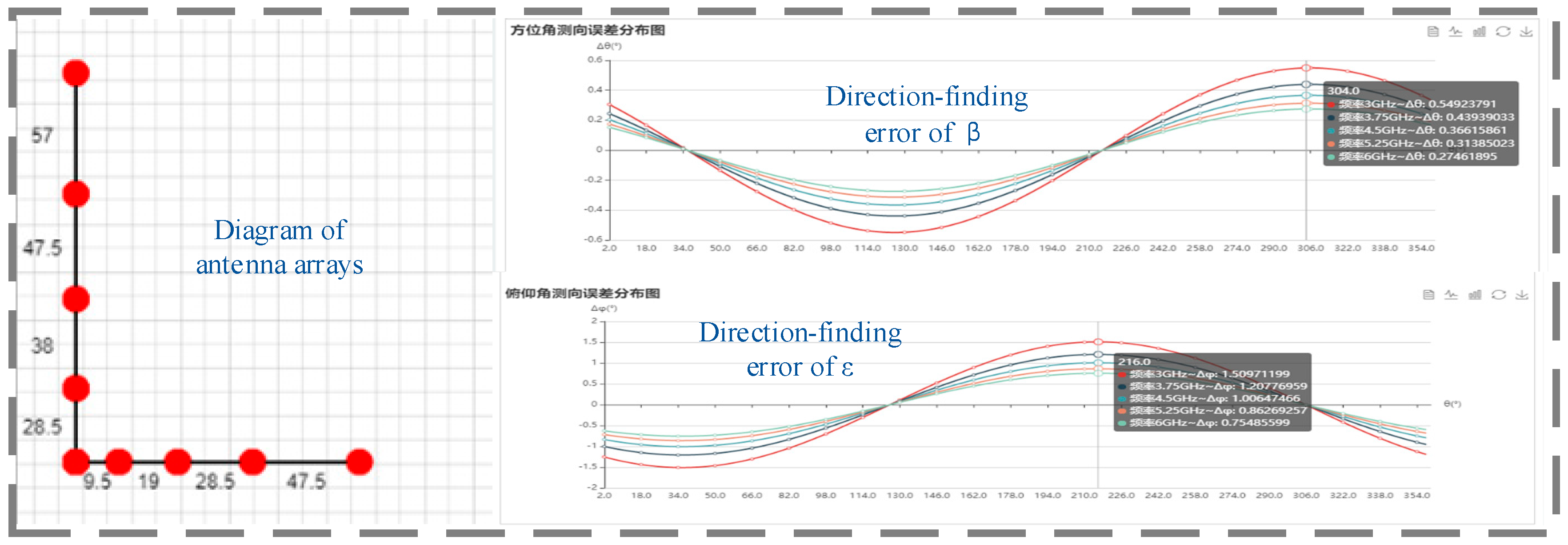
According to the calculation requirements, a set of corresponding knowledge data is transmitted as shown in Table 7, and other knowledge data remain unchanged. In Table 7, Fd denotes the fixed traversal angle, Tw denotes the traversal dimension, Vbr and Hbr denote the vertical and horizontal baseline ratios, respectively, Vub and Hub denote the vertical and horizontal unit baseline lengths, respectively, Ag denotes the antenna geometry type, Id denotes the allowable direction-finding error, Escope denotes the angular search range, Fscope denotes the operating frequency range, and Δ ψ y and Δ ψ x denote the pitch-angle and azimuth-angle error thresholds, respectively. Modify the traversal angle, change the value of Tw to V, set the value of Fd to 20°, fix the pitch angle ε to 20° for global azimuth traversal, and other setting parameters remain unchanged. After the tool performs requirement analysis according to formula rules and knowledge element attributes, the requirement result set is obtained. Table 8 and Figure 13 are a set of examples. The symbols used in Table 8 follow the same definitions as those provided for Table 6.
From the above data calculations, the following conclusions can be drawn. For example, when the operating frequency increases from 3 GHz to 6 GHz, both azimuth and pitch-angle estimation errors decrease, indicating that the proposed configuration framework can support the selection of feasible antenna parameters according to different demonstration requirements. When the fixed Tw value is V and the fixed angle is 20°, the knowledge metadata indicate that the maximum unambiguous angle is [0, 90°]. Within the [0, 360°] azimuth traversal range, the azimuthal measurement error is at most ±0.55°, strictly satisfying the ±1° tolerance. When β is 32° and 216°, the horizontal spatial accuracy is maximized. In the 4.5 GHz to 6 GHz band, the pitch angle estimation error across the entire [0, 360°] azimuthal traversal meets the target accuracy requirements, remaining entirely within ±1°. When β is 124° and 308°, the pitch precision peaks. From 3 GHz to 4.5 GHz, this deviation can reach ±1.5°. Comparing the two sets of data for the two-dimensional fighter radar antenna array reveals that the precision in the horizontal azimuth exceeds that of the pitch direction. Furthermore, pitch measurements operate closer to the system’s operational boundary, inherently resulting in larger angular errors.
In the above, taking the knowledge management of the radar antenna array as an example, the antenna array index demonstration template configuration plan was designed, and the dynamic template configuration process was described. Through the establishment of a knowledge base of radar antenna systems and related rules, knowledge management and rapid demonstration of weapons and equipment indexes have been realized. The parameters can be jointly optimized to obtain feasible demonstration schemes. The system optimizes the optimal antenna frequency, calculates the azimuth/elevation angle direction finding error, the maximum unambiguous angle, and produces the antenna layout diagram and antenna error analysis diagram. Through the digital management of the antenna array system knowledge and its demonstration process, a computer-aided rapid demonstration method has been formed. This has allowed designers to quickly demonstrate the combination of antenna array technical parameters, fusion collaborative design process, index simulation, and verification report output based on different demonstration requirements and antenna information.
The rapid generation of demonstration tools is implemented through the method of demonstration template configuration and instantiation, standardizing the antenna error and radar index demonstration process, reducing the time cost of obtaining the demonstration results, forming a computer-aided demonstration method, and effectively improving the efficiency of the demonstration. The proposed theoretical method is applied to the demonstration template configuration management module of the knowledge engineering management system of a domestic research institute, forming a rapid implementation method of the demonstration tool. The design, construction, and output cycle using common demonstration tools can be as long as one month or even longer. In our practical deployment, a baseline comparison with this conventional manual development workflow was conducted. While the traditional process typically required an average cycle of approximately 30 days to construct a specific demonstration tool, the institute utilized the proposed dynamic configuration approach to complete the same tool construction in just 2 days. Accordingly, the efficiency improvement was calculated as ( 30 2 ) / 30 × 100 % 93 % . It is important to note that this result specifically reflects the efficiency gain observed in the studied engineering application. The comparison quantitatively demonstrates the time savings achieved by the proposed configuration-based method over the conventional manual development process. While it highlights the practical benefits of the proposed framework, further validation across additional equipment systems is needed to assess its broader generalizability. Consequently, the efficiency of design demonstration has been greatly improved, and the standard design, demonstration, and simulation process throughout the entire life cycle of weapons and equipment has been accelerated.

5. Conclusions

This paper proposes a requirements-driven performance index demonstration model centered on four levels comprising requirements, plans, templates, and data, and establishes a weapon equipment system performance index demonstration process. A unitized demonstration requirement and knowledge management model is proposed, which realizes the concrete expression of index demonstration requirements and knowledge. Based on the association of the requirement form and the knowledge form, a dynamic structured demonstration template configuration method is proposed and the corresponding configuration process is given. A prototype system for the demonstration of indexes was developed for the requirements of radar antenna performance evaluation, which verified the effectiveness of the proposed method. The proposed performance demonstration model and demonstration process can be applied to the performance demonstration requirements of complex equipment weapon systems. The configurable dynamic index demonstration template shows strong potential for broader engineering applications and can support the entire process from product demonstration to system design.
Despite the promising results and significant efficiency improvements achieved, the current study has certain limitations. The experimental validation is primarily focused on the application case of antenna array systems. While this demonstrates the feasibility of the requirement-driven configuration framework, further application verification across broader and more diverse equipment domains is necessary. Future work will focus on expanding the integration of larger-scale multimodal knowledge bases and incorporating more advanced intelligent algorithms to further optimize the automated template configuration capabilities.

Author Contributions

Conceptualization, L.Z.; Methodology, L.Z. and Y.L.; Validation, J.Z.; Investigation, J.P.; Data curation, J.Z.; Writing—original draft, L.Z. and Y.L.; Writing—review & editing, J.P.; Project administration, W.L.; Funding acquisition, W.L. All authors have read and agreed to the published version of the manuscript.

Funding

This research was funded by the National Natural Science Foundation of China (grant number 52075350) and the Juyuan Xingchuan Project of Sichuan Province (grant number 25JYXC0060; project title: R&D and Application of Electrical Interconnection Products for High-Density Multi-Link Avionics Systems). The APC was funded by the Juyuan Xingchuan Project of Sichuan Province (grant number 25JYXC0060).

Data Availability Statement

The original contributions presented in this study are included in the article. Further inquiries can be directed to the corresponding author(s).

Acknowledgments

This work is supported by the National Natural Science Foundation of China (No. 52075350), and the Juyuan Xingchuan Project of Sichuan Province: R&D and Application of Electrical Interconnection Products for High-Density Multi-Link Avionics Systems (No. 25JYXC0060).

Conflicts of Interest

The authors declare no conflicts of interest.

References

  1. Yang, H.; Liu, F.; Yan, Y. A new perspective on evaluation software of contribution rate for weapon equipment system. In Geo-Spatial Knowledge and Intelligence; Springer: Singapore, 2018. [Google Scholar]
  2. Jia, Z.; Ding, L.; Zhou, Y. Process design of a capability-based weapon equipment requirements analysis system. In Proceedings of the 2018 Fifth International Conference on Software Defined Systems (SDS), Barcelona, Spain, 23–26 April 2018; IEEE: New York, NY, USA, 2018; pp. 74–79. [Google Scholar]
  3. Kang, H.; Sung, Y.; Kwon, H.; Yoon, S.; Choi, S. An open architecture framework for electronic warfare based approach to HLA federate development. Secur. Commun. Netw. 2018, 2018, 1–12. [Google Scholar] [CrossRef]
  4. Yang, H.; Xia, Z.; Chen, Y.; Zhu, L.; Dai, L.; Xu, R.; Sun, G.; Yu, H.; Xu, W. Research on visual simulation for complex weapon equipment interoperability based on MBSE. Multimed. Tools Appl. 2024, 83, 13463–13482. [Google Scholar] [CrossRef]
  5. Jiuyao, J.; Jichao, L.; Kewei, Y. Weapon system portfolio selection based on structural robustness. J. Syst. Eng. Electron. 2020, 31, 1216–1229. [Google Scholar] [CrossRef]
  6. Wang, C.; Li, N.; Kong, H.; Li, H. Study on general effectiveness evaluation platform for combat aircraft. In System Simulation and Scientific Computing; Springer: Berlin/Heidelberg, Germany, 2012; pp. 128–136. [Google Scholar]
  7. Li, Z.; Zhang, S.; Wang, J.; Liu, S. Research on description method of operational task oriented to operational effectiveness evaluation. In Proceedings of the Asia Simulation Conference 2012, Shanghai, China, 27–30 October 2012; Springer: Berlin/Heidelberg, Germany, 2012; pp. 313–321. [Google Scholar]
  8. Ren, W.; Zhang, A.; Ding, Z.; Bi, W. Research on Effectiveness Evaluation of Integrated Space-Ground Information System Oriented Aircraft Carrier Strike. In Recent Developments in Mechatronics and Intelligent Robotics; Springer: Cham, Switzerland, 2019; pp. 1069–1078. [Google Scholar]
  9. Bi, W.; Gao, F.; Zhang, A. A novel weapon system effectiveness assessment method based on the interval-valued evidential reasoning algorithm and the analytical hierarchy process. IEEE Access 2021, 9, 53480–53490. [Google Scholar] [CrossRef]
  10. Zhu, L. Research and application of AHP-fuzzy comprehensive evaluation model. Evol. Intell. 2022, 15, 2403–2409. [Google Scholar] [CrossRef]
  11. Dajie, Y.; Zhexuan, Z.; Danling, Z.; Yong, W. Weapons system portfolio selection based on the contribution rate evaluation of system of systems. J. Syst. Eng. Electron. 2019, 30, 905–919. [Google Scholar] [CrossRef]
  12. Zhang, Y.; Guo, Q.; Wang, J.; Liu, Q.; Zhang, W. Research on establishment method of index system for weapons and equipment operational test. In Proceedings of the International Conference on Advanced Manufacturing, Computation and Optimization (AMCO 2019), Dublin, Ireland, 17–19 October 2019; pp. 75–84. [Google Scholar]
  13. Peng, W.; Wang, W.; Chen, L.; Li, Q.; Li, Y. Performance evaluation of man-portable devices based on the cloud center of gravity. J. Phys. Conf. Ser. 2021, 1955, 012124. [Google Scholar]
  14. Dağıstanlı, H.A. Weapon system selection for capability-based defense planning using Lanchester models integrated with fuzzy MCDM in computer assisted military experiment. Knowl. Decis. Syst. Appl. 2025, 1, 11–23. [Google Scholar] [CrossRef]
  15. Shi, X.; Tian, X.; Gu, J.; Yang, F.; Ma, L.; Chen, Y.; Su, T. Knowledge graph-based assembly resource knowledge reuse towards complex product assembly process. Sustainability 2022, 14, 15541. [Google Scholar] [CrossRef]
  16. Sun, Y.; Fang, Z. Research on projection gray target model based on FANP-QFD for weapon system of systems capability evaluation. IEEE Syst. J. 2021, 15, 4126–4136. [Google Scholar] [CrossRef]
  17. Hui, Q. Research on construction of armament knowledge graph by Protégé. In Proceedings of the IEEE Conference Telecommunications, Optics and Computer Science (TOCS), Dalian, China, 11–12 December 2022; pp. 1410–1413. [Google Scholar]
  18. Wang, L.; Cheng, H.; Wang, R.; Huang, X. Machining scheme selection of features based on process knowledge graph and improved cosine similarity matching. Machines 2025, 13, 188. [Google Scholar] [CrossRef]
  19. Han, V.Y.; Wang, T.; Cho, H.; Todi, K.; Fernandes, A.S.; Levi, A.; Zhang, Z.; Grossman, T.; Ion, A.; Jonker, T.R. A dynamic Bayesian network based framework for multimodal context-aware interactions. In Proceedings of the 30th International Conference on Intelligent User Interfaces, Cagliari, Italy, 24–27 March 2025; pp. 54–69. [Google Scholar]
  20. Hirmer, P.; Wieland, M.; Schwarz, H.; Mitschang, B.; Breitenbücher, U.; Sáez, S.G.; Leymann, F. Situation recognition and handling based on executing situation templates and situation-aware workflows. Computing 2017, 99, 163–181. [Google Scholar] [CrossRef]
  21. Lenko, G.; Grigorov, G. Conceptual Design of Discrete-Event Systems Using Templates; Queen’s University: Kingston, ON, Canada, 2009. [Google Scholar]
  22. Jiang, G.; Evans, J.; Endle, C.M. Using semantic web technologies for the generation of domain-specific templates to support clinical study metadata standards. J. Biomed. Semant. 2016, 7, 10. [Google Scholar] [CrossRef]
  23. Caione, A.; Guido, A.L.; Martella, A.; Paiano, R.; Pandurino, A. Knowledge base support for dynamic information system management. Inf. Syst. e-Bus. Manag. 2016, 14, 3. [Google Scholar] [CrossRef]
  24. Marrella, A.; Lespérance, Y. A planning approach to the automated synthesis of template-based process models. Serv. Oriented Comput. Appl. 2017, 11, 367–392. [Google Scholar] [CrossRef]
  25. Gui, C. Evaluation of unmanned equipment operational effectiveness based on ADC model. In Proceedings of the 10th International Conference on Intelligent Human-Machine Systems and Cybernetics (IHMSC), Hangzhou, China, 25–26 August 2018; pp. 299–303. [Google Scholar]
  26. Cai, Z. Demonstration of weapon system requirements based on system engineering. E3S Web Conf. 2021, 253, 03007. [Google Scholar] [CrossRef]
  27. Bao, Q.; Zhao, G.; Yu, Y.; Dai, S.; Wang, W. Ontology-based modeling of part digital twin oriented to assembly. Proc. Inst. Mech. Eng. Part B J. Eng. Manuf. 2022, 236, 16–28. [Google Scholar] [CrossRef]
  28. Li, Y.; Branicio, P.S. Template-based bicontinuous nanoporous graphene: Computational design, thermal stability, and mechanical response. Comput. Mater. Sci. 2025, 260, 114135. [Google Scholar] [CrossRef]
  29. Sun, S.; Deng, J.; Qin, X. Unearthing historical insights: Semantic organization and application of historical newspapers from a fine-grained knowledge element perspective. Aslib J. Inf. Manag. 2025, 77, 260–281. [Google Scholar] [CrossRef]
  30. Zhang, L.; Lobov, A. Semantic web rule language-based approach for implementing knowledge-based engineering systems. Adv. Eng. Inform. 2024, 62, 102587. [Google Scholar] [CrossRef]
  31. Failla, L.; Rossoni, M.; Colombo, G. Ontology-Based Product Lifecycle Management: Insights from a Proof-of-Concept Implementation. IEEE Access 2025, 13, 179295–179314. [Google Scholar] [CrossRef]
  32. Zhao, W.; Geng, S.; Jia, Z. A review of representation and application scenarios of multi-modal knowledge graphs in the context of large language models. Neurocomputing 2026, 663, 131562. [Google Scholar] [CrossRef]
  33. Peng, J.; Li, W.; Wang, M.; Song, Y.; Qin, X. Knowledge configuration model for fast derivation design of electronic equipment and its implementation. Knowl.-Based Syst. 2020, 206, 106360. [Google Scholar] [CrossRef]
  34. Kalluri, V.S.; Malineni, S.C.; Seenivasan, M.; Sakkarai, J.; Kumar, D.; Ananthan, B. Enhancing manufacturing efficiency: Leveraging CRM data with Lean-based DL approach for early failure detection. Bull. Electr. Eng. Inform. 2025, 14, 2319–2329. [Google Scholar] [CrossRef]
  35. Chen, W.; Zhu, W.; Fan, Z.; Wu, L.; He, Y. Three-dimensional interferometric direction-finding for non-planar antenna arrays. J. Syst. Eng. Electron. 2026, 37, 377–392. [Google Scholar] [CrossRef]
  36. Dong, Z.; Wang, D.; Yin, J.; Wang, Z. The CNN-SE-LSTM Model for Phase Interferometer Ambiguity Resolution. IEEE Signal Process. Lett. 2025, 32, 2639–2643. [Google Scholar] [CrossRef]
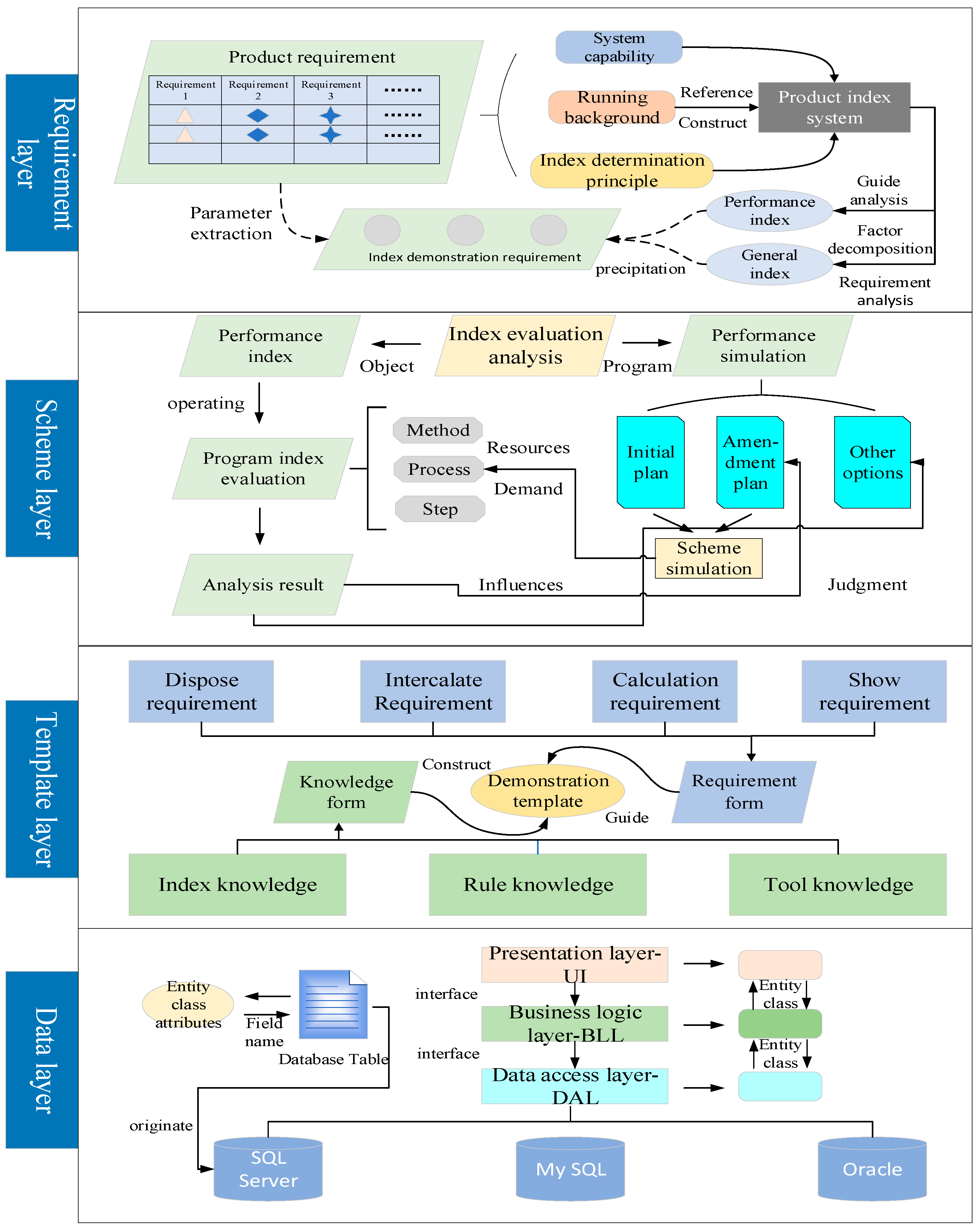
Figure 1. Demonstration model based on requirement-driven performance index.
Electronics 15 02634 g001
Figure 2. Analysis and establishment of demonstration requirements.
Electronics 15 02634 g002
Figure 3. Construction and evaluation of demonstration index.
Electronics 15 02634 g003
Figure 4. Configuration and packaging of the demonstration tool.
Electronics 15 02634 g004
Figure 5. Unitized demonstration requirements and knowledge management model.
Electronics 15 02634 g005
Figure 6. The relationship between demonstration templates, knowledge bases and knowledge elements.
Electronics 15 02634 g006
Figure 7. Dynamic demonstration template configuration method.
Electronics 15 02634 g007
Figure 8. Tool template instantiation process.
Electronics 15 02634 g008
Figure 9. Requirement form association and requirement metadata construction process.
Electronics 15 02634 g009
Figure 10. Dynamic demonstration template generation workflow for the antenna-array system.
Electronics 15 02634 g010
Figure 11. Dynamically generated antenna-array demonstration tool interface.
Electronics 15 02634 g011
Figure 12. Example analysis results for the antenna-array demonstration case (horizontal traversal mode).
Electronics 15 02634 g012
Figure 13. Example analysis results for the antenna-array demonstration case (vertical traversal mode).
Electronics 15 02634 g013
Table 1. Comparison of the proposed method with existing demonstration approaches.
MethodsRequirement
Adaptability
Knowledge Reuse CapabilityTemplate Generation MechanismTool
Configurability
Conventional
manual approaches
Low
(Static parameters)
Weak
(Unstructured data)
Manual codingLow
Fixed-template
approaches
Medium
(Predefined scope)
Medium
(Domain-specific)
Static invocationMedium
The Proposed MethodHigh
(Dynamic configuration)
Strong
(Unitized elements)
Requirement-driven dynamic instantiationHigh
Table 2. Meta-information table of antenna array requirements.
The RF of Antenna
DREIRECRESRE
Txt, Rdo, Btm, Frm, Grp, Lbl, Lvw, Menu, Date, Dgv, Lst, Dud, Canvas, Pdl, Image, Rdo, Hyperlink, etc.Phase measurement error, The range of signal frequencies, The interval degree in traverse, Unit baseline, Base ratio, TraverseOne-dimensional:
Direction finding error and maximum fuzzy Angle of one-dimensional linear array;
two-dimensional:
L-, T-, cross–azimuth and pitch–Angle measurement error and pitch–direction maximum without fuzzy Angle
Schematic diagram of antenna array, Azimuth error distribution,
Pitch Angle direction finding error distribution
Table 3. Meta-information of antenna knowledge index.
The KF of AntennaThe KF of Antenna
BEMeaning & InformationREBEMeaning & InformationRE
∆ψxHorizontal phase measurement error1~5°VabVertical antenna baseline
∆ψyVertical phase measurement errorTwTraverse wayHorizontal, H/
Vertical, V
FscopeThe range of signal frequencies2~8/12~14/14~18/1.2~2/8~10/0.35~0.7 GHzFdFixed degree
EscopeThe range of interferometer system’s error±0.5°/±1°ffrequency
IdThe interval degree in traverse1°/2°/5°maxηmax direction of arrival
AgAntenna geometryL-shape/T-shape/
Cross/Linear array
minθThe min azimuth
HubHorizontal unit baseline9.5/76 mmmaxθThe max azimuth
VubVesrtical unit baselineminφThe min pitch angle
HbrHorizontal base ratio maxφThe max pitch angle
VbrVertical base ratio HabHorizontal antenna baseline
Table 4. Antenna array error analysis RE.
The RE of Antenna
Line-TypeL-TypeT-TypeCross-Type
Δ θ = λ 2 π D cos θ Δ φ
θ m a x = arcsin λ 2 d
L1:
Δ β = λ 2 π φ x d x cos β φ y d y sin β cos ε
Δ ε = λ 2 π φ y d y cos β φ x d x sin β sin ε
ε = cos 1 λ 2 π φ x d x 2 + φ y d y 2
L2:
Δ θ = λ 2 π D cos θ Δ φ
θ m a x = arcsin λ 2 d
Δ β = λ 2 π φ x D x cos β φ y d y sin β cos ε
Δ ε = λ 2 π φ y d y cos β φ x D x sin β sin ε
ε = cos 1 λ 2 π φ y d y 2 + φ x D x 2
Δ β = λ 2 π φ x D x cos β φ y D y sin β cos ε
Δ ε = λ 2 π φ y D y cos β φ x D x sin β sin ε
ε = cos 1 λ 2 π φ y D y 2 + φ x D x 2
Table 5. A set of antenna knowledge data in error requirement analysis (horizontal traversal mode).
TE∆ψx∆ψyFscopeEscopeIdAgHubVubHbrVbrTwFd
Data0.9°1.5°3~6 GHz±1°L1-shape9.5 mm9.5 mm1:2:3:53:4:5:6H20°
Table 6. Antenna requirement analysis result set (horizontal traversal mode).
TEApF (Frequency)maxηHabVabminθmaxθminφmaxφ
Dataβ = 20°390°9.5:
19:
28.5:
47.5
28.5:
38:
47.5:
57
0.14°4.02°−0.49°−14.2°
3.7590°0.11°3.21°−0.40°−11.4°
4.590°0.09°2.67°−0.33°−9.49°
5.2590°0.08°2.29°−0.28°−8.14°
690°0.07°2.0°−0.25°−7.12°
Table 7. A set of antenna knowledge data in error requirement analysis (vertical traversal mode).
TE∆ψx∆ψyFscopeEscopeIdAgHubVubHbrVbrTwFd
Data0.9°1.5°3~6 GHz±1°L1-shape9.5 mm9.5 mm1:2:3:53:4:5:6V20°
Table 8. Antenna requirement analysis result set (vertical traversal mode).
TEApF (Frequency)maxηHabVabminθmaxθminφmaxφ
Dataε = 20°390°9.5:
19:
28.5:
47.5
28.5:
38:
47.5:
57
0.549°1.51°
3.7590°0.440°1.21°
4.590°0.366°1.00°
5.2590°0.314°0.863°
690°0.275°0.755°
Disclaimer/Publisher’s Note: The statements, opinions and data contained in all publications are solely those of the individual author(s) and contributor(s) and not of MDPI and/or the editor(s). MDPI and/or the editor(s) disclaim responsibility for any injury to people or property resulting from any ideas, methods, instructions or products referred to in the content.