The Evolution of the Robot Operating System Communication Ecosystem: An Overview of the DDS Architecture and Emerging Communication Protocols


Abstract
1. Introduction
- From the perspective of architectural evolution, systematically trace the technical development path of ROS communication from centralized to distributed systems, and summarize key design turning points.
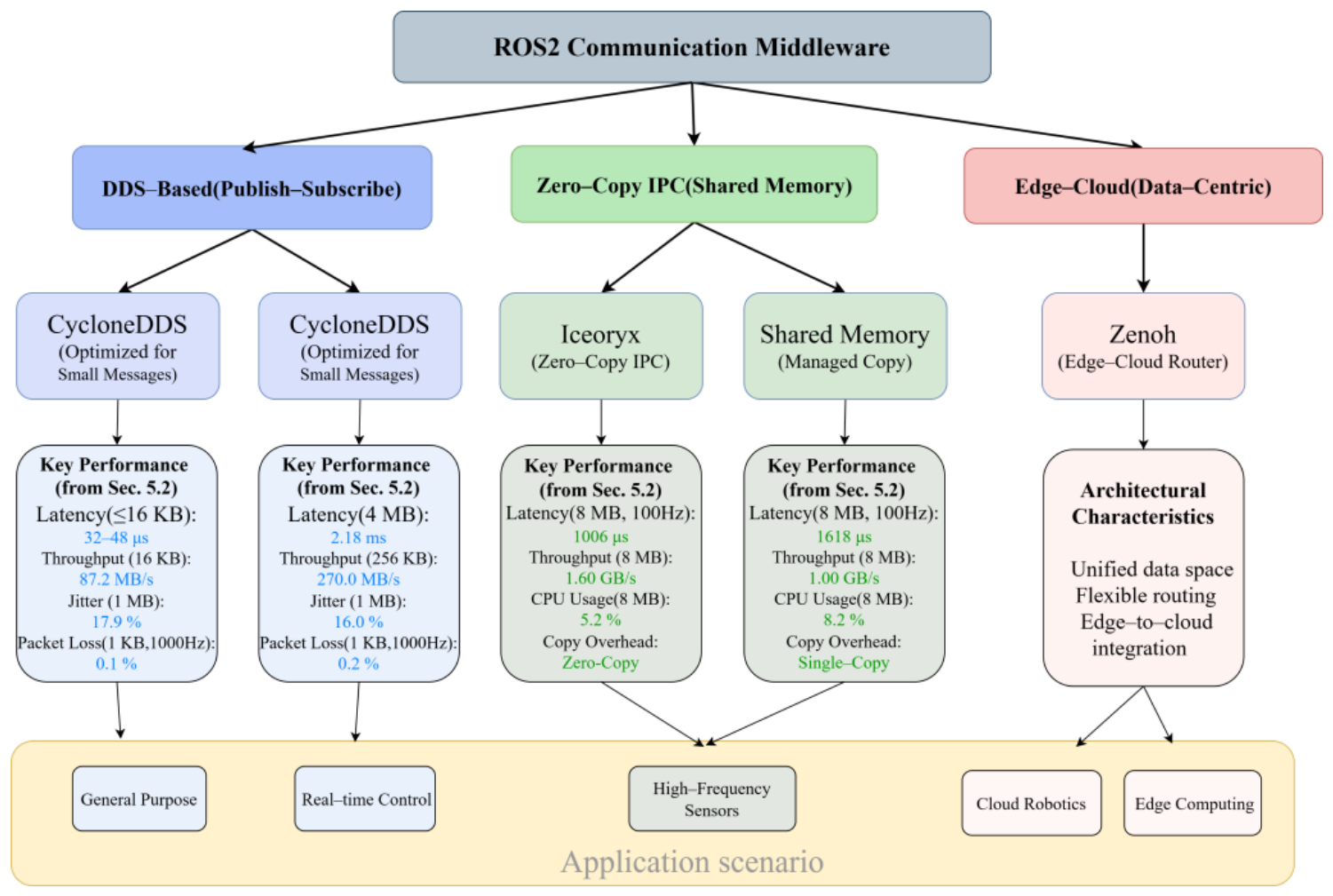
- Establish a unified classification framework for communication middleware, and conduct a standardized analysis of DDS, Zenoh, and Iceoryx based on two dimensions: communication models and data transmission paths.
- Conduct original, unified benchmark experiments: In contrast to existing studies that aggregate results from heterogeneous literature, this paper designs and performs systematic performance measurements on a controlled testbed. The experiments cover message sizes from 64 B to 8 MB and node counts from 1 to 50, providing reliable cross-protocol comparisons of CycloneDDS and FastDDS in terms of latency, throughput, jitter, scalability, packet loss under publication rate load, and the performance of shared memory and zero-copy modes for large messages.
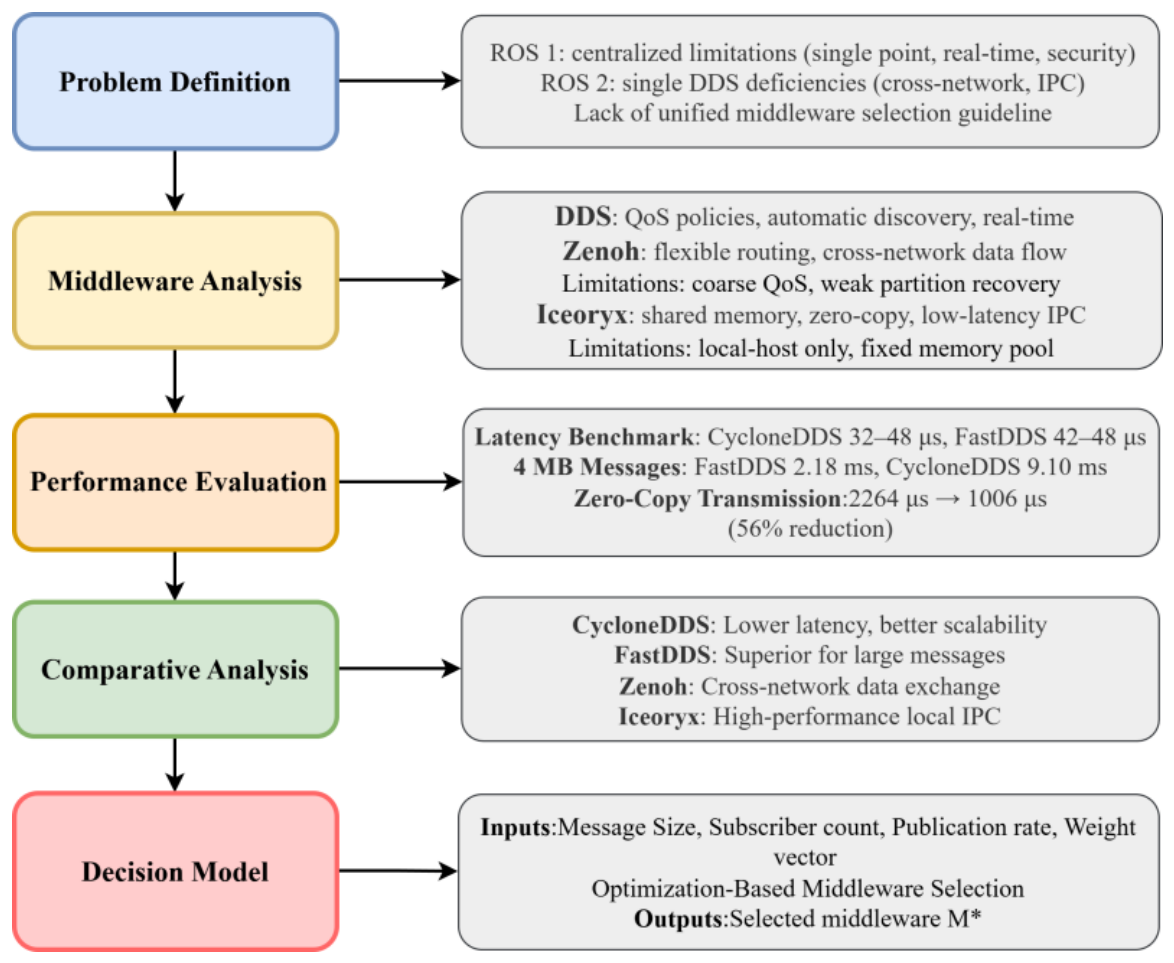
- Propose an optimization-based middleware selection method that models middleware selection as a constrained optimization problem based on message size, subscriber scale, and application performance requirements. By combining the analytical model with experimentally derived performance parameters, the method enables quantitative middleware selection and a priori performance estimation for ROS communication systems.
- Summarize the key challenges of ROS communication regarding multi-middleware collaboration, real-time performance assurance, and resource constraints, and outline future development directions.
2. The Evolution of ROS Communication Mechanisms
2.1. Communication Architecture and Limitations of ROS 1
2.1.1. Design of the TCPROS/UDPROS Protocols
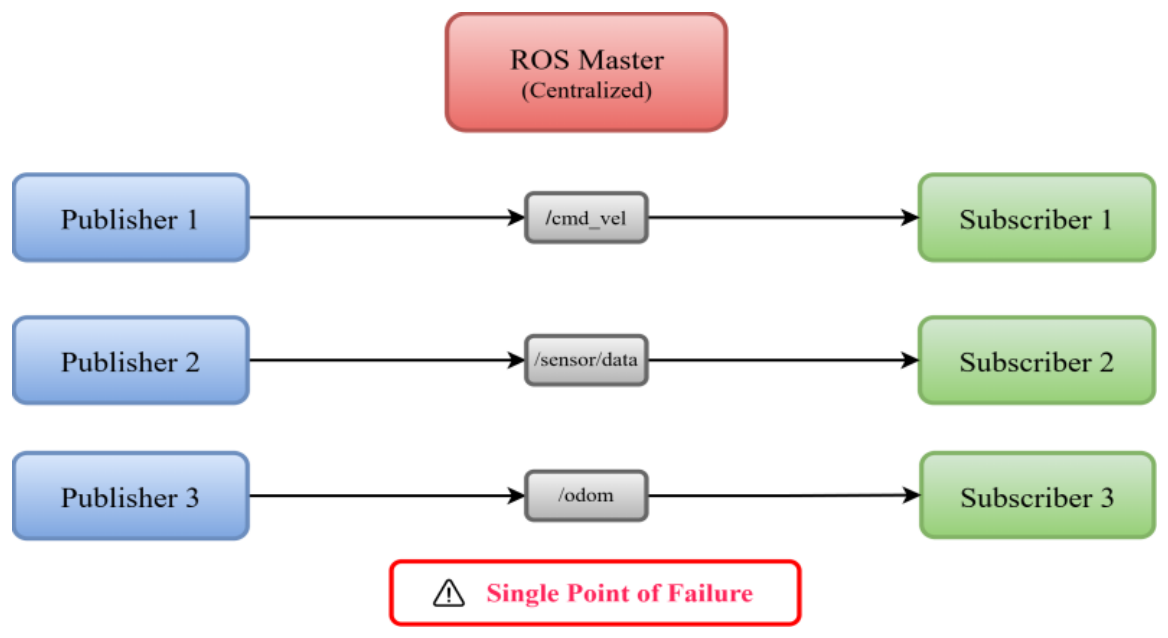
2.1.2. Centralized Discovery Mechanism
2.1.3. Real-Time Performance and Security Issues
2.2. Communication Innovations in ROS 2
2.2.1. Native Integration of the DDS Standard
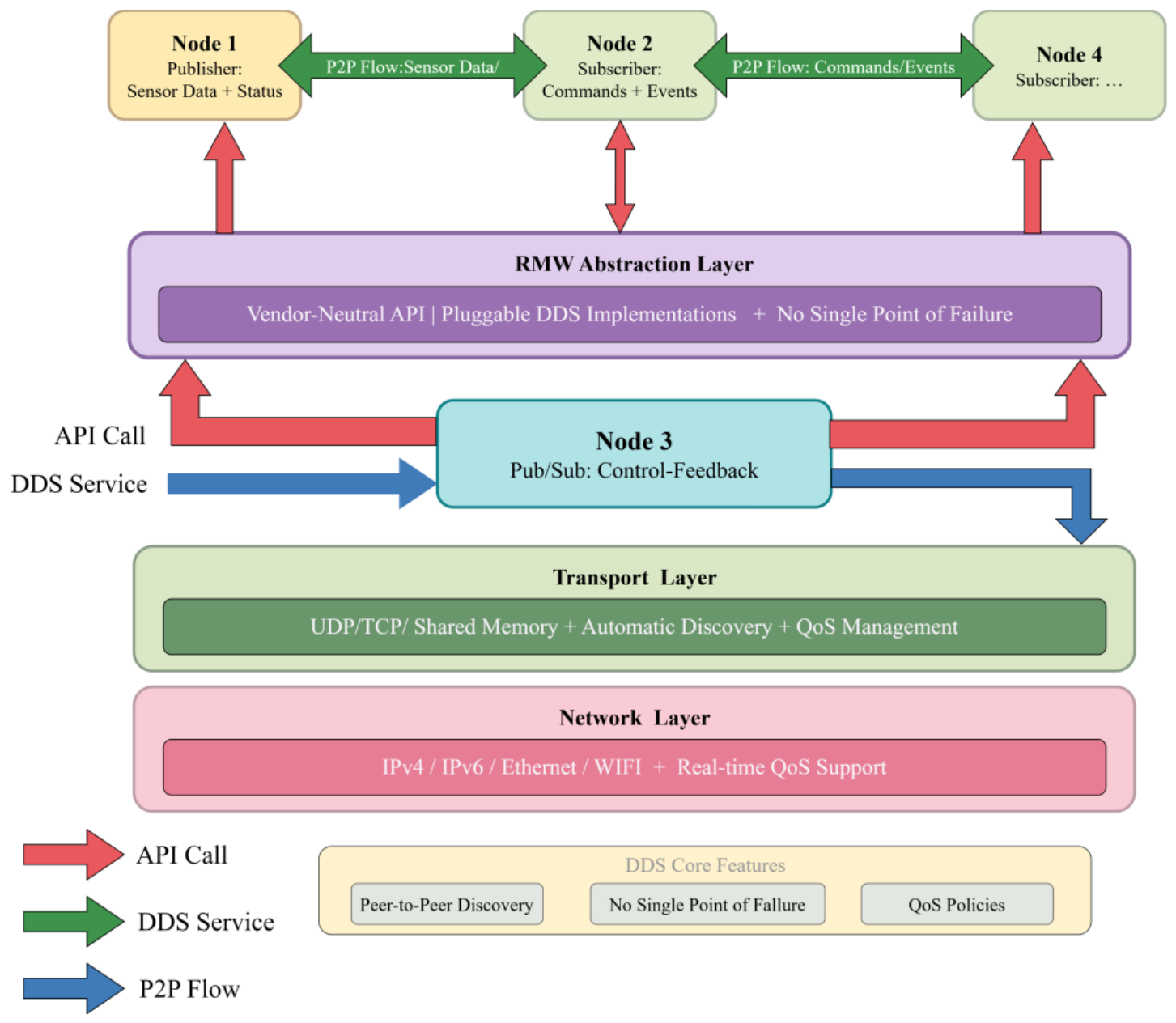
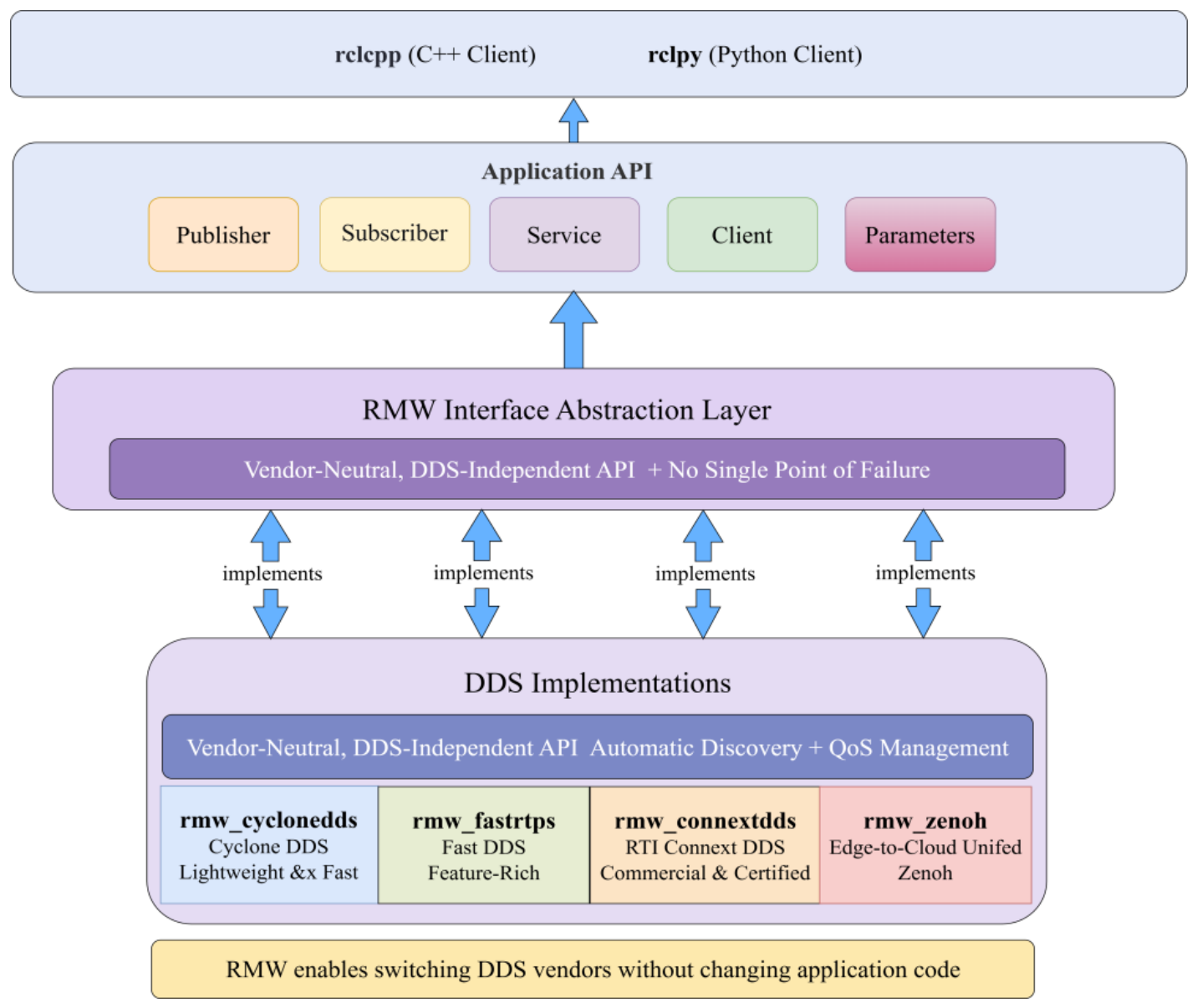
2.2.2. Design and Significance of the RMW Interface
2.2.3. Security Enhancements in ROS 2
2.2.4. Comparison of Mainstream DDS Implementations
3. Emerging Communication Protocols and the Expansion of the ROS Ecosystem
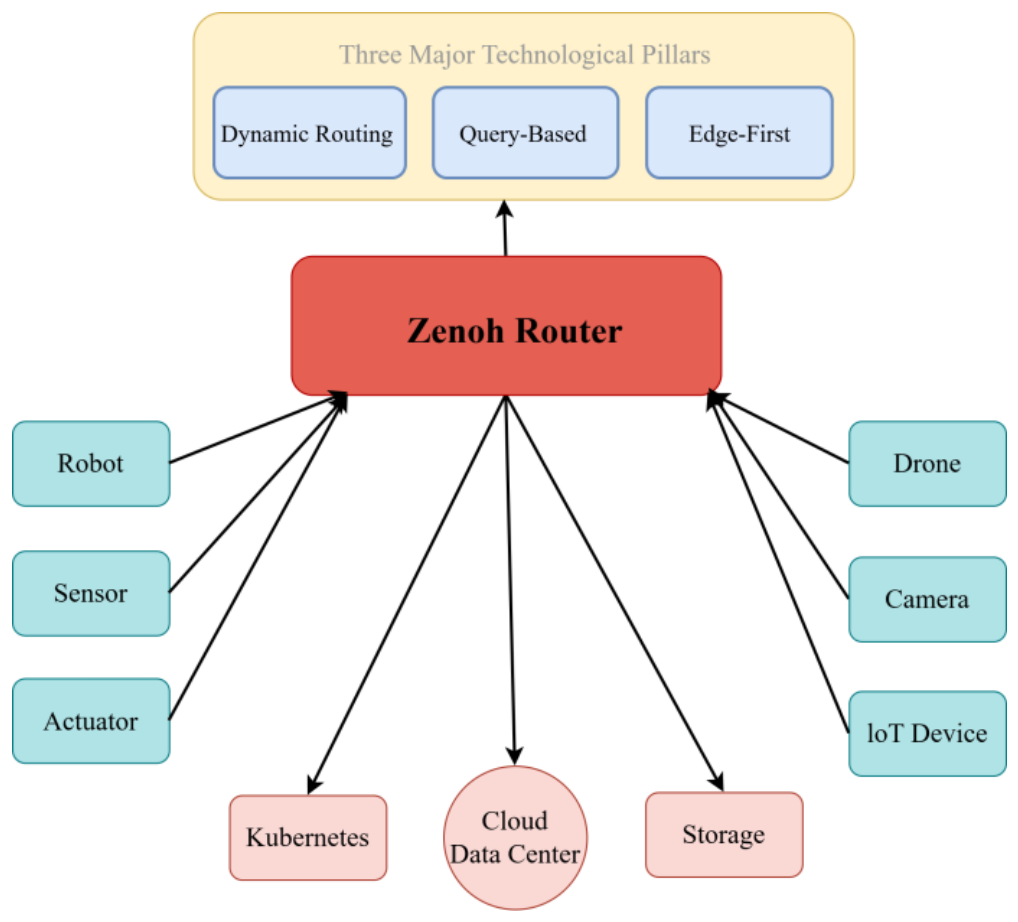
3.1. Zenoh: A Communication Protocol for Edge-to-Cloud Collaboration
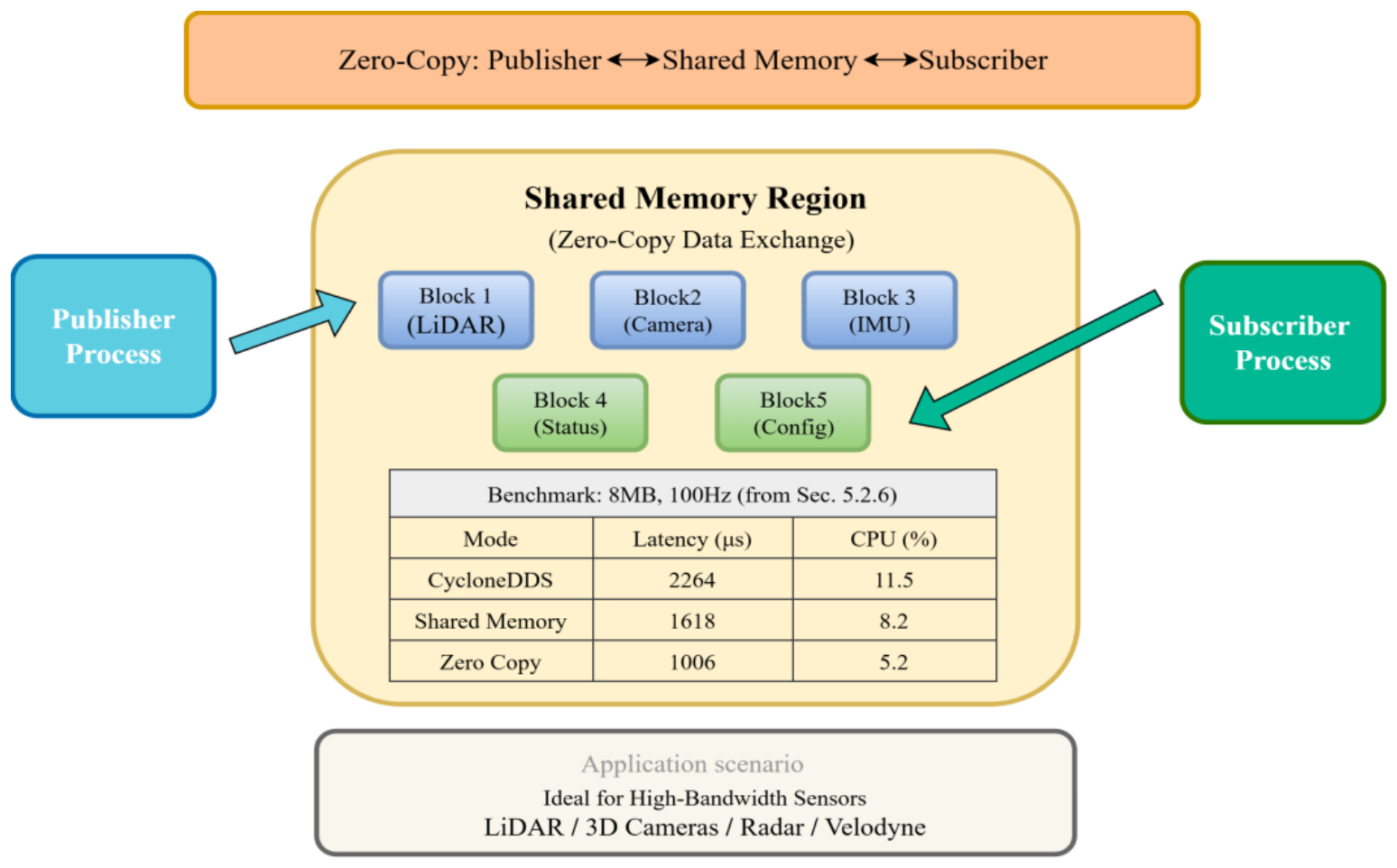
3.2. Iceoryx: A High-Performance Zero-Copy Communication Mechanism
3.3. Complementary Relationship Between Emerging Communication Protocols and DDS
3.4. Mathematical Formulation of the Unified Analytical Framework
- P ∈ {local shared memory, local network, remote network} denotes the data transmission path;
- T ∈ {publish-subscribe, shared memory, query-based} denotes the communication model;
- C ∈ {zero-copy, single copy, multi copy} denotes the copy semantics;
- Q ∈ {rich, medium, basic} denotes the QoS capability level;
- F: (P, T, C, Q, S, Nsub) → (L, σL, CPU, PLR) is a performance function that maps the architectural parameters together with workload conditions (message size S and number of subscribers Nsub) to four key outcomes: mean end-to-end latency L, latency jitter σL, CPU utilization, and packet loss rate (PLR).
- Iceoryx = (local shared memory, shared memory, zero-copy, basic, FIceoryx),
- DDS = (local network, publish-subscribe, multi-copy, rich, FDDS),
- Zenoh = (remote network, publish-subscribe/query, multi-copy, medium, FZenoh).
- Multi copy (CycloneDDS): L = 2264 μs;
- Single copy (shared memory): L = 1618 μs;
- Zero-copy (Iceoryx): L = 1006 μs;
4. ROS Communication Support Mechanisms and System Challenges
4.1. RMW Plugin Architecture and Abstraction Mechanism
4.2. Serialization Mechanisms and Data Representation Challenges
4.3. Discovery Mechanisms and Topological Adaptability
4.4. Heterogeneity in QoS Capabilities and Semantic Mapping
4.5. Challenges of Temporal Determinism and Resource Optimization
4.6. DDS and Time-Sensitive Networking Integration
5. Comprehensive Evaluation of ROS Communication Middleware Performance
5.1. Communication Performance Optimization Strategies
5.2. Unified Benchmark Evaluation on ROS 2 Middleware
5.2.1. Latency Scaling with Message Size
5.2.2. Throughput Scaling with Message Size
5.2.3. Jitter Scaling with Message Size
5.2.4. Scalability with Node Counts
5.2.5. Packet Loss Under Publication Rate Load
5.2.6. Comparison of CycloneDDS, Shared Memory, and Zero-Copy
5.3. Validation of Robot Application Scenarios
5.3.1. Mobile Robot Navigation Systems
5.3.2. Multi-Robot Coordination Systems
5.3.3. Analysis of Real-World Deployment Environments
5.4. Optimization-Based Middleware Selection Method
5.4.1. Problem Formulation
- i denotes the predicted end-to-end latency;
- i denotes the predicted CPU utilization;
- i denotes the predicted packet-loss rate.
- is the baseline latency;
- describes latency growth with increasing subscribers;
- represents message size sensitivity;
- captures the additional overhead introduced by memory-copy operations.
5.4.2. Optimization Procedure
| Algorithm 1 Optimization-Based Middleware Selection |
| Input: Message size S, Subscriber count Nsub, Publication rate R, Weight vector (, , ) Procedure: 1. For each candidate middleware Mi ∈ M: Compute predicted latency ; Compute predicted CPU utilization ; Compute predicted packet-loss rate . 2. Normalize the predicted metrics to obtain , , . 3. Calculate . 4. Select . Output: Selected middleware . |
5.4.3. Retrospective Evaluation Using Benchmark Data
5.4.4. Discussion
6. Future Directions and Research Challenges
6.1. Cloud-Native Communication Architectures and Deployment Models
6.2. Intelligent-Driven Adaptive Communication Mechanisms
6.3. Integration of Real-Time Performance and Functional Safety
6.4. Key Technical Challenges and Research Directions
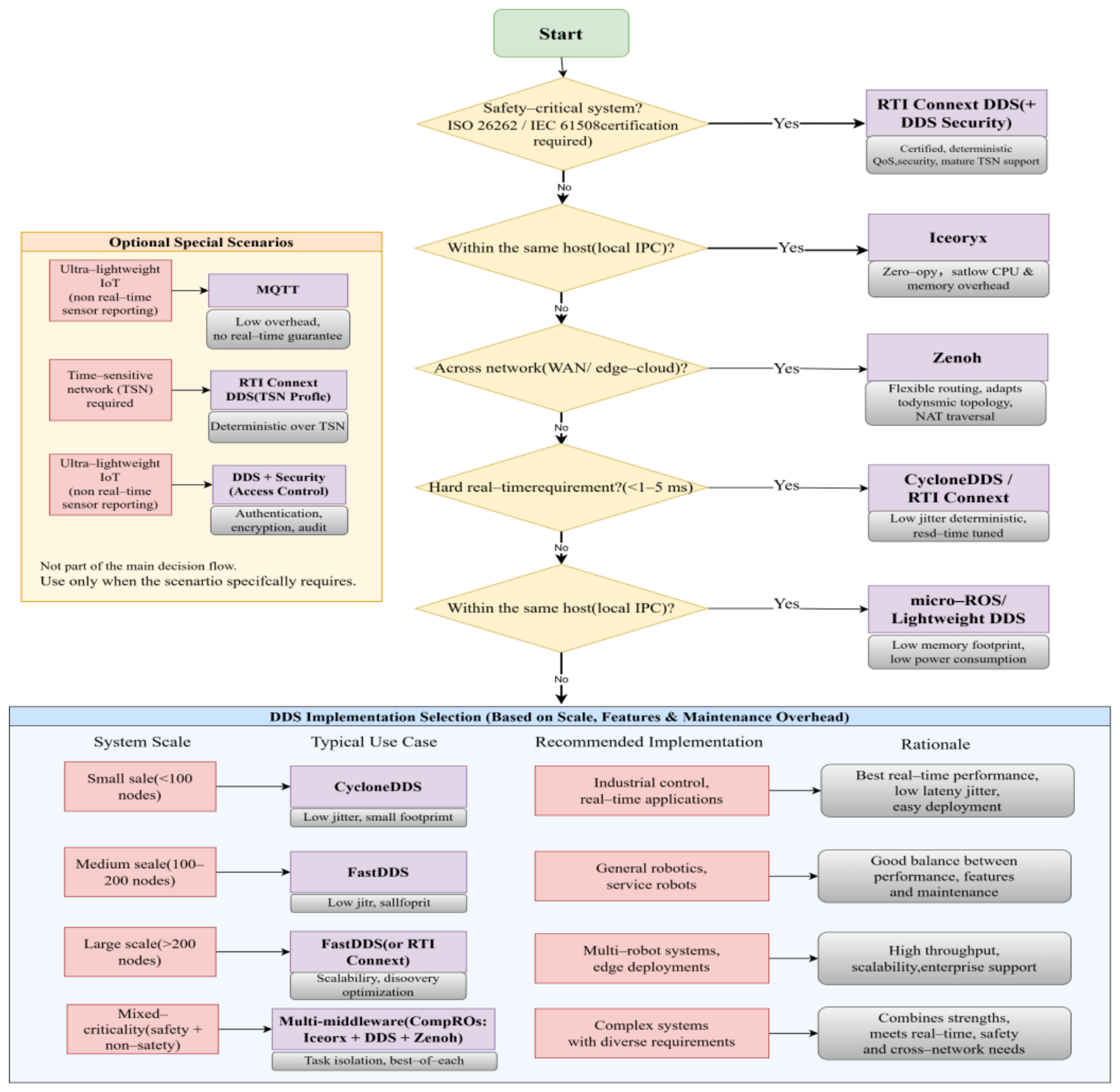
6.5. Recommendations for Communication Solutions for Different Application Scenarios
7. Conclusions
Author Contributions
Funding
Data Availability Statement
Acknowledgments
Conflicts of Interest
References
- Betz, T.; Schmeller, M.; Teper, H.; Betz, J. How Fast is My Software? Latency Evaluation for a ROS 2 Autonomous Driving Software. In Proceedings of the 2023 IEEE Intelligent Vehicles Symposium (IV), Anchorage, AK, USA, 4–7 June 2023; pp. 1–6. [Google Scholar]
- Teper, H.; Günzel, M.; Ueter, N.; von der Brüggen, G.; Chen, J.J. End-To-End Timing Analysis in ROS2. In Proceedings of the 2022 IEEE Real-Time Systems Symposium (RTSS), Houston, TX, USA, 5–8 December 2022; pp. 53–65. [Google Scholar]
- Macenski, S.; Moore, T.; Lu, D.V.; Merzlyakov, A.; Ferguson, M. From the desks of ROS maintainers: A survey of modern and capable mobile robotics algorithms in the robot operating system 2. Robot. Auton. Syst. 2023, 168, 104493. [Google Scholar] [CrossRef]
- Quigley, M.; Conley, K.; Gerkey, B.; Faust, J.; Foote, T.; Leibs, J.; Wheeler, R.; Ng, A. ROS: An open-source Robot Operating System. In Proceedings of the IEEE International Conference on Robotics and Automation (ICRA)—Workshop on Open Source Software, Kobe, Japan, 12–17 May 2009; Volume 3. [Google Scholar]
- Park, J.; Delgado, R.; Choi, B.W. Real-Time Characteristics of ROS 2.0 in Multiagent Robot Systems: An Empirical Study. IEEE Access 2020, 8, 154637–154651. [Google Scholar] [CrossRef]
- Bode, V.; Buettner, D.; Preclik, T.; Trinitis, C.; Schulz, M. Systematic Analysis of DDS Implementations. In Proceedings of the Middleware ‘23: Proceedings of the 24th ACM/IFIP 24th International Middleware Conference, Bologna, Italy, 11–15 December 2023; pp. 234–246. [Google Scholar]
- Alaerjan, A.; Kim, D.-K.; Ming, H.; Kim, H. Configurable DDS as Uniform Middleware for Data Communication in Smart Grids. Energies 2020, 13, 1839. [Google Scholar] [CrossRef]
- Profanter, S.; Tekat, A.; Dorofeev, K.; Rickert, M.; Knoll, A. OPC UA versus ROS, DDS, and MQTT: Performance Evaluation of Industry 4.0 Protocols. In Proceedings of the 2019 IEEE International Conference on Industrial Technology (ICIT), Melbourne, Australia, 13–15 February 2019; pp. 955–962. [Google Scholar]
- AL-Madani, B.; Elkhider, S.M.; El-Ferik, S. DDS-Based Containment Control of Multiple UAV Systems. Appl. Sci. 2020, 10, 4572. [Google Scholar] [CrossRef]
- Mouradian, C.; Naboulsi, D.; Yangui, S.; Glitho, R.H.; Morrow, M.J.; Polakos, P.A. A Comprehensive Survey on Fog Computing: State-of-the-Art and Research Challenges. IEEE Commun. Surv. Tutor. 2018, 20, 416–464. [Google Scholar] [CrossRef]
- Raj, R.; Kos, A. A Comprehensive Study of Mobile Robot: History, Developments, Applications, and Future Research Perspectives. Appl. Sci. 2022, 12, 6951. [Google Scholar] [CrossRef]
- Camargo, C.; Gonçalves, J.; Conde, M.Á.; Rodríguez-Sedano, F.J.; Costa, P.; García-Peñalvo, F.J. Systematic Literature Review of Realistic Simulators Applied in Educational Robotics Context. Sensors 2021, 21, 4031. [Google Scholar] [CrossRef] [PubMed]
- Duan, F.; Li, W.; Tan, Y. ROS Debugging. In Intelligent Robot: Implementation and Applications; Springer: Berlin/Heidelberg, Germany, 2023; pp. 71–92. [Google Scholar]
- Puck, L.; Keller, P.; Schnell, T.; Plasberg, C.; Tanev, A.; Heppner, G.; Roennau, A.; Dillmann, R. Performance Evaluation of Real-Time ROS2 Robotic Control in a Time-Synchronized Distributed Network. In Proceedings of the 2021 IEEE 17th International Conference on Automation Science and Engineering (CASE), Lyon, France, 23–27 August 2021; pp. 1670–1676. [Google Scholar]
- Gambo, M.L.; Danasabe, A.; Almadani, B.; Aliyu, F.; Aliyu, A.; Al-Nahari, E. A Systematic Literature Review of DDS Middleware in Robotic Systems. Robotics 2025, 14, 63. [Google Scholar] [CrossRef]
- Liu, R.; Zheng, J.; Luan, T.H.; Gao, L.; Hui, Y.; Xiang, Y.; Dong, M. ROS-Based Collaborative Driving Framework in Autonomous Vehicular Networks. IEEE Trans. Veh. Technol. 2023, 72, 6987–6999. [Google Scholar] [CrossRef]
- Pico, N.; Mite, G.; Morán, D.; Alvarez-Alvarado, M.S.; Auh, E.; Moon, H. Web-Based Real-Time Alarm and Teleoperation System for Autonomous Navigation Failures Using ROS 1 and ROS 2. Actuators 2025, 14, 164. [Google Scholar] [CrossRef]
- Yang, S.; Guo, J.; Rui, X. Formal Analysis and Detection for ROS2 Communication Security Vulnerability. Electronics 2024, 13, 1762. [Google Scholar] [CrossRef]
- Fernandez, J.; Allen, B.; Thulasiraman, P.; Bingham, B. Performance Study of the Robot Operating System 2 with QoS and Cyber Security Settings. In Proceedings of the 2020 IEEE International Systems Conference (SysCon), Montreal, QC, Canada, 24–27 August 2020; pp. 1–6. [Google Scholar]
- Bode, V.; Trinitis, C.; Schulz, M.; Buettner, D.; Preclik, T. DDS Implementations as Real-Time Middleware—A Systematic Evaluation. In Proceedings of the 2023 IEEE 29th International Conference on Embedded and Real-Time Computing Systems and Applications (RTCSA), Niigata, Japan, 30 August–1 September 2023; pp. 186–195. [Google Scholar]
- Alaerjan, A. Formalizing the Semantics of DDS QoS Policies for Improved Communications in Distributed Smart Grid Applications. Electronics 2023, 12, 2246. [Google Scholar] [CrossRef]
- Ho, M.-H.; Lai, M.-Y.; Liu, Y.-T. Implementation of DDS Cloud Platform for Real-Time Data Acquisition of Sensors for a Legacy Machine. Electronics 2022, 11, 2096. [Google Scholar] [CrossRef]
- Papavasileiou, A.; Nikoladakis, S.; Basamakis, F.P.; Aivaliotis, S.; Michalos, G.; Makris, S. A Voice-Enabled ROS2 Framework for Human–Robot Collaborative Inspection. Appl. Sci. 2024, 14, 4138. [Google Scholar] [CrossRef]
- D’Avella, S.; Avizzano, C.A.; Tripicchio, P. ROS-Industrial based robotic cell for Industry 4.0: Eye-in-hand stereo camera and visual servoing for flexible, fast, and accurate picking and hooking in the production line. Robot. Comput.-Integr. Manuf. 2023, 80, 102453. [Google Scholar] [CrossRef]
- Kang, Z.; Dubey, A. Evaluating DDS, MQTT, and ZeroMQ Under Different IoT Traffic Conditions. Available online: http://www.dre.vanderbilt.edu/~gokhale/WWW/papers/M4IoT2020.pdf (accessed on 21 March 2024).
- Zhang, J.; Keramat, F.; Yu, X.; Hernández, D.M.; Queralta, J.P.; Westerlund, T. Distributed Robotic Systems in the Edge-Cloud Continuum with ROS 2: A Review on Novel Architectures and Technology Readiness. In Proceedings of the 2022 Seventh International Conference on Fog and Mobile Edge Computing (FMEC), Paris, France, 12–15 December 2022; pp. 1–8. [Google Scholar]
- Chen, K.; Wang, M.; Gualtieri, M.; Tian, N.; Juette, C.; Ren, L.; Ichnowski, J.; Kubiatowicz, J.; Goldberg, K. Fogros2-ls: A location-independent fog robotics framework for latency sensitive ros2 applications. In Proceedings of the 2024 IEEE International Conference on Robotics and Automation (ICRA), Yokohama, Japan, 13–17 May 2024; pp. 10581–10587. [Google Scholar]
- Corsaro, A.; Cominardi, L.; Hecart, O.; Baldoni, G.; Avital, J.E.P.; Loudet, J.; Guimares, C.; Ilyin, M.; Bannov, D. Zenoh: Unifying communication, storage and computation from the cloud to the microcontroller. In Proceedings of the 2023 26th Euromicro Conference on Digital System Design (DSD), Golem, Albania, 6–8 September 2023; IEEE: Piscataway, NJ, USA, 2023; pp. 422–428. [Google Scholar]
- Baldoni, G.; Loudet, J.; Cominardi, L.; Corsaro, A.; He, Y. Facilitating distributed data-flow programming with Eclipse Zenoh: The ERDOS case. In Proceedings of the 1st Workshop on Serverless mobile networking for 6G Communications, Virtual, 25 June 2021; pp. 13–14. [Google Scholar]
- Zhang, J.; Yu, X.; Sier, H.; Queralta, J.P.; Westerlund, T. Comparison of DDS, MQTT, and Zenoh in Edge-to-Edge and Edge-to-Cloud Communication for Distributed ROS 2 Systems. arXiv 2023, arXiv:2309.07496. Available online: https://api.semanticscholar.org/CorpusID:261823232 (accessed on 27 November 2024).
- Chovet, L.; Garcia, G.; Bera, A.; Richard, A.; Yoshida, K.; Olivares-Mendez, M. Performance Comparison of ROS2 Middlewares for Multi-Robot Mesh Networks in Planetary Exploration. J. Intell. Robot. Syst. 2025, 111, 18. [Google Scholar] [CrossRef]
- Pöhnl, M.; Tamisier, A.; Blass, T. A Middleware Journey from Microcontrollers to Microprocessors. In Proceedings of the 2022 Design, Automation & Test in Europe Conference & Exhibition (DATE), Antwerp, Belgium, 14–23 March 2022; pp. 282–286. [Google Scholar]
- Dehnavi, S.; Koedam, M.; Nelson, A.; Goswami, D.; Goossens, K. CompROS: A composable ROS 2 based architecture for real-time embedded robotic development. In Proceedings of the 2021 IEEE/RSJ International Conference on Intelligent Robots and Systems (IROS), Prague, Czech Republic, 27 September–1 October 2021; pp. 6449–6455. [Google Scholar] [CrossRef]
- Ichnowski, J.; Chen, K.; Dharmarajan, K.; Adebola, S.; Danielczuk, M.; Mayoral-Vilches, V.; Jha, N.; Zhan, H.; Llontop, E.; Xu, D.; et al. FogROS2: An Adaptive Platform for Cloud and Fog Robotics Using ROS 2. In Proceedings of the 2023 IEEE International Conference on Robotics and Automation (ICRA), London, UK, 29 May–2 June 2023; pp. 5493–5500. [Google Scholar]
- Fu, L.; Kapoor, G.; Militano, L.; Carughi, G.T.; Bohnert, T.M. IoRT ROS 2 applications: Evaluating Zenoh and VPN for robotic networking in the edge-cloud continuum. In Proceedings of the 2025 IEEE Symposium on Computers and Communications (ISCC), Bologna, Italy, 2–5 July 2025; pp. 1–6. [Google Scholar]
- Carreira, R.; Costa, N.; Ramos, J.; Frazão, L.; Pereira, A. A ROS2-Based Gateway for Modular Hardware Usage in Heterogeneous Environments. Sensors 2024, 24, 6341. [Google Scholar] [CrossRef]
- Kaushik, S.; Poonia, R.C.; Khatri, S.K. Comparative study of various protocols of DDS. J. Stat. Manag. Syst. 2017, 20, 647–658. [Google Scholar] [CrossRef]
- Yang, Y.; Azumi, T. Exploring Real-Time Executor on ROS 2. In Proceedings of the 2020 IEEE International Conference on Embedded Software and Systems (ICESS), Shanghai, China, 10–11 December 2020; pp. 1–8. [Google Scholar]
- Wang, G.; Zhang, C.; Liu, S.; Zhao, Y.; Zhang, Y.; Wang, L. Multi-robot collaborative manufacturing driven by digital twins: Advancements, challenges, and future directions. J. Manuf. Syst. 2025, 82, 333–361. [Google Scholar] [CrossRef]
- Basu, S.; Baert, M.; Hoebeke, J. QoS Enabled Heterogeneous BLE Mesh Networks. J. Sens. Actuator Netw. 2021, 10, 24. [Google Scholar] [CrossRef]
- Tang, Y.; Feng, Z.; Guan, N.; Jiang, X.; Lv, M.; Deng, Q.; Yi, W. Response time analysis and priority assignment of processing chains on ros2 executors. In Proceedings of the 2020 IEEE Real-Time Systems Symposium (RTSS), Houston, TX, USA, 1–4 December 2020; pp. 231–243. [Google Scholar]
- Wang, Z.; Liu, S.; Ji, D.; Yi, W. Improving Real-Time Performance of Micro-ROS with Priority-Driven Chain-Aware Scheduling. Electronics 2024, 13, 1658. [Google Scholar] [CrossRef]
- Wang, Y.P.; Tan, W.; Hu, X.Q.; Manocha, D.; Hu, S.M. TZC: Efficient Inter-Process Communication for Robotics Middleware with Partial Serialization. arXiv 2020, arXiv:1810.00556. [Google Scholar] [CrossRef]
- Ishikawa-Aso, T.; Kato, S. ROS 2 Agnocast: Supporting unsized message types for true zero-copy publish/subscribe IPC. In Proceedings of the 2025 28th International Symposium on Real-Time Distributed Computing (ISORC), Toulouse, France, 26–28 May 2025; pp. 1–10. [Google Scholar]
- Bedard, C.; Lutkebohle, I.; Dagenais, M. ros2_tracing: Multipurpose Low-Overhead Framework for Real-Time Tracing of ROS 2. IEEE Robot. Autom. Lett. 2022, 7, 6511–6518. [Google Scholar] [CrossRef]
- Ye, Y.; Nie, Z.; Liu, X.; Xie, F.; Li, Z.; Li, P. ROS2 Real-time Performance Optimization and Evaluation. Chin. J. Mech. Eng. 2023, 36, 144. [Google Scholar] [CrossRef]
- Ferrari, E.; Morato, A.; Tramarin, F.; Zunino, C.; Bertocco, M. Quantifying the Trajectory Tracking Accuracy in UGVs: The Role of Traffic Scheduling in Wi-Fi-Enabled Time-Sensitive Networking. Sensors 2026, 26, 881. [Google Scholar] [CrossRef]
- Brekke, V.; Berge, E.O.; Dybdahl, E.; Singh, J.; Tyapin, I. ROS 2-Driven Navigation and Sensor Platform for Quadruped Robots. Robotics 2026, 15, 70. [Google Scholar] [CrossRef]
- Kronauer, T.; Pohlmann, J.; Matthé, M.; Smejkal, T.; Fettweis, G. Latency Analysis of ROS2 Multi-Node Systems. In Proceedings of the 2021 IEEE International Conference on Multisensor Fusion and Integration for Intelligent Systems (MFI), Karlsruhe, Germany, 23–25 September 2021; pp. 1–7. [Google Scholar]
- Liang, W.-Y.; Yuan, Y.; Lin, H.-J. A performance study on the throughput and latency of Zenoh, MQTT, Kafka, and DDS. arXiv 2023, arXiv:2303.09419. Available online: https://arxiv.org/abs/2303.09419 (accessed on 10 April 2026). [CrossRef]
- Orr, J.; Dutta, A. Multi-Agent Deep Reinforcement Learning for Multi-Robot Applications: A Survey. Sensors 2023, 23, 3625. [Google Scholar] [CrossRef] [PubMed]
- Romeh, A.E.; Mirjalili, S.; Gul, F. Hybrid Vulture-Coordinated Multi-Robot Exploration: A Novel Algorithm for Optimization of Multi-Robot Exploration. Mathematics 2023, 11, 2474. [Google Scholar] [CrossRef]
- Paul, S.; Lephuoc, D.; Hauswirth, M. Performance Evaluation of ROS2-DDS middleware implementations facilitating Cooperative Driving in Autonomous Vehicle. arXiv 2024, arXiv:2412.07485. [Google Scholar] [CrossRef]
- Chisăliţă, A.-I.; Korodi, A. Stepping toward Zenoh protocol in automotive scenarios. IEEE Access 2025, 13, 166167–166180. [Google Scholar] [CrossRef]
- ISO 26262; Road Vehicles—Functional Safety. International Organization for Standardization (ISO): Geneva, Switzerland, 2018.
- IEC 61508; Functional Safety of Electrical/Electronic/Programmable Electronic Safety-Related Systems. International Electrotechnical Commission (IEC): Geneva, Switzerland, 2010.
- Siriweera, A.; Naruse, K. Survey on Cloud Robotics Architecture and Model-Driven Reference Architecture for Decentralized Multicloud Heterogeneous-Robotics Platform. IEEE Access 2021, 9, 40521–40539. [Google Scholar] [CrossRef]
- Song, B.-Y.; Choi, H. ROS Gateway: Enhancing ROS Availability across Multiple Network Environments. Sensors 2024, 24, 6297. [Google Scholar] [CrossRef]
- Patel, D.; Maiti, C.; Muthuswamy, S. Real-Time Performance Monitoring of a CNC Milling Machine using ROS 2 and AWS IoT Towards Industry 4.0. In Proceedings of the IEEE EUROCON 2023—20th International Conference on Smart Technologies, Torino, Italy, 6 July 2023. [Google Scholar]
- Licardo, J.; Domjan, M.; Orehovački, T. Intelligent Robotics—A Systematic Review of Emerging Technologies and Trends. Electronics 2024, 13, 542. [Google Scholar] [CrossRef]
- Almeida, L.; Teixeira, R.; Baldoni, G.; Antunes, M.; Aguiar, R.L. Federated Learning for a Dynamic Edge: A Modular and Resilient Approach. Sensors 2025, 25, 3812. [Google Scholar] [CrossRef] [PubMed]
- Shamaine, C.X.E.; Qiao, Y.; Henry, J.; McNevin, K.; Murray, N. RoSTAR: ROS-based telerobotic control via augmented reality. In Proceedings of the 2020 IEEE 22nd International Workshop on Multimedia Signal Processing (MMSP), Tampere, Finland, 21–24 September 2020; IEEE: Piscataway, NJ, USA, 2020; pp. 1–6. [Google Scholar]
- IEC 62304; Medical Device Software—Software Life Cycle Processes. International Electrotechnical Commission (IEC): Geneva, Switzerland, 2006.
- Bonci, A.; Gaudeni, F.; Giannini, M.C.; Longhi, S. Robot Operating System 2 (ROS2)-Based Frameworks for Increasing Robot Autonomy: A Survey. Appl. Sci. 2023, 13, 12796. [Google Scholar] [CrossRef]
- Sthapit, I.; Olbina, S. Digital Twin (DT) and Extended Reality (XR) in the Construction Industry: A Systematic Literature Review. Buildings 2026, 16, 517. [Google Scholar] [CrossRef]
- Abaza, B.F. AI-Driven Dynamic Covariance for ROS 2 Mobile Robot Localization. Sensors 2025, 25, 3026. [Google Scholar] [CrossRef]
- Macenski, S.; Foote, T.; Gerkey, B.; Lalancette, C.; Woodall, W. Robot Operating System 2: Design, architecture, and uses in the wild. Sci. Robot. 2022, 7, eabm6074. [Google Scholar] [CrossRef] [PubMed]
- Garzón, M. Using ROS in Multi-robot Systems: Experiences and Lessons Learned from Real-World Field Tests. In Robot Operating System (ROS); Koubaa, A., Ed.; Studies in Computational Intelligence; Springer: Cham, Switzerland, 2017; Volume 707. [Google Scholar]
- Sasaki, R.; Takefusa, A.; Nakada, H.; Oguchi, M. Development and Evaluation of IoT System Consisting of ROS-based Robot, Edge and Cloud. In Proceedings of the 2023 IEEE 47th Annual Computers, Software, and Applications Conferecnce (COMPSAC), Torino, Italy, 26 June 2023. [Google Scholar]
- Megalingam, R.K.; Rajendraprasad, A.; Manoharan, S.K. Comparison of Planned Path and Travelled Path Using ROS Navigation Stack. In Proceedings of the 2020 International Conference for Emerging Technology (INCET), Belgaum, India, 5–7 June 2020; IEEE: Belgaum, India, 2020; pp. 1–6. [Google Scholar]
- Lertyosbordin, C.; Wongsanont, D.; Khurukitwanit, N.; Saowapark, W. A Framework for Remote Robot Actuation using ROS Integrated with MQTT. In Proceedings of the 2024 International Technical Conference on Circuits/Systems, Computers, and Communications (ITC-CSCC), Okinawa, Japan, 2 July 2024. [Google Scholar]


| Sensor Type | Reliability | History | Depth | Deadline | Priority | Lifespan | Performance Impact |
|---|---|---|---|---|---|---|---|
| LiDAR PointCloud | best_effort | keep_last = 1 | 1 | 100 ms | HIGH | infinite | 60–80% latency reduction |
| RGB Camera (30 fps) | best_effort | keep_last = 5 | 5 | 33 ms | HIGH | 5 s | Zero copy eliminates serialization |
| IMU (100 Hz) | reliable | keep_last = 10 | 10 | 10 ms | CRITICAL | 1 s | <5 ms jitter |
| Depth Camera | best_effort | keep_last = 1 | 1 | 100 ms | HIGH | infinite | 2x throughput |
| Tactile Sensor | reliable | keep_all | 10 | Not Applicable | MEDIUM | infinite | Late-joiner support |
| ToF Sensor | best_effort | keep_last = 1 | 1 | 50 ms | MEDIUM | 3 s | Bandwidth optimization |
| Radar (77 GHz) | best_effort | keep_last = 2 | 2 | 50 ms | HIGH | 10 s | Real-time detection |
| Sonar | reliable | keep_last = 3 | 3 | 200 ms | MEDIUM | infinite | Reliable obstacle avoidance |
| GPS | reliable | keep_last = 1 | 1 | 1 s | LOW | infinite | Global positioning |
| Magnetometer | reliable | keep_last = 5 | 5 | 100 ms | MEDIUM | infinite | Orientation stability |
| Middleware | Primary Application Scenarios | Communication Model | Data Transfer Path | Key Advantages | Limitations |
|---|---|---|---|---|---|
| DDS | Distributed robotic systems | Publish-Subscribe | Network transport | Mature standard, rich QoS, supports distributed | Complex configuration |
| Zenoh | Edge-cloud collaboration | Publish-Subscribe/Query | Routing forwarding | Flexible routing, unified data space | Lack of standardization |
| Iceoryx | Local high-performance communication | Shared memory | Local zero-copy | Zero-copy, efficient IPC | Local only |
| Middleware | QoS Support Level | QoS Control Dimensions | Control Granularity | Design Focus | Typical Applications |
|---|---|---|---|---|---|
| DDS | High | Reliability, durability, history, resource limits, etc. | Fine-grained (multiple configurable policies) | Real-time and communication reliability assurance | Distributed robotic systems |
| Zenoh | Medium | Data distribution strategy, routing control, query mechanism | Medium (focus on data access and distribution) | Cross-network data routing and unified data access | Edge-Cloud communication |
| Iceoryx | Low | No explicit QoS mechanism (relies on shared memory) | Coarse-grained (system-level control) | Improves local communication performance (low latency/high throughput) | Local high-bandwidth communication |
| Parameter | Fixed Value | Description |
|---|---|---|
| Executor | rclcpp-single-threaded-executor | Single-thread execution mode |
| Publisher | 1 | Single publisher |
| Subscriber | 1 | Single subscriber |
| QoS Reliability | BEST_EFFORT | Best-effort QoS policy |
| QoS Durability | VOLATILE | Volatile QoS policy |
| QoS History | KEEP_LAST, depth = 16 | Keep the last 16 messages |
| Rate | 1000 Hz | Message publishing frequency |
| Runtime | 30 s | Duration of each experimental run |
| DDS Domain ID | 0 | DDS domain ID |
| Topic Name | test_topic | Test subject name |
| Round-trip Mode | None | No round-trip mode |
| Message Size | Avg Min Latency (μs) | Avg Max Latency (μs) | Avg Mean Latency (μs) | Avg Variance |
|---|---|---|---|---|
| 64 B | 17.14 | 991.90 | 47.65 | 6.30 × 10⁻⁹ |
| 256 B | 21.85 | 649.46 | 43.51 | 1.25 × 10⁻⁹ |
| 1 KB | 17.48 | 401.88 | 31.92 | 4.62 × 10⁻¹⁰ |
| 16 KB | 18.19 | 296.87 | 32.54 | 3.02 × 10⁻¹⁰ |
| 256 KB | 40.00 | 588.18 | 67.46 | 1.27 × 10⁻⁹ |
| 1 MB | 180.96 | 727.49 | 202.45 | 2.17 × 10⁻⁹ |
| 4 MB | 6715.81 | 13,459.52 | 9103.80 | 1.26 × 10⁻⁴ |
| 8 MB | 17,269.69 | 24,828.47 | 19,730.61 | 3.57 × 10⁻⁴ |
| Message Size | Avg Min Latency (μs) | Avg Max Latency (μs) | Avg Mean Latency (μs) | Avg Variance |
|---|---|---|---|---|
| 64 B | 28.19 | 417.89 | 48.54 | 5.27 × 10⁻¹⁰ |
| 256 B | 24.86 | 362.75 | 44.49 | 4.28 × 10⁻¹⁰ |
| 1 KB | 25.75 | 406.49 | 42.64 | 4.28 × 10⁻¹⁰ |
| 16 KB | 28.78 | 432.01 | 48.31 | 4.23 × 10⁻¹⁰ |
| 256 KB | 52.47 | 700.80 | 82.55 | 1.43 × 10⁻⁹ |
| 1 MB | 174.96 | 729.69 | 203.70 | 2.13 × 10⁻⁹ |
| 4 MB | 1100.17 | 4781.69 | 2184.57 | 2.06 × 10⁻⁵ |
| 8 MB | 14,738.22 | 24,873.73 | 18,398.29 | 3.52 × 10⁻⁴ |
| Message Size | Num_Samples _Received | Total_Data_Received (MB) | Num_Samples_Sent | Num_Samples_Lost | ThroughPut_MB_s (MB/s) | ThroughPut_Mbit_s (Mbit/s) | Sample_ Throughput (Samples/s) |
|---|---|---|---|---|---|---|---|
| 64 B | 266,490 | 17.06 | 748,329 | 481,839 | 0.542 | 4.548 | 8883 |
| 256 B | 254,324 | 65.11 | 638,245 | 383,921 | 2.070 | 17.362 | 8477 |
| 1 KB | 219,913 | 225.19 | 467,857 | 247,944 | 7.159 | 60.051 | 7330 |
| 16 KB | 167,447 | 2743.46 | 192,548 | 25,101 | 87.212 | 731.589 | 5582 |
| 256 KB | 29,409 | 7709.51 | 29,410 | 1 | 245.079 | 2055.869 | 980 |
| 1 MB | 3168 | 3322.49 | 8172 | 5004 | 105.619 | 885.998 | 106 |
| 4 MB | 955 | 4009.04 | 2527 | 1572 | 127.444 | 1069.078 | 32 |
| 8 MB | 438 | 3678.74 | 802 | 364 | 116.944 | 980.997 | 15 |
| Message Size | Num_Samples _Received | Total_Data_Received (MB) | Num_Samples_Sent | Num_Samples_Lost | ThroughPut_MB_s (MB/s) | ThroughPut_Mbit_s (Mbit/s) | Sample_ Throughput (Samples/s) |
|---|---|---|---|---|---|---|---|
| 64 B | 45,234 | 2.89 | 297,879 | 252,645 | 0.092 | 0.772 | 1508 |
| 256 B | 44,427 | 11.37 | 308,092 | 263,665 | 0.362 | 3.033 | 1481 |
| 1 KB | 42,503 | 43.52 | 298,949 | 256,446 | 1.384 | 11.606 | 1417 |
| 16 KB | 36,520 | 598.35 | 188,087 | 151,567 | 19.021 | 159.560 | 1217 |
| 256 KB | 32,399 | 8493.40 | 34,511 | 2112 | 269.998 | 2264.906 | 1080 |
| 1 MB | 3919 | 4109.73 | 10,005 | 6086 | 130.645 | 1095.928 | 131 |
| 4 MB | 871 | 3653.74 | 2481 | 1610 | 116.149 | 974.331 | 29 |
| 8 MB | 426 | 3582.54 | 875 | 449 | 113.886 | 955.345 | 14 |
| Message Size | Latency_Mean (μs) | Latency_Variance (ms2) | Latency_Std (μs) | Jitter_Range (μs) | Jitter_Coefficient (%) |
|---|---|---|---|---|---|
| 64 B | 42.35 | 0.76 | 27.58 | 471.72 | 65.12 |
| 256 B | 40.80 | 1.17 | 34.17 | 540.67 | 83.75 |
| 1 KB | 47.34 | 1.10 | 33.20 | 587.79 | 70.13 |
| 16 KB | 42.07 | 0.53 | 22.96 | 369.54 | 54.57 |
| 256 KB | 62.91 | 0.49 | 22.24 | 348.14 | 35.35 |
| 1 MB | 206.46 | 1.38 | 37.13 | 491.46 | 17.98 |
| 4 MB | 811.09 | 323.49 | 568.76 | 2310.27 | 70.12 |
| 8 MB | 18,581.55 | 345.27 | 18,249.61 | 8792.74 | 98.21 |
| Message Size | Latency_Mean (μs) | Latency_Variance (ms2) | Latency_Std (μs) | Jitter_Range (μs) | Jitter_Coefficient (%) |
|---|---|---|---|---|---|
| 64 B | 52.17 | 0.88 | 29.69 | 535.70 | 56.91 |
| 256 B | 44.16 | 0.78 | 27.90 | 382.59 | 63.17 |
| 1 KB | 53.73 | 0.70 | 26.48 | 464.08 | 49.28 |
| 16 KB | 54.69 | 0.60 | 24.44 | 422.74 | 44.68 |
| 256 KB | 72.98 | 0.67 | 25.86 | 410.82 | 35.44 |
| 1 MB | 200.57 | 1.36 | 36.88 | 546.00 | 18.39 |
| 4 MB | 1092.64 | 496.56 | 2028.37 | 2105.88 | 185.64 |
| 8 MB | 19,218.63 | 379.09 | 19,470.17 | 8757.52 | 101.31 |
| Subscribers | Latency_Mean (μs) | Latency_Variance (μs2) | Cpu_Info_ Cpu_Usage (%) | Sys_Tracker_ Ru_Nvcsw |
|---|---|---|---|---|
| 1 | 32.83 | 318.65 | 2.69 | 32,067 |
| 10 | 94.06 | 2014.63 | 10.03 | 179,298 |
| 20 | 157.73 | 49,289.16 | 18.86 | 351,471 |
| 30 | 222.68 | 54,436.71 | 28.58 | 552,199 |
| 40 | 275.34 | 90,117.03 | 37.04 | 755,601 |
| 50 | 303.30 | 111,003.26 | 41.85 | 965,695 |
| Subscribers | Latency_Mean (μs) | Latency_Variance (μs2) | Cpu_Info_ Cpu_Usage (%) | Sys_Tracker_ Ru_Nvcsw |
|---|---|---|---|---|
| 1 | 50.21 | 600.85 | 3.62 | 32,199 |
| 10 | 116.97 | 1231.93 | 12.75 | 177,613 |
| 20 | 186.30 | 48,786.15 | 22.35 | 342,811 |
| 30 | 263.09 | 75,307.35 | 33.40 | 516,165 |
| 40 | 313.12 | 110,021.84 | 41.14 | 708,677 |
| 50 | 384.37 | 171,337.48 | 52.03 | 925,353 |
| Rate (Hz) | Avg Num_ Samples_Sent | Avg Num_ Samples_Received | Avg Num_ Samples_Lost | Avg Packet Loss Rate (%) |
|---|---|---|---|---|
| 0 | 103.26 K | 99.95 K | 3309.38 | 3.0511 |
| 1000 | 1.00 K | 1.00 K | 0.00 | 0.0000 |
| 5000 | 4999.52 | 4999.52 | 0.00 | 0.0000 |
| 10,000 | 9999.62 | 9999.14 | 0.48 | 0.0048 |
| 20,000 | 19,999.31 | 19,980.00 | 18.55 | 0.0928 |
| Rate (Hz) | Avg Num_ Samples_Sent | Avg Num_ Samples_Received | Avg Num_ Samples_Lost | Avg Packet Loss Rate (%) |
|---|---|---|---|---|
| 0 | 134.74 K | 44.47 K | 90,270.34 | 66.9415 |
| 1000 | 999 | 999 | 0.00 | 0.0000 |
| 5000 | 4999.21 | 4999.21 | 0.00 | 0.0000 |
| 10,000 | 9999.52 | 9998.28 | 0.90 | 0.0090 |
| 20,000 | 19,999.79 | 19,987.59 | 11.41 | 0.0571 |
| Transmission Mode | Avg Min Latency (μs) | Avg Max Latency (μs) | Avg Mean Latency (μs) | Avg Variance (μs2) | Avg CPU Usage (%) | Avg Total Data Received | Avg Throughput | Avg Samples Lost |
|---|---|---|---|---|---|---|---|---|
| Cyclone DDS | 2032.34 | 3099.84 | 2264.72 | 4.30 × 10⁴ | 11.4777 | 800.04 MB | 13.333 MB/s (106.67 Mbit/s) | 0.00 |
| Shared Memory | 1436.40 | 2221.97 | 1617.97 | 1.99 × 10⁴ | 8.2073 | 400.05 MB | 6.668 MB/s (53.34 Mbit/s) | 0.00 |
| Zero Copy | 884.37 | 1287.46 | 1005.90 | 5.64 × 10³ | 5.2017 | 400.01 MB | 6.666 MB/s (53.33 Mbit/s) | 0.00 |
| Research Direction | Key Problem | Technical Challenge | Research Significance |
|---|---|---|---|
| DDS–TSN Integration | Conventional Ethernet cannot guarantee deterministic end-to-end communication under network congestion | Mapping DDS QoS policies to TSN scheduling mechanisms and ensuring bounded latency across heterogeneous networks | Enable deterministic communication for industrial robots and autonomous vehicles |
| Intelligent QoS Adaptation | Static QoS profiles cannot adapt to dynamic network conditions | Runtime optimization of Reliability, Deadline, History, and Lifespan policies while minimizing decision overhead | Improve communication efficiency and adaptability in large-scale robotic systems |
| Real-Time and Security Co-design | Security mechanisms introduce additional latency and computational overhead | Balancing encryption, authentication, and deterministic communication requirements | Support safety-critical robotic applications with both security and real-time guarantees |
| Hardware- Accelerated Communication | Increasing sensor bandwidth creates CPU bottlenecks in communication processing | Efficient integration of RDMA, FPGA, SmartNIC, and zero-copy transport mechanisms | Improve throughput, scalability, and resource utilization in next-generation robotic systems |
Disclaimer/Publisher’s Note: The statements, opinions and data contained in all publications are solely those of the individual author(s) and contributor(s) and not of MDPI and/or the editor(s). MDPI and/or the editor(s) disclaim responsibility for any injury to people or property resulting from any ideas, methods, instructions or products referred to in the content. |
© 2026 by the authors. Licensee MDPI, Basel, Switzerland. This article is an open access article distributed under the terms and conditions of the Creative Commons Attribution (CC BY) license.
Share and Cite
Wei, Z.; You, H.; Xu, H.; Deng, Z. The Evolution of the Robot Operating System Communication Ecosystem: An Overview of the DDS Architecture and Emerging Communication Protocols. Electronics 2026, 15, 2632. https://doi.org/10.3390/electronics15122632
Wei Z, You H, Xu H, Deng Z. The Evolution of the Robot Operating System Communication Ecosystem: An Overview of the DDS Architecture and Emerging Communication Protocols. Electronics. 2026; 15(12):2632. https://doi.org/10.3390/electronics15122632
Chicago/Turabian StyleWei, Zhe, Huitong You, Haibo Xu, and Zhipan Deng. 2026. "The Evolution of the Robot Operating System Communication Ecosystem: An Overview of the DDS Architecture and Emerging Communication Protocols" Electronics 15, no. 12: 2632. https://doi.org/10.3390/electronics15122632
APA StyleWei, Z., You, H., Xu, H., & Deng, Z. (2026). The Evolution of the Robot Operating System Communication Ecosystem: An Overview of the DDS Architecture and Emerging Communication Protocols. Electronics, 15(12), 2632. https://doi.org/10.3390/electronics15122632