


An Automatic Identification Method for Vertebral Compression Fractures in X-Ray Images Based on Multi-Stage Deep Learning
Abstract
1. Introduction
- (1)
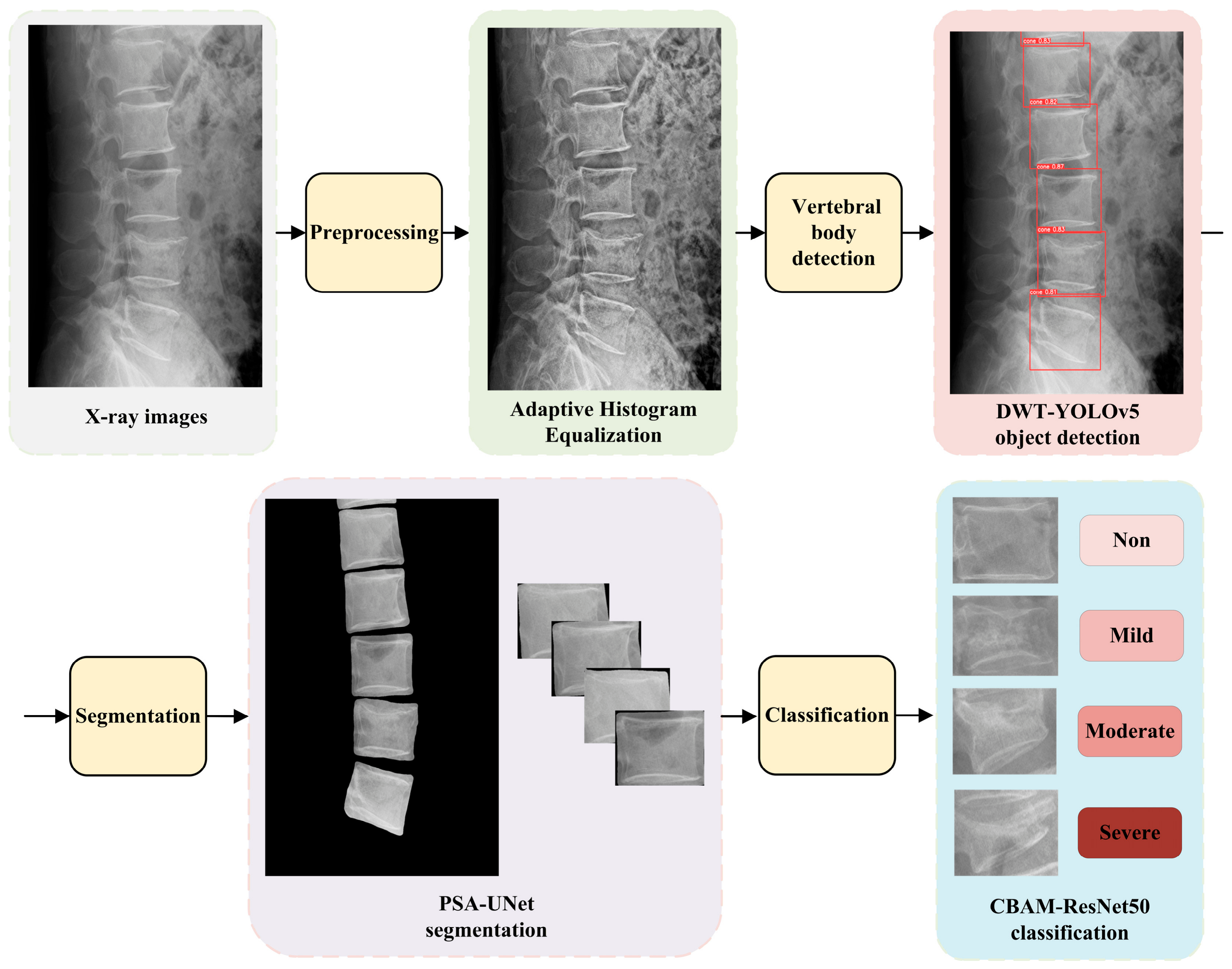
- Addressing the challenge of ambiguous features and high recognition difficulty in X-ray images of vertebral compression fractures, this study decomposes the recognition task into three stages: localization, segmentation, and classification. Tailored network architectures are designed for each stage, significantly enhancing overall recognition accuracy and robustness.
- (2)
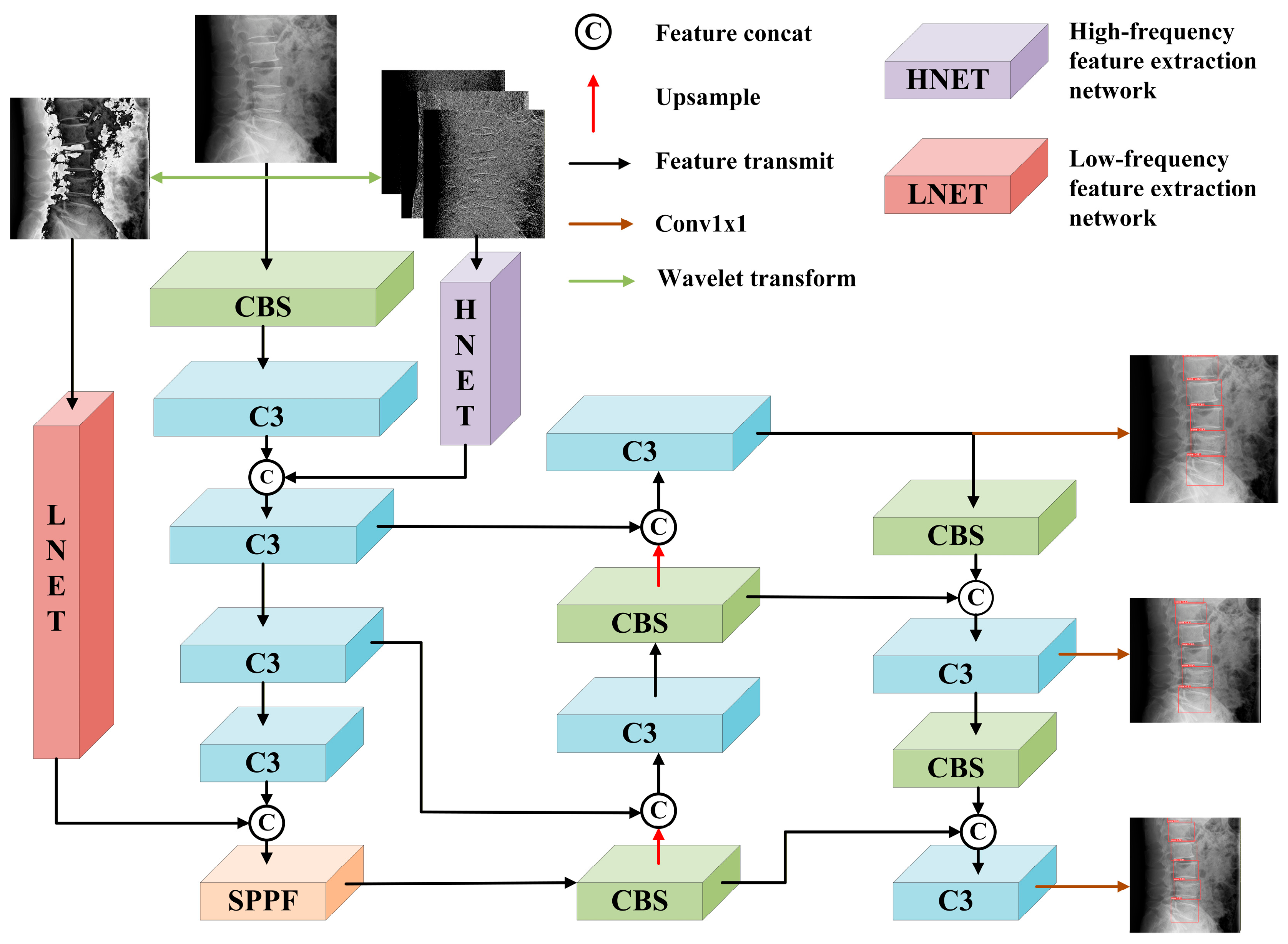
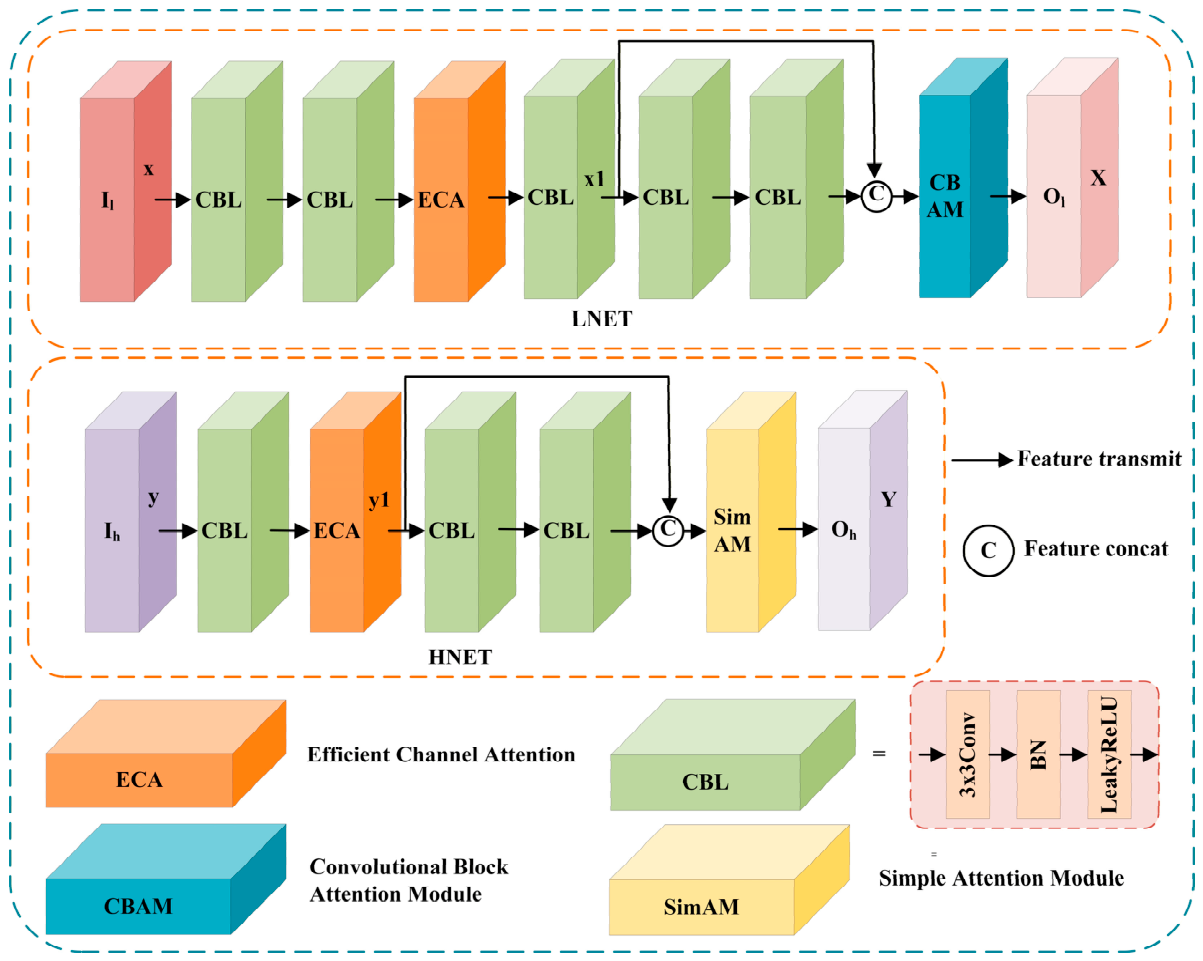
- To address the limitation of single feature extraction networks in simultaneously capturing local details and global semantic information, this study introduces a parallel feature fusion structure combining High-frequency Network (HNET) and Low-frequency Network (LNET) within Discrete Wavelet Transform-YOLOv5 (DWT-YOLOv5). By jointly modeling high- and low-frequency information, it effectively enhances the accuracy and stability of vertebral body detection.
- (3)
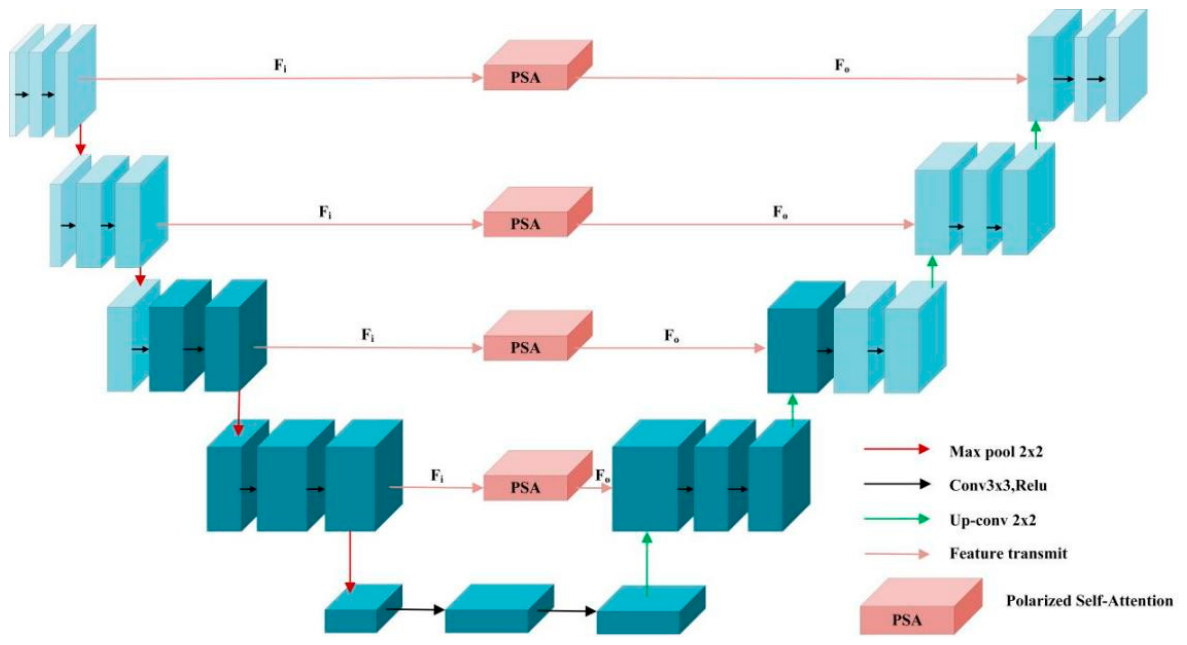
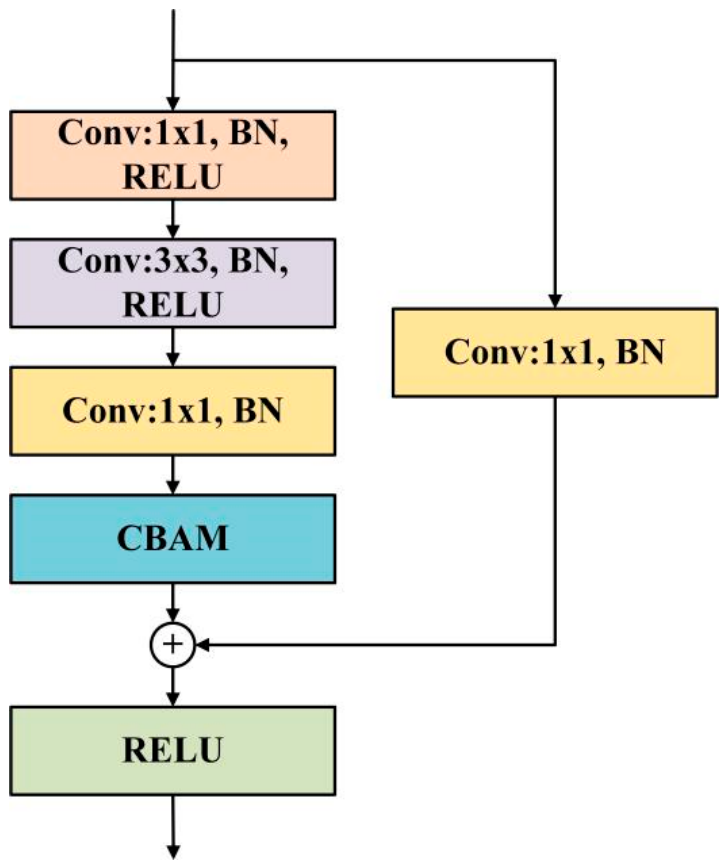
- Addressing the limitations of traditional segmentation and classification models in edge region recognition and feature representation, this study incorporates Polarized Self-Attention (PSA) into U-Net to enhance detail capture capabilities. Additionally, integrating the Convolutional Block Attention Module (CBAM) into ResNet50 significantly improves the precision of vertebral segmentation and the accuracy of fracture severity classification.
2. Proposed Method
2.1. Image Preprocessing
2.2. DWT-YOLOv5 Vertebral Body Detection
2.3. PSA-UNet Vertebral Body Segmentation
2.4. CBAM-ResNet50 Classification Model
3. Experimental Results and Analysis
3.1. Dataset and Experimental Details
3.2. Experimental Results
- (1)
- Performance of the Vertebral Body Detection Model
- (2)
- Model Performance in Vertebral Body Segmentation
- (3)
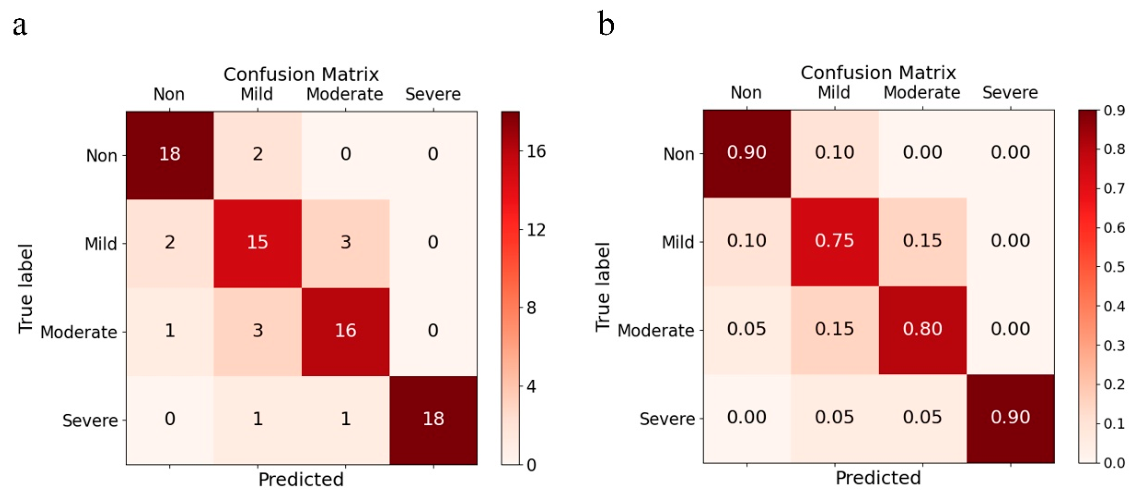
- Model Performance in Fracture Classification
- (4)
- Ablation Experiment
4. Discussion
5. Conclusions
Author Contributions
Funding
Data Availability Statement
Conflicts of Interest
References
- Nguyen, H.T.; Nguyen, B.T.; Thai, T.H.N.; Tran, A.V.; Nguyen, T.T.; Vo, T.; Mai, L.D.; Tran, T.S.; Nguyen, T.V.; Ho-Pham, L.T. Prevalence, incidence of and risk factors for vertebral fracture in the community: The Vietnam Osteoporosis Study. Sci. Rep. 2024, 14, 32. [Google Scholar] [CrossRef] [PubMed]
- Miao, K.H.; Miao, J.H.; Belani, P.; Dayan, E.; Carlon, T.A.; Cengiz, T.B.; Finkelstein, M. Radiological diagnosis and advances in imaging of vertebral compression fractures. J. Imaging 2024, 10, 244. [Google Scholar] [CrossRef]
- VanBerlo, B.; Hoey, J.; Wong, A. A survey of the impact of self-supervised pretraining for diagnostic tasks in medical X-ray, CT, MRI, and ultrasound. BMC Med. Imaging 2024, 24, 79. [Google Scholar] [CrossRef]
- Al Taha, K.; Lauper, N.; Bauer, D.E.; Tsoupras, A.; Tessitore, E.; Biver, E.; Dominguez, D.E. Multidisciplinary and coordinated management of osteoporotic vertebral compression fractures: Current state of the art. J. Clin. Med. 2024, 13, 930. [Google Scholar] [CrossRef] [PubMed]
- Bendtsen, M.G.; Hitz, M.F. Opportunistic identification of vertebral compression fractures on CT scans of the chest and abdomen, using an AI algorithm, in a real-life setting. Calcif. Tissue Int. 2024, 114, 468–479. [Google Scholar] [CrossRef] [PubMed]
- Yabu, A.; Hoshino, M.; Tabuchi, H.; Takahashi, S.; Masumoto, H.; Akada, M.; Morita, S.; Maeno, T.; Iwamae, M.; Inose, H. Using artificial intelligence to diagnose fresh osteoporotic vertebral fractures on magnetic resonance images. Spine J. 2021, 21, 1652–1658. [Google Scholar] [CrossRef] [PubMed]
- Windsor, R.; Jamaludin, A.; Kadir, T.; Zisserman, A. Automated detection, labelling and radiological grading of clinical spinal MRIs. Sci. Rep. 2024, 14, 14993. [Google Scholar] [CrossRef] [PubMed]
- Lee, S.; Kim, H.; Kim, H.; Cho, S. Risk prediction of stereotactic-body-radiotherapy-induced vertebral compression fracture using multi-modal deep learning network. In Proceedings of the Medical Imaging 2024: Image-Guided Procedures, Robotic Interventions, and Modeling, San Diego, CA, USA, 18–22 February 2024; SPIE: Washington, DC, USA, 2024; pp. 472–477. [Google Scholar]
- Wang, Q.; Liu, J.; Ji, Q.; Qiu, Y.; Min, N.; Wang, L.; Zhang, Y. Percutaneous vertebroplasty versus percutaneous kyphoplasty in elderly patients with osteoporotic vertebral compression fractures: Prospective controlled study. BJS Open 2024, 8, zrad162. [Google Scholar] [CrossRef] [PubMed]
- Kim, K.C.; Cho, H.C.; Jang, T.J.; Choi, J.M.; Seo, J.K. Automatic detection and segmentation of lumbar vertebrae from X-ray images for compression fracture evaluation. Comput. Methods Programs Biomed. 2021, 200, 105833. [Google Scholar] [CrossRef] [PubMed]
- Wang, Q.; Wu, B.; Zhu, P.; Li, P.; Zuo, W.; Hu, Q. ECA-Net: Efficient channel attention for deep convolutional neural networks. In Proceedings of the IEEE/CVF Conference on Computer Vision and Pattern Recognition (CVPR), Seattle, WA, USA, 14–19 June 2020; IEEE: Piscataway, NJ, USA, 2020; pp. 11534–11542. [Google Scholar]
- Woo, S.; Park, J.; Lee, J.-Y.; Kweon, I.S. Cbam: Convolutional block attention module. In Proceedings of the European Conference on Computer Vision (ECCV), Munich, Germany, 8–14 September 2018; Springer: Cham, Switzerland, 2018; pp. 3–19. [Google Scholar]
- Yang, L.; Zhang, R.-Y.; Li, L.; Xie, X. Simam: A simple, parameter-free attention module for convolutional neural networks. In Proceedings of the International Conference on Machine Learning, Virtual, 18–24 July 2021; PMLR, 2021. pp. 11863–11874. [Google Scholar]
- Liu, H.; Liu, F.; Fan, X.; Huang, D. Polarized self-attention: Towards high-quality pixel-wise mapping. Neurocomputing 2022, 506, 158–167. [Google Scholar] [CrossRef]
- Genant, H.K.; Wu, C.Y.; Van Kuijk, C.; Nevitt, M.C. Vertebral fracture assessment using a semiquantitative technique. J. Bone Miner. Res. 1993, 8, 1137–1148. [Google Scholar] [CrossRef] [PubMed]
- Dong, Q.; Luo, G.; Lane, N.E.; Lui, L.-Y.; Marshall, L.M.; Kado, D.M.; Cawthon, P.; Perry, J.; Johnston, S.K.; Haynor, D. Deep learning classification of spinal osteoporotic compression fractures on radiographs using an adaptation of the genant semiquantitative criteria. Acad. Radiol. 2022, 29, 1819–1832. [Google Scholar] [CrossRef] [PubMed]
- Kim, C.; Kang, M.; Yuh, W.T.; Lee, S.-L.; Lee, J.J.; Hou, J.-U.; Kang, S.H. Comparative efficacy of anteroposterior and lateral X-ray based deep learning in the detection of osteoporotic vertebral compression fracture. Sci. Rep. 2024, 14, 28388. [Google Scholar] [CrossRef] [PubMed]
- Tian, J.; Wang, K.; Wu, P.; Li, J.; Zhang, X.; Wang, X. Development of a deep learning model for detecting lumbar vertebral fractures on CT images: An external validation. Eur. J. Radiol. 2024, 180, 111685. [Google Scholar] [CrossRef] [PubMed]
- Yilmaz, E.B.; Buerger, C.; Fricke, T.; Sagar, M.M.R.; Peña, J.; Lorenz, C.; Glüer, C.-C.; Meyer, C. Automated deep learning-based detection of osteoporotic fractures in CT images. In Proceedings of the International Workshop on Machine Learning in Medical Imaging, Strasbourg, France, 27 September 2021; Springer: Cham, Switzerland, 2021; pp. 376–385. [Google Scholar]

| Types of Fractures | Total | Non | Mild | Moderate | Severe |
|---|---|---|---|---|---|
| Numbers of Vertebrae | 4591 | 2668 | 621 | 624 | 678 |
| Model | Precision | mAP | Recall | F1-Score |
|---|---|---|---|---|
| Baseline | 0.830 | 0.973 | 0.956 | 0.930 |
| FasterRCNN | 0.798 | 0.924 | 0.936 | 0.783 |
| YOLOv3 | 0.813 | 0.863 | 0.722 | 0.765 |
| YOLOv4 | 0.827 | 0.849 | 0.801 | 0.814 |
| YOLOv8 | 0.878 | 0.974 | 0.977 | 0.920 |
| YOLOv11 | 0.892 | 0.980 | 0.963 | 0.902 |
| Ours | 0.932 | 0.986 | 0.971 | 0.950 |
| Metrics | Model | Average Performance | p Value |
|---|---|---|---|
| mIoU | Baseline | 0.892 | 0.037 |
| Ours | 0.901 | ||
| mPA | Baseline | 0.941 | 0.028 |
| Ours | 0.947 | ||
| Accuracy | Baseline | 0.979 | 0.011 |
| Ours | 0.987 |
| Class | Metric | Baseline | ResNet34 | Vgg16 | Vgg19 | ConvNeXt | Ours |
|---|---|---|---|---|---|---|---|
| Non | Precision | 0.842 | 0.842 | 0.850 | 0.810 | 0.845 | 0.857 |
| Recall | 0.800 | 0.800 | 0.850 | 0.850 | 0.872 | 0.900 | |
| F1-score | 0.820 | 0.821 | 0.850 | 0.829 | 0.853 | 0.878 | |
| Mild | Precision | 0.714 | 0.700 | 0.703 | 0.667 | 0.710 | 0.714 |
| Recall | 0.750 | 0.700 | 0.749 | 0.700 | 0.745 | 0.750 | |
| F1-score | 0.732 | 0.700 | 0.721 | 0.683 | 0.729 | 0.732 | |
| Moderate | Precision | 0.714 | 0.762 | 0.750 | 0.700 | 0.785 | 0.800 |
| Recall | 0.750 | 0.800 | 0.750 | 0.700 | 0.792 | 0.800 | |
| F1-score | 0.732 | 0.781 | 0.750 | 0.700 | 0.780 | 0.800 | |
| Severe | Precision | 0.895 | 0.850 | 0.894 | 1.000 | 0.937 | 0.995 |
| Recall | 0.850 | 0.850 | 0.850 | 0.800 | 0.853 | 0.900 | |
| F1-score | 0.872 | 0.850 | 0.872 | 0.889 | 0.925 | 0.945 | |
| Total | Accuracy | 0.863 | 0.860 | 0.879 | 0.878 | 0.883 | 0.885 |
| Macro-AUC | 0.874 | 0.868 | 0.883 | 0.881 | 0.895 | 0.902 |
| Model | DWT | PSA | CBAM | Accuracy | Recall | Specificity | F1-Score |
|---|---|---|---|---|---|---|---|
| Baseline | 0.785 | 0.793 | 0.892 | 0.815 | |||
| DWT | √ | 0.810 | 0.823 | 0.930 | 0.843 | ||
| DWT + PSA | √ | √ | 0.821 | 0.835 | 0.958 | 0.860 | |
| DWT + PSA + CBAM | √ | √ | √ | 0.837 | 0.862 | 0.977 | 0.872 |
| Class | Accuracy | Precision | Recall | Specificity | F1-Score |
| Non | 0.900 | 0.984 | 0.998 | 0.950 | 0.992 |
| Mild | 0.750 | 0.790 | 0.750 | 0.982 | 0.769 |
| Moderate | 0.800 | 0.762 | 0.800 | 0.982 | 0.780 |
| Severe | 0.900 | 0.989 | 0.900 | 0.995 | 0.947 |
| Macro average | 0.837 | 0.881 | 0.862 | 0.977 | 0.872 |
Disclaimer/Publisher’s Note: The statements, opinions and data contained in all publications are solely those of the individual author(s) and contributor(s) and not of MDPI and/or the editor(s). MDPI and/or the editor(s) disclaim responsibility for any injury to people or property resulting from any ideas, methods, instructions or products referred to in the content. |
© 2026 by the authors. Licensee MDPI, Basel, Switzerland. This article is an open access article distributed under the terms and conditions of the Creative Commons Attribution (CC BY) license.
Share and Cite
Duan, S.; Deng, Y.; Song, Y. An Automatic Identification Method for Vertebral Compression Fractures in X-Ray Images Based on Multi-Stage Deep Learning. Electronics 2026, 15, 2626. https://doi.org/10.3390/electronics15122626
Duan S, Deng Y, Song Y. An Automatic Identification Method for Vertebral Compression Fractures in X-Ray Images Based on Multi-Stage Deep Learning. Electronics. 2026; 15(12):2626. https://doi.org/10.3390/electronics15122626
Chicago/Turabian StyleDuan, Shenyang, Yufeng Deng, and Yang Song. 2026. "An Automatic Identification Method for Vertebral Compression Fractures in X-Ray Images Based on Multi-Stage Deep Learning" Electronics 15, no. 12: 2626. https://doi.org/10.3390/electronics15122626
APA StyleDuan, S., Deng, Y., & Song, Y. (2026). An Automatic Identification Method for Vertebral Compression Fractures in X-Ray Images Based on Multi-Stage Deep Learning. Electronics, 15(12), 2626. https://doi.org/10.3390/electronics15122626

