1. Introduction
With the rapid growth of the air transportation industry, aircraft taxiing trajectory data are increasing at an unprecedented scale and complexity. As a core element of air traffic management and aviation safety, efficient analysis and intelligent prediction of taxiing trajectories are critical for resource optimization, anomaly detection, accident investigation, and other applications. However, faced with massive, high-dimensional, dynamic spatio-temporal trajectory data, traditional prediction and reasoning methods encounter significant challenges [
1]. On the one hand, prediction approaches based on relational databases or simple spatio-temporal indexes cannot effectively support multi-hop exploration of complex spatio-temporal associations and semantic relations among trajectory entities. On the other hand, existing methods mostly concentrate on multi-hop prediction of static knowledge or single-hop prediction of spatio-temporal knowledge, lacking the ability to handle multi-hop associations in spatio-temporal knowledge of aircraft taxiing trajectories [
2]. Against this backdrop, constructing an efficient prediction framework that deeply integrates spatio-temporal attributes with semantic knowledge to enable rapid mining and retrieval of implicit patterns in taxiing trajectories has become a key problem in smart aviation [
3].
Knowledge graphs provide a powerful structured knowledge representation model, offering a new way for semantic organization and associative prediction of taxiing trajectory data. Through subject-relation-object triples, a knowledge graph can naturally capture the rich spatio-temporal multi-hop relations among various entities such as aircraft, taxiway nodes, and flights. In recent years, knowledge graph technology has shown potential in spatio-temporal data applications, including traffic trajectory analysis [
4] and urban mobility understanding [
5]. Nevertheless, existing knowledge graphs for aircraft taxiing trajectories often suffer from knowledge incompleteness. In the specialized aviation domain, fine-grained trajectory patterns and domain rules are difficult to obtain, resulting in limited graph coverage, which in turn makes multi-step association prediction prone to interruption or missing answers [
6,
7]. This deficiency seriously affects the practicality of knowledge graphs in real-time air traffic situation awareness and in-depth historical trajectory analysis.
To alleviate the limitations caused by knowledge incompleteness, KGE techniques have been widely adopted. By mapping discrete entities and relations into a low-dimensional continuous vector space, KGE not only enables probabilistic prediction of missing links but, more importantly, provides a unified representation framework for structured computation of complex knowledge [
8,
9]. From classic models such as TransE [
10] and DistMult [
11] to more recent ones incorporating semantic information like DRGCL [
12], KGE has made continuous progress in enhancing knowledge representation and reasoning, laying an important foundation for constructing spatio-temporal knowledge graphs of taxiing trajectories that deeply integrate temporal and spatial attributes.
Nevertheless, applying KGE to multi-hop prediction on taxiing trajectory knowledge graphs still faces two major challenges. First, such graphs are generally large and involve complex relations. Performing multi-hop prediction in a high-dimensional embedding space requires multiple consecutive nearest neighbor searches or vector operations, incurring high computational costs that make real-time or near-real-time prediction difficult [
13]. Second, existing research on KGE optimization has mostly focused on improving link prediction accuracy for static, simple relations, with little attention to efficiency optimization for prediction patterns that involve the specific temporal order, spatial proximity, and multi-hop semantic associations inherent in spatio-temporal trajectory data [
14]. In scenarios such as aviation monitoring and emergency response, the stringent demand for prediction efficiency makes the computational bottleneck of traditional KGE methods particularly prominent.
In recent years, vector-index-based methods for accelerating knowledge graph queries have gained attention [
13,
15,
16,
17,
18,
19]. Their core idea is to transform exact vector distance computation into approximate nearest neighbor search by constructing efficient vector index structures such as hierarchical navigable small world graphs or product quantization indexes, thereby achieving orders-of-magnitude improvement in prediction efficiency with acceptable accuracy loss. Although these methods perform well on general knowledge graphs, their direct application to spatio-temporal knowledge graphs of aircraft taxiing trajectories has limitations. The spatio-temporal attributes of taxiing trajectories are highly domain-specific, and general vector index cannot adequately capture and exploit this domain knowledge to optimize the index structure and search path.
To address the above challenges, this study proposes a vector-index-supported multi-hop prediction method for spatio-temporal knowledge graphs of aircraft taxiing trajectories. The method establishes a spatio-temporal feature-aware KGE model that jointly embeds flight entities, relations, and spatio-temporal semantics into a low-dimensional vector space. Based on this, a hierarchical vector index structure optimized for multi-hop prediction is constructed, using the spatio-temporal distribution characteristics of trajectory data to guide the clustering partition of the index space. Finally, a multi-hop prediction processing algorithm based on the index is developed to achieve fast pruning of the search range and efficient retrieval of approximate answers. Experimental results show that the proposed index mechanism significantly improves the efficiency of multi-hop prediction, substantially reducing response time while maintaining prediction accuracy. The main contributions of this study are as follows:
A multi-hop prediction acceleration method for spatio-temporal knowledge graphs of aircraft taxiing trajectories is proposed. By introducing a vector index structure, the method achieves a significant improvement in multi-hop prediction efficiency while essentially preserving prediction quality.
A KGE model that incorporates spatio-temporal context is designed, and a vector index mechanism adapted to the distribution of taxiing trajectory data is constructed. The embedding module models complex relations using an interaction scheme that integrates spatio-temporal operations. The index mechanism employs a clustering algorithm to partition the vector space in a domain-aware manner, replacing global exact computation with approximate search within subspaces to achieve fast retrieval.
Comprehensive multi-hop prediction experiments and evaluations are conducted on a real aircraft taxiing trajectory dataset and on public spatio-temporal knowledge graph benchmarks. The results show that the proposed method has a clear efficiency advantage on the taxiing trajectory knowledge graph and exhibits good generalization performance on the general benchmarks.
2. Related Work
2.1. Static Knowledge Graph Multi-Hop Prediction Models
Static knowledge graph multi-hop prediction aims to discover potential complex relation paths between entities. Related research can be divided into single-hop and multi-hop prediction.
For single-hop prediction, the link prediction task mainly relies on three categories of embedding models. The first category is translation-distance-based models. TransE [
10] introduced the assumption that a relation corresponds to a translation, and subsequent works such as TransH [
20] and TransR [
21] improved the modeling of complex relations from different perspectives. The second category is semantic-matching-based models, which use a scoring function to measure the semantic consistency of triples; representative works include DistMult [
11] and ComplEx [
22]. The third category is neural-network-based models, which use deep learning to capture nonlinear interactions, e.g., ConvE [
23], DRR-GAT [
24], and MA-GNN [
25]. These models lay a foundation for further prediction research, but their design primarily targets single-hop semantic associations and does not fully consider the characteristics of multi-hop paths.
In multi-hop prediction, researchers have proposed path reasoning methods to handle complex associative predictions. pTransE [
26] models a multi-hop path as a semantic composition of single-hop relations, and RPE [
27] embeds entities into a path-specific semantic space. TravNM [
28] uses neural memory networks to simulate path traversal, and other works perform reasoning by predicting implicit relation chains [
29]. In recent years, more complex mechanisms have been introduced, including reinforcement-learning-based methods that formalize path finding as sequential decision making [
30], and attention-based methods that dynamically focus on key path information [
31]. Although these studies perform well on multi-hop semantic association reasoning, they generally lack systematic modeling of spatio-temporal contextual information and cannot be directly applied to spatio-temporally sensitive scenarios such as aircraft taxiing trajectories.
2.2. Spatio-Temporal Knowledge Graph Prediction Models
Dynamic spatio-temporal knowledge graphs extend static knowledge graphs by incorporating temporal and spatial dimensions, providing richer semantic representations for dynamic scenarios such as trajectory analysis [
32,
33]. Related research mainly proceeds from two aspects: temporal multi-hop prediction and spatio-temporal single-hop prediction.
In temporal multi-hop prediction, studies mainly focus on path reasoning along the time dimension. Some works have explored multi-hop prediction on temporal knowledge graphs. TPRG [
34] explicitly constructs temporal multi-hop paths using logical rules, and STKGR-PR [
35] uses path completion and reward shaping to alleviate the sparsity of temporal paths. However, these methods primarily focus on the time dimension and do not fully incorporate spatial information, making it difficult to handle prediction scenarios with coupled spatio-temporal constraints.
In spatio-temporal single-hop prediction, the research emphasis is on how to jointly embed spatio-temporal information with triple semantics. Early works modeled locations as entities and time as relations [
36] or constructed embedding frameworks for urban multi-source spatio-temporal knowledge graphs [
37], but these methods had limitations in deeply fusing spatio-temporal information. To address this, subsequent studies proposed more refined models, using hypercomplex vector spaces to represent spatio-temporal quintuples [
5], precisely representing spatial positions with two-dimensional coordinates [
38], and learning spatio-temporal-aware embeddings via recurrent neural networks. Recent works perform multi-hop prediction based on cross-regional word embedding [
39] and spatio-temporal twin-guided recurrent graph networks [
40]. However, these methods generally lack the ability to model multi-hop spatio-temporal knowledge and cannot efficiently predict multi-hop location information in aircraft taxiing trajectory scenarios.
2.3. Index-Based Knowledge Graph Prediction
Facing the computational efficiency bottleneck of large-scale knowledge graph prediction, vector-space-index-based acceleration techniques have become an important research direction. Such methods typically build hierarchical or compressed index structures to convert exact nearest neighbor search into efficient approximate retrieval, significantly improving prediction response time with acceptable accuracy loss.
Early index methods were mainly based on deep hashing techniques, mapping high-dimensional embeddings into a low-dimensional Hamming space for fast retrieval. Some studies proposed deep hashing frameworks that integrate triple structure and ontology features, using a joint optimization objective to ensure that hash codes preserve semantic associations between entities [
13,
15]. On this basis, acceleration architectures based on XNOR and bit-count operations were further proposed [
16]; these methods are model-agnostic and can greatly reduce search complexity. However, the inherent binarization operation of the hashing process often leads to significant semantic information loss, thus affecting retrieval accuracy.
To reduce information loss, more refined quantization index methods have been introduced. One representative work employs product quantization, decomposing the high-dimensional vector space into the Cartesian product of several low-dimensional subspaces and constructing a hierarchical codebook to achieve efficient vector compression and approximate distance computation [
17]. Combined with deep metric learning for optimization, this method significantly reduces storage overhead while maintaining high retrieval accuracy. For complex multi-hop logical queries, Bai et al. [
18] proposed a dynamic optimization method based on query computation trees, using forward-backward propagation and search space pruning to effectively reduce redundant computation and improve the efficiency of multi-step reasoning. In addition, for specific tasks such as entity alignment, some works have used approximate nearest neighbor algorithms to build specialized index structures to avoid full data comparison and accelerate retrieval [
19], but such methods generally lack generality and are difficult to transfer directly to diverse knowledge graph prediction scenarios.
In summary, some studies have investigated static knowledge graph multi-hop prediction models, but they lack efficient retrieval mechanisms. For spatio-temporal knowledge graph prediction models, multi-hop semantic modeling is absent. Other studies have proposed index-based knowledge graph prediction models, but general vector index methods cannot adapt to domain-specific characteristics of spatio-temporal data. To this end, this study focuses on aircraft taxiing trajectory data and proposes a vector-index-supported multi-hop prediction method for spatio-temporal knowledge graphs of taxiing trajectories to achieve efficient and accurate spatio-temporal multi-hop prediction.
3. Vector-Index-Supported Multi-Hop Prediction Method for Spatio-Temporal Knowledge Graph of Aircraft Taxiing Trajectories
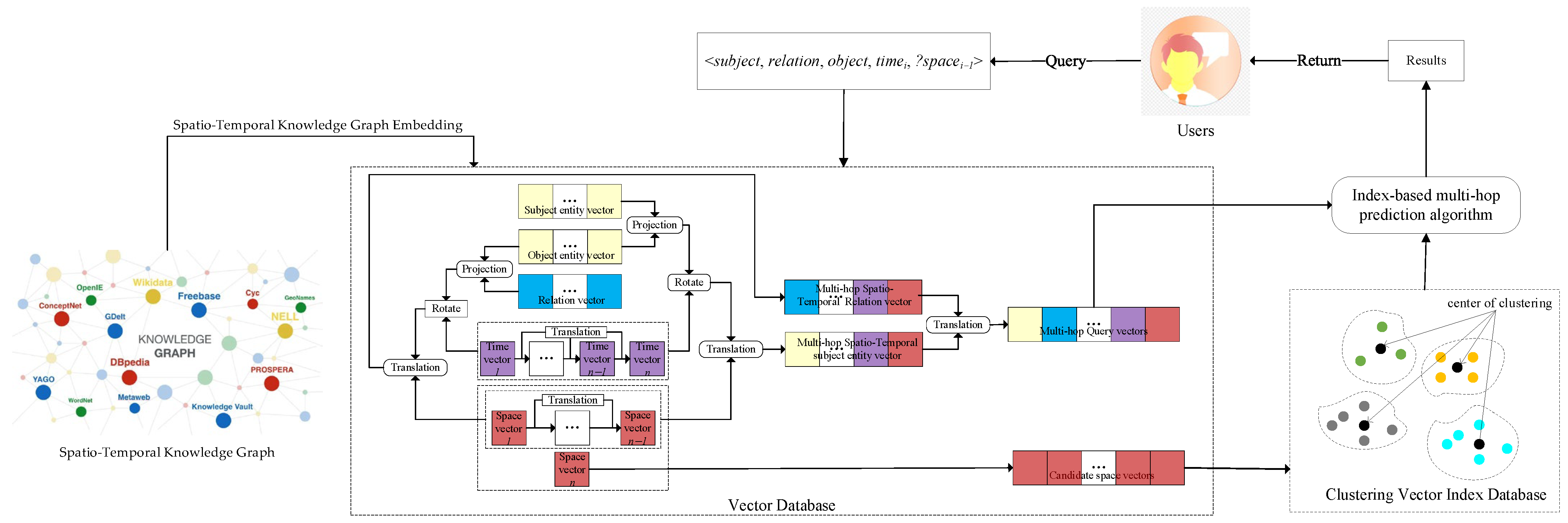
Figure 1 illustrates the overall architecture of the proposed method. In this study, the proposed multi-hop prediction method is divided into two main stages: the vector database construction stage via spatio-temporal knowledge graph embedding and the approximate prediction stage based on clustering-based vector indexing.
The first stage is the spatio-temporal knowledge graph embedding stage. First, the spatio-temporal trajectory data are converted into sequential quintuples of the form <subject, relation, object, timei, ?spacei-1>. Subsequently, complex space embedding techniques are employed to map entities, relations, time, and spatial elements into complex vectors. We integrate the subject entity with the object, time, and space vectors through projection, rotation, and translation operations to obtain the multi-hop spatio-temporal subject entity vector. Meanwhile, we integrate the relation with the object, time, and space vectors through projection, rotation, and translation operations to obtain the multi-hop spatio-temporal relation vector. In this process, multi-sequence time and space vectors are encoded into a unified complex vector representation through cumulative translation operations. Then, we further integrate the obtained multi-hop spatio-temporal subject entity vector and multi-hop spatio-temporal relation vector through a translation operation to derive the multi-hop spatio-temporal query vector. Through the above-mentioned embedding process, complete entity vectors, relation vectors, and spatial position vectors are trained and collectively form the vector database.
The second stage is the approximate prediction stage based on clustering-based vector indexing. First, based on the spatial position vectors in the vector database, a clustering-based vector index is constructed. All spatial position vectors are partitioned into several subspaces via clustering, with each subspace represented by its cluster center. Subsequently, during the prediction phase, for a given multi-hop query, the system maps the query into a multi-hop spatio-temporal query vector using the embedding model trained in the first stage. Finally, an approximate prediction algorithm is employed to access only the nearest several cluster subspaces relative to the query vector, retrieve the most similar candidate spatial position vectors within these subspaces, and return the corresponding similarity scores along with the matched answer elements.
3.1. Problem Definition
To perform multi-hop prediction of aircraft trajectory information, this section defines the spatio-temporal knowledge graph of aircraft taxiing trajectories and the corresponding multi-hop prediction problem as follows.
Definition 1.
Spatio-temporal knowledge graph of aircraft taxiing trajectories.
The spatio-temporal knowledge graph of aircraft taxiing trajectories is formally defined as , where denote the subject and object respectively, denotes the relation, is a sequence of timestamps, is a sequence of spatial coordinates, is the set of entities, and is the set of relations. When , is a single-hop spatio-temporal knowledge graph. When is a multi-hop spatio-temporal knowledge graph.
Definition 2.
Multi-hop prediction problem on spatio-temporal knowledge graph of aircraft taxiing trajectories.
Given a multi-hop prediction query on the spatio-temporal knowledge graph, under the time sequence , we aim to find the location sequence of the object reachable from the subject via the relation . Notably, our model uses the constructed spatio-temporal knowledge vector library and index structure to efficiently retrieve a set of approximate answers satisfying all temporal and semantic constraints. The prediction can maximize response speed while preserving prediction accuracy.
3.2. Multi-Hop Modeling of the Spatio-Temporal Knowledge Graph of Aircraft Taxiing Trajectories
3.2.1. Embedding Representation of the Spatio-Temporal Knowledge Graph
Previous research [
7] introduced geometric operations such as rotation and projection to incorporate complex semantics like time and space into the element representations of triples, enabling the modeling of temporal and spatio-temporal knowledge graphs. Although these methods can handle temporal or spatio-temporal knowledge graphs, they mainly focus on multi-hop temporal relations or single-hop spatio-temporal relations, and do not fully cover the modeling needs of multi-hop spatio-temporal knowledge graphs, especially in the domain of aircraft taxiing trajectories. Therefore, to model the spatio-temporal knowledge graph in this domain and further represent its multi-hop semantics, this section maps the spatio-temporal knowledge graph
into a complex vector space
, thereby completing the modeling of both single-hop and multi-hop knowledge.
Because rotation operations involve complex numbers, each element of the spatio-temporal knowledge graph is first mapped to a complex vector space as follows:
where the vector representation of each element consists of a real part
and an imaginary part
. The initial embeddings
are used as input for subsequent single-hop embedding, with the corresponding
being the candidate spatial element for the given single-hop prediction. The initial embeddings
(
) are used as input for subsequent multi-hop embedding, with the corresponding
being the candidate spatial element for the given multi-hop prediction.
In real flight scenarios, prediction often involves path reasoning across multiple spatio-temporal steps. To support such multi-hop prediction, based on the initial embeddings defined above, we further define a modeling mechanism for single-hop and multi-hop embeddings oriented to spatial paths as follows.
The single-hop embedding representation of the spatio-temporal knowledge graph of aircraft taxiing trajectories is:
here,
denotes an object-based projection operation, defined as
, where
is the object normal vector used for representation.
denotes a time-based rotation operation, defined as
, where
is the temporal rotation angle used to model temporal changes.
and
represent the subject and relation vectors that incorporate object and time information, serving as inputs for subsequent single-hop prediction.
The multi-hop embedding representation of the spatio-temporal knowledge graph of aircraft taxiing trajectories is:
where
.
and
denote the subject and relation vectors that incorporate object information, time information, and spatial information from the
positions. The additive accumulation operation of spatial positions has a clear geometric interpretation in the complex vector space: the cumulative sum of the first
spatial position vectors
is equivalent to the cumulative displacement vector from the starting point to the position at the
-th hop. After each hop, the embedding vector is translated by a step size determined by the spatial position of that hop along the gradient direction of the position. Together with the complex rotation operation, this translation operation forms a continuous path representation of the taxiing trajectory in the embedding space.
It is worth noting that the above multi-hop embedding representation does not rely on a single snapshot of static historical trajectories, but explicitly models the dynamic temporal evolution during taxiing. As shown in Equation (3), the construction of the subject vector and the relation vector depends simultaneously on the cumulative temporal information from multiple consecutive time steps and the sequential information from the previous historical spatial positions . Unlike the single-hop case, which uses only a single time point , the multi-hop embedding encodes the spatio-temporal context along the path into a unified complex vector representation through the accumulation operations and . This design enables the model to receive and process variable-length dynamic trajectory sequences, rather than relying solely on static spatial positions or isolated timestamps. Therefore, this embedding module inherently possesses the capability to model continuous dynamic sequential data, providing theoretical support for the subsequent vector-index-based real-time multi-hop prediction.
3.2.2. Distance Function for the Spatio-Temporal Knowledge Graph
To measure the semantic similarity between a prediction vector and candidate answer vectors, based on the embedding representation constructed above, this section defines a corresponding prediction distance function. This function aims to make the distance between the prediction vector and the correct answer vector as small as possible in the vector space, and the distance to incorrect answers as large as possible, thereby providing a measurable basis for retrieval and ranking.
Given a prediction
on the spatio-temporal knowledge graph, which may be a single-hop prediction
or a multi-hop prediction
, the prediction distance function
is defined as:
where
where
denotes the
or
norm, used to measure vector distance.
is the number of sub-predictions contained in the prediction.
Regarding the interaction between temporal rotation and spatial addition in the distance function, we further analyze its mathematical foundations. First, the and norms themselves satisfy the triangle inequality, and the combined vectors and are linear combinations of vectors in complex space. The difference operation between them also preserves the triangle inequality; thus, the distance function satisfies the basic axioms of a distance metric. Second, regarding noise sensitivity, consider a small perturbation in the time step . The complex rotation operation satisfies , and , indicating that the rotation is Lipschitz continuous with respect to temporal perturbations. For spatial position addition, suppose the spatial position at the -th hop contains noise ; then the change in cumulative displacement is , and its norm satisfies . That is, noise propagation is linearly bounded by the path length. In summary, the distance function is Lipschitz continuous with respect to small perturbations in temporal and spatial inputs, with the Lipschitz constant determined jointly by the number of hops and the maximum noise bound. This provides theoretical support for the robustness of our method on real-world data.
3.2.3. Loss Function for the Spatio-Temporal Knowledge Graph
To train the embedding model and optimize the distance function, a distance-based contrastive loss function is adopted. This function jointly optimizes positive samples, the true triples, and negative samples, the constructed counterexamples, pulling the correct answer vectors closer to the prediction and pushing incorrect ones away, thereby enhancing the discriminative ability of the prediction.
Given the prediction distance function
, the loss function is defined as:
where
is a positive sample (true prediction-answer pair).
is number
negative sample constructed by randomly replacing the answer entity in a positive sample.
is the Sigmoid function.
is a margin hyperparameter.
is the number of negative samples. And
is the total number of negative examples used in training.
3.3. Index Construction and Approximate Multi-Hop Prediction for the Spatio-Temporal Knowledge Graph
To further improve the efficiency of multi-hop prediction on the spatio-temporal knowledge graph of aircraft taxiing trajectories, this paper adopts vector indexing technology, aiming to significantly accelerate multi-hop prediction through space partitioning and approximate retrieval. The open-source vector search library Faiss is chosen for index construction, primarily because of its advantages:
It supports efficient similarity search with various index structures and distance metrics;
It has good scalability, adapting to vector scales from millions to billions;
It is easy to integrate into systems, providing comprehensive programming interfaces.
To accelerate the retrieval process, the method first partitions the entity vector space into several subspaces as in Voronoi Cells, each represented by a cluster center. During prediction, only the neighboring subspaces of the prediction vector are searched, thus avoiding a global traversal and achieving orders-of-magnitude improvement in retrieval efficiency. The index uses the IndexIVFFlat structure, with key parameters including nlist, which is the number of cluster centers determining the granularity of space partitioning, quantizer, which is the first-level index used for clustering, and nprobe which is the number of subspaces accessed during prediction, balancing retrieval accuracy and speed.
3.3.1. Index Construction
Index construction is based on the vector representations generated above. First, the cluster centers are determined through training, and then vectors are assigned to the corresponding subspaces as follows:
where
is the dimensionality of the vectors. IndexFlatL2 uses Euclidean Distance as the similarity metric since the distance functions above use
or
norms.
performs k-means clustering on the set of spatial position vectors, generating
centroids.
assigns vectors to the corresponding clusters and builds the index mapping. This process organizes spatial elements with similar semantic and multi-hop spatio-temporal prediction features into the same local region through spatial clustering, thereby constructing a basic retrieval library for subsequent approximate prediction.
Furthermore, we further analyze the convergence, initialization impact, and quantization error of k-means clustering in IndexIVFFlat construction. First, k-means clustering guarantees convergence to a local optimum within a finite number of steps on a finite set of vectors, and this convergence does not rely on explicit modeling of the underlying trajectory manifold. Although the randomness of initialization may lead to different local optima, in practice, multiple independent runs or deterministic initialization strategies based on the distribution characteristics of trajectory data can effectively mitigate this issue. Second, regarding quantization error, suppose the -th spatial vector is assigned to the subspace corresponding to cluster center . The per-point quantization error is defined as . The total quantization error of IndexIVFFlat is the sum of quantization errors over all training vectors, i.e., , where is the total number of training vectors. This error decreases monotonically as the number of clusters increases and reduces to zero when . Based on the scale and spatial distribution characteristics of the trajectory data, this paper sets to approximately the order of to strike a balance between retrieval efficiency and quantization accuracy.
3.3.2. Approximate Prediction
For a given prediction vector
, the index quickly locates its neighboring subspaces, and searches within those regions for the
spatial vectors most similar to
:
Here controls the number of clusters accessed during the search. is equivalent to full-space search. returns the distances and indices of the top nearest neighbor vectors.
In practice, is often set to about the square root of the dataset size, but the optimal value requires tuning based on the dataset size and feature distribution. is generally set to a small proportion of . When the dataset is large or high search accuracy is required, can be increased accordingly. The settings of and need to be tuned comprehensively according to dataset size, prediction efficiency, and accuracy requirements. A larger increases index discrimination but also raises training and storage costs. A larger improves recall but prolongs the prediction response time.
Regarding the theoretical characterization of the relationship between recall and the parameter in approximate search, this section further analyzes the approximate retrieval quality. Suppose the total number of vectors in the dataset is , and IndexIVFFlat partitions the vector space into clusters. For a given query vector , the approximate search accesses its nearest clusters. Let denote the true -nearest neighbor set of in the full space, and let denote the -nearest neighbor set returned by the approximate search. The recall is then defined as . If the probability that all true -nearest neighbors of fall into the accessed clusters is denoted as , then the expected recall satisfies . When the cluster centers effectively characterize the data distribution, increases monotonically with .
3.4. Algorithm Overview
Algorithm 1 describes the multi-hop prediction process for the spatio-temporal knowledge graph of aircraft taxiing trajectories. The input consists of several spatio-temporal knowledge subgraphs
, entity set
, relation set
, time sequence set
, spatial sequence set
, and relevant hyperparameters
. The output is the prediction result, which is the distances and indices of the top
spatial vectors most similar to the prediction.
| Algorithm 1. IndexSearch(q) |
| Input: G1 = <s, r, o, t1, l1> ∪ G2 = <s, r, o, t2, l2> ∪ ⋯ ∪ Gn = <s, r, o, tn, ln>; E, R, H |
| Output: most similar spatial vectors |
| 01 for all G1, G2, ⋯, Gn do |
| 02 G1, G2, ⋯, Gn ⟵ Embedding(G1, G2, ⋯, Gn) |
| 03 |
| 04 |
| 05 |
| 06 |
| 07 end for |
4. Experiments
4.1. Experimental Setup and Datasets
4.1.1. Experimental Environment
The hardware environment was Windows 10 Professional (64-bit) with an Intel Core i7-9700 processor (3.0 GHz), an NVIDIA GeForce RTX 2080 Ti GPU (11 GB memory), and 32 GB DDR4 RAM (2666 MHz). The software environment was Python 3.10 with the PyTorch 2.0.1 deep learning framework.
4.1.2. Dataset Description
To comprehensively evaluate the prediction performance of the proposed method, experiments used four spatio-temporal knowledge graph datasets with different scales and domain characteristics, including two aircraft taxiing trajectory spatio-temporal knowledge graph datasets, FlightTrack1day and FlightTrack5day, and two general-domain spatio-temporal knowledge graph datasets, Wikidata33k and YAGO13k.
Aircraft taxiing trajectory spatio-temporal knowledge graph datasets are built from post-landing taxiing trajectory data of flights. FlightTrack1day covers a single day of operations, while FlightTrack5day covers five consecutive days. The original data contain flight call signs, operation types, waypoints on the taxiway, passing times, and passing order. Adjacent waypoint pairs were used as basic units to convert the original sequences into spatio-temporal quintuples, including subject, relation, object, timestamp, and a spatial point. Then, spatially adjacent points were concatenated to construct multi-hop spatio-temporal quintuples, such as two-hop and three-hop. FlightTrack1day is used to validate prediction performance with limited spatio-temporal samples, and FlightTrack5day tests scalability and stability over a longer time span and more trajectory patterns.
Static triples, temporal triples, and spatial triples were extracted from the open knowledge bases Wikidata [
39] and YAGO [
40] and concatenated to form spatio-temporal quintuples, yielding the general spatio-temporal knowledge graph datasets Wikidata33k and YAGO13k. Both datasets preserve complete spatio-temporal annotations but do not contain spatio-temporal sequence points, and are widely used as benchmarks for single-hop spatio-temporal prediction. They are used to evaluate the generalization ability of the model on general spatio-temporal domains.
It should be noted that FlightTrack1day and FlightTrack5day contain only a single relation type (i.e., the “pass” relation between adjacent taxiway nodes), which is determined by the chain-like structure of taxiing trajectory data. Nevertheless, the semantic complexity in multi-hop prediction tasks stems from the multi-dimensional joint constraints of temporal order, spatial continuity, and entity consistency, rather than from the diversity of relation types. Experimental results on general-domain datasets further validate the generalization capability of the proposed model in multi-relational scenarios.
Table 1 and
Table 2 show the statistics of the four datasets, including the number of entities, relation types, time points, spatial points, and the splits into training, validation, and test sets.
4.1.3. Hyperparameter Configuration and Optimization
A systematic hyperparameter tuning strategy was adopted to ensure optimal performance. Taking the hyperparameter search methods of [
7,
41] a as reference, the search space for key parameters was set. Embedding dimension
d was {100, 200, 300, 400, 500, 600}. Learning rate
lr was {0.0001, 0.001, 0.01, 0.1}. Batch size
bs was {512, 1024}. Interval parameter
γ was {10, 20, 30, 40, 50, 60, 70, 80, 90, 100, 110, 120, 130}. The number of negative samples
η was {1, 3, 5, 10, 20}. For index parameters,
was set to the square root of the dataset size, and
was set as {10, 20, 30, 35, 40, 45, …, 100}. All experiments used the Adagrad optimizer, which adaptively adjusts the learning rate per parameter, which is especially suitable for sparse data and non-stationary objective functions.
Through validation set evaluation, the optimal hyperparameters for all datasets were d = 500, lr = 0.01, bs = 512, and γ = 80, η = 10. For the IndexIVFFlat structure, based on dataset size and vector distribution, was set to 43, 49, 100, and 100 for FlightTrack1day, FlightTrack5day, Wikidata33k, and YAGO13k, respectively, and to 40, 45, 98, and 98. This index configuration achieved a good balance between retrieval accuracy and efficiency.
4.2. Evaluation Metrics and Baseline Models
4.2.1. Evaluation Metrics
We adopted standard evaluation metrics widely used in knowledge graph reasoning and prediction to comprehensively quantify the performance of models on spatio-temporal knowledge graph multi-hop prediction tasks.
The Mean Reciprocal Rank (MRR) measures the overall ranking quality by averaging the reciprocal ranks of correct answers across all predictions:
where
is the total number of test predictions, and
is the rank of the correct answer in the returned list for the
i-th prediction.
. A higher
indicates that the model tends to rank relevant answers higher.
Hits@K measures the proportion of predictions for which the correct answer appears within the top
results:
where
is the indicator function, taking 1 if the condition holds and 0 otherwise. We report Hits@1, Hits@3, and Hits@10 to evaluate performance under different recall requirements.
with its values closer to 1 indicating better performance.
4.2.2. Baseline Models
To validate the effectiveness of the proposed method, we selected three categories of representative baseline models.
TransE [
10], DistMult [
11], ComplEx [
22], and RotatE [
42] are static single-hop models. pTransE [
26] and RPE [
27] are the static multi-hop. Static multi-hop models are only compared on the general datasets, such as Wikidata33k and YAGO13k, since they cannot handle the sequence points in the aircraft taxiing trajectory domain.
TeRo [
43] and HGCT [
44] are the temporal single-hop. MA-TPath [
32] is a temporal multi-hop. ST-NewDE [
5] is the spatio-temporal single-hop. Temporal multi-hop models are also only compared on the general datasets, such as Wikidata and YAGO, as they cannot handle the sequence points in the taxiing trajectory domain.
Index-supported static knowledge graph prediction model for power faults AQIFKGVI [
45].
4.3. Results and Analysis
4.3.1. Prediction Performance Evaluation
To comprehensively evaluate the effectiveness of the proposed method, we used
and
on the aircraft taxiing trajectory datasets (FlightTrack1day, FlightTrack5day) and the general benchmarks (Wikidata33k, YAGO13k), comparing with various mainstream knowledge graph prediction models, as shown in
Table 3 and
Table 4 respectively. Ours(one-hop), Ours(two-hop), Ours(three-hop) denote the performance of our model on single-hop, two-hop, and three-hop prediction tasks respectively, and Ours(avg) is the average of these three. On the general datasets, which do not support multi-hop prediction, our model only participates in single-hop prediction.
On the aircraft taxiing trajectory datasets, Ours(one-hop), Ours(two-hop), Ours(three-hop), and Ours(avg) achieves the best results on almost all metrics, demonstrating that the spatio-temporal feature-aware embedding can precisely model the temporal order, spatial proximity, and multi-hop semantic associations of taxiway nodes in taxiing trajectories. The performance advantage remains stable as the hop count increases. On the general benchmarks, the proposed model also shows leading performance on single-hop prediction, indicating strong cross-domain generalization even without explicit spatio-temporal sequence annotations.
Compared with the three categories of baselines, the proposed model outperforms static models by incorporating spatio-temporal information, temporal models by breaking the single-hop limitation and jointly training multi-hop spatio-temporal quintuples, and spatio-temporal single-hop models by using spatial coordinate sequences as explicit supervision and preserving multi-hop transition patterns.
Compared with the index-based static knowledge graph single-hop prediction, strong relevant baseline AQIFKGVI, the proposed model achieves superior performance on all hop settings of the taxiing trajectory datasets and on all metrics of the general datasets, confirming that the embedding interaction module and clustering index specifically designed for spatio-temporal taxiing trajectory semantics improve both accuracy and retrieval efficiency.
In addition, the IndexIVFFlat approximate retrieval mechanism employed in the above experiments inevitably introduces retrieval errors. The cumulative effect of this error in multi-hop reasoning is primarily governed by two factors: the single-hop recall rate and the path length. When the cluster partition is largely consistent with the manifold structure of the taxiing trajectory data, the retrieval error at each hop remains bounded, and the propagation of the error along the path satisfies Lipschitz continuity. That is, a small perturbation of the query vector in the embedding space does not lead to drastic changes in the retrieval results. Under such conditions, as long as the single-hop recall rate is maintained at a sufficiently high level and the path length is limited (with a maximum of three hops in this paper), the accumulated error will not systematically exclude correct multi-hop paths. Experimental results demonstrate that the end-to-end prediction accuracy after approximate retrieval remains at a high level, further validating the effectiveness of the proposed model.
4.3.2. Prediction Efficiency Analysis
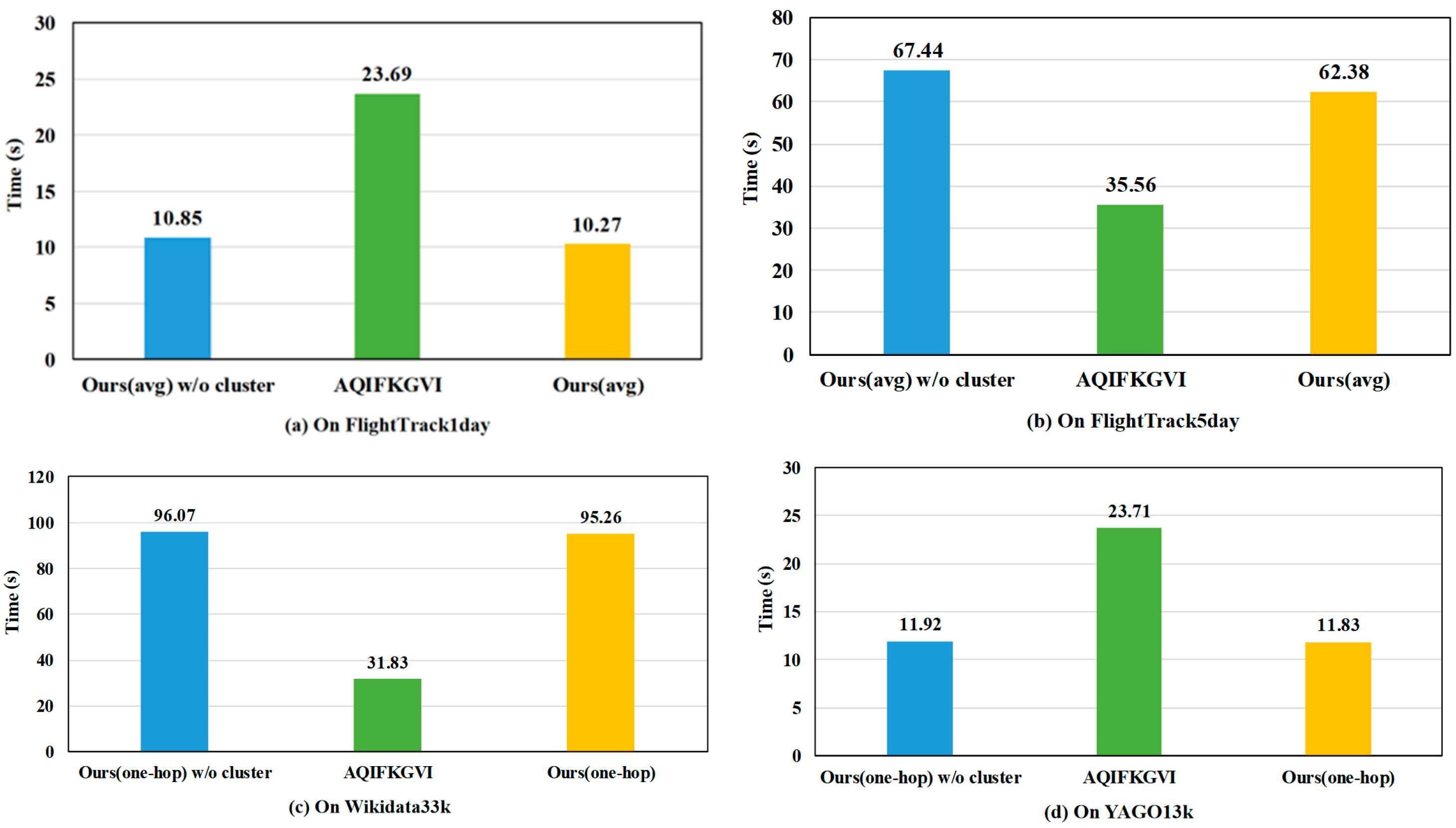
To evaluate the efficiency gains of the proposed vector index mechanism for multi-hop prediction on spatio-temporal knowledge graphs of aircraft taxiing trajectories, we conducted experiments on two aircraft taxiing trajectory datasets (FlightTrack1day, FlightTrack5day) and two general benchmarks (YAGO13k, Wikidata33k). In these experiments, Ours(avg)/Ours(one-hop) refers to the full/single-hop model of our approach, while Ours(avg) w/o cluster / Ours(one-hop) w/o cluster are the ablation variants without the clustering-based index. AQIFKGVI serves as a strong baseline for static knowledge graph single-hop prediction.
Figure 2 shows the comparison of prediction time of the proposed model and the comparative model. On FlightTrack1day and FlightTrack5day, the proposed model Ours(avg) outperforms the no-index variants, demonstrating the effectiveness of IndexIVFFlat in partitioning the high-dimensional semantic vector space and performing approximate nearest neighbor search only within neighboring cells, avoiding global brute-force traversal. Compared with AQIFKGVI, the model is more efficient than the no-index variant on FlightTrack1day, showing that the spatio-temporal embedding module works synergistically with the index. On FlightTrack5day, the model maintains a stable efficiency advantage, confirming scalability.
On YAGO13k and Wikidata33k, Ours(one-hop) consistently outperforms its no-index variant, further proving that IndexIVFFlat clustering works across domains. Compared with AQIFKGVI, the proposed model has a clear advantage on YAGO13k but a certain gap on Wikidata33k. This is because Wikidata33k is larger and contains more complex spatio-temporal patterns, incurring higher vector computation costs, while AQIFKGVI is a static model without spatio-temporal computations.
Overall, the proposed vector index mechanism demonstrates verifiable efficiency advantages on both domain-specific and general datasets.
4.3.3. Ablation Study
To analyze the contribution of each key component, we conducted ablation experiments on all datasets. We compared Ours(avg) (full model), Ours(avg) w/o cluster (removing the clustering index), and Ours(avg) w/o multi-hop (keeping only single-hop prediction) as shown in
Table 5. On the general datasets, only the variant without clustering (Ours(one-hop) w/o cluster) was compared as shown in
Table 6.
On all datasets, the full model’s metrics are slightly lower than those of the no-index variant as expected. The index mechanism trades a small accuracy loss for substantial efficiency gains. The accuracy drop is within an acceptable range, confirming a good efficiency-accuracy trade-off. On the taxiing trajectory datasets, the full model significantly outperforms the variant without multi-hop prediction, demonstrating that multi-hop modeling captures deeper semantic structures beyond single-step associations, which is essential for complex aviation analysis.
Furthermore, the slight improvement in predictive accuracy after removing the clustering index is consistent with expectations, as exact search can theoretically achieve superior results. However, in real-world aircraft taxiing scenarios, real-time requirements are equally critical. With the introduction of the index mechanism, the accuracy drop is controlled within an acceptable range (a relative decrease of approximately 5%), while the prediction response time achieves an order-of-magnitude acceleration. For application scenarios with higher safety sensitivity, the nprobe parameter can be increased to approximate exact search, trading a small amount of efficiency for higher accuracy.
Thus, the ablation results validate the effectiveness and design rationality of each component.
In addition, we conducted multiple random experiments to evaluate the prediction performance and standard deviation of the proposed model on the FlightTrack1day dataset, thereby verifying the model’s stability. As shown in
Table 7, the average MRR% (Avg) of Ours(avg), Ours(avg) w/o cluster, and Ours(avg) w/o multi-hop over five independent runs is 28.08, 29.61, and 6.75, respectively, with corresponding standard deviations (Std) of 0.17, 0.20, and 0.05. The standard deviations of all models are at low levels, indicating that the proposed method achieves stable prediction performance under different random initialization conditions.
4.3.4. Parameter Analysis
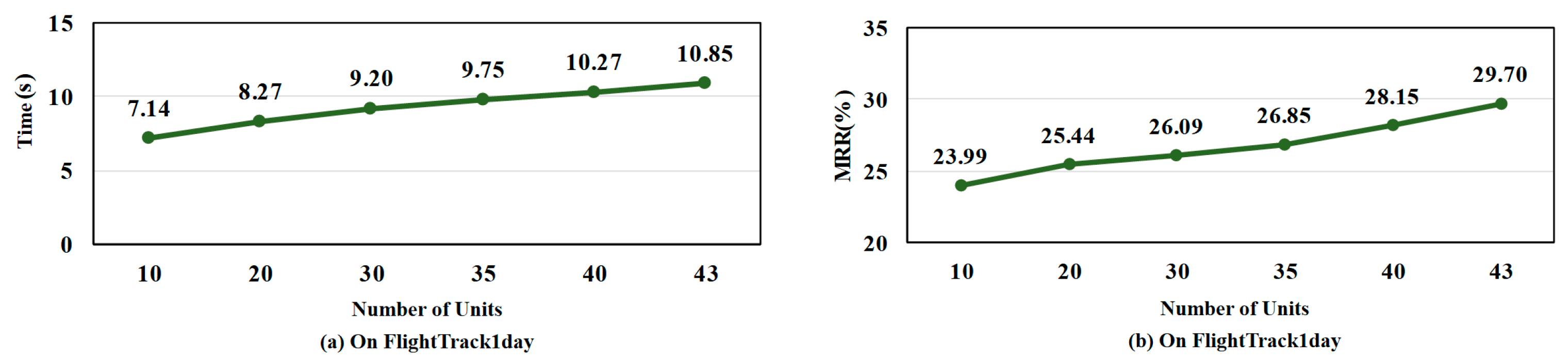
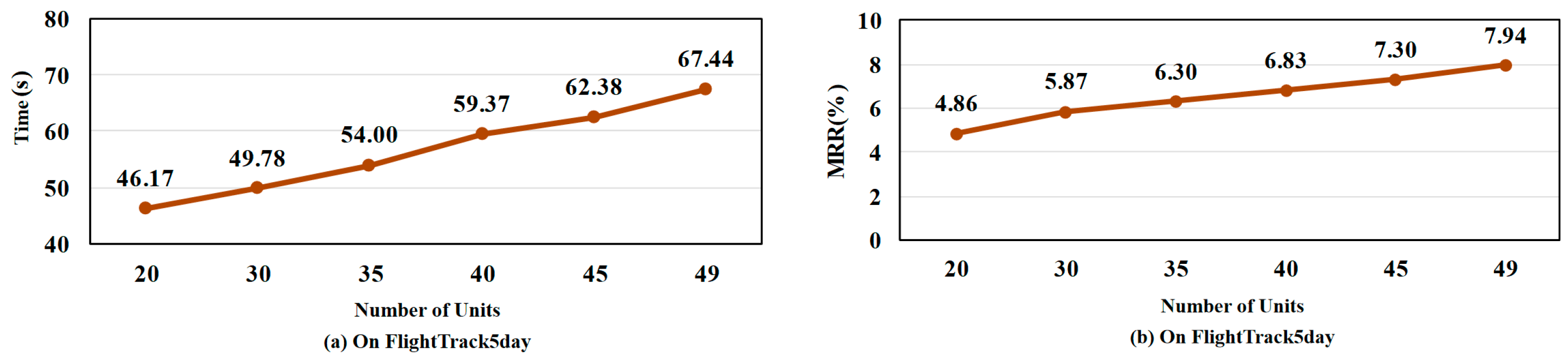
To investigate the trade-off between prediction time and retrieval performance with respect to
, we fixed
and varied
on all four datasets, recording prediction time and MRR as shown in
Figure 3,
Figure 4 and
Figure 5.
On all datasets, prediction time increases monotonically with . On FlightTrack1day, as increased from 10 to 43, prediction time rose from 7.14 s to 10.85 s; on FlightTrack5day from 46.17 s to 67.44 s; on Wikidata33k it rose from 82.5 s to 96.07 s. This conforms to the IndexIVFFlat design that more visited subspaces produce more distance computations.
MRR also increases with . On the taxiing trajectory datasets, MRR grows smoothly, indicating a relatively uniform vector space distribution. On the general datasets, MRR stays low for below 90 and then jumps sharply, reaching a turning point around 98, indicating a more complex clustering structure where core semantic information is concentrated in specific subspaces.
Based on these observations, the optimal for each dataset was chosen as the smallest value that brings MRR close to the full-search level as = while minimizing prediction time. Accordingly, we selected for FlightTrack1day, for FlightTrack5day, and for both Wikidata33k and YAGO13k.
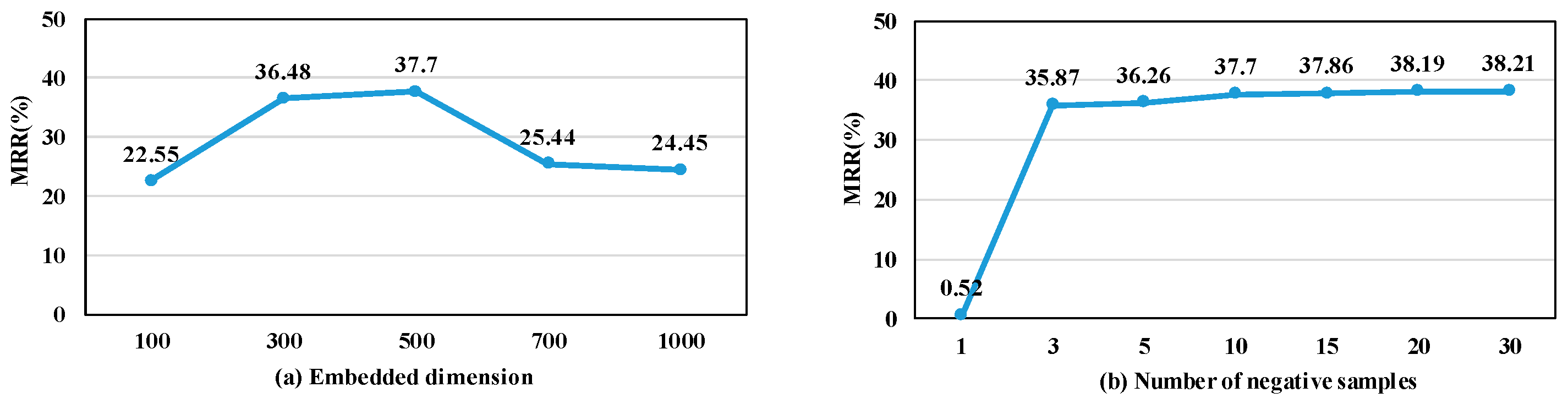
We conducted a sensitivity analysis of the embedding dimension and the number of negative samples on the FlightTrack1day dataset, reporting the performance (MRR%) of three-hop prediction (Ours(three-hop)). For the embedding dimension, five values were tested: 100, 300, 500, 700, and 1000. Experimental results show that as the embedding dimension increases from 100 to 500, MRR consistently improves from 22.55% to 37.70%. When the dimension exceeds 500, performance declines, dropping to 25.44% and 24.45% at dimensions 700 and 1000, respectively, as shown in
Figure 6a. This phenomenon indicates that an overly low embedding dimension cannot adequately capture spatio-temporal semantic information, while an excessively high dimension may introduce redundant noise or even lead to overfitting. Therefore, the embedding dimension is finally set to 500 in this paper. For the number of negative samples, seven values were tested: 1, 3, 5, 10, 15, 20, and 30. Experimental results show that as the number of negative samples increases from 1 to 10, MRR rapidly improves from 0.52% to 37.70%. When the number exceeds 10, the performance gain becomes marginal, reaching 38.21% at 30 negative samples, as shown in
Figure 6b. Considering both training efficiency and prediction accuracy, the number of negative samples is finally set to 10 in this paper.
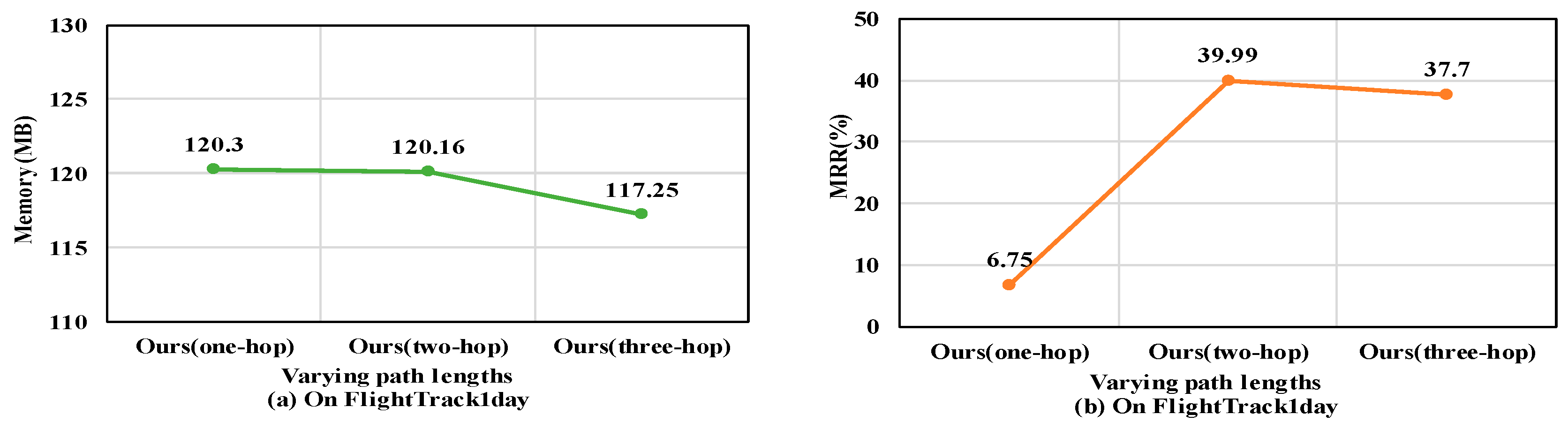
We further evaluated the memory usage of the proposed method for different hop counts on the FlightTrack1day dataset and compared it with the corresponding prediction performance (MRR%). As shown in
Figure 7, the memory usage for one-hop, two-hop, and three-hop predictions are 120.3 MB, 120.16 MB, and 117.25 MB, respectively, with corresponding MRR% values of 6.75, 39.99, and 37.70. It should be noted that the numbers of test samples for one-hop, two-hop, and three-hop predictions are 3747, 3668, and 1815, respectively, exhibiting a decreasing trend, which is the primary reason for the slight decline in memory usage as the hop count increases. The memory usage for all hop counts remains at a low level of approximately 120 MB, indicating that the proposed method has good scalability in terms of memory efficiency. In terms of prediction performance, the MRR of two-hop and three-hop predictions is significantly better than that of one-hop predictions, verifying the advantage of multi-hop modeling in capturing spatio-temporal semantics of trajectories. The performance of three-hop predictions is slightly lower than that of two-hop predictions, indicating that an increased hop count leads to a certain degree of performance degradation; however, the decline is limited and the overall performance remains at a high level.
5. Case Study
To intuitively demonstrate the practical performance of the proposed method on multi-hop prediction tasks, we present two typical prediction cases from the FlightTrack1day dataset, comparing the proposed model with baseline models.
One-hop prediction case (UEA2218, route_type, DEP, 1day_11:14:30, ?)
This case means retrieve the spatial position, which is the taxiway node, of flight UEA2218 at time 1day_11:14:30 when performing a departure (DEP) operation. The answer is TWP#692.
The proposed model successfully retrieves TWP#692 as the top result. In contrast, static models like TransE cannot encode time information and thus mix waypoints from different times. Temporal models like TeRo are time-aware but only support a single time point, requiring prediction to be broken into independent steps, losing the holistic view of the flight process.
Two-hop prediction case (ANA931, route_type, ARR, [1day_12:54:54, 1day_12:55:12], [TWP#324, ?]).
This case means for flight ANA931 performing an arrival (ARR) operation, given the first-hop spatial coordinate TWP#324, predict the second-hop spatial coordinate after about 18 s. The correct answer is TWP#692.
The core challenge is to understand the spatio-temporal continuity between taxiway nodes. The proposed model, trained on multi-hop spatio-temporal quintuples, learns the transition pattern from TWP#324 to TWP#692 and correctly infers the second hop. Static multi-hop methods like pTransE cannot encode the time interval and spatial continuity, while spatio-temporal single-hop models like ST-NewDE must break the two-hop query into two independent single-hop predictions, incurring higher latency and losing joint optimization.
6. Conclusions
This paper addressed the efficiency bottleneck of multi-hop prediction on large-scale spatio-temporal knowledge graphs of aircraft taxiing trajectories by proposing a vector-index-supported optimization method. The method combines a spatio-temporal-aware KGE model with an efficient vector index structure to build a high-performance retrieval framework for trajectory data. First, a spatio-temporal feature-aware embedding model maps trajectory entities, relations, and their spatio-temporal attributes into a low-dimensional vector space, creating a vectorized knowledge representation with consistent spatio-temporal semantics. Then, an IndexIVFFlat index structure is introduced to partition the vector space under the guidance of semantic and spatial distribution via clustering, constructing a hierarchical retrieval architecture that converts global search into efficient approximate matching within local subspaces, thereby significantly reducing the computational complexity of multi-hop prediction. Experimental results on both domain-specific datasets (FlightTrack1day and FlightTrack5day) and general spatio-temporal datasets (Wikidata33k and YAGO13k) demonstrate that the proposed method maintains high prediction accuracy with excellent MRR and Hits@K while achieving substantial efficiency improvements, validating the effectiveness and practicality of the vector index mechanism for spatio-temporal knowledge graph prediction tasks.
It should be noted that the current research focuses on prediction analysis of static historical trajectory data. As flight operation data are continuously and dynamically updated, the spatio-temporal knowledge graph and its corresponding vector representations and index structures need to support dynamic evolution. Future work will explore incremental embedding learning and index update mechanisms to improve the model’s adaptability to real-time streaming trajectory data, thereby better supporting real-time applications such as dynamic air traffic monitoring, anomaly detection, and situation evolution.
Author Contributions
Conceptualization, M.H.; methodology, J.Y.; software, B.Z.; validation, J.S.; formal analysis, B.Z.; investigation, B.Z.; resources, J.S.; data curation, J.S.; writing—original draft preparation, J.S.; writing—review and editing, J.Y.; visualization, B.Z.; supervision, M.H. and J.Y.; project administration, J.S.; funding acquisition, J.Y. All authors have read and agreed to the published version of the manuscript.
Funding
This research was funded by the National Natural Science Foundation of China, grant number is 52002178 and the Jiangsu Province Science and Technology Department, grant number is BK20252031.
Data Availability Statement
Conflicts of Interest
The authors declare no conflict of interest.
References
- Nguyen, C.D.M.; French, T.; Stewart, M.; Hodkiewicz, M.; Liu, W. Representation Learning in Complex Logical Query Answering on Knowledge Graphs: A Survey. ACM Comput. Surv. 2025, 58, 1–36. [Google Scholar] [CrossRef]
- Ji, H.; Yan, L.; Ma, Z. Multi-hop Knowledge Chain Query on Fine-Grained Fuzzy Spatiotemporal Knowledge Graph by Embedding. IEEE Trans. Fuzzy Syst. 2026, 34, 1711–1720. [Google Scholar] [CrossRef]
- Ji, H.; Yan, L.; Ma, Z. Uncertain Spatiotemporal Knowledge Graph Construction with Fuzzy Spatiotemporal XML Data. Appl. Soft Comput. 2025, 189, 114527. [Google Scholar] [CrossRef]
- Lu, D.B.; Ergan, S. Behavioral modelling of roadway construction workers: Improving deep learning-based trajectory prediction with contextual information in traffic work zones. Adv. Eng. Inf. 2026, 71, 104277. [Google Scholar] [CrossRef]
- Nayyeri, M.; Vahdati, S.; Khan, T.; Alam, M.M.; Wenige, L.; Behrend, A.; Lehmann, J. Dihedron algebraic embeddings for spatio-temporal knowledge graph completion. In Proceedings of the 19th European Semantic Web Conference (ESWC 2022), Hersonissos, Greece, 29 May–2 June 2022; Springer: Berlin/Heidelberg, Germany, 2022; pp. 253–269. [Google Scholar]
- Wang, Q.; Mao, Z.; Wang, B.; Guo, L. Knowledge graph embedding: A survey of approaches and applications. IEEE Trans. Knowl. Data Eng. 2017, 29, 2724–2743. [Google Scholar] [CrossRef]
- Ji, H.; Yan, L.; Ma, Z. FSTRE: Fuzzy Spatiotemporal RDF Knowledge Graph Embedding Using Uncertain Dynamic Vector Projection and Rotation. IEEE Trans. Fuzzy Syst. 2024, 32, 435–444. [Google Scholar] [CrossRef]
- Ji, S.; Pan, S.; Cambria, E.; Marttinen, P.; Yu, P.S. A survey on knowledge graphs: Representation, acquisition, and applications. IEEE Trans. Neural Netw. Learn. Syst. 2021, 33, 494–514. [Google Scholar] [CrossRef] [PubMed]
- Ji, H.; Yan, L.; Ma, Z. Multihop fuzzy spatiotemporal RDF knowledge graph query via quaternion embedding. IEEE Trans. Fuzzy Syst. 2024, 32, 3026–3036. [Google Scholar] [CrossRef]
- Bordes, A.; Usunier, N.; Garcia-Duran, A.; Weston, J.; Yakhnenko, O. Translating embeddings for modeling multi-relational data. In Proceedings of the 27th Annual Conference on Neural Information Processing Systems 2013, Lake Tahoe, NV, USA, 5–8 December 2013; Curran Associates Inc.: Red Hook, NY, USA, 2013; pp. 2787–2795. [Google Scholar]
- Yang, B.; Yih, W.T.; He, X.; Gao, J.; Deng, L. Embedding entities and relations for learning and inference in knowledge bases. In Proceedings of the 3rd International Conference on Learning Representations (ICLR 2015), San Diego, CA, USA, 7–9 May 2015; pp. 1–13. [Google Scholar]
- Yin, H.; Zhong, J.; Li, R.; Li, X. Disentangled relational graph neural network with contrastive learning for knowledge graph completion. Knowl. Based Syst. 2024, 295, 111828. [Google Scholar] [CrossRef]
- Wang, M.; Chen, W.; Wang, S.; Jiang, Y.; Yao, L.; Qi, G. Efficient search over incomplete knowledge graphs in binarized embedding space. Future Gener. Comput. Syst. 2021, 123, 24–34. [Google Scholar] [CrossRef]
- Ji, H.; Yan, L.; Ma, Z. Fuzzy Spatiotemporal Knowledge Graph Queries via Global and Local Uncertain Dynamic Subgraph Reasoning Using Embedding. IEEE Trans. Fuzzy Syst. 2025, 33, 3981–3991. [Google Scholar] [CrossRef]
- Wang, M.; Shen, H.; Wang, S.; Yao, L.; Jiang, Y.; Qi, G.; Chen, Y. Learning to hash for efficient search over incomplete knowledge graphs. In 2019 IEEE International Conference on Data Mining; IEEE: New York, NY, USA, 2019; pp. 1360–1365. [Google Scholar]
- Wang, M.; Wu, T.; Qi, G. A hash learning framework for search-oriented knowledge graph embedding. In Proceedings of the 24th European Conference on Artificial Intelligence, Santiago de Compostela, Spain, 29 August–8 September 2020; IOS Press: Amsterdam, The Netherlands, 2020; pp. 921–928. [Google Scholar]
- Abuoda, G.; Thirumuruganathan, S.; Aboulnaga, A. Accelerating entity lookups in knowledge graphs through embeddings. In Proceedings of the 38th IEEE International Conference on Data Engineering (ICDE), Kuala Lumpur, Malaysia, 9–12 May 2020; IEEE: New York, NY, USA, 2022; pp. 1111–1123. [Google Scholar]
- Bai, Y.; Lv, X.; Li, J.; Hou, L. Answering complex logical queries on knowledge graphs via query computation tree optimization. In Proceedings of the 40th International Conference on Machine Learning (ICML 2023), Honolulu, HI, USA, 23–29 July 2023; PMLR: New York, NY, USA, 2023; pp. 1472–1491. [Google Scholar]
- Obraczka, D.; Rahm, E. Fast hubness-reduced nearest neighbor search for entity alignment in knowledge graphs. SN Comput. Sci. 2022, 3, 501. [Google Scholar] [CrossRef]
- Wang, Z.; Zhang, J.; Feng, J.; Chen, Z. Knowledge graph embedding by translating on hyperplanes. In Proceedings of the Twenty-Eighth AAAI Conference on Artificial Intelligence, Québec City, QC, Canada, 27–31 July 2014; AAAI Press: Washington, DC, USA, 2014; pp. 1112–1119. [Google Scholar]
- Lin, Y.; Liu, Z.; Sun, M.; Liu, Y.; Zhu, X. Learning entity and relation embeddings for knowledge graph completion. In Proceedings of the Twenty-Ninth AAAI Conference on Artificial Intelligence, Austin, TX, USA, 25–30 January 2015; AAAI Press: Washington, DC, USA, 2015; pp. 2181–2187. [Google Scholar]
- Trouillon, T.; Welbl, J.; Riedel, S.; Gaussier, É.; Bouchard, G. Complex embeddings for simple link prediction. In Proceedings of the 33rd International Conference on Machine Learning, New York, NY, USA, 20–22 June 2016; JMLR: Norfolk, MA, USA, 2016; pp. 2071–2080. [Google Scholar]
- Dettmers, T.; Minervini, P.; Stenetorp, P.; Riedel, S. Convolutional 2d knowledge graph embeddings. In Proceedings of the Thirty-Second AAAI Conference on Artificial Intelligence, New Orleans, LA, USA, 2–7 February 2018; AAAI Press: Washington, DC, USA, 2018; Volume 32, pp. 1811–1818. [Google Scholar]
- Zhang, X.; Zhang, C.; Guo, J.; Peng, C.; Niu, Z.; Wu, X. Graph attention network with dynamic representation of relations for knowledge graph completion. Expert Syst. Appl. 2023, 219, 119616. [Google Scholar] [CrossRef]
- Xu, H.; Bao, J.; Liu, W. Double-branch multi-attention based graph neural network for knowledge graph completion. In Proceedings of the 61st Annual Meeting of the Association for Computational Linguistics, Toronto, ON, Canada, 9–14 July 2023; Association for Computational Linguistics: Stroudsburg, PA, USA, 2023; pp. 15257–15271. [Google Scholar]
- Lin, Y.; Liu, Z.; Luan, H.; Sun, M.; Rao, S.; Liu, S. Modeling relation paths for representation learning of knowledge bases. In Proceedings of the 2015 Conference on Empirical Methods in Natural Language Processing, Lisbon, Portugal, 17–21 September 2015; The Association for Computational Linguistics: Stroudsburg, PA, USA, 2015; pp. 705–714. [Google Scholar]
- Lin, X.; Liang, Y.; Giunchiglia, F.; Feng, X.; Guan, R. Relation path embedding in knowledge graphs. Neural Comput. Appl. 2019, 31, 5629–5639. [Google Scholar] [CrossRef]
- Wang, Q.; Yin, H.; Wang, W.; Huang, Z.; Guo, G.; Nguyen, Q.V.H. Multi-hop path queries over knowledge graphs with neural memory networks. In Proceedings of the 24th International Conference on Database Systems for Advanced Applications (DASFAA 2019), Chiang Mai, Thailand, 22–25 April 2019; Springer: Berlin/Heidelberg, Germany, 2019; Volume 11446, pp. 777–794. [Google Scholar]
- Jin, W.; Zhao, B.; Yu, H.; Tao, X.; Yin, R.; Liu, G. Improving embedded knowledge graph multi-hop question answering by introducing relational chain reasoning. Data Min. Knowl. Discov. 2023, 37, 255–288. [Google Scholar] [CrossRef]
- Shang, B.; Zhao, Y.; Liu, Y.; Wang, C. Attention-based exploitation and exploration strategy for multi-hop knowledge graph reasoning. Inf. Sci. 2024, 653, 119787. [Google Scholar] [CrossRef]
- Zheng, S.; Chen, W.; Wang, W.; Zhao, P.; Yin, H.; Zhao, L. Multi-hop knowledge graph reasoning in few-shot scenarios. IEEE Trans. Knowl. Data Eng. 2023, 36, 1713–1727. [Google Scholar] [CrossRef]
- Mohammadi, M.; Berahmand, K.; Sadiq, S.; Khosravi, H. Knowledge tracing with a temporal hypergraph memory network. In Proceedings of the 26th International Conference on Artificial Intelligence in Education (AIED 2025), Palermo, Italy, 22–26 July 2025; Springer: Berlin/Heidelberg, Germany, 2025; pp. 77–85. [Google Scholar]
- Nejadshamsi, S.; Bentahar, J.; Wang, C.; Eicker, U. Predicting Short-Term Bike-Sharing Demand at Station Level: A Multi-Task Dynamic Graph-based Spatiotemporal Approach. Knowl. Based Syst. 2025, 333, 114986. [Google Scholar] [CrossRef]
- Bai, L.; Chen, M.; Zhu, L.; Meng, X. Multi-hop temporal knowledge graph reasoning with temporal path rules guidance. Expert Syst. Appl. 2023, 223, 119804. [Google Scholar] [CrossRef]
- Meng, X.; Bai, L.; Hu, J.; Zhu, L. Multi-hop path reasoning over sparse temporal knowledge graphs based on path completion and reward shaping. Inf. Process. Manag. 2024, 61, 103605. [Google Scholar] [CrossRef]
- Zhang, X.; Zhu, X.; Wu, J.; Hu, Z.; Zhang, C. A framework of data fusion through spatio-temporal knowledge graph. In Proceedings of the 14th International Conference on Knowledge Science, Engineering and Management (KSEM 2021), Tokyo, Japan, 14–16 August 2021; Springer: Berlin/Heidelberg, Germany, 2021; pp. 216–228. [Google Scholar]
- Zhao, L.; Deng, H.; Qiu, L.; Li, S.; Hou, Z.; Sun, H.; Chen, Y. Urban multi-source spatio-temporal data analysis aware knowledge graph embedding. Symmetry 2020, 12, 199. [Google Scholar] [CrossRef]
- Jia, W.; Wang, X.; Shan, J.; Yan, L.; Niu, W.; Ma, Z. Sequence encoder-based spatiotemporal knowledge graph completion. J. Web Eng. 2022, 21, 1913–1936. [Google Scholar] [CrossRef]
- Xu, X.; Jia, W.; Yan, L.; Lu, X.; Wang, C.; Ma, Z. Spatiotemporal knowledge graph completion via diachronic and transregional word embedding. Inf. Sci. 2024, 667, 120477. [Google Scholar] [CrossRef]
- Xu, X.; Ma, R.; Zhou, B.; Yan, L.; Ma, Z. Spatial and temporal twin-guided pattern recurrent graph network for implementing reasoning of spatiotemporal knowledge graph. Inf. Process. Manag. 2025, 62, 103942. [Google Scholar] [CrossRef]
- Zhai, S.; Ji, H.; Zhang, K.; Wu, Y.; Ma, Z. Approximate Query for Industrial Fault Knowledge Graph Based on Vector Index. Int. J. Softw. Eng. Knowl. Eng. 2025, 35, 525–545. [Google Scholar] [CrossRef]
- Sun, Z.; Deng, Z.H.; Nie, J.Y.; Tang, J. RotatE: Knowledge graph embedding by relational rotation in complex space. In Proceedings of the 7th International Conference on Learning Representations (ICLR), New Orleans, LA, USA, 6–9 May 2019; pp. 1–18. [Google Scholar]
- Xu, C.; Nayyeri, M.; Alkhoury, F.; Yazdi, H.S.; Lehmann, J. TeRo: A time-aware knowledge graph embedding via temporal rotation. In Proceedings of the 28th International Conference on Computational Linguistics, Barcelona, Spain, 8–13 December 2020; International Committee on Computational Linguistics: Stroudsburg, PA, USA, 2020; pp. 1583–1593. [Google Scholar]
- Dao, H.; Phan, N.; Le, T.; Nguyen, N.-T. HGCT: Enhancing temporal knowledge graph reasoning through extrapolated historical fact extraction. Knowl. Based Syst. 2025, 316, 113358. [Google Scholar] [CrossRef]
- Erxleben, F.; Günther, M.; Krötzsch, M.; Mendez, J.; Vrandečić, D. Introducing wikidata to the linked data web. In Proceedings of the 13th International Semantic Web Conference, Riva del Garda, Italy, 19–23 October 2014; Springer: Berlin/Heidelberg, Germany, 2014; pp. 50–65. [Google Scholar]
- Pellissier Tanon, T.; Weikum, G.; Suchanek, F. YAGO 4: A Reason-able Knowledge Base. In Proceedings of the Semantic Web: 17th International Conference, Heraklion, Crete, Greece, 31 May–4 June 2020; Springer: Berlin/Heidelberg, Germany, 2020; pp. 583–596. [Google Scholar]
| Disclaimer/Publisher’s Note: The statements, opinions and data contained in all publications are solely those of the individual author(s) and contributor(s) and not of MDPI and/or the editor(s). MDPI and/or the editor(s) disclaim responsibility for any injury to people or property resulting from any ideas, methods, instructions or products referred to in the content. |