Article

Experimental Study on the Impact of Aging Trajectories on High-Nickel Ternary NCA Lithium-Ion Cells

1
College of Energy Engineering, Zhejiang University, Hangzhou 310027, China
2
Polytechnic Institute, Zhejiang University, Hangzhou 310027, China
*
Author to whom correspondence should be addressed.
Electronics 2026, 15(12), 2563; https://doi.org/10.3390/electronics15122563
Submission received: 1 April 2026 / Revised: 3 June 2026 / Accepted: 4 June 2026 / Published: 10 June 2026

Abstract

High-nickel NCA/Si–C 21700 cells exhibit strongly condition-dependent degradation, but the coupled influence of temperature and rate on electrochemical, thermal, and structural evolution remains insufficiently resolved. Here, Samsung INR21700-50E cells were aged under a 3 × 3 matrix of ambient temperatures (0, 23, and 40 °C) and C-rates (0.5C, 1C, and 2C). Periodic reference performance tests were used to track capacity, 10 s direct-current internal resistance, electrochemical impedance, pseudo-open-circuit voltage, differential voltage/incremental capacity behavior, heat generation, and post-mortem morphology. Guided by the hypothesis that temperature and rate history change not only the speed but also the dominant pathway of aging, the results show that both ambient temperature and the charge/discharge rate program govern the aging trajectory. Low-temperature cycling accelerates capacity loss and resistance growth through severe polarization and lithium plating, indicating dominant loss of lithium inventory. High-temperature operation promotes interfacial side reactions, impedance rise, and cathode structural degradation, leading to stronger loss of active material at later stages. An increasing C-rate amplifies these effects by raising overpotential and thermal load. Heat generation power increases markedly with aging and depends strongly on temperature–rate history. Scanning electron microscopy confirms cathode cracking, anode surface film thickening, and separator degradation under severe conditions. These experimental indicators are integrated into a mechanism-aware diagnostic framework that maps capacity retention, DCIR/EIS parameters, ICA/DVA indices, and heat generation metrics to dominant aging modes, supporting BMS state-of-health estimation, lifetime prediction, thermal management, and second-life screening of high-nickel NCA cells. The condition-averaged trajectories are further converted into a semi-empirical aging law that links capacity loss, resistance growth, and heat generation increase for BMS-oriented lifetime prediction.

1. Introduction

With the global energy system rapidly transitioning toward low-carbon and sustainable development, there is an urgent demand for high-performance lithium-ion batteries in electric vehicles and stationary energy storage systems. High-nickel layered oxide lithium-ion batteries based on LiNixCoyAlzO2 (NCA) have become a key enabling technology because of their high specific energy (>250 Wh·kg−1), operating voltage around 3.7 V, and excellent cycle stability [1,2,3]. Commercial high-energy 21,700 cells, such as INR21700-50E cells (Samsung SDI China Co., Ltd., Tianjin, China), typically employ high-nickel NCA positive electrodes and Si/graphite composite negative electrodes. These cells deliver outstanding initial energy density (nominal capacity ~5.0 Ah), but their aging behavior is strongly influenced by temperature and the charge/discharge rate, which can lead to pronounced loss of lithium inventory (LLI) and loss of active material (LAM), thereby affecting both first-life performance and second-life (repurposing) potential when the state of health (SOH) drops to ~80% [1,2,4,5].
In long-term service, NCA/Si–C cells are subject to capacity fade, internal resistance growth, and changes in thermal behavior that may compromise safety. These macroscopic manifestations originate from coupled degradation mechanisms, including LLI, LAM at the positive and negative electrodes, interfacial film growth, gas evolution, and microstructural damage [4,5,6]. Temperature and C-rate are among the most critical external factors that govern aging pathways: high-temperature operation accelerates SEI/CEI formation, electrolyte decomposition, gas generation, and particle cracking, whereas low-temperature and/or high-rate cycling can induce severe polarization, heterogeneous reaction distributions, and possible surface lithium deposition, substantially altering the lifetime and safety margins of the cells [5,7,8].
To diagnose and quantify aging modes, incremental capacity analysis (ICA) and differential voltage analysis (DVA) are widely used to extract information from the derivatives of voltage–capacity curves and to decompose the contributions of LLI and LAM [9]. Dubarry et al. summarized best practices for ICA, emphasizing that peak broadening and overlap—particularly on the negative electrode—can significantly reduce the reliability of quantitative parameter extraction and that data processing (e.g., step size, smoothing, and peak fitting) must be handled with care [9]. Electrochemical impedance spectroscopy (EIS) provides complementary frequency-domain information, allowing separation of ohmic, interfacial, and charge-transfer processes and offering parameters for mechanism-based aging models [10,11]. Direct current internal resistance (DCIR), usually obtained by standardized current pulses of a few to tens of seconds, has also been demonstrated as a sensitive health indicator and an early-warning metric for accelerated degradation [7,9,12,13].
Thermal behavior during operation is closely coupled to cell aging mechanisms. Accelerating rate calorimeters (ARCs) can characterize heat generation and thermal runaway behavior under near-adiabatic conditions and have become an important experimental tool for thermal safety assessment and for building electro-thermal models of lithium-ion cells [8,14,15,16,17]. Recent studies on 21,700 cells show that combining ARC measurements before and after aging with electrochemical characterization and post-mortem analysis can link changes in heat generation to underlying degradation pathways such as SEI growth, impedance rise, and structural damage in electrodes and separators [3,6,16,17].
Although several studies have investigated calendar and cycle aging of Samsung INR21700-50E and other high-nickel 21,700 cells and have provided comprehensive open datasets [1,2,4], there are still important gaps. In particular, systematic aging experiments that investigate coupled temperature–C-rate effects on capacity fade, internal resistance evolution, and thermal behavior in a unified experimental framework remain limited. Furthermore, there are relatively few studies that tightly integrate DCIR/EIS, DVA/ICA, ARC-based heat generation measurements, and post-mortem microstructural analysis to identify dominant aging modes and to evaluate the suitability of aged cells for second-life applications.
The present study therefore provides an experimental basis for electronic battery management systems rather than only a materials-level degradation analysis. The measured signals—capacity, pulse resistance, impedance spectra, voltage-derived ICA/DVA features, and heat generation metrics—are the same types of inputs used by embedded BMS algorithms, power electronics control, safety monitoring, and thermal management electronics in electric vehicles and stationary storage systems. Linking these measurable indicators to dominant degradation mechanisms directly supports state estimation, prognostics, derating strategies, and safe second-life screening.
The central hypothesis of this study is that temperature and charge/discharge rate history do not merely accelerate a single universal degradation process; rather, they shift the dominant aging pathway among lithium inventory loss, electrode active material loss, impedance growth, heat generation amplification, and microstructural damage. Accordingly, the analysis is organized around three questions: (i) which temperature–rate histories produce accelerated capacity fade and resistance growth; (ii) whether electrochemical signatures, thermal signatures, and post-mortem morphology point to the same dominant aging mode; and (iii) how these coupled indicators can be converted into practical rules for BMS derating, SOH estimation, lifetime prediction, and second-life screening.
In this work, commercial high-nickel NCA/Si–C cylindrical cells (Samsung INR21700-50E) are subjected to a 3 × 3 matrix comprising three ambient temperatures (0 °C, 23 °C, and 40 °C) and three explicitly defined charge/discharge rate programs (C0.5D1, C1D1, and C1D2). A hypothesis-driven aging and diagnostic protocol is implemented to: (1) determine whether temperature–rate history changes only the magnitude or also the mechanism of degradation; (2) quantitatively compare capacity fade and the evolution of DCIR and EIS under different temperature–rate histories; (3) use DVA/ICA to identify the dominant aging modes while explicitly discussing the applicability and limitations of the method; (4) combine ARC-based heat generation measurements with SEM post-mortem observations of positive/negative electrodes and separators to test whether thermal and structural signatures support the electrochemical diagnosis; and (5) formulate a BMS-oriented, mechanism-aware diagnostic framework in which experimentally accessible indicators are converted into features for SOH estimation, lifetime prediction, thermal derating, and second-life classification. In addition, a semi-empirical predictive aging law is formulated from the condition-averaged trajectories to connect cycle number, temperature–rate history, SOH, DCIR, and heat generation growth in a form suitable for BMS-oriented lifetime extrapolation.

2. Materials and Methods

The experimental procedure follows the sequence of cell selection and initial screening, aging matrix design, periodic non-destructive diagnostics, ARC heat generation testing, and post-mortem destructive analysis.

2.1. Cell Selection and Initial Characterization

Commercial high-nickel cylindrical lithium-ion Samsung SDI INR21700-50E cells were selected as the test objects. These cells employ a high-nickel NCA positive electrode and a Si/graphite composite negative electrode and have a nominal capacity of 5.0 Ah [1,3,18]. To ensure sample consistency, twenty-seven cells were randomly selected from the same production batch. The cells were first stored at 23 °C for 3 h, after which their initial capacity was determined following the manufacturer’s recommended rate capacity test protocol. Specifically, a constant-current–constant-voltage (CC–CV) charging procedure was applied: constant-current charge at 2.45 A to 4.2 V, followed by constant-voltage charging at 4.2 V until the current decreased to 98 mA. The discharge process consisted of a 1C constant-current discharge to a cutoff voltage of 2.5 V. To minimize the influence of formation history and early conditioning effects on subsequent aging, this CC–CV charge/1C discharge cycle was repeated three times, and the average discharge capacity was taken as the initial capacity. The distribution of cell masses and initial capacities was found to be narrow, indicating good batch uniformity and fulfilling the requirements for subsequent comparative aging experiments, consistent with previous reports on this cell type [1,3,18].
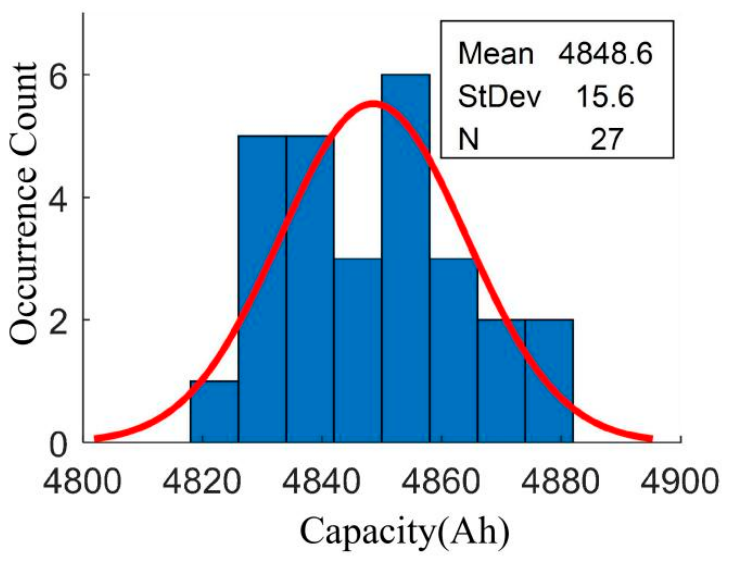
To quantitatively evaluate sample consistency, twenty-seven INR21700-50E cells from the same batch were subjected to the initial capacity characterization procedure described above, and the resulting capacities were analyzed statistically. As illustrated schematically in Figure 1, all initial capacities fell within the 95% confidence interval with a narrow distribution, indicating good capacity uniformity across the sample set. This observation is consistent with previous open datasets and studies on this cell type [1,3,18]. The high level of consistency provides a solid basis for comparing the aging behavior under different temperature–C-rate conditions.

2.2. Aging Matrix and 100% DOD Cycling Protocol

Subsequently, a 3 × 3 matrix of operating conditions was defined based on three ambient temperatures (0 °C, 23 °C, and 40 °C) and three charge/discharge rate programs, resulting in nine typical aging scenarios. The rate program notation CxDy is used throughout the manuscript and figures, where x is the constant-current charge C-rate and y is the constant-current discharge C-rate. Therefore, C0.5D1, C1D1, and C1D2 represent 0.5C charge/1C discharge, 1C charge/1C discharge, and 1C charge/2C discharge, respectively. The twenty-seven cells were evenly assigned to these conditions, with three replicates per scenario. The ambient temperature during cycling was controlled by a GPU-3 climatic chamber (ESPEC Environmental Equipment (Shanghai) Co., Ltd., Shanghai, China). After each temperature setpoint change, the cells were allowed to rest for 3 h to ensure thermal equilibrium between the chamber environment and the cell core.
Charge–discharge cycling was performed using a CT-4008-5V12A battery test system (Neware Technology Limited, Shenzhen, China). For all aging conditions, the cells were charged using a CC–CV protocol: constant-current charge at the charge rate specified by the CxDy program to an upper cutoff voltage of 4.2 V, followed by constant-voltage charging at 4.2 V until the current dropped to 0.05C (approximately 98 mA). After charging, the cells were rested for 5 min and then discharged at the discharge rate specified by the same CxDy program to a lower cutoff voltage of 2.5 V. Following discharge, the cells were rested for 25 min before the next cycle started. Thus, the rate program was fixed within each condition, but the charge and discharge rates were not necessarily identical; this clarification removes the ambiguity caused by the previous shorthand description. By keeping the voltage window and rest times identical across all conditions, the DOD was maintained at ~100%, and the midpoint of the SOC window during cycling was around 50%, which is similar to the settings used in recent aging studies on high-nickel 21,700 cells [2,4,18].
Rationale for 100% DOD: The full 4.2–2.5 V voltage window was deliberately selected as an accelerated and conservative protocol to magnify the coupled effects of temperature and C-rate and to distinguish aging trajectories within a feasible experimental duration. Practical EV and stationary storage operation often uses narrower SOC windows, such as 10–90% or 20–80%; therefore, the present results should be interpreted as full-window accelerated aging behavior rather than as a direct prediction for all partial-DOD duty cycles. The influence of partial DOD and daily SOC fluctuation is identified as a limitation and future work item in Section 3.5.
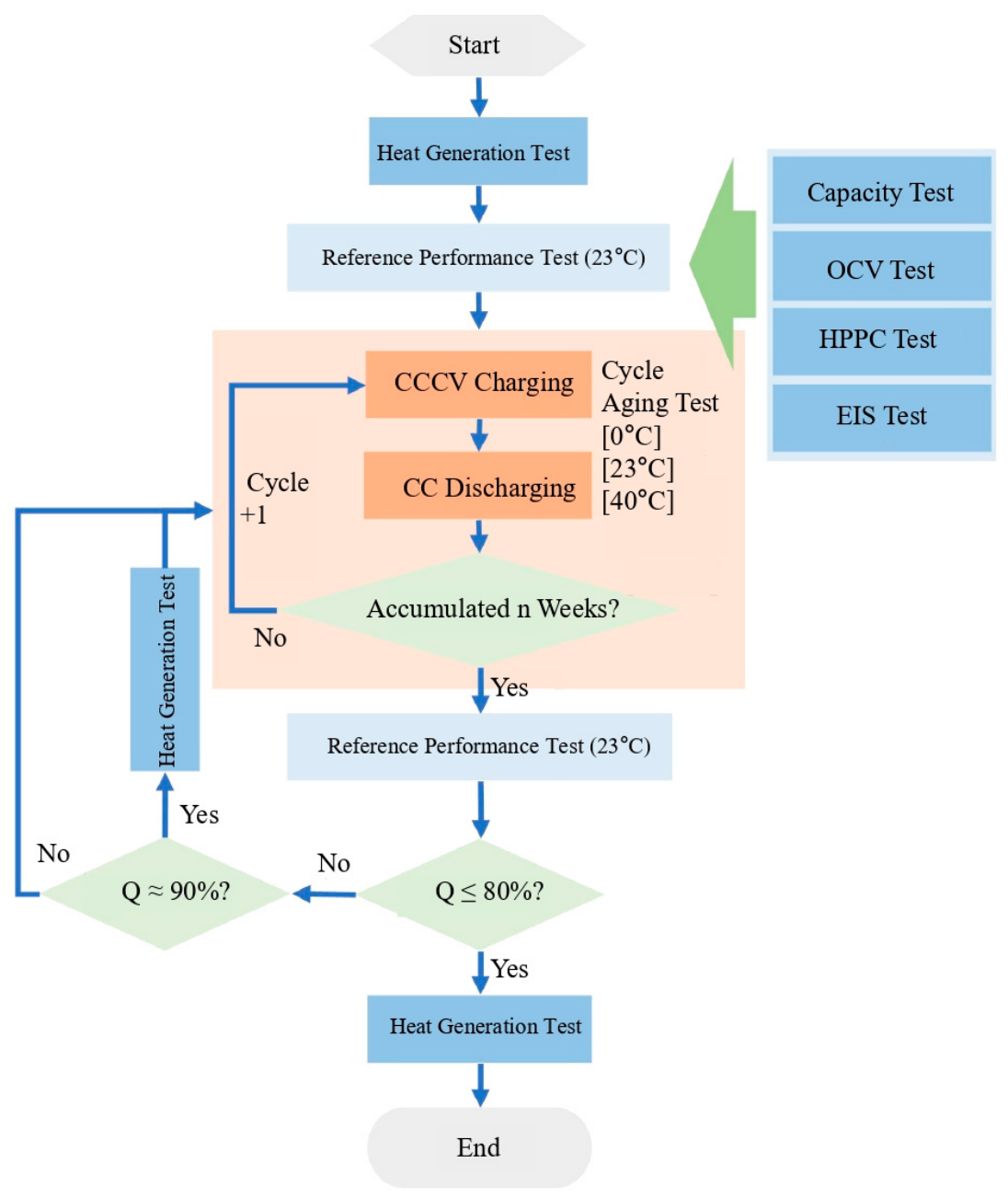
The temperature control, cycling protocols, and RPT frequency adopted in the present study are aligned with typical settings reported in recent aging studies on high-nickel NCA/Si–C 21,700 cells [2,4,18]. At each RPT point, in addition to routine capacity, DCIR, and EIS measurements, full pOCV curves were obtained to support ICA/DVA-based aging mode analysis. In the subsequent sections, the interpretation of ICA/DVA results and associated limitations—especially under conditions where negative electrode peaks broaden and overlap—are discussed with reference to the methodological insights provided in [9]. The overall experimental workflow is shown in Figure 2.

2.3. Reference Performance Tests and Non-Destructive Diagnostics

To monitor the evolution of electrochemical performance, reference performance tests (RPTs) were scheduled periodically under each aging condition. The RPT protocol included capacity tests, DCIR measurements, electrochemical impedance spectroscopy (EIS), and pseudo-open-circuit voltage (pOCV) measurements. The pOCV was obtained by multi-step galvanostatic charge/discharge with extended rest periods to approximate quasi-equilibrium voltage–capacity curves. Differential voltage (dV/dQ) and incremental capacity (dQ/dV) curves were then computed and used for subsequent DVA and ICA analyses. The ICA/DVA data processing followed the best practice guidelines proposed by Dubarry et al., including appropriate current step sizes, numerical smoothing, and peak-tracking strategies to mitigate noise and artificial peak formation during numerical differentiation [9].
For DCIR measurements, a galvanostatic pulse method was employed. The cells were first charged or discharged to a target SOC and rested until the terminal voltage stabilized. Then, a constant-current pulse with amplitude Ipulse was applied. Based on common industrial practice and prior studies [1,6,10,11], a pulse duration of 10 s was selected. To avoid ambiguity in the sign convention of charge/discharge pulses, the 10 s DCIR was calculated from the absolute voltage change and absolute pulse current as
R10s = |U10s − U0|/|Ipulse|
where U0 is the terminal voltage immediately before pulse application (V), U10s is the terminal voltage 10 s after pulse initiation (V), and Ipulse is the pulse current (A). The absolute-value notation in Equation (1) allows the same resistance definition to be used for either charge or discharge pulses. This DCIR value reflects both ohmic resistance and polarization contributions on the 10 s timescale and is suitable for correlation with EIS results and capacity fade to characterize internal resistance evolution during aging [1,6,10,11].
EIS measurements were carried out using an electrochemical workstation in galvanostatic mode. Small-amplitude alternating current signals with an effective current amplitude of 500 mA were applied at 50% SOC and at each target temperature after sufficient rest to ensure thermal and electrochemical equilibrium. The frequency range was set from 10 kHz down to 20 mHz, similar to the ranges used in aging analyses of 21,700 cells [8,13,15]. Nyquist plots were fitted using the equivalent circuit model RΩ-(Rfilm||CPEfilm)-(Rct||CPEdl)-ZW, where RΩ represents ohmic resistance, Rfilm represents the SEI/CEI film resistance, Rct represents charge-transfer resistance, CPE terms represent non-ideal interfacial capacitance, and ZW represents diffusion-related Warburg impedance. The fitted parameters were used to discuss changes in impedance components under different aging conditions.

2.4. ARC Heat Generation Measurements

Heat generation measurements were conducted using an accelerating rate calorimeter (ARC). Before the start of the aging campaign, fresh cells were fully charged according to the standard CC–CV protocol and then placed into the ARC chamber. Temperature measurement accuracy was ensured by calibrating T-type thermocouples, the NI 9214 thermocouple module (National Instruments, Shanghai, China), and the NI cRIO-9037 control unit (National Instruments, Shanghai, China) using a thermostatic oil bath and a reference mercury thermometer. The calibration results were fitted to a correction equation that was integrated into the data acquisition software. During ARC testing, the cells were cycled under controlled electrical conditions (constant-current charge/discharge) while the ARC maintained near-adiabatic boundary conditions and continuously recorded cell surface temperature, voltage, and current. Instantaneous heat generation rate and total released heat were then calculated. This methodology is consistent with previous uses of ARC for evaluating the thermal behavior and safety of NMC/NCA cells [7,8,12,14,15].
During the aging campaign, when the capacity loss under a given condition reached approximately 10% and 20% (SOH ≈ 90% and 80%), the corresponding cells were removed from cycling and subjected to ARC testing again to characterize the influence of aging on heat generation. These results were later compared with the evolution of capacity, DCIR/EIS, and ICA/DVA indicators. In this work, a capacity loss of ~20% was adopted as the end-of-life criterion for the first-life application of the cells.

2.5. Post-Mortem Destructive Analysis

To further investigate how different aging pathways affect the internal material structure, fresh cells and aged cells at selected conditions near end of life were disassembled for post-mortem analysis. Cell disassembly was performed in an argon-filled glovebox. After removing the cell casing and current collectors, the jellyroll was carefully unwound, and samples of the positive electrode, negative electrode, and separator were collected from different radial and axial locations. These samples were used for subsequent morphological characterization. To eliminate SOC-dependent morphology differences during post-mortem comparison, all cells selected for disassembly were first discharged to the lower cutoff voltage of 2.5 V using the standard discharge protocol and then rested until the terminal voltage stabilized before transfer into the argon-filled glovebox. Therefore, the SEM comparisons were made at a nominal fully discharged state rather than at arbitrary SOCs.
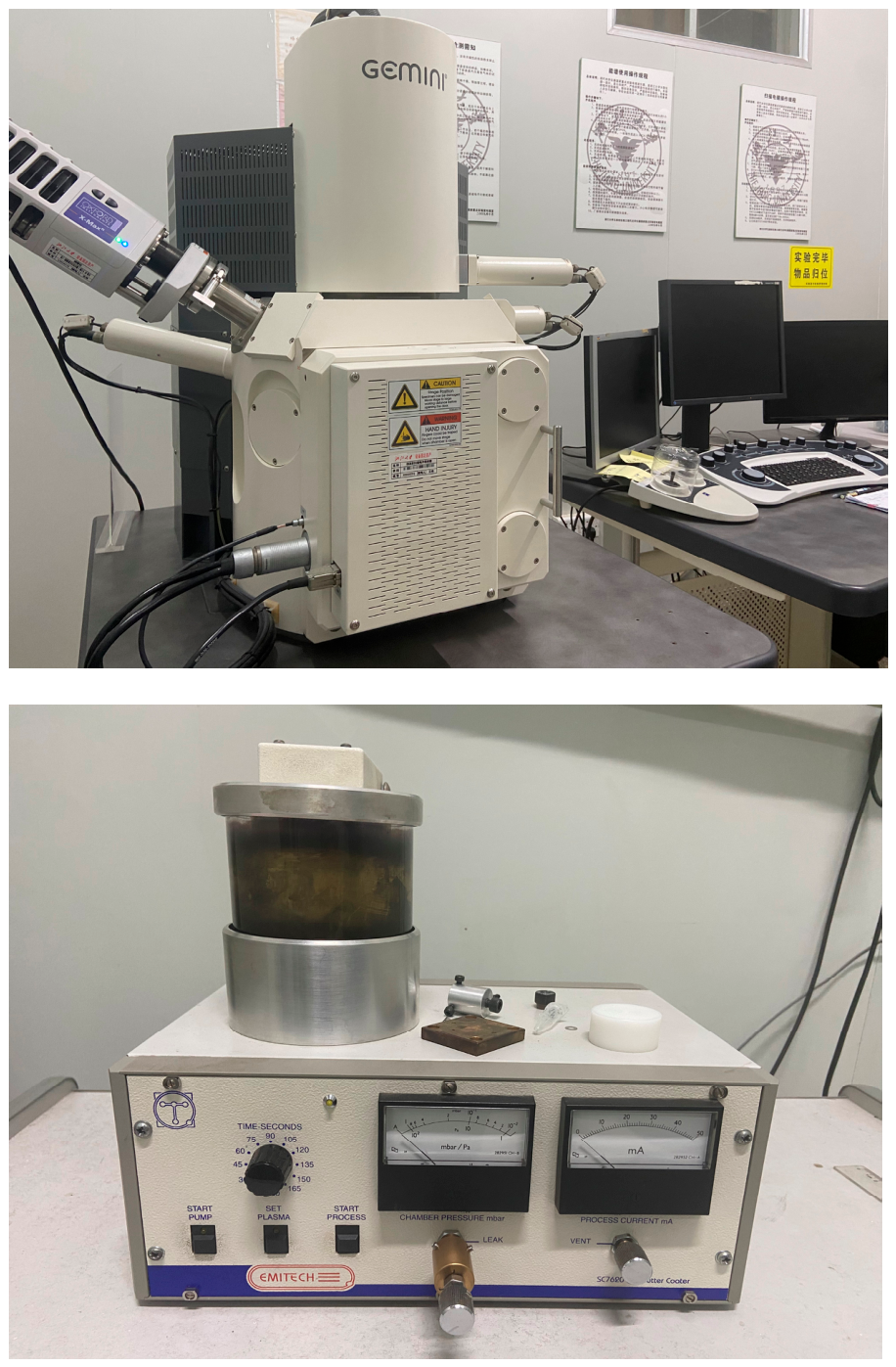
To reveal the microstructural effects of different aging pathways, post-mortem analyses were performed using field emission scanning electron microscopy (SEM). A Carl Zeiss Ultra 55 field emission SEM (Carl Zeiss (Shanghai) Management Co., Ltd., Shanghai, China) (Figure 3) was employed owing to its high spatial resolution and large depth of field, which are well suited to imaging particle cracking, surface films, and pore structures in electrodes and separators.
Fresh and aged cells (typically at SOH ≈ 80% under representative conditions) were disassembled in an argon glovebox as described above. Positive and negative electrode samples, as well as separator samples, were cut from selected locations of the unrolled jellyroll. Residual electrolyte was gently removed, and the samples were dried under vacuum to minimize artefacts during imaging. Because the separator is electrically insulating, sputter-coating with a thin gold layer was performed before SEM observation to improve surface conductivity and image quality.
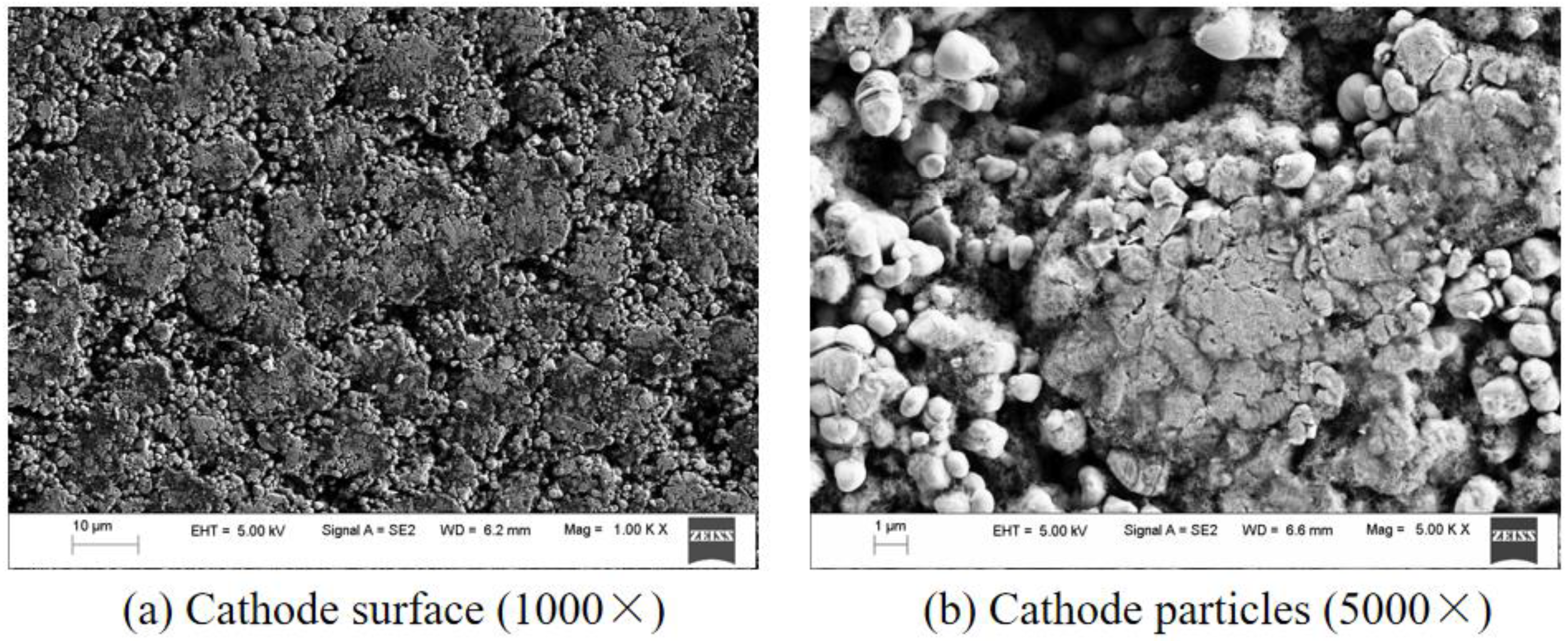
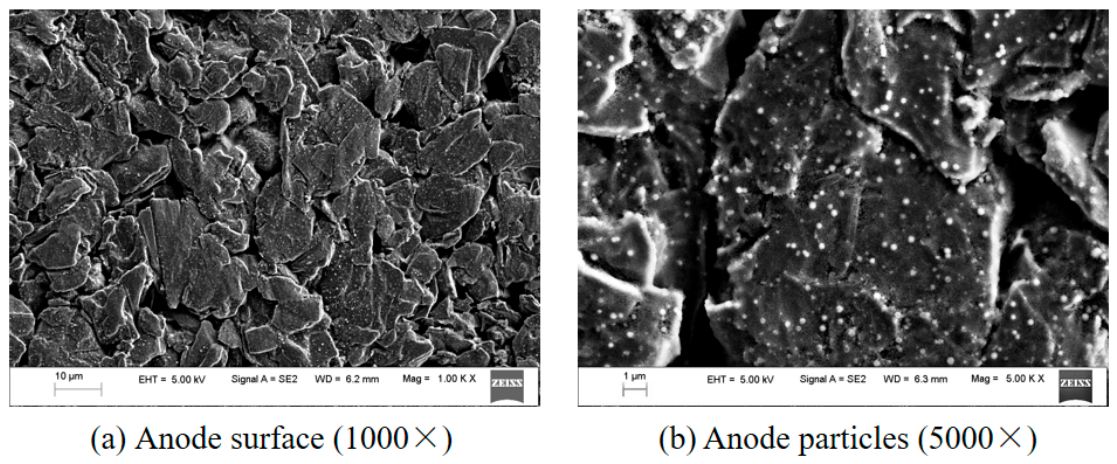
SEM images of the positive electrode, negative electrode, and separator were acquired at a magnification of 1000× to capture overall surface morphology. Higher-magnification images at 5000× were used to resolve finer features such as electrode particle morphology, microcracks, and separator pore structures. The SEM testing procedure followed the common practice reported in high-temperature aging and high-nickel cathode degradation studies [4,8,13], enabling microstructural observations to be directly correlated with electrochemical and thermal behavior to support the identification of aging modes.

2.6. Measurement Accuracy and Uncertainty Evaluation

To improve the credibility of the reported experimental trends, measurement accuracy and uncertainty were evaluated for the main measured quantities. All cyclers, temperature sensors, and calorimetry channels were calibrated or checked before the test campaign according to the corresponding laboratory procedures and manufacturer specifications. The uncertainty analysis focuses on the quantities directly used in the discussion: capacity, DCIR, EIS-fitted resistance, and heat generation power.
For capacity, the relative uncertainty was estimated from the current and time uncertainties as u(Q)/Q ≈ [(u(I)/I)2 + (u(t)/t)2]1/2. Because the test duration is long and the time-based uncertainty is small, the capacity uncertainty is dominated by current accuracy and repeatability. For DCIR, uncertainty was propagated from R10s = ΔU/Ipulse, giving u(R10s)/R10s ≈ [(u(ΔU)/ΔU)2 + (u(Ipulse)/Ipulse)2]1/2. For the ARC-derived heat generation power, the propagated uncertainty is mainly governed by cell mass measurement, assumed specific heat capacity, and the numerical derivative of the temperature signal.
The uncertainty analysis indicates that the qualitative conclusions are not controlled by instrumental noise because the observed aging-induced changes are much larger than the estimated measurement uncertainty. For example, the reported DCIR and heat generation increases at MOL/EOL exceed the uncertainty bands by more than one order of magnitude in most conditions. Therefore, the uncertainty mainly affects the exact fitted parameters, while the ranking of dominant aging pathways remains robust. The main instruments, uses in analysis, and uncertainty sources are summarized in Table 1.

3. Results and Discussion

The results are presented as a sequential test of the central hypothesis. Capacity and DCIR first establish whether the aging rates diverge across the matrix; EIS and ICA/DVA then identify which electrochemical processes dominate those divergences; ARC calorimetry evaluates whether the electrochemical degradation translates into a changing thermal load; and SEM finally checks whether the inferred mechanisms are consistent with observable electrode and separator damage. This structure is intended to integrate the multifaceted data into a mechanism-based aging narrative rather than to provide isolated experimental summaries.

3.1. Capacity Fade Analysis

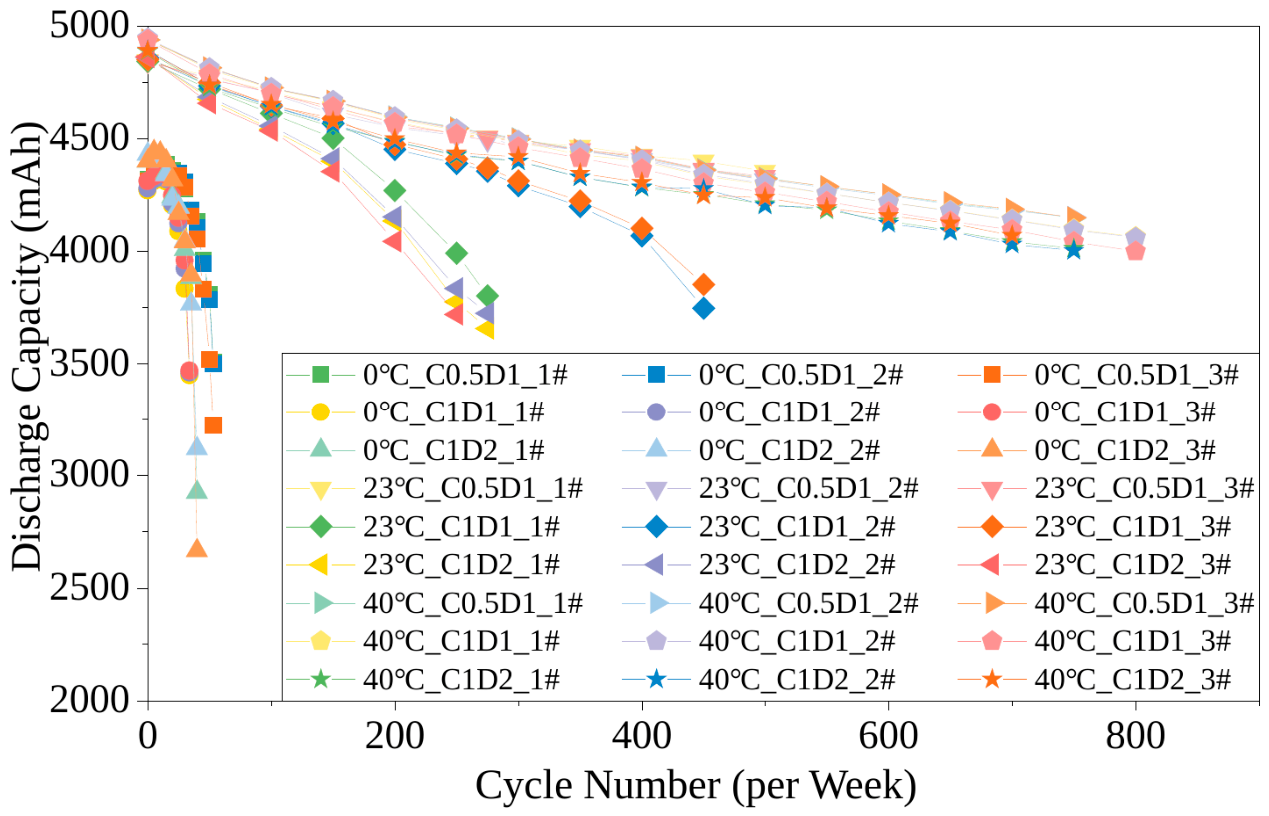
Figure 4 shows the evolution of discharge capacity as a function of cycle number for all cells. Under a given temperature–C-rate condition, the three cells generally follow a similar capacity fade trajectory, except for one cell under the 23 °C_C1D1 condition that exhibits a pronounced early failure and “sudden drop” in capacity in the late stage. Combined with test logs and post-mortem observations, this behavior is most likely due to an isolated defect rather than a representative response of the condition, and this cell is therefore excluded from subsequent statistical analysis.
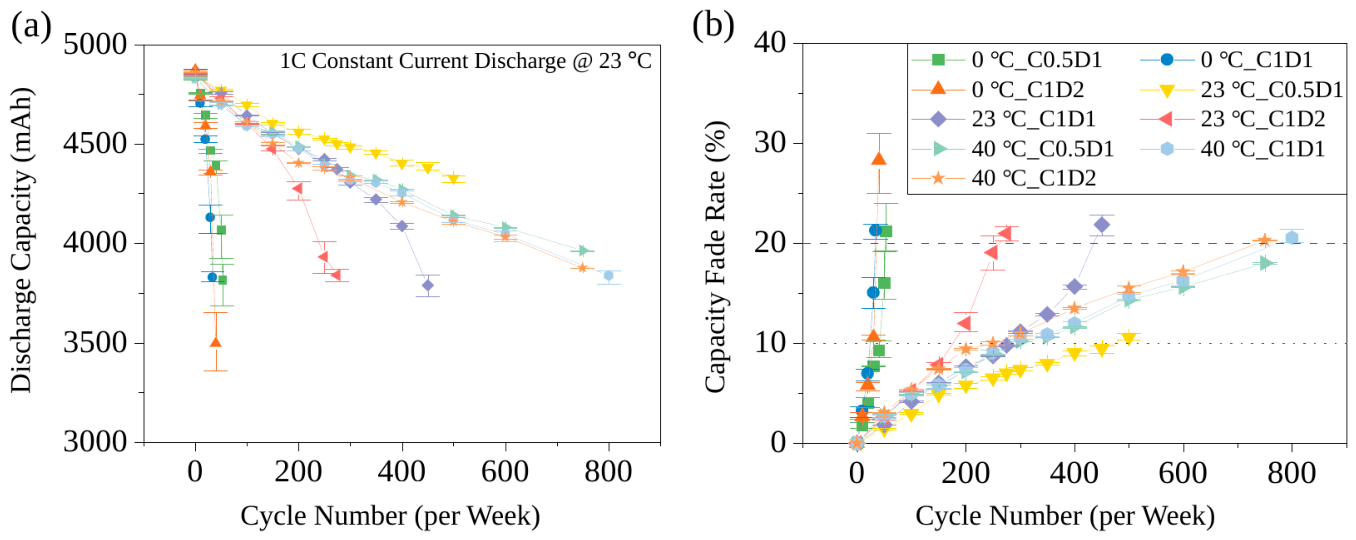
Based on the RPT data, the nominal discharge capacity and capacity fade at the same cycle number are averaged for each condition, and the dispersion between cells is represented by error bars (Figure 5).
From the evolution of capacity fade (Figure 5b), the following can be observed:
At 0 °C, aging is the fastest among all temperatures. After about 50 aging segments, the capacity fade exceeds 20%, and the fade rate accelerates in the later stage. This is consistent with previous studies showing that low temperature aggravates polarization, slows negative electrode kinetics, and promotes lithium deposition, all of which accelerate capacity loss [5]. Within 0 °C, the capacity fade is slower at 0 °C_C0.5D1, while 0 °C_C1D1 and 0 °C_C1D2 age faster. The slightly slower fade at C1D2 than at C1D1 is plausibly related to stronger self-heating at higher current, which partially mitigates extreme low-temperature limitations [5].
At 23 °C, the cycle life is strongly dependent on the C-rate. The C0.5D1 condition shows the lowest and gradually decelerating capacity fade, whereas C1D1/C1D2 exhibit accelerated aging and a pronounced “capacity cliff” near end of life, indicating that medium temperature combined with a high C-rate strongly promotes cycle degradation.
At 40 °C, capacity fade is characterized by a faster initial drop followed by a more gradual decline. Differences between C-rates are much smaller than at 23 °C, suggesting that at 40 °C, the temperature effect dominates and the additional effect of the C-rate is partially masked. High temperature accelerates SEI/CEI growth and electrolyte decomposition, causing rapid initial capacity loss before the fade rate stabilizes [4,16].
Overall, within the discrete operating matrix tested in this study, 23 °C_C0.5D1 yields the longest cycle life. However, at the high-discharge rate program C1D2 and at the 1C/1C program, the measured 40 °C trajectories are longer than the corresponding 23 °C trajectories. This observation should not be interpreted as proof of a continuous optimum at 40 °C. Rather, it indicates that, among the three tested temperatures, moderate heating can partially alleviate severe polarization under high-rate operation, whereas additional intermediate temperatures such as 30 °C or 35 °C may yield different or even better trade-offs. The conclusion is therefore framed as a discrete matrix result and as guidance for temperature/rate co-management, not as a fully resolved temperature optimization law.

3.2. Electrochemical Analysis

3.2.1. DCIR Evolution

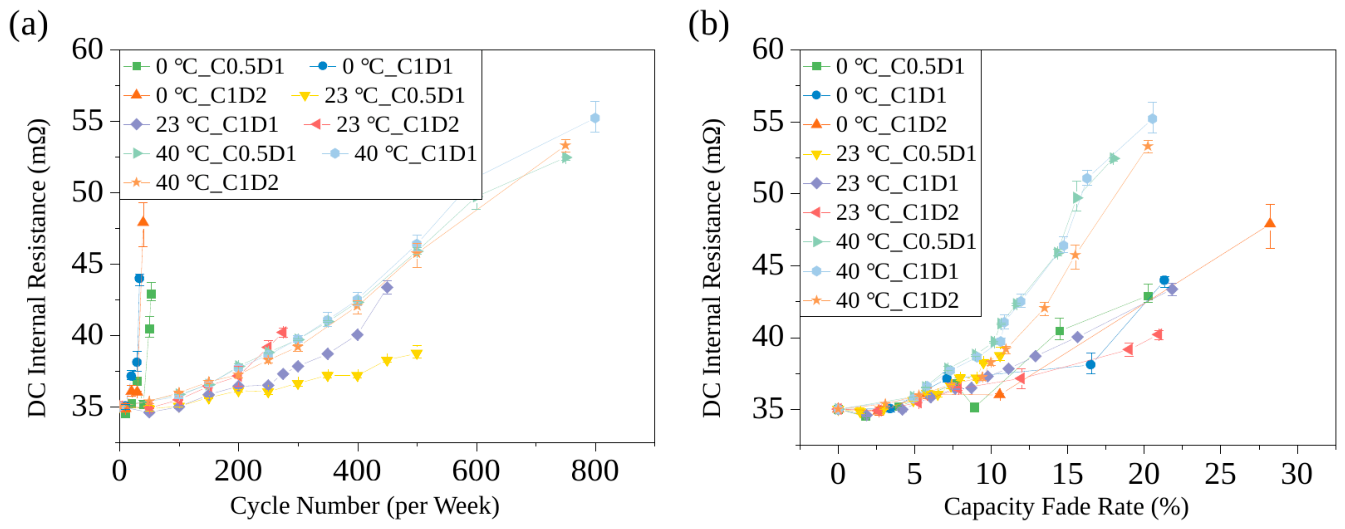
Using HPPC data at 50% SOC, the 10 s direct current internal resistance (DCIR) is computed and averaged for each condition (Figure 6). In all cases, DCIR increases significantly with aging, but the relative impact of temperature and the C-rate differs:
At 0 °C, DCIR exhibits the fastest growth, with a clear acceleration in the late stage, indicating that low-temperature cycling not only causes capacity loss but also severely deteriorates dynamic performance, consistent with the mechanism of lithium deposition and local pore blockage leading to a rapid rise in internal resistance [5].
At 23 °C, DCIR is most sensitive to the C-rate: C0.5D1 shows the smallest increase, whereas C1D1/C1D2 display much faster DCIR growth, which coincides with the capacity “cliff”. This suggests that under medium temperature and a high C-rate, ohmic and polarization resistance build-up is strongly coupled with capacity fade.
At 40 °C, the DCIR values and growth are higher than those at 23 °C_C0.5D1/C1D1 but still lower than at 23 °C_C1D2. High temperature accelerates interfacial reactions and structural degradation, leading to a roughly monotonic DCIR increase with capacity loss; at the same fade level, 40 °C tends to produce the highest DCIR, in agreement with high-temperature aging studies in which degradation is dominated by resistance growth [4,16].
When DCIR is plotted against capacity fade (Figure 6b), 40 °C clearly yields the highest DCIR at a given fade, while 23 °C_C1D2 shows the slowest DCIR growth and the lowest end-of-life resistance. This indicates that a high temperature amplifies degradation pathways dominated by resistance rise, whereas a medium temperature at a high C-rate induces stronger capacity loss with comparatively moderate resistance growth.

3.2.2. EIS Evolution

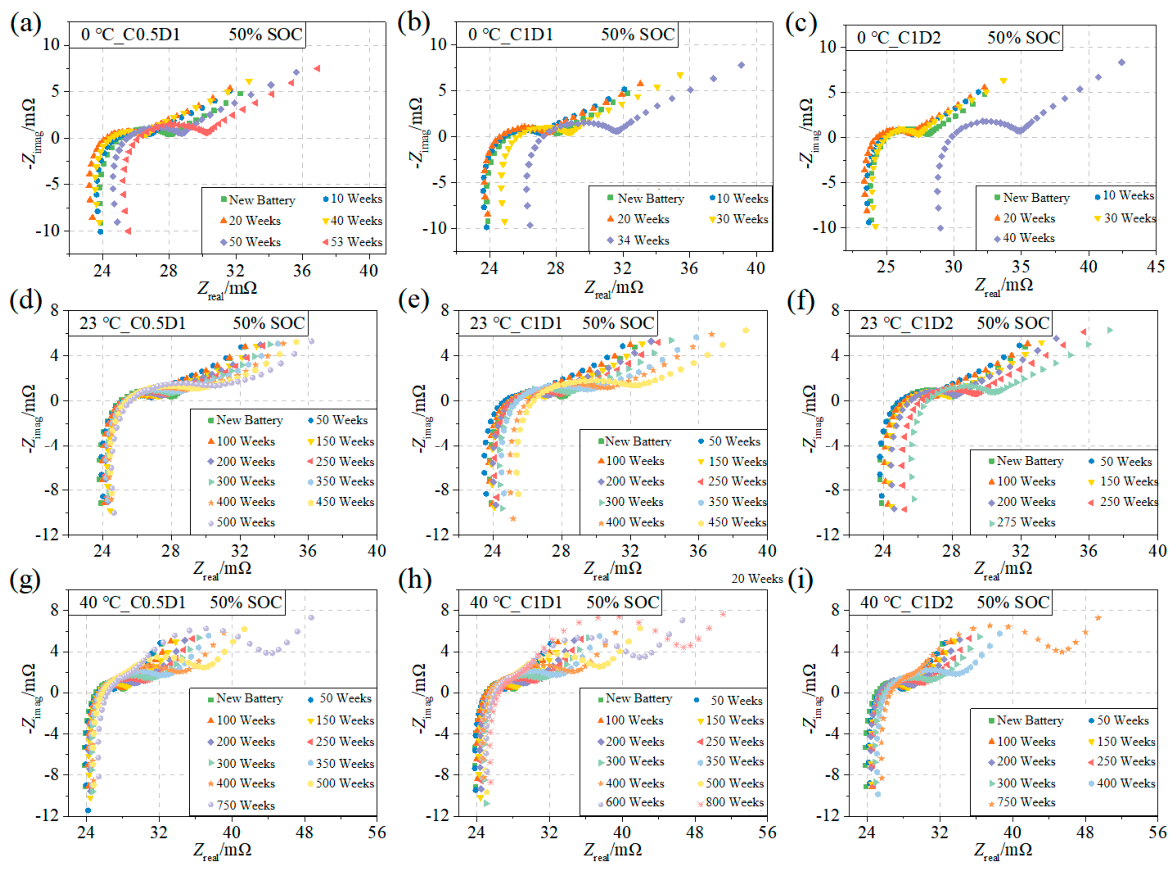
To separate different resistance contributions, EIS tests were performed at 50% SOC for various aging states (Figure 7). Figure 7 is interpreted together with the equivalent circuit model described in Section 2.3 andthe fitted parameter evolution in Figure 8. With cycling, the high-frequency intercept shifts to the right, indicating an increase in ohmic components such as electrolyte and contact resistances. The mid-frequency semicircle first changes little or slightly shrinks, then expands significantly, especially at 40 °C, suggesting growth in SEI/CEI-related film resistance and charge-transfer resistance. The low-frequency tail becomes steeper, reflecting increasing diffusion limitation. These trends are consistent with reports on Ni-rich NCA cathodes, where high temperatures promote microcracking and structural collapse, leading to increased impedance [5].
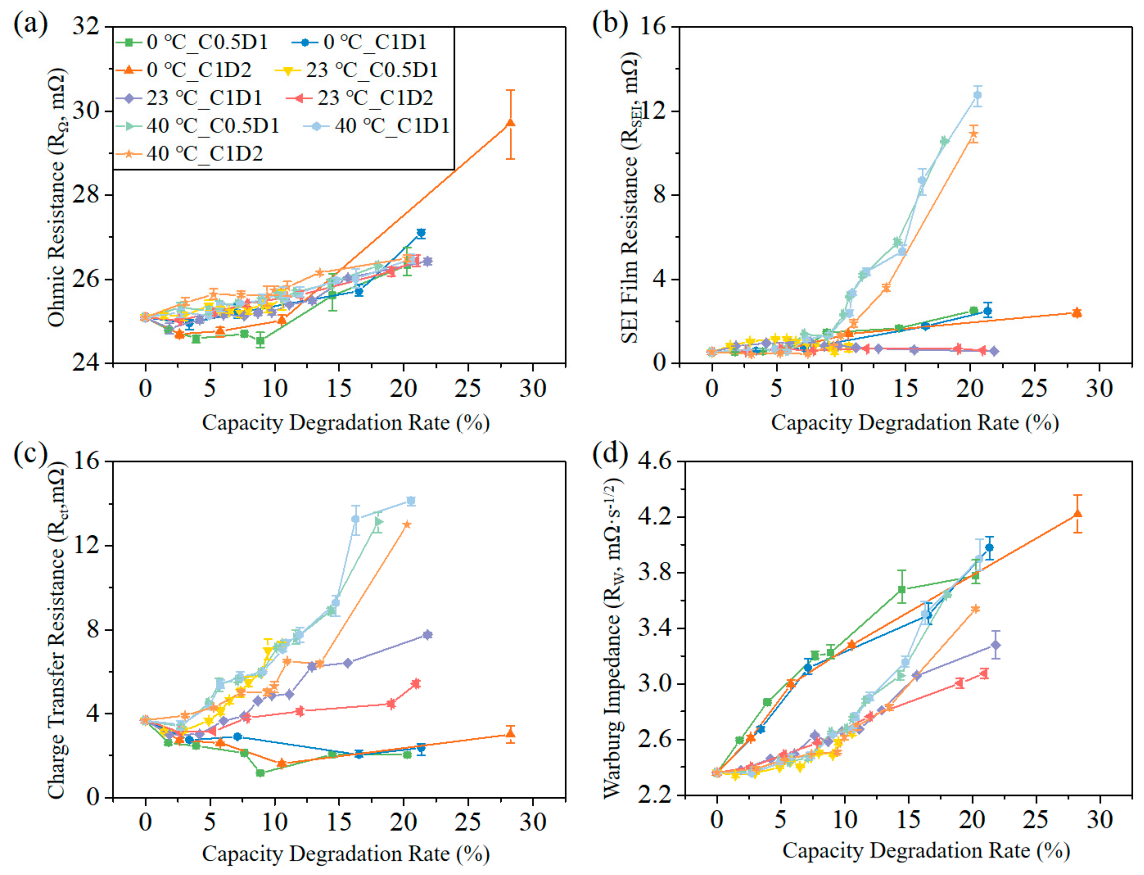
Equivalent circuit fitting using the equivalent circuit model described in Section 2.3 yields the evolution of ohmic resistance, SEI/CEI film resistance, charge-transfer resistance, and Warburg impedance as a function of capacity fade (Figure 8). The fitted spectra were checked against the measured Nyquist plots, and the following interpretation is based on the fitted component trends rather than on visual inspection alone. Overall, ohmic resistance increases monotonically, with a faster rise at 0 °C in the late stage; SEI/CEI film resistance shows modest changes at 0 and 23 °C but increases strongly at 40 °C; charge-transfer resistance grows fastest at 40 °C and at 23 °C_C0.5D1; and Warburg impedance increases in the order 23 °C < 40 °C < 0 °C, indicating the most severe diffusion limitation at low temperatures.

3.2.3. Aging Modes Identified by ICA/DVA

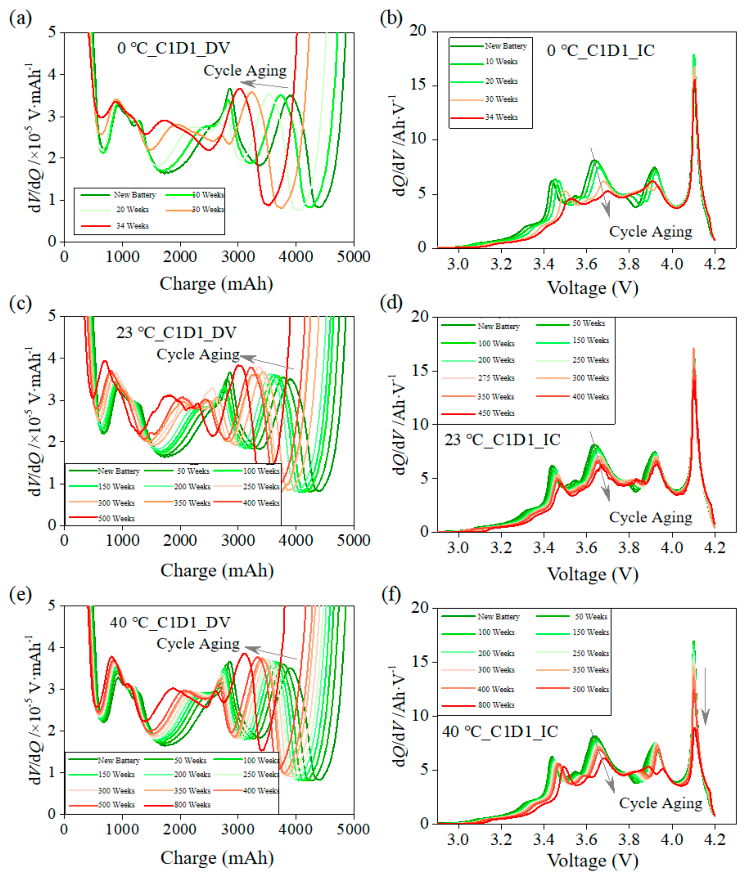
At each RPT, pOCV curves are measured and processed. To avoid noise amplification from direct numerical differentiation, a Savitzky–Golay (SG) smoothing is first applied to the pOCV curves, followed by differentiation to obtain DV (dV/dQ) and IC (dQ/dV) curves (Figure 9), in line with the best practice recommendations for incremental capacity analysis [9].
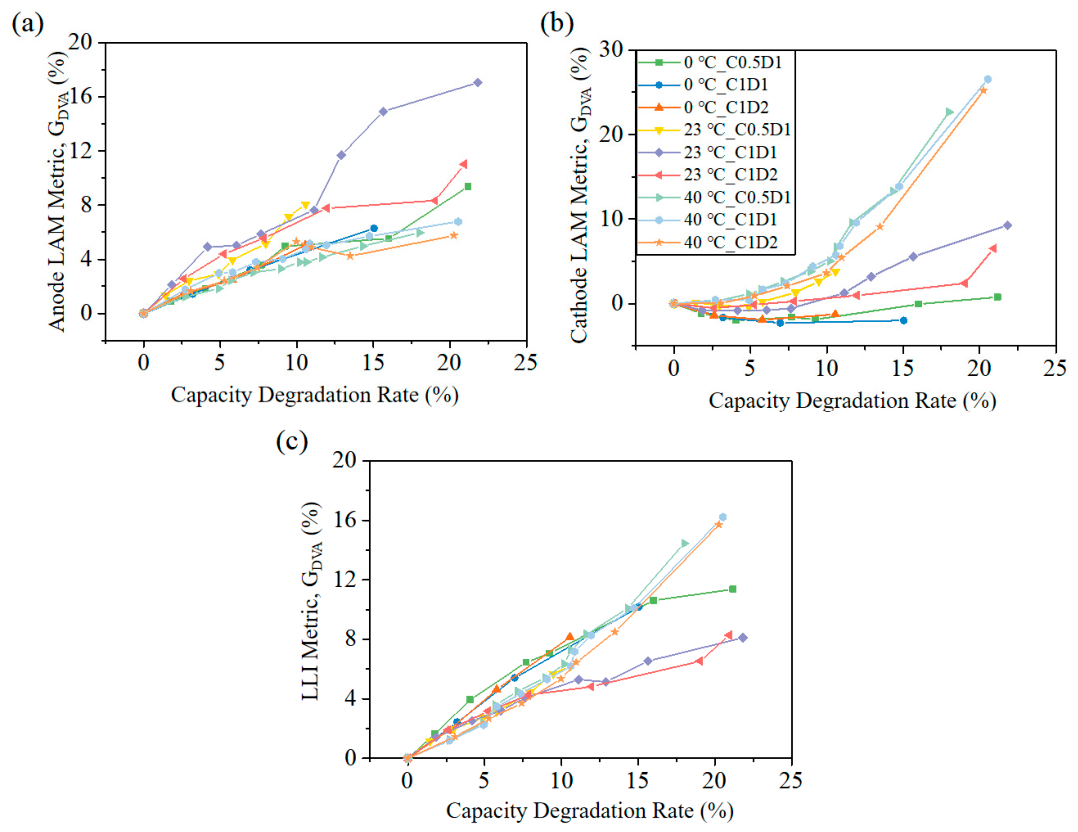
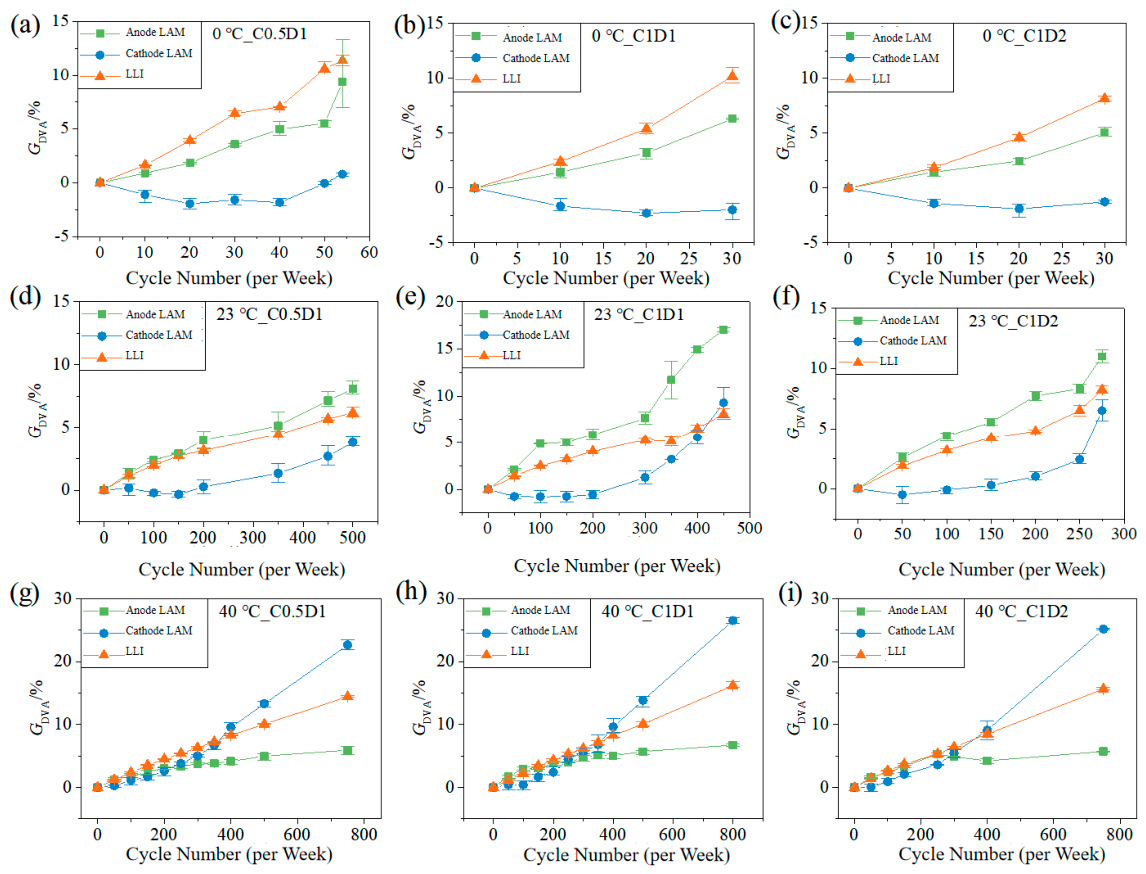
Using a constrained parameter space and peak–phase correspondence from the literature for NCA/graphite (or NCA/Si–C) systems, the main aging modes are extracted via DVA (Figure 10 and Figure 11). The main trends are: LLI is dominant with minor LAM_ne at 0 °C, LAM_ne is dominant with secondary LLI and increasing LAM_pe at end of life at 23 °C, and LAM_pe becomes the main contribution in the later stage at 40 °C, with LLI secondary and LAM_ne weakest. Because the negative electrode peaks broaden and overlap strongly at 0 °C, the quantitative values of LAM_ne under this condition have large uncertainty and are used only as qualitative trends, consistent with the limitations discussed in ICA best practice studies [9].

3.2.4. Mechanism-Aware Diagnostic Framework for BMS-Oriented SOH and Lifetime Estimation

The experimental results were further organized into a practical diagnostic framework for BMS implementation. At each RPT point k, a feature vector can be constructed as xk = [SOHk, R10s, RΩ, RSEI, Rct, ZW, LLI, LAMne, LAMpe, Htotal, qavg], where SOHk = Qk/Q0 × 100%, R10s is the 10sDCIR, RΩ/RSEI/Rct/ZW are fitted EIS components, LLI/LAMne/LAMpe are ICA/DVA-derived aging indices, and Htotal/qavg represent total heat and average heat generation power.
The mechanism-aware interpretation is rule-based and can be embedded in data-driven or model-based BMS estimators: (i) dominant LLI is inferred when capacity loss is accompanied by strong low-temperature polarization, rapid DCIR/Warburg growth, and lithium-plating signatures; (ii) dominant interfacial degradation is inferred when RSEI/Rct and heat generation power increase disproportionately; and (iii) dominant positive electrode LAM is inferred when DVA/ICA peak shifts and SEM cathode cracking/pulverization are consistent with a sharp impedance rise at elevated temperatures. These mechanism labels provide physically interpretable inputs for SOH estimation, remaining useful life prediction, thermal derating, and second-life screening.
For lifetime prediction, the end-of-life criterion used here is SOH = 80%. In practical electronics applications, the vector xk can be updated during scheduled diagnostic pulses or maintenance RPTs, and the remaining cycle life can be obtained by extrapolating the condition-specific fade rate dSOH/dN while using the mechanism label to choose an appropriate degradation branch. The present framework is therefore methodological rather than purely descriptive, while still remaining directly grounded in the experimental evidence.

3.3. Heat Generation Behavior

3.3.1. Total Heat Generation

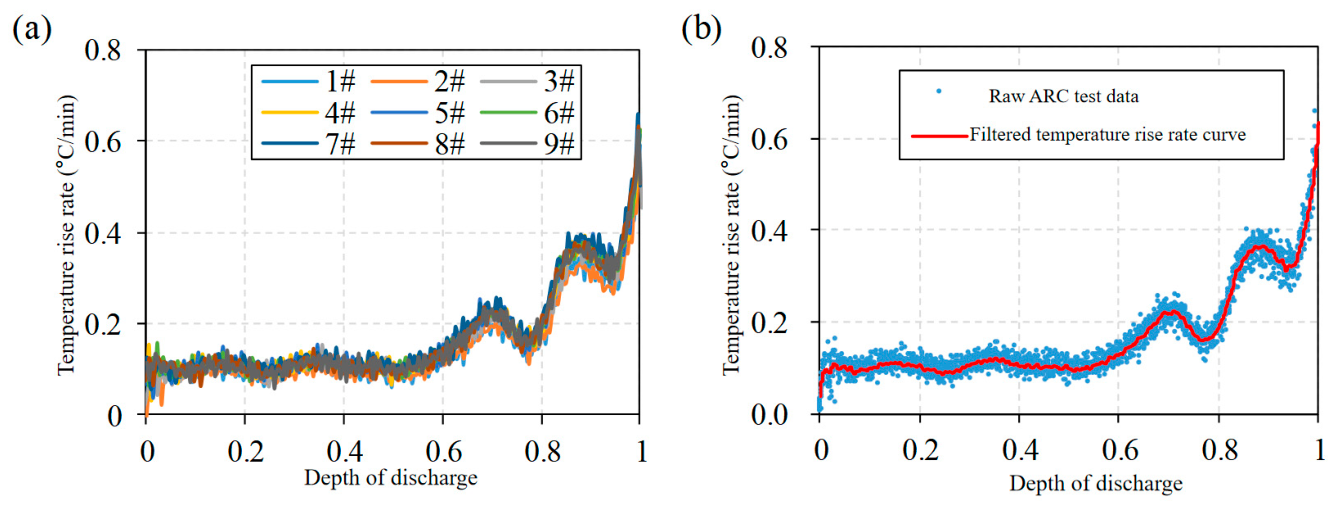
At the initial stage of cycle aging, the temperature rise rate during 0.5C constant-current discharge was measured for nine fresh cells using an adiabatic calorimeter (Figure 12a). The results show that the temperature rise rate remains stable at approximately 0.1 °C min−1 when DOD < 60% but increases with fluctuations to ~0.7 °C min−1 toward the end of discharge when DOD > 60%, indicating higher heat generation power in the low-SOC region. To suppress noise in the raw data (Figure 12a), the smoothdata function in MATLAB R2023b (The MathWorks, Inc., Natick, MA, USA) was applied to obtain a smoothed reference curve (Figure 12b).
For aged cells, the same discharge condition was re-tested and filtered when the capacity faded by 10% (MOL) and 20% (EOL). Based on the filtered data, the cell mass (69 g) and the specific heat capacity (880 J kg−1 K−1), the instantaneous heat generation power was computed from the governing relation.
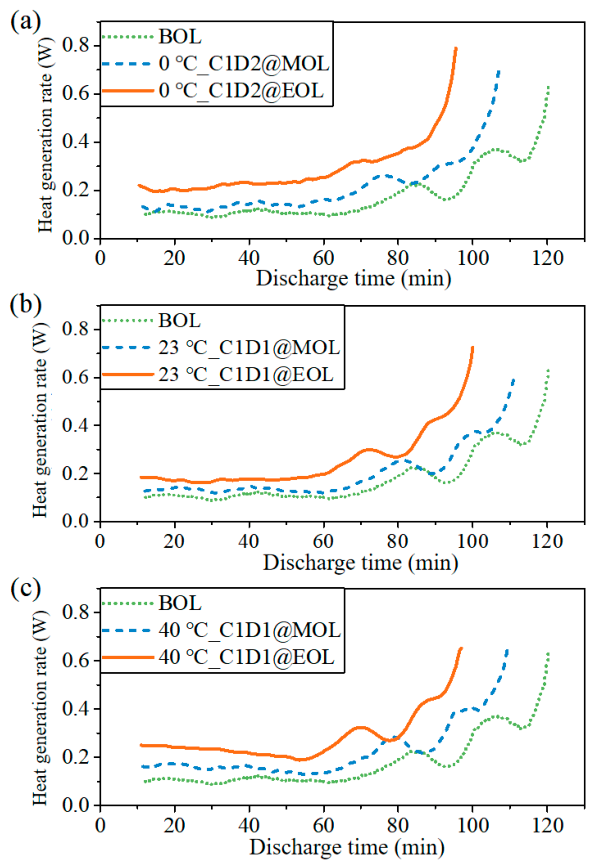
Taking the 0 °C_C0.5D1 condition as an example (Figure 13), aging markedly increases heat generation power: at 10% capacity fade, the average power rises by 25.6% and the total heat by 16.5%; at 20% fade, the average power increases by 65.3% and the total heat by 32.4%. Concurrently, the power profile morphology changes: fluctuations in the low-SOC region diminish, and at 20% capacity fade, they virtually vanish, yielding a monotonic increase in power. This trend is consistent with previous studies on the coupling between high-temperature aging and heat generation characteristics [10,16].
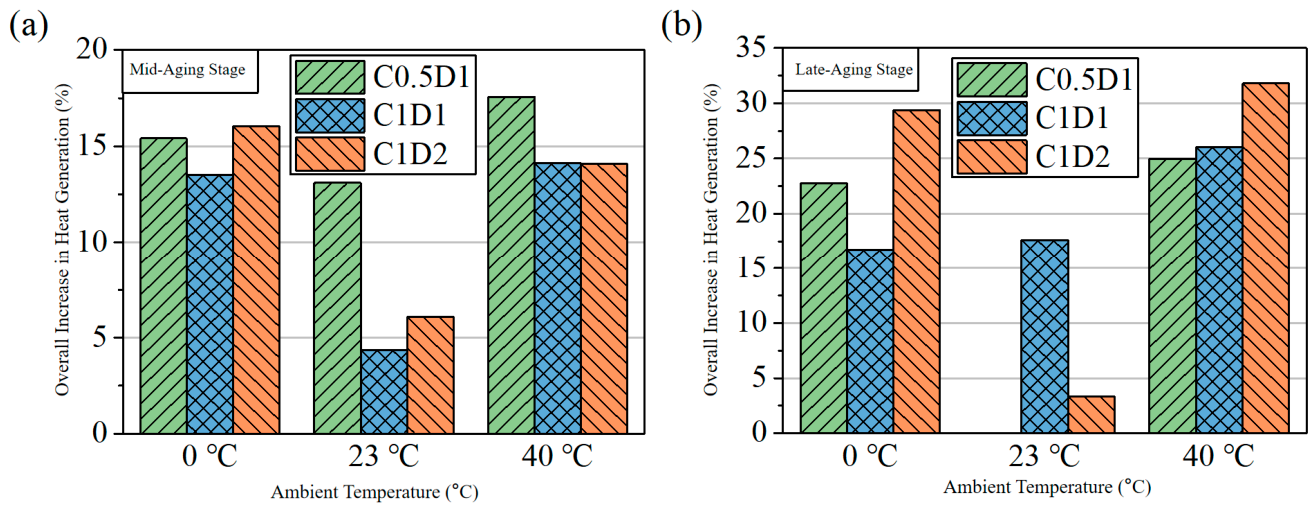
Figure 14 compares the growth rate of total heat generation for aged cells under different cycling conditions. At the MOL stage (Figure 14a), total heat increases significantly, with a strong temperature effect: the largest growth occurs at 0 °C and 40 °C (13.53–17.57%). At 23 °C, the C-rate dependence is evident (C0.5D1: 13.11%; C1D1: 4.35%; C1D2: 6.08%). At the EOL stage (Figure 14b), except for 23 °C_C1D2, the total heat under all other conditions further increases; for 40 °C_C1D2, the increment reaches 31.78%. Across conditions, all nine cases show higher total heat at MOL than at BOL, with the largest increases generally at 0 and 40 °C. At EOL, except for 23 °C_C1D2, every condition exhibits a further increase in total heat, with 40 °C_C1D2 showing the largest growth, indicating that a high temperature combined with a high C-rate results in the strongest amplification of heat generation [10,16].

3.3.2. Average Heat Power and Growth Rate

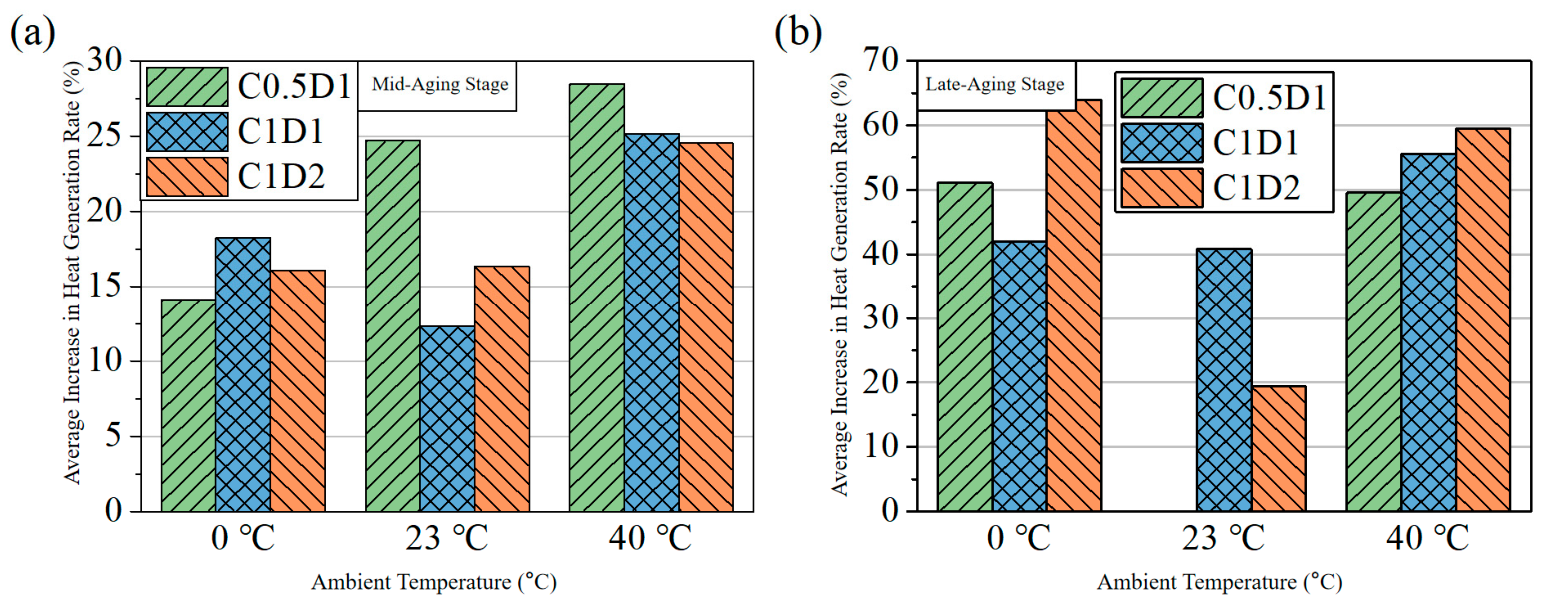
For aged cells, the growth rate of average heat generation power increases markedly with cycling conditions (Figure 15). At MOL (Figure 15a), the largest increments occur at 40 °C (24.5–28.4%), followed by 0 °C (14.1–18.3%); at 23 °C, a clear C-rate dependence appears (C0.5D1: 24.7%; C1D2: 12.1%). By EOL (Figure 15b), except for 23 °C_C1D2 and the prematurely terminated 23 °C_C0.5D1 case, all other conditions exhibit increases exceeding 40%. Notably, at 0 °C_C1D2, the increase reaches 63.9% (albeit with nearly 30% capacity fade), whereas at 23 °C_C1D2, the increase is the lowest (19.4%), i.e., the heat generation growth rate lags behind the capacity fade rate. Over the whole life, 40 °C has the highest average, followed by 0 °C, and 23 °C has the lowest, consistent with the temperature dependence of impedance evolution and with previous modeling and experimental work on heat generation during aging [10,16].

3.3.3. Growth Rate of Average Heat Generation Power

To quantify the relationship between changes in heat generation power and capacity fade, the growth rate of average heat generation power, ξki, is defined as follows:
ξki = [(qki − q0i)/q0i]/Qloss,k
where ξki is the growth rate metric, Qloss,k is the capacity fade ratio, qki is the average heat-generation power (W) during constant-current discharge in the aged state k, and q0i is the average heat generation power for the fresh cell. The subscript k denotes the aging state—MOL (mid-of-life) or EOL (end-of-life)—and the superscript i denotes the cycling condition.
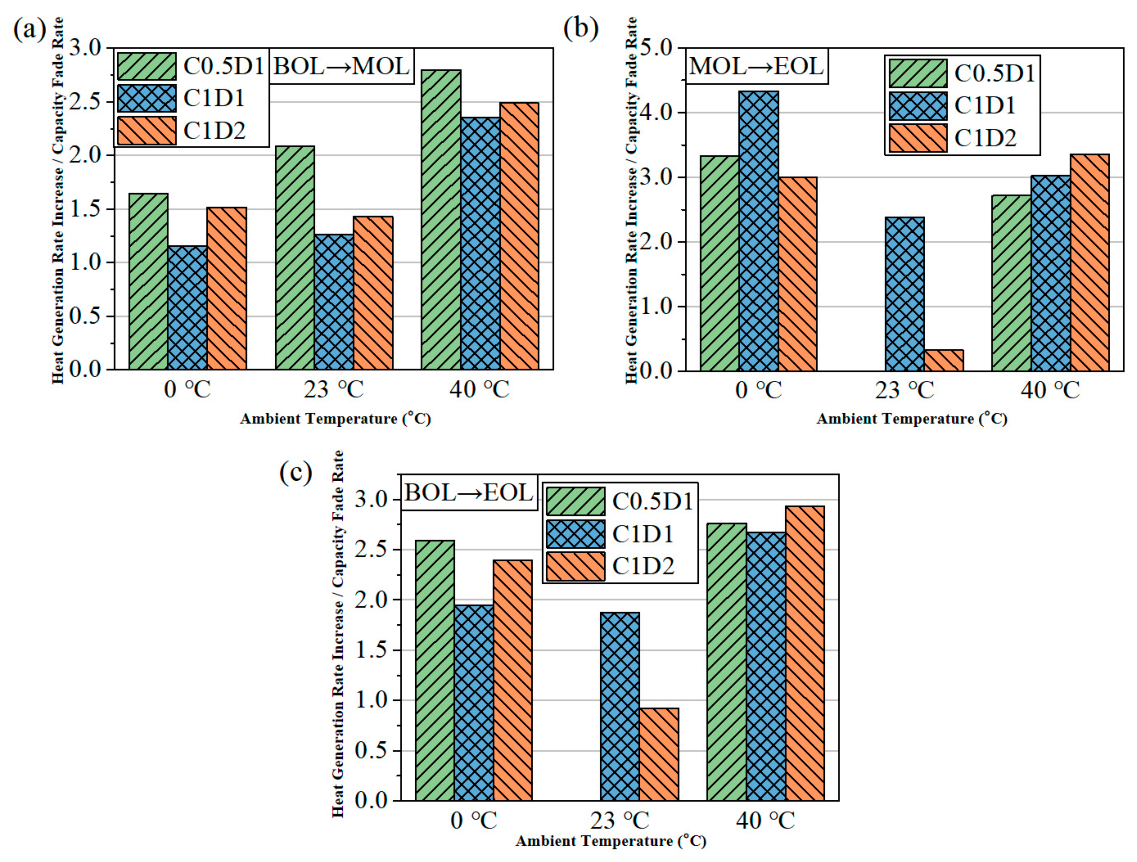
Using Equation (2), ξki was computed for BOL → MOL, MOL → EOL, and BOL → EOL, with the results summarized in Figure 16.
The evolution of ξki during aging is shown in Figure 16. From BOL to MOL (Figure 16a), ξki is highest at 40 °C (2.35–2.80%), significantly exceeding that at 0 °C (1.15–1.64%) and 23 °C (1.26–2.08%); under C0.5D1, ξki is generally higher than at other C-rates. From MOL to EOL (Figure 16b), except for 23 °C_C1D2 and the prematurely terminated 23 °C_C0.5D1, all other conditions show higher ξki than in the earlier stage, indicating accelerated heat generation toward end of life. In this stage, the temperature effect reverses: ξki at 0 °C reaches 3.55, surpassing that at 40 °C (3.03); for 23 °C_C1D2, ξki decreases from 1.42 to 0.33, exhibiting an anomalous decline. Over the full span (Figure 16c), ξki is highest at 40 °C (mean 2.79), followed by 0 °C (mean 2.31), and lowest at 23 °C (with C1D2 only 0.92); this trend is consistent with the impedance evolution characteristics discussed in Section 3.2.
In summary, aging significantly increases heat generation power, and its growth rate is jointly regulated by ambient temperature and the C-rate. For the same capacity fade level, distinct aging pathways lead to differentiated thermal characteristics, underscoring the decisive influence of aging conditions on battery thermal behavior.

3.4. Morphological Changes

To elucidate how different aging pathways affect the structural integrity of cell components, fresh and aged cells were disassembled and representative regions were sampled for analysis. Using direct visual inspection and scanning electron microscopy (SEM), the macro-/micromorphological evolution of the cathode and anode electrodes was systematically characterized, with emphasis on surface- and particle-level changes. In parallel, the microstructural features of aged separators were examined.
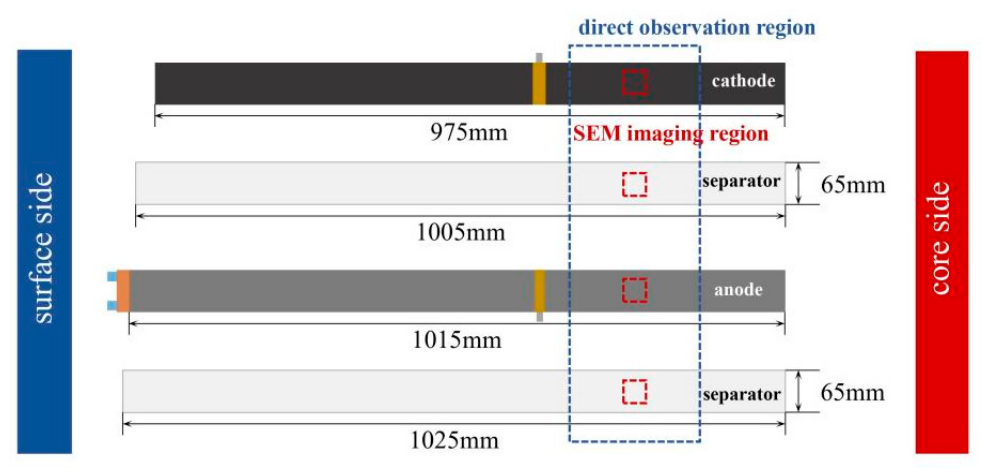
Given the non-uniform internal temperature field in wound cylindrical cells—and prior reports that the core region is more susceptible to aging due to elevated temperatures/stress—the present study focuses on the structural evolution of the cathode, anode, and separator near the cell core. Figure 17 specifies the dimensions of each functional layer and the key sampling locations, providing a spatial reference for morphology analysis.

3.4.1. Direct Morphology Comparison

The cathode active material is LiNi0.8Co0.15Al0.05O2 (NCA), and the anode active material is a silicon/carbon composite (Si/C), coated on Al and Cu current collectors, respectively. As shown in Figure 18, the fresh cell exhibits uniformly coated cathode and anode sheets with compact, dense microstructures, primarily attributable to good electrolyte wetting.
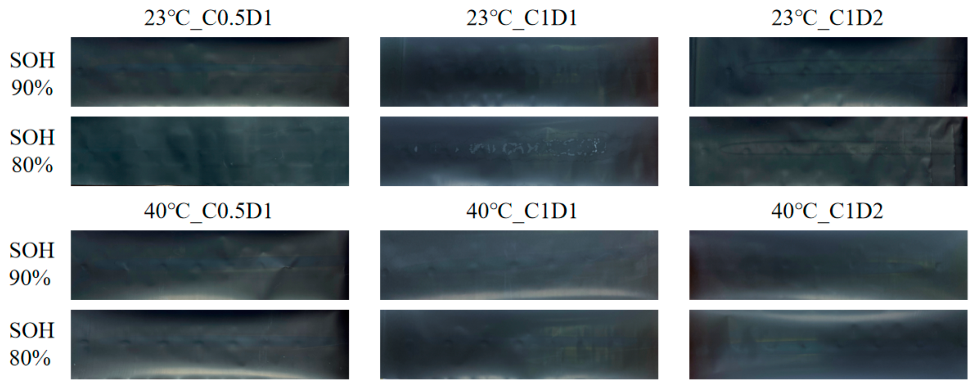
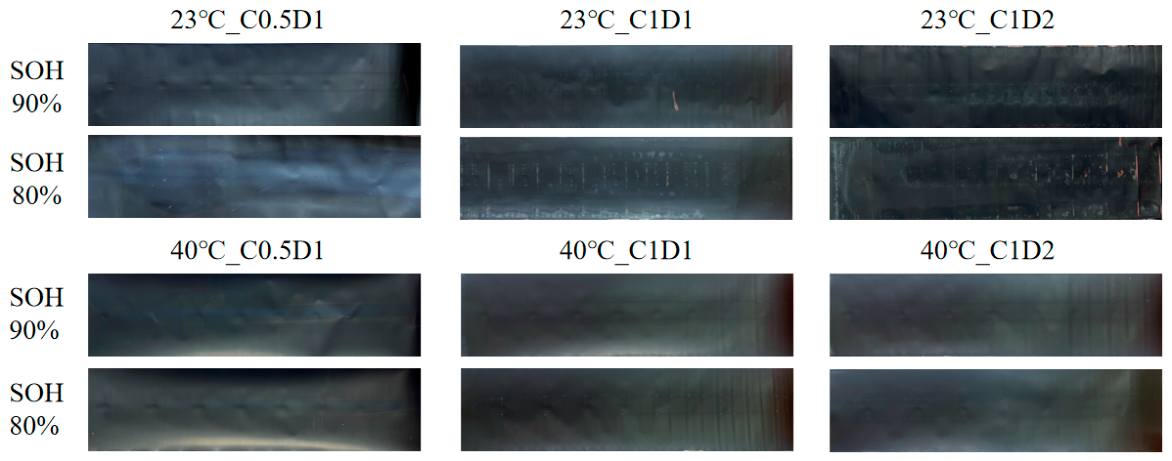
Figure 19 shows morphology degradation of the aged cathode sheets—wrinkling, dimples, and coating delamination—relative to fresh electrodes. Under 23 °C_C1D2 (SOH = 80%), wrinkles are most pronounced, consistent with intensified electrolyte decomposition driven by discharge-induced temperature rise at a high C-rate; the coating near the wound core exhibits severe drying cracks, reflecting non-uniform aging caused by radial/axial temperature gradients. Under 23 °C_C0.5D1, prominent dimples are observed, attributable to mechanical stress from expansion/contraction over long cycling and contact degradation, leading to increased impedance. Under 23 °C_C1D1, local material loss is evident, likely due to the combined effects of stress and electrolyte decomposition causing partial cathode–separator separation. At 40 °C, deformation is milder across C-rates, and the aged morphology is more uniform along both radial and axial directions.
As shown in Figure 20, aged anodes display material detachment and signs of lithium plating. Under 23 °C_C1D1/C1D2 (SOH = 80%), material detachment is pronounced and accompanied by slight lithium deposits (silvery-white), indicating that at a high C-rate, plated Li reacts with the electrolyte to form a passivating film, causing active Li loss and deteriorating liquid retention, which, in turn, aggravates active material peeling. Long-cycle conditions (e.g., 23 °C_C0.5D1) exhibit the poorest liquid retention. Under 40 °C, deformation is moderate, and aging is comparatively uniform; although electrolyte drying is observed under C1D1/C1D2, lithium plating is not detected.

3.4.2. Micromorphology Comparison

(1)
Cathode.
The NCA cathode is a ternary derivative of lithium nickel oxide (LiNiO2), formulated as LiNi0.8Co0.15Al0.05O2; the Ni/Co/Al ratio strongly influences electrochemical performance. As shown in Figure 21, fresh NCA consists of polycrystalline secondary particles formed by agglomeration of primary particles.
During cycling, Li-ion insertion/extraction induces lattice distortion and contraction, triggering intra-particle cracking and weakening inter-particle cohesion, thereby reducing electronic conductivity and exacerbating SOC heterogeneity. Newly exposed surfaces undergo persistent parasitic reactions with the electrolyte, accelerating particle pulverization. At high charging voltages, oxidation of Ni2+ to higher valence states (Ni3+/Ni4+) can destabilize the layered structure and promote slab collapse, leading to increased impedance and a shortened cycle life.
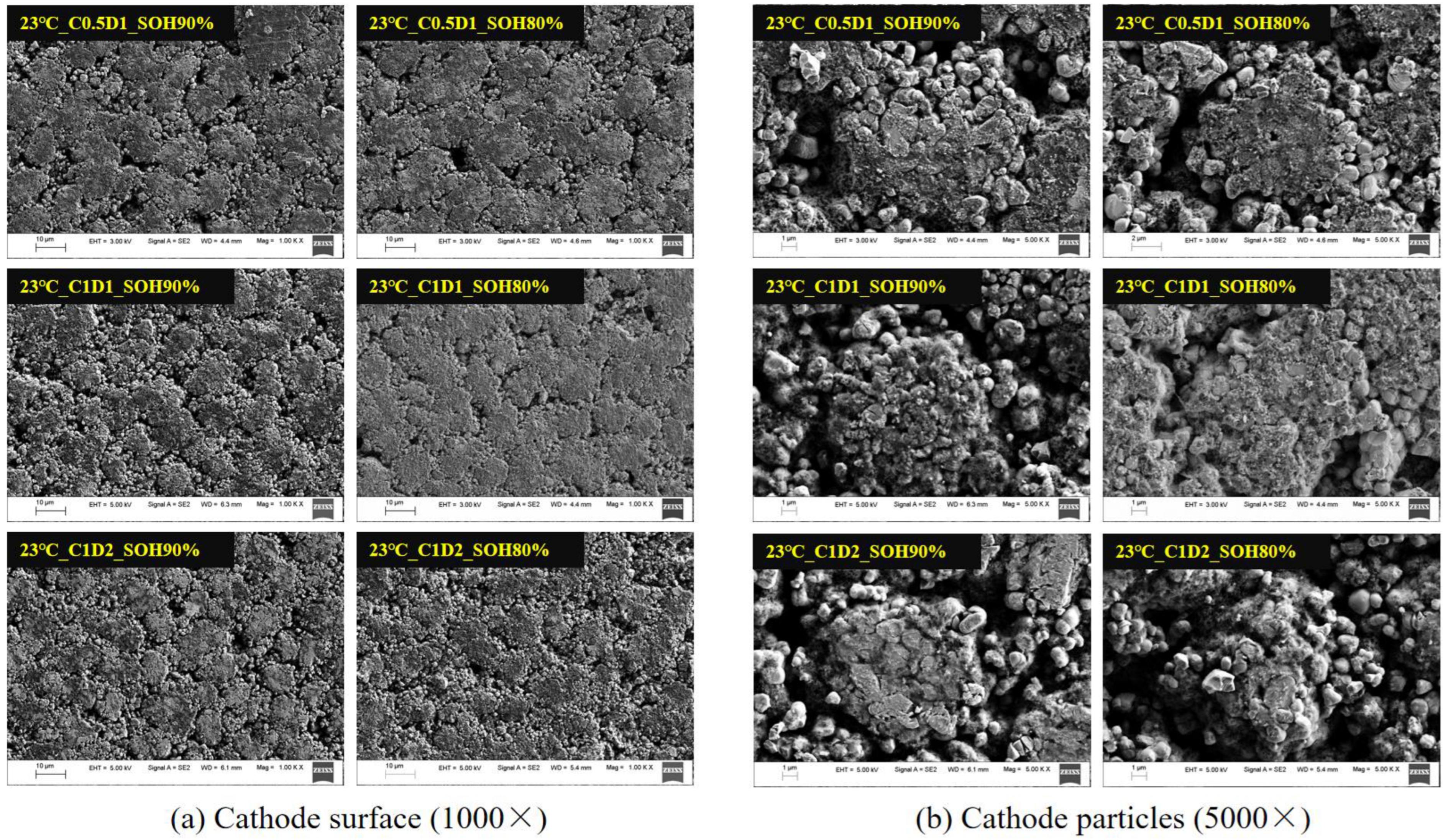
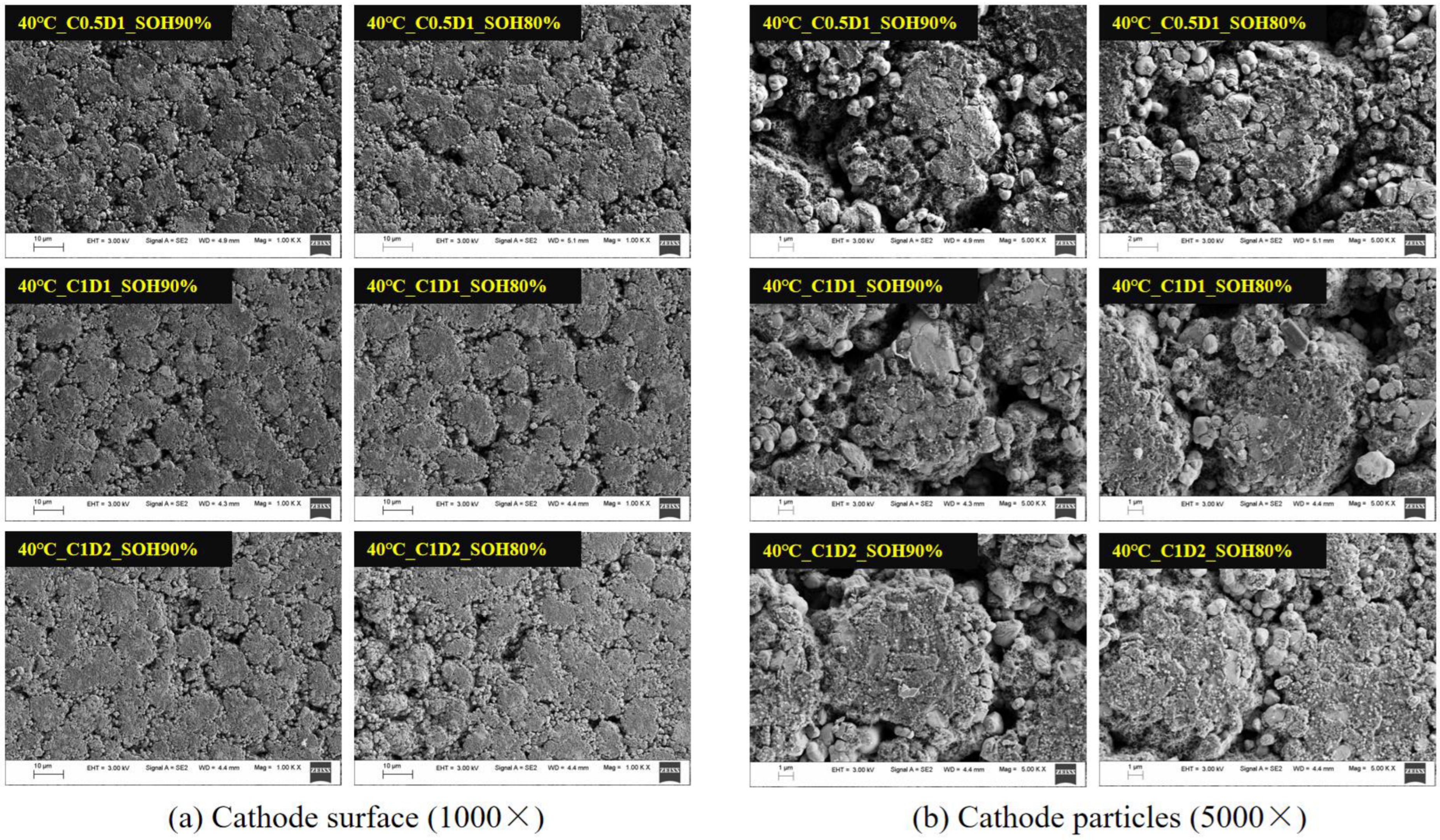
Figure 22 and Figure 23 reveal that, at 23 °C, the cathode particles remain largely intact at SOH = 90%. By SOH = 80%, condition-dependent divergence emerges: for C1D2, particles exhibit severe cracking with adherent primary fragments; for C1D1, extensive particle pulverization is observed; and for C0.5D1, deformation is mild. At 40 °C, degradation accelerates markedly—distinct pulverization is already present at SOH = 90%: C1D2 suffers the most severe structural collapse, whereas C1D1/C0.5D1 retain partial integrity. These observations indicate that elevated temperature substantially undermines cathode structural stability and that the pulverization severity increases with the C-rate.
(2)
Anode.
Degradation of the Si/C anode arises from the intrinsic deterioration of silicon particles and from electrode-level decay. The former is governed by Si particle size/morphology and charge/discharge utilization; the latter depends on the Si/graphite ratio. In the fresh anode (Figure 24), white Si particles are distributed on a graphite matrix. Repeated lithiation/delithiation induces cracks that degrade active material/electrolyte and active material/current collector contacts, increasing internal resistance and causing capacity loss. Crack propagation promotes Si agglomeration, which accelerates SEI growth and lithium consumption, thereby hastening performance fade.
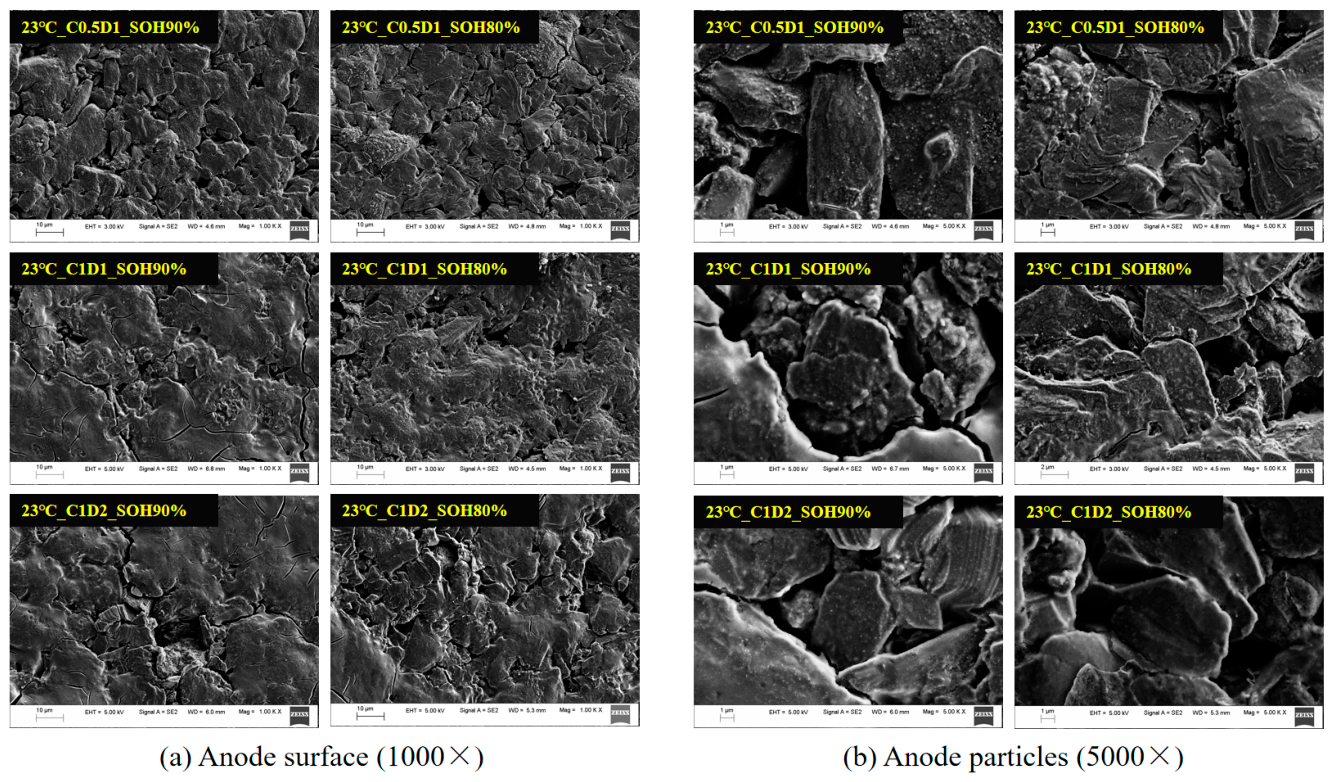
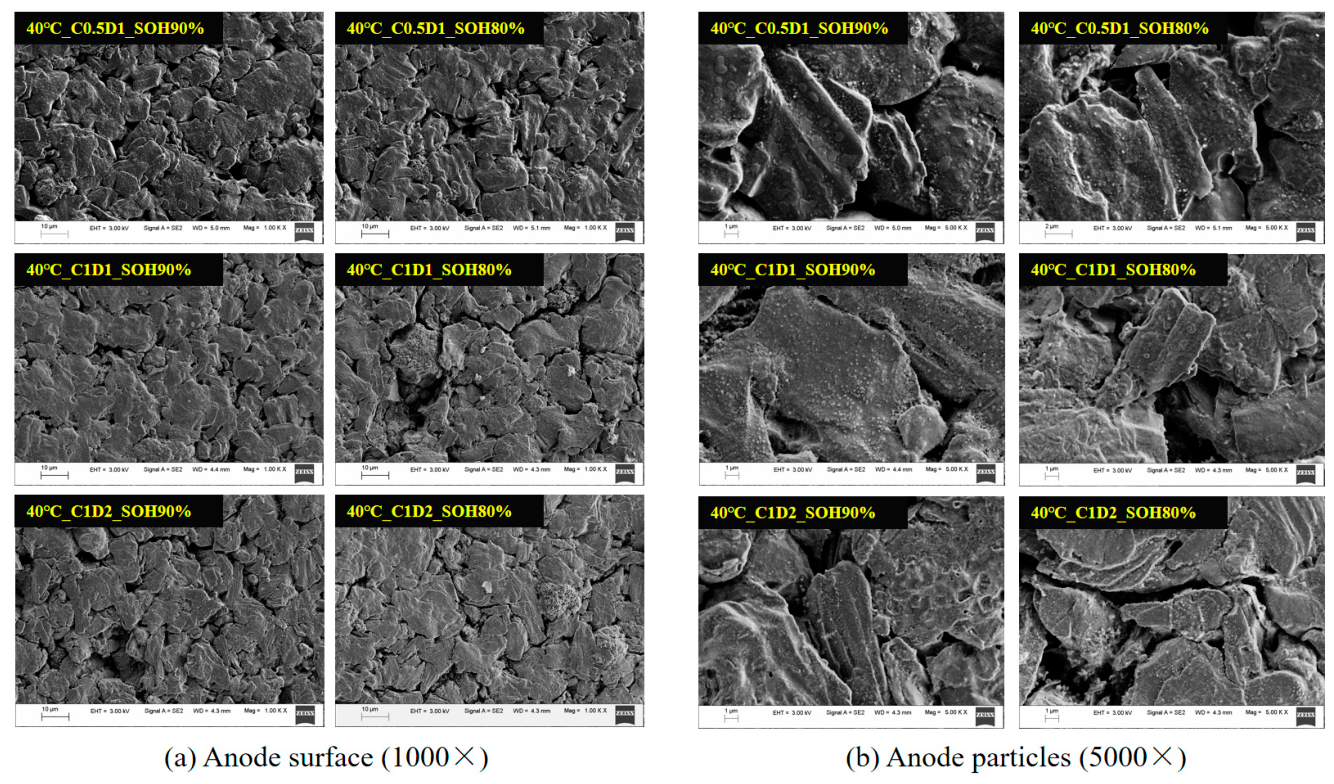
Figure 25 and Figure 26 show that with aging, an SEI deposition layer forms on the Si/C anode surface and progressively obscures the graphite texture. At SOH = 90%, the 23–C1D1/C1D2 samples exhibit a thick SEI with cracks (possibly associated with high-rate lithium plating), whereas at 40 °C, the deposition is more uniform and crack-free at the same C-rates. At lower C-rates (C0.5D1), deposition is lighter, and the graphite framework remains discernible. By SOH = 80%, the SEI layer thickens across all conditions (with the smallest impact at 40–C0.5D1). In the high-rate samples (23–C1D1/C1D2), Si particles are already indistinct at SOH = 90%, indicating loss of activity; by SOH = 80%, Si particles are scarcely visible for all conditions, confirming that long cycling together with SEI growth synergistically accelerates Si failure, consistent with recent studies on SEI aging in Si/C- and SiOx-based anodes.
(3)
Separator.
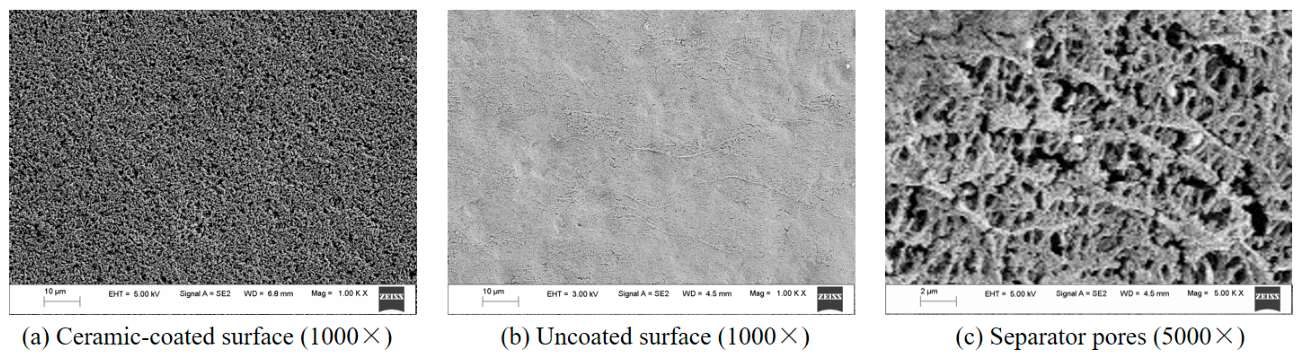
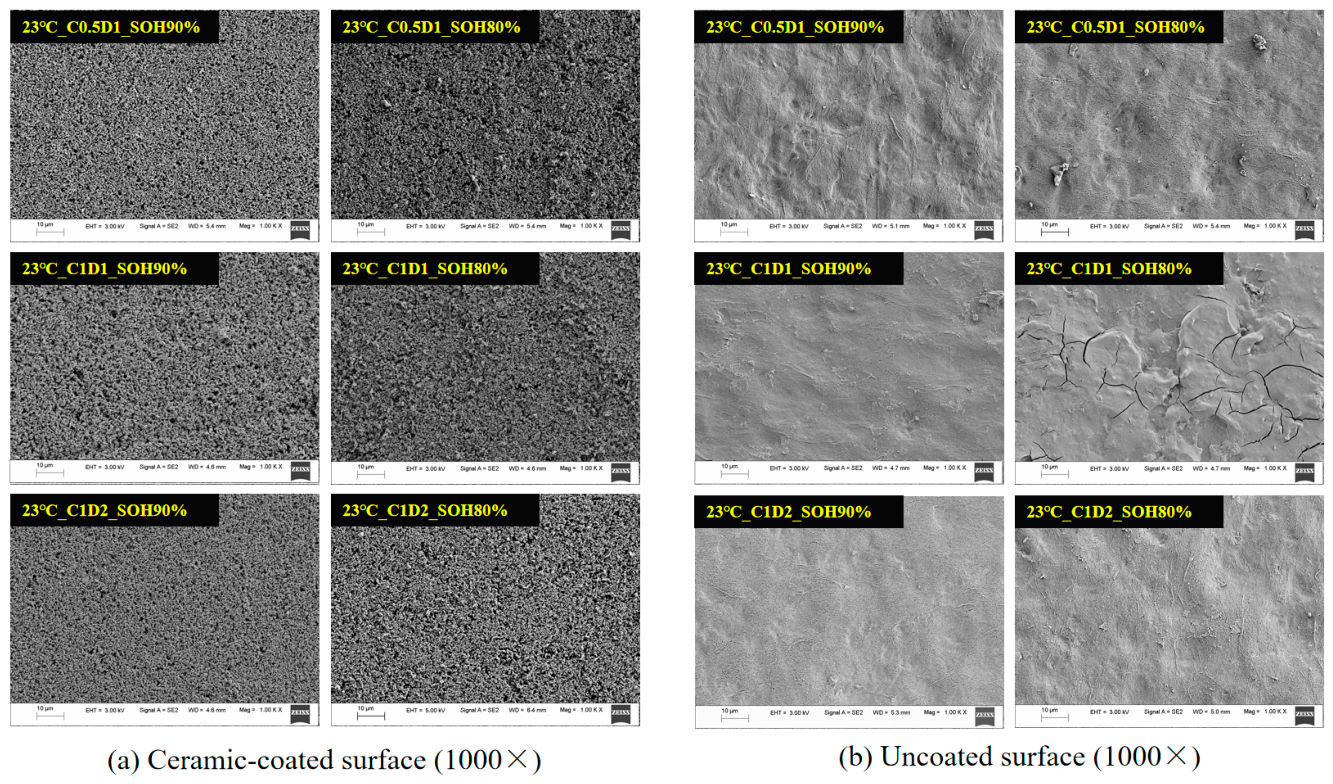
The separator prevents short circuits between electrodes and regulates Li+ transport, thereby directly affecting cycle life and rate capability. Given the insufficient thermal stability of polyolefin separators, a single-sided ceramic coating is employed to enhance safety (Figure 27): the coated face comprises nano-sized cubic particles, while the uncoated face is relatively flat with well-defined pores, effectively improving high-temperature short-circuit resistance.
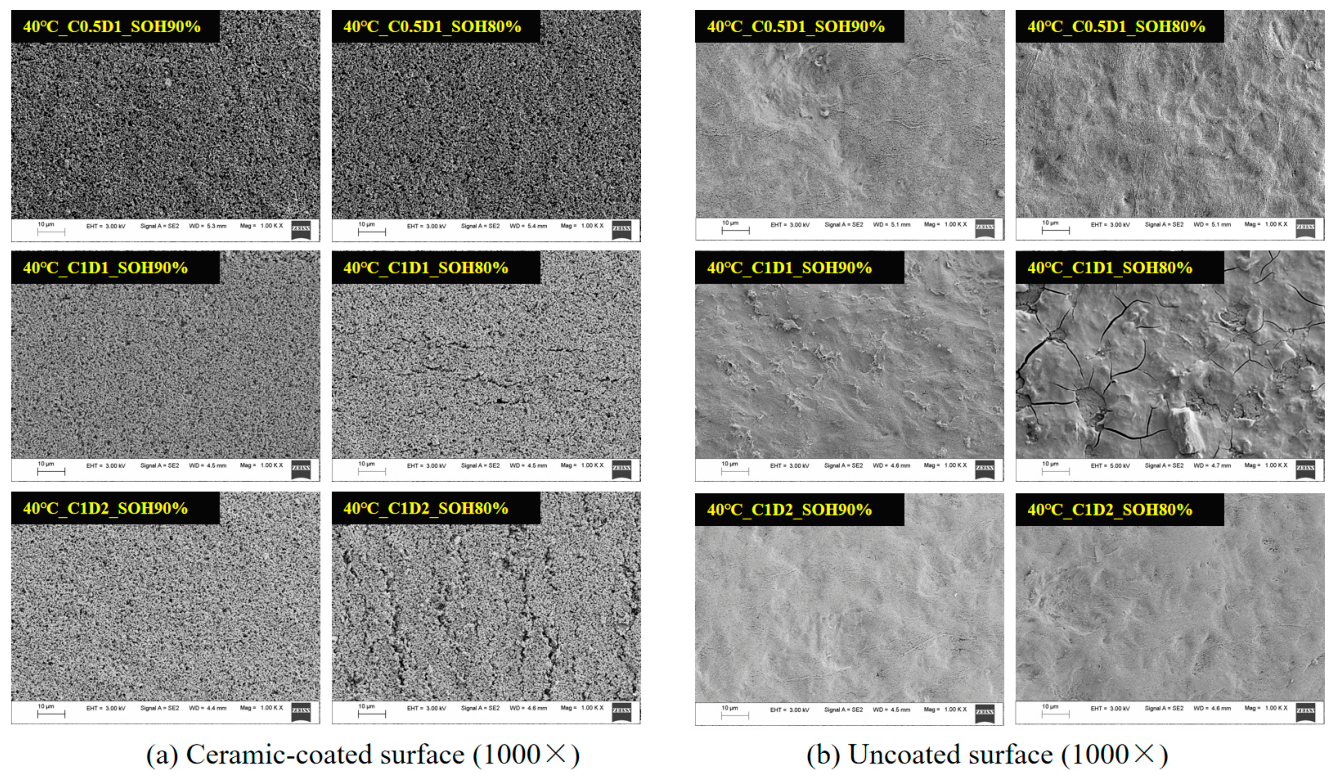
Figure 28 and Figure 29 indicate morphology degradation in aged separators: the ceramic layer exhibits particle shedding, agglomeration, fracture, and cracking, which weaken mechanical strength and hinder ion diffusion. Changes are minor at SOH = 90% but become pronounced at SOH = 80%: under 23–C0.5D1, long cycling leads to marked particle agglomeration; under 40–C1D2, high-rate stress causes the most severe particle fragmentation. On the uncoated face adjacent to the anode, deposition accumulates with aging, clogging pores and increasing resistance; the layer thickens and cracks with further aging (e.g., the cracking observed at 40–C1D1 at SOH = 80% likely originates from anode material loss and internal stress), significantly impairing ion transport.
In summary, aging is accompanied by electrolyte depletion, cathode particle pulverization, failure of silicon particles and thickening of surface deposits on the anode, as well as ceramic layer damage and pore blockage in the separator. Comparative micromorphology across aging conditions deepens our understanding of how the degradation trajectory reshapes cell architecture and provides a basis for analyzing thermal runaway mechanisms. Table 2 summarizes the extent of morphological impact on each component under different aging conditions; a larger number of “★” symbols denotes a more pronounced effect.

3.5. Semi-Empirical Aging Law and Predictive Aging Model

To enable lifetime prediction from the experimental trends, the condition-averaged experimental results were further converted into a semi-empirical aging law framework. Because the tested temperature window contains both low-temperature lithium-plating-dominated aging and high-temperature side reaction/structural aging, a single monotonic Arrhenius expression is not sufficient. Therefore, the model was formulated in a condition-specific form, with the aging condition i representing each temperature–C-rate combination.
Q l o s s , i ( N ) = 1 SOH i ( N ) = a i N b i
N E O L , i = 0.20 a i 1 / b i
R 10 s , i ( N ) = R 10 s , 0 , i + c i Q l o s s , i ( N ) + d i Q l o s s , i 2 ( N )
q a v g , i ( N ) = q a v g , 0 , i 1 + n i Q l o s s , i ( N )
In these equations, N is the cycle number or aging segment number, ai and bi are fitted capacity fade coefficients, NEOL,i is the predicted cycle number at SOH = 80%, ci and di describe resistance growth as a function of capacity loss, and ηi describes the heat generation amplification per unit capacity fade. The equations are intended as an application-oriented predictor for BMS and second-life screening rather than a universal chemistry-independent law.
The proposed model reflects the mechanisms identified in Section 3.1, Section 3.2, Section 3.3 and Section 3.4. At 0 °C, a high bi and a strong increase in ZW/R10s indicate accelerated late-stage aging associated with polarization and possible lithium plating. At 40 °C, larger ci, di, and ηi reflect stronger interfacial and charge-transfer resistance growth and larger heat generation amplification. At 23 °C_C0.5D1, smaller ai and ηi correspond to the most stable trajectory in the tested matrix. Thus, the model not only predicts SOH and EOL but also retains a mechanistic interpretation through resistance and heat generation parameters.
For practical use, the coefficients can be updated from periodic RPTs or scheduled BMS diagnostic pulses by least squares fitting. Once the feature vector xk = [SOHk, R10s, RΩ, RSEI, Rct, ZW, LLI, LAMne, LAMpe, Htotal, qavg] is updated, the remaining useful life can be extrapolated from the fitted Qloss,i(N) curve, while the thermal safety margin can be adjusted using qavg,i(N). The complete fitted coefficient table will be released together with the open dataset because the coefficients are directly tied to the full numerical trajectories.

3.6. Potential Influence of Humidity and Environmental Boundary Conditions

Humidity was not an independent variable in the present cycling matrix. The experiments used commercial hermetically sealed 21,700 cells, and the climatic chamber was used primarily to control ambient temperature. Therefore, the conclusions should be interpreted as temperature–C-rate aging results under sealed-cell conditions, not as a full environmental aging map that includes humidity.
Nevertheless, humidity can influence lithium-ion cell aging through several pathways. During cell manufacturing or after imperfect sealing, residual or penetrating moisture can react with LiPF6-based electrolyte salts to generate acidic species such as HF, deteriorate SEI/CEI chemistry, increase DCIR, and accelerate transition-metal dissolution or surface degradation. Moisture absorption by electrodes and separators can also alter interfacial wettability and ionic transport. These effects are particularly relevant for long-term storage, module-level sealing, pack condensation, and recycling/second-life handling, where cells or components may be exposed to humid air [19,20,21].
Because humidity was not actively controlled in this work, it is not included as a fitting variable in the semi-empirical model above. Future work should extend the present temperature–C-rate matrix by adding relative humidity levels and by monitoring internal moisture-related signatures, gas generation, insulation resistance, and post-mortem evidence of corrosion or HF-driven surface attack. Such data would allow the model to be expanded from Q_loss,i(N,T,C) to Q_loss(N,T,C,RH), where RH is relative humidity.

3.7. Limitations and Future Work Regarding DOD/SOC Variation and Humidity-Controlled Aging

The temperature dimension of this study contains three discrete setpoints (0 °C, 23 °C, and 40 °C). Consequently, the results can compare the aging trajectories at these selected points, but they cannot define a continuous aging response surface or a genuine global optimum temperature. Intermediate setpoints such as 30 °C or 35 °C, and finer rate combinations, should be included in future work to quantify the curvature of the temperature–rate response.
The upper setpoint of 40 °C represents an elevated but not extreme thermal boundary for sealed 21,700-cell cycling. In real packs, summer solar soaking, poor ventilation, local hot spots, or thermal management failure can expose cells to temperatures above 40 °C. At such temperatures, additional mechanisms may become important, including accelerated gas generation, binder softening or decomposition, stronger electrolyte oxidation, separator shrinkage, and more severe transition-metal dissolution. Therefore, the present conclusions should not be extrapolated to >40 °C without additional experiments.
The present matrix intentionally fixed the DOD at approximately 100% to isolate the coupled effects of ambient temperature and the C-rate under a common full-voltage-window protocol. Additional DOD levels or dynamic daily SOC profiles were not included because the study already involved 27 cells, repeated RPT/EIS/ARC diagnostics, and destructive post-mortem sampling, which limited the feasible factorial design. This design choice limits direct extrapolation to partial-DOD duty cycles. Future work will extend the protocol to partial-DOD windows, especially 20–80% and 10–90% SOC, and to dynamic driving/storage profiles so that the mechanism-aware framework can be parameterized for real-world BMS duty cycles. In addition to DOD/SOC window variation, humidity-controlled aging is identified as an important future extension because moisture ingress or residual moisture can interact with electrolyte decomposition and interfacial aging.

4. Conclusions

In this work, commercial high-nickel NCA/Si–C cylindrical cells (Samsung INR21700-50E) were subjected to systematic aging at 0/23/40 °C and 0.5C/1C/2C. Capacity fade, DCIR/EIS, ICA/DVA-based aging mode analysis, ARC heat generation, and post-mortem SEM were combined to obtain a comprehensive picture of degradation. The main conclusions are:
(1)
Capacity fade is highly sensitive to both temperature and charge/discharge rate programs, but the data support only a discrete matrix comparison rather than a continuous optimum temperature law. Within the tested range, 23 °C_C0.5D1 gives the best cycle life, while the high-rate programs show longer life at 40 °C than at 23 °C. At 0 °C, capacity fade is the fastest and accelerates in the late stage, consistent with low-temperature aging dominated by strong polarization and possible lithium deposition [5].
(2)
Impedance evolution shows strong temperature dependence: at 0 °C, aging is characterized by rapid increases in diffusion and ohmic resistance; at 40 °C, growth in interfacial and charge-transfer resistance dominates. DCIR and EIS fitting show that all resistance components increase with capacity fade but with different dominant contributions, leading to distinct impacts on power capability and heat generation [4,16].
(3)
With careful implementation of ICA/DVA best practices, the main aging modes can be distinguished: LLI-dominated at 0 °C (with uncertain but non-negligible LAM_ne), LAM_ne-dominated with secondary LLI and late-stage LAM_pe at 23 °C, and LAM_pe-dominated in the later stage at 40 °C. For 0 °C, negative peak broadening and overlap cause considerable uncertainty in LAM_ne, so the results are used only qualitatively, in agreement with ICA best practice recommendations [9].
(4)
ARC tests clearly show that aging significantly amplifies both total heat generation and average heat power at the same operating condition, with the magnitude controlled by temperature and the C-rate. As SOH decreases from 100% to ~80%, total heat typically increases by 15–30% and average power by 25–60%, with the largest increases at high temperatures and high C-rates (e.g., 40 °C_C1D2). This behavior is consistent with previous investigations on heat generation and degradation mechanisms during high-temperature aging [10,16] and highlights the need for stronger thermal management for aged cells.
(5)
Post-mortem SEM confirms the structural degradation pathways of the cathode, anode, and separator under different conditions and correlates well with electrochemical and thermal behavior: a high temperature causes more severe NCA particle cracking, a medium temperature at a high C-rate leads to thick SEI and loss of active Si on the anode, and long-cycle/high-temperature conditions induce ceramic coating damage and pore blockage in separators [6,14,22,23].
(6)
A semi-empirical aging-law framework was formulated from the condition-averaged trajectories. The model links capacity fade evolution, DCIR growth, and heat generation amplification, thereby providing a practical route for SOH estimation, EOL prediction, and thermal safety screening in BMS applications. Humidity is treated as a limitation and future variable; it was not independently controlled in the present sealed-cell experiments but may accelerate aging through moisture-induced electrolyte and interfacial degradation.
From the integrated results, three aging management principles can be derived. First, capacity alone is insufficient for second-life or safety screening; resistance growth, heat generation amplification, and mechanism indicators should be evaluated together. Second, low-temperature operation should be accompanied by stricter current limitation because polarization-driven degradation can produce rapid late-stage capacity loss and resistance rise. Third, aged cells should receive condition-dependent thermal derating because cells with similar SOH can generate different heat loads depending on whether their history is dominated by lithium loss, interfacial resistance growth, or positive electrode structural damage. These principles directly support BMS control logic, lifetime prediction, thermal management calibration, and second-life sorting of high-nickel NCA/Si–C cells.
Overall, the study links capacity fade, impedance evolution, ICA/DVA-derived aging modes, heat generation characteristics, and microstructural degradation within a unified experimental framework and demonstrates that high-nickel NCA/Si–C 21,700 cells follow distinct degradation pathways under different temperature–C-rate combinations, with clear consequences for thermal safety and lifetime.

Author Contributions

Conceptualization, R.H.; methodology, R.H., X.L. and Z.C.; software, J.Z. and X.L.; validation, J.C., X.L. and Z.C.; formal analysis, J.Z., Y.X. and M.J.; investigation, J.C., Y.X. and W.L.; resources, J.C., W.L. and Z.C.; data curation, J.Z., J.C., W.L. and X.Y.; writing—original draft preparation, J.Z.; writing—review and editing, R.H. and M.J.; visualization, J.Z., Y.X. and M.J.; supervision, R.H.; project administration, R.H. and X.Y.; funding acquisition, R.H. All authors have read and agreed to the published version of the manuscript.

Funding

This research was funded by the Zhejiang Provincial Natural Science Foundation, grant number LD25E070002.

Data Availability Statement

The data presented in this study are available from the corresponding author upon reasonable request.

Acknowledgments

The authors gratefully acknowledge the support of the Zhejiang Provincial Natural Science Foundation.

Conflicts of Interest

The authors declare no conflicts of interest. The funders had no role in the design of the study; in the collection, analyses, or interpretation of data; in the writing of the manuscript; or in the decision to publish the results.

List of Symbols and Abbreviations

The symbols and abbreviations used throughout the manuscript are summarized to improve readability.
Unit/NoteMeaningSymbol/Abbreviation
capacityampere-hour, cell capacity unitAh
thermal testaccelerating rate calorimeterARC
application contextbattery management systemBMS
fresh statebeginning of lifeBOL
protocolconstant-current–constant-voltage chargingCC–CV
interface layercathode electrolyte interphaseCEI
mΩ or Ωdirect-current internal resistanceDCIR
%depth of dischargeDOD
dV/dQdifferential voltage analysisDVA
frequency-domain testelectrochemical impedance spectroscopyEIS
SOH ≈ 80% in this workend of lifeEOL
pulse testhybrid pulse power characterizationHPPC
dQ/dVincremental capacity analysisICA
aging modeloss of active material in the negative electrodeLAM_ne
aging modeloss of active material in the positive electrodeLAM_pe
aging modeloss of lithium inventoryLLI
SOH ≈ 90% in this workmid-of-lifeMOL
cell chemistryLiNiCoAlO2-based nickel–cobalt–aluminum oxide cathodeNCA
quasi-equilibrium curvepseudo-open-circuit voltagepOCV
Ω10 s direct-current internal resistanceR10s
Ωcharge-transfer resistanceR_ct
ΩSEI/film resistanceR_SEI
Ωohmic resistance
diagnostic testreference performance testRPT
interface layersolid electrolyte interphaseSEI
morphology testscanning electron microscopySEM
%state of chargeSOC
%state of healthSOH
Ω s−1/2 or fitted parameterWarburg-type diffusion impedanceZ_W
Waverage heat generation powerq_avg
dimensionless or %Capacity fade ratioQ_loss
dimensionlessgrowth rate of average heat generation power normalized by capacity fadeξki
used in condition labelsrate program with 0.5C CC charge and 1C CC dischargeC0.5D1
used in condition labelsrate program with 1C CC charge and 1C CC dischargeC1D1
used in condition labelsrate program with 1C CC charge and 2C CC dischargeC1D2
notation definitiongeneral rate program notation; x is charge C-rate and y is discharge C-rateCxDy

References

  1. Morales-Torricos, P.; Endisch, C.; Lewerenz, M. Apparent aging during accelerated cycling aging test of cylindrical silicon containing Li-ion cells. Batteries 2023, 9, 230. [Google Scholar] [CrossRef]
  2. Guo, B.; He, R.; Li, Y.; Zhou, S.; Zhang, L.; Liu, X.; Yang, S. Aging mechanisms of cylindrical NCA/Si-graphite battery with high specific energy under dynamic driving cycles. J. Energy Storage 2024, 103, 114287. [Google Scholar] [CrossRef]
  3. Benavente-Araoz, F.A.; Ko, J.Y.; Lundblad, A.; Ekström, H.; Lindbergh, G. An aging study of NCA/Si-graphite lithium-ion cells for off-grid photovoltaic systems in Bolivia. J. Electrochem. Soc. 2021, 168, 100526. [Google Scholar] [CrossRef]
  4. Wu, K.; Wu, X.; Lin, Z.; Sun, H.; Wang, M.; Li, W. Identifying the calendar aging boundary and high temperature capacity fading mechanism of Li ion battery with Ni-rich cathode. J. Power Sources 2024, 589, 233736. [Google Scholar] [CrossRef]
  5. Petzl, M.; Kasper, M.; Danzer, M.A. Lithium plating in a commercial lithium-ion battery: A low-temperature aging study. J. Power Sources 2015, 275, 799–807. [Google Scholar] [CrossRef]
  6. Park, K.-J.; Hwang, J.-Y.; Ryu, H.-H.; Maglia, F.; Kim, S.-J.; Lamp, P.; Yoon, C.S.; Sun, Y.-K. Degradation mechanism of Ni-enriched NCA cathode for lithium batteries: Are microcracks really critical? ACS Energy Lett. 2019, 4, 1394–1400. [Google Scholar] [CrossRef]
  7. McBrayer, J.D.; Harrison, K.L.; Allcorn, E.; Minteer, S.D. Chemical contributions to silicon anode calendar aging are dominant over mechanical contributions. Front. Batter. Electrochem. 2023, 2, 1308127. [Google Scholar] [CrossRef]
  8. Ohneseit, S.; Finster, P.; Floras, C.; Lubenau, N.; Uhlmann, N.; Seifert, H.J.; Ziebert, C. Thermal and Mechanical Safety Assessment of Type 21700 Lithium-Ion Batteries with NMC, NCA and LFP Cathodes—Investigation of Cell Abuse by Means of Accelerating Rate Calorimetry (ARC). Batteries 2023, 9, 237. [Google Scholar] [CrossRef]
  9. Dubarry, M.; Anseán, D. Best practices for incremental capacity analysis. Front. Energy Res. 2022, 10, 1023555. [Google Scholar] [CrossRef]
  10. Spitthoff, L.; Wahl, M.S.; Lamb, J.J.; Shearing, P.R.; Vie, P.J.S.; Burheim, O.S. On the Relations between Lithium-Ion Battery Reaction Entropy, Surface Temperatures and Degradation. Batteries 2023, 9, 249. [Google Scholar] [CrossRef]
  11. Atalay, S.; Sheikh, M.; Mariani, A.; Merla, Y.; Bower, E.; Widanage, W.D. Theory of battery ageing in a lithium-ion battery: Capacity fade, nonlinear ageing and lifetime prediction. J. Power Sources 2020, 478, 229026. [Google Scholar] [CrossRef]
  12. He, X.; Zhao, C.; Hu, Z.; Restuccia, F.; Richter, F.; Wang, Q.; Rein, G. Heat transfer effects on accelerating rate calorimetry of the thermal runaway of Lithium-ion batteries. Process Saf. Environ. Prot. 2022, 162, 684–693. [Google Scholar] [CrossRef]
  13. Kemeny, M.; Ondrejka, P.; Mikolasek, M. Comprehensive Degradation Analysis of NCA Li-Ion Batteries via Methods of Electrochemical Characterisation for Various Stress-Inducing Scenarios. Batteries 2023, 9, 33. [Google Scholar] [CrossRef]
  14. Qian, G.; Li, Y.; Chen, H.; Xie, L.; Liu, T.; Yang, N.; Song, Y.; Lin, C.; Cheng, J.; Nakashima, N.; et al. Revealing the aging process of solid electrolyte interphase on SiOx anode. Nat. Commun. 2023, 14, 6048. [Google Scholar] [CrossRef] [PubMed]
  15. Zhang, L.; Wen, J.; Chen, G. Application of accelerating rate calorimeter in the lithium-ion battery safety evaluation. J. Integr. Technol. 2015, 4, 45–52. [Google Scholar] [CrossRef]
  16. Shen, W.; Wang, N.; Zhang, J.; Wang, F.; Zhang, G. Heat generation and degradation mechanism of lithium-ion batteries during high-temperature aging. ACS Omega 2022, 7, 44733–44742. [Google Scholar] [CrossRef]
  17. Zhang, G.; Wei, X.; Chen, D.; Wang, X.; Chen, S.; Zhu, J.; Dai, H. Thermal characteristic evolution of lithium-ion batteries during the whole lifecycle. J. Energy Chem. 2024, 92, 534–547. [Google Scholar] [CrossRef]
  18. Stroebl, F.; Petersohn, R.; Schricker, B.; Schaeufl, F.; Bohlen, O.; Palm, H. A multi-stage lithium-ion battery aging dataset using various experimental design methodologies. Sci. Data 2024, 11, 74. [Google Scholar] [CrossRef]
  19. Han, X.; Xia, S.; Cao, J.; Wang, C.; Chen, M. Effect of Humidity on Properties of Lithium-ion Batteries. Int. J. Electrochem. Sci. 2021, 16, 210554. [Google Scholar] [CrossRef]
  20. Kosfeld, M.; Westphal, B.; Kwade, A. Moisture behavior of lithium-ion battery components along the production process. J. Energy Storage 2023, 57, 106174. [Google Scholar] [CrossRef]
  21. Langner, T.; Sieber, T.; Rietig, A.; Merk, V.; Pfeifer, L.; Acker, J. A phenomenological and quantitative view on the degradation of positive electrodes from spent lithium-ion batteries in humid atmosphere. Sci. Rep. 2023, 13, 5671. [Google Scholar] [CrossRef] [PubMed]
  22. Yang, R.; Yu, G.; Wu, Z.; Lu, T.; Hu, T.; Liu, F.; Zhao, H. Aging of lithium-ion battery separators during battery cycling. J. Energy Storage 2023, 63, 107107. [Google Scholar] [CrossRef]
  23. Qian, W.; Wu, S.; Lei, C.; Xu, R.; Wang, Y. Aging Behavior of Polyethylene and Ceramics-Coated Separators under the Simulated Lithium-Ion Battery Service Compression and Temperature Field. Coatings 2024, 14, 419. [Google Scholar] [CrossRef]
Figure 1. Probability distribution of the initial capacities of the 27 cells.
Electronics 15 02563 g001
Figure 2. Flowchart of the cycling aging and heat generation power measurement protocol. In the flowchart, Q denotes the measured discharge capacity, and SOH is calculated as Q/Q0, where Q0 is the initial discharge capacity.
Electronics 15 02563 g002
Figure 3. Field emission SEM and gold sputter coater.
Electronics 15 02563 g003
Figure 4. Discharge capacity vs. cycle number for all cells during cycling aging.
Electronics 15 02563 g004
Figure 5. Evolution of (a) rated discharge capacity and (b) capacity fade rate with cycle number under different conditions.
Electronics 15 02563 g005
Figure 6. DCIR evolution under different conditions as a function of (a) cycle number and (b) capacity fade.
Electronics 15 02563 g006
Figure 7. Representative EIS during aging at 50% SOC under: (a) 0 °C_C0.5D1, (b) 0 °C_C1D1, (c) 0 °C_C1D2, (d) 23 °C_C0.5D1, (e) 23 °C_C1D1, (f) 23 °C_C1D2, (g) 40 °C_C0.5D1, (h) 40 °C_C1D1, and (i) 40 °C_C1D2.
Electronics 15 02563 g007
Figure 8. Fitted impedance elements versus capacity fade under different conditions: (a) ohmic resistance, (b) SEI film resistance, (c) charge-transfer resistance, and (d) Warburg impedance.
Electronics 15 02563 g008
Figure 9. DV and IC curve evolution during aging under: (a,b) 0 °C_C1D1, (c,d) 23 °C_C1D1, and (e,f) 40 °C_C1D1.
Electronics 15 02563 g009
Figure 10. Aging mode identification by DVA under: (a) 0 °C_C0.5D1, (b) 0 °C_C1D1, (c) 0 °C_C1D2, (d) 23 °C_C0.5D1, (e) 23 °C_C1D1, (f) 23 °C_C1D2, (g) 40 °C_C0.5D1, (h) 40 °C_C1D1, and (i) 40 °C_C1D2.
Electronics 15 02563 g010
Figure 11. Aging indices versus capacity fade under different conditions: (a) anode LAM index (LAM_ne), (b) cathode LAM index (LAM_pe), and (c) LLI index.
Electronics 15 02563 g011
Figure 12. Temperature rise rate of fresh cells during adiabatic discharge at 0.5C: (a) raw measurements; (b) filtered data.
Electronics 15 02563 g012
Figure 13. Evolution of heat generation power with cycling under (a) 0 °C_C1D2, (b) 23 °C_C1D1, and (c) 40 °C_C1D1 conditions.
Electronics 15 02563 g013
Figure 14. Growth rate of total heat generated during 0.5C constant-current discharge at (a) mid of life and (b) end of life under different cycling conditions.
Electronics 15 02563 g014
Figure 15. Growth rate of average heat generation power during 0.5C constant-current discharge at (a) mid of life and (b) end of life under different cycling conditions.
Electronics 15 02563 g015
Figure 16. Average heat generation power growth rate ξki for cells cycled under different conditions: (a) BOL to MOL, (b) MOL to EOL, and (c) BOL to EOL.
Electronics 15 02563 g016
Figure 17. Schematic of regions for morphology investigation within the cell.
Electronics 15 02563 g017
Figure 18. Direct morphology of cathode/anode sheets from a fresh cell.
Electronics 15 02563 g018
Figure 19. Direct morphology of cathode sheets after different aging histories.
Electronics 15 02563 g019
Figure 20. Direct morphology of anode sheets after different aging histories.
Electronics 15 02563 g020
Figure 21. Micromorphology of the NCA cathode from a fresh cell.
Electronics 15 02563 g021
Figure 22. Micromorphology of the NCA cathode at different aging states under 23 °C cycling.
Electronics 15 02563 g022
Figure 23. Micromorphology of the NCA cathode at different aging states under 40 °C cycling.
Electronics 15 02563 g023
Figure 24. Micromorphology of the Si/C anode from a fresh cell.
Electronics 15 02563 g024
Figure 25. Micromorphology of the Si/C anode at different aging states under 23 °C cycling.
Electronics 15 02563 g025
Figure 26. Micromorphology of the Si/C anode at different aging states under 40 °C cycling.
Electronics 15 02563 g026
Figure 27. Micromorphology of the ceramic-coated separator in a fresh cell.
Electronics 15 02563 g027
Figure 28. Micromorphology of separators at different aging states under 23 °C cycling.
Electronics 15 02563 g028
Figure 29. Micromorphology of separators at different aging states under 40 °C cycling.
Electronics 15 02563 g029
Table 1. Measurement accuracy and uncertainty sources considered in this study.
Use in AnalysisUncertainty Source ConsideredMain Instrument/SourceQuantity
SOH and capacity fade trajectoriescurrent accuracy, voltage cutoff, time base, replicate variationNeware CT-4008 battery testerCapacity Q
power capability and aging indicatorvoltage response ΔU, pulse current accuracy, SOC rest repeatabilityCurrent pulse and voltage responseR10s/DCIR
separation of ohmic, interfacial, and charge-transfer componentsAC amplitude, frequency response, equivalent-circuit fitting residualsElectrochemical workstationEIS parameters
total heat and average heat generation powerthermocouple calibration, cell mass, heat capacity, smoothing/derivative windowARC, T-type thermocouples, NI moduleTemperature and heat power
definition of ambient-temperature aging conditionsetpoint stability and cell equilibration timeESPEC climatic chamberTemperature control
Table 2. Comparative results illustrating how different aging histories affect the morphology and structure of aged cells.
Aging
Condition
SOHElectrolyte
Loss
Cathode
Detachment
Cathode
Pulverization
Si
Detachment
Anode
Deposit
Ceramic
Damage
Separator
Deposit
23 °C_C0.5D1SOH90%★★★★
23 °C_C0.5D1SOH80%★★★★★★★★★★★★
23 °C_C1D1SOH90%★★★★
23 °C_C1D1SOH80%★★★★★★★★★★
23 °C_C1D2SOH90%★★★★★★
23 °C_C1D2SOH80%★★★★★★★★
40 °C_C0.5D1SOH90%★★
40 °C_C0.5D1SOH80%★★★★
40 °C_C1D1SOH90%★★★★★★
40 °C_C1D1SOH80%★★★★★★★★★★★★
40 °C_C1D2SOH90%★★★★★★
40 °C_C1D2SOH80%★★★★★★★★★★★★
A larger number of stars indicates a more pronounced effect.
Disclaimer/Publisher’s Note: The statements, opinions and data contained in all publications are solely those of the individual author(s) and contributor(s) and not of MDPI and/or the editor(s). MDPI and/or the editor(s) disclaim responsibility for any injury to people or property resulting from any ideas, methods, instructions or products referred to in the content.