Article

Coordinated Control of Dynamic Zoning and Load Shedding for Enhancing Fault Recovery of High-Penetration Renewable Distribution Network

1
School of Electrical and Electronic Engineering, Shandong University of Technology, Zibo 255000, China
2
Electric Power Research Institute of State Grid Shandong Electric Power Company, Jinan 250002, China
*
Author to whom correspondence should be addressed.
Electronics 2026, 15(12), 2542; https://doi.org/10.3390/electronics15122542 (registering DOI)
Submission received: 8 May 2026 / Revised: 30 May 2026 / Accepted: 1 June 2026 / Published: 9 June 2026

Abstract

With the increasing penetration of distributed renewable energy, distribution networks face severe operational challenges during grid faults, where rapid power restoration and system stability are crucial. Traditional fault restoration strategies often rely on static dynamic zoning or simple power balancing, neglecting the critical electrical interactions among nodes. To address these limitations, this paper innovatively proposes a hierarchical coordinated control framework for distribution network fault recovery, combining dynamic zoning and coordinated load shedding. The core novelty of this research lies in integrating the node electrical correlation degree into the load grading process to assist in coordinating dynamic network dynamic zoning. By comprehensively evaluating real-time power flow, the regulation capabilities of distributed resources, and intra-region electrical correlations, the proposed framework adaptively optimizes both the zoning structure and the load shedding sequence. Simulation results demonstrate that, compared with conventional static or uncoordinated methods, the proposed approach significantly minimizes load loss while improving grid recovery efficiency and voltage stability. Ultimately, this coordinated control strategy effectively enhances the resilience and operational safety of high-penetration renewable distribution networks, providing robust support for distribution network operations under a high proportion of renewable energy integration.

1. Introduction

As the penetration rate of distributed renewable energy sources in distribution networks gradually increases, the challenges faced by power grids become increasingly complex [1,2,3]. Although distributed energy resources play a significant role in mitigating climate change and promoting energy transition, their volatility and uncertainty pose severe challenges to the safe and stable operation of power grids [4,5,6]. Furthermore, such renewable energy uncertainties can heavily affect system dispatch schemes [7], particularly during grid faults. Due to the unbalanced allocation of loads and power resources, traditional grid dispatch methods often fail to restore power supply in a timely and effective manner, resulting in prolonged post-fault recovery processes and potentially exacerbating grid stability issues [8,9]. Consequently, how to achieve rapid restoration and stable operation through dynamic zoning and rational load shedding strategies during grid faults has become an important research topic in the field of power systems [10,11].
To address this challenge, dynamic zoning technology, as an effective means of network management, can dynamically adjust the regional structure of a distribution network based on real-time power flow calculations and voltage/frequency variations when a fault occurs [12,13]. Against this background, reference [14] proposed a robust dynamic zoning method that combines the stochastic characteristics of wind turbine output, using the Wasserstein distance and the modularity index from community theory to achieve dynamic zoning for reactive power–voltage control in power grids. Reference [15] proposes a dynamic network dynamic zoning method based on an improved genetic algorithm (IGA) and depth-first search (DFS), employing an adaptive update mechanism to overcome the limitations of traditional fixed-interval dynamic zoning updates, effectively enhancing system adaptability and computational efficiency under renewable energy fluctuations, load demand changes, and grid topology variations. Reference [16] proposed a network dynamic zoning method based on a community detection algorithm. By performing node voltage sensitivity analysis, the distribution network is divided into multiple clusters/communities, and fast voltage control is achieved through a combination of minimum reactive power compensation and active power curtailment strategies, thereby effectively solving the voltage regulation problem caused by reverse power flow after photovoltaic integration. Reference [17] proposed a novel distributionally robust optimization model for an electricity–gas coupled distribution network that considers demand response uncertainty and the dynamic characteristics of natural gas linepack. By combining chance constraints and the Wasserstein distance, the model optimizes the dynamic dispatch of the electricity–gas coupled system, improving system reliability and effectively reducing operating costs. Reference [18] proposed a method for calculating cross-voltage-level sensitivity considering transformer and converter losses. Based on this, a multi-indicator evaluation system including coupling degree, dispersion degree, and power balance degree was constructed. A genetic algorithm was used to perform dynamic zoning and leader node selection for AC/DC distribution networks to achieve efficient distributed voltage control. Reference [19] proposed a method for dynamic zoning smart distribution networks and identifying islands based on reachability matrices. By constructing the adjacency matrix and reachability matrix of the distribution network and combining logical operations, the method quickly determines regional characteristics and island extents, providing an effective tool for the study of islanding operation control and protection of distribution networks.
Moreover, load shedding, as an essential measure in the fault restoration process, must be performed scientifically according to the structural characteristics of the distribution network [20,21,22]. Reference [23] proposed a hierarchical optimized load shedding strategy for receiving-end power grids. By establishing a cross-voltage-level hierarchical model and employing an improved particle swarm optimization algorithm and an AHP-fuzzy comprehensive evaluation method, fast load shedding is achieved when faults occur. Reference [24] proposed a fault restoration strategy for active distribution networks considering load control participation. Based on an adaptive load control model, fast load shedding and island formation are performed. Combined with distribution network reconfiguration, the strategy aims to minimize network losses and the number of switching operations, and is solved using the NSGA-II algorithm, significantly improving the efficiency and robustness of fault restoration. Reference [25] proposed a novel load shedding scheme that accounts for the active power response capability of distributed energy resources. By combining the reserve power and power injection ramp rates of DERs, the amount of load to be shed is determined, thereby ensuring that frequency does not exceed critical thresholds and effectively avoiding frequency collapse in microgrids. Reference [26] proposed a power supply restoration strategy for distribution networks considering load classification and islanding operation. By determining the islanding scope and employing a breadth-first search algorithm and the Hungarian algorithm to optimize power restoration, the strategy prioritizes the supply to critical loads, avoiding the inadvertent shedding of important loads during restoration, thereby improving system restoration speed and stability.
However, existing dynamic zoning methods mostly focus on voltage control and reactive power regulation, and have not fully considered the coordination between load shedding and grid stability. As a key link in fault restoration, the load shedding strategy must be scientifically graded and adjusted based on the electrical topological characteristics of the distribution network. Traditional load classification methods often neglect the critical role of node electrical coupling during faults, and therefore cannot effectively guarantee the efficiency and stability of grid fault restoration.
To address the limitations of existing research, this paper proposes a hierarchical coordinated control framework for dynamic zoning and load shedding aimed at fault restoration. In this framework, dynamic zoning is performed first, based on real-time power flow results and regional voltage and power regulation capability. Distributed resources within each region are preferentially used for voltage regulation and power balancing. If the resources within a region are insufficient to meet safe restoration requirements, load shedding is applied according to load classification and node electrical coupling. This strategy minimizes load loss while ensuring system safety and stability. A concise comparison between the proposed method and prior fault restoration strategies is summarized in Table 1 to highlight our technical novelty.

2. Fault Restoration-Oriented Dynamic Zoning Method

2.1. Characteristic Analysis of Diverse Adjustable Resources in Distribution Networks

The ability to fully utilize the flexible regulation capabilities of resources within each partition is critical for the effectiveness of dynamic zoning. Fully leveraging these resources enhances the autonomous regulation of each region and improves its adaptability to voltage fluctuations and power variations. Based on the above analysis, this paper first selects representative adjustable power resources within the region as research objects and discusses their regulation characteristics, mainly including distributed photovoltaics (PV), energy storage devices, and flexible loads.
  • Analysis of the Regulation Capability of Distributed Photovoltaics;
To minimize the curtailment of distributed photovoltaic power, PV is generally not prioritized as a primary regulation resource. However, when other adjustable resources have limited regulation capability and the system may experience voltage violations, it remains necessary to reserve an adjustable margin for PV output. On the other hand, to address the issue of distributed PV forecasting errors, This paper adopts the model from Reference [27] to model the prediction error, and its specific expression is shown in Equation (1).
Δ P p v , max i , t = k P P V i , t
P P V i , t = P P V , p r e i , t + E P P V , e r r i , t
where k represents the allowable PV curtailment ratio; Δ P p v , max i , t denotes the maximum adjustable capacity of the i-th PV unit at time t; P P V , p r e i , t is the corresponding predicted PV power; and E P P V , e r r i , t is the expected value of the prediction error.
2.
Analysis of Energy Storage System Regulation Capability;
The energy storage system can bidirectionally regulate active power through charging and discharging operations. Discharging corresponds to upward regulation capability, while charging corresponds to downward regulation capability. The maximum regulation capacity is constrained by charging/discharging power limits and the remaining energy storage capacity.
P d i s c , max i , t = min E i t E i min / Δ t , P d i s c , max i
P c h a r , max i , t = min E i max E i t / Δ t , P c h a r , max i
where E i min and E i max denote the minimum and maximum capacities of the i-th energy storage unit, respectively, and P d i s c , max i and P c h a r , max i represent the upper limits of charging power and discharging power of the i-th energy storage unit at time t.
Furthermore, the reactive power regulation capability that the energy storage system can provide is subject to corresponding operational constraints, and its value shall satisfy the constraint relationships given by Equations (5) and (6).
Q c h a r , max i , l = E N , j 2 P c h a r , max i , l 2
Q d i s c , max i , l = E N , j 2 P d i s c , max i , l 2
where E N , j represents the rated capacity of the j-th energy storage unit in region N.
3.
Analysis of Flexible Load Response Capability;
Loads such as air conditioning clusters and electric vehicle clusters serve as the primary flexible loads in distribution networks. Due to their strong demand response potential, they can provide significant support for system regulation. Their maximum regulation capability is shown in Equation (7):
Δ P load , max i , t = μ i , t P L i , t
where μ i , t represents the response ratio of the i-th flexible load at time t; P L i , t represents the power of the i-th flexible load at time t.
Furthermore, the adjustment of flexible loads shall satisfy the constraint relationship given by Equation (8).
tan φ Δ P L , i t Δ Q L , i t tan φ Δ P L , i t
where tan φ denotes the power factor of the load.
4.
Analysis of the Regulation Capability of Reactive Power Compensation Devices;
As more and more distributed photovoltaics are integrated into distribution networks, the difficulty of system voltage regulation increases accordingly. To address this, some distribution transformer areas are equipped with reactive power compensation devices to enhance voltage support capability and improve operational voltage levels. The corresponding adjustable capacity is shown as follows:
Q c , min i Q c i Q c , max i
where Q c , min i and Q c , max i represent the minimum and maximum compensation capacities of the i-th reactive power compensation device, respectively.

2.2. Dynamic Zoning Indicators

To ensure that the distribution network dynamic zoning results effectively achieve the intended dynamic zoning objectives, this paper constructs dynamic zoning indicators based on the dynamic zoning principles. Considering that mitigating the maximum voltage deviation and reducing net load fluctuation are two core tasks in regional dynamic zoning, a comprehensive evaluation framework is further established. This framework mainly includes the modularity index, the voltage regulation capability index, and the continuous power regulation capability index. By comprehensively considering the above indicators, the autonomous operation capability and coordinated regulation level of the distribution network after dynamic zoning can be enhanced.
  • Modularity Index;
After dynamic zoning, the distribution network should exhibit strong intra-region coupling and weak inter-region coupling. Nodes within the same region should have high electrical correlation, while inter-region coupling should be low. This dynamic zoning supports subsequent regional operation management and coordinated control. The corresponding modularity index is shown in Equation (10):
ρ = f 2 n i j e i j k i k j 2 n
where e i j represents the weight of the edge between node i and node j, and its value is determined based on the electrical distance between the two nodes, as shown in Equations (11)–(13); n denotes half of the sum of the weights of all edges within the region; k i = i e i j represents the sum of the weights of the edges adjacent to node i. If node i and node j are located in the same partition, then f = 1; otherwise, f = 0.
e i j = 1 L i j max ( L )
L i j = ( d i n d j n ) 2
d i j = lg S V P , j j + S V Q , j j S V P , i j + S V Q , i j
where S V P , j j , S V P , i j , S V Q , j j and S V Q , i j represent the active and reactive voltage sensitivities of node j to itself, and of node i to node j, respectively; L i j is used to reflect the degree of correlation between two nodes after comprehensively considering the effects of other nodes within the region; and d i j is a metric parameter that measures the degree of influence of node j on node i. As its value increases, the influence of node j on node i gradually weakens, and the corresponding distance between the two nodes also increases.
2.
Voltage Regulation Capability Index;
To evaluate the ability of resources such as photovoltaics, energy storage, and flexible loads within a region to mitigate voltage deviations through active and reactive power regulation, this paper introduces a voltage regulation capability index, expressed as shown in Equations (14)–(17). Meanwhile, to avoid frequent inter-region power coordination and the associated additional network losses, voltage violation handling should prioritize the use of resources within the region. For the entire distribution network, its voltage regulation capability can be characterized by the average value of the corresponding indices of each partition, as specifically shown in Equation (18):
φ V n , t = 1 , Δ V i < Δ V max i Δ V max i / Δ V , o t h e r w i s e
Δ V max i = S V P , i j Δ P max i , t + S V Q , i j Δ Q max i , t
Δ P max j , t = Δ P p v , m j , t + P e s s , m j , t + Δ P l o a d , m j , t
Δ Q max j , t = Q p v , m j , t + Q e s s , m j , t + Δ Q l o a d , m j , t + Q c , m j , t
φ V = 1 N n N t φ V n , t
where φ V n , t represents the voltage regulation capability of regio n at time t, and Δ V i t is the voltage deviation value corresponding to the node with the maximum voltage deviation in the region; A denotes the total number of nodes in the region; Δ V max i represents the maximum voltage regulation amount that node i can provide under the condition that both active and reactive power regulation margins are sufficient, and this amount is directional; SVP and SVQ denote the active and reactive power–voltage sensitivity matrices, respectively; and M represents the number of regional partitions.
3.
Continuous Power Regulation Capability Index;
This paper constructs a continuous power regulation capability index. Since the regional dynamic zoning result formed at a single time instant cannot simultaneously accommodate the fluctuation smoothing requirements throughout the entire dispatch period, this index is described and defined from the perspective of time-series operation. For the entire distribution network, its continuous power regulation capability can be represented by the average value of the corresponding capability indices of each region, as specifically shown in Equations (19)–(21).
φ H = 1 N n N t H φ P n , t / H
φ P n , t = 1 , P a d j n Δ P L n , t P a d j n Δ P L n , t , P a d j n < Δ P L n , t
P a d j n = Δ P P V n , t + Δ P e s s n , t + Δ P l o a d n , t
where Δ P P V n , t , Δ P e s s n , t , Δ P l o a d n , t and Δ P L n , t represent the adjustable capacity of distributed photovoltaics, energy storage, flexible loads, and the net load within the region at time t, respectively.

2.3. Dynamic Zoning Method

To fully assess the influence of each indicator, this paper constructs a comprehensive evaluation index system for distribution network dynamic zoning, whose mathematical model is shown in Equation (22):
ϕ = γ 1 ρ + γ 2 φ V + γ 3 φ P
where γ 1 , γ 2 and γ 3 are weight coefficients.
A genetic algorithm is employed to optimize the comprehensive dynamic zoning index. This algorithm achieves global optimization by evolving the population and iteratively improving the fitness of candidate solutions. The comprehensive dynamic zoning index serves as the fitness function, and the optimal solution obtained is selected as the final dynamic zoning scheme.
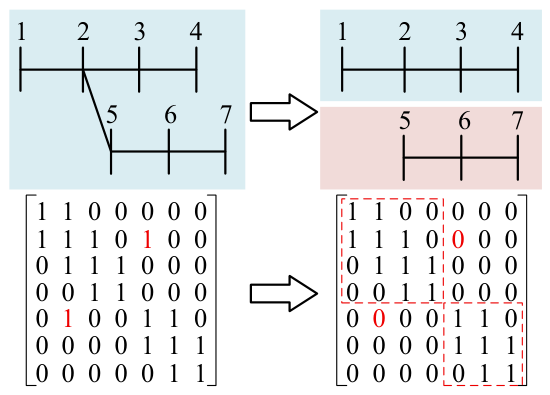
Since the region dynamic zoning studied in this paper does not involve the reconfiguration of the distribution network topology but only adjusts the partition affiliation of each node, the network adjacency matrix is adopted to represent the chromosome in the encoding scheme. This matrix can reflect whether a connection relationship exists between nodes, and its elements consist only of 0 and 1, where 0 indicates that nodes are not connected, and 1 indicates that nodes are connected. The specific form is shown on the left side of Figure 1.
The specific implementation of chromosome crossover and mutation in this paper can be found in reference [28].
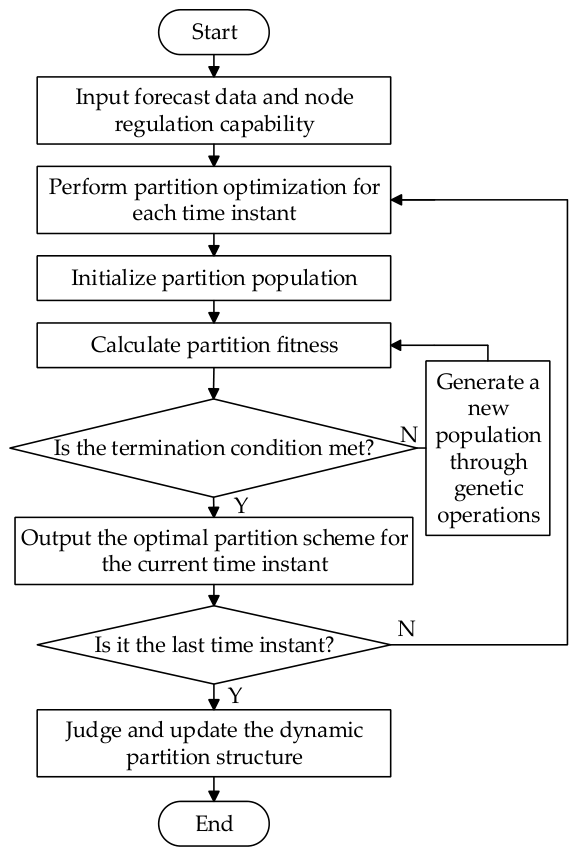
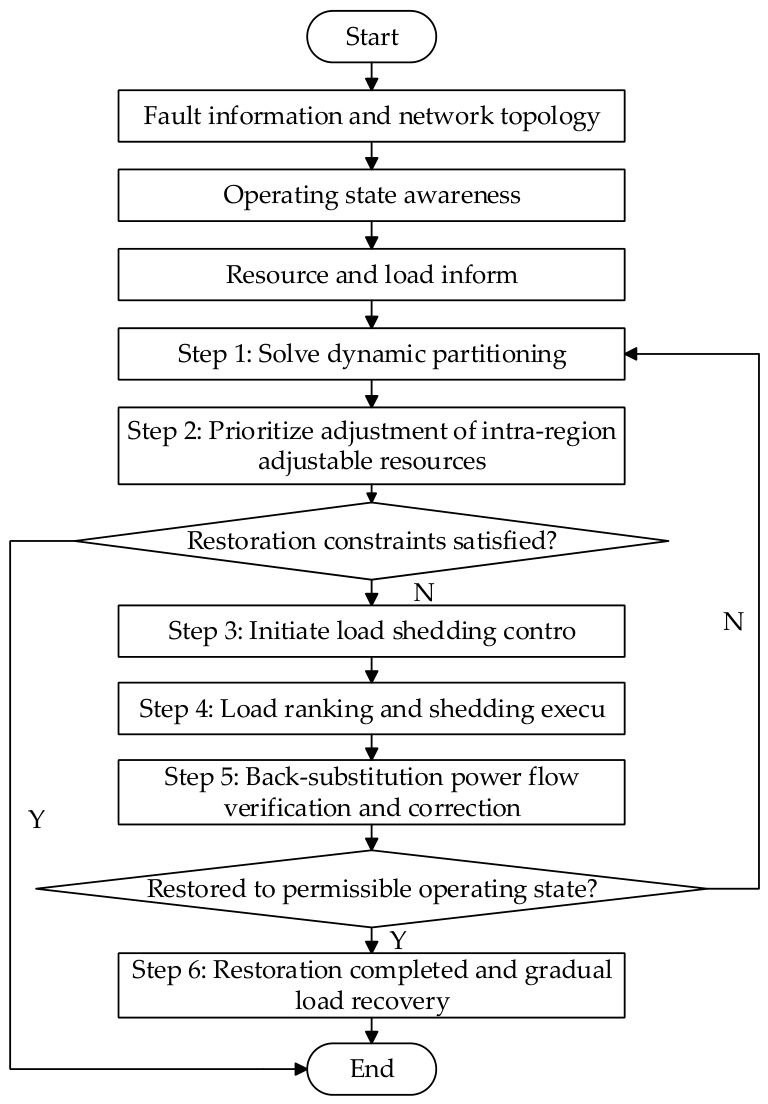
During the dynamic zoning process, power flow calculations are performed based on forecasted results, and the weights of each indicator are dynamically adjusted based on real-time power flow outcomes. If no voltage violations occur, the weights of the modularity index and continuous power regulation capability index are increased. If a voltage violation is detected, the weight of the voltage regulation capability index is raised, while the weights of other indicators are reduced accordingly. Furthermore, to avoid frequent changes in the partition structure, this paper sets a threshold for the difference in comprehensive indicator weights. A new stage of dynamic zoning is triggered only when the difference exceeds the threshold, with the triggering condition shown in Equation (23). The implementation steps of the dynamic zoning for the distribution network are illustrated in Figure 2.
Φ t = Φ t 1 , ϕ t ( t ) ϕ t 1 ( t ) < σ Φ t , Other
where Φ t denotes the candidate optimal partition structure calculated at the current time t . Φ t 1 denotes the partition structure adopted at the previous time t 1 . ϕ t ( t ) represents the comprehensive index value evaluated under the candidate optimal partition structure Φ t at time t . ϕ t 1 ( t ) represents the comprehensive index value evaluated when continuing to use the previous partition structure Φ t 1 at the current time t . σ represents the predefined threshold for the difference in the comprehensive index, which is used to trigger the dynamic update of the partition structure.
During the execution of the genetic algorithm, the individuals with the optimal comprehensive evaluation for region dynamic zoning are preferentially retained in the population, and the roulette wheel strategy is employed to complete the selection and generation of the new population. For the updated population, the comprehensive indicator values corresponding to each region dynamic zoning scheme are further calculated, and the current optimal solution is consistently preserved throughout the iterative process until the maximum number of iterations is reached or the termination requirements are satisfied. Finally, the optimal scheme obtained during the iterative process is output as the result.

3. Load Importance Grading Model for Distribution Networks Based on Node Electrical Coupling Degree

Traditional load classification categorizes loads primarily based on socioeconomic importance and the potential consequences of power outages, thereby serving as a fundamental constraint—for instance, critical loads are assigned the highest priority and are exempt from shedding whenever possible. In contrast, the proposed grading method focuses on the physical and topological characteristics of the distribution network by evaluating the node electrical coupling degree. These two concepts are complementary rather than mutually exclusive. For loads belonging to the same traditional class, their shedding sequence is determined by their electrical coupling degrees. Specifically, nodes with weaker electrical connections to major power sources or regional centers are prioritized for shedding, as removing them effectively restores power balance while minimally affecting overall system voltage stability. The proposed indicators in this paper are presented as follows:
  • Node Electrical Distance;
In power systems, the coupling between nodes is quantified using electrical distance. This indicator is computed from the system node impedance matrix by calculating the equivalent impedance between nodes, as expressed in the following equation.
Z i j = ( Z i i   Z i j ) ( Z j i Z j j )
where Z i i   and Z j j represent the self-impedances of node i and node j, respectively; Z i j is the mutual impedance between the nodes.
2.
Node Electrical Coupling Degree;
The node electrical coupling degree is defined as the reciprocal of the sum of equivalent impedances between a given node and all other nodes in the network, reflecting its relative importance within the overall electrical structure. For a distribution network with N nodes, the electrical coupling degree of node i is expressed as:
D e , i = 1 / j = 1 , j i N Z i j
From the perspective of the electrical structural characteristics of the distribution network, a larger value of the node electrical coupling degree indicates a shorter overall electrical distance from that node to all other nodes in the system, and also implies that the node occupies a more central position in the overall electrical topology. With this indicator, both the electrical coupling tightness of a node within the network and its topological importance can be characterized. Generally speaking, nodes with a higher coupling degree play a more prominent role in power transmission and operational regulation. For load nodes, such nodes are often associated with smaller power supply network losses. Therefore, prioritizing power supply to them not only helps reduce energy losses but also expands the available power margin, thereby providing support for the stable operation of the partition.

4. Hierarchical Coordinated Control Strategy of Dynamic Zoning and Load Shedding

Dynamic zoning can provide a new regulation means for emergency state management in power grids, thereby reducing the reliance on load shedding measures to a certain extent. However, in some cases, if all feasible dynamic zoning schemes are still insufficient to eliminate the emergency operation risks caused by anticipated faults, relying solely on partition adjustment can hardly meet the safety control requirements. Under such circumstances, dynamic zoning and load shedding measures should be coordinated comprehensively to minimize the scale of load shedding while ensuring the safe and stable operation of the power grid, thereby reducing control costs and alleviating the power supply security pressure faced by operation departments.

4.1. Analysis of Load Shedding Strategy Under Fault Conditions

In power system analysis, the actual active power consumed by a load is shown in the following equation:
P L = P L 0 V V L 0 α × f f 0 β
where PL0 is the rated active power, V and VL0 are the actual and rated load voltages, respectively, f and f0 are the actual system frequency and the rated system frequency, respectively, and the exponents α and β are the voltage exponent and frequency exponent that characterize the load power variation characteristics, respectively.
In a power system, when a strong disturbance causes a significant drop in load voltage or frequency, it is often necessary to initiate under-voltage or under-frequency load shedding measures. Although load shedding can relieve system stress in a short time, as the system voltage and frequency gradually recover, the active power demand of the remaining load also increases, thereby impairing the system restoration process. This indicates that the load voltage-frequency characteristics have a negative impact on load shedding control under such circumstances. Therefore, in the design of under-voltage and under-frequency load shedding schemes, this negative effect should be comprehensively considered, and the load shedding amount should be dynamically determined in combination with the real-time status of voltage and frequency.
Taking the per-unit value of Equation (26) and differentiating it with respect to time t yields:
d P L d t = P L 0 α V α 1 f β d V d t + β V α f β 1 d f d t
By simplifying Equation (27), the relationship of load active power as influenced by frequency and voltage variations during the dynamic process can be obtained as follows:
1 P L d P L d t = β f d f d t + α V d V d t
Based on the above analysis, the dynamic variation process of load power can be divided into the response component caused by bus frequency variations and the response component caused by load voltage variations. Considering that the degrees of influence of frequency disturbances and voltage fluctuations on the change in load active power are not identical, this paper calculates the combined under-voltage and under-frequency load shedding amount according to the respective contribution ratios of the two factors. Its specific expression is as follows:
Δ P L = β f d f d t + α V d V d t Δ P L V + β f d f d t + α V d V d t Δ P L f
where ΔPLf and ΔPLV are the load shedding amounts for under-frequency and under-voltage load shedding, respectively; dV/dt and df/dt are the average values over two cycles.
It should be noted that in practical engineering applications, the direct calculation of derivatives such as dV/dt and df/dt is highly sensitive to inherent measurement noise, which may lead to accidental load shedding. To address this issue, the raw voltage and frequency measurement signals are typically processed through a low-pass filter (LPF) prior to the derivative calculations to eliminate high-frequency noise. Furthermore, a deadband threshold mechanism is incorporated into the practical control logic. The load shedding action is only triggered when the calculated rate of change reliably and continuously exceeds this predefined threshold margin, thereby ensuring the robustness of the load shedding strategy against transient measurement disturbances.

4.2. Hierarchical Load Shedding Control Method Based on Dynamic Zoning

Although dynamic zoning can alleviate post-fault operational stress and reduce the demand for load shedding to a certain extent, when the adjustable resources within a partition are insufficient to eliminate the violation risks caused by the fault, load shedding control must be further introduced. Based on this, this paper constructs a hierarchical coordinated control mechanism that prioritizes dynamic zoning, gives precedence to intra-partition resources, supplements with load shedding, and performs rolling verification during the restoration process, so as to minimize load loss while ensuring system safety and stability. Under the constraints of ensuring safe and stable system operation, partition adjustment and load shedding strategies are coordinated to achieve minimization of load shedding amount and reduction of operational risks, thereby optimizing the overall control cost. The specific steps are as follows: the flowchart is shown in Figure 3.
Step 1: Perform power flow calculations based on the post-fault network topology and operating status, and solve the dynamic zoning scheme for the current time instant by considering indicators such as modularity, voltage regulation capability, and continuous power regulation capability.
Step 2: Based on the dynamic zoning results, prioritize the dispatch of adjustable resources within the partition, including photovoltaics, energy storage, flexible loads, and reactive power compensation devices, to regulate voltage deviations and power imbalances within the region.
Step 3: If voltage violations or unsatisfied restoration constraints still exist after intra-partition regulation, initiate load shedding control.
Step 4: Determine the load shedding priority based on the load grading results. Give priority to shedding loads at nodes with lower electrical coupling degrees, with the load shedding amount calculated according to Equation (29).
Step 5: After load shedding is executed, re-perform power flow verification. If the system has not yet returned to the permissible operating state, continue to iteratively revise the dynamic zoning scheme and load shedding amount.
Step 6: Once the system satisfies the restoration constraints, terminate the fault restoration control, and decide whether to gradually restore some loads in subsequent operation according to state changes.

5. Case Study

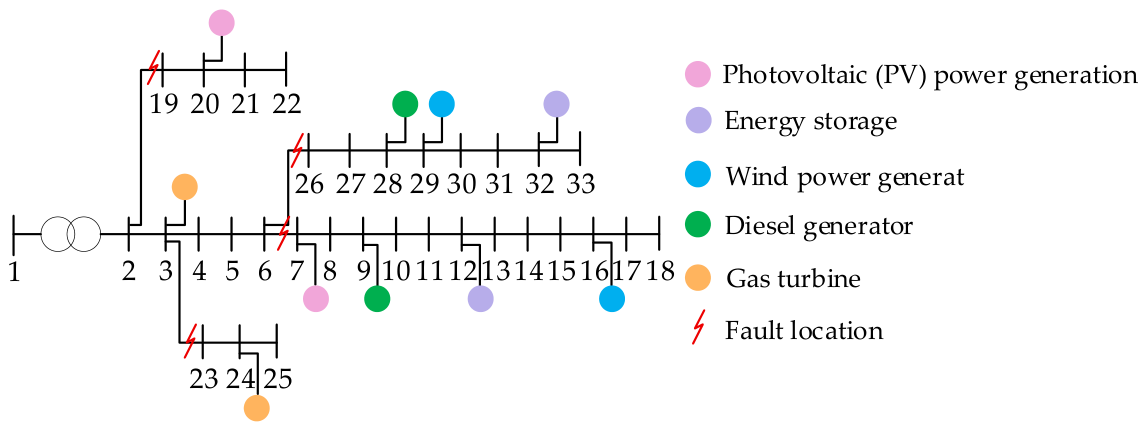
This paper adopts the standard IEEE-33 bus system to validate and analyze the proposed method. Photovoltaic (PV), wind power, energy storage, gas turbines, and diesel generators are integrated to simulate actual operating conditions. The IEEE-33 bus system is shown in Figure 4. The parameter settings are shown in Table 2.

5.1. Forecasting of Wind and Solar Power and Load

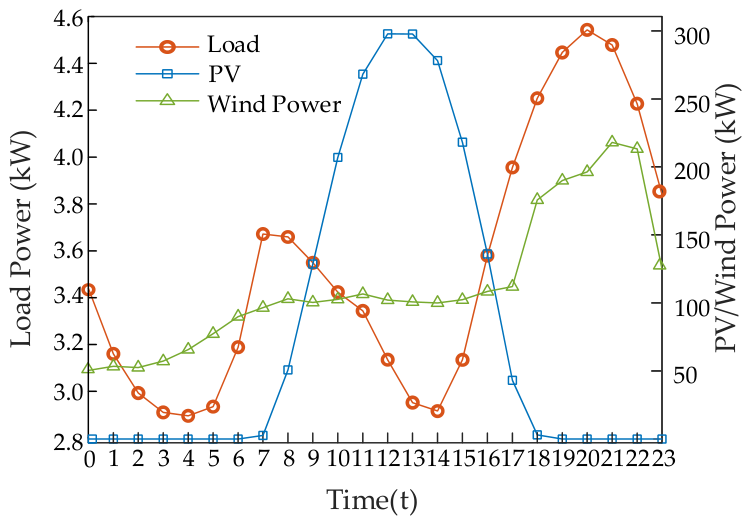
To meet the operational dispatch requirements of power grids with high penetration of distributed PV and wind power, constructing an accurate source-load time-series forecasting model is fundamental to achieving dynamic zoning and optimal operation of distribution networks. The forecasted output curves of load, PV, and wind power are shown in Figure 5.
From the forecasting results, it can be observed that PV output exhibits a clear pattern of being high during the day and low at night, with the peak output occurring around noon. This partially coincides with the daytime load peak, indicating a certain potential for peak-time complementarity. In contrast, wind power output shows strong randomness and intermittency, fluctuating throughout the day. The peak wind power output has a low correlation with the load peak, which can easily induce significant fluctuations in net load. The load curve, on the other hand, presents a typical bimodal characteristic, with peaks appearing around noon and in the evening, while the nighttime load is relatively low, forming a notable contrast with the diurnal characteristics of PV output.

5.2. Analysis of Dynamic Zoning Case Study

To analyze the impact of key parameters on the results of dynamic zoning, this paper compares different indicator weights and partition update triggering thresholds under normal operating conditions. The comprehensive indicator for dynamic zoning consists of three components: modularity index, voltage regulation capability index, and continuous power regulation capability index. Variations in weights directly affect the optimization direction of the dynamic zoning results. Specifically, increasing the weight of modularity is conducive to enhancing regional structural stability; increasing the weight of voltage regulation capability helps improve post-fault voltage support capability; and increasing the weight of continuous power regulation capability contributes to strengthening the region’s adaptability to source-load fluctuations.
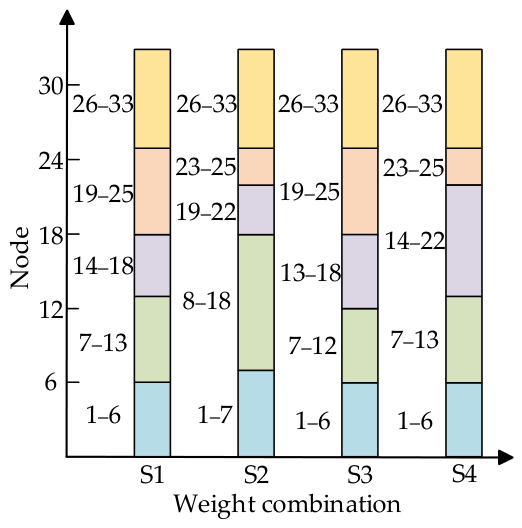
Meanwhile, the triggering threshold determines the update frequency of dynamic zoning. A smaller threshold enables the partition structure to respond more promptly to fault states and changes in renewable energy output, but it increases the number of partition updates. A larger threshold reduces frequent changes in dynamic zoning; however, it may weaken the adaptability of the partition structure to post-fault operating conditions. Therefore, this paper analyzes the influence of parameter settings on partition structure, regional regulation capability, and fault recovery effectiveness by comparing different weight combinations and triggering thresholds. In this paper, the execution details of the genetic algorithm (GA) are explicitly defined. Based on the binary chromosome coding approach, the key parameters configured for the optimization process are presented in Table 3. To highlight the effectiveness of the proposed strategy under extreme conditions, a high renewable energy penetration scenario (e.g., 100%) is selected as the baseline testing environment in this section. Under this high-penetration scenario, the settings of the different weight parameters are shown in Table 4, and the dynamic zoning results are presented in Figure 6, with the threshold set to 0.01.
Comprehensive analysis of the dynamic zoning results under various weight combinations indicates that Scheme S1 achieves a favorable balance between regional structural stability and regulation capability. Compared with Scheme S2, although S1 yields a slightly lower modularity value, it avoids over-reliance on network topology in the dynamic zoning outcome, thereby enhancing the utilization efficiency of adjustable resources within the region. In comparison with Scheme S4, S1 exhibits marginally lower continuous power regulation capability, yet its partition structure is more balanced and does not compromise topological rationality in pursuit of excessive source–load–storage power balance. Relative to Scheme S3, S1 does not introduce an unnecessarily high voltage regulation weight under non-fault conditions, which aligns better with the dynamic zoning requirements during normal operation—where structural stability and sustained power regulation are the primary concerns.
Therefore, Scheme S1 can be adopted as the baseline weighting scheme for dynamic zoning in this study. Under normal conditions, the weights are set to (0.40, 0.00, 0.60), with emphasis on both modularity and continuous power regulation capability. Under fault conditions, the weights are adjusted to (0.10, 0.70, 0.20), promptly increasing the weight of voltage regulation capability to enhance post-fault voltage support. Overall, S1 ensures that the partition structure does not undergo excessive and frequent changes during fault-free operation, while providing good dynamic adaptability in the event of faults or voltage violations, thus demonstrating strong comprehensive performance and engineering selectivity.
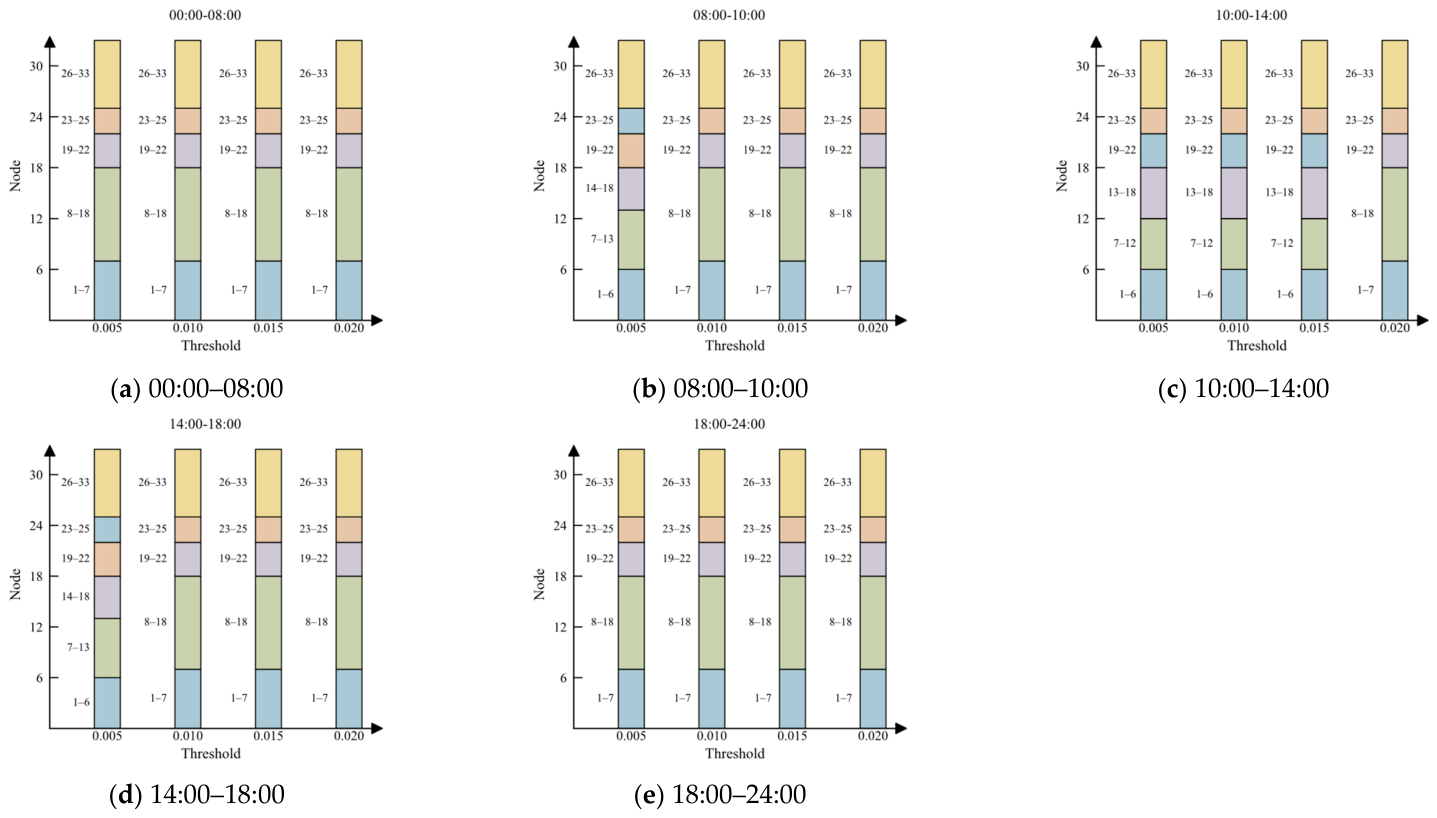
After identifying S1 as the baseline weighting scheme, the effect of the partition update threshold on the dynamic zoning results is further investigated. The weighting parameters are kept unchanged, and four threshold values, namely 0.005, 0.010, 0.015, and 0.020, are selected for comparison. This analysis aims to examine the trade-off between the update frequency of dynamic zoning and the stability of the resulting partition structure. The corresponding dynamic zoning results are shown in Figure 7.
Based on Figure 7, when the threshold is set to 0.005, the dynamic zoning becomes overly detailed in certain time periods. For example, during 08:00–10:00, 10:00–14:00, and 14:00–18:00, numerous small partitions appear, indicating that this threshold is overly sensitive to nodal differences and tends to cause fluctuations in the dynamic zoning results.
When the threshold increases to 0.015 or 0.020, although the dynamic zoning results are relatively stable, the merging of nodal regions becomes more pronounced in some areas, which may weaken the ability to characterize local operational differences.
In contrast, under the threshold of 0.010, the partition structure remains generally stable across all time periods, avoiding the excessive subdivision observed with the 0.005 threshold while still preserving the differences among various nodal regions. Therefore, considering both dynamic zoning stability and granularity, 0.010 is selected as the optimal threshold.

5.3. Adaptability Analysis Under Different Renewable Energy Penetration Levels

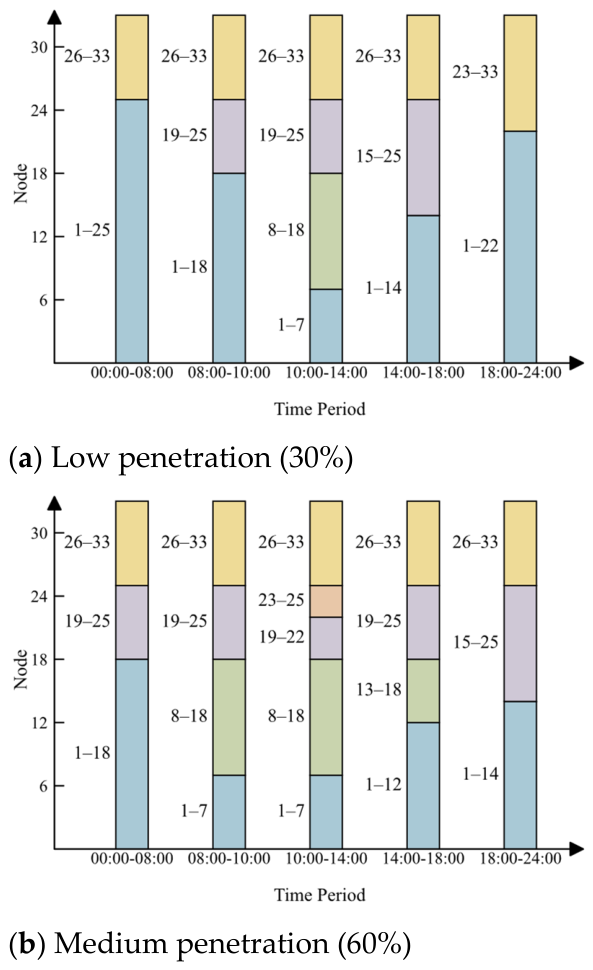
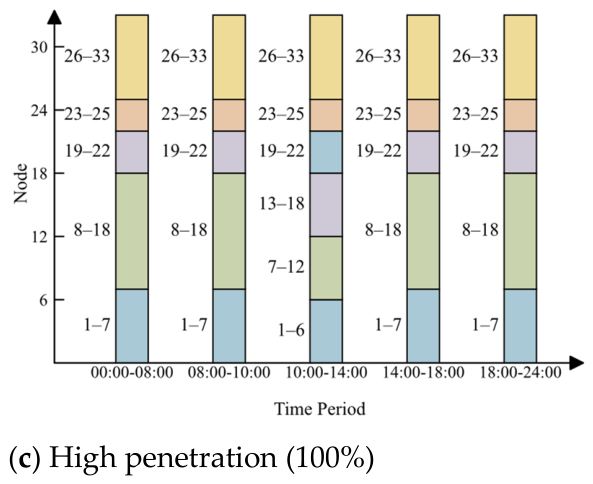
Based on the parameter analysis in Section 5.2, the optimal weight combination S1 and the update triggering threshold of 0.010 are selected as the baseline configuration for dynamic zoning. To further verify the robustness of the proposed strategy in high-penetration renewable distribution networks, three different renewable energy penetration scenarios—30% (low penetration), 60% (medium penetration), and 100% (high penetration)—are constructed for comparative validation (Figure 8). As the renewable energy penetration level changes, the active and reactive power flow distribution within the system alters significantly. This variation profoundly affects the voltage sensitivities of the nodes, as well as the node electrical distance and node electrical coupling degree determined by the equivalent impedance.
The simulation results demonstrate that under the fixed 0.010 threshold triggering mechanism, the algorithm can acutely perceive regional state fluctuations caused by changes in the proportion of renewable energy integration. Based on the comprehensive evaluation framework, which includes the real-time voltage regulation capability index, the system can adaptively generate the optimal dynamic zoning topology that matches the current resource adequacy. This proves that even under varying source-load power fluctuations and complex electrical coupling conditions, the proposed dynamic zoning method maintains a reasonable topological structure, avoiding excessive subdivision or update hysteresis, thereby exhibiting strong engineering practicability and robustness.
As illustrated in the dynamic zoning results, the network topology adaptively changes across different renewable energy penetration levels. In the low-penetration scenario (30%), the system forms larger, broadly merged regions that rely heavily on the main grid due to insufficient local generation. Under the medium-penetration scenario (60%), the network exhibits strong temporal flexibility; it merges regions at night to obtain support from the main grid and fragments during peak photovoltaic output to maximize local source-load balance. In the high-penetration scenario (100%), abundant distributed generation enables the network to maintain highly refined, stable, and autonomous regions. Overall, this dynamic adjustment accurately captures real-time changes in network power flow and the electrical coupling degrees of buses. By ensuring strong intra-region coupling and weak inter-region coupling, the proposed strategy effectively supports subsequent regional operation management and coordinated control for fault recovery.

5.4. Load Coupling Degree Analysis

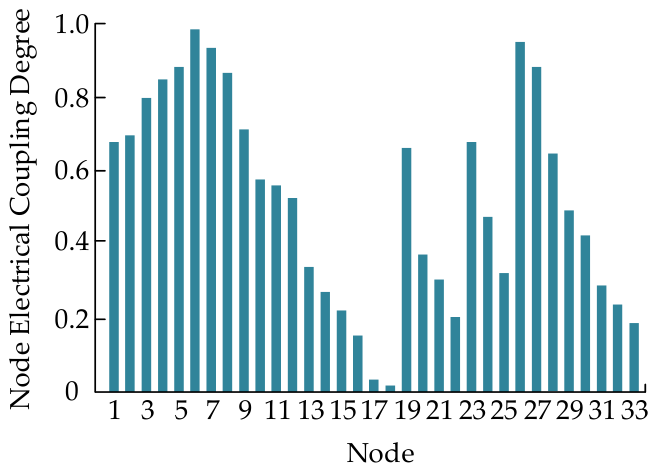
To shed necessary loads during faults, the electrical coupling degree of each node in the IEEE-33 bus system is analyzed according to Section 3. When a fault occurs, priority is given to shedding loads at nodes with a lower electrical coupling degree. The electrical coupling degree of each node is shown in Figure 9.
From Figure 9, it can be seen that nodes with a high coupling degree (e.g., nodes 8 and 26) have a coupling degree of approximately 0.99. These nodes are located in the middle of the network, have short electrical distances, and play a key role in power transmission, making them critical nodes. Nodes with a low coupling degree (e.g., nodes 17 and 18) have a coupling degree of approximately 0.7. These nodes are located at the ends of the network or at the tips of branches, and exhibit weak electrical coupling with other nodes in the system. This result supports the load shedding priority rule provided in Section 4.2, i.e., giving priority to shedding loads at nodes with a lower electrical coupling degree. Shedding low-coupling-degree nodes has a smaller impact on the overall power transmission capacity and voltage support capability of the system, while retaining high-coupling-degree nodes helps maintain intra-partition power balance and voltage regulation capability.

5.5. Case Study Analysis of Dynamic Zoning and Load Shedding

To verify the effectiveness of the proposed method under a 100% high renewable energy penetration scenario, four faults are set on lines 2–19, 3–23, 6–26, and 6–7 in this paper. The fault start time is 8:00, after which one fault is repaired every two hours to verify the superiority of the proposed dynamic zoning results and load shedding method. The following three schemes are designed for comparison with the proposed scheme:
Scheme 1: Traditional load shedding control (without partition adjustment)
Scheme 2: Static dynamic zoning + load shedding control
Scheme 3: Dynamic zoning + traditional load shedding (ignoring node electrical coupling degree)
Scheme 4: The scheme proposed in this paper
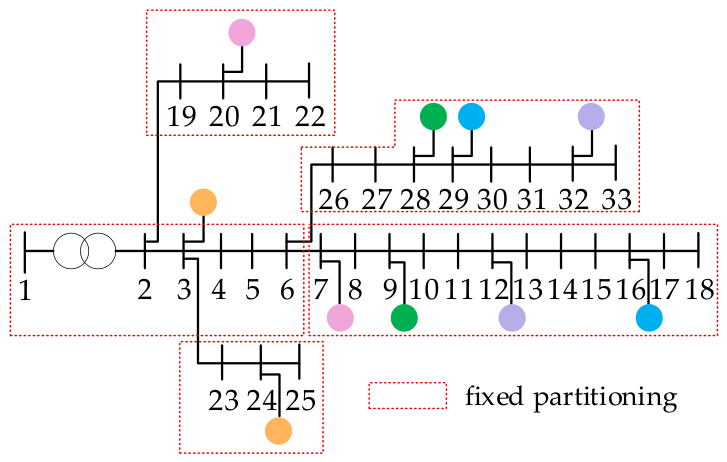
The results of fixed dynamic zoning are shown in Figure 10, the load shedding results under different schemes are presented in Table 5, and the dynamic zoning results are shown in Figure 11.
Among the different load grading schemes, Scheme 4 is significantly superior to the traditional methods and can effectively reduce the amount of load shedding. In Scheme 1, the total load shedding amount of the distribution network after the fault is 3.21 MW. With the coordinated control strategy of dynamic zoning and load shedding proposed in this paper, the load shedding amount is reduced to 1.47 MW, a decrease of 54.3%. Furthermore, under different fault conditions, Scheme 4 demonstrates significant advantages. For example, in the first time period of fault restoration, the traditional scheme sheds 1.31 MW of load, while Scheme 4 sheds only 0.68 MW, a reduction of 48.9%. In the fourth time period, the traditional method still sheds 0.22 MW of load, whereas the shedding amount in Scheme 4 is reduced to 0.05 MW, a reduction of 77.3%. These results indicate that the coordinated control strategy of dynamic zoning and load shedding can effectively reduce unnecessary load shedding and improve the restoration efficiency of the power grid.
Further analysis shows that Scheme 4 can maximize the resource dispatch of the power grid when a fault occurs, avoiding excessive shedding of critical load nodes. Among all simulation schemes, Scheme 4 achieves the lowest total load shedding amount, which is reduced by 1.74 MW compared with the traditional method, significantly decreasing the load shedding amount and power loss.
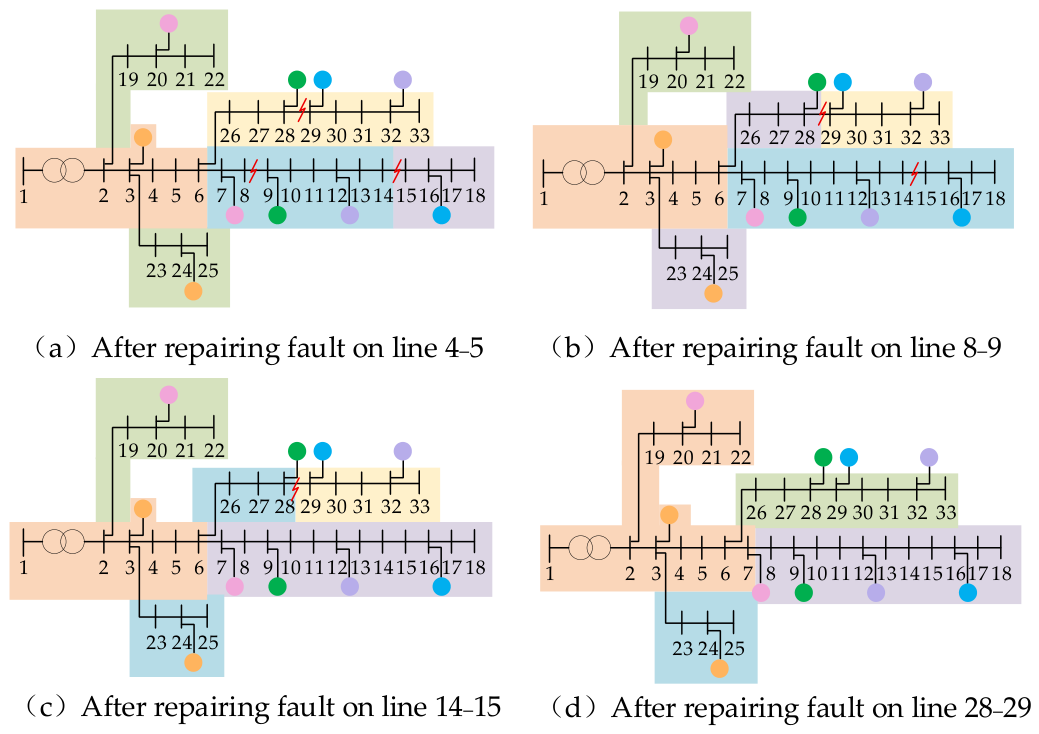
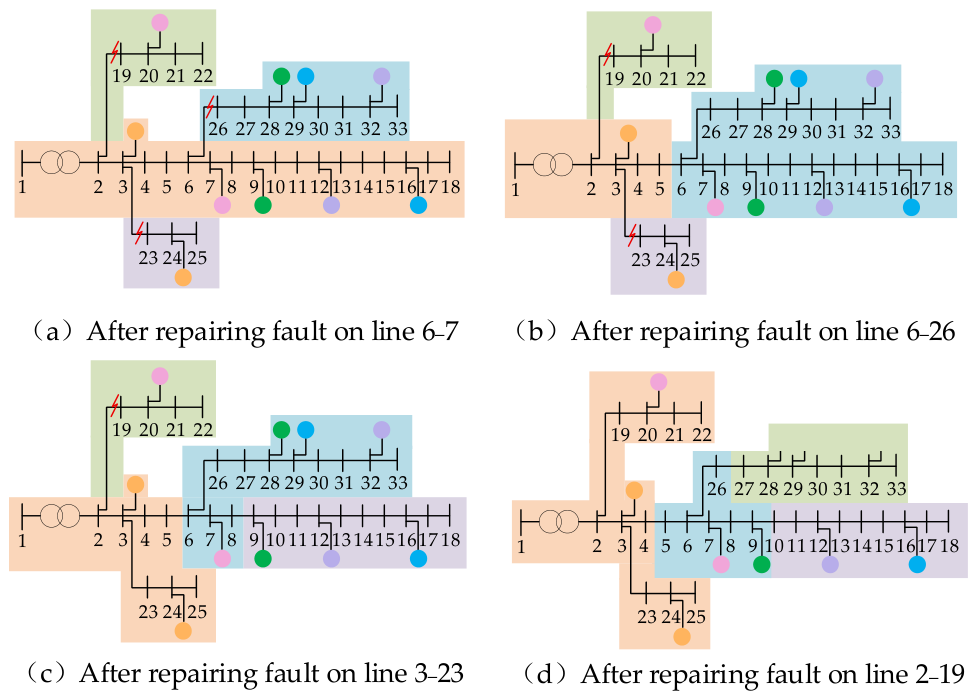
To evaluate the robustness of the proposed method across various fault locations, new faults are additionally introduced on lines 4–5, 8–9, 14–15, and 28–29. Following the occurrence of the faults, one fault is repaired every two hours in the aforementioned sequence. The dynamic zoning results are depicted in Figure 12, while the load shedding amounts at each stage are detailed in Table 6.
As shown in Table 6, despite the changes in fault locations, the load shedding amount of the proposed scheme remains the lowest. This provides compelling evidence that the proposed Scheme 4 is effective not only in specific scenarios but also exhibits high robustness and stable optimization capabilities across different fault locations. Under the new fault conditions, Scheme 4 continues to significantly outperform traditional methods. Its total load shedding is stably maintained at a minimum of 1.47 MW, achieving a substantial reduction of 54.3% compared to Scheme 1 (3.21 MW). From time period 1 to 4, Scheme 4 consistently maximizes resource dispatch, thereby avoiding unnecessary load shedding. Furthermore, Figure 12a–d visually demonstrates that in the face of new multiple faults and their sequential repair process, the distribution network can adaptively perform dynamic zoning. This capability to flexibly adjust microgrid boundaries ensures that, regardless of the fault location, the system can isolate faults with an optimal topology and maximize power restoration.

5.6. Case Study Analysis of Voltage and Frequency Variations

The voltage regulation results for the first fault case are shown in Figure 13. The proposed scheme significantly outperforms the other schemes. Since the proposed scheme considers the voltage regulation capability indicator in dynamic zoning and prioritizes the power supply of nodes with higher electrical coupling degrees during load shedding, it can adjust voltage more finely and reduce the occurrence of voltage violations. When voltage fluctuations occur, the proposed scheme can quickly utilize adjustable resources within the region for voltage regulation, greatly reducing voltage deviations. Compared with Schemes 1 and 2, Scheme 4 ensures that the voltage remains within the control range by updating partitions and dispatching resources in real time, avoiding large voltage fluctuations.
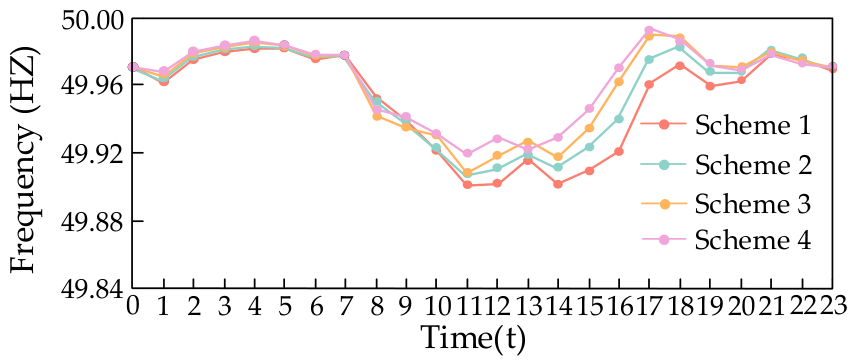
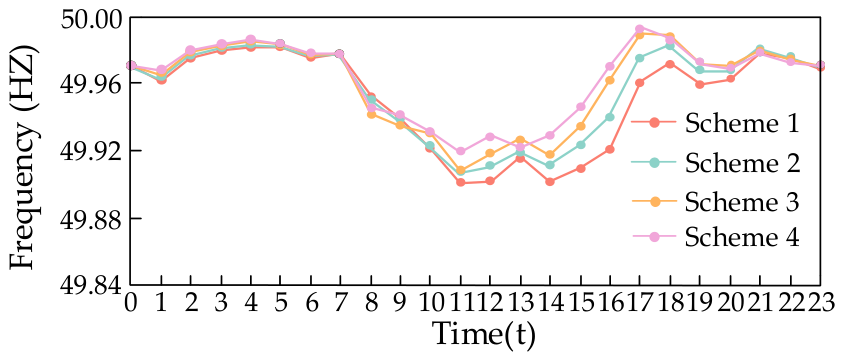
The frequency regulation results for the first fault case are shown in Figure 14. The proposed scheme also demonstrates its significant advantages. By prioritizing power supply to nodes with a high electrical coupling degree, Scheme 4 avoids excessive shedding of critical node loads, thereby reducing the impact of frequency fluctuations on grid operation. During multiple fault restoration processes, the load shedding strategy of Scheme 4 effectively balances grid load and voltage, quickly restoring the frequency stability of the grid. Compared with Scheme 3, Scheme 4 ensures smooth frequency recovery by coordinating load shedding and intra-region resource dispatch under conditions of large frequency fluctuations, avoiding excessive frequency deviations caused by inappropriate load shedding.

6. Conclusions

This paper proposes an optimization method for distribution network fault restoration based on coordinated control of dynamic zoning and load shedding, aiming to improve the efficiency and stability of distribution networks during fault restoration. By integrating real-time power flow calculations, node electrical coupling degree, and the regulation capabilities of distributed resources, the proposed dynamic zoning method can effectively optimize the restoration strategy of the distribution network. In terms of load shedding, the method prioritizes the protection of critical nodes in the grid, significantly reducing the amount of load shedding, avoiding excessive shedding of important loads, and ensuring grid stability.
Compared with traditional methods, simulation results demonstrate that the proposed method can significantly reduce the load shedding amount. Specifically, in the simulation on the IEEE-33 bus system, the total load shedding amount under traditional load shedding control is 3.21 MW, whereas under the proposed method it is only 1.47 MW, a reduction of 54.3%.
In terms of voltage and frequency fluctuation control, the proposed method can quickly restore grid stability after a fault. By updating partitions and dispatching intra-region resources in real time, voltage deviations are significantly reduced. With respect to frequency fluctuations, the proposed method can effectively balance grid load and voltage, avoiding excessively rapid frequency recovery caused by over-shedding, thereby ensuring frequency stability.
Overall, the proposed method significantly improves the efficiency and stability of distribution network fault restoration, reduces the load shedding amount, enhances the emergency response capability of the grid, and provides effective support for the operation of distribution networks with a high penetration of renewable energy sources.

Author Contributions

Conceptualization, W.Y.; Methodology, W.Y.; Validation, W.Y. and M.L.; Investigation, W.Y. and M.L.; Resources, Y.L. and K.L.; Data curation, Y.L. and K.L.; Writing—original draft, W.Y.; Writing—review & editing, Y.L., K.L. and M.L.; Visualization, K.L. and M.L.; Supervision, Y.L.; Project administration, Y.L.; Funding acquisition, Y.L. and K.L. All authors have read and agreed to the published version of the manuscript.

Funding

This research was supported by the Science and Technology Project of State Grid Co., Ltd. (Key Technologies and Equipment for Security and Stability Control of Distribution Networks Considering Active Support Requirements of the Main Grid; Project Number: 52060025001T-053-ZN).

Data Availability Statement

Data are contained within the article.

Conflicts of Interest

Authors Yudun Li and Kuan Li were employed by the company Electric Power Research Institute of State Grid Shandong Electric Power Company. The remaining authors declare that the research was conducted in the absence of any commercial or financial relationships that could be construed as a potential conflict of interest.

References

  1. Yang, H.; Wang, X.; Jiang, C.; Jiang, B.; Zhang, K.; Ke, J. Coordinated Pre-Disaster Scheduling of Transmission and Distribution Networks under Aggregation Feasibility and Frequency Stability Constraints of Distributed Energy Resource. Autom. Electr. Power Syst. 2025, 49, 52–61. [Google Scholar]
  2. Liu, S.; Jiang, D.; Tang, Z. Coordinated Optimal Dispatching of Source-Grid-Load-Storage in Distribution Network Based on Graph Reinforcement Learning. Distrib. Util. 2025, 42, 37–46. [Google Scholar]
  3. Yin, W.; Dong, Z.Y.; Liu, L.; Rui, X. Self-stabilising speed regulating differential mechanism for continuously variable speed wind power generation system. IET Renew. Power Gener. 2020, 14, 3002–3009. [Google Scholar] [CrossRef]
  4. Pan, M.; He, X.; Ai, Q.; Tang, Y. Research Status and Prospect of Distributed Energy Resource Dispatching in New Distribution System. Power Syst. Technol. 2024, 48, 933–949. [Google Scholar]
  5. Wang, Z.; Yin, W.; Liu, L.; Wang, Y.; Zhang, C.; Rui, X. Fractional-order Sliding Mode Control of Hybrid Drive Wind Turbine for Improving Low-voltage Ride-through Capacity. J. Mod. Power Syst. Clean Energy 2023, 11, 1427–1436. [Google Scholar] [CrossRef]
  6. Xu, Z.; Liu, Z.; He, J.; Si, F.; Wang, X. Distributed Resource Aggregation and Aggregate Optimization Operation Method of Multi-Virtual Power Plant in New Power Distribution Network. High Volt. Eng. 2024, 50, 105–116. [Google Scholar]
  7. Liang, Z.; Chung, C.Y.; Zhang, W.; Wang, Q.; Lin, W.; Wang, C. Enabling high-efficiency economic dispatch of hybrid AC/DC networked microgrids: Steady-state convex bi-directional converter models. IEEE Trans. Smart Grid 2024, 16, 45–61. [Google Scholar] [CrossRef]
  8. Chen, X.; Hu, Q.; Shi, Q.; Cui, H.; Li, X.; Li, F. Review on Residential Distributed Energy Resource Management in New Power System. Autom. Electr. Power Syst. 2024, 48, 157–175. [Google Scholar]
  9. Liu, F.; Zhang, H.; Yang, X. Black Start Scheme and Real-Time Scheduling Strategy for Key Nodes of the Main Network Assisted by Multi-Type Distributed Resources of the Distribution Network. Power Syst. Technol. 2023, 47, 4416–4429. [Google Scholar]
  10. Hosseini Najafabadi, Z.; Akbari Foroud, A. Dynamic zoning of Island Smart Distribution Systems in Emergencies. IET Gener. Transm. Distrib. 2024, 18, 2910–2929. [Google Scholar] [CrossRef]
  11. Hua, H.; Zhai, J.; Chen, X.; Wang, B.; Yu, K.; Qin, Y.; Shen, J.; Ding, Y.; He, D. Dynamical Dynamic zoning and Local Energy Autonomy of Virtual Microgrid Groups Based on Strengthen Elitist Genetic Algorithm. Proc. CSEE 2024, 44, 4652–4666. [Google Scholar]
  12. Xu, Y.; Wu, X.; Wang, Y. Research and Prospect on Resilience Enhancement Technology Based on Islanded Operation of Urban Partitioned Power Grids under Extreme Events. Distrib. Util. 2024, 41, 45–53. [Google Scholar]
  13. Liu, J.; Wang, C.; Bi, T. Node Equivalent Inertia Index for Temporal-Spatial Frequency Dynamics of Renewable Energy Power System and Its Applications. Proc. CSEE 2023, 43, 7773–7789. [Google Scholar]
  14. Peng, X.; Shen, Y.; Lu, Q.; Shen, C. Robust Var-Voltage Control Dynamic zoning for Power Grid Considering Wind Power Uncertainty. Power Syst. Technol. 2023, 47, 4102–4111. [Google Scholar]
  15. Hua, H.; Zou, Y.; Chen, X.; Yu, K.; Gan, L.; Lei, S. Dynamic Network Partitioning for A Large-scale Microgrid Cluster. IEEE Trans. Smart Grid 2025, 16, 4087–4098. [Google Scholar] [CrossRef]
  16. Zhao, B.; Xu, Z.; Xu, C.; Wang, C.; Lin, F. Network Partition-Based Zonal Voltage Control for Distribution Networks with Distributed PV Systems. IEEE Trans. Smart Grid 2017, 9, 4087–4098. [Google Scholar] [CrossRef]
  17. Zeng, J.; Tong, X.; Fan, J. Dynamic Distributionally Robust Optimization of Integrated Electric-Gas Distribution System Considering Demand Response Uncertainty. Power Syst. Technol. 2022, 46, 1877–1888. [Google Scholar]
  18. Xu, Y.; Cai, Y.; Wang, Y.; Miao, Y. A dynamic partitioning method for AC-DC distribution networks considering voltage-power sensitivity across voltage levels. Distrib. Util. 2024, 41, 29–38. [Google Scholar]
  19. Cong, W.; Kong, J.; Zhao, Y.; Ding, L. Smart Distribution Networks Partition and Island Identification Method Based on Reachability Matrix. Autom. Electr. Power Syst. 2013, 37, 50–55. [Google Scholar]
  20. Kang, H.; Li, C.; Huang, S. Evaluation of Cascading Failures in an Integrated Gas and Power System Considering Effects of Energy Conversion Load. Power Syst. Prot. Control. 2023, 51, 133–145. [Google Scholar]
  21. Hu, G.; Yan, Y.; Wu, H.; Jin, P. Emergency Load Control Strategy and Terminal Implementation for Distribution Network Based on Collaboration of Main Grid and Distribution Network. Autom. Electr. Power Syst. 2022, 46, 180–187. [Google Scholar]
  22. She, Q.; Shen, C.; Qiao, Y. A Coordinated Load Shedding Scheme for Both Under-Voltage and Under-Frequency Load Shedding. Autom. Electr. Power Syst. 2008, 32, 23–27. [Google Scholar]
  23. Wang, Z.; Zhu, S.; Wang, T.; Qin, H. Research on Stratified Optimal Load Shedding Strategy for Receiving End Power Grid. Trans. China Electrotech. Soc. 2020, 35, 1128–1139. [Google Scholar]
  24. Jiang, H.; Qian, G.; Fan, Z.; Chen, J. A Service Restoration Strategy Considering Influence of Load Management for Distribution System with DG. Electr. Power 2017, 50, 101–106. [Google Scholar]
  25. Hong, Q.; Ji, L.; Blair, S.M.; Tzelepis, D.; Karimi, M.; Terzija, V.; Booth, C.D. A New Load Shedding Scheme with Consideration of Distributed Energy Resources’ Active Power Ramping Capability. IEEE Trans. Power Syst. 2021, 37, 81–93. [Google Scholar] [CrossRef]
  26. Luo, H.; Zhou, B.; Wang, X.; Le, Z.; Li, F. Service Restoration of Distribution Grid with Load Classification and Isolated Island Operation. Electr. Meas. Instrum. 2015, 52, 116–123. [Google Scholar]
  27. Tang, C.; Xu, J.; Sun, Y.; Liu, J.; Li, X.; Ke, D.; Yang, J.; Peng, X. Look-ahead economic dispatch with adjustable confidence interval based on a truncated versatile distribution model for wind power. IEEE Trans. Power Syst. 2018, 33, 1755–1767. [Google Scholar] [CrossRef]
  28. Ding, M.; Liu, X.; Bi, R.; Hu, D.; Ye, B.; Zhang, J. Method for Cluster Partition of High-Penetration Distributed Generators Based on Comprehensive Performance Index. Autom. Electr. Power Syst. 2018, 42, 47–52, 141. [Google Scholar]
Figure 1. Chromosome coding approach.
Electronics 15 02542 g001
Figure 2. Dynamic zoning method based on genetic algorithm.
Electronics 15 02542 g002
Figure 3. Hierarchical load shedding control method based on dynamic zoning.
Electronics 15 02542 g003
Figure 4. Simulation topology of the IEEE-33 bus system.
Electronics 15 02542 g004
Figure 5. Wind power, PV power, and load forecasting curves.
Electronics 15 02542 g005
Figure 6. Dynamic zoning results under different weight combinations.
Electronics 15 02542 g006
Figure 7. Dynamic zoning results under different thresholds.
Electronics 15 02542 g007
Figure 8. Dynamic zoning results under different renewable energy penetration levels.
Electronics 15 02542 g008aElectronics 15 02542 g008b
Figure 9. Electrical coupling degrees of buses.
Electronics 15 02542 g009
Figure 10. Fixed dynamic zoning results.
Electronics 15 02542 g010
Figure 11. Dynamic zoning results.
Electronics 15 02542 g011
Figure 12. Dynamic zoning results under new fault locations.
Electronics 15 02542 g012
Figure 13. Voltage variation results.
Electronics 15 02542 g013
Figure 14. Frequency variation results.
Electronics 15 02542 g014
Table 1. Comparison of current research methods.
Strategy/ReferencesDynamic ZoningLoad Shedding ConsiderationNode Electrical Coupling in Load GradingOptimization Focus
Conventional Islanding [12,14,16]Maximize prioritized load
Existing Dynamic Zoning [22,24]Voltage & reactive power control
Existing Load Shedding [21,23]System frequency/voltage
Proposed MethodCoordinated fault recovery & minimized load loss
Table 2. Comparison of the proposed method with prior fault restoration and islanding strategies.
CatgoryParameterValueCatgoryParameterValue
SystemBase voltage/base power12.66 kV/1 MVADiesel generatorConnection nodes9, 12
PV sourceConnection nodes7, 20Active power range per unit100 kW–250 kW
Rated capacity per unit30 kWEnergy storageConnection nod28, 32
Wind powerConnection nodes16, 29Charging power limit−200 kW
Rated capacity per unit40 kWDischarging power limit250 kW
Gas tubineConnection nodes3, 24State of charge upper limit250 kWh
Active power range per unit100 kW–300 kWState of charge lower limit−200 kWh
Table 3. Key parameters of the genetic algorithm.
ParameterValue/Strategy
Population size80
Maximum number of iterations150
Crossover probability0.8
Mutation probability0.05
Selection strategyRoulette wheel selection
Convergence strategyElitism retention
Average execution time3.5 s
Table 4. Different weight parameter settings.
Normal StateFault State
S10.40, 0.00, 0.600.10, 0.70, 0.20
S20.60, 0.00, 0.400.25, 0.60, 0.15
S30.30, 0.10, 0.600.10, 0.80, 0.10
S40.25, 0.00, 0.750.10, 0.55, 0.35
Table 5. Comparison of load shedding under four different strategies.
Time PeriodScheme 1 (MW)Scheme 2 (MW)Scheme 3 (MW)Scheme 4 (MW)
11.311.060.930.68
20.970.840.610.46
30.710.550.470.28
40.220.170.110.05
Total3.212.622.121.47
Table 6. Comparison of load shedding under four different strategies for new fault locations.
Time PeriodScheme 1 (MW)Scheme 2 (MW)Scheme 3 (MW)Scheme 4 (MW)
11.311.060.930.68
20.970.840.610.46
30.710.550.470.28
40.220.170.110.05
Total3.212.622.121.47
Disclaimer/Publisher’s Note: The statements, opinions and data contained in all publications are solely those of the individual author(s) and contributor(s) and not of MDPI and/or the editor(s). MDPI and/or the editor(s) disclaim responsibility for any injury to people or property resulting from any ideas, methods, instructions or products referred to in the content.