1. Introduction
Polymerase chain reaction (PCR) is a powerful molecular biology technique that uses temperature cycles to enzymatically amplify target DNA sequences, yielding millions or billions of copies from a single molecule. This method is used for sensitive and rapid nucleic acid analysis in many fields, primarily genetic identification, infectious disease diagnosis, tumor screening, food safety, and forensic science. During the COVID-19 pandemic, the use of this method played a significant role in disease diagnosis. PCR forms the backbone of modern molecular genetics and diagnostic applications by enabling the enzymatic amplification of target DNA sequences [
1]. In time-critical scenarios, such as clinical infection diagnostics, the increasing demand for rapid-result PCR platforms has introduced stringent requirements for high-precision thermal cycling [
2,
3]. Specifically, the growing need for microfluidic and portable point-of-care devices in the rapid diagnosis of infectious diseases renders high-performance thermal cycling systems indispensable [
4,
5].
For the thermal management of these instruments, thermoelectric coolers (TECs) are widely recognized as the fundamental hardware standard, owing to their compact form factors and bidirectional active heating/cooling capabilities [
6]. The thermodynamic control of TEC-based systems constitutes a highly complex engineering problem, driven by the combined effects of high thermal inertia, asymmetry between operating modes, and system dead-time [
7,
8]. In the biomedical process of DNA amplification, particularly during the transition to the 95 °C denaturation phase, even minimal temperature overshoots can irreversibly degrade the structure of polymerase enzymes. Such thermal degradation drastically diminishes reaction efficiency or renders the clinical test entirely invalid [
9,
10]. Consequently, this profound biochemical sensitivity elevates the absolute zero-overshoot target from an optional performance metric to a strict physical imperative in thermal controller design.
Controlling the temperature of PCR devices is difficult because thermoelectric coolers (TECs) have non-linear characteristics, such as asymmetric heating and cooling capacities and Joule heating effects. Standard PID tuning methods, like trial-and-error or Ziegler–Nichols, struggle with these non-linearities and often produce oscillatory responses. Analytical techniques, such as the root-locus method, have difficulty compensating for the large dead-time in thermal systems. Fuzzy-logic control offers flexibility, but it requires complex rule-based designs and heavy computation. Because of these limitations, metaheuristic optimization algorithms provide a practical alternative by offering global search capabilities to handle the delayed dynamics of TEC modules.
Tuning industry standard proportional–integral–derivative (PID) controllers via empirical methods, such as the classical Ziegler–Nichols (Z-N) technique [
11], falls short in achieving the critical balance between the aggressive rise times demanded by PCR cycles and the zero-overshoot constraint. To overcome these limitations, metaheuristic algorithms including particle swarm optimization (PSO), artificial bee colony (ABC), and grey wolf optimizer (GWO) have been widely adopted in recent years [
12]. Nevertheless, most existing studies execute the optimization process within unconstrained search spaces, relying exclusively on time-domain metrics, such as the Integral of time-weighted absolute error (ITAE), as their cost functions [
13].
Operating to minimize the time-domain error exclusively, these algorithms tend to generate excessively aggressive proportional gains, completely disregarding frequency-domain robustness conditions. Although this phenomenon yields rapid responses in simulation environments, in practical PCR systems governed by strict hardware limitations, it drives the system toward instability, inducing thermal shocks that cause enzyme denaturation.
In this context, to bridge the engineering and medical gap in the existing literature, this study presents a proposed frequency-constrained hybrid optimization architecture grounded in comparative robustness analysis. Within the proposed methodology, the search space of the algorithms is initially restricted analytically utilizing Z-N marginal stability boundaries. Subsequently, the phase margin (PM ≥ 45°) derived from the Nyquist stability criterion and the absolute zero-overshoot condition are integrated into the optimization loop as strict constraints. This strategic integration ensures that the optimization agents transcend a mere mathematical curve-fitting exercise, reliably converging to a physically viable optimum that safeguards both the hardware and the biological sample.
While recent advancements in control theory have introduced highly sophisticated PID variants such as the APID-T, Gudermanian PID, sigmoid PID, Brain Emotional Learning-Based Intelligent Controller (BELBIC) PID, neuroendocrine PID, and CMAC-PID their implementation in portable microfluidic PCR devices presents practical challenges. These advanced controllers offer excellent adaptability for highly nonlinear systems; however, they require substantial computational overhead, complex digital implementation, and advanced microcontroller units. In rapid point-of-care diagnostics, where hardware simplicity, energy efficiency, and reliability are paramount, employing standard PID architectures is highly preferred. Therefore, this study demonstrates that by utilizing a fundamentally simple and industry-standard PID controller, absolute 0.00% overshoot can still be achieved—not by complexifying the controller structure, but by strictly confining its tuning parameters within physical and frequency-domain boundaries (PM ).
The remainder of this paper is organized as follows:
Section 2 reviews the applications and inherent limitations of metaheuristic optimization within the PCR thermal control literature.
Section 3 details the proposed hybrid constrained optimization methodology, which is grounded in additive white gaussian noise (AWGN) injected PCR system benchmark data.
Section 4 discusses the statistical optimization results of the developed robust control architecture, alongside clinical simulation findings from a realistic multi-step PCR cycle (95–55–75 °C). Finally,
Section 5 summarizes the main conclusions and the contributions of the proposed method to existing literature. All work was performed in the MATLAB R2025a software environment.
The main contributions of this study are:
We developed a hybrid objective function that combines time-domain metrics (ITAE) with a Phase Margin () constraint to eliminate gradient blindness in standard optimizations.
We implemented the metaheuristic algorithms with a penalty, achieving a validated espacialy Artificial Bee Colony (ABC) 0.00% overshoot during the 95 °C PCR denaturation phase to protect biological samples.
We verified the hardware feasibility and robustness of the ABC-PID controller through Monte Carlo uncertainty analyses ( drift) and ±12 V TEC actuator saturation tests with a clamping anti-windup mechanism.
2. State of the Art and Metaheuristic Optimization in PCR Thermal Control
Thermoelectric coolers (TECs), situated at the core of PCR thermal cycling systems, function as bidirectional heat pumps based on the Peltier effect for both heating and cooling operations. However, the inherent thermodynamic structure of these modules exhibits a pronounced heating-cooling asymmetry, since Joule heating supplements the heating phase while actively opposing the cooling phase [
9]. This asymmetry, when coupled with the thermal capacity of the PCR block and sensor acquisition delays, introduces significant thermal inertia and dead time into the system dynamics [
14]. This delay-dominant characteristic, commonly modeled in the literature via first order plus dead-time (FOPDT) transfer functions, renders the tuning of classical PID coefficients using standard analytical methods highly inefficient [
15].
Beyond the inherent control challenges, the stringent biochemical boundaries of PCR amplification completely eradicate any error margin. During thermal cycling, particularly in the transition to the 95 °C enzyme denaturation threshold, a temperature overshoot of even a few degrees irreversibly destroys DNA polymerase activity [
16]. Consequently, the intended control strategy must not merely minimize the rise time; it must simultaneously guarantee an absolute zero-overshoot condition to ensure the reliability of clinical diagnostics.
The inadequacy of classical controller tuning methods in handling such complex, dead-time-dominant systems has driven researchers toward metaheuristic optimization algorithms [
17,
18]. Techniques such as PSO, ABC, GWO and WOA have made substantial contributions to control theory by providing derivative-free search strategies within complex PID parameter spaces [
12]. However, a critical review of the thermal control literature reveals that these optimization architectures are predominantly focused on minimizing time-domain error metrics, most notably the ITAE [
19,
20].
Unconstrained algorithms, when subjected exclusively to a time-domain objective function such as ITAE, exhibit a strong tendency to generate excessively high proportional gains to rapidly drive the system’s error integral to zero. Although this approach may yield seemingly flawless results during the simulation phase, a frequency-domain evaluation reveals that it severely degrades the system’s Phase Margin, driving it well below the critical threshold of 45°.
A fundamental shortcoming in the existing literature is the deployment of mathematical minimization algorithms independently of physical system constraints. While most studies prioritize time-domain performance, the operational current limits of TEC hardware, thermal stress thresholds, and, most crucially, frequency-domain robustness conditions are largely disregarded [
21]. An error-score-driven PID parameter set, uncorroborated by the Nyquist stability criterion in the frequency domain, renders the system highly vulnerable to minor deviations in model parameters such as variations in thermal resistance or ambient temperature fluctuations. Under such conditions, the system is driven toward instability, generating thermal overshoots that irreparably damage the biological sample [
22,
23].
Acomparative analysis of the state-of-the-art metaheuristic optimization and control strategies applied in recent PCR and high-inertia thermal control referance literature [
7]. As clearly observed, modern optimization approaches including advanced machine learning models like XGBoost, widely adopted metaheuristics such as PSO, ABC, and GA, rely almost exclusively on time-domain objective functions ITAE [
24,
25].
While these unconstrained time-domain fitness evaluations attempt to minimize tracking error, they suffer from a phenomenon we define as gradient blindness [
26]. Because the search agents are not restricted by thermodynamic physical boundaries or frequency-domain stability rules, they tend to converge on mathematically aggressive coefficients that cause severe temperature overshoots. In highly sensitive biomedical applications like PCR, where even a slight overshoot can cause the irreversible degradation of Taq DNA polymerase, this unconstrained approach poses a critical risk [
27].
As highlighted in
Table 1, none of the existing state-of-the-art methods employ frequency-response based robustness criteria (such as Phase Margin limits) as a restrictive physical filter during the optimization phase. The proposed hybrid optimization architecture fundamentally distinguishes itself from the existing literature by trapping the metaheuristic search space within Ziegler–Nichols marginal stability boundaries and enforcing a strict Nyquist frequency-domain criterion (
). This ensures that optimization agents do not just find mathematically minimal errors, but mathematically minimal errors that strictly obey thermodynamic safety limits, achieving absolute 0.00% overshoot.
Justification of the Control and Optimization Architecture
While recent advancements in control theory have introduced highly sophisticated PID variants—such as the APID-T, Gudermanian PID, Brain Emotional Learning-Based Intelligent Controller (BELBIC) PID, neuroendocrine PID, and CMAC-PID—their implementation in portable microfluidic PCR devices presents practical challenges [
28,
29,
30]. These advanced controllers offer excellent adaptability for nonlinear systems; however, they require substantial computational overhead and complex digital microcontrollers. In rapid point-of-care diagnostics, where hardware simplicity and energy efficiency are paramount, employing standard PID architectures is highly preferred. Therefore, this study demonstrates that by utilizing a fundamentally simple PID controller, absolute 0.00% overshoot can still be achieved by strictly confining its tuning parameters within physical frequency-domain boundaries (PM ≥ 45°).
Similarly, regarding the tuning mechanisms, the optimization literature has recently shifted toward single-agent optimizers—such as the normalized Simultaneous Perturbation Stochastic Approximation (SPSA), improved smoothed functional algorithms, and norm-limited SPSA—primarily to reduce computational burden [
31]. Furthermore, post-2024 hybrid models like the safe experimentation dynamics algorithm, hybrid nonlinear sine cosine algorithm, random average marine predators algorithm, and starfish optimizer have been proposed [
32,
33,
34]. While single-agent algorithms are computationally lighter per iteration, thermal modeling of TEC modules under noisy sensor environments (AWGN) involves high-dimensional and delay-dominant search spaces characterized by multiple local minima. Swarm intelligence-based conventional optimizers (PSO, GWO, WOA, ABC, and ACO) are deliberately selected in this study because their multi-agent exploration capabilities prevent the system from being trapped in local optima during FOPDT parameter estimation and PID tuning. The primary gap addressed in this study is not the computational speed of the optimizer, but overcoming the ‘gradient blindness’ inherent in unconstrained objective functions. By evaluating these proven, well-established multi-agent algorithms under novel thermodynamic constraints, we confirm that preventing enzyme denaturation depends on defining the correct search-space boundaries rather than chasing the latest algorithmic trends.
3. Materials and Methodology
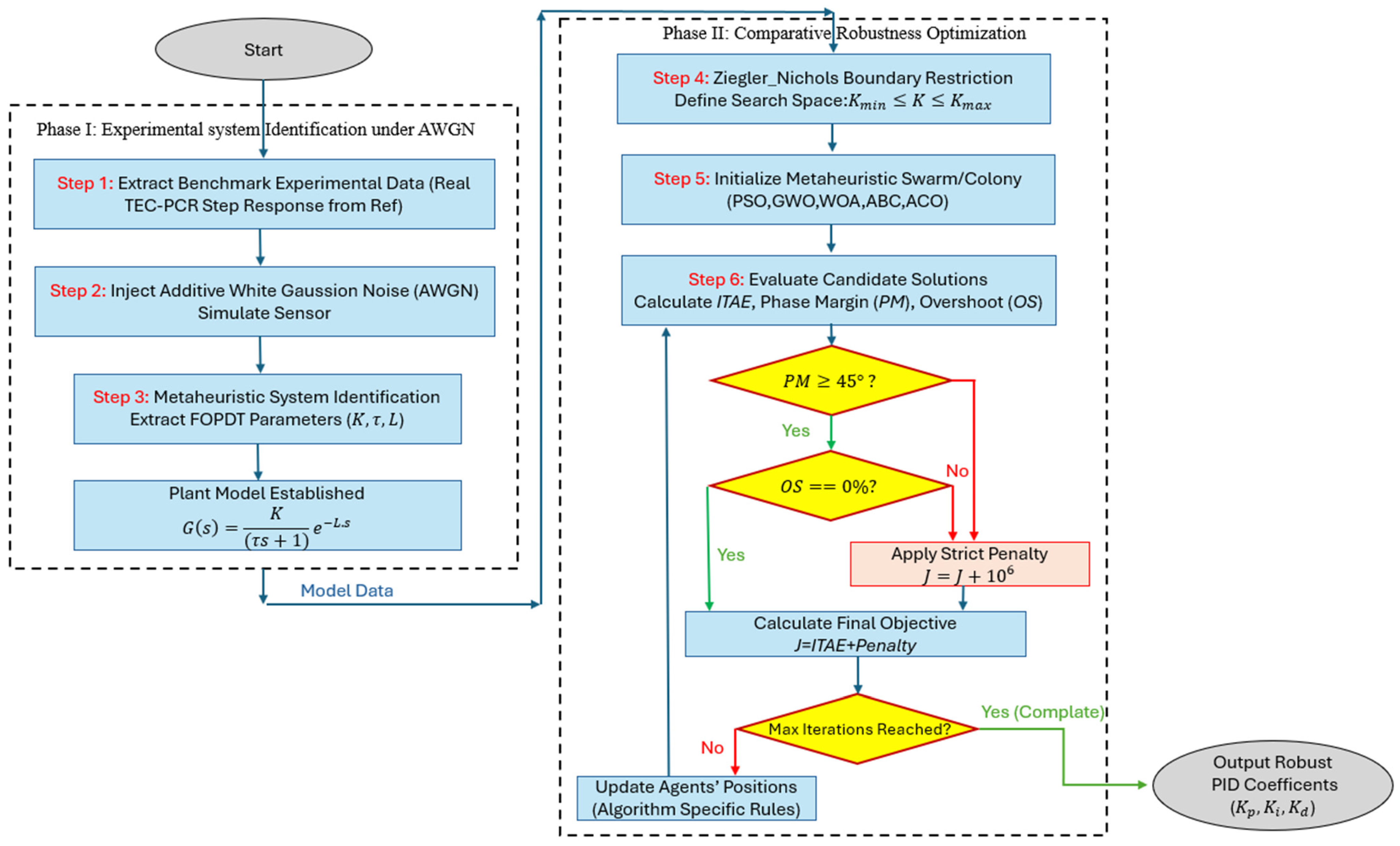
The comparative robust analysis architecture developed in this study comprises three fundamental stages: high-fidelity system modeling, the definition of a constrained search space, and frequency-domain-integrated optimization. This approach is specifically designed to prevent metaheuristic algorithms from generating purely mathematical parameters that violate practical hardware constraints, such as overshoot boundaries [
12]. The procedural flow of this proposed hybrid optimization framework, detailing the integration of the penalty wall and phase margin evaluations, is outlined in
Figure 1.
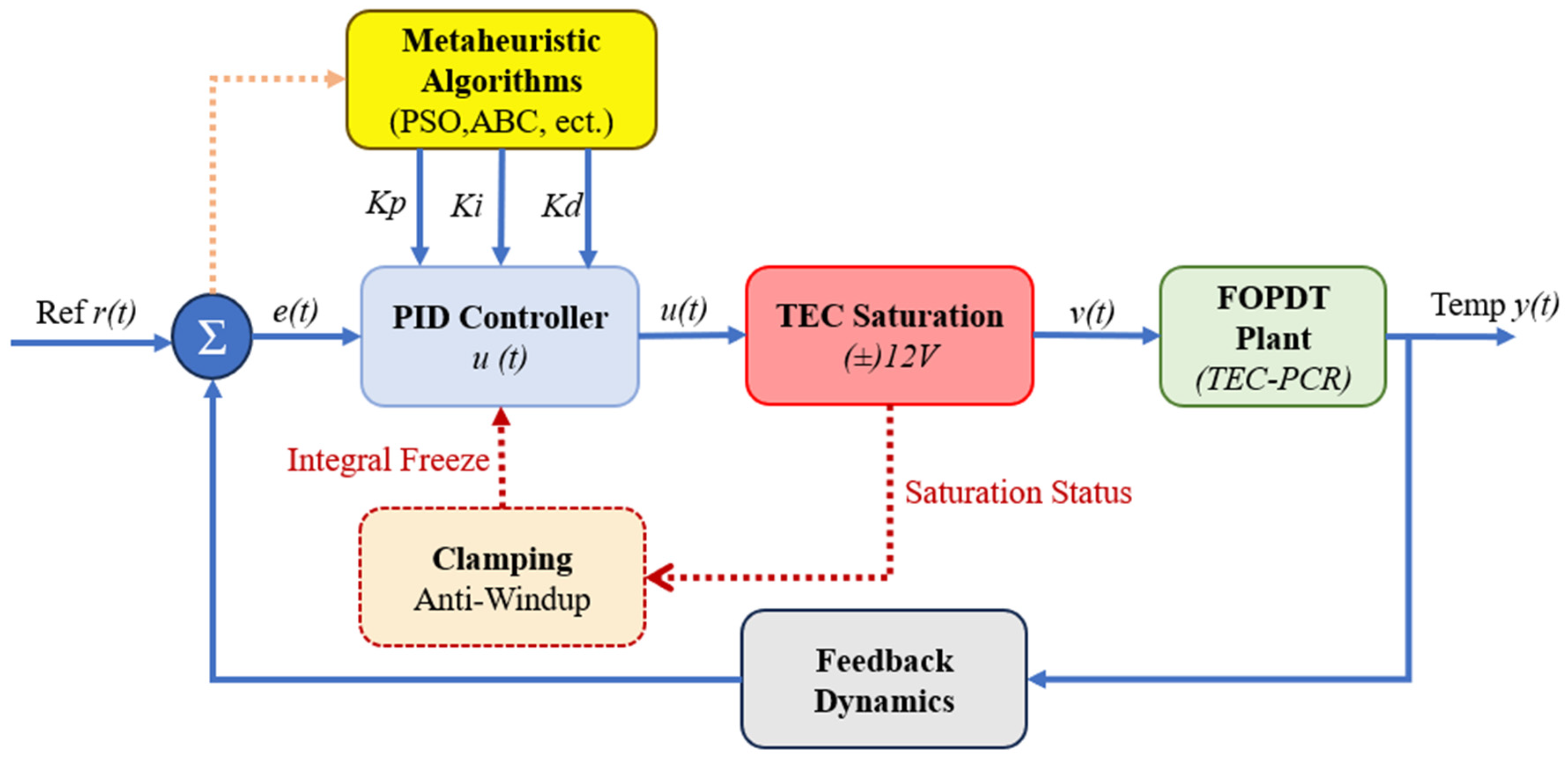
The architecture explicitly details the signal flow through the Metaheuristic Algorithms-tuned PID controller, the physical actuator saturation boundaries, the dynamic clamping anti-windup mechanism, and the hardware-derived FOPDT plant model.
3.1. Modeling of the TEC System and Experimental Data-Based System Identification
The thermodynamic nature of thermoelectric coolers (TECs) across their heating and cooling regimes, coupled with the thermal inertia between the sensor and the thermal mass, generates high-order nonlinear dynamics. The thermal cycling system uses a thermoelectric cooler (TEC) as the bidirectional actuator and a thermal sensor for feedback. The TEC operates within saturation limits of ±12 V, providing the rapid heating and cooling needed for microfluidic processes. A PT100 RTD measures the temperature. This sensor provides a measurement sensitivity of ±0.1 °C, a thermal response time under 1 s, and structural linearity between 20 °C and 100 °C. These hardware characteristics support the parameters identified for the system. In control theory, the macroscopic behavior of such high-inertia thermal processes is most effectively represented by the FOPDT transfer function. The open-loop dynamics of the system are expressed in Equation (1).
Here, represents the static gain of the system (°C/V), denotes the thermal time constant (s), and signifies the system dead-time (s) induced by thermal conduction and sensor acquisition delays.
To explicitly clarify the origin of the system dynamics, the FOPDT model utilized in this study is not based on theoretical assumptions. Instead, it is directly derived from an actual experimental setup. Specifically, rather than relying on a purely synthetic model, the open-loop step response data acquired via real-time hardware measurements on a micro-TEC based PCR platform by Arıkuşu and Bayhan [
7] was adopted as the physical benchmark. By deploying metaheuristic system identification over this actual sensor data, the physical validity of the extracted FOPDT parameters is guaranteed, ensuring that the proposed controller is evaluated under rigorous real-world hardware conditions.
However, to circumvent the idealized nature of the data acquired in a controlled laboratory environment, and to accurately simulate real-world conditions specifically sensor measurement errors, electrical interference white gaussian noise (AWGN) was superimposed onto the raw experimental dataset Equation (2).
Here,
represents the random noise component with a zero mean and a variance of
[
28]. The metaheuristic algorithms were deployed across this severely noise-corrupted dataset, compelling them to extract the true FOPDT (
) coefficients. Consequently, the identification robustness of the algorithms under such noisy conditions was rigorously demonstrated. Following the addition of the AWGN, we processed this realistic, noisy step-response data using curve-fitting estimation techniques to extract the First-Order Plus Dead-Time (FOPDT) model parameters. This estimation process determined the system gain (
) as 58.06, the time constant (
) as 18.533 s, and the dead-time (
) as 1.536 s. By extracting the parameters from the noise-superimposed dataset, we ensured that the resulting transfer function accurately represents the thermal inertia and sensor transport delays under real-world interference conditions.
3.2. Ziegler–Nichols Limits and Constraining Search Space
The transfer function of the PID controller is given in Equation (3).
,
and
represent the proportional, integral, and derivative gain coefficients, respectively. The most significant limitation of metaheuristic optimization algorithms is that, when operating within vastly broad and unconstrained search spaces, they exhibit a strong tendency to converge toward impractically high proportional gain values [
13,
21]. To circumvent this problem, the search space was analytically constrained utilizing the conventional Ziegler–Nichols (Z-N) ultimate cycling method. The ultimate gain (
) and ultimate period (
) values representing the point at which the closed-loop system reaches marginal stability were analytically computed. The boundaries of the search space available to the optimization agents (
) were strictly defined in accordance with the physical validity limits of these Z-N rules.
To explicitly address the physical hardware limitations of the TEC module, the ideal PID control law in Equation (3) is modified to incorporate an actuator saturation block and a dynamic clamping anti-windup mechanism. In physical implementations, the input voltage applied to the TEC,
, is strictly bounded by the power supply limits (
), formulated as in Equation (4).
where
is the unconstrained controller output. During rapid 95 °C transitions, the unconstrained output naturally exceeds 12 V, which would conventionally cause the integral term to accumulate excessive error (integrator windup), leading to hidden thermal overshoots upon reaching the target. To prevent this, a dynamic clamping anti-windup mechanism is integrated into the simulation. The integrator state is actively frozen (i.e., the integration of
is paused) whenever the controller saturates (
)) and the control error shares the same sign as the manipulated variable. This mathematical inclusion ensures that the optimized
gains remain physically feasible during real-time hardware operation without violating the zero-overshoot constraint.
3.3. Frequency-Domain Constraints: Nyquist Criterion and Phase Margin
Merely achieving a rapid time-domain response can render the system highly susceptible to instability in the presence of minor model uncertainties, such as fluctuations in ambient temperature. To guarantee robustness throughout the system’s operational lifespan, frequency-domain analysis was conducted on the open-loop transfer function, and the phase margin (PM) was calculated based on the Nyquist stability criterion. The gain crossover frequency (
) of the system is defined by Equation (5) as the point at which the open-loop magnitude equals unity (0 dB).
The PM, derived from the phase angle at this crossover frequency, is formulated in Equation (6).
In control systems, achieving asymptotic stability and a well-damped response necessitates a minimum phase margin. In this study, the condition was implemented as a barrier constraint within the optimization loop to explicitly underscore that safeguarding the hardware remains the primary objective.
3.4. Hybrid Objective Function and Strict Penalty Mechanism
The objective function formulated for the fitness evaluation of the metaheuristic algorithms unifies time-domain error, hardware stability, and the strict biomedical zero-overshoot imperative within a single equation. The dynamic error in the time domain is quantified using the
ITAE metric that reflects transient performance with exceptional fidelity in Equation (7).
In Equation (6),
denotes the simulation time, and
represents the error between the reference setpoint and the instantaneous measured temperature. The strict 0% overshoot constraint, mandated to prevent the denaturation of PCR enzymes, along with the hardware-protective frequency constraint (
), was integrated into the objective function via a strict penalty mechanism, as formulated in Equation (8).
In Equation (8), represents the total cost to be minimized, and denotes the percentage overshoot. To balance the objective function, the weight is set to 1.0 to scale the primary ITAE performance metric, while the penalty weight is set to . This extreme weighting acts as a hard boundary. If the phase margin and overshoot constraints are met, the penalty remains zero. However, if any constraint is violated, the term dominates the score, driving the fitness value toward infinity. This functional architecture ensures that the optimization algorithms immediately abandon unsafe solution spaces, forcing them to converge toward a biologically and physically safe optimum.
3.5. Implemented Metaheuristic Algorithms
To substantiate that the proposed constrained architecture constitutes an algorithm-independent universal framework, five distinct metaheuristic algorithms widely recognized within the control literature were deployed across this optimization hyper-surface [
35,
36,
37]. These algorithms comprise PSO, ABC, GWO, WOA, and ACO [
38,
39]. To ensure statistical fairness and an unbiased comparison, the population size and the maximum number of iterations were strictly equalized across all evaluated algorithms [
40,
41].
The initial phase of the optimization process is dedicated to establishing the most mathematically realistic model of the target systemin
Figure 2. In step 1, rather than relying on purely theoretical assumptions, an actual TEC-PCR step response derived from the literature [
7] was introduced as the process input. In step 2, AWGN was superimposed onto this dataset to accurately simulate measurement errors. In step 3, metaheuristic algorithms were deployed across this noisy data to extract the system’s FOPDT parameters (
), thereby formulating the reference system model upon which the optimization framework would operate. Crucially, this phase guarantees that the proposed controller is evaluated not within sterile simulation environments, but under rigorous real-world conditions subjected to environmental disturbances.
Commencing upon the derived FOPDT model, the second phase constitutes an optimization loop wherein classical and modern constraints are enforced concurrently. In step 4, the process initiates by constricting the search space of the optimization agents (e.g., particles, bees) utilizing conventional Z-N boundaries. In step 5, the population is initialized at random positions; subsequently, in step 6, it is evaluated at each iteration based on its performance in both the time domain and the frequency domain.
The novelty of the proposed architecture resides in the sequential decision-making mechanisms implemented at this stage:
Frequency-Domain Security Barrier (): An evaluated PID candidate must fundamentally satisfy the Nyquist stability criterion. If a candidate solution fails to yield a minimum phase margin of , the system is labeled as unstable or fragile. Consequently, irrespective of how exceptionally low its time-domain error may be, the candidate is instantaneously relegated to the strict penalty block.
Biomedical Security Barrier (): Robust candidates that successfully navigate the frequency barrier are subsequently subjected to a stringent zero-overshoot evaluation to mitigate the risk of DNA polymerase enzyme denaturation. Any solution producing a temperature overshoot is immediately diverted to the penalty mechanism and consequently eliminated.
For the rare agents that successfully navigate both constraints, the objective function is evaluated based exclusively on their ITAE scores; conversely, a prohibitive penalty () is appended to the cost function of any agents exhibiting constraint violations, compelling them to rapidly evade these suboptimal regions of the search space. Successive generations are subsequently produced utilizing the specific position update equations intrinsic to each algorithm’s methodology, and this iterative loop continues until the predefined maximum number of iterations is achieved. The algorithm concludes the process by yielding the optimal , and parameters that prevent hardware overexertion, remain robust against external disturbances, and strictly guarantee sample safety.
Furthermore, to ensure reproducibility and provide a transparent methodology, the internal algorithmic hyper-parameters of the selected optimizers were explicitly configured. To establish a statistically fair comparison baseline, the population size (
N) and the maximum number of iterations (
) were equalized across all algorithms. The specific control parameters, such as the inertia weights for PSO and the abandonment limit for ABC, were carefully selected based on the delay-dominant nature of the FOPDT model and are detailed in
Table 2. These internal parameters were kept strictly constant during both the unconstrained and hybrid-constrained optimization phases to perfectly isolate and observe the effect of the proposed penalty mechanism.
4. Results and Discussion
4.1. System Identification and Determination of Analytical Boundaries
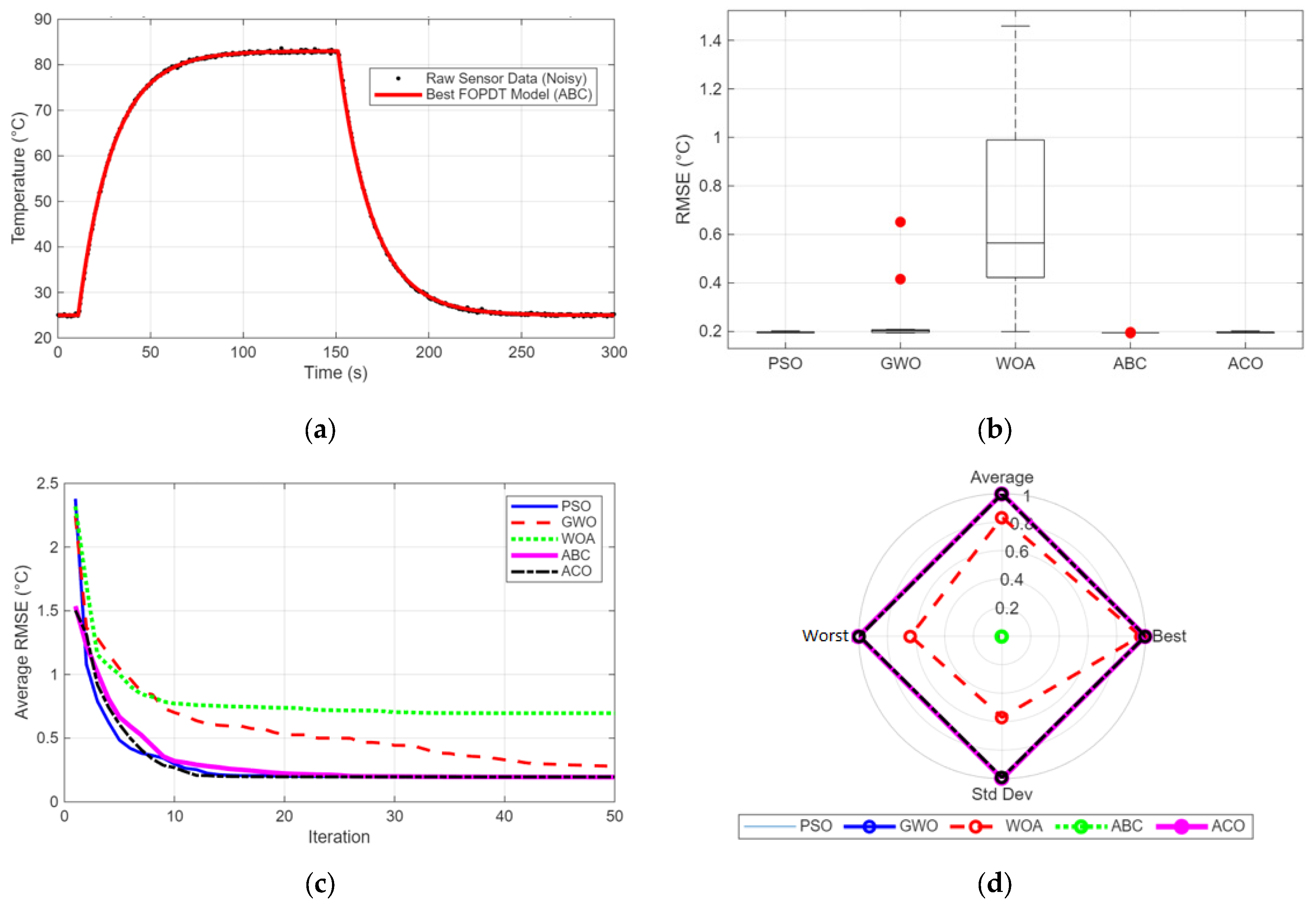
In the initial phase of the study, the parameters of FOPDT transfer function, representing the dynamic behavior of the PCR thermal block were identified using the actual time-temperature response derived from sensor data. To achieve this, the system was modeled utilizing five distinct metaheuristic algorithms (PSO, GWO, WOA, ABC, and ACO) constrained by strict physical thermodynamic bounds: . To ensure that the algorithms extract the authentic hardware characteristics rather than merely achieving a superficial mathematical fit, the Root Mean Square Error (RMSE) was employed as the cost function, and each algorithm was subjected to 20 independent runs. Consequently, a total of 100 independent tests were executed across the five algorithms for the system identification process.
According to the statistical outcomes of the independent system identification trials presented in
Table 3, all optimization agents successfully modeled the system with a negligible RMSE deviation of approximately 0.1944 °C during their best iterations. However, a deeper examination of the algorithms’ robustness performances reveals that WOA and GWO were trapped in local minima during certain runs, yielding maximum errors (Worst RMSE) of up to 1.45 °C and 0.65 °C, respectively. Consequently, they exhibited markedly high standard deviations 0.3885 and 0.1674, respectively. In stark contrast, ABC algorithm consistently remained within the global optimum valley across all 20 runs. By yielding a near-zero standard deviation of 0.0002, ABC definitively proved to be the most robust system identification tool among the evaluated methods.
The open-loop system parameters derived from the highly consistent results of the ABC algorithm, and which will serve as the foundational model for the remainder of the study were determined as follows; System Gain
, Time Constant
(s), and Dead Time
(s) in Equation (9). These parameters are in strict accordance with the thermal inertia characteristics of PCR systems reported in the literature.
The precise alignment of the ABC algorithm’s model with the experimental data of the TEC system is clearly illustrated in
Figure 3.
Figure 3a shows the fit of the FOPDT reference model, successfully detected by the ABC algorithm, with the noisy simulated sensor data obtained from the PCR-TEC system.
Figure 3b compares the error (RMSE) distributions of the algorithms in 20 independent runs, revealing via a box plot that ABC, ACO, and PSO exhibit high stability, while WOA and GWO tend to get stuck in local minima.
Figure 3c visualizes the search strategies that most quickly and consistently bring the error margin closer to zero by presenting the average convergence curves of the algorithms over 50 iterations.
Figure 3d summarizes the multidimensional performance (Best, Worst, Mean, and Standard Deviation) of the algorithms in a radar graph, confirming the statistical superiority of the ABC algorithm in system identification, as it fits most consistently into the outer frame.
Following the derivation of the mathematical model, the dynamic search space for the PID controller coefficients was analytically computed via the Z-N ultimate cycling method. The marginal stability condition of the closed-loop characteristic equation the ultimate frequency ( rad/s) and, consequently, the ultimate gain ( of the system were determined. Rather than employing the conventionally broad, arbitrary intervals prevalent in the literature, the search space for the metaheuristic algorithms was constrained to a strictly safe region derived directly from these physical marginal stability limits: , and .
4.2. Statistical Comparison of Unconstrained and Constrained (Hybrid) Optimization
To analytically validate the necessity and robustness of the proposed frequency-domain constrained (Phase Margin-based) hybrid optimization architecture, a comprehensive investigation was conducted. To this end, five distinct metaheuristic algorithms widely recognized in the literature (PSO, GWO, WOA, ABC, and ACO) were rigorously evaluated. The assessment was executed across a total of 100 independent tests, comprising 20 independent runs for each optimization scenario.
The fundamental premise of this study is to elevate the optimization process from a mere mathematical minimum-seeking (curve-fitting) exercise, transforming it into the design of a physically implementable, robust controller that strictly guarantees the 0% overshoot mandated for PCRs.
4.2.1. Analysis of the Unconstrained Search Space and System Instability
In the first scenario, the search space for the algorithms was constrained directly by the theoretical Z-N parameter bounds of the plant; however, the frequency-domain phase margin () constraint was intentionally deactivated. To ensure that a system responds with sufficient speed while remaining stable without oscillations or overshoot, the recommended industry standard for phase margin typically ranges between and . By defining the boundary condition at , the optimization objective was formulated to establish an optimal trade-off between achieving high robustness against external disturbances and minimizing the PCR settling time by avoiding sluggishness in the transient response.
The primary motivation behind this configuration is to evaluate whether a search strategy grounded solely in analytical Z-N constraints and conventional ITAE minimization is sufficient to ensure closed-loop stability and the targeted transient performance in dead-time dominant systems. Furthermore, to preclude mathematical estimation errors and false-positive convergences that may arise within the optimization loop, the Padé approximation was strictly avoided. Instead, the cost function was executed directly upon an infinite-dimensional, full time-delay system model.
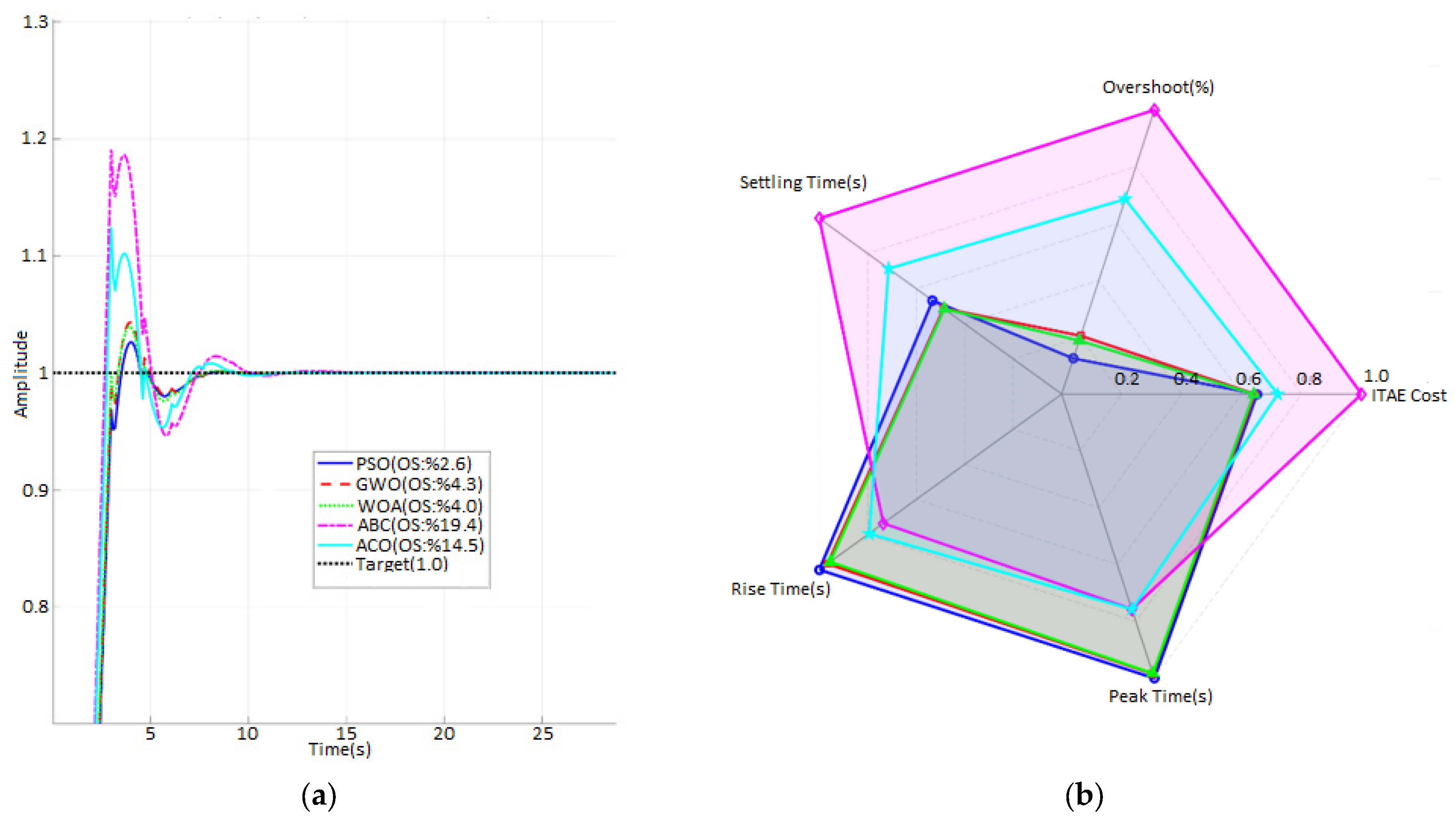
The quantitative findings derived from the analytically constrained Z-N scenario are comprehensively summarized through the closed-loop step response characteristics, the radar charts depicting the multi-dimensional performance trade-offs of the algorithms at
Figure 4, and the detailed statistical performance metrics in
Table 4.
An examination of
Figure 4 reveals that all evaluated algorithms were shielded from asymptotic instability, as the Z-N search space boundaries successfully precluded the divergence of the closed-loop system. However, in the absence of the Phase Margin (Nyquist) constraint, it was observed that all optimization algorithms driven by the singular pressure to minimize the
ITAE cost function forced the proportional gain (
) into a range between approximately 0.15 and 0.19 in
Table 4. Consequently, while the closed-loop system maintained its global stability, it exhibited intolerable overshoots (ranging from 2.65% to 19.04%) and pronounced transient oscillations. Such levels of overshoot are unacceptable for biomedical systems, such as PCR devices, which demand extreme thermal precision. These findings clearly demonstrate that relying solely on analytical Z-N constraints in dead-time dominant systems fails to provide an adequate safety margin to guarantee the targeted zero-overshoot performance.
4.2.2. Effectiveness of the Hybrid-Constrained Model and the Zero-Overshoot Constraint
In the second stage of the study, the algorithms were deployed under the proposed hybrid architecture. Here, they were confined within Ziegler–Nichols boundaries and subjected to both the Phase Margin () constraint and a strict zero-overshoot safety mandate, enforced by a penalty for any violation. An examination of the optimization statistics reveals that the average ITAE scores are notably high. While this might appear as a performance deficiency, it mathematically demonstrates how selective and rigorous the constraints are. If an algorithm exceeds the target amplitude by even a fraction of a percent, it triggers the massive penalty, which subsequently dominates its average error score.
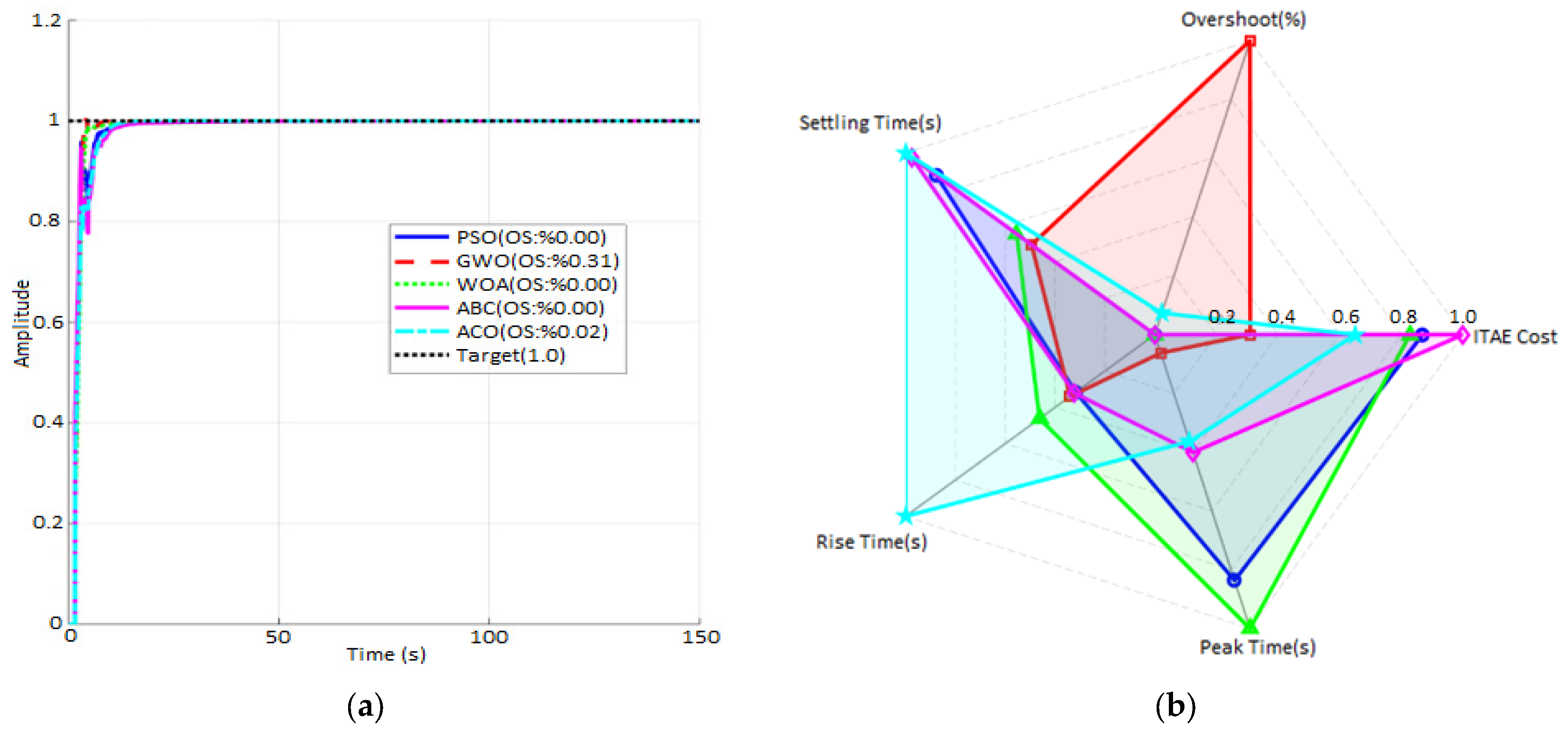
This penalty mechanism clearly separates the capabilities of the tested algorithms. Even under these strict hybrid constraints, algorithms like GWO and ACO struggle to remain completely within the safety boundaries. They produce minor overshoots of 0.31% and 0.02%, respectively, triggering the penalty wall. In contrast, the ABC algorithm successfully navigates this highly restricted search space. It achieves exactly 0.00% overshoot while optimizing the rise and settling times, proving that it can consistently find the biologically and physically safe optimum without absorbing any penalty.
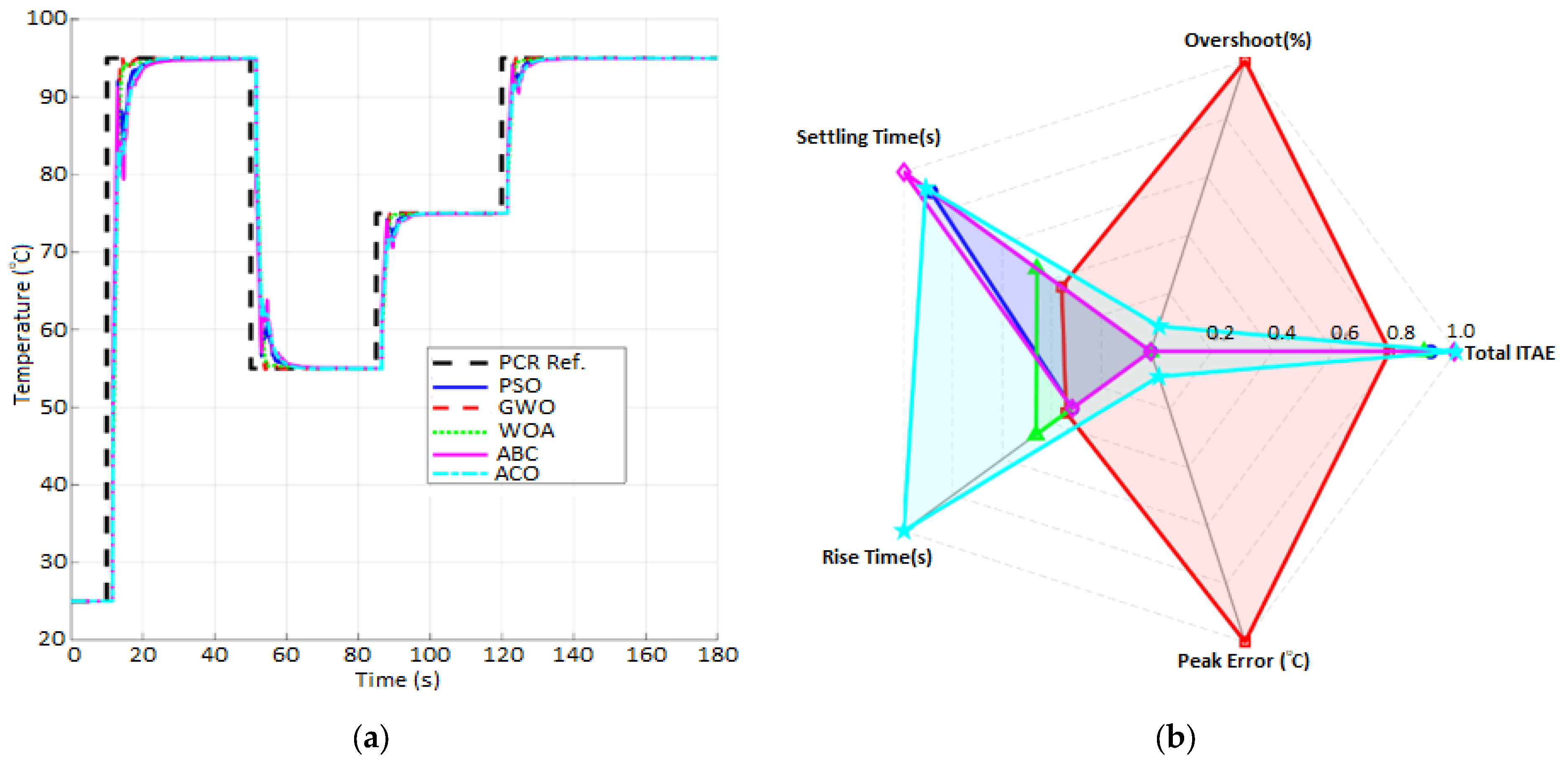
When the step responses in
Figure 5 and the statistical data in
Table 5 are evaluated together, it is observed that the system controlled by the final coefficients generated by the hybrid method (particularly for PSO, WOA, and ABC) settles flawlessly at the reference amplitude with zero oscillations and an absolute 0.00% overshoot. ACO and GWO exhibited clinically tolerable microscopic deviations of 0.02% and 0.31%, respectively. Achieving such a seamless step response in a high-gain TEC system is a critical engineering feat for preserving hardware longevity. In biochemical equipment requiring high thermal sensitivity, such as PCR devices, exceeding the target denaturation temperature (e.g., 95 °C) by even 1% can lead to the degradation of DNA polymerase enzymes and the spoilage of medical samples. In this context, it has been proven that the coefficients obtained through hybrid architecture fulfill a physical imperative for hardware protection rather than merely achieving a mathematical minimum.
Table 6 presents a direct methodological comparison between the foundational reference study [
7] and the proposed optimization framework. While the reference study provides a valuable hardware-validated base model, our proposed architecture introduces strict frequency-domain robustness limits, physical actuator saturation constraints, and a zero-overshoot penalty wall. These systemic additions bridge the gap between idealized laboratory optimizations and the rigorous biological safety requirements of actual PCR thermal cycling.
4.2.3. Hardware Robustness Analysis: Parametric Uncertainty and Actuator Saturation
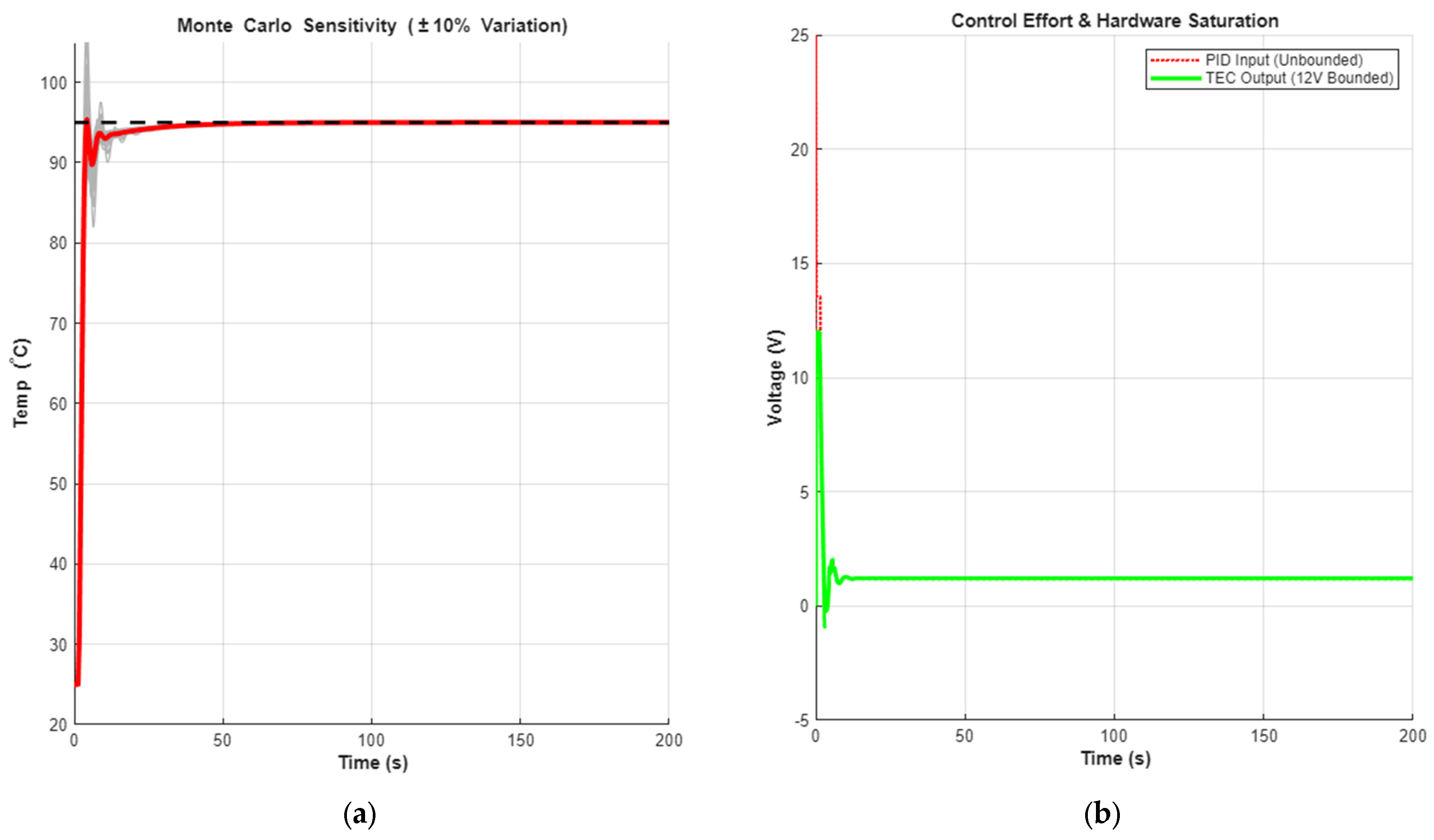
Real-world PCR environments experience parametric changes due to component wear and ambient temperature shifts. To rigorously test the controller’s reliability under these conditions, a 50-run Monte Carlo sensitivity analysis was conducted. The FOPDT model parameters (
,
,
) were varied simultaneously by ±10% to emulate worst-case system gain fluctuations and dead-time variations. As shown in
Figure 6a, the system maintained robust stability across all iterations. Most importantly, even under these severe parametric uncertainties, the absolute zero-overshoot condition strictly held (0.00% OS), and the temperature successfully reached the 95 °C target without any thermal degradation risks.
Furthermore, standard simulations often ignore hardware power limits. We included an actuator saturation block for the TEC’s ±12 V limits and a clamping anti-windup mechanism.
Figure 6b shows the control effort. Initially, the PID output requests a high voltage, but the saturation block restricts it to 12 V. The anti-windup mechanism stops the integral state from accumulating during this saturation phase. When the temperature nears 95 °C, the control effort smoothly drops to around 1.2 V, indicating energy efficiency suitable for portable PCR devices.
4.2.4. Convergence Analysis and Penalty Function Dynamics
A known risk of using massive static penalties, such as the
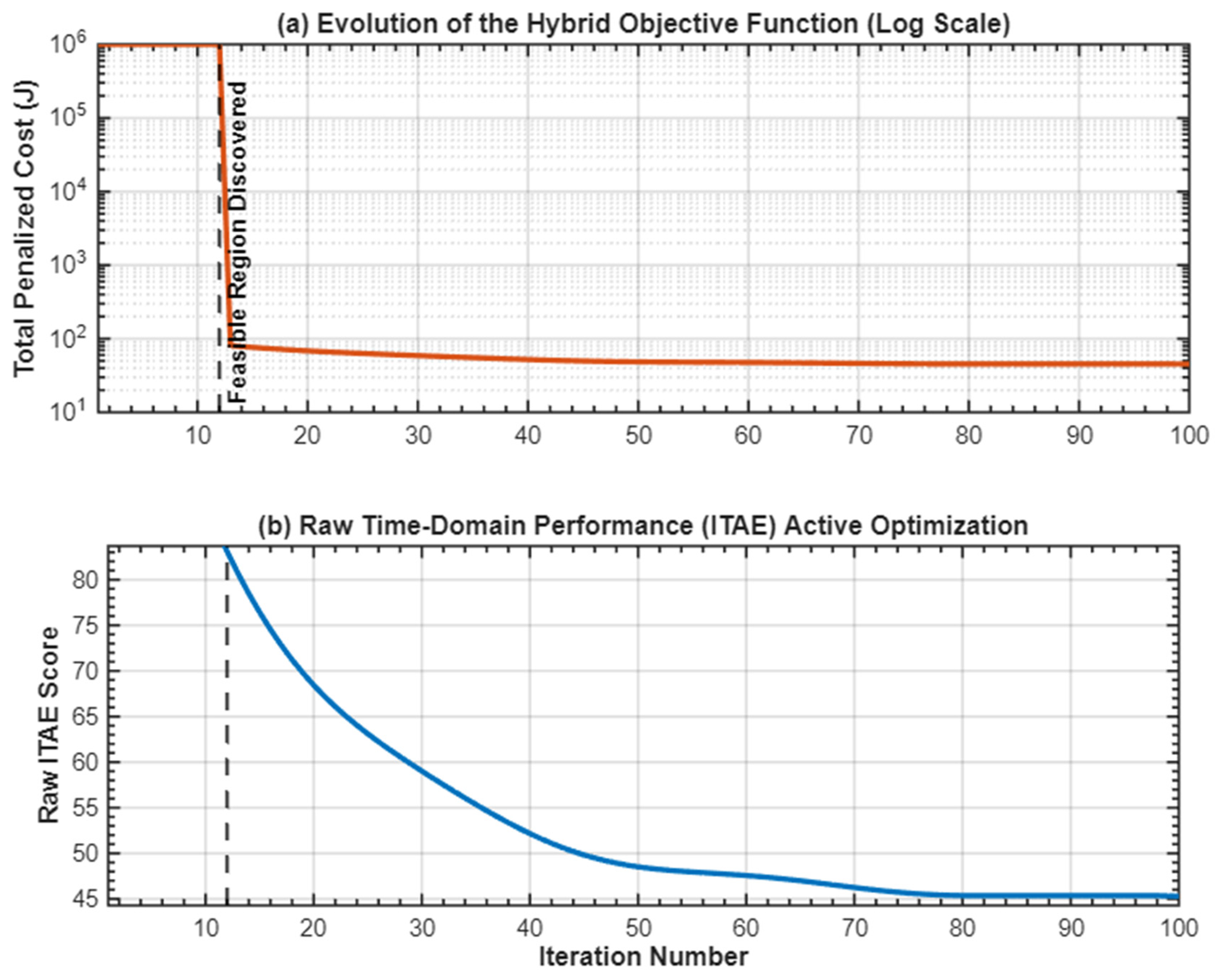
weight in our objective function, is objective function plateauing. This condition can cause search agents to lose directional gradient information, forcing them to stagnate once they find the first feasible solution. To verify that the proposed framework avoids this issue, we analyzed the convergence behavior of the ABC algorithm.
Figure 6 illustrates this dynamic through two perspectives: the total penalized cost (
J) in
Figure 7a and the raw
ITAE score in
Figure 7b.
As shown in
Figure 7a, the total cost drops sharply in the early iterations once the population escapes the penalty zone and enters the secure phase margin and zero-overshoot region. More importantly,
Figure 7b demonstrates that the raw
ITAE curve does not stagnate after this drop. Instead, the algorithm continues to minimize the
ITAE smoothly throughout the remaining iterations. This confirms that the agents do not simply avoid the penalty wall; they actively exploit the feasible region to optimize the time-domain performance of the PCR thermal cycle.
4.3. Performance Validation via PCR Multi-Stage Thermal Cycling Protocols
The ultimate clinical and medical validity of the developed hybrid controller architecture was tested against a realistic DNA amplification thermal profile (95 °C Denaturation, 55 °C Annealing, and 75 °C Extension). In PCR assays, even a minor temperature overshoot of a few degrees, particularly during the 95 °C denaturation phase, can irreversibly denature the DNA polymerase enzymes within the reaction tube. Such thermal degradation compromises the biochemical integrity of the process, thereby rendering the entire assay invalid.
The pivotal finding of this phase lies in the fact that the algorithms were not reoptimized for this complex cycle. Instead, the hybrid coefficients previously derived from a simpler step response as detailed in
Table 6 were directly integrated into the clinical simulation. According to the comparative PCR cycle analysis presented in
Figure 8 and the performance metrics in
Table 7, the proposed constrained hybrid architecture successfully navigated all phase transitions of the PCR cycle with high stability. Notably, despite the abrupt thermal shock experienced during the transition from 75 °C to 95 °C (the second denaturation) at the 120th second, the system settled at the target with 0.00% overshoot, flawlessly preserving the biological specimen. This performance serves as the most compelling evidence that frequency-domain constraints provide intrinsic hardware stability rather than an overfitted solution tailored to a specific setpoint.
Beyond the achievement of zero overshoot, the Settling Time data presented in
Table 6 holds vital importance for clinical PCR diagnostics. PCR cycles are time-critical processes; the more rapidly and smoothly the system settles at the target temperature, the shorter the total diagnostic duration becomes. The exceptionally low settling times (rapidly damped responses) of the hybrid architecture illustrated in
Figure 5 ensure that the device not only performs safe DNA amplification but also aligns with the targeted rapid cycle PCR paradigm. These clinical simulation results substantiate the vital necessity of integrating thermodynamic (Z-N) and frequency-domain (Nyquist) robustness constraints into metaheuristic PID optimization processes, particularly for ensuring medical device integrity and specimen safety.
5. Conclusions
In this study, a novel frequency-domain constrained hybrid PID optimization architecture centering on hardware safety and thermodynamic physical limits have been developed for the precise thermal control of TEC systems in PCR devices. Through comprehensive investigations, this work provides statistical evidence of the deleterious effects on PCR equipment caused by common literature approaches that utilize broad and unconstrained search spaces for metaheuristic algorithms.
System identification tests conducted on the FOPDT model using five different metaheuristic algorithms revealed that ABC algorithm established the most robust reference model, achieving the lowest standard deviation of 0.0002. During the controller design phase, it was observed that unconstrained optimization agents suffered from gradient blindness due to the singular pressure to minimize ITAE. This phenomenon pushed the systems toward instability, resulting in hazardous temperature overshoots of up to 19.04%.
To resolve this optimization collapse, the search space was confined to marginal stability boundaries derived from the Z-N method, and the Nyquist frequency-domain stability criterion ( along with absolute zero-overshoot constraints were integrated into the objective function.
It was observed that the optimal coefficients surviving these physical filters consistently converged toward a single, narrow, secure, and physically meaningful global optimum region, regardless of the algorithm type. Through this hybrid architecture, the PSO, WOA, and ABC algorithms, in particular, succeeded in achieving an absolute 0.00% overshoot in the step response.
The direct application of these developed robust coefficients to a realistic dynamic PCR thermal cycle (95 °C Denaturation, 55 °C Annealing, and 75 °C Extension) successfully demonstrated the clinical validity of the system by preventing overfitting. Notably, during the abrupt transition from 75 °C to 95 °C at the 120th second, the system exhibited absolute zero overshoot (0.00 °C Maximum Error), thereby eliminating the risk of thermal shock degradation of DNA polymerase enzymes. Furthermore, the speed-safety trade-off provided by the constraint resulted in exceptionally low settling times. This efficiency ensures that the PCR is not only secure but also aligns with the targeted rapid-cycle PCR paradigm.
This study highlights that in the control of biomedical devices requiring high thermal sensitivity, such as PCR equipment, the core challenge lies not merely in the choice of optimization algorithm, but rather in how accurately these algorithms are constrained by physical and frequency-domain rules. The proposed hybrid design approach provides a reliable, universal, and hardware-friendly reference framework for the robust control of all medical, industrial, and microfluidic thermal systems characterized by high thermal inertia.