1. Introduction
The growing adoption of EVs and the increasing demand for energy flexibility are accelerating the development of efficient bidirectional power conversion systems. These converters enable not only vehicle charging but also V2G and vehicle-to-home (V2H) operations, where the energy stored in EV batteries can be supplied back to the grid to balance peak loads and enhance grid stability. Achieving this bidirectional power flow efficiently requires isolated DC–DC converters with high power density, galvanic isolation, and soft-switching capabilities across a wide operating range [
1].
In addition, emerging applications such as wireless power transfer (WPT) for EV charging are driving the exploration of novel converter topologies and resonant architectures, aimed at improving efficiency, tolerance to misalignment, and overall system integration [
2,
3]. Among various topologies, the DAB converter has emerged as one of the most suitable architectures for on-board chargers and energy storage interfaces [
4]. It offers inherent bidirectional operation, compact magnetic design, and the ability to maintain ZVS/ZCS conditions. However, under large variations in voltage gain and load current, conventional Single Phase Shift (SPS) control suffers from significant conduction and switching losses due to increased circulating current and partial loss of ZVS and ZCS, particularly under light-load conditions [
5,
6]. To overcome these limitations, several extensions of the basic SPS have been introduced, such as Extended Phase Shift (EPS) [
7], Dual Phase Shift (DPS) [
8], and TPS modulations [
9]. These schemes provide additional control flexibility through internal and external phase adjustments, yet still struggle to guarantee complete soft-switching operation or minimum current trajectories across the entire operating range [
10].
Resonant DAB converters, including LC, LCL, and CLLC-type tanks, have been proposed to further reduce losses and improve soft-switching [
10,
11,
12]. While these topologies achieve higher efficiency by shaping the current waveform, they often introduce higher circulating currents or require complex control strategies and wide frequency variations. Variable-frequency modulation can extend the ZVS range but complicates magnetic design, increases electromagnetic interference (EMI), and imposes additional constraints on control and filtering [
13]. Fixed-frequency operation, on the other hand, simplifies implementation and EMI compliance but traditionally limits efficiency when the converter operates far from its nominal point [
14].
Recent studies have explored hybrid control strategies that combine phase-shift modulation with variable inductance or frequency adjustment, seeking to reduce both conduction and switching losses while maintaining ZVS in all operating conditions [
15]. Variable-inductor techniques allow the converter to dynamically minimize the root-mean-square (RMS) current and reactive power in non-resonant converters. Nevertheless, the integration of variable inductance control into a fixed-frequency, high-efficiency resonant DAB converter has not been addressed.
For instance, in Refs. [
16,
17], a variable inductor is employed to extend the operating range of a non-resonant DAB converter, enabling ZVS over a wider range of operation. However, ZCS operation is not achieved, since the system does not operate with a resonant tank.
In contrast, Ref. [
18] introduces an additional inductor alongside the LC resonant network to create an auxiliary current path, which can be selectively short-circuited depending on the operating mode. This approach extends the soft-switching range; however, it only enables ZVS in the high-voltage bridge and ZCS in the low-voltage bridge.
A recent study partially resolved the issues associated with fixed-frequency modulation by employing dual asymmetric voltage regulation [
19]; however, no performance improvements were achieved over phase-shift modulation with variable frequency.
In this work, a Fixed-Frequency Dual-Active-Bridge Resonant Converter is proposed, featuring four degrees of freedom (4-DOF) through the combination of TPS modulation and a current-controlled variable inductor (VI). The proposed approach maintains a constant switching frequency while independently regulating the phase relationships and tank inductance to achieve minimum reactive power, reduced RMS current, full-range ZVS, and ZCS. This yields a converter that combines the controllability of resonant DABs with the predictability and EMI advantages of fixed-frequency operation.
A complete theoretical analysis and experimental validation is presented to demonstrate the benefits of the proposed control. Using a 14 kW SiC-based prototype operating at 122 kHz, the converter achieves peak efficiencies above 97%, confirming its suitability for next-generation EV charging and V2G applications where high efficiency, compactness, and bidirectional capability are key requirements.
3. Analysis and Application of Current-Controlled Variable Inductor in Series Resonant Converter
The concept behind the Current-Controlled Variable Inductor stems from earlier research works [
21,
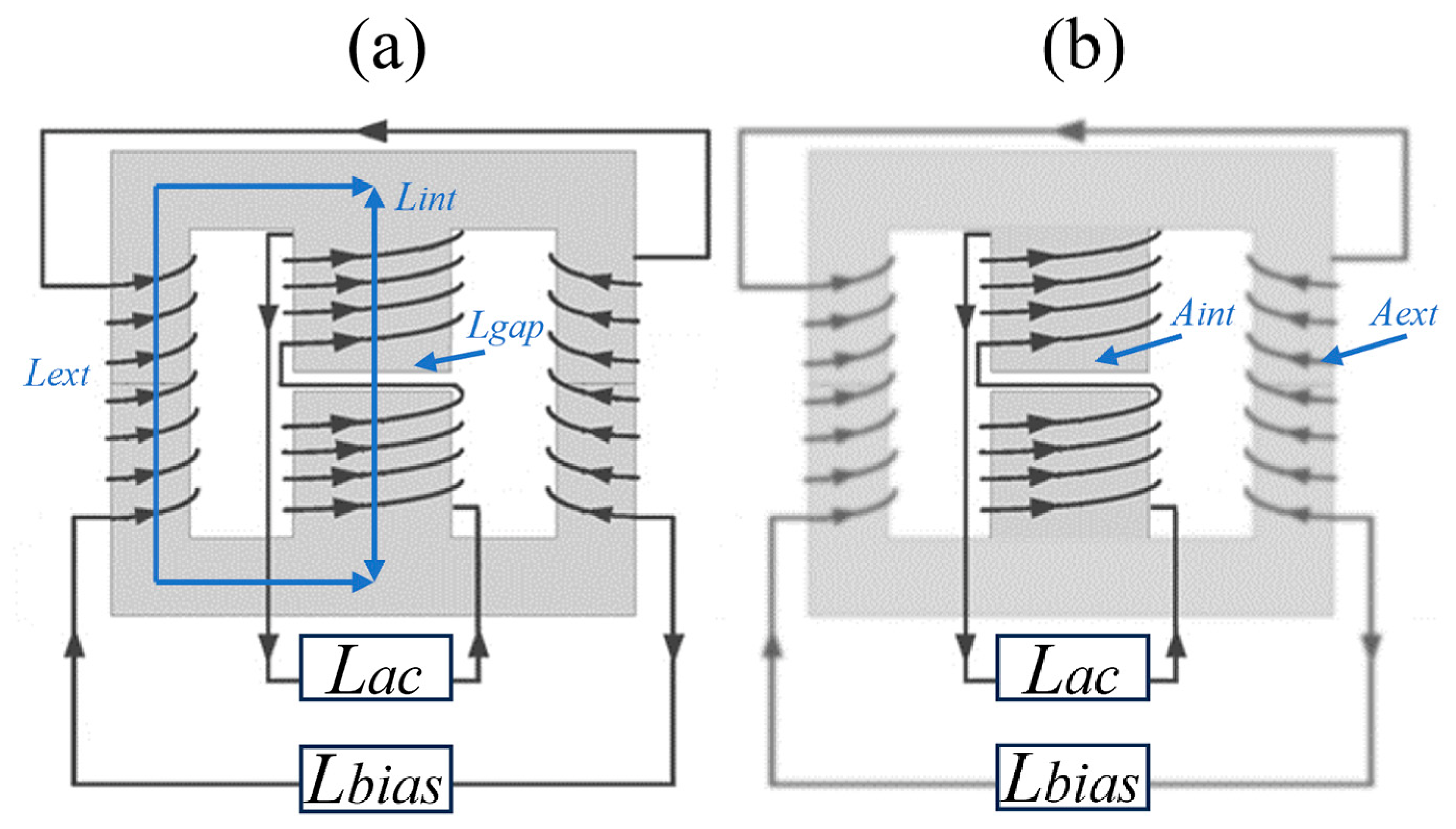
22]. Its fundamental operating mechanism relies on applying a direct current to saturate the outer regions of the magnetic core, thereby adjusting its effective permeability. As illustrated in
Figure 3, the device is composed of two superimposed ferrite cores shaped like the letter “E.” The central branch includes an air gap and a winding that constitutes the main inductance (
Lac). Meanwhile, the two outer branches are used for bias control winding (
Lbias), which are connected in series with opposing polarity. This configuration effectively isolates
Lac from
Lbias, canceling the magnetic coupling and preventing any induced voltage in the bias winding.
In the design process, the inductance of the central branch is calculated using the standard geometric relationship for inductors employing a ferrite core, which can be expressed as
Here, μi is the initial permeability of the ferrite core, μ0 is the permeability of free space, denotes the effective cross-sectional area of the central branch, represents the number of turns in the winding, and corresponds to the magnetic path length of the central branch.
The inductance associated with the air gap can be expressed as
where
represents the length of the air gap.
The leakage inductance corresponds to the magnetic flux paths that close through the surrounding air instead of the central branch of the ferrite core
and the inductance corresponding to the two outer branches can be expressed as
where
denotes the relative permeability of the core in the absence of a DC bias.
Accordingly, the maximum value of
can be determined using the following expression:
As
diminishes under the influence of a continuous magnetic field intensity (
), applied through the
winding, the relationship between
and
, where
corresponds to the minimum inductance obtained for the lowest
at maximum
, can be determined using the following expression
where
denotes the effective relative permeability of the gapped magnetic core, obtained from the elementary inductance relationship
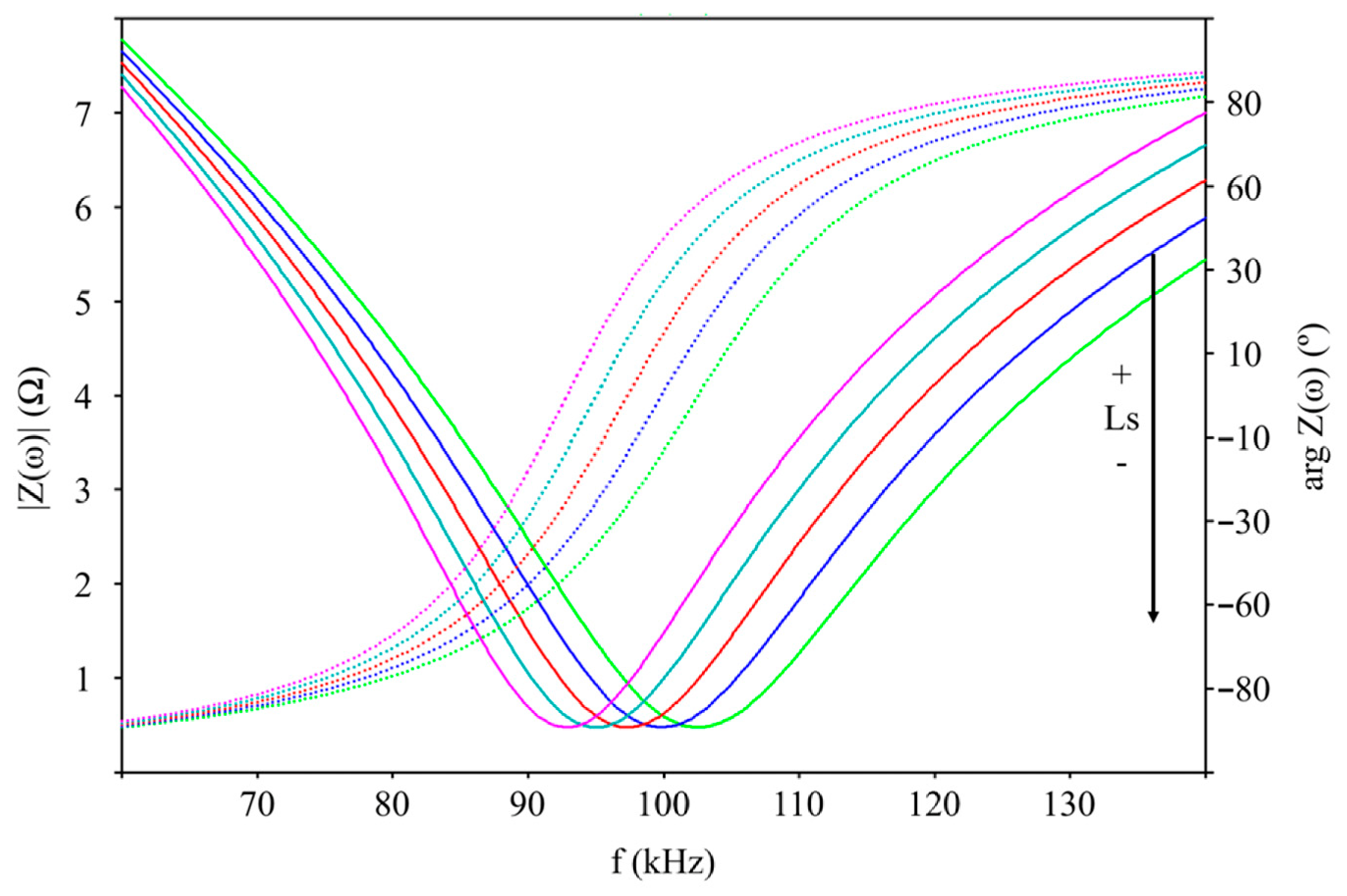
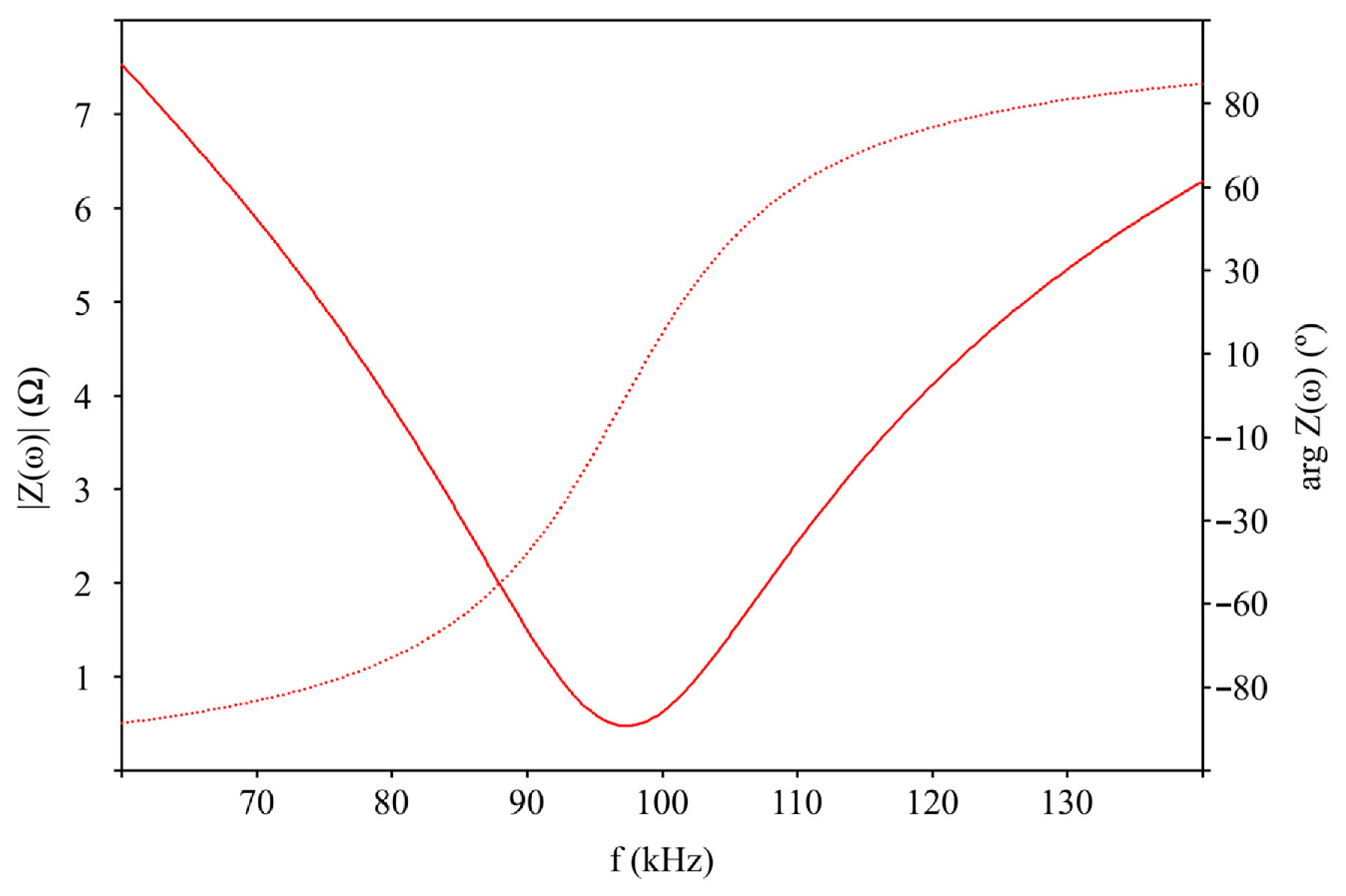
The effect of incorporating this variable inductance into the resonant tank is illustrated in
Figure 4. When the operating point is selected at a fixed frequency near and slightly above the resonance frequency, where the impedance reaches its minimum, it can be observed that both the impedance magnitude and phase increase as the series inductance is raised. This behavior provides two significant advantages.
The first advantage is that, for a fixed switching frequency, the converter delivers its highest output current and power when the series inductance is at its minimum value, since both the impedance magnitude and phase are minimized. Conversely, when maximum output power is not required, increasing the series inductance elevates the impedance magnitude, thus reducing the output current.
The second advantage arises from the simultaneous variation in the impedance magnitude and phase, which enables an improved response to power variations, due to the change in voltage level or power transfer requirements, and allows the converter to maintain ZVS and ZCS even when operating very far from the initial series resonance frequency. Previous studies using a fixed frequency near the series resonance point [
23] reported poor dynamic behavior under load variations, often leading to the loss of ZVS. Another study [
19] obtained good power range performance by operating with asymmetrical voltage cancelation; however, this came at the expense of duplicating the reactive elements due to the fact that continuous component must be blocked so as not to saturate the transformer.
Therefore, employing a variable inductance introduces an additional degree of freedom that, when combined with a triple phase shift control, enables the effective optimization of the inverter output current as well as extending the ZVS and ZCS range of power and voltages. These effects will be demonstrated both analytically and experimentally in subsequent sections of this paper.
Given that a ferrite core is employed for the high-frequency LC series inductance, the voltage across the inductor must be determined () to calculate the magnetic flux density and ensure that the core does not operate near saturation.
Since the switching frequency will be selected close to the series resonance frequency, the voltage across the inductor can be considered in the worst condition equal to the voltage across the capacitor, as both components are connected in series and their impedances cancel each other at resonance. Therefore, the capacitor voltage is determined by its capacitance, the current flowing through it, and the operating frequency.
And the expression of the magnetic flux can be expressed as
where
Ae is the effective area (m2).
f is the applied frequency (Hz).
As mentioned earlier, the operating point that yields the maximum output power occurs when the series inductance reaches its minimum value, which causes saturation of the outer branches of the inductor. Under this condition, the inductor voltage attains its highest value, as the current across the capacitor will be the highest, and therefore the maximum flux density that the core must withstand is determined from this scenario.
Considering the relationship
, and acknowledging that the relative permeability of the core varies with the applied
to which it is subjected, the relationship between the maximum magnetic flux density and the relative permeability for a constant magnetic field
can be obtained [
24].
4. DAB Resonant Converter Design
4.1. Design Procedure
TPS modulation is a symmetric control strategy used in DAB converters. It was introduced for non-resonant converters [
25] and later adapted for resonant converters operating at a fixed switching frequency [
26]. More recently, it has also been applied to resonant LC-based DAB converters [
15], with frequency variations designed to reduce power losses.
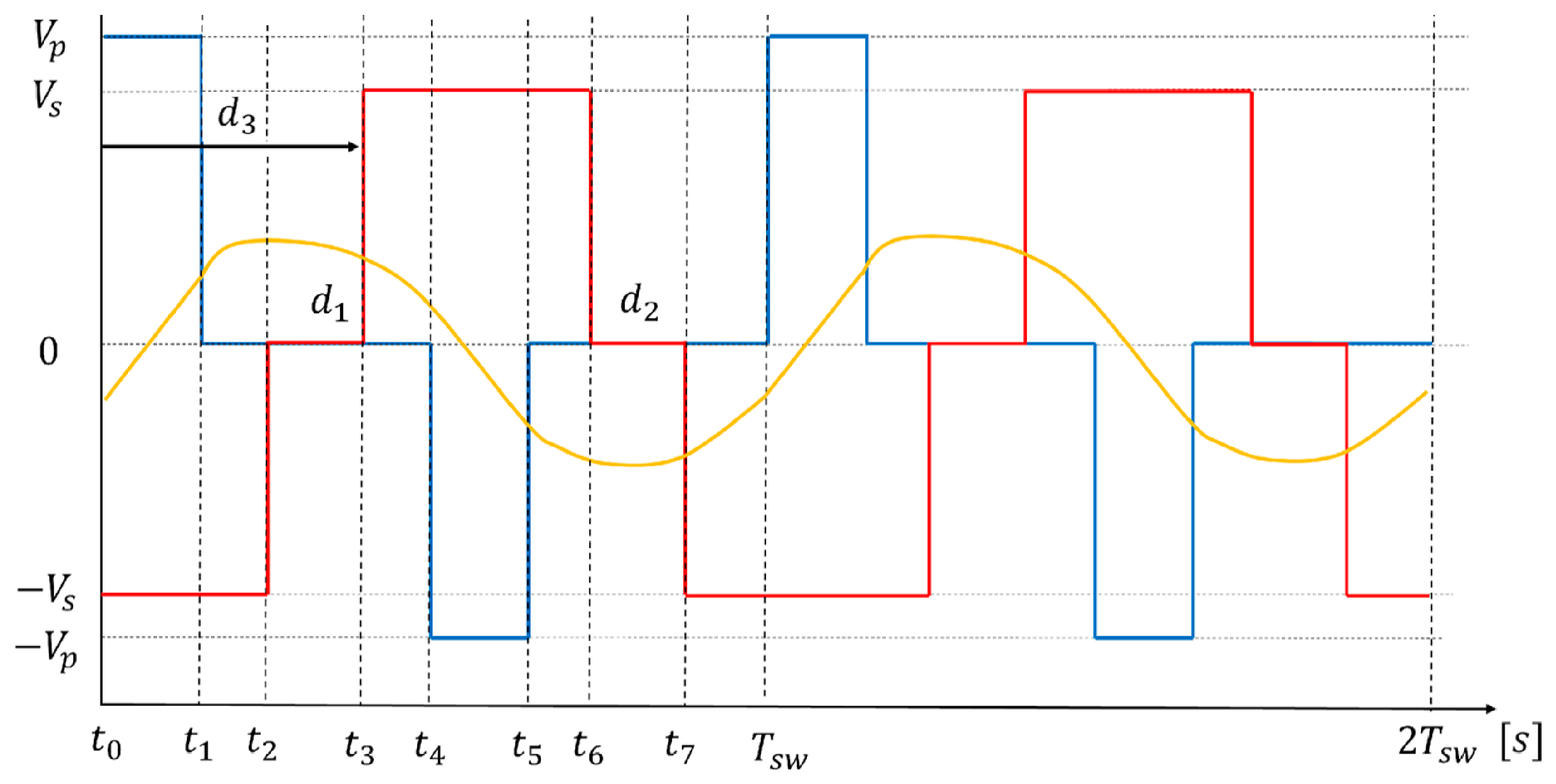
This modulation method defines multiple operating states for both forward and reverse power transfer, which provides a high degree of flexibility.
Transitions between operating states are governed by a control algorithm, ensuring a consistent basis for comparison between modulation strategies. The selected mode depends on the relationship between three key variables (degrees of freedom): d1, d2, and d3. These variables are linked to the required power and must always result in non-negative time intervals.
Physically, d1 and d2 correspond to the phase shifts in the two converter bridges, while d3 represents the phase shift between them. From these parameters, the switching time intervals are determined, with the remaining intervals defined by the symmetry of the switching period.
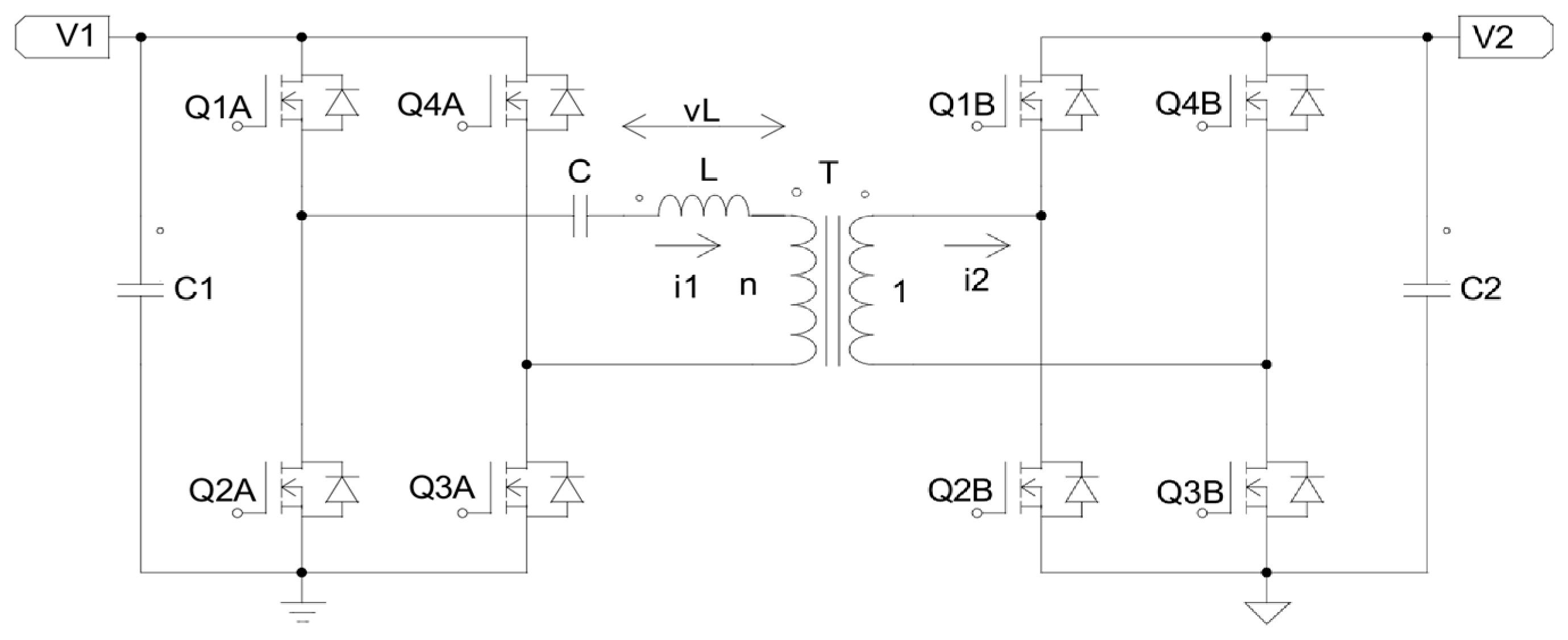
As shown in
Figure 1, switches Q1A–Q4A constitute the primary-side full bridge of the DAB series resonant converter and are modulated to generate
and
, or its secondary-referred equivalent, with an internal phase shift
as defined in
Figure 5. The secondary-side full bridge is formed by switches Q1B–Q4B, which are modulated to produce the voltage
with an internal phase shift
. The external phase shift
between
and
controls the direction of the power transfer, where a positive
indicates that
leads
.
Since power transfer is mainly determined by the fundamental components of the resonant tank current and the bridge voltages, a fundamental component analysis is adopted in this section, resulting in simplified expressions.
In order to define the equations of the system, the relationships maintained by the converter must first be determined. The first is the relationship between the voltages.
and the current that will flow through the resonant tank due to the two voltages.
where
is the base resistance obtained at the output, which would be each of the sides depending in the energy transfer situation
Both voltages can therefore be expressed using the following term
Therefore, the current that will flow through the resonant circuit can be expressed in the root-mean-square value using the following expression
Also, the power in the resonant tank can be obtained as
where
is the impedance of the tank expressed as
and
is the ratio between the resonant frequency and the switching frequency
The average output power
and output current
of the DAB converter can be calculated using either the primary side or secondary side bridge voltage together with the resonant tank current, leading in the following expressions.
From Equations (16) and (17), it can be concluded that maximum power transfer occurs when the external phase shifts between and is 90°, while the internal phase shifts and are set to 0°.
The converter is designed for fast bidirectional charging of lithium-ion electric vehicle batteries using a conventional charging methodology [
27].
Table 1 summarizes the key parameters used as specifications for the converter design.
To determine the maximum value of the series inductance, the circuit impedance must be evaluated under minimum power operating conditions and at the maximum battery voltage.
The opposite occurs at a maximum power and minimum battery voltage, which results in minimum impedance.
Therefore, the maximum inductance value is determined by the operating frequency, the capacitor and the maximum impedance.
The same applies to the minimum impedance, which is used to obtain the minimum inductance.
After obtaining the range of the series inductor, the value is adjusted with the switching frequency to operate with a small phase angle between the applied voltage and resonant current and also accounting for the value of the transformer’s stray inductance.
then, the maximum voltage across the capacitor is calculated using Equation (8) and also the minimum series inductance.
At this point a ferritic material is selected and the most restrictive value of the flux density is obtained. To do this, the core loss curves at the operating frequency are compared with the obtained value of B = μH using the maximum permeability variation obtained from the relative permeability variation curves under DC bias.
Applying the effective area relationship for maximum flux density Equation (24) to the winding area yields the expression for the area product as follows
where:
Ae is the effective area of the core given by the manufacturer.
J represents current density (A/m2), and in this case, when working with high output currents from the inverter and aiming to minimize losses due to current carried in Lbias, only Lac is considered for the design since the Lbias winding will be negligible.
K is the fill factor, which will be assumed to have a value between 0.5 and 0.9.
Using the obtained value for the area product, a core size is selected to maintain a higher ratio, and the number of turns for
Lac is calculated through
With the number of turns and the characteristics of the selected core, using Equation (9),
is calculated, and with the previous value of
, the relationship between inductances is determined to obtain the necessary
from Equation (10). With this value and the curve on the datasheet regarding the relative permeability subjected to DC bias, the value of
Hbias is determined to achieve the value of
. If
value is not reached, iteration with a different ferritic material is performed. In the event of obtaining a value within the range, optimization is carried out to reduce the maximum DC current value (
Ibias) of
Lbias through the relationship given by
where:
next represents the number of turns of an external branch.
lext is the length of the external branch from center to center of the core (m).
Table 2 presents the initial specifications and the calculated values used for the converter design. In contrast,
Table 3 summarizes the design results of the current-controlled variable inductor, which is implemented using two ferrite cores made of N27 material, with geometry E70/33/32 from TDK Electronics.
The implementation of the current-controlled variable inductor introduces several practical limitations that must be considered. The achievable inductance tuning range is inherently constrained by the magnetic core material and geometry, as well as by the variation in permeability under DC bias. Additionally, the inductance exhibits nonlinear behavior when operating close to saturation, which may affect control accuracy if not properly managed. From a dynamic perspective, the bandwidth of the inductance variation is limited by the response of the bias current source, preventing instantaneous adaptation to very fast transients. Moreover, the inclusion of the bias winding and its associated control circuitry increases system complexity. Thermal effects must also be considered, as both core losses and bias current contribute to heating. Despite these limitations, the proposed design operates within a safe region far from saturation and provides an effective trade-off between efficiency improvement and implementation complexity.
4.2. Losses Analysis
To verify the benefits of this optimization, the converter transistor losses are analytically evaluated to determine the efficiency across the entire operating range, while considering proper commutation to improve the power distribution among the devices [
28]. The conduction losses associated with the current through each transistor channel are given by:
where
is the ON-state MOSFET channel resistance.
Regarding the switching losses, only turn OFF of the switching is considered in the bridge that is supplying power, as the ON will be negligible when operating in ZVS across the entire operating range and in ZCS on the bridge receiving power. To calculate it, the polynomial equation of the turn OFF switching loss curves from the manufacturer is obtained for the drain voltage equal to
V1 and
V2 and the gate resistance used. It is expressed as follows
where
Ic is the switching current and it is derived from the following function
Therefore, the power losses for each transistor are obtained from
The losses due to the transistor gate depend on the total gate charge
QG and the gate-to-source voltage
VG, related through the following expression
To conclude, the total losses are determined by the following equation
meanwhile, the efficiency is given by
For the losses analysis, the SiC MOSFET C3M0040120K was used as two transistors in parallel for each of the inverter switches.
Table 4 presents the characteristics obtained from the datasheet for the efficiency analysis of the converter.
Table 5 shows the breakdown of the losses for the optimization of the TPS-VI control compared to the TPS control and 4DOF operating at 8 kW charging battery at 250 V.
4.3. Control Principles
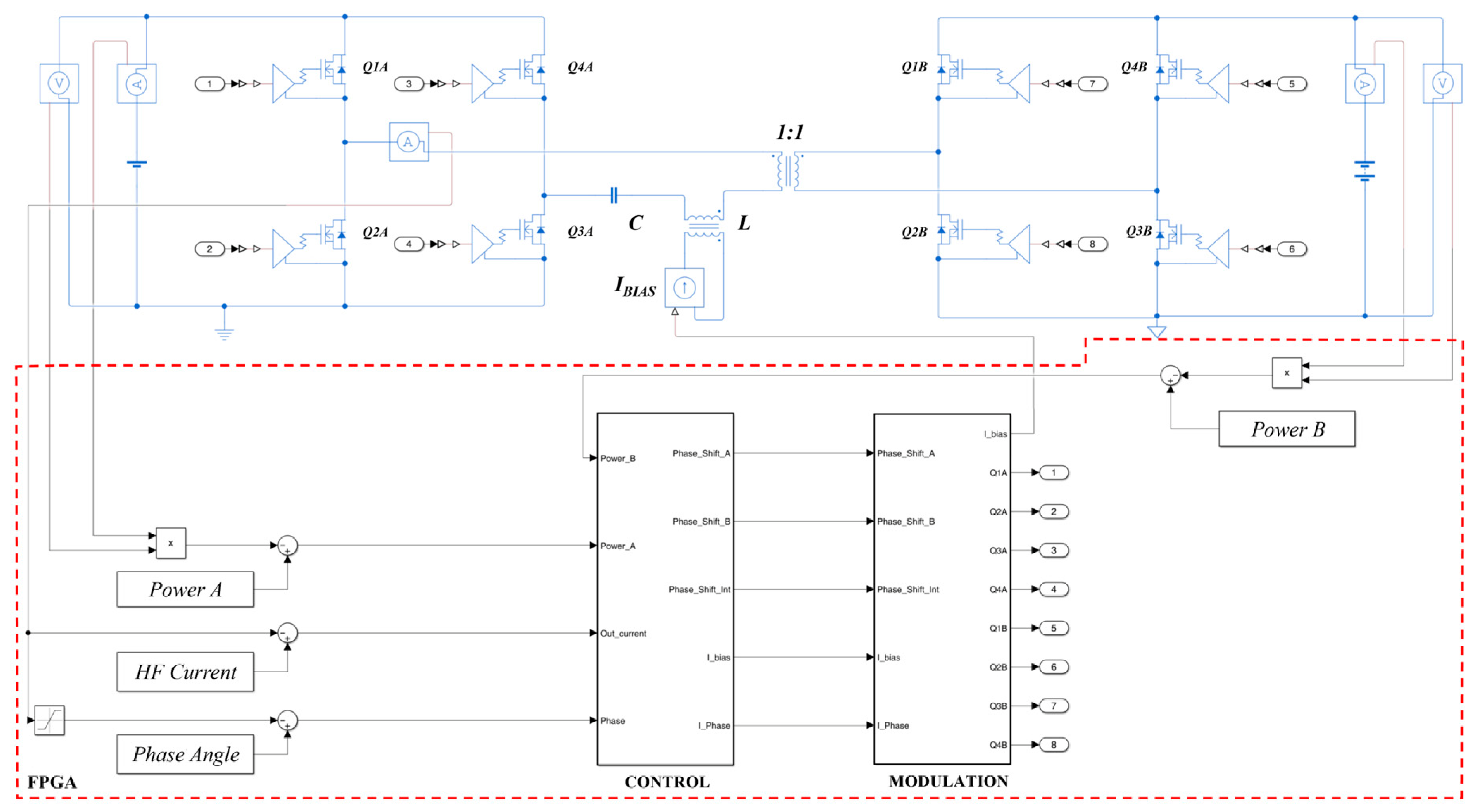
The control architecture implemented for the proposed series-resonant DAB converter is illustrated in
Figure 6. Due to the interaction among several control variables, the system presents a multi-input multi-output (MIMO) behavior, characterized by nonlinear and coupled dynamics. To address this, a coordinated strategy based on proportional–integral–derivative (PID) regulators together with a decoupling network is adopted, enabling independent tuning of the control loops while compensating for cross-coupling effects.
In this case, three input variables are considered. The first is the transferred power, which can be measured at either bridge A or bridge B depending on the direction of the energy flow and is related to Equation (19). The second input is the RMS value of the resonant current, Equation (20), which is directly related to conduction losses and overall converter efficiency. The third input corresponds to the phase relationship between the voltage of each bridge and the resonant current, Equation (29).
The converter operates under TPS modulation at a fixed switching frequency, where multiple phase-shift variables define both the power transfer and the switching conditions. The modulation strategy enforces near in-phase switching of the bridge receiving energy, enabling soft-switching conditions (ZVS/ZCS) for its semiconductor devices. In contrast, the phase shift in the bridge delivering power, along with the relative phase displacement between both bridges, determines the amount and direction of the transferred power soft-switching in ZVS conditions, Equation (29).
Accordingly, the control outputs are the TPS modulation parameters and the bias current applied to the auxiliary winding, which dynamically adjusts the effective series inductance. The inductance tuning is closely linked to the RMS current minimization, Equation (21), allowing the controller to reduce energy circulating in the resonant tank and improve efficiency.
To further enhance performance, a supervisory optimization block is included. This stage evaluates the resonant current together with the modulation variables and the inductance control signal, introducing corrective actions to minimize the RMS current while maintaining the required power transfer. The resulting optimal operating region is obtained from Equations (19) and (20).
Additionally, the gating signal generation module produces the switching commands for all semiconductor devices, including appropriate dead times derived from the TPS parameters. This block also monitors current zero-crossings in each switching cycle to ensure that soft-switching conditions are consistently maintained.
During operation, variations in load conditions may shift the converter away from its optimal operating point. If the system moves toward a capacitive region, the control system reacts by adjusting the bias current to increase the effective series inductance. This correction restores the desired inductive operation, preserving soft-switching and preventing semiconductor stress.
Due to the nonlinear nature of the system, the tuning of the PID controllers has been carried out experimentally, ensuring stable operation and adequate dynamic performance across the full operating range.
5. Experimental Results with Discussions
To conduct the experimental tests discussed in this section, a 14 kW dual active bridge converter was used to test the complete design. This module includes FPGA-based control, sigma-delta modulator sensing stages, isolated power sources, the controllable current source based on the Howland current pump with an OPA548 as a high current operational amplifier, trigger drivers, transistors, and a cooler heatsink. The converter is powered by two bidirectional power supplies with variable voltage.
The experimental validation presented in this section was carried out using a 14 kW DAB prototype. The setup integrates a digital control platform implemented on an FPGA, along with sigma–delta-based sensing circuits and isolated auxiliary power supplies. The system also incorporates a controllable current source built around a Howland current pump topology, employing an OPA548 high-current operational amplifier. In addition, the hardware includes gate driver circuits, power semiconductor devices, and a heatsink.
The converter is supplied by two bidirectional power sources with adjustable voltage, enabling controlled operation under different power flow conditions.
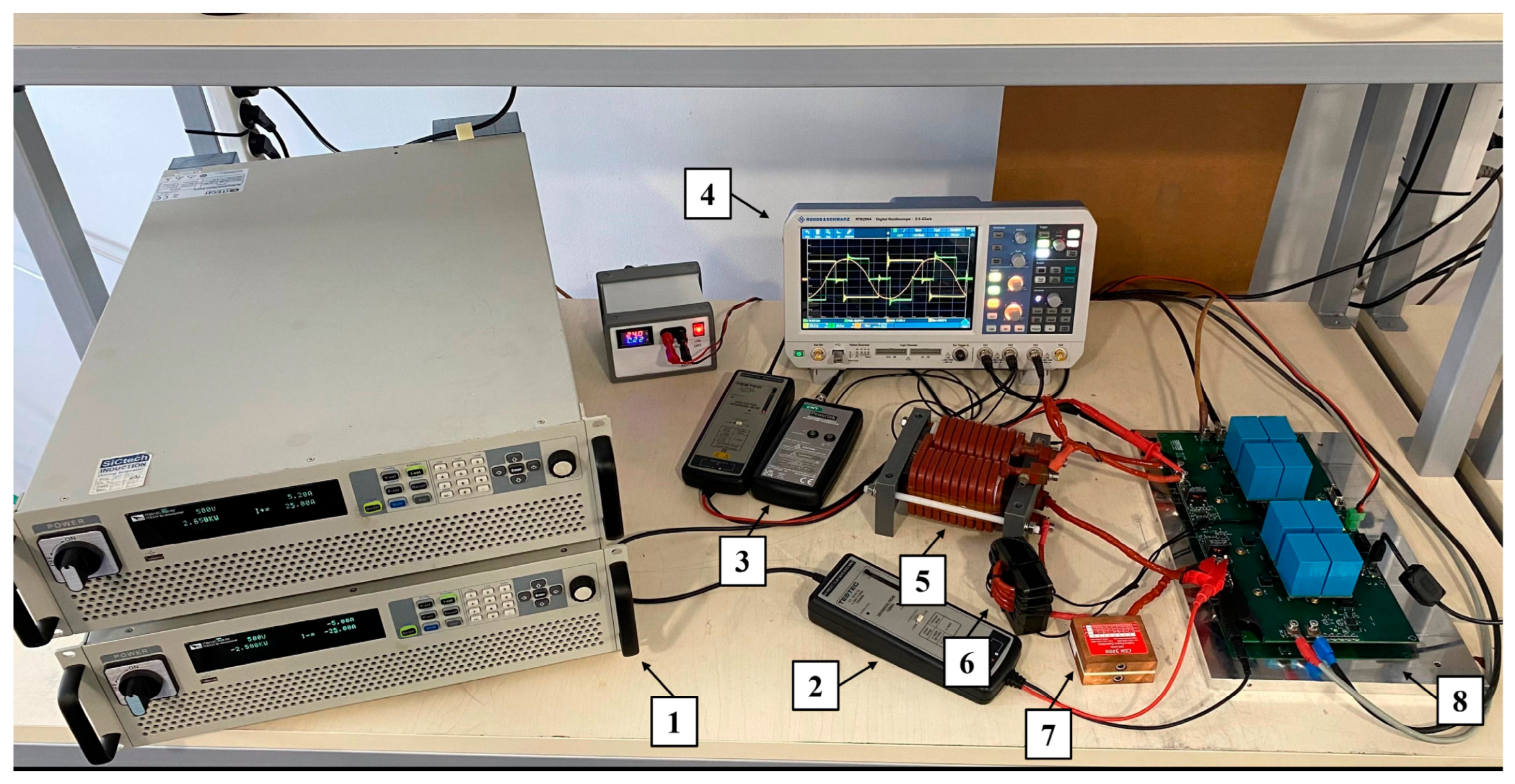
The test bench used is shown in
Figure 7, and it has been assembled with the design components from
Section 4. Each number corresponds to:
- (1)
Bidirectional power supplies.
- (2)
Differential voltage probe.
- (3)
Rogowski current probe.
- (4)
300 MHz bandwidth DSO.
- (5)
Isolation transformer.
- (6)
Controllable series inductor (Ls).
- (7)
Series capacitor (Cs).
- (8)
DAB converter with sixteen SiC C3M0040120K.
To assess the accuracy of the proposed design, the analytical results derived from the theoretical expressions were contrasted with experimental measurements obtained from the converter at two distinct power levels. The comparison, summarized in
Table 6, reveals minor discrepancies between the predicted and measured values. These deviations can be attributed to the simplifications inherent in the modeling approach, as well as the influence of parasitic components and additional losses not considered in the analysis. Factors such as wiring and interconnections, temperature-dependent behavior of components, and measurement uncertainties associated with voltage and current sensing also contribute to the observed differences.
Since the theoretical calculations of the converter are based on the first harmonic approximation and the system operates over a wide load range, a larger deviation between theoretical and experimental results could be expected. However, this is not observed in practice. The reason is that the control strategy regulates the RMS current, effectively matching the RMS value of the non-sinusoidal waveform to that of the fundamental harmonic of the theoretical sinusoidal signal. As a result, both RMS values remain consistent.
The remaining discrepancy is associated with differences in peak current. This mainly affects the turn-off switching of the bridge that delivers power, as this transition does not occur under ZCS conditions. Nevertheless, the receiving bridge operates under near-synchronous voltage and current conditions, ensuring ZVS/ZCS switching. This significantly reduces the impact of peak current deviations, making their effect on overall performance negligible.
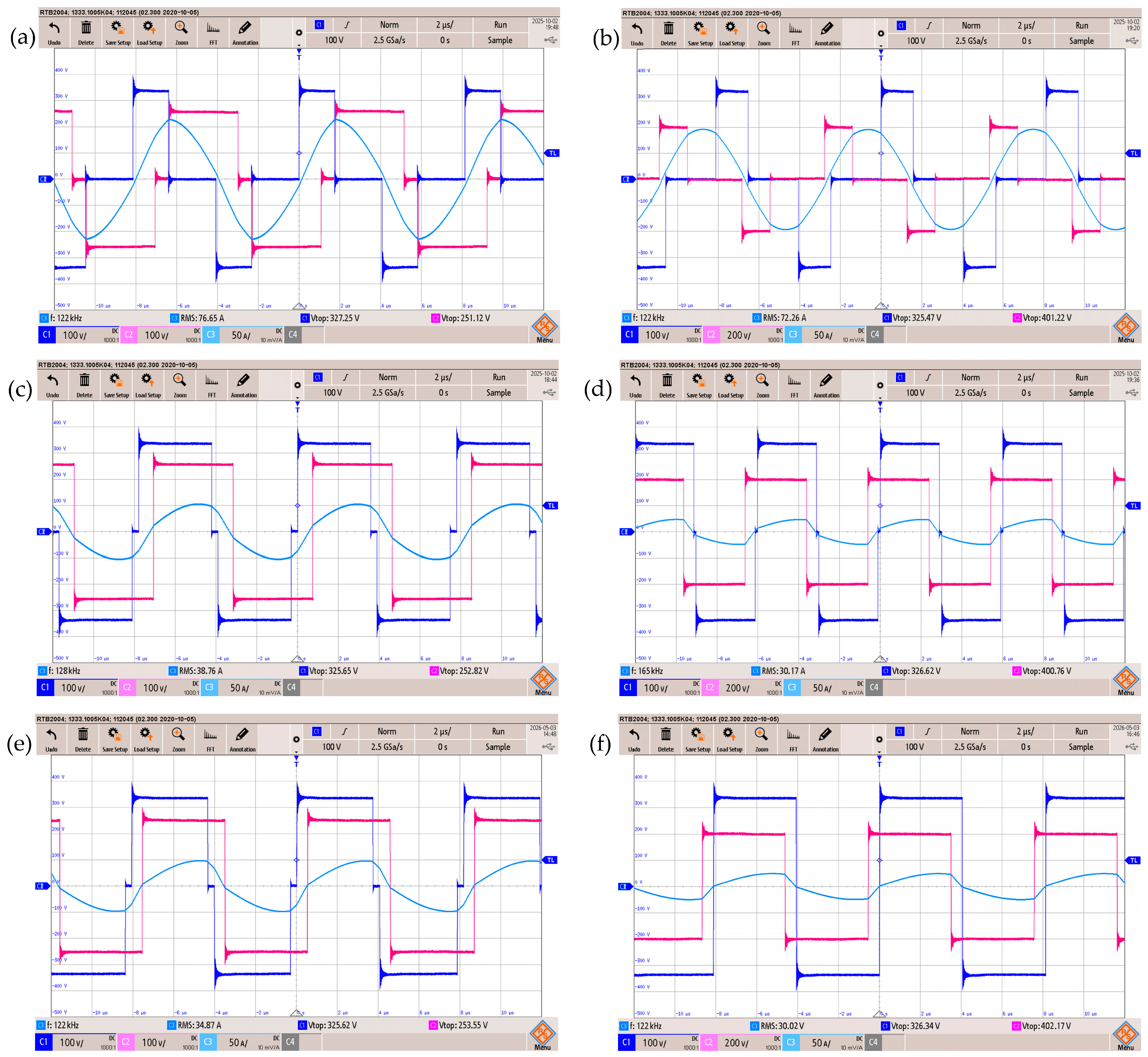
Figure 8 presents the experimental waveforms captured with a digital oscilloscope for the DAB converter operating at 8 kW charging battery at 250 V and 5.4 kW discharging battery at 400 V under three different control approaches. The three control strategies under comparison are conventional TPS modulation at fixed switching frequency, TPS modulation with variable switching frequency, and the proposed method, which combines TPS modulation at constant frequency with variable inductance.
In all cases, the same resonant tank is used, with the inductance initially set to its nominal value. For identical power references, noticeable differences arise in both current levels and switching performance depending on the control strategy. In the case of fixed-frequency TPS, the switching frequency is selected to meet the maximum power requirement of the system. As a result, when the converter operates at lower power levels, the operating point remains close to the resonant frequency. Under these conditions, the tank impedance is relatively low, which leads to an increase in the RMS value of the resonant current despite the reduced power demand and voltage applied by the phase shift. Moreover, operating so close to resonance reduces the controllability of the switching conditions, making it difficult to guarantee ZVS during load transients. Consequently, abrupt variations in operating conditions can compromise soft switching performance.
When frequency variation is introduced in the TPS scheme, the controller gains an additional degree of freedom to regulate power and maintain favorable switching conditions. However, this comes at the expense of operating at higher switching frequencies under certain conditions, which increases switching losses and complicates the design of magnetic components and EMI filters. Although this strategy improves soft-switching robustness and the RMS current remains low as in the proposed method the frequency increases from 122 kHz to 165 kHz at 5.4 kW.
In contrast, the proposed control strategy maintains a constant switching frequency while dynamically adjusting the effective series inductance. This additional degree of freedom allows the converter to operate closer to its optimal nominal resonant condition without requiring frequency variation. As a consequence, the phase shifts involved in the TPS modulation remain smaller, and the RMS value of the resonant current is significantly reduced. Furthermore, the modulation enforces near-in-phase switching in the receiving bridge, ensuring ZVS/ZCS operation, while the phase relationships governing power transfer are preserved.
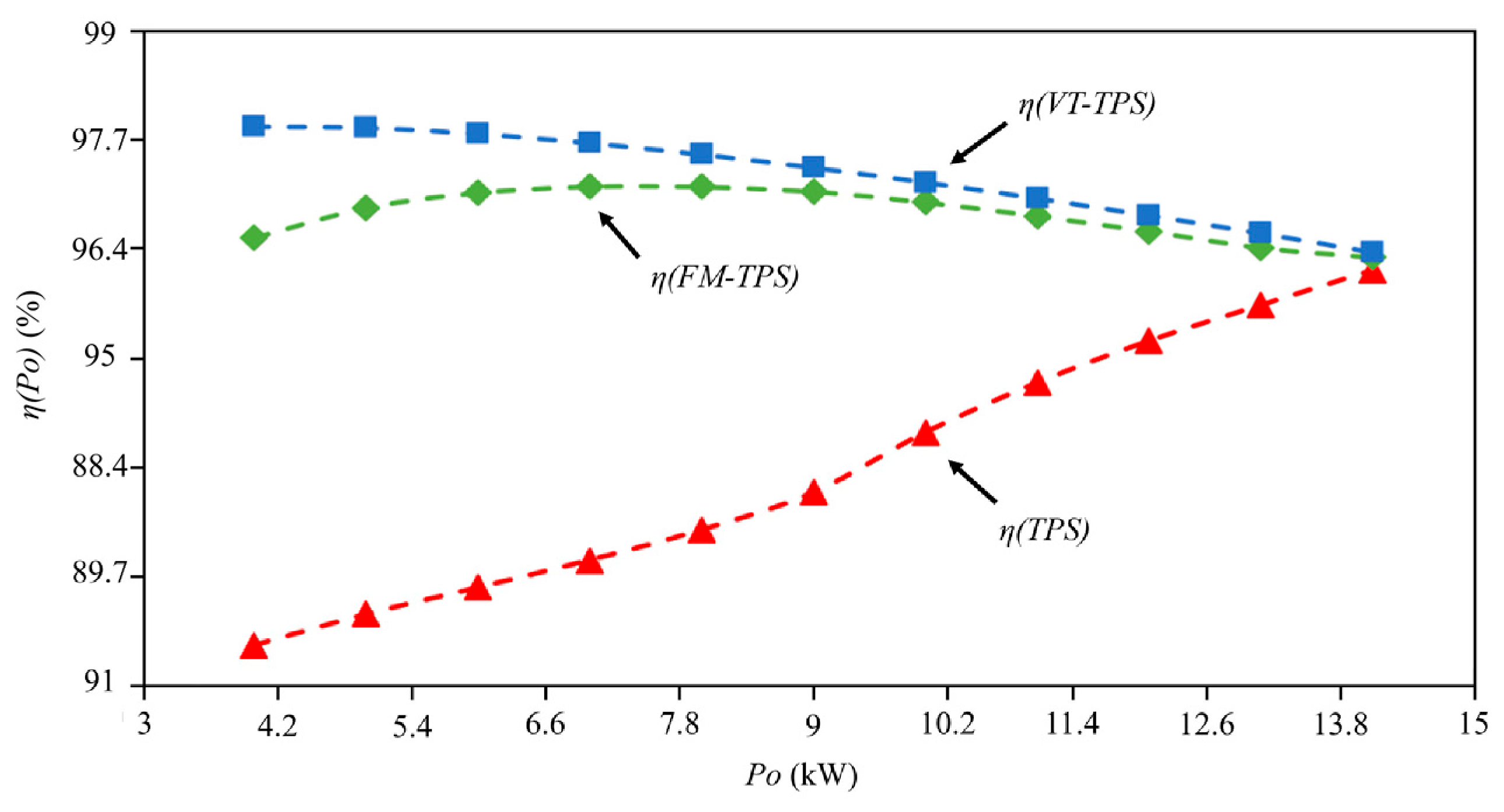
Finally, to complete the comparison among the three control strategies and validate the proposed approach, the converter efficiency has been evaluated over the full operating power range. The efficiency is obtained by comparing the input power, measured at the DC power source, with the output power measured at the DC power source acting as a load.
All three methods are evaluated under the same initial conditions, namely identical switching frequency, phase shift, and series inductance value. As shown in
Figure 9, the efficiency of the three strategies is similar at high power levels, where the operating point is close to the design conditions. However, as the transferred power decreases, clear differences begin to emerge.
In the case of conventional TPS at a fixed frequency, the efficiency drops significantly at lower power levels. This behavior is mainly due to the increase in circulating current when operating close to resonance with reduced power demand, as previously discussed. Additionally, the limited control flexibility makes it difficult to maintain optimal switching conditions, further degrading performance.
For the variable-frequency TPS approach, the efficiency improves compared to the fixed-frequency case, since the controller can shift the operating point away from resonance as the power decreases. This helps to reduce the circulating current and maintain soft-switching conditions. Nevertheless, this improvement comes at the cost of increased switching frequency, which introduces higher switching losses and complicates the design of passive components and filtering stages.
In contrast, the proposed control strategy based on fixed-frequency TPS combined with variable inductance achieves the highest efficiency across most of the power range. By dynamically adjusting the series inductance, the converter can maintain an optimal impedance level without modifying the switching frequency. This reduces the RMS current in the resonant tank while preserving favorable switching conditions, resulting in improved efficiency.
The comparison highlights clear trade-offs among the three control strategies. The proposed VI-TPS method achieves the highest peak efficiency (97.75%) while maintaining high efficiency even at low power levels, matching FM-TPS and significantly outperforming conventional TPS. Unlike FM-TPS, it operates at a fixed switching frequency, avoiding frequency variation (122 kHz vs. 122–165 kHz), which simplifies design and reduces EMI/EMC issues. In terms of dynamic performance, VI-TPS provides the fastest response, followed by FM-TPS, while TPS shows the slowest behavior. Although both VI-TPS and FM-TPS involve higher implementation complexity compared to TPS, the proposed approach offers a better overall balance by combining high efficiency, strong dynamic response, and improved electromagnetic compatibility, as presented in
Table 7.
The complete breakdown of the converter losses when operating at 9 kW in battery charging mode with a battery voltage of 325 V is presented in
Table 8.
Overall, the experimental results show a good agreement with the expected trends, with minor deviations attributed to parasitic elements, unmodeled losses, and measurement uncertainties. These results confirm the effectiveness of the proposed approach in enhancing efficiency without introducing the drawbacks associated with frequency variation.
6. Conclusions
This work has investigated the impact of combining TPS modulation with adaptive control of the series inductance in a resonant DAB converter. A design methodology for the variable inductance has been presented, together with a control strategy aimed at improving efficiency and ensuring robust operation under varying load conditions.
The proposed approach has been experimentally validated using a 14 kW DAB prototype. The results have been compared with two conventional control methods: TPS at fixed switching frequency and TPS with variable frequency. The comparison has been carried out under equivalent operating conditions, evaluating efficiency, circulating current levels, and switching behaviour. In particular, the analysis has focused on conduction losses, switching losses, and the ability to maintain soft-switching conditions.
The experimental results demonstrate that the proposed method consistently outperforms the conventional strategies over a wide operating range. By adjusting the effective series inductance instead of modifying the switching frequency, the converter is able to operate closer to its optimal condition, reducing the RMS value of the resonant current and improving overall efficiency, especially at partial load.
In contrast, the fixed-frequency TPS approach suffers from increased circulating current at light load. The variable-frequency TPS method improves switching conditions but introduces frequency deviations that increase switching losses and add complexity to the design of passive components and filtering stages.
In summary, the proposed control technique enables efficient operation at constant switching frequency while extending the effective operating range of the converter. By leveraging inductance tuning as an additional control variable, it is possible to minimize current stress, maintain soft-switching, and improve overall system performance without the drawbacks associated with frequency variation. This approach opens new possibilities for the control of resonant DAB converters and other resonant topologies through the active management of reactive elements.