1. Introduction
In recent years, wireless sensor networks (WSNs) have been widely applied in many fields, such as environmental monitoring, health care, disaster warning, military detection, and transportation management [
1,
2,
3]. In general, a WSN is composed of a large number of sensor nodes, and it is impractical or even impossible to replace the batteries of sensors. Sensing errors and link failures often occur when the lifetime of a sensor node is over. Therefore, extending the lifetime of sensor nodes while maintaining their connections with each other is a major concern in the area of WSNs [
4].
Energy harvest (EH) technology is widely applied to extend the lifetime of WSNs. Traditional EH technology replenishes energy from the environment, which is leveraged from natural resources (e.g., heat, wind, solar, sound, and mechanical energy) [
5]. However, due to the unstable performance of traditional EH technology, it is easily affected by environmental factors [
6]. Simultaneous wireless information and power transfer (SWIPT) technology has the potential to provide stable energy provision for sensor nodes through radio frequency (RF) signals [
7].
SWIPT technology, as a new paradigm of energy harvesting technology, makes full use of the information and energy carried by RF signals to provide stable energy resources for sensor nodes without being affected by complicated environments [
8]. Compared with traditional EH technology, which harvests from uncontrollable natural resources, SWIPT does not generate additional energy consumption and has the advantages of low cost and no protocol requirements [
9,
10,
11,
12]. With the aforementioned advantages, the combination of WSNs with SWIPT provides a potential method for the energy sustainability of WSNs.
In this paper, a novel energy-sustainable approach combining time slot allocation and power splitting (ETAPS) ratio determination for SWIPT-enabled WSNs is proposed. To be specific, the contributions of this paper are as follows:
- (1)
A dedicated frame structure is proposed to partition each cluster member (CM) into four distinct operational modes for slot scheduling, realizing conflict-free resource coordination among CMs;
- (2)
A novel power splitting ratio determination strategy is developed to adaptively optimize slot allocation for CMs and derive the optimal power splitting ratio for the cluster head (CH), mitigating the energy consumption burden of sensor nodes;
- (3)
Leveraging optimization theory, the joint problem of optimal time allocation and power splitting ratio determination is formulated as an information rate maximization problem, where the objective is to maximize the CH’s information rate. Comprehensive numerical simulations are conducted to objectively validate the performance of ETAPS;
- (4)
Simulation results demonstrate that ETAPS sustains effective energy sustainability even under a limited energy supply from the EAP. When the EAP provides sufficient energy, the optimal power splitting ratio converges to 0.9; meanwhile, with adequate transmit power at CMs, ETAPS adaptively adjusts the CM-to-CH transmission time allocation by setting the optimal power splitting ratio to 0.6.
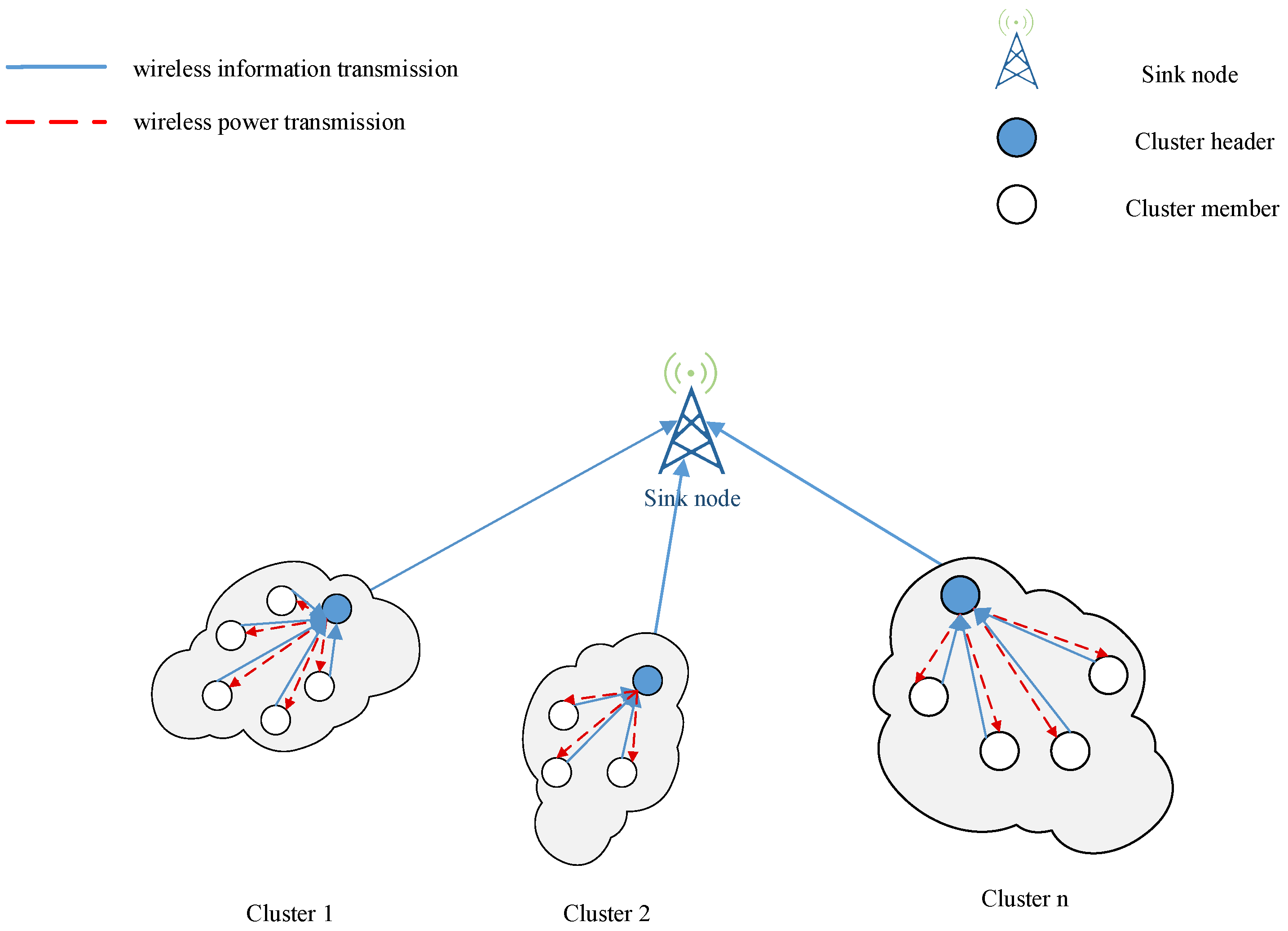
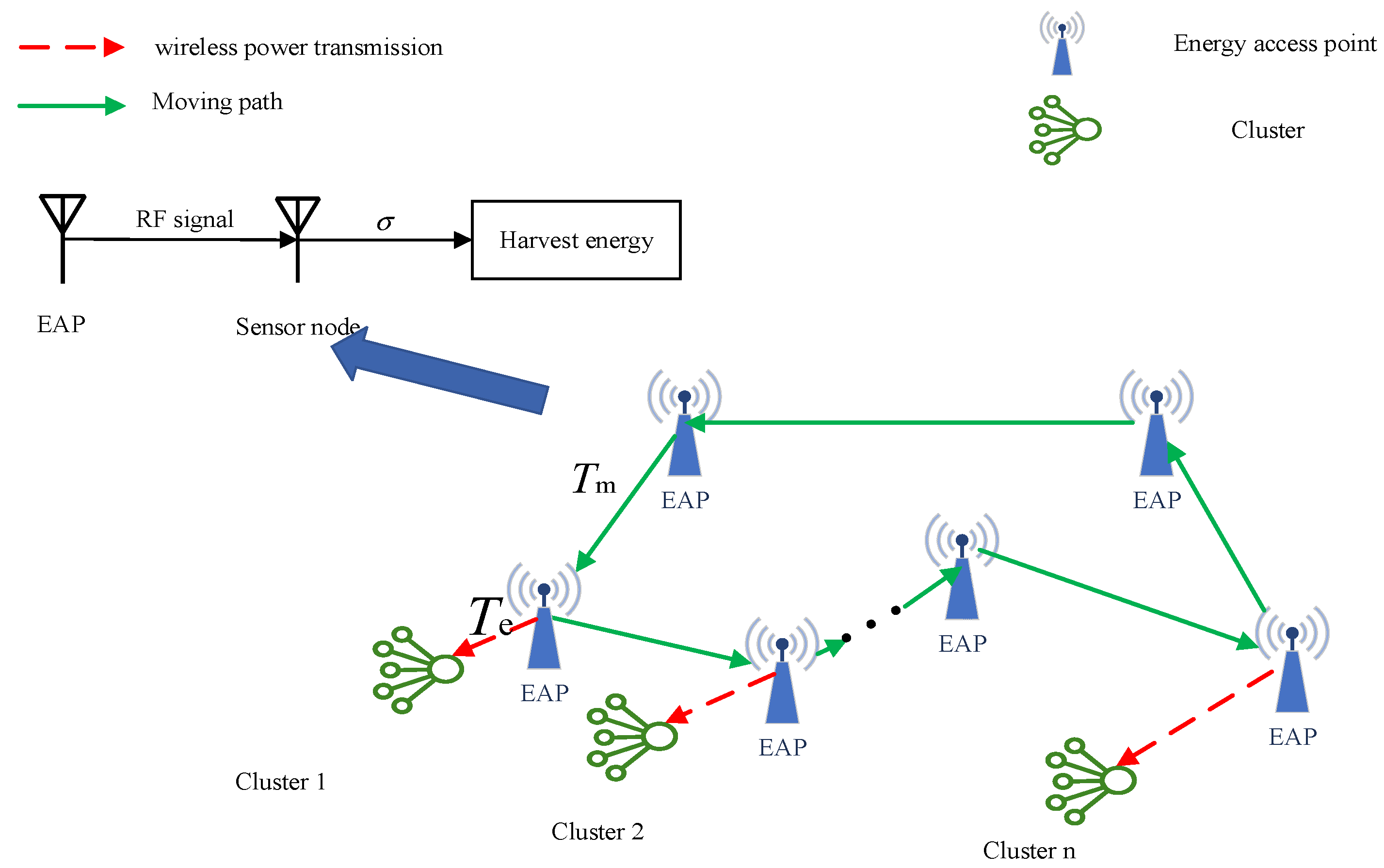
The organization of the rest of this paper is as follows. The related work is summarized in
Section 2. In
Section 3, the network model and related assumptions are presented. The frame structure, the energy harvesting model, and the energy consumption model are presented in
Section 4. The optimization problem of the power splitting ratio and the corresponding solution are proposed in
Section 5. The performance of ETAPS is evaluated in
Section 6. Finally, the conclusions are drawn, and some potential research directions are pointed out.
2. Related Works
SWIPT technology, which allows sensor nodes to realize simultaneous information decoding (ID) and energy harvesting (EH), was first proposed in [
13]. To date, extensive research has focused on receiver architecture design. For instance, a novel scheme combining pulse position modulation (PPM) and SWIPT was developed for RF signal modulation and demodulation. By employing high-amplitude pulses to improve the peak average power ratio (PAPR) of transmitted signals and exploiting the nonlinearity of EH circuits, the DC output power of energy harvesting is enhanced [
14].
Two fundamental receiver modes, namely time switching (TS) and power splitting (PS), were subsequently introduced [
3,
15,
16,
17]. Studies have verified that PS outperforms TS in terms of information transmission performance [
3]. Accordingly, PS has been continuously refined and innovated in numerous works [
6,
18,
19]. A dedicated resource allocation (ResAll) algorithm was designed, accounting for distinct PS characteristics of relays under two scenarios [
6]. In the first scenario, continuous power streams with arbitrary splitting ratios are considered, whereas in the second, the received power is partitioned into discrete streams with fixed PS ratios [
6]. In mobile environments, the application of information-energy models and EH models in SWIPT systems has attracted extensive attention from both academia and industry. As the demand for information volume increases, the absolute energy deviation derived from the linear EH model decreases, yet the relative deviation rate rises [
18]. For Internet of Things (IoT) scenarios, a PS-based algorithm was presented to balance energy efficiency (EE) and spectral efficiency (SE), thereby achieving optimal power allocation across distributed antenna ports [
19].
To achieve a favorable trade-off between ID and EH at the receiver, several studies have pursued objectives including lower transmit power, higher data rate, stronger received power, and more efficient energy supply strategies [
20]. An energy-aware SWIPT routing algorithm was proposed for multi-hop energy-constrained wireless networks (MECWN) to improve the distribution of information and energy over links. During path discovery, a ratio allocation mechanism is introduced to distribute information and energy proportions on each link [
20]. An energy-efficient transmission scheme was developed to maximize system energy efficiency via joint optimization of source transmit power, relay selection, and relay power splitting ratio, enabling efficient energy utilization for data delivery [
21]. For tree-topology sensor networks, an improved energy supply strategy was presented to schedule data transmission for individual sensor nodes, where PS is adopted for relay selection [
22]. A distributed iterative algorithm was proposed with joint consideration of power allocation, power splitting, and relay selection, confirming that the power splitting ratio is critical to relay selection decisions [
23]. Beyond applications in clustering routing protocols, extensive research has also explored the integration of SWIPT and clustering mechanisms. Energy-efficient clustering models for wireless sensor networks have been investigated to extend the operational lifetime of sensor nodes [
24,
25,
26,
27,
28].
To reduce network energy consumption while sustaining uninterrupted data flows, strategic dormancy of selected nodes has been investigated to enable more nodes to perform sensing and communication tasks. Thus, the integration of SWIPT and sleep scheduling represents an important approach to realizing energy sustainability [
29,
30,
31,
32]. Combined with clustering techniques, a distributed SWIPT-enabled node sleep scheduling method was proposed [
29]. The energy-assisted communication process is divided into three time slots: the first for EH, the second for information decoding at the cluster head (CH), and the third for CH data transmission and member node (CM) sensing [
29]. A sleep scheduling scheme was developed to prolong node lifetime by dynamically adjusting the duty cycle based on the discrepancy between harvested energy and predicted energy consumption [
30]. A novel code-based Sleep and Wake-up Protocol (SWAP) was introduced to mitigate energy waste from idle listening. SWAP adopts binary vector scheduling over equal-length time slots to uniformly distribute node activity, alleviating channel contention and improving channel utilization [
31]. A semi-automated sleep schedule radio node for fast and efficient control (SEC) was proposed for parameter-aware sensor networks to reduce latency and energy consumption. SEC performs periodic parameter sensing via static scheduling and adaptively adjusts sleep scheduling based on measured values to trigger dynamic actor nodes [
32].
Hybrid SWIPT schemes integrating TS and PS have also been proposed. A nonlinear energy harvester based on such a hybrid scheme was applied in a bidirectional communication network, where radio users are divided into primary users (PUs) and secondary users (SUs). SUs enable communication over licensed spectrum while providing relay assistance to PUs, effectively improving both system throughput and energy efficiency [
33]. A multiuser wireless-powered communication network (WPCN) utilizing OFDM-assisted SWIPT was presented, dividing transmission time into dedicated downlink and uplink phases. A joint resource allocation scheme was developed to optimize time, subcarrier, and power splitting, achieving a balanced trade-off between downlink and uplink rates [
34].
Although existing studies have adopted nonlinear energy harvesters integrating time allocation and power splitting, the specific implementation mechanism of time allocation remains insufficiently elaborated. Notably, the optimal time allocation strategy has not been effectively integrated with the sleep mode—a critical factor that directly impacts the energy sustainability of wireless sensor networks (WSNs). Furthermore, most prior works focus solely on optimizing node capacity and data transmission rates, while neglecting the core requirement of network energy sustainability. Contrary to the simple combination of existing techniques, this paper proposes a novel energy-sustainable framework (ETAPS) based on simultaneous wireless information and power transfer (SWIPT), which integrates time allocation and power splitting into a unified optimization system with novel design principles and performance guarantees, aiming to achieve reliable energy sustainability for WSNs under limited energy supply.
4. Theory Analysis
4.1. Frame Structure
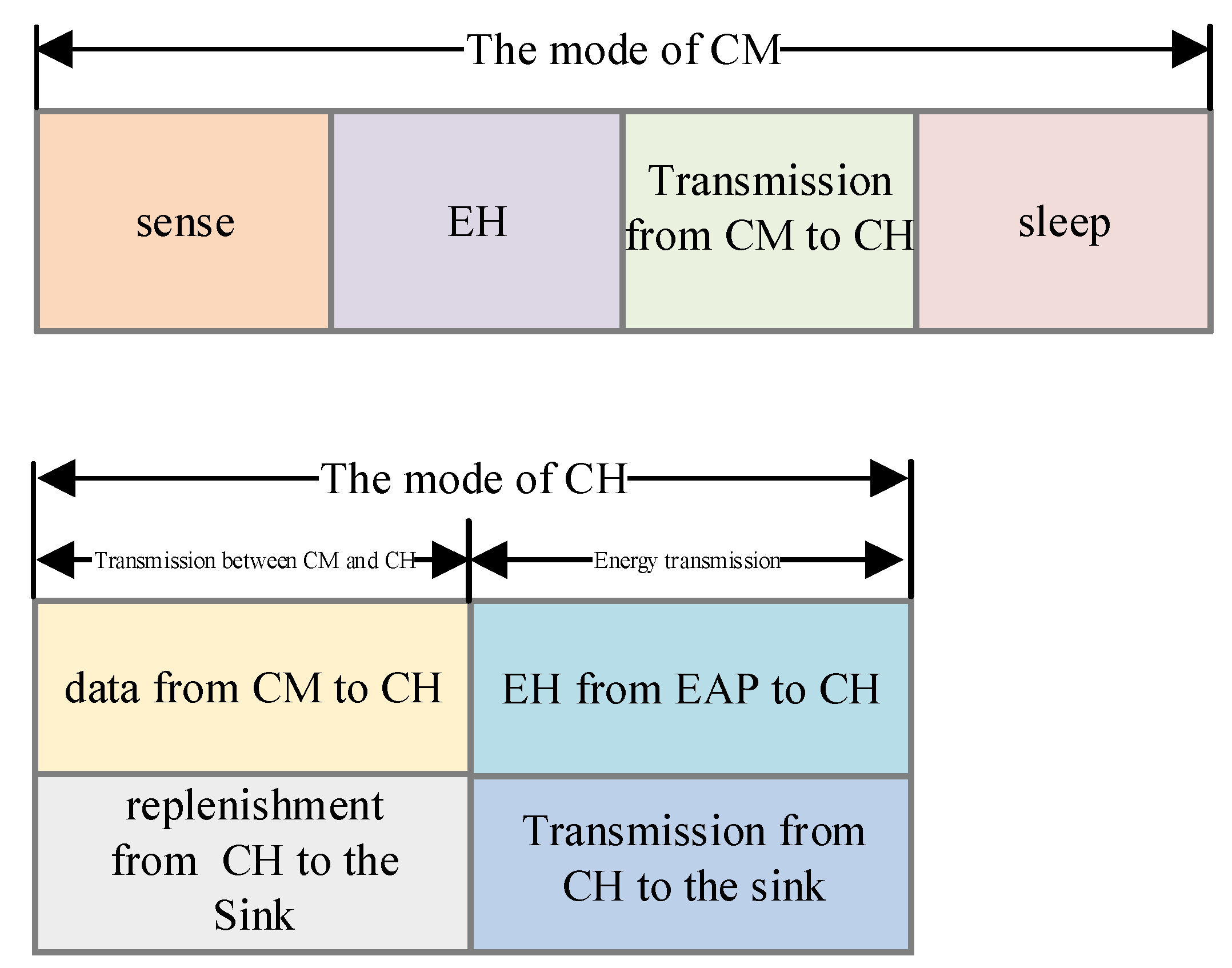
In this paper, a new frame structure based on the Time Division Multiple Access (TDMA) and Time Division Duplex (TDD) mechanisms is proposed for the control over data transmission and energy harvesting for each CM within an arbitrary cluster with the assistance of the EAP.
In this paper, the new frame structure designed for CH and CMs is presented in
Figure 3. The time slot allocated for CMs is represented by
, and that for the CH is divided into three parts, namely data-energy transmission between the CH and its CMs in the same cluster, data transmission between the CH and the Sink, and energy transmission between the CH and the EAP. These time slots are represented by
and
, respectively.
The time slot allocated for CMs can be divided into four sub-slots. When a CM is in different sub-slots, it works in distinct modes. The time allocation for CM is denoted as . To be specific, the working mode consists of sensing mode, transmission mode, energy harvesting mode, and sleeping mode. The details of the time allocation for the work mode are presented as follows.
In sensing mode, each CM perceives the surrounding environment and collects data. The sub-slot of sensing mode is denoted as .
In transmission mode, each CM sends collected data to the corresponding CH. The sub-slot of transmission mode is denoted as .
In energy harvesting (EH) mode, each CM receives energy from the corresponding CH. The sub-slot of EH mode is denoted as .
In sleeping mode, each CM exhausts no energy and harvests no energy. The sub-slot of sleeping mode is denoted as .
The time slot for data-energy transmission between the CH and the CM undertakes different tasks at the receiver and transmitter of the CH. The former is utilized for data-energy transmission from CMs to the CH, while the latter for energy replenishment from the CH to CMs. The details of the work modes are presented as follows.
In the data transmission allocation, the CH receives data transmitted by CMs, and the CH harvests energy while encoding information based on the PS mode.
In the energy supplement allocation, the CH replenishes energy to CMs in the cluster.
For the CH, the data-energy transmission happens between the CH and the Sink and between the CH and the EAP. The former is utilized for leveraging energy from the EAP, while the latter for transmitting the data from the CH to the Sink. The details of the work mode are presented as follows.
In the energy replenishing allocation, the CH receives the energy transmitted by the EAP.
In the data transmission allocation, the CH aggregates and integrates the data transmitted from the CMs in the same cluster and subsequently sends it to the Sink.
4.2. Power Splitting Mode
In this paper, PS mode is applied to the receiver of the CH, which enables the receiver to harvest energy and decode information from the same received signal concurrently. The receiver of the CH divides the signals received from CM into two separated proportions, which are used for information decoding and energy harvesting according to the power splitting ratio and , respectively. Particularly, when setting the power splitting ratio of and or and , the integrated receiver structure is reduced to a separate receiver structure for decoding information and energy harvesting, respectively.
The signal noise ratio (SNR) of the link from CH to CM
in the
th cluster is expressed as below,
where
is the power splitting ratio from CM
to the CH.
is the channel gain from CM
to the CH in the cluster
,
is a normalization constant depending on the radio propagation properties of the environment,
indicates the path loss exponent,
is the distance from CM
to the CH, and
represents the signal processing noise power at the receiver of the CH from CM
.
According to Shannon’s theorem, the information decoded from CM
by the CH in cluster
can be expressed as below,
where
is the bandwidth of the channel and
is the power of CM
when transmitting RF signals to the CH in cluster n.
4.3. Energy Harvesting Model
The main symbols utilized in this paper are shown in
Table 1. Assume the time allocation of S-sensors for data-energy transmission is normalized as
. The first portion of the whole time is utilized to transmit energy and information from the CMs to the CH in the same cluster, where
refers to the work time of CMs. The second portion, denoted by
, is utilized for energy transmission from the CH to the CMs in the same cluster. The third portion,
, is utilized by the CH to transmit aggregated data to the Sink. Denote the set of clusters as
and the set of S-sensors in cluster
as
,
is the CH of each cluster. In order to reduce the energy consumption within each cluster as much as possible, each CH has a different time allocation during its work time.
In this paper, a nonlinear energy harvesting (EH) model is adopted to illustrate the relationship between transmitted power and received power. For each CH, the received power from the EAP in cluster
is denoted by
, as shown below,
where
,
, and
are constants.
represents the maximum harvested power with saturation of the EH circuit in spite of the increasing input RF signals.
and
correspond to the resistance, capacitance, and circuit sensitivity associated with the specification of EH circuits.
is the input RF signal from the EAP to the CH.
For each CH, the energy harvested by the CH from the EAP in cluster
is denoted by
, as shown below,
where
is the energy conversion efficiency for converting RF signals into direct current (DC) of CH,
is the received power of the RF signals from the EAP to the CH in cluster
,
is the channel gain between the CH in cluster
and the EAP.
is the time allocated for energy transmission from the EAP to the CH in the
th cluster.
For the CH, the received signal power
from the CM
in cluster
is expressed as below,
where
is the power of the input RF signal from CM
to the CH.
Based on the PS model, the energy harvested by CH
from the CMs is expressed as below,
where the received power of the CH from the
th CM in cluster
is denoted by
, and the channel gain from CM
in cluster
to the CH is denoted by
.
is the power splitting ratio for information decoding from the
th CM to the CH.
is the time slot for the transmission from CM
to the CH in the
th cluster.
The CH harvests energy from both CMs and the EAP in this paper. To be specific, the total energy harvested by the CH in cluster
is expressed mathematically as follows,
As for the CM, it only harvests energy transmitted by the CH in the same cluster through the PS mode. The received power from the CH in cluster
is denoted by
as below,
where
is the input RF power from the CH to the CM
.
Therefore, the energy harvested by CM
, denoted by
, is expressed as below,
where
is the energy acquired by CM
in cluster
,
is the transmission power from the CH to CM
in cluster
, and
denotes the channel gain from the CH to CM
in cluster
.
4.4. Energy Consumption Model
As mentioned above, CMs work in sensing, transmission, energy harvesting, and sleeping modes. In general, energy is mainly consumed in the sensing and transmission modes. The primary communication activities of the CH involve the transmission between the CH and other S-sensors or the Sink. Therefore, the main energy consumption of the CH happens during the process of data processing and transmitting. In other words, the communication modules account for the majority of each S-sensor in terms of energy consumption [
4].
For each CH, it consumes energy when receiving the data from the CMs, replenishing energy to the CMs and transmitting data to the Sink. The energy consumption of the CH
for processing the data from the CMs in cluster
is obtained as below,
where the
th CM transfers energy to its corresponding CH in cluster
with the power of
,
is the power splitting ratio of energy transfer from the
th CM to the CH, and
is the time slot of transmission from CM
to the CH in the
th cluster.
The energy consumption
of the CH for replenishing energy to CMs in cluster
is mathematically expressed as below,
where
denotes the energy transmitted by the CH to the
th CM in cluster
.
In this paper, the first-order radio model is adopted to establish the communication energy consumption of S-sensors. The energy consumption for each CH to transmit data to the Sink is denoted as below,
where
denotes the energy consumption for data transmission from the current CH to the Sink,
is the data transmission rate from the CH in cluster
to the Sink,
is the energy consumption per unit bit of data processed by the sending or receiving circuit,
is the distance between the CH in cluster
and the Sink, and
represents the energy consumption of the power amplifier in the wireless communication model per unit data.
Therefore, the energy consumed by the CH can be expressed mathematically as follows,
In contrast, for CMs, energy consumption models are considered according to the different working modes.
In sensing mode, the energy consumption for CM
to acquire raw data is expressed as follows,
where
is the energy consumption of CM
to sense data,
stands for the data sensing rate to perceive the surrounding environment, and
is the sensing energy consumption per unit bit of data.
represents the time slot of the
th CM allocated for sensing mode.
In transmission mode, the energy consumed by a CM to transmit data to the corresponding CH is expressed by the following expression,
where
indicates the energy consumption for data transmission of CM
,
represents the time slot for data transmission of the
th CM,
stands for the transmission rate from CM
to the CH in cluster
, and
is the distance from CM
to the CH in cluster
.
When CMs are in sleep mode, energy consumption is usually negligible [
37]. Therefore, the total energy consumption for each CM can be expressed as below,
where
is the total energy consumption of CM
,
is the energy consumption of CM
in cluster
for data sensing, and
denotes the energy consumption of CM
for data transmission.
5. Problem Formulation and Solutions
In this paper, a novel energy-sustainable approach combining time slot allocation and power splitting (ETAPS) ratio algorithm is proposed to solve the problem of time allocation and power splitting ratio determination.
5.1. The Definition of Objective Function
In order to obtain the optimal time allocation for each cluster member, the maximization of the number of S-nodes alive in each cluster is converted to a maximum problem of the information decoded by the CH in the cluster. Therefore, the objective function can be expressed as follows,
where constraints
and
are the energy constraints that the energy harvested by the CMs and CH should be greater than the energy consumed, guaranteeing the condition of energy neutral operation (ENO) [
9]. Constraint
is the QoS constraint on the network, namely that the end-to-end throughput should meet the minimum data rate requirement of
. Constraint
indicates that the time allocation for the sense, transmission, or EH modes cannot be greater than the upper limit
. Constraint
indicates that the time slots of CMs are divided into only four modes, with no unallocated time. Constraint
is the power constraint that the transmission power should range between the lowest power
and the highest power
. Constraints
are the constraints on the power splitting ratio. Constraint
specifies that the power splitting ratio for information decoding is limited by the minimum lower limit
and the maximum upper limit
. Constraint
indicates that the power splitting ratio for energy harvesting is limited by the minimum lower limit
and the maximum upper limit
. There are constraints on the power splitting ratio threshold that
and
. Constraint
is a power distribution constraint, which means that no extra power gain will be obtained through power splitting.
Lemma 1. The objective function in (18),
, can be equivalently transformed into the convex form (19),
, which admits a globally optimal solution.
Proof. The objective function (18) characterizes the maximum aggregate data received by the CH from all active CMs within the cluster, which jointly depends on the CM transmission time allocation and the CH power splitting ratio . We analyze its convexity via the Hessian matrix and verify that the original function is concave.
As concave objectives tend to converge to local optima under heuristic search, we convert the problem into a convex optimization form. Using the relation in Equation (1), the original objective (18) is rewritten as,
The term l is convex due to the positive definiteness of its Hessian. By convex composition rules, the product of a linear function and a convex function preserves convexity. Combined with linear constraints, the transformed objective is convex and thus guarantees a global optimum. □
5.2. Sparrow Search Algorithm
The sparrow search algorithm (SSA) is a new intelligent optimization algorithm based on sparrows’ foraging behavior. Compared with the traditional optimization algorithm, it is superior in convergence speed and optimization precision. Therefore, SSA is applied to find the optimal solution of the objective function (19). There are three kinds of individuals in the sparrow search algorithm, namely finders, joiners, and watchers. The finder in the sparrow search algorithm has a better search range, providing search direction and search area for the joiner. At the same time, the sparrow can locate the watcher and avoid its attack.
If there are
sparrows in the population, then the population composed of all individuals can be expressed as follows,
where
denotes the number of variables to be solved and
is the number of sparrows.
The fitness function corresponding to each individual is
where the
is the objective function.
The location update formula of the finder in the sparrow search algorithm is:
where
represents the number of current iterations and
is the position of the
sparrow in the
dimension in the
th generation.
and R
2 represent random numbers in the interval
,
represents the alarm value, and
is the maximum number of iterations.
represents the security threshold,
is the random number obeying a normal distribution,
is the all-1 matrix of
, and
denotes the dimensions.
The location update formula of the joiner in the sparrow search algorithm is presented as follows,
where
represents the individual position with the worst fitness in the
th generation and
represents the individual position with the best fitness in the
th generation.
represents a matrix of
, where
is the number of variables and each element is randomly preset to be
or
.
The position of the watcher in the SSA is updated according to Formula (24),
where
represents the global best position in the
th generation.
is the control step size, which follows a normal distribution with mean
and variance
,
,
is set to a constant to avoid a denominator of 0.
represents the fitness value of the current individual,
and
and represent the fitness values of the current global best and worst individuals.
The proposed algorithm, ETAPS, is described in detail in Algorithm 1. Lines 1 to 16 indicate the main loop of the algorithm; execution is performed until the stop condition is met ( is less than the maximum number of iterations ). Line 2 indicates that the algorithm ranks the individuals in the population according to their fitness values to find the best and worst individuals. Line 3 indicates that the alarm value is generated randomly. Lines 4 to 12 indicate that the three loop bodies are each identified for discoverers, joiners and watchers through Equations (22) to (23), respectively. Lines 13 and 14 indicate the process of obtaining the current new location and subsequently updating it if the fitness value of the new location surpasses the previous value. Line 15 indicates incrementing the number of iterations and advancing to the subsequent iteration. Line 17 indicates the process of returning the optimal solution and its corresponding fitness.
| Algorithm 1 ETAPS algorithm |
| Input |
| the power splitting ratio |
| the time allocation |
| G: the maximum iterations |
| PD: the number of producers, including the discoverers and the joiners |
| SD: the number of sparrows who perceive the danger |
| R2: the alarm value |
| n: the number of sparrows |
| initialize a population of n sparrows and define its relevant parameters |
| Output |
| the best time allocation , the best capacity |
| 1:while |
| 2: Rank the fitness values and find the current best individual and the current worst individual. |
| 3: |
| 4: for |
| 5: Using Equation (22), update the sparrow’s location; |
| 6: end for |
| 7: for |
| 8: Using Equation (23), update the sparrow’s location; |
| 9: end for |
| 10: for |
| 11: Using Equation (24), update the sparrow’s location; |
| 12: end for |
| 13: Get the current new location; |
| 14: If the new location is better than before, update it; |
| 15: |
| 16: end while |
| 17: return . |
6. Simulations and Result Analysis
6.1. Simulation Parameters
The default simulation settings used in the simulation are shown in
Table 2.
nodes including CHs and CMs are randomly distributed in an area of
.
The Sink is deployed at the center of the square area, namely
. Assume that the initial energy of all the nodes is
. The minimum energy requirement
for data forwarding is set to
. The transmission power of the node is set to
. The minimum value of
of the CH for information decoding is set to
. Assume that all the nodes have the same setting of noise parameters, namely,
. For the nonlinear EH model, set
,
and
according to the fitting results [
18]. The energy conversion efficiency
among S-sensors is 0.8. In order to evaluate the effectiveness of ETAPS, simulation experiments are conducted.
Table 2 shows some parameter settings in the simulations. The experimental results are analyzed in detail in the following section.
6.2. Impact of the Number of Clusters and Power Splitting Ratio
In this section, the influence of the number of clusters and the power splitting ratio on information decoding of the CH is evaluated.
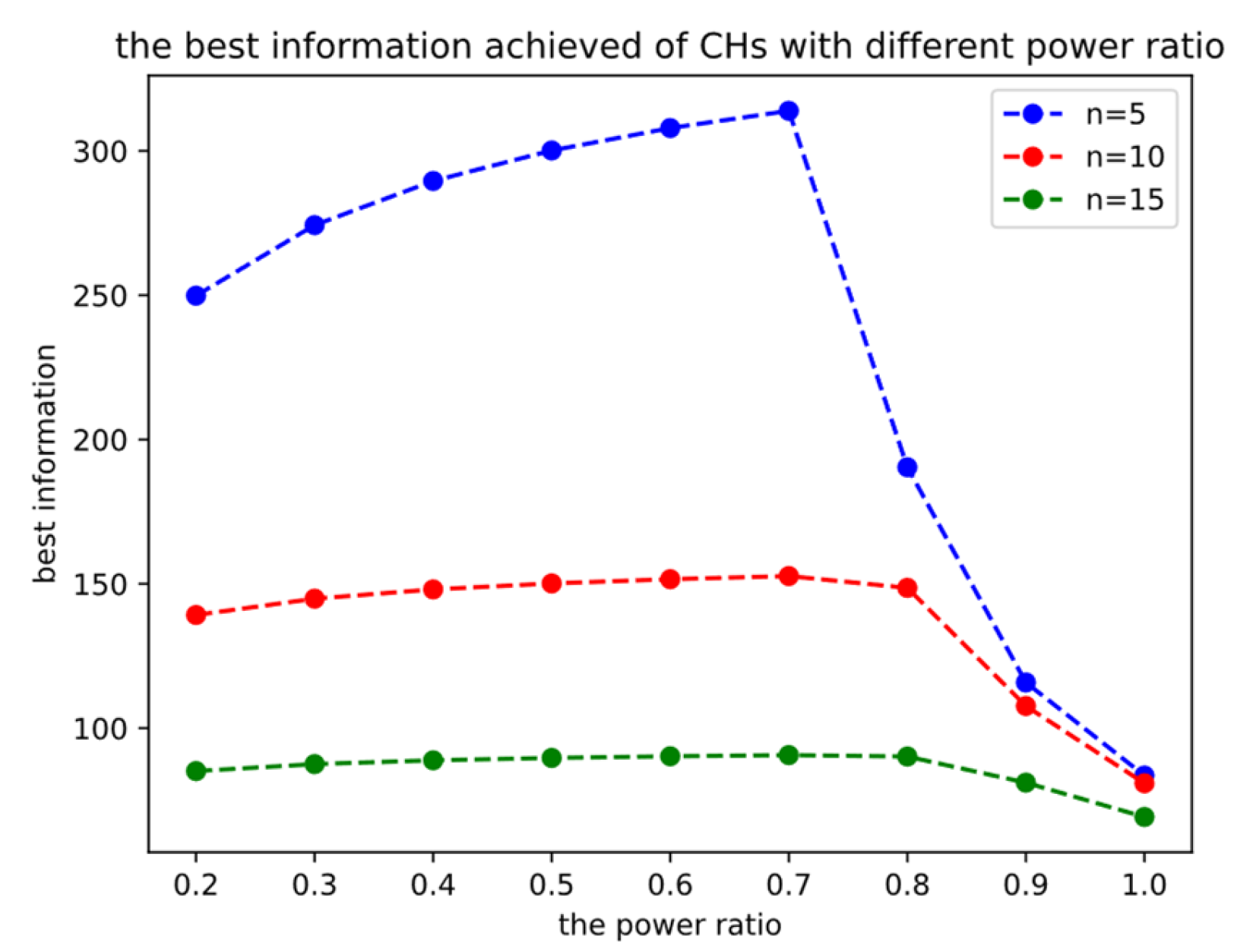
Figure 4 illustrates the relationship between the overall network channel capacity and the number of clusters under different power splitting ratio configurations. A total of 100 S-sensors are clustered using the K-means algorithm, and as the number of clusters increases, the number of cluster members (CMs) per cluster decreases proportionally, which directly leads to a reduction in the volume of information received by each cluster head (CH). As depicted in
Figure 4, the growth rate of the network’s total information throughput also diminishes with an increasing number of clusters. This phenomenon can be attributed to the novel optimization mechanism embedded in the ETAPS algorithm: specifically, as the total number of CMs across the entire network increases with more clusters, the CH is able to harvest additional energy from these CMs via the algorithm’s dynamic power splitting and time allocation strategy, which effectively mitigates the degradation of information reception caused by fewer CMs per cluster and maintains the network’s operational stability. This observation highlights the ETAPS algorithm’s ability to balance cluster density, energy harvesting efficiency, and information transmission performance—a key advantage over conventional clustering and resource allocation schemes.
With the increase in the preset power splitting ratio, the growing number of cluster members (CMs) leads to a significant rise in the energy consumption of the cluster head (CH) for data reception and processing. This is primarily because more CMs mean more data transmission requests, which requires the CH to allocate more computing and energy resources to receive, decode, and process the incoming data, resulting in higher energy overhead and potential performance bottlenecks if not properly optimized. However, after the ETAPS algorithm is applied, it dynamically adjusts the transmission time of CMs based on the CH’s energy status and data processing capacity, effectively reducing redundant data transmission and optimizing the CH’s resource allocation. Consequently, the amount of information received by the CH is appropriately controlled, which not only alleviates the CH’s energy burden but also ensures the stability of data transmission quality while avoiding energy waste—a key advantage of the ETAPS framework in balancing information transmission efficiency and energy sustainability.
6.3. Impact of Power on Optimal Power Ratio
In this section, the power of the EAP to the CH for energy replenishment is set to
, and the rest of the variables are set the same as in Sec. A (simulation parameters). It is adopted to simulate the S-sensor in an insufficient energy state. As shown in
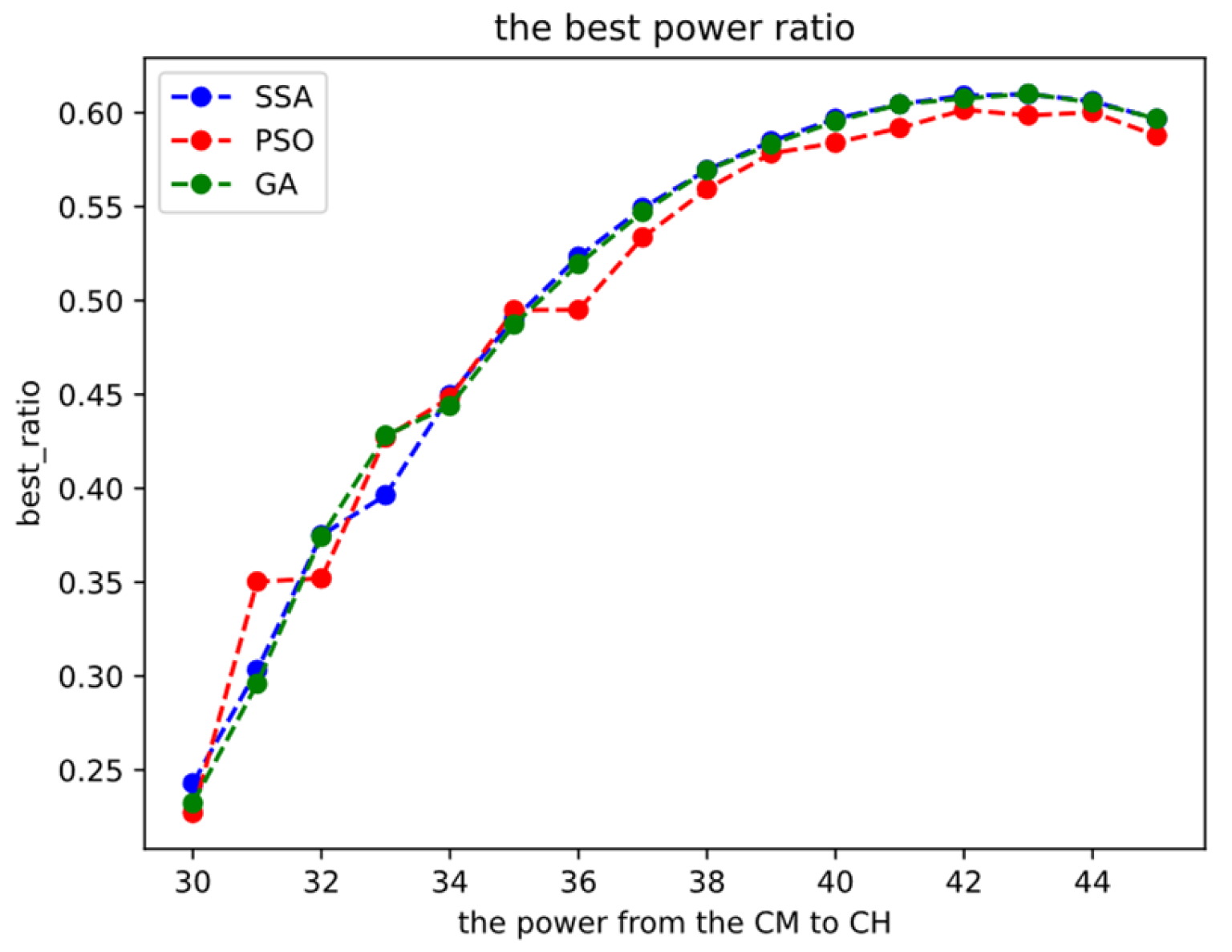
Figure 5, as the transmission power from the CM to the CH increases, the power splitting ratio of the CH increases first and then decreases. When the transmission power is small, to relieve the pressure of energy consumption, the CH decreases the splitting ratio for information decoding to harvest enough energy from CMs for energy compensation according to ETAPS. When the transmission power of the CM is higher, the reception power of the CH increases accordingly, resulting in a reduction in the proportion of reception power dedicated to energy harvesting. Therefore, the power splitting ratio for information decoding increases.
As shown in
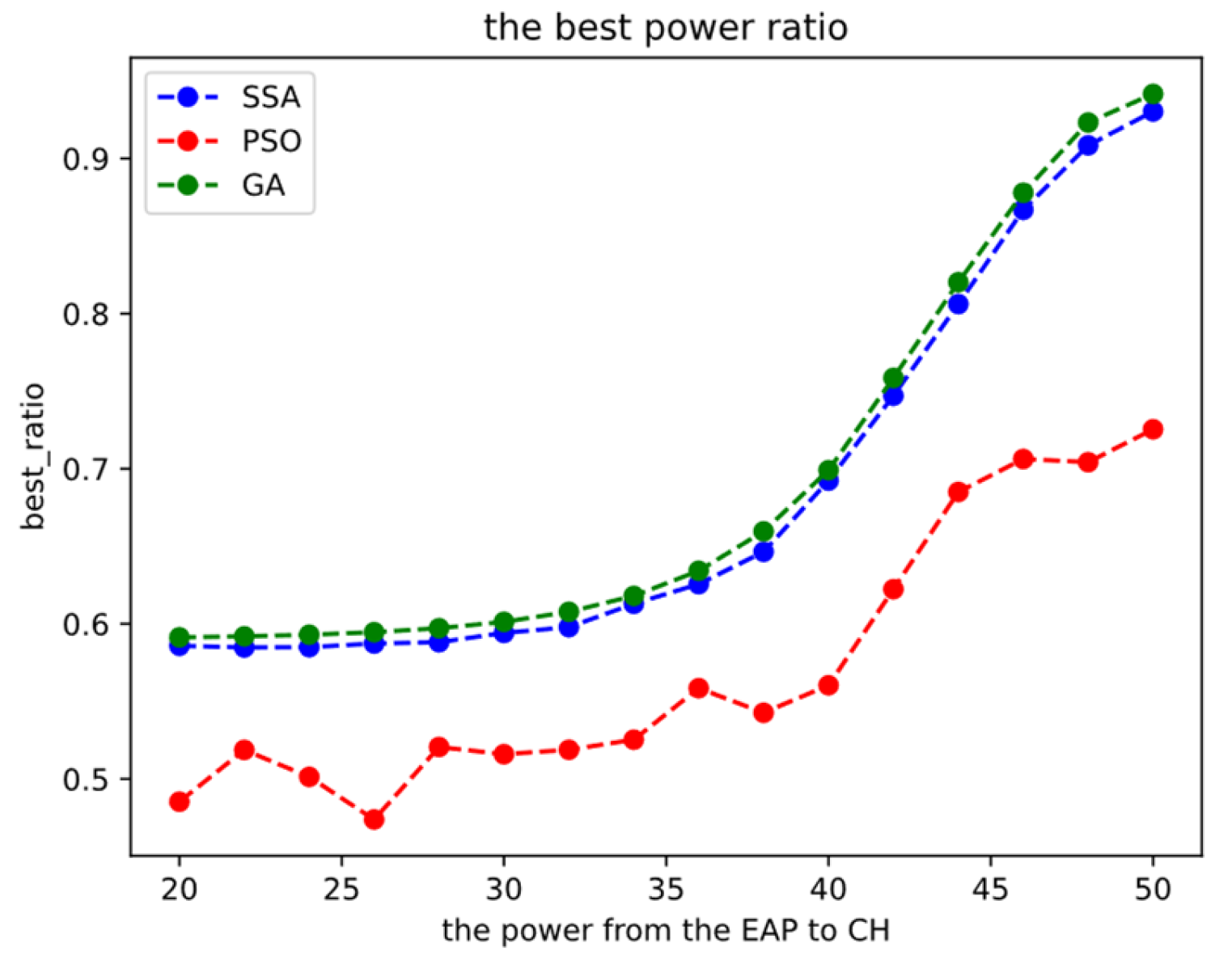
Figure 6, as the energy supply power from the EAP to the CH increases, the CH’s power splitting ratio for information decoding rises gradually and eventually converges to a steady state. This can be explained from the perspective of energy sustainability and adaptive resource coordination: when the transmit power of the EAP is insufficient, the energy harvested by the CH from the EAP cannot support its normal sensing, receiving, and forwarding operations in the next working cycle. In this case, the CH has to reduce the power splitting ratio for information decoding to reserve more received signal power for energy harvesting, thereby compensating for its energy shortage from CMs. As the EAP transmit power increases, the CH obtains a sufficient external energy supply, so it can progressively allocate a larger proportion of received power to information transmission and processing. When the energy provided by the EAP fully meets the CH’s operational demand, the power splitting ratio no longer changes significantly and stabilizes at the upper bound
, reflecting the optimal trade-off between energy harvesting and information decoding achieved by the proposed ETAPS framework.
6.4. Impact of Algorithm on Time Allocation and Alive S-Sensors
As shown in
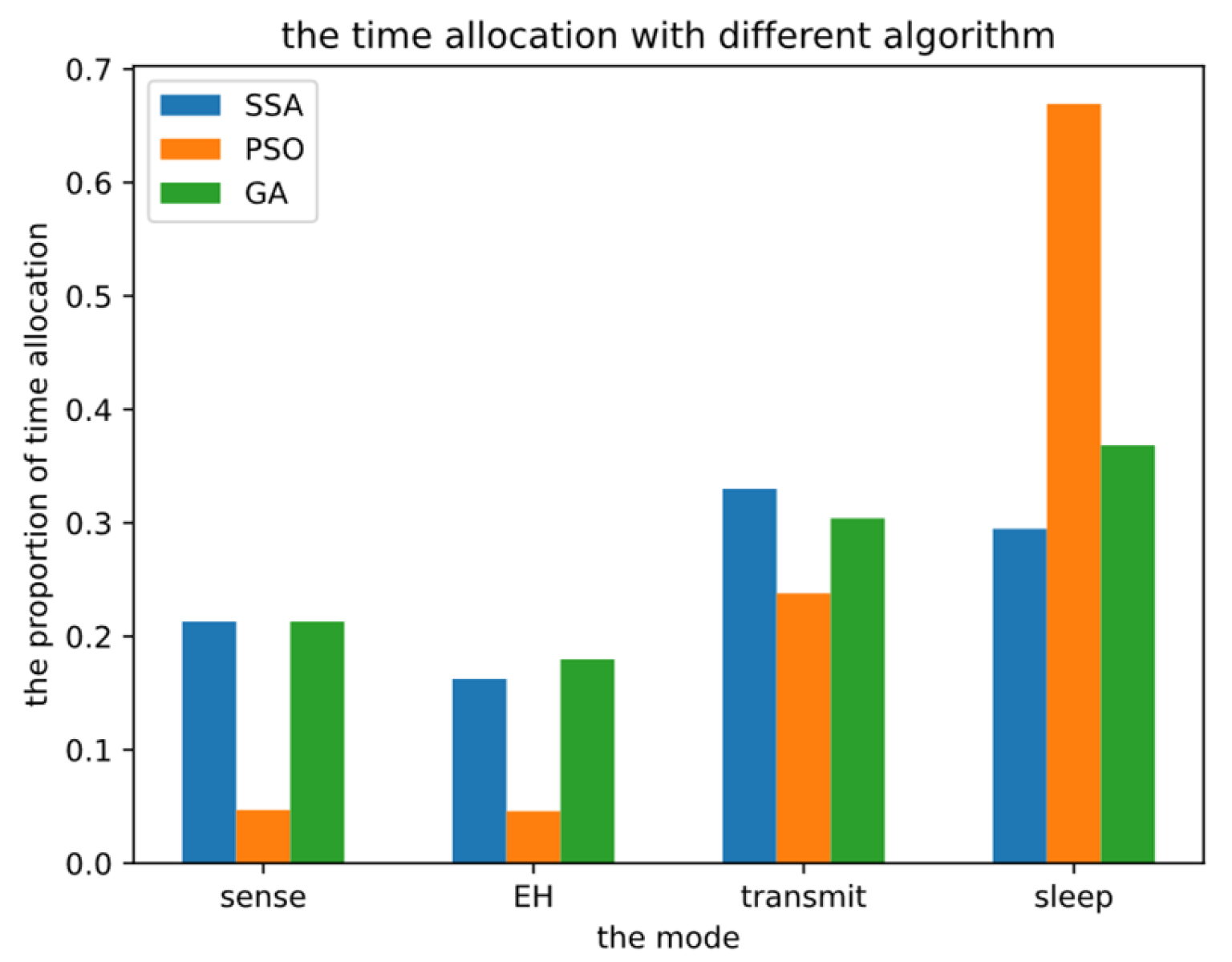
Figure 7, three distinct optimization algorithms are integrated into the time allocation theoretical framework to evaluate their performance in balancing resource utilization and functional requirements. Through systematic comparative analysis, it is verified that the particle swarm optimization (PSO) algorithm allocates a significantly larger proportion of time to sleep mode compared to the other two algorithms. In contrast, when the genetic algorithm (GA) or sparrow search algorithm (SSA) is adopted, the time allocation is tilted toward the sensing mode and energy harvesting (EH) mode, which is attributed to their inherent optimization logic that prioritizes energy acquisition and environmental perception. Notably, when the SSA is employed, it achieves a higher proportion of transmission mode time compared to both PSO and GA. This key difference directly translates to more efficient information transmission between CMs and the CH, as the increased transmission time allows the CH to receive a greater volume of data from CMs than when the GA is applied. This observation not only confirms the superiority of SSA in balancing energy efficiency and information transmission performance but also highlights the critical role of algorithm selection in optimizing time allocation for WSNs, as different algorithms exhibit distinct advantages in aligning with the network’s core requirements (e.g., energy conservation vs. information throughput).
A network coverage model based on the PSO algorithm (VCH-PSO) is proposed to extend the lifetime of S-sensors [
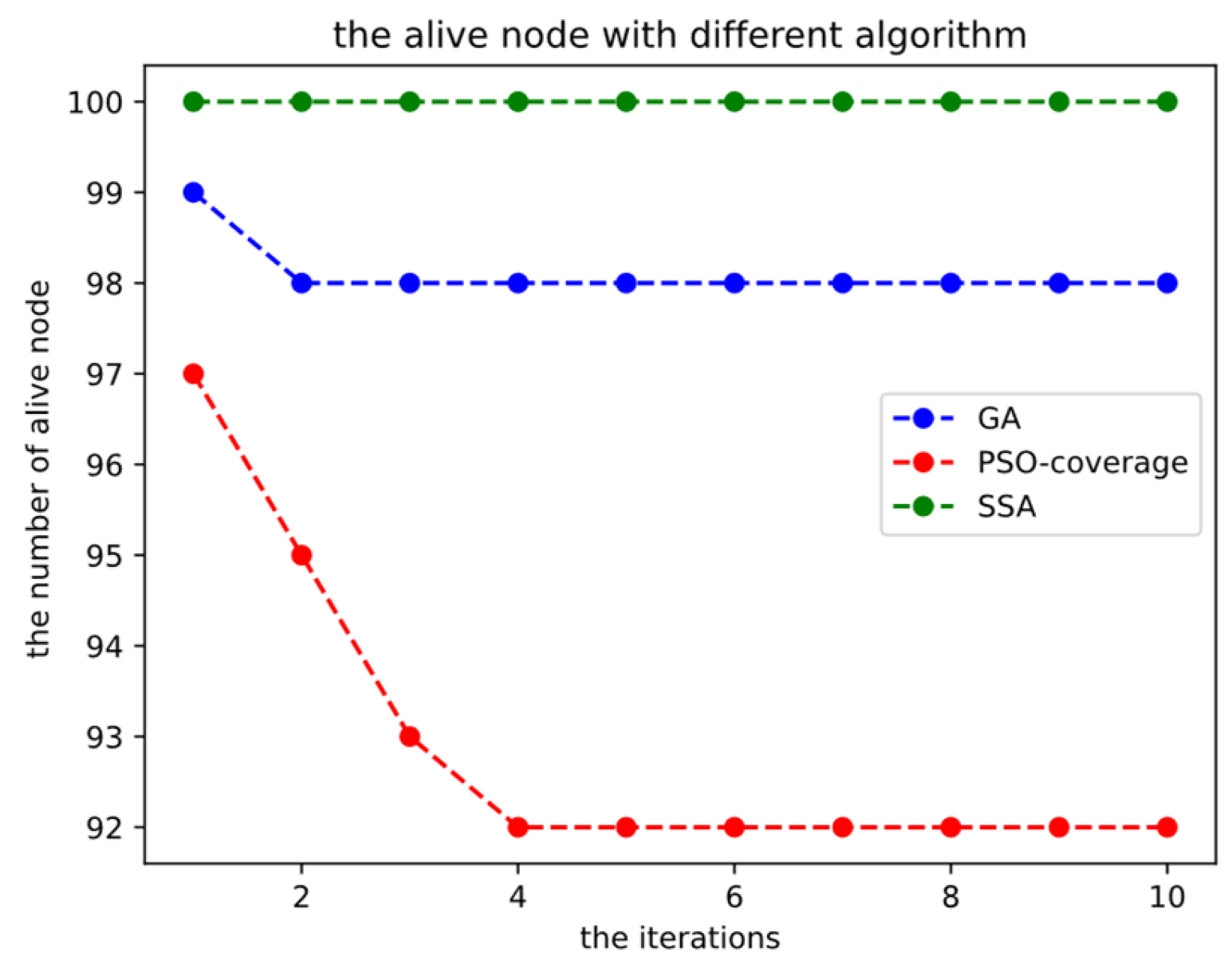
38]. As shown in
Figure 8, the time-slot allocation model using SSA and GA is compared with VCH-PSO in this paper. The results show that the algorithms using the slot allocation model perform much better than those using the VCH-PSO algorithm. In both the PSO and GA algorithms, the nodes that face mortality are primarily the CHs, owing to their highest energy consumption pressure, making them the first casualties. However, the SSA model stands out as it demonstrates the feasibility of the ETAPS algorithm by preserving all S-sensors even after 10 rounds of iteration.
Based on the simulation experiments above, it is evident that by manipulating the transmission power of CMs and the EAP, the power splitting ratio exhibits noticeable variations. This indicates the predominant influence of the CH’s energy consumption on the optimal power splitting ratio. When the energy harvested by the CH from the EAP is insufficient to meet communication requirements, adjustments in the time allocation of CMs primarily involve increasing the transmission time allocated to the CH. Reducing the power splitting ratio of the CH can effectively alleviate the energy consumption burden on the CH and minimize the number of energy-exhausted CHs. Under the aforementioned simulation conditions, the optimal power splitting ratio of the CH is 0.6, and the power splitting ratio of the CH approaches the maximum value when the CH harvests enough energy from the EAP.
6.5. Discussion
Based on simulation results, the ETAPS algorithm effectively balances energy consumption and information transmission. The number of clusters and the power splitting ratio affect the CH’s information decoding performance; more clusters lead to slower information growth, which ETAPS mitigates by harvesting more energy from CMs. When CM-to-CH power is low, the CH reduces the decoding splitting ratio to prioritize energy harvesting; as power increases, the splitting ratio rises. Compared with GA and VCH-PSO, the SSA-based ETAPS achieves better time allocation, more received information, and keeps all S-sensors alive, ensuring stable WSN operation under constrained energy.
Note that the influence of key simplifications including EAP trajectory deviation, imperfect synchronization, non-ideal power splitting, and a limited EAP energy supply is ignored in this paper. In practice, EAP trajectory deviation causes unstable energy coverage and uneven energy distribution, leading to insufficient energy harvesting at cluster heads and degraded network sustainability. Imperfect synchronization introduces transmission collisions and timing mismatches, reducing communication reliability and increasing packet loss. Non-ideal power splitting deviates from the theoretical optimal ratio, lowering both energy conversion efficiency and information decoding quality. A limited EAP energy supply restricts the total energy injected into the network, forcing cluster heads to reduce information transmission to save energy. Together, these non-ideal factors break the balanced trade-off between energy harvesting and data transmission, weakening network throughput, energy sustainability, and algorithm stability. The sensitivity analysis quantifies these performance losses and defines practical application boundaries for the proposed system.
7. Conclusions
In this paper, a novel algorithm, ETAPS, is proposed to address the limited energy supply problem in WSNs. It mitigates scheduling conflicts among CMs via a novel frame structure, dynamic optimal time allocation, and power splitting ratio determination. Leveraging optimization theory, ETAPS maximizes the information rate at the CH using the SSA to derive the optimal solution. Finally, simulation experiments demonstrate that ETAPS can extend the lifetime of S-sensors by dynamically adjusting time allocation and optimizing the power splitting ratio. Additionally, ETAPS enables the entire network to achieve energy sustainability.
In future work, our research focus will shift to the integration of SWIPT with the Artificial Intelligence of Things (AIoT). In essence, AIoT is an emerging technology that fuses artificial intelligence and the Internet of Things [
39]. Since IoT devices require efficient and intelligent processing of large volumes of collected data, substantial energy consumption is incurred [
40,
41]. Thus, research on the integration of SWIPT and AIoT is of great significance. Furthermore, we will explore feasible extensions to practical scenarios, including the incorporation of non-ideal power splitting, asynchronous delays, and channel estimation errors, along with corresponding algorithmic improvements.