Article

Dynamic Graph Construction and Continuous Spatiotemporal Evolution for Traffic Forecasting

1
School of Electronic Information Engineering, Changchun University of Science and Technology, Satellite Street, Changchun 130022, China
2
Changchun Institute of Technology, 395 Kuanping Road, Changchun 130012, China
*
Author to whom correspondence should be addressed.
Electronics 2026, 15(11), 2369; https://doi.org/10.3390/electronics15112369

Submission received: 10 April 2026 / Revised: 15 May 2026 / Accepted: 18 May 2026 / Published: 31 May 2026
(This article belongs to the Section Artificial Intelligence)

Abstract

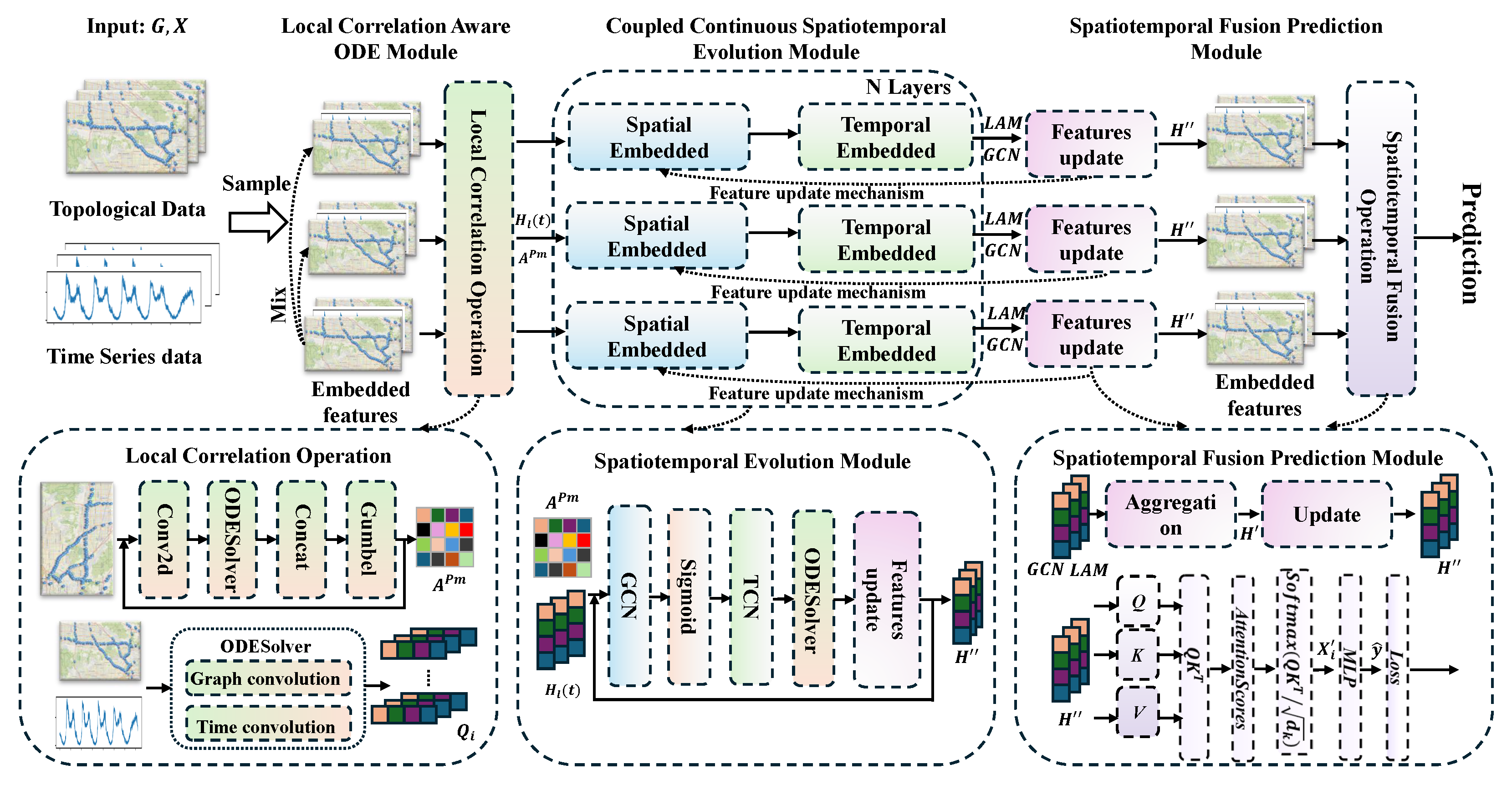
Traffic prediction is a fundamental task in intelligent transportation systems, yet developing accurate prediction models remains challenging because of the complex spatial and temporal dependencies in real road networks. Existing methods commonly rely on discrete modeling paradigms to characterize spatiotemporal features. However, these approaches often fail to adequately capture the intrinsic spatiotemporal coupling among nodes and mainly depend on static adjacency matrices constructed from prior knowledge, which limits their ability to represent dynamic spatiotemporal correlations in real traffic scenarios. To address these limitations, this paper proposes a dynamic prediction model using continuous ordinary differential equations termed DPMCODE. The proposed method enables collaborative aggregation of global and local information through continuous neural ordinary differential equations and dynamically learns spatiotemporal dependencies via graph ODE networks for traffic prediction. Specifically, a continuous ordinary differential equation modeling strategy is introduced to alleviate the over-smoothing problem in discrete networks. Meanwhile, an adaptive dynamic graph structure is designed to reduce the reliance on prior knowledge graphs and capture richer latent spatiotemporal correlations. In addition, a local correlation-aware ODE module is developed to model potential dependencies between non-adjacent nodes, while a spatiotemporal fusion prediction module is further designed to promote effective collaboration between global and local information. Compared with conventional discrete network models, the proposed model generates more realistic and accurate predictions. Extensive experiments and theoretical analysis on five benchmark traffic prediction datasets demonstrate the superiority and state-of-the-art performance of DPMCODE.
Keywords: dynamic adaptive graph; spatiotemporal forecasting; over-smoothing problem; continuous ordinary differential equations dynamic adaptive graph; spatiotemporal forecasting; over-smoothing problem; continuous ordinary differential equations