Article

Stochastic Optimal Energy Management of a Shore-Side Renewable Hydrogen Supply System for Hydrogen-Based Marine Vessels

1
Department of Electrical and Electronics Engineering, Graduate School of Natural and Applied Sciences, Trakya University, 22030 Edirne, Türkiye
2
Department of Electrical and Electronics Engineering, Faculty of Engineering, Trakya University, 22030 Edirne, Türkiye
*
Author to whom correspondence should be addressed.
Electronics 2026, 15(11), 2368; https://doi.org/10.3390/electronics15112368
Submission received: 17 April 2026 / Revised: 27 May 2026 / Accepted: 28 May 2026 / Published: 31 May 2026
(This article belongs to the Special Issue Advances in Electric Vehicles and Energy Storage Systems)

Abstract

The decarbonization of maritime transportation has increased the need for efficient and sustainable hydrogen-based energy systems supported by renewable energy resources (RESs). In this study, a stochastic mixed-integer linear programming (MILP)-based energy management framework is proposed for a shore-side renewable hydrogen supply system integrating photovoltaic (PV) and wind generation, electrolyzer (EL), fuel cell (FC), hydrogen storage, and electricity–hydrogen trading. The model incorporates uncertainties in RESs, electricity prices, and hydrogen demand through a scenario-based approach, enabling adaptive and coordinated system operation. The results indicate that effective coordination of RESs and conversion units significantly improves system performance, with the best configuration achieving a maximum operating gain of 219.34 €, demonstrating strong economic efficiency. In contrast, less flexible configurations result in substantially higher costs, reaching up to 54.53 €, highlighting the importance of system flexibility. From an environmental perspective, carbon emissions vary notably across configurations, with the lowest value of 0.9982 metric tons achieved under optimized conditions, while inefficient designs lead to emissions as high as 1.6280 metric tons. The findings confirm that the proposed stochastic framework effectively enhances both economic and environmental performance, providing a robust and scalable solution for sustainable hydrogen-based maritime energy systems.

1. Introduction

The maritime sector has become an important focus of global decarbonization policies due to its considerable contribution to greenhouse gas emissions and its heavy dependence on fossil-based fuels [1]. In this context, hydrogen has recently emerged as a promising alternative marine fuel since it can be produced from renewable energy resources (RESs) and enables zero-emission operation at the point of use [2]. With the growing interest in hydrogen-based marine transportation systems, shore-side hydrogen production and refueling infrastructures supported by RESs have been considered a potential solution for sustainable maritime energy supply [3]. However, the efficient operation of such integrated systems is challenging due to the intermittent nature of RESs and the uncertainties associated with electricity markets and hydrogen demand [4]. Therefore, uncertainty-aware energy management approaches are required to coordinate RESs, hydrogen production, storage systems, and multi-energy interactions within integrated maritime energy infrastructures [5]. Although several studies have investigated RES-based hydrogen production and energy management strategies for integrated energy systems, most of the existing works focus on specific components of the system rather than addressing their coordinated operation. In particular, the integrated operational management of RESs, electrolyzer (EL), hydrogen storage systems, fuel cells (FCs), and electricity–hydrogen trading mechanisms under uncertain operating conditions within shore-side renewable hydrogen infrastructures supporting maritime transportation remains insufficiently explored in the literature.
Van Sickle et al. [6] presented the MV Sea Change project, the first commercially developed fully hydrogen FC passenger ferry, and reported its design, construction, certification, bunkering, and operational performance. Their study provided critical real-world evidence on the practical feasibility of hydrogen-powered ferries and yielded valuable regulatory and operational insights for the broader deployment of hydrogen-based marine transportation systems. Saadeldin et al. [7] investigated the feasibility of hydrogen FC passenger vessels for sustainable inland waterway transportation through a multi-criteria assessment combined with mixed-integer linear programming (MILP)-based optimization, demonstrating that a PEMFC-CH2+BES hybrid configuration can offer advantages in terms of emission reduction, fuel consumption, and operating cost. Di Ilio et al. [8] developed a methodological retrofit framework for converting the Fior Di Levante ferry operated by Levante Ferries (Zakynthos, Greece) into an FC hybrid vessel, evaluating duty profile, hydrogen consumption, weight, and volume relationships, and showing that hydrogen storage units constitute one of the most decisive factors in vessel layout and performance design. Fan et al. [9] reviewed hydrogen-powered ships developed between 2000 and 2024 at the fleet level and synthesized advances in energy conversion systems, storage technologies, and bunkering infrastructure, while emphasizing that safety concerns, rapid refueling requirements, infrastructure investment, and scalability remain major bottlenecks for the sector.
Zhao et al. [10] systematically categorized modeling and optimization studies on hybrid power systems in hydrogen-electric ships and identified substantial research gaps in decision-making under uncertainty, real-time control, multi-scale modeling, and route-based operational optimization. Liu et al. [11] experimentally validated a dual-objective energy management strategy for hydrogen-electric ships and demonstrated that an advanced dynamic programming-based approach can simultaneously reduce total energy consumption and FC load fluctuations, thereby improving both system lifetime and operational performance. Cha et al. [12] comprehensively reviewed optimization-based power management strategies for FC and battery hybrid vehicles and highlighted that joint consideration of component sizing and control strategy is crucial for cost, performance, system durability, and health-conscious energy management. Maloberti and Zaccone [13] proposed an optimization-based energy management strategy for marine hybrid propulsion systems that explicitly incorporates the environmental impacts associated with the hydrogen production chain, revealing that overall environmental performance is determined not only by onboard energy consumption but also by the origin and production pathway of the hydrogen used. Shaikh et al. [14] proposed a hybrid optimization approach combining moth-flame optimization and particle swarm optimization for estimating transmission line parameters in power transmission and distribution systems. The method was tested on benchmark functions and different bundle conductor configurations, showing better convergence and estimation accuracy than conventional moth-flame optimization, particle swarm optimization, modified whale optimization, and grey wolf optimization methods.
Kheirani et al. [15] examined an off-grid green hydrogen supply system based on offshore wave and wind energy for hydrogen-powered ships and showed that competitive hydrogen costs can be achieved within a multi-stop refueling infrastructure. Kaur et al. [16] evaluated offshore floating solar-based electrofuel production for refueling small ferries and demonstrated that offshore photovoltaic (PV)-based hydrogen generation can deliver substantial emission reductions while reaching acceptable cost levels. Guo and Cao [17] investigated a hybrid configuration combining coastal and offshore ocean energy to support smart charging infrastructure for ferries and electric vehicles, showing that port-based energy management can reduce both grid dependency and operational costs. Duan et al. [18] developed a multi-objective optimization framework for solar-hydrogen-battery-integrated electric vehicle charging stations with direct energy exchange between geographically dispersed stations. The study simultaneously evaluated investment cost, operating cost, and greenhouse gas emissions, and showed that hydrogen storage together with inter-station energy exchange can reduce daily costs and improve operational flexibility. Wang et al. [19] proposed a low-carbon economic dispatch model for an integrated electricity-heat-hydrogen system considering hydrogen production via water electrolysis. The framework jointly incorporates rooftop PV, battery storage, electric boilers, hydrogen production, hydrogen storage, and hydrogen FCs, while also accounting for FC waste heat recovery. The results demonstrate that the proposed multi-energy complementary structure can effectively reduce operating costs and carbon emissions. Mojarrad et al. [20] assessed a zero-emission maritime transport concept for high-speed passenger ferries incorporating hydrogen fuel and superconducting propulsion, concluding that compressed hydrogen is more feasible under current conditions, whereas liquid hydrogen may emerge as a strong alternative with advances in infrastructure and propulsion technologies. Mojarrad et al. [21] also investigated the conversion of a diesel-powered high-speed ferry to green hydrogen and found that compressed hydrogen is currently more economically viable, while liquid hydrogen may become more competitive in the future. Nagem et al. [22] proposed an optimal design and three-level stochastic energy management framework for a grid-connected microgrid serving both electrical loads and an FCEV hydrogen refueling station. The study jointly considered PV, wind, hydrogen storage, and demand side response, and demonstrated that the third-level configuration achieved the greatest reduction in total annual cost under uncertainty. Beyazıt et al. [23] developed a real-time optimization model integrating PV-based charging stations, hydrogen refueling infrastructure, ELs, hydrogen storage, and mobile charging stations. The study showed that mobile charging units can both mitigate BEV overstaying and support hydrogen production when idle, thereby improving infrastructure utilization and hydrogen availability simultaneously. Shaikh et al. [24] proposed a chaotic gorilla troop optimization-based planning approach for integrating renewable energy systems into radial distribution networks. The study optimized the placement and sizing of solid-state transformers, wind turbines, photovoltaic panels, and battery energy storage systems, showing that the proposed framework improved voltage profiles and reduced power losses under variable load and renewable generation conditions.
Feng et al. [25] provided a comprehensive assessment of alternative fuels, battery and supercapacitor systems, PV and wind integration, and onboard DC microgrids, arguing that multi-energy integrated power systems represent a central pathway toward sustainable shipping. Katumwesigye et al. [26] compared the environmental and economic performance of a fully battery-electric RoPax ferry through life cycle assessment and techno-economic analysis, showing that a fully electric solution supplied by renewable electricity performs particularly well from a climate impact perspective. Karaca and Dinçer [27] proposed a renewable-based polygeneration ferry system capable of producing hydrogen onboard from solar and wind energy while simultaneously supplying electricity, heating, and cooling, thereby demonstrating the potential of hydrogen to function as an integrated energy carrier. Riccobono et al. [28] investigated a multi-source power system composed of PVs, FCs, and lithium-ion batteries for autonomous marine vehicles and showed that appropriate energy sharing can significantly extend operational range.
Motivated by this research gap, this study proposes a stochastic MILP-based optimal energy management framework for a shore-side renewable hydrogen supply system that integrates RESs, hydrogen production, storage, and multi-energy trading mechanisms to support hydrogen-based marine vessels. Motivated by this research gap, the main contributions of this study are summarized as follows:
  • An energy management model representing the decision-making mechanism of a shore-side renewable hydrogen supply system is developed to optimally coordinate RESs, hydrogen production, hydrogen storage, and energy exchange processes for hydrogen-based marine vessels, cars and motorcycles.
  • A stochastic optimization approach based on MILP is proposed in which uncertainties associated with electricity prices, wind and solar power generation, and hydrogen demand are explicitly represented through a scenario-based framework.
  • The proposed framework enables coordinated operation with external infrastructures by considering both electricity exchange with the power grid and hydrogen procurement from the hydrogen network within the energy management process.
  • The proposed model is tested through a case study representing a shore-side hydrogen supply system located on the Meriç River in Edirne, where the system performance is evaluated using realistic RES and demand data.
The taxonomy table of the proposed methodology compared to literature studies. is presented in Table 1.
The remainder of this paper is organized as follows: Section 2 presents the structure of the considered system and the mathematical formulation of the proposed energy management model. Section 3 describes the case study and presents the numerical results obtained from the simulations. Finally, Section 4 concludes the paper and summarizes the main findings of the study.

2. Mathematical Formulation of the Proposed System

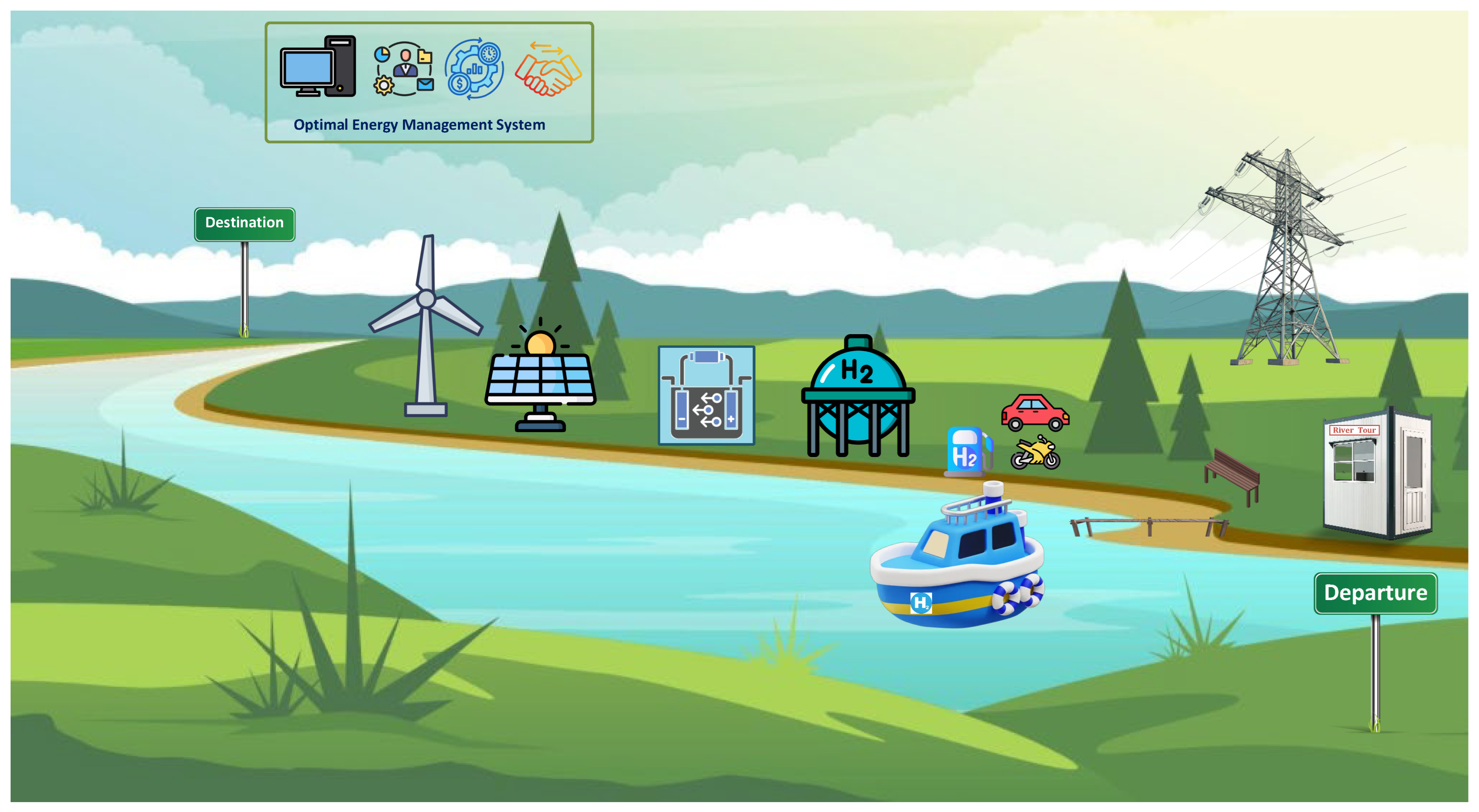
In this paper, a stochastic MILP-based optimal energy management model is developed for a shore-side renewable hydrogen-based marine energy system that aims to supply clean hydrogen fuel to vessels in a cost-effective and reliable manner. The proposed system integrates PV system and wind turbines, an EL, a FC, a hydrogen storage tank, bidirectional electricity exchange with the utility, and hydrogen trading with the external network within a unified operational framework. Considering the intermittent nature of RESs, time-varying electricity and hydrogen prices, the energy management problem is formulated as a scenario-based stochastic optimization model in which both continuous energy variables and binary operational decisions are optimized simultaneously. Within the system, renewable electricity can be either used for hydrogen production through the EL or sold to the utility depending on the optimal operational decision and market conditions. When renewable generation is insufficient or when purchasing electricity becomes economically more advantageous, the grid acts as a supporting energy source. The produced hydrogen is stored in the tank to provide temporal flexibility and is used to refuel vessels, generate electricity via the FC, or participate in hydrogen market transactions. The FC enables multi-energy coupling by converting stored hydrogen into electricity during high-price periods or low renewable generation conditions. The general architecture of the proposed decision-making model for the hydrogen-based marine energy system is presented in Figure 1.
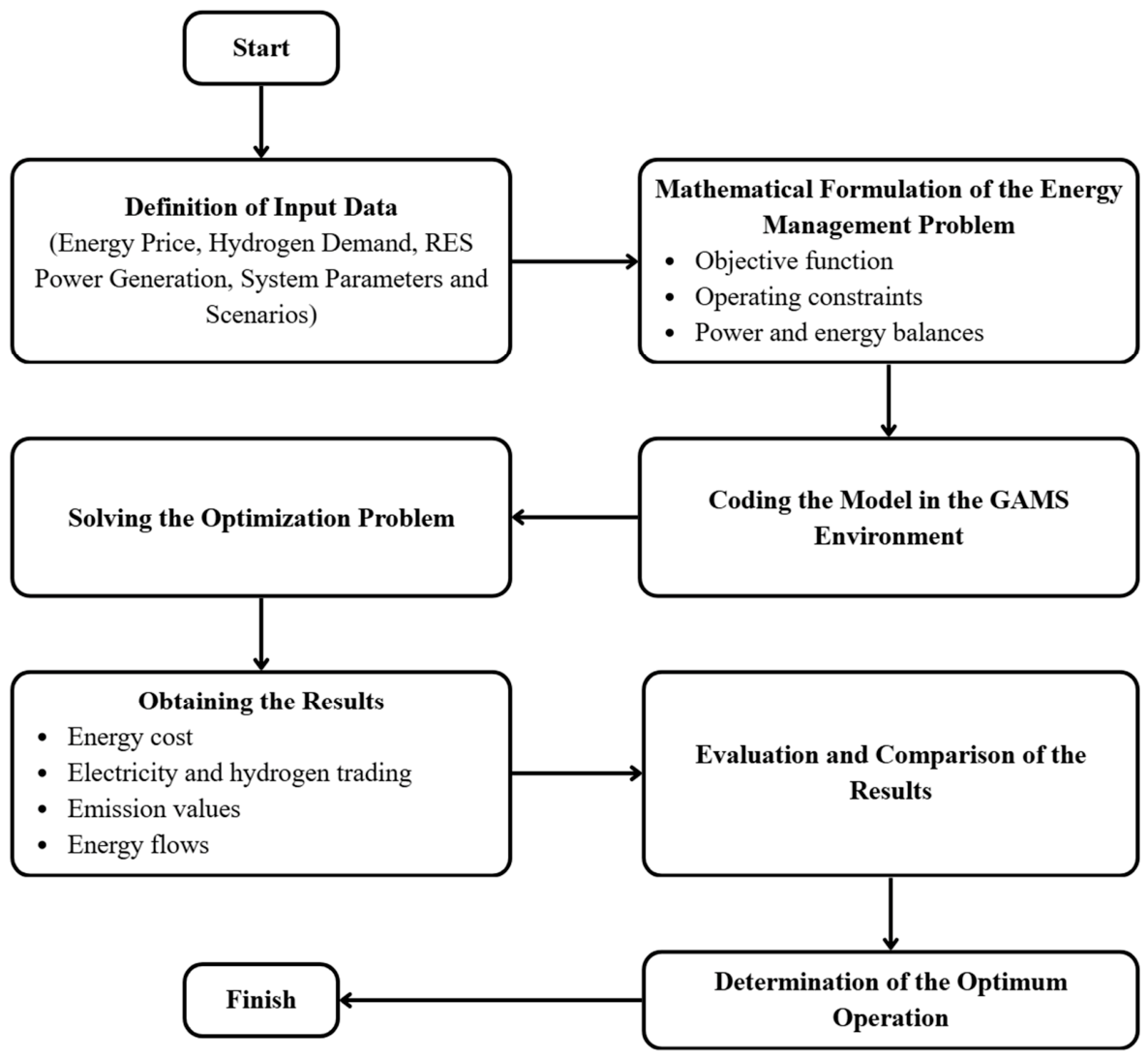
The flowchart of the proposed decision-making model for the hydrogen-based marine energy system is presented in Figure 2.
Equation (1) presents the objective function of the proposed optimization model. It minimizes the expected total operating cost over the scheduling horizon by considering the probability of each scenario. The formulation includes the cost of electricity purchased from the utility and the cost of hydrogen procured from the external network, while the revenues obtained from electricity and hydrogen sales are subtracted. In this way, the most economical operating strategy is determined under uncertain conditions.
m i n t s p s Δ T P t , s b u y λ t , s e l e c Δ T P t , s s e l l λ t , s e l e c + H 2 t , s b u y λ t , s h 2 H 2 t , s s e l l λ t , s h 2
Equation (2) represents the electrical power balance of the system. For each time period and scenario, the electrical power required by the EL together with the electricity exported to the power grid is supplied by the wind turbine and PV power generation system, the electricity imported from the power grid, and the power generated by the FC.
P t , s e l + P t , s s e l l = P t , s w i n d + P t , s p v + P t , s b u y + P t , s f c ,   t , s
Equation (3) defines the minimum and maximum operating limits of the EL and ensures that its power consumption remains within the allowable technical range. Equation (4) describes the hydrogen production process of the EL. The amount of hydrogen generated is determined by the consumed electrical power, the EL efficiency, the lower heating value of hydrogen, and the duration of the time interval.
P t , s e l m i n P t , s e l P t , s e l m a x ,   t , s
A t , s e l h 2 = E e l P t , s e l L H V h 2 Δ T ,   t , s
Equation (5) expresses the hydrogen storage balance in the hydrogen tank. The hydrogen level in the tank at each time period is obtained by considering the stored hydrogen from the previous period, the hydrogen produced by the EL, the hydrogen consumed by the FC, the hydrogen purchased from the network, the hydrogen sold to the network, and the hydrogen supplied to the vessels and the other vehicles (cars and motorcycles). Equation (6) imposes the minimum and maximum storage capacity limits of the hydrogen tank and guarantees that the stored hydrogen always remains within the allowable bounds.
A t , s h 2 = A t 1 , s h 2 + A t , s e l h 2 A t , s f c h 2 + H 2 t , s b u y H 2 t , s s e l l v A v , t , s v e s s e l h 2 o A o , t , s o t h e r h 2 ,   t , s
A t a n k h 2 m i n A t , s h 2 A t a n k h 2 m a x ,   t , s
Equation (7) defines the initial hydrogen storage level for each scenario at the beginning of the scheduling horizon. Equation (8) specifies the final hydrogen storage level and enforces a predefined value at the end of the scheduling horizon to ensure cyclic operation.
A t , s h 2 = A t , s t a n k b e g i n n i n g h 2 , s     i f   t = f i r s t   t i m e   p e r i o d
A t , s h 2 = A t , s t a n k f i n a l h 2 , s     i f   t = l a s t   t i m e   p e r i o d
Equation (9) models the operational state of the EL by linking the hydrogen production amount to a binary decision variable and the maximum hydrogen production capacity. Equation (10) represents the operational state of the FC by associating hydrogen consumption with a binary decision variable and the maximum hydrogen consumption capacity. Equation (11) prevents the EL and FC from operating simultaneously, thereby ensuring a feasible and efficient operating strategy.
A t , s e l h 2 = N t , s e l m a x h 2 b t , s e l   ,   t , s
A t , s f c h 2 = N t , s f c m a x h 2 b t , s f c ,   t , s
b t , s e l + b t , s f c 1 ,   t , s
Equation (12) defines the relationship between the electrical power generated by the FC and the hydrogen consumed. This conversion depends on the FC efficiency, the lower heating value of hydrogen, and the duration of the time interval. Equation (13) limits the electrical power output of the FC within its minimum and maximum generation capacity. Equation (14) limits the increase in the electrical power output of the FC between two consecutive time intervals based on the ramp-up rate and the maximum generation capacity. Equation (15) limits the decrease in the electrical power output of the FC between two consecutive time intervals based on the ramp-down rate and the maximum generation capacity.
A t , s f c h 2 = P t , s f c Δ T E f c L H V h 2 ,   t , s
P t , s f c m i n P t , s f c P t , s f c m a x ,   t , s
P t , s f c P t 1 , s f c R f c u p P t , s f c m a x ,   t > 1 , s
P t 1 , s f c P t , s f c R f c d o w n P t , s f c m a x ,   t > 1 , s
Equation (16) restricts the hydrogen purchasing amount from the pipeline by using a binary decision variable and the maximum transfer capacity. Equation (17) limits the hydrogen selling amount to the pipeline and ensures that the system cannot buy and sell hydrogen simultaneously.
H 2 t , s b u y N h 2 p i p e l i n e m a x b t , s h 2   ,   t , s
H 2 t , s s e l l N h 2 p i p e l i n e m a x ( 1 b t , s h 2 ) ,   t , s
Equation (18) constrains the electricity purchasing amount from the utility through the maximum grid connection capacity and the corresponding binary decision variable. Equation (19) restricts the electricity sold to the grid and the binary prevents simultaneous electricity import and export.
P t , s b u y N e l e c g r i d m a x b t , s e l e c g r i d   ,   t , s
P t , s s e l l N e l e c g r i d m a x ( 1 b t , s e l e c g r i d ) ,   t , s

3. Tests and Results

3.1. Input Data

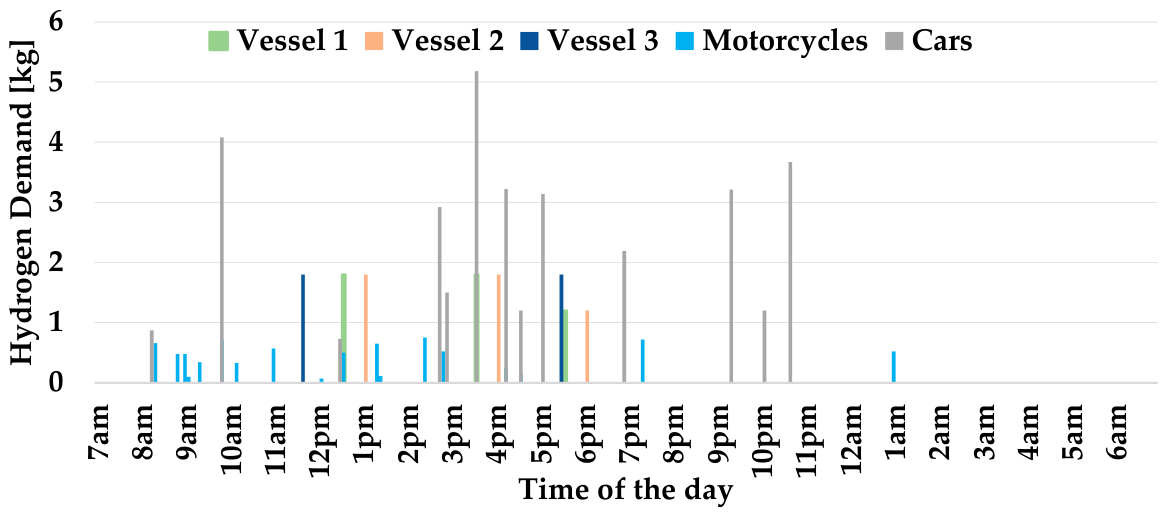
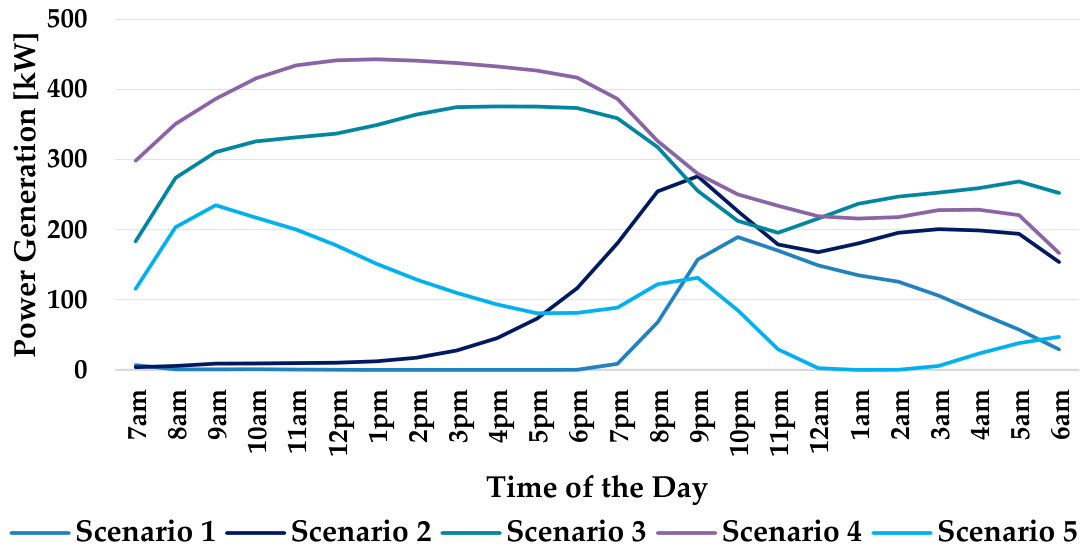
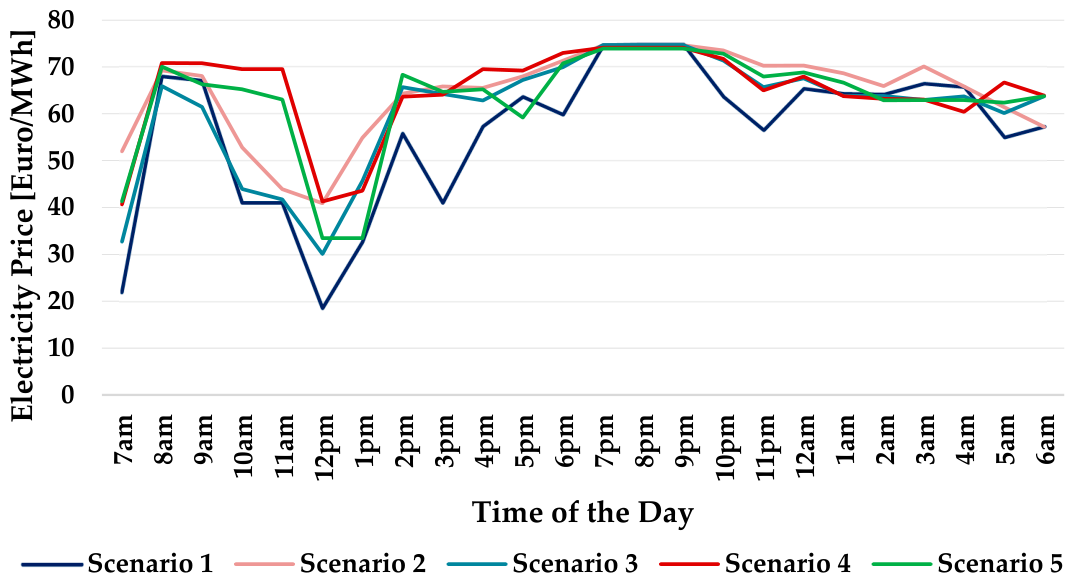
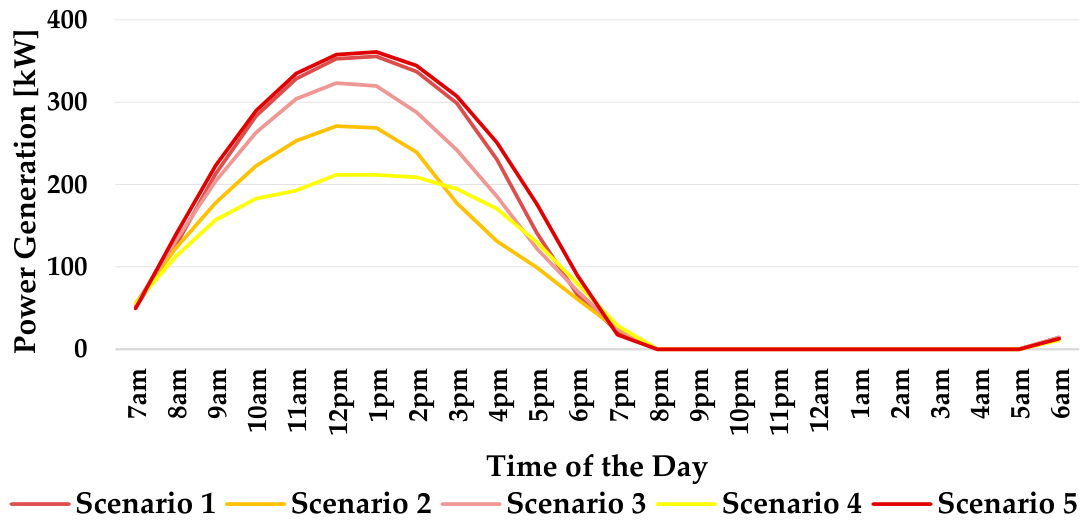
Figure 3 shows the total hydrogen demand profile of all vehicles over the scheduling horizon, reflecting temporal variations in hydrogen consumption. Figure 4 illustrates the wind power generation profiles under different scenarios, capturing the uncertainty associated with wind energy, while Figure 5 presents the PV generation profiles, highlighting the intermittent and diurnal nature of solar power. The power generation profiles of the wind turbine and PV system are obtained from the Renewable.ninja platform [29], ensuring realistic representation of renewable energy production under site-specific conditions. In addition, Figure 6 depicts the hourly electricity price profiles for all scenarios, representing market-driven uncertainty. The hourly electricity price profiles for all scenarios considered in the study are obtained from the EPİAŞ transparency platform [30], reflecting real market dynamics. Together, these input datasets are incorporated into the scenario-based stochastic optimization framework, enabling a realistic and comprehensive evaluation of the proposed energy management strategy under varying operational conditions. The time resolution of the study is set to 5 min, and the system operation is analyzed over a one-day horizon, spanning from 07:00 on June 23 to 07:00 on June 24. These datasets are incorporated into the proposed stochastic optimization framework to accurately capture temporal variations and uncertainties in both RESs and electricity prices. The efficiency of EL is 75%, while FC efficiency is 90%.
The hydrogen tank capacity was set to 25 kg, and the allowable amount of stored hydrogen was constrained between 7 kg and 25 kg. The operating power limits of the EL were defined between 20 kW and 200 kW. The hydrogen trading limit with the hydrogen network was set to 5 kg for both purchasing and selling operations. In addition, the maximum power limit for electricity trading with the power grid was defined as 1500 kW. The ramp-up and ramp-down limits of the FC were defined as 250 kW per 5 min interval.

3.2. Test Results

Table 2 summarizes the configuration of the case studies considered in the simulations. The table presents the installed capacities of RESs, including PV and wind systems, along with the capacities of the EL and FC units. Different efficiency values for the EL and FC units are also considered in specific cases. In addition, different operational conditions such as grid outage periods and grid support levels are defined for each case. These variations enable a comprehensive evaluation of the proposed energy management model under different system configurations and operating scenarios, allowing the impact of RES capacity, conversion units, and grid interaction to be systematically analyzed.
Table 3 presents the total operating cost results for the considered case studies, enabling a comprehensive comparative assessment of system performance under different configurations. The results clearly indicate that system profitability is strongly influenced by the coordinated sizing of RESs and conversion units, as well as grid interaction strategies. It should be stated that negative values in the cost results represent profit, whereas positive values represent cost. Among all cases, Case 6 achieves the best performance with the lowest cost (−219.34 €), outperforming Case 3 (−163.61 €) due to its higher FC capacity, which enhances the effective utilization of stored hydrogen and increases arbitrage opportunities. Although Case 5 (−23.54 €) benefits from increased PV capacity, its performance remains inferior to Case 3 and Case 6, demonstrating that increasing RES capacity alone is insufficient without adequate conversion flexibility. In contrast, Case 1 (39.21 €) and Case 10 (54.53 €) exhibit the highest costs, indicating limited operational flexibility and reduced capability to exploit market dynamics. Case 2 and Case 8, both yielding near break-even results (−1.36 €), reveal similar operational characteristics, while Case 7, and Case 9, incorporating grid outage and support constraints, show moderate costs (around 13.20 €), highlighting the trade-off between economic performance and system resilience. Case 11, in which the EL efficiency is reduced to 60%, results in a total operating cost of 2.49 €, while Case 12, in which the FC efficiency is reduced to 75%, results in a total operating cost of 26.01 €. These results indicate that reductions in conversion efficiency directly affect the economic performance of the system by decreasing the efficiency of hydrogen production in the EL and limiting the benefits obtained from hydrogen utilization in the FC. Case 7 and Case 9 show that grid support has a negligible impact on cost, while Case 2 and Case 8 similarly indicate that operational differences do not significantly affect economic performance. Overall, the findings demonstrate that configurations combining higher RES penetration with appropriately sized EL and FC units and flexible grid interaction (e.g., Case 3 and Case 6) significantly enhance economic efficiency, thereby validating the effectiveness of the proposed stochastic optimization framework.
Table 4 presents the detailed electricity and hydrogen trading amounts for each case study under different scenarios, providing critical insights into the operational behavior of the system. The results indicate that cases with higher flexibility and conversion capacity, particularly Case 3 and Case 6, achieve significantly higher energy selling values (up to 12,943.29 kWh), demonstrating their strong capability to exploit surplus renewable generation and market opportunities. In contrast, Case 5 exhibits substantially higher energy buying levels (reaching 2790.95 kWh), indicating a greater dependency on the power grid. Hydrogen trading patterns further support these findings, as configurations with larger EL capacity enable increased hydrogen production and trading activities. The efficiency-based cases further indicate that variations in EL and FC efficiencies also influence electricity and hydrogen trading patterns, confirming the role of conversion efficiency in system operation. Scenario-based fluctuations highlight the influence of uncertainty on both electricity and hydrogen exchanges, reinforcing the importance of stochastic optimization. In addition, electricity purchasing is completely avoided in certain scenarios due to sufficient on-site generation. Overall, the findings emphasize that integrated system flexibility and appropriately sized conversion units play a key role in enhancing both market participation and overall system efficiency.
Table 5 presents the average CO2 emissions for all case studies, revealing notable differences in environmental performance across system configurations. The results show that Case 4 achieves the lowest emissions (0.9982 metric tons), indicating the most environmentally favorable operation, While Case 5 exhibits the highest emissions (1.6280 metric tons), this is mainly attributed to its larger EL capacity, leading to higher grid electricity consumption to support intensified hydrogen production activities. Case 11 and Case 12 result in average CO2 emissions of 1.0350 and 1.1120 metric tons, respectively, indicating that variations in EL and FC efficiencies also affect the environmental performance of the system. Most other cases, including Case 1, Case 2, Case 3, Case 6, Case 7, and Case 9, demonstrate relatively similar emission levels (around 1.14–1.15 metric tons), suggesting comparable operational behaviors in terms of carbon intensity. In contrast, Case 8 (1.1873 metric tons) and Case 10 (1.2440 metric tons) show moderately higher emissions. Overall, the findings highlight that properly designed system configurations with balanced RES integration and conversion capacity can significantly reduce emissions, whereas insufficient flexibility or higher grid dependency leads to increased environmental impact. Moreover, lower carbon emission levels could be achieved in the absence of arbitrage in both electricity and hydrogen trading, particularly when supported by a larger EL capacity.
The comparison in Figure 7 provides a clear view of how electricity purchasing and selling behavior changes across the selected case studies under Scenario 1. A lower electricity purchasing level indicates that the system can meet a larger share of its energy demand through internal resources, particularly RES generation and hydrogen-based conversion units, and may also reflect limited arbitrage opportunities, whereas higher purchasing levels indicate either a greater dependence on the external grid or the presence of arbitrage opportunities in electricity and hydrogen markets.
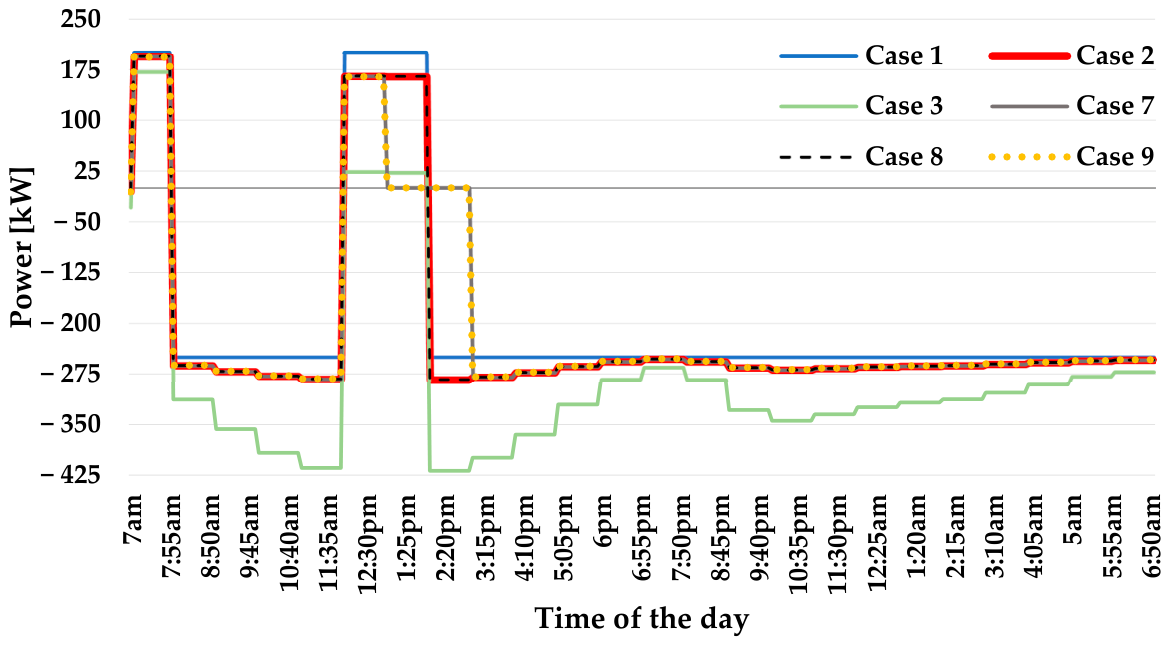
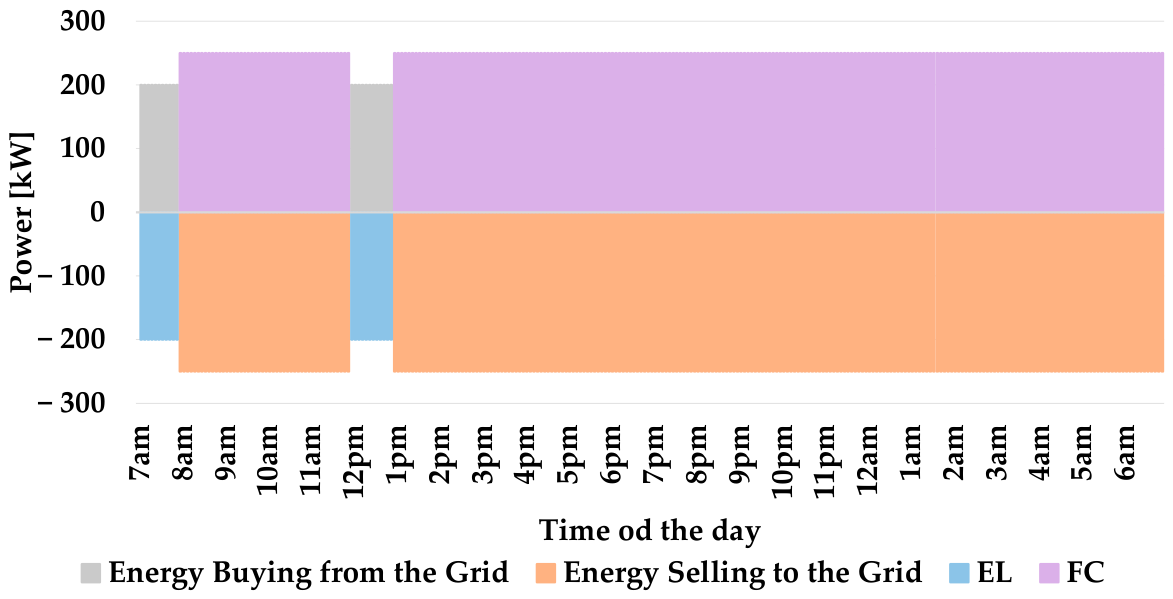
A baseline operational perspective is offered in Figure 8, which presents the power balance of Case 1 in Scenario 3. The power balance indicates that the 383.33 kWh of electricity purchased from the grid is entirely utilized to supply the EL demand (383.33 kWh), while the 5500 kWh generated by the FC is fully exported to the grid, thereby maintaining the overall supply–demand equilibrium within the system. Since Case 1 represents a comparatively standard configuration without outage or support constraints, this figure can be interpreted as a reference for understanding how renewable production, grid interaction, EL demand, and FC contribution are coordinated over time. The balance shown in the figure reflects the core logic of the optimization model, namely that power demand must be continuously satisfied by combining local generation, grid imports, and hydrogen-based reconversion in a cost-effective manner. As such, Figure 8 serves as a useful benchmark for evaluating how more advanced or constrained cases deviate from this reference operating pattern.
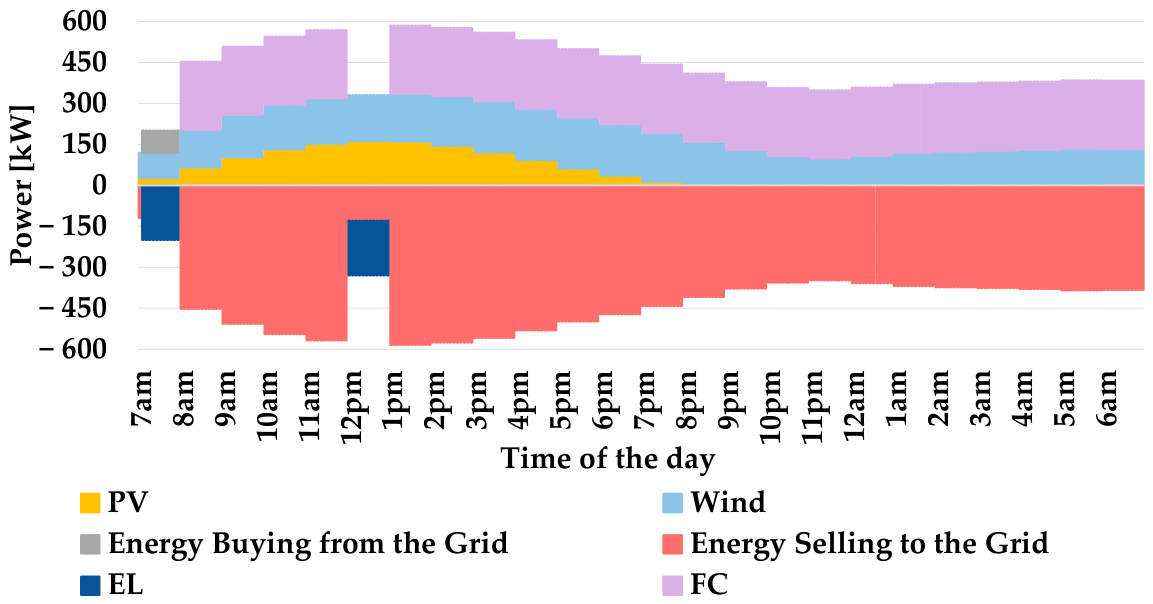
The operational behavior becomes more advantageous in Figure 9, where the power balance of Case 3 in Scenario 3 is illustrated. Compared with the baseline structure, Case 3 includes RES capacity, which is expected to improve the contribution of local generation to the overall supply balance and reduce the need for electricity imports. This makes the figure particularly important for demonstrating how RES penetration enhances the capability of the system to operate more independently and economically. In the broader results of the manuscript, Case 3 also exhibits one of the best cost performances, which supports the interpretation that the power balance in this figure is associated with more efficient RES utilization and more favorable energy management decisions across the scheduling horizon. In this context, the total energy flows further confirm a strongly export-oriented operation. Wind generation (42,296 kWh) dominates over PV (15,292 kWh), forming the main energy source. The total renewable production (57,588 kWh) largely exceeds grid purchasing (894 kWh), confirming high reliance on local resources. A portion of this energy is converted to hydrogen via the EL (4600 kWh), while a significantly larger amount is recovered through the FC (66,000 kWh). Notably, the system exports a substantial amount of electricity to the grid (119,882 kWh), indicating that it operates as a net energy producer with effective renewable utilization and energy conversion.
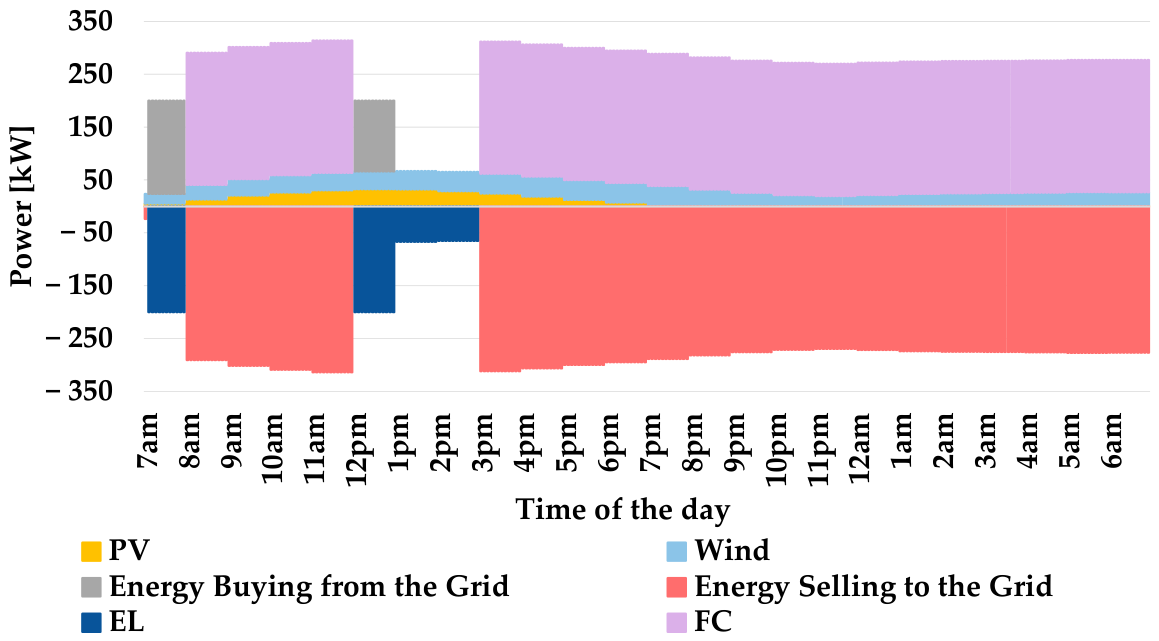
A different operational character is reflected in Figure 10, which depicts the power balance for Case 7 in Scenario 3. Unlike the earlier cases, Case 7 includes both grid outage and grid support conditions, meaning that the balancing pattern is shaped not only by economic signals but also by resilience-oriented operational restrictions. For this reason, the figure is especially valuable in showing how the system adapts when normal grid interaction becomes limited or strategically constrained. Under such circumstances, hydrogen storage and FC operation become more critical for preserving supply–demand balance. The figure therefore represents the resilience dimension of the proposed framework, illustrating that the system can maintain feasible operation even when the grid cannot be used in a fully flexible manner. This behavior is further reflected in the aggregated energy quantities. Wind generation is 8459 kWh, while PV generation is 3058 kWh. The total renewable production (11,518 kWh), together with grid purchases (3546 kWh), forms the primary energy supply under constrained grid conditions. A notable share of this energy is allocated to hydrogen production through the EL (6185 kWh), while the FC provides a major contribution to electricity generation (60,000 kWh), highlighting the critical role of hydrogen-based conversion. In parallel, the system delivers a substantial amount of electricity to the power grid (68,878 kWh).
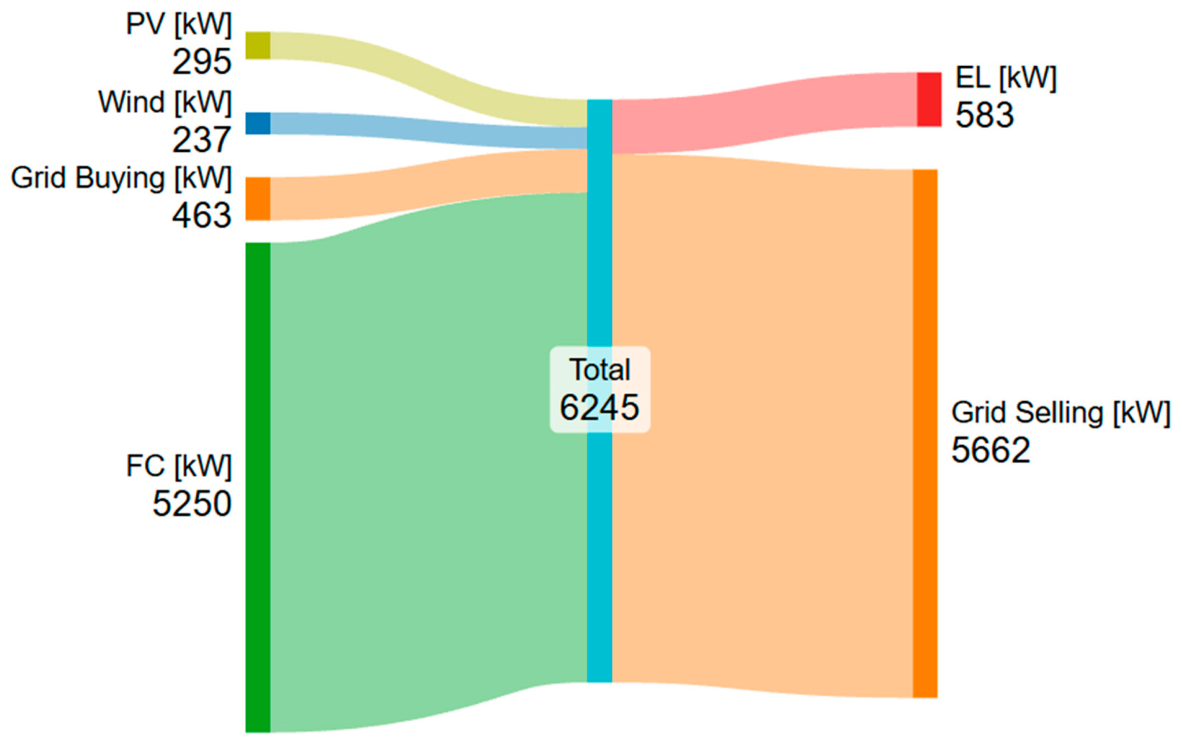
Rather than focusing on a time-based balance, Figure 11 provides a flow-based interpretation of system operation by presenting a Sankey diagram for the overall energy balance of Case 7 in Scenario 5. This visualization is particularly effective as it clearly illustrates how energy flows throughout the system, from RESs and grid exchange to hydrogen production, storage, reconversion, and final utilization. Since this case study incorporates resilience-related grid conditions, the Sankey structure further clarifies how the system redistributes energy across multiple pathways when operational flexibility is partially shifted from direct grid interaction to hydrogen-based processes.
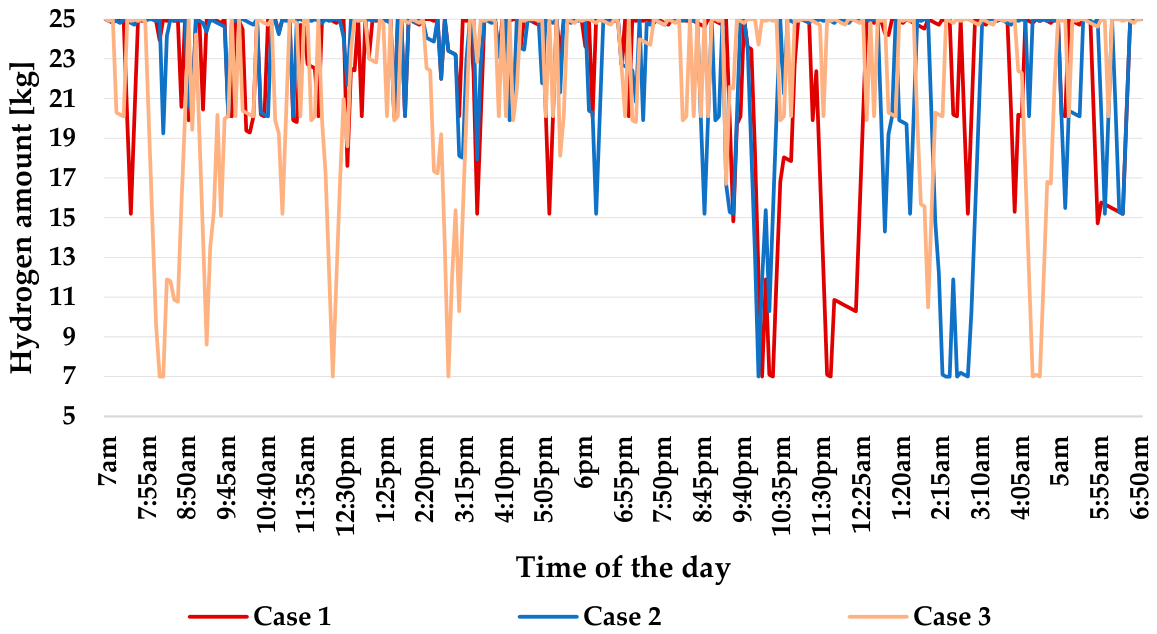
The temporal storage behavior of hydrogen is highlighted in Figure 12, which compares tank level variations for Case 1, Case 2, and Case 3 under Scenario 4. This figure is particularly important because hydrogen storage functions as the primary intertemporal flexibility mechanism in the system, enabling excess renewable electricity to be shifted across time and later utilized for vessel demand, FC-based electricity generation, or market transactions. The differences observed among the cases stem mainly from variations in RESs, as well as the coordination between EL and FC operations. Specifically, higher RES penetration leads to increased hydrogen production during surplus periods, resulting in more pronounced charging cycles, while coordinated FC operation facilitates controlled discharging during periods of low-RES availability or high electricity prices. In contrast, limited RES capacity or less effective operational coordination results in smoother and less dynamic storage profiles.
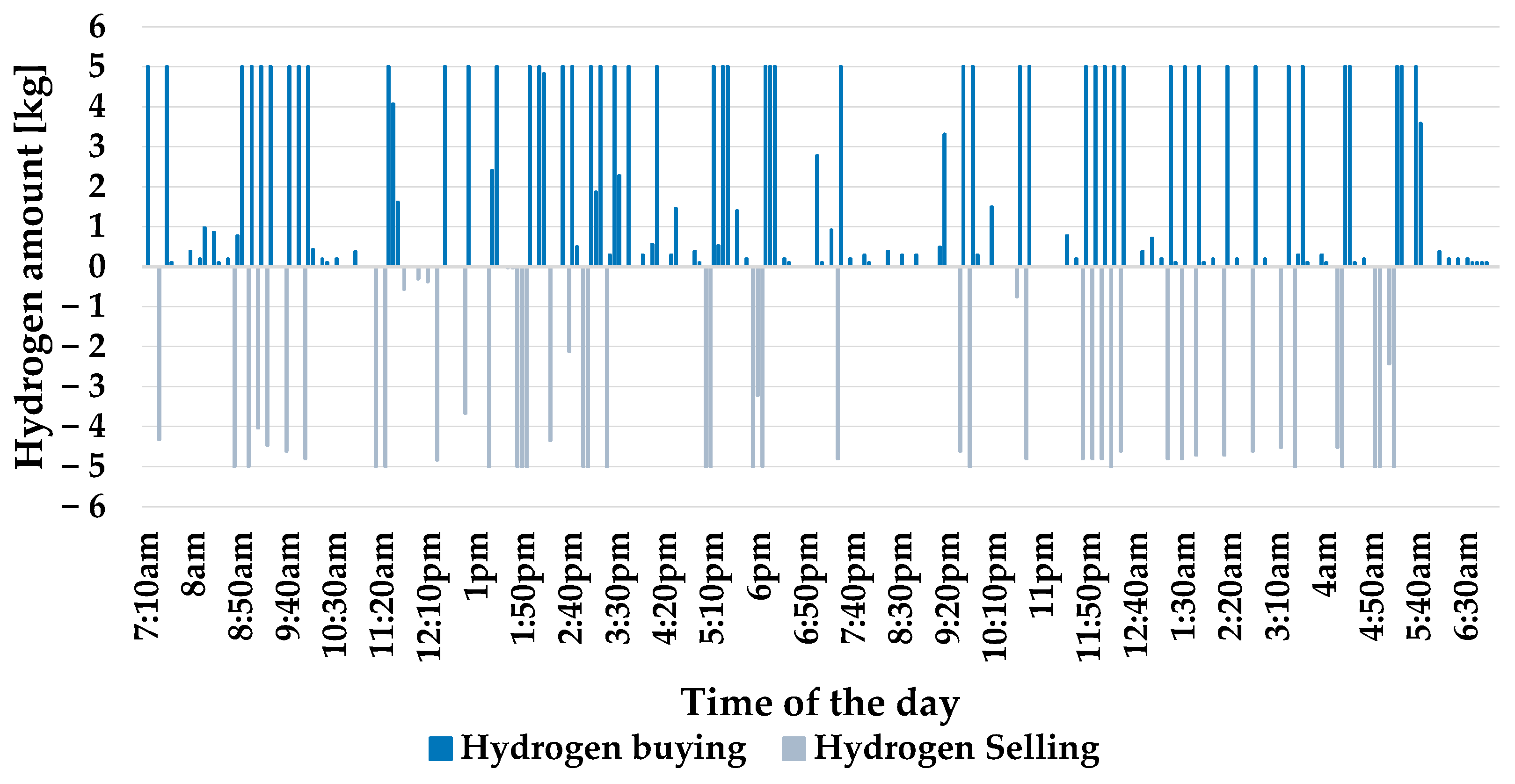
Figure 13 illustrates the hydrogen market interaction by presenting the hydrogen trading amounts for Case 7 in Scenario 2. In a resilience-constrained configuration such as Case 7, the observed hydrogen buying (298.02 kg) and selling (230.87 kg) levels indicate that the optimization model actively utilizes the hydrogen network to compensate for operational limitations while maintaining economic feasibility. Specifically, the higher level of hydrogen purchasing suggests that external supply is strategically used to support system operation under constrained conditions. Therefore, hydrogen trading is not merely a supplementary process but a dynamic decision variable that directly contributes to system balancing, storage management, and cost optimization.

4. Conclusions

This study proposed a stochastic MILP-based energy management framework for a shore-side renewable hydrogen supply system designed to support hydrogen-based marine vessels. The developed model integrates RESs, EL, FC, hydrogen storage, and electricity–hydrogen trading within a unified optimization structure while explicitly considering uncertainties in RESs, electricity prices, and hydrogen demand. The results demonstrate that system performance is highly dependent on the coordinated sizing of RESs and conversion units. In particular, configurations with higher RES penetration and enhanced conversion flexibility (e.g., Case 3 and Case 6) achieve significantly improved economic outcomes by maximizing RES utilization and increasing arbitrage opportunities. Among the evaluated configurations, Case 6 achieved the best economic performance with a total operating cost of −219.34 €, while Case 3 also provided a favorable result with −163.61 €, confirming the economic benefit of combining renewable generation with sufficient conversion flexibility. In contrast, cases with limited flexibility or excessive reliance on grid energy exhibit weaker performance in both economic and environmental terms. The findings also reveal that grid outage and support constraints (Case 7 and Case 9) introduce a trade-off between economic efficiency and system resilience, although their impact on cost remains relatively limited. From an environmental perspective, the results confirm that effective integration of RESs and hydrogen technologies can substantially reduce carbon emissions, with the lowest emissions achieved in configurations that minimize grid dependency. Moreover, the scenario-based analysis highlights the importance of uncertainty-aware decision-making in maintaining stable and cost-effective system operation under varying conditions. The results further indicate that economic performance, operational stability, renewable energy utilization, and hydrogen management should be evaluated together rather than independently. Within the considered case studies, improved economic outcomes are mainly associated with the coordinated use of renewable generation, EL and FC operation, hydrogen storage, and electricity–hydrogen trading. Under grid outage and support conditions, preserving operational feasibility and resilience may require a certain compromise in economic performance. Therefore, the proposed stochastic framework provides a useful decision-support basis for balanced operation of shore-side renewable hydrogen systems under uncertain operating conditions. Overall, the proposed framework provides a robust and flexible solution for the optimal operation of integrated electricity–hydrogen systems in maritime applications. Future work may focus on demand-side flexibility, dynamic pricing mechanisms, and the exploration of alternative market structures such as capacity markets, ancillary service markets, peer-to-peer energy trading, and transactive energy frameworks. In addition, future studies may consider larger-scale implementations, alternative uncertainty modeling approaches, real-world deployment issues, and integration with broader maritime decarbonization strategies.

Author Contributions

Conceptualization, E.M., B.Ş. and A.Ç.; methodology, E.M., B.Ş. and A.Ç.; software, E.M., B.Ş. and A.Ç.; formal analysis, E.M., B.Ş. and A.Ç.; investigation, E.M., B.Ş. and A.Ç.; data curation, E.M., B.Ş. and A.Ç.; writing—original draft preparation, E.M., B.Ş. and A.Ç.; visualization, E.M., B.Ş. and A.Ç. All authors have read and agreed to the published version of the manuscript.

Funding

This research received no external funding.

Data Availability Statement

The original contributions presented in this study are included in the article. Further inquiries can be directed to the corresponding author.

Acknowledgments

This study forms part of the M.Sc. thesis research conducted by Emre Molla at the Graduate School of Natural and Applied Sciences, Trakya University, under the supervision of Alper Çiçek. During the preparation of this manuscript, the authors used ChatGPT (OpenAI, GPT-5.5) for the purpose of language editing. The authors have reviewed and edited the output and take full responsibility for the content of this publication.

Conflicts of Interest

The authors declare no conflicts of interest.

Abbreviations

The following abbreviations are used in this manuscript:
ELElectrolyzer
FCFuel cell
MILPMixed-integer linear programming
RESRenewable energy source
Sets and indices
oSets of other vehicles
sSets of scenarios
tSets of time periods
vSets of vessels
Parameters
A t , s t a n k b e g i n n i n g h 2 Hydrogen level in the tank at the beginning of period t under scenario s [kg]
A t , s t a n k f i n a l h 2 Hydrogen level in the tank at the end of time period t under scenario s [kg]
A t a n k h 2 m i n Minimum hydrogen level in the tank [kg]
A t a n k h 2 m a x Maximum hydrogen level in the tank [kg]
A v , t , s v e s s e l h 2 Hydrogen supplied to vessel v at time t under scenario s [kg]
A o , t , s o t h e r h 2 Hydrogen supplied to cars and motorcycles at time t under scenario s [kg]
E e l EL efficiency [%]
E f c FC efficiency [%]
L H V h 2 Lower heating value of hydrogen [kWh/kg]
N t , s e l m a x h 2 Maximum hydrogen production capacity of the EL [kg]
N e l e c g r i d m a x Maximum electricity exchange capacity with the grid [kW]
N f c m a x h 2 Maximum hydrogen consumption of the FC [kg]
N h 2 p i p e l i n e m a x Maximum hydrogen exchange capacity with the hydrogen network [kg]
p s Probability of scenario s
P t , s e l m i n / P t , s e l m a x Minimum/maximum operating power of the EL [kW]
P t , s f c m i n / P t , s f c m a x Minimum/maximum operating power of the FC [kW]
P t , s p v Power generated by the PV system [kW]
P t , s w i n d Power generated by the wind turbine [kW]
R f c d o w n Ramp-down rate of the FC
R f c u p Ramp-up rate of the FC
Δ T Time step duration [5 min]
λ t , s e l e c Electricity price [Euro/kWh]
λ t , s h 2 Hydrogen price [Euro/kg]
Variables
A t , s e l h 2 Hydrogen produced by the EL [kg]
A t , s f c h 2 Hydrogen consumed by the FC [kg]
A t , s h 2 Hydrogen stored in the tank [kg]
b t , s e l Binary variable indicating EL on/off status [0–1]
b t , s e l e c g r i d Binary variable indicating power grid trading/flow direction [0–1]
b t , s f c Binary variable indicating FC on/off status [0–1]
b t , s h 2 Binary variable indicating hydrogen trading/flow direction [0–1]
H 2 t , s b u y Amount of hydrogen purchased [kg]
H 2 t , s s e l l Amount of hydrogen sold [kg]
P t , s b u y Power purchased from the power grid [kW]
P t , s e l Power consumed by the EL [kW]
P t , s f c Power generated by the FC [kW]
P t , s s e l l Power sold to the power grid [kW]

References

  1. Robalo-Cabrera, I.; Alcayde, A.; Filgueira-Vizoso, A.; Castro-Santos, L.; García-Diez, A.; Manzano-Agugliaro, F. Shipping sector decarbonisation measures: A review. Sustain. Energy Technol. Assess. 2025, 82, 104549. [Google Scholar] [CrossRef]
  2. Alavi-Borazjani, S.A.; Adeel, S.; Chkoniya, V. Hydrogen as a Sustainable Fuel: Transforming Maritime Logistics. Energies 2025, 18, 1231. [Google Scholar] [CrossRef]
  3. Balcombe, P.; Brierley, J.; Lewis, C.; Skatvedt, L.; Speirs, J.; Hawkes, A.; Staffell, I. How to decarbonise international shipping: Options for fuels, technologies and policies. Energy Convers. Manag. 2019, 182, 72–88. [Google Scholar] [CrossRef]
  4. Bakare, M.S.; Abdulkarim, A.; Zeeshan, M.; Shuaibu, A.N. A comprehensive overview on demand side energy management towards smart grids: Challenges, solutions, and future direction. Energy Inform. 2023, 6, 4. [Google Scholar] [CrossRef]
  5. Fan, G.; Peng, C.; Wang, X.; Wu, P.; Yang, Y.; Sun, H. Optimal scheduling of integrated energy system considering renewable energy uncertainties based on distributionally robust adaptive MPC. Renew. Energy 2024, 226, 120457. [Google Scholar] [CrossRef]
  6. Van Sickle, E.; Ralli, P.; Pratt, J.; Klebanoff, L. MV Sea Change: The first commercial 100% hydrogen fuel cell passenger ferry in the world. Int. J. Hydrogen Energy 2025, 105, 389–404. [Google Scholar] [CrossRef]
  7. Saadeldin, M.; Vasylyev, A.; Rivarolo, M.; Sorce, A. Feasibility analysis of hydrogen fuel cell-powered passenger vessels: A multi-criteria and MILP-based analysis for sustainable inland navigation. Ocean Eng. 2026, 349, 124186. [Google Scholar] [CrossRef]
  8. Di Ilio, G.; Bionda, A.; Ponzini, R.; Salvadore, F.; Cigolotti, V.; Minutillo, M.; Georgopoulou, C.; Mahos, K. Towards the design of a hydrogen-powered ferry for cleaner passenger transport. Int. J. Hydrogen Energy 2024, 95, 1261–1273. [Google Scholar] [CrossRef]
  9. Fan, H.; Abdussamie, N.; Chen, P.S.-L.; Harris, A.; Gray, E.M.; Arzaghi, E.; Bhaskar, P.; Mehr, J.A.; Penesis, I. Two decades of hydrogen-powered ships (2000–2024): Evolution, challenges, and future perspectives. Renew. Sustain. Energy Rev. 2025, 219, 115878. [Google Scholar] [CrossRef]
  10. Zhao, Y.; Wang, N.; Lv, Z. Review on hybrid power system modeling and optimization of hydrogen-electric ships. Ocean Eng. 2026, 343, 123456. [Google Scholar] [CrossRef]
  11. Liu, H.; Fan, A.; Bucknall, R.; Wu, P.; Liu, Y.; Xia, M. Experimental verification of a dual-objective energy management strategy: A case study of hydrogen-electric ship. Energy Convers. Manag. 2026, 348, 120659. [Google Scholar] [CrossRef]
  12. Cha, M.; Enshaei, H.; Nguyen, H.; Jayasinghe, S. Towards a future electric ferry using optimisation-based power management strategy in fuel cell and battery vehicle application—A review. Renew. Sustain. Energy Rev. 2023, 183, 113470. [Google Scholar] [CrossRef]
  13. Maloberti, L.; Zaccone, R. An environmentally sustainable energy management strategy for marine hybrid propulsion. Energy 2025, 316, 134517. [Google Scholar] [CrossRef]
  14. Shaikh, M.S.; Raj, S.; Babu, R.; Kumar, S.; Sagrolikar, K. A hybrid moth–flame algorithm with particle swarm optimization with application in power transmission and distribution. Decis. Anal. J. 2023, 6, 100182. [Google Scholar] [CrossRef]
  15. Kheirani, S.; Houmani, A.; Jahangir, M.H. Economical Investigation of green hydrogen supply for Hydrogen-Powered ship by Off-Grid wave and wind energy hubs. Energy Convers. Manag. X 2025, 26, 101006. [Google Scholar] [CrossRef]
  16. Kaur, N.; Hariram, N.; Mekha, K.; Mohamed, M.; Priya, S.S.; Sudhakar, K. Offshore floating solar with electrofuels for refuelling small ferries: A techno-economic-environmental study. Energy Convers. Manag. X 2025, 28, 101234. [Google Scholar] [CrossRef]
  17. Guo, X.; Cao, S. The techno-economic analysis of hybrid coastal and offshore ocean energy system for the smart charging of cross-harbour zero-emission ferries and electric vehicles. Appl. Energy 2025, 402, 126775. [Google Scholar] [CrossRef]
  18. Duan, L.; Guo, Z.; Taylor, G.; Lai, C.S. Multi-Objective Optimization for Solar-Hydrogen-Battery-Integrated Electric Vehicle Charging Stations with Energy Exchange. Electronics 2023, 12, 4149. [Google Scholar] [CrossRef]
  19. Wang, J.; Pan, Z.; Ge, H.; Zhao, H.; Xia, T.; Wang, B. Economic Dispatch of Integrated Electricity–Heat–Hydrogen System Considering Hydrogen Production by Water Electrolysis. Electronics 2023, 12, 4166. [Google Scholar] [CrossRef]
  20. Mojarrad, M.; Zadeh, M.; Rødseth, K.L. Techno-economic modeling of zero-emission marine transport with hydrogen fuel and superconducting propulsion system: Case study of a passenger ferry. Int. J. Hydrogen Energy 2023, 48, 27427–27440. [Google Scholar] [CrossRef]
  21. Mojarrad, M.; Thorne, R.J.; Rødseth, K.L. Technical and cost analysis of zero-emission high-speed ferries: Retrofitting from diesel to green hydrogen. Heliyon 2024, 10, e27479. [Google Scholar] [CrossRef]
  22. Nagem, N.A.; Ebeed, M.; Alqahtani, D.; Jurado, F.; Khan, N.H.; Hafez, W.A. Optimal design and three-level stochastic energy management for an interconnected microgrid with hydrogen production and storage for fuel cell electric vehicle refueling stations. Int. J. Hydrogen Energy 2024, 87, 574–587. [Google Scholar] [CrossRef]
  23. Beyazıt, M.A.; Salehizadeh, M.R.; Demirel, E.; Taşcıkaraoǧlu, A.; Liu, J. Real-time management of electric and hydrogen vehicle infrastructure using mobile and integrated charging stations. Sustain. Energy Grids Netw. 2025, 44, 102008. [Google Scholar] [CrossRef]
  24. Shaikh, M.S.; Dong, X.; Wang, C.; Wang, C.; Xie, S.; Lin, H. Optimized Integration of Renewable Energy Systems Using Chaotic Optimization in Distribution Systems. In 2025 International Conference on Electrical Engineering and Informatics (ICEEI), Kuching, Malaysia; IEEE: New York, NY, USA, 2025; pp. 1–6. [Google Scholar] [CrossRef]
  25. Feng, L.; Sun, Y.; Tang, X.; Yuan, C.; Yin, H.; Luo, W. Review on the development and challenges of clean energy sources for ships. Renew. Sustain. Energy Rev. 2026, 225, 116181. [Google Scholar] [CrossRef]
  26. Katumwesigye, A.; Schwartz, H.; Gustafsson, M.; Hellström, M. A comparative technoeconomic and life cycle assessment of a fully battery-electric ROPAX ferry. J. Clean. Prod. 2025, 534, 146935. [Google Scholar] [CrossRef]
  27. Karaca, A.E.; Dincer, I. A renewable and hydrogen based multigeneration system designed for ferry applications. ETransportation 2023, 18, 100289. [Google Scholar] [CrossRef]
  28. Riccobono, A.; Boscaino, V.; Odetti, A.; Mammana, F.; Cipriani, G.; Bruzzone, G.; Di Dio, V.; Caccia, M.; Tinè, G. A comparison of multi-source power supply systems for autonomous marine vehicles: The SWAMP case study. Int. J. Hydrogen Energy 2024, 80, 1124–1136. [Google Scholar] [CrossRef]
  29. Renewables.ninja, Renewable Energy Generation Data Platform. Available online: https://www.renewables.ninja/ (accessed on 23 January 2026).
  30. EPİAŞ (Energy Exchange Istanbul (EXIST), Day-Ahead Market (DAM)—Market Clearing Price Data. Available online: https://seffaflik.epias.com.tr/electricity/electricity-markets/day-ahead-market-dam/market-clearing-price-mcp (accessed on 23 January 2026).
Figure 1. General architecture of the proposed decision-making model for the hydrogen-based marine energy system.
Electronics 15 02368 g001
Figure 2. Flowchart of the proposed decision-making model for the hydrogen-based marine energy system.
Electronics 15 02368 g002
Figure 3. Total hydrogen demand of all vehicles.
Electronics 15 02368 g003
Figure 4. Power generation profile of the wind turbine.
Electronics 15 02368 g004
Figure 5. Power generation profile of the PV system.
Electronics 15 02368 g005
Figure 6. Hourly electricity price profile for all scenarios considered in the study.
Electronics 15 02368 g006
Figure 7. Electricity buying and selling amounts for selected case studies in Scenario 1.
Electronics 15 02368 g007
Figure 8. Power balance for Case 1 in Scenario 3.
Electronics 15 02368 g008
Figure 9. Power balance for Case 3 in Scenario 3.
Electronics 15 02368 g009
Figure 10. Power balance for Case 7 in Scenario 3.
Electronics 15 02368 g010
Figure 11. Sankey diagram illustrating the overall energy balance for Case 7 in Scenario 5.
Electronics 15 02368 g011
Figure 12. Hydrogen tank variations for Case 1, Case 2, and Case 3 in Scenario 4.
Electronics 15 02368 g012
Figure 13. Hydrogen trading amounts for Case 7 in Scenario 2.
Electronics 15 02368 g013
Table 1. Taxonomy of the proposed methodology compared to literature studies.
Ref.Hydrogen-Based Vessel, Cars and MotorcyclesShore-Side
Hydrogen
Refueling
Hydrogen NetworkUncertaintyMethodGrid OutageGrid SupportElectricity TradingHydrogen Trading
[15]xxxxHOMER optimization toolxxxx
[16]xxxxxxxxx
[22]xxxMonte Carlo Particle swarm optimizationxxx
[23]xxxReal-time adaptive operationReal-time optimizationxxxx
This studyStochasticMILP
Table 2. Summary of the case study configurations used in the simulations.
Case
Studies
Renewable
Capacity
[PV/Wind] [kW]
EL and FC
Capacity [kW]
Grid Outage
[1 pm–3 pm]
Grid Support
[3 pm–5 pm]
Efficiency of EL and FC [%]
Case 1- 200/250xx75/90
Case 250/50200/250xx75/90
Case 3250/250200/250xx75/90
Case 450/50100/250xx75/90
Case 550/50500/250xx75/90
Case 650/50200/500xx75/90
Case 750/50200/25075/90
Case 850/50200/250x75/90
Case 950/50200/250x75/90
Case 100/0200/25075/90
Case 1150/50200/250xx60/90
Case 1250/50200/250xx75/75
Table 3. Simulation results for the case studies considered.
Case StudiesCost [Euro]Case StudiesCost [Euro]
Case 139.21Case 713.20
Case 2−1.36Case 8−1.36
Case 3−163.61Case 913.20
Case 43.43Case 1054.53
Case 5−23.54Case 112.49
Case 6−219.34Case 1226.01
Table 4. Electricity and hydrogen trading amounts for each case study under each scenario.
CasesScenario NumberEnergy Buying
[kWh]
Energy Selling
[kWh]
Hydrogen Buying [kg]Hydrogen Selling [kg]
Case 1Scenario 1583.335250264.09197.14
Scenario 2216.675708.33254.82181.62
Scenario 3383.335500258.76188.39
Scenario 405979.17255.94179.05
Scenario 5583.335250247.27180.31
Case 2Scenario 1507.175584.67248.84181.89
Scenario 2345.575911.53296.22226.14
Scenario 3295.536371.99215.24144.88
Scenario 406964.13254.86177.97
Scenario 5463.395662.45284.85217.89
Case 3Scenario 1202.536923.34282.62215.66
Scenario 299.277799.90274.96203.46
Scenario 374.519990.14295.38225.02
Scenario 4010,903.97330.78253.89
Scenario 5107.637436.23240.41173.45
Case 4Scenario 1151.085870.24235.37162.85
Scenario 206465.96246.75169.86
Scenario 3103.866371.96248.48175.97
Scenario 406964.13269.28192.39
Scenario 595.205906.75237.38165.06
Case 5Scenario 12790.954743.45194.09157.31
Scenario 21398.415676.87211.49154.37
Scenario 32181.165432.62245.99202.44
Scenario 41295.026071.65240.02182.90
Scenario 51338.395662.45230.87173.75
Case 6Scenario 1342.7511,370.24261.40165.58
Scenario 2012,445.13321.29216.73
Scenario 3295.5311,871.99261.66165.85
Scenario 4012,943.29237.05132.49
Scenario 5295.2011,385.92279.12183.69
Case 7Scenario 1342.755300.94252.28185.02
Scenario 2345.575357.73298.03230.87
Scenario 3295.535739.91244.87178.31
Scenario 406333.64266.99193.88
Scenario 5314.665365.12272.60205.66
Case 8Scenario 1507.175584.67261.88194.93
Scenario 2345.575911.53271.60201.53
Scenario 3295.536371.99245.99175.62
Scenario 406964.13282.53205.64
Scenario 5463.395662.45283.96217.00
Case 9Scenario 1342.755300.94252.28185.02
Scenario 2345.575357.73298.02230.87
Scenario 3295.5235739.91244.87178.31
Scenario 406333.64266.99193.88
Scenario 5314.665365.12272.60205.66
Case 10Scenario 1383.335000274.07206.02
Scenario 24004979.17267.82200.06
Scenario 3383.335000283.04214.99
Scenario 405479.17297.60223.03
Scenario 5383.335000303.26235.21
Case 11Scenario 1342.755870.24292.19220.97
Scenario 206465.96266.74189.85
Scenario 3295.536371.99231.77160.55
Scenario 406964.13249.80172.91
Scenario 5295.205906.75295.32224.35
Case 12Scenario 1507.175584.67274.71202.90
Scenario 2345.575911.53268.74193.59
Scenario 3431.956058.41226.83155.01
Scenario 4150.876702.50294.35215.26
Scenario 5463.395662.45262.48190.66
Table 5. Carbon emission results.
Case StudiesAvg. CO2 Emissions [Metric Tons]Case StudiesAvg. CO2 Emissions [Metric Tons]
Case 11.1498Case 71.1522
Case 21.1516 Case 81.1873
Case 31.1539Case 91.1522
Case 40.9982Case 101.2440
Case 51.6280Case 111.0350
Case 61.1455Case 121.1120
Disclaimer/Publisher’s Note: The statements, opinions and data contained in all publications are solely those of the individual author(s) and contributor(s) and not of MDPI and/or the editor(s). MDPI and/or the editor(s) disclaim responsibility for any injury to people or property resulting from any ideas, methods, instructions or products referred to in the content.