Article

High-Penetration New Energy Power System Outage Loss Uncertainty Analysis-Oriented Ultra-Short-Term Wind Speed Prediction Based on Physics-Informed Neural Network Considering Different Maintenance Assemblies


1
State Grid Jibei Electric Power Co., Ltd., EHV Power Transmission Company, Beijing 102488, China
2
Beijing Tsingdian Technology Co., Ltd., Beijing 100190, China
3
Department of Electrical Engineering, North China Electric Power University, Baoding 071003, China
4
Yanzhao Electric Power Laboratory, North China Electric Power University, Baoding 071003, China
*
Author to whom correspondence should be addressed.
Electronics 2026, 15(11), 2338; https://doi.org/10.3390/electronics15112338
Submission received: 6 May 2026 / Revised: 15 May 2026 / Accepted: 18 May 2026 / Published: 28 May 2026

Abstract

In high-penetration wind power systems, outage loss uncertainty analysis is fundamental to maintenance scheduling, and its accuracy critically depends on real-time wind power generation, which is dominated by ultra-short-term wind speed fluctuations. Accurate wind speed prediction is therefore essential for reliable outage loss evaluation and subsequent maintenance decision-making. Dense turbine layouts in wind farms lead to strong wake effects, resulting in complex physical attenuation and spatiotemporal correlations in wind speed between upstream and downstream turbines. Leveraging upstream turbine information can therefore enhance the accuracy of downstream wind speed forecasting. However, existing approaches that incorporate neighboring information, such as graph neural networks, rely primarily on data-driven learning and do not explicitly account for the physical mechanisms of wake attenuation, which limits their predictive performance. To address these challenges, a physics-informed ultra-short-term wind speed forecasting method is proposed which integrates an LSTM network for temporal feature extraction with the Jensen wake model through a weighted loss function within a PINN framework. Wake relationships are first identified based on wind direction and turbine layout, and the Jensen wake model is employed to characterize downstream wind speed attenuation. The weighted loss jointly optimizes data-driven and physics-based objectives, enabling the model to coordinate temporal pattern learning with wake-related physical interactions while adhering to wake decay physics. Moreover, the proposed approach accounts for topology-sensitive power flow variations under high-penetration renewable systems, where outage losses are strongly influenced by real-time wind power and wake-effect uncertainties. Case studies demonstrate that, compared with a conventional LSTM model, the proposed method reduces the normalized mean absolute error and the normalized root mean square error by 14.3% and 13.5%, respectively, indicating improved forecasting accuracy and potential for more reliable system outage analysis.

1. Introduction

With the continuous advancement of China’s carbon peaking and carbon neutrality goals, the national energy structure is undergoing a profound transformation, and wind power has become a key component of the emerging power system [1]. By the end of 2025, installed wind power capacity in China reached 640 GW, accounting for 16.5% of the total generation capacity. In 2025 alone, approximately 120 GW of new wind power capacity was grid-connected, representing an increase of more than 50% compared with the previous year and serving as a major driver of newly added capacity [2]. According to the International Energy Agency (IEA), cumulative global wind power additions are expected to reach 872 GW during 2025–2030, accounting for about 19% of total renewable capacity additions over the same period [3].
In large-scale wind power bases like those in the Jibei region, which transmit electricity to Beijing, Tianjin, and Tangshan, wind power is mainly delivered through a few central transmission lines [4]. Because of this, the system operation is quite sensitive to the grid topology. When equipment is taken out for maintenance, different maintenance assemblies will change the actual grid structure and the way power flows [5]. The ability to transmit wind power may be limited under different maintenance assemblies. Consequently, even under identical wind conditions, outage losses can be substantially affected by the maintenance plan in place. For example, the amount of wind energy that has to be curtailed or the load that has to be shed during a fault can vary a lot. Once a certain maintenance assembly is determined, the actual outage loss if an accident happens is not completely fixed by the maintenance plan itself [6]. Instead, it depends heavily on the real-time balance between generation and load, and on which transmission paths are still available at that moment. And importantly, these real-time conditions are closely tied to the current level of wind power generation. The margin of dispatchable capacity and the loading on the remaining network are largely determined by how much wind power is being produced at that instant [7]. Therefore, outage loss analysis is inherently inseparable from the prevailing wind power output at that moment [8]. In such a sending-end system, wind power constitutes a very high proportion of total generation, making the overall power output highly variable and difficult to regulate. These rapid, short-term fluctuations are primarily driven by fast variations in local wind speed [9]. As a result, the wind power output that directly determines the outage loss can change substantially within a very short time window. Accurate ultra-short-term wind speed forecasting therefore becomes essential for quantitatively analyzing system outage losses and their uncertainties in power systems with high renewable penetration. Figure 1 illustrates the causal chain from maintenance-induced topology changes and wind power uncertainty to unreliable outage loss evaluation, and shows how accurate wind speed prediction breaks this chain to enable optimal maintenance decisions.
Existing ultra-short-term wind speed forecasting methods can be broadly categorized into two main types: physics-based methods and data-driven methods [10]. Physics-based methods simulate and predict wind speed through mathematical and physical formulations describing atmospheric dynamics under specified boundary and initial conditions. These methods offer strong physical interpretability; however, they require parameter reconfiguration and model recalibration when wind farm layouts, geographical conditions, turbine types, or operating conditions vary. Consequently, the generalization capability of physics-based models is often limited across different sites. Recent studies using LiDAR buoy measurements indicate that the Weather Research and Forecasting (WRF) model exhibits spatially varying bias patterns in wind speed across different sites, underscoring the limited generalizability of physics-based models and the challenges in their direct application to multiple wind farms [11,12]. In related research, forecasting methods based on physical wind field modeling guided by image fusion have also been proposed. However, these methods still rely on numerical weather prediction (NWP) and are constrained by the spatial resolution and accuracy of NWP initial conditions, thus requiring parameter adjustments for different wind farm layouts [13,14].
In contrast, data-driven methods do not require explicit solutions to physical equations but instead learn underlying patterns from historical data, enabling more efficient modeling of nonlinear wind speed characteristics. For example, previous studies have proposed a hybrid model combining variational mode decomposition and a transformer, which incorporates multiple atmospheric variables to improve the accuracy of wind speed forecasting at a single location [15,16]. In addition, a composite framework has been developed that integrates outlier correction, empirical wavelet transform, and Volterra-based multi-model fusion, enhancing prediction stability through multi-objective optimization [17,18]. Furthermore, hybrid models combining empirical mode decomposition, LSTM or other recurrent networks, and ARIMA have been proposed to separate high- and low-frequency components for improved wind speed prediction [19,20,21]. Although these studies have achieved notable improvements in prediction accuracy, their modeling processes rely solely on historical wind speed data at the target location and fail to fully exploit the spatial correlations of wind speed across different locations within a wind farm. Other recent methods include dynamic graph-based forecasting and multi-transform image-based wind motion prediction [22].
Due to the dense arrangement of wind turbines within a wind farm, wind speed at neighboring locations exhibits strong spatiotemporal correlations, and the future wind speed at a target location is often influenced by the historical wind speed at upstream locations. To exploit such correlations for improved forecasting accuracy, a spatiotemporal graph neural network has been proposed to capture dependencies of offshore wind speed across multiple nodes by combining graph convolution and LSTM [23]. Furthermore, a multidimensional spatiotemporal graph neural network has been developed to aggregate wind speed information from both local and surrounding locations for target wind speed prediction [24]. However, the extraction of such correlations relies entirely on statistical patterns learned during training, where inter-location relationships are inferred solely from historical data, and thus remains essentially a data-driven adaptive modeling approach. Moreover, by neglecting the complex spatiotemporal evolution of wind flow within a wind farm arising from terrain effects, turbine-induced wake interactions, and flow obstruction, these methods are unable to accurately characterize the actual distribution of wind speed and the resulting power fluctuations, thereby limiting the accuracy of both wind speed forecasting and subsequent power prediction.
This issue is particularly pronounced in the context of wind farms in China. Large-scale wind farms in China typically consist of dozens or even hundreds of wind turbines arranged in dense layouts [25]. Wakes generated by upstream turbines can significantly reduce the effective wind speed at downstream locations, resulting in highly complex wind speed distribution patterns within wind farms and thereby increasing the difficulty of wind power forecasting. Moreover, the development of large-scale wind power bases in China is expanding toward environments such as deserts, Gobi regions, barren land, and offshore areas, where wake interactions are more complex [26,27]. The diversity of terrain and atmospheric conditions further amplifies the uncertainty of wake effects, intensifies the spatiotemporal interactions of wind flow within the wind farm, and imposes higher demands on wind speed forecasting [28].
These observations highlight the importance of incorporating wake-related physical relationships into forecasting models. In particular, effectively leveraging information from neighboring turbines is critical for improving wind speed prediction accuracy. Currently, widely used wake models such as CFD models based on the Navier–Stokes (N-S) equations are computationally expensive and time-consuming, making them unsuitable for ultra-short-term forecasting [29]. A comparative study of six wake models, including Jensen, Larsen, and Frandsen, conducted under a wide range of practical scenarios involving onshore and offshore environments, regular and irregular layouts, and turbine spacing ranging from dense to sparse, showed that the Jensen wake model achieved the best overall performance across all wind directions and can therefore be recommended as a general-purpose model. To this end, an ultra-short-term wind speed forecasting method integrating the Jensen wake model with LSTM is proposed [30]. Within the framework of physics-informed neural networks (PINNs), wake effects are introduced as physical constraints, enabling the model to jointly fit historical data and capture wake attenuation between upstream and downstream locations during training. As a result, the proposed method more accurately characterizes the influence of neighboring turbines on the target location, thereby improving forecasting performance, aiming to improve ultra-short-term wind speed forecasts and thereby enable more reliable system outage loss analysis under diverse maintenance scenarios.

2. Methodology

2.1. The Overall Framework

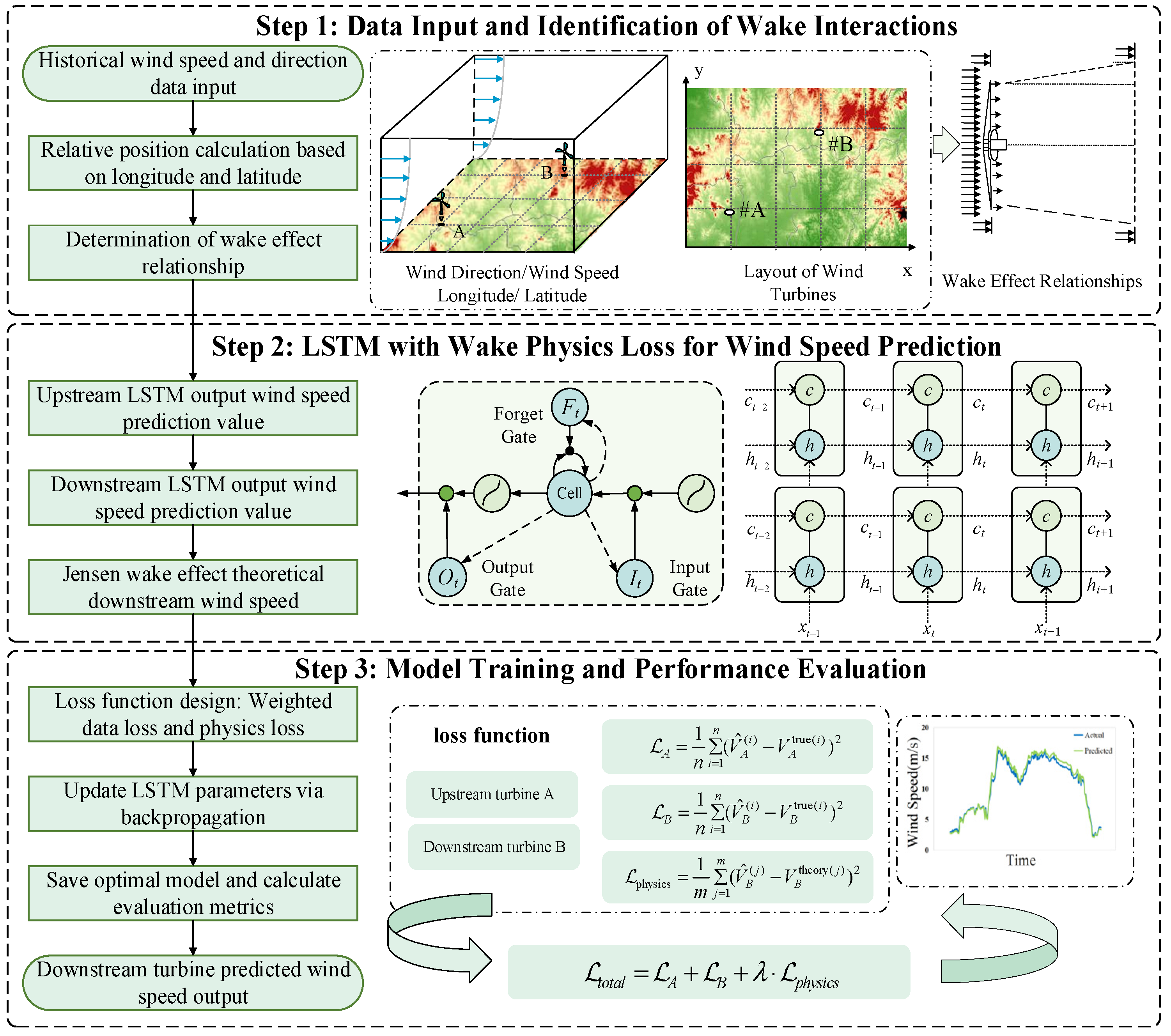
Wind speed is strongly influenced by wake effects, leading to pronounced spatiotemporal correlations and physical attenuation between upstream and downstream turbines. Conventional time-series models struggle to effectively capture such physics-driven dependencies induced by wake interactions. To address this issue, this paper proposes an ultra-short-term wind speed forecasting method that integrates wake-induced physical constraints with an LSTM network. The overall framework is illustrated in Figure 2.
Step 1: Data input and identification of wake interaction relationships. Historical wind speed and wind direction data from upstream and downstream turbines are used as inputs. The relative azimuth angle between turbines is calculated based on their geographical coordinates, and the wake interaction relationship is determined by combining this information with the prevailing wind direction. This relationship serves as the basis for imposing subsequent physical constraints.
Step 2: Upstream–downstream wind speed prediction and physics-based constraint construction using LSTM and the Jensen wake model. LSTM networks are constructed to extract temporal features of upstream and downstream turbines, yielding their respective wind speed predictions. The predicted wind speed of the upstream turbine is then fed into the Jensen wake model to estimate the theoretical wind speed at the downstream location.
Step 3: Multi-objective loss design and model optimization. A weighted loss function is designed by combining upstream prediction loss, downstream prediction loss, and wake-related physical loss to achieve multi-objective optimization. Model parameters are updated via backpropagation until convergence, after which the optimal model is retained and evaluation metrics such as NMAE and NRMSE are computed to produce the final wind speed prediction at the downstream location.

2.2. LSTM-Based Wind Speed Prediction for Upstream and Downstream Turbines

Wind speed time series exhibit strong nonlinearity, non-stationarity, and long-term dependencies. Traditional recurrent neural networks (RNNs) are prone to gradient vanishing or explosion during training, making it difficult to effectively capture the evolution patterns of ultra-short-term wind speed. In contrast, LSTM can selectively retain historical information and alleviate long-term dependency issues. Therefore, LSTM is employed to model the historical wind speed sequences of upstream and downstream turbines, extract temporal features, and generate preliminary ultra-short-term wind speed predictions for each.
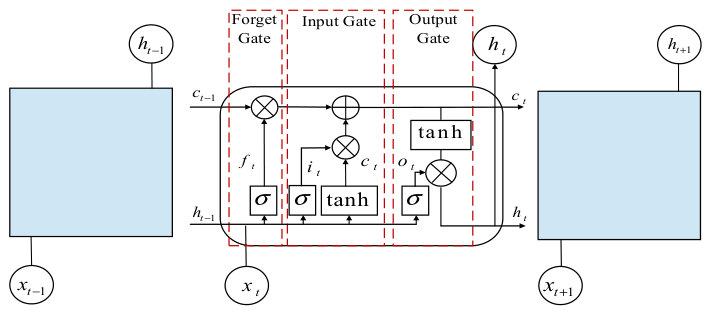
Among various deep learning models, LSTM has been widely adopted in time-series forecasting tasks due to its stable training performance and strong capability in capturing temporal dependencies. In this study, LSTM mainly serves as a representative temporal modeling tool, while the primary focus is placed on integrating wake-related physical constraints with data-driven forecasting models. The architecture of the LSTM unit employed for temporal feature extraction is shown in Figure 3.
The basic units of an LSTM network include the forget gate, input gate, and output gate. The calculation formulas are as follows:
f t = σ g ( W f x t + U f h t 1 + b f )
i t = σ g ( W i x t + U i h t 1 + b i )
o t = σ g ( W o x t + U o h t 1 + b o )
c t = f t c t 1 + i t σ c ( W c x t + U c h t + 1 + b c )
h t = o t σ c ( c t )
where f t , i t , o t represent the forget, input, and output gates, respectively; c t represents the time-dependent cell state; W f , U f , W i , U i , W o , U o , W c , and U c denote the weight matrices; b f , b i , b o , and b c represent the bias vectors; x t represents the input at time step t ; h t 1 represents the output of the LSTM at time t 1 ; σ g ( ) represents the activation function; and denotes element-wise multiplication.
To better adapt to ultra-short-term forecasting tasks, a sliding window mechanism is adopted to construct input–output samples. Specifically, a fixed-length historical window of size L is used as input to predict the wind speed at the next time step. This approach allows the model to dynamically update predictions as new observations become available, thereby improving real-time forecasting capability.
Furthermore, normalization techniques such as min–max scaling or z-score standardization are applied to the input data to accelerate model convergence and stabilize training. The predicted outputs are then inversely transformed to obtain wind speed values at the original scale.
It is important to note that the LSTM model in this stage serves primarily as a data-driven feature extractor, generating preliminary wind speed predictions for both upstream and downstream turbines. These predictions are subsequently incorporated into the physics-informed framework, where wake effects are explicitly modeled through the Jensen wake model. By combining data-driven temporal learning with physics-based constraints, the proposed approach ensures both predictive accuracy and physical consistency.

2.3. Modeling Wake Effects Between Wind Turbines

The dense arrangement of turbines within a wind farm causes wakes generated by upstream turbines to significantly alter the inflow conditions of downstream turbines, reducing their effective wind speed and increasing turbulence intensity. This wind speed attenuation caused by wake effects follows clear physical patterns on ultra-short-term timescales and is a key factor influencing the accuracy of downstream turbine predictions.
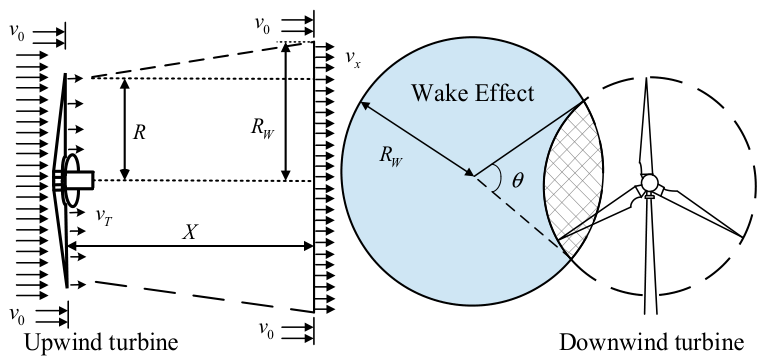
The Jensen wake model, proposed by the Danish National Laboratory, assumes linear wake expansion and derives a formula for wind speed loss at downstream turbines based on the principle of mass conservation. This model effectively simulates wake effects in flat terrain. In this study, the LSTM-predicted wind speed of upstream turbines is incorporated into the Jensen formula to calculate the theoretical wind speed at downstream turbines.
Here, X is the distance between two wind turbines; R and R W are the rotor radius and wake radius, respectively; and v 0 , v T , and v x are the free-stream wind speed, the wind speed through the rotor, and the wind speed affected by the wake, respectively, as shown in Figure 4.
ρ π R W 2 v x = ρ π R 2 v T + ρ π ( R W 2 R 2 ) v 0
d R W d t = k W ( σ G + σ 0 )
d R W d x = d R W d t d t d x = k W ( σ G + σ 0 ) / v
where ρ is the air density; σ G and σ 0 represent the turbulence intensity induced by the atmosphere and the rotor, respectively; k W is a constant set to 0.075 for onshore conditions; and the wake decay coefficient is given by k = k W ( σ G + σ 0 ) / v .
The relationship among v 0 , v T , and the thrust coefficient C T of the wind turbine is expressed as follows:
v T = v 0 ( 1 C T ) 1 / 2
From this, the Jensen wake model can be derived as:
v x = v 0 [ 1 ( 1 ( 1 C T ) 1 / 2 ) R R + k X 2 ]
The thrust coefficient C T represents the momentum extraction capability of the rotor and directly determines the magnitude of wake-induced velocity deficit. In general, a larger C T indicates stronger momentum extraction from the incoming flow, which leads to a more pronounced reduction in downstream wind speed. To further clarify the physical meaning of C T , it can be expressed as:
C T = T 1 2 ρ A v 0 2
where T is the thrust force exerted on the rotor and A is the rotor swept area. This expression shows that the wake effect is intrinsically related to the aerodynamic loading of the turbine.
Based on the Jensen model, the wake-induced velocity deficit can be defined as:
Δ v = v 0 v
where Δ v quantifies the wind speed reduction caused by the upstream turbine. This quantity provides an intuitive measure of wake intensity and reflects the strength of the physical coupling between upstream and downstream turbines.
In the proposed forecasting framework, the upstream wind speed used in the Jensen model is not directly taken as the measured wind speed, but is replaced by the LSTM-predicted upstream wind speed. Specifically, the predicted wind speed of upstream turbine A , denoted as v ^ A , is fed into the Jensen wake model to obtain the theoretical downstream wind speed:
v ˜ B = f Jensen ( v ^ A , x , R , k , C T )
where v ˜ B denotes the physics-derived wind speed of downstream turbine B . This formulation establishes a coupling interface between the temporal feature extraction module and the wake-based physical model. As a result, the downstream prediction is not only guided by historical data but also constrained by aerodynamic wake propagation principles.
It should be noted that the Jensen model is a simplified engineering wake model. It does not fully resolve complex flow structures such as wake meandering, atmospheric stability variation, terrain-induced flow distortion, or multi-wake superposition in large wind farms. Nevertheless, for the pairwise upstream–downstream forecasting scenario considered in this study, the Jensen model captures the primary mechanism of wake-induced wind speed attenuation with low computational cost. This property makes it particularly suitable for integration into a physics-informed neural network framework, where the physical model is used not as an independent deterministic predictor, but as a physically consistent constraint for regularizing the learning process.
Overall, the wake modeling component provides an interpretable physical bridge between upstream and downstream turbines. By introducing the Jensen wake relationship into the forecasting framework, the proposed method constrains the downstream wind speed prediction to remain consistent with wake attenuation physics. This design helps reduce physically implausible predictions and lays the foundation for the construction of the physics-informed loss function in the subsequent section.

2.4. Wind Speed Forecasting Optimization with Physics-Informed Neural Networks

PINNs integrate physical laws into deep learning models. The core idea is to incorporate physical equation constraints into the loss function, enabling the model to simultaneously fit observational data while satisfying known physical laws during training, thereby enhancing generalization, interpretability, and physical consistency.
The loss function of a PINN typically consists of two components:
L total = L data + λ L physics
where L data is the data-driven loss term, typically expressed in the form of mean squared error (MSE):
L data = 1 N i = 1 N y ^ i y i 2
where L physics is the physics-informed loss term, computed as the residual obtained by substituting the neural network output into the governing physical equations:
L physics = 1 M j = 1 M F ( u ^ j ) 2
where F represents the governing physical equations, and u ^ j denotes the predicted state variables output by the neural network. By minimizing L physics , the network is guided toward a solution space that conforms to physical laws, thereby maintaining physical plausibility in predictions even under data-sparse or extrapolation scenarios.
The LSTM prediction for the upstream wind turbine A is denoted as V ^ A , and for the downstream wind turbine B as V ^ B , with the corresponding true values for the upstream and downstream turbines being V A t r u e and V B t r u e , respectively. The prediction loss for the downstream wind turbine is defined as:
L A = 1 n i = 1 n ( V ^ A ( i ) V A true ( i ) ) 2
L B = 1 n i = 1 n ( V ^ B ( i ) V B true ( i ) ) 2
The LSTM V ^ A for upstream wind turbine A is incorporated into the Jensen wake model to calculate the theoretical wind speed V B t h e o r y for downstream wind turbine B. The physical loss is defined as:
L physics = 1 m j = 1 m ( V ^ B ( j ) V B theory ( j ) ) 2
The total loss function is:
L t o t a l = L A + L B + λ L p h y s i c s

3. Case Study

3.1. Dataset Description

The dataset used in this study consists of supervisory control and data acquisition (SCADA) measurements collected from two adjacent wind turbines, denoted as A305 and A306, in a wind farm located in Xinjiang, China. The sampling interval of the dataset is 15 min, which is consistent with the temporal resolution commonly adopted in ultra-short-term wind speed forecasting tasks. The observation period spans from 24 August 2024 to 29 March 2025, covering multiple months of wind farm operation and thereby containing diverse meteorological conditions, wind direction variations, and wind speed fluctuation patterns.
The selected variables include wind speed and wind direction measurements recorded at the turbine level. Wind speed is the primary target variable for forecasting, while wind direction is used to identify the upstream–downstream relationship between turbines and determine whether wake interactions are likely to occur. Since wake effects are strongly dependent on inflow direction and turbine alignment, the incorporation of wind direction information is essential for constructing physically meaningful wake constraints.
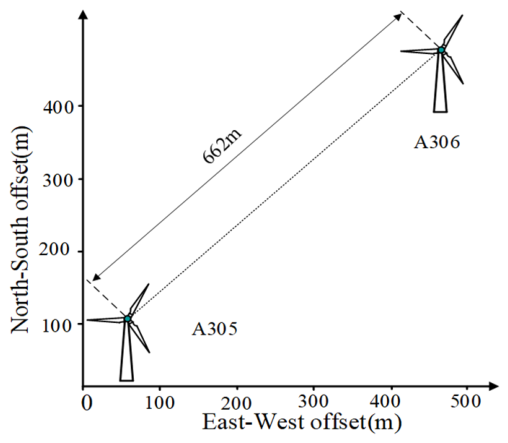
The geographic coordinates and elevations of turbines A305 and A306 were obtained to analyze their relative spatial relationship. Their relative positions are illustrated in Figure 5. Based on the turbine layout, the two turbines are located close to each other, making them suitable for investigating local wake interactions within a wind farm. In particular, when the incoming wind direction aligns with the turbine arrangement, the upstream turbine may generate a wake region that propagates toward the downstream turbine, leading to a reduction in the effective wind speed observed at the downstream location.
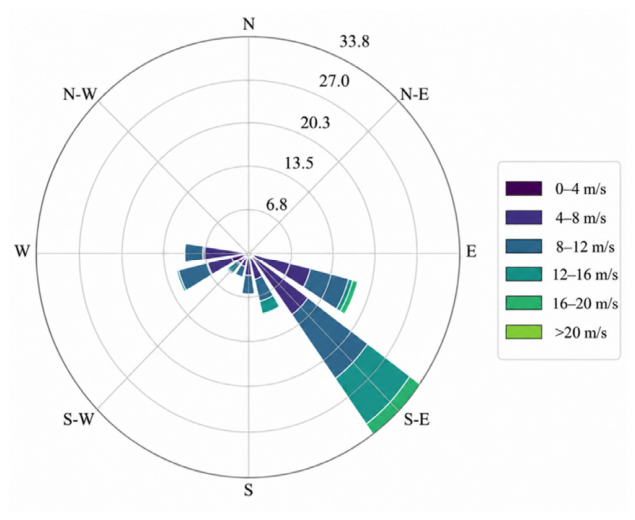
To further characterize the wind resource distribution during the study period, a wind rose diagram is presented in Figure 6. In the wind rose diagram, the sector length represents the occurrence frequency of wind directions, while different colors indicate different wind speed ranges. This visualization provides an intuitive description of both wind direction frequency and wind speed distribution. The results show that the wind direction exhibits a dominant sector during the observation period, indicating that the inflow conditions are not uniformly distributed across all directions.
According to the dominant wind direction and the relative position of the two turbines, A305 is identified as the upstream turbine, while A306 is regarded as the downstream turbine. Under such inflow conditions, the operation of A305 can affect the wind speed observed at A306 through wake propagation. Therefore, the selected turbine pair provides a representative scenario for studying wake-induced spatial coupling between upstream and downstream turbines.
Before model training, the raw SCADA data were preprocessed to improve data quality and ensure the reliability of the forecasting experiment. Abnormal records, missing values, and physically unreasonable measurements were identified and removed or corrected. In addition, the wind speed sequences were normalized to reduce the influence of scale differences and accelerate neural network convergence. The processed data were then organized into sequential samples using a sliding-window strategy, where historical observations were used as inputs for ultra-short-term wind speed prediction.
The choice of turbines A305 and A306 is consistent with the objective of this paper, which aims to improve downstream wind speed forecasting by incorporating upstream information and wake-induced physical constraints. Since A306 is affected by the wake generated by A305 under the dominant wind direction, this dataset is well suited for validating the effectiveness of the proposed physics-informed forecasting framework. Compared with isolated single-turbine datasets, the selected upstream–downstream turbine pair better reflects the physical interaction characteristics in densely arranged wind farms.
Overall, the dataset provides both temporal wind speed evolution information and spatial wake interaction information. This enables the proposed model to learn data-driven temporal patterns through LSTM networks while simultaneously incorporating wake-related physical constraints through the Jensen model. Therefore, the dataset forms a reliable basis for evaluating the proposed ultra-short-term wind speed forecasting method.

3.2. Accuracy Evaluation

The evaluation metrics adopted in this study are the Normalized Mean Absolute Error (NMAE) and the Normalized Root Mean Square Error (NRMSE), which are widely used to quantify the forecasting performance of wind speed prediction models. Compared with conventional MAE and RMSE, the normalized forms reduce the influence of wind speed magnitude and enable a more objective comparison across different turbines and forecasting horizons. NMAE measures the average absolute deviation between predicted and observed wind speeds, providing an intuitive and robust indicator of the overall prediction bias. Since each error term contributes linearly, NMAE is relatively insensitive to occasional extreme deviations and is suitable for evaluating the general accuracy of the model. In contrast, NRMSE squares the prediction errors before averaging, thereby assigning larger penalties to significant forecasting deviations. As a result, NRMSE is more sensitive to large errors and can better reflect the model’s ability to maintain stable performance under rapidly fluctuating wind conditions. Therefore, using NMAE and NRMSE jointly enables a comprehensive assessment of both average prediction accuracy and robustness against large forecasting errors.
y N M A E = 1 n i = 1 n X a c t ( i ) X p r e d ( i ) max ( X )
y N R M S E = 1 n i = 1 n ( X a c t ( i ) X p r e d ( i ) max ( X ) ) 2
where X a c t ( i ) and X p r e d ( i ) , respectively, represent the actual and predicted wind speeds.

3.3. Model Configuration

The proposed forecasting method is referred to as Method 1, and its total loss function consists of three components:
L t o t a l = λ 1 L A + λ 2 L B + λ 3 L p h y s i c s
y M S E = 1 n ( i = 1 n ( X a c t ( i ) X p r e d ( i ) ) 2 )
where L 305 and L 306 denote the prediction losses, defined as the mean squared error (MSE) between the LSTM predictions and the true values for turbines 305 and 306, respectively; L p h y s i c s represents the physical loss, defined as the MSE between the predicted wind speed of turbine 306 and the theoretical value computed by the Jensen model; and λ 1 , λ 2 , λ 3 are weighting coefficients, with λ 1 = λ 2 = 1 , and λ 3 tuned during the simulation.
In this study, Method 1 is designed as a physics-informed forecasting framework. Unlike a purely data-driven model, it not only minimizes the prediction errors of the upstream and downstream turbines, but also introduces the wake attenuation relationship as an additional physical regularization term. This design enables the neural network to learn temporal patterns from historical wind speed sequences while maintaining consistency with the aerodynamic relationship between upstream and downstream turbines. In particular, the physical loss term guides the prediction of the downstream turbine toward a physically plausible solution space, reducing predictions that may fit historical data but violate wake propagation characteristics.
The weighting coefficients in the total loss function play a crucial role in determining the learning behavior of the model. If the weight assigned to the physical loss is too small, the model degenerates toward a conventional data-driven LSTM structure, and the wake-induced coupling between turbines cannot be sufficiently utilized. In this case, the downstream prediction is mainly determined by historical statistical patterns, and the benefit of incorporating upstream turbine information becomes limited. Conversely, if the physical loss weight is excessively large, the model may rely too strongly on the simplified Jensen wake model. Since the Jensen model is an engineering approximation and cannot fully describe all complex atmospheric and terrain-induced effects, an excessively high physical weight may introduce bias and weaken the ability of the neural network to fit actual observations. Therefore, an appropriate balance between data fidelity and physical consistency is necessary.
To determine a suitable physical constraint intensity, extensive experiments were conducted by adjusting the physical loss weight λ 3 . According to the experimental analysis, when λ 3 = 0.4, the forecasting results for wind turbine A306 achieve the best overall performance in terms of both NMAE and NRMSE. This indicates that a moderate level of physical regularization is beneficial for improving downstream wind speed prediction. Under this configuration, the proposed physics-informed model can effectively exploit upstream wind speed information while avoiding over-constraining the neural network with simplified wake assumptions.
For comparison, the LSTM-based data-driven forecasting model is defined as Method 2. Method 2 uses the same historical wind speed input and LSTM structure as the benchmark model but does not include the Jensen wake-based physical loss term. Therefore, the comparison between Method 1 and Method 2 allows a direct evaluation of the contribution of the physics-informed wake constraint. By keeping the data-driven component consistent between the two methods, the performance difference can be mainly attributed to the introduction of physical information rather than differences in network architecture or input data. A comparative evaluation between the two methods is presented in Table 1.
As shown in Table 1, Method 1 achieves lower prediction errors than Method 2 for both turbines, demonstrating the overall effectiveness of the proposed physics-informed framework. For turbine A305, Method 1 reduces NMAE from 0.0721 to 0.0689 and NRMSE from 0.0917 to 0.0881. Although A305 is the upstream turbine and is less directly constrained by the downstream wake loss, its forecasting accuracy still improves slightly. This improvement suggests that the joint optimization framework can enhance feature learning and stabilize the training process even for the upstream turbine.
The improvement is more significant for turbine A306, which is located downstream of A305 under the dominant wind direction. For A306, Method 1 reduces NMAE from 0.0712 to 0.061 and NRMSE from 0.0913 to 0.079. Compared with Method 2, the proposed method reduces the NMAE and NRMSE of A306 by 14.3% and 13.5%, respectively. This result confirms that the wake-based physical constraint plays a more direct and important role in downstream wind speed forecasting. Since the wind speed at A306 is affected by the wake generated by A305, incorporating the Jensen wake relationship helps the model better characterize the physical attenuation between the two turbines.
The larger performance gain observed for A306 also supports the fundamental motivation of this study. Purely data-driven LSTM models can capture temporal dependencies in historical wind speed series, but they do not explicitly represent the physical mechanism by which the upstream turbine affects the downstream inflow. As a result, the benchmark LSTM model may fail to distinguish between ordinary temporal fluctuations and wake-induced wind speed attenuation. By contrast, Method 1 introduces an additional physical reference derived from the Jensen model, allowing the downstream prediction to be corrected according to the expected wake behavior. This explains why the proposed method achieves more substantial improvements for the downstream turbine.
To further evaluate the performance of the proposed method at different forecasting horizons, the NMAE and NRMSE values at 15 min intervals within 0–4 h were calculated for all prediction time steps, with the results presented in Table 2.
The multi-step forecasting results in Table 2 further demonstrate the superiority of Method 1 across all forecasting horizons. At the 15 min forecasting horizon, Method 1 achieves an NRMSE of 0.0279 and an NMAE of 0.0227, both of which are lower than those of Method 2. This indicates that the proposed method can effectively improve very short-term prediction accuracy, where recent wind speed observations and local wake interactions have strong explanatory power.
As the forecasting horizon increases from 15 min to 4 h, both NMAE and NRMSE gradually increase for the two methods. This trend is expected because wind speed uncertainty accumulates over time, and the temporal correlation between historical observations and future values becomes weaker at longer horizons. Wind speed is influenced by stochastic atmospheric fluctuations, local turbulence, and turbine operating conditions, all of which make long-horizon forecasting more challenging. Nevertheless, Method 1 consistently maintains lower errors than Method 2 at each forecasting horizon, indicating that the wake-based physical constraint remains effective not only for one-step prediction but also for multi-step ultra-short-term forecasting.
The results also show that the performance advantage of Method 1 persists as the forecasting horizon becomes longer. For example, at the 4 h horizon, Method 1 obtains an NRMSE of 0.1234, whereas Method 2 yields an NRMSE of 0.1347. This corresponds to an error reduction of approximately 8.4%. Similarly, the NMAE decreases from 0.1084 to 0.0987. These results suggest that the proposed physics-informed model improves not only instantaneous prediction accuracy but also forecasting robustness over extended ultra-short-term horizons.
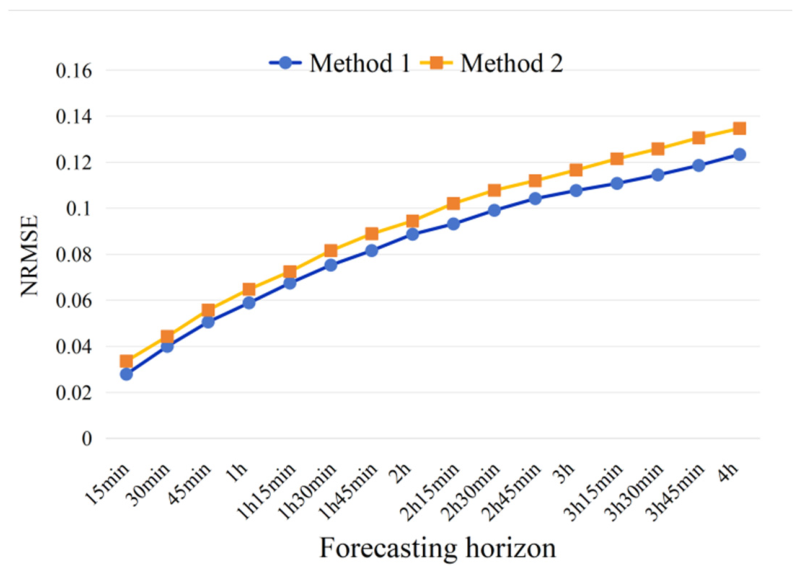
The NRMSE comparison is further illustrated in Figure 7. The figure shows that the NRMSE curve of Method 1 remains consistently below that of Method 2 across the entire 0–4 h forecasting range. This visual comparison confirms the quantitative results in Table 2 and demonstrates the stability of the proposed method. Since NRMSE is more sensitive to large forecasting deviations, the lower NRMSE achieved by Method 1 indicates that the physics-informed constraint helps suppress large prediction errors, especially under more variable wind conditions.
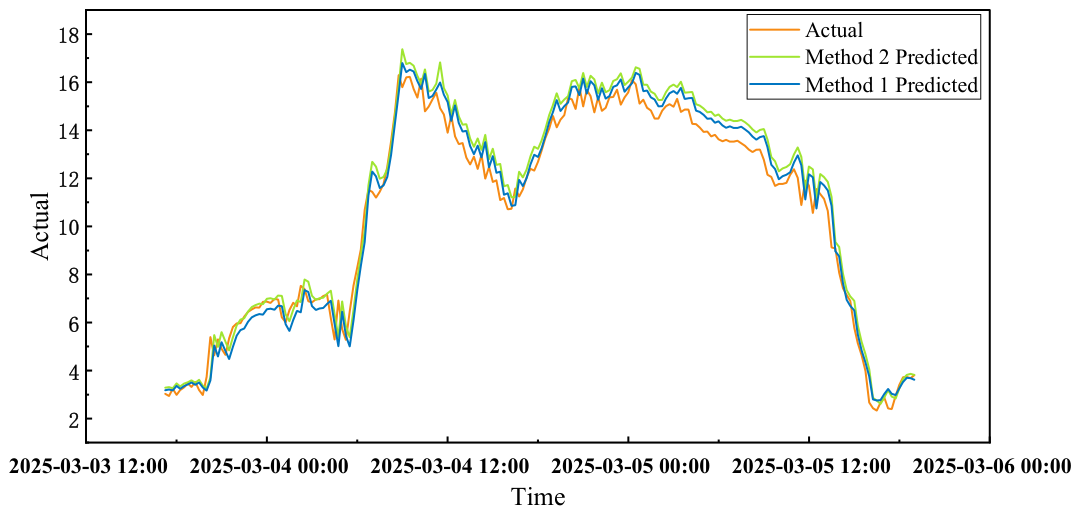
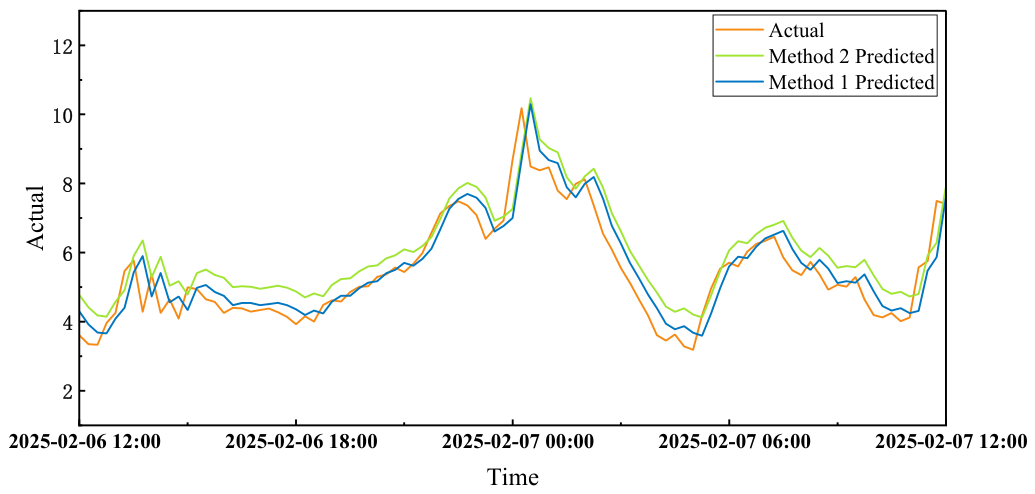
Finally, Figure 8 presents the predicted and observed wind speeds of turbine 306 for Methods 1 and 2 under λ 3 = 0.4 over 200 consecutive time steps. Both methods capture the overall wind speed trends effectively, but Method 1 demonstrates higher accuracy in tracking rapid fluctuations.
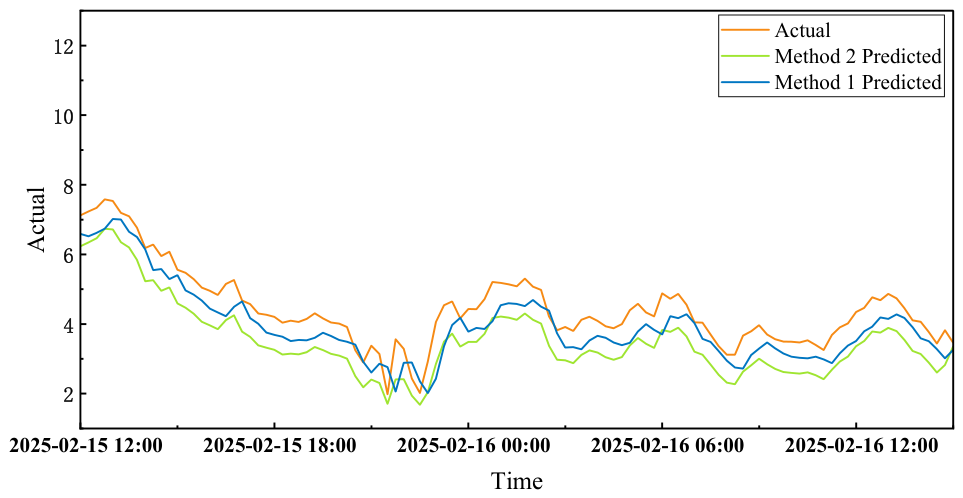
Figure 9 compares the predictions during relatively stable wind speed periods. Both methods effectively track the trends, with Method 1 providing more consistent performance in capturing minor fluctuations.
Figure 10 compares the predictions during periods of rapid wind speed changes. Method 2 exhibits noticeable deviations under abrupt fluctuations, whereas Method 1 more accurately reflects instantaneous variations. This indicates that incorporating wake-related physical constraints enables the model to learn temporal features while effectively capturing upstream–downstream interactions, thereby improving prediction accuracy under complex wind conditions.
Overall, the experimental results verify the effectiveness of incorporating wake-related physical information into LSTM-based wind speed forecasting. Method 1 outperforms the conventional LSTM benchmark in both single-turbine comparison and multi-horizon evaluation. The improvement is particularly evident for the downstream turbine A306, confirming that wake effects are a key physical factor influencing downstream wind speed prediction. These findings demonstrate that the proposed physics-informed forecasting framework can better capture the spatiotemporal coupling between upstream and downstream turbines and improve the accuracy and reliability of ultra-short-term wind speed forecasting in densely arranged wind farms.

4. Conclusions

This paper proposes a wind speed forecasting method that integrates Jensen wake-based physical constraints with an LSTM network. By incorporating wake physics, the proposed method effectively captures the physical interactions between upstream and downstream turbines, which are difficult to model using conventional time-series approaches. Specifically, LSTM is used to extract temporal features of upstream and downstream turbines, while a physics-informed loss based on the Jensen model is introduced and jointly optimized with prediction losses to ensure consistency with wake dynamics. Experimental results demonstrate that, under the optimal physical loss weight, the proposed method significantly improves the forecasting accuracy of the downstream turbine. Compared with the conventional LSTM model, NMAE and NRMSE are reduced by 14.3% and 13.5%, respectively. These results verify the effectiveness of the proposed method for wind speed prediction under wake effects, showing its potential for improving wind farm operation and grid reliability. Future work will extend the method to multi-turbine scenarios and explore graph neural networks to model more complex wake interactions.
The improved wind speed forecasting accuracy provides a more reliable basis for estimating real-time wind power output in large-scale wind power bases, which is essential for quantitatively analyzing system outage losses under different transmission maintenance assemblies and their associated uncertainties in high-renewable-penetration power systems. Future work will extend the method to multi-turbine scenarios and explore graph neural networks to model more complex wake interactions. In addition, other deep learning architectures, such as GRUs and transformer-based models, will be further investigated within the proposed physics-informed framework to evaluate their adaptability and forecasting performance under different wind conditions. Alternative optimization strategies (e.g., PSO, ACO, GWO) will also be explored in future work to further enhance the adaptability of the PINN framework. Furthermore, the integration of the proposed forecasting model into a probabilistic outage loss evaluation framework will be investigated, aiming to provide a more comprehensive decision-support tool for maintenance planning and real-time dispatch in wind-rich transmission corridors. Due to current data availability constraints, only eight months of measurements were used in this study. A full-year dataset will be considered in future work for more comprehensive validation under different seasonal and meteorological conditions.

Author Contributions

Conceptualization, H.J. and Y.W.; methodology, H.J.; software, H.J.; validation, X.Z., L.L.; formal analysis, H.J.; investigation, H.J.; resources, X.Z., L.L.; data curation, X.Z., L.L.; writing—original draft preparation, H.J., Y.L.; writing—review and editing, Y.W., H.R.; visualization, H.J.; supervision, H.R.; project administration, H.R.; funding acquisition, Y.W. All authors have read and agreed to the published version of the manuscript.

Funding

This research was supported by State Grid Jibei Electric Power Co., Ltd., EHV Power Transmission Company Technology Project (SGJBJX00JLJS2400989), Beijing, China.

Data Availability Statement

The datasets generated and/or analyzed during the current study are available from the corresponding author on reasonable request.

Conflicts of Interest

Authors Haiwang Jin and Xiaofei Zhang were employed by State Grid Jibei Electric Power Co., Ltd., EHV Power Transmission Company. Author Liming Li was employed by Beijing Tsingdian Technology Co., Ltd. The remaining authors declare that the research was conducted in the absence of any commercial or financial relationships that could be construed as a potential conflict of interest.

References

  1. Zhang, Z.; Kang, C. Challenges and prospects for constructing the new-type power system towards a carbon neutrality future. Proc. CSEE 2022, 42, 2806–2819. [Google Scholar]
  2. National Energy Administration. Available online: http://www.nea.gov.cn/20260130/503483f133e44016a66ddd6fad8ab695/c.html (accessed on 31 March 2026).
  3. International Energy Agency. Renewable Electricity. Available online: https://www.iea.org/reports/renewables-2025/renewable-electricity (accessed on 1 April 2026).
  4. Shi, J.; Liu, Y.; Li, Y.; Liu, Y.; Roux, G.; Shi, L.; Fan, X. Wind speed forecasts of a mesoscale ensemble for large-scale wind farms in Northern China: Downscaling effect of global model forecasts. Energies 2022, 15, 896. [Google Scholar] [CrossRef]
  5. Alvarado, D.; Moreno, R.; Orchard, M.E.; Kirschen, D.S. Cost-benefit analysis of maintenance plans: Case study of the power system of a large industrial facility. IEEE Trans. Power Syst. 2023, 38, 2046–2057. [Google Scholar] [CrossRef]
  6. Tan, Y.; Zhou, L.; Xue, X.; Duan, B. Exploration of key technologies for equipment operation and maintenance based on new power systems. Int. J. Thermofluids 2023, 20, 100482. [Google Scholar] [CrossRef]
  7. Shayesteh, E.; Yu, J.; Hilber, P. Maintenance optimization of power systems with renewable energy sources integrated. Energy 2018, 149, 577–586. [Google Scholar] [CrossRef]
  8. Shuai, M.; Chengzhi, W.; Shiwen, Y.; Hao, G.; Jufang, Y.; Hui, H. Review on economic loss assessment of power outages. Procedia Comput. Sci. 2018, 130, 1158–1163. [Google Scholar] [CrossRef]
  9. Wang, Y.; Zou, R.; Liu, F.; Zhang, L.; Liu, Q. A review of wind speed and wind power forecasting with deep neural networks. Appl. Energy 2021, 304, 117766. [Google Scholar] [CrossRef]
  10. Valdivia-Bautista, S.M.; Domínguez-Navarro, J.A.; Pérez-Cisneros, M.; Vega-Gómez, C.J.; Castillo-Téllez, B. Artificial intelligence in wind speed forecasting: A review. Energies 2023, 16, 2457. [Google Scholar] [CrossRef]
  11. Xu, J.; Xiao, Z.; Lin, Z.; Li, M. System bias correction of short-term hub-height wind forecasts using the Kalman filter. Prot. Control Mod. Power Syst. 2021, 6, 37. [Google Scholar] [CrossRef]
  12. Sward, J.A.; Ault, T.R.; Zhang, K.M. Spatial biases revealed by LiDAR in a multiphysics WRF ensemble designed for offshore wind. Energy 2023, 262, 125346. [Google Scholar] [CrossRef]
  13. Zhen, Z.; Xuan, Z.; Wang, F.; Sun, R.; Duić, N.; Jin, T. Image phase shift invariance based multi-transform-fusion method for cloud motion displacement calculation using sky images. Energy Convers. Manag. 2019, 197, 111853. [Google Scholar] [CrossRef]
  14. Cai, X.; Zhou, Y.; Wang, Z.; Lei, X.; Jia, Y. Regional wind power forecasting guided by physics-based wind field modeling and image fusion. Electr. Power Syst. Res. 2026, 253, 112527. [Google Scholar] [CrossRef]
  15. Cheng, Y.; Zhang, S.; Li, H. Optimising time series forecasting transformers to linear complexity. Energy Internet 2025, 2, 275–286. [Google Scholar] [CrossRef]
  16. Jiang, W.; Liu, B.; Liang, Y.; Gao, H.; Lin, P.; Zhang, D.; Hu, G. Applicability analysis of transformer to wind speed forecasting by a novel deep learning framework with multiple atmospheric variables. Appl. Energy 2024, 353, 122155. [Google Scholar] [CrossRef]
  17. Dong, X.; Liu, Y.; Zhang, X.; Mei, S. Short-term wind power probabilistic forecasting via data-driven ensemble weather modeling. Prot. Control Mod. Power Syst. 2025, 1–11. [Google Scholar] [CrossRef]
  18. Fang, P.; Fu, W.; Wang, K.; Xiong, D.; Zhang, K. A compositive architecture coupling outlier correction, EWT, nonlinear Volterra multi-model fusion with multi-objective optimization for short-term wind speed forecasting. Appl. Energy 2022, 307, 118191. [Google Scholar] [CrossRef]
  19. Liu, X.; Zhen, Z.; Mi, Z.; Hao, L.; Xu, F.; Wang, F. Two-stage ultra-short-term wind power forecasting based on multi-scale wind process extraction and fluctuation continuation analysis. Energy 2025, 342, 139506. [Google Scholar] [CrossRef]
  20. Li, G.; Li, N.; Hao, L.; He, L.; Yang, W.; Dai, H.; Wang, F.; Xu, F.; Lv, D.; Wang, Y.; et al. New energy power forecasting model performance evaluation method based on new energy station resource complexity quantification. IEEE Trans. Ind. Appl. 2026. [Google Scholar] [CrossRef]
  21. Liu, M.-D.; Ding, L.; Bai, Y.-L. Application of hybrid model based on empirical mode decomposition, novel recurrent neural networks and the ARIMA to wind speed prediction. Energy Convers. Manag. 2021, 233, 113917. [Google Scholar] [CrossRef]
  22. Wang, Y.; Fu, W.; Zhang, X.; Zhen, Z.; Wang, F. Dynamic directed graph convolution network based ultra-short-term forecasting method of distributed photovoltaic power to enhance the resilience and flexibility of distribution. IET Gener. Transm. Distrib. 2024, 18, 337–352. [Google Scholar] [CrossRef]
  23. Geng, X.; Xu, L.; He, X.; Yu, J. Graph optimization neural network with spatio-temporal correlation learning for multi-node offshore wind speed forecasting. Renew. Energy 2021, 180, 1014–1025. [Google Scholar] [CrossRef]
  24. Wu, Q.; Zheng, H.; Guo, X.; Liu, G. Promoting wind energy for sustainable development by precise wind speed prediction based on graph neural networks. Renew. Energy 2022, 199, 977–992. [Google Scholar] [CrossRef]
  25. Tsai, W.-C.; Hong, C.-M.; Tu, C.-S.; Lin, W.-M.; Chen, C.-H. A review of modern wind power generation forecasting technologies. Sustainability 2023, 15, 10757. [Google Scholar] [CrossRef]
  26. He, B.; Ye, L.; Pei, M.; Lu, P.; Dai, B.; Li, Z.; Wang, K. A combined model for short-term wind power forecasting based on the analysis of numerical weather prediction data. Energy Rep. 2022, 8, 929–939. [Google Scholar] [CrossRef]
  27. Li, P.; Yang, H.; Wu, H.; Wang, Y.; Su, H.; Zheng, T.; Zhu, F.; Zhang, G.; Han, Y. Deep learning model for solar and wind energy forecasting considering Northwest China as an example. Results Eng. 2024, 24, 102939. [Google Scholar] [CrossRef]
  28. Meng, Q.; Gao, Y.; He, Y.; Hussain, S.; Lu, J.; Chen, Y.; Qin, C.; Luo, F.; Guerrero, J.M. PowerMistral: A data-efficient wind power forecasting framework leveraging pre-trained large language models. Appl. Energy 2026, 411, 127625. [Google Scholar] [CrossRef]
  29. Song, M.; Huang, J.; Shao, X.; Zhao, S.; Ma, C.; Qi, Z. A three-dimensional dynamic wake prediction framework for multiple turbine operating states based on diffusion model. Energy 2025, 333, 134822. [Google Scholar] [CrossRef]
  30. Archer, C.L.; Vasel-Be-Hagh, A.; Yan, C. Review and evaluation of wake loss models for wind energy applications. Appl. Energy 2018, 226, 1187–1207. [Google Scholar] [CrossRef]
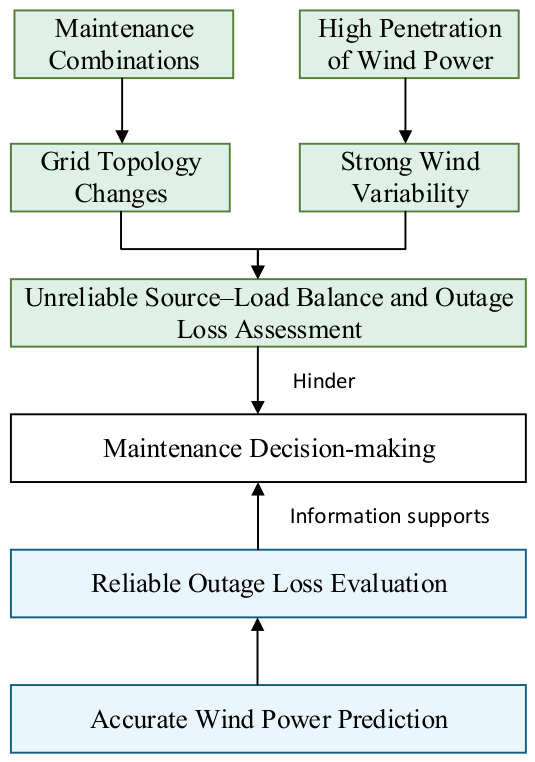
Figure 1. Causal logic diagram of outage loss and maintenance decision-making under wind power uncertainty.
Electronics 15 02338 g001
Figure 2. The flowchart of the proposed forecasting method.
Electronics 15 02338 g002
Figure 3. Basic unit of LSTM network.
Electronics 15 02338 g003
Figure 4. Jensen model.
Electronics 15 02338 g004
Figure 5. Location diagram of turbines.
Electronics 15 02338 g005
Figure 6. Wind rose diagram.
Electronics 15 02338 g006
Figure 7. NRMSE comparison within 0–4 h.
Electronics 15 02338 g007
Figure 8. Comparison of actual and predicted wind speeds for Method 1.
Electronics 15 02338 g008
Figure 9. Comparison of predicted wind speeds during stable periods.
Electronics 15 02338 g009
Figure 10. Comparison of predicted wind speeds during rapid fluctuations.
Electronics 15 02338 g010
Table 1. Comparison of prediction results for turbines 305 and 306.
Method 1Method 2
Turbine 305 NMAE0.06890.0721
Turbine 305 NRMSE0.08810.0917
Turbine 306 NMAE0.0610.0712
Turbine 306 NRMSE0.0790.0913
Table 2. Comparison within 0–4 h.
Method 1Method 2
15 minNRMSE0.02790.0336
NMAE0.02270.0265
1 hNRMSE0.05890.0648
NMAE0.04670.0511
2 hNRMSE0.08870.0945
NMAE0.06970.0751
3 hNRMSE0.10770.1166
NMAE0.08450.0931
4 hNRMSE0.12340.1347
NMAE0.09870.1084
Disclaimer/Publisher’s Note: The statements, opinions and data contained in all publications are solely those of the individual author(s) and contributor(s) and not of MDPI and/or the editor(s). MDPI and/or the editor(s) disclaim responsibility for any injury to people or property resulting from any ideas, methods, instructions or products referred to in the content.