1. Introduction
Deep learning models have been successfully applied to neural style transfer in both images and audio. For images, pixel arrays can be decomposed into content and style representations, where “style” is often characterized by color distributions and localized texture patterns. Starting from the seminal work of Gatys et al. [
1], convolutional neural networks (CNNs) have been used to extract neural representations that disentangle content from style, enabling high-quality transfer of artistic styles between arbitrary images. Subsequent works have improved the efficiency and flexibility of image style transfer using feed-forward networks [
2,
3] and adaptive normalization techniques for arbitrary style transfer [
4], and extensive surveys summarize the rapid progress in this field [
5].
For audio, the notion of style is typically related to spectral envelope, pitch contour, and rhythmic structure. Spectrogram-based CNN models have been used to manipulate timbre and other spectral features for music and audio style transfer [
6], while recurrent neural networks (RNNs) and generative adversarial networks (GANs) have been introduced to better capture temporal dependencies such as rhythm and phrasing across multiple timescales [
7,
8]. Recent generative models further demonstrate high-fidelity music synthesis and transformation [
9,
10], and position papers review the challenges of music style transfer in more detail [
11]. Despite these advances, most existing approaches operate within a single modality—either image-to-image or audio-to-audio.
In contrast to “true” cross-modal painting style transfer—where one would expect a direct, semantically meaningful mapping from an input audio clip to a specific artistic painting style—our goal in this paper is more modest and explicitly affect-focused. Throughout this work, we formulate the problem as valence–arousal (VA)–consistent affective transfer between audio and images under weak alignment, rather than strict semantic style transfer from audio to a curated painting corpus. All our models are therefore designed to preserve and transform cross-modal affective properties in a shared VA space, rather than to recover detailed artistic content or composition in a particular artwork.
To date, there is still no deep learning framework that explicitly focuses on mapping and transferring styles between images and audio. Yet, images and sounds are among the most fundamental artistic media, and many outstanding artists create works that evoke cross-modal impressions: a painting that seems to contain an audible atmosphere, or music that spontaneously gives rise to vivid visual imagery. This phenomenon is closely related to synesthesia. At the same time, a growing body of work in cross-modal representation learning and audiovisual generation explores how visual and auditory signals can be jointly modeled [
12,
13,
14,
15,
16], but these methods mainly focus on recognition or sound prediction from videos rather than explicit cross-modal style transfer.
Physiological and anatomical studies suggest that sensory modalities are highly interconnected and integrated in regions such as the prefrontal cortex [
17]. Based on such neural organization, Lewkowicz [
18] examined the hypothesis that young infants respond to audiovisual events in a unified fashion rather than strictly separating light and sound. Meltzoff [
19] demonstrated intermodal matching abilities in human neonates, indicating early cross-modal correspondences. Cytowic [
17] argued that synesthesia is a latent capacity of the human brain, although only a minority of individuals experience it vividly enough to create synesthetic art. Identifying common structures between visual attributes (e.g., color, shape) and auditory attributes (e.g., pitch, timbre, rhythm) offers a promising way to bridge scientific models and artistic practice.
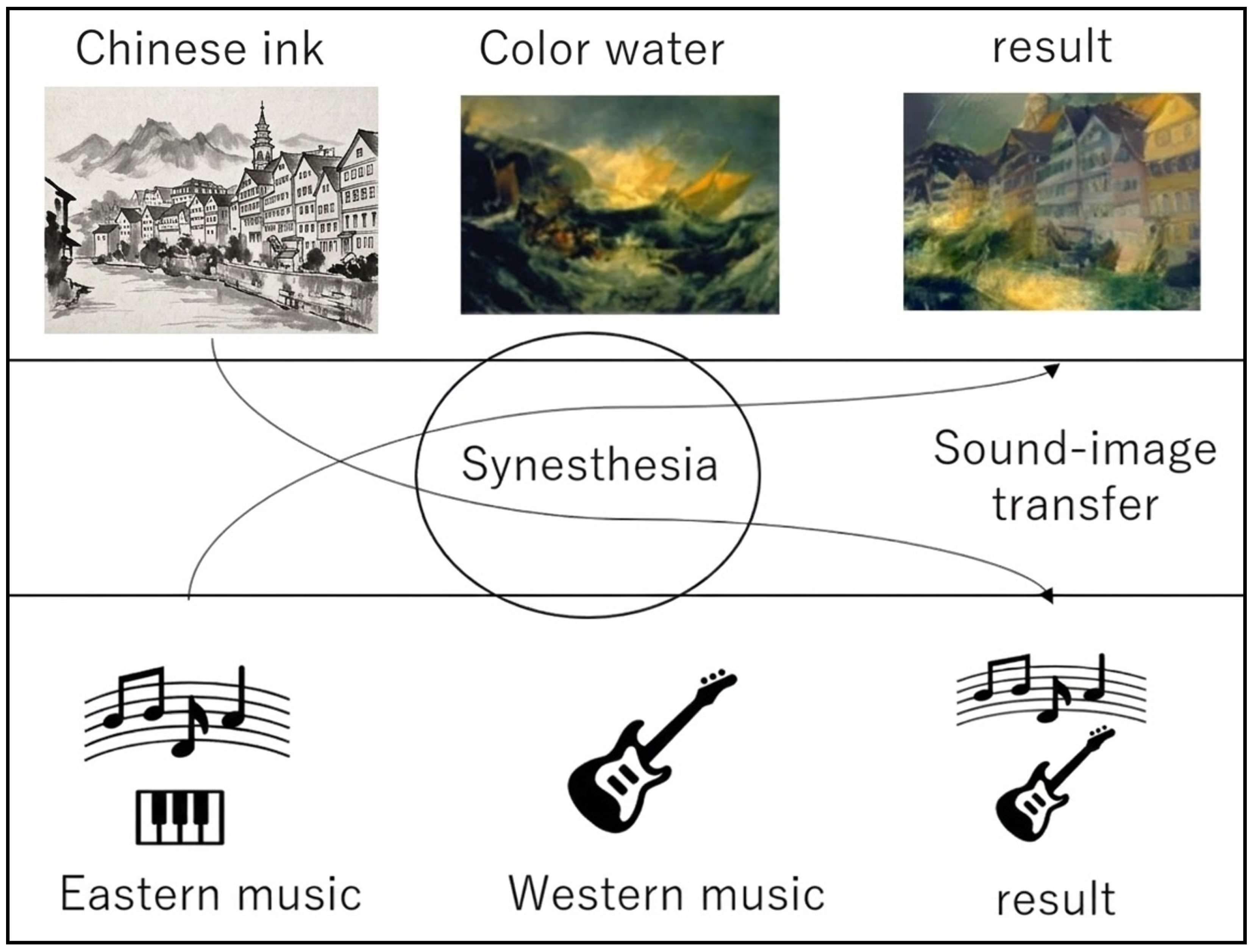
In this work, we propose a deep hybrid synesthesia model that learns shared representations across audio and images and applies them to cross-modal style transfer. As illustrated in
Figure 1, we distinguish between Eastern style features (Chinese ink paintings and eastern music) and Western style features (color water paintings and western music). For the component transfer part, we design a component conversion network that maps image color and shape features to audio spectral and pitch features, and vice versa. Crucially, this mapping is constrained by a shared continuous VA emotion space: instead of attempting arbitrary style conversion, our model is trained to preserve and reflect valence–arousal similarity across modalities, so that the generated image and sound fragments are affectively consistent even when their semantic content is not aligned. This mapping is learned in a continuous valence–arousal (VA) emotion space [
20,
21,
22,
23], leveraging emotional reactions as an intermediate representation that underlies synesthetic processes.
For the style transfer part, we focus on transferring high-level artistic styles between Eastern and Western arts. In the visual domain, this includes ink-wash (shui-mo) landscape painting versus Western oil painting; in the audio domain, we consider traditional Oriental instruments versus Western symphonic music. Our style conversion module learns to associate these cultural and stylistic differences across modalities, enabling transformations such as generating an ink-wash style image conditioned on a segment of traditional music, or synthesizing a Western-style visual scene from symphonic audio. Throughout the paper, we therefore use the term “audio–image style transfer” in this affective, VA-grounded sense, and we explicitly distinguish our problem setting from exact semantic style replication onto specific paintings.
We conduct experiments in two main settings. First, in the “see the sound” scenario, we generate images from audio by controlling specific components (e.g., rhythm, spectral brightness) and examine whether the resulting images exhibit consistent color and shape patterns. Second, we perform full cross-modal style transfer combining component and style features, and evaluate the outputs through subjective preference tests, where participants are asked to choose the images that best match given sounds in terms of style and emotion. Because our datasets are only weakly aligned via VA labels rather than paired audio–image instances, all evaluations are phrased in terms of perceived affective and stylistic correspondence, not one-to-one content fidelity. The results indicate that our deep hybrid synesthesia model can produce audio–image transformations whose perceived cross-modal correspondences are consistent with human synesthetic tendencies [
17,
18,
19].
The main contributions of this work are three-fold:
We introduce a deep hybrid framework for audio–image style transfer grounded in synesthesia theory, going beyond unimodal style transfer.
We propose emotion-aware component conversion networks that learn cross-modal mappings between audio rhythm/spectrum and image color/shape in a continuous VA space.
We demonstrate cross-cultural style conversion between Eastern and Western visual and musical arts, and validate the effectiveness of our model through both qualitative examples and human evaluation.
3. Our Approach
We propose a novel deep hybrid synesthesia model for audio–image style transfer. The key motivation comes from the observation that emotion provides a natural bridge between music and painting: synesthetic experiences are often described in terms of coherent affective impressions across modalities. By learning emotion-aware shared representations for audio and images, our model can discover common synesthetic features and use them to perform cross-modal style transfer.
Existing neural style transfer models are typically unimodal, operating either on 2D images or on 1D/2D audio representations, and therefore cannot jointly handle 2D spatial image features and time-series audio features in a unified framework. Our method addresses this limitation by: (1) decomposing each modality into short-term component features and long-term style features; (2) mapping component features across modalities through an emotion-guided feature space; and (3) aligning long-term style codes between audio and images.
In the following, we first provide an overview of the training manner and pipeline, using an Oriental music–to–ink-and-color landscape painting task as an illustrative example (
Section 3.1). We then describe the component transfer module and the style transfer module in detail (
Section 3.2). Finally, we present the training objectives and loss functions (
Section 3.2.1).
3.1. Overview
3.1.1. Training Manner
In
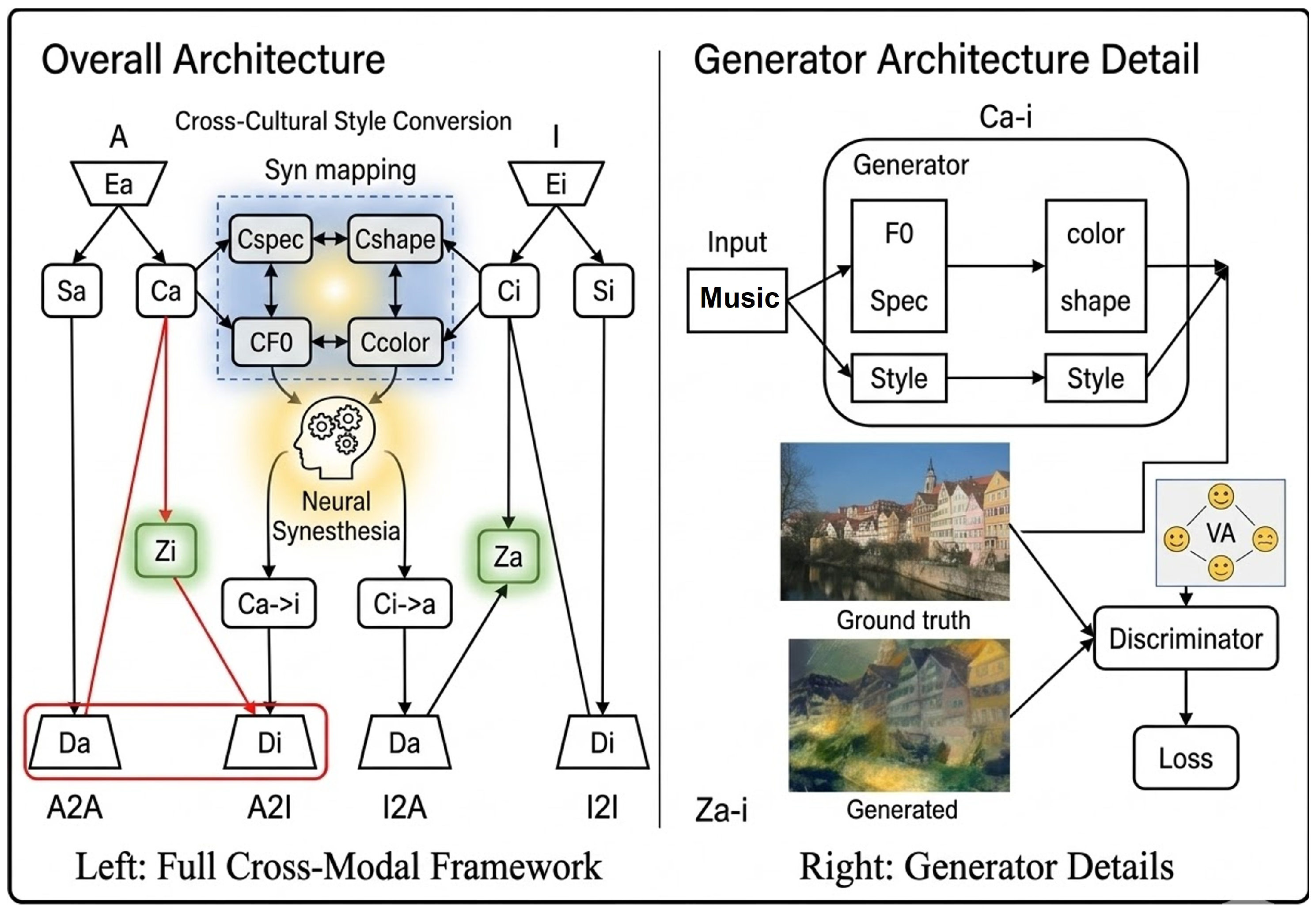
Figure 3 we illustrate the overall training scheme. We start from paired or weakly aligned audio
a and image
i sampled from the audio dataset and image dataset. Two encoders,
for audio and
for images, map the inputs into content and style codes:
where
and
denote content codes, and
and
denote style codes in their respective domains. Two decoders,
and
, reconstruct signals from these codes:
For audio, we further decompose the content code into a spectral component and a prosodic component:
where
encodes timbre/spectral envelope and
encodes pitch and prosody. For images, we decompose the content code into shape and color:
The component transfer module learns cross-modal mappings between these codes. Specifically, we learn:
where
is an image-like content code derived from audio, and
is an audio-like content code derived from images.
Within each domain, combining content and style codes allows reconstruction:
For cross-domain translation, we sample style codes
where
and
are estimated statistics of image and audio style codes, respectively. Assuming
lies in the image style space, we obtain audio-to-image translation:
indicated by the red arrows in
Figure 3. Similarly, assuming
lies in the audio style space, we obtain image-to-audio translation:
Training alternates between within-domain reconstruction (, ) and cross-domain translation (, ), with shared encoders/decoders and shared emotion-guided constraints. For simplicity, we primarily describe the audio-to-image direction, but the same framework applies to image-to-audio and unimodal style transfer (e.g., between different painting styles).
3.1.2. Pipeline
In
Figure 3, we detail the end-to-end pipeline for audio-to-image style transfer. Given an input audio signal
a:
Audio analysis: we compute its time–frequency representation (e.g., log-Mel spectrogram) and extract short-term content features and (spectrum and F0) and long-term style code (capturing global rhythm, instrumentation, and expressive characteristics).
Component transfer: using the component transfer model
, we map
to image-side content features
, based on our synesthetic mapping theory (details in
Section 3.2). This yields
, which is compatible with the image decoder
.
Style conversion: a pretrained style transfer model maps the audio style code to a corresponding image style code in the visual style space. This module captures, for example, the correspondence between traditional Oriental music and ink-and-color landscape style versus Western symphonic music and oil painting style.
Image synthesis and discrimination: the translated image
is fed into an image discriminator
, which evaluates both: component-level realism (color/shape plausibility) and style-level realism (consistency with target artistic style). We employ a fusion hinge loss that combines component-level and style-level adversarial hinge loss terms to jointly drive the learning of
,
, and
.
This unified pipeline allows us to explicitly disentangle and recombine content and style across modalities, under the guidance of a shared emotional representation.
3.2. Component Transfer
Auditory–visual synesthesia is a special form of cross-modal integration in which sounds evoke involuntary visual experiences. Prior studies show that synesthetic color and shape perceptions are often associated with timbre and prosodic patterns in audio. Motivated by this, our audio–image component transfer focuses on learning structured correlations between audio components (spectrum and F0) and image components (color and shape), and then performing efficient, temporally-aware cross-modal mapping.
3.2.1. Signal Analysis
An audio signal is commonly decomposed into timbre and pitch components, which are closely related to the spectrum and F0, respectively. Timbre (spectrum) characterizes the tone color or unique quality of a sound, enabling us to distinguish different speakers and instruments. Pitch (F0), generated at the vocal folds (or analogous excitation mechanism in instruments) and modulated by tension and length, conveys melodic contour and prosodic emphasis, and is strongly linked to perceived emotion.
As discussed in
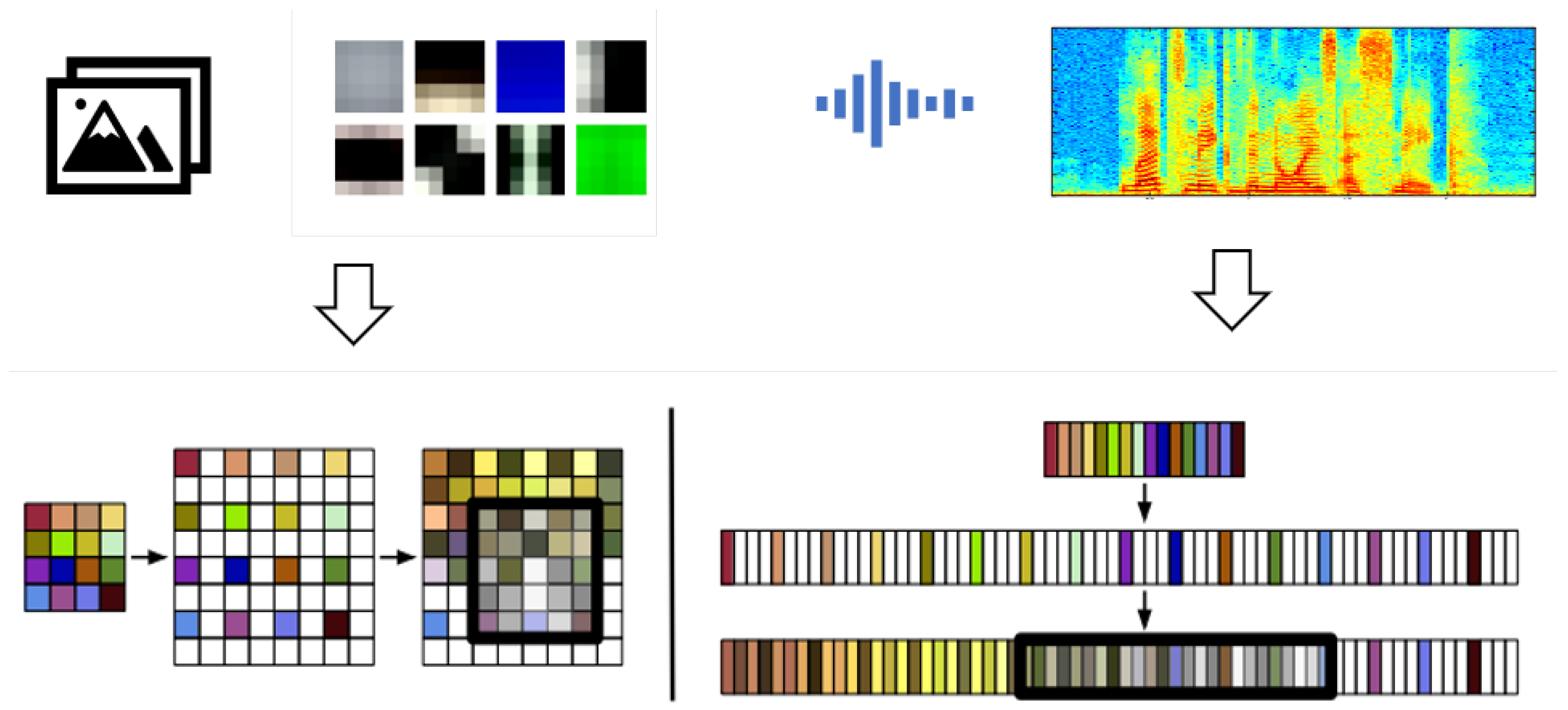
Section 2, principal component analysis (PCA) on natural image patches and speech slices (see
Figure 2) shows that: image PCs mainly capture intensity, gradient, and edge-like patterns in 2D spatial structures, while audio PCs tend to form periodic basis functions over time, decomposing the signal into quasi-harmonic bands.
Moreover, in spectrograms, the two axes represent fundamentally different quantities (time vs. frequency), in contrast to the purely spatial dimensions in images. Therefore, naively mapping spectral and F0 features to 2D image features without accounting for temporal structure can lead to suboptimal audio–image component transfer.
To address this, we impose a common temporal unit for both modalities. Specifically:
We segment audio spectrograms into fixed-length windows of size (time × frequency), corresponding to approximately 0.5 s of audio. Each segment is encoded into .
We select video clips of around 1 s at 25 fps, and align or average their frame-level features into the same temporal resolution (e.g., 0.5 s units), so that each audio segment corresponds to one or two image frames. From these frames, we extract RGB-based features and higher-level representations, which are then decomposed into .
In the final experimental setup of this paper, we do not rely on true audio–video pairs. Instead, audio and images are related only via their VA labels. To obtain a common temporal unit on the audio side, we segment spectrograms into fixed-length windows of approximately 0.5 s (32 frames in our configuration) and encode each window into . On the visual side, we work with static affective images rather than video frames; each image is treated as a single “time-agnostic” unit with associated VA label. When we speak of “alignment” between 0.5 s audio segments and images in the following, this always refers to matching in the VA space, not frame-level synchronization.
3.2.2. Feature Mapping
As illustrated in
Figure 4, we first extract spectral features and F0 trajectories from audio segments, and RGB and structural features from image frames derived from art videos.
To transfer audio features
to image features
effectively, we introduce an intermediate, modality-agnostic component space:
where
and
are learnable mappings from audio components and image components, respectively, into the shared component space
H. This space is: temporally aligned (each element corresponds to ~
s units), emotionally informed (supervised or regularized by VA labels), and structured such that similar emotional and structural patterns cluster together regardless of modality.
The cross-modal component mappings are then defined as:
where implemented via neural networks trained with reconstruction and consistency losses. In practice, we parameterize these mappings with temporal convolutional networks or lightweight sequence models, ensuring that local temporal dynamics are preserved during transfer.
3.2.3. Transfer Model
The component transfer model is realized as a conditional encoder–decoder with adversarial regularization: An audio component encoder
maps
into the shared space
H; An image component encoder
maps
into
H; Two decoders,
and
, map from
H back to image and audio component codes, respectively:
Both and are implemented as temporal convolutional stacks with residual connections, so that they can model local temporal patterns (e.g., rhythmic pulses) in audio and temporal evolution of visual elements in video frames, and their receptive fields cover the 0.5 s segments while maintaining sufficient resolution.
To encourage realistic component distributions after transfer, we use auxiliary discriminators at the component level (one in the audio space, one in the image space), which judge whether a component sequence is real or transferred. These discriminators are trained with hinge losses, and their gradients are back-propagated to , , , and .
3.3. Style Transfer
While the component transfer module focuses on short-term correlations (spectrum–color, F0–shape, etc.), the style transfer module handles long-term, high-level artistic style. For audio, the style code captures global attributes such as tempo, instrument ensemble, articulation patterns, and overall emotional trajectory. For images, the style code encodes global brushwork, composition, texture statistics, and color palette typical of specific art movements (e.g., ink-wash vs. oil painting).
We learn two style encoders,
and
, and a shared style space
where:
A style alignment network
is trained to map between audio and image style codes:
subject to:
distribution alignment: the mapped codes follow the empirical style distributions in each modality;
emotion consistency: mapped styles preserve the VA trajectory associated with the source signal;
cycle consistency: mapping audio style to image style and back recovers the original style up to small perturbations.
During translation, is combined with and fed into the image decoder to produce an image that is consistent both in local components and global style with the source audio.
3.4. Loss Functions
The model is trained end-to-end with a combination of reconstruction, adversarial, and regularization losses:
Within-domain reconstruction losses:
encouraging faithful encoding–decoding in each modality.
Component consistency losses:
where
and
are shared representations from
and
, and
,
are their cross-modal reconstructions.
Adversarial hinge losses at component and style levels:
with hinge formulations for the discriminators to ensure realistic component distributions and style codes.
Emotion consistency loss:
where
is a pretrained or jointly learned emotion regressor that predicts VA coordinates from audio or images. This term enforces that the translated image preserves the emotional content of the source audio.
Cycle consistency loss for style codes:
which stabilizes the bidirectional mapping in the style space.
The overall objective combines these terms:
where
are weighting coefficients. By jointly optimizing this objective, our model learns to generate images from audio (and vice versa) that are consistent at the component level, stylistically coherent, and emotionally aligned across modalities.
To assess the robustness of the loss weighting coefficients in Equation (
3), we conducted a small sensitivity analysis by varying one coefficient at a time while keeping the others fixed. Specifically, we scaled each of
,
,
, and
by factors of 0.5 and 2.0 and measured the resulting FID and VA-MSE on the validation set. We observed that moderate changes (within this range) lead to changes of less than 3.5 in FID and 0.004 in VA-MSE, indicating that the model is not overly sensitive to the exact choice of these hyperparameters. Stronger deviations (e.g., reducing
by an order of magnitude) noticeably degrade VA consistency while having smaller impact on FID, which is consistent with the role of the emotion loss in our objective.
4. Experiments
In this section, we evaluate the proposed hybrid synesthesia model on several audio–image style transfer tasks. We first describe the experimental setup, including datasets, preprocessing, and implementation details. We then present quantitative results using objective metrics and ablation studies, followed by qualitative visualizations and user studies.
4.1. Experimental Setup
4.1.1. Tasks
We consider three families of tasks:
Audio-to-image (A2I) component transfer: given an audio clip, generate an image whose local components (color, shape) correspond to audio components (spectrum, F0) under the learned synesthetic mapping, while preserving the overall emotional content.
Audio-to-image (A2I) full style transfer: given an audio clip, generate an image that not only matches local components but also exhibits a coherent visual artistic style (e.g., ink-wash vs. oil painting) corresponding to the audio style (e.g., Oriental vs. Western music).
Image-to-audio (I2A) transfer (optional): symmetric experiments where an input image is translated into an audio segment with matching emotional content and style.
Unless otherwise stated, we focus on the A2I direction as our primary evaluation, and report I2A results qualitatively. In all reported experiments, we restrict ourselves to monophonic or moderately polyphonic audio excerpts in which a dominant F0 trajectory is meaningful. For highly complex, multi-instrumental mixtures where no single F0 contour can adequately summarize the pitch structure, our current F0-based component representation becomes less representative. Handling such material would require extending the model with multi-F0 estimation and/or richer timbre embeddings, which we regard as an important direction for future work.
4.1.2. Datasets and Splits
We use the affective image and music datasets described in
Section 2:
Images: IAPS [
38], NAPS [
39], and EMOTIC [
40], all annotated with continuous or discretized valence–arousal (VA) labels.
Music: DEAM [
41], containing music excerpts with continuous and global VA annotations.
We normalize all VA values into
within each modality and randomly split both image and music data into 80% training, 5% validation, and 15% testing, as summarized in
Table 1. For cross-modal experiments, we do not require exact pairs of image and audio; instead, samples are weakly aligned via their VA labels (e.g., in the same VA bin or neighborhood), which we use for sampling during training mini-batches.
4.1.3. Preprocessing
Audio signals are resampled to 44.1 kHz. We compute log-Mel spectrograms with a 1024-point FFT, a hop size of 256 samples, and 128 Mel bands. F0 contours are extracted using the PYIN algorithm, configured with a frame hop of 256 samples, a minimum F0 of 50 Hz and a maximum F0 of 1000 Hz, and voicing thresholds tuned on the DEAM validation set. The resulting F0 trajectories are encoded as normalized continuous values.
For image corpora, we resize images to and normalize RGB channels. For art videos, we sample clips of about 1 s at 25 fps and either use a central frame or aggregate frame features into temporally aligned representations (0.5 s resolution) to match audio segments. Image content and style features are extracted using pretrained CNN backbones (e.g., VGG-like architectures) and then fed into our encoders , , and .
4.1.4. Implementation Details
Feature Dimensions
For audio, we compute log-Mel spectrograms with Mel bands and segment them into time frames per 0.5 s window, resulting in inputs to the audio content encoder . The encoder outputs a 256-dimensional content code (split into a 192-dimensional spectral code and a 64-dimensional F0/prosodic code ) and a 128-dimensional style code . For images, we resize each image to and extract a 512-dimensional content embedding and a 128-dimensional style embedding using a CNN backbone followed by global average pooling. These dimensions are chosen to balance expressiveness and computational cost.
In the component transfer module, both audio and image component encoders map their inputs into a shared component space
H of dimension 256. Concretely,
and
output 256-dimensional vectors per 0.5 s segment, and the decoders
and
map from this 256D space back to their respective content codes
and
. In the style transfer module, both
and
produce 128-dimensional style codes that live in a shared style space
; the style alignment network
therefore learns mappings between 128D audio and image style vectors.
Table 2 summarizes all the main feature dimensionalities.
Inverse Mappings and VA Regressors
The inverse mappings from the shared VA space back to audio/image latent spaces are implemented as small multilayer perceptrons (MLPs) with two hidden layers of size 256 and ReLU activations, mapping 2D VA coordinates to 128D style codes in the audio and image domains, respectively. The VA regressors and are trained separately on DEAM and the combined affective image corpus using the mean-squared-error loss on the normalized VA labels, an Adam optimizer with learning rate , and early stopping on a held-out validation set. We then fix these regressors when training the main model and use them only for computing the emotion consistency loss .
Style Label Estimation and Normalization
For DEAM, we use the provided continuous VA annotations and derive global VA labels by averaging over time for each song. For IAPS and NAPS, we convert the 9-point valence and arousal ratings to the range via linear scaling; for EMOTIC, we normalize the 10-point VAD scores in the same manner. When global labels are available, each 0.5 s audio segment or each static image inherits the corresponding global VA label. All VA values across datasets are then linearly rescaled to per modality to construct the shared VA space used by the component and style transfer modules.
4.2. Evaluation Metrics
We evaluate the model from three complementary perspectives.
4.2.1. Visual Quality and Realism
For generated images, we use:
Fréchet Inception Distance (FID) between generated images and real images in the corresponding style domain, computed on Inception features.
Style classification accuracy: a pretrained style classifier (e.g., ink-wash vs. oil painting) predicts the style of generated images; we report the fraction of images classified into the intended target style.
4.2.2. Emotion and Component Consistency
To measure emotional alignment across modalities, we use:
Cross-modal VA consistency: a pretrained emotion regressor
is applied to source audio and generated images; we compute the mean squared error (MSE) between predicted VA coordinates:
Component correlation: we compute correlations between low-level descriptors (e.g., spectral centroid vs. color saturation, F0 variance vs. shape complexity) across matched audio–image pairs, before and after transfer, to assess whether the component mapping increases cross-modal consistency.
4.2.3. Ablation Metrics
For ablation studies, we monitor: Reconstruction SNR / PSNR in within-domain tasks (, ); FID and VA consistency when disabling specific modules (component transfer, style transfer, emotion loss).
4.3. Quantitative Results
4.3.1. Audio-to-Image Style Transfer
Table 3 reports FID, style accuracy, and VA consistency for A2I full style transfer. We compare:
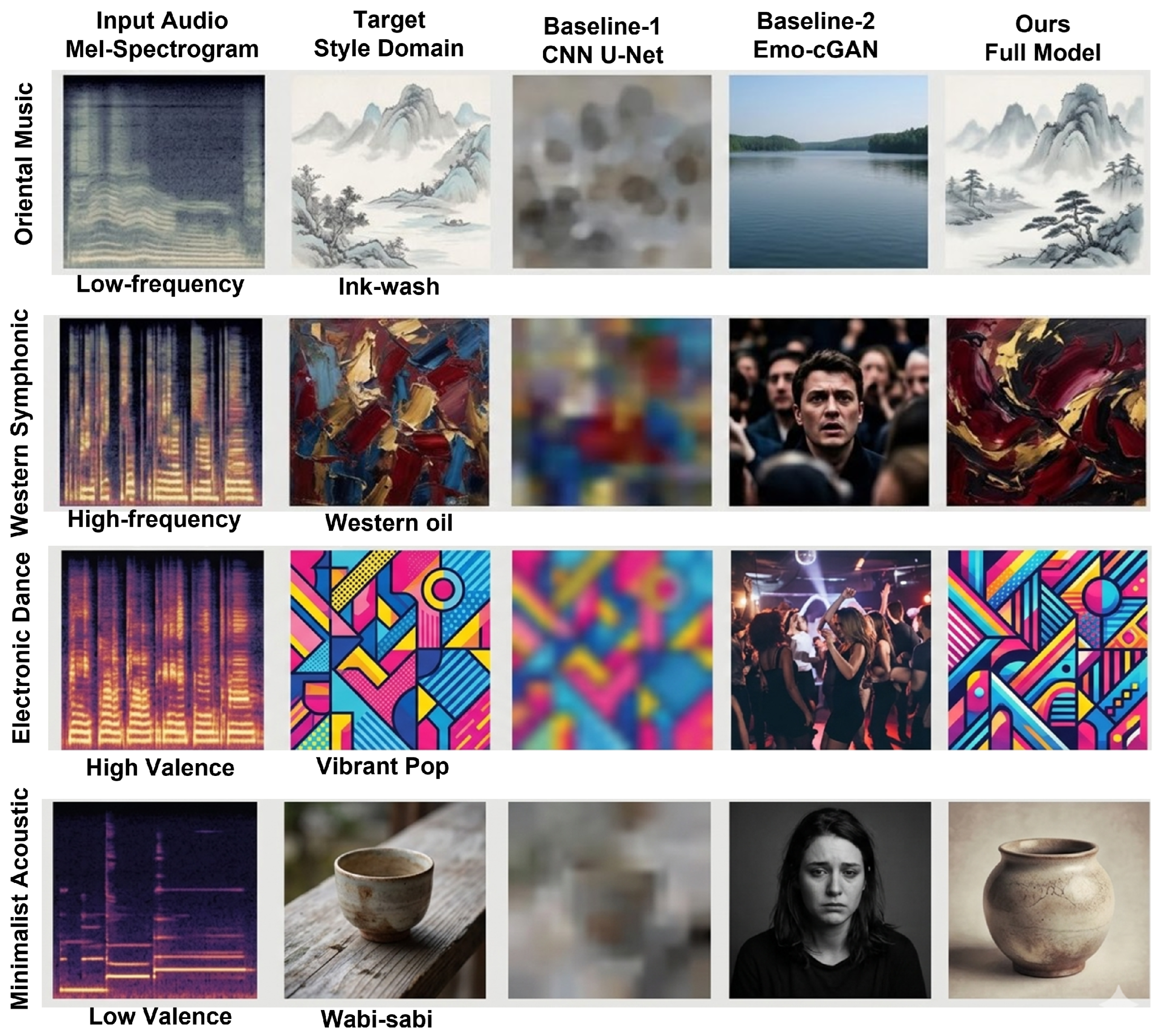
Baseline-1 (CNN U-Net): a model that directly maps Mel spectrograms to images using a U-Net without explicit component or style disentanglement.
Baseline-2 (Emotion-conditioned GAN): a conditional GAN that takes spectrograms and VA labels as input and generates images conditioned only on emotion, without component transfer.
Ours (full): the proposed hybrid synesthesia model with component and style modules and emotion loss.
Our full model achieves the lowest FID (best visual quality), highest style accuracy, and significantly lower VA MSE than both baselines. Including component transfer and emotion consistency loss improves the correlation between audio and image VA predictions, indicating better cross-modal emotional alignment.
4.3.2. Ablation Study
To understand the contribution of each component, we evaluate several ablated variants:
w/o component: remove the component transfer network, directly feeding audio content features into the image decoder.
w/o style: remove the style alignment network, using only image style priors or random style codes.
w/o emotion: remove the emotion consistency loss .
Removing the component module significantly degrades FID and component correlation metrics, indicating that explicit component mapping is crucial for coherent low-level cross-modal structure. Removing the style module reduces style classification accuracy and leads to more ambiguous art styles in generated images. Removing emotion loss deteriorates VA consistency while having less impact on FID, confirming that emotional alignment is specifically enforced by .
4.4. Qualitative Analysis
Figure 4 shows representative examples of audio-to-image transfers. For Oriental music clips, the model tends to produce images with ink-like textures, soft edges, and limited color palettes, consistent with traditional ink-and-color landscape styles. For Western symphonic excerpts, the generated images often exhibit richer color palettes, more pronounced brush strokes, and structured compositions reminiscent of Western oil paintings.
We also inspect the effect of manipulating specific audio components. When we artificially increase spectral brightness or F0 variability while keeping VA constant, the generated images shift toward higher color saturation or more complex shapes, while their overall emotional tone (e.g., calm vs. tense) remains similar. This suggests that the model has learned meaningful component-level correspondences between audio and visual features.
4.5. User Study
We conducted a perceptual user study with participants (age 20–32 years, mean = 24.7; 10 female, 14 male). All participants were non-experts in visual arts and music production but reported normal hearing and normal or corrected-to-normal vision. None of them had prior exposure to our model or stimuli.
Each participant completed two tasks in a quiet lab environment using headphones and a calibrated display. In Task 1 (emotion matching), each trial presented a 6 s audio clip together with three candidate images generated by Baseline-1, Baseline-2, and our method (order randomized per trial and per participant). Participants were asked: “Which image best matches the emotional impression of the audio?” and responded by clicking one of the three images. Each participant completed 30 trials in Task 1, with audio clips sampled without replacement from the test set; clip and condition order were fully randomized.
In Task 2 (synesthetic plausibility), the procedure was similar, but the question was: “If this music were a painting, which image would it most likely look like?” Again, each participant completed 30 trials with randomized ordering. We discarded trials with response times below 0.5 s as inattentive (on average <2% of trials) and recomputed preference percentages after exclusion.
We report mean preference percentages across participants together with 95% confidence intervals (CIs) estimated using the t-distribution. For each comparison between our method and a baseline, we perform a binomial test over aggregated choices; all reported improvements are statistically significant at unless otherwise noted.
6. Conclusions
This paper presents a novel deep hybrid synesthesia model for cross-modal artistic style transfer between audio and images, grounded in neuroscientific principles of sensory-emotional integration. By learning emotion-aware mappings in a continuous valence–arousal (VA) space, our framework successfully bridges low-level components (audio rhythm/spectrum ↔ image color/shape) and high-level styles (Eastern shui-mo ink-wash ↔ Western painting, traditional Oriental ↔ symphonic music). Extensive experiments demonstrate that the model generates perceptually coherent cross-modal artworks: audio-to-image synthesis (“seeing the sound”) achieves controllability over visual components (e.g., spectral brightness → color saturation), while full style transfer preserves emotional content (54% lower VA-MSE than baselines) and stylistic authenticity (85.9% style accuracy). Human evaluations confirm strong synesthetic plausibility, with 63% preference for emotion/style consistency. This work establishes emotion as a unifying substrate for multimodal creativity, enabling machines to reinterpret artistic expression beyond unimodal constraints. To facilitate further research on cross-modal affective transfer, we plan to publicly release the core implementation of our model together with the VA-binned alignment metadata (subject to the licensing constraints of the underlying DEAM, IAPS, NAPS, and EMOTIC datasets), so that other researchers can reproduce and extend our experiments.