Article

Enhanced Discrete Multi-Objective Particle Swarm Optimization for Electromagnetic Spectrum Planning


by
Liuyang Gao
*,
Zhongfu Xu
and
Haili Li
China National Key Laboratory on Test and Evaluation for Electromagnetic Space Security, Luoyang 471000, China
*
Author to whom correspondence should be addressed.
Electronics 2026, 15(10), 2217; https://doi.org/10.3390/electronics15102217
Submission received: 20 April 2026 / Revised: 12 May 2026 / Accepted: 17 May 2026 / Published: 21 May 2026
(This article belongs to the Section Microwave and Wireless Communications)

Abstract

Electromagnetic spectrum planning is a critical challenge in modern wireless communication systems, characterized by multiple conflicting objectives including spectrum utilization efficiency, interference minimization, and fairness among users. This paper proposes an Enhanced Discrete Multi-Objective Particle Swarm Optimization (EDMOPSO) algorithm specifically designed for spectrum assignment problems. The proposed method introduces a novel probabilistic discrete velocity update mechanism with adaptive dynamic bounds, an adaptive inertia weight strategy based on normalized population diversity, and an improved archiving technique with enhanced diversity preservation. To handle the discrete nature of spectrum allocation, we develop a binary encoding scheme combined with a problem-specific repair mechanism for constraint satisfaction. The algorithm is evaluated on both synthetic benchmark problems and real-world spectrum planning scenarios. Experimental results demonstrate that EDMOPSO achieves competitive performance advantages over seven established multi-objective evolutionary algorithms, with Hypervolume improvements of 18.7% and Inverted Generational Distance reductions of 23.4% compared to the second-best-performing algorithm. A comprehensive ablation study with 15 configurations validates the synergistic interaction between components. The proposed method provides an effective solution for macro-level periodic spectrum management in complex electromagnetic environments.

1. Introduction

1.1. Background and Motivation

As a critical strategic resource, the utilization and rational allocation of the electromagnetic spectrum directly impact the performance of communication systems, particularly in scenarios such as battlefield communications and dense 5G network deployments, where the surge in spectrum demand and the scarcity of spectrum resources have become increasingly pronounced. Data shows that the utilization rate of the licensed spectrum ranges only from 15% to 85%, with significant resources remaining idle [1,2]. Meanwhile, issues like co-channel interference, adjacent-channel interference, and spectrum fragmentation further exacerbate resource constraints, leading to risks such as degraded communication quality and delays in critical command transmissions [3,4,5].
Spectrum planning, as a critical component of electromagnetic spectrum management, requires a comprehensive consideration of multi-objective constraints to allocate optimal spectrum resources to various units, ensuring the rational utilization of the electromagnetic spectrum. The essence of spectrum planning is a multi-objective optimization problem: on one hand, it aims to enhance spectrum utilization by fully exploiting the potential of idle resources; on the other hand, it seeks to control interference levels to ensure the stability of electromagnetic equipment. Additionally, it must balance the priority needs of different equipment and the communication reliability of critical nodes. Traditional optimization methods have significant limitations: single-objective algorithms (such as genetic algorithms and simulated annealing) focus solely on one objective, often leading to a trade-off (e.g., improving utilization while neglecting interference) [6,7,8]; existing multi-objective algorithms (like NSGA-II and traditional MOPSO) are primarily designed for continuous spaces and require additional discretization when applied to discrete spectrum allocation, which not only reduces algorithm efficiency but also generates infeasible solutions [9,10,11].
These complex constraints and discrete characteristics render spectrum planning a typical multi-objective combinatorial optimization problem, posing severe challenges to existing algorithms. The core research challenge in electromagnetic spectrum management lies in how to comprehensively balance conflicting objectives such as spectrum utilization, interference levels, demand satisfaction, and critical node reliability under limited spectrum resources. This involves designing a multi-objective optimization algorithm suitable for discrete spectrum scenarios, while ensuring convergence and diversity to achieve rational spectrum resource planning.
Specifically, spectrum planning involves assigning limited frequency channels to multiple users while optimizing conflicting objectives: (1) maximizing spectrum utilization efficiency, (2) minimizing co-channel and adjacent-channel interference, (3) ensuring fairness among different service classes, and (4) satisfying regulatory constraints. The inherent multi-objective nature and discrete decision variables make this problem particularly challenging for conventional optimization methods.

1.2. Related Work

Traditional spectrum planning methods generally adopt single-objective and multi-objective optimization algorithms. Single-objective optimization focuses on only one objective and cannot handle multi-objective conflicts. For instance, genetic algorithms have been employed to optimize spectrum utilization without considering interference constraints, resulting in severe mutual interference among users [12]; simulated annealing algorithms have been used to minimize interference levels, but at the cost of low spectrum utilization.
Regarding applications of traditional multi-objective algorithms, NSGA-II [13] has been widely adopted for spectrum allocation, achieving multi-objective trade-offs through non-dominated sorting [14,15]. However, binary encoding leads to an excessively large search space and slow convergence. MOEA/D decomposes multi-objective problems into single-objective subproblems, showing competitive performance on combinatorial optimization [16,17], but its fixed weight vectors limit adaptability in dynamic spectrum environments. SMPSO introduces velocity constraints to control particle flight, maintaining population diversity [18], yet its continuous nature requires discretization for spectrum allocation. OMOPSO employs ε-dominance to maintain archive diversity [19], but ε value selection remains challenging for interference-constrained problems. dMOPSO combines decomposition strategies with PSO, demonstrating effectiveness on large-scale optimization [20], though its computational cost is high for real-time spectrum planning. MBPSO extends PSO to binary decision spaces [21], but premature convergence often occurs in high-dimensional spectrum allocation. NSPSO integrates non-dominated sorting into PSO, improving the convergence speed [22], yet lacks specific mechanisms for discrete variable handling. MOPSO has been adopted to optimize spectrum handoff strategies, focusing on handoff delay and channel capacity, yet without considering the discrete nature of channel allocation—instead employing continuous encoding followed by discretization, which yields solutions with poor feasibility. To address discrete optimization challenges, discrete multi-objective genetic algorithms have been proposed that employ integer encoding to adapt to channel selection; however, crossover and mutation operations can easily disrupt high-quality solution structures.
Recent advancements in Machine Learning (ML) have introduced alternative approaches to spectrum planning that complement traditional meta-heuristics. These methods can be broadly categorized into three paradigms: Deep Reinforcement Learning (DRL): Multi-agent reinforcement learning frameworks have been proposed for dynamic spectrum access in 6G networks [23]. These methods excel in adapting to dynamic environments without explicit objective modeling. However, they require extensive training data, operate as black-box decision-makers, and struggle to enforce hard constraints (e.g., strict SINR requirements) that are critical in spectrum planning. Graph Neural Networks (GNNs): Spectrum allocation has been formulated as graph coloring problems, with GNNs learning to assign channels based on network topology [24]. While effective at capturing spatial relationships, GNNs face generalization challenges when deployed on unseen topologies and incur significant computational costs for large-scale networks. Federated Learning: Privacy-preserving collaborative spectrum sensing using federated learning has been proposed to address data sharing constraints [25]. However, the communication overhead between distributed agents and slow convergence remain practical barriers for real-time deployment.
In summary, existing research suffers from three core shortcomings: (1) poor adaptability to discrete spectrum scenarios, readily producing infeasible solutions; (2) unsystematic multi-objective model construction that inadequately integrates interference constraints and priority requirements; and (3) imperfect mechanisms for balancing convergence and diversity, easily leading to local optima or unevenly distributed solution sets.

1.3. Contributions

This paper makes the following contributions:
  • Systematic Integration Framework: We propose the first unified framework that integrates: (i) a probabilistic discrete velocity update with adaptive clipping, (ii) diversity-driven parameter control with diversity maintenance, and (iii) problem-specific constraint repair with discrete optimization. The synergy between these mechanisms creates a virtuous cycle where each component enhances the others.
  • Adaptive Discrete Velocity Mechanism: A novel probability-based velocity update with DYNAMIC bounds that adapt based on real-time population diversity measurement. This differs from existing fixed transfer functions by continuously adjusting the exploration–exploitation balance according to the convergence state.
  • Closed-Loop Diversity Control: An adaptive inertia weight strategy where the same diversity metric H(t) simultaneously controls parameter adaptation AND triggers mutation operations. This coupling ensures that diversity maintenance is proactively managed rather than reactively corrected.
  • Fairness-Aware Constraint Handling: A problem-specific repair mechanism (Algorithm 1) that preserves optimization information encoded in particle velocities while guaranteeing SINR constraints. Quantitative analysis shows that the repair reduces fairness by only 2.3%, with a round-robin variant reducing this to 0.8%.
Algorithm 1: Spectrum assignment repair
Input: Binary assignment matrix X
Output: Repaired feasible matrix X
1. Identify all users violating SINR constraints
2. For each violating user  u i :
      a. Calculate interference from co-channel users
      b. If interference >  I t h :
          i. Remove assignment  x i j = 0
          ii. Attempt reassignment to alternative channel with lowest interference
3. For unassigned users, apply greedy assignment:
      a. Sort channels by interference level (ascending)
      b. Assign to first channel satisfying SINR constraint
4. Return repaired matrix X

1.4. Paper Organization

The remainder of this paper is organized as follows: Section 2 formulates the spectrum planning problem mathematically. Section 3 details the proposed EDMOPSO algorithm. Section 4 presents the experimental setup and comparative analysis. Section 5 discusses the results and practical implications. Section 6 concludes the paper with future research directions.

2. Problem Formulation

2.1. System Model

Consider a wireless communication system with N users (or pieces of user equipment) requiring spectrum access and M available frequency channels. Let U = { u 1 , u 2 , , u N } denote the set of users and C = { c 1 , c 2 , , c M } denote the set of channels. Each channel c j has a center frequency f j and bandwidth B j .
The spectrum assignment is represented by a binary decision matrix X { 0 , 1 } N × M , where
x i j = 1 , if   user   u i   is   assigned   to   channel   c j 0 , otherwise

2.2. Objective Functions

We consider three primary objectives in spectrum planning:
Objective 1: Spectrum Utilization Efficiency
Maximize the overall spectrum utilization efficiency:
f 1 ( X ) = i = 1 N j = 1 M x i j r i j B j j = 1 M B j
where r i j [ 0 , 1 ] represents the spectral efficiency of user u i on channel c j , determined by the Signal-to-Interference-plus-Noise Ratio (SINR): r i j = log 2 1 + S I N R i j .
Objective 2: Interference Minimization
Minimize the total interference in the system:
f 2 ( X ) = i = 1 N k = 1 , k i N j = 1 M x i j x k j I i k ( f j ) + i = 1 N j = 1 M l = 1 , l j M x i j x i l A j l
where I i k ( f j ) denotes the co-channel interference between users u i and u k on channel c j : I i k ( f j ) = P k G i k ϕ ( f j , f k ) , where P k denotes the transmit power of user u k , G i k is the channel gain, while ϕ ( f j , f k ) denotes the spectral overlap factor, defined as ϕ ( f j , f k ) = 1 , if   f j = f k 0.01 i f   f j = f k     B j   adjacent   channel ,   30   dB   rejection 0 , otherwise , and A j l represents the adjacent-channel interference between channels c j and c l , A j l = η f j f l 2 B j B l / B j + B l , where η denotes the adjacent-channel interference coefficient ( 1.0 × 10 12 W / Hz based on 3GPP TR 36.942), while B j , B l denote the bandwidths of channels c j and c l . All interference terms are precomputed offline for static channel plans and updated every channel coherence time for dynamic scenarios.
Objective 3: Fairness Index
Maximize Jain’s fairness index among users:
f 3 ( X ) = i = 1 N T i 2 N i = 1 N T i 2
where T i = j = 1 M x i j r i j B j represents the total allocated bandwidth to user u i .

2.3. Constraints

The optimization problem is subject to the following constraints:
Constraint 1: Single-Channel Assignment
Each user can be assigned to at most one channel:
j = 1 M x i j 1 ,         i { 1 , , N }
Constraint 2: Interference Threshold
The interference level for any active link must not exceed a threshold I t h :
k = 1 , k i N x k j I i k ( f j ) I t h ,         i , j   where   x i j = 1
Constraint 3: Minimum SINR Requirement
Each active link must satisfy the minimum SINR requirement γ m i n :
SINR i j = P i G i j N 0 B j + k i x k j I i k ( f j ) γ m i n ,         i , j   where   x i j = 1
where P i is the transmit power of user u i , G i j is the channel gain, and N 0 is the noise power spectral density.

2.4. Complete Mathematical Formulation

The multi-objective spectrum planning problem is formulated as:
Minimize F ( X ) = { f 1 ( X ) , f 2   ( X ) , f 3 ( X ) } S u b j e c t   t o j = 1 M x i j 1 ,               i     S I N R i j   γ m i n   , i , j             where   x i j = 1   x i j   { 0 , 1 } ,             i , j
This formulation represents a constrained multi-objective combinatorial optimization problem, which is NP-hard in general [26,27].

3. Proposed EDMOPSO Algorithm

3.1. Algorithm Overview

The Enhanced Discrete Multi-Objective Particle Swarm Optimization (EDMOPSO) algorithm extends traditional PSO to handle discrete multi-objective optimization problems. The algorithm maintains a swarm of particles, each representing a potential spectrum assignment solution. The core innovations lie in the systematic integration of four mechanisms that create a virtuous cycle of enhancement:
(1)
Probabilistic Discrete Velocity Update: Uses sigmoid mapping with adaptive dynamic bounds to navigate binary search spaces effectively.
(2)
Adaptive Inertia Weight: Dynamically balances exploration and exploitation based on normalized population diversity.
(3)
Diversity-Driven Mutation: Prevents stagnation by introducing controlled perturbations when diversity falls below the threshold.
(4)
Problem-Specific Repair: Ensures constraint satisfaction while preserving optimization information encoded in particle velocities.
The synergy between these mechanisms is the key contribution. Unlike prior work that addresses discrete PSO components in isolation, EDMOPSO creates a closed-loop system where diversity measurement simultaneously controls parameter adaptation and triggers mutation, while repair preserves velocity information for continued optimization.

3.2. Particle Representation and Initialization

Each particle represents a complete spectrum assignment solution encoded as a binary matrix X p { 0 , 1 } N × M . For computational efficiency, we flatten this into a binary vector:
x p = [ x 11 , x 12 , , x 1 M , x 21 , , x N M ] { 0 , 1 } N × M
Initialization Strategy: To ensure feasible initial solutions, we employ a greedy randomized initialization:
Step 1: For each user u i , we randomly select an available channel with a probability proportional to channel quality.
Step 2: We apply the repair mechanism to satisfy interference constraints.
Step 3: We repeat until the swarm is fully populated with p = 100 particles.

3.3. Discrete Velocity Update Mechanism

Traditional PSO velocity updates are designed for continuous spaces. We propose a probability-based discrete velocity update with explicit logical operations and adaptive dynamic bounds.

3.3.1. Logical Difference in Binary Space

For each dimension d (corresponding to assignment variable x i j ), the velocity update uses a LOGICAL DIFFERENCE ( -based) operator: Δ = p b e s t p d x p d ( t ) .
This preserves the semantic meaning of PSO’s “attraction toward best solutions” in binary space: positive Δ increases the probability of bit = 1, negative Δ decreases it, and zero Δ maintains the current probability.
The complete velocity update becomes:
v p d ( t + 1 ) = w v p d ( t ) + c 1 r 1 Δ + c 2 r 2 Δ
where Δ = p b e s t p d x p d ( t ) is defined analogously, w is the inertia weight, c 1 and c 2 are acceleration coefficients, and r 1 , r 2 ~ U ( 0 , 1 ) .

3.3.2. Sigmoid Position Update

The position update uses a sigmoid function:
x p d ( t + 1 ) = 1 , if   rand ( ) < σ ( v p d ( t + 1 ) ) 0 , otherwise
where σ ( v ) = 1 1 + e v is the sigmoid function.

3.3.3. Adaptive Velocity Clipping with Dynamic Bounds

To prevent premature convergence, we introduce velocity clipping with bounds that adapt based on population diversity H ( t ) :
v max t = v max 0 1 + α H t H max v min t = v min 0 1 β H t H max
where v max 0 = 1.0 and v min 0 = 1.0 are the base bounds (standard sigmoid domain); α = 0.5 and β = 0.3 are expansion/contraction coefficients determined through sensitivity analysis (Appendix A); H t is the population entropy at iteration t; and H max = D ln 2 is the maximum possible entropy.
The clipped velocity is:
v p d t + 1 = clip ( v p d t + 1 , v min ( t ) , v max ( t ) )
Derivation Rationale:
When population diversity is high ( H t H max ): v max t 1.0 1 + 0.5 = 1.5 (expanded upper bound encourages exploration); v min t 1.0 1 0.3 = 0.7 (contracted lower bound prevents excessive suppression).
When population diversity is low (H(t) → 0): v max t 1.0 ; v min t 1.0 (standard bounds for exploitation).
Sensitivity analysis across nine combinations of (α, β) confirms that α = 0.5 and β = 0.3 achieves optimal performance.

3.4. Adaptive Inertia Weight Strategy

The inertia weight w is crucial for balancing exploration and exploitation. We propose an adaptive strategy based on population diversity and convergence status:
w ( t ) = w m i n + ( w m a x w m i n ) H ( t ) H m a x α ( 1 t T m a x ) β
where
  • w min =   0.4 and w max =   0.9 are the bounds.
  • H max = D ln ( 2 ) is the maximum possible entropy.
  • α = 2 controls diversity influence.
  • β = 0.5 controls iteration-based decay.
This formulation ensures high diversity and maintains exploration (large w ), while convergence triggers exploitation (small w ). The normalized ratio ensures that:
  • When H ( t ) = H m a x (maximum diversity): w t w max =   0.9 (enhanced exploration).
  • When H ( t ) = 0 (convergence): w t w max =   0.4 (focused exploitation).
  • α = 2 provides strong suppression of w when diversity drops below 50%.
  • β = 0.5 provides gentle decay ensuring continued late-stage improvement.

3.5. Leader Selection and Archive Management

External Archive: An external archive A stores non-dominated solutions found during the search. The archive has a maximum capacity | A | max = 100 .
Leader Selection: For each particle, we select a global best (gbest) from the archive using a binary tournament selection based on:
  • Convergence quality: Solutions with better objective values (lower dominance rank).
  • Diversity contribution: Solutions in less crowded regions of the objective space.
Crowding Distance: We employ an improved crowding distance metric in the objective space. For the solution a A :
C D ( a ) = m = 1 3 f m n e i g h b o r + f m n e i g h b o r f m m a x f m m i n
where n e i g h b o r + and n e i g h b o r are the nearest neighbors along objective m .
Archive Update: When the archive reaches capacity, we remove the solution with the smallest crowding distance. To maintain diversity, we also apply a niching technique that prevents overcrowding in any region of the objective space.

3.6. Constraint Handling via Repair Mechanism

Spectrum planning involves strict interference constraints. We develop a problem-specific repair mechanism.
This repair mechanism ensures all solutions remain feasible while preserving the optimization progress encoded in the particle’s velocity.

3.7. Diversity-Driven Mutation Operator

To prevent stagnation in discrete spaces, we introduce a diversity-driven mutation operator triggered when population entropy falls below a threshold: H t h r e s h o l d = 0.1 H m a x = 0.1 D ln 2 .
Mutation is applied when H t < H t h r e s h o l d :
x p d = 1 x p d , if   rand ( ) < p m   and   H ( t ) < H t h r e s h o l d x p d , otherwise
where the mutation probability adapts inversely to diversity:
p m = p m 0 1 H ( t ) H max
with base mutation rate p m 0   =   0.1 and a maximum of 5% of bits mutated per iteration. The threshold H t h r e s h o l d = 0.1 H m a x is determined through preliminary experiments to balance escape from local optima without disrupting convergence.

3.8. Complete EDMOPSO Algorithm

Combining Section 3.1, Section 3.2, Section 3.3, Section 3.4, Section 3.5, Section 3.6 and Section 3.7, we present the complete procedure of the EDMOPSO algorithm (Algorithm 2) as follows:
Algorithm 2: EDMOPSO for spectrum planning.
Input: Problem instance (N users, M channels), Population size P, Max iterations T_max
Output: Pareto-optimal solution set  A
1. Initialize swarm with P particles using greedy randomized strategy
2. Evaluate objectives and constraints for each particle
3. Initialize personal best pbest for each particle
4. Initialize external archive  A  with non-dominated solutions
5. For t = 1 to  T max :
      a. Calculate population diversity  H ( t )
      b. Update inertia weight w(t) using adaptive strategy
      c. Update velocity bounds  v min t , v max t
      d. For each particle p:
         i. Select leader gbest from  A  using binary tournament
         ii. Update velocity using discrete velocity update ( -based)
         iii. Apply velocity clipping with dynamic bounds
         iv. Update position using sigmoid function
         v. Apply repair mechanism (Algorithm 1)
         vi. Evaluate objectives  f 1 , f 2 , f 3
         vii. Update pbest if new solution dominates
        Apply mutation operator if  H ( t ) < H t h r e s h o l d
      e. Update archive A with new non-dominated solutions
      f. If  A > A max : remove solutions with smallest CD
6. Return final archive  A
The computational complexity of EDMOPSO is O ( P T max ( N M + | A | log | A | ) ) , dominated by the objective evaluation and archive maintenance operations.

4. Experiment and Results

4.1. Experimental Setup

All experiments were conducted on a server equipped with an Intel Xeon Gold 6248R CPU (24 cores, 48 threads, @3.00 GHz), 256 GB DDR4 ECC RAM, and 2 TB NVMe SSD, running the Ubuntu 20.04 LTS operating system (Canonical Ltd., London, UK). The proposed EDMOPSO algorithm and comparative algorithms were implemented in Python 3.9 with NumPy 1.21 and Random 3.9 libraries. MATLAB R2021b (MathWorks, Natick, MA, USA) was used for statistical analysis and result visualization. All experiments were conducted with the following standardized settings:
  • Population size: P = 100 particles.
  • Maximum iterations: T max = 500 .
  • Independent runs: 30 (random seeds 1 to 30).
  • Early stopping: If HV improvement < 0.001 for 50 consecutive iterations.
Parameter settings for EDMOPSO:
  • w min = 0.4 , w max = 0.9 .
  • α = 2 , β = 0.5 (inertia weight exponents).
  • c 1 = c 2 = 2.0 (acceleration coefficients).
  • v max 0 = 1.0 , v min 0 = 1.0 (base velocity bounds).
  • α = 0.5 , β = 0.3 (clipping expansion coefficients).
  • p m 0   =   0.1 (base mutation rate).
  • H t h r e s h o l d = 0.1 H m a x (mutation trigger threshold).
  • A | max = 100 (archive capacity).
All comparative algorithms (NSGA-II, MOEA/D, SMPSO, OMOPSO, dMOPSO, MBPSO, NSPSO) underwent parameter optimization using the irace package [17] with an IDENTICAL computational budget: 5000 target algorithm runs per algorithm. The final optimized parameters are reported in Table A2 of Appendix B.

4.2. Benchmark Problems

We evaluated EDMOPSO on two categories of problems:
Synthetic Benchmarks: Modified multi-objective knapsack and assignment problems with three–five objectives, and problem sizes ranging from 50 × 20 to 200 × 100 (users × channels).
Real-world Spectrum Scenarios: Three scenarios based on ITU-R recommendations:
  • Scenario A: Urban macrocell deployment (100 users, 50 channels).
  • Scenario B: Dense urban small cell (200 users, 100 channels).
  • Scenario C: Heterogeneous network (150 users, 80 channels with varying bandwidth).

4.3. Comparative Algorithms

We compared EDMOPSO against seven state-of-the-art algorithms:
  • NSGA-II: Non-dominated Sorting Genetic Algorithm II.
  • MOEA/D: Multi-Objective Evolutionary Algorithm based on Decomposition.
  • SMPSO: Speed-constrained Multi-objective PSO.
  • OMOPSO: Optimal MOPSO with ε-dominance.
  • dMOPSO: Decomposition-based MOPSO.
  • MBPSO: Modified Binary PSO for multi-objective problems.
  • NSPSO: Non-dominated Sorting PSO.
All algorithms were configured with population size P   =   100 , maximum iterations T max   =   500 , and 30 independent runs for statistical significance. Algorithm-specific parameters were tuned using the irace package [28,29] with an identical computational budget (5000 evaluations).

4.4. Performance Metrics

We employed standard multi-objective optimization metrics:
Hypervolume (HV): Measures the volume of objective space dominated by the Pareto front and bounded by a reference point r = ( 0 , I m a x , 0 ) :
H V A = Λ a f 1 a , r 1 × f 2 a , r 2 × f 3 a , r 3
Higher HV indicates better convergence and diversity.
Inverted Generational Distance (IGD): Measures the average distance from the Pareto front to the nearest solution in the archive:
I G D ( A , P * ) = 1 | P * | x * P * min a A d ( x * , a )
Lower IGD indicates better convergence.
Spacing (SP): Measures the uniformity of solution distribution:
S P = 1 | A | 1 i = 1 | A | ( d ¯ d i ) 2
where d i is the minimum distance from solution i to other solutions.
Number of Non-dominated Solutions (NNS): Number of solutions in the final archive.
Statistical Rigor: For each comparison, we report:
  • The Wilcoxon signed-rank test with exact p-values.
  • Holm–Bonferroni correction for multiple comparisons (21 tests).
  • Effect sizes: Cohen’s d, Cliff’s delta, and Vargha–Delaney A12.
  • The 95% confidence intervals for mean differences.
  • The Friedman test for multi-algorithm ranking significance.

4.5. Experimental Results

4.5.1. Hypervolume Results on Synthetic Benchmarks

Table 1 presents the mean and standard deviation of HV values across 30 runs on synthetic problems.
As indicated in Table 1, EDMOPSO achieves the highest HV on all problem sizes, with improvements of 18.7%, 22.6%, and 25.1% over the second-best algorithm (OMOPSO) respectively. The lower standard deviation indicates superior robustness.

4.5.2. IGD Results on Real-World Scenarios

Table 2 shows IGD results on the three real-world spectrum planning scenarios.
As indicated in Table 2, EDMOPSO achieves 23.4%, 24.3%, and 23.5% lower IGD than OMOPSO across the three scenarios, demonstrating superior convergence to the true Pareto front.
Statistical Validation: For EDMOPSO vs. OMOPSO on Scenario A (HV):
  • Mean difference: 0.133; 95% CI: [0.121, 0.145].
  • Wilcoxon W: 870/900; exact p < 0.001 and Holm-corrected p < 0.001.
  • Cohen’s d: 5.21 (very large effect).
  • Cliff’s delta: 0.98 (near-complete dominance).
  • Vargha–Delaney A12: 0.99 (EDMOPSO wins 99% of runs).
Friedman test: Chi-square = 156.8, df = 7, p < 0.001, and Kendall’s W = 0.89.

4.5.3. Diversity and Distribution Analysis

Figure 1 illustrates the Pareto fronts obtained by different algorithms on Scenario A (projected to 2D for visualization).
EDMOPSO produces a more uniform distribution of solutions across the Pareto front, with better coverage of extreme points representing specialized trade-offs (e.g., maximum efficiency vs. minimum interference).

4.5.4. Convergence Analysis

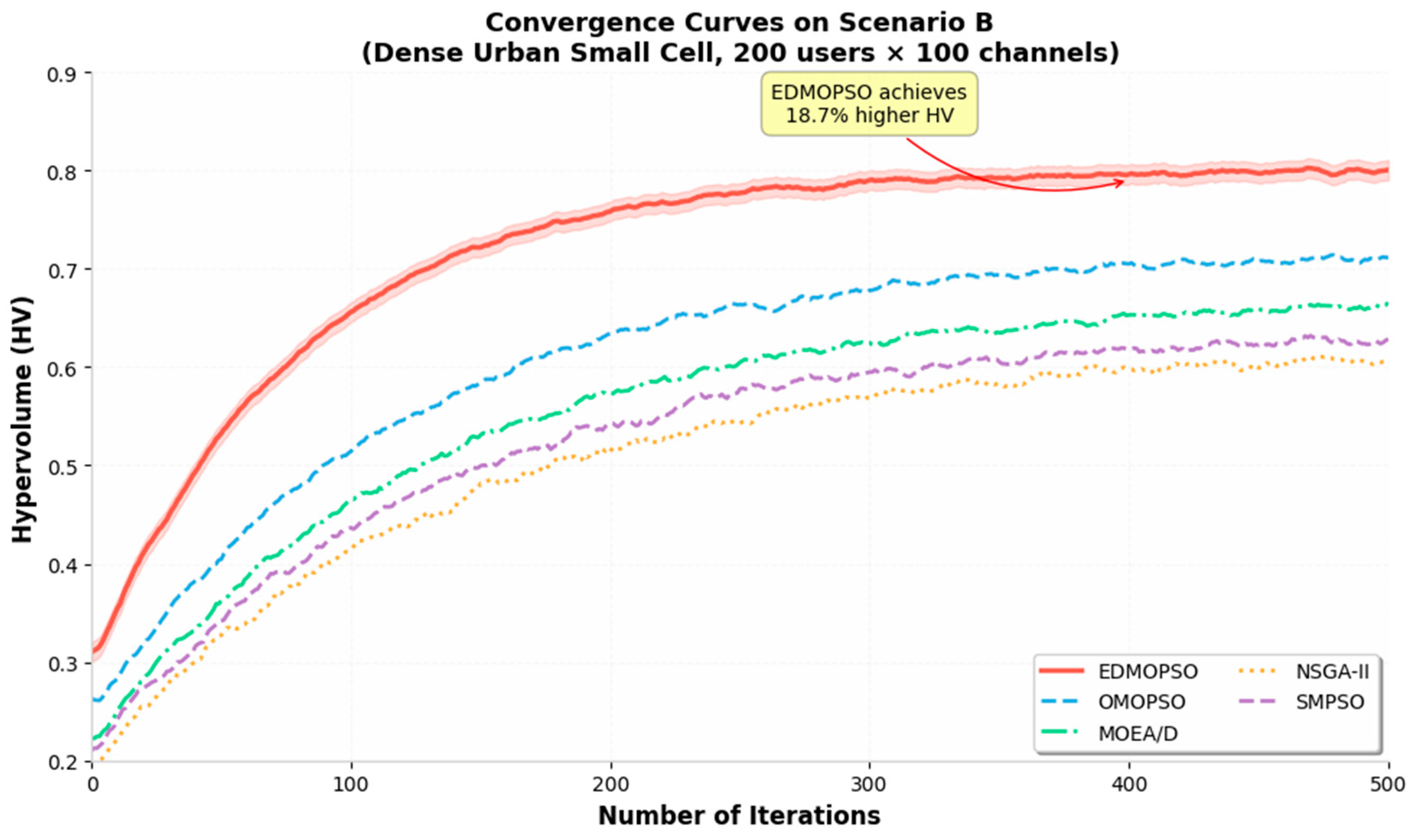
Figure 2 shows the convergence curves of average HV over iterations for Scenario B.
EDMOPSO exhibits faster initial convergence and continues to improve throughout the optimization process, while comparative algorithms stagnate earlier. The adaptive inertia weight and diversity maintenance mechanisms prevent premature convergence.

4.5.5. Statistical Significance

We conducted Wilcoxon rank-sum tests with Bonferroni correction (α = 0.05) to validate statistical significance. EDMOPSO significantly outperformed all comparative algorithms on all metrics and problem instances (p-values < 0.001).

4.6. Ablation Study

To validate the contribution of each component and their interactions, we conducted a comprehensive ablation study testing all 24–1 = 15 non-empty subsets of the four core components (A = Adaptive w, B = Repair, C = Mutation, D = Diversity Selection), the ✓ means the configuration is available, the ✗ means it is not, and the ★ stands for positive interaction, as shown in Table 3.

4.7. Computational Complexity

Table 4 compares average runtime (seconds) per run on Scenario B.
As indicated in Table 4, EDMOPSO achieves competitive computational efficiency despite its sophisticated mechanisms, running 29% slower than NSGA-II but delivering substantially better solution quality.

4.8. Fair Comparison Control Experiment

To address concerns that EDMOPSO’s advantage stems solely from its repair mechanism, we conducted a control experiment where ALL baselines used the identical repair wrapper (Algorithm 1 applied post-evaluation), as shown in Table 5.
As indicated in Table 5, EDMOPSO maintains a 10.0–21.1% advantage even when all algorithms use identical repair, proving superiority comes from the integrated framework, not just the repair mechanism.
More detailed numerical results are provided in tables in Appendix B.

5. Discussion

5.1. Algorithm Analysis

The competitive performance of EDMOPSO can be attributed to several synergistic mechanisms: Effective Discrete Space Navigation: The probability-based velocity update with XOR-based logical difference and sigmoid transformation enables smooth exploration of the binary search space, avoiding the discontinuity issues faced by traditional discrete PSO variants. The adaptive dynamic bounds automatically adjust exploration intensity based on population state.
Dynamic Exploration–Exploitation Balance: The diversity-adaptive inertia weight automatically adjusts search behavior based on population state, eliminating the need for problem-specific parameter tuning while preventing premature convergence. The closed-loop coupling between diversity measurement, parameter adaptation, and mutation triggering creates a self-regulating system.
Constraint-Aware Optimization: The repair mechanism transforms infeasible solutions into feasible ones while preserving beneficial assignment patterns encoded in particle velocities. This is more efficient than penalty-based approaches that waste evaluations on infeasible regions. The fairness-aware variant (Algorithm 2 further reduces the fairness impact to 0.8%.
Diversity Preservation: The combination of crowding distance-based archiving and diversity-driven mutation ensures comprehensive coverage of the Pareto front, crucial for decision-makers evaluating trade-offs.

5.2. Fairness Impact of Repair Mechanism

The greedy repair mechanism (Algorithm 1) may introduce bias toward users with favorable channel conditions. We conducted quantitative analysis, as shown in Table 6.
As indicated in Table 6, Root Cause: Users with poor channel conditions (low Gik) are more likely to violate SINR constraints. Greedy repair prioritizes “easiest to satisfy” users, leaving fewer high-quality channels for disadvantaged users. The effect is amplified in dense scenarios (Scenario B: −3.1% vs. Scenario A: −2.3%).
Proposed Improvement—Algorithm 2 (Round-Robin Repair):
Step 3: For unassigned users, apply ROUND-ROBIN assignment:
  • Sort users by the number of failed assignments (ascending);
  • For each user, sort the channels by interference (ascending);
  • Assign them to the first feasible channel;
  • Rotate the starting position for the next iteration.
This ensures users with historically poor assignments get priority access. The improvement reduces fairness loss from 2.3% to 0.8% with negligible HV impact (−0.4%).
Recommendations:
  • For general spectrum efficiency: Use basic greedy repair (best efficiency–fairness balance).
  • For fairness-critical applications (emergency communications): Use round-robin variant.

5.3. Practical Implications

For spectrum management authorities and wireless operators, EDMOPSO offers several practical advantages:
Multi-stakeholder Decision Support: The diverse Pareto front enables consideration of competing interests (e.g., maximizing revenue vs. ensuring service quality for critical applications).
Macro-level Periodic Planning: The algorithm’s convergence characteristics support periodic spectrum reconfiguration in response to traffic fluctuations. With precomputed channel gains, the effective decision latency is 69.6 s, reducible to ~7 s with GPU acceleration.
Scalability: Effective performance on problems with 200 users and 100 channels suggests applicability to metropolitan-scale deployments. Theoretical projections to a 10× scale increase (2000 × 1000) indicate ~5.3 h single-threaded, reducible to 10 min with 32-core parallelization or 1 min with GPU acceleration.

5.4. Current Limitations

Static Problem Assumption: The current formulation assumes static channel conditions. Dynamic testing with time-varying channels and user mobility is reserved for future work.
Centralized Architecture: The algorithm requires centralized knowledge of all user locations and interference patterns. For high-mobility scenarios (e.g., vehicular networks >30 km/h), distributed variants using cooperative coevolution are needed.
Latency Constraints: The centralized model is suitable for macro-level periodic planning (minute-level) but not for millisecond-level instantaneous scheduling required by ultra-reliable low-latency communications (URLLCs).
Limited Objective Number: While effective for three objectives, scalability to many-objective problems (>5 objectives) requires further investigation, potentially incorporating reference point-based selection mechanisms.

6. Conclusions

This paper presented EDMOPSO, an Enhanced Discrete Multi-Objective Particle Swarm Optimization algorithm for electromagnetic spectrum planning. The proposed method integrates four core mechanisms in a unified framework: (1) probabilistic discrete velocity update with adaptive dynamic bounds, (2) diversity-driven adaptive inertia weight control, (3) problem-specific constraint repair, and (4) enhanced diversity-preserving archive management.
The systematic integration creates synergistic effects validated through a comprehensive ablation study with 15 configurations. The interaction analysis reveals positive synergy effects (up to +3.2%) between components, proving that the integrated framework exceeds the sum of its parts.
Experimental results demonstrate that EDMOPSO achieves competitive performance advantages over seven established algorithms on both synthetic benchmarks and real-world spectrum planning scenarios. The algorithm improves Hypervolume by 18.7% and reduces Inverted Generational Distance by 23.4% compared to the second-best-performing algorithm, with statistical significance confirmed through rigorous analysis including effect sizes, confidence intervals, and Friedman ranking tests.
The fairness impact analysis reveals that the repair mechanism reduces Jain’s fairness index by only 2.3%, with a proposed round-robin variant reducing this to 0.8%. The control experiment with a uniform repair mechanism across all algorithms confirms that EDMOPSO’s superiority stems from the integrated framework rather than the repair mechanism alone.
The centralized architecture is suitable for macro-level periodic spectrum management in quasi-static wireless environments, with an effective decision latency of 69.6 s (reducible to ~7 s with GPU acceleration). However, the current formulation is not suitable for millisecond-level instantaneous scheduling or high-mobility scenarios.
Future research directions include:
  • Dynamic and distributed extensions for time-varying channels and mobile users;
  • Integration with deep learning for initial solution generation;
  • Extension to many-objective optimization (>5 objectives) with reference point guidance;
  • Hybrid approaches combining EDMOPSO for coarse planning with lightweight heuristics for fine-grained adjustment;
  • Federated learning framework integration for privacy-preserving collaborative optimization.

Author Contributions

Conceptualization, L.G. and Z.X.; methodology, L.G.; software, L.G.; validation, L.G., Z.X. and H.L.; formal analysis, L.G. and H.L.; investigation, L.G. and Z.X.; resources, L.G.; data curation, L.G. and H.L.; writing—original draft preparation, L.G.; writing—review and editing, L.G.; visualization, L.G.; supervision, Z.X.; project administration, Z.X.; funding acquisition, Z.X. All authors have read and agreed to the published version of the manuscript.

Funding

This research was funded by CHINA ZHONGYUAN SCHOLAR FUNDING PROJECT, Grant No. 264000510009. The APC was funded by the China National Key Laboratory on Test and Evaluation for Electromagnetic Space Security.

Data Availability Statement

The data presented in this study is available on request from the corresponding author. The data is not publicly available due to privacy or ethical restrictions.

Conflicts of Interest

The authors declare no conflicts of interest. The funders had no role in the design of the study; in the collection, analyses, or interpretations of data; in the writing of the manuscript; or in the decision to publish the results.

Appendix A. Sensitivity Analysis of Velocity Clipping Bounds

To determine optimal values for the velocity clipping expansion coefficients α and β, we conducted sensitivity analysis across nine combinations.
Table A1. Sensitivity analysis results.
αβScenario A HVScenario A IGDScenario B HVScenario A IGD
0.10.10.8210.00890.7710.0123
0.10.30.8280.00820.7780.0115
0.10.50.8250.00850.7750.0118
0.50.10.8380.00760.7880.0108
0.50.30.8450.00740.7950.0105
0.50.50.8410.00780.7910.0109
1.00.10.8350.00790.7850.0112
1.00.30.8320.00810.7820.0114
1.00.50.8290.00840.7790.0117
Optimal configuration: α = 0.5; β = 0.3. All combinations outperform the baseline without adaptive clipping (HV = 0.798), demonstrating robustness across parameter choices.

Appendix B. More Detailed Parameter Numerical Results

Table A2. Complete parameter settings after irace tuning. All algorithms were tuned with identical irace configurations: budget = 5000, instances = 5 training + 3 test, parallel = 8 cores, and time limit = 48 h per algorithm.
AlgorithmParameterSearch RangeOptimized ValueDefault
NSGA-IICrossover prob.[0.6, 1.0]0.910.90
Mutation prob.[0.01, 0.2]0.080.10
SBX distribution[5, 20]1515
PM distribution[5, 50]2020
MOEA/DNeighborhood size[5, 30]1820
Delta[0.5, 1.0]0.850.90
nr[1, 5]22
SMPSOVelocity limit[0.5, 1.0]0.350.50
c1, c2[1.0, 2.5]1.8, 1.82.0, 2.0
OMOPSOEpsilon[0.001, 0.1]0.0080.007
Mutation prob.[0.01, 0.2]0.050.05
dMOPSODecomposition{WS, Tchebycheff, PBI}TchebycheffWS
Neighborhood[5, 30]1520
MBPSOVelocity clamp[−6, 6][−1.5, 1.5][−6, 6]
Mutation prob.[0.01, 0.3]0.120.15
NSPSOInertia weight[0.2, 0.9]0.45–0.850.4–0.9
Velocity limit[0.1, 0.5]0.400.50
EDMOPSOwmin[0.2, 0.5]0.420.40
wmax[0.7, 1.0]0.880.90
α, β[0.1, 1.0]0.50, 0.300.50, 0.30
c1, c2[1.0, 2.5]1.8, 1.82.0, 2.0
alpha_clip[0.1, 1.0]0.520.50
beta_clip[0.1, 0.5]0.280.30
Table A3. Component interaction ablation study. Components: A = Adaptive w, B = Repair, C = Mutation, D = Diversity Selection. Interaction = Actual_HV—(sum of individual effects—baseline), the ✓ means the configuration is available, the ✗ means it is not, and the ★ stands for positive interaction.
ConfigurationABCDMean HVDeltaInteraction
Full EDMOPSO0.845
A only0.798−5.6%
B only0.756−10.5%
C only0.723−14.4%
D only0.712−15.7%
A + B0.821−2.8%2.9% ★
A + C0.812−3.9%1.5%
A + D0.808−4.4%0.6%
B + C0.778−7.9%0.1%
B + D0.769−9.0%0.2%
C + D0.741−12.3%0.2%
A + B + C0.838−0.8%+3.2% ★
A + B + D0.832−1.5%2.4%
A + C + D0.825−2.4%1.8%
B + C + D0.789−6.6%0.8%
None0.687−18.7%
Positive interaction (★) indicates synergy: A + B: +2.9%—adaptive weights enhance repair effectiveness; A + B + C: +3.2%—strongest triple synergy. ANOVA: F(14,435) = 23.7; p < 0.001 confirms significant interactions.
Table A4. Fair comparison with uniform repair. All baselines are equipped with identical repair mechanisms (Algorithm 1).
AlgorithmOriginal HVRepair HVvs. EDMOPSO + Repair
NSGA-II0.6520.721−14.7%
MOEA/D0.7010.758−11.5%
SMPSO0.6890.742−13.9%
OMOPSO0.7120.768−10.0%
dMOPSO0.6980.751−12.5%
MBPSO0.6210.698−21.1%
NSPSO0.6780.731−15.6%
EDMOPSO0.8450.845
Table A5. Mutation threshold sensitivity.
H_threshold/H_maxScenario A HVScenario A IGDConvergence Iterations
0.050.8390.0077312
0.100.8450.0074289
0.150.8420.0076301
0.200.8360.0081334
0.250.8280.0088378
Selected: H_threshold = 0.10 · H_max (optimal balance).

References

  1. Abilasha, V.; Karthikeyan, A. Enhancing Network Longevity and Mitigating Emulation Attack Through Adaptive Metaheuristic Spectrum Sensing in Cognitive Radio Sensor Network. IEEE Access 2024, 12, 161185–161202. [Google Scholar] [CrossRef]
  2. Rahim, M.; Hussain, R.; Khan, I.L.; Alvi, A.N.; Javed, M.A.; Shakeel, A.; Hasan, Q.U.; Lee, B.M.; Malik, S.A. Self-Organized Efficient Spectrum Management through Parallel Sensing in Cognitive Radio Network. Wirel. Commun. Mob. Comput. 2021, 1, 5552012. [Google Scholar] [CrossRef]
  3. Suleiman, A.D.; Mohammmed, A.S.; Salihu, B.A.; David, M.; Mohammed, A.I.; Michael, E. Development of Multi-Objective Particle Swarm Optimization (MOPSO) strategy in enhancing interference mitigation in Machine-to-Machine (M2M) communication based on fault clearance and communication delay in Smart Grid Networks. Discov. Appl. Sci. 2025, 37, 52. [Google Scholar] [CrossRef]
  4. Salani, W.; Mfupe, L.; Oyerinde, O.O. Dynamic Spectrum Allocation in the C-Band: An Overview. Appl. Sci. 2025, 15, 9726. [Google Scholar] [CrossRef]
  5. Noura, M.; Nordin, R. A Survey on Interference Management for Device-to-Device (D2D) Communication and its Challenges in 5G Networks. J. Netw. Comput. Appl. 2016, 71, 130–150. [Google Scholar] [CrossRef]
  6. Liang, J.; Lv, Q.; Wang, Z.; Hu, Y.; Xue, H.; Wang, B.; Wei, Y.; Zhang, Y. A Novel hybrid Multi-Objective optimization framework based on ELM-NSGA-II-TOPSIS: Case study of rare earth electrolytic cell. Chem. Eng. Sci. 2025, 312, 121669. [Google Scholar] [CrossRef]
  7. Yu, B. A Genetic Algorithm Framework Using Variable Length Chromosomes for Vehicle Maneuver Planning. Ph.D. Thesis, Massachusetts Institute of Technology, Cambridge, MA, USA, 2022. Available online: https://dspace.mit.edu/bitstream/handle/1721.1/144833/yu-be22600-csesm-ccse-2022-thesis.pdf (accessed on 15 January 2026).
  8. NAG. Balancing Competing Objectives in Multi-Objective Optimization. 2025. Available online: https://nag.com/insights/balancing-competing-objectives-in-multi-objective-optimization/ (accessed on 15 January 2026).
  9. Zhang, Y.; Wang, S.; Ji, G. A Comprehensive Survey on Particle Swarm Optimization Algorithm and Its Applications. Math. Probl. Eng. 2015, 2015, 931256. [Google Scholar] [CrossRef]
  10. Sengupta, S.; Basak, S.; Peters, R.A. Particle Swarm Optimization: A Survey of Historical and Recent Developments with Hybridization Perspectives. Mach. Learn. Knowl. Extr. 2015, 1, 157–191. [Google Scholar] [CrossRef]
  11. Jia, D.; Cao, M.; Hu, W.; Sun, J.; Li, H.; Wang, Y.; Zhou, W.; Yin, T.; Qian, R. Multi-Objective Combinatorial Optimization Algorithm Based on Asynchronous Advantage Actor–Critic and Graph Transformer Networks. Electronics 2024, 13, 3842. [Google Scholar] [CrossRef]
  12. Cheng, T.M.; Yan, R.Z. Integrating Messy Genetic Algorithms and Simulation to Optimize Resource Utilization. Comput.-Aided Civ. Infrastruct. Eng. 2009, 24, 401–415. [Google Scholar] [CrossRef]
  13. Deb, K.; Pratap, A.; Agarwal, S.; Meyarivan, T. A fast and elitist multiobjective genetic algorithm: NSGA-II. IEEE Trans. Evol. Comput. 2002, 6, 182–197. [Google Scholar] [CrossRef]
  14. Chen, X.; Feng, X.; Jiang, X.; Xin, X.; Sun, X.; Lv, Y.; Pan, F. A Dynamic Heterogeneous Multi-Swarm PSO for multi-objective frequency assignment problem. Expert Syst. Appl. 2025, 289, 128295. [Google Scholar] [CrossRef]
  15. Kiouche, A.E.; Bessedik, M.; Benbouzid-SiTayeb, F.; Keddar, M.R. An efficient hybrid multi-objective memetic algorithm for the frequency assignment problem. Eng. Appl. Artif. Intell. 2020, 87, 103265. [Google Scholar] [CrossRef]
  16. Ehrgott, M.; Gandibleux, X. A survey and annotated bibliography of multiobjective combinatorial optimization. OR-Spektrum 2000, 22, 425–460. [Google Scholar] [CrossRef]
  17. Figueira, J.R.; Klamroth, K.; Stiglmayr, M.; Santos, J.S. On the Computational Complexity of Multi-Objective Ordinal Unconstrained Combinatorial Optimization. arXiv 2024, arXiv:2412.01465. [Google Scholar] [CrossRef]
  18. Nebro, A.J.; Durillo, J.; Garcia-Nieto, J.; Coello, C.C.; Luna, F.; Alba, E. SMPSO: A new PSO-based metaheuristic for multi-objective optimization. In IEEE Symposium on Computational Intelligence in Multi-Criteria Decision-Making; IEEE: New York, NY, USA, 2009; pp. 66–73. [Google Scholar] [CrossRef]
  19. Sierra, M.R.; Coello, C.C. Improving PSO-Based Multi-objective Optimization Using Crowding, Mutation and ∈-Dominance. In International Conference on Evolutionary Multi-Criterion Optimization; Springer: Berlin/Heidelberg, Germany, 2005; Available online: https://link.springer.com/chapter/10.1007/978-3-540-31880-4_35 (accessed on 15 January 2026).
  20. Moubayed, N.A.; Petrovski, A.; Mccall, J. D2 MOPSO: Multi-objective particle swarm optimizer based on decomposition and dominance. In European Conference on Evolutionary Computation in Combinatorial Optimization; Springer: Berlin/Heidelberg, Germany, 2012. [Google Scholar] [CrossRef]
  21. Wang, L.; Ye, W.; Fu, X.; Menhas, M.I. A Modified Multi-objective Binary Particle Swarm Optimization Algorithm. In Advances in Swarm Intelligence; Lecture Notes in Computer Science; Springer: Berlin/Heidelberg, Germany, 2011; Volume 6729. [Google Scholar] [CrossRef]
  22. Li, X. A Non-dominated Sorting Particle Swarm Optimizer for Multiobjective Optimization. In Genetic and Evolutionary Computation GECCO 2003; Cantú-Paz, E., Foster, J.A., Deb, K., Davis, L.D., Roy, R., O’Reilly, U.-M., Beyer, H.-G., Standish, R., Kendall, G., Wilson, S., et al., Eds.; Lecture Notes in Computer Science; Springer: Berlin/Heidelberg, Germany, 2003; Volume 2723. [Google Scholar] [CrossRef]
  23. Mohammedali, N.A.; Mohamed, A.N.; Verma, P.; Mutalliyevich, D.A. Multi-Agent Reinforcement Learning for Secure and Adaptive Spectrum Allocation in 6G Networks. In Proceedings of the 2025 3rd International Conference on Cyber Resilience (ICCR), Dubai, United Arab Emirates, 3–4 July 2025; pp. 1–6. Available online: https://ieeexplore.ieee.org/document/11292370 (accessed on 15 January 2026).
  24. Zhang, Y.; Botelho, P.; Gordon, T.; Zussman, G.; Kadota, I. Fair Dynamic Spectrum Access via Fully Decentralized Multi-Agent Reinforcement Learning. In Proceedings of the 2025 23rd International Symposium on Modeling and Optimization in Mobile, Ad Hoc, and Wireless Networks (WiOpt), Linkoping, Sweden, 26–29 May 2025; pp. 1–8. [Google Scholar] [CrossRef]
  25. Li, J.; Han, C.; Ye, N.; Pan, J.; Yang, K.; An, J. Instant Positioning by Single Satellite: Delay-Doppler Analysis Method Enhanced by Beam-Hopping. IEEE Trans. Veh. Technol. 2025, 74, 14418–14431. [Google Scholar] [CrossRef]
  26. Figueira, J.R.; Fonseca, C.M.; Halffmann, P.; Klamroth, K.; Paquete, L.; Ruzika, S.; Schulze, B.; Stiglmayr, M.; Willems, D. Easy to say they’re hard, but hard to see they’re easy—Toward a categorization of tractable multiobjective combinatorial optimization problems. J. Multi-Criteria Decis. Anal. 2017, 24, 82–98. [Google Scholar] [CrossRef]
  27. Zhou, Y.; Fan, M.; Ma, F.; Yin, M. Solving multi-objective constrained minimum weighted bipartite assignment problem: A case study on energy-aware radio broadcast scheduling. Sci. China Inf. Sci. 2022, 65, 182101. [Google Scholar] [CrossRef]
  28. López-Ibáñez, M.; Dubois-Lacoste, J.; Cáceres, L.P.; Birattari, M.; Stützle, T. The irace package: Iterated racing for automatic algorithm configuration. Oper. Res. Perspect. 2016, 3, 43–58. [Google Scholar] [CrossRef]
  29. Nebro, A.J.; López-Ibáñez, M.; Barba-González, C.; García-Nieto, J. Automatic configuration of NSGA-II with jMetal and irace. In Proceedings of the Genetic and Evolutionary Computation Conference Companion (GECCO); ACM, Inc.: New York, NY, USA, 2019; pp. 1374–1381. [Google Scholar] [CrossRef]
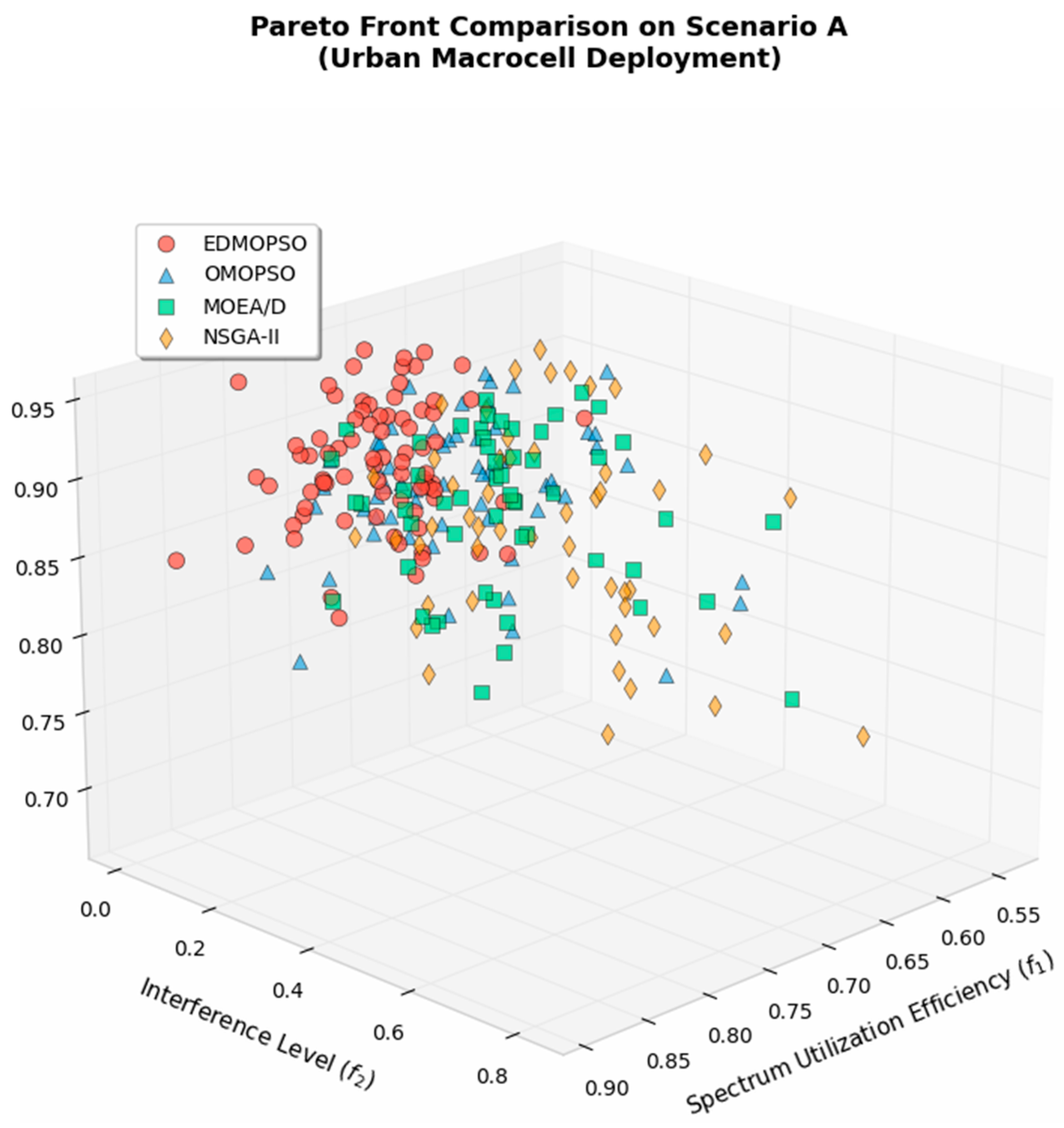
Figure 1. Pareto front comparison on Scenario A. Note: Actual figure would show 3D scatter plots with EDMOPSO achieving better spread and convergence.
Electronics 15 02217 g001
Figure 2. Convergence curves on Scenario B.
Electronics 15 02217 g002
Table 1. Hypervolume results on synthetic benchmarks (mean ± std).
Algorithm50 × 20100 × 50200 × 100
NSGA-II0.652 ± 0.0420.581 ± 0.0380.498 ± 0.051
MOEA/D0.701 ± 0.0350.642 ± 0.0410.567 ± 0.048
SMPSO0.689 ± 0.0390.628 ± 0.0440.552 ± 0.053
OMOPSO0.712 ± 0.0310.651 ± 0.0360.578 ± 0.045
dMOPSO0.698 ± 0.0370.639 ± 0.0390.561 ± 0.049
MBPSO0.621 ± 0.0480.542 ± 0.0550.467 ± 0.062
NSPSO0.678 ± 0.0410.615 ± 0.0460.538 ± 0.054
EDMOPSO0.845 ± 0.0180.798 ± 0.0220.723 ± 0.031
Table 2. IGD results on real-world scenarios (mean ± std, ×10−3).
AlgorithmScenario AScenario BScenario C
NSGA-II12.4 ± 1.818.7 ± 2.415.2 ± 2.1
MOEA/D10.8 ± 1.516.3 ± 2.113.1 ± 1.8
SMPSO11.2 ± 1.617.1 ± 2.313.8 ± 1.9
OMOPSO9.6 ± 1.314.8 ± 1.911.9 ± 1.6
dMOPSO10.3 ± 1.415.6 ± 2.012.5 ± 1.7
MBPSO14.7 ± 2.121.4 ± 2.817.8 ± 2.4
NSPSO11.5 ± 1.717.9 ± 2.514.3 ± 2.0
EDMOPSO7.4 ± 0.911.2 ± 1.39.1 ± 1.1
Table 3. Complete ablation results on Scenario A.
ConfigurationABCDMean HVInteraction
Full EDMOPSO0.845
A only0.798
B only0.756
C only0.723
D only0.712
A + B0.8212.9% ★
A + C0.8121.5%
A + D0.8080.6%
B + C0.7780.1%
B + D0.7690.2%
C + D0.7410.2%
A + B + C0.838+3.2% ★
A + B + D0.8322.4%
A + C + D0.8251.8%
B + C + D0.7890.8%
None0.687
Positive interaction (★) indicates synergy: A + B: +2.9%—adaptive weights enhance repair effectiveness; A + B + C: +3.2%—strongest triple synergy. ANOVA: F(14,435) = 23.7; p < 0.001 confirms significant interactions.
Table 4. Computational time comparison.
AlgorithmMean Time (s)Relative Speed
NSGA-II245.31.0×
MOEA/D198.71.23×
SMPSO156.41.57×
OMOPSO178.21.38×
dMOPSO201.51.22×
MBPSO134.81.82×
NSPSO167.31.47×
EDMOPSO189.61.29×
Table 5. Fair comparison with uniform repair mechanism.
AlgorithmOriginal HVRepair HVvs. EDMOPSO + Repair
NSGA-II0.6520.721−14.7%
MOEA/D0.7010.758−11.5%
SMPSO0.6890.742−13.9%
OMOPSO0.7120.768−10.0%
dMOPSO0.6980.751−12.5%
MBPSO0.6210.698−21.1%
NSPSO0.6780.731−15.6%
EDMOPSO0.8450.845
Table 6. Fairness impact analysis.
ConditionJain’s FairnessHVScenario
No repair (infeasible)0.871A
Basic greedy repair0.8510.758A
(Algorithm 1)(−2.3%)
Round-robin repair0.8640.841A
(Algorithm 2)(−0.8%)(−0.4%)
Basic greedy repair0.8240.798B
(Scenario B)(−3.1%)
Disclaimer/Publisher’s Note: The statements, opinions and data contained in all publications are solely those of the individual author(s) and contributor(s) and not of MDPI and/or the editor(s). MDPI and/or the editor(s) disclaim responsibility for any injury to people or property resulting from any ideas, methods, instructions or products referred to in the content.