1. Introduction
Co-channel interference (CCI) remains a major factor affecting communication reliability in narrowband wireless systems. In practical deployment scenarios, intensive frequency reuse, overlapping coverage, and increasing terminal density make CCI difficult to avoid. Once interference occurs, the signal-to-interference-plus-noise ratio at the receiver decreases, which degrades physical-layer demodulation performance, increases the bit error rate, and further triggers link-layer retransmissions and protocol inefficiency. In real-time communication links, such degradation may ultimately lead to unstable service quality, delayed information delivery, or even link interruption. Therefore, accurate and timely detection of narrowband CCI is of both theoretical and practical importance.
Existing studies on wireless interference detection can be broadly classified into three categories. The first category includes conventional spectrum sensing and threshold-based methods, such as energy detection, adaptive thresholding, and FFT/spectrum-statistics-based monitoring [
1,
2]. These methods are attractive because of their low computational complexity and ease of implementation, but their performance is often sensitive to noise uncertainty, threshold drift, and weak interference conditions. The second category includes time–frequency or feature-fusion approaches, which jointly exploit temporal and spectral information to enhance detection robustness [
1,
3]. The third category includes machine learning-based methods, such as convolutional neural network (CNN) detectors, cooperative spectrum sensing networks, and lightweight data-driven interference classifiers [
3,
4,
5,
6,
7]. These methods can achieve strong classification accuracy in complex environments, but they usually require labeled datasets, offline training, and additional inference resources, which may limit their deployment in engineering scenarios with strict real-time constraints and limited maintenance capability.
Recent studies have reported substantial progress in wireless interference recognition and spectrum sensing. Deep learning-based signal detectors have shown promising performance in the presence of co-channel interference, especially when explicit channel state information is unavailable [
4]. Unsupervised clustering and anomaly-detection methods have also been introduced for narrowband radio-frequency interference analysis [
8]. In addition, adaptive thresholding, hybrid denoising-thresholding schemes, and ML-assisted cooperative sensing frameworks have been proposed to improve robustness under low-SNR conditions [
1,
2,
5]. However, most existing methods either focus on signal presence detection or interference classification, rather than on lightweight online identification of co-channel interference events in operational narrowband links. Moreover, many high-performing ML-based solutions rely on training pipelines that are difficult to maintain when labeled data are scarce or when system conditions vary across devices and deployments [
4,
5,
6].
For narrowband wireless systems, these limitations are particularly relevant. In such scenarios, co-channel interference may not always manifest itself as a large absolute power increase. Instead, because of oscillator offset, phase evolution, and multi-source signal superposition, interference often appears as a short-term nonstationary perturbation in the spectral peak position. Traditional static power detection or single-frame spectral inspection may therefore be insufficiently sensitive, whereas data-driven solutions may impose excessive deployment and maintenance costs. Consequently, there remains a need for a detection method that preserves the interpretability and implementation simplicity of FFT-based monitoring while being more sensitive than static threshold or single-frame spectrum analysis. In addition, recent narrowband wireless studies in industrial and NB-IoT scenarios suggest that lightweight and interpretable monitoring methods remain valuable in broader low-bandwidth communication environments [
9,
10].
To address this gap, this paper proposes a lightweight co-channel interference detection method for narrowband wireless systems based on dynamic spectrum-jump analysis in the FFT domain. The core novelty of the proposed method lies in transforming the short-term temporal instability of dominant FFT-bin positions into an interpretable interference signature for lightweight online detection. In contrast to conventional FFT-based spectrum monitoring, which typically relies on instantaneous amplitude, average energy, or static spectral occupancy, the proposed method uses the FFT only as a front-end transformation and bases the final decision on the temporal inconsistency pattern of dominant carrier-bin indices. This design is particularly suitable for narrowband wireless systems in which co-channel signal superposition may not produce a sufficiently strong power excursion for reliable energy-only detection, but can still induce recurrent peak-bin migration.
The main contributions of this paper are summarized as follows.
A dynamic CCI detection framework is developed for narrowband wireless systems, in which interference is identified through dominant-bin temporal inconsistency rather than static energy inspection.
A lightweight FFT-domain detection rule based on recurrent peak-bin migration is proposed, enabling real-time implementation without offline model training.
A closed-loop processing chain integrating signal acquisition, spectrum analysis, jump-event extraction, and decision output is established for practical deployment and SDR-based validation.
A validation-oriented experimental protocol is adopted, including repeated tests under SNR/ISR variations, ISR/CFO boundary analysis, ROC and precision–recall threshold scans, confidence-interval reporting, and comparison with tuned classical baselines.
Robustness and limitation analyses are conducted for multi-peak ambiguity, two-path Rayleigh fading, and spatially nonstationary multi-antenna extensions, so that the applicability boundaries of the dominant-bin assumption are explicitly stated.
The remainder of this paper is organized as follows.
Section 2 introduces the principle of spectrum-jump detection and explains the physical basis and applicability conditions of dominant-bin instability under co-channel interference.
Section 3 presents the design of the narrowband wireless CCI detection system, including the acquisition, analysis, detection, decision, and complexity-analysis modules.
Section 4 reports the SDR measurements, controlled repeated experiments, ROC/PR threshold validation, robustness tests, and baseline comparisons.
Section 5 discusses the detection mechanism, practical applicability, spatial-channel extension, and limitations.
Section 6 concludes the paper.
2. Principle of Spectrum-Jump Detection
When co-channel interference occurs in a narrowband wireless link, the received signal is formed by the superposition of the desired signal and one or more interfering signals. If the desired and interfering signals are generated by independent oscillators, even a small oscillator frequency deviation may cause a slight carrier-frequency mismatch. Although this mismatch may be too small to create a dramatic shift in total in-band power, it can still cause the dominant spectral peak of the superimposed signal to fluctuate among adjacent FFT bins over time. This short-term nonstationary peak migration is the physical basis of the proposed spectrum-jump detection method.
2.1. Signal Superposition Model
Let the complex baseband expressions of the desired and interference signals be written as
and
where
and
denote the amplitudes of the desired and interference signals, respectively;
and
denote their carrier frequencies; and
and
represent phase noise or phase evolution. Ideally,
, but in practice a small mismatch exists because of oscillator deviation. Let
Then the received superimposed signal can be expressed as
Equation (
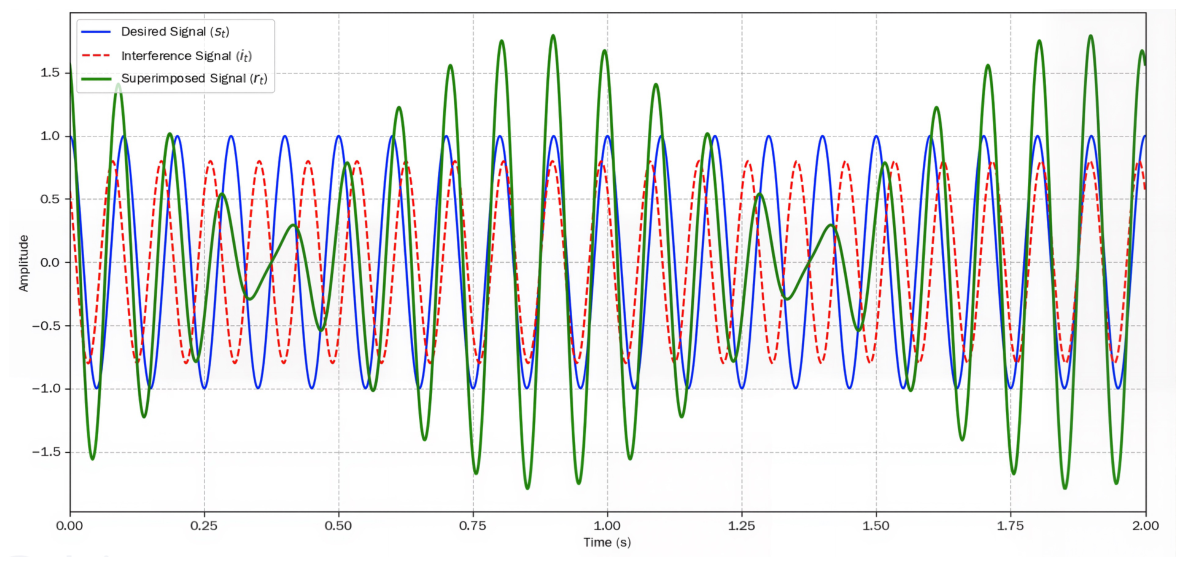
4) shows that the received signal is no longer a single stable sinusoidal component. Instead, the relative phase between the desired and interfering signals evolves over time, which changes the instantaneous amplitude and phase of the composite signal. In the time domain, this effect appears as amplitude fluctuation and waveform distortion. In the frequency domain, it may appear as unstable peak locations around the carrier center.
Figure 1 illustrates the time-domain waveforms of the desired signal, the interference signal, and their superimposed signal.
2.2. Discrete Sampling and FFT-Domain Representation
In practical systems, the received continuous-time signal is digitally sampled and processed in discrete form. Let the sampling rate be
, and let
denote the sampling period. Sampling
yields the discrete sequence
where
N denotes the number of FFT points. For narrowband digital receivers, the sampling rate is selected to satisfy the Nyquist criterion for the observation bandwidth, thereby preventing aliasing in the monitored band.
The discrete Fourier transform (DFT) of the received sequence is
In implementation, the fast Fourier transform (FFT) is used as an efficient realization of the DFT. By linearity,
where
and
denote the frequency-domain representations of the desired and interference signals, respectively.
If phase noise is temporarily ignored for clarity, the desired signal may be approximated as
and the interference signal as
In this case, their dominant FFT peaks are approximately located at
and
Therefore, when , the desired and interference components tend to concentrate around nearby but not identical FFT bins. As the relative phase evolves over time, the dominant peak of the composite spectrum may oscillate between bins near and .
2.3. Physical Interpretation of Spectrum Jumps
Equations (1)–(11) explain why co-channel interference can be detected from peak-bin motion in the FFT domain. When only the desired signal is present, the dominant spectral peak remains nearly stationary over adjacent FFT frames because the carrier frequency is stable. Minor fluctuations may still occur because of receiver noise, spectral leakage, finite-length FFT effects, or quantization, but these are typically sparse and weak.
When an interference signal with a small frequency offset is superimposed, the relative phase between the two signals changes continuously over time. As a result, the location of the maximum spectral magnitude of the composite signal may move among adjacent FFT bins. Importantly, the proposed detector does not rely on a large absolute increase in total power. Instead, it exploits the repeated instability of the dominant carrier-bin position. This makes the method particularly suitable for narrowband CCI scenarios in which the power difference between interference and normal operation is not sufficiently large for reliable single-frame energy detection [
1,
2].
It should also be noted that practical FFT implementations are affected by windowing and spectral leakage. When the actual carrier frequency is not perfectly aligned with an FFT bin, energy spreads into nearby bins. However, the proposed decision rule is based on short-term peak-index consistency across multiple frames rather than on a single-bin amplitude value. Therefore, the method is less sensitive to isolated leakage artifacts or occasional noise spikes than single-frame threshold detectors.
2.4. Applicability Conditions and Multi-Peak Ambiguity
The proposed spectrum-jump signature is observable only when the composite narrowband spectrum exhibits measurable temporal migration of its dominant bin. This condition is usually satisfied when the desired and interfering signals have a non-negligible carrier-frequency offset and comparable received powers. Conversely, if the carrier-frequency offset approaches zero, or if the interference is much weaker than the desired signal, the maximum of the composite spectrum may remain locked near the stronger component. In this case, the jump count may remain close to its normal-state distribution even though CCI is physically present. Therefore, the proposed method should be interpreted as a detector of interference-induced dominant-bin instability, rather than as a universal detector for all possible CCI conditions.
Another important limitation is the single-dominant-bin assumption. In practical narrowband receivers affected by fading, multipath, or adjacent stationary components, two or more spectral peaks may have comparable magnitudes. A direct argmax operation may then switch between nearly equal peaks even without true co-channel interference, which can produce false spectrum jumps. To identify this ambiguity, the dominance ratio between the largest and second-largest spectral peaks can be computed as
where
and
are the largest and second-largest spectral powers in frame
t, respectively. If
is smaller than a predefined ambiguity margin
, the frame can be marked as a multi-peak ambiguous frame and either excluded from jump counting or processed by a top-
k consistency guard. This additional check is not required for the basic detector, but it is useful in deployment scenarios where multiple comparable stationary peaks are expected.
2.5. Oscillator Offset and Practical Frequency Deviation
The carrier-frequency mismatch can be related to oscillator frequency deviation. Let
denote the nominal carrier frequency, and let
and
denote the frequency deviations of the desired and interference oscillators in parts per million (ppm). Then the frequency offset can be approximated as
Equation (
13) indicates that even small ppm-level oscillator deviations may generate a measurable spectral offset in narrowband systems. Although this offset is often insufficient to produce a large shift in the center frequency itself, it can still induce recurrent instability of the dominant FFT-bin position after signal superposition. This provides the conceptual basis for spectrum-jump analysis.
2.6. Spectrum-Jump Detection Rule
Based on the above observation, the key idea of the proposed detector is to track the dominant carrier-bin index across consecutive FFT frames and determine whether its temporal consistency is violated. Let the dominant carrier-bin indices in three consecutive frames be denoted by , , and . Under normal operation, the middle index is expected to remain consistent with either its predecessor or successor, because the carrier center is stable over short time intervals. By contrast, under co-channel interference, recurrent peak migration may cause to differ from both and .
Accordingly, an effective spectrum-jump event is declared when
This rule converts local peak-bin inconsistency into a discrete jump event. To enhance robustness, the detector does not make the final decision from a single event. Instead, it accumulates jump events within a short counting interval . If the accumulated jump count exceeds a decision threshold , co-channel interference is declared.
This design has two advantages. First, it suppresses isolated outliers caused by random noise or occasional FFT anomalies. Second, it preserves low implementation complexity because the decision is based only on FFT processing, peak extraction, and short-window counting.
For clarity,
Table 1 summarizes the key assumptions underlying the proposed spectrum-jump detector and their practical implications. The method is most suitable when CCI produces observable temporal migration of the dominant FFT-bin index. It is not intended to replace all narrowband interference detectors, especially in zero-CFO, extremely weak-interference, equal-power multi-peak, or strongly spatially nonstationary scenarios.
3. Narrowband Wireless Co-Channel Interference Detection System Design
Based on the spectrum-jump principle introduced above, a complete narrowband wireless CCI detection system was designed. The system forms a closed-loop processing chain consisting of signal acquisition, spectrum analysis, spectrum-jump detection, and decision output. The overall objective is to provide real-time, interpretable, and lightweight interference detection suitable for practical deployment in railway narrowband wireless monitoring systems.
3.1. Overall Architecture
The system architecture consists of four functional modules:
Signal acquisition module;
Spectrum analysis module;
Spectrum-jump detection module;
Decision output module.
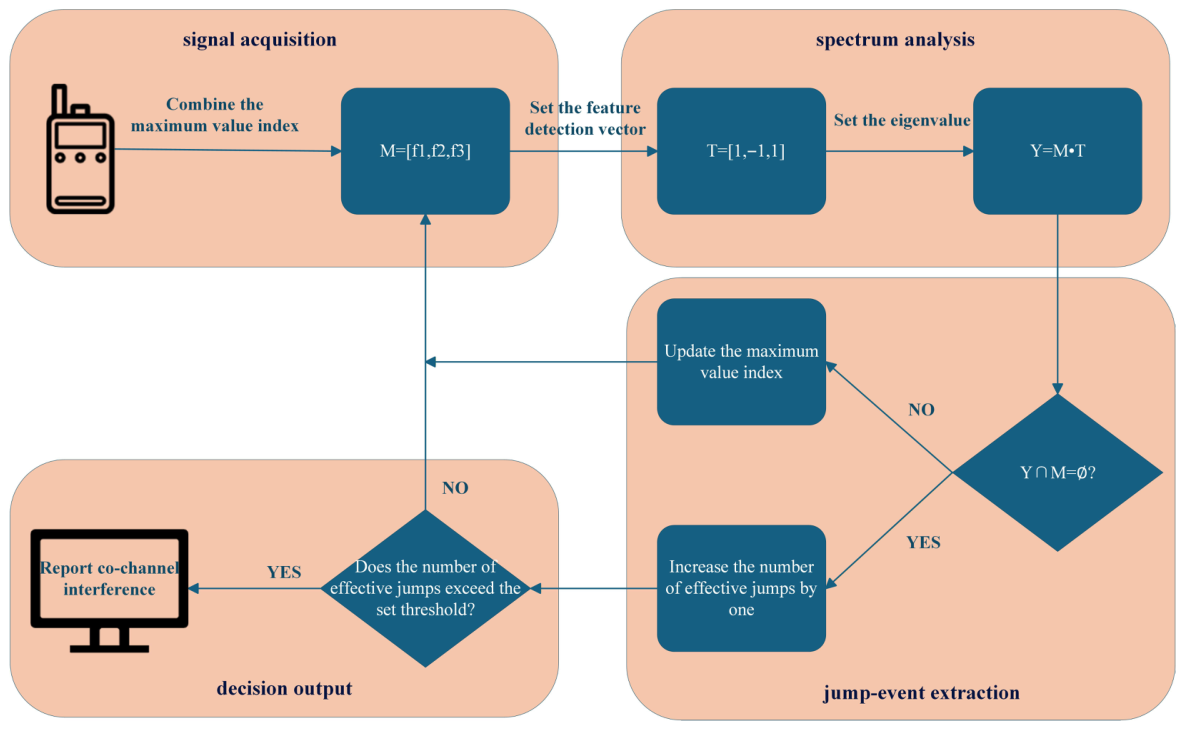
The signal acquisition module receives complex baseband samples from the SDR front end. The spectrum analysis module transforms the received time-domain samples into the frequency domain by FFT. The spectrum-jump detection module extracts the dominant carrier-bin index from each FFT frame and identifies effective jump events through a three-frame sliding-window rule. Finally, the decision output module accumulates jump events within a predefined counting interval and determines whether co-channel interference is present.
Compared with conventional static spectrum monitoring, this architecture explicitly incorporates temporal continuity into the detection process. Compared with data-driven ML approaches, it avoids the need for offline training and large-scale labeled datasets [
4,
5]. Therefore, it provides a practical compromise between detection performance, interpretability, and deployment cost.
3.2. Signal Acquisition Module
The signal acquisition module is responsible for parameter initialization, time-domain signal acquisition, and complex-sample reconstruction. The SDR receiver captures the in-phase (I) and quadrature (Q) components of the baseband signal, which are then combined into complex samples for subsequent frequency-domain analysis.
Let
and
denote the real and imaginary parts of the sampled signal, respectively, where
. The complex sample sequence is constructed as
The resulting sequence provides the complex baseband representation of the received narrowband signal. Using complex sampling rather than real-only sampling allows the system to preserve both amplitude and phase information, which is essential for accurate spectral analysis around the carrier center.
In practical deployment, the sampling rate is selected according to the observation bandwidth, and the receiver gain is set to ensure adequate dynamic range without severe saturation. To keep the following FFT processing stable, the same acquisition configuration is maintained throughout a given experiment or monitoring interval.
3.3. Spectrum Analysis Module
The spectrum analysis module converts the time-domain complex samples into the frequency domain and monitors spectral behavior within the observation band. Specifically, each frame of
N complex samples is buffered and transformed by FFT to obtain the discrete spectrum
The magnitude spectrum is then used to identify the dominant carrier-bin index. In practice, the FFT output is normalized by the signal length, and amplitude or power values may be further converted to the logarithmic dB scale for visualization and engineering analysis.
The choice of FFT size involves a trade-off between spectral resolution and update speed. A larger FFT provides finer frequency resolution and more precise bin localization, but it also increases computational delay and reduces the update rate. A smaller FFT provides faster temporal updates, but the coarser frequency grid makes the dominant-bin trajectory more sensitive to frame-level randomness. For the present narrowband setting, the FFT size is selected to balance frequency discrimination and real-time detection latency.
3.4. Spectrum-Jump Detection Module
The spectrum-jump detection module is the core of the proposed method. Its purpose is to track the temporal evolution of the dominant carrier-bin position and determine whether local inconsistency occurs.
3.4.1. Dominant-Bin Extraction
For each FFT frame, the system identifies the dominant carrier-bin index , corresponding to the frequency-bin location of the maximum spectral peak in the monitored band. This index is then entered into a short sliding buffer used for local consistency analysis.
3.4.2. Three-Frame Sliding-Window Mechanism
To capture short-term peak-bin instability with minimal delay, a sliding window of length three is employed. Let the dominant-bin indices stored in the window be , , and . After each new FFT frame is processed, the window is updated according to
;
;
.
This mechanism maintains the immediate temporal neighborhood of the current observation while avoiding the additional latency associated with longer windows.
3.4.3. Effective Jump Determination
After the sliding window is updated, the detector checks whether the middle index
differs from both neighboring indices. If
an effective spectrum-jump event is recorded.
The rationale of this rule is straightforward. Under normal conditions, the dominant carrier-bin location should remain stable over adjacent frames, so the current index is expected to match at least one nearby observation. In contrast, when co-channel interference induces recurrent spectral instability, the dominant-bin position may abruptly move among neighboring bins, producing a sequence of local inconsistencies. By recording only those events that violate short-term consistency, the detector suppresses isolated random perturbations and focuses on persistent nonstationary behavior.
Figure 2 shows the workflow of the proposed spectrum-jump detection algorithm.
3.5. Decision Output Module
The decision output module converts jump events into the final interference detection result. A global counter is used to record the number of effective spectrum-jump events within a predefined counting interval . At the end of each interval, the accumulated jump count is compared with the decision threshold .
If the jump count exceeds
, co-channel interference is declared; otherwise, the system remains in the normal state. Formally, let
denote the jump count accumulated during
. Then the final decision
D is
This cumulative decision mechanism improves robustness compared with single-frame threshold rules. Even if a noise spike or spectral leakage artifact perturbs one or a few frames, it is unlikely to produce a sustained burst of effective jump events throughout the entire counting interval. Therefore, the final decision is more stable and more suitable for online practical deployment.
3.6. Parameter Selection and Practical Rationale
The main parameters of the proposed system include the sampling rate, FFT size, sliding-window length, counting interval , and decision threshold . These parameters were selected by jointly considering spectral resolution, update latency, robustness, and implementation complexity.
First, the sampling rate should be high enough to cover the observation bandwidth under the Nyquist criterion while remaining computationally manageable for continuous monitoring. Second, the FFT size should provide sufficient frequency resolution to capture narrowband carrier-bin perturbations without introducing excessive detection delay. Third, the sliding-window length is set to three because the proposed jump rule only requires the local consistency relationship among the previous, current, and next observations. A longer window may improve smoothing but would also increase delay and reduce sensitivity to short interference bursts.
The counting interval should be long enough to accumulate multiple jump events so that isolated random perturbations do not trigger a false alarm, but short enough to preserve real-time responsiveness. Finally, the threshold controls the trade-off between detection sensitivity and false-alarm suppression. A very small threshold increases false alarms, whereas an excessively large threshold reduces the detection probability for weak or short interference events. Therefore, should be selected from validation data according to the required balance among detection probability, false-alarm rate, and response latency.
3.7. Algorithmic Summary
For clarity, the overall processing steps of the proposed detector are summarized in Algorithm 1.
This algorithmic formulation highlights that the proposed method is computationally lightweight and suitable for real-time execution. It also makes clear that the method is not a conventional static FFT monitor, but a dynamic detector that transforms short-term peak-bin inconsistency into an interference decision.
| Algorithm 1 Dynamic spectrum-jump CCI detection |
- 1:
Input: complex baseband samples, sampling rate, FFT size N, counting interval , threshold - 2:
Output: interference decision - 3:
Acquire N complex baseband samples from the SDR receiver. - 4:
Compute the FFT magnitude spectrum of the current frame. - 5:
Extract the dominant carrier-bin index . - 6:
Update the three-frame sliding window . - 7:
If and , record one effective jump event. - 8:
Repeat Steps 3–6 within the counting interval . - 9:
At the end of , compare the accumulated jump count with threshold . - 10:
If the count exceeds , output interference; otherwise, output normal state.
|
3.8. Computational Complexity Analysis
Because the proposed method belongs to the FFT-domain detector family, the FFT front end is shared with many conventional spectral monitoring methods. The lightweight advantage of the proposed method lies mainly in its post-FFT decision logic. After each FFT frame is obtained, the detector only needs dominant-bin extraction, a three-frame index buffer, two integer comparisons for the jump rule, and one counter update. No model parameters, training samples, convolutional layers, or iterative optimization procedures are required.
Table 2 clarifies that the proposed detector should not be described as eliminating spectral processing cost. Rather, it reuses a standard FFT front end and replaces complex post-processing with integer-level temporal-consistency logic. This supports the “lightweight” claim while avoiding an overstatement of the computational savings.
4. System Testing and Quantitative Evaluation
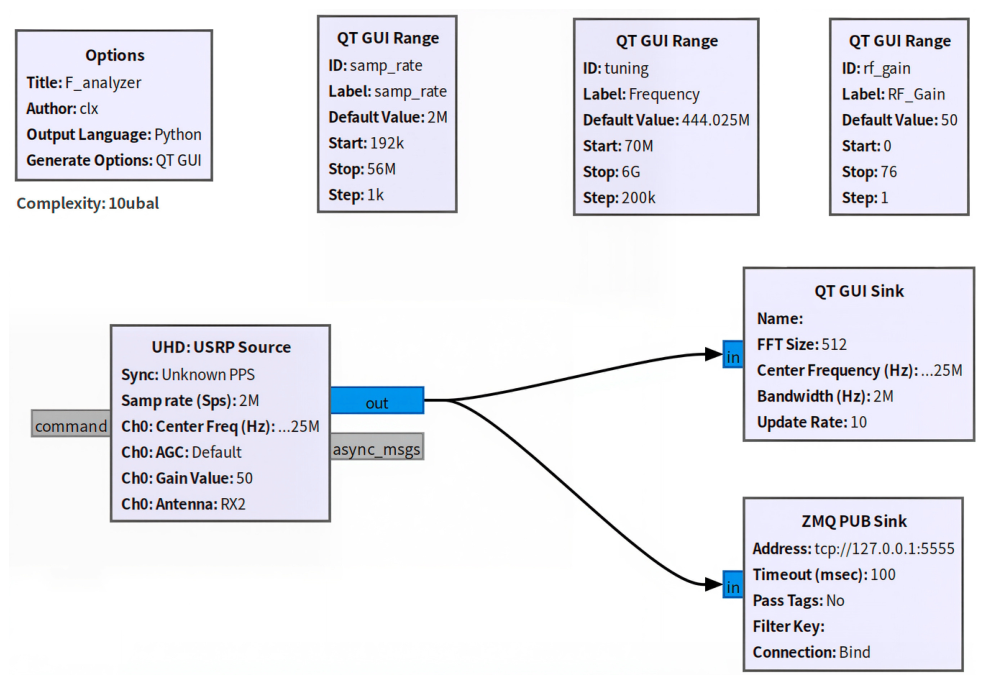
The proposed narrowband co-channel interference detection system was implemented on a GNU Radio-based software-defined radio (SDR) platform (Version 3.10) [
11,
12]. The receiver was configured with the center frequency aligned to the transmitter carrier, a sampling rate of 2 MS/s, a receive gain of 50 dB, and an FFT size of 512. Under this configuration, the observation bandwidth was 2 MHz and the frequency resolution was approximately 3.9 kHz. Each FFT frame contained 512 complex samples, corresponding to a frame duration of 0.256 ms. Therefore, a 100 ms decision interval included about 391 FFT frames, which provided sufficient temporal observations for spectrum-jump counting while still satisfying real-time processing requirements.
The evaluation consists of two complementary parts. First, two SDR-recorded baseband datasets are used to verify the physical feasibility of the detector, including one normal recording without co-channel interference and one recording containing an interference segment. Second, controlled repeated experiments are conducted to assess statistical robustness under varying SNR, ISR, CFO, multi-peak ambiguity, and two-path Rayleigh fading conditions. For each FFT frame, the dominant carrier-bin index is extracted. According to the proposed three-frame sliding-window rule, an effective jump event is counted when the middle dominant bin differs from both neighboring frames. This rule suppresses isolated fluctuations and converts persistent spectral instability into an interference indicator.
The quantitative evaluation covers nine aspects: dominant-bin stability, jump-event statistics, temporal evolution, robustness under repeated SNR/ISR conditions, ISR/CFO detectability boundaries, comparison with tuned baselines, ROC and precision–recall threshold validation, multi-peak ambiguity, and two-path fading robustness.
4.1. Evaluation Protocol for Measured and Controlled Tests
The measured SDR data are used as an end-to-end platform validation, whereas the controlled experiments are used to estimate variability and applicability boundaries. In the SNR/ISR robustness test, SNR is swept over 0, 5, 10, 15, and 20 dB, and ISR is swept over , , 0, 5, and 10 dB. For each SNR/ISR pair, 10 independent normal trials and 10 independent CCI trials are generated, producing 250 normal and 250 CCI trials. In the ISR/CFO boundary test, the SNR is fixed at 20 dB, ISR is swept over the same five levels, and the CFO is swept over 0, 0.1, 0.25, 0.5, 1.0, and 2.0 FFT-bin offsets, with 10 independent trials per condition. Multi-peak ambiguity and two-path Rayleigh fading tests are each repeated 20 times per condition. Unless otherwise stated, the counting interval is ms and the decision threshold is .
For binomial detection outcomes, 95% Wilson confidence intervals are reported where appropriate to quantify statistical uncertainty. The repeated-trial design provides a broader statistical basis for evaluating detection performance beyond the SDR-recorded case study.
4.2. Experimental Configuration and Detection Logic
The hardware parameters of the test platform are listed in
Table 3.
Based on the receiver configuration described above, the system first acquired complex baseband samples and transformed them into the frequency domain using FFT. The dominant carrier-bin index was then tracked frame by frame. Under normal conditions, the dominant bin remained nearly stationary around the carrier center. When co-channel interference was present, the superposition of the desired and interfering signals introduced phase-dependent spectral instability, causing the dominant spectral peak to migrate among adjacent FFT bins.
To reduce the impact of occasional noise spikes, the final decision was not made from a single FFT frame. Instead, the system accumulated effective jump events within a short counting interval and compared the resulting jump count with the decision threshold . This design improved robustness while preserving low implementation complexity.
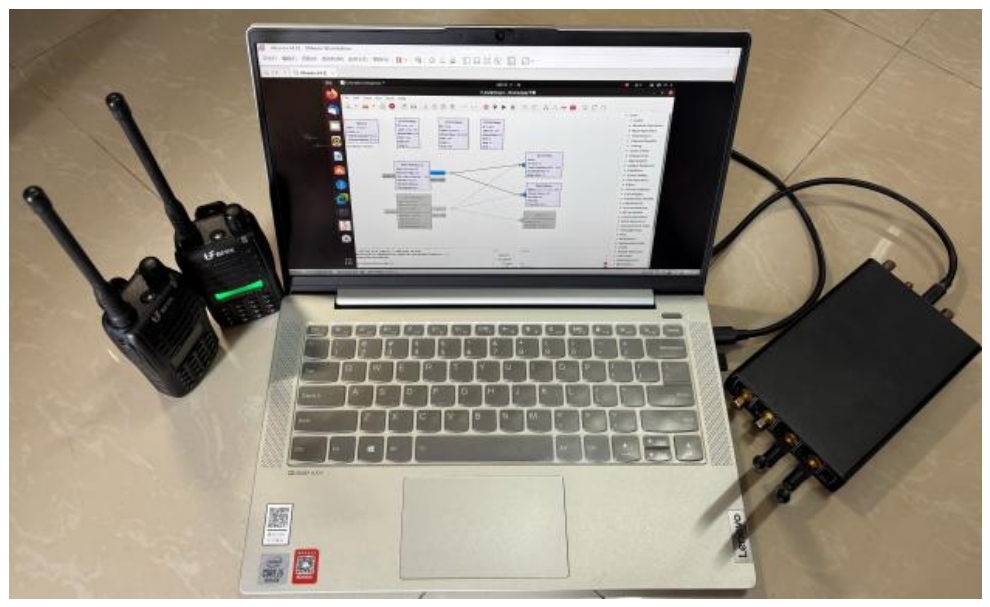
Figure 3 shows the physical connection diagram of the system hardware, and
Figure 4 presents the data flow diagram of the software system.
4.3. Quantitative Analysis of Dominant-Bin Stability
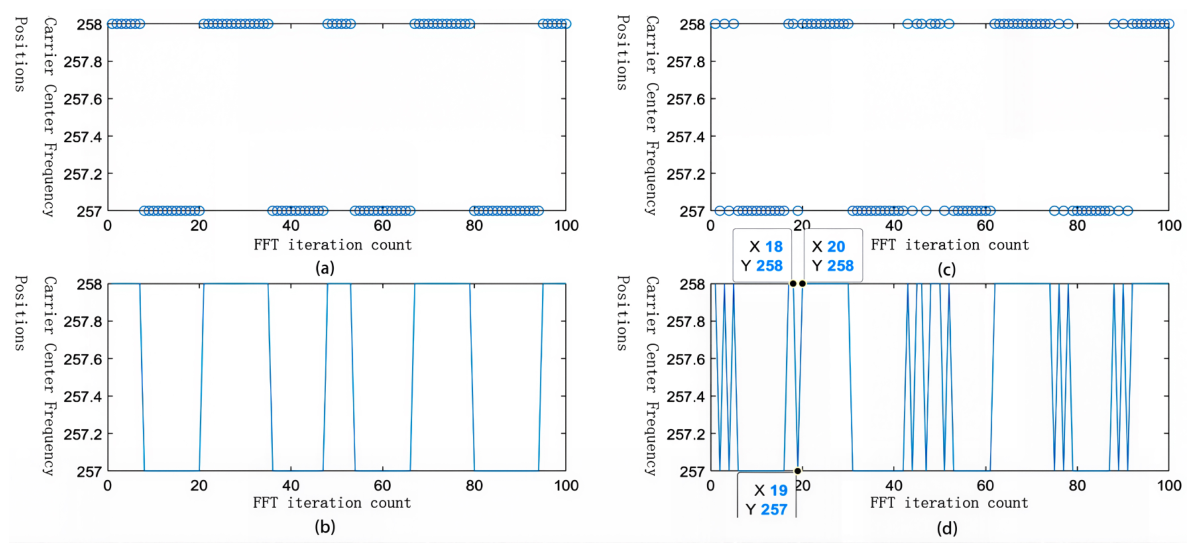
For the normal dataset, the dominant FFT-bin index remained highly concentrated around the carrier center throughout the observation period. Across 6147 FFT frames, the dominant bin was almost always located at bin 256, with only minor fluctuations to adjacent bins 255 and 257. The total number of distinct dominant-bin positions was only three, indicating strong spectral stability in the absence of co-channel interference.
By contrast, the CCI dataset exhibited substantially different behavior. Although the dominant bin was still centered near bin 256 during part of the recording, its temporal stability deteriorated significantly once interference became active. Across 5888 FFT frames, the number of distinct dominant-bin positions increased to 406, showing that the superposition of narrowband signals caused repeated migration of the dominant spectral peak. This result confirms that dominant-bin instability is a highly discriminative signature of narrowband co-channel interference.
4.4. Statistics of Spectrum-Jump Events
To provide a more rigorous comparison, the jump-event statistics extracted from the two datasets are summarized in
Table 4.
As shown in
Table 4, the normal case produced only a small number of isolated jump events. The jump count in a 100 ms window remained between 2 and 8, and the average jump count was only 4.95. This indicates that ordinary receiver noise, quantization effects, and minor spectral leakage did not generate persistent spectrum-jump behavior.
In contrast, the CCI case exhibited much stronger nonstationary behavior. The effective jump ratio increased from 1.29% to 18.20%, and the average jump count per 100 ms window increased by more than one order of magnitude. More importantly, the upper tail of the jump-count distribution became extremely large, with the 95th percentile reaching 386 and the maximum value reaching 387. These results provide clear quantitative evidence that the proposed jump-counting mechanism can effectively distinguish normal carrier fluctuations from interference-induced spectral instability.
4.5. Temporal Evolution of the Interference Process
To further analyze the time-varying behavior of the detector, the jump count was evaluated using a 100 ms counting window with a 10 ms sliding step. In the normal dataset, the jump count remained consistently low throughout the entire observation interval, fluctuating slightly around five and never exceeding eight. This confirms that the proposed detector is not easily triggered by random local fluctuations.
In the CCI dataset, the early part of the signal showed relatively low jump counts similar to those of the normal case, suggesting that the carrier remained stable before the interference became dominant. However, a sharp transition occurred at approximately 1.16–1.25 s, after which the jump count rose abruptly and stayed at a very high level. This temporal behavior is consistent with the physical mechanism of the proposed method: once co-channel interference becomes sufficiently strong, the evolving phase relationship and frequency offset between the desired and interfering signals cause repeated migration of the dominant FFT bin, which is then captured as dense jump events within the decision interval.
Figure 5 shows the carrier center frequency positions under normal and interference conditions.
4.6. Repeated Tests Under SNR and ISR Variations
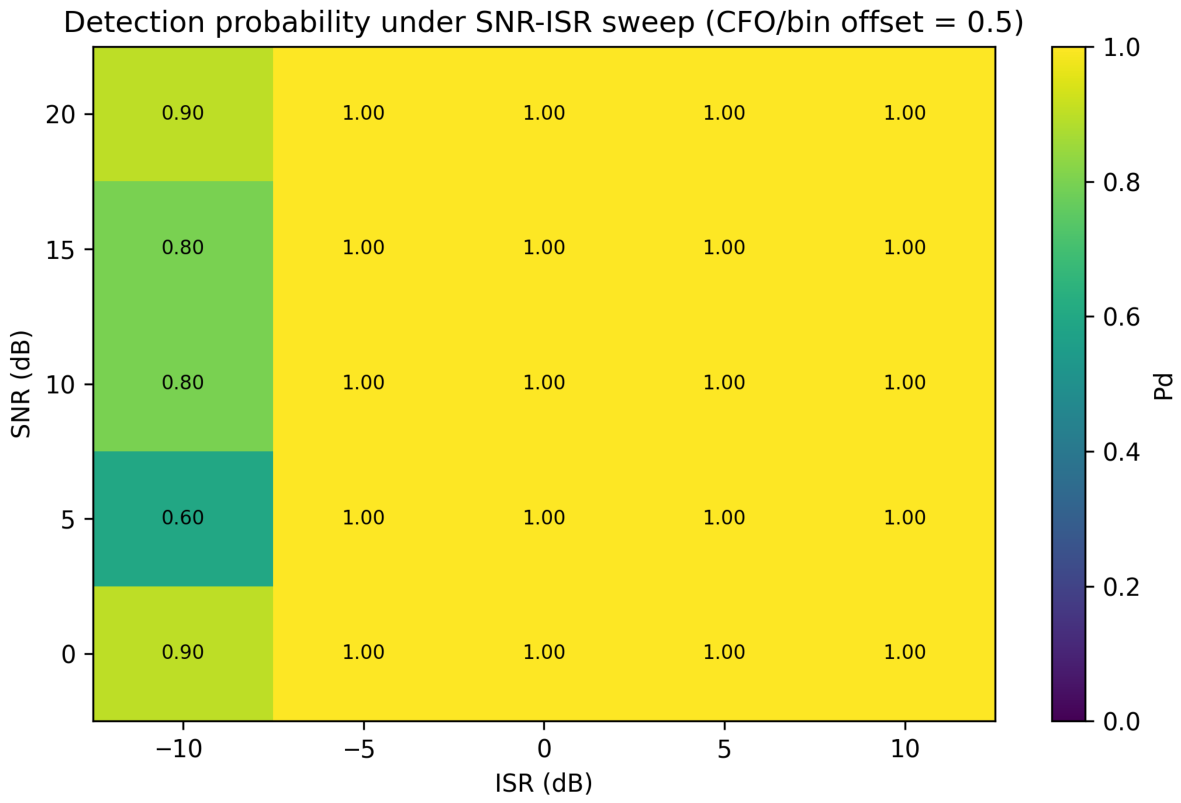
To address the limited statistical scope of the two measured recordings, a controlled SNR/ISR robustness test was conducted. The CFO was fixed at a 0.5 FFT-bin offset, while SNR was swept from 0 to 20 dB and ISR was swept from
to 10 dB. Each condition was repeated 10 times.
Figure 6 shows the resulting detection probability heatmap.
Across the 25 SNR/ISR conditions, the proposed detector achieved 240 successful detections out of 250 CCI trials, corresponding to an overall detection probability of 96.0% with a 95% Wilson confidence interval of approximately 92.8–97.8%. No false alarm was observed in the 250 normal trials, which corresponds to an empirical false-alarm rate of 0% and a 95% Wilson upper bound of approximately 1.51%. As summarized in
Table 5, the detector achieved 100% detection probability for all tested conditions with ISR
dB. The performance degradation was concentrated at ISR =
dB, where the interference component was sufficiently weak that the composite spectral maximum occasionally remained locked near the desired signal.
These repeated results support the robustness of the spectrum-jump mechanism under moderate and strong interference, while also revealing that very weak interference is a practical boundary case rather than an unqualified success condition.
4.7. Detectability Boundary Under ISR and CFO Variations
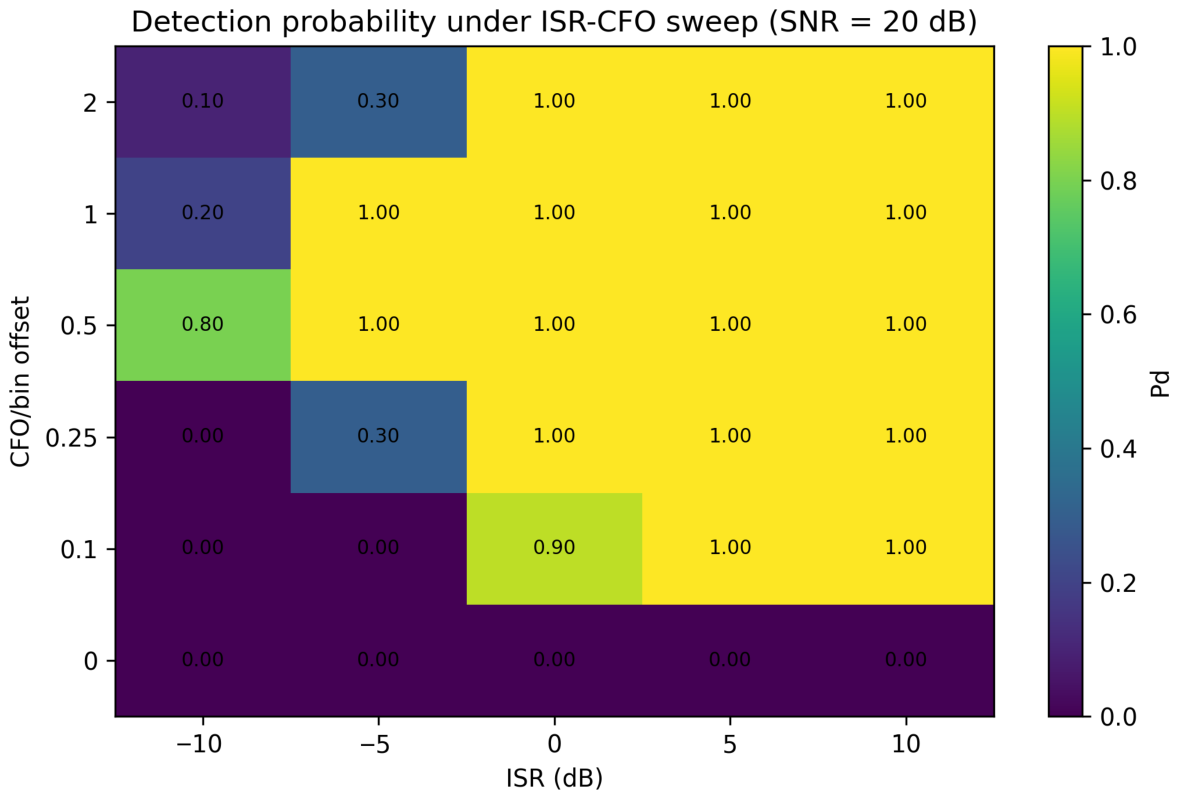
A second controlled test was conducted to examine the physical detectability boundary associated with carrier-frequency offset. The SNR was fixed at 20 dB, ISR was swept from
to 10 dB, and CFO was swept from 0 to 2 FFT-bin offsets.
Figure 7 presents the corresponding detection probability heatmap.
The results show a clear physical boundary. When CFO is zero, the detection probability is 0% for all ISR levels, because the composite spectral maximum remains stable instead of migrating across bins. When CFO is nonzero and ISR is at least 0 dB, the detector achieves 149 successful detections out of 150 trials, i.e., 99.3% detection probability with a 95% Wilson confidence interval of approximately 96.3–99.9%. When CFO is at least 0.5 bin and ISR is at least dB, the detector achieves 113 successful detections out of 120 trials, i.e., 94.2% with a 95% Wilson confidence interval of approximately 88.4–97.1%. These results confirm that the proposed detector is effective when CCI creates observable dominant-bin migration, but it should not be expected to detect zero-CFO CCI from the spectrum-jump signature alone.
4.8. Quantitative Comparison with Baseline Methods
To further validate the proposed method on the measured SDR record, a baseline comparison was conducted using conventional energy detection (ED), an adaptive threshold/CFAR-style detector, and the proposed dynamic spectrum-jump detector. The purpose of this comparison is to examine whether dominant-bin temporal inconsistency provides additional sensitivity beyond power-based rules on the same receiver data.
For a fair comparison, all methods used the same receiver front end, sampling rate, observation bandwidth, FFT configuration, 100 ms analysis window, and 10 ms sliding step wherever applicable. The measured-record comparison produced 289 decision windows in total, including 148 windows from the normal recording and 141 windows from the CCI recording. According to the measured transition of dominant-bin instability, the interference onset in the CCI record occurred at approximately 1.16 s. Therefore, the 24 windows after this onset were treated as positive samples and the remaining 265 windows were treated as negative samples.
The ED baseline used the average in-band signal power within each window. Its threshold was selected from the normal-validation distribution to suppress false alarms. The CFAR-style detector used a local median-based adaptive threshold and was tuned over its scaling factor and local reference-window setting on the validation portion before test evaluation. The proposed method used the jump count extracted from the dominant FFT-bin trajectory, with ms and . The evaluated metrics include accuracy, probability of detection (), false-alarm rate (), miss rate (), F1-score, and detection latency relative to the marked interference onset.
As shown in
Table 6, the proposed method achieved the best overall measured-record performance among the three training-free detectors. It captured all 24 positive windows after the marked interference onset, while ED missed two positive windows and the CFAR-style detector missed 13 positive windows. Because this measured-record comparison is based on one normal recording and one CCI recording, the 100% detection probability should be interpreted as a platform-specific measurement result rather than as a universal guarantee. The repeated controlled experiments in sections above and below are therefore used to provide broader statistical evidence.
To quantify uncertainty in the measured-window comparison,
Table 7 reports Wilson confidence intervals for
and
. The proposed method has a 95% confidence interval of approximately 86.2–100% for
on the 24 positive measured windows and approximately 0.07–2.11% for
on the 265 negative measured windows. These intervals make explicit that the measured SDR record alone is not sufficient to justify an overgeneralized 100% detection claim.
Compared with ED, the proposed method provided a clear improvement in recall and onset responsiveness. Although ED produced no false alarms on the current measured data, it missed two positive windows and responded about 20 ms later than the proposed method. This result indicates that static energy-based detection can remain effective when interference produces a pronounced power anomaly, but it is less sensitive than the dynamic spectrum-jump rule in tracking the onset of abnormal spectral behavior.
Compared with the tuned CFAR-style detector, the proposed method achieved higher measured-record recall. The adaptive detector responded quickly to the interference onset, but its locally updated threshold adapted to the abnormal segment too rapidly, causing missed detections during the sustained interference period. This result should not be interpreted as proving the fundamental inadequacy of CFAR methods in all narrowband settings; rather, it indicates that, for the present measured abnormality pattern, local power adaptation alone is less stable than dominant-bin temporal inconsistency.
The manuscript restricts quantitative superiority claims to training-free classical baselines evaluated under the same protocol. ML-based spectrum detectors remain relevant alternatives when a sufficiently large labeled corpus is available, and the proposed jump count can also be used as one interpretable feature in a future shallow ML or anomaly-detection baseline.
4.9. ROC/PR Analysis and Validation-Based Threshold Setting
The decision threshold
was re-examined using a validation-oriented threshold scan. Let
and
denote the mean and standard deviation of the normal-state jump count in the validation set. A simple conservative threshold rule can be written as
where
controls the desired false-alarm margin. For the measured normal data,
and
, so
. Therefore, thresholds above 10 already lie outside the dominant normal fluctuation range.
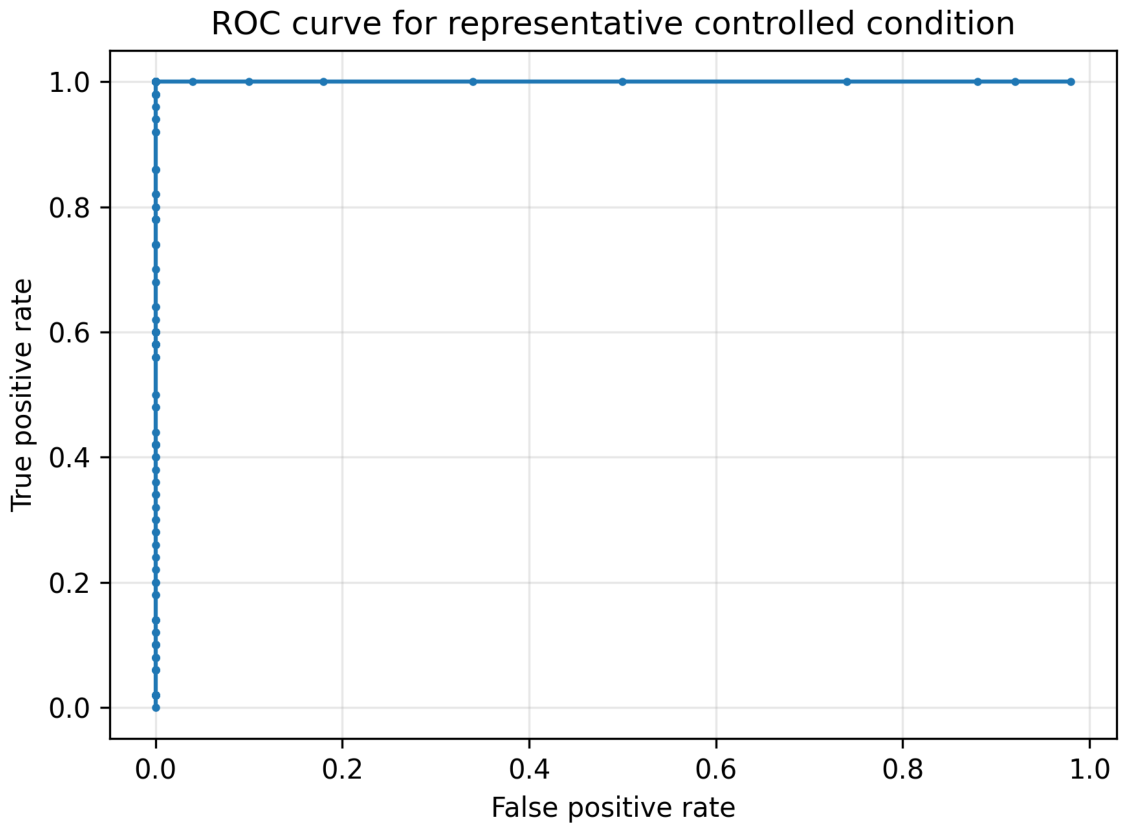
Figure 8 and
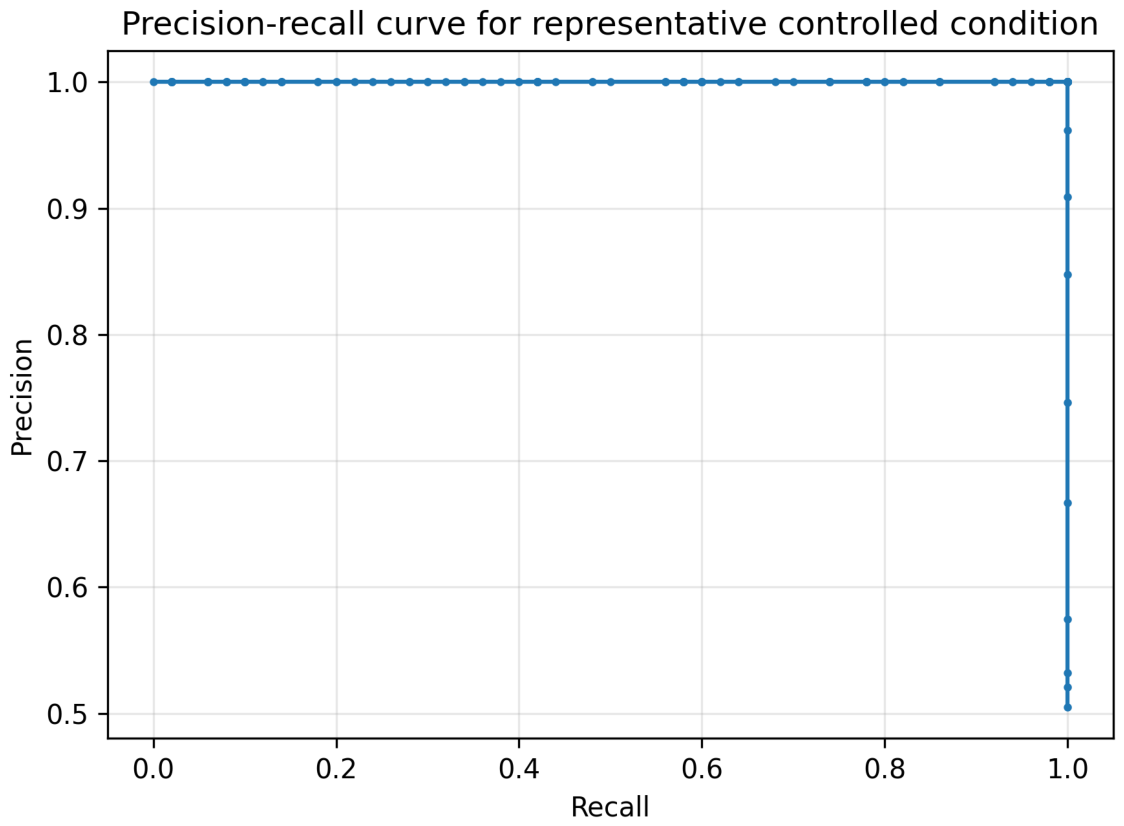
Figure 9 show the ROC and precision–recall curves obtained from the representative validation scan. The threshold range from 9 to 53 simultaneously gives
,
, precision = 1, recall = 1, and F1-score = 1. The selected operating point
is therefore located inside a broad stable plateau.
4.10. Parameter Sensitivity Analysis
The main parameter choices of the proposed detector are evaluated through a sensitivity study covering the FFT size (
N), sliding-window length, counting interval (
), and decision threshold (
).
Table 8 summarizes the sensitivity of the major design parameters and the rationale for the selected operating point.
The influence of the counting interval can be seen directly from the jump-count statistics. On the measured data, when ms, the 95th-percentile jump count was 4 in the normal recording and 193 in the CCI recording. When ms, the corresponding values became approximately 7.65 and 388, respectively. When ms, they increased further to 10 and 579.5. These results indicate that all three intervals preserve strong class separability, but 50 ms is more vulnerable to isolated fluctuations and 150 ms increases the decision delay. Therefore, 100 ms was selected as the preferred compromise between robustness and responsiveness.
The threshold was selected by combining the normal-state distribution rule and the ROC/PR validation plateau. A very small threshold increases false alarms, whereas an excessively large threshold reduces sensitivity to weaker or shorter interference events. The selected value is higher than the normal-state upper tail while remaining well below the jump-count values observed under moderate and strong CCI in the repeated experiments.
Overall, the sensitivity analysis shows that the final parameter set ms, achieves a favorable trade-off among detection probability, false-alarm control, and real-time implementation cost.
Based on
Table 8,
Table 9 further provides deployment-oriented tuning guidance for different SNR/ISR and latency requirements.
The selected parameter set is recommended as the default operating point for the tested narrowband SDR configuration. In practical deployment, however, the preferred values of and should be adjusted according to the expected SNR/ISR region and the relative cost of false alarms and missed detections.
When SNR is high and ISR is moderate or strong, the jump-count separation between normal and CCI windows is usually large. In this case, a larger or a shorter counting interval can be used to reduce false alarms and detection latency. When ISR is weak or SNR is low, the interference-induced bin migration becomes less frequent. A slightly lower or a longer can improve sensitivity, but this increases the risk of false alarms caused by noise, leakage, or multi-peak ambiguity. Therefore, should first be initialized from the normal-state rule and then validated using a small set of CCI examples or controlled injection tests.
A practical tuning procedure is as follows. First, collect interference-free data under the expected receiver configuration and estimate the normal jump-count statistics . Second, choose an initial threshold using for balanced operation, for conservative false-alarm control, or for weak-interference sensitivity. Third, select according to the required response time: shorter windows such as 50 ms reduce latency but are more sensitive to isolated fluctuations, whereas longer windows such as 150 ms improve accumulation under weak ISR but increase delay. Finally, verify the selected pair using ROC/PR scans or controlled CCI injection whenever possible.
4.11. Multi-Peak Ambiguity Test
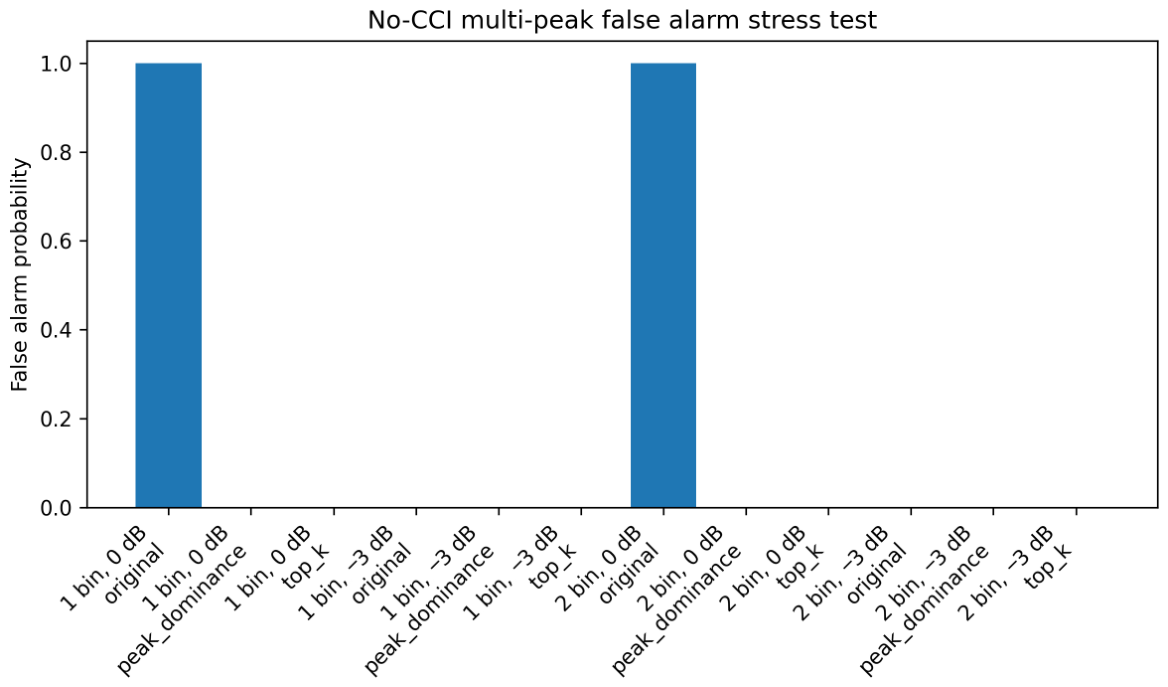
The single-dominant-bin assumption is examined through a controlled multi-peak ambiguity test, in which two stationary spectral peaks are generated with peak spacings of one and two FFT bins. The second peak was set either equal in power to the primary peak or 3 dB lower. Three variants were evaluated: the original argmax-based rule, a peak-dominance guard, and a top-k consistency guard.
As shown in
Figure 10, equal-power stationary peaks create a severe ambiguity for the original argmax rule. When the peak spacing is one bin and the second peak has equal power, the original method yields a false-alarm rate of 100% with a mean jump count of 101.45. When the spacing is two bins under equal power, the false-alarm rate remains 100% with a mean jump count of 97.60. However, when the second peak is 3 dB lower, the original false-alarm rate drops to 0%, showing that the problem arises mainly from nearly equal stationary peaks. Both the peak-dominance and top-
k guards suppress false alarms in the tested multi-peak cases. Therefore, a peak-dominance guard is recommended when practical deployments contain multiple comparable stationary carriers.
4.12. Two-Path Rayleigh Channel Robustness
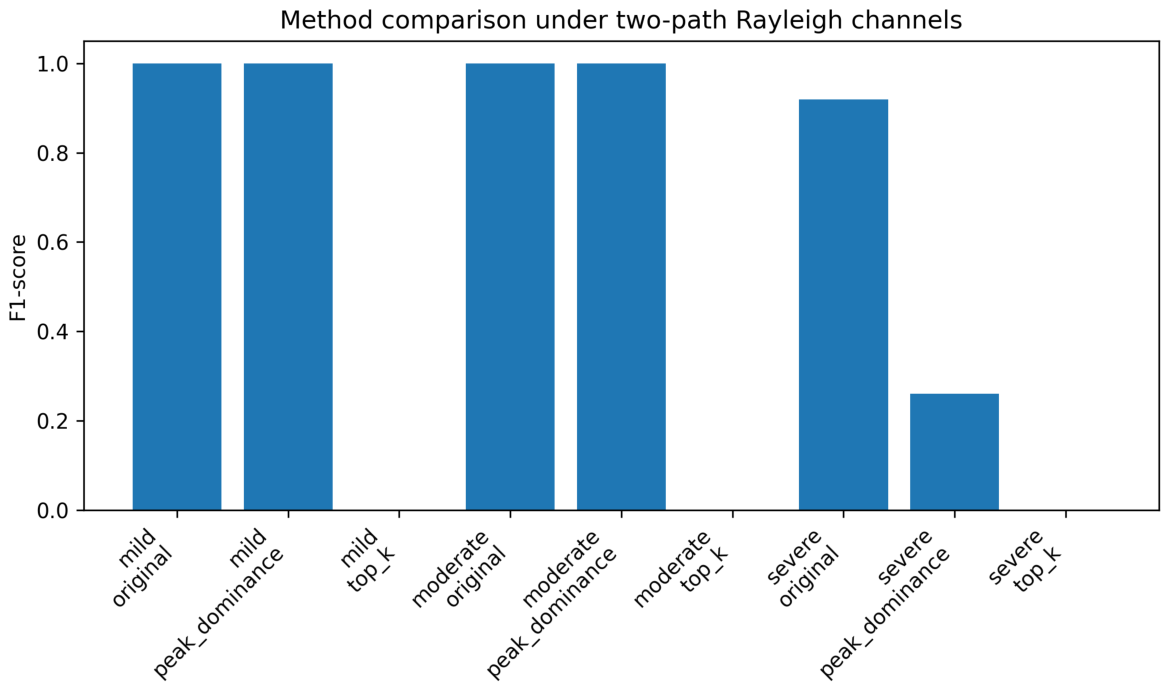
To address the effect of fading and multipath, a two-path Rayleigh robustness test was conducted. Three cases were considered: mild fading with 20 dB SNR, 0 dB ISR, 1.0-bin CFO, and a second path 10 dB weaker; moderate fading with 20 dB SNR, 0 dB ISR, 0.5-bin CFO, and a second path 6 dB weaker; and severe fading with 10 dB SNR, dB ISR, 0.25-bin CFO, and a second path 3 dB weaker. Each case was repeated 20 times.
Figure 11 shows that the original detector retains a 100% detection probability and 0% false-alarm rate in the mild and moderate two-path cases. In the severe case, the detection probability decreases to 85%, with an F1-score of approximately 91.89%. This confirms that the proposed detector is robust to light and moderate two-path fading, but performance degrades when low SNR, weak ISR, small CFO, and stronger multipath coexist. The peak-dominance guard remains useful for reducing multi-peak false alarms, but it may become too conservative in the severe fading case; therefore, it should be treated as an optional false-alarm guard rather than as a complete replacement for the original jump detector.
5. Discussion of Experimental Results
The revised experiments show that the key discriminative feature of co-channel interference is not simply an increase in spectral power, but a repeated loss of temporal consistency in the dominant FFT-bin position. Under interference-free conditions, the carrier center remains highly stable, and the dominant FFT bin is concentrated within a very narrow range around the nominal carrier location. Although minor bin fluctuations still occur because of receiver noise, finite-length FFT effects, and spectral leakage, these fluctuations are sparse and do not accumulate into a large jump count within the counting interval.
When co-channel interference is present with a non-negligible oscillator offset, the superposition of two narrowband signals and their time-varying relative phase causes the composite spectral maximum to move among nearby bins. The measured data confirm this behavior: the number of unique dominant bins increased from 3 in the normal case to 406 in the interference case, while the effective jump ratio increased from 1.29% to 18.20%. The controlled experiments further show that this mechanism remains reliable across a broad range of SNR/ISR conditions, but only when the interference is strong enough and the CFO is large enough to induce observable bin migration.
The baseline comparison should be interpreted with appropriate scope. On the measured SDR record, the proposed method achieved higher recall and shorter onset latency than the tuned ED and CFAR-style baselines. However, this does not imply that all adaptive threshold, cyclostationary, correlation-based, or ML-based detectors are fundamentally inferior. Those methods may be preferable when prior modulation structure, pilot sequences, known cyclic features, or large labeled datasets are available. The contribution of this paper is instead a training-free and modulation-agnostic detector that is especially suitable when a receiver can continuously track FFT-bin trajectories but cannot maintain a labeled training pipeline.
The robustness tests also clarify the dominant-bin assumption. The detector is reliable in single-carrier and moderate two-path conditions, but it can produce false alarms when two stationary peaks have nearly equal power. The peak-dominance ratio and top-k consistency guards are therefore useful optional safeguards for environments with multiple comparable stationary carriers. Nevertheless, these guards may reduce sensitivity in severe fading cases, so practical deployment should select them according to the expected false-alarm and missed-detection costs.
Extension to Multi-Antenna and Spatially Nonstationary Channels
The present implementation is a single-receiver-chain detector and treats CCI primarily as a time–frequency-domain phenomenon. In modern multi-antenna, distributed, or near-field deployments, co-channel interference can also exhibit spatial nonstationarity: different array elements or monitoring nodes may observe different ISR values, fading states, phase relationships, and dominant-bin trajectories. This spatial variation can change the distribution of the jump count across antenna elements.
A natural extension is to compute an antenna-indexed jump count
for the
m-th antenna or monitoring node. The final decision can then be made by maximum fusion,
or by weighted voting,
where
denotes the reliability weight of the
m-th channel and
is the fusion threshold. This extension would allow the detector to exploit spatial diversity while preserving the interpretability of the original jump-count rule. A full multi-antenna validation is outside the scope of the current paper and is identified as an important direction for future work.
From an engineering perspective, the proposed method offers a favorable balance among interpretability, computational cost, and deployment simplicity. The algorithm requires only FFT processing, dominant-bin extraction, and short-window counting. It does not depend on offline training, labeled datasets, or complex model inference. Therefore, it is suitable as a lightweight online trigger in railway narrowband wireless systems and related narrowband monitoring tasks. At the same time, the detector should be combined with other methods when the expected interference has zero CFO, extremely low ISR, strong multipath, or spatially heterogeneous behavior.
Recent hybrid-field XL-MIMO studies have shown that accurate channel estimation in near-field/far-field mixed propagation environments may require sophisticated sparse Bayesian learning frameworks to exploit spatial sparsity and path correlations [
13]. For example, enhanced hybrid-field XL-MIMO channel estimation based on joint sparse Bayesian learning integrates near-field and far-field dictionaries into a unified estimation framework to improve channel-estimation robustness. In contrast, the proposed spectrum-jump detector is not designed to estimate the full high-dimensional MIMO channel. Instead, it provides a low-complexity online trigger based on temporal FFT-bin inconsistency. Therefore, the proposed method can complement advanced XL-MIMO estimation strategies by providing an early-warning or pre-screening mechanism before more computationally demanding spatial-channel-estimation or interference-localization modules are activated.
6. Conclusions
This paper proposed a narrowband co-channel interference detection method based on dynamic spectrum-jump analysis. Unlike conventional static spectrum or energy-based approaches, the proposed method identifies interference by tracking short-term inconsistency in dominant carrier-bin positions across consecutive FFT frames. The method preserves the simplicity and interpretability of FFT-based monitoring while improving sensitivity to nonstationary spectral perturbations caused by signal superposition and oscillator offset.
In the SDR measurement, the dominant carrier bin remained highly stable in the normal case, with only 3 distinct dominant-bin positions and an effective jump ratio of 1.29%, whereas the CCI case contained 406 distinct dominant-bin positions and an effective jump ratio of 18.20%. On the measured positive windows after the marked onset, the proposed detector produced no missed detections in this SDR recording. This result is reported together with confidence intervals and should be interpreted as case-study evidence rather than a universal robustness guarantee.
Controlled repeated experiments further clarify the operating region of the detector. Under SNR/ISR variations, the proposed method achieved a 96.0% overall detection probability over 250 CCI trials and no false alarms over 250 normal trials, with all ISR dB conditions detected successfully in the tested setting. Under ISR/CFO variations, the detector performed reliably when nonzero CFO and sufficient ISR produced observable dominant-bin migration, but it failed at zero CFO because the spectrum-jump signature disappeared. Two-path Rayleigh tests showed robust performance in mild and moderate fading and reduced detection probability in the severe case. Multi-peak ambiguity tests showed that equal-power stationary peaks can cause false jumps, motivating the optional peak-dominance guard.
Overall, the proposed method is best positioned as a low-complexity, interpretable, training-free online detector for narrowband CCI cases that induce temporal FFT-bin instability. It is not intended to replace all narrowband interference detectors. Its effectiveness depends on whether the interference produces measurable dominant-bin migration. When the oscillator offset is nearly zero, the interference is much weaker than the desired signal, multiple comparable stationary peaks coexist, or spatially nonstationary multi-antenna effects dominate, additional detectors or fusion strategies may be required.
Future work will focus on larger labeled datasets for fair comparison with SVM, random-forest, CNN, and anomaly-detection baselines; correlation-based and cyclostationary classical detectors for scenarios with known signal structure; multi-antenna fusion for spatially nonstationary channels; and hardware-level profiling of memory footprint and real-time processing load on embedded SDR platforms.